EP4138266B1 - Charger with two coils for wireless charging - Google Patents
Charger with two coils for wireless charging Download PDFInfo
- Publication number
- EP4138266B1 EP4138266B1 EP21192274.5A EP21192274A EP4138266B1 EP 4138266 B1 EP4138266 B1 EP 4138266B1 EP 21192274 A EP21192274 A EP 21192274A EP 4138266 B1 EP4138266 B1 EP 4138266B1
- Authority
- EP
- European Patent Office
- Prior art keywords
- antenna
- power
- portable
- power amplifier
- portable device
- Prior art date
- Legal status (The legal status is an assumption and is not a legal conclusion. Google has not performed a legal analysis and makes no representation as to the accuracy of the status listed.)
- Active
Links
Images
Classifications
-
- H—ELECTRICITY
- H02—GENERATION; CONVERSION OR DISTRIBUTION OF ELECTRIC POWER
- H02J—ELECTRIC POWER NETWORKS; CIRCUIT ARRANGEMENTS OR SYSTEMS FOR SUPPLYING OR DISTRIBUTING ELECTRIC POWER; SYSTEMS FOR STORING ELECTRIC ENERGY
- H02J50/00—Circuit arrangements or systems for wireless supply or distribution of electric power
- H02J50/005—Mechanical details of housing or structure aiming to accommodate the power transfer means, e.g. mechanical integration of coils, antennas or transducers into emitting or receiving devices
-
- H—ELECTRICITY
- H02—GENERATION; CONVERSION OR DISTRIBUTION OF ELECTRIC POWER
- H02J—ELECTRIC POWER NETWORKS; CIRCUIT ARRANGEMENTS OR SYSTEMS FOR SUPPLYING OR DISTRIBUTING ELECTRIC POWER; SYSTEMS FOR STORING ELECTRIC ENERGY
- H02J50/00—Circuit arrangements or systems for wireless supply or distribution of electric power
- H02J50/001—Energy harvesting or scavenging
-
- H—ELECTRICITY
- H02—GENERATION; CONVERSION OR DISTRIBUTION OF ELECTRIC POWER
- H02J—ELECTRIC POWER NETWORKS; CIRCUIT ARRANGEMENTS OR SYSTEMS FOR SUPPLYING OR DISTRIBUTING ELECTRIC POWER; SYSTEMS FOR STORING ELECTRIC ENERGY
- H02J50/00—Circuit arrangements or systems for wireless supply or distribution of electric power
- H02J50/10—Circuit arrangements or systems for wireless supply or distribution of electric power using inductive coupling
- H02J50/12—Circuit arrangements or systems for wireless supply or distribution of electric power using inductive coupling of the resonant type
-
- H—ELECTRICITY
- H02—GENERATION; CONVERSION OR DISTRIBUTION OF ELECTRIC POWER
- H02J—ELECTRIC POWER NETWORKS; CIRCUIT ARRANGEMENTS OR SYSTEMS FOR SUPPLYING OR DISTRIBUTING ELECTRIC POWER; SYSTEMS FOR STORING ELECTRIC ENERGY
- H02J50/00—Circuit arrangements or systems for wireless supply or distribution of electric power
- H02J50/40—Circuit arrangements or systems for wireless supply or distribution of electric power using two or more transmitting or receiving devices
- H02J50/402—Circuit arrangements or systems for wireless supply or distribution of electric power using two or more transmitting or receiving devices the two or more transmitting or the two or more receiving devices being integrated in the same unit, e.g. power mats with several coils or antennas with several sub-antennas
-
- H—ELECTRICITY
- H02—GENERATION; CONVERSION OR DISTRIBUTION OF ELECTRIC POWER
- H02J—ELECTRIC POWER NETWORKS; CIRCUIT ARRANGEMENTS OR SYSTEMS FOR SUPPLYING OR DISTRIBUTING ELECTRIC POWER; SYSTEMS FOR STORING ELECTRIC ENERGY
- H02J50/00—Circuit arrangements or systems for wireless supply or distribution of electric power
- H02J50/80—Circuit arrangements or systems for wireless supply or distribution of electric power involving the exchange of data, concerning supply or distribution of electric power, between transmitting devices and receiving devices
-
- H—ELECTRICITY
- H02—GENERATION; CONVERSION OR DISTRIBUTION OF ELECTRIC POWER
- H02J—ELECTRIC POWER NETWORKS; CIRCUIT ARRANGEMENTS OR SYSTEMS FOR SUPPLYING OR DISTRIBUTING ELECTRIC POWER; SYSTEMS FOR STORING ELECTRIC ENERGY
- H02J7/00—Circuit arrangements for charging or discharging batteries or for supplying loads from batteries
- H02J7/02—Circuit arrangements for charging or discharging batteries or for supplying loads from batteries for charging batteries from AC mains by converters
Definitions
- the present invention relates to a system comprising a power device and a portable device, wherein the portable device comprises a battery and the power device is configured to wireless charge the battery of the portable device, the power device comprises a first antenna configured to emit a magnetic field and which portable device comprises a portable antenna exposed to the magnetic field and connected to a charge stage configured to rectify an antenna signal from the portable antenna and configured to provide a charge voltage configured to charge the battery.
- Wireless charging is used for all kind of different portable devices like a mobile phone or earphones.
- the portable device just has to be dropped close-by a power device or charger that generates and radiates a magnetic field via an antenna of the power device with the advantage that no wire is needed to charge the portable device.
- the power device just radiates the magnetic field and some newer systems comprise a feedback loop from the portable device to the power device to regulate the power of the magnetic field.
- a square wave signal is radiated from the first antenna of the power device to the portable antenna of the portable device.
- an external matching component or EMC filtering has to be implemented, which makes the realization of the portable device more complex and expensive.
- the power device rediates a magnetic field using an inductive element as first antenna that rediates the magnetic field in a sufficient large area to charge the portable device.
- the magnetic field so created is a doughnut shape with magnetic flux lines emanating in a circular pattern around the coil of the first antenna.
- the portable antenna when inside the field of the power device, had a voltage induced across it allowing power to be transferred in a process called energy harvesting.
- the amount of energy available to be harvested is strongly correlated with the distance between the first antenna of the power device and the portable antenna with available power dropping off significantly in only a few millimeter, which makes it difficult to provide an instruction for the user about the charging time.
- EP 3 318 182 A1 may be cited as the closest prior art.
- This document discloses a system of a sensing device worn by a patient and coupled wireless to an interrogation device to transmit sensor data to the interrogation device.
- the sensing device comprises a sensor power supply.
- a battery of the sensing device may be charged wirelessly including through harvesting RF energy from the interrogation device.
- the interrogation device comprises an antenna with two coils wound about two respective bedrails, within a configuration as known as "Helmholtz" configuration.
- EP 3 318 182 A1 discloses that the power of the interrogator is minimized as large power transmissions may result in emissions that exceed the RF immunity test limits for medical devices. Therefore sensor data may be transmitted from the sensing device to the interrogation device, but charging of the battery will not be possible as this requires much larger power transmission what conflicts with RF immunity test limits.
- a power device that comprises a second antenna realized identical to the first antenna and arranged in a distance to and on the same coil axis of the first antenna configured to generate a Helmholtz magnetic field and wherein a first power amplifier directly connected to the first antenna and a second power amplifier directly connected to the second antenna are realized identical and on the same substrate, wherein the first power amplifier and the second power amplifier are realized in CMOS residing on the same monolithic silicon substrate and operating at low voltages of 3,6V.
- This inventive concept realizes an arrangement of the first antenna coupled directly to a first power amplifier and a second antenna coupled directly to a second power amplifier with the two antennas of the power device in the physical arrangement and limitation to generate a Helmholz field. Both antennas are identical and both power amplifier are realized on the same substrate, but drive electrically independent from each other the two antennas to generate one close to homogenous magnet field.
- the portable antenna of the portable device is arranged within the Helmholz field arranged to enable a high energy harvesting within a short and reliable charging time for charging the portable devices in the RFID area. This solves above listed problems and a long felt need of users of such portable devices in the RFID area.
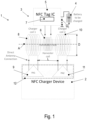
- Figure 1 shows a system according to the invention, which comprises a power device and a portable device with a battery to be charged wireless.
- FIG. 1 shows a first embodiment of a system 1 of a power device 2 and a portable device 3 with a battery 4 according to the invention.
- the portable device 3 could be any device like e.g. earphones or a mobile phone with a wireless interface and a battery 4.
- the portable device 3 according to this embodiment complies with the NFC Standard and comprises a NFC Tag IC 5 connected to a portable antenna 6.
- a magnetic field with the frequency of 13,56MHz is radiated to transmit and receive data from other passive or active devices that comply with the NFC Standard.
- Battery 4 is used to power the NFC Tag IC 5 in its active mode.
- Battery 4 is a Li-Ion battery that needs to be charged by a charge stage 7 in different time periods with different charge currents and charge voltages. To enable charging of battery 4 with a charge voltage Ui provided by charge stage 7, portable device 3 in its charging mode needs to harvest enough energy from the magnetic field provide by power device 2, to which portable antenna 6 is exposed.
- Power device 2 could be a charging device connected to the power grid or powered by a battery power pack.
- Power device 2 comprises a first antenna 8 directly connected to a first power amplifier 9 to supply and drive the first antenna 8 resonant at the resonance frequency of 13,56MHz.
- Power device 2 furthermore comprises a second antenna 10 directly connected to a second power amplifier 11 to supply and drive the second antenna 10 resonant at the same resonance frequency of 13,56MHz.
- both power amplifier 9 and 11 drive the antennas 8 and 10 with the same phase and amplitude.
- the first antenna 8 and the second antenna 10 are built as much as possible identical and both power amplifier 9 and 11 are realized as much as possible identical and exposed to the same operating temperature.
- antennas 8 and 10 identical means the same number of windings and the same material of the antenna coils and as much as possible the same geometrical form of the antenna coils.
- the geometrical form could be a circular or square cross-section to name two of the most common geometrical forms to be used for the invention, but other forms like a triangle could be used as well.
- power amplifier 9 and 11 identical means the same manufacturing technology CMOS and the same circuitry are realized. Furthermore to ensure that both power amplifier 9 and 11 are exposed to the same operating temperature they are realized residing on the same monolithic silicon substrate.
- both power amplifier 9 and 11 keep the same operating temperature during the charging mode what ensures that the amplitude, phase and frequency of the antenna signal to drive the antennas 8 and 10 stay close to identical or identical for both power amplifier 9 and 11.
- Power device 2 comprises a housing to mechanically hold the first antenna 8 in a distance L to the second antenna 10 and both antennas 8 and 10 are realized on the same coil axis A to generate a so called Helmholtz magnetic field that is close to homogenous in an area between the antennas 8 and 10.
- the housing of power device 2 is designed in a way together with the housing of portable device 3 to enable to insert the portable antenna 6 of portable device 3 in a charging position into this area between antennas 8 and 10. In this charging position the portable antenna 6 with its antenna coil axis is as much as possible exact positioned in the coil axis A of the antennas 8 and 10.
- first antenna 8 and second antenna 10 if realized with circular windings, haven an area of the circular cross-section equal or greater with an equal or greater diameter D than the circular cross-section and diameter of portable antenna 6.
- first antenna 8 and second antenna 10 are realized with a square cross-section, they will have an area of the square cross-section equal or greater with an equal or greater side length than that of the portable antenna 6 of the portable device 3. The more of these measures are combined, the better it is ensured that portable antenna 6 is exposed to a close to ideal homogenous magnetic field with maximal energy harvesting for portable device 3.
- First power amplifier 9 and second power amplifier 11 are realized as high-voltage digital power amplifier with a digital control section to output a digital wave-forming bit combination of N bits with a clock frequency M-times the resonance frequency of antennas 6, 8 and 10. Increments are added to provide a substantial sinusoidal output current to the first antenna 8 and second antenna 10.
- Such a power amplifier is disclosed in the patent EP 3 182 585 B.
- Each of these power amplifier 9 and 11 generate a voltage of 7,2V from a 3,6V supply what enables to harvest and generate the charge voltage Ui needed for charge stage 7 to charge battery 4.
- the use of a sinus current to drive the first antenna 8 and second antenna 10 compared to the use of a square-wave current comprises the advantage that the portable device 3 does not need an EMC filter to filter all those harmonic multiples caused by the square-wave signal.
- the inventive use of two parallel resonant units of one power amplifier connected directly to the antenna with power amplifiers 9 and 11 operating at low voltages of 3,6V allows to use standard CMOS processes down to 40nm technology nodes without using high voltage devices. Furthermore compatibility with battery charger systems e.g. Li-Ion sources without the need for expensive, large and inefficient DC-DC converter technologies from 3,6V to 7,2V.
- the use of the Helmholz magnetic field increases the effective distance between first antenna 8 and second antenna 10 and the energy harvesting portable antenna 6 leading to an easier industrial design and more repeatable end user experience.
Landscapes
- Engineering & Computer Science (AREA)
- Power Engineering (AREA)
- Computer Networks & Wireless Communication (AREA)
- Charge And Discharge Circuits For Batteries Or The Like (AREA)
Description
- The present invention relates to a system comprising a power device and a portable device, wherein the portable device comprises a battery and the power device is configured to wireless charge the battery of the portable device, the power device comprises a first antenna configured to emit a magnetic field and which portable device comprises a portable antenna exposed to the magnetic field and connected to a charge stage configured to rectify an antenna signal from the portable antenna and configured to provide a charge voltage configured to charge the battery.
- Wireless charging is used for all kind of different portable devices like a mobile phone or earphones. The portable device just has to be dropped close-by a power device or charger that generates and radiates a magnetic field via an antenna of the power device with the advantage that no wire is needed to charge the portable device. In some of these systems, the power device just radiates the magnetic field and some newer systems comprise a feedback loop from the portable device to the power device to regulate the power of the magnetic field.
- There are standards like ISO/IEC18000-3 or ISO/IEC 14.443 Type A and B or ISO15.693 or ECMA-340 13,56 MHz Near Field Communication (NFC) or the NFC Forum or company standards like Felica from company Sony that define protocols and types of modulation used to transmit information between a portable device like a passive or active tag and a reader. Some or all of these standards in the RFID area define, to use an amplitude modulation to transmit an amplitude modulated data signal with digital data within the RF-Field over the air to the tag. ISO14.443 Type A for instance furthermore defines to use a modified Miller encoding to encode the data signal into an encoded data signal for the transmission.
- In a wireless charging mode for portable devices in the RFID area quite often a square wave signal is radiated from the first antenna of the power device to the portable antenna of the portable device. To transfer maximum power in resonance and to get rid of the harmonic multiples in the portable antenna caused by the square wave signal an external matching component or EMC filtering has to be implemented, which makes the realization of the portable device more complex and expensive.
- In a NFC legacy system the power device rediates a magnetic field using an inductive element as first antenna that rediates the magnetic field in a sufficient large area to charge the portable device. The magnetic field so created is a doughnut shape with magnetic flux lines emanating in a circular pattern around the coil of the first antenna. The portable antenna, when inside the field of the power device, had a voltage induced across it allowing power to be transferred in a process called energy harvesting. The amount of energy available to be harvested is strongly correlated with the distance between the first antenna of the power device and the portable antenna with available power dropping off significantly in only a few millimeter, which makes it difficult to provide an instruction for the user about the charging time.
-
EP 3 318 182 A1 may be cited as the closest prior art. This document discloses a system of a sensing device worn by a patient and coupled wireless to an interrogation device to transmit sensor data to the interrogation device. The sensing device comprises a sensor power supply. In one embodiment disclosed, a battery of the sensing device may be charged wirelessly including through harvesting RF energy from the interrogation device. In another embodiment, the interrogation device comprises an antenna with two coils wound about two respective bedrails, within a configuration as known as "Helmholtz" configuration. For this embodiment with coils in a distance of about 1 meter with a person in between,EP 3 318 182 A1 - Furthermore, the prior
art document EP 3 182 585 A1 should be mentioned, in which a single power amplifier with CMOS technology is disclosed. - It is an object of the invention to provide a system of a power device and a portable device for wireless charging of the battery of the portable device with an improved energy harvesting and a short and reliable charging time as defined by
independent claim 1. - This object is achieved in a system with a power device that comprises a second antenna realized identical to the first antenna and arranged in a distance to and on the same coil axis of the first antenna configured to generate a Helmholtz magnetic field and wherein a first power amplifier directly connected to the first antenna and a second power amplifier directly connected to the second antenna are realized identical and on the same substrate, wherein the first power amplifier and the second power amplifier are realized in CMOS residing on the same monolithic silicon substrate and operating at low voltages of 3,6V.
- A person skilled in the art knows the physical effect found by Mr. Herman von Helmholtz back at the end of the 19th century when arranging two identical coils on the same coil axis and in a particular distance to generate a homogeneous or nearly uniform magnetic field between the coils. Until now this physical effect has been used to create uniform DC magnetic fields for applications for cancelling the earth's magnetic field or in the medical area for magnetic resonance tomography with huge magnets involved. For these use cases there is no resonant circuit and coils can be wired in series. Since NFC typically uses a resonant circuit, the resonant tank could be created by adding a capacitor to the series inductor pair. The issues with placing the inductors in series is that both the inductance and the series impedance is doubled, resulting in very small matching capacitance and the need for high voltage excitation. A person skilled in the art therefore was held off using this physical effect for RFID or NFC applications.
- This inventive concept realizes an arrangement of the first antenna coupled directly to a first power amplifier and a second antenna coupled directly to a second power amplifier with the two antennas of the power device in the physical arrangement and limitation to generate a Helmholz field. Both antennas are identical and both power amplifier are realized on the same substrate, but drive electrically independent from each other the two antennas to generate one close to homogenous magnet field. In this inventive concept the portable antenna of the portable device is arranged within the Helmholz field arranged to enable a high energy harvesting within a short and reliable charging time for charging the portable devices in the RFID area. This solves above listed problems and a long felt need of users of such portable devices in the RFID area. It is enabled by using two separate resonant loops, allowing the coils of the first and second antenna to be driven from a low voltage power amplifier of 3,6V. This voltage is compatible with a small geometry enabled by CMOS processes typically used for NFC applications. Two separate identical, synchronous transmitters/power amplifiers are deployed in the power device. These can be matched in amplitude and phase for maximum coherence of the generated magnetic field. Since power is harvested from both coils the power output can be split between the two transmitters.
- It is in particular advantageous to use two identical power ampifier realized as invented by the same applicant and described in the
patent EP 3 182 585 - These and other aspects of the invention will be apparent from and elucidated with reference to the embodiments described hereinafter. The person skilled in the art will understand that various embodiments may be combined.
-
Figure 1 shows a system according to the invention, which comprises a power device and a portable device with a battery to be charged wireless. -
Figure 1 shows a first embodiment of asystem 1 of apower device 2 and aportable device 3 with abattery 4 according to the invention. Theportable device 3 could be any device like e.g. earphones or a mobile phone with a wireless interface and abattery 4. Theportable device 3 according to this embodiment complies with the NFC Standard and comprises a NFC Tag IC 5 connected to aportable antenna 6. In an active mode of the portable device 3 a magnetic field with the frequency of 13,56MHz is radiated to transmit and receive data from other passive or active devices that comply with the NFC Standard.Battery 4 is used to power the NFC Tag IC 5 in its active mode.Battery 4 is a Li-Ion battery that needs to be charged by acharge stage 7 in different time periods with different charge currents and charge voltages. To enable charging ofbattery 4 with a charge voltage Ui provided bycharge stage 7,portable device 3 in its charging mode needs to harvest enough energy from the magnetic field provide bypower device 2, to whichportable antenna 6 is exposed. -
Power device 2 could be a charging device connected to the power grid or powered by a battery power pack.Power device 2 comprises afirst antenna 8 directly connected to afirst power amplifier 9 to supply and drive thefirst antenna 8 resonant at the resonance frequency of 13,56MHz. Power device 2 furthermore comprises asecond antenna 10 directly connected to asecond power amplifier 11 to supply and drive thesecond antenna 10 resonant at the same resonance frequency of 13,56MHz. In addition to that, bothpower amplifier antennas first antenna 8 and thesecond antenna 10 are built as much as possible identical and bothpower amplifier - With regard to the
antennas power amplifier power amplifier power amplifier antennas power amplifier power device 2 with only substantially or more or less identical two sets of antenna and power amplifier. -
Power device 2 comprises a housing to mechanically hold thefirst antenna 8 in a distance L to thesecond antenna 10 and bothantennas antennas power device 2 is designed in a way together with the housing ofportable device 3 to enable to insert theportable antenna 6 ofportable device 3 in a charging position into this area betweenantennas portable antenna 6 with its antenna coil axis is as much as possible exact positioned in the coil axis A of theantennas first antenna 8 andsecond antenna 10, if realized with circular windings, haven an area of the circular cross-section equal or greater with an equal or greater diameter D than the circular cross-section and diameter ofportable antenna 6. In casefirst antenna 8 andsecond antenna 10 are realized with a square cross-section, they will have an area of the square cross-section equal or greater with an equal or greater side length than that of theportable antenna 6 of theportable device 3. The more of these measures are combined, the better it is ensured thatportable antenna 6 is exposed to a close to ideal homogenous magnetic field with maximal energy harvesting forportable device 3. -
First power amplifier 9 andsecond power amplifier 11 are realized as high-voltage digital power amplifier with a digital control section to output a digital wave-forming bit combination of N bits with a clock frequency M-times the resonance frequency ofantennas first antenna 8 andsecond antenna 10. Such a power amplifier is disclosed in thepatent EP 3 182 585 B. Each of thesepower amplifier charge stage 7 to chargebattery 4. A DC-DC converter needed in state of the art systems with state of the art power devices and portable device. The use of a sinus current to drive thefirst antenna 8 andsecond antenna 10 compared to the use of a square-wave current comprises the advantage that theportable device 3 does not need an EMC filter to filter all those harmonic multiples caused by the square-wave signal. - The inventive use of two parallel resonant units of one power amplifier connected directly to the antenna with
power amplifiers first antenna 8 andsecond antenna 10 and the energy harvestingportable antenna 6 leading to an easier industrial design and more repeatable end user experience.
Claims (7)
- System (1) comprising a power device (2) and a portable device (3), wherein the portable device (3) comprises a battery (4) and the power device (2) is configured to wireless charge the battery (4) of the portable device (3), wherein the the power device (2) comprises a first antenna (8) configured to emit a magnetic field and the portable device (3) comprises a portable antenna (6) exposed to the magnetic field and connected to a charge stage (7) configured to rectify an antenna signal from the portable antenna (6) and configured to provide a charge voltage (Ui) configured to charge the battery (4), the power device (2) comprises a second antenna (10) realized identical to the first antenna (8) and arranged at a distance (L) from the first antenna (8) and on the same coil axis (A) as the first antenna (8) and configured to generate a Helmholtz magnetic field, and the power device (2) further comprises a first power amplifier (9) and a second power power amplifier (11), characterized in that the first power amplifier (9) directly connected to the first antenna (8) and the second power amplifier (11) directly connected to the second antenna (10) are realized identical and on the same substrate (12), wherein the first power amplifier (9) and the second power amplifier (11) are realized in CMOS residing on the same monolithic silicon substrate (12) and operating at low voltages of 3,6V.
- System (1) according to claim 1, wherein the first power amplifier (9) and the second power amplifier (11) are configured to provide a substantially sinusoidal output current to the first antenna (8) and to the second antenna (10), respectively.
- System (1) according to any of the claims 1 to 2, wherein the identically realized first antenna (8) and second antenna (10) comprise the same number of windings and have a circular or square cross-section, which enclose an area equal to or greater than the area of the portable antenna (6) of the portable device (3), which is realized with the same cross-section as the first antenna (8) and the second antenna (10).
- System (1) according to claim 3, wherein the distance (L) between the first antenna (8) and the second antenna (10) is less than the diameter (D) of a circular shaped first antenna (8) and second antenna (10) or less than a side length of a square shaped first antenna and second antenna to ensure a Helmholz magnetic field between the first antenna (8) and the second antenna (10).
- System (1) according to any of the claims 1 to 4, wherein the power device (2) comprises a housing configured to mechanically hold the portable device (3) in a charging position when inserted, wherein the portable antenna (6) of the portable device (3) is arranged between the first antenna (8) and the second antenna (10) and substantially on the same coil axis (A) of the first antenna (8) and the second antenna (10).
- System (1) according to any of the claims 1 to 5, wherein the first power amplifier (9) and the second power amplifier (11) are configured to drive the first antenna (8) and the second antenna (10) at the same resonance frequency in resonance and wherein the portable device (3) is configured to drive the portable antenna (6) at the same resonance frequency as the power device (2) in resonance.
- System (1) according to any of the claims 1 to 6, wherein the portable device (3) comprises a wireless data interface (5) that is realized as a near-field communication, NFC, interface that complies with the standardISO/IEC 18092:2013/COR 1:2015.
Priority Applications (4)
| Application Number | Priority Date | Filing Date | Title |
|---|---|---|---|
| EP21192274.5A EP4138266B1 (en) | 2021-08-20 | 2021-08-20 | Charger with two coils for wireless charging |
| CN202280056972.5A CN117837053A (en) | 2021-08-20 | 2022-05-24 | Charger with two coils for wireless charging |
| PCT/EP2022/063958 WO2023020724A1 (en) | 2021-08-20 | 2022-05-24 | Charger with two coils for wireless charging |
| US18/291,490 US12088111B2 (en) | 2021-08-20 | 2022-05-24 | Charger with two coils for wireless charging |
Applications Claiming Priority (1)
| Application Number | Priority Date | Filing Date | Title |
|---|---|---|---|
| EP21192274.5A EP4138266B1 (en) | 2021-08-20 | 2021-08-20 | Charger with two coils for wireless charging |
Publications (3)
| Publication Number | Publication Date |
|---|---|
| EP4138266A1 EP4138266A1 (en) | 2023-02-22 |
| EP4138266C0 EP4138266C0 (en) | 2023-08-02 |
| EP4138266B1 true EP4138266B1 (en) | 2023-08-02 |
Family
ID=77431147
Family Applications (1)
| Application Number | Title | Priority Date | Filing Date |
|---|---|---|---|
| EP21192274.5A Active EP4138266B1 (en) | 2021-08-20 | 2021-08-20 | Charger with two coils for wireless charging |
Country Status (4)
| Country | Link |
|---|---|
| US (1) | US12088111B2 (en) |
| EP (1) | EP4138266B1 (en) |
| CN (1) | CN117837053A (en) |
| WO (1) | WO2023020724A1 (en) |
Families Citing this family (1)
| Publication number | Priority date | Publication date | Assignee | Title |
|---|---|---|---|---|
| CN117275913A (en) * | 2023-09-21 | 2023-12-22 | 澳门大学 | Magnetic coupler and wireless charging system |
Family Cites Families (7)
| Publication number | Priority date | Publication date | Assignee | Title |
|---|---|---|---|---|
| KR101230515B1 (en) * | 2011-03-30 | 2013-02-06 | 서울대학교산학협력단 | Apparatus and System for Wireless Power Transmission Using Dual Transmitter Coils |
| KR101222137B1 (en) * | 2011-05-16 | 2013-01-15 | 전자부품연구원 | Directional wireless power transmission apparatus using magnetic resonance induction |
| US10912515B2 (en) * | 2014-11-19 | 2021-02-09 | Veloce Corporation | Wireless communications system integrating electronics into orally ingestible products for controlled release of active ingredients |
| EP3182585B1 (en) | 2015-12-14 | 2020-07-22 | Panthronics AG | High-voltage digital power amplifier with sinusoidal output for rfid |
| US9882610B1 (en) * | 2016-11-08 | 2018-01-30 | Welch Allyn, Inc. | Near field communication sensor system |
| CN109617263B (en) * | 2018-12-21 | 2024-12-17 | 深圳先进技术研究院 | Electric energy transmitting end and wireless charging device |
| US20210268244A1 (en) * | 2020-01-07 | 2021-09-02 | Veloce Corporation | Wireless communications system integrating electronics into orally ingestible products for controlled release or injection of active ingredients |
-
2021
- 2021-08-20 EP EP21192274.5A patent/EP4138266B1/en active Active
-
2022
- 2022-05-24 US US18/291,490 patent/US12088111B2/en active Active
- 2022-05-24 CN CN202280056972.5A patent/CN117837053A/en active Pending
- 2022-05-24 WO PCT/EP2022/063958 patent/WO2023020724A1/en not_active Ceased
Also Published As
| Publication number | Publication date |
|---|---|
| WO2023020724A1 (en) | 2023-02-23 |
| US20240266873A1 (en) | 2024-08-08 |
| EP4138266A1 (en) | 2023-02-22 |
| US12088111B2 (en) | 2024-09-10 |
| EP4138266C0 (en) | 2023-08-02 |
| CN117837053A (en) | 2024-04-05 |
Similar Documents
| Publication | Publication Date | Title |
|---|---|---|
| US8947041B2 (en) | Bidirectional wireless power transmission | |
| US11245181B2 (en) | Antenna designs for communication between a wirelessly powered implant to an external device outside the body | |
| US11239701B2 (en) | Resonant power transfer systems having efficiency optimization based on receiver impedance | |
| CN103795430B (en) | Mobile device and the method for using Multi-Function Antenna in the mobile device | |
| KR101398367B1 (en) | Method and apparatus for an enlarged wireless charging area | |
| US10511183B2 (en) | System, apparatus and method for optimizing wireless charging via load modulation | |
| CN106662896A (en) | Wireless Power Transfer Through Metal Objects | |
| CN109120310A (en) | Multiband transmitting antenna | |
| US12212156B2 (en) | Reconfigurable wireless power transmitter for computer peripherals | |
| AU2017211647B2 (en) | Wireless power transfer in an electronic device having a tuned metallic body | |
| CN107852015A (en) | Apparatus and method for the configuration of wireless power transmitter coil | |
| EP4138266B1 (en) | Charger with two coils for wireless charging | |
| Na et al. | An improved wireless power transfer system with adaptive technique for implantable biomedical devices | |
| US20170155282A1 (en) | Enhanced coupling in a wearable resonator | |
| US12401227B1 (en) | Inductive power transfer system with common mode channel communication | |
| Gnanasegaran et al. | The development of wireless power transfer technologies for mobile charging in vehicles using inductive approach | |
| Stuemke | Design of a Closed Loop Wireless Power Transfer System for an Electrocorticography Device to Be Implanted in the Brain of a Rat Over an Extended Period | |
| Boby et al. | Wireless Power Transmission System Based on Magnetic Inductive Resonance of Couple Circuit | |
| HK1257336A1 (en) | Wireless power transfer in an electronic device having a tuned metallic body |
Legal Events
| Date | Code | Title | Description |
|---|---|---|---|
| STAA | Information on the status of an ep patent application or granted ep patent |
Free format text: STATUS: EXAMINATION IS IN PROGRESS |
|
| PUAI | Public reference made under article 153(3) epc to a published international application that has entered the european phase |
Free format text: ORIGINAL CODE: 0009012 |
|
| 17P | Request for examination filed |
Effective date: 20220223 |
|
| AK | Designated contracting states |
Kind code of ref document: A1 Designated state(s): AL AT BE BG CH CY CZ DE DK EE ES FI FR GB GR HR HU IE IS IT LI LT LU LV MC MK MT NL NO PL PT RO RS SE SI SK SM TR |
|
| GRAP | Despatch of communication of intention to grant a patent |
Free format text: ORIGINAL CODE: EPIDOSNIGR1 |
|
| STAA | Information on the status of an ep patent application or granted ep patent |
Free format text: STATUS: GRANT OF PATENT IS INTENDED |
|
| INTG | Intention to grant announced |
Effective date: 20230316 |
|
| GRAS | Grant fee paid |
Free format text: ORIGINAL CODE: EPIDOSNIGR3 |
|
| GRAA | (expected) grant |
Free format text: ORIGINAL CODE: 0009210 |
|
| STAA | Information on the status of an ep patent application or granted ep patent |
Free format text: STATUS: THE PATENT HAS BEEN GRANTED |
|
| AK | Designated contracting states |
Kind code of ref document: B1 Designated state(s): AL AT BE BG CH CY CZ DE DK EE ES FI FR GB GR HR HU IE IS IT LI LT LU LV MC MK MT NL NO PL PT RO RS SE SI SK SM TR |
|
| REG | Reference to a national code |
Ref country code: GB Ref legal event code: FG4D |
|
| REG | Reference to a national code |
Ref country code: CH Ref legal event code: EP |
|
| REG | Reference to a national code |
Ref country code: DE Ref legal event code: R096 Ref document number: 602021003932 Country of ref document: DE |
|
| REG | Reference to a national code |
Ref country code: IE Ref legal event code: FG4D |
|
| U01 | Request for unitary effect filed |
Effective date: 20230808 |
|
| U07 | Unitary effect registered |
Designated state(s): AT BE BG DE DK EE FI FR IT LT LU LV MT NL PT SE SI Effective date: 20230811 |
|
| U20 | Renewal fee for the european patent with unitary effect paid |
Year of fee payment: 3 Effective date: 20230821 |
|
| RAP4 | Party data changed (patent owner data changed or rights of a patent transferred) |
Owner name: RENESAS DESIGN AUSTRIA GMBH |
|
| U1H | Name or address of the proprietor changed after the registration of the unitary effect |
Owner name: RENESAS DESIGN AUSTRIA GMBH; AT |
|
| PG25 | Lapsed in a contracting state [announced via postgrant information from national office to epo] |
Ref country code: GR Free format text: LAPSE BECAUSE OF FAILURE TO SUBMIT A TRANSLATION OF THE DESCRIPTION OR TO PAY THE FEE WITHIN THE PRESCRIBED TIME-LIMIT Effective date: 20231103 |
|
| PG25 | Lapsed in a contracting state [announced via postgrant information from national office to epo] |
Ref country code: IS Free format text: LAPSE BECAUSE OF FAILURE TO SUBMIT A TRANSLATION OF THE DESCRIPTION OR TO PAY THE FEE WITHIN THE PRESCRIBED TIME-LIMIT Effective date: 20231202 |
|
| PG25 | Lapsed in a contracting state [announced via postgrant information from national office to epo] |
Ref country code: RS Free format text: LAPSE BECAUSE OF FAILURE TO SUBMIT A TRANSLATION OF THE DESCRIPTION OR TO PAY THE FEE WITHIN THE PRESCRIBED TIME-LIMIT Effective date: 20230802 Ref country code: NO Free format text: LAPSE BECAUSE OF FAILURE TO SUBMIT A TRANSLATION OF THE DESCRIPTION OR TO PAY THE FEE WITHIN THE PRESCRIBED TIME-LIMIT Effective date: 20231102 Ref country code: IS Free format text: LAPSE BECAUSE OF FAILURE TO SUBMIT A TRANSLATION OF THE DESCRIPTION OR TO PAY THE FEE WITHIN THE PRESCRIBED TIME-LIMIT Effective date: 20231202 Ref country code: HR Free format text: LAPSE BECAUSE OF FAILURE TO SUBMIT A TRANSLATION OF THE DESCRIPTION OR TO PAY THE FEE WITHIN THE PRESCRIBED TIME-LIMIT Effective date: 20230802 Ref country code: GR Free format text: LAPSE BECAUSE OF FAILURE TO SUBMIT A TRANSLATION OF THE DESCRIPTION OR TO PAY THE FEE WITHIN THE PRESCRIBED TIME-LIMIT Effective date: 20231103 |
|
| PG25 | Lapsed in a contracting state [announced via postgrant information from national office to epo] |
Ref country code: PL Free format text: LAPSE BECAUSE OF FAILURE TO SUBMIT A TRANSLATION OF THE DESCRIPTION OR TO PAY THE FEE WITHIN THE PRESCRIBED TIME-LIMIT Effective date: 20230802 |
|
| PG25 | Lapsed in a contracting state [announced via postgrant information from national office to epo] |
Ref country code: ES Free format text: LAPSE BECAUSE OF FAILURE TO SUBMIT A TRANSLATION OF THE DESCRIPTION OR TO PAY THE FEE WITHIN THE PRESCRIBED TIME-LIMIT Effective date: 20230802 |
|
| PG25 | Lapsed in a contracting state [announced via postgrant information from national office to epo] |
Ref country code: SM Free format text: LAPSE BECAUSE OF FAILURE TO SUBMIT A TRANSLATION OF THE DESCRIPTION OR TO PAY THE FEE WITHIN THE PRESCRIBED TIME-LIMIT Effective date: 20230802 Ref country code: RO Free format text: LAPSE BECAUSE OF FAILURE TO SUBMIT A TRANSLATION OF THE DESCRIPTION OR TO PAY THE FEE WITHIN THE PRESCRIBED TIME-LIMIT Effective date: 20230802 Ref country code: ES Free format text: LAPSE BECAUSE OF FAILURE TO SUBMIT A TRANSLATION OF THE DESCRIPTION OR TO PAY THE FEE WITHIN THE PRESCRIBED TIME-LIMIT Effective date: 20230802 Ref country code: CZ Free format text: LAPSE BECAUSE OF FAILURE TO SUBMIT A TRANSLATION OF THE DESCRIPTION OR TO PAY THE FEE WITHIN THE PRESCRIBED TIME-LIMIT Effective date: 20230802 Ref country code: SK Free format text: LAPSE BECAUSE OF FAILURE TO SUBMIT A TRANSLATION OF THE DESCRIPTION OR TO PAY THE FEE WITHIN THE PRESCRIBED TIME-LIMIT Effective date: 20230802 |
|
| REG | Reference to a national code |
Ref country code: DE Ref legal event code: R097 Ref document number: 602021003932 Country of ref document: DE |
|
| REG | Reference to a national code |
Ref country code: IE Ref legal event code: MM4A |
|
| PG25 | Lapsed in a contracting state [announced via postgrant information from national office to epo] |
Ref country code: MC Free format text: LAPSE BECAUSE OF FAILURE TO SUBMIT A TRANSLATION OF THE DESCRIPTION OR TO PAY THE FEE WITHIN THE PRESCRIBED TIME-LIMIT Effective date: 20230802 |
|
| PLBE | No opposition filed within time limit |
Free format text: ORIGINAL CODE: 0009261 |
|
| STAA | Information on the status of an ep patent application or granted ep patent |
Free format text: STATUS: NO OPPOSITION FILED WITHIN TIME LIMIT |
|
| PG25 | Lapsed in a contracting state [announced via postgrant information from national office to epo] |
Ref country code: IE Free format text: LAPSE BECAUSE OF NON-PAYMENT OF DUE FEES Effective date: 20230820 |
|
| 26N | No opposition filed |
Effective date: 20240503 |
|
| PG25 | Lapsed in a contracting state [announced via postgrant information from national office to epo] |
Ref country code: IE Free format text: LAPSE BECAUSE OF NON-PAYMENT OF DUE FEES Effective date: 20230820 |
|
| U20 | Renewal fee for the european patent with unitary effect paid |
Year of fee payment: 4 Effective date: 20240814 |
|
| REG | Reference to a national code |
Ref country code: CH Ref legal event code: PL |
|
| PG25 | Lapsed in a contracting state [announced via postgrant information from national office to epo] |
Ref country code: CH Free format text: LAPSE BECAUSE OF NON-PAYMENT OF DUE FEES Effective date: 20240831 |
|
| PG25 | Lapsed in a contracting state [announced via postgrant information from national office to epo] |
Ref country code: CY Free format text: LAPSE BECAUSE OF FAILURE TO SUBMIT A TRANSLATION OF THE DESCRIPTION OR TO PAY THE FEE WITHIN THE PRESCRIBED TIME-LIMIT; INVALID AB INITIO Effective date: 20210820 |
|
| PG25 | Lapsed in a contracting state [announced via postgrant information from national office to epo] |
Ref country code: HU Free format text: LAPSE BECAUSE OF FAILURE TO SUBMIT A TRANSLATION OF THE DESCRIPTION OR TO PAY THE FEE WITHIN THE PRESCRIBED TIME-LIMIT; INVALID AB INITIO Effective date: 20210820 |
|
| U20 | Renewal fee for the european patent with unitary effect paid |
Year of fee payment: 5 Effective date: 20250820 |
|
| PG25 | Lapsed in a contracting state [announced via postgrant information from national office to epo] |
Ref country code: TR Free format text: LAPSE BECAUSE OF FAILURE TO SUBMIT A TRANSLATION OF THE DESCRIPTION OR TO PAY THE FEE WITHIN THE PRESCRIBED TIME-LIMIT Effective date: 20230802 |