EP4138060A1 - Systems and methods for confirming identity and location of an aircraft within an airspace - Google Patents
Systems and methods for confirming identity and location of an aircraft within an airspace Download PDFInfo
- Publication number
- EP4138060A1 EP4138060A1 EP22173779.4A EP22173779A EP4138060A1 EP 4138060 A1 EP4138060 A1 EP 4138060A1 EP 22173779 A EP22173779 A EP 22173779A EP 4138060 A1 EP4138060 A1 EP 4138060A1
- Authority
- EP
- European Patent Office
- Prior art keywords
- aircraft
- signal
- control unit
- airspace
- location
- Prior art date
- Legal status (The legal status is an assumption and is not a legal conclusion. Google has not performed a legal analysis and makes no representation as to the accuracy of the status listed.)
- Withdrawn
Links
Images



Classifications
-
- G—PHYSICS
- G08—SIGNALLING
- G08G—TRAFFIC CONTROL SYSTEMS
- G08G5/00—Traffic control systems for aircraft
- G08G5/70—Arrangements for monitoring traffic-related situations or conditions
- G08G5/72—Arrangements for monitoring traffic-related situations or conditions for monitoring traffic
- G08G5/727—Arrangements for monitoring traffic-related situations or conditions for monitoring traffic from a ground station
-
- B—PERFORMING OPERATIONS; TRANSPORTING
- B64—AIRCRAFT; AVIATION; COSMONAUTICS
- B64C—AEROPLANES; HELICOPTERS
- B64C39/00—Aircraft not otherwise provided for
- B64C39/02—Aircraft not otherwise provided for characterised by special use
- B64C39/024—Aircraft not otherwise provided for characterised by special use of the remote controlled vehicle type, i.e. RPV
-
- G—PHYSICS
- G01—MEASURING; TESTING
- G01S—RADIO DIRECTION-FINDING; RADIO NAVIGATION; DETERMINING DISTANCE OR VELOCITY BY USE OF RADIO WAVES; LOCATING OR PRESENCE-DETECTING BY USE OF THE REFLECTION OR RERADIATION OF RADIO WAVES; ANALOGOUS ARRANGEMENTS USING OTHER WAVES
- G01S5/00—Position-fixing by co-ordinating two or more direction or position line determinations; Position-fixing by co-ordinating two or more distance determinations
- G01S5/02—Position-fixing by co-ordinating two or more direction or position line determinations; Position-fixing by co-ordinating two or more distance determinations using radio waves
- G01S5/0205—Details
- G01S5/0244—Accuracy or reliability of position solution or of measurements contributing thereto
-
- G—PHYSICS
- G08—SIGNALLING
- G08G—TRAFFIC CONTROL SYSTEMS
- G08G5/00—Traffic control systems for aircraft
- G08G5/20—Arrangements for acquiring, generating, sharing or displaying traffic information
-
- G—PHYSICS
- G08—SIGNALLING
- G08G—TRAFFIC CONTROL SYSTEMS
- G08G5/00—Traffic control systems for aircraft
- G08G5/20—Arrangements for acquiring, generating, sharing or displaying traffic information
- G08G5/26—Transmission of traffic-related information between aircraft and ground stations
-
- G—PHYSICS
- G08—SIGNALLING
- G08G—TRAFFIC CONTROL SYSTEMS
- G08G5/00—Traffic control systems for aircraft
- G08G5/50—Navigation or guidance aids
- G08G5/55—Navigation or guidance aids for a single aircraft
-
- G—PHYSICS
- G01—MEASURING; TESTING
- G01S—RADIO DIRECTION-FINDING; RADIO NAVIGATION; DETERMINING DISTANCE OR VELOCITY BY USE OF RADIO WAVES; LOCATING OR PRESENCE-DETECTING BY USE OF THE REFLECTION OR RERADIATION OF RADIO WAVES; ANALOGOUS ARRANGEMENTS USING OTHER WAVES
- G01S3/00—Direction-finders for determining the direction from which infrasonic, sonic, ultrasonic or electromagnetic waves, or particle emission, not having a directional significance, are being received
- G01S3/80—Direction-finders for determining the direction from which infrasonic, sonic, ultrasonic or electromagnetic waves, or particle emission, not having a directional significance, are being received using ultrasonic, sonic or infrasonic waves
- G01S3/802—Systems for determining direction or deviation from predetermined direction
-
- G—PHYSICS
- G01—MEASURING; TESTING
- G01S—RADIO DIRECTION-FINDING; RADIO NAVIGATION; DETERMINING DISTANCE OR VELOCITY BY USE OF RADIO WAVES; LOCATING OR PRESENCE-DETECTING BY USE OF THE REFLECTION OR RERADIATION OF RADIO WAVES; ANALOGOUS ARRANGEMENTS USING OTHER WAVES
- G01S5/00—Position-fixing by co-ordinating two or more direction or position line determinations; Position-fixing by co-ordinating two or more distance determinations
- G01S5/0009—Transmission of position information to remote stations
- G01S5/0018—Transmission from mobile station to base station
- G01S5/0027—Transmission from mobile station to base station of actual mobile position, i.e. position determined on mobile
-
- G—PHYSICS
- G01—MEASURING; TESTING
- G01S—RADIO DIRECTION-FINDING; RADIO NAVIGATION; DETERMINING DISTANCE OR VELOCITY BY USE OF RADIO WAVES; LOCATING OR PRESENCE-DETECTING BY USE OF THE REFLECTION OR RERADIATION OF RADIO WAVES; ANALOGOUS ARRANGEMENTS USING OTHER WAVES
- G01S5/00—Position-fixing by co-ordinating two or more direction or position line determinations; Position-fixing by co-ordinating two or more distance determinations
- G01S5/02—Position-fixing by co-ordinating two or more direction or position line determinations; Position-fixing by co-ordinating two or more distance determinations using radio waves
- G01S5/0257—Hybrid positioning
- G01S5/0263—Hybrid positioning by combining or switching between positions derived from two or more separate positioning systems
- G01S5/0264—Hybrid positioning by combining or switching between positions derived from two or more separate positioning systems at least one of the systems being a non-radio wave positioning system
-
- G—PHYSICS
- G08—SIGNALLING
- G08G—TRAFFIC CONTROL SYSTEMS
- G08G5/00—Traffic control systems for aircraft
- G08G5/50—Navigation or guidance aids
- G08G5/58—Navigation or guidance aids for emergency situations, e.g. hijacking or bird strikes
Definitions
- Examples of the present disclosure generally relate to systems and methods for confirming an identity and location of an aircraft within an airspace.
- Aircraft such as commercial aircraft, military aircraft, unmanned aerial vehicles (UAVs), such as drones, and the like may fly within an airspace.
- Radar can be used to track positions of aircraft within the airspace.
- ADS-B automatic dependent surveillance broadcast
- ADS-B automatic dependent surveillance broadcast
- ADS-B can be an essential protocol for modern air traffic management. However, ADS-B may also be insecure. For example, adversarial, intentional and unintentional interference, or otherwise unscrupulous acts can spoof ADS-B transmissions. Further, such actors can also attempt to jam ADS-B out transmissions.
- certain examples of the present disclosure provide a system including an aircraft having a position sensor configured to output a position signal regarding a position of the aircraft within an airspace, and a propulsion system configured to output a position confirmation signal regarding the position of the aircraft within the airspace.
- the system also includes a tracking sub-system including a tracking control unit configured to receive the position signal and the position confirmation signal.
- the tracking control unit is further configured to compare the position signal and the position confirmation signal to assess an accuracy of the position signal.
- the position sensor is an automatic dependent surveillance-broadcast (ADS-B) communication device.
- ADS-B automatic dependent surveillance-broadcast
- the aircraft can be an unmanned aerial vehicle (UAV), such as a drone, a commercial aircraft, or a military aircraft.
- UAV unmanned aerial vehicle
- the propulsion system includes a motor in communication with a propulsion control unit.
- the motor can be an electric motor.
- the propulsion control unit encodes a location signal on an audio signal output by the motor to provide the position confirmation signal.
- the location signal includes a location of the aircraft within the airspace, and an identification of the aircraft.
- the location signal also includes a timestamp.
- Certain examples of the present disclosure provide a method including outputting, by a position sensor of an aircraft, a position signal regarding a position of the aircraft within an airspace; and outputting, by a modulation of a propulsion system of the aircraft, a position confirmation signal regarding the position of the aircraft within the airspace.
- the method also includes receiving, by a tracking control unit of a tracking sub-system, the position signal and the position confirmation signal; and comparing, by the tracking control unit, the position signal and the position confirmation signal to assess an accuracy of the position signal.
- Examples of the present disclosure provide systems and methods for confirming an identity of an aircraft within an airspace.
- the systems and methods are configured to modulate an audio signature of an aircraft (such as output from a propulsion system, such as may have an electric motor) to confirm the identity and location of the aircraft.
- certain examples of the present disclosure leverage existing sensors and actuators, thereby providing cost-effective and efficient systems and methods. Additionally, because the systems and methods utilize physical attributes of the behavior of the aircraft, spoofing information would essentially require an equivalent platform be inserted into the same physical space, which would vastly increase the cost of spoofing relative to existing spoofing methods.
- Certain examples of the present disclosure provide systems and methods that are configured to modulate an audio signature of an aircraft (such as output from a propulsion system) to confirm the identity and location of the aircraft.
- the propulsion system includes a motor in communication with a propulsion control unit that encodes a location signal on an audio signal output by the motor to provide a position confirmation signal.
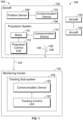
- Figure 1 illustrates a schematic block diagram of a system 100 for confirming an identity of aircraft 102 within an airspace 104, according to example of the present disclosure.
- the aircraft 102 are tracked within the airspace 104.
- the aircraft 102 can be commercial aircraft, military aircraft, UAVs, and/or the like.
- the aircraft 102 includes a propulsion system 106 and a position sensor 108 (such as may be or otherwise include a position transmitter).
- the position sensor 108 is in communication with a communicative device 110, such as through one or more wired or wireless connections.
- the communication device 110 can be a transceiver (transmitter/receiver), an antenna, a radio unit, and/or the like.
- the position sensor 108 is separate and distinct from the propulsion system 106.
- the propulsion system 106 does not include the position sensor 108.
- the propulsion system 106 includes a motor 110 in communication with a propulsion control unit 112, such as through one or more wired or wireless connections.
- the motor 110 is an electric motor.
- the motor 110 can be, or least part of, an engine.
- the motor 110 and/or the propulsion control unit 112 is in communication with a communication device 114, such as through one or more wired or wireless connections.
- the communication device 110 can be a transceiver (transmitter/receiver), an antenna, a radio unit, and/or the like.
- the propulsion control unit 112 controls operation of the motor 110.
- Each of the aircraft 102 within the airspace 104 can be configured as shown in Figure 1 .
- less than all of the aircraft 102 within the airspace 104 can be configured as shown in Figure 1 .
- the airspace 104 can include more or less aircraft 102 than shown.
- a monitoring center 116 is configured to track locations of the aircraft 102 within the airspace 104.
- the monitoring center 116 can be land-based, air-based, sea-based, or space-based (such as a satellite).
- the monitoring center 116 includes a tracking sub-system 118 having a communication device 120 in communication with a tracking control unit 122, such as through one or more wired or wireless connections.
- the communication device 120 can be a transceiver (transmitter/receiver), an antenna, a radio unit, one or more microphones, and/or the like.
- the communication device 120 is configured to receive signals from the aircraft 102 to identify, locate, and confirm the location of the aircraft 102 within the airspace 104, as described herein.
- the tracking sub-system 118 can be onboard at least one of the aircraft 102 within the airspace 104.
- a plurality of the aircraft 102 can each include a tracking sub-system 118.
- the position sensor 108 of the aircraft 102 is configured to be tracked by the tracking sub-system 118.
- the position sensor 108 is an automatic dependent surveillance-broadcast (ADS-B) communication device, and the tracking sub-system 118 is configured to track the position sensor 108 through an ADS-B protocol.
- the position sensor 108 is a global positioning system sensor.
- the tracking sub-system 118 can be or otherwise include radar that is configured to track the position sensor 108 and/or other portions of the aircraft 102.
- the tracking sub-system 118 is an ADS-B tracking sub-system.
- the tracking sub-system 118 determines a current position of the aircraft 102 via satellite navigation through a positional signal of the aircraft 102 output by the position sensor 108.
- the position sensor 108 can be or include a transmitter that periodically outputs information about the aircraft 102, such as identification details, current position, current altitude, and current velocity.
- the tracking sub-system 118 receives the transmitted position signal from the position sensor 108 to determine a current and real time location (such as may include position, heading, velocity, and the like) of the aircraft 102.
- the tracking sub-system 118 can be a radar system or other such system that is configured to track the position of the aircraft 102.
- the position sensor 108 outputs a position signal 124, via the communication device 110.
- the position signal 124 is indicative of one or more of the position, altitude, heading, acceleration, velocity, and/or the like of the aircraft 102.
- the communication device 120 of the tracking sub-system 118 receives the position signal 124 from the aircraft 102 via the communication device 120.
- the tracking control unit 122 analyzes the position signal 124 to determine the location of the aircraft 102 within the airspace 104.
- the propulsion system 106 of the aircraft 102 outputs a separate position confirmation signal 126 from the communication device 114.
- the tracking sub-system 118 receives the position confirmation signal 126 via the communication device 120.
- the tracking control unit 122 analyzes the position confirmation signal 126. If the position confirmation signal 126 conforms or otherwise is in agreement with the position signal 124, the tracking control unit 122 confirms that the location of the aircraft 102 within the airspace 104 as indicated from the position signal 124 is accurate. If, however, the position confirmation signal 126 differs from (for example, indicates a different location) the position signal 124, the tracking control unit 122 determines that the position signal 124 is not accurate (for example, may be spoofed).
- the position confirmation signal 126 is separate and distinct from the position signal 124.
- the position signal 124 is output by the position sensor 108, whereas the position conformation signal 126 is output by the propulsion system 106.
- the position sensor 108 does not output the position confirmation signal 126.
- the propulsion system 106 encodes a location signal 128 on an audio signal 130 (for example, an audio or acoustic signature) output of the motor 110.
- the position confirmation signal 126 includes the location signal 128 on the audio signal 130 output by the motor 110.
- the location signal 128 includes a location of the aircraft 102 within the airspace 104, and an identification of the aircraft 102.
- the location of the aircraft 102 can be determined by the position sensor 108, and/or another position sensor in communication with the propulsion control unit 112, which attaches, assigns, adds, or otherwise includes the location of the aircraft 102 on the location signal 128.
- the propulsion control unit 112 also attaches, assigns, adds, or otherwise includes the identification of the aircraft 102 on the location signal 128.
- the location signal 128 can also include a timestamp.
- the propulsion control unit 112 can include or otherwise be in communication with a timer, which can attach, assign, add, or otherwise include the timestamp on the location signal 128.
- the location signal 128 may not include the timestamp.
- the position confirmation signal 126 output by the propulsion system 106 includes a location and identification of the aircraft 102 within the airspace 104, and may optionally include a timestamp indicating a time of the aircraft 102 at a current location.
- the motor 110 is an electric motor.
- the propulsion system 106 can be an electric propulsion system.
- the propulsion control unit 112 is able to modulate an output of the electric motor.
- the motor 110 generates noise.
- the propulsion control unit 112 modulates the motor 110 and embeds the position confirmation signal 126 in the modulated noise signal output by the motor 110.
- the propulsion control unit 112 encodes the location signal 128 on the audio signal 130 to provide the position confirmation signal 126.
- the propulsion system 106 may not be an electric propulsion system.
- the propulsion system 106 can include gas turbine engines.
- the position confirmation signal 126 can be an audio signal, which is received by the communication device 120, such as may include one or more microphones.
- the position confirmation signal 126 is an encoded signal in an audio channel.
- the propulsion control unit 112 can modulate an amplitude or frequency of the position confirmation signal 126 in order to define a desired audio channel.
- the system 100 uses inexpensive audio sensors to detect the position confirmation signal 126.
- the communication device 120 can include one or more microphones (in addition to one or more ADS-B receivers, for example).
- the system 100 enhances cyber resilience of the tracking sub-system 118, such as may be or otherwise track the aircraft 102 through ADS-B.
- the propulsion control unit 112 modulates the output of drive units, such as the motor 110, to encode the location signal 128 on the audio signal 130 to form the position confirmation signal 126.
- examples of the present disclosure provide a system and method that is cost-effective, and which may be crowd sourced.
- the system 100 includes the aircraft 102 including the position sensor 108 configured to output the position signal 124 regarding a position of the aircraft 102 within the airspace 104, and the propulsion system 106 configured to output the position confirmation signal 126 regarding the position of the aircraft 102 within the airspace 104.
- the tracking sub-system 118 includes the tracking control unit 122 configured to receive the position signal 124 and the position confirmation signal 126.
- the tracking control unit 122 is further configured to compare the position signal 124 and the position confirmation signal 126 to assess the accuracy and reliability of the position signal 124.
- the tracking sub-system 118 can include multiple microphones as the communication device 120.
- the multiple microphones can physically locate the source of the signal 126, which provides an efficient and inexpensive way to tie the signal 126 to a specific direction and region in the airspace 104.
- Figure 2 illustrates a schematic block diagram of a control unit 200, according to an example of the subject disclosure.
- the propulsion control unit 112 and the tracking control unit 122 (shown in Figure 1 ) are configured as shown in Figure 2 .
- the control unit 200 includes at least one processor 202 in communication with a memory 204.
- the memory 204 stores instructions 206, received data 208, and generated data 210.
- the control unit 200 shown in Figure 5 is merely exemplary, and non-limiting.
- control unit central processing unit
- CPU central processing unit
- CPU central processing unit
- CPU central processing unit
- ASIC application specific integrated circuits
- logic circuits any other circuit or processor including hardware, software, or a combination thereof capable of executing the functions described herein.
- RISC reduced instruction set computers
- ASICs application specific integrated circuits
- the propulsion control unit 112 and the tracking control unit 122 may be or include one or more processors that are configured to control operation, as described herein.
- the propulsion control unit 112 and the tracking control unit 122 are configured to execute a set of instructions that are stored in one or more data storage units or elements (such as one or more memories), in order to process data.
- the propulsion control unit 112 and the tracking control unit 122 may include or be coupled to one or more memories.
- the data storage units may also store data or other information as desired or needed.
- the data storage units may be in the form of an information source or a physical memory element within a processing machine.
- the set of instructions may include various commands that instruct the propulsion control unit 112 and the tracking control unit 122 as a processing machine to perform specific operations such as the methods and processes of the various examples of the subject matter described herein.
- the set of instructions may be in the form of a software program.
- the software may be in various forms such as system software or application software. Further, the software may be in the form of a collection of separate programs, a program subset within a larger program, or a portion of a program.
- the software may also include modular programming in the form of object-oriented programming.
- the processing of input data by the processing machine may be in response to user commands, or in response to results of previous processing, or in response to a request made by another processing machine.
- the diagrams of examples herein may illustrate one or more control or processing units, such as the propulsion control unit 112 and the tracking control unit 122.
- the processing or control units may represent circuits, circuitry, or portions thereof that may be implemented as hardware with associated instructions (e.g., software stored on a tangible and non-transitory computer readable storage medium, such as a computer hard drive, ROM, RAM, or the like) that perform the operations described herein.
- the hardware may include state machine circuitry hardwired to perform the functions described herein.
- the hardware may include electronic circuits that include and/or are connected to one or more logic-based devices, such as microprocessors, processors, controllers, or the like.
- the propulsion control unit 112 and the tracking control unit 122 may represent processing circuitry such as one or more of a field programmable gate array (FPGA), application specific integrated circuit (ASIC), microprocessor(s), and/or the like.
- the circuits in various examples may be configured to execute one or more algorithms to perform functions described herein.
- the one or more algorithms may include aspects of examples disclosed herein, whether or not expressly identified in a flowchart or a method.
- the terms "software” and “firmware” are interchangeable, and include any computer program stored in a data storage unit (for example, one or more memories) for execution by a computer, including RAM memory, ROM memory, EPROM memory, EEPROM memory, and non-volatile RAM (NVRAM) memory.
- a data storage unit for example, one or more memories
- NVRAM non-volatile RAM
- the above data storage unit types are exemplary only, and are thus not limiting as to the types of memory usable for storage of a computer program.
- Figure 3 illustrates a method for confirming an identity and/or position of aircraft within an airspace, according to an example of the present disclosure.
- the method includes receiving, at 300, the position signal 124 from the aircraft 102.
- the tracking sub-system 118 receives the position signal 124.
- the position confirmation signal 126 from the aircraft 102 is received.
- the tracking sub-system 118 receives the position confirmation signal 126.
- Steps 300 and 302 can occur concurrently.
- step 300 can occur before step 302, or vice versa.
- the tracking control unit 122 of the tracking sub-system 118 determines if the position signal 124 agrees (that is, indicates the location information that is consistent with) the position confirmation signal 126. If, at 304, the tracking control unit 122 determines that the position signal 124 agrees with the position confirmation signal 126, the method proceeds to 306, at which the tracking control unit 122 confirms the location of the aircraft 102 within the airspace 104. The tracking control unit 122 can then output a location confirmation message, such as a graphic or audio message on a user interface at the monitoring center 116 and/or the aircraft 102.
- the method proceeds to 308, at which the tracking control unit 122 indicates a difference between the position signal 124 and the position confirmation signal 126, and outputs an alert (such as on the user interface) that the position signal 124 is not accurate.
- FIG 4 illustrates a top view of an example of an aircraft 102, according to an example of the present disclosure.
- the aircraft 102 is an unmanned aerial vehicle (UAV), which may include an airframe 418 and one or more propulsion systems 420 coupled to the airframe 418.
- At least one of the propulsion systems 420 is an example of the propulsion system 106 shown in Figure 1 .
- a plurality of the propulsion systems 420 can share a common propulsion control unit 112, such as shown in Figure 1 .
- each of the propulsion systems 420 can include its own propulsion control unit 112.
- the airframe 418 forms the structural body or framework for the aircraft 102.
- the aircraft 102 includes four propulsion systems 420, such that each propulsion system 420 is mounted to a respective arm 424, 425, 426, and 427.
- the aircraft 102 includes four arms 424-427 and a single propulsion system 420 that is mounted to each respective arm 424-427.
- the aircraft 102 may include more or less propulsion systems 420, more or less propulsion systems 420 per arm 424-427, and more or less arms 424-427 than shown.
- the aircraft 102 may be include a fuselage, wings, a tail, and the like. In this manner, the aircraft 102 may be designed as an unmanned airplane.
- FIG. 5 illustrates a front perspective view of an aircraft 102, according to an example of the present disclosure.
- the aircraft 102 includes a propulsion system 112 that includes two engines 514, for example.
- the engines 514 can be or otherwise include electric motors.
- the engines 514 can be gas turbine engines.
- the propulsion system 112 may include more engines 514 than shown.
- the engines 514 are carried by wings 516 of the aircraft 102.
- the engines 514 may be carried by a fuselage 518 and/or an empennage 520.
- the empennage 520 may also support horizontal stabilizers 522 and a vertical stabilizer 524.
- the fuselage 518 of the aircraft 102 defines an internal cabin, which may include a cockpit, one or more work sections (for example, galleys, personnel carry-on baggage areas, and the like), one or more passenger sections (for example, first class, business class, and coach sections), and an aft section.
- the aircraft 102 can be a commercial jet, for example.
- the aircraft 102 can be a military aircraft, which can be configured differently than shown.
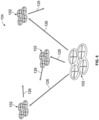
- Figure 6 illustrates a schematic diagram of a plurality of aircraft 102 within an airspace 104, according to an example of the present disclosure.
- the propulsion systems 106 shown in Figure 1 ) of the aircraft 102 output the position confirmation signals 126, as described herein.
- the position confirmation signals 126 are audio signals.
- the tracking control unit 122 constantly records the position confirmation signals 126 in a loop. When location information is to be analyzed, a desired window of data including the recorded position confirmation signals 126 can be analyzed by the tracking control unit 122.
- the position confirmation signals 126 output by the plurality of aircraft 102 can be crowd sourced for greater resiliency and accuracy.
- the tracking control unit 122 can federate the various aircraft 102 and analyze their respective position confirmation signals 126 to increase accuracy and resistance to spoofing.
- the plurality of aircraft 102 can shared bounded location estimates to improve collective resistance to spoofing attempts.
- the tracking control unit 122 not only reads the location and identification information from the position confirmation signals 126, the tracking control unit 122 can also analyze the physical characteristics of the carrier signal (for example, the audio position confirmation signal 126) to approximate a location of the detected aircraft 102. As such, even an untrusted sender is limited in how much it can spoof a location. In a crowd-sourced variant, such limiting is even more stringent.
- the location information can be physically anchored, such as via the physics of the carrier (that is, the audio position confirmation signal 126).
- one or more of the aircraft 102 can include a tracking control unit 122, such as shown in Figure 1 . Further, at least one of the aircraft 102 can include multiple transmitters for outputting one or more position confirmation signals 126 to the tracking control unit 122 of the monitoring center 116 and/or of the other aircraft 102. By using additional transmitters to output position confirmation signals 126 in different directions, the system 100 can enhance its ability to locate specific aircraft 102. In this manner, the system 100 can use targeted sensing to handle crowded environments.
- Figure 7 illustrates a flow chart of a method for confirming an identity of aircraft within an airspace, according to example of the present disclosure.
- the method includes outputting at 600, by the position sensor 108 of the aircraft 102, the position signal 124 regarding a position of the aircraft 102 within the airspace 104; and outputting at 602, by the propulsion system 106 of the aircraft 102, the position confirmation signal 126 regarding the position of the aircraft 102 within the airspace 104.
- the method also includes receiving at 604, by the tracking control unit 122 of the tracking sub-system 118, the position signal 124 and the position confirmation signal 126; and comparing at 606, by the tracking control unit 122, the position signal 124 and the position confirmation signal 126 to assess an accuracy of the position signal 124.
- the method also includes encoding, by the propulsion control unit 112, a location signal 128 on an audio signal 130 output by the motor 110 to provide the position confirmation signal 126.
- examples of the present disclosure provide systems and methods for securely and accurately confirming an identity of an aircraft within an airspace. Further, examples of the present disclosure provide systems and methods that provide cyber resilience to tracking systems, such as ADS-B systems. Moreover, examples of the present disclosure provide efficient and inexpensive systems and methods for securely and accurately confirming an identity of aircraft.
- a structure, limitation, or element that is "configured to” perform a task or operation is particularly structurally formed, constructed, or adapted in a manner corresponding to the task or operation.
- an object that is merely capable of being modified to perform the task or operation is not “configured to” perform the task or operation as used herein.
Landscapes
- Engineering & Computer Science (AREA)
- Aviation & Aerospace Engineering (AREA)
- Physics & Mathematics (AREA)
- General Physics & Mathematics (AREA)
- Radar, Positioning & Navigation (AREA)
- Remote Sensing (AREA)
- Radar Systems Or Details Thereof (AREA)
- Traffic Control Systems (AREA)
- Computer Networks & Wireless Communication (AREA)
Abstract
A system includes an aircraft including a position sensor configured to output a position signal regarding a position of the aircraft within an airspace, and a propulsion system configured to output a position confirmation signal regarding the position of the aircraft within the airspace. A method includes outputting, by a position sensor of an aircraft, a position signal regarding a position of the aircraft within an airspace; and outputting, by a propulsion system of the aircraft, a position confirmation signal regarding the position of the aircraft within the airspace.
Description
- Examples of the present disclosure generally relate to systems and methods for confirming an identity and location of an aircraft within an airspace.
- Aircraft, such as commercial aircraft, military aircraft, unmanned aerial vehicles (UAVs), such as drones, and the like may fly within an airspace. Radar can be used to track positions of aircraft within the airspace. As another example, an automatic dependent surveillance broadcast (ADS-B) system can be used to communicate positions of the aircraft within the airspace.
- ADS-B can be an essential protocol for modern air traffic management. However, ADS-B may also be insecure. For example, adversarial, intentional and unintentional interference, or otherwise unscrupulous acts can spoof ADS-B transmissions. Further, such actors can also attempt to jam ADS-B out transmissions.
- A need exists for a system and method for securely and accurately confirming an identity and location of an aircraft within an airspace. Further, a need exists for adding cyber resilience to tracking systems, such as ADS-B systems.
- With those needs in mind, certain examples of the present disclosure provide a system including an aircraft having a position sensor configured to output a position signal regarding a position of the aircraft within an airspace, and a propulsion system configured to output a position confirmation signal regarding the position of the aircraft within the airspace.
- In at least one example, the system also includes a tracking sub-system including a tracking control unit configured to receive the position signal and the position confirmation signal. The tracking control unit is further configured to compare the position signal and the position confirmation signal to assess an accuracy of the position signal.
- In at least one example, the position sensor is an automatic dependent surveillance-broadcast (ADS-B) communication device.
- The aircraft can be an unmanned aerial vehicle (UAV), such as a drone, a commercial aircraft, or a military aircraft.
- In at least one example, the propulsion system includes a motor in communication with a propulsion control unit. The motor can be an electric motor. In at least one example, the propulsion control unit encodes a location signal on an audio signal output by the motor to provide the position confirmation signal.
- As an example, the location signal includes a location of the aircraft within the airspace, and an identification of the aircraft. As a further example, the location signal also includes a timestamp.
- Certain examples of the present disclosure provide a method including outputting, by a position sensor of an aircraft, a position signal regarding a position of the aircraft within an airspace; and outputting, by a modulation of a propulsion system of the aircraft, a position confirmation signal regarding the position of the aircraft within the airspace. In at least one example, the method also includes receiving, by a tracking control unit of a tracking sub-system, the position signal and the position confirmation signal; and comparing, by the tracking control unit, the position signal and the position confirmation signal to assess an accuracy of the position signal.
-
-
Figure 1 illustrates a schematic block diagram of a system for confirming an identity of aircraft within an airspace, according to example of the present disclosure. -
Figure 2 illustrates a schematic block diagram of a control unit, according to an example of the subject disclosure. -
Figure 3 illustrates a method for confirming an identity and position of aircraft within an airspace, according to an example of the present disclosure. -
Figure 4 illustrates a top view of an example of an aircraft, according to an example of the present disclosure. -
Figure 5 illustrates a front perspective view of an aircraft, according to an example of the present disclosure. -
Figure 6 illustrates a schematic diagram of a plurality of aircraft within an airspace, according to an example of the present disclosure. -
Figure 7 illustrates a flow chart of a method for confirming an identity of aircraft within an airspace, according to example of the present disclosure. - The foregoing summary, as well as the following detailed description of certain examples will be better understood when read in conjunction with the appended drawings. As used herein, an element or step recited in the singular and preceded by the word "a" or "an" should be understood as not necessarily excluding the plural of the elements or steps. Further, references to "one example" are not intended to be interpreted as excluding the existence of additional examples that also incorporate the recited features. Moreover, unless explicitly stated to the contrary, examples "comprising" or "having" an element or a plurality of elements having a particular condition can include additional elements not having that condition.
- Examples of the present disclosure provide systems and methods for confirming an identity of an aircraft within an airspace. The systems and methods are configured to modulate an audio signature of an aircraft (such as output from a propulsion system, such as may have an electric motor) to confirm the identity and location of the aircraft.
- Rather than using additional hardware, certain examples of the present disclosure leverage existing sensors and actuators, thereby providing cost-effective and efficient systems and methods. Additionally, because the systems and methods utilize physical attributes of the behavior of the aircraft, spoofing information would essentially require an equivalent platform be inserted into the same physical space, which would vastly increase the cost of spoofing relative to existing spoofing methods.
- Certain examples of the present disclosure provide systems and methods that are configured to modulate an audio signature of an aircraft (such as output from a propulsion system) to confirm the identity and location of the aircraft. As an example, the propulsion system includes a motor in communication with a propulsion control unit that encodes a location signal on an audio signal output by the motor to provide a position confirmation signal.
-
Figure 1 illustrates a schematic block diagram of asystem 100 for confirming an identity ofaircraft 102 within anairspace 104, according to example of the present disclosure. Theaircraft 102 are tracked within theairspace 104. Theaircraft 102 can be commercial aircraft, military aircraft, UAVs, and/or the like. Theaircraft 102 includes apropulsion system 106 and a position sensor 108 (such as may be or otherwise include a position transmitter). Theposition sensor 108 is in communication with acommunicative device 110, such as through one or more wired or wireless connections. Thecommunication device 110 can be a transceiver (transmitter/receiver), an antenna, a radio unit, and/or the like. - In at least one example, the
position sensor 108 is separate and distinct from thepropulsion system 106. For example, thepropulsion system 106 does not include theposition sensor 108. - In at least one example, the
propulsion system 106 includes amotor 110 in communication with apropulsion control unit 112, such as through one or more wired or wireless connections. As an example, themotor 110 is an electric motor. As another example, themotor 110 can be, or least part of, an engine. Themotor 110 and/or thepropulsion control unit 112 is in communication with acommunication device 114, such as through one or more wired or wireless connections. Thecommunication device 110 can be a transceiver (transmitter/receiver), an antenna, a radio unit, and/or the like. Thepropulsion control unit 112 controls operation of themotor 110. Each of theaircraft 102 within theairspace 104 can be configured as shown inFigure 1 . Optionally, less than all of theaircraft 102 within theairspace 104 can be configured as shown inFigure 1 . Theairspace 104 can include more orless aircraft 102 than shown. - A
monitoring center 116 is configured to track locations of theaircraft 102 within theairspace 104. Themonitoring center 116 can be land-based, air-based, sea-based, or space-based (such as a satellite). Themonitoring center 116 includes atracking sub-system 118 having acommunication device 120 in communication with atracking control unit 122, such as through one or more wired or wireless connections. Thecommunication device 120 can be a transceiver (transmitter/receiver), an antenna, a radio unit, one or more microphones, and/or the like. Thecommunication device 120 is configured to receive signals from theaircraft 102 to identify, locate, and confirm the location of theaircraft 102 within theairspace 104, as described herein. In at least one example, thetracking sub-system 118 can be onboard at least one of theaircraft 102 within theairspace 104. For example, a plurality of theaircraft 102 can each include atracking sub-system 118. - The
position sensor 108 of theaircraft 102 is configured to be tracked by thetracking sub-system 118. In at least one example, theposition sensor 108 is an automatic dependent surveillance-broadcast (ADS-B) communication device, and thetracking sub-system 118 is configured to track theposition sensor 108 through an ADS-B protocol. As another example, theposition sensor 108 is a global positioning system sensor. As another example, thetracking sub-system 118 can be or otherwise include radar that is configured to track theposition sensor 108 and/or other portions of theaircraft 102. - As noted, in at least one example, the
tracking sub-system 118 is an ADS-B tracking sub-system. In such an example, thetracking sub-system 118 determines a current position of theaircraft 102 via satellite navigation through a positional signal of theaircraft 102 output by theposition sensor 108. Theposition sensor 108 can be or include a transmitter that periodically outputs information about theaircraft 102, such as identification details, current position, current altitude, and current velocity. Thetracking sub-system 118 receives the transmitted position signal from theposition sensor 108 to determine a current and real time location (such as may include position, heading, velocity, and the like) of theaircraft 102. Alternatively, thetracking sub-system 118 can be a radar system or other such system that is configured to track the position of theaircraft 102. - The
position sensor 108 outputs aposition signal 124, via thecommunication device 110. Theposition signal 124 is indicative of one or more of the position, altitude, heading, acceleration, velocity, and/or the like of theaircraft 102. Thecommunication device 120 of thetracking sub-system 118 receives the position signal 124 from theaircraft 102 via thecommunication device 120. Thetracking control unit 122 analyzes the position signal 124 to determine the location of theaircraft 102 within theairspace 104. - In order to confirm the location of the
aircraft 102 within theairspace 104, as detected by thetracking sub-system 118 analyzing the receivedposition signal 124, thepropulsion system 106 of theaircraft 102 outputs a separate position confirmation signal 126 from thecommunication device 114. Thetracking sub-system 118 receives theposition confirmation signal 126 via thecommunication device 120. Thetracking control unit 122 analyzes theposition confirmation signal 126. If theposition confirmation signal 126 conforms or otherwise is in agreement with theposition signal 124, thetracking control unit 122 confirms that the location of theaircraft 102 within theairspace 104 as indicated from the position signal 124 is accurate. If, however, theposition confirmation signal 126 differs from (for example, indicates a different location) theposition signal 124, thetracking control unit 122 determines that the position signal 124 is not accurate (for example, may be spoofed). - The
position confirmation signal 126 is separate and distinct from theposition signal 124. Theposition signal 124 is output by theposition sensor 108, whereas theposition conformation signal 126 is output by thepropulsion system 106. Theposition sensor 108 does not output theposition confirmation signal 126. - In at least one example, the
propulsion system 106 encodes alocation signal 128 on an audio signal 130 (for example, an audio or acoustic signature) output of themotor 110. For example, theposition confirmation signal 126 includes thelocation signal 128 on theaudio signal 130 output by themotor 110. Thelocation signal 128 includes a location of theaircraft 102 within theairspace 104, and an identification of theaircraft 102. The location of theaircraft 102 can be determined by theposition sensor 108, and/or another position sensor in communication with thepropulsion control unit 112, which attaches, assigns, adds, or otherwise includes the location of theaircraft 102 on thelocation signal 128. Thepropulsion control unit 112 also attaches, assigns, adds, or otherwise includes the identification of theaircraft 102 on thelocation signal 128. In at least one example, thelocation signal 128 can also include a timestamp. For example, thepropulsion control unit 112 can include or otherwise be in communication with a timer, which can attach, assign, add, or otherwise include the timestamp on thelocation signal 128. Optionally, thelocation signal 128 may not include the timestamp. Accordingly, theposition confirmation signal 126 output by thepropulsion system 106 includes a location and identification of theaircraft 102 within theairspace 104, and may optionally include a timestamp indicating a time of theaircraft 102 at a current location. - In at least one example, the
motor 110 is an electric motor. As such, thepropulsion system 106 can be an electric propulsion system. Thepropulsion control unit 112 is able to modulate an output of the electric motor. For example, themotor 110 generates noise. Thepropulsion control unit 112 modulates themotor 110 and embeds theposition confirmation signal 126 in the modulated noise signal output by themotor 110. Thepropulsion control unit 112 encodes thelocation signal 128 on theaudio signal 130 to provide theposition confirmation signal 126. Optionally, thepropulsion system 106 may not be an electric propulsion system. For example, thepropulsion system 106 can include gas turbine engines. - The
position confirmation signal 126 can be an audio signal, which is received by thecommunication device 120, such as may include one or more microphones. In at least one example, theposition confirmation signal 126 is an encoded signal in an audio channel. Thepropulsion control unit 112 can modulate an amplitude or frequency of theposition confirmation signal 126 in order to define a desired audio channel. - In at least one example, the
system 100 uses inexpensive audio sensors to detect theposition confirmation signal 126. For example, as noted, thecommunication device 120 can include one or more microphones (in addition to one or more ADS-B receivers, for example). By detecting and analyzing theposition confirmation signal 126, thesystem 100 enhances cyber resilience of thetracking sub-system 118, such as may be or otherwise track theaircraft 102 through ADS-B. Thepropulsion control unit 112 modulates the output of drive units, such as themotor 110, to encode thelocation signal 128 on theaudio signal 130 to form theposition confirmation signal 126. By encoding location information for theaircraft 102 within theairspace 104 in this way, examples of the present disclosure provide a system and method that is cost-effective, and which may be crowd sourced. - As described herein, the
system 100 includes theaircraft 102 including theposition sensor 108 configured to output the position signal 124 regarding a position of theaircraft 102 within theairspace 104, and thepropulsion system 106 configured to output theposition confirmation signal 126 regarding the position of theaircraft 102 within theairspace 104. Thetracking sub-system 118 includes thetracking control unit 122 configured to receive the position signal 124 and theposition confirmation signal 126. Thetracking control unit 122 is further configured to compare the position signal 124 and theposition confirmation signal 126 to assess the accuracy and reliability of theposition signal 124. - In at least one example, the
tracking sub-system 118 can include multiple microphones as thecommunication device 120. The multiple microphones can physically locate the source of thesignal 126, which provides an efficient and inexpensive way to tie thesignal 126 to a specific direction and region in theairspace 104. -
Figure 2 illustrates a schematic block diagram of acontrol unit 200, according to an example of the subject disclosure. In at least one example, thepropulsion control unit 112 and the tracking control unit 122 (shown inFigure 1 ) are configured as shown inFigure 2 . In at least one example, thecontrol unit 200 includes at least oneprocessor 202 in communication with amemory 204. Thememory 204stores instructions 206, receiveddata 208, and generateddata 210. Thecontrol unit 200 shown inFigure 5 is merely exemplary, and non-limiting. - As used herein, the term "control unit," "central processing unit," "CPU," "computer," or the like may include any processor-based or microprocessor-based system including systems using microcontrollers, reduced instruction set computers (RISC), application specific integrated circuits (ASICs), logic circuits, and any other circuit or processor including hardware, software, or a combination thereof capable of executing the functions described herein. Such are exemplary only, and are thus not intended to limit in any way the definition and/or meaning of such terms. For example, the
propulsion control unit 112 and thetracking control unit 122 may be or include one or more processors that are configured to control operation, as described herein. - The
propulsion control unit 112 and thetracking control unit 122 are configured to execute a set of instructions that are stored in one or more data storage units or elements (such as one or more memories), in order to process data. For example, thepropulsion control unit 112 and thetracking control unit 122 may include or be coupled to one or more memories. The data storage units may also store data or other information as desired or needed. The data storage units may be in the form of an information source or a physical memory element within a processing machine. - The set of instructions may include various commands that instruct the
propulsion control unit 112 and thetracking control unit 122 as a processing machine to perform specific operations such as the methods and processes of the various examples of the subject matter described herein. The set of instructions may be in the form of a software program. The software may be in various forms such as system software or application software. Further, the software may be in the form of a collection of separate programs, a program subset within a larger program, or a portion of a program. The software may also include modular programming in the form of object-oriented programming. The processing of input data by the processing machine may be in response to user commands, or in response to results of previous processing, or in response to a request made by another processing machine. - The diagrams of examples herein may illustrate one or more control or processing units, such as the
propulsion control unit 112 and thetracking control unit 122. It is to be understood that the processing or control units may represent circuits, circuitry, or portions thereof that may be implemented as hardware with associated instructions (e.g., software stored on a tangible and non-transitory computer readable storage medium, such as a computer hard drive, ROM, RAM, or the like) that perform the operations described herein. The hardware may include state machine circuitry hardwired to perform the functions described herein. Optionally, the hardware may include electronic circuits that include and/or are connected to one or more logic-based devices, such as microprocessors, processors, controllers, or the like. Optionally, thepropulsion control unit 112 and thetracking control unit 122 may represent processing circuitry such as one or more of a field programmable gate array (FPGA), application specific integrated circuit (ASIC), microprocessor(s), and/or the like. The circuits in various examples may be configured to execute one or more algorithms to perform functions described herein. The one or more algorithms may include aspects of examples disclosed herein, whether or not expressly identified in a flowchart or a method. - As used herein, the terms "software" and "firmware" are interchangeable, and include any computer program stored in a data storage unit (for example, one or more memories) for execution by a computer, including RAM memory, ROM memory, EPROM memory, EEPROM memory, and non-volatile RAM (NVRAM) memory. The above data storage unit types are exemplary only, and are thus not limiting as to the types of memory usable for storage of a computer program.
-
Figure 3 illustrates a method for confirming an identity and/or position of aircraft within an airspace, according to an example of the present disclosure. Referring toFigures 1-3 , the method includes receiving, at 300, the position signal 124 from theaircraft 102. Thetracking sub-system 118 receives theposition signal 124. At 302, the position confirmation signal 126 from theaircraft 102 is received. Thetracking sub-system 118 receives theposition confirmation signal 126.Steps step 302, or vice versa. - At 304, the
tracking control unit 122 of thetracking sub-system 118 determines if the position signal 124 agrees (that is, indicates the location information that is consistent with) theposition confirmation signal 126. If, at 304, thetracking control unit 122 determines that the position signal 124 agrees with theposition confirmation signal 126, the method proceeds to 306, at which thetracking control unit 122 confirms the location of theaircraft 102 within theairspace 104. Thetracking control unit 122 can then output a location confirmation message, such as a graphic or audio message on a user interface at themonitoring center 116 and/or theaircraft 102. If, however, thetracking control unit 122 determines that the position signal 124 does not agree with theposition confirmation signal 126 at 304, the method proceeds to 308, at which thetracking control unit 122 indicates a difference between the position signal 124 and theposition confirmation signal 126, and outputs an alert (such as on the user interface) that the position signal 124 is not accurate. -
Figure 4 illustrates a top view of an example of anaircraft 102, according to an example of the present disclosure. As shown, theaircraft 102 is an unmanned aerial vehicle (UAV), which may include anairframe 418 and one ormore propulsion systems 420 coupled to theairframe 418. At least one of thepropulsion systems 420 is an example of thepropulsion system 106 shown inFigure 1 . A plurality of thepropulsion systems 420 can share a commonpropulsion control unit 112, such as shown inFigure 1 . Optionally, each of thepropulsion systems 420 can include its ownpropulsion control unit 112. - In general, the
airframe 418 forms the structural body or framework for theaircraft 102. In the illustrated example shown inFigure 4 , theaircraft 102 includes fourpropulsion systems 420, such that eachpropulsion system 420 is mounted to arespective arm aircraft 102 includes four arms 424-427 and asingle propulsion system 420 that is mounted to each respective arm 424-427. Optionally, theaircraft 102 may include more orless propulsion systems 420, more orless propulsion systems 420 per arm 424-427, and more or less arms 424-427 than shown. - Also, optionally, instead of the UAV shown in
Figure 4 , theaircraft 102 may be include a fuselage, wings, a tail, and the like. In this manner, theaircraft 102 may be designed as an unmanned airplane. -
Figure 5 illustrates a front perspective view of anaircraft 102, according to an example of the present disclosure. Theaircraft 102 includes apropulsion system 112 that includes twoengines 514, for example. Theengines 514 can be or otherwise include electric motors. As another example, theengines 514 can be gas turbine engines. Optionally, thepropulsion system 112 may includemore engines 514 than shown. Theengines 514 are carried bywings 516 of theaircraft 102. In other examples, theengines 514 may be carried by afuselage 518 and/or anempennage 520. Theempennage 520 may also supporthorizontal stabilizers 522 and avertical stabilizer 524. - The
fuselage 518 of theaircraft 102 defines an internal cabin, which may include a cockpit, one or more work sections (for example, galleys, personnel carry-on baggage areas, and the like), one or more passenger sections (for example, first class, business class, and coach sections), and an aft section. Theaircraft 102 can be a commercial jet, for example. Optionally, theaircraft 102 can be a military aircraft, which can be configured differently than shown. -
Figure 6 illustrates a schematic diagram of a plurality ofaircraft 102 within anairspace 104, according to an example of the present disclosure. The propulsion systems 106 (shown inFigure 1 ) of theaircraft 102 output the position confirmation signals 126, as described herein. In at least one example, the position confirmation signals 126 are audio signals. Referring toFigures 1 and6 , in at least one example, thetracking control unit 122 constantly records the position confirmation signals 126 in a loop. When location information is to be analyzed, a desired window of data including the recorded position confirmation signals 126 can be analyzed by thetracking control unit 122. - Further, the position confirmation signals 126 output by the plurality of
aircraft 102 can be crowd sourced for greater resiliency and accuracy. For example, thetracking control unit 122 can federate thevarious aircraft 102 and analyze their respective position confirmation signals 126 to increase accuracy and resistance to spoofing. As an example, the plurality ofaircraft 102 can shared bounded location estimates to improve collective resistance to spoofing attempts. For example, thetracking control unit 122 not only reads the location and identification information from the position confirmation signals 126, thetracking control unit 122 can also analyze the physical characteristics of the carrier signal (for example, the audio position confirmation signal 126) to approximate a location of the detectedaircraft 102. As such, even an untrusted sender is limited in how much it can spoof a location. In a crowd-sourced variant, such limiting is even more stringent. In short, the location information can be physically anchored, such as via the physics of the carrier (that is, the audio position confirmation signal 126). - In at least one example, one or more of the
aircraft 102 can include atracking control unit 122, such as shown inFigure 1 . Further, at least one of theaircraft 102 can include multiple transmitters for outputting one or more position confirmation signals 126 to thetracking control unit 122 of themonitoring center 116 and/or of theother aircraft 102. By using additional transmitters to output position confirmation signals 126 in different directions, thesystem 100 can enhance its ability to locatespecific aircraft 102. In this manner, thesystem 100 can use targeted sensing to handle crowded environments. -
Figure 7 illustrates a flow chart of a method for confirming an identity of aircraft within an airspace, according to example of the present disclosure. Referring toFigures 1 and7 , the method includes outputting at 600, by theposition sensor 108 of theaircraft 102, the position signal 124 regarding a position of theaircraft 102 within theairspace 104; and outputting at 602, by thepropulsion system 106 of theaircraft 102, theposition confirmation signal 126 regarding the position of theaircraft 102 within theairspace 104. In at least one example, the method also includes receiving at 604, by thetracking control unit 122 of thetracking sub-system 118, the position signal 124 and theposition confirmation signal 126; and comparing at 606, by thetracking control unit 122, the position signal 124 and theposition confirmation signal 126 to assess an accuracy of theposition signal 124. In at least one example, the method also includes encoding, by thepropulsion control unit 112, alocation signal 128 on anaudio signal 130 output by themotor 110 to provide theposition confirmation signal 126. - Further, the disclosure comprises examples according to the following clauses:
- Clause 1. A system comprising:
an aircraft including a position sensor configured to output a position signal regarding a position of the aircraft within an airspace, and a propulsion system configured to output a position confirmation signal regarding the position of the aircraft within the airspace. - Clause 2. The system of Clause 1, further comprising a tracking sub-system including a tracking control unit configured to receive the position signal and the position confirmation signal, wherein the tracking control unit is further configured to compare the position signal and the position confirmation signal to assess an accuracy of the position signal.
- Clause 3. The system of Clauses 1 or 2, wherein the position sensor is an automatic dependent surveillance-broadcast (ADS-B) communication device.
- Clause 4. The system of any of Clauses 1-3, wherein the aircraft is an unmanned aerial vehicle (UAV), a commercial aircraft, or a military aircraft.
- Clause 5. The system of any of Clauses 1-4, wherein the propulsion system comprises a motor in communication with a propulsion control unit.
- Clause 6. The system of Clause 5, wherein the motor is an electric motor.
- Clause 7. The system of Clauses 5 or 6, wherein the propulsion control unit encodes a location signal on an audio signal output by the motor to provide the position confirmation signal.
- Clause 8. The system of Clause 7, wherein the location signal comprises:
- a location of the aircraft within the airspace; and
- an identification of the aircraft.
- Clause 9. The system of Clause 8, wherein the location signal further comprises a timestamp.
- Clause 10. A method comprising:
- outputting, by a position sensor of an aircraft, a position signal regarding a position of the aircraft within an airspace; and
- outputting, by a propulsion system of the aircraft, a position confirmation signal regarding the position of the aircraft within the airspace.
- Clause 11. The method of Clause 10, further comprising:
- receiving, by a tracking control unit of a tracking sub-system, the position signal and the position confirmation signal; and
- comparing, by the tracking control unit, the position signal and the position confirmation signal to assess an accuracy of the position signal.
- Clause 12. The method of Clauses 10 or 11, wherein the position sensor is an automatic dependent surveillance-broadcast (ADS-B) communication device.
- Clause 13. The method of any of Clauses 10-12, wherein the aircraft is an unmanned aerial vehicle (UAV), a commercial aircraft, or a military aircraft.
- Clause 14. The method of any of Clauses 10-13, wherein the propulsion system comprises a motor in communication with a propulsion control unit.
- Clause 15. The method of Clause 14, wherein the motor is an electric motor.
- Clause 16. The method of Clauses 14 or 15, further comprising encoding, by the propulsion control unit, a location signal on an audio signal output by the motor to provide the position confirmation signal.
- Clause 17. The method of Clause 16, wherein the location signal comprises:
- a location of the aircraft within the airspace; and
- an identification of the aircraft.
- Clause 18. The method of Clause 17, wherein the location signal further comprises a timestamp.
- Clause 19. A system comprising:
- an aircraft including a position sensor configured to output a position signal regarding a position of the aircraft within an airspace, and a propulsion system configured to output a position confirmation signal regarding the position of the aircraft within the airspace, wherein the position sensor is an automatic dependent surveillance-broadcast (ADS-B) communication device, wherein the propulsion system comprises a motor in communication with a propulsion control unit, and wherein the propulsion control unit encodes a location signal on an audio signal output by the motor to provide the position confirmation signal; and
- a tracking sub-system including a tracking control unit configured to receive the position signal and the position confirmation signal, wherein the tracking control unit is further configured to compare the position signal and the position confirmation signal to assess an accuracy of the position signal.
- Clause 20. The system of Clause 19, wherein the location signal comprises:
- a location of the aircraft within the airspace;
- an identification of the aircraft; and
- a timestamp.
- As described herein, examples of the present disclosure provide systems and methods for securely and accurately confirming an identity of an aircraft within an airspace. Further, examples of the present disclosure provide systems and methods that provide cyber resilience to tracking systems, such as ADS-B systems. Moreover, examples of the present disclosure provide efficient and inexpensive systems and methods for securely and accurately confirming an identity of aircraft.
- While various spatial and directional terms, such as top, bottom, lower, mid, lateral, horizontal, vertical, front and the like can be used to describe examples of the present disclosure, it is understood that such terms are merely used with respect to the orientations shown in the drawings. The orientations can be inverted, rotated, or otherwise changed, such that an upper portion is a lower portion, and vice versa, horizontal becomes vertical, and the like.
- As used herein, a structure, limitation, or element that is "configured to" perform a task or operation is particularly structurally formed, constructed, or adapted in a manner corresponding to the task or operation. For purposes of clarity and the avoidance of doubt, an object that is merely capable of being modified to perform the task or operation is not "configured to" perform the task or operation as used herein.
- It is to be understood that the above description is intended to be illustrative, and not restrictive. For example, the above-described examples (and/or aspects thereof) can be used in combination with each other. In addition, many modifications can be made to adapt a particular situation or material to the teachings of the various examples of the disclosure without departing from their scope. While the dimensions and types of materials described herein are intended to define the parameters of the various examples of the disclosure, the examples are by no means limiting and are exemplary examples. Many other examples will be apparent to those of skill in the art upon reviewing the above description. The scope of the various examples of the disclosure should, therefore, be determined with reference to the appended claims, along with the full scope of equivalents to which such claims are entitled. In the appended claims and the detailed description herein, the terms "including" and "in which" are used as the plain-English equivalents of the respective terms "comprising" and "wherein." Moreover, the terms "first," "second," and "third," etc. are used merely as labels, and are not intended to impose numerical requirements on their objects. Further, the limitations of the following claims are not written in means-plus-function format and are not intended to be interpreted based on 35 U.S.C. § 112(f), unless and until such claim limitations expressly use the phrase "means for" followed by a statement of function void of further structure.
- This written description uses examples to disclose the various examples of the disclosure, including the best mode, and also to enable any person skilled in the art to practice the various examples of the disclosure, including making and using any devices or systems and performing any incorporated methods. The patentable scope of the various examples of the disclosure is defined by the claims, and can include other examples that occur to those skilled in the art. Such other examples are intended to be within the scope of the claims if the examples have structural elements that do not differ from the literal language of the claims, or if the examples include equivalent structural elements with insubstantial differences from the literal language of the claims.
Claims (15)
- A system (100) comprising:
an aircraft (102) including a position sensor (108) configured to output a position signal (124) regarding a position of the aircraft (102) within an airspace (104), and a propulsion system (106) configured to output a position confirmation signal (126) regarding the position of the aircraft (102) within the airspace (104). - The system (100) of claim 1, further comprising a tracking sub-system (122) (100) including a tracking control unit (122) configured to receive the position signal (124) and the position confirmation signal (126), wherein the tracking control unit (122) is further configured to compare the position signal (124) and the position confirmation signal (126) to assess an accuracy of the position signal (124).
- The system (100) of claim 1 or 2, wherein the position sensor (108) is an automatic dependent surveillance-broadcast communication device (120).
- The system (100) of any of claims 1 to 3, wherein the aircraft (102) is an unmanned aerial vehicle, a commercial aircraft (102), or a military aircraft (102).
- The system (100) of any of claims 1 to 4, wherein the propulsion system (106) comprises a motor (110) in communication with a propulsion control unit (112).
- The system (100) of claim 5, wherein the propulsion control unit (112) encodes a location signal (128) on an audio signal (130) output by the motor (110) to provide the position confirmation signal (126).
- The system (100) of claim 6, wherein the location signal (128) comprises:a location of the aircraft (102) within the airspace (104); andan identification of the aircraft (102).
- The system (100) of claim 6 or 7, wherein the location signal (128) further comprises a timestamp.
- A method comprising:outputting, by a position sensor (108) of an aircraft (102), a position signal (124) regarding a position of the aircraft (102) within an airspace (104); andoutputting, by a propulsion system (106) of the aircraft (102), a position confirmation signal (126) regarding the position of the aircraft (102) within the airspace (104).
- The method of claim 9, further comprising:receiving, by a tracking control unit (122) of a tracking sub-system (122) (100), the position signal (124) and the position confirmation signal (126); andcomparing, by the tracking control unit (122), the position signal (124) and the position confirmation signal (126) to assess an accuracy of the position signal (124).
- The method of claim 9 or 10, wherein the position sensor (108) is an automatic dependent surveillance-broadcast communication device (120).
- The method of any of claims 9 to 11, wherein the aircraft (102) is an unmanned aerial vehicle, a commercial aircraft (102), or a military aircraft (102).
- The method of any of claims 9 to 12, wherein the propulsion system (106) comprises a motor (110) in communication with a propulsion control unit (112).
- The method of claim 13, further comprising encoding, by the propulsion control unit (112), a location signal (128) on an audio signal (130) output by the motor (110) to provide the position confirmation signal (126).
- The method of claim 14, wherein the location signal (128) comprises:a location of the aircraft (102) within the airspace (104); andan identification of the aircraft (102).
Applications Claiming Priority (1)
| Application Number | Priority Date | Filing Date | Title |
|---|---|---|---|
| US17/405,417 US20230130515A1 (en) | 2021-08-18 | 2021-08-18 | Systems and methods for confirming identity and location of an aircraft within an airspace |
Publications (1)
| Publication Number | Publication Date |
|---|---|
| EP4138060A1 true EP4138060A1 (en) | 2023-02-22 |
Family
ID=81748865
Family Applications (1)
| Application Number | Title | Priority Date | Filing Date |
|---|---|---|---|
| EP22173779.4A Withdrawn EP4138060A1 (en) | 2021-08-18 | 2022-05-17 | Systems and methods for confirming identity and location of an aircraft within an airspace |
Country Status (6)
| Country | Link |
|---|---|
| US (1) | US20230130515A1 (en) |
| EP (1) | EP4138060A1 (en) |
| JP (1) | JP2023085190A (en) |
| CN (1) | CN115708033A (en) |
| AU (1) | AU2022218578A1 (en) |
| CA (1) | CA3161015C (en) |
Cited By (1)
| Publication number | Priority date | Publication date | Assignee | Title |
|---|---|---|---|---|
| EP4467467A1 (en) * | 2023-05-25 | 2024-11-27 | B/E Aerospace, Inc. | Method and apparatus for identifying an aircraft |
Citations (7)
| Publication number | Priority date | Publication date | Assignee | Title |
|---|---|---|---|---|
| US20170278410A1 (en) * | 2016-03-28 | 2017-09-28 | Cisco Technology, Inc. | Multi-modal UAV Certification |
| US20180091908A1 (en) * | 2016-09-29 | 2018-03-29 | Verizon Patent And Licensing Inc. | Identification of unmanned aerial vehicles based on audio signatures |
| US20180197420A1 (en) * | 2016-03-17 | 2018-07-12 | Jasminder Banga | System and method for aerial system discrimination and action |
| US20190051197A1 (en) * | 2018-09-25 | 2019-02-14 | Intel Corporation | Methods and apparatus for preventing collisions between drones based on drone-to-drone acoustic communications |
| US20200096624A1 (en) * | 2018-09-24 | 2020-03-26 | Howden Alphair Ventilating Systems Inc. | System and method for acoustic vehicle location tracking |
| US20200312159A1 (en) * | 2019-03-25 | 2020-10-01 | Kittyhawk.io, Inc. | Systems and Methods for Multi-Channel Remote Identification of Aircraft |
| US20210225182A1 (en) * | 2019-12-31 | 2021-07-22 | Zipline International Inc. | Acoustic based detection and avoidance for aircraft |
Family Cites Families (5)
| Publication number | Priority date | Publication date | Assignee | Title |
|---|---|---|---|---|
| ATE448638T1 (en) * | 2006-04-13 | 2009-11-15 | Fraunhofer Ges Forschung | AUDIO SIGNAL DECORRELATOR |
| JP6693023B2 (en) * | 2015-09-16 | 2020-05-13 | エスゼット ディージェイアイ テクノロジー カンパニー リミテッドSz Dji Technology Co.,Ltd | Method and system for producing sound |
| US10785562B1 (en) * | 2017-12-08 | 2020-09-22 | Verily Life Sciences Llc | Position-aware recording devices able to provide context to speech |
| AR119752A1 (en) * | 2019-08-13 | 2022-01-12 | Fmc Corp | SYSTEMS AND METHODS OF SUPPLY OF MATERIALS |
| US11567214B2 (en) * | 2019-12-17 | 2023-01-31 | Aireon Llc | Decoding position information |
-
2021
- 2021-08-18 US US17/405,417 patent/US20230130515A1/en active Pending
-
2022
- 2022-05-17 EP EP22173779.4A patent/EP4138060A1/en not_active Withdrawn
- 2022-05-27 CA CA3161015A patent/CA3161015C/en active Active
- 2022-06-14 CN CN202210665139.2A patent/CN115708033A/en active Pending
- 2022-08-12 JP JP2022128663A patent/JP2023085190A/en active Pending
- 2022-08-18 AU AU2022218578A patent/AU2022218578A1/en active Pending
Patent Citations (7)
| Publication number | Priority date | Publication date | Assignee | Title |
|---|---|---|---|---|
| US20180197420A1 (en) * | 2016-03-17 | 2018-07-12 | Jasminder Banga | System and method for aerial system discrimination and action |
| US20170278410A1 (en) * | 2016-03-28 | 2017-09-28 | Cisco Technology, Inc. | Multi-modal UAV Certification |
| US20180091908A1 (en) * | 2016-09-29 | 2018-03-29 | Verizon Patent And Licensing Inc. | Identification of unmanned aerial vehicles based on audio signatures |
| US20200096624A1 (en) * | 2018-09-24 | 2020-03-26 | Howden Alphair Ventilating Systems Inc. | System and method for acoustic vehicle location tracking |
| US20190051197A1 (en) * | 2018-09-25 | 2019-02-14 | Intel Corporation | Methods and apparatus for preventing collisions between drones based on drone-to-drone acoustic communications |
| US20200312159A1 (en) * | 2019-03-25 | 2020-10-01 | Kittyhawk.io, Inc. | Systems and Methods for Multi-Channel Remote Identification of Aircraft |
| US20210225182A1 (en) * | 2019-12-31 | 2021-07-22 | Zipline International Inc. | Acoustic based detection and avoidance for aircraft |
Cited By (1)
| Publication number | Priority date | Publication date | Assignee | Title |
|---|---|---|---|---|
| EP4467467A1 (en) * | 2023-05-25 | 2024-11-27 | B/E Aerospace, Inc. | Method and apparatus for identifying an aircraft |
Also Published As
| Publication number | Publication date |
|---|---|
| JP2023085190A (en) | 2023-06-20 |
| CA3161015A1 (en) | 2023-02-18 |
| CA3161015C (en) | 2026-03-31 |
| US20230130515A1 (en) | 2023-04-27 |
| CN115708033A (en) | 2023-02-21 |
| AU2022218578A1 (en) | 2023-03-09 |
Similar Documents
| Publication | Publication Date | Title |
|---|---|---|
| US9934621B2 (en) | Automated transmission of vehicle anomalous incident data via preferred transmission modes | |
| US11037453B2 (en) | Adaptive sense and avoid system | |
| US10457249B2 (en) | Detecting false positioning signals based on surveillance signals | |
| EP2506032A1 (en) | Validity check of vehicle position information | |
| CN108475068A (en) | UAV flight control method, UAV and control terminal based on ADS-B receiver | |
| CN111819610A (en) | Air situational information and traffic management systems for unmanned and manned aerial vehicles | |
| EP4075409B1 (en) | System and method for communication in mixed airspace | |
| US7383124B1 (en) | ADS-B broadcast monitoring system and method | |
| CN112748456A (en) | System and method for assisted navigation using distributed avionics processing | |
| CN112749007A (en) | System and method for distributed avionics device processing | |
| EP3594924B1 (en) | Aircraft position-based air turbulence detection systems and methods | |
| EP4138060A1 (en) | Systems and methods for confirming identity and location of an aircraft within an airspace | |
| Quek et al. | Analysis of safety performance of tracking services based on simulation of unmitigated uas conflicts | |
| EP4485425A1 (en) | Systems and methods for improving situational awareness of aircraft within an airspace | |
| RU2683703C1 (en) | Unmanned aviation systems complex automated monitoring and control system logical architecture, providing their safe integration in public air space | |
| CN114882717B (en) | Object detection system and method based on vehicle-road cooperation | |
| US20230343231A1 (en) | Ads-b validation using directional antenna | |
| Dai et al. | A simulation-based study on the impact of tracking performance on UTM flight safety | |
| Gellerman et al. | Integration of a radar sensor into a sense-and-avoid payload for small UAS | |
| KR102173972B1 (en) | Method for determining status of unmanned aerial vehicle, device and system using the same | |
| EP4471745A1 (en) | Air mobility system with enhanced situational awareness | |
| US12530976B2 (en) | Method to obtain a recognized air picture of an observation space surrounding an automated aerial vehicle | |
| CN114019999B (en) | An automatic anti-collision method and automatic anti-collision system for UAVs in the air | |
| WO2023175810A1 (en) | Unmanned aerial vehicle information acquisition system and unmanned aerial vehicle information acquisition method | |
| Quek et al. | Analysing UTM tracking service performance in the detection of unmitigated UAS conflicts using Monte Carlo simulation |
Legal Events
| Date | Code | Title | Description |
|---|---|---|---|
| PUAI | Public reference made under article 153(3) epc to a published international application that has entered the european phase |
Free format text: ORIGINAL CODE: 0009012 |
|
| STAA | Information on the status of an ep patent application or granted ep patent |
Free format text: STATUS: THE APPLICATION HAS BEEN PUBLISHED |
|
| AK | Designated contracting states |
Kind code of ref document: A1 Designated state(s): AL AT BE BG CH CY CZ DE DK EE ES FI FR GB GR HR HU IE IS IT LI LT LU LV MC MK MT NL NO PL PT RO RS SE SI SK SM TR |
|
| RAP3 | Party data changed (applicant data changed or rights of an application transferred) |
Owner name: THE BOEING COMPANY |
|
| STAA | Information on the status of an ep patent application or granted ep patent |
Free format text: STATUS: THE APPLICATION IS DEEMED TO BE WITHDRAWN |
|
| 18D | Application deemed to be withdrawn |
Effective date: 20230823 |