EP4137802B1 - Method for analyzing content and distribution of boron introduced into positive electrode active material - Google Patents
Method for analyzing content and distribution of boron introduced into positive electrode active material Download PDFInfo
- Publication number
- EP4137802B1 EP4137802B1 EP21911187.9A EP21911187A EP4137802B1 EP 4137802 B1 EP4137802 B1 EP 4137802B1 EP 21911187 A EP21911187 A EP 21911187A EP 4137802 B1 EP4137802 B1 EP 4137802B1
- Authority
- EP
- European Patent Office
- Prior art keywords
- boron
- active material
- cathode active
- content
- analysis method
- Prior art date
- Legal status (The legal status is an assumption and is not a legal conclusion. Google has not performed a legal analysis and makes no representation as to the accuracy of the status listed.)
- Active
Links
Images
Classifications
-
- C—CHEMISTRY; METALLURGY
- C01—INORGANIC CHEMISTRY
- C01G—COMPOUNDS CONTAINING METALS NOT COVERED BY SUBCLASSES C01D OR C01F
- C01G53/00—Compounds of nickel
- C01G53/40—Complex oxides containing nickel and at least one other metal element
- C01G53/42—Complex oxides containing nickel and at least one other metal element containing alkali metals, e.g. LiNiO2
- C01G53/44—Complex oxides containing nickel and at least one other metal element containing alkali metals, e.g. LiNiO2 containing manganese
- C01G53/50—Complex oxides containing nickel and at least one other metal element containing alkali metals, e.g. LiNiO2 containing manganese of the type (MnO2)n-, e.g. Li(NixMn1-x)O2 or Li(MyNixMn1-x-y)O2
-
- C—CHEMISTRY; METALLURGY
- C01—INORGANIC CHEMISTRY
- C01G—COMPOUNDS CONTAINING METALS NOT COVERED BY SUBCLASSES C01D OR C01F
- C01G53/00—Compounds of nickel
- C01G53/40—Complex oxides containing nickel and at least one other metal element
- C01G53/42—Complex oxides containing nickel and at least one other metal element containing alkali metals, e.g. LiNiO2
- C01G53/44—Complex oxides containing nickel and at least one other metal element containing alkali metals, e.g. LiNiO2 containing manganese
- C01G53/50—Complex oxides containing nickel and at least one other metal element containing alkali metals, e.g. LiNiO2 containing manganese of the type (MnO2)n-, e.g. Li(NixMn1-x)O2 or Li(MyNixMn1-x-y)O2
- C01G53/502—Complex oxides containing nickel and at least one other metal element containing alkali metals, e.g. LiNiO2 containing manganese of the type (MnO2)n-, e.g. Li(NixMn1-x)O2 or Li(MyNixMn1-x-y)O2 containing lithium and cobalt
-
- C—CHEMISTRY; METALLURGY
- C01—INORGANIC CHEMISTRY
- C01G—COMPOUNDS CONTAINING METALS NOT COVERED BY SUBCLASSES C01D OR C01F
- C01G53/00—Compounds of nickel
- C01G53/40—Complex oxides containing nickel and at least one other metal element
- C01G53/42—Complex oxides containing nickel and at least one other metal element containing alkali metals, e.g. LiNiO2
- C01G53/44—Complex oxides containing nickel and at least one other metal element containing alkali metals, e.g. LiNiO2 containing manganese
- C01G53/50—Complex oxides containing nickel and at least one other metal element containing alkali metals, e.g. LiNiO2 containing manganese of the type (MnO2)n-, e.g. Li(NixMn1-x)O2 or Li(MyNixMn1-x-y)O2
- C01G53/502—Complex oxides containing nickel and at least one other metal element containing alkali metals, e.g. LiNiO2 containing manganese of the type (MnO2)n-, e.g. Li(NixMn1-x)O2 or Li(MyNixMn1-x-y)O2 containing lithium and cobalt
- C01G53/504—Complex oxides containing nickel and at least one other metal element containing alkali metals, e.g. LiNiO2 containing manganese of the type (MnO2)n-, e.g. Li(NixMn1-x)O2 or Li(MyNixMn1-x-y)O2 containing lithium and cobalt with the molar ratio of nickel with respect to all the metals other than alkali metals higher than or equal to 0.5, e.g. Li(MzNixCoyMn1-x-y-z)O2 with x ≥ 0.5
-
- C—CHEMISTRY; METALLURGY
- C01—INORGANIC CHEMISTRY
- C01G—COMPOUNDS CONTAINING METALS NOT COVERED BY SUBCLASSES C01D OR C01F
- C01G53/00—Compounds of nickel
- C01G53/40—Complex oxides containing nickel and at least one other metal element
- C01G53/42—Complex oxides containing nickel and at least one other metal element containing alkali metals, e.g. LiNiO2
- C01G53/44—Complex oxides containing nickel and at least one other metal element containing alkali metals, e.g. LiNiO2 containing manganese
- C01G53/50—Complex oxides containing nickel and at least one other metal element containing alkali metals, e.g. LiNiO2 containing manganese of the type (MnO2)n-, e.g. Li(NixMn1-x)O2 or Li(MyNixMn1-x-y)O2
- C01G53/502—Complex oxides containing nickel and at least one other metal element containing alkali metals, e.g. LiNiO2 containing manganese of the type (MnO2)n-, e.g. Li(NixMn1-x)O2 or Li(MyNixMn1-x-y)O2 containing lithium and cobalt
- C01G53/504—Complex oxides containing nickel and at least one other metal element containing alkali metals, e.g. LiNiO2 containing manganese of the type (MnO2)n-, e.g. Li(NixMn1-x)O2 or Li(MyNixMn1-x-y)O2 containing lithium and cobalt with the molar ratio of nickel with respect to all the metals other than alkali metals higher than or equal to 0.5, e.g. Li(MzNixCoyMn1-x-y-z)O2 with x ≥ 0.5
- C01G53/506—Complex oxides containing nickel and at least one other metal element containing alkali metals, e.g. LiNiO2 containing manganese of the type (MnO2)n-, e.g. Li(NixMn1-x)O2 or Li(MyNixMn1-x-y)O2 containing lithium and cobalt with the molar ratio of nickel with respect to all the metals other than alkali metals higher than or equal to 0.5, e.g. Li(MzNixCoyMn1-x-y-z)O2 with x ≥ 0.5 with the molar ratio of nickel with respect to all the metals other than alkali metals higher than or equal to 0.8, e.g. Li(MzNixCoyMn1-x-y-z)O2 with x ≥ 0.8
-
- G—PHYSICS
- G01—MEASURING; TESTING
- G01N—INVESTIGATING OR ANALYSING MATERIALS BY DETERMINING THEIR CHEMICAL OR PHYSICAL PROPERTIES
- G01N1/00—Sampling; Preparing specimens for investigation
- G01N1/28—Preparing specimens for investigation including physical details of (bio-)chemical methods covered elsewhere, e.g. G01N33/50, C12Q
- G01N1/38—Diluting, dispersing or mixing samples
-
- G—PHYSICS
- G01—MEASURING; TESTING
- G01N—INVESTIGATING OR ANALYSING MATERIALS BY DETERMINING THEIR CHEMICAL OR PHYSICAL PROPERTIES
- G01N1/00—Sampling; Preparing specimens for investigation
- G01N1/28—Preparing specimens for investigation including physical details of (bio-)chemical methods covered elsewhere, e.g. G01N33/50, C12Q
- G01N1/44—Sample treatment involving radiation, e.g. heat
-
- G—PHYSICS
- G01—MEASURING; TESTING
- G01N—INVESTIGATING OR ANALYSING MATERIALS BY DETERMINING THEIR CHEMICAL OR PHYSICAL PROPERTIES
- G01N21/00—Investigating or analysing materials by the use of optical means, i.e. using sub-millimetre waves, infrared, visible or ultraviolet light
- G01N21/62—Systems in which the material investigated is excited whereby it emits light or causes a change in wavelength of the incident light
- G01N21/71—Systems in which the material investigated is excited whereby it emits light or causes a change in wavelength of the incident light thermally excited
- G01N21/73—Systems in which the material investigated is excited whereby it emits light or causes a change in wavelength of the incident light thermally excited using plasma burners or torches
-
- G—PHYSICS
- G01—MEASURING; TESTING
- G01N—INVESTIGATING OR ANALYSING MATERIALS BY DETERMINING THEIR CHEMICAL OR PHYSICAL PROPERTIES
- G01N33/00—Investigating or analysing materials by specific methods not covered by groups G01N1/00 - G01N31/00
- G01N33/20—Metals
- G01N33/202—Constituents thereof
- G01N33/2022—Non-metallic constituents
-
- C—CHEMISTRY; METALLURGY
- C01—INORGANIC CHEMISTRY
- C01P—INDEXING SCHEME RELATING TO STRUCTURAL AND PHYSICAL ASPECTS OF SOLID INORGANIC COMPOUNDS
- C01P2002/00—Crystal-structural characteristics
- C01P2002/50—Solid solutions
- C01P2002/52—Solid solutions containing elements as dopants
- C01P2002/54—Solid solutions containing elements as dopants one element only
-
- Y—GENERAL TAGGING OF NEW TECHNOLOGICAL DEVELOPMENTS; GENERAL TAGGING OF CROSS-SECTIONAL TECHNOLOGIES SPANNING OVER SEVERAL SECTIONS OF THE IPC; TECHNICAL SUBJECTS COVERED BY FORMER USPC CROSS-REFERENCE ART COLLECTIONS [XRACs] AND DIGESTS
- Y02—TECHNOLOGIES OR APPLICATIONS FOR MITIGATION OR ADAPTATION AGAINST CLIMATE CHANGE
- Y02E—REDUCTION OF GREENHOUSE GAS [GHG] EMISSIONS, RELATED TO ENERGY GENERATION, TRANSMISSION OR DISTRIBUTION
- Y02E60/00—Enabling technologies; Technologies with a potential or indirect contribution to GHG emissions mitigation
- Y02E60/10—Energy storage using batteries
Definitions
- the present invention relates to an analysis method of distribution pattern and content for each distribution position of boron introduced into a cathode active material for a lithium secondary battery.
- Lithium secondary batteries generally have a structure including an electrode assembly composed of a cathode and an anode comprising electrode active materials capable of intercalating/releasing lithium ions and a separator interposed between the two electrodes, and an electrolyte solution which is a transfer medium for lithium ions. Lithium ions move between the anode and the cathode through the electrolyte, causing charging and discharging of batteries.
- the secondary batteries undergo problems such as deterioration of life characteristics, decomposition of electrolytes or deterioration of active materials during repeated charging and discharging procedures.
- problems such as deterioration of life characteristics, decomposition of electrolytes or deterioration of active materials during repeated charging and discharging procedures.
- the batteries are subject to swelling due to the reaction between impurities and the electrolyte and change over time.
- the electrode active material may be coated or doped with various materials.
- lithium transition metal oxides such as lithium-nickel-manganese-cobalt-based oxides
- coating or doping with boron results in formation of oxygen-sealing structures, thereby capacity reduction can be slowed down.
- boron contained in the cathode active material may enhance structural stability by strengthening the bonding between transition metals and oxygen.
- the introduction of boron into the cathode active material is carried out by mixing the cathode active material and boric acid (H 3 BO 3 ) and firing at a high temperature wherein boron may penetrate to the inside of the cathode active material or may remain in the form of Li-B-O compound on the surface and outside thereof.
- boric acid H 3 BO 3
- the current method for analyzing components of a cathode active material is to perform measurement by inductively coupled plasma optical emission spectroscopy (ICP-OES) after pretreatment with acid. In this method, it is possible to quantify even the boron that has penetrated to the inside of primary grains of the structurally stable cathode active material by using acid.
- ICP-OES inductively coupled plasma optical emission spectroscopy
- WO 2020/230424 A1 describes a positive electrode active substance for a non-aqueous electrolyte secondary battery that contains a lithium-containing transition metal oxide having secondary particles formed by aggregation of primary particles and at least a tungsten compound and a boron compound that are present between primary particles.
- US 2018/131006 A1 describes positive electrode active material of secondary particles formed by aggregation of primary particles of a lithium transition metal oxide containing Ni and Mn and that include a boron compound present in the inner part and surface of the secondary particles.
- US 2016/013476 A1 describes a method of preparing a cathode active material including coating a surface of a lithium transition metal oxide with a lithium boron oxide by dry mixing the lithium transition metal oxide and a boron-containing compound and performing a heat treatment.
- US 2019/312279 A1 describes a positive electrode active material for a nonaqueous electrolyte secondary battery that contains a first lithium-metal composite oxide containing a secondary particle formed of a plurality of flocculated primary particles and either one or both of a first compound containing lithium and boron and a second compound containing lithium and tungsten.
- the present invention provides an analysis method of content for each distribution position of boron introduced to improve performance of a cathode active material used in a lithium secondary battery.
- an analysis method of content of boron introduced into a cathode active material comprising:
- the present invention it is possible to sequentially extract and analyze boron introduced to improve performance of a cathode active material for a lithium secondary battery by using a difference in solubility in water and an acid according to the distribution position of boron, thereby determining the optimal content of boron required for improving performance of the cathode active material through the distribution pattern of boron in the cathode active material.
- the present invention relates to an analysis method of content of boron introduced to improve the performance of a cathode active material for a lithium secondary battery according to a distribution position.
- the method will be described in detail for each step.
- the cathode active material sample may be prepared by dry mixing a boron-containing compound and a cathode active material, followed by firing at a high temperature.
- the boron-containing compound may comprise at least one compound selected from the group consisting of H 3 BO 3 , B 2 O 3 , C 6 H 5 B(OH) 2 , (C 6 H 5 O) 3 B, [CH 3 (CH 2 ) 3 O] 3 B, C 13 H 19 BO 3 , C 3 H 9 B 3 O 6 , and (C 3 H 7 O) 3 B.
- the cathode active material may comprise a lithium transition metal oxide represented by the following formula 1.
- M is one or two or more selected from the group consisting of Al, Zr, Zn, Ti, Mg, Ga and In; 0 ⁇ x ⁇ 1.0, 0 ⁇ y ⁇ 0.6, 0 ⁇ z ⁇ 0.6 and 0 ⁇ v ⁇ 0.1.
- the firing may be carried out near the melting point of the boron-containing compound, for example at 130 °C to 300 °C, such as 130 °C to 200 °C, for 3 hours to 10 hours.
- the firing temperature satisfies the above temperature range, the boron-containing compound is sufficiently melted and non-uniform reaction due to excessive temperature can be prevented.
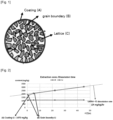
- boron may be coated on the surface of the cathode active material or penetrate to the inside of the cathode active material to be distributed between primary grains or secondary grains. Referring to Fig. 1 , boron is introduced into the cathode active material such that it exists in the coating layer on the surface (A), at grain boundary (B), or in lattice (C) to form lithium boron oxides such as LiBO 2 , LiB 4 O 7 , etc.
- the solubility of boron in water may vary depending on the distribution position of the boron in the cathode active material.
- boron present in the coating layer (A) of the cathode active material is readily dissolved in water, while boron present at grain boundary (B) is dissolved in water over a long period of time and boron doped in lattice (C) is hardly dissolved in water and can be dissolved through acid treatment. Therefore, in the present invention, boron present in the cathode active material sample is sequentially extracted by using the difference in solubility for each distribution position.
- the cathode active material sample is dissolved in water to obtain a first liquid layer and a first insoluble precipitate, and then the first liquid layer is treated with acid (S2). At this time, dissolving the sample in water may be performed at room temperature for 1 to 10 minutes.
- the first liquid layer is a result of rapidly dissolving boron coated on the surface of the cathode active material in water, and thus the first liquid layer is subjected to acid treatment to induce dissolution of remaining boron.
- acid treatment through the acid treatment, acid concentration and solution viscosity can be maintained as same level as in the single extraction of boron.
- the acid-treated solution of the first liquid layer may be analyzed by inductively coupled plasma optical emission spectroscopy (ICP-OES) to measure the boron concentration.
- ICP-OES inductively coupled plasma optical emission spectroscopy
- the ICP-OES may be performed in a conventional manner in the art, for example, under the condition as exemplified in the following Example.
- the content (A) of boron coated on the surface of the cathode active material may be calculated using the boron concentration as measured above.
- the first precipitate is dissolved in water to obtain a second liquid layer and a second insoluble precipitate, and then the second liquid layer is treated with acid (S3).
- dissolving the first precipitate in water may be performed at room temperature for 1 to 10 hours.
- the acid-treated solution of the second liquid layer may be analyzed by ICP-OES to measure the boron concentration, and the content (B) of boron present at grain boundary of the cathode active material may be calculated using the boron concentration as measured above.
- the second precipitate is dissolved by adding acid and hydrogen peroxide (S4). At this time, dissolving the second precipitate may be performed for 1 to 5 hours.
- the solution obtained by treating the second precipitate with acid and hydrogen peroxide is analyzed by ICP-OES to measure the boron concentration, and the content (C) of boron doped in lattice of the cathode active material may be calculated using the boron concentration as measured above.
- the acid that may be used for the first liquid layer, the second liquid layer and the second precipitate may be hydrochloric acid, and the acid may be used in an amount of 0.01 to 10 ml, preferably 5 to 10 ml based on 1 g of each object to be treated.
- the hydrogen peroxide is used to extract remaining boron that has not been dissolved by the acid, and the acid and hydrogen peroxide may be used in a volume ratio of 1:0.3 to 1:0.7, for example, 1:0.5.
- Example 1 Extraction and content analysis according to distribution position of boron introduced into cathode active material
- LiNi 0.78 Mn 0.11 Co 0.11 O 2 as a cathode active material and H 3 BO 3 as a boron-containing compound were mixed in a dry mixer (CYCLOMIX, HOSOKAWA Micron Corporation), and then the resulting powders were fired at 150 °C for 5 hours. Through this process, three samples with boron introduced into the cathode active material were obtained, wherein the cathode active material and the boron-containing compound are applied to the sample in an amount as shown in Table 1, respectively.
- Step 2 Extraction and content measurement of boron present in coating layer of cathode active material
- step 1 0.1 g of each of the three samples obtained in step 1 was aliquoted and put into a vial, and it was dissolved by adding 20 g of ultrapure water thereto and then shaking at room temperature for 5 minutes. The resulting solution was allowed to stand so that a first liquid layer and a first precipitate (insoluble) were separated, and then filtered through a 0.45 ⁇ m filter.
- the content (A) of boron present in the coating layer of the cathode active material was calculated.
- Step 3 Extraction and content measurement of boron present at grain boundary of cathode active material
- step 2 0.1 g of the first precipitates (insoluble) separated in step 2 were put into a vial and dissolved by adding 20 g of ultrapure water thereto and then shaking at room temperature for 5 hours. The resulting solution was allowed to stand so that a second liquid layer and a second precipitate (insoluble) were separated, and then filtered through a 0.45 ⁇ m filter.
- Step 4 Extraction and content measurement of boron in lattice of cathode active material
- step 3 0.1 g of the second precipitates (insoluble) separated in step 3 were put into a vial and dissolved by adding 1 ml of concentrated hydrochloric acid and 0.5 ml of hydrogen peroxide at room temperature for 3 hours, and bubbles and heat were generated during the dissolution process.
- Comparative Example 1 Single extraction and content analysis of boron introduced into cathode active material
- 0.1 g of each of the three samples obtained in step 1 of Example was aliquoted and put into a vial, and it was dissolved by adding 1 ml of concentrated hydrochloric acid and 0.5 ml of hydrogen peroxide at room temperature for 3 hours, and bubbles and heat were generated during the dissolution process.
- Example 1 when boron introduced into the cathode active material is extracted and analyzed according to the distribution position, it is possible to quantify the amount of boron present in each position according to the distribution pattern of boron in the cathode active material, thereby identifying correlation between the performance improvement and the amount of boron introduced. From this, it can be determined the optimal content of boron that contributes to the performance improvement of the cathode material.
- LiNi 0.78 Mn 0.11 Co 0.11 O 2 and H 3 BO 3 were dry mixed and fired as in Step 1 of Example 1 to produce a sample (1000 mg of boron/1kg of cathode active material), and then 0.1 g of the sample was aliquoted and put into a vial and it was dissolved by adding 20 g of ultrapure water thereto at room temperature, and ICP-OES analysis was performed under the same conditions as in Example 1 depending on the dissolution time.
- the content (extraction concentration) of boron is not significantly changed according to the dissolution time and most of boron is present in the coating, while the slope of the content (extraction concentration) of lithium is divided into three stages according to the dissolution time and the lithium results are similar to the results for Samples 2 and 3 used in Example 1.
- These results will be used as indirect evidence that the lithium applied to the cathode active material at a high concentration has different distribution pattern in the active material particles depending on the dissolution rate.
- the difference in the dissolution rate of the lithium component is presumed to be due to partial desorption and dissolution of lithium from the structure of the NCM-based cathode active material (Li[Ni/Co/Mn]O 2 ).
Landscapes
- Chemical & Material Sciences (AREA)
- Organic Chemistry (AREA)
- Health & Medical Sciences (AREA)
- Life Sciences & Earth Sciences (AREA)
- Physics & Mathematics (AREA)
- Inorganic Chemistry (AREA)
- General Physics & Mathematics (AREA)
- Pathology (AREA)
- Immunology (AREA)
- Analytical Chemistry (AREA)
- Biochemistry (AREA)
- General Health & Medical Sciences (AREA)
- Engineering & Computer Science (AREA)
- Medicinal Chemistry (AREA)
- Food Science & Technology (AREA)
- Plasma & Fusion (AREA)
- Nuclear Medicine, Radiotherapy & Molecular Imaging (AREA)
- Battery Electrode And Active Subsutance (AREA)
- Investigating, Analyzing Materials By Fluorescence Or Luminescence (AREA)
- Sampling And Sample Adjustment (AREA)
Description
- The present invention relates to an analysis method of distribution pattern and content for each distribution position of boron introduced into a cathode active material for a lithium secondary battery.
- Lithium secondary batteries generally have a structure including an electrode assembly composed of a cathode and an anode comprising electrode active materials capable of intercalating/releasing lithium ions and a separator interposed between the two electrodes, and an electrolyte solution which is a transfer medium for lithium ions. Lithium ions move between the anode and the cathode through the electrolyte, causing charging and discharging of batteries.
- The secondary batteries undergo problems such as deterioration of life characteristics, decomposition of electrolytes or deterioration of active materials during repeated charging and discharging procedures. In addition, when impurities are present on the surfaces of the active materials during the manufacture of electrodes of secondary batteries, the batteries are subject to swelling due to the reaction between impurities and the electrolyte and change over time.
- In order to overcome the above problems, the electrode active material may be coated or doped with various materials. For example, when lithium transition metal oxides such as lithium-nickel-manganese-cobalt-based oxides are used as the cathode active material, coating or doping with boron results in formation of oxygen-sealing structures, thereby capacity reduction can be slowed down. In addition, boron contained in the cathode active material may enhance structural stability by strengthening the bonding between transition metals and oxygen. In general, the introduction of boron into the cathode active material is carried out by mixing the cathode active material and boric acid (H3BO3) and firing at a high temperature wherein boron may penetrate to the inside of the cathode active material or may remain in the form of Li-B-O compound on the surface and outside thereof.
- In order to evaluate effect of boron on performance of a cathode active material, it is important to understand distribution pattern of boron inside and outside the active material, and in particular, to measure content of boron penetrating to the inside. The current method for analyzing components of a cathode active material is to perform measurement by inductively coupled plasma optical emission spectroscopy (ICP-OES) after pretreatment with acid. In this method, it is possible to quantify even the boron that has penetrated to the inside of primary grains of the structurally stable cathode active material by using acid.
- However, a technique for separately analyzing boron inside and outside of the cathode active material has not yet been developed.
-
WO 2020/230424 A1 describes a positive electrode active substance for a non-aqueous electrolyte secondary battery that contains a lithium-containing transition metal oxide having secondary particles formed by aggregation of primary particles and at least a tungsten compound and a boron compound that are present between primary particles. -
US 2018/131006 A1 describes positive electrode active material of secondary particles formed by aggregation of primary particles of a lithium transition metal oxide containing Ni and Mn and that include a boron compound present in the inner part and surface of the secondary particles. -
US 2016/013476 A1 describes a method of preparing a cathode active material including coating a surface of a lithium transition metal oxide with a lithium boron oxide by dry mixing the lithium transition metal oxide and a boron-containing compound and performing a heat treatment. -
US 2019/312279 A1 describes a positive electrode active material for a nonaqueous electrolyte secondary battery that contains a first lithium-metal composite oxide containing a secondary particle formed of a plurality of flocculated primary particles and either one or both of a first compound containing lithium and boron and a second compound containing lithium and tungsten. - Accordingly, the present invention provides an analysis method of content for each distribution position of boron introduced to improve performance of a cathode active material used in a lithium secondary battery.
- According to the invention, there is provided an analysis method of content of boron introduced into a cathode active material, the method comprising:
- (S1) preparing a cathode active material sample into which boron is introduced;
- (S2) dissolving the cathode active material sample in water to obtain a first liquid layer and a first precipitate and treating the first liquid layer with acid, and then analyzing the resulting solution by inductively coupled plasma optical emission spectroscopy (ICP-OES) to determine the concentration of boron;
- (S3) dissolving the first precipitate in water to obtain a second liquid layer and a second precipitate and treating the second liquid layer with acid, and then analyzing the resulting solution by ICP-OES to determine the concentration of boron; and
- (S4) adding acid and hydrogen peroxide to the second precipitate, and then analyzing the resulting solution by ICP-OES to determine the concentration of boron.
- According to the present invention, it is possible to sequentially extract and analyze boron introduced to improve performance of a cathode active material for a lithium secondary battery by using a difference in solubility in water and an acid according to the distribution position of boron, thereby determining the optimal content of boron required for improving performance of the cathode active material through the distribution pattern of boron in the cathode active material.
-
-
Fig. 1 illustrates a distribution pattern of boron introduced to the cathode active material. -
Fig. 2 shows the extraction results of boron and lithium according to the dissolution time in water of the cathode active material sample in the analysis process according to the embodiment. - Hereinafter, the terms or words used in the present specification and claims should not be construed as being limited to conventional or dictionary meanings, and should be interpreted as meanings and concepts consistent with the technical spirit of the present invention based on principles that the inventor can appropriately define the concept of a term to best describe his invention.
- In addition, the configuration shown in the embodiments and drawings described in this specification is only the most preferred embodiment of the present invention and does not represent all of the technical idea of the present invention, which is defined in claim 1.
- The present invention relates to an analysis method of content of boron introduced to improve the performance of a cathode active material for a lithium secondary battery according to a distribution position. Hereinafter, the method will be described in detail for each step.
- First, a cathode active material sample into which boron is introduced is prepared (S1).
- Specifically, the cathode active material sample may be prepared by dry mixing a boron-containing compound and a cathode active material, followed by firing at a high temperature.
- The boron-containing compound may comprise at least one compound selected from the group consisting of H3BO3, B2O3, C6H5B(OH)2, (C6H5O)3B, [CH3(CH2)3O]3B, C13H19BO3, C3H9B3O6, and (C3H7O)3B.
- The cathode active material may comprise a lithium transition metal oxide represented by the following formula 1.
[Formula 1] Li[NixMnyCozMv]O2
- In the formula, M is one or two or more selected from the group consisting of Al, Zr, Zn, Ti, Mg, Ga and In; 0≤x≤1.0, 0≤y≤0.6, 0≤z≤0.6 and 0≤v≤0.1.
- In addition, the firing may be carried out near the melting point of the boron-containing compound, for example at 130 °C to 300 °C, such as 130 °C to 200 °C, for 3 hours to 10 hours. When the firing temperature satisfies the above temperature range, the boron-containing compound is sufficiently melted and non-uniform reaction due to excessive temperature can be prevented.
- After the firing process, boron may be coated on the surface of the cathode active material or penetrate to the inside of the cathode active material to be distributed between primary grains or secondary grains. Referring to
Fig. 1 , boron is introduced into the cathode active material such that it exists in the coating layer on the surface (A), at grain boundary (B), or in lattice (C) to form lithium boron oxides such as LiBO2, LiB4O7, etc. - The solubility of boron in water may vary depending on the distribution position of the boron in the cathode active material. For example, boron present in the coating layer (A) of the cathode active material is readily dissolved in water, while boron present at grain boundary (B) is dissolved in water over a long period of time and boron doped in lattice (C) is hardly dissolved in water and can be dissolved through acid treatment. Therefore, in the present invention, boron present in the cathode active material sample is sequentially extracted by using the difference in solubility for each distribution position.
- In particular, the cathode active material sample is dissolved in water to obtain a first liquid layer and a first insoluble precipitate, and then the first liquid layer is treated with acid (S2). At this time, dissolving the sample in water may be performed at room temperature for 1 to 10 minutes.
- The first liquid layer is a result of rapidly dissolving boron coated on the surface of the cathode active material in water, and thus the first liquid layer is subjected to acid treatment to induce dissolution of remaining boron. In addition, through the acid treatment, acid concentration and solution viscosity can be maintained as same level as in the single extraction of boron.
- The acid-treated solution of the first liquid layer may be analyzed by inductively coupled plasma optical emission spectroscopy (ICP-OES) to measure the boron concentration. The ICP-OES may be performed in a conventional manner in the art, for example, under the condition as exemplified in the following Example. The content (A) of boron coated on the surface of the cathode active material may be calculated using the boron concentration as measured above.
- Then, to extract boron present at grain boundary of the cathode active material sample, the first precipitate is dissolved in water to obtain a second liquid layer and a second insoluble precipitate, and then the second liquid layer is treated with acid (S3). At this time, dissolving the first precipitate in water may be performed at room temperature for 1 to 10 hours.
- The acid-treated solution of the second liquid layer may be analyzed by ICP-OES to measure the boron concentration, and the content (B) of boron present at grain boundary of the cathode active material may be calculated using the boron concentration as measured above.
- Then, to extract boron doped in lattice of the cathode active material sample, the second precipitate is dissolved by adding acid and hydrogen peroxide (S4). At this time, dissolving the second precipitate may be performed for 1 to 5 hours.
- The solution obtained by treating the second precipitate with acid and hydrogen peroxide is analyzed by ICP-OES to measure the boron concentration, and the content (C) of boron doped in lattice of the cathode active material may be calculated using the boron concentration as measured above.
- The content (C) of boron doped in lattice of the active material particles which is determined through extraction and ICP-OES analysis in a sequential process corresponds to a value according to Equation 1 below:
Boron content in lattice (C) = Total boron content in the sample (D) - (Boron content in the coating layer (A) + Boron content at grain boundary (B)) - In the steps of extracting boron for each distribution position, the acid that may be used for the first liquid layer, the second liquid layer and the second precipitate may be hydrochloric acid, and the acid may be used in an amount of 0.01 to 10 ml, preferably 5 to 10 ml based on 1 g of each object to be treated.
- Meanwhile, the hydrogen peroxide is used to extract remaining boron that has not been dissolved by the acid, and the acid and hydrogen peroxide may be used in a volume ratio of 1:0.3 to 1:0.7, for example, 1:0.5.
- As described above, when boron introduced into the cathode active material is sequentially extracted and analyzed by using a difference in solubility in water and an acid, it is possible to quantify the amount of boron present in each position according to the distribution pattern of boron in the cathode active material, thereby identifying the correlation between the performance improvement and the amount of boron introduced. From this, it can be confirmed that the optimal content of boron that contributes to the performance improvement of the cathode material.
- Hereinafter, examples will be described in detail for helping understanding of the present invention.
- LiNi0.78Mn0.11Co0.11O2 as a cathode active material and H3BO3 as a boron-containing compound were mixed in a dry mixer (CYCLOMIX, HOSOKAWA Micron Corporation), and then the resulting powders were fired at 150 °C for 5 hours. Through this process, three samples with boron introduced into the cathode active material were obtained, wherein the cathode active material and the boron-containing compound are applied to the sample in an amount as shown in Table 1, respectively.
- 0.1 g of each of the three samples obtained in step 1 was aliquoted and put into a vial, and it was dissolved by adding 20 g of ultrapure water thereto and then shaking at room temperature for 5 minutes. The resulting solution was allowed to stand so that a first liquid layer and a first precipitate (insoluble) were separated, and then filtered through a 0.45 µm filter.
- After filtration, 0.5 ml of concentrated hydrochloric acid and 0.1 ml of an internal standard solution (
Sc 1000 µg/ml) were added to 10 g of the first liquid layer, and the resulting solution was analyzed by ICP-OES. At this time, the ICP-OES (AVIO500, Perkin Elmer) was operated with the following conditions: Forward Power 1300 W; Torch Height 15 mm; Plasma gas flow rate 15.00 L/min; Sample gas flow rate 0.8 L/min; Auxiliary gas flow rate 0.20 L/min and Pump speed 1.5 ml/m. - From the concentration of boron measured by the ICP-OES, the content (A) of boron present in the coating layer of the cathode active material was calculated.
- 0.1 g of the first precipitates (insoluble) separated in step 2 were put into a vial and dissolved by adding 20 g of ultrapure water thereto and then shaking at room temperature for 5 hours. The resulting solution was allowed to stand so that a second liquid layer and a second precipitate (insoluble) were separated, and then filtered through a 0.45 µm filter.
- After filtration, 0.5 ml of concentrated hydrochloric acid and 0.1 ml of an internal standard solution (
Sc 1000 µg/ml) were added to 10 g of the second liquid layer, and the resulting solution was analyzed by ICP-OES under the same conditions as in step 2. - From the concentration of boron measured by the ICP-OES, the content (B) of boron present at grain boundary of the cathode active material was calculated.
- 0.1 g of the second precipitates (insoluble) separated in step 3 were put into a vial and dissolved by adding 1 ml of concentrated hydrochloric acid and 0.5 ml of hydrogen peroxide at room temperature for 3 hours, and bubbles and heat were generated during the dissolution process.
- 0.1 ml of an internal standard solution (
Sc 1000 µg/ml) was added to the resulting solution, and ICP-OES analysis was performed under the same conditions as in step 2. - From the concentration of boron measured by the ICP-OES, the content (C) of boron in lattice of the cathode active material was calculated.
- 0.1 g of each of the three samples obtained in step 1 of Example was aliquoted and put into a vial, and it was dissolved by adding 1 ml of concentrated hydrochloric acid and 0.5 ml of hydrogen peroxide at room temperature for 3 hours, and bubbles and heat were generated during the dissolution process.
- 0.1 ml of an internal standard solution (
Sc 1000 µg/ml) was added to the resulting solution, and ICP-OES analysis was performed under the same conditions as in step 2. - From the concentration of boron measured by the ICP-OES, the content (D) of boron introduced into the cathode active material was calculated.
- The analysis results according to Example and Comparative Example are shown in Table 1 below.
[Table 1] Boron content (mg/kg of cathode active material) Sample 1 Sample 2 Sample 3 Amount used in sample preparation 1000 1000 1000 Example 1 Coating boron (A) 1035 420 540 Boundary boron (B) <10 <10 <10 Lattice boron (C) <10 45 125 Comparative Example 1 Total boron (D) 1035 465 665 - From Table 1, even if the amount of boron used in preparing the sample was the same, the content of the coated or doped boron in each sample was different depending on reactivity between boron and the active material (especially, for Sample 1, it was found that the content in the active material was different from the amount of boron introduced due to the weight error when weighing boron raw materials or the purity of boron). By sequentially extracting boron using the difference in solubility in water and an acid according to the distribution position in the active material, the content of boron to penetrate to the inside could be measured. That is, it can be seen that, in Sample 1, most of the boron introduced into the cathode active material is present in the coating layer (A) on the surface, and in Samples 2 and 3, the introduced boron is dispersed and distributed in the coating layer (A), at grain boundary (B) and in lattice (C). Through the distribution pattern of boron, it is possible to determine the optimal content of boron required to improve the performance of the cathode active material.
- In addition, from the results of Comparative Example, it was confirmed that the content (C) of boron in lattice of the cathode active material particles corresponds to a value according to Equation 1 below.
Boron content in lattice (C) = Total boron content in the sample (D) - (Boron content in the coating layer (A) + Boron content at grain boundary (B)) - Therefore, as in Example 1, when boron introduced into the cathode active material is extracted and analyzed according to the distribution position, it is possible to quantify the amount of boron present in each position according to the distribution pattern of boron in the cathode active material, thereby identifying correlation between the performance improvement and the amount of boron introduced. From this, it can be determined the optimal content of boron that contributes to the performance improvement of the cathode material.
- In order to determine extraction content of boron and lithium according to the dissolution time in water of the cathode active material into which boron is introduced, LiNi0.78Mn0.11Co0.11O2 and H3BO3 were dry mixed and fired as in Step 1 of Example 1 to produce a sample (1000 mg of boron/1kg of cathode active material), and then 0.1 g of the sample was aliquoted and put into a vial and it was dissolved by adding 20 g of ultrapure water thereto at room temperature, and ICP-OES analysis was performed under the same conditions as in Example 1 depending on the dissolution time.
- As a result, the contents of boron and lithium depending on the dissolution time are shown in Table 2 and
Fig. 2 .[Table 2] Dissolution time (hr) Content (mg/1 kg of cathode active material) Li dissolution rate (corresponds to the straight line slope of Fig. 2 )B Li 0.1 1068 1470 1 1084 1786 314 5 1093 2076 72 22 1093 2511 25.6 45 1105 3052 23.5 - From Table 2 and
Fig. 2 , the content (extraction concentration) of boron is not significantly changed according to the dissolution time and most of boron is present in the coating, while the slope of the content (extraction concentration) of lithium is divided into three stages according to the dissolution time and the lithium results are similar to the results for Samples 2 and 3 used in Example 1. These results will be used as indirect evidence that the lithium applied to the cathode active material at a high concentration has different distribution pattern in the active material particles depending on the dissolution rate. The difference in the dissolution rate of the lithium component is presumed to be due to partial desorption and dissolution of lithium from the structure of the NCM-based cathode active material (Li[Ni/Co/Mn]O2).
Claims (9)
- An analysis method of content of boron introduced into a cathode active material, the method comprising:(S1) preparing a cathode active material sample into which boron is introduced;(S2) dissolving the cathode active material sample in water to obtain a first liquid layer and a first precipitate and treating the first liquid layer with acid, and then analyzing the resulting solution by inductively coupled plasma optical emission spectroscopy (ICP-OES) to determine the concentration of boron;(S3) dissolving the first precipitate in water to obtain a second liquid layer and a second precipitate and treating the second liquid layer with acid, and then analyzing the resulting solution by ICP-OES to determine the concentration of boron; and(S4) adding acid and hydrogen peroxide to the second precipitate, and then analyzing the resulting solution by ICP-OES to determine the concentration of boron.
- The analysis method according to claim 1, wherein the cathode active material sample is prepared by dry mixing a boron-containing compound and a cathode active material, followed by firing, such that boron is present on the surface, at grain boundary, and in lattice of the cathode active material particles.
- The analysis method according to claim 2, wherein the boron-containing compound comprises at least one compound selected from the group consisting of H3BO3, B2O3, C6H5B(OH)2, (C6H5O)3B, [CH3(CH2)3O]3B, C13H19BO3, C3H9B3O6, and (C3H7O)3B.
- The analysis method according to claim 2, wherein the cathode active material comprises a lithium transition metal oxide represented by the following formula 1:
[Formula 1] Li[NixMnyCozMv]O2
wherein M is one or two or more selected from the group consisting of Al, Zr, Zn, Ti, Mg, Ga and In; 0≤x≤1.0, 0≤y≤0.6, 0≤z≤0.6 and 0≤v≤0.1. - The analysis method according to claim 2, wherein the firing is carried out at a temperature of 130 °C to 300 °C.
- The analysis method according to claim 1, wherein the amount of the acid used in the steps S2 to S4 is a range of 0.01 to 10 ml based on 1 g of the object to be treated.
- The analysis method according to claim 1, wherein the acid used in the steps S2 to S4 comprises hydrochloric acid.
- The analysis method according to claim 1 or 2, wherein the method comprising:calculating a content (A) of boron coated on the surface of the cathode active material using the boron concentration measured in step S2,calculating a content (B) of boron present at grain boundary of the cathode active material using the boron concentration measured in step S3, andcalculating a content (C) of boron doped in lattice of the cathode active material using the boron concentration measured in step S4.
- The analysis method according to claim 8, wherein the content (C) of boron present in lattice of the cathode active material corresponds to a value according to Equation 1 below:
Boron content in lattice (C) = Total boron content in the sample (D) - (Boron content in the coating layer (A) + Boron content at grain boundary (B))
Applications Claiming Priority (3)
| Application Number | Priority Date | Filing Date | Title |
|---|---|---|---|
| KR20200181058 | 2020-12-22 | ||
| KR1020210107445A KR102562647B1 (en) | 2020-12-22 | 2021-08-13 | Method for analyzing content and distribution of boron used in cathode active material |
| PCT/KR2021/011794 WO2022139118A1 (en) | 2020-12-22 | 2021-09-01 | Method for analyzing content and distribution of boron introduced into positive electrode active material |
Publications (3)
| Publication Number | Publication Date |
|---|---|
| EP4137802A1 EP4137802A1 (en) | 2023-02-22 |
| EP4137802A4 EP4137802A4 (en) | 2023-12-06 |
| EP4137802B1 true EP4137802B1 (en) | 2024-10-30 |
Family
ID=82159928
Family Applications (1)
| Application Number | Title | Priority Date | Filing Date |
|---|---|---|---|
| EP21911187.9A Active EP4137802B1 (en) | 2020-12-22 | 2021-09-01 | Method for analyzing content and distribution of boron introduced into positive electrode active material |
Country Status (5)
| Country | Link |
|---|---|
| US (1) | US12379320B2 (en) |
| EP (1) | EP4137802B1 (en) |
| JP (1) | JP7508174B2 (en) |
| CN (1) | CN115667892B (en) |
| WO (1) | WO2022139118A1 (en) |
Family Cites Families (23)
| Publication number | Priority date | Publication date | Assignee | Title |
|---|---|---|---|---|
| JP2004325380A (en) | 2003-04-28 | 2004-11-18 | Japan Organo Co Ltd | Quantitative determination method for micro amount of boron |
| WO2011161754A1 (en) | 2010-06-21 | 2011-12-29 | トヨタ自動車株式会社 | Lithium ion secondary battery |
| KR101264333B1 (en) | 2011-01-12 | 2013-05-14 | 삼성에스디아이 주식회사 | Cathode active material, cathode and lithium battery containing the same, and preparation method thereof |
| US9214676B2 (en) * | 2011-03-31 | 2015-12-15 | Jx Nippon Mining & Metals Corporation | Positive electrode active material for lithium ion batteries, positive electrode for lithium ion batteries, and lithium ion battery |
| JP5928800B2 (en) * | 2012-05-22 | 2016-06-01 | トヨタ自動車株式会社 | Nonaqueous electrolyte secondary battery |
| US10056605B2 (en) | 2013-10-29 | 2018-08-21 | Lg Chem, Ltd. | Manufacturing method of cathode active material, and cathode active material for lithium secondary battery manufactured thereby |
| CN104155267A (en) | 2014-07-27 | 2014-11-19 | 中国人民解放军第五七一九工厂 | Method for chemically analyzing content of boron nitride in nickel-based powder material |
| KR20160149450A (en) | 2015-06-18 | 2016-12-28 | 주식회사 엘지화학 | Method for analyzing content or distribution of metal in secondary battery cathode active material |
| CN104949961B (en) | 2015-06-25 | 2017-11-28 | 江苏省电子信息产品质量监督检验研究院 | The ICP AES detection methods of Ge element content in Pb-free solder material |
| JP6775125B2 (en) * | 2015-09-30 | 2020-10-28 | パナソニックIpマネジメント株式会社 | Positive electrode active material for non-aqueous electrolyte secondary batteries |
| JP6685002B2 (en) * | 2015-12-11 | 2020-04-22 | パナソニックIpマネジメント株式会社 | Positive electrode active material for secondary battery and secondary battery |
| EP3425703B1 (en) * | 2016-03-04 | 2019-09-11 | LG Chem, Ltd. | Cathode active material for secondary battery, manufacturing method therefor, and secondary battery including same |
| CN109891643B (en) * | 2016-08-29 | 2022-09-06 | 住友金属矿山株式会社 | Positive electrode active material for nonaqueous electrolyte secondary battery, method for producing same, positive electrode composite material paste for nonaqueous electrolyte secondary battery, and nonaqueous electrolyte secondary battery |
| JP2018036081A (en) | 2016-08-30 | 2018-03-08 | 株式会社Ube科学分析センター | Trace element analysis method in rare earth oxides |
| JP6862727B2 (en) | 2016-09-13 | 2021-04-21 | 住友金属鉱山株式会社 | Positive electrode active material for non-aqueous electrolyte secondary battery and its manufacturing method, and non-aqueous electrolyte secondary battery using the positive electrode active material |
| KR102126607B1 (en) * | 2017-07-26 | 2020-06-24 | 주식회사 엘지화학 | Analysis method of boron contents in anode materials of lithium secondary battery |
| WO2019040533A1 (en) * | 2017-08-22 | 2019-02-28 | A123 Systems Llc | Lithium tetraborate glass coating on cathode materials for improving safety and cycling stability |
| KR102761160B1 (en) * | 2017-08-25 | 2025-02-03 | 스미토모 긴조쿠 고잔 가부시키가이샤 | Positive electrode active material for non-aqueous electrolyte secondary battery and its manufacturing method, positive electrode composite paste for non-aqueous electrolyte secondary battery and non-aqueous electrolyte secondary battery |
| HUE069404T2 (en) * | 2017-12-04 | 2025-03-28 | Samsung Sdi Co Ltd | Positive active material for rechargeable lithium battery, preparing method thereof and rechargeable lithium battery comprising positive electrode including positive active material |
| JP7439748B2 (en) | 2018-03-20 | 2024-02-28 | 住友金属鉱山株式会社 | Positive electrode active material for non-aqueous electrolyte secondary batteries and its manufacturing method |
| KR102716644B1 (en) * | 2018-10-15 | 2024-10-14 | 주식회사 엘지에너지솔루션 | Analysis method for cathod |
| WO2020230424A1 (en) * | 2019-05-16 | 2020-11-19 | パナソニックIpマネジメント株式会社 | Positive electrode active substance for non-aqueous electrolyte secondary battery, and positive electrode for non-aqueous electrolyte secondary battery |
| KR20210107445A (en) | 2020-02-24 | 2021-09-01 | 엘지전자 주식회사 | Smart stroller including the same |
-
2021
- 2021-09-01 WO PCT/KR2021/011794 patent/WO2022139118A1/en not_active Ceased
- 2021-09-01 JP JP2022571855A patent/JP7508174B2/en active Active
- 2021-09-01 CN CN202180037999.5A patent/CN115667892B/en active Active
- 2021-09-01 US US18/011,252 patent/US12379320B2/en active Active
- 2021-09-01 EP EP21911187.9A patent/EP4137802B1/en active Active
Also Published As
| Publication number | Publication date |
|---|---|
| JP7508174B2 (en) | 2024-07-01 |
| US20230324304A1 (en) | 2023-10-12 |
| WO2022139118A1 (en) | 2022-06-30 |
| EP4137802A1 (en) | 2023-02-22 |
| CN115667892B (en) | 2025-05-27 |
| JP2023526682A (en) | 2023-06-22 |
| EP4137802A4 (en) | 2023-12-06 |
| US12379320B2 (en) | 2025-08-05 |
| CN115667892A (en) | 2023-01-31 |
Similar Documents
| Publication | Publication Date | Title |
|---|---|---|
| CN109721043B (en) | Method for recycling and preparing lithium iron phosphate cathode material | |
| KR101661827B1 (en) | Positive electrode active material for lithium-ion cell, positive electrode for lithium-ion cell, and lithium-ion cell | |
| EP2368851A1 (en) | Powder of lithium complex compound particles, method for producing the same, and nonaqueous electrolyte secondary cell | |
| EP4290615A1 (en) | Positive electrode material and preparation method therefor, and lithium-ion battery | |
| EP3930068B1 (en) | Sulfide solid electrolyte and method for the preparation thereof, all solid-state lithium secondary battery, and apparatus containing the same | |
| EP2842926A1 (en) | Lithium lanthanum titanium oxide sintered body, solid electrolyte containing oxide, lithium air battery employing solid electrolyte and all-solid lithium battery | |
| EP2679544A1 (en) | Spherical trimanganese tetroxide with low BET specific surface area and the method for preparation thereof | |
| KR102562647B1 (en) | Method for analyzing content and distribution of boron used in cathode active material | |
| EP4579771A1 (en) | Positive electrode active material and lithium-ion battery | |
| US20230387454A1 (en) | Solid lithium ion conducting material containing ytterbium and process for preparation thereof | |
| EP3932871A1 (en) | Method for producing positive electrode active substance for non-aqueous electrolyte secondary battery | |
| EP3886214A1 (en) | Cathode material and process | |
| US12379320B2 (en) | Method for analyzing content and distribution of boron introduced into positive electrode active material | |
| US20150180050A1 (en) | Lithium-lanthanum-titanium oxide sintered material, solid electrolyte containing the oxide, lithium air battery and all-solid lithium battery including the solid electrolyte, and method for producing the lithium-lanthanum-titanium oxide sintered material | |
| EP4604264A1 (en) | Method for recycling waste batteries | |
| KR102878675B1 (en) | Analysis method of residual lithium compound present in cathode active material | |
| KR20230063456A (en) | Method for analyzing content of metals present in anode active material | |
| Katorova et al. | Chemical aspects of the degradation of lithium-ion batteries based on layered oxide LiNi0. 6Mn0. 2Co0. 2O2 and graphite | |
| JP2025132348A (en) | Method for manufacturing a solid electrolyte, a separator, an electrode, and a power storage device | |
| US20230146412A1 (en) | Cathode material and process | |
| EP4636104A1 (en) | Method for recovering lithium | |
| CN108242537B (en) | Positive electrode material for nonaqueous secondary battery, and method for producing positive electrode material for nonaqueous secondary battery | |
| EP4286843B1 (en) | Method for analysis of residual lithium compounds in positive electrode active material | |
| KR102857668B1 (en) | Method of recovery of lithium | |
| EP4621083A1 (en) | Method for recovering lithium carbonate from cathode material of wasted lithium ion battery |
Legal Events
| Date | Code | Title | Description |
|---|---|---|---|
| STAA | Information on the status of an ep patent application or granted ep patent |
Free format text: STATUS: THE INTERNATIONAL PUBLICATION HAS BEEN MADE |
|
| PUAI | Public reference made under article 153(3) epc to a published international application that has entered the european phase |
Free format text: ORIGINAL CODE: 0009012 |
|
| STAA | Information on the status of an ep patent application or granted ep patent |
Free format text: STATUS: REQUEST FOR EXAMINATION WAS MADE |
|
| 17P | Request for examination filed |
Effective date: 20221118 |
|
| AK | Designated contracting states |
Kind code of ref document: A1 Designated state(s): AL AT BE BG CH CY CZ DE DK EE ES FI FR GB GR HR HU IE IS IT LI LT LU LV MC MK MT NL NO PL PT RO RS SE SI SK SM TR |
|
| A4 | Supplementary search report drawn up and despatched |
Effective date: 20231103 |
|
| RIC1 | Information provided on ipc code assigned before grant |
Ipc: G01N 33/2022 20190101ALI20231027BHEP Ipc: G01N 21/73 20060101ALI20231027BHEP Ipc: C01G 53/00 20060101ALI20231027BHEP Ipc: G01N 15/06 20060101ALI20231027BHEP Ipc: G01N 1/40 20060101ALI20231027BHEP Ipc: G01N 21/71 20060101AFI20231027BHEP |
|
| DAV | Request for validation of the european patent (deleted) | ||
| DAX | Request for extension of the european patent (deleted) | ||
| GRAP | Despatch of communication of intention to grant a patent |
Free format text: ORIGINAL CODE: EPIDOSNIGR1 |
|
| STAA | Information on the status of an ep patent application or granted ep patent |
Free format text: STATUS: GRANT OF PATENT IS INTENDED |
|
| RIC1 | Information provided on ipc code assigned before grant |
Ipc: G01N 33/2022 20190101ALI20240522BHEP Ipc: G01N 21/73 20060101ALI20240522BHEP Ipc: C01G 53/00 20060101ALI20240522BHEP Ipc: G01N 15/06 20060101ALI20240522BHEP Ipc: G01N 1/40 20060101ALI20240522BHEP Ipc: G01N 21/71 20060101AFI20240522BHEP |
|
| INTG | Intention to grant announced |
Effective date: 20240607 |
|
| GRAS | Grant fee paid |
Free format text: ORIGINAL CODE: EPIDOSNIGR3 |
|
| GRAA | (expected) grant |
Free format text: ORIGINAL CODE: 0009210 |
|
| STAA | Information on the status of an ep patent application or granted ep patent |
Free format text: STATUS: THE PATENT HAS BEEN GRANTED |
|
| AK | Designated contracting states |
Kind code of ref document: B1 Designated state(s): AL AT BE BG CH CY CZ DE DK EE ES FI FR GB GR HR HU IE IS IT LI LT LU LV MC MK MT NL NO PL PT RO RS SE SI SK SM TR |
|
| REG | Reference to a national code |
Ref country code: GB Ref legal event code: FG4D |
|
| REG | Reference to a national code |
Ref country code: CH Ref legal event code: EP |
|
| REG | Reference to a national code |
Ref country code: DE Ref legal event code: R096 Ref document number: 602021021212 Country of ref document: DE |
|
| REG | Reference to a national code |
Ref country code: IE Ref legal event code: FG4D |
|
| REG | Reference to a national code |
Ref country code: LT Ref legal event code: MG9D |
|
| REG | Reference to a national code |
Ref country code: NL Ref legal event code: MP Effective date: 20241030 |
|
| PG25 | Lapsed in a contracting state [announced via postgrant information from national office to epo] |
Ref country code: HR Free format text: LAPSE BECAUSE OF FAILURE TO SUBMIT A TRANSLATION OF THE DESCRIPTION OR TO PAY THE FEE WITHIN THE PRESCRIBED TIME-LIMIT Effective date: 20241030 Ref country code: IS Free format text: LAPSE BECAUSE OF FAILURE TO SUBMIT A TRANSLATION OF THE DESCRIPTION OR TO PAY THE FEE WITHIN THE PRESCRIBED TIME-LIMIT Effective date: 20250228 Ref country code: PT Free format text: LAPSE BECAUSE OF FAILURE TO SUBMIT A TRANSLATION OF THE DESCRIPTION OR TO PAY THE FEE WITHIN THE PRESCRIBED TIME-LIMIT Effective date: 20250228 |
|
| PG25 | Lapsed in a contracting state [announced via postgrant information from national office to epo] |
Ref country code: NL Free format text: LAPSE BECAUSE OF FAILURE TO SUBMIT A TRANSLATION OF THE DESCRIPTION OR TO PAY THE FEE WITHIN THE PRESCRIBED TIME-LIMIT Effective date: 20241030 Ref country code: FI Free format text: LAPSE BECAUSE OF FAILURE TO SUBMIT A TRANSLATION OF THE DESCRIPTION OR TO PAY THE FEE WITHIN THE PRESCRIBED TIME-LIMIT Effective date: 20241030 |
|
| REG | Reference to a national code |
Ref country code: AT Ref legal event code: MK05 Ref document number: 1737324 Country of ref document: AT Kind code of ref document: T Effective date: 20241030 |
|
| PG25 | Lapsed in a contracting state [announced via postgrant information from national office to epo] |
Ref country code: BG Free format text: LAPSE BECAUSE OF FAILURE TO SUBMIT A TRANSLATION OF THE DESCRIPTION OR TO PAY THE FEE WITHIN THE PRESCRIBED TIME-LIMIT Effective date: 20241030 |
|
| PG25 | Lapsed in a contracting state [announced via postgrant information from national office to epo] |
Ref country code: ES Free format text: LAPSE BECAUSE OF FAILURE TO SUBMIT A TRANSLATION OF THE DESCRIPTION OR TO PAY THE FEE WITHIN THE PRESCRIBED TIME-LIMIT Effective date: 20241030 |
|
| PG25 | Lapsed in a contracting state [announced via postgrant information from national office to epo] |
Ref country code: NO Free format text: LAPSE BECAUSE OF FAILURE TO SUBMIT A TRANSLATION OF THE DESCRIPTION OR TO PAY THE FEE WITHIN THE PRESCRIBED TIME-LIMIT Effective date: 20250130 |
|
| PG25 | Lapsed in a contracting state [announced via postgrant information from national office to epo] |
Ref country code: GR Free format text: LAPSE BECAUSE OF FAILURE TO SUBMIT A TRANSLATION OF THE DESCRIPTION OR TO PAY THE FEE WITHIN THE PRESCRIBED TIME-LIMIT Effective date: 20250131 Ref country code: LV Free format text: LAPSE BECAUSE OF FAILURE TO SUBMIT A TRANSLATION OF THE DESCRIPTION OR TO PAY THE FEE WITHIN THE PRESCRIBED TIME-LIMIT Effective date: 20241030 Ref country code: AT Free format text: LAPSE BECAUSE OF FAILURE TO SUBMIT A TRANSLATION OF THE DESCRIPTION OR TO PAY THE FEE WITHIN THE PRESCRIBED TIME-LIMIT Effective date: 20241030 |
|
| PG25 | Lapsed in a contracting state [announced via postgrant information from national office to epo] |
Ref country code: PL Free format text: LAPSE BECAUSE OF FAILURE TO SUBMIT A TRANSLATION OF THE DESCRIPTION OR TO PAY THE FEE WITHIN THE PRESCRIBED TIME-LIMIT Effective date: 20241030 |
|
| PG25 | Lapsed in a contracting state [announced via postgrant information from national office to epo] |
Ref country code: RS Free format text: LAPSE BECAUSE OF FAILURE TO SUBMIT A TRANSLATION OF THE DESCRIPTION OR TO PAY THE FEE WITHIN THE PRESCRIBED TIME-LIMIT Effective date: 20250130 |
|
| PG25 | Lapsed in a contracting state [announced via postgrant information from national office to epo] |
Ref country code: SM Free format text: LAPSE BECAUSE OF FAILURE TO SUBMIT A TRANSLATION OF THE DESCRIPTION OR TO PAY THE FEE WITHIN THE PRESCRIBED TIME-LIMIT Effective date: 20241030 |
|
| PG25 | Lapsed in a contracting state [announced via postgrant information from national office to epo] |
Ref country code: DK Free format text: LAPSE BECAUSE OF FAILURE TO SUBMIT A TRANSLATION OF THE DESCRIPTION OR TO PAY THE FEE WITHIN THE PRESCRIBED TIME-LIMIT Effective date: 20241030 |
|
| PG25 | Lapsed in a contracting state [announced via postgrant information from national office to epo] |
Ref country code: EE Free format text: LAPSE BECAUSE OF FAILURE TO SUBMIT A TRANSLATION OF THE DESCRIPTION OR TO PAY THE FEE WITHIN THE PRESCRIBED TIME-LIMIT Effective date: 20241030 |
|
| PG25 | Lapsed in a contracting state [announced via postgrant information from national office to epo] |
Ref country code: RO Free format text: LAPSE BECAUSE OF FAILURE TO SUBMIT A TRANSLATION OF THE DESCRIPTION OR TO PAY THE FEE WITHIN THE PRESCRIBED TIME-LIMIT Effective date: 20241030 |
|
| PG25 | Lapsed in a contracting state [announced via postgrant information from national office to epo] |
Ref country code: SK Free format text: LAPSE BECAUSE OF FAILURE TO SUBMIT A TRANSLATION OF THE DESCRIPTION OR TO PAY THE FEE WITHIN THE PRESCRIBED TIME-LIMIT Effective date: 20241030 |
|
| PG25 | Lapsed in a contracting state [announced via postgrant information from national office to epo] |
Ref country code: CZ Free format text: LAPSE BECAUSE OF FAILURE TO SUBMIT A TRANSLATION OF THE DESCRIPTION OR TO PAY THE FEE WITHIN THE PRESCRIBED TIME-LIMIT Effective date: 20241030 |
|
| PG25 | Lapsed in a contracting state [announced via postgrant information from national office to epo] |
Ref country code: IT Free format text: LAPSE BECAUSE OF FAILURE TO SUBMIT A TRANSLATION OF THE DESCRIPTION OR TO PAY THE FEE WITHIN THE PRESCRIBED TIME-LIMIT Effective date: 20241030 |
|
| REG | Reference to a national code |
Ref country code: DE Ref legal event code: R097 Ref document number: 602021021212 Country of ref document: DE |
|
| PLBE | No opposition filed within time limit |
Free format text: ORIGINAL CODE: 0009261 |
|
| STAA | Information on the status of an ep patent application or granted ep patent |
Free format text: STATUS: NO OPPOSITION FILED WITHIN TIME LIMIT |
|
| PG25 | Lapsed in a contracting state [announced via postgrant information from national office to epo] |
Ref country code: SE Free format text: LAPSE BECAUSE OF FAILURE TO SUBMIT A TRANSLATION OF THE DESCRIPTION OR TO PAY THE FEE WITHIN THE PRESCRIBED TIME-LIMIT Effective date: 20241030 |
|
| 26N | No opposition filed |
Effective date: 20250731 |
|
| PGFP | Annual fee paid to national office [announced via postgrant information from national office to epo] |
Ref country code: DE Payment date: 20250820 Year of fee payment: 5 |
|
| PGFP | Annual fee paid to national office [announced via postgrant information from national office to epo] |
Ref country code: FR Payment date: 20250821 Year of fee payment: 5 |
|
| REG | Reference to a national code |
Ref country code: CH Ref legal event code: H13 Free format text: ST27 STATUS EVENT CODE: U-0-0-H10-H13 (AS PROVIDED BY THE NATIONAL OFFICE) Effective date: 20260504 |
|
| PG25 | Lapsed in a contracting state [announced via postgrant information from national office to epo] |
Ref country code: LU Free format text: LAPSE BECAUSE OF NON-PAYMENT OF DUE FEES Effective date: 20250901 |
|
| GBPC | Gb: european patent ceased through non-payment of renewal fee |
Effective date: 20250901 |
|
| REG | Reference to a national code |
Ref country code: BE Ref legal event code: MM Effective date: 20250930 |
|
| PG25 | Lapsed in a contracting state [announced via postgrant information from national office to epo] |
Ref country code: LT Free format text: LAPSE BECAUSE OF FAILURE TO SUBMIT A TRANSLATION OF THE DESCRIPTION OR TO PAY THE FEE WITHIN THE PRESCRIBED TIME-LIMIT Effective date: 20241030 |
|
| PG25 | Lapsed in a contracting state [announced via postgrant information from national office to epo] |
Ref country code: MC Free format text: LAPSE BECAUSE OF FAILURE TO SUBMIT A TRANSLATION OF THE DESCRIPTION OR TO PAY THE FEE WITHIN THE PRESCRIBED TIME-LIMIT Effective date: 20241030 |
|
| PG25 | Lapsed in a contracting state [announced via postgrant information from national office to epo] |
Ref country code: GB Free format text: LAPSE BECAUSE OF NON-PAYMENT OF DUE FEES Effective date: 20250901 |
|
| PG25 | Lapsed in a contracting state [announced via postgrant information from national office to epo] |
Ref country code: IE Free format text: LAPSE BECAUSE OF NON-PAYMENT OF DUE FEES Effective date: 20250901 Ref country code: BE Free format text: LAPSE BECAUSE OF NON-PAYMENT OF DUE FEES Effective date: 20250930 Ref country code: CH Free format text: LAPSE BECAUSE OF NON-PAYMENT OF DUE FEES Effective date: 20250930 |