EP4137757B1 - Valve opening circuit and heat pump device - Google Patents
Valve opening circuit and heat pump device Download PDFInfo
- Publication number
- EP4137757B1 EP4137757B1 EP20931122.4A EP20931122A EP4137757B1 EP 4137757 B1 EP4137757 B1 EP 4137757B1 EP 20931122 A EP20931122 A EP 20931122A EP 4137757 B1 EP4137757 B1 EP 4137757B1
- Authority
- EP
- European Patent Office
- Prior art keywords
- valve
- refrigerant
- power source
- voltage
- pump device
- Prior art date
- Legal status (The legal status is an assumption and is not a legal conclusion. Google has not performed a legal analysis and makes no representation as to the accuracy of the status listed.)
- Active
Links
Images


Classifications
-
- F—MECHANICAL ENGINEERING; LIGHTING; HEATING; WEAPONS; BLASTING
- F16—ENGINEERING ELEMENTS AND UNITS; GENERAL MEASURES FOR PRODUCING AND MAINTAINING EFFECTIVE FUNCTIONING OF MACHINES OR INSTALLATIONS; THERMAL INSULATION IN GENERAL
- F16K—VALVES; TAPS; COCKS; ACTUATING-FLOATS; DEVICES FOR VENTING OR AERATING
- F16K31/00—Actuating devices; Operating means; Releasing devices
- F16K31/02—Actuating devices; Operating means; Releasing devices electric; magnetic
- F16K31/04—Actuating devices; Operating means; Releasing devices electric; magnetic using a motor
- F16K31/041—Actuating devices; Operating means; Releasing devices electric; magnetic using a motor for rotating valves
- F16K31/042—Actuating devices; Operating means; Releasing devices electric; magnetic using a motor for rotating valves with electric means, e.g. for controlling the motor or a clutch between the valve and the motor
-
- F—MECHANICAL ENGINEERING; LIGHTING; HEATING; WEAPONS; BLASTING
- F25—REFRIGERATION OR COOLING; COMBINED HEATING AND REFRIGERATION SYSTEMS; HEAT PUMP SYSTEMS; MANUFACTURE OR STORAGE OF ICE; LIQUEFACTION SOLIDIFICATION OF GASES
- F25B—REFRIGERATION MACHINES, PLANTS OR SYSTEMS; COMBINED HEATING AND REFRIGERATION SYSTEMS; HEAT PUMP SYSTEMS
- F25B49/00—Arrangement or mounting of control or safety devices
- F25B49/02—Arrangement or mounting of control or safety devices for compression type machines, plants or systems
-
- F—MECHANICAL ENGINEERING; LIGHTING; HEATING; WEAPONS; BLASTING
- F25—REFRIGERATION OR COOLING; COMBINED HEATING AND REFRIGERATION SYSTEMS; HEAT PUMP SYSTEMS; MANUFACTURE OR STORAGE OF ICE; LIQUEFACTION SOLIDIFICATION OF GASES
- F25B—REFRIGERATION MACHINES, PLANTS OR SYSTEMS; COMBINED HEATING AND REFRIGERATION SYSTEMS; HEAT PUMP SYSTEMS
- F25B30/00—Heat pumps
-
- F—MECHANICAL ENGINEERING; LIGHTING; HEATING; WEAPONS; BLASTING
- F25—REFRIGERATION OR COOLING; COMBINED HEATING AND REFRIGERATION SYSTEMS; HEAT PUMP SYSTEMS; MANUFACTURE OR STORAGE OF ICE; LIQUEFACTION SOLIDIFICATION OF GASES
- F25B—REFRIGERATION MACHINES, PLANTS OR SYSTEMS; COMBINED HEATING AND REFRIGERATION SYSTEMS; HEAT PUMP SYSTEMS
- F25B41/00—Fluid-circulation arrangements
- F25B41/20—Disposition of valves, e.g. of on-off valves or flow control valves
-
- F—MECHANICAL ENGINEERING; LIGHTING; HEATING; WEAPONS; BLASTING
- F25—REFRIGERATION OR COOLING; COMBINED HEATING AND REFRIGERATION SYSTEMS; HEAT PUMP SYSTEMS; MANUFACTURE OR STORAGE OF ICE; LIQUEFACTION SOLIDIFICATION OF GASES
- F25B—REFRIGERATION MACHINES, PLANTS OR SYSTEMS; COMBINED HEATING AND REFRIGERATION SYSTEMS; HEAT PUMP SYSTEMS
- F25B45/00—Arrangements for charging or discharging refrigerant
-
- F—MECHANICAL ENGINEERING; LIGHTING; HEATING; WEAPONS; BLASTING
- F25—REFRIGERATION OR COOLING; COMBINED HEATING AND REFRIGERATION SYSTEMS; HEAT PUMP SYSTEMS; MANUFACTURE OR STORAGE OF ICE; LIQUEFACTION SOLIDIFICATION OF GASES
- F25B—REFRIGERATION MACHINES, PLANTS OR SYSTEMS; COMBINED HEATING AND REFRIGERATION SYSTEMS; HEAT PUMP SYSTEMS
- F25B49/00—Arrangement or mounting of control or safety devices
- F25B49/005—Arrangement or mounting of control or safety devices of safety devices
-
- H—ELECTRICITY
- H02—GENERATION; CONVERSION OR DISTRIBUTION OF ELECTRIC POWER
- H02J—ELECTRIC POWER NETWORKS; CIRCUIT ARRANGEMENTS OR SYSTEMS FOR SUPPLYING OR DISTRIBUTING ELECTRIC POWER; SYSTEMS FOR STORING ELECTRIC ENERGY
- H02J9/00—Circuit arrangements for emergency or stand-by power supply, e.g. for emergency lighting
- H02J9/04—Circuit arrangements for emergency or stand-by power supply, e.g. for emergency lighting in which the distribution system is disconnected from the normal source and connected to a standby source
- H02J9/06—Circuit arrangements for emergency or stand-by power supply, e.g. for emergency lighting in which the distribution system is disconnected from the normal source and connected to a standby source with automatic change-over, e.g. UPS systems
- H02J9/061—Circuit arrangements for emergency or stand-by power supply, e.g. for emergency lighting in which the distribution system is disconnected from the normal source and connected to a standby source with automatic change-over, e.g. UPS systems for DC powered loads
-
- F—MECHANICAL ENGINEERING; LIGHTING; HEATING; WEAPONS; BLASTING
- F25—REFRIGERATION OR COOLING; COMBINED HEATING AND REFRIGERATION SYSTEMS; HEAT PUMP SYSTEMS; MANUFACTURE OR STORAGE OF ICE; LIQUEFACTION SOLIDIFICATION OF GASES
- F25B—REFRIGERATION MACHINES, PLANTS OR SYSTEMS; COMBINED HEATING AND REFRIGERATION SYSTEMS; HEAT PUMP SYSTEMS
- F25B13/00—Compression machines, plants or systems, with reversible cycle
-
- F—MECHANICAL ENGINEERING; LIGHTING; HEATING; WEAPONS; BLASTING
- F25—REFRIGERATION OR COOLING; COMBINED HEATING AND REFRIGERATION SYSTEMS; HEAT PUMP SYSTEMS; MANUFACTURE OR STORAGE OF ICE; LIQUEFACTION SOLIDIFICATION OF GASES
- F25B—REFRIGERATION MACHINES, PLANTS OR SYSTEMS; COMBINED HEATING AND REFRIGERATION SYSTEMS; HEAT PUMP SYSTEMS
- F25B2345/00—Details for charging or discharging refrigerants; Service stations therefor
- F25B2345/003—Control issues for charging or collecting refrigerant to or from a cycle
-
- F—MECHANICAL ENGINEERING; LIGHTING; HEATING; WEAPONS; BLASTING
- F25—REFRIGERATION OR COOLING; COMBINED HEATING AND REFRIGERATION SYSTEMS; HEAT PUMP SYSTEMS; MANUFACTURE OR STORAGE OF ICE; LIQUEFACTION SOLIDIFICATION OF GASES
- F25B—REFRIGERATION MACHINES, PLANTS OR SYSTEMS; COMBINED HEATING AND REFRIGERATION SYSTEMS; HEAT PUMP SYSTEMS
- F25B2345/00—Details for charging or discharging refrigerants; Service stations therefor
- F25B2345/006—Details for charging or discharging refrigerants; Service stations therefor characterised by charging or discharging valves
-
- F—MECHANICAL ENGINEERING; LIGHTING; HEATING; WEAPONS; BLASTING
- F25—REFRIGERATION OR COOLING; COMBINED HEATING AND REFRIGERATION SYSTEMS; HEAT PUMP SYSTEMS; MANUFACTURE OR STORAGE OF ICE; LIQUEFACTION SOLIDIFICATION OF GASES
- F25B—REFRIGERATION MACHINES, PLANTS OR SYSTEMS; COMBINED HEATING AND REFRIGERATION SYSTEMS; HEAT PUMP SYSTEMS
- F25B2400/00—Component parts or details not otherwise provided for in this subclass
- F25B2400/13—Economisers
-
- F—MECHANICAL ENGINEERING; LIGHTING; HEATING; WEAPONS; BLASTING
- F25—REFRIGERATION OR COOLING; COMBINED HEATING AND REFRIGERATION SYSTEMS; HEAT PUMP SYSTEMS; MANUFACTURE OR STORAGE OF ICE; LIQUEFACTION SOLIDIFICATION OF GASES
- F25B—REFRIGERATION MACHINES, PLANTS OR SYSTEMS; COMBINED HEATING AND REFRIGERATION SYSTEMS; HEAT PUMP SYSTEMS
- F25B2600/00—Control issues
- F25B2600/25—Control of valves
-
- F—MECHANICAL ENGINEERING; LIGHTING; HEATING; WEAPONS; BLASTING
- F25—REFRIGERATION OR COOLING; COMBINED HEATING AND REFRIGERATION SYSTEMS; HEAT PUMP SYSTEMS; MANUFACTURE OR STORAGE OF ICE; LIQUEFACTION SOLIDIFICATION OF GASES
- F25B—REFRIGERATION MACHINES, PLANTS OR SYSTEMS; COMBINED HEATING AND REFRIGERATION SYSTEMS; HEAT PUMP SYSTEMS
- F25B2600/00—Control issues
- F25B2600/25—Control of valves
- F25B2600/2519—On-off valves
-
- F—MECHANICAL ENGINEERING; LIGHTING; HEATING; WEAPONS; BLASTING
- F25—REFRIGERATION OR COOLING; COMBINED HEATING AND REFRIGERATION SYSTEMS; HEAT PUMP SYSTEMS; MANUFACTURE OR STORAGE OF ICE; LIQUEFACTION SOLIDIFICATION OF GASES
- F25B—REFRIGERATION MACHINES, PLANTS OR SYSTEMS; COMBINED HEATING AND REFRIGERATION SYSTEMS; HEAT PUMP SYSTEMS
- F25B41/00—Fluid-circulation arrangements
- F25B41/30—Expansion means; Dispositions thereof
- F25B41/39—Dispositions with two or more expansion means arranged in series, i.e. multi-stage expansion, on a refrigerant line leading to the same evaporator
Definitions
- the present invention relates to a heat pump device that executes a refrigeration cycle by using a refrigerant, and to a valve opening circuit of the heat pump device.
- a representative example of a heat pump device that executes a refrigeration cycle using a refrigerant is an air conditioner.
- the air conditioner when a commercial AC power source is lost due to a power failure or the like, an internal valve is closed to prevent a refrigerant leakage (see, for example, JP 2019 020113 A ).
- JP 2014 119153 A discloses an air conditioner capable of adjusting the amount of refrigerant circulating in a refrigerant circuit.
- JP 2010 061229 A discloses an apparatus for controlling opening and closing of a valve having a configuration for inhibiting power supply to a proportional valve, when a driving circuit of the proportional valve is failed, while suppressing increase of costs and mounting areas of electronic components.
- the air conditioner When an existing air conditioner is removed, the air conditioner is generally physically disconnected from the commercial AC power source, and then a collection worker collects the refrigerant inside using a refrigerant collector. However, when the internal valve is closed, there is a closed section on the refrigerant circuit, and the refrigerant cannot be completely collected although sucked by the refrigerant collector.
- An object of the present invention is to more reliably collect a refrigerant from a heat pump device such as an air conditioner to be removed.
- the refrigerant can be collected from before and after the heat exchanger in which a relatively large amount of refrigerant is likely to remain.
- a representative example of the heat pump device is an air conditioner.
- the air conditioner will be described as an example.
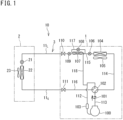
- FIG. 1 is a schematic configuration diagram of a refrigerant circuit of an air conditioner 10.
- the air conditioner 10 is a device that performs cooling or heating in a building by a vapor compression refrigeration cycle.
- the air conditioner 10 is configured by connecting an outdoor unit 1 and an indoor unit 2 by a refrigerant circuit 3. Although only one indoor unit 2 is illustrated, a plurality of indoor units 2 are actually connected in parallel in accordance with a scale of equipment.
- a refrigerant for example, R32 is used.
- the outdoor unit 1 is installed outdoors or outside a room in a building.
- the outdoor unit 1 is connected to the indoor unit 2 via a liquid-refrigerant connection pipe 11 L and a gas-refrigerant connection pipe 11 G .
- the outdoor unit 1 includes a compressor 100, a check valve 101, a four-way switching valve 102, an accumulator 103, an outdoor heat exchanger 104, an outdoor expansion valve 106, a refrigerant cooler 107, an expansion valve 108 for returning refrigerant, an expansion valve 109 for adjusting liquid-refrigerant pressure, a liquid-side shutoff valve 110, and a gas-side shutoff valve 111.
- the four-way switching valve 102 can mutually switch between a heat radiation operation state in which the outdoor heat exchanger 104 functions as a refrigerant radiator, and an evaporation operation state in which the outdoor heat exchanger 104 functions as a refrigerant evaporator.
- the four-way switching valve 102 and a suction side of the compressor 100 are connected via a suction refrigerant pipe 112.
- the suction refrigerant pipe 112 is provided with the accumulator 103 that temporarily accumulates a refrigerant suctioned into the compressor 100.
- the compressor 100 is a device for compressing the refrigerant, and for example, a device having a sealed structure such as a rotary type or a scroll type is used.
- the check valve 101 for prevention of a backflow is provided in between in a discharge refrigerant pipe 113 connecting a discharge side of the compressor 100 and the four-way switching valve 102.
- the four-way switching valve 102 and a gas-side end of the outdoor heat exchanger 104 are connected by a first outdoor gas-refrigerant pipe 114.
- a liquid-side end of the outdoor heat exchanger 104 and the liquid-refrigerant connection pipe 11 L are connected via an outdoor liquid-refrigerant pipe 115.
- the liquid-side shutoff valve 110 is provided at a connecting part between the outdoor liquid-refrigerant pipe 115 and the liquid-refrigerant connection pipe 11 L .
- the four-way switching valve 102 and the gas-refrigerant connection pipe 11 G are connected via a second outdoor gas-refrigerant pipe 116.
- the gas-side shutoff valve 111 is provided at a connecting part between the second outdoor gas-refrigerant pipe 116 and the gas-refrigerant connection pipe 11 G .
- the liquid-side shutoff valve 110 and the gas-side shutoff valve 111 are valves to be manually opened and closed, for example.
- the four-way switching valve 102 connects the discharge side of the compressor 100 and a gas side of the outdoor heat exchanger 104 (a state of the four-way switching valve 102 indicated by a solid line in FIG. 1 ).
- the outdoor heat exchanger 104 functions as a refrigerant evaporator (hereinafter referred to as an "outdoor heat evaporation state")
- the suction side of the compressor 100 and the gas side of the outdoor heat exchanger 104 (a state of the four-way switching valve 102 indicated by a broken line in FIG. 1 ) are connected.
- the four-way switching valve 102 is switched to the outdoor heat radiation state.
- the four-way switching valve 102 is switched to the outdoor heat evaporation state.
- the outdoor heat exchanger 104 functions as a refrigerant radiator or functions as a refrigerant evaporator.
- the outdoor fan 105 supplies outdoor air as a cooling source or a heating source of the refrigerant flowing through the outdoor heat exchanger 104, to the outdoor heat exchanger 104.
- the outdoor expansion valve 106 and the expansion valve 109 are provided on the outdoor liquid-refrigerant pipe 115.
- the outdoor expansion valve 106 is an electric valve that decompresses the refrigerant during the heating operation, and is provided at a portion of the outdoor liquid-refrigerant pipe 115 close to the liquid-side end of the outdoor heat exchanger 104.
- the expansion valve 109 is an electric valve that decompresses the refrigerant such that the refrigerant flowing through the liquid-refrigerant connection pipe 11 L is in a gas-liquid two-phase state during the cooling operation, and is provided in a portion of the outdoor liquid-refrigerant pipe 115 close to the liquid-refrigerant connection pipe 11 L .
- the expansion valve 109 is provided at a portion of the outdoor liquid-refrigerant pipe 115 closer to the liquid-refrigerant connection pipe 11 L than the outdoor expansion valve 106.
- the air conditioner 10 causes the refrigerant in the gas-liquid two-phase state to flow into the liquid-refrigerant connection pipe 11 L by the expansion valve 109, and performs two-phase conveyance of the refrigerant sent from the outdoor unit 1 to the indoor unit 2.
- a refrigerant return pipe 117 having the expansion valve 108 interposed in between is connected to the refrigerant cooler 107.
- a refrigerant return outlet pipe 118 is connected to the refrigerant cooler 107.
- the refrigerant return outlet pipe 118 is connected to the suction refrigerant pipe 112.
- a part of the refrigerant flowing through the outdoor liquid-refrigerant pipe 115 is split from a portion between the outdoor expansion valve 106 and the refrigerant cooler 107, and sent to an inlet (a left side in FIG. 1 ) of the refrigerant cooler 107 close to the refrigerant return pipe 117.
- the expansion valve 108 of the refrigerant return pipe 117 decompresses the refrigerant flowing in the refrigerant return pipe 117 as well as adjusting a flow rate of the refrigerant flowing in the refrigerant cooler 107.
- the expansion valve 108 is an electric valve.
- the refrigerant return outlet pipe 118 sends the refrigerant to from an outlet of the refrigerant cooler 107 close to the refrigerant return pipe 117 to the suction refrigerant pipe 112.
- the refrigerant return outlet pipe 118 of the refrigerant return pipe 117 is connected to the accumulator 103 via the suction refrigerant pipe 112.
- the refrigerant cooler 107 is a heat exchanger that cools the refrigerant flowing through a portion of the outdoor liquid-refrigerant pipe 115 closer to the outdoor heat exchanger 104 than the expansion valve 109 by the refrigerant flowing through the refrigerant return pipe 117.
- the refrigerant flowing through the refrigerant return pipe 117 and the refrigerant flowing through the outdoor liquid-refrigerant pipe 115 are counterflow during the cooling operation.
- the indoor unit 2 is installed inside a room in a building. As described above, the indoor unit 2 is connected to the outdoor unit 1 via the liquid-refrigerant connection pipe 11 L and the gas-refrigerant connection pipe 11 G to constitute a part of the refrigerant circuit 3.
- the indoor unit 2 mainly has an indoor expansion valve 21 and an indoor heat exchanger 22.
- a side with the indoor expansion valve 21 is connected to the liquid-refrigerant connection pipe 11 L , and the opposite side is connected to the gas-refrigerant connection pipe 11 G .
- the indoor expansion valve 21 is an electric valve that adjusts a flow rate of the refrigerant flowing through the indoor heat exchanger 22 while decompressing the refrigerant.
- the indoor heat exchanger 22 functions as a refrigerant evaporator to cool indoor air or functions as a refrigerant radiator to heat indoor air.
- An indoor fan 23 sucks the indoor air into the indoor unit 2, exchanges heat with the refrigerant in the indoor heat exchanger 22, and then supplies the indoor air as supply air to the room.
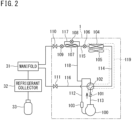
- FIG. 2 is a diagram illustrating a state in which the outdoor unit 1 is removed from the air conditioner 10 illustrated in FIG. 1 and the refrigerant is collected.
- the liquid-side shutoff valve 110 and the gas-side shutoff valve 111 of the outdoor unit 1 are opened and connected to a refrigerant collector 32 via a manifold 31.
- a cylinder 33 is connected to the refrigerant collector 32. By operating the refrigerant collector 32, the refrigerant remaining in the outdoor unit 1 can be sucked and collected in the cylinder 33.
- the outdoor expansion valve 106, the expansion valve 108, and the expansion valve 109, which are electric valves, are closed, the refrigerant remaining in the outdoor unit 1 cannot be completely collected.
- a relatively large amount of refrigerant trapped in a section 119 between the outdoor expansion valve 106 and the check valve 101 cannot be collected.
- the electric valves can be opened even in such a case.
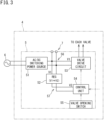
- FIG. 3 is a circuit diagram illustrating an example of a valve opening circuit 5 provided in a power source box 4.
- the power source box 4 is provided in the outdoor unit 1.
- the valve opening circuit 5 includes an AC/DC switching power source 51, a regulator 52, a valve drive circuit 53, a control unit 54, and a valve opening switch 55.
- a normal AC voltage is fed from a commercial AC power source 6 to the AC/DC switching power source 51.
- the AC/DC switching power source 51 converts the AC voltage into a predetermined DC voltage V1, and outputs the DC voltage to a DC electric path 56.
- the valve drive circuit 53 and the regulator 52 are connected to the DC electric path 56.
- the power feed port 7 is connected to the DC electric path 56.
- An actual form of the power feed port 7 is a terminal block or a connector.
- the valve drive circuit 53 can open and close each electric valve (the outdoor expansion valve 106, the expansion valve 108, and the expansion valve 109) on the basis of the DC voltage V1.
- the control unit 54 includes a microcomputer and operates on the basis of a computer program.
- a valve opening-closing signal can be given from outside to the control unit 54.
- the control unit 54 gives a drive signal to the valve drive circuit 53 to open and close each electric valve.
- a valve opening command signal can be given from the valve opening switch 55 to the control unit 54.
- the valve opening switch 55 is a manual switch and is operated by a service engineer.
- the power feed port 7 is not used when the air conditioner 10 is in the normal use state.
- FIG. 4 is a circuit diagram of the valve opening circuit 5 in the power source box 4 in a state where connection with the commercial AC power source 6 is disconnected in order to remove the outdoor unit 1.
- AC voltage is not fed to the AC/DC switching power source 51.
- a DC power source line 9 is connected to the power feed port 7 from an external power source (DC power source) 8 capable of outputting the DC voltage V1.
- the regulator 52 steps down the DC voltage V1 to the power source voltage V2 of the control unit 54, and outputs the DC voltage V1 to the DC electric path 57.
- the control unit 54 transmits a valve opening signal to the valve drive circuit 53.
- the valve drive circuit 53 opens each electric valve (the outdoor expansion valve 106, the expansion valve 108, and the expansion valve 109). The electric valves can thus be opened even after the outdoor unit 1 is disconnected from the commercial AC power source 6.
- the refrigerant remaining in the outdoor unit 1 can be collected by connecting the refrigerant collector 32 as illustrated in FIG. 2 .
- FIG. 5 is a perspective view illustrating an example of an external appearance of the outdoor unit 1. What can be seen in this drawing is a housing 1A and the outdoor heat exchanger 104 of the outdoor unit 1. A cover 1C that is easily removed is attached to a part of an outer surface of the housing 1A.
- FIG. 6 is a front view of the outdoor unit 1 with the cover 1C removed.
- the power source box 4 and the inside thereof are exposed.
- the power source box 4 there is an external line terminal 120 as a source for connecting the commercial AC power source to the outdoor unit 1.
- the power feed port 7 is disposed, for example, near the external line terminal 120.
- FIG. 7 is a circuit diagram illustrating another example of the valve opening circuit 5 provided in the power source box 4.
- the difference from FIG. 3 is that there is no valve opening switch 55 provided in FIG. 3 , and instead, a signal can be sent from the AC/DC switching power source 51 to the control unit 54.
- This signal is a signal notifying that the AC voltage is lost. Specifically, for example, by using a B contact of a relay, the contact is to be opened when there is an AC voltage, and the contact is to be closed when the AC voltage is lost. The contact being closed is a signal indicating that the AC voltage is lost. Since the operation of the valve opening circuit 5 according to a second embodiment is not different from the operation according to the first embodiment in the normal use state of the air conditioner 10, the description thereof will be omitted.
- FIG. 8 is a circuit diagram of the valve opening circuit 5 in the power source box 4 in a state where connection with the commercial AC power source 6 is disconnected in order to remove the outdoor unit 1.
- AC voltage is not fed to the AC/DC switching power source 51.
- This state is notified to the control unit 54.
- a DC power source line 9 is connected to the power feed port 7 from an external power source (DC power source) 8 capable of outputting the DC voltage V1.
- DC power source DC power source
- the regulator 52 steps down the DC voltage V1 to the power source voltage V2 of the control unit 54, and outputs the DC voltage V1 to the DC electric path 57.
- control unit 54 receives a signal indicating that the AC voltage is lost from the AC/DC switching power source 51 although the voltage V2 is applied. As a result, the control unit 54 determines that the AC voltage is lost and the DC voltage V1 is fed from the external power source 8 to the power feed port 7.
- the control unit 54 thus determined sends a valve opening signal to the valve drive circuit 53.
- the valve drive circuit 53 opens each electric valve (the outdoor expansion valve 106, the expansion valve 108, and the expansion valve 109). The electric valves can thus be opened even after the outdoor unit 1 is disconnected from the commercial AC power source 6.
- the refrigerant remaining in the outdoor unit 1 can be collected by connecting the refrigerant collector 32 as illustrated in FIG. 2 .
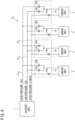
- FIG. 9 is a diagram illustrating an example of a configuration in a case where the air conditioner 10 is of simultaneous cooling and heating.
- a plurality of (here, four) flow path switching units 14 are connected via a high-pressure gas pipe 13 HG through which a high-pressure gas refrigerant flows, a low-pressure gas pipe 13 LG through which a low-pressure gas refrigerant flows, and a high-pressure liquid pipe 13 HL through which a high-pressure liquid refrigerant flows.
- the indoor unit 2 is connected to each of the flow path switching units 14.
- the flow path switching units 14 and the indoor units 2 form a refrigerant circuit that shares the outdoor unit 1. Note that, although four flow path switching units 14 and indoor units 2 are illustrated here, the number is merely an example for convenience of illustration.
- the flow path switching units 14 can be installed either outdoors or indoors.
- Each of the flow path switching units 14 includes an electric valve 14H connected to the high-pressure gas pipe 13 HG , an electric valve 14L connected to the low-pressure gas pipe 13 LG , and an electric valve 14e connected to the high-pressure liquid pipe 13 HL .
- the air conditioner 10 of simultaneous cooling and heating described above can cause any indoor unit 2 to perform an air conditioning (cooling or heating) operation as a use-side unit under the outdoor unit 1 common as a heat source-side unit.
- the flow path switching units 14 can also cause some of the indoor units 2 to perform cooling and other indoor units 2 to perform heating. Specifically, controlling opening and closing of the electric valves 14H and 14L enables the refrigerant flow path to be switched. Controlling an opening degree of the electric valve 14e as necessary enables adjustment of a flow rate of the refrigerant flowing through a heat exchanger in the indoor unit 2.
- the electric valves 14H, 14L, and 14e in each of the flow path switching unit 14 can also be used as shutoff valves.
- an electric valve In an intermediate unit of a system having a binary refrigerant circuit, such as a chiller system, if an electric valve is provided inside, there is also a case where a refrigerant is trapped. It is therefore also conceivable to apply the valve opening circuit 5 to the intermediate unit to release the trapped refrigerant.
- valves to be operated by the valve drive circuit 53 has been described as electric valves so far, the valve opening circuit 5 of the present disclosure is also applicable to opening and closing of an electromagnetic valve.
- a valve opening circuit of the present disclosure is a valve opening circuit 5 mounted on a heat pump device (air conditioner 10) having a valve (outdoor expansion valve 106 or the like) on a refrigerant circuit 3, the valve opening circuit including a DC electric path 56 to which a DC voltage generated from an AC voltage for normal use is applied, a valve drive circuit 53 that opens and closes the valve by using the DC voltage of the DC electric path 56, a control unit 54 that acquires a control power source voltage based on the DC voltage of the DC electric path 56 and controls the valve drive circuit 53, and a power feed port 7 connected to the DC electric path 56 and connectable to a DC power source line 9 provided from outside for emergency.
- the control unit 54 causes the valve drive circuit 53 to open the valve when the AC voltage is lost and the DC voltage is fed from the DC power source line 9 to the power feed port 7.
- the heat pump device including the valve opening circuit 5 as described above When the heat pump device including the valve opening circuit 5 as described above is removed, even if the AC voltage of the commercial AC power source 6 is lost, the DC power source line 9 can be connected to the power feed port 7 to feed the DC voltage to the DC electric path 56. By opening the valve in this state, the refrigerant remaining in the heat pump device can be reliably collected by the refrigerant collector 32.
- control unit 54 may open the valve when a condition that the AC voltage is lost and the DC voltage is fed from the DC power source line 9 to the power feed port 7 is satisfied.
- the valve when connection with the commercial AC power source 6 is disconnected from the heat pump device and the DC voltage is fed to the power feed port 7, the valve can be automatically opened such that the refrigerant can be collected.
- the valve opening circuit 5 can also include a valve opening switch 55.
- the control unit 54 is to open the valve when the AC voltage is lost and the valve opening switch 55 is opened in a state where the DC power source line 9 is connected to the power feed port 7.
- valve is not opened only by disconnecting the heat pump device from the commercial AC power source 6 and feeding the DC voltage to the power feed port 7, but also by operating the valve opening switch 55.
- valve opening switch 55 can be operated after the refrigerant collector 32 is reliably connected to the heat pump device. This makes it possible to collect the refrigerant while avoiding leakage of the refrigerant into the atmosphere as much as possible.
- a heat pump device having a valve (outdoor expansion valve 106 or the like) on a refrigerant circuit 3, the heat pump device including a DC electric path 56 to which a DC voltage generated from an AC voltage for normal use is applied, a valve drive circuit 53 that opens and closes the valve by using the DC voltage of the DC electric path 56, a control unit 54 that acquires a control power source voltage based on the DC voltage of the DC electric path 56 and controls the valve drive circuit 53, and a power feed port 7 connected to the DC electric path 56 and connectable to a DC power source line 9 provided from outside for emergency.
- the control unit 54 causes the valve drive circuit 53 to open the valve when the AC voltage is lost and the DC voltage is fed from the DC power source line 9 to the power feed port 7.
- the heat pump device as described above, when the heat pump device is removed, even if the AC voltage of the commercial AC power source 6 is lost, the DC power source line 9 can be connected to the power feed port 7 to feed the DC voltage to the DC electric path 56. By opening the valve in this state, the refrigerant remaining in the heat pump device can be reliably collected by the refrigerant collector 32.
- the heat pump device preferably include a power source box 4, in which the power feed port 7 is provided in the power source box 4.
- the power feed port 7 that is not used except when the heat pump device is removed can be accommodated in the power source box 4 without being unnecessarily exposed.
- the power source box 4 is preferably provided at a position to be exposed in a state where a cover 1C on a part of an outer surface of a housing 1A of the heat pump device is removed.
- the power source box 4 is preferably provided inside with an external line terminal 120 that feeds the AC voltage, and the power feed port 7 is preferably provided near the external line terminal.
- the DC power source line 9 can be connected to the power feed port 7 in that state, and therefore there is no waste in operation.
- the valve is preferably provided in a pipe line from a heat exchanger (outdoor heat exchanger 104) to a liquid pipe (liquid-refrigerant connection pipe 11 L ).
- the refrigerant can be collected from before and after the heat exchanger in which a relatively large amount of refrigerant is likely to remain.
Landscapes
- Engineering & Computer Science (AREA)
- General Engineering & Computer Science (AREA)
- Mechanical Engineering (AREA)
- Physics & Mathematics (AREA)
- Thermal Sciences (AREA)
- Business, Economics & Management (AREA)
- Emergency Management (AREA)
- Power Engineering (AREA)
- Air Conditioning Control Device (AREA)
- Cooling Or The Like Of Electrical Apparatus (AREA)
Description
- The present invention relates to a heat pump device that executes a refrigeration cycle by using a refrigerant, and to a valve opening circuit of the heat pump device.
- A representative example of a heat pump device that executes a refrigeration cycle using a refrigerant is an air conditioner. In the air conditioner, when a commercial AC power source is lost due to a power failure or the like, an internal valve is closed to prevent a refrigerant leakage (see, for example,
JP 2019 020113 A - On the other hand, when the air conditioner is removed, it is required to appropriately collect the refrigerant inside.
-
JP 2014 119153 A JP 2010 061229 A - When an existing air conditioner is removed, the air conditioner is generally physically disconnected from the commercial AC power source, and then a collection worker collects the refrigerant inside using a refrigerant collector. However, when the internal valve is closed, there is a closed section on the refrigerant circuit, and the refrigerant cannot be completely collected although sucked by the refrigerant collector.
- An object of the present invention is to more reliably collect a refrigerant from a heat pump device such as an air conditioner to be removed.
- The present invention is defined by the
independent claim 1. The dependent claims describe optional features and preferred embodiments. - (1) A valve opening circuit of the present invention is a valve opening circuit mounted on a heat pump device having a valve on a refrigerant circuit, the valve opening circuit including a DC electric path to which a DC voltage generated from an AC voltage for normal use is applied, a valve drive circuit that opens and closes the valve by using the DC voltage of the DC electric path, a control unit that acquires a control power source voltage based on the DC voltage of the DC electric path and controls the valve drive circuit, and a power feed port connected to the DC electric path and connectable to a DC power source line provided from outside for emergency. The control unit causes the valve drive circuit to open the valve when the AC voltage is lost and the DC voltage is fed from the DC power source line to the power feed port.
By providing such a valve opening circuit, the refrigerant remaining in the heat pump device can be reliably collected. - (2) The control unit may open the valve when a condition that the AC voltage is lost and the DC voltage is fed from the DC power source line to the power feed port is satisfied.
In this case, when the DC voltage is fed to the power feed port, the valve can be automatically opened such that the refrigerant can be collected. - (3) The valve opening circuit may include a valve opening switch, in which the control unit may open the valve when the AC voltage is lost and the valve opening switch is operated for opening in a state where the DC power source line is connected to the power feed port.
In this case, the valve opening switch can be operated after the refrigerant collector is reliably connected to the heat pump device. - (4) A heat pump device of the present invention is a heat pump device having a valve on a refrigerant circuit, the heat pump device including a DC electric path to which a DC voltage generated from an AC voltage for normal use is applied, a valve drive circuit that opens and closes the valve by using the DC voltage of the DC electric path, a control unit that acquires a control power source voltage based on the DC voltage of the DC electric path and controls the valve drive circuit, and a power feed port connected to the DC electric path and connectable to a DC power source line provided from outside for emergency. The control unit causes the valve drive circuit to open the valve when the AC voltage is lost and the DC voltage is fed from the DC power source line to the power feed port.
In the above heat pump device, the refrigerant remaining in the heat pump device can be reliably collected. - (5) The heat pump device may include a power source box, in which the power feed port may be provided in the power source box.
In this case, the power feed port can be accommodated in the power source box. - (6) The power source box (4) may be provided at a position to be exposed in a state where a cover on a part of an outer surface of a housing of the heat pump device is removed.
In this case, when the cover is removed, the power source box is exposed, and the DC power source line can be connected to the power feed port. - (7) The power source box may be provided inside with an external line terminal that feeds the AC voltage, and the power feed port may be provided near the external line terminal.
In this case, after the power source box is exposed and a cable for feeding a commercial AC power source to the external line terminal is removed, the DC power source line can be connected to the power feed port in that state, and therefore there is no waste in operation. - (8) The valve is provided, for example, in a pipe line from a heat exchanger to a liquid pipe.
- In this case, the refrigerant can be collected from before and after the heat exchanger in which a relatively large amount of refrigerant is likely to remain.
-
-
FIG. 1 is a schematic configuration diagram of a refrigerant circuit of an air conditioner. -
FIG. 2 is a diagram illustrating a state in which an outdoor unit is removed from the air conditioner illustrated inFIG. 1 and a refrigerant is collected. -
FIG. 3 is a circuit diagram illustrating an example of a valve opening circuit according to the first embodiment of the present invention. provided in a power source box. -
FIG. 4 is a circuit diagram related to the valve opening circuit in the power source box in a state where connection with a commercial AC power source is disconnected in order to remove an outdoor unit. -
FIG. 5 is a perspective view illustrating an example of an external appearance of the outdoor unit. -
FIG. 6 is a front view of the outdoor unit with a cover removed. -
FIG. 7 is a circuit diagram illustrating another example of the valve opening circuit according to the second embodiment of the present invention. provided in the power source box -
FIG. 8 is a circuit diagram of the valve opening circuit in the power source box in a state where connection with the commercial AC power source is disconnected in order to remove the outdoor unit. -
FIG. 9 is a diagram illustrating an example of a configuration in a case where the air conditioner is of simultaneous cooling and heating. - Hereinafter, embodiments of a heat pump device and a valve opening circuit of the heat pump device will be described.
- A representative example of the heat pump device is an air conditioner. The air conditioner will be described as an example.
-
FIG. 1 is a schematic configuration diagram of a refrigerant circuit of anair conditioner 10. Theair conditioner 10 is a device that performs cooling or heating in a building by a vapor compression refrigeration cycle. Theair conditioner 10 is configured by connecting anoutdoor unit 1 and anindoor unit 2 by arefrigerant circuit 3. Although only oneindoor unit 2 is illustrated, a plurality ofindoor units 2 are actually connected in parallel in accordance with a scale of equipment. As a refrigerant, for example, R32 is used. - The
outdoor unit 1 is installed outdoors or outside a room in a building. Theoutdoor unit 1 is connected to theindoor unit 2 via a liquid-refrigerant connection pipe 11L and a gas-refrigerant connection pipe 11G. Theoutdoor unit 1 includes acompressor 100, acheck valve 101, a four-way switching valve 102, anaccumulator 103, anoutdoor heat exchanger 104, anoutdoor expansion valve 106, arefrigerant cooler 107, anexpansion valve 108 for returning refrigerant, anexpansion valve 109 for adjusting liquid-refrigerant pressure, a liquid-side shutoff valve 110, and a gas-side shutoff valve 111. - The four-
way switching valve 102 can mutually switch between a heat radiation operation state in which theoutdoor heat exchanger 104 functions as a refrigerant radiator, and an evaporation operation state in which theoutdoor heat exchanger 104 functions as a refrigerant evaporator. The four-way switching valve 102 and a suction side of thecompressor 100 are connected via asuction refrigerant pipe 112. Thesuction refrigerant pipe 112 is provided with theaccumulator 103 that temporarily accumulates a refrigerant suctioned into thecompressor 100. Thecompressor 100 is a device for compressing the refrigerant, and for example, a device having a sealed structure such as a rotary type or a scroll type is used. - The
check valve 101 for prevention of a backflow is provided in between in adischarge refrigerant pipe 113 connecting a discharge side of thecompressor 100 and the four-way switching valve 102. The four-way switching valve 102 and a gas-side end of theoutdoor heat exchanger 104 are connected by a first outdoor gas-refrigerant pipe 114. A liquid-side end of theoutdoor heat exchanger 104 and the liquid-refrigerant connection pipe 11L are connected via an outdoor liquid-refrigerant pipe 115. - At a connecting part between the outdoor liquid-
refrigerant pipe 115 and the liquid-refrigerant connection pipe 11L, the liquid-side shutoff valve 110 is provided. The four-way switching valve 102 and the gas-refrigerant connection pipe 11G are connected via a second outdoor gas-refrigerant pipe 116. At a connecting part between the second outdoor gas-refrigerant pipe 116 and the gas-refrigerant connection pipe 11G, the gas-side shutoff valve 111 is provided. The liquid-side shutoff valve 110 and the gas-side shutoff valve 111 are valves to be manually opened and closed, for example. - When the
outdoor heat exchanger 104 functions as a refrigerant radiator (hereinafter referred to as an "outdoor heat radiation state"), the four-way switching valve 102 connects the discharge side of thecompressor 100 and a gas side of the outdoor heat exchanger 104 (a state of the four-way switching valve 102 indicated by a solid line inFIG. 1 ). When theoutdoor heat exchanger 104 functions as a refrigerant evaporator (hereinafter referred to as an "outdoor heat evaporation state"), the suction side of thecompressor 100 and the gas side of the outdoor heat exchanger 104 (a state of the four-way switching valve 102 indicated by a broken line inFIG. 1 ) are connected. At a time of the cooling operation, the four-way switching valve 102 is switched to the outdoor heat radiation state. At a time of the heating operation, the four-way switching valve 102 is switched to the outdoor heat evaporation state. - The
outdoor heat exchanger 104 functions as a refrigerant radiator or functions as a refrigerant evaporator. Theoutdoor fan 105 supplies outdoor air as a cooling source or a heating source of the refrigerant flowing through theoutdoor heat exchanger 104, to theoutdoor heat exchanger 104. - The
outdoor expansion valve 106 and theexpansion valve 109 are provided on the outdoor liquid-refrigerant pipe 115. Theoutdoor expansion valve 106 is an electric valve that decompresses the refrigerant during the heating operation, and is provided at a portion of the outdoor liquid-refrigerant pipe 115 close to the liquid-side end of theoutdoor heat exchanger 104. Theexpansion valve 109 is an electric valve that decompresses the refrigerant such that the refrigerant flowing through the liquid-refrigerant connection pipe 11L is in a gas-liquid two-phase state during the cooling operation, and is provided in a portion of the outdoor liquid-refrigerant pipe 115 close to the liquid-refrigerant connection pipe 11L. Theexpansion valve 109 is provided at a portion of the outdoor liquid-refrigerant pipe 115 closer to the liquid-refrigerant connection pipe 11L than theoutdoor expansion valve 106. - During the cooling operation, the
air conditioner 10 causes the refrigerant in the gas-liquid two-phase state to flow into the liquid-refrigerant connection pipe 11L by theexpansion valve 109, and performs two-phase conveyance of the refrigerant sent from theoutdoor unit 1 to theindoor unit 2. - To the
refrigerant cooler 107, arefrigerant return pipe 117 having theexpansion valve 108 interposed in between is connected. To therefrigerant cooler 107, a refrigerantreturn outlet pipe 118 is connected. The refrigerantreturn outlet pipe 118 is connected to the suctionrefrigerant pipe 112. - A part of the refrigerant flowing through the outdoor liquid-
refrigerant pipe 115 is split from a portion between theoutdoor expansion valve 106 and therefrigerant cooler 107, and sent to an inlet (a left side inFIG. 1 ) of therefrigerant cooler 107 close to therefrigerant return pipe 117. Theexpansion valve 108 of therefrigerant return pipe 117 decompresses the refrigerant flowing in therefrigerant return pipe 117 as well as adjusting a flow rate of the refrigerant flowing in therefrigerant cooler 107. Theexpansion valve 108 is an electric valve. - The refrigerant
return outlet pipe 118 sends the refrigerant to from an outlet of therefrigerant cooler 107 close to therefrigerant return pipe 117 to the suctionrefrigerant pipe 112. The refrigerantreturn outlet pipe 118 of therefrigerant return pipe 117 is connected to theaccumulator 103 via the suctionrefrigerant pipe 112. - The
refrigerant cooler 107 is a heat exchanger that cools the refrigerant flowing through a portion of the outdoor liquid-refrigerant pipe 115 closer to theoutdoor heat exchanger 104 than theexpansion valve 109 by the refrigerant flowing through therefrigerant return pipe 117. In therefrigerant cooler 107, the refrigerant flowing through therefrigerant return pipe 117 and the refrigerant flowing through the outdoor liquid-refrigerant pipe 115 are counterflow during the cooling operation. - The
indoor unit 2 is installed inside a room in a building. As described above, theindoor unit 2 is connected to theoutdoor unit 1 via the liquid-refrigerant connection pipe 11L and the gas-refrigerant connection pipe 11G to constitute a part of therefrigerant circuit 3. - The
indoor unit 2 mainly has anindoor expansion valve 21 and anindoor heat exchanger 22. A side with theindoor expansion valve 21 is connected to the liquid-refrigerant connection pipe 11L, and the opposite side is connected to the gas-refrigerant connection pipe 11G. Theindoor expansion valve 21 is an electric valve that adjusts a flow rate of the refrigerant flowing through theindoor heat exchanger 22 while decompressing the refrigerant. Theindoor heat exchanger 22 functions as a refrigerant evaporator to cool indoor air or functions as a refrigerant radiator to heat indoor air. Anindoor fan 23 sucks the indoor air into theindoor unit 2, exchanges heat with the refrigerant in theindoor heat exchanger 22, and then supplies the indoor air as supply air to the room. -
FIG. 2 is a diagram illustrating a state in which theoutdoor unit 1 is removed from theair conditioner 10 illustrated inFIG. 1 and the refrigerant is collected. The liquid-side shutoff valve 110 and the gas-side shutoff valve 111 of theoutdoor unit 1 are opened and connected to arefrigerant collector 32 via amanifold 31. Acylinder 33 is connected to therefrigerant collector 32. By operating therefrigerant collector 32, the refrigerant remaining in theoutdoor unit 1 can be sucked and collected in thecylinder 33. - When the
outdoor expansion valve 106, theexpansion valve 108, and theexpansion valve 109, which are electric valves, are closed, the refrigerant remaining in theoutdoor unit 1 cannot be completely collected. In particular, a relatively large amount of refrigerant trapped in asection 119 between theoutdoor expansion valve 106 and thecheck valve 101 cannot be collected. In the present disclosure, the electric valves can be opened even in such a case. -
FIG. 3 is a circuit diagram illustrating an example of avalve opening circuit 5 provided in apower source box 4. Thepower source box 4 is provided in theoutdoor unit 1. InFIG. 3 , thevalve opening circuit 5 includes an AC/DC switchingpower source 51, aregulator 52, avalve drive circuit 53, acontrol unit 54, and avalve opening switch 55. - In a normal use state of the
air conditioner 10, a normal AC voltage is fed from a commercialAC power source 6 to the AC/DC switchingpower source 51. The AC/DC switchingpower source 51 converts the AC voltage into a predetermined DC voltage V1, and outputs the DC voltage to a DCelectric path 56. Thevalve drive circuit 53 and theregulator 52 are connected to the DCelectric path 56. Thepower feed port 7 is connected to the DCelectric path 56. An actual form of thepower feed port 7 is a terminal block or a connector. - The
valve drive circuit 53 can open and close each electric valve (theoutdoor expansion valve 106, theexpansion valve 108, and the expansion valve 109) on the basis of the DC voltage V1. Theregulator 52 steps down the DC voltage V1 to a power source voltage V2 (= Vcc, V2 < V1) of thecontrol unit 54, and outputs the DC voltage V1 to a DCelectric path 57. Thecontrol unit 54 includes a microcomputer and operates on the basis of a computer program. A valve opening-closing signal can be given from outside to thecontrol unit 54. On the basis of the valve opening-closing signal, thecontrol unit 54 gives a drive signal to thevalve drive circuit 53 to open and close each electric valve. A valve opening command signal can be given from thevalve opening switch 55 to thecontrol unit 54. Thevalve opening switch 55 is a manual switch and is operated by a service engineer. Thepower feed port 7 is not used when theair conditioner 10 is in the normal use state. -
FIG. 4 is a circuit diagram of thevalve opening circuit 5 in thepower source box 4 in a state where connection with the commercialAC power source 6 is disconnected in order to remove theoutdoor unit 1. In the drawing, AC voltage is not fed to the AC/DC switchingpower source 51. Here, a DCpower source line 9 is connected to thepower feed port 7 from an external power source (DC power source) 8 capable of outputting the DC voltage V1. As a result, even when the AC/DC switchingpower source 51 is not functioning, the DC voltage V1 can be generated in the DCelectric path 56. Theregulator 52 steps down the DC voltage V1 to the power source voltage V2 of thecontrol unit 54, and outputs the DC voltage V1 to the DCelectric path 57. - From this state, when the service engineer operates the
valve opening switch 55, thecontrol unit 54 transmits a valve opening signal to thevalve drive circuit 53. Upon receipt of the valve opening signal, thevalve drive circuit 53 opens each electric valve (theoutdoor expansion valve 106, theexpansion valve 108, and the expansion valve 109). The electric valves can thus be opened even after theoutdoor unit 1 is disconnected from the commercialAC power source 6. - Thereafter, the refrigerant remaining in the
outdoor unit 1 can be collected by connecting therefrigerant collector 32 as illustrated inFIG. 2 . -
FIG. 5 is a perspective view illustrating an example of an external appearance of theoutdoor unit 1. What can be seen in this drawing is ahousing 1A and theoutdoor heat exchanger 104 of theoutdoor unit 1. A cover 1C that is easily removed is attached to a part of an outer surface of thehousing 1A. -
FIG. 6 is a front view of theoutdoor unit 1 with the cover 1C removed. When the cover 1C is removed, thepower source box 4 and the inside thereof are exposed. In thepower source box 4, there is anexternal line terminal 120 as a source for connecting the commercial AC power source to theoutdoor unit 1. Thepower feed port 7 is disposed, for example, near theexternal line terminal 120. -
FIG. 7 is a circuit diagram illustrating another example of thevalve opening circuit 5 provided in thepower source box 4. The difference fromFIG. 3 is that there is novalve opening switch 55 provided inFIG. 3 , and instead, a signal can be sent from the AC/DC switchingpower source 51 to thecontrol unit 54. This signal is a signal notifying that the AC voltage is lost. Specifically, for example, by using a B contact of a relay, the contact is to be opened when there is an AC voltage, and the contact is to be closed when the AC voltage is lost. The contact being closed is a signal indicating that the AC voltage is lost. Since the operation of thevalve opening circuit 5 according to a second embodiment is not different from the operation according to the first embodiment in the normal use state of theair conditioner 10, the description thereof will be omitted. -
FIG. 8 is a circuit diagram of thevalve opening circuit 5 in thepower source box 4 in a state where connection with the commercialAC power source 6 is disconnected in order to remove theoutdoor unit 1. In the drawing, AC voltage is not fed to the AC/DC switchingpower source 51. This state is notified to thecontrol unit 54. Here, a DCpower source line 9 is connected to thepower feed port 7 from an external power source (DC power source) 8 capable of outputting the DC voltage V1. As a result, even when the AC/DC switchingpower source 51 is not functioning, the DC voltage V1 can be generated in the DCelectric path 56. Theregulator 52 steps down the DC voltage V1 to the power source voltage V2 of thecontrol unit 54, and outputs the DC voltage V1 to the DCelectric path 57. - In this state, the
control unit 54 receives a signal indicating that the AC voltage is lost from the AC/DC switchingpower source 51 although the voltage V2 is applied. As a result, thecontrol unit 54 determines that the AC voltage is lost and the DC voltage V1 is fed from theexternal power source 8 to thepower feed port 7. - The
control unit 54 thus determined sends a valve opening signal to thevalve drive circuit 53. Upon receipt of the valve opening signal, thevalve drive circuit 53 opens each electric valve (theoutdoor expansion valve 106, theexpansion valve 108, and the expansion valve 109). The electric valves can thus be opened even after theoutdoor unit 1 is disconnected from the commercialAC power source 6. - Thereafter, the refrigerant remaining in the
outdoor unit 1 can be collected by connecting therefrigerant collector 32 as illustrated inFIG. 2 . -
FIG. 9 is a diagram illustrating an example of a configuration in a case where theair conditioner 10 is of simultaneous cooling and heating. - In the drawing, from the
outdoor unit 1 of simultaneous cooling and heating, a plurality of (here, four) flowpath switching units 14 are connected via a high-pressure gas pipe 13HG through which a high-pressure gas refrigerant flows, a low-pressure gas pipe 13LG through which a low-pressure gas refrigerant flows, and a high-pressure liquid pipe 13HL through which a high-pressure liquid refrigerant flows. Theindoor unit 2 is connected to each of the flowpath switching units 14. The flowpath switching units 14 and theindoor units 2 form a refrigerant circuit that shares theoutdoor unit 1. Note that, although four flowpath switching units 14 andindoor units 2 are illustrated here, the number is merely an example for convenience of illustration. The flowpath switching units 14 can be installed either outdoors or indoors. - Each of the flow
path switching units 14 includes anelectric valve 14H connected to the high-pressure gas pipe 13HG, anelectric valve 14L connected to the low-pressure gas pipe 13LG, and anelectric valve 14e connected to the high-pressure liquid pipe 13HL. - The
air conditioner 10 of simultaneous cooling and heating described above can cause anyindoor unit 2 to perform an air conditioning (cooling or heating) operation as a use-side unit under theoutdoor unit 1 common as a heat source-side unit. The flowpath switching units 14 can also cause some of theindoor units 2 to perform cooling and otherindoor units 2 to perform heating. Specifically, controlling opening and closing of theelectric valves electric valve 14e as necessary enables adjustment of a flow rate of the refrigerant flowing through a heat exchanger in theindoor unit 2. Theelectric valves path switching unit 14 can also be used as shutoff valves. - Since the flow
path switching units 14 as described above also use an electric valve, there is a case where the refrigerant is trapped. It is therefore also conceivable to apply thevalve opening circuit 5 as described above to the flowpath switching unit 14 to release the trapped refrigerant. - In an intermediate unit of a system having a binary refrigerant circuit, such as a chiller system, if an electric valve is provided inside, there is also a case where a refrigerant is trapped. It is therefore also conceivable to apply the
valve opening circuit 5 to the intermediate unit to release the trapped refrigerant. - Although the valves to be operated by the
valve drive circuit 53 has been described as electric valves so far, thevalve opening circuit 5 of the present disclosure is also applicable to opening and closing of an electromagnetic valve. - A summary of the above disclosure can be expressed in a generalized manner as follows.
- A valve opening circuit of the present disclosure is a
valve opening circuit 5 mounted on a heat pump device (air conditioner 10) having a valve (outdoor expansion valve 106 or the like) on arefrigerant circuit 3, the valve opening circuit including a DCelectric path 56 to which a DC voltage generated from an AC voltage for normal use is applied, avalve drive circuit 53 that opens and closes the valve by using the DC voltage of the DCelectric path 56, acontrol unit 54 that acquires a control power source voltage based on the DC voltage of the DCelectric path 56 and controls thevalve drive circuit 53, and apower feed port 7 connected to the DCelectric path 56 and connectable to a DCpower source line 9 provided from outside for emergency. Thecontrol unit 54 causes thevalve drive circuit 53 to open the valve when the AC voltage is lost and the DC voltage is fed from the DCpower source line 9 to thepower feed port 7. - When the heat pump device including the
valve opening circuit 5 as described above is removed, even if the AC voltage of the commercialAC power source 6 is lost, the DCpower source line 9 can be connected to thepower feed port 7 to feed the DC voltage to the DCelectric path 56. By opening the valve in this state, the refrigerant remaining in the heat pump device can be reliably collected by therefrigerant collector 32. - In the
valve opening circuit 5, thecontrol unit 54 may open the valve when a condition that the AC voltage is lost and the DC voltage is fed from the DCpower source line 9 to thepower feed port 7 is satisfied. - In this case, when connection with the commercial
AC power source 6 is disconnected from the heat pump device and the DC voltage is fed to thepower feed port 7, the valve can be automatically opened such that the refrigerant can be collected. - The
valve opening circuit 5 can also include avalve opening switch 55. Thecontrol unit 54 is to open the valve when the AC voltage is lost and thevalve opening switch 55 is opened in a state where the DCpower source line 9 is connected to thepower feed port 7. - In this case, the valve is not opened only by disconnecting the heat pump device from the commercial
AC power source 6 and feeding the DC voltage to thepower feed port 7, but also by operating thevalve opening switch 55. Thus, thevalve opening switch 55 can be operated after therefrigerant collector 32 is reliably connected to the heat pump device. This makes it possible to collect the refrigerant while avoiding leakage of the refrigerant into the atmosphere as much as possible. - Disclosed is a heat pump device (air conditioner 10) having a valve (
outdoor expansion valve 106 or the like) on arefrigerant circuit 3, the heat pump device including a DCelectric path 56 to which a DC voltage generated from an AC voltage for normal use is applied, avalve drive circuit 53 that opens and closes the valve by using the DC voltage of the DCelectric path 56, acontrol unit 54 that acquires a control power source voltage based on the DC voltage of the DCelectric path 56 and controls thevalve drive circuit 53, and apower feed port 7 connected to the DCelectric path 56 and connectable to a DCpower source line 9 provided from outside for emergency. Thecontrol unit 54 causes thevalve drive circuit 53 to open the valve when the AC voltage is lost and the DC voltage is fed from the DCpower source line 9 to thepower feed port 7. - With the heat pump device as described above, when the heat pump device is removed, even if the AC voltage of the commercial
AC power source 6 is lost, the DCpower source line 9 can be connected to thepower feed port 7 to feed the DC voltage to the DCelectric path 56. By opening the valve in this state, the refrigerant remaining in the heat pump device can be reliably collected by therefrigerant collector 32. - The heat pump device preferably include a
power source box 4, in which thepower feed port 7 is provided in thepower source box 4. - In this case, the
power feed port 7 that is not used except when the heat pump device is removed can be accommodated in thepower source box 4 without being unnecessarily exposed. - The
power source box 4 is preferably provided at a position to be exposed in a state where a cover 1C on a part of an outer surface of ahousing 1A of the heat pump device is removed. - In this case, when the cover 1C is removed, the
power source box 4 is exposed, and the DCpower source line 9 can be connected to thepower feed port 7. - The
power source box 4 is preferably provided inside with anexternal line terminal 120 that feeds the AC voltage, and thepower feed port 7 is preferably provided near the external line terminal. - In this case, after the
power source box 4 is exposed and a cable for feeding the commercialAC power source 6 to theexternal line terminal 120 is removed, the DCpower source line 9 can be connected to thepower feed port 7 in that state, and therefore there is no waste in operation. - The valve is preferably provided in a pipe line from a heat exchanger (outdoor heat exchanger 104) to a liquid pipe (liquid-refrigerant connection pipe 11L).
- In this case, the refrigerant can be collected from before and after the heat exchanger in which a relatively large amount of refrigerant is likely to remain.
- At least part of the embodiments described above may be appropriately combined with each other.
-
- 1
- outdoor unit
- 1A
- housing
- 1C
- cover
- 2
- indoor unit
- 3
- refrigerant circuit
- 4
- power source box
- 5
- valve opening circuit
- 6
- commercial AC power source
- 7
- power feed port
- 8
- external power source
- 9
- DC power source line
- 10
- air conditioner
- 11L
- liquid-refrigerant connection pipe
- 11G
- gas-refrigerant connection pipe
- 13HG
- high-pressure gas pipe
- 13LG
- low-pressure gas pipe
- 13HL
- high-pressure liquid pipe
- 14
- flow path switching unit
- 14e, 14H, 14L
- electric valve
- 21
- indoor expansion valve
- 22
- indoor heat exchanger
- 23
- indoor fan
- 31
- manifold
- 32
- refrigerant collector
- 33
- cylinder
- 51
- AC/DC switching power source
- 52
- regulator
- 53
- valve drive circuit
- 54
- control unit
- 55
- valve opening switch
- 56, 57
- DC electric path
- 100
- compressor
- 101
- check valve
- 102
- four-way switching valve
- 103
- accumulator
- 104
- outdoor heat exchanger
- 105
- outdoor fan
- 106
- outdoor expansion valve
- 107
- refrigerant cooler
- 108
- expansion valve
- 109
- expansion valve
- 110
- liquid-side shutoff valve
- 111
- gas-side shutoff valve
- 112
- suction refrigerant pipe
- 113
- refrigerant discharge pipe
- 114
- first outdoor gas-refrigerant pipe
- 115
- outdoor liquid-refrigerant pipe
- 116
- second outdoor gas-refrigerant pipe
- 117
- refrigerant return pipe
- 118
- refrigerant return outlet pipe
- 119
- section
- 120
- external line terminal
Claims (8)
- A valve opening circuit (5) mounted on a heat pump device including a valve on a refrigerant circuit, the valve opening circuit comprising:a DC electric path (56) to which a DC voltage generated from an AC voltage for normal use is applied;a valve drive circuit (53) that opens and closes the valve by using the DC voltage of the DC electric path (56);a control unit (54) that acquires a control power source voltage based on the DC voltage of the DC electric path (56) and controls the valve drive circuit (53); anda power feed port (7) connected to the DC electric path (56) and connectable to a DC power source line (9) provided from outside for emergency, whereinthe control unit (54) causes the valve drive circuit (53) to open the valve when the AC voltage is lost and the DC voltage is fed from the DC power source line (9) to the power feed port (7).
- The valve opening circuit according to claim 1, wherein the control unit (54) opens the valve when a condition that the AC voltage is lost and the DC voltage is fed from the DC power source line to the power feed port (7) is satisfied.
- The valve opening circuit according to claim 1, comprising a valve opening switch (55), wherein the control unit (54) opens the valve when the AC voltage is lost and the valve opening switch (55) is operated for opening in a state where the DC power source line (9) is connected to the power feed port (7).
- A heat pump device including a valve on a refrigerant circuit, the heat pump device comprising the valve opening circuit (5) according to any one of claims 1 to 3.
- The heat pump device according to claim 4, comprising a power source box (4), wherein the power feed port (7) is provided in the power source box (4).
- The heat pump device according to claim 5, wherein the power source box (4) is provided at a position to be exposed in a state where a cover on a part of an outer surface of a housing of the heat pump device is removed.
- The heat pump device according to claim 5 or 6, whereinthe power source box (4) is provided inside with an external line terminal that feeds the AC voltage, andthe power feed port (7) is provided near the external line terminal.
- The heat pump device according to any one of claims 4 to 7, wherein the valve is provided in a pipe line from a heat exchanger to a liquid pipe.
Applications Claiming Priority (2)
| Application Number | Priority Date | Filing Date | Title |
|---|---|---|---|
| JP2020073358A JP7440761B2 (en) | 2020-04-16 | 2020-04-16 | Open valve circuit and heat pump device |
| PCT/JP2020/045626 WO2021210215A1 (en) | 2020-04-16 | 2020-12-08 | Valve opening circuit and heat pump device |
Publications (3)
| Publication Number | Publication Date |
|---|---|
| EP4137757A1 EP4137757A1 (en) | 2023-02-22 |
| EP4137757A4 EP4137757A4 (en) | 2023-10-25 |
| EP4137757B1 true EP4137757B1 (en) | 2024-10-09 |
Family
ID=78084203
Family Applications (1)
| Application Number | Title | Priority Date | Filing Date |
|---|---|---|---|
| EP20931122.4A Active EP4137757B1 (en) | 2020-04-16 | 2020-12-08 | Valve opening circuit and heat pump device |
Country Status (6)
| Country | Link |
|---|---|
| US (1) | US12442463B2 (en) |
| EP (1) | EP4137757B1 (en) |
| JP (1) | JP7440761B2 (en) |
| CN (1) | CN115413314B (en) |
| ES (1) | ES2995236T3 (en) |
| WO (1) | WO2021210215A1 (en) |
Families Citing this family (1)
| Publication number | Priority date | Publication date | Assignee | Title |
|---|---|---|---|---|
| WO2025246977A1 (en) * | 2024-05-28 | 2025-12-04 | 广东美的暖通设备有限公司 | Heating, ventilation, and air conditioning system and electric control system thereof |
Family Cites Families (15)
| Publication number | Priority date | Publication date | Assignee | Title |
|---|---|---|---|---|
| TW330977B (en) * | 1996-06-04 | 1998-05-01 | Jinkichi Aizawa | Heat exchanger, method of reusing and recovering refrigerant thereof |
| JP2000074514A (en) * | 1998-09-03 | 2000-03-14 | Hitachi Ltd | Energy storage type air conditioner and cold heat source device used therefor |
| JP4684796B2 (en) * | 2005-08-05 | 2011-05-18 | シャープ株式会社 | Air conditioner outdoor unit |
| JP2008020133A (en) * | 2006-07-13 | 2008-01-31 | Sanyo Electric Co Ltd | Outdoor unit |
| JP5430100B2 (en) * | 2008-09-01 | 2014-02-26 | リンナイ株式会社 | Valve open / close control device |
| JP2013210110A (en) | 2012-03-30 | 2013-10-10 | Hitachi Appliances Inc | Air conditioner |
| JP6068121B2 (en) * | 2012-12-14 | 2017-01-25 | シャープ株式会社 | Air conditioner |
| JP6192434B2 (en) * | 2013-08-23 | 2017-09-06 | サンデンホールディングス株式会社 | Air conditioner for vehicles |
| JP2015083894A (en) * | 2013-10-25 | 2015-04-30 | ダイキン工業株式会社 | Refrigeration equipment |
| WO2017037788A1 (en) * | 2015-08-28 | 2017-03-09 | 三菱電機株式会社 | Refrigeration cycle device |
| EP3517851B1 (en) * | 2016-09-26 | 2021-09-15 | Toshiba Carrier Corporation | Air conditioning device |
| WO2018078729A1 (en) * | 2016-10-25 | 2018-05-03 | 三菱電機株式会社 | Refrigeration cycle device |
| JP6878100B2 (en) * | 2017-04-04 | 2021-05-26 | 株式会社東芝 | How to operate the cryogenic device and the cryogenic device |
| WO2018235230A1 (en) * | 2017-06-22 | 2018-12-27 | 三菱電機株式会社 | Refrigeration cycle device |
| JP6587017B2 (en) | 2017-07-20 | 2019-10-09 | ダイキン工業株式会社 | air conditioner |
-
2020
- 2020-04-16 JP JP2020073358A patent/JP7440761B2/en active Active
- 2020-12-08 WO PCT/JP2020/045626 patent/WO2021210215A1/en not_active Ceased
- 2020-12-08 EP EP20931122.4A patent/EP4137757B1/en active Active
- 2020-12-08 CN CN202080099851.XA patent/CN115413314B/en active Active
- 2020-12-08 ES ES20931122T patent/ES2995236T3/en active Active
-
2022
- 2022-09-15 US US17/945,567 patent/US12442463B2/en active Active
Also Published As
| Publication number | Publication date |
|---|---|
| JP2021169892A (en) | 2021-10-28 |
| US12442463B2 (en) | 2025-10-14 |
| EP4137757A1 (en) | 2023-02-22 |
| EP4137757A4 (en) | 2023-10-25 |
| ES2995236T3 (en) | 2025-02-07 |
| JP7440761B2 (en) | 2024-02-29 |
| CN115413314A (en) | 2022-11-29 |
| WO2021210215A1 (en) | 2021-10-21 |
| CN115413314A8 (en) | 2023-04-11 |
| CN115413314B (en) | 2024-06-21 |
| US20230019373A1 (en) | 2023-01-19 |
Similar Documents
| Publication | Publication Date | Title |
|---|---|---|
| US10928092B2 (en) | Usage-side air-conditioning apparatus and air-conditioning apparatus provided with same | |
| CN102112814B (en) | Air conditioner | |
| EP2975338B1 (en) | Air conditioner | |
| EP2975335B1 (en) | Air conditioner | |
| US10976090B2 (en) | Air conditioner | |
| US20220065506A1 (en) | Refrigerant cycle apparatus | |
| US11047590B2 (en) | Air conditioner | |
| US20040011072A1 (en) | Air conditioner and method of installing the air conditioner | |
| US20220221200A1 (en) | Refrigeration apparatus | |
| US12442463B2 (en) | Valve opening circuit and heat pump device | |
| JP2025010423A (en) | Refrigerant Cycle System | |
| CN115053102B (en) | Air Conditioning System | |
| WO2013145012A1 (en) | Outdoor unit and air conditioning device with outdoor unit | |
| EP3978814B1 (en) | Air-conditioning system | |
| US20220146173A1 (en) | Air conditioning system | |
| KR100688170B1 (en) | Heat Pump Air Conditioners | |
| US20220221209A1 (en) | Refrigeration apparatus and heat source unit | |
| KR100524720B1 (en) | By-pass device of inside unit for multi air-conditioner system | |
| JP3642609B2 (en) | Air conditioner | |
| KR100575696B1 (en) | Multi air conditioner with emergency power supply | |
| CN106032949B (en) | Refrigerating device | |
| JP2002022303A (en) | Refrigerating device and air conditioner employing the device | |
| KR20090067492A (en) | Air conditioning system and its control method | |
| JPWO2013145012A1 (en) | Outdoor unit and air conditioner equipped with the outdoor unit | |
| JP2006189244A (en) | Air conditioner |
Legal Events
| Date | Code | Title | Description |
|---|---|---|---|
| STAA | Information on the status of an ep patent application or granted ep patent |
Free format text: STATUS: THE INTERNATIONAL PUBLICATION HAS BEEN MADE |
|
| PUAI | Public reference made under article 153(3) epc to a published international application that has entered the european phase |
Free format text: ORIGINAL CODE: 0009012 |
|
| STAA | Information on the status of an ep patent application or granted ep patent |
Free format text: STATUS: REQUEST FOR EXAMINATION WAS MADE |
|
| 17P | Request for examination filed |
Effective date: 20220929 |
|
| AK | Designated contracting states |
Kind code of ref document: A1 Designated state(s): AL AT BE BG CH CY CZ DE DK EE ES FI FR GB GR HR HU IE IS IT LI LT LU LV MC MK MT NL NO PL PT RO RS SE SI SK SM TR |
|
| P01 | Opt-out of the competence of the unified patent court (upc) registered |
Effective date: 20230525 |
|
| DAV | Request for validation of the european patent (deleted) | ||
| DAX | Request for extension of the european patent (deleted) | ||
| A4 | Supplementary search report drawn up and despatched |
Effective date: 20230925 |
|
| RIC1 | Information provided on ipc code assigned before grant |
Ipc: F25B 49/00 20060101ALI20230919BHEP Ipc: F25B 1/00 20060101ALI20230919BHEP Ipc: F25B 49/02 20060101ALI20230919BHEP Ipc: F25B 45/00 20060101AFI20230919BHEP |
|
| GRAP | Despatch of communication of intention to grant a patent |
Free format text: ORIGINAL CODE: EPIDOSNIGR1 |
|
| STAA | Information on the status of an ep patent application or granted ep patent |
Free format text: STATUS: GRANT OF PATENT IS INTENDED |
|
| INTG | Intention to grant announced |
Effective date: 20240508 |
|
| GRAS | Grant fee paid |
Free format text: ORIGINAL CODE: EPIDOSNIGR3 |
|
| GRAA | (expected) grant |
Free format text: ORIGINAL CODE: 0009210 |
|
| STAA | Information on the status of an ep patent application or granted ep patent |
Free format text: STATUS: THE PATENT HAS BEEN GRANTED |
|
| AK | Designated contracting states |
Kind code of ref document: B1 Designated state(s): AL AT BE BG CH CY CZ DE DK EE ES FI FR GB GR HR HU IE IS IT LI LT LU LV MC MK MT NL NO PL PT RO RS SE SI SK SM TR |
|
| REG | Reference to a national code |
Ref country code: CH Ref legal event code: EP |
|
| REG | Reference to a national code |
Ref country code: DE Ref legal event code: R096 Ref document number: 602020039376 Country of ref document: DE |
|
| REG | Reference to a national code |
Ref country code: IE Ref legal event code: FG4D |
|
| REG | Reference to a national code |
Ref country code: LT Ref legal event code: MG9D |
|
| REG | Reference to a national code |
Ref country code: ES Ref legal event code: FG2A Ref document number: 2995236 Country of ref document: ES Kind code of ref document: T3 Effective date: 20250207 |
|
| REG | Reference to a national code |
Ref country code: NL Ref legal event code: MP Effective date: 20241009 |
|
| REG | Reference to a national code |
Ref country code: AT Ref legal event code: MK05 Ref document number: 1730979 Country of ref document: AT Kind code of ref document: T Effective date: 20241009 |
|
| PG25 | Lapsed in a contracting state [announced via postgrant information from national office to epo] |
Ref country code: NL Free format text: LAPSE BECAUSE OF FAILURE TO SUBMIT A TRANSLATION OF THE DESCRIPTION OR TO PAY THE FEE WITHIN THE PRESCRIBED TIME-LIMIT Effective date: 20241009 |
|
| PG25 | Lapsed in a contracting state [announced via postgrant information from national office to epo] |
Ref country code: NL Free format text: LAPSE BECAUSE OF FAILURE TO SUBMIT A TRANSLATION OF THE DESCRIPTION OR TO PAY THE FEE WITHIN THE PRESCRIBED TIME-LIMIT Effective date: 20241009 |
|
| PG25 | Lapsed in a contracting state [announced via postgrant information from national office to epo] |
Ref country code: HR Free format text: LAPSE BECAUSE OF FAILURE TO SUBMIT A TRANSLATION OF THE DESCRIPTION OR TO PAY THE FEE WITHIN THE PRESCRIBED TIME-LIMIT Effective date: 20241009 Ref country code: IS Free format text: LAPSE BECAUSE OF FAILURE TO SUBMIT A TRANSLATION OF THE DESCRIPTION OR TO PAY THE FEE WITHIN THE PRESCRIBED TIME-LIMIT Effective date: 20250209 Ref country code: PT Free format text: LAPSE BECAUSE OF FAILURE TO SUBMIT A TRANSLATION OF THE DESCRIPTION OR TO PAY THE FEE WITHIN THE PRESCRIBED TIME-LIMIT Effective date: 20250210 |
|
| PG25 | Lapsed in a contracting state [announced via postgrant information from national office to epo] |
Ref country code: FI Free format text: LAPSE BECAUSE OF FAILURE TO SUBMIT A TRANSLATION OF THE DESCRIPTION OR TO PAY THE FEE WITHIN THE PRESCRIBED TIME-LIMIT Effective date: 20241009 |
|
| PG25 | Lapsed in a contracting state [announced via postgrant information from national office to epo] |
Ref country code: BG Free format text: LAPSE BECAUSE OF FAILURE TO SUBMIT A TRANSLATION OF THE DESCRIPTION OR TO PAY THE FEE WITHIN THE PRESCRIBED TIME-LIMIT Effective date: 20241009 |
|
| PG25 | Lapsed in a contracting state [announced via postgrant information from national office to epo] |
Ref country code: NO Free format text: LAPSE BECAUSE OF FAILURE TO SUBMIT A TRANSLATION OF THE DESCRIPTION OR TO PAY THE FEE WITHIN THE PRESCRIBED TIME-LIMIT Effective date: 20250109 |
|
| PG25 | Lapsed in a contracting state [announced via postgrant information from national office to epo] |
Ref country code: LV Free format text: LAPSE BECAUSE OF FAILURE TO SUBMIT A TRANSLATION OF THE DESCRIPTION OR TO PAY THE FEE WITHIN THE PRESCRIBED TIME-LIMIT Effective date: 20241009 Ref country code: GR Free format text: LAPSE BECAUSE OF FAILURE TO SUBMIT A TRANSLATION OF THE DESCRIPTION OR TO PAY THE FEE WITHIN THE PRESCRIBED TIME-LIMIT Effective date: 20250110 Ref country code: AT Free format text: LAPSE BECAUSE OF FAILURE TO SUBMIT A TRANSLATION OF THE DESCRIPTION OR TO PAY THE FEE WITHIN THE PRESCRIBED TIME-LIMIT Effective date: 20241009 |
|
| PG25 | Lapsed in a contracting state [announced via postgrant information from national office to epo] |
Ref country code: PL Free format text: LAPSE BECAUSE OF FAILURE TO SUBMIT A TRANSLATION OF THE DESCRIPTION OR TO PAY THE FEE WITHIN THE PRESCRIBED TIME-LIMIT Effective date: 20241009 |
|
| PG25 | Lapsed in a contracting state [announced via postgrant information from national office to epo] |
Ref country code: RS Free format text: LAPSE BECAUSE OF FAILURE TO SUBMIT A TRANSLATION OF THE DESCRIPTION OR TO PAY THE FEE WITHIN THE PRESCRIBED TIME-LIMIT Effective date: 20250109 |
|
| PG25 | Lapsed in a contracting state [announced via postgrant information from national office to epo] |
Ref country code: SM Free format text: LAPSE BECAUSE OF FAILURE TO SUBMIT A TRANSLATION OF THE DESCRIPTION OR TO PAY THE FEE WITHIN THE PRESCRIBED TIME-LIMIT Effective date: 20241009 |
|
| PG25 | Lapsed in a contracting state [announced via postgrant information from national office to epo] |
Ref country code: MC Free format text: LAPSE BECAUSE OF FAILURE TO SUBMIT A TRANSLATION OF THE DESCRIPTION OR TO PAY THE FEE WITHIN THE PRESCRIBED TIME-LIMIT Effective date: 20241009 |
|
| PG25 | Lapsed in a contracting state [announced via postgrant information from national office to epo] |
Ref country code: DK Free format text: LAPSE BECAUSE OF FAILURE TO SUBMIT A TRANSLATION OF THE DESCRIPTION OR TO PAY THE FEE WITHIN THE PRESCRIBED TIME-LIMIT Effective date: 20241009 |
|
| REG | Reference to a national code |
Ref country code: DE Ref legal event code: R097 Ref document number: 602020039376 Country of ref document: DE |
|
| PG25 | Lapsed in a contracting state [announced via postgrant information from national office to epo] |
Ref country code: EE Free format text: LAPSE BECAUSE OF FAILURE TO SUBMIT A TRANSLATION OF THE DESCRIPTION OR TO PAY THE FEE WITHIN THE PRESCRIBED TIME-LIMIT Effective date: 20241009 |
|
| PG25 | Lapsed in a contracting state [announced via postgrant information from national office to epo] |
Ref country code: RO Free format text: LAPSE BECAUSE OF FAILURE TO SUBMIT A TRANSLATION OF THE DESCRIPTION OR TO PAY THE FEE WITHIN THE PRESCRIBED TIME-LIMIT Effective date: 20241009 |
|
| PG25 | Lapsed in a contracting state [announced via postgrant information from national office to epo] |
Ref country code: SK Free format text: LAPSE BECAUSE OF FAILURE TO SUBMIT A TRANSLATION OF THE DESCRIPTION OR TO PAY THE FEE WITHIN THE PRESCRIBED TIME-LIMIT Effective date: 20241009 |
|
| PG25 | Lapsed in a contracting state [announced via postgrant information from national office to epo] |
Ref country code: CZ Free format text: LAPSE BECAUSE OF FAILURE TO SUBMIT A TRANSLATION OF THE DESCRIPTION OR TO PAY THE FEE WITHIN THE PRESCRIBED TIME-LIMIT Effective date: 20241009 |
|
| REG | Reference to a national code |
Ref country code: CH Ref legal event code: PL |
|
| PLBE | No opposition filed within time limit |
Free format text: ORIGINAL CODE: 0009261 |
|
| STAA | Information on the status of an ep patent application or granted ep patent |
Free format text: STATUS: NO OPPOSITION FILED WITHIN TIME LIMIT |
|
| PG25 | Lapsed in a contracting state [announced via postgrant information from national office to epo] |
Ref country code: LU Free format text: LAPSE BECAUSE OF NON-PAYMENT OF DUE FEES Effective date: 20241208 |
|
| PG25 | Lapsed in a contracting state [announced via postgrant information from national office to epo] |
Ref country code: SE Free format text: LAPSE BECAUSE OF FAILURE TO SUBMIT A TRANSLATION OF THE DESCRIPTION OR TO PAY THE FEE WITHIN THE PRESCRIBED TIME-LIMIT Effective date: 20241009 |
|
| 26N | No opposition filed |
Effective date: 20250710 |
|
| REG | Reference to a national code |
Ref country code: BE Ref legal event code: MM Effective date: 20241231 |
|
| PG25 | Lapsed in a contracting state [announced via postgrant information from national office to epo] |
Ref country code: BE Free format text: LAPSE BECAUSE OF NON-PAYMENT OF DUE FEES Effective date: 20241231 |
|
| PG25 | Lapsed in a contracting state [announced via postgrant information from national office to epo] |
Ref country code: CH Free format text: LAPSE BECAUSE OF NON-PAYMENT OF DUE FEES Effective date: 20241231 |
|
| PG25 | Lapsed in a contracting state [announced via postgrant information from national office to epo] |
Ref country code: IE Free format text: LAPSE BECAUSE OF NON-PAYMENT OF DUE FEES Effective date: 20241208 |
|
| PGFP | Annual fee paid to national office [announced via postgrant information from national office to epo] |
Ref country code: DE Payment date: 20251211 Year of fee payment: 6 |
|
| PGFP | Annual fee paid to national office [announced via postgrant information from national office to epo] |
Ref country code: GB Payment date: 20251219 Year of fee payment: 6 |
|
| PGFP | Annual fee paid to national office [announced via postgrant information from national office to epo] |
Ref country code: IT Payment date: 20251223 Year of fee payment: 6 |
|
| PGFP | Annual fee paid to national office [announced via postgrant information from national office to epo] |
Ref country code: FR Payment date: 20251229 Year of fee payment: 6 |
|
| PGFP | Annual fee paid to national office [announced via postgrant information from national office to epo] |
Ref country code: ES Payment date: 20260130 Year of fee payment: 6 |