EP4137697B1 - Fuel pump with gear and bearing indents to induce fluid film - Google Patents
Fuel pump with gear and bearing indents to induce fluid film Download PDFInfo
- Publication number
- EP4137697B1 EP4137697B1 EP22187336.7A EP22187336A EP4137697B1 EP 4137697 B1 EP4137697 B1 EP 4137697B1 EP 22187336 A EP22187336 A EP 22187336A EP 4137697 B1 EP4137697 B1 EP 4137697B1
- Authority
- EP
- European Patent Office
- Prior art keywords
- gear
- wear surface
- indents
- bearing
- wear
- Prior art date
- Legal status (The legal status is an assumption and is not a legal conclusion. Google has not performed a legal analysis and makes no representation as to the accuracy of the status listed.)
- Active
Links
Images


Classifications
-
- F—MECHANICAL ENGINEERING; LIGHTING; HEATING; WEAPONS; BLASTING
- F04—POSITIVE - DISPLACEMENT MACHINES FOR LIQUIDS; PUMPS FOR LIQUIDS OR ELASTIC FLUIDS
- F04C—ROTARY-PISTON, OR OSCILLATING-PISTON, POSITIVE-DISPLACEMENT MACHINES FOR LIQUIDS; ROTARY-PISTON, OR OSCILLATING-PISTON, POSITIVE-DISPLACEMENT PUMPS
- F04C2/00—Rotary-piston machines or pumps
- F04C2/08—Rotary-piston machines or pumps of intermeshing-engagement type, i.e. with engagement of co-operating members similar to that of toothed gearing
- F04C2/12—Rotary-piston machines or pumps of intermeshing-engagement type, i.e. with engagement of co-operating members similar to that of toothed gearing of other than internal-axis type
- F04C2/14—Rotary-piston machines or pumps of intermeshing-engagement type, i.e. with engagement of co-operating members similar to that of toothed gearing of other than internal-axis type with toothed rotary pistons
- F04C2/18—Rotary-piston machines or pumps of intermeshing-engagement type, i.e. with engagement of co-operating members similar to that of toothed gearing of other than internal-axis type with toothed rotary pistons with similar tooth forms
-
- F—MECHANICAL ENGINEERING; LIGHTING; HEATING; WEAPONS; BLASTING
- F02—COMBUSTION ENGINES; HOT-GAS OR COMBUSTION-PRODUCT ENGINE PLANTS
- F02C—GAS-TURBINE PLANTS; AIR INTAKES FOR JET-PROPULSION PLANTS; CONTROLLING FUEL SUPPLY IN AIR-BREATHING JET-PROPULSION PLANTS
- F02C7/00—Features, components parts, details or accessories, not provided for in, or of interest apart form groups F02C1/00 - F02C6/00; Air intakes for jet-propulsion plants
- F02C7/22—Fuel supply systems
-
- F—MECHANICAL ENGINEERING; LIGHTING; HEATING; WEAPONS; BLASTING
- F04—POSITIVE - DISPLACEMENT MACHINES FOR LIQUIDS; PUMPS FOR LIQUIDS OR ELASTIC FLUIDS
- F04C—ROTARY-PISTON, OR OSCILLATING-PISTON, POSITIVE-DISPLACEMENT MACHINES FOR LIQUIDS; ROTARY-PISTON, OR OSCILLATING-PISTON, POSITIVE-DISPLACEMENT PUMPS
- F04C15/00—Component parts, details or accessories of machines, pumps or pumping installations, not provided for in groups F04C2/00 - F04C14/00
- F04C15/0088—Lubrication
-
- F—MECHANICAL ENGINEERING; LIGHTING; HEATING; WEAPONS; BLASTING
- F04—POSITIVE - DISPLACEMENT MACHINES FOR LIQUIDS; PUMPS FOR LIQUIDS OR ELASTIC FLUIDS
- F04C—ROTARY-PISTON, OR OSCILLATING-PISTON, POSITIVE-DISPLACEMENT MACHINES FOR LIQUIDS; ROTARY-PISTON, OR OSCILLATING-PISTON, POSITIVE-DISPLACEMENT PUMPS
- F04C2/00—Rotary-piston machines or pumps
- F04C2/02—Rotary-piston machines or pumps of arcuate-engagement type, i.e. with circular translatory movement of co-operating members, each member having the same number of teeth or tooth-equivalents
- F04C2/06—Rotary-piston machines or pumps of arcuate-engagement type, i.e. with circular translatory movement of co-operating members, each member having the same number of teeth or tooth-equivalents of other than internal-axis type
-
- F—MECHANICAL ENGINEERING; LIGHTING; HEATING; WEAPONS; BLASTING
- F04—POSITIVE - DISPLACEMENT MACHINES FOR LIQUIDS; PUMPS FOR LIQUIDS OR ELASTIC FLUIDS
- F04C—ROTARY-PISTON, OR OSCILLATING-PISTON, POSITIVE-DISPLACEMENT MACHINES FOR LIQUIDS; ROTARY-PISTON, OR OSCILLATING-PISTON, POSITIVE-DISPLACEMENT PUMPS
- F04C2/00—Rotary-piston machines or pumps
- F04C2/08—Rotary-piston machines or pumps of intermeshing-engagement type, i.e. with engagement of co-operating members similar to that of toothed gearing
- F04C2/082—Details specially related to intermeshing engagement type machines or pumps
- F04C2/084—Toothed wheels
-
- F—MECHANICAL ENGINEERING; LIGHTING; HEATING; WEAPONS; BLASTING
- F04—POSITIVE - DISPLACEMENT MACHINES FOR LIQUIDS; PUMPS FOR LIQUIDS OR ELASTIC FLUIDS
- F04C—ROTARY-PISTON, OR OSCILLATING-PISTON, POSITIVE-DISPLACEMENT MACHINES FOR LIQUIDS; ROTARY-PISTON, OR OSCILLATING-PISTON, POSITIVE-DISPLACEMENT PUMPS
- F04C2210/00—Fluid
- F04C2210/20—Fluid liquid, i.e. incompressible
- F04C2210/203—Fuel
-
- F—MECHANICAL ENGINEERING; LIGHTING; HEATING; WEAPONS; BLASTING
- F04—POSITIVE - DISPLACEMENT MACHINES FOR LIQUIDS; PUMPS FOR LIQUIDS OR ELASTIC FLUIDS
- F04C—ROTARY-PISTON, OR OSCILLATING-PISTON, POSITIVE-DISPLACEMENT MACHINES FOR LIQUIDS; ROTARY-PISTON, OR OSCILLATING-PISTON, POSITIVE-DISPLACEMENT PUMPS
- F04C2230/00—Manufacture
- F04C2230/90—Improving properties of machine parts
- F04C2230/92—Surface treatment
-
- F—MECHANICAL ENGINEERING; LIGHTING; HEATING; WEAPONS; BLASTING
- F04—POSITIVE - DISPLACEMENT MACHINES FOR LIQUIDS; PUMPS FOR LIQUIDS OR ELASTIC FLUIDS
- F04C—ROTARY-PISTON, OR OSCILLATING-PISTON, POSITIVE-DISPLACEMENT MACHINES FOR LIQUIDS; ROTARY-PISTON, OR OSCILLATING-PISTON, POSITIVE-DISPLACEMENT PUMPS
- F04C2240/00—Components
- F04C2240/50—Bearings
-
- F—MECHANICAL ENGINEERING; LIGHTING; HEATING; WEAPONS; BLASTING
- F04—POSITIVE - DISPLACEMENT MACHINES FOR LIQUIDS; PUMPS FOR LIQUIDS OR ELASTIC FLUIDS
- F04C—ROTARY-PISTON, OR OSCILLATING-PISTON, POSITIVE-DISPLACEMENT MACHINES FOR LIQUIDS; ROTARY-PISTON, OR OSCILLATING-PISTON, POSITIVE-DISPLACEMENT PUMPS
- F04C2270/00—Control; Monitoring or safety arrangements
- F04C2270/16—Wear
-
- F—MECHANICAL ENGINEERING; LIGHTING; HEATING; WEAPONS; BLASTING
- F05—INDEXING SCHEMES RELATING TO ENGINES OR PUMPS IN VARIOUS SUBCLASSES OF CLASSES F01-F04
- F05D—INDEXING SCHEME FOR ASPECTS RELATING TO NON-POSITIVE-DISPLACEMENT MACHINES OR ENGINES, GAS-TURBINES OR JET-PROPULSION PLANTS
- F05D2220/00—Application
- F05D2220/30—Application in turbines
- F05D2220/32—Application in turbines in gas turbines
Definitions
- the present invention relates to gears and bearings in a gear pump and, in particular, to indents on a surface of the gear or bearing to control a fluid film thickness between the two components.
- US 2017/175736 A1 describes a gear pump with end plates or bearings having spiral grooves.
- EP 2 295 802 A2 describes a hydraulic geared machine.
- US 2019/101117 A1 describes a vane pump.
- a fuel pump assembly for a gas turbine engine is described herein and defined in claim 1.
- Gear pumps utilize gears to transfer fluids through the gear pump from an inlet to an outlet. The circumferential rotation of the gears deliver the fluid from the inlet to the outlet through each gear tooth.
- Gear pumps typically utilize two gears that have meshing teeth and are well suited for pumping low and high viscosity fluids.
- the gears in gear pumps are supported by bearings for handling axial load.
- a gear and bearing assembly for a gear pump is disclosed herein that includes a drive shaft, a gear set, and bearings.
- the drive gear is connected to and coaxial with the shaft.
- the shaft transmits rotational motion to the gear and the gear rotates about the same axis as the shaft.
- the bearings support the gear and handle axial loads during shaft rotation.
- the gear or bearings have a plurality of indents in a wear surface to create a fluid film thickness with a fluid between the gear and bearing.
- the indents create a separation force on the fluid film, causing turbulent fluid flow between the gear and bearing. This separation force generates an appropriate fluid film thickness for tribology lubrication that assists in counteracting the axial load pushing the gear and bearing closer to each other.
- the fluid film thickness reduces or prevents solid surface contact between the gear and bearing and acts as a lubricant.
- FIG. 1 shows a perspective view of first gear and bearing assembly 10 and second gear and bearing assembly 80, which can be a portion of a gear pump that includes two gears along two separate shafts with the two gears having teeth that mesh with each other to pump the fluid.
- First gear and bearing assembly 10 includes axial centerline 12, shaft 14, first bearing 16, first gear 22, and second bearing 28.
- Shaft 14 extends along axial centerline 12.
- First gear 22 is connected to and coaxial with shaft 14.
- First bearing 16 is coaxial with shaft 14 and is on one axial side of first gear 22.
- First bearing 16 is configured to support first gear 22.
- Second bearing 28 is coaxial with shaft 14 and is on an opposite axial side of first gear 22 from first bearing 16. Second bearing 28 is configured to support first gear 22.
- First gear and bearing assembly 10 can include other components not expressly shown in FIG. 1 .
- first gear and bearing assembly 10 can include a housing or casing, seal, inlet port, outlet port, and safety valve.
- First gear and bearing assembly 10 can be a portion of an internal gear pump assembly or an external gear pump assembly.
- First gear and bearing assembly 10 can include a different number of gears or bearings from what is shown in FIG. 1 .
- Second gear and bearing assembly 80 can be similar in components and configuration to first gear and bearing assembly 10 and can mirror first gear and bearing assembly 10.
- Second gear and bearing assembly 80 includes third bearing 82, second gear 84, and fourth bearing 86.
- Second gear 84 is connected to and coaxial with a second shaft (not shown).
- Third bearing 82 is coaxial with the second shaft and is on one axial side of second gear 84.
- Third bearing 82 is configured to support second gear 84.
- Fourth bearing 86 is coaxial with the second shaft and is on an opposite axial side of second gear 84 from third bearing 82.
- Fourth bearing 86 is configured to support second gear 84.
- Third bearing 82, second gear 84, and fourth bearing 86 can be arranged sequentially along a separate axial centerline than axial centerline 12.
- Second gear and bearing assembly 80 can include other components not expressly shown in FIG. 1 .
- second gear and bearing assembly 80 can include a housing or casing, seal, inlet port, outlet port, and safety valve.
- Second gear and bearing assembly 80 can be a portion of an internal gear pump assembly or an external gear pump assembly.
- Second gear and bearing assembly 80 can include a different number of gears or bearings from what is shown in FIG. 1 and can be oriented differently with respect to first gear and bearing assembly 10.
- Second gear and bearing assembly 80 can have similar features, components, characteristics, and/or configurations to that of first gear and bearing assembly 10.
- second gear and bearing assembly 80 can include gaps, indents, and wear surfaces like first gear and bearing assembly 10.
- Third bearing 82 and fourth bearing 86 can have wear surfaces like first wear surface 24 and second wear surface 18 with indents similar to indents 44.
- Second gear and bearing assembly 80 can have a fluid film thickness to prevent metal-to-metal or surface contact like that of first gear and bearing assembly 10.
- first bearing 16 and second bearing 28 support first gear 22 directly by handling axial loads (i.e., by preventing substantial axial movement of first gear 22) and indirectly by handling radial loads (i.e., by preventing radial movement of shaft 14).
- Fluid is pumped with first gear and bearing assembly 10 when first gear 22 is rotated.
- First gear and bearing assembly 10 increases the pressure of the fluid (i.e., pumps the fluid).
- First bearing 16 and second bearing 28 are configured to support the axial loads imparted on first bearing 16 and second bearing 28 by first gear 22 during rotation.
- First bearing 16 and second bearing 28 can be stationary or floating bearings such that bearings 16 and 28 are stationary relative to shaft 14 and first gear 22, rotate at a slower or faster speed relative to shaft 14 and first gear 22, or rotate in an opposite direction relative to shaft 14 and first gear 22.
- Shaft 14 can be a drive shaft and first gear 22 can be a drive gear.
- shaft 14 can transmit rotational motion to first gear 22 causing second gear 84 to rotate.
- First gear 22 and second gear 84 have teeth that mesh causing first gear 22 and second gear 84 to rotate together to pump a fluid.
- second gear and bearing assembly 80 can have a drift shaft and a drive gear.
- second gear 84 could be a drive gear causing first gear 22 to rotate.
- Third bearing 82 and fourth bearing 86 are configured to support the axial loads imparted on third bearing 82 and fourth bearing 86 by second gear 84 during rotation.
- Third bearing 82 and fourth bearing 86 can be stationary relative to second gear 84, rotate at a slower or faster speed relative to second gear 84, or rotate in an opposite direction relative to second gear 84.
- FIG. 2 shows a side view of first gear and bearing assembly 10 and includes axial centerline 12, shaft 14, first bearing 16, second wear surface 18, first gear 22, first wear surface 24, third wear surface 26, second bearing 28, fourth wear surface 30, first axial side 36, second axial side 38, gap 40A, and gap 40B.
- Shaft 14 extends along axial centerline 12.
- shaft 14 can have a circular cross-sectional shape or can be other cross-sectional shapes, such as rectangle, triangle, pentagon, or hexagon.
- Shaft 14 can be within a gas turbine engine and can be a main shaft, a secondary shaft, or another component for transmitting rotational energy. Shaft 14 can transmit motion to other components and can rotate about axial centerline 12.
- Shaft 14 can be made from a variety of different materials.
- First gear 22 is connected to and coaxial with shaft 14 and contains first wear surface 24 on first axial side 36 and third wear surface 26 on second axial side 38.
- First gear 22 can be annular in shape with teeth extending radially outward along the entire circumference of first gear 22.
- First gear 22 can be made of various materials. In one example, first gear 22 is made of a single material. In another example, first gear 22 is made of multiple materials or pieces fastened together. First gear 22 can be built with shaft 14 as a single piece or can be two separate pieces welded, attached, or otherwise fastened together.
- First wear surface 24 and third wear surface 26 can be the same material as first gear 22 or different materials from first gear 22 and fastened to first gear 22. First wear surface 24 and third wear surface 26 can be two different materials.
- first gear 22 has teeth for meshing with another gear to pump a fluid through a gear pump.
- First wear surface 24 and third wear surface 26 can be on any portion of the axial ends of first gear 22, including the radially outermost portion of the axial ends of first gear 22 that include teeth.
- First bearing 16 is coaxial with shaft 14 and is on first axial side 36 of first gear 22.
- First axial side 36 includes a portion of shaft 14, first bearing 16, first wear surface 24, second wear surface 18, and gap 40A.
- first bearing 16 has an annular shape.
- first bearing 16 can be stationary or floating.
- First bearing 16 supports first gear 22.
- First bearing 16 allows first gear 22 to rotate for pumping fluid and ensures first gear 22 does not move too much in the axial direction.
- First bearing 16 can also indirectly support first gear 22 in the radial direction.
- Second wear surface 18 is on first bearing 16 and is positioned to interact with first wear surface 24 on first gear 22.
- First bearing 16 can be made from a variety of different materials.
- First bearing 16 can be the same or different material as second wear surface 18.
- first bearing 16 can be attached to second wear surface 18.
- Indents 44 are distributed in first wear surface 24 or second wear surface 18. Indents 44 can be on any portion of first wear surface 24 or second wear surface 18, including the portion of teeth on first wear surface 24 of first gear 22.
- Gap 40A is positioned between first wear surface 24 and second wear surface 18. Gap 40A is a gap between first wear surface 24 and second wear surface 18 for the fluid film to enter and/or flow.
- the size of gap 40A can vary depending on, but not limited to, fluid type, first gear 22 rotation speed, environmental conditions, thermal energy, separation forces, friction, and fluid film interaction with indents 44.
- the fluid film can consist of a fuel.
- the fluid film can consist of jet fuel.
- indents 44 on either first wear surface 24 or second wear surface 18 create turbulent flow of the fluid therebetween, which causes a separation force to push first wear surface 24 away from second wear surface 18 to control/increase gap 40A.
- Second bearing 28 is coaxial with shaft 14 and is on second axial side 38 of first gear 22.
- Second bearing 28 can be similar to first bearing 16, but second bearing 28 is on an opposite side of first gear 22.
- Second axial side 38 includes a portion of shaft 14, second bearing 28, third wear surface 26, fourth wear surface 30, and gap 40B.
- second bearing 28 has an annular shape.
- Second bearing 28 can be stationary or floating.
- Second bearing 28 allows first gear 22 to rotate and ensures first gear 22 does not move too much in the axial direction.
- Second bearing 28 can also indirectly support first gear 22 in the radial direction.
- Fourth wear surface 30 is on second bearing 28 and is positioned to interact with third wear surface 26 on first gear 22, which is on an opposite side of first wear surface 24 of first gear 22.
- Second bearing 28 can be made from a variety of different materials. Second bearing 28 can be the same or different material as fourth wear surface 30. If fourth wear surface 30 is a different material, second bearing 28 can be attached to fourth wear surface 30. Indents 44 are distributed in third wear surface 26 or fourth wear surface 30. Indents 44 can be on any portion of the third wear surface 26 or the fourth wear surface 30, including the portion of teeth on third wear surface 26 of first gear 22.
- Gap 40B is positioned between third wear surface 26 and fourth wear surface 30. Gap 40B is a gap between the third wear surface 26 and fourth wear surface 30 for the fluid film to enter and/or flow.
- the size of gap 40B can vary depending on, but not limited to, fluid type, first gear 22 rotation speed, environmental conditions, thermal energy, separation forces, friction, and the fluid film interaction with indents 44. As discussed below, indents 44 of either third wear surface 26 and fourth wear surface 30 create turbulent flow of the fluid therebetween, which causes a separation force to push third wear surface 26 away from fourth wear surface 30 to control/increase gap 40B.
- first gear and bearing assembly 10 When first gear 22 is rotated.
- First gear 22 rotation allows fluid to enter gap 40A between first wear surface 24 and second wear surface 18 and gap 40B between third wear surface 26 and fourth wear surface 30.
- Indents 44 create a separation force on the fluid film to produce a certain fluid film thickness. This separation force during rotation increases the width of gaps 40A and 40B to reduce or prevent contact between first gear 22 and first bearing 16 and first gear 22 and second bearing 28 because the separation force ensures gaps 40A and 40B are sufficiently large enough. While the surfaces are described as "wear surfaces" herein, gaps 40A and 40B can be sufficient to prevent any wear altogether by preventing contact between the wear surfaces. Due to indents 44, fluid film can have a turbulent movement during first gear 22 rotation.
- the fluid film can support first gear 22 during rotation because of indent 44 separation force.
- the fluid film generation prevents or reduces contact damage to first gear 22, first bearing 16, and second bearing 28. Thus, less waste heat is created allowing for a variety of different materials to be used that could not previously be used due to temperature limitations.
- Indents 44 can reduce rotating friction by improving the fluid film thickness between both first gear 22 and first bearing 16 and first gear 22 and second bearing 28. Indents 44 form a sufficiently thick fluid film to prevent or reduce contact.
- the fluid between first gear 22 and first bearing 16 and first gear 22 and second bearing 28 has more of a turbulent flow or movement because of indents 44 on the surface of first wear surface 24, second wear surface 18, third wear surface 26 and/or fourth wear surface 30.
- Gear fuel pump friction reduction will improve pump mechanical efficiency, which translates to extended pump operating life and cavitation erosion reduction.
- Different first gear and bearing assembly 10 materials could be utilized that have lower coefficients of thermal conductivity and the disclosed first gear and bearing assembly 10 can have an extended operating life as compared to existing gear pumps due to better fluid film generation and less mechanical wear.
- the disclosed first gear and bearing assembly 10 can be operated at higher pressure and speed conditions as compared to existing gear pumps without inducing first bearing 16 and second bearing 28 face wear. Without indents 44 on the surface of first wear surface 24, second wear surface 18, third wear surface 26 and/or fourth wear surface 30, first gear 22 and first bearing 16 and first gear 22 and second bearing 28 can damage each other with contact.
- first gear and bearing assembly 10 is part of a fuel pump assembly. In another example, first gear and bearing assembly 10 is part of a fuel pump assembly for a gas turbine engine. Indents 44 can be especially important in making a fluid film thickness to reduce or prevent bearing and/or gear wear for a gas turbine engine due to extreme operating conditions such as high temperatures. When temperature rises, the viscosity of jet fuel drops and makes separation of the gear and bearing more difficult. Indents 44 solve this problem by creating the separation force to maintain or increase the fluid film thickness.
- FIGS. 3A-3E are cross-sectional views of various indent 44 shapes. Indents 44 can be distributed in first wear surface 24, second wear surface 18, third wear surface 26, and fourth wear surface 30.
- FIG. 3A shows a cross-sectional view of indent 44A with a cylindrical indent shape with a depth "D" and width at the surface "W.”
- indent 44A depth can be the same distance as the width at the surface (such as a semi-circle). Indent 44A depth can also be longer or shorter than the width at the surface.
- FIG. 3B shows a cross-sectional view of indent 44B with a rectangular indent shape.
- indent 44B depth can be the same distance as the width at the surface (such as a square). Indent 44B depth can also be longer or shorter than the width at the surface for a deeper or shallower indent 44B, respectively (such as a rectangle).
- FIG. 3C shows a cross-sectional view of indent 44C with a triangular indent shape.
- the triangular shape could be that of an equilateral triangle, isosceles triangle, or scalene triangle.
- the depth of indent 44C can be the same, shorter, or longer than the width at the surface.
- FIG. 3D shows a cross-sectional view of indent 44D with a wedge indent shape.
- Indent 44D can have various angles with a steeper wall and a flatter wall.
- the steeper wall or flatter wall can be on the first side in the direction of fluid flow.
- the depth of indent 44D can be the same, shorter, or longer than the width at the surface.
- FIG. 3E shows a cross-sectional view of indent 44E with a semi-ellipse indent shape.
- the depth of indent 44E can be the same, shorter, or longer than the width at the surface.
- FIGS. 3A-3E are non-limiting examples of cross-sectional views of indent 44 shapes. Any side or wall of indents 44A-44E can be rotated towards the direction of fluid flow.
- each of the indents 44 has a depth that the indents 44 extend into the first wear surface 24, second wear surface 18, third wear surface 26 or fourth wear surface 30.
- the ratio of surface area of one of the indents 44 to the depth of one of the indents 44 in this example is 0.012.
- the indents 44 have a ratio of surface area to depth of between 0.01 and 0.05.
- the depth of each indent 44 can range from 1 micrometer to 10 micrometers. In another example, the depth of each indent 44 is approximately 2.54 micrometers.
- indents 44 create a separation force on the fluid film to produce a certain fluid film thickness.
- Different indent 44 cross-sectional shapes (44A-44E) create different fluid film thicknesses depending on gear rotation speed because the separation force applied to the fluid is different depending on indent 44 cross-sectional shapes (44A-44E).
- the fluid interacts differently with various cross-sectional shapes because of the edges or curves of the cross-sectional shapes and because different amounts of fluid can interact with the shape.
- Various cross-sectional shapes of indents 44 may be chosen based off operating conditions or desired fluid film thickness. For example, the hydrodynamic lifting forces can change based on indent 44 cross-sectional shapes (44A-44E). Multiple different indent 44 cross-sectional shapes can be on the same wear surface.
- the cross-sectional shapes (44A-44E) are shown as non-limiting examples of possible indent 44 cross-sectional shapes.
- Indents 44 creating a sufficiently thick fluid film thickness allows for use of other first gear and bearing assembly 10 materials that may have different properties optimized for cavitation, heat, sliding, operating life, or operating conditions such as pressure or velocity. Higher temperatures and operating speeds may be utilized because less waste heat is created with a sufficiently thick fluid film in first gear and bearing assembly 10. Thus, higher operating temperatures can be maintained because of this fluid film thickness.
- First gear and bearing assembly 10 surfaces such as first wear surface 24, second wear surface 18, third wear surface 26 and/or fourth wear surface 30 with indents 44 can be made using micro-laser etching or laser ablation.
- femtosecond laser ablation machines can create indents 44 in first wear surface 24, second wear surface 18, third wear surface 26 and fourth wear surface 30. Laser ablation works well for the depths of indents 44 that are desired. Other surface modification techniques can also be used to create indents 44.
- FIGS. 4A-4F are plan views of various indent 44 surface shapes.
- a surface shape is the shape of indent 44 when looking straight down on first wear surface 24, second wear surface 18, third wear surface 26 or fourth wear surface 30.
- FIG. 4A shows a plan view of indent 44F with a rectangle surface shape with side length "L" and width "W.”
- Indent 44F has a length of a side and a width (the distance of the top and bottom).
- Indent 44F can have equal lengths and widths to be a square.
- Indent 44F can also be a rectangle with unequal lengths and widths. Any side can be the leading side towards the direction of fluid flow.
- FIG. 4B shows a plan view of indent 44G with a circle surface shape.
- Indent 44G can have an equal radius at all points. The radius can be changed for various indents 44 so as to have a mixture of different sized indent 44G on a surface.
- FIG. 4C shows a plan view of indent 44H with a triangle surface shape.
- Indent 44H can be any triangular shape, such as an equilateral triangle, isosceles triangle, or scalene triangle. Any side can be the leading side towards fluid flow. In another example, one of the points of the triangle could be pointed towards the direction of fluid flow.
- FIG. 4D shows a plan view of indent 44I with an ellipse surface shape.
- Indent 44I can have a longer and shorter axis where the longer and shorter axis lengths can vary in length.
- FIG. 4E shows a plan view of indent 44J with an oval surface shape.
- Indent 44J can be such that the oval surface shape has only one axis of symmetry (egg shaped).
- FIG. 4F shows a plan view of indent 44K with a stadium surface shape.
- Indent 44K straight sides can be shorter or longer.
- Indent 44K rounded corners can be more or less rounded.
- Indent 44K can be oriented in any direction and with any side or edge towards fluid flow.
- FIGS. 4A-4F are non-limiting examples of possible indent 44 surface shapes (44F-44K). Any of indents 44F-44K along with other surface shapes can be rotated in any direction to have any part of the shape facing towards the fluid flow direction.
- the length of indent 44F can be from 1 micrometer to 200 micrometers. In another example, the length of indent 44F can be approximately 50 micrometers. In one example, the width of indent 44F can be 1 micrometer to 200 micrometers. In another example, the width of indent 44F is approximately 15 micrometers. These lengths and widths can be used for any indent 44 surface shapes (44F-44K) or other surface shapes.
- indent 44 surface shapes can be on the surfaces of first wear surface 24, second wear surface 18, third wear surface 26, and fourth wear surface 30. Different indent 44 surface shapes can create different magnitudes of separation force creating a different fluid film thickness. Depending on the application and operating conditions, the surface shape can be changed to create a lesser or greater fluid film thickness. The surface shapes may have different edges or curves on the surface causing different interactions with the fluid. The fluid interaction with indent 44 surface shapes can increase the turbulent movement of the fluid.
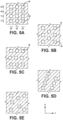
- FIGS. 5A-5E are plan views of various indent 44 configurations.
- Indents 44 are shown on a surface, for example, on first wear surface 24, second wear surface 18, third wear surface 26, or fourth wear surface 30.
- Each indent 44 has a surface shape midpoint 48.
- the radial direction is shown as "R” and the circumferential direction as "C.”
- Surface shape midpoint 48 is the midpoint of the surface shape of indent 44 in circumferential direction C.
- Indents 44 also have a surface shape midpoint 58 in the radial direction.
- FIG. 5A is a plan view of an indent configuration where surface shape midpoints 48 of indents 44 are aligned in both the radial direction and the circumferential direction.
- FIG. 5A shows first column 60, second column 62, third column 64, first row 66, second row 68, third row 70, and fourth row 72. Indents 44 are aligned with indents 44 in adjacent columns and rows.
- FIG. 5B is a plan view of an indent configuration where surface shape midpoints 48 of indents 44 are aligned in the radial direction.
- FIG. 5B shows indents 44 with first column 60, second column 62, and third column 64.
- the indents 44 are offset so there are no rows of indents 44 like that of FIG. 5A .
- FIG. 5C is a plan view of an indent configuration where surface shape midpoints 48 of indents 44 are aligned in the circumferential direction.
- FIG. 5C shows indent 44 with first row 66, second row 68, and third row 70.
- the indents 44 are offset so there are no columns of indents 44.
- FIG. 5D is a plan view of an indent configuration where surface shape midpoints 48 of indents 44 are not aligned in either the radial direction or the circumferential direction but are arranged diagonally when looking in the radial direction.
- FIG. 5E is a plan view of an indent configuration where surface shape midpoints 48 of indents 44 are not aligned in either the radial direction or the circumferential direction.
- FIGS. 5A-5E of various indent 44 configurations are non-limiting examples of indent 44 configurations.
- FIGS. 5A-5E show examples of indent configurations that can extend circumferentially around the entirety of the first wear surface 24, second wear surface 18, third wear surface 26, and fourth wear surface 30.
- Indents 44 can also be distributed in certain circumferential portions of the previously mentioned wear surfaces while other circumferential sections of the wear surfaces may have no indents.
- the total surface area of all the indents 44 occupies between 15 percent and 25 percent of a total surface area of the first wear surface 24, second wear surface 18, third wear surface 26 or fourth wear surface 30. This percentage of a total surface area on a wear surface can be advantageous to fully support first gear 22 while creating enough separation to prevent any wear.
- the indents 44 have a gap between each other 0.25 degrees in the radial direction.
- Indents 44 as shown in FIGS. 5A-5E are shown with indent 44F rectangular surface shape as an example.
- Indents 44 in FIGS. 5A-5E can have other surface shapes such as 44G-44K.
- Indents 44 can also have any cross-sectional shape such as indents 44A-44E.
- the cross-sectional shape could be that of 44A
- the surface shape could be that of 44F
- the orientation on the surface could be that of FIG. 5B
- the cross-sectional shape could be that of 44B
- the surface shape could be that of 44F
- the orientation on the surface could be that of FIG. 5D .
- Different indent 44 configurations can cause the fluid film thickness to be different depending on the operating conditions. This is due to the different spacing between indents 44 and the way the fluid interacts with indents 44 during rotation of first gear 22. Different separation forces creating different fluid film thicknesses can be advantageous because different operating conditions may require more or less separation force. Indent 44 configurations can change how turbulent the movement of the fluid is between first gear 22 and the first bearing 16 and second bearing 28 and can increase the separation force. The turbulence of the fluid help to maintain the fluid film thickness.
- a fuel pump assembly for a gas turbine engine includes a shaft, a gear, a first wear surface, a first bearing, a second wear surface, and a plurality of indents.
- the shaft transmits motion.
- the gear is connected to and coaxial with the shaft and the gear has a first wear surface.
- the first bearing is coaxial with the shaft and the first bearing is configured to support the gear.
- the first bearing has a second wear surface positioned to interact with the first wear surface.
- the plurality of indents is distributed in the first wear surface or the second wear surface and at least two of the plurality of indents are partially aligned in a radial direction.
- Each of the indents has a depth that the indents extend into the first wear surface or the second wear surface and a ratio of a surface area of one of the indents to the depth of one of the indents is between 0.01 and 0.05.
- the fuel pump assembly of the preceding paragraph can optionally any one or more of the following features, configurations and/or additional components.
- the first bearing can be on a first axial side of the gear.
- the assembly can comprise a third wear surface on the gear and a second bearing, wherein the third wear surface is on a second axial side of the gear that is opposite the first wear surface.
- the second bearing is coaxial with the shaft, the second bearing being configured to support the gear, wherein the second bearing has a fourth wear surface positioned to interact with the third wear surface, wherein the indents are distributed in the third wear surface or the fourth wear surface.
- a total surface area of all the indents can occupy between 15 percent and 25 percent of a total surface area of the first wear surface or the second wear surface.
- At least one of the indents can have a cross-sectional shape selected from the group consisting of a rectangle, triangle, wedge, semicircle, and semi-ellipse.
- At least one of the indents can have a surface shape selected from the group consisting of a rectangle, circle, triangle, ellipse, oval, and stadium.
- Each of the indents has a surface shape midpoint in a circumferential direction, and the midpoints of at least two of the indents can be aligned in a radial direction.
- Each of the indents has a surface shape midpoint in a circumferential direction, and the midpoints of at least two of the indents can be aligned in the circumferential direction.
- the fuel pump assembly can include a fuel between the first wear surface and the second wear surface when the fuel pump assembly is in operation, wherein the indents control a film thickness of the fuel.
- the first bearing can be on a first axial side of the gear.
- the assembly can include a third wear surface, a second axial side of the gear, a second bearing, and a fourth wear surface.
- the third wear surface is on the gear, wherein the third wear surface is on a second axial side of the gear that is opposite the first wear surface.
- the second bearing is coaxial with the shaft, the second bearing being configured to support the gear, wherein the second bearing has the fourth wear surface positioned to interact with the third wear surface, wherein the indents are distributed in the third wear surface or the fourth wear surface.
- a method of operating a gear and bearing assembly includes rotating a gear adjacent a bearing configured to support the gear, the gear having a first wear surface positioned to interact with a second wear surface of the bearing, wherein one of the first wear surface and the second wear surface includes a plurality of indents with at least two of the plurality of indents being partially aligned in a radial direction.
- the method also includes generating a fluid film thickness with a fluid between the first wear surface and the second wear surface, wherein during said gear rotation the plurality of indents creates a separation force on the fluid to produce the fluid film thickness.
- Each of the indents has a depth that the indents extend into the first wear surface or the second wear surface and a ratio of a surface area of one of the indents to the depth of one of the indents is between 0.01 and 0.05.
- the method of the preceding paragraph can optionally include, additionally and/or alternatively, any one or more of the following steps, features, configurations, steps, and/or additional components.
- the fluid can be a fuel and the method further can include pumping the fuel through the assembly by rotating the gear.
- a total surface area of all of the indents can occupy between 15 percent and 25 percent of a total surface area of the first wear surface or the second wear surface.
- At least one of the indents can have a cross-sectional shape selected from the group consisting of a rectangle, triangle, wedge, semicircle, and semi-ellipse.
- At least one of the indents can have a surface shape selected from the group consisting of a rectangle, circle, triangle, ellipse, oval, and stadium.
Landscapes
- Engineering & Computer Science (AREA)
- Mechanical Engineering (AREA)
- General Engineering & Computer Science (AREA)
- Chemical & Material Sciences (AREA)
- Combustion & Propulsion (AREA)
- Rotary Pumps (AREA)
Description
- The present invention relates to gears and bearings in a gear pump and, in particular, to indents on a surface of the gear or bearing to control a fluid film thickness between the two components.
- Stationary or floating bearings are used to support gears in a gear pump. Wear damage on the surface of the gear or bearing can result from contact between the gear and the bearing. These surfaces can mechanically wear over time and are sensitive to friction or contact. Mechanical efficiency, pump operating life, operating pressures, and speeds are all limited by preventing gear and bearing wear and the materials usable for the gear and bearing. Accordingly, there remains a need to reduce friction and prevent metal-to-metal contact by controlling a fluid film thickness between the gear and bearing during operation.
-
US 2017/175736 A1 describes a gear pump with end plates or bearings having spiral grooves.EP 2 295 802 A2 describes a hydraulic geared machine.US 2019/101117 A1 describes a vane pump. - A fuel pump assembly for a gas turbine engine is described herein and defined in claim 1.
- A method of operating a pair of gear and bearing assemblies is described herein and defined in claim 9.
-
-
FIG. 1 is a perspective view of a gear set supported by bearings. -
FIG. 2 is a side view of a gear and bearing assembly with a gap for fluid film. -
FIGS. 3A, 3B, 3C and3E are cross-sectional views of various indent shapes in the gear and bearing assembly. -
FIGS. 4A, 4B, 4C, 4D, 4E and 4F are plan views of various indent surface shapes in the gear and bearing assembly. -
FIGS. 5A, 5B, 5C and 5D are plan views of the bearing having various indent configurations. - While the above-identified figures set forth one or more embodiments of the present invention, other embodiments are also contemplated, as noted in the discussion. In all cases, this disclosure presents embodiments by way of representation and not limitation. It should be understood that numerous other modifications and embodiments can be devised by those skilled in the art, which fall within the scope of the invention as defined by the appended claims. The figures may not be drawn to scale, and applications and embodiments of the present invention may include features and components not specifically shown in the drawings.
- Gear pumps utilize gears to transfer fluids through the gear pump from an inlet to an outlet. The circumferential rotation of the gears deliver the fluid from the inlet to the outlet through each gear tooth. Gear pumps typically utilize two gears that have meshing teeth and are well suited for pumping low and high viscosity fluids. The gears in gear pumps are supported by bearings for handling axial load.
- A gear and bearing assembly for a gear pump is disclosed herein that includes a drive shaft, a gear set, and bearings. The drive gear is connected to and coaxial with the shaft. The shaft transmits rotational motion to the gear and the gear rotates about the same axis as the shaft. The bearings support the gear and handle axial loads during shaft rotation. The gear or bearings have a plurality of indents in a wear surface to create a fluid film thickness with a fluid between the gear and bearing. The indents create a separation force on the fluid film, causing turbulent fluid flow between the gear and bearing. This separation force generates an appropriate fluid film thickness for tribology lubrication that assists in counteracting the axial load pushing the gear and bearing closer to each other. The fluid film thickness reduces or prevents solid surface contact between the gear and bearing and acts as a lubricant.
-
FIG. 1 shows a perspective view of first gear and bearingassembly 10 and second gear andbearing assembly 80, which can be a portion of a gear pump that includes two gears along two separate shafts with the two gears having teeth that mesh with each other to pump the fluid. First gear andbearing assembly 10 includesaxial centerline 12,shaft 14, first bearing 16,first gear 22, and second bearing 28. Shaft 14 extends alongaxial centerline 12.First gear 22 is connected to and coaxial withshaft 14. First bearing 16 is coaxial withshaft 14 and is on one axial side offirst gear 22. First bearing 16 is configured to supportfirst gear 22. Second bearing 28 is coaxial withshaft 14 and is on an opposite axial side offirst gear 22 from first bearing 16. Second bearing 28 is configured to supportfirst gear 22. First bearing 16,first gear 22, and second bearing 28 are arranged sequentially alongaxial centerline 12. First gear andbearing assembly 10 can include other components not expressly shown inFIG. 1 . For example, first gear andbearing assembly 10 can include a housing or casing, seal, inlet port, outlet port, and safety valve. First gear andbearing assembly 10 can be a portion of an internal gear pump assembly or an external gear pump assembly. First gear andbearing assembly 10 can include a different number of gears or bearings from what is shown inFIG. 1 . - Second gear and
bearing assembly 80 can be similar in components and configuration to first gear and bearingassembly 10 and can mirror first gear andbearing assembly 10. Second gear andbearing assembly 80 includes third bearing 82,second gear 84, and fourth bearing 86.Second gear 84 is connected to and coaxial with a second shaft (not shown). Third bearing 82 is coaxial with the second shaft and is on one axial side ofsecond gear 84. Third bearing 82 is configured to supportsecond gear 84. Fourth bearing 86 is coaxial with the second shaft and is on an opposite axial side ofsecond gear 84 from third bearing 82. Fourth bearing 86 is configured to supportsecond gear 84. Third bearing 82,second gear 84, and fourth bearing 86 can be arranged sequentially along a separate axial centerline thanaxial centerline 12. Second gear andbearing assembly 80 can include other components not expressly shown inFIG. 1 . For example, second gear andbearing assembly 80 can include a housing or casing, seal, inlet port, outlet port, and safety valve. Second gear andbearing assembly 80 can be a portion of an internal gear pump assembly or an external gear pump assembly. Second gear andbearing assembly 80 can include a different number of gears or bearings from what is shown inFIG. 1 and can be oriented differently with respect to first gear andbearing assembly 10. - Second gear and bearing
assembly 80 can have similar features, components, characteristics, and/or configurations to that of first gear and bearingassembly 10. For example, second gear and bearingassembly 80 can include gaps, indents, and wear surfaces like first gear and bearingassembly 10.Third bearing 82 andfourth bearing 86 can have wear surfaces likefirst wear surface 24 andsecond wear surface 18 with indents similar toindents 44. Second gear and bearingassembly 80 can have a fluid film thickness to prevent metal-to-metal or surface contact like that of first gear and bearingassembly 10. - During operation,
shaft 14 rotates aboutaxial centerline 12 and transmits rotational motion tofirst gear 22. First bearing 16 andsecond bearing 28 supportfirst gear 22 directly by handling axial loads (i.e., by preventing substantial axial movement of first gear 22) and indirectly by handling radial loads (i.e., by preventing radial movement of shaft 14). Fluid is pumped with first gear and bearingassembly 10 whenfirst gear 22 is rotated. First gear and bearingassembly 10 increases the pressure of the fluid (i.e., pumps the fluid). First bearing 16 andsecond bearing 28 are configured to support the axial loads imparted onfirst bearing 16 andsecond bearing 28 byfirst gear 22 during rotation. First bearing 16 andsecond bearing 28 can be stationary or floating bearings such thatbearings shaft 14 andfirst gear 22, rotate at a slower or faster speed relative toshaft 14 andfirst gear 22, or rotate in an opposite direction relative toshaft 14 andfirst gear 22.Shaft 14 can be a drive shaft andfirst gear 22 can be a drive gear. For example,shaft 14 can transmit rotational motion tofirst gear 22 causingsecond gear 84 to rotate.First gear 22 andsecond gear 84 have teeth that mesh causingfirst gear 22 andsecond gear 84 to rotate together to pump a fluid. In another example, second gear and bearingassembly 80 can have a drift shaft and a drive gear. For example,second gear 84 could be a drive gear causingfirst gear 22 to rotate.Third bearing 82 andfourth bearing 86 are configured to support the axial loads imparted onthird bearing 82 andfourth bearing 86 bysecond gear 84 during rotation.Third bearing 82 andfourth bearing 86 can be stationary relative tosecond gear 84, rotate at a slower or faster speed relative tosecond gear 84, or rotate in an opposite direction relative tosecond gear 84. -
FIG. 2 shows a side view of first gear and bearingassembly 10 and includesaxial centerline 12,shaft 14,first bearing 16,second wear surface 18,first gear 22,first wear surface 24,third wear surface 26,second bearing 28,fourth wear surface 30, firstaxial side 36, secondaxial side 38,gap 40A, andgap 40B. -
Shaft 14 extends alongaxial centerline 12. In one example,shaft 14 can have a circular cross-sectional shape or can be other cross-sectional shapes, such as rectangle, triangle, pentagon, or hexagon.Shaft 14 can be within a gas turbine engine and can be a main shaft, a secondary shaft, or another component for transmitting rotational energy.Shaft 14 can transmit motion to other components and can rotate aboutaxial centerline 12.Shaft 14 can be made from a variety of different materials. -
First gear 22 is connected to and coaxial withshaft 14 and containsfirst wear surface 24 on firstaxial side 36 andthird wear surface 26 on secondaxial side 38.First gear 22 can be annular in shape with teeth extending radially outward along the entire circumference offirst gear 22.First gear 22 can be made of various materials. In one example,first gear 22 is made of a single material. In another example,first gear 22 is made of multiple materials or pieces fastened together.First gear 22 can be built withshaft 14 as a single piece or can be two separate pieces welded, attached, or otherwise fastened together. First wearsurface 24 andthird wear surface 26 can be the same material asfirst gear 22 or different materials fromfirst gear 22 and fastened tofirst gear 22. First wearsurface 24 andthird wear surface 26 can be two different materials. In one example,first gear 22 has teeth for meshing with another gear to pump a fluid through a gear pump. First wearsurface 24 andthird wear surface 26 can be on any portion of the axial ends offirst gear 22, including the radially outermost portion of the axial ends offirst gear 22 that include teeth. - First bearing 16 is coaxial with
shaft 14 and is on firstaxial side 36 offirst gear 22. Firstaxial side 36 includes a portion ofshaft 14,first bearing 16,first wear surface 24,second wear surface 18, andgap 40A. In one example,first bearing 16 has an annular shape. In another example,first bearing 16 can be stationary or floating. First bearing 16 supportsfirst gear 22. First bearing 16 allowsfirst gear 22 to rotate for pumping fluid and ensuresfirst gear 22 does not move too much in the axial direction. First bearing 16 can also indirectly supportfirst gear 22 in the radial direction.Second wear surface 18 is onfirst bearing 16 and is positioned to interact withfirst wear surface 24 onfirst gear 22. First bearing 16 can be made from a variety of different materials. First bearing 16 can be the same or different material assecond wear surface 18. Ifsecond wear surface 18 is a different material,first bearing 16 can be attached tosecond wear surface 18. Indents 44 (as shown inFIGS 3A-3E ,4A-4F , and5A-5E ) are distributed infirst wear surface 24 orsecond wear surface 18.Indents 44 can be on any portion offirst wear surface 24 orsecond wear surface 18, including the portion of teeth onfirst wear surface 24 offirst gear 22. -
Gap 40A is positioned betweenfirst wear surface 24 andsecond wear surface 18.Gap 40A is a gap betweenfirst wear surface 24 andsecond wear surface 18 for the fluid film to enter and/or flow. The size ofgap 40A (distance betweenfirst wear surface 24 and second wear surface 18) can vary depending on, but not limited to, fluid type,first gear 22 rotation speed, environmental conditions, thermal energy, separation forces, friction, and fluid film interaction withindents 44. In one example, the fluid film can consist of a fuel. In another example, the fluid film can consist of jet fuel. As discussed below, indents 44 on eitherfirst wear surface 24 orsecond wear surface 18 create turbulent flow of the fluid therebetween, which causes a separation force to pushfirst wear surface 24 away fromsecond wear surface 18 to control/increase gap 40A. -
Second bearing 28 is coaxial withshaft 14 and is on secondaxial side 38 offirst gear 22.Second bearing 28 can be similar tofirst bearing 16, butsecond bearing 28 is on an opposite side offirst gear 22. Secondaxial side 38 includes a portion ofshaft 14,second bearing 28,third wear surface 26,fourth wear surface 30, andgap 40B. In one example,second bearing 28 has an annular shape.Second bearing 28 can be stationary or floating.Second bearing 28 allowsfirst gear 22 to rotate and ensuresfirst gear 22 does not move too much in the axial direction.Second bearing 28 can also indirectly supportfirst gear 22 in the radial direction. -
Fourth wear surface 30 is onsecond bearing 28 and is positioned to interact withthird wear surface 26 onfirst gear 22, which is on an opposite side offirst wear surface 24 offirst gear 22.Second bearing 28 can be made from a variety of different materials.Second bearing 28 can be the same or different material asfourth wear surface 30. Iffourth wear surface 30 is a different material,second bearing 28 can be attached tofourth wear surface 30.Indents 44 are distributed inthird wear surface 26 orfourth wear surface 30.Indents 44 can be on any portion of thethird wear surface 26 or thefourth wear surface 30, including the portion of teeth onthird wear surface 26 offirst gear 22. -
Gap 40B is positioned betweenthird wear surface 26 andfourth wear surface 30.Gap 40B is a gap between thethird wear surface 26 andfourth wear surface 30 for the fluid film to enter and/or flow. The size ofgap 40B (distance betweenthird wear surface 26 and fourth wear surface 30) can vary depending on, but not limited to, fluid type,first gear 22 rotation speed, environmental conditions, thermal energy, separation forces, friction, and the fluid film interaction withindents 44. As discussed below, indents 44 of eitherthird wear surface 26 andfourth wear surface 30 create turbulent flow of the fluid therebetween, which causes a separation force to pushthird wear surface 26 away fromfourth wear surface 30 to control/increase gap 40B. - During operation, fluid is pumped by first gear and bearing
assembly 10 whenfirst gear 22 is rotated.First gear 22 rotation allows fluid to entergap 40A betweenfirst wear surface 24 andsecond wear surface 18 andgap 40B betweenthird wear surface 26 andfourth wear surface 30.Indents 44 create a separation force on the fluid film to produce a certain fluid film thickness. This separation force during rotation increases the width ofgaps first gear 22 andfirst bearing 16 andfirst gear 22 andsecond bearing 28 because the separation force ensuresgaps gaps indents 44, fluid film can have a turbulent movement duringfirst gear 22 rotation. The fluid film can supportfirst gear 22 during rotation because ofindent 44 separation force. The fluid film generation prevents or reduces contact damage tofirst gear 22,first bearing 16, andsecond bearing 28. Thus, less waste heat is created allowing for a variety of different materials to be used that could not previously be used due to temperature limitations. -
Indents 44 can reduce rotating friction by improving the fluid film thickness between bothfirst gear 22 andfirst bearing 16 andfirst gear 22 andsecond bearing 28.Indents 44 form a sufficiently thick fluid film to prevent or reduce contact. The fluid betweenfirst gear 22 andfirst bearing 16 andfirst gear 22 andsecond bearing 28 has more of a turbulent flow or movement because ofindents 44 on the surface offirst wear surface 24,second wear surface 18,third wear surface 26 and/orfourth wear surface 30. Gear fuel pump friction reduction will improve pump mechanical efficiency, which translates to extended pump operating life and cavitation erosion reduction. Different first gear and bearingassembly 10 materials could be utilized that have lower coefficients of thermal conductivity and the disclosed first gear and bearingassembly 10 can have an extended operating life as compared to existing gear pumps due to better fluid film generation and less mechanical wear. The disclosed first gear and bearingassembly 10 can be operated at higher pressure and speed conditions as compared to existing gear pumps without inducingfirst bearing 16 andsecond bearing 28 face wear. Without indents 44 on the surface offirst wear surface 24,second wear surface 18,third wear surface 26 and/orfourth wear surface 30,first gear 22 andfirst bearing 16 andfirst gear 22 andsecond bearing 28 can damage each other with contact. - In one example, first gear and bearing
assembly 10 is part of a fuel pump assembly. In another example, first gear and bearingassembly 10 is part of a fuel pump assembly for a gas turbine engine.Indents 44 can be especially important in making a fluid film thickness to reduce or prevent bearing and/or gear wear for a gas turbine engine due to extreme operating conditions such as high temperatures. When temperature rises, the viscosity of jet fuel drops and makes separation of the gear and bearing more difficult.Indents 44 solve this problem by creating the separation force to maintain or increase the fluid film thickness. -
FIGS. 3A-3E are cross-sectional views ofvarious indent 44 shapes.Indents 44 can be distributed infirst wear surface 24,second wear surface 18,third wear surface 26, andfourth wear surface 30. -
FIG. 3A shows a cross-sectional view ofindent 44A with a cylindrical indent shape with a depth "D" and width at the surface "W." For example,indent 44A depth can be the same distance as the width at the surface (such as a semi-circle).Indent 44A depth can also be longer or shorter than the width at the surface. -
FIG. 3B shows a cross-sectional view ofindent 44B with a rectangular indent shape. For example,indent 44B depth can be the same distance as the width at the surface (such as a square).Indent 44B depth can also be longer or shorter than the width at the surface for a deeper orshallower indent 44B, respectively (such as a rectangle). -
FIG. 3C shows a cross-sectional view ofindent 44C with a triangular indent shape. For example, the triangular shape could be that of an equilateral triangle, isosceles triangle, or scalene triangle. The depth ofindent 44C can be the same, shorter, or longer than the width at the surface. -
FIG. 3D shows a cross-sectional view ofindent 44D with a wedge indent shape.Indent 44D can have various angles with a steeper wall and a flatter wall. The steeper wall or flatter wall can be on the first side in the direction of fluid flow. The depth ofindent 44D can be the same, shorter, or longer than the width at the surface. -
FIG. 3E shows a cross-sectional view ofindent 44E with a semi-ellipse indent shape. The depth ofindent 44E can be the same, shorter, or longer than the width at the surface.FIGS. 3A-3E are non-limiting examples of cross-sectional views ofindent 44 shapes. Any side or wall ofindents 44A-44E can be rotated towards the direction of fluid flow. - In one example, each of the
indents 44 has a depth that theindents 44 extend into thefirst wear surface 24,second wear surface 18,third wear surface 26 orfourth wear surface 30. The ratio of surface area of one of theindents 44 to the depth of one of theindents 44 in this example is 0.012. According to the invention, theindents 44 have a ratio of surface area to depth of between 0.01 and 0.05. - In one example, the depth of each
indent 44 can range from 1 micrometer to 10 micrometers. In another example, the depth of eachindent 44 is approximately 2.54 micrometers. - During
first gear 22 rotation, indents 44 create a separation force on the fluid film to produce a certain fluid film thickness.Different indent 44 cross-sectional shapes (44A-44E) create different fluid film thicknesses depending on gear rotation speed because the separation force applied to the fluid is different depending onindent 44 cross-sectional shapes (44A-44E). The fluid interacts differently with various cross-sectional shapes because of the edges or curves of the cross-sectional shapes and because different amounts of fluid can interact with the shape. Various cross-sectional shapes ofindents 44 may be chosen based off operating conditions or desired fluid film thickness. For example, the hydrodynamic lifting forces can change based onindent 44 cross-sectional shapes (44A-44E). Multipledifferent indent 44 cross-sectional shapes can be on the same wear surface. The cross-sectional shapes (44A-44E) are shown as non-limiting examples ofpossible indent 44 cross-sectional shapes. -
Indents 44 creating a sufficiently thick fluid film thickness allows for use of other first gear and bearingassembly 10 materials that may have different properties optimized for cavitation, heat, sliding, operating life, or operating conditions such as pressure or velocity. Higher temperatures and operating speeds may be utilized because less waste heat is created with a sufficiently thick fluid film in first gear and bearingassembly 10. Thus, higher operating temperatures can be maintained because of this fluid film thickness. First gear and bearingassembly 10 surfaces such asfirst wear surface 24,second wear surface 18,third wear surface 26 and/orfourth wear surface 30 withindents 44 can be made using micro-laser etching or laser ablation. For example, femtosecond laser ablation machines can createindents 44 infirst wear surface 24,second wear surface 18,third wear surface 26 andfourth wear surface 30. Laser ablation works well for the depths ofindents 44 that are desired. Other surface modification techniques can also be used to createindents 44. -
FIGS. 4A-4F are plan views ofvarious indent 44 surface shapes. A surface shape is the shape ofindent 44 when looking straight down onfirst wear surface 24,second wear surface 18,third wear surface 26 orfourth wear surface 30.FIG. 4A shows a plan view ofindent 44F with a rectangle surface shape with side length "L" and width "W."Indent 44F has a length of a side and a width (the distance of the top and bottom).Indent 44F can have equal lengths and widths to be a square.Indent 44F can also be a rectangle with unequal lengths and widths. Any side can be the leading side towards the direction of fluid flow. -
FIG. 4B shows a plan view ofindent 44G with a circle surface shape.Indent 44G can have an equal radius at all points. The radius can be changed forvarious indents 44 so as to have a mixture of differentsized indent 44G on a surface. -
FIG. 4C shows a plan view ofindent 44H with a triangle surface shape.Indent 44H can be any triangular shape, such as an equilateral triangle, isosceles triangle, or scalene triangle. Any side can be the leading side towards fluid flow. In another example, one of the points of the triangle could be pointed towards the direction of fluid flow. -
FIG. 4D shows a plan view of indent 44I with an ellipse surface shape. Indent 44I can have a longer and shorter axis where the longer and shorter axis lengths can vary in length. -
FIG. 4E shows a plan view ofindent 44J with an oval surface shape.Indent 44J can be such that the oval surface shape has only one axis of symmetry (egg shaped). -
FIG. 4F shows a plan view ofindent 44K with a stadium surface shape.Indent 44K straight sides can be shorter or longer.Indent 44K rounded corners can be more or less rounded.Indent 44K can be oriented in any direction and with any side or edge towards fluid flow.FIGS. 4A-4F are non-limiting examples ofpossible indent 44 surface shapes (44F-44K). Any ofindents 44F-44K along with other surface shapes can be rotated in any direction to have any part of the shape facing towards the fluid flow direction. - In one example, the length of
indent 44F can be from 1 micrometer to 200 micrometers. In another example, the length ofindent 44F can be approximately 50 micrometers. In one example, the width ofindent 44F can be 1 micrometer to 200 micrometers. In another example, the width ofindent 44F is approximately 15 micrometers. These lengths and widths can be used for anyindent 44 surface shapes (44F-44K) or other surface shapes. - These indent 44 surface shapes can be on the surfaces of
first wear surface 24,second wear surface 18,third wear surface 26, andfourth wear surface 30.Different indent 44 surface shapes can create different magnitudes of separation force creating a different fluid film thickness. Depending on the application and operating conditions, the surface shape can be changed to create a lesser or greater fluid film thickness. The surface shapes may have different edges or curves on the surface causing different interactions with the fluid. The fluid interaction withindent 44 surface shapes can increase the turbulent movement of the fluid. -
FIGS. 5A-5E are plan views ofvarious indent 44 configurations.Indents 44 are shown on a surface, for example, onfirst wear surface 24,second wear surface 18,third wear surface 26, orfourth wear surface 30. Eachindent 44 has asurface shape midpoint 48. The radial direction is shown as "R" and the circumferential direction as "C."Surface shape midpoint 48 is the midpoint of the surface shape ofindent 44 in circumferential direction C. Indents 44 also have asurface shape midpoint 58 in the radial direction. -
FIG. 5A is a plan view of an indent configuration wheresurface shape midpoints 48 ofindents 44 are aligned in both the radial direction and the circumferential direction.FIG. 5A showsfirst column 60,second column 62,third column 64,first row 66,second row 68, third row 70, andfourth row 72.Indents 44 are aligned withindents 44 in adjacent columns and rows. -
FIG. 5B is a plan view of an indent configuration wheresurface shape midpoints 48 ofindents 44 are aligned in the radial direction. For example,FIG. 5B showsindents 44 withfirst column 60,second column 62, andthird column 64. Theindents 44 are offset so there are no rows ofindents 44 like that ofFIG. 5A . -
FIG. 5C is a plan view of an indent configuration wheresurface shape midpoints 48 ofindents 44 are aligned in the circumferential direction. For example,FIG. 5C showsindent 44 withfirst row 66,second row 68, and third row 70. Theindents 44 are offset so there are no columns ofindents 44. -
FIG. 5D is a plan view of an indent configuration wheresurface shape midpoints 48 ofindents 44 are not aligned in either the radial direction or the circumferential direction but are arranged diagonally when looking in the radial direction. -
FIG. 5E is a plan view of an indent configuration wheresurface shape midpoints 48 ofindents 44 are not aligned in either the radial direction or the circumferential direction.FIGS. 5A-5E ofvarious indent 44 configurations are non-limiting examples ofindent 44 configurations. -
FIGS. 5A-5E show examples of indent configurations that can extend circumferentially around the entirety of thefirst wear surface 24,second wear surface 18,third wear surface 26, andfourth wear surface 30.Indents 44 can also be distributed in certain circumferential portions of the previously mentioned wear surfaces while other circumferential sections of the wear surfaces may have no indents. In one example, the total surface area of all theindents 44 occupies between 15 percent and 25 percent of a total surface area of thefirst wear surface 24,second wear surface 18,third wear surface 26 orfourth wear surface 30. This percentage of a total surface area on a wear surface can be advantageous to fully supportfirst gear 22 while creating enough separation to prevent any wear. In another example, theindents 44 have a gap between each other 0.25 degrees in the radial direction. -
Indents 44 as shown inFIGS. 5A-5E are shown withindent 44F rectangular surface shape as an example.Indents 44 inFIGS. 5A-5E can have other surface shapes such as 44G-44K.Indents 44 can also have any cross-sectional shape such asindents 44A-44E. In one example of anindent 44, the cross-sectional shape could be that of 44A, the surface shape could be that of 44F, and the orientation on the surface could be that ofFIG. 5B . In another example of anindent 44, the cross-sectional shape could be that of 44B, the surface shape could be that of 44F, and the orientation on the surface could be that ofFIG. 5D . -
Different indent 44 configurations can cause the fluid film thickness to be different depending on the operating conditions. This is due to the different spacing betweenindents 44 and the way the fluid interacts withindents 44 during rotation offirst gear 22. Different separation forces creating different fluid film thicknesses can be advantageous because different operating conditions may require more or less separation force.Indent 44 configurations can change how turbulent the movement of the fluid is betweenfirst gear 22 and thefirst bearing 16 andsecond bearing 28 and can increase the separation force. The turbulence of the fluid help to maintain the fluid film thickness. - The following are non-exclusive descriptions of possible embodiments of the present invention.
- A fuel pump assembly for a gas turbine engine, among other possible options, includes a shaft, a gear, a first wear surface, a first bearing, a second wear surface, and a plurality of indents. The shaft transmits motion. The gear is connected to and coaxial with the shaft and the gear has a first wear surface. The first bearing is coaxial with the shaft and the first bearing is configured to support the gear. The first bearing has a second wear surface positioned to interact with the first wear surface. The plurality of indents is distributed in the first wear surface or the second wear surface and at least two of the plurality of indents are partially aligned in a radial direction. Each of the indents has a depth that the indents extend into the first wear surface or the second wear surface and a ratio of a surface area of one of the indents to the depth of one of the indents is between 0.01 and 0.05.
- The fuel pump assembly of the preceding paragraph can optionally any one or more of the following features, configurations and/or additional components.
- In the fuel pump assembly, the first bearing can be on a first axial side of the gear. The assembly can comprise a third wear surface on the gear and a second bearing, wherein the third wear surface is on a second axial side of the gear that is opposite the first wear surface. The second bearing is coaxial with the shaft, the second bearing being configured to support the gear, wherein the second bearing has a fourth wear surface positioned to interact with the third wear surface, wherein the indents are distributed in the third wear surface or the fourth wear surface.
- A total surface area of all the indents can occupy between 15 percent and 25 percent of a total surface area of the first wear surface or the second wear surface.
- At least one of the indents can have a cross-sectional shape selected from the group consisting of a rectangle, triangle, wedge, semicircle, and semi-ellipse.
- At least one of the indents can have a surface shape selected from the group consisting of a rectangle, circle, triangle, ellipse, oval, and stadium.
- Each of the indents has a surface shape midpoint in a circumferential direction, and the midpoints of at least two of the indents can be aligned in a radial direction.
- Each of the indents has a surface shape midpoint in a circumferential direction, and the midpoints of at least two of the indents can be aligned in the circumferential direction.
- The fuel pump assembly can include a fuel between the first wear surface and the second wear surface when the fuel pump assembly is in operation, wherein the indents control a film thickness of the fuel.
- In the assembly, the first bearing can be on a first axial side of the gear. The assembly can include a third wear surface, a second axial side of the gear, a second bearing, and a fourth wear surface. The third wear surface is on the gear, wherein the third wear surface is on a second axial side of the gear that is opposite the first wear surface. The second bearing is coaxial with the shaft, the second bearing being configured to support the gear, wherein the second bearing has the fourth wear surface positioned to interact with the third wear surface, wherein the indents are distributed in the third wear surface or the fourth wear surface.
- A method of operating a gear and bearing assembly, among other possible options, includes rotating a gear adjacent a bearing configured to support the gear, the gear having a first wear surface positioned to interact with a second wear surface of the bearing, wherein one of the first wear surface and the second wear surface includes a plurality of indents with at least two of the plurality of indents being partially aligned in a radial direction. The method also includes generating a fluid film thickness with a fluid between the first wear surface and the second wear surface, wherein during said gear rotation the plurality of indents creates a separation force on the fluid to produce the fluid film thickness. Each of the indents has a depth that the indents extend into the first wear surface or the second wear surface and a ratio of a surface area of one of the indents to the depth of one of the indents is between 0.01 and 0.05.
- The method of the preceding paragraph can optionally include, additionally and/or alternatively, any one or more of the following steps, features, configurations, steps, and/or additional components.
- The fluid can be a fuel and the method further can include pumping the fuel through the assembly by rotating the gear.
- A total surface area of all of the indents can occupy between 15 percent and 25 percent of a total surface area of the first wear surface or the second wear surface.
- At least one of the indents can have a cross-sectional shape selected from the group consisting of a rectangle, triangle, wedge, semicircle, and semi-ellipse.
- At least one of the indents can have a surface shape selected from the group consisting of a rectangle, circle, triangle, ellipse, oval, and stadium.
- While the invention has been described with reference to an exemplary embodiment(s), it will be understood by those skilled in the art that various changes may be made without departing from the scope of the invention. In addition, many modifications may be made to adapt a particular situation or material to the teachings of the invention without departing from the essential scope thereof. Therefore, it is intended that the invention not be limited to the particular embodiment(s) disclosed, but that the invention will include all embodiments falling within the scope of the appended claims.
Claims (13)
- A fuel pump assembly for a gas turbine engine, the fuel pump assembly comprising:a shaft (14) for transmitting motion;a gear connected to and coaxial with the shaft (14), the gear having a first wear surface;a first bearing (16) coaxial with the shaft (14), the first bearing (16) being configured to support the gear, wherein the first bearing (16) has a second wear surface positioned to interact with the first wear surface; anda plurality of indents (44), wherein the indents (44) are distributed in the first wear surface or the second wear surface and at least two of the plurality of indents (44) are partially aligned in a radial direction, and characterized in that each of the indents (44) has a depth that the indents (44) extend into the first wear surface or the second wear surface and a ratio of a surface area of one of the indents (44) to the depth of one of the indents (44) is between 0.01 and 0.05
- The fuel pump assembly of claim 1, wherein the first bearing (16) is on a first axial side of the gear and the fuel pump assembly further comprises:a third wear surface on the gear, wherein the third wear surface is on a second axial side of the gear that is opposite the first wear surface; anda second bearing coaxial with the shaft (14), the second bearing being configured to support the gear, wherein the second bearing has a fourth wear surface positioned to interact with the third wear surface, wherein the indents (44) are distributed in the third wear surface or the fourth wear surface.
- The fuel pump assembly of claim 1 or 2, wherein a total surface area of all the indents (44) occupies between 15 percent and 25 percent of a total surface area of the first wear surface or the second wear surface.
- The fuel pump assembly of any preceding claim, wherein at least one of the indents (44) has a cross-sectional shape selected from the group consisting of a rectangle, triangle, wedge, semicircle, and semi-ellipse, or wherein at least one of the indents (44) has a surface shape selected from the group consisting of a rectangle, circle, triangle, ellipse, oval, and stadium.
- The fuel pump assembly of any preceding claim, wherein each of the indents (44) has a surface shape midpoint in a circumferential direction, and the midpoints of at least two of the indents (44) are aligned in a radial direction.
- The fuel pump assembly of any of claims 1 to 4, wherein each of the indents (44) has a surface shape midpoint in a circumferential direction, and the midpoints of at least two of the indents (44) are aligned in the circumferential direction.
- The fuel pump assembly of any preceding claim further comprising:
a fuel between the first wear surface and the second wear surface when the fuel pump assembly is in operation, wherein the indents (44) at least partially control a film thickness of the fuel. - The assembly of claim 3, wherein the first bearing (16) is on a first axial side of the gear and further comprises:a third wear surface on the gear, wherein the third wear surface is on a second axial side of the gear that is opposite the first wear surface; anda second bearing coaxial with the shaft (14), the second bearing being configured to support the gear, wherein the second bearing has a fourth wear surface positioned to interact with the third wear surface, wherein the indents (44) are distributed in the third wear surface or the fourth wear surface.
- A method of operating a gear and bearing assembly, the method comprising:rotating a gear adjacent a bearing configured to support the gear, the gear having a first wear surface positioned to interact with a second wear surface of the bearing, wherein one of the first wear surface and the second wear surface includes a plurality of indents (44) with at least two of the plurality of indents (44) being partially aligned in a radial direction; andgenerating a fluid film thickness with a fluid between the first wear surface and the second wear surface, wherein during said gear rotation the plurality of indents (44) creates a separation force on the fluid to produce the fluid film thickness, and characterized in that each of the indents (44) has a depth that the indents (44) extend into the first wear surface or the second wear surface and a ratio of a surface area of one of the indents (44) to the depth of one of the indents (44) is between 0.01 and 0.05.
- The method of claim 9, wherein the fluid is a fuel and the method further comprises: pumping the fuel through the assembly by rotating the gear.
- The method of claim 9 or 10, wherein a total surface area of all the indents (44) occupies between 15 percent and 25 percent of a total surface area of the first wear surface or the second wear surface.
- The method of any of claims 9 to 11, wherein at least one of the indents (44) has a cross-sectional shape selected from the group consisting of a rectangle, triangle, wedge, semicircle, and semi-ellipse.
- The method of any of claims 9 to 12, wherein at least one of the indents (44) has a surface shape selected from the group consisting of a rectangle, circle, triangle, ellipse, oval, and stadium.
Applications Claiming Priority (1)
| Application Number | Priority Date | Filing Date | Title |
|---|---|---|---|
| US17/403,046 US11713716B2 (en) | 2021-08-16 | 2021-08-16 | Gear and bearing indents to induce fluid film |
Publications (2)
| Publication Number | Publication Date |
|---|---|
| EP4137697A1 EP4137697A1 (en) | 2023-02-22 |
| EP4137697B1 true EP4137697B1 (en) | 2025-05-07 |
Family
ID=82748116
Family Applications (1)
| Application Number | Title | Priority Date | Filing Date |
|---|---|---|---|
| EP22187336.7A Active EP4137697B1 (en) | 2021-08-16 | 2022-07-27 | Fuel pump with gear and bearing indents to induce fluid film |
Country Status (2)
| Country | Link |
|---|---|
| US (1) | US11713716B2 (en) |
| EP (1) | EP4137697B1 (en) |
Families Citing this family (1)
| Publication number | Priority date | Publication date | Assignee | Title |
|---|---|---|---|---|
| US12497995B2 (en) | 2024-01-17 | 2025-12-16 | Hamilton Sundstrand Corporation | Microscopic surface texturing for shouldered shaft and bearing pads |
Family Cites Families (17)
| Publication number | Priority date | Publication date | Assignee | Title |
|---|---|---|---|---|
| DE1810314A1 (en) | 1968-11-22 | 1970-06-11 | Bosch Gmbh Robert | Gear pump or motor |
| JPS52113445A (en) * | 1976-03-19 | 1977-09-22 | Daido Metal Co Ltd | Bearing metal |
| EP0877866B2 (en) * | 1996-01-30 | 2004-09-01 | Federal-Mogul Wiesbaden GmbH & Co.KG | Sliding bearing element with lubricating oil pockets |
| US5941532A (en) | 1996-06-20 | 1999-08-24 | Rexnord Corporation | Aerospace housing and shaft assembly with noncontacting seal |
| JPH1150974A (en) | 1997-08-05 | 1999-02-23 | Koyo Seiko Co Ltd | Gear pump and power steering device using it |
| ATE402350T1 (en) * | 2005-03-09 | 2008-08-15 | Skf Ab | PLAIN BEARINGS WITH DIFFERENT CAVITY GROUPINGS |
| US8162322B2 (en) | 2006-10-25 | 2012-04-24 | Rexnord Industries, Llc | Hydrodynamic seal with circumferentially varying lift force |
| DE102009037199A1 (en) | 2009-08-12 | 2011-02-17 | Robert Bosch Gmbh | Hydraulic gear machine |
| US8398381B1 (en) | 2009-09-24 | 2013-03-19 | Laverne Schumann | Low friction, high flow pump |
| KR101747965B1 (en) * | 2009-12-22 | 2017-06-15 | 두산인프라코어 주식회사 | Sliding bearing and sliding bearing assembly |
| JP6271992B2 (en) | 2013-12-13 | 2018-01-31 | Ntn株式会社 | Internal gear pump |
| WO2015143141A1 (en) * | 2014-03-21 | 2015-09-24 | Imo Industries, Inc. | Gear pump with end plates or bearings having spiral grooves |
| JP6382877B2 (en) | 2016-03-24 | 2018-08-29 | 大豊工業株式会社 | Vane pump |
| CN110785587B (en) | 2017-07-14 | 2022-05-17 | 伊格尔工业股份有限公司 | sliding parts |
| JP7234123B2 (en) | 2017-10-03 | 2023-03-07 | イーグル工業株式会社 | sliding parts |
| EP3739242A4 (en) | 2018-01-12 | 2021-10-13 | Eagle Industry Co., Ltd. | Sliding component |
| US11624360B2 (en) * | 2020-12-23 | 2023-04-11 | Hamilton Sundstrand Corporation | Gear pump with gear including etched surfaces |
-
2021
- 2021-08-16 US US17/403,046 patent/US11713716B2/en active Active
-
2022
- 2022-07-27 EP EP22187336.7A patent/EP4137697B1/en active Active
Also Published As
| Publication number | Publication date |
|---|---|
| EP4137697A1 (en) | 2023-02-22 |
| US11713716B2 (en) | 2023-08-01 |
| US20230048163A1 (en) | 2023-02-16 |
Similar Documents
| Publication | Publication Date | Title |
|---|---|---|
| EP2520835B1 (en) | Hydrodynamic non-contacting seal | |
| EP3877664B1 (en) | System for hybrid hydrodynamic-hydrostatic thrust bearings | |
| US20120014779A1 (en) | Disc pump | |
| US8668388B1 (en) | Bearing assemblies, apparatuses, and motor assemblies using the same | |
| EP2267275B1 (en) | A shroudless blade | |
| US20130156357A1 (en) | Bearing assemblies, apparatuses, and motor assemblies using the same | |
| US9080601B1 (en) | Flow enhancing bearing assemblies, apparatuses, and motor assemblies using the same | |
| US20080080972A1 (en) | Stationary-rotating assemblies having surface features for enhanced containment of fluid flow, and related processes | |
| EP4137697B1 (en) | Fuel pump with gear and bearing indents to induce fluid film | |
| EP3039317B1 (en) | Seal ring composite for improved hydrodynamic seal performance | |
| CN105987175B (en) | Mechanical sealing structure with combination of various hole patterns and three-dimensional snowflake-like groove patterns | |
| WO2013188086A1 (en) | Bearing assembly for use with a turbine engine | |
| JP7258050B2 (en) | Bearing device and turbocharger provided with the same | |
| JP4472910B2 (en) | Hybrid bearing | |
| KR102441853B1 (en) | Journal foil air bearing with herringbone pattern | |
| EP4137719A1 (en) | Seal with surface indents | |
| EP3627010B1 (en) | Sliding component | |
| WO2015160534A1 (en) | Bearing assemblies including superhard bearing elements configured to promote lubrication and/or cooling thereof, bearing apparatus including the same, and related methods | |
| EP2831359B1 (en) | Bearing assembly | |
| EP3172402B1 (en) | Rotary piston and cylinder devices | |
| RU2851914C1 (en) | Contactless liquid seal | |
| EP3973187B1 (en) | Variable displacement lubricant pump | |
| CN100554697C (en) | Conveying equipment | |
| EP2080869B1 (en) | Turbomachinery rotor disc | |
| TWI510715B (en) | Vacuum dry pump |
Legal Events
| Date | Code | Title | Description |
|---|---|---|---|
| PUAI | Public reference made under article 153(3) epc to a published international application that has entered the european phase |
Free format text: ORIGINAL CODE: 0009012 |
|
| STAA | Information on the status of an ep patent application or granted ep patent |
Free format text: STATUS: THE APPLICATION HAS BEEN PUBLISHED |
|
| AK | Designated contracting states |
Kind code of ref document: A1 Designated state(s): AL AT BE BG CH CY CZ DE DK EE ES FI FR GB GR HR HU IE IS IT LI LT LU LV MC MK MT NL NO PL PT RO RS SE SI SK SM TR |
|
| STAA | Information on the status of an ep patent application or granted ep patent |
Free format text: STATUS: REQUEST FOR EXAMINATION WAS MADE |
|
| 17P | Request for examination filed |
Effective date: 20230816 |
|
| RBV | Designated contracting states (corrected) |
Designated state(s): AL AT BE BG CH CY CZ DE DK EE ES FI FR GB GR HR HU IE IS IT LI LT LU LV MC MK MT NL NO PL PT RO RS SE SI SK SM TR |
|
| GRAP | Despatch of communication of intention to grant a patent |
Free format text: ORIGINAL CODE: EPIDOSNIGR1 |
|
| STAA | Information on the status of an ep patent application or granted ep patent |
Free format text: STATUS: GRANT OF PATENT IS INTENDED |
|
| RIC1 | Information provided on ipc code assigned before grant |
Ipc: F04C 15/00 20060101ALI20241115BHEP Ipc: F04C 2/18 20060101ALI20241115BHEP Ipc: F04C 2/08 20060101AFI20241115BHEP |
|
| INTG | Intention to grant announced |
Effective date: 20241203 |
|
| GRAS | Grant fee paid |
Free format text: ORIGINAL CODE: EPIDOSNIGR3 |
|
| GRAA | (expected) grant |
Free format text: ORIGINAL CODE: 0009210 |
|
| STAA | Information on the status of an ep patent application or granted ep patent |
Free format text: STATUS: THE PATENT HAS BEEN GRANTED |
|
| AK | Designated contracting states |
Kind code of ref document: B1 Designated state(s): AL AT BE BG CH CY CZ DE DK EE ES FI FR GB GR HR HU IE IS IT LI LT LU LV MC MK MT NL NO PL PT RO RS SE SI SK SM TR |
|
| REG | Reference to a national code |
Ref country code: GB Ref legal event code: FG4D |
|
| REG | Reference to a national code |
Ref country code: CH Ref legal event code: EP |
|
| REG | Reference to a national code |
Ref country code: DE Ref legal event code: R096 Ref document number: 602022014152 Country of ref document: DE |
|
| REG | Reference to a national code |
Ref country code: IE Ref legal event code: FG4D |
|
| PGFP | Annual fee paid to national office [announced via postgrant information from national office to epo] |
Ref country code: FR Payment date: 20250620 Year of fee payment: 4 |
|
| REG | Reference to a national code |
Ref country code: NL Ref legal event code: MP Effective date: 20250507 |
|
| PG25 | Lapsed in a contracting state [announced via postgrant information from national office to epo] |
Ref country code: FI Free format text: LAPSE BECAUSE OF FAILURE TO SUBMIT A TRANSLATION OF THE DESCRIPTION OR TO PAY THE FEE WITHIN THE PRESCRIBED TIME-LIMIT Effective date: 20250507 Ref country code: PT Free format text: LAPSE BECAUSE OF FAILURE TO SUBMIT A TRANSLATION OF THE DESCRIPTION OR TO PAY THE FEE WITHIN THE PRESCRIBED TIME-LIMIT Effective date: 20250908 Ref country code: ES Free format text: LAPSE BECAUSE OF FAILURE TO SUBMIT A TRANSLATION OF THE DESCRIPTION OR TO PAY THE FEE WITHIN THE PRESCRIBED TIME-LIMIT Effective date: 20250507 |
|
| PGFP | Annual fee paid to national office [announced via postgrant information from national office to epo] |
Ref country code: DE Payment date: 20250620 Year of fee payment: 4 |
|
| REG | Reference to a national code |
Ref country code: LT Ref legal event code: MG9D |
|
| PG25 | Lapsed in a contracting state [announced via postgrant information from national office to epo] |
Ref country code: GR Free format text: LAPSE BECAUSE OF FAILURE TO SUBMIT A TRANSLATION OF THE DESCRIPTION OR TO PAY THE FEE WITHIN THE PRESCRIBED TIME-LIMIT Effective date: 20250808 Ref country code: NO Free format text: LAPSE BECAUSE OF FAILURE TO SUBMIT A TRANSLATION OF THE DESCRIPTION OR TO PAY THE FEE WITHIN THE PRESCRIBED TIME-LIMIT Effective date: 20250807 |
|
| PG25 | Lapsed in a contracting state [announced via postgrant information from national office to epo] |
Ref country code: NL Free format text: LAPSE BECAUSE OF FAILURE TO SUBMIT A TRANSLATION OF THE DESCRIPTION OR TO PAY THE FEE WITHIN THE PRESCRIBED TIME-LIMIT Effective date: 20250507 Ref country code: PL Free format text: LAPSE BECAUSE OF FAILURE TO SUBMIT A TRANSLATION OF THE DESCRIPTION OR TO PAY THE FEE WITHIN THE PRESCRIBED TIME-LIMIT Effective date: 20250507 |
|
| REG | Reference to a national code |
Ref country code: AT Ref legal event code: MK05 Ref document number: 1792721 Country of ref document: AT Kind code of ref document: T Effective date: 20250507 |
|
| PG25 | Lapsed in a contracting state [announced via postgrant information from national office to epo] |
Ref country code: BG Free format text: LAPSE BECAUSE OF FAILURE TO SUBMIT A TRANSLATION OF THE DESCRIPTION OR TO PAY THE FEE WITHIN THE PRESCRIBED TIME-LIMIT Effective date: 20250507 |
|
| PG25 | Lapsed in a contracting state [announced via postgrant information from national office to epo] |
Ref country code: HR Free format text: LAPSE BECAUSE OF FAILURE TO SUBMIT A TRANSLATION OF THE DESCRIPTION OR TO PAY THE FEE WITHIN THE PRESCRIBED TIME-LIMIT Effective date: 20250507 |
|
| PG25 | Lapsed in a contracting state [announced via postgrant information from national office to epo] |
Ref country code: AT Free format text: LAPSE BECAUSE OF FAILURE TO SUBMIT A TRANSLATION OF THE DESCRIPTION OR TO PAY THE FEE WITHIN THE PRESCRIBED TIME-LIMIT Effective date: 20250507 |
|
| PG25 | Lapsed in a contracting state [announced via postgrant information from national office to epo] |
Ref country code: RS Free format text: LAPSE BECAUSE OF FAILURE TO SUBMIT A TRANSLATION OF THE DESCRIPTION OR TO PAY THE FEE WITHIN THE PRESCRIBED TIME-LIMIT Effective date: 20250807 |
|
| PG25 | Lapsed in a contracting state [announced via postgrant information from national office to epo] |
Ref country code: IS Free format text: LAPSE BECAUSE OF FAILURE TO SUBMIT A TRANSLATION OF THE DESCRIPTION OR TO PAY THE FEE WITHIN THE PRESCRIBED TIME-LIMIT Effective date: 20250907 |
|
| PG25 | Lapsed in a contracting state [announced via postgrant information from national office to epo] |
Ref country code: LV Free format text: LAPSE BECAUSE OF FAILURE TO SUBMIT A TRANSLATION OF THE DESCRIPTION OR TO PAY THE FEE WITHIN THE PRESCRIBED TIME-LIMIT Effective date: 20250507 |
|
| PG25 | Lapsed in a contracting state [announced via postgrant information from national office to epo] |
Ref country code: DK Free format text: LAPSE BECAUSE OF FAILURE TO SUBMIT A TRANSLATION OF THE DESCRIPTION OR TO PAY THE FEE WITHIN THE PRESCRIBED TIME-LIMIT Effective date: 20250507 Ref country code: SM Free format text: LAPSE BECAUSE OF FAILURE TO SUBMIT A TRANSLATION OF THE DESCRIPTION OR TO PAY THE FEE WITHIN THE PRESCRIBED TIME-LIMIT Effective date: 20250507 |
|
| PG25 | Lapsed in a contracting state [announced via postgrant information from national office to epo] |
Ref country code: CZ Free format text: LAPSE BECAUSE OF FAILURE TO SUBMIT A TRANSLATION OF THE DESCRIPTION OR TO PAY THE FEE WITHIN THE PRESCRIBED TIME-LIMIT Effective date: 20250507 |
|
| PG25 | Lapsed in a contracting state [announced via postgrant information from national office to epo] |
Ref country code: EE Free format text: LAPSE BECAUSE OF FAILURE TO SUBMIT A TRANSLATION OF THE DESCRIPTION OR TO PAY THE FEE WITHIN THE PRESCRIBED TIME-LIMIT Effective date: 20250507 |
|
| PG25 | Lapsed in a contracting state [announced via postgrant information from national office to epo] |
Ref country code: SK Free format text: LAPSE BECAUSE OF FAILURE TO SUBMIT A TRANSLATION OF THE DESCRIPTION OR TO PAY THE FEE WITHIN THE PRESCRIBED TIME-LIMIT Effective date: 20250507 |
|
| PG25 | Lapsed in a contracting state [announced via postgrant information from national office to epo] |
Ref country code: IT Free format text: LAPSE BECAUSE OF FAILURE TO SUBMIT A TRANSLATION OF THE DESCRIPTION OR TO PAY THE FEE WITHIN THE PRESCRIBED TIME-LIMIT Effective date: 20250507 |
|
| PG25 | Lapsed in a contracting state [announced via postgrant information from national office to epo] |
Ref country code: RO Free format text: LAPSE BECAUSE OF FAILURE TO SUBMIT A TRANSLATION OF THE DESCRIPTION OR TO PAY THE FEE WITHIN THE PRESCRIBED TIME-LIMIT Effective date: 20250507 |
|
| REG | Reference to a national code |
Ref country code: DE Ref legal event code: R097 Ref document number: 602022014152 Country of ref document: DE |
|
| REG | Reference to a national code |
Ref country code: CH Ref legal event code: H13 Free format text: ST27 STATUS EVENT CODE: U-0-0-H10-H13 (AS PROVIDED BY THE NATIONAL OFFICE) Effective date: 20260224 |
|
| PLBE | No opposition filed within time limit |
Free format text: ORIGINAL CODE: 0009261 |
|
| STAA | Information on the status of an ep patent application or granted ep patent |
Free format text: STATUS: NO OPPOSITION FILED WITHIN TIME LIMIT |
|
| PG25 | Lapsed in a contracting state [announced via postgrant information from national office to epo] |
Ref country code: LU Free format text: LAPSE BECAUSE OF NON-PAYMENT OF DUE FEES Effective date: 20250727 |
|
| REG | Reference to a national code |
Ref country code: CH Ref legal event code: L10 Free format text: ST27 STATUS EVENT CODE: U-0-0-L10-L00 (AS PROVIDED BY THE NATIONAL OFFICE) Effective date: 20260318 |
|
| REG | Reference to a national code |
Ref country code: BE Ref legal event code: MM Effective date: 20250731 |
|
| 26N | No opposition filed |
Effective date: 20260210 |
|
| PG25 | Lapsed in a contracting state [announced via postgrant information from national office to epo] |
Ref country code: BE Free format text: LAPSE BECAUSE OF NON-PAYMENT OF DUE FEES Effective date: 20250731 |
|
| PG25 | Lapsed in a contracting state [announced via postgrant information from national office to epo] |
Ref country code: CH Free format text: LAPSE BECAUSE OF NON-PAYMENT OF DUE FEES Effective date: 20250731 |