EP4137688B1 - Front section stiffness ratio - Google Patents
Front section stiffness ratio Download PDFInfo
- Publication number
- EP4137688B1 EP4137688B1 EP22191557.2A EP22191557A EP4137688B1 EP 4137688 B1 EP4137688 B1 EP 4137688B1 EP 22191557 A EP22191557 A EP 22191557A EP 4137688 B1 EP4137688 B1 EP 4137688B1
- Authority
- EP
- European Patent Office
- Prior art keywords
- fan
- guide vanes
- equal
- gas turbine
- gap
- Prior art date
- Legal status (The legal status is an assumption and is not a legal conclusion. Google has not performed a legal analysis and makes no representation as to the accuracy of the status listed.)
- Active
Links
Images



Classifications
-
- F—MECHANICAL ENGINEERING; LIGHTING; HEATING; WEAPONS; BLASTING
- F01—MACHINES OR ENGINES IN GENERAL; ENGINE PLANTS IN GENERAL; STEAM ENGINES
- F01D—NON-POSITIVE DISPLACEMENT MACHINES OR ENGINES, e.g. STEAM TURBINES
- F01D25/00—Component parts, details, or accessories, not provided for in, or of interest apart from, other groups
- F01D25/28—Supporting or mounting arrangements, e.g. for turbine casing
-
- F—MECHANICAL ENGINEERING; LIGHTING; HEATING; WEAPONS; BLASTING
- F02—COMBUSTION ENGINES; HOT-GAS OR COMBUSTION-PRODUCT ENGINE PLANTS
- F02K—JET-PROPULSION PLANTS
- F02K3/00—Plants including a gas turbine driving a compressor or a ducted fan
- F02K3/02—Plants including a gas turbine driving a compressor or a ducted fan in which part of the working fluid by-passes the turbine and combustion chamber
- F02K3/04—Plants including a gas turbine driving a compressor or a ducted fan in which part of the working fluid by-passes the turbine and combustion chamber the plant including ducted fans, i.e. fans with high volume, low pressure outputs, for augmenting the jet thrust, e.g. of double-flow type
- F02K3/06—Plants including a gas turbine driving a compressor or a ducted fan in which part of the working fluid by-passes the turbine and combustion chamber the plant including ducted fans, i.e. fans with high volume, low pressure outputs, for augmenting the jet thrust, e.g. of double-flow type with front fan
-
- F—MECHANICAL ENGINEERING; LIGHTING; HEATING; WEAPONS; BLASTING
- F01—MACHINES OR ENGINES IN GENERAL; ENGINE PLANTS IN GENERAL; STEAM ENGINES
- F01D—NON-POSITIVE DISPLACEMENT MACHINES OR ENGINES, e.g. STEAM TURBINES
- F01D25/00—Component parts, details, or accessories, not provided for in, or of interest apart from, other groups
- F01D25/24—Casings; Casing parts, e.g. diaphragms, casing fastenings
-
- F—MECHANICAL ENGINEERING; LIGHTING; HEATING; WEAPONS; BLASTING
- F01—MACHINES OR ENGINES IN GENERAL; ENGINE PLANTS IN GENERAL; STEAM ENGINES
- F01D—NON-POSITIVE DISPLACEMENT MACHINES OR ENGINES, e.g. STEAM TURBINES
- F01D9/00—Stators
- F01D9/02—Nozzles; Nozzle boxes; Stator blades; Guide conduits, e.g. individual nozzles
-
- F—MECHANICAL ENGINEERING; LIGHTING; HEATING; WEAPONS; BLASTING
- F02—COMBUSTION ENGINES; HOT-GAS OR COMBUSTION-PRODUCT ENGINE PLANTS
- F02C—GAS-TURBINE PLANTS; AIR INTAKES FOR JET-PROPULSION PLANTS; CONTROLLING FUEL SUPPLY IN AIR-BREATHING JET-PROPULSION PLANTS
- F02C7/00—Features, components parts, details or accessories, not provided for in, or of interest apart form groups F02C1/00 - F02C6/00; Air intakes for jet-propulsion plants
- F02C7/20—Mounting or supporting of plant; Accommodating heat expansion or creep
-
- F—MECHANICAL ENGINEERING; LIGHTING; HEATING; WEAPONS; BLASTING
- F04—POSITIVE - DISPLACEMENT MACHINES FOR LIQUIDS; PUMPS FOR LIQUIDS OR ELASTIC FLUIDS
- F04D—NON-POSITIVE-DISPLACEMENT PUMPS
- F04D29/00—Details, component parts, or accessories
- F04D29/40—Casings; Connections of working fluid
- F04D29/52—Casings; Connections of working fluid for axial pumps
- F04D29/54—Fluid-guiding means, e.g. diffusers
- F04D29/541—Specially adapted for elastic fluid pumps
- F04D29/542—Bladed diffusers
-
- F—MECHANICAL ENGINEERING; LIGHTING; HEATING; WEAPONS; BLASTING
- F04—POSITIVE - DISPLACEMENT MACHINES FOR LIQUIDS; PUMPS FOR LIQUIDS OR ELASTIC FLUIDS
- F04D—NON-POSITIVE-DISPLACEMENT PUMPS
- F04D29/00—Details, component parts, or accessories
- F04D29/66—Combating cavitation, whirls, noise, vibration or the like; Balancing
- F04D29/661—Combating cavitation, whirls, noise, vibration or the like; Balancing especially adapted for elastic fluid pumps
- F04D29/663—Sound attenuation
- F04D29/665—Sound attenuation by means of resonance chambers or interference
-
- F—MECHANICAL ENGINEERING; LIGHTING; HEATING; WEAPONS; BLASTING
- F05—INDEXING SCHEMES RELATING TO ENGINES OR PUMPS IN VARIOUS SUBCLASSES OF CLASSES F01-F04
- F05D—INDEXING SCHEME FOR ASPECTS RELATING TO NON-POSITIVE-DISPLACEMENT MACHINES OR ENGINES, GAS-TURBINES OR JET-PROPULSION PLANTS
- F05D2220/00—Application
- F05D2220/30—Application in turbines
- F05D2220/36—Application in turbines specially adapted for the fan of turbofan engines
-
- F—MECHANICAL ENGINEERING; LIGHTING; HEATING; WEAPONS; BLASTING
- F05—INDEXING SCHEMES RELATING TO ENGINES OR PUMPS IN VARIOUS SUBCLASSES OF CLASSES F01-F04
- F05D—INDEXING SCHEME FOR ASPECTS RELATING TO NON-POSITIVE-DISPLACEMENT MACHINES OR ENGINES, GAS-TURBINES OR JET-PROPULSION PLANTS
- F05D2240/00—Components
- F05D2240/10—Stators
- F05D2240/12—Fluid guiding means, e.g. vanes
-
- F—MECHANICAL ENGINEERING; LIGHTING; HEATING; WEAPONS; BLASTING
- F05—INDEXING SCHEMES RELATING TO ENGINES OR PUMPS IN VARIOUS SUBCLASSES OF CLASSES F01-F04
- F05D—INDEXING SCHEME FOR ASPECTS RELATING TO NON-POSITIVE-DISPLACEMENT MACHINES OR ENGINES, GAS-TURBINES OR JET-PROPULSION PLANTS
- F05D2240/00—Components
- F05D2240/10—Stators
- F05D2240/14—Casings or housings protecting or supporting assemblies within
-
- F—MECHANICAL ENGINEERING; LIGHTING; HEATING; WEAPONS; BLASTING
- F05—INDEXING SCHEMES RELATING TO ENGINES OR PUMPS IN VARIOUS SUBCLASSES OF CLASSES F01-F04
- F05D—INDEXING SCHEME FOR ASPECTS RELATING TO NON-POSITIVE-DISPLACEMENT MACHINES OR ENGINES, GAS-TURBINES OR JET-PROPULSION PLANTS
- F05D2240/00—Components
- F05D2240/90—Mounting on supporting structures or systems
-
- F—MECHANICAL ENGINEERING; LIGHTING; HEATING; WEAPONS; BLASTING
- F05—INDEXING SCHEMES RELATING TO ENGINES OR PUMPS IN VARIOUS SUBCLASSES OF CLASSES F01-F04
- F05D—INDEXING SCHEME FOR ASPECTS RELATING TO NON-POSITIVE-DISPLACEMENT MACHINES OR ENGINES, GAS-TURBINES OR JET-PROPULSION PLANTS
- F05D2250/00—Geometry
- F05D2250/20—Three-dimensional
- F05D2250/29—Three-dimensional machined; miscellaneous
- F05D2250/291—Three-dimensional machined; miscellaneous hollowed
-
- F—MECHANICAL ENGINEERING; LIGHTING; HEATING; WEAPONS; BLASTING
- F05—INDEXING SCHEMES RELATING TO ENGINES OR PUMPS IN VARIOUS SUBCLASSES OF CLASSES F01-F04
- F05D—INDEXING SCHEME FOR ASPECTS RELATING TO NON-POSITIVE-DISPLACEMENT MACHINES OR ENGINES, GAS-TURBINES OR JET-PROPULSION PLANTS
- F05D2250/00—Geometry
- F05D2250/70—Shape
- F05D2250/75—Shape given by its similarity to a letter, e.g. T-shaped
-
- F—MECHANICAL ENGINEERING; LIGHTING; HEATING; WEAPONS; BLASTING
- F05—INDEXING SCHEMES RELATING TO ENGINES OR PUMPS IN VARIOUS SUBCLASSES OF CLASSES F01-F04
- F05D—INDEXING SCHEME FOR ASPECTS RELATING TO NON-POSITIVE-DISPLACEMENT MACHINES OR ENGINES, GAS-TURBINES OR JET-PROPULSION PLANTS
- F05D2260/00—Function
- F05D2260/30—Retaining components in desired mutual position
-
- F—MECHANICAL ENGINEERING; LIGHTING; HEATING; WEAPONS; BLASTING
- F05—INDEXING SCHEMES RELATING TO ENGINES OR PUMPS IN VARIOUS SUBCLASSES OF CLASSES F01-F04
- F05D—INDEXING SCHEME FOR ASPECTS RELATING TO NON-POSITIVE-DISPLACEMENT MACHINES OR ENGINES, GAS-TURBINES OR JET-PROPULSION PLANTS
- F05D2260/00—Function
- F05D2260/40—Transmission of power
- F05D2260/403—Transmission of power through the shape of the drive components
- F05D2260/4031—Transmission of power through the shape of the drive components as in toothed gearing
- F05D2260/40311—Transmission of power through the shape of the drive components as in toothed gearing of the epicyclical, planetary or differential type
-
- F—MECHANICAL ENGINEERING; LIGHTING; HEATING; WEAPONS; BLASTING
- F05—INDEXING SCHEMES RELATING TO ENGINES OR PUMPS IN VARIOUS SUBCLASSES OF CLASSES F01-F04
- F05D—INDEXING SCHEME FOR ASPECTS RELATING TO NON-POSITIVE-DISPLACEMENT MACHINES OR ENGINES, GAS-TURBINES OR JET-PROPULSION PLANTS
- F05D2260/00—Function
- F05D2260/60—Fluid transfer
- F05D2260/606—Bypassing the fluid
-
- F—MECHANICAL ENGINEERING; LIGHTING; HEATING; WEAPONS; BLASTING
- F05—INDEXING SCHEMES RELATING TO ENGINES OR PUMPS IN VARIOUS SUBCLASSES OF CLASSES F01-F04
- F05D—INDEXING SCHEME FOR ASPECTS RELATING TO NON-POSITIVE-DISPLACEMENT MACHINES OR ENGINES, GAS-TURBINES OR JET-PROPULSION PLANTS
- F05D2260/00—Function
- F05D2260/96—Preventing, counteracting or reducing vibration or noise
-
- F—MECHANICAL ENGINEERING; LIGHTING; HEATING; WEAPONS; BLASTING
- F05—INDEXING SCHEMES RELATING TO ENGINES OR PUMPS IN VARIOUS SUBCLASSES OF CLASSES F01-F04
- F05D—INDEXING SCHEME FOR ASPECTS RELATING TO NON-POSITIVE-DISPLACEMENT MACHINES OR ENGINES, GAS-TURBINES OR JET-PROPULSION PLANTS
- F05D2300/00—Materials; Properties thereof
- F05D2300/60—Properties or characteristics given to material by treatment or manufacturing
-
- Y—GENERAL TAGGING OF NEW TECHNOLOGICAL DEVELOPMENTS; GENERAL TAGGING OF CROSS-SECTIONAL TECHNOLOGIES SPANNING OVER SEVERAL SECTIONS OF THE IPC; TECHNICAL SUBJECTS COVERED BY FORMER USPC CROSS-REFERENCE ART COLLECTIONS [XRACs] AND DIGESTS
- Y02—TECHNOLOGIES OR APPLICATIONS FOR MITIGATION OR ADAPTATION AGAINST CLIMATE CHANGE
- Y02T—CLIMATE CHANGE MITIGATION TECHNOLOGIES RELATED TO TRANSPORTATION
- Y02T50/00—Aeronautics or air transport
- Y02T50/60—Efficient propulsion technologies, e.g. for aircraft
Definitions
- This application relates to a method of incorporating A-frame connections and fan exit guide vanes connections between a fan case and a core housing in a gas turbine engine.
- Gas turbine engines typically include a fan delivering air into a bypass duct as propulsion air, and into a core engine housing.
- the core engine housing houses a compressor section which also receives air from the fan. The air is compressed and delivered into a combustor where it is mixed with fuel and ignited. Products of this combustion pass downstream over turbine rotors, driving them to rotate. The turbine rotors in turn rotate the fan and compressor rotors.
- the fan rotor was fixed to rotate at the same speed as a fan drive turbine rotor, which may also drive a low pressure compressor rotor. More recently a gear reduction has been incorporated between the fan drive turbine and the fan rotor, allowing the fan rotor to rotate at slower speeds than the fan drive turbine.
- the fan case has been fixed to the core housing through a plurality of fan exit guide vanes, which provide the structural support between the fan case and the inner core housing.
- US 2020/003122 A1 discloses a prior art gas turbine engine including a plurality of outlet guide vanes extending between an engine core housing and an outlet guide vane support region of a fan case.
- US 2013/084174 A1 discloses prior art strut rods for structural guide vanes.
- US 2004/108413 A1 discloses a prior art mounting arrangement for mounting a gas turbine engine to a vehicle.
- EP 3 009 618 A1 discloses a prior art ducted fan gas turbine engine.
- US 2015/052908 A1 discloses a prior art bleed duct assembly for a gas turbine engine.
- a moment stiffness is defined about an axis extending perpendicular to a rotational axis of the gas turbine engine.
- a moment stiffness ratio of the moment stiffness of the plurality of fan exit guide vanes to a moment stiffness of the combination of the plurality of A-frames, the compressor wall, and the fan intermediate case being greater than or equal to 0.50 and less than or equal to 2.0.
- the moment stiffness ratio is less than or equal to 1.4.
- the moment stiffness ratio is less than or equal to 1.0.
- a first gap is defined between a leading edge of the fan exit guide vanes at a radially innermost point radially outward of the splitter wall and a leading edge of the plurality of A-frames at a radially inner location radially inward of the splitter wall.
- a second gap is defined between a trailing edge of the fan blades and a leading edge of the plurality of fan exit guide vanes at the radially inward point radially outward of the splitter wall each of the gaps being defined by extending a line from the respective points in a radially outward direction. Then a distance is measured with a line extending parallel to the rotational axis of the engine, and a first gap ratio of the second gap to the first gap is between 0.25 and 0.45.
- a third gap is defined between the trailing edge of the fan blades and a leading edge of the fan exit guide vane at a radially outermost location radially inward of the fan case.
- the third gap is also defined by extending a line from the respective points in a radially outward direction. Then a distance is measured with a line extending parallel to the rotational axis of the engine.
- a second gap ratio of the first gap to the third gap is greater than or equal to 1.1 and less than or equal to 2.
- a third gap ratio of the second gap to the third gap is greater than or equal to 0.4 and less than or equal to 0.6.
- the lateral stiffness ratio is less than or equal to 1.4.
- the lateral stiffness ratio is less than or equal to 1.0.
- a ratio of a quantity of the plurality of fan exit guide vanes to a quantity of the legs of the plurality of A-frames being greater than or equal to 1.75.
- the low pressure compressor has between four to six stages.
- the moment stiffness ratio is less than or equal to 1.4.
- the moment ratio is less than or equal to 1.0.
- a ratio of a quantity of the plurality of fan exit guide vanes to a quantity of the legs of the plurality of A-frames is greater than or equal to 1.75.
- FIG. 1 schematically illustrates a gas turbine engine 20.
- the gas turbine engine 20 is disclosed herein as a two-spool turbofan that generally incorporates a fan section 22, a compressor section 24, a combustor section 26 and a turbine section 28.
- the fan section 22 may include a single-stage fan 42 having a plurality of fan blades 43.
- the fan blades 43 may have a fixed stagger angle or may have a variable pitch to direct incoming airflow from an engine inlet.
- the fan 42 drives air along a bypass flow path B in a bypass duct 13 defined within a housing 15 such as a fan case or nacelle, and also drives air along a core flow path C for compression and communication into the combustor section 26 then expansion through the turbine section 28.
- a splitter 29 aft of the fan 42 divides the air between the bypass flow path B and the core flow path C.
- the housing 15 may surround the fan 42 to establish an outer diameter of the bypass duct 13.
- the splitter 29 may establish an inner diameter of the bypass duct 13.
- the exemplary engine 20 generally includes a low speed spool 30 and a high speed spool 32 mounted for rotation about an engine central longitudinal axis A relative to an engine static structure 36 via several bearing systems 38. It should be understood that various bearing systems 38 at various locations may alternatively or additionally be provided, and the location of bearing systems 38 may be varied as appropriate to the application.
- the low speed spool 30 generally includes an inner shaft 40 that interconnects, a first (or low) pressure compressor 44 and a first (or low) pressure turbine 46.
- the inner shaft 40 is connected to the fan 42 through a speed change mechanism, which in the exemplary gas turbine engine 20 is illustrated as a geared architecture 48 to drive the fan 42 at a lower speed than the low speed spool 30.
- the inner shaft 40 may interconnect the low pressure compressor 44 and low pressure turbine 46 such that the low pressure compressor 44 and low pressure turbine 46 are rotatable at a common speed and in a common direction.
- the low pressure turbine 46 drives both the fan 42 and low pressure compressor 44 through the geared architecture 48 such that the fan 42 and low pressure compressor 44 are rotatable at a common speed.
- the high speed spool 32 includes an outer shaft 50 that interconnects a second (or high) pressure compressor 52 and a second (or high) pressure turbine 54.
- a combustor 56 is arranged in the exemplary gas turbine 20 between the high pressure compressor 52 and the high pressure turbine 54.
- a mid-turbine frame 57 of the engine static structure 36 may be arranged generally between the high pressure turbine 54 and the low pressure turbine 46.
- the mid-turbine frame 57 further supports bearing systems 38 in the turbine section 28.
- the inner shaft 40 and the outer shaft 50 are concentric and rotate via bearing systems 38 about the engine central longitudinal axis A which is collinear with their longitudinal axes.
- Airflow in the core flow path C is compressed by the low pressure compressor 44 then the high pressure compressor 52, mixed and burned with fuel in the combustor 56, then expanded through the high pressure turbine 54 and low pressure turbine 46.
- the mid-turbine frame 57 includes airfoils 59 which are in the core flow path C.
- the turbines 46, 54 rotationally drive the respective low speed spool 30 and high speed spool 32 in response to the expansion.
- gear system 48 may be located aft of the low pressure compressor, or aft of the combustor section 26 or even aft of turbine section 28, and fan 42 may be positioned forward or aft of the location of gear system 48.
- the fan 42 may have at least 10 fan blades 43 but no more than 20 or 24 fan blades 43. In examples, the fan 42 may have between 12 and 18 fan blades 43, such as 14 fan blades 43.
- An exemplary fan size measurement is a maximum radius between the tips of the fan blades 43 and the engine central longitudinal axis A. The maximum radius of the fan blades 43 can be at least 38 inches, or more narrowly no more than 75 inches. For example, the maximum radius of the fan blades 43 can be between 45 inches and 60 inches, such as between 50 inches and 55 inches.
- Another exemplary fan size measurement is a hub radius, which is defined as distance between a hub of the fan 42 at a location of the leading edges of the fan blades 43 and the engine central longitudinal axis A.
- the fan blades 43 may establish a fan hub-to-tip ratio, which is defined as a ratio of the hub radius divided by the maximum radius of the fan 42.
- the fan hub-to-tip ratio can be less than or equal to 0.35, or more narrowly greater than or equal to 0.20, such as between 0.25 and 0.30.
- the combination of fan blade counts and fan hub-to-tip ratios disclosed herein can provide the engine 20 with a relatively compact fan arrangement.
- the low pressure compressor 44, high pressure compressor 52, high pressure turbine 54 and low pressure turbine 46 each include one or more stages having a row of rotatable airfoils. Each stage may include a row of vanes adjacent the rotatable airfoils.
- the rotatable airfoils are schematically indicated at 47, and the vanes are schematically indicated at 49.
- the low pressure compressor 44 and low pressure turbine 46 can include an equal number of stages.
- the engine 20 can include a three-stage low pressure compressor 44, an eight-stage high pressure compressor 52, a two-stage high pressure turbine 54, and a three-stage low pressure turbine 46 to provide a total of sixteen stages.
- the low pressure compressor 44 includes a different (e.g., greater) number of stages than the low pressure turbine 46.
- the engine 20 can include a five-stage low pressure compressor 44, a nine-stage high pressure compressor 52, a two-stage high pressure turbine 54, and a four-stage low pressure turbine 46 to provide a total of twenty stages.
- the engine 20 includes a four-stage low pressure compressor 44, a nine-stage high pressure compressor 52, a two-stage high pressure turbine 54, and a three-stage low pressure turbine 46 to provide a total of eighteen stages. It should be understood that the engine 20 can incorporate other compressor and turbine stage counts, including any combination of stages disclosed herein.
- the engine 20 may be a high-bypass geared aircraft engine.
- the bypass ratio can be greater than or equal to 10.0 and less than or equal to about 18.0, or more narrowly can be less than or equal to 16.0.
- the geared architecture 48 may be an epicyclic gear train, such as a planetary gear system or a star gear system.
- the epicyclic gear train may include a sun gear, a ring gear, a plurality of intermediate gears meshing with the sun gear and ring gear, and a carrier that supports the intermediate gears.
- the sun gear may provide an input to the gear train.
- the ring gear (e.g., star gear system) or carrier (e.g., planetary gear system) may provide an output of the gear train to drive the fan 42.
- a gear reduction ratio may be greater than or equal to 2.3, or more narrowly greater than or equal to 3.0, and in some embodiments the gear reduction ratio is greater than or equal to 3.4.
- the gear reduction ratio may be less than or equal to 4.0.
- the fan diameter is significantly larger than that of the low pressure compressor 44.
- the low pressure turbine 46 can have a pressure ratio that is greater than or equal to 8.0 and in some embodiments is greater than or equal to 10.0.
- the low pressure turbine pressure ratio can be less than or equal to 13.0, or more narrowly less than or equal to 12.0.
- Low pressure turbine 46 pressure ratio is pressure measured prior to an inlet of low pressure turbine 46 as related to the pressure at the outlet of the low pressure turbine 46 prior to an exhaust nozzle. It should be understood, however, that the above parameters are only exemplary of one embodiment of a geared architecture engine and that the present invention is applicable to other gas turbine engines including direct drive turbofans. All of these parameters are measured at the cruise condition described below.
- the fan section 22 of the engine 20 is designed for a particular flight condition -- typically cruise at about 0.8 Mach and about 35,000 feet (10,668 meters).
- the flight condition of 0.8 Mach and 35,000 ft (10,668 meters), with the engine at its best fuel consumption - also known as "bucket cruise Thrust Specific Fuel Consumption ('TSFC')" - is the industry standard parameter of lbm of fuel being burned divided by lbf of thrust the engine produces at that minimum point.
- 'TSFC' Thrust Specific Fuel Consumption
- Fan pressure ratio is the pressure ratio across the fan blade 43 alone, without a Fan Exit Guide Vane (“FEGV”) system.
- a distance is established in a radial direction between the inner and outer diameters of the bypass duct 13 at an axial position corresponding to a leading edge of the splitter 29 relative to the engine central longitudinal axis A.
- the fan pressure ratio is a spanwise average of the pressure ratios measured across the fan blade 43 alone over radial positions corresponding to the distance.
- the fan pressure ratio can be less than or equal to 1.45, or more narrowly greater than or equal to 1.25, such as between 1.30 and 1.40.
- “Corrected fan tip speed” is the actual fan tip speed in ft/sec divided by an industry standard temperature correction of [(Tram °R) / (518.7 °R)] 0.5 .
- the corrected fan tip speed can be less than or equal to 1150.0 ft / second (350.5 meters/second), and can be greater than or equal to 1000.0 ft / second (304.8 meters/second).
- the fan 42, low pressure compressor 44 and high pressure compressor 52 can provide different amounts of compression of the incoming airflow that is delivered downstream to the turbine section 28 and cooperate to establish an overall pressure ratio (OPR).
- OPR is a product of the fan pressure ratio across a root (i.e., 0% span) of the fan blade 43 alone, a pressure ratio across the low pressure compressor 44 and a pressure ratio across the high pressure compressor 52.
- the pressure ratio of the low pressure compressor 44 is measured as the pressure at the exit of the low pressure compressor 44 divided by the pressure at the inlet of the low pressure compressor 44.
- a product of the pressure ratio of the low pressure compressor 44 and the fan pressure ratio is between 3.0 and 6.0, or more narrowly is between 4.0 and 5.5.
- the pressure ratio of the high pressure compressor ratio 52 is measured as the pressure at the exit of the high pressure compressor 52 divided by the pressure at the inlet of the high pressure compressor 52.
- the pressure ratio of the high pressure compressor 52 is between 7.0 and 12.0, or more narrowly is between 10.0 and 11.5.
- the OPR can be equal to or greater than 44.0, and can be less than or equal to 70.0, such as between 50.0 and 60.0.
- the overall and compressor pressure ratios disclosed herein are measured at the cruise condition described above, and can be utilized in two-spool architectures such as the engine 20 as well as three-spool engine architectures.
- the engine 20 establishes a turbine entry temperature (TET).
- TET turbine entry temperature
- the TET is defined as a maximum temperature of combustion products communicated to an inlet of the turbine section 28 at a maximum takeoff (MTO) condition.
- MTO maximum takeoff
- the inlet is established at the leading edges of the axially forwardmost row of airfoils of the turbine section 28, and MTO is measured at maximum thrust of the engine 20 at static sea-level and 86 degrees Fahrenheit (°F).
- the TET may be greater than or equal to 2700.0 °F, or more narrowly less than or equal to 3500.0 °F, such as between 2750.0 °F and 3350.0 °F.
- the relatively high TET can be utilized in combination with the other techniques disclosed herein to provide a compact turbine arrangement.
- the engine 20 establishes an exhaust gas temperature (EGT).
- EGT is defined as a maximum temperature of combustion products in the core flow path C communicated to at the trailing edges of the axially aftmost row of airfoils of the turbine section 28 at the MTO condition.
- the EGT may be less than or equal to 1000.0 °F, or more narrowly greater than or equal to 800.0 °F, such as between 900.0 °F and 975.0 °F.
- the relatively low EGT can be utilized in combination with the other techniques disclosed herein to reduce fuel consumption.
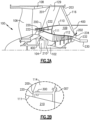
- FIG 2A shows an engine 100, which may operate similar to the engine 20 of Figure 1 .
- a shaft 102 is driven by a fan drive turbine to drive a fan rotor 106 through a gear reduction 104.
- the drive connection here may be generally as described above with regard to Figure 1 .
- a fan case 108 surrounds the fan rotor 106, and an core engine 400 may include a splitter wall 110 that surrounds compressor housing wall 111 which houses a low pressure compressor 112, and a high pressure compressor 230, and combustor and turbine sections (not shown in this Figure).
- the core engine 400 must be rigidly connected to the fan case 108, to address torque and other loads.
- Applicant has previously developed a geared gas turbine engine.
- the fan case was connected to the core engine through a plurality of fan exit guide vanes.
- Each of these fan exit guide vanes were structural elements that provided a load path between the fan case and the core engine.
- engine 100 there are fewer structural fan exit guide vanes 114.
- A-frames 116 have been added to provide additional rigidity.
- the low pressure compressor 112 has five rotating stages.
- the low pressure compressor may have four to six stages, which is longer than the first generation gas turbine engine manufactured by Applicant mentioned above. With such a long low pressure compressor 112, mounting challenges are raised.
- the fan exit guide vanes 114/129 extend from an inner point 200 at an angle to a radially outer point 201, with the angle having a component in a radially outer direction, and another component in an axially aft direction.
- the A-frames 116 extend from a radially inner point 202 attached to the core engine 400, radially outwardly at an angle to an outer point 203 connected to the fan case 108.
- the angle of the A-frame 116 has a component in a radially outer direction and another component in an axially forward direction.
- the core engine 400 includes a fan intermediate case 210 including a plurality of struts, and having a mount bracket 220.
- a non-structural guide vane 129 is attached to the bracket 220 through pins 222. In this manner, the non-structural guide vanes 129 can "float" or adjust radially relative to the bracket 220, but are prevented from moving circumferentially. Alternatively, the non-structural guide vanes may be fixed to bracket 220.
- Figure 2B shows a detail of the mount of a structural guide vane 114 to the fan intermediate case 210 and to the bracket 220 through a first pin 300 preventing circumferential movement, and a second pin 307 preventing radial movement.
- the A-frames 116 are attached at inner ends 202 at a bracket 234 which is fixed with a compressor intermediate case 232 having a plurality of struts 233.
- the compressor intermediate cases 232 is intermediate the low pressure compressor 112 and a high pressure compressor 230, and includes struts. This view shows one such strut.
- the core engine 400 is defined to include at least the compressor housing wall 111, the fan intermediate case 210, the compressor intermediate case 232, the low pressure compressor 112, the high pressure compressor 230 and a combustor end turbine section, not shown, but which may be as disclosed with regard to Figure 1 .
- the A-frames 116 comprise two rigid members 118 and 120 which extend from a connection point 122 at the fan case 108 inwardly to connection points 124 with the compressor housing 111.
- the members 118 extend away from each other moving away from the connection point 122, and in opposed directions/angles relative to a plane drawn through connection point 122, parallel to a center axis X.
- Figure 3A there are sixteen structural guide vanes 114 illustrated. Other numbers can be used. They are rigidly connected at 126 to the fan case 108. It should be understood that Figure 3A is an over simplification.
- the fan exit guide vanes 114 and 129 and A-frames 116 may be attached as shown in Figures 2A and 2B .
- the view of Figure 3A is shown simply to illustrate some general relationships.
- the engine 100 can have more or less than eight of the A-frame legs 118 and 120.
- FIG. 3B there are forty-eight fan exit guide vanes total, with sixteen of the fan exit guide vanes being structural vanes 114. Intermediate each structural fan exit guide vane 114 are two non-structural guide vanes 129.
- the non-structural guide vanes 129 are rigidly connected to the fan case 108 at 130, but as mentioned may float relative to the wall 110 at a radially inner point 132. Alternatively, inner point 132 may be fixed.
- the guide vanes 129 are not structural, they can provide an acoustic function. As shown in Figure 4 , one of the non-structural fan exit guide vanes 129 is illustrated.
- the guide vane 129 has a pressure wall 134 and a suction wall 136.
- An outer skin 137 is perforated at 138 and provided over a plurality of chambers 140.
- the chambers 140 can have any number of shapes including honeycomb, or other cross-sections.
- the perforations 138 could be circular, but can be other shapes, including elongated slots.
- the structural guide vanes 114 may include 16% to 55% of the total fan exit guide vanes. In other embodiments the structural fan exit guide vanes 114 may include 25% to 50% of the total fan exit guide vanes. In yet another embodiment, the structural fan exit guide vanes provide 30% to 35% of the total fan exit guide vanes.
- Stiffness relationships can be defined between the combined stiffness of the fan exit guide vanes 114 and 129, compared to the combined stiffness of A-frames 116, intermediate case 210 and compressor wall 111. Note, if the A-frames 116 are attached to the compressor intermediate case 232, it is also considered as part of the compressor wall 111, including its struts 233.
- a lateral stiffness can be defined in a radial direction. A ratio of lateral stiffness of the combination of structural and non-structural fan exit guide vane to a lateral stiffness of a combination of the A-frames, the compressor wall 111, and the fan intermediate case 210 is greater than or equal to 0.6, and less than or equal to 2.0.
- a moment stiffness may be defined as a moment about an axis perpendicular to a rotational axis of the engine.
- a ratio of the moment stiffness of the combination of the structural and non-structural fan exit guide vanes to the moment stiffness of the combination of the A-frame, compressor wall 111, and case 210 is greater than or equal to 0.50 and less than or equal to 2.0. In embodiments, it is less than or equal to 1.4, and in further embodiments less than or equal to 1.0.
- a quantity of the combined structural guide vanes to a ratio of the quantity of the individual legs 118/120 in the A-frames 116 should be greater than or equal to 1.75.
- Figure 5 shows geometric relationships incorporated into this disclosure.
- a first gap A is defined between a leading edge 300 of the fan exit guide vanes at a radially innermost point outward of wall 110 and a leading edge 301 of the A-frames 116.
- a second gap B is defined between the trailing edge 302 of the fan blade and a leading edge 300 of the fan exit guide vanes at the radially innermost point.
- a third gap C is defined between the trailing edge 304 of the fan blades and a leading edge 305 of the fan exit guide vanes at a radially outermost location radially inward of the fan case 108.
- the fan blade may having a twisting shape such that its trailing edge is defined at a rearmost point on the blades.
- Each of the gaps is defined by extending a line from the mentioned point in a radially outward direction, and then measuring the distance with a line extending parallel to the rotational axis X of the engine.
- Low pressure compressor 112 is shown as is a gear reduction 104. As is clear this view is quite schematic.
- Three gap ratios may be defined as B/A, A/C and B/C.
- the gap ratio A/C was greater than or equal to 1.1 and less than or equal to 2.
- the gap ratio B/C is greater than or equal to 0.4 and less than or equal to 0.6.
- the gap ratio B/A is greater than or equal to 0.25 and less than or equal to 0.45.
- the stiffness ratios and gap ratios may also be influenced by a diameter of the engine and a center line of the geared architecture.
- the center line of the gear reduction may be slightly aft utilizing a planetary gear relative to the center line of the first generation's star gear configuration in Applicant's first generation engine. Moving this center line forward may cause the fan to moved forward. Additional low pressure compressor stages also change the gap ratios.
Landscapes
- Engineering & Computer Science (AREA)
- Mechanical Engineering (AREA)
- General Engineering & Computer Science (AREA)
- Chemical & Material Sciences (AREA)
- Combustion & Propulsion (AREA)
- Structures Of Non-Positive Displacement Pumps (AREA)
Description
- This application relates to a method of incorporating A-frame connections and fan exit guide vanes connections between a fan case and a core housing in a gas turbine engine.
- Gas turbine engines are known, and typically include a fan delivering air into a bypass duct as propulsion air, and into a core engine housing. The core engine housing houses a compressor section which also receives air from the fan. The air is compressed and delivered into a combustor where it is mixed with fuel and ignited. Products of this combustion pass downstream over turbine rotors, driving them to rotate. The turbine rotors in turn rotate the fan and compressor rotors.
- Historically the fan rotor was fixed to rotate at the same speed as a fan drive turbine rotor, which may also drive a low pressure compressor rotor. More recently a gear reduction has been incorporated between the fan drive turbine and the fan rotor, allowing the fan rotor to rotate at slower speeds than the fan drive turbine.
- In modern gas turbine engines with such a gear reduction the fan case has been fixed to the core housing through a plurality of fan exit guide vanes, which provide the structural support between the fan case and the inner core housing.
-
US 2020/003122 A1 discloses a prior art gas turbine engine including a plurality of outlet guide vanes extending between an engine core housing and an outlet guide vane support region of a fan case. -
US 2013/084174 A1 discloses prior art strut rods for structural guide vanes. -
US 2004/108413 A1 discloses a prior art mounting arrangement for mounting a gas turbine engine to a vehicle. -
EP 3 009 618 A1 discloses a prior art ducted fan gas turbine engine. -
US 2015/052908 A1 discloses a prior art bleed duct assembly for a gas turbine engine. - According to a first aspect of the present invention, there is provided a gas turbine engine as set forth in claim 1.
- In another embodiment according to the previous embodiment, a moment stiffness is defined about an axis extending perpendicular to a rotational axis of the gas turbine engine. A moment stiffness ratio of the moment stiffness of the plurality of fan exit guide vanes to a moment stiffness of the combination of the plurality of A-frames, the compressor wall, and the fan intermediate case being greater than or equal to 0.50 and less than or equal to 2.0.
- In another embodiment according to any of the previous embodiments, the moment stiffness ratio is less than or equal to 1.4.
- In another embodiment according to any of the previous embodiments, the moment stiffness ratio is less than or equal to 1.0.
- In another embodiment according to any of the previous embodiments, a first gap is defined between a leading edge of the fan exit guide vanes at a radially innermost point radially outward of the splitter wall and a leading edge of the plurality of A-frames at a radially inner location radially inward of the splitter wall. A second gap is defined between a trailing edge of the fan blades and a leading edge of the plurality of fan exit guide vanes at the radially inward point radially outward of the splitter wall each of the gaps being defined by extending a line from the respective points in a radially outward direction. Then a distance is measured with a line extending parallel to the rotational axis of the engine, and a first gap ratio of the second gap to the first gap is between 0.25 and 0.45.
- In another embodiment according to any of the previous embodiments, a third gap is defined between the trailing edge of the fan blades and a leading edge of the fan exit guide vane at a radially outermost location radially inward of the fan case. The third gap is also defined by extending a line from the respective points in a radially outward direction. Then a distance is measured with a line extending parallel to the rotational axis of the engine. A second gap ratio of the first gap to the third gap is greater than or equal to 1.1 and less than or equal to 2.
- In another embodiment according to any of the previous embodiments, a third gap ratio of the second gap to the third gap is greater than or equal to 0.4 and less than or equal to 0.6.
- In another embodiment according to any of the previous embodiments, the lateral stiffness ratio is less than or equal to 1.4.
- In another embodiment according to any of the previous embodiments, the lateral stiffness ratio is less than or equal to 1.0.
- In another embodiment according to any of the previous embodiments, a ratio of a quantity of the plurality of fan exit guide vanes to a quantity of the legs of the plurality of A-frames being greater than or equal to 1.75.
- In another embodiment according to any of the previous embodiments, the low pressure compressor has between four to six stages.
- According to a further aspect of the present invention, there is provided a gas turbine engine as set forth in claim 9.
- In another embodiment according to any of the previous embodiments, the moment stiffness ratio is less than or equal to 1.4.
- In another embodiment according to any of the previous embodiments, the moment ratio is less than or equal to 1.0.
- In another embodiment according to any of the previous embodiments, a ratio of a quantity of the plurality of fan exit guide vanes to a quantity of the legs of the plurality of A-frames is greater than or equal to 1.75.
- These and other features of the present invention can be best understood from the following specification and drawings, the following of which is a brief description.
-
-
Figure 1 schematically shows a gas turbine engine. -
Figure 2A schematically shows details of the connection between a fan case and an inner core housing. -
Figure 2B shows a further detail. -
Figure 3A shows a simplified rear view ofFigure 2A . -
Figure 3B shows a detail of a plurality of fan exit guide vanes. -
Figure 4 shows details of one fan exit guide vane. -
Figure 5 shows geometric relationships. - In this specification the following non-SI units are used, which may be converted to the respective SI or metric unit according to the following conversion: Fahrenheit (°F) to Kelvin (K): T(K) = (T(°F) + 459.67 °F) × 5/9; Rankin (°R) to Kelvin: T(K) = T(°R) × 5/9; inch (in) to meter (m): m = in × 0,0254.
-
Figure 1 schematically illustrates agas turbine engine 20. Thegas turbine engine 20 is disclosed herein as a two-spool turbofan that generally incorporates afan section 22, acompressor section 24, a combustor section 26 and aturbine section 28. Thefan section 22 may include a single-stage fan 42 having a plurality offan blades 43. Thefan blades 43 may have a fixed stagger angle or may have a variable pitch to direct incoming airflow from an engine inlet. Thefan 42 drives air along a bypass flow path B in abypass duct 13 defined within ahousing 15 such as a fan case or nacelle, and also drives air along a core flow path C for compression and communication into the combustor section 26 then expansion through theturbine section 28. Asplitter 29 aft of thefan 42 divides the air between the bypass flow path B and the core flow path C. Thehousing 15 may surround thefan 42 to establish an outer diameter of thebypass duct 13. Thesplitter 29 may establish an inner diameter of thebypass duct 13. Although depicted as a two-spool turbofan gas turbine engine in the disclosed nonlimiting embodiment, it should be understood that the concepts described herein are not limited to use with two-spool turbofans as the teachings may be applied to other types of turbine engines including three-spool architectures. Theengine 20 may incorporate a variable area nozzle for varying an exit area of the bypass flow path B and/or a thrust reverser for generating reverse thrust. - The
exemplary engine 20 generally includes alow speed spool 30 and ahigh speed spool 32 mounted for rotation about an engine central longitudinal axis A relative to an enginestatic structure 36 viaseveral bearing systems 38. It should be understood thatvarious bearing systems 38 at various locations may alternatively or additionally be provided, and the location ofbearing systems 38 may be varied as appropriate to the application. - The
low speed spool 30 generally includes aninner shaft 40 that interconnects, a first (or low)pressure compressor 44 and a first (or low)pressure turbine 46. Theinner shaft 40 is connected to thefan 42 through a speed change mechanism, which in the exemplarygas turbine engine 20 is illustrated as a gearedarchitecture 48 to drive thefan 42 at a lower speed than thelow speed spool 30. Theinner shaft 40 may interconnect thelow pressure compressor 44 andlow pressure turbine 46 such that thelow pressure compressor 44 andlow pressure turbine 46 are rotatable at a common speed and in a common direction. In other embodiments, thelow pressure turbine 46 drives both thefan 42 andlow pressure compressor 44 through the gearedarchitecture 48 such that thefan 42 andlow pressure compressor 44 are rotatable at a common speed. Although this application discloses gearedarchitecture 48, its teaching may benefit direct drive engines having no geared architecture. Thehigh speed spool 32 includes anouter shaft 50 that interconnects a second (or high)pressure compressor 52 and a second (or high)pressure turbine 54. Acombustor 56 is arranged in theexemplary gas turbine 20 between thehigh pressure compressor 52 and thehigh pressure turbine 54. Amid-turbine frame 57 of the enginestatic structure 36 may be arranged generally between thehigh pressure turbine 54 and thelow pressure turbine 46. Themid-turbine frame 57 furthersupports bearing systems 38 in theturbine section 28. Theinner shaft 40 and theouter shaft 50 are concentric and rotate via bearingsystems 38 about the engine central longitudinal axis A which is collinear with their longitudinal axes. - Airflow in the core flow path C is compressed by the
low pressure compressor 44 then thehigh pressure compressor 52, mixed and burned with fuel in thecombustor 56, then expanded through thehigh pressure turbine 54 andlow pressure turbine 46. Themid-turbine frame 57 includesairfoils 59 which are in the core flow path C. Theturbines low speed spool 30 andhigh speed spool 32 in response to the expansion. It will be appreciated that each of the positions of thefan section 22,compressor section 24, combustor section 26,turbine section 28, and fandrive gear system 48 may be varied. For example,gear system 48 may be located aft of the low pressure compressor, or aft of the combustor section 26 or even aft ofturbine section 28, andfan 42 may be positioned forward or aft of the location ofgear system 48. - The
fan 42 may have at least 10fan blades 43 but no more than 20 or 24fan blades 43. In examples, thefan 42 may have between 12 and 18fan blades 43, such as 14fan blades 43. An exemplary fan size measurement is a maximum radius between the tips of thefan blades 43 and the engine central longitudinal axis A. The maximum radius of thefan blades 43 can be at least 38 inches, or more narrowly no more than 75 inches. For example, the maximum radius of thefan blades 43 can be between 45 inches and 60 inches, such as between 50 inches and 55 inches. Another exemplary fan size measurement is a hub radius, which is defined as distance between a hub of thefan 42 at a location of the leading edges of thefan blades 43 and the engine central longitudinal axis A. Thefan blades 43 may establish a fan hub-to-tip ratio, which is defined as a ratio of the hub radius divided by the maximum radius of thefan 42. The fan hub-to-tip ratio can be less than or equal to 0.35, or more narrowly greater than or equal to 0.20, such as between 0.25 and 0.30. The combination of fan blade counts and fan hub-to-tip ratios disclosed herein can provide theengine 20 with a relatively compact fan arrangement. - The
low pressure compressor 44,high pressure compressor 52,high pressure turbine 54 andlow pressure turbine 46 each include one or more stages having a row of rotatable airfoils. Each stage may include a row of vanes adjacent the rotatable airfoils. The rotatable airfoils are schematically indicated at 47, and the vanes are schematically indicated at 49. - The
low pressure compressor 44 andlow pressure turbine 46 can include an equal number of stages. For example, theengine 20 can include a three-stagelow pressure compressor 44, an eight-stagehigh pressure compressor 52, a two-stagehigh pressure turbine 54, and a three-stagelow pressure turbine 46 to provide a total of sixteen stages. In other examples, thelow pressure compressor 44 includes a different (e.g., greater) number of stages than thelow pressure turbine 46. For example, theengine 20 can include a five-stagelow pressure compressor 44, a nine-stagehigh pressure compressor 52, a two-stagehigh pressure turbine 54, and a four-stagelow pressure turbine 46 to provide a total of twenty stages. In other embodiments, theengine 20 includes a four-stagelow pressure compressor 44, a nine-stagehigh pressure compressor 52, a two-stagehigh pressure turbine 54, and a three-stagelow pressure turbine 46 to provide a total of eighteen stages. It should be understood that theengine 20 can incorporate other compressor and turbine stage counts, including any combination of stages disclosed herein. - The
engine 20 may be a high-bypass geared aircraft engine. The bypass ratio can be greater than or equal to 10.0 and less than or equal to about 18.0, or more narrowly can be less than or equal to 16.0. The gearedarchitecture 48 may be an epicyclic gear train, such as a planetary gear system or a star gear system. The epicyclic gear train may include a sun gear, a ring gear, a plurality of intermediate gears meshing with the sun gear and ring gear, and a carrier that supports the intermediate gears. The sun gear may provide an input to the gear train. The ring gear (e.g., star gear system) or carrier (e.g., planetary gear system) may provide an output of the gear train to drive thefan 42. A gear reduction ratio may be greater than or equal to 2.3, or more narrowly greater than or equal to 3.0, and in some embodiments the gear reduction ratio is greater than or equal to 3.4. The gear reduction ratio may be less than or equal to 4.0. The fan diameter is significantly larger than that of thelow pressure compressor 44. Thelow pressure turbine 46 can have a pressure ratio that is greater than or equal to 8.0 and in some embodiments is greater than or equal to 10.0. The low pressure turbine pressure ratio can be less than or equal to 13.0, or more narrowly less than or equal to 12.0.Low pressure turbine 46 pressure ratio is pressure measured prior to an inlet oflow pressure turbine 46 as related to the pressure at the outlet of thelow pressure turbine 46 prior to an exhaust nozzle. It should be understood, however, that the above parameters are only exemplary of one embodiment of a geared architecture engine and that the present invention is applicable to other gas turbine engines including direct drive turbofans. All of these parameters are measured at the cruise condition described below. - A significant amount of thrust is provided by the bypass flow B due to the high bypass ratio. The
fan section 22 of theengine 20 is designed for a particular flight condition -- typically cruise at about 0.8 Mach and about 35,000 feet (10,668 meters). The flight condition of 0.8 Mach and 35,000 ft (10,668 meters), with the engine at its best fuel consumption - also known as "bucket cruise Thrust Specific Fuel Consumption ('TSFC')" - is the industry standard parameter of lbm of fuel being burned divided by lbf of thrust the engine produces at that minimum point. The engine parameters described above, and those in the next paragraph are measured at this condition unless otherwise specified. - "Fan pressure ratio" is the pressure ratio across the
fan blade 43 alone, without a Fan Exit Guide Vane ("FEGV") system. A distance is established in a radial direction between the inner and outer diameters of thebypass duct 13 at an axial position corresponding to a leading edge of thesplitter 29 relative to the engine central longitudinal axis A. The fan pressure ratio is a spanwise average of the pressure ratios measured across thefan blade 43 alone over radial positions corresponding to the distance. The fan pressure ratio can be less than or equal to 1.45, or more narrowly greater than or equal to 1.25, such as between 1.30 and 1.40. "Corrected fan tip speed" is the actual fan tip speed in ft/sec divided by an industry standard temperature correction of [(Tram °R) / (518.7 °R)]0.5. The corrected fan tip speed can be less than or equal to 1150.0 ft / second (350.5 meters/second), and can be greater than or equal to 1000.0 ft / second (304.8 meters/second). - The
fan 42,low pressure compressor 44 andhigh pressure compressor 52 can provide different amounts of compression of the incoming airflow that is delivered downstream to theturbine section 28 and cooperate to establish an overall pressure ratio (OPR). The OPR is a product of the fan pressure ratio across a root (i.e., 0% span) of thefan blade 43 alone, a pressure ratio across thelow pressure compressor 44 and a pressure ratio across thehigh pressure compressor 52. The pressure ratio of thelow pressure compressor 44 is measured as the pressure at the exit of thelow pressure compressor 44 divided by the pressure at the inlet of thelow pressure compressor 44. In examples, a product of the pressure ratio of thelow pressure compressor 44 and the fan pressure ratio is between 3.0 and 6.0, or more narrowly is between 4.0 and 5.5. The pressure ratio of the highpressure compressor ratio 52 is measured as the pressure at the exit of thehigh pressure compressor 52 divided by the pressure at the inlet of thehigh pressure compressor 52. In examples, the pressure ratio of thehigh pressure compressor 52 is between 7.0 and 12.0, or more narrowly is between 10.0 and 11.5. The OPR can be equal to or greater than 44.0, and can be less than or equal to 70.0, such as between 50.0 and 60.0. The overall and compressor pressure ratios disclosed herein are measured at the cruise condition described above, and can be utilized in two-spool architectures such as theengine 20 as well as three-spool engine architectures. - The
engine 20 establishes a turbine entry temperature (TET). The TET is defined as a maximum temperature of combustion products communicated to an inlet of theturbine section 28 at a maximum takeoff (MTO) condition. The inlet is established at the leading edges of the axially forwardmost row of airfoils of theturbine section 28, and MTO is measured at maximum thrust of theengine 20 at static sea-level and 86 degrees Fahrenheit (°F). The TET may be greater than or equal to 2700.0 °F, or more narrowly less than or equal to 3500.0 °F, such as between 2750.0 °F and 3350.0 °F. The relatively high TET can be utilized in combination with the other techniques disclosed herein to provide a compact turbine arrangement. - The
engine 20 establishes an exhaust gas temperature (EGT). The EGT is defined as a maximum temperature of combustion products in the core flow path C communicated to at the trailing edges of the axially aftmost row of airfoils of theturbine section 28 at the MTO condition. The EGT may be less than or equal to 1000.0 °F, or more narrowly greater than or equal to 800.0 °F, such as between 900.0 °F and 975.0 °F. The relatively low EGT can be utilized in combination with the other techniques disclosed herein to reduce fuel consumption. -
Figure 2A shows anengine 100, which may operate similar to theengine 20 ofFigure 1 . Ashaft 102 is driven by a fan drive turbine to drive afan rotor 106 through agear reduction 104. The drive connection here may be generally as described above with regard toFigure 1 . Afan case 108 surrounds thefan rotor 106, and ancore engine 400 may include asplitter wall 110 that surroundscompressor housing wall 111 which houses alow pressure compressor 112, and ahigh pressure compressor 230, and combustor and turbine sections (not shown in this Figure). Thecore engine 400 must be rigidly connected to thefan case 108, to address torque and other loads. - Applicant has previously developed a geared gas turbine engine. In this first generation engine the fan case was connected to the core engine through a plurality of fan exit guide vanes. Each of these fan exit guide vanes were structural elements that provided a load path between the fan case and the core engine.
- In
engine 100, as will be described below, there are fewer structural fan exit guide vanes 114. A-frames 116 have been added to provide additional rigidity. - As shown, the
low pressure compressor 112 has five rotating stages. In embodiments the low pressure compressor may have four to six stages, which is longer than the first generation gas turbine engine manufactured by Applicant mentioned above. With such a longlow pressure compressor 112, mounting challenges are raised. - As can been seen from
Figures 2A and 2B , the fanexit guide vanes 114/129 extend from aninner point 200 at an angle to a radiallyouter point 201, with the angle having a component in a radially outer direction, and another component in an axially aft direction. - Conversely, the A-frames 116 extend from a radially
inner point 202 attached to thecore engine 400, radially outwardly at an angle to anouter point 203 connected to thefan case 108. The angle of theA-frame 116 has a component in a radially outer direction and another component in an axially forward direction. - As shown in
Figure 2A , thecore engine 400 includes a fanintermediate case 210 including a plurality of struts, and having amount bracket 220. Anon-structural guide vane 129 is attached to thebracket 220 throughpins 222. In this manner, thenon-structural guide vanes 129 can "float" or adjust radially relative to thebracket 220, but are prevented from moving circumferentially. Alternatively, the non-structural guide vanes may be fixed tobracket 220. -
Figure 2B shows a detail of the mount of astructural guide vane 114 to the fanintermediate case 210 and to thebracket 220 through afirst pin 300 preventing circumferential movement, and asecond pin 307 preventing radial movement. - Returning to
Figure 2A , it can be seen that the A-frames 116 are attached atinner ends 202 at abracket 234 which is fixed with a compressorintermediate case 232 having a plurality of struts 233. The compressorintermediate cases 232 is intermediate thelow pressure compressor 112 and ahigh pressure compressor 230, and includes struts. This view shows one such strut. - Although specific mount locations are shown, other connections between the fan
exit guide vanes 114/129 and A-frames 116 to thecore engine 400 may be utilized. For purposes of this application, thecore engine 400 is defined to include at least thecompressor housing wall 111, the fanintermediate case 210, the compressorintermediate case 232, thelow pressure compressor 112, thehigh pressure compressor 230 and a combustor end turbine section, not shown, but which may be as disclosed with regard toFigure 1 . - As shown in
Figure 3A , the A-frames 116 comprise tworigid members connection point 122 at thefan case 108 inwardly toconnection points 124 with thecompressor housing 111. As can be seen, themembers 118 extend away from each other moving away from theconnection point 122, and in opposed directions/angles relative to a plane drawn throughconnection point 122, parallel to a center axis X. InFigure 3A there are sixteenstructural guide vanes 114 illustrated. Other numbers can be used. They are rigidly connected at 126 to thefan case 108. It should be understood thatFigure 3A is an over simplification. In fact, as mentioned above, the fanexit guide vanes Figures 2A and 2B . The view ofFigure 3A is shown simply to illustrate some general relationships. In embodiments, theengine 100 can have more or less than eight of theA-frame legs - As shown in
Figure 3B , there are forty-eight fan exit guide vanes total, with sixteen of the fan exit guide vanes beingstructural vanes 114. Intermediate each structural fanexit guide vane 114 are two non-structural guide vanes 129. Thenon-structural guide vanes 129 are rigidly connected to thefan case 108 at 130, but as mentioned may float relative to thewall 110 at a radiallyinner point 132. Alternatively,inner point 132 may be fixed. - Since the
guide vanes 129 are not structural, they can provide an acoustic function. As shown inFigure 4 , one of the non-structural fanexit guide vanes 129 is illustrated. Theguide vane 129 has apressure wall 134 and asuction wall 136. Anouter skin 137 is perforated at 138 and provided over a plurality ofchambers 140. Thechambers 140 can have any number of shapes including honeycomb, or other cross-sections. Theperforations 138 could be circular, but can be other shapes, including elongated slots. - In embodiments the
structural guide vanes 114 may include 16% to 55% of the total fan exit guide vanes. In other embodiments the structural fanexit guide vanes 114 may include 25% to 50% of the total fan exit guide vanes. In yet another embodiment, the structural fan exit guide vanes provide 30% to 35% of the total fan exit guide vanes. - The details of the fan exit guide vanes and A-frame structure as disclosed above are disclosed and claimed in co-pending
United States Patent Application No. 17/407,275, entitled "Frame Connection Between Fan Case And Core Housing In A Gas Turbine Engine" filed on August 20, 2021 - Stiffness relationships can be defined between the combined stiffness of the fan
exit guide vanes A-frames 116,intermediate case 210 andcompressor wall 111. Note, if the A-frames 116 are attached to the compressorintermediate case 232, it is also considered as part of thecompressor wall 111, including its struts 233. A lateral stiffness can be defined in a radial direction. A ratio of lateral stiffness of the combination of structural and non-structural fan exit guide vane to a lateral stiffness of a combination of the A-frames, thecompressor wall 111, and the fanintermediate case 210 is greater than or equal to 0.6, and less than or equal to 2.0. In embodiments, it is less than or equal to 1.40, and in further embodiments it is less than or equal to 1.0. A moment stiffness may be defined as a moment about an axis perpendicular to a rotational axis of the engine. A ratio of the moment stiffness of the combination of the structural and non-structural fan exit guide vanes to the moment stiffness of the combination of the A-frame,compressor wall 111, andcase 210 is greater than or equal to 0.50 and less than or equal to 2.0. In embodiments, it is less than or equal to 1.4, and in further embodiments less than or equal to 1.0. - A quantity of the combined structural guide vanes to a ratio of the quantity of the
individual legs 118/120 in the A-frames 116 should be greater than or equal to 1.75. -
Figure 5 shows geometric relationships incorporated into this disclosure. - A first gap A is defined between a
leading edge 300 of the fan exit guide vanes at a radially innermost point outward ofwall 110 and aleading edge 301 of theA-frames 116. A second gap B is defined between the trailingedge 302 of the fan blade and aleading edge 300 of the fan exit guide vanes at the radially innermost point. A third gap C is defined between the trailingedge 304 of the fan blades and aleading edge 305 of the fan exit guide vanes at a radially outermost location radially inward of thefan case 108. Note that the fan blade may having a twisting shape such that its trailing edge is defined at a rearmost point on the blades. Each of the gaps is defined by extending a line from the mentioned point in a radially outward direction, and then measuring the distance with a line extending parallel to the rotational axis X of the engine. -
Low pressure compressor 112 is shown as is agear reduction 104. As is clear this view is quite schematic. - These gaps impact how the structure works together for fan blade clearance and noise, as well as overcoming stresses and other operational challenges. Three gap ratios may be defined as B/A, A/C and B/C. In one embodiment, the gap ratio A/C was greater than or equal to 1.1 and less than or equal to 2. In embodiments the gap ratio B/C is greater than or equal to 0.4 and less than or equal to 0.6. In embodiments the gap ratio B/A is greater than or equal to 0.25 and less than or equal to 0.45.
- The stiffness ratios and gap ratios may also be influenced by a diameter of the engine and a center line of the geared architecture. In one embodiment the center line of the gear reduction may be slightly aft utilizing a planetary gear relative to the center line of the first generation's star gear configuration in Applicant's first generation engine. Moving this center line forward may cause the fan to moved forward. Additional low pressure compressor stages also change the gap ratios.
- Although embodiments of this disclosure have been shown, a worker of ordinary skill in this art would recognize that modifications would come within the scope of this disclosure. For that reason, the following claims should be studied to determine the true scope and content of this disclosure.
Claims (13)
- A gas turbine engine (20) comprising:a fan rotor (106) comprising fan blades (43) driven by a fan drive turbine about an axis through a gear reduction (104) to reduce a speed of said fan rotor (106) relative to a speed of said fan drive turbine;a fan case (108) surrounding said fan rotor (106), and an inner core housing surrounding a compressor section (24), including a low pressure compressor (112);said fan rotor (106) delivering air into a bypass duct (13) defined between said fan case (108) and a splitter wall (110) of said inner core housing, and a rigid connection between said fan case (108) and said inner core housing including a plurality of A-frames (116) each including a pair of legs (118, 120) rigidly connected at a connection point (122) to said fan case (108), and each leg (118, 120) in said pair extending away from said connection point (122) in opposed circumferential directions to be connected to a compressor wall (111) of said inner core housing to form an A-shape; andthe rigid connection also including a plurality of fan exit guide vanes (114, 129) rigidly connected to said fan case (108), the plurality of fan exit guide vanes (114, 129) including a plurality of structural guide vanes (114) and a plurality of non-structural guide vanes (129), each of the plurality of non-structural guide vanes (129) comprising an outer skin (137) with perforations (138) and provided over a plurality of chambers (140); anda lateral stiffness is defined in a radial direction, a lateral stiffness ratio of the lateral stiffness of the plurality of fan exit guide vanes (114, 129) and a lateral stiffness of a combination of the plurality of A-frame, the compressor wall (111), and a fan intermediate case (210) which is forward of the low pressure compressor (44, 112) being greater than or equal to 0.6 and less than or equal to 2.0.
- The gas turbine engine (20) as set forth in claim 1, wherein a first gap (A) is defined between a leading edge (300) of the fan exit guide vanes (114, 129) at a radially innermost point radially outward of the splitter wall (110) and a leading edge (301) of the plurality of A-frames (116) at a radially inner location radially inward of the splitter wall (110), and a second gap (B) is defined between a trailing edge (302) of the fan blades (43) and a leading edge (300) of the plurality of fan exit guide vanes (114, 129) at the radially inward point radially outward of the splitter wall (110) each of the gaps being defined by extending a line from the respective points in a radially outward direction, and then measuring a distance with a line extending parallel to the rotational axis (X) of the engine, and a first gap ratio (B/A) of said second gap (B) to said first gap (A) is between 0.25 and 0.45.
- The gas turbine engine (20) as set forth in claim 2, wherein a third gap (C) is defined between the trailing edge (304) of the fan blades (43) and a leading edge (305) of the fan exit guide vane (114, 129) at a radially outermost location radially inward of the fan case (108), the third gap (C) also defined by extending a line from the respective points in a radially outward direction, and then measuring a distance with a line extending parallel to the rotational axis (X) of the engine, and a second gap ratio (A/C) of said first gap (A) to said third gap (C) is greater than or equal to 1.1 and less than or equal to 2.
- The gas turbine engine (20) as set forth in claim 3, wherein a third gap ratio (B/C) of said second gap (B) to said third gap (C) is greater than or equal to 0.4 and less than or equal to 0.6.
- The gas turbine engine (20) as set forth in any preceding claim, wherein the lateral stiffness ratio being less than or equal to 1.4.
- The gas turbine engine (20) as set forth in any preceding claim, wherein the lateral stiffness ratio being less than or equal to 1.0.
- The gas turbine engine (20) as set forth in any preceding claim, wherein said low pressure compressor (44, 112) has between four to six stages.
- The gas turbine engine (20) as set forth in claim 1, wherein a moment stiffness is defined about an axis extending perpendicular to a rotational axis (X) of the gas turbine engine (20), and a moment stiffness ratio of the moment stiffness of the plurality of fan exit guide vanes (114, 129) to a moment stiffness of the combination of the plurality of A-frames (116), the compressor wall (111), and the fan intermediate case (210) being greater than or equal to 0.50 and less than or equal to 2.0.
- A gas turbine engine (20) comprising:a fan rotor (106) driven by a fan drive turbine about an axis through a gear reduction (104) to reduce a speed of said fan rotor (106) relative to a speed of said fan drive turbine;a fan case (108) surrounding said fan rotor (106), and an inner core housing surrounding a compressor section (24), including a low pressure compressor (112);said fan rotor (106) delivering air into a bypass duct (13) defined between said fan case (108) and a splitter wall (110) of said inner core housing, and a rigid connection between said fan case (108) and said inner core housing including a plurality of A-frames (116) each including a pair of legs (118, 120) rigidly connected at a connection point (122, 124) to said fan case (108), and each leg (118, 120) in said pair extending away from said connection point (122) in opposed circumferential directions to be connected to a compressor wall (111) of said inner core housing to form an A-shape;the rigid connection also including a plurality of fan exit guide vanes (114, 129) rigidly connected to said fan case (108), the plurality of fan exit guide vanes (114, 129) including a plurality of structural guide vanes (114) and a plurality of non-structural guide vanes (129), each of the plurality of non-structural guide vanes (129) comprising an outer skin (137) with perforations (138) and provided over a plurality of chambers (140); andwherein a moment stiffness is defined about an axis extending perpendicular to a rotational axis (X) of the gas turbine engine (20), and a moment stiffness ratio of a moment stiffness of the plurality of fan exit guide vanes (114, 129) to a moment stiffness of the combination of the plurality of A-frames (116), the compressor wall (111), and a fan intermediate case (210) forward of the lower pressure compressor being greater than or equal to 0.50 and less than or equal to 2.0.
- The gas turbine engine (20) as set forth in claim 8 or 9, wherein the moment stiffness ratio being less than or equal to 1.4.
- The gas turbine engine (20) as set forth in any of claims 8 to 10, wherein the moment ratio being less than or equal to 1.0.
- The gas turbine engine (20) as set forth in any preceding claim, wherein a ratio of a quantity of the plurality of fan exit guide vanes (114, 129) to a quantity of the legs (118, 120) of the plurality of A-frames (116) being greater than or equal to 1.75.
- The gas turbine engine (20) as set forth in any preceding claim, wherein the plurality of structural guide vanes (114) comprise 25% to 50% of a total number of the plurality of fan exit guide vanes (114, 129).
Applications Claiming Priority (2)
| Application Number | Priority Date | Filing Date | Title |
|---|---|---|---|
| US202163235199P | 2021-08-20 | 2021-08-20 | |
| US17/512,824 US11674415B2 (en) | 2021-08-20 | 2021-10-28 | Front section stiffness ratio |
Publications (2)
| Publication Number | Publication Date |
|---|---|
| EP4137688A1 EP4137688A1 (en) | 2023-02-22 |
| EP4137688B1 true EP4137688B1 (en) | 2024-09-25 |
Family
ID=83049875
Family Applications (1)
| Application Number | Title | Priority Date | Filing Date |
|---|---|---|---|
| EP22191557.2A Active EP4137688B1 (en) | 2021-08-20 | 2022-08-22 | Front section stiffness ratio |
Country Status (2)
| Country | Link |
|---|---|
| US (2) | US11674415B2 (en) |
| EP (1) | EP4137688B1 (en) |
Family Cites Families (26)
| Publication number | Priority date | Publication date | Assignee | Title |
|---|---|---|---|---|
| US3398535A (en) | 1966-05-25 | 1968-08-27 | Gen Electric | Engine supporting structure |
| US3421577A (en) | 1967-07-27 | 1969-01-14 | Olin Mathieson | Composite porous structure |
| US3820628A (en) | 1972-10-02 | 1974-06-28 | United Aircraft Corp | Sound suppression means for rotating machinery |
| GB2275308B (en) | 1993-02-20 | 1997-02-26 | Rolls Royce Plc | A mounting for coupling a turbofan gas turbine engine to an aircraft structure |
| FR2738283B1 (en) | 1995-08-30 | 1997-09-26 | Snecma | TURBOMACHINE ARRANGEMENT INCLUDING A VANE GRILLE AND AN INTERMEDIATE HOUSING |
| GB2394991B (en) * | 2002-11-06 | 2006-02-15 | Rolls Royce Plc | Mounting arrangement |
| US7018172B2 (en) | 2003-12-22 | 2006-03-28 | United Technologies Corporation | Airfoil surface impedance modification for noise reduction in turbofan engines |
| GB0520850D0 (en) | 2005-10-14 | 2005-11-23 | Rolls Royce Plc | Fan static structure |
| US7607287B2 (en) | 2007-05-29 | 2009-10-27 | United Technologies Corporation | Airfoil acoustic impedance control |
| FR2928136B1 (en) | 2008-02-28 | 2010-04-02 | Airbus France | AIRCRAFT ENGINE ASSEMBLY COMPRISING ENGINE FASTENERS DEPORTED DOWN TO THE BLOWER HOUSING. |
| US8979491B2 (en) | 2009-05-15 | 2015-03-17 | Pratt & Whitney Canada Corp. | Turbofan mounting arrangement |
| FR2956164B1 (en) * | 2010-02-10 | 2012-02-24 | Snecma | CONNECTION BETWEEN THE EXHAUST CASE AND A STRUCTURAL RING OF A BLOWER DELIVERY OF A TURBOREACTOR |
| DE102010023703A1 (en) | 2010-06-14 | 2011-12-15 | Rolls-Royce Deutschland Ltd & Co Kg | Turbomachine with noise reduction |
| US9470243B2 (en) | 2011-03-09 | 2016-10-18 | Ihi Corporation | Guide vane attachment structure and fan |
| US20130084174A1 (en) * | 2011-10-03 | 2013-04-04 | United Technologies Corporation | Strut rods for structural guide vanes |
| WO2015050619A2 (en) * | 2013-08-20 | 2015-04-09 | United Technologies Corporation | High thrust geared gas turbine engine |
| GB201314946D0 (en) * | 2013-08-21 | 2013-10-02 | Rolls Royce Deutschland | Bleed duct assembly for a gas turbine engine |
| US9784129B2 (en) | 2014-08-01 | 2017-10-10 | Pratt & Whitney Canada Corp. | Rear mount assembly for gas turbine engine |
| GB201418396D0 (en) | 2014-10-17 | 2014-12-03 | Rolls Royce Plc | Gas turbine engine support structures |
| US9915225B2 (en) | 2015-02-06 | 2018-03-13 | United Technologies Corporation | Propulsion system arrangement for turbofan gas turbine engine |
| US10371173B2 (en) | 2015-05-07 | 2019-08-06 | United Technologies Corporation | Liner for a gas turbine engine |
| KR20170036176A (en) * | 2015-09-23 | 2017-04-03 | 삼성디스플레이 주식회사 | Display panel driving apparatus, method of driving display panel using the display panel driving apparatus and display apparatus having the display panel driving apparatus |
| FR3062876B1 (en) | 2017-02-14 | 2021-03-12 | Safran Aircraft Engines | HIGH PRESSURE COMPRESSOR FOR TURBOMACHINE |
| GB201810606D0 (en) | 2018-06-28 | 2018-08-15 | Rolls Royce Plc | Gas turbine engine |
| US11174815B2 (en) | 2018-09-14 | 2021-11-16 | Rohr, Inc. | Inlet deep cavity flutter liner |
| US11512608B2 (en) | 2020-08-14 | 2022-11-29 | Raytheon Technologies Corporation | Passive transpirational flow acoustically lined guide vane |
-
2021
- 2021-10-28 US US17/512,824 patent/US11674415B2/en active Active
-
2022
- 2022-08-22 EP EP22191557.2A patent/EP4137688B1/en active Active
-
2023
- 2023-04-14 US US18/300,558 patent/US11933190B2/en active Active
Also Published As
| Publication number | Publication date |
|---|---|
| US11933190B2 (en) | 2024-03-19 |
| US20230056571A1 (en) | 2023-02-23 |
| US11674415B2 (en) | 2023-06-13 |
| US20240003268A1 (en) | 2024-01-04 |
| EP4137688A1 (en) | 2023-02-22 |
Similar Documents
| Publication | Publication Date | Title |
|---|---|---|
| US11608796B1 (en) | Radial strut frame connection between fan case and core housing in a gas turbine engine | |
| EP3101258B1 (en) | Geared architecture for a gas turbine engine and a corresponding method | |
| US9194329B2 (en) | Gas turbine engine shaft bearing configuration | |
| US11927106B2 (en) | Frame connection between fan case and core housing in a gas turbine engine | |
| US11719245B2 (en) | Compressor arrangement for a gas turbine engine | |
| US20230220781A1 (en) | Geared gas turbine engine with front section moment stiffness relationships | |
| EP4180637B1 (en) | Gas turbine engine with triangular-frame connection between fan case and core housing | |
| US11686220B2 (en) | H-frame connection between fan case and core housing in a gas turbine engine | |
| EP4137688B1 (en) | Front section stiffness ratio | |
| US11814968B2 (en) | Gas turbine engine with idle thrust ratio | |
| EP4180636A1 (en) | Radial strut frame connection between fan case and core housing in a gas turbine engine | |
| US12098681B2 (en) | High and low spool configuration for a gas turbine engine | |
| EP4390107B1 (en) | Aft mounted pusher fan for gas turbine engine | |
| US12392280B2 (en) | Gas turbine engine with high low spool power extraction ratio | |
| US12123356B2 (en) | Gas turbine engine with higher low spool torque-to-thrust ratio | |
| EP4170143B1 (en) | Straddle mounted low pressure compressor | |
| US20230026997A1 (en) | Gas turbine engine compressor arrangement |
Legal Events
| Date | Code | Title | Description |
|---|---|---|---|
| PUAI | Public reference made under article 153(3) epc to a published international application that has entered the european phase |
Free format text: ORIGINAL CODE: 0009012 |
|
| STAA | Information on the status of an ep patent application or granted ep patent |
Free format text: STATUS: THE APPLICATION HAS BEEN PUBLISHED |
|
| AK | Designated contracting states |
Kind code of ref document: A1 Designated state(s): AL AT BE BG CH CY CZ DE DK EE ES FI FR GB GR HR HU IE IS IT LI LT LU LV MC MK MT NL NO PL PT RO RS SE SI SK SM TR |
|
| STAA | Information on the status of an ep patent application or granted ep patent |
Free format text: STATUS: REQUEST FOR EXAMINATION WAS MADE |
|
| 17P | Request for examination filed |
Effective date: 20230822 |
|
| RBV | Designated contracting states (corrected) |
Designated state(s): AL AT BE BG CH CY CZ DE DK EE ES FI FR GB GR HR HU IE IS IT LI LT LU LV MC MK MT NL NO PL PT RO RS SE SI SK SM TR |
|
| RAP3 | Party data changed (applicant data changed or rights of an application transferred) |
Owner name: RTX CORPORATION |
|
| GRAP | Despatch of communication of intention to grant a patent |
Free format text: ORIGINAL CODE: EPIDOSNIGR1 |
|
| STAA | Information on the status of an ep patent application or granted ep patent |
Free format text: STATUS: GRANT OF PATENT IS INTENDED |
|
| INTG | Intention to grant announced |
Effective date: 20240408 |
|
| GRAS | Grant fee paid |
Free format text: ORIGINAL CODE: EPIDOSNIGR3 |
|
| GRAA | (expected) grant |
Free format text: ORIGINAL CODE: 0009210 |
|
| STAA | Information on the status of an ep patent application or granted ep patent |
Free format text: STATUS: THE PATENT HAS BEEN GRANTED |
|
| AK | Designated contracting states |
Kind code of ref document: B1 Designated state(s): AL AT BE BG CH CY CZ DE DK EE ES FI FR GB GR HR HU IE IS IT LI LT LU LV MC MK MT NL NO PL PT RO RS SE SI SK SM TR |
|
| REG | Reference to a national code |
Ref country code: GB Ref legal event code: FG4D |
|
| REG | Reference to a national code |
Ref country code: CH Ref legal event code: EP |
|
| REG | Reference to a national code |
Ref country code: DE Ref legal event code: R096 Ref document number: 602022006344 Country of ref document: DE |
|
| REG | Reference to a national code |
Ref country code: IE Ref legal event code: FG4D |
|
| REG | Reference to a national code |
Ref country code: LT Ref legal event code: MG9D |
|
| PG25 | Lapsed in a contracting state [announced via postgrant information from national office to epo] |
Ref country code: NO Free format text: LAPSE BECAUSE OF FAILURE TO SUBMIT A TRANSLATION OF THE DESCRIPTION OR TO PAY THE FEE WITHIN THE PRESCRIBED TIME-LIMIT Effective date: 20241225 |
|
| PG25 | Lapsed in a contracting state [announced via postgrant information from national office to epo] |
Ref country code: GR Free format text: LAPSE BECAUSE OF FAILURE TO SUBMIT A TRANSLATION OF THE DESCRIPTION OR TO PAY THE FEE WITHIN THE PRESCRIBED TIME-LIMIT Effective date: 20241226 Ref country code: FI Free format text: LAPSE BECAUSE OF FAILURE TO SUBMIT A TRANSLATION OF THE DESCRIPTION OR TO PAY THE FEE WITHIN THE PRESCRIBED TIME-LIMIT Effective date: 20240925 |
|
| PG25 | Lapsed in a contracting state [announced via postgrant information from national office to epo] |
Ref country code: BG Free format text: LAPSE BECAUSE OF FAILURE TO SUBMIT A TRANSLATION OF THE DESCRIPTION OR TO PAY THE FEE WITHIN THE PRESCRIBED TIME-LIMIT Effective date: 20240925 |
|
| PG25 | Lapsed in a contracting state [announced via postgrant information from national office to epo] |
Ref country code: LV Free format text: LAPSE BECAUSE OF FAILURE TO SUBMIT A TRANSLATION OF THE DESCRIPTION OR TO PAY THE FEE WITHIN THE PRESCRIBED TIME-LIMIT Effective date: 20240925 |
|
| PG25 | Lapsed in a contracting state [announced via postgrant information from national office to epo] |
Ref country code: RS Free format text: LAPSE BECAUSE OF FAILURE TO SUBMIT A TRANSLATION OF THE DESCRIPTION OR TO PAY THE FEE WITHIN THE PRESCRIBED TIME-LIMIT Effective date: 20241225 |
|
| REG | Reference to a national code |
Ref country code: NL Ref legal event code: MP Effective date: 20240925 |
|
| PG25 | Lapsed in a contracting state [announced via postgrant information from national office to epo] |
Ref country code: RS Free format text: LAPSE BECAUSE OF FAILURE TO SUBMIT A TRANSLATION OF THE DESCRIPTION OR TO PAY THE FEE WITHIN THE PRESCRIBED TIME-LIMIT Effective date: 20241225 Ref country code: NO Free format text: LAPSE BECAUSE OF FAILURE TO SUBMIT A TRANSLATION OF THE DESCRIPTION OR TO PAY THE FEE WITHIN THE PRESCRIBED TIME-LIMIT Effective date: 20241225 Ref country code: LV Free format text: LAPSE BECAUSE OF FAILURE TO SUBMIT A TRANSLATION OF THE DESCRIPTION OR TO PAY THE FEE WITHIN THE PRESCRIBED TIME-LIMIT Effective date: 20240925 Ref country code: GR Free format text: LAPSE BECAUSE OF FAILURE TO SUBMIT A TRANSLATION OF THE DESCRIPTION OR TO PAY THE FEE WITHIN THE PRESCRIBED TIME-LIMIT Effective date: 20241226 Ref country code: FI Free format text: LAPSE BECAUSE OF FAILURE TO SUBMIT A TRANSLATION OF THE DESCRIPTION OR TO PAY THE FEE WITHIN THE PRESCRIBED TIME-LIMIT Effective date: 20240925 Ref country code: BG Free format text: LAPSE BECAUSE OF FAILURE TO SUBMIT A TRANSLATION OF THE DESCRIPTION OR TO PAY THE FEE WITHIN THE PRESCRIBED TIME-LIMIT Effective date: 20240925 |
|
| REG | Reference to a national code |
Ref country code: AT Ref legal event code: MK05 Ref document number: 1726807 Country of ref document: AT Kind code of ref document: T Effective date: 20240925 |
|
| PG25 | Lapsed in a contracting state [announced via postgrant information from national office to epo] |
Ref country code: NL Free format text: LAPSE BECAUSE OF FAILURE TO SUBMIT A TRANSLATION OF THE DESCRIPTION OR TO PAY THE FEE WITHIN THE PRESCRIBED TIME-LIMIT Effective date: 20240925 |
|
| PG25 | Lapsed in a contracting state [announced via postgrant information from national office to epo] |
Ref country code: IS Free format text: LAPSE BECAUSE OF FAILURE TO SUBMIT A TRANSLATION OF THE DESCRIPTION OR TO PAY THE FEE WITHIN THE PRESCRIBED TIME-LIMIT Effective date: 20250125 Ref country code: PT Free format text: LAPSE BECAUSE OF FAILURE TO SUBMIT A TRANSLATION OF THE DESCRIPTION OR TO PAY THE FEE WITHIN THE PRESCRIBED TIME-LIMIT Effective date: 20250127 |
|
| PG25 | Lapsed in a contracting state [announced via postgrant information from national office to epo] |
Ref country code: SM Free format text: LAPSE BECAUSE OF FAILURE TO SUBMIT A TRANSLATION OF THE DESCRIPTION OR TO PAY THE FEE WITHIN THE PRESCRIBED TIME-LIMIT Effective date: 20240925 Ref country code: RO Free format text: LAPSE BECAUSE OF FAILURE TO SUBMIT A TRANSLATION OF THE DESCRIPTION OR TO PAY THE FEE WITHIN THE PRESCRIBED TIME-LIMIT Effective date: 20240925 |
|
| PG25 | Lapsed in a contracting state [announced via postgrant information from national office to epo] |
Ref country code: ES Free format text: LAPSE BECAUSE OF FAILURE TO SUBMIT A TRANSLATION OF THE DESCRIPTION OR TO PAY THE FEE WITHIN THE PRESCRIBED TIME-LIMIT Effective date: 20240925 |
|
| PG25 | Lapsed in a contracting state [announced via postgrant information from national office to epo] |
Ref country code: EE Free format text: LAPSE BECAUSE OF FAILURE TO SUBMIT A TRANSLATION OF THE DESCRIPTION OR TO PAY THE FEE WITHIN THE PRESCRIBED TIME-LIMIT Effective date: 20240925 Ref country code: AT Free format text: LAPSE BECAUSE OF FAILURE TO SUBMIT A TRANSLATION OF THE DESCRIPTION OR TO PAY THE FEE WITHIN THE PRESCRIBED TIME-LIMIT Effective date: 20240925 |
|
| PG25 | Lapsed in a contracting state [announced via postgrant information from national office to epo] |
Ref country code: PL Free format text: LAPSE BECAUSE OF FAILURE TO SUBMIT A TRANSLATION OF THE DESCRIPTION OR TO PAY THE FEE WITHIN THE PRESCRIBED TIME-LIMIT Effective date: 20240925 Ref country code: CZ Free format text: LAPSE BECAUSE OF FAILURE TO SUBMIT A TRANSLATION OF THE DESCRIPTION OR TO PAY THE FEE WITHIN THE PRESCRIBED TIME-LIMIT Effective date: 20240925 |
|
| PG25 | Lapsed in a contracting state [announced via postgrant information from national office to epo] |
Ref country code: SK Free format text: LAPSE BECAUSE OF FAILURE TO SUBMIT A TRANSLATION OF THE DESCRIPTION OR TO PAY THE FEE WITHIN THE PRESCRIBED TIME-LIMIT Effective date: 20240925 Ref country code: IT Free format text: LAPSE BECAUSE OF FAILURE TO SUBMIT A TRANSLATION OF THE DESCRIPTION OR TO PAY THE FEE WITHIN THE PRESCRIBED TIME-LIMIT Effective date: 20240925 |
|
| REG | Reference to a national code |
Ref country code: DE Ref legal event code: R097 Ref document number: 602022006344 Country of ref document: DE |
|
| PG25 | Lapsed in a contracting state [announced via postgrant information from national office to epo] |
Ref country code: DK Free format text: LAPSE BECAUSE OF FAILURE TO SUBMIT A TRANSLATION OF THE DESCRIPTION OR TO PAY THE FEE WITHIN THE PRESCRIBED TIME-LIMIT Effective date: 20240925 |
|
| PLBE | No opposition filed within time limit |
Free format text: ORIGINAL CODE: 0009261 |
|
| STAA | Information on the status of an ep patent application or granted ep patent |
Free format text: STATUS: NO OPPOSITION FILED WITHIN TIME LIMIT |
|
| 26N | No opposition filed |
Effective date: 20250626 |
|
| PG25 | Lapsed in a contracting state [announced via postgrant information from national office to epo] |
Ref country code: SE Free format text: LAPSE BECAUSE OF FAILURE TO SUBMIT A TRANSLATION OF THE DESCRIPTION OR TO PAY THE FEE WITHIN THE PRESCRIBED TIME-LIMIT Effective date: 20240925 |
|
| PGFP | Annual fee paid to national office [announced via postgrant information from national office to epo] |
Ref country code: DE Payment date: 20250724 Year of fee payment: 4 |
|
| PGFP | Annual fee paid to national office [announced via postgrant information from national office to epo] |
Ref country code: FR Payment date: 20250725 Year of fee payment: 4 |
|
| PG25 | Lapsed in a contracting state [announced via postgrant information from national office to epo] |
Ref country code: HR Free format text: LAPSE BECAUSE OF FAILURE TO SUBMIT A TRANSLATION OF THE DESCRIPTION OR TO PAY THE FEE WITHIN THE PRESCRIBED TIME-LIMIT Effective date: 20240925 |
|
| REG | Reference to a national code |
Ref country code: CH Ref legal event code: H13 Free format text: ST27 STATUS EVENT CODE: U-0-0-H10-H13 (AS PROVIDED BY THE NATIONAL OFFICE) Effective date: 20260324 |
|
| PG25 | Lapsed in a contracting state [announced via postgrant information from national office to epo] |
Ref country code: MC Free format text: LAPSE BECAUSE OF FAILURE TO SUBMIT A TRANSLATION OF THE DESCRIPTION OR TO PAY THE FEE WITHIN THE PRESCRIBED TIME-LIMIT Effective date: 20240925 |
|
| PG25 | Lapsed in a contracting state [announced via postgrant information from national office to epo] |
Ref country code: LU Free format text: LAPSE BECAUSE OF NON-PAYMENT OF DUE FEES Effective date: 20250822 |
|
| PG25 | Lapsed in a contracting state [announced via postgrant information from national office to epo] |
Ref country code: CH Free format text: LAPSE BECAUSE OF NON-PAYMENT OF DUE FEES Effective date: 20250831 |