EP4137366A2 - Capacitor measurement - Google Patents
Capacitor measurement Download PDFInfo
- Publication number
- EP4137366A2 EP4137366A2 EP22190946.8A EP22190946A EP4137366A2 EP 4137366 A2 EP4137366 A2 EP 4137366A2 EP 22190946 A EP22190946 A EP 22190946A EP 4137366 A2 EP4137366 A2 EP 4137366A2
- Authority
- EP
- European Patent Office
- Prior art keywords
- voltage
- time
- terminal
- resistor
- change
- Prior art date
- Legal status (The legal status is an assumption and is not a legal conclusion. Google has not performed a legal analysis and makes no representation as to the accuracy of the status listed.)
- Granted
Links
Images



Classifications
-
- G—PHYSICS
- G01—MEASURING; TESTING
- G01R—MEASURING ELECTRIC VARIABLES; MEASURING MAGNETIC VARIABLES
- G01R31/00—Arrangements for testing electric properties; Arrangements for locating electric faults; Arrangements for electrical testing characterised by what is being tested not provided for elsewhere
- G01R31/50—Testing of electric apparatus, lines, cables or components for short-circuits, continuity, leakage current or incorrect line connections
- G01R31/64—Testing of capacitors
-
- G—PHYSICS
- G01—MEASURING; TESTING
- G01R—MEASURING ELECTRIC VARIABLES; MEASURING MAGNETIC VARIABLES
- G01R27/00—Arrangements for measuring resistance, reactance, impedance, or electric characteristics derived therefrom
- G01R27/02—Measuring real or complex resistance, reactance, impedance, or other two-pole characteristics derived therefrom, e.g. time constant
- G01R27/26—Measuring inductance or capacitance; Measuring quality factor, e.g. by using the resonance method; Measuring loss factor; Measuring dielectric constants ; Measuring impedance or related variables
- G01R27/2605—Measuring capacitance
-
- G—PHYSICS
- G01—MEASURING; TESTING
- G01R—MEASURING ELECTRIC VARIABLES; MEASURING MAGNETIC VARIABLES
- G01R31/00—Arrangements for testing electric properties; Arrangements for locating electric faults; Arrangements for electrical testing characterised by what is being tested not provided for elsewhere
- G01R31/005—Testing of electric installations on transport means
- G01R31/006—Testing of electric installations on transport means on road vehicles, e.g. automobiles or trucks
-
- B—PERFORMING OPERATIONS; TRANSPORTING
- B60—VEHICLES IN GENERAL
- B60R—VEHICLES, VEHICLE FITTINGS, OR VEHICLE PARTS, NOT OTHERWISE PROVIDED FOR
- B60R21/00—Arrangements or fittings on vehicles for protecting or preventing injuries to occupants or pedestrians in case of accidents or other traffic risks
- B60R21/01—Electrical circuits for triggering passive safety arrangements, e.g. airbags, safety belt tighteners, in case of vehicle accidents or impending vehicle accidents
- B60R2021/01122—Prevention of malfunction
- B60R2021/01129—Problems or faults
- B60R2021/0115—Current leakage
-
- B—PERFORMING OPERATIONS; TRANSPORTING
- B60—VEHICLES IN GENERAL
- B60R—VEHICLES, VEHICLE FITTINGS, OR VEHICLE PARTS, NOT OTHERWISE PROVIDED FOR
- B60R21/00—Arrangements or fittings on vehicles for protecting or preventing injuries to occupants or pedestrians in case of accidents or other traffic risks
- B60R21/01—Electrical circuits for triggering passive safety arrangements, e.g. airbags, safety belt tighteners, in case of vehicle accidents or impending vehicle accidents
- B60R2021/01122—Prevention of malfunction
- B60R2021/01129—Problems or faults
- B60R2021/01163—Insufficient current or voltage
-
- B—PERFORMING OPERATIONS; TRANSPORTING
- B60—VEHICLES IN GENERAL
- B60R—VEHICLES, VEHICLE FITTINGS, OR VEHICLE PARTS, NOT OTHERWISE PROVIDED FOR
- B60R21/00—Arrangements or fittings on vehicles for protecting or preventing injuries to occupants or pedestrians in case of accidents or other traffic risks
- B60R21/01—Electrical circuits for triggering passive safety arrangements, e.g. airbags, safety belt tighteners, in case of vehicle accidents or impending vehicle accidents
- B60R2021/01122—Prevention of malfunction
- B60R2021/01184—Fault detection or diagnostic circuits
-
- B—PERFORMING OPERATIONS; TRANSPORTING
- B60—VEHICLES IN GENERAL
- B60R—VEHICLES, VEHICLE FITTINGS, OR VEHICLE PARTS, NOT OTHERWISE PROVIDED FOR
- B60R21/00—Arrangements or fittings on vehicles for protecting or preventing injuries to occupants or pedestrians in case of accidents or other traffic risks
- B60R21/01—Electrical circuits for triggering passive safety arrangements, e.g. airbags, safety belt tighteners, in case of vehicle accidents or impending vehicle accidents
- B60R21/017—Electrical circuits for triggering passive safety arrangements, e.g. airbags, safety belt tighteners, in case of vehicle accidents or impending vehicle accidents including arrangements for providing electric power to safety arrangements or their actuating means, e.g. to pyrotechnic fuses or electro-mechanic valves
- B60R21/0173—Diagnostic or recording means therefor
Definitions
- the present disclosure generally relates to electronic technology and, in particular embodiments, to systems, methods, and devices for measuring a capacitor.
- a deployment circuit which typically includes a microcontroller and an accelerometer, actuates a firing circuit of the supplemental restraint system during a collision. The firing circuit fires a squib upon command of the microcontroller, which deploys the vehicle's airbags.
- a dependable electrical energy source for the reliable operation of the system is essential.
- the vehicle ignition voltage provides power to the system through the vehicle's primary battery.
- the vehicle's primary battery can become disconnected or inaccessible to the supplemental restraint system.
- a known solution is to provide a reserve capacitor (i.e., energy reserve source) connected to the system-the reserve capacitor provides power when the vehicle's primary battery becomes unreachable.
- a reliable system to monitor the operation of the reserve capacitor is desirable.
- a first aspect relates to a method for measuring a capacitance value of a capacitor; the method includes having a resistor coupled to a terminal of the capacitor; measuring a difference in voltage at the terminal between a first time and a second time during a discharge routine of the capacitor, the discharge routine includes sinking a current through a discharge circuit coupled to the resistor from the first time to the second time; measuring an integration of a difference in voltage at terminals of the resistor during the discharge routine between the first time and the second time; computing the capacitance value based on the measured difference in voltage, the measured integration, and a resistance value of the resistor; and determining a health of the capacitor based on a difference between the computed capacitance value and a threshold value.
- the method further includes determining the second time by monitoring the voltage at the terminal during the discharge routine, the second time corresponding to a difference in voltage at the terminal, between the first time and the second time, being greater than or equal to a second threshold voltage.
- a value of the second threshold voltage is 1.2 volts, and a steady-state voltage at the capacitor is between 20 and 33 volts.
- the capacitor is a reserve capacitor in a supplemental restraint system of a vehicle.
- a second aspect relates to a method for measuring an equivalent series resistor value of a capacitor; the method includes having a resistor coupled to a terminal of the capacitor; measuring a first change in voltage at the terminal at a first time during a discharge routine, the discharge routine includes sinking a current through a discharge circuit coupled to the resistor from the first time to a second time; measuring a first change in voltage across terminals of the resistor at the first time; measuring a second change in voltage across the terminals of the resistor at the second time; measuring a second change in voltage at the terminal at the second time; computing the equivalent series resistor value based on the measurements; and determining a health of the capacitor based on a difference between the computed equivalent series resistor value and a threshold value.
- the method further includes determining the second time by monitoring the voltage at the terminal during the discharge routine, the second time corresponding to a change in voltage at the terminal, between the first time and the second time, being greater than or equal to a second threshold voltage.
- a value of the second threshold voltage is 1.2 volts, and a steady-state voltage at the capacitor is between 20 and 33 volts.
- measuring the first change in voltage at the terminal includes measuring a change in voltage at the terminal between a steady-state condition and a third time, where the steady-state condition corresponds to a time before enabling of the discharge circuit at the first time, and wherein the third time is a time corresponding to a first change in slope of the voltage at the terminal during the discharge routine.
- measuring the second change in voltage at the terminal includes measuring a change in voltage at the terminal during a third time and a fourth time, the third time is a time corresponding to a second change in slope of the voltage at the terminal during the discharge routine, and the fourth time is a time corresponding to a third change in slope of the voltage at the terminal, the third change in slope being after the discharge circuit is disabled.
- a third aspect relates to a system for measuring a voltage drop of a reserve capacitor in a supplemental restraint system (SRS), the reserve capacitor having a capacitance value and an equivalent series resistor value, the system includes a resistor having a first terminal and a second terminal, the first terminal of the resistor coupled to a terminal of the reserve capacitor; a discharge circuit coupled to the second terminal of the resistor, the discharge circuit configured to supply a discharge path for the reserve capacitor during a discharge routine; and circuitry configured to measure a first change in voltage at the first terminal between a first time and a second time during a discharge routine of the reserve capacitor, the discharge routine includes sinking a current through a discharge circuit coupled to the resistor from the first time to the second time, measuring an integration of a first change in voltage at the terminals of the resistor during the discharge routine between the first time and the second time, measuring a second change in voltage at the first terminal at the first time, measuring a first change in voltage across terminals of the resistor at the first time, measuring a second
- the system further includes a logic circuit configured to compute the capacitance value based on the measured first change in voltage at the first terminal and the measured integration; and determine the health of the reserve capacitor based on a difference between the computed capacitance value and a threshold value.
- system further includes a logic circuit configured to compute the equivalent series resistor value based on the measured second and third change in voltage at the first terminal and the first and second change in voltage across terminals of the resistor; and determine health of the reserve capacitor based on a difference between the computed equivalent series resistor value and a threshold value.
- the second time corresponds to a difference in voltage at the first terminal, between the first time and the second time, being greater than or equal to a second threshold voltage.
- a value of the second threshold voltage is 1.2 volts, and a steady-state voltage at the reserve capacitor is between 20 and 33 volts.
- measuring the second change in voltage at the first terminal includes measuring a change in voltage at the first terminal during a steady-state condition and a third time
- the steady-state condition corresponds to a time before enabling of the discharge circuit at the first time
- the third time is a time corresponding to a first change in slope of the voltage at the terminal during the discharge routine.
- measuring the third change in voltage at the first terminal at the second time includes measuring a difference in voltage at the first terminal during a third time and a fourth time, the third time is a time corresponding to a second change in slope of the voltage at the terminal during the discharge routine, and the fourth time is a time corresponding to a third change in slope of the voltage at the terminal, the third change in slope being after the discharge circuit is disabled.
- Embodiments can be implemented in hardware, software, or in any combination thereof.
- inventive aspects are described primarily in the context of a reserve capacitor of a supplemental restraint system (SRS), the inventive aspects may be similarly applicable to any electronic device that can benefit from a measurement of a capacitor of the electronic device. Such devices can profit from the measurement of a voltage drop over an unknown voltage baseline to determine the proper functioning of the capacitor.
- SRS supplemental restraint system
- a vehicle's supplemental restraint system includes one or more reserve capacitors that provide an alternative energy source for the system if the primary energy source (e.g., vehicle's primary battery) becomes disabled or inaccessible.
- the primary energy source e.g., vehicle's primary battery
- a charging circuit charges the reserve capacitor through, for example, the vehicle's primary battery.
- the reserve capacitor is isolated from the deployment circuit to minimize the load on the charging circuit.
- an isolation circuit detects vehicle ignition voltage loss and connects the reserve capacitor to the deployment circuit for the continued operation of the supplemental restraint system.
- An airbag control module of the supplemental restraint system cyclically evaluates for hardware failures and communicates any errors with the vehicle's diagnostic computer through a diagnostic trouble code (DTC).
- DTC diagnostic trouble code
- the vehicle's dash panel displays errors through, for example, a flashing airbag warning light to the user.
- Embodiments of this disclosure can be used to determine the capacitance of the reserve capacitor and its equivalent series resistor (ESR). Once the capacitance and equivalent series resistor values are computed, the health of the reserve capacitor can be determined. A diagnostic trouble code (DTC) is generated if the reserve capacitor is determined to be faulty based on the computation. The diagnostic trouble code generates a warning signal that alerts the vehicle owner of the supplemental restraint system issues.
- ESR equivalent series resistor
- Embodiments of this disclosure provide an application-specific integrated or standalone circuit used in combination with a circuit implemented in a standard supplemental restraint system.
- the circuits provide various functions, such as power management, deployment functionality for drivers (e.g., supporting both squib and low-energy actuator loads), deployment functionality for regulators, remote sensor interfaces (e.g., supporting Peripheral Sensor Interface 5 (PSI5) satellite sensors), diagnostic functionality, deployment arming, hall-effect sensor interfaces, switch sensor interfaces, general-purpose low-side drivers, watchdog functionality, local internet network (LIN) interface, and the like.
- drivers e.g., supporting both squib and low-energy actuator loads
- remote sensor interfaces e.g., supporting Peripheral Sensor Interface 5 (PSI5) satellite sensors
- diagnostic functionality e.g., supporting Peripheral Sensor Interface 5 (PSI5) satellite sensors
- diagnostic functionality e.g., deployment arming, hall-effect sensor interfaces, switch sensor interfaces, general-purpose low-side drivers, watchdog functionality
- aspects of this disclosure include an improved technique over existing circuits.
- the systems and methods disclosed herein improve the measurement accuracy, minimize dissipation associated with measurements, and minimize component count used to make measurements.
- the measurement techniques provide an improved system and method to measure the health of a reserve capacitor used in a supplemental restraint system.
- a discharge resistor is coupled to a terminal of the reserve capacitor to dissipate power during a discharge phase of the circuit.
- a switch is arranged in series between the reserve capacitor and the discharge resistor, which is activated and deactivated in response to a control signal associated with the discharge phase.
- a difference in voltage at the terminal of the reserve capacitor between time t 1 and time t2 is measured.
- the discharge routine includes sinking a current through the discharge resistor from time t 1 to time t2.
- an integration of a difference in voltage at terminals of the discharge resistor is measured.
- a logic circuit can compute the capacitance value of the reserve capacitor. Based on the difference between the computed capacitance value and a threshold value, the health of the reserve capacitor can be determined.
- a discharge resistor is coupled to a terminal of the reserve capacitor.
- a difference in voltage at the terminal of the reserve capacitor during time t 1 and a second difference in voltage at the terminal of the reserve capacitor during time t 2 is measured.
- a difference in voltage across terminals of the discharge resistor at time t 1 is measured.
- the discharge routine includes sinking a current through a discharge circuit coupled to the discharge resistor from time t 1 to time t 2 .
- time t 2 a second difference in voltage across the terminals of the discharge resistor is measured.
- the difference in voltage at the terminal of the reserve capacitor during time t 1 corresponds to a sharp voltage drop at the terminal from about 64 microseconds before time t 1 and approximately 64 microseconds after time t 1 .
- the difference in voltage at the terminal during time t2 corresponds to a sharp voltage jump at the terminal from about 64 microseconds before time t 2 and about 64 microseconds after time t 2 .
- Time t 1 corresponds to the time at which the discharge circuit coupled to the reserve capacitor is enabled.
- Time t 2 corresponds to the time at which the discharge circuit is disabled.
- the difference in voltage at the terminal of the reserve capacitor during time t 1 is a difference between the steady-state voltage and a voltage corresponding to a first change in slope of the voltage at the reserve capacitor after time t 1 .
- the difference in voltage is a difference between the steady-state voltage value before the discharge circuit is enabled and the voltage immediately before the first change in slope of the voltage after the discharge circuit is enabled.
- the difference in voltage at the terminal during time t 2 is a difference in voltage at the terminal of the reserve capacitor immediately before a second change in slope and the voltage immediately before a third change in slope. The second change in slope being caused by the disabling of the discharge circuit.
- the health of the reserve capacitor can be determined based on more than one relationship between the computed measurements.
- the determination of the health of the reserve capacitor is not limited to a one-to-one relationship between the computed values and an expected capacitance or equivalent series resistor value.
- the health of the reserve capacitor can be determined by a complex relationship between the measured values, expected values, with various possible ranges corresponding to the manufacturing type, tolerances, operating ranges of the reserve capacitor, or the like.
- the computation is at the system level, external to the circuit.
- analysis of the capacitor's health can be based on a relationship between the capacitance value and the equivalent series resistor of the capacitor.
- a microcontroller or processor at the system level can determine that the value of the reserve capacitor is outside of the expected range and set a flag accordingly.
- the various parameters are measured during a single discharge routine to minimize the total power dissipation used to compute the capacitance and equivalent series resistor (ESR) values.
- Figure 1a illustrates a circuit model 100 of an embodiment reserve capacitor 102, which in addition to the model capacitor 104, includes an equivalent series resistor 106.
- the reserve capacitor 102 is an auxiliary source used to power a vehicle's supplemental restraint system as an alternative power source to the primary vehicle battery.
- Discharge circuit 108 provides a controllable (e.g., serial peripheral interface (SPI), etc.), low-ohmic path that allows reserve capacitor 102 to discharge during a discharge routine of reserve capacitor 102.
- SPI serial peripheral interface
- a charge circuit 120 is coupled to reserve capacitor 102.
- the charge circuit 120 provides a controllable (e.g., serial peripheral interface (SPI), etc.), low-ohmic path that, when enabled, allows reserve capacitor 102 to charge during a charge routine of reserve capacitor 102.
- SPI serial peripheral interface
- Discharge circuit 108 includes a discharge switch 110.
- a discharge resistor 112 is coupled to discharge circuit 108.
- discharge switch 110 When discharge switch 110 is activated, for example, during a discharge routine, current is dissipated through discharge resistor 112.
- the arrangement of components shown in Figure 1a may (or may not) be arranged as shown. Further, discharge circuit 108 may include additional or fewer components as shown with the purpose of having a discharge path being provided for reserve capacitor 102 when discharge switch 110 is in the closed position.
- discharge switch 110 is a metal-oxide-semiconductor field-effect transistor (MOSFET).
- discharge circuit 108 may include a diode in series between discharge switch 110 and discharge resistor 112. Although, as shown, discharge circuit 108 is arranged between discharge resistor 112 and a reference voltage, in embodiments, the discharge resistor 112 is coupled in series between discharge switch 110 and a reference voltage.
- discharge resistor 112 is located away from the circuit model 100 to minimize power dissipation and reduce circuit temperature during a discharge phase. In embodiments, discharge resistor 112 is advantageously utilized as a sensing resistor during the discharge phase of the circuit.
- Figure 1b illustrates a timing diagram 150 for the V ER voltage at the terminal of the reserve capacitor 102 during a discharge routine. Before time t 1 , discharge circuit 108 is disabled, and the V ER voltage corresponds to the steady-state voltage value V START .
- discharge circuit 108 is enabled through discharge switch 110.
- reserve capacitor 102 is immediately discharged to a voltage value V START_t1+ .
- the sharp drop in voltage at time t 1 generally corresponds to the non-zero equivalent series resistor value of reserve capacitor 102.
- reserve capacitor 102 is constantly discharged until it reaches a voltage value V STOP_t2- .
- discharge circuit 108 is disabled, and charge circuit 120 is enabled.
- reserve capacitor 102 is immediately charged to an initial voltage value V STOP .
- V END steady-state voltage value
- the voltage of the fully charged reserve capacitor 102 is between 20 and 33 Volts (V). In such an embodiment, the voltage drop between time t 1 and t 2 is approximately 600 millivolts (mV).
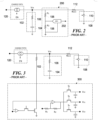
- FIG. 2 illustrates a prior art circuit 200 used to measure the capacitance of reserve capacitor 102.
- Circuit 200 includes an analog-to-digital converter (ADC) 202, discharge circuit 108, R 1 resistor 204a, and R 2 resistor 204b.
- ADC analog-to-digital converter
- R 1 and R 2 resistors 204a-b provides a resistor divider at the input of analog-to-digital converter 202.
- the ratioed V ER voltage is converted to a digital value using analog-to-digital converter 202.
- the voltage at node V ER is measured when charge circuit 120 and discharge circuit 108 are disabled (i.e., no current is flowing through reserve capacitor 102) to obtain an accurate capacitance value measurement and avoid error contributions from equivalent series resistor 106.
- the charge and discharge timing must be carefully synchronized-challenging to do, and reserve capacitor 102 selectively chosen based on its electrical parameters to maximize differential voltage at times t2 and t 1 and improve measurement accuracy.
- the amount of current discharged through discharge circuit 108 must be well defined to compute the capacitance value (C ER ). Further, additional circuit components are required to accurately measure the current, which negatively affects the overall circuit footprint and increases energy consumption-in the form of wasted current through discharge circuit 108. At a minimum, a sequence of charge and discharge of reserve capacitor 102 is required for capacitance computation. For all these reasons, it is challenging to make an accurate measurement of capacitance using circuit 200.
- FIG. 3 illustrates a prior art circuit 300 used to measure the equivalent series resistor 106 of reserve capacitor 102.
- Circuit 300 includes multiple transistors and resistors, which are selectively enabled and disabled to measure equivalent series resistor 106.
- switches e.g., transistors
- the sample voltages i.e., V S1 , V S2 , and V S3
- V S1 , V S2 , and V S3 are digitized through an analog-to-digital converter (not shown) coupled to the output of the sample/hold circuit.
- circuit 300 requires at least a capacitor and switch for each sample that is to be held, which can significantly increase the footprint of circuit 300. Further, leakages at various switches can significantly undermine voltage drop measurement accuracy. Finally, errors inherent in the circuit used to measure the voltage across discharge resistor 112 can add additional errors in the computation of the value of equivalent series resistor 106.
- Figure 4a illustrates an embodiment circuit 400 used to measure the capacitance and the equivalent series resistor values of reserve capacitor 102. The accurate measurement of these values allows circuit 400 to monitor the health of reserve capacitor 102. Circuit 400 simultaneously measures the capacitance and equivalent series resistor values of reserve capacitor 102 by enabling discharge circuit 108, measuring the voltage drop at node V ER , and measuring the discharge current (I DCH ) flowing across the discharge resistor 112.
- discharge resistor 112 is an existing resistor of an integrated circuit of an airbag system coupled to the reserve capacitor. In embodiments, discharge resistor 112is sufficiently separated from circuit 400 to minimize an increase in temperature of circuit 400 while power is being dissipated through discharge resistor 112.
- FIG. 4b illustrates an embodiment timing diagram 450 for the V ER voltage during a discharge routine of reserve capacitor 102.
- ESR equivalent series resistor value
- V ER voltage drops from V START to V START _ t 1+ .
- the sharp drop is generally due to the non-zero equivalent series resistor value of reserve capacitor 102.
- the value of V START can be measured at any time before discharge circuit 108 is disabled. For example, the value of V START can be measured at time t 1A , which is about 64 microseconds before time t 1 .
- the value of V START _ t 1+ can be measured after the discharge circuit 108 is enabled.
- V START _ t 1+ is measured at time t 1 .
- the measurement of V START _ t 1+ is likely to be completed between time t 1 and time t 1B given the constraints of measurements systems.
- a circuit that utilizes a sigma-delta type amplifier would measure the value of V START_t 1+ between time t 1 and time t 1B -a period extending, for example, about 64 microseconds. It should be noted that the voltage measured towards time t 1B is slightly lower than the value of V START_t 1+ .
- V START_t 1+ is, thus, an average value of the voltage between time t 1 and time t 1B .
- the discharge of the capacitor corresponds to a constant current, the discharge waveform being linear. It is preferred to take the measurement at time t 1 due to the time used by the sigma-delta to collect a sample-the measurement falling between time t 1 and t 1B with the sigma-delta, which may cause a lower voltage than ideal to be measured. Similarly, it is preferred to take a measurement at time t2 due to time used by the sigma-delta to acquire a sample-the measurement falling between time t 2a and time t2 with the sigma-delta, which may cause a higher voltage higher than ideal to be measured. However, the average between the two measurements by the sigma-delta provides an identical measurement to the ideal condition due to consistencies with the measurement time by the sigma-delta and the linear form of the discharge waveform.
- the approximate 64 microseconds associated with the timing of the measurements corresponds to an operation of an exemplary sigma-delta type amplifier and is not limiting.
- the various components of circuit 400 are synchronized using a clock signal.
- the various voltage measurements can be performed with sufficient accuracy to time the measurement of values V START and V START_t 1+ , for example, 64microseconds before and after the enabling of discharge circuit 108.
- the difference between V START and V START_t 1+ is measured by monitoring the slope (change in voltage at V ER node in reference to time). As shown, the slope at time t 1 (i.e., sharp drop) is different from the slope between times t 1 and t 2 (i.e., linear, gradual drop). By continuously monitoring V ER over time, the difference between V START and V START_t 1+ is set to the value before the occurrence of the change in slope.
- V STOP can be measured after discharge circuit 108 is disabled, and before charge circuit 120 is enabled.
- the value of V STOP can be measured at time t 2B , which is about 64 microseconds after time t 2 .
- the value of V STOP_t 2 - is measured before discharge circuit 108 is disabled.
- the value of V STOP_t 2- can be measured at time t 2A , which is about 64 microseconds before time t2. It should be noted that the voltage measured at time t 2A is slightly higher than the value of V STOP _ t 2- . However, by setting t 2A to a time close to time t 1 , the difference in voltage becomes negligible.
- the various components of circuit 400 are synchronized using a clock signal.
- the various voltage measurements can be performed with sufficient accuracy to time the measurement of values V STOP _ t 2- and V STOP , for example, in reference to the time corresponding to the disabling of discharge circuit 108.
- the difference between V STOP_t 2- and V STOP is measured by monitoring the slope (change in voltage at V ER node in reference to time). As shown, the slope between times t 1 and t 2 (i.e., linear, gradual drop), the slope at time t2 (i.e., sharp jump), and the slope after time t2 (i.e., steady) are different in value.
- the difference between V STOP _ t 2- and V STOP is set to the boundary values corresponding to the change from time t 1 to t2 and after time t2.
- the capacitance value of the reserve capacitor 102 is between 2.2 milliFarads (mF) and 52 mF
- the equivalent series resistor value of reserve capacitor 102 is between 0.2 Ohms and 0.6 Ohms
- the resistor value of discharge resistor 112 is approximately 20 Ohms
- the voltage at node V ER is between 20 and 33 volts
- the discharge current (I DCH ) flowing through discharge resistor 112 during a discharge routine is between 1 amp to 1.65 amps-in comparison
- the leakage at the reserve capacitor 102 is minimal (e.g., 10 mA).
- the drop in V ER voltage (V START_t1+ - V STOP_t2- ) from time t 1 to time t2 is approximately 0.5 Volts in an embodiment.
- FIG. 5 is a flowchart of an embodiment method 500 for measuring the values for the various parameters: V START - V STOP , ⁇ t 1 t 2 V ER t ⁇ V DCH t dt , ⁇ V START , ⁇ V STOP , V ER ( t 1 ) - V DCH ( t 1 ), and V ER ( t 2 ) - V DCH ( t 2 ) .
- These parameter values once measured, can be used to compute the capacitance (C ER ) and the equivalent series resistor (ESR) values of reserve capacitor 102.
- the steady-state voltage value V START at node V ER is measured.
- discharge circuit 108 is enabled, and reserve capacitor 102 begins discharging.
- the voltage value V START_t 1+ at node V ER is measured.
- the difference between the voltages measured at node V ER at step 502 (e.g., V START ) and at step 504 (e.g., V START_t 1+ ) provides the value for the parameter ⁇ V START .
- step 506 at time t 1 the voltages at nodes V ER and V DCH are measured to compute the value corresponding to the parameter V ER ( t 1 ) - V DCH ( t 1 ) .
- step 508 the integration ⁇ t 1 t 2 V ER t ⁇ V DCH t dt begins at time t 1 .
- time t 2 is determined corresponding to a voltage drop at node V ER being greater than or equal to a threshold voltage (e.g., 1.2 volts).
- a threshold voltage e.g., 1.2 volts.
- the voltage at node VER is continuously monitored and subtracted from the steady-state voltage value V START until the threshold voltage is reached.
- the voltages at nodes V ER and V DCH are again measured to compute the value corresponding to the parameter V ER ( t 2 ) - V DCH ( t 2 ).
- the integration ⁇ t 1 t 2 V ER t ⁇ V DCH t dt ends at time t2.
- the voltage value V STOP_t 2- at node V ER is measured.
- discharge circuit 108 is disabled, and charge circuit 120 is enabled.
- the voltage value V STOP at node V ER is measured.
- the difference between the voltages measured at node V ER at step 518 (e.g., V STOP ) and at step 516 (e.g., V STOP_t 2- ) provides the value for the parameter ⁇ VSTOP .
- the difference in voltage measured at node VER at step 518 (e.g., V STOP ) and at step 502 (e.g., V START ) provides the value for the parameter V START - V STOP .
- the measurement sequence ends.
- an error signal is generated from a microcontroller circuit of the supplemental restraint system (SRS) to the vehicle computer.
- the error signal alerts the driver that the reserve capacitor of the supplemental restraint system (SRS) is outside of the normal operating range and that the system requires service.
- Figure 6 illustrates a diagram of an embodiment circuit 600 used to measure the values for the various parameters: V START - V STOP , ⁇ t 1 t 2 V ER t ⁇ V DCH t dt , ⁇ V START , ⁇ V STOP , V ER ( t 1 ) - V DCH ( t 1 ), and V ER ( t 2 ) - V DCH ( t 2 ) to compute the capacitance (C ER ) and the equivalent series resistor (ESR) values of reserve capacitor 102.
- circuit 600 in addition to the components previously described with respect to circuit 400, includes first circuitry 602 and second circuitry 610.
- First circuitry 602 includes a sigma-delta ( ⁇ - ⁇ ) analog-to-digital converter 604, a controller, and a controllable current sink 608.
- the input of the first circuitry 602 is coupled to the V ER node, and the output of the first circuitry 602 is the digital signal BS OUT1 .
- Second circuitry 610 includes an amplifier 612, a differential sigma-delta ( ⁇ - ⁇ ) analog-to-digital converter 614, and a digital integrator 616.
- the input of the second circuitry 610 is coupled to the V ER and V DCH nodes at the terminals of discharge resistor 112 (R DCH ).
- the output of the second circuitry 610 is the digital signal BS OUT2 .
- V START - V STOP , ⁇ V START , and ⁇ V STOP are computed using the first circuitry 602, which is optimized to measure voltage variations at the V ER node.
- the digital output signal (BS OUT1 ) is filtered and computed by a logic circuit (not shown) coupled to the output of the first circuitry 602.
- V ER t Parameters ⁇ t 1 t 2 V ER t ⁇ V DCH t dt , V ER ( t 1 ) - V DCH ( t 1 ), and V ER ( t 2 ) - V DCH ( t 2 ) are computed using the second circuitry 610.
- the digital output signal (BS OUT2 ) is filtered and computed by a logic circuit (not shown) coupled to the output of the second circuitry 610.
- Embodiments of this disclosure advantageously limit the computation of the capacitance (C ER ) and the equivalent series resistor (ESR) values to a single discharge routine. As such, the amount of dissipation to make the various measurements, in contrast to the prior art, is advantageously minimized.
- circuit 600 is embedded in the supplemental restraint system (SRS) and is self-managed. As soon as a capacitive measurement is requested, the embodiments of this disclosure provide a limited discharge voltage at the V ER node with a fast execution time (e.g., single discharge phase).
- SRS supplemental restraint system
- discharge circuit 108 operates in the linear region in a low-power dissipation mode.
- the use of discharge circuit 108 to measure the various parameters advantageously, is a repurposing of existing components within the supplemental restraint system (SRS). As such, the number of components to measure the various parameters is minimized.
- SRS Supplemental restraint system
Landscapes
- Physics & Mathematics (AREA)
- General Physics & Mathematics (AREA)
- Engineering & Computer Science (AREA)
- Chemical & Material Sciences (AREA)
- Combustion & Propulsion (AREA)
- Power Engineering (AREA)
- Measurement Of Resistance Or Impedance (AREA)
Abstract
Description
- The present disclosure generally relates to electronic technology and, in particular embodiments, to systems, methods, and devices for measuring a capacitor.
- This application is related to a co-pending EP application filed on the same day as this application, entitled "Measuring a Change in Voltage".Background Modern vehicles are typically equipped with airbags, commonly referred to as a supplemental inflatable restraint system (SIR) or a supplemental restraint system (SRS). These systems are secondary to the vehicle's seat belt restraint system and used further to protect passengers in the event of a crash. A deployment circuit, which typically includes a microcontroller and an accelerometer, actuates a firing circuit of the supplemental restraint system during a collision. The firing circuit fires a squib upon command of the microcontroller, which deploys the vehicle's airbags.
- A dependable electrical energy source for the reliable operation of the system is essential. Typically, the vehicle ignition voltage provides power to the system through the vehicle's primary battery. However, in some instances, during a collision, the vehicle's primary battery can become disconnected or inaccessible to the supplemental restraint system. A known solution is to provide a reserve capacitor (i.e., energy reserve source) connected to the system-the reserve capacitor provides power when the vehicle's primary battery becomes unreachable. A reliable system to monitor the operation of the reserve capacitor is desirable.
- Technical advantages are generally achieved by embodiments of this disclosure which describe systems, methods, and devices for measuring a capacitor.
- A first aspect relates to a method for measuring a capacitance value of a capacitor; the method includes having a resistor coupled to a terminal of the capacitor; measuring a difference in voltage at the terminal between a first time and a second time during a discharge routine of the capacitor, the discharge routine includes sinking a current through a discharge circuit coupled to the resistor from the first time to the second time; measuring an integration of a difference in voltage at terminals of the resistor during the discharge routine between the first time and the second time; computing the capacitance value based on the measured difference in voltage, the measured integration, and a resistance value of the resistor; and determining a health of the capacitor based on a difference between the computed capacitance value and a threshold value.
- In a first implementation form of the method according to the first aspect as such, the method further includes determining the second time by monitoring the voltage at the terminal during the discharge routine, the second time corresponding to a difference in voltage at the terminal, between the first time and the second time, being greater than or equal to a second threshold voltage.
- In a second implementation form of the method according to the first aspect as such or any preceding implementation form of the first aspect, a value of the second threshold voltage is 1.2 volts, and a steady-state voltage at the capacitor is between 20 and 33 volts.
- In a third implementation form of the method according to the first aspect as such or any preceding implementation form of the first aspect, the capacitor is a reserve capacitor in a supplemental restraint system of a vehicle.
- In a fourth implementation form of the method according to the first aspect as such or any preceding implementation form of the first aspect, the capacitance value is computed using the equation:

- A second aspect relates to a method for measuring an equivalent series resistor value of a capacitor; the method includes having a resistor coupled to a terminal of the capacitor; measuring a first change in voltage at the terminal at a first time during a discharge routine, the discharge routine includes sinking a current through a discharge circuit coupled to the resistor from the first time to a second time; measuring a first change in voltage across terminals of the resistor at the first time; measuring a second change in voltage across the terminals of the resistor at the second time; measuring a second change in voltage at the terminal at the second time; computing the equivalent series resistor value based on the measurements; and determining a health of the capacitor based on a difference between the computed equivalent series resistor value and a threshold value.
- In a first implementation form of the method according to the second aspect as such, the method further includes determining the second time by monitoring the voltage at the terminal during the discharge routine, the second time corresponding to a change in voltage at the terminal, between the first time and the second time, being greater than or equal to a second threshold voltage.
- In a second implementation form of the method according to the second aspect as such or any preceding implementation form of the second aspect, a value of the second threshold voltage is 1.2 volts, and a steady-state voltage at the capacitor is between 20 and 33 volts.
- In a third implementation form of the method according to the second aspect as such or any preceding implementation form of the second aspect, the equivalent series resistor value is computed using the equation:

- In a fourth implementation form of the method according to the second aspect as such or any preceding implementation form of the second aspect, measuring the first change in voltage at the terminal includes measuring a change in voltage at the terminal between a steady-state condition and a third time, where the steady-state condition corresponds to a time before enabling of the discharge circuit at the first time, and wherein the third time is a time corresponding to a first change in slope of the voltage at the terminal during the discharge routine.
- In a fifth implementation form of the method according to the second aspect as such or any preceding implementation form of the second aspect, measuring the second change in voltage at the terminal includes measuring a change in voltage at the terminal during a third time and a fourth time, the third time is a time corresponding to a second change in slope of the voltage at the terminal during the discharge routine, and the fourth time is a time corresponding to a third change in slope of the voltage at the terminal, the third change in slope being after the discharge circuit is disabled.
- A third aspect relates to a system for measuring a voltage drop of a reserve capacitor in a supplemental restraint system (SRS), the reserve capacitor having a capacitance value and an equivalent series resistor value, the system includes a resistor having a first terminal and a second terminal, the first terminal of the resistor coupled to a terminal of the reserve capacitor; a discharge circuit coupled to the second terminal of the resistor, the discharge circuit configured to supply a discharge path for the reserve capacitor during a discharge routine; and circuitry configured to measure a first change in voltage at the first terminal between a first time and a second time during a discharge routine of the reserve capacitor, the discharge routine includes sinking a current through a discharge circuit coupled to the resistor from the first time to the second time, measuring an integration of a first change in voltage at the terminals of the resistor during the discharge routine between the first time and the second time, measuring a second change in voltage at the first terminal at the first time, measuring a first change in voltage across terminals of the resistor at the first time, measuring a second change in voltage across the terminals of the resistor at the second time, and measuring a third change in voltage at the first terminal at the second time.
- In a first implementation form of the system according to the third aspect as such, the system further includes a logic circuit configured to compute the capacitance value based on the measured first change in voltage at the first terminal and the measured integration; and determine the health of the reserve capacitor based on a difference between the computed capacitance value and a threshold value.
- In a second implementation form of the system according to the third aspect as such or any preceding implementation form of the third aspect, the capacitance value is computed using the equation:

- In a second implementation form of the system according to the third aspect as such or any preceding implementation form of the third aspect, the system further includes a logic circuit configured to compute the equivalent series resistor value based on the measured second and third change in voltage at the first terminal and the first and second change in voltage across terminals of the resistor; and determine health of the reserve capacitor based on a difference between the computed equivalent series resistor value and a threshold value.
- In a third implementation form of the system according to the third aspect as such or any preceding implementation form of the third aspect, the equivalent series resistor value is computed using the equation:

- In a fourth implementation form of the system according to the third aspect as such or any preceding implementation form of the third aspect, the second time corresponds to a difference in voltage at the first terminal, between the first time and the second time, being greater than or equal to a second threshold voltage. In a fifth implementation form of the system according to the third aspect as such or any preceding implementation form of the third aspect, a value of the second threshold voltage is 1.2 volts, and a steady-state voltage at the reserve capacitor is between 20 and 33 volts.
- In a sixth implementation form of the system according to the third aspect as such or any preceding implementation form of the third aspect, measuring the second change in voltage at the first terminal includes measuring a change in voltage at the first terminal during a steady-state condition and a third time, the steady-state condition corresponds to a time before enabling of the discharge circuit at the first time, and the third time is a time corresponding to a first change in slope of the voltage at the terminal during the discharge routine.
- In a seventh implementation form of the system according to the third aspect as such or any preceding implementation form of the third aspect, measuring the third change in voltage at the first terminal at the second time includes measuring a difference in voltage at the first terminal during a third time and a fourth time, the third time is a time corresponding to a second change in slope of the voltage at the terminal during the discharge routine, and the fourth time is a time corresponding to a third change in slope of the voltage at the terminal, the third change in slope being after the discharge circuit is disabled.
- Embodiments can be implemented in hardware, software, or in any combination thereof.
- For a more complete understanding of the present disclosure and the advantages thereof, reference is now made to the following descriptions taken in conjunction with the accompanying drawings, in which:
-
Figure 1a is a circuit model of an embodiment reserve capacitor; -
Figure 1b is a timing diagram for a voltage discharge during a discharge routine; -
Figure 2 is a prior art circuit used to measure a capacitance of a capacitor; -
Figure 3 is a prior art circuit used to measure an equivalent series resistor of a capacitor; -
Figure 4a is an embodiment circuit used to measure capacitance and equivalent series resistor values of a capacitor; -
Figure 4b is an embodiment timing diagram for the capacitor voltage; -
Figure 5 is a flowchart of an embodiment method for measuring the values for the various parameters used to calculate capacitance and equivalent series resistor values of a capacitor; and -
Figure 6 is a diagram of an embodiment circuit used to measure the values for the various parameters used to calculate capacitance and equivalent series resistor values of a capacitor. - This disclosure provides many applicable inventive concepts that can be embodied in a wide variety of specific contexts. The particular embodiments are merely illustrative of specific configurations and do not limit the scope of the claimed embodiments. Features from different embodiments may be combined to form further embodiments unless noted otherwise.
- Variations or modifications described to one of the embodiments may also apply to other embodiments. Further, it should be understood that various changes, substitutions, and alterations can be made herein without departing from the spirit and scope of this disclosure as defined by the appended claims.
- While inventive aspects are described primarily in the context of a reserve capacitor of a supplemental restraint system (SRS), the inventive aspects may be similarly applicable to any electronic device that can benefit from a measurement of a capacitor of the electronic device. Such devices can profit from the measurement of a voltage drop over an unknown voltage baseline to determine the proper functioning of the capacitor.
- Generally, a vehicle's supplemental restraint system includes one or more reserve capacitors that provide an alternative energy source for the system if the primary energy source (e.g., vehicle's primary battery) becomes disabled or inaccessible. During regular operation, a charging circuit charges the reserve capacitor through, for example, the vehicle's primary battery. Typically, the reserve capacitor is isolated from the deployment circuit to minimize the load on the charging circuit. In the event of a crash and the absence of the primary energy source, an isolation circuit detects vehicle ignition voltage loss and connects the reserve capacitor to the deployment circuit for the continued operation of the supplemental restraint system.
- An airbag control module of the supplemental restraint system cyclically evaluates for hardware failures and communicates any errors with the vehicle's diagnostic computer through a diagnostic trouble code (DTC). In response, the vehicle's dash panel displays errors through, for example, a flashing airbag warning light to the user.
- Embodiments of this disclosure can be used to determine the capacitance of the reserve capacitor and its equivalent series resistor (ESR). Once the capacitance and equivalent series resistor values are computed, the health of the reserve capacitor can be determined. A diagnostic trouble code (DTC) is generated if the reserve capacitor is determined to be faulty based on the computation. The diagnostic trouble code generates a warning signal that alerts the vehicle owner of the supplemental restraint system issues.
- Embodiments of this disclosure provide an application-specific integrated or standalone circuit used in combination with a circuit implemented in a standard supplemental restraint system. In combination, the circuits provide various functions, such as power management, deployment functionality for drivers (e.g., supporting both squib and low-energy actuator loads), deployment functionality for regulators, remote sensor interfaces (e.g., supporting Peripheral Sensor Interface 5 (PSI5) satellite sensors), diagnostic functionality, deployment arming, hall-effect sensor interfaces, switch sensor interfaces, general-purpose low-side drivers, watchdog functionality, local internet network (LIN) interface, and the like.
- Aspects of this disclosure include an improved technique over existing circuits. In embodiments, the systems and methods disclosed herein improve the measurement accuracy, minimize dissipation associated with measurements, and minimize component count used to make measurements. In particular embodiments, the measurement techniques provide an improved system and method to measure the health of a reserve capacitor used in a supplemental restraint system.
- In an embodiment, a discharge resistor is coupled to a terminal of the reserve capacitor to dissipate power during a discharge phase of the circuit. A switch is arranged in series between the reserve capacitor and the discharge resistor, which is activated and deactivated in response to a control signal associated with the discharge phase.
- In an embodiment, during a single discharge routine from time t1 to time t2, a difference in voltage at the terminal of the reserve capacitor between time t1 and time t2 is measured. The discharge routine includes sinking a current through the discharge resistor from time t1 to time t2. During the same discharge routine phase, an integration of a difference in voltage at terminals of the discharge resistor is measured. Once the difference in voltage and the integration values are measured, because the resistance value of the discharge resistor is known, a logic circuit can compute the capacitance value of the reserve capacitor. Based on the difference between the computed capacitance value and a threshold value, the health of the reserve capacitor can be determined.
- In another embodiment, during a single discharge routine, a discharge resistor is coupled to a terminal of the reserve capacitor. A difference in voltage at the terminal of the reserve capacitor during time t1 and a second difference in voltage at the terminal of the reserve capacitor during time t2 is measured. A difference in voltage across terminals of the discharge resistor at time t1 is measured. The discharge routine includes sinking a current through a discharge circuit coupled to the discharge resistor from time t1 to time t2. At time t2, a second difference in voltage across the terminals of the discharge resistor is measured. Once the various parameters are measured, the equivalent series resistor value of the reserve capacitor is computed. Based on the difference between the computed equivalent series resistor value and a threshold value, the health of the reserve capacitor can be determined.
- In such an embodiment, the difference in voltage at the terminal of the reserve capacitor during time t1 corresponds to a sharp voltage drop at the terminal from about 64 microseconds before time t1 and approximately 64 microseconds after time t1. Further, the difference in voltage at the terminal during time t2 corresponds to a sharp voltage jump at the terminal from about 64 microseconds before time t2 and about 64 microseconds after time t2. Time t1 corresponds to the time at which the discharge circuit coupled to the reserve capacitor is enabled. Time t2 corresponds to the time at which the discharge circuit is disabled.
- In an embodiment, the difference in voltage at the terminal of the reserve capacitor during time t1 is a difference between the steady-state voltage and a voltage corresponding to a first change in slope of the voltage at the reserve capacitor after time t1. Thus, the difference in voltage is a difference between the steady-state voltage value before the discharge circuit is enabled and the voltage immediately before the first change in slope of the voltage after the discharge circuit is enabled. In an embodiment, the difference in voltage at the terminal during time t2 is a difference in voltage at the terminal of the reserve capacitor immediately before a second change in slope and the voltage immediately before a third change in slope. The second change in slope being caused by the disabling of the discharge circuit. It is noted that in embodiments, the health of the reserve capacitor can be determined based on more than one relationship between the computed measurements. Thus the determination of the health of the reserve capacitor is not limited to a one-to-one relationship between the computed values and an expected capacitance or equivalent series resistor value. For example, the health of the reserve capacitor can be determined by a complex relationship between the measured values, expected values, with various possible ranges corresponding to the manufacturing type, tolerances, operating ranges of the reserve capacitor, or the like.
- In embodiments, the computation is at the system level, external to the circuit. At the system level, analysis of the capacitor's health can be based on a relationship between the capacitance value and the equivalent series resistor of the capacitor. In an exemplary circuit, having a reserve capacitor of 2.2 microfarads with an accuracy of ± 30 %, a microcontroller or processor at the system level can determine that the value of the reserve capacitor is outside of the expected range and set a flag accordingly.
- In embodiments, the various parameters are measured during a single discharge routine to minimize the total power dissipation used to compute the capacitance and equivalent series resistor (ESR) values. These and other details are discussed in greater detail below.
-
Figure 1a illustrates acircuit model 100 of anembodiment reserve capacitor 102, which in addition to themodel capacitor 104, includes anequivalent series resistor 106. In embodiments, thereserve capacitor 102 is an auxiliary source used to power a vehicle's supplemental restraint system as an alternative power source to the primary vehicle battery. - It is desirable to periodically monitor the
reserve capacitor 102 for proper operation. At set intervals, the equivalent series resistor and capacitance values ofreserve capacitor 102 are measured during a discharge routine ofreserve capacitor 102 through thedischarge circuit 108.Discharge circuit 108 provides a controllable (e.g., serial peripheral interface (SPI), etc.), low-ohmic path that allowsreserve capacitor 102 to discharge during a discharge routine ofreserve capacitor 102. - A
charge circuit 120 is coupled toreserve capacitor 102. Thecharge circuit 120 provides a controllable (e.g., serial peripheral interface (SPI), etc.), low-ohmic path that, when enabled, allowsreserve capacitor 102 to charge during a charge routine ofreserve capacitor 102. -
Discharge circuit 108 includes adischarge switch 110. Adischarge resistor 112 is coupled to dischargecircuit 108. Whendischarge switch 110 is activated, for example, during a discharge routine, current is dissipated throughdischarge resistor 112. The arrangement of components shown inFigure 1a may (or may not) be arranged as shown. Further,discharge circuit 108 may include additional or fewer components as shown with the purpose of having a discharge path being provided forreserve capacitor 102 whendischarge switch 110 is in the closed position. - In embodiments,
discharge switch 110 is a metal-oxide-semiconductor field-effect transistor (MOSFET). Optionally,discharge circuit 108 may include a diode in series betweendischarge switch 110 and dischargeresistor 112. Although, as shown,discharge circuit 108 is arranged betweendischarge resistor 112 and a reference voltage, in embodiments, thedischarge resistor 112 is coupled in series betweendischarge switch 110 and a reference voltage. - In embodiments,
discharge resistor 112 is located away from thecircuit model 100 to minimize power dissipation and reduce circuit temperature during a discharge phase. In embodiments,discharge resistor 112 is advantageously utilized as a sensing resistor during the discharge phase of the circuit. -
Figure 1b illustrates a timing diagram 150 for the VER voltage at the terminal of thereserve capacitor 102 during a discharge routine. Before time t1,discharge circuit 108 is disabled, and the VER voltage corresponds to the steady-state voltage value VSTART. - At time t1,
discharge circuit 108 is enabled throughdischarge switch 110. In response,reserve capacitor 102 is immediately discharged to a voltage value VSTART_t1+. The sharp drop in voltage at time t1 generally corresponds to the non-zero equivalent series resistor value ofreserve capacitor 102. - From time t1 until time t2, while
discharge circuit 108 remains enabled,reserve capacitor 102 is constantly discharged until it reaches a voltage value VSTOP_t2-. - At time t2,
discharge circuit 108 is disabled, andcharge circuit 120 is enabled. In response,reserve capacitor 102 is immediately charged to an initial voltage value VSTOP. Gradually thereafter,reserve capacitor 102 is recharged to the steady-state voltage value VEND. - In embodiments, the voltage of the fully charged
reserve capacitor 102 is between 20 and 33 Volts (V). In such an embodiment, the voltage drop between time t1 and t2 is approximately 600 millivolts (mV). -
Figure 2 illustrates aprior art circuit 200 used to measure the capacitance ofreserve capacitor 102.Circuit 200 includes an analog-to-digital converter (ADC) 202,discharge circuit 108, R1 resistor 204a, and R2 resistor 204b. - The arrangement of R1 and R2 resistors 204a-b provides a resistor divider at the input of analog-to-
digital converter 202. At time t1 and t2, the ratioed VER voltage is converted to a digital value using analog-to-digital converter 202. The capacitance value (CER) ofreserve capacitor 102 can, thus, be computed using the equation:

discharge circuit 108 when enabled, t2-t1 is the time during which dischargecircuit 108 is enabled, VSTART_t1+ is the voltage at node VER at time t1 afterdischarge circuit 108 is enabled, VSTOP is the voltage at node VER at time t2 afterdischarge circuit 108 is disabled andcharge circuit 120 is enabled, and VEND is the voltage at node VER aftercharge circuit 120 is enabled andreserve capacitor 120 is recharged. - In
circuit 200, the voltage at node VER is measured whencharge circuit 120 anddischarge circuit 108 are disabled (i.e., no current is flowing through reserve capacitor 102) to obtain an accurate capacitance value measurement and avoid error contributions fromequivalent series resistor 106. Thus, the charge and discharge timing must be carefully synchronized-challenging to do, andreserve capacitor 102 selectively chosen based on its electrical parameters to maximize differential voltage at times t2 and t1 and improve measurement accuracy. - The amount of current discharged through
discharge circuit 108 must be well defined to compute the capacitance value (CER). Further, additional circuit components are required to accurately measure the current, which negatively affects the overall circuit footprint and increases energy consumption-in the form of wasted current throughdischarge circuit 108. At a minimum, a sequence of charge and discharge ofreserve capacitor 102 is required for capacitance computation. For all these reasons, it is challenging to make an accurate measurement ofcapacitance using circuit 200. -
Figure 3 illustrates aprior art circuit 300 used to measure theequivalent series resistor 106 ofreserve capacitor 102.Circuit 300 includes multiple transistors and resistors, which are selectively enabled and disabled to measureequivalent series resistor 106. By enabling and disabling various switches (e.g., transistors) in various sequences and sampling the output of transistors S1, S2, and S3, the value (RESR) of theequivalent series resistor 106 can be computed using the equation:
discharge circuit 108 when enabled, VS1 is the voltage sampled at the S1 transistor, VS2 is the voltage sampled at the S2 transistor, and VS3 is the voltage sampled at the S3 transistor. The sample voltages (i.e., VS1, VS2, and VS3) are digitized through an analog-to-digital converter (not shown) coupled to the output of the sample/hold circuit. - Disadvantageously,
circuit 300 requires at least a capacitor and switch for each sample that is to be held, which can significantly increase the footprint ofcircuit 300. Further, leakages at various switches can significantly undermine voltage drop measurement accuracy. Finally, errors inherent in the circuit used to measure the voltage acrossdischarge resistor 112 can add additional errors in the computation of the value ofequivalent series resistor 106. -
Figure 4a illustrates anembodiment circuit 400 used to measure the capacitance and the equivalent series resistor values ofreserve capacitor 102. The accurate measurement of these values allowscircuit 400 to monitor the health ofreserve capacitor 102.Circuit 400 simultaneously measures the capacitance and equivalent series resistor values ofreserve capacitor 102 by enablingdischarge circuit 108, measuring the voltage drop at node VER, and measuring the discharge current (IDCH) flowing across thedischarge resistor 112. - In embodiments,
discharge resistor 112 is an existing resistor of an integrated circuit of an airbag system coupled to the reserve capacitor. In embodiments, discharge resistor 112is sufficiently separated fromcircuit 400 to minimize an increase in temperature ofcircuit 400 while power is being dissipated throughdischarge resistor 112. -
Figure 4b illustrates an embodiment timing diagram 450 for the VER voltage during a discharge routine ofreserve capacitor 102. Referring tocircuit 400 and the timing diagram 450, the relationship between the capacitance value (CER) ofreserve capacitor 102, the current (I(t)) flowing throughdischarge resistor 112 during a discharge routine (i.e.,discharge circuit 108 enabled), and the voltage drop (VSTART - VSTOP ) from time t1 (i.e., discharge circuit enabled) until time t2 (i.e.,discharge circuit 108 disabled) follows the equation:
discharge resistor 112 during the discharge routine (using Ohm's law), we have the following equation:
discharge resistor 112. - Because the resistance value (RDCH) of
discharge resistor 112 is known, the values of VSTART - VSTOP and
reserve capacitor 102. Because the discharge current (IDCH) is much larger than any leakage current atreserve capacitor 102, the leakage value can be excluded from the equation above with minimal errors-worst-case contributing error being less than 1 %. - The equivalent series resistor value (ESR) of
reserve capacitor 102 follows the equation:

discharge resistor 112 during the discharge routine (using Ohm's law), we have the following equation:

- As shown in
Figure 4b , immediately afterdischarge circuit 108 is enabled at time t1, the VER voltage drops from VSTART to V START_t1+. The sharp drop is generally due to the non-zero equivalent series resistor value ofreserve capacitor 102. The value of VSTART can be measured at any time beforedischarge circuit 108 is disabled. For example, the value of VSTART can be measured at time t1A, which is about 64 microseconds before time t1. The value of V START_t1+ can be measured after thedischarge circuit 108 is enabled. - Optimally, the value of V START_t1+ is measured at time t1. However, the measurement of V START_t1+is likely to be completed between time t1 and time t1B given the constraints of measurements systems. For example, a circuit that utilizes a sigma-delta type amplifier would measure the value of V START_t1+ between time t1 and time t1B-a period extending, for example, about 64 microseconds. It should be noted that the voltage measured towards time t1B is slightly lower than the value of V START_t1+. However, by setting t1b to a time close to time t1, the voltage difference becomes negligible-particularly because the discharge at the
reserve capacitor 102 is with a constant current sink. The resulting measurement of V START_t1+ is, thus, an average value of the voltage between time t1 and time t1B. - Further, as the discharge of the capacitor corresponds to a constant current, the discharge waveform being linear. It is preferred to take the measurement at time t1 due to the time used by the sigma-delta to collect a sample-the measurement falling between time t1 and t1B with the sigma-delta, which may cause a lower voltage than ideal to be measured. Similarly, it is preferred to take a measurement at time t2 due to time used by the sigma-delta to acquire a sample-the measurement falling between time t2a and time t2 with the sigma-delta, which may cause a higher voltage higher than ideal to be measured. However, the average between the two measurements by the sigma-delta provides an identical measurement to the ideal condition due to consistencies with the measurement time by the sigma-delta and the linear form of the discharge waveform.
- It is noted that the approximate 64 microseconds associated with the timing of the measurements corresponds to an operation of an exemplary sigma-delta type amplifier and is not limiting.
- In an embodiment, the various components of
circuit 400 are synchronized using a clock signal. Thus, the various voltage measurements can be performed with sufficient accuracy to time the measurement of values VSTART and V START_t1+, for example, 64microseconds before and after the enabling ofdischarge circuit 108. In another embodiment, the difference between VSTART and V START_t1+ is measured by monitoring the slope (change in voltage at VER node in reference to time). As shown, the slope at time t1 (i.e., sharp drop) is different from the slope between times t1 and t2 (i.e., linear, gradual drop). By continuously monitoring VER over time, the difference between VSTART and V START_t1+ is set to the value before the occurrence of the change in slope. - Similarly and as shown in
Figure 4b , immediately after thedischarge circuit 108 is disabled at time t2, the VER voltage jumps from V STOP_t2- to VSTOP. As before, the sharp change in voltage is generally due to the non-zero equivalent series resistor value ofreserve capacitor 102. The value of VSTOP can be measured afterdischarge circuit 108 is disabled, and beforecharge circuit 120 is enabled. For example, the value of VSTOP can be measured at time t2B, which is about 64 microseconds after time t2. The value of V STOP_t2- is measured beforedischarge circuit 108 is disabled. For example, the value of V STOP_t2- can be measured at time t2A, which is about 64 microseconds before time t2. It should be noted that the voltage measured at time t2A is slightly higher than the value of V STOP_t2-. However, by setting t2A to a time close to time t1, the difference in voltage becomes negligible. - In an embodiment, the various components of
circuit 400 are synchronized using a clock signal. Thus, the various voltage measurements can be performed with sufficient accuracy to time the measurement of values V STOP_t2-and VSTOP , for example, in reference to the time corresponding to the disabling ofdischarge circuit 108. - In another embodiment, the difference betweenV STOP_t2- and VSTOP is measured by monitoring the slope (change in voltage at VER node in reference to time). As shown, the slope between times t1 and t2 (i.e., linear, gradual drop), the slope at time t2 (i.e., sharp jump), and the slope after time t2 (i.e., steady) are different in value. By continuously monitoring VER over time, the difference between V STOP_t2- and VSTOP is set to the boundary values corresponding to the change from time t1 to t2 and after time t2.
- Because the resistance value (RDCH ) of the
discharge resistor 112 is known, the values of ΔVSTART, ΔVSTOP, VER (t 1) - VDCH (t 1), and VER (t 2) - VDCH (t 2) allow the computation of the equivalent series resistor (ESR) value ofreserve capacitor 102. In embodiments, the capacitance value of thereserve capacitor 102 is between 2.2 milliFarads (mF) and 52 mF, the equivalent series resistor value ofreserve capacitor 102 is between 0.2 Ohms and 0.6 Ohms, the resistor value ofdischarge resistor 112 is approximately 20 Ohms, the voltage at node VER is between 20 and 33 volts, and the discharge current (IDCH) flowing throughdischarge resistor 112 during a discharge routine is between 1 amp to 1.65 amps-in comparison, the leakage at thereserve capacitor 102 is minimal (e.g., 10 mA). The drop in VER voltage (VSTART_t1+ - VSTOP_t2-) from time t1 to time t2 is approximately 0.5 Volts in an embodiment. -
Figure 5 is a flowchart of anembodiment method 500 for measuring the values for the various parameters: VSTART - VSTOP,
reserve capacitor 102. - At
step 502 and before time t1, the steady-state voltage value VSTART at node VER is measured. Atstep 504,discharge circuit 108 is enabled, andreserve capacitor 102 begins discharging. As soon asdischarge circuit 108 is enabled at time t1, the voltage value V START_t1+ at node VER is measured. The difference between the voltages measured at node VER at step 502 (e.g., VSTART ) and at step 504 (e.g., V START_t1+) provides the value for the parameter ΔVSTART. - At
step 506 at time t1, the voltages at nodes VER and VDCH are measured to compute the value corresponding to the parameter VER (t 1) - VDCH (t 1). - At
step 508, the integration
- At
step 510, time t2 is determined corresponding to a voltage drop at node VER being greater than or equal to a threshold voltage (e.g., 1.2 volts). In embodiments, the voltage at node VER is continuously monitored and subtracted from the steady-state voltage value VSTART until the threshold voltage is reached. - At
step 512 and at time t2, the voltages at nodes VER and VDCH are again measured to compute the value corresponding to the parameter VER (t 2) - VDCH (t 2). Atstep 514, the integration
- At
step 516 and at time t2, the voltage value V STOP_t2- at node VER is measured. Atstep 518,discharge circuit 108 is disabled, andcharge circuit 120 is enabled. As soon ascharge circuit 120 is enabled, the voltage value VSTOP at node VER is measured. The difference between the voltages measured at node VER at step 518 (e.g., VSTOP ) and at step 516 (e.g., V STOP_t2-) provides the value for the parameter Δ VSTOP . - At
step 520, the difference in voltage measured at node VER at step 518 (e.g., VSTOP ) and at step 502 (e.g., VSTART ) provides the value for the parameter VSTART - VSTOP . Atstep 522, the measurement sequence ends. - In embodiments, if the computed values for the capacitance (CER) and the equivalent series resistor (ESR) of
reserve capacitor 102 falls outside a corresponding threshold value, an error signal is generated from a microcontroller circuit of the supplemental restraint system (SRS) to the vehicle computer. The error signal alerts the driver that the reserve capacitor of the supplemental restraint system (SRS) is outside of the normal operating range and that the system requires service. - It is noted that the order of steps shown in
Figure 5 is not absolutely required, so in principle, the various steps may be performed out of the illustrated order. Also, certain steps may be skipped, different steps may be added or substituted, or selected steps or groups of steps may be performed in a separate application.Figure 6 illustrates a diagram of anembodiment circuit 600 used to measure the values for the various parameters: VSTART - VSTOP ,
reserve capacitor 102. - As shown,
circuit 600, in addition to the components previously described with respect tocircuit 400, includesfirst circuitry 602 andsecond circuitry 610.First circuitry 602 includes a sigma-delta (Σ-Δ) analog-to-digital converter 604, a controller, and a controllablecurrent sink 608. The input of thefirst circuitry 602 is coupled to the VER node, and the output of thefirst circuitry 602 is the digital signal BSOUT1. -
Second circuitry 610 includes anamplifier 612, a differential sigma-delta (Σ-Δ) analog-to-digital converter 614, and adigital integrator 616. The input of thesecond circuitry 610 is coupled to the VER and VDCH nodes at the terminals of discharge resistor 112 (RDCH). The output of thesecond circuitry 610 is the digital signal BSOUT2. - Parameters VSTART - VSTOP , ΔVSTART, and ΔVSTOP are computed using the
first circuitry 602, which is optimized to measure voltage variations at the VER node. The digital output signal (BSOUT1) is filtered and computed by a logic circuit (not shown) coupled to the output of thefirst circuitry 602. - Parameters

second circuitry 610. The digital output signal (BSOUT2) is filtered and computed by a logic circuit (not shown) coupled to the output of thesecond circuitry 610. - Once the value for parameters VSTART - VSTOP , ΔVSTART , ΔVSTOP ,

reserve capacitor 102 using the equations:

- Embodiments of this disclosure advantageously limit the computation of the capacitance (CER) and the equivalent series resistor (ESR) values to a single discharge routine. As such, the amount of dissipation to make the various measurements, in contrast to the prior art, is advantageously minimized.
- In embodiments,
circuit 600 is embedded in the supplemental restraint system (SRS) and is self-managed. As soon as a capacitive measurement is requested, the embodiments of this disclosure provide a limited discharge voltage at the VER node with a fast execution time (e.g., single discharge phase). - It is noted that the various measurements are a function of the discharge current (IDCH) sunk through
discharge circuit 108.Discharge switch 110 operates in the linear region in a low-power dissipation mode. The use ofdischarge circuit 108 to measure the various parameters, advantageously, is a repurposing of existing components within the supplemental restraint system (SRS). As such, the number of components to measure the various parameters is minimized. - Unless otherwise specified, when reference is made to two elements electrically connected together, this means that the elements are directly connected with no intermediate element other than conductors. When reference is made to two elements electrically coupled together, this means that the two elements may be directly coupled (connected) or coupled via one or a plurality of other elements. Although the description has been described in detail, it should be understood that various changes, substitutions, and alterations may be made without departing from the spirit and scope of this disclosure as defined by the appended claims. The same elements are designated with the same reference numbers in the various figures. Moreover, the scope of the disclosure is not intended to be limited to the particular embodiments described herein, as one of ordinary skill in the art will readily appreciate from this disclosure that processes, machines, manufacture, compositions of matter, means, methods, or steps, presently existing or later to be developed, may perform substantially the same function or achieve substantially the same result as the corresponding embodiments described herein. Accordingly, the appended claims are intended to include within their scope such processes, machines, manufacture, compositions of matter, means, methods, or steps.
- The specification and drawings are, accordingly, to be regarded simply as an illustration of the disclosure as defined by the appended claims, and are contemplated to cover any and all modifications, variations, combinations, or equivalents that fall within the scope of the present disclosure.
Claims (15)
- A method for measuring a capacitance value of a capacitor (102), the method comprising:having a resistor (112) coupled to a terminal of the capacitor (102);measuring a difference in voltage at the terminal between a first time and a second time during a discharge routine of the capacitor (102), the discharge routine comprising sinking a current through a discharge circuit (108, 110) coupled to the resistor (112) from the first time to the second time;measuring an integration of a difference in voltage at terminals of the resistor (112) during the discharge routine between the first time and the second time;computing the capacitance value based on the measured difference in voltage, the measured integration, and a resistance value of the resistor (112); anddetermining a health of the capacitor (102) based on a difference between the computed capacitance value and a threshold value.
- The method of claim 1, further comprising determining the second time by monitoring the voltage at the terminal during the discharge routine, the second time corresponding to a difference in voltage at the terminal, between the first time and the second time, being greater than or equal to a second threshold voltage.
- The method of claim 2, wherein a value of the second threshold voltage is 1.2 volts, and wherein a steady-state voltage at the capacitor (102) is between 20 and 33 volts.
- The method of claim 1:wherein the capacitor (102) is a reserve capacitor in a supplemental restraint system of a vehicle,
and/orwherein the capacitance value is computed using equation:
- A method for measuring an equivalent series resistor (106) value of a capacitor (102), the method comprising:having a resistor (112) coupled to a terminal of the capacitor (102);measuring a first change in voltage at the terminal at a first time during a discharge routine, the discharge routine comprising sinking a current through a discharge circuit (108, 110) coupled to the resistor (112) from the first time to a second time;measuring a first change in voltage across terminals of the resistor (112) at the first time;measuring a second change in voltage across the terminals of the resistor (112) at the second time;measuring a second change in voltage at the terminal at the second time;computing the equivalent series resistor (106) value based on the measurements; anddetermining a health of the capacitor (102) based on a difference between the computed equivalent series resistor (106) value and a threshold value.
- The method of claim 5, further comprising determining the second time by monitoring the voltage at the terminal during the discharge routine, the second time corresponding to a change in voltage at the terminal, between the first time and the second time, being greater than or equal to a second threshold voltage, wherein a value of the second threshold voltage is preferably 1.2 volts, and wherein a steady-state voltage at the capacitor (102) is preferably between 20 and 33 volts.
- The method of claim 6, wherein the equivalent series resistor (106) value is computed using equation:

- The method of claim 5, wherein measuring the first change in voltage at the terminal comprises measuring a change in voltage at the terminal between a steady-state condition and a third time, wherein the steady-state condition corresponds to a time before enabling of the discharge circuit (108, 110) at the first time, and wherein the third time is a time corresponding to a first change in slope of the voltage at the terminal during the discharge routine.
- The method of claim 5, wherein measuring the second change in voltage at the terminal comprises measuring a change in voltage at the terminal during a third time and a fourth time, wherein the third time is a time corresponding to a second change in slope of the voltage at the terminal during the discharge routine, and wherein the fourth time is a time corresponding to a third change in slope of the voltage at the terminal, the third change in slope being after the discharge circuit (108, 110) is disabled.
- A system for measuring a voltage drop of a reserve capacitor (102) in a supplemental restraint system (SRS), the reserve capacitor (102) having a capacitance value and an equivalent series resistor (106) value, the system comprising:a resistor (112) having a first terminal and a second terminal, the first terminal of the resistor (112) coupled to a terminal of the reserve capacitor (102);a discharge circuit (108, 110) coupled to the second terminal of the resistor (112), the discharge circuit (108, 110) configured to supply a discharge path for the reserve capacitor (102) during a discharge routine; andcircuitry configured to:measure a first change in voltage at the first terminal between a first time and a second time during a discharge routine of the reserve capacitor (102), the discharge routine comprising sinking a current through a discharge circuit (108, 110) coupled to the resistor (112) from the first time to the second time,measure an integration of a first change in voltage at the terminals of the resistor (112) during the discharge routine between the first time and the second time,measure a second change in voltage at the first terminal at the first time,measure a first change in voltage across terminals of the resistor (112) at the first time,measure a second change in voltage across the terminals of the resistor (112) at the second time, andmeasure a third change in voltage at the first terminal at the second time.
- The system of claim 10, further comprising a logic circuit configured to:compute the capacitance value based on the measured first change in voltage at the first terminal and the measured integration; anddetermine a health of the reserve capacitor (102) based on a difference between the computed capacitance value and a threshold value.
- The system of claim 11, wherein the capacitance value is computed using equation:

- The system of claim 10, further comprising a logic circuit configured to:compute the equivalent series resistor (106) value based on the measured second and third change in voltage at the first terminal and the first and second change in voltage across terminals of the resistor (112); anddetermine a health of the reserve capacitor (102) based on a difference between the computed equivalent series resistor (106) value and a threshold value, wherein the equivalent series resistor (106) value is preferably computed using equation:

- The system of claim 10, wherein the second time corresponds to a difference in voltage at the first terminal, between the first time and the second time, being greater than or equal to a second threshold voltage, wherein a value of the second threshold voltage is preferably 1.2 volts, and wherein a steady-state voltage at the reserve capacitor (102) is preferably between 20 and 33 volts.
- The system of claim 10:
wherein measuring the second change in voltage at the first terminal comprises measuring a change in voltage at the first terminal during a steady-state condition and a third time, wherein the steady-state condition corresponds to a time before enabling of the discharge circuit (108, 110) at the first time, and wherein the third time is a time corresponding to a first change in slope of the voltage at the terminal during the discharge routine, and/or wherein measuring the third change in voltage at the first terminal at the second time comprises measuring a difference in voltage at the first terminal during a third time and a fourth time, wherein the third time is a time corresponding to a second change in slope of the voltage at the terminal during the discharge routine, and wherein the fourth time is a time corresponding to a third change in slope of the voltage at the terminal, the third change in slope being after the discharge circuit (108, 110) is disabled.
Applications Claiming Priority (1)
| Application Number | Priority Date | Filing Date | Title |
|---|---|---|---|
| US17/407,747 US11719761B2 (en) | 2021-08-20 | 2021-08-20 | Capacitor measurement |
Publications (3)
| Publication Number | Publication Date |
|---|---|
| EP4137366A2 true EP4137366A2 (en) | 2023-02-22 |
| EP4137366A3 EP4137366A3 (en) | 2023-05-03 |
| EP4137366B1 EP4137366B1 (en) | 2024-07-10 |
Family
ID=83004469
Family Applications (1)
| Application Number | Title | Priority Date | Filing Date |
|---|---|---|---|
| EP22190946.8A Active EP4137366B1 (en) | 2021-08-20 | 2022-08-18 | Capacitor measurement |
Country Status (3)
| Country | Link |
|---|---|
| US (2) | US11719761B2 (en) |
| EP (1) | EP4137366B1 (en) |
| CN (1) | CN115902420B (en) |
Families Citing this family (3)
| Publication number | Priority date | Publication date | Assignee | Title |
|---|---|---|---|---|
| US11719761B2 (en) * | 2021-08-20 | 2023-08-08 | Stmicroelectronics S.R.L. | Capacitor measurement |
| CN118688556B (en) * | 2024-08-22 | 2025-01-14 | 苏州国芯科技股份有限公司 | Airbag energy storage capacitor monitoring system and method |
| CN119269946B (en) * | 2024-11-21 | 2025-07-22 | 深圳市新东航科技有限公司 | Circuit board component missing detection method based on electrical performance parameters |
Family Cites Families (33)
| Publication number | Priority date | Publication date | Assignee | Title |
|---|---|---|---|---|
| US4243933A (en) | 1978-09-20 | 1981-01-06 | Analogic Corporation | Capacitance measurement apparatus |
| US5627488A (en) * | 1994-06-23 | 1997-05-06 | Kabushiki Kaisha Toshiba | Delay circuit, oscillation circuit and semiconductor memory device |
| DE19508850A1 (en) | 1995-03-11 | 1996-09-12 | Telefunken Microelectron | Circuit device, in particular for safety-critical systems in vehicles for the transportation of people |
| JPH08336233A (en) | 1995-05-31 | 1996-12-17 | Asuko Kk | Power supply for air bag |
| EP0961383A1 (en) | 1998-05-29 | 1999-12-01 | Siemens Aktiengesellschaft | Method and device for testing the capacity of a storage capacitor in a passenger safety system |
| JP3139487B2 (en) * | 1999-02-01 | 2001-02-26 | 日本電気株式会社 | Airbag system and diagnostic method thereof |
| AU4333000A (en) | 1999-04-08 | 2000-11-14 | Midtronics, Inc. | Electronic battery tester |
| US7155353B2 (en) | 2002-04-25 | 2006-12-26 | Daicel Chemical Industries, Ltd. | Method for determining charging capacitance of capacitor |
| US7324902B2 (en) * | 2003-02-18 | 2008-01-29 | General Motors Corporation | Method and apparatus for generalized recursive least-squares process for battery state of charge and state of health |
| DE10392735T5 (en) | 2003-03-17 | 2007-03-15 | Mitsubishi Denki K.K. | inverter device |
| DE10319336A1 (en) | 2003-04-30 | 2004-11-18 | Robert Bosch Gmbh | Device and method for monitoring at least one energy reserve capacitor in a restraint system |
| JP4211715B2 (en) | 2004-08-23 | 2009-01-21 | 株式会社デンソー | In-vehicle power supply system |
| TW200624826A (en) | 2004-10-29 | 2006-07-16 | Koninkl Philips Electronics Nv | System for diagnosing impedances having accurate current source and accurate voltage level-shift |
| US7539587B2 (en) * | 2005-09-22 | 2009-05-26 | University Of Tennessee Research Foundation | Rate-based sensors for advanced real-time analysis and diagnostics |
| US20090121725A1 (en) | 2007-11-08 | 2009-05-14 | Advantest Corporation | Test apparatus and measurement apparatus |
| US7898268B2 (en) | 2008-02-15 | 2011-03-01 | Infineon Technologies Ag | Circuit and method for capacitor effective series resistance measurement |
| CN101556297B (en) * | 2008-04-08 | 2011-05-18 | 瑞鼎科技股份有限公司 | Capacitance measuring circuit and method thereof |
| US8552849B2 (en) * | 2009-01-15 | 2013-10-08 | Infineon Technologies Ag | System and method for power supply testing |
| US20110125224A1 (en) | 2009-11-23 | 2011-05-26 | Boston Scientific Neuromodulation Corporation | Neurostimulation system and method for combining current using reconfigurable current sources |
| KR20110062990A (en) * | 2009-12-04 | 2011-06-10 | 삼성전기주식회사 | Apparatus and method for evaluating capacitors |
| DE102010035276B4 (en) | 2010-08-24 | 2012-08-02 | Austriamicrosystems Ag | Method for Offset Compensation of a Switched Capacitor Amplifier and Switched Capacitor Amplifier Arrangement |
| US9861293B2 (en) * | 2011-04-28 | 2018-01-09 | Myolex Inc. | Sensors, including disposable sensors, for measuring tissue |
| US8892198B2 (en) * | 2011-04-28 | 2014-11-18 | Skulpt, Inc. | Devices and methods for evaluating tissue |
| JP5944291B2 (en) * | 2012-10-05 | 2016-07-05 | カルソニックカンセイ株式会社 | Battery parameter estimation apparatus and method |
| US8847805B1 (en) * | 2013-06-17 | 2014-09-30 | Power Integrations, Inc. | Delta-sigma modulator with high input impedance |
| JP6182025B2 (en) * | 2013-09-05 | 2017-08-16 | カルソニックカンセイ株式会社 | Battery health estimation device and health estimation method |
| JP6351026B2 (en) | 2014-01-31 | 2018-07-04 | アルプス電気株式会社 | Signal processing circuit |
| JP6227581B2 (en) | 2015-03-20 | 2017-11-08 | ファナック株式会社 | Motor drive apparatus having means for determining DC capacitor life |
| CN105699786B (en) * | 2016-01-28 | 2018-09-04 | 重庆大学 | Dc-link capacitance monitoring method and system based on variable discharge network |
| US20170336463A1 (en) * | 2016-05-23 | 2017-11-23 | Exxelia Technologies | Method for determining the maximum time when a capacitor should be replaced |
| US11650264B2 (en) * | 2019-04-29 | 2023-05-16 | Schweitzer Engineering Laboratories, Inc. | Capacitance-coupled voltage transformer monitoring |
| US11829168B2 (en) | 2019-12-08 | 2023-11-28 | Qualcomm Incorporated | Power management circuit including on-board current-sense resistor and on-die current sensor |
| US11719761B2 (en) * | 2021-08-20 | 2023-08-08 | Stmicroelectronics S.R.L. | Capacitor measurement |
-
2021
- 2021-08-20 US US17/407,747 patent/US11719761B2/en active Active
-
2022
- 2022-08-18 EP EP22190946.8A patent/EP4137366B1/en active Active
- 2022-08-19 CN CN202211002533.4A patent/CN115902420B/en active Active
-
2023
- 2023-06-15 US US18/335,511 patent/US12241946B2/en active Active
Also Published As
| Publication number | Publication date |
|---|---|
| CN115902420B (en) | 2026-03-17 |
| US20230324475A1 (en) | 2023-10-12 |
| US11719761B2 (en) | 2023-08-08 |
| CN115902420A (en) | 2023-04-04 |
| EP4137366A3 (en) | 2023-05-03 |
| EP4137366B1 (en) | 2024-07-10 |
| US12241946B2 (en) | 2025-03-04 |
| US20230055745A1 (en) | 2023-02-23 |
Similar Documents
| Publication | Publication Date | Title |
|---|---|---|
| US12241946B2 (en) | Capacitor measurement | |
| US9234943B2 (en) | Method and system for battery current measurement calibration | |
| US7893656B2 (en) | Semiconductor integrated circuit device for monitoring cell voltages | |
| US6255826B1 (en) | Battery voltage measuring device | |
| CN102539961B (en) | Apparatus for detecting fault of flying capacitor of insulated condition detecting unit | |
| US8988084B2 (en) | Device and method for monitoring at least one energy reserve capacitor in a restraint system | |
| US11280844B2 (en) | Device and method for monitoring a reliability of a cell impedance measurement of a battery cell | |
| JPH0748934B2 (en) | Occupant protection device failure detection device | |
| US10139453B2 (en) | Battery voltage monitoring device using capacitor circuit and switch failure detection circuit | |
| KR100392920B1 (en) | Method for checking the capacitance of memory-capacitor provided in a passenger-protecting-system and testing apparatus | |
| US9995793B2 (en) | System and method for a built-in-self-test of a battery | |
| US5963044A (en) | Method for acquiring measured values by comparison with a stepped ramp voltage | |
| CN101091118A (en) | System for diagnosing impedances having accurate current source and accurate voltage level-shift | |
| CN107107850B (en) | The monitoring device of at least one firing circuit of the personal protection means for vehicle and method for device for monitoring running | |
| JPH09229976A (en) | Capacitor capacity diagnosing circuit | |
| US12535517B2 (en) | Insulation resistance measuring device and battery system including the same | |
| EP4137824B1 (en) | Measuring a change in voltage | |
| JP3481315B2 (en) | Diagnosis system for occupant protection equipment | |
| US8762007B2 (en) | Control unit and method for triggering passenger protection means for a vehicle | |
| US11243237B2 (en) | Method for determining an electrical parameter and measurement arrangement for determining an electrical parameter | |
| JP2018040711A (en) | Capacitor capacity diagnosis apparatus and capacitor capacity diagnosis method | |
| US20240369423A1 (en) | Temperature measurement techniques for battery management circuits | |
| US20250175024A1 (en) | Ultracapacitor module with autonomous self learning | |
| JP2000009781A (en) | Failure detection device for occupant protection device | |
| WO2026073958A1 (en) | Measurement device for a redundant measurement of a current of a battery device |
Legal Events
| Date | Code | Title | Description |
|---|---|---|---|
| PUAI | Public reference made under article 153(3) epc to a published international application that has entered the european phase |
Free format text: ORIGINAL CODE: 0009012 |
|
| STAA | Information on the status of an ep patent application or granted ep patent |
Free format text: STATUS: THE APPLICATION HAS BEEN PUBLISHED |
|
| AK | Designated contracting states |
Kind code of ref document: A2 Designated state(s): AL AT BE BG CH CY CZ DE DK EE ES FI FR GB GR HR HU IE IS IT LI LT LU LV MC MK MT NL NO PL PT RO RS SE SI SK SM TR |
|
| PUAL | Search report despatched |
Free format text: ORIGINAL CODE: 0009013 |
|
| AK | Designated contracting states |
Kind code of ref document: A3 Designated state(s): AL AT BE BG CH CY CZ DE DK EE ES FI FR GB GR HR HU IE IS IT LI LT LU LV MC MK MT NL NO PL PT RO RS SE SI SK SM TR |
|
| RIC1 | Information provided on ipc code assigned before grant |
Ipc: B60R 21/01 20060101ALI20230328BHEP Ipc: G01R 31/64 20200101ALI20230328BHEP Ipc: G01R 31/00 20060101ALI20230328BHEP Ipc: G01R 27/26 20060101ALI20230328BHEP Ipc: B60R 21/017 20060101AFI20230328BHEP |
|
| STAA | Information on the status of an ep patent application or granted ep patent |
Free format text: STATUS: REQUEST FOR EXAMINATION WAS MADE |
|
| 17P | Request for examination filed |
Effective date: 20230725 |
|
| RBV | Designated contracting states (corrected) |
Designated state(s): AL AT BE BG CH CY CZ DE DK EE ES FI FR GB GR HR HU IE IS IT LI LT LU LV MC MK MT NL NO PL PT RO RS SE SI SK SM TR |
|
| GRAP | Despatch of communication of intention to grant a patent |
Free format text: ORIGINAL CODE: EPIDOSNIGR1 |
|
| STAA | Information on the status of an ep patent application or granted ep patent |
Free format text: STATUS: GRANT OF PATENT IS INTENDED |
|
| INTG | Intention to grant announced |
Effective date: 20240319 |
|
| GRAS | Grant fee paid |
Free format text: ORIGINAL CODE: EPIDOSNIGR3 |
|
| GRAA | (expected) grant |
Free format text: ORIGINAL CODE: 0009210 |
|
| STAA | Information on the status of an ep patent application or granted ep patent |
Free format text: STATUS: THE PATENT HAS BEEN GRANTED |
|
| AK | Designated contracting states |
Kind code of ref document: B1 Designated state(s): AL AT BE BG CH CY CZ DE DK EE ES FI FR GB GR HR HU IE IS IT LI LT LU LV MC MK MT NL NO PL PT RO RS SE SI SK SM TR |
|
| REG | Reference to a national code |
Ref country code: CH Ref legal event code: EP |
|
| REG | Reference to a national code |
Ref country code: DE Ref legal event code: R096 Ref document number: 602022004437 Country of ref document: DE |
|
| REG | Reference to a national code |
Ref country code: LT Ref legal event code: MG9D |
|
| REG | Reference to a national code |
Ref country code: NL Ref legal event code: MP Effective date: 20240710 |
|
| PG25 | Lapsed in a contracting state [announced via postgrant information from national office to epo] |
Ref country code: PT Free format text: LAPSE BECAUSE OF FAILURE TO SUBMIT A TRANSLATION OF THE DESCRIPTION OR TO PAY THE FEE WITHIN THE PRESCRIBED TIME-LIMIT Effective date: 20241111 |
|
| REG | Reference to a national code |
Ref country code: AT Ref legal event code: MK05 Ref document number: 1701793 Country of ref document: AT Kind code of ref document: T Effective date: 20240710 |
|
| PG25 | Lapsed in a contracting state [announced via postgrant information from national office to epo] |
Ref country code: NL Free format text: LAPSE BECAUSE OF FAILURE TO SUBMIT A TRANSLATION OF THE DESCRIPTION OR TO PAY THE FEE WITHIN THE PRESCRIBED TIME-LIMIT Effective date: 20240710 |
|
| PG25 | Lapsed in a contracting state [announced via postgrant information from national office to epo] |
Ref country code: PT Free format text: LAPSE BECAUSE OF FAILURE TO SUBMIT A TRANSLATION OF THE DESCRIPTION OR TO PAY THE FEE WITHIN THE PRESCRIBED TIME-LIMIT Effective date: 20241111 Ref country code: NL Free format text: LAPSE BECAUSE OF FAILURE TO SUBMIT A TRANSLATION OF THE DESCRIPTION OR TO PAY THE FEE WITHIN THE PRESCRIBED TIME-LIMIT Effective date: 20240710 |
|
| PG25 | Lapsed in a contracting state [announced via postgrant information from national office to epo] |
Ref country code: NO Free format text: LAPSE BECAUSE OF FAILURE TO SUBMIT A TRANSLATION OF THE DESCRIPTION OR TO PAY THE FEE WITHIN THE PRESCRIBED TIME-LIMIT Effective date: 20241010 |
|
| PG25 | Lapsed in a contracting state [announced via postgrant information from national office to epo] |
Ref country code: GR Free format text: LAPSE BECAUSE OF FAILURE TO SUBMIT A TRANSLATION OF THE DESCRIPTION OR TO PAY THE FEE WITHIN THE PRESCRIBED TIME-LIMIT Effective date: 20241011 Ref country code: PL Free format text: LAPSE BECAUSE OF FAILURE TO SUBMIT A TRANSLATION OF THE DESCRIPTION OR TO PAY THE FEE WITHIN THE PRESCRIBED TIME-LIMIT Effective date: 20240710 Ref country code: FI Free format text: LAPSE BECAUSE OF FAILURE TO SUBMIT A TRANSLATION OF THE DESCRIPTION OR TO PAY THE FEE WITHIN THE PRESCRIBED TIME-LIMIT Effective date: 20240710 |
|
| PG25 | Lapsed in a contracting state [announced via postgrant information from national office to epo] |
Ref country code: BG Free format text: LAPSE BECAUSE OF FAILURE TO SUBMIT A TRANSLATION OF THE DESCRIPTION OR TO PAY THE FEE WITHIN THE PRESCRIBED TIME-LIMIT Effective date: 20240710 |
|
| PG25 | Lapsed in a contracting state [announced via postgrant information from national office to epo] |
Ref country code: LV Free format text: LAPSE BECAUSE OF FAILURE TO SUBMIT A TRANSLATION OF THE DESCRIPTION OR TO PAY THE FEE WITHIN THE PRESCRIBED TIME-LIMIT Effective date: 20240710 |
|
| PG25 | Lapsed in a contracting state [announced via postgrant information from national office to epo] |
Ref country code: AT Free format text: LAPSE BECAUSE OF FAILURE TO SUBMIT A TRANSLATION OF THE DESCRIPTION OR TO PAY THE FEE WITHIN THE PRESCRIBED TIME-LIMIT Effective date: 20240710 Ref country code: IS Free format text: LAPSE BECAUSE OF FAILURE TO SUBMIT A TRANSLATION OF THE DESCRIPTION OR TO PAY THE FEE WITHIN THE PRESCRIBED TIME-LIMIT Effective date: 20241110 |
|
| PG25 | Lapsed in a contracting state [announced via postgrant information from national office to epo] |
Ref country code: HR Free format text: LAPSE BECAUSE OF FAILURE TO SUBMIT A TRANSLATION OF THE DESCRIPTION OR TO PAY THE FEE WITHIN THE PRESCRIBED TIME-LIMIT Effective date: 20240710 |
|
| PG25 | Lapsed in a contracting state [announced via postgrant information from national office to epo] |
Ref country code: RS Free format text: LAPSE BECAUSE OF FAILURE TO SUBMIT A TRANSLATION OF THE DESCRIPTION OR TO PAY THE FEE WITHIN THE PRESCRIBED TIME-LIMIT Effective date: 20241010 Ref country code: ES Free format text: LAPSE BECAUSE OF FAILURE TO SUBMIT A TRANSLATION OF THE DESCRIPTION OR TO PAY THE FEE WITHIN THE PRESCRIBED TIME-LIMIT Effective date: 20240710 |
|
| PG25 | Lapsed in a contracting state [announced via postgrant information from national office to epo] |
Ref country code: RS Free format text: LAPSE BECAUSE OF FAILURE TO SUBMIT A TRANSLATION OF THE DESCRIPTION OR TO PAY THE FEE WITHIN THE PRESCRIBED TIME-LIMIT Effective date: 20241010 Ref country code: PL Free format text: LAPSE BECAUSE OF FAILURE TO SUBMIT A TRANSLATION OF THE DESCRIPTION OR TO PAY THE FEE WITHIN THE PRESCRIBED TIME-LIMIT Effective date: 20240710 Ref country code: NO Free format text: LAPSE BECAUSE OF FAILURE TO SUBMIT A TRANSLATION OF THE DESCRIPTION OR TO PAY THE FEE WITHIN THE PRESCRIBED TIME-LIMIT Effective date: 20241010 Ref country code: LV Free format text: LAPSE BECAUSE OF FAILURE TO SUBMIT A TRANSLATION OF THE DESCRIPTION OR TO PAY THE FEE WITHIN THE PRESCRIBED TIME-LIMIT Effective date: 20240710 Ref country code: IS Free format text: LAPSE BECAUSE OF FAILURE TO SUBMIT A TRANSLATION OF THE DESCRIPTION OR TO PAY THE FEE WITHIN THE PRESCRIBED TIME-LIMIT Effective date: 20241110 Ref country code: HR Free format text: LAPSE BECAUSE OF FAILURE TO SUBMIT A TRANSLATION OF THE DESCRIPTION OR TO PAY THE FEE WITHIN THE PRESCRIBED TIME-LIMIT Effective date: 20240710 Ref country code: GR Free format text: LAPSE BECAUSE OF FAILURE TO SUBMIT A TRANSLATION OF THE DESCRIPTION OR TO PAY THE FEE WITHIN THE PRESCRIBED TIME-LIMIT Effective date: 20241011 Ref country code: FI Free format text: LAPSE BECAUSE OF FAILURE TO SUBMIT A TRANSLATION OF THE DESCRIPTION OR TO PAY THE FEE WITHIN THE PRESCRIBED TIME-LIMIT Effective date: 20240710 Ref country code: ES Free format text: LAPSE BECAUSE OF FAILURE TO SUBMIT A TRANSLATION OF THE DESCRIPTION OR TO PAY THE FEE WITHIN THE PRESCRIBED TIME-LIMIT Effective date: 20240710 Ref country code: BG Free format text: LAPSE BECAUSE OF FAILURE TO SUBMIT A TRANSLATION OF THE DESCRIPTION OR TO PAY THE FEE WITHIN THE PRESCRIBED TIME-LIMIT Effective date: 20240710 Ref country code: AT Free format text: LAPSE BECAUSE OF FAILURE TO SUBMIT A TRANSLATION OF THE DESCRIPTION OR TO PAY THE FEE WITHIN THE PRESCRIBED TIME-LIMIT Effective date: 20240710 |
|
| REG | Reference to a national code |
Ref country code: DE Ref legal event code: R097 Ref document number: 602022004437 Country of ref document: DE |
|
| PG25 | Lapsed in a contracting state [announced via postgrant information from national office to epo] |
Ref country code: DK Free format text: LAPSE BECAUSE OF FAILURE TO SUBMIT A TRANSLATION OF THE DESCRIPTION OR TO PAY THE FEE WITHIN THE PRESCRIBED TIME-LIMIT Effective date: 20240710 Ref country code: RO Free format text: LAPSE BECAUSE OF FAILURE TO SUBMIT A TRANSLATION OF THE DESCRIPTION OR TO PAY THE FEE WITHIN THE PRESCRIBED TIME-LIMIT Effective date: 20240710 Ref country code: SM Free format text: LAPSE BECAUSE OF FAILURE TO SUBMIT A TRANSLATION OF THE DESCRIPTION OR TO PAY THE FEE WITHIN THE PRESCRIBED TIME-LIMIT Effective date: 20240710 |
|
| PG25 | Lapsed in a contracting state [announced via postgrant information from national office to epo] |
Ref country code: LU Free format text: LAPSE BECAUSE OF NON-PAYMENT OF DUE FEES Effective date: 20240818 |
|
| PG25 | Lapsed in a contracting state [announced via postgrant information from national office to epo] |
Ref country code: EE Free format text: LAPSE BECAUSE OF FAILURE TO SUBMIT A TRANSLATION OF THE DESCRIPTION OR TO PAY THE FEE WITHIN THE PRESCRIBED TIME-LIMIT Effective date: 20240710 Ref country code: MC Free format text: LAPSE BECAUSE OF FAILURE TO SUBMIT A TRANSLATION OF THE DESCRIPTION OR TO PAY THE FEE WITHIN THE PRESCRIBED TIME-LIMIT Effective date: 20240710 |
|
| PG25 | Lapsed in a contracting state [announced via postgrant information from national office to epo] |
Ref country code: CZ Free format text: LAPSE BECAUSE OF FAILURE TO SUBMIT A TRANSLATION OF THE DESCRIPTION OR TO PAY THE FEE WITHIN THE PRESCRIBED TIME-LIMIT Effective date: 20240710 |
|
| PG25 | Lapsed in a contracting state [announced via postgrant information from national office to epo] |
Ref country code: IT Free format text: LAPSE BECAUSE OF FAILURE TO SUBMIT A TRANSLATION OF THE DESCRIPTION OR TO PAY THE FEE WITHIN THE PRESCRIBED TIME-LIMIT Effective date: 20240710 Ref country code: SK Free format text: LAPSE BECAUSE OF FAILURE TO SUBMIT A TRANSLATION OF THE DESCRIPTION OR TO PAY THE FEE WITHIN THE PRESCRIBED TIME-LIMIT Effective date: 20240710 |
|
| PLBE | No opposition filed within time limit |
Free format text: ORIGINAL CODE: 0009261 |
|
| STAA | Information on the status of an ep patent application or granted ep patent |
Free format text: STATUS: NO OPPOSITION FILED WITHIN TIME LIMIT |
|
| 26N | No opposition filed |
Effective date: 20250411 |
|
| REG | Reference to a national code |
Ref country code: BE Ref legal event code: MM Effective date: 20240831 |
|
| PG25 | Lapsed in a contracting state [announced via postgrant information from national office to epo] |
Ref country code: BE Free format text: LAPSE BECAUSE OF NON-PAYMENT OF DUE FEES Effective date: 20240831 |
|
| PG25 | Lapsed in a contracting state [announced via postgrant information from national office to epo] |
Ref country code: FR Free format text: LAPSE BECAUSE OF NON-PAYMENT OF DUE FEES Effective date: 20240910 |
|
| PG25 | Lapsed in a contracting state [announced via postgrant information from national office to epo] |
Ref country code: IE Free format text: LAPSE BECAUSE OF NON-PAYMENT OF DUE FEES Effective date: 20240818 |
|
| PG25 | Lapsed in a contracting state [announced via postgrant information from national office to epo] |
Ref country code: SE Free format text: LAPSE BECAUSE OF FAILURE TO SUBMIT A TRANSLATION OF THE DESCRIPTION OR TO PAY THE FEE WITHIN THE PRESCRIBED TIME-LIMIT Effective date: 20240710 |
|
| PGFP | Annual fee paid to national office [announced via postgrant information from national office to epo] |
Ref country code: DE Payment date: 20250724 Year of fee payment: 4 |
|
| PG25 | Lapsed in a contracting state [announced via postgrant information from national office to epo] |
Ref country code: CY Free format text: LAPSE BECAUSE OF FAILURE TO SUBMIT A TRANSLATION OF THE DESCRIPTION OR TO PAY THE FEE WITHIN THE PRESCRIBED TIME-LIMIT; INVALID AB INITIO Effective date: 20220818 |
|
| PG25 | Lapsed in a contracting state [announced via postgrant information from national office to epo] |
Ref country code: HU Free format text: LAPSE BECAUSE OF FAILURE TO SUBMIT A TRANSLATION OF THE DESCRIPTION OR TO PAY THE FEE WITHIN THE PRESCRIBED TIME-LIMIT; INVALID AB INITIO Effective date: 20220818 |
|
| REG | Reference to a national code |
Ref country code: CH Ref legal event code: H13 Free format text: ST27 STATUS EVENT CODE: U-0-0-H10-H13 (AS PROVIDED BY THE NATIONAL OFFICE) Effective date: 20260324 |
|
| PG25 | Lapsed in a contracting state [announced via postgrant information from national office to epo] |
Ref country code: CH Free format text: LAPSE BECAUSE OF NON-PAYMENT OF DUE FEES Effective date: 20250831 |