EP4135464A1 - Prioritized service period for time sensitive transmissions - Google Patents
Prioritized service period for time sensitive transmissions Download PDFInfo
- Publication number
- EP4135464A1 EP4135464A1 EP22189279.7A EP22189279A EP4135464A1 EP 4135464 A1 EP4135464 A1 EP 4135464A1 EP 22189279 A EP22189279 A EP 22189279A EP 4135464 A1 EP4135464 A1 EP 4135464A1
- Authority
- EP
- European Patent Office
- Prior art keywords
- tid
- transmission
- wireless
- mld
- rtwt
- Prior art date
- Legal status (The legal status is an assumption and is not a legal conclusion. Google has not performed a legal analysis and makes no representation as to the accuracy of the status listed.)
- Pending
Links
Images


Classifications
-
- H—ELECTRICITY
- H04—ELECTRIC COMMUNICATION TECHNIQUE
- H04W—WIRELESS COMMUNICATION NETWORKS
- H04W74/00—Wireless channel access
- H04W74/04—Scheduled access
- H04W74/06—Scheduled access using polling
-
- H—ELECTRICITY
- H04—ELECTRIC COMMUNICATION TECHNIQUE
- H04W—WIRELESS COMMUNICATION NETWORKS
- H04W72/00—Local resource management
- H04W72/50—Allocation or scheduling criteria for wireless resources
- H04W72/56—Allocation or scheduling criteria for wireless resources based on priority criteria
- H04W72/566—Allocation or scheduling criteria for wireless resources based on priority criteria of the information or information source or recipient
- H04W72/569—Allocation or scheduling criteria for wireless resources based on priority criteria of the information or information source or recipient of the traffic information
-
- H—ELECTRICITY
- H04—ELECTRIC COMMUNICATION TECHNIQUE
- H04W—WIRELESS COMMUNICATION NETWORKS
- H04W52/00—Power management, e.g. Transmission Power Control [TPC] or power classes
- H04W52/02—Power saving arrangements
- H04W52/0209—Power saving arrangements in terminal devices
- H04W52/0225—Power saving arrangements in terminal devices using monitoring of external events, e.g. the presence of a signal
- H04W52/0248—Power saving arrangements in terminal devices using monitoring of external events, e.g. the presence of a signal dependent on the time of the day, e.g. according to expected transmission activity
-
- H—ELECTRICITY
- H04—ELECTRIC COMMUNICATION TECHNIQUE
- H04W—WIRELESS COMMUNICATION NETWORKS
- H04W72/00—Local resource management
- H04W72/50—Allocation or scheduling criteria for wireless resources
- H04W72/52—Allocation or scheduling criteria for wireless resources based on load
-
- H—ELECTRICITY
- H04—ELECTRIC COMMUNICATION TECHNIQUE
- H04W—WIRELESS COMMUNICATION NETWORKS
- H04W72/00—Local resource management
- H04W72/50—Allocation or scheduling criteria for wireless resources
- H04W72/54—Allocation or scheduling criteria for wireless resources based on quality criteria
- H04W72/543—Allocation or scheduling criteria for wireless resources based on quality criteria based on requested quality, e.g. QoS
-
- H—ELECTRICITY
- H04—ELECTRIC COMMUNICATION TECHNIQUE
- H04W—WIRELESS COMMUNICATION NETWORKS
- H04W74/00—Wireless channel access
- H04W74/08—Non-scheduled access, e.g. ALOHA
- H04W74/0866—Non-scheduled access, e.g. ALOHA using a dedicated channel for access
- H04W74/0875—Non-scheduled access, e.g. ALOHA using a dedicated channel for access with assigned priorities based access
-
- H—ELECTRICITY
- H04—ELECTRIC COMMUNICATION TECHNIQUE
- H04W—WIRELESS COMMUNICATION NETWORKS
- H04W74/00—Wireless channel access
- H04W74/002—Transmission of channel access control information
- H04W74/006—Transmission of channel access control information in the downlink, i.e. towards the terminal
-
- H—ELECTRICITY
- H04—ELECTRIC COMMUNICATION TECHNIQUE
- H04W—WIRELESS COMMUNICATION NETWORKS
- H04W84/00—Network topologies
- H04W84/02—Hierarchically pre-organised networks, e.g. paging networks, cellular networks, WLAN [Wireless Local Area Network] or WLL [Wireless Local Loop]
- H04W84/10—Small scale networks; Flat hierarchical networks
- H04W84/12—WLAN [Wireless Local Area Networks]
Definitions
- Embodiments of the present invention generally relate to the field of wireless communications. More specifically, embodiments of the present invention relate to systems and methods of communication in wireless time sensitive networks.
- Modern electronic devices typically send and receive data with other electronic devices wirelessly using Wi-Fi, and many of these electronic devices are "dual band" devices that include at least two wireless transceivers capable of operating in different frequency bands, e.g., 2.4 GHz, 5 GHz, and 6 GHz.
- a wireless device will communicate over only a single band at a time.
- older and low-power devices e.g., battery powered devices
- Newer devices and devices that require greater bandwidth often operate on the 5 GHz band.
- the availability of the 6 GHz band is a recent advancement and can provide higher performance, lower latency, and faster data rates.
- multi-link operations can provide higher network throughput and improved network flexibility compared to traditional techniques for wireless communication.
- time-sensitive networking is a set of standards that defines requirements of time synchronization, scheduling and traffic shaping, and communication path selection, reservation, and fault tolerance to introduce the concept of "time" for network communication.
- TSN use cases include control networks that receive inputs from sensors, perform control loop processing, and initiate actions, safety-critical networks that implement packet and link redundancy, and mixed media networks that handle data with varying levels of timing sensitivity and priority, such as vehicle networks that support climate control, infotainment, body electronics, driver assistance, etc.
- TSN standards serve as the foundation for deterministic networking to satisfy the common requirements of these applications.
- TSN can provide timing synchronization of network entities in the TSN network.
- TSN also provides a mechanism of frame replication and elimination for reliable transmission.
- TSN standards have been implemented as a link layer technology on wired networks, like Ethernet.
- An approach to time-sensitive communication incorporated with TSN standards for wireless devices is desired.
- Wireless Local Area Network (WLAN) integrated or interworking with TSN can advantageously make the timing of APs synchronized in an extended service set (ESS).
- ESS extended service set
- a TSN transmission mechanism can improve transmission reliability using duplicating transmission over one or more links and/or one or more APs.
- embodiments of the present invention provide systems, devices and methods of wireless communications that improve transmission reliability for time sensitive traffic over multiple wireless communication links in a wireless TSN.
- the transmitting device can be configured for uplink QoS data transmission according to transmission QoS information (e.g., a traffic profile) received from a TSN configuration server or from an application running on the transmitting device.
- Embodiments of the present invention provide a traffic identifier (TID) based restricted target wake time (RTWT) service period (SP) that can be configured for either trigger-based transmission or EDCA-based transmission for time sensitive traffic or priority traffic to reduce the chance of contention/collision on time sensitive traffic or priority traffic caused by non-time sensitive traffic using an EDCA mechanism.
- TID traffic identifier
- RWT restricted target wake time
- SP service period
- the AP MLD can dynamically adjust the schedule of TID-SPs for ether trigger-based or EDCA-based transmission according to the requirements of time sensitive traffic and/or traffic load condition, and can prioritize time sensitive transmission to meet QoS requirements.
- a method of wireless data transmission in a wireless time sensitive network (TSN) by a wireless TSN-capable access point (AP) multi-link device (MLD) includes scheduling a TID-SP for performing time sensitive transmission with a wireless station (STA) MLD, transmitting a broadcast restricted target wake time (RTWT) element including the TID-SP in a beacon frame, and receiving data during the TID-SP from an STA affiliated with the STA MLD.
- TSN wireless time sensitive network
- AP wireless TSN-capable access point
- MLD multi-link device
- the method includes adjusting a schedule of the TID-SP according to a requirement concerning at least one of a time sensitive transmission and a traffic load condition, and announcing a new schedule of the TID-SP.
- the scheduling a TID-SP includes scheduling a TID-SP for enhanced distributed channel access (EDCA) transmission.
- EDCA enhanced distributed channel access
- the scheduling a TID-SP includes scheduling a TID-SP for trigger-based (TB) transmission.
- the method includes dynamically changing the schedule of TID-SP to enhanced distributed channel access transmission.
- the method includes dynamically changing the schedule of TID-SP to trigger-based transmission.
- the method includes receiving an indication of RTWT TID-SP capability from the STA during an association process.
- the method includes receiving a target wake time (TWT) Setup Request including an SP type and TID information for establishing RTWT SP of the TID, in the SP type includes at least one of: trigger-based transmission of the TID; and enhanced distributed channel access-based transmission of the TID.
- TWT target wake time
- the method includes transmitting a target wake time (TWT) setup response including SP type, and TID information and transmission parameters to confirm a restricted TWT (RTWT) TID-SP.
- TWT target wake time
- RWT restricted TWT
- the method includes prioritizing a time sensitive transmission to meet a quality of service (QoS) requirement.
- QoS quality of service
- a method of wireless data transmission in a wireless time sensitive network (TSN) by a wireless station (STA) multi-link device (MLD) includes receiving a restricted target wake time (RTWT) element including the TID-SP in a beacon frame from an AP MLD, in the AP MLD schedules a TID-SP for performing time sensitive transmission, and transmitting data during the TID-SP to the AP MLD.
- TSN wireless time sensitive network
- STA wireless station
- MLD multi-link device
- the method includes the transmitting data during the TID-SP to the AP MLD includes receiving a trigger frame in the trigger based TID-SP, performing a trigger-based (TB) response, and transmitting a TB physical layer protocol data unit (PPDU) including a MAC Service Data Unit (MSDU) including a TID permitted in the TID-SP.
- PPDU physical layer protocol data unit
- MSDU MAC Service Data Unit
- the method includes transmitting data during the TID-SP to the AP MLD includes performing enhanced distributed channel access (EDCA) or priority EDCA to acquire a wireless medium of the wireless network, and transmitting a PPDU including a MAC Service Data Unit (MSDU) including a TID equal to a TID permitted in the TID-SP.
- EDCA enhanced distributed channel access
- MSDU MAC Service Data Unit
- the method includes transmitting an indication of RTWT TID-SP capability to the AP during an association process.
- the method includes transmitting a target wake time (TWT) Setup Request including an SP type and TID information for establishing an RTWT SP of a TID, in the SP type includes at least one of trigger-based transmission of the TID and enhanced distributed channel access-based (EDCA) transmission of the TID.
- TWT target wake time
- EDCA enhanced distributed channel access-based
- the method includes receiving a target wake time (TWT) setup response including SP type, TID information and transmission parameters to confirm a restricted TWT (RTWT) TID-SP.
- TWT target wake time
- RWT restricted TWT
- the method includes performing priority enhanced distributed channel access (EDCA) for channel access and transmitting a PPDU including a MAC Service Data Unit (MSDU) including a TID permitted for the TID-SP in the TID-SP is not scheduled for the STA affiliated with the STA MLD.
- EDCA priority enhanced distributed channel access
- MSDU MAC Service Data Unit
- an apparatus for wireless data transmission in a wireless time sensitive network by a wireless access point multi-link device includes a processor, a memory coupled to the processor operable to store data, and a plurality of radios operable to perform wireless TSN transmission.
- the processor is operable to schedule a TID-SP for performing time sensitive transmission with a wireless station (STA) MLD, transmit the TID-SP in target wake time (TWT) element in a beacon frame, and receive data during the TID-SP from the STA MLD.
- STA wireless station
- TWT target wake time
- the processor is further operable to adjust a schedule of the TID-SP, and announce the new schedule of TID-SP according to a requirement of at least one of a time sensitive transmission and a traffic load condition.
- the processor is further operable to dynamically change the TID-SP to enhanced distributed channel access (EDCA) transmission and announce a new schedule of the TID-SP.
- EDCA enhanced distributed channel access
- program modules include routines, programs, objects, components, data structures, etc. that perform particular tasks or implement particular abstract data types.
- functionality of the program modules may be combined or distributed as desired in various embodiments.
- Embodiments of the present invention provide systems, devices and methods of wireless communications that perform reliable transmissions of time sensitive user data over multiple wireless communication links in a wireless time sensitive network (TSN).
- the transmitting device can be configured and scheduled for uplink transmission according to transmission information (e.g., a traffic profile) received from a TSN configuration server or an application running on the transmission device.
- transmission information e.g., a traffic profile
- a TID-based RTWT SP that can be configured for either trigger-based transmission or EDCA-based transmission for time sensitive traffic is described herein to advantageously reduce the chance of contention/collision on time sensitive traffic caused by non-time sensitive traffic using an EDCA mechanism.
- the AP MLD can dynamically adjust the schedule of TID-SPs for ether trigger-based or EDCA-based transmission and announce the schedule changes according to the requirements of time sensitive traffic and/or traffic load condition of link, and can prioritize time sensitive transmission to meet QoS requirements.
- TWT target wake time
- STAs can be scheduled to operate at nonoverlapping times, and/or frequencies, and to concentrate the frame exchanges in predefined service periods (SPs).
- SPs predefined service periods
- Broadcast TWT is a method for the AP to allocate time intervals (or SPs) during which only specified STAs can communicate with the AP.
- Broadcast TWT SPs are uniquely identified by the ⁇ broadcast TWT ID, MAC address of TWT scheduling AP> tuple.
- Broadcast TWT SP are recommended for frame transmission without constraints, solicited feedback not initiated by (Uplink OFDMA random access) UORA, or solicited status and solicited feedback initiated by UORA, as well as frame transmissions without constraints (other than AP transmitting a traffic indication map (TIM) at the beginning of each TWT SP).
- TIM traffic indication map
- Restricted TWT is a type of Broadcast TWT which only allows a certain type of traffic in the service period.
- Restricted TWT (RTWT) SPs are the service periods (or prioritized service periods) recommended for transmitting time sensitive traffic or priority traffic with predictable delay.
- the RTWT setup procedure specifies TIDs of which the time sensitive traffic or priority traffic can be served during RTWT SP.
- the RTWT setup procedure may not specify a mechanism to allow EDCA-based or priority EDCA-based UL transmission in prioritized service periods.
- Trigger-based UL transmission are triggered from an AP affiliated with an AP MLD with a basic trigger variant for scheduled UL data frame transmission from one or more STAs affiliated with non-AP MLDs.
- This UL transmission from a STA fully relies on the scheduling of AP, and may not be sufficiently flexible for a STA to handle burst-type UL traffic in the RTWT SP.
- the RTWT SP setup procedure does not separate trigger-based UL transmission from an enhanced distributed channel access (EDCA)-based UL transmission mechanism within the same RTWT SP.
- EDCA enhanced distributed channel access
- Traffic ID (TID) information is a quality of service (QoS) feature that can be used by wireless devices to decide and select a UP (user priority) for prioritized QoS or a TSPEC (traffic specification) for parameterized QoS.
- QoS quality of service
- packets can be a stream of video, voice, or data, and each category can have a different priority.
- TID information can be used as an identifier to classify a packet in Wireless LAN.
- TID based RTWT SP restricts QoS transmissions only for specified TIDs.
- a scheduled STA affiliated with a non-AP MLD can use EDCA for channel access in a TID-based RTWT SP to efficiently handle burst-type UL QoS traffic in a TID-based RTWT SP.
- a TID-based RTWT SP (i.e., TID-SP) can be configured for either trigger-based transmission or EDCA-based transmission for time sensitive traffic to reduce the chance of contention/collision on time sensitive traffic caused by non-time sensitive traffic using an EDCA mechanism in the TID-SP. This can also reduce the chance of contention for time sensitive traffic when both trigger-based transmission and EDCA-based-transmission are used in the same TID-SP.
- the AP affiliated with the AP MLD can dynamically adjust the schedule of TID-SPs for ether trigger-based or EDCA-based transmission and announce the new schedule according to the requirements of time sensitive traffic and/or traffic load condition of the link, and can prioritize time sensitive transmission to meet QoS requirements.
- TID-based RTWT SP setup can be initiated by an STA affiliated with a non-AP MLD capable of TID-SP indicating the capability of RTWT TID-SP during the association process with an AP affiliated with an AP MLD or after the association.
- the initiating STA sends a TWT Setup Request which carries SP type (trigger-based transmission or EDCA-based transmission) and TID information for establishing RTWT SP with the AP affiliated with the AP MLD for UL QoS transmission on the specified TID(s).
- SP type Trigger-based transmission or EDCA-based transmission
- TID information for establishing RTWT SP with the AP affiliated with the AP MLD for UL QoS transmission on the specified TID(s).
- the affiliated AP sends a TWT Setup Response carrying SP type, TID information and other parameters to confirm the RTWT TID-SP establishment between the STA (e.g., a scheduled STA) and the AP (e.g., a scheduled AP).
- the AP schedules a TID-SP for either trigger-based (TB) transmission or EDCA-based transmission and announces a TID-SP in RTWT element carried in beacon frame.
- the AP transmits a trigger frame to initiate the TB response from the scheduled STA affiliated with non-AP MLD.
- the scheduled STA affiliated with the non-AP MLD that has setup TID-SP with the AP affiliated with the AP MLD performs a TB response after receiving a trigger frame in the SP associated with the TID and/or transmits a TB physical layer protocol data unit (PPDU) which carries a MAC Service Data Unit (MSDU) or Aggregate-MSDU (A-MSDU) with the TID equal to the TID permitted for this trigger-based TID-SP.
- PPDU physical layer protocol data unit
- MSDU carries a MAC Service Data Unit
- A-MSDU Aggregate-MSDU
- the scheduled STA performs EDCA to acquire the wireless medium and transmits a PPDU which carries an MAC Service Data Unit (MSDU) or Aggregate MSDU (A-MSDU) with a TID equal to the TID permitted in the TID-SP.
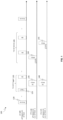
- FIG. 1 is a transmission timing diagram depicting an exemplary time sensitive transmission 100 in a wireless network according to embodiments of the present invention.
- AP 105 is affiliated with an AP MLD capable of TID-SP transmission and schedules a TID-SP for either trigger-based transmission or EDCA-based transmission and announces the TID-SP in RTWT element carried in Beacon frame 120.
- AP 105 then transmits a trigger frame 125 in a trigger-based TID-SP for receipt by scheduled STAs 110 and/or 115 affiliated with non-AP MLDs capable of TID-SP transmission.
- Trigger frame 125 is transmitted in the SP associated with the TID to initiate the TB response from the scheduled STA(s).
- the scheduled STA performs TB response and transmits TB PPDU which carries an MSDU or A-MSDU with the TID equal to the TID permitted for the TID-SP.
- TB PPDU which carries an MSDU or A-MSDU with the TID equal to the TID permitted for the TID-SP.
- EDCA-based TID-SP the scheduled STA performs EDCA or priority EDCA to acquire the medium and transmit a PPDU which carries a MSDU (or A-MSDU) with the TID equal to the TID permitted for the TID-SP.
- an associated STA affiliated with the priority access enabled non-AP MLD can perform priority EDCA for channel access and transmit a PPDU carrying an MSDU or A-MSDU with TID permitted for the TID-SP which may not be scheduled for the STA with the priority access enabled non-AP MLD.
- AP 105 can dynamically adjust the schedule of TID-SP for ether trigger-based or EDCA-based transmission and announce the new TID-SP in RTWT element carried in Beacon frames according to needs of time sensitive traffic and/or traffic load condition of the link and prioritize the time sensitive transmission to meet QoS requirements.
- trigger-based TID-SP 130 scheduled STAs 110 and 115 transmit TB PPDUs 135 and 140 which carry MSDUs or A-MSDUs with the TID equal to the TID permitted for the SP.
- scheduled STAs 110 and 115 perform EDCA to acquire the medium and transmit PPDUs 150 and 155 which carry MSDUs or A-MSDUs with the TID equal to the TID permitted for the TID-SP.
- FIG. 2 depicts an exemplary some information in RTWT information element (IE) format 200 according to embodiments of the present invention.
- the SP of RTWT inherits the mechanism of a broadcast TWT SP with certain transmission restrictions.
- RTWT DL TID Bitmap 205 of the RTWT element indicates the permitted TIDs for DL transmission in the RTWT SP (e.g., TID-SP).
- RTWT UL TID Bitmap 210 in RTWT element indicates the permitted TIDs for UL transmission in the TID-SP.
- SP Type 215 indicates the type of access is permitted in the Service Period. For a trigger-based SP, the AP affiliated with the AP MLD is allowed to transmit a trigger frame to initiate TB UL transmission in this SP on the corresponding link.
- a scheduled STA affiliated with the non-AP MLD is allowed to perform EDCA or priority EDCA to transmit a PPDU carrying an MSDU (or A-MSDU) with TID equal to the TID permitted for the TID-SP.
- TID(s) permitted for the TID-SP for UL transmission is/are indicated in the RTWT UL TID Bitmap subfields of RTWT element.
- SP Synchronization Bitmap 220 (optional) can indicate whether the timing of this TID-SP is synchronized with the timing of TID-SP on other links.
- a bit corresponding to a link in the SP Synchronization Bitmap is set to 1 to indicate that the timing of the TID-SP on that link is synchronized with the timing of this TID-SP. Otherwise, it is not synchronized. If more than one bit of SP Synchronization Bitmap are set to "1", the non-AP MLD may perform an EDCA procedure and transmit on the corresponding links at substantially the same time.
- an associated STA affiliated with the priority access enabled non-AP MLD can perform priority EDCA for channel access and transmit a PPDU which carries an MSDU or an A-MSDU with TID permitted for the TID-SP which may be not scheduled for the STA with the priority access enabled non-AP MLD.
- This can provide higher priority to a priority access enabled non-AP MLD than non-priority enabled non-AP MLDs in TID-SPs of RTWT.
- Figure 3 is a flow chart depicting an exemplary sequence of computer implemented steps of a process 300 for time sensitive transmission during a TID-SP in a wireless network according to embodiments of the present invention.
- an STA affiliated with an STA MLD capable of TID-SP transmission indicates support of RTWT TID-SP capability during an association process with an AP affiliated with an AP MLD capable of TID-SP transmission.
- the STA transmits a TWT Setup Request carrying an SP type (trigger-based transmission or EDCA-based transmission), TID information and other parameters for establishing an RTWT SP with the AP for transmitting user data with specified TIDs.
- SP type Trigger-based transmission or EDCA-based transmission
- TID information TID information and other parameters for establishing an RTWT SP with the AP for transmitting user data with specified TIDs.
- the AP transmits a TWT Setup Response carrying an SP type (trigger-based transmission or EDCA-based transmission), TID information and other parameters to confirm the RTWT SP establishment between the scheduled STA and scheduling AP).
- SP type Trigger-based transmission or EDCA-based transmission
- TID information TID information and other parameters to confirm the RTWT SP establishment between the scheduled STA and scheduling AP.
- the AP affiliated schedules a TID-SP for either trigger-based transmission or EDCA-based transmission and announces the TID-SP in RTWT element carried in a beacon frame.
- the AP can dynamically adjust the schedule of the TID-SP for ether trigger-based or EDCA-based transmission and announce the new TID-SP in RTWT element carried in Beacon frames according to the requirements of time sensitive traffic and/or traffic load condition on the link and prioritize the time sensitive transmission to meet QoS requirements.
- the AP transmits in a TID-SP a trigger frame for receipt by an STA of a non-AP MLD capable of TID-SP transmission.
- the trigger frame is transmitted in the SP associated with the TID to initiate the TB response from the responding STA.
- the scheduled responding STA performs TB response and transmits a TB PPDU which carries an MSDU or A-MSDU with the TID equal to the TID permitted for the TID-SP.
- the scheduled responding STA affiliated with a non-AP MLD performs EDCA or priority EDCA to acquire the medium and transmit a PPDU which carries a MSDU (or A-MSDU) with the TID equal to the TID permitted for the TID-SP.
- a STA affiliated with the priority access enabled non-AP MLD can perform priority EDCA for channel access and transmit a PPDU carrying an MSDU or an A-MSDU with TID permitted for the TID-SP which may not be scheduled for the STA with the priority access enabled non-AP MLD.
- the AP adjusts the schedule (e.g., transmission time, frequency, and duration) of the TID-SP for ether trigger-based or EDCA-based transmission according to the requirements of time sensitive traffic and/or traffic load condition and prioritize the time sensitive transmission to meet QoS requirements.
- the affiliated AP broadcasts the adjusted schedule of the TID-SP in an RTWT element carried in beacon frames for scheduled STAs affiliated with non-AP MLDs to transmit time sensitive or priority traffic in the TID-SPs.
- FIG. 4 depicts an exemplary wireless device 400 upon which embodiments of the present invention can be implemented.
- Embodiments of the present invention are drawn to wireless devices capable of performing duplicating transmission in a wireless TSN according to embodiments of the present invention.
- Wireless device 400 can transmit and/or receive with trigger-based and/or EDCA-based transmission methods in a TID-SP time sensitive or priority user data in a wireless network.
- wireless device 400 can dynamically adjust the schedule of TID-SPs for ether trigger-based or EDCA-based transmission and announce the adjustment according to the requirements of time sensitive traffic and/or traffic load condition, and can advantageously prioritize time sensitive transmission to meet QoS requirements.
- Wireless device 400 includes a processor 405 for running software applications and optionally an operating system.
- Memory 410 can include read-only memory and/or random-access memory, for example, to store applications and data (e.g., tables of index values) for use by the processor 405 and data received or transmitted by radios 415 and 420.
- Radios 415 and 420 can communicate with other electronic devices over a wireless network (e.g., WLAN) using multiple spatial streams (e.g., multiple antennas) and typically operates according to IEEE standards (e.g., IEEE 802.1 lax, IEEE 802.11ay, IEEE 802.1 1be, etc.).
- Radios 415 and 420 can perform multi-link operations including multi-link time sensitive transmissions.
- Wireless device 400 can include more than two radios, according to embodiments.
- the radios can be configured to transmit and/or receive data according to wireless transmission QoS requirements (e.g., a traffic profile), for example.
- Wireless device 400 is a wireless TSN capable device that can be configured by a TSN configuration server and scheduled by the associated AP for wireless time sensitive transmission.
Landscapes
- Engineering & Computer Science (AREA)
- Computer Networks & Wireless Communication (AREA)
- Signal Processing (AREA)
- Quality & Reliability (AREA)
- Mobile Radio Communication Systems (AREA)
Abstract
Description
- This application is a continuation in part and claims the benefit of and priority to co-pending patent application Serial Number
17/734,982, Attorney Docket Number MEDT-0089-02U00US, with filing date May 2, 2022, by Yonggang Fang, et al. 63/231,813, Attorney Docket Number 251359-8118, with filing date August 11, 2021, by Yonggang Fang, et al. - Embodiments of the present invention generally relate to the field of wireless communications. More specifically, embodiments of the present invention relate to systems and methods of communication in wireless time sensitive networks.
- Modern electronic devices typically send and receive data with other electronic devices wirelessly using Wi-Fi, and many of these electronic devices are "dual band" devices that include at least two wireless transceivers capable of operating in different frequency bands, e.g., 2.4 GHz, 5 GHz, and 6 GHz. In most cases, a wireless device will communicate over only a single band at a time. For example, older and low-power devices, e.g., battery powered devices, often operate on the 2.4 GHz band. Newer devices and devices that require greater bandwidth often operate on the 5 GHz band. The availability of the 6 GHz band is a recent advancement and can provide higher performance, lower latency, and faster data rates.
- The use of a single band may not satisfy the bandwidth or latency needs of certain devices. Therefore, some developing approaches to wireless communication increase communication bandwidth by operating on multiple bands concurrently (technically called link aggregation or multi-link operation). Advantageously, multi-link operations can provide higher network throughput and improved network flexibility compared to traditional techniques for wireless communication.
- Additionally, some networks operate using special timing requirements for time-sensitive transmission of data in deterministic networks. For example, time-sensitive networking (TSN) is a set of standards that defines requirements of time synchronization, scheduling and traffic shaping, and communication path selection, reservation, and fault tolerance to introduce the concept of "time" for network communication. Examples of TSN use cases include control networks that receive inputs from sensors, perform control loop processing, and initiate actions, safety-critical networks that implement packet and link redundancy, and mixed media networks that handle data with varying levels of timing sensitivity and priority, such as vehicle networks that support climate control, infotainment, body electronics, driver assistance, etc. TSN standards serve as the foundation for deterministic networking to satisfy the common requirements of these applications. TSN can provide timing synchronization of network entities in the TSN network. TSN also provides a mechanism of frame replication and elimination for reliable transmission.
- Heretofore, TSN standards have been implemented as a link layer technology on wired networks, like Ethernet. An approach to time-sensitive communication incorporated with TSN standards for wireless devices is desired.
- What is needed is an approach to time-sensitive communication leveraging TSN standards that can be used to communicate over wireless networks, including wireless communications over multiple wireless links by multi-link devices (MLDs). Wireless Local Area Network (WLAN) integrated or interworking with TSN can advantageously make the timing of APs synchronized in an extended service set (ESS). Moreover, as transmission failure rate in WLAN can highly impact time sensitive applications, a TSN transmission mechanism can improve transmission reliability using duplicating transmission over one or more links and/or one or more APs. Methods according to the invention are defined in the
independent claims 1 and 9. An apparatus according to the invention is defined in the independent claim 15. The dependent claims define preferred embodiments thereof. - Accordingly, embodiments of the present invention provide systems, devices and methods of wireless communications that improve transmission reliability for time sensitive traffic over multiple wireless communication links in a wireless TSN. The transmitting device can be configured for uplink QoS data transmission according to transmission QoS information (e.g., a traffic profile) received from a TSN configuration server or from an application running on the transmitting device. Embodiments of the present invention provide a traffic identifier (TID) based restricted target wake time (RTWT) service period (SP) that can be configured for either trigger-based transmission or EDCA-based transmission for time sensitive traffic or priority traffic to reduce the chance of contention/collision on time sensitive traffic or priority traffic caused by non-time sensitive traffic using an EDCA mechanism. This can also reduce the chance of contention on time sensitive traffic when both trigger-based transmission and EDCA-based-transmission are used in the same TID-based RTWT SP (TID-SP). The AP MLD can dynamically adjust the schedule of TID-SPs for ether trigger-based or EDCA-based transmission according to the requirements of time sensitive traffic and/or traffic load condition, and can prioritize time sensitive transmission to meet QoS requirements.
- According to one embodiment, a method of wireless data transmission in a wireless time sensitive network (TSN) by a wireless TSN-capable access point (AP) multi-link device (MLD) is disclosed. The method includes scheduling a TID-SP for performing time sensitive transmission with a wireless station (STA) MLD, transmitting a broadcast restricted target wake time (RTWT) element including the TID-SP in a beacon frame, and receiving data during the TID-SP from an STA affiliated with the STA MLD.
- Preferably, the method includes adjusting a schedule of the TID-SP according to a requirement concerning at least one of a time sensitive transmission and a traffic load condition, and announcing a new schedule of the TID-SP.
- Preferably, the scheduling a TID-SP includes scheduling a TID-SP for enhanced distributed channel access (EDCA) transmission.
- Preferably, the scheduling a TID-SP includes scheduling a TID-SP for trigger-based (TB) transmission.
- Preferably, the method includes dynamically changing the schedule of TID-SP to enhanced distributed channel access transmission.
- Preferably, the method includes dynamically changing the schedule of TID-SP to trigger-based transmission.
- Preferably, the method includes receiving an indication of RTWT TID-SP capability from the STA during an association process.
- Preferably, the method includes receiving a target wake time (TWT) Setup Request including an SP type and TID information for establishing RTWT SP of the TID, in the SP type includes at least one of: trigger-based transmission of the TID; and enhanced distributed channel access-based transmission of the TID.
- Preferably, the method includes transmitting a target wake time (TWT) setup response including SP type, and TID information and transmission parameters to confirm a restricted TWT (RTWT) TID-SP.
- Preferably, the method includes prioritizing a time sensitive transmission to meet a quality of service (QoS) requirement.
- According to another embodiment, a method of wireless data transmission in a wireless time sensitive network (TSN) by a wireless station (STA) multi-link device (MLD) is disclosed. The method includes receiving a restricted target wake time (RTWT) element including the TID-SP in a beacon frame from an AP MLD, in the AP MLD schedules a TID-SP for performing time sensitive transmission, and transmitting data during the TID-SP to the AP MLD.
- Preferably, the method includes the transmitting data during the TID-SP to the AP MLD includes receiving a trigger frame in the trigger based TID-SP, performing a trigger-based (TB) response, and transmitting a TB physical layer protocol data unit (PPDU) including a MAC Service Data Unit (MSDU) including a TID permitted in the TID-SP.
- Preferably, the method includes transmitting data during the TID-SP to the AP MLD includes performing enhanced distributed channel access (EDCA) or priority EDCA to acquire a wireless medium of the wireless network, and transmitting a PPDU including a MAC Service Data Unit (MSDU) including a TID equal to a TID permitted in the TID-SP.
- Preferably, the method includes transmitting an indication of RTWT TID-SP capability to the AP during an association process.
- Preferably, the method includes transmitting a target wake time (TWT) Setup Request including an SP type and TID information for establishing an RTWT SP of a TID, in the SP type includes at least one of trigger-based transmission of the TID and enhanced distributed channel access-based (EDCA) transmission of the TID.
- Preferably, the method includes receiving a target wake time (TWT) setup response including SP type, TID information and transmission parameters to confirm a restricted TWT (RTWT) TID-SP.
- Preferably, the method includes performing priority enhanced distributed channel access (EDCA) for channel access and transmitting a PPDU including a MAC Service Data Unit (MSDU) including a TID permitted for the TID-SP in the TID-SP is not scheduled for the STA affiliated with the STA MLD.
- According to a different embodiment, an apparatus for wireless data transmission in a wireless time sensitive network by a wireless access point multi-link device is disclosed. The apparatus includes a processor, a memory coupled to the processor operable to store data, and a plurality of radios operable to perform wireless TSN transmission. The processor is operable to schedule a TID-SP for performing time sensitive transmission with a wireless station (STA) MLD, transmit the TID-SP in target wake time (TWT) element in a beacon frame, and receive data during the TID-SP from the STA MLD.
- Preferably, the processor is further operable to adjust a schedule of the TID-SP, and announce the new schedule of TID-SP according to a requirement of at least one of a time sensitive transmission and a traffic load condition.
- Preferably, the processor is further operable to dynamically change the TID-SP to enhanced distributed channel access (EDCA) transmission and announce a new schedule of the TID-SP.
- The accompanying drawings, which are incorporated in and form a part of this specification, illustrate embodiments of the invention and, together with the description, serve to explain the principles of the invention:
-
Figure 1 is a diagram of an exemplary time sensitive transmission between multi-link devices of a wireless network according to embodiments of the present invention. -
Figure 2 is a diagram of an TID-based service period information element according to embodiments of the present invention. -
Figure 3 is a flowchart of an exemplary process for performing time sensitive transmission during a TID-SP according to embodiments of the present invention, -
Figure 4 is a block diagram depicting an exemplary computer system platform upon which embodiments of the present invention may be implemented. - Reference will now be made in detail to several embodiments. While the subject matter will be described in conjunction with the alternative embodiments, it will be understood that they are not intended to limit the claimed subject matter to these embodiments.
- Furthermore, in the following detailed description, numerous specific details are set forth in order to provide a thorough understanding of the claimed subject matter. However, it will be recognized by one skilled in the art that embodiments may be practiced without these specific details or with equivalents thereof. In other instances, well-known methods, procedures, components, and circuits have not been described in detail as not to unnecessarily obscure aspects and features of the subject matter.
- Portions of the detailed description that follow are presented and discussed in terms of a method. Although steps and sequencing thereof are disclosed in a figure herein (e.g.,
Figure 3 ) describing the operations of this method, such steps and sequencing are exemplary. Embodiments are well suited to performing various other steps or variations of the steps recited in the flowchart of the figure herein, and in a sequence other than that depicted and described herein. - Some portions of the detailed description are presented in terms of procedures, steps, logic blocks, processing, and other symbolic representations of operations on data bits that can be performed on computer memory. These descriptions and representations are the means used by those skilled in the data processing arts to most effectively convey the substance of their work to others skilled in the art. A procedure, computer-executed step, logic block, process, etc., is here, and generally, conceived to be a self-consistent sequence of steps or instructions leading to a desired result. The steps are those requiring physical manipulations of physical quantities. Usually, though not necessarily, these quantities take the form of electrical or magnetic signals capable of being stored, transferred, combined, compared, and otherwise manipulated in a computer system. It has proven convenient at times, principally for reasons of common usage, to refer to these signals as bits, values, elements, symbols, characters, terms, numbers, or the like.
- It should be borne in mind, however, that all of these and similar terms are to be associated with the appropriate physical quantities and are merely convenient labels applied to these quantities. Unless specifically stated otherwise as apparent from the following discussions, it is appreciated that throughout, discussions utilizing terms such as "accessing," "configuring," "coordinating," "storing," "transmitting," "authenticating," "identifying," "requesting," "reporting," "determining," or the like, refer to the action and processes of a computer system, or similar electronic computing device, that manipulates and transforms data represented as physical (electronic) quantities within the computer system's registers and memories into other data similarly represented as physical quantities within the computer system memories or registers or other such information storage, transmission or display devices.
- Some embodiments may be described in the general context of computer-executable instructions, such as program modules, executed by one or more computers or other devices. Generally, program modules include routines, programs, objects, components, data structures, etc. that perform particular tasks or implement particular abstract data types. Typically the functionality of the program modules may be combined or distributed as desired in various embodiments.
- Embodiments of the present invention provide systems, devices and methods of wireless communications that perform reliable transmissions of time sensitive user data over multiple wireless communication links in a wireless time sensitive network (TSN). The transmitting device can be configured and scheduled for uplink transmission according to transmission information (e.g., a traffic profile) received from a TSN configuration server or an application running on the transmission device. A TID-based RTWT SP that can be configured for either trigger-based transmission or EDCA-based transmission for time sensitive traffic is described herein to advantageously reduce the chance of contention/collision on time sensitive traffic caused by non-time sensitive traffic using an EDCA mechanism. This can also reduce the chance of contention on time sensitive traffic when both trigger-based transmission and EDCA-based-transmission are used in the same TID-based RTWT SP. The AP MLD can dynamically adjust the schedule of TID-SPs for ether trigger-based or EDCA-based transmission and announce the schedule changes according to the requirements of time sensitive traffic and/or traffic load condition of link, and can prioritize time sensitive transmission to meet QoS requirements.
- Some wireless transmissions use a target wake time (TWT) to manage activity in the wireless communication. For example, TWT can reduce medium contention between STAs, and can reduce the required amount of time that wireless devices using power-save mode are awakened from a sleep state. STAs can be scheduled to operate at nonoverlapping times, and/or frequencies, and to concentrate the frame exchanges in predefined service periods (SPs).
- Broadcast TWT is a method for the AP to allocate time intervals (or SPs) during which only specified STAs can communicate with the AP. Broadcast TWT SPs are uniquely identified by the <broadcast TWT ID, MAC address of TWT scheduling AP> tuple. Broadcast TWT SP are recommended for frame transmission without constraints, solicited feedback not initiated by (Uplink OFDMA random access) UORA, or solicited status and solicited feedback initiated by UORA, as well as frame transmissions without constraints (other than AP transmitting a traffic indication map (TIM) at the beginning of each TWT SP). Restricted TWT (RTWT) is a type of Broadcast TWT which only allows a certain type of traffic in the service period. Restricted TWT (RTWT) SPs are the service periods (or prioritized service periods) recommended for transmitting time sensitive traffic or priority traffic with predictable delay. The RTWT setup procedure specifies TIDs of which the time sensitive traffic or priority traffic can be served during RTWT SP. However, the RTWT setup procedure may not specify a mechanism to allow EDCA-based or priority EDCA-based UL transmission in prioritized service periods.
- Trigger-based UL transmission are triggered from an AP affiliated with an AP MLD with a basic trigger variant for scheduled UL data frame transmission from one or more STAs affiliated with non-AP MLDs. This UL transmission from a STA fully relies on the scheduling of AP, and may not be sufficiently flexible for a STA to handle burst-type UL traffic in the RTWT SP. Moreover, the RTWT SP setup procedure does not separate trigger-based UL transmission from an enhanced distributed channel access (EDCA)-based UL transmission mechanism within the same RTWT SP. When both channel access mechanisms are allowed in one SP, scheduling complexity is increased which may result in reduced performance, such as increased channel access delay, power consumption for battery operated devices, etc., especially for EDCA-based UL transmissions.
- Traffic ID (TID) information is a quality of service (QoS) feature that can be used by wireless devices to decide and select a UP (user priority) for prioritized QoS or a TSPEC (traffic specification) for parameterized QoS. For example, in WLAN, packets can be a stream of video, voice, or data, and each category can have a different priority. TID information can be used as an identifier to classify a packet in Wireless LAN. According to embodiments of the present invention, TID based RTWT SP restricts QoS transmissions only for specified TIDs. A scheduled STA affiliated with a non-AP MLD can use EDCA for channel access in a TID-based RTWT SP to efficiently handle burst-type UL QoS traffic in a TID-based RTWT SP.
- A TID-based RTWT SP (i.e., TID-SP) can be configured for either trigger-based transmission or EDCA-based transmission for time sensitive traffic to reduce the chance of contention/collision on time sensitive traffic caused by non-time sensitive traffic using an EDCA mechanism in the TID-SP. This can also reduce the chance of contention for time sensitive traffic when both trigger-based transmission and EDCA-based-transmission are used in the same TID-SP. Moreover, the AP affiliated with the AP MLD can dynamically adjust the schedule of TID-SPs for ether trigger-based or EDCA-based transmission and announce the new schedule according to the requirements of time sensitive traffic and/or traffic load condition of the link, and can prioritize time sensitive transmission to meet QoS requirements.
- TID-based RTWT SP setup can be initiated by an STA affiliated with a non-AP MLD capable of TID-SP indicating the capability of RTWT TID-SP during the association process with an AP affiliated with an AP MLD or after the association. The initiating STA sends a TWT Setup Request which carries SP type (trigger-based transmission or EDCA-based transmission) and TID information for establishing RTWT SP with the AP affiliated with the AP MLD for UL QoS transmission on the specified TID(s). The affiliated AP sends a TWT Setup Response carrying SP type, TID information and other parameters to confirm the RTWT TID-SP establishment between the STA (e.g., a scheduled STA) and the AP (e.g., a scheduled AP).
- During operation, the AP schedules a TID-SP for either trigger-based (TB) transmission or EDCA-based transmission and announces a TID-SP in RTWT element carried in beacon frame. In a TID-SP for TB transmission, the AP transmits a trigger frame to initiate the TB response from the scheduled STA affiliated with non-AP MLD. The scheduled STA affiliated with the non-AP MLD that has setup TID-SP with the AP affiliated with the AP MLD performs a TB response after receiving a trigger frame in the SP associated with the TID and/or transmits a TB physical layer protocol data unit (PPDU) which carries a MAC Service Data Unit (MSDU) or Aggregate-MSDU (A-MSDU) with the TID equal to the TID permitted for this trigger-based TID-SP. For EDCA-based TID-SP, the scheduled STA performs EDCA to acquire the wireless medium and transmits a PPDU which carries an MAC Service Data Unit (MSDU) or Aggregate MSDU (A-MSDU) with a TID equal to the TID permitted in the TID-SP.
-
Figure 1 is a transmission timing diagram depicting an exemplary timesensitive transmission 100 in a wireless network according to embodiments of the present invention.AP 105 is affiliated with an AP MLD capable of TID-SP transmission and schedules a TID-SP for either trigger-based transmission or EDCA-based transmission and announces the TID-SP in RTWT element carried inBeacon frame 120.AP 105 then transmits atrigger frame 125 in a trigger-based TID-SP for receipt by scheduledSTAs 110 and/or 115 affiliated with non-AP MLDs capable of TID-SP transmission.Trigger frame 125 is transmitted in the SP associated with the TID to initiate the TB response from the scheduled STA(s). During a trigger-based TID-SP, the scheduled STA performs TB response and transmits TB PPDU which carries an MSDU or A-MSDU with the TID equal to the TID permitted for the TID-SP. During an EDCA-based TID-SP, the scheduled STA performs EDCA or priority EDCA to acquire the medium and transmit a PPDU which carries a MSDU (or A-MSDU) with the TID equal to the TID permitted for the TID-SP. When the priority access is enabled, an associated STA affiliated with the priority access enabled non-AP MLD can perform priority EDCA for channel access and transmit a PPDU carrying an MSDU or A-MSDU with TID permitted for the TID-SP which may not be scheduled for the STA with the priority access enabled non-AP MLD. - As depicted in
Figure 1 ,AP 105 can dynamically adjust the schedule of TID-SP for ether trigger-based or EDCA-based transmission and announce the new TID-SP in RTWT element carried in Beacon frames according to needs of time sensitive traffic and/or traffic load condition of the link and prioritize the time sensitive transmission to meet QoS requirements. During trigger-based TID-SP 130, scheduledSTAs TB PPDUs SP 145, scheduledSTAs -
Figure 2 depicts an exemplary some information in RTWT information element (IE)format 200 according to embodiments of the present invention. The SP of RTWT inherits the mechanism of a broadcast TWT SP with certain transmission restrictions. RTWTDL TID Bitmap 205 of the RTWT element indicates the permitted TIDs for DL transmission in the RTWT SP (e.g., TID-SP). RTWTUL TID Bitmap 210 in RTWT element indicates the permitted TIDs for UL transmission in the TID-SP.SP Type 215 indicates the type of access is permitted in the Service Period. For a trigger-based SP, the AP affiliated with the AP MLD is allowed to transmit a trigger frame to initiate TB UL transmission in this SP on the corresponding link. - For an EDCA-based TID-SP, a scheduled STA affiliated with the non-AP MLD is allowed to perform EDCA or priority EDCA to transmit a PPDU carrying an MSDU (or A-MSDU) with TID equal to the TID permitted for the TID-SP. TID(s) permitted for the TID-SP for UL transmission is/are indicated in the RTWT UL TID Bitmap subfields of RTWT element. SP Synchronization Bitmap 220 (optional) can indicate whether the timing of this TID-SP is synchronized with the timing of TID-SP on other links. A bit corresponding to a link in the SP Synchronization Bitmap is set to 1 to indicate that the timing of the TID-SP on that link is synchronized with the timing of this TID-SP. Otherwise, it is not synchronized. If more than one bit of SP Synchronization Bitmap are set to "1", the non-AP MLD may perform an EDCA procedure and transmit on the corresponding links at substantially the same time.
- When priority access is enabled, an associated STA affiliated with the priority access enabled non-AP MLD can perform priority EDCA for channel access and transmit a PPDU which carries an MSDU or an A-MSDU with TID permitted for the TID-SP which may be not scheduled for the STA with the priority access enabled non-AP MLD. This can provide higher priority to a priority access enabled non-AP MLD than non-priority enabled non-AP MLDs in TID-SPs of RTWT.
-
Figure 3 is a flow chart depicting an exemplary sequence of computer implemented steps of aprocess 300 for time sensitive transmission during a TID-SP in a wireless network according to embodiments of the present invention. - At
step 305, an STA affiliated with an STA MLD capable of TID-SP transmission indicates support of RTWT TID-SP capability during an association process with an AP affiliated with an AP MLD capable of TID-SP transmission. - At
step 310, the STA transmits a TWT Setup Request carrying an SP type (trigger-based transmission or EDCA-based transmission), TID information and other parameters for establishing an RTWT SP with the AP for transmitting user data with specified TIDs. - At
step 315, the AP transmits a TWT Setup Response carrying an SP type (trigger-based transmission or EDCA-based transmission), TID information and other parameters to confirm the RTWT SP establishment between the scheduled STA and scheduling AP). - At
step 320, the AP affiliated schedules a TID-SP for either trigger-based transmission or EDCA-based transmission and announces the TID-SP in RTWT element carried in a beacon frame. The AP can dynamically adjust the schedule of the TID-SP for ether trigger-based or EDCA-based transmission and announce the new TID-SP in RTWT element carried in Beacon frames according to the requirements of time sensitive traffic and/or traffic load condition on the link and prioritize the time sensitive transmission to meet QoS requirements. - At
step 325, for trigger-based transmission, the AP transmits in a TID-SP a trigger frame for receipt by an STA of a non-AP MLD capable of TID-SP transmission. The trigger frame is transmitted in the SP associated with the TID to initiate the TB response from the responding STA. - At
step 330, for trigger-based TID-SP, the scheduled responding STA performs TB response and transmits a TB PPDU which carries an MSDU or A-MSDU with the TID equal to the TID permitted for the TID-SP. For EDCA-based TID-SP, the scheduled responding STA affiliated with a non-AP MLD performs EDCA or priority EDCA to acquire the medium and transmit a PPDU which carries a MSDU (or A-MSDU) with the TID equal to the TID permitted for the TID-SP. When priority access is enabled, a STA affiliated with the priority access enabled non-AP MLD can perform priority EDCA for channel access and transmit a PPDU carrying an MSDU or an A-MSDU with TID permitted for the TID-SP which may not be scheduled for the STA with the priority access enabled non-AP MLD. - At
step 335, the AP adjusts the schedule (e.g., transmission time, frequency, and duration) of the TID-SP for ether trigger-based or EDCA-based transmission according to the requirements of time sensitive traffic and/or traffic load condition and prioritize the time sensitive transmission to meet QoS requirements. The affiliated AP broadcasts the adjusted schedule of the TID-SP in an RTWT element carried in beacon frames for scheduled STAs affiliated with non-AP MLDs to transmit time sensitive or priority traffic in the TID-SPs. -
Figure 4 depicts anexemplary wireless device 400 upon which embodiments of the present invention can be implemented. Embodiments of the present invention are drawn to wireless devices capable of performing duplicating transmission in a wireless TSN according to embodiments of the present invention.Wireless device 400 can transmit and/or receive with trigger-based and/or EDCA-based transmission methods in a TID-SP time sensitive or priority user data in a wireless network. Moreover,wireless device 400 can dynamically adjust the schedule of TID-SPs for ether trigger-based or EDCA-based transmission and announce the adjustment according to the requirements of time sensitive traffic and/or traffic load condition, and can advantageously prioritize time sensitive transmission to meet QoS requirements. -
Wireless device 400 includes aprocessor 405 for running software applications and optionally an operating system.Memory 410 can include read-only memory and/or random-access memory, for example, to store applications and data (e.g., tables of index values) for use by theprocessor 405 and data received or transmitted byradios Radios Radios Wireless device 400 can include more than two radios, according to embodiments. The radios (e.g.,radios 415 and 420) can be configured to transmit and/or receive data according to wireless transmission QoS requirements (e.g., a traffic profile), for example.Wireless device 400 is a wireless TSN capable device that can be configured by a TSN configuration server and scheduled by the associated AP for wireless time sensitive transmission. - Embodiments of the present invention are thus described. While the present invention has been described in particular embodiments, it should be appreciated that the present invention should not be construed as limited by such embodiments, but rather construed according to the following claims.
Claims (15)
- A method of wireless data transmission in a wireless time sensitive network, TSN, by a wireless TSN-capable access point, AP (105), multi-link device, MLD, the method comprising:scheduling a traffic identifier service period, TID-SP, for performing time sensitive transmission with a wireless station, STA, MLD;transmitting a wake time, TWT, element comprising the TID-SP in a beacon frame; andreceiving data during the TID-SP from an STA affiliated with the STA MLD.
- The method of claim 1, wherein the TWT element is a broadcast restricted target wake time, RTWT, element.
- The method according to any one of the preceding claims, further comprising:adjusting a schedule of the TID-SP according to a requirement concerning at least one of: a time sensitive transmission; and a traffic load condition; andannouncing a new schedule of the TID-SP.
- The method according to any one of the preceding claims, wherein the scheduling a TID-SP comprises scheduling a TID-SP for enhanced distributed channel access, EDCA, transmission or scheduling a TID-SP for trigger-based, TB, transmission.
- The method according to any one of the preceding claims, further comprising:- dynamically changing the schedule of TID-SP to enhanced distributed channel access, EDCA, transmission, or- dynamically changing the schedule of TID-SP to trigger-based, TB, transmission.
- The method according to any one of the preceding claims, further comprising receiving an indication of RTWT TID-SP capability from the STA during an association process.
- The method according to any one of the preceding claims, further comprising receiving a target wake time, TWT, Setup Request comprising an SP type and TID information for establishing RTWT SP of the TID, wherein the SP type comprises at least one of: trigger-based transmission of the TID; and enhanced distributed channel access-based transmission of the TID.
- The method according to any one of the preceding claims, further comprising:- transmitting a target wake time, TWT, setup response comprising SP type, and TID information and transmission parameters to confirm a restricted TWT, RTWT, TID-SP, and/or- prioritizing a time sensitive transmission to meet a quality of service, QoS, requirement.
- A method of wireless data transmission in a wireless time sensitive network, TSN, by a wireless station, STA, multi-link device, MLD, the method comprising:receiving a restricted target wake time, RTWT, element comprising the TID-SP in a beacon frame from an AP MLD, wherein the AP MLD schedules a traffic identifier service period, TID-SP, for performing time sensitive transmission; andtransmitting data during the TID-SP to the AP MLD.
- The method of claim 9, wherein the transmitting data during the TID-SP to the AP MLD comprises:receiving a trigger frame in the trigger based TID-SP;performing a trigger-based, TB, response; andtransmitting a TB physical layer protocol data unit, PPDU, comprising a MAC Service Data Unit, MSDU, with a TID permitted in the TID-SP.
- The method according to any one of claims 9 and 10, wherein the transmitting data during the TID-SP to the AP MLD comprises:performing enhanced distributed channel access, EDCA, or priority EDCA to acquire a wireless medium of the wireless network; andtransmitting a PPDU comprising a MAC Service Data Unit, MSDU, with a TID equal to a TID permitted in the TID-SP.
- The method according to any one of claims 9 to 11, further comprising transmitting an indication of RTWT TID-SP capability to the AP (105) during an association process.
- The method according to any one of claims 9 to 12, further comprising:- transmitting a target wake time, TWT, Setup Request comprising an SP type and TID information for establishing an RTWT SP of a TID, wherein the SP type comprises at least one of: trigger-based transmission of the TID; and enhanced distributed channel access-based, EDCA, transmission of the TID, and/or- receiving a target wake time, TWT, setup response comprising SP type, TID information and transmission parameters to confirm a restricted TWT (RTWT) TID-SP.
- The method according to any one of claims 9 to 13, further comprising:performing priority enhanced distributed channel access, EDCA, for channel access; andtransmitting a PPDU comprising a MAC Service Data Unit, MSDU, with a TID permitted for the TID-SP, wherein the TID-SP is not scheduled for the STA affiliated with the STA MLD.
- An apparatus for wireless data transmission in a wireless time sensitive network, TSN, by a wireless access point, AP (105), multi-link device, MLD, the apparatus comprising:a processor;a memory coupled to the processor operable to store data; anda plurality of radios operable to perform wireless TSN transmission, and wherein the processor is operable to perform the method according to any one of claims 1 to 8.
Applications Claiming Priority (3)
| Application Number | Priority Date | Filing Date | Title |
|---|---|---|---|
| US202163231813P | 2021-08-11 | 2021-08-11 | |
| US17/734,982 US12557135B2 (en) | 2021-05-07 | 2022-05-02 | Priority service access using EDCA channel access technology in a wireless network |
| US17/880,544 US12414149B2 (en) | 2021-08-11 | 2022-08-03 | Prioritized service period for time sensitive transmissions |
Publications (1)
| Publication Number | Publication Date |
|---|---|
| EP4135464A1 true EP4135464A1 (en) | 2023-02-15 |
Family
ID=82850509
Family Applications (1)
| Application Number | Title | Priority Date | Filing Date |
|---|---|---|---|
| EP22189279.7A Pending EP4135464A1 (en) | 2021-08-11 | 2022-08-08 | Prioritized service period for time sensitive transmissions |
Country Status (4)
| Country | Link |
|---|---|
| US (1) | US12414149B2 (en) |
| EP (1) | EP4135464A1 (en) |
| CN (1) | CN115707088A (en) |
| TW (1) | TWI880108B (en) |
Cited By (2)
| Publication number | Priority date | Publication date | Assignee | Title |
|---|---|---|---|---|
| US20250080469A1 (en) * | 2023-09-01 | 2025-03-06 | Cisco Technology, Inc. | Enterprise-friendly scs policy validation |
| US12628032B2 (en) * | 2022-08-12 | 2026-05-12 | Samsung Electronics Co., Ltd. | Electronic device and integrated control method of MLO and R-TWT |
Families Citing this family (8)
| Publication number | Priority date | Publication date | Assignee | Title |
|---|---|---|---|---|
| WO2023122530A1 (en) * | 2021-12-20 | 2023-06-29 | Sony Group Corporation | Fast restricted target wait time update |
| CN118632371A (en) * | 2023-03-07 | 2024-09-10 | 华为技术有限公司 | Communication method, communication device, communication system and storage medium |
| EP4694365A1 (en) * | 2023-04-07 | 2026-02-11 | Beijing Xiaomi Mobile Software Co., Ltd. | Communication method, electronic device and storage medium |
| CN121002980A (en) * | 2023-05-26 | 2025-11-21 | 联发科技股份有限公司 | Methods and related equipment for performing preemption management in wireless communication systems |
| US20250185062A1 (en) * | 2023-11-30 | 2025-06-05 | Qualcomm Incorporated | Enhanced distributed channel access (edca) for coordinated channel access |
| WO2025259074A1 (en) * | 2024-06-14 | 2025-12-18 | 주식회사 윌러스표준기술연구소 | Method for transmitting and receiving data and wireless communication terminal using same in wireless communication system |
| CN121217664A (en) * | 2024-06-26 | 2025-12-26 | 中兴通讯股份有限公司 | Data transmission methods, communication devices and computer-readable storage media |
| CN119967602B (en) * | 2024-12-25 | 2025-09-30 | 国网辽宁省电力有限公司信息通信分公司 | Wireless deterministic traffic access control method, device, equipment and storage medium |
Citations (1)
| Publication number | Priority date | Publication date | Assignee | Title |
|---|---|---|---|---|
| US20200267636A1 (en) * | 2019-05-10 | 2020-08-20 | Dave A. Cavalcanti | Extreme high throughput (eht) time-sensitive networking |
Family Cites Families (17)
| Publication number | Priority date | Publication date | Assignee | Title |
|---|---|---|---|---|
| CN106413112A (en) | 2015-08-03 | 2017-02-15 | 上海宽带技术及应用工程研究中心 | Distributed access method based on service priority improvement |
| EP4013179B1 (en) | 2016-09-07 | 2025-01-29 | Wilus Institute of Standards and Technology Inc. | Wireless communication method using enhanced distributed channel access, and wireless communication terminal using same |
| US10206230B2 (en) | 2017-01-02 | 2019-02-12 | Lg Electronics Inc. | Method for transmitting frame in wireless local area network and wireless terminal using the same |
| JPWO2018181999A1 (en) | 2017-03-31 | 2019-11-07 | 株式会社カネカ | Retardation film |
| US11510269B2 (en) | 2019-07-01 | 2022-11-22 | Qualcomm Incorporated | Signaling for multi-link communication in a wireless local area network (WLAN) |
| US20210099212A1 (en) | 2019-09-30 | 2021-04-01 | Qualcomm Incorporated | Uplink transmission mode selection and triggering |
| US11711848B2 (en) * | 2019-10-08 | 2023-07-25 | Intel Corporation | Link switch parameters |
| WO2021080264A1 (en) | 2019-10-23 | 2021-04-29 | 엘지전자 주식회사 | Method for performing communication through multiple links in wireless lan system |
| US11595884B2 (en) | 2020-02-12 | 2023-02-28 | Mediatek Singapore Pte. Ltd. | Apparatus and methods for EHT multi-link BBS parameter update |
| CN115516930B (en) | 2020-03-04 | 2024-12-13 | Lg电子株式会社 | Method for performing multi-link communication in a wireless communication system |
| WO2021177774A2 (en) | 2020-03-05 | 2021-09-10 | 엘지전자 주식회사 | Method for performing multi-link communication in wireless communication system |
| US12250592B2 (en) * | 2020-07-01 | 2025-03-11 | Intel Corporation | Methods and arrangements for application service discovery |
| CN112203344B (en) * | 2020-09-29 | 2023-04-18 | 展讯通信(上海)有限公司 | Peer connection data time-sharing scheduling method and device based on AP |
| CN115669120A (en) * | 2020-10-13 | 2023-01-31 | 北京小米移动软件有限公司 | Multi-connection communication method, device, equipment and storage medium thereof |
| US12120760B2 (en) | 2020-10-23 | 2024-10-15 | Nxp Usa, Inc. | Multi-link device (MLD) setup and multi-link operation (MLO) |
| CN112492698B (en) | 2020-10-30 | 2025-05-09 | 中兴通讯股份有限公司 | Multi-link low-latency communication method, device, storage medium and electronic device |
| MX2023006059A (en) | 2020-12-04 | 2023-06-06 | Panasonic Ip Corp America | Communication apparatus and communication method for prioritized traffic. |
-
2022
- 2022-08-03 US US17/880,544 patent/US12414149B2/en active Active
- 2022-08-04 CN CN202210933542.9A patent/CN115707088A/en active Pending
- 2022-08-08 EP EP22189279.7A patent/EP4135464A1/en active Pending
- 2022-08-10 TW TW111130022A patent/TWI880108B/en active
Patent Citations (1)
| Publication number | Priority date | Publication date | Assignee | Title |
|---|---|---|---|---|
| US20200267636A1 (en) * | 2019-05-10 | 2020-08-20 | Dave A. Cavalcanti | Extreme high throughput (eht) time-sensitive networking |
Non-Patent Citations (2)
| Title |
|---|
| 802 11 WORKING GROUP OF THE LAN/MAN STANDARDS COMMITTEE OF THE IEEE COMPUTER SOCIETY, vol. 802.11ax drafts, no. D5.1, 6 November 2019 (2019-11-06), pages 1 - 770, XP068155342, Retrieved from the Internet <URL:http://www.ieee802.org/11/private/Draft_Standards/11ax/Draft%20P802.11ax_D5.1.pdf> [retrieved on 20191106] * |
| 802 11 WORKING GROUP OF THE LAN/MAN STANDARDS COMMITTEE OF THE IEEE COMPUTER SOCIETY: "Draft Standard for Information technology- Tele- communications and information exchange between systems Local and metropolitan area networks- Specific requirements ? ? Part 11: Wireless LAN Medium Access Control ? (MAC) and Physical Layer (PHY) Specifications ? ? Amendment 8: Enhancements for extre", vol. 802.11be drafts, no. D1.01, 30 June 2021 (2021-06-30), pages 1 - 657, XP068183206, Retrieved from the Internet <URL:http://www.ieee802.org/11/private/Draft_Standards/11be/Draft%20P802.11be_D1.01.pdf> [retrieved on 20210630] * |
Cited By (2)
| Publication number | Priority date | Publication date | Assignee | Title |
|---|---|---|---|---|
| US12628032B2 (en) * | 2022-08-12 | 2026-05-12 | Samsung Electronics Co., Ltd. | Electronic device and integrated control method of MLO and R-TWT |
| US20250080469A1 (en) * | 2023-09-01 | 2025-03-06 | Cisco Technology, Inc. | Enterprise-friendly scs policy validation |
Also Published As
| Publication number | Publication date |
|---|---|
| TWI880108B (en) | 2025-04-11 |
| CN115707088A (en) | 2023-02-17 |
| US12414149B2 (en) | 2025-09-09 |
| US20230051808A1 (en) | 2023-02-16 |
| TW202308443A (en) | 2023-02-16 |
Similar Documents
| Publication | Publication Date | Title |
|---|---|---|
| US12414149B2 (en) | Prioritized service period for time sensitive transmissions | |
| US20230128915A1 (en) | Multi-link flexible wake time scheduling | |
| EP3749040B1 (en) | Systems and methods for constrained multi-link operation in a wireless network | |
| JP7778868B2 (en) | Multi-link communication method and apparatus | |
| US11770731B2 (en) | Target wake time traffic differentiation and service period extension | |
| EP3637869B1 (en) | Method and apparatus for multi-band power management in a wireless network | |
| US20240422674A1 (en) | Enhanced Multi-Link Power Save Mode | |
| EP3342215B1 (en) | Power save mechanism in a wlan network with large number of stations | |
| CN117768956B (en) | Method and apparatus for R-TWT operation for delay-sensitive traffic in WLAN | |
| JP2022533271A (en) | Power-saving and group-addressed frame in WLAN using multiple communication links | |
| EP4013179A1 (en) | Wireless communication method using enhanced distributed channel access, and wireless communication terminal using same | |
| EP1730885B1 (en) | Multicasting in wireless networks | |
| EP3278625B1 (en) | Clock drift management for coexistence and concurrency | |
| US20250031242A1 (en) | Rescheduling of Restricted Target Wake Time Service Period | |
| US8446825B2 (en) | Method and system for reliable service period allocation in 60 GHz MAC | |
| US8774719B2 (en) | System and method for WLAN and SCO bluetooth coexistence | |
| US12501382B2 (en) | Base station and terminal apparatus for synchronizing time in multi-link | |
| CN111405667B (en) | Node and method for TDMA dynamic time slot allocation based on linear prediction | |
| WO2023194351A1 (en) | Method of controlling operating states of a first communication interface through mediation via a second communication interface | |
| CN119071889A (en) | A method for implementing low-latency services, electronic equipment, and storage medium | |
| HK1099972B (en) | Multicasting in wireless networks |
Legal Events
| Date | Code | Title | Description |
|---|---|---|---|
| PUAI | Public reference made under article 153(3) epc to a published international application that has entered the european phase |
Free format text: ORIGINAL CODE: 0009012 |
|
| STAA | Information on the status of an ep patent application or granted ep patent |
Free format text: STATUS: THE APPLICATION HAS BEEN PUBLISHED |
|
| AK | Designated contracting states |
Kind code of ref document: A1 Designated state(s): AL AT BE BG CH CY CZ DE DK EE ES FI FR GB GR HR HU IE IS IT LI LT LU LV MC MK MT NL NO PL PT RO RS SE SI SK SM TR |
|
| P01 | Opt-out of the competence of the unified patent court (upc) registered |
Effective date: 20230627 |
|
| STAA | Information on the status of an ep patent application or granted ep patent |
Free format text: STATUS: REQUEST FOR EXAMINATION WAS MADE |
|
| 17P | Request for examination filed |
Effective date: 20230811 |
|
| RBV | Designated contracting states (corrected) |
Designated state(s): AL AT BE BG CH CY CZ DE DK EE ES FI FR GB GR HR HU IE IS IT LI LT LU LV MC MK MT NL NO PL PT RO RS SE SI SK SM TR |
|
| STAA | Information on the status of an ep patent application or granted ep patent |
Free format text: STATUS: EXAMINATION IS IN PROGRESS |
|
| 17Q | First examination report despatched |
Effective date: 20240116 |
|
| GRAP | Despatch of communication of intention to grant a patent |
Free format text: ORIGINAL CODE: EPIDOSNIGR1 |
|
| STAA | Information on the status of an ep patent application or granted ep patent |
Free format text: STATUS: GRANT OF PATENT IS INTENDED |
|
| INTG | Intention to grant announced |
Effective date: 20260410 |