EP4135065A1 - Negative electrode active material, and electrochemical device and electronic device using same - Google Patents
Negative electrode active material, and electrochemical device and electronic device using same Download PDFInfo
- Publication number
- EP4135065A1 EP4135065A1 EP20930448.4A EP20930448A EP4135065A1 EP 4135065 A1 EP4135065 A1 EP 4135065A1 EP 20930448 A EP20930448 A EP 20930448A EP 4135065 A1 EP4135065 A1 EP 4135065A1
- Authority
- EP
- European Patent Office
- Prior art keywords
- negative electrode
- active material
- electrode active
- lithium
- material layer
- Prior art date
- Legal status (The legal status is an assumption and is not a legal conclusion. Google has not performed a legal analysis and makes no representation as to the accuracy of the status listed.)
- Pending
Links
- 239000007773 negative electrode material Substances 0.000 title claims abstract description 303
- 239000002245 particle Substances 0.000 claims abstract description 97
- 238000009826 distribution Methods 0.000 claims abstract description 40
- 230000001186 cumulative effect Effects 0.000 claims abstract description 22
- 238000012360 testing method Methods 0.000 claims description 35
- 238000000576 coating method Methods 0.000 claims description 31
- 239000011248 coating agent Substances 0.000 claims description 30
- 239000008151 electrolyte solution Substances 0.000 claims description 26
- 239000011164 primary particle Substances 0.000 claims description 23
- 238000002441 X-ray diffraction Methods 0.000 claims description 10
- 238000001228 spectrum Methods 0.000 claims description 10
- 239000011163 secondary particle Substances 0.000 claims description 7
- 239000010410 layer Substances 0.000 description 130
- HBBGRARXTFLTSG-UHFFFAOYSA-N Lithium ion Chemical compound [Li+] HBBGRARXTFLTSG-UHFFFAOYSA-N 0.000 description 116
- 229910001416 lithium ion Inorganic materials 0.000 description 116
- 229910052744 lithium Inorganic materials 0.000 description 91
- WHXSMMKQMYFTQS-UHFFFAOYSA-N Lithium Chemical compound [Li] WHXSMMKQMYFTQS-UHFFFAOYSA-N 0.000 description 87
- 238000001556 precipitation Methods 0.000 description 72
- 238000000034 method Methods 0.000 description 39
- -1 polyphenylene Polymers 0.000 description 30
- 230000008961 swelling Effects 0.000 description 21
- 239000000126 substance Substances 0.000 description 18
- 239000007774 positive electrode material Substances 0.000 description 16
- PXHVJJICTQNCMI-UHFFFAOYSA-N Nickel Chemical compound [Ni] PXHVJJICTQNCMI-UHFFFAOYSA-N 0.000 description 14
- 238000009830 intercalation Methods 0.000 description 11
- 239000004020 conductor Substances 0.000 description 10
- 229920000642 polymer Polymers 0.000 description 10
- RYGMFSIKBFXOCR-UHFFFAOYSA-N Copper Chemical compound [Cu] RYGMFSIKBFXOCR-UHFFFAOYSA-N 0.000 description 9
- 229910052782 aluminium Inorganic materials 0.000 description 9
- 239000010949 copper Substances 0.000 description 9
- 239000011148 porous material Substances 0.000 description 9
- 239000000843 powder Substances 0.000 description 9
- 239000002904 solvent Substances 0.000 description 9
- OKTJSMMVPCPJKN-UHFFFAOYSA-N Carbon Chemical compound [C] OKTJSMMVPCPJKN-UHFFFAOYSA-N 0.000 description 8
- 239000002390 adhesive tape Substances 0.000 description 8
- XAGFODPZIPBFFR-UHFFFAOYSA-N aluminium Chemical compound [Al] XAGFODPZIPBFFR-UHFFFAOYSA-N 0.000 description 8
- 150000001875 compounds Chemical class 0.000 description 8
- 125000004122 cyclic group Chemical group 0.000 description 8
- 238000007599 discharging Methods 0.000 description 8
- 229910052731 fluorine Inorganic materials 0.000 description 8
- 230000014759 maintenance of location Effects 0.000 description 8
- 230000002829 reductive effect Effects 0.000 description 8
- 238000010998 test method Methods 0.000 description 8
- 238000012546 transfer Methods 0.000 description 8
- XEEYBQQBJWHFJM-UHFFFAOYSA-N Iron Chemical compound [Fe] XEEYBQQBJWHFJM-UHFFFAOYSA-N 0.000 description 7
- 239000004698 Polyethylene Substances 0.000 description 7
- 239000011230 binding agent Substances 0.000 description 7
- 230000005540 biological transmission Effects 0.000 description 7
- 239000011575 calcium Substances 0.000 description 7
- 239000011737 fluorine Substances 0.000 description 7
- 239000011777 magnesium Substances 0.000 description 7
- 239000000463 material Substances 0.000 description 7
- 229920000573 polyethylene Polymers 0.000 description 7
- 238000002360 preparation method Methods 0.000 description 7
- 239000000243 solution Substances 0.000 description 7
- 239000010936 titanium Substances 0.000 description 7
- XEKOWRVHYACXOJ-UHFFFAOYSA-N Ethyl acetate Chemical compound CCOC(C)=O XEKOWRVHYACXOJ-UHFFFAOYSA-N 0.000 description 6
- 239000004743 Polypropylene Substances 0.000 description 6
- 230000000052 comparative effect Effects 0.000 description 6
- 229910052802 copper Inorganic materials 0.000 description 6
- 150000005676 cyclic carbonates Chemical class 0.000 description 6
- 239000003792 electrolyte Substances 0.000 description 6
- FKRCODPIKNYEAC-UHFFFAOYSA-N ethyl propionate Chemical compound CCOC(=O)CC FKRCODPIKNYEAC-UHFFFAOYSA-N 0.000 description 6
- 238000001764 infiltration Methods 0.000 description 6
- 230000008595 infiltration Effects 0.000 description 6
- 229910003002 lithium salt Inorganic materials 0.000 description 6
- 159000000002 lithium salts Chemical class 0.000 description 6
- 239000000203 mixture Substances 0.000 description 6
- 239000003960 organic solvent Substances 0.000 description 6
- 229920001155 polypropylene Polymers 0.000 description 6
- 229920003048 styrene butadiene rubber Polymers 0.000 description 6
- OIFBSDVPJOWBCH-UHFFFAOYSA-N Diethyl carbonate Chemical compound CCOC(=O)OCC OIFBSDVPJOWBCH-UHFFFAOYSA-N 0.000 description 5
- KMTRUDSVKNLOMY-UHFFFAOYSA-N Ethylene carbonate Chemical compound O=C1OCCO1 KMTRUDSVKNLOMY-UHFFFAOYSA-N 0.000 description 5
- 229910001290 LiPF6 Inorganic materials 0.000 description 5
- RTAQQCXQSZGOHL-UHFFFAOYSA-N Titanium Chemical compound [Ti] RTAQQCXQSZGOHL-UHFFFAOYSA-N 0.000 description 5
- 150000007942 carboxylates Chemical class 0.000 description 5
- 150000005678 chain carbonates Chemical class 0.000 description 5
- 230000002687 intercalation Effects 0.000 description 5
- 239000011572 manganese Substances 0.000 description 5
- 229910052751 metal Inorganic materials 0.000 description 5
- 239000002184 metal Substances 0.000 description 5
- 229910052759 nickel Inorganic materials 0.000 description 5
- RUOJZAUFBMNUDX-UHFFFAOYSA-N propylene carbonate Chemical compound CC1COC(=O)O1 RUOJZAUFBMNUDX-UHFFFAOYSA-N 0.000 description 5
- YEJRWHAVMIAJKC-UHFFFAOYSA-N 4-Butyrolactone Chemical compound O=C1CCCO1 YEJRWHAVMIAJKC-UHFFFAOYSA-N 0.000 description 4
- RTZKZFJDLAIYFH-UHFFFAOYSA-N Diethyl ether Chemical compound CCOCC RTZKZFJDLAIYFH-UHFFFAOYSA-N 0.000 description 4
- YCKRFDGAMUMZLT-UHFFFAOYSA-N Fluorine atom Chemical compound [F] YCKRFDGAMUMZLT-UHFFFAOYSA-N 0.000 description 4
- 229910013098 LiBF2 Inorganic materials 0.000 description 4
- 229910013880 LiPF4 Inorganic materials 0.000 description 4
- 229910019142 PO4 Inorganic materials 0.000 description 4
- 239000002033 PVDF binder Substances 0.000 description 4
- 229910052796 boron Inorganic materials 0.000 description 4
- 229910052791 calcium Inorganic materials 0.000 description 4
- 229910000625 lithium cobalt oxide Inorganic materials 0.000 description 4
- BFZPBUKRYWOWDV-UHFFFAOYSA-N lithium;oxido(oxo)cobalt Chemical compound [Li+].[O-][Co]=O BFZPBUKRYWOWDV-UHFFFAOYSA-N 0.000 description 4
- 229910052749 magnesium Inorganic materials 0.000 description 4
- NBIIXXVUZAFLBC-UHFFFAOYSA-K phosphate Chemical compound [O-]P([O-])([O-])=O NBIIXXVUZAFLBC-UHFFFAOYSA-K 0.000 description 4
- 239000010452 phosphate Substances 0.000 description 4
- 229920000058 polyacrylate Polymers 0.000 description 4
- 229920000036 polyvinylpyrrolidone Polymers 0.000 description 4
- 239000001267 polyvinylpyrrolidone Substances 0.000 description 4
- 235000013855 polyvinylpyrrolidone Nutrition 0.000 description 4
- 239000000758 substrate Substances 0.000 description 4
- 229910052718 tin Inorganic materials 0.000 description 4
- 229910052719 titanium Inorganic materials 0.000 description 4
- FFRBMBIXVSCUFS-UHFFFAOYSA-N 2,4-dinitro-1-naphthol Chemical compound C1=CC=C2C(O)=C([N+]([O-])=O)C=C([N+]([O-])=O)C2=C1 FFRBMBIXVSCUFS-UHFFFAOYSA-N 0.000 description 3
- UHOPWFKONJYLCF-UHFFFAOYSA-N 2-(2-sulfanylethyl)isoindole-1,3-dione Chemical compound C1=CC=C2C(=O)N(CCS)C(=O)C2=C1 UHOPWFKONJYLCF-UHFFFAOYSA-N 0.000 description 3
- ZOXJGFHDIHLPTG-UHFFFAOYSA-N Boron Chemical compound [B] ZOXJGFHDIHLPTG-UHFFFAOYSA-N 0.000 description 3
- OYPRJOBELJOOCE-UHFFFAOYSA-N Calcium Chemical compound [Ca] OYPRJOBELJOOCE-UHFFFAOYSA-N 0.000 description 3
- VYZAMTAEIAYCRO-UHFFFAOYSA-N Chromium Chemical compound [Cr] VYZAMTAEIAYCRO-UHFFFAOYSA-N 0.000 description 3
- FYYHWMGAXLPEAU-UHFFFAOYSA-N Magnesium Chemical compound [Mg] FYYHWMGAXLPEAU-UHFFFAOYSA-N 0.000 description 3
- PWHULOQIROXLJO-UHFFFAOYSA-N Manganese Chemical compound [Mn] PWHULOQIROXLJO-UHFFFAOYSA-N 0.000 description 3
- ZOKXTWBITQBERF-UHFFFAOYSA-N Molybdenum Chemical compound [Mo] ZOKXTWBITQBERF-UHFFFAOYSA-N 0.000 description 3
- NINIDFKCEFEMDL-UHFFFAOYSA-N Sulfur Chemical compound [S] NINIDFKCEFEMDL-UHFFFAOYSA-N 0.000 description 3
- ATJFFYVFTNAWJD-UHFFFAOYSA-N Tin Chemical compound [Sn] ATJFFYVFTNAWJD-UHFFFAOYSA-N 0.000 description 3
- 239000006230 acetylene black Substances 0.000 description 3
- 229910021383 artificial graphite Inorganic materials 0.000 description 3
- 210000004027 cell Anatomy 0.000 description 3
- 125000001153 fluoro group Chemical group F* 0.000 description 3
- 239000011888 foil Substances 0.000 description 3
- 229910002804 graphite Inorganic materials 0.000 description 3
- 239000010439 graphite Substances 0.000 description 3
- 125000004435 hydrogen atom Chemical group [H]* 0.000 description 3
- WDAXFOBOLVPGLV-UHFFFAOYSA-N isobutyric acid ethyl ester Natural products CCOC(=O)C(C)C WDAXFOBOLVPGLV-UHFFFAOYSA-N 0.000 description 3
- 230000000670 limiting effect Effects 0.000 description 3
- 239000007791 liquid phase Substances 0.000 description 3
- 229910001496 lithium tetrafluoroborate Inorganic materials 0.000 description 3
- 229910052748 manganese Inorganic materials 0.000 description 3
- 229910052750 molybdenum Inorganic materials 0.000 description 3
- 239000011733 molybdenum Substances 0.000 description 3
- 239000004745 nonwoven fabric Substances 0.000 description 3
- 229920001343 polytetrafluoroethylene Polymers 0.000 description 3
- 239000004810 polytetrafluoroethylene Substances 0.000 description 3
- 229920002981 polyvinylidene fluoride Polymers 0.000 description 3
- 238000003825 pressing Methods 0.000 description 3
- 238000007493 shaping process Methods 0.000 description 3
- 229910052710 silicon Inorganic materials 0.000 description 3
- 239000002002 slurry Substances 0.000 description 3
- 229910052712 strontium Inorganic materials 0.000 description 3
- CIOAGBVUUVVLOB-UHFFFAOYSA-N strontium atom Chemical compound [Sr] CIOAGBVUUVVLOB-UHFFFAOYSA-N 0.000 description 3
- IAHFWCOBPZCAEA-UHFFFAOYSA-N succinonitrile Chemical compound N#CCCC#N IAHFWCOBPZCAEA-UHFFFAOYSA-N 0.000 description 3
- 229910052717 sulfur Inorganic materials 0.000 description 3
- 239000011593 sulfur Substances 0.000 description 3
- 239000002335 surface treatment layer Substances 0.000 description 3
- JBQYATWDVHIOAR-UHFFFAOYSA-N tellanylidenegermanium Chemical compound [Te]=[Ge] JBQYATWDVHIOAR-UHFFFAOYSA-N 0.000 description 3
- WFKWXMTUELFFGS-UHFFFAOYSA-N tungsten Chemical compound [W] WFKWXMTUELFFGS-UHFFFAOYSA-N 0.000 description 3
- 229910052721 tungsten Inorganic materials 0.000 description 3
- 239000010937 tungsten Substances 0.000 description 3
- LEONUFNNVUYDNQ-UHFFFAOYSA-N vanadium atom Chemical compound [V] LEONUFNNVUYDNQ-UHFFFAOYSA-N 0.000 description 3
- DHKHKXVYLBGOIT-UHFFFAOYSA-N 1,1-Diethoxyethane Chemical compound CCOC(C)OCC DHKHKXVYLBGOIT-UHFFFAOYSA-N 0.000 description 2
- SPEUIVXLLWOEMJ-UHFFFAOYSA-N 1,1-dimethoxyethane Chemical compound COC(C)OC SPEUIVXLLWOEMJ-UHFFFAOYSA-N 0.000 description 2
- BTBUEUYNUDRHOZ-UHFFFAOYSA-N Borate Chemical compound [O-]B([O-])[O-] BTBUEUYNUDRHOZ-UHFFFAOYSA-N 0.000 description 2
- 229920000049 Carbon (fiber) Polymers 0.000 description 2
- 229920002134 Carboxymethyl cellulose Polymers 0.000 description 2
- XTHFKEDIFFGKHM-UHFFFAOYSA-N Dimethoxyethane Chemical compound COCCOC XTHFKEDIFFGKHM-UHFFFAOYSA-N 0.000 description 2
- IAZDPXIOMUYVGZ-UHFFFAOYSA-N Dimethylsulphoxide Chemical compound CS(C)=O IAZDPXIOMUYVGZ-UHFFFAOYSA-N 0.000 description 2
- IAYPIBMASNFSPL-UHFFFAOYSA-N Ethylene oxide Chemical compound C1CO1 IAYPIBMASNFSPL-UHFFFAOYSA-N 0.000 description 2
- 229920002153 Hydroxypropyl cellulose Polymers 0.000 description 2
- 229910000552 LiCF3SO3 Inorganic materials 0.000 description 2
- SECXISVLQFMRJM-UHFFFAOYSA-N N-Methylpyrrolidone Chemical compound CN1CCCC1=O SECXISVLQFMRJM-UHFFFAOYSA-N 0.000 description 2
- 239000004677 Nylon Substances 0.000 description 2
- OAICVXFJPJFONN-UHFFFAOYSA-N Phosphorus Chemical compound [P] OAICVXFJPJFONN-UHFFFAOYSA-N 0.000 description 2
- 239000004952 Polyamide Substances 0.000 description 2
- 229920000265 Polyparaphenylene Polymers 0.000 description 2
- 239000004372 Polyvinyl alcohol Substances 0.000 description 2
- XUIMIQQOPSSXEZ-UHFFFAOYSA-N Silicon Chemical compound [Si] XUIMIQQOPSSXEZ-UHFFFAOYSA-N 0.000 description 2
- BQCADISMDOOEFD-UHFFFAOYSA-N Silver Chemical compound [Ag] BQCADISMDOOEFD-UHFFFAOYSA-N 0.000 description 2
- 229920002125 Sokalan® Polymers 0.000 description 2
- 229910000831 Steel Inorganic materials 0.000 description 2
- WYURNTSHIVDZCO-UHFFFAOYSA-N Tetrahydrofuran Chemical compound C1CCOC1 WYURNTSHIVDZCO-UHFFFAOYSA-N 0.000 description 2
- XLOMVQKBTHCTTD-UHFFFAOYSA-N Zinc monoxide Chemical compound [Zn]=O XLOMVQKBTHCTTD-UHFFFAOYSA-N 0.000 description 2
- PFYQFCKUASLJLL-UHFFFAOYSA-N [Co].[Ni].[Li] Chemical compound [Co].[Ni].[Li] PFYQFCKUASLJLL-UHFFFAOYSA-N 0.000 description 2
- HFCVPDYCRZVZDF-UHFFFAOYSA-N [Li+].[Co+2].[Ni+2].[O-][Mn]([O-])(=O)=O Chemical compound [Li+].[Co+2].[Ni+2].[O-][Mn]([O-])(=O)=O HFCVPDYCRZVZDF-UHFFFAOYSA-N 0.000 description 2
- BTGRAWJCKBQKAO-UHFFFAOYSA-N adiponitrile Chemical compound N#CCCCCC#N BTGRAWJCKBQKAO-UHFFFAOYSA-N 0.000 description 2
- 239000003849 aromatic solvent Substances 0.000 description 2
- 239000010426 asphalt Substances 0.000 description 2
- 230000000712 assembly Effects 0.000 description 2
- 238000000429 assembly Methods 0.000 description 2
- TZCXTZWJZNENPQ-UHFFFAOYSA-L barium sulfate Chemical compound [Ba+2].[O-]S([O-])(=O)=O TZCXTZWJZNENPQ-UHFFFAOYSA-L 0.000 description 2
- 239000003990 capacitor Substances 0.000 description 2
- 239000004917 carbon fiber Substances 0.000 description 2
- 239000011203 carbon fibre reinforced carbon Substances 0.000 description 2
- 239000003575 carbonaceous material Substances 0.000 description 2
- NKCVNYJQLIWBHK-UHFFFAOYSA-N carbonodiperoxoic acid Chemical compound OOC(=O)OO NKCVNYJQLIWBHK-UHFFFAOYSA-N 0.000 description 2
- 239000001768 carboxy methyl cellulose Substances 0.000 description 2
- 235000010948 carboxy methyl cellulose Nutrition 0.000 description 2
- 239000005466 carboxylated polyvinylchloride Substances 0.000 description 2
- 239000010941 cobalt Substances 0.000 description 2
- 229910017052 cobalt Inorganic materials 0.000 description 2
- GUTLYIVDDKVIGB-UHFFFAOYSA-N cobalt atom Chemical compound [Co] GUTLYIVDDKVIGB-UHFFFAOYSA-N 0.000 description 2
- 239000002131 composite material Substances 0.000 description 2
- 229920001940 conductive polymer Polymers 0.000 description 2
- 239000011889 copper foil Substances 0.000 description 2
- 125000004093 cyano group Chemical group *C#N 0.000 description 2
- 150000004292 cyclic ethers Chemical class 0.000 description 2
- 230000001351 cycling effect Effects 0.000 description 2
- 230000003247 decreasing effect Effects 0.000 description 2
- 229920005994 diacetyl cellulose Polymers 0.000 description 2
- 238000010586 diagram Methods 0.000 description 2
- 239000011267 electrode slurry Substances 0.000 description 2
- 238000004146 energy storage Methods 0.000 description 2
- 239000003822 epoxy resin Substances 0.000 description 2
- 239000000835 fiber Substances 0.000 description 2
- 239000006260 foam Substances 0.000 description 2
- GAEKPEKOJKCEMS-UHFFFAOYSA-N gamma-valerolactone Chemical compound CC1CCC(=O)O1 GAEKPEKOJKCEMS-UHFFFAOYSA-N 0.000 description 2
- ZQBFAOFFOQMSGJ-UHFFFAOYSA-N hexafluorobenzene Chemical compound FC1=C(F)C(F)=C(F)C(F)=C1F ZQBFAOFFOQMSGJ-UHFFFAOYSA-N 0.000 description 2
- 239000001863 hydroxypropyl cellulose Substances 0.000 description 2
- 235000010977 hydroxypropyl cellulose Nutrition 0.000 description 2
- 238000010191 image analysis Methods 0.000 description 2
- 239000010954 inorganic particle Substances 0.000 description 2
- 229910052742 iron Inorganic materials 0.000 description 2
- 239000003273 ketjen black Substances 0.000 description 2
- ACFSQHQYDZIPRL-UHFFFAOYSA-N lithium;bis(1,1,2,2,2-pentafluoroethylsulfonyl)azanide Chemical compound [Li+].FC(F)(F)C(F)(F)S(=O)(=O)[N-]S(=O)(=O)C(F)(F)C(F)(F)F ACFSQHQYDZIPRL-UHFFFAOYSA-N 0.000 description 2
- QSZMZKBZAYQGRS-UHFFFAOYSA-N lithium;bis(trifluoromethylsulfonyl)azanide Chemical compound [Li+].FC(F)(F)S(=O)(=O)[N-]S(=O)(=O)C(F)(F)F QSZMZKBZAYQGRS-UHFFFAOYSA-N 0.000 description 2
- LBSANEJBGMCTBH-UHFFFAOYSA-N manganate Chemical compound [O-][Mn]([O-])(=O)=O LBSANEJBGMCTBH-UHFFFAOYSA-N 0.000 description 2
- 239000007769 metal material Substances 0.000 description 2
- BHIWKHZACMWKOJ-UHFFFAOYSA-N methyl isobutyrate Chemical compound COC(=O)C(C)C BHIWKHZACMWKOJ-UHFFFAOYSA-N 0.000 description 2
- YKYONYBAUNKHLG-UHFFFAOYSA-N n-Propyl acetate Natural products CCCOC(C)=O YKYONYBAUNKHLG-UHFFFAOYSA-N 0.000 description 2
- 229910021382 natural graphite Inorganic materials 0.000 description 2
- 229920001778 nylon Polymers 0.000 description 2
- 238000012856 packing Methods 0.000 description 2
- 229910052698 phosphorus Inorganic materials 0.000 description 2
- 239000011574 phosphorus Substances 0.000 description 2
- 229920005569 poly(vinylidene fluoride-co-hexafluoropropylene) Polymers 0.000 description 2
- 239000004584 polyacrylic acid Substances 0.000 description 2
- 229920002239 polyacrylonitrile Polymers 0.000 description 2
- 229920002647 polyamide Polymers 0.000 description 2
- 229920000647 polyepoxide Polymers 0.000 description 2
- 229920002635 polyurethane Polymers 0.000 description 2
- 239000004814 polyurethane Substances 0.000 description 2
- 229920002451 polyvinyl alcohol Polymers 0.000 description 2
- 229920000915 polyvinyl chloride Polymers 0.000 description 2
- 239000004800 polyvinyl chloride Substances 0.000 description 2
- 229920001289 polyvinyl ether Polymers 0.000 description 2
- 229920002620 polyvinyl fluoride Polymers 0.000 description 2
- 229920000973 polyvinylchloride carboxylated Polymers 0.000 description 2
- 229940090181 propyl acetate Drugs 0.000 description 2
- 230000005855 radiation Effects 0.000 description 2
- 238000012827 research and development Methods 0.000 description 2
- 230000002441 reversible effect Effects 0.000 description 2
- VSZWPYCFIRKVQL-UHFFFAOYSA-N selanylidenegallium;selenium Chemical compound [Se].[Se]=[Ga].[Se]=[Ga] VSZWPYCFIRKVQL-UHFFFAOYSA-N 0.000 description 2
- 239000010703 silicon Substances 0.000 description 2
- 229910052709 silver Inorganic materials 0.000 description 2
- 239000004332 silver Substances 0.000 description 2
- 239000010959 steel Substances 0.000 description 2
- HVLLSGMXQDNUAL-UHFFFAOYSA-N triphenyl phosphite Chemical compound C=1C=CC=CC=1OP(OC=1C=CC=CC=1)OC1=CC=CC=C1 HVLLSGMXQDNUAL-UHFFFAOYSA-N 0.000 description 2
- NQPDZGIKBAWPEJ-UHFFFAOYSA-N valeric acid Chemical compound CCCCC(O)=O NQPDZGIKBAWPEJ-UHFFFAOYSA-N 0.000 description 2
- XLYOFNOQVPJJNP-UHFFFAOYSA-N water Chemical compound O XLYOFNOQVPJJNP-UHFFFAOYSA-N 0.000 description 2
- GETTZEONDQJALK-UHFFFAOYSA-N (trifluoromethyl)benzene Chemical compound FC(F)(F)C1=CC=CC=C1 GETTZEONDQJALK-UHFFFAOYSA-N 0.000 description 1
- BQCIDUSAKPWEOX-UHFFFAOYSA-N 1,1-Difluoroethene Chemical compound FC(F)=C BQCIDUSAKPWEOX-UHFFFAOYSA-N 0.000 description 1
- WACNXHCZHTVBJM-UHFFFAOYSA-N 1,2,3,4,5-pentafluorobenzene Chemical compound FC1=CC(F)=C(F)C(F)=C1F WACNXHCZHTVBJM-UHFFFAOYSA-N 0.000 description 1
- SOZFIIXUNAKEJP-UHFFFAOYSA-N 1,2,3,4-tetrafluorobenzene Chemical compound FC1=CC=C(F)C(F)=C1F SOZFIIXUNAKEJP-UHFFFAOYSA-N 0.000 description 1
- AJKNNUJQFALRIK-UHFFFAOYSA-N 1,2,3-trifluorobenzene Chemical compound FC1=CC=CC(F)=C1F AJKNNUJQFALRIK-UHFFFAOYSA-N 0.000 description 1
- ZZXUZKXVROWEIF-UHFFFAOYSA-N 1,2-butylene carbonate Chemical compound CCC1COC(=O)O1 ZZXUZKXVROWEIF-UHFFFAOYSA-N 0.000 description 1
- LZDKZFUFMNSQCJ-UHFFFAOYSA-N 1,2-diethoxyethane Chemical compound CCOCCOCC LZDKZFUFMNSQCJ-UHFFFAOYSA-N 0.000 description 1
- GOYDNIKZWGIXJT-UHFFFAOYSA-N 1,2-difluorobenzene Chemical compound FC1=CC=CC=C1F GOYDNIKZWGIXJT-UHFFFAOYSA-N 0.000 description 1
- ZPFAVCIQZKRBGF-UHFFFAOYSA-N 1,3,2-dioxathiolane 2,2-dioxide Chemical compound O=S1(=O)OCCO1 ZPFAVCIQZKRBGF-UHFFFAOYSA-N 0.000 description 1
- FSSPGSAQUIYDCN-UHFFFAOYSA-N 1,3-Propane sultone Chemical compound O=S1(=O)CCCO1 FSSPGSAQUIYDCN-UHFFFAOYSA-N 0.000 description 1
- VDFVNEFVBPFDSB-UHFFFAOYSA-N 1,3-dioxane Chemical compound C1COCOC1 VDFVNEFVBPFDSB-UHFFFAOYSA-N 0.000 description 1
- VAYTZRYEBVHVLE-UHFFFAOYSA-N 1,3-dioxol-2-one Chemical compound O=C1OC=CO1 VAYTZRYEBVHVLE-UHFFFAOYSA-N 0.000 description 1
- WNXJIVFYUVYPPR-UHFFFAOYSA-N 1,3-dioxolane Chemical compound C1COCO1 WNXJIVFYUVYPPR-UHFFFAOYSA-N 0.000 description 1
- RYHBNJHYFVUHQT-UHFFFAOYSA-N 1,4-Dioxane Chemical compound C1COCCO1 RYHBNJHYFVUHQT-UHFFFAOYSA-N 0.000 description 1
- NYYLZXREFNYPKB-UHFFFAOYSA-N 1-[ethoxy(methyl)phosphoryl]oxyethane Chemical compound CCOP(C)(=O)OCC NYYLZXREFNYPKB-UHFFFAOYSA-N 0.000 description 1
- HNAGHMKIPMKKBB-UHFFFAOYSA-N 1-benzylpyrrolidine-3-carboxamide Chemical compound C1C(C(=O)N)CCN1CC1=CC=CC=C1 HNAGHMKIPMKKBB-UHFFFAOYSA-N 0.000 description 1
- MYCXIDKAJBXPCZ-UHFFFAOYSA-N 1-ethoxy-1-methoxyethane Chemical compound CCOC(C)OC MYCXIDKAJBXPCZ-UHFFFAOYSA-N 0.000 description 1
- MBDUIEKYVPVZJH-UHFFFAOYSA-N 1-ethylsulfonylethane Chemical compound CCS(=O)(=O)CC MBDUIEKYVPVZJH-UHFFFAOYSA-N 0.000 description 1
- YBJCDTIWNDBNTM-UHFFFAOYSA-N 1-methylsulfonylethane Chemical compound CCS(C)(=O)=O YBJCDTIWNDBNTM-UHFFFAOYSA-N 0.000 description 1
- QAPSIUMUNHNUPW-UHFFFAOYSA-N 1-methylsulfonylpropane Chemical compound CCCS(C)(=O)=O QAPSIUMUNHNUPW-UHFFFAOYSA-N 0.000 description 1
- ZKUJOCJJXCPCFS-UHFFFAOYSA-N 2,2,2-trifluoroethyl 2,2,2-trifluoroacetate Chemical compound FC(F)(F)COC(=O)C(F)(F)F ZKUJOCJJXCPCFS-UHFFFAOYSA-N 0.000 description 1
- QOARFWDBTJVWJG-UHFFFAOYSA-N 2,2-difluoroethyl methyl carbonate Chemical compound COC(=O)OCC(F)F QOARFWDBTJVWJG-UHFFFAOYSA-N 0.000 description 1
- HEWZVZIVELJPQZ-UHFFFAOYSA-N 2,2-dimethoxypropane Chemical compound COC(C)(C)OC HEWZVZIVELJPQZ-UHFFFAOYSA-N 0.000 description 1
- VUAXHMVRKOTJKP-UHFFFAOYSA-M 2,2-dimethylbutanoate Chemical compound CCC(C)(C)C([O-])=O VUAXHMVRKOTJKP-UHFFFAOYSA-M 0.000 description 1
- IUVGGESEBFJHPK-UHFFFAOYSA-N 2-ethoxy-1,3,2$l^{5}-dioxaphospholane 2-oxide Chemical compound CCOP1(=O)OCCO1 IUVGGESEBFJHPK-UHFFFAOYSA-N 0.000 description 1
- NOLGJZJMWUDWQW-UHFFFAOYSA-N 2-fluoroethyl methyl carbonate Chemical compound COC(=O)OCCF NOLGJZJMWUDWQW-UHFFFAOYSA-N 0.000 description 1
- LDMIKSKELVYBIZ-UHFFFAOYSA-N 2-methoxy-1,3,2$l^{5}-dioxaphospholane 2-oxide Chemical compound COP1(=O)OCCO1 LDMIKSKELVYBIZ-UHFFFAOYSA-N 0.000 description 1
- HTWIZMNMTWYQRN-UHFFFAOYSA-N 2-methyl-1,3-dioxolane Chemical compound CC1OCCO1 HTWIZMNMTWYQRN-UHFFFAOYSA-N 0.000 description 1
- JWUJQDFVADABEY-UHFFFAOYSA-N 2-methyltetrahydrofuran Chemical compound CC1CCCO1 JWUJQDFVADABEY-UHFFFAOYSA-N 0.000 description 1
- ALGVJKNIAOBBBJ-UHFFFAOYSA-N 3-[2,3-bis(2-cyanoethoxy)propoxy]propanenitrile Chemical compound N#CCCOCC(OCCC#N)COCCC#N ALGVJKNIAOBBBJ-UHFFFAOYSA-N 0.000 description 1
- VTHRQKSLPFJQHN-UHFFFAOYSA-N 3-[2-(2-cyanoethoxy)ethoxy]propanenitrile Chemical compound N#CCCOCCOCCC#N VTHRQKSLPFJQHN-UHFFFAOYSA-N 0.000 description 1
- UNSCZBQVNAFILR-UHFFFAOYSA-N 3-[3,4-bis(2-cyanoethoxy)butoxy]propanenitrile Chemical compound N#CCCOCCC(COCCC#N)OCCC#N UNSCZBQVNAFILR-UHFFFAOYSA-N 0.000 description 1
- BJWMSGRKJIOCNR-UHFFFAOYSA-N 4-ethenyl-1,3-dioxolan-2-one Chemical compound C=CC1COC(=O)O1 BJWMSGRKJIOCNR-UHFFFAOYSA-N 0.000 description 1
- SBLRHMKNNHXPHG-UHFFFAOYSA-N 4-fluoro-1,3-dioxolan-2-one Chemical compound FC1COC(=O)O1 SBLRHMKNNHXPHG-UHFFFAOYSA-N 0.000 description 1
- SBUOHGKIOVRDKY-UHFFFAOYSA-N 4-methyl-1,3-dioxolane Chemical compound CC1COCO1 SBUOHGKIOVRDKY-UHFFFAOYSA-N 0.000 description 1
- DKPFZGUDAPQIHT-UHFFFAOYSA-N Butyl acetate Natural products CCCCOC(C)=O DKPFZGUDAPQIHT-UHFFFAOYSA-N 0.000 description 1
- ZTHQBROSBNNGPU-UHFFFAOYSA-N Butyl hydrogen sulfate Chemical compound CCCCOS(O)(=O)=O ZTHQBROSBNNGPU-UHFFFAOYSA-N 0.000 description 1
- PLUBXMRUUVWRLT-UHFFFAOYSA-N Ethyl methanesulfonate Chemical compound CCOS(C)(=O)=O PLUBXMRUUVWRLT-UHFFFAOYSA-N 0.000 description 1
- ICMAFTSLXCXHRK-UHFFFAOYSA-N Ethyl pentanoate Chemical compound CCCCC(=O)OCC ICMAFTSLXCXHRK-UHFFFAOYSA-N 0.000 description 1
- 229910016855 F9SO2 Inorganic materials 0.000 description 1
- 229910005143 FSO2 Inorganic materials 0.000 description 1
- IJMWOMHMDSDKGK-UHFFFAOYSA-N Isopropyl propionate Chemical compound CCC(=O)OC(C)C IJMWOMHMDSDKGK-UHFFFAOYSA-N 0.000 description 1
- JGFBQFKZKSSODQ-UHFFFAOYSA-N Isothiocyanatocyclopropane Chemical compound S=C=NC1CC1 JGFBQFKZKSSODQ-UHFFFAOYSA-N 0.000 description 1
- 229910013164 LiN(FSO2)2 Inorganic materials 0.000 description 1
- 229910012423 LiSO3F Inorganic materials 0.000 description 1
- 229910016664 LixCoaM1bO2-c Inorganic materials 0.000 description 1
- OFOBLEOULBTSOW-UHFFFAOYSA-N Malonic acid Chemical compound OC(=O)CC(O)=O OFOBLEOULBTSOW-UHFFFAOYSA-N 0.000 description 1
- RJUFJBKOKNCXHH-UHFFFAOYSA-N Methyl propionate Chemical compound CCC(=O)OC RJUFJBKOKNCXHH-UHFFFAOYSA-N 0.000 description 1
- 239000004642 Polyimide Substances 0.000 description 1
- XBDQKXXYIPTUBI-UHFFFAOYSA-M Propionate Chemical compound CCC([O-])=O XBDQKXXYIPTUBI-UHFFFAOYSA-M 0.000 description 1
- VYPSYNLAJGMNEJ-UHFFFAOYSA-N Silicium dioxide Chemical compound O=[Si]=O VYPSYNLAJGMNEJ-UHFFFAOYSA-N 0.000 description 1
- 239000002174 Styrene-butadiene Substances 0.000 description 1
- PZBFGYYEXUXCOF-UHFFFAOYSA-N TCEP Chemical compound OC(=O)CCP(CCC(O)=O)CCC(O)=O PZBFGYYEXUXCOF-UHFFFAOYSA-N 0.000 description 1
- STSCVKRWJPWALQ-UHFFFAOYSA-N TRIFLUOROACETIC ACID ETHYL ESTER Chemical compound CCOC(=O)C(F)(F)F STSCVKRWJPWALQ-UHFFFAOYSA-N 0.000 description 1
- GWEVSGVZZGPLCZ-UHFFFAOYSA-N Titan oxide Chemical compound O=[Ti]=O GWEVSGVZZGPLCZ-UHFFFAOYSA-N 0.000 description 1
- 239000007983 Tris buffer Substances 0.000 description 1
- YWJVFBOUPMWANA-UHFFFAOYSA-H [Li+].[V+5].[O-]P([O-])([O-])=O.[O-]P([O-])([O-])=O Chemical compound [Li+].[V+5].[O-]P([O-])([O-])=O.[O-]P([O-])([O-])=O YWJVFBOUPMWANA-UHFFFAOYSA-H 0.000 description 1
- KXKVLQRXCPHEJC-UHFFFAOYSA-N acetic acid trimethyl ester Natural products COC(C)=O KXKVLQRXCPHEJC-UHFFFAOYSA-N 0.000 description 1
- DPXJVFZANSGRMM-UHFFFAOYSA-N acetic acid;2,3,4,5,6-pentahydroxyhexanal;sodium Chemical compound [Na].CC(O)=O.OCC(O)C(O)C(O)C(O)C=O DPXJVFZANSGRMM-UHFFFAOYSA-N 0.000 description 1
- NIXOWILDQLNWCW-UHFFFAOYSA-N acrylic acid group Chemical group C(C=C)(=O)O NIXOWILDQLNWCW-UHFFFAOYSA-N 0.000 description 1
- 239000011149 active material Substances 0.000 description 1
- 239000013543 active substance Substances 0.000 description 1
- 239000000654 additive Substances 0.000 description 1
- 230000002411 adverse Effects 0.000 description 1
- WNROFYMDJYEPJX-UHFFFAOYSA-K aluminium hydroxide Chemical compound [OH-].[OH-].[OH-].[Al+3] WNROFYMDJYEPJX-UHFFFAOYSA-K 0.000 description 1
- 239000012300 argon atmosphere Substances 0.000 description 1
- 229910052785 arsenic Inorganic materials 0.000 description 1
- WLLOZRDOFANZMZ-UHFFFAOYSA-N bis(2,2,2-trifluoroethyl) carbonate Chemical compound FC(F)(F)COC(=O)OCC(F)(F)F WLLOZRDOFANZMZ-UHFFFAOYSA-N 0.000 description 1
- UYFISINJOLGYBJ-UHFFFAOYSA-N bis(2,2-difluoroethyl) carbonate Chemical compound FC(F)COC(=O)OCC(F)F UYFISINJOLGYBJ-UHFFFAOYSA-N 0.000 description 1
- YZWIIIGEQKTIMS-UHFFFAOYSA-N bis(2-fluoroethyl) carbonate Chemical compound FCCOC(=O)OCCF YZWIIIGEQKTIMS-UHFFFAOYSA-N 0.000 description 1
- GUQJDWWGHRDAQN-UHFFFAOYSA-N bis(difluoromethyl) carbonate Chemical compound FC(F)OC(=O)OC(F)F GUQJDWWGHRDAQN-UHFFFAOYSA-N 0.000 description 1
- IQFAIEKYIVKGST-UHFFFAOYSA-N bis(fluoromethyl) carbonate Chemical compound FCOC(=O)OCF IQFAIEKYIVKGST-UHFFFAOYSA-N 0.000 description 1
- LVYPNDZTRXRBNM-UHFFFAOYSA-N bis(trifluoromethyl) carbonate Chemical compound FC(F)(F)OC(=O)OC(F)(F)F LVYPNDZTRXRBNM-UHFFFAOYSA-N 0.000 description 1
- 229910001593 boehmite Inorganic materials 0.000 description 1
- ZTCLFSRIWSZUHZ-UHFFFAOYSA-N but-1-yne;carbonic acid Chemical compound CCC#C.OC(O)=O ZTCLFSRIWSZUHZ-UHFFFAOYSA-N 0.000 description 1
- QLWRIBWHGKFKJU-UHFFFAOYSA-N but-2-en-2-yl hydrogen carbonate Chemical compound CC=C(C)OC(O)=O QLWRIBWHGKFKJU-UHFFFAOYSA-N 0.000 description 1
- OBNCKNCVKJNDBV-UHFFFAOYSA-N butanoic acid ethyl ester Natural products CCCC(=O)OCC OBNCKNCVKJNDBV-UHFFFAOYSA-N 0.000 description 1
- CLDYDTBRUJPBGU-UHFFFAOYSA-N butyl 2,2,2-trifluoroacetate Chemical compound CCCCOC(=O)C(F)(F)F CLDYDTBRUJPBGU-UHFFFAOYSA-N 0.000 description 1
- 229940043232 butyl acetate Drugs 0.000 description 1
- PWLNAUNEAKQYLH-UHFFFAOYSA-N butyric acid octyl ester Natural products CCCCCCCCOC(=O)CCC PWLNAUNEAKQYLH-UHFFFAOYSA-N 0.000 description 1
- AXCZMVOFGPJBDE-UHFFFAOYSA-L calcium dihydroxide Chemical compound [OH-].[OH-].[Ca+2] AXCZMVOFGPJBDE-UHFFFAOYSA-L 0.000 description 1
- 239000000920 calcium hydroxide Substances 0.000 description 1
- 229910001861 calcium hydroxide Inorganic materials 0.000 description 1
- BRPQOXSCLDDYGP-UHFFFAOYSA-N calcium oxide Chemical compound [O-2].[Ca+2] BRPQOXSCLDDYGP-UHFFFAOYSA-N 0.000 description 1
- 239000000292 calcium oxide Substances 0.000 description 1
- ODINCKMPIJJUCX-UHFFFAOYSA-N calcium oxide Inorganic materials [Ca]=O ODINCKMPIJJUCX-UHFFFAOYSA-N 0.000 description 1
- 125000004432 carbon atom Chemical group C* 0.000 description 1
- 239000006229 carbon black Substances 0.000 description 1
- 229910021393 carbon nanotube Inorganic materials 0.000 description 1
- 239000002041 carbon nanotube Substances 0.000 description 1
- SYLNJGIBLUVXCG-UHFFFAOYSA-N carbonic acid;prop-1-yne Chemical compound CC#C.OC(O)=O SYLNJGIBLUVXCG-UHFFFAOYSA-N 0.000 description 1
- 239000008112 carboxymethyl-cellulose Substances 0.000 description 1
- CETPSERCERDGAM-UHFFFAOYSA-N ceric oxide Chemical compound O=[Ce]=O CETPSERCERDGAM-UHFFFAOYSA-N 0.000 description 1
- 229910000422 cerium(IV) oxide Inorganic materials 0.000 description 1
- 238000006243 chemical reaction Methods 0.000 description 1
- 238000004891 communication Methods 0.000 description 1
- 229920001577 copolymer Polymers 0.000 description 1
- 239000008367 deionised water Substances 0.000 description 1
- 229910021641 deionized water Inorganic materials 0.000 description 1
- 210000001787 dendrite Anatomy 0.000 description 1
- 238000011161 development Methods 0.000 description 1
- DENRZWYUOJLTMF-UHFFFAOYSA-N diethyl sulfate Chemical compound CCOS(=O)(=O)OCC DENRZWYUOJLTMF-UHFFFAOYSA-N 0.000 description 1
- 229940008406 diethyl sulfate Drugs 0.000 description 1
- NKDDWNXOKDWJAK-UHFFFAOYSA-N dimethoxymethane Chemical compound COCOC NKDDWNXOKDWJAK-UHFFFAOYSA-N 0.000 description 1
- IEJIGPNLZYLLBP-UHFFFAOYSA-N dimethyl carbonate Chemical compound COC(=O)OC IEJIGPNLZYLLBP-UHFFFAOYSA-N 0.000 description 1
- VAYGXNSJCAHWJZ-UHFFFAOYSA-N dimethyl sulfate Chemical compound COS(=O)(=O)OC VAYGXNSJCAHWJZ-UHFFFAOYSA-N 0.000 description 1
- 238000007598 dipping method Methods 0.000 description 1
- VUPKGFBOKBGHFZ-UHFFFAOYSA-N dipropyl carbonate Chemical compound CCCOC(=O)OCCC VUPKGFBOKBGHFZ-UHFFFAOYSA-N 0.000 description 1
- 238000003487 electrochemical reaction Methods 0.000 description 1
- 238000005516 engineering process Methods 0.000 description 1
- 230000007613 environmental effect Effects 0.000 description 1
- KLKFAASOGCDTDT-UHFFFAOYSA-N ethoxymethoxyethane Chemical compound CCOCOCC KLKFAASOGCDTDT-UHFFFAOYSA-N 0.000 description 1
- HHEIMYAXCOIQCJ-UHFFFAOYSA-N ethyl 2,2-dimethylpropanoate Chemical compound CCOC(=O)C(C)(C)C HHEIMYAXCOIQCJ-UHFFFAOYSA-N 0.000 description 1
- 229940093499 ethyl acetate Drugs 0.000 description 1
- JQVXMIPNQMYRPE-UHFFFAOYSA-N ethyl dimethyl phosphate Chemical compound CCOP(=O)(OC)OC JQVXMIPNQMYRPE-UHFFFAOYSA-N 0.000 description 1
- PPCXFTKZPBHXIW-UHFFFAOYSA-N ethyl ethanesulfonate Chemical compound CCOS(=O)(=O)CC PPCXFTKZPBHXIW-UHFFFAOYSA-N 0.000 description 1
- JBTWLSYIZRCDFO-UHFFFAOYSA-N ethyl methyl carbonate Chemical compound CCOC(=O)OC JBTWLSYIZRCDFO-UHFFFAOYSA-N 0.000 description 1
- CYEDOLFRAIXARV-UHFFFAOYSA-N ethyl propyl carbonate Chemical compound CCCOC(=O)OCC CYEDOLFRAIXARV-UHFFFAOYSA-N 0.000 description 1
- 238000011156 evaluation Methods 0.000 description 1
- 239000000446 fuel Substances 0.000 description 1
- 229910052733 gallium Inorganic materials 0.000 description 1
- 229910052732 germanium Inorganic materials 0.000 description 1
- 238000005469 granulation Methods 0.000 description 1
- 230000003179 granulation Effects 0.000 description 1
- 229910021389 graphene Inorganic materials 0.000 description 1
- 229910000449 hafnium oxide Inorganic materials 0.000 description 1
- WIHZLLGSGQNAGK-UHFFFAOYSA-N hafnium(4+);oxygen(2-) Chemical compound [O-2].[O-2].[Hf+4] WIHZLLGSGQNAGK-UHFFFAOYSA-N 0.000 description 1
- 238000010438 heat treatment Methods 0.000 description 1
- HCDGVLDPFQMKDK-UHFFFAOYSA-N hexafluoropropylene Chemical group FC(F)=C(F)C(F)(F)F HCDGVLDPFQMKDK-UHFFFAOYSA-N 0.000 description 1
- FUZZWVXGSFPDMH-UHFFFAOYSA-N hexanoic acid Chemical compound CCCCCC(O)=O FUZZWVXGSFPDMH-UHFFFAOYSA-N 0.000 description 1
- XLYOFNOQVPJJNP-UHFFFAOYSA-M hydroxide Chemical compound [OH-] XLYOFNOQVPJJNP-UHFFFAOYSA-M 0.000 description 1
- FAHBNUUHRFUEAI-UHFFFAOYSA-M hydroxidooxidoaluminium Chemical compound O[Al]=O FAHBNUUHRFUEAI-UHFFFAOYSA-M 0.000 description 1
- 230000001788 irregular Effects 0.000 description 1
- GJRQTCIYDGXPES-UHFFFAOYSA-N iso-butyl acetate Natural products CC(C)COC(C)=O GJRQTCIYDGXPES-UHFFFAOYSA-N 0.000 description 1
- FGKJLKRYENPLQH-UHFFFAOYSA-M isocaproate Chemical compound CC(C)CCC([O-])=O FGKJLKRYENPLQH-UHFFFAOYSA-M 0.000 description 1
- JMMWKPVZQRWMSS-UHFFFAOYSA-N isopropanol acetate Natural products CC(C)OC(C)=O JMMWKPVZQRWMSS-UHFFFAOYSA-N 0.000 description 1
- 229940011051 isopropyl acetate Drugs 0.000 description 1
- GWYFCOCPABKNJV-UHFFFAOYSA-N isovaleric acid Chemical compound CC(C)CC(O)=O GWYFCOCPABKNJV-UHFFFAOYSA-N 0.000 description 1
- OQAGVSWESNCJJT-UHFFFAOYSA-N isovaleric acid methyl ester Natural products COC(=O)CC(C)C OQAGVSWESNCJJT-UHFFFAOYSA-N 0.000 description 1
- 229910052746 lanthanum Inorganic materials 0.000 description 1
- FZLIPJUXYLNCLC-UHFFFAOYSA-N lanthanum atom Chemical compound [La] FZLIPJUXYLNCLC-UHFFFAOYSA-N 0.000 description 1
- 229910001547 lithium hexafluoroantimonate(V) Inorganic materials 0.000 description 1
- 229910001540 lithium hexafluoroarsenate(V) Inorganic materials 0.000 description 1
- GELKBWJHTRAYNV-UHFFFAOYSA-K lithium iron phosphate Chemical compound [Li+].[Fe+2].[O-]P([O-])([O-])=O GELKBWJHTRAYNV-UHFFFAOYSA-K 0.000 description 1
- MHCFAGZWMAWTNR-UHFFFAOYSA-M lithium perchlorate Chemical compound [Li+].[O-]Cl(=O)(=O)=O MHCFAGZWMAWTNR-UHFFFAOYSA-M 0.000 description 1
- 229910001486 lithium perchlorate Inorganic materials 0.000 description 1
- IGILRSKEFZLPKG-UHFFFAOYSA-M lithium;difluorophosphinate Chemical compound [Li+].[O-]P(F)(F)=O IGILRSKEFZLPKG-UHFFFAOYSA-M 0.000 description 1
- DVATZODUVBMYHN-UHFFFAOYSA-K lithium;iron(2+);manganese(2+);phosphate Chemical compound [Li+].[Mn+2].[Fe+2].[O-]P([O-])([O-])=O DVATZODUVBMYHN-UHFFFAOYSA-K 0.000 description 1
- VTHJTEIRLNZDEV-UHFFFAOYSA-L magnesium dihydroxide Chemical compound [OH-].[OH-].[Mg+2] VTHJTEIRLNZDEV-UHFFFAOYSA-L 0.000 description 1
- 239000000347 magnesium hydroxide Substances 0.000 description 1
- 229910001862 magnesium hydroxide Inorganic materials 0.000 description 1
- 239000000395 magnesium oxide Substances 0.000 description 1
- CPLXHLVBOLITMK-UHFFFAOYSA-N magnesium oxide Inorganic materials [Mg]=O CPLXHLVBOLITMK-UHFFFAOYSA-N 0.000 description 1
- AXZKOIWUVFPNLO-UHFFFAOYSA-N magnesium;oxygen(2-) Chemical compound [O-2].[Mg+2] AXZKOIWUVFPNLO-UHFFFAOYSA-N 0.000 description 1
- VYQSSWZYPCCBRN-HZSPNIEDSA-N menthyl isovalerate Chemical compound CC(C)CC(=O)O[C@@H]1C[C@H](C)CC[C@H]1C(C)C VYQSSWZYPCCBRN-HZSPNIEDSA-N 0.000 description 1
- CHCLGECDSSWNCP-UHFFFAOYSA-N methoxymethoxyethane Chemical compound CCOCOC CHCLGECDSSWNCP-UHFFFAOYSA-N 0.000 description 1
- VMVNZNXAVJHNDJ-UHFFFAOYSA-N methyl 2,2,2-trifluoroacetate Chemical compound COC(=O)C(F)(F)F VMVNZNXAVJHNDJ-UHFFFAOYSA-N 0.000 description 1
- GBPVMEKUJUKTBA-UHFFFAOYSA-N methyl 2,2,2-trifluoroethyl carbonate Chemical compound COC(=O)OCC(F)(F)F GBPVMEKUJUKTBA-UHFFFAOYSA-N 0.000 description 1
- YLJRCXSSKLWCDE-UHFFFAOYSA-N methyl ethanesulfonate Chemical compound CCS(=O)(=O)OC YLJRCXSSKLWCDE-UHFFFAOYSA-N 0.000 description 1
- MBABOKRGFJTBAE-UHFFFAOYSA-N methyl methanesulfonate Chemical compound COS(C)(=O)=O MBABOKRGFJTBAE-UHFFFAOYSA-N 0.000 description 1
- 229940017219 methyl propionate Drugs 0.000 description 1
- KKQAVHGECIBFRQ-UHFFFAOYSA-N methyl propyl carbonate Chemical compound CCCOC(=O)OC KKQAVHGECIBFRQ-UHFFFAOYSA-N 0.000 description 1
- 229940016409 methylsulfonylmethane Drugs 0.000 description 1
- UUIQMZJEGPQKFD-UHFFFAOYSA-N n-butyric acid methyl ester Natural products CCCC(=O)OC UUIQMZJEGPQKFD-UHFFFAOYSA-N 0.000 description 1
- 229910000480 nickel oxide Inorganic materials 0.000 description 1
- 230000003647 oxidation Effects 0.000 description 1
- 238000007254 oxidation reaction Methods 0.000 description 1
- TWNQGVIAIRXVLR-UHFFFAOYSA-N oxo(oxoalumanyloxy)alumane Chemical compound O=[Al]O[Al]=O TWNQGVIAIRXVLR-UHFFFAOYSA-N 0.000 description 1
- SIWVEOZUMHYXCS-UHFFFAOYSA-N oxo(oxoyttriooxy)yttrium Chemical compound O=[Y]O[Y]=O SIWVEOZUMHYXCS-UHFFFAOYSA-N 0.000 description 1
- GNRSAWUEBMWBQH-UHFFFAOYSA-N oxonickel Chemical compound [Ni]=O GNRSAWUEBMWBQH-UHFFFAOYSA-N 0.000 description 1
- RVTZCBVAJQQJTK-UHFFFAOYSA-N oxygen(2-);zirconium(4+) Chemical compound [O-2].[O-2].[Zr+4] RVTZCBVAJQQJTK-UHFFFAOYSA-N 0.000 description 1
- RXIMZKYZCDNHPG-UHFFFAOYSA-N pentane-1,3,5-tricarbonitrile Chemical compound N#CCCC(C#N)CCC#N RXIMZKYZCDNHPG-UHFFFAOYSA-N 0.000 description 1
- 239000002985 plastic film Substances 0.000 description 1
- 229920006255 plastic film Polymers 0.000 description 1
- 238000007747 plating Methods 0.000 description 1
- 230000010287 polarization Effects 0.000 description 1
- 229920003229 poly(methyl methacrylate) Polymers 0.000 description 1
- 229920000139 polyethylene terephthalate Polymers 0.000 description 1
- 239000005020 polyethylene terephthalate Substances 0.000 description 1
- 229920001721 polyimide Polymers 0.000 description 1
- 229920006254 polymer film Polymers 0.000 description 1
- 229920000307 polymer substrate Polymers 0.000 description 1
- 239000004926 polymethyl methacrylate Substances 0.000 description 1
- 235000019422 polyvinyl alcohol Nutrition 0.000 description 1
- 229910052700 potassium Inorganic materials 0.000 description 1
- 239000001294 propane Substances 0.000 description 1
- MNAMONWYCZEPTE-UHFFFAOYSA-N propane-1,2,3-tricarbonitrile Chemical compound N#CCC(C#N)CC#N MNAMONWYCZEPTE-UHFFFAOYSA-N 0.000 description 1
- XDLVYYYGCNMREZ-UHFFFAOYSA-N propane-1,2-diol;sulfuric acid Chemical compound CC(O)CO.OS(O)(=O)=O XDLVYYYGCNMREZ-UHFFFAOYSA-N 0.000 description 1
- CDXJNCAVPFGVNL-UHFFFAOYSA-N propyl 2,2,2-trifluoroacetate Chemical compound CCCOC(=O)C(F)(F)F CDXJNCAVPFGVNL-UHFFFAOYSA-N 0.000 description 1
- HUAZGNHGCJGYNP-UHFFFAOYSA-N propyl butyrate Chemical compound CCCOC(=O)CCC HUAZGNHGCJGYNP-UHFFFAOYSA-N 0.000 description 1
- 238000011160 research Methods 0.000 description 1
- DCKVNWZUADLDEH-UHFFFAOYSA-N sec-butyl acetate Chemical compound CCC(C)OC(C)=O DCKVNWZUADLDEH-UHFFFAOYSA-N 0.000 description 1
- 238000000926 separation method Methods 0.000 description 1
- HBMJWWWQQXIZIP-UHFFFAOYSA-N silicon carbide Chemical compound [Si+]#[C-] HBMJWWWQQXIZIP-UHFFFAOYSA-N 0.000 description 1
- 229910010271 silicon carbide Inorganic materials 0.000 description 1
- 229910052814 silicon oxide Inorganic materials 0.000 description 1
- 229910052708 sodium Inorganic materials 0.000 description 1
- 239000011734 sodium Substances 0.000 description 1
- 235000019812 sodium carboxymethyl cellulose Nutrition 0.000 description 1
- 229920001027 sodium carboxymethylcellulose Polymers 0.000 description 1
- 239000007784 solid electrolyte Substances 0.000 description 1
- 238000005507 spraying Methods 0.000 description 1
- 229910001220 stainless steel Inorganic materials 0.000 description 1
- 239000010935 stainless steel Substances 0.000 description 1
- HXJUTPCZVOIRIF-UHFFFAOYSA-N sulfolane Chemical compound O=S1(=O)CCCC1 HXJUTPCZVOIRIF-UHFFFAOYSA-N 0.000 description 1
- HHVIBTZHLRERCL-UHFFFAOYSA-N sulfonyldimethane Chemical compound CS(C)(=O)=O HHVIBTZHLRERCL-UHFFFAOYSA-N 0.000 description 1
- WMOVHXAZOJBABW-UHFFFAOYSA-N tert-butyl acetate Chemical compound CC(=O)OC(C)(C)C WMOVHXAZOJBABW-UHFFFAOYSA-N 0.000 description 1
- YLQBMQCUIZJEEH-UHFFFAOYSA-N tetrahydrofuran Natural products C=1C=COC=1 YLQBMQCUIZJEEH-UHFFFAOYSA-N 0.000 description 1
- XOLBLPGZBRYERU-UHFFFAOYSA-N tin dioxide Chemical compound O=[Sn]=O XOLBLPGZBRYERU-UHFFFAOYSA-N 0.000 description 1
- 229910001887 tin oxide Inorganic materials 0.000 description 1
- OGIDPMRJRNCKJF-UHFFFAOYSA-N titanium oxide Inorganic materials [Ti]=O OGIDPMRJRNCKJF-UHFFFAOYSA-N 0.000 description 1
- DQWPFSLDHJDLRL-UHFFFAOYSA-N triethyl phosphate Chemical compound CCOP(=O)(OCC)OCC DQWPFSLDHJDLRL-UHFFFAOYSA-N 0.000 description 1
- BDZBKCUKTQZUTL-UHFFFAOYSA-N triethyl phosphite Chemical compound CCOP(OCC)OCC BDZBKCUKTQZUTL-UHFFFAOYSA-N 0.000 description 1
- WVLBCYQITXONBZ-UHFFFAOYSA-N trimethyl phosphate Chemical compound COP(=O)(OC)OC WVLBCYQITXONBZ-UHFFFAOYSA-N 0.000 description 1
- CYTQBVOFDCPGCX-UHFFFAOYSA-N trimethyl phosphite Chemical compound COP(OC)OC CYTQBVOFDCPGCX-UHFFFAOYSA-N 0.000 description 1
- XZZNDPSIHUTMOC-UHFFFAOYSA-N triphenyl phosphate Chemical compound C=1C=CC=CC=1OP(OC=1C=CC=CC=1)(=O)OC1=CC=CC=C1 XZZNDPSIHUTMOC-UHFFFAOYSA-N 0.000 description 1
- ZMQDTYVODWKHNT-UHFFFAOYSA-N tris(2,2,2-trifluoroethyl) phosphate Chemical compound FC(F)(F)COP(=O)(OCC(F)(F)F)OCC(F)(F)F ZMQDTYVODWKHNT-UHFFFAOYSA-N 0.000 description 1
- ZDOOXJCSVYVMQL-UHFFFAOYSA-N tris(2,2,3,3,3-pentafluoropropyl) phosphate Chemical compound FC(F)(F)C(F)(F)COP(=O)(OCC(F)(F)C(F)(F)F)OCC(F)(F)C(F)(F)F ZDOOXJCSVYVMQL-UHFFFAOYSA-N 0.000 description 1
- 238000009461 vacuum packaging Methods 0.000 description 1
- 229910052720 vanadium Inorganic materials 0.000 description 1
- 125000005287 vanadyl group Chemical group 0.000 description 1
- 238000005303 weighing Methods 0.000 description 1
- 238000004804 winding Methods 0.000 description 1
- 229910052727 yttrium Inorganic materials 0.000 description 1
- VWQVUPCCIRVNHF-UHFFFAOYSA-N yttrium atom Chemical compound [Y] VWQVUPCCIRVNHF-UHFFFAOYSA-N 0.000 description 1
- 239000011787 zinc oxide Substances 0.000 description 1
- 229910052726 zirconium Inorganic materials 0.000 description 1
- 229910001928 zirconium oxide Inorganic materials 0.000 description 1
Images
Classifications
-
- H—ELECTRICITY
- H01—ELECTRIC ELEMENTS
- H01M—PROCESSES OR MEANS, e.g. BATTERIES, FOR THE DIRECT CONVERSION OF CHEMICAL ENERGY INTO ELECTRICAL ENERGY
- H01M4/00—Electrodes
- H01M4/02—Electrodes composed of, or comprising, active material
- H01M4/36—Selection of substances as active materials, active masses, active liquids
- H01M4/362—Composites
-
- H—ELECTRICITY
- H01—ELECTRIC ELEMENTS
- H01M—PROCESSES OR MEANS, e.g. BATTERIES, FOR THE DIRECT CONVERSION OF CHEMICAL ENERGY INTO ELECTRICAL ENERGY
- H01M10/00—Secondary cells; Manufacture thereof
- H01M10/05—Accumulators with non-aqueous electrolyte
- H01M10/052—Li-accumulators
- H01M10/0525—Rocking-chair batteries, i.e. batteries with lithium insertion or intercalation in both electrodes; Lithium-ion batteries
-
- H—ELECTRICITY
- H01—ELECTRIC ELEMENTS
- H01M—PROCESSES OR MEANS, e.g. BATTERIES, FOR THE DIRECT CONVERSION OF CHEMICAL ENERGY INTO ELECTRICAL ENERGY
- H01M4/00—Electrodes
- H01M4/02—Electrodes composed of, or comprising, active material
- H01M4/04—Processes of manufacture in general
- H01M4/0402—Methods of deposition of the material
- H01M4/0404—Methods of deposition of the material by coating on electrode collectors
-
- H—ELECTRICITY
- H01—ELECTRIC ELEMENTS
- H01M—PROCESSES OR MEANS, e.g. BATTERIES, FOR THE DIRECT CONVERSION OF CHEMICAL ENERGY INTO ELECTRICAL ENERGY
- H01M4/00—Electrodes
- H01M4/02—Electrodes composed of, or comprising, active material
- H01M4/36—Selection of substances as active materials, active masses, active liquids
- H01M4/58—Selection of substances as active materials, active masses, active liquids of inorganic compounds other than oxides or hydroxides, e.g. sulfides, selenides, tellurides, halogenides or LiCoFy; of polyanionic structures, e.g. phosphates, silicates or borates
- H01M4/583—Carbonaceous material, e.g. graphite-intercalation compounds or CFx
- H01M4/587—Carbonaceous material, e.g. graphite-intercalation compounds or CFx for inserting or intercalating light metals
-
- H—ELECTRICITY
- H01—ELECTRIC ELEMENTS
- H01M—PROCESSES OR MEANS, e.g. BATTERIES, FOR THE DIRECT CONVERSION OF CHEMICAL ENERGY INTO ELECTRICAL ENERGY
- H01M4/00—Electrodes
- H01M4/02—Electrodes composed of, or comprising, active material
- H01M4/64—Carriers or collectors
- H01M4/66—Selection of materials
- H01M4/665—Composites
- H01M4/667—Composites in the form of layers, e.g. coatings
-
- H—ELECTRICITY
- H01—ELECTRIC ELEMENTS
- H01M—PROCESSES OR MEANS, e.g. BATTERIES, FOR THE DIRECT CONVERSION OF CHEMICAL ENERGY INTO ELECTRICAL ENERGY
- H01M50/00—Constructional details or processes of manufacture of the non-active parts of electrochemical cells other than fuel cells, e.g. hybrid cells
- H01M50/40—Separators; Membranes; Diaphragms; Spacing elements inside cells
- H01M50/46—Separators, membranes or diaphragms characterised by their combination with electrodes
-
- H—ELECTRICITY
- H01—ELECTRIC ELEMENTS
- H01M—PROCESSES OR MEANS, e.g. BATTERIES, FOR THE DIRECT CONVERSION OF CHEMICAL ENERGY INTO ELECTRICAL ENERGY
- H01M4/00—Electrodes
- H01M4/02—Electrodes composed of, or comprising, active material
- H01M2004/021—Physical characteristics, e.g. porosity, surface area
-
- H—ELECTRICITY
- H01—ELECTRIC ELEMENTS
- H01M—PROCESSES OR MEANS, e.g. BATTERIES, FOR THE DIRECT CONVERSION OF CHEMICAL ENERGY INTO ELECTRICAL ENERGY
- H01M4/00—Electrodes
- H01M4/02—Electrodes composed of, or comprising, active material
- H01M2004/026—Electrodes composed of, or comprising, active material characterised by the polarity
- H01M2004/027—Negative electrodes
-
- H—ELECTRICITY
- H01—ELECTRIC ELEMENTS
- H01M—PROCESSES OR MEANS, e.g. BATTERIES, FOR THE DIRECT CONVERSION OF CHEMICAL ENERGY INTO ELECTRICAL ENERGY
- H01M4/00—Electrodes
- H01M4/02—Electrodes composed of, or comprising, active material
- H01M4/64—Carriers or collectors
- H01M4/66—Selection of materials
- H01M4/661—Metal or alloys, e.g. alloy coatings
-
- Y—GENERAL TAGGING OF NEW TECHNOLOGICAL DEVELOPMENTS; GENERAL TAGGING OF CROSS-SECTIONAL TECHNOLOGIES SPANNING OVER SEVERAL SECTIONS OF THE IPC; TECHNICAL SUBJECTS COVERED BY FORMER USPC CROSS-REFERENCE ART COLLECTIONS [XRACs] AND DIGESTS
- Y02—TECHNOLOGIES OR APPLICATIONS FOR MITIGATION OR ADAPTATION AGAINST CLIMATE CHANGE
- Y02E—REDUCTION OF GREENHOUSE GAS [GHG] EMISSIONS, RELATED TO ENERGY GENERATION, TRANSMISSION OR DISTRIBUTION
- Y02E60/00—Enabling technologies; Technologies with a potential or indirect contribution to GHG emissions mitigation
- Y02E60/10—Energy storage using batteries
Definitions
- This application relates to the energy storage field, and specifically, to a negative electrode active material, and an electrochemical apparatus and electronic apparatus using the same.
- Electrochemical apparatuses for example, lithium-ion batteries
- Small-sized lithium-ion batteries are usually used as power sources for driving portable electronic communications devices (for example, camcorders, mobile phones, or notebook computers), and in particular, for high-performance portable devices.
- portable electronic communications devices for example, camcorders, mobile phones, or notebook computers
- High-performance portable devices for example, camcorders, mobile phones, or notebook computers
- Medium-sized and large-sized lithium-ion batteries with high output characteristics are developed and applied to electric vehicles (EV) and large-scale energy storage systems (ESS).
- EV electric vehicles
- ESS large-scale energy storage systems
- This application provides a negative electrode active material, and an electrochemical apparatus and electronic apparatus using the same, in an attempt to resolve at least one problem in the related art at least to some extent.
- this application provides a negative electrode active material, where, tested by using a dynamic particle image analyzer, when a cumulative particle volume distribution of the negative electrode active material is 10%, an aspect ratio AR 10 of the negative electrode active material satisfies 0.4 ⁇ AR 10 ⁇ 0.55, and a sphericity S 10 of the negative electrode active material satisfies 0.48 ⁇ S 10 ⁇ 0.60.
- the aspect ratio AR 10 of the negative electrode active material satisfies 0.42 ⁇ AR 10 ⁇ 0.52. In some embodiments, the aspect ratio AR 10 of the negative electrode active material satisfies 0.45 ⁇ AR 10 ⁇ 0.50. In some embodiments, the aspect ratio AR 10 of the negative electrode active material is 0.4, 0.42, 0.45, 0.48, 0.50, 0.52, or 0.55, or is in a range defined by any two of the values.
- the sphericity S 10 of the negative electrode active material satisfies 0.50 ⁇ S 10 ⁇ 0.55. In some embodiments, the sphericity S 10 of the negative electrode active material is 0.48, 0.50, 0.52, 0.55, 0.58, or 0.60, or is in a range defined by any two of the values.
- the negative electrode active material when the cumulative particle volume distribution of the negative electrode active material is 50%, the negative electrode active material satisfies at least one of condition (a) or (b):
- the aspect ratio AR 50 of the negative electrode active material satisfies 0.62 ⁇ AR 50 ⁇ 0.72. In some embodiments, the aspect ratio AR 50 of the negative electrode active material satisfies 0.65 ⁇ AR 50 ⁇ 0.70. In some embodiments, the aspect ratio AR 50 of the negative electrode active material is 0.6, 0.62, 0.65, 0.68, 0.70, 0.72, or 0.75, or is in a range defined by any two of the values.
- the sphericity S 50 of the negative electrode active material satisfies 0.70 ⁇ S 50 ⁇ 0.80. In some embodiments, the sphericity S 50 of the negative electrode active material satisfies 0.72 ⁇ S 50 ⁇ 0.75. In some embodiments, the sphericity S 50 of the negative electrode active material is 0.68, 0.70, 0.72, 0.75, 0.78, 0.80, or 0.82, or is in a range defined by any two of the values.
- the negative electrode active material when the cumulative particle volume distribution of the negative electrode active material is 90%, the negative electrode active material satisfies at least one of condition (c) or (d):
- the aspect ratio AR 90 of the negative electrode active material satisfies 0.85 ⁇ AR 90 ⁇ 0.88. In some embodiments, the aspect ratio AR 90 of the negative electrode active material is 0.82, 0.85, 0.88, or 0.90, or is in a range defined by any two of the values.
- the sphericity S 90 of the negative electrode active material satisfies 0.88 ⁇ S 90 ⁇ 0.90. In some embodiments, the sphericity S 90 of the negative electrode active material is 0.85, 0.88, 0.90, 0.92, or 0.95, or is in a range defined by any two of the values.
- a compacted density of the negative electrode active material is greater than 1.90 g/cm 3 . In some embodiments, the compacted density of the negative electrode active material is greater than 1.95 g/cm 3 . In some embodiments, the compacted density of the negative electrode active material is greater than 2.0 g/cm 3 .
- the negative electrode active material includes primary particles and secondary particles, and based on a total quantity of particles of the negative electrode active material, a quantity of the primary particles is 20% to 55%. In some embodiments, based on the total quantity of particles of the negative electrode active material, the quantity of the primary particles is 25% to 50%. In some embodiments, based on the total quantity of particles of the negative electrode active material, the quantity of the primary particles is 30% to 40%. In some embodiments, based on the total quantity of particles of the negative electrode active material, the quantity of the primary particles is 30% to 35%. In some embodiments, based on the total quantity of particles of the negative electrode active material, the quantity of the primary particles is 25%, 30%, 35%, 40%, 45%, or 50%, or is in a range defined by any two of the values.
- this application provides an electrochemical apparatus, including a positive electrode, a negative electrode, a separator, and an electrolyte solution, where the negative electrode includes a negative electrode current collector and a negative electrode active material layer, and the negative electrode active material layer includes the negative electrode active material according to this application.
- the negative electrode satisfies at least one of conditions (e) to (g):
- the weight of the negative electrode active material layer is 0.095mg/mm 2 to 0.105 mg/mm 2 . In some embodiments, the weight of the negative electrode active material layer is 0.095 mg/mm 2 , 0.097 mg/mm 2 , 0.099mg/mm 2 , 0.101 mg/mm 2 , 0.103mg/mm 2 , or 0.105 mg/mm 2 , or is in a range defined by any two of the values.
- the ratio C004/C110 of the negative electrode active material layer, obtained by performing the X-ray diffraction spectrum test is in a range of 12 to 18. In some embodiments, the ratio C004/C110 of the negative electrode active material layer, obtained by performing the X-ray diffraction spectrum test, is in a range of 14 to 16. In some embodiments, the ratio C004/C110 of the negative electrode active material layer, obtained by performing the X-ray diffraction spectrum test, is 10, 11, 12, 13, 14, 15, 16, 17, 18, 19, or 20, or is in a range defined by any two of the values.
- the negative electrode active material layer has a porosity of 25% to 40%. In some embodiments, the negative electrode active material layer has a porosity of 30% to 35%. In some embodiments, the porosity of the negative electrode active material layer is 20%, 25%, 30%, 35%, 40%, or 45%, or is in a range defined by any two of the values.
- a coating is further included between the negative electrode current collector and the negative electrode active material layer, and a ratio of thickness of the coating to thickness of the negative electrode active material layer is in a range of 1:50 to 1:120. In some embodiments, the ratio of the thickness of the coating to the thickness of the negative electrode active material layer is in a range of 1:60 to 1:100. In some embodiments, the ratio of the thickness of the coating to the thickness of the negative electrode active material layer is in a range of 1:80 to 1:90.
- the ratio of the thickness of the coating to the thickness of the negative electrode active material layer is 1:50, 1:60, 1:70, 1:80, 1:90, 1:100, 1:110, or 1:120, or is in a range defined by any two of the values.
- a bonding force between the negative electrode active material layer and the negative electrode current collector is greater than 18 N/m. In some embodiments, the bonding force between the negative electrode active material layer and the negative electrode current collector is greater than 20 N/m. In some embodiments, the bonding force between the negative electrode active material layer and the negative electrode current collector is greater than 25 N/m.
- the electrochemical apparatus satisfies the following relationship: Y ⁇ 0.417X + A, where X is a state of charge of the electrochemical apparatus, and 1 ⁇ X ⁇ 1.5; and when the state of charge of the electrochemical apparatus is 1, thickness of the electrochemical apparatus is A mm; or when the state of charge of the electrochemical apparatus is X, thickness of the electrochemical apparatus is Y mm.
- X is 1.1, 1.2, 1.3, 1.4, or 1.5.
- this application provides an electronic apparatus, including the electrochemical apparatus according to this application.
- a list of items connected by the term "at least one of” may mean any combination of the listed items.
- the phrase "at least one of A and B” means only A, only B, or A and B.
- the phrase "at least one of A, B, and C” means only A, only B, only C, A and B (excluding C), A and C (excluding B), B and C (excluding A), or all of A, B, and C.
- the item A may include one element or a plurality of elements.
- the item B may include one element or a plurality of elements.
- the item C may include one element or a plurality of elements.
- an "aspect ratio" of a negative electrode active material is a ratio of a width to a length of a negative electrode active material particle.
- the aspect ratio of the negative electrode active material may be obtained through dynamic particle image analysis (for example, by using a Sympatec QICPIC dynamic particle image analyzer).
- the "width" of the negative electrode active material particle is a minimum distance between parallel lines that are tangent to a projection image of the particle.
- the “length” of the negative electrode active material particle is a maximum distance between parallel lines that are tangent to the projection image of the particle.
- AR n is a corresponding aspect ratio of the negative electrode active material particle when a cumulative particle volume distribution of the negative electrode active material is n%.
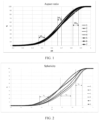
- AR 10 indicates a corresponding aspect ratio of the negative electrode active material particle when the cumulative particle volume distribution of the negative electrode active material is 10%, as shown by “AR 10 " in FIG. 1 .
- AR 50 indicates a corresponding aspect ratio of the negative electrode active material particle when the cumulative particle volume distribution of the negative electrode active material is 50%, as shown by “AR 50 " in FIG. 1 .
- AR 90 indicates a corresponding aspect ratio of the negative electrode active material particle when the cumulative particle volume distribution of the negative electrode active material is 10%, as shown by “AR 90 " in FIG. 1 .
- sphericity of the negative electrode active material is a ratio of a perimeter of a projection of a sphere having a same volume as the negative electrode active material particle, to a perimeter of an actual projection of the negative electrode active material particle. If the sphericity of the negative electrode active material is closer to 1, it indicates that the negative electrode active material particle is more approximately in a spherical shape. When the sphericity of the negative electrode active material is 1, the negative electrode active material particle is exactly in a spherical shape.
- the sphericity of the negative electrode active material may be obtained through dynamic particle image analysis (for example, by using the Sympatec QICPIC dynamic particle image analyzer).
- S n is a corresponding sphericity of the negative electrode active material particle when the cumulative particle volume distribution of the negative electrode active material is n%.
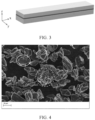
- S 10 indicates a corresponding sphericity of the negative electrode active material particle when the cumulative particle volume distribution of the negative electrode active material is 10%, as shown by “S 10 " in FIG. 2 .
- S 50 indicates a corresponding sphericity of the negative electrode active material particle when the cumulative particle volume distribution of the negative electrode active material is 50%, as shown by “S 50 " in FIG. 2 .
- S 90 indicates a corresponding sphericity of the negative electrode active material particle when the cumulative particle volume distribution of the negative electrode active material is 90%, as shown by “S 90 " in FIG. 2 .
- Rate performance may reflect the fast charging capability of a lithium-ion battery.
- a lithium precipitation phenomenon may occur on a negative electrode surface, and the lithium precipitation phenomenon dramatically reduces rate performance of the lithium-ion battery.
- dynamics performance of the negative electrode active material is reduced. Consequently, electrochemical polarization in a negative electrode is increased, and the lithium precipitation phenomenon occurs more easily.
- Lithium metal that is precipitated may form a lithium dendrite, which may penetrate a separator and cause a short circuit between the negative electrode and a positive electrode.
- deformation of the lithium-ion battery in the cycle process may also cause the lithium precipitation phenomenon. Therefore, how to improve the lithium precipitation phenomenon in the negative electrode has become one of research and development directions.
- the shape and distribution of the negative electrode active material may be adjusted, to improve the lithium precipitation phenomenon in the cycle process of the electrochemical apparatus and improve rate performance and dynamics performance of the electrochemical apparatus, while improving the deformation problem of the electrochemical apparatus.
- this application provides a negative electrode active material, tested by using a dynamic particle image analyzer, where when a cumulative particle volume distribution of the negative electrode active material is 10%, an aspect ratio AR 10 of the negative electrode active material satisfies 0.4 ⁇ AR 10 ⁇ 0.55, and a sphericity S 10 of the negative electrode active material satisfies 0.48 ⁇ S 10 ⁇ 0.60.
- the aspect ratio AR 10 of the negative electrode active material satisfies 0.42 ⁇ AR 10 ⁇ 0.52. In some embodiments, the aspect ratio AR 10 of the negative electrode active material satisfies 0.45 ⁇ AR 10 ⁇ 0.50. In some embodiments, the aspect ratio AR 10 of the negative electrode active material is 0.4, 0.42, 0.45, 0.48, 0.50, 0.52, or 0.55, or is in a range defined by any two of the values.
- the sphericity S 10 of the negative electrode active material satisfies 0.50 ⁇ S 10 ⁇ 0.55. In some embodiments, the sphericity S 10 of the negative electrode active material is 0.48, 0.50, 0.52, 0.55, 0.58, or 0.60, or is in a range defined by any two of the values.
- Particles of the negative electrode active material usually pack a surface of a negative electrode current collector layer by layer based on a porosity in a range and different orientations, to form a negative electrode active material layer. Due to irregular packing of the negative electrode active material particles, if the negative electrode active material particles are excessively slim (for example, AR 10 ⁇ 0.3), pores between small particles are reduced, and this is disadvantageous for electrolyte solution infiltration. Negative electrode active material particles in a sphere-like shape (for example, S 10 > 0.9) elongate a lithium-ion transmission path, and increase resistance in lithium-ion intercalation and de-intercalation.
- a sphere-like shape for example, S 10 > 0.9
- the aspect ratio of the negative electrode active material may be controlled in a hierarchical mode, and then corners on a negative electrode active material surface part are removed by means of shaping to control the sphericity of the negative electrode active material.
- the negative electrode active material satisfies 0.4 ⁇ AR 10 ⁇ 0.55 and 0.48 ⁇ S 10 ⁇ 0.60, some negative electrode active material particles are slim and have corners, and pores of the negative electrode active material may be filled with such particles. This helps suppress swelling of the negative electrode active material layer caused by lithium-ion intercalation and de-intercalation, and therefore improves a deformation problem and a lithium precipitation phenomenon in a cycle process of a lithium-ion battery.
- an aspect ratio AR 50 of the negative electrode active material when the cumulative particle volume distribution of the negative electrode active material is 50%, an aspect ratio AR 50 of the negative electrode active material satisfies 0.6 ⁇ AR 50 ⁇ 0.75. In some embodiments, the aspect ratio AR 50 of the negative electrode active material satisfies 0.62 ⁇ AR 50 ⁇ 0.72. In some embodiments, the aspect ratio AR 50 of the negative electrode active material satisfies 0.65 ⁇ AR 50 ⁇ 0.70. In some embodiments, the aspect ratio AR 50 of the negative electrode active material is 0.6, 0.62, 0.65, 0.68, 0.70, 0.72, or 0.75, or is in a range defined by any two of the values.
- a sphericity S 50 of the negative electrode active material when the cumulative particle volume distribution of the negative electrode active material is 50%, a sphericity S 50 of the negative electrode active material satisfies 0.68 ⁇ S 50 ⁇ 0.82. In some embodiments, the sphericity S 50 of the negative electrode active material satisfies 0.70 ⁇ S 50 ⁇ 0.80. In some embodiments, the sphericity S 50 of the negative electrode active material satisfies 0.72 ⁇ S 50 ⁇ 0.75. In some embodiments, the sphericity S 50 of the negative electrode active material is 0.68, 0.70, 0.72, 0.75, 0.78, 0.80, or 0.82, or is in a range defined by any two of the values.
- an aspect ratio AR 90 of the negative electrode active material when the cumulative particle volume distribution of the negative electrode active material is 90%, an aspect ratio AR 90 of the negative electrode active material satisfies 0.82 ⁇ AR 90 ⁇ 0.90. In some embodiments, the aspect ratio AR 90 of the negative electrode active material satisfies 0.85 ⁇ AR 90 ⁇ 0.88. In some embodiments, the aspect ratio AR 90 of the negative electrode active material is 0.82, 0.85, 0.88, or 0.90, or is in a range defined by any two of the values.
- a sphericity S 90 of the negative electrode active material when the cumulative particle volume distribution of the negative electrode active material is 90%, a sphericity S 90 of the negative electrode active material satisfies 0.85 ⁇ S 90 ⁇ 0.95. In some embodiments, the sphericity S 90 of the negative electrode active material satisfies 0.88 ⁇ S 90 ⁇ 0.90. In some embodiments, the sphericity S 90 of the negative electrode active material is 0.85, 0.88, 0.90, 0.92, or 0.95, or is in a range defined by any two of the values.
- Negative electrode active material particles having different appearances are used in combination, so that when the negative electrode active material satisfies the foregoing AR 10 , AR 50 , AR 90 , S 10 , S 50 , and S 90 , the negative electrode active material looks round on the whole but still has an appearance with certain corners.
- the appearance that looks round on the whole allows presence of an appropriate quantity of pores between packing layers formed by the negative electrode active material particles. This shortens the lithium-ion transmission path, accelerates lithium-ion de-intercalation, and ensures smooth transmission of lithium ions in the pores. Presence of corners can increase friction between the negative electrode active material particles, so that stresses received by the negative electrode active material particles during lithium-ion intercalation and de-intercalation are evenly released to all directions. In this way, swelling of the negative electrode active material layer is suppressed, and a swelling problem of the lithium-ion battery in the cycle process is improved.
- a compacted density of the negative electrode active material is greater than 1.90 g/cm 3 . In some embodiments, the compacted density of the negative electrode active material is greater than 1.95 g/cm 3 . In some embodiments, the compacted density of the negative electrode active material is greater than 2.0 g/cm 3 .
- a greater compacted density may enable mutual occlusion of the negative electrode active material particles having corners in their appearances, so that the negative electrode active material particles are laminated and arranged in a direction parallel with a current collector and that pores between laminated structures are reduced. Sufficient pores are still reserved between particles whose appearances are in a sphere-like shape, to ensure smooth transmission of lithium ions.
- the negative electrode active material includes primary particles (for example, particles circled by solid lines in FIG. 4 ) and secondary particles (for example, particles circled by dashed lines in FIG. 4 ).
- a quantity of the primary particles is 20% to 55%. In some embodiments, based on the total quantity of particles of the negative electrode active material, the quantity of the primary particles is 25% to 50%. In some embodiments, based on the total quantity of particles of the negative electrode active material, the quantity of the primary particles is 30% to 40%. In some embodiments, based on the total quantity of particles of the negative electrode active material, the quantity of the primary particles is 30% to 35%. In some embodiments, based on the total quantity of particles of the negative electrode active material, the quantity of the primary particles is 25%, 30%, 35%, 40%, 45%, or 50%, or is in a range defined by any two of the values.
- the negative electrode active material includes a quantity of primary particles in the foregoing range
- anisotropy of the negative electrode active material particles is increased. Therefore, the swelling problem of the lithium-ion battery in the cycle process can be effectively improved, and the deformation of the lithium-ion battery is suppressed.
- the quantity of primary particles in the foregoing range can further help increase an energy density of the negative electrode active material.
- This application further provides an electrochemical apparatus, where the electrochemical apparatus includes a positive electrode, a negative electrode, a separator, and an electrolyte solution.
- the electrochemical apparatus includes a positive electrode, a negative electrode, a separator, and an electrolyte solution.
- the following describes the positive electrode, negative electrode, separator, and electrolyte solution that can be used in this application.
- the negative electrode used by the electrochemical apparatus in this application includes a negative electrode current collector and a negative electrode active material layer, and the negative electrode active material layer includes the negative electrode active material according to this application.
- the negative electrode active material layer is disposed on the negative electrode current collector. In some embodiments, the negative electrode active material layer is disposed on two sides of the negative electrode current collector. In some embodiments, the negative electrode current collector includes a region of a single-sided negative electrode active material layer.
- weight of the negative electrode active material layer is 0.095 g/cm 2 to 0.105 g/cm 2 . In some embodiments, the weight of the negative electrode active material layer is 0.095 g/cm 2 to 0.101 g/cm 2 . In some embodiments, the weight of the negative electrode active material layer is 0.095 g/cm 2 , 0.097 g/cm 2 , 0.099 g/cm 2 , 0.101 g/cm 2 , 0.103 g/cm 2 , or 0.105 g/cm 2 , or is in a range defined by any two of the values. When the weight of the negative electrode active material layer is in the foregoing range, it helps the electrolyte solution infiltrate the negative electrode active material layer, and therefore, transmission of lithium ions is accelerated.
- a ratio C004/C110 of a peak area C004 of a side (004) to a peak area C110 of a side (110) of the negative electrode active material layer, obtained by performing an X-ray diffraction spectrum test is in a range of 10 to 20.
- the ratio C004/C110 of the negative electrode active material layer, obtained by performing the X-ray diffraction spectrum test is in a range of 12 to 18.
- the ratio C004/C110 of the negative electrode active material layer, obtained by performing the X-ray diffraction spectrum test is in a range of 14 to 16.
- the ratio C004/C110 of the negative electrode active material layer is 10, 11, 12, 13, 14, 15, 16, 17, 18, 19, or 20, or is in a range defined by any two of the values.
- a value of C004/C110 of the negative electrode active material layer can reflect an orientation of the negative electrode active material layer.
- the negative electrode active material layer shows great anisotropy.
- C004/C110 is large, that is, when the peak area C004 of the side (004) is large, in a compacted density, negative electrode active material particles tend to be arranged on the current collector in parallel with the current collector.
- the negative electrode active material layer has a porosity of 20% to 45%.
- the negative electrode active material layer has a porosity of 25% to 40%. In some embodiments, the negative electrode active material layer has a porosity of 30% to 35%. In some embodiments, the porosity of the negative electrode active material layer is 20%, 25%, 30%, 35%, 40%, or 45%, or is in a range defined by any two of the values. When the porosity of the negative electrode active material layer is in the foregoing range, it helps the electrolyte solution infiltrate the negative electrode active material layer, shorten a lithium-ion transmission path, and accelerate lithium-ion de-intercalation, while helping form an appropriate solid electrolyte interface (SEI) film and reduce loss of lithium ions.
- SEI solid electrolyte interface
- the porosity of the negative electrode active material layer may be implemented by controlling roll-in pressure in a negative electrode preparation process. By controlling the roll-in pressure, a continuous change of thickness of the negative electrode active material layer can be implemented, so that the porosity of the negative electrode active material layer can be controlled.
- the porosity of the negative electrode active material layer may be obtained by performing a test according to the standard GB / T24586-2009 Iron Ores - Determination of Apparent Density, True Density, and Porosity.
- a coating is further included between the negative electrode current collector and the negative electrode active material layer, and a ratio of thickness of the coating to thickness of the negative electrode active material layer is in a range of 1:50 to 1:120. In some embodiments, the ratio of the thickness of the coating to the thickness of the negative electrode active material layer is in a range of 1:60 to 1:100. In some embodiments, the ratio of the thickness of the coating to the thickness of the negative electrode active material layer is in a range of 1:80 to 1:90.
- the ratio of the thickness of the coating to the thickness of the negative electrode active material layer is 1:50, 1:60, 1:70, 1:80, 1:90, 1:100, 1:110, or 1:120, or is in a range defined by any two of the values.
- the coating includes a conductive layer.
- a conductive material of the conductive layer may include any conductive material, provided that the conductive material does not cause a chemical change.
- Non-restrictive examples of the conductive material include carbon-based materials (for example, natural graphite, artificial graphite, carbon black, acetylene black, Ketjen black, carbon fibers, carbon nanotubes, and graphene), metal-based materials (for example, metal powder and metal fibers, such as copper, nickel, aluminum, and silver), conductive polymers (for example, polyphenylene derivatives), and mixtures thereof.
- a bonding force between the negative electrode active material layer and the negative electrode current collector is greater than 18 N/m. In some embodiments, the bonding force between the negative electrode active material layer and the negative electrode current collector is greater than 20 N/m. In some embodiments, the bonding force between the negative electrode active material layer and the negative electrode current collector is greater than 25 N/m.
- Bonding between the negative electrode active material layer and the negative electrode current collector may be implemented by controlling the roll-in operation in the negative electrode preparation process. Specifically, the bonding between the negative electrode active material layer and the negative electrode current collector may be tested by using an Instron (model number 33652) tester: taking an electrode plate that is 15-20 mm long; fixing the electrode plate on a steel plate by using a 3M double-sided adhesive tape; attaching the adhesive tape to a surface of the negative electrode active material layer, where one side of the adhesive tape is connected to a paper tape having a same width as the adhesive tape; adjusting a limiting block of a tensile machine to an appropriate position, and folding the paper tape up and sliding for 40 mm at a sliding speed of 50 mm/min; and testing the bonding force between the negative electrode active material layer and the negative electrode current collector at 180° (that is, reverse stretching).
- Instron model number 33652
- the electrochemical apparatus satisfies the following relationship: Y ⁇ 0.417X + A, where X is a state of charge of the electrochemical apparatus, and 1 ⁇ X ⁇ 1.5; and when the state of charge of the electrochemical apparatus is 1, thickness of the electrochemical apparatus is A mm; or when the state of charge of the electrochemical apparatus is X, thickness of the electrochemical apparatus is Y mm.
- X is 1.1, 1.2, 1.3, 1.4, or 1.5.
- the negative electrode current collector in this application may be selected from copper foil, nickel foil, stainless steel foil, titanium foil, nickel foam, copper foam, a polymer substrate coated with conductive metal, and any combination thereof.
- the negative electrode further includes a binder
- the binder is selected from at least one of the following: polyvinyl alcohol, carboxymethyl cellulose, hydroxypropyl cellulose, diacetyl cellulose, polyvinyl chloride, carboxylated polyvinyl chloride, polyvinyl fluoride, a polymer containing ethylene oxide, polyvinylpyrrolidone, polyurethane, polytetrafluoroethylene, poly (1,1-difluoroethylene), polyethylene, polypropylene, styrene-butadiene rubber, styrene-butadiene rubber, epoxy resin, nylon, and the like.
- the positive electrode includes a positive electrode current collector and a positive electrode active material disposed on the positive electrode current collector.
- Specific types of positive electrode active materials are not subject to specific limitations, and can be selected according to requirements.
- the positive electrode active material includes a positive electrode material that can absorb and release Li (Li).
- positive electrode materials that can absorb or release Li (Li) may include lithium cobalt oxide, lithium nickel cobalt manganate, lithium nickel cobalt aluminate, lithium manganate oxide, lithium manganese iron phosphate, lithium vanadium phosphate, lithium vanadyl phosphate, lithium iron phosphate, lithium titanate, and lithium-rich manganese-based materials.
- a chemical formula of lithium cobalt oxide may be a chemical formula 1: Li x Co a M1 b O 2-c chemical formula 1 where M1 means being selected from at least one of the following: nickel (Ni), manganese (Mn), magnesium (Mg), aluminum (Al), boron (B), titanium (Ti), vanadium (V), chrome (Cr), iron (Fe), copper (Cu), zinc (Zn), molybdenum (Mo), tin (Sn), calcium (Ca), strontium (Sr), tungsten (W), yttrium (Y), lanthanum (La), zirconium (Zr), and silicon (Si), and values of x, a, b, and c are respectively in the following ranges: 0.8 ⁇ x ⁇ 1.2, 0.8 ⁇ a ⁇ 1, 0 ⁇ b ⁇ 0.2, and -0.1 ⁇ c ⁇ 0.2.
- a chemical formula of lithium nickel cobalt manganate or lithium nickel cobalt aluminate may be a chemical formula 2: Li y Ni d M2 e O 2-f chemical formula 2 where M2 means being selected from at least one of the following: cobalt (Co), manganese (Mn), magnesium (Mg), aluminum (Al), boron (B), titanium (Ti), vanadium (V), chrome (Cr), iron (Fe), copper (Cu), zinc (Zn), molybdenum (Mo), tin (Sn), calcium (Ca), strontium (Sr), tungsten (W), zirconium (Zr), and silicon (Si), and values of y, d, e, and f are respectively in the following ranges: 0.8 ⁇ y ⁇ 1.2, 0.3 ⁇ d ⁇ 0.98, 0.02 ⁇ e ⁇ 0.7, and -0.1 ⁇ f ⁇ 0.2.
- a chemical formula of lithium manganate oxide may be a chemical formula 3: Li z Mn 2-g M3 g O 4-h chemical formula 3 where M3 means being selected from at least one of the following: cobalt (Co), nickel (Ni), magnesium (Mg), aluminum (Al), boron (B), titanium (Ti), vanadium (V), chrome (Cr), iron (Fe), copper (Cu), zinc (Zn), molybdenum (Mo), tin (Sn), calcium (Ca), strontium (Sr), and tungsten (W), and values of z, g, and h are respectively in the following ranges: 0.8 ⁇ z ⁇ 1.2, 0 ⁇ g ⁇ 1.0, and -0.2 ⁇ h ⁇ 0.2.
- weight of the positive electrode active material layer is 1.5 to 15 times that of the negative electrode active material layer. In some embodiments, the weight of the positive electrode active material layer is 3 to 10 times that of the negative electrode active material layer. In some embodiments, the weight of the positive electrode active material layer is 5 to 8 times that of the negative electrode active material layer. In some embodiments, the weight of the positive electrode active material layer is 1.5, 2, 3, 4, 5, 6, 7, 8, 9, 10, 11, 12, 13, 14, or 15 times that of the negative electrode active material layer.
- the positive electrode active material layer may have a coating on its surface, or may be mixed with another compound having a coating.
- the coating may include at least one coating element compound selected from oxide of coating elements, hydroxide of coating elements, oxyhydroxide of coating elements, oxycarbonate (oxycarbonate) of coating elements, and hydroxycarbonate (hydroxycarbonate) of coating elements.
- the compound used for the coating may be amorphous or crystalline.
- the coating elements included in the coating may include Mg, Al, Co, K, Na, Ca, Si, Ti, V, Sn, Ge, Ga, B, As, Zr, F, or a mixture thereof.
- the coating may be applied by using any method, provided that the method does not have adverse impact on performance of the positive electrode active material.
- the method may include any coating method well known to a person of ordinary skill in the art, such as spraying or dipping.
- the positive electrode active material layer further includes a binder, and optionally further includes a positive electrode conductive material.
- the binder can enhance bonding between particles of the positive electrode active material, and binding between the positive electrode active material and the current collector.
- Non-restrictive examples of the binder include polyvinyl alcohol, hydroxypropyl cellulose, diacetyl cellulose, polyvinyl chloride, carboxylated polyvinyl chloride, polyvinyl fluoride, a polymer containing ethylene oxide, polyvinylpyrrolidone, polyurethane, polytetrafluoroethylene, poly (1,1-difluoroethylene), polyethylene, polypropylene, styrene-butadiene rubber, acrylic styrene-butadiene rubber, epoxy resin, nylon, and the like.
- the positive electrode active material layer includes a positive electrode conductive material, thereby imparting conductivity to the electrode.
- the positive electrode conductive material may include any conductive material, provided that the conductive material does not cause a chemical change.
- Non-restrictive examples of the positive electrode conductive material include carbon-based materials (for example, natural graphite, artificial graphite, carbon black, acetylene black, Ketjen black, and carbon fibers), metal-based materials (for example, metal powder and metal fibers, including, for example, copper, nickel, aluminum, and silver), conductive polymers (for example, polyphenylene derivatives), and mixtures thereof.
- the positive electrode current collector used for the electrochemical apparatus according to this application may be aluminum (Al), but is not limited thereto.
- the electrolyte solution that can be used in the embodiments of this application may be an electrolyte solution known in the prior art.
- Electrolytes that can be used in the electrolyte solution in the embodiments of this application include but are not limited to an inorganic lithium salt, for example, LiClO 4 , LiAsF 6 , LiPF 6 , LiBF 4 , LiSbF 6 , LiSO 3 F, or LiN(FSO 2 ) 2 ; an organic lithium salt containing fluorine, for example, LiCF 3 SO 3 , LiN(FSO 2 )(CF 3 SO 2 ), LiN(CF 3 SO 2 ) 2 , LiN(C 2 F 5 SO 2 ) 2 , lithium -hexafluoropropane-1,3-disulfonimide, lithium tetrafluoroethane-1,2-disulfonimide, LiN(CF 3 SO 2 )(C 4 F 9 SO 2 ), LiC(CF 3 SO 2 ) 3 , LiPF 4 (CF 3 ) 2 , LiPF 4 (C 2 F 5 ) 2 , LiPF 4 (CF 3 SO 2
- the electrolyte includes a combination of LiPF 6 and LiBF 4 .
- the electrolyte includes a combination of an inorganic lithium salt such as LiPF 6 or LiBF 4 and an organic lithium salt containing fluorine such as LiCF 3 SO 3 , LiN(CF 3 SO 2 ) 2 , or LiN(C 2 F 5 SO 2 ) 2 .
- the electrolyte includes LiPF 6 .
- a concentration of the electrolyte is in a range of 0.8 mol/L to 3 mol/L, for example, is in a range of 0.8 mol/L to 2.5 mol/L, 0.8 mol/L to 2 mol/L, or 1 mol/L to 2 mol/L, or for another example, is 1 mol/L, 1.15 mol/L, 1.2 mol/L, 1.5 mol/L, 2 mol/L, or 2.5 mol/L.
- Solvents that can be used in the electrolyte solution in the embodiments of this application include but are not limited to cyclic carbonate, chain carbonate, cyclic carboxylate, chain carboxylate, cyclic ether, chain ether, an organic solvent containing phosphorus, an organic solvent containing sulfur, and an aromatic solvent containing fluorine.
- the cyclic carbonate includes but is not limited to ethylene carbonate(ethylene carbonate, EC), propylene carbonate (propylene carbonate, PC), and 1,2-butylene carbonate.
- the cyclic carbonate has three to six carbon atoms.
- the chain carbonate includes but is not limited to: chain carbonate such as dimethyl carbonate, ethyl methyl carbonate, diethyl carbonate (diethyl carbonate, DEC), methyl n-propyl carbonate, ethyl n-propyl carbonate, and di-n-propyl carbonate, and fluorine-substituted chain carbonate such as bis(fluoromethyl) carbonate, bis(difluoromethyl) carbonate, bis(trifluoromethyl) carbonate, bis(2-fluoroethyl) carbonate, bis(2,2-difluoroethyl) carbonate, bis(2,2,2-trifluoroethyl) carbonate, 2-fluoroethyl methyl carbonate, 2,2-difluoroethyl methyl carbonate, and 2,2,2-trifluoroethyl methyl carbonate.
- chain carbonate such as dimethyl carbonate, ethyl methyl carbonate, diethyl carbonate
- the cyclic carboxylate includes but is not limited to ⁇ -butyrolactone and ⁇ -valerolactone. In some embodiments, some hydrogen atoms in the cyclic carboxylate may be replaced with fluorine.
- the chain carboxylate includes but is not limited to methyl acetate, ethyl acetate, propyl acetate, isopropyl acetate, butyl acetate, sec-butyl acetate, isobutyl acetate, tert-butyl acetate, methyl propionate, ethyl propionate, propyl propionate, isopropyl propionate, methyl butyrate, ethyl butyrate, propyl butyrate, methyl isobutyrate, ethyl isobutyrate, menthyl valerate, ethyl valerate, methyl pivalate, and ethyl pivalate.
- fluorine-substituted chain carboxylate includes but is not limited to methyl trifluoroacetate, ethyl trifluoroacetate, propyl trifluoroacetate, n-butyl trifluoroacetate, and 2,2,2-trifluoroethyl trifluoroacetate.
- the cyclic ether includes but is not limited to tetrahydrofuran, 2-methyltetrahydrofuran, 1,3-dioxolane, 2-methyl-1,3-dioxolane, 4-methyl-1,3-dioxolane, 1,3-dioxane, 1,4-dioxane, and 2,2-dimethoxypropane.
- the chain ether includes but is not limited to dimethoxymethane, 1,1-dimethoxy ethane, 1,2-dimethoxy ethane, diethoxymethane, 1,1-diethoxy ethane, 1,2-diethoxy ethane, ethoxy methoxy methane, 1,1-ethoxy methoxy ethane, and 1,2-ethoxy methoxy ethane.
- the organic solvent containing phosphorus includes but is not limited to trimethyl phosphate, triethyl orthophosphate, dimethylethyl phosphate, diethyl methylphosphonate, methylethylene phosphate, ethylene ethyl phosphate, triphenyl phosphate, trimethyl phosphite, triethyl phosphite, triphenyl phosphite, tris(2,2,2-trifluoroethyl)phosphate, and tris(2,2,3,3,3 -pentafluoropropyl)phosphate.
- the organic solvent containing sulfur includes but is not limited to sulfolane, 2-dimethylsulfolane, 3-dimethylsulfolane, methyl sulfonyl methane, diethyl sulfone, ethyl methyl sulfone, methylpropyl sulfone, dimethyl sulfoxide, methyl methanesulfonate, ethyl methanesulfonate, methyl ethanesulfonate, ethyl ethanesulfonate, dimethyl sulfate, diethyl sulfate, and butyl sulfate.
- some hydrogen atoms in the organic solvent containing sulfur may be replaced with fluorine.
- the aromatic solvent containing fluorine includes but is not limited to fluorobenzen, difluorobenzene, trifluorobenzene, tetrafluorobenzene, pentafluorobenzene, hexafluorobenzene, and benzotrifluoride.
- a solvent used in the electrolyte solution in this application includes one or more of the foregoing solvents.
- the solvent used in the electrolyte solution in this application includes cyclic carbonate, chain carbonate, cyclic carboxylate, chain carboxylate, or a combination thereof.
- the solvent used in the electrolyte solution in this application includes an organic solvent selected from a group formed by the following substances: ethylene carbonate, propylene carbonate, diethyl carbonate, ethyl propionate, propyl propionate, propyl acetate, ethyl acetate, or a combination thereof.
- the solvent used in the electrolyte solution in this application includes ethylene carbonate, propylene carbonate, diethyl carbonate, ethyl propionate, propyl propionate, ⁇ -butyrolactone, or a combination thereof.
- Additives that can be used in the electrolyte solution in the embodiments of this application include but are not limited to a compound having two or three cyanogroups, a cyclic carbonate containing a carbon-carbon double bond, a compound containing a sulfur-oxygen double bond, and lithium difluorophosphate.
- the compound having two or three cyanogroups may include at least one selected from succinonitrile (SN), adiponitrile (ADN), ethylene glycol bis(propionitrile) ether (EDN), 1,3,5-pentanetricarbonitrile, 1,2,3-propanetricarbonitrile, 1,3,6-hexyltrimethonitrile (HTCN), 1,2,6-hexyltrimethonitrile, 1,2,3-tris(2-cyanoethoxy)propane (TCEP), or 1,2,4-tris(2-cyanoethoxy)butane.
- succinonitrile SN
- ADN adiponitrile
- EDN ethylene glycol bis(propionitrile) ether
- HTCN 1,3,6-hexyltrimethonitrile
- TCEP 1,2,6-hexyltrimethonitrile
- TCEP 1,2,4-tris(2-cyanoethoxy)butane.
- the cyclic carbonate containing a carbon-carbon double bond specifically includes but is not limited to at least one of vinylene carbonate, methyl vinylene carbonate, ethyl vinylene carbonate, Vinyl ethylene carbonate, or 1, 2-dimethylvinyl carbonate.
- the compound containing a sulfur-oxygen double bond includes but is not limited to at least one of ethylene sulfate, 1,2-propanediol sulfate, 1,3-propane sultone, 1- fluoro-1,3-propane sultone, 2-fluoro-1,3-propane sultone, or 3-fluoro-1,3-propane sultone.
- the separator is disposed between the positive electrode and the negative electrode to avoid a short circuit.
- the material and shape of the separator that can be used in the embodiments of this application are not specifically limited, and any technology disclosed in the prior art may be used for the separator.
- the separator includes a polymer or an organic substance or the like formed by a material that is stable against the electrolyte solution in this application.
- the separator may include a substrate layer and a surface treatment layer.
- the substrate layer is a non-woven fabric, a film, or a composite film with a porous structure
- a material of the substrate layer is selected from at least one of polyethylene, polypropylene, polyethylene terephthalate, and polyimide.
- a polypropylene porous film, a polyethylene porous film, a polypropylene non-woven fabric, a polyethylene non-woven fabric, or a polypropylene-polyethylene-polypropylene porous composite film may be selected.
- the porous structure can improve heat resistance, oxidation resistance, and electrolyte solution infiltration performance of the separator, and enhance adhesion between the separator and an electrode plate.
- a surface treatment layer is disposed on at least one surface of the substrate layer, and the surface treatment layer may be a polymer layer or an inorganic substance layer, or may be a layer formed by a mixture of a polymer and an inorganic substance.
- the inorganic substance layer includes inorganic particles and a binder.
- the inorganic particles are selected from one or a combination of aluminum oxide, silicon oxide, magnesium oxide, titanium oxide, hafnium oxide, tin oxide, ceria oxide, nickel oxide, zinc oxide, calcium oxide, zirconium oxide, yttrium oxide, silicon carbide, boehmite, aluminum hydroxide, magnesium hydroxide, calcium hydroxide, and barium sulfate.
- the binder is selected from one or a combination of polyvinylidene fluoride, a copolymer of vinylidene fluoride and hexafluoropropylene, polyamide, polyacrylonitrile, polyacrylate, polyacrylic acid, polyacrylate, polyvinylpyrrolidone, polyvinyl ether, polymethyl methacrylate, polytetrafluoroethylene, and polyhexafluoropropylene.
- the polymer layer includes a polymer, and a material of the polymer is selected from at least one of polyamide, polyacrylonitrile, acrylate polymer, polyacrylic acid, polyacrylate, polyvinylpyrrolidone, polyvinyl ether, polyvinylidene fluoride, and poly (vinylidene fluoride-hexafluoropropylene).
- This application further provides an electrochemical apparatus, where the electrochemical apparatus includes a positive electrode, an electrolyte solution, and a negative electrode, the positive electrode includes a positive electrode active material layer and a positive electrode current collector, the negative electrode includes a negative electrode active material layer and a negative electrode current collector, and the negative electrode active material layer includes the negative electrode active material according to this application.
- the electrochemical apparatus in this application includes any apparatus on which electrochemical reactions occur. Its specific examples include all kinds of primary batteries, secondary batteries, fuel batteries, solar batteries, or capacitors. Particularly, the electrochemical apparatus is a lithium secondary battery, including a lithium metal secondary battery, a lithium-ion secondary battery, a lithium polymer secondary battery, or a lithium-ion polymer secondary battery.
- This application provides another electronic apparatus, where the electronic apparatus includes the electrochemical apparatus according to this application.
- a purpose of the electrochemical apparatus in this application is not specifically limited. It can be used for any known electronic apparatus in the prior art.
- the electrochemical apparatus in this application may be used, without limitation, in a notebook computer, a stylus-input computer, a mobile computer, an e-book player, a portable phone, a portable fax, a portable copier, a portable printer, a stereo headphone, a video recorder, an LCD TV, a handy cleaner, a portable CD player, a mini disk, a transceiver, an electronic notebook, a calculator, a memory card, a portable recorder, a radio, a backup power supply, a motor, a vehicle, a motorcycle, a power assisted cycle, a bicycle, a lighting appliance, a toy, a game player, a clock, an electric tool, a flash lamp, a camera, a large household battery, a lithium-ion capacitor, or the like.
- Graphite, styrene-butadiene rubber (SBR for short), and sodium carboxymethyl cellulose (CMC for short), which were negative electrode active substances, were fully stirred and mixed based on a weight ratio of 95:2:3 in a deionized water solvent, to form even negative electrode slurry; the slurry was applied to two surfaces of copper foil of a current collector coated with a primer layer (such as carbon black), where thickness of the primer layer was 1.0 ⁇ m, and after the slurry was dried, cold pressing was performed to obtain a negative electrode active material layer; and then the negative electrode active material layer was piece-cut, and welded with a tab, and a negative electrode was obtained.
- SBR styrene-butadiene rubber
- CMC sodium carboxymethyl cellulose
- a weight of the negative electrode active material layer was 0.100 mg/mm 2 , and thickness of the negative electrode active material layer was 130 ⁇ m.
- a weight of a negative electrode active material layer on any surface of a negative electrode current collector was calculated as the weight of the negative electrode active material layer.
- the aspect ratio and sphericity of the negative electrode active material could be controlled as follows: In the process of preparing the negative electrode active material, prepared graphite was fed through a feed system into a shaping region and then ground to make surfaces of particles having corners, thus to control the aspect ratio and sphericity of each particle; and then the ground particles were classified by using an automatic shunting and classifying region, to obtain particles to be distributed.
- Primary particles of the negative electrode active material were samples obtained by directly graphitizing crushed particles of a particle size distribution, and secondary particles of the negative electrode active material were secondary particles obtained after a granulation device performed heat treatment on crushed particles mixed with a proportion of bitumen at a particular temperature so that particles were bonded together by the bitumen, and then the mixture was graphitized.
- Primary particle content of the negative electrode active material was obtained by controlling a mixture proportion of the primary particles and the secondary particles.
- a test method for powder compacting of the negative electrode active material was: weighing 1 g powder and placing the powder in a mold (its diameter was 13 mm), then placing the mold in an automatic powder compacting test device (SUNS UTM7305), and finally measuring, by applying pressure to the mold by using a device, a compacted powder density of the powder under a condition of 5t.
- Lithium cobalt oxide (LiCoO 2 ), acetylene black, and polyvinylidene fluoride (PVDF) were fully stirred and mixed based on a weight ratio of 96:2:2 in an appropriate N-methylpyrrolidone (NMP) solvent, to form even positive electrode slurry.
- NMP N-methylpyrrolidone
- ethylene carbonate (EC for short), diethyl carbonate (DEC for short), and propylene carbonate (PC for short) were mixed evenly based on a weight ratio of 3:4:3; then fully dried lithium salt LiPF 6 was dissolved in the foregoing non-water solvent; and finally 3 wt% fluoroethylene carbonate, 2 wt% 1,3-propane suhone, and 2 wt% succinonitrile were added to make an electrolyte solution.
- PE polyethylene
- the positive electrode, the separator, and the negative electrode were laminated in sequence, so that the separator was located between the positive electrode and the negative electrode for separation, and then a bare cell was obtained by winding; after tabs were welded, the bare cell was placed in an aluminum plastic film of outer package foil; the prepared electrolyte solution was injected into the dried bare cell, and a soft package lithium-ion battery was obtained after operations such as vacuum packaging, standing, chemical conversion, shaping, and capacity testing.
- the aspect ratio distribution of the negative electrode active material was tested by using a Sympatec QICPIC dynamic particle image analyzer.
- the sphericity distribution of the negative electrode active material was tested by using the Sympatec QICPIC dynamic particle image analyzer.
- the bonding between the negative electrode active material layer and the negative electrode current collector was tested by using an Instron (model number 33652) tester: taking an electrode plate that was 15-20 mm long; fixing the electrode plate on a steel plate by using a 3M double-sided adhesive tape; attaching the adhesive tape to a surface of the negative electrode active material layer, where one side of the adhesive tape was connected to a paper tape having a same width as the adhesive tape; adjusting a limiting block of a tensile machine to an appropriate position, and folding the paper tape up and sliding for 40 mm at a sliding speed of 50 mm/min; and testing the bonding force between the negative electrode active material layer and the negative electrode current collector at 180° (that is, reverse stretching).
- Instron model number 33652
- a diffraction pattern of a side (004) and a diffraction pattern of a side (110) in an X-ray diffraction spectrum of the negative electrode active material layer was tested according to Machinery Industry Standard of the People's Republic of China JB/T 4220-2011 Determination Method of Artificial Graphite Lattice Parameter. Test conditions were as follows: The X-ray used CuK ⁇ radiation, and the CuK ⁇ radiation was removed by a filter or a monochromator. A working voltage of an X-ray tube was (30-35) kV, and a working current was (15-20) mA. A scanning speed of a counter was 1/4(O)/min.
- a scanning range of a diffraction angle 2 ⁇ was 53°-57°.
- a scanning range of a diffraction angle 2 ⁇ was 75°-79°.
- a peak area obtained from the diffraction pattern of (004) was marked as C004.
- a peak area obtained from the diffraction pattern of (110) was marked as C110.
- a ratio C004/C110 of the negative electrode active material layer was calculated.
- a negative electrode active material layer sample was made into a complete wafer. 30 samples were tested in each example or comparative example, and the volume of each sample was approximately 0.35 cm 3 .
- the porosity of the negative electrode active material layer was tested according to the standard GB / T24586-2009 Iron Ores - Determination of Apparent Density, True Density, and Porosity.
- a negative electrode active material layer sample that was 50 mm long and 50 mm wide was taken. Under a dry condition, a 5 mL electrolyte solution was dripped onto a surface of the sample, and timing started. Timing stopped when the electrolyte solution on the surface of the sample disappeared completely. Timing time was marked as the infiltration time of the negative electrode active material layer. 30 samples were tested in each example or comparative example, and an average value was obtained.
- the lithium-ion battery was connected to a Bio-Logic VMP3B electrochemical workstation manufactured by Bio-Logic France, where a frequency range was 30 mHz to 50 kHz, and amplitude was 5 mV. After data was collected, a complex impedance plane diagram was used to analyze the data and obtain the lithium-ion liquid-phase transfer resistance (R ion ).
- the lithium-ion battery was left to stand at 25°C for five minutes, then charged to a voltage 4.45V at a constant current of 0.7C, then charged to 0.05C at a constant voltage of 4.45V, left to stand for five minutes, then discharged to a voltage 3.0V at a constant current of 0.5C, and left to stand for five minutes.
- the foregoing charging and discharging process was repeated.
- the lithium-ion battery was discharged to a voltage 3.0V at 0.1C, and a 0.1C discharge capacity of the lithium-ion battery was recorded; and then the lithium-ion battery was discharged to a voltage 3.0V at 2C, and a 2C discharge capacity of the lithium-ion battery was recorded.
- the lithium-ion battery was left to stand at 25°C for five minutes.
- the lithium-ion battery was charged to a voltage 4.45V at a constant current of 0.7C, then charged to 0.05C at a constant voltage of 4.45V, and left to stand for five minutes.
- the lithium-ion battery was discharged to a voltage 3.0V at a constant current of 0.5C, to test a discharge capacity of the lithium-ion battery at 25°C.
- a furnace temperature was adjusted to -20°C.
- the foregoing charging and discharging process was repeated, to test a discharge capacity of the lithium-ion battery at -20°C.
- the lithium-ion battery was charged to 4.45V at a constant current of 1.5C, then charged to 0.05C at a constant voltage of 4.45V, and left to stand for 30 minutes.
- the lithium-ion battery was discharged at 0.1C for 10 seconds, where a voltage value was recorded as U1, and the lithium-ion battery was discharged at 1C for 360 seconds, where a voltage value was recorded as U2.
- the charging and discharging step was repeated five times.
- “1C” was a current value for completely discharging the capacity of the lithium-ion battery for one hour.
- DC resistance of the lithium-ion battery at 0°C was tested by using a basically same method, and a difference was only that an operating temperature was 0°C.
- the DCR in this application is DC resistance of the lithium-ion battery at 10% state of charge (SOC).
- the lithium-ion battery was left to stand at 25°C for five minutes. Based on settings of the examples or the comparative examples, the lithium-ion battery was charged to 4.45V at a constant current of 0.7C or 2C, then charged to 0.05C at a constant voltage of 4.45V, and left to stand for five minutes. Then the lithium-ion battery was discharged to 3.0V at a constant current of 0.5C, and left to stand for five minutes. The foregoing charging and discharging process was repeated 10 times. The battery was fully charged, and disassembled under a dry condition. A status of the negative electrode was photographed and recorded.
- a lithium precipitation of the lithium-ion battery was determined according to the following criterion:
- a copper wire was connected additionally in the foregoing process of preparing the lithium-ion battery and used as a reference electrode, and lithium plating was performed on the negative electrode at a current 20 ⁇ A for six hours, to obtain a three-electrode lithium-ion battery.
- the three-electrode lithium-ion battery was connected to the Bio-Logic VMP3B electrochemical workstation manufactured by Bio-Logic France, where the frequency range was 30 MHz to 50 kHz, and the amplitude was 5 mV. After data was collected, a complex impedance plane diagram was used to analyze the data and obtain the charge transfer resistance (Rct) of the lithium-ion battery.
- a width H1 of the negative electrode after cold pressing along the X/Y direction was tested by using a charge-coupled device (CCD).
- the negative electrode was made into the lithium-ion battery according to the steps of preparing the lithium-ion battery.
- the lithium-ion battery was left to stand at 25°C for five minutes, then charged to 4.45V at a constant current of 0.7C, and then charged to 0.05C at a constant voltage of 4.45V
- the lithium-ion battery was disassembled under a dry condition, and the disassembled negative electrode was obtained.
- a width H2 of the negative electrode along the X/Y direction (as shown in FIG. 3 ) was tested by using the charge-coupled device (CCD).
- a thickness of the negative electrode processed with a compacted density (1.78 g/cc) was tested, and was marked as T1.
- the negative electrode was made into the lithium-ion battery according to the steps of preparing the lithium-ion battery.
- the lithium-ion battery was left to stand at 25°C for five minutes and then charged to 3.95V (that is, 50% SOC) at a constant current of 0.7C.
- the lithium-ion battery was disassembled under a dry condition, and the disassembled negative electrode was obtained.
- Negative electrode thicknesses at a minimum of 14 points were recorded, and an average value was obtained and marked as T2.
- the lithium-ion battery was left to stand at 45°C for five minutes, then charged to 4.45V at a constant current of 0.7C, then charged to 0.05C at a constant voltage of 4.45V, and left to stand for five minutes. Thicknesses at three points of the lithium-ion battery were tested by using a PPG test method, and an average value was obtained and marked as PPG 0 . Thicknesses at three points of the lithium-ion battery were tested by using an MMC test method, and an average value was obtained and marked as MMC 0 . Then the lithium-ion battery was discharged to 3.0V at a constant current of 0.5C, and left to stand for five minutes. The foregoing charging and discharging cycle was repeated 500 times.
- a thickness of the battery was recorded every 50 cycles in the first to the 200 th charging and discharging cycles; and thickness of the battery was recorded every 100 cycles in the 300 th to the 500 th charging and discharging cycles. Thicknesses at three points of the lithium-ion battery were tested every time, and an average value was obtained and marked as PPG x and MMC x (x represented a quantity of cycles). A maximum value of the MMC thicknesses tested at three test points was marked as Max (MMC x ). A difference between MMC x and MMC 0 was marked as a battery thickness increment.
- the foregoing PPG test method was: using a PPG soft package battery thickness gauge (manufactured by Shenzhen Aotomei Automation TechnologyCo., Ltd), placing the lithium-ion battery on a lower front panel of the thickness gauge, where an upper cover plate dropped at a constant speed in the test process, and measuring thickness of the lithium-ion battery by using a pressure sensor, where the measured thickness was PPG thickness.
- a PPG soft package battery thickness gauge manufactured by Shenzhen Aotomei Automation TechnologyCo., Ltd
- the foregoing MMC test method was: using a micrometer tester (manufactured by Mitutoyo Japan, model number: MDC-25SX) to measure thickness of a tab on the positive electrode of the lithium-ion battery, measuring three different positions of each sample, obtaining an average value, and marking the average value as an MMC thickness.
- a micrometer tester manufactured by Mitutoyo Japan, model number: MDC-25SX
- the cyclic swelling rate and the cyclic deformation rate of the lithium-ion battery at 25°C were tested by using a basically same method, and a difference was that an operating temperature was 25°C.
- the lithium-ion battery was left to stand at 25°C for five minutes, then charged to 4.45V at a constant current of 0.5C and then charged to 0.025C at a constant voltage of 4.45V (that is, 100% SOC, also known as the state of charge being 1). Then the lithium-ion battery was charged at a constant current of 0.1C for one hour, and left to stand for 30 minutes.
- the process of charging at a constant current of 0.1C was repeated five times, where the first charging, second charging, third charging, fourth charging, and fifth charging reached 110% SOC (that is, the state of charge was 1.1), 120% SOC (that is, the state of charge was 1.2), 130% SOC (that is, the state of charge was 1.3), 140% SOC (that is, the state of charge was 1.4), and 150% SOC (that is, the state of charge was 1.5) respectively. Duration of each charging was one hour, and the lithium-ion battery was left to stand for 30 minutes after each charging was ended.
- Table 1 presents impact of the aspect ratio distribution and sphericity distribution of the negative electrode active material on performance of the lithium-ion battery.
- the swelling rate and DC resistance (DCR) of the lithium-ion battery in high-temperature cycling could be reduced significantly, and a lithium precipitation phenomenon did not occur in the cycling process of the lithium-ion battery. Performance of the lithium-ion battery was improved significantly.
- Table 2 presents impact of the orientation of the negative electrode active material layer on performance of the lithium-ion battery.
- the result indicates that, as the aspect ratio and the sphericity of the particle was reduced, the C004/C110 value of the negative electrode active material layer increased, so that the swelling rate of the negative electrode active material layer along the Z direction decreased, and the thickness increment of the battery decreased.
- the aspect ratio distribution and the sphericity distribution of the negative electrode active material satisfied the following conditions: 0.4 ⁇ AR 10 ⁇ 0.55, 0.48 ⁇ S 10 ⁇ 0.60, 0.6 ⁇ AR 50 ⁇ 0.75, 0.68 ⁇ S 50 ⁇ 0.82, 0.82 ⁇ AR 90 ⁇ 0.90, and 0.85 ⁇ S 90 ⁇ 0.95, when the C004/C110 value of the negative electrode active material layer was in a range of 10 to 20, stresses generated by intercalation and de-intercalation of lithium-ion were released to all directions, and swelling rates along the Z direction and the X/Y direction were balanced.
- Table 3 presents impact of the percentage of primary particles and the compacted density of the negative electrode active material, and the weight and coating of the negative electrode active material layer on performance of the lithium-ion battery. Except parameters listed in Table 3, all settings in Examples 28-39 were the same as those in Example 10.
- the result indicates that, as the percentage of primary particles in the negative electrode active material increased, the compacted density of the negative electrode active material increased.
- reducing the weight of the negative electrode active material layer could reduce the thickness of the negative electrode active material layer, so that charge transfer resistance (Rct) of a lithium ion entering a vicinity of the current collector through a pore between particles was reduced, and that a lithium precipitation phenomenon of the lithium-ion battery could be alleviated.
- adding the coating that is, a conductive layer
- adding the coating could increase the transmission speed of lithium ions, and reduce the charge transfer resistance (Rct) of the lithium-ion battery, thereby alleviating the lithium precipitation phenomenon in a high-rate lithium intercalation process.
- Table 4 presents impact of the porosity of the negative electrode active material layer on performance of the lithium-ion battery.
- Table 4 Aspect ratio distribution Sphericity distribution Porosity Infiltration time of electrode plate (minutes) R ion (mQ) 0°C Rct (mQ) 0°C DCR (mQ) 2C discharge capacity retention rate Lithium precipitation phenomenon (2C, 25°C) AR 10 AR 50 AR 90 S 10 S 50 S 90 Example 10 0.46 0.66 0.86 0.54 0.75 0.9 36% 1.7 14.5 48.22 220.5 83.40% No lithium precipitation Example 40 0.46 0.66 0.86 0.54 0.75 0.9 45% 0.9 10.8 35.30 200.6 86.58% No lithium precipitation Example 41 0.46 0.66 0.86 0.54 0.75 0.9 40% 1.5 13.7 39.20 208.8 85.12% No lithium precipitation Example 42 0.46 0.66 0.86 0.54 0.75 0.9 30% 2.5 15.2 46.30 217.1 81.40% No lithium precipitation Example 43 0.46 0.66 0.86 0.54 0.75 0.9 25%
- the result indicates that, when the porosity of the negative electrode active material layer was in a range of 20% to 45%, time of electrolyte solution infiltration into the negative electrode active material layer was shortened significantly, and the lithium-ion liquid-phase transfer resistance (R ion ), the charge transfer resistance (Rct), and the DC resistance (DCR) of the lithium-ion battery were all reduced significantly. Therefore, the 2C discharge rate could be improved and the lithium precipitation phenomenon of the lithium-ion battery could be alleviated significantly, thus significantly improving rate performance of the lithium-ion battery.
- references to “an embodiment”, “some embodiments”, “one embodiment”, “another example”, “an example”, “a specific example”, or “ some examples” means that at least one embodiment or example in this application includes a specific feature, structure, material, or characteristic described in this embodiment or example. Therefore, descriptions that appear in various parts of this specification, such as “in some implementation solutions”, “in an embodiment”, “in one embodiment”, “in another example”, “in an example”, “in a specific example”, or “an example” do not necessarily refer to the same embodiment or example in this application.
- a specific feature, structure, material, or characteristic herein may be combined in any appropriate manner in one or more embodiments or examples.
Landscapes
- Chemical & Material Sciences (AREA)
- Electrochemistry (AREA)
- General Chemical & Material Sciences (AREA)
- Chemical Kinetics & Catalysis (AREA)
- Engineering & Computer Science (AREA)
- Manufacturing & Machinery (AREA)
- Materials Engineering (AREA)
- Composite Materials (AREA)
- Inorganic Chemistry (AREA)
- Battery Electrode And Active Subsutance (AREA)
- Secondary Cells (AREA)
- Carbon And Carbon Compounds (AREA)
- Cell Electrode Carriers And Collectors (AREA)
Abstract
Description
- This application relates to the energy storage field, and specifically, to a negative electrode active material, and an electrochemical apparatus and electronic apparatus using the same.
- Electrochemical apparatuses (for example, lithium-ion batteries) are widely applied, thanks to their environmental friendliness, high working voltage, large specific capacity, and long cycle life, and have become a new type of green chemical power source with the greatest development potential in the world today. Small-sized lithium-ion batteries are usually used as power sources for driving portable electronic communications devices (for example, camcorders, mobile phones, or notebook computers), and in particular, for high-performance portable devices. Medium-sized and large-sized lithium-ion batteries with high output characteristics are developed and applied to electric vehicles (EV) and large-scale energy storage systems (ESS). As lithium-ion batteries are widely applied, an important direction of research and development is on problems of rate performance and kinetic performance, and the deformation of lithium-ion batteries. All such performance is related to the lithium precipitation phenomenon with the negative electrode. How to alleviate the lithium precipitation phenomenon with the negative electrode has become a key technical problem to be resolved urgently. Improving an active material in the negative electrode is one of research directions to resolve the foregoing problems.
- In view of this, it is indeed necessary to provide an improved negative electrode active material, and an electrochemical apparatus and electronic apparatus using the same.
- This application provides a negative electrode active material, and an electrochemical apparatus and electronic apparatus using the same, in an attempt to resolve at least one problem in the related art at least to some extent.
- According to one aspect of this application, this application provides a negative electrode active material, where, tested by using a dynamic particle image analyzer, when a cumulative particle volume distribution of the negative electrode active material is 10%, an aspect ratio AR10 of the negative electrode active material satisfies 0.4 ≤ AR10 ≤ 0.55, and a sphericity S10 of the negative electrode active material satisfies 0.48 ≤ S10 ≤ 0.60.
- In some embodiments, the aspect ratio AR10 of the negative electrode active material satisfies 0.42 ≤ AR10 ≤ 0.52. In some embodiments, the aspect ratio AR10 of the negative electrode active material satisfies 0.45 ≤ AR10 ≤ 0.50. In some embodiments, the aspect ratio AR10 of the negative electrode active material is 0.4, 0.42, 0.45, 0.48, 0.50, 0.52, or 0.55, or is in a range defined by any two of the values.
- In some embodiments, the sphericity S10 of the negative electrode active material satisfies 0.50 ≤ S10 ≤ 0.55. In some embodiments, the sphericity S10 of the negative electrode active material is 0.48, 0.50, 0.52, 0.55, 0.58, or 0.60, or is in a range defined by any two of the values.
- According to an embodiment of this application, when the cumulative particle volume distribution of the negative electrode active material is 50%, the negative electrode active material satisfies at least one of condition (a) or (b):
- (a) an aspect ratio AR50 of the negative electrode active material satisfies 0.6 ≤ AR50 ≤ 0.75; or
- (b) a sphericity S50 of the negative electrode active material satisfies 0.68 ≤ S50 ≤ 0.82.
- In some embodiments, the aspect ratio AR50 of the negative electrode active material satisfies 0.62 ≤ AR50 ≤ 0.72. In some embodiments, the aspect ratio AR50 of the negative electrode active material satisfies 0.65 ≤ AR50 ≤ 0.70. In some embodiments, the aspect ratio AR50 of the negative electrode active material is 0.6, 0.62, 0.65, 0.68, 0.70, 0.72, or 0.75, or is in a range defined by any two of the values.
- In some embodiments, the sphericity S50 of the negative electrode active material satisfies 0.70 ≤ S50 ≤ 0.80. In some embodiments, the sphericity S50 of the negative electrode active material satisfies 0.72 ≤ S50 ≤ 0.75. In some embodiments, the sphericity S50 of the negative electrode active material is 0.68, 0.70, 0.72, 0.75, 0.78, 0.80, or 0.82, or is in a range defined by any two of the values.
- According to an embodiment of this application, when the cumulative particle volume distribution of the negative electrode active material is 90%, the negative electrode active material satisfies at least one of condition (c) or (d):
- (c) an aspect ratio AR90 of the negative electrode active material satisfies 0.82 ≤ AR90 ≤ 0.90; or
- (d) a sphericity S90 of the negative electrode active material satisfies 0.85 ≤ S90 ≤ 0.95.
- In some embodiments, the aspect ratio AR90 of the negative electrode active material satisfies 0.85 ≤ AR90 ≤ 0.88. In some embodiments, the aspect ratio AR90 of the negative electrode active material is 0.82, 0.85, 0.88, or 0.90, or is in a range defined by any two of the values.
- In some embodiments, the sphericity S90 of the negative electrode active material satisfies 0.88 ≤ S90 ≤ 0.90. In some embodiments, the sphericity S90 of the negative electrode active material is 0.85, 0.88, 0.90, 0.92, or 0.95, or is in a range defined by any two of the values.
- According to an embodiment of this application, a compacted density of the negative electrode active material is greater than 1.90 g/cm3. In some embodiments, the compacted density of the negative electrode active material is greater than 1.95 g/cm3. In some embodiments, the compacted density of the negative electrode active material is greater than 2.0 g/cm3.
- According to an embodiment of this application, the negative electrode active material includes primary particles and secondary particles, and based on a total quantity of particles of the negative electrode active material, a quantity of the primary particles is 20% to 55%. In some embodiments, based on the total quantity of particles of the negative electrode active material, the quantity of the primary particles is 25% to 50%. In some embodiments, based on the total quantity of particles of the negative electrode active material, the quantity of the primary particles is 30% to 40%. In some embodiments, based on the total quantity of particles of the negative electrode active material, the quantity of the primary particles is 30% to 35%. In some embodiments, based on the total quantity of particles of the negative electrode active material, the quantity of the primary particles is 25%, 30%, 35%, 40%, 45%, or 50%, or is in a range defined by any two of the values.
- According to another aspect of this application, this application provides an electrochemical apparatus, including a positive electrode, a negative electrode, a separator, and an electrolyte solution, where the negative electrode includes a negative electrode current collector and a negative electrode active material layer, and the negative electrode active material layer includes the negative electrode active material according to this application.
- According to an embodiment of this application, the negative electrode satisfies at least one of conditions (e) to (g):
- (e) weight of the negative electrode active material layer is 0.095 mg/mm2 to 0.105 mg/mm2;
- (f) a ratio C004/C110 of a peak area C004 of a side (004) to a peak area C110 of a side (110) of the negative electrode active material layer, obtained by performing an X-ray diffraction spectrum test, is in a range of 10 to 20; and
- (g) the negative electrode active material layer has a porosity of 20% to 45%.
- In some embodiments, the weight of the negative electrode active material layer is 0.095mg/mm2 to 0.105 mg/mm2. In some embodiments, the weight of the negative electrode active material layer is 0.095 mg/mm2, 0.097 mg/mm2, 0.099mg/mm2, 0.101 mg/mm2, 0.103mg/mm2, or 0.105 mg/mm2, or is in a range defined by any two of the values.
- In some embodiments, the ratio C004/C110 of the negative electrode active material layer, obtained by performing the X-ray diffraction spectrum test, is in a range of 12 to 18. In some embodiments, the ratio C004/C110 of the negative electrode active material layer, obtained by performing the X-ray diffraction spectrum test, is in a range of 14 to 16. In some embodiments, the ratio C004/C110 of the negative electrode active material layer, obtained by performing the X-ray diffraction spectrum test, is 10, 11, 12, 13, 14, 15, 16, 17, 18, 19, or 20, or is in a range defined by any two of the values.
- In some embodiments, the negative electrode active material layer has a porosity of 25% to 40%. In some embodiments, the negative electrode active material layer has a porosity of 30% to 35%. In some embodiments, the porosity of the negative electrode active material layer is 20%, 25%, 30%, 35%, 40%, or 45%, or is in a range defined by any two of the values.
- According to an embodiment of this application, a coating is further included between the negative electrode current collector and the negative electrode active material layer, and a ratio of thickness of the coating to thickness of the negative electrode active material layer is in a range of 1:50 to 1:120. In some embodiments, the ratio of the thickness of the coating to the thickness of the negative electrode active material layer is in a range of 1:60 to 1:100. In some embodiments, the ratio of the thickness of the coating to the thickness of the negative electrode active material layer is in a range of 1:80 to 1:90. In some embodiments, the ratio of the thickness of the coating to the thickness of the negative electrode active material layer is 1:50, 1:60, 1:70, 1:80, 1:90, 1:100, 1:110, or 1:120, or is in a range defined by any two of the values.
- According to an embodiment of this application, a bonding force between the negative electrode active material layer and the negative electrode current collector is greater than 18 N/m. In some embodiments, the bonding force between the negative electrode active material layer and the negative electrode current collector is greater than 20 N/m. In some embodiments, the bonding force between the negative electrode active material layer and the negative electrode current collector is greater than 25 N/m.
- According to an embodiment of this application, the electrochemical apparatus satisfies the following relationship: Y ≤ 0.417X + A, where X is a state of charge of the electrochemical apparatus, and 1 < X ≤ 1.5; and when the state of charge of the electrochemical apparatus is 1, thickness of the electrochemical apparatus is A mm; or when the state of charge of the electrochemical apparatus is X, thickness of the electrochemical apparatus is Y mm. In some embodiments, X is 1.1, 1.2, 1.3, 1.4, or 1.5.
- According to still another aspect of this application, this application provides an electronic apparatus, including the electrochemical apparatus according to this application.
- Additional aspects and advantages of this application are partially described and presented in subsequent descriptions, or explained by implementation of the embodiments of this application.
- To describe embodiments of this application, the following briefly describes the accompanying drawings required for describing the embodiments of this application or the prior art. Apparently, the accompanying drawings described below are merely some embodiments of this application. A person skilled in the art may still derive drawings for other embodiments from structures shown in these accompanying drawings without creative efforts.
-
FIG. 1 presents an aspect ratio of a negative electrode active material in different cumulative particle volume distributions according to an embodiment of this application; -
FIG. 2 presents a sphericity of a negative electrode active material in different cumulative particle volume distributions according to an embodiment of this application; -
FIG. 3 presents a schematic view of X, Y, and Z directions of a negative electrode structure; and -
FIG. 4 presents a scanning electron microscope (SEM) view of a negative electrode material according to an embodiment of this application. - Embodiments of this application are described in detail below. In the specification of this application, identical or similar assemblies or assemblies with identical or similar functions are represented by similar reference numerals in the accompanying drawings. The embodiments in related accompanying drawings described herein are descriptive and illustrative, and are used to provide a basic understanding of this application. The embodiments of this application should not be construed as any limitation on this application.
- In specific implementations and claims, a list of items connected by the term "at least one of" may mean any combination of the listed items. For example, if items A and B are listed, the phrase "at least one of A and B" means only A, only B, or A and B. In another example, if items A, B, and C are listed, the phrase "at least one of A, B, and C" means only A, only B, only C, A and B (excluding C), A and C (excluding B), B and C (excluding A), or all of A, B, and C. The item A may include one element or a plurality of elements. The item B may include one element or a plurality of elements. The item C may include one element or a plurality of elements.
- As used in this specification, an "aspect ratio" of a negative electrode active material is a ratio of a width to a length of a negative electrode active material particle. The aspect ratio of the negative electrode active material may be obtained through dynamic particle image analysis (for example, by using a Sympatec QICPIC dynamic particle image analyzer). The "width" of the negative electrode active material particle is a minimum distance between parallel lines that are tangent to a projection image of the particle. The "length" of the negative electrode active material particle is a maximum distance between parallel lines that are tangent to the projection image of the particle. When the aspect ratio of the negative electrode active material is small, the negative electrode active material particle is in a slim shape. If the aspect ratio of the negative electrode active material is closer to 1, it indicates that the width and length of the negative electrode active material particle are closer, that is, the negative electrode active material particle is more approximately in a circular shape.
- As used in this specification, "ARn" is a corresponding aspect ratio of the negative electrode active material particle when a cumulative particle volume distribution of the negative electrode active material is n%. "AR10" indicates a corresponding aspect ratio of the negative electrode active material particle when the cumulative particle volume distribution of the negative electrode active material is 10%, as shown by "AR10" in
FIG. 1 . "AR50" indicates a corresponding aspect ratio of the negative electrode active material particle when the cumulative particle volume distribution of the negative electrode active material is 50%, as shown by "AR50" inFIG. 1 . "AR90" indicates a corresponding aspect ratio of the negative electrode active material particle when the cumulative particle volume distribution of the negative electrode active material is 10%, as shown by "AR90" inFIG. 1 . - As used in this specification, "sphericity" of the negative electrode active material is a ratio of a perimeter of a projection of a sphere having a same volume as the negative electrode active material particle, to a perimeter of an actual projection of the negative electrode active material particle. If the sphericity of the negative electrode active material is closer to 1, it indicates that the negative electrode active material particle is more approximately in a spherical shape. When the sphericity of the negative electrode active material is 1, the negative electrode active material particle is exactly in a spherical shape. The sphericity of the negative electrode active material may be obtained through dynamic particle image analysis (for example, by using the Sympatec QICPIC dynamic particle image analyzer).
- As used in this specification, "Sn" is a corresponding sphericity of the negative electrode active material particle when the cumulative particle volume distribution of the negative electrode active material is n%. "S10" indicates a corresponding sphericity of the negative electrode active material particle when the cumulative particle volume distribution of the negative electrode active material is 10%, as shown by "S10" in
FIG. 2 . "S50" indicates a corresponding sphericity of the negative electrode active material particle when the cumulative particle volume distribution of the negative electrode active material is 50%, as shown by "S50" inFIG. 2 . "S90" indicates a corresponding sphericity of the negative electrode active material particle when the cumulative particle volume distribution of the negative electrode active material is 90%, as shown by "S90" inFIG. 2 . - As electrochemical apparatuses (for example, lithium-ion batteries, which are hereinafter used as examples) are widely applied, a fast charging capability of an electrochemical apparatus becomes an important indicator for evaluating performance of the electrochemical apparatus. Rate performance may reflect the fast charging capability of a lithium-ion battery. In a cycle process of the lithium-ion battery, a lithium precipitation phenomenon may occur on a negative electrode surface, and the lithium precipitation phenomenon dramatically reduces rate performance of the lithium-ion battery. Especially, at a low temperature, dynamics performance of the negative electrode active material is reduced. Consequently, electrochemical polarization in a negative electrode is increased, and the lithium precipitation phenomenon occurs more easily. Lithium metal that is precipitated may form a lithium dendrite, which may penetrate a separator and cause a short circuit between the negative electrode and a positive electrode. In addition, deformation of the lithium-ion battery in the cycle process may also cause the lithium precipitation phenomenon. Therefore, how to improve the lithium precipitation phenomenon in the negative electrode has become one of research and development directions.
- In this application, the shape and distribution of the negative electrode active material may be adjusted, to improve the lithium precipitation phenomenon in the cycle process of the electrochemical apparatus and improve rate performance and dynamics performance of the electrochemical apparatus, while improving the deformation problem of the electrochemical apparatus. Specifically, this application provides a negative electrode active material, tested by using a dynamic particle image analyzer, where when a cumulative particle volume distribution of the negative electrode active material is 10%, an aspect ratio AR10 of the negative electrode active material satisfies 0.4 ≤ AR10 ≤ 0.55, and a sphericity S10 of the negative electrode active material satisfies 0.48 ≤ S10 ≤ 0.60.
- In some embodiments, the aspect ratio AR10 of the negative electrode active material satisfies 0.42 ≤ AR10 ≤ 0.52. In some embodiments, the aspect ratio AR10 of the negative electrode active material satisfies 0.45 ≤ AR10 ≤ 0.50. In some embodiments, the aspect ratio AR10 of the negative electrode active material is 0.4, 0.42, 0.45, 0.48, 0.50, 0.52, or 0.55, or is in a range defined by any two of the values.
- In some embodiments, the sphericity S10 of the negative electrode active material satisfies 0.50 ≤ S10 ≤ 0.55. In some embodiments, the sphericity S10 of the negative electrode active material is 0.48, 0.50, 0.52, 0.55, 0.58, or 0.60, or is in a range defined by any two of the values.
- Particles of the negative electrode active material (for example, graphite) usually pack a surface of a negative electrode current collector layer by layer based on a porosity in a range and different orientations, to form a negative electrode active material layer. Due to irregular packing of the negative electrode active material particles, if the negative electrode active material particles are excessively slim (for example, AR10 < 0.3), pores between small particles are reduced, and this is disadvantageous for electrolyte solution infiltration. Negative electrode active material particles in a sphere-like shape (for example, S10 > 0.9) elongate a lithium-ion transmission path, and increase resistance in lithium-ion intercalation and de-intercalation. In a process of preparing the negative electrode active material, the aspect ratio of the negative electrode active material may be controlled in a hierarchical mode, and then corners on a negative electrode active material surface part are removed by means of shaping to control the sphericity of the negative electrode active material. When the negative electrode active material satisfies 0.4 ≤ AR10 ≤ 0.55 and 0.48 ≤ S10 ≤ 0.60, some negative electrode active material particles are slim and have corners, and pores of the negative electrode active material may be filled with such particles. This helps suppress swelling of the negative electrode active material layer caused by lithium-ion intercalation and de-intercalation, and therefore improves a deformation problem and a lithium precipitation phenomenon in a cycle process of a lithium-ion battery.
- According to an embodiment of this application, when the cumulative particle volume distribution of the negative electrode active material is 50%, an aspect ratio AR50 of the negative electrode active material satisfies 0.6 ≤ AR50 ≤ 0.75. In some embodiments, the aspect ratio AR50 of the negative electrode active material satisfies 0.62 ≤ AR50 ≤ 0.72. In some embodiments, the aspect ratio AR50 of the negative electrode active material satisfies 0.65 ≤ AR50 ≤ 0.70. In some embodiments, the aspect ratio AR50 of the negative electrode active material is 0.6, 0.62, 0.65, 0.68, 0.70, 0.72, or 0.75, or is in a range defined by any two of the values.
- According to an embodiment of this application, when the cumulative particle volume distribution of the negative electrode active material is 50%, a sphericity S50 of the negative electrode active material satisfies 0.68 ≤ S50 ≤ 0.82. In some embodiments, the sphericity S50 of the negative electrode active material satisfies 0.70 ≤ S50 ≤ 0.80. In some embodiments, the sphericity S50 of the negative electrode active material satisfies 0.72 ≤ S50 ≤ 0.75. In some embodiments, the sphericity S50 of the negative electrode active material is 0.68, 0.70, 0.72, 0.75, 0.78, 0.80, or 0.82, or is in a range defined by any two of the values.
- According to an embodiment of this application, when the cumulative particle volume distribution of the negative electrode active material is 90%, an aspect ratio AR90 of the negative electrode active material satisfies 0.82 ≤ AR90 ≤ 0.90. In some embodiments, the aspect ratio AR90 of the negative electrode active material satisfies 0.85 ≤ AR90 ≤ 0.88. In some embodiments, the aspect ratio AR90 of the negative electrode active material is 0.82, 0.85, 0.88, or 0.90, or is in a range defined by any two of the values.
- According to an embodiment of this application, when the cumulative particle volume distribution of the negative electrode active material is 90%, a sphericity S90 of the negative electrode active material satisfies 0.85 ≤ S90 ≤ 0.95. In some embodiments, the sphericity S90 of the negative electrode active material satisfies 0.88 ≤ S90 ≤ 0.90. In some embodiments, the sphericity S90 of the negative electrode active material is 0.85, 0.88, 0.90, 0.92, or 0.95, or is in a range defined by any two of the values.
- Negative electrode active material particles having different appearances are used in combination, so that when the negative electrode active material satisfies the foregoing AR10, AR50, AR90, S10, S50, and S90, the negative electrode active material looks round on the whole but still has an appearance with certain corners. The appearance that looks round on the whole allows presence of an appropriate quantity of pores between packing layers formed by the negative electrode active material particles. This shortens the lithium-ion transmission path, accelerates lithium-ion de-intercalation, and ensures smooth transmission of lithium ions in the pores. Presence of corners can increase friction between the negative electrode active material particles, so that stresses received by the negative electrode active material particles during lithium-ion intercalation and de-intercalation are evenly released to all directions. In this way, swelling of the negative electrode active material layer is suppressed, and a swelling problem of the lithium-ion battery in the cycle process is improved.
- According to an embodiment of this application, a compacted density of the negative electrode active material is greater than 1.90 g/cm3. In some embodiments, the compacted density of the negative electrode active material is greater than 1.95 g/cm3. In some embodiments, the compacted density of the negative electrode active material is greater than 2.0 g/cm3. A greater compacted density may enable mutual occlusion of the negative electrode active material particles having corners in their appearances, so that the negative electrode active material particles are laminated and arranged in a direction parallel with a current collector and that pores between laminated structures are reduced. Sufficient pores are still reserved between particles whose appearances are in a sphere-like shape, to ensure smooth transmission of lithium ions.
- According to an embodiment of this application, the negative electrode active material includes primary particles (for example, particles circled by solid lines in
FIG. 4 ) and secondary particles (for example, particles circled by dashed lines inFIG. 4 ). - According to an embodiment of this application, based on a total quantity of particles of the negative electrode active material, a quantity of the primary particles is 20% to 55%. In some embodiments, based on the total quantity of particles of the negative electrode active material, the quantity of the primary particles is 25% to 50%. In some embodiments, based on the total quantity of particles of the negative electrode active material, the quantity of the primary particles is 30% to 40%. In some embodiments, based on the total quantity of particles of the negative electrode active material, the quantity of the primary particles is 30% to 35%. In some embodiments, based on the total quantity of particles of the negative electrode active material, the quantity of the primary particles is 25%, 30%, 35%, 40%, 45%, or 50%, or is in a range defined by any two of the values. When the negative electrode active material includes a quantity of primary particles in the foregoing range, anisotropy of the negative electrode active material particles is increased. Therefore, the swelling problem of the lithium-ion battery in the cycle process can be effectively improved, and the deformation of the lithium-ion battery is suppressed. In addition, the quantity of primary particles in the foregoing range can further help increase an energy density of the negative electrode active material.
- This application further provides an electrochemical apparatus, where the electrochemical apparatus includes a positive electrode, a negative electrode, a separator, and an electrolyte solution. The following describes the positive electrode, negative electrode, separator, and electrolyte solution that can be used in this application.
- The negative electrode used by the electrochemical apparatus in this application includes a negative electrode current collector and a negative electrode active material layer, and the negative electrode active material layer includes the negative electrode active material according to this application.
- According to an embodiment of this application, the negative electrode active material layer is disposed on the negative electrode current collector. In some embodiments, the negative electrode active material layer is disposed on two sides of the negative electrode current collector. In some embodiments, the negative electrode current collector includes a region of a single-sided negative electrode active material layer.
- According to an embodiment of this application, weight of the negative electrode active material layer is 0.095 g/cm2 to 0.105 g/cm2. In some embodiments, the weight of the negative electrode active material layer is 0.095 g/cm2 to 0.101 g/cm2. In some embodiments, the weight of the negative electrode active material layer is 0.095 g/cm2, 0.097 g/cm2, 0.099 g/cm2, 0.101 g/cm2, 0.103 g/cm2, or 0.105 g/cm2, or is in a range defined by any two of the values. When the weight of the negative electrode active material layer is in the foregoing range, it helps the electrolyte solution infiltrate the negative electrode active material layer, and therefore, transmission of lithium ions is accelerated.
- According to an embodiment of this application, a ratio C004/C110 of a peak area C004 of a side (004) to a peak area C110 of a side (110) of the negative electrode active material layer, obtained by performing an X-ray diffraction spectrum test, is in a range of 10 to 20. In some embodiments, the ratio C004/C110 of the negative electrode active material layer, obtained by performing the X-ray diffraction spectrum test, is in a range of 12 to 18. In some embodiments, the ratio C004/C110 of the negative electrode active material layer, obtained by performing the X-ray diffraction spectrum test, is in a range of 14 to 16. In some embodiments, the ratio C004/C110 of the negative electrode active material layer, obtained by performing the X-ray diffraction spectrum test, is 10, 11, 12, 13, 14, 15, 16, 17, 18, 19, or 20, or is in a range defined by any two of the values. A value of C004/C110 of the negative electrode active material layer can reflect an orientation of the negative electrode active material layer. When C004/C110 is excessively large or small, the negative electrode active material layer shows great anisotropy. When C004/C110 is large, that is, when the peak area C004 of the side (004) is large, in a compacted density, negative electrode active material particles tend to be arranged on the current collector in parallel with the current collector. When C004/C110 is small, that is, when the peak area C110 of the side (110) is large, in a compacted density, negative electrode active material particles tend to be arranged on the current collector vertically to the current collector. When C004/C110 of the negative electrode active material layer is in the foregoing range, one part of negative electrode active material particles are arranged on the current collector in parallel with the current collector, and the other part of the negative electrode active material particles are arranged on the current collector vertically to the current collector, so that the negative electrode active material layer has appropriate anisotropy in every direction. This helps improve swelling and deformation problems of a lithium-ion battery in a cycle process. According to an embodiment of this application, the negative electrode active material layer has a porosity of 20% to 45%. In some embodiments, the negative electrode active material layer has a porosity of 25% to 40%. In some embodiments, the negative electrode active material layer has a porosity of 30% to 35%. In some embodiments, the porosity of the negative electrode active material layer is 20%, 25%, 30%, 35%, 40%, or 45%, or is in a range defined by any two of the values. When the porosity of the negative electrode active material layer is in the foregoing range, it helps the electrolyte solution infiltrate the negative electrode active material layer, shorten a lithium-ion transmission path, and accelerate lithium-ion de-intercalation, while helping form an appropriate solid electrolyte interface (SEI) film and reduce loss of lithium ions.
- The porosity of the negative electrode active material layer may be implemented by controlling roll-in pressure in a negative electrode preparation process. By controlling the roll-in pressure, a continuous change of thickness of the negative electrode active material layer can be implemented, so that the porosity of the negative electrode active material layer can be controlled. The porosity of the negative electrode active material layer may be obtained by performing a test according to the standard GB/T24586-2009 Iron Ores - Determination of Apparent Density, True Density, and Porosity.
- According to an embodiment of this application, a coating is further included between the negative electrode current collector and the negative electrode active material layer, and a ratio of thickness of the coating to thickness of the negative electrode active material layer is in a range of 1:50 to 1:120. In some embodiments, the ratio of the thickness of the coating to the thickness of the negative electrode active material layer is in a range of 1:60 to 1:100. In some embodiments, the ratio of the thickness of the coating to the thickness of the negative electrode active material layer is in a range of 1:80 to 1:90. In some embodiments, the ratio of the thickness of the coating to the thickness of the negative electrode active material layer is 1:50, 1:60, 1:70, 1:80, 1:90, 1:100, 1:110, or 1:120, or is in a range defined by any two of the values.
- According to an embodiment of this application, the coating includes a conductive layer. In some implementation solutions, a conductive material of the conductive layer may include any conductive material, provided that the conductive material does not cause a chemical change. Non-restrictive examples of the conductive material include carbon-based materials (for example, natural graphite, artificial graphite, carbon black, acetylene black, Ketjen black, carbon fibers, carbon nanotubes, and graphene), metal-based materials (for example, metal powder and metal fibers, such as copper, nickel, aluminum, and silver), conductive polymers (for example, polyphenylene derivatives), and mixtures thereof.
- According to an embodiment of this application, a bonding force between the negative electrode active material layer and the negative electrode current collector is greater than 18 N/m. In some embodiments, the bonding force between the negative electrode active material layer and the negative electrode current collector is greater than 20 N/m. In some embodiments, the bonding force between the negative electrode active material layer and the negative electrode current collector is greater than 25 N/m. When the bonding force between the negative electrode active material layer and the negative electrode current collector is in the foregoing range, film stripping or burr generation in a roll-in or slitting operation in the negative electrode preparation process can be avoided, and therefore, potential safety hazards are avoided. In addition, it is further ensured that internal resistance of the battery is in an acceptable range, and dynamics performance of the electrochemical apparatus is ensured.
- Bonding between the negative electrode active material layer and the negative electrode current collector may be implemented by controlling the roll-in operation in the negative electrode preparation process. Specifically, the bonding between the negative electrode active material layer and the negative electrode current collector may be tested by using an Instron (model number 33652) tester: taking an electrode plate that is 15-20 mm long; fixing the electrode plate on a steel plate by using a 3M double-sided adhesive tape; attaching the adhesive tape to a surface of the negative electrode active material layer, where one side of the adhesive tape is connected to a paper tape having a same width as the adhesive tape; adjusting a limiting block of a tensile machine to an appropriate position, and folding the paper tape up and sliding for 40 mm at a sliding speed of 50 mm/min; and testing the bonding force between the negative electrode active material layer and the negative electrode current collector at 180° (that is, reverse stretching).
- According to an embodiment of this application, the electrochemical apparatus satisfies the following relationship: Y ≤ 0.417X + A, where X is a state of charge of the electrochemical apparatus, and 1 < X ≤ 1.5; and when the state of charge of the electrochemical apparatus is 1, thickness of the electrochemical apparatus is A mm; or when the state of charge of the electrochemical apparatus is X, thickness of the electrochemical apparatus is Y mm. In some embodiments, X is 1.1, 1.2, 1.3, 1.4, or 1.5. When X, Y, and A satisfy the foregoing relationship, the thickness of the electrochemical apparatus in an overcharging state changes slightly, that is, the electrochemical apparatus is basically not deformed.
- The negative electrode current collector in this application may be selected from copper foil, nickel foil, stainless steel foil, titanium foil, nickel foam, copper foam, a polymer substrate coated with conductive metal, and any combination thereof.
- According to an embodiment of this application, the negative electrode further includes a binder, and the binder is selected from at least one of the following: polyvinyl alcohol, carboxymethyl cellulose, hydroxypropyl cellulose, diacetyl cellulose, polyvinyl chloride, carboxylated polyvinyl chloride, polyvinyl fluoride, a polymer containing ethylene oxide, polyvinylpyrrolidone, polyurethane, polytetrafluoroethylene, poly (1,1-difluoroethylene), polyethylene, polypropylene, styrene-butadiene rubber, styrene-butadiene rubber, epoxy resin, nylon, and the like.
- The positive electrode includes a positive electrode current collector and a positive electrode active material disposed on the positive electrode current collector. Specific types of positive electrode active materials are not subject to specific limitations, and can be selected according to requirements.
- In some implementation solutions, the positive electrode active material includes a positive electrode material that can absorb and release Li (Li). Examples of positive electrode materials that can absorb or release Li (Li) may include lithium cobalt oxide, lithium nickel cobalt manganate, lithium nickel cobalt aluminate, lithium manganate oxide, lithium manganese iron phosphate, lithium vanadium phosphate, lithium vanadyl phosphate, lithium iron phosphate, lithium titanate, and lithium-rich manganese-based materials.
- Specifically, a chemical formula of lithium cobalt oxide may be a chemical formula 1:
LixCoaM1bO2-c chemical formula 1
where M1 means being selected from at least one of the following: nickel (Ni), manganese (Mn), magnesium (Mg), aluminum (Al), boron (B), titanium (Ti), vanadium (V), chrome (Cr), iron (Fe), copper (Cu), zinc (Zn), molybdenum (Mo), tin (Sn), calcium (Ca), strontium (Sr), tungsten (W), yttrium (Y), lanthanum (La), zirconium (Zr), and silicon (Si), and values of x, a, b, and c are respectively in the following ranges: 0.8 ≤ x ≤ 1.2, 0.8 ≤ a ≤ 1, 0 ≤ b ≤ 0.2, and -0.1 ≤ c ≤ 0.2. - A chemical formula of lithium nickel cobalt manganate or lithium nickel cobalt aluminate may be a chemical formula 2:
LiyNidM2eO2-f chemical formula 2
where M2 means being selected from at least one of the following: cobalt (Co), manganese (Mn), magnesium (Mg), aluminum (Al), boron (B), titanium (Ti), vanadium (V), chrome (Cr), iron (Fe), copper (Cu), zinc (Zn), molybdenum (Mo), tin (Sn), calcium (Ca), strontium (Sr), tungsten (W), zirconium (Zr), and silicon (Si), and values of y, d, e, and f are respectively in the following ranges: 0.8 ≤ y ≤ 1.2, 0.3 ≤ d ≤ 0.98, 0.02 ≤ e ≤ 0.7, and -0.1 ≤ f ≤ 0.2. - A chemical formula of lithium manganate oxide may be a chemical formula 3:
LizMn2-gM3gO4-h chemical formula 3
where M3 means being selected from at least one of the following: cobalt (Co), nickel (Ni), magnesium (Mg), aluminum (Al), boron (B), titanium (Ti), vanadium (V), chrome (Cr), iron (Fe), copper (Cu), zinc (Zn), molybdenum (Mo), tin (Sn), calcium (Ca), strontium (Sr), and tungsten (W), and values of z, g, and h are respectively in the following ranges: 0.8 ≤ z ≤ 1.2, 0 ≤ g < 1.0, and -0.2 ≤ h ≤ 0.2. - In some embodiments, weight of the positive electrode active material layer is 1.5 to 15 times that of the negative electrode active material layer. In some embodiments, the weight of the positive electrode active material layer is 3 to 10 times that of the negative electrode active material layer. In some embodiments, the weight of the positive electrode active material layer is 5 to 8 times that of the negative electrode active material layer. In some embodiments, the weight of the positive electrode active material layer is 1.5, 2, 3, 4, 5, 6, 7, 8, 9, 10, 11, 12, 13, 14, or 15 times that of the negative electrode active material layer.
- In some embodiments, the positive electrode active material layer may have a coating on its surface, or may be mixed with another compound having a coating. The coating may include at least one coating element compound selected from oxide of coating elements, hydroxide of coating elements, oxyhydroxide of coating elements, oxycarbonate (oxycarbonate) of coating elements, and hydroxycarbonate (hydroxycarbonate) of coating elements. The compound used for the coating may be amorphous or crystalline. The coating elements included in the coating may include Mg, Al, Co, K, Na, Ca, Si, Ti, V, Sn, Ge, Ga, B, As, Zr, F, or a mixture thereof. The coating may be applied by using any method, provided that the method does not have adverse impact on performance of the positive electrode active material. For example, the method may include any coating method well known to a person of ordinary skill in the art, such as spraying or dipping.
- In some implementation solutions, the positive electrode active material layer further includes a binder, and optionally further includes a positive electrode conductive material.
- The binder can enhance bonding between particles of the positive electrode active material, and binding between the positive electrode active material and the current collector. Non-restrictive examples of the binder include polyvinyl alcohol, hydroxypropyl cellulose, diacetyl cellulose, polyvinyl chloride, carboxylated polyvinyl chloride, polyvinyl fluoride, a polymer containing ethylene oxide, polyvinylpyrrolidone, polyurethane, polytetrafluoroethylene, poly (1,1-difluoroethylene), polyethylene, polypropylene, styrene-butadiene rubber, acrylic styrene-butadiene rubber, epoxy resin, nylon, and the like.
- The positive electrode active material layer includes a positive electrode conductive material, thereby imparting conductivity to the electrode. The positive electrode conductive material may include any conductive material, provided that the conductive material does not cause a chemical change. Non-restrictive examples of the positive electrode conductive material include carbon-based materials (for example, natural graphite, artificial graphite, carbon black, acetylene black, Ketjen black, and carbon fibers), metal-based materials (for example, metal powder and metal fibers, including, for example, copper, nickel, aluminum, and silver), conductive polymers (for example, polyphenylene derivatives), and mixtures thereof.
- The positive electrode current collector used for the electrochemical apparatus according to this application may be aluminum (Al), but is not limited thereto.
- The electrolyte solution that can be used in the embodiments of this application may be an electrolyte solution known in the prior art.
- Electrolytes that can be used in the electrolyte solution in the embodiments of this application include but are not limited to an inorganic lithium salt, for example, LiClO4, LiAsF6, LiPF6, LiBF4, LiSbF6, LiSO3F, or LiN(FSO2)2; an organic lithium salt containing fluorine, for example, LiCF3SO3, LiN(FSO2)(CF3SO2), LiN(CF3SO2)2, LiN(C2F5SO2)2, lithium -hexafluoropropane-1,3-disulfonimide, lithium tetrafluoroethane-1,2-disulfonimide, LiN(CF3SO2)(C4F9SO2), LiC(CF3SO2)3, LiPF4(CF3)2, LiPF4(C2F5)2, LiPF4(CF3SO2)2, LiPF4(C2F5SO2)2, LiBF2(CF3)2, LiBF2(C2F5)2, LiBF2(CF3SO2)2, or LiBF2(C2F5SO2)2; and a lithium salt containing a dicarboxylic acid coordination compound, such as lithium bis(oxalato) borate, lithium difluoro (oxalato) borate, lithium tris(oxalato) phosphate, lithium difluoro bis(oxalato) phosphate, or lithium tetrafluoro (oxalato) phosphate. In addition, one of the foregoing electrolytes may be used alone, or two or more thereof may be used. In some embodiments, the electrolyte includes a combination of LiPF6 and LiBF4. In some embodiments, the electrolyte includes a combination of an inorganic lithium salt such as LiPF6 or LiBF4 and an organic lithium salt containing fluorine such as LiCF3SO3, LiN(CF3SO2)2, or LiN(C2F5SO2)2. In some embodiments, the electrolyte includes LiPF6.
- In some embodiments, a concentration of the electrolyte is in a range of 0.8 mol/L to 3 mol/L, for example, is in a range of 0.8 mol/L to 2.5 mol/L, 0.8 mol/L to 2 mol/L, or 1 mol/L to 2 mol/L, or for another example, is 1 mol/L, 1.15 mol/L, 1.2 mol/L, 1.5 mol/L, 2 mol/L, or 2.5 mol/L.
- Solvents that can be used in the electrolyte solution in the embodiments of this application include but are not limited to cyclic carbonate, chain carbonate, cyclic carboxylate, chain carboxylate, cyclic ether, chain ether, an organic solvent containing phosphorus, an organic solvent containing sulfur, and an aromatic solvent containing fluorine.
- In some embodiments, the cyclic carbonate includes but is not limited to ethylene carbonate(ethylene carbonate, EC), propylene carbonate (propylene carbonate, PC), and 1,2-butylene carbonate.
- In some embodiments, the cyclic carbonate has three to six carbon atoms.
- In some embodiments, the chain carbonate includes but is not limited to: chain carbonate such as dimethyl carbonate, ethyl methyl carbonate, diethyl carbonate (diethyl carbonate, DEC), methyl n-propyl carbonate, ethyl n-propyl carbonate, and di-n-propyl carbonate, and fluorine-substituted chain carbonate such as bis(fluoromethyl) carbonate, bis(difluoromethyl) carbonate, bis(trifluoromethyl) carbonate, bis(2-fluoroethyl) carbonate, bis(2,2-difluoroethyl) carbonate, bis(2,2,2-trifluoroethyl) carbonate, 2-fluoroethyl methyl carbonate, 2,2-difluoroethyl methyl carbonate, and 2,2,2-trifluoroethyl methyl carbonate.
- In some embodiments, the cyclic carboxylate includes but is not limited to γ-butyrolactone and γ-valerolactone. In some embodiments, some hydrogen atoms in the cyclic carboxylate may be replaced with fluorine.
- In some embodiments, the chain carboxylate includes but is not limited to methyl acetate, ethyl acetate, propyl acetate, isopropyl acetate, butyl acetate, sec-butyl acetate, isobutyl acetate, tert-butyl acetate, methyl propionate, ethyl propionate, propyl propionate, isopropyl propionate, methyl butyrate, ethyl butyrate, propyl butyrate, methyl isobutyrate, ethyl isobutyrate, menthyl valerate, ethyl valerate, methyl pivalate, and ethyl pivalate. In some embodiments, some hydrogen atoms in the chain carboxylate may be replaced with fluorine. In some embodiments, fluorine-substituted chain carboxylate includes but is not limited to methyl trifluoroacetate, ethyl trifluoroacetate, propyl trifluoroacetate, n-butyl trifluoroacetate, and 2,2,2-trifluoroethyl trifluoroacetate.
- In some embodiments, the cyclic ether includes but is not limited to tetrahydrofuran, 2-methyltetrahydrofuran, 1,3-dioxolane, 2-methyl-1,3-dioxolane, 4-methyl-1,3-dioxolane, 1,3-dioxane, 1,4-dioxane, and 2,2-dimethoxypropane.
- In some embodiments, the chain ether includes but is not limited to dimethoxymethane, 1,1-dimethoxy ethane, 1,2-dimethoxy ethane, diethoxymethane, 1,1-diethoxy ethane, 1,2-diethoxy ethane, ethoxy methoxy methane, 1,1-ethoxy methoxy ethane, and 1,2-ethoxy methoxy ethane.
- In some embodiments, the organic solvent containing phosphorus includes but is not limited to trimethyl phosphate, triethyl orthophosphate, dimethylethyl phosphate, diethyl methylphosphonate, methylethylene phosphate, ethylene ethyl phosphate, triphenyl phosphate, trimethyl phosphite, triethyl phosphite, triphenyl phosphite, tris(2,2,2-trifluoroethyl)phosphate, and tris(2,2,3,3,3 -pentafluoropropyl)phosphate.
- In some embodiments, the organic solvent containing sulfur includes but is not limited to sulfolane, 2-dimethylsulfolane, 3-dimethylsulfolane, methyl sulfonyl methane, diethyl sulfone, ethyl methyl sulfone, methylpropyl sulfone, dimethyl sulfoxide, methyl methanesulfonate, ethyl methanesulfonate, methyl ethanesulfonate, ethyl ethanesulfonate, dimethyl sulfate, diethyl sulfate, and butyl sulfate. In some embodiments, some hydrogen atoms in the organic solvent containing sulfur may be replaced with fluorine.
- In some embodiments, the aromatic solvent containing fluorine includes but is not limited to fluorobenzen, difluorobenzene, trifluorobenzene, tetrafluorobenzene, pentafluorobenzene, hexafluorobenzene, and benzotrifluoride.
- In some embodiments, a solvent used in the electrolyte solution in this application includes one or more of the foregoing solvents. In some embodiments, the solvent used in the electrolyte solution in this application includes cyclic carbonate, chain carbonate, cyclic carboxylate, chain carboxylate, or a combination thereof. In some embodiments, the solvent used in the electrolyte solution in this application includes an organic solvent selected from a group formed by the following substances: ethylene carbonate, propylene carbonate, diethyl carbonate, ethyl propionate, propyl propionate, propyl acetate, ethyl acetate, or a combination thereof. In some embodiments, the solvent used in the electrolyte solution in this application includes ethylene carbonate, propylene carbonate, diethyl carbonate, ethyl propionate, propyl propionate, γ-butyrolactone, or a combination thereof.
- Additives that can be used in the electrolyte solution in the embodiments of this application include but are not limited to a compound having two or three cyanogroups, a cyclic carbonate containing a carbon-carbon double bond, a compound containing a sulfur-oxygen double bond, and lithium difluorophosphate.
- In some embodiments, the compound having two or three cyanogroups may include at least one selected from succinonitrile (SN), adiponitrile (ADN), ethylene glycol bis(propionitrile) ether (EDN), 1,3,5-pentanetricarbonitrile, 1,2,3-propanetricarbonitrile, 1,3,6-hexyltrimethonitrile (HTCN), 1,2,6-hexyltrimethonitrile, 1,2,3-tris(2-cyanoethoxy)propane (TCEP), or 1,2,4-tris(2-cyanoethoxy)butane.
- In some embodiments, the cyclic carbonate containing a carbon-carbon double bond specifically includes but is not limited to at least one of vinylene carbonate, methyl vinylene carbonate, ethyl vinylene carbonate, Vinyl ethylene carbonate, or 1, 2-dimethylvinyl carbonate.
- In some embodiments, the compound containing a sulfur-oxygen double bond includes but is not limited to at least one of ethylene sulfate, 1,2-propanediol sulfate, 1,3-propane sultone, 1- fluoro-1,3-propane sultone, 2-fluoro-1,3-propane sultone, or 3-fluoro-1,3-propane sultone.
- In some implementation solutions, the separator is disposed between the positive electrode and the negative electrode to avoid a short circuit. The material and shape of the separator that can be used in the embodiments of this application are not specifically limited, and any technology disclosed in the prior art may be used for the separator. In some implementation solutions, the separator includes a polymer or an organic substance or the like formed by a material that is stable against the electrolyte solution in this application.
- For example, the separator may include a substrate layer and a surface treatment layer. The substrate layer is a non-woven fabric, a film, or a composite film with a porous structure, and a material of the substrate layer is selected from at least one of polyethylene, polypropylene, polyethylene terephthalate, and polyimide. Specifically, a polypropylene porous film, a polyethylene porous film, a polypropylene non-woven fabric, a polyethylene non-woven fabric, or a polypropylene-polyethylene-polypropylene porous composite film may be selected. The porous structure can improve heat resistance, oxidation resistance, and electrolyte solution infiltration performance of the separator, and enhance adhesion between the separator and an electrode plate.
- A surface treatment layer is disposed on at least one surface of the substrate layer, and the surface treatment layer may be a polymer layer or an inorganic substance layer, or may be a layer formed by a mixture of a polymer and an inorganic substance.
- The inorganic substance layer includes inorganic particles and a binder. The inorganic particles are selected from one or a combination of aluminum oxide, silicon oxide, magnesium oxide, titanium oxide, hafnium oxide, tin oxide, ceria oxide, nickel oxide, zinc oxide, calcium oxide, zirconium oxide, yttrium oxide, silicon carbide, boehmite, aluminum hydroxide, magnesium hydroxide, calcium hydroxide, and barium sulfate. The binder is selected from one or a combination of polyvinylidene fluoride, a copolymer of vinylidene fluoride and hexafluoropropylene, polyamide, polyacrylonitrile, polyacrylate, polyacrylic acid, polyacrylate, polyvinylpyrrolidone, polyvinyl ether, polymethyl methacrylate, polytetrafluoroethylene, and polyhexafluoropropylene.
- The polymer layer includes a polymer, and a material of the polymer is selected from at least one of polyamide, polyacrylonitrile, acrylate polymer, polyacrylic acid, polyacrylate, polyvinylpyrrolidone, polyvinyl ether, polyvinylidene fluoride, and poly (vinylidene fluoride-hexafluoropropylene).
- This application further provides an electrochemical apparatus, where the electrochemical apparatus includes a positive electrode, an electrolyte solution, and a negative electrode, the positive electrode includes a positive electrode active material layer and a positive electrode current collector, the negative electrode includes a negative electrode active material layer and a negative electrode current collector, and the negative electrode active material layer includes the negative electrode active material according to this application.
- The electrochemical apparatus in this application includes any apparatus on which electrochemical reactions occur. Its specific examples include all kinds of primary batteries, secondary batteries, fuel batteries, solar batteries, or capacitors. Particularly, the electrochemical apparatus is a lithium secondary battery, including a lithium metal secondary battery, a lithium-ion secondary battery, a lithium polymer secondary battery, or a lithium-ion polymer secondary battery.
- This application provides another electronic apparatus, where the electronic apparatus includes the electrochemical apparatus according to this application.
- A purpose of the electrochemical apparatus in this application is not specifically limited. It can be used for any known electronic apparatus in the prior art. In some implementation solutions, the electrochemical apparatus in this application may be used, without limitation, in a notebook computer, a stylus-input computer, a mobile computer, an e-book player, a portable phone, a portable fax, a portable copier, a portable printer, a stereo headphone, a video recorder, an LCD TV, a handy cleaner, a portable CD player, a mini disk, a transceiver, an electronic notebook, a calculator, a memory card, a portable recorder, a radio, a backup power supply, a motor, a vehicle, a motorcycle, a power assisted cycle, a bicycle, a lighting appliance, a toy, a game player, a clock, an electric tool, a flash lamp, a camera, a large household battery, a lithium-ion capacitor, or the like.
- The following uses a lithium-ion battery as an example and describes preparation of a lithium-ion battery with reference to specific examples. A person skilled in the art understands that a preparation method described in this application is only an example, and that all other suitable preparation methods fall within the scope of this application.
- The following describes performance evaluation performed based on examples of a lithium-ion battery in this application and comparative examples.
- Graphite, styrene-butadiene rubber (SBR for short), and sodium carboxymethyl cellulose (CMC for short), which were negative electrode active substances, were fully stirred and mixed based on a weight ratio of 95:2:3 in a deionized water solvent, to form even negative electrode slurry; the slurry was applied to two surfaces of copper foil of a current collector coated with a primer layer (such as carbon black), where thickness of the primer layer was 1.0 µm, and after the slurry was dried, cold pressing was performed to obtain a negative electrode active material layer; and then the negative electrode active material layer was piece-cut, and welded with a tab, and a negative electrode was obtained. A weight of the negative electrode active material layer was 0.100 mg/mm2, and thickness of the negative electrode active material layer was 130 µm. A weight of a negative electrode active material layer on any surface of a negative electrode current collector was calculated as the weight of the negative electrode active material layer.
- The aspect ratio and sphericity of the negative electrode active material could be controlled as follows: In the process of preparing the negative electrode active material, prepared graphite was fed through a feed system into a shaping region and then ground to make surfaces of particles having corners, thus to control the aspect ratio and sphericity of each particle; and then the ground particles were classified by using an automatic shunting and classifying region, to obtain particles to be distributed.
- Primary particles of the negative electrode active material were samples obtained by directly graphitizing crushed particles of a particle size distribution, and secondary particles of the negative electrode active material were secondary particles obtained after a granulation device performed heat treatment on crushed particles mixed with a proportion of bitumen at a particular temperature so that particles were bonded together by the bitumen, and then the mixture was graphitized. Primary particle content of the negative electrode active material was obtained by controlling a mixture proportion of the primary particles and the secondary particles.
- A test method for powder compacting of the negative electrode active material was: weighing 1 g powder and placing the powder in a mold (its diameter was 13 mm), then placing the mold in an automatic powder compacting test device (SUNS UTM7305), and finally measuring, by applying pressure to the mold by using a device, a compacted powder density of the powder under a condition of 5t.
- Lithium cobalt oxide (LiCoO2), acetylene black, and polyvinylidene fluoride (PVDF) were fully stirred and mixed based on a weight ratio of 96:2:2 in an appropriate N-methylpyrrolidone (NMP) solvent, to form even positive electrode slurry. The slurry was applied to aluminum foil of a positive electrode current collector, and then was dried, cold-pressed, piece-cut, and parted off, and a positive electrode is obtained.
- In an argon atmosphere glove box whose moisture content was less than 10 ppm, ethylene carbonate (EC for short), diethyl carbonate (DEC for short), and propylene carbonate (PC for short) were mixed evenly based on a weight ratio of 3:4:3; then fully dried lithium salt LiPF6 was dissolved in the foregoing non-water solvent; and finally 3 wt% fluoroethylene carbonate, 2
wt% 1,3-propane suhone, and 2 wt% succinonitrile were added to make an electrolyte solution. - A polyethylene (PE) porous polymer film with a thickness of 7 µm was used as a separator.
- The positive electrode, the separator, and the negative electrode were laminated in sequence, so that the separator was located between the positive electrode and the negative electrode for separation, and then a bare cell was obtained by winding; after tabs were welded, the bare cell was placed in an aluminum plastic film of outer package foil; the prepared electrolyte solution was injected into the dried bare cell, and a soft package lithium-ion battery was obtained after operations such as vacuum packaging, standing, chemical conversion, shaping, and capacity testing.
- The aspect ratio distribution of the negative electrode active material was tested by using a Sympatec QICPIC dynamic particle image analyzer.
- The sphericity distribution of the negative electrode active material was tested by using the Sympatec QICPIC dynamic particle image analyzer.
- The bonding between the negative electrode active material layer and the negative electrode current collector was tested by using an Instron (model number 33652) tester: taking an electrode plate that was 15-20 mm long; fixing the electrode plate on a steel plate by using a 3M double-sided adhesive tape; attaching the adhesive tape to a surface of the negative electrode active material layer, where one side of the adhesive tape was connected to a paper tape having a same width as the adhesive tape; adjusting a limiting block of a tensile machine to an appropriate position, and folding the paper tape up and sliding for 40 mm at a sliding speed of 50 mm/min; and testing the bonding force between the negative electrode active material layer and the negative electrode current collector at 180° (that is, reverse stretching).
- A diffraction pattern of a side (004) and a diffraction pattern of a side (110) in an X-ray diffraction spectrum of the negative electrode active material layer was tested according to Machinery Industry Standard of the People's Republic of China JB/T 4220-2011 Determination Method of Artificial Graphite Lattice Parameter. Test conditions were as follows: The X-ray used CuKα radiation, and the CuKα radiation was removed by a filter or a monochromator. A working voltage of an X-ray tube was (30-35) kV, and a working current was (15-20) mA. A scanning speed of a counter was 1/4(O)/min. When the diffraction pattern of 004 was recorded, a scanning range of a diffraction angle 2θ was 53°-57°. When the diffraction pattern of 110 was recorded, a scanning range of a diffraction angle 2θ was 75°-79°. A peak area obtained from the diffraction pattern of (004) was marked as C004. A peak area obtained from the diffraction pattern of (110) was marked as C110. A ratio C004/C110 of the negative electrode active material layer was calculated.
- A negative electrode active material layer sample was made into a complete wafer. 30 samples were tested in each example or comparative example, and the volume of each sample was approximately 0.35 cm3. The porosity of the negative electrode active material layer was tested according to the standard GB/T24586-2009 Iron Ores - Determination of Apparent Density, True Density, and Porosity.
- A negative electrode active material layer sample that was 50 mm long and 50 mm wide was taken. Under a dry condition, a 5 mL electrolyte solution was dripped onto a surface of the sample, and timing started. Timing stopped when the electrolyte solution on the surface of the sample disappeared completely. Timing time was marked as the infiltration time of the negative electrode active material layer. 30 samples were tested in each example or comparative example, and an average value was obtained.
- The lithium-ion battery was connected to a Bio-Logic VMP3B electrochemical workstation manufactured by Bio-Logic France, where a frequency range was 30 mHz to 50 kHz, and amplitude was 5 mV. After data was collected, a complex impedance plane diagram was used to analyze the data and obtain the lithium-ion liquid-phase transfer resistance (Rion).
- The lithium-ion battery was left to stand at 25°C for five minutes, then charged to a voltage 4.45V at a constant current of 0.7C, then charged to 0.05C at a constant voltage of 4.45V, left to stand for five minutes, then discharged to a voltage 3.0V at a constant current of 0.5C, and left to stand for five minutes. The foregoing charging and discharging process was repeated. The lithium-ion battery was discharged to a voltage 3.0V at 0.1C, and a 0.1C discharge capacity of the lithium-ion battery was recorded; and then the lithium-ion battery was discharged to a voltage 3.0V at 2C, and a 2C discharge capacity of the lithium-ion battery was recorded. The 2C discharge capacity retention rate of the lithium-ion battery was calculated by using the following formula:

- The lithium-ion battery was left to stand at 25°C for five minutes. The lithium-ion battery was charged to a voltage 4.45V at a constant current of 0.7C, then charged to 0.05C at a constant voltage of 4.45V, and left to stand for five minutes. The lithium-ion battery was discharged to a voltage 3.0V at a constant current of 0.5C, to test a discharge capacity of the lithium-ion battery at 25°C. A furnace temperature was adjusted to -20°C. The foregoing charging and discharging process was repeated, to test a discharge capacity of the lithium-ion battery at -20°C. The discharge capacity retention rate of the lithium-ion battery at -20°C was calculated by using the following formula:

- At 25°C, the lithium-ion battery was charged to 4.45V at a constant current of 1.5C, then charged to 0.05C at a constant voltage of 4.45V, and left to stand for 30 minutes. The lithium-ion battery was discharged at 0.1C for 10 seconds, where a voltage value was recorded as U1, and the lithium-ion battery was discharged at 1C for 360 seconds, where a voltage value was recorded as U2. The charging and discharging step was repeated five times. "1C" was a current value for completely discharging the capacity of the lithium-ion battery for one hour.
- DC resistance R of the lithium-ion battery at 25°C was calculated by using the following formula:

- DC resistance of the lithium-ion battery at 0°C was tested by using a basically same method, and a difference was only that an operating temperature was 0°C.
- Unless otherwise specified, the DCR in this application is DC resistance of the lithium-ion battery at 10% state of charge (SOC).
- The lithium-ion battery was left to stand at 25°C for five minutes. Based on settings of the examples or the comparative examples, the lithium-ion battery was charged to 4.45V at a constant current of 0.7C or 2C, then charged to 0.05C at a constant voltage of 4.45V, and left to stand for five minutes. Then the lithium-ion battery was discharged to 3.0V at a constant current of 0.5C, and left to stand for five minutes. The foregoing charging and discharging process was repeated 10 times. The battery was fully charged, and disassembled under a dry condition. A status of the negative electrode was photographed and recorded.
- A lithium precipitation of the lithium-ion battery was determined according to the following criterion:
- When the disassembled negative electrode was golden yellow on the whole, gray could be observed in only a very few positions, and the area of a gray region was less than 2%, it was determined that there was no lithium precipitation.
- When the disassembled negative electrode was largely golden yellow, gray could be observed in some positions, and the area of a gray region was 2% to 20%, slight lithium precipitation was determined.
- When the disassembled negative electrode was gray on the whole, golden yellow could be observed in some positions, and the area of a gray region was 20% to 60%, lithium precipitation was determined.
- When the disassembled negative electrode was gray on the whole and the area of a gray region was greater than 60%, severe lithium precipitation was determined.
- A copper wire was connected additionally in the foregoing process of preparing the lithium-ion battery and used as a reference electrode, and lithium plating was performed on the negative electrode at a current 20 µA for six hours, to obtain a three-electrode lithium-ion battery.
- The three-electrode lithium-ion battery was connected to the Bio-Logic VMP3B electrochemical workstation manufactured by Bio-Logic France, where the frequency range was 30 MHz to 50 kHz, and the amplitude was 5 mV. After data was collected, a complex impedance plane diagram was used to analyze the data and obtain the charge transfer resistance (Rct) of the lithium-ion battery.
- A width H1 of the negative electrode after cold pressing along the X/Y direction was tested by using a charge-coupled device (CCD). The negative electrode was made into the lithium-ion battery according to the steps of preparing the lithium-ion battery. The lithium-ion battery was left to stand at 25°C for five minutes, then charged to 4.45V at a constant current of 0.7C, and then charged to 0.05C at a constant voltage of 4.45V The lithium-ion battery was disassembled under a dry condition, and the disassembled negative electrode was obtained. A width H2 of the negative electrode along the X/Y direction (as shown in
FIG. 3 ) was tested by using the charge-coupled device (CCD). The swelling rate of the negative electrode along the X/Y direction was calculated by using the following formula:
- A thickness of the negative electrode processed with a compacted density (1.78 g/cc) was tested, and was marked as T1. The negative electrode was made into the lithium-ion battery according to the steps of preparing the lithium-ion battery. The lithium-ion battery was left to stand at 25°C for five minutes and then charged to 3.95V (that is, 50% SOC) at a constant current of 0.7C. The lithium-ion battery was disassembled under a dry condition, and the disassembled negative electrode was obtained. Negative electrode thicknesses at a minimum of 14 points were recorded, and an average value was obtained and marked as T2. The swelling rate of the negative electrode along the Z direction was calculated by using the following formula:

- The lithium-ion battery was left to stand at 45°C for five minutes, then charged to 4.45V at a constant current of 0.7C, then charged to 0.05C at a constant voltage of 4.45V, and left to stand for five minutes. Thicknesses at three points of the lithium-ion battery were tested by using a PPG test method, and an average value was obtained and marked as PPG0. Thicknesses at three points of the lithium-ion battery were tested by using an MMC test method, and an average value was obtained and marked as MMC0. Then the lithium-ion battery was discharged to 3.0V at a constant current of 0.5C, and left to stand for five minutes. The foregoing charging and discharging cycle was repeated 500 times. A thickness of the battery was recorded every 50 cycles in the first to the 200th charging and discharging cycles; and thickness of the battery was recorded every 100 cycles in the 300th to the 500th charging and discharging cycles. Thicknesses at three points of the lithium-ion battery were tested every time, and an average value was obtained and marked as PPGx and MMCx (x represented a quantity of cycles). A maximum value of the MMC thicknesses tested at three test points was marked as Max (MMCx). A difference between MMCx and MMC0 was marked as a battery thickness increment.
- The cyclic swelling rate of the lithium-ion battery at 45°C was calculated by using the following formula:

- The cyclic deformation rate of the lithium-ion battery at 45°C was calculated by using the following formula:

- The foregoing PPG test method was: using a PPG soft package battery thickness gauge (manufactured by Shenzhen Aotomei Automation TechnologyCo., Ltd), placing the lithium-ion battery on a lower front panel of the thickness gauge, where an upper cover plate dropped at a constant speed in the test process, and measuring thickness of the lithium-ion battery by using a pressure sensor, where the measured thickness was PPG thickness.
- The foregoing MMC test method was: using a micrometer tester (manufactured by Mitutoyo Japan, model number: MDC-25SX) to measure thickness of a tab on the positive electrode of the lithium-ion battery, measuring three different positions of each sample, obtaining an average value, and marking the average value as an MMC thickness.
- The cyclic swelling rate and the cyclic deformation rate of the lithium-ion battery at 25°C were tested by using a basically same method, and a difference was that an operating temperature was 25°C.
- The lithium-ion battery was left to stand at 25°C for five minutes, then charged to 4.45V at a constant current of 0.5C and then charged to 0.025C at a constant voltage of 4.45V (that is, 100% SOC, also known as the state of charge being 1). Then the lithium-ion battery was charged at a constant current of 0.1C for one hour, and left to stand for 30 minutes. The process of charging at a constant current of 0.1C was repeated five times, where the first charging, second charging, third charging, fourth charging, and fifth charging reached 110% SOC (that is, the state of charge was 1.1), 120% SOC (that is, the state of charge was 1.2), 130% SOC (that is, the state of charge was 1.3), 140% SOC (that is, the state of charge was 1.4), and 150% SOC (that is, the state of charge was 1.5) respectively. Duration of each charging was one hour, and the lithium-ion battery was left to stand for 30 minutes after each charging was ended. After five cycles, thicknesses of the lithium-ion battery at three different points at 150% SOC were tested by using the PPG test method, and an average value was obtained and marked as PPG5. Thicknesses of the lithium-ion battery at three different points at 150% SOC were tested by using the MMC test method, and a maximum value was obtained and marked as Max (MMC5). The deformation rate of the lithium-ion battery at 150% SOC was calculated by using the following formula:

- Table 1 presents impact of the aspect ratio distribution and sphericity distribution of the negative electrode active material on performance of the lithium-ion battery.
- The result indicates that, when the aspect ratio distribution and the sphericity distribution of the negative electrode active material satisfied the following conditions: 0.4 ≤ AR10 ≤ 0.55, 0.48 ≤ S10 ≤ 0.60, 0.6 ≤ AR50 ≤ 0.75, 0.68 ≤ S50 ≤ 0.82, 0.82 ≤ AR90 ≤ 0.90, and 0.85 ≤ S90 ≤ 0.95, negative electrode active material particles of different shapes were used in combination, pores were formed between round negative electrode active materials particles, and the pores were filled with slim negative electrode active material particles having corners, so that the negative electrode active material looked round on the whole but still had an appearance with certain corners. Therefore, the swelling rate and DC resistance (DCR) of the lithium-ion battery in high-temperature cycling could be reduced significantly, and a lithium precipitation phenomenon did not occur in the cycling process of the lithium-ion battery. Performance of the lithium-ion battery was improved significantly.
Table 1 Aspect ratio distribution Sphericity distribution 2C discharge capacity retention rate (-20°C) Bonding force between the negative electrode active material layer and the negative electrode current collector (N/m) Post-cycle swelling rate at 45°C (500 cycles) 25°C DCR (mS2) Lithium precipitation phenomenon (0.7C, 25°C) AR10 AR50 AR90 S10 S50 S90 Example 1 0.40 0.50 0.70 0.48 0.60 0.80 30.50% 23.52 10.59% 61.2 Slight lithium precipitation Example 2 0.45 0.60 0.80 0.52 0.70 0.82 32.35% 21.03 9.08% 59.3 Slight lithium precipitation Example 3 0.50 0.55 0.90 0.56 0.85 0.95 49.56% 13.52 9.50% 50.5 No lithium precipitation Example 4 0.55 0.80 0.96 0.60 0.90 0.99 53.34% 10.42 8.73% 49.2 No lithium precipitation Example 5 0.40 0.60 0.82 0.48 0.68 0.85 39.70% 20.09 8.72% 57.6 No lithium precipitation Example 6 0.43 0.60 0.82 0.51 0.68 0.85 39.50% 22.05 8.27% 57.2 No lithium precipitation Example 7 0.43 0.63 0.82 0.51 0.68 0.88 40.90% 20.58 8.17% 57.1 No lithium precipitation Example 8 0.43 0.63 0.84 0.51 0.72 0.88 43.70% 22.54 8.07% 56.9 No lithium precipitation Example 9 0.46 0.63 0.84 0.54 0.72 0.88 44.40% 23.52 7.90% 56.2 No lithium precipitation Example 10 0.46 0.66 0.84 0.54 0.72 0.90 45.70% 24.01 7.06% 56.2 No lithium precipitation Example 11 0.46 0.66 0.86 0.54 0.75 0.90 46.00% 18.24 7.73% 56.1 No lithium precipitation Example 12 0.49 0.66 0.86 0.57 0.75 0.90 44.70% 18.62 7.98% 55.4 No lithium precipitation Example 13 0.49 0.69 0.86 0.57 0.75 0.92 46.20% 19.6 8.74% 55.6 No lithium precipitation Example 14 0.49 0.69 0.88 0.57 0.78 0.92 49.20% 19.6 7.76% 55.4 No lithium precipitation Example 15 0.52 0.69 0.88 0.60 0.78 0.92 47.00% 21.56 7.57% 54.7 No lithium precipitation Example 16 0.52 0.72 0.88 0.60 0.78 0.95 46.90% 21.07 7.13% 54.6 No lithium precipitation Example 17 0.52 0.72 0.90 0.60 0.82 0.95 46.30% 19.11 7.45% 54.5 No lithium precipitation Example 18 0.55 0.72 0.90 0.60 0.78 0.95 47.70% 18.98 7.75% 54.2 No lithium precipitation Example 19 0.55 0.75 0.90 0.60 0.82 0.95 46.50% 18.56 8.94% 52.5 No lithium precipitation Comparative example 1 0.10 0.60 0.80 0.20 0.40 0.60 25.20% 15.82 15.69% 78.9 Severe lithium precipitation Comparative example 2 0.20 0.70 0.95 0.30 0.50 0.95 30.20% 13.42 11.55% 69.2 Lithium precipitation - Table 2 presents impact of the orientation of the negative electrode active material layer on performance of the lithium-ion battery.
- The result indicates that, as the aspect ratio and the sphericity of the particle was reduced, the C004/C110 value of the negative electrode active material layer increased, so that the swelling rate of the negative electrode active material layer along the Z direction decreased, and the thickness increment of the battery decreased. On the basis that the aspect ratio distribution and the sphericity distribution of the negative electrode active material satisfied the following conditions: 0.4 ≤ AR10 ≤ 0.55, 0.48 ≤ S10 ≤ 0.60, 0.6 ≤ AR50 ≤ 0.75, 0.68 ≤ S50 ≤ 0.82, 0.82 ≤ AR90 ≤ 0.90, and 0.85 ≤ S90 ≤ 0.95, when the C004/C110 value of the negative electrode active material layer was in a range of 10 to 20, stresses generated by intercalation and de-intercalation of lithium-ion were released to all directions, and swelling rates along the Z direction and the X/Y direction were balanced. In this way, the overcharging deformation rate, the thickness increment, and the post-cycle deformation rate of the lithium-ion battery could be reduced significantly. The deformation problem of the lithium-ion battery was significantly mitigated.
Table 2 Aspect ratio distribution Sphericity distribution C004 /C110 Swelling rate of the negative electrode along the Z direction Swelling rate of the negative electrode along the X/Y direction Thickness at 150% SOC (mm) Deformation rate at 150% SOC Battery thickness increment (mm) Post-cycle deformation rate AR10 AR50 AR90 S10 S50 S90 25°C 45°C Example 10 0.46 0.66 0.86 0.54 0.75 0.90 15 17.50% 0.27% 3.395 0.55% 0.215 1.62% 3.15% Example 20 0.55 0.74 0.90 0.61 0.80 0.93 10 15.90% 0.37% 3.344 1.15% 0.180 1.90% 2.50% Example 21 0.53 0.70 0.87 0.60 0.80 0.90 12 16.60% 0.35% 3.356 0.98% 0.198 1.90% 2.70% Example 22 0.49 0.70 0.86 0.57 0.77 0.92 14 16.70% 0.33% 3.365 0.82% 0.212 1.70% 3.00% Example 23 0.46 0.66 0.85 0.55 0.75 0.90 16 17.30% 0.29% 3.369 0.52% 0.218 1.60% 3.20% Example 24 0.43 0.66 0.85 0.51 0.72 0.88 18 17.60% 0.25% 3.372 0.43% 0.223 1.40% 3.30% Example 25 0.42 0.63 0.82 0.51 0.70 0.89 20 18.00% 0.23% 3.535 0.35% 0.230 1.40% 3.70% Example 26 0.40 0.70 0.95 0.48 0.78 0.98 5 14.70% 0.39% 3.363 0.96% 0.150 2.60% 3.22% Example 27 0.40 0.50 0.70 0.48 0.60 0.80 23 19.52% 0.21% 3.542 0.88% 0.250 2.10% 3.32% - Table 3 presents impact of the percentage of primary particles and the compacted density of the negative electrode active material, and the weight and coating of the negative electrode active material layer on performance of the lithium-ion battery. Except parameters listed in Table 3, all settings in Examples 28-39 were the same as those in Example 10.
Table 3 Percentage of primary particles Percentage of secondary particles Compacted powder density of the negative electrode active material (g/cm3) Weight of the negative electrode active material layer (mg/mm2) Whether coating exists between the negative electrode current collector and the negative electrode active material layer Ratio of thickness of coating to thickness of the negative electrode active material layer 25°C Rct (mQ, 25°C) Lithium precipitation phenomenon (2C, 25°C) Example 10 20% 80% 1.90 0.100 Yes 1:130 5.8 No lithium precipitation Example 28 20% 80% 1.90 0.095 Yes 1:50 5.7 No lithium precipitation Example 29 30% 70% 1.92 0.098 Yes 1:80 5.9 No lithium precipitation Example 30 40% 60% 1.94 0.101 Yes 1:110 7.7 No lithium precipitation Example 31 55% 45% 1.96 0.105 Yes 1:150 8.6 No lithium precipitation Example 32 40% 60% 1.94 0.098 Yes 1:80 5.5 No lithium precipitation Example 33 40% 60% 1.94 0.098 No 0 9.1 Slight lithium precipitation Example 34 10% 90% 1.86 0.098 Yes 1:80 4.5 Slight lithium precipitation Example 35 70% 30% 1.97 0.098 Yes 1:80 10.2 Slight lithium precipitation Example 36 40% 60% 1.94 0.075 Yes 1:40 4.0 No lithium precipitation Example 37 40% 60% 1.94 0.120 Yes 1:200 15.3 Lithium precipitation Example 38 100% 0% 1.98 0.098 Yes 1:80 28.4 Severe lithium precipitation Example 39 0% 100% 1.80 0.098 Yes 1:80 18.2 Lithium precipitation - The result indicates that, as the percentage of primary particles in the negative electrode active material increased, the compacted density of the negative electrode active material increased. When the percentage of primary particles in the negative electrode active material was the same, reducing the weight of the negative electrode active material layer could reduce the thickness of the negative electrode active material layer, so that charge transfer resistance (Rct) of a lithium ion entering a vicinity of the current collector through a pore between particles was reduced, and that a lithium precipitation phenomenon of the lithium-ion battery could be alleviated. In addition, adding the coating (that is, a conductive layer) could increase the transmission speed of lithium ions, and reduce the charge transfer resistance (Rct) of the lithium-ion battery, thereby alleviating the lithium precipitation phenomenon in a high-rate lithium intercalation process.
- Table 4 presents impact of the porosity of the negative electrode active material layer on performance of the lithium-ion battery.
Table 4 Aspect ratio distribution Sphericity distribution Porosity Infiltration time of electrode plate (minutes) Rion (mQ) 0°C Rct (mQ) 0°C DCR (mQ) 2C discharge capacity retention rate Lithium precipitation phenomenon (2C, 25°C) AR10 AR50 AR90 S10 S50 S90 Example 10 0.46 0.66 0.86 0.54 0.75 0.9 36% 1.7 14.5 48.22 220.5 83.40% No lithium precipitation Example 40 0.46 0.66 0.86 0.54 0.75 0.9 45% 0.9 10.8 35.30 200.6 86.58% No lithium precipitation Example 41 0.46 0.66 0.86 0.54 0.75 0.9 40% 1.5 13.7 39.20 208.8 85.12% No lithium precipitation Example 42 0.46 0.66 0.86 0.54 0.75 0.9 30% 2.5 15.2 46.30 217.1 81.40% No lithium precipitation Example 43 0.46 0.66 0.86 0.54 0.75 0.9 25% 2.9 16.1 47.35 223.5 79.92% No lithium precipitation Example 44 0.46 0.66 0.86 0.54 0.75 0.9 20% 3.4 17.5 49.90 229.4 78.81% No lithium precipitation Example 45 0.46 0.66 0.86 0.54 0.75 0.9 18% 3.9 18.6 59.30 230.5 76.58% No lithium precipitation Example 46 0.46 0.66 0.86 0.54 0.75 0.9 47% 0.7 8.7 33.20 196.3 89.42% No lithium precipitation Example 47 0.55 0.75 0.9 0.6 0.82 0.95 45% 0.3 10.3 32.50 200.2 87.54% No lithium precipitation Example 48 0.5 0.72 0.9 0.57 0.82 0.95 43% 0.5 12.5 35.40 203.5 82.40% No lithium precipitation Example 49 0.46 0.69 0.86 0.54 0.8 0.92 40% 0.8 13.3 41.60 206.8 88.40% No lithium precipitation Example 50 0.46 0.66 0.83 0.54 0.77 0.9 37% 1.5 14.2 42.23 210.6 80.10% No lithium precipitation Example 51 0.43 0.65 0.84 0.51 0.74 0.9 35% 2.1 14.7 44.67 212.7 78.80% No lithium precipitation Example 42 0.41 0.62 0.83 0.51 0.7 0.88 30% 3.0 15.6 48.20 223.1 78.60% No lithium precipitation Example 53 0.4 0.6 0.7 0.82 0.68 0.85 25% 4.0 16.5 58.99 228.5 77.50% No lithium precipitation Example 54 0.55 0.8 0.93 0.6 0.88 0.98 55% 0.1 5.3 25.30 172.2 92.76% No lithium precipitation - The result indicates that, when the porosity of the negative electrode active material layer was in a range of 20% to 45%, time of electrolyte solution infiltration into the negative electrode active material layer was shortened significantly, and the lithium-ion liquid-phase transfer resistance (Rion), the charge transfer resistance (Rct), and the DC resistance (DCR) of the lithium-ion battery were all reduced significantly. Therefore, the 2C discharge rate could be improved and the lithium precipitation phenomenon of the lithium-ion battery could be alleviated significantly, thus significantly improving rate performance of the lithium-ion battery.
- In this specification, reference to "an embodiment", "some embodiments", "one embodiment", "another example", "an example", "a specific example", or " some examples" means that at least one embodiment or example in this application includes a specific feature, structure, material, or characteristic described in this embodiment or example. Therefore, descriptions that appear in various parts of this specification, such as "in some implementation solutions", "in an embodiment", "in one embodiment", "in another example", "in an example", "in a specific example", or "an example" do not necessarily refer to the same embodiment or example in this application. In addition, a specific feature, structure, material, or characteristic herein may be combined in any appropriate manner in one or more embodiments or examples.
- Although illustrative embodiments have been demonstrated and described, a person skilled in the art should understand that the foregoing embodiments are not to be construed as limiting this application, and that the embodiments may be changed, replaced, and modified without departing from the spirit, principle, and scope of this application.
Claims (11)
- A negative electrode active material, wherein, tested by using a dynamic particle image analyzer, when a cumulative particle volume distribution of the negative electrode active material is 10%, an aspect ratio AR10 of the negative electrode active material satisfies 0.4 ≤ AR10 ≤ 0.55, and a sphericity S10 of the negative electrode active material satisfies 0.48 ≤ S10 ≤ 0.60.
- The negative electrode active material according to claim 1, wherein when the cumulative particle volume distribution of the negative electrode active material is 50%, the negative electrode active material satisfies at least one of condition (a) or (b):(a) an aspect ratio AR50 of the negative electrode active material satisfies 0.6 ≤ AR50 ≤ 0.75; or(b) a sphericity S50 of the negative electrode active material satisfies 0.68 ≤ S50 ≤ 0.82.
- The negative electrode active material according to claim 1, wherein when the cumulative particle volume distribution of the negative electrode active material is 90%, the negative electrode active material satisfies at least one of condition (c) or (d):(c) an aspect ratio AR90 of the negative electrode active material satisfies 0.82 ≤ AR90 ≤ 0.90; or(d) a sphericity S90 of the negative electrode active material satisfies 0.85 ≤ S90 ≤ 0.95.
- The negative electrode active material according to claim 1, wherein a compacted density of the negative electrode active material is greater than 1.90 g/cm3.
- The negative electrode active material according to claim 1, wherein the negative electrode active material comprises primary particles and secondary particles, and based on a total quantity of particles of the negative electrode active material, a quantity of the primary particles is 20% to 55%.
- An electrochemical apparatus, comprising a positive electrode, a negative electrode, a separator, and an electrolyte solution, wherein the negative electrode comprises a negative electrode current collector and a negative electrode active material layer, and the negative electrode active material layer comprises the negative electrode active material according to any one of claims 1 to 5.
- The electrochemical apparatus according to claim 6, wherein the negative electrode satisfies at least one of conditions (e) to (g):(e) weight of the negative electrode active material layer is 0.095 mg/mm2 to 0.105 mg/mm2;(f) a ratio C004/C110 of a peak area C004 of a side (004) to a peak area C110 of a side (110) of the negative electrode active material layer, obtained by performing an X-ray diffraction spectrum test, is in a range of 10 to 20; and(g) the negative electrode active material layer has a porosity of 20% to 45%.
- The electrochemical apparatus according to claim 6, wherein a coating is further comprised between the negative electrode current collector and the negative electrode active material layer, and a ratio of thickness of the coating to thickness of the negative electrode active material layer is in a range of 1:50 to 1:120.
- The electrochemical apparatus according to claim 6, wherein a bonding force between the negative electrode active material layer and the negative electrode current collector is greater than 18 N/m.
- The electrochemical apparatus according to claim 6, wherein the electrochemical apparatus satisfies the following relationship: Y ≤ 0.417X + A, whereinX is a state of charge of the electrochemical apparatus, and 1 < X ≤ 1.5; andwhen the state of charge of the electrochemical apparatus is 1, thickness of the electrochemical apparatus is A mm; orwhen the state of charge of the electrochemical apparatus is X, thickness of the electrochemical apparatus is Y mm.
- An electronic apparatus, comprising the electrochemical apparatus according to any one of claims 6 to 10.
Applications Claiming Priority (1)
| Application Number | Priority Date | Filing Date | Title |
|---|---|---|---|
| PCT/CN2020/084168 WO2021203408A1 (en) | 2020-04-10 | 2020-04-10 | Negative electrode active material, and electrochemical device and electronic device using same |
Publications (2)
| Publication Number | Publication Date |
|---|---|
| EP4135065A1 true EP4135065A1 (en) | 2023-02-15 |
| EP4135065A4 EP4135065A4 (en) | 2023-06-28 |
Family
ID=75291179
Family Applications (1)
| Application Number | Title | Priority Date | Filing Date |
|---|---|---|---|
| EP20930448.4A Pending EP4135065A4 (en) | 2020-04-10 | 2020-04-10 | Negative electrode active material, and electrochemical device and electronic device using same |
Country Status (5)
| Country | Link |
|---|---|
| US (1) | US20230049766A1 (en) |
| EP (1) | EP4135065A4 (en) |
| JP (1) | JP7236532B2 (en) |
| CN (2) | CN112640163B (en) |
| WO (1) | WO2021203408A1 (en) |
Cited By (2)
| Publication number | Priority date | Publication date | Assignee | Title |
|---|---|---|---|---|
| EP4184650A4 (en) * | 2021-09-30 | 2024-09-25 | Contemporary Amperex Technology Co., Limited | SECONDARY BATTERY, BATTERY MODULE THEREOF, BATTERY PACK AND ELECTRICAL DEVICE |
| EP4310955A4 (en) * | 2021-06-21 | 2024-12-18 | Ningde Amperex Technology Limited | Negative electrode active material, secondary battery, and electronic device |
Families Citing this family (4)
| Publication number | Priority date | Publication date | Assignee | Title |
|---|---|---|---|---|
| WO2021203408A1 (en) * | 2020-04-10 | 2021-10-14 | 宁德新能源科技有限公司 | Negative electrode active material, and electrochemical device and electronic device using same |
| CN115528237A (en) * | 2021-06-25 | 2022-12-27 | 贝特瑞新材料集团股份有限公司 | Silicon oxide material, negative electrode material and preparation method thereof, lithium ion battery |
| US20240405198A1 (en) * | 2022-12-29 | 2024-12-05 | Sila Nanotechnologies, Inc. | Jagged electrochemically-active composite particles for lithium-ion batteries |
| CN118016880B (en) * | 2024-01-19 | 2025-11-21 | 宁德新能源科技有限公司 | Negative electrode material, negative electrode plate, secondary battery and electronic device |
Family Cites Families (14)
| Publication number | Priority date | Publication date | Assignee | Title |
|---|---|---|---|---|
| EP2472638A3 (en) * | 2003-12-15 | 2013-09-11 | Mitsubishi Chemical Corporation | Nonaqueous-Electrolyte Secondary Battery |
| JP5266839B2 (en) * | 2008-03-28 | 2013-08-21 | ソニー株式会社 | Negative electrode for secondary battery, secondary battery and electronic device |
| JP5322804B2 (en) * | 2009-06-25 | 2013-10-23 | Jfeケミカル株式会社 | Negative electrode material for lithium ion secondary battery, negative electrode for lithium ion secondary battery, and lithium ion secondary battery |
| JP5473886B2 (en) * | 2010-12-21 | 2014-04-16 | Jfeケミカル株式会社 | Negative electrode material for lithium ion secondary battery, negative electrode for lithium ion secondary battery, and lithium ion secondary battery |
| JP2012216532A (en) * | 2011-03-29 | 2012-11-08 | Mitsubishi Chemicals Corp | Negative electrode material for nonaqueous secondary battery, negative electrode using the same, and nonaqueous secondary battery |
| JP6251968B2 (en) * | 2013-03-25 | 2017-12-27 | 三菱ケミカル株式会社 | Non-aqueous secondary battery negative electrode carbon material, non-aqueous secondary battery negative electrode and non-aqueous secondary battery |
| CN106170880B (en) * | 2014-04-14 | 2020-12-01 | 英默里斯石墨及活性炭瑞士有限公司 | Amorphous carbon coatings from carbonaceous particles comprising dispersions of amphiphilic organic compounds |
| WO2016121585A1 (en) * | 2015-01-29 | 2016-08-04 | Necエナジーデバイス株式会社 | Negative electrode for lithium ion secondary battery, and lithium ion secondary battery |
| JP6884982B2 (en) * | 2016-01-12 | 2021-06-09 | 三菱ケミカル株式会社 | A method for manufacturing a negative electrode material for a non-aqueous secondary battery, and a non-aqueous secondary battery using a negative electrode material for a non-aqueous secondary battery. |
| EP3477749A4 (en) * | 2016-06-23 | 2019-06-26 | Showa Denko K.K. | Graphite material and secondary battery electrode using same |
| WO2018101300A1 (en) * | 2016-12-02 | 2018-06-07 | 日産化学工業株式会社 | Production method for thin film containing conductive carbon material |
| WO2018179111A1 (en) * | 2017-03-28 | 2018-10-04 | 日立化成株式会社 | Negative electrode active material for lithium ion secondary battery, negative electrode for lithium ion secondary battery, and lithium ion secondary battery |
| CN109841831B (en) * | 2019-03-21 | 2020-12-25 | 宁德新能源科技有限公司 | Negative electrode material, negative electrode comprising same, and electrochemical device |
| WO2021203408A1 (en) * | 2020-04-10 | 2021-10-14 | 宁德新能源科技有限公司 | Negative electrode active material, and electrochemical device and electronic device using same |
-
2020
- 2020-04-10 WO PCT/CN2020/084168 patent/WO2021203408A1/en not_active Ceased
- 2020-04-10 CN CN202080004196.5A patent/CN112640163B/en active Active
- 2020-04-10 EP EP20930448.4A patent/EP4135065A4/en active Pending
- 2020-04-10 JP JP2021512518A patent/JP7236532B2/en active Active
- 2020-04-10 CN CN202210860935.1A patent/CN115000393B/en active Active
-
2022
- 2022-10-11 US US17/963,564 patent/US20230049766A1/en active Pending
Cited By (3)
| Publication number | Priority date | Publication date | Assignee | Title |
|---|---|---|---|---|
| EP4310955A4 (en) * | 2021-06-21 | 2024-12-18 | Ningde Amperex Technology Limited | Negative electrode active material, secondary battery, and electronic device |
| EP4184650A4 (en) * | 2021-09-30 | 2024-09-25 | Contemporary Amperex Technology Co., Limited | SECONDARY BATTERY, BATTERY MODULE THEREOF, BATTERY PACK AND ELECTRICAL DEVICE |
| EP4571931A3 (en) * | 2021-09-30 | 2025-08-20 | Contemporary Amperex Technology (Hong Kong) Limited | Secondary battery, battery module comprising same, battery pack, and electrical device |
Also Published As
| Publication number | Publication date |
|---|---|
| EP4135065A4 (en) | 2023-06-28 |
| CN112640163B (en) | 2022-08-09 |
| JP7236532B2 (en) | 2023-03-09 |
| WO2021203408A1 (en) | 2021-10-14 |
| CN115000393A (en) | 2022-09-02 |
| US20230049766A1 (en) | 2023-02-16 |
| JP2022532001A (en) | 2022-07-13 |
| CN112640163A (en) | 2021-04-09 |
| CN115000393B (en) | 2024-11-22 |
Similar Documents
| Publication | Publication Date | Title |
|---|---|---|
| US20260081158A1 (en) | Anode material, anode and electrochemical device comprising the anode material | |
| US20230049766A1 (en) | Negative electrode active material, and electrochemical apparatus and electronic apparatus using the same | |
| US12456730B2 (en) | Negative electrode active material and electrochemical device and electronic device using the same | |
| JP7627297B2 (en) | Negative electrode active material, and electrochemical device and electronic device using the same | |
| CN111082129B (en) | Electrochemical and electronic devices | |
| US12597610B2 (en) | Negative electrode active material, and electrochemical apparatus and electronic apparatus using the same | |
| CN111384395B (en) | Electrochemical and electronic devices | |
| JP2025514584A (en) | Secondary battery and power consuming device | |
| CN118712452B (en) | Secondary batteries and devices | |
| CN114221034A (en) | Electrochemical device and electronic device comprising same | |
| US20230223538A1 (en) | Negative active material, electrochemical device that uses same, and electronic device | |
| CN112421031A (en) | Electrochemical and electronic devices | |
| WO2025246770A1 (en) | Secondary battery and electronic device | |
| US12334499B2 (en) | Electrochemical device and electronic device | |
| US20240290977A1 (en) | Positive electrode and electrochemical apparatus and electronic apparatus using same | |
| EP4345936A1 (en) | Electrochemical apparatus, and electric device including electrochemical apparatus | |
| EP4404287A1 (en) | Electrochemical device and electronic device | |
| WO2026044639A1 (en) | Secondary battery and electronic device |
Legal Events
| Date | Code | Title | Description |
|---|---|---|---|
| STAA | Information on the status of an ep patent application or granted ep patent |
Free format text: STATUS: THE INTERNATIONAL PUBLICATION HAS BEEN MADE |
|
| PUAI | Public reference made under article 153(3) epc to a published international application that has entered the european phase |
Free format text: ORIGINAL CODE: 0009012 |
|
| STAA | Information on the status of an ep patent application or granted ep patent |
Free format text: STATUS: REQUEST FOR EXAMINATION WAS MADE |
|
| 17P | Request for examination filed |
Effective date: 20221108 |
|
| AK | Designated contracting states |
Kind code of ref document: A1 Designated state(s): AL AT BE BG CH CY CZ DE DK EE ES FI FR GB GR HR HU IE IS IT LI LT LU LV MC MK MT NL NO PL PT RO RS SE SI SK SM TR |
|
| A4 | Supplementary search report drawn up and despatched |
Effective date: 20230526 |
|
| RIC1 | Information provided on ipc code assigned before grant |
Ipc: H01M 10/0525 20100101ALI20230522BHEP Ipc: H01M 4/66 20060101ALI20230522BHEP Ipc: H01M 4/587 20100101ALI20230522BHEP Ipc: H01M 4/04 20060101ALI20230522BHEP Ipc: H01M 4/02 20060101ALI20230522BHEP Ipc: C01B 32/20 20170101ALI20230522BHEP Ipc: H01M 4/13 20100101AFI20230522BHEP |
|
| DAV | Request for validation of the european patent (deleted) | ||
| DAX | Request for extension of the european patent (deleted) |