EP4134388A1 - Conductive polymer composition, substrate, and method for producing substrate - Google Patents
Conductive polymer composition, substrate, and method for producing substrate Download PDFInfo
- Publication number
- EP4134388A1 EP4134388A1 EP21783683.2A EP21783683A EP4134388A1 EP 4134388 A1 EP4134388 A1 EP 4134388A1 EP 21783683 A EP21783683 A EP 21783683A EP 4134388 A1 EP4134388 A1 EP 4134388A1
- Authority
- EP
- European Patent Office
- Prior art keywords
- group
- flat
- conductive polymer
- continuous film
- polymer composition
- Prior art date
- Legal status (The legal status is an assumption and is not a legal conclusion. Google has not performed a legal analysis and makes no representation as to the accuracy of the status listed.)
- Pending
Links
Classifications
-
- C—CHEMISTRY; METALLURGY
- C09—DYES; PAINTS; POLISHES; NATURAL RESINS; ADHESIVES; COMPOSITIONS NOT OTHERWISE PROVIDED FOR; APPLICATIONS OF MATERIALS NOT OTHERWISE PROVIDED FOR
- C09D—COATING COMPOSITIONS, e.g. PAINTS, VARNISHES OR LACQUERS; FILLING PASTES; CHEMICAL PAINT OR INK REMOVERS; INKS; CORRECTING FLUIDS; WOODSTAINS; PASTES OR SOLIDS FOR COLOURING OR PRINTING; USE OF MATERIALS THEREFOR
- C09D5/00—Coating compositions, e.g. paints, varnishes or lacquers, characterised by their physical nature or the effects produced; Filling pastes
- C09D5/24—Electrically-conducting paints
-
- C—CHEMISTRY; METALLURGY
- C08—ORGANIC MACROMOLECULAR COMPOUNDS; THEIR PREPARATION OR CHEMICAL WORKING-UP; COMPOSITIONS BASED THEREON
- C08F—MACROMOLECULAR COMPOUNDS OBTAINED BY REACTIONS ONLY INVOLVING CARBON-TO-CARBON UNSATURATED BONDS
- C08F212/00—Copolymers of compounds having one or more unsaturated aliphatic radicals, each having only one carbon-to-carbon double bond, and at least one being terminated by an aromatic carbocyclic ring
- C08F212/02—Monomers containing only one unsaturated aliphatic radical
- C08F212/04—Monomers containing only one unsaturated aliphatic radical containing one ring
- C08F212/14—Monomers containing only one unsaturated aliphatic radical containing one ring substituted by heteroatoms or groups containing heteroatoms
-
- C—CHEMISTRY; METALLURGY
- C08—ORGANIC MACROMOLECULAR COMPOUNDS; THEIR PREPARATION OR CHEMICAL WORKING-UP; COMPOSITIONS BASED THEREON
- C08F—MACROMOLECULAR COMPOUNDS OBTAINED BY REACTIONS ONLY INVOLVING CARBON-TO-CARBON UNSATURATED BONDS
- C08F212/00—Copolymers of compounds having one or more unsaturated aliphatic radicals, each having only one carbon-to-carbon double bond, and at least one being terminated by an aromatic carbocyclic ring
- C08F212/02—Monomers containing only one unsaturated aliphatic radical
- C08F212/04—Monomers containing only one unsaturated aliphatic radical containing one ring
- C08F212/14—Monomers containing only one unsaturated aliphatic radical containing one ring substituted by heteroatoms or groups containing heteroatoms
- C08F212/16—Halogens
- C08F212/20—Fluorine
-
- C—CHEMISTRY; METALLURGY
- C08—ORGANIC MACROMOLECULAR COMPOUNDS; THEIR PREPARATION OR CHEMICAL WORKING-UP; COMPOSITIONS BASED THEREON
- C08F—MACROMOLECULAR COMPOUNDS OBTAINED BY REACTIONS ONLY INVOLVING CARBON-TO-CARBON UNSATURATED BONDS
- C08F212/00—Copolymers of compounds having one or more unsaturated aliphatic radicals, each having only one carbon-to-carbon double bond, and at least one being terminated by an aromatic carbocyclic ring
- C08F212/02—Monomers containing only one unsaturated aliphatic radical
- C08F212/04—Monomers containing only one unsaturated aliphatic radical containing one ring
- C08F212/14—Monomers containing only one unsaturated aliphatic radical containing one ring substituted by heteroatoms or groups containing heteroatoms
- C08F212/22—Oxygen
- C08F212/24—Phenols or alcohols
-
- C—CHEMISTRY; METALLURGY
- C08—ORGANIC MACROMOLECULAR COMPOUNDS; THEIR PREPARATION OR CHEMICAL WORKING-UP; COMPOSITIONS BASED THEREON
- C08F—MACROMOLECULAR COMPOUNDS OBTAINED BY REACTIONS ONLY INVOLVING CARBON-TO-CARBON UNSATURATED BONDS
- C08F212/00—Copolymers of compounds having one or more unsaturated aliphatic radicals, each having only one carbon-to-carbon double bond, and at least one being terminated by an aromatic carbocyclic ring
- C08F212/02—Monomers containing only one unsaturated aliphatic radical
- C08F212/04—Monomers containing only one unsaturated aliphatic radical containing one ring
- C08F212/14—Monomers containing only one unsaturated aliphatic radical containing one ring substituted by heteroatoms or groups containing heteroatoms
- C08F212/30—Sulfur
-
- C—CHEMISTRY; METALLURGY
- C08—ORGANIC MACROMOLECULAR COMPOUNDS; THEIR PREPARATION OR CHEMICAL WORKING-UP; COMPOSITIONS BASED THEREON
- C08F—MACROMOLECULAR COMPOUNDS OBTAINED BY REACTIONS ONLY INVOLVING CARBON-TO-CARBON UNSATURATED BONDS
- C08F220/00—Copolymers of compounds having one or more unsaturated aliphatic radicals, each having only one carbon-to-carbon double bond, and only one being terminated by only one carboxyl radical or a salt, anhydride ester, amide, imide or nitrile thereof
- C08F220/02—Monocarboxylic acids having less than ten carbon atoms; Derivatives thereof
- C08F220/10—Esters
- C08F220/22—Esters containing halogen
-
- C—CHEMISTRY; METALLURGY
- C08—ORGANIC MACROMOLECULAR COMPOUNDS; THEIR PREPARATION OR CHEMICAL WORKING-UP; COMPOSITIONS BASED THEREON
- C08F—MACROMOLECULAR COMPOUNDS OBTAINED BY REACTIONS ONLY INVOLVING CARBON-TO-CARBON UNSATURATED BONDS
- C08F220/00—Copolymers of compounds having one or more unsaturated aliphatic radicals, each having only one carbon-to-carbon double bond, and only one being terminated by only one carboxyl radical or a salt, anhydride ester, amide, imide or nitrile thereof
- C08F220/02—Monocarboxylic acids having less than ten carbon atoms; Derivatives thereof
- C08F220/10—Esters
- C08F220/22—Esters containing halogen
- C08F220/24—Esters containing halogen containing perhaloalkyl radicals
-
- C—CHEMISTRY; METALLURGY
- C08—ORGANIC MACROMOLECULAR COMPOUNDS; THEIR PREPARATION OR CHEMICAL WORKING-UP; COMPOSITIONS BASED THEREON
- C08F—MACROMOLECULAR COMPOUNDS OBTAINED BY REACTIONS ONLY INVOLVING CARBON-TO-CARBON UNSATURATED BONDS
- C08F220/00—Copolymers of compounds having one or more unsaturated aliphatic radicals, each having only one carbon-to-carbon double bond, and only one being terminated by only one carboxyl radical or a salt, anhydride ester, amide, imide or nitrile thereof
- C08F220/02—Monocarboxylic acids having less than ten carbon atoms; Derivatives thereof
- C08F220/10—Esters
- C08F220/38—Esters containing sulfur
-
- C—CHEMISTRY; METALLURGY
- C08—ORGANIC MACROMOLECULAR COMPOUNDS; THEIR PREPARATION OR CHEMICAL WORKING-UP; COMPOSITIONS BASED THEREON
- C08F—MACROMOLECULAR COMPOUNDS OBTAINED BY REACTIONS ONLY INVOLVING CARBON-TO-CARBON UNSATURATED BONDS
- C08F220/00—Copolymers of compounds having one or more unsaturated aliphatic radicals, each having only one carbon-to-carbon double bond, and only one being terminated by only one carboxyl radical or a salt, anhydride ester, amide, imide or nitrile thereof
- C08F220/02—Monocarboxylic acids having less than ten carbon atoms; Derivatives thereof
- C08F220/10—Esters
- C08F220/38—Esters containing sulfur
- C08F220/382—Esters containing sulfur and containing oxygen, e.g. 2-sulfoethyl (meth)acrylate
-
- C—CHEMISTRY; METALLURGY
- C08—ORGANIC MACROMOLECULAR COMPOUNDS; THEIR PREPARATION OR CHEMICAL WORKING-UP; COMPOSITIONS BASED THEREON
- C08G—MACROMOLECULAR COMPOUNDS OBTAINED OTHERWISE THAN BY REACTIONS ONLY INVOLVING UNSATURATED CARBON-TO-CARBON BONDS
- C08G61/00—Macromolecular compounds obtained by reactions forming a carbon-to-carbon link in the main chain of the macromolecule
- C08G61/12—Macromolecular compounds containing atoms other than carbon in the main chain of the macromolecule
-
- C—CHEMISTRY; METALLURGY
- C08—ORGANIC MACROMOLECULAR COMPOUNDS; THEIR PREPARATION OR CHEMICAL WORKING-UP; COMPOSITIONS BASED THEREON
- C08G—MACROMOLECULAR COMPOUNDS OBTAINED OTHERWISE THAN BY REACTIONS ONLY INVOLVING UNSATURATED CARBON-TO-CARBON BONDS
- C08G61/00—Macromolecular compounds obtained by reactions forming a carbon-to-carbon link in the main chain of the macromolecule
- C08G61/12—Macromolecular compounds containing atoms other than carbon in the main chain of the macromolecule
- C08G61/122—Macromolecular compounds containing atoms other than carbon in the main chain of the macromolecule derived from five- or six-membered heterocyclic compounds, other than imides
- C08G61/123—Macromolecular compounds containing atoms other than carbon in the main chain of the macromolecule derived from five- or six-membered heterocyclic compounds, other than imides derived from five-membered heterocyclic compounds
- C08G61/126—Macromolecular compounds containing atoms other than carbon in the main chain of the macromolecule derived from five- or six-membered heterocyclic compounds, other than imides derived from five-membered heterocyclic compounds with a five-membered ring containing one sulfur atom in the ring
-
- C—CHEMISTRY; METALLURGY
- C08—ORGANIC MACROMOLECULAR COMPOUNDS; THEIR PREPARATION OR CHEMICAL WORKING-UP; COMPOSITIONS BASED THEREON
- C08G—MACROMOLECULAR COMPOUNDS OBTAINED OTHERWISE THAN BY REACTIONS ONLY INVOLVING UNSATURATED CARBON-TO-CARBON BONDS
- C08G73/00—Macromolecular compounds obtained by reactions forming a linkage containing nitrogen with or without oxygen or carbon in the main chain of the macromolecule, not provided for in groups C08G12/00 - C08G71/00
- C08G73/02—Polyamines
-
- C—CHEMISTRY; METALLURGY
- C08—ORGANIC MACROMOLECULAR COMPOUNDS; THEIR PREPARATION OR CHEMICAL WORKING-UP; COMPOSITIONS BASED THEREON
- C08K—Use of inorganic or non-macromolecular organic substances as compounding ingredients
- C08K5/00—Use of organic ingredients
- C08K5/16—Nitrogen-containing compounds
- C08K5/17—Amines; Quaternary ammonium compounds
- C08K5/175—Amines; Quaternary ammonium compounds containing COOH-groups; Esters or salts thereof
-
- C—CHEMISTRY; METALLURGY
- C08—ORGANIC MACROMOLECULAR COMPOUNDS; THEIR PREPARATION OR CHEMICAL WORKING-UP; COMPOSITIONS BASED THEREON
- C08L—COMPOSITIONS OF MACROMOLECULAR COMPOUNDS
- C08L101/00—Compositions of unspecified macromolecular compounds
- C08L101/12—Compositions of unspecified macromolecular compounds characterised by physical features, e.g. anisotropy, viscosity or electrical conductivity
-
- C—CHEMISTRY; METALLURGY
- C08—ORGANIC MACROMOLECULAR COMPOUNDS; THEIR PREPARATION OR CHEMICAL WORKING-UP; COMPOSITIONS BASED THEREON
- C08L—COMPOSITIONS OF MACROMOLECULAR COMPOUNDS
- C08L33/00—Compositions of homopolymers or copolymers of compounds having one or more unsaturated aliphatic radicals, each having only one carbon-to-carbon double bond, and only one being terminated by only one carboxyl radical, or of salts, anhydrides, esters, amides, imides or nitriles thereof; Compositions of derivatives of such polymers
- C08L33/04—Homopolymers or copolymers of esters
- C08L33/14—Homopolymers or copolymers of esters of esters containing halogen, nitrogen, sulfur, or oxygen atoms in addition to the carboxy oxygen
-
- C—CHEMISTRY; METALLURGY
- C08—ORGANIC MACROMOLECULAR COMPOUNDS; THEIR PREPARATION OR CHEMICAL WORKING-UP; COMPOSITIONS BASED THEREON
- C08L—COMPOSITIONS OF MACROMOLECULAR COMPOUNDS
- C08L65/00—Compositions of macromolecular compounds obtained by reactions forming a carbon-to-carbon link in the main chain; Compositions of derivatives of such polymers
-
- C—CHEMISTRY; METALLURGY
- C09—DYES; PAINTS; POLISHES; NATURAL RESINS; ADHESIVES; COMPOSITIONS NOT OTHERWISE PROVIDED FOR; APPLICATIONS OF MATERIALS NOT OTHERWISE PROVIDED FOR
- C09D—COATING COMPOSITIONS, e.g. PAINTS, VARNISHES OR LACQUERS; FILLING PASTES; CHEMICAL PAINT OR INK REMOVERS; INKS; CORRECTING FLUIDS; WOODSTAINS; PASTES OR SOLIDS FOR COLOURING OR PRINTING; USE OF MATERIALS THEREFOR
- C09D11/00—Inks
- C09D11/02—Printing inks
- C09D11/03—Printing inks characterised by features other than the chemical nature of the binder
- C09D11/033—Printing inks characterised by features other than the chemical nature of the binder characterised by the solvent
-
- C—CHEMISTRY; METALLURGY
- C09—DYES; PAINTS; POLISHES; NATURAL RESINS; ADHESIVES; COMPOSITIONS NOT OTHERWISE PROVIDED FOR; APPLICATIONS OF MATERIALS NOT OTHERWISE PROVIDED FOR
- C09D—COATING COMPOSITIONS, e.g. PAINTS, VARNISHES OR LACQUERS; FILLING PASTES; CHEMICAL PAINT OR INK REMOVERS; INKS; CORRECTING FLUIDS; WOODSTAINS; PASTES OR SOLIDS FOR COLOURING OR PRINTING; USE OF MATERIALS THEREFOR
- C09D11/00—Inks
- C09D11/02—Printing inks
- C09D11/10—Printing inks based on artificial resins
- C09D11/106—Printing inks based on artificial resins containing macromolecular compounds obtained by reactions only involving carbon-to-carbon unsaturated bonds
- C09D11/107—Printing inks based on artificial resins containing macromolecular compounds obtained by reactions only involving carbon-to-carbon unsaturated bonds from unsaturated acids or derivatives thereof
-
- C—CHEMISTRY; METALLURGY
- C09—DYES; PAINTS; POLISHES; NATURAL RESINS; ADHESIVES; COMPOSITIONS NOT OTHERWISE PROVIDED FOR; APPLICATIONS OF MATERIALS NOT OTHERWISE PROVIDED FOR
- C09D—COATING COMPOSITIONS, e.g. PAINTS, VARNISHES OR LACQUERS; FILLING PASTES; CHEMICAL PAINT OR INK REMOVERS; INKS; CORRECTING FLUIDS; WOODSTAINS; PASTES OR SOLIDS FOR COLOURING OR PRINTING; USE OF MATERIALS THEREFOR
- C09D11/00—Inks
- C09D11/30—Inkjet printing inks
- C09D11/38—Inkjet printing inks characterised by non-macromolecular additives other than solvents, pigments or dyes
-
- C—CHEMISTRY; METALLURGY
- C09—DYES; PAINTS; POLISHES; NATURAL RESINS; ADHESIVES; COMPOSITIONS NOT OTHERWISE PROVIDED FOR; APPLICATIONS OF MATERIALS NOT OTHERWISE PROVIDED FOR
- C09D—COATING COMPOSITIONS, e.g. PAINTS, VARNISHES OR LACQUERS; FILLING PASTES; CHEMICAL PAINT OR INK REMOVERS; INKS; CORRECTING FLUIDS; WOODSTAINS; PASTES OR SOLIDS FOR COLOURING OR PRINTING; USE OF MATERIALS THEREFOR
- C09D11/00—Inks
- C09D11/52—Electrically conductive inks
-
- C—CHEMISTRY; METALLURGY
- C09—DYES; PAINTS; POLISHES; NATURAL RESINS; ADHESIVES; COMPOSITIONS NOT OTHERWISE PROVIDED FOR; APPLICATIONS OF MATERIALS NOT OTHERWISE PROVIDED FOR
- C09D—COATING COMPOSITIONS, e.g. PAINTS, VARNISHES OR LACQUERS; FILLING PASTES; CHEMICAL PAINT OR INK REMOVERS; INKS; CORRECTING FLUIDS; WOODSTAINS; PASTES OR SOLIDS FOR COLOURING OR PRINTING; USE OF MATERIALS THEREFOR
- C09D125/00—Coating compositions based on homopolymers or copolymers of compounds having one or more unsaturated aliphatic radicals, each having only one carbon-to-carbon double bond, and at least one being terminated by an aromatic carbocyclic ring; Coating compositions based on derivatives of such polymers
- C09D125/18—Homopolymers or copolymers of aromatic monomers containing elements other than carbon and hydrogen
-
- C—CHEMISTRY; METALLURGY
- C09—DYES; PAINTS; POLISHES; NATURAL RESINS; ADHESIVES; COMPOSITIONS NOT OTHERWISE PROVIDED FOR; APPLICATIONS OF MATERIALS NOT OTHERWISE PROVIDED FOR
- C09D—COATING COMPOSITIONS, e.g. PAINTS, VARNISHES OR LACQUERS; FILLING PASTES; CHEMICAL PAINT OR INK REMOVERS; INKS; CORRECTING FLUIDS; WOODSTAINS; PASTES OR SOLIDS FOR COLOURING OR PRINTING; USE OF MATERIALS THEREFOR
- C09D133/00—Coating compositions based on homopolymers or copolymers of compounds having one or more unsaturated aliphatic radicals, each having only one carbon-to-carbon double bond, and at least one being terminated by only one carboxyl radical, or of salts, anhydrides, esters, amides, imides, or nitriles thereof; Coating compositions based on derivatives of such polymers
- C09D133/04—Homopolymers or copolymers of esters
- C09D133/14—Homopolymers or copolymers of esters of esters containing halogen, nitrogen, sulfur or oxygen atoms in addition to the carboxy oxygen
- C09D133/16—Homopolymers or copolymers of esters containing halogen atoms
-
- C—CHEMISTRY; METALLURGY
- C09—DYES; PAINTS; POLISHES; NATURAL RESINS; ADHESIVES; COMPOSITIONS NOT OTHERWISE PROVIDED FOR; APPLICATIONS OF MATERIALS NOT OTHERWISE PROVIDED FOR
- C09D—COATING COMPOSITIONS, e.g. PAINTS, VARNISHES OR LACQUERS; FILLING PASTES; CHEMICAL PAINT OR INK REMOVERS; INKS; CORRECTING FLUIDS; WOODSTAINS; PASTES OR SOLIDS FOR COLOURING OR PRINTING; USE OF MATERIALS THEREFOR
- C09D7/00—Features of coating compositions, not provided for in group C09D5/00; Processes for incorporating ingredients in coating compositions
- C09D7/20—Diluents or solvents
-
- C—CHEMISTRY; METALLURGY
- C09—DYES; PAINTS; POLISHES; NATURAL RESINS; ADHESIVES; COMPOSITIONS NOT OTHERWISE PROVIDED FOR; APPLICATIONS OF MATERIALS NOT OTHERWISE PROVIDED FOR
- C09D—COATING COMPOSITIONS, e.g. PAINTS, VARNISHES OR LACQUERS; FILLING PASTES; CHEMICAL PAINT OR INK REMOVERS; INKS; CORRECTING FLUIDS; WOODSTAINS; PASTES OR SOLIDS FOR COLOURING OR PRINTING; USE OF MATERIALS THEREFOR
- C09D7/00—Features of coating compositions, not provided for in group C09D5/00; Processes for incorporating ingredients in coating compositions
- C09D7/40—Additives
- C09D7/45—Anti-settling agents
-
- C—CHEMISTRY; METALLURGY
- C09—DYES; PAINTS; POLISHES; NATURAL RESINS; ADHESIVES; COMPOSITIONS NOT OTHERWISE PROVIDED FOR; APPLICATIONS OF MATERIALS NOT OTHERWISE PROVIDED FOR
- C09D—COATING COMPOSITIONS, e.g. PAINTS, VARNISHES OR LACQUERS; FILLING PASTES; CHEMICAL PAINT OR INK REMOVERS; INKS; CORRECTING FLUIDS; WOODSTAINS; PASTES OR SOLIDS FOR COLOURING OR PRINTING; USE OF MATERIALS THEREFOR
- C09D7/00—Features of coating compositions, not provided for in group C09D5/00; Processes for incorporating ingredients in coating compositions
- C09D7/40—Additives
- C09D7/60—Additives non-macromolecular
- C09D7/63—Additives non-macromolecular organic
-
- H—ELECTRICITY
- H01—ELECTRIC ELEMENTS
- H01B—CABLES; CONDUCTORS; INSULATORS; SELECTION OF MATERIALS FOR THEIR CONDUCTIVE, INSULATING OR DIELECTRIC PROPERTIES
- H01B1/00—Conductors or conductive bodies characterised by the conductive materials; Selection of materials as conductors
- H01B1/06—Conductors or conductive bodies characterised by the conductive materials; Selection of materials as conductors mainly consisting of other non-metallic substances
- H01B1/12—Conductors or conductive bodies characterised by the conductive materials; Selection of materials as conductors mainly consisting of other non-metallic substances organic substances
-
- H—ELECTRICITY
- H10—SEMICONDUCTOR DEVICES; ELECTRIC SOLID-STATE DEVICES NOT OTHERWISE PROVIDED FOR
- H10K—ORGANIC ELECTRIC SOLID-STATE DEVICES
- H10K71/00—Manufacture or treatment specially adapted for the organic devices covered by this subclass
- H10K71/10—Deposition of organic active material
- H10K71/12—Deposition of organic active material using liquid deposition, e.g. spin coating
- H10K71/13—Deposition of organic active material using liquid deposition, e.g. spin coating using printing techniques, e.g. ink-jet printing or screen printing
- H10K71/135—Deposition of organic active material using liquid deposition, e.g. spin coating using printing techniques, e.g. ink-jet printing or screen printing using ink-jet printing
-
- H—ELECTRICITY
- H10—SEMICONDUCTOR DEVICES; ELECTRIC SOLID-STATE DEVICES NOT OTHERWISE PROVIDED FOR
- H10K—ORGANIC ELECTRIC SOLID-STATE DEVICES
- H10K85/00—Organic materials used in the body or electrodes of devices covered by this subclass
- H10K85/10—Organic polymers or oligomers
- H10K85/111—Organic polymers or oligomers comprising aromatic, heteroaromatic, or aryl chains, e.g. polyaniline, polyphenylene or polyphenylene vinylene
- H10K85/113—Heteroaromatic compounds comprising sulfur or selene, e.g. polythiophene
-
- H—ELECTRICITY
- H10—SEMICONDUCTOR DEVICES; ELECTRIC SOLID-STATE DEVICES NOT OTHERWISE PROVIDED FOR
- H10K—ORGANIC ELECTRIC SOLID-STATE DEVICES
- H10K85/00—Organic materials used in the body or electrodes of devices covered by this subclass
- H10K85/10—Organic polymers or oligomers
- H10K85/141—Organic polymers or oligomers comprising aliphatic or olefinic chains, e.g. poly N-vinylcarbazol, PVC or PTFE
-
- H—ELECTRICITY
- H10—SEMICONDUCTOR DEVICES; ELECTRIC SOLID-STATE DEVICES NOT OTHERWISE PROVIDED FOR
- H10K—ORGANIC ELECTRIC SOLID-STATE DEVICES
- H10K85/00—Organic materials used in the body or electrodes of devices covered by this subclass
- H10K85/10—Organic polymers or oligomers
- H10K85/151—Copolymers
-
- C—CHEMISTRY; METALLURGY
- C08—ORGANIC MACROMOLECULAR COMPOUNDS; THEIR PREPARATION OR CHEMICAL WORKING-UP; COMPOSITIONS BASED THEREON
- C08G—MACROMOLECULAR COMPOUNDS OBTAINED OTHERWISE THAN BY REACTIONS ONLY INVOLVING UNSATURATED CARBON-TO-CARBON BONDS
- C08G2261/00—Macromolecular compounds obtained by reactions forming a carbon-to-carbon link in the main chain of the macromolecule
- C08G2261/30—Monomer units or repeat units incorporating structural elements in the main chain
- C08G2261/32—Monomer units or repeat units incorporating structural elements in the main chain incorporating heteroaromatic structural elements in the main chain
- C08G2261/322—Monomer units or repeat units incorporating structural elements in the main chain incorporating heteroaromatic structural elements in the main chain non-condensed
- C08G2261/3223—Monomer units or repeat units incorporating structural elements in the main chain incorporating heteroaromatic structural elements in the main chain non-condensed containing one or more sulfur atoms as the only heteroatom, e.g. thiophene
-
- C—CHEMISTRY; METALLURGY
- C08—ORGANIC MACROMOLECULAR COMPOUNDS; THEIR PREPARATION OR CHEMICAL WORKING-UP; COMPOSITIONS BASED THEREON
- C08G—MACROMOLECULAR COMPOUNDS OBTAINED OTHERWISE THAN BY REACTIONS ONLY INVOLVING UNSATURATED CARBON-TO-CARBON BONDS
- C08G2261/00—Macromolecular compounds obtained by reactions forming a carbon-to-carbon link in the main chain of the macromolecule
- C08G2261/70—Post-treatment
- C08G2261/79—Post-treatment doping
- C08G2261/794—Post-treatment doping with polymeric dopants
-
- C—CHEMISTRY; METALLURGY
- C08—ORGANIC MACROMOLECULAR COMPOUNDS; THEIR PREPARATION OR CHEMICAL WORKING-UP; COMPOSITIONS BASED THEREON
- C08G—MACROMOLECULAR COMPOUNDS OBTAINED OTHERWISE THAN BY REACTIONS ONLY INVOLVING UNSATURATED CARBON-TO-CARBON BONDS
- C08G2261/00—Macromolecular compounds obtained by reactions forming a carbon-to-carbon link in the main chain of the macromolecule
- C08G2261/90—Applications
- C08G2261/95—Use in organic luminescent diodes
-
- C—CHEMISTRY; METALLURGY
- C08—ORGANIC MACROMOLECULAR COMPOUNDS; THEIR PREPARATION OR CHEMICAL WORKING-UP; COMPOSITIONS BASED THEREON
- C08L—COMPOSITIONS OF MACROMOLECULAR COMPOUNDS
- C08L25/00—Compositions of, homopolymers or copolymers of compounds having one or more unsaturated aliphatic radicals, each having only one carbon-to-carbon double bond, and at least one being terminated by an aromatic carbocyclic ring; Compositions of derivatives of such polymers
- C08L25/18—Homopolymers or copolymers of aromatic monomers containing elements other than carbon and hydrogen
-
- C—CHEMISTRY; METALLURGY
- C11—ANIMAL OR VEGETABLE OILS, FATS, FATTY SUBSTANCES OR WAXES; FATTY ACIDS THEREFROM; DETERGENTS; CANDLES
- C11D—DETERGENT COMPOSITIONS; USE OF SINGLE SUBSTANCES AS DETERGENTS; SOAP OR SOAP-MAKING; RESIN SOAPS; RECOVERY OF GLYCEROL
- C11D2111/00—Cleaning compositions characterised by the objects to be cleaned; Cleaning compositions characterised by non-standard cleaning or washing processes
- C11D2111/10—Objects to be cleaned
- C11D2111/12—Soft surfaces, e.g. textile
-
- H—ELECTRICITY
- H10—SEMICONDUCTOR DEVICES; ELECTRIC SOLID-STATE DEVICES NOT OTHERWISE PROVIDED FOR
- H10K—ORGANIC ELECTRIC SOLID-STATE DEVICES
- H10K50/00—Organic light-emitting devices
- H10K50/10—OLEDs or polymer light-emitting diodes [PLED]
- H10K50/17—Carrier injection layers
-
- Y—GENERAL TAGGING OF NEW TECHNOLOGICAL DEVELOPMENTS; GENERAL TAGGING OF CROSS-SECTIONAL TECHNOLOGIES SPANNING OVER SEVERAL SECTIONS OF THE IPC; TECHNICAL SUBJECTS COVERED BY FORMER USPC CROSS-REFERENCE ART COLLECTIONS [XRACs] AND DIGESTS
- Y02—TECHNOLOGIES OR APPLICATIONS FOR MITIGATION OR ADAPTATION AGAINST CLIMATE CHANGE
- Y02E—REDUCTION OF GREENHOUSE GAS [GHG] EMISSIONS, RELATED TO ENERGY GENERATION, TRANSMISSION OR DISTRIBUTION
- Y02E10/00—Energy generation through renewable energy sources
- Y02E10/50—Photovoltaic [PV] energy
- Y02E10/549—Organic PV cells
Definitions
- the present invention relates to a conductive polymer composition, and a substrate having a coating-type conductive film formed from the conductive polymer composition in an organic electroluminescent device.
- a polymer having a conjugated double bond does not exhibit electrical conductivity by itself, but becomes an electroconductive polymer material by doping with an appropriate anion molecule which causes electron or hole to move.
- (Hetero) aromatic polymers such as polythiophene, polyselenophene, polytellurophene, polypyrrole, polyaniline, a mixture thereof, and the like, have been used as the ⁇ -conjugated polymer.
- a sulfonic acid-based anion has most frequently been used as the anion molecule (dopant). This is because the sulfonic acid, which is a strong acid, interacts efficiently with the ⁇ -conjugated polymer.
- sulfonic acid-based anion dopant sulfonic acid polymers such as polyvinylsulfonic acid and polystyrenesulfonic acid (PSS) have widely been used (Patent Document 1).
- PPS polystyrenesulfonic acid
- Patent Document 1 a vinyl perfluoroalkyl ether sulfonic acid represented by Nafion ® has been used for fuel cell applications.
- the polystyrenesulfonic acid (PSS) which is a sulfonic acid homopolymer has high efficiency in doping to the ⁇ -conjugated polymer since sulfonic acids are continuously present as the monomer units in the polymer main chain, and it can improve dispersibility of the doped ⁇ -conjugated polymer in water. This is because hydrophilicity is retained by the presence of sulfo groups excessively present in the PSS compared with the doped portion, so that the dispersibility into water is dramatically improved.
- Polythiophene using the PSS as a dopant can be handled as a highly conductive liquid material, and is thus expected as a coating-type transparent electrode film material in place of ITO (indium tin oxide) used as a transparent electrode in organic EL, solar cell, etc. While thin-film devices including organic EL, solar cell, and so forth are in such a trend that all the layers are made from coating-type material, high conductivity is not required, but it is desirable to apply polythiophene as a coating material which functions as an injection layer to reduce the carrier transfer load from an electrode to a carrier transfer layer.
- ITO indium tin oxide
- the composite of the ⁇ -conjugated polymer with the dopant is dispersed as particles in H 2 O.
- This dispersion is applicable as a liquid material onto a substrate.
- a film can be formed by heating with a hot air circulation furnace, hot plate, or the like, or a film can be formed by IR or UV radiation, etc. Nevertheless, since the PSS having quite high hydrophilicity retains the moisture, a large amount of moisture remains in the film after the treatment for the film formation.
- the moisture volatizes and fills the device, for example, and consequently significantly lowers the device performance in some cases.
- a film thin film constituting, for example, an organic EL
- the moisture remaining in the film and moisture absorbed from the external atmosphere in the manufacturing process till sealing volatize or permeate an adjacent layer after constituent layers are laminated and sealed.
- the moisture condenses in the sealed device or in the film this causes defects and lowers the device functions such as decreased function of the light emitting layer and increased voltage for driving the device due to the moisture in the film. Consequently, there are problems such as shortened device lifetime.
- PEDOT-PSS which has been studied for wide applications, absorbs light in the visible light range and the transmittance is low.
- this material has a difficulty in application to light-permeable, light emitting devices, and has natures such that dispersed particles of the composite in a liquid state are likely to aggregate. The filtration purification is difficult.
- the thin film can be formed in a variety of ways.
- the film formation method include: coating with a spin coater, etc.; bar coating, dipping, comma coating, spray coating, roll coating, screen printing, flexographic printing, gravure printing, inkjet printing, etc.
- a conductive film can be formed by a heat treatment with a hot air circulation furnace, hot plate, or the like, by IR or UV radiation, etc.
- the filtration for removing the component aggregates in the composition is problematic as described above.
- Coating without filtration brings about problems: the coating is improperly carried out due to the influence of these aggregates; even if a uniform film is obtained, the surface roughness is poor; and when the uniform film is employed for organic EL, solar cell, or the like having a laminate structure, problems such as impaired carrier transfer and short circuit are likely to occur due to such large surface unevenness or pinhole.
- a solid content may be firmly attached around a nozzle, or the solid content may precipitate due to drying after the liquid material is ejected from the nozzle tip and before landing on the substrate.
- a less volatile solvent as a main solvent instead of H 2 O, or to further add an agent for slowing the drying if the main solvent is H 2 O.
- the main solvent is most desirably an organic solvent from the viewpoints of coatability and film quality.
- Patent Documents 2 and 3 describe production of a polythiophene-polyanion complex in a water-free solvent or low-water-content solvent.
- H 2 O as an initial solvent is exchanged with another water-miscible organic solvent.
- H 2 O is removed by distillation, for example.
- Patent Document 4 Otani et al. describe a method in which a conductive polymer such as PEDOT is first dried and then re-dispersed in an organic solvent. Although isopropyl alcohol and ⁇ -butyrolactone are disclosed in Examples, this method requires a polar solvent for re-dissolution.
- This document does not disclose a polythiophene-polyanion composite. Concerning a polythiophene-polyanion composite, particularly PEDOT-PSS with PSS as a dopant, after removal of H 2 O, which is a solvent for chemical polymerization, a mechanical treatment, such as highpressure dispersing, is required for the re-dispersing into an organic solvent.
- This re-dispersion scheme is not desirable because an appropriate dispersion in the PEDOT-PSS usage does not cause film thickness reduction due to the solid content reduction by passing the dispersion through a filtration membrane of at least 0.45 ⁇ m or less when the PEDOT-PSS is used.
- the synthesis method of a polythiophene-based conductive polymer with PSS as a dopant is known, and numerous commercial products of the raw materials and manufactured articles are available in the market. Accordingly, the polythiophene-based conductive polymer is a suitable material applied to organic thin-film devices such as organic EL and solar cell.
- the transparency is poor due to visible light absorption; the aggregation is highly likely in the H 2 O dispersion state; the aggregation is further accelerated by mixing an organic solvent, so that the viscosity is high and the filtration purification is difficult; after the film formation, plenty of moisture remains in the film; the film itself has poor surface roughness; and defects are likely to occur by particles derived from the aggregates.
- the surface tension is so high that after the composition is blown onto a substrate by employing a spray-type printer, the contact angle of landed droplets is high, and the leveling property is low. Consequently, a flat continuous film cannot be obtained, and a partial film or a sea-island structure is formed from the composition droplets on the substrate.
- Patent Documents 5, 6, and 7 propose conductive polymer compositions formed by using: a ⁇ -conjugated polymer formed of a repeating unit selected from thiophene, pyrrole, aniline, and polycyclic aromatic compounds; and a dopant polymer incorporating a fluorinated acid unit. It is disclosed that a H 2 O dispersion of the conductive polymer is obtained by combining H 2 O, a precursor monomer of the ⁇ -conjugated polymer, a fluorinated acid polymer, and an oxidizing agent in any order. By introducing a fluorinated acid unit, the affinity of the fluorine atoms to organic solvents is imparted to the dopant polymer.
- the composite including the ⁇ -conjugated polymer as a whole has higher affinity to organic solvents and hydrophobic substrate surface, improving the dispersibility of the composite into organic solvents and coatability onto hydrophobic substrates. Moreover, introducing a fluorinated acid unit into the dopant relieves the strong hydrophilicity observed from PSS, and thus the moisture remaining in the film is reduced after the film formation.
- the dopant polymer is constituted of a fluorinated acid unit and such an acid unit as styrenesulfonic acid, which is a constituent monomer of PSS. Nevertheless, the amount of H + generated from extra sulfonated terminals other than the sulfonated terminal for doping the ⁇ -conjugated polymer is not controlled. In other words, in a case where every repeating unit of a dopant polymer (B) is a unit having a sulfonated terminal, the repeating units constituting a ⁇ -conjugated polymer (A) are not doped therewith at a ratio of 1:1.
- the sulfonated terminals of the repeating units of the dopant polymer (B) in a non-doping state are present as free acids, so that the acidity of the material in a liquid state before film formation is very high. Due to the influence of such high acidity, a problem occurs that surrounding members corrode progressively in the coating step. Furthermore, even after a film formed as a constituent of a thin-film device is dried, H + diffuses into the device structure through the adjacent layer or from a side surface of the laminate structure, bringing about problems such as chemical changes in constituent layers, and decreases in function, device performance as a whole, and durability.
- Patent Document 7 an amphoteric ion compound is added to control the diffusion of H + into such adjacent layer.
- the composite containing a ⁇ -conjugated polymer formed of a repeating unit selected from thiophene, pyrrole, aniline, and polycyclic aromatic compounds, and a dopant polymer incorporating a fluorinated acid unit is improved in terms of dispersibility into an organic solvent and coatability onto a substrate.
- composition described in Patent Document 7 has improved dispersibility into an organic solvent and improved coatability onto a substrate as described above.
- spin coating method enables formation of a flatter continuous film.
- the films formed by this method are applicable as, for example, an antistatic film for electron beam resist, a transparent electrode layer and a hole injection layer in an organic EL device.
- the film formability is improved in comparison with a composite of a ⁇ -conjugated polymer with PSS as a dopant, but problems such as coating spots, pinhole generation, and insufficient film flatness are not completely solved.
- the resulting device has problems such as increased voltage, uneven light emission, and lowered durability.
- a solvent of the composition is 100% H 2 O
- this H 2 O volatizes in a spray coater and inkjet printing, the solid content is firmly attached around the nozzle, or the solid content precipitates by drying after the liquid material is ejected from the nozzle tip and before landed on a substrate. Consequently, the precipitate adheres to the film, causing defect problem in the organic EL device.
- An object of the present invention is to obtain a conductive polymer composition having favorable filterability and film formability and being capable of: relieving acidity; forming a conductive film with high transparency; imparting leveling property on a substrate; and being applicable in droplet-coating methods, such as spray coating and inkjet printing.
- the present invention provides a conductive polymer composition comprising:
- Incorporating (A), (B), (C), and (D) as described above enables the conductive polymer composition to have favorable filterability and film formability, to relieve acidity, and to form a conductive film having high transparency. Moreover, as the H 2 O dispersion of the composition is mixed with a water-soluble organic solvent, the surface tension and the contact angle are so low that leveling property on a substrate is imparted. Further, the composition is applicable in droplet-coating methods, such as spray coating and inkjet printing.
- the landed droplets will not have high contact angle, preventing the composition droplets from forming a sea-island structure or a partial film on the substrate.
- the component (C) preferably comprises an organic solvent (C1) having a boiling point of 120°C or more and/or an organic solvent (C2) having a boiling point of less than 120°C such that 1.0 wt% ⁇ (C1)+(C2) ⁇ 50.0 wt% is satisfied relative to a total of the components (A), (B), and (D).
- the components (C1) and (C2) are preferably selected from alcohols, ethers, esters, ketones, and nitriles each of which has 1 to 7 carbon atoms.
- organic solvents are usable.
- the repeating unit "a" in the component (B) preferably comprises one or more selected from repeating units a1 to a4 shown by the following general formulae (4-1) to (4-4), wherein R 16 , R 17 , R 18 , and R 19 each independently represent a hydrogen atom or a methyl group; R 20 represents any of a single bond and a linear, branched, or cyclic hydrocarbon group having 1 to 14 carbon atoms optionally having an ether group; R 15 represents any of a single bond, a methylene group, an ethylidene group, an isopropylidene group, an ether group, an ester group, an amino group, an amide group, and a linear, branched, or cyclic hydrocarbon group having 1 to 12 carbon atoms optionally containing an ether group, an ester group, an amino group, an amide group, or a heteroatom, and the amino groups and the amide groups each optionally contain any of a hydrogen atom and a linear, branche
- the repeating unit b1 in the component (B) preferably comprises one or more selected from repeating units b1' to b4' shown by the following general formulae (5-1) to (5-4), wherein R 21 , R 22 , R 23 , and R 24 each independently represent a hydrogen atom or a methyl group; and b'1, b'2, b'3, and b'4 satisfy 0 ⁇ b'1 ⁇ 1.0, 0 ⁇ b'2 ⁇ 1.0, 0 ⁇ b'3 ⁇ 1.0, 0 ⁇ b'4 ⁇ 1.0, and 0 ⁇ b'1+b'2+b'3+b'4 ⁇ 1.0.
- the component (B) preferably contains the repeating unit(s) as described above. These enhance the filterability and film formability of the conductive polymer composition, the coatability onto organic and inorganic substrates, and the transmittance after the film formation. Additionally, the effect of reducing residual moisture in the formed film will be exhibited.
- the component (B) may further comprise a repeating unit "c" shown by the following general formula (6), wherein "c" satisfies 0 ⁇ c ⁇ 1.0.
- repeating unit "c” By incorporating such repeating unit "c", it is possible to adjust the conductivity of the film appropriately for intended applications and for efficient function demonstration when a device constituent layer is formed.
- the component (B) preferably has a weight-average molecular weight in a range of 1,000 to 500,000.
- the weight-average molecular weight is 1,000 or more, the heat resistance is excellent, and the uniformity of the solution containing the composite with the component (A) is favorable. Meanwhile, when the weight-average molecular weight is 500,000 or less, the viscosity is not increased too much, the workability is favorable, and the dispersibility into water and an organic solvent is not lowered.
- the component (A) is preferably a material in which at least one precursor monomer selected from the group consisting of pyrrole, thiophene, selenophene, tellurophene, aniline, polycyclic aromatic compounds, and derivatives thereof is polymerized.
- Such monomers are easily polymerized, and the stability in air is favorable. Hence, the component (A) can be easily synthesized.
- the inventive conductive polymer composition preferably comprises a component (E) shown by the following general formula (3).
- R 201 and R 202 each independently represent any of a hydrogen atom, a heteroatom, and a linear, branched, or cyclic monovalent hydrocarbon group having 1 to 20 carbon atoms optionally having a heteroatom
- R 203 and R 204 each independently represent any of a hydrogen atom and a linear, branched, or cyclic monovalent hydrocarbon group having 1 to 20 carbon atoms optionally having a heteroatom
- R 201 and R 203 , or R 201 and R 204 are optionally bonded to each other to form a ring
- L represents a linear, branched, or cyclic tetravalent organic group having 1 to 20 carbon atoms optionally having a heteroatom
- the heteroatom is optionally an ion.
- the conductive polymer composition containing the component (E) When the conductive polymer composition containing the component (E) is used to form a film as an electrode or hole injection layer of a thin-film stacked device such as organic EL and solar cell, the acid diffusion to an adjacent layer and another constituent layer of the laminate structure is suppressed. This makes it possible to relieve the influence of the acid. Moreover, when the inventive conductive polymer composition contains the component (E) and this conductive polymer composition is used to form a film as a constituent of a thin-film device having a laminate structure on a material to be processed, the acid diffusion to an adjacent layer and another constituent layer of the laminate structure device is further suppressed. Thus, the acid influence can be further relieved.
- the component (E) is preferably contained in an amount of 1 part by mass to 50 parts by mass based on 100 parts by mass of the composite of the component (A) with the component (B).
- the inventive composition further comprises a nonionic surfactant.
- Such a component can further enhance the coatability onto a material to be processed, such as a substrate.
- the nonionic surfactant is preferably contained in an amount of 1 part by mass to 15 parts by mass based on 100 parts by mass of the composite of the component (A) with the component (B).
- Such a composition has more favorable coatability onto a material to be processed, such as a substrate.
- the film to be formed also has more favorable surface flatness.
- inventive conductive polymer composition is preferably used to form a hole injection layer of an organic EL device.
- the conductive film formed from the inventive conductive polymer composition is excellent in conductivity, hole injectability, and transparency, and thus can function as a transparent electrode layer or hole injection layer of a thin film-stacked device, such as organic EL and solar cell.
- the present invention also provides a substrate comprising an organic EL device, wherein the organic EL device comprises a hole injection layer formed from the above-described conductive polymer composition.
- a conductive film can be formed by coating a substrate or the like with the inventive conductive polymer composition. This makes it possible to provide a substrate on which a hole injection layer is formed as the conductive film in an organic EL device.
- the present invention provides a method for producing the substrate, comprising a step of applying the above-described conductive polymer composition by employing a spray coater or inkjet printing.
- the substrate of the present invention can be produced by such a method.
- the inventive conductive polymer composition has low viscosity, favorable filterability, and good film formability by coating on inorganic and organic substrates, and is also capable of providing a continuous film with few defects even when a spray coater or an inkjet printer is used. Moreover, residual moisture in the film is efficiently removed during the film formation by the influence of fluorine atoms present in the repeating units "a" and "b" in the dopant polymer as the component (B).
- the film to be formed can be a conductive film having favorable transparency, flatness, and electrical conductivity or hole injection efficiency.
- the repeating unit "b" containing a sulfo group is copolymerized with the non-doping fluorinated unit "a” having no sulfonated terminal.
- This polymer as a dopant to form a composite with the component (A) decreases extra non-doping sulfonated terminals, consequently generating fewer H + .
- the inventive conductive polymer composition is employed as a constituent film of a thin film-stacked device, it is possible to suppress the influence of H + on other constituent layers.
- the conductive film formed from the inventive conductive polymer composition is excellent in conductivity, hole injection efficiency, transparency, etc., and can reduce moisture volatilization from the film, aggregation, and so forth when employed as a constituent film of a thin film-stacked device. Accordingly, such a conductive film can effectively function as a transparent electrode layer or hole injection layer of such a thin film-stacked device.
- the material having: low viscosity, favorable filterability, and good coating-film formability on inorganic and organic substrates; ability to form a continuous film with few defects even when a spray coater or an inkjet printer is used; ability to form a conductive film with high transparency and favorable flatness; and ability to efficiently remove residual moisture in such films.
- a dopant polymer is prepared by copolymerizing a non-doping fluorinated unit "a" with a repeating unit "b” including a repeating unit with a sulfo group fluorinated at the ⁇ -position, for example. Further, a H 2 O dispersion of a conductive polymer material using this dopant polymer is mixed with a water-soluble organic solvent.
- a conductive polymer composition thus obtained has favorable filterability and favorable ability to form a continuous film with few defects on an inorganic substrate even when a spray coater or an inkjet printer is used. Moreover, the conductive polymer composition can form a conductive film having high transparency, high flatness, and little residual moisture in the formed film. Further, favorable results have been obtained in the performance evaluations of the conductive polymer composition mounted as a constituent layer of an organic EL device. These findings have led to the completion of the present invention.
- the present invention is a conductive polymer composition
- a conductive polymer composition comprising:
- the inventive conductive polymer composition contains a ⁇ -conjugated polymer as a component (A).
- This component (A) may be a polymer containing a precursor monomer (organic monomer molecule) for forming a ⁇ -conjugated chain (a structure in which a single bond and a double bond are alternately continued).
- Such a precursor monomer examples include monocyclic aromatics, such as pyrroles, thiophenes, thiophene vinylenes, selenophenes, tellurophenes, phenylenes, phenylene vinylenes, and anilines; polycyclic aromatics, such as acenes; acetylenes; etc.
- a homopolymer or a copolymer of these monomers can be used as the component (A).
- pyrrole, thiophene, selenophene, tellurophene, aniline, polycyclic aromatic compounds, and derivatives thereof are preferable, and pyrrole, thiophene, aniline, and derivatives thereof are particularly preferable.
- the component (A) can give sufficient conductivity even when the monomer constituting the ⁇ -conjugated polymer is not substituted. Nevertheless, for higher conductivity, a monomer substituted by an alkyl group, a carboxyl group, a sulfo group, an alkoxy group, a hydroxyl group, a cyano group, a halogen atom, or the like may be used.
- pyrroles N-methylpyrrole, 3-methylpyrrole, 3-ethylpyrrole, 3-n-propylpyrrole, 3-butylpyrrole, 3-octylpyrrole, 3-decylpyrrole, 3-dodecylpyrrole, 3,4-dimethylpyrrole, 3,4-dibutylpyrrole, 3-carboxypyrrole, 3-methyl-4-carboxypyrrole, 3-methyl-4-carboxyethylpyrrole, 3-methyl-4-carboxybutylpyrrole, 3-hydroxypyrrole, 3-methoxypyrrole, 3-ethoxypyrrole, 3-butoxypyrrole, 3-hexyloxypyrrole, 3-methyl-4-hexyloxypyrrole; thiophene, 3-methylthiophene, 3-ethylthiophene, 3-propylthiophene, 3-but
- a (co)polymer containing one or two selected from pyrrole, thiophene, N-methylpyrrole, 3-methylthiophene, 3-methoxythiophene, and 3,4-ethylenedioxythiophene is suitably used from the viewpoints of a resistance value and reactivity.
- a homopolymer of pyrrole or 3,4-ethylenedioxythiophene is more preferable because the conductivity is high.
- the number of these repeating units repeated is preferably in a range of 2 to 20, more preferably 6 to 15.
- the molecular weight is preferably about 130 to 5000.
- the inventive conductive polymer composition contains a dopant polymer as a component (B).
- This dopant polymer as the component (B) is a strongly acidic polyanion containing repeating units "a" and "b” shown by the following general formula (2).
- a monomer for forming the repeating unit "a” is shown by the following general formula (1).
- R 1 represents a hydrogen atom or a methyl group.
- Z represents any of a phenylene group, a naphthylene group, an ester group, an ether group, an amino group, and an amide group.
- R 2 represents any of a single bond and a linear, branched, or cyclic hydrocarbon group having 1 to 12 carbon atoms optionally having one or both of an ester group and an ether group.
- R 2 represents any of a single bond and a linear, branched, or cyclic hydrocarbon group having 1 to 14 carbon atoms optionally having an ether group.
- "m" represents any one of 1 to 3.
- R 3 , R 5 , and R 7 each independently represent a hydrogen atom or a methyl group.
- R 4 and R 6 each independently represent any of a single bond and a linear, branched, or cyclic hydrocarbon group having 1 to 12 carbon atoms optionally having one or both of an ether group and an ester group.
- R 8 represents any of a single bond, a methylene group, an ethylidene group, an isopropylidene group, an ether group, an ester group, an amino group, an amide group, and a linear, branched, or cyclic hydrocarbon group having 1 to 12 carbon atoms optionally containing an ether group, an ester group, an amino group, an amide group, or a heteroatom; the amino groups and the amide groups each optionally contain any of a hydrogen atom and a linear, branched, or cyclic hydrocarbon group having 1 to 12 carbon atoms optionally containing a heteroatom.
- the repeating unit "a” preferably includes one or more selected from repeating units a1 to a4 shown by the following general formulae (4-1) to (4-4).
- R 16 , R 17 , R 18 , and R 19 each independently represent a hydrogen atom or a methyl group.
- R 20 represents any of a single bond and a linear, branched, or cyclic hydrocarbon group having 1 to 14 carbon atoms optionally having an ether group.
- R 15 represents any of a single bond, a methylene group, an ethylidene group, an isopropylidene group, an ether group, an ester group, an amino group, an amide group, and a linear, branched, or cyclic hydrocarbon group having 1 to 12 carbon atoms optionally containing an ether group, an ester group, an amino group, an amide group, or a heteroatom; the amino groups and the amide groups each optionally contain a hydrogen atom.
- Y represents any of an ether group, an ester group, an amino group, and an amide group; the amino group and the amide group each optionally contain any of a hydrogen atom and a linear, branched, or cyclic hydrocarbon group having 1 to 12 carbon atoms optionally containing a heteroatom.
- "m" represents any one of 1 to 3. a1, a2, a3, and a4 satisfy 0 ⁇ a1 ⁇ 1.0, 0 ⁇ a2 ⁇ 1.0, 0 ⁇ a3 ⁇ 1.0, 0 ⁇ a4 ⁇ 1.0, and 0 ⁇ a1+a2+a3+a4 ⁇ 1.0.
- the content percentage is preferably 20 ⁇ a ⁇ 60, so that the effects of the present invention are sufficiently obtained.
- the content percentage of the repeating unit "a” is further preferably 20 ⁇ a ⁇ 40.
- reasonable ranges are 20 ⁇ a ⁇ 40 and 60 ⁇ b ⁇ 80, preferably 20 ⁇ a ⁇ 40 and 60 ⁇ b+c ⁇ 80; in this case, c ⁇ 40 is preferable. "c" will be described later.
- a monomer for providing the repeating unit "a” can be specifically exemplified by the following.
- the component (B) preferably contains one or more selected from repeating units b'1 to b'4 shown by the following general formulae (5-1) to (5-4).
- R 21 , R 22 , R 23 , and R 24 each independently represent a hydrogen atom or a methyl group.
- b'1, b'2, b'3, and b'4 satisfy 0 ⁇ b'1 ⁇ 1.0, 0 ⁇ b'2 ⁇ 1.0, 0 ⁇ b'3 ⁇ 1.0, 0 ⁇ b'4 ⁇ 1.0, and 0 ⁇ b'1+b'2+b'3+b'4 ⁇ 1.0.
- a monomer for providing the repeating unit b1 can be specifically exemplified by the following.
- R 3 is as defined above.
- a monomer for providing the repeating unit b2 can be specifically exemplified by the following.
- R 5 is as defined above.
- a monomer for providing the repeating unit b3 can be specifically exemplified by the following.
- R 7 is as defined above.
- the component (B) can further contain a repeating unit "c" shown by the following general formula (6). "c" satisfies 0 ⁇ c ⁇ 1.0.
- a monomer for providing the repeating unit "c" can be specifically exemplified by the following.
- the dopant polymer as the component (B) may have a repeating unit “d” other than the repeating units "a” to "c".
- the repeating unit “d” can include repeating units based on styrene, vinylnaphthalene, vinylsilane, acenaphthylene, indene, vinylcarbazole, etc.
- a monomer for providing the repeating unit “d” can be specifically exemplified by the following.
- desired monomers among the monomers providing the repeating units "a” to “d” may be subjected to polymerization under heating in an organic solvent by adding a radical polymerization initiator to obtain a dopant polymer which is a (co)polymer.
- the organic solvent to be used at the time of the polymerization may be exemplified by toluene, benzene, tetrahydrofuran, diethyl ether, dioxane, cyclohexane, cyclopentane, methyl ethyl ketone, ⁇ -butyrolactone, etc.
- the radical polymerization initiator may be exemplified by 2,2'-azobisisobutyronitrile (AIBN), 2,2'-azobis(2,4-dimethylvaleronitrile), dimethyl 2,2'-azobis(2-methylpropionate), benzoyl peroxide, lauroyl peroxide, etc.
- AIBN 2,2'-azobisisobutyronitrile
- 2,2'-azobis(2,4-dimethylvaleronitrile) dimethyl 2,2'-azobis(2-methylpropionate
- benzoyl peroxide lauroyl peroxide, etc.
- the reaction temperature is preferably 50 to 80°C.
- the reaction time is preferably 2 to 100 hours, more preferably 5 to 20 hours.
- the monomer for providing the repeating unit "a” may be either one kind or two or more kinds. It is preferable to use a methacrylic type monomer and a styrene type monomer in combination to heighten polymerizability.
- the monomers When two or more kinds of the monomers for providing the repeating unit “a” are used, the monomers may be randomly copolymerized, or may be copolymerized in block.
- block copolymerized polymer block copolymer
- the repeating unit portions of two or more kinds of the repeating unit "a” aggregate, whereby a specific structure is generated around the dopant polymer, and as a result, a merit of improving electric conductivity can also be expected.
- the monomers providing the repeating units "a” to “c” may be randomly copolymerized, or may be copolymerized in block. In this case also, a merit of improving conductivity can be expected by forming a block copolymer, as in the case of the repeating unit "a".
- the random copolymerization is carried out by the radical polymerization, it is a general method that monomers to be copolymerized and a radical polymerization initiator are mixed and polymerized under heating. Polymerization is started in the presence of a first monomer and a radical polymerization initiator, and a second monomer is added later. Thereby, one side of the polymer molecule has a structure in which the first monomer is polymerized, and the other side has a structure in which the second monomer is polymerized. In this case, however, the repeating units of the first and second monomers are mixedly present in the intermediate portion, and the form is different from that of the block copolymer. For forming the block copolymer by the radical polymerization, living radical polymerization is preferably used.
- the radical at the polymer end is always living, so that it is possible to form a di-block copolymer with a block of the repeating unit of the first monomer and a block of the repeating unit of the second monomer by: starting the polymerization with the first monomer, and adding the second monomer when the first monomer is consumed.
- a tri-block copolymer can also be formed by: starting the polymerization with the first monomer, adding the second monomer when the first monomer is consumed, and then adding a third monomer.
- RAFT polymerization When the RAFT polymerization is carried out, there is a characteristic that a narrow dispersion polymer whose molecular weight distribution (dispersity) is narrow is formed.
- a polymer having a narrower molecular weight distribution can be formed.
- a chain transfer agent For carrying out the RAFT polymerization, a chain transfer agent is necessary.
- Specific examples thereof include 2-cyano-2-propylbenzothioate, 4-cyano-4-phenylcarbonothioylthiopentanoic acid, 2-cyano-2-propyl dodecyl trithiocarbonate, 4-cyano-4-[(dodecylsulfanylthiocarbonyl)sulfanyl]pentanoic acid, 2-(dodecylthiocarbonothioylthio)-2-methylpropanoic acid, cyanomethyl dodecyl thiocarbonate, cyanomethyl methyl(phenyl)carbamothioate, bis(thiobenzoyl)disulfide, and bis(dodecylsulfanylthiocarbonyl)disulfide.
- 2-cyano-2-propylbenzothioate is particularly preferable.
- the dopant polymer as the component (B) has a weight-average molecular weight in a range of preferably 1,000 to 500,000, more preferably 2,000 to 200,000.
- the weight-average molecular weight is 1,000 or more, the heat resistance is excellent, and the uniformity of the composite solution with the component (A) does not deteriorate.
- the weight-average molecular weight is 500,000 or less, the viscosity is not increased too much, the workability is favorable, and the dispersibility into water and an organic solvent is favorable.
- the weight-average molecular weight (Mw) is a measured value in terms of polyethylene oxide, polyethylene glycol, or polystyrene, by gel permeation chromatography (GPC) using water, dimethylformamide (DMF), or tetrahydrofuran (THF) as a solvent.
- a monomer having a sulfo group may be used as a monomer constituting the dopant polymer of the component (B).
- the polymerization reaction may be carried out using a monomer which is a lithium salt, a sodium salt, a potassium salt, an ammonium salt, or a sulfonium salt of a sulfo group; after the polymerization, the resultant is changed to a sulfo group by using an ion exchange resin.
- the inventive conductive polymer composition contains the composite containing: the ⁇ -conjugated polymer as the component (A); and the dopant polymer as the component (B).
- the dopant polymer of the component (B) is coordinated to the ⁇ -conjugated polymer of the component (A) to form the composite.
- the composite used in the present invention is capable of dispersing in H 2 O and has affinity to an organic solvent.
- the composite can improve the continuous-film formability and the film flatness on a highly hydrophobic inorganic or organic substrate when a spray coater and an inkjet printer are used.
- the composite of the components (A) and (B) can be obtained, for example, by adding a raw-material monomer of the component (A) (preferably, pyrrole, thiophene, aniline, or a derivative monomer thereof) into an aqueous solution of the component (B) or a mixture solution of water and an organic solvent with the component (B), and adding an oxidizing agent and, if necessary, an oxidizing catalyst thereto, to carry out oxidative polymerization.
- a raw-material monomer of the component (A) preferably, pyrrole, thiophene, aniline, or a derivative monomer thereof
- the oxidizing agent and the oxidizing catalyst which can be used may be: a peroxodisulfate (persulfate), such as ammonium peroxodisulfate (ammonium persulfate), sodium peroxodisulfate (sodium persulfate), and potassium peroxodisulfate (potassium persulfate); a transition metal compound, such as ferric chloride, ferric sulfate, and cupric chloride; a metal oxide, such as silver oxide and cesium oxide; a peroxide, such as hydrogen peroxide and ozone; an organic peroxide, such as benzoyl peroxide; oxygen, etc.
- a peroxodisulfate such as ammonium peroxodisulfate (ammonium persulfate), sodium peroxodisulfate (sodium persulfate), and potassium peroxodisulfate (potassium persulfate)
- reaction solvent to be used for carrying out the oxidative polymerization water or a mixed solvent of water and an organic solvent may be used.
- the organic solvent herein used is preferably an organic solvent which is miscible with water, and can dissolve or disperse the components (A) and (B).
- the solvent examples include polar solvents, such as N-methyl-2-pyrrolidone, N,N'-dimethylformamide, N,N'-dimethylacetamide, dimethylsulfoxide, and hexamethylene phosphotriamide; alcohols, such as methanol, ethanol, propanol, and butanol; polyhydric aliphatic alcohols, such as ethylene glycol, propylene glycol, dipropylene glycol, 1,3-butylene glycol, 1,4-butylene glycol, D-glucose, D-glucitol, isoprene glycol, butanediol, 1,5-pentanediol, 1,6-hexanediol, 1,9-nonanediol, and neopentyl glycol; carbonate compounds, such as ethylene carbonate and propylene carbonate; cyclic ether compounds, such as dioxane and tetrahydrofuran; linear ether
- an anion which is capable of doping the component (A) of the ⁇ -conjugated polymer may be used in combination other than the component (B) of the dopant polymer.
- Such an anion is preferably an organic acid from the viewpoints of, for example, adjusting de-doping characteristics from the ⁇ -conjugated polymer, dispersibility of the conductive polymer composite, heat resistance, and environmental resistance characteristics.
- the organic acid include an organic carboxylic acid, phenols, an organic sulfonic acid, etc.
- organic carboxylic acid a material in which one or two or more carboxyl groups are contained in an aliphatic, an aromatic, a cycloaliphatic, or the like may be used.
- examples thereof include formic acid, acetic acid, oxalic acid, benzoic acid, phthalic acid, maleic acid, fumaric acid, malonic acid, tartaric acid, citric acid, lactic acid, succinic acid, monochloroacetic acid, dichloroacetic acid, trichloroacetic acid, trifluoroacetic acid, nitroacetic acid, triphenylacetic acid, etc.
- phenols examples include phenols, such as cresol, phenol, and xylenol.
- the organic sulfonic acid a material in which one or two or more sulfonic acid groups are contained in an aliphatic, an aromatic, a cycloaliphatic, or the like may be used.
- the organic sulfonic acid containing one sulfonic acid group can include sulfonic acid compounds containing a sulfonic acid group, such as methanesulfonic acid, ethanesulfonic acid, 1-propanesulfonic acid, 1-butanesulfonic acid, 1-hexanesulfonic acid, 1-heptanesulfonic acid, 1-octanesulfonic acid, 1-nonanesulfonic acid, 1-decanesulfonic acid, 1-dodecanesulfonic acid, 1-tetradecanesulfonic acid, 1-pentadecanesulfonic acid, 2-bromoethanesulfonic acid, 3-chloro-2-hydroxypropanesulfonic acid, trifluorome
- organic sulfonic acid containing two or more sulfonic acid groups can include ethanedisulfonic acid, butanedisulfonic acid, pentanedisulfonic acid, decanedisulfonic acid, m-benzenedisulfonic acid, o-benzenedisulfonic acid, p-benzenedisulfonic acid, toluenedisulfonic acid, xylenedisulfonic acid, chlorobenzenedisulfonic acid, fluorobenzenedisulfonic acid, aniline-2,4-disulfonic acid, aniline-2,5-disulfonic acid, dimethylbenzenedisulfonic acid, diethylbenzenedisulfonic acid, dibutylbenzenedisulfonic acid, naphthalenedisulfonic acid, methylnaphthalenedisulfonic acid, ethylnaphthalenedisulfonic acid, dodecylnaphthalenedisulfonic acid, pen
- anions other than the component (B) may be added to the solution containing the raw-material monomer of the component (A), the component (B), an oxidizing agent and/or an oxidative polymerization catalyst before polymerization of the component (A), or may be added to the composite containing the components (A) and (B) after the polymerization.
- the thus obtained composite of the components (A) and (B) can be used, if necessary, after subjected to fine pulverization with a homogenizer, a ball mill, or the like.
- a mixing-dispersing machine which can provide high shearing force is preferably used.
- the mixing-dispersing machine include a homogenizer, a high-pressure homogenizer, a bead mill, etc. Among these, a high-pressure homogenizer is preferable.
- Examples of a dispersing treatment using the high-pressure homogenizer include a treatment in which the composite solution before subjecting to the dispersing treatment is subjected to counter-collision with high pressure; a treatment in which it is passed through an orifice or slit with high pressure; and other similar methods.
- impurities may be removed by a method, such as filtration, ultrafiltration, and dialysis, followed by purification with a cation-exchange resin, an anion-exchange resin, a chelate resin, or the like.
- a total content of the components (A) and (B) is preferably 0.05 to 5.0 mass% in the conductive polymer compound composition.
- the total content of the components (A) and (B) is 0.05 mass% or more, sufficient conductivity or hole injection function is obtained.
- the total content is 5.0 mass% or less, uniform conductive coating film is easily obtained.
- Examples of the organic solvent which can be added to the aqueous solution for the polymerization reaction or can dilute the monomer, include methanol, ethyl acetate, cyclohexanone, methyl amyl ketone, butanediol monomethyl ether, propylene glycol monomethyl ether, ethylene glycol monomethyl ether, butanediol monoethyl ether, propylene glycol monoethyl ether, ethylene glycol monoethyl ether, propylene glycol dimethyl ether, diethylene glycol dimethyl ether, propylene glycol monomethyl ether acetate, propylene glycol monoethyl ether acetate, ethyl pyruvate, butyl acetate, methyl 3-methoxypropionate, ethyl 3-ethoxypropionate, tert-butyl acetate, t-butyl propionate, propylene glycol mono-t-butyl
- the amount of the organic solvent to be used is preferably 0 to 1,000 mL based on 1 mol of the monomer, particularly preferably 0 to 500 mL. With 1,000 mL or less of the organic solvent, the reaction vessel does not become too large so that it is economical.
- a water-soluble organic solvent is added to improve the printability to a material to be processed, such as a substrate.
- organic solvents include organic solvents that are soluble in H 2 O and have a boiling point of 250°C or less at normal pressure.
- alcohols such as methanol, ethanol, propanol, and butanol
- polyhydric aliphatic alcohols such as ethylene glycol, propylene glycol, 1,3-propanediol, diethylene glycol, dipropylene glycol, 1,3-butylene glycol, 1,4-butylene glycol, isoprene glycol, 1,2-butanediol, 1,3-butanediol, 1,4-butanediol, 2,3-butanediol, 1,2-pentanediol, 1,5-pentanediol, 1,2-hexanediol, 1,6-hexanediol, and neopentyl glycol; linear ethers, such as dialkyl ether, dimethoxyethane, ethylene glycol monoalkyl ether, ethylene glycol dialkyl ether, propylene glycol monoalkyl ether, propylene glycol monoal
- the organic solvent (C) to be mixed with a H 2 O dispersion of the composite of (A) and (B) is essentially a water-soluble organic solvent.
- the organic solvent (C) may include an organic solvent (C1) having a boiling point of 120°C or more, and an organic solvent (C2) having a boiling point of less than 120°C. It is possible to use, for example, either (C1) or (C2) singly, or a mixture of (C1) and (C2).
- the content(s) preferably satisfy 1.0 wt% ⁇ (C1)+(C2) ⁇ 50.0 wt%, more preferably 5.0 wt% ⁇ (C1)+(C2) ⁇ 30.0 wt%, relative to a total of the components (A), (B), and (D).
- components (C1) and (C2) are preferably selected from alcohols, ethers, esters, ketones, and nitriles each of which has 1 to 7 carbon atoms.
- an organic solvent having a boiling point higher than that of H 2 O in the water-soluble organic solvent makes it possible to avoid solid content precipitation around a nozzle and solid content precipitation due to drying between ejection of the liquid material from a nozzle tip and landing on a substrate.
- the composite of the components (A) and (B) is dispersed in H 2 O as a component (D), and the inventive composition contains a water-soluble organic solvent (C).
- a component (D) for example, ultrapure water can be used.
- R 201 and R 202 each independently represent any of a hydrogen atom, a heteroatom, and a linear, branched, or cyclic monovalent hydrocarbon group having 1 to 20 carbon atoms optionally having a heteroatom.
- R 203 and R 204 each independently represent any of a hydrogen atom and a linear, branched, or cyclic monovalent hydrocarbon group having 1 to 20 carbon atoms optionally having a heteroatom.
- R 201 and R 203 , or R 201 and R 204 are optionally bonded to each other to form a ring.
- L represents a linear, branched, or cyclic tetravalent organic group having 1 to 20 carbon atoms optionally having a heteroatom. When L has a heteroatom, the heteroatom may be an ion.
- the inventive conductive polymer composition contains the compound shown by the general formula (3), in which L represents a linear, branched or cyclic tetravalent organic group having 2 to 10 carbon atoms optionally having a heteroatom.
- the compound shown by the general formula (3) and the compound(s) shown by the formula (7) are preferably in an amount of 1 part by mass to 50 parts by mass, further more preferably 5 parts by mass to 30 parts by mass, based on 100 parts by mass of the composite of the components (A) and (B).
- the compound shown by the general formula (3) and the compound(s) shown by the formula (7) are contained in such amounts, the H + diffusion from a film formed of the inventive conductive polymer composition to an adjacent layer can be controlled.
- a surfactant may be added to further increase wettability to a material to be processed, such as a substrate.
- a surfactant include various surfactants such as nonionic, cationic, and anionic surfactants. Specific examples thereof include nonionic surfactants, such as polyoxyethylene alkyl ether, polyoxyethylene alkylphenyl ether, polyoxyethylene carboxylic acid ester, sorbitan ester, and polyoxyethylene sorbitan ester; cationic surfactants, such as alkyltrimethyl ammonium chloride and alkylbenzyl ammonium chloride; anionic surfactants, such as alkyl or alkylallyl sulfates, alkyl or alkylallyl sulfonate, and dialkyl sulfosuccinate; amphoteric ionic surfactants, such as amino acid type and betaine type; etc.
- a nonionic surfactant is contained in an amount of 1 part by mass to 15 parts by mass based on 100 parts by mass of the composite of the components (A) and (B).
- the inventive conductive polymer composition is capable of efficiently removing residual moisture in the film during the film formation, has favorable filterability and high continuous-film formability on inorganic and organic substrates even when a spray coater or inkjet printer is used, and is also capable of forming a conductive film having favorable flatness and high transparency.
- the present invention provides a substrate having an organic EL device, the organic EL device including a hole injection layer formed from the above-described conductive polymer composition.
- the substrate examples include inorganic substrates, such as glass substrate, quartz substrate, photomask blank substrate, silicon wafer, gallium arsenide wafer, and indium phosphide wafer; organic resin substrates, such as polyimide, polyethylene terephthalate, polycarbonate, cycloolefin polymer, and triacetyl cellulose; etc.
- inorganic substrates such as glass substrate, quartz substrate, photomask blank substrate, silicon wafer, gallium arsenide wafer, and indium phosphide wafer
- organic resin substrates such as polyimide, polyethylene terephthalate, polycarbonate, cycloolefin polymer, and triacetyl cellulose; etc.
- the water-soluble organic solvent (C) is mixed with the H 2 O dispersion of the composite composed of (A) the ⁇ -conjugated polymer and (B) containing a highly strongly acidic sulfo group and a non-doping fluorinated unit.
- This enables low viscosity, favorable filterability, and high formability of continuous film on inorganic and organic substrates even when a spray coater or an inkjet printer is employed.
- adding the component (E) makes it possible to suppress the H + diffusion to an adjacent layer after the film formation while keeping appropriate acidity as a composition.
- a conductive polymer composition can function as a hole injection layer.
- the obtained white polymer was dissolved in 100 g of pure water, and the ammonium salt was changed to a sulfo group by using an ion exchange resin.
- the obtained polymer was measured by 19 F, 1 H-NMR and GPC, the following analytical results were obtained.
- the obtained white polymer was dissolved in 100 g of pure water, and the ammonium salt was changed to a sulfo group by using an ion exchange resin.
- the obtained polymer was measured by 19 F, 1 H-NMR and GPC, the following analytical results were obtained.
- This polymer compound is designated as (Polymer 2).
- the obtained white polymer was dissolved in 100 g of pure water, and the ammonium salt was changed to a sulfo group by using an ion exchange resin.
- the obtained polymer was measured by 19 F, 1 H-NMR and GPC, the following analytical results were obtained.
- This polymer compound is designated as (Polymer 3).
- the obtained white polymer was dissolved in 100 g of pure water, and the ammonium salt was changed to a sulfo group by using an ion exchange resin.
- the obtained polymer was measured by 19 F, 1 H-NMR and GPC, the following analytical results were obtained.
- This polymer compound is designated as (Polymer 4).
- the obtained white polymer was dissolved in 100 g of pure water, and the ammonium salt was changed to a sulfo group by using an ion exchange resin.
- the obtained polymer was measured by 19 F, 1 H-NMR and GPC, the following analytical results were obtained.
- This polymer compound is designated as (Polymer 5).
- the obtained white polymer was dissolved in 100 g of pure water, and the ammonium salt was changed to a sulfo group by using an ion exchange resin.
- the obtained polymer was measured by 19 F, 1 H-NMR and GPC, the following analytical results were obtained.
- This polymer compound is designated as (Polymer 6).
- the obtained white polymer was dissolved in 100 g of pure water, and the ammonium salt was changed to a sulfo group by using an ion exchange resin.
- the obtained polymer was measured by 19 F, 1 H-NMR and GPC, the following analytical results were obtained.
- This polymer compound is designated as (Polymer 7).
- the obtained white polymer was dissolved in 100 g of pure water, and the ammonium salt was changed to a sulfo group by using an ion exchange resin.
- the obtained polymer was measured by 19 F, 1 H-NMR and GPC, the following analytical results were obtained.
- This polymer compound is designated as (Polymer 8).
- the obtained white polymer was dissolved in 100 g of pure water, and the ammonium salt was changed to a sulfo group by using an ion exchange resin.
- the obtained polymer was measured by 19 F, 1 H-NMR and GPC, the following analytical results were obtained.
- This polymer compound is designated as (Polymer 9).
- the obtained white polymer was dissolved in 100 g of pure water, and the sodium salt was changed to a sulfo group by using an ion exchange resin.
- the obtained polymer was measured by 19 F, 1 H-NMR and GPC, the following analytical results were obtained.
- This polymer compound is designated as (Polymer 10) .
- the obtained mixture solution was maintained at 30°C under stirring. In this state, 4.99 g of sodium persulfate dissolved in 100 mL of ultrapure water and an oxidizing catalyst solution of 1.36 g of ferric sulfate were gradually added thereto and stirred for 4 hours to react these materials.
- the ultrafiltration conditions were as follows. Molecular weight cutoff of ultrafiltration membrane: 30 K
- Preparation was carried out in the same manner as in Preparation Example 1 except for changing 15.0 g of Dopant Polymer 1 to Dopant Polymer 2, and changing the amount of 3,4-ethylenedioxythiophene blended to 2.09 g, the amount of sodium persulfate blended to 4.59 g, and the amount of ferric sulfate blended to 1.25 g.
- Conductive Polymer Composite Dispersion 2 was obtained.
- Preparation was carried out in the same manner as in Preparation Example 1 except for changing 15.0 g of Dopant Polymer 1 to Dopant Polymer 3, and changing the amount of 3,4-ethylenedioxythiophene blended to 2.27 g, the amount of sodium persulfate blended to 4.99 g, and the amount of ferric sulfate blended to 1.36 g.
- Conductive Polymer Composite Dispersion 3 was obtained.
- Preparation was carried out in the same manner as in Preparation Example 1 except for changing 15.0 g of Dopant Polymer 1 to Dopant Polymer 4, and changing the amount of 3,4-ethylenedioxythiophene blended to 2.79 g, the amount of sodium persulfate blended to 6.13 g, and the amount of ferric sulfate blended to 1.67 g.
- Conductive Polymer Composite Dispersion 4 was obtained.
- Preparation was carried out in the same manner as in Preparation Example 1 except for changing 15.0 g of Dopant Polymer 1 to Dopant Polymer 5, and changing the amount of 3,4-ethylenedioxythiophene blended to 2.64 g, the amount of sodium persulfate blended to 5.82 g, and the amount of ferric sulfate blended to 1.59 g.
- Conductive Polymer Composite Dispersion 5 was obtained.
- Preparation was carried out in the same manner as in Preparation Example 1 except for changing 15.0 g of Dopant Polymer 1 to Dopant Polymer 6, and changing the amount of 3,4-ethylenedioxythiophene blended to 2.34 g, the amount of sodium persulfate blended to 5.14 g, and the amount of ferric sulfate blended to 1.40 g.
- Conductive Polymer Composite Dispersion 6 was obtained.
- Preparation was carried out in the same manner as in Preparation Example 1 except for changing 15.0 g of Dopant Polymer 1 to Dopant Polymer 7, and changing the amount of 3,4-ethylenedioxythiophene blended to 1.97 g, the amount of sodium persulfate blended to 4.32 g, and the amount of ferric sulfate blended to 1.17 g.
- Conductive Polymer Composite Dispersion 7 was obtained.
- Preparation was carried out in the same manner as in Preparation Example 1 except for changing 15.0 g of Dopant Polymer 1 to Dopant Polymer 8, and changing the amount of 3,4-ethylenedioxythiophene blended to 1.91 g, the amount of sodium persulfate blended to 4.20 g, and the amount of ferric sulfate blended to 1.12 g.
- Conductive Polymer Composite Dispersion 8 was obtained.
- Preparation was carried out in the same manner as in Preparation Example 1 except for changing 15.0 g of Dopant Polymer 1 to Dopant Polymer 9, and changing the amount of 3,4-ethylenedioxythiophene blended to 2.06 g, the amount of sodium persulfate blended to 4.54 g, and the amount of ferric sulfate blended to 1.24 g.
- Conductive Polymer Composite Dispersion 9 was obtained.
- Preparation was carried out in the same manner as in Preparation Example 1 except for changing 15.0 g of Dopant Polymer 1 to Dopant Polymer 10, and changing the amount of 3,4-ethylenedioxythiophene blended to 2.97 g, the amount of sodium persulfate blended to 6.53 g, and the amount of ferric sulfate blended to 1.78 g.
- Conductive Polymer Composite Dispersion 10 was obtained.
- compositions of Examples 1 to 120 were mixed with 0.43 mass% of L-(+)-Lysine included in the compound (E) shown by the general formula (3) and a fluoroalkyl-based nonionic surfactant FS-31 (available from DuPont). Then, such mixtures were filtered using cellulose filters (manufactured by ADVANTEC Corporation) having a pore size of 3.00 to 0.45 ⁇ m. In this manner, conductive polymer compositions were prepared and respectively designated as Composition Examples 121 to 240.
- each conductive polymer composition was adjusted to 25°C. Then, 35 mL of each composition was weighed into a measurement cell specifically attached to a tuning fork vibration type viscometer SV-10 (manufactured by A&D Company Limited) to measure the viscosity immediately after the preparation. Tables 1-1 to 1-9 show the result.
- a conductive polymer composition Onto a SiO 2 wafer having a diameter of 4 inches (100 mm), 1.0 mL of a conductive polymer composition was added dropwise. After 10 seconds, the whole wafer was spin-coated therewith by using a spinner. The spin-coating conditions were so adjusted that the film thickness became 100 ⁇ 5 nm. Baking was carried out in a precise constant temperature oven at 120°C for 30 minutes to remove the solvent. Thus, a conductive film was obtained.
- the electric conductivity (S/cm) of the obtained conductive film was determined from the actually measured value of the film thickness and the surface resistivity ( ⁇ / ⁇ ) measured by using Hiresta-UP MCP-HT450 and Loresta-GP MCP-T610 (both manufactured by Mitsubishi Chemical Corporation). Tables 1-1 to 1-9 show the result.
- a 35 mm-square non-alkaline glass substrate was subjected to surface cleaning with UV/O 3 for 10 minutes, and coated with one of the conductive polymer compositions by using a spray coater NVD203 (manufactured by Fujimori Technical Laboratory Inc.) to form a film.
- the coating film surface was observed with an optical microscope and an interference microscope to evaluate whether a continuous film was formed or not. Tables 1-1 to 1-9 show the result.
- Example 1 0.20 ⁇ m 37.0 2.80 3.2 98% 1.53E+00 continuous film (flat)
- Example 2 0.20 ⁇ m 36.0 3.00 3.1 95% 2.33E+00 continuous film (flat)
- Example 3 0.20 ⁇ m 36.5 2.98 3.0 96% 5.55E+00 continuous film (flat)
- Example 4 0.20 ⁇ m 37.0 2.79 3.5 94% 3.00E+00 continuous film (flat)
- Example 5 0.20 ⁇ m 36.2 2.88 3.6 95% 6.60E+00 continuous film (flat)
- Example 6 0.20 ⁇ m 36.8 2.86 3.5 96% 4.25E+00 continuous film (flat)
- Example 7 0.20 ⁇ m 37.5 2.69 3.1 98% 3.36E+00 continuous film (flat)
- Example 8 0.
- Example 153 0.20 ⁇ m 34.8 3.62 6.1 96% 4.40E-05 continuous film (flat)
- Example 154 0.20 ⁇ m 34.6 3.28 6.8 97% 7.70E-05 continuous film (flat)
- Example 155 0.20 ⁇ m 34.5 3.27 6.4 95% 4.30E-05 continuous film (flat)
- Example 156 0.20 ⁇ m 34.2 3.00 6.5 94% 4.
- Example 157 0.20 ⁇ m 35.0 3.55 6.6 96% 5.
- Example 158 0.20 ⁇ m 33.5 3.99 6.6 96% 9.60E-04 continuous film (flat)
- Example 159 0.20 ⁇ m 33.1 3.20 6.9 95% 1.50E-04 continuous film (flat)
- Example 160 0.20 ⁇ m 34.1 4.13 6.1 95% 2.60E-05 continuous film (flat)
- Example 161 0.20 ⁇ m 33.9 3.28 6.1 96% 4.90E-05 continuous film (flat)
- Example 162 0.20 ⁇ m 35.0 3.96 6.5 95% 3.30E-05 continuous film (flat)
- Example 163 0.20 ⁇ m 34.6 4.33 6.4 96% 8.50E-05 continuous film (flat)
- Example 164 0.20 ⁇ m 34.4 3.18 6.7 95% 5.60E-05 continuous film (flat)
- Example 165 0.20 ⁇ m 34.2 3.66 6.5 95% 1.
- Example 166 0.20 ⁇ m 35.0 3.99 6.5 96% 1.50E-04 continuous film (flat)
- Example 167 0.20 ⁇ m 32.1 3.58 6.1 95% 1.70E-04 continuous film (flat)
- Example 168 0.20 ⁇ m 33.5 3.78 6.0 95% 3.40E-05 continuous film (flat)
- Example 169 0.20 ⁇ m 36.0 3.80 6.5 94% 2.60E-05 continuous film (flat)
- Example 170 0.20 ⁇ m 34.6 3.26 6.7 95% 3.50E-05 continuous film (flat)
- Example 171 0.20 ⁇ m 34.5 3.38 6.5 94% 4.70E-05 continuous film (flat)
- Example 172 0.20 ⁇ m 34.4 3.94 6.6 97% 5.90E-05 continuous film (flat)
- Example 173 0.20 ⁇ m 34.4 3.80 6.2 96% 1.60E-04 continuous film (flat)
- Example 174 0.20 ⁇ m 33.9 4.26 6.3 96% 7.60E-05 continuous film (flat)
- Example 175 0.20 ⁇ m 33.6 3.60 6.3 9
- Example 176 0.20 ⁇ m 34.0 3.84 6.5 96% 2.90E-05 continuous film (flat)
- Example 177 0.20 ⁇ m 35.0 3.19 6.6 94% 1.60E-04 continuous film (flat)
- Example 178 0.20 ⁇ m 34.8 4.00 6.4 94% 1.50E-04 continuous film (flat)
- Example 179 0.20 ⁇ m 34.4 3.76 6.5 97% 2.30E-05 continuous film (flat)
- Example 180 0.20 ⁇ m 34.2 3.88 6.7 96% 3.50E-05 continuous film (flat)
- Filterability filter pore size limit for passage
- Surface tension mN/m
- Conductivity S/cm
- Spray-coated film state Example 181 0.20 ⁇ m 34.5 3.86 6.5 96% 5.70E-05 continuous film (flat)
- Example 182 0.20 ⁇ m 34.2 3.93 6.4 96% 8.60E-05 continuous film (flat)
- Example 200 0.20 ⁇ m 33.9 4.20 6.5 95% 4.30E-05 continuous film (flat)
- Example 201 0.20 ⁇ m 35.2 3.99 6.8 94% 5.60E-05 continuous film (flat)
- Example 202 0.20 ⁇ m 35.6 3.83 6.9 96% 9.60E-05 continuous film (flat)
- Example 203 0.20 ⁇ m 34.8 3.58 6.3 97% 4.80E-05 continuous film (flat)
- Example 204 0.20 ⁇ m 34.2 3.51 5.9 95% 5.
- Example 205 0.20 ⁇ m 34.0 3.54 6.5 95% 4.80E-05 continuous film (flat)
- Example 206 0.20 ⁇ m 35.2 3.89 6.2 94% 6.90E-05 continuous film (flat)
- Example 207 0.20 ⁇ m 35.1 3.99 6.4 95% 5.30E-05 continuous film (flat)
- Example 208 0.20 ⁇ m 34.4 4.23 6.4 95% 3.60E-05 continuous film (flat)
- Example 209 0.20 ⁇ m 34.0 4.50 6.8 94% 3.50E-05 continuous film (flat)
- Examples 121 to 240 which are the compositions obtained by adding the nonionic surfactant and the compound as the component (E) shown by the following general formula (3) to Examples 1 to 120, the surface tensions and viscosities were lower than those of Comparative Examples 11 to 20, and the filtration pore size limits were as small as 0.20 pm. Further, adding the water-soluble organic solvents (C) did not result in performance degradation of pH, transmittance, and conductivity. Furthermore, in the coating test with a spray coater, continuous films (flat films) were formed on the substrates in Examples 121 to 240; in contrast, in Comparative Examples 11 to 20, only spotted and partial films not completely covering the substrates were formed.
- the conductive compositions of Examples 1 to 240 and Comparative Examples 1 to 20 were each mounted as a hole injection layer in an organic EL device. The percentage of luminance decrease in each device was measured.
- Example 1 The conductive composition of Example 1 was applied to a washed glass substrate with ITO by spray coating to have a film thickness of 100 nm.
- ⁇ -NPD diphenylnaphthyldiamine
- ⁇ -NPD diphenylnaphthyldiamine
- ⁇ -NPD diphenylnaphthyldiamine
- ⁇ -NPD diphenylnaphthyldiamine
- ⁇ -NPD diphenylnaphthyldiamine
- Alq 3 tris(8-hydroxyquinoline)aluminum
- 8-Liq (8-hydroxyquinolinolato-lithium) was vapor-deposited thereon to have a film thickness of 30 nm.
- An electrode made of an alloy in which magnesium and silver had been mixed was formed thereon to have a film thickness of 100 nm.
- an organic EL device was obtained. The device was caused to emit light in high load state with a fixed current density of 20 mA/cm 2 to then measure the elapsed time until the luminance became 70% of the initial luminance. Tables 2-1 to 2-9 show this result and the others.
- continuous films (flat films) formed on the glass substrates by using a spray coater shown in Tables 1-1 to 1-9 continuous films (flat) were formed on the glass substrates with ITO by the conductive compositions of Examples 1 to 240, in each of which the water-soluble organic solvent (C) was added to the H 2 O dispersion of the composite of the n-conjugated polymer (A) and the polymer (B) shown by the general formula (2) prepared by copolymerizing the polymerizable monomer shown by the general formula (1) with the monomer having a fluorosulfonic acid.
- the water-soluble organic solvent (C) was added to the H 2 O dispersion of the composite of the n-conjugated polymer (A) and the polymer (B) shown by the general formula (2) prepared by copolymerizing the polymerizable monomer shown by the general formula (1) with the monomer having a fluorosulfonic acid.
- the organic EL devices in which these films were mounted as the hole injection layers emitted uniform light were obtained as shown in Tables 2-1 to 2-9.
- the compound (E) since the compound (E) was not added, the H + diffusion from the films to adjacent layers was less suppressed, and the percentages of luminance decrease (device lifetime) were less favorable than Examples 120 to 240, but the organic EL devices emitted uniform light.
- Comparative Examples 1 to 20 continuous films (flat) were not formed on the glass substrates with ITO, either, as in the cases of the incomplete coating on the glass substrates by using a spray coater shown in Tables 1-1 to 1-9.
- the resulting organic EL devices only exhibited partial light emission or non-uniform light emission, and did not emit uniform light. Since uniform light was not emitted from the entire film surfaces, it was impossible to measure the percentage of luminance decrease.
- the inventive conductive polymer compositions have favorable filterability and high continuous-film formability on inorganic and organic substrates even when a spray-type printer, such as a spray coater or inkjet, is used; the inventive conductive polymer compositions are capable of forming transparent conductive films having favorable injection efficiency and appropriate conductivity as a hole injection layer.
- the repeating unit "b" containing a sulfo group is copolymerized with the non-doping fluorinated unit "a" having no sulfonated terminal.
- the conductive films formed from such conductive polymer compositions are excellent in conductivity, hole injection efficiency, transparency, etc., and can reduce moisture volatilization from the films, aggregation, and so forth even when employed as constituent films of thin film-stacked devices.
- the conductive films are capable of effectively functioning as hole injection layers of the thin film-stacked devices.
Landscapes
- Chemical & Material Sciences (AREA)
- Organic Chemistry (AREA)
- Chemical Kinetics & Catalysis (AREA)
- Health & Medical Sciences (AREA)
- Medicinal Chemistry (AREA)
- Polymers & Plastics (AREA)
- Engineering & Computer Science (AREA)
- Materials Engineering (AREA)
- Wood Science & Technology (AREA)
- Life Sciences & Earth Sciences (AREA)
- Emergency Medicine (AREA)
- Spectroscopy & Molecular Physics (AREA)
- Physics & Mathematics (AREA)
- Manufacturing & Machinery (AREA)
- General Chemical & Material Sciences (AREA)
- Compositions Of Macromolecular Compounds (AREA)
- Conductive Materials (AREA)
- Non-Insulated Conductors (AREA)
- Electroluminescent Light Sources (AREA)
- Polyoxymethylene Polymers And Polymers With Carbon-To-Carbon Bonds (AREA)
- Addition Polymer Or Copolymer, Post-Treatments, Or Chemical Modifications (AREA)
Abstract
Description
- The present invention relates to a conductive polymer composition, and a substrate having a coating-type conductive film formed from the conductive polymer composition in an organic electroluminescent device.
- A polymer having a conjugated double bond (a π-conjugated polymer) does not exhibit electrical conductivity by itself, but becomes an electroconductive polymer material by doping with an appropriate anion molecule which causes electron or hole to move. (Hetero) aromatic polymers such as polythiophene, polyselenophene, polytellurophene, polypyrrole, polyaniline, a mixture thereof, and the like, have been used as the π-conjugated polymer. A sulfonic acid-based anion has most frequently been used as the anion molecule (dopant). This is because the sulfonic acid, which is a strong acid, interacts efficiently with the π-conjugated polymer.
- As the sulfonic acid-based anion dopant, sulfonic acid polymers such as polyvinylsulfonic acid and polystyrenesulfonic acid (PSS) have widely been used (Patent Document 1). In addition, among such sulfonic acid polymers, a vinyl perfluoroalkyl ether sulfonic acid represented by Nafion® has been used for fuel cell applications.
- The polystyrenesulfonic acid (PSS) which is a sulfonic acid homopolymer has high efficiency in doping to the π-conjugated polymer since sulfonic acids are continuously present as the monomer units in the polymer main chain, and it can improve dispersibility of the doped π-conjugated polymer in water. This is because hydrophilicity is retained by the presence of sulfo groups excessively present in the PSS compared with the doped portion, so that the dispersibility into water is dramatically improved.
- Polythiophene using the PSS as a dopant can be handled as a highly conductive liquid material, and is thus expected as a coating-type transparent electrode film material in place of ITO (indium tin oxide) used as a transparent electrode in organic EL, solar cell, etc. While thin-film devices including organic EL, solar cell, and so forth are in such a trend that all the layers are made from coating-type material, high conductivity is not required, but it is desirable to apply polythiophene as a coating material which functions as an injection layer to reduce the carrier transfer load from an electrode to a carrier transfer layer.
- When PSS having quite high hydrophilicity is added as a dopant to a π-conjugated polymer having low hydrophilicity, the composite of the π-conjugated polymer with the dopant is dispersed as particles in H2O. This dispersion is applicable as a liquid material onto a substrate. After a substrate is coated with the composite, a film can be formed by heating with a hot air circulation furnace, hot plate, or the like, or a film can be formed by IR or UV radiation, etc. Nevertheless, since the PSS having quite high hydrophilicity retains the moisture, a large amount of moisture remains in the film after the treatment for the film formation. After device preparation and sealing, the moisture volatizes and fills the device, for example, and consequently significantly lowers the device performance in some cases. When the material is used for a film (thin film) constituting, for example, an organic EL, the moisture remaining in the film and moisture absorbed from the external atmosphere in the manufacturing process till sealing volatize or permeate an adjacent layer after constituent layers are laminated and sealed. When the moisture condenses in the sealed device or in the film, this causes defects and lowers the device functions such as decreased function of the light emitting layer and increased voltage for driving the device due to the moisture in the film. Consequently, there are problems such as shortened device lifetime.
- Hence, when a composite of a π-conjugated polymer with PSS as a dopant is used in the form of a H2O dispersion as a transparent electrode material or hole injection layer material in an organic thin-film device such as organic EL or solar cell, the remaining moisture degrades the device performance. Efforts have been made to disperse the composite in an organic solvent as an alternative solvent to H2O; however, the affinity to organic solvent is so low that it is difficult to obtain a uniform dispersion.
- Meanwhile, PEDOT-PSS, which has been studied for wide applications, absorbs light in the visible light range and the transmittance is low. Hence, this material has a difficulty in application to light-permeable, light emitting devices, and has natures such that dispersed particles of the composite in a liquid state are likely to aggregate. The filtration purification is difficult.
- When a composite of a π-conjugated polymer with PSS as a dopant is used for a transparent electrode material or hole injection layer material in an organic thin-film device such as organic EL or solar cell, the thin film can be formed in a variety of ways. Examples of the film formation method include: coating with a spin coater, etc.; bar coating, dipping, comma coating, spray coating, roll coating, screen printing, flexographic printing, gravure printing, inkjet printing, etc. After a substrate is coated, a conductive film can be formed by a heat treatment with a hot air circulation furnace, hot plate, or the like, by IR or UV radiation, etc. However, the filtration for removing the component aggregates in the composition is problematic as described above. Coating without filtration brings about problems: the coating is improperly carried out due to the influence of these aggregates; even if a uniform film is obtained, the surface roughness is poor; and when the uniform film is employed for organic EL, solar cell, or the like having a laminate structure, problems such as impaired carrier transfer and short circuit are likely to occur due to such large surface unevenness or pinhole.
- Moreover, when H2O is used as the solvent for a composite of a π-conjugated polymer with PSS as a dopant, since the surface tension is high, the contact angle is large regardless of whether a glass substrate or plastic substrate is coated. The aggregation occurs in the solution after the coating, or the solution is left adhering on the substrate as droplets by the repelling on the substrate. Hence, it is necessary to lower the contact angle with respect to a substrate by lowering the surface tension of the material, and to impart leveling property so that a uniform film can be formed. Particularly, in spray coating and inkjet printing by spraying or blowing a liquid material, lowering the surface tension and imparting leveling property are essential. Moreover, a solid content may be firmly attached around a nozzle, or the solid content may precipitate due to drying after the liquid material is ejected from the nozzle tip and before landing on the substrate. Hence, it is necessary to use a less volatile solvent as a main solvent instead of H2O, or to further add an agent for slowing the drying if the main solvent is H2O.
- When a glass substrate or plastic substrate is coated with a composite of a π-conjugated polymer with PSS as a dopant, the main solvent is most desirably an organic solvent from the viewpoints of coatability and film quality. Patent Documents 2 and 3 describe production of a polythiophene-polyanion complex in a water-free solvent or low-water-content solvent. In these systems, H2O as an initial solvent is exchanged with another water-miscible organic solvent. For this purpose, after an organic solvent is added, H2O is removed by distillation, for example. However, this procedure has the following shortcomings: the distillation requires a two-stage process; the organic solvent to be added has to be miscible with water; if the organic solvent has a boiling point of roughly 150°C or more, or if the polythiophene-polyanion particle dispersion has high versatility, polymer modification occurs such that the conductivity is increased; in the application as hole injection layer, there are such problems that the conductivity departs from the appropriate range; etc.
- Meanwhile, in Patent Document 4, Otani et al. describe a method in which a conductive polymer such as PEDOT is first dried and then re-dispersed in an organic solvent. Although isopropyl alcohol and γ-butyrolactone are disclosed in Examples, this method requires a polar solvent for re-dissolution. This document does not disclose a polythiophene-polyanion composite. Concerning a polythiophene-polyanion composite, particularly PEDOT-PSS with PSS as a dopant, after removal of H2O, which is a solvent for chemical polymerization, a mechanical treatment, such as highpressure dispersing, is required for the re-dispersing into an organic solvent. Even after such treatment is performed, when the composite is used for a transparent electrode material or hole injection layer material in an organic thin-film device such as organic EL or solar cell, there is such a disadvantage that defects such as dark spots derived from the polymer aggregates are likely to occur on the resulting film that transmits light. The viscosity also tends to be high in comparison with the system with H2O main solvent. These disadvantages are considerably related to the film formability as well as the luminance lifetime, durability, and yield in production of the organic thin-film device. This re-dispersion scheme is not desirable because an appropriate dispersion in the PEDOT-PSS usage does not cause film thickness reduction due to the solid content reduction by passing the dispersion through a filtration membrane of at least 0.45 µm or less when the PEDOT-PSS is used.
- Meanwhile, the synthesis method of a polythiophene-based conductive polymer with PSS as a dopant, such as widely-applicable PEDOT-PSS, is known, and numerous commercial products of the raw materials and manufactured articles are available in the market. Accordingly, the polythiophene-based conductive polymer is a suitable material applied to organic thin-film devices such as organic EL and solar cell. Nevertheless, there are problems that: the transparency is poor due to visible light absorption; the aggregation is highly likely in the H2O dispersion state; the aggregation is further accelerated by mixing an organic solvent, so that the viscosity is high and the filtration purification is difficult; after the film formation, plenty of moisture remains in the film; the film itself has poor surface roughness; and defects are likely to occur by particles derived from the aggregates. Furthermore, in a state where no organic solvent is added to avoid the aggregation, the surface tension is so high that after the composition is blown onto a substrate by employing a spray-type printer, the contact angle of landed droplets is high, and the leveling property is low. Consequently, a flat continuous film cannot be obtained, and a partial film or a sea-island structure is formed from the composition droplets on the substrate.
- Patent Documents 5, 6, and 7 propose conductive polymer compositions formed by using: a π-conjugated polymer formed of a repeating unit selected from thiophene, pyrrole, aniline, and polycyclic aromatic compounds; and a dopant polymer incorporating a fluorinated acid unit. It is disclosed that a H2O dispersion of the conductive polymer is obtained by combining H2O, a precursor monomer of the π-conjugated polymer, a fluorinated acid polymer, and an oxidizing agent in any order. By introducing a fluorinated acid unit, the affinity of the fluorine atoms to organic solvents is imparted to the dopant polymer. As a result, the composite including the π-conjugated polymer as a whole has higher affinity to organic solvents and hydrophobic substrate surface, improving the dispersibility of the composite into organic solvents and coatability onto hydrophobic substrates. Moreover, introducing a fluorinated acid unit into the dopant relieves the strong hydrophilicity observed from PSS, and thus the moisture remaining in the film is reduced after the film formation.
- In Patent Document 6, the dopant polymer is constituted of a fluorinated acid unit and such an acid unit as styrenesulfonic acid, which is a constituent monomer of PSS. Nevertheless, the amount of H+ generated from extra sulfonated terminals other than the sulfonated terminal for doping the π-conjugated polymer is not controlled. In other words, in a case where every repeating unit of a dopant polymer (B) is a unit having a sulfonated terminal, the repeating units constituting a π-conjugated polymer (A) are not doped therewith at a ratio of 1:1. Hence, the sulfonated terminals of the repeating units of the dopant polymer (B) in a non-doping state are present as free acids, so that the acidity of the material in a liquid state before film formation is very high. Due to the influence of such high acidity, a problem occurs that surrounding members corrode progressively in the coating step. Furthermore, even after a film formed as a constituent of a thin-film device is dried, H+ diffuses into the device structure through the adjacent layer or from a side surface of the laminate structure, bringing about problems such as chemical changes in constituent layers, and decreases in function, device performance as a whole, and durability. Against these problems, in Patent Document 7, an amphoteric ion compound is added to control the diffusion of H+ into such adjacent layer. Thereby, the composite containing a π-conjugated polymer formed of a repeating unit selected from thiophene, pyrrole, aniline, and polycyclic aromatic compounds, and a dopant polymer incorporating a fluorinated acid unit is improved in terms of dispersibility into an organic solvent and coatability onto a substrate.
- The composition described in Patent Document 7 has improved dispersibility into an organic solvent and improved coatability onto a substrate as described above. In addition, spin coating method enables formation of a flatter continuous film. Thus, the films formed by this method are applicable as, for example, an antistatic film for electron beam resist, a transparent electrode layer and a hole injection layer in an organic EL device. Meanwhile, when a printing method with a spray coater or a printing method to blow droplets onto a substrate like inkjet printing is employed for an organic EL, solar cell, or the like having a laminate structure, the film formability is improved in comparison with a composite of a π-conjugated polymer with PSS as a dopant, but problems such as coating spots, pinhole generation, and insufficient film flatness are not completely solved. The resulting device has problems such as increased voltage, uneven light emission, and lowered durability. Moreover, when a solvent of the composition is 100% H2O, this H2O volatizes in a spray coater and inkjet printing, the solid content is firmly attached around the nozzle, or the solid content precipitates by drying after the liquid material is ejected from the nozzle tip and before landed on a substrate. Consequently, the precipitate adheres to the film, causing defect problem in the organic EL device.
-
- Patent Document 1:
JP 2008-146913 A - Patent Document 2:
EP 1 373 356 A - Patent Document 3:
WO 2003/048228 A1 - Patent Document 4:
JP 2005-068166 A - Patent Document 5:
JP 2008-546899 A - Patent Document 6:
JP 6483518 B - Patent Document 7:
JP 6450666 B - The present invention has been made in view of the above circumstances. An object of the present invention is to obtain a conductive polymer composition having favorable filterability and film formability and being capable of: relieving acidity; forming a conductive film with high transparency; imparting leveling property on a substrate; and being applicable in droplet-coating methods, such as spray coating and inkjet printing.
- To achieve the object, the present invention provides a conductive polymer composition comprising:
- a composite comprising
- a π-conjugated polymer (A), and
- a polymer (B) shown by the following general formula (2);
- H2O (D) for dispersing the composite; and
- a water-soluble organic solvent (C),

- Incorporating (A), (B), (C), and (D) as described above enables the conductive polymer composition to have favorable filterability and film formability, to relieve acidity, and to form a conductive film having high transparency. Moreover, as the H2O dispersion of the composition is mixed with a water-soluble organic solvent, the surface tension and the contact angle are so low that leveling property on a substrate is imparted. Further, the composition is applicable in droplet-coating methods, such as spray coating and inkjet printing.
- Moreover, the inventive composition preferably has a surface tension in a range of 20 to 50 mN/m.
- With such a low surface tension, when the composition is blown onto a substrate by employing a spray-type printer, the landed droplets will not have high contact angle, preventing the composition droplets from forming a sea-island structure or a partial film on the substrate.
- The component (C) preferably comprises an organic solvent (C1) having a boiling point of 120°C or more and/or an organic solvent (C2) having a boiling point of less than 120°C such that 1.0 wt%≤(C1)+(C2)≤50.0 wt% is satisfied relative to a total of the components (A), (B), and (D).
- In this case, the components (C1) and (C2) are preferably selected from alcohols, ethers, esters, ketones, and nitriles each of which has 1 to 7 carbon atoms.
- In the present invention, such organic solvents are usable.
- The repeating unit "a" in the component (B) preferably comprises one or more selected from repeating units a1 to a4 shown by the following general formulae (4-1) to (4-4),

- Further, in this case, the repeating unit b1 in the component (B) preferably comprises one or more selected from repeating units b1' to b4' shown by the following general formulae (5-1) to (5-4),

- The component (B) preferably contains the repeating unit(s) as described above. These enhance the filterability and film formability of the conductive polymer composition, the coatability onto organic and inorganic substrates, and the transmittance after the film formation. Additionally, the effect of reducing residual moisture in the formed film will be exhibited.
- Additionally, in this case, the component (B) may further comprise a repeating unit "c" shown by the following general formula (6),

- By incorporating such repeating unit "c", it is possible to adjust the conductivity of the film appropriately for intended applications and for efficient function demonstration when a device constituent layer is formed.
- Furthermore, the component (B) preferably has a weight-average molecular weight in a range of 1,000 to 500,000.
- When the weight-average molecular weight is 1,000 or more, the heat resistance is excellent, and the uniformity of the solution containing the composite with the component (A) is favorable. Meanwhile, when the weight-average molecular weight is 500,000 or less, the viscosity is not increased too much, the workability is favorable, and the dispersibility into water and an organic solvent is not lowered.
- Moreover, in this case, the component (A) is preferably a material in which at least one precursor monomer selected from the group consisting of pyrrole, thiophene, selenophene, tellurophene, aniline, polycyclic aromatic compounds, and derivatives thereof is polymerized.
- Such monomers are easily polymerized, and the stability in air is favorable. Hence, the component (A) can be easily synthesized.
- The inventive conductive polymer composition preferably comprises a component (E) shown by the following general formula (3).

- In the formula, R201 and R202 each independently represent any of a hydrogen atom, a heteroatom, and a linear, branched, or cyclic monovalent hydrocarbon group having 1 to 20 carbon atoms optionally having a heteroatom; R203 and R204 each independently represent any of a hydrogen atom and a linear, branched, or cyclic monovalent hydrocarbon group having 1 to 20 carbon atoms optionally having a heteroatom; R201 and R203, or R201 and R204, are optionally bonded to each other to form a ring; L represents a linear, branched, or cyclic tetravalent organic group having 1 to 20 carbon atoms optionally having a heteroatom; and when L has a heteroatom, the heteroatom is optionally an ion.
- When the conductive polymer composition containing the component (E) is used to form a film as an electrode or hole injection layer of a thin-film stacked device such as organic EL and solar cell, the acid diffusion to an adjacent layer and another constituent layer of the laminate structure is suppressed. This makes it possible to relieve the influence of the acid. Moreover, when the inventive conductive polymer composition contains the component (E) and this conductive polymer composition is used to form a film as a constituent of a thin-film device having a laminate structure on a material to be processed, the acid diffusion to an adjacent layer and another constituent layer of the laminate structure device is further suppressed. Thus, the acid influence can be further relieved.
- Further, in this case, the component (E) is preferably contained in an amount of 1 part by mass to 50 parts by mass based on 100 parts by mass of the composite of the component (A) with the component (B).
- Preferably, the inventive composition further comprises a nonionic surfactant.
- Such a component can further enhance the coatability onto a material to be processed, such as a substrate.
- Additionally, in this case, the nonionic surfactant is preferably contained in an amount of 1 part by mass to 15 parts by mass based on 100 parts by mass of the composite of the component (A) with the component (B).
- Such a composition has more favorable coatability onto a material to be processed, such as a substrate. The film to be formed also has more favorable surface flatness.
- In addition, the inventive conductive polymer composition is preferably used to form a hole injection layer of an organic EL device.
- The conductive film formed from the inventive conductive polymer composition is excellent in conductivity, hole injectability, and transparency, and thus can function as a transparent electrode layer or hole injection layer of a thin film-stacked device, such as organic EL and solar cell.
- The present invention also provides a substrate comprising an organic EL device, wherein the organic EL device comprises a hole injection layer formed from the above-described conductive polymer composition.
- In this manner, a conductive film can be formed by coating a substrate or the like with the inventive conductive polymer composition. This makes it possible to provide a substrate on which a hole injection layer is formed as the conductive film in an organic EL device.
- Furthermore, the present invention provides a method for producing the substrate, comprising a step of applying the above-described conductive polymer composition by employing a spray coater or inkjet printing.
- The substrate of the present invention can be produced by such a method.
- As described above, the inventive conductive polymer composition has low viscosity, favorable filterability, and good film formability by coating on inorganic and organic substrates, and is also capable of providing a continuous film with few defects even when a spray coater or an inkjet printer is used. Moreover, residual moisture in the film is efficiently removed during the film formation by the influence of fluorine atoms present in the repeating units "a" and "b" in the dopant polymer as the component (B). The film to be formed can be a conductive film having favorable transparency, flatness, and electrical conductivity or hole injection efficiency. Further, in the component (B), the repeating unit "b" containing a sulfo group is copolymerized with the non-doping fluorinated unit "a" having no sulfonated terminal. The use of this polymer as a dopant to form a composite with the component (A) decreases extra non-doping sulfonated terminals, consequently generating fewer H+. When the inventive conductive polymer composition is employed as a constituent film of a thin film-stacked device, it is possible to suppress the influence of H+ on other constituent layers. Furthermore, the conductive film formed from the inventive conductive polymer composition is excellent in conductivity, hole injection efficiency, transparency, etc., and can reduce moisture volatilization from the film, aggregation, and so forth when employed as a constituent film of a thin film-stacked device. Accordingly, such a conductive film can effectively function as a transparent electrode layer or hole injection layer of such a thin film-stacked device.
- As noted above, it has been desired to develop a material for forming a conductive film, the material having: low viscosity, favorable filterability, and good coating-film formability on inorganic and organic substrates; ability to form a continuous film with few defects even when a spray coater or an inkjet printer is used; ability to form a conductive film with high transparency and favorable flatness; and ability to efficiently remove residual moisture in such films.
- The present inventors have intensively studied the problems, and consequently found the following facts. Specifically, in place of polystyrenesulfonic acid homopolymer (PSS) widely used as a dopant for a conductive polymer material, a dopant polymer is prepared by copolymerizing a non-doping fluorinated unit "a" with a repeating unit "b" including a repeating unit with a sulfo group fluorinated at the α-position, for example. Further, a H2O dispersion of a conductive polymer material using this dopant polymer is mixed with a water-soluble organic solvent. A conductive polymer composition thus obtained has favorable filterability and favorable ability to form a continuous film with few defects on an inorganic substrate even when a spray coater or an inkjet printer is used. Moreover, the conductive polymer composition can form a conductive film having high transparency, high flatness, and little residual moisture in the formed film. Further, favorable results have been obtained in the performance evaluations of the conductive polymer composition mounted as a constituent layer of an organic EL device. These findings have led to the completion of the present invention.
- Specifically, the present invention is a conductive polymer composition comprising:
- a composite comprising
- a π-conjugated polymer (A), and
- a polymer (B) shown by the following general formula (2);
- H2O (D) for dispersing the composite; and
- a water-soluble organic solvent (C),

- Hereinafter, the present invention will be described in detail, but the present invention is not limited thereto.
- The inventive conductive polymer composition contains a π-conjugated polymer as a component (A). This component (A) may be a polymer containing a precursor monomer (organic monomer molecule) for forming a π-conjugated chain (a structure in which a single bond and a double bond are alternately continued).
- Examples of such a precursor monomer include monocyclic aromatics, such as pyrroles, thiophenes, thiophene vinylenes, selenophenes, tellurophenes, phenylenes, phenylene vinylenes, and anilines; polycyclic aromatics, such as acenes; acetylenes; etc. A homopolymer or a copolymer of these monomers can be used as the component (A).
- Among the monomers, from the viewpoints of easiness in polymerization and stability in air, pyrrole, thiophene, selenophene, tellurophene, aniline, polycyclic aromatic compounds, and derivatives thereof are preferable, and pyrrole, thiophene, aniline, and derivatives thereof are particularly preferable.
- In addition, the component (A) can give sufficient conductivity even when the monomer constituting the π-conjugated polymer is not substituted. Nevertheless, for higher conductivity, a monomer substituted by an alkyl group, a carboxyl group, a sulfo group, an alkoxy group, a hydroxyl group, a cyano group, a halogen atom, or the like may be used.
- Specific examples of the monomers of pyrroles, thiophenes, and anilines include pyrrole, N-methylpyrrole, 3-methylpyrrole, 3-ethylpyrrole, 3-n-propylpyrrole, 3-butylpyrrole, 3-octylpyrrole, 3-decylpyrrole, 3-dodecylpyrrole, 3,4-dimethylpyrrole, 3,4-dibutylpyrrole, 3-carboxypyrrole, 3-methyl-4-carboxypyrrole, 3-methyl-4-carboxyethylpyrrole, 3-methyl-4-carboxybutylpyrrole, 3-hydroxypyrrole, 3-methoxypyrrole, 3-ethoxypyrrole, 3-butoxypyrrole, 3-hexyloxypyrrole, 3-methyl-4-hexyloxypyrrole; thiophene, 3-methylthiophene, 3-ethylthiophene, 3-propylthiophene, 3-butylthiophene, 3-hexylthiophene, 3-heptylthiophene, 3-octylthiophene, 3-decylthiophene, 3-dodecylthiophene, 3-octadecylthiophene, 3-bromothiophene, 3-chlorothiophene, 3-iodothiophene, 3-cyanothiophene, 3-phenylthiophene, 3,4-dimethylthiophene, 3,4-dibutylthiophene, 3-hydroxythiophene, 3-methoxythiophene, 3-ethoxythiophene, 3-butoxythiophene, 3-hexyloxythiophene, 3-heptyloxythiophene, 3-octyloxythiophene, 3-decyloxythiophene, 3-dodecyloxythiophene, 3-octadecyloxythiophene, 3,4-dihydroxythiophene, 3,4-dimethoxythiophene, 3,4-diethoxythiophene, 3,4-dipropoxythiophene, 3,4-dibutoxythiophene, 3,4-dihexyloxythiophene, 3,4-diheptyloxythiophene, 3,4-dioctyloxythiophene, 3,4-didecyloxythiophene, 3,4-didodecyloxythiophene, 3,4-ethylenedioxythiophene, 3,4-propylenedioxythiophene, 3,4-butenedioxythiophene, 3-methyl-4-methoxythiophene, 3-methyl-4-ethoxythiophene, 3-carboxythiophene, 3-methyl-4-carboxythiophene, 3-methyl-4-carboxyethylthiophene, 3-methyl-4-carboxybutylthiophene; aniline, 2-methylaniline, 3-isobutylaniline, 2-methoxyaniline, 2-ethoxyaniline, 2-anilinesulfonic acid, 3-anilinesulfonic acid; etc.
- Particularly, a (co)polymer containing one or two selected from pyrrole, thiophene, N-methylpyrrole, 3-methylthiophene, 3-methoxythiophene, and 3,4-ethylenedioxythiophene is suitably used from the viewpoints of a resistance value and reactivity. Moreover, a homopolymer of pyrrole or 3,4-ethylenedioxythiophene is more preferable because the conductivity is high.
- For a practical reason, the number of these repeating units repeated is preferably in a range of 2 to 20, more preferably 6 to 15. The molecular weight is preferably about 130 to 5000.
- The inventive conductive polymer composition contains a dopant polymer as a component (B). This dopant polymer as the component (B) is a strongly acidic polyanion containing repeating units "a" and "b" shown by the following general formula (2). A monomer for forming the repeating unit "a" is shown by the following general formula (1).


- In the formulae, R1 represents a hydrogen atom or a methyl group. Z represents any of a phenylene group, a naphthylene group, an ester group, an ether group, an amino group, and an amide group. When Z is a phenylene group or a naphthylene group, R2 represents any of a single bond and a linear, branched, or cyclic hydrocarbon group having 1 to 12 carbon atoms optionally having one or both of an ester group and an ether group. When Z is an ester group, an ether group, an amino group, or an amide group, R2 represents any of a single bond and a linear, branched, or cyclic hydrocarbon group having 1 to 14 carbon atoms optionally having an ether group. "m" represents any one of 1 to 3. R3, R5, and R7 each independently represent a hydrogen atom or a methyl group. R4 and R6 each independently represent any of a single bond and a linear, branched, or cyclic hydrocarbon group having 1 to 12 carbon atoms optionally having one or both of an ether group and an ester group. R8 represents any of a single bond, a methylene group, an ethylidene group, an isopropylidene group, an ether group, an ester group, an amino group, an amide group, and a linear, branched, or cyclic hydrocarbon group having 1 to 12 carbon atoms optionally containing an ether group, an ester group, an amino group, an amide group, or a heteroatom; the amino groups and the amide groups each optionally contain any of a hydrogen atom and a linear, branched, or cyclic hydrocarbon group having 1 to 12 carbon atoms optionally containing a heteroatom. X1 and X2 each independently represent any of a single bond, a phenylene group, a naphthylene group, an ether group, an ester group, and an amide group. X3 represents any of a single bond, an ether group, and an ester group. Rf1 represents a fluorine atom or a trifluoromethyl group. "a", b1, b2, and b3 satisfy 0<a<1.0, 0≤b1<1.0, 0≤b2<1.0, 0≤b3<1.0, and 0<b1+b2+b3<1.0. "n" represents an integer of 1 to 4.
- In the component (B), the repeating unit "a" preferably includes one or more selected from repeating units a1 to a4 shown by the following general formulae (4-1) to (4-4).

- In the component (B), the higher the content of the repeating unit "a" relative to the repeating units "b", the more clearly the effects of the present invention are exhibited. The content percentage is preferably 20≤a≤60, so that the effects of the present invention are sufficiently obtained. From the viewpoints of the conductivity and the stability of the composite of (A) and (B), the content percentage of the repeating unit "a" is further preferably 20≤a≤40. Specifically, in order to achieve conductivity for exhibiting sufficient functions as an electrode, or achieve hole injection efficiency for exhibiting sufficient functions as a hole injection layer, reasonable ranges are 20≤a≤40 and 60≤b≤80, preferably 20≤a≤40 and 60≤b+c≤80; in this case, c≤40 is preferable. "c" will be described later.
- A monomer for providing the repeating unit "a" can be specifically exemplified by the following.

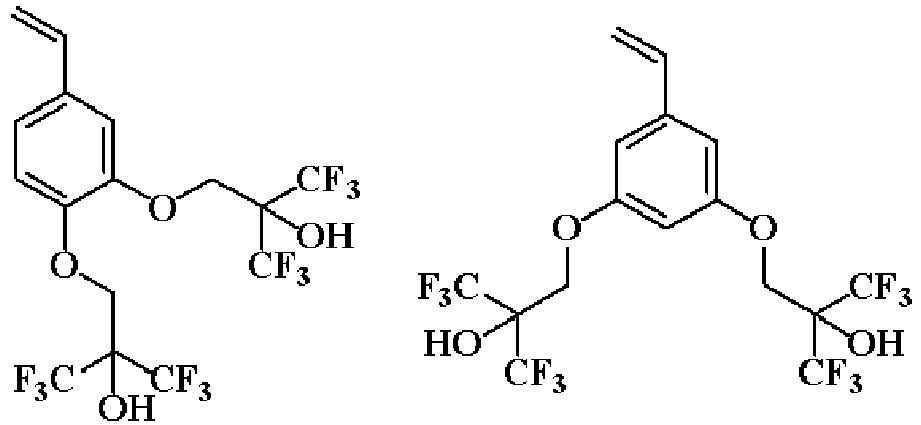


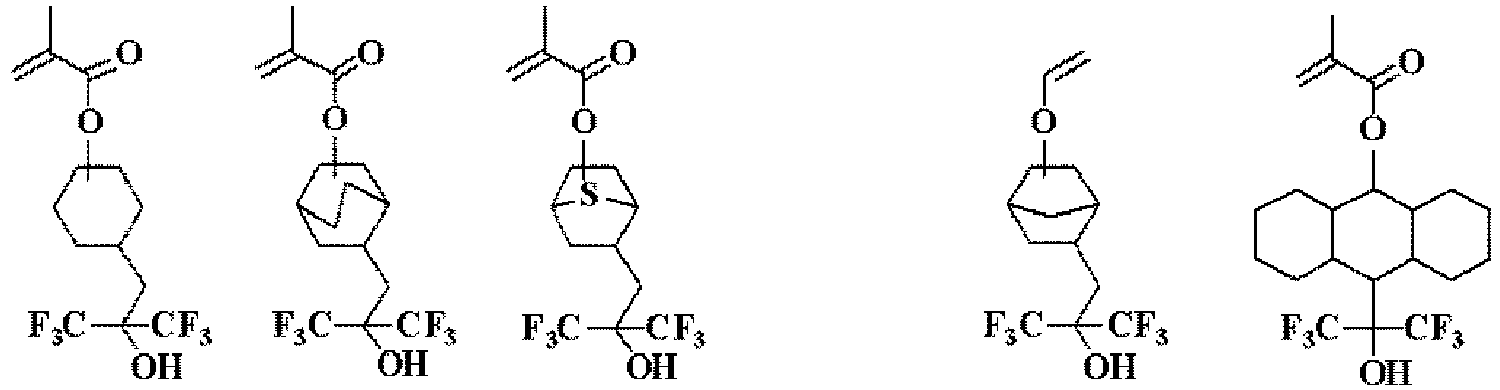

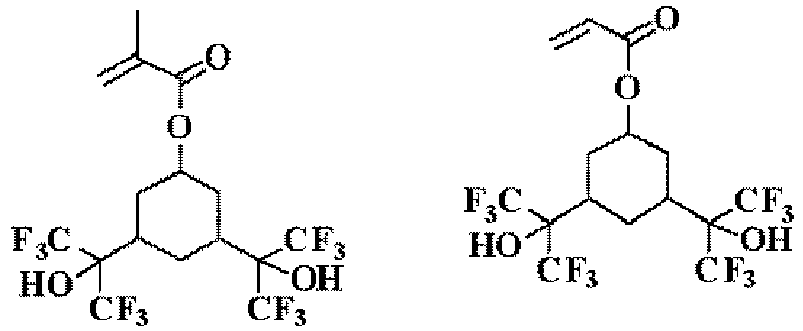





- As the repeating unit b1, the component (B) preferably contains one or more selected from repeating units b'1 to b'4 shown by the following general formulae (5-1) to (5-4).

- A monomer for providing the repeating unit b1 can be specifically exemplified by the following.


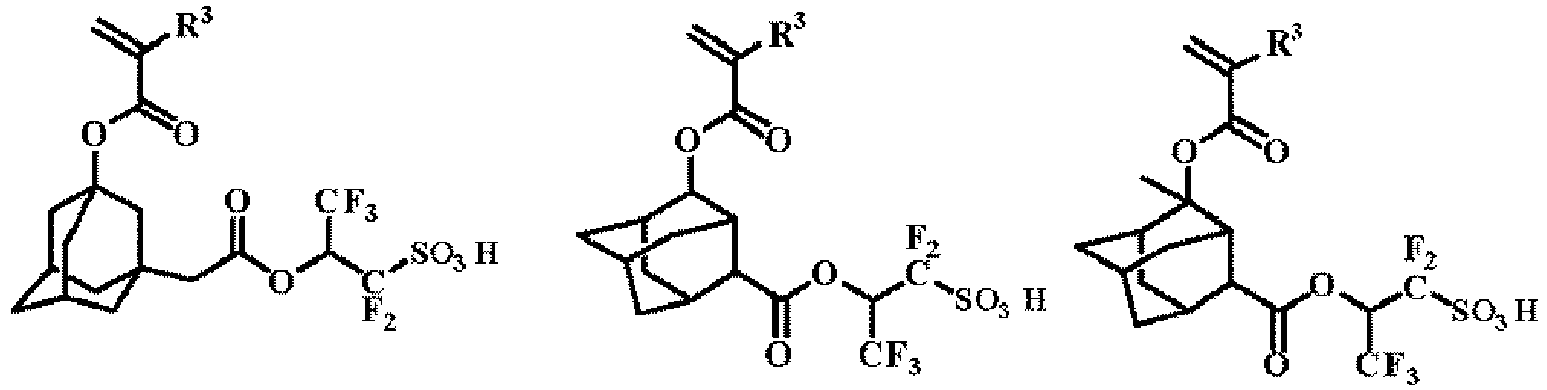


- A monomer for providing the repeating unit b2 can be specifically exemplified by the following.


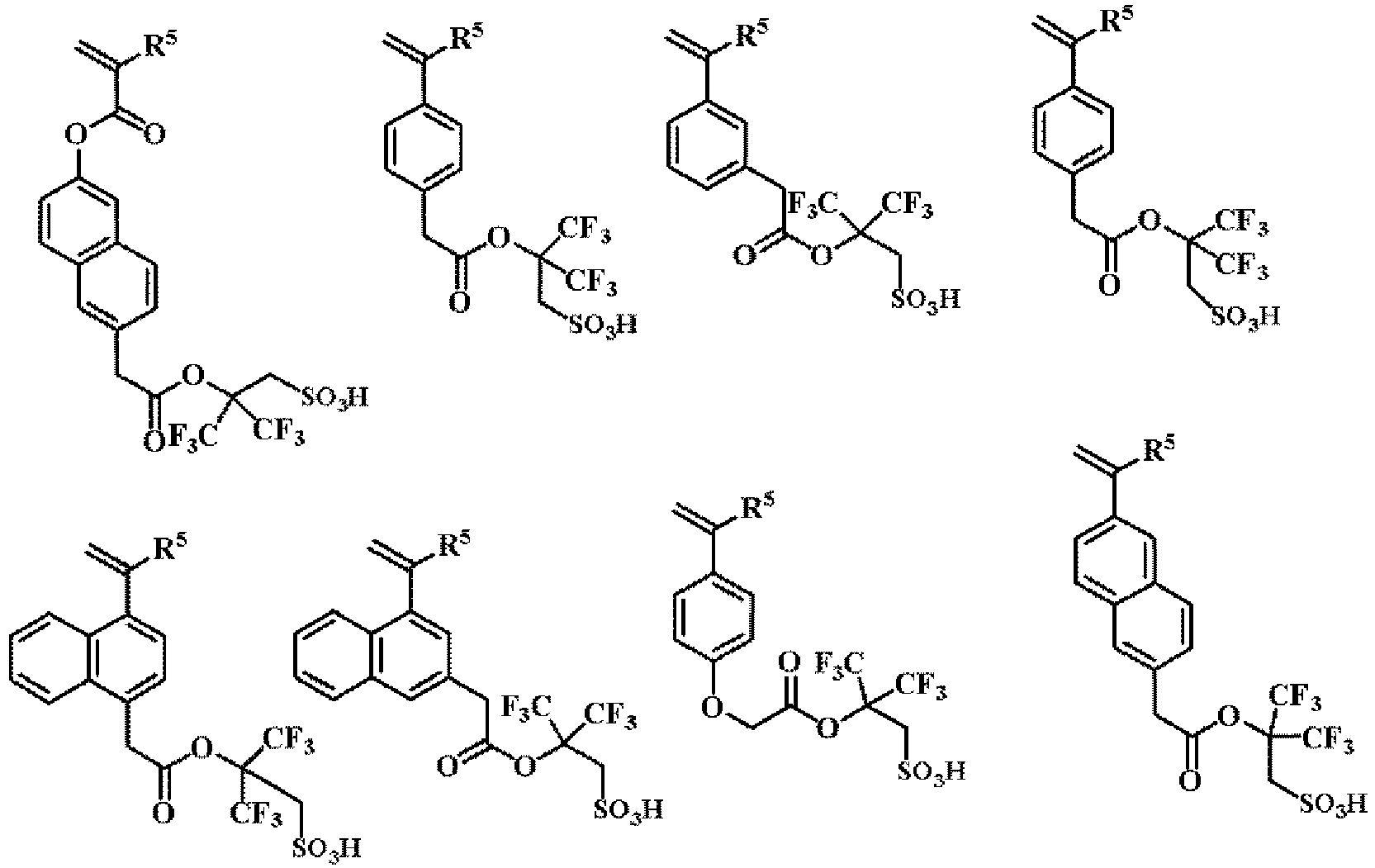


- In the formulae, R5 is as defined above.
- A monomer for providing the repeating unit b3 can be specifically exemplified by the following.


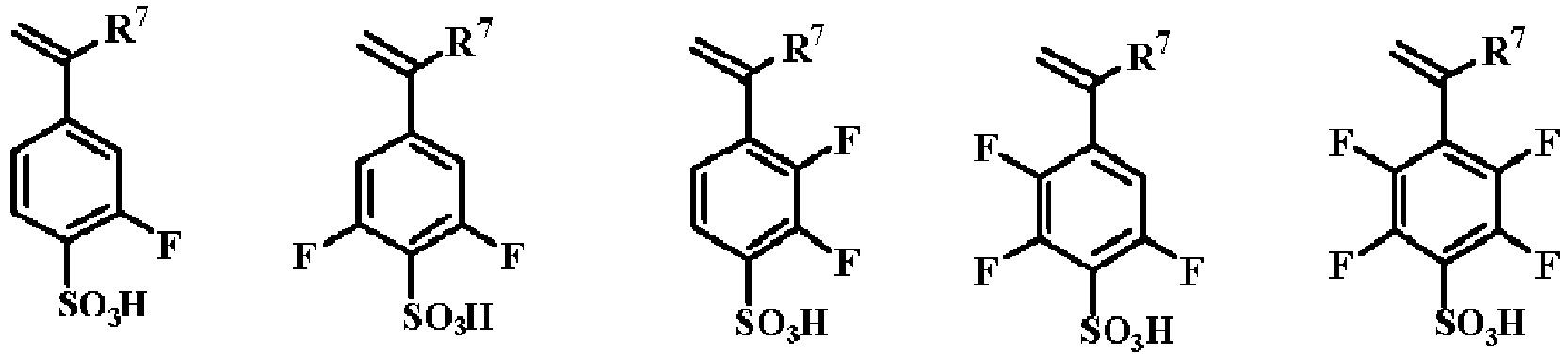

- In the formulae, R7 is as defined above.
- The component (B) can further contain a repeating unit "c" shown by the following general formula (6).

- A monomer for providing the repeating unit "c" can be specifically exemplified by the following.

- Furthermore, the dopant polymer as the component (B) may have a repeating unit "d" other than the repeating units "a" to "c". Examples of the repeating unit "d" can include repeating units based on styrene, vinylnaphthalene, vinylsilane, acenaphthylene, indene, vinylcarbazole, etc.
- A monomer for providing the repeating unit "d" can be specifically exemplified by the following.




- The organic solvent to be used at the time of the polymerization may be exemplified by toluene, benzene, tetrahydrofuran, diethyl ether, dioxane, cyclohexane, cyclopentane, methyl ethyl ketone, γ-butyrolactone, etc.
- The radical polymerization initiator may be exemplified by 2,2'-azobisisobutyronitrile (AIBN), 2,2'-azobis(2,4-dimethylvaleronitrile), dimethyl 2,2'-azobis(2-methylpropionate), benzoyl peroxide, lauroyl peroxide, etc.
- The reaction temperature is preferably 50 to 80°C. The reaction time is preferably 2 to 100 hours, more preferably 5 to 20 hours.
- In the dopant polymer as the component (B), the monomer for providing the repeating unit "a" may be either one kind or two or more kinds. It is preferable to use a methacrylic type monomer and a styrene type monomer in combination to heighten polymerizability.
- When two or more kinds of the monomers for providing the repeating unit "a" are used, the monomers may be randomly copolymerized, or may be copolymerized in block. When the block copolymerized polymer (block copolymer) is made, the repeating unit portions of two or more kinds of the repeating unit "a" aggregate, whereby a specific structure is generated around the dopant polymer, and as a result, a merit of improving electric conductivity can also be expected.
- In addition, the monomers providing the repeating units "a" to "c" may be randomly copolymerized, or may be copolymerized in block. In this case also, a merit of improving conductivity can be expected by forming a block copolymer, as in the case of the repeating unit "a".
- When the random copolymerization is carried out by the radical polymerization, it is a general method that monomers to be copolymerized and a radical polymerization initiator are mixed and polymerized under heating. Polymerization is started in the presence of a first monomer and a radical polymerization initiator, and a second monomer is added later. Thereby, one side of the polymer molecule has a structure in which the first monomer is polymerized, and the other side has a structure in which the second monomer is polymerized. In this case, however, the repeating units of the first and second monomers are mixedly present in the intermediate portion, and the form is different from that of the block copolymer. For forming the block copolymer by the radical polymerization, living radical polymerization is preferably used.
- In the living radical polymerization method called as the RAFT polymerization (Reversible Addition Fragmentation chain Transfer polymerization), the radical at the polymer end is always living, so that it is possible to form a di-block copolymer with a block of the repeating unit of the first monomer and a block of the repeating unit of the second monomer by: starting the polymerization with the first monomer, and adding the second monomer when the first monomer is consumed. Further, a tri-block copolymer can also be formed by: starting the polymerization with the first monomer, adding the second monomer when the first monomer is consumed, and then adding a third monomer.
- When the RAFT polymerization is carried out, there is a characteristic that a narrow dispersion polymer whose molecular weight distribution (dispersity) is narrow is formed. In particular, when the RAFT polymerization is carried out by adding the monomers at a time, a polymer having a narrower molecular weight distribution can be formed.
- Note that the dopant polymer as the component (B) has a molecular weight distribution (Mw/Mn) of preferably 1.0 to 2.0, particularly preferably a narrow dispersity of 1.0 to 1.5. With a narrow dispersity, it is possible to prevent a decrease in the transmittance of a conductive film formed from the conductive polymer composition using such dopant polymer.
- For carrying out the RAFT polymerization, a chain transfer agent is necessary. Specific examples thereof include 2-cyano-2-propylbenzothioate, 4-cyano-4-phenylcarbonothioylthiopentanoic acid, 2-cyano-2-propyl dodecyl trithiocarbonate, 4-cyano-4-[(dodecylsulfanylthiocarbonyl)sulfanyl]pentanoic acid, 2-(dodecylthiocarbonothioylthio)-2-methylpropanoic acid, cyanomethyl dodecyl thiocarbonate, cyanomethyl methyl(phenyl)carbamothioate, bis(thiobenzoyl)disulfide, and bis(dodecylsulfanylthiocarbonyl)disulfide. Among these, 2-cyano-2-propylbenzothioate is particularly preferable.
- The dopant polymer as the component (B) has a weight-average molecular weight in a range of preferably 1,000 to 500,000, more preferably 2,000 to 200,000. When the weight-average molecular weight is 1,000 or more, the heat resistance is excellent, and the uniformity of the composite solution with the component (A) does not deteriorate. Meanwhile, when the weight-average molecular weight is 500,000 or less, the viscosity is not increased too much, the workability is favorable, and the dispersibility into water and an organic solvent is favorable.
- Incidentally, the weight-average molecular weight (Mw) is a measured value in terms of polyethylene oxide, polyethylene glycol, or polystyrene, by gel permeation chromatography (GPC) using water, dimethylformamide (DMF), or tetrahydrofuran (THF) as a solvent.
- Note that, as a monomer constituting the dopant polymer of the component (B), a monomer having a sulfo group may be used. Alternatively, the polymerization reaction may be carried out using a monomer which is a lithium salt, a sodium salt, a potassium salt, an ammonium salt, or a sulfonium salt of a sulfo group; after the polymerization, the resultant is changed to a sulfo group by using an ion exchange resin.
- The inventive conductive polymer composition contains the composite containing: the π-conjugated polymer as the component (A); and the dopant polymer as the component (B). The dopant polymer of the component (B) is coordinated to the π-conjugated polymer of the component (A) to form the composite.
- Preferably, the composite used in the present invention is capable of dispersing in H2O and has affinity to an organic solvent. The composite can improve the continuous-film formability and the film flatness on a highly hydrophobic inorganic or organic substrate when a spray coater and an inkjet printer are used.
- The composite of the components (A) and (B) can be obtained, for example, by adding a raw-material monomer of the component (A) (preferably, pyrrole, thiophene, aniline, or a derivative monomer thereof) into an aqueous solution of the component (B) or a mixture solution of water and an organic solvent with the component (B), and adding an oxidizing agent and, if necessary, an oxidizing catalyst thereto, to carry out oxidative polymerization.
- The oxidizing agent and the oxidizing catalyst which can be used may be: a peroxodisulfate (persulfate), such as ammonium peroxodisulfate (ammonium persulfate), sodium peroxodisulfate (sodium persulfate), and potassium peroxodisulfate (potassium persulfate); a transition metal compound, such as ferric chloride, ferric sulfate, and cupric chloride; a metal oxide, such as silver oxide and cesium oxide; a peroxide, such as hydrogen peroxide and ozone; an organic peroxide, such as benzoyl peroxide; oxygen, etc.
- As the reaction solvent to be used for carrying out the oxidative polymerization, water or a mixed solvent of water and an organic solvent may be used. The organic solvent herein used is preferably an organic solvent which is miscible with water, and can dissolve or disperse the components (A) and (B). Examples of the solvent include polar solvents, such as N-methyl-2-pyrrolidone, N,N'-dimethylformamide, N,N'-dimethylacetamide, dimethylsulfoxide, and hexamethylene phosphotriamide; alcohols, such as methanol, ethanol, propanol, and butanol; polyhydric aliphatic alcohols, such as ethylene glycol, propylene glycol, dipropylene glycol, 1,3-butylene glycol, 1,4-butylene glycol, D-glucose, D-glucitol, isoprene glycol, butanediol, 1,5-pentanediol, 1,6-hexanediol, 1,9-nonanediol, and neopentyl glycol; carbonate compounds, such as ethylene carbonate and propylene carbonate; cyclic ether compounds, such as dioxane and tetrahydrofuran; linear ethers, such as dialkyl ether, ethylene glycol monoalkyl ether, ethylene glycol dialkyl ether, propylene glycol monoalkyl ether, propylene glycol dialkyl ether, polyethylene glycol dialkyl ether, and polypropylene glycol dialkyl ether; heterocyclic compounds, such as 3-methyl-2-oxazolidinone; nitrile compounds, such as acetonitrile, glutaronitrile, methoxyacetonitrile, propionitrile, and benzonitrile; etc. One of these organic solvents may be used singly, or two or more kinds thereof may be used in mixture. A formulation ratio of these organic solvents miscible with water is preferably 50 mass% or less based on the whole reaction solvent.
- In addition, an anion which is capable of doping the component (A) of the π-conjugated polymer may be used in combination other than the component (B) of the dopant polymer. Such an anion is preferably an organic acid from the viewpoints of, for example, adjusting de-doping characteristics from the π-conjugated polymer, dispersibility of the conductive polymer composite, heat resistance, and environmental resistance characteristics. Examples of the organic acid include an organic carboxylic acid, phenols, an organic sulfonic acid, etc.
- As the organic carboxylic acid, a material in which one or two or more carboxyl groups are contained in an aliphatic, an aromatic, a cycloaliphatic, or the like may be used. Examples thereof include formic acid, acetic acid, oxalic acid, benzoic acid, phthalic acid, maleic acid, fumaric acid, malonic acid, tartaric acid, citric acid, lactic acid, succinic acid, monochloroacetic acid, dichloroacetic acid, trichloroacetic acid, trifluoroacetic acid, nitroacetic acid, triphenylacetic acid, etc.
- Examples of the phenols include phenols, such as cresol, phenol, and xylenol.
- As the organic sulfonic acid, a material in which one or two or more sulfonic acid groups are contained in an aliphatic, an aromatic, a cycloaliphatic, or the like may be used. Examples of the organic sulfonic acid containing one sulfonic acid group can include sulfonic acid compounds containing a sulfonic acid group, such as methanesulfonic acid, ethanesulfonic acid, 1-propanesulfonic acid, 1-butanesulfonic acid, 1-hexanesulfonic acid, 1-heptanesulfonic acid, 1-octanesulfonic acid, 1-nonanesulfonic acid, 1-decanesulfonic acid, 1-dodecanesulfonic acid, 1-tetradecanesulfonic acid, 1-pentadecanesulfonic acid, 2-bromoethanesulfonic acid, 3-chloro-2-hydroxypropanesulfonic acid, trifluoromethanesulfonic acid, colistinmethanesulfonic acid, 2-acrylamido-2-methylpropanesulfonic acid, aminomethanesulfonic acid, 1-amino-2-naphthol-4-sulfonic acid, 2-amino-5-naphthol-7-sulfonic acid, 3-aminopropanesulfonic acid, N-cyclohexyl-3-aminopropanesulfonic acid, benzenesulfonic acid, p-toluenesulfonic acid, xylenesulfonic acid, ethylbenzenesulfonic acid, propylbenzenesulfonic acid, butylbenzenesulfonic acid, pentylbenzenesulfonic acid, hexylbenzenesulfonic acid, heptylbenzenesulfonic acid, octylbenzenesulfonic acid, nonylbenzenesulfonic acid, decylbenzenesulfonic acid, undecylbenzenesulfonic acid, dodecylbenzenesulfonic acid, pentadecylbenzenesulfonic acid, hexadecylbenzenesulfonic acid, 2,4-dimethylbenzenesulfonic acid, dipropylbenzenesulfonic acid, butylbenzenesulfonic acid, 4-aminobenzenesulfonic acid, o-aminobenzenesulfonic acid, m-aminobenzenesulfonic acid, 4-amino-2-chlorotoluene-5-sulfonic acid, 4-amino-3-methylbenzene-1-sulfonic acid, 4-amino-5-methoxy-2-methylbenzenesulfonic acid, 2-amino-5-methylbenzene-1-sulfonic acid, 4-amino-2-methylbenzene-1-sulfonic acid, 5-amino-2-methylbenzene-1-sulfonic acid, 4-amino-3-methylbenzene-1-sulfonic acid, 4-acetamido-3-chlorobenzenesulfonic acid, 4-chloro-3-nitrobenzenesulfonic acid, p-chlorobenzenesulfonic acid, naphthalenesulfonic acid, methylnaphthalenesulfonic acid, propylnaphthalenesulfonic acid, butylnaphthalenesulfonic acid, pentylnaphthalenesulfonic acid, dimethylnaphthalenesulfonic acid, 4-amino-1-naphthalenesulfonic acid, 8-chloronaphthalene-1-sulfonic acid, naphthalenesulfonic acid formalin polycondensate, and melaminesulfonic acid formalin polycondensate.
- Examples of the organic sulfonic acid containing two or more sulfonic acid groups can include ethanedisulfonic acid, butanedisulfonic acid, pentanedisulfonic acid, decanedisulfonic acid, m-benzenedisulfonic acid, o-benzenedisulfonic acid, p-benzenedisulfonic acid, toluenedisulfonic acid, xylenedisulfonic acid, chlorobenzenedisulfonic acid, fluorobenzenedisulfonic acid, aniline-2,4-disulfonic acid, aniline-2,5-disulfonic acid, dimethylbenzenedisulfonic acid, diethylbenzenedisulfonic acid, dibutylbenzenedisulfonic acid, naphthalenedisulfonic acid, methylnaphthalenedisulfonic acid, ethylnaphthalenedisulfonic acid, dodecylnaphthalenedisulfonic acid, pentadecylnaphthalenedisulfonic acid, butylnaphthalenedisulfonic acid, 2-amino-1,4-benzenedisulfonic acid, 1-amino-3,8-naphthalenedisulfonic acid, 3-amino-1,5-naphthalenedisulfonic acid, 8-amino-1-naphthol-3,6-disulfonic acid, 4-amino-5-naphthol-2,7-disulfonic acid, anthracenedisulfonic acid, butylanthracenedisulfonic acid, 4-acetamido-4'-isothio-cyanatostilbene-2,2'-disulfonic acid, 4-acetamido-4'-isothiocyanatostilbene-2,2'-disulfonic acid, 4-acetamido-4'-maleimidylstilbene-2,2'-disulfonic acid, 1-acetoxypyrene-3,6,8-trisulfonic acid, 7-amino-1,3,6-naphthalenetrisulfonic acid, 8-aminonaphthalene-1,3,6-trisulfonic acid, 3-amino-1,5,7-naphthalenetrisulfonic acid, etc.
- These anions other than the component (B) may be added to the solution containing the raw-material monomer of the component (A), the component (B), an oxidizing agent and/or an oxidative polymerization catalyst before polymerization of the component (A), or may be added to the composite containing the components (A) and (B) after the polymerization.
- The thus obtained composite of the components (A) and (B) can be used, if necessary, after subjected to fine pulverization with a homogenizer, a ball mill, or the like.
- For fine pulverization, a mixing-dispersing machine which can provide high shearing force is preferably used. Examples of the mixing-dispersing machine include a homogenizer, a high-pressure homogenizer, a bead mill, etc. Among these, a high-pressure homogenizer is preferable.
- Specific examples of the high-pressure homogenizer include Nanovater manufactured by Yoshida Kikai Co., Ltd., Microfluidizer manufactured by Powrex Corp., Artimizer manufactured by Sugino Machine Limited., etc.
- Examples of a dispersing treatment using the high-pressure homogenizer include a treatment in which the composite solution before subjecting to the dispersing treatment is subjected to counter-collision with high pressure; a treatment in which it is passed through an orifice or slit with high pressure; and other similar methods.
- Before or after fine pulverization, impurities may be removed by a method, such as filtration, ultrafiltration, and dialysis, followed by purification with a cation-exchange resin, an anion-exchange resin, a chelate resin, or the like.
- Note that a total content of the components (A) and (B) is preferably 0.05 to 5.0 mass% in the conductive polymer compound composition. When the total content of the components (A) and (B) is 0.05 mass% or more, sufficient conductivity or hole injection function is obtained. When the total content is 5.0 mass% or less, uniform conductive coating film is easily obtained.
- Examples of the organic solvent, which can be added to the aqueous solution for the polymerization reaction or can dilute the monomer, include methanol, ethyl acetate, cyclohexanone, methyl amyl ketone, butanediol monomethyl ether, propylene glycol monomethyl ether, ethylene glycol monomethyl ether, butanediol monoethyl ether, propylene glycol monoethyl ether, ethylene glycol monoethyl ether, propylene glycol dimethyl ether, diethylene glycol dimethyl ether, propylene glycol monomethyl ether acetate, propylene glycol monoethyl ether acetate, ethyl pyruvate, butyl acetate, methyl 3-methoxypropionate, ethyl 3-ethoxypropionate, tert-butyl acetate, t-butyl propionate, propylene glycol mono-t-butyl ether acetate, γ-butyrolactone, mixtures thereof, etc.
- Note that the amount of the organic solvent to be used is preferably 0 to 1,000 mL based on 1 mol of the monomer, particularly preferably 0 to 500 mL. With 1,000 mL or less of the organic solvent, the reaction vessel does not become too large so that it is economical.
- In the present invention, a water-soluble organic solvent is added to improve the printability to a material to be processed, such as a substrate. Examples of such an organic solvent include organic solvents that are soluble in H2O and have a boiling point of 250°C or less at normal pressure.
- Examples thereof include alcohols, such as methanol, ethanol, propanol, and butanol; polyhydric aliphatic alcohols, such as ethylene glycol, propylene glycol, 1,3-propanediol, diethylene glycol, dipropylene glycol, 1,3-butylene glycol, 1,4-butylene glycol, isoprene glycol, 1,2-butanediol, 1,3-butanediol, 1,4-butanediol, 2,3-butanediol, 1,2-pentanediol, 1,5-pentanediol, 1,2-hexanediol, 1,6-hexanediol, and neopentyl glycol; linear ethers, such as dialkyl ether, dimethoxyethane, ethylene glycol monoalkyl ether, ethylene glycol dialkyl ether, propylene glycol monoalkyl ether, propylene glycol dialkyl ether, butanediol monoalkyl ether, polyethylene glycol dialkyl ether, and polypropylene glycol dialkyl ether; cyclic ether compounds, such as dioxane and tetrahydrofuran; polar solvents, such as cyclohexanone, methyl amyl ketone, ethyl acetate, diethylene glycol dimethyl ether, propylene glycol monomethyl ether acetate, propylene glycol monoethyl ether acetate, ethyl pyruvate, butyl acetate, methyl 3-methoxypropionate, ethyl 3-ethoxypropionate, tert-butyl acetate, t-butyl propionate, propylene glycol mono-t-butyl ether acetate, γ-butyrolactone, N-methyl-2-pyrrolidone, N,N'-dimethylformamide, N,N'-dimethylacetamide, dimethylsulfoxide, and hexamethylene phosphotriamide; carbonate compounds, such as ethylene carbonate and propylene carbonate; heterocyclic compounds, such as 3-methyl-2-oxazolidinone; nitrile compounds, such as acetonitrile, glutaronitrile, methoxyacetonitrile, propionitrile, and benzonitrile; mixtures thereof; etc.
- The organic solvent (C) to be mixed with a H2O dispersion of the composite of (A) and (B) is essentially a water-soluble organic solvent. The organic solvent (C) may include an organic solvent (C1) having a boiling point of 120°C or more, and an organic solvent (C2) having a boiling point of less than 120°C. It is possible to use, for example, either (C1) or (C2) singly, or a mixture of (C1) and (C2). The content(s) preferably satisfy 1.0 wt%≤(C1)+(C2)≤50.0 wt%, more preferably 5.0 wt%≤(C1)+(C2)≤30.0 wt%, relative to a total of the components (A), (B), and (D).
- Further, the components (C1) and (C2) are preferably selected from alcohols, ethers, esters, ketones, and nitriles each of which has 1 to 7 carbon atoms.
- Additionally, the use of an organic solvent having a boiling point higher than that of H2O in the water-soluble organic solvent makes it possible to avoid solid content precipitation around a nozzle and solid content precipitation due to drying between ejection of the liquid material from a nozzle tip and landing on a substrate.
- In the inventive composition, the composite of the components (A) and (B) is dispersed in H2O as a component (D), and the inventive composition contains a water-soluble organic solvent (C). As the component (D), for example, ultrapure water can be used.
- To the composition in which the H2O dispersion of the composite of the components (A) and (B) is mixed with the organic solvent (C), a compound (E) shown by the following general formula (3) can be further added.

- In the formula, R201 and R202 each independently represent any of a hydrogen atom, a heteroatom, and a linear, branched, or cyclic monovalent hydrocarbon group having 1 to 20 carbon atoms optionally having a heteroatom. R203 and R204 each independently represent any of a hydrogen atom and a linear, branched, or cyclic monovalent hydrocarbon group having 1 to 20 carbon atoms optionally having a heteroatom. R201 and R203, or R201 and R204, are optionally bonded to each other to form a ring. L represents a linear, branched, or cyclic tetravalent organic group having 1 to 20 carbon atoms optionally having a heteroatom. When L has a heteroatom, the heteroatom may be an ion.
- As a result of incorporating the component (E), when the conductive polymer composition is used to form a film as an electrode or hole injection layer of a thin film-stacked device, such as organic EL and solar cell, the influence of acid can be relieved by suppressing the acid diffusion into an adjacent layer and other constituent layers of the laminate structure. Moreover, when the inventive conductive polymer composition contains the component (E) and this conductive polymer composition is used to form a film as a constituent of a thin-film device having a laminate structure on a material to be processed, the acid diffusion into an adjacent layer and other constituent layers of the laminate-structure device is further suppressed. Thus, the acid influence can be further relieved.
- In the present invention, only one kind of the compound (E) shown by the general formula (3) may be used, or two or more kinds thereof may be used in mixture. Moreover, any known compound can be used.
- The structure of the compound shown by the general formula (3) can be specifically exemplified by the following.


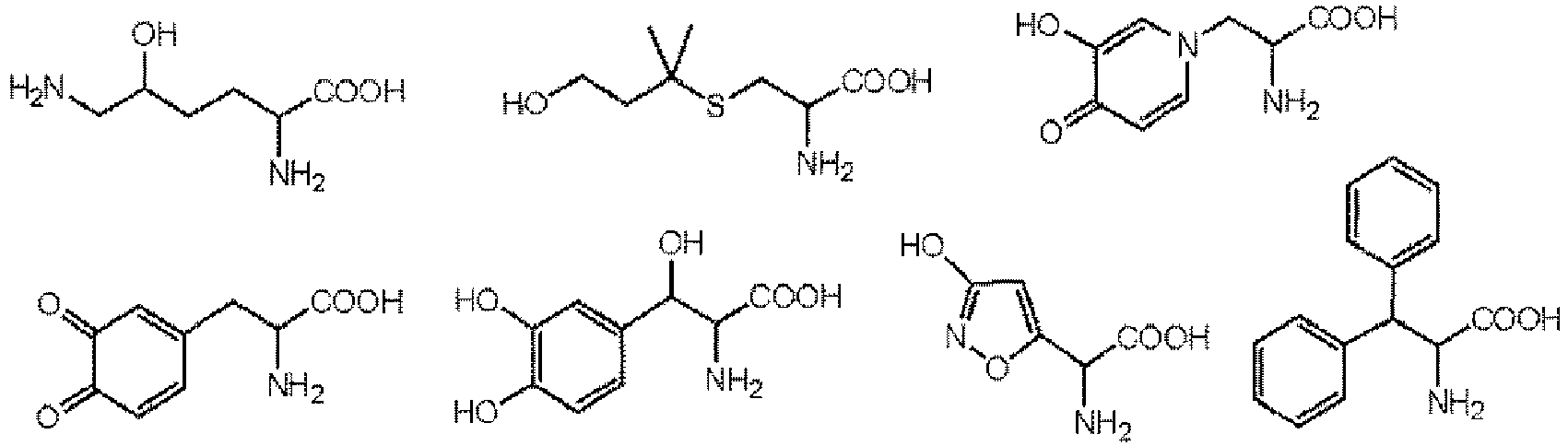


- More preferably, the inventive conductive polymer composition contains the compound shown by the general formula (3), in which L represents a linear, branched or cyclic tetravalent organic group having 2 to 10 carbon atoms optionally having a heteroatom.
- Other than the structures shown by the general formula (3), compounds shown in the following formula (7) can also be suitably used in the present invention.

- Additionally, in the inventive conductive polymer composition, the compound shown by the general formula (3) and the compound(s) shown by the formula (7) are preferably in an amount of 1 part by mass to 50 parts by mass, further more preferably 5 parts by mass to 30 parts by mass, based on 100 parts by mass of the composite of the components (A) and (B). When the compound shown by the general formula (3) and the compound(s) shown by the formula (7) are contained in such amounts, the H+ diffusion from a film formed of the inventive conductive polymer composition to an adjacent layer can be controlled.
- In the present invention, a surfactant may be added to further increase wettability to a material to be processed, such as a substrate. Examples of such a surfactant include various surfactants such as nonionic, cationic, and anionic surfactants. Specific examples thereof include nonionic surfactants, such as polyoxyethylene alkyl ether, polyoxyethylene alkylphenyl ether, polyoxyethylene carboxylic acid ester, sorbitan ester, and polyoxyethylene sorbitan ester; cationic surfactants, such as alkyltrimethyl ammonium chloride and alkylbenzyl ammonium chloride; anionic surfactants, such as alkyl or alkylallyl sulfates, alkyl or alkylallyl sulfonate, and dialkyl sulfosuccinate; amphoteric ionic surfactants, such as amino acid type and betaine type; etc.
- Preferably, a nonionic surfactant is contained in an amount of 1 part by mass to 15 parts by mass based on 100 parts by mass of the composite of the components (A) and (B).
- As has been described above, the inventive conductive polymer composition is capable of efficiently removing residual moisture in the film during the film formation, has favorable filterability and high continuous-film formability on inorganic and organic substrates even when a spray coater or inkjet printer is used, and is also capable of forming a conductive film having favorable flatness and high transparency.
- The present invention provides a substrate having an organic EL device, the organic EL device including a hole injection layer formed from the above-described conductive polymer composition.
- In addition, the substrate of the present invention can be produced according to a process including a step of applying the above-described conductive polymer composition by using a spray coater or inkjet printing.
- Examples of the substrate include inorganic substrates, such as glass substrate, quartz substrate, photomask blank substrate, silicon wafer, gallium arsenide wafer, and indium phosphide wafer; organic resin substrates, such as polyimide, polyethylene terephthalate, polycarbonate, cycloolefin polymer, and triacetyl cellulose; etc.
- As described above, according to the present invention, the water-soluble organic solvent (C) is mixed with the H2O dispersion of the composite composed of (A) the π-conjugated polymer and (B) containing a highly strongly acidic sulfo group and a non-doping fluorinated unit. This enables low viscosity, favorable filterability, and high formability of continuous film on inorganic and organic substrates even when a spray coater or an inkjet printer is employed. Moreover, it is possible to form a conductive film having suitable transparency, flatness, durability, and conductivity. Further, to relieve the diffusion of H+ derived from the acid unit in a non-doping state, adding the component (E) makes it possible to suppress the H+ diffusion to an adjacent layer after the film formation while keeping appropriate acidity as a composition. Such a conductive polymer composition can function as a hole injection layer.
- Hereinafter, the present invention will be specifically described with reference to Examples, but the present invention is not limited thereto.
- Raw-material monomers employed in polymerizations for copolymerized dopant polymers represented by (B) in composites used in Examples are shown below.


- Under nitrogen atmosphere, a solution was added dropwise over 4 hours to 10 g of methanol stirred at 64°C, the solution containing 1.20 g of Monomer a"1, 3.75 g of Monomer b"1, and 0.12 g of dimethyl 2,2'-azobis(isobutyrate) dissolved in 3 g of methanol. The mixture was further stirred at 64°C for 4 hours. After cooled to room temperature, the mixture was added dropwise to 10 g of ethyl acetate under vigorous stirring. The resulting solid product was collected by filtration, and dried under vacuum at 50°C for 15 hours. Thus, a white polymer was obtained.
- The obtained white polymer was dissolved in 100 g of pure water, and the ammonium salt was changed to a sulfo group by using an ion exchange resin. When the obtained polymer was measured by 19F, 1H-NMR and GPC, the following analytical results were obtained.
- Weight-average molecular weight (Mw)=21,000
- Molecular weight distribution (Mw/Mn)=1.90
- This polymer compound is designated as (Polymer 1).

- Under nitrogen atmosphere, a solution was added dropwise over 4 hours to 10 g of methanol stirred at 64°C, the solution containing 0.6 g of Monomer a"1, 5.00 g of Monomer b"1, and 0.12 g of dimethyl 2,2'-azobis(isobutyrate) dissolved in 3 g of methanol. The mixture was further stirred at 64°C for 4 hours. After cooled to room temperature, the mixture was added dropwise to 10 g of ethyl acetate under vigorous stirring. The resulting solid product was collected by filtration, and dried under vacuum at 50°C for 15 hours. Thus, a white polymer was obtained.
- The obtained white polymer was dissolved in 100 g of pure water, and the ammonium salt was changed to a sulfo group by using an ion exchange resin. When the obtained polymer was measured by 19F, 1H-NMR and GPC, the following analytical results were obtained.
- Weight-average molecular weight (Mw)=20,500
- Molecular weight distribution (Mw/Mn)=1.94
- This polymer compound is designated as (Polymer 2).

- Under nitrogen atmosphere, a solution was added dropwise over 4 hours to 10 g of methanol stirred at 64°C, the solution containing 1.20 g of Monomer a"2, 3.75 g of Monomer b"1, and 0.12 g of dimethyl 2,2'-azobis(isobutyrate) dissolved in 3 g of methanol. The mixture was further stirred at 64°C for 4 hours. After cooled to room temperature, the mixture was added dropwise to 10 g of ethyl acetate under vigorous stirring. The resulting solid product was collected by filtration, and dried under vacuum at 50°C for 15 hours. Thus, a white polymer was obtained.
- The obtained white polymer was dissolved in 100 g of pure water, and the ammonium salt was changed to a sulfo group by using an ion exchange resin. When the obtained polymer was measured by 19F, 1H-NMR and GPC, the following analytical results were obtained.
- Weight-average molecular weight (Mw)=20,000
- Molecular weight distribution (Mw/Mn)=1.88
- This polymer compound is designated as (Polymer 3).

- Under nitrogen atmosphere, a solution was added dropwise over 4 hours to 10 g of methanol stirred at 64°C, the solution containing 1.51 g of Monomer a"1, 2.55 g of Monomer b"2, and 0.12 g of dimethyl 2,2'-azobis(isobutyrate) dissolved in 3 g of methanol. The mixture was further stirred at 64°C for 4 hours. After cooled to room temperature, the mixture was added dropwise to 10 g of ethyl acetate under vigorous stirring. The resulting solid product was collected by filtration, and dried under vacuum at 50°C for 15 hours. Thus, a white polymer was obtained.
- The obtained white polymer was dissolved in 100 g of pure water, and the ammonium salt was changed to a sulfo group by using an ion exchange resin. When the obtained polymer was measured by 19F, 1H-NMR and GPC, the following analytical results were obtained.
- Weight-average molecular weight (Mw)=22,000
- Molecular weight distribution (Mw/Mn)=1.93
- This polymer compound is designated as (Polymer 4).

- Under nitrogen atmosphere, a solution was added dropwise over 4 hours to 10 g of methanol stirred at 64°C, the solution containing 0.60 g of Monomer a"1, 4.07 g of Monomer b"2, and 0.12 g of dimethyl 2,2'-azobis(isobutyrate) dissolved in 3 g of methanol. The mixture was further stirred at 64°C for 4 hours. After cooled to room temperature, the mixture was added dropwise to 10 g of ethyl acetate under vigorous stirring. The resulting solid product was collected by filtration, and dried under vacuum at 50°C for 15 hours. Thus, a white polymer was obtained.
- The obtained white polymer was dissolved in 100 g of pure water, and the ammonium salt was changed to a sulfo group by using an ion exchange resin. When the obtained polymer was measured by 19F, 1H-NMR and GPC, the following analytical results were obtained.
- Weight-average molecular weight (Mw)=19,500
- Molecular weight distribution (Mw/Mn)=1.99
- This polymer compound is designated as (Polymer 5).

- Under nitrogen atmosphere, a solution was added dropwise over 4 hours to 10 g of methanol stirred at 64°C, the solution containing 1.08 g of Monomer a"6, 3.75 g of Monomer b"1, and 0.12 g of dimethyl 2,2'-azobis(isobutyrate) dissolved in 3 g of methanol. The mixture was further stirred at 64°C for 4 hours. After cooled to room temperature, the mixture was added dropwise to 10 g of ethyl acetate under vigorous stirring. The resulting solid product was collected by filtration, and dried under vacuum at 50°C for 15 hours. Thus, a white polymer was obtained.
- The obtained white polymer was dissolved in 100 g of pure water, and the ammonium salt was changed to a sulfo group by using an ion exchange resin. When the obtained polymer was measured by 19F, 1H-NMR and GPC, the following analytical results were obtained.
- Weight-average molecular weight (Mw)=21,500
- Molecular weight distribution (Mw/Mn)=2.07
- This polymer compound is designated as (Polymer 6).

- Under nitrogen atmosphere, a solution was added dropwise over 4 hours to 10 g of methanol stirred at 64°C, the solution containing 0.87 g of Monomer a"7, 5.00 g of Monomer b"1, and 0.12 g of dimethyl 2,2'-azobis(isobutyrate) dissolved in 3 g of methanol. The mixture was further stirred at 64°C for 4 hours. After cooled to room temperature, the mixture was added dropwise to 10 g of ethyl acetate under vigorous stirring. The resulting solid product was collected by filtration, and dried under vacuum at 50°C for 15 hours. Thus, a white polymer was obtained.
- The obtained white polymer was dissolved in 100 g of pure water, and the ammonium salt was changed to a sulfo group by using an ion exchange resin. When the obtained polymer was measured by 19F, 1H-NMR and GPC, the following analytical results were obtained.
- Weight-average molecular weight (Mw)=19,500
- Molecular weight distribution (Mw/Mn)=2.00
- This polymer compound is designated as (Polymer 7).

- Under nitrogen atmosphere, a solution was added dropwise over 4 hours to 10 g of methanol stirred at 64°C, the solution containing 1.00 g of Monomer a"8, 5.00 g of Monomer b"1, and 0.12 g of dimethyl 2,2'-azobis(isobutyrate) dissolved in 3 g of methanol. The mixture was further stirred at 64°C for 4 hours. After cooled to room temperature, the mixture was added dropwise to 10 g of ethyl acetate under vigorous stirring. The resulting solid product was collected by filtration, and dried under vacuum at 50°C for 15 hours. Thus, a white polymer was obtained.
- The obtained white polymer was dissolved in 100 g of pure water, and the ammonium salt was changed to a sulfo group by using an ion exchange resin. When the obtained polymer was measured by 19F, 1H-NMR and GPC, the following analytical results were obtained.
- Weight-average molecular weight (Mw)=20,000
- Molecular weight distribution (Mw/Mn)=1.85
- This polymer compound is designated as (Polymer 8).

- Under nitrogen atmosphere, a solution was added dropwise over 4 hours to 10 g of methanol stirred at 64°C, the solution containing 0.90 g of Monomer a"1, 4.60 g of Monomer b"5, and 0.12 g of dimethyl 2,2'-azobis(isobutyrate) dissolved in 3 g of methanol. The mixture was further stirred at 64°C for 4 hours. After cooled to room temperature, the mixture was added dropwise to 10 g of ethyl acetate under vigorous stirring. The resulting solid product was collected by filtration, and dried under vacuum at 50°C for 15 hours. Thus, a white polymer was obtained.
- The obtained white polymer was dissolved in 100 g of pure water, and the ammonium salt was changed to a sulfo group by using an ion exchange resin. When the obtained polymer was measured by 19F, 1H-NMR and GPC, the following analytical results were obtained.
- Weight-average molecular weight (Mw)=26,000
- Molecular weight distribution (Mw/Mn)=2.04
- This polymer compound is designated as (Polymer 9).

- Under nitrogen atmosphere, a solution was added dropwise over 4 hours to 10 g of methanol stirred at 64°C, the solution containing 0.90 g of Monomer a"1, 2.35 g of Monomer b"6, and 0.12 g of dimethyl 2,2'-azobis(isobutyrate) dissolved in 3 g of methanol. The mixture was further stirred at 64°C for 4 hours. After cooled to room temperature, the mixture was added dropwise to 10 g of ethyl acetate under vigorous stirring. The resulting solid product was collected by filtration, and dried under vacuum at 50°C for 15 hours. Thus, a white polymer was obtained.
- The obtained white polymer was dissolved in 100 g of pure water, and the sodium salt was changed to a sulfo group by using an ion exchange resin. When the obtained polymer was measured by 19F, 1H-NMR and GPC, the following analytical results were obtained.
- Weight-average molecular weight (Mw)=31,000
- Molecular weight distribution (Mw/Mn)=2.11
- This polymer compound is designated as (Polymer 10) .

- 2.27 g of 3,4-ethylenedioxythiophene and a solution in which 15.0 g of Dopant Polymer 1 had been dissolved in 1,000 mL of ultrapure water were mixed at 30°C.
- The obtained mixture solution was maintained at 30°C under stirring. In this state, 4.99 g of sodium persulfate dissolved in 100 mL of ultrapure water and an oxidizing catalyst solution of 1.36 g of ferric sulfate were gradually added thereto and stirred for 4 hours to react these materials.
- To the obtained reaction solution, 1,000 mL of ultrapure water was added, and about 1,000 mL of the solution was removed by using the ultrafiltration method. This operation was repeated three times.
- Then, to the processed solution after the filtration treatment, 200 mL of sulfuric acid diluted to 10 mass% and 2,000 mL of ion exchanged water were added. About 2,000 mL of the processed solution was removed by using the ultrafiltration method, and 2,000 mL of ion exchanged water was added thereto. About 2,000 mL of the solution was removed by using the ultrafiltration method. This operation was repeated three times.
- Further, 2,000 mL of ion exchanged water was added to the obtained processed solution, and about 2,000 mL of the processed solution was removed by using the ultrafiltration method. This operation was repeated five times. The resultant was concentrated to obtain 2.5 mass% of blue-colored Conductive Polymer Composite Dispersion 1.
- The ultrafiltration conditions were as follows.
Molecular weight cutoff of ultrafiltration membrane: 30 K -
- Flow amount of supplied liquid: 3,000 mL/minute
- Membrane partial pressure: 0.12 Pa
- Note that the ultrafiltration was carried out under the same conditions in the other Preparation Examples.
- Preparation was carried out in the same manner as in Preparation Example 1 except for changing 15.0 g of Dopant Polymer 1 to Dopant Polymer 2, and changing the amount of 3,4-ethylenedioxythiophene blended to 2.09 g, the amount of sodium persulfate blended to 4.59 g, and the amount of ferric sulfate blended to 1.25 g. Thus, Conductive Polymer Composite Dispersion 2 was obtained.
- Preparation was carried out in the same manner as in Preparation Example 1 except for changing 15.0 g of Dopant Polymer 1 to Dopant Polymer 3, and changing the amount of 3,4-ethylenedioxythiophene blended to 2.27 g, the amount of sodium persulfate blended to 4.99 g, and the amount of ferric sulfate blended to 1.36 g. Thus, Conductive Polymer Composite Dispersion 3 was obtained.
- Preparation was carried out in the same manner as in Preparation Example 1 except for changing 15.0 g of Dopant Polymer 1 to Dopant Polymer 4, and changing the amount of 3,4-ethylenedioxythiophene blended to 2.79 g, the amount of sodium persulfate blended to 6.13 g, and the amount of ferric sulfate blended to 1.67 g. Thus, Conductive Polymer Composite Dispersion 4 was obtained.
- Preparation was carried out in the same manner as in Preparation Example 1 except for changing 15.0 g of Dopant Polymer 1 to Dopant Polymer 5, and changing the amount of 3,4-ethylenedioxythiophene blended to 2.64 g, the amount of sodium persulfate blended to 5.82 g, and the amount of ferric sulfate blended to 1.59 g. Thus, Conductive Polymer Composite Dispersion 5 was obtained.
- Preparation was carried out in the same manner as in Preparation Example 1 except for changing 15.0 g of Dopant Polymer 1 to Dopant Polymer 6, and changing the amount of 3,4-ethylenedioxythiophene blended to 2.34 g, the amount of sodium persulfate blended to 5.14 g, and the amount of ferric sulfate blended to 1.40 g. Thus, Conductive Polymer Composite Dispersion 6 was obtained.
- Preparation was carried out in the same manner as in Preparation Example 1 except for changing 15.0 g of Dopant Polymer 1 to Dopant Polymer 7, and changing the amount of 3,4-ethylenedioxythiophene blended to 1.97 g, the amount of sodium persulfate blended to 4.32 g, and the amount of ferric sulfate blended to 1.17 g. Thus, Conductive Polymer Composite Dispersion 7 was obtained.
- Preparation was carried out in the same manner as in Preparation Example 1 except for changing 15.0 g of Dopant Polymer 1 to Dopant Polymer 8, and changing the amount of 3,4-ethylenedioxythiophene blended to 1.91 g, the amount of sodium persulfate blended to 4.20 g, and the amount of ferric sulfate blended to 1.12 g. Thus, Conductive Polymer Composite Dispersion 8 was obtained.
- Preparation was carried out in the same manner as in Preparation Example 1 except for changing 15.0 g of Dopant Polymer 1 to Dopant Polymer 9, and changing the amount of 3,4-ethylenedioxythiophene blended to 2.06 g, the amount of sodium persulfate blended to 4.54 g, and the amount of ferric sulfate blended to 1.24 g. Thus, Conductive Polymer Composite Dispersion 9 was obtained.
- Preparation was carried out in the same manner as in Preparation Example 1 except for changing 15.0 g of Dopant Polymer 1 to Dopant Polymer 10, and changing the amount of 3,4-ethylenedioxythiophene blended to 2.97 g, the amount of sodium persulfate blended to 6.53 g, and the amount of ferric sulfate blended to 1.78 g. Thus, Conductive Polymer Composite Dispersion 10 was obtained.
- 2.5 mass% of one of the conductive polymer composite dispersions obtained in Preparation Examples 1 to 10 was mixed with 10 wt% of PGMEA (propylene glycol monomethyl ether acetate) as the organic solvent (C1) and 5 wt% of EtOH as the organic solvent (C2). The mixtures obtained in this manner were respectively designated as Examples 1 to 10.
- 2.5 mass% of one of the conductive polymer composite dispersions obtained in Preparation Examples 1 to 10 was mixed with 10 wt% of PGMEA (propylene glycol monomethyl ether acetate) as the organic solvent (C1) and 5 wt% of IPA (2-propanol) as the organic solvent (C2). The mixtures obtained in this manner were respectively designated as Examples 11 to 20.
- 2.5 mass% of one of the conductive polymer composite dispersions obtained in Preparation Examples 1 to 10 was mixed with 10 wt% of PGMEA (propylene glycol monomethyl ether acetate) as the organic solvent (C1) and 5 wt% of tBuOH (tertiary butyl alcohol) as the organic solvent (C2). The mixtures obtained in this manner were respectively designated as Examples 21 to 30.
- 2.5 mass% of one of the conductive polymer composite dispersions obtained in Preparation Examples 1 to 10 was mixed with 15 wt% of PGMEA (propylene glycol monomethyl ether acetate) as the organic solvent (C1) and 5 wt% of EtOH as the organic solvent (C2). The mixtures obtained in this manner were respectively designated as Examples 31 to 40.
- 2.5 mass% of one of the conductive polymer composite dispersions obtained in Preparation Examples 1 to 10 was mixed with 15 wt% of PGMEA (propylene glycol monomethyl ether acetate) as the organic solvent (C1) and 5 wt% of IPA (2-propanol) as the organic solvent (C2). The mixtures obtained in this manner were respectively designated as Examples 41 to 50.
- 2.5 mass% of one of the conductive polymer composite dispersions obtained in Preparation Examples 1 to 10 was mixed with 15 wt% of PGMEA (propylene glycol monomethyl ether acetate) as the organic solvent (C1) and 5 wt% of tBuOH (tertiary butyl alcohol) as the organic solvent (C2). The mixtures obtained in this manner were respectively designated as Examples 51 to 60.
- 2.5 mass% of one of the conductive polymer composite dispersions obtained in Preparation Examples 1 to 10 was mixed with 10 wt% of PGME (propylene glycol monomethyl ether) as the organic solvent (C1) and 5 wt% of EtOH as the organic solvent (C2). The mixtures obtained in this manner were respectively designated as Examples 61 to 70.
- 2.5 mass% of one of the conductive polymer composite dispersions obtained in Preparation Examples 1 to 10 was mixed with 10 wt% of PGME (propylene glycol monomethyl ether) as the organic solvent (C1) and 5 wt% of IPA (2-propanol) as the organic solvent (C2). The mixtures obtained in this manner were respectively designated as Examples 71 to 80.
- 2.5 mass% of one of the conductive polymer composite dispersions obtained in Preparation Examples 1 to 10 was mixed with 10 wt% of PGME (propylene glycol monomethyl ether) as the organic solvent (C1) and 5 wt% of tBuOH (tertiary butyl alcohol) as the organic solvent (C2). The mixtures obtained in this manner were respectively designated as Examples 81 to 90.
- 2.5 mass% of one of the conductive polymer composite dispersions obtained in Preparation Examples 1 to 10 was mixed with 15 wt% of PGME (propylene glycol monomethyl ether) as the organic solvent (C1) and 5 wt% of EtOH as the organic solvent (C2). The mixtures obtained in this manner were respectively designated as Examples 91 to 100.
- 2.5 mass% of one of the conductive polymer composite dispersions obtained in Preparation Examples 1 to 10 was mixed with 15 wt% of PGME (propylene glycol monomethyl ether) as the organic solvent (C1) and 5 wt% of IPA (2-propanol) as the organic solvent (C2). The mixtures obtained in this manner were respectively designated as Examples 101 to 110.
- 2.5 mass% of one of the conductive polymer composite dispersions obtained in Preparation Examples 1 to 10 was mixed with 15 wt% of PGME (propylene glycol monomethyl ether) as the organic solvent (C1) and 5 wt% of tBuOH (tertiary butyl alcohol) as the organic solvent (C2). The mixtures obtained in this manner were respectively designated as Examples 111 to 120.
- One of the compositions of Examples 1 to 120 was mixed with 0.43 mass% of L-(+)-Lysine included in the compound (E) shown by the general formula (3) and a fluoroalkyl-based nonionic surfactant FS-31 (available from DuPont). Then, such mixtures were filtered using cellulose filters (manufactured by ADVANTEC Corporation) having a pore size of 3.00 to 0.45 µm. In this manner, conductive polymer compositions were prepared and respectively designated as Composition Examples 121 to 240.
- 2.5 mass% of the conductive polymer composite dispersions obtained in Preparation Examples 1 to 10 were respectively designated as Comparative Examples 1 to 10.
- 2.5 mass% of one of the conductive polymer compound dispersions obtained in Preparation Examples 1 to 10 was mixed with 0.43 mass% of L-(+)-Lysine included in the compound (E) shown by the general formula (3) and a fluoroalkyl-based nonionic surfactant FS-31 (available from DuPont). The mixtures obtained in this manner were respectively designated as Comparative Examples 11 to 20.
- The conductive polymer compositions of Examples and Comparative Examples prepared as described above were evaluated as follows.
- In the preparations of the conductive polymer composite compositions of Examples and Comparative Examples, the filtration was carried out using regenerated cellulose filters having pore sizes of 3.0 to 0.20 µm. In this event, the pore size limits of the filters through which the compositions were successfully filtered and passed are shown in Tables 1-1 to 1-9.
- The surface tension of each composition was measured using a du Nouy surface tensiometer Model D (manufactured by Ito Seisakusho Co., Ltd.). Tables 1-1 to 1-9 show the result.
- The liquid temperature of each conductive polymer composition was adjusted to 25°C. Then, 35 mL of each composition was weighed into a measurement cell specifically attached to a tuning fork vibration type viscometer SV-10 (manufactured by A&D Company Limited) to measure the viscosity immediately after the preparation. Tables 1-1 to 1-9 show the result.
- The pH of each conductive polymer composition was measured using a pH meter D-52 (manufactured by HORIBA, Ltd.). Tables 1-1 to 1-9 show the result.
- From the refractive index (n, k) at a wavelength of 636 nm measured using a spectroscopic ellipsometer (VASE) with variable incident angle, the transmittance for light beam with a wavelength of 550 nm at FT=200 nm was calculated. Tables 1-1 to 1-9 show the result.
- Onto a SiO2 wafer having a diameter of 4 inches (100 mm), 1.0 mL of a conductive polymer composition was added dropwise. After 10 seconds, the whole wafer was spin-coated therewith by using a spinner. The spin-coating conditions were so adjusted that the film thickness became 100±5 nm. Baking was carried out in a precise constant temperature oven at 120°C for 30 minutes to remove the solvent. Thus, a conductive film was obtained.
- The electric conductivity (S/cm) of the obtained conductive film was determined from the actually measured value of the film thickness and the surface resistivity (Ω/□) measured by using Hiresta-UP MCP-HT450 and Loresta-GP MCP-T610 (both manufactured by Mitsubishi Chemical Corporation). Tables 1-1 to 1-9 show the result.
- A 35 mm-square non-alkaline glass substrate was subjected to surface cleaning with UV/O3 for 10 minutes, and coated with one of the conductive polymer compositions by using a spray coater NVD203 (manufactured by Fujimori Technical Laboratory Inc.) to form a film. The coating film surface was observed with an optical microscope and an interference microscope to evaluate whether a continuous film was formed or not. Tables 1-1 to 1-9 show the result.
[Table 1-1] Filterability (filter pore size limit for passage) Surface tension (mN/m) Viscosity (mPa/S) pH Transmittance (FT=200nm, λ=550nm) Conductivity (S/cm) Spray-coated film state Example 1 0.20µm 37.0 2.80 3.2 98% 1.53E+00 continuous film (flat) Example 2 0.20µm 36.0 3.00 3.1 95% 2.33E+00 continuous film (flat) Example 3 0.20µm 36.5 2.98 3.0 96% 5.55E+00 continuous film (flat) Example 4 0.20µm 37.0 2.79 3.5 94% 3.00E+00 continuous film (flat) Example 5 0.20µm 36.2 2.88 3.6 95% 6.60E+00 continuous film (flat) Example 6 0.20µm 36.8 2.86 3.5 96% 4.25E+00 continuous film (flat) Example 7 0.20µm 37.5 2.69 3.1 98% 3.36E+00 continuous film (flat) Example 8 0.20µm 36.6 2.78 3.8 98% 3.41E+00 continuous film (flat) Example 9 0.20µm 37.8 2.89 3.5 99% 2.00E+00 continuous film (flat) Example 10 0.20µm 38.0 2.99 3.6 97% 9.53E-01 continuous film (flat) Example 11 0.20µm 37.9 2.75 2.9 95% 3.33E+00 continuous film (flat) Example 12 0.20µm 36.8 2.68 2.5 94% 4.56E+00 continuous film (flat) Example 13 0.20µm 38.5 2.89 3.5 95% 2.36E+00 continuous film (flat) Example 14 0.20µm 38.0 3.00 3.1 96% 5.69E+00 continuous film (flat) Example 15 0.20µm 37.1 2.77 3.0 96% 6.22E+00 continuous film (flat) Example 16 0.20µm 37.7 2.96 2.9 96% 2.78E+00 continuous film (flat) Example 17 0.20µm 38.1 2.89 3.4 97% 4.96E+00 continuous film (flat) Example 18 0.20µm 38.0 2.87 3.4 95% 6.33E+00 continuous film (flat) Example 19 0.20µm 36.9 2.69 3.5 97% 2.58E+00 continuous film (flat) Example 20 0.20µm 37.5 2.87 3.0 98% 5.69E+00 continuous film (flat) Example 21 0.20µm 37.4 2.69 3.3 95% 4.15E+00 continuous film (flat) Example 22 0.20µm 37.7 2.86 3.5 94% 6.14E+00 continuous film (flat) Example 23 0.20µm 38.2 2.87 3.4 95% 7.53E+00 continuous film (flat) Example 24 0.20µm 36.9 2.99 3.9 96% 4.65E+00 continuous film (flat) Example 25 0.20µm 37.7 2.94 3.5 93% 9.60E-01 continuous film (flat) Example 26 0.20µm 37.1 2.86 2.5 95% 5.60E+00 continuous film (flat) Example 27 0.20µm 37.5 2.92 3.4 95% 4.90E+00 continuous film (flat) Example 28 0.20µm 37.9 3.00 3.4 92% 5.60E+00 continuous film (flat) Example 29 0.20µm 38.2 2.79 2.8 98% 5.70E+00 continuous film (flat) Example 30 0.20µm 38.0 3.12 3.9 95% 3.60E+00 continuous film (flat) [Table 1-2] Filterability (filter pore size limit for passage) Surface tension (mN/m) Viscosity (mPa/S) pH Transmittance (FT=200nm, λ=550nm) Conductivity (S/cm) Spray-coated film state Example 31 0.20µm 37.0 2.95 3.4 96% 2.50E+00 continuous film (flat) Example 32 0.20µm 37.6 2.86 3.3 94% 6.70E+00 continuous film (flat) Example 33 0.20µm 37.5 2.82 3.0 95% 8.90E+00 continuous film (flat) Example 34 0.20µm 37.9 2.70 3.6 96% 5.10E+00 continuous film (flat) Example 35 0.20µm 38.0 2.69 2.9 96% 2.70E+00 continuous film (flat) Example 36 0.20µm 37.4 2.89 3.4 95% 4.00E+00 continuous film (flat) Example 37 0.20µm 37.7 2.93 3.6 92% 3.90E+00 continuous film (flat) Example 38 0.20µm 38.0 3.02 3.6 93% 6.60E+00 continuous film (flat) Example 39 0.20µm 37.6 2.86 3.5 94% 3.70E+00 continuous film (flat) Example 40 0.20µm 37.8 2.79 3.6 99% 4.90E+00 continuous film (flat) Example 41 0.20µm 36.0 2.83 3.3 95% 4.50E+00 continuous film (flat) Example 42 0.20µm 36.9 2.81 3.7 96% 6.10E+00 continuous film (flat) Example 43 0.20µm 37.0 2.59 3.6 94% 3.80E+00 continuous film (flat) Example 44 0.20µm 36.5 2.93 3.1 92% 4.90E+00 continuous film (flat) Example 45 0.20µm 38.0 2.82 3.8 96% 6.00E+00 continuous film (flat) Example 46 0.20µm 38.5 3.10 3.2 97% 2.90E+00 continuous film (flat) Example 47 0.20µm 37.7 2.59 3.8 96% 6.80E+00 continuous film (flat) Example 48 0.20µm 36.9 2.89 2.6 95% 5.69E+00 continuous film (flat) Example 49 0.20µm 37.2 2.96 3.4 95% 6.33E+00 continuous film (flat) Example 50 0.20µm 37.8 2.73 3.6 94% 4.26E+00 continuous film (flat) Example 51 0.20µm 38.2 2.75 3.7 92% 3.95E+00 continuous film (flat) Example 52 0.20µm 38.0 2.91 3.6 95% 6.00E+00 continuous film (flat) Example 53 0.20µm 37.4 2.85 3.6 93% 7.35E+00 continuous film (flat) Example 54 0.20µm 37.7 2.69 3.5 95% 6.37E+00 continuous film (flat) Example 55 0.20µm 37.5 2.80 3.0 95% 5.00E+00 continuous film (flat) Example 56 0.20µm 37.6 2.82 3.2 97% 4.29E+00 continuous film (flat) Example 57 0.20µm 38.0 2.96 3.2 99% 6.23E+00 continuous film (flat) Example 58 0.20µm 37.0 3.03 3.8 93% 4.23E+00 continuous film (flat) Example 59 0.20µm 36.8 2.86 2.5 92% 6.37E+03 continuous film (flat) Example 60 0.20µm 37.5 2.91 3.0 96% 4.69E+00 continuous film (flat) [Table 1-3] Filterability (filter pore size limit for passage) Surface tension (mN/m) Viscosity (mPa/S) pH Transmittance (FT=200nm, λ=550nm) Conductivity (S/cm) Spray-coated film state Example 61 0.20µm 36.5 2.86 2.9 94% 7.59E+00 continuous film (flat) Example 62 0.20µm 37.7 2.79 3.6 93% 3.68E+00 continuous film (flat) Example 63 0.20µm 37.2 2.69 3.0 96% 5.96E+00 continuous film (flat) Example 64 0.20µm 36.7 2.85 3.5 96% 4.69E+00 continuous film (flat) Example 65 0.20µm 37.1 2.82 3.0 95% 5.37E+03 continuous film (flat) Example 66 0.20µm 38.5 2.95 3.9 95% 2.99E+00 continuous film (flat) Example 67 0.20µm 37.0 2.90 3.2 95% 7.89E+00 continuous film (flat) Example 68 0.20µm 38.6 2.58 3.4 95% 8.00E+00 continuous film (flat) Example 69 0.20µm 38.2 2.67 3.4 96% 8.88E+00 continuous film (flat) Example 70 0.20µm 37.5 3.09 3.9 95% 5.69E+00 continuous film (flat) Example 71 0.20µm 37.4 2.85 3.5 94% 6.27E+00 continuous film (flat) Example 72 0.20µm 36.5 2.76 3.1 98% 4.95E+00 continuous film (flat) Example 73 0.20µm 37.0 2.81 3.0 96% 5.56E+00 continuous film (flat) Example 74 0.20µm 36.8 2.80 3.6 97% 6.75E+00 continuous film (flat) Example 75 0.20µm 35.9 2.86 3.6 95% 2.99E+00 continuous film (flat) Example 76 0.20µm 37.4 2.86 3.0 96% 6.77E+00 continuous film (flat) Example 77 0.20µm 37.5 2.82 3.5 94% 4.50E+00 continuous film (flat) Example 78 0.20µm 36.5 2.91 3.2 96% 4.59E+00 continuous film (flat) Example 79 0.20µm 38.5 2.86 3.8 98% 6.78E+00 continuous film (flat) Example 80 0.20µm 36.4 2.81 3.3 95% 8.93E+00 continuous film (flat) Example 81 0.20µm 36.2 2.91 3.6 96% 5.48E+00 continuous film (flat) Example 82 0.20µm 38.0 2.73 3.4 97% 7.58E+00 continuous film (flat) Example 83 0.20µm 37.5 2.85 3.7 95% 6.50E+00 continuous film (flat) Example 84 0.20µm 37.2 3.01 3.5 95% 4.15E+00 continuous film (flat) Example 85 0.20µm 37.4 3.08 3.0 96% 2.68E+00 continuous film (flat) Example 86 0.20µm 37.7 2.93 3.2 92% 3.58E+00 continuous film (flat) Example 87 0.20µm 38.0 2.78 3.8 94% 5.55E+00 continuous film (flat) Example 88 0.20µm 38.6 2.90 3.4 92% 6.30E+00 continuous film (flat) Example 89 0.20µm 37.4 2.75 3.5 95% 5.04E+00 continuous film (flat) Example 90 0.20µm 37.2 2.81 3.9 95% 8.59E+00 continuous film (flat) [Table 1-4] Filterability (filter pore size limit for passage) Surface tension (mN/m) Viscosity (mPa/S) pH Transmittance (FT=200nm, λ=550nm) Conductivity (S/cm) Spray-coated film state Example 91 0.20µm 37.4 2.67 3.6 95% 5.60E+00 continuous film (flat) Example 92 0.20µm 38.0 3.12 3.0 97% 5.77E+00 continuous film (flat) Example 93 0.20µm 37.5 3.00 3.4 98% 4.80E+00 continuous film (flat) Example 94 0.20µm 37.0 2.91 3.5 97% 6.00E+00 continuous film (flat) Example 95 0.20µm 37.5 2.76 2.5 96% 2.58E+00 continuous film (flat) Example 96 0.20µm 36.7 2.81 3.8 95% 5.69E+00 continuous film (flat) Example 97 0.20µm 36.5 2.95 3.6 94% 6.00E+00 continuous film (flat) Example 98 0.20µm 37.0 2.76 3.2 95% 4.25E+00 continuous film (flat) Example 99 0.20µm 37.2 2.91 3.0 97% 3.38E+00 continuous film (flat) Example 100 0.20µm 38.0 2.90 2.7 95% 3.96E+00 continuous film (flat) Example 101 0.20µm 37.4 2.95 3.3 97% 8.37E+03 continuous film (flat) Example 102 0.20µm 37.7 2.88 3.4 94% 5.78E+00 continuous film (flat) Example 103 0.20µm 35.9 2.76 3.9 94% 4.95E+00 continuous film (flat) Example 104 0.20µm 36.0 2.80 3.2 96% 6.76E+00 continuous film (flat) Example 105 0.20µm 36.8 3.05 3.0 95% 5.00E+00 continuous film (flat) Example 106 0.20µm 38.0 2.75 3.5 98% 2.28E+00 continuous film (flat) Example 107 0.20µm 37.5 2.69 3.9 94% 4.69E+00 continuous film (flat) Example 108 0.20µm 36.8 3.00 3.3 97% 5.69E+00 continuous film (flat) Example 109 0.20µm 36.9 2.86 3.4 96% 5.32E+00 continuous film (flat) Example 110 0.20µm 37.5 2.75 3.5 95% 7.58E+00 continuous film (flat) Example 111 0.20µm 37.7 2.80 3.6 96% 7.77E+00 continuous film (flat) Example 112 0.20µm 37.5 2.92 3.7 94% 6.59E+00 continuous film (flat) Example 113 0.20µm 37.1 2.95 3.5 96% 3.58E+00 continuous film (flat) Example 114 0.20µm 36.5 2.70 2.9 97% 6.58E+00 continuous film (flat) Example 115 0.20µm 36.0 2.83 3.0 95% 4.90E+00 continuous film (flat) Example 116 0.20µm 8.0 2.85 3.5 98% 8.59E+00 continuous film (flat) Example 117 0.20µm 37.0 2.91 3.6 97% 7.10E+00 continuous film (flat) Example 118 0.20µm 38.2 2.73 3.4 96% 6.25E+00 continuous film (flat) Example 119 0.20µm 37.9 2.85 3.8 95% 4.44E+00 continuous film (flat) Example 120 0.20µm 38.6 2.76 3.0 97% 6.00E+00 continuous film (flat) [Table 1-5] Filterability (filter pore size limit for passage) Surface tension (mN/m) Viscosity (mPa/S) pH Transmittance (FT=200nm, λ=550nm) Conductivity (S/cm) Spray-coated film state Example 121 0.20µm 34.2 3.54 6.6 95% 6.50E-05 continuous film (flat) Example 122 0.20µm 35.2 3.25 6.3 95% 3.20E-05 continuous film (flat) Example 123 0.20µm 34.3 3.65 6.5 96% 6.40E-05 continuous film (flat) Example 124 0.20µm 35.0 3.55 6.8 94% 4.20E-05 continuous film (flat) Example 125 0.20µm 34.2 3.98 6.9 93% 7.80E-05 continuous film (flat) Example 126 0.20µm 33.3 3.78 6.3 95% 4.20E-05 continuous film (flat) Example 127 0.20µm 33.5 3.89 6.3 96% 3.20E-05 continuous film (flat) Example 128 0.20µm 34.0 3.31 6.5 93% 9.50E-04 continuous film (flat) Example 129 0.20µm 35.0 3.52 6.2 95% 6.30E-05 continuous film (flat) Example 130 0.20µm 34.2 3.65 6.4 96% 3.20E-05 continuous film (flat) Example 131 0.20µm 33.2 3.45 6.8 94% 5.20E-05 continuous film (flat) Example 132 0.20µm 31.2 3.11 6.8 96% 6.90E-05 continuous film (flat) Example 133 0.20µm 32.5 3.27 6.9 98% 4.90E-05 continuous film (flat) Example 134 0.20µm 33.3 3.86 6.6 95% 6.50E-05 continuous film (flat) Example 135 0.20µm 33.5 3.56 6.6 96% 3.50E-05 continuous film (flat) Example 136 0.20µm 36.0 3.64 6.7 96% 5.20E-05 continuous film (flat) Example 137 0.20µm 34.2 3.35 6.4 95% 4.30E-05 continuous film (flat) Example 138 0.20µm 34.0 3.25 6.9 96% 5.70E-05 continuous film (flat) Example 139 0.20µm 33.9 3.59 6.5 94% 5.30E-05 continuous film (flat) Example 140 0.20µm 35.1 3.85 6.5 96% 3.60E-05 continuous film (flat) Example 141 0.20µm 34.9 3.15 6.6 97% 3.90E-05 continuous film (flat) Example 142 0.20µm 34.5 3.43 6.6 95% 1.90E-04 continuous film (flat) Example 143 0.20µm 34.0 4.00 6.9 93% 6.90E-05 continuous film (flat) Example 144 0.20µm 35.0 4.10 6.6 95% 2.60E-05 continuous film (flat) Example 145 0.20µm 34.2 3.55 6.4 96% 1.50E-04 continuous film (flat) Example 146 0.20µm 34.9 3.85 6.5 95% 3.60E-05 continuous film (flat) Example 147 0.20µm 35.2 3.68 6.5 96% 2.60E-05 continuous film (flat) Example 148 0.20µm 33.5 3.63 6.5 93% 1.60E-04 continuous film (flat) Example 149 0.20µm 34.6 3.33 6.6 94% 3.60E-05 continuous film (flat) Example 150 0.20µm 33.2 3.37 6.3 95% 5.50E-05 continuous film (flat) [Table 1-6] Filterability (filter pore size limit for passage) Surface tension (mN/m) Viscosity (mPa/S) pH Transmittance (FT=200nm, λ=550nm) Conductivity (S/cm) Spray-coated film state Example 151 0.20µm 34.1 3.82 6.2 96% 6.90E-05 continuous film (flat) Example 152 0.20µm 34.0 3.49 6.5 96% 6. 00E-05 continuous film (flat) Example 153 0.20µm 34.8 3.62 6.1 96% 4.40E-05 continuous film (flat) Example 154 0.20µm 34.6 3.28 6.8 97% 7.70E-05 continuous film (flat) Example 155 0.20µm 34.5 3.27 6.4 95% 4.30E-05 continuous film (flat) Example 156 0.20µm 34.2 3.00 6.5 94% 4. 00E-05 continuous film (flat) Example 157 0.20µm 35.0 3.55 6.6 96% 5. 29E-05 continuous film (flat) Example 158 0.20µm 33.5 3.99 6.6 96% 9.60E-04 continuous film (flat) Example 159 0.20µm 33.1 3.20 6.9 95% 1.50E-04 continuous film (flat) Example 160 0.20µm 34.1 4.13 6.1 95% 2.60E-05 continuous film (flat) Example 161 0.20µm 33.9 3.28 6.1 96% 4.90E-05 continuous film (flat) Example 162 0.20µm 35.0 3.96 6.5 95% 3.30E-05 continuous film (flat) Example 163 0.20µm 34.6 4.33 6.4 96% 8.50E-05 continuous film (flat) Example 164 0.20µm 34.4 3.18 6.7 95% 5.60E-05 continuous film (flat) Example 165 0.20µm 34.2 3.66 6.5 95% 1. 80E-04 continuous film (flat) Example 166 0.20µm 35.0 3.99 6.5 96% 1.50E-04 continuous film (flat) Example 167 0.20µm 32.1 3.58 6.1 95% 1.70E-04 continuous film (flat) Example 168 0.20µm 33.5 3.78 6.0 95% 3.40E-05 continuous film (flat) Example 169 0.20µm 36.0 3.80 6.5 94% 2.60E-05 continuous film (flat) Example 170 0.20µm 34.6 3.26 6.7 95% 3.50E-05 continuous film (flat) Example 171 0.20µm 34.5 3.38 6.5 94% 4.70E-05 continuous film (flat) Example 172 0.20µm 34.4 3.94 6.6 97% 5.90E-05 continuous film (flat) Example 173 0.20µm 34.4 3.80 6.2 96% 1.60E-04 continuous film (flat) Example 174 0.20µm 33.9 4.26 6.3 96% 7.60E-05 continuous film (flat) Example 175 0.20µm 33.6 3.60 6.3 95% 1. 70E-04 continuous film (flat) Example 176 0.20µm 34.0 3.84 6.5 96% 2.90E-05 continuous film (flat) Example 177 0.20µm 35.0 3.19 6.6 94% 1.60E-04 continuous film (flat) Example 178 0.20µm 34.8 4.00 6.4 94% 1.50E-04 continuous film (flat) Example 179 0.20µm 34.4 3.76 6.5 97% 2.30E-05 continuous film (flat) Example 180 0.20µm 34.2 3.88 6.7 96% 3.50E-05 continuous film (flat) [Table 1-7] Filterability (filter pore size limit for passage) Surface tension (mN/m) Viscosity (mPa/S) pH Transmittance (FT=200nm, λ=550nm) Conductivity (S/cm) Spray-coated film state Example 181 0.20µm 34.5 3.86 6.5 96% 5.70E-05 continuous film (flat) Example 182 0.20µm 34.2 3.93 6.4 96% 8.60E-05 continuous film (flat) Example 183 0.20µm 34.0 3.25 6.7 95% 4.30E-05 continuous film (flat) Example 184 0.20µm 33.5 3.54 6.5 94% 3.50E-05 continuous film (flat) Example 185 0.20µm 35.0 4.05 6.5 93% 6.90E-05 continuous film (flat) Example 186 0.20µm 35.2 3.48 6.1 95% 6.70E-05 continuous film (flat) Example 187 0.20µm 34.4 3.86 6.0 96% 5.80E-05 continuous film (flat) Example 188 0.20µm 34.9 3.48 6.5 95% 4.90E-05 continuous film (flat) Example 189 0.20µm 34.5 3.32 6.0 94% 8.60E-05 continuous film (flat) Example 190 0.20µm 34.7 3.28 6.5 96% 4.90E-05 continuous film (flat) Example 191 0.20µm 34.4 3.69 6.6 96% 5.60E-05 continuous film (flat) Example 192 0.20µm 34.0 3.98 6.2 96% 6.80E-05 continuous film (flat) Example 193 0.20µm 33.5 3.72 6.3 95% 8.60E-05 continuous film (flat) Example 194 0.20µm 33.9 3.49 6.3 96% 4.80E-05 continuous film (flat) Example 195 0.20µm 33.5 3.68 6.5 94% 5.60E-05 continuous film (flat) Example 196 0.20µm 34.0 3.56 6.4 97% 5.60E-05 continuous film (flat) Example 197 0.20µm 34.5 3.35 6.4 95% 4.90E-05 continuous film (flat) Example 198 0.20µm 36.0 3.91 6.5 96% 7.60E-05 continuous film (flat) Example 199 0.20µm 34.0 3.99 6.7 93% 6. 00E-05 continuous film (flat) Example 200 0.20µm 33.9 4.20 6.5 95% 4.30E-05 continuous film (flat) Example 201 0.20µm 35.2 3.99 6.8 94% 5.60E-05 continuous film (flat) Example 202 0.20µm 35.6 3.83 6.9 96% 9.60E-05 continuous film (flat) Example 203 0.20µm 34.8 3.58 6.3 97% 4.80E-05 continuous film (flat) Example 204 0.20µm 34.2 3.51 5.9 95% 5. 60E-05 continuous film (flat) Example 205 0.20µm 34.0 3.54 6.5 95% 4.80E-05 continuous film (flat) Example 206 0.20µm 35.2 3.89 6.2 94% 6.90E-05 continuous film (flat) Example 207 0.20µm 35.1 3.99 6.4 95% 5.30E-05 continuous film (flat) Example 208 0.20µm 34.4 4.23 6.4 95% 3.60E-05 continuous film (flat) Example 209 0.20µm 34.0 4.50 6.8 94% 3.50E-05 continuous film (flat) Example 210 0.20µm 34.2 3.18 6.9 96% 3.70E-05 continuous film (flat) [Table 1-8] Filterability (filter pore size limit for passage) Surface tension (mN/m) Viscosity (mPa/S) pH Transmittance (FT=200nm, λ=550nm) Conductivity (S/cm) Spray-coated film state Example 211 0.20µm 33.5 3.58 6.6 96% 5.90E-05 continuous film (flat) Example 212 0.20µm 34.6 3.67 6.6 95% 6.90E-05 continuous film (flat) Example 213 0.20µm 33.8 3.29 6.7 94% 6.80E-05 continuous film (flat) Example 214 0.20µm 35.0 3.68 6.4 94% 7.50E-05 continuous film (flat) Example 215 0.20µm 34.6 3.42 6.9 94% 4.89E-05 continuous film (flat) Example 216 0.20µm 34.8 3.58 6.5 95% 1.00E-04 continuous film (flat) Example 217 0.20µm 33.5 3.39 6.5 96% 4.90E-05 continuous film (flat) Example 218 0.20µm 33.3 3.64 6.5 95% 5.90E-05 continuous film (flat) Example 219 0.20µm 33.5 3.72 6.8 94% 6.30E-05 continuous film (flat) Example 220 0.20µm 34.2 3.19 6.9 96% 4.20E-05 continuous film (flat) Example 221 0.20µm 34.8 3.69 6.1 96% 6.90E-05 continuous film (flat) Example 222 0.20µm 34.0 3.00 6.6 96% 5.80E-05 continuous film (flat) Example 223 0.20µm 33.5 3.49 6.0 95% 3.60E-05 continuous film (flat) Example 224 0.20µm 33.5 3.44 6.3 97% 2.80E-05 continuous film (flat) Example 225 0.20µm 34.2 3.69 6.3 96% 4.90E-05 continuous film (flat) Example 226 0.20µm 34.5 4.19 6.4 95% 6.90E-05 continuous film (flat) Example 227 0.20µm 33.9 3.32 6.5 95% 3.60E-05 continuous film (flat) Example 228 0.20µm 33.5 3.29 6.6 96% 5.80E-05 continuous film (flat) Example 229 0.20µm 34.0 3.86 6.6 94% 7.90E-05 continuous film (flat) Example 230 0.20µm 34.5 3.23 6.3 95% 5.50E-05 continuous film (flat) Example 231 0.20µm 34.5 3.75 6.2 95% 6.90E-05 continuous film (flat) Example 232 0.20µm 35.8 3.69 6.2 96% 1.50E-04 continuous film (flat) Example 233 0.20µm 35.6 4.35 6.1 97% 6.90E-05 continuous film (flat) Example 234 0.20µm 34.2 3.47 6.2 96% 4.90E-05 continuous film (flat) Example 235 0.20µm 34.1 3.58 6.9 95% 6.30E-05 continuous film (flat) Example 236 0.20µm 34.0 3.19 6.8 95% 4.80E-05 continuous film (flat) Example 237 0.20µm 33.2 3.49 6.4 96% 3.90E-05 continuous film (flat) Example 238 0.20µm 33.5 3.69 6.8 94% 4.80E-05 continuous film (flat) Example 239 0.20µm 33.9 4.35 6.5 96% 8.70E-05 continuous film (flat) Example 240 0.20µm 34.5 3.21 6.1 96% 7.50E-05 continuous film (flat) [Table 1-9] Filterability (filter pore size limit for passage) Surface tension (mN/m) Viscosity (mPa/S) pH Transmittance (FT=200nm, λ=550nm) Conductivity (S/cm) Spray-coated film state Comparative Example 1 0.45µm 60.0 3.55 2.1 93% 1.42E+00 droplet marks, sea-island structure Comparative Example 2 0.45µm 58.5 3.21 1.9 93% 2.56E+00 droplet marks, sea-island structure Comparative Example 3 0.45µm 57.7 3.63 2.0 94% 1.89E+00 droplet marks, sea-island structure Comparative Example 4 0.45µm 56.6 3.12 2.0 92% 2.00E+00 droplet marks, sea-island structure Comparative Example 5 0.45µm 56.2 3.46 1.8 97% 3.01E+00 droplet marks, sea-island structure Comparative Example 6 0.45µm 58.6 3.21 2.0 97% 1.89E+00 droplet marks, sea-island structure Comparative Example 7 0.45µm 57.7 3.83 1.8 95% 3.41E+00 droplet marks, sea-island structure Comparative Example 8 0.45µm 58.0 3.25 1.9 96% 3.25E+00 droplet marks, sea-island structure Comparative Example 9 0.45µm 57.7 3.40 1.9 94% 9.53E-01 droplet marks, sea-island structure Comparative Example 10 0.45µm 58.0 3.36 2.0 95% 5.36E+00 droplet marks, sea-island structure Comparative Example 11 0.45µm 51.0 4.74 7.0 93% 4.70E-05 partial film, spotted Comparative Example 12 0.45µm 51.2 5.00 6.4 95% 9.18E-05 partial film, spotted Comparative Example 13 0.45µm 52.0 4.23 6.9 94% 3.92E-05 partial film, spotted Comparative Example 14 0.45µm 53.2 4.01 6.8 95% 3.32E-05 partial film, spotted Comparative Example 15 0.45µm 52.8 4.89 6.3 92% 1.11E-04 partial film, spotted Comparative Example 16 0.45µm 53.5 4.56 6.9 92% 5.52E-05 partial film, spotted Comparative Example 17 0.45µm 52.8 4.85 6.5 92% 1.12E-04 partial film, spotted Comparative Example 18 0.45µm 51.5 5.12 6.4 96% 8.87E-05 partial film, spotted Comparative Example 19 0.45µm 53.0 4.99 6.9 95% 6.75E-05 partial film, spotted Comparative Example 20 0.45µm 52.1 4.88 6.9 93% 1.07E-04 partial film, spotted - As shown in Tables 1-1 to 1-9, by the conductive compositions of Examples 1 to 120, in each of which the water-soluble organic solvent (C) was added to the H2O dispersion of the composite of the n-conjugated polymer (A) and the polymer (B) shown by the general formula (2) prepared by copolymerizing the polymerizable monomer shown by the general formula (1) with the monomer having a fluorosulfonic acid, lower surface tensions and viscosities were exhibited than those of Comparative Examples 1 to 10, and the filtration pore size limits were as small as 0.20 pm. Moreover, regarding pH, transmittance, and conductivity, the performances were not degraded by adding the water-soluble organic solvents (C). Meanwhile, in the coating test with a spray coater, continuous films (flat films) were formed on the substrates in Examples 1 to 120; in contrast, in Comparative Examples 1 to 10, only sea-island structures attributable to the droplets and partial films not completely covering the substrates were formed.
- Similarly, in Examples 121 to 240, which are the compositions obtained by adding the nonionic surfactant and the compound as the component (E) shown by the following general formula (3) to Examples 1 to 120, the surface tensions and viscosities were lower than those of Comparative Examples 11 to 20, and the filtration pore size limits were as small as 0.20 pm. Further, adding the water-soluble organic solvents (C) did not result in performance degradation of pH, transmittance, and conductivity. Furthermore, in the coating test with a spray coater, continuous films (flat films) were formed on the substrates in Examples 121 to 240; in contrast, in Comparative Examples 11 to 20, only spotted and partial films not completely covering the substrates were formed.
- The conductive compositions of Examples 1 to 240 and Comparative Examples 1 to 20 were each mounted as a hole injection layer in an organic EL device. The percentage of luminance decrease in each device was measured.
- The conductive composition of Example 1 was applied to a washed glass substrate with ITO by spray coating to have a film thickness of 100 nm. α-NPD (diphenylnaphthyldiamine) was stacked thereon as a hole transport layer by vapor deposition to have a film thickness of 80 nm. Then, as a light emitting layer, Alq3 (tris(8-hydroxyquinoline)aluminum) complex was vapor-deposited to have a film thickness of 35 nm, and 8-Liq (8-hydroxyquinolinolato-lithium) was vapor-deposited thereon to have a film thickness of 30 nm. An electrode made of an alloy in which magnesium and silver had been mixed was formed thereon to have a film thickness of 100 nm. Thus, an organic EL device was obtained. The device was caused to emit light in high load state with a fixed current density of 20 mA/cm2 to then measure the elapsed time until the luminance became 70% of the initial luminance. Tables 2-1 to 2-9 show this result and the others.
[Table 2-1] Elapsed time (h) until 70% of initial luminance Example 1 3564 Example 2 3258 Example 3 3599 Example 4 3843 Example 5 3699 Example 6 3211 Example 7 3002 Example 8 3485 Example 9 3658 Example 10 3755 Example 11 3566 Example 12 3252 Example 13 3789 Example 14 3581 Example 15 3936 Example 16 3867 Example 17 3800 Example 18 3772 Example 19 3962 Example 20 3559 Example 21 3206 Example 22 3893 Example 23 3152 Example 24 3356 Example 25 3077 Example 26 3552 Example 27 3789 Example 28 3581 Example 29 3936 Example 30 3768 [Table 2-2] Elapsed time (h) until 70% of initial luminance Example 31 3800 Example 32 3772 Example 33 3956 Example 34 3559 Example 35 3505 Example 36 3896 Example 37 3152 Example 38 3569 Example 39 3077 Example 40 3252 Example 41 3789 Example 42 3581 Example 43 3965 Example 44 3867 Example 45 3800 Example 46 3772 Example 47 3961 Example 48 3559 Example 49 3505 Example 50 3893 Example 51 3152 Example 52 3365 Example 53 3077 Example 54 3252 Example 55 3556 Example 56 3581 Example 57 3936 Example 58 3856 Example 59 3800 Example 60 3772 [Table 2-3] Elapsed time (h) until 70% of initial luminance Example 61 3961 Example 62 3559 Example 63 3206 Example 64 3869 Example 65 3159 Example 66 3362 Example 67 3088 Example 68 3856 Example 69 3695 Example 70 3158 Example 71 3699 Example 72 3600 Example 73 3648 Example 74 3699 Example 75 3559 Example 76 3258 Example 77 3695 Example 78 3458 Example 79 3599 Example 80 3692 Example 81 3489 Example 82 3691 Example 83 3185 Example 84 3956 Example 85 3644 Example 86 3005 Example 87 3963 Example 88 3782 Example 89 3915 Example 90 3548 [Table 2-4] Elapsed time (h) until 70% of initial luminance Example 91 3202 Example 92 3615 Example 93 3158 Example 94 3956 Example 95 3485 Example 96 3694 Example 97 3158 Example 98 3698 Example 99 3648 Example 100 3588 Example 101 3692 Example 102 3458 Example 103 3600 Example 104 3158 Example 105 3598 Example 106 3699 Example 107 3158 Example 108 3754 Example 109 3777 Example 110 3596 Example 111 3158 Example 112 3695 Example 113 3655 Example 114 3158 Example 115 3964 Example 116 3485 Example 117 2159 Example 118 3915 Example 119 3589 Example 120 3844 [Table 2-5] Elapsed time (h) until 70% of initial luminance Example 121 5596 Example 122 5648 Example 123 5961 Example 124 5358 Example 125 5555 Example 126 5694 Example 127 5612 Example 128 6000 Example 129 5694 Example 130 5998 Example 131 4961 Example 132 5559 Example 133 5206 Example 134 5684 Example 135 5565 Example 136 5329 Example 137 5009 Example 138 5252 Example 139 5486 Example 140 5788 Example 141 5956 Example 142 5884 Example 143 5800 Example 144 5772 Example 145 5694 Example 146 5102 Example 147 5206 Example 148 5893 Example 149 4999 Example 150 5648 [Table 2-6] Elapsed time (h) until 70% of initial luminance Example 151 5666 Example 152 5361 Example 153 5489 Example 154 5984 Example 155 5936 Example 156 5388 Example 157 5999 Example 158 5848 Example 159 5678 Example 160 5754 Example 161 5632 Example 162 5777 Example 163 5121 Example 164 5362 Example 165 5077 Example 166 5252 Example 167 5369 Example 168 5488 Example 169 5699 Example 170 5325 Example 171 5777 Example 172 5772 Example 173 4961 Example 174 5559 Example 175 5206 Example 176 4893 Example 177 5648 Example 178 5869 Example 179 5963 Example 180 5252 [Table 2-7] Elapsed time (h) until 70% of initial luminance Example 181 5477 Example 182 5989 Example 183 5488 Example 184 5399 Example 185 5777 Example 186 5848 Example 187 5968 Example 188 5559 Example 189 5206 Example 190 5798 Example 191 5456 Example 192 5318 Example 193 5077 Example 194 5252 Example 195 5688 Example 196 5612 Example 197 5556 Example 198 5468 Example 199 5328 Example 200 5969 Example 201 5486 Example 202 5877 Example 203 5648 Example 204 5556 Example 205 5186 Example 206 5318 Example 207 5789 Example 208 5999 Example 209 5485 Example 210 5666 [Table 2-8] Elapsed time (h) until 70% of initial luminance Example 211 5484 Example 212 5286 Example 213 5800 Example 214 5772 Example 215 5444 Example 216 5699 Example 217 5185 Example 218 5636 Example 219 5989 Example 220 5462 Example 221 5596 Example 222 5699 Example 223 5483 Example 224 5632 Example 225 5648 Example 226 5248 Example 227 5252 Example 228 5648 Example 229 5255 Example 230 5559 Example 231 5666 Example 232 5669 Example 233 5445 Example 234 5753 Example 235 5255 Example 236 5635 Example 237 5485 Example 238 5956 Example 239 5358 Example 240 5755 [Table 2-9] Elapsed time (h) until 70% of initial luminance Comparative Example 1 unmeasurable (partial light emission, non-uniform light emission) Comparative Example 2 unmeasurable (partial light emission, non-uniform light emission) Comparative Example 3 unmeasurable (partial light emission, non-uniform light emission) Comparative Example 4 unmeasurable (partial light emission, non-uniform light emission) Comparative Example 5 unmeasurable (partial light emission, non-uniform light emission) Comparative Example 6 unmeasurable (partial light emission, non-uniform light emission) Comparative Example 7 unmeasurable (partial light emission, non-uniform light emission) Comparative Example 8 unmeasurable (partial light emission, non-uniform light emission) Comparative Example 9 unmeasurable (partial light emission, non-uniform light emission) Comparative Example 10 unmeasurable (partial light emission, non-uniform light emission) Comparative Example 11 unmeasurable (partial light emission, non-uniform light emission) Comparative Example 12 unmeasurable (partial light emission, non-uniform light emission) Comparative Example 13 unmeasurable (partial light emission, non-uniform light emission) Comparative Example 14 unmeasurable (partial light emission, non-uniform light emission) Comparative Example 15 unmeasurable (partial light emission, non-uniform light emission) Comparative Example 16 unmeasurable (partial light emission, non-uniform light emission) Comparative Example 17 unmeasurable (partial light emission, non-uniform light emission) Comparative Example 18 unmeasurable (partial light emission, non-uniform light emission) Comparative Example 19 unmeasurable (partial light emission, non-uniform light emission) Comparative Example 20 unmeasurable (partial light emission, non-uniform light emission) - As in the cases of the continuous films (flat films) formed on the glass substrates by using a spray coater shown in Tables 1-1 to 1-9, continuous films (flat) were formed on the glass substrates with ITO by the conductive compositions of Examples 1 to 240, in each of which the water-soluble organic solvent (C) was added to the H2O dispersion of the composite of the n-conjugated polymer (A) and the polymer (B) shown by the general formula (2) prepared by copolymerizing the polymerizable monomer shown by the general formula (1) with the monomer having a fluorosulfonic acid. Further, the organic EL devices in which these films were mounted as the hole injection layers emitted uniform light, and the evaluation results of the percentage of luminance decrease (device lifetime) were obtained as shown in Tables 2-1 to 2-9. In Examples 1 to 120, since the compound (E) was not added, the H+ diffusion from the films to adjacent layers was less suppressed, and the percentages of luminance decrease (device lifetime) were less favorable than Examples 120 to 240, but the organic EL devices emitted uniform light. In contrast, in Comparative Examples 1 to 20, continuous films (flat) were not formed on the glass substrates with ITO, either, as in the cases of the incomplete coating on the glass substrates by using a spray coater shown in Tables 1-1 to 1-9. The resulting organic EL devices only exhibited partial light emission or non-uniform light emission, and did not emit uniform light. Since uniform light was not emitted from the entire film surfaces, it was impossible to measure the percentage of luminance decrease.
- As described above, it was clarified that: the inventive conductive polymer compositions have favorable filterability and high continuous-film formability on inorganic and organic substrates even when a spray-type printer, such as a spray coater or inkjet, is used; the inventive conductive polymer compositions are capable of forming transparent conductive films having favorable injection efficiency and appropriate conductivity as a hole injection layer. Moreover, in the component (B), the repeating unit "b" containing a sulfo group is copolymerized with the non-doping fluorinated unit "a" having no sulfonated terminal. The use of this polymer as a dopant to form a composite with (A) improves the efficiency of eliminating residual moisture in the formed film, and decreases extra non-doping sulfonated terminals, consequently decreasing the H+ generation. When the inventive conductive polymer compositions are employed as constituent films of thin film-stacked devices, it is thus possible to suppress the influence of H+ on other constituent layers. Further, adding the compound (E) can reduce the influence of H+ on other constituent layers. Such conductive polymer compositions are revealed to have favorable affinity to highly hydrophobic organic and inorganic substrates and have favorable film formability on both types of the substrates with spray-type printers, such as a spray coater and inkjet.
- Furthermore, the conductive films formed from such conductive polymer compositions are excellent in conductivity, hole injection efficiency, transparency, etc., and can reduce moisture volatilization from the films, aggregation, and so forth even when employed as constituent films of thin film-stacked devices. Thus, the conductive films are capable of effectively functioning as hole injection layers of the thin film-stacked devices.
- It should be noted that the present invention is not limited to the above-described embodiments. The embodiments are just examples, and any embodiments that substantially have the same feature and demonstrate the same functions and effects as those in the technical concept disclosed in claims of the present invention are included in the technical scope of the present invention.
Claims (16)
- A conductive polymer composition comprising:a composite comprisinga π-conjugated polymer (A), anda polymer (B) shown by the following general formula (2);H2O (D) for dispersing the composite; anda water-soluble organic solvent (C),

- The conductive polymer composition according to claim 1, wherein the conductive polymer composition has a surface tension in a range of 20 to 50 mN/m.
- The conductive polymer composition according to claim 1 or 2, wherein the component (C) comprises an organic solvent (C1) having a boiling point of 120°C or more and/or an organic solvent (C2) having a boiling point of less than 120°C such that 1.0 wt%≤(C1)+(C2)≤50.0 wt% is satisfied relative to a total of the components (A), (B), and (D).
- The conductive polymer composition according to claim 3, wherein the components (C1) and (C2) are selected from alcohols, ethers, esters, ketones, and nitriles each of which has 1 to 7 carbon atoms.
- The conductive polymer composition according to any one of claims 1 to 4, wherein the repeating unit "a" in the component (B) comprises one or more selected from repeating units a1 to a4 shown by the following general formulae (4-1) to (4-4),

- The conductive polymer composition according to any one of claims 1 to 5, wherein the repeating unit b1 in the component (B) comprises one or more selected from repeating units b'1 to b'4 shown by the following general formulae (5-1) to (5-4),

- The conductive polymer composition according to any one of claims 1 to 6, wherein the component (B) further comprises a repeating unit "c" shown by the following general formula (6),

- The conductive polymer composition according to any one of claims 1 to 7, wherein the component (B) has a weight-average molecular weight in a range of 1,000 to 500,000.
- The conductive polymer composition according to any one of claims 1 to 8, wherein the component (A) is a material in which at least one precursor monomer selected from the group consisting of pyrrole, thiophene, selenophene, tellurophene, aniline, polycyclic aromatic compounds, and derivatives thereof is polymerized.
- The conductive polymer composition according to any one of claims 1 to 9, comprising a compound (E) shown by the following general formula (3),

- The conductive polymer composition according to claim 10, wherein the component (E) is contained in an amount of 1 part by mass to 50 parts by mass based on 100 parts by mass of the composite of the component (A) with the component (B).
- The conductive polymer composition according to any one of claims 1 to 11, further comprising a nonionic surfactant.
- The conductive polymer composition according to claim 12, wherein the nonionic surfactant is contained in an amount of 1 part by mass to 15 parts by mass based on 100 parts by mass of the composite of the component (A) with the component (B).
- The conductive polymer composition according to any one of claims 1 to 13, wherein the conductive polymer composition is used to form a hole injection layer of an organic EL device.
- A substrate comprising an organic EL device, wherein the organic EL device comprises a hole injection layer formed from the conductive polymer composition according to any one of claims 1 to 14.
- A method for producing the substrate according to claim 15, comprising a step of applying the conductive polymer composition by employing a spray coater or inkjet printing.
Applications Claiming Priority (2)
| Application Number | Priority Date | Filing Date | Title |
|---|---|---|---|
| JP2020068624 | 2020-04-06 | ||
| PCT/JP2021/012125 WO2021205873A1 (en) | 2020-04-06 | 2021-03-24 | Conductive polymer composition, substrate, and method for producing substrate |
Publications (2)
| Publication Number | Publication Date |
|---|---|
| EP4134388A1 true EP4134388A1 (en) | 2023-02-15 |
| EP4134388A4 EP4134388A4 (en) | 2024-05-01 |
Family
ID=78024089
Family Applications (1)
| Application Number | Title | Priority Date | Filing Date |
|---|---|---|---|
| EP21783683.2A Pending EP4134388A4 (en) | 2020-04-06 | 2021-03-24 | CONDUCTIVE POLYMER COMPOSITION, SUBSTRATE, AND METHOD FOR PRODUCING SUBSTRATE |
Country Status (7)
| Country | Link |
|---|---|
| US (1) | US12415931B2 (en) |
| EP (1) | EP4134388A4 (en) |
| JP (2) | JP7488887B2 (en) |
| KR (1) | KR20220164714A (en) |
| CN (1) | CN115397916A (en) |
| TW (1) | TWI891756B (en) |
| WO (1) | WO2021205873A1 (en) |
Families Citing this family (3)
| Publication number | Priority date | Publication date | Assignee | Title |
|---|---|---|---|---|
| WO2021205873A1 (en) * | 2020-04-06 | 2021-10-14 | 信越化学工業株式会社 | Conductive polymer composition, substrate, and method for producing substrate |
| JP7492484B2 (en) * | 2021-03-31 | 2024-05-29 | 信越化学工業株式会社 | Conductive polymer composition, substrate, and method for producing substrate |
| JP7757261B2 (en) * | 2022-09-30 | 2025-10-21 | 日信化学工業株式会社 | Composite, dispersion, conductive paint, conductive material, electronic device, method for producing composite, copolymer, and method for producing copolymer |
Family Cites Families (18)
| Publication number | Priority date | Publication date | Assignee | Title |
|---|---|---|---|---|
| US1373356A (en) | 1921-02-02 | 1921-03-29 | Salamon Peter | Metallic railroad-tie and fastener |
| SE429323B (en) | 1979-01-15 | 1983-08-29 | Tetra Pak Int | WITH OPENING DEVICE PROVIDED PARALLELLEPIPEDIC PACKAGING CONTAINER AND SETTING TO MAKE SUCH A CONTAINER |
| DE10111790A1 (en) | 2001-03-12 | 2002-09-26 | Bayer Ag | New polythiophene dispersions |
| EP1453877B1 (en) | 2001-12-04 | 2007-03-28 | Agfa-Gevaert | Process for preparing an aqueous or non-aqueous solution or dispersion of a polythiophene or thiophene copolymer |
| JP4387131B2 (en) | 2003-06-30 | 2009-12-16 | 富山薬品工業株式会社 | Conductive polymer substance organic solvent dispersion and method for producing the same |
| EP1899985A4 (en) | 2005-06-27 | 2010-03-10 | Du Pont | Electrically conductive polymer compositions |
| JP2008146913A (en) | 2006-12-07 | 2008-06-26 | Shin Etsu Polymer Co Ltd | Conductive polymer solution and conductive coating |
| JP2015108733A (en) * | 2013-12-05 | 2015-06-11 | チェイル インダストリーズ インコーポレイテッド | Resin film and manufacturing method therefor |
| JP6483518B2 (en) | 2014-05-20 | 2019-03-13 | 信越化学工業株式会社 | Conductive polymer composite and substrate |
| JP6382780B2 (en) * | 2014-09-30 | 2018-08-29 | 信越化学工業株式会社 | Conductive polymer composition, coated article, pattern forming method, and substrate. |
| US9752045B2 (en) | 2015-08-25 | 2017-09-05 | Shin-Etsu Chemical Co., Ltd. | Conductive polymer composite and substrate |
| JP6450661B2 (en) | 2015-08-27 | 2019-01-09 | 信越化学工業株式会社 | Conductive polymer composite and substrate |
| JP6450666B2 (en) * | 2015-09-25 | 2019-01-09 | 信越化学工業株式会社 | Conductive polymer composition, coated article, and pattern forming method |
| JP2018100392A (en) * | 2016-12-16 | 2018-06-28 | 東レ株式会社 | Copolymerization polyester resin composition and method for producing the same |
| JP6937232B2 (en) * | 2017-12-07 | 2021-09-22 | 信越化学工業株式会社 | Conductive polymer compositions, coatings, and pattern forming methods |
| JP7017530B2 (en) * | 2019-02-08 | 2022-02-08 | 信越化学工業株式会社 | Conductive polymer compositions and substrates |
| WO2021205873A1 (en) * | 2020-04-06 | 2021-10-14 | 信越化学工業株式会社 | Conductive polymer composition, substrate, and method for producing substrate |
| US12398288B2 (en) * | 2020-06-03 | 2025-08-26 | Shin-Etsu Chemical Co., Ltd. | Conductive polymer composition, substrate, and method for producing substrate |
-
2021
- 2021-03-24 WO PCT/JP2021/012125 patent/WO2021205873A1/en not_active Ceased
- 2021-03-24 JP JP2022514384A patent/JP7488887B2/en active Active
- 2021-03-24 CN CN202180026714.8A patent/CN115397916A/en active Pending
- 2021-03-24 EP EP21783683.2A patent/EP4134388A4/en active Pending
- 2021-03-24 US US17/916,899 patent/US12415931B2/en active Active
- 2021-03-24 KR KR1020227034441A patent/KR20220164714A/en active Pending
- 2021-03-30 TW TW110111514A patent/TWI891756B/en active
-
2024
- 2024-01-25 JP JP2024009698A patent/JP2024050695A/en not_active Withdrawn
Also Published As
| Publication number | Publication date |
|---|---|
| TW202146593A (en) | 2021-12-16 |
| CN115397916A (en) | 2022-11-25 |
| TWI891756B (en) | 2025-08-01 |
| JPWO2021205873A1 (en) | 2021-10-14 |
| WO2021205873A1 (en) | 2021-10-14 |
| JP2024050695A (en) | 2024-04-10 |
| KR20220164714A (en) | 2022-12-13 |
| US12415931B2 (en) | 2025-09-16 |
| US20230159766A1 (en) | 2023-05-25 |
| JP7488887B2 (en) | 2024-05-22 |
| EP4134388A4 (en) | 2024-05-01 |
Similar Documents
| Publication | Publication Date | Title |
|---|---|---|
| EP3693979B1 (en) | Conductive polymer composite and conductive polymer composition | |
| KR102276824B1 (en) | Electro-conductive polymer composite and substrate | |
| JP6496258B2 (en) | Conductive polymer composite and substrate | |
| TWI670343B (en) | Conductive polymer composite and substrate | |
| US12415931B2 (en) | Conductive polymer composition, substrate, and method for producing substrate | |
| JP2016050304A (en) | Conductive polymer composite and substrate | |
| US12398288B2 (en) | Conductive polymer composition, substrate, and method for producing substrate | |
| JP6474358B2 (en) | Conductive polymer composite and substrate | |
| JP6275083B2 (en) | Conductive polymer material, substrate and manufacturing method thereof | |
| EP4067437B1 (en) | Conductive polymer composition, substrate, and method for producing substrate | |
| JP7470654B2 (en) | Conductive polymer composition, substrate, and method for producing substrate | |
| JP2017043715A (en) | Conductive polymer composite and substrate | |
| JP7288103B2 (en) | Conductive polymer composite and substrate |
Legal Events
| Date | Code | Title | Description |
|---|---|---|---|
| STAA | Information on the status of an ep patent application or granted ep patent |
Free format text: STATUS: THE INTERNATIONAL PUBLICATION HAS BEEN MADE |
|
| PUAI | Public reference made under article 153(3) epc to a published international application that has entered the european phase |
Free format text: ORIGINAL CODE: 0009012 |
|
| STAA | Information on the status of an ep patent application or granted ep patent |
Free format text: STATUS: REQUEST FOR EXAMINATION WAS MADE |
|
| 17P | Request for examination filed |
Effective date: 20221004 |
|
| AK | Designated contracting states |
Kind code of ref document: A1 Designated state(s): AL AT BE BG CH CY CZ DE DK EE ES FI FR GB GR HR HU IE IS IT LI LT LU LV MC MK MT NL NO PL PT RO RS SE SI SK SM TR |
|
| DAV | Request for validation of the european patent (deleted) | ||
| DAX | Request for extension of the european patent (deleted) | ||
| A4 | Supplementary search report drawn up and despatched |
Effective date: 20240328 |
|
| RIC1 | Information provided on ipc code assigned before grant |
Ipc: C09D 125/18 20060101ALI20240322BHEP Ipc: C08F 220/24 20060101ALI20240322BHEP Ipc: H01B 5/14 20060101ALI20240322BHEP Ipc: H01B 1/20 20060101ALI20240322BHEP Ipc: H01B 1/12 20060101ALI20240322BHEP Ipc: C08L 101/12 20060101ALI20240322BHEP Ipc: C08L 65/00 20060101ALI20240322BHEP Ipc: C08L 33/14 20060101ALI20240322BHEP Ipc: C08L 25/18 20060101ALI20240322BHEP Ipc: C08F 220/38 20060101ALI20240322BHEP Ipc: C08F 220/22 20060101ALI20240322BHEP Ipc: C08F 212/14 20060101ALI20240322BHEP Ipc: C08G 73/02 20060101ALI20240322BHEP Ipc: C08G 61/12 20060101AFI20240322BHEP |