EP4134284B1 - Device and method for automatic detection of road conditions for vehicle applications - Google Patents
Device and method for automatic detection of road conditions for vehicle applications Download PDFInfo
- Publication number
- EP4134284B1 EP4134284B1 EP22184131.5A EP22184131A EP4134284B1 EP 4134284 B1 EP4134284 B1 EP 4134284B1 EP 22184131 A EP22184131 A EP 22184131A EP 4134284 B1 EP4134284 B1 EP 4134284B1
- Authority
- EP
- European Patent Office
- Prior art keywords
- rotation speed
- charge variation
- road condition
- wheel
- frequency
- Prior art date
- Legal status (The legal status is an assumption and is not a legal conclusion. Google has not performed a legal analysis and makes no representation as to the accuracy of the status listed.)
- Active
Links
Images



Classifications
-
- B—PERFORMING OPERATIONS; TRANSPORTING
- B60—VEHICLES IN GENERAL
- B60W—CONJOINT CONTROL OF VEHICLE SUB-UNITS OF DIFFERENT TYPE OR DIFFERENT FUNCTION; CONTROL SYSTEMS SPECIALLY ADAPTED FOR HYBRID VEHICLES; ROAD VEHICLE DRIVE CONTROL SYSTEMS FOR PURPOSES NOT RELATED TO THE CONTROL OF A PARTICULAR SUB-UNIT
- B60W40/00—Estimation or calculation of non-directly measurable driving parameters for road vehicle drive control systems not related to the control of a particular sub unit, e.g. by using mathematical models
- B60W40/02—Estimation or calculation of non-directly measurable driving parameters for road vehicle drive control systems not related to the control of a particular sub unit, e.g. by using mathematical models related to ambient conditions
- B60W40/06—Road conditions
-
- B—PERFORMING OPERATIONS; TRANSPORTING
- B60—VEHICLES IN GENERAL
- B60T—VEHICLE BRAKE CONTROL SYSTEMS OR PARTS THEREOF; BRAKE CONTROL SYSTEMS OR PARTS THEREOF, IN GENERAL; ARRANGEMENT OF BRAKING ELEMENTS ON VEHICLES IN GENERAL; PORTABLE DEVICES FOR PREVENTING UNWANTED MOVEMENT OF VEHICLES; VEHICLE MODIFICATIONS TO FACILITATE COOLING OF BRAKES
- B60T8/00—Arrangements for adjusting wheel-braking force to meet varying vehicular or ground-surface conditions, e.g. limiting or varying distribution of braking force
- B60T8/17—Using electrical or electronic regulation means to control braking
- B60T8/172—Determining control parameters used in the regulation, e.g. by calculations involving measured or detected parameters
-
- B—PERFORMING OPERATIONS; TRANSPORTING
- B60—VEHICLES IN GENERAL
- B60W—CONJOINT CONTROL OF VEHICLE SUB-UNITS OF DIFFERENT TYPE OR DIFFERENT FUNCTION; CONTROL SYSTEMS SPECIALLY ADAPTED FOR HYBRID VEHICLES; ROAD VEHICLE DRIVE CONTROL SYSTEMS FOR PURPOSES NOT RELATED TO THE CONTROL OF A PARTICULAR SUB-UNIT
- B60W40/00—Estimation or calculation of non-directly measurable driving parameters for road vehicle drive control systems not related to the control of a particular sub unit, e.g. by using mathematical models
- B60W40/10—Estimation or calculation of non-directly measurable driving parameters for road vehicle drive control systems not related to the control of a particular sub unit, e.g. by using mathematical models related to vehicle motion
- B60W40/105—Speed
-
- G—PHYSICS
- G01—MEASURING; TESTING
- G01R—MEASURING ELECTRIC VARIABLES; MEASURING MAGNETIC VARIABLES
- G01R29/00—Arrangements for measuring or indicating electric quantities not covered by groups G01R19/00 - G01R27/00
- G01R29/12—Measuring electrostatic fields or voltage-potential
-
- G—PHYSICS
- G01—MEASURING; TESTING
- G01R—MEASURING ELECTRIC VARIABLES; MEASURING MAGNETIC VARIABLES
- G01R29/00—Arrangements for measuring or indicating electric quantities not covered by groups G01R19/00 - G01R27/00
- G01R29/24—Arrangements for measuring quantities of charge
-
- B—PERFORMING OPERATIONS; TRANSPORTING
- B60—VEHICLES IN GENERAL
- B60T—VEHICLE BRAKE CONTROL SYSTEMS OR PARTS THEREOF; BRAKE CONTROL SYSTEMS OR PARTS THEREOF, IN GENERAL; ARRANGEMENT OF BRAKING ELEMENTS ON VEHICLES IN GENERAL; PORTABLE DEVICES FOR PREVENTING UNWANTED MOVEMENT OF VEHICLES; VEHICLE MODIFICATIONS TO FACILITATE COOLING OF BRAKES
- B60T2210/00—Detection or estimation of road or environment conditions; Detection or estimation of road shapes
- B60T2210/10—Detection or estimation of road conditions
- B60T2210/12—Friction
Definitions
- the present invention relates to a device and a method for automatic detection of road conditions for vehicle applications, in particular for autonomous or automated driving.
- road vehicles are commonly provided with a plurality of sensors, in order to increase their safety and also in order to implement autonomous or automated driving.
- the monitoring and detection of road conditions and consequent forces generated on the vehicle tires/wheels are, for example, crucial to ensure safety and reliability.
- the detection of road conditions may enable to significantly improve the intervention modes of important vehicle systems, such as the braking system, the steering or the active suspensions.
- important vehicle systems such as the braking system, the steering or the active suspensions.
- the possibility of signaling and warning a driver as to road conditions may significantly improve driving safety.
- EP 2 801 835 A1 discloses a device for measuring a charge potential distributed over a vehicle body resulting from the contact, separation, and friction between tires and road surface.
- a detecting unit is provided with a sensing electrode that is disposed on the external surface of the vehicle body, a reference electrode that is disposed apart from the external surface of the vehicle body with a space therebetween, and a sensor amplifier that senses a potential between the sensing electrode and the reference electrode as a signal and amplifies the signal.
- the amplitude of the charge potential detected by the detecting unit is monitored by a data processing unit, to identify not only a state of the road surface but also an internal pressure state of the tire, a wear state of the tire, and the like during vehicular travel.
- the aim of the present invention is to overcome the drawbacks of the known approaches, providing a solution for detecting road conditions, having improved characteristics.
- a device and a method for the detection of road conditions are provided, as defined in independent claim and 12.
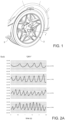
- detection of road conditions for vehicle applications is provided by a detection device 1, designed to be integrally coupled to a wheel 2 of a vehicle 3 and based on the use of an electrostatic charge variation sensor.
- the detection device 1 may for example be coupled to the rim of the wheel 2, in proximity to the tire, or be coupled to the tire, or be integrated inside the rim or tire.
- the detection device 1 is configured so that a charge variation signal provided by the electrostatic charge variation sensor is processed jointly, or in combination, with information on the rotation speed of the wheel, in order to identify road conditions, in particular to distinguish between a dry road condition and a wet road condition.
- the electric charge is a fundamental component of nature.
- the charge of an electrostatically charged body may be easily transferred to another body, in conditions of direct contact between the elements or at a distance.
- a static charge is generated whereby the object with an excess of electrons is charged negatively and the object with a deficit of electrons is charged positively.
- the displacement of charges is of a different nature, depending on whether the object is a conductive object or a dielectric.
- the electrons are distributed throughout the material and are free to move, based on the influence of external electric fields.
- a dielectric In a dielectric, there are no electrons free to move but electric dipoles, with random directions in space (thus resulting in zero net charge), which may be oriented or deformed through an external electric field, thus generating an ordered charge distribution and, therefore, a bias.
- the charge may be movable, depending on material properties and other environmental factors.
- the electrostatic charge variation sensor of the detection device 1 is configured to detect, through electrostatic induction, the variations in the electric field (and therefore in electrostatic potential), which occur over time due to the local electrostatic charge variation, caused by the rotation of the wheel 2 of the vehicle 3, to which the same sensor is coupled.
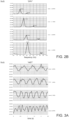
- Figure 2A shows the trend in the time domain S Q (t) of the charge variation signal S Q indicative of the electrostatic charge variation felt by the charge variation sensor, at different rotation speeds (indicated as RPS, rotations or revolutions per second) of the wheel 2 having the detection device 1 coupled thereto.
- Figure 2B shows the corresponding trend in the frequency domain S Q (f) of the same charge variation signal S Q , again considering the different rotation speeds of the wheel 2.
- the frequency of the main or fundamental harmonic has a value corresponding to the inverse of the rotation period of the wheel 2, i.e. to its rotation speed (indicated in RPS, revolutions per second) and has a significantly greater amplitude; further harmonics are present at multiples of the main harmonic frequency.
- Figures 3A and 3B show, similarly to what has been shown in Figures 2A and 2B (the latter being related to a dry road condition, "dry"), the trend in the time domain S Q (t) and the trend in the frequency domain S Q (f) of the charge variation signal S Q , at different rotation speeds of the wheel 2 (two of the rotation values corresponding to values shown in the aforementioned Figures 2A and 2B ), in a wet road condition, "wet".
- the present Applicant has found an average reduction in the amplitude of the charge variation signal S Q , considered in the time domain, by a factor of about 100; and a corresponding average reduction in the charge variation signal S Q , considered in the frequency domain, by a factor equal to about 5000.
- An aspect of the present invention thus provides for the joint or combined processing of the charge variation signal S Q , in particular considered in the frequency domain (where a more marked reduction in the aforementioned amplitude occurs), and of a signal indicative of the rotation speed of the wheel 2, which is used to identify the fundamental (and most significant) harmonic of the same charge variation signal S Q .
- this rotation speed variation signal is also used to inhibit the detection of road conditions at reduced rotation speeds of the wheel 2, since the present Applicant has found that, for reduced speeds, the aforementioned electrostatic charge generation associated with the rotation of the wheel 2 may not be significant and therefore not provide reliable indications.
- Figure 4 illustrates, schematically, the detection device 1 according to an embodiment of the present invention, which comprises a rotation speed sensor 12, configured to provide an indication of the rotation speed of the wheel 2, to which the same detection device 1 is designed to be coupled.
- the aforementioned rotation speed sensor 12 is a semiconductor gyroscope made using MEMS (Micro Electro Mechanical System) technology, of a per se known type and not described in detail herein, which is configured to provide a rotation speed (or angular speed) signal S V , expressed in degrees/sec;
- MEMS Micro Electro Mechanical System
- these road condition information may be sent, for example through a wireless transmission, to a management and control unit of the vehicle 3 having the detection device 1 incorporated therein, in order to perform and activate certain actions in response to the road condition detection (for example, activating suitable adjustments of one or more systems of the vehicle 3, such as a braking system, suspensions or steering).
- the aforementioned processing unit 16 comprises for example a microcontroller, or an MLC (Machine Learning Core) processor resident in an ASIC (Application Specific Integrated Circuit) electronic circuit coupled to the rotation speed sensor 12 and to the electrostatic charge variation sensor 14 for processing the corresponding rotation speed signal S V and charge variation signal S Q ; the aforementioned rotation speed sensor 12, electrostatic charge variation sensor 14 and processing unit 16 may be integrated within a same package (or chip) provided with suitable elements for electrical connection to the outside.
- MLC Machine Learning Core
- ASIC Application Specific Integrated Circuit
- the aforementioned chip may be coupled to a printed circuit board (not illustrated here), and a wireless communication module (also not illustrated) may be coupled to the same printed circuit board, for remote transmission, for example to the aforementioned management and control unit of the vehicle 3, of the road condition information provided by the detection device 1.
- Figure 5 illustrates an exemplary and non-limiting embodiment of the electrostatic charge variation sensor 14, which comprises at least one input electrode IN, or detection electrode, made of metal material, possibly covered with a dielectric material layer, designed to be arranged facing or in proximity to the operating environment associated with the wheel 2, for detecting the local charge variation (and the consequent field and electric potential variation), due to the rotation of the same wheel 2 and to the contact with the road.
- the electrostatic charge variation sensor 14 comprises at least one input electrode IN, or detection electrode, made of metal material, possibly covered with a dielectric material layer, designed to be arranged facing or in proximity to the operating environment associated with the wheel 2, for detecting the local charge variation (and the consequent field and electric potential variation), due to the rotation of the same wheel 2 and to the contact with the road.
- the detection electrode IN in the illustrated exemplary solution, forms part of a differential input 19 of an instrumentation amplifier 22, being coupled to a corresponding first input terminal 19a.
- An input capacitor C I and an input resistor R I are connected in parallel with each other between the first input terminal 19a and a second input terminal 19b of the differential input 19.
- an input voltage V d across the input capacitor C I varies due to the charge redistribution in the external environment. After a transient (whose duration is given by the constant R I ⁇ C I defined by the parallel between the capacitor C I and the resistor R I ), the input voltage V d returns to its steady state value (so-called "steady state”) .
- the instrumentation amplifier 22 is essentially made by two operational amplifiers OP1 and OP2, having non-inverting input terminals connected to the first and to the second input terminals 19a, 19b, respectively, and inverting terminals connected to each other through a gain resistor R G2 .
- a biasing stage (buffer) OP3 biases the instrumentation amplifier 22 to a common mode voltage V CM , through a resistor R 1 coupled to the second input terminal 19b.
- the output terminals of the operational amplifiers OP1 and OP2 are connected to the respective inverting input terminals through a respective gain resistor R G1 ; an output voltage V d ' is present between the same output terminals.
- the gain Ad of the instrumentation amplifier 22 is equal to (1+2 ⁇ R 1 /R 2 ); therefore, the aforementioned output voltage V d ' is equal to: V d ⁇ (1+2 ⁇ R 1 /R 2 ).
- the components of the instrumentation amplifier 22 are chosen such that the same instrumentation amplifier 22 has a reduced noise and a high impedance (for example of the order of 10 9 Ohm) in its passband (for example comprised between 0 and 500 Hz).
- the aforementioned output voltage V d ' is input to an analog-to-digital converter (ADC) 24, which outputs the aforementioned charge variation signal S Q for the processing unit 16.
- ADC analog-to-digital converter
- This charge variation signal S Q may be, for example, a (16 or 24 bit) high resolution digital stream.
- the instrumentation amplifier 22 may be omitted, in this case supplying the input voltage V d directly to the input of the analog-to-digital converter 24.
- the charge variation signal S Q may be provided to a first input of a multiplexer block, which may also receive, at at least one further input, the aforementioned rotation speed signal S V (and possibly, at further inputs, further detection signals).
- the output of the multiplexer block is, in this case, coupled to an input of the processing unit 16, providing the aforementioned charge variation signal and rotation speed signal S Q , S V (and possibly further detection signals) for processing by the same processing unit 16.
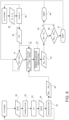
- Figure 6 illustrates in greater detail, through a flow chart, the joint processing operations of the charge variation and rotation speed signals S Q , S V implemented by the processing unit 16, in a possible embodiment of the present invention.
- this joint processing provides two processing channels executed in parallel and continuously over time, a first channel dedicated to the charge variation signal S Q and a second channel dedicated to the rotation speed signal S V .
- the processing unit 16 is initially configured to acquire, block 30, the charge variation signal S Q (t) in the time domain; in particular, corresponding samples thereof are acquired at subsequent time instants (for example, these samples are stored in an acquisition buffer which is progressively fed with and updated by the same samples).
- the aforementioned charge variation signal S Q (t) may be subjected to a normalization operation, for example by removing a corresponding base value, so-called “baseline” (due for example to an environmental electrostatic charge or to an uncompensated offset of the sensor), as indicated in block 32.
- baseline due for example to an environmental electrostatic charge or to an uncompensated offset of the sensor
- the resulting signal is then provided to a frequency transform, block 33, for example through known FFT (Fast Fourier Transform) operations preceded by a windowing operation (for example through a Hann window), to obtain, as indicated in block 34, a charge variation signal S Q (f) in the frequency domain.
- FFT Fast Fourier Transform
- windowing operation for example through a Hann window
- block 35 an operation for identifying the peaks in the frequency domain in the charge variation signal S Q (f) is performed, to obtain, as indicated in block 36, a series of N identified peaks, [Pk 1 , ..., Pk N ], each at an associated frequency.
- this rotation speed sensor 14 is a gyroscope having three detection axes, which provides three angular speed components Gx, Gy, Gz along three detection axes.
- block 38 the aforementioned angular speed components Gx, Gy, Gz are acquired and the modulus G thereof is obtained, block 39 (expressed in degrees per second).
- the rotation speed value of the wheel 2 is obtained, expressed in rotations per second, RPS (for example, the aforementioned modulus is divided by 360 to obtain this rotation speed value, RPS).
- the rotation speed value RPS is then compared to a minimum-speed threshold RPS TH , for example corresponding to a speed of the vehicle 3 equal to 4-5 Km/h, in such a way as not to continue with the detection algorithm in case the aforementioned rotation speed value RPS is not higher than the minimum-speed threshold RPS TH .
- the algorithm determines the presence of a dry road condition, "dry", as indicated in block 47.
- the count of the time during which a certain condition persists may also be provided, in order to validate the detected condition only if this condition persists for more than a minimum time: for example, for an asphalt to be identified as dry, the system may provide for the detection of the "dry" condition, continuously, for at least five seconds (or other time interval of suitable value).
Landscapes
- Engineering & Computer Science (AREA)
- Physics & Mathematics (AREA)
- Transportation (AREA)
- Mechanical Engineering (AREA)
- Automation & Control Theory (AREA)
- Mathematical Physics (AREA)
- General Physics & Mathematics (AREA)
- Regulating Braking Force (AREA)
- Gyroscopes (AREA)
- Traffic Control Systems (AREA)
- Geophysics And Detection Of Objects (AREA)
- Radar Systems Or Details Thereof (AREA)
Description
- The present invention relates to a device and a method for automatic detection of road conditions for vehicle applications, in particular for autonomous or automated driving.
- As is known, road vehicles are commonly provided with a plurality of sensors, in order to increase their safety and also in order to implement autonomous or automated driving.
- In this regard, the monitoring and detection of road conditions and consequent forces generated on the vehicle tires/wheels are, for example, crucial to ensure safety and reliability.
- In particular, the detection of road conditions (for example, distinguishing between a dry or wet road) may enable to significantly improve the intervention modes of important vehicle systems, such as the braking system, the steering or the active suspensions. Furthermore, the possibility of signaling and warning a driver as to road conditions may significantly improve driving safety.
- In general, two approaches have been proposed for monitoring road conditions:
- a first approach, based on the effects, provides for the identification of road friction conditions, in an indirect manner, by estimating the response of dynamic parameters of the vehicle;
- a second approach, based on causes, provides for the detection of the causes, that is, in a direct manner, of the actual variation of road conditions, before they significantly affect the behavior of the vehicle, using various sensors suitable for this purpose.
- For example, as to the second approach, J. Häkli et al., "Road surface condition detection using 24 GHz automotive radar technology," 14th International Radar Symposium (IRS), 2013, pp. 702-707, discloses measurement systems using a 24-GHz radar technology to study the backscattering properties of different asphalt surfaces, such as dry, wet or icy surfaces.
- I. Abdić et al., "Detecting road surface wetness from audio: A deep learning approach," 23rd International Conference on Pattern Recognition (ICPR), 2016, pp. 3458-3463, discloses a method for detecting the humidity of the road surface, based on the processing of sound signals generated by the interaction between the same surface and the tire.
- E. Šabanovič, et al. "Identification of Road-Surface Type Using Deep Neural Networks for Friction Coefficient Estimation",
Sensors 2020, 20, no. 3, 612, discloses a solution for detecting the type of road surface based on the acquisition of images and their processing through the use of DNN (Deep Neural Network) neural networks. -
EP 2 801 835 A1 - The present Applicant has found that the solutions currently used have, however, some limitations and suffer from some drawbacks, in general as to the applicability to various operating conditions, the reliability and robustness to external and unwanted factors, the life and reliability of the used sensors.
- The aim of the present invention is to overcome the drawbacks of the known approaches, providing a solution for detecting road conditions, having improved characteristics.
- According to the present invention, a device and a method for the detection of road conditions are provided, as defined in independent claim and 12.
- For a better understanding of the invention, embodiments thereof are now described, purely by way of non-limiting example and with reference to the attached drawings, wherein:
-
Figure 1 is a schematic representation of a road condition detection device, coupled to the wheel of a vehicle; -
Figures 2A and2B show trends, respectively in the time and frequency domain, of a charge variation signal, in a first road condition, of a dry road; -
Figures 3A and3B show trends, respectively in the time and in frequency domain, of the charge variation signal, in a second road condition, of a wet road; -
Figure 4 is a schematic block diagram of the detection device, according to an embodiment of the present invention; -
Figure 5 illustrates a possible circuit embodiment of an electrostatic charge variation sensor of the detection device ofFigure 4 ; -
Figure 6 is a flow chart of operations implemented by the detection device ofFigure 4 , according to an embodiment of the present invention; -
Figure 7 shows graphs of an electrostatic charge variation signal and of a wheel rotation speed signal and the associated detection of the first and second road conditions; and -
Figure 8 is a schematic block diagram of a vehicle system in which the detection device ofFigure 4 may be used. - As shown schematically in
Figure 1 , according to an aspect of the present solution, detection of road conditions for vehicle applications is provided by adetection device 1, designed to be integrally coupled to awheel 2 of avehicle 3 and based on the use of an electrostatic charge variation sensor. - The
detection device 1 may for example be coupled to the rim of thewheel 2, in proximity to the tire, or be coupled to the tire, or be integrated inside the rim or tire. - As will be discussed in detail below, the
detection device 1 is configured so that a charge variation signal provided by the electrostatic charge variation sensor is processed jointly, or in combination, with information on the rotation speed of the wheel, in order to identify road conditions, in particular to distinguish between a dry road condition and a wet road condition. - In a per se known manner, the electric charge is a fundamental component of nature. The charge of an electrostatically charged body may be easily transferred to another body, in conditions of direct contact between the elements or at a distance. When the charge is transferred between two electrically insulated objects, a static charge is generated whereby the object with an excess of electrons is charged negatively and the object with a deficit of electrons is charged positively. The displacement of charges is of a different nature, depending on whether the object is a conductive object or a dielectric. In a conductor, the electrons are distributed throughout the material and are free to move, based on the influence of external electric fields. In a dielectric, there are no electrons free to move but electric dipoles, with random directions in space (thus resulting in zero net charge), which may be oriented or deformed through an external electric field, thus generating an ordered charge distribution and, therefore, a bias. The charge may be movable, depending on material properties and other environmental factors.
- In the present invention, the electrostatic charge variation sensor of the
detection device 1 is configured to detect, through electrostatic induction, the variations in the electric field (and therefore in electrostatic potential), which occur over time due to the local electrostatic charge variation, caused by the rotation of thewheel 2 of thevehicle 3, to which the same sensor is coupled. - In particular, when, during its rotation, the portion of the
wheel 2, at which the charge variation sensor is coupled, comes into contact with the road surface (in particular, asphalt), an electrostatic charge generation (due to triboelectric effect) occurs, with a consequent evident modification in the charge variation signal provided by the charge variation sensor. - In this regard,
Figure 2A shows the trend in the time domain SQ(t) of the charge variation signal SQ indicative of the electrostatic charge variation felt by the charge variation sensor, at different rotation speeds (indicated as RPS, rotations or revolutions per second) of thewheel 2 having thedetection device 1 coupled thereto. - In particular, it is evident that, corresponding to the rotations of the wheel 2 (that occur at a shorter period, i.e. at a higher angular frequency, the greater the rotation speed), peaks are generated in the charge variation signal SQ, due to the aforementioned electrostatic charge generation effect caused by the contact between the tire and the road.
-
Figure 2B shows the corresponding trend in the frequency domain SQ(f) of the same charge variation signal SQ, again considering the different rotation speeds of thewheel 2. - In the frequency spectrum of the charge variation signal SQ various harmonics of the rotation frequency of the wheel are present; in particular, the frequency of the main or fundamental harmonic has a value corresponding to the inverse of the rotation period of the
wheel 2, i.e. to its rotation speed (indicated in RPS, revolutions per second) and has a significantly greater amplitude; further harmonics are present at multiples of the main harmonic frequency. - The present Applicant has found that the amplitude of the aforementioned charge variation signal SQ is strongly influenced by (and therefore indicative of) the road conditions. In particular, in the presence of water (of a so-called "aqueous film") on the road surface, this amplitude is significantly lower, due to the fact that electrostatic charge generation due to the triboelectric effect (i.e., due to the rubbing of the tire on the road) is significantly reduced (the wet road condition neutralizing this effect to a significant extent).
- In this regard,
Figures 3A and3B show, similarly to what has been shown inFigures 2A and2B (the latter being related to a dry road condition, "dry"), the trend in the time domain SQ(t) and the trend in the frequency domain SQ(f) of the charge variation signal SQ, at different rotation speeds of the wheel 2 (two of the rotation values corresponding to values shown in the aforementionedFigures 2A and2B ), in a wet road condition, "wet". - From the comparative examination of these
Figures 3A and3B and of the precedingFigures 2A and2B , the marked reduction in the amplitude of the charge variation signal SQ is apparent, in particular in the amplitude of the fundamental harmonic of the signal in the frequency domain, an amplitude which is therefore strongly linked to the asphalt conditions: in particular, a maximum amplitude corresponds to a dry road and a minimum amplitude (i.e., significantly less with respect to the dry road condition) corresponds to a wet road (having a film or aqueous layer thereon). - In detail, the present Applicant has found an average reduction in the amplitude of the charge variation signal SQ, considered in the time domain, by a factor of about 100; and a corresponding average reduction in the charge variation signal SQ, considered in the frequency domain, by a factor equal to about 5000.
- An aspect of the present invention thus provides for the joint or combined processing of the charge variation signal SQ, in particular considered in the frequency domain (where a more marked reduction in the aforementioned amplitude occurs), and of a signal indicative of the rotation speed of the
wheel 2, which is used to identify the fundamental (and most significant) harmonic of the same charge variation signal SQ. - As will be highlighted, according to an aspect of the present invention, this rotation speed variation signal is also used to inhibit the detection of road conditions at reduced rotation speeds of the
wheel 2, since the present Applicant has found that, for reduced speeds, the aforementioned electrostatic charge generation associated with the rotation of thewheel 2 may not be significant and therefore not provide reliable indications. -
Figure 4 illustrates, schematically, thedetection device 1 according to an embodiment of the present invention, which comprises arotation speed sensor 12, configured to provide an indication of the rotation speed of thewheel 2, to which thesame detection device 1 is designed to be coupled. - In particular, in a possible embodiment, the aforementioned
rotation speed sensor 12 is a semiconductor gyroscope made using MEMS (Micro Electro Mechanical System) technology, of a per se known type and not described in detail herein, which is configured to provide a rotation speed (or angular speed) signal SV, expressed in degrees/sec; - an electrostatic
charge variation sensor 14, configured to provide a charge variation signal SQ indicative of an electrostatic charge variation; and - a
processing unit 16, coupled to therotation speed sensor 12 and to the electrostaticcharge variation sensor 14 in order to receive the rotation speed signal SV and the charge variation signal SQ and configured to jointly process the aforementioned rotation speed signal SV and charge variation signal SQ to detect road conditions and output information on detected road condition. - In a manner not illustrated herein, these road condition information may be sent, for example through a wireless transmission, to a management and control unit of the
vehicle 3 having thedetection device 1 incorporated therein, in order to perform and activate certain actions in response to the road condition detection (for example, activating suitable adjustments of one or more systems of thevehicle 3, such as a braking system, suspensions or steering). - In greater detail, the
aforementioned processing unit 16 comprises for example a microcontroller, or an MLC (Machine Learning Core) processor resident in an ASIC (Application Specific Integrated Circuit) electronic circuit coupled to therotation speed sensor 12 and to the electrostaticcharge variation sensor 14 for processing the corresponding rotation speed signal SV and charge variation signal SQ; the aforementionedrotation speed sensor 12, electrostaticcharge variation sensor 14 andprocessing unit 16 may be integrated within a same package (or chip) provided with suitable elements for electrical connection to the outside. - In a possible implementation, the aforementioned chip may be coupled to a printed circuit board (not illustrated here), and a wireless communication module (also not illustrated) may be coupled to the same printed circuit board, for remote transmission, for example to the aforementioned management and control unit of the
vehicle 3, of the road condition information provided by thedetection device 1. -
Figure 5 illustrates an exemplary and non-limiting embodiment of the electrostaticcharge variation sensor 14, which comprises at least one input electrode IN, or detection electrode, made of metal material, possibly covered with a dielectric material layer, designed to be arranged facing or in proximity to the operating environment associated with thewheel 2, for detecting the local charge variation (and the consequent field and electric potential variation), due to the rotation of thesame wheel 2 and to the contact with the road. - The detection electrode IN, in the illustrated exemplary solution, forms part of a
differential input 19 of aninstrumentation amplifier 22, being coupled to a correspondingfirst input terminal 19a. - An input capacitor CI and an input resistor RI are connected in parallel with each other between the
first input terminal 19a and asecond input terminal 19b of thedifferential input 19. - During operation, an input voltage Vd across the input capacitor CI varies due to the charge redistribution in the external environment. After a transient (whose duration is given by the constant RI·CI defined by the parallel between the capacitor CI and the resistor RI), the input voltage Vd returns to its steady state value (so-called "steady state") .
- The
instrumentation amplifier 22 is essentially made by two operational amplifiers OP1 and OP2, having non-inverting input terminals connected to the first and to thesecond input terminals - A biasing stage (buffer) OP3 biases the
instrumentation amplifier 22 to a common mode voltage VCM, through a resistor R1 coupled to thesecond input terminal 19b. - The output terminals of the operational amplifiers OP1 and OP2 are connected to the respective inverting input terminals through a respective gain resistor RG1; an output voltage Vd' is present between the same output terminals.
- As will become apparent from the examination of the circuit, the gain Ad of the
instrumentation amplifier 22 is equal to (1+2·R1/R2); therefore, the aforementioned output voltage Vd' is equal to: Vd·(1+2·R1/R2). - The components of the
instrumentation amplifier 22 are chosen such that thesame instrumentation amplifier 22 has a reduced noise and a high impedance (for example of the order of 109 Ohm) in its passband (for example comprised between 0 and 500 Hz). - The aforementioned output voltage Vd' is input to an analog-to-digital converter (ADC) 24, which outputs the aforementioned charge variation signal SQ for the
processing unit 16. This charge variation signal SQ may be, for example, a (16 or 24 bit) high resolution digital stream. - According to a different embodiment, having an analog-to-
digital converter 24 with suitable characteristics (e.g. differential input, high input impedance, high resolution, dynamic range optimized for the quantities to be measured, low noise) theinstrumentation amplifier 22 may be omitted, in this case supplying the input voltage Vd directly to the input of the analog-to-digital converter 24. - In a manner not illustrated, the charge variation signal SQ may be provided to a first input of a multiplexer block, which may also receive, at at least one further input, the aforementioned rotation speed signal SV (and possibly, at further inputs, further detection signals). The output of the multiplexer block is, in this case, coupled to an input of the
processing unit 16, providing the aforementioned charge variation signal and rotation speed signal SQ, SV (and possibly further detection signals) for processing by thesame processing unit 16. -
Figure 6 illustrates in greater detail, through a flow chart, the joint processing operations of the charge variation and rotation speed signals SQ, SV implemented by theprocessing unit 16, in a possible embodiment of the present invention. - As will now be described, this joint processing provides two processing channels executed in parallel and continuously over time, a first channel dedicated to the charge variation signal SQ and a second channel dedicated to the rotation speed signal SV.
- In detail, the
processing unit 16 is initially configured to acquire, block 30, the charge variation signal SQ(t) in the time domain; in particular, corresponding samples thereof are acquired at subsequent time instants (for example, these samples are stored in an acquisition buffer which is progressively fed with and updated by the same samples). - The aforementioned charge variation signal SQ(t) may be subjected to a normalization operation, for example by removing a corresponding base value, so-called "baseline" (due for example to an environmental electrostatic charge or to an uncompensated offset of the sensor), as indicated in
block 32. - The resulting signal is then provided to a frequency transform, block 33, for example through known FFT (Fast Fourier Transform) operations preceded by a windowing operation (for example through a Hann window), to obtain, as indicated in
block 34, a charge variation signal SQ(f) in the frequency domain. - Then, block 35, an operation for identifying the peaks in the frequency domain in the charge variation signal SQ(f) is performed, to obtain, as indicated in
block 36, a series of N identified peaks, [Pk1, ..., PkN], each at an associated frequency. - In parallel to the processing of the aforementioned charge variation signal SQ, which in any case continues over time, as indicated in the same
Figure 6 the rotation speed signal SV provided by therotation speed sensor 14 is processed in the second processing channel. - In the illustrated embodiment, this
rotation speed sensor 14 is a gyroscope having three detection axes, which provides three angular speed components Gx, Gy, Gz along three detection axes. - In detail, block 38, the aforementioned angular speed components Gx, Gy, Gz are acquired and the modulus G thereof is obtained, block 39 (expressed in degrees per second).
- As a function of this modulus, as indicated in
block 40, the rotation speed value of thewheel 2 is obtained, expressed in rotations per second, RPS (for example, the aforementioned modulus is divided by 360 to obtain this rotation speed value, RPS). - According to an aspect of the present invention, block 41, the rotation speed value RPS is then compared to a minimum-speed threshold RPSTH, for example corresponding to a speed of the
vehicle 3 equal to 4-5 Km/h, in such a way as not to continue with the detection algorithm in case the aforementioned rotation speed value RPS is not higher than the minimum-speed threshold RPSTH. - If, on the other hand, the aforementioned threshold condition is verified (that is, the rotation speed value RPS is higher than the minimum-speed threshold RPSTH), the algorithm continues to block 42, where distances in the frequency domain (in absolute value) are determined between each of the previously detected peaks ([Pk1, ... , PkN]) and the frequency corresponding to the aforementioned rotation speed RPS (as previously indicated, the value of this rotation speed RPS corresponds in fact to the fundamental frequency of the charge variation signal SQ(f)); the aforementioned distances are indicated with ([d1, ... , dN]).
- In the
next block 43, of all the peaks the one with minimum distance dm with respect to the rotation speed value RPS is then selected, the amplitude of this selected peak being indicated with Pkm, as shown inblock 44. - The aforementioned minimum distance dm is then compared with a minimum-distance threshold dTH, block 45.
- In case the minimum distance dm is less than the minimum-distance threshold dTH, a further comparison between the aforementioned selected peak amplitude Pkm and a peak-amplitude threshold PkTH (whose value may for example be set in the design step or be adjustable, selectable, by an operator to adapt to various use scenarios), is performed, block 46.
- In case the selected peak amplitude Pkm is greater than the peak-amplitude threshold PkTH, the algorithm determines the presence of a dry road condition, "dry", as indicated in
block 47. - Otherwise, as indicated in
block 48, in case the minimum distance dm is not less than the minimum-distance threshold dTH (at the aforementioned block 45), or the selected peak amplitude Pkm is not greater than the peak-amplitude threshold PkTH (at the aforementioned block 46), the algorithm determines the presence of a wet road condition, "wet", as indicated inblock 48. - It should be noted that the aforementioned wet road condition is characterized by the presence of liquid, in particular an aqueous film or layer, on the surface in contact with the
wheel 2, which, instead, is not present in the dry road condition. - As shown in the same
Figure 6 , the processing continues over time, on the basis of the new samples of the rotation speed and charge variation signals SV, SQ that are acquired. - In a possible implementation, not illustrated, the count of the time during which a certain condition persists may also be provided, in order to validate the detected condition only if this condition persists for more than a minimum time: for example, for an asphalt to be identified as dry, the system may provide for the detection of the "dry" condition, continuously, for at least five seconds (or other time interval of suitable value).
- Basically, the algorithm implemented by the
processing unit 16 provides, therefore, for the parallel acquisition of the rotation speed signal SV (advantageously provided by therotation speed sensor 12, in this case a triaxial gyroscope, so as to correspond directly to the number of rotations or revolutions per second of thewheel 2, therefore to the fundamental frequency at which the pulses of the charge variation signal SQ occur) and of the same charge variation signal SQ provided by thecharge variation sensor 14. - On the basis of this charge variation signal SQ, a search for peaks in the spectrum SQ(f) is performed to identify the positions and amplitudes of all detected peaks.
- If the aforementioned rotation speed value RPS is greater than the minimum-speed threshold RPSTH, i.e. if the vehicle moves with a speed being greater than the minimum significant speed, the algorithm searches for the peak in the spectrum SQ(f) having minimum distance from the fundamental frequency, which corresponds to the same value RPS.
- If a peak with a distance not greater, in absolute value, than the minimum-distance threshold dTH is identified and it is also verified that this peak has an amplitude being greater than the peak-amplitude threshold PKTH, then the aforementioned "dry road" condition is determined; otherwise, the aforementioned "wet road" condition is determined.
-
Figure 7 shows, as regards to what has just been discussed, the trends of the charge variation signal SQ and of the rotation speed signal SV, as the rotation speed of thewheel 2 of thevehicle 3 varies over time, with reference to experimental tests performed by the present Applicant. - The amplitude of the charge variation signal SQ is dimensionless expressed as LSB ("Least Significant Bit"), that is the minimum digital value output from the analog-to-digital converter, which is proportional to the voltage detected at the aforementioned input electrode IN (refer again to what has been discussed with reference to
Figure 5 ). For example, 1 LSB may correspond to a value comprised between a few nV and a few tens of µV. The constant of proportionality (or sensitivity) depends on the gain of the amplifier, on the resolution of the analog-to-digital converter and on possible digital processing (e.g., oversampling, decimation, etc.). The LSB representation is common in the art and disregards a quantification in physical units, as the aim is typically to detect corresponding variations, with respect to a steady or baseline state. - In particular,
Figure 7 indicates the time intervals wherein the aforementioned algorithm performed by theprocessing unit 16 determines the presence of a "dry road" (dry) or a "wet road" (wet) condition. -
Figure 8 schematically illustrates a vehicle system, wherein thevehicle 3, for example a motor car, includes at least onedetection device 1 previously described, suitably coupled to at least onecorresponding wheel 2. - The
vehicle 3 also comprises a main controller 52 (a microcontroller, a microprocessor or a similar digital processing unit), coupled to theprocessing unit 16 of thedetection device 1, in order to receive information relating to the detected road condition. - In the previously described embodiment, the
main controller 52 receives, for example from theprocessing unit 16 of thedetection device 1, the information of "dry road" or "wet road" condition, to activate or deactivate certain adjustments of thesame vehicle 3, as previously described, for example of a corresponding braking system, of the steering or of the suspensions. - The advantages that the present invention allows to achieve are clear from the preceding description.
- In any case, it is highlighted that the detection device 1:
- operates correctly at all speeds of the vehicle 3 (in the speed measurement range by the rotation speed sensor, for example the gyroscope);
- has a high robustness to external and unwanted factors;
- has a high durability and reliability of the used sensors (the
charge variation sensor 14 and the rotation speed sensor 12); - ensures an accurate and reliable classification of road conditions (distinguishing between dry and wet road conditions), allowing the number of false detections (false positives) to be removed or, in any case, strongly reduced.
- The
detection device 1 also has an optimized energy consumption (the consumption associated with the aforementionedrotation speed sensor 12 andcharge variation sensor 14 and with the corresponding electronics is very low) and a reduced space occupation (in particular, with the possibility of integrating both the detection, rotation speed and charge variation technologies in a single package). - In this regard, and as previously indicated, the use of a MEMS gyroscope as the aforementioned
rotation speed sensor 12 is particularly advantageous (in this case, in fact, the frequency of the fundamental harmonic of the charge variation signal SQ is equal to the inverse of the rotation period of thewheel 2, i.e. to the RPS value which is calculated directly from the output of the same gyroscope), according to the expression:
- Finally, variations and modifications may be applied to the present solution, without thereby departing from the scope identified by the claims.
- For example, in a manner not illustrated, a plurality of the aforementioned
charge variation sensors 14 might be used, possibly coupled to thedifferent wheels 2 of thevehicle 3 and/or coupled, in a certain number, to each of thesewheels 2, in order to further increase the reliability and accuracy of the determination of road conditions (for example, by averaging or processing in a suitable manner, the indications provided by the various sensors). - Similarly, the system might provide for the use of a plurality of
rotation speed sensors 12, again for example coupled to each of thewheels 2 of thevehicle 3. - The aforementioned
rotation speed sensor 12 might be a different sensor, for example a monoaxial or biaxial gyroscope, or a different sensor configured in any case to provide the information on the rotation speed of thewheel 2. - Furthermore, variants of the present invention might allow distinguishing, in addition to the two extreme conditions "dry" (absence of a significant amount of liquid) and "wet" (presence of a significant amount of liquid), also different and further conditions, after a suitable calibration of the
detection device 1, taking into account, for example, factors such as the type of tread of thewheel 2 and the material thereof, the state of wear, the type of road surface, etc. - It is highlighted that the present invention may find advantageous application for any road vehicle, in particular a motor car, but also a motor vehicle or other kind of vehicle (bicycles, mopeds, etc.) provided with wheels in contact with the road (in a material, for example rubber, being suitable for the described electrostatic charge generation).
- Furthermore, it is again highlighted that the
detection device 1 may be made in a single chip that incorporates the charge variation sensor 14 (and the electronic circuitry thereof), therotation speed sensor 12 and theprocessing unit 16; alternatively, the charge variation signal SQ and the rotation speed signal SV could be processed in themain controller 52 of thevehicle 3 having thedetection device 1 incorporated therein (implementing in this case the aforementioned processing unit 16). - Furthermore, it is highlighted that the input electrode IN (or detection electrode) of the electrostatic
charge variation sensor 14 might also be a simple conductive probe; a metal plane or path in the printed circuit board; or any conductive element that may operate as a detection electrode for being arranged facing the operating environment associated with the rotation of thewheel 2 of thevehicle 3, in order to detect the charge variation.
Claims (18)
- A road condition detection device (1), configured to be coupled to a wheel (2) of a vehicle (3) and comprising:an electrostatic charge variation sensor (14), configured to provide a charge variation signal (SQ) indicative of an electrostatic charge variation associated with the rotation of said wheel (2); anda processing unit (16), coupled to the electrostatic charge variation sensor (14) to receive the charge variation signal (SQ) and further configured to receive a rotation speed signal (SV) indicative of the rotation speed of said wheel (2),wherein said processing unit (16) is configured to jointly process said rotation speed signal (SV) and charge variation signal (SQ) for detecting a road condition,characterized in that said processing unit (16) is configured to: determine, in the trend in the frequency domain of said charge variation signal (SQ), a peak amplitude of a fundamental frequency at said rotation speed of the wheel (2); and compare said peak amplitude with a threshold amplitude (PkTH) to determine one of a dry road condition and a wet road condition.
- The device according to claim 1, wherein said processing unit (16) is configured to determine one of a dry road condition and a wet road condition.
- The device according to claim 1 or 2, further comprising a rotation speed sensor (12), configured to provide said rotation speed signal (SV).
- The device according to claim 3, wherein said rotation speed sensor (12) is a MEMS triaxial gyroscope; and wherein said processing unit (16) is configured to determine said rotation speed of the wheel (2) as a function of the modulus of an angular speed signal provided by said gyroscope.
- The device according to claim 3 or 4, wherein said charge variation sensor (12) comprises at least one detection electrode (IN) configured to detect said electrostatic charge variation; a high-impedance instrumentation amplifier (22) having an input coupled to said detection electrode (IN); and an analog-to-digital converter (24) coupled to the output of said instrumentation amplifier (22) to provide said charge variation signal (SQ).
- The device according to any of claims 3-5, wherein said processing unit (16), said rotation speed sensor (12) and said electrostatic charge variation sensor (14) are integrated within a same chip.
- The device according to any of the preceding claims, wherein said processing unit (16) is configured to: determine a frequency distance between said fundamental frequency and a frequency associated with said rotation speed of the wheel (2); and compare said distance with a threshold distance (dTH) to determine said one of a dry road condition and a wet road condition.
- The device according to claim 7, wherein said processing unit (16) is configured to determine the dry road condition in case said distance is less than the threshold distance (dTH) and said peak amplitude is greater than the threshold amplitude (PkTH); and determine the wet road condition in case said distance is not less than the threshold distance (dTH) or said peak amplitude is not greater than the threshold amplitude (PKTH).
- The device according to any of the preceding claims, wherein said processing unit (16) is configured to: perform a transform in the frequency domain to obtain the charge variation signal in the frequency domain; perform a peak identification operation in the frequency domain in the charge variation signal, to obtain a series of identified peaks, each at an associated frequency; determine the frequency distances between each of the detected peaks and a frequency corresponding to the rotation speed of the wheel (2); select the peak with minimum distance (dm) with respect to said frequency corresponding to the rotation speed of the wheel (2) and determine the amplitude of said selected peak as said peak amplitude of the fundamental frequency.
- The device according to any of the preceding claims, wherein said processing unit (16) is configured to: compare said rotation speed with a minimum-speed threshold (RPSTH); and continue the detection of said road conditions only in case said rotation speed value is higher than said minimum-speed threshold (RPSTH).
- A vehicle system, comprising a detection device (1) according to any of the preceding claims and a main controller (52) coupled to the processing unit (16) of the detection device (1), in order to receive information on road condition, for executing and/or activating certain actions according to said road condition.
- A method for detecting road conditions for a vehicle (3) having at least one wheel (2), comprising:generating, by an electrostatic charge variation sensor (14), a charge variation signal (SQ) indicative of an electrostatic charge variation associated with the rotation of said wheel (2); andreceiving, by a processing unit (16) coupled to the electrostatic charge variation sensor (14), the charge variation signal (SQ) and a rotation speed signal (SV) indicative of the rotation speed of said wheel (2),further comprising, by said processing unit (16), jointly processing said rotation speed signal (SV) and charge variation signal (SQ) to detect a road condition,characterized by determining, in the trend in the frequency domain of said charge variation signal (SQ), the peak amplitude of a fundamental frequency at said rotation speed of the wheel (2); and comparing said peak amplitude with a threshold amplitude (PkTH) to determine one of a dry road condition and a wet road condition.
- The method according to claim 12, wherein detecting comprises determining one of a dry road condition and a wet road condition.
- The method according to claim 12 or 13, wherein processing comprises: determining a frequency distance between said fundamental frequency and a frequency associated with said rotation speed of the wheel (2); and comparing said distance with a threshold distance (dTH) to determine said one of a dry road condition and a wet road condition.
- The method according to claim 14, comprising: determining the dry road condition in case the distance is less than said threshold distance (dTH) and the peak amplitude is greater than said threshold amplitude (PkTH); and determining the wet road condition in case the distance is not less than said threshold distance (dTH) or the peak amplitude is not greater than said threshold amplitude (PKTH).
- The method according to any of claims 12-15, wherein processing comprises: performing a transform in the frequency domain to obtain the charge variation signal in the frequency domain; performing a peak identification operation in the frequency domain in the charge variation signal, to obtain a series of identified peaks, each at an associated frequency; determining the frequency distances between each of the detected peaks and the frequency corresponding to the rotation speed of the wheel (2); selecting the peak with minimum distance (dm) with respect to said rotation speed value and determine the amplitude of said selected peak as said peak amplitude of the fundamental frequency.
- The method according to any of claims 12-16, comprising: comparing said rotation speed value with a minimum-speed threshold (RPSTH); and continuing the detection of said road conditions only in case said rotation speed value is higher than a minimum-speed threshold (RPSTH).
- The method according to any of claims 12-17, comprising implementing the execution and/or activation of certain actions in said vehicle (3) according to the detection of said road conditions.
Applications Claiming Priority (1)
| Application Number | Priority Date | Filing Date | Title |
|---|---|---|---|
| IT102021000021680A IT202100021680A1 (en) | 2021-08-10 | 2021-08-10 | DEVICE AND METHOD OF AUTOMATIC DETECTION OF ROAD CONDITIONS FOR VEHICLE APPLICATIONS |
Publications (2)
| Publication Number | Publication Date |
|---|---|
| EP4134284A1 EP4134284A1 (en) | 2023-02-15 |
| EP4134284B1 true EP4134284B1 (en) | 2025-03-05 |
Family
ID=78212554
Family Applications (1)
| Application Number | Title | Priority Date | Filing Date |
|---|---|---|---|
| EP22184131.5A Active EP4134284B1 (en) | 2021-08-10 | 2022-07-11 | Device and method for automatic detection of road conditions for vehicle applications |
Country Status (3)
| Country | Link |
|---|---|
| US (1) | US12441324B2 (en) |
| EP (1) | EP4134284B1 (en) |
| IT (1) | IT202100021680A1 (en) |
Families Citing this family (1)
| Publication number | Priority date | Publication date | Assignee | Title |
|---|---|---|---|---|
| SE2330191A1 (en) * | 2023-05-01 | 2024-11-02 | Volvo Truck Corp | Radar-based wheel end modules for determining wheel force generating capability |
Family Cites Families (14)
| Publication number | Priority date | Publication date | Assignee | Title |
|---|---|---|---|---|
| CN1321838C (en) * | 2001-12-21 | 2007-06-20 | 株式会社普利司通 | Method and apparatus for estimating road surface state and tire running state, abs and vehicle control using the same |
| US20070100666A1 (en) | 2002-08-22 | 2007-05-03 | Stivoric John M | Devices and systems for contextual and physiological-based detection, monitoring, reporting, entertainment, and control of other devices |
| JP4046059B2 (en) * | 2002-11-08 | 2008-02-13 | 株式会社豊田中央研究所 | Road surface condition estimation device |
| CA2608250A1 (en) * | 2005-05-19 | 2006-11-23 | Dcrypt Consultancy Services Limited | Skid and roll-over protection system and method for vehicles |
| JP4717716B2 (en) | 2006-05-25 | 2011-07-06 | 株式会社ブリヂストン | Road surface state estimating apparatus and method |
| KR101118984B1 (en) | 2009-12-02 | 2012-03-13 | 최용환 | Door opening -closing Method and Transmitting Apparatus for opening - closing Door using thereof |
| JP5928704B2 (en) | 2011-12-26 | 2016-06-01 | 国立大学法人 東京大学 | Measuring device, road surface state estimating method, road surface state estimating device, and detecting device |
| US9772361B2 (en) * | 2011-12-26 | 2017-09-26 | The University Of Tokyo | Measuring method and measuring apparatus to detect charge potential between tire and road surface |
| ES2534702B1 (en) | 2013-09-24 | 2016-02-09 | Ontech Security, Sl | ELECTROSTATIC FIELD SENSOR AND SECURITY SYSTEM IN INTERIOR SPACES |
| KR20160136013A (en) | 2015-05-19 | 2016-11-29 | 엘지전자 주식회사 | Mobile terminal and method for controlling the same |
| JP6614073B2 (en) | 2016-09-06 | 2019-12-04 | 株式会社デンソー | Road surface condition estimation device |
| US9925988B1 (en) * | 2017-02-24 | 2018-03-27 | Flord Global Technologies, Llc | Steering and braking control system |
| DE102019207157A1 (en) | 2019-05-16 | 2020-11-19 | Robert Bosch Gmbh | Method and device for detecting a wet or damp road surface, computer product program and machine-readable storage medium |
| IT202000001603A1 (en) * | 2020-01-28 | 2021-07-28 | St Microelectronics Srl | SYSTEM AND METHOD OF RECOGNIZING A TOUCH GESTURE |
-
2021
- 2021-08-10 IT IT102021000021680A patent/IT202100021680A1/en unknown
-
2022
- 2022-07-11 EP EP22184131.5A patent/EP4134284B1/en active Active
- 2022-07-22 US US17/871,463 patent/US12441324B2/en active Active
Also Published As
| Publication number | Publication date |
|---|---|
| US12441324B2 (en) | 2025-10-14 |
| CN115703469A (en) | 2023-02-17 |
| IT202100021680A1 (en) | 2023-02-10 |
| EP4134284A1 (en) | 2023-02-15 |
| US20230045861A1 (en) | 2023-02-16 |
Similar Documents
| Publication | Publication Date | Title |
|---|---|---|
| US9566834B2 (en) | System and method for determining the mileage and wear of a tire | |
| CN107000503B (en) | System and method for determining at least one tire contact area parameter characterizing the size of a tire contact area on a tire of a wheel | |
| US9527352B2 (en) | Indirect tire pressure monitoring systems and methods using multidimensional resonance frequency analysis | |
| EP3800100B1 (en) | Road surface condition estimation apparatus and road surface condition estimation method using the same | |
| EP2039540B1 (en) | Method for determining the behaviour of a tyre in motion | |
| CN101939177B (en) | Method and device for determining the change in contact surface of a tire | |
| CN112477871B (en) | Identify hand detachment based on group data | |
| US8437907B2 (en) | Method for determining a roadway state | |
| EP4134284B1 (en) | Device and method for automatic detection of road conditions for vehicle applications | |
| JP2014008956A (en) | Tire location distinction device and tire location distinction method using the same | |
| US10239366B2 (en) | Wheel position detecting device and tire air pressure detecting apparatus having the same | |
| US20070299573A1 (en) | Accelerometer based system for detection of tire tread separation and loose wheels | |
| CN115703469B (en) | Equipment and methods for automatic road condition detection in vehicle applications | |
| US12480983B2 (en) | Low-cost, high measurement speed capacitive sensing circuit for loading mode operation of capacitive sensors | |
| CN106965631A (en) | Apparatus and method for detecting vehicle movement in system for monitoring pressure in tyre | |
| US8248062B2 (en) | Rotational direction detector and method for determining the direction of rotation of a wheel | |
| GB2372861A (en) | Vehicle tyre damage detection | |
| Nishiyama et al. | Intelligent Tire Algorithm Enabling Simultaneous Detection of Loading and Wear Status of Truck and Bus Tires | |
| Breglio et al. | Cost-effective wireless sensing system for an intelligent pneumatic tire | |
| JP2015039917A (en) | Sensor position discrimination method and sensor position discrimination device | |
| JP5097438B2 (en) | Tire dynamic load radius reference value initialization method and apparatus, and tire dynamic load radius reference value initialization program | |
| WO2020120564A1 (en) | Method and device for monitoring an instantaneous behaviour of a tire of a vehicle | |
| JPH06183229A (en) | Tire pressure abnormality detection method and apparatus | |
| Watzenig et al. | Capacitive sensor signal processing based on decentralized Kalman filtering | |
| PASERO et al. | Multi-frequency ice detection system |
Legal Events
| Date | Code | Title | Description |
|---|---|---|---|
| PUAI | Public reference made under article 153(3) epc to a published international application that has entered the european phase |
Free format text: ORIGINAL CODE: 0009012 |
|
| STAA | Information on the status of an ep patent application or granted ep patent |
Free format text: STATUS: THE APPLICATION HAS BEEN PUBLISHED |
|
| AK | Designated contracting states |
Kind code of ref document: A1 Designated state(s): AL AT BE BG CH CY CZ DE DK EE ES FI FR GB GR HR HU IE IS IT LI LT LU LV MC MK MT NL NO PL PT RO RS SE SI SK SM TR |
|
| STAA | Information on the status of an ep patent application or granted ep patent |
Free format text: STATUS: REQUEST FOR EXAMINATION WAS MADE |
|
| 17P | Request for examination filed |
Effective date: 20230804 |
|
| RBV | Designated contracting states (corrected) |
Designated state(s): AL AT BE BG CH CY CZ DE DK EE ES FI FR GB GR HR HU IE IS IT LI LT LU LV MC MK MT NL NO PL PT RO RS SE SI SK SM TR |
|
| RIC1 | Information provided on ipc code assigned before grant |
Ipc: B60W 40/06 20120101ALI20240813BHEP Ipc: B60T 8/172 20060101AFI20240813BHEP |
|
| GRAP | Despatch of communication of intention to grant a patent |
Free format text: ORIGINAL CODE: EPIDOSNIGR1 |
|
| STAA | Information on the status of an ep patent application or granted ep patent |
Free format text: STATUS: GRANT OF PATENT IS INTENDED |
|
| INTG | Intention to grant announced |
Effective date: 20240924 |
|
| GRAS | Grant fee paid |
Free format text: ORIGINAL CODE: EPIDOSNIGR3 |
|
| GRAA | (expected) grant |
Free format text: ORIGINAL CODE: 0009210 |
|
| STAA | Information on the status of an ep patent application or granted ep patent |
Free format text: STATUS: THE PATENT HAS BEEN GRANTED |
|
| AK | Designated contracting states |
Kind code of ref document: B1 Designated state(s): AL AT BE BG CH CY CZ DE DK EE ES FI FR GB GR HR HU IE IS IT LI LT LU LV MC MK MT NL NO PL PT RO RS SE SI SK SM TR |
|
| REG | Reference to a national code |
Ref country code: GB Ref legal event code: FG4D |
|
| REG | Reference to a national code |
Ref country code: CH Ref legal event code: EP |
|
| REG | Reference to a national code |
Ref country code: IE Ref legal event code: FG4D |
|
| REG | Reference to a national code |
Ref country code: DE Ref legal event code: R096 Ref document number: 602022011335 Country of ref document: DE |
|
| PG25 | Lapsed in a contracting state [announced via postgrant information from national office to epo] |
Ref country code: RS Free format text: LAPSE BECAUSE OF FAILURE TO SUBMIT A TRANSLATION OF THE DESCRIPTION OR TO PAY THE FEE WITHIN THE PRESCRIBED TIME-LIMIT Effective date: 20250605 |
|
| PG25 | Lapsed in a contracting state [announced via postgrant information from national office to epo] |
Ref country code: FI Free format text: LAPSE BECAUSE OF FAILURE TO SUBMIT A TRANSLATION OF THE DESCRIPTION OR TO PAY THE FEE WITHIN THE PRESCRIBED TIME-LIMIT Effective date: 20250305 |
|
| REG | Reference to a national code |
Ref country code: NL Ref legal event code: MP Effective date: 20250305 |
|
| PG25 | Lapsed in a contracting state [announced via postgrant information from national office to epo] |
Ref country code: ES Free format text: LAPSE BECAUSE OF FAILURE TO SUBMIT A TRANSLATION OF THE DESCRIPTION OR TO PAY THE FEE WITHIN THE PRESCRIBED TIME-LIMIT Effective date: 20250305 |
|
| REG | Reference to a national code |
Ref country code: LT Ref legal event code: MG9D |
|
| PG25 | Lapsed in a contracting state [announced via postgrant information from national office to epo] |
Ref country code: NO Free format text: LAPSE BECAUSE OF FAILURE TO SUBMIT A TRANSLATION OF THE DESCRIPTION OR TO PAY THE FEE WITHIN THE PRESCRIBED TIME-LIMIT Effective date: 20250605 |
|
| PG25 | Lapsed in a contracting state [announced via postgrant information from national office to epo] |
Ref country code: HR Free format text: LAPSE BECAUSE OF FAILURE TO SUBMIT A TRANSLATION OF THE DESCRIPTION OR TO PAY THE FEE WITHIN THE PRESCRIBED TIME-LIMIT Effective date: 20250305 |
|
| PG25 | Lapsed in a contracting state [announced via postgrant information from national office to epo] |
Ref country code: LV Free format text: LAPSE BECAUSE OF FAILURE TO SUBMIT A TRANSLATION OF THE DESCRIPTION OR TO PAY THE FEE WITHIN THE PRESCRIBED TIME-LIMIT Effective date: 20250305 |
|
| PG25 | Lapsed in a contracting state [announced via postgrant information from national office to epo] |
Ref country code: GR Free format text: LAPSE BECAUSE OF FAILURE TO SUBMIT A TRANSLATION OF THE DESCRIPTION OR TO PAY THE FEE WITHIN THE PRESCRIBED TIME-LIMIT Effective date: 20250606 Ref country code: BG Free format text: LAPSE BECAUSE OF FAILURE TO SUBMIT A TRANSLATION OF THE DESCRIPTION OR TO PAY THE FEE WITHIN THE PRESCRIBED TIME-LIMIT Effective date: 20250305 |
|
| REG | Reference to a national code |
Ref country code: AT Ref legal event code: MK05 Ref document number: 1772682 Country of ref document: AT Kind code of ref document: T Effective date: 20250305 |
|
| PG25 | Lapsed in a contracting state [announced via postgrant information from national office to epo] |
Ref country code: NL Free format text: LAPSE BECAUSE OF FAILURE TO SUBMIT A TRANSLATION OF THE DESCRIPTION OR TO PAY THE FEE WITHIN THE PRESCRIBED TIME-LIMIT Effective date: 20250305 |
|
| PG25 | Lapsed in a contracting state [announced via postgrant information from national office to epo] |
Ref country code: SE Free format text: LAPSE BECAUSE OF FAILURE TO SUBMIT A TRANSLATION OF THE DESCRIPTION OR TO PAY THE FEE WITHIN THE PRESCRIBED TIME-LIMIT Effective date: 20250305 |
|
| PG25 | Lapsed in a contracting state [announced via postgrant information from national office to epo] |
Ref country code: SM Free format text: LAPSE BECAUSE OF FAILURE TO SUBMIT A TRANSLATION OF THE DESCRIPTION OR TO PAY THE FEE WITHIN THE PRESCRIBED TIME-LIMIT Effective date: 20250305 |
|
| PG25 | Lapsed in a contracting state [announced via postgrant information from national office to epo] |
Ref country code: PT Free format text: LAPSE BECAUSE OF FAILURE TO SUBMIT A TRANSLATION OF THE DESCRIPTION OR TO PAY THE FEE WITHIN THE PRESCRIBED TIME-LIMIT Effective date: 20250707 |
|
| PGFP | Annual fee paid to national office [announced via postgrant information from national office to epo] |
Ref country code: DE Payment date: 20250620 Year of fee payment: 4 |
|
| PG25 | Lapsed in a contracting state [announced via postgrant information from national office to epo] |
Ref country code: PL Free format text: LAPSE BECAUSE OF FAILURE TO SUBMIT A TRANSLATION OF THE DESCRIPTION OR TO PAY THE FEE WITHIN THE PRESCRIBED TIME-LIMIT Effective date: 20250305 Ref country code: IT Free format text: LAPSE BECAUSE OF FAILURE TO SUBMIT A TRANSLATION OF THE DESCRIPTION OR TO PAY THE FEE WITHIN THE PRESCRIBED TIME-LIMIT Effective date: 20250305 |
|
| PG25 | Lapsed in a contracting state [announced via postgrant information from national office to epo] |
Ref country code: AT Free format text: LAPSE BECAUSE OF FAILURE TO SUBMIT A TRANSLATION OF THE DESCRIPTION OR TO PAY THE FEE WITHIN THE PRESCRIBED TIME-LIMIT Effective date: 20250305 |
|
| PG25 | Lapsed in a contracting state [announced via postgrant information from national office to epo] |
Ref country code: CZ Free format text: LAPSE BECAUSE OF FAILURE TO SUBMIT A TRANSLATION OF THE DESCRIPTION OR TO PAY THE FEE WITHIN THE PRESCRIBED TIME-LIMIT Effective date: 20250305 Ref country code: EE Free format text: LAPSE BECAUSE OF FAILURE TO SUBMIT A TRANSLATION OF THE DESCRIPTION OR TO PAY THE FEE WITHIN THE PRESCRIBED TIME-LIMIT Effective date: 20250305 |
|
| PG25 | Lapsed in a contracting state [announced via postgrant information from national office to epo] |
Ref country code: RO Free format text: LAPSE BECAUSE OF FAILURE TO SUBMIT A TRANSLATION OF THE DESCRIPTION OR TO PAY THE FEE WITHIN THE PRESCRIBED TIME-LIMIT Effective date: 20250305 |
|
| PG25 | Lapsed in a contracting state [announced via postgrant information from national office to epo] |
Ref country code: SK Free format text: LAPSE BECAUSE OF FAILURE TO SUBMIT A TRANSLATION OF THE DESCRIPTION OR TO PAY THE FEE WITHIN THE PRESCRIBED TIME-LIMIT Effective date: 20250305 |
|
| PG25 | Lapsed in a contracting state [announced via postgrant information from national office to epo] |
Ref country code: IS Free format text: LAPSE BECAUSE OF FAILURE TO SUBMIT A TRANSLATION OF THE DESCRIPTION OR TO PAY THE FEE WITHIN THE PRESCRIBED TIME-LIMIT Effective date: 20250705 |
|
| REG | Reference to a national code |
Ref country code: DE Ref legal event code: R097 Ref document number: 602022011335 Country of ref document: DE |
|
| PLBE | No opposition filed within time limit |
Free format text: ORIGINAL CODE: 0009261 |
|
| STAA | Information on the status of an ep patent application or granted ep patent |
Free format text: STATUS: NO OPPOSITION FILED WITHIN TIME LIMIT |
|
| PG25 | Lapsed in a contracting state [announced via postgrant information from national office to epo] |
Ref country code: DK Free format text: LAPSE BECAUSE OF FAILURE TO SUBMIT A TRANSLATION OF THE DESCRIPTION OR TO PAY THE FEE WITHIN THE PRESCRIBED TIME-LIMIT Effective date: 20250305 |
|
| REG | Reference to a national code |
Ref country code: CH Ref legal event code: L10 Free format text: ST27 STATUS EVENT CODE: U-0-0-L10-L00 (AS PROVIDED BY THE NATIONAL OFFICE) Effective date: 20260114 |
|
| 26N | No opposition filed |
Effective date: 20251208 |
|
| REG | Reference to a national code |
Ref country code: CH Ref legal event code: H13 Free format text: ST27 STATUS EVENT CODE: U-0-0-H10-H13 (AS PROVIDED BY THE NATIONAL OFFICE) Effective date: 20260224 |
|
| PG25 | Lapsed in a contracting state [announced via postgrant information from national office to epo] |
Ref country code: LU Free format text: LAPSE BECAUSE OF NON-PAYMENT OF DUE FEES Effective date: 20250711 |
|
| REG | Reference to a national code |
Ref country code: BE Ref legal event code: MM Effective date: 20250731 |
|
| PG25 | Lapsed in a contracting state [announced via postgrant information from national office to epo] |
Ref country code: BE Free format text: LAPSE BECAUSE OF NON-PAYMENT OF DUE FEES Effective date: 20250731 |
|
| PG25 | Lapsed in a contracting state [announced via postgrant information from national office to epo] |
Ref country code: FR Free format text: LAPSE BECAUSE OF NON-PAYMENT OF DUE FEES Effective date: 20250731 |
|
| PG25 | Lapsed in a contracting state [announced via postgrant information from national office to epo] |
Ref country code: CH Free format text: LAPSE BECAUSE OF NON-PAYMENT OF DUE FEES Effective date: 20250731 |