EP4132841B1 - An abs actuator device for a bicycle hydraulic braking system - Google Patents
An abs actuator device for a bicycle hydraulic braking system Download PDFInfo
- Publication number
- EP4132841B1 EP4132841B1 EP21716555.4A EP21716555A EP4132841B1 EP 4132841 B1 EP4132841 B1 EP 4132841B1 EP 21716555 A EP21716555 A EP 21716555A EP 4132841 B1 EP4132841 B1 EP 4132841B1
- Authority
- EP
- European Patent Office
- Prior art keywords
- actuator device
- floating member
- chamber
- downstream chamber
- actuator
- Prior art date
- Legal status (The legal status is an assumption and is not a legal conclusion. Google has not performed a legal analysis and makes no representation as to the accuracy of the status listed.)
- Active
Links
Images






Classifications
-
- B—PERFORMING OPERATIONS; TRANSPORTING
- B60—VEHICLES IN GENERAL
- B60T—VEHICLE BRAKE CONTROL SYSTEMS OR PARTS THEREOF; BRAKE CONTROL SYSTEMS OR PARTS THEREOF, IN GENERAL; ARRANGEMENT OF BRAKING ELEMENTS ON VEHICLES IN GENERAL; PORTABLE DEVICES FOR PREVENTING UNWANTED MOVEMENT OF VEHICLES; VEHICLE MODIFICATIONS TO FACILITATE COOLING OF BRAKES
- B60T8/00—Arrangements for adjusting wheel-braking force to meet varying vehicular or ground-surface conditions, e.g. limiting or varying distribution of braking force
- B60T8/17—Using electrical or electronic regulation means to control braking
- B60T8/1701—Braking or traction control means specially adapted for particular types of vehicles
- B60T8/1706—Braking or traction control means specially adapted for particular types of vehicles for single-track vehicles, e.g. motorcycles
-
- B—PERFORMING OPERATIONS; TRANSPORTING
- B62—LAND VEHICLES FOR TRAVELLING OTHERWISE THAN ON RAILS
- B62K—CYCLES; CYCLE FRAMES; CYCLE STEERING DEVICES; RIDER-OPERATED TERMINAL CONTROLS SPECIALLY ADAPTED FOR CYCLES; CYCLE AXLE SUSPENSIONS; CYCLE SIDECARS, FORECARS, OR THE LIKE
- B62K19/00—Cycle frames
- B62K19/30—Frame parts shaped to receive other cycle parts or accessories
-
- B—PERFORMING OPERATIONS; TRANSPORTING
- B62—LAND VEHICLES FOR TRAVELLING OTHERWISE THAN ON RAILS
- B62L—BRAKES SPECIALLY ADAPTED FOR CYCLES
- B62L1/00—Brakes; Arrangements thereof
- B62L1/005—Brakes; Arrangements thereof constructional features of brake elements, e.g. fastening of brake blocks in their holders
-
- B—PERFORMING OPERATIONS; TRANSPORTING
- B62—LAND VEHICLES FOR TRAVELLING OTHERWISE THAN ON RAILS
- B62L—BRAKES SPECIALLY ADAPTED FOR CYCLES
- B62L3/00—Brake-actuating mechanisms; Arrangements thereof
- B62L3/02—Brake-actuating mechanisms; Arrangements thereof for control by a hand lever
- B62L3/023—Brake-actuating mechanisms; Arrangements thereof for control by a hand lever acting on fluid pressure systems
-
- B—PERFORMING OPERATIONS; TRANSPORTING
- B62—LAND VEHICLES FOR TRAVELLING OTHERWISE THAN ON RAILS
- B62J—CYCLE SADDLES OR SEATS; AUXILIARY DEVICES OR ACCESSORIES SPECIALLY ADAPTED TO CYCLES AND NOT OTHERWISE PROVIDED FOR, e.g. ARTICLE CARRIERS OR CYCLE PROTECTORS
- B62J27/00—Safety equipment
-
- B—PERFORMING OPERATIONS; TRANSPORTING
- B62—LAND VEHICLES FOR TRAVELLING OTHERWISE THAN ON RAILS
- B62K—CYCLES; CYCLE FRAMES; CYCLE STEERING DEVICES; RIDER-OPERATED TERMINAL CONTROLS SPECIALLY ADAPTED FOR CYCLES; CYCLE AXLE SUSPENSIONS; CYCLE SIDECARS, FORECARS, OR THE LIKE
- B62K3/00—Bicycles
Definitions
- the present invention relates, in general, to braking systems for bicycles and - in particular - relates to an ABS actuator device for a bicycle hydraulic braking system.
- the invention is applicable to any type of bicycle, including bicycles assisted by an electric motor.
- the application of the invention is not excluded to any other type of cycle, including motorcycles, or electric scooters.
- WO 2019 155371 A1 illustrates an ABS actuator device for a bicycle hydraulic braking system of the type indicated in the preamble of the attached claim 1.
- This known device comprises an actuator body, defining an inner cavity, and having an inlet opening and an outlet opening communicating with the inner cavity.
- a floating member is slidably mounted in this cavity, carrying a main sealing ring, which is in engagement with the wall of the inner cavity, so as to define an upstream chamber within the cavity, communicating with the inlet opening, and a downstream chamber, communicating with the outlet opening.
- the aforesaid inlet and outlet openings are arranged to be hydraulically connected to a pumping device associated with an actuator member of a bicycle brake (for example, a brake lever) and, with a hydraulic device for actuating a bicycle brake (e.g. a disc brake caliper), respectively.
- a pumping device associated with an actuator member of a bicycle brake (for example, a brake lever) and, with a hydraulic device for actuating a bicycle brake (e.g. a disc brake caliper), respectively.
- a passage for hydraulic communication between the upstream chamber and the downstream chamber is defined in the body of the floating member.
- the hydraulic communication through said passage is controlled by a valve member associated with the floating member, which cooperates with a valve seat formed in the body of the floating member.
- a spring tends to keep the valve member in engagement against the valve seat, in a closed position wherein the hydraulic communication between the upstream chamber and the downstream chamber is interrupted.
- the aforesaid actuator device also comprises an electric motor configured to control the position of the floating member within the cavity of the actuator body.
- the electric motor is inactive and the floating member is in an end position, in the direction of the downstream chamber, wherein the valve member of the floating member interacts with an abutment element of the actuator body, which keeps the valve member in an open position, spaced apart from its valve seat, against the action of the spring.
- the floating member remains in this end position, and the fluid pumped by the brake lever can flow from said inlet opening to said outlet opening, through the passage left open by the aforesaid valve member, to then arrive at the brake caliper.
- the electric motor is activated (by an electronic controller that receives signals from one or more sensors and processes them according to a predetermined algorithm to detect, for example, when the front wheel of the bicycle is about to lock, or when the rear wheel is about to lift off the ground).
- the electric motor commands a movement of the floating member in the direction of the upstream chamber and away from the aforesaid end position.
- the valve member is brought into its closed position by the spring, so that the communication between the upstream and downstream chambers is interrupted.
- the movement of the floating member in the direction of the upstream chamber generates an increase in the volume of the downstream chamber, which gives rise to a decrease in the pressure of the fluid supplied to the brake caliper and, consequently, to a decrease in the braking action, which allows locking of the wheel to be avoided.
- the aforesaid known device also comprises a valve device configured to open the communication between the upstream chamber and the downstream chamber when the pressure in the downstream chamber becomes greater than the pressure in the upstream chamber, by a differential greater than a predetermined threshold, More precisely, in the case of the known device, this valve device consists of the aforesaid main sealing ring, which is configured with an elastically deformable circumferential sealing lip. The lip is configured in such a way that it normally remains in sealing engagement against the wall of the cavity of the body of the actuator device, isolating the upstream chamber from the downstream chamber.
- the lip deforms, moving away from the wall of the cavity of the actuator device, and opening the communication between the two chambers, which then return to the same pressure.
- the aforesaid predetermined threshold of the pressure differential that causes the lip to open, by construction is always less than the force exerted by the spring of the valve member inside the floating member, and this is why it is the lip gasket that has the function of placing the two chambers in communication in the case of overpressure.
- the aforesaid known device has the drawback of involving the use of the aforesaid sealing ring with lip, which constitutes a relatively critical component, due to the stringent manufacturing and assembly specifications it requires, and also for the stringent specifications of roughness and machining of the cylindrical cavity into which it flows.
- the assembly and setup of the sealing ring with lip are relatively complex, not very repeatable and require the use of dedicated equipment.
- Another drawback lies in the problem of complexity and high production cost of the floating member.
- the object of the present invention is to overcome the drawbacks of the prior art.
- the object of the invention is to produce an actuator device - of the type indicated above - which is constructively simple, less expensive than the prior art device, and yet fully efficient and reliable in operation.
- the invention relates to an actuator device having the characteristics of the attached claim 1.
- the device according to the invention is mainly characterized in that:
- the actuator device is able to definitively solve the problems of the prior art, avoiding the use of the lip sealing ring and the resulting drawbacks.
- the characteristics and assembly of the spring associated with the valve member of the floating member are predetermined to define the overpressure threshold in the downstream chamber that generates the opening of the communication.
- the actuator device of the invention is provided with a solenoid valve configured to place in direct communication, when activated, the inlet opening of the actuator device with the outlet opening (communicating, respectively, with said upstream and downstream chambers), in such a way that said solenoid valve can be controlled by an electronic control unit of the bicycle braking system to establish said communication each time that an operating anomaly of the actuator device is detected by said electronic control unit; in this way additional safety is obtained on the fact that the braking system is always able to operate correctly, ensuring communication between the inlet opening and the outlet opening, and the integrity of the hydraulic circuit that connects the pumping device operated by the brake lever with the hydraulic cylinder actuator of the brake caliper.
- the actuator device of the invention is provided with a pressure sensor arranged to detect the pressure in said upstream chamber or in said downstream chamber, in such a way as to allow the electronic control unit of the braking system to have direct control over the pressure of the fluid entering or leaving the actuator device.
- the electronic control unit may have a more direct control over the correct functioning of the braking system, and can intervene more promptly in the event of any malfunction that endangers the operation of the brake.
- the aforesaid inlet and outlet openings of the actuator device of the invention are arranged on opposite sides of the body of the actuator device, and are provided with respective connecting elements with outlets at 90 degrees with respect to the respective openings in the body of the actuator device.
- At least one of said connecting elements may be selectively oriented into two different positions, offset from each other by 180 degrees, in such a way that the two outlets of the connecting elements may both be oriented parallel to the axis of the floating member of the actuator device, and both facing towards one end of the body of the actuator device or towards opposite ends of the body of the actuator device.
- the actuator device of the invention can be easily configured to have the inlet and outlet tubes of the fluid that leave the actuator device in the same direction, or from opposite ends, which allows great flexibility in the choice of mounting position of the actuator device on the bicycle.
- the actuator device can be mounted vertically on one of the two arms of the front fork of the bicycle, adjacent to the caliper of a disc brake, with the tubes protruding from opposite ends, or it can be mounted at a distance from the brake, for example, on the upper longitudinal tube of the bicycle frame (or even inside it), with the tubes for the fluid coming out from the front end of the body of the actuator device).
- the reference number 1 indicates - in its entirety - a bicycle including a braking system equipped with an ABS actuator device according to the invention.
- ABS is used according to its conventional meaning in the art, that is, with reference to an Anti-Blocking System configured to reduce the action of a brake on a wheel when, during braking, the wheel tends to lock up.
- Devices of this type have been widespread for a long time in the field of motor-vehicles, but for some years they have also found increasing application in the field of bicycles, including electric bicycles, and in the field of light electric vehicles.
- the actuator device according to the invention which in the attached drawings is indicated with the reference number 2, has been conceived and developed by the Applicant with particular reference to the application on a bicycle of any type, including electric or assisted-pedaling bicycles and has characteristics that make it particularly advantageous in the case of such an application.
- the actuator device 2 is interposed in the hydraulic connection between a pumping device (not visible in the drawings) of any known type associated with the brake control member (for example, the lever 3 for actuating the front brake of the bicycle - see Figure 1 ), and an actuation device of the brake (for example, the caliper 4 of a disc brake 5 - see Figure 2 ) associated with the front wheel R of the bicycle.
- a pumping device not visible in the drawings
- the brake control member for example, the lever 3 for actuating the front brake of the bicycle - see Figure 1
- an actuation device of the brake for example, the caliper 4 of a disc brake 5 - see Figure 2
- the actuator device 2 is configured in such a way as to leave ample flexibility in envisaging its positioning on the bicycle.
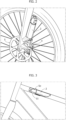
- it may be mounted on one of the two arms of the front fork of the bicycle, adjacent to the front disc brake controlled by it ( Figure 2 ), or, again for example, it may be mounted inside the upper longitudinal tube of the frame of the bicycle ( Figure 3 ), by providing a closed opening with a cover in the tube of the frame, or by providing mounting starting from one end of the frame tube, during manufacture and assembly of the frame.
- the actuator device 2 comprises a substantially elongated body 6 within which an inner cavity 7 is formed.
- the body 6 of the actuator device has an inlet opening 8 and an outlet opening 9, both communicating with the inner cavity 7, and formed on opposite sides of the body 6.
- the inlet and outlet openings 8, 9 are defined by holes directed radially and orthogonally with respect to the X-X axis of the body 6.
- the inlet opening 8 is intended to be connected, for example, by means of a flexible tube, to the pumping device controlled by the brake lever 3, while the outlet opening 9 is intended to be connected, for example, by means of a flexible tube, to the hydraulic cylinder actuator (not visible in the drawings) of the brake caliper 4.
- At least one of the connecting elements 10, 11 is selectively orientable into two different positions, offset from each other by 180 degrees, in such a way that the two outlets 12, 13 of the connecting elements may both be oriented parallel to the X-X axis of the actuator device, and both facing towards one end of the body of the actuator device or towards opposite ends of the body of the actuator device.
- the actuator device of the invention can be easily configured to have the inlet and outlet tubes of the fluid that come out from the same end of the body of the actuator device, or from opposite ends, which allows great flexibility in the choice of mounting position of the actuator device on the bicycle.
- the actuator device 2 may be mounted vertically on one of the two arms of the front fork of the bicycle ( Figure 2 ); adjacent to the caliper 4 of the disc brake 5, with the tubes protruding in opposite directions; or it can be mounted at a distance from the brake, for example, inside the upper longitudinal tube of the bicycle frame ( Figure 3 ), with the tubes for the fluid both coming out from the front end in the same direction.
- a floating member 14 is slidably mounted within the inner cavity 7 of the body 6, said floating member having an elongated cylindrical body, with a portion 14A of larger diameter, configured in such a way as to define an upstream chamber 15 inside the cavity 7, communicating with the inlet opening 8 (and, consequently, in the condition of use, with the outlet of the pumping device operated by the brake lever 3), and a downstream chamber 16, communicating with the outlet opening 9 (and consequently, in the aforesaid condition of use, with the inlet of the hydraulic cylinder of actuation of the brake caliper 4).
- the two chambers 15, 16 are isolated from each other by a main sealing ring 17 mounted in a circumferential groove of the portion 14A of the floating member 14.
- the sealing ring 17, made of any elastomeric material suitable for the purpose, is configured to be permanently in engagement against the wall of the cavity 7, whatever the axial position of the floating member 14 within the cavity 7, so as to always isolate the chambers 15, 16 from each other.
- the sealing ring 17 is illustrated in the non-deformed configuration, which it assumes when it is free. In reality, being compressed radially between its seat in the floating member 14 and the wall of the cavity 7, the sealing ring 17 assumes a flattened configuration, with its outer surface in contact with the wall of the cavity 7 for an extended portion axially.
- the upstream and downstream chambers 15, 16 have a volume that varies according to the axial position of the floating member 14 within the cavity 7.
- the portion 14A of the floating member is in its end position in the direction of the downstream chamber 16 (towards the right, with reference to the drawings), so that the downstream chamber 16 is in the minimum volume condition.
- the body of the floating member 14 has an axial through-hole 18 and radial holes 19 that define a passage inside the body of the floating member, which connects the upstream chamber 15 with the downstream chamber 16. Communication through this passage is controlled by a valve member 20 slidably mounted within an axial cavity 14B of the body of the floating member 14. The valve member 20 cooperates with a valve seat 21 defined in the cavity 14A formed in the body of the floating member.
- valve seat 21 is defined by a conical connecting surface between the axial hole 18 and the axial cavity 14A, which has a diameter greater than the diameter of the hole 18.
- the valve member 20 has a larger diameter portion, which has a conical surface cooperating with the conical valve seat 21.
- a spring 22 tends to keep the valve member 20 in a closed position, with the conical surface of the valve member 20 in contact with the conical valve seat 21. In this condition (visible in Figure 5B ), the communication between the chambers 15, 16 through the passage inside the floating member is interrupted.
- the spring 22 is a helical spring surrounding a reduced diameter rod of the valve member 20 and axially interposed between an abutment surface of the valve member and a closing element screwed into one end of the cavity 14A.
- the body of the valve member 20 extends beyond its conical surface with an axial rod 20A, which is inserted through the through-hole 18 of the body of the floating member 14.
- the rod 20A has a smaller diameter than the diameter of the hole 18, so that the conical surface of the valve member 20 is subjected to the pressure established in the downstream chamber 16.
- Figures 4 and 5A show the floating member 14 in the aforesaid end position (to the right, with reference to the drawings), wherein the portion 14A is in its position of maximum displacement towards the downstream chamber 16.
- This end position is defined by the engagement of the floating member against an abutment surface 24 defined in the wall of the cavity 7.
- the tip of the rod 20A which protrudes out of the end of the hole 18, interacts with an abutment element carried by the body 6 of the actuator device, so that - in this condition - the valve member 20 is kept in an open position, with its conical surface spaced apart from the conical seat 21, against the action of the spring 22.
- the abutment element is a transverse pin 23 carried by the body 6 and extending transversely through the cavity 7 of the body 6 and through a slot 25 in the body of the floating member 14.
- the upstream chamber 15 and the downstream chamber 16 communicate with each other, so that an intervention by the cyclist on the brake lever 3 causes the transfer of fluid from the pumping device associated with the brake lever 3 to the inlet opening 8 and to the upstream chamber 15, from this to the downstream chamber 16 and from this to the outlet opening 8, and to the hydraulic cylinder actuating the brake caliper 4, which therefore exerts its braking action on the wheel, while the floating member 14 remains permanently in the aforesaid end position.
- the actuator device 2 comprises an electric motor M configured to control the axial position of the floating member 14 within the cavity 7 of the body 6.
- the electric motor is mounted coaxially to one end of the body 6 of the actuator device.
- the actuator body has three portions 6A, 6B and 6C arranged axially in series and rigidly connected to each other, for example, by screws.
- the portion 6A contains the components of the hydraulic system of the actuator device that have been described above.
- the portion 6B is in the form of a tube and constitutes an extension element to which the portion 6C is secured, in the form of a ring, to which the body of the electric motor M is, in turn, secured.
- the electric motor M has a crankshaft 26, which is connected in rotation with a screw 27 arranged coaxially with the floating member 14.
- the screw 27 is rotatably mounted within the body portion 6C by means of a rolling bearing 28, and is held by the bearing 28 (in the manner which will be described in detail below) in a fixed axial position.
- the screw 27 is engaged within the inner thread of a nut 29, which is guided within the portion 6B so as to be free to slide axially, but prevented from rotating. In this way the nut 29 moves axially due to a rotation of the screw 27.
- the nut 29 is rigidly connected to the floating member 14. Therefore, thanks to the arrangement described above, the electric motor M is able to control the axial position of the floating member 14.
- the electric motor M is activated in such a way as to control a movement of the floating member 14 and of its portion 14A in the direction of the upstream chamber 15 and away from said end position, so that the valve member 20 is carried into its closed position by the spring 22, so as to interrupt the communication between the upstream chamber 15 and the downstream chamber 16 (see Figure 5B ).
- the downstream chamber 16 increases in volume, generating a decrease in the pressure of the fluid supplied to the brake caliper 4 and, consequently, a decrease in the braking action that allows locking of the wheel to be avoided.
- the request for intervention of the ABS may be generated by an electronic control unit of the braking system, which is configured to receive signals from one or more sensors indicative of the operating conditions of the bicycle (for example, from an angular speed sensor of the wheel), and which is programmed to control the electric motor as a function of these signals, when they are indicative of an incipient locking of the wheel following braking.
- an electronic control unit of the braking system which is configured to receive signals from one or more sensors indicative of the operating conditions of the bicycle (for example, from an angular speed sensor of the wheel), and which is programmed to control the electric motor as a function of these signals, when they are indicative of an incipient locking of the wheel following braking.
- the actuator device 2 is arranged to open the communication between the upstream chamber 15 and the downstream chamber 16 when the pressure in the downstream chamber 16 becomes greater than the pressure in the upstream chamber, by a differential greater than a predetermined threshold.
- this function is performed by the main sealing ring associated with the floating member, which is configured with an elastically deformable circumferential sealing lip.
- the lip is configured in such a way that it normally remains in sealing engagement against the wall of the inner cavity of the floating member, isolating the upstream chamber from the downstream chamber.
- the lip deforms, moving away from the wall of the cavity of the floating member and opening the communication between the two chambers, which then return to be at the same pressure.
- the main sealing ring 17 is not in the form of a sealing ring with a deformable lip, and is always engaged against the wall of the cavity 7 of the body 6 of the actuator device, so as to always isolate the upstream chamber 15 from the downstream chamber 16, in any operating condition of the bicycle brake.
- the function of opening the communication between the upstream chamber 15 and the downstream chamber 16 when the pressure in the downstream chamber becomes greater than the pressure in the upstream chamber is, instead, fulfilled by the valve member 20 associated with the floating member.
- valve member 20 is configured in such a way that, when it is in its closed position, with the floating member 14 spaced apart from its end position ( Figure 5B ), it has its conical surface exposed to the downstream chamber 16, so that an increase in pressure in the downstream chamber sufficient to overcome the action of the spring 22 causes the conical surface of the valve member 20 to move away from its valve seat 21 and the opening of communication through the hole 18.
- the load of the spring 22 may be arranged in order to set the pressure differential between chamber 16 and chamber 15, which causes the opening of the communication. It is also possible to envisage the possibility of adjusting the load of the spring 22 by providing an adjustable abutment member, for supporting the end of the spring 22 opposite to the end of the spring that acts on the valve member 20.
- the actuator device 2 is provided with a solenoid valve 30 ( Figures 6-8 ) configured, when activated, to place the inlet opening 8 of the actuator device into direct communication with the outlet opening 9.
- the solenoid valve 30 may be controlled by an electronic control unit of the bicycle braking system to establish said communication whenever an operating anomaly of the actuator device is detected by the electronic control unit, for example, when the floating member remains erroneously locked in an ABS activation position, i.e. in a position such as that illustrated in Figure 5B . This provides additional safety that the braking system is always able to operate correctly, ensuring braking capability.
- the provision of the safety solenoid valve eliminates the need, provided in devices of the prior art, of a reversible transmission between the electric motor and the floating member, such as to allow, if the floating member stops due to a fault, the fluid pressure generated by the brake lever to be able to move the floating member backwards.
- the adoption of a reversible transmission requires stringent quality controls and the use of an expensive production screw.
- Figures 6-8 refer to an embodiment that is constructionally slightly different from that of Figure 4 (for example, regarding the positioning of the inlet and outlet openings 8, 9), but similar in substance.
- Figure 6 the parts corresponding to those of Figures 4 are indicated by the same reference numbers.
- the solenoid valve 30 includes a solenoid 31 that controls a slide valve member 32, slidably mounted in a cylindrical cavity 33 formed in the body 6 of the actuator device 2, parallel to and at a distance from the cavity 7 within which the floating member 14 is slidably mounted.
- the slide member 32 has a circumferential groove 37 which - in the position illustrated - intercepts the ends of two ducts 34, 35 formed in the body 6 and, respectively, communicating with the inlet and outlet openings 8, 9 (the cross-section of Figure 7 is taken in two radial planes with respect to the axis of the cavity 33, forming an angle of less than 90° between them).
- a helical spring 36 normally keeps the slide member 32 in a end position, wherein the groove 37 is axially spaced apart from the ends of the ducts 34, 35, so there is no communication between these ducts.
- the electronic unit When the electronic unit detects an anomalous situation that requires the solenoid, it activates the solenoid 31 to attract the slide member 32 into the position illustrated in the drawings, against the action of the spring 36, so as to establish communication between the ducts 34, 35 and consequently between the inlet and outlet openings 8, 9 of the actuator device.
- the braking system is able to operate correctly, ensuring that the fluid can pass from the pumping device operated by the brake lever 3, up to the brake caliper 4, passing through the actuator device 2.
- the actuator device 2 provides, as indicated above, a screw-and-nut transmission 27, 29 (see Figure 4 ) between the electric motor M and the floating member 14.
- this transmission includes a screw 27 rotatably mounted by means of a rolling bearing 28 within the body of the actuator device, and axially locked with respect to said rolling bearing.
- the screw 27 is connected in rotation with the shaft 26 of the electric motor M by means of a bushing 38.
- the bushing 38 has a bell-shaped conformation, with an axial hole having a first shaped portion 39 (in the example, square) for shape-coupling with the crankshaft 26, which has a corresponding shaped conformation.
- the aforesaid axial hole of the bushing 38 has a second shaped portion 40 (in the example, square), wider than the section 39 for shape-coupling with an end nose 27A of the screw 27, having a corresponding conformation.
- the axial hole of the bushing 39 opens into a shaped front cavity 41 (in the example hexagonal) for shape-coupling with a tightening nut 42, which is screwed onto a threaded portion of the end nose of the screw to lock the inner ring of the bearing 28 against an annular shoulder of the screw 27,
- the bushing 39 is secured in rotation both with the shaft 26 of the electric motor M and with the screw 27, and also with the tightening nut 42, so that any risk of loosening the nut 42 is safely prevented.
- the actuator device 2 is provided with a pressure sensor S P arranged to detect the pressure in the upstream chamber 15 or, as in the case illustrated in the drawings, in the downstream chamber 16 (see Figures 4 , 11, 12 ) in such a way as to allow the electronic control unit of the braking system to have a direct control over the fluid pressure.
- the electronic control unit may have a more direct control over the correct functioning of the braking system, and can intervene more promptly in the event of any malfunction that endangers the operation of the brake.
- the support body of the sensor S P is screwed into a seat formed in the body 6.
- the pressure signal output from the sensor S P is used by the electronic control unit to enable an ABS control logic, for example, according to an embodiment described in the Italian patent application IT 10 201 6000111289 .
- the sensor makes it possible to clearly identify when the cyclist is braking, precisely by means of the braking pressure signal. In this way, the control logic is more robust with respect to any false positives.
- the actuator device according to the invention is constructively simple and extremely efficient, reliable and safe in operation.
Landscapes
- Engineering & Computer Science (AREA)
- Mechanical Engineering (AREA)
- Physics & Mathematics (AREA)
- Fluid Mechanics (AREA)
- Transportation (AREA)
- Regulating Braking Force (AREA)
Description
- The present invention relates, in general, to braking systems for bicycles and - in particular - relates to an ABS actuator device for a bicycle hydraulic braking system.
- The invention is applicable to any type of bicycle, including bicycles assisted by an electric motor. The application of the invention is not excluded to any other type of cycle, including motorcycles, or electric scooters.
- The document
WO 2019 155371 A1 illustrates an ABS actuator device for a bicycle hydraulic braking system of the type indicated in the preamble of the attached claim 1. - This known device comprises an actuator body, defining an inner cavity, and having an inlet opening and an outlet opening communicating with the inner cavity. A floating member is slidably mounted in this cavity, carrying a main sealing ring, which is in engagement with the wall of the inner cavity, so as to define an upstream chamber within the cavity, communicating with the inlet opening, and a downstream chamber, communicating with the outlet opening.
- The aforesaid inlet and outlet openings are arranged to be hydraulically connected to a pumping device associated with an actuator member of a bicycle brake (for example, a brake lever) and, with a hydraulic device for actuating a bicycle brake (e.g. a disc brake caliper), respectively.
- A passage for hydraulic communication between the upstream chamber and the downstream chamber is defined in the body of the floating member. The hydraulic communication through said passage is controlled by a valve member associated with the floating member, which cooperates with a valve seat formed in the body of the floating member. A spring tends to keep the valve member in engagement against the valve seat, in a closed position wherein the hydraulic communication between the upstream chamber and the downstream chamber is interrupted.
- The aforesaid actuator device also comprises an electric motor configured to control the position of the floating member within the cavity of the actuator body.
- During normal operation of the bicycle brake, the electric motor is inactive and the floating member is in an end position, in the direction of the downstream chamber, wherein the valve member of the floating member interacts with an abutment element of the actuator body, which keeps the valve member in an open position, spaced apart from its valve seat, against the action of the spring.
- Therefore, during normal operation of the brake, the floating member remains in this end position, and the fluid pumped by the brake lever can flow from said inlet opening to said outlet opening, through the passage left open by the aforesaid valve member, to then arrive at the brake caliper.
- Conversely, in conditions wherein ABS activation is required, the electric motor is activated (by an electronic controller that receives signals from one or more sensors and processes them according to a predetermined algorithm to detect, for example, when the front wheel of the bicycle is about to lock, or when the rear wheel is about to lift off the ground). In this condition, the electric motor commands a movement of the floating member in the direction of the upstream chamber and away from the aforesaid end position. In this condition, the valve member is brought into its closed position by the spring, so that the communication between the upstream and downstream chambers is interrupted. At the same time, the movement of the floating member in the direction of the upstream chamber generates an increase in the volume of the downstream chamber, which gives rise to a decrease in the pressure of the fluid supplied to the brake caliper and, consequently, to a decrease in the braking action, which allows locking of the wheel to be avoided.
- The aforesaid known device also comprises a valve device configured to open the communication between the upstream chamber and the downstream chamber when the pressure in the downstream chamber becomes greater than the pressure in the upstream chamber, by a differential greater than a predetermined threshold, More precisely, in the case of the known device, this valve device consists of the aforesaid main sealing ring, which is configured with an elastically deformable circumferential sealing lip. The lip is configured in such a way that it normally remains in sealing engagement against the wall of the cavity of the body of the actuator device, isolating the upstream chamber from the downstream chamber. However, when the pressure in the downstream chamber becomes greater than the pressure in the upstream chamber by a differential greater than a predetermined threshold, the lip deforms, moving away from the wall of the cavity of the actuator device, and opening the communication between the two chambers, which then return to the same pressure.
- In the known device, the aforesaid predetermined threshold of the pressure differential that causes the lip to open, by construction, is always less than the force exerted by the spring of the valve member inside the floating member, and this is why it is the lip gasket that has the function of placing the two chambers in communication in the case of overpressure.
- Studies and experiments carried out by the Applicant have shown that the aforesaid known device has the drawback of involving the use of the aforesaid sealing ring with lip, which constitutes a relatively critical component, due to the stringent manufacturing and assembly specifications it requires, and also for the stringent specifications of roughness and machining of the cylindrical cavity into which it flows. The assembly and setup of the sealing ring with lip are relatively complex, not very repeatable and require the use of dedicated equipment. Another drawback lies in the problem of complexity and high production cost of the floating member.
- The object of the present invention is to overcome the drawbacks of the prior art.
- More generally, the object of the invention is to produce an actuator device - of the type indicated above - which is constructively simple, less expensive than the prior art device, and yet fully efficient and reliable in operation.
- In order to achieve this object, the invention relates to an actuator device having the characteristics of the attached claim 1.
- Compared to the known device described above, the device according to the invention is mainly characterized in that:
- the aforesaid main sealing ring is not a ring with a lip, and always remains engaged against the wall of the cavity of the actuator body, so as to always isolate the upstream chamber with respect to the downstream chamber, in any operating condition of the bicycle brake,
- the valve device configured to open the communication between the upstream chamber and the downstream chamber, when the pressure in the downstream chamber becomes greater than the pressure in the upstream chamber, is constituted only by the valve member associated with the floating member,
- Thanks to the aforesaid characteristics, the actuator device according to the invention is able to definitively solve the problems of the prior art, avoiding the use of the lip sealing ring and the resulting drawbacks. This is achieved by the fact that the valve member associated with the floating member of the actuator device is able to perform a double function, that is: its known function, consisting in establishing communication between the upstream and downstream chambers during normal operation of the braking system, when the floating member is in its end position, and the function that - in the known device - is performed by the lip of the lip sealing ring, i.e. establishing the aforesaid communication when the pressure in the downstream chamber tends to become greater than the pressure in the upstream chamber. To this end, the characteristics and assembly of the spring associated with the valve member of the floating member are predetermined to define the overpressure threshold in the downstream chamber that generates the opening of the communication.
- Additional preferred and advantageous characteristics of the invention are described in the attached drawings.
- According to a first option, which forms the object of the invention, even independently of the characteristics of the characterizing part of claim 1, the actuator device of the invention is provided with a solenoid valve configured to place in direct communication, when activated, the inlet opening of the actuator device with the outlet opening (communicating, respectively, with said upstream and downstream chambers), in such a way that said solenoid valve can be controlled by an electronic control unit of the bicycle braking system to establish said communication each time that an operating anomaly of the actuator device is detected by said electronic control unit; in this way additional safety is obtained on the fact that the braking system is always able to operate correctly, ensuring communication between the inlet opening and the outlet opening, and the integrity of the hydraulic circuit that connects the pumping device operated by the brake lever with the hydraulic cylinder actuator of the brake caliper.
- According to another option, which forms the object of the invention, even independently of the characteristics of the characterizing part of claim 1, the actuator device of the invention is provided with a pressure sensor arranged to detect the pressure in said upstream chamber or in said downstream chamber, in such a way as to allow the electronic control unit of the braking system to have direct control over the pressure of the fluid entering or leaving the actuator device. In this way, the electronic control unit may have a more direct control over the correct functioning of the braking system, and can intervene more promptly in the event of any malfunction that endangers the operation of the brake.
- According to another option, which forms the object of the invention, even independently of the characteristics of the characterizing part of claim 1, the aforesaid inlet and outlet openings of the actuator device of the invention are arranged on opposite sides of the body of the actuator device, and are provided with respective connecting elements with outlets at 90 degrees with respect to the respective openings in the body of the actuator device. At least one of said connecting elements may be selectively oriented into two different positions, offset from each other by 180 degrees, in such a way that the two outlets of the connecting elements may both be oriented parallel to the axis of the floating member of the actuator device, and both facing towards one end of the body of the actuator device or towards opposite ends of the body of the actuator device. Thanks to this characteristic, the actuator device of the invention can be easily configured to have the inlet and outlet tubes of the fluid that leave the actuator device in the same direction, or from opposite ends, which allows great flexibility in the choice of mounting position of the actuator device on the bicycle. For example, the actuator device can be mounted vertically on one of the two arms of the front fork of the bicycle, adjacent to the caliper of a disc brake, with the tubes protruding from opposite ends, or it can be mounted at a distance from the brake, for example, on the upper longitudinal tube of the bicycle frame (or even inside it), with the tubes for the fluid coming out from the front end of the body of the actuator device).
- Further characteristics and advantages of the invention will become apparent from the description that follows with reference to the attached drawings, provided purely by way of non-limiting example, wherein:
-
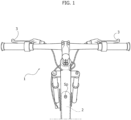
Figure 1 is a partial top view of a bicycle using the actuator device according to the invention, with the actuator device mounted inside the upper longitudinal tube of the bicycle frame, -
Figure 2 is a perspective view showing a detail of the front wheel of the bicycle ofFigure 1 , with the actuator device mounted vertically on one of the two arms of the front fork of the bicycle, -
Figure 3 is a detail of a cross-sectioned side view of the bicycle ofFigure 1 , with the actuator device mounted inside the upper longitudinal tube of the bicycle frame. -
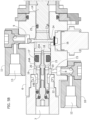
Figure 4 is a cross-sectional view of an embodiment of the actuator device of the invention, illustrated in an operating condition of normal operation of the braking system, i.e. with inactive ABS, -
Figure 5A illustrates a detail on an enlarged scale ofFigure 4 , -
Figure 5B illustrates the detail ofFigure 5A in the ABS activation condition, -
Figure 6 is a cross-sectional view of another embodiment of the actuator device of the invention, -
Figure 7 is a cross-sectional view of the device ofFigure 6 , on an enlarged scale, -
Figure 8 illustrates a detail ofFigure 7 , in a further enlarged scale, -
Figure 9 illustrates another detail on an enlarged scale ofFigure 4 , with reference to another aspect of the invention, -
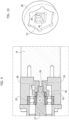
Figure 10 is a perspective view of a component of the actuator device that is illustrated inFigure 9 , -
Figure 11 is a detail of a cross-sectional view of the actuator device, according to another embodiment, -
Figure 12 is a perspective view of the detail ofFigure 11 and, -
Figures 13 and 14 are perspective views showing two alternative configurations of the actuator device according to the invention. - In the drawings, the reference number 1 indicates - in its entirety - a bicycle including a braking system equipped with an ABS actuator device according to the invention.
- In the present invention, the term ABS is used according to its conventional meaning in the art, that is, with reference to an Anti-Blocking System configured to reduce the action of a brake on a wheel when, during braking, the wheel tends to lock up. Devices of this type have been widespread for a long time in the field of motor-vehicles, but for some years they have also found increasing application in the field of bicycles, including electric bicycles, and in the field of light electric vehicles.
- The actuator device according to the invention, which in the attached drawings is indicated with the
reference number 2, has been conceived and developed by the Applicant with particular reference to the application on a bicycle of any type, including electric or assisted-pedaling bicycles and has characteristics that make it particularly advantageous in the case of such an application. - The drawings show, purely by way of example, some embodiments of the
actuator device 2, and its possible arrangements on the bicycle. In general, theactuator device 2 is interposed in the hydraulic connection between a pumping device (not visible in the drawings) of any known type associated with the brake control member (for example, thelever 3 for actuating the front brake of the bicycle - seeFigure 1 ), and an actuation device of the brake (for example, the caliper 4 of a disc brake 5 - seeFigure 2 ) associated with the front wheel R of the bicycle. - As will be described in detail below, the
actuator device 2 is configured in such a way as to leave ample flexibility in envisaging its positioning on the bicycle. For example, it may be mounted on one of the two arms of the front fork of the bicycle, adjacent to the front disc brake controlled by it (Figure 2 ), or, again for example, it may be mounted inside the upper longitudinal tube of the frame of the bicycle (Figure 3 ), by providing a closed opening with a cover in the tube of the frame, or by providing mounting starting from one end of the frame tube, during manufacture and assembly of the frame. - With reference to
Figure 4 andFigure 5A , in the embodiment illustrated therein, theactuator device 2 comprises a substantiallyelongated body 6 within which an inner cavity 7 is formed. Thebody 6 of the actuator device has aninlet opening 8 and anoutlet opening 9, both communicating with the inner cavity 7, and formed on opposite sides of thebody 6. In the example illustrated, the inlet andoutlet openings body 6. - Two connecting
elements outlets openings outlet openings inlet opening 8 is intended to be connected, for example, by means of a flexible tube, to the pumping device controlled by thebrake lever 3, while theoutlet opening 9 is intended to be connected, for example, by means of a flexible tube, to the hydraulic cylinder actuator (not visible in the drawings) of the brake caliper 4. - As is also visible in
Figures 13 and 14 , at least one of the connectingelements outlets - Thanks to this characteristic, the actuator device of the invention can be easily configured to have the inlet and outlet tubes of the fluid that come out from the same end of the body of the actuator device, or from opposite ends, which allows great flexibility in the choice of mounting position of the actuator device on the bicycle. For example, as already indicated above, the
actuator device 2 may be mounted vertically on one of the two arms of the front fork of the bicycle (Figure 2 ); adjacent to the caliper 4 of the disc brake 5, with the tubes protruding in opposite directions; or it can be mounted at a distance from the brake, for example, inside the upper longitudinal tube of the bicycle frame (Figure 3 ), with the tubes for the fluid both coming out from the front end in the same direction. - With reference again to
Figures 4 and5A , a floatingmember 14 is slidably mounted within the inner cavity 7 of thebody 6, said floating member having an elongated cylindrical body, with aportion 14A of larger diameter, configured in such a way as to define anupstream chamber 15 inside the cavity 7, communicating with the inlet opening 8 (and, consequently, in the condition of use, with the outlet of the pumping device operated by the brake lever 3), and adownstream chamber 16, communicating with the outlet opening 9 (and consequently, in the aforesaid condition of use, with the inlet of the hydraulic cylinder of actuation of the brake caliper 4). The twochambers main sealing ring 17 mounted in a circumferential groove of theportion 14A of the floatingmember 14. The sealingring 17, made of any elastomeric material suitable for the purpose, is configured to be permanently in engagement against the wall of the cavity 7, whatever the axial position of the floatingmember 14 within the cavity 7, so as to always isolate thechambers ring 17 is illustrated in the non-deformed configuration, which it assumes when it is free. In reality, being compressed radially between its seat in the floatingmember 14 and the wall of the cavity 7, the sealingring 17 assumes a flattened configuration, with its outer surface in contact with the wall of the cavity 7 for an extended portion axially. - The upstream and
downstream chambers member 14 within the cavity 7. InFigures 4 ,5A , theportion 14A of the floating member is in its end position in the direction of the downstream chamber 16 (towards the right, with reference to the drawings), so that thedownstream chamber 16 is in the minimum volume condition. - With reference - in particular - to
Figure 5A , which illustrates a detail on an enlarged scale ofFigure 4 , the body of the floatingmember 14 has an axial through-hole 18 andradial holes 19 that define a passage inside the body of the floating member, which connects theupstream chamber 15 with thedownstream chamber 16. Communication through this passage is controlled by avalve member 20 slidably mounted within anaxial cavity 14B of the body of the floatingmember 14. Thevalve member 20 cooperates with avalve seat 21 defined in thecavity 14A formed in the body of the floating member. - In the example illustrated, the
valve seat 21 is defined by a conical connecting surface between theaxial hole 18 and theaxial cavity 14A, which has a diameter greater than the diameter of thehole 18. Thevalve member 20 has a larger diameter portion, which has a conical surface cooperating with theconical valve seat 21. - A
spring 22 tends to keep thevalve member 20 in a closed position, with the conical surface of thevalve member 20 in contact with theconical valve seat 21. In this condition (visible inFigure 5B ), the communication between thechambers spring 22 is a helical spring surrounding a reduced diameter rod of thevalve member 20 and axially interposed between an abutment surface of the valve member and a closing element screwed into one end of thecavity 14A. - The body of the
valve member 20 extends beyond its conical surface with anaxial rod 20A, which is inserted through the through-hole 18 of the body of the floatingmember 14. Therod 20A has a smaller diameter than the diameter of thehole 18, so that the conical surface of thevalve member 20 is subjected to the pressure established in thedownstream chamber 16. -
Figures 4 and5A show the floatingmember 14 in the aforesaid end position (to the right, with reference to the drawings), wherein theportion 14A is in its position of maximum displacement towards thedownstream chamber 16. This end position is defined by the engagement of the floating member against anabutment surface 24 defined in the wall of the cavity 7. - In the aforesaid end position, the tip of the
rod 20A, which protrudes out of the end of thehole 18, interacts with an abutment element carried by thebody 6 of the actuator device, so that - in this condition - thevalve member 20 is kept in an open position, with its conical surface spaced apart from theconical seat 21, against the action of thespring 22. - In the illustrated example, the abutment element is a
transverse pin 23 carried by thebody 6 and extending transversely through the cavity 7 of thebody 6 and through aslot 25 in the body of the floatingmember 14. - Therefore, in the end position of the floating member, which is illustrated in
Figures 4 and5A , which corresponds, as will be better illustrated below, to the normal operating condition of the bicycle braking system (i.e. when there is no intervention request of the ABS), theupstream chamber 15 and thedownstream chamber 16 communicate with each other, so that an intervention by the cyclist on thebrake lever 3 causes the transfer of fluid from the pumping device associated with thebrake lever 3 to theinlet opening 8 and to theupstream chamber 15, from this to thedownstream chamber 16 and from this to theoutlet opening 8, and to the hydraulic cylinder actuating the brake caliper 4, which therefore exerts its braking action on the wheel, while the floatingmember 14 remains permanently in the aforesaid end position. - With reference to
Figure 4 , theactuator device 2 comprises an electric motor M configured to control the axial position of the floatingmember 14 within the cavity 7 of thebody 6. - In the example illustrated, the electric motor is mounted coaxially to one end of the
body 6 of the actuator device. Again in the case of this non-limiting example, the actuator body has threeportions portion 6A contains the components of the hydraulic system of the actuator device that have been described above. Theportion 6B is in the form of a tube and constitutes an extension element to which theportion 6C is secured, in the form of a ring, to which the body of the electric motor M is, in turn, secured. Again, these details are provided here only for a better understanding of the illustrated example, but should not be interpreted in a limiting sense, since the construction details and the embodiments may vary widely. - The electric motor M has a
crankshaft 26, which is connected in rotation with ascrew 27 arranged coaxially with the floatingmember 14. Thescrew 27 is rotatably mounted within thebody portion 6C by means of a rollingbearing 28, and is held by the bearing 28 (in the manner which will be described in detail below) in a fixed axial position. Thescrew 27 is engaged within the inner thread of anut 29, which is guided within theportion 6B so as to be free to slide axially, but prevented from rotating. In this way thenut 29 moves axially due to a rotation of thescrew 27. Thenut 29 is rigidly connected to the floatingmember 14. Therefore, thanks to the arrangement described above, the electric motor M is able to control the axial position of the floatingmember 14. - During normal operation of the bicycle braking system, when there is no request for intervention of the ABS, the electric motor M is inactive and the floating
member 14 is in the end position ofFigures 4 and5A , wherein thevalve member 20 is maintained by engagement against thetransverse pin 23 in its open position, with its conical surface spaced apart from theconical seat 21, so that, as already described above; an intervention on thebrake lever 3 causes the transfer of fluid through theactuator device 2 to the actuator cylinder of the brake caliper 4. In this condition, the fluid enters and exits the actuator device, thanks to the communication between theupstream chamber 15 and thedownstream chamber 16 established by the open condition of thevalve member 20. - On the other hand, in a condition wherein there is a request for intervention of the ABS, the electric motor M is activated in such a way as to control a movement of the floating
member 14 and of itsportion 14A in the direction of theupstream chamber 15 and away from said end position, so that thevalve member 20 is carried into its closed position by thespring 22, so as to interrupt the communication between theupstream chamber 15 and the downstream chamber 16 (seeFigure 5B ). In this condition, thedownstream chamber 16 increases in volume, generating a decrease in the pressure of the fluid supplied to the brake caliper 4 and, consequently, a decrease in the braking action that allows locking of the wheel to be avoided. According to a technique known per se, the request for intervention of the ABS may be generated by an electronic control unit of the braking system, which is configured to receive signals from one or more sensors indicative of the operating conditions of the bicycle (for example, from an angular speed sensor of the wheel), and which is programmed to control the electric motor as a function of these signals, when they are indicative of an incipient locking of the wheel following braking. - The
actuator device 2 is arranged to open the communication between theupstream chamber 15 and thedownstream chamber 16 when the pressure in thedownstream chamber 16 becomes greater than the pressure in the upstream chamber, by a differential greater than a predetermined threshold. - In the device known from
WO 2019 155371 A1 , this function is performed by the main sealing ring associated with the floating member, which is configured with an elastically deformable circumferential sealing lip. The lip is configured in such a way that it normally remains in sealing engagement against the wall of the inner cavity of the floating member, isolating the upstream chamber from the downstream chamber. However, when the pressure in the downstream chamber becomes greater than the pressure in the upstream chamber by a differential greater than a predetermined threshold, the lip deforms, moving away from the wall of the cavity of the floating member and opening the communication between the two chambers, which then return to be at the same pressure. - As seen, in the
actuator device 2 according to the invention, themain sealing ring 17 is not in the form of a sealing ring with a deformable lip, and is always engaged against the wall of the cavity 7 of thebody 6 of the actuator device, so as to always isolate theupstream chamber 15 from thedownstream chamber 16, in any operating condition of the bicycle brake. The function of opening the communication between theupstream chamber 15 and thedownstream chamber 16 when the pressure in the downstream chamber becomes greater than the pressure in the upstream chamber is, instead, fulfilled by thevalve member 20 associated with the floating member. - As illustrated above, the
valve member 20 is configured in such a way that, when it is in its closed position, with the floatingmember 14 spaced apart from its end position (Figure 5B ), it has its conical surface exposed to thedownstream chamber 16, so that an increase in pressure in the downstream chamber sufficient to overcome the action of thespring 22 causes the conical surface of thevalve member 20 to move away from itsvalve seat 21 and the opening of communication through thehole 18. - The load of the
spring 22 may be arranged in order to set the pressure differential betweenchamber 16 andchamber 15, which causes the opening of the communication. It is also possible to envisage the possibility of adjusting the load of thespring 22 by providing an adjustable abutment member, for supporting the end of thespring 22 opposite to the end of the spring that acts on thevalve member 20. - According to another aspect, which forms the object of the invention even independently of the characteristics of the characterizing part of claim 1, the
actuator device 2 is provided with a solenoid valve 30 (Figures 6-8 ) configured, when activated, to place theinlet opening 8 of the actuator device into direct communication with theoutlet opening 9. - The
solenoid valve 30 may be controlled by an electronic control unit of the bicycle braking system to establish said communication whenever an operating anomaly of the actuator device is detected by the electronic control unit, for example, when the floating member remains erroneously locked in an ABS activation position, i.e. in a position such as that illustrated inFigure 5B . This provides additional safety that the braking system is always able to operate correctly, ensuring braking capability. - It should be noted that the provision of the safety solenoid valve eliminates the need, provided in devices of the prior art, of a reversible transmission between the electric motor and the floating member, such as to allow, if the floating member stops due to a fault, the fluid pressure generated by the brake lever to be able to move the floating member backwards. The adoption of a reversible transmission requires stringent quality controls and the use of an expensive production screw.
-
Figures 6-8 refer to an embodiment that is constructionally slightly different from that ofFigure 4 (for example, regarding the positioning of the inlet andoutlet openings 8, 9), but similar in substance. InFigure 6 , the parts corresponding to those ofFigures 4 are indicated by the same reference numbers. - In the illustrated example, the
solenoid valve 30 includes asolenoid 31 that controls aslide valve member 32, slidably mounted in acylindrical cavity 33 formed in thebody 6 of theactuator device 2, parallel to and at a distance from the cavity 7 within which the floatingmember 14 is slidably mounted. Theslide member 32 has acircumferential groove 37 which - in the position illustrated - intercepts the ends of twoducts body 6 and, respectively, communicating with the inlet andoutlet openings 8, 9 (the cross-section ofFigure 7 is taken in two radial planes with respect to the axis of thecavity 33, forming an angle of less than 90° between them). Ahelical spring 36 normally keeps theslide member 32 in a end position, wherein thegroove 37 is axially spaced apart from the ends of theducts - When the electronic unit detects an anomalous situation that requires the solenoid, it activates the
solenoid 31 to attract theslide member 32 into the position illustrated in the drawings, against the action of thespring 36, so as to establish communication between theducts outlet openings brake lever 3, up to the brake caliper 4, passing through theactuator device 2. - According to another aspect, which forms the object of the invention even independently of the characteristics of the characterizing part of claim 1, the
actuator device 2 provides, as indicated above, a screw-and-nut transmission 27, 29 (seeFigure 4 ) between the electric motor M and the floatingmember 14. As also indicated above, this transmission includes ascrew 27 rotatably mounted by means of a rollingbearing 28 within the body of the actuator device, and axially locked with respect to said rolling bearing. - With reference to the embodiment of
Figures 9, 10 , thescrew 27 is connected in rotation with theshaft 26 of the electric motor M by means of abushing 38. - The
bushing 38 has a bell-shaped conformation, with an axial hole having a first shaped portion 39 (in the example, square) for shape-coupling with thecrankshaft 26, which has a corresponding shaped conformation. - The aforesaid axial hole of the
bushing 38 has a second shaped portion 40 (in the example, square), wider than thesection 39 for shape-coupling with anend nose 27A of thescrew 27, having a corresponding conformation. - Finally, the axial hole of the
bushing 39 opens into a shaped front cavity 41 (in the example hexagonal) for shape-coupling with a tighteningnut 42, which is screwed onto a threaded portion of the end nose of the screw to lock the inner ring of thebearing 28 against an annular shoulder of thescrew 27, - In this way, the
bushing 39 is secured in rotation both with theshaft 26 of the electric motor M and with thescrew 27, and also with the tighteningnut 42, so that any risk of loosening thenut 42 is safely prevented. - According to another aspect, which forms the object of the invention even independently of the characteristics of the characterizing part of claim 1, the
actuator device 2 is provided with a pressure sensor SP arranged to detect the pressure in theupstream chamber 15 or, as in the case illustrated in the drawings, in the downstream chamber 16 (seeFigures 4 ,11, 12 ) in such a way as to allow the electronic control unit of the braking system to have a direct control over the fluid pressure. In this way, the electronic control unit may have a more direct control over the correct functioning of the braking system, and can intervene more promptly in the event of any malfunction that endangers the operation of the brake. - In the example illustrated, the support body of the sensor SP is screwed into a seat formed in the
body 6. The pressure signal output from the sensor SP is used by the electronic control unit to enable an ABS control logic, for example, according to an embodiment described in the Italianpatent application IT 10 201 6000111289 - As is evident from the above description, the actuator device according to the invention is constructively simple and extremely efficient, reliable and safe in operation.
- Of course, without prejudice to the principle of the invention, the details of construction and the embodiments may vary widely with respect to those described and illustrated purely by way of example, without departing from the scope of the present invention, as defined by the attached claims.
Claims (5)
- An ABS actuator device for a hydraulic braking system of a bicycle, cycle or scooter, comprising:- an actuator body (6), defining an inner cavity (7), and having an inlet opening (8) and an outlet opening (9) communicating with said cavity (7),- a floating member (14), slidably mounted within the inner cavity (7) of the actuator body (6),- a main sealing ring (17), mounted on the floating member (14) and engaged on the wall of said inner cavity (7), so as to define an upstream chamber (15) within said cavity (7), which communicates with said inlet opening (8), and a downstream chamber (16) communicating with said outlet opening (9),- wherein said inlet (8) and outlet (9) openings are arranged to be hydraulically connected to a pumping device associated with an actuator member of a brake and with a hydraulic brake, respectively,- said floating member (14) having a body with a passage (18, 19) for hydraulic communication between said upstream chamber (15) and said downstream chamber (16), and being provided with a valve member (20) that cooperates with a valve seat (21) formed in the body of the floating member (14), for controlling said hydraulic communication through said passage (18, 19),- wherein said valve member (20) is associated with at least one spring (22) tending to keep the valve member engaged against said valve seat (21), in a closed position in which the hydraulic communication between said upstream chamber (15) and said downstream chamber (16) is interrupted,- said actuator device further comprising an electric motor (M) configured to control the position of the floating member (14) within the cavity (7) of the actuator body (6), in such a way that:- during normal operation of said brake, said electric motor (M) is inactive and said floating member (14) is in an end position towards the downstream chamber (16), in which the valve member (20) of the floating member (14) interacts with an abutment element (23) of the actuator body (6), which holds the valve member (20) in an open position, spaced apart from said valve seat (21), against the action of said at least one spring (22), so that during normal brake operation, the fluid pumped by the pumping device can flow from said inlet opening (8) to said outlet opening (9), in the direction of the hydraulic brake,- while in conditions that require the activation of the ABS, said electric motor (M) is configured to be activated and to cause a movement of the floating member (14) in the direction of said upstream chamber and away from said end position, so that the valve member (20) is brought into its closed position by said at least one spring (22), so as to interrupt the communication between the upstream chamber (15) and the downstream chamber (16), the downstream chamber (16) thereby increasing in volume and generating a decrease in the pressure of the fluid supplied to the hydraulic brake,- wherein said actuator device (2) further comprises a valve device configured to open the communication between the upstream chamber (15) and the downstream chamber (16) when the pressure in the downstream chamber (16) becomes greater than the pressure in the upstream chamber (15), by a differential greater than a predetermined threshold,said actuator device being characterized in that:- said main sealing ring (17) is not in the form of a sealing ring with a deformable lip, and remains always engaged against the wall of the cavity (7) of the actuator body, so as to always isolate the upstream chamber (15) with respect to the downstream chamber (16), in any operating condition of the brake, and for any position of the floating member (14),- the valve device configured to open the communication between the upstream chamber (15) and the downstream chamber (16), when the pressure in the downstream chamber (16) becomes greater than the pressure in the upstream chamber (15), is constituted by the valve member (20) associated with the floating member (14),said valve member (20) being configured in such a way that, when it is in its closed position, with the floating member (14) spaced apart from said end position, the valve member (20) has a surface exposed to the downstream chamber (16), so that a pressure increase in the downstream chamber sufficient to overcome the action of said at least one spring (22) causes the valve member (20) to move away from its valve seat, and the opening of the aforesaid communication.
- An ABS actuator device according to claim 1, characterized in that it is provided with a solenoid valve (30) configured to place the inlet opening (8) of the actuator device (2) in direct communication, when activated, with the outlet opening (9), so that said solenoid valve (30) can be controlled by an electronic control unit of the braking system to establish said communication whenever a malfunction of the actuator device is detected.
- An ABS actuator device according to claim 1, characterized in that it is provided with a pressure sensor (SP) arranged to detect the pressure in said upstream chamber or in said downstream chamber (16).
- An ABS actuator device according to claim 1, characterized in that the aforesaid inlet (8) and outlet (9) openings of the actuator device of the invention are arranged on opposite sides of the body (6) of the actuator device, and are provided with respective connector elements (10, 11) with outlets at 90 degrees with respect to the respective openings (8, 9) in the body (6) of the actuator device, at least one of said connector elements (10, 11) being selectively orientable in different positions in such a way that the two outlets (12, 13) of the connector elements can both be oriented parallel to the axis of the floating member of the actuator device, and both facing towards the same end of the body of the actuator device, or towards opposite ends of the body of the actuator device.
- An ABS actuator device according to claim 1, characterized in that it comprises a screw-and-nut transmission (27, 29) between the electric motor (M) and the floating member (14), including a screw (27) rotatably mounted by means of a rolling bearing (28) within the body (6) of the actuator device and axially locked with respect to said rolling bearing (28) by means of a tightening nut (42), andin that the screw (27) is connected in rotation with the shaft (26) of the electric motor (M) by means of a bushing (38) having an axial hole that includes:- a first shaped portion (39) for shape-coupling to the crankshaft (26), which has a corresponding shaped conformation,- a second shaped portion 40, wider than the first portion (39) for shape-coupling to an end nose (27A) of the screw (27), which has a corresponding conformation, and- a shaped front cavity (41) for shape-coupling to a tightening nut (42), which is screwed onto a threaded portion of the end nose of the screw to lock the inner ring of the bearing (28) against an annular shoulder of the screw (27),in such a way that the bushing (39) is secured in rotation both with the shaft (26) of the electric motor (M) and with the screw (27), and also with the tightening nut (42), which is thus prevented from unscrewing.
Applications Claiming Priority (2)
| Application Number | Priority Date | Filing Date | Title |
|---|---|---|---|
| IT102020000007480A IT202000007480A1 (en) | 2020-04-08 | 2020-04-08 | ABS ACTUATOR DEVICE FOR A HYDRAULIC BICYCLE BRAKING SYSTEM |
| PCT/IB2021/052840 WO2021205334A1 (en) | 2020-04-08 | 2021-04-06 | An abs actuator device for a bicycle hydraulic braking system |
Publications (3)
| Publication Number | Publication Date |
|---|---|
| EP4132841A1 EP4132841A1 (en) | 2023-02-15 |
| EP4132841C0 EP4132841C0 (en) | 2023-12-20 |
| EP4132841B1 true EP4132841B1 (en) | 2023-12-20 |
Family
ID=71170745
Family Applications (1)
| Application Number | Title | Priority Date | Filing Date |
|---|---|---|---|
| EP21716555.4A Active EP4132841B1 (en) | 2020-04-08 | 2021-04-06 | An abs actuator device for a bicycle hydraulic braking system |
Country Status (4)
| Country | Link |
|---|---|
| EP (1) | EP4132841B1 (en) |
| IT (1) | IT202000007480A1 (en) |
| TW (1) | TWI861384B (en) |
| WO (1) | WO2021205334A1 (en) |
Cited By (2)
| Publication number | Priority date | Publication date | Assignee | Title |
|---|---|---|---|---|
| IT202300027030A1 (en) | 2023-12-18 | 2025-06-18 | Blubrake S P A | ABS DEVICE FOR A HYDRAULIC BRAKING SYSTEM OF A CYCLE OR MOTORCYCLE OR A LIGHT VEHICLE |
| IT202300027039A1 (en) | 2023-12-18 | 2025-06-18 | Blubrake S P A | VEHICLE WITH HANDLEBAR WITH HYDRAULIC BRAKING SYSTEM AND ELECTRONIC CONTROL HYDRAULIC ABS DEVICE, MOUNTED IN THE STEERING HEAD |
Families Citing this family (5)
| Publication number | Priority date | Publication date | Assignee | Title |
|---|---|---|---|---|
| IT202300010833A1 (en) * | 2023-05-29 | 2024-11-29 | Blubrake S P A | Parking brake device for cycles and motorcycles, especially for electric bicycles |
| CN116409295B (en) * | 2023-06-07 | 2023-09-05 | 杭州新剑机电传动股份有限公司 | Anti-lock device for brake system, and two-wheeled vehicle |
| TW202515758A (en) | 2023-06-12 | 2025-04-16 | 義大利商萊卡母動力傳動系統有限公司 | A dual piston valve unit for an anti-lock braking system for bicycles |
| WO2025099611A1 (en) | 2023-11-09 | 2025-05-15 | RAICAM DRIVELINE S.r.l. | Abs system for a bicycle fitted inside the handlebar |
| WO2026003664A1 (en) | 2024-06-27 | 2026-01-02 | RAICAM DRIVELINE S.r.l. | An anti-lock control unit for the hydraulic brakes of a handlebar-guided vehicle |
Family Cites Families (4)
| Publication number | Priority date | Publication date | Assignee | Title |
|---|---|---|---|---|
| US7963114B2 (en) * | 2008-08-24 | 2011-06-21 | Wayne-Ian Moore | Hydraulic brake lever assembly |
| US9415831B2 (en) * | 2013-06-28 | 2016-08-16 | Shimano Inc. | Bicycle hydraulic operating device |
| JP5749373B2 (en) * | 2014-04-23 | 2015-07-15 | ボッシュ株式会社 | ABS hydraulic unit for motorcycle |
| IT201800002543A1 (en) | 2018-02-09 | 2019-08-09 | Freni Brembo Spa | BRAKING SYSTEM FOR VEHICLES, IN PARTICULAR CYCLES AND MOTORCYCLES, AND METHOD FOR IMPLEMENTING A BRAKING SYSTEM FOR VEHICLES |
-
2020
- 2020-04-08 IT IT102020000007480A patent/IT202000007480A1/en unknown
-
2021
- 2021-04-01 TW TW110112127A patent/TWI861384B/en active
- 2021-04-06 WO PCT/IB2021/052840 patent/WO2021205334A1/en not_active Ceased
- 2021-04-06 EP EP21716555.4A patent/EP4132841B1/en active Active
Cited By (2)
| Publication number | Priority date | Publication date | Assignee | Title |
|---|---|---|---|---|
| IT202300027030A1 (en) | 2023-12-18 | 2025-06-18 | Blubrake S P A | ABS DEVICE FOR A HYDRAULIC BRAKING SYSTEM OF A CYCLE OR MOTORCYCLE OR A LIGHT VEHICLE |
| IT202300027039A1 (en) | 2023-12-18 | 2025-06-18 | Blubrake S P A | VEHICLE WITH HANDLEBAR WITH HYDRAULIC BRAKING SYSTEM AND ELECTRONIC CONTROL HYDRAULIC ABS DEVICE, MOUNTED IN THE STEERING HEAD |
Also Published As
| Publication number | Publication date |
|---|---|
| WO2021205334A1 (en) | 2021-10-14 |
| EP4132841C0 (en) | 2023-12-20 |
| IT202000007480A1 (en) | 2021-10-08 |
| TWI861384B (en) | 2024-11-11 |
| TW202204189A (en) | 2022-02-01 |
| EP4132841A1 (en) | 2023-02-15 |
Similar Documents
| Publication | Publication Date | Title |
|---|---|---|
| EP4132841B1 (en) | An abs actuator device for a bicycle hydraulic braking system | |
| EP4132821B1 (en) | An abs actuator device for a bicycle hydraulic braking system | |
| EP3749557B1 (en) | Braking system for vehicles, in particular for cycles and motorcycles, and actuation method for a braking system | |
| KR100230099B1 (en) | Solenoid actuated vavle for vehicle antilocking system | |
| EP1509415B1 (en) | Integrated control unit for an active roll control system for a vehicle suspension system | |
| US6808238B2 (en) | Operating unit for an electrohydraulic braking system | |
| US5904335A (en) | Flow control valve with a pressure compensation function | |
| WO2005009823A2 (en) | Steering apparatus for a vehicle having front and rear steerable wheels | |
| SE450760B (en) | HYDRAULIC BRAKE PLANT WITH LAYOUT REGULATION | |
| US3969000A (en) | Brake hydraulic pressure control valve | |
| CN102574517A (en) | Master cylinder assembly for balancing braking systems of an agricultural vehicle | |
| US3950037A (en) | Brake proportioning valve for a motor vehicle responsive to both the rate of vehicle deceleration and vehicle load variation | |
| EP4408712B1 (en) | Electric bicycle with combined brake actuating system for the rear and the front brakes | |
| US3844623A (en) | Anti-skid control means for air pressure braking systems | |
| SE448706B (en) | RETARDATION SENSITIVE BRAKE PRESSURE CONTROL DEVICE FOR A VEHICLE BRAKE SYSTEM | |
| US5236057A (en) | Rear wheel steering apparatus for vehicle | |
| US4560208A (en) | Brake pressure control unit of deceleration-responsive type | |
| WO2025012785A1 (en) | Abs device for a hydraulic braking system of a cycle or a motorcycle, particularly for a bicycle | |
| WO2025133807A1 (en) | A vehicle with a handlebar, having a hydraulic braking system and an electronically controlled abs hydraulic device mounted in the steerer tube | |
| US4695101A (en) | Pressure regulator | |
| US4273386A (en) | Control valve assemblies | |
| WO2025215442A1 (en) | Braking system | |
| JP4158680B2 (en) | Vehicle behavior control device | |
| US5102206A (en) | Anti-lock braking and traction control system | |
| US5005914A (en) | Dual brake compensator |
Legal Events
| Date | Code | Title | Description |
|---|---|---|---|
| STAA | Information on the status of an ep patent application or granted ep patent |
Free format text: STATUS: UNKNOWN |
|
| STAA | Information on the status of an ep patent application or granted ep patent |
Free format text: STATUS: THE INTERNATIONAL PUBLICATION HAS BEEN MADE |
|
| PUAI | Public reference made under article 153(3) epc to a published international application that has entered the european phase |
Free format text: ORIGINAL CODE: 0009012 |
|
| STAA | Information on the status of an ep patent application or granted ep patent |
Free format text: STATUS: REQUEST FOR EXAMINATION WAS MADE |
|
| 17P | Request for examination filed |
Effective date: 20220808 |
|
| AK | Designated contracting states |
Kind code of ref document: A1 Designated state(s): AL AT BE BG CH CY CZ DE DK EE ES FI FR GB GR HR HU IE IS IT LI LT LU LV MC MK MT NL NO PL PT RO RS SE SI SK SM TR |
|
| DAV | Request for validation of the european patent (deleted) | ||
| DAX | Request for extension of the european patent (deleted) | ||
| GRAP | Despatch of communication of intention to grant a patent |
Free format text: ORIGINAL CODE: EPIDOSNIGR1 |
|
| STAA | Information on the status of an ep patent application or granted ep patent |
Free format text: STATUS: GRANT OF PATENT IS INTENDED |
|
| INTG | Intention to grant announced |
Effective date: 20230831 |
|
| GRAS | Grant fee paid |
Free format text: ORIGINAL CODE: EPIDOSNIGR3 |
|
| GRAA | (expected) grant |
Free format text: ORIGINAL CODE: 0009210 |
|
| STAA | Information on the status of an ep patent application or granted ep patent |
Free format text: STATUS: THE PATENT HAS BEEN GRANTED |
|
| AK | Designated contracting states |
Kind code of ref document: B1 Designated state(s): AL AT BE BG CH CY CZ DE DK EE ES FI FR GB GR HR HU IE IS IT LI LT LU LV MC MK MT NL NO PL PT RO RS SE SI SK SM TR |
|
| REG | Reference to a national code |
Ref country code: GB Ref legal event code: FG4D |
|
| REG | Reference to a national code |
Ref country code: DE Ref legal event code: R096 Ref document number: 602021007912 Country of ref document: DE |
|
| REG | Reference to a national code |
Ref country code: CH Ref legal event code: EP |
|
| REG | Reference to a national code |
Ref country code: IE Ref legal event code: FG4D |
|
| U01 | Request for unitary effect filed |
Effective date: 20231222 |
|
| U07 | Unitary effect registered |
Designated state(s): AT BE BG DE DK EE FI FR IT LT LU LV MT NL PT SE SI Effective date: 20240109 |
|
| PG25 | Lapsed in a contracting state [announced via postgrant information from national office to epo] |
Ref country code: GR Free format text: LAPSE BECAUSE OF FAILURE TO SUBMIT A TRANSLATION OF THE DESCRIPTION OR TO PAY THE FEE WITHIN THE PRESCRIBED TIME-LIMIT Effective date: 20240321 |
|
| PG25 | Lapsed in a contracting state [announced via postgrant information from national office to epo] |
Ref country code: ES Free format text: LAPSE BECAUSE OF FAILURE TO SUBMIT A TRANSLATION OF THE DESCRIPTION OR TO PAY THE FEE WITHIN THE PRESCRIBED TIME-LIMIT Effective date: 20231220 |
|
| PG25 | Lapsed in a contracting state [announced via postgrant information from national office to epo] |
Ref country code: GR Free format text: LAPSE BECAUSE OF FAILURE TO SUBMIT A TRANSLATION OF THE DESCRIPTION OR TO PAY THE FEE WITHIN THE PRESCRIBED TIME-LIMIT Effective date: 20240321 Ref country code: ES Free format text: LAPSE BECAUSE OF FAILURE TO SUBMIT A TRANSLATION OF THE DESCRIPTION OR TO PAY THE FEE WITHIN THE PRESCRIBED TIME-LIMIT Effective date: 20231220 |
|
| U20 | Renewal fee for the european patent with unitary effect paid |
Year of fee payment: 4 Effective date: 20240422 |
|
| PG25 | Lapsed in a contracting state [announced via postgrant information from national office to epo] |
Ref country code: RS Free format text: LAPSE BECAUSE OF FAILURE TO SUBMIT A TRANSLATION OF THE DESCRIPTION OR TO PAY THE FEE WITHIN THE PRESCRIBED TIME-LIMIT Effective date: 20231220 Ref country code: NO Free format text: LAPSE BECAUSE OF FAILURE TO SUBMIT A TRANSLATION OF THE DESCRIPTION OR TO PAY THE FEE WITHIN THE PRESCRIBED TIME-LIMIT Effective date: 20240320 Ref country code: HR Free format text: LAPSE BECAUSE OF FAILURE TO SUBMIT A TRANSLATION OF THE DESCRIPTION OR TO PAY THE FEE WITHIN THE PRESCRIBED TIME-LIMIT Effective date: 20231220 |
|
| PG25 | Lapsed in a contracting state [announced via postgrant information from national office to epo] |
Ref country code: IS Free format text: LAPSE BECAUSE OF FAILURE TO SUBMIT A TRANSLATION OF THE DESCRIPTION OR TO PAY THE FEE WITHIN THE PRESCRIBED TIME-LIMIT Effective date: 20240420 |
|
| PG25 | Lapsed in a contracting state [announced via postgrant information from national office to epo] |
Ref country code: CZ Free format text: LAPSE BECAUSE OF FAILURE TO SUBMIT A TRANSLATION OF THE DESCRIPTION OR TO PAY THE FEE WITHIN THE PRESCRIBED TIME-LIMIT Effective date: 20231220 |
|
| PG25 | Lapsed in a contracting state [announced via postgrant information from national office to epo] |
Ref country code: SK Free format text: LAPSE BECAUSE OF FAILURE TO SUBMIT A TRANSLATION OF THE DESCRIPTION OR TO PAY THE FEE WITHIN THE PRESCRIBED TIME-LIMIT Effective date: 20231220 |
|
| PG25 | Lapsed in a contracting state [announced via postgrant information from national office to epo] |
Ref country code: SM Free format text: LAPSE BECAUSE OF FAILURE TO SUBMIT A TRANSLATION OF THE DESCRIPTION OR TO PAY THE FEE WITHIN THE PRESCRIBED TIME-LIMIT Effective date: 20231220 Ref country code: SK Free format text: LAPSE BECAUSE OF FAILURE TO SUBMIT A TRANSLATION OF THE DESCRIPTION OR TO PAY THE FEE WITHIN THE PRESCRIBED TIME-LIMIT Effective date: 20231220 Ref country code: RO Free format text: LAPSE BECAUSE OF FAILURE TO SUBMIT A TRANSLATION OF THE DESCRIPTION OR TO PAY THE FEE WITHIN THE PRESCRIBED TIME-LIMIT Effective date: 20231220 Ref country code: IS Free format text: LAPSE BECAUSE OF FAILURE TO SUBMIT A TRANSLATION OF THE DESCRIPTION OR TO PAY THE FEE WITHIN THE PRESCRIBED TIME-LIMIT Effective date: 20240420 Ref country code: CZ Free format text: LAPSE BECAUSE OF FAILURE TO SUBMIT A TRANSLATION OF THE DESCRIPTION OR TO PAY THE FEE WITHIN THE PRESCRIBED TIME-LIMIT Effective date: 20231220 |
|
| PG25 | Lapsed in a contracting state [announced via postgrant information from national office to epo] |
Ref country code: PL Free format text: LAPSE BECAUSE OF FAILURE TO SUBMIT A TRANSLATION OF THE DESCRIPTION OR TO PAY THE FEE WITHIN THE PRESCRIBED TIME-LIMIT Effective date: 20231220 |
|
| PG25 | Lapsed in a contracting state [announced via postgrant information from national office to epo] |
Ref country code: PL Free format text: LAPSE BECAUSE OF FAILURE TO SUBMIT A TRANSLATION OF THE DESCRIPTION OR TO PAY THE FEE WITHIN THE PRESCRIBED TIME-LIMIT Effective date: 20231220 |
|
| U1N | Appointed representative for the unitary patent procedure changed after the registration of the unitary effect |
Representative=s name: BUZZI, NOTARO & ANTONIELLI D'OULX S.P.A.; IT |
|
| REG | Reference to a national code |
Ref country code: DE Ref legal event code: R097 Ref document number: 602021007912 Country of ref document: DE |
|
| PLBE | No opposition filed within time limit |
Free format text: ORIGINAL CODE: 0009261 |
|
| STAA | Information on the status of an ep patent application or granted ep patent |
Free format text: STATUS: NO OPPOSITION FILED WITHIN TIME LIMIT |
|
| PG25 | Lapsed in a contracting state [announced via postgrant information from national office to epo] |
Ref country code: MC Free format text: LAPSE BECAUSE OF FAILURE TO SUBMIT A TRANSLATION OF THE DESCRIPTION OR TO PAY THE FEE WITHIN THE PRESCRIBED TIME-LIMIT Effective date: 20231220 |
|
| 26N | No opposition filed |
Effective date: 20240923 |
|
| PG25 | Lapsed in a contracting state [announced via postgrant information from national office to epo] |
Ref country code: MC Free format text: LAPSE BECAUSE OF FAILURE TO SUBMIT A TRANSLATION OF THE DESCRIPTION OR TO PAY THE FEE WITHIN THE PRESCRIBED TIME-LIMIT Effective date: 20231220 |
|
| REG | Reference to a national code |
Ref country code: CH Ref legal event code: PL |
|
| PG25 | Lapsed in a contracting state [announced via postgrant information from national office to epo] |
Ref country code: CH Free format text: LAPSE BECAUSE OF NON-PAYMENT OF DUE FEES Effective date: 20240430 |
|
| PG25 | Lapsed in a contracting state [announced via postgrant information from national office to epo] |
Ref country code: IE Free format text: LAPSE BECAUSE OF NON-PAYMENT OF DUE FEES Effective date: 20240406 |
|
| U20 | Renewal fee for the european patent with unitary effect paid |
Year of fee payment: 5 Effective date: 20250401 |
|
| PG25 | Lapsed in a contracting state [announced via postgrant information from national office to epo] |
Ref country code: CY Free format text: LAPSE BECAUSE OF FAILURE TO SUBMIT A TRANSLATION OF THE DESCRIPTION OR TO PAY THE FEE WITHIN THE PRESCRIBED TIME-LIMIT; INVALID AB INITIO Effective date: 20210406 |
|
| PG25 | Lapsed in a contracting state [announced via postgrant information from national office to epo] |
Ref country code: HU Free format text: LAPSE BECAUSE OF FAILURE TO SUBMIT A TRANSLATION OF THE DESCRIPTION OR TO PAY THE FEE WITHIN THE PRESCRIBED TIME-LIMIT; INVALID AB INITIO Effective date: 20210406 |
|
| PG25 | Lapsed in a contracting state [announced via postgrant information from national office to epo] |
Ref country code: TR Free format text: LAPSE BECAUSE OF FAILURE TO SUBMIT A TRANSLATION OF THE DESCRIPTION OR TO PAY THE FEE WITHIN THE PRESCRIBED TIME-LIMIT Effective date: 20231220 |
|
| GBPC | Gb: european patent ceased through non-payment of renewal fee |
Effective date: 20250406 |
|
| PG25 | Lapsed in a contracting state [announced via postgrant information from national office to epo] |
Ref country code: GB Free format text: LAPSE BECAUSE OF NON-PAYMENT OF DUE FEES Effective date: 20250406 |