EP4131265A2 - Method and system for dynamic voice enhancement - Google Patents
Method and system for dynamic voice enhancement Download PDFInfo
- Publication number
- EP4131265A2 EP4131265A2 EP22184919.3A EP22184919A EP4131265A2 EP 4131265 A2 EP4131265 A2 EP 4131265A2 EP 22184919 A EP22184919 A EP 22184919A EP 4131265 A2 EP4131265 A2 EP 4131265A2
- Authority
- EP
- European Patent Office
- Prior art keywords
- source input
- channel
- gain control
- control parameter
- audio source
- Prior art date
- Legal status (The legal status is an assumption and is not a legal conclusion. Google has not performed a legal analysis and makes no representation as to the accuracy of the status listed.)
- Granted
Links
Images



Classifications
-
- G—PHYSICS
- G10—MUSICAL INSTRUMENTS; ACOUSTICS
- G10L—SPEECH ANALYSIS TECHNIQUES OR SPEECH SYNTHESIS; SPEECH RECOGNITION; SPEECH OR VOICE PROCESSING TECHNIQUES; SPEECH OR AUDIO CODING OR DECODING
- G10L21/00—Speech or voice signal processing techniques to produce another audible or non-audible signal, e.g. visual or tactile, in order to modify its quality or its intelligibility
- G10L21/02—Speech enhancement, e.g. noise reduction or echo cancellation
- G10L21/0316—Speech enhancement, e.g. noise reduction or echo cancellation by changing the amplitude
- G10L21/0364—Speech enhancement, e.g. noise reduction or echo cancellation by changing the amplitude for improving intelligibility
-
- G—PHYSICS
- G10—MUSICAL INSTRUMENTS; ACOUSTICS
- G10L—SPEECH ANALYSIS TECHNIQUES OR SPEECH SYNTHESIS; SPEECH RECOGNITION; SPEECH OR VOICE PROCESSING TECHNIQUES; SPEECH OR AUDIO CODING OR DECODING
- G10L21/00—Speech or voice signal processing techniques to produce another audible or non-audible signal, e.g. visual or tactile, in order to modify its quality or its intelligibility
- G10L21/02—Speech enhancement, e.g. noise reduction or echo cancellation
- G10L21/0316—Speech enhancement, e.g. noise reduction or echo cancellation by changing the amplitude
- G10L21/0324—Details of processing therefor
- G10L21/034—Automatic adjustment
-
- G—PHYSICS
- G10—MUSICAL INSTRUMENTS; ACOUSTICS
- G10L—SPEECH ANALYSIS TECHNIQUES OR SPEECH SYNTHESIS; SPEECH RECOGNITION; SPEECH OR VOICE PROCESSING TECHNIQUES; SPEECH OR AUDIO CODING OR DECODING
- G10L21/00—Speech or voice signal processing techniques to produce another audible or non-audible signal, e.g. visual or tactile, in order to modify its quality or its intelligibility
- G10L21/02—Speech enhancement, e.g. noise reduction or echo cancellation
-
- G—PHYSICS
- G10—MUSICAL INSTRUMENTS; ACOUSTICS
- G10L—SPEECH ANALYSIS TECHNIQUES OR SPEECH SYNTHESIS; SPEECH RECOGNITION; SPEECH OR VOICE PROCESSING TECHNIQUES; SPEECH OR AUDIO CODING OR DECODING
- G10L25/00—Speech or voice analysis techniques not restricted to a single one of groups G10L15/00 - G10L21/00
- G10L25/03—Speech or voice analysis techniques not restricted to a single one of groups G10L15/00 - G10L21/00 characterised by the type of extracted parameters
-
- G—PHYSICS
- G10—MUSICAL INSTRUMENTS; ACOUSTICS
- G10L—SPEECH ANALYSIS TECHNIQUES OR SPEECH SYNTHESIS; SPEECH RECOGNITION; SPEECH OR VOICE PROCESSING TECHNIQUES; SPEECH OR AUDIO CODING OR DECODING
- G10L25/00—Speech or voice analysis techniques not restricted to a single one of groups G10L15/00 - G10L21/00
- G10L25/78—Detection of presence or absence of voice signals
-
- H—ELECTRICITY
- H03—ELECTRONIC CIRCUITRY
- H03G—CONTROL OF AMPLIFICATION
- H03G3/00—Gain control in amplifiers or frequency changers
- H03G3/20—Automatic control
- H03G3/30—Automatic control in amplifiers having semiconductor devices
- H03G3/3005—Automatic control in amplifiers having semiconductor devices in amplifiers suitable for low-frequencies, e.g. audio amplifiers
-
- H—ELECTRICITY
- H04—ELECTRIC COMMUNICATION TECHNIQUE
- H04S—STEREOPHONIC SYSTEMS
- H04S1/00—Two-channel systems
- H04S1/007—Two-channel systems in which the audio signals are in digital form
-
- H—ELECTRICITY
- H04—ELECTRIC COMMUNICATION TECHNIQUE
- H04S—STEREOPHONIC SYSTEMS
- H04S3/00—Systems employing more than two channels, e.g. quadraphonic
- H04S3/008—Systems employing more than two channels, e.g. quadraphonic in which the audio signals are in digital form, i.e. employing more than two discrete digital channels
-
- H—ELECTRICITY
- H04—ELECTRIC COMMUNICATION TECHNIQUE
- H04R—LOUDSPEAKERS, MICROPHONES, GRAMOPHONE PICK-UPS OR LIKE ACOUSTIC ELECTROMECHANICAL TRANSDUCERS; ELECTRIC HEARING AIDS; PUBLIC ADDRESS SYSTEMS
- H04R2430/00—Signal processing covered by H04R, not provided for in its groups
- H04R2430/01—Aspects of volume control, not necessarily automatic, in sound systems
-
- H—ELECTRICITY
- H04—ELECTRIC COMMUNICATION TECHNIQUE
- H04S—STEREOPHONIC SYSTEMS
- H04S2400/00—Details of stereophonic systems covered by H04S but not provided for in its groups
- H04S2400/01—Multi-channel, i.e. more than two input channels, sound reproduction with two speakers wherein the multi-channel information is substantially preserved
-
- H—ELECTRICITY
- H04—ELECTRIC COMMUNICATION TECHNIQUE
- H04S—STEREOPHONIC SYSTEMS
- H04S2400/00—Details of stereophonic systems covered by H04S but not provided for in its groups
- H04S2400/05—Generation or adaptation of centre channel in multi-channel audio systems
-
- H—ELECTRICITY
- H04—ELECTRIC COMMUNICATION TECHNIQUE
- H04S—STEREOPHONIC SYSTEMS
- H04S2400/00—Details of stereophonic systems covered by H04S but not provided for in its groups
- H04S2400/13—Aspects of volume control, not necessarily automatic, in stereophonic sound systems
Definitions
- the present disclosure relates generally to the field of audio signal processing, and more particularly, to a method and system for dynamic voice enhancement of an audio source.
- a common method for existing voice enhancement is to utilize static equalization. This method applies static equalization only on an audio channel about 200 Hz to 4 kHz to increase the loudness of a voice band. This implementation requires very few system resources, but the distortion that occurs in this method is obvious. Since this implementation method works all the time even when there is no voice or dialogue in a clip, a pitch imbalance will be caused, and the background will be amplified.
- a more advanced method is to first detect voice within each time frame, and then automatically process an audio signal based on the detection result. This one-way execution method requires accurate detection of voice and fast response of system processing. However, some existing methods cannot detect voice quickly and accurately, and often color a signal so that it sounds harsh.
- a method of dynamic voice enhancement may include performing a first path signal processing, the first path signal processing including receiving an audio source input and performing dynamic loudness balancing on the audio source input based on a first gain control parameter.
- the method may also include: performing a second path signal processing, the second path signal processing including performing voice detection on the audio source input and calculating a detection confidence, wherein the detection confidence indicates the possibility of voice in the audio source input; and calculating a second gain control parameter based on the detection confidence.
- the method may further include updating the first gain control parameter with the second gain control parameter, and performing the first path signal processing based on the updated first gain control parameter.
- the audio source input may include a multi-channel source input
- the performing voice detection on the audio source input and calculating a detection confidence may include: extracting a center channel signal from the multi-channel source input; performing normalization on the center channel signal; and performing fast autocorrelation on the normalized center channel signal, the result of the fast autocorrelation representing the detection confidence.
- the calculating a second gain control parameter based on the detection confidence may include: calculating the second gain control parameter based on a logarithmic function of the detection confidence; smoothing the calculated second gain control parameter; and limiting the smoothed second gain control parameter.
- the audio source input may include a multi-channel source input
- the performing dynamic loudness balancing on the audio source input includes: extracting a center channel signal from the multi-channel source input; enhancing the loudness of the center channel signal and reducing the loudness of other channel signals based on the first gain control parameter or the updated first gain control parameter; and concatenating and mixing the enhanced center channel signal and the reduced other channel signals to generate an output signal.
- the method may also include performing crossover filtering on the audio source input before performing the dynamic loudness balancing.
- the method may also include: performing the dynamic loudness balancing only on signals in a mid frequency range of the audio source input; and concatenating and mixing signals in a low frequency range and a high frequency range of the audio source input and signals in the mid frequency range of the audio source input after the dynamic loudness balancing to generate the output signal.
- the audio source input also includes a dual-channel source input
- the method also includes generating a multi-channel source input based on the dual-channel source input.
- the generating a multi-channel source input based on the dual-channel source input may include: performing a cross-correlation between a left channel signal and a right channel signal from the dual-channel source input; and generating the multi-channel source input according to a combination ratio.
- the combination ratio depends on the result of the cross-correlation.
- the first path signal processing and the second path signal processing are synchronous or asynchronous.
- a system for voice enhancement including: a memory and a processor.
- the memory is configured to store computer-executable instructions.
- the processor is configured to execute the instructions to implement the method described above.
- Couple means “couple,” “coupling,” “being coupled,” “coupled,” “coupler,” and similar terms are used broadly herein and may include any method or device for fixing, bonding, adhering, fastening, attaching, associating, inserting, forming thereon or therein, communicating with, or otherwise directly or indirectly mechanically, magnetically, electrically, chemically, and operatively associated with an intermediate element and one or more members, or may also include, but is not limited to, one member being integrally formed with another member in a unified manner. Coupling may occur in any direction, including rotationally.
- the terms “including” and “such as” are illustrative rather than restrictive, and the word “may” means “may, but not necessarily,” unless stated otherwise.
- the present disclosure proposes a solution of actively detecting human voice and dynamically enhancing voice loudness in an audio source (for example, a theater audio source) based on a detection confidence that indicates the possibility of voice in an audio source input.
- the method and system of the present disclosure may simultaneously perform signal processing of two paths on an input signal.
- the first path signal processing includes receiving an audio source input and performing dynamic loudness balancing on the audio source input based on a first gain control parameter.
- the second path signal processing includes: performing voice detection on the audio source input and calculating a detection confidence; and calculating a second gain control parameter based on the detection confidence.
- the first path signal processing and the second path signal processing may be synchronous or asynchronous.
- the method of the present disclosure also includes updating the first gain control parameter with the second gain control parameter calculated by a second processing path, and performing the first path signal processing based on the updated first gain control parameter.
- the method and system of the present disclosure can better enhance the intelligibility of voice and improve the user's experience of using audio products.
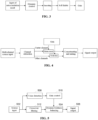
- FIG. 1 shows a schematic block diagram of a voice method and system according to one or more embodiments of an implementation of the present disclosure.
- the present disclosure will be described with reference to several modules according to main processing procedures of the method and system. It will be appreciated by those skilled in the art that the reference to the module description is for the purpose of describing the solution more clearly, but not for the purpose of limitation.
- FIG. 1 shows a schematic diagram according to one or more embodiments of an implementation of the present disclosure.
- the method and system of processing audio source input signals in the present disclosure involve the following parts: source input module 102, dynamic loudness balancing module 104, signal output module 106, voice detection module 108, and gain control module 110.
- the method and system of the present disclosure may simultaneously perform signal processing of two paths on an input signal.
- the first path signal processing is mainly used to perform dynamic loudness balancing on a received source input signal.
- the second path signal processing is used to perform voice detection on the received source input signal and estimate a gain.
- the first path signal processing and the second path signal processing may be performed synchronously or asynchronously.
- This dual-path processing design for source input signals minimizes the delay and prevents audio distortion.
- a signal may pass through the entire system quickly and with low delay; on the other hand, a gain may be estimated at a relatively low rate, so that the estimated gain has a higher accuracy and smoothness, which is a huge help in preventing audio distortion.
- the first path signal processing may include: receiving an audio source input signal through source input module 102, and performing dynamic balancing on the received audio source input signal based on a current gain control parameter through dynamic loudness balancing module 104.
- the second path processing may include: detecting the audio source input signal received from input module 102 at voice detection module 108 and calculating a detection confidence.
- the second path processing also includes: gain control module 110 may estimate a new gain control parameter based on the calculated detection confidence.
- the new gain control parameter estimated by gain control module 110 may be used to update the gain control parameter currently used by dynamic loudness balancing module 104.
- dynamic loudness balancing module 104 may perform the first path signal processing based on the updated gain control parameter. That is, dynamic loudness balancing module 104 may perform dynamic loudness balancing on the received audio source input signal based on the updated gain control parameter.
- the audio signal after the dynamic loudness balancing may be output through signal output module 106.
- the audio source input may include a multi-channel source input, a dual-channel source input, and a single-channel source input.
- the processing procedures of different source inputs will be described below respectively with reference to the accompanying drawings.
- FIG. 2 exemplarily shows a schematic block diagram of voice detection according to one or more embodiments of the present disclosure, where the audio input source includes a multi-channel source input.
- the voice detection process shown in FIG. 2 may be performed, for example, by voice detection module 108 in FIG. 1 .
- center channel extraction is performed first, that is, center channel signals are extracted from the multi-channel source input. Usually, most of voice signals exist in a center channel.
- ⁇ i and ⁇ i are the mean and variance of the input signals corresponding to the ith time frame.
- the fast autocorrelation processing is performed on the normalized signal and an autocorrelation result is output.
- the fast autocorrelation processing may first perform a Fourier transformation on the normalized input signal by using a short-time Fourier transform (STFT) method, and perform fast autocorrelation on the Fourier transformed signal.
- STFT short-time Fourier transform
- the fast autocorrelation processing procedure is shown in the following equations (2)-(4).
- X i ( z ) is a Fourier transformed signal
- X l ( z ) represents a conjugate of X i ( z )
- iSTFT is an inverse short-time Fourier transformation
- c i ( n ) is an autocorrelation of a signal of an ith time frame.
- a norm of c i ( n ) is calculated to obtain C i .
- an output C i of the final autocorrelation result is obtained based on a Euclidean norm.
- the output C i of the autocorrelation result represents the detection confidence, which may indicate the possibility of voice in the center channel signal.
- FIG. 3 exemplarily shows a schematic block diagram of a method and system of estimating a dynamic gain based on voice detection according to one or more embodiments of the present disclosure.
- the process of estimating a dynamic gain based on voice detection shown in FIG. 3 may be performed, for example, by gain control module 110 in FIG. 1 .
- the detection confidence C i generated via voice detection module 108 with reference to the process shown in FIG. 2 serves as an input to gain control module 110.
- the gain for voice (which may also be referred to as a gain control parameter hereinafter) is output after processing in gain control module 110 as an input to dynamic loudness balancing module 104.
- G i may be provided to dynamic loudness balancing module 104 as an output from gain control module 110.
- G i may be further processed and then serve as an output from gain control module 104.
- G i is smoothed to reduce audio distortion.
- a soft limiter may also be used to ensure that the gain G i _lim is within a reasonable range of magnitude.
- a tangent function of the following equation (6) may be used as the soft limiter.
- G i _ lim tanh ⁇ G i + ⁇ + ⁇ where ⁇ , ⁇ and ⁇ are limiter parameters, which depend on the system configuration, ⁇ may be a real number greater than zero, and ⁇ and ⁇ may be non-zero real numbers.
- G i _lim may serve as the output from gain control module 110.
- FIG. 4 exemplarily shows a schematic diagram of a dynamic loudness balancing process of each channel according to one or more embodiments of the present disclosure.
- the dynamic loudness balancing processing of FIG. 4 may be performed by dynamic loudness balancing module 104.
- dynamic loudness balancing module 104 first performs channel extraction to extract a center channel signal. Then, the loudness of the center channel signal is enhanced, and the loudness of other channel signals is reduced based on the gain control parameter. Then, the enhanced center channel signal and the reduced other channel signals are concatenated and mixed to generate an output signal.
- the gain control parameter may be a current gain control parameter or an updated gain parameter.
- the gain control parameter used for the dynamic loudness balancing of a signal of a current time frame is a calculated gain control parameter updated in real time, for example, Gi or G i _lim updated in real time.
- the gain control parameter used for the dynamic loudness balancing of a signal of a current time frame may be the gain control parameter used for the dynamic loudness balancing of the signal of the previous time frame, such as G i - n or G i - n_ lim , where n is an integer greater than 0, and the value thereof may vary depending on the actual processing power of the system or the practical experience of engineers.
- the signal in the center channel and the signals in the other channels may be enhanced and reduced at different ratios, respectively.
- an enhancement control parameter for enhancing the loudness of the center channel signal and an attenuation control parameter for reducing the loudness of the center channel signal may be further determined based on the current/updated gain control parameter, respectively.
- the enhancement control parameter and the attenuation control parameter may be determined by proportional calculation, function calculation, or other calculation methods set by engineers according to system requirements or experience. As a result, the overall loudness of the system remains unchanged, but the loudness of each channel is dynamically balanced.
- a source input signal received from input module 502 is processed by crossover filtering module 512 first, and then is processed by dynamic loudness balancing module 504 for dynamic loudness balancing.
- a crossover filter may be selected to process the input signal to distinguish signals in different frequency ranges.
- gain control is only applied to a signal in the mid frequency range in the input signal, while signals in other frequency ranges in the input signal remain unchanged.
- the dynamic loudness balancing only on the signal in the mid frequency range in the source input signal, so as to avoid distortion in a non-voice frequency range as much as possible.
- the signals in the low frequency range and the high frequency range in the multi-channel source input signal will not be subjected to the dynamic loudness balancing, but will be directly concatenated and mixed with the signals in the mid frequency range after the dynamic loudness balancing to generate an output signal. Thus, the distortion caused by a non-voice signal may be better avoided.
- FIG. 1 to FIG. 6 A number of processing procedures performed in the case where the source input is a multi-channel source input with a center channel are described above in conjunction with FIG. 1 to FIG. 6 . Those skilled in the art may understand from the present disclosure that if the source input is a single-channel input, the processing procedures shown in FIG. 1 to FIG. 6 may also be performed, wherein the process of center channel extraction will be omitted. That is, the signal processing of two paths described above is performed directly on the single-channel source input.
- FIG. 7 schematically shows a process of generating a multi-channel source input based on a dual-channel source input in the case where a source input is the dual-channel source input according to one or more embodiments of the present disclosure.
- An upmixing process shown in FIG. 7 may adopt a center extraction algorithm, so as to output a multi-channel source input based on a dual-channel source input.
- FIG. 8 schematically shows a method for dynamic voice enhancement according to one or more embodiments of the present disclosure.
- the method includes performing a first path signal processing.
- the first path signal processing includes receiving an audio source input and performing dynamic loudness balancing on the audio source input based on a first gain control parameter S802.
- the method also includes performing a second path signal processing.
- the second path signal processing includes: performing voice detection on the audio source input and calculating a detection confidence S804; and calculating a second gain control parameter based on the detection confidence S806.
- the method may also include updating the first gain control parameter with the second gain control parameter S808, and performing the first path signal processing based on the updated first gain control parameter S802.
- the method shown in FIG. 8 may be performed by a processor.
- a method for dynamic voice enhancement comprising: performing a first path signal processing, the first path signal processing comprising receiving an audio source input and performing dynamic loudness balancing on the audio source input based on a first gain control parameter; performing a second path signal processing, the second path signal processing comprising: performing voice detection on the audio source input and calculating a detection confidence, wherein the detection confidence indicates the possibility of voice in the audio source input; and calculating a second gain control parameter based on the detection confidence; and updating the first gain control parameter with the second gain control parameter, and performing the first path signal processing based on the updated first gain control parameter.
- the audio source input comprises a multi-channel source input
- the performing voice detection on the audio source input and calculating a detection confidence comprises: extracting a center channel signal from the multi-channel source input; performing normalization on the center channel signal; and performing fast autocorrelation on the normalized center channel signal, the result of the fast autocorrelation representing the detection confidence.
- Clause 3 The method according to any one of the preceding clauses, wherein the calculating a second gain control parameter based on the detection confidence comprises: calculating the second gain control parameter based on a logarithmic function of the detection confidence; smoothing the calculated second gain control parameter; and limiting the smoothed second gain control parameter.
- the audio source input comprises a multi-channel source input
- the performing dynamic loudness balancing on the audio source input comprises: extracting a center channel signal from the multi-channel source input; enhancing the loudness of the center channel signal and reducing the loudness of other channel signals based on the first gain control parameter or the updated first gain control parameter; and concatenating and mixing the enhanced center channel signal and the reduced other channel signals to generate an output signal.
- Clause 5 The method according to any one of the preceding clauses, further comprising: performing crossover filtering on the audio source input before performing the dynamic loudness balancing.
- Clause 6 The method according to any one of the preceding clauses, further comprising: performing the dynamic loudness balancing only on signals in a mid frequency range of the audio source input; and concatenating and mixing signals in a low frequency range and a high frequency range of the audio source input and signals in the mid frequency range of the audio source input after the dynamic loudness balancing to generate the output signal.
- Clause 7 The method according to any one of the preceding clauses, wherein the audio source input further comprises a dual-channel source input, and the method further comprises generating a multi-channel source input based on the dual-channel source input.
- Clause 8 The method according to any one of the preceding clauses, wherein the generating a multi-channel source input based on the dual-channel source input comprises: performing a cross-correlation between a left channel signal and a right channel signal from the dual-channel source input; and generating the multi-channel source input according to a combination ratio, wherein the combination ratio depends on the result of the cross-correlation.
- a system of dynamic voice enhancement comprising: a memory configured to store computer-executable instructions; and a processor configured to execute the computer-executable instructions to implement the method according to any one of the preceding clauses 1-9.
- one or more of the methods described may be performed by a suitable device and/or a combination of devices.
- the method may be performed by using one or more logic devices (for example, processors) in combination with one or more additional hardware elements (such as storage devices, memories, hardware network interfaces/antennas, switches, actuators, clock circuits, etc.) to perform stored instructions.
- the method described and associated actions may also be executed in parallel and/or simultaneously in various orders other than the order described in this application.
- the system described is illustrative in nature, and may include additional elements and/or omit elements.
- the subject matter of the present disclosure includes all novel and non-obvious combinations of the disclosed various systems and configurations as well as other features, functions, and/or properties.
- the system may include additional or different logic, and may be implemented in many different ways.
- the processor may be implemented as a microprocessor, a microcontroller, an Application Specific Integrated Circuit (ASIC), digital signal processor DSP, discrete logic, or a combination of these and/or other types of circuits or logic.
- the memory may be a DRAM, a SRAM, a flash memory, or other types of memory.
- Parameters (for example, conditions and thresholds) and other data structures may be stored and managed separately, may be combined into a single memory or database, or may be logically and physically organized in many different ways.
- Programs and instruction sets may be parts of a single program, or separate programs, or distributed across a plurality of memories and processors.
Landscapes
- Engineering & Computer Science (AREA)
- Multimedia (AREA)
- Acoustics & Sound (AREA)
- Signal Processing (AREA)
- Physics & Mathematics (AREA)
- Human Computer Interaction (AREA)
- Audiology, Speech & Language Pathology (AREA)
- Health & Medical Sciences (AREA)
- Computational Linguistics (AREA)
- Quality & Reliability (AREA)
- Tone Control, Compression And Expansion, Limiting Amplitude (AREA)
- Circuit For Audible Band Transducer (AREA)
- Stereophonic System (AREA)
Abstract
Description
- The present disclosure relates generally to the field of audio signal processing, and more particularly, to a method and system for dynamic voice enhancement of an audio source.
- Thanks to new ways of media consumption such as high-definition cable TV and online streaming, and with the advent of large-screen TVs and displays, the cinema experience is gaining popularity in the consumer market. These media sources are often accompanied by multi-channel audio technology or commonly referred to as surround technology. Surround providers such as Dolby, THX, and DTS have their own multi-channel audio encoding technology that provides a better spatial audio resolution for source content. Since the main purpose of content in a movie format is to provide an immersive surround experience, it is often preferred to sacrifice voice intelligibility in favor of the surround experience. While this provides great benefits in terms of immersion and spatial resolution, it often results in poor voice quality and sometimes even difficulty in understanding the movie content. In order to improve the quality of voice in a movie content source to improve intelligibility and audibility, methods of voice enhancement are often applied to the movie content.
- A common method for existing voice enhancement is to utilize static equalization. This method applies static equalization only on an audio channel about 200 Hz to 4 kHz to increase the loudness of a voice band. This implementation requires very few system resources, but the distortion that occurs in this method is obvious. Since this implementation method works all the time even when there is no voice or dialogue in a clip, a pitch imbalance will be caused, and the background will be amplified. A more advanced method is to first detect voice within each time frame, and then automatically process an audio signal based on the detection result. This one-way execution method requires accurate detection of voice and fast response of system processing. However, some existing methods cannot detect voice quickly and accurately, and often color a signal so that it sounds harsh.
- Therefore, there is a need for an improved technical solution to overcome the above-mentioned shortcomings in the existing solutions.
- According to an aspect of the present disclosure, a method of dynamic voice enhancement is provided. The method may include performing a first path signal processing, the first path signal processing including receiving an audio source input and performing dynamic loudness balancing on the audio source input based on a first gain control parameter. The method may also include: performing a second path signal processing, the second path signal processing including performing voice detection on the audio source input and calculating a detection confidence, wherein the detection confidence indicates the possibility of voice in the audio source input; and calculating a second gain control parameter based on the detection confidence. The method may further include updating the first gain control parameter with the second gain control parameter, and performing the first path signal processing based on the updated first gain control parameter.
- According to one or more embodiments, the audio source input may include a multi-channel source input, and the performing voice detection on the audio source input and calculating a detection confidence may include: extracting a center channel signal from the multi-channel source input; performing normalization on the center channel signal; and performing fast autocorrelation on the normalized center channel signal, the result of the fast autocorrelation representing the detection confidence.
- According to one or more embodiments, the calculating a second gain control parameter based on the detection confidence may include: calculating the second gain control parameter based on a logarithmic function of the detection confidence; smoothing the calculated second gain control parameter; and limiting the smoothed second gain control parameter.
- According to one or more embodiments, the audio source input may include a multi-channel source input, and the performing dynamic loudness balancing on the audio source input includes: extracting a center channel signal from the multi-channel source input; enhancing the loudness of the center channel signal and reducing the loudness of other channel signals based on the first gain control parameter or the updated first gain control parameter; and concatenating and mixing the enhanced center channel signal and the reduced other channel signals to generate an output signal.
- According to one or more embodiments, the method may also include performing crossover filtering on the audio source input before performing the dynamic loudness balancing.
- According to one or more embodiments, the method may also include: performing the dynamic loudness balancing only on signals in a mid frequency range of the audio source input; and concatenating and mixing signals in a low frequency range and a high frequency range of the audio source input and signals in the mid frequency range of the audio source input after the dynamic loudness balancing to generate the output signal.
- According to one or more embodiments, the audio source input also includes a dual-channel source input, and the method also includes generating a multi-channel source input based on the dual-channel source input.
- According to one or more embodiments, the generating a multi-channel source input based on the dual-channel source input may include: performing a cross-correlation between a left channel signal and a right channel signal from the dual-channel source input; and generating the multi-channel source input according to a combination ratio. The combination ratio depends on the result of the cross-correlation.
- According to one or more embodiments, the first path signal processing and the second path signal processing are synchronous or asynchronous.
- According to another aspect of the present disclosure, a system for voice enhancement is provided, including: a memory and a processor. The memory is configured to store computer-executable instructions. The processor is configured to execute the instructions to implement the method described above.
- The present disclosure may be better understood by reading the following description of nonlimiting implementations with reference to the accompanying drawings, in which:
-
FIG. 1 schematically shows a schematic block diagram of voice enhancement according to one or more embodiments of an implementation of the present disclosure; -
FIG. 2 exemplarily shows a schematic block diagram of voice detection according to one or more embodiments of the present disclosure; -
FIG. 3 exemplarily shows a schematic block diagram of gain estimation based on voice detection according to one or more embodiments of the present disclosure; -
FIG. 4 exemplarily shows a schematic diagram of a dynamic loudness balancing process according to one or more embodiments of the present disclosure; -
FIG. 5 shows a schematic diagram of voice enhancement according to one or more embodiments of another implementation of the present disclosure; -
FIG. 6 shows a schematic diagram of a dynamic loudness balancing process according to one or more embodiments of the implementation inFIG. 5 ; -
FIG. 7 schematically shows a process of generating a multi-channel source input based on a dual-channel source input in the case where a source input is the dual-channel source input, according to one or more embodiments of the present disclosure; and -
FIG. 8 schematically shows a method for dynamic voice enhancement according to one or more embodiments of the present disclosure. - It should be understood that the following description of the embodiments is given for purposes of illustration only and not limitation. The division of examples in functional blocks, modules or units shown in the figures should not be construed as implying that these functional blocks, modules or units must be implemented as physically separate units. The functional blocks, modules or units shown or described may be implemented as separate units, circuits, chips, functional blocks, modules, or circuit elements. One or more functional blocks or units may also be implemented in a common circuit, chip, circuit element, or unit.
- The use of singular terms (for example, but not limited to, "a") is not intended to limit the number of items. Relational terms, for example but not limited to, "top," "bottom," "left," "right," "upper," "lower," "down," "up," "side," "first," "second" ("third," etc.), "entry," "exit," etc., are used in the written description for clarity in specific reference to the drawings and are not intended to limit the scope of the present disclosure or the appended claims, unless otherwise noted. The terms "couple," "coupling," "being coupled," "coupled," "coupler," and similar terms are used broadly herein and may include any method or device for fixing, bonding, adhering, fastening, attaching, associating, inserting, forming thereon or therein, communicating with, or otherwise directly or indirectly mechanically, magnetically, electrically, chemically, and operatively associated with an intermediate element and one or more members, or may also include, but is not limited to, one member being integrally formed with another member in a unified manner. Coupling may occur in any direction, including rotationally. The terms "including" and "such as" are illustrative rather than restrictive, and the word "may" means "may, but not necessarily," unless stated otherwise. Although any other language is used in the present disclosure, the embodiments shown in the figures are examples given for purposes of illustration and explanation and are not the only embodiments of the subject matter herein.
- In order to overcome the defects of the existing technical solutions and improve the quality of voice output so as to bring a better experience to users, the present disclosure proposes a solution of actively detecting human voice and dynamically enhancing voice loudness in an audio source (for example, a theater audio source) based on a detection confidence that indicates the possibility of voice in an audio source input. The method and system of the present disclosure may simultaneously perform signal processing of two paths on an input signal. The first path signal processing includes receiving an audio source input and performing dynamic loudness balancing on the audio source input based on a first gain control parameter. The second path signal processing includes: performing voice detection on the audio source input and calculating a detection confidence; and calculating a second gain control parameter based on the detection confidence. The first path signal processing and the second path signal processing may be synchronous or asynchronous. The method of the present disclosure also includes updating the first gain control parameter with the second gain control parameter calculated by a second processing path, and performing the first path signal processing based on the updated first gain control parameter. The method and system of the present disclosure can better enhance the intelligibility of voice and improve the user's experience of using audio products.
- The method and system of dynamic voice enhancement according to various embodiments of various implementations of the present disclosure will be described in detail below with reference to the accompanying drawings.
FIG. 1 shows a schematic block diagram of a voice method and system according to one or more embodiments of an implementation of the present disclosure. For ease of understanding, the present disclosure will be described with reference to several modules according to main processing procedures of the method and system. It will be appreciated by those skilled in the art that the reference to the module description is for the purpose of describing the solution more clearly, but not for the purpose of limitation. -
FIG. 1 shows a schematic diagram according to one or more embodiments of an implementation of the present disclosure. In one or more embodiments shown inFIG. 1 , the method and system of processing audio source input signals in the present disclosure involve the following parts:source input module 102, dynamicloudness balancing module 104,signal output module 106,voice detection module 108, and gaincontrol module 110. As can be seen fromFIG. 1 , the method and system of the present disclosure may simultaneously perform signal processing of two paths on an input signal. The first path signal processing is mainly used to perform dynamic loudness balancing on a received source input signal. The second path signal processing is used to perform voice detection on the received source input signal and estimate a gain. The first path signal processing and the second path signal processing may be performed synchronously or asynchronously. This depends on the processing power and latency requirements of an actual system. This dual-path processing design for source input signals minimizes the delay and prevents audio distortion. For example, when the first path signal processing and the second signal processing are performed asynchronously, on the one hand, a signal may pass through the entire system quickly and with low delay; on the other hand, a gain may be estimated at a relatively low rate, so that the estimated gain has a higher accuracy and smoothness, which is a huge help in preventing audio distortion. - Referring to
FIG. 1 , for example, the first path signal processing may include: receiving an audio source input signal throughsource input module 102, and performing dynamic balancing on the received audio source input signal based on a current gain control parameter through dynamicloudness balancing module 104. The second path processing may include: detecting the audio source input signal received frominput module 102 atvoice detection module 108 and calculating a detection confidence. For example, the second path processing also includes: gaincontrol module 110 may estimate a new gain control parameter based on the calculated detection confidence. - The new gain control parameter estimated by
gain control module 110 may be used to update the gain control parameter currently used by dynamicloudness balancing module 104. Thus, dynamicloudness balancing module 104 may perform the first path signal processing based on the updated gain control parameter. That is, dynamicloudness balancing module 104 may perform dynamic loudness balancing on the received audio source input signal based on the updated gain control parameter. The audio signal after the dynamic loudness balancing may be output throughsignal output module 106. - The audio source input may include a multi-channel source input, a dual-channel source input, and a single-channel source input. The processing procedures of different source inputs will be described below respectively with reference to the accompanying drawings.
FIG. 2 exemplarily shows a schematic block diagram of voice detection according to one or more embodiments of the present disclosure, where the audio input source includes a multi-channel source input. The voice detection process shown inFIG. 2 may be performed, for example, byvoice detection module 108 inFIG. 1 . As shown inFIG. 2 , center channel extraction is performed first, that is, center channel signals are extracted from the multi-channel source input. Usually, most of voice signals exist in a center channel. Then, normalization is performed on the extracted center channel signals so that the input signal is scaled to a similar level. The normalized signal is, for example, represented by the following equation (1):
- Next, fast autocorrelation processing is performed on the normalized signal and an autocorrelation result is output. For example, the fast autocorrelation processing may first perform a Fourier transformation on the normalized input signal by using a short-time Fourier transform (STFT) method, and perform fast autocorrelation on the Fourier transformed signal. For example, the fast autocorrelation processing procedure is shown in the following equations (2)-(4).


Xl (z) represents a conjugate of Xi (z), iSTFT is an inverse short-time Fourier transformation, and ci (n) is an autocorrelation of a signal of an ith time frame. Next, a norm of ci (n) is calculated to obtain Ci . For example, an output Ci of the final autocorrelation result is obtained based on a Euclidean norm. The output Ci of the autocorrelation result represents the detection confidence, which may indicate the possibility of voice in the center channel signal. -
FIG. 3 exemplarily shows a schematic block diagram of a method and system of estimating a dynamic gain based on voice detection according to one or more embodiments of the present disclosure. The process of estimating a dynamic gain based on voice detection shown inFIG. 3 may be performed, for example, bygain control module 110 inFIG. 1 . For example, the detection confidence Ci generated viavoice detection module 108 with reference to the process shown inFIG. 2 serves as an input to gaincontrol module 110. Based on the input, the gain for voice (which may also be referred to as a gain control parameter hereinafter) is output after processing ingain control module 110 as an input to dynamicloudness balancing module 104. In some examples, the dynamic range of the gain is calculated by the following equation (5):
loudness balancing module 104 as an output fromgain control module 110. - In some other examples, Gi may be further processed and then serve as an output from
gain control module 104. For example, Gi is smoothed to reduce audio distortion. In addition, a soft limiter may also be used to ensure that the gain G i_lim is within a reasonable range of magnitude. For example, a tangent function of the following equation (6) may be used as the soft limiter.
gain control module 110. -
FIG. 4 exemplarily shows a schematic diagram of a dynamic loudness balancing process of each channel according to one or more embodiments of the present disclosure. The dynamic loudness balancing processing ofFIG. 4 may be performed by dynamicloudness balancing module 104. For example, after receiving the multi-channel source input, dynamicloudness balancing module 104 first performs channel extraction to extract a center channel signal. Then, the loudness of the center channel signal is enhanced, and the loudness of other channel signals is reduced based on the gain control parameter. Then, the enhanced center channel signal and the reduced other channel signals are concatenated and mixed to generate an output signal. The gain control parameter may be a current gain control parameter or an updated gain parameter. For example, in the case where the first path signal processing and the second path signal processing are synchronous, the gain control parameter used for the dynamic loudness balancing of a signal of a current time frame (for example, the ith time frame) is a calculated gain control parameter updated in real time, for example, Gi or G i_lim updated in real time. In the case where the first path signal processing and the second path signal processing are asynchronous, since the speed of the second path signal processing including voice detection and gain estimation is relatively low, the gain control parameter used for the dynamic loudness balancing of a signal of a current time frame (for example, the ith time frame) may be the gain control parameter used for the dynamic loudness balancing of the signal of the previous time frame, such as G i-n or G i-n_lim, where n is an integer greater than 0, and the value thereof may vary depending on the actual processing power of the system or the practical experience of engineers. Furthermore, based on the current/updated gain control parameter, the signal in the center channel and the signals in the other channels may be enhanced and reduced at different ratios, respectively. That is, an enhancement control parameter for enhancing the loudness of the center channel signal and an attenuation control parameter for reducing the loudness of the center channel signal may be further determined based on the current/updated gain control parameter, respectively. For example, the enhancement control parameter and the attenuation control parameter may be determined by proportional calculation, function calculation, or other calculation methods set by engineers according to system requirements or experience. As a result, the overall loudness of the system remains unchanged, but the loudness of each channel is dynamically balanced. -
FIG. 5 shows a schematic diagram of a method and system according to one or more embodiments of another implementation of the present disclosure. In one or more embodiments shown inFIG. 5 , the method and system of processing audio source input signals in the present disclosure involve the following parts:source input module 502, dynamicloudness balancing module 504,signal output module 506,voice detection module 508, and gaincontrol module 510. These modules operate on substantially the same principles as the corresponding modules 102-110 inFIG. 1 . Besides, the method and system shown inFIG. 5 may further includecrossover filtering module 512. It will be understood that the difference between the processing procedure shown inFIG. 5 and the processing procedure described above with reference toFIGS. 1-4 is that crossover filtering is added to a first signal path. Therefore, a source input signal received frominput module 502 is processed bycrossover filtering module 512 first, and then is processed by dynamicloudness balancing module 504 for dynamic loudness balancing. Since the frequency range of human voice is basically in a mid frequency range, a crossover filter may be selected to process the input signal to distinguish signals in different frequency ranges. Thus, gain control is only applied to a signal in the mid frequency range in the input signal, while signals in other frequency ranges in the input signal remain unchanged. Through the added crossover filtering, it is possible to perform the dynamic loudness balancing only on the signal in the mid frequency range in the source input signal, so as to avoid distortion in a non-voice frequency range as much as possible. In order to save space, only the different parts of the embodiments shown inFIG. 5 andFIG. 1 will be described below. For other identical parts, please refer toFIGS. 1-4 and the related descriptions. -
FIG. 6 shows a schematic diagram of a dynamic loudness balancing process according to one or more embodiments of the implementation inFIG. 5 . As shown inFIG. 6 , the source input signal after the crossover filtering may include signals in mid frequency, high frequency, and low frequency ranges. Next, dynamic loudness balancing is performed only on signals in the mid frequency range. The dynamic loudness balancing includes channel extraction to extract a center channel signal. Then, the loudness of the center channel signal is enhanced and the loudness of other channel signals is reduced based on a current/updated gain control parameter. The signals in the low frequency range and the high frequency range in the multi-channel source input signal will not be subjected to the dynamic loudness balancing, but will be directly concatenated and mixed with the signals in the mid frequency range after the dynamic loudness balancing to generate an output signal. Thus, the distortion caused by a non-voice signal may be better avoided. - A number of processing procedures performed in the case where the source input is a multi-channel source input with a center channel are described above in conjunction with
FIG. 1 to FIG. 6 . Those skilled in the art may understand from the present disclosure that if the source input is a single-channel input, the processing procedures shown inFIG. 1 to FIG. 6 may also be performed, wherein the process of center channel extraction will be omitted. That is, the signal processing of two paths described above is performed directly on the single-channel source input. - In the case where the source input is a dual-channel source input, it is necessary to add a center extraction process in advance before implementing the method and system disclosed above, so that a multi-channel source input is generated based on the dual-channel source input.
FIG. 7 schematically shows a process of generating a multi-channel source input based on a dual-channel source input in the case where a source input is the dual-channel source input according to one or more embodiments of the present disclosure. - An upmixing process shown in
FIG. 7 may adopt a center extraction algorithm, so as to output a multi-channel source input based on a dual-channel source input. A center extraction algorithm may, for example, include calculating a cross-correlation between left and right channel input signals, and combining the left and right channel input signals into a center channel signal, wherein the combination ratio depends on the cross-correlation, referring to the following equation (7):
-
FIG. 8 schematically shows a method for dynamic voice enhancement according to one or more embodiments of the present disclosure. As shown inFIG. 8 , the method includes performing a first path signal processing. The first path signal processing includes receiving an audio source input and performing dynamic loudness balancing on the audio source input based on a first gain control parameter S802. The method also includes performing a second path signal processing. The second path signal processing includes: performing voice detection on the audio source input and calculating a detection confidence S804; and calculating a second gain control parameter based on the detection confidence S806. The method may also include updating the first gain control parameter with the second gain control parameter S808, and performing the first path signal processing based on the updated first gain control parameter S802. The method shown inFIG. 8 may be performed by a processor. - The method and system provided by the present disclosure may be applied not only to consumer products such as Soundbars and stereo speakers, but also to products in cinema applications such as theaters and concert halls. The method and system provided by the present disclosure can better enhance the intelligibility of voice and improve the user's experience of using audio products and applications. The above-mentioned method and system described in the present disclosure with reference to the accompanying drawings may both be implemented by a processor.
- Clause 1. A method for dynamic voice enhancement, comprising: performing a first path signal processing, the first path signal processing comprising receiving an audio source input and performing dynamic loudness balancing on the audio source input based on a first gain control parameter; performing a second path signal processing, the second path signal processing comprising: performing voice detection on the audio source input and calculating a detection confidence, wherein the detection confidence indicates the possibility of voice in the audio source input; and calculating a second gain control parameter based on the detection confidence; and updating the first gain control parameter with the second gain control parameter, and performing the first path signal processing based on the updated first gain control parameter.
- Clause 2. The method according to clause 1, wherein the audio source input comprises a multi-channel source input, and the performing voice detection on the audio source input and calculating a detection confidence comprises: extracting a center channel signal from the multi-channel source input; performing normalization on the center channel signal; and performing fast autocorrelation on the normalized center channel signal, the result of the fast autocorrelation representing the detection confidence.
- Clause 3. The method according to any one of the preceding clauses, wherein the calculating a second gain control parameter based on the detection confidence comprises: calculating the second gain control parameter based on a logarithmic function of the detection confidence; smoothing the calculated second gain control parameter; and limiting the smoothed second gain control parameter.
- Clause 4. The method according to any one of the preceding clauses, wherein the audio source input comprises a multi-channel source input, and the performing dynamic loudness balancing on the audio source input comprises: extracting a center channel signal from the multi-channel source input; enhancing the loudness of the center channel signal and reducing the loudness of other channel signals based on the first gain control parameter or the updated first gain control parameter; and concatenating and mixing the enhanced center channel signal and the reduced other channel signals to generate an output signal.
- Clause 5. The method according to any one of the preceding clauses, further comprising: performing crossover filtering on the audio source input before performing the dynamic loudness balancing.
- Clause 6. The method according to any one of the preceding clauses, further comprising: performing the dynamic loudness balancing only on signals in a mid frequency range of the audio source input; and concatenating and mixing signals in a low frequency range and a high frequency range of the audio source input and signals in the mid frequency range of the audio source input after the dynamic loudness balancing to generate the output signal.
- Clause 7. The method according to any one of the preceding clauses, wherein the audio source input further comprises a dual-channel source input, and the method further comprises generating a multi-channel source input based on the dual-channel source input.
- Clause 8. The method according to any one of the preceding clauses, wherein the generating a multi-channel source input based on the dual-channel source input comprises: performing a cross-correlation between a left channel signal and a right channel signal from the dual-channel source input; and generating the multi-channel source input according to a combination ratio, wherein the combination ratio depends on the result of the cross-correlation.
- Clause 9. The method according to any one of the preceding clauses, wherein the first path signal processing and the second path signal processing are synchronous or asynchronous.
- Clause 10. A system of dynamic voice enhancement, comprising: a memory configured to store computer-executable instructions; and a processor configured to execute the computer-executable instructions to implement the method according to any one of the preceding clauses 1-9.
- The description of the implementations has been presented for the purposes of illustration and description. The implementations may be appropriately modified and changed according to the above description or these modifications and changes may be obtained by practicing the method. For example, unless otherwise indicated, one or more of the methods described may be performed by a suitable device and/or a combination of devices. The method may be performed by using one or more logic devices (for example, processors) in combination with one or more additional hardware elements (such as storage devices, memories, hardware network interfaces/antennas, switches, actuators, clock circuits, etc.) to perform stored instructions. The method described and associated actions may also be executed in parallel and/or simultaneously in various orders other than the order described in this application. The system described is illustrative in nature, and may include additional elements and/or omit elements. The subject matter of the present disclosure includes all novel and non-obvious combinations of the disclosed various systems and configurations as well as other features, functions, and/or properties.
- The system may include additional or different logic, and may be implemented in many different ways. The processor may be implemented as a microprocessor, a microcontroller, an Application Specific Integrated Circuit (ASIC), digital signal processor DSP, discrete logic, or a combination of these and/or other types of circuits or logic. Similarly, the memory may be a DRAM, a SRAM, a flash memory, or other types of memory. Parameters (for example, conditions and thresholds) and other data structures may be stored and managed separately, may be combined into a single memory or database, or may be logically and physically organized in many different ways. Programs and instruction sets may be parts of a single program, or separate programs, or distributed across a plurality of memories and processors.
- As used in this application, an element or step listed in the singular form and preceded by the word "a/one" should be understood as not excluding a plurality of said elements or steps, unless such exclusion is indicated. Furthermore, references to "one implementation" or "one example" of the present disclosure are not intended to be interpreted as excluding the existence of additional implementations that also incorporate the recited features. The present invention has been described above with reference to specific implementations. However, those of ordinary skill in the art will appreciate that various modifications and changes may be made therein without departing from the broader spirit and scope of the present invention as set forth in the appended claims.
Claims (10)
- A method of dynamic voice enhancement, comprising:performing a first path signal processing, the first path signal processing comprising receiving an audio source input and performing dynamic loudness balancing on the audio source input based on a first gain control parameter;performing a second path signal processing, the second path signal processing comprising:performing voice detection on the audio source input and calculating a detection confidence, wherein the detection confidence indicates the possibility of voice in the audio source input; andcalculating a second gain control parameter based on the detection confidence; andupdating the first gain control parameter with the second gain control parameter, and performing the first path signal processing based on the updated first gain control parameter.
- The method according to claim 1, wherein the audio source input comprises a multi-channel source input, and the performing voice detection on the audio source input and calculating a detection confidence comprises:extracting a center channel signal from the multi-channel source input;performing normalization on the center channel signal; andperforming fast autocorrelation on the normalized center channel signal, the result of the fast autocorrelation representing the detection confidence.
- The method according to claim 1 or 2, wherein the calculating a second gain control parameter based on the detection confidence comprises:calculating the second gain control parameter based on a logarithmic function of the detection confidence;smoothing the calculated second gain control parameter; andlimiting the smoothed second gain control parameter.
- The method according to any preceding claim, wherein the audio source input comprises a multi-channel source input, and the performing dynamic loudness balancing on the audio source input comprises:extracting a center channel signal from the multi-channel source input;enhancing the loudness of the center channel signal and reducing the loudness of other channel signals based on the first gain control parameter or the updated first gain control parameter; andconcatenating and mixing the enhanced center channel signal and the reduced other channel signals to generate an output signal.
- The method according to any preceding claim, further comprising: performing crossover filtering on the audio source input before performing the dynamic loudness balancing.
- The method according to claim 5, further comprising:performing the dynamic loudness balancing only on signals in a mid frequency range of the audio source input; andconcatenating and mixing signals in a low frequency range and a high frequency range of the audio source input and signals in the mid frequency range of the audio source input after the dynamic loudness balancing to generate the output signal.
- The method according to any preceding claim, wherein the audio source input further comprises a dual-channel source input, and the method further comprises generating a multi-channel source input based on the dual-channel source input.
- The method according to claim 7, wherein the generating a multi-channel source input based on the dual-channel source input comprises:performing a cross-correlation between a left channel signal and a right channel signal from the dual-channel source input; andgenerating the multi-channel source input according to a combination ratio,wherein the combination ratio depends on the result of the cross-correlation.
- The method according to any preceding claim, wherein the first path signal processing and the second path signal processing are synchronous or asynchronous.
- A system of dynamic voice enhancement, comprising:a memory configured to store computer-executable instructions; anda processor configured to execute the computer-executable instructions to implement the method according to any one of claims 1-9.
Applications Claiming Priority (1)
| Application Number | Priority Date | Filing Date | Title |
|---|---|---|---|
| CN202110895493.XA CN115881146A (en) | 2021-08-05 | 2021-08-05 | Method and system for dynamic speech enhancement |
Publications (3)
| Publication Number | Publication Date |
|---|---|
| EP4131265A2 true EP4131265A2 (en) | 2023-02-08 |
| EP4131265A3 EP4131265A3 (en) | 2023-04-19 |
| EP4131265B1 EP4131265B1 (en) | 2025-06-11 |
Family
ID=82608415
Family Applications (1)
| Application Number | Title | Priority Date | Filing Date |
|---|---|---|---|
| EP22184919.3A Active EP4131265B1 (en) | 2021-08-05 | 2022-07-14 | Method and system for dynamic voice enhancement |
Country Status (5)
| Country | Link |
|---|---|
| US (1) | US20230040743A1 (en) |
| EP (1) | EP4131265B1 (en) |
| JP (1) | JP2023024295A (en) |
| KR (1) | KR20230021580A (en) |
| CN (1) | CN115881146A (en) |
Families Citing this family (2)
| Publication number | Priority date | Publication date | Assignee | Title |
|---|---|---|---|---|
| CN116701921B (en) * | 2023-08-08 | 2023-10-20 | 电子科技大学 | Multi-channel time sequence signal self-adaptive noise suppression circuit |
| CN119889331A (en) * | 2023-10-24 | 2025-04-25 | 哈曼国际工业有限公司 | Intelligent dynamic voice enhancement method and system |
Family Cites Families (22)
| Publication number | Priority date | Publication date | Assignee | Title |
|---|---|---|---|---|
| JP2001237920A (en) * | 2000-02-23 | 2001-08-31 | Hitachi Kokusai Electric Inc | Input level adjustment circuit |
| FI20045315A7 (en) * | 2004-08-30 | 2006-03-01 | Nokia Corp | Detecting audio activity in an audio signal |
| US7464029B2 (en) * | 2005-07-22 | 2008-12-09 | Qualcomm Incorporated | Robust separation of speech signals in a noisy environment |
| CN101960516B (en) * | 2007-09-12 | 2014-07-02 | 杜比实验室特许公司 | Speech enhancement |
| JP5094427B2 (en) * | 2008-01-09 | 2012-12-12 | アルパイン株式会社 | Audio reproduction method and multi-process system |
| EP2272062B1 (en) * | 2008-03-26 | 2012-10-17 | Nokia Corporation | An audio signal classifier |
| EP2107553B1 (en) * | 2008-03-31 | 2011-05-18 | Harman Becker Automotive Systems GmbH | Method for determining barge-in |
| MY179314A (en) * | 2008-04-18 | 2020-11-04 | Dolby Laboratories Licensing Corp | Method and apparatus for maintaining speech audibility in multi-channel audio with minimal impact on surround experience |
| US8831936B2 (en) * | 2008-05-29 | 2014-09-09 | Qualcomm Incorporated | Systems, methods, apparatus, and computer program products for speech signal processing using spectral contrast enhancement |
| US8503694B2 (en) * | 2008-06-24 | 2013-08-06 | Microsoft Corporation | Sound capture system for devices with two microphones |
| US20110058676A1 (en) * | 2009-09-07 | 2011-03-10 | Qualcomm Incorporated | Systems, methods, apparatus, and computer-readable media for dereverberation of multichannel signal |
| US9324337B2 (en) * | 2009-11-17 | 2016-04-26 | Dolby Laboratories Licensing Corporation | Method and system for dialog enhancement |
| TWI459828B (en) * | 2010-03-08 | 2014-11-01 | Dolby Lab Licensing Corp | Method and system for scaling ducking of speech-relevant channels in multi-channel audio |
| JP5528538B2 (en) * | 2010-03-09 | 2014-06-25 | 三菱電機株式会社 | Noise suppressor |
| US8744091B2 (en) * | 2010-11-12 | 2014-06-03 | Apple Inc. | Intelligibility control using ambient noise detection |
| JP5604275B2 (en) * | 2010-12-02 | 2014-10-08 | 富士通テン株式会社 | Correlation reduction method, audio signal conversion apparatus, and sound reproduction apparatus |
| JP5762549B2 (en) * | 2011-09-15 | 2015-08-12 | 三菱電機株式会社 | Dynamic range controller |
| DE112012005855B4 (en) * | 2012-02-10 | 2021-07-08 | Mitsubishi Electric Corporation | Interference suppression device |
| WO2013184520A1 (en) * | 2012-06-04 | 2013-12-12 | Stone Troy Christopher | Methods and systems for identifying content types |
| EP2896126B1 (en) * | 2012-09-17 | 2016-06-29 | Dolby Laboratories Licensing Corporation | Long term monitoring of transmission and voice activity patterns for regulating gain control |
| US10546593B2 (en) * | 2017-12-04 | 2020-01-28 | Apple Inc. | Deep learning driven multi-channel filtering for speech enhancement |
| US11164592B1 (en) * | 2019-05-09 | 2021-11-02 | Amazon Technologies, Inc. | Responsive automatic gain control |
-
2021
- 2021-08-05 CN CN202110895493.XA patent/CN115881146A/en active Pending
-
2022
- 2022-07-08 JP JP2022110199A patent/JP2023024295A/en active Pending
- 2022-07-14 EP EP22184919.3A patent/EP4131265B1/en active Active
- 2022-07-18 KR KR1020220088509A patent/KR20230021580A/en active Pending
- 2022-08-02 US US17/879,561 patent/US20230040743A1/en active Pending
Also Published As
| Publication number | Publication date |
|---|---|
| US20230040743A1 (en) | 2023-02-09 |
| JP2023024295A (en) | 2023-02-16 |
| CN115881146A (en) | 2023-03-31 |
| EP4131265A3 (en) | 2023-04-19 |
| KR20230021580A (en) | 2023-02-14 |
| EP4131265B1 (en) | 2025-06-11 |
Similar Documents
| Publication | Publication Date | Title |
|---|---|---|
| US20240205629A1 (en) | Processing object-based audio signals | |
| US10573328B2 (en) | Determining the inter-channel time difference of a multi-channel audio signal | |
| US10311881B2 (en) | Determining the inter-channel time difference of a multi-channel audio signal | |
| US9311923B2 (en) | Adaptive audio processing based on forensic detection of media processing history | |
| CN114203163A (en) | Audio signal processing method and device | |
| EP4131265B1 (en) | Method and system for dynamic voice enhancement | |
| CN105284133B (en) | Scaled and stereo enhanced apparatus and method based on being mixed under signal than carrying out center signal | |
| EP2543199B1 (en) | Method and apparatus for upmixing a two-channel audio signal | |
| KR100773560B1 (en) | Method and apparatus for synthesizing stereo signal | |
| US20180270600A1 (en) | Method and apparatus for generating 3d audio content from two-channel stereo content | |
| US20250365552A1 (en) | Binaural signal post-processing | |
| US9601124B2 (en) | Acoustic matching and splicing of sound tracks | |
| US12058511B2 (en) | Sound field related rendering | |
| US20230106162A1 (en) | Spatial Audio Filtering Within Spatial Audio Capture | |
| EP4546338A1 (en) | Method and system for intelligent dynamic speech enhancement | |
| CN118942477B (en) | Signal processing methods, electronic devices and storage media for enhancing human voice | |
| US12323762B2 (en) | Spatial audio capture | |
| Lee et al. | On-Line Monaural Ambience Extraction Algorithm for Multichannel Audio Upmixing System Based on Nonnegative Matrix Factorization |
Legal Events
| Date | Code | Title | Description |
|---|---|---|---|
| PUAI | Public reference made under article 153(3) epc to a published international application that has entered the european phase |
Free format text: ORIGINAL CODE: 0009012 |
|
| STAA | Information on the status of an ep patent application or granted ep patent |
Free format text: STATUS: THE APPLICATION HAS BEEN PUBLISHED |
|
| AK | Designated contracting states |
Kind code of ref document: A2 Designated state(s): AL AT BE BG CH CY CZ DE DK EE ES FI FR GB GR HR HU IE IS IT LI LT LU LV MC MK MT NL NO PL PT RO RS SE SI SK SM TR |
|
| PUAL | Search report despatched |
Free format text: ORIGINAL CODE: 0009013 |
|
| AK | Designated contracting states |
Kind code of ref document: A3 Designated state(s): AL AT BE BG CH CY CZ DE DK EE ES FI FR GB GR HR HU IE IS IT LI LT LU LV MC MK MT NL NO PL PT RO RS SE SI SK SM TR |
|
| RIC1 | Information provided on ipc code assigned before grant |
Ipc: G10L 25/78 20130101ALN20230316BHEP Ipc: H04S 7/00 20060101ALI20230316BHEP Ipc: H03G 5/16 20060101ALI20230316BHEP Ipc: G10L 21/0364 20130101AFI20230316BHEP |
|
| STAA | Information on the status of an ep patent application or granted ep patent |
Free format text: STATUS: REQUEST FOR EXAMINATION WAS MADE |
|
| 17P | Request for examination filed |
Effective date: 20231019 |
|
| RBV | Designated contracting states (corrected) |
Designated state(s): AL AT BE BG CH CY CZ DE DK EE ES FI FR GB GR HR HU IE IS IT LI LT LU LV MC MK MT NL NO PL PT RO RS SE SI SK SM TR |
|
| GRAP | Despatch of communication of intention to grant a patent |
Free format text: ORIGINAL CODE: EPIDOSNIGR1 |
|
| STAA | Information on the status of an ep patent application or granted ep patent |
Free format text: STATUS: GRANT OF PATENT IS INTENDED |
|
| INTG | Intention to grant announced |
Effective date: 20250218 |
|
| RIC1 | Information provided on ipc code assigned before grant |
Ipc: G10L 25/78 20130101ALN20250210BHEP Ipc: H03G 3/30 20060101ALI20250210BHEP Ipc: H04S 7/00 20060101ALI20250210BHEP Ipc: H03G 5/16 20060101ALI20250210BHEP Ipc: G10L 21/0364 20130101AFI20250210BHEP |
|
| GRAS | Grant fee paid |
Free format text: ORIGINAL CODE: EPIDOSNIGR3 |
|
| GRAA | (expected) grant |
Free format text: ORIGINAL CODE: 0009210 |
|
| STAA | Information on the status of an ep patent application or granted ep patent |
Free format text: STATUS: THE PATENT HAS BEEN GRANTED |
|
| AK | Designated contracting states |
Kind code of ref document: B1 Designated state(s): AL AT BE BG CH CY CZ DE DK EE ES FI FR GB GR HR HU IE IS IT LI LT LU LV MC MK MT NL NO PL PT RO RS SE SI SK SM TR |
|
| P01 | Opt-out of the competence of the unified patent court (upc) registered |
Free format text: CASE NUMBER: APP_21470/2025 Effective date: 20250506 |
|
| REG | Reference to a national code |
Ref country code: GB Ref legal event code: FG4D |
|
| REG | Reference to a national code |
Ref country code: CH Ref legal event code: EP |
|
| REG | Reference to a national code |
Ref country code: IE Ref legal event code: FG4D |
|
| REG | Reference to a national code |
Ref country code: DE Ref legal event code: R096 Ref document number: 602022015738 Country of ref document: DE |
|
| PG25 | Lapsed in a contracting state [announced via postgrant information from national office to epo] |
Ref country code: ES Free format text: LAPSE BECAUSE OF FAILURE TO SUBMIT A TRANSLATION OF THE DESCRIPTION OR TO PAY THE FEE WITHIN THE PRESCRIBED TIME-LIMIT Effective date: 20250611 Ref country code: FI Free format text: LAPSE BECAUSE OF FAILURE TO SUBMIT A TRANSLATION OF THE DESCRIPTION OR TO PAY THE FEE WITHIN THE PRESCRIBED TIME-LIMIT Effective date: 20250611 |
|
| PGFP | Annual fee paid to national office [announced via postgrant information from national office to epo] |
Ref country code: DE Payment date: 20250724 Year of fee payment: 4 |
|
| REG | Reference to a national code |
Ref country code: LT Ref legal event code: MG9D |
|
| PG25 | Lapsed in a contracting state [announced via postgrant information from national office to epo] |
Ref country code: NO Free format text: LAPSE BECAUSE OF FAILURE TO SUBMIT A TRANSLATION OF THE DESCRIPTION OR TO PAY THE FEE WITHIN THE PRESCRIBED TIME-LIMIT Effective date: 20250911 Ref country code: GR Free format text: LAPSE BECAUSE OF FAILURE TO SUBMIT A TRANSLATION OF THE DESCRIPTION OR TO PAY THE FEE WITHIN THE PRESCRIBED TIME-LIMIT Effective date: 20250912 |
|
| REG | Reference to a national code |
Ref country code: NL Ref legal event code: MP Effective date: 20250611 |
|
| PG25 | Lapsed in a contracting state [announced via postgrant information from national office to epo] |
Ref country code: BG Free format text: LAPSE BECAUSE OF FAILURE TO SUBMIT A TRANSLATION OF THE DESCRIPTION OR TO PAY THE FEE WITHIN THE PRESCRIBED TIME-LIMIT Effective date: 20250611 |
|
| PG25 | Lapsed in a contracting state [announced via postgrant information from national office to epo] |
Ref country code: HR Free format text: LAPSE BECAUSE OF FAILURE TO SUBMIT A TRANSLATION OF THE DESCRIPTION OR TO PAY THE FEE WITHIN THE PRESCRIBED TIME-LIMIT Effective date: 20250611 |
|
| PGFP | Annual fee paid to national office [announced via postgrant information from national office to epo] |
Ref country code: AT Payment date: 20251020 Year of fee payment: 4 |
|
| PG25 | Lapsed in a contracting state [announced via postgrant information from national office to epo] |
Ref country code: RS Free format text: LAPSE BECAUSE OF FAILURE TO SUBMIT A TRANSLATION OF THE DESCRIPTION OR TO PAY THE FEE WITHIN THE PRESCRIBED TIME-LIMIT Effective date: 20250911 |
|
| PG25 | Lapsed in a contracting state [announced via postgrant information from national office to epo] |
Ref country code: LV Free format text: LAPSE BECAUSE OF FAILURE TO SUBMIT A TRANSLATION OF THE DESCRIPTION OR TO PAY THE FEE WITHIN THE PRESCRIBED TIME-LIMIT Effective date: 20250611 |
|
| PG25 | Lapsed in a contracting state [announced via postgrant information from national office to epo] |
Ref country code: NL Free format text: LAPSE BECAUSE OF FAILURE TO SUBMIT A TRANSLATION OF THE DESCRIPTION OR TO PAY THE FEE WITHIN THE PRESCRIBED TIME-LIMIT Effective date: 20250611 |
|
| PG25 | Lapsed in a contracting state [announced via postgrant information from national office to epo] |
Ref country code: PT Free format text: LAPSE BECAUSE OF FAILURE TO SUBMIT A TRANSLATION OF THE DESCRIPTION OR TO PAY THE FEE WITHIN THE PRESCRIBED TIME-LIMIT Effective date: 20251013 |
|
| REG | Reference to a national code |
Ref country code: AT Ref legal event code: MK05 Ref document number: 1802927 Country of ref document: AT Kind code of ref document: T Effective date: 20250611 |
|
| PG25 | Lapsed in a contracting state [announced via postgrant information from national office to epo] |
Ref country code: IS Free format text: LAPSE BECAUSE OF FAILURE TO SUBMIT A TRANSLATION OF THE DESCRIPTION OR TO PAY THE FEE WITHIN THE PRESCRIBED TIME-LIMIT Effective date: 20251011 |
|
| PG25 | Lapsed in a contracting state [announced via postgrant information from national office to epo] |
Ref country code: SM Free format text: LAPSE BECAUSE OF FAILURE TO SUBMIT A TRANSLATION OF THE DESCRIPTION OR TO PAY THE FEE WITHIN THE PRESCRIBED TIME-LIMIT Effective date: 20250611 Ref country code: AT Free format text: LAPSE BECAUSE OF FAILURE TO SUBMIT A TRANSLATION OF THE DESCRIPTION OR TO PAY THE FEE WITHIN THE PRESCRIBED TIME-LIMIT Effective date: 20250611 |
|
| PG25 | Lapsed in a contracting state [announced via postgrant information from national office to epo] |
Ref country code: CZ Free format text: LAPSE BECAUSE OF FAILURE TO SUBMIT A TRANSLATION OF THE DESCRIPTION OR TO PAY THE FEE WITHIN THE PRESCRIBED TIME-LIMIT Effective date: 20250611 |
|
| PG25 | Lapsed in a contracting state [announced via postgrant information from national office to epo] |
Ref country code: PL Free format text: LAPSE BECAUSE OF FAILURE TO SUBMIT A TRANSLATION OF THE DESCRIPTION OR TO PAY THE FEE WITHIN THE PRESCRIBED TIME-LIMIT Effective date: 20250611 |
|
| PG25 | Lapsed in a contracting state [announced via postgrant information from national office to epo] |
Ref country code: EE Free format text: LAPSE BECAUSE OF FAILURE TO SUBMIT A TRANSLATION OF THE DESCRIPTION OR TO PAY THE FEE WITHIN THE PRESCRIBED TIME-LIMIT Effective date: 20250611 |
|
| PG25 | Lapsed in a contracting state [announced via postgrant information from national office to epo] |
Ref country code: SK Free format text: LAPSE BECAUSE OF FAILURE TO SUBMIT A TRANSLATION OF THE DESCRIPTION OR TO PAY THE FEE WITHIN THE PRESCRIBED TIME-LIMIT Effective date: 20250611 |
|
| PG25 | Lapsed in a contracting state [announced via postgrant information from national office to epo] |
Ref country code: RO Free format text: LAPSE BECAUSE OF FAILURE TO SUBMIT A TRANSLATION OF THE DESCRIPTION OR TO PAY THE FEE WITHIN THE PRESCRIBED TIME-LIMIT Effective date: 20250611 |
|
| REG | Reference to a national code |
Ref country code: CH Ref legal event code: H13 Free format text: ST27 STATUS EVENT CODE: U-0-0-H10-H13 (AS PROVIDED BY THE NATIONAL OFFICE) Effective date: 20260224 |
|
| REG | Reference to a national code |
Ref country code: DE Ref legal event code: R097 Ref document number: 602022015738 Country of ref document: DE |
|
| PG25 | Lapsed in a contracting state [announced via postgrant information from national office to epo] |
Ref country code: LU Free format text: LAPSE BECAUSE OF NON-PAYMENT OF DUE FEES Effective date: 20250714 |
|
| REG | Reference to a national code |
Ref country code: BE Ref legal event code: MM Effective date: 20250731 |
|
| PG25 | Lapsed in a contracting state [announced via postgrant information from national office to epo] |
Ref country code: MC Free format text: LAPSE BECAUSE OF FAILURE TO SUBMIT A TRANSLATION OF THE DESCRIPTION OR TO PAY THE FEE WITHIN THE PRESCRIBED TIME-LIMIT Effective date: 20250611 |
|
| PG25 | Lapsed in a contracting state [announced via postgrant information from national office to epo] |
Ref country code: DK Free format text: LAPSE BECAUSE OF FAILURE TO SUBMIT A TRANSLATION OF THE DESCRIPTION OR TO PAY THE FEE WITHIN THE PRESCRIBED TIME-LIMIT Effective date: 20250611 |
|
| PG25 | Lapsed in a contracting state [announced via postgrant information from national office to epo] |
Ref country code: BE Free format text: LAPSE BECAUSE OF NON-PAYMENT OF DUE FEES Effective date: 20250731 Ref country code: IT Free format text: LAPSE BECAUSE OF FAILURE TO SUBMIT A TRANSLATION OF THE DESCRIPTION OR TO PAY THE FEE WITHIN THE PRESCRIBED TIME-LIMIT Effective date: 20250611 |
|
| PLBE | No opposition filed within time limit |
Free format text: ORIGINAL CODE: 0009261 |
|
| STAA | Information on the status of an ep patent application or granted ep patent |
Free format text: STATUS: NO OPPOSITION FILED WITHIN TIME LIMIT |
|
| PG25 | Lapsed in a contracting state [announced via postgrant information from national office to epo] |
Ref country code: CH Free format text: LAPSE BECAUSE OF NON-PAYMENT OF DUE FEES Effective date: 20250731 |
|
| REG | Reference to a national code |
Ref country code: CH Ref legal event code: L10 Free format text: ST27 STATUS EVENT CODE: U-0-0-L10-L00 (AS PROVIDED BY THE NATIONAL OFFICE) Effective date: 20260423 |