EP4130677A2 - Visualization of predictive health monitoring - Google Patents
Visualization of predictive health monitoring Download PDFInfo
- Publication number
- EP4130677A2 EP4130677A2 EP22188129.5A EP22188129A EP4130677A2 EP 4130677 A2 EP4130677 A2 EP 4130677A2 EP 22188129 A EP22188129 A EP 22188129A EP 4130677 A2 EP4130677 A2 EP 4130677A2
- Authority
- EP
- European Patent Office
- Prior art keywords
- predicted
- event
- processor
- events
- outcome
- Prior art date
- Legal status (The legal status is an assumption and is not a legal conclusion. Google has not performed a legal analysis and makes no representation as to the accuracy of the status listed.)
- Pending
Links
Images


Classifications
-
- G—PHYSICS
- G06—COMPUTING OR CALCULATING; COUNTING
- G06N—COMPUTING ARRANGEMENTS BASED ON SPECIFIC COMPUTATIONAL MODELS
- G06N3/00—Computing arrangements based on biological models
- G06N3/02—Neural networks
- G06N3/04—Architecture, e.g. interconnection topology
-
- G—PHYSICS
- G01—MEASURING; TESTING
- G01C—MEASURING DISTANCES, LEVELS OR BEARINGS; SURVEYING; NAVIGATION; GYROSCOPIC INSTRUMENTS; PHOTOGRAMMETRY OR VIDEOGRAMMETRY
- G01C23/00—Combined instruments indicating more than one navigational value, e.g. for aircraft; Combined measuring devices for measuring two or more variables of movement, e.g. distance, speed or acceleration
-
- B—PERFORMING OPERATIONS; TRANSPORTING
- B64—AIRCRAFT; AVIATION; COSMONAUTICS
- B64D—EQUIPMENT FOR FITTING IN OR TO AIRCRAFT; FLIGHT SUITS; PARACHUTES; ARRANGEMENT OR MOUNTING OF POWER PLANTS OR PROPULSION TRANSMISSIONS IN AIRCRAFT
- B64D45/00—Aircraft indicators or protectors not otherwise provided for
-
- G—PHYSICS
- G08—SIGNALLING
- G08G—TRAFFIC CONTROL SYSTEMS
- G08G5/00—Traffic control systems for aircraft
- G08G5/20—Arrangements for acquiring, generating, sharing or displaying traffic information
- G08G5/21—Arrangements for acquiring, generating, sharing or displaying traffic information located onboard the aircraft
-
- G—PHYSICS
- G08—SIGNALLING
- G08G—TRAFFIC CONTROL SYSTEMS
- G08G5/00—Traffic control systems for aircraft
- G08G5/50—Navigation or guidance aids
- G08G5/53—Navigation or guidance aids for cruising
-
- G—PHYSICS
- G08—SIGNALLING
- G08G—TRAFFIC CONTROL SYSTEMS
- G08G5/00—Traffic control systems for aircraft
- G08G5/70—Arrangements for monitoring traffic-related situations or conditions
- G08G5/76—Arrangements for monitoring traffic-related situations or conditions for monitoring atmospheric conditions
-
- B—PERFORMING OPERATIONS; TRANSPORTING
- B64—AIRCRAFT; AVIATION; COSMONAUTICS
- B64D—EQUIPMENT FOR FITTING IN OR TO AIRCRAFT; FLIGHT SUITS; PARACHUTES; ARRANGEMENT OR MOUNTING OF POWER PLANTS OR PROPULSION TRANSMISSIONS IN AIRCRAFT
- B64D45/00—Aircraft indicators or protectors not otherwise provided for
- B64D2045/0085—Devices for aircraft health monitoring, e.g. monitoring flutter or vibration
-
- G—PHYSICS
- G08—SIGNALLING
- G08G—TRAFFIC CONTROL SYSTEMS
- G08G5/00—Traffic control systems for aircraft
- G08G5/50—Navigation or guidance aids
- G08G5/55—Navigation or guidance aids for a single aircraft
Definitions
- Predictive health monitoring systems observe and flag events that could or will impact a pilot's ability to complete a mission. However, there are no useful mechanisms for delivering that information to the pilot in a meaningful way that increases the pilot's awareness of the situation.
- embodiments of the inventive concepts disclosed herein are directed to a system for incorporating predictive health data into a mission timeline.
- the system receives a predictive health event, identifies a time frame for the event, and incorporates the event into a mission timeline.
- the event may define a probability window with weighted probabilities overlaid onto the mission timeline.
- the event may define an uncorrected outcome.
- the uncorrected outcome is rendered onto the mission timeline at a point when the uncorrected outcome will likely occur if no remedial action is taken.
- inventive concepts are not limited in their application to the details of construction and the arrangement of the components or steps or methodologies set forth in the following description or illustrated in the drawings.
- inventive concepts disclosed herein may be practiced without these specific details.
- well-known features may not be described in detail to avoid unnecessarily complicating the instant disclosure.
- inventive concepts disclosed herein are capable of other embodiments or of being practiced or carried out in various ways. Also, it is to be understood that the phraseology and terminology employed herein is for the purpose of description and should not be regarded as limiting.
- a letter following a reference numeral is intended to reference an embodiment of the feature or element that may be similar, but not necessarily identical, to a previously described element or feature bearing the same reference numeral (e.g., 1, 1a, 1b).
- reference numeral e.g. 1, 1a, 1b
- Such shorthand notations are used for purposes of convenience only, and should not be construed to limit the inventive concepts disclosed herein in any way unless expressly stated to the contrary.
- any reference to "one embodiment,” or “some embodiments” means that a particular element, feature, structure, or characteristic described in connection with the embodiment is included in at least one embodiment of the inventive concepts disclosed herein.
- the appearances of the phrase “in some embodiments” in various places in the specification are not necessarily all referring to the same embodiment, and embodiments of the inventive concepts disclosed may include one or more of the features expressly described or inherently present herein, or any combination of sub-combination of two or more such features, along with any other features which may not necessarily be expressly described or inherently present in the instant disclosure.
- embodiments of the inventive concepts disclosed herein are directed to a system for incorporating predictive health data into a mission timeline.
- the system receives a predictive health event, identifies a time frame for the event, and incorporates the event into a mission timeline.
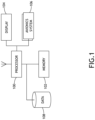
- the system includes a processor 100, memory 102 connected to the processor 100, and a display 104 for rendering an action window and mission timeline.
- the processor 100 receives one or more predicted events; each predicted event defines an event type and some indication of the predicted time of occurrence. For example, a separate avionics system 106 monitoring fuel usage may determine that, based on current or average consumption rates, an aircraft will run out of fuel at a predetermined time in the future. That event, including the type ("fuel exhaustion”) and time, and transmitted to the processor 100.
- the processor 100 maintains an action window on the display including a rendered mission timeline including various markers of relevant mission events.
- the processor 100 identifies where on the mission timeline the predicted event occurs and incorporates some event symbology into the mission timeline corresponding to the event type at the identified time relative to the overall mission.
- the processor 100 may re-render existing mission events so as to avoid obfuscating the predicted event symbology and vice-versa.
- the predicted events may define a weighted probability of occurrence over time.
- the processor 100 may render the predicted event over a window of probability.
- the window of probability may include an artifice to indicate the distribution of probability; for example, the window of probability may be shaded with the most shaded portion in the temporal region of highest probability, and reduced shading accordingly. Alternatively, varying colors may be utilized for different probabilities. Alternatively, a probability curve may be rendered in the window of probability.
- the predicted events may define a degradation curve corresponding to a window of time wherein the predicted event is likely to begin and progressively degrade overtime.
- the predicted events may include an indication of an uncorrected outcome; that is to say, an indication of the anticipated result if the predicted event is not addressed.
- the indication of uncorrected outcome may define a separate time indication corresponding to when the uncorrected outcome will occur. For example, where the predicted event indicates fuel exhaustion, the uncorrected outcome may indicate engine failure and crash rendered on the mission timeline shortly afterwards. Alternatively, where the predicted event indicates a mission critical system failure, the uncorrected outcome may indicate a time after the mission critical system failure when the mission will have to be aborted.
- avionics systems 106 may update predicted events from time to time.
- the predicted events may be based on statistical analysis of various factors including factors internal to the aircraft and factors external to the aircraft. As factors are updated, the predicted events may also be updated. In at least one embodiment, predicted events may be based on a Bayesian probability analysis.
- an action window with a rendered mission timeline 200 is shown.
- the mission timeline 200 may include indications of mission critical events over time (as distinct from other information sources which may be defined by points in space).
- the mission timeline 300 includes a symbol 302 corresponding an event type defined by a predicted event and a temporal indication 306 corresponding to a predicted time of the event.
- the temporal indication 306 may comprise a window of probability with shaded regions corresponding to greater or lesser predicted probabilities of the event occurring at that time. Such window of probability may be defined by statistical analysis of similar events, either mathematically or via a machine learning algorithm.
- the predicted event may include an uncorrected outcome corresponding to a result if the event is not addressed.
- the uncorrected outcome may also be translated to an outcome symbol 304 and rendered at an indicated time on the mission timeline 300.
- the system implementing the method receives 400 a predicted event warning comprising an event type and a predicted time of occurrence.
- the predicted time of occurrence may comprise a weighted, probabilistic window of occurrence.
- the time of occurrence may comprise a degradation curve indicating a prediction of how the event may degrade over a period of time.
- the system determines 402 a placement of the event warning withing a mission time line, and incorporates 404 the event warning into the timeline by identifying a symbol corresponding to the event type, and placing that symbology on the mission timeline at the determined placement.
- the predicted event time corresponds to a weighted, probabilistic window or degradation curve
- a window representing the weighted distribution or degradation curve is rendered at the appropriate mission timeline location.
- the location and / or time window may be periodically updated according to updated event details from a corresponding avionics system.
- surrounding symbology such as mission event markers, may be adjusted 406 to accommodate the predicted event warning symbols.
- the predicted event warning symbology may comprise symbols corresponding to a predicted, uncorrected outcome, indicating a type and time of outcome that will occur if the predicted event is unaddressed.
- the predicted events may be based on current aircraft and environmental conditions, pilot entered information, stored statistical data, etc. Such data may be used by a trained neural network to produce the event type and predicted time of the predicted event warnings.
- the visualization is a depiction of critical events that are predicted to impact mission success overlaid on a mission timeline.
- the predicted system degradation is visualized relative to a current state of the mission and aircraft, as well as the predicted events. It shows when a predicted event is likely to occur, and gives the user a certainty range, using opacity to communicate increasing or decreasing probability of occurrence. It also shows the user the predicted result if corrective action is not taken, in the form of an icon at the end of the degradation trend line.
- a visualization system overlaid on the mission timeline gives a pilot an immediate understanding of when the flagged event would potentially impact the mission, and increase awareness by providing timely alerting.
- This information overlay will allow the pilot to predict future system status, increase the pilot's overall situation awareness in time-critical scenarios, and address the need for more advanced system monitoring technology in the flight deck.
Landscapes
- Engineering & Computer Science (AREA)
- Physics & Mathematics (AREA)
- General Physics & Mathematics (AREA)
- Aviation & Aerospace Engineering (AREA)
- Theoretical Computer Science (AREA)
- Radar, Positioning & Navigation (AREA)
- Remote Sensing (AREA)
- Life Sciences & Earth Sciences (AREA)
- Biophysics (AREA)
- Molecular Biology (AREA)
- Artificial Intelligence (AREA)
- Computational Linguistics (AREA)
- Data Mining & Analysis (AREA)
- Evolutionary Computation (AREA)
- General Health & Medical Sciences (AREA)
- Biomedical Technology (AREA)
- Computing Systems (AREA)
- General Engineering & Computer Science (AREA)
- Mathematical Physics (AREA)
- Software Systems (AREA)
- Health & Medical Sciences (AREA)
- Management, Administration, Business Operations System, And Electronic Commerce (AREA)
- Atmospheric Sciences (AREA)
Abstract
Description
- Predictive health monitoring systems observe and flag events that could or will impact a pilot's ability to complete a mission. However, there are no useful mechanisms for delivering that information to the pilot in a meaningful way that increases the pilot's awareness of the situation.
- In one aspect, embodiments of the inventive concepts disclosed herein are directed to a system for incorporating predictive health data into a mission timeline. The system receives a predictive health event, identifies a time frame for the event, and incorporates the event into a mission timeline.
- In a further aspect, the event may define a probability window with weighted probabilities overlaid onto the mission timeline.
- In a further aspect, the event may define an uncorrected outcome. The uncorrected outcome is rendered onto the mission timeline at a point when the uncorrected outcome will likely occur if no remedial action is taken.
- It is to be understood that both the foregoing general description and the following detailed description are exemplary and explanatory only and should not restrict the scope of the claims. The accompanying drawings, which are incorporated in and constitute a part of the specification, illustrate exemplary embodiments of the inventive concepts disclosed herein and together with the general description, serve to explain the principles.
- The numerous advantages of the embodiments of the inventive concepts disclosed herein may be better understood by those skilled in the art by reference to the accompanying figures in which:
-
FIG. 1 shows a block diagram of a system for implementing an exemplary embodiment; -
FIG. 2 shows an action window with a rendered mission timeline; -
FIG. 3 shows a rendered mission timeline including an exemplary embodiment; and -
FIG. 4 shows a flowchart of a method for incorporating predictive health events into a mission timeline according to an exemplary embodiment. - Before explaining at least one embodiment of the inventive concepts disclosed herein in detail, it is to be understood that the inventive concepts are not limited in their application to the details of construction and the arrangement of the components or steps or methodologies set forth in the following description or illustrated in the drawings. In the following detailed description of embodiments of the instant inventive concepts, numerous specific details are set forth in order to provide a more thorough understanding of the inventive concepts. However, it will be apparent to one of ordinary skill in the art having the benefit of the instant disclosure that the inventive concepts disclosed herein may be practiced without these specific details. In other instances, well-known features may not be described in detail to avoid unnecessarily complicating the instant disclosure. The inventive concepts disclosed herein are capable of other embodiments or of being practiced or carried out in various ways. Also, it is to be understood that the phraseology and terminology employed herein is for the purpose of description and should not be regarded as limiting.
- As used herein a letter following a reference numeral is intended to reference an embodiment of the feature or element that may be similar, but not necessarily identical, to a previously described element or feature bearing the same reference numeral (e.g., 1, 1a, 1b). Such shorthand notations are used for purposes of convenience only, and should not be construed to limit the inventive concepts disclosed herein in any way unless expressly stated to the contrary.
- Further, unless expressly stated to the contrary, "or" refers to an inclusive or and not to an exclusive or. For example, a condition A or B is satisfied by anyone of the following: A is true (or present) and B is false (or not present), A is false (or not present) and B is true (or present), and both A and B are true (or present).
- In addition, use of the "a" or "an" are employed to describe elements and components of embodiments of the instant inventive concepts. This is done merely for convenience and to give a general sense of the inventive concepts, and "a" and "an" are intended to include one or at least one and the singular also includes the plural unless it is obvious that it is meant otherwise.
- Finally, as used herein any reference to "one embodiment," or "some embodiments" means that a particular element, feature, structure, or characteristic described in connection with the embodiment is included in at least one embodiment of the inventive concepts disclosed herein. The appearances of the phrase "in some embodiments" in various places in the specification are not necessarily all referring to the same embodiment, and embodiments of the inventive concepts disclosed may include one or more of the features expressly described or inherently present herein, or any combination of sub-combination of two or more such features, along with any other features which may not necessarily be expressly described or inherently present in the instant disclosure.
- Broadly, embodiments of the inventive concepts disclosed herein are directed to a system for incorporating predictive health data into a mission timeline. The system receives a predictive health event, identifies a time frame for the event, and incorporates the event into a mission timeline.
- Referring to
FIG. 1 , a block diagram of a system for implementing an exemplary embodiment is shown. The system includes aprocessor 100,memory 102 connected to theprocessor 100, and adisplay 104 for rendering an action window and mission timeline. Theprocessor 100 receives one or more predicted events; each predicted event defines an event type and some indication of the predicted time of occurrence. For example, aseparate avionics system 106 monitoring fuel usage may determine that, based on current or average consumption rates, an aircraft will run out of fuel at a predetermined time in the future. That event, including the type ("fuel exhaustion") and time, and transmitted to theprocessor 100. - The
processor 100 maintains an action window on the display including a rendered mission timeline including various markers of relevant mission events. Theprocessor 100 identifies where on the mission timeline the predicted event occurs and incorporates some event symbology into the mission timeline corresponding to the event type at the identified time relative to the overall mission. In at least one embodiment, theprocessor 100 may re-render existing mission events so as to avoid obfuscating the predicted event symbology and vice-versa. - In at least one embodiment, the predicted events may define a weighted probability of occurrence over time. In those cases, the
processor 100 may render the predicted event over a window of probability. The window of probability may include an artifice to indicate the distribution of probability; for example, the window of probability may be shaded with the most shaded portion in the temporal region of highest probability, and reduced shading accordingly. Alternatively, varying colors may be utilized for different probabilities. Alternatively, a probability curve may be rendered in the window of probability. - In at least one embodiment, the predicted events may define a degradation curve corresponding to a window of time wherein the predicted event is likely to begin and progressively degrade overtime.
- In at least one embodiment, the predicted events may include an indication of an uncorrected outcome; that is to say, an indication of the anticipated result if the predicted event is not addressed. The indication of uncorrected outcome may define a separate time indication corresponding to when the uncorrected outcome will occur. For example, where the predicted event indicates fuel exhaustion, the uncorrected outcome may indicate engine failure and crash rendered on the mission timeline shortly afterwards. Alternatively, where the predicted event indicates a mission critical system failure, the uncorrected outcome may indicate a time after the mission critical system failure when the mission will have to be aborted.
- In at least one embodiment,
avionics systems 106 may update predicted events from time to time. In at least one embodiment, the predicted events may be based on statistical analysis of various factors including factors internal to the aircraft and factors external to the aircraft. As factors are updated, the predicted events may also be updated. In at least one embodiment, predicted events may be based on a Bayesian probability analysis. - Referring to
FIG. 2 , an action window with a renderedmission timeline 200 is shown. In a unified action window display where multiple information sources are combined into a single rendered display, themission timeline 200 may include indications of mission critical events over time (as distinct from other information sources which may be defined by points in space). - Referring to
FIG. 3 , a renderedmission timeline 300 including an exemplary embodiment is shown. Themission timeline 300 includes a symbol 302 corresponding an event type defined by a predicted event and atemporal indication 306 corresponding to a predicted time of the event. In at least one embodiment, thetemporal indication 306 may comprise a window of probability with shaded regions corresponding to greater or lesser predicted probabilities of the event occurring at that time. Such window of probability may be defined by statistical analysis of similar events, either mathematically or via a machine learning algorithm. - In at least one embodiment, the predicted event may include an uncorrected outcome corresponding to a result if the event is not addressed. The uncorrected outcome may also be translated to an
outcome symbol 304 and rendered at an indicated time on themission timeline 300. - Referring to
FIG. 4 , a flowchart of a method for incorporating predictive health events into a mission timeline according to an exemplary embodiment is shown. The system implementing the method receives 400 a predicted event warning comprising an event type and a predicted time of occurrence. In at least one embodiment, the predicted time of occurrence may comprise a weighted, probabilistic window of occurrence. Alternatively, or in addition, the time of occurrence may comprise a degradation curve indicating a prediction of how the event may degrade over a period of time. - The system determines 402 a placement of the event warning withing a mission time line, and incorporates 404 the event warning into the timeline by identifying a symbol corresponding to the event type, and placing that symbology on the mission timeline at the determined placement. Where the predicted event time corresponds to a weighted, probabilistic window or degradation curve, a window representing the weighted distribution or degradation curve is rendered at the appropriate mission timeline location.
- In at least one embodiment, the location and / or time window may be periodically updated according to updated event details from a corresponding avionics system. Furthermore, surrounding symbology, such as mission event markers, may be adjusted 406 to accommodate the predicted event warning symbols.
- In at least one embodiment, the predicted event warning symbology may comprise symbols corresponding to a predicted, uncorrected outcome, indicating a type and time of outcome that will occur if the predicted event is unaddressed.
- In at least one embodiment, the predicted events may be based on current aircraft and environmental conditions, pilot entered information, stored statistical data, etc. Such data may be used by a trained neural network to produce the event type and predicted time of the predicted event warnings.
- The visualization is a depiction of critical events that are predicted to impact mission success overlaid on a mission timeline. The predicted system degradation is visualized relative to a current state of the mission and aircraft, as well as the predicted events. It shows when a predicted event is likely to occur, and gives the user a certainty range, using opacity to communicate increasing or decreasing probability of occurrence. It also shows the user the predicted result if corrective action is not taken, in the form of an icon at the end of the degradation trend line.
- A visualization system overlaid on the mission timeline gives a pilot an immediate understanding of when the flagged event would potentially impact the mission, and increase awareness by providing timely alerting. This information overlay will allow the pilot to predict future system status, increase the pilot's overall situation awareness in time-critical scenarios, and address the need for more advanced system monitoring technology in the flight deck.
- It is believed that the inventive concepts disclosed herein and many of their attendant advantages will be understood by the foregoing description of embodiments of the inventive concepts disclosed, and it will be apparent that various changes may be made in the form, construction, and arrangement of the components thereof without departing from the broad scope of the inventive concepts disclosed herein or without sacrificing all of their material advantages; and individual features from various embodiments may be combined to arrive at other embodiments. The form herein before described being merely an explanatory embodiment thereof, it is the intention of the following claims to encompass and include such changes. Furthermore, any of the features disclosed in relation to any of the individual embodiments may be incorporated into any other embodiment.
Claims (15)
- A computer apparatus comprising:a display (104); andat least one processor (100) in data communication with the display and a memory (102) storing processor executable code for configuring the at least one processor to:receive one or more predicted events, each of the one or more predicted events comprising an event type and a predicted time of the event;determine a location on a rendered mission timeline corresponding to the predicted time of each of the one or more predicted events;determine a symbol for each predicted event based on the event type; andrender the symbols at the determined location.
- The computer apparatus of Claim 1, wherein the predicted time comprises a weighted probability window of occurrence, and preferably wherein the at least one processor is further configured to render the weighted probability window as variably shaded region defined by probabilities of the predicted time.
- The computer apparatus of Claim 1 or 2, wherein:the predicted time comprises a degradation curve; andthe at least one processor is further configured to render the degradation curve across a corresponding window of occurrence.
- The computer apparatus of any preceding Claim, wherein:each of the one or more predicted events further comprise an uncorrected outcome; andthe at least one processor is further configured to:determine a symbol corresponding to the uncorrected outcome; andrender the symbol corresponding to the uncorrected outcome.
- The computer apparatus of any preceding Claim, wherein the at least one processor is further configured to:periodically receive updates to the one or more predicted events; andupdate corresponding symbology on the mission timeline.
- The computer apparatus of any preceding Claim, wherein the one or more predicted events are determined via a Bayesian analysis of aircraft conditions and environmental conditions.
- A method comprising:receiving one or more predicted events, each of the one or more predicted events comprising an event type and a predicted time of the event;determining a location on a rendered mission timeline corresponding to the predicted time of each of the one or more predicted events;determining a symbol for each predicted event based on the event type; andrender the symbols at the determined location on the mission timeline.
- The method of Claim 7, wherein:the predicted time comprises a weighted probability window of occurrence; andfurther comprising rendering the weighted probability window as variably shaded region defined by probabilities of the predicted time.
- The method of Claim 7 or 8, wherein:the predicted time comprises a degradation curve; andfurther comprising rendering the degradation curve across a corresponding window of occurrence.
- The method of any of Claims 7-9, wherein:each of the one or more predicted events further comprise an uncorrected outcome; andfurther comprising:determining a symbol corresponding to the uncorrected outcome; andrendering the symbol corresponding to the uncorrected outcome.
- The method of any of Claims 7-10, further comprising:periodically receiving updates to the one or more predicted events; andupdating corresponding symbology on the mission timeline; and/orwherein the one or more predicted events are determined via a Bayesian analysis of aircraft conditions and environmental conditions.
- A pilot awareness system comprising:a display (104); andat least one processor (100) in data communication with the display (104) and a memory (102) storing processor executable code for configuring the at least one processor to:receive one or more predicted events, each of the one or more predicted events comprising an event type and a predicted time of the event;determine a location on a rendered mission timeline corresponding to the predicted time of each of the one or more predicted events;determine a symbol for each predicted event based on the event type; and render the symbols at the determined location.
- The pilot awareness system of Claim 12, wherein the predicted time comprises a weighted probability window of occurrence, and preferably wherein the at least one processor is further configured to render the weighted probability window as variably shaded region defined by probabilities of the predicted time.
- The pilot awareness system of Claim 12 or 13, wherein:the predicted time comprises a degradation curve; andthe at least one processor is further configured to render the degradation curve across a corresponding window of occurrence.
- The pilot awareness system of any of Claims 12-14, wherein:each of the one or more predicted events further comprise an uncorrected outcome; andthe at least one processor is further configured to:wherein the at least one processor is further configured to:determine a symbol corresponding to the uncorrected outcome; andrender the symbol corresponding to the uncorrected outcome; and/orperiodically receive updates to the one or more predicted events; andupdate corresponding symbology on the mission timeline; and/orwherein the one or more predicted events are determined via a neural network configured to receive aircraft conditions and environmental conditions.
Applications Claiming Priority (1)
| Application Number | Priority Date | Filing Date | Title |
|---|---|---|---|
| US17/392,009 US12026603B2 (en) | 2021-08-02 | 2021-08-02 | Visualization of predictive health monitoring |
Publications (2)
| Publication Number | Publication Date |
|---|---|
| EP4130677A2 true EP4130677A2 (en) | 2023-02-08 |
| EP4130677A3 EP4130677A3 (en) | 2023-05-03 |
Family
ID=82786356
Family Applications (1)
| Application Number | Title | Priority Date | Filing Date |
|---|---|---|---|
| EP22188129.5A Pending EP4130677A3 (en) | 2021-08-02 | 2022-08-01 | Visualization of predictive health monitoring |
Country Status (2)
| Country | Link |
|---|---|
| US (1) | US12026603B2 (en) |
| EP (1) | EP4130677A3 (en) |
Citations (1)
| Publication number | Priority date | Publication date | Assignee | Title |
|---|---|---|---|---|
| US20150142224A1 (en) * | 2013-11-19 | 2015-05-21 | Airbus Operations (S.A.S.) | Method and system for displaying meteorological events along a flight plan of an aircraft |
Family Cites Families (11)
| Publication number | Priority date | Publication date | Assignee | Title |
|---|---|---|---|---|
| FR2991094B1 (en) | 2012-05-25 | 2015-02-27 | Thales Sa | DEVICE FOR FLIGHT MANAGEMENT OF AN AIRCRAFT ADAPTED TO CONTROL OF MULTI-TIME CONSTRAINTS AND CORRESPONDING METHOD |
| US10121384B2 (en) | 2014-09-30 | 2018-11-06 | The Boeing Company | Aircraft performance predictions |
| US11074529B2 (en) * | 2015-12-04 | 2021-07-27 | International Business Machines Corporation | Predicting event types and time intervals for projects |
| US10325504B2 (en) | 2017-03-20 | 2019-06-18 | The Boeing Company | System and method for optimization of aircraft fuel economy in real-time |
| US11393348B1 (en) * | 2017-05-05 | 2022-07-19 | Architecture Technology Corporation | Autonomous and automatic, predictive aircraft surface state event track system and corresponding methods |
| US10672279B2 (en) | 2017-09-26 | 2020-06-02 | Honeywell International Inc. | Systems and methods for presenting an intuitive timeline visualization via an avionics primary flight display (PFD) |
| US10964130B1 (en) * | 2018-10-18 | 2021-03-30 | Northrop Grumman Systems Corporation | Fleet level prognostics for improved maintenance of vehicles |
| EP3660461B1 (en) | 2018-11-27 | 2022-04-06 | Honeywell International Inc. | Systems and methods for providing deviation assistance on an integrated flight management display |
| US11417220B2 (en) | 2018-11-27 | 2022-08-16 | Honeywell International Inc. | Systems and methods for providing an integrated flight management display with interactive time-based functionality |
| US11472567B2 (en) * | 2020-07-14 | 2022-10-18 | Honeywell International Inc. | Systems and methods for presenting environment information on a mission timeline |
| US20220245526A1 (en) * | 2021-01-29 | 2022-08-04 | Intuit Inc. | Quantile hurdle modeling systems and methods for sparse time series prediction applications |
-
2021
- 2021-08-02 US US17/392,009 patent/US12026603B2/en active Active
-
2022
- 2022-08-01 EP EP22188129.5A patent/EP4130677A3/en active Pending
Patent Citations (1)
| Publication number | Priority date | Publication date | Assignee | Title |
|---|---|---|---|---|
| US20150142224A1 (en) * | 2013-11-19 | 2015-05-21 | Airbus Operations (S.A.S.) | Method and system for displaying meteorological events along a flight plan of an aircraft |
Non-Patent Citations (2)
| Title |
|---|
| ANONYMOUS: "[D] Use of machine learning in weather forecast", 12 May 2019 (2019-05-12), pages 1 - 6, XP093238356, Retrieved from the Internet <URL:https://www.reddit.com/r/MachineLearning/comments/bnpgvw/d_use_of_machine_learning_in_weather_forecast/?rdt=34112> [retrieved on 20250110] * |
| ANONYMOUS: "Amsterdam Hourly Weather - AccuWeather Forecast for North Holland Netherlands", 25 July 2017 (2017-07-25), pages 1 - 3, XP093238317, Retrieved from the Internet <URL:https://web.archive.org/web/20170725071533/http://www.accuweather.com/en/nl/amsterdam/249758/hourly-weather-forecast/249758> [retrieved on 20250110] * |
Also Published As
| Publication number | Publication date |
|---|---|
| EP4130677A3 (en) | 2023-05-03 |
| US12026603B2 (en) | 2024-07-02 |
| US20230030010A1 (en) | 2023-02-02 |
Similar Documents
| Publication | Publication Date | Title |
|---|---|---|
| US20220360323A1 (en) | Method for predictive maintenance of satellites | |
| Pinner et al. | Addressing climate change in a post-pandemic world | |
| EP4047878A1 (en) | Traffic prediction method, device, and storage medium | |
| US20230174203A1 (en) | Conditional online-based risk advisory system (cobras) | |
| EP4141755A1 (en) | Component record processing for aircraft maintenance | |
| US20200160283A1 (en) | System and method for damage assessment and restoration | |
| EP3948707A1 (en) | Systems and methods for forecast alerts with programmable human-machine hybrid ensemble learning | |
| EP2717216A1 (en) | Techniques for automatically outputting severe weather notifications at a user's mobile computing service | |
| EP3118838A1 (en) | Aircraft systems and methods to monitor proximate traffic | |
| CA3126292A1 (en) | System and method for tracking vessels | |
| WO2014145127A4 (en) | Warning for frequently traveled trips based on traffic | |
| EP2277778A2 (en) | Vehicle health management systems and methods with predicted diagnostic indicators | |
| KR102003321B1 (en) | Method and Apparatus for Analyzing of Notice To Airman Message | |
| EP2919220A1 (en) | System and method for intelligently mining information and briefing an aircrew on condition outside the aircraft | |
| EP4130677A2 (en) | Visualization of predictive health monitoring | |
| US11112984B2 (en) | Database driven approach to format text, color, and display of messages on various displays | |
| CN109581543B (en) | Aviation meteorological message graphical display method | |
| US11599105B2 (en) | Vehicle inspection management system | |
| US9886860B2 (en) | Systems and methods for processing concatenated datalink messages | |
| CN112133133B (en) | System and method for providing terrain and runway warning services via a protected data link | |
| US7418261B2 (en) | Status reporting system and method | |
| JPWO2019159585A1 (en) | Learning system, estimation system and trained model | |
| US20220129909A1 (en) | Vessel detention prevention and risk assessment service | |
| EP3992948A1 (en) | Mixed aspect graphic for neighboring fields of view | |
| US12025698B2 (en) | Enhanced human machine interface for storm growth rate |
Legal Events
| Date | Code | Title | Description |
|---|---|---|---|
| PUAI | Public reference made under article 153(3) epc to a published international application that has entered the european phase |
Free format text: ORIGINAL CODE: 0009012 |
|
| STAA | Information on the status of an ep patent application or granted ep patent |
Free format text: STATUS: THE APPLICATION HAS BEEN PUBLISHED |
|
| AK | Designated contracting states |
Kind code of ref document: A2 Designated state(s): AL AT BE BG CH CY CZ DE DK EE ES FI FR GB GR HR HU IE IS IT LI LT LU LV MC MK MT NL NO PL PT RO RS SE SI SK SM TR |
|
| PUAL | Search report despatched |
Free format text: ORIGINAL CODE: 0009013 |
|
| AK | Designated contracting states |
Kind code of ref document: A3 Designated state(s): AL AT BE BG CH CY CZ DE DK EE ES FI FR GB GR HR HU IE IS IT LI LT LU LV MC MK MT NL NO PL PT RO RS SE SI SK SM TR |
|
| RIC1 | Information provided on ipc code assigned before grant |
Ipc: G06Q 10/10 20230101ALI20230329BHEP Ipc: G08G 5/00 20060101ALI20230329BHEP Ipc: B64D 43/00 20060101ALI20230329BHEP Ipc: G01C 23/00 20060101AFI20230329BHEP |
|
| STAA | Information on the status of an ep patent application or granted ep patent |
Free format text: STATUS: REQUEST FOR EXAMINATION WAS MADE |
|
| 17P | Request for examination filed |
Effective date: 20231025 |
|
| RBV | Designated contracting states (corrected) |
Designated state(s): AL AT BE BG CH CY CZ DE DK EE ES FI FR GB GR HR HU IE IS IT LI LT LU LV MC MK MT NL NO PL PT RO RS SE SI SK SM TR |
|
| STAA | Information on the status of an ep patent application or granted ep patent |
Free format text: STATUS: EXAMINATION IS IN PROGRESS |
|
| 17Q | First examination report despatched |
Effective date: 20250117 |