EP4130214A1 - Lubricant composition - Google Patents
Lubricant composition Download PDFInfo
- Publication number
- EP4130214A1 EP4130214A1 EP21780231.3A EP21780231A EP4130214A1 EP 4130214 A1 EP4130214 A1 EP 4130214A1 EP 21780231 A EP21780231 A EP 21780231A EP 4130214 A1 EP4130214 A1 EP 4130214A1
- Authority
- EP
- European Patent Office
- Prior art keywords
- mass
- lubricating oil
- oil composition
- compound
- group
- Prior art date
- Legal status (The legal status is an assumption and is not a legal conclusion. Google has not performed a legal analysis and makes no representation as to the accuracy of the status listed.)
- Granted
Links
Classifications
-
- C—CHEMISTRY; METALLURGY
- C10—PETROLEUM, GAS OR COKE INDUSTRIES; TECHNICAL GASES CONTAINING CARBON MONOXIDE; FUELS; LUBRICANTS; PEAT
- C10M—LUBRICATING COMPOSITIONS; USE OF CHEMICAL SUBSTANCES EITHER ALONE OR AS LUBRICATING INGREDIENTS IN A LUBRICATING COMPOSITION
- C10M129/00—Lubricating compositions characterised by the additive being an organic non-macromolecular compound containing oxygen
- C10M129/02—Lubricating compositions characterised by the additive being an organic non-macromolecular compound containing oxygen having a carbon chain of less than 30 atoms
- C10M129/68—Esters
-
- C—CHEMISTRY; METALLURGY
- C10—PETROLEUM, GAS OR COKE INDUSTRIES; TECHNICAL GASES CONTAINING CARBON MONOXIDE; FUELS; LUBRICANTS; PEAT
- C10M—LUBRICATING COMPOSITIONS; USE OF CHEMICAL SUBSTANCES EITHER ALONE OR AS LUBRICATING INGREDIENTS IN A LUBRICATING COMPOSITION
- C10M141/00—Lubricating compositions characterised by the additive being a mixture of two or more compounds covered by more than one of the main groups C10M125/00 - C10M139/00, each of these compounds being essential
- C10M141/06—Lubricating compositions characterised by the additive being a mixture of two or more compounds covered by more than one of the main groups C10M125/00 - C10M139/00, each of these compounds being essential at least one of them being an organic nitrogen-containing compound
-
- C—CHEMISTRY; METALLURGY
- C10—PETROLEUM, GAS OR COKE INDUSTRIES; TECHNICAL GASES CONTAINING CARBON MONOXIDE; FUELS; LUBRICANTS; PEAT
- C10M—LUBRICATING COMPOSITIONS; USE OF CHEMICAL SUBSTANCES EITHER ALONE OR AS LUBRICATING INGREDIENTS IN A LUBRICATING COMPOSITION
- C10M129/00—Lubricating compositions characterised by the additive being an organic non-macromolecular compound containing oxygen
- C10M129/02—Lubricating compositions characterised by the additive being an organic non-macromolecular compound containing oxygen having a carbon chain of less than 30 atoms
- C10M129/04—Hydroxy compounds
- C10M129/10—Hydroxy compounds having hydroxy groups bound to a carbon atom of a six-membered aromatic ring
-
- C—CHEMISTRY; METALLURGY
- C10—PETROLEUM, GAS OR COKE INDUSTRIES; TECHNICAL GASES CONTAINING CARBON MONOXIDE; FUELS; LUBRICANTS; PEAT
- C10M—LUBRICATING COMPOSITIONS; USE OF CHEMICAL SUBSTANCES EITHER ALONE OR AS LUBRICATING INGREDIENTS IN A LUBRICATING COMPOSITION
- C10M133/00—Lubricating compositions characterised by the additive being an organic non-macromolecular compound containing nitrogen
- C10M133/02—Lubricating compositions characterised by the additive being an organic non-macromolecular compound containing nitrogen having a carbon chain of less than 30 atoms
- C10M133/04—Amines, e.g. polyalkylene polyamines; Quaternary amines
-
- C—CHEMISTRY; METALLURGY
- C10—PETROLEUM, GAS OR COKE INDUSTRIES; TECHNICAL GASES CONTAINING CARBON MONOXIDE; FUELS; LUBRICANTS; PEAT
- C10M—LUBRICATING COMPOSITIONS; USE OF CHEMICAL SUBSTANCES EITHER ALONE OR AS LUBRICATING INGREDIENTS IN A LUBRICATING COMPOSITION
- C10M133/00—Lubricating compositions characterised by the additive being an organic non-macromolecular compound containing nitrogen
- C10M133/02—Lubricating compositions characterised by the additive being an organic non-macromolecular compound containing nitrogen having a carbon chain of less than 30 atoms
- C10M133/16—Amides; Imides
-
- C—CHEMISTRY; METALLURGY
- C10—PETROLEUM, GAS OR COKE INDUSTRIES; TECHNICAL GASES CONTAINING CARBON MONOXIDE; FUELS; LUBRICANTS; PEAT
- C10M—LUBRICATING COMPOSITIONS; USE OF CHEMICAL SUBSTANCES EITHER ALONE OR AS LUBRICATING INGREDIENTS IN A LUBRICATING COMPOSITION
- C10M137/00—Lubricating compositions characterised by the additive being an organic non-macromolecular compound containing phosphorus
- C10M137/12—Lubricating compositions characterised by the additive being an organic non-macromolecular compound containing phosphorus having a phosphorus-to-carbon bond
- C10M137/14—Lubricating compositions characterised by the additive being an organic non-macromolecular compound containing phosphorus having a phosphorus-to-carbon bond containing sulfur
-
- C—CHEMISTRY; METALLURGY
- C10—PETROLEUM, GAS OR COKE INDUSTRIES; TECHNICAL GASES CONTAINING CARBON MONOXIDE; FUELS; LUBRICANTS; PEAT
- C10M—LUBRICATING COMPOSITIONS; USE OF CHEMICAL SUBSTANCES EITHER ALONE OR AS LUBRICATING INGREDIENTS IN A LUBRICATING COMPOSITION
- C10M2203/00—Organic non-macromolecular hydrocarbon compounds and hydrocarbon fractions as ingredients in lubricant compositions
- C10M2203/10—Petroleum or coal fractions, e.g. tars, solvents, bitumen
- C10M2203/102—Aliphatic fractions
- C10M2203/1025—Aliphatic fractions used as base material
-
- C—CHEMISTRY; METALLURGY
- C10—PETROLEUM, GAS OR COKE INDUSTRIES; TECHNICAL GASES CONTAINING CARBON MONOXIDE; FUELS; LUBRICANTS; PEAT
- C10M—LUBRICATING COMPOSITIONS; USE OF CHEMICAL SUBSTANCES EITHER ALONE OR AS LUBRICATING INGREDIENTS IN A LUBRICATING COMPOSITION
- C10M2207/00—Organic non-macromolecular hydrocarbon compounds containing hydrogen, carbon and oxygen as ingredients in lubricant compositions
- C10M2207/02—Hydroxy compounds
- C10M2207/023—Hydroxy compounds having hydroxy groups bound to carbon atoms of six-membered aromatic rings
-
- C—CHEMISTRY; METALLURGY
- C10—PETROLEUM, GAS OR COKE INDUSTRIES; TECHNICAL GASES CONTAINING CARBON MONOXIDE; FUELS; LUBRICANTS; PEAT
- C10M—LUBRICATING COMPOSITIONS; USE OF CHEMICAL SUBSTANCES EITHER ALONE OR AS LUBRICATING INGREDIENTS IN A LUBRICATING COMPOSITION
- C10M2207/00—Organic non-macromolecular hydrocarbon compounds containing hydrogen, carbon and oxygen as ingredients in lubricant compositions
- C10M2207/02—Hydroxy compounds
- C10M2207/023—Hydroxy compounds having hydroxy groups bound to carbon atoms of six-membered aromatic rings
- C10M2207/026—Hydroxy compounds having hydroxy groups bound to carbon atoms of six-membered aromatic rings with tertiary alkyl groups
-
- C—CHEMISTRY; METALLURGY
- C10—PETROLEUM, GAS OR COKE INDUSTRIES; TECHNICAL GASES CONTAINING CARBON MONOXIDE; FUELS; LUBRICANTS; PEAT
- C10M—LUBRICATING COMPOSITIONS; USE OF CHEMICAL SUBSTANCES EITHER ALONE OR AS LUBRICATING INGREDIENTS IN A LUBRICATING COMPOSITION
- C10M2207/00—Organic non-macromolecular hydrocarbon compounds containing hydrogen, carbon and oxygen as ingredients in lubricant compositions
- C10M2207/28—Esters
- C10M2207/283—Esters of polyhydroxy compounds
-
- C—CHEMISTRY; METALLURGY
- C10—PETROLEUM, GAS OR COKE INDUSTRIES; TECHNICAL GASES CONTAINING CARBON MONOXIDE; FUELS; LUBRICANTS; PEAT
- C10M—LUBRICATING COMPOSITIONS; USE OF CHEMICAL SUBSTANCES EITHER ALONE OR AS LUBRICATING INGREDIENTS IN A LUBRICATING COMPOSITION
- C10M2207/00—Organic non-macromolecular hydrocarbon compounds containing hydrogen, carbon and oxygen as ingredients in lubricant compositions
- C10M2207/28—Esters
- C10M2207/287—Partial esters
- C10M2207/289—Partial esters containing free hydroxy groups
-
- C—CHEMISTRY; METALLURGY
- C10—PETROLEUM, GAS OR COKE INDUSTRIES; TECHNICAL GASES CONTAINING CARBON MONOXIDE; FUELS; LUBRICANTS; PEAT
- C10M—LUBRICATING COMPOSITIONS; USE OF CHEMICAL SUBSTANCES EITHER ALONE OR AS LUBRICATING INGREDIENTS IN A LUBRICATING COMPOSITION
- C10M2209/00—Organic macromolecular compounds containing oxygen as ingredients in lubricant compositions
- C10M2209/02—Macromolecular compounds obtained by reactions only involving carbon-to-carbon unsaturated bonds
- C10M2209/08—Macromolecular compounds obtained by reactions only involving carbon-to-carbon unsaturated bonds containing monomers having an unsaturated radical bound to a carboxyl radical, e.g. acrylate type
- C10M2209/084—Acrylate; Methacrylate
-
- C—CHEMISTRY; METALLURGY
- C10—PETROLEUM, GAS OR COKE INDUSTRIES; TECHNICAL GASES CONTAINING CARBON MONOXIDE; FUELS; LUBRICANTS; PEAT
- C10M—LUBRICATING COMPOSITIONS; USE OF CHEMICAL SUBSTANCES EITHER ALONE OR AS LUBRICATING INGREDIENTS IN A LUBRICATING COMPOSITION
- C10M2215/00—Organic non-macromolecular compounds containing nitrogen as ingredients in lubricant Compositions
- C10M2215/02—Amines, e.g. polyalkylene polyamines; Quaternary amines
-
- C—CHEMISTRY; METALLURGY
- C10—PETROLEUM, GAS OR COKE INDUSTRIES; TECHNICAL GASES CONTAINING CARBON MONOXIDE; FUELS; LUBRICANTS; PEAT
- C10M—LUBRICATING COMPOSITIONS; USE OF CHEMICAL SUBSTANCES EITHER ALONE OR AS LUBRICATING INGREDIENTS IN A LUBRICATING COMPOSITION
- C10M2215/00—Organic non-macromolecular compounds containing nitrogen as ingredients in lubricant Compositions
- C10M2215/02—Amines, e.g. polyalkylene polyamines; Quaternary amines
- C10M2215/06—Amines, e.g. polyalkylene polyamines; Quaternary amines having amino groups bound to carbon atoms of six-membered aromatic rings
- C10M2215/064—Di- and triaryl amines
-
- C—CHEMISTRY; METALLURGY
- C10—PETROLEUM, GAS OR COKE INDUSTRIES; TECHNICAL GASES CONTAINING CARBON MONOXIDE; FUELS; LUBRICANTS; PEAT
- C10M—LUBRICATING COMPOSITIONS; USE OF CHEMICAL SUBSTANCES EITHER ALONE OR AS LUBRICATING INGREDIENTS IN A LUBRICATING COMPOSITION
- C10M2215/00—Organic non-macromolecular compounds containing nitrogen as ingredients in lubricant Compositions
- C10M2215/086—Imides [having hydrocarbon substituents containing less than thirty carbon atoms]
-
- C—CHEMISTRY; METALLURGY
- C10—PETROLEUM, GAS OR COKE INDUSTRIES; TECHNICAL GASES CONTAINING CARBON MONOXIDE; FUELS; LUBRICANTS; PEAT
- C10M—LUBRICATING COMPOSITIONS; USE OF CHEMICAL SUBSTANCES EITHER ALONE OR AS LUBRICATING INGREDIENTS IN A LUBRICATING COMPOSITION
- C10M2215/00—Organic non-macromolecular compounds containing nitrogen as ingredients in lubricant Compositions
- C10M2215/22—Heterocyclic nitrogen compounds
- C10M2215/223—Five-membered rings containing nitrogen and carbon only
-
- C—CHEMISTRY; METALLURGY
- C10—PETROLEUM, GAS OR COKE INDUSTRIES; TECHNICAL GASES CONTAINING CARBON MONOXIDE; FUELS; LUBRICANTS; PEAT
- C10M—LUBRICATING COMPOSITIONS; USE OF CHEMICAL SUBSTANCES EITHER ALONE OR AS LUBRICATING INGREDIENTS IN A LUBRICATING COMPOSITION
- C10M2215/00—Organic non-macromolecular compounds containing nitrogen as ingredients in lubricant Compositions
- C10M2215/24—Organic non-macromolecular compounds containing nitrogen as ingredients in lubricant Compositions having hydrocarbon substituents containing thirty or more carbon atoms, e.g. nitrogen derivatives of substituted succinic acid
- C10M2215/28—Amides; Imides
-
- C—CHEMISTRY; METALLURGY
- C10—PETROLEUM, GAS OR COKE INDUSTRIES; TECHNICAL GASES CONTAINING CARBON MONOXIDE; FUELS; LUBRICANTS; PEAT
- C10M—LUBRICATING COMPOSITIONS; USE OF CHEMICAL SUBSTANCES EITHER ALONE OR AS LUBRICATING INGREDIENTS IN A LUBRICATING COMPOSITION
- C10M2223/00—Organic non-macromolecular compounds containing phosphorus as ingredients in lubricant compositions
- C10M2223/02—Organic non-macromolecular compounds containing phosphorus as ingredients in lubricant compositions having no phosphorus-to-carbon bonds
- C10M2223/04—Phosphate esters
-
- C—CHEMISTRY; METALLURGY
- C10—PETROLEUM, GAS OR COKE INDUSTRIES; TECHNICAL GASES CONTAINING CARBON MONOXIDE; FUELS; LUBRICANTS; PEAT
- C10M—LUBRICATING COMPOSITIONS; USE OF CHEMICAL SUBSTANCES EITHER ALONE OR AS LUBRICATING INGREDIENTS IN A LUBRICATING COMPOSITION
- C10M2223/00—Organic non-macromolecular compounds containing phosphorus as ingredients in lubricant compositions
- C10M2223/02—Organic non-macromolecular compounds containing phosphorus as ingredients in lubricant compositions having no phosphorus-to-carbon bonds
- C10M2223/04—Phosphate esters
- C10M2223/041—Triaryl phosphates
-
- C—CHEMISTRY; METALLURGY
- C10—PETROLEUM, GAS OR COKE INDUSTRIES; TECHNICAL GASES CONTAINING CARBON MONOXIDE; FUELS; LUBRICANTS; PEAT
- C10M—LUBRICATING COMPOSITIONS; USE OF CHEMICAL SUBSTANCES EITHER ALONE OR AS LUBRICATING INGREDIENTS IN A LUBRICATING COMPOSITION
- C10M2223/00—Organic non-macromolecular compounds containing phosphorus as ingredients in lubricant compositions
- C10M2223/02—Organic non-macromolecular compounds containing phosphorus as ingredients in lubricant compositions having no phosphorus-to-carbon bonds
- C10M2223/04—Phosphate esters
- C10M2223/043—Ammonium or amine salts thereof
-
- C—CHEMISTRY; METALLURGY
- C10—PETROLEUM, GAS OR COKE INDUSTRIES; TECHNICAL GASES CONTAINING CARBON MONOXIDE; FUELS; LUBRICANTS; PEAT
- C10M—LUBRICATING COMPOSITIONS; USE OF CHEMICAL SUBSTANCES EITHER ALONE OR AS LUBRICATING INGREDIENTS IN A LUBRICATING COMPOSITION
- C10M2223/00—Organic non-macromolecular compounds containing phosphorus as ingredients in lubricant compositions
- C10M2223/02—Organic non-macromolecular compounds containing phosphorus as ingredients in lubricant compositions having no phosphorus-to-carbon bonds
- C10M2223/04—Phosphate esters
- C10M2223/047—Thioderivatives not containing metallic elements
-
- C—CHEMISTRY; METALLURGY
- C10—PETROLEUM, GAS OR COKE INDUSTRIES; TECHNICAL GASES CONTAINING CARBON MONOXIDE; FUELS; LUBRICANTS; PEAT
- C10M—LUBRICATING COMPOSITIONS; USE OF CHEMICAL SUBSTANCES EITHER ALONE OR AS LUBRICATING INGREDIENTS IN A LUBRICATING COMPOSITION
- C10M2223/00—Organic non-macromolecular compounds containing phosphorus as ingredients in lubricant compositions
- C10M2223/06—Organic non-macromolecular compounds containing phosphorus as ingredients in lubricant compositions having phosphorus-to-carbon bonds
- C10M2223/065—Organic non-macromolecular compounds containing phosphorus as ingredients in lubricant compositions having phosphorus-to-carbon bonds containing sulfur
-
- C—CHEMISTRY; METALLURGY
- C10—PETROLEUM, GAS OR COKE INDUSTRIES; TECHNICAL GASES CONTAINING CARBON MONOXIDE; FUELS; LUBRICANTS; PEAT
- C10M—LUBRICATING COMPOSITIONS; USE OF CHEMICAL SUBSTANCES EITHER ALONE OR AS LUBRICATING INGREDIENTS IN A LUBRICATING COMPOSITION
- C10M2229/00—Organic macromolecular compounds containing atoms of elements not provided for in groups C10M2205/00, C10M2209/00, C10M2213/00, C10M2217/00, C10M2221/00 or C10M2225/00 as ingredients in lubricant compositions
- C10M2229/02—Unspecified siloxanes; Silicones
-
- C—CHEMISTRY; METALLURGY
- C10—PETROLEUM, GAS OR COKE INDUSTRIES; TECHNICAL GASES CONTAINING CARBON MONOXIDE; FUELS; LUBRICANTS; PEAT
- C10N—INDEXING SCHEME ASSOCIATED WITH SUBCLASS C10M RELATING TO LUBRICATING COMPOSITIONS
- C10N2030/00—Specified physical or chemical properties which is improved by the additive characterising the lubricating composition, e.g. multifunctional additives
- C10N2030/04—Detergent property or dispersant property
-
- C—CHEMISTRY; METALLURGY
- C10—PETROLEUM, GAS OR COKE INDUSTRIES; TECHNICAL GASES CONTAINING CARBON MONOXIDE; FUELS; LUBRICANTS; PEAT
- C10N—INDEXING SCHEME ASSOCIATED WITH SUBCLASS C10M RELATING TO LUBRICATING COMPOSITIONS
- C10N2030/00—Specified physical or chemical properties which is improved by the additive characterising the lubricating composition, e.g. multifunctional additives
- C10N2030/06—Oiliness; Film-strength; Anti-wear; Resistance to extreme pressure
-
- C—CHEMISTRY; METALLURGY
- C10—PETROLEUM, GAS OR COKE INDUSTRIES; TECHNICAL GASES CONTAINING CARBON MONOXIDE; FUELS; LUBRICANTS; PEAT
- C10N—INDEXING SCHEME ASSOCIATED WITH SUBCLASS C10M RELATING TO LUBRICATING COMPOSITIONS
- C10N2030/00—Specified physical or chemical properties which is improved by the additive characterising the lubricating composition, e.g. multifunctional additives
- C10N2030/10—Inhibition of oxidation, e.g. anti-oxidants
-
- C—CHEMISTRY; METALLURGY
- C10—PETROLEUM, GAS OR COKE INDUSTRIES; TECHNICAL GASES CONTAINING CARBON MONOXIDE; FUELS; LUBRICANTS; PEAT
- C10N—INDEXING SCHEME ASSOCIATED WITH SUBCLASS C10M RELATING TO LUBRICATING COMPOSITIONS
- C10N2030/00—Specified physical or chemical properties which is improved by the additive characterising the lubricating composition, e.g. multifunctional additives
- C10N2030/52—Base number [TBN]
-
- C—CHEMISTRY; METALLURGY
- C10—PETROLEUM, GAS OR COKE INDUSTRIES; TECHNICAL GASES CONTAINING CARBON MONOXIDE; FUELS; LUBRICANTS; PEAT
- C10N—INDEXING SCHEME ASSOCIATED WITH SUBCLASS C10M RELATING TO LUBRICATING COMPOSITIONS
- C10N2040/00—Specified use or application for which the lubricating composition is intended
- C10N2040/08—Hydraulic fluids, e.g. brake-fluids
Definitions
- the present invention relates to a lubricating oil composition.
- Hydraulic equipment mounted on a construction machine such as a hydraulic excavator, a crane, a wheel loader, and a bulldozer is required to operate under a high pressure, a high temperature, a high speed, and a high load.
- a lubricating oil composition used as a power transmission medium in the hydraulic equipment for the construction machine is required to have wear resistance and oxidation stability so as not to impair performance of the hydraulic equipment even when used for a long period of time under a high pressure, a high temperature, a high speed, and a high load.
- a lubricating oil composition used in hydraulic equipment having an operating pressure of 30 MPa or more is likely to have deterioration in oxidation stability and lubricating performance at an early stage, and is likely to cause adverse effects such as sludge generation and operational failures.
- PTL 1 proposes, as a hydraulic oil composition used in hydraulic equipment for a construction machine having an operating pressure of 30 MPa or more, a hydraulic oil composition containing an amine-based antioxidant, a phenol-based antioxidant, and a phosphate ester each in a predetermined ratio in a polyolefin having a predetermined kinematic viscosity.
- PTL 1 discloses that the hydraulic oil composition is excellent in oxidation stability and lubricating performance under a high pressure, effectively prevents early deterioration, sludge generation, and the like under a high pressure, and can be used for a long period of time.
- hydraulic equipment is aimed to achieve higher performance such as higher pressure, smaller size, higher speed, and higher accuracy. Therefore, performance required for a lubricating oil composition used in the hydraulic equipment is more stringent. Therefore, it is desired to further improve the performance of the lubricating oil composition used in the hydraulic equipment.
- the lubricating oil composition is also required to exhibit excellent seizure resistance over a long period of time.
- the lubricating oil composition used for the hydraulic equipment is required to have excellent performance of reducing an amount of sludge generated to an extremely small amount over a long period of time (hereinafter, also referred to as "sludge prevention properties") and to be capable of satisfactorily exhibiting wear resistance evaluated by scoring resistance, seizure resistance, and the like over a long period of time.
- An object of the present invention is to provide a lubricating oil composition capable of satisfactorily exhibiting sludge prevention properties and wear resistance evaluated by scoring resistance and seizure resistance over a long period of time.
- the present invention relates to the following [1],
- a lubricating oil composition capable of satisfactorily exhibiting sludge prevention properties and wear resistance evaluated by scoring resistance and seizure resistance over a long period of time.
- a lower limit value and an upper limit value described in a stepwise manner in a preferable numerical range can be independently combined.
- a preferable numerical range for example, a range of content or the like
- the “preferable lower limit value (10)” and the “more preferable upper limit value (60)” can be combined to be “10 to 60”.
- a numerical range described as “AA to BB” means “AA or more and BB or less” unless otherwise specified.
- a lubricating oil composition of the present invention contains: a base oil (A); a hindered phenol-based antioxidant (B); one or more imide compounds (C) selected from the group consisting of a monoimide compound (C1) and a bisimide compound (C2); and an extreme pressure agent (D), in which the hindered phenol-based antioxidant (B) is 2,6-di-tert-butylphenol, the monoimide compound (C1) is one or more selected from the group consisting of an alkenyl succinic monoimide compound and an alkyl succinic monoimide compound, and the bisimide compound (C2) is one or more selected from the group consisting of an alkenyl succinic bisimide compound and an alkyl succinic bisimide compound.
- the present inventors have conducted intensive studies to provide a lubricating oil composition capable of satisfactorily exhibiting sludge prevention properties and wear resistance evaluated by scoring resistance and seizure resistance over a long period of time.
- the imide compound is capable of improving the sludge prevention properties, and on the other hand, decreases performance of the extreme pressure agent, thereby causing a decrease in wear resistance of the lubricating oil composition.
- the extreme pressure agent imparts wear resistance to the lubricating oil composition, and on the other hand, causes sludge generation.
- DBPC 2,6-di-tert-butyl-p-cresol
- DTBP 2,6-di-tert-butylphenol
- the present inventors have found that, by using a monoimide compound and a bisimide compound in combination as the imide compound, it is possible to prevent the decrease in performance of the extreme pressure agent caused when using the extreme pressure agent in combination with the imide compound, and thus it is possible to sufficiently exhibit the performance of the extreme pressure agent.
- DTBP in which the methyl group in the cresol skeleton of DBPC is changed to a hydrogen atom is multimerized (for example, dimerized) in the lubricating oil composition, and is thus easier to stay in the lubricating oil composition as compared with DBPC and can sufficiently exhibit performance as an antioxidant
- the monoimide compound improves dispersibility of the extreme pressure agent
- the bisimide compound tends to form a reaction field of the extreme pressure agent on a metal surface, so that effects of the present invention are exhibited.
- the "base oil (A)”, the “hindered phenol-based antioxidant (B)”, the “imide compound (C)”, and the “extreme pressure agent (D)” are also referred to as the “component (A)”, the “component (B)”, the “component (C)”, and the “component (D)", respectively.
- the lubricating oil composition in one embodiment of the present invention can contain only the “component (A)", the “component (B)”, the “component (C)”, and the “component (D)", and can also contain components other than the “component (A)", the “component (B)", the “component (C)", and the “component (D)” as long as the effects of the present invention are not impaired.
- a total content of the "component (A)", the “component (B)", the “component (C)”, and the “component (D)” is preferably 70.0% by mass or more, more preferably 75.0% by mass or more, still more preferably 80.0% by mass or more, and yet still more preferably 85.0% by mass or more, based on a total amount of the lubricating oil composition.
- An upper limit value of the total content of the component (A), the component (B), the component (C), and the component (D) can be adjusted in view of a balance with components other than the component (A), the component (B), the component (C), and the component (D), and is preferably 99.0% by mass or less, more preferably 98.0% by mass or less, and still more preferably 97.0% by mass or less, based on the total amount of the lubricating oil composition.
- the total content is preferably 70.0% by mass to 99.0% by mass, more preferably 75.0% by mass to 98.0% by mass, still more preferably 80.0% by mass to 98.0% by mass, and yet still more preferably 85.0% by mass to 97.0% by mass.
- the base oil (A), the hindered phenol-based antioxidant (B), the imide compound (C), the extreme pressure agent (D), and other components will be described in detail.
- the lubricating oil composition of the present invention contains the base oil (A).
- base oil (A) one or more selected from a mineral oil and a synthetic oil used in the related art as base oils for lubricating oils can be used without particular limitation.
- Examples of the mineral oil include: an atmospheric residual oil obtained by atmospheric distillation of a crude oil, such as a paraffinic crude oil, an intermediate base crude oil, or a naphthenic crude oil; a distillate oil obtained by vacuum distillation of the atmospheric residual oil; and a mineral oil obtained by subjecting the distillate oil to one or more refining treatments such as solvent deasphalting, solvent extraction, hydrocracking, solvent dewaxing, catalytic dewaxing, and hydrorefining.
- a crude oil such as a paraffinic crude oil, an intermediate base crude oil, or a naphthenic crude oil
- a distillate oil obtained by vacuum distillation of the atmospheric residual oil such as solvent deasphalting, solvent extraction, hydrocracking, solvent dewaxing, catalytic dewaxing, and hydrorefining.
- Examples of the synthetic oil include: poly- ⁇ -olefins such as ⁇ -olefin homopolymers and ⁇ -olefin copolymers (for example, ⁇ -olefin copolymers each having 8 to 14 carbon atoms, such as ethylene- ⁇ -olefin copolymers); isoparaffins; esters such as polyol esters and dibasic esters; various ethers such as polyphenyl ether; polyalkylene glycols; alkylbenzenes; alkylnaphthalenes; and gas-to-liquid (GTL) base oils obtained by isomerizing a wax (GTL wax) produced from a natural gas by a Fischer-Tropsch method or the like.
- poly- ⁇ -olefins such as ⁇ -olefin homopolymers and ⁇ -olefin copolymers (for example, ⁇ -olefin copolymers each having 8 to 14 carbon atoms, such as ethylene-
- a mineral oil can be used alone or a plurality of mineral oils can be used in combination, or a synthetic oil can be used alone or a plurality of synthetic oils can be used in combination.
- one or more mineral oils and one or more synthetic oils can be used in combination.
- the base oil (A) is preferably one or more selected from base oils classified into Groups II, III, and IV in the base oil category of the American Petroleum Institute (API), and more preferably one or more selected from the base oils classified into Groups II and III.
- API American Petroleum Institute
- a kinematic viscosity at 40°C of the base oil (A) (hereinafter also referred to as the "40°C kinematic viscosity") is preferably 10 mm 2 /s to 150 mm 2 /s, more preferably 15 mm 2 /s to 100 mm 2 /s, and still more preferably 20 mm 2 /s to 80 mm 2 /s.
- a viscosity index of the base oil (A) is preferably 80 or more, more preferably 90 or more, still more preferably 100 or more, and yet still more preferably 110 or more.
- the viscosity index of the base oil (A) is in the above range, a viscosity change caused by a temperature change can be reduced, an oil film can be easily formed under a high temperature, and thus wear resistance is easily improved.
- the 40°C kinematic viscosity and the viscosity index of the mixed base oil are preferably within the above ranges.
- the kinematic viscosity at 40°C and the viscosity index refer to values measured or calculated according to JIS K 2283:2000.
- a content of the base oil (A) is preferably 80.0% by mass or more, more preferably 83.0% by mass or more, and still more preferably 85.0% by mass or more, based on the total amount of the lubricating oil composition.
- the content is preferably 98.0% by mass or less, more preferably 97.0% by mass or less, and still more preferably 96.0% by mass or less.
- Upper limit values and lower limit values of these numerical ranges can be freely combined as desired.
- the content is preferably 80.0% by mass to 98.0% by mass, more preferably 83.0% by mass to 97.0% by mass, and still more preferably 85.0% by mass to 96.0% by mass.
- the lubricating oil composition of the present invention contains the hindered phenol-based antioxidant (B), and the hindered phenol-based antioxidant (B) is 2,6-di-tert-butylphenol.
- a content of the hindered phenol-based antioxidant (B) is preferably 0.40% by mass or more, more preferably 0.50% by mass or more, still more preferably 0.60% by mass or more, yet still more preferably 0.65% by mass or more, and even still more preferably 0.70% by mass or more, based on the total amount of the lubricating oil composition.
- the content is preferably 2.0% by mass or less, more preferably 1.5% by mass or less, still more preferably 1.2% by mass or less, yet still more preferably 1.0% by mass or less, and even still more preferably 0.90% by mass or less.
- Upper limit values and lower limit values of these numerical ranges can be freely combined as desired.
- the content is preferably 0.40% by mass to 2.0% by mass, more preferably 0.50% by mass to 1.5% by mass, still more preferably 0.60% by mass to 1.2% by mass, yet still more preferably 0.65% by mass to 1.0% by mass, and even still more preferably 0.70% by mass to 0.90% by mass.
- the lubricating oil composition of the present invention contains one or more imide compounds (C) selected from the group consisting of the monoimide compound (C1) and the bisimide compound (C2).
- imide compound (C) selected from the group consisting of the monoimide compound (C1) and the bisimide compound (C2).
- the performance of the extreme pressure agent (D) is sufficiently exhibited without being deteriorated, and thus a lubricating oil composition having excellent wear resistance is obtained.
- the monoimide compound (C1) is one or more selected from the group consisting of an alkenyl succinic monoimide compound and an alkyl succinic monoimide compound.
- the bisimide compound (C2) is one or more selected from the group consisting of an alkenyl succinic bisimide compound and an alkyl succinic bisimide compound.
- the "monoimide compound (C1)” is also simply referred to as the “component (C1)”.
- the “bisimide compound (C2)” is also simply referred to as the “component (C2)”.
- the monoimide compound (C1) is one or more selected from the group consisting of an alkenyl succinic monoimide compound and an alkyl succinic monoimide compound.
- an alkenyl succinic monoimide compound and the alkyl succinic monoimide compound for example, a compound represented by the following general formula (c1) is preferable.
- the bisimide compound (C2) is one or more selected from the group consisting of an alkenyl succinic bisimide compound and an alkyl succinic bisimide compound.
- a compound represented by the following general formula (c2) is preferable.
- R c11 is an alkenyl group or an alkyl group
- R c12 is an alkylene group having 1 to 6 carbon atoms
- n1 is an integer of 1 to 20.
- a plurality of R c12 's can be the same as or different from one another.
- R c21 and R c24 are each independently an alkenyl group or an alkyl group
- R c22 and R c23 are each independently an alkylene group having 1 to 6 carbon atoms
- n2 is an integer of 0 to 20.
- a plurality of R c22 's can be the same as or different from one another.
- the alkenyl group or alkyl group that can be selected as R c11 , R c21 , and R c24 has a mass average molecular weight (Mw) of preferably 500 or more, more preferably 1,000 or more, still more preferably 2,000 or more, yet still more preferably 3,000 or more, and even still more preferably 4,000 or more.
- Mw mass average molecular weight
- the mass average molecular weight is preferably 10,000 or less, more preferably 90,000 or less, and still more preferably 8,000 or less.
- Upper limit values and lower limit values of these numerical ranges can be freely combined as desired.
- the mass average molecular weight is preferably 500 to 10,000, more preferably 1,000 to 10,000, still more preferably 2,000 to 10,000, yet still more preferably 3,000 to 9,000, and even still more preferably 4,000 to 8,000.
- Examples of the alkenyl group that can be selected as R c11 , R c21 , and R c24 include a polybutenyl group, a polyisobutenyl group, and an ethylene-propylene copolymer, and examples of the alkyl group that can be selected as R c11 , R c21 , and R c24 include those hydrogenated with the above groups.
- a polybutenyl group a mixture of 1-butene and isobutene or one obtained by polymerizing high-purity isobutene is preferably used.
- the alkenyl group is preferably a polybutenyl group or an isobutenyl group, and examples of the alkyl group include those hydrogenated with a polybutenyl group or an isobutenyl group.
- the group that can be selected as R c11 , R c21 , and R c24 is preferably an alkenyl group, and more preferably a polybutenyl group among alkenyl groups.
- an alkylene group having 1 to 6 carbon atoms which can be selected as R c12 , R c22 , and R c23 , is preferably a methylene group, various ethylene groups such as a 1,1-ethylene group and a 1,2-ethylene group, various propylene groups such as 1,3-propylene, 1,2-propylene, and 2,2-propylene, various butylene groups, various pentylene groups, and various hexylene groups.
- the number of carbon atoms in the alkylene group that can be selected as R c12 , R c22 , and R c23 is preferably 2 to 5, more preferably 2 to 4, and still more preferably 2 or 3.
- n1 in the general formula (c1) is preferably 2 to 15, more preferably 3 to 10, still more preferably 3 to 5, and yet still more preferably 3 or 4.
- n2 in the general formula (c2) is preferably 1 to 15, more preferably 2 to 10, still more preferably 2 to 5, and yet still more preferably 3 or 4.
- the alkenyl succinic monoimide, the alkyl succinic monoimide, the alkenyl succinic bisimide, or the alkyl succinic bisimide can be generally prepared by reacting, with a polyamine, an alkenyl succinic anhydride obtained by reacting a polyolefin with a maleic anhydride, or an alkyl succinic anhydride obtained by hydrogenating the alkenyl succinic anhydride.
- the monoimide form and the bisimide form can each be prepared by changing a reaction ratio of the alkenyl succinic anhydride or the alkyl succinic anhydride to the polyamine.
- olefin monomer forming the polyolefin one or more selected from ⁇ -olefins having 2 to 8 carbon atoms can be mixed and used, and a mixture of isobutene and 1-butene can be preferably used.
- examples of the polyamine include diamines such as ethylenediamine, propylenediamine, butylenediamine, and pentylenediamine, and polyalkylene polyamines such as diethylenetriamine, triethylenetetramine, tetraethylenepentamine, pentaethylenehexamine, di(methylethylene)triamine, dibutylenetriamine, tributylenetetramine, and pentapentylenehexamine.
- diamines such as ethylenediamine, propylenediamine, butylenediamine, and pentylenediamine
- polyalkylene polyamines such as diethylenetriamine, triethylenetetramine, tetraethylenepentamine, pentaethylenehexamine, di(methylethylene)triamine, dibutylenetriamine, tributylenetetramine, and pentapentylenehexamine.
- a total content of the monoimide compound (C1) and the bisimide compound (C2) is preferably 0.10% by mass or more, more preferably 0.13% by mass or more, still more preferably 0.15% by mass or more, and yet still more preferably 0.17% by mass or more, based on the total amount of the lubricating oil composition.
- the total content is preferably 0.50% by mass or less, more preferably 0.40% by mass or less, still more preferably 0.35% by mass or less, and yet still more preferably 0.30% by mass or less.
- Upper limit values and lower limit values of these numerical ranges can be freely combined as desired.
- the total content is preferably 0.10% by mass to 0.50% by mass, more preferably 0.13% by mass to 0.40% by mass, still more preferably 0.15% by mass to 0.35% by mass, and yet still more preferably 0.17% by mass to 0.30% by mass.
- a content ratio [(C 1)/(C2)] of the monoimide compound (C1) to the bisimide compound (C2) is preferably more than 0, more preferably 1/3 or more, and still more preferably 2/3 or more in terms of a mass ratio.
- the content ratio is preferably 2/1 or less, and more preferably 3/2 or less.
- Upper limit values and lower limit values of these numerical ranges can be freely combined as desired.
- the content ratio is preferably more than 0 and 2/1 or less, more preferably 1/3 to 3/2, and still more preferably 2/3 to 3/2.
- the lubricating oil composition of the present invention contains the extreme pressure agent (D).
- the lubricating oil composition does not contain the extreme pressure agent (D), a lubricating oil composition having excellent wear resistance cannot be obtained.
- the extreme pressure agent (D) preferably contains one or more selected from the group consisting of a phosphorus-based extreme pressure agent (D1) and a sulfur-phosphorus-based extreme pressure agent (D2).
- the "phosphorus-based extreme pressure agent (D1)” is also simply referred to as the “component (D1)".
- the "sulfur-phosphorus-based extreme pressure agent (D2)” is also simply referred to as the “component (D2)”.
- a content of one or more components selected from the group consisting of the "component (D1)” and the “component (D2)” is preferably 80% by mass to 100% by mass, more preferably 85% by mass to 100% by mass, still more preferably 90% by mass to 100% by mass, and yet still more preferably 95% by mass to 100% by mass based on a total amount of the extreme pressure agent (D).
- the lubricating oil composition according to the embodiment of the present invention preferably contains the phosphorus-based extreme pressure agent (D1).
- the lubricating oil composition contains the phosphorus-based extreme pressure agent (D1)
- excellent wear resistance is easily imparted to the lubricating oil composition.
- the phosphorus-based extreme pressure agent (D1) in combination with the component (B), the component (C1), and the component (C2), a decrease in sludge prevention properties caused by addition of the phosphorus-based extreme pressure agent (D1) is alleviated, and thus performance of the phosphorus-based extreme pressure agent (D1) is exhibited well.
- the phosphorus-based extreme pressure agent (D1) refers to an extreme pressure agent containing a phosphorus atom and having extreme pressure performance.
- An extreme pressure agent containing a sulfur atom and a phosphorus atom is classified into the sulfur-phosphorus-based extreme pressure agent (D2) instead of being classified into the phosphorus-based extreme pressure agent (D1).
- Preferred examples of the phosphorus-based extreme pressure agent (D1) include phosphate ester compounds such as a phosphate ester, an acidic phosphate ester, a phosphite ester, and a hydrogen phosphite ester, and an amine salt of the phosphate ester compounds.
- phosphate ester preferred examples include a phosphate ester represented by the following general formula (d1-1), an acidic phosphate ester represented by the following general formula (d1-2), a phosphite ester represented by the following general formula (d1-3), and a hydrogen phosphite ester represented by the following general formulas (d1-4) and (d1-5).
- the phosphorus-based extreme pressure agent (D1) can be used alone or two or more types of phosphorus-based extreme pressure agents (D1) can be used in combination.
- R d11 , R d21 , R d31 , R d41 , and R d51 each independently represent a hydrocarbon group having 1 to 30 carbon atoms.
- preferred examples of the hydrocarbon group include an alkyl group, an alkenyl group, an aryl group, and an arylalkyl group.
- R d11 , R d21 , R d31 , R d41 , and R d51 are each an alkyl group, from the viewpoint of obtaining more excellent wear resistance and further considering availability and the like, the number of carbon atoms is preferably 2 to 20, and more preferably 2 to 10.
- the alkyl group can be linear, branched, or cyclic, and is preferably linear or branched in view of availability.
- R d11 , R d21 , R d31 , R d41 , and R d51 are each an alkenyl group
- the number of carbon atoms is preferably 2 to 20, and more preferably 2 to 10.
- the alkenyl group can be linear, branched, or cyclic, and is preferably linear or branched.
- the number of carbon atoms is preferably 6 to 20, and more preferably 6 to 15.
- the number of carbon atoms is preferably 6 to 20, and more preferably 6 to 15.
- a plurality of R d11 's, R d31 's, and R d51 's can be the same as or different from one another.
- the plurality of R d21 's and R d41 's may be the same as or different from one another.
- n 2 represents 1 or 2
- m 4 represents 1 or 2.
- Examples of the phosphate ester represented by the general formula (d1-1) include triphenyl phosphate, tricresyl phosphate, benzyl diphenyl phosphate, ethyl diphenyl phosphate, tributyl phosphate, ethyl dibutyl phosphate, tert-butyl phenyl diphenyl phosphate, di-tert-butylphenyl monophenyl phosphate, cresyl diphenyl phosphate, dicresyl monophenyl phosphate, ethyl phenyl diphenyl phosphate, diethyl phenyl monophenyl phosphate, triethyl phenyl phosphate, trihexyl phosphate, tri(2-ethylhexyl) phosphate, tridecyl phosphate, trilauryl phosphate, trimyristyl phosphate, tripalmityl phosphate
- Examples of the acidic phosphate ester represented by the general formula (d1-2) include mono- or di-ethyl acid phosphate, mono- or di-n-propyl acid phosphate, mono- or di-2-ethylhexyl acid phosphate, mono- or di-butyl acid phosphate, mono- or di-oleyl acid phosphate, mono- or di-isodecyl acid phosphate, mono- or di-lauryl acid phosphate, mono- or di-stearyl acid phosphate, and mono- or di-isostearyl acid phosphate.
- Examples of the phosphite ester represented by the general formula (d1-3) include triethyl phosphite, tributyl phosphite, triphenyl phosphite, tricresyl phosphite, tri(nonylphenyl) phosphite, tri(2-ethylhexyl) phosphite, tridecyl phosphite, trilauryl phosphite, triisooctyl phosphite, diphenyl isodecyl phosphite, tristearyl phosphite, and trioleyl phosphite.
- Examples of the hydrogen phosphite ester represented by the general formulas (d1-4) and (d1-5) include mono- or di-ethyl hydrogen phosphite, mono- or di-n-propyl hydrogen phosphite, mono- or di-n-butyl hydrogen phosphite, mono- or di-2-ethylhexyl hydrogen phosphite, mono- or di-lauryl hydrogen phosphite, mono- or di-oleyl hydrogen phosphite, mono- or di-stearyl hydrogen phosphite, and mono- or di-phenyl hydrogen phosphite.
- amine salt of the phosphate ester compounds such as the phosphate ester, acidic phosphate ester, phosphite ester and hydrogen phosphite ester include an amine salt formed from the phosphate ester compounds described above and an amine.
- examples of the amine used for forming the amine salt include a primary amine, a secondary amine, a tertiary amine, and a polyalkylene amine, and examples of the primary amine, the secondary amine, and the tertiary amine include amines represented by the following general formula (d1-6).
- R d61 represents a hydrocarbon group having 1 to 30 carbon atoms.
- the hydrocarbon group is an alkyl group
- the hydrocarbon group can be a hydroxyalkyl group in which at least one hydrogen atom in the alkyl group is substituted with a hydroxy group.
- R d61 is preferably an alkyl group having 6 to 18 carbon atoms, an alkenyl group having 6 to 18 carbon atoms, an aryl group having 6 to 18 ring carbon atoms, an arylalkyl group having 7 to 18 carbon atoms, or a hydroxyalkyl group having 6 to 18 carbon atoms. Among these, an alkyl group having 6 to 18 carbon atoms is more preferable.
- m 6 is 1, 2 or 3
- the amine is a primary amine when m 6 is 1
- the amine is a secondary amine when m 6 is 2
- the amine is a tertiary amine when m 6 is 3.
- polyalkylene amine examples include ethylenediamine, diethylenetriamine, triethylenetetramine, tetraethylenepentamine, pentaethylenehexamine, hexaethyleneheptamine, heptaethyleneoctamine, tetrapropylenepentamine, and hexabutyleneheptamine.
- a phosphate ester and an amine salt of an acidic phosphate ester it is preferable to use one or more selected from the group consisting of a phosphate ester and an amine salt of an acidic phosphate ester, and it is preferable to use a phosphate ester alone or a combination of phosphate esters and an amine salt of an acidic phosphate ester.
- the phosphate ester is preferably a compound represented by the general formula (d1-1), and more preferably a compound represented by the following general formula (d1-1a).
- R d71 to R d73 are each independently an alkyl group having 1 to 12 carbon atoms.
- p1 to p3 are each independently an integer of 0 to 5.
- R d71 to R d73 are each independently preferably an alkyl group having 1 to 10 carbon atoms, more preferably an alkyl group having 1 to 6 carbon atoms, and still more preferably an alkyl group having 1 to 4 carbon atoms.
- p1 to p3 are each independently an integer of 0 or 1.
- the alkyl group that can be selected as R d71 to R d73 is preferably a tert-butyl group.
- the amine salt of the acidic phosphate ester is preferably an amine salt of an acidic phosphate ester formed of an acidic phosphate ester represented by the general formula (d1-2) and an amine represented by the general formula (d1-6).
- the acidic phosphate ester represented by the general formula (d1-2) is preferably an alkyl group having 2 to 10 carbon atoms, more preferably an alkyl group having 2 to 8 carbon atoms, and still more preferably an alkyl group having 3 to 6 carbon atoms.
- the lubricating oil composition according to the embodiment of the present invention preferably contains the sulfur-phosphorus-based extreme pressure agent (D2).
- the sulfur-phosphorus-based extreme pressure agent (D2) When the lubricating oil composition contains the sulfur-phosphorus-based extreme pressure agent (D2), excellent wear resistance is easily imparted to the lubricating oil composition.
- the sulfur-phosphorus-based extreme pressure agent (D2) in combination with the component (B), the component (C1), and the component (C2), a decrease in sludge prevention properties caused by addition of the sulfur-phosphorus-based extreme pressure agent (D2) is alleviated, and thus performance of the sulfur-phosphorus-based extreme pressure agent (D2) is exhibited well.
- Examples of the sulfur-phosphorus-based extreme pressure agent (D2) include a monothiophosphate ester, a dithiophosphate ester, a trithiophosphate ester, an amine salt of the monothiophosphate ester, an amine salt of the dithiophosphate ester, a monothiophosphite ester, a dithiophosphite ester, and a trithiophosphite ester.
- a dithiophosphate ester is preferable.
- a dithiophosphate ester having a carboxy group at a terminal is preferable.
- dithiophosphate ester having a carboxyl group at the terminal examples include a compound represented by the following general formula (d2).
- R d71 represents a linear or branched alkylene group having 1 to 8 carbon atoms
- R d72 and R d73 each independently represent a hydrocarbon group having 3 to 20 carbon atoms.
- R d71 is preferably a linear or branched alkylene group having 1 to 8 carbon atoms, more preferably a linear or branched alkylene group having 2 to 4 carbon atoms, and still more preferably a branched alkylene group.
- preferred examples thereof include -CH 2 CH 2 -, -CH 2 CH(CH 3 )-, -CH 2 CH(CH 2 CH 3 )-, CH 2 CH(CH 3 )CH 2 -, and - CH 2 CH(CH 2 CH 2 CH 3 )-.
- -CH 2 CH(CH 3 )- and -CH 2 CH(CH 3 )CH 2 - are more preferable, and -CH 2 CH(CH 3 )- is still more preferable.
- R d72 and R d73 are each preferably a linear or branched alkyl group having 3 to 8 carbon atoms, and more preferably a linear or branched alkyl group having 4 to 6 carbon atoms.
- R d72 and R d73 are each preferably selected from the group consisting of a propyl group, an isopropyl group, a butyl group, an isobutyl group, a tert-butyl group, a pentyl group, an isopentyl group, a hexyl group, a 2-ethylbutyl group, a 1-methylpentyl group, a 1,3-dimethylbutyl group, and a 2-ethylhexyl group.
- an isobutyl group and a tert-butyl group are more preferable.
- the sulfur-phosphorus-based extreme pressure agent (D2) can be used alone or two or more types of sulfur-phosphorus-based extreme pressure agents (D2) can be used in combination.
- a content of the extreme pressure agent (D) is preferably 0.20% by mass or more, more preferably 0.30% by mass or more, and still more preferably 0.40% by mass or more, based on the total amount of the lubricating oil composition.
- the content is preferably 2.0% by mass or less, more preferably 1.7% by mass or less, and still more preferably 1.5% by mass or less.
- Upper limit values and lower limit values of these numerical ranges can be freely combined as desired.
- the content is preferably 0.20% by mass to 2.0% by mass, more preferably 0.30% by mass to 1.7% by mass, and still more preferably 0.40% by mass to 1.5% by mass.
- a content of the phosphorus-based extreme pressure agent (D 1) is preferably 0.30% by mass or more, more preferably 0.35% by mass or more, and still more preferably 0.40% by mass or more, based on the total amount of the lubricating oil composition.
- the content is preferably 1.5% by mass or less, more preferably 1.2% by mass or less, and still more preferably 1.0% by mass or less.
- Upper limit values and lower limit values of these numerical ranges can be freely combined as desired.
- the content is preferably 0.30% by mass to 1.5% by mass, more preferably 0.35% by mass to 1.2% by mass, and still more preferably 0.40% by mass to 1.0% by mass.
- the content of the phosphorus-based extreme pressure agent (D1) is equal to or higher than the lower limit value, a lubricating oil composition having excellent wear resistance is easily obtained.
- the content of the phosphorus-based extreme pressure agent (D1) is equal to or less than the upper limit value, sludge generation caused by the phosphorus-based extreme pressure agent (D1) is easily prevented.
- a content of phosphorus atoms derived from the phosphorus-based extreme pressure agent (D1) is preferably 200 ppm by mass to 1400 ppm by mass, more preferably 300 ppm by mass to 900 ppm by mass, and still more preferably 500 ppm by mass to 700 ppm by mass, based on the total amount of the lubricating oil composition.
- the phosphorus-based extreme pressure agent (D1) it is preferable to use a phosphate ester alone or a combination of a phosphate ester compound and an amine salt of an acidic phosphate ester.
- a content of the phosphate ester is preferably within a range same as the range of the content of the phosphorus-based extreme pressure agent (D1).
- a total content of the phosphate ester compound and the amine salt of the acidic phosphate ester is preferably within a range same as the range of the content of the phosphorus-based extreme pressure agent (D1).
- a content of the phosphate ester compound is preferably 0.20% by mass or more, more preferably 0.30% by mass or more, and still more preferably 0.35% by mass or more, based on the total amount of the lubricating oil composition.
- the content is preferably 1.4% by mass or less, more preferably 1.2% by mass or less, and still more preferably 0.9% by mass or less.
- Upper limit values and lower limit values of these numerical ranges can be freely combined as desired.
- the content is preferably 0.20% by mass to 1.4% by mass, more preferably 0.30% by mass to 1.2% by mass, and still more preferably 0.35% by mass to 0.9% by mass.
- a content of the amine salt of the acidic phosphate ester is preferably 0.003% by mass or more, more preferably 0.005% by mass or more, and still more preferably 0.007% by mass or more.
- the content is preferably 0.1% by mass or less, more preferably 0.05% by mass or less, and still more preferably 0.03% by mass or less. Upper limit values and lower limit values of these numerical ranges can be freely combined as desired.
- the content is preferably 0.003% by mass to 0.1% by mass, more preferably 0.005% by mass to 0.05% by mass, and still more preferably 0.007% by mass to 0.03% by mass.
- a content ratio of the phosphate ester compound to the amine salt of the acidic phosphate ester [(phosphate ester compound)/(amine salt of acidic phosphate ester)] is preferably 50/1 or more, more preferably 60/1 or more, and still more preferably 70/1 or more in terms of a mass ratio.
- the content ratio is preferably 100/1 or less, more preferably 95/1 or less, and still more preferably 90/1 or less. Upper limit values and lower limit values of these numerical ranges can be freely combined as desired.
- the content ratio is preferably 50/1 to 100/1, more preferably 60/1 to 95/1, and still more preferably 70/1 to 90/1.
- a content of the sulfur-phosphorus-based extreme pressure agent (D2) is preferably 0.01% by mass or more, and more preferably 0.02% by mass or more, based on the total amount of the lubricating oil composition.
- the content is preferably 0.20% by mass or less, more preferably 0.10% by mass or less, and still more preferably 0.07% by mass or less.
- Upper limit values and lower limit values of these numerical ranges can be freely combined as desired.
- the content is preferably 0.01% by mass to 0.20% by mass, more preferably 0.02% by mass to 0.10% by mass, and still more preferably 0.02% by mass to 0.07% by mass.
- a content of phosphorus atoms derived from the sulfur-phosphorus-based extreme pressure agent (D2) is preferably 7 ppm by mass to 250 ppm by mass, more preferably 15 ppm by mass to 150 ppm by mass, and still more preferably 20 ppm by mass to 70 ppm by mass, based on the total amount of the lubricating oil composition.
- a content of sulfur atoms derived from the sulfur-phosphorus-based extreme pressure agent (D2) is preferably 15 ppm by mass to 500 ppm by mass, more preferably 25 ppm by mass to 250 ppm by mass, and still more preferably 30 ppm by mass to 150 ppm by mass, based on the total amount of the lubricating oil composition.
- a content ratio [(D1)/(D2)] of the phosphorus-based extreme pressure agent (D1) to the sulfur-phosphorus-based extreme pressure agent (D2) is preferably 20/3 or more, more preferably 30/3 or more, and still more preferably 40/3 or more in terms of a mass ratio.
- the content ratio is preferably 80/3 or less, more preferably 70/3 or less, and still more preferably 60/3 or less. Upper limit values and lower limit values of these numerical ranges can be freely combined as desired.
- the content ratio is preferably 20/3 to 80/3, more preferably 30/3 to 70/3, and still more preferably 40/3 to 60/3.
- the extreme pressure agent (D) is not limited to one or more extreme pressure agents selected from the group consisting of the phosphorus-based extreme pressure agent (D1) and the sulfur-phosphorus-based extreme pressure agent (D2), and another extreme pressure agent (D') can also be used.
- Examples of the another extreme pressure agent (D') include an organic metal-based extreme pressure agent and a sulfur-based extreme pressure agent.
- organic metal-based extreme pressure agent examples include one or more selected from organic molybdenum-based compounds such as molybdenum dialkyldithiocarbamate (MoDTC) and molybdenum dialkyldithiophosphate (MoDTP), and organic zinc-based compounds such as zinc dialkyldithiocarbamate (ZnDTC) and zinc dialkyldithiophosphate (ZnDTP).
- organic molybdenum-based compounds such as molybdenum dialkyldithiocarbamate (MoDTC) and molybdenum dialkyldithiophosphate (MoDTP)
- organic zinc-based compounds such as zinc dialkyldithiocarbamate (ZnDTC) and zinc dialkyldithiophosphate (ZnDTP).
- sulfur-based extreme pressure agent examples include one or more selected from a sulfurized oil and fat, a sulfurized fatty acid, a sulfurized ester, a sulfurized olefin, a monosulfide, a polysulfide, a dihydrocarbyl polysulfide, a thiadiazole compound, an alkylthiocarbamoyl compound, a thiocarbamate compound, a thioterpene compound, and a dialkyl thiodipropionate compound.
- a content of the organic metal-based extreme pressure agent and the sulfur-based extreme pressure agent is preferably low.
- the content of the organic metal-based extreme pressure agent and the sulfur-based extreme pressure agent is preferably less than 0.1% by mass, more preferably less than 0.01% by mass, and still more preferably less than 0.001% by mass, based on the total amount of the lubricating oil composition, and yet still more preferably, no organic metal-based extreme pressure agent or sulfur-based extreme pressure agent is contained.
- the lubricating oil composition according to the embodiment of the present invention preferably further contains an amine-based antioxidant (E).
- E an amine-based antioxidant
- the amine-based antioxidant (E) that can be used in the lubricating oil composition according to the embodiment of the present invention is not particularly limited, and is preferably, for example, a compound represented by the following general formula (e1).
- Ar 1 and Ar 2 each independently represent an aryl group having 6 to 24 carbon atoms selected from a phenyl group, an alkylsubstituted phenyl group substituted with an alkyl group, an aralkyl-substituted phenyl group substituted with an aralkyl group, a naphthyl group, and an alkylsubstituted naphthyl group substituted with an alkyl group.
- the amine-based antioxidant (E) is preferably one selected from the group consisting of a phenyl- ⁇ -naphthylamine represented by the following general formula (e1-1) and a diphenylamine represented by the following general formula (e1-2).
- R e11 is a hydrogen atom or an alkyl group having 1 to 18 carbon atoms.
- R e21 and R e22 are each independently selected from a hydrogen atom, an alkyl group having 1 to 18 carbon atoms, and an aralkyl group having 7 to 18 carbon atoms.
- R e11 is preferably a hydrogen atom or an alkyl group having 1 to 12 carbon atoms, and R e11 is preferably located at a para-position.
- R e21 and R e22 are each independently preferably selected from a hydrogen atom, an alkyl group having 4 to 12 carbon atoms, and an ⁇ , ⁇ -dimethylbenzyl group. In addition, it is more preferable that R e21 and R e22 are both located at a para-position.
- amine-based antioxidant examples include, but are not particularly limited to, dioctyldiphenylamine, phenyl- ⁇ -naphthylamine, diphenylamine, dinonyldiphenylamine, monobutylphenylmonooctylphenylamine, p-t-octylphenyl-1-naphthylamine, and 4,4'-bis( ⁇ , ⁇ -dimethylbenzyl)diphenylamine.
- diamine-based antioxidants other than those described above can also be used. Specific examples thereof include N-isopropyl-N'-phenyl-p-phenylenediamine, N-(1,3-dimethylbutyl)-N'-phenyl-p-phenylenediamine, N,N'-di-2-naphthyl-p-phenylenediamine, and N-phenyl-N'-(1,3-dimethylbutyl)-p-phenylenediamine.
- one amine-based antioxidant can be used alone, or two or more types of amine-based antioxidants can be used in combination.
- a content of the amine-based antioxidant (E) is preferably 0.02% by mass or more, more preferably 0.05% by mass or more, and still more preferably 0.08% by mass or more, based on the total amount of the lubricating oil composition.
- the content is preferably 0.20% by mass or less, more preferably 0.16% by mass or less, still more preferably 0.14% by mass or less, and yet still more preferably 0.12% by mass or less.
- Upper limit values and lower limit values of these numerical ranges can be freely combined as desired.
- the content is preferably 0.02% by mass to 0.20% by mass, more preferably 0.05% by mass to 0.16% by mass, still more preferably 0.08% by mass to 0.14% by mass, and yet still more preferably 0.08% by mass to 0.12% by mass.
- a content ratio [(B)/(E)] of the hindered phenol-based antioxidant (B) to the amine-based antioxidant (E) is preferably 6/1 or more, more preferably 6.5/1 or more, and still more preferably 7/1 or more in terms of a mass ratio.
- the content ratio is preferably 10/1 or less, more preferably 9.5/1 or less, and still more preferably 9/1 or less.
- Upper limit values and lower limit values of these numerical ranges can be freely combined as desired.
- the content ratio is preferably 6/1 to 10/1, more preferably 6.5/1 to 9.5/1, and still more preferably 7/1 to 9/1.
- the lubricating oil composition according to the embodiment of the present invention preferably further contains a sorbitan fatty acid ester (F).
- a sorbitan fatty acid ester (F) in combination with the imide compound (C), a squeal phenomenon between a hydraulic cylinder and a sealing material (hereinafter, also simply referred to as the "squeal phenomenon") can be prevented without impairing the effects of the present invention.
- the sorbitan fatty acid ester (F) is an ester compound of sorbitan and a fatty acid.
- the sorbitan fatty acid ester (F) can be a partial ester or a complete ester, and is preferably a partial ester from the viewpoint of making it easier to prevent the squeal phenomenon without impairing the effects of the present invention. That is, the sorbitan fatty acid ester (F) preferably contains one or more selected from the group consisting of a sorbitan fatty acid monoester, a sorbitan fatty acid diester, and a sorbitan fatty acid triester.
- a total content of the one or more selected from the group consisting of a sorbitan fatty acid monoester, a sorbitan fatty acid diester, and a sorbitan fatty acid triester is preferably 80% by mass to 100% by mass, more preferably 85% by mass to 100% by mass, still more preferably 90% by mass to 100% by mass, and yet still more preferably 95% by mass to 100% by mass, based on a total amount of the sorbitan fatty acid ester (F).
- Examples of the fatty acid constituting the sorbitan fatty acid ester (F) include a fatty acid having preferably 14 to 22 carbon atoms, and more preferably 16 to 20 carbon atoms.
- the number of carbon atoms in the fatty acid also includes a carbon atom of a carboxy group (-COOH) in the fatty acid.
- the fatty acid can be linear or branched, and is preferably linear.
- fatty acid examples include linear saturated fatty acids such as palmitic acid and stearic acid, and linear unsaturated fatty acids such as oleic acid and elaidic acid. These fatty acids can be used alone or two or more thereof can be used in combination. Among these, from the viewpoint of making it easier to prevent the squeal phenomenon without impairing the effects of the present invention, it is preferable to use a linear unsaturated fatty acid, and it is more preferable to use oleic acid.
- the sorbitan fatty acid ester (F) more preferably contains one or more selected from the group consisting of sorbitan monooleate, sorbitan dioleate, and sorbitan trioleate, still more preferably contains one or more selected from the group consisting of sorbitan monooleate and sorbitan dioleate, and yet still more preferably contains sorbitan monooleate.
- a content of the sorbitan fatty acid ester (F) is preferably 0.02% by mass or more, more preferably 0.05% by mass or more, and still more preferably 0.08% by mass or more, based on the total amount of the lubricating oil composition.
- the content is preferably 0.50% by mass or less, more preferably 0.30% by mass or less, still more preferably 0.20% by mass or less, and yet still more preferably 0.15% by mass or less.
- Upper limit values and lower limit values of these numerical ranges can be freely combined as desired.
- the content is preferably 0.02% by mass to 0.50% by mass, more preferably 0.05% by mass to 0.30% by mass, still more preferably 0.08% by mass to 0.20% by mass, and yet still more preferably 0.08% by mass to 0.15% by mass.
- a content ratio [(C)/(F)] of the imide compound (C) to the sorbitan fatty acid ester (F) is preferably 1/3 or more, more preferably 1/2 or more, and still more preferably 2/3 or more in terms of a mass ratio.
- the content ratio is preferably 7/2 or less, more preferably 6/2 or less, and still more preferably 5/2 or less.
- Upper limit values and lower limit values of these numerical ranges can be freely combined as desired.
- the content ratio is preferably 1/3 to 7/2, more preferably 1/2 to 6/2, and still more preferably 2/3 to 5/2.
- the lubricating oil composition according to the embodiment of the present invention can contain lubricating oil additives other than the component (B), the component (C), and the component (D) as long as the effects of the present invention are not impaired.
- lubricating oil additives examples include a viscosity index improver, a pour point depressant, a rust inhibitor, a metal deactivator, an anti-foaming agent, and an antioxidant other than the components (B) and (E).
- lubricating oil additives can be used alone or two or more thereof can be used in combination.
- an additive such as a viscosity index improver or an anti-foaming agent can be in a form of a solution diluted with and dissolved in a part of the base oil (A).
- a content to be described later of the additive such as an anti-foaming agent and a viscosity index improver refers to a content in terms of an active ingredient excluding the diluent oil (in terms of resin contents).
- the viscosity index improver examples include polymers such as a non-dispersed polymethacrylate, a dispersed polymethacrylate, an olefin-based copolymer (for example, an ethylene-propylene copolymer), a dispersed olefin-based copolymer, and a styrene-based copolymer (for example, a styrene-diene copolymer and a styrene-isoprene copolymer).
- polymers such as a non-dispersed polymethacrylate, a dispersed polymethacrylate, an olefin-based copolymer (for example, an ethylene-propylene copolymer), a dispersed olefin-based copolymer, and a styrene-based copolymer).
- a content of the viscosity index improver in terms of resin contents is preferably 0.01% by mass to 10% by mass, more preferably 0.02% by mass to 7% by mass, and still more preferably 0.03% by mass to 5% by mass, based on the total amount of the lubricating oil composition.
- pour point depressant examples include a polymethacrylate having a mass average molecular weight of about 50,000 to 150,000.
- a content of the pour point depressant is preferably 0.01% by mass to 5% by mass, and more preferably 0.02% by mass to 2% by mass, based on the total amount of the lubricating oil composition.
- rust inhibitor examples include a metal sulfonate, an alkylbenzene sulfonate, a dinonylnaphthalene sulfonate, an organophosphite ester, an organophosphate ester, an organic sulfonic acid metal salt, an organic phosphoric acid metal salt, an alkenyl succinate ester, and an alkenyl succinate polyhydric alcohol ester.
- a content of the rust inhibitor is preferably 0.01% by mass to 10.0% by mass, and more preferably 0.03% by mass to 5.0% by mass, based on the total amount of the lubricating oil composition.
- the metal deactivator examples include a benzotriazole-based compound, a tolyltriazole-based compound, a thiadiazole-based compound, an imidazole-based compound, and a pyrimidine-based compound.
- a content of the metal deactivator is preferably 0.01% by mass to 5.0% by mass, and more preferably 0.03% by mass to 3.0% by mass, based on the total amount of the lubricating oil composition.
- anti-foaming agent examples include a silicone-based anti-foaming agent, a fluorine-based anti-foaming agent such as a fluorosilicone oil and a fluoroalkyl ether, and a polyacrylate-based anti-foaming agent.
- a content of the anti-foaming agent in terms of resin contents is preferably 0.0001% by mass to 0.20% by mass, and more preferably 0.0005% by mass to 0.10% by mass, based on the total amount of the lubricating oil composition.
- antioxidant other than the components (B) and (E) examples include a phenol-based antioxidant other than the component (B), a metal-based antioxidant, and a sulfur-based antioxidant.
- a content of DBPC is preferably low among phenol-based antioxidants other than the component (B).
- the content of DBPC is preferably less than 0.60% by mass, more preferably less than 0.10% by mass, and still more preferably less than 0.01% by mass, based on the total amount of the lubricating oil composition, and yet still more preferably, no DBPC is contained.
- a content of each of the metal-based antioxidant and the sulfur-based antioxidant is preferably small.
- a content of each of the metal-based antioxidant and the sulfur-based antioxidant is preferably less than 0.1% by mass, more preferably less than 0.01% by mass, and still more preferably less than 0.001% by mass, based on the total amount of the lubricating oil composition, and yet still more preferably, no metal-based antioxidant or sulfur-based antioxidant is contained.
- a kinematic viscosity at 40°C of the lubricating oil composition according to the embodiment of the present invention is preferably 10 mm 2 /s or more, more preferably 15 mm 2 /s or more, and still more preferably 20 mm 2 /s or more.
- the kinematic viscosity at 40°C is preferably 150 mm 2 /s or less, more preferably 100 mm 2 /s or less, and still more preferably 80 mm 2 /s or less.
- Upper limit values and lower limit values of these numerical ranges can be freely combined as desired.
- the kinematic viscosity at 40°C is preferably 10 mm 2 /s to 150 mm 2 /s, more preferably 15 mm 2 /s to 100 mm 2 /s, and still more preferably 20 mm 2 /s to 80 mm 2 /s.
- the kinematic viscosity at 40°C of the lubricating oil composition is 10 mm 2 /s or more, a lubricating oil composition having a high flash point and excellent lubricating performance is easily obtained.
- a viscosity index of the lubricating oil composition according to the embodiment of the present invention is preferably 80 or more, more preferably 90 or more, still more preferably 100 or more, and yet still more preferably 110 or more.
- a millipore value measured and calculated according to SAE-ARP-785-63 after performing a high pressure piston pump test described in Examples to be described later for 2,000 hours according to JCMAS P045 is preferably 10 mg/100 mL or less, more preferably 5.0 mg/100 mL or less, still more preferably 4.0 mg/mL or less, and yet still more preferably 3.5 mg/100 mL.
- the lubricating oil composition of the present invention has an extremely low millipore value after the high pressure piston pump test is performed for a long time of 2,000 hours, and is thus extremely excellent in sludge prevention properties.
- a stage value measured by an FZG scoring test described in Examples to be described later according to ASTM D5182-97 (2014) is preferably 10 stage or more after the high pressure piston pump test described in Examples to be described later according to JCMAS P045 is performed for 2,000 hours.
- the lubricating oil composition of the present invention has a high stage value in the FZG scoring test after the high pressure piston pump test is performed for a long time of 2,000 hours, and is thus extremely excellent in scoring resistance.
- a seizure load measured by an SRV (oscillation, friction and wear) test described in Examples to be described later according to ASTM D7421 is preferably 1,500 N or more, and more preferably 1,600 N or more after the high pressure piston pump test described in Examples to be described later according to JCMAS P045 is performed for 2,000 hours.
- the lubricating oil composition of the present invention has a high seizure load in the SRV (oscillation, friction and wear) test after the high pressure piston pump test is performed for a long time of 2,000 hours, and is thus extremely excellent in seizure resistance.
- a method of producing the lubricating oil composition of the present invention is not particularly limited.
- a method of producing the lubricating oil composition includes a step of mixing the base oil (A), the hindered phenol-based antioxidant (B), one or more imide compounds (C) selected from the group consisting of the monoimide compound (C1) and the bisimide compound (C2), and the extreme pressure agent (D), in which the hindered phenol-based antioxidant (B) is 2,6-di-tert-butylphenol, the monoimide compound (C1) is one or more selected from the group consisting of an alkenyl succinic monoimide compound and an alkyl succinic monoimide compound, and the bisimide compound (C2) is one or more selected from the group consisting of an alkenyl succinic bisimide compound and an alkyl succinic bisimide compound.
- a method of mixing the components is not particularly limited, and examples thereof include a method including a step of blending the component (B), the component (C), and the component (D) with the base oil (A).
- the component (B), the component (C), and the component (D) can be blended with the base oil (A) at the same time, or can be blended separately.
- Each component can be blended in a form of a solution (dispersion) in which a diluent oil or the like is added. After the components are blended, it is preferable to uniformly disperse the mixture by stirring according to a known method.
- the lubricating oil composition of the present invention is excellent in sludge prevention properties and wear resistance even when used under a high pressure for a long period of time. Therefore, the lubricating oil composition of the present invention can be used in one or more types of hydraulic equipment selected from the group consisting of a construction machine, a general industrial machine, and a generator. Among these types of hydraulic equipment, the lubricating oil composition of the present invention can be preferably used in hydraulic equipment having an operating pressure of 30 MPa or more.
- a method of using the lubricating oil composition of the present invention in hydraulic equipment is also possible.
- Examples of the construction machine include: cranes such as mobile cranes, stationary cranes, and derricks; excavation machines such as hydraulic excavators, mini-excavators, and wheel hydraulic excavators; terrain machines such as bulldozers; loading machines such as wheel loaders; transport machines such as rough terrain transport vehicles; compaction machines such as vibratory rollers; dismantling machines such as breakers; basic construction machines such as pile drivers and earth augers; concrete asphalt machines such as concrete pump vehicles; aerial work platforms, paving machines, shields, boring machines, and snow removal machines.
- cranes such as mobile cranes, stationary cranes, and derricks
- excavation machines such as hydraulic excavators, mini-excavators, and wheel hydraulic excavators
- terrain machines such as bulldozers
- loading machines such as wheel loaders
- transport machines such as rough terrain transport vehicles
- compaction machines such as vibratory rollers
- dismantling machines such as breakers
- basic construction machines such as pile drivers and earth augers
- concrete asphalt machines such as concrete pump vehicles
- examples of the general industrial machines include vehicles, machine tools, gear devices, conveying devices, air conditioning facilities, and mining facilities.
- Base oils and various additives shown below were sufficiently mixed in blending amounts (% by mass) shown in Table 1 to prepare lubricating oil compositions.
- the base oil is a mixed base oil containing a mineral oil belonging to Group II and a mineral oil belonging to Group III in the API category, and the base oils used in Example 1 and Comparative Examples 1 and 2 each have a kinematic viscosity at 40°C of 46 mm 2 /s and a viscosity index of 120.
- the base oils used in Example 2 and Comparative Example 3 each have a kinematic viscosity at 40°C of 68 mm 2 /s and a viscosity index of 150.
- the kinematic viscosity at 40°C and the viscosity index were measured and calculated according to JIS K2283:2000.
- DTBP 2,6-di-tert-butylphenol
- DBPC 2,6-di-tert-butyl-p-cresol
- the monoimide compound (C1) a polybutenyl succinic monoimide compound having a polybutenyl group having a mass average molecular weight (Mw) of 6,300, a nitrogen atom content of 1.75% by mass, and a base number of 40.0 mgKOH/g was used.
- the bisimide compound (C2) a polybutenyl succinic bisimide compound having a polybutenyl group having a mass average molecular weight (Mw) of 1,000, a nitrogen atom content of 1.15% by mass, and a base number of 19.5 mgKOH/g was used.
- the mass average molecular weight of the polybutenyl group is a value obtained by measuring a mass average molecular weight (Mw) of a polybutene that is a raw material of the polybutenyl group under the following conditions and evaluating the measured mass average molecular weight as a mass average molecular weight (Mw) in terms of a standard polystyrene.
- Phosphate ester compound 1 mixture of tert-butylphenyl diphenyl phosphate and di-tert-butylphenyl monophenyl phosphate
- Phosphate ester compound 2 tricresyl phosphate
- Amine salt of acidic phosphate ester VANLUBE 672 manufactured by Vanderbilt Chemicals, LLC.
- a compound represented by the following formula (d2-1) (IRGALUBE 353, manufactured by BASF) was used.
- the compound represented by the formula (d2-1) is a compound represented by the general formula (d2) in which R d71 is -CH 2 CH(CH 3 )- and R d72 and R d73 are isobutyl groups.
- Monobutylphenyl monooctylphenylamine is a compound represented by the general formula (e1-2) in which one of R e21 and R e22 is a butyl group and the other is an octyl group.
- Example 1 and Comparative Example 3 0.02 wt% of the metal deactivator, 0.10% by mass of the silicone-based anti-foaming agent in terms of resin contents, 10% by mass of the viscosity index improver, and 0.30% by mass of the pour point depressant were added.
- Example 2 Comparative Example 1, and Comparative Example 2, 0.02 wt% of the metal deactivator, 0.10% by mass of the silicone-based anti-foaming agent in terms of resin contents, 2.0% by mass of the viscosity index improver, and 0.30% by mass of the pour point depressant were added.
- Oxidation deterioration and reduction in wear resistance of the lubricating oil compositions in Examples 1 and 2 and Comparative Examples 1 to 3 when used under a high pressure for a long period of time were evaluated.
- sample oil was subjected to a millipore value evaluation, an FZG scoring test, and an SRV (oscillation, friction and wear) test.
- a load was increased stepwise according to the specification under conditions of a sample oil temperature of 90°C, a rotation speed of 1,450 rpm, and an operation time of 15 minutes by using an A-type gear, and a stage of the load when scoring occurred was determined. It can be said that, as a value of the stage becomes higher, scoring resistance is more excellent.
- a seizure load (N) was measured according to ASTM D7421.
- a load was increased by 100 N at a time under friction conditions of a temperature of 120°C, a frequency of 50 Hz, and an amplitude of 2.0 mm, and a load (N) at the time when seizure occurred and a friction coefficient increased greatly was measured. It can be said that, as a value of the seizure load becomes higher, seizure resistance is more excellent.
- the lubricating oil compositions in Examples 1 and 2 have a small millipore value and are excellent in sludge prevention properties.
- scoring resistance and seizure resistance thereof are also excellent, wear resistance thereof is also excellent.
- the lubricating oil composition in Comparative Example 3 which has the same composition as that of Example 1 except that no monoimide compound (C1) is contained and the content of the bisimide compound (C2) is 0.20% by mass, has a small millipore value and excellent sludge prevention properties, whereas seizure resistance thereof is inferior, and thus wear resistance thereof is inferior.
Landscapes
- Chemical & Material Sciences (AREA)
- Chemical Kinetics & Catalysis (AREA)
- General Chemical & Material Sciences (AREA)
- Oil, Petroleum & Natural Gas (AREA)
- Organic Chemistry (AREA)
- Lubricants (AREA)
Abstract
Description
- The present invention relates to a lubricating oil composition.
- Hydraulic equipment mounted on a construction machine such as a hydraulic excavator, a crane, a wheel loader, and a bulldozer is required to operate under a high pressure, a high temperature, a high speed, and a high load.
- Therefore, a lubricating oil composition used as a power transmission medium in the hydraulic equipment for the construction machine is required to have wear resistance and oxidation stability so as not to impair performance of the hydraulic equipment even when used for a long period of time under a high pressure, a high temperature, a high speed, and a high load.
- In particular, a lubricating oil composition used in hydraulic equipment having an operating pressure of 30 MPa or more is likely to have deterioration in oxidation stability and lubricating performance at an early stage, and is likely to cause adverse effects such as sludge generation and operational failures.
- For example, PTL 1 proposes, as a hydraulic oil composition used in hydraulic equipment for a construction machine having an operating pressure of 30 MPa or more, a hydraulic oil composition containing an amine-based antioxidant, a phenol-based antioxidant, and a phosphate ester each in a predetermined ratio in a polyolefin having a predetermined kinematic viscosity.
- PTL 1 discloses that the hydraulic oil composition is excellent in oxidation stability and lubricating performance under a high pressure, effectively prevents early deterioration, sludge generation, and the like under a high pressure, and can be used for a long period of time.
- PTL 1:
JP H09-111277 A - In recent years, hydraulic equipment is aimed to achieve higher performance such as higher pressure, smaller size, higher speed, and higher accuracy. Therefore, performance required for a lubricating oil composition used in the hydraulic equipment is more stringent. Therefore, it is desired to further improve the performance of the lubricating oil composition used in the hydraulic equipment.
- From this viewpoint, in recent years, an "FZG scoring test" that defines lubricity such as wear resistance has been adopted in ISO standards for hydraulic oil (ISO-14635).
- In addition, when a large amount of sludge is generated in the hydraulic equipment, valve lock and wear of a hydraulic pump are caused. In order to further improve the performance of the lubricating oil composition used in the hydraulic equipment, it is required to reduce an amount of sludge generated over a long period of time to an extremely small amount.
- Further, due to high performance of the hydraulic equipment, seizure or the like may be more likely to occur. In order to further improve the performance of the lubricating oil composition used in the hydraulic equipment, the lubricating oil composition is also required to exhibit excellent seizure resistance over a long period of time.
- That is, in view of the recent circumstances in which the hydraulic equipment is aimed to achieve higher performance, the lubricating oil composition used for the hydraulic equipment is required to have excellent performance of reducing an amount of sludge generated to an extremely small amount over a long period of time (hereinafter, also referred to as "sludge prevention properties") and to be capable of satisfactorily exhibiting wear resistance evaluated by scoring resistance, seizure resistance, and the like over a long period of time.
- However, in PTL 1, such studies are not sufficiently conducted.
- An object of the present invention is to provide a lubricating oil composition capable of satisfactorily exhibiting sludge prevention properties and wear resistance evaluated by scoring resistance and seizure resistance over a long period of time.
- As a result of intensive studies, the present inventors have found that a lubricating oil composition containing a specific phenol-based antioxidant and containing two specific imide compounds can solve the above problems.
- That is, the present invention relates to the following [1],
- [1] A lubricating oil composition containing: a base oil (A); a hindered phenol-based antioxidant (B); one or more imide compounds (C) selected from the group consisting of a monoimide compound (C1) and a bisimide compound (C2); and an extreme pressure agent (D), in which the hindered phenol-based antioxidant (B) is 2,6-di-tert-butylphenol, the monoimide compound (C1) is one or more selected from the group consisting of an alkenyl succinic monoimide compound and an alkyl succinic monoimide compound, and the bisimide compound (C2) is one or more selected from the group consisting of an alkenyl succinic bisimide compound and an alkyl succinic bisimide compound.
- According to the present invention, it is possible to provide a lubricating oil composition capable of satisfactorily exhibiting sludge prevention properties and wear resistance evaluated by scoring resistance and seizure resistance over a long period of time.
- In the present description, a lower limit value and an upper limit value described in a stepwise manner in a preferable numerical range (for example, a range of content or the like) can be independently combined. For example, regarding description of "preferably 10 to 90, and more preferably 30 to 60", the "preferable lower limit value (10)" and the "more preferable upper limit value (60)" can be combined to be "10 to 60".
- In addition, in the present description, numerical values in Examples are numerical values that can each be used as an upper limit value or a lower limit value.
- In addition, in the present description, a numerical range described as "AA to BB" means "AA or more and BB or less" unless otherwise specified.
- A lubricating oil composition of the present invention contains: a base oil (A); a hindered phenol-based antioxidant (B); one or more imide compounds (C) selected from the group consisting of a monoimide compound (C1) and a bisimide compound (C2); and an extreme pressure agent (D), in which the hindered phenol-based antioxidant (B) is 2,6-di-tert-butylphenol, the monoimide compound (C1) is one or more selected from the group consisting of an alkenyl succinic monoimide compound and an alkyl succinic monoimide compound, and the bisimide compound (C2) is one or more selected from the group consisting of an alkenyl succinic bisimide compound and an alkyl succinic bisimide compound.
- The present inventors have conducted intensive studies to provide a lubricating oil composition capable of satisfactorily exhibiting sludge prevention properties and wear resistance evaluated by scoring resistance and seizure resistance over a long period of time.
- First, from the viewpoint of sludge prevention properties, it is conceivable to use a combination of a phenol-based antioxidant and an imide compound. However, it is conceivable that the imide compound is capable of improving the sludge prevention properties, and on the other hand, decreases performance of the extreme pressure agent, thereby causing a decrease in wear resistance of the lubricating oil composition. In addition, it is conceivable that the extreme pressure agent imparts wear resistance to the lubricating oil composition, and on the other hand, causes sludge generation.
- Considering these points comprehensively, the present inventors have considered that it is important to solve at least the following two points in order to achieve the object of the present invention.
- (1) To prevent the decrease in performance of the extreme pressure agent caused when using the extreme pressure agent in combination with the imide compound.
- (2) To prevent the sludge generation caused by addition of the extreme pressure agent.
- From this viewpoint, the present inventors have conducted further intensive studies.
- As a result, it has been found that, instead of 2,6-di-tert-butyl-p-cresol (hereinafter, also referred to as "DBPC"), which is a phenol-based antioxidant used in a lubricating oil composition used in a hydraulic equipment or the like in the related art, a lubricating oil composition containing 2,6-di-tert-butylphenol (hereinafter, also referred to as "DTBP") in which a methyl group in a cresol skeleton of DBPC is changed to a hydrogen atom has a function of preventing the sludge generation caused by the addition of the extreme pressure agent and greatly improving sludge prevention properties.
- In addition, the present inventors have found that, by using a monoimide compound and a bisimide compound in combination as the imide compound, it is possible to prevent the decrease in performance of the extreme pressure agent caused when using the extreme pressure agent in combination with the imide compound, and thus it is possible to sufficiently exhibit the performance of the extreme pressure agent.
- Based on these results, the present inventors have made further intensive studies and completed the present invention.
- Although a reason why the above effects of the present invention are exhibited is not clear, for example, the following is presumed.
- That is, it is presumed that DTBP in which the methyl group in the cresol skeleton of DBPC is changed to a hydrogen atom is multimerized (for example, dimerized) in the lubricating oil composition, and is thus easier to stay in the lubricating oil composition as compared with DBPC and can sufficiently exhibit performance as an antioxidant, the monoimide compound improves dispersibility of the extreme pressure agent, and the bisimide compound tends to form a reaction field of the extreme pressure agent on a metal surface, so that effects of the present invention are exhibited.
- In the following description, the "base oil (A)", the "hindered phenol-based antioxidant (B)", the "imide compound (C)", and the "extreme pressure agent (D)" are also referred to as the "component (A)", the "component (B)", the "component (C)", and the "component (D)", respectively.
- The lubricating oil composition in one embodiment of the present invention can contain only the "component (A)", the "component (B)", the "component (C)", and the "component (D)", and can also contain components other than the "component (A)", the "component (B)", the "component (C)", and the "component (D)" as long as the effects of the present invention are not impaired.
- In the embodiment of the present invention, from the viewpoint of making it easier to exhibit the effects of the present invention, a total content of the "component (A)", the "component (B)", the "component (C)", and the "component (D)" is preferably 70.0% by mass or more, more preferably 75.0% by mass or more, still more preferably 80.0% by mass or more, and yet still more preferably 85.0% by mass or more, based on a total amount of the lubricating oil composition.
- An upper limit value of the total content of the component (A), the component (B), the component (C), and the component (D) can be adjusted in view of a balance with components other than the component (A), the component (B), the component (C), and the component (D), and is preferably 99.0% by mass or less, more preferably 98.0% by mass or less, and still more preferably 97.0% by mass or less, based on the total amount of the lubricating oil composition.
- Upper limit values and lower limit values of these numerical ranges can be freely combined as desired. Specifically, the total content is preferably 70.0% by mass to 99.0% by mass, more preferably 75.0% by mass to 98.0% by mass, still more preferably 80.0% by mass to 98.0% by mass, and yet still more preferably 85.0% by mass to 97.0% by mass.
- Hereinafter, the base oil (A), the hindered phenol-based antioxidant (B), the imide compound (C), the extreme pressure agent (D), and other components will be described in detail.
- The lubricating oil composition of the present invention contains the base oil (A).
- As the base oil (A), one or more selected from a mineral oil and a synthetic oil used in the related art as base oils for lubricating oils can be used without particular limitation.
- Examples of the mineral oil include: an atmospheric residual oil obtained by atmospheric distillation of a crude oil, such as a paraffinic crude oil, an intermediate base crude oil, or a naphthenic crude oil; a distillate oil obtained by vacuum distillation of the atmospheric residual oil; and a mineral oil obtained by subjecting the distillate oil to one or more refining treatments such as solvent deasphalting, solvent extraction, hydrocracking, solvent dewaxing, catalytic dewaxing, and hydrorefining.
- Examples of the synthetic oil include: poly-α-olefins such as α-olefin homopolymers and α-olefin copolymers (for example, α-olefin copolymers each having 8 to 14 carbon atoms, such as ethylene-α-olefin copolymers); isoparaffins; esters such as polyol esters and dibasic esters; various ethers such as polyphenyl ether; polyalkylene glycols; alkylbenzenes; alkylnaphthalenes; and gas-to-liquid (GTL) base oils obtained by isomerizing a wax (GTL wax) produced from a natural gas by a Fischer-Tropsch method or the like.
- As the base oil (A), a mineral oil can be used alone or a plurality of mineral oils can be used in combination, or a synthetic oil can be used alone or a plurality of synthetic oils can be used in combination. In addition, one or more mineral oils and one or more synthetic oils can be used in combination.
- From the viewpoint of further improving the oxidation stability of the lubricating oil composition, the base oil (A) is preferably one or more selected from base oils classified into Groups II, III, and IV in the base oil category of the American Petroleum Institute (API), and more preferably one or more selected from the base oils classified into Groups II and III.
- A kinematic viscosity at 40°C of the base oil (A) (hereinafter also referred to as the "40°C kinematic viscosity") is preferably 10 mm2/s to 150 mm2/s, more preferably 15 mm2/s to 100 mm2/s, and still more preferably 20 mm2/s to 80 mm2/s.
- When the kinematic viscosity at 40°C of the base oil (A) is 10 mm2/s or more, a lubricating oil composition having a high flash point and excellent lubricating performance is easily obtained.
- In addition, when the kinematic viscosity at 40°C of the base oil (A) is 150 mm2/s or less, viscosity resistance at a low temperature is not excessively large, and thus an operation of a machine is easily improved.
- A viscosity index of the base oil (A) is preferably 80 or more, more preferably 90 or more, still more preferably 100 or more, and yet still more preferably 110 or more. When the viscosity index of the base oil (A) is in the above range, a viscosity change caused by a temperature change can be reduced, an oil film can be easily formed under a high temperature, and thus wear resistance is easily improved.
- When the base oil (A) is a mixed base oil containing two or more types of base oils, the 40°C kinematic viscosity and the viscosity index of the mixed base oil are preferably within the above ranges.
- In the present description, the kinematic viscosity at 40°C and the viscosity index refer to values measured or calculated according to JIS K 2283:2000.
- In the lubricating oil composition according to the embodiment of the present invention, from the viewpoint of making it easier to exhibit the effects of the present invention, a content of the base oil (A) is preferably 80.0% by mass or more, more preferably 83.0% by mass or more, and still more preferably 85.0% by mass or more, based on the total amount of the lubricating oil composition. In addition, the content is preferably 98.0% by mass or less, more preferably 97.0% by mass or less, and still more preferably 96.0% by mass or less. Upper limit values and lower limit values of these numerical ranges can be freely combined as desired. Specifically, the content is preferably 80.0% by mass to 98.0% by mass, more preferably 83.0% by mass to 97.0% by mass, and still more preferably 85.0% by mass to 96.0% by mass.
- The lubricating oil composition of the present invention contains the hindered phenol-based antioxidant (B), and the hindered phenol-based antioxidant (B) is 2,6-di-tert-butylphenol.
- In a case where the lubricating oil composition does not contain 2,6-di-tert-butylphenol, excellent sludge prevention properties cannot be obtained.
- According to the studies conducted by the present inventors, when 2,6-di-tert-butyl-p-cresol is used in which a hydrogen atom at a 4 position (para position) of a phenyl group in 2,6-di-tert-butylphenol is substituted with a methyl group, excellent sludge prevention properties cannot be obtained. That is, it is presumed that the effects of the present invention are exhibited due to a slight structure difference in the phenol-based antioxidant (that is, presence or absence of the methyl group).
- In the lubricating oil composition according to the embodiment of the present invention, from the viewpoint of obtaining a lubricating oil composition having more excellent sludge prevention properties, a content of the hindered phenol-based antioxidant (B) is preferably 0.40% by mass or more, more preferably 0.50% by mass or more, still more preferably 0.60% by mass or more, yet still more preferably 0.65% by mass or more, and even still more preferably 0.70% by mass or more, based on the total amount of the lubricating oil composition. In addition, the content is preferably 2.0% by mass or less, more preferably 1.5% by mass or less, still more preferably 1.2% by mass or less, yet still more preferably 1.0% by mass or less, and even still more preferably 0.90% by mass or less. Upper limit values and lower limit values of these numerical ranges can be freely combined as desired. Specifically, the content is preferably 0.40% by mass to 2.0% by mass, more preferably 0.50% by mass to 1.5% by mass, still more preferably 0.60% by mass to 1.2% by mass, yet still more preferably 0.65% by mass to 1.0% by mass, and even still more preferably 0.70% by mass to 0.90% by mass.
- The lubricating oil composition of the present invention contains one or more imide compounds (C) selected from the group consisting of the monoimide compound (C1) and the bisimide compound (C2). In a case where the lubricating oil composition does not contain the imide compound (C), excellent sludge prevention properties cannot be obtained. On the other hand, as described above, when the lubricating oil composition contains the imide compound (C), there is a problem that the performance of the extreme pressure agent (D) is deteriorated. In the present invention, in view of such a problem, one or more imide compounds (C) selected from the group consisting of the monoimide compound (C1) and the bisimide compound (C2) are used as the imide compound (C).
- Accordingly, the performance of the extreme pressure agent (D) is sufficiently exhibited without being deteriorated, and thus a lubricating oil composition having excellent wear resistance is obtained.
- The monoimide compound (C1) is one or more selected from the group consisting of an alkenyl succinic monoimide compound and an alkyl succinic monoimide compound.
- In addition, the bisimide compound (C2) is one or more selected from the group consisting of an alkenyl succinic bisimide compound and an alkyl succinic bisimide compound.
- In the following description, the "monoimide compound (C1)" is also simply referred to as the "component (C1)". In addition, the "bisimide compound (C2)" is also simply referred to as the "component (C2)".
- Hereinafter, the monoimide compound (C1) and the bisimide compound (C2) will be described in detail.
- The monoimide compound (C1) is one or more selected from the group consisting of an alkenyl succinic monoimide compound and an alkyl succinic monoimide compound. As the alkenyl succinic monoimide compound and the alkyl succinic monoimide compound, for example, a compound represented by the following general formula (c1) is preferable. In addition, the bisimide compound (C2) is one or more selected from the group consisting of an alkenyl succinic bisimide compound and an alkyl succinic bisimide compound. As the alkenyl succinic bisimide compound and the alkyl succinic bisimide compound, for example, a compound represented by the following general formula (c2) is preferable.


- In the general formula (c1), Rc11 is an alkenyl group or an alkyl group, Rc12 is an alkylene group having 1 to 6 carbon atoms, and n1 is an integer of 1 to 20. In addition, when n1 is 2 or more, a plurality of Rc12's can be the same as or different from one another.
- In the general formula (c2), Rc21 and Rc24 are each independently an alkenyl group or an alkyl group, Rc22 and Rc23 are each independently an alkylene group having 1 to 6 carbon atoms, and n2 is an integer of 0 to 20. In addition, when n2 is 2 or more, a plurality of Rc22's can be the same as or different from one another.
- From the viewpoint of improving solubility in the base oil (A) and making it easier to exhibit the effects of the present invention, the alkenyl group or alkyl group that can be selected as Rc11, Rc21, and Rc24 has a mass average molecular weight (Mw) of preferably 500 or more, more preferably 1,000 or more, still more preferably 2,000 or more, yet still more preferably 3,000 or more, and even still more preferably 4,000 or more. In addition, the mass average molecular weight is preferably 10,000 or less, more preferably 90,000 or less, and still more preferably 8,000 or less. Upper limit values and lower limit values of these numerical ranges can be freely combined as desired. Specifically, the mass average molecular weight is preferably 500 to 10,000, more preferably 1,000 to 10,000, still more preferably 2,000 to 10,000, yet still more preferably 3,000 to 9,000, and even still more preferably 4,000 to 8,000.
- Examples of the alkenyl group that can be selected as Rc11, Rc21, and Rc24 include a polybutenyl group, a polyisobutenyl group, and an ethylene-propylene copolymer, and examples of the alkyl group that can be selected as Rc11, Rc21, and Rc24 include those hydrogenated with the above groups. As a polybutenyl group, a mixture of 1-butene and isobutene or one obtained by polymerizing high-purity isobutene is preferably used. Among these, the alkenyl group is preferably a polybutenyl group or an isobutenyl group, and examples of the alkyl group include those hydrogenated with a polybutenyl group or an isobutenyl group.
- In the lubricating oil composition according to the embodiment of the present invention, from the viewpoint of making it easier to exhibit the effects of the present invention, the group that can be selected as Rc11, Rc21, and Rc24 is preferably an alkenyl group, and more preferably a polybutenyl group among alkenyl groups.
- From the viewpoint of improving the solubility in the base oil (A) and making it easier to exhibit the effects of the present invention, an alkylene group having 1 to 6 carbon atoms, which can be selected as Rc12, Rc22, and Rc23, is preferably a methylene group, various ethylene groups such as a 1,1-ethylene group and a 1,2-ethylene group, various propylene groups such as 1,3-propylene, 1,2-propylene, and 2,2-propylene, various butylene groups, various pentylene groups, and various hexylene groups.
- In addition, from the same viewpoint, the number of carbon atoms in the alkylene group that can be selected as Rc12, Rc22, and Rc23 is preferably 2 to 5, more preferably 2 to 4, and still more preferably 2 or 3.
- From the viewpoint of improving the solubility in the base oil (A) and making it easier to exhibit the effects of the present invention, n1 in the general formula (c1) is preferably 2 to 15, more preferably 3 to 10, still more preferably 3 to 5, and yet still more preferably 3 or 4.
- From the viewpoint of improving solubility of the component (C2) represented by the general formula (c2) in the base oil and making it easier to exhibit the effects of the present invention, n2 in the general formula (c2) is preferably 1 to 15, more preferably 2 to 10, still more preferably 2 to 5, and yet still more preferably 3 or 4.
- The alkenyl succinic monoimide, the alkyl succinic monoimide, the alkenyl succinic bisimide, or the alkyl succinic bisimide can be generally prepared by reacting, with a polyamine, an alkenyl succinic anhydride obtained by reacting a polyolefin with a maleic anhydride, or an alkyl succinic anhydride obtained by hydrogenating the alkenyl succinic anhydride. The monoimide form and the bisimide form can each be prepared by changing a reaction ratio of the alkenyl succinic anhydride or the alkyl succinic anhydride to the polyamine.
- As an olefin monomer forming the polyolefin, one or more selected from α-olefins having 2 to 8 carbon atoms can be mixed and used, and a mixture of isobutene and 1-butene can be preferably used.
- Meanwhile, examples of the polyamine include diamines such as ethylenediamine, propylenediamine, butylenediamine, and pentylenediamine, and polyalkylene polyamines such as diethylenetriamine, triethylenetetramine, tetraethylenepentamine, pentaethylenehexamine, di(methylethylene)triamine, dibutylenetriamine, tributylenetetramine, and pentapentylenehexamine.
- In the lubricating oil composition according to the embodiment of the present invention, from the viewpoint of making it easier to exhibit the effects of the present invention, a total content of the monoimide compound (C1) and the bisimide compound (C2) is preferably 0.10% by mass or more, more preferably 0.13% by mass or more, still more preferably 0.15% by mass or more, and yet still more preferably 0.17% by mass or more, based on the total amount of the lubricating oil composition. In addition, the total content is preferably 0.50% by mass or less, more preferably 0.40% by mass or less, still more preferably 0.35% by mass or less, and yet still more preferably 0.30% by mass or less. Upper limit values and lower limit values of these numerical ranges can be freely combined as desired. Specifically, the total content is preferably 0.10% by mass to 0.50% by mass, more preferably 0.13% by mass to 0.40% by mass, still more preferably 0.15% by mass to 0.35% by mass, and yet still more preferably 0.17% by mass to 0.30% by mass.
- In the lubricating oil composition according to the embodiment of the present invention, from the viewpoint of making it easier to exhibit the effects of the present invention, a content ratio [(C 1)/(C2)] of the monoimide compound (C1) to the bisimide compound (C2) is preferably more than 0, more preferably 1/3 or more, and still more preferably 2/3 or more in terms of a mass ratio. In addition, the content ratio is preferably 2/1 or less, and more preferably 3/2 or less. Upper limit values and lower limit values of these numerical ranges can be freely combined as desired. Specifically, the content ratio is preferably more than 0 and 2/1 or less, more preferably 1/3 to 3/2, and still more preferably 2/3 to 3/2.
- The lubricating oil composition of the present invention contains the extreme pressure agent (D).
- When the lubricating oil composition does not contain the extreme pressure agent (D), a lubricating oil composition having excellent wear resistance cannot be obtained.
- Here, in the lubricating oil composition according to the embodiment of the present invention, the extreme pressure agent (D) preferably contains one or more selected from the group consisting of a phosphorus-based extreme pressure agent (D1) and a sulfur-phosphorus-based extreme pressure agent (D2).
- In the following description, the "phosphorus-based extreme pressure agent (D1)" is also simply referred to as the "component (D1)". In addition, the "sulfur-phosphorus-based extreme pressure agent (D2)" is also simply referred to as the "component (D2)".
- In the lubricating oil composition according to the embodiment of the present invention, from the viewpoint of obtaining a lubricating oil composition having excellent wear resistance, a content of one or more components selected from the group consisting of the "component (D1)" and the "component (D2)" is preferably 80% by mass to 100% by mass, more preferably 85% by mass to 100% by mass, still more preferably 90% by mass to 100% by mass, and yet still more preferably 95% by mass to 100% by mass based on a total amount of the extreme pressure agent (D).
- Hereinafter, the "phosphorus-based extreme pressure agent (D1)" and the "sulfur-phosphorus-based extreme pressure agent (D2)" will be described in detail.
- The lubricating oil composition according to the embodiment of the present invention preferably contains the phosphorus-based extreme pressure agent (D1). When the lubricating oil composition contains the phosphorus-based extreme pressure agent (D1), excellent wear resistance is easily imparted to the lubricating oil composition. In addition, by using the phosphorus-based extreme pressure agent (D1) in combination with the component (B), the component (C1), and the component (C2), a decrease in sludge prevention properties caused by addition of the phosphorus-based extreme pressure agent (D1) is alleviated, and thus performance of the phosphorus-based extreme pressure agent (D1) is exhibited well.
- In the present description, the phosphorus-based extreme pressure agent (D1) refers to an extreme pressure agent containing a phosphorus atom and having extreme pressure performance. An extreme pressure agent containing a sulfur atom and a phosphorus atom is classified into the sulfur-phosphorus-based extreme pressure agent (D2) instead of being classified into the phosphorus-based extreme pressure agent (D1).
- Preferred examples of the phosphorus-based extreme pressure agent (D1) include phosphate ester compounds such as a phosphate ester, an acidic phosphate ester, a phosphite ester, and a hydrogen phosphite ester, and an amine salt of the phosphate ester compounds. More specifically, preferred examples of the phosphate ester, the acidic phosphate ester, the phosphite ester, and the hydrogen phosphite ester respectively include a phosphate ester represented by the following general formula (d1-1), an acidic phosphate ester represented by the following general formula (d1-2), a phosphite ester represented by the following general formula (d1-3), and a hydrogen phosphite ester represented by the following general formulas (d1-4) and (d1-5).
- The phosphorus-based extreme pressure agent (D1) can be used alone or two or more types of phosphorus-based extreme pressure agents (D1) can be used in combination.


- In the general formulas (d1-1) to (d1-5), Rd11, Rd21, Rd31, Rd41, and Rd51 each independently represent a hydrocarbon group having 1 to 30 carbon atoms. From the viewpoint of obtaining more excellent wear resistance, preferred examples of the hydrocarbon group include an alkyl group, an alkenyl group, an aryl group, and an arylalkyl group.
- In a case where Rd11, Rd21, Rd31, Rd41, and Rd51 are each an alkyl group, from the viewpoint of obtaining more excellent wear resistance and further considering availability and the like, the number of carbon atoms is preferably 2 to 20, and more preferably 2 to 10. The alkyl group can be linear, branched, or cyclic, and is preferably linear or branched in view of availability.
- In a case where Rd11, Rd21, Rd31, Rd41, and Rd51 are each an alkenyl group, from the viewpoint of obtaining more excellent wear resistance and further considering availability and the like, the number of carbon atoms is preferably 2 to 20, and more preferably 2 to 10. The alkenyl group can be linear, branched, or cyclic, and is preferably linear or branched.
- In a case where Rd11, Rd21, Rd31, Rd41, and Rd51 are each an aryl group, from the viewpoint of obtaining more excellent seizure resistance and wear resistance, and further considering availability and the like, the number of carbon atoms is preferably 6 to 20, and more preferably 6 to 15.
- In a case where Rd11, Rd21, Rd31, Rd41, and Rd51 are each an arylalkyl group, from the viewpoint of obtaining more excellent seizure resistance and wear resistance, and further considering availability and the like, the number of carbon atoms is preferably 6 to 20, and more preferably 6 to 15.
- A plurality of Rd11's, Rd31's, and Rd51's can be the same as or different from one another. In addition, when there are a plurality of Rd21's and Rd41's, the plurality of Rd21's and Rd41's may be the same as or different from one another.
- In addition, in the general formula (d1-2), m2 represents 1 or 2, and in the general formula (d1-4), m4 represents 1 or 2.
- Examples of the phosphate ester represented by the general formula (d1-1) include triphenyl phosphate, tricresyl phosphate, benzyl diphenyl phosphate, ethyl diphenyl phosphate, tributyl phosphate, ethyl dibutyl phosphate, tert-butyl phenyl diphenyl phosphate, di-tert-butylphenyl monophenyl phosphate, cresyl diphenyl phosphate, dicresyl monophenyl phosphate, ethyl phenyl diphenyl phosphate, diethyl phenyl monophenyl phosphate, triethyl phenyl phosphate, trihexyl phosphate, tri(2-ethylhexyl) phosphate, tridecyl phosphate, trilauryl phosphate, trimyristyl phosphate, tripalmityl phosphate, tristearyl phosphate, and trioleyl phosphate.
- Examples of the acidic phosphate ester represented by the general formula (d1-2) include mono- or di-ethyl acid phosphate, mono- or di-n-propyl acid phosphate, mono- or di-2-ethylhexyl acid phosphate, mono- or di-butyl acid phosphate, mono- or di-oleyl acid phosphate, mono- or di-isodecyl acid phosphate, mono- or di-lauryl acid phosphate, mono- or di-stearyl acid phosphate, and mono- or di-isostearyl acid phosphate.
- Examples of the phosphite ester represented by the general formula (d1-3) include triethyl phosphite, tributyl phosphite, triphenyl phosphite, tricresyl phosphite, tri(nonylphenyl) phosphite, tri(2-ethylhexyl) phosphite, tridecyl phosphite, trilauryl phosphite, triisooctyl phosphite, diphenyl isodecyl phosphite, tristearyl phosphite, and trioleyl phosphite.
- Examples of the hydrogen phosphite ester represented by the general formulas (d1-4) and (d1-5) include mono- or di-ethyl hydrogen phosphite, mono- or di-n-propyl hydrogen phosphite, mono- or di-n-butyl hydrogen phosphite, mono- or di-2-ethylhexyl hydrogen phosphite, mono- or di-lauryl hydrogen phosphite, mono- or di-oleyl hydrogen phosphite, mono- or di-stearyl hydrogen phosphite, and mono- or di-phenyl hydrogen phosphite.
- In addition, preferred examples of the amine salt of the phosphate ester compounds such as the phosphate ester, acidic phosphate ester, phosphite ester and hydrogen phosphite ester include an amine salt formed from the phosphate ester compounds described above and an amine. Here, examples of the amine used for forming the amine salt include a primary amine, a secondary amine, a tertiary amine, and a polyalkylene amine, and examples of the primary amine, the secondary amine, and the tertiary amine include amines represented by the following general formula (d1-6).

- In the general formula (d1-6), Rd61 represents a hydrocarbon group having 1 to 30 carbon atoms. When the hydrocarbon group is an alkyl group, the hydrocarbon group can be a hydroxyalkyl group in which at least one hydrogen atom in the alkyl group is substituted with a hydroxy group.
- Rd61 is preferably an alkyl group having 6 to 18 carbon atoms, an alkenyl group having 6 to 18 carbon atoms, an aryl group having 6 to 18 ring carbon atoms, an arylalkyl group having 7 to 18 carbon atoms, or a hydroxyalkyl group having 6 to 18 carbon atoms. Among these, an alkyl group having 6 to 18 carbon atoms is more preferable.
- In addition, m6 is 1, 2 or 3, and the amine is a primary amine when m6 is 1, the amine is a secondary amine when m6 is 2, and the amine is a tertiary amine when m6 is 3.
- Examples of the polyalkylene amine include ethylenediamine, diethylenetriamine, triethylenetetramine, tetraethylenepentamine, pentaethylenehexamine, hexaethyleneheptamine, heptaethyleneoctamine, tetrapropylenepentamine, and hexabutyleneheptamine.
- Among these, from the viewpoint of imparting more excellent wear resistance to the lubricating oil composition, it is preferable to use one or more selected from the group consisting of a phosphate ester and an amine salt of an acidic phosphate ester, and it is preferable to use a phosphate ester alone or a combination of phosphate esters and an amine salt of an acidic phosphate ester.
- The phosphate ester is preferably a compound represented by the general formula (d1-1), and more preferably a compound represented by the following general formula (d1-1a).

- In the general formula (d1-1a), Rd71 to Rd73 are each independently an alkyl group having 1 to 12 carbon atoms. p1 to p3 are each independently an integer of 0 to 5.
- Among compounds represented by the general formula (d1-1a), from the viewpoint of more easily exhibiting the effects of the present invention, Rd71 to Rd73 are each independently preferably an alkyl group having 1 to 10 carbon atoms, more preferably an alkyl group having 1 to 6 carbon atoms, and still more preferably an alkyl group having 1 to 4 carbon atoms.
- In addition, it is preferable that p1 to p3 are each independently an integer of 0 or 1.
- Here, when a phosphate ester is used alone, it is preferable that one or two of p1 to p3 are 0 and the rest is 1. In addition, in this case, the alkyl group that can be selected as Rd71 to Rd73 is preferably a tert-butyl group.
- In addition, the amine salt of the acidic phosphate ester is preferably an amine salt of an acidic phosphate ester formed of an acidic phosphate ester represented by the general formula (d1-2) and an amine represented by the general formula (d1-6). In this case, the acidic phosphate ester represented by the general formula (d1-2) is preferably an alkyl group having 2 to 10 carbon atoms, more preferably an alkyl group having 2 to 8 carbon atoms, and still more preferably an alkyl group having 3 to 6 carbon atoms.
- The lubricating oil composition according to the embodiment of the present invention preferably contains the sulfur-phosphorus-based extreme pressure agent (D2). When the lubricating oil composition contains the sulfur-phosphorus-based extreme pressure agent (D2), excellent wear resistance is easily imparted to the lubricating oil composition. In addition, by using the sulfur-phosphorus-based extreme pressure agent (D2) in combination with the component (B), the component (C1), and the component (C2), a decrease in sludge prevention properties caused by addition of the sulfur-phosphorus-based extreme pressure agent (D2) is alleviated, and thus performance of the sulfur-phosphorus-based extreme pressure agent (D2) is exhibited well.
- Examples of the sulfur-phosphorus-based extreme pressure agent (D2) include a monothiophosphate ester, a dithiophosphate ester, a trithiophosphate ester, an amine salt of the monothiophosphate ester, an amine salt of the dithiophosphate ester, a monothiophosphite ester, a dithiophosphite ester, and a trithiophosphite ester. Among these, a dithiophosphate ester is preferable.
- Here, from the viewpoint of imparting even more excellent wear resistance to the lubricating oil composition, among the dithiophosphate ester, a dithiophosphate ester having a carboxy group at a terminal is preferable.
- Specific examples of the dithiophosphate ester having a carboxyl group at the terminal include a compound represented by the following general formula (d2).

- In the general formula (d2), Rd71 represents a linear or branched alkylene group having 1 to 8 carbon atoms, and Rd72 and Rd73 each independently represent a hydrocarbon group having 3 to 20 carbon atoms.
- From the viewpoint of improving solubility in the base oil, Rd71 is preferably a linear or branched alkylene group having 1 to 8 carbon atoms, more preferably a linear or branched alkylene group having 2 to 4 carbon atoms, and still more preferably a branched alkylene group. Specifically, preferred examples thereof include -CH2CH2-, -CH2CH(CH3)-, -CH2CH(CH2CH3)-, CH2CH(CH3)CH2-, and - CH2CH(CH2CH2CH3)-. -CH2CH(CH3)- and -CH2CH(CH3)CH2- are more preferable, and -CH2CH(CH3)- is still more preferable.
- In addition, from the viewpoint of improving extreme pressure performance and improving solubility in the base oil, Rd72 and Rd73 are each preferably a linear or branched alkyl group having 3 to 8 carbon atoms, and more preferably a linear or branched alkyl group having 4 to 6 carbon atoms. Specifically, Rd72 and Rd73 are each preferably selected from the group consisting of a propyl group, an isopropyl group, a butyl group, an isobutyl group, a tert-butyl group, a pentyl group, an isopentyl group, a hexyl group, a 2-ethylbutyl group, a 1-methylpentyl group, a 1,3-dimethylbutyl group, and a 2-ethylhexyl group. Among these, an isobutyl group and a tert-butyl group are more preferable.
- The sulfur-phosphorus-based extreme pressure agent (D2) can be used alone or two or more types of sulfur-phosphorus-based extreme pressure agents (D2) can be used in combination.
- In the lubricating oil composition according to the embodiment of the present invention, a content of the extreme pressure agent (D) is preferably 0.20% by mass or more, more preferably 0.30% by mass or more, and still more preferably 0.40% by mass or more, based on the total amount of the lubricating oil composition. In addition, the content is preferably 2.0% by mass or less, more preferably 1.7% by mass or less, and still more preferably 1.5% by mass or less. Upper limit values and lower limit values of these numerical ranges can be freely combined as desired. Specifically, the content is preferably 0.20% by mass to 2.0% by mass, more preferably 0.30% by mass to 1.7% by mass, and still more preferably 0.40% by mass to 1.5% by mass.
- When the content of the extreme pressure agent (D) is equal to or higher than the lower limit value, a lubricating oil composition having excellent wear resistance is easily obtained. In addition, when the content of the extreme pressure agent (D) is equal to or less than the upper limit value, sludge generation caused by the extreme pressure agent (D) is easily prevented.
- In the lubricating oil composition according to the embodiment of the present invention, a content of the phosphorus-based extreme pressure agent (D 1) is preferably 0.30% by mass or more, more preferably 0.35% by mass or more, and still more preferably 0.40% by mass or more, based on the total amount of the lubricating oil composition. In addition, the content is preferably 1.5% by mass or less, more preferably 1.2% by mass or less, and still more preferably 1.0% by mass or less. Upper limit values and lower limit values of these numerical ranges can be freely combined as desired. Specifically, the content is preferably 0.30% by mass to 1.5% by mass, more preferably 0.35% by mass to 1.2% by mass, and still more preferably 0.40% by mass to 1.0% by mass.
- When the content of the phosphorus-based extreme pressure agent (D1) is equal to or higher than the lower limit value, a lubricating oil composition having excellent wear resistance is easily obtained. In addition, when the content of the phosphorus-based extreme pressure agent (D1) is equal to or less than the upper limit value, sludge generation caused by the phosphorus-based extreme pressure agent (D1) is easily prevented.
- From the same viewpoint, a content of phosphorus atoms derived from the phosphorus-based extreme pressure agent (D1) is preferably 200 ppm by mass to 1400 ppm by mass, more preferably 300 ppm by mass to 900 ppm by mass, and still more preferably 500 ppm by mass to 700 ppm by mass, based on the total amount of the lubricating oil composition.
- Here, as the phosphorus-based extreme pressure agent (D1), it is preferable to use a phosphate ester alone or a combination of a phosphate ester compound and an amine salt of an acidic phosphate ester.
- When the phosphate ester is used alone as the phosphorus-based extreme pressure agent (D 1), a content of the phosphate ester is preferably within a range same as the range of the content of the phosphorus-based extreme pressure agent (D1).
- When the phosphate ester compound and the amine salt of the acidic phosphate ester are used in combination as the phosphorus-based extreme pressure agent (D1), a total content of the phosphate ester compound and the amine salt of the acidic phosphate ester is preferably within a range same as the range of the content of the phosphorus-based extreme pressure agent (D1).
- In addition, when the phosphate ester compound and the amine salt of the acidic phosphate ester are used in combination as the phosphorus-based extreme pressure agent (D1), a content of the phosphate ester compound is preferably 0.20% by mass or more, more preferably 0.30% by mass or more, and still more preferably 0.35% by mass or more, based on the total amount of the lubricating oil composition. In addition, the content is preferably 1.4% by mass or less, more preferably 1.2% by mass or less, and still more preferably 0.9% by mass or less. Upper limit values and lower limit values of these numerical ranges can be freely combined as desired. Specifically, the content is preferably 0.20% by mass to 1.4% by mass, more preferably 0.30% by mass to 1.2% by mass, and still more preferably 0.35% by mass to 0.9% by mass. In addition, a content of the amine salt of the acidic phosphate ester is preferably 0.003% by mass or more, more preferably 0.005% by mass or more, and still more preferably 0.007% by mass or more. In addition, the content is preferably 0.1% by mass or less, more preferably 0.05% by mass or less, and still more preferably 0.03% by mass or less. Upper limit values and lower limit values of these numerical ranges can be freely combined as desired. Specifically, the content is preferably 0.003% by mass to 0.1% by mass, more preferably 0.005% by mass to 0.05% by mass, and still more preferably 0.007% by mass to 0.03% by mass.
- In addition, when the phosphate ester compound and the amine salt of the acidic phosphate ester are used in combination as the phosphorus-based extreme pressure agent (D1), a content ratio of the phosphate ester compound to the amine salt of the acidic phosphate ester [(phosphate ester compound)/(amine salt of acidic phosphate ester)] is preferably 50/1 or more, more preferably 60/1 or more, and still more preferably 70/1 or more in terms of a mass ratio. In addition, the content ratio is preferably 100/1 or less, more preferably 95/1 or less, and still more preferably 90/1 or less. Upper limit values and lower limit values of these numerical ranges can be freely combined as desired. Specifically, the content ratio is preferably 50/1 to 100/1, more preferably 60/1 to 95/1, and still more preferably 70/1 to 90/1.
- In the lubricating oil composition according to the embodiment of the present invention, a content of the sulfur-phosphorus-based extreme pressure agent (D2) is preferably 0.01% by mass or more, and more preferably 0.02% by mass or more, based on the total amount of the lubricating oil composition. In addition, the content is preferably 0.20% by mass or less, more preferably 0.10% by mass or less, and still more preferably 0.07% by mass or less. Upper limit values and lower limit values of these numerical ranges can be freely combined as desired. Specifically, the content is preferably 0.01% by mass to 0.20% by mass, more preferably 0.02% by mass to 0.10% by mass, and still more preferably 0.02% by mass to 0.07% by mass.
- When the content of the sulfur-phosphorus-based extreme pressure agent (D2) is equal to or higher than the lower limit value, a lubricating oil composition having excellent wear resistance is easily obtained. In addition, when the content of the sulfur-phosphorus-based extreme pressure agent (D2) is equal to or less than the upper limit value, sludge generation caused by the sulfur-phosphorus-based extreme pressure agent (D2) is easily prevented.
- From the same viewpoint, a content of phosphorus atoms derived from the sulfur-phosphorus-based extreme pressure agent (D2) is preferably 7 ppm by mass to 250 ppm by mass, more preferably 15 ppm by mass to 150 ppm by mass, and still more preferably 20 ppm by mass to 70 ppm by mass, based on the total amount of the lubricating oil composition.
- In addition, from the same viewpoint, a content of sulfur atoms derived from the sulfur-phosphorus-based extreme pressure agent (D2) is preferably 15 ppm by mass to 500 ppm by mass, more preferably 25 ppm by mass to 250 ppm by mass, and still more preferably 30 ppm by mass to 150 ppm by mass, based on the total amount of the lubricating oil composition.
- In the lubricating oil composition according to the embodiment of the present invention, from the viewpoint of making it easier to exhibit the effects of the present invention, a content ratio [(D1)/(D2)] of the phosphorus-based extreme pressure agent (D1) to the sulfur-phosphorus-based extreme pressure agent (D2) is preferably 20/3 or more, more preferably 30/3 or more, and still more preferably 40/3 or more in terms of a mass ratio. In addition, the content ratio is preferably 80/3 or less, more preferably 70/3 or less, and still more preferably 60/3 or less. Upper limit values and lower limit values of these numerical ranges can be freely combined as desired. Specifically, the content ratio is preferably 20/3 to 80/3, more preferably 30/3 to 70/3, and still more preferably 40/3 to 60/3.
- In the lubricating oil composition according to the embodiment of the present invention, the extreme pressure agent (D) is not limited to one or more extreme pressure agents selected from the group consisting of the phosphorus-based extreme pressure agent (D1) and the sulfur-phosphorus-based extreme pressure agent (D2), and another extreme pressure agent (D') can also be used.
- Examples of the another extreme pressure agent (D') include an organic metal-based extreme pressure agent and a sulfur-based extreme pressure agent.
- Examples of the organic metal-based extreme pressure agent include one or more selected from organic molybdenum-based compounds such as molybdenum dialkyldithiocarbamate (MoDTC) and molybdenum dialkyldithiophosphate (MoDTP), and organic zinc-based compounds such as zinc dialkyldithiocarbamate (ZnDTC) and zinc dialkyldithiophosphate (ZnDTP).
- Examples of the sulfur-based extreme pressure agent include one or more selected from a sulfurized oil and fat, a sulfurized fatty acid, a sulfurized ester, a sulfurized olefin, a monosulfide, a polysulfide, a dihydrocarbyl polysulfide, a thiadiazole compound, an alkylthiocarbamoyl compound, a thiocarbamate compound, a thioterpene compound, and a dialkyl thiodipropionate compound.
- However, from the viewpoint of making it easier to exhibit the effects of the present invention, a content of the organic metal-based extreme pressure agent and the sulfur-based extreme pressure agent is preferably low.
- Specifically, the content of the organic metal-based extreme pressure agent and the sulfur-based extreme pressure agent is preferably less than 0.1% by mass, more preferably less than 0.01% by mass, and still more preferably less than 0.001% by mass, based on the total amount of the lubricating oil composition, and yet still more preferably, no organic metal-based extreme pressure agent or sulfur-based extreme pressure agent is contained.
- The lubricating oil composition according to the embodiment of the present invention preferably further contains an amine-based antioxidant (E). By containing the amine-based antioxidant (E), the sludge prevention properties of the lubricating oil composition are more easily improved.
- The amine-based antioxidant (E) that can be used in the lubricating oil composition according to the embodiment of the present invention is not particularly limited, and is preferably, for example, a compound represented by the following general formula (e1).
Ar1-NH-Ar2 (e1)
- [In the general formula (e1), Ar1 and Ar2 each independently represent an aryl group having 6 to 24 carbon atoms selected from a phenyl group, an alkylsubstituted phenyl group substituted with an alkyl group, an aralkyl-substituted phenyl group substituted with an aralkyl group, a naphthyl group, and an alkylsubstituted naphthyl group substituted with an alkyl group.]
- In addition, more specifically, the amine-based antioxidant (E) is preferably one selected from the group consisting of a phenyl-α-naphthylamine represented by the following general formula (e1-1) and a diphenylamine represented by the following general formula (e1-2).

- [In the general formula (e1-1), Re11 is a hydrogen atom or an alkyl group having 1 to 18 carbon atoms.]
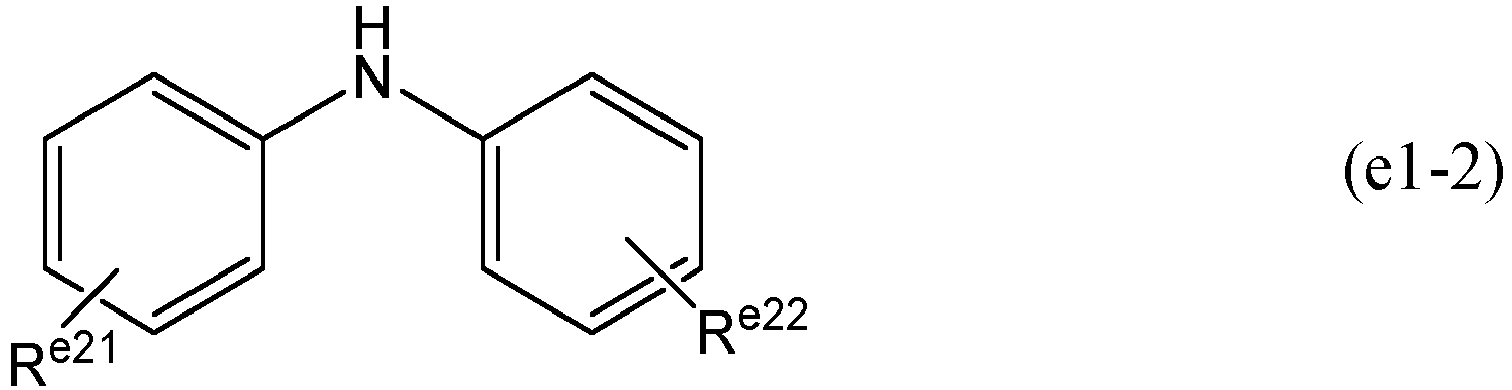
- (In the general formula (e1-2), Re21 and Re22 are each independently selected from a hydrogen atom, an alkyl group having 1 to 18 carbon atoms, and an aralkyl group having 7 to 18 carbon atoms.)
- In the phenyl-α-naphthylamine represented by the general formula (e1-1), Re11 is preferably a hydrogen atom or an alkyl group having 1 to 12 carbon atoms, and Re11 is preferably located at a para-position.
- In addition, in the diphenylamine represented by the general formula (e1-2), Re21 and Re22 are each independently preferably selected from a hydrogen atom, an alkyl group having 4 to 12 carbon atoms, and an α,α-dimethylbenzyl group. In addition, it is more preferable that Re21 and Re22 are both located at a para-position.
- Specific examples of the amine-based antioxidant include, but are not particularly limited to, dioctyldiphenylamine, phenyl-α-naphthylamine, diphenylamine, dinonyldiphenylamine, monobutylphenylmonooctylphenylamine, p-t-octylphenyl-1-naphthylamine, and 4,4'-bis(α,α-dimethylbenzyl)diphenylamine.
- In addition, as the amine-based antioxidant (E), diamine-based antioxidants other than those described above can also be used. Specific examples thereof include N-isopropyl-N'-phenyl-p-phenylenediamine, N-(1,3-dimethylbutyl)-N'-phenyl-p-phenylenediamine, N,N'-di-2-naphthyl-p-phenylenediamine, and N-phenyl-N'-(1,3-dimethylbutyl)-p-phenylenediamine.
- As the amine-based antioxidant (E), one amine-based antioxidant can be used alone, or two or more types of amine-based antioxidants can be used in combination.
- In the lubricating oil composition according to the embodiment of the present invention, from the viewpoint of making it easier to exhibit the effects of the present invention, a content of the amine-based antioxidant (E) is preferably 0.02% by mass or more, more preferably 0.05% by mass or more, and still more preferably 0.08% by mass or more, based on the total amount of the lubricating oil composition. In addition, the content is preferably 0.20% by mass or less, more preferably 0.16% by mass or less, still more preferably 0.14% by mass or less, and yet still more preferably 0.12% by mass or less. Upper limit values and lower limit values of these numerical ranges can be freely combined as desired. Specifically, the content is preferably 0.02% by mass to 0.20% by mass, more preferably 0.05% by mass to 0.16% by mass, still more preferably 0.08% by mass to 0.14% by mass, and yet still more preferably 0.08% by mass to 0.12% by mass.
- In the lubricating oil composition according to the embodiment of the present invention, from the viewpoint of making it easier to exhibit the effects of the present invention, a content ratio [(B)/(E)] of the hindered phenol-based antioxidant (B) to the amine-based antioxidant (E) is preferably 6/1 or more, more preferably 6.5/1 or more, and still more preferably 7/1 or more in terms of a mass ratio. In addition, the content ratio is preferably 10/1 or less, more preferably 9.5/1 or less, and still more preferably 9/1 or less. Upper limit values and lower limit values of these numerical ranges can be freely combined as desired. Specifically, the content ratio is preferably 6/1 to 10/1, more preferably 6.5/1 to 9.5/1, and still more preferably 7/1 to 9/1.
- The lubricating oil composition according to the embodiment of the present invention preferably further contains a sorbitan fatty acid ester (F). By using the sorbitan fatty acid ester (F) in combination with the imide compound (C), a squeal phenomenon between a hydraulic cylinder and a sealing material (hereinafter, also simply referred to as the "squeal phenomenon") can be prevented without impairing the effects of the present invention.
- The sorbitan fatty acid ester (F) is an ester compound of sorbitan and a fatty acid. The sorbitan fatty acid ester (F) can be a partial ester or a complete ester, and is preferably a partial ester from the viewpoint of making it easier to prevent the squeal phenomenon without impairing the effects of the present invention. That is, the sorbitan fatty acid ester (F) preferably contains one or more selected from the group consisting of a sorbitan fatty acid monoester, a sorbitan fatty acid diester, and a sorbitan fatty acid triester.
- Specifically, a total content of the one or more selected from the group consisting of a sorbitan fatty acid monoester, a sorbitan fatty acid diester, and a sorbitan fatty acid triester is preferably 80% by mass to 100% by mass, more preferably 85% by mass to 100% by mass, still more preferably 90% by mass to 100% by mass, and yet still more preferably 95% by mass to 100% by mass, based on a total amount of the sorbitan fatty acid ester (F).
- Examples of the fatty acid constituting the sorbitan fatty acid ester (F) include a fatty acid having preferably 14 to 22 carbon atoms, and more preferably 16 to 20 carbon atoms. The number of carbon atoms in the fatty acid also includes a carbon atom of a carboxy group (-COOH) in the fatty acid. In addition, the fatty acid can be linear or branched, and is preferably linear.
- Examples of the fatty acid include linear saturated fatty acids such as palmitic acid and stearic acid, and linear unsaturated fatty acids such as oleic acid and elaidic acid. These fatty acids can be used alone or two or more thereof can be used in combination. Among these, from the viewpoint of making it easier to prevent the squeal phenomenon without impairing the effects of the present invention, it is preferable to use a linear unsaturated fatty acid, and it is more preferable to use oleic acid. That is, the sorbitan fatty acid ester (F) more preferably contains one or more selected from the group consisting of sorbitan monooleate, sorbitan dioleate, and sorbitan trioleate, still more preferably contains one or more selected from the group consisting of sorbitan monooleate and sorbitan dioleate, and yet still more preferably contains sorbitan monooleate.
- From the viewpoint of making it easier to prevent the squeal phenomenon without impairing the effects of the present invention, a content of the sorbitan fatty acid ester (F) is preferably 0.02% by mass or more, more preferably 0.05% by mass or more, and still more preferably 0.08% by mass or more, based on the total amount of the lubricating oil composition. In addition, the content is preferably 0.50% by mass or less, more preferably 0.30% by mass or less, still more preferably 0.20% by mass or less, and yet still more preferably 0.15% by mass or less. Upper limit values and lower limit values of these numerical ranges can be freely combined as desired. Specifically, the content is preferably 0.02% by mass to 0.50% by mass, more preferably 0.05% by mass to 0.30% by mass, still more preferably 0.08% by mass to 0.20% by mass, and yet still more preferably 0.08% by mass to 0.15% by mass.
- In the lubricating oil composition according to the embodiment of the present invention, from the viewpoint of making it easier to prevent the squeal phenomenon of the cylinder without impairing the effects of the present invention, a content ratio [(C)/(F)] of the imide compound (C) to the sorbitan fatty acid ester (F) is preferably 1/3 or more, more preferably 1/2 or more, and still more preferably 2/3 or more in terms of a mass ratio. In addition, the content ratio is preferably 7/2 or less, more preferably 6/2 or less, and still more preferably 5/2 or less. Upper limit values and lower limit values of these numerical ranges can be freely combined as desired. Specifically, the content ratio is preferably 1/3 to 7/2, more preferably 1/2 to 6/2, and still more preferably 2/3 to 5/2.
- The lubricating oil composition according to the embodiment of the present invention can contain lubricating oil additives other than the component (B), the component (C), and the component (D) as long as the effects of the present invention are not impaired.
- Examples of the lubricating oil additives include a viscosity index improver, a pour point depressant, a rust inhibitor, a metal deactivator, an anti-foaming agent, and an antioxidant other than the components (B) and (E).
- These lubricating oil additives can be used alone or two or more thereof can be used in combination.
- In the present description, in consideration of handling properties and solubility in the base oil (A), an additive such as a viscosity index improver or an anti-foaming agent can be in a form of a solution diluted with and dissolved in a part of the base oil (A). In such a case, in the present description, a content to be described later of the additive such as an anti-foaming agent and a viscosity index improver refers to a content in terms of an active ingredient excluding the diluent oil (in terms of resin contents).
- Examples of the viscosity index improver include polymers such as a non-dispersed polymethacrylate, a dispersed polymethacrylate, an olefin-based copolymer (for example, an ethylene-propylene copolymer), a dispersed olefin-based copolymer, and a styrene-based copolymer (for example, a styrene-diene copolymer and a styrene-isoprene copolymer).
- In a case where the lubricating oil composition according to the embodiment of the present invention contains a viscosity index improver, a content of the viscosity index improver in terms of resin contents is preferably 0.01% by mass to 10% by mass, more preferably 0.02% by mass to 7% by mass, and still more preferably 0.03% by mass to 5% by mass, based on the total amount of the lubricating oil composition.
- Examples of the pour point depressant include a polymethacrylate having a mass average molecular weight of about 50,000 to 150,000. In a case where the lubricating oil composition according to the embodiment of the present invention contains a pour point depressant, a content of the pour point depressant is preferably 0.01% by mass to 5% by mass, and more preferably 0.02% by mass to 2% by mass, based on the total amount of the lubricating oil composition.
- Examples of the rust inhibitor include a metal sulfonate, an alkylbenzene sulfonate, a dinonylnaphthalene sulfonate, an organophosphite ester, an organophosphate ester, an organic sulfonic acid metal salt, an organic phosphoric acid metal salt, an alkenyl succinate ester, and an alkenyl succinate polyhydric alcohol ester.
- In a case where the lubricating oil composition according to the embodiment of the present invention contains a rust inhibitor, a content of the rust inhibitor is preferably 0.01% by mass to 10.0% by mass, and more preferably 0.03% by mass to 5.0% by mass, based on the total amount of the lubricating oil composition.
- Examples of the metal deactivator include a benzotriazole-based compound, a tolyltriazole-based compound, a thiadiazole-based compound, an imidazole-based compound, and a pyrimidine-based compound.
- In a case where the lubricating oil composition according to the embodiment of the present invention contains a metal deactivator, a content of the metal deactivator is preferably 0.01% by mass to 5.0% by mass, and more preferably 0.03% by mass to 3.0% by mass, based on the total amount of the lubricating oil composition.
- Examples of the anti-foaming agent include a silicone-based anti-foaming agent, a fluorine-based anti-foaming agent such as a fluorosilicone oil and a fluoroalkyl ether, and a polyacrylate-based anti-foaming agent.
- In a case where the lubricating oil composition according to the embodiment of the present invention contains an anti-foaming agent, a content of the anti-foaming agent in terms of resin contents is preferably 0.0001% by mass to 0.20% by mass, and more preferably 0.0005% by mass to 0.10% by mass, based on the total amount of the lubricating oil composition.
- Examples of the antioxidant other than the components (B) and (E) include a phenol-based antioxidant other than the component (B), a metal-based antioxidant, and a sulfur-based antioxidant.
- Here, in the lubricating oil composition according to the embodiment of the present invention, from the viewpoint of obtaining a lubricating oil composition having more excellent sludge prevention properties, a content of DBPC is preferably low among phenol-based antioxidants other than the component (B). From the viewpoint of obtaining a lubricating oil composition having more excellent sludge prevention properties, the content of DBPC is preferably less than 0.60% by mass, more preferably less than 0.10% by mass, and still more preferably less than 0.01% by mass, based on the total amount of the lubricating oil composition, and yet still more preferably, no DBPC is contained.
- In addition, from the viewpoint of more easily exhibiting the effects of the present invention, a content of each of the metal-based antioxidant and the sulfur-based antioxidant is preferably small.
- Specifically, a content of each of the metal-based antioxidant and the sulfur-based antioxidant is preferably less than 0.1% by mass, more preferably less than 0.01% by mass, and still more preferably less than 0.001% by mass, based on the total amount of the lubricating oil composition, and yet still more preferably, no metal-based antioxidant or sulfur-based antioxidant is contained.
- A kinematic viscosity at 40°C of the lubricating oil composition according to the embodiment of the present invention is preferably 10 mm2/s or more, more preferably 15 mm2/s or more, and still more preferably 20 mm2/s or more. In addition, the kinematic viscosity at 40°C is preferably 150 mm2/s or less, more preferably 100 mm2/s or less, and still more preferably 80 mm2/s or less. Upper limit values and lower limit values of these numerical ranges can be freely combined as desired. Specifically, the kinematic viscosity at 40°C is preferably 10 mm2/s to 150 mm2/s, more preferably 15 mm2/s to 100 mm2/s, and still more preferably 20 mm2/s to 80 mm2/s.
- When the kinematic viscosity at 40°C of the lubricating oil composition is 10 mm2/s or more, a lubricating oil composition having a high flash point and excellent lubricating performance is easily obtained.
- In addition, when the kinematic viscosity at 40°C of the base oil (A) is 150 mm2/s or less, viscosity resistance at a low temperature is not excessively large, and thus an operation of a machine is easily improved.
- A viscosity index of the lubricating oil composition according to the embodiment of the present invention is preferably 80 or more, more preferably 90 or more, still more preferably 100 or more, and yet still more preferably 110 or more.
- In the lubricating oil composition according to the embodiment of the present invention, a millipore value measured and calculated according to SAE-ARP-785-63 after performing a high pressure piston pump test described in Examples to be described later for 2,000 hours according to JCMAS P045 is preferably 10 mg/100 mL or less, more preferably 5.0 mg/100 mL or less, still more preferably 4.0 mg/mL or less, and yet still more preferably 3.5 mg/100 mL.
- The lubricating oil composition of the present invention has an extremely low millipore value after the high pressure piston pump test is performed for a long time of 2,000 hours, and is thus extremely excellent in sludge prevention properties.
- In the lubricating oil composition according to the embodiment of the present invention, a stage value measured by an FZG scoring test described in Examples to be described later according to ASTM D5182-97 (2014) is preferably 10 stage or more after the high pressure piston pump test described in Examples to be described later according to JCMAS P045 is performed for 2,000 hours.
- The lubricating oil composition of the present invention has a high stage value in the FZG scoring test after the high pressure piston pump test is performed for a long time of 2,000 hours, and is thus extremely excellent in scoring resistance.
- In the lubricating oil composition according to the embodiment of the present invention, a seizure load measured by an SRV (oscillation, friction and wear) test described in Examples to be described later according to ASTM D7421 is preferably 1,500 N or more, and more preferably 1,600 N or more after the high pressure piston pump test described in Examples to be described later according to JCMAS P045 is performed for 2,000 hours.
- The lubricating oil composition of the present invention has a high seizure load in the SRV (oscillation, friction and wear) test after the high pressure piston pump test is performed for a long time of 2,000 hours, and is thus extremely excellent in seizure resistance.
- A method of producing the lubricating oil composition of the present invention is not particularly limited.
- For example, a method of producing the lubricating oil composition according to the embodiment of the present invention includes a step of mixing the base oil (A), the hindered phenol-based antioxidant (B), one or more imide compounds (C) selected from the group consisting of the monoimide compound (C1) and the bisimide compound (C2), and the extreme pressure agent (D), in which the hindered phenol-based antioxidant (B) is 2,6-di-tert-butylphenol, the monoimide compound (C1) is one or more selected from the group consisting of an alkenyl succinic monoimide compound and an alkyl succinic monoimide compound, and the bisimide compound (C2) is one or more selected from the group consisting of an alkenyl succinic bisimide compound and an alkyl succinic bisimide compound.
- A method of mixing the components is not particularly limited, and examples thereof include a method including a step of blending the component (B), the component (C), and the component (D) with the base oil (A). The component (B), the component (C), and the component (D) can be blended with the base oil (A) at the same time, or can be blended separately. The same applies to components other than the component (B), the component (C), and the component (D). Each component can be blended in a form of a solution (dispersion) in which a diluent oil or the like is added. After the components are blended, it is preferable to uniformly disperse the mixture by stirring according to a known method.
- The lubricating oil composition of the present invention is excellent in sludge prevention properties and wear resistance even when used under a high pressure for a long period of time. Therefore, the lubricating oil composition of the present invention can be used in one or more types of hydraulic equipment selected from the group consisting of a construction machine, a general industrial machine, and a generator. Among these types of hydraulic equipment, the lubricating oil composition of the present invention can be preferably used in hydraulic equipment having an operating pressure of 30 MPa or more.
- Therefore, according to the present invention, the following use methods are provided.
- A method of using the lubricating oil composition of the present invention in hydraulic equipment.
- A method of using the lubricating oil composition of the present invention in one or more types of hydraulic equipment selected from the group consisting of a construction machine, a general industrial machine, and a generator.
- A method of using the lubricating oil composition of the present invention in one or more types of hydraulic equipment each of which has an operating pressure of 30 MPa or more and is selected from the group consisting of a construction machine, a general industrial machine, and a generator.
- Examples of the construction machine include: cranes such as mobile cranes, stationary cranes, and derricks; excavation machines such as hydraulic excavators, mini-excavators, and wheel hydraulic excavators; terrain machines such as bulldozers; loading machines such as wheel loaders; transport machines such as rough terrain transport vehicles; compaction machines such as vibratory rollers; dismantling machines such as breakers; basic construction machines such as pile drivers and earth augers; concrete asphalt machines such as concrete pump vehicles; aerial work platforms, paving machines, shields, boring machines, and snow removal machines.
- In addition, examples of the general industrial machines include vehicles, machine tools, gear devices, conveying devices, air conditioning facilities, and mining facilities.
- In one embodiment of the present invention, the following [1] to [8] are provided.
- [1] A lubricating oil composition containing: a base oil (A); a hindered phenol-based antioxidant (B); one or more imide compounds (C) selected from the group consisting of a monoimide compound (C1) and a bisimide compound (C2); and a extreme pressure agent (D), in which the hindered phenol-based antioxidant (B) is 2,6-di-tert-butylphenol, the monoimide compound (C1) is one or more selected from the group consisting of an alkenyl succinic monoimide compound and an alkyl succinic monoimide compound, and the bisimide compound (C2) is one or more selected from the group consisting of an alkenyl succinic bisimide compound and an alkyl succinic bisimide compound.
- [2] The lubricating oil composition according to [1], further containing: an amine-based antioxidant (E).
- [3] The lubricating oil composition according to [2], in which a content ratio [(B)/(E)] of the hindered phenol-based antioxidant (B) to the amine-based antioxidant (E) is 6/1 to 10/1 in terms of a mass ratio.
- [4] The lubricating oil composition according to any one of [1] to [3], in which a content ratio [(C 1)/(C2)] of the monoimide compound (C 1) to the bisimide compound (C2) is more than 0 and is 2/1 or less in terms of a mass ratio.
- [5] The lubricating oil composition according to any one of [1] to [4], in which a content of 2,6-di-tert-butyl-p-cresol is less than 0.60% by mass based on a total amount of the lubricating oil composition.
- [6] The lubricating oil composition according to any one of [1] to [5], in which the extreme pressure agent (D) is one or more selected from the group consisting of a phosphorus-based extreme pressure agent (D1) and a sulfur-phosphorus-based extreme pressure agent (D2).
- [7] The lubricating oil composition according to any one of [1] to [6], further containing: a sorbitan fatty acid ester (F).
- [8] The lubricating oil composition according to any one of [1] to [7], which is used as a hydraulic oil.
- The present invention will be described in detail with reference to the following Examples, whereas the present invention is not limited to the following Examples.
- Properties of raw materials used in Examples and Comparative Examples and lubricating oil compositions in Examples and Comparative Examples were measured in the following manner.
- Measurement and calculation were performed according to JIS K2283:2000.
- Measurement was performed by a perchloric acid method according to JIS K-2501-9:2003.
- Base oils and various additives shown below were sufficiently mixed in blending amounts (% by mass) shown in Table 1 to prepare lubricating oil compositions.
- Details of the base oils and various additives used in Examples 1 and 2 and Comparative Examples 1 to 3 are as follows.
- The base oil is a mixed base oil containing a mineral oil belonging to Group II and a mineral oil belonging to Group III in the API category, and the base oils used in Example 1 and Comparative Examples 1 and 2 each have a kinematic viscosity at 40°C of 46 mm2/s and a viscosity index of 120. In addition, the base oils used in Example 2 and Comparative Example 3 each have a kinematic viscosity at 40°C of 68 mm2/s and a viscosity index of 150.
- The kinematic viscosity at 40°C and the viscosity index were measured and calculated according to JIS K2283:2000.
- 2,6-di-tert-butylphenol (DTBP) was used as the hindered phenol-based antioxidant (B).
- 2,6-di-tert-butyl-p-cresol (DBPC) was used as a phenol-based antioxidant (B') in Comparative Examples.
- As the monoimide compound (C1), a polybutenyl succinic monoimide compound having a polybutenyl group having a mass average molecular weight (Mw) of 6,300, a nitrogen atom content of 1.75% by mass, and a base number of 40.0 mgKOH/g was used.
- In addition, as the bisimide compound (C2), a polybutenyl succinic bisimide compound having a polybutenyl group having a mass average molecular weight (Mw) of 1,000, a nitrogen atom content of 1.15% by mass, and a base number of 19.5 mgKOH/g was used.
- The mass average molecular weight of the polybutenyl group is a value obtained by measuring a mass average molecular weight (Mw) of a polybutene that is a raw material of the polybutenyl group under the following conditions and evaluating the measured mass average molecular weight as a mass average molecular weight (Mw) in terms of a standard polystyrene.
- ·SEC device: HLC-8220GPC manufactured by Tosoh Corporation
- ·Column: TSK guard column HXL-H + two TSK gel GMH-XL + one G2000H-XL, manufactured by Tosoh Corporation
- ·Solvent: tetrahydrofuran (stabilizer-free special grade, manufactured by Wako Pure Chemical Industries, Ltd.)
- Detector: differential refractive index (RI) detector and UV detector
- ·Concentration: 0.1 w/v%
- ·Injection amount: 100 pL
- ·Flow Rate: 1.0 mL/min
- ·Column Temperature: 40°C
- ·Standard sample for calibration curve: TSK standard polystyrene manufactured by Tosoh Corporation
- ·Analysis software: GPC-8020 model 2
- Phosphate ester compound 1: mixture of tert-butylphenyl diphenyl phosphate and di-tert-butylphenyl monophenyl phosphate
- Phosphate ester compound 2: tricresyl phosphate
- Amine salt of acidic phosphate ester: VANLUBE 672 manufactured by Vanderbilt Chemicals, LLC.
- A compound represented by the following formula (d2-1) (IRGALUBE 353, manufactured by BASF) was used.

- The compound represented by the formula (d2-1) is a compound represented by the general formula (d2) in which Rd71 is -CH2CH(CH3)- and Rd72 and Rd73 are isobutyl groups.
- Monobutylphenyl monooctylphenylamine (IRGANOX L-57, manufactured by BASF) was used.
- Monobutylphenyl monooctylphenylamine is a compound represented by the general formula (e1-2) in which one of Re21 and Re22 is a butyl group and the other is an octyl group.
- Sorbitan monooleate
-
- Anti-foaming agent: silicone-based anti-foaming agent
- ·Viscosity index improver: polymethacrylate having a mass average molecular weight (Mw) of 40,000
- ·Pour point depressant: polymethacrylate having a mass average molecular weight (Mw) of 69,000
- In Example 1 and Comparative Example 3, 0.02 wt% of the metal deactivator, 0.10% by mass of the silicone-based anti-foaming agent in terms of resin contents, 10% by mass of the viscosity index improver, and 0.30% by mass of the pour point depressant were added.
- In Example 2, Comparative Example 1, and Comparative Example 2, 0.02 wt% of the metal deactivator, 0.10% by mass of the silicone-based anti-foaming agent in terms of resin contents, 2.0% by mass of the viscosity index improver, and 0.30% by mass of the pour point depressant were added.
- Oxidation deterioration and reduction in wear resistance of the lubricating oil compositions in Examples 1 and 2 and Comparative Examples 1 to 3 when used under a high pressure for a long period of time were evaluated.
- First, for each of the lubricating oil compositions in Examples 1 and 2 and Comparative Examples 1 to 3, a high pressure piston pump test was performed according to JCMAS P045 for 2,000 hours using a high pressure piston pump test device (pump: BOSCH-REXROTH A2F10) under conditions of a pump pressure of 35 MPa, a sample oil temperature of 80°C, and an air blowing amount of 1.0 L/h to obtain a sample oil assuming to be a lubricating oil composition to be used under a high pressure for a long period of time.
- Then, the sample oil was subjected to a millipore value evaluation, an FZG scoring test, and an SRV (oscillation, friction and wear) test.
- According to SAE-ARP-785-63, a precipitate in 300 mL of the sample oil was collected by filtration, and the mass of the precipitate per 100 mL of the sample oil was calculated as a "millipore value".
- It can be said that, as the "millipore value" becomes lower, an amount of sludge generated is lower and the lubricating oil composition is more excellent in sludge prevention properties.
- In the present example, a case where the millipore value was 10 mg/100 mL or less was determined to be acceptable.
- According to ASTM D5182-97 (2014), a load was increased stepwise according to the specification under conditions of a sample oil temperature of 90°C, a rotation speed of 1,450 rpm, and an operation time of 15 minutes by using an A-type gear, and a stage of the load when scoring occurred was determined. It can be said that, as a value of the stage becomes higher, scoring resistance is more excellent.
- In the present example, a case where the stage was 10 or more was determined to be acceptable.
- A seizure load (N) was measured according to ASTM D7421. As for the seizure load, a load was increased by 100 N at a time under friction conditions of a temperature of 120°C, a frequency of 50 Hz, and an amplitude of 2.0 mm, and a load (N) at the time when seizure occurred and a friction coefficient increased greatly was measured. It can be said that, as a value of the seizure load becomes higher, seizure resistance is more excellent.
- In the present example, a case where the seizure load was 1,500 N or more was determined to be acceptable.
- Results are shown in Table 1.
Table 1 Example 1 Example 2 Comparative Example 1 Comparative Example 2 Comparative Example 3 Composition of lubricating oil composition (unit: % by mass) Base oil (A) 87.85 95.57 95.78 95.77 87.85 Phenol-based antioxidant (B) DTBP 0.80 0.80 - - 0.80 Phenol-based antioxidant (B') DBPC - - 0.60 0.60 - Imide compound (C) Monoimide compound (C1) 0.10 0.10 - - 0.20 Polybutenyl succinic bisimide (C2) 0.10 0.10 0.10 0.10 - Extreme pressure agent (D) Phosphorus-based extreme pressure agent (D1) Phosphate ester compound 1 0.50 - - - 0.50 Phosphate ester compound 2 - 0.80 0.80 0.80 - Amine salt of acidic phosphate ester - 0.01 - 0.01 - Sulfur-phosphorus-based extreme pressure agent (D2) 0.03 - - - 0.03 Amine-based antioxidant (E) 0.10 0.10 0.20 0.20 0.10 Sorbitan fatty acid ester (F) 0.10 0.10 0.10 0.10 0.10 Other additives 10.42 2.42 2.42 2.42 10.42 Total 100.00 100.00 100.00 100.00 100.00 Various content ratios [(B)/(E)] 8.00 8.00 0.00 0.00 8.00 [(C1)/(C2)] 1.00 1.00 0.00 0.00 - Physical properties of lubricating oil composition Kinematic viscosity at 40°C (mm2/s) 61.93 47.44 48.95 47.46 62.01 Viscosity index 152 125 123 126 152 Evaluation result Millipore value (unit: mg/100 mL) 2.1 0.5 19 22 2.1 FZG test (unit: stage) 12 10 9 10 10 SRV test (unit: N) 1600 1800 1600 1000 1200 - The following can be seen from Table 1.
- It can be seen that the lubricating oil compositions in Examples 1 and 2 have a small millipore value and are excellent in sludge prevention properties. In addition, it can be seen that since scoring resistance and seizure resistance thereof are also excellent, wear resistance thereof is also excellent.
- In contrast, it can be seen that, as in the lubricating oil compositions in Comparative Examples 1 and 2, when no hindered phenol-based antioxidant (B) is contained and no monoimide compound (C1) is contained, the millipore value is large and the sludge prevention properties are inferior. In addition, it can also be seen that the scoring resistance and seizure resistance thereof are both inferior, and thus the wear resistance thereof is inferior.
- In addition, the lubricating oil composition in Comparative Example 3, which has the same composition as that of Example 1 except that no monoimide compound (C1) is contained and the content of the bisimide compound (C2) is 0.20% by mass, has a small millipore value and excellent sludge prevention properties, whereas seizure resistance thereof is inferior, and thus wear resistance thereof is inferior.
Claims (8)
- A lubricating oil composition comprising:a base oil (A);a hindered phenol-based antioxidant (B);one or more imide compounds (C) selected from the group consisting of a monoimide compound (C 1) and a bisimide compound (C2); andan extreme pressure agent (D), whereinthe hindered phenol-based antioxidant (B) is 2,6-di-tert-butylphenol,the monoimide compound (C1) is one or more selected from the group consisting of an alkenyl succinic monoimide compound and an alkyl succinic monoimide compound, andthe bisimide compound (C2) is one or more selected from the group consisting of an alkenyl succinic bisimide compound and an alkyl succinic bisimide compound.
- The lubricating oil composition according to claim 1, further comprising:
an amine-based antioxidant (E). - The lubricating oil composition according to claim 2, wherein a content ratio [(B)/(E)] of the hindered phenol-based antioxidant (B) to the amine-based antioxidant (E) is 6/1 to 10/1 in terms of a mass ratio.
- The lubricating oil composition according to any one of claims 1 to 3, wherein a content ratio [(C 1)/(C2)] of the monoimide compound (C 1) to the bisimide compound (C2) is more than 0 and 2/1 or less in terms of a mass ratio.
- The lubricating oil composition according to any one of claims 1 to 4, wherein a content of 2,6-di-tert-butyl-p-cresol is less than 0.60% by mass based on a total amount of the lubricating oil composition.
- The lubricating oil composition according to any one of claims 1 to 5, wherein the extreme pressure agent (D) is one or more selected from the group consisting of a phosphorus-based extreme pressure agent (D1) and a sulfur-phosphorus-based extreme pressure agent (D2).
- The lubricating oil composition according to any one of claims 1 to 6, further comprising:
a sorbitan fatty acid ester (F). - The lubricating oil composition according to any one of claims 1 to 7, which is used as a hydraulic oil.
Applications Claiming Priority (2)
| Application Number | Priority Date | Filing Date | Title |
|---|---|---|---|
| JP2020065357A JP7445497B2 (en) | 2020-03-31 | 2020-03-31 | lubricating oil composition |
| PCT/JP2021/013183 WO2021200782A1 (en) | 2020-03-31 | 2021-03-29 | Lubricant composition |
Publications (3)
| Publication Number | Publication Date |
|---|---|
| EP4130214A1 true EP4130214A1 (en) | 2023-02-08 |
| EP4130214A4 EP4130214A4 (en) | 2024-05-01 |
| EP4130214B1 EP4130214B1 (en) | 2026-01-07 |
Family
ID=77929021
Family Applications (1)
| Application Number | Title | Priority Date | Filing Date |
|---|---|---|---|
| EP21780231.3A Active EP4130214B1 (en) | 2020-03-31 | 2021-03-29 | Lubricant composition |
Country Status (5)
| Country | Link |
|---|---|
| US (1) | US20230105292A1 (en) |
| EP (1) | EP4130214B1 (en) |
| JP (1) | JP7445497B2 (en) |
| CN (1) | CN115279870B (en) |
| WO (1) | WO2021200782A1 (en) |
Family Cites Families (21)
| Publication number | Priority date | Publication date | Assignee | Title |
|---|---|---|---|---|
| JPH0971795A (en) * | 1995-09-06 | 1997-03-18 | Nippon Oil Co Ltd | Lubricating oil composition for gas engine |
| JP3935982B2 (en) * | 1995-10-19 | 2007-06-27 | 出光興産株式会社 | Hydraulic fluid composition |
| JP2001303086A (en) * | 2000-04-18 | 2001-10-31 | Chevron Oronite Ltd | Lubricating oil composition and additive composition |
| JP4223239B2 (en) * | 2002-06-28 | 2009-02-12 | 株式会社Adeka | Lubricating oil composition containing hydrophobic silica |
| JP2004123938A (en) * | 2002-10-03 | 2004-04-22 | Asahi Denka Kogyo Kk | Lubricating oil composition containing hydrophobic silica |
| JP4218432B2 (en) * | 2003-05-10 | 2009-02-04 | 東燃ゼネラル石油株式会社 | Lubricating oil composition |
| JP4827381B2 (en) * | 2004-01-30 | 2011-11-30 | 出光興産株式会社 | Biodegradable lubricating oil composition |
| WO2006043527A1 (en) * | 2004-10-19 | 2006-04-27 | Nippon Oil Corporation | Lubricating oil composition |
| JP4806528B2 (en) * | 2004-12-22 | 2011-11-02 | 出光興産株式会社 | Lubricating oil composition for internal combustion engines |
| US7820602B2 (en) * | 2005-07-12 | 2010-10-26 | King Industries, Inc. | Amine tungstates and lubricant compositions |
| US20090029888A1 (en) * | 2005-07-12 | 2009-01-29 | Ramanathan Ravichandran | Amine tungstates and lubricant compositions |
| JP5258162B2 (en) * | 2005-12-09 | 2013-08-07 | 出光興産株式会社 | Lubricating oil composition |
| US20080015126A1 (en) * | 2006-07-12 | 2008-01-17 | Teresan W. Gilbert | Ashless Controlled Release Gels |
| JP2009029968A (en) * | 2007-07-27 | 2009-02-12 | Japan Energy Corp | Transmission oil composition |
| EP2826847B1 (en) * | 2012-03-12 | 2020-01-08 | Idemitsu Kosan Co., Ltd | Lubricating oil composition |
| JP5965222B2 (en) * | 2012-06-29 | 2016-08-03 | 出光興産株式会社 | Lubricating oil composition |
| CN109439401A (en) * | 2013-03-08 | 2019-03-08 | 出光兴产株式会社 | lubricating oil composition |
| JP6776495B2 (en) * | 2015-03-20 | 2020-10-28 | 出光興産株式会社 | Lubricating oil composition |
| JP6467377B2 (en) * | 2016-06-29 | 2019-02-13 | 株式会社Adeka | Lubricating composition and engine oil composition comprising the lubricating composition |
| WO2018003812A1 (en) * | 2016-06-29 | 2018-01-04 | 株式会社Adeka | Lubricating oil composition for internal combustion engine |
| JP2019073628A (en) * | 2017-10-16 | 2019-05-16 | 出光興産株式会社 | Hydraulic pressure actuating oil composition |
-
2020
- 2020-03-31 JP JP2020065357A patent/JP7445497B2/en active Active
-
2021
- 2021-03-29 CN CN202180024773.1A patent/CN115279870B/en active Active
- 2021-03-29 US US17/907,342 patent/US20230105292A1/en not_active Abandoned
- 2021-03-29 WO PCT/JP2021/013183 patent/WO2021200782A1/en not_active Ceased
- 2021-03-29 EP EP21780231.3A patent/EP4130214B1/en active Active
Also Published As
| Publication number | Publication date |
|---|---|
| EP4130214B1 (en) | 2026-01-07 |
| CN115279870A (en) | 2022-11-01 |
| JP2021161289A (en) | 2021-10-11 |
| EP4130214A4 (en) | 2024-05-01 |
| JP7445497B2 (en) | 2024-03-07 |
| US20230105292A1 (en) | 2023-04-06 |
| CN115279870B (en) | 2024-12-10 |
| WO2021200782A1 (en) | 2021-10-07 |
Similar Documents
| Publication | Publication Date | Title |
|---|---|---|
| EP3196278B1 (en) | Lubricating oil composition and method for manufacturing said lubricating oil composition | |
| CN106459816B (en) | Lubricating oil composition for gasoline engine and method for producing the same | |
| EP3279298B2 (en) | Lubricating oil composition and method for reducing friction in internal combustion engines | |
| US20230174887A1 (en) | Lubricating oil composition | |
| AU2024204750A1 (en) | Hydraulic oil composition | |
| EP4317370B1 (en) | Lubricant composition | |
| EP3693447A1 (en) | Gear oil composition for automobile, and lubrication method | |
| EP3572485A1 (en) | Lubricant composition | |
| US11384310B2 (en) | Lubricating oil composition and production method therefor | |
| EP4130214B1 (en) | Lubricant composition | |
| EP4502122A1 (en) | Lubricant composition | |
| JP2015180761A (en) | Lubricant composition and method for producing the same |
Legal Events
| Date | Code | Title | Description |
|---|---|---|---|
| STAA | Information on the status of an ep patent application or granted ep patent |
Free format text: STATUS: THE INTERNATIONAL PUBLICATION HAS BEEN MADE |
|
| PUAI | Public reference made under article 153(3) epc to a published international application that has entered the european phase |
Free format text: ORIGINAL CODE: 0009012 |
|
| STAA | Information on the status of an ep patent application or granted ep patent |
Free format text: STATUS: REQUEST FOR EXAMINATION WAS MADE |
|
| 17P | Request for examination filed |
Effective date: 20220927 |
|
| AK | Designated contracting states |
Kind code of ref document: A1 Designated state(s): AL AT BE BG CH CY CZ DE DK EE ES FI FR GB GR HR HU IE IS IT LI LT LU LV MC MK MT NL NO PL PT RO RS SE SI SK SM TR |
|
| DAV | Request for validation of the european patent (deleted) | ||
| DAX | Request for extension of the european patent (deleted) | ||
| A4 | Supplementary search report drawn up and despatched |
Effective date: 20240405 |
|
| RIC1 | Information provided on ipc code assigned before grant |
Ipc: C10N 30/00 20060101ALI20240328BHEP Ipc: C10N 30/10 20060101ALI20240328BHEP Ipc: C10M 141/06 20060101ALI20240328BHEP Ipc: C10M 133/56 20060101ALI20240328BHEP Ipc: C10M 133/16 20060101ALI20240328BHEP Ipc: C10M 133/12 20060101ALI20240328BHEP Ipc: C10M 129/74 20060101ALI20240328BHEP Ipc: C10M 129/10 20060101ALI20240328BHEP Ipc: C10N 40/08 20060101ALI20240328BHEP Ipc: C10N 30/06 20060101ALI20240328BHEP Ipc: C10N 30/04 20060101ALI20240328BHEP Ipc: C10M 169/04 20060101AFI20240328BHEP |
|
| STAA | Information on the status of an ep patent application or granted ep patent |
Free format text: STATUS: EXAMINATION IS IN PROGRESS |
|
| 17Q | First examination report despatched |
Effective date: 20250304 |
|
| GRAP | Despatch of communication of intention to grant a patent |
Free format text: ORIGINAL CODE: EPIDOSNIGR1 |
|
| STAA | Information on the status of an ep patent application or granted ep patent |
Free format text: STATUS: GRANT OF PATENT IS INTENDED |
|
| INTG | Intention to grant announced |
Effective date: 20250804 |
|
| GRAS | Grant fee paid |
Free format text: ORIGINAL CODE: EPIDOSNIGR3 |
|
| GRAA | (expected) grant |
Free format text: ORIGINAL CODE: 0009210 |
|
| STAA | Information on the status of an ep patent application or granted ep patent |
Free format text: STATUS: THE PATENT HAS BEEN GRANTED |
|
| AK | Designated contracting states |
Kind code of ref document: B1 Designated state(s): AL AT BE BG CH CY CZ DE DK EE ES FI FR GB GR HR HU IE IS IT LI LT LU LV MC MK MT NL NO PL PT RO RS SE SI SK SM TR |
|
| REG | Reference to a national code |
Ref country code: CH Ref legal event code: F10 Free format text: ST27 STATUS EVENT CODE: U-0-0-F10-F00 (AS PROVIDED BY THE NATIONAL OFFICE) Effective date: 20260107 Ref country code: GB Ref legal event code: FG4D |
|
| REG | Reference to a national code |
Ref country code: DE Ref legal event code: R096 Ref document number: 602021046025 Country of ref document: DE |
|
| REG | Reference to a national code |
Ref country code: IE Ref legal event code: FG4D |
|
| PGFP | Annual fee paid to national office [announced via postgrant information from national office to epo] |
Ref country code: DE Payment date: 20260319 Year of fee payment: 6 |