EP4129672A1 - Laminated film - Google Patents
Laminated film Download PDFInfo
- Publication number
- EP4129672A1 EP4129672A1 EP21779412.2A EP21779412A EP4129672A1 EP 4129672 A1 EP4129672 A1 EP 4129672A1 EP 21779412 A EP21779412 A EP 21779412A EP 4129672 A1 EP4129672 A1 EP 4129672A1
- Authority
- EP
- European Patent Office
- Prior art keywords
- resin layer
- laminated film
- resin
- polyolefin
- thickness
- Prior art date
- Legal status (The legal status is an assumption and is not a legal conclusion. Google has not performed a legal analysis and makes no representation as to the accuracy of the status listed.)
- Pending
Links
- 229920005989 resin Polymers 0.000 claims abstract description 698
- 239000011347 resin Substances 0.000 claims abstract description 698
- 229920005672 polyolefin resin Polymers 0.000 claims abstract description 136
- 238000004458 analytical method Methods 0.000 claims abstract description 17
- 229920000219 Ethylene vinyl alcohol Polymers 0.000 claims description 47
- 229920001903 high density polyethylene Polymers 0.000 claims description 47
- 239000004700 high-density polyethylene Substances 0.000 claims description 47
- 229920001577 copolymer Polymers 0.000 claims description 39
- 239000005038 ethylene vinyl acetate Substances 0.000 claims description 30
- 229920001200 poly(ethylene-vinyl acetate) Polymers 0.000 claims description 30
- 238000010894 electron beam technology Methods 0.000 claims description 29
- 238000006073 displacement reaction Methods 0.000 claims description 14
- 230000000930 thermomechanical effect Effects 0.000 claims description 10
- 229920005678 polyethylene based resin Polymers 0.000 claims description 9
- 238000010521 absorption reaction Methods 0.000 claims description 7
- 239000010410 layer Substances 0.000 description 716
- 239000000463 material Substances 0.000 description 46
- 229920001684 low density polyethylene Polymers 0.000 description 45
- 239000004702 low-density polyethylene Substances 0.000 description 45
- 239000011342 resin composition Substances 0.000 description 37
- 239000000470 constituent Substances 0.000 description 33
- 230000000694 effects Effects 0.000 description 30
- 238000000034 method Methods 0.000 description 26
- QVGXLLKOCUKJST-UHFFFAOYSA-N atomic oxygen Chemical compound [O] QVGXLLKOCUKJST-UHFFFAOYSA-N 0.000 description 25
- 229910052760 oxygen Inorganic materials 0.000 description 25
- 239000001301 oxygen Substances 0.000 description 25
- -1 polyethylene Polymers 0.000 description 21
- 239000004715 ethylene vinyl alcohol Substances 0.000 description 19
- 238000011156 evaluation Methods 0.000 description 18
- 230000004888 barrier function Effects 0.000 description 17
- 239000004698 Polyethylene Substances 0.000 description 16
- VGGSQFUCUMXWEO-UHFFFAOYSA-N Ethene Chemical compound C=C VGGSQFUCUMXWEO-UHFFFAOYSA-N 0.000 description 14
- 239000005977 Ethylene Substances 0.000 description 14
- 238000004519 manufacturing process Methods 0.000 description 14
- 238000003860 storage Methods 0.000 description 14
- 229920000573 polyethylene Polymers 0.000 description 13
- 125000000391 vinyl group Chemical group [H]C([*])=C([H])[H] 0.000 description 12
- 229920002554 vinyl polymer Polymers 0.000 description 12
- 239000012790 adhesive layer Substances 0.000 description 10
- 238000005259 measurement Methods 0.000 description 10
- QQONPFPTGQHPMA-UHFFFAOYSA-N propylene Natural products CC=C QQONPFPTGQHPMA-UHFFFAOYSA-N 0.000 description 9
- 125000004805 propylene group Chemical group [H]C([H])([H])C([H])([*:1])C([H])([H])[*:2] 0.000 description 9
- 229920001971 elastomer Polymers 0.000 description 8
- 239000000806 elastomer Substances 0.000 description 8
- 230000001771 impaired effect Effects 0.000 description 8
- 229920001179 medium density polyethylene Polymers 0.000 description 8
- 239000004701 medium-density polyethylene Substances 0.000 description 8
- 239000000565 sealant Substances 0.000 description 8
- 229910001220 stainless steel Inorganic materials 0.000 description 8
- 229920000092 linear low density polyethylene Polymers 0.000 description 7
- 239000004707 linear low-density polyethylene Substances 0.000 description 7
- 239000004952 Polyamide Substances 0.000 description 6
- 229920006225 ethylene-methyl acrylate Polymers 0.000 description 6
- 229920005680 ethylene-methyl methacrylate copolymer Polymers 0.000 description 6
- 229920002647 polyamide Polymers 0.000 description 6
- 229920000642 polymer Polymers 0.000 description 6
- 239000004677 Nylon Substances 0.000 description 5
- 230000015572 biosynthetic process Effects 0.000 description 5
- 238000001125 extrusion Methods 0.000 description 5
- 229920001778 nylon Polymers 0.000 description 5
- 238000007789 sealing Methods 0.000 description 5
- 229920000089 Cyclic olefin copolymer Polymers 0.000 description 4
- 229920010126 Linear Low Density Polyethylene (LLDPE) Polymers 0.000 description 4
- 230000001133 acceleration Effects 0.000 description 4
- 150000001336 alkenes Chemical class 0.000 description 4
- 229920001400 block copolymer Polymers 0.000 description 4
- 230000000052 comparative effect Effects 0.000 description 4
- 238000010030 laminating Methods 0.000 description 4
- 239000000155 melt Substances 0.000 description 4
- 239000002699 waste material Substances 0.000 description 4
- CTQNGGLPUBDAKN-UHFFFAOYSA-N O-Xylene Chemical compound CC1=CC=CC=C1C CTQNGGLPUBDAKN-UHFFFAOYSA-N 0.000 description 3
- 238000004364 calculation method Methods 0.000 description 3
- 238000010438 heat treatment Methods 0.000 description 3
- 229920000554 ionomer Polymers 0.000 description 3
- JRZJOMJEPLMPRA-UHFFFAOYSA-N olefin Natural products CCCCCCCC=C JRZJOMJEPLMPRA-UHFFFAOYSA-N 0.000 description 3
- 239000003960 organic solvent Substances 0.000 description 3
- 229920005604 random copolymer Polymers 0.000 description 3
- 239000002356 single layer Substances 0.000 description 3
- 239000008096 xylene Substances 0.000 description 3
- 239000006096 absorbing agent Substances 0.000 description 2
- 239000000654 additive Substances 0.000 description 2
- 239000000853 adhesive Substances 0.000 description 2
- 230000001070 adhesive effect Effects 0.000 description 2
- 238000004132 cross linking Methods 0.000 description 2
- 229920006242 ethylene acrylic acid copolymer Polymers 0.000 description 2
- 229920005648 ethylene methacrylic acid copolymer Polymers 0.000 description 2
- 229920006244 ethylene-ethyl acrylate Polymers 0.000 description 2
- 229920001519 homopolymer Polymers 0.000 description 2
- 230000001678 irradiating effect Effects 0.000 description 2
- 238000004898 kneading Methods 0.000 description 2
- 239000000178 monomer Substances 0.000 description 2
- 238000004806 packaging method and process Methods 0.000 description 2
- 230000000630 rising effect Effects 0.000 description 2
- 239000000126 substance Substances 0.000 description 2
- 239000004711 α-olefin Substances 0.000 description 2
- SMZOUWXMTYCWNB-UHFFFAOYSA-N 2-(2-methoxy-5-methylphenyl)ethanamine Chemical compound COC1=CC=C(C)C=C1CCN SMZOUWXMTYCWNB-UHFFFAOYSA-N 0.000 description 1
- NIXOWILDQLNWCW-UHFFFAOYSA-N 2-Propenoic acid Natural products OC(=O)C=C NIXOWILDQLNWCW-UHFFFAOYSA-N 0.000 description 1
- CERQOIWHTDAKMF-UHFFFAOYSA-N Methacrylic acid Chemical compound CC(=C)C(O)=O CERQOIWHTDAKMF-UHFFFAOYSA-N 0.000 description 1
- 239000004743 Polypropylene Substances 0.000 description 1
- 229920011250 Polypropylene Block Copolymer Polymers 0.000 description 1
- 239000002253 acid Substances 0.000 description 1
- 239000003963 antioxidant agent Substances 0.000 description 1
- 239000002216 antistatic agent Substances 0.000 description 1
- 239000002981 blocking agent Substances 0.000 description 1
- 239000003638 chemical reducing agent Substances 0.000 description 1
- 239000003795 chemical substances by application Substances 0.000 description 1
- 239000003484 crystal nucleating agent Substances 0.000 description 1
- 238000004090 dissolution Methods 0.000 description 1
- 238000001035 drying Methods 0.000 description 1
- 239000005042 ethylene-ethyl acrylate Substances 0.000 description 1
- 230000003203 everyday effect Effects 0.000 description 1
- 239000012760 heat stabilizer Substances 0.000 description 1
- 238000007654 immersion Methods 0.000 description 1
- 239000010954 inorganic particle Substances 0.000 description 1
- 239000000314 lubricant Substances 0.000 description 1
- 150000001455 metallic ions Chemical class 0.000 description 1
- 230000002093 peripheral effect Effects 0.000 description 1
- 229920001155 polypropylene Polymers 0.000 description 1
- 229920005629 polypropylene homopolymer Polymers 0.000 description 1
- 229920005630 polypropylene random copolymer Polymers 0.000 description 1
- 238000004064 recycling Methods 0.000 description 1
- 150000003839 salts Chemical class 0.000 description 1
- 239000010935 stainless steel Substances 0.000 description 1
- 239000002562 thickening agent Substances 0.000 description 1
Images

Classifications
-
- B—PERFORMING OPERATIONS; TRANSPORTING
- B32—LAYERED PRODUCTS
- B32B—LAYERED PRODUCTS, i.e. PRODUCTS BUILT-UP OF STRATA OF FLAT OR NON-FLAT, e.g. CELLULAR OR HONEYCOMB, FORM
- B32B27/00—Layered products comprising a layer of synthetic resin
- B32B27/06—Layered products comprising a layer of synthetic resin as the main or only constituent of a layer, which is next to another layer of the same or of a different material
- B32B27/08—Layered products comprising a layer of synthetic resin as the main or only constituent of a layer, which is next to another layer of the same or of a different material of synthetic resin
-
- B—PERFORMING OPERATIONS; TRANSPORTING
- B32—LAYERED PRODUCTS
- B32B—LAYERED PRODUCTS, i.e. PRODUCTS BUILT-UP OF STRATA OF FLAT OR NON-FLAT, e.g. CELLULAR OR HONEYCOMB, FORM
- B32B27/00—Layered products comprising a layer of synthetic resin
- B32B27/30—Layered products comprising a layer of synthetic resin comprising vinyl (co)polymers; comprising acrylic (co)polymers
- B32B27/306—Layered products comprising a layer of synthetic resin comprising vinyl (co)polymers; comprising acrylic (co)polymers comprising vinyl acetate or vinyl alcohol (co)polymers
-
- B—PERFORMING OPERATIONS; TRANSPORTING
- B32—LAYERED PRODUCTS
- B32B—LAYERED PRODUCTS, i.e. PRODUCTS BUILT-UP OF STRATA OF FLAT OR NON-FLAT, e.g. CELLULAR OR HONEYCOMB, FORM
- B32B27/00—Layered products comprising a layer of synthetic resin
- B32B27/32—Layered products comprising a layer of synthetic resin comprising polyolefins
-
- B—PERFORMING OPERATIONS; TRANSPORTING
- B32—LAYERED PRODUCTS
- B32B—LAYERED PRODUCTS, i.e. PRODUCTS BUILT-UP OF STRATA OF FLAT OR NON-FLAT, e.g. CELLULAR OR HONEYCOMB, FORM
- B32B2250/00—Layers arrangement
- B32B2250/24—All layers being polymeric
-
- B—PERFORMING OPERATIONS; TRANSPORTING
- B32—LAYERED PRODUCTS
- B32B—LAYERED PRODUCTS, i.e. PRODUCTS BUILT-UP OF STRATA OF FLAT OR NON-FLAT, e.g. CELLULAR OR HONEYCOMB, FORM
- B32B2250/00—Layers arrangement
- B32B2250/24—All layers being polymeric
- B32B2250/242—All polymers belonging to those covered by group B32B27/32
-
- B—PERFORMING OPERATIONS; TRANSPORTING
- B32—LAYERED PRODUCTS
- B32B—LAYERED PRODUCTS, i.e. PRODUCTS BUILT-UP OF STRATA OF FLAT OR NON-FLAT, e.g. CELLULAR OR HONEYCOMB, FORM
- B32B2307/00—Properties of the layers or laminate
- B32B2307/40—Properties of the layers or laminate having particular optical properties
- B32B2307/414—Translucent
-
- B—PERFORMING OPERATIONS; TRANSPORTING
- B32—LAYERED PRODUCTS
- B32B—LAYERED PRODUCTS, i.e. PRODUCTS BUILT-UP OF STRATA OF FLAT OR NON-FLAT, e.g. CELLULAR OR HONEYCOMB, FORM
- B32B2307/00—Properties of the layers or laminate
- B32B2307/50—Properties of the layers or laminate having particular mechanical properties
- B32B2307/54—Yield strength; Tensile strength
-
- B—PERFORMING OPERATIONS; TRANSPORTING
- B32—LAYERED PRODUCTS
- B32B—LAYERED PRODUCTS, i.e. PRODUCTS BUILT-UP OF STRATA OF FLAT OR NON-FLAT, e.g. CELLULAR OR HONEYCOMB, FORM
- B32B2307/00—Properties of the layers or laminate
- B32B2307/50—Properties of the layers or laminate having particular mechanical properties
- B32B2307/58—Cuttability
- B32B2307/581—Resistant to cut
-
- B—PERFORMING OPERATIONS; TRANSPORTING
- B32—LAYERED PRODUCTS
- B32B—LAYERED PRODUCTS, i.e. PRODUCTS BUILT-UP OF STRATA OF FLAT OR NON-FLAT, e.g. CELLULAR OR HONEYCOMB, FORM
- B32B2307/00—Properties of the layers or laminate
- B32B2307/70—Other properties
- B32B2307/724—Permeability to gases, adsorption
-
- Y—GENERAL TAGGING OF NEW TECHNOLOGICAL DEVELOPMENTS; GENERAL TAGGING OF CROSS-SECTIONAL TECHNOLOGIES SPANNING OVER SEVERAL SECTIONS OF THE IPC; TECHNICAL SUBJECTS COVERED BY FORMER USPC CROSS-REFERENCE ART COLLECTIONS [XRACs] AND DIGESTS
- Y02—TECHNOLOGIES OR APPLICATIONS FOR MITIGATION OR ADAPTATION AGAINST CLIMATE CHANGE
- Y02W—CLIMATE CHANGE MITIGATION TECHNOLOGIES RELATED TO WASTEWATER TREATMENT OR WASTE MANAGEMENT
- Y02W30/00—Technologies for solid waste management
- Y02W30/50—Reuse, recycling or recovery technologies
- Y02W30/80—Packaging reuse or recycling, e.g. of multilayer packaging
Definitions
- the present invention relates to a laminated film.
- a laminated film composed of a plurality of resin layers laminated is widely used as a material for a package.
- a typical laminated film includes at least a sealant layer provided for heat-sealing an object to be sealed and an outer layer provided on an opposite side to a sealant layer side.
- main constituent materials of the plurality of resin layers in the laminated film are of the same type, there is no need to separate and reuse each resin layer separately, and the entire laminated film can be easily reused, thereby increasing the usefulness.
- a polyethylene laminate for a package material which includes, for example, at least a stretched polyethylene film, an adhesive layer containing a solvent-free adhesive, and a heat-sealable polyethylene layer is disclosed (see PTL 1).
- the present invention has been made in view of the above circumstance, and an objective of the present invention is to provide a laminated film having higher heat resistance and higher reusability than the film in the related art.
- the present invention employs the following configurations.
- the laminated film having higher heat resistance and higher reusability than the film in the related art is provided.
- a laminated film includes a first resin layer and a second resin layer.
- the first resin layer and the second resin layer each contain polyolefin-based resins of the same kind.
- a dynamic mechanical analysis (DMA) is performed on the second resin layer to measure an elastic modulus E'(100) at 100°C and an elastic modulus E'(110) at 110°C at a vibration frequency of 1 Hz
- a value of E'(110)/E'(100) (may be referred to as an E'(1 10)/E'(100) value in the present specification) is equal to or more than 0.2.
- elastic modulus means a “storage elastic modulus” unless otherwise specified.
- the laminated film of the present embodiment has high reusability because the first resin layer and the second resin layer each contain polyolefin-based resins of the same kind.
- the laminated film of the present embodiment includes the second resin layer, of which an E'(1 10)/E'(100) value is equal to or more than 0.2, and this configuration enables the heat resistance of the second resin layer to be high, and as a result, the laminated film of the present embodiment has higher heat resistance than a laminated film that contains a conventional polyolefin-based resin.
- a laminated film having high heat resistance is heat-sealed, adhesion between a heating plate in a heat-sealing device and the laminated film (particularly, the second resin layer) is suppressed.
- the first resin layer contains a polyolefin-based resin.
- the polyolefin-based resin contained in the first resin layer is not particularly limited as long as it has a constituent unit derived from an olefin, and the polyolefin-based resin may be a homopolymer composed of one olefin or may be a copolymer composed of two or more olefins.
- Examples of the homopolymer composed of the olefin include polyethylene such as low density polyethylene (LDPE), linear low density polyethylene (LLDPE), metallocene-catalyzed linear low density polyethylene (mLLDPE), medium density polyethylene (MDPE), and high density polyethylene (HDPE); polypropylene (homopolypropylene), and other polymers.
- polyethylene such as low density polyethylene (LDPE), linear low density polyethylene (LLDPE), metallocene-catalyzed linear low density polyethylene (mLLDPE), medium density polyethylene (MDPE), and high density polyethylene (HDPE); polypropylene (homopolypropylene), and other polymers.
- Linear low density polyethylene (LLDPE) and metallocene-catalyzed linear low density polyethylene (mLLDPE) are a kind of low density polyethylene (LDPE).
- polyethylene is classified by its density based on this definition.
- low density polyethylene means polyethylene having a density of equal to or more than 0.91 g/cm 3 and less than 0.93 g/cm 3 .
- MDPE medium density polyethylene
- high density polyethylene means polyethylene having a density of equal to or more than 0.942 g/cm 3 .
- olefin copolymer examples include an ethylene-based copolymer that has at least a constituent unit derived from ethylene and a propylene-based copolymer that has at least a constituent unit derived from propylene.
- the ethylene-based copolymer has a constituent unit derived from ethylene and a constituent unit derived from a monomer other than ethylene.
- a copolymer that has the larger number of constituent units derived from propylene than the number of constituent units derived from ethylene is classified as a propylene-based copolymer for convenience.
- ethylene-based copolymer examples include an ethylene-vinyl acetate copolymer (EVA), an ethylene-vinyl alcohol copolymer (EVOH), an ethylene-vinyl alcohol-vinyl acetate copolymer (also known as a partially saponified product of the ethylene-vinyl acetate copolymer, sometimes referred to as "EVA partially saponified product" in the present specification), ethylene-methyl acrylate copolymer (EMA), ethylene-methyl methacrylate copolymer (EMMA), ethylene-ethyl acrylate copolymer (EEA), ethylene-acrylic acid copolymer (EAA), ethylene-methacrylic acid copolymer (EMAA), ethylene-ethyl acrylate-maleic anhydride copolymer (E-EA-MAH), ionomer (ION), and other polymers.
- EVA ethylene-vinyl acetate copolymer
- EVOH ethylene-
- An example of the ionomer includes a resin having a structure formed by changing a copolymer of ethylene and a small amount of acrylic acid or methacrylic acid into an ion bridge structure resulting from salt formation of the acid part thereof and the metallic ion.
- the propylene-based copolymer has a constituent unit derived from propylene and a constituent unit derived from a monomer other than propylene.
- propylene-based copolymer examples include a propylene-ethylene random copolymer (also known as polypropylene random copolymer (rPP)) and a propylene-ethylene block copolymer (also known as polypropylene block copolymer (bPP)).
- rPP polypropylene random copolymer
- bPP polypropylene block copolymer
- the polyolefin-based resin contained in the first resin layer may be only one kind or may be two or more kinds. In a case in which two or more kinds are used, the combination and ratio of these can be optionally selected according to the purpose.
- the polyolefin-based resin contained in the first resin layer is preferably a polyethylene-based resin, and more preferably low density polyethylene.
- the first resin layer may contain other components in addition to the polyolefin-based resin as long as the effects of the present invention are not impaired.
- the other components may be any of a resin component (may be referred to as “another resin component” in the present specification) and a non-resin component (may be referred to as “another non-resin component” in the present specification).
- the other resin component is not particularly limited as long as it is a resin other than the polyolefin-based resin.
- non-resin component examples include additives known in the art.
- additives examples include anti-fogging agents, anti-blocking agents, antioxidants, antistatic agents, crystal nucleating agents, inorganic particles, viscosity-reducing agents, thickeners, heat stabilizers, lubricants, infrared absorbers, and ultraviolet absorbers.
- the other component contained in the first resin layer may be only one kind or may be two or more kinds. In a case in which two or more kinds are used, the combination and ratio of these can be optionally selected according to the purpose.
- a ratio of a content of the polyolefin-based resin to a total mass of the first resin layer is preferably 90% to 100% by mass and more preferably 95% to 100% by mass, and for example, the ratio may be any of 97% to 100% by mass, and 99% to 100% by mass.
- the ratio is usually equivalent to a ratio (mass parts) of a content of the polyolefin-based resin (a total content of the polyolefin-based resin of the same kind as the polyolefin-based resin contained in the second resin layer, and the polyolefin-based resin of a different kind from the polyolefin-based resin contained in the second resin layer) to a total content (mass parts) of a component that does not vaporize at room temperature in the first resin composition, described later.
- the first resin layer and the second resin layer each contain polyolefin-based resins of the same kind.
- the term "resins of the same kind" is not only applied to the case of polyolefin-based resins, but also applied to the case in which in comparison of resins that have common constituent units with each other, a ratio of the amount (mol) of the common constituent units to a total amount (mol) of the constituent units is equal to or more than 20% by mol in both resins.
- low density polyethylene LDPE
- linear low density polyethylene LLDPE
- metallocene-catalyzed linear low density polyethylene mLLDPE
- medium density polyethylene MDPE
- high density polyethylene HDPE
- EMA resin ethylene-methyl acrylate copolymer
- EMMA resin ethylene-methyl methacrylate copolymer
- EVOH ethylene-vinyl alcohol copolymer
- EVA ethylene-vinyl acetate copolymer
- EVA partially saponified product and other polymers are of the same kind because all of the above have a ratio of the amount (mol) of constituent units derived from ethylene to the total amount (mol) of the constituent units of equal to or more than 20% by mol.
- a copolymer that has the ratio of the amount (mol) of the constituent units derived from ethylene to the total amount (mol) of the constituent units of less than 20% by mol is of a different kind from the low density polyethylene.
- each of the resins of the same kind preferably has a ratio of the amount (mol) of the common constituent units to the total amount (mol) of the constituent units of equal to or more than 30% by mol even in both resins, more preferably have a ratio of equal to or more than 40% by mol, and still more preferably have a ratio of equal to or more than 50% by mol, and for example, the ratio may be any of equal to or more than 60% by mol, equal to or more than 70% by mol, and equal to or more than 80% by mol.
- a ratio of a content of the polyolefin-based resin of the same kind as the polyolefin-based resin contained in the second resin layer to the total mass of the first resin layer is preferably 80% to 100% by mass and more preferably 90% to 100% by mass, and may be, for example, both 95% to 100% by mass and 99% to 100% by mass.
- a ratio of a content of the low density polyethylene to the total mass of the first resin layer in the first resin layer is preferably 70% to 100% by mass, more preferably 80% to 100% by mass, and still more preferably 90% to 100% by mass.
- room temperature means a temperature that is not particularly cooled or heated, that is, a normal temperature, and examples thereof include a temperature of 15°C to 25°C.
- the first resin layer may be composed of one layer (single layer) or may be composed of two or more layers.
- the plurality of layers may be the same or different from each other, and a combination of the plurality of layers is not particularly limited as long as the effects of the present invention are not impaired.
- the term “plurality of layers may be the same or different from each other” means that "all of the layers may be the same, all of the layers may be different from each other, or only some of the layers may be the same", and furthermore, the term “plurality of layers are different from each other” means that "at least one of a constituent material or a thickness of each layer is different from each other".
- a thickness of the first resin layer can be optionally set according to the use of the laminated film, and is not particularly limited.
- the thickness of the first resin layer is usually preferably 5 to 100 ⁇ m, more preferably 10 to 80 ⁇ m, and still more preferably 20 to 60 ⁇ m.
- the configuration in which the thickness of the first resin layer is equal to or more than at least the above-mentioned lower limit value enables the strength of the first resin layer to be further improved, and enables a more remarkable effect of the laminated film including the first resin layer to be obtained.
- the configuration in which the thickness of the first resin layer is equal to or less than the upper limit value enables the first resin layer to be prevented from having an excessive thickness.
- the total thickness of the plurality of layers may be set to be the preferred thickness of the first resin layer.
- the first resin layer is preferably a non-stretched layer (film). Since the first resin layer is a non-stretched layer, the formability of the laminated film is improved.
- the first resin layer is suitable as, for example, a sealant layer.
- the second resin layer contains a polyolefin-based resin of the same kind as the polyolefin-based resin contained in the first resin layer.
- the polyolefin-based resin of the same kind, which is contained in the second resin layer may be only one kind or may be two or more kinds. In a case in which two or more kinds are used, the combination and ratio of these can be optionally selected according to the purpose.
- the polyolefin-based resin of the same kind, which is contained in the second resin layer, is preferably a polyethylene-based resin, and more preferably high density polyethylene. It is easier for the second resin layer containing a polyethylene-based resin, particularly high density polyethylene, to have an E'(1 10)/E'(100) value of equal to or more than 0.2.
- both the first resin layer and the second resin layer each contain polyethylene-based resins, and it is more preferable that the second resin layer contains high density polyethylene.
- the second resin layer may contain other components in addition to the polyolefin-based resin of the same kind as the polyolefin-based resin contained in the first resin layer, as long as the effects of the present invention are not impaired.
- the other components contained in the second resin layer may be any of a resin component (may be referred to as “another resin component” in the present specification) and a non-resin component (may be referred to as “another non-resin component” in the present specification).
- the other resin component in the second resin layer is not particularly limited as long as it is a resin other than the polyolefin-based resin of the same kind as the polyolefin-based resin contained in the first resin layer.
- Examples of the other resin component in the second resin layer include a polyolefin-based resin of a different kind from the polyolefin-based resin contained in the first resin layer, and a resin other than the polyolefin-based resin.
- Examples of the polyolefin-based resin of a different kind from the polyolefin-based resin contained in the first resin layer include polyolefin-based resins of the same kind as those mentioned above as the polyolefin-based resin contained in the first resin layer.
- non-resin component in the second resin layer examples include the non-resin component of the same kind as those in the first resin layer.
- the other component contained in the second resin layer may be only one kind or may be two or more kinds. In a case in which two or more kinds are used, the combination and ratio of these can be optionally selected according to the purpose.
- a ratio of a content of the polyolefin-based resin to a total mass of the second resin layer is preferably 90% to 100% by mass and more preferably 95% to 100% by mass, and for example, the ratio may be any of 97% to 100% by mass, and 99% to 100% by mass.
- the ratio is usually equivalent to a ratio (mass parts) of a content of the polyolefin-based resin (a total content of the polyolefin-based resin of the same kind as the polyolefin-based resin contained in the first resin layer, and the polyolefin-based resin of a different kind from the polyolefin-based resin contained in the first resin layer) to a total content (mass parts) of a component that does not vaporize at room temperature in the second resin composition, described later.
- a ratio of a content of the polyolefin-based resin of the same kind as the polyolefin-based resin contained in the first resin layer to the total mass of the second resin layer is preferably 80% to 100% by mass and more preferably 90% to 100% by mass, and may be, for example, both 95% to 100% by mass and 99% to 100% by mass.
- a ratio of a content of the high density polyethylene to the total mass of the second resin layer in the second resin layer is preferably 70% to 100% by mass, more preferably 80% to 100% by mass, and still more preferably 90% to 100% by mass.
- the ratio of equal to or more than the above-mentioned lower limit value enables the heat resistance of the second resin layer to be remarkably improved.
- the second resin layer may be irradiated with an electron beam. That is, the laminated film may be irradiated with an electron beam, and a second resin layer side of the laminated film is preferably irradiated with an electron beam.
- the second resin layer can easily have an E'(1 10)/E'(100) value of equal to or more than 0.2 by the irradiation with an electron beam. The reason thereof is presumed that the crosslink density of a resin in the second resin layer is increased by the irradiation with an electron beam.
- Examples of the preferred second resin layer that has been irradiated with an electron beam include a second resin layer that contains low density polyethylene and that is obtained by irradiating, with an electron beam, a second resin layer that has been irradiated with no electron beam (in the present specification, the second resin layer in this case is referred to as a "second non-irradiated resin layer" to distinguish from the second resin layer that has been irradiated with an electron beam).
- examples of the preferred laminated film that has been irradiated with an electron beam include a laminated film (in the present specification, the laminated film in this case may be referred to as a "non-irradiated laminated film" to distinguish from the laminated film that has been irradiated with an electron beam) that includes the second non-irradiated resin layer containing low density polyethylene and that has been irradiated with an electron beam.
- a ratio of a content of the low density polyethylene to the total mass of the second non-irradiated resin layer is preferably 70% to 100% by mass, more preferably 80% to 100% by mass, and still more preferably 90% to 100% by mass.
- Irradiating the second non-irradiated resin layer or the non-irradiated laminated film with an electron beam is preferably carried out under the condition of an absorption dose of 20 to 300 kGy.
- an absorption dose of 20 to 300 kGy.
- the absorption dose By setting the absorption dose to be equal to or more than the above-mentioned lower limit value, a more remarkable effect of the irradiation with an electron beam is obtained.
- By setting the absorption dose to be equal to or less than the above-mentioned upper limit value excessive crosslinking of the resin in the second resin layer is suppressed.
- an example of the preferred laminated film, which is irradiated with an electron beam includes a laminated film that is irradiated with an electron beam under a condition of an absorption dose of 20 to 300 kGy.
- An acceleration voltage of the electron beam during the irradiation of the second non-irradiated resin layer or the non-irradiated laminated film is preferably 100 to 300 kV, more preferably 120 to 280 kV, and still more preferably 140 to 260 kV.
- By setting the acceleration voltage to be equal to or more than the above-mentioned lower limit value a more remarkable effect of the irradiation with an electron beam is obtained.
- By setting the acceleration voltage to be equal to or less than the above-mentioned upper limit value excessive crosslinking of the resin in the second resin layer is suppressed.
- a gel fraction of the laminated film is increased by the irradiation with an electron beam. That is, the gel fraction of the laminated film is larger than a gel fraction of the non-irradiated laminated film.
- the gel fraction of the laminated film is preferably equal to or more than 30%, and may be, for example, any of 30% to 90%, 32% to 78%, and 34% to 76%.
- Such a laminated film has more preferable heat resistance as the laminated film provided with the second resin layer having the above-mentioned E'(110)/E'(100) value.
- the gel fraction of the laminated film can be measured in accordance with JIS K 6769. That is, the laminated film is immersed in an organic solvent such as xylene, and an insoluble matter remaining in an undissolved state is dried to obtain a mass thereof. Thereafter, a gel fraction can be calculated from a mass of the laminated film before dissolution and a mass of the insoluble matter derived from the laminated film after drying. More specifically, for example, a laminated film of X g is wrapped with a stainless steel wire mesh of Y g, the wrapped film is immersed in a heated organic solvent, and the insoluble matter derived from the laminated film is taken out from the organic solvent together with the stainless steel wire mesh.
- the properties of the laminated film are changed during thermomechanical analysis by the irradiation of an electron beam, for example.
- a temperature at which a displacement is 2000 ⁇ m is preferably equal to or higher than 120°C, and for example, may be any of 125°C to 200°C and 130°C to 195°C.
- Such a laminated film has more preferable heat resistance as the laminated film provided with the second resin layer having the above-mentioned E'(110)/E'(100) value.
- a displacement at a temperature of 100°C is preferably equal to or less than 500 ⁇ m, and for example, may be any of 50 to 490 ⁇ m, and 100 ⁇ m to equal to or more than 480 ⁇ m.
- Such a laminated film has more preferable heat resistance as the laminated film provided with the second resin layer having the above-mentioned E'(110)/E'(100) value.
- thermomechanical analysis of the laminated film is in accordance with, for example, JIS K 7196, and thermomechanical analysis can be carried out by a method of measuring the thermal expansion amount of a sample from a difference between the thermal expansion amounts in a case in which a temperature of a standard sample and a temperature of a target sample are raised at a constant rate.
- the second resin layer may be composed of one layer (single layer) or may be composed of two or more layers.
- the plurality of layers may be the same or different from each other, and a combination of the plurality of layers is not particularly limited as long as the effects of the present invention are not impaired.
- a thickness of the second resin layer can be optionally set according to the use of the laminated film, and is not particularly limited.
- the thickness of the second resin layer is usually preferably 5 to 100 ⁇ m, more preferably 10 to 80 ⁇ m, and still more preferably 20 to 60 ⁇ m.
- the configuration in which the thickness of the second resin layer is equal to or more than at least the above-mentioned lower limit value enables the strength of the second resin layer to be further improved, and enables a more remarkable effect of the laminated film including the second resin layer to be obtained.
- the configuration in which the thickness of the second resin layer is equal to or less than the upper limit value enables the second resin layer to be prevented from having an excessive thickness.
- the total thickness of the plurality of layers may be set to be the preferred thickness of the second resin layer.
- a ratio (thickness ratio) of [the thickness of the first resin layer]/[the thickness of the second resin layer] is not particularly limited, but is preferably 0.7 to 1.3, regardless of the presence or absence of a third resin layer described later.
- an E'(1 10)/E'(100) value is equal to or more than 0.2.
- examples of the second resin layer subjected to a dynamic mechanical analysis include a test piece having a width of 1 cm and a length of equal to or more than5 cm.
- the test piece is placed to set a length of a measurement target portion subjected to a dynamic mechanical analysis as 2 cm, and the test piece is heated at a temperature rising rate of 5°C/min to perform the dynamic mechanical analysis.
- the elastic modulus E'(100) and the elastic modulus E'(110) can be measured with higher accuracy.
- the E'(1 10)/E'(100) value of the second resin layer is preferably equal to or more than 0.24, and for example, may be any of equal to or more than 0.3, equal to or more than 0.4, equal to or more than 0.5, and equal to or more than 0.6.
- the upper limit value of the E'(1 10)/E'(100) value of the second resin layer is not particularly limited.
- the second resin layer having an E'(110)/E'(100) value of equal to or less than 0.9 can be more easily achieved.
- the E'(110)/E'(100) value of the second resin layer can be appropriately adjusted within a range set by optionally combining any of the above-mentioned lower limit value and upper limit value.
- the E'(110)/E'(100) value of the second resin layer is preferably 0.2 to 0.9 and more preferably 0.24 to 0.9, and for example, may be any of 0.3 to 0.9, 0.4 to 0.9, 0.5 to 0.9, and 0.6 to 0.9.
- the E'(110)/E'(100) value of the second resin layer containing high density polyethylene tends to be increased.
- the second resin layer having a value of E'(110)/E'(100) of equal to or more than 0.5 can be more easily achieved by the second resin layer containing high density polyethylene.
- the E'(100) of the second resin layer is not particularly limited as long as the above-mentioned conditions of the E'(110)/E'(100) value are satisfied.
- the E'(100) of the second resin layer may be 1.6 ⁇ 10 7 to 2 ⁇ 10 8 Pa.
- the E'(110) of the second resin layer is not particularly limited as long as the above-mentioned conditions of the E'(110)/E'(100) value are satisfied.
- the E'(110) of the second resin layer may be 1.5 ⁇ 10 7 to 2.2 ⁇ 10 8 Pa.
- the second resin layer is preferably a non-stretched layer (film). Since the second resin layer is a non-stretched layer, the formability of the laminated film is improved.
- the second resin layer has heat resistance
- the second resin layer is suitably used as, for example, an outer layer (the outermost layer on the opposite side to a sealant layer side).
- the laminated film further may include a third resin layer between the first resin layer and the second resin layer, in addition to the first resin layer and the second resin layer.
- the third resin layer contains a polyolefin-based resin of the same kind as the polyolefin-based resins contained in the first resin layer and the second resin layer. That is, in the laminated film provided with the third resin layer, the first resin layer, the second resin layer, and the third resin layer contain polyolefin-based resins of the same kind.
- the term "resins of the same kind" is not only applied to the case of polyolefin-based resins, but also applied to the case in which, in comparison of resins that have common constituent units with each other, a ratio of the amount (mol) of the common constituent units to a total amount (mol) of the constituent units is equal to or more than 20% by mol in both resins.
- low density polyethylene LDPE
- linear low density polyethylene LLDPE
- metallocene-catalyzed linear low density polyethylene mLLDPE
- medium density polyethylene MDPE
- high density polyethylene HDPE
- EMA resin ethylene-methyl acrylate copolymer
- EMMA resin ethylene-methyl methacrylate copolymer
- EVOH ethylene-vinyl alcohol copolymer
- EVA ethylene-vinyl acetate copolymer
- EVA partially saponified product and other polymers are of the same kind because all of the above have a ratio of the amount (mol) of constituent units derived from ethylene to the total amount (mol) of the constituent units of equal to or more than 20% by mol.
- a copolymer that has the ratio of the amount (mol) of the constituent units derived from ethylene to the total amount (mol) of the constituent units of less than 20% by mol is of a different kind from the low density polyethylene.
- each of the resins of the same kind preferably has a ratio of the amount (mol) of the common constituent units to the total amount (mol) of the constituent units of equal to or more than 30% by mol even in both resins, more preferably have a ratio of equal to or more than 40% by mol, and still more preferably have a ratio of equal to or more than 50% by mol, and for example, the ratio may be any of equal to or more than 60% by mol, equal to or more than 70% by mol, and equal to or more than 80% by mol.
- the laminated film provided with the third resin layer has an effect obtained by provision of the third resin layer, and has high reusability.
- the polyolefin-based resin of the same kind, which is contained in the third resin layer, may be only one kind or may be two or more kinds. In a case in which two or more kinds are used, the combination and ratio of these can be optionally selected according to the purpose.
- the polyolefin-based resin of the same kind, which is contained in the third resin layer, is preferably a polyethylene-based resin.
- all the first resin layer, the second resin layer, and the third resin layer contain a polyethylene-based resin.
- the third resin layer may contain other components in addition to the polyolefin-based resin of the same kind as the polyolefin-based resins contained in the first resin layer and the second resin layer, as long as the effects of the present invention are not impaired.
- the other components contained in the third resin layer may be any of a resin component (may be referred to as “another resin component” in the present specification) and a non-resin component (may be referred to as “another non-resin component” in the present specification).
- the other resin component in the third resin layer is not particularly limited as long as it is a resin other than the polyolefin-based resin of the same kind as the polyolefin-based resins contained in the first resin layer and the second resin layer.
- Examples of the other resin component in the third resin layer include a polyolefin-based resin of a different kind from the polyolefin-based resins contained in the first resin layer and the second resin layer, and a resin other than the polyolefin-based resin.
- Examples of the polyolefin-based resin (included in the third resin layer) used for the third resin layer also include an elastomer component such as an ⁇ -olefin copolymer; an ethylene-vinyl alcohol copolymer (EVOH); an ethylene-vinyl alcohol-vinyl acetate copolymer (EVA partially saponified product).
- an elastomer component such as an ⁇ -olefin copolymer; an ethylene-vinyl alcohol copolymer (EVOH); an ethylene-vinyl alcohol-vinyl acetate copolymer (EVA partially saponified product).
- the laminated film provided with a third resin layer that contains an elastomer has high pinhole resistance and high strength even though the laminated film does not contain a polyamide such as nylon.
- the laminated film provided with the third resin layer that contains EVOH has an oxygen barrier property.
- Examples of the polyolefin-based resin of a different kind from the polyolefin-based resins contained in the first resin layer and the second resin layer include polyolefin-based resins of the same kind as those mentioned above as the polyolefin-based resin contained in the first resin layer; an elastomer such as an ⁇ -olefin copolymer.
- the laminated film provided with the third resin layer that contains the elastomer has high pinhole resistance and high strength even though the laminated film does not contain a polyamide such as nylon.
- Examples of a resin other than the polyolefin-based resin in the third resin layer include elastomers such as styrene-ethylene-butylene-ethylene block copolymer.
- the laminated film provided with the third resin layer that contains the elastomer has high pinhole resistance and high strength even though the laminated film does not contain a polyamide such as nylon.
- non-resin component in the third resin layer examples include the non-resin component of the same kind as those in the first resin layer.
- the other component contained in the third resin layer may be only one kind or may be two or more kinds. In a case in which two or more kinds are used, the combination and ratio of these can be optionally selected according to the purpose.
- a ratio of a content of the polyolefin-based resin to a total mass of the third resin layer is preferably 90% to 100% by mass and more preferably 95% to 100% by mass, and for example, the ratio may be any of 97% to 100% by mass, and 99% to 100% by mass.
- the ratio is usually equivalent to a ratio (mass parts) of a content of the polyolefin-based resin (a total content of the polyolefin-based resin of the same kind as the polyolefin-based resins contained in the first resin layer and the second resin layer, and the polyolefin-based resin of a different kind from the polyolefin-based resins contained in the first resin layer and the second resin layer) to a total content (mass parts) of a component that does not vaporize at room temperature in the third resin composition, described later.
- a ratio of a content of the polyolefin-based resin of the same kind as the polyolefin-based resins contained in the first resin layer and the second resin layer to the total mass of the third resin layer is preferably 80% to 100% by mass and more preferably 90% to 100% by mass, and may be, for example, both 95% to 100% by mass and 99% to 100% by mass.
- the third resin layer may be composed of one layer (single layer) or may be composed of two or more layers.
- the plurality of layers may be the same or different from each other, and a combination of the plurality of layers is not particularly limited as long as the effects of the present invention are not impaired.
- the third resin layer that is composed of a plurality of layers, all the layers contain a polyolefin-based resin of the same kind as the polyolefin-based resins contained in the first resin layer and the second resin layer.
- a thickness of the third resin layer can be optionally set according to the use of the laminated film, and is not particularly limited.
- the thickness of the third resin layer is usually preferably 15 to 200 ⁇ m, more preferably 30 to 160 ⁇ m, and still more preferably 50 to 120 ⁇ m.
- the configuration in which the thickness of the third resin layer is equal to or more than the above-mentioned lower limit value enables the strength of the third resin layer to be further improved, and enables a more remarkable effect of the laminated film including the third resin layer to be obtained.
- the configuration in which the thickness of the third resin layer is equal to or less than the upper limit value enables the second resin layer to be prevented from having an excessive thickness.
- the total thickness of the plurality of layers may be set to be the preferred thickness of the third resin layer.
- a ratio of the thickness of the third resin layer to the thickness of the laminated film is not particularly limited, but is preferably 50% to 70%.
- the ratio is set to be equal to or more than the above-mentioned lower limit value, the effect of the laminated film, which contains the third resin layer, is further improved.
- the ratio is set to be equal to or less than the above-mentioned upper limit value, the effect of the laminated film, which contains the first resin layer and the second resin layer, is further improved.
- a ratio of the total thickness of the first resin layer and the second resin layer to the thickness of the laminated film is not particularly limited, but is preferably 30% to 50%.
- the ratio is set to be equal to or more than the above-mentioned lower limit value, the effect of the laminated film, which contains the first resin layer and the second resin layer, is further improved.
- the ratio is set to be equal to or less than the above-mentioned upper limit value, the effect of the laminated film, which contains the third resin layer, is further improved.
- the third resin layer is preferably a non-stretched layer (film). Since the third resin layer is a non-stretched layer, the formability of the laminated film is improved.
- the third resin layer is suitable as, for example, an intermediate layer such as a pinhole resistance layer or an oxygen barrier layer.
- the laminated film has high pinhole resistance and high strength even though the laminated film does not contain a polyamide such as nylon.
- a puncture strength N
- N a load, which is added to the needle when the needle penetrates the laminated film
- Examples of the needle include those made of stainless steel.
- the puncture strength of the laminated film is preferably equal to or more than 7N, and for example, may be any of equal to or more than 8N and equal to or more than 10N.
- the upper limit value of the puncture strength is not particularly limited, but for example, a laminated film having a puncture strength of equal to or less than 12 N can be more easily achieved.
- the laminated film having the high puncture strength as described above is provided with, for example, the third resin layer, and can be more easily achieved.
- the puncture strength of the laminated film can be adjusted.
- the resin layer containing an ethylene-vinyl alcohol copolymer has a high oxygen barrier property. Therefore, the laminated film provided with, for example, the third resin layer that contains an ethylene-vinyl alcohol copolymer has an oxygen barrier property.
- the ethylene-vinyl alcohol copolymer usually has low compatibility with polyolefin-based resins that do not fall under any of an ethylene-vinyl acetate copolymer and an ethylene-vinyl alcohol-vinyl acetate copolymer (in other words, an ethylene-vinyl acetate copolymer and a partially saponified product thereof).
- the ethylene-vinyl alcohol-vinyl acetate copolymer (a partially saponified product of the ethylene-vinyl acetate copolymer) usually has compatibility with an ethylene-vinyl alcohol copolymer, and further has compatibility with polyolefin-based resins that do not fall under any of an ethylene-vinyl alcohol copolymer, an ethylene-vinyl acetate copolymer, and an ethylene-vinyl alcohol-vinyl acetate copolymer (in the present specification, may be referred to as a "non-vinyl polyolefin-based resin").
- this third resin layer contains the non-vinyl polyolefin-based resin and the ethylene-vinyl alcohol copolymer
- this third resin layer is preferably a resin layer that further contains an ethylene-vinyl alcohol-vinyl acetate copolymer in addition to these resins (in the present specification, may be referred to as a "resin layer (I)").
- the third resin layer which is the resin layer (I), has a high oxygen barrier property.
- the non-vinyl polyolefin-based resin is a polyolefin-based resin of the same kind as the polyolefin-based resins contained in the first resin layer and the second resin layer, and is preferably a polyethylene-based resin.
- both the ethylene-vinyl alcohol copolymer and the ethylene-vinyl alcohol-vinyl acetate copolymer are preferably polyolefin-based resins of the same kind as the polyolefin-based resins contained in the first resin layer and the second resin layer.
- a ratio of the amount (mol) of constituent units derived from ethylene to the total amount (mol) of the constituent units in an ethylene-vinyl alcohol copolymer in the resin layer (I) is preferably equal to or more than 20% by mol and more preferably 20% to 80% by mol, and for example, may be any of 20% to 70% by mol, 20% to 60% by mol, and 20% to 50% by mol, may be any of 30% to 80% by mol, 40% to 80% by mol, and 50% to 80% by mol, and may be any of 30% to 70% by mol and 40% to 60% by mol.
- a ratio of a content of the ethylene-vinyl alcohol copolymer to the total mass of the resin layer (I) may be, for example, 25% to 70% by mass.
- the above-mentioned ratio is preferably 40% to 70% by mass and more preferably 50% to 70% by mass, and for example, may be 55% to 65% by mass.
- the ratio is usually the same as the ratio of the content of the ethylene-vinyl alcohol copolymer to the total content (parts by mass) of a component that does not vaporize at room temperature in a resin composition (a third resin composition described later) for forming the resin layer (I).
- a ratio of a content of the non-vinyl polyolefin-based resin to the total mass of the resin layer (I) may be, for example, 5% to 50% by mass.
- the above-mentioned ratio is preferably 5% to 35% by mass and more preferably 5% to 20% by mass, and for example, may be 5% to 15% by mass.
- the above-mentioned ratio is usually the same as the ratio of the content (parts by mass) of the non-vinyl polyolefin-based resin to the total content (parts by mass) of a component that does not vaporize at room temperature in the resin composition (the third resin composition described later) for forming the resin layer (I).
- a ratio of a content of the ethylene-vinyl alcohol-vinyl acetate copolymer to the total mass of the resin layer (I) is preferably 20% to 40% by mass, and for example, may be 25% to 35% by mass. By setting the ratio to be within such a range, a more remarkable effect of using the ethylene-vinyl alcohol-vinyl acetate copolymer can be obtained.
- the ratio is usually the same as the ratio of the content of the ethylene-vinyl alcohol-vinyl acetate copolymer to the total content (parts by mass) of a component that does not vaporize at room temperature in the resin composition (the third resin composition described later) for forming the resin layer (I).
- a ratio of the total content of the ethylene-vinyl alcohol copolymer, the non-vinyl polyolefin-based resin, and the ethylene-vinyl alcohol-vinyl acetate copolymer to the total mass of the resin layer (I) is preferably 90% to 100% by mass and more preferably 95% to 100% by mass, and for example, may be any of 97% to 100% by mass and 99% to 100% by mass.
- the ratio By setting the ratio to be equal to or more than the lower limit value, the oxygen barrier property of the resin layer (I) is higher.
- the above-mentioned ratio is usually the same as the ratio of the total content (parts by mass) of the ethylene-vinyl alcohol copolymer, the non-vinyl polyolefin-based resin, and the ethylene-vinyl alcohol-vinyl acetate copolymer to the total content (parts by mass) of the component that does not vaporize at room temperature in the resin composition (the third resin composition described later) for forming the resin layer (I).
- the laminated film may include only one resin layer (I) or may include two or more layers.
- these two or more resin layers (I) may be the same or different from each other, and a combination of these resin layers (I) is not particularly limited as long as the effect of the present invention is not impaired.
- An example of the laminated film including the resin layer (I) as the third resin layer includes a laminated film that includes one resin layer (I) and a third resin layer other than one or two resin layers (I) disposed on either a first resin layer side or a second resin layer side of the resin layer (I), or both the first resin layer side and the second resin layer side of the resin layer (I).
- the laminated film include a laminated film formed of a first resin layer, one resin layer (I) (third resin layer), a third resin layer other than one or two resin layers (I), and a second resin layer, which are laminated in a thickness direction in this order, with the third resin layer being composed of a total of two or three layers; a laminated film formed of a first resin layer, a third resin layer other than one or two resin layers (I), one resin layer (I) (third resin layer), and a second resin layer, which are laminated in a thickness direction in this order, with the third resin layer being composed of a total of two or three layers; a laminated film formed of a first resin layer, a third resin layer other than one or two resin layers (I), one resin layer (I) (third resin layer), a third resin layer other than one or two resin layers (I), and a second resin layer, which are laminated in a thickness direction in this order, with the third resin layer being composed of a total of three to five layers.
- the first resin layer, the resin layer (I), the third resin layer other than the resin layer (I), and the second resin layer all contain polyolefin-based resins of the same kind.
- both the first resin layer and the second resin layer may be composed of only one layer or may be composed of two or more layers.
- a preferred example of the laminated film includes a laminated film that is formed of a third resin layer composed of a plurality of layers including three or more layers, in which at least one of the layers contains the non-vinyl polyolefin-based resin, the ethylene-vinyl alcohol copolymer, and the ethylene-vinyl alcohol-vinyl acetate copolymer (that is, the resin layer (I)), in terms of the oxygen barrier property being provided.
- one or two or more selected from the group consisting of the non-vinyl polyolefin-based resin, the ethylene-vinyl alcohol copolymer, and the ethylene-vinyl alcohol-vinyl acetate copolymer may be polyolefin-based resins of the same kind as the polyolefin-based resin contained in the first resin layer and the second resin layer.
- the non-vinyl polyolefin-based resin is a polyolefin-based resin of the same kind as described above
- either the ethylene-vinyl alcohol copolymer or the ethylene-vinyl alcohol-vinyl acetate copolymer, or both the ethylene-vinyl alcohol copolymer and the ethylene-vinyl alcohol-vinyl acetate copolymer may be polyolefin-based resins of the same kind, and both the ethylene-vinyl alcohol copolymer and the ethylene-vinyl alcohol-vinyl acetate copolymer may not be polyolefin-based resins of the same kind.
- a ratio of a thickness of the resin layer (I) to a thickness of the laminated film is not particularly limited, but is preferably 4% to 15%.
- the resin layer (I) having the ratio of equal to or more than the lower limit value has higher uniformity in thickness. By setting the ratio to be equal to or less than the above-mentioned upper limit value, the reusability of the laminated film is higher.
- the oxygen permeation amount of the laminated film which is measured in accordance with JIS K 7126-2:2006 under conditions of a temperature of 23°C and a relative humidity (RH) of 50%, may be equal to or less than 500 ml/(m 2 ⁇ 24h ⁇ atm), and is preferably equal to or less than 100 ml/(m 2 ⁇ 24h ⁇ atm), more preferably equal to or less than 50 ml/(m 2 ⁇ 24h ⁇ atm), and still more preferably equal to or less than 25 ml/(m 2 ⁇ 24h ⁇ atm), and for example, may be equal to or less than 10 ml/(m 2 ⁇ 24h ⁇ atm).
- the oxygen permeation amount of the laminated film is equal to or more than 0 ml/(m 2 ⁇ 24h ⁇ atm).
- the haze on the second resin layer side of the laminated film may be either equal to or less than 35% or equal to or less than 30% or, and is preferably equal to or less than 20%.
- the oxygen barrier property of the laminated film with the haze of equal to or less than the upper limit value is higher. This is because of the high uniformity of the resin layer (I) and the high oxygen barrier property of the resin layer (I).
- haze in the present specification means the haze measured in accordance with JIS K 7136:2000.
- the laminated film not only has the high reusability, but also is formed of individual layers adhered to one another without an adhesive layer because the individual layers (the first resin layer and the second resin layer, and in some cases, the third resin layer) constituting the laminated film contain the polyolefin-based resins of the same kind. That is, even though the laminated film does not have an adhesive layer, the adhesion of each layer is high. In addition, the laminated film without the adhesive layer can be produced at low cost.
- a ratio of a content of polyolefin-based resins of the same kind to the total mass of the laminated film is preferably equal to or more than 90%, more preferably equal to or more than 92%, and still more preferably equal to or more than 95%.
- the laminated film can be made of a monomaterial, and the entire laminated film can be easily reused.
- FIG. 1 is a cross-sectional view schematically illustrating an example of the laminated film of the present embodiment.
- a laminated film 1 illustrated herein is configured to include a first resin layer 11 and a second resin layer 12, and further includes a third resin layer 13 between the first resin layer 11 and the second resin layer 12. That is, the laminated film 1 is formed of the first resin layer 11, the third resin layer 13, and the second resin layer 12 being laminated in a thickness direction, in this order.
- the first resin layer 11, the second resin layer 12, and the third resin layer 13 all have been described above.
- the third resin layer 13 may have any configuration, and the laminated film 1 may not include the third resin layer 13.
- One surface 11b of the first resin layer 11 (a surface opposite to a second resin layer 12 side, which may be referred to as a "second surface” in the present specification) is an exposure surface.
- One surface 12a of the second resin layer 12 (a surface opposite to a first resin layer 11 side, which may be referred to as a "first surface” in the present specification) is an exposure surface.
- a ratio of a thickness of the third resin layer 13 to a thickness of the laminated film 1 is not particularly limited as described above, but is preferably 50% to 70%.
- a ratio of a total thickness of the first resin layer 11 and the second resin layer 12 to the thickness of the laminated film 1 is not particularly limited as described above, but is preferably 30% to 50%.
- a ratio (thickness ratio) of [the thickness of the first resin layer 11]/[the thickness of the second resin layer 12] is not particularly limited as described above, but is preferably 0.7 to 1.3.
- FIG. 2 is a cross-sectional view schematically illustrating another example of the laminated film of the present embodiment.
- the laminated film 2 illustrated herein has a structure composed of five resin layers laminated in a thickness direction thereof as a third resin layer 23, in the following order: a 3-1 resin layer 231; a 3-2 resin layer 232; a 3-3 third resin layer 233; a 3-4 resin layer 234; and a 3-5 resin layer 235, which are laminated from the first resin layer 11 side to the second resin layer 12 side.
- the laminated film 2 has the same configuration as the laminated film 1 except that the third resin layer 23 is provided in place of the third resin layer 13.
- both the 3-1 resin layer 231 and the 3-5 resin layer 235 are preferably resin layers other than the resin layer (I).
- Any one or two or more of the 3-2 resin layer 232, the 3-3 resin layer 233, and the 3-4 resin layer 234 is preferably the resin layer (I), that is, a resin layer having an oxygen barrier property.
- a more preferable example of the third resin layer 23 includes a third resin layer configured to include the 3-1 resin layer 231, the 3-2 resin layer 232, the 3-4 resin layer 234, and the 3-5 resin layer 235 all of which are resin layers other than the resin layer (I), to have the 3-3 resin layer 233 that is the resin layer (I), and to have an oxygen barrier property.
- a ratio of a thickness of the resin layer (I) to a thickness of the laminated film 2 is not particularly limited as described above, but is preferably 4% to 15%.
- a ratio of a thickness of the 3-3 resin layer 233 in the laminated film 2 to a thickness of the laminated film 2 is preferably 4% to 15%.
- a ratio of a thickness of the third resin layer 23 to a thickness of the laminated film 2 is not particularly limited as described above, but is preferably 50% to 70%.
- a ratio of a total thickness of the first resin layer 11 and the second resin layer 12 to the thickness of the laminated film 2 is not particularly limited as described above, but is preferably 30% to 50%.
- a ratio (thickness ratio) of [the thickness of the first resin layer 1 1]/[the thickness of the second resin layer 12] is not particularly limited as described above, but is preferably 0.7 to 1.3.
- the third resin layer 23 may be a laminated resin layer other than the structure composed of the five resin layers.
- the third resin layer 23 has a structure composed of three layers in which the 3-1 resin layer 231 and the 3-2 resin layer 232 are not included, and the 3-3 resin layer 233 may be the resin layer (I).
- the third resin layer 23 has a structure composed of two layers in which the 3-1 resin layer 231, the 3-2 resin layer 232, and the 3-4 resin layer 234 are not included, and the 3-3 resin layer 233 may be the resin layer (I).
- the third resin layer 23 has a structure composed of three layers in which the 3-4 resin layer 234 and the 3-5 resin layer 235 are not included, and the 3-3 resin layer 233 may be the resin layer (I).
- the third resin layer 23 has a structure composed of two layers in which the 3-2 resin layer 232, the 3-4 resin layer 234, and the 3-5 resin layer 235 are not included, and the 3-3 resin layer 233 may be the resin layer (I).
- the third resin layer 23 has a structure composed of four layers in which the 3-2 resin layer 232 is not included, and the 3-3 resin layer 233 may be the resin layer (I).
- the third resin layer 23 has a structure composed of four layers in which the 3-4 resin layer 234 is not included, and the 3-3 resin layer 233 may be the resin layer (I).
- the third resin layer 23 has a structure composed of three layers in which the 3-2 resin layer 232 and the 3-4 resin layer 234 are not included, and the 3-3 resin layer 233 may be the resin layer (I).
- the laminated film may include the other layer that does not fall under any of the first resin layer, the second resin layer, and the third resin layer as long as the effects of the present invention are not impaired, it is preferably that no other layer is provided.
- the other layer is a layer that contains no polyolefin-based resin, and containing no other layer enables the reusability of the laminated film to be higher.
- the total thickness of the laminated film is not particularly limited, but is preferably 100 to 200 ⁇ m, for example.
- the laminated film it is preferable that all the layers constituting the laminated film (for example, the first resin layer, the second resin layer, and the third resin layer) are non-stretched layers (films).
- a non-stretched laminated film is particularly excellent in formability and is suitable for forming, for example, a deep-drawn package.
- the laminated film can be produced by, for example, a feed block method of melt-extruding a resin material for forming each layer, a resin composition, or the like by using a number of extruders, a co-extrusion T-die method such as a multi-manifold method, or an air-cooled or water-cooled co-extrusion inflation method.
- the laminated film can be produced by bonding and laminating two or more films for forming any two or more layers in the laminated film, which has been separately prepared in advance, by a thermal (heat) laminating method or other methods without using an adhesive, and as necessary, can also be produced by further laminating layers other than these layers to have a desired arrangement form.
- the resin composition used as a material for forming any of layers in the laminated film may be produced by adjusting a kind and content of a component to be contained so that a layer to be formed contains a desired component in a desired content.
- a ratio of contents of components in the resin composition, which do not vaporize at room temperature, is usually the same as a ratio of contents of the components in a layer formed by using this resin composition.
- first resin composition for forming the first resin layer (the first resin layer 11 in the laminated film 1 illustrated in FIG. 1 and the first resin layer 11 in the laminated film 2 illustrated in FIG. 2 ) includes a resin composition containing the above-mentioned polyolefin-based resin and, as necessary, other components.
- the other components are the components described above.
- An example of the resin composition (in the present specification, may be referred to as a "second resin composition") for forming the second resin layer (the second resin layer 12 in the laminated film 1 illustrated in FIG. 1 and the second resin layer 12 in the laminated film 2 illustrated in FIG. 2 ) includes a resin composition containing the above-mentioned polyolefin-based resin, and as necessary, other components.
- the other components are the components described above.
- An example of the resin composition (in the present specification, may be referred to as a "third resin composition") for forming the third resin layer (the third resin layer 13 in the laminated film 1 illustrated in FIG. 1 ; the 3-1 resin layer 231, the 3-2 resin layer 232, the 3-3 resin layer 233, the 3-4 resin layer 234, and the 3-5 resin layer 235 in the laminated film 2 illustrated in FIG. 2 ) includes a resin composition containing the above-mentioned polyolefin-based resin, and as necessary, other components.
- the other components are the components described above.
- an example of the third resin composition for forming the resin layer (I) among the 3-1 resin layer 231 to the 3-5 resin layer 235 includes a resin composition that contains an ethylene-vinyl alcohol copolymer, the non-vinyl polyolefin-based resin, an ethylene-vinyl alcohol-vinyl acetate copolymer, and as necessary, other components other than these.
- the laminated film is suitable as a material for a package.
- a preferable package includes a package provided with the laminated film.
- the package of the present embodiment can be produced by packaging an object to be packaged using the laminated film.
- the first resin layer in the laminated film is preferably disposed on the side of the object to be packaged, and the second resin layer is preferably disposed on the side opposite to the object to be packaged to carry out packaging the object to be packaged.
- the laminated film is suitable for forming either a lid material or a bottom material of a deep-drawn package.
- the laminated film having good formability is particularly suitable for forming a bottom material having a recessed part for forming a storage section.
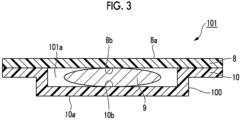
- FIG. 3 is a cross-sectional view schematically illustrating an example of a package including the laminated film of the present embodiment.
- a package 101 illustrated herein includes a lid material 8 and a bottom material 10, and is a deep-drawn package obtained by deep-draw forming a resin film.
- Either the lid material 8 or the bottom material 10m or both the lid material 8 and the bottom material 10 are formed by using the laminated film 1 or the laminated film 2 illustrated in FIG. 1 .
- lid material 8 or the bottom material 10 illustrated in FIG. 3 individual layers in the laminated film 1 or the laminated film 2 for forming the lid material 8 or the bottom material 10 are not distinguished.
- a recessed part 100 is formed with the bottom material 10.
- One surface (in some cases, may be referred to as a "second surface” in the present specification) 10b of a region excluding the recessed part 100 of the bottom material 10 and one surface (in some cases, may be referred to as a "second surface” in the present specification) of the lid material 8b are both sealing surfaces and face each other.
- the package 101 is configured to seal the object to be packaged with the lid material 8 and the bottom material 10. More specifically, the second surface 10b in the region excluding the recessed part 100 of the bottom material 10 and the second surface 8b of the lid material 8 are overlapped with each other and sealed with each other in the region near peripheral edges thereof. As a result, in the region of the recessed part 100 of the bottom material 10, a storage section 101a is formed between the second surface 10b of the bottom material 10 and the second surface 8b of the lid material 8. A storage object 9 is stored in the storage section 101a.
- one surface (second surface) 10b of the bottom material 10 is preferably the same as the second surface 1 1b of the first resin layer 11 in the laminated film 1 or the laminated film 2.
- the other surface (in some cases, may be referred to as a "first surface” in the present specification) 10a of the bottom material 10 is preferably the same as the first surface 12a of the second resin layer 12 in the laminated film 1 or the laminated film 2.
- one surface (second surface) 8b of the lid material 8 is preferably the same as the second surface 11b of the first resin layer 11 in the laminated film 1 or the laminated film 2.
- the other surface (in some cases, may be referred to as a "first surface” in the present specification) 8a of the lid material 8 is preferably the same as the first surface 12a of the second resin layer 12 in the laminated film 1 or the laminated film 2.
- a thickness of the bottom material 10 in a flat portion and a thickness of the lid material 8 may be the same as a thickness of the laminated film 1 or the laminated film 2 described above.
- the deep-drawn package has been described as an example of the package including the laminated film, but the package including the laminated film is not limited to the deep-drawn package and may be another package.
- the object to be packaged is stored while the storage section for storing the object to be packaged (in other words, the storage object) is formed by using the laminated films or the laminated film and another resin film other than the laminated film, and regions other than the storage section formed by these films are then heat-sealed; thereby the package can be produced.
- the adhesion of the laminated film (particularly the second resin layer) to a heating plate in a heat-sealing device is prevented.
- a laminated film having the configuration illustrated in FIG. 1 was produced through the procedure illustrated below.
- low density polyethylene (“LDPE) (“UBE polyethylene (registered trademark) F222NH” manufactured by UBE Corporation, a density of 0.922 g/cm 3 ) was prepared as a resin for forming a first resin layer.
- High density polyethylene (“Nipolon Hard (registered trademark) 4010” manufactured by Tosoh Corporation, a density of 0.964 g/cm 3 , a melt mass-flow rate of 5.4 g/10 min) was prepared as a resin for forming a second resin layer.
- this HDPE may be referred to as a "HDPE (1)" in some cases.
- mLLDPE Metallocene-catalyzed linear low density polyethylene
- UMERIT registered trademark 1520F manufactured by UBE Corporation, a density of 0.913 g/cm 3
- a laminated film (a thickness of 150 ⁇ m) was obtained by laminating the first resin layer (a thickness of 30 ⁇ m), the third resin layer (a thickness of 90 ⁇ m), and the second resin layer (a thickness of 30 ⁇ m) in a thickness direction in this order.
- the HDPE (1) was subjected to extrusion forming to obtain a test resin film (a thickness of 30 ⁇ m).
- test piece (1) having a size of 7 cm ⁇ 1 cm was cut out from this test resin film, and the test piece (1) was placed in a sample holder so that a length of a measurement target portion was 2 cm.
- E'(100) and E'(110) were measured by using a dynamic mechanical analyzer ("DMS6100” manufactured by Seiko Instruments Inc.) in a tensile mode within a temperature range of 20°C to 130°C, under conditions of a displacement of 5 ⁇ m, a vibration frequency of 1 Hz, and a temperature rising rate of 5°C/min to calculate a E'(110)/E'(100) value.
- DMS6100 dynamic mechanical analyzer
- a tip portion of a needle that has a curvature radius of the tip portion of 0.5 mm was put into the laminated film obtained as described above from the second resin layer side, and the tip of the needle was vertically pushed against the laminated film at a speed of 500 mm/min.
- a load applied to the needle was read, and this read out value was employed as the puncture strength of the laminated film.
- Table 1 The results are illustrated in Table 1.
- a laminated film was produced in the same manner as in Example 1, except that HDPE ("Nipolon Hard (registered trademark) 1000" manufactured by Tosoh Corporation, a density of 0.964 g/cm 3 , a melt mass-flow rate of 20 g/10 min) of a different kind from the HDPE (1) was used in place of the HDPE (1) ("Nipolon Hard (registered trademark) 4010" manufactured by Tosoh Corporation, a density of 0.964 g/cm 3 , a melt mass-flow rate of 5.4 g/10 min) during the formation of the second resin layer.
- HDPE Nepolon Hard (registered trademark) 1000 manufactured by Tosoh Corporation, a density of 0.964 g/cm 3 , a melt mass-flow rate of 20 g/10 min
- HDPE used in this example may be referred to as a "HDPE (2)".
- the laminated film obtained above was evaluated by the same method as in Example 1. The results are illustrated in Table 1.
- a laminated film was produced in the same manner as in Example 1, except that the third resin composition was used in place of mLLDPE ("UMERIT (registered trademark) 1520F” manufactured by UBE Corporation) during the formation of the third resin layer.
- This third resin composition was obtained by kneading mLLDPE ("UMERIT (registered trademark) 1520F” manufactured by UBE Corporation) (90 parts by mass) and an elastomer (“TAFMER (registered trademark) BL3450M” manufactured by Mitsui Chemicals, Inc.) (10 parts by mass) at 200°C for 10 minutes.
- the laminated film obtained above was evaluated by the same method as in Example 1. The results are illustrated in Table 1.
- a laminated film was produced in the same manner as in Example 1, except that the second resin composition was used in place of the HDPE (1) ("Nipolon Hard (registered trademark) 4010" manufactured by Tosoh Corporation, a density of 0.964 g/cm 3 ) during the formation of the second resin layer.
- This second resin composition was obtained by kneading the HDPE (1) ("Nipolon Hard (registered trademark) 4010” manufactured by Tosoh Corporation) (60 parts by mass) and LDPE ("UBE polyethylene (registered trademark) F222NH” manufactured by UBE Corporation) (40 parts by mass) at 200°C for 10 minutes.
- the laminated film obtained above was evaluated by the same method as in Example 1. The results are illustrated in Table 2.
- a laminated film (the non-irradiated laminated film) was produced in the same manner as in Example 1, except that mLLDPE ("UMERIT (registered trademark) 1520F” manufactured by UBE Corporation) was used in place of the HDPE (1) ("Nipolon Hard (registered trademark) 4010" manufactured by Tosoh Corporation, a density of 0.964 g/cm 3 ) during the formation of the second resin layer.
- mLLDPE UMERIT (registered trademark) 1520F” manufactured by UBE Corporation
- the second resin layer side of the laminated film was irradiated with an electron beam (EB).
- EB electron beam
- an absorption dose was set to 50 kGy and an acceleration voltage was set to 150 kV.
- the laminated film thus obtained was used as a laminated film of this Example.
- E'(100) and E'(110) of each of the laminated films thus obtained were measured by the same method as in the case of Example 1, and each E'(110)/E'(100) value was calculated. The results are illustrated in Table 2.
- the gel fraction of each of the laminated films thus obtained was measured in accordance with JIS K 6769.
- test piece (2) having a size of 3 cm ⁇ 3 cm was cut out from each of the laminated films, and the test piece (2) was wrapped with a stainless steel wire mesh of 400 mesh (100 g).
- the test piece (2) wrapped in this stainless steel wire mesh was immersed in xylene (18 mL) at 110°C for 24 hours.
- test piece (2) after immersion was taken out from the xylene together with the stainless steel wire mesh, and was further vacuum-dried as it was at 110°C for 24 hours under a pressure of 1.7 kPa.
- the mass of the obtained dried product was obtained, and the gel fraction was calculated. The results are illustrated in Table 2.
- thermomechanical analyzer EXSTAR 6000 manufactured by Seiko Instruments Inc.
- JIS K 7196 thermomechanical analysis in accordance with JIS K 7196
- a displacement temperature of 2000 ⁇ m was obtained from the obtained thermomechanical analysis curve. The results are illustrated in Table 2.
- Low density polyethylene (“LDPE) (“UBE polyethylene (registered trademark) F222NH” manufactured by UBE Corporation, a density of 0.922 g/cm 3 ) was prepared as a resin for forming a sealant layer.
- Metallocene-catalyzed linear low density polyethylene (“UMERIT (registered trademark) 1520F” manufactured by UBE Corporation) was prepared as a resin for forming an intermediate layer.
- a modified polyolefin resin (“NF536” manufactured by Mitsui Chemicals, Inc.) was prepared as a resin for forming an adhesive layer.
- 6-Nylon (Ny) (“1022B” manufactured by Ube Corporation) was prepared as a resin for forming a strength-retaining layer and an outer layer.
- the LDPE, the mLLDPE, the modified polyolefin resin, the Ny, the modified polyolefin resin, and the Ny were co-extruded in this order to form a laminated film (a thickness of 150 ⁇ m) composed of a sealant layer (a thickness of 20 ⁇ m), an intermediate layer (a thickness of 60 ⁇ m), an adhesive layer (a thickness of 15 ⁇ m), a strength-retaining layer (a thickness of 30 ⁇ m), an adhesive layer (a thickness of 15 ⁇ m), and an outer layer (a thickness of 10 ⁇ m), which are laminated in a thickness direction in this order.
- a laminated film a thickness of 150 ⁇ m
- a sealant layer a thickness of 20 ⁇ m
- an intermediate layer a thickness of 60 ⁇ m
- an adhesive layer a thickness of 15 ⁇ m
- a strength-retaining layer a thickness of 30 ⁇ m
- an adhesive layer a thickness of 15 ⁇ m
- an outer layer a thickness of 10 ⁇ m
- E'(100) and E'(110) of an outer layer in the laminated film thus obtained were measured by the same method as in the case of Example 1, and E'(110)/E'(100) value was calculated. The result is illustrated in Table 3.
- Example 1 Example 2
- Example 3 Configuration of laminated film
- the E'(1 10)/E'(100) value of the second resin layer was equal to or more than 0.25 (0.25 to 0.7), and the heat resistance of the second resin layer was sufficiently large to be recognized as being sufficiently high.
- the E'(1 10)/E'(100) value of the second resin layer is particularly large at 0.66 to 0.7, and the effect of that the second resin layer contained HDPE was high.
- a resin layer (resin film), which is the same as the second resin layer in Example 5 except that EB irradiation was not performed was separately prepared, E'(100) and E'(110) thereof were measured, the E'(110)/E'(100) value was calculated, and the resultant value was 0.11. As described above, in Example 5, the E'(110)/E'(100) value of the second resin layer was increased by the effect of EB irradiation.
- Example 5 the gel fraction of the laminated film was 42%, the displacement temperature of 2000 ⁇ m of the laminated film was 125°C, and the effect of EB irradiation performed on the second resin layer was also recognized herein.
- the puncture strength of the laminated film was equal to or more than 7.4 N (7.4 to 10.8 N), which was sufficiently large.
- the laminated films of Examples 1 to 5 had sufficiently high pinhole resistance and high strength even though a polyamide such as Ny was not used.
- the laminated film obtained in Comparative Example 1 had sufficient heat resistance because the outer layer contained Ny, and had sufficiently high strength because the strength-retaining layer contained Ny.
- the sealant layer and the intermediate layer contained PE, and the adhesive layer contained a modified polyolefin resin.
- the laminated film obtained in Comparative Example 1 included the layers composed of resins of which the main components contained were different from each other, and the reusability was low.
- a laminated film having the configuration illustrated in FIG. 2 was produced through the procedure illustrated below.
- low density polyethylene (“LDPE) (“UBE polyethylene (registered trademark) F222NH” manufactured by UBE Corporation, a density of 0.922 g/cm 3 ) was prepared as a resin for forming a first resin layer.
- High density polyethylene (“Nipolon Hard (registered trademark) 4010" manufactured by Tosoh Corporation, a density of 0.964 g/cm 3 , a melt mass-flow rate of 5.4 g/10 min, HDPE (1)) was prepared as a resin for forming a second resin layer.
- HDPE High density polyethylene
- Metallocene-catalyzed linear low density polyethylene (“UMERIT (registered trademark) 1520F” manufactured by UBE Corporation, a density of 0.913 g/cm 3 ) was prepared as a resin for forming a 3-1 resin layer, a 3-2 resin layer, a 3-3 resin layer, a 3-4 resin layer, and a 3-5 resin layer.
- EVA partially saponified product (“Mersen (registered trademark) -H3051R” manufactured by Tosoh Corporation) and an ethylene-vinyl alcohol copolymer (EVOH) (“Eval (registered trademark) E105B” manufactured by KURARAY CO., LTD.) were prepared as a resin for forming the 3-3 resin layer.
- the mLLDPE 40 parts by mass
- the EVA partially saponified product (30 parts by mass)
- the EVOH 30 parts by mass
- the first resin layer (a thickness of 30 ⁇ m), the 3-1 resin layer (a thickness of 15 ⁇ m), the 3-2 resin layer (a thickness of 30 ⁇ m), the 3-3 resin layer (a thickness of 15 ⁇ m), the 3-4 resin layer (a thickness of 15 ⁇ m), the 3-5 resin layer (a thickness of 15 ⁇ m), and a second resin layer (a thickness of 30 ⁇ m), which were laminated in the thickness direction in this order, was obtained.
- the laminated film obtained above was evaluated by the same method as in Example 1. The results are illustrated in Table 4.
- the haze on the second resin layer side of the laminated film was externally measured in accordance with JIS K 7136:2000. The results are illustrated in Table 4.
- the oxygen permeation amount of the laminated film obtained above was measured under conditions of a temperature of 23°C and a relative humidity of 50% in accordance with JIS K 7126-2:2006. The results are illustrated in Table 4.
- a laminated film was produced in the same manner as in the case of Example 6, except that the mLLDPE (25 parts by mass), the EVA partially saponified product (30 parts by mass), the EVOH (45 parts by mass) were kneaded at 200°C for 10 minutes in place of that the mLLDPE (40 parts by mass), the EVA partially saponified product (30 parts by mass), and the EVOH (30 parts by mass) were kneaded at 200°C for 10 minutes during the production of the third resin composition.
- This laminated film was a laminated film (a thickness of 150 ⁇ m) composed of the first resin layer (a thickness of 30 ⁇ m), the 3-1 resin layer (a thickness of 15 ⁇ m), the 3-2 resin layer (a thickness of 30 ⁇ m), the 3-3 resin layer (a thickness of 15 ⁇ m), the 3-4 resin layer (a thickness of 15 ⁇ m), the 3-5 resin layer (a thickness of 15 ⁇ m), and the second resin layer (a thickness of 30 ⁇ m), which were laminated in this order in the thickness direction thereof.
- the laminated film obtained above was evaluated by the same method as in Example 6. The results are illustrated in Table 4.
- a laminated film was produced in the same manner as in the case of Example 6, except that the mLLDPE (10 parts by mass), the EVA partially saponified product (30 parts by mass), the EVOH (60 parts by mass) were kneaded at 200°C for 10 minutes in place of that the mLLDPE (40 parts by mass), the EVA partially saponified product (30 parts by mass), and the EVOH (30 parts by mass) were kneaded at 200°C for 10 minutes during the production of the third resin composition.
- This laminated film was a laminated film (a thickness of 150 ⁇ m) composed of the first resin layer (a thickness of 30 ⁇ m), the 3-1 resin layer (a thickness of 15 ⁇ m), the 3-2 resin layer (a thickness of 30 ⁇ m), the 3-3 resin layer (a thickness of 15 ⁇ m), the 3-4 resin layer (a thickness of 15 ⁇ m), the 3-5 resin layer (a thickness of 15 ⁇ m), and the second resin layer (a thickness of 30 ⁇ m), which were laminated in this order in the thickness direction thereof.
- the laminated film obtained above was evaluated by the same method as in Example 6. The results are illustrated in Table 4.
- a laminated film was produced in the same manner as in the case of Example 6, except that the LDPE (10 parts by mass), the EVA partially saponified product (30 parts by mass), the EVOH (60 parts by mass) were kneaded at 200°C for 10 minutes in place of that the mLLDPE (40 parts by mass), the EVA partially saponified product (30 parts by mass), and the EVOH (30 parts by mass) were kneaded at 200°C for 10 minutes during the production of the third resin composition.
- This laminated film was a laminated film (a thickness of 150 ⁇ m) composed of the first resin layer (a thickness of 30 ⁇ m), the 3-1 resin layer (a thickness of 15 ⁇ m), the 3-2 resin layer (a thickness of 30 ⁇ m), the 3-3 resin layer (a thickness of 15 ⁇ m), the 3-4 resin layer (a thickness of 15 ⁇ m), the 3-5 resin layer (a thickness of 15 ⁇ m), and the second resin layer (a thickness of 30 ⁇ m), which were laminated in this order in the thickness direction thereof.
- the laminated film obtained above was evaluated by the same method as in Example 6. The results are illustrated in Table 5.
- a laminated film was produced in the same manner as in the case of Example 9, except that the extrusion amount of the mLLDPE was increased and the extrusion amount of the third resin composition was reduced.
- This laminated film was a laminated film (a thickness of 150 ⁇ m) composed of the first resin layer (a thickness of 37.5 ⁇ m), the 3-1 resin layer (a thickness of 15 ⁇ m), the 3-2 resin layer (a thickness of 30 ⁇ m), the 3-3 resin layer (a thickness of 7.5 ⁇ m), the 3-4 resin layer (a thickness of 15 ⁇ m), the 3-5 resin layer (a thickness of 15 ⁇ m), and the second resin layer (a thickness of 30 ⁇ m), which were laminated in this order in the thickness direction thereof.
- the laminated film obtained above was evaluated by the same method as in Example 6. The results are illustrated in Table 5.
- a laminated film was produced in the same manner as in the case of Example 6, except that the mLLDPE was used in place of the third resin composition.
- This laminated film was a laminated film (a thickness of 150 ⁇ m) composed of the first resin layer (a thickness of 30 ⁇ m), the 3-1 resin layer (a thickness of 15 ⁇ m), the 3-2 resin layer (a thickness of 30 ⁇ m), the 3-3 resin layer (a thickness of 15 ⁇ m), the 3-4 resin layer (a thickness of 15 ⁇ m), the 3-5 resin layer (a thickness of 15 ⁇ m), and the second resin layer (a thickness of 30 ⁇ m), which were laminated in this order in the thickness direction thereof.
- Example 6 Example 7
- Example 8 Configuration of laminated film Second resin layer Contained component (% by mass) HDPE (1) (100) HDPE (1) (100) HDPE (1) (100) Thickness ( ⁇ ) 30 30 30 3-5 resin layer Contained component (% by mass) mLLDPE (100) mLLDPE (100) mLLDPE (100) Thickness ( ⁇ m) 15 15 15 3-4 resin layer Contained component (% by mass) mLLDPE (100) mLLDPE (100) mLLDPE (100) Thickness ( ⁇ m) 15 15 15 3-3 resin layer Contained component (% by mass) mLLDPE/ EVA partially saponified product/EVOH (40/30/30) mLLDPE/ EVA partially saponified product/EVOH (25/30/45) mLLDPE/ EVA partially saponified product/EVOH (10/30/60) Thickness ( ⁇ m)
- the puncture strength of the laminated film was equal to or more than 7.5 N (7.5 to 8.5 N), which was sufficiently large.
- the laminated films of Examples 6 to 11 had sufficiently high pinhole resistance and high strength even though a polyamide such as Ny was not used.
- the oxygen permeation amount of the laminated film obtained in each of Examples 6 to 10 among Examples 6 to 11 was equal to or less than 452.2 ml/(m 2 ⁇ 24h ⁇ atm) (9.4 to 452.2 ml/(m 2 ⁇ 24h ⁇ atm)), and the laminated film obtained in each of Examples 6 to 10 had an oxygen barrier property. This was because the 3-3 resin layer in the laminated film was the resin layer (I).
- the oxygen permeation amount of the laminated film obtained in each of Examples 7 to 10 was equal to or less than 21.3 ml/(m 2 ⁇ 24h ⁇ atm) (9.4 to 21.3 ml/(m 2 ⁇ 24h ⁇ atm)), and the laminated film obtained in each of Examples 7 to 10 had a higher oxygen barrier property. This was because the uniformity and the oxygen barrier property of the 3-3 resin layer in the laminated film were high.
- the haze of the laminated film was equal to or less than 25.7% (16.5% to 25.7%).
- the haze of the laminated film obtained in each of Examples 8 to 10 was equal to or less than 18.9% (16.5% to 18.9%), which was a low level. This was because the uniformity of the 3-3 resin layer in the laminated film was high, which is consistent with the high oxygen barrier property of the laminated film.
- the present invention can be used to produce various packages that can be reused after use.
Landscapes
- Laminated Bodies (AREA)
- Wrappers (AREA)
Abstract
Description
- The present invention relates to a laminated film.
- Priority is claimed on
Japanese Patent Application No. 2020-060062, filed on March 30, 2020 Japanese Patent Application No. 2020-209113, filed on December 17, 2020 - A laminated film composed of a plurality of resin layers laminated is widely used as a material for a package. A typical laminated film includes at least a sealant layer provided for heat-sealing an object to be sealed and an outer layer provided on an opposite side to a sealant layer side.
- On the other hand, such laminated films for a package are produced and consumed in large quantities every day all over the world because of their high convenience, and a large amount of waste is produced after use. Producing waste has become an important issue to be solved from the viewpoint of improving the global environment. In recent years, a method of recycling waste has been actively studied together with methods of reducing the amount of waste produced.
- For example, if main constituent materials of the plurality of resin layers in the laminated film are of the same type, there is no need to separate and reuse each resin layer separately, and the entire laminated film can be easily reused, thereby increasing the usefulness.
- As such a laminated film, a polyethylene laminate for a package material, which includes, for example, at least a stretched polyethylene film, an adhesive layer containing a solvent-free adhesive, and a heat-sealable polyethylene layer is disclosed (see PTL 1).
- [PTL 1]
Japanese Unexamined Patent Application, First Publication No. 2019-189333 - In most cases, a problem that a resin film easily adheres to a heating plate in a heat-sealing device is generated in a case in which the resin film is heat-sealed. This is because the heat resistance of the resin film is insufficient. Meanwhile, it is uncertain whether the laminated film described in PTL 1 has sufficient heat resistance.
- The present invention has been made in view of the above circumstance, and an objective of the present invention is to provide a laminated film having higher heat resistance and higher reusability than the film in the related art.
- In order to solve the above problem, the present invention employs the following configurations.
- [1] A laminated film including a first resin layer, and a second resin layer, in which the first resin layer and the second resin layer each contain polyolefin-based resins of the same kind, and in a case in which a dynamic mechanical analysis is performed on the second resin layer to measure an elastic modulus E'(100) at 100°C and an elastic modulus E'(110) at 110°C at a vibration frequency of 1 Hz, a value of E'(110)/E'(100) is equal to or more than 0.2.
- [2] The laminated film according to [1], in which the laminated film has a gel fraction of equal to or more than 30%.
- [3] The laminated film according to [1] or [2], in which the laminated film is irradiated with an electron beam under a condition of an absorption dose of 20 to 300 kGy.
- [4] The laminated film according to any one of [1] to [3], wherein in a case in which a thermomechanical analysis is performed on the laminated film, a temperature indicating a displacement of 2000 µm is equal to or higher than 120°C.
- [5] The laminated film according to any one of [1] to [4], further including a third resin layer between the first resin layer and the second resin layer, in which the first resin layer, the second resin layer, and the third resin layer each contain polyolefin-based resins of the same kind.
- [6] The laminated film according to [5], in which the third resin layer is composed of a plurality of layers including three or more layers, at least one of the layers containing the polyolefin-based resin, an ethylene-vinyl alcohol copolymer, and an ethylene-vinyl alcohol-vinyl acetate copolymer, and the polyolefin-based resin does not correspond to any of an ethylene-vinyl alcohol copolymer, an ethylene-vinyl acetate copolymer, and an ethylene-vinyl alcohol-vinyl acetate copolymer.
- [7] The laminated film according to any one of [1] to [6], in which the polyolefin-based resin is a polyethylene-based resin.
- [8] The laminated film according to any one of [1] to [7], wherein in a case in which a tip portion of a needle having 0.5 mm of a curvature radius of the tip portion is perpendicularly put into the laminated film at a speed of 500 mm/min, a load applied to the needle at a moment when the needle penetrates the laminated film is equal to or more than 7 N.
- [9] The laminated film according to [1], in which the value of E'(110)/E'(100) is equal to or more than 0.5.
- [10] The laminated film according to [1] or [9], in which the second resin layer contains high density polyethylene.
- According to the present invention, the laminated film having higher heat resistance and higher reusability than the film in the related art is provided.
-
-
FIG. 1 is a cross-sectional view schematically showing an example of a laminated film according to an embodiment of the present invention. -
FIG. 2 is a cross-sectional view schematically showing another example of the laminated film according to the embodiment of the present invention. -
FIG. 3 is a cross-sectional view schematically showing an example of a package provided with the laminated film according to the embodiment of the present invention. - A laminated film includes a first resin layer and a second resin layer. The first resin layer and the second resin layer each contain polyolefin-based resins of the same kind. In a case in which a dynamic mechanical analysis (DMA) is performed on the second resin layer to measure an elastic modulus E'(100) at 100°C and an elastic modulus E'(110) at 110°C at a vibration frequency of 1 Hz, a value of E'(110)/E'(100) (may be referred to as an E'(1 10)/E'(100) value in the present specification) is equal to or more than 0.2.
- As used herein, the term "elastic modulus" means a "storage elastic modulus" unless otherwise specified.
- The laminated film of the present embodiment has high reusability because the first resin layer and the second resin layer each contain polyolefin-based resins of the same kind.
- The laminated film of the present embodiment includes the second resin layer, of which an E'(1 10)/E'(100) value is equal to or more than 0.2, and this configuration enables the heat resistance of the second resin layer to be high, and as a result, the laminated film of the present embodiment has higher heat resistance than a laminated film that contains a conventional polyolefin-based resin. As described above, in a case in which such a laminated film having high heat resistance is heat-sealed, adhesion between a heating plate in a heat-sealing device and the laminated film (particularly, the second resin layer) is suppressed.
- The first resin layer contains a polyolefin-based resin.
- The polyolefin-based resin contained in the first resin layer is not particularly limited as long as it has a constituent unit derived from an olefin, and the polyolefin-based resin may be a homopolymer composed of one olefin or may be a copolymer composed of two or more olefins.
- Examples of the homopolymer composed of the olefin include polyethylene such as low density polyethylene (LDPE), linear low density polyethylene (LLDPE), metallocene-catalyzed linear low density polyethylene (mLLDPE), medium density polyethylene (MDPE), and high density polyethylene (HDPE); polypropylene (homopolypropylene), and other polymers.
- Linear low density polyethylene (LLDPE) and metallocene-catalyzed linear low density polyethylene (mLLDPE) are a kind of low density polyethylene (LDPE).
- The classification of polyethylene by its density was defined in, for example, the former JIS K 6748:1995. In the present specification, polyethylene is classified by its density based on this definition.
- That is, in the present specification, low density polyethylene (LDPE) means polyethylene having a density of equal to or more than 0.91 g/cm3 and less than 0.93 g/cm3.
- In addition, medium density polyethylene (MDPE) means polyethylene having a density of equal to or more than 0.93 g/cm3 and less than 0.942 g/cm3.
- Furthermore, high density polyethylene (HDPE) means polyethylene having a density of equal to or more than 0.942 g/cm3.
- Examples of the olefin copolymer include an ethylene-based copolymer that has at least a constituent unit derived from ethylene and a propylene-based copolymer that has at least a constituent unit derived from propylene.
- The ethylene-based copolymer has a constituent unit derived from ethylene and a constituent unit derived from a monomer other than ethylene. However, among the olefin copolymers that have a constituent unit derived from ethylene and a constituent unit derived from propylene, a copolymer that has the larger number of constituent units derived from propylene than the number of constituent units derived from ethylene is classified as a propylene-based copolymer for convenience.
- Examples of the ethylene-based copolymer include an ethylene-vinyl acetate copolymer (EVA), an ethylene-vinyl alcohol copolymer (EVOH), an ethylene-vinyl alcohol-vinyl acetate copolymer (also known as a partially saponified product of the ethylene-vinyl acetate copolymer, sometimes referred to as "EVA partially saponified product" in the present specification), ethylene-methyl acrylate copolymer (EMA), ethylene-methyl methacrylate copolymer (EMMA), ethylene-ethyl acrylate copolymer (EEA), ethylene-acrylic acid copolymer (EAA), ethylene-methacrylic acid copolymer (EMAA), ethylene-ethyl acrylate-maleic anhydride copolymer (E-EA-MAH), ionomer (ION), and other polymers.
- An example of the ionomer includes a resin having a structure formed by changing a copolymer of ethylene and a small amount of acrylic acid or methacrylic acid into an ion bridge structure resulting from salt formation of the acid part thereof and the metallic ion.
- The propylene-based copolymer has a constituent unit derived from propylene and a constituent unit derived from a monomer other than propylene.
- Examples of the propylene-based copolymer include a propylene-ethylene random copolymer (also known as polypropylene random copolymer (rPP)) and a propylene-ethylene block copolymer (also known as polypropylene block copolymer (bPP)).
- The polyolefin-based resin contained in the first resin layer may be only one kind or may be two or more kinds. In a case in which two or more kinds are used, the combination and ratio of these can be optionally selected according to the purpose.
- The polyolefin-based resin contained in the first resin layer is preferably a polyethylene-based resin, and more preferably low density polyethylene.
- The first resin layer may contain other components in addition to the polyolefin-based resin as long as the effects of the present invention are not impaired.
- The other components may be any of a resin component (may be referred to as "another resin component" in the present specification) and a non-resin component (may be referred to as "another non-resin component" in the present specification).
- The other resin component is not particularly limited as long as it is a resin other than the polyolefin-based resin.
- Examples of the other non-resin component include additives known in the art.
- Examples of the additives include anti-fogging agents, anti-blocking agents, antioxidants, antistatic agents, crystal nucleating agents, inorganic particles, viscosity-reducing agents, thickeners, heat stabilizers, lubricants, infrared absorbers, and ultraviolet absorbers.
- The other component contained in the first resin layer may be only one kind or may be two or more kinds. In a case in which two or more kinds are used, the combination and ratio of these can be optionally selected according to the purpose.
- In the first resin layer, a ratio of a content of the polyolefin-based resin to a total mass of the first resin layer (a total content of the polyolefin-based resin of the same kind as the polyolefin-based resin contained in the second resin layer, and the polyolefin-based resin of a different kind from the polyolefin-based resin contained in the second resin layer) is preferably 90% to 100% by mass and more preferably 95% to 100% by mass, and for example, the ratio may be any of 97% to 100% by mass, and 99% to 100% by mass. By setting the ratio to be equal to or more than the above-mentioned lower limit value, a more remarkable effect of the first resin layer containing the polyolefin-based resin is obtained.
- The ratio is usually equivalent to a ratio (mass parts) of a content of the polyolefin-based resin (a total content of the polyolefin-based resin of the same kind as the polyolefin-based resin contained in the second resin layer, and the polyolefin-based resin of a different kind from the polyolefin-based resin contained in the second resin layer) to a total content (mass parts) of a component that does not vaporize at room temperature in the first resin composition, described later.
- The first resin layer and the second resin layer each contain polyolefin-based resins of the same kind.
- In the present embodiment, the term "resins of the same kind" is not only applied to the case of polyolefin-based resins, but also applied to the case in which in comparison of resins that have common constituent units with each other, a ratio of the amount (mol) of the common constituent units to a total amount (mol) of the constituent units is equal to or more than 20% by mol in both resins. For example, low density polyethylene (LDPE), linear low density polyethylene (LLDPE), metallocene-catalyzed linear low density polyethylene (mLLDPE), medium density polyethylene (MDPE), and high density polyethylene (HDPE), an ethylene-methyl acrylate copolymer (EMA resin), an ethylene-methyl methacrylate copolymer (EMMA resin), an ethylene-vinyl alcohol copolymer (EVOH), an ethylene-vinyl acetate copolymer (EVA), an ethylene-vinyl alcohol-vinyl acetate copolymer (EVA partially saponified product), and other polymers are of the same kind because all of the above have a ratio of the amount (mol) of constituent units derived from ethylene to the total amount (mol) of the constituent units of equal to or more than 20% by mol. By contrast, for example, among the propylene-ethylene random copolymer, the propylene-ethylene block copolymer, and other polymers, a copolymer that has the ratio of the amount (mol) of the constituent units derived from ethylene to the total amount (mol) of the constituent units of less than 20% by mol is of a different kind from the low density polyethylene.
- In the present embodiment, each of the resins of the same kind preferably has a ratio of the amount (mol) of the common constituent units to the total amount (mol) of the constituent units of equal to or more than 30% by mol even in both resins, more preferably have a ratio of equal to or more than 40% by mol, and still more preferably have a ratio of equal to or more than 50% by mol, and for example, the ratio may be any of equal to or more than 60% by mol, equal to or more than 70% by mol, and equal to or more than 80% by mol.
- In the first resin layer, a ratio of a content of the polyolefin-based resin of the same kind as the polyolefin-based resin contained in the second resin layer to the total mass of the first resin layer is preferably 80% to 100% by mass and more preferably 90% to 100% by mass, and may be, for example, both 95% to 100% by mass and 99% to 100% by mass. By setting the ratio to be equal to or more than the above-mentioned lower limit value, the reusability of the laminated film is higher.
- In a case in which the first resin layer contains low density polyethylene, a ratio of a content of the low density polyethylene to the total mass of the first resin layer in the first resin layer is preferably 70% to 100% by mass, more preferably 80% to 100% by mass, and still more preferably 90% to 100% by mass. By setting the ratio to be equal to or more than the above-mentioned lower limit value, the effect of the first resin layer containing the low density polyethylene is further improved.
- In the present specification, the term "room temperature" means a temperature that is not particularly cooled or heated, that is, a normal temperature, and examples thereof include a temperature of 15°C to 25°C.
- The first resin layer may be composed of one layer (single layer) or may be composed of two or more layers. In a case in which the first resin layer is composed of a plurality of layers, the plurality of layers may be the same or different from each other, and a combination of the plurality of layers is not particularly limited as long as the effects of the present invention are not impaired.
- In the present specification, it is not limited to the case of the first resin layer, the term "plurality of layers may be the same or different from each other" means that "all of the layers may be the same, all of the layers may be different from each other, or only some of the layers may be the same", and furthermore, the term "plurality of layers are different from each other" means that "at least one of a constituent material or a thickness of each layer is different from each other".
- A thickness of the first resin layer can be optionally set according to the use of the laminated film, and is not particularly limited.
- The thickness of the first resin layer is usually preferably 5 to 100 µm, more preferably 10 to 80 µm, and still more preferably 20 to 60 µm. The configuration in which the thickness of the first resin layer is equal to or more than at least the above-mentioned lower limit value enables the strength of the first resin layer to be further improved, and enables a more remarkable effect of the laminated film including the first resin layer to be obtained. The configuration in which the thickness of the first resin layer is equal to or less than the upper limit value enables the first resin layer to be prevented from having an excessive thickness.
- In a case in which the first resin layer is composed of the plurality of layers, the total thickness of the plurality of layers may be set to be the preferred thickness of the first resin layer.
- The first resin layer is preferably a non-stretched layer (film). Since the first resin layer is a non-stretched layer, the formability of the laminated film is improved.
- The first resin layer is suitable as, for example, a sealant layer.
- The second resin layer contains a polyolefin-based resin of the same kind as the polyolefin-based resin contained in the first resin layer.
- The polyolefin-based resin of the same kind, which is contained in the second resin layer, may be only one kind or may be two or more kinds. In a case in which two or more kinds are used, the combination and ratio of these can be optionally selected according to the purpose.
- The polyolefin-based resin of the same kind, which is contained in the second resin layer, is preferably a polyethylene-based resin, and more preferably high density polyethylene. It is easier for the second resin layer containing a polyethylene-based resin, particularly high density polyethylene, to have an E'(1 10)/E'(100) value of equal to or more than 0.2.
- That is, it is preferable that both the first resin layer and the second resin layer each contain polyethylene-based resins, and it is more preferable that the second resin layer contains high density polyethylene.
- The second resin layer may contain other components in addition to the polyolefin-based resin of the same kind as the polyolefin-based resin contained in the first resin layer, as long as the effects of the present invention are not impaired.
- The other components contained in the second resin layer may be any of a resin component (may be referred to as "another resin component" in the present specification) and a non-resin component (may be referred to as "another non-resin component" in the present specification).
- The other resin component in the second resin layer is not particularly limited as long as it is a resin other than the polyolefin-based resin of the same kind as the polyolefin-based resin contained in the first resin layer.
- Examples of the other resin component in the second resin layer include a polyolefin-based resin of a different kind from the polyolefin-based resin contained in the first resin layer, and a resin other than the polyolefin-based resin.
- Examples of the polyolefin-based resin of a different kind from the polyolefin-based resin contained in the first resin layer include polyolefin-based resins of the same kind as those mentioned above as the polyolefin-based resin contained in the first resin layer.
- Examples of the non-resin component in the second resin layer include the non-resin component of the same kind as those in the first resin layer.
- The other component contained in the second resin layer may be only one kind or may be two or more kinds. In a case in which two or more kinds are used, the combination and ratio of these can be optionally selected according to the purpose.
- In the second resin layer, a ratio of a content of the polyolefin-based resin to a total mass of the second resin layer (a total content of the polyolefin-based resin of the same kind as the polyolefin-based resin contained in the first resin layer, and the polyolefin-based resin of a different kind from the polyolefin-based resin contained in the first resin layer) is preferably 90% to 100% by mass and more preferably 95% to 100% by mass, and for example, the ratio may be any of 97% to 100% by mass, and 99% to 100% by mass. By setting the ratio to be equal to or more than the above-mentioned lower limit value, a more remarkable effect of the second resin layer containing the polyolefin-based resin is obtained.
- The ratio is usually equivalent to a ratio (mass parts) of a content of the polyolefin-based resin (a total content of the polyolefin-based resin of the same kind as the polyolefin-based resin contained in the first resin layer, and the polyolefin-based resin of a different kind from the polyolefin-based resin contained in the first resin layer) to a total content (mass parts) of a component that does not vaporize at room temperature in the second resin composition, described later.
- In the second resin layer, a ratio of a content of the polyolefin-based resin of the same kind as the polyolefin-based resin contained in the first resin layer to the total mass of the second resin layer is preferably 80% to 100% by mass and more preferably 90% to 100% by mass, and may be, for example, both 95% to 100% by mass and 99% to 100% by mass. By setting the ratio to be equal to or more than the above-mentioned lower limit value, the reusability of the laminated film is higher.
- In a case in which the second resin layer contains high density polyethylene, a ratio of a content of the high density polyethylene to the total mass of the second resin layer in the second resin layer is preferably 70% to 100% by mass, more preferably 80% to 100% by mass, and still more preferably 90% to 100% by mass. The ratio of equal to or more than the above-mentioned lower limit value enables the heat resistance of the second resin layer to be remarkably improved.
- The second resin layer may be irradiated with an electron beam. That is, the laminated film may be irradiated with an electron beam, and a second resin layer side of the laminated film is preferably irradiated with an electron beam. For example, even though the second resin layer does not contain high density polyethylene, the second resin layer can easily have an E'(1 10)/E'(100) value of equal to or more than 0.2 by the irradiation with an electron beam. The reason thereof is presumed that the crosslink density of a resin in the second resin layer is increased by the irradiation with an electron beam.
- Examples of the preferred second resin layer that has been irradiated with an electron beam include a second resin layer that contains low density polyethylene and that is obtained by irradiating, with an electron beam, a second resin layer that has been irradiated with no electron beam (in the present specification, the second resin layer in this case is referred to as a "second non-irradiated resin layer" to distinguish from the second resin layer that has been irradiated with an electron beam).
- That is, examples of the preferred laminated film that has been irradiated with an electron beam include a laminated film (in the present specification, the laminated film in this case may be referred to as a "non-irradiated laminated film" to distinguish from the laminated film that has been irradiated with an electron beam) that includes the second non-irradiated resin layer containing low density polyethylene and that has been irradiated with an electron beam.
- In the second non-irradiated resin layer, a ratio of a content of the low density polyethylene to the total mass of the second non-irradiated resin layer is preferably 70% to 100% by mass, more preferably 80% to 100% by mass, and still more preferably 90% to 100% by mass. By setting the ratio to be equal to or more than the above-mentioned lower limit value, a more remarkable effect of the irradiation with an electron beam is obtained.
- Irradiating the second non-irradiated resin layer or the non-irradiated laminated film with an electron beam is preferably carried out under the condition of an absorption dose of 20 to 300 kGy. By setting the absorption dose to be equal to or more than the above-mentioned lower limit value, a more remarkable effect of the irradiation with an electron beam is obtained. By setting the absorption dose to be equal to or less than the above-mentioned upper limit value, excessive crosslinking of the resin in the second resin layer is suppressed.
- That is, an example of the preferred laminated film, which is irradiated with an electron beam, includes a laminated film that is irradiated with an electron beam under a condition of an absorption dose of 20 to 300 kGy.
- An acceleration voltage of the electron beam during the irradiation of the second non-irradiated resin layer or the non-irradiated laminated film is preferably 100 to 300 kV, more preferably 120 to 280 kV, and still more preferably 140 to 260 kV. By setting the acceleration voltage to be equal to or more than the above-mentioned lower limit value, a more remarkable effect of the irradiation with an electron beam is obtained. By setting the acceleration voltage to be equal to or less than the above-mentioned upper limit value, excessive crosslinking of the resin in the second resin layer is suppressed.
- For example, a gel fraction of the laminated film is increased by the irradiation with an electron beam. That is, the gel fraction of the laminated film is larger than a gel fraction of the non-irradiated laminated film.
- The gel fraction of the laminated film is preferably equal to or more than 30%, and may be, for example, any of 30% to 90%, 32% to 78%, and 34% to 76%. Such a laminated film has more preferable heat resistance as the laminated film provided with the second resin layer having the above-mentioned E'(110)/E'(100) value.
- The gel fraction of the laminated film can be measured in accordance with JIS K 6769. That is, the laminated film is immersed in an organic solvent such as xylene, and an insoluble matter remaining in an undissolved state is dried to obtain a mass thereof. Thereafter, a gel fraction can be calculated from a mass of the laminated film before dissolution and a mass of the insoluble matter derived from the laminated film after drying. More specifically, for example, a laminated film of X g is wrapped with a stainless steel wire mesh of Y g, the wrapped film is immersed in a heated organic solvent, and the insoluble matter derived from the laminated film is taken out from the organic solvent together with the stainless steel wire mesh. Next, the stainless steel wire mesh wrapping the insoluble matter is vacuum-dried, and a total mass (Z g) of the dried insoluble matter and the stainless steel wire mesh is measured. The gel fraction of the laminated film is calculated from the following Equation (1).

- The properties of the laminated film are changed during thermomechanical analysis by the irradiation of an electron beam, for example.
- For example, in a case in which a thermomechanical analysis is performed on the laminated film, a temperature at which a displacement is 2000 µm (in the present specification, may be abbreviated as a "displacement temperature of 2000 µm") is preferably equal to or higher than 120°C, and for example, may be any of 125°C to 200°C and 130°C to 195°C. Such a laminated film has more preferable heat resistance as the laminated film provided with the second resin layer having the above-mentioned E'(110)/E'(100) value.
- For example, in a case in which a thermomechanical analysis is performed on the laminated film, a displacement at a temperature of 100°C is preferably equal to or less than 500 µm, and for example, may be any of 50 to 490 µm, and 100 µm to equal to or more than 480 µm. Such a laminated film has more preferable heat resistance as the laminated film provided with the second resin layer having the above-mentioned E'(110)/E'(100) value.
- The thermomechanical analysis of the laminated film is in accordance with, for example, JIS K 7196, and thermomechanical analysis can be carried out by a method of measuring the thermal expansion amount of a sample from a difference between the thermal expansion amounts in a case in which a temperature of a standard sample and a temperature of a target sample are raised at a constant rate.
- The second resin layer may be composed of one layer (single layer) or may be composed of two or more layers. In a case in which the second resin layer is composed of a plurality of layers, the plurality of layers may be the same or different from each other, and a combination of the plurality of layers is not particularly limited as long as the effects of the present invention are not impaired.
- A thickness of the second resin layer can be optionally set according to the use of the laminated film, and is not particularly limited.
- The thickness of the second resin layer is usually preferably 5 to 100 µm, more preferably 10 to 80 µm, and still more preferably 20 to 60 µm. The configuration in which the thickness of the second resin layer is equal to or more than at least the above-mentioned lower limit value enables the strength of the second resin layer to be further improved, and enables a more remarkable effect of the laminated film including the second resin layer to be obtained. The configuration in which the thickness of the second resin layer is equal to or less than the upper limit value enables the second resin layer to be prevented from having an excessive thickness.
- In a case in which the second resin layer is composed of the plurality of layers, the total thickness of the plurality of layers may be set to be the preferred thickness of the second resin layer.
- In the laminated film, a ratio (thickness ratio) of [the thickness of the first resin layer]/[the thickness of the second resin layer] is not particularly limited, but is preferably 0.7 to 1.3, regardless of the presence or absence of a third resin layer described later. By setting the thickness ratio to be within such a range, the effect obtained by providing the laminated film with the first resin layer and the effect obtained by providing the second resin layer are more well balanced.
- In a case in which a dynamic mechanical analysis (DMA) is performed on the second resin layer to measure an elastic modulus E'(100) at 100°C at a vibration frequency of 1 Hz and an elastic modulus E'(110) at 110°C at a vibration frequency of 1 Hz, an E'(1 10)/E'(100) value is equal to or more than 0.2.
- At this time, examples of the second resin layer subjected to a dynamic mechanical analysis, that is, a test piece of the second resin layer, include a test piece having a width of 1 cm and a length of equal to or more than5 cm. With this configuration in which such a test piece is used, it is preferable that the test piece is placed to set a length of a measurement target portion subjected to a dynamic mechanical analysis as 2 cm, and the test piece is heated at a temperature rising rate of 5°C/min to perform the dynamic mechanical analysis. Under such conditions, the elastic modulus E'(100) and the elastic modulus E'(110) can be measured with higher accuracy.
- In terms of increasing the heat resistance of the second resin layer and the laminated film, the E'(1 10)/E'(100) value of the second resin layer is preferably equal to or more than 0.24, and for example, may be any of equal to or more than 0.3, equal to or more than 0.4, equal to or more than 0.5, and equal to or more than 0.6.
- The upper limit value of the E'(1 10)/E'(100) value of the second resin layer is not particularly limited. For example, the second resin layer having an E'(110)/E'(100) value of equal to or less than 0.9 can be more easily achieved.
- The E'(110)/E'(100) value of the second resin layer can be appropriately adjusted within a range set by optionally combining any of the above-mentioned lower limit value and upper limit value. For example, in one embodiment, the E'(110)/E'(100) value of the second resin layer is preferably 0.2 to 0.9 and more preferably 0.24 to 0.9, and for example, may be any of 0.3 to 0.9, 0.4 to 0.9, 0.5 to 0.9, and 0.6 to 0.9.
- The E'(110)/E'(100) value of the second resin layer containing high density polyethylene tends to be increased.
- For example, the second resin layer having a value of E'(110)/E'(100) of equal to or more than 0.5 can be more easily achieved by the second resin layer containing high density polyethylene.
- The E'(100) of the second resin layer is not particularly limited as long as the above-mentioned conditions of the E'(110)/E'(100) value are satisfied. For example, the E'(100) of the second resin layer may be 1.6 × 10⁷ to 2 × 10⁸ Pa.
- The E'(110) of the second resin layer is not particularly limited as long as the above-mentioned conditions of the E'(110)/E'(100) value are satisfied. For example, the E'(110) of the second resin layer may be 1.5 × 10⁷ to 2.2 × 10⁸ Pa.
- The second resin layer is preferably a non-stretched layer (film). Since the second resin layer is a non-stretched layer, the formability of the laminated film is improved.
- Since the second resin layer has heat resistance, the second resin layer is suitably used as, for example, an outer layer (the outermost layer on the opposite side to a sealant layer side).
- The laminated film further may include a third resin layer between the first resin layer and the second resin layer, in addition to the first resin layer and the second resin layer.
- The third resin layer contains a polyolefin-based resin of the same kind as the polyolefin-based resins contained in the first resin layer and the second resin layer. That is, in the laminated film provided with the third resin layer, the first resin layer, the second resin layer, and the third resin layer contain polyolefin-based resins of the same kind.
- In the present embodiment, the term "resins of the same kind" is not only applied to the case of polyolefin-based resins, but also applied to the case in which, in comparison of resins that have common constituent units with each other, a ratio of the amount (mol) of the common constituent units to a total amount (mol) of the constituent units is equal to or more than 20% by mol in both resins. For example, low density polyethylene (LDPE), linear low density polyethylene (LLDPE), metallocene-catalyzed linear low density polyethylene (mLLDPE), medium density polyethylene (MDPE), and high density polyethylene (HDPE), an ethylene-methyl acrylate copolymer (EMA resin), an ethylene-methyl methacrylate copolymer (EMMA resin), an ethylene-vinyl alcohol copolymer (EVOH), an ethylene-vinyl acetate copolymer (EVA), an ethylene-vinyl alcohol-vinyl acetate copolymer (EVA partially saponified product), and other polymers are of the same kind because all of the above have a ratio of the amount (mol) of constituent units derived from ethylene to the total amount (mol) of the constituent units of equal to or more than 20% by mol. By contrast, for example, among the propylene-ethylene random copolymer, the propylene-ethylene block copolymer, and other polymers, a copolymer that has the ratio of the amount (mol) of the constituent units derived from ethylene to the total amount (mol) of the constituent units of less than 20% by mol is of a different kind from the low density polyethylene.
- In the present embodiment, each of the resins of the same kind preferably has a ratio of the amount (mol) of the common constituent units to the total amount (mol) of the constituent units of equal to or more than 30% by mol even in both resins, more preferably have a ratio of equal to or more than 40% by mol, and still more preferably have a ratio of equal to or more than 50% by mol, and for example, the ratio may be any of equal to or more than 60% by mol, equal to or more than 70% by mol, and equal to or more than 80% by mol.
- The laminated film provided with the third resin layer has an effect obtained by provision of the third resin layer, and has high reusability.
- The polyolefin-based resin of the same kind, which is contained in the third resin layer, may be only one kind or may be two or more kinds. In a case in which two or more kinds are used, the combination and ratio of these can be optionally selected according to the purpose.
- The polyolefin-based resin of the same kind, which is contained in the third resin layer, is preferably a polyethylene-based resin.
- That is, it is preferable that all the first resin layer, the second resin layer, and the third resin layer contain a polyethylene-based resin.
- The third resin layer may contain other components in addition to the polyolefin-based resin of the same kind as the polyolefin-based resins contained in the first resin layer and the second resin layer, as long as the effects of the present invention are not impaired.
- The other components contained in the third resin layer may be any of a resin component (may be referred to as "another resin component" in the present specification) and a non-resin component (may be referred to as "another non-resin component" in the present specification).
- The other resin component in the third resin layer is not particularly limited as long as it is a resin other than the polyolefin-based resin of the same kind as the polyolefin-based resins contained in the first resin layer and the second resin layer.
- Examples of the other resin component in the third resin layer include a polyolefin-based resin of a different kind from the polyolefin-based resins contained in the first resin layer and the second resin layer, and a resin other than the polyolefin-based resin.
- Examples of the polyolefin-based resin (included in the third resin layer) used for the third resin layer also include an elastomer component such as an α-olefin copolymer; an ethylene-vinyl alcohol copolymer (EVOH); an ethylene-vinyl alcohol-vinyl acetate copolymer (EVA partially saponified product). The laminated film provided with a third resin layer that contains an elastomer has high pinhole resistance and high strength even though the laminated film does not contain a polyamide such as nylon. The laminated film provided with the third resin layer that contains EVOH has an oxygen barrier property.
- Examples of the polyolefin-based resin of a different kind from the polyolefin-based resins contained in the first resin layer and the second resin layer include polyolefin-based resins of the same kind as those mentioned above as the polyolefin-based resin contained in the first resin layer; an elastomer such as an α-olefin copolymer.
- The laminated film provided with the third resin layer that contains the elastomer has high pinhole resistance and high strength even though the laminated film does not contain a polyamide such as nylon.
- Examples of a resin other than the polyolefin-based resin in the third resin layer include elastomers such as styrene-ethylene-butylene-ethylene block copolymer.
- The laminated film provided with the third resin layer that contains the elastomer has high pinhole resistance and high strength even though the laminated film does not contain a polyamide such as nylon.
- Examples of the non-resin component in the third resin layer include the non-resin component of the same kind as those in the first resin layer.
- The other component contained in the third resin layer may be only one kind or may be two or more kinds. In a case in which two or more kinds are used, the combination and ratio of these can be optionally selected according to the purpose.
- In the third resin layer, a ratio of a content of the polyolefin-based resin to a total mass of the third resin layer (a total content of the polyolefin-based resin of the same kind as the polyolefin-based resins contained in the first resin layer and the second resin layer, and the polyolefin-based resin of a different kind from the polyolefin-based resins contained in the first resin layer and the second resin layer) is preferably 90% to 100% by mass and more preferably 95% to 100% by mass, and for example, the ratio may be any of 97% to 100% by mass, and 99% to 100% by mass. By setting the ratio to be equal to or more than the above-mentioned lower limit value, a more remarkable effect of the third resin layer containing the polyolefin-based resin is obtained.
- The ratio is usually equivalent to a ratio (mass parts) of a content of the polyolefin-based resin (a total content of the polyolefin-based resin of the same kind as the polyolefin-based resins contained in the first resin layer and the second resin layer, and the polyolefin-based resin of a different kind from the polyolefin-based resins contained in the first resin layer and the second resin layer) to a total content (mass parts) of a component that does not vaporize at room temperature in the third resin composition, described later.
- In the third resin layer, a ratio of a content of the polyolefin-based resin of the same kind as the polyolefin-based resins contained in the first resin layer and the second resin layer to the total mass of the third resin layer is preferably 80% to 100% by mass and more preferably 90% to 100% by mass, and may be, for example, both 95% to 100% by mass and 99% to 100% by mass. By setting the ratio to be equal to or more than the above-mentioned lower limit value, the reusability of the laminated film is higher.
- The third resin layer may be composed of one layer (single layer) or may be composed of two or more layers. In a case in which the third resin layer is composed of a plurality of layers, the plurality of layers may be the same or different from each other, and a combination of the plurality of layers is not particularly limited as long as the effects of the present invention are not impaired.
- In the third resin layer that is composed of a plurality of layers, all the layers contain a polyolefin-based resin of the same kind as the polyolefin-based resins contained in the first resin layer and the second resin layer.
- A thickness of the third resin layer can be optionally set according to the use of the laminated film, and is not particularly limited.
- The thickness of the third resin layer is usually preferably 15 to 200 µm, more preferably 30 to 160 µm, and still more preferably 50 to 120 µm. The configuration in which the thickness of the third resin layer is equal to or more than the above-mentioned lower limit value enables the strength of the third resin layer to be further improved, and enables a more remarkable effect of the laminated film including the third resin layer to be obtained. The configuration in which the thickness of the third resin layer is equal to or less than the upper limit value enables the second resin layer to be prevented from having an excessive thickness.
- In a case in which the third resin layer is composed of the plurality of layers, the total thickness of the plurality of layers may be set to be the preferred thickness of the third resin layer.
- In a case in which the laminated film includes the third resin layer, a ratio of the thickness of the third resin layer to the thickness of the laminated film is not particularly limited, but is preferably 50% to 70%.
By setting the ratio to be equal to or more than the above-mentioned lower limit value, the effect of the laminated film, which contains the third resin layer, is further improved. By setting the ratio to be equal to or less than the above-mentioned upper limit value, the effect of the laminated film, which contains the first resin layer and the second resin layer, is further improved. - In a case in which the laminated film includes the third resin layer, a ratio of the total thickness of the first resin layer and the second resin layer to the thickness of the laminated film is not particularly limited, but is preferably 30% to 50%. By setting the ratio to be equal to or more than the above-mentioned lower limit value, the effect of the laminated film, which contains the first resin layer and the second resin layer, is further improved. By setting the ratio to be equal to or less than the above-mentioned upper limit value, the effect of the laminated film, which contains the third resin layer, is further improved.
- The third resin layer is preferably a non-stretched layer (film). Since the third resin layer is a non-stretched layer, the formability of the laminated film is improved.
- The third resin layer is suitable as, for example, an intermediate layer such as a pinhole resistance layer or an oxygen barrier layer.
- The laminated film has high pinhole resistance and high strength even though the laminated film does not contain a polyamide such as nylon.
- For example, in a case in which a tip portion of a needle that has a curvature radius of the tip portion of 0.5 mm is vertically put into the laminated film at a speed of 500 mm/min, and a load, which is added to the needle when the needle penetrates the laminated film, is denoted by a puncture strength (N), it can be said that the higher the puncture strength, the higher the pinhole resistance of the laminated film.
- Examples of the needle include those made of stainless steel.
- The puncture strength of the laminated film is preferably equal to or more than 7N, and for example, may be any of equal to or more than 8N and equal to or more than 10N.
- The upper limit value of the puncture strength is not particularly limited, but for example, a laminated film having a puncture strength of equal to or less than 12 N can be more easily achieved.
- The laminated film having the high puncture strength as described above is provided with, for example, the third resin layer, and can be more easily achieved. By adjusting the kind and content of the resins contained in the first resin layer, the second resin layer, and in some cases, the third resin layer, the puncture strength of the laminated film can be adjusted.
- The resin layer containing an ethylene-vinyl alcohol copolymer (EVOH) has a high oxygen barrier property. Therefore, the laminated film provided with, for example, the third resin layer that contains an ethylene-vinyl alcohol copolymer has an oxygen barrier property.
- On the other hand, the ethylene-vinyl alcohol copolymer usually has low compatibility with polyolefin-based resins that do not fall under any of an ethylene-vinyl acetate copolymer and an ethylene-vinyl alcohol-vinyl acetate copolymer (in other words, an ethylene-vinyl acetate copolymer and a partially saponified product thereof). The ethylene-vinyl alcohol-vinyl acetate copolymer (a partially saponified product of the ethylene-vinyl acetate copolymer) usually has compatibility with an ethylene-vinyl alcohol copolymer, and further has compatibility with polyolefin-based resins that do not fall under any of an ethylene-vinyl alcohol copolymer, an ethylene-vinyl acetate copolymer, and an ethylene-vinyl alcohol-vinyl acetate copolymer (in the present specification, may be referred to as a "non-vinyl polyolefin-based resin"). Therefore, in a case in which the third resin layer contains the non-vinyl polyolefin-based resin and the ethylene-vinyl alcohol copolymer, this third resin layer is preferably a resin layer that further contains an ethylene-vinyl alcohol-vinyl acetate copolymer in addition to these resins (in the present specification, may be referred to as a "resin layer (I)"). The third resin layer, which is the resin layer (I), has a high oxygen barrier property.
- In the resin layer (I), the non-vinyl polyolefin-based resin is a polyolefin-based resin of the same kind as the polyolefin-based resins contained in the first resin layer and the second resin layer, and is preferably a polyethylene-based resin.
- In the resin layer (I), both the ethylene-vinyl alcohol copolymer and the ethylene-vinyl alcohol-vinyl acetate copolymer are preferably polyolefin-based resins of the same kind as the polyolefin-based resins contained in the first resin layer and the second resin layer.
- A ratio of the amount (mol) of constituent units derived from ethylene to the total amount (mol) of the constituent units in an ethylene-vinyl alcohol copolymer in the resin layer (I) (the third resin layer containing an ethylene-vinyl alcohol copolymer, the non-vinyl polyolefin-based resin, and an ethylene-vinyl alcohol-vinyl acetate copolymer) is preferably equal to or more than 20% by mol and more preferably 20% to 80% by mol, and for example, may be any of 20% to 70% by mol, 20% to 60% by mol, and 20% to 50% by mol, may be any of 30% to 80% by mol, 40% to 80% by mol, and 50% to 80% by mol, and may be any of 30% to 70% by mol and 40% to 60% by mol.
- In the resin layer (I), a ratio of a content of the ethylene-vinyl alcohol copolymer to the total mass of the resin layer (I) may be, for example, 25% to 70% by mass. However, in terms of increasing the uniformity and the oxygen barrier property of the resin layer (I), the above-mentioned ratio is preferably 40% to 70% by mass and more preferably 50% to 70% by mass, and for example, may be 55% to 65% by mass.
- The ratio is usually the same as the ratio of the content of the ethylene-vinyl alcohol copolymer to the total content (parts by mass) of a component that does not vaporize at room temperature in a resin composition (a third resin composition described later) for forming the resin layer (I).
- In the resin layer (I), a ratio of a content of the non-vinyl polyolefin-based resin to the total mass of the resin layer (I) may be, for example, 5% to 50% by mass. However, in terms of increasing the uniformity and the oxygen barrier property of the resin layer (I), the above-mentioned ratio is preferably 5% to 35% by mass and more preferably 5% to 20% by mass, and for example, may be 5% to 15% by mass.
- The above-mentioned ratio is usually the same as the ratio of the content (parts by mass) of the non-vinyl polyolefin-based resin to the total content (parts by mass) of a component that does not vaporize at room temperature in the resin composition (the third resin composition described later) for forming the resin layer (I).
- In the resin layer (I), a ratio of a content of the ethylene-vinyl alcohol-vinyl acetate copolymer to the total mass of the resin layer (I) is preferably 20% to 40% by mass, and for example, may be 25% to 35% by mass. By setting the ratio to be within such a range, a more remarkable effect of using the ethylene-vinyl alcohol-vinyl acetate copolymer can be obtained.
- The ratio is usually the same as the ratio of the content of the ethylene-vinyl alcohol-vinyl acetate copolymer to the total content (parts by mass) of a component that does not vaporize at room temperature in the resin composition (the third resin composition described later) for forming the resin layer (I).
- A ratio of the total content of the ethylene-vinyl alcohol copolymer, the non-vinyl polyolefin-based resin, and the ethylene-vinyl alcohol-vinyl acetate copolymer to the total mass of the resin layer (I) is preferably 90% to 100% by mass and more preferably 95% to 100% by mass, and for example, may be any of 97% to 100% by mass and 99% to 100% by mass. By setting the ratio to be equal to or more than the lower limit value, the oxygen barrier property of the resin layer (I) is higher.
- The above-mentioned ratio is usually the same as the ratio of the total content (parts by mass) of the ethylene-vinyl alcohol copolymer, the non-vinyl polyolefin-based resin, and the ethylene-vinyl alcohol-vinyl acetate copolymer to the total content (parts by mass) of the component that does not vaporize at room temperature in the resin composition (the third resin composition described later) for forming the resin layer (I).
- In a case in which the laminated film includes the resin layer (I) as the third resin layer, the laminated film may include only one resin layer (I) or may include two or more layers. In a case in which the laminated film includes two or more resin layers (I), these two or more resin layers (I) may be the same or different from each other, and a combination of these resin layers (I) is not particularly limited as long as the effect of the present invention is not impaired.
- An example of the laminated film including the resin layer (I) as the third resin layer includes a laminated film that includes one resin layer (I) and a third resin layer other than one or two resin layers (I) disposed on either a first resin layer side or a second resin layer side of the resin layer (I), or both the first resin layer side and the second resin layer side of the resin layer (I).
- More specific examples of the laminated film include a laminated film formed of a first resin layer, one resin layer (I) (third resin layer), a third resin layer other than one or two resin layers (I), and a second resin layer, which are laminated in a thickness direction in this order, with the third resin layer being composed of a total of two or three layers; a laminated film formed of a first resin layer, a third resin layer other than one or two resin layers (I), one resin layer (I) (third resin layer), and a second resin layer, which are laminated in a thickness direction in this order, with the third resin layer being composed of a total of two or three layers; a laminated film formed of a first resin layer, a third resin layer other than one or two resin layers (I), one resin layer (I) (third resin layer), a third resin layer other than one or two resin layers (I), and a second resin layer, which are laminated in a thickness direction in this order, with the third resin layer being composed of a total of three to five layers.
- In the laminated film described herein, the first resin layer, the resin layer (I), the third resin layer other than the resin layer (I), and the second resin layer all contain polyolefin-based resins of the same kind.
- In the laminated film described herein, both the first resin layer and the second resin layer may be composed of only one layer or may be composed of two or more layers.
- A preferred example of the laminated film includes a laminated film that is formed of a third resin layer composed of a plurality of layers including three or more layers, in which at least one of the layers contains the non-vinyl polyolefin-based resin, the ethylene-vinyl alcohol copolymer, and the ethylene-vinyl alcohol-vinyl acetate copolymer (that is, the resin layer (I)), in terms of the oxygen barrier property being provided.
- In the third resin layer that is the resin layer (I), one or two or more selected from the group consisting of the non-vinyl polyolefin-based resin, the ethylene-vinyl alcohol copolymer, and the ethylene-vinyl alcohol-vinyl acetate copolymer may be polyolefin-based resins of the same kind as the polyolefin-based resin contained in the first resin layer and the second resin layer.
- For example, in a case in which the non-vinyl polyolefin-based resin is a polyolefin-based resin of the same kind as described above, either the ethylene-vinyl alcohol copolymer or the ethylene-vinyl alcohol-vinyl acetate copolymer, or both the ethylene-vinyl alcohol copolymer and the ethylene-vinyl alcohol-vinyl acetate copolymer may be polyolefin-based resins of the same kind, and both the ethylene-vinyl alcohol copolymer and the ethylene-vinyl alcohol-vinyl acetate copolymer may not be polyolefin-based resins of the same kind.
- In the laminated film including the resin layer (I) as the third resin layer, a ratio of a thickness of the resin layer (I) to a thickness of the laminated film is not particularly limited, but is preferably 4% to 15%. The resin layer (I) having the ratio of equal to or more than the lower limit value has higher uniformity in thickness. By setting the ratio to be equal to or less than the above-mentioned upper limit value, the reusability of the laminated film is higher.
- In a case in which the laminated film includes the resin layer (I) as a third resin layer, the oxygen permeation amount of the laminated film, which is measured in accordance with JIS K 7126-2:2006 under conditions of a temperature of 23°C and a relative humidity (RH) of 50%, may be equal to or less than 500 ml/(m2·24h·atm), and is preferably equal to or less than 100 ml/(m2·24h·atm), more preferably equal to or less than 50 ml/(m2·24h·atm), and still more preferably equal to or less than 25 ml/(m2·24h·atm), and for example, may be equal to or less than 10 ml/(m2·24h·atm). In contrast, the oxygen permeation amount of the laminated film is equal to or more than 0 ml/(m2·24h·atm).
- In a case in which the laminated film includes the resin layer (I) as the third resin layer, the haze on the second resin layer side of the laminated film, which is externally measured, may be either equal to or less than 35% or equal to or less than 30% or, and is preferably equal to or less than 20%. The oxygen barrier property of the laminated film with the haze of equal to or less than the upper limit value is higher. This is because of the high uniformity of the resin layer (I) and the high oxygen barrier property of the resin layer (I).
- The term "haze" in the present specification means the haze measured in accordance with JIS K 7136:2000.
- The laminated film not only has the high reusability, but also is formed of individual layers adhered to one another without an adhesive layer because the individual layers (the first resin layer and the second resin layer, and in some cases, the third resin layer) constituting the laminated film contain the polyolefin-based resins of the same kind. That is, even though the laminated film does not have an adhesive layer, the adhesion of each layer is high. In addition, the laminated film without the adhesive layer can be produced at low cost.
- In the laminated film, a ratio of a content of polyolefin-based resins of the same kind to the total mass of the laminated film is preferably equal to or more than 90%, more preferably equal to or more than 92%, and still more preferably equal to or more than 95%. By setting the ratio to be equal to or more than the lower limit value, the laminated film can be made of a monomaterial, and the entire laminated film can be easily reused.
-
FIG. 1 is a cross-sectional view schematically illustrating an example of the laminated film of the present embodiment. - A laminated film 1 illustrated herein is configured to include a
first resin layer 11 and asecond resin layer 12, and further includes athird resin layer 13 between thefirst resin layer 11 and thesecond resin layer 12. That is, the laminated film 1 is formed of thefirst resin layer 11, thethird resin layer 13, and thesecond resin layer 12 being laminated in a thickness direction, in this order. - The
first resin layer 11, thesecond resin layer 12, and thethird resin layer 13 all have been described above. - The
third resin layer 13 may have any configuration, and the laminated film 1 may not include thethird resin layer 13. - One
surface 11b of the first resin layer 11 (a surface opposite to asecond resin layer 12 side, which may be referred to as a "second surface" in the present specification) is an exposure surface. - One
surface 12a of the second resin layer 12 (a surface opposite to afirst resin layer 11 side, which may be referred to as a "first surface" in the present specification) is an exposure surface. - A ratio of a thickness of the
third resin layer 13 to a thickness of the laminated film 1 is not particularly limited as described above, but is preferably 50% to 70%. - A ratio of a total thickness of the
first resin layer 11 and thesecond resin layer 12 to the thickness of the laminated film 1 is not particularly limited as described above, but is preferably 30% to 50%. - In the laminated film 1, a ratio (thickness ratio) of [the thickness of the first resin layer 11]/[the thickness of the second resin layer 12] is not particularly limited as described above, but is preferably 0.7 to 1.3.
-
FIG. 2 is a cross-sectional view schematically illustrating another example of the laminated film of the present embodiment. - The laminated film 2 illustrated herein has a structure composed of five resin layers laminated in a thickness direction thereof as a
third resin layer 23, in the following order: a 3-1resin layer 231; a 3-2resin layer 232; a 3-3third resin layer 233; a 3-4resin layer 234; and a 3-5resin layer 235, which are laminated from thefirst resin layer 11 side to thesecond resin layer 12 side. - That is, the laminated film 2 formed by the
first resin layer 11, the 3-1resin layer 231, the 3-2resin layer 232, the 3-3resin layer 233, and the 3-4resin layer 234, the 3-5resin layer 235, and thesecond resin layer 12 being laminated in this order in the thickness direction thereof. - The laminated film 2 has the same configuration as the laminated film 1 except that the
third resin layer 23 is provided in place of thethird resin layer 13. - In the
third resin layer 23, both the 3-1resin layer 231 and the 3-5resin layer 235 are preferably resin layers other than the resin layer (I). Any one or two or more of the 3-2resin layer 232, the 3-3resin layer 233, and the 3-4resin layer 234 is preferably the resin layer (I), that is, a resin layer having an oxygen barrier property. - A more preferable example of the
third resin layer 23 includes a third resin layer configured to include the 3-1resin layer 231, the 3-2resin layer 232, the 3-4resin layer 234, and the 3-5resin layer 235 all of which are resin layers other than the resin layer (I), to have the 3-3resin layer 233 that is the resin layer (I), and to have an oxygen barrier property. - In a laminated film 2 including the resin layer (I) as the third resin layer, a ratio of a thickness of the resin layer (I) to a thickness of the laminated film 2 is not particularly limited as described above, but is preferably 4% to 15%. For example, in a case in which the 3-3
resin layer 233 of thethird resin layer 23 is the resin layer (I), a ratio of a thickness of the 3-3resin layer 233 in the laminated film 2 to a thickness of the laminated film 2 is preferably 4% to 15%. - A ratio of a thickness of the
third resin layer 23 to a thickness of the laminated film 2 is not particularly limited as described above, but is preferably 50% to 70%. - A ratio of a total thickness of the
first resin layer 11 and thesecond resin layer 12 to the thickness of the laminated film 2 is not particularly limited as described above, but is preferably 30% to 50%. - In the laminated film 2, a ratio (thickness ratio) of [the thickness of the first resin layer 1 1]/[the thickness of the second resin layer 12] is not particularly limited as described above, but is preferably 0.7 to 1.3.
- In the laminated film 2, the
third resin layer 23 may be a laminated resin layer other than the structure composed of the five resin layers. - For example, the
third resin layer 23 has a structure composed of three layers in which the 3-1resin layer 231 and the 3-2resin layer 232 are not included, and the 3-3resin layer 233 may be the resin layer (I). - For example, the
third resin layer 23 has a structure composed of two layers in which the 3-1resin layer 231, the 3-2resin layer 232, and the 3-4resin layer 234 are not included, and the 3-3resin layer 233 may be the resin layer (I). - For example, the
third resin layer 23 has a structure composed of three layers in which the 3-4resin layer 234 and the 3-5resin layer 235 are not included, and the 3-3resin layer 233 may be the resin layer (I). - For example, the
third resin layer 23 has a structure composed of two layers in which the 3-2resin layer 232, the 3-4resin layer 234, and the 3-5resin layer 235 are not included, and the 3-3resin layer 233 may be the resin layer (I). - For example, the
third resin layer 23 has a structure composed of four layers in which the 3-2resin layer 232 is not included, and the 3-3resin layer 233 may be the resin layer (I). - For example, the
third resin layer 23 has a structure composed of four layers in which the 3-4resin layer 234 is not included, and the 3-3resin layer 233 may be the resin layer (I). - For example, the
third resin layer 23 has a structure composed of three layers in which the 3-2resin layer 232 and the 3-4resin layer 234 are not included, and the 3-3resin layer 233 may be the resin layer (I). - The laminated film may include the other layer that does not fall under any of the first resin layer, the second resin layer, and the third resin layer as long as the effects of the present invention are not impaired, it is preferably that no other layer is provided.
- The other layer is a layer that contains no polyolefin-based resin, and containing no other layer enables the reusability of the laminated film to be higher.
- The total thickness of the laminated film is not particularly limited, but is preferably 100 to 200 µm, for example.
- In the laminated film, it is preferable that all the layers constituting the laminated film (for example, the first resin layer, the second resin layer, and the third resin layer) are non-stretched layers (films). Such a non-stretched laminated film is particularly excellent in formability and is suitable for forming, for example, a deep-drawn package.
- The laminated film can be produced by, for example, a feed block method of melt-extruding a resin material for forming each layer, a resin composition, or the like by using a number of extruders, a co-extrusion T-die method such as a multi-manifold method, or an air-cooled or water-cooled co-extrusion inflation method.
- In addition, the laminated film can be produced by bonding and laminating two or more films for forming any two or more layers in the laminated film, which has been separately prepared in advance, by a thermal (heat) laminating method or other methods without using an adhesive, and as necessary, can also be produced by further laminating layers other than these layers to have a desired arrangement form.
- The resin composition used as a material for forming any of layers in the laminated film may be produced by adjusting a kind and content of a component to be contained so that a layer to be formed contains a desired component in a desired content. For example, a ratio of contents of components in the resin composition, which do not vaporize at room temperature, is usually the same as a ratio of contents of the components in a layer formed by using this resin composition.
- An example of the resin composition (in the present specification, may be referred to as a "first resin composition") for forming the first resin layer (the
first resin layer 11 in the laminated film 1 illustrated inFIG. 1 and thefirst resin layer 11 in the laminated film 2 illustrated inFIG. 2 ) includes a resin composition containing the above-mentioned polyolefin-based resin and, as necessary, other components. The other components are the components described above. - An example of the resin composition (in the present specification, may be referred to as a "second resin composition") for forming the second resin layer (the
second resin layer 12 in the laminated film 1 illustrated inFIG. 1 and thesecond resin layer 12 in the laminated film 2 illustrated inFIG. 2 ) includes a resin composition containing the above-mentioned polyolefin-based resin, and as necessary, other components. The other components are the components described above. - An example of the resin composition (in the present specification, may be referred to as a "third resin composition") for forming the third resin layer (the
third resin layer 13 in the laminated film 1 illustrated inFIG. 1 ; the 3-1resin layer 231, the 3-2resin layer 232, the 3-3resin layer 233, the 3-4resin layer 234, and the 3-5resin layer 235 in the laminated film 2 illustrated inFIG. 2 ) includes a resin composition containing the above-mentioned polyolefin-based resin, and as necessary, other components. The other components are the components described above. In particular, an example of the third resin composition for forming the resin layer (I) among the 3-1resin layer 231 to the 3-5resin layer 235 includes a resin composition that contains an ethylene-vinyl alcohol copolymer, the non-vinyl polyolefin-based resin, an ethylene-vinyl alcohol-vinyl acetate copolymer, and as necessary, other components other than these. - The laminated film is suitable as a material for a package.
- That is, a preferable package includes a package provided with the laminated film.
- The package of the present embodiment can be produced by packaging an object to be packaged using the laminated film. During the production of the package, the first resin layer in the laminated film is preferably disposed on the side of the object to be packaged, and the second resin layer is preferably disposed on the side opposite to the object to be packaged to carry out packaging the object to be packaged.
- For example, the laminated film is suitable for forming either a lid material or a bottom material of a deep-drawn package. In particular, the laminated film having good formability is particularly suitable for forming a bottom material having a recessed part for forming a storage section.
-
FIG. 3 is a cross-sectional view schematically illustrating an example of a package including the laminated film of the present embodiment. - A
package 101 illustrated herein includes alid material 8 and abottom material 10, and is a deep-drawn package obtained by deep-draw forming a resin film. - Either the
lid material 8 or the bottom material 10m or both thelid material 8 and thebottom material 10 are formed by using the laminated film 1 or the laminated film 2 illustrated inFIG. 1 . - In the
lid material 8 or thebottom material 10 illustrated inFIG. 3 , individual layers in the laminated film 1 or the laminated film 2 for forming thelid material 8 or thebottom material 10 are not distinguished. - A recessed
part 100 is formed with thebottom material 10. - One surface (in some cases, may be referred to as a "second surface" in the present specification) 10b of a region excluding the recessed
part 100 of thebottom material 10 and one surface (in some cases, may be referred to as a "second surface" in the present specification) of thelid material 8b are both sealing surfaces and face each other. - The
package 101 is configured to seal the object to be packaged with thelid material 8 and thebottom material 10. More specifically, thesecond surface 10b in the region excluding the recessedpart 100 of thebottom material 10 and thesecond surface 8b of thelid material 8 are overlapped with each other and sealed with each other in the region near peripheral edges thereof. As a result, in the region of the recessedpart 100 of thebottom material 10, astorage section 101a is formed between thesecond surface 10b of thebottom material 10 and thesecond surface 8b of thelid material 8. A storage object 9 is stored in thestorage section 101a. - In a case in which the
bottom material 10 is formed of the laminated film 1 or the laminated film 2, one surface (second surface) 10b of thebottom material 10 is preferably the same as the second surface 1 1b of thefirst resin layer 11 in the laminated film 1 or the laminated film 2. The other surface (in some cases, may be referred to as a "first surface" in the present specification) 10a of thebottom material 10 is preferably the same as thefirst surface 12a of thesecond resin layer 12 in the laminated film 1 or the laminated film 2. - In a case in which the
lid material 8 is formed of the laminated film 1, one surface (second surface) 8b of thelid material 8 is preferably the same as thesecond surface 11b of thefirst resin layer 11 in the laminated film 1 or the laminated film 2. The other surface (in some cases, may be referred to as a "first surface" in the present specification) 8a of thelid material 8 is preferably the same as thefirst surface 12a of thesecond resin layer 12 in the laminated film 1 or the laminated film 2. - In the
storage section 101a of thepackage 101 illustrated inFIG. 3 , although some gaps can be seen between the storage object 9 and thebottom material 10 and between the storage object 9 and thelid material 8, the gaps are not necessary in thepackage 101 while storing the storage object 9. - A thickness of the
bottom material 10 in a flat portion and a thickness of thelid material 8 may be the same as a thickness of the laminated film 1 or the laminated film 2 described above. - Up to this point, the deep-drawn package has been described as an example of the package including the laminated film, but the package including the laminated film is not limited to the deep-drawn package and may be another package.
- The object to be packaged is stored while the storage section for storing the object to be packaged (in other words, the storage object) is formed by using the laminated films or the laminated film and another resin film other than the laminated film, and regions other than the storage section formed by these films are then heat-sealed; thereby the package can be produced. In this case, the adhesion of the laminated film (particularly the second resin layer) to a heating plate in a heat-sealing device is prevented.
- Hereinafter, the present invention will be described in more detail by way of specific Examples. However, the present invention is not intended to be limited to the following Examples.
- A laminated film having the configuration illustrated in
FIG. 1 was produced through the procedure illustrated below. - That is, low density polyethylene (LDPE) ("UBE polyethylene (registered trademark) F222NH" manufactured by UBE Corporation, a density of 0.922 g/cm3) was prepared as a resin for forming a first resin layer.
- High density polyethylene (HDPE) ("Nipolon Hard (registered trademark) 4010" manufactured by Tosoh Corporation, a density of 0.964 g/cm3, a melt mass-flow rate of 5.4 g/10 min) was prepared as a resin for forming a second resin layer. In the present specification, this HDPE may be referred to as a "HDPE (1)" in some cases.
- Metallocene-catalyzed linear low density polyethylene (mLLDPE) ("UMERIT (registered trademark) 1520F" manufactured by UBE Corporation, a density of 0.913 g/cm3) was prepared as a resin for forming a third resin layer.
- By co-extruding the LDPE, the mLLDPE, and the HDPE (1) in this order, a laminated film (a thickness of 150 µm) was obtained by laminating the first resin layer (a thickness of 30 µm), the third resin layer (a thickness of 90 µm), and the second resin layer (a thickness of 30 µm) in a thickness direction in this order.
- The HDPE (1) was subjected to extrusion forming to obtain a test resin film (a thickness of 30 µm).
- A test piece (1) having a size of 7 cm × 1 cm was cut out from this test resin film, and the test piece (1) was placed in a sample holder so that a length of a measurement target portion was 2 cm.
- Next, E'(100) and E'(110) were measured by using a dynamic mechanical analyzer ("DMS6100" manufactured by Seiko Instruments Inc.) in a tensile mode within a temperature range of 20°C to 130°C, under conditions of a displacement of 5 µm, a vibration frequency of 1 Hz, and a temperature rising rate of 5°C/min to calculate a E'(110)/E'(100) value. The results are illustrated in Table 1.
- A tip portion of a needle that has a curvature radius of the tip portion of 0.5 mm was put into the laminated film obtained as described above from the second resin layer side, and the tip of the needle was vertically pushed against the laminated film at a speed of 500 mm/min. When the needle penetrated the laminated film, a load applied to the needle was read, and this read out value was employed as the puncture strength of the laminated film. The results are illustrated in Table 1.
- A laminated film was produced in the same manner as in Example 1, except that HDPE ("Nipolon Hard (registered trademark) 1000" manufactured by Tosoh Corporation, a density of 0.964 g/cm3, a melt mass-flow rate of 20 g/10 min) of a different kind from the HDPE (1) was used in place of the HDPE (1) ("Nipolon Hard (registered trademark) 4010" manufactured by Tosoh Corporation, a density of 0.964 g/cm3, a melt mass-flow rate of 5.4 g/10 min) during the formation of the second resin layer. In the present specification, HDPE used in this example may be referred to as a "HDPE (2)".
- The laminated film obtained above was evaluated by the same method as in Example 1. The results are illustrated in Table 1.
- In Table 1, the description of "-" in the column "Evaluation result" means that the item has not been evaluated.
- A laminated film was produced in the same manner as in Example 1, except that the third resin composition was used in place of mLLDPE ("UMERIT (registered trademark) 1520F" manufactured by UBE Corporation) during the formation of the third resin layer. This third resin composition was obtained by kneading mLLDPE ("UMERIT (registered trademark) 1520F" manufactured by UBE Corporation) (90 parts by mass) and an elastomer ("TAFMER (registered trademark) BL3450M" manufactured by Mitsui Chemicals, Inc.) (10 parts by mass) at 200°C for 10 minutes.
- The laminated film obtained above was evaluated by the same method as in Example 1. The results are illustrated in Table 1.
- A laminated film was produced in the same manner as in Example 1, except that the second resin composition was used in place of the HDPE (1) ("Nipolon Hard (registered trademark) 4010" manufactured by Tosoh Corporation, a density of 0.964 g/cm3) during the formation of the second resin layer. This second resin composition was obtained by kneading the HDPE (1) ("Nipolon Hard (registered trademark) 4010" manufactured by Tosoh Corporation) (60 parts by mass) and LDPE ("UBE polyethylene (registered trademark) F222NH" manufactured by UBE Corporation) (40 parts by mass) at 200°C for 10 minutes.
- The laminated film obtained above was evaluated by the same method as in Example 1. The results are illustrated in Table 2.
- A laminated film (the non-irradiated laminated film) was produced in the same manner as in Example 1, except that mLLDPE ("UMERIT (registered trademark) 1520F" manufactured by UBE Corporation) was used in place of the HDPE (1) ("Nipolon Hard (registered trademark) 4010" manufactured by Tosoh Corporation, a density of 0.964 g/cm3) during the formation of the second resin layer.
- Next, the second resin layer side of the laminated film was irradiated with an electron beam (EB). At this time, an absorption dose was set to 50 kGy and an acceleration voltage was set to 150 kV. The laminated film thus obtained was used as a laminated film of this Example.
- E'(100) and E'(110) of each of the laminated films thus obtained were measured by the same method as in the case of Example 1, and each E'(110)/E'(100) value was calculated. The results are illustrated in Table 2.
- The puncture strength of each of the laminated films thus obtained was evaluated by the same method as in Example 1. The results are illustrated in Table 2.
- The gel fraction of each of the laminated films thus obtained was measured in accordance with JIS K 6769.
- That is, a test piece (2) having a size of 3 cm × 3 cm was cut out from each of the laminated films, and the test piece (2) was wrapped with a stainless steel wire mesh of 400 mesh (100 g). The test piece (2) wrapped in this stainless steel wire mesh was immersed in xylene (18 mL) at 110°C for 24 hours.
- Next, the test piece (2) after immersion was taken out from the xylene together with the stainless steel wire mesh, and was further vacuum-dried as it was at 110°C for 24 hours under a pressure of 1.7 kPa. The mass of the obtained dried product was obtained, and the gel fraction was calculated. The results are illustrated in Table 2.
- By using a thermomechanical analyzer ("EXSTAR 6000" manufactured by Seiko Instruments Inc.), the laminated film obtained above was subjected to thermomechanical analysis in accordance with JIS K 7196, and a displacement temperature of 2000 µm was obtained from the obtained thermomechanical analysis curve. The results are illustrated in Table 2.
- Low density polyethylene (LDPE) ("UBE polyethylene (registered trademark) F222NH" manufactured by UBE Corporation, a density of 0.922 g/cm3) was prepared as a resin for forming a sealant layer.
- Metallocene-catalyzed linear low density polyethylene (mLLDPE) ("UMERIT (registered trademark) 1520F" manufactured by UBE Corporation) was prepared as a resin for forming an intermediate layer.
- A modified polyolefin resin ("NF536" manufactured by Mitsui Chemicals, Inc.) was prepared as a resin for forming an adhesive layer.
- 6-Nylon (Ny) ("1022B" manufactured by Ube Corporation) was prepared as a resin for forming a strength-retaining layer and an outer layer.
- The LDPE, the mLLDPE, the modified polyolefin resin, the Ny, the modified polyolefin resin, and the Ny were co-extruded in this order to form a laminated film (a thickness of 150 µm) composed of a sealant layer (a thickness of 20 µm), an intermediate layer (a thickness of 60 µm), an adhesive layer (a thickness of 15 µm), a strength-retaining layer (a thickness of 30 µm), an adhesive layer (a thickness of 15 µm), and an outer layer (a thickness of 10 µm), which are laminated in a thickness direction in this order.
- E'(100) and E'(110) of an outer layer in the laminated film thus obtained were measured by the same method as in the case of Example 1, and E'(110)/E'(100) value was calculated. The result is illustrated in Table 3.
- The puncture strength of each of the laminated films thus obtained was evaluated by the same method as in Example 1. The result is illustrated in Table 3.
[Table 1] Example 1 Example 2 Example 3 Configuration of laminated film Second resin layer Contained component (% bv mass) HDPE (1) (100) HDPE (2) (100) HDPE (1) (100) Thickness (µm) 30 30 30 Third resin layer Contained component (% bv mass) mLLDPE (100) mLLDPE (100) mLLDPE (90) Elastomer (10) Thickness (µm) 90 90 90 First resin layer Contained component (% bv mass) LDPE (100) LDPE (100) LDPE (100) Thickness (µm) 30 30 30 Evaluation result E'(100) (Pa) of second resin layer 1.9 × 10⁸ 1.4 × 10⁸ 1.9 × 10⁸ E'(110) (Pa) of second resin layer 1.4 × 10⁸ 9.6 × 10⁷ 1.4 × 10⁸ E'(110)/E'(100) value of second resin layer 0.7 0.69 0.7 Puncture strength (N) of laminated film 8.5 7.4 9.0 Gel fraction (%) of laminated film - - - Displacement temperature (°C) of 2000 µm of laminated film - - - [Table 2] Example 4 Example 5 Configuration of laminated film Second resin layer Contained component (% bv mass) HDPE (1) (60) LDPE (40) EB irradiation mLLDPE (100) Thickness (µm) 30 30 Third resin layer Contained component (% bv mass) mLLDPE (100) mLLDPE (100) Thickness (µm) 90 90 First resin layer Contained component (% bv mass) LDPE (100) LDPE (100) Thickness (µm) 30 30 Evaluation result E'(100) (Pa) of second resin layer 1.3 × 10⁸ 1.8 × 10⁷ E'(110) (Pa) of second resin layer 8.2 × 10⁷ 4.6 × 10⁶ E'(110)/E'(100) value of second resin layer 0.66 0.25 Puncture strength (N) of laminated film 8.0 108 Gel fraction (%) of laminated film - 42 Displacement temperature (°C) of 2000 µm of laminated film - 125 [Table 3] Comparative Example 1 Configuration of laminated film Outer layer Contained component (% by mass) Ny (100) Thickness (µm) 10 Adhesive layer Contained component (% by mass) Modified polyolefin resin (100) Thickness (µm) 15 Strength-retaining layer Contained component (% by mass) Ny (100) Thickness (µm) 30 Adhesive layer Contained component (% by mass) Modified polyolefin resin (100) Thickness (µm) 15 Intermediate layer Contained component (% by mass) mLLDPE (100) Thickness (µm) 60 Sealant layer Contained component (% by mass) LDPE (100) Thickness (µm) 20 Evaluation result E'(110)/E'(100) value of outer layer 0.85 Puncture strength (N) of laminated film 121 Gel fraction (%) of laminated film - Displacement temperature (°C) of 2000 µm of laminated film - - As is clear from the above results, in each of Examples 1 to 5, the E'(1 10)/E'(100) value of the second resin layer was equal to or more than 0.25 (0.25 to 0.7), and the heat resistance of the second resin layer was sufficiently large to be recognized as being sufficiently high. Among these, in each of Examples 1 to 4, the E'(1 10)/E'(100) value of the second resin layer is particularly large at 0.66 to 0.7, and the effect of that the second resin layer contained HDPE was high.
- In each of the laminated films obtained in Examples 1 to 5, all of the first resin layer to the third resin layer contained PE, and the main contained component was polyolefin-based resins of the same kind, so that the reusability was high.
- A resin layer (resin film), which is the same as the second resin layer in Example 5 except that EB irradiation was not performed was separately prepared, E'(100) and E'(110) thereof were measured, the E'(110)/E'(100) value was calculated, and the resultant value was 0.11. As described above, in Example 5, the E'(110)/E'(100) value of the second resin layer was increased by the effect of EB irradiation.
- Furthermore, in Example 5, the gel fraction of the laminated film was 42%, the displacement temperature of 2000 µm of the laminated film was 125°C, and the effect of EB irradiation performed on the second resin layer was also recognized herein.
- In each of Examples 1 to 5, the puncture strength of the laminated film was equal to or more than 7.4 N (7.4 to 10.8 N), which was sufficiently large. As described above, the laminated films of Examples 1 to 5 had sufficiently high pinhole resistance and high strength even though a polyamide such as Ny was not used.
- In Examples 1 to 5, all of the first resin layer to the third resin layer were non-stretched layers (films), and the laminated films of these examples were excellent in formability.
- The laminated film obtained in Comparative Example 1 had sufficient heat resistance because the outer layer contained Ny, and had sufficiently high strength because the strength-retaining layer contained Ny. However, the sealant layer and the intermediate layer contained PE, and the adhesive layer contained a modified polyolefin resin. As described above, the laminated film obtained in Comparative Example 1 included the layers composed of resins of which the main components contained were different from each other, and the reusability was low.
- A laminated film having the configuration illustrated in
FIG. 2 was produced through the procedure illustrated below. - That is, low density polyethylene (LDPE) ("UBE polyethylene (registered trademark) F222NH" manufactured by UBE Corporation, a density of 0.922 g/cm3) was prepared as a resin for forming a first resin layer.
- High density polyethylene (HDPE) ("Nipolon Hard (registered trademark) 4010" manufactured by Tosoh Corporation, a density of 0.964 g/cm3, a melt mass-flow rate of 5.4 g/10 min, HDPE (1)) was prepared as a resin for forming a second resin layer.
- Metallocene-catalyzed linear low density polyethylene (mLLDPE) ("UMERIT (registered trademark) 1520F" manufactured by UBE Corporation, a density of 0.913 g/cm3) was prepared as a resin for forming a 3-1 resin layer, a 3-2 resin layer, a 3-3 resin layer, a 3-4 resin layer, and a 3-5 resin layer.
- An ethylene-vinyl alcohol-vinyl acetate copolymer (EVA partially saponified product) ("Mersen (registered trademark) -H3051R" manufactured by Tosoh Corporation) and an ethylene-vinyl alcohol copolymer (EVOH) ("Eval (registered trademark) E105B" manufactured by KURARAY CO., LTD.) were prepared as a resin for forming the 3-3 resin layer.
- The mLLDPE (40 parts by mass), the EVA partially saponified product (30 parts by mass), and the EVOH (30 parts by mass) were kneaded at 200°C for 10 minutes to produce a third resin composition.
- By co-extruding the LDPE, the mLLDPE, the mLLDPE, the third resin composition, a laminated film (a thickness of 150 µm) composed of the mLLDPE, the mLLDPE, and the HDPE (1) in this order, the first resin layer (a thickness of 30 µm), the 3-1 resin layer (a thickness of 15 µm), the 3-2 resin layer (a thickness of 30 µm), the 3-3 resin layer (a thickness of 15 µm), the 3-4 resin layer (a thickness of 15 µm), the 3-5 resin layer (a thickness of 15 µm), and a second resin layer (a thickness of 30 µm), which were laminated in the thickness direction in this order, was obtained.
- The laminated film obtained above was evaluated by the same method as in Example 1. The results are illustrated in Table 4.
- The haze on the second resin layer side of the laminated film was externally measured in accordance with JIS K 7136:2000. The results are illustrated in Table 4.
- The oxygen permeation amount of the laminated film obtained above was measured under conditions of a temperature of 23°C and a relative humidity of 50% in accordance with JIS K 7126-2:2006. The results are illustrated in Table 4.
- A laminated film was produced in the same manner as in the case of Example 6, except that the mLLDPE (25 parts by mass), the EVA partially saponified product (30 parts by mass), the EVOH (45 parts by mass) were kneaded at 200°C for 10 minutes in place of that the mLLDPE (40 parts by mass), the EVA partially saponified product (30 parts by mass), and the EVOH (30 parts by mass) were kneaded at 200°C for 10 minutes during the production of the third resin composition.
- This laminated film was a laminated film (a thickness of 150 µm) composed of the first resin layer (a thickness of 30 µm), the 3-1 resin layer (a thickness of 15 µm), the 3-2 resin layer (a thickness of 30 µm), the 3-3 resin layer (a thickness of 15 µm), the 3-4 resin layer (a thickness of 15 µm), the 3-5 resin layer (a thickness of 15 µm), and the second resin layer (a thickness of 30µm), which were laminated in this order in the thickness direction thereof.
- The laminated film obtained above was evaluated by the same method as in Example 6. The results are illustrated in Table 4.
- A laminated film was produced in the same manner as in the case of Example 6, except that the mLLDPE (10 parts by mass), the EVA partially saponified product (30 parts by mass), the EVOH (60 parts by mass) were kneaded at 200°C for 10 minutes in place of that the mLLDPE (40 parts by mass), the EVA partially saponified product (30 parts by mass), and the EVOH (30 parts by mass) were kneaded at 200°C for 10 minutes during the production of the third resin composition.
- This laminated film was a laminated film (a thickness of 150 µm) composed of the first resin layer (a thickness of 30 µm), the 3-1 resin layer (a thickness of 15 µm), the 3-2 resin layer (a thickness of 30 µm), the 3-3 resin layer (a thickness of 15 µm), the 3-4 resin layer (a thickness of 15 µm), the 3-5 resin layer (a thickness of 15 µm), and the second resin layer (a thickness of 30µm), which were laminated in this order in the thickness direction thereof.
- The laminated film obtained above was evaluated by the same method as in Example 6. The results are illustrated in Table 4.
- A laminated film was produced in the same manner as in the case of Example 6, except that the LDPE (10 parts by mass), the EVA partially saponified product (30 parts by mass), the EVOH (60 parts by mass) were kneaded at 200°C for 10 minutes in place of that the mLLDPE (40 parts by mass), the EVA partially saponified product (30 parts by mass), and the EVOH (30 parts by mass) were kneaded at 200°C for 10 minutes during the production of the third resin composition.
- This laminated film was a laminated film (a thickness of 150 µm) composed of the first resin layer (a thickness of 30 µm), the 3-1 resin layer (a thickness of 15 µm), the 3-2 resin layer (a thickness of 30 µm), the 3-3 resin layer (a thickness of 15 µm), the 3-4 resin layer (a thickness of 15 µm), the 3-5 resin layer (a thickness of 15 µm), and the second resin layer (a thickness of 30µm), which were laminated in this order in the thickness direction thereof.
- The laminated film obtained above was evaluated by the same method as in Example 6. The results are illustrated in Table 5.
- A laminated film was produced in the same manner as in the case of Example 9, except that the extrusion amount of the mLLDPE was increased and the extrusion amount of the third resin composition was reduced.
- This laminated film was a laminated film (a thickness of 150 µm) composed of the first resin layer (a thickness of 37.5 µm), the 3-1 resin layer (a thickness of 15 µm), the 3-2 resin layer (a thickness of 30 µm), the 3-3 resin layer (a thickness of 7.5 µm), the 3-4 resin layer (a thickness of 15 µm), the 3-5 resin layer (a thickness of 15 µm), and the second resin layer (a thickness of 30µm), which were laminated in this order in the thickness direction thereof.
- The laminated film obtained above was evaluated by the same method as in Example 6. The results are illustrated in Table 5.
- A laminated film was produced in the same manner as in the case of Example 6, except that the mLLDPE was used in place of the third resin composition.
- This laminated film was a laminated film (a thickness of 150 µm) composed of the first resin layer (a thickness of 30 µm), the 3-1 resin layer (a thickness of 15 µm), the 3-2 resin layer (a thickness of 30 µm), the 3-3 resin layer (a thickness of 15 µm), the 3-4 resin layer (a thickness of 15 µm), the 3-5 resin layer (a thickness of 15 µm), and the second resin layer (a thickness of 30µm), which were laminated in this order in the thickness direction thereof.
- The laminated film obtained above was evaluated by the same method as in Example 6. The results are illustrated in Table 5.
[Table 4] Example 6 Example 7 Example 8 Configuration of laminated film Second resin layer Contained component (% by mass) HDPE (1) (100) HDPE (1) (100) HDPE (1) (100) Thickness (µιη) 30 30 30 3-5 resin layer Contained component (% by mass) mLLDPE (100) mLLDPE (100) mLLDPE (100) Thickness (µm) 15 15 15 3-4 resin layer Contained component (% by mass) mLLDPE (100) mLLDPE (100) mLLDPE (100) Thickness (µm) 15 15 15 3-3 resin layer Contained component (% by mass) mLLDPE/ EVA partially saponified product/EVOH (40/30/30) mLLDPE/ EVA partially saponified product/EVOH (25/30/45) mLLDPE/ EVA partially saponified product/EVOH (10/30/60) Thickness (µm) 15 15 15 3-2 resin layer Contained component (% bv mass) mLLDPE (100) mLLDPE (100) mLLDPE (100) Thickness (µm) 30 30 30 3-1 resin layer Contained component (% bv mass) mLLDPE (100) mLLDPE (100) mLLDPE (100) Thickness (µm) 15 15 15 First resin layer Contained component (% by mass) LDPE (100) LDPE (100) LDPE (100) Thickness (µm) 30 30 30 Evaluation result E'(100) (Pa) of second resin layer 1.9 × 10⁸ 1.9 × 10⁸ 1.9 × 10⁸ E'(110) (Pa) of second resin layer 1.4 × 10⁸ 1.4 × 10⁸ 1.4 × 10⁸ E'(110)/E'(100) value of second resin layer 0.7 0.7 0.7 Puncture strength (N) of laminated film 7.7 7.5 7.8 Gel fraction (%) of laminated film - - - Displacement temperature (°C) of 2000 µm of laminated film - - - Haze (%) 22.2 25.7 18.6 Oxygen permeation amount (ml/(m2·24h·atm)) 452.2 19.1 12.2 [Table 5] Example 9 Example 10 Example 11 Configuration of laminated film Second resin layer Contained component (% by mass) HDPE (1) (100) HDPE (1) (100) HDPE (1) (100) Thickness (µm) 30 30 30 3-5 resin layer Contained component (% by mass) mLLDPE (100) mLLDPE (100) mLLDPE (100) Thickness (µm) 15 15 15 3-4 resin layer Contained component (% by mass) mLLDPE (100) mLLDPE (100) mLLDPE (100) Thickness (µm) 15 15 15 3-3 resin layer Contained component (% by mass) LDPE/ EVA partially saponified product/EVOH (10/30/60) LDPE/ EVA partially saponified product/EVOH (10/30/60) mLLDPE (100) Thickness (µm) 15 7.5 15 3-2 resin layer Contained component (% by mass) mLLDPE (100) mLLDPE (100) mLLDPE (100) Thickness (µm) 30 30 30 3-1 resin layer Contained component (% by mass) mLLDPE (100) mLLDPE (100) mLLDPE (100) Thickness (µm) 15 15 15 First resin layer Contained component (% by mass) LDPE (100) LDPE (100) LDPE (100) Thickness (µm) 30 37.5 30 Evaluation result E'(100) (Pa) of second resin layer 1.9 × 10⁸ 1.9 × 10⁸ 1.9 × 10⁸ E'(110) (Pa) of second resin layer 1.4 × 10⁸ 1.4 × 10⁸ 1.4 × 10⁸ E'(110)/E'(100) value of second resin layer 0.7 0.7 0.7 Puncture strength (N) of laminated film 7.6 7.9 8.5 Gel fraction (%) of laminated film - - - Displacement temperature (°C) of 2000 µm of laminated film - - - Haze (%) 18.9 16.5 16.6 Oxygen permeation amount (ml/(m2·24h·atm)) 9.4 21.3 - - As is clear from the above results, in each of Examples 6 to 11, the E'(1 10)/E'(100) value of the second resin layer was 0.7, and the heat resistance of the second resin layer was sufficiently large to be recognized as being sufficiently high.
- In each of the laminated films obtained in Examples 6 to 11, all of the first resin layer to the third resin layer contained PE, and the main contained component was polyolefin-based resins of the same kind, so that the reusability was high.
- In each of Examples 6 to 11, the puncture strength of the laminated film was equal to or more than 7.5 N (7.5 to 8.5 N), which was sufficiently large. As described above, the laminated films of Examples 6 to 11 had sufficiently high pinhole resistance and high strength even though a polyamide such as Ny was not used.
- The oxygen permeation amount of the laminated film obtained in each of Examples 6 to 10 among Examples 6 to 11 was equal to or less than 452.2 ml/(m2·24h·atm) (9.4 to 452.2 ml/(m2·24h·atm)), and the laminated film obtained in each of Examples 6 to 10 had an oxygen barrier property. This was because the 3-3 resin layer in the laminated film was the resin layer (I).
- Among these, the oxygen permeation amount of the laminated film obtained in each of Examples 7 to 10 was equal to or less than 21.3 ml/(m2·24h·atm) (9.4 to 21.3 ml/(m2·24h·atm)), and the laminated film obtained in each of Examples 7 to 10 had a higher oxygen barrier property. This was because the uniformity and the oxygen barrier property of the 3-3 resin layer in the laminated film were high.
- In Examples 6 to 11, the haze of the laminated film was equal to or less than 25.7% (16.5% to 25.7%). Among these, the haze of the laminated film obtained in each of Examples 8 to 10 was equal to or less than 18.9% (16.5% to 18.9%), which was a low level. This was because the uniformity of the 3-3 resin layer in the laminated film was high, which is consistent with the high oxygen barrier property of the laminated film.
- In Examples 6 to 11, all of the first resin layer to the third resin layer were non-stretched layers (films), and the laminated films of these examples were excellent in formability.
- The present invention can be used to produce various packages that can be reused after use.
-
- 1, 2: Laminated film
- 11: First resin layer
- 11b: Second surface of
first resin layer 11 - 12: Second resin layer
- 12a: First surface of
second resin layer 12 - 13, 23: Third resin layer
- 231: 3-1 resin layer
- 232: 3-2 resin layer
- 233: 3-3 resin layer
- 234: 3-4 resin layer
- 235: 3-5 resin layer
- 100: Recessed part
- 101: Package (deep-drawn package)
- 101a: Storage section
- 8: Lid material
- 8a: First surface of
lid material 8 - 8b: Second surface of
lid material 8 - 9: Storage object
- 10: Bottom material
- 10a: First surface of
bottom material 10 - 10b: Second surface of
bottom material 10
Claims (10)
- A laminated film comprising:a first resin layer; anda second resin layer,wherein the first resin layer and the second resin layer each contain polyolefin-based resins of the same kind, andin a case in which a dynamic mechanical analysis is performed on the second resin layer to measure an elastic modulus E'(100) at 100°C and an elastic modulus E'(110) at 110°C at a vibration frequency of 1 Hz, a value of E'(110)/E'(100) is equal to or more than 0.2.
- The laminated film according to claim 1,
wherein the laminated film has a gel fraction of equal to or more than 30%. - The laminated film according to claim 1 or 2,
wherein the laminated film is irradiated with an electron beam under a condition of an absorption dose of 20 to 300 kGy. - The laminated film according to any one of claims 1 to 3,
wherein in a case in which a thermomechanical analysis is performed on the laminated film, a temperature at which a displacement is 2000 µm is equal to or higher than 120°C. - The laminated film according to any one of claims 1 to 4, further comprising:a third resin layer between the first resin layer and the second resin layer,wherein the first resin layer, the second resin layer, and the third resin layer each contain polyolefin-based resins of the same kind.
- The laminated film according to claim 5,wherein the third resin layer is composed of a plurality of layers including three or more layers, at least one of the layers containing the polyolefin-based resin, an ethylene-vinyl alcohol copolymer, and an ethylene-vinyl alcohol-vinyl acetate copolymer, andthe polyolefin-based resin does not correspond to any of an ethylene-vinyl alcohol copolymer, an ethylene-vinyl acetate copolymer, and an ethylene-vinyl alcohol-vinyl acetate copolymer.
- The laminated film according to any one of claims 1 to 6,
wherein the polyolefin-based resin is a polyethylene-based resin. - The laminated film according to any one of claims 1 to 7,
wherein in a case in which a tip portion of a needle that has 0.5 mm of a curvature radius of the tip portion is perpendicularly put into the laminated film at a speed of 500 mm/min, a load applied to the needle at a moment when the needle penetrates the laminated film is equal to or more than 7 N. - The laminated film according to claim 1,
wherein the value of E'(110)/E'(100) is equal to or more than 0.5. - The laminated film according to claim 1 or 9,
wherein the second resin layer contains high density polyethylene.
Applications Claiming Priority (3)
| Application Number | Priority Date | Filing Date | Title |
|---|---|---|---|
| JP2020060062 | 2020-03-30 | ||
| JP2020209113 | 2020-12-17 | ||
| PCT/JP2021/013264 WO2021200811A1 (en) | 2020-03-30 | 2021-03-29 | Laminated film |
Publications (2)
| Publication Number | Publication Date |
|---|---|
| EP4129672A1 true EP4129672A1 (en) | 2023-02-08 |
| EP4129672A4 EP4129672A4 (en) | 2024-05-01 |
Family
ID=77929423
Family Applications (1)
| Application Number | Title | Priority Date | Filing Date |
|---|---|---|---|
| EP21779412.2A Pending EP4129672A4 (en) | 2020-03-30 | 2021-03-29 | COMPOSITE FILM |
Country Status (4)
| Country | Link |
|---|---|
| EP (1) | EP4129672A4 (en) |
| JP (2) | JP7348953B2 (en) |
| CN (1) | CN115335231B (en) |
| WO (1) | WO2021200811A1 (en) |
Families Citing this family (4)
| Publication number | Priority date | Publication date | Assignee | Title |
|---|---|---|---|---|
| JP7180736B1 (en) | 2021-09-21 | 2022-11-30 | 住友ベークライト株式会社 | Laminated film and package |
| CN114889278B (en) * | 2022-04-13 | 2023-02-10 | 惠州市道科包装材料有限公司 | Polyethylene type recyclable packaging material and preparation method thereof |
| JP2024018377A (en) * | 2022-07-29 | 2024-02-08 | 住友ベークライト株式会社 | Laminated film and packaging |
| WO2025105452A1 (en) * | 2023-11-16 | 2025-05-22 | 住友ベークライト株式会社 | Laminated film and package |
Family Cites Families (14)
| Publication number | Priority date | Publication date | Assignee | Title |
|---|---|---|---|---|
| US5491011A (en) * | 1994-01-25 | 1996-02-13 | Colgate-Palmolive Company | Thermoplastic multilayer ethylene polymer sheet for containment of odoriferous product components |
| JP2000343658A (en) | 1999-06-07 | 2000-12-12 | Nippon Polyolefin Kk | Multilayer film for packaging material and method for producing the same |
| JP2007059167A (en) * | 2005-08-24 | 2007-03-08 | Matsushita Electric Ind Co Ltd | Heating element |
| JP2009012465A (en) * | 2007-06-06 | 2009-01-22 | Mitsubishi Plastics Inc | Laminated film, stretched film using the film, heat-shrinkable film, molded product, heat-shrinkable label, and container equipped with the label |
| JP5846803B2 (en) * | 2011-08-12 | 2016-01-20 | 日本テトラパック株式会社 | Manufacturing method of strip-shaped barrier laminated packaging material and packaging material manufacturing apparatus |
| CA2919466C (en) * | 2015-02-10 | 2023-06-27 | Nova Chemicals Corporation | Stand up pouch |
| US12441857B2 (en) * | 2015-07-28 | 2025-10-14 | Dai Nippon Printing Co., Ltd. | Polyethylene film, laminate and package using the same |
| EP3369769A4 (en) * | 2015-10-29 | 2019-03-13 | Dai Nippon Printing Co., Ltd. | Polyethylene film, laminate, and package using same |
| JP6836710B2 (en) * | 2016-08-05 | 2021-03-03 | Dic株式会社 | Easy-to-open laminated film, easy-to-open laminated film, and lid material |
| WO2018221495A1 (en) * | 2017-05-30 | 2018-12-06 | 大日本印刷株式会社 | Polyethylene coextruded film, polyethylene layered film, and packaging material using same |
| JP6969160B2 (en) * | 2017-05-30 | 2021-11-24 | 大日本印刷株式会社 | Polyethylene press film and packaging material using it |
| US20200324513A1 (en) * | 2017-12-29 | 2020-10-15 | Bemis Company, Inc. | Recyclable films for product packaging |
| JP7192238B2 (en) | 2018-04-27 | 2022-12-20 | 大日本印刷株式会社 | Polyethylene laminate for packaging material and packaging material comprising said laminate |
| JP2020060062A (en) | 2018-10-11 | 2020-04-16 | 株式会社Lixil | Toilet device and accessories |
-
2021
- 2021-03-29 JP JP2021552553A patent/JP7348953B2/en active Active
- 2021-03-29 WO PCT/JP2021/013264 patent/WO2021200811A1/en not_active Ceased
- 2021-03-29 EP EP21779412.2A patent/EP4129672A4/en active Pending
- 2021-03-29 CN CN202180025479.2A patent/CN115335231B/en active Active
-
2022
- 2022-04-04 JP JP2022062518A patent/JP7697394B2/en active Active
Also Published As
| Publication number | Publication date |
|---|---|
| WO2021200811A1 (en) | 2021-10-07 |
| CN115335231B (en) | 2024-10-18 |
| CN115335231A (en) | 2022-11-11 |
| JP2022087183A (en) | 2022-06-09 |
| EP4129672A4 (en) | 2024-05-01 |
| JPWO2021200811A1 (en) | 2021-10-07 |
| JP7697394B2 (en) | 2025-06-24 |
| JP7348953B2 (en) | 2023-09-21 |
Similar Documents
| Publication | Publication Date | Title |
|---|---|---|
| JP7348953B2 (en) | laminated film | |
| US10099454B2 (en) | Cover tape for packaging electronic part | |
| EP4249244A1 (en) | Polyolefin resin film and multilayer body using same | |
| EP4249245A1 (en) | Polyolefin-based resin film, and laminate in which same is used | |
| JP2023044963A (en) | Laminated film and package | |
| JP6797353B2 (en) | Multilayer film and packaging material | |
| US20250170767A1 (en) | Hygroscopic film and hygroscopic laminate | |
| EP3593995A1 (en) | Laminate, packaging body, and packaged item | |
| JP2012045886A (en) | Coextruded multilayer film, and lid material using the same | |
| JP7207604B2 (en) | Alcohol permeation suppressing film, and packaging material and package using alcohol permeation suppressing film | |
| JP7188522B1 (en) | Laminated film and package | |
| EP4212335A1 (en) | Packaging bag and packaging multilayer film used in production of said packaging bag | |
| TWI851800B (en) | Packaging materials, sealing materials, bags for transporting silicon materials, and packages for silicon materials | |
| EP1849598A1 (en) | Multilayer polyolefin film for use in paper container for liquids, material for use in paper container for liquids comprising the same, and paper container for liquids using the same | |
| EP4582254A1 (en) | Multilayer body, packaging bag and method for producing packaging bag | |
| JP2023016014A (en) | Laminated film and package | |
| US20200189232A1 (en) | Easily unsealable laminate film and packaging container | |
| JP7798214B1 (en) | Multilayer film and packaging | |
| KR102960983B1 (en) | Cell pouch film, secondary battery inlcuding the same and method for manufacturing the secondary battery | |
| JP7782761B2 (en) | Laminated film and packaging | |
| JP7740061B2 (en) | Food skin pack packaging | |
| JP7838231B2 (en) | Multilayer films and packaging | |
| JP2004284161A (en) | Polyolefin heat shrinkable film | |
| JP7753701B2 (en) | Cover tape, electronic component package, and method of manufacturing the cover tape | |
| JP7800011B2 (en) | Multilayer film and packaging |
Legal Events
| Date | Code | Title | Description |
|---|---|---|---|
| STAA | Information on the status of an ep patent application or granted ep patent |
Free format text: STATUS: THE INTERNATIONAL PUBLICATION HAS BEEN MADE |
|
| PUAI | Public reference made under article 153(3) epc to a published international application that has entered the european phase |
Free format text: ORIGINAL CODE: 0009012 |
|
| STAA | Information on the status of an ep patent application or granted ep patent |
Free format text: STATUS: REQUEST FOR EXAMINATION WAS MADE |
|
| 17P | Request for examination filed |
Effective date: 20220920 |
|
| AK | Designated contracting states |
Kind code of ref document: A1 Designated state(s): AL AT BE BG CH CY CZ DE DK EE ES FI FR GB GR HR HU IE IS IT LI LT LU LV MC MK MT NL NO PL PT RO RS SE SI SK SM TR |
|
| DAV | Request for validation of the european patent (deleted) | ||
| DAX | Request for extension of the european patent (deleted) | ||
| A4 | Supplementary search report drawn up and despatched |
Effective date: 20240403 |
|
| RIC1 | Information provided on ipc code assigned before grant |
Ipc: B32B 7/022 20190101ALI20240326BHEP Ipc: B65D 65/40 20060101ALI20240326BHEP Ipc: B32B 27/32 20060101AFI20240326BHEP |