EP4129462A1 - Analysis method that analyses chemical reactions from starting materials, analysis device, analysis system, and analysis program - Google Patents
Analysis method that analyses chemical reactions from starting materials, analysis device, analysis system, and analysis program Download PDFInfo
- Publication number
- EP4129462A1 EP4129462A1 EP21781704.8A EP21781704A EP4129462A1 EP 4129462 A1 EP4129462 A1 EP 4129462A1 EP 21781704 A EP21781704 A EP 21781704A EP 4129462 A1 EP4129462 A1 EP 4129462A1
- Authority
- EP
- European Patent Office
- Prior art keywords
- reaction
- chemical
- analysis
- rate
- starting materials
- Prior art date
- Legal status (The legal status is an assumption and is not a legal conclusion. Google has not performed a legal analysis and makes no representation as to the accuracy of the status listed.)
- Pending
Links
Images


Classifications
-
- G—PHYSICS
- G16—INFORMATION AND COMMUNICATION TECHNOLOGY [ICT] SPECIALLY ADAPTED FOR SPECIFIC APPLICATION FIELDS
- G16C—COMPUTATIONAL CHEMISTRY; CHEMOINFORMATICS; COMPUTATIONAL MATERIALS SCIENCE
- G16C20/00—Chemoinformatics, i.e. ICT specially adapted for the handling of physicochemical or structural data of chemical particles, elements, compounds or mixtures
- G16C20/10—Analysis or design of chemical reactions, syntheses or processes
-
- G—PHYSICS
- G06—COMPUTING OR CALCULATING; COUNTING
- G06N—COMPUTING ARRANGEMENTS BASED ON SPECIFIC COMPUTATIONAL MODELS
- G06N5/00—Computing arrangements using knowledge-based models
- G06N5/01—Dynamic search techniques; Heuristics; Dynamic trees; Branch-and-bound
-
- G—PHYSICS
- G06—COMPUTING OR CALCULATING; COUNTING
- G06N—COMPUTING ARRANGEMENTS BASED ON SPECIFIC COMPUTATIONAL MODELS
- G06N7/00—Computing arrangements based on specific mathematical models
- G06N7/01—Probabilistic graphical models, e.g. probabilistic networks
-
- G—PHYSICS
- G06—COMPUTING OR CALCULATING; COUNTING
- G06N—COMPUTING ARRANGEMENTS BASED ON SPECIFIC COMPUTATIONAL MODELS
- G06N3/00—Computing arrangements based on biological models
- G06N3/12—Computing arrangements based on biological models using genetic models
- G06N3/126—Evolutionary algorithms, e.g. genetic algorithms or genetic programming
-
- G—PHYSICS
- G16—INFORMATION AND COMMUNICATION TECHNOLOGY [ICT] SPECIALLY ADAPTED FOR SPECIFIC APPLICATION FIELDS
- G16C—COMPUTATIONAL CHEMISTRY; CHEMOINFORMATICS; COMPUTATIONAL MATERIALS SCIENCE
- G16C20/00—Chemoinformatics, i.e. ICT specially adapted for the handling of physicochemical or structural data of chemical particles, elements, compounds or mixtures
- G16C20/70—Machine learning, data mining or chemometrics
Definitions
- the present disclosure relates to an analysis method, analysis apparatus, analysis system, and analysis program, each analyzing chemical reaction from a starting materials.
- PTL 1 discloses repeating a cycle comprising analyzing a chemical reaction of a subset of compounds selected from a library of compounds based on specific selection criteria and selecting a subset of compounds from a library of compounds based on the selection criteria generated from the above analysis, thereby generating chemical entities with defined physical, chemical, and/or bioactive properties.
- PTL 2 discloses a reaction mechanism generation method comprising the step of performing a molecular dynamics calculation at each time step of atoms that constitute each molecule in a reaction system, the step, performed when a chemical reaction has occurred in the reaction system before and after the time step, of identifying a reacting molecule and a product molecule that contributed to the chemical reaction, the step of constructing, based on atomic relationships between the reacting molecule and the product molecule, an elementary reaction structured from the reacting molecule and the product molecule having the relationship, and the step of calculating a reaction rate constant for the constructed elementary reaction.
- PTL 1 the selection criteria of a subset of compounds do not include the concept of the reaction rate.
- the reaction rate constants for individual chemical reactions are calculated, divergent reaction pathways of the chemical reactions from initial molecules are not considered. Accordingly, PTL 1 and 2 have difficulty in searching for reaction conditions to efficiently obtain a desired product.
- the present disclosure has been accomplished in order to solve the above problems, and an object of the present disclosure is to efficiently search for good reaction conditions for chemical reaction.
- the analysis method is a method for analyzing a chemical reaction from one or more starting materials, comprising preparing a reaction network diagram indicating the one or more starting materials, at least part of one or more intermediate products and one or more final products generated from the chemical reaction, and reaction pathways of the chemical reaction, and predicting the reaction rate in each reaction pathway using an artificial intelligence algorithm.
- predicting the reaction rate preferably comprises calculating the rate constant indicating the reaction rate, and modifying the rate constant with the artificial intelligence algorithm.
- the rate constant in calculating the rate constant, can be preferably calculated based on the Arrhenius equation.
- the artificial intelligence algorithm is preferably a gradient algorithm, a genetic algorithm, or a combination thereof.
- the analysis method comprise performing the chemical reaction more than once under different reaction conditions using a reaction device, and updating the predicted reaction rate based on the results of the performed chemical reactions.
- the analysis method is a method for analyzing a chemical reaction from one or more starting materials, comprising performing the chemical reaction more than once under different reaction conditions using a reaction device, and updating, based on the results of the performed chemical reactions, the reaction rate in each reaction pathway of the reaction network diagram indicating the one or more starting materials, at least part of one or more intermediate products and one or more final products generated from the chemical reaction, and reaction pathways of the chemical reaction.
- the analysis method further comprise searching for an optimal reaction condition based on the different reaction conditions and the results of the performed chemical reactions corresponding to respective reaction conditions.
- the analysis apparatus of the present disclosure is an apparatus for analyzing a chemical reaction from one or more starting materials, and the apparatus comprises a preparation unit that prepares a reaction network diagram indicating the one or more starting materials, at least part of one or more intermediate products and one or more final products generated from the chemical reaction, and reaction pathways of the chemical reaction, and a prediction unit that predicts the reaction rate in each reaction pathway using an artificial intelligence algorithm.
- the analysis system comprises the analysis apparatus of the present disclosure and a reaction device that performs the chemical reaction more than once under different reaction conditions, wherein the analysis apparatus further comprises an updating unit that updates the predicted reaction rate based on the results obtained by the reaction device.
- the analysis program is a program for analyzing a chemical reaction from one or more starting materials, wherein the analysis program causes a computer to perform preparing a reaction network diagram indicating the one or more starting materials, at least part of one or more intermediate products and one or more final products generated from the chemical reaction, and reaction pathways of the chemical reaction, and predicting the reaction rate in each reaction pathway using an artificial intelligence algorithm.
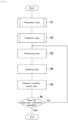
- Fig. 1 is a flowchart showing the process of an analysis method according to the present embodiment.
- the analysis method according to the present embodiment is a method for analyzing a chemical reaction from one or more starting materials, comprising:
- the chemical reaction may be a degradation reaction, synthesis reaction, or polymerization reaction; however, it is more preferably a degradation reaction.
- the degradation reaction include degradation of a pharmaceutical agent (degradation relating to metabolism in the body), ozone (layer) depletion by CFCs, degradation and detoxification of NOx in exhaust gas, analysis of degradation mechanisms of chemical products, and etching processing.
- Steps S1 to S5 can be performed by the analysis system 100 of the present embodiment. The details of processing of steps S1 to S5 are described below with reference to Figs. 2 to 11 .
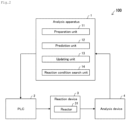
- Fig. 2 is a functional block diagram showing the schematic structure of the analysis system 100.
- the analysis system 100 includes an analysis apparatus 1, a PLC 2, a reaction device 3, and an analysis device 4.
- the analysis apparatus 1 is an apparatus for analyzing a chemical reaction from a starting material.
- the hardware configuration of the analysis apparatus 1 is not limited, and the analysis apparatus 1 can be formed of a general computer, a portable computer such as a tablet or smartphone, or a quantum computer.
- the analysis apparatus 1 includes, as functional blocks, a preparation unit 11, a prediction unit 12, an updating unit 13, and a reaction condition search unit 14.
- the units 11 to 14 are functioned when the GPU or CPU in the analysis apparatus 1 reads out the analysis program of this embodiment into the main memory to perform the analysis program.
- the analysis program may be downloaded to the analysis apparatus 1 via a communication network, such as the internet, or the analysis program may be recorded on a non-transient computerreadable recording medium such as a CD-ROM, and installed in the analysis apparatus 1 via the recording medium.
- the functions of units 11 to 14 are described below.
- the PLC 2 is a control device for controlling the reaction device 3.
- the analysis apparatus 1 may have a function of PLC 2.
- the reaction device 3 is a device for performing a chemical reaction such as a decomposition reaction or an additional reaction.
- the reaction device 3 comprises a reactor 31 for storing a chemical material, and allows a chemical reaction to consecutively proceed in the reactor 31 under the predetermined reaction conditions (e.g., temperature and residence time).
- the analysis device 4 is a device that analyzes the components of a material in the reactor 31.
- the reaction device 3 may have a function of the analysis device 4.
- the preparation step S1 is performed by the preparation unit 11 in the analysis apparatus 1.
- the preparation unit 11 has a function of preparing a reaction network diagram indicating the one or more starting materials, at least part of one or more intermediate products and one or more final products generated from the chemical reaction, and reaction pathways of the chemical reaction.
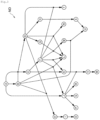
- Fig. 3 is an example of a reaction network diagram ND.
- the reaction network diagram ND is a drawing in which a chemical reaction from a starting material is modeled, which shows a starting material A, intermediate products B to V, and a final product W produced by the chemical reaction, and reaction pathways of the chemical reaction.
- the intermediate products B to V and the final product W are part of the intermediate and final products resulting from the chemical reaction of the starting material A.
- the desired chemical material is contained in the intermediate products B to V and the final product W.
- the starting material A, intermediate products B to V, and final product W can be gases, liquids, or solids, and are preferably gases.
- the starting material A, intermediate products B to V, and final product W may be low-molecular-weight compounds or high-molecular-weight compounds, and are preferably low-molecular-weight compounds.
- the number of intermediate products B to V and final product W, and the number of reaction pathways are not limited; however, they are determined by considering the calculation amount in the prediction step S2, updating step S4, and reaction condition search step S5 described below.
- the reaction network diagram ND may not include the final product.
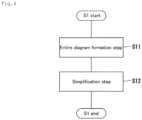
- Fig. 4 is a flowchart showing the details of the preparation step S1.
- the preparation step S1 includes an entire diagram formation step S11 and a simplification step S12.
- the preparation unit 11 forms an exhaustive reaction network diagram (entire diagram) indicating the starting material(s), (almost) all of the intermediate product(s) and final product(s) resulting from the chemical reaction, and (almost) all of the reaction pathways of the chemical reaction.
- the entire diagram can be automatically formed according to a predefined reaction pattern. For example, if the chemical reaction is a degradation reaction, one or more intermediate products produced from the starting material(s) are determined according to the possible pattern of material(s) desorbed from the starting material(s). Similarly, intermediate products are additionally determined according to the possible pattern of material(s) desorbed from the intermediate product(s). This process is repeated to form the entire diagram.
- the entire diagram does not necessarily include all of the intermediate products and final products. Similarly, the entire diagram does not necessarily include all the reaction pathways of the chemical reaction. The number of reaction pathways in the entire diagram is not limited. It is, for example, about 5000.
- the simplification step S12 is performed.
- the preparation unit 11 simplifies the entire diagram to form the reaction network diagram ND shown in Fig. 3 .
- the method of simplifying the entire diagram is not limited.
- a reaction network diagram ND can be formed by performing a convolution operation on the entire diagram.
- the prediction step S2 is performed by the prediction unit 12 in the analysis apparatus 1.
- the prediction unit 12 has a function of predicting the reaction rate in each reaction pathway using an artificial intelligence algorithm.
- the artificial intelligence algorithm is not limited, and is preferably a gradient algorithm, a genetic algorithm, or a combination thereof.
- Fig. 5 is a flowchart showing the details of the prediction step S2.
- the prediction step S2 includes a rate constant calculation step S21 and a rate constant modification step S22.
- the prediction unit 12 calculates the rate constant showing the reaction rate in each reaction pathway.
- the prediction unit 12 calculates the rate constant based on the Arrhenius equation.
- the prediction unit 12 calculates the rate constants k 1-0 to k n-0 (wherein n is the number of reaction pathways in the reaction network diagram ND) in individual reaction pathways under reaction conditions of temperature T 0 and residence time t 0 as the initial values of the rate constants.
- the temperature T 0 and residence time t 0 may be given by the user or randomly given by the prediction unit 12.
- Fig. 6 is the reaction network diagram ND with initial values for rate constants. To avoid complication, only the rate constants k 1-0 to k 7-0 for the seven pathways are shown in Fig. 6 . In order to intuitively understand the reaction rate in each pathway, the thickness of the line indicating the pathway in the reaction network diagram ND corresponds to the magnitude of the rate constant.
- the prediction unit 12 modifies the rate constant by an artificial intelligence algorithm.
- the rate constants k 1-0 to k n-0 are modified by changing reaction conditions (temperature and residence time) using a gradient algorithm, a genetic algorithm, or a combination thereof as an artificial intelligence algorithm so that the value of the evaluation function (e.g., target chemical material yield and cost) increases.
- reaction conditions under which the evaluation function is maximized are searched for, and the rate constants are converged to rate constants k 1-1 to k n-1 in which the evaluation function is maximized in theory.
- the rate constants k 1-1 to k n-1 are reaction rates predicted in the prediction step S2.
- the reaction conditions in this case are temperature T 1 and residence time t 1 .
- the reaction conditions are not limited to temperature and residence time, and it may be, for example, reaction time, reaction pressure, raw material concentration, or raw material introduction flow rate.
- Fig. 7 is a reaction network diagram ND with theoretical optimum values of rate constants. To avoid complication, in Fig. 7 , only rate constants k 1-1 to k 7-1 of the seven pathways are shown.
- the chemical reaction is performed more than once using the reaction device 3 under different reaction conditions. As described below, since the performing step S3 to the reaction condition search step S5 are performed more than once, in the single performing step S2, the chemical reaction is performed once under specific reaction conditions.
- the starting material A is subjected to chemical reaction in the reactor 31 of the reaction device 3 by changing reaction conditions within the range of temperature T 2 to T 3 and residence time t 2 to t 3 .
- the reaction conditions of the chemical reaction are determined by the reaction condition search unit 14, which is described below; however, the reaction conditions of the chemical reaction may be set by the user if the reaction condition search step S5 is omitted, as described below.
- the PLC 2 controls the reaction device 3 according to the determined reaction conditions.
- the analysis device 4 analyzes the concentration of each chemical material in the reactor 31, and the yield of the target compound. Furthermore, the analysis device 4 provides feedback on the analyzed concentration and yield to the analysis apparatus 1 as the results of the performing step.
- the updating unit 13 updates the reaction rates predicted in the prediction step S2, based on the results of the performing step S3.
- the updating unit 13 updates the predicted reaction rate by an automatic differential method. Specifically, the updating unit 13 updates rate constants k 1-1 to k n-1 to rate constants k 1-2 to k n-2 in such a manner that the error is minimized by comparing the concentration obtained by the analysis device 4 and output results of the yield of the target compound with the concentration of a compound output from the reaction network diagram with the reaction rate group obtained in the immediately preceding prediction step S2 and output results of the yield of the target compound.
- Fig. 8 is the reaction network diagram ND in which the rate constant is updated once. To avoid complication, in Fig. 8 , only rate constants k 1-2 to k 7-2 of the seven pathways are shown.
- the reaction condition search unit 14 searches for optimal reaction conditions based on the reaction conditions and results of the performing step S3.
- the reaction condition search unit 14 searches for the optimal reaction conditions by Bayesian optimization.
- the reaction condition search unit 14 records reaction conditions and the results in the first performing step S3, as shown in Fig. 9 .
- the shading of the circle corresponds to the degree of the objective function, with a smaller (lighter) objective function value meaning a higher yield (excellent results).
- the reaction condition search unit 14 determines reaction conditions for the subsequent performing step S3 based on optimization theory.
- the number of times in which the performing step S3 to the reaction condition search step S5 are repeated is not limited; however, it is preferable that the steps be repeated (m times) until the rate constant is sufficiently converged in the updating step S4, and an appropriate reaction condition can be searched for (no possibility of falling into a local solution) in the reaction condition search step S5 (YES in step S6).
- the PLC 2 controls the reaction device 3 according to the reaction conditions determined by the reaction condition search unit 14 in the (i-1)-th reaction condition search step S5 to perform a chemical reaction.
- the updating unit 13 updates the rate constant in the reaction network diagram ND based on the results of the first performing step S3 to i-th performing step S3. The more times the updating step S4 is performed, the smaller the latitude of the rate constant becomes, and so the rate constant is converged to a predetermined value.
- the reaction condition search unit 14 records the reaction conditions and results in the i-th performing step S3, and determines reaction conditions for the (i+1)-th performing step S3 based on the optimization theory.
- Fig. 10 is a reaction network diagram ND after completion of the m-th updating step S4.
- Fig. 10 of the rate constants k 1-m+1 to k n-m+1 in all of the pathways, only k 1-m+1 to k 7-m+1 are shown.
- the rate constants k 1-m+1 to k 7-m+1 can be regarded as the true rate constants in the reaction network diagram ND.
- reaction network diagram ND in Fig. 10 Based on the reaction network diagram ND in Fig. 10 , a reaction pathway showing a high yield can be easily found. By-products generated by chemical reaction are often not considered in conventional reaction pathway searches; however, since the reaction network diagram ND includes by-products, it is expected to find reaction pathways that have been overlooked by users' own empirical rules or existing theories.
- Fig. 11 is an illustrative diagram showing an example of Bayesian optimization after optimization (after completion of the m-th reaction condition search step S5).
- the number of plots showing reaction conditions is m, which suggests that the optimal reaction conditions exist within the dashed circle. Based on this, optimal or near-optimal reaction conditions can be easily found.
- the reaction network diagram is prepared in the preparation step S1, and the reaction rates in the reaction network diagram are predicted in the prediction step S2 with an artificial intelligence algorithm such as a gradient method algorithm. Since the reaction network diagram is formed based on chemical knowledge, and the reaction rates are predicted with an artificial intelligence algorithm considering the reaction pathways shown in the reaction network diagram, excellent reaction conditions for chemical reaction can be efficiently searched for. In contrast, PTL 1 does not consider the reaction rate of the chemical reaction. In PTL 2, a reaction network diagram showing reaction pathways of chemical reaction generated from a starting material (initial molecule) is not used, nor does it disclose the prediction of the reaction rate with an artificial intelligence algorithm considering the reaction pathways.
- an artificial intelligence algorithm such as a gradient method algorithm
- reaction conditions are inductively searched for by Bayesian optimization or the like based on the results of the chemical reaction using the reaction device, more excellent reaction conditions can be searched for in a shorter time. This reduces the work required for reaction condition search, and results in highly efficient search.
- reaction condition search step S5 is performed after the updating step S4; however, the updating step S4 may be performed after the reaction condition search step S5. Alternatively, the updating step S4 and the reaction condition search step S5 may be simultaneously performed.
- the reaction condition search step S5 may be omitted.
- the performing step S3 and the updating step S4 may both be repeated once under different reaction conditions, or the performing step S3 may be performed beforehand multiple times under different reaction conditions, followed by the updating step S4.
- the preparation step S1 and the prediction step S2, or the preparation step S1 alone may be omitted.
- the user may, for example, prepare a reaction network diagram based on the user's own empirical rules.
- the performing step S3 to the reaction condition search step S5 may be omitted, and reaction pathways may be searched for based on the reaction network diagram ND obtained in the prediction step S2.
- the reaction rates predicted in the prediction step S2 are theoretical reaction rates predicted with an artificial intelligence algorithm such as a gradient method algorithm; however, it is possible to find near-optimal reaction pathways as long as a huge error, such as falling into a local solution, does not occur.
- a gradient algorithm, genetic algorithm, or combination thereof was used as the artificial intelligence algorithm in the prediction step S2; however, the artificial intelligence algorithm in the present disclosure is not limited to these.
- Artificial intelligence algorithms such as the Gauss-Newton method and EM algorithm, can also be used in the prediction step S2.
- the optimal reaction conditions are searched for by Bayesian optimization; however, the method of searching for optimal reaction conditions is not limited to this.
- a method such as a genetic algorithm, ant colony optimization, and reinforcement learning can also be used.
- reaction conditions to be searched for are temperature and residence time; however, the type and number of reaction conditions are not limited.
- the reaction conditions may include the partial pressure of the raw material.
- the present disclosure can be applied for reaction condition search of chemical reaction for producing various chemical materials.
Landscapes
- Engineering & Computer Science (AREA)
- Physics & Mathematics (AREA)
- Theoretical Computer Science (AREA)
- Computing Systems (AREA)
- General Physics & Mathematics (AREA)
- Life Sciences & Earth Sciences (AREA)
- Bioinformatics & Computational Biology (AREA)
- Bioinformatics & Cheminformatics (AREA)
- Chemical & Material Sciences (AREA)
- Mathematical Physics (AREA)
- General Engineering & Computer Science (AREA)
- Artificial Intelligence (AREA)
- Software Systems (AREA)
- Evolutionary Computation (AREA)
- Data Mining & Analysis (AREA)
- Biophysics (AREA)
- Health & Medical Sciences (AREA)
- Evolutionary Biology (AREA)
- Chemical Kinetics & Catalysis (AREA)
- Computational Linguistics (AREA)
- Crystallography & Structural Chemistry (AREA)
- Analytical Chemistry (AREA)
- Probability & Statistics with Applications (AREA)
- Algebra (AREA)
- Pure & Applied Mathematics (AREA)
- Mathematical Optimization (AREA)
- Mathematical Analysis (AREA)
- Computational Mathematics (AREA)
- Physiology (AREA)
- Biomedical Technology (AREA)
- Genetics & Genomics (AREA)
- General Health & Medical Sciences (AREA)
- Molecular Biology (AREA)
- Physical Or Chemical Processes And Apparatus (AREA)
- Management, Administration, Business Operations System, And Electronic Commerce (AREA)
Abstract
Description
- The present disclosure relates to an analysis method, analysis apparatus, analysis system, and analysis program, each analyzing chemical reaction from a starting materials.
- In order to efficiently obtain a desired product from a starting material by chemical reaction, researchers have employed a method in which experiments on chemical reactions are repeatedly conducted by changing reaction conditions based on researchers' own empirical rules by using a reaction device to search for more efficient reaction conditions. Such a method requires researchers to determine reaction conditions on their own, and further, it is time-consuming because the operation of the reaction device and the analysis of data are conducted by a person.
- In contrast,
PTL 1 discloses repeating a cycle comprising analyzing a chemical reaction of a subset of compounds selected from a library of compounds based on specific selection criteria and selecting a subset of compounds from a library of compounds based on the selection criteria generated from the above analysis, thereby generating chemical entities with defined physical, chemical, and/or bioactive properties.PTL 2 discloses a reaction mechanism generation method comprising the step of performing a molecular dynamics calculation at each time step of atoms that constitute each molecule in a reaction system, the step, performed when a chemical reaction has occurred in the reaction system before and after the time step, of identifying a reacting molecule and a product molecule that contributed to the chemical reaction, the step of constructing, based on atomic relationships between the reacting molecule and the product molecule, an elementary reaction structured from the reacting molecule and the product molecule having the relationship, and the step of calculating a reaction rate constant for the constructed elementary reaction. -
- PTL 1:
JP2001-507675A - PTL 2:
WO2016/133002 - However, in
PTL 1, the selection criteria of a subset of compounds do not include the concept of the reaction rate. InPTL 2, although the reaction rate constants for individual chemical reactions are calculated, divergent reaction pathways of the chemical reactions from initial molecules are not considered. Accordingly,PTL - The present disclosure has been accomplished in order to solve the above problems, and an object of the present disclosure is to efficiently search for good reaction conditions for chemical reaction.
- In order to achieve the above object, the analysis method according to one embodiment of the present disclosure is a method for analyzing a chemical reaction from one or more starting materials, comprising preparing a reaction network diagram indicating the one or more starting materials, at least part of one or more intermediate products and one or more final products generated from the chemical reaction, and reaction pathways of the chemical reaction, and predicting the reaction rate in each reaction pathway using an artificial intelligence algorithm.
- In the analysis method, predicting the reaction rate preferably comprises calculating the rate constant indicating the reaction rate, and modifying the rate constant with the artificial intelligence algorithm.
- In the analysis method, in calculating the rate constant, the rate constant can be preferably calculated based on the Arrhenius equation.
- In the analysis method, the artificial intelligence algorithm is preferably a gradient algorithm, a genetic algorithm, or a combination thereof.
- It is further preferable that the analysis method comprise performing the chemical reaction more than once under different reaction conditions using a reaction device, and updating the predicted reaction rate based on the results of the performed chemical reactions.
- The analysis method according to one embodiment of the present disclosure is a method for analyzing a chemical reaction from one or more starting materials, comprising performing the chemical reaction more than once under different reaction conditions using a reaction device, and updating, based on the results of the performed chemical reactions, the reaction rate in each reaction pathway of the reaction network diagram indicating the one or more starting materials, at least part of one or more intermediate products and one or more final products generated from the chemical reaction, and reaction pathways of the chemical reaction.
- In the analysis method, it is preferable to update the reaction rate by an automatic differential method in updating the reaction rate.
- It is preferable that the analysis method further comprise searching for an optimal reaction condition based on the different reaction conditions and the results of the performed chemical reactions corresponding to respective reaction conditions.
- In the analysis method, it is preferable to search for the optimal reaction condition by Bayesian optimization in searching for the optimal reaction condition.
- The analysis apparatus of the present disclosure is an apparatus for analyzing a chemical reaction from one or more starting materials, and the apparatus comprises a preparation unit that prepares a reaction network diagram indicating the one or more starting materials, at least part of one or more intermediate products and one or more final products generated from the chemical reaction, and reaction pathways of the chemical reaction, and a prediction unit that predicts the reaction rate in each reaction pathway using an artificial intelligence algorithm.
- The analysis system according to one embodiment of the present disclosure comprises the analysis apparatus of the present disclosure and a reaction device that performs the chemical reaction more than once under different reaction conditions, wherein the analysis apparatus further comprises an updating unit that updates the predicted reaction rate based on the results obtained by the reaction device.
- The analysis program according to one embodiment of the present disclosure is a program for analyzing a chemical reaction from one or more starting materials, wherein the analysis program causes a computer to perform preparing a reaction network diagram indicating the one or more starting materials, at least part of one or more intermediate products and one or more final products generated from the chemical reaction, and reaction pathways of the chemical reaction, and predicting the reaction rate in each reaction pathway using an artificial intelligence algorithm.
- According to the present disclosure, excellent reaction conditions for chemical reaction can be efficiently searched for.
-
-
Fig. 1 is a flowchart showing the process of an analysis method according to an embodiment of the present disclosure. -
Fig. 2 is a functional block diagram showing the schematic structure of an analysis system according to an embodiment of the present disclosure. -
Fig. 3 is an example of a reaction network diagram. -
Fig. 4 is a flowchart showing the details of a preparation step. -
Fig. 5 is a flowchart showing the details of a prediction step. -
Fig. 6 is an example of a reaction network diagram. -
Fig. 7 is an example of a reaction network diagram. -
Fig. 8 is an example of a reaction network diagram. -
Fig. 9 is an illustrative diagram showing an example of Bayesian optimization. -
Fig. 10 is an example of a reaction network diagram. -
Fig. 11 is an illustrative diagram showing an example of Bayesian optimization. - Preferable embodiments of the present disclosure are described below with reference to the attached drawings. The present disclosure is not limited to the following embodiments.
-
Fig. 1 is a flowchart showing the process of an analysis method according to the present embodiment. The analysis method according to the present embodiment is a method for analyzing a chemical reaction from one or more starting materials, comprising: - a preparation step S1 of preparing a reaction network diagram indicating the one or more starting materials, at least part of one or more intermediate products and one or more final products generated from the chemical reaction, and reaction pathways of the chemical reaction;
- a prediction step S2 of predicting the reaction rate in each reaction pathway using an artificial intelligence algorithm;
- a performing step S3 of performing the chemical reaction more than once under different reaction conditions using a reaction device;
- an updating step S4 of updating the predicted reaction rate based on the results of the performing step S3; and
- a reaction condition search step S5 of searching for an optimal reaction condition based on the different reaction conditions and the results of the performing step S3 corresponding to each reaction condition.
- The chemical reaction may be a degradation reaction, synthesis reaction, or polymerization reaction; however, it is more preferably a degradation reaction. Examples of the degradation reaction include degradation of a pharmaceutical agent (degradation relating to metabolism in the body), ozone (layer) depletion by CFCs, degradation and detoxification of NOx in exhaust gas, analysis of degradation mechanisms of chemical products, and etching processing.
- Steps S1 to S5 can be performed by the
analysis system 100 of the present embodiment. The details of processing of steps S1 to S5 are described below with reference toFigs. 2 to 11 . -
Fig. 2 is a functional block diagram showing the schematic structure of theanalysis system 100. Theanalysis system 100 includes ananalysis apparatus 1, aPLC 2, areaction device 3, and ananalysis device 4. - The
analysis apparatus 1 is an apparatus for analyzing a chemical reaction from a starting material. The hardware configuration of theanalysis apparatus 1 is not limited, and theanalysis apparatus 1 can be formed of a general computer, a portable computer such as a tablet or smartphone, or a quantum computer. - The
analysis apparatus 1 includes, as functional blocks, apreparation unit 11, aprediction unit 12, anupdating unit 13, and a reactioncondition search unit 14. When theanalysis apparatus 1 is formed of a general computer, theunits 11 to 14 are functioned when the GPU or CPU in theanalysis apparatus 1 reads out the analysis program of this embodiment into the main memory to perform the analysis program. The analysis program may be downloaded to theanalysis apparatus 1 via a communication network, such as the internet, or the analysis program may be recorded on a non-transient computerreadable recording medium such as a CD-ROM, and installed in theanalysis apparatus 1 via the recording medium. The functions ofunits 11 to 14 are described below. - The
PLC 2 is a control device for controlling thereaction device 3. Theanalysis apparatus 1 may have a function ofPLC 2. - The
reaction device 3 is a device for performing a chemical reaction such as a decomposition reaction or an additional reaction. Thereaction device 3 comprises areactor 31 for storing a chemical material, and allows a chemical reaction to consecutively proceed in thereactor 31 under the predetermined reaction conditions (e.g., temperature and residence time). - The
analysis device 4 is a device that analyzes the components of a material in thereactor 31. Thereaction device 3 may have a function of theanalysis device 4. - The following section describes the details of processing when each of the steps S1 to S5 in the method for analyzing a chemical reaction from a starting material, which is shown in
Fig. 1 , is performed by theanalysis system 100. - The preparation step S1 is performed by the
preparation unit 11 in theanalysis apparatus 1. Thepreparation unit 11 has a function of preparing a reaction network diagram indicating the one or more starting materials, at least part of one or more intermediate products and one or more final products generated from the chemical reaction, and reaction pathways of the chemical reaction. -
Fig. 3 is an example of a reaction network diagram ND. The reaction network diagram ND is a drawing in which a chemical reaction from a starting material is modeled, which shows a starting material A, intermediate products B to V, and a final product W produced by the chemical reaction, and reaction pathways of the chemical reaction. The intermediate products B to V and the final product W are part of the intermediate and final products resulting from the chemical reaction of the starting material A. The desired chemical material is contained in the intermediate products B to V and the final product W. - The starting material A, intermediate products B to V, and final product W can be gases, liquids, or solids, and are preferably gases. The starting material A, intermediate products B to V, and final product W may be low-molecular-weight compounds or high-molecular-weight compounds, and are preferably low-molecular-weight compounds. The number of intermediate products B to V and final product W, and the number of reaction pathways are not limited; however, they are determined by considering the calculation amount in the prediction step S2, updating step S4, and reaction condition search step S5 described below. The reaction network diagram ND may not include the final product.
-
Fig. 4 is a flowchart showing the details of the preparation step S1. The preparation step S1 includes an entire diagram formation step S11 and a simplification step S12. - In the entire diagram formation step S11, when the starting material is determined by the user, the
preparation unit 11 forms an exhaustive reaction network diagram (entire diagram) indicating the starting material(s), (almost) all of the intermediate product(s) and final product(s) resulting from the chemical reaction, and (almost) all of the reaction pathways of the chemical reaction. The entire diagram can be automatically formed according to a predefined reaction pattern. For example, if the chemical reaction is a degradation reaction, one or more intermediate products produced from the starting material(s) are determined according to the possible pattern of material(s) desorbed from the starting material(s). Similarly, intermediate products are additionally determined according to the possible pattern of material(s) desorbed from the intermediate product(s). This process is repeated to form the entire diagram. - The entire diagram does not necessarily include all of the intermediate products and final products. Similarly, the entire diagram does not necessarily include all the reaction pathways of the chemical reaction. The number of reaction pathways in the entire diagram is not limited. It is, for example, about 5000.
- Although the entire diagram shows (almost) all of the reaction pathways, the use of the entire diagram in the prediction step S2, updating step S4, and reaction condition search step S5 results in a huge amount of calculation. Accordingly, in this embodiment, the simplification step S12 is performed.
- In the simplification step S12, the
preparation unit 11 simplifies the entire diagram to form the reaction network diagram ND shown inFig. 3 . The method of simplifying the entire diagram is not limited. For example, a reaction network diagram ND can be formed by performing a convolution operation on the entire diagram. - Thus, the preparation step S1 is completed.
- The prediction step S2 is performed by the
prediction unit 12 in theanalysis apparatus 1. Theprediction unit 12 has a function of predicting the reaction rate in each reaction pathway using an artificial intelligence algorithm. The artificial intelligence algorithm is not limited, and is preferably a gradient algorithm, a genetic algorithm, or a combination thereof. -
Fig. 5 is a flowchart showing the details of the prediction step S2. The prediction step S2 includes a rate constant calculation step S21 and a rate constant modification step S22. - In the rate constant calculation step S21, the
prediction unit 12 calculates the rate constant showing the reaction rate in each reaction pathway. In this embodiment, theprediction unit 12 calculates the rate constant based on the Arrhenius equation. In the Arrhenius equation, the rate constant k is represented by the following formula:
prediction unit 12 calculates the rate constants k1-0 to kn-0 (wherein n is the number of reaction pathways in the reaction network diagram ND) in individual reaction pathways under reaction conditions of temperature T0 and residence time t0 as the initial values of the rate constants. The temperature T0 and residence time t0 may be given by the user or randomly given by theprediction unit 12. -
Fig. 6 is the reaction network diagram ND with initial values for rate constants. To avoid complication, only the rate constants k1-0 to k7-0 for the seven pathways are shown inFig. 6 . In order to intuitively understand the reaction rate in each pathway, the thickness of the line indicating the pathway in the reaction network diagram ND corresponds to the magnitude of the rate constant. - In the rate constant modification step S22, the
prediction unit 12 modifies the rate constant by an artificial intelligence algorithm. In this embodiment, the rate constants k1-0 to kn-0 are modified by changing reaction conditions (temperature and residence time) using a gradient algorithm, a genetic algorithm, or a combination thereof as an artificial intelligence algorithm so that the value of the evaluation function (e.g., target chemical material yield and cost) increases. Thereby, reaction conditions under which the evaluation function is maximized are searched for, and the rate constants are converged to rate constants k1-1 to kn-1 in which the evaluation function is maximized in theory. The rate constants k1-1 to kn-1 are reaction rates predicted in the prediction step S2. The reaction conditions in this case are temperature T1 and residence time t1. The reaction conditions are not limited to temperature and residence time, and it may be, for example, reaction time, reaction pressure, raw material concentration, or raw material introduction flow rate. -
Fig. 7 is a reaction network diagram ND with theoretical optimum values of rate constants. To avoid complication, inFig. 7 , only rate constants k1-1 to k7-1 of the seven pathways are shown. - It is more preferable to use a genetic algorithm or an algorithm involving the combination of a gradient algorithm and a genetic algorithm because the rate constant may fall into a local solution if the gradient algorithm alone is used.
- Thus, the prediction step S2 is completed.
- In the performing step S3, the chemical reaction is performed more than once using the
reaction device 3 under different reaction conditions. As described below, since the performing step S3 to the reaction condition search step S5 are performed more than once, in the single performing step S2, the chemical reaction is performed once under specific reaction conditions. - In this embodiment, the starting material A is subjected to chemical reaction in the
reactor 31 of thereaction device 3 by changing reaction conditions within the range of temperature T2 to T3 and residence time t2 to t3. In this embodiment, the temperatures T2 and T3 satisfy T2<T3 and T1=(T2+T3)/2; however, the temperatures T2 and T3 are not limited as long as they satisfy T2<T1<T3, and are the temperatures at which thereaction device 3 can be operated. Similarly, the residence times t2 and t3 in this embodiment satisfy t2<t3 and t1=(t2+t3)/2; however, the residence times t2 and t3 are not limited as long as they satisfy t2<t1<t3. The reaction conditions of the chemical reaction are determined by the reactioncondition search unit 14, which is described below; however, the reaction conditions of the chemical reaction may be set by the user if the reaction condition search step S5 is omitted, as described below. ThePLC 2 controls thereaction device 3 according to the determined reaction conditions. - When the chemical reaction in the
reaction device 3 is completed, theanalysis device 4 analyzes the concentration of each chemical material in thereactor 31, and the yield of the target compound. Furthermore, theanalysis device 4 provides feedback on the analyzed concentration and yield to theanalysis apparatus 1 as the results of the performing step. - Subsequently, in the updating step S4, the updating
unit 13 updates the reaction rates predicted in the prediction step S2, based on the results of the performing step S3. In this embodiment, the updatingunit 13 updates the predicted reaction rate by an automatic differential method. Specifically, the updatingunit 13 updates rate constants k1-1 to kn-1 to rate constants k1-2 to kn-2 in such a manner that the error is minimized by comparing the concentration obtained by theanalysis device 4 and output results of the yield of the target compound with the concentration of a compound output from the reaction network diagram with the reaction rate group obtained in the immediately preceding prediction step S2 and output results of the yield of the target compound. -
Fig. 8 is the reaction network diagram ND in which the rate constant is updated once. To avoid complication, inFig. 8 , only rate constants k1-2 to k7-2 of the seven pathways are shown. - In the subsequent reaction condition search step S5, the reaction
condition search unit 14 searches for optimal reaction conditions based on the reaction conditions and results of the performing step S3. In this embodiment, the reactioncondition search unit 14 searches for the optimal reaction conditions by Bayesian optimization. In the first reaction condition search step S5, the reactioncondition search unit 14 records reaction conditions and the results in the first performing step S3, as shown inFig. 9 . InFig. 9 , the shading of the circle corresponds to the degree of the objective function, with a smaller (lighter) objective function value meaning a higher yield (excellent results). The reactioncondition search unit 14 then determines reaction conditions for the subsequent performing step S3 based on optimization theory. - The number of times in which the performing step S3 to the reaction condition search step S5 are repeated is not limited; however, it is preferable that the steps be repeated (m times) until the rate constant is sufficiently converged in the updating step S4, and an appropriate reaction condition can be searched for (no possibility of falling into a local solution) in the reaction condition search step S5 (YES in step S6).
- For example, in the i-th (1<i<m) performing step S3, the
PLC 2 controls thereaction device 3 according to the reaction conditions determined by the reactioncondition search unit 14 in the (i-1)-th reaction condition search step S5 to perform a chemical reaction. In the i-th updating step S4, the updatingunit 13 updates the rate constant in the reaction network diagram ND based on the results of the first performing step S3 to i-th performing step S3. The more times the updating step S4 is performed, the smaller the latitude of the rate constant becomes, and so the rate constant is converged to a predetermined value. In the i-th reaction condition search step S5, the reactioncondition search unit 14 records the reaction conditions and results in the i-th performing step S3, and determines reaction conditions for the (i+1)-th performing step S3 based on the optimization theory. -
Fig. 10 is a reaction network diagram ND after completion of the m-th updating step S4. InFig. 10 , of the rate constants k1-m+1 to kn-m+1 in all of the pathways, only k1-m+1 to k7-m+1 are shown. The rate constants k1-m+1 to k7-m+1 can be regarded as the true rate constants in the reaction network diagram ND. - Based on the reaction network diagram ND in
Fig. 10 , a reaction pathway showing a high yield can be easily found. By-products generated by chemical reaction are often not considered in conventional reaction pathway searches; however, since the reaction network diagram ND includes by-products, it is expected to find reaction pathways that have been overlooked by users' own empirical rules or existing theories. -
Fig. 11 is an illustrative diagram showing an example of Bayesian optimization after optimization (after completion of the m-th reaction condition search step S5). InFig. 11 , the number of plots showing reaction conditions is m, which suggests that the optimal reaction conditions exist within the dashed circle. Based on this, optimal or near-optimal reaction conditions can be easily found. - As described above, in this embodiment, the reaction network diagram is prepared in the preparation step S1, and the reaction rates in the reaction network diagram are predicted in the prediction step S2 with an artificial intelligence algorithm such as a gradient method algorithm. Since the reaction network diagram is formed based on chemical knowledge, and the reaction rates are predicted with an artificial intelligence algorithm considering the reaction pathways shown in the reaction network diagram, excellent reaction conditions for chemical reaction can be efficiently searched for. In contrast,
PTL 1 does not consider the reaction rate of the chemical reaction. InPTL 2, a reaction network diagram showing reaction pathways of chemical reaction generated from a starting material (initial molecule) is not used, nor does it disclose the prediction of the reaction rate with an artificial intelligence algorithm considering the reaction pathways. - Furthermore, in the performing step S3 to the reaction condition search step S5, since reaction conditions are inductively searched for by Bayesian optimization or the like based on the results of the chemical reaction using the reaction device, more excellent reaction conditions can be searched for in a shorter time. This reduces the work required for reaction condition search, and results in highly efficient search.
- The embodiments are described above; however, it will be understood that various changes in forms and details can be made without departing from the spirit and scope of the claims.
- For example, in the above embodiments, the reaction condition search step S5 is performed after the updating step S4; however, the updating step S4 may be performed after the reaction condition search step S5. Alternatively, the updating step S4 and the reaction condition search step S5 may be simultaneously performed.
- The reaction condition search step S5 may be omitted. In such a case, the performing step S3 and the updating step S4 may both be repeated once under different reaction conditions, or the performing step S3 may be performed beforehand multiple times under different reaction conditions, followed by the updating step S4.
- The preparation step S1 and the prediction step S2, or the preparation step S1 alone may be omitted. In such a case, the user may, for example, prepare a reaction network diagram based on the user's own empirical rules.
- The performing step S3 to the reaction condition search step S5 may be omitted, and reaction pathways may be searched for based on the reaction network diagram ND obtained in the prediction step S2. The reaction rates predicted in the prediction step S2 are theoretical reaction rates predicted with an artificial intelligence algorithm such as a gradient method algorithm; however, it is possible to find near-optimal reaction pathways as long as a huge error, such as falling into a local solution, does not occur.
- In the above embodiment, a gradient algorithm, genetic algorithm, or combination thereof was used as the artificial intelligence algorithm in the prediction step S2; however, the artificial intelligence algorithm in the present disclosure is not limited to these. Artificial intelligence algorithms, such as the Gauss-Newton method and EM algorithm, can also be used in the prediction step S2.
- In the above embodiment, in the reaction condition search step S5, the optimal reaction conditions are searched for by Bayesian optimization; however, the method of searching for optimal reaction conditions is not limited to this. In the reaction condition search step S5, a method such as a genetic algorithm, ant colony optimization, and reinforcement learning can also be used.
- In the above embodiment, the reaction conditions to be searched for are temperature and residence time; however, the type and number of reaction conditions are not limited. For example, the reaction conditions may include the partial pressure of the raw material.
- The present disclosure can be applied for reaction condition search of chemical reaction for producing various chemical materials.
-
- 1: Analysis apparatus
- 11: Preparation unit
- 12: Prediction unit
- 13: Updating unit
- 14: Reaction condition search unit
- 2: PLC
- 3: Reaction device
- 31: Reactor
- 4: Analysis device
- 100: Analysis system
- A: Starting material
- B to V: Intermediate product
- W: Final product
- ND: Reaction network diagram
- S1: Preparation step
- S11: Entire diagram formation step
- S12: Simplification step
- S2: Prediction step
- S21: Rate constant calculation step
- S22: Rate constant modification step
- S3: Performing step
- S4 Updating step
- S5: Reaction condition search step
Claims (12)
- An analysis method for analyzing a chemical reaction from one or more starting materials, comprisingpreparing a reaction network diagram indicating the one or more starting materials, at least part of one or more intermediate products and one or more final products generated from the chemical reaction, and reaction pathways of the chemical reaction, andpredicting the reaction rate in each reaction pathway using an artificial intelligence algorithm.
- The analysis method according to claim 1, wherein predicting the reaction rate comprises calculating the rate constant indicating the reaction rate, and modifying the rate constant with the artificial intelligence algorithm.
- The analysis method according to claim 2, wherein in calculating the rate constant, the rate constant is calculated based on the Arrhenius equation.
- The analysis method according to any one of claims 1 to 3, wherein the artificial intelligence algorithm is a gradient algorithm, a genetic algorithm, or a combination thereof.
- The analysis method according to any one of claims 1 to 4, further comprisingperforming the chemical reaction more than once under different reaction conditions using a reaction device, andupdating the predicted reaction rate based on the results of the performed chemical reactions.
- An analysis method for analyzing a chemical reaction from one or more starting materials, comprisingperforming the chemical reaction more than once under different reaction conditions using a reaction device, andupdating, based on the results of the performed chemical reactions, the reaction rate in each reaction pathway of the reaction network diagram indicating the one or more starting materials, at least part of one or more intermediate products and one or more final products generated from the chemical reaction, and reaction pathways of the chemical reaction.
- The analysis method according to claim 5 or 6, wherein in updating the reaction rate, the reaction rate is updated by an automatic differential method.
- The analysis method according to any one of claims 5 to 7, further comprising searching for an optimal reaction condition based on the different reaction conditions and the results of the performed chemical reactions corresponding to respective reaction conditions.
- The analysis method according to claim 8, wherein in searching for the optimal reaction condition, the optimal reaction condition is searched for by Bayesian optimization.
- An analysis apparatus for analyzing a chemical reaction from one or more starting materials, the apparatus comprisinga preparation unit that prepares a reaction network diagram indicating the one or more starting materials, at least part of one or more intermediate products and one or more final products generated from the chemical reaction, and reaction pathways of the chemical reaction, anda prediction unit that predicts the reaction rate in each reaction pathway using an artificial intelligence algorithm.
- An analysis system comprising the analysis apparatus according to Claim 10 and a reaction device that performs the chemical reaction more than once under different reaction conditions, wherein the analysis apparatus further comprises an updating unit that updates the predicted reaction rate based on the results obtained by the reaction device.
- An analysis program for analyzing a chemical reaction from one or more starting materials, wherein the analysis program causes a computer to perform preparing a reaction network diagram indicating the one or more starting materials, at least part of one or more intermediate products and one or more final products generated from the chemical reaction, and reaction pathways of the chemical reaction, and predicting the reaction rate in each reaction pathway using an artificial intelligence algorithm.
Applications Claiming Priority (2)
| Application Number | Priority Date | Filing Date | Title |
|---|---|---|---|
| JP2020067796A JP7021443B2 (en) | 2020-04-03 | 2020-04-03 | Analytical methods, analyzers, analysis systems and analysis programs for analyzing chemical reactions from starting materials |
| PCT/JP2021/006568 WO2021199788A1 (en) | 2020-04-03 | 2021-02-22 | Analysis method that analyses chemical reactions from starting materials, analysis device, analysis system, and analysis program |
Publications (2)
| Publication Number | Publication Date |
|---|---|
| EP4129462A1 true EP4129462A1 (en) | 2023-02-08 |
| EP4129462A4 EP4129462A4 (en) | 2024-05-29 |
Family
ID=77928343
Family Applications (1)
| Application Number | Title | Priority Date | Filing Date |
|---|---|---|---|
| EP21781704.8A Pending EP4129462A4 (en) | 2020-04-03 | 2021-02-22 | Analysis method that analyses chemical reactions from starting materials, analysis device, analysis system, and analysis program |
Country Status (6)
| Country | Link |
|---|---|
| US (1) | US20230027989A1 (en) |
| EP (1) | EP4129462A4 (en) |
| JP (1) | JP7021443B2 (en) |
| CN (1) | CN115362505A (en) |
| TW (1) | TWI843941B (en) |
| WO (1) | WO2021199788A1 (en) |
Cited By (1)
| Publication number | Priority date | Publication date | Assignee | Title |
|---|---|---|---|---|
| WO2025078643A1 (en) | 2023-10-13 | 2025-04-17 | The University Court Of The University Of Glasgow | Chemical synthesis optimiser |
Families Citing this family (7)
| Publication number | Priority date | Publication date | Assignee | Title |
|---|---|---|---|---|
| JP7797831B2 (en) * | 2021-11-02 | 2026-01-14 | 株式会社レゾナック | Information processing system, information processing method, and information processing program |
| JP2024114197A (en) * | 2023-02-13 | 2024-08-23 | 株式会社日立プラントサービス | Microreactor system for condition exploration and method for optimizing process conditions |
| US12587274B2 (en) | 2023-03-28 | 2026-03-24 | Quantum Generative Materials Llc | Satellite optimization management system based on natural language input and artificial intelligence |
| US12368503B2 (en) | 2023-12-27 | 2025-07-22 | Quantum Generative Materials Llc | Intent-based satellite transmit management based on preexisting historical location and machine learning |
| US12627372B2 (en) | 2023-12-27 | 2026-05-12 | Quantum Generative Materials Llc | Advanced mission control predictive systems for low earth orbit semi-autonomous satellites |
| US12603701B2 (en) | 2023-12-27 | 2026-04-14 | Quantum Generative Materials Llc | Distributed satellite constellation management and control system |
| JP2026056705A (en) * | 2024-09-20 | 2026-04-02 | 株式会社日立製作所 | Method and system for analyzing the chemical transformation pathways of gases |
Family Cites Families (12)
| Publication number | Priority date | Publication date | Assignee | Title |
|---|---|---|---|---|
| JPH0737821A (en) * | 1993-07-20 | 1995-02-07 | Hitachi Ltd | Thin film manufacturing apparatus and semiconductor device manufacturing method |
| JPH1137821A (en) * | 1997-05-23 | 1999-02-12 | Hitachi Metals Ltd | Gas meter piping structure and gas meter connecting joint |
| US6647342B2 (en) * | 2000-08-07 | 2003-11-11 | Novodynamics, Inc. | Knowledge-based process for the development of materials |
| US7415359B2 (en) * | 2001-11-02 | 2008-08-19 | Gene Network Sciences, Inc. | Methods and systems for the identification of components of mammalian biochemical networks as targets for therapeutic agents |
| JP4623958B2 (en) * | 2003-12-16 | 2011-02-02 | トヨタ自動車株式会社 | Search method of chemical reaction path |
| CN101251747B (en) * | 2007-10-31 | 2012-04-25 | 华东理工大学 | Modelling method for industrial device model for dimethylbenzene oxidation reaction |
| CN104484714B (en) * | 2014-11-26 | 2018-05-11 | 华东理工大学 | A kind of real-time predicting method of catalytic reforming unit yield |
| US10497464B2 (en) * | 2015-10-28 | 2019-12-03 | Samsung Electronics Co., Ltd. | Method and device for in silico prediction of chemical pathway |
| JP7357183B2 (en) * | 2018-01-30 | 2023-10-06 | エスアールアイ インターナショナル | Computational generation of chemical synthesis routes and methods |
| US11735292B2 (en) * | 2018-08-07 | 2023-08-22 | International Business Machines Corporation | Intelligent personalized chemical synthesis planning |
| CN110598255B (en) * | 2019-08-14 | 2021-07-06 | 华南理工大学 | A chemical vapor deposition rate prediction method |
| CN110556167B (en) * | 2019-09-06 | 2022-02-25 | 北京赛普泰克技术有限公司 | Construction method of MTO reaction kinetic model and MTO reaction regeneration integration model |
-
2020
- 2020-04-03 JP JP2020067796A patent/JP7021443B2/en active Active
-
2021
- 2021-02-22 WO PCT/JP2021/006568 patent/WO2021199788A1/en not_active Ceased
- 2021-02-22 EP EP21781704.8A patent/EP4129462A4/en active Pending
- 2021-02-22 CN CN202180026494.9A patent/CN115362505A/en active Pending
- 2021-03-16 TW TW110109260A patent/TWI843941B/en active
-
2022
- 2022-09-29 US US17/956,122 patent/US20230027989A1/en active Pending
Cited By (1)
| Publication number | Priority date | Publication date | Assignee | Title |
|---|---|---|---|---|
| WO2025078643A1 (en) | 2023-10-13 | 2025-04-17 | The University Court Of The University Of Glasgow | Chemical synthesis optimiser |
Also Published As
| Publication number | Publication date |
|---|---|
| JP7021443B2 (en) | 2022-02-17 |
| TWI843941B (en) | 2024-06-01 |
| WO2021199788A1 (en) | 2021-10-07 |
| EP4129462A4 (en) | 2024-05-29 |
| JP2021163422A (en) | 2021-10-11 |
| CN115362505A (en) | 2022-11-18 |
| US20230027989A1 (en) | 2023-01-26 |
| TW202147331A (en) | 2021-12-16 |
Similar Documents
| Publication | Publication Date | Title |
|---|---|---|
| US20230027989A1 (en) | Analysis method that analyses chemical reactions from starting materials, analysis apparatus, analysis system, and analysis program | |
| Meyer et al. | Information-theoretic feature selection in microarray data using variable complementarity | |
| Gao et al. | Using machine learning to predict suitable conditions for organic reactions | |
| Kim et al. | Open macromolecular genome: Generative design of synthetically accessible polymers | |
| Ikebata et al. | Bayesian molecular design with a chemical language model | |
| Jasper et al. | Theoretical unimolecular kinetics for CH4+ M⇄ CH3+ H+ M in eight baths, M= He, Ne, Ar, Kr, H2, N2, CO, and CH4 | |
| Yao et al. | Online updating soft sensor modeling and industrial application based on selectively integrated moving window approach | |
| Angira et al. | Optimization of dynamic systems: A trigonometric differential evolution approach | |
| Kimaev et al. | Artificial neural network discrimination for parameter estimation and optimal product design of thin films manufactured by chemical vapor deposition | |
| CN118098404B (en) | Method, equipment and medium for predicting molecular reaction performance of catalyst | |
| Steimel et al. | A framework for the modeling and optimization of process superstructures under uncertainty | |
| Bahakim et al. | Optimal design of large‐scale chemical processes under uncertainty: A ranking‐based approach | |
| Carpenter et al. | Empirical classification of trajectory data: An opportunity for the use of machine learning in molecular dynamics | |
| Chaudhuri et al. | Synthesis under uncertainty with simulators | |
| Du et al. | Fault detection and classification for nonlinear chemical processes using lasso and Gaussian process | |
| MacGregor et al. | Multivariate model identification and stochastic control of a chemical reactor | |
| WO2024029063A1 (en) | Assistance method, assistance device, and assistance program | |
| Sun et al. | Integrating controlled random search into the line-up competition algorithm to solve unsteady operation problems | |
| Schultz et al. | The importance of nominal operating point selection in self-optimizing control | |
| WO2023145825A1 (en) | Reaction-path search program, reaction-path search system, and reaction-path search method | |
| Alexander | Generating Molecules with Specific Boiling Points and Melting Points | |
| Vassilev-Galindo et al. | Explainable artificial intelligence for materials discovery: application to catalysts for the HER and ORR | |
| Ruiz-Femenia et al. | Logic-Based Outer-Approximation Algorithm for Solving Discrete-Continuous Dynamic Optimization Problems | |
| Liu et al. | miRNA-disease associations prediction based on neural tensor decomposition | |
| Raush et al. | Graph-convolutional neural net model of the statistical torsion profiles for small organic molecules |
Legal Events
| Date | Code | Title | Description |
|---|---|---|---|
| STAA | Information on the status of an ep patent application or granted ep patent |
Free format text: STATUS: THE INTERNATIONAL PUBLICATION HAS BEEN MADE |
|
| PUAI | Public reference made under article 153(3) epc to a published international application that has entered the european phase |
Free format text: ORIGINAL CODE: 0009012 |
|
| STAA | Information on the status of an ep patent application or granted ep patent |
Free format text: STATUS: REQUEST FOR EXAMINATION WAS MADE |
|
| 17P | Request for examination filed |
Effective date: 20221012 |
|
| AK | Designated contracting states |
Kind code of ref document: A1 Designated state(s): AL AT BE BG CH CY CZ DE DK EE ES FI FR GB GR HR HU IE IS IT LI LT LU LV MC MK MT NL NO PL PT RO RS SE SI SK SM TR |
|
| P01 | Opt-out of the competence of the unified patent court (upc) registered |
Effective date: 20230525 |
|
| DAV | Request for validation of the european patent (deleted) | ||
| DAX | Request for extension of the european patent (deleted) | ||
| REG | Reference to a national code |
Ref country code: DE Ref legal event code: R079 Free format text: PREVIOUS MAIN CLASS: B01J0019000000 Ipc: G16C0020100000 |
|
| A4 | Supplementary search report drawn up and despatched |
Effective date: 20240502 |
|
| RIC1 | Information provided on ipc code assigned before grant |
Ipc: G06N 3/126 20230101ALN20240426BHEP Ipc: G16C 20/70 20190101ALN20240426BHEP Ipc: G06N 7/01 20230101ALI20240426BHEP Ipc: G06N 5/01 20230101ALI20240426BHEP Ipc: G16C 20/10 20190101AFI20240426BHEP |