EP4129053B1 - Pet toy having treat retention features - Google Patents
Pet toy having treat retention features Download PDFInfo
- Publication number
- EP4129053B1 EP4129053B1 EP22175196.9A EP22175196A EP4129053B1 EP 4129053 B1 EP4129053 B1 EP 4129053B1 EP 22175196 A EP22175196 A EP 22175196A EP 4129053 B1 EP4129053 B1 EP 4129053B1
- Authority
- EP
- European Patent Office
- Prior art keywords
- pet
- treat
- slot
- toy
- surface feature
- Prior art date
- Legal status (The legal status is an assumption and is not a legal conclusion. Google has not performed a legal analysis and makes no representation as to the accuracy of the status listed.)
- Active
Links
Images




Classifications
-
- A—HUMAN NECESSITIES
- A01—AGRICULTURE; FORESTRY; ANIMAL HUSBANDRY; HUNTING; TRAPPING; FISHING
- A01K—ANIMAL HUSBANDRY; AVICULTURE; APICULTURE; PISCICULTURE; FISHING; REARING OR BREEDING ANIMALS, NOT OTHERWISE PROVIDED FOR; NEW BREEDS OF ANIMALS
- A01K15/00—Devices for taming animals, e.g. nose-rings or hobbles; Devices for overturning animals in general; Training or exercising equipment; Covering boxes
- A01K15/02—Training or exercising equipment, e.g. mazes or labyrinths for animals ; Electric shock devices; Toys specially adapted for animals
- A01K15/025—Toys specially adapted for animals
-
- A—HUMAN NECESSITIES
- A01—AGRICULTURE; FORESTRY; ANIMAL HUSBANDRY; HUNTING; TRAPPING; FISHING
- A01K—ANIMAL HUSBANDRY; AVICULTURE; APICULTURE; PISCICULTURE; FISHING; REARING OR BREEDING ANIMALS, NOT OTHERWISE PROVIDED FOR; NEW BREEDS OF ANIMALS
- A01K15/00—Devices for taming animals, e.g. nose-rings or hobbles; Devices for overturning animals in general; Training or exercising equipment; Covering boxes
- A01K15/02—Training or exercising equipment, e.g. mazes or labyrinths for animals ; Electric shock devices; Toys specially adapted for animals
- A01K15/025—Toys specially adapted for animals
- A01K15/026—Chewable toys, e.g. for dental care of pets
-
- A—HUMAN NECESSITIES
- A01—AGRICULTURE; FORESTRY; ANIMAL HUSBANDRY; HUNTING; TRAPPING; FISHING
- A01K—ANIMAL HUSBANDRY; AVICULTURE; APICULTURE; PISCICULTURE; FISHING; REARING OR BREEDING ANIMALS, NOT OTHERWISE PROVIDED FOR; NEW BREEDS OF ANIMALS
- A01K5/00—Feeding devices for stock or game ; Feeding wagons; Feeding stacks
- A01K5/01—Feed troughs; Feed pails
- A01K5/0114—Pet food dispensers; Pet food trays
Definitions
- the present disclosure relates to a pet toy and use of the pet toy to provide an edible treat for a pet.
- a variety of pet toys have been designed, manufactured, and sold, often with the intent of encouraging pet interaction, mental stimulation, and/or play, while reducing or eliminating pet boredom and its associated destructive behaviors.
- these destructive behaviors may include, for example, biting, gnawing or clawing furniture or other articles in the dog's environment, digging or otherwise seeking to escape confinement, and excessive barking.
- Pet toys often seek to incentivize a pet's extended interaction with the pet toy by providing one or more edible items (e.g., pet treat(s), pet food, or the like) to the pet over a relatively long time interval.
- an extended interval of animal interaction with the toy may not be achieved for some pet toys, for example, because the pet toy dispenses the edible item(s) to the pet in too great a quantity or too rapidly or because the pet toy makes it too difficult for the pet to consume the edible item(s). In either case, the pet will become disinterested in the pet toy and consequently engage in an undesired and/or destructive behavior.
- US 10 932 449 B2 discloses a pet toy product comprising at least one edible treat and a body member in the form of a ring surrounding the edible treat, with the body member having opposing sides and a body member aperture.
- the edible treat is receivable into the body member aperture from either side of the body member, and connected to the body member within the body member aperture by a releaseable mechanical connection formed between the edible treat and the body member.
- WO 2009/039153 A1 discloses pet toys configured to accept an edible or chewable treat which can be readily replaced.
- the pet toys have a first portion and a second portion which releaseably engage to retain the edible treat with the toy until the treat is consumed or otherwise removed from the toy by the pet.
- the toy can be disassembled by removing the first portion from the second portion, new treats can be added to the toy, and the two portions reassembled
- WO 2004/043142 A1 discloses a non-consumable pet toy includes a resilient first concave-shaped molded member having a first peripheral edge and a resilient second concave-shaped molded member having a second peripheral edge.
- the first and second members have a treat-retaining cavity between them.
- the treat retaining pet toy also includes a fastener extending centrally through the treat-retaining cavity.
- an improved pet toy is configured for use with a pet treat having a body with a gap therein that communicates with a central opening in the pet treat.
- the pet toy includes a body having an exterior surface and a core portion that is radially asymmetric and a slot formed in the body about the core portion.
- the slot has the core portion as a base and includes a sidewall having a second surface feature configured to cooperate with a first surface feature of the pet treat to promote retention of the pet treat in the slot.
- one of the first and second surface features is a boss and the other is a recess.
- the first and second surface features are engaged by rotating the pet treat within the slot with respect to the body of the pet toy.
- a pet treat is configured for use with a pet toy having a slot partially defined by a sidewall.
- the pet treat includes an edible body having a first side and an opposing second side.
- the body has a gap therein that communicates with a central opening in the body.
- a first surface feature is disposed on the body and configured to cooperate with a second surface feature of the sidewall of the slot of the pet toy to promote retention of the pet treat in the slot of the pet toy.
- a method of using a pet toy includes providing a pet treat including an edible body having a first side and an opposing second side.
- the body has a gap therein that communicates with a central opening in the body and further includes afirstsurface feature disposed on the body.
- the method additionally includes providing a pet toy configured for use with the pet treat.
- the pet toy includes a body having an exterior surface and a core portion that is radially asymmetric.
- a slot is formed in the body of the pet toy about the core portion.
- the slot has the core portion as a base and includes a sidewall having a second surface feature configured to cooperate with the first surface feature of the pet treat to promote retention of the pet treat in the slot.
- the method additionally includes inserting the pet treat in the slot such that the core portion is received through the gap into the central opening and engaging the first surface feature on the pet treat with the second surface feature on the pet toy.
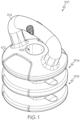
- Figure 1 is a perspective view of pet toy 100 ;
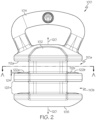
- Figure 2 is a front elevation view of pet toy 100 ;
- Figure 3 is a section view of pet toy 100 taken along line A-A in Figure 2 ;
- Figure 4 is a side elevation view of pet toy 100 (the other side being substantially identical);
- Figure 5 is a top plan view of pet toy 100 ;
- Figure 6 is a bottom plan view of pet toy 100.
- pet toy 100 includes a body 102.
- Body 102 has an exterior surface, which in the various different embodiments can have different profiles and/or contours and/or surface finishes.
- body 102 of pet toy 100 can have any desired overall form, including, without limitation, that of a ball, a bone, a stick, an animal or human food item (e.g., a steak, a chicken leg, a donut, etc.), a geometric form (e.g., a sphere, a pyramid, a cube, a star, etc.), and/or an irregular form.
- at least a portion of body 102 may have a curved, ovoid, or rounded shape.
- body 102 can have a substantially circular cross-section when viewed in plan.
- pet toy 100 has the overall form of a simulated kettlebell and accordingly body 102 includes an optional handle portion 104 , which in at least some embodiments is formed integrally with and of the same material as the remainder of body 102.
- handle portion 104 promotes various types of pet play, for example, a "tug-of-war" in which the pet grasps either body 102 or handle portion 104 in its jaws and a human handler grasps and pulls the other of body 102 or handle portion 104.
- Body 102 may also include a substantially planar surface 106 (best seen in Figures 2 and 6 ) that enables body to rest in a stable position on an underlying substrate (e.g., the floor or ground).
- body 102 (including handle portion 104 ) is preferably made of a resilient elastomeric material, such as a thermoplastic elastomer or natural rubber, which has sufficient durability to withstand the repeated biting action of an animal without tearing or permanent deformation.
- Body 102 can be made, for example, by injection molding.
- body 102 can advantageously be formed with a hole 108 partially or fully there through. Hole 108 reduces the weight and cost of pet toy 100 and renders body 102 more pliable and easier for a pet to deform, thus promoting extended pet interaction with pet toy 100.
- hole 108 can be located along a central axis 120 of body 102 , as shown in Figures 1 , 3 , and 6 .
- the exterior surface of pet toy 100 has at least one recess or slot 110 formed therein.
- body 102 of pet toy 100 has two slots 110a , 110b formed therein. If multiple slots 110 are included in a pet toy 100 , the slots need not be identical and may instead having differing dimensions (e.g., widths, depths, lengths) and/or interior surfaces.
- each slot 110 has an opening at which the slot 110 communicates with the exterior surface of pet toy 100 , a base formed by a core portion 114 of body 102 (which in this embodiment surrounds hole 108 ), and a pair of opposing sidewalls 112a, 112b extending between the base and the opening.
- each slot 110 is fully circumferential with respect to body 102 ; in other embodiments, one or more of slots 110 may have an opening that extends less than all the way about body 102.
- sidewalls 112a, 112b are substantially planar and approximately parallel.
- core portion 114 of body 102 is radially asymmetric in a plane formed by taking a section along line A-A orthogonal to axis 120 of body 102. Consequently, some regions of core portion 114 extend further from axis 120 of body 108 that other regions of core portion 114.
- the ratio of a first dimension 116 of core portion 114 (i.e., a minimum dimension of core portion 114 measured through axis 120 ) to a second dimension 118 of core portion 114 (i.e., a maximum dimension of core portion 114 measured through axis 120 ) is between about 0.6 and about 0.8 and, more particularly, about 0.7.
- slot 110 and core portion 114 are selected to correspond to, and to accommodate within slot 110 , an edible treat that can be utilized in combination with pet toy 100.
- an edible treat that can be utilized in combination with pet toy 100.
- the provision in a slot 110 of an edible treat that can be consumed by the pet increases a pet's interest in and engagement with a pet toy 100.
- Some prior art pet toys exemplified by those disclosed in U.S. Patent No. RE39563 , rely on the resilience of the material from which the pet toys are formed and interference fit between pet treats and recesses formed in the pet toys in order to retain pet treats in the slots.
- the present application recognizes that often the retention force applied to the pet treats by such pet toys are frequently insufficient to retain the pet treats in the recesses for a long enough duration to achieve a desired period of engagement by the pet with the pet toy.
- the retention force applied to the pet treats by such pet toys are frequently insufficient to retain the pet treats in the recesses for a long enough duration to achieve a desired period of engagement by the pet with the pet toy.
- all of the pet treats fall out of the recesses onto the underlying substrate and are rapidly consumed by the pet. The pet consequently loses interest in the pet toy as soon as the pet treats are separated from the pet toy.
- Pet toys in accordance with the embodiments disclosed herein address the issue of treat retention by providing one or more treat retention features that can extend a duration that a pet treat is retained in a slot 110.
- the treat retention features include the relative dimensions of the pet treats and slots 110.
- a width 128 of slot 110 and depth of slot 110 between the opening and core portion 114 are selected so that a pet will typically bite, gnaw, or lick on an edge of a treat, reducing the likelihood that the pet will rapidly remove the treat from the pet toy 100.
- the treat retention features include the radially asymmetric configuration of core portion 114 noted above.
- the treat retention features including cooperating surface features on the pet treat and at least one sidewall 112.
- at least one of sidewalls 112a, 112b includes at least one boss 122 (and in this case, two bosses 122a, 122b ) protruding from its generally planar surface into the interior of slot 110.
- Boss(es) 122 are designed to cooperate with substantially corresponding recess(es) formed in the surfaces of pet treats and thus promote retention of the pet treats within slots 110.
- each boss 122 has tapered edges and rises to a maximum extension 124 normal to the surrounding areas of sidewall 112 of between about 1 mm and about 2 mm.
- Each boss 122 may have a width 126 of between, for example, about 10 mm and about 20 mm.
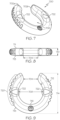
- pet treats 700 that may utilized in combination with a pet toy 100 in accordance with at least one embodiment.
- pet treats 700 can be rigid or semi-rigid and can be formed, for example, by injection molding as is known in the art. It is preferred if pet treats 700 are digestible by an animal and provide nutrition as well as a desirable flavor.
- pet treat 700 has a body having a generally horseshoe-shaped form, defined by a partial loop having two spaced-apart ends 702a, 702b separated by a gap 704.
- a minimum dimension of gap 704 is preferably selected such that first dimension 116 of core portion 114 can pass through gap 704 (either because the minimum dimension of gap 704 is equal to or greater than first dimension 116 or because elastic deformation of core portion 114 permits core portion 114 to pass through gap 704 even if first dimension 116 is greater than the minimum dimension of gap 704 ).
- the minimum dimension of gap 704 is further preferably selected such that second dimension 118 of core portion 114 cannot readily pass through gap 704 (e.g., because the minimum dimension of gap 704 is substantially less than the second dimension 118 of core portion 114 ).
- the partial loop of pet treat 700 has a generally circular central opening 706 that communicates with gap 704.
- a diameter 708 of this central opening 706 is greater than second dimension 118 of core portion 114.
- Pet treat 700 additionally has a thickness 710 measured orthogonally between substantially parallel first and second sides 711, 713 that is less than the width 128 at the opening of a slot 110.
- a minimum radial dimension 712 of pet treat 700 as measured radially between an interior edge 716 and an exterior edge 718 and a maximum dimension 714 of pet treat 700 are preferably selected to achieve a desired relationship between exterior edge 718 and the opening of a slot 110. In some cases, minimum radial dimension 712 and maximum dimension 714 are chosen such that exterior edge 718 of pet treat 700 is within a slot 110 when the pet treat 700 is installed in the slot 110.
- minimum radial dimension 712 and maximum dimension 714 are chosen such that at least exterior edge 718 of pet treat 700 extends outwardly from a slot 110 past the opening of the slot 110 when pet treat 700 is installed in the slot 110. In yet other cases, minimum radial dimension 712 and maximum dimension 714 are chosen such that at least exterior edge 718 of pet treat 700 installed in a slot 110 is approximately at the opening of the slot 110, as shown in Figure 12 .
- pet treat 700 includes grip enhancement features, such as bumps, ridges, and/or notches 720, formed in or on at least a portion of exterior edge 718 of pet treat 700.
- pet treat 700 includes surface features that in cooperation with surface features of sidewalls 112a and/or 112b form treat retention features.
- pet treat 700 when pet treat 700 is configured for use with a pet toy 100 having at least one boss 122 formed on the sidewall of a slot 110, pet treat 700 preferably includes at least one recess 722 formed in at least one of first side 711 and second side 713.
- pet treat 722 includes, in each of first side 711 and second side 713, two recesses 722 on opposing sides of central opening 706 and corresponding in spacing and location to bosses 122a, 122b.
- a pet treat 700 may have only one or more than two recesses formed in a given side 711 or 713.
- pet treat 700 may have the recess(es) formed in only one of sides 711 or 713.
- the pet treat 700 would have increased probability of retention within a slot 110 if the pet treat 700 is installed in a slot 110 with the recess(es) 722 engaging boss(es) 122 and a lesser probability of retention within the slot 110 otherwise.
- the depths of recesses 722, which can be utilized to control the retention force applied to pet treat 700 by pet toy 100, can vary between different pet treats 700, between the different sides 711 and 713 of a given pet treat 700, and between recesses 722 on a given side 711 or 713 of a given pet treat 722.
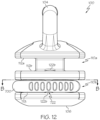
- FIG. 10-12 there are depicted two section views taken along line B-B of Figure 12 and a right side elevation view illustrating the installation of a pet treat 700 in a pet toy 100 in accordance with at least one embodiment.
- a pet treat 700 is installed into a slot 110 of a pet toy 100 by a human user as follows. First, the human user first translates pet treat 700 along a first linear direction indicated by arrow 1000 to cause core portion 114 of body 102 to pass through gap 704 into central opening 706 of pet treat 700, thus inserting pet treat 700 within slot 110. It should be noted in the initial treat insertion position shown in Figure 10 , recesses 722 on second side 713 of pet treat 700 do not engage bosses 122a, 122b on sidewall 112b of slot 110b.
- the human user rotates or twists pet treat 700 with respect to body 102 of pet toy 100 to cause a boss 122 (e.g., formed on a sidewall 112 of slot 110 ) to engage a cooperating recess 722 (e.g., formed in side 711 or 713 of pet treat 700 ).
- a boss 122 e.g., formed on a sidewall 112 of slot 110
- a cooperating recess 722 e.g., formed in side 711 or 713 of pet treat 700 .
- the human user rotates pet treat 700 90 degrees clockwise with respect to body 102 of pet toy 100, as indicated by arrow 1002, in order to obtain the orientation illustrated in Figures 11-12 . In this orientation, bosses 112 engage recesses 722 .
- the human user could alternatively engage bosses 122 with cooperating recesses 722 by rotating pet treat 700 90 degrees counter-clockwise with respect to body 102 of pet toy 100.
- pet treat 700 has improved resistance to removal from slot 110b, thus encouraging extended pet interaction with pet toy 100.
- cooperating surface features may alternatively or additionally be disposed on or formed in one or more of sidewalls 112a, 112b at radial positions other than 90 degrees with respect to the initial insertion position.
- a cooperating surface feature may be located on a sidewall 112a or 112b at a lesser or greater angle than 90 degrees from the initial insertion position.
- the human user can provide pet toy 100 to an animal to interact with. The animal will then attempt, via chewing, biting, licking to dislodge and/or to consume treat(s) 700. Once all treat(s) 700 are removed from slot(s) 110 by the animal, the animal can continue to interact with pet toy 100. Pet toy 100 may thereafter be reloaded with additional treats 700 as desired.
- pet toy 1300 is preferably made of a resilient elastomeric material, such as a thermoplastic elastomer or natural rubber and can be formed by injection molding.
- pet toy 1300 includes many features that, although possibly differing in configuration and/or number, correspond to those of pet toy 100.
- pet toy 1300 includes a body 102' having two handle portions 104' on opposing sides of body 102'.
- Body 102' includes a hole 108', which in this embodiment is formed fully through body 102' and is centered on a central axis 120' of body 102.
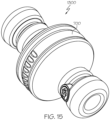
- the exterior surface of pet toy 1300 has a single slot 110' formed therein. As indicated by like reference numerals, the features of slot 110' can be implemented as described above with respect to slots 110a, 110b of pet toy 100. As shown in Figure 15 , a pet treat 700 can be installed in slot 110' of pet toy 1300 substantially as described above with reference to Figures 10-12 .
- an improved pet toy is configured for use with a pet treat having a body with a gap therein that communicates with a central opening in the pet treat.
- the pet toy includes a body having an exterior surface and a core portion that is radially asymmetric and a slot formed in the body about the core portion.
- the slot has the core portion as a base and includes a sidewall having a second surface feature configured to cooperate with a first surface feature of the pet treat to promote retention of the pet treat in the slot.
- one of the first and second surface features is a boss and the other is a recess.
- the first and second surface features are engaged by rotating the pet treat within the slot with respect to the body of the pet toy.
- a pet treat is configured for use with a pet toy having a slot partially defined by a sidewall.
- the pet treat includes an edible body having a first side and an opposing second side.
- the body has a gap therein that communicates with a central opening in the body.
- a first surface feature is disposed on the body and configured to cooperate with a second surface feature of the sidewall of the slot of the pet toy to promote retention of the pet treat in the slot of the pet toy.
- the invention is further defined by a method according to claim 15 and includes providing a pet treat including an edible body having a first side and an opposing second side.
- the body has a gap therein that communicates with a central opening in the body and further includes a first surface feature disposed on the body.
- the method additionally includes providing a pet toy configured for use with the pet treat.
- the pet toy includes a body having an exterior surface and a core portion that is radially asymmetric.
- a slot is formed in the body of the pet toy about the core portion.
- the slot has the core portion as a base and includes a sidewall having a second surface feature configured to cooperate with the first surface feature of the pet treat to promote retention of the pet treat in the slot.
- the method additionally includes inserting the pet treat in the slot such that the core portion is received through the gap into the central opening and engaging the first surface feature on the pet treat with the second surface feature on the pet toy.
Landscapes
- Life Sciences & Earth Sciences (AREA)
- Environmental Sciences (AREA)
- Health & Medical Sciences (AREA)
- Animal Husbandry (AREA)
- Biodiversity & Conservation Biology (AREA)
- Animal Behavior & Ethology (AREA)
- Zoology (AREA)
- Physical Education & Sports Medicine (AREA)
- General Health & Medical Sciences (AREA)
- Dentistry (AREA)
- Birds (AREA)
- Housing For Livestock And Birds (AREA)
- Feeding And Watering For Cattle Raising And Animal Husbandry (AREA)
Description
- The present disclosure relates to a pet toy and use of the pet toy to provide an edible treat for a pet.
- A variety of pet toys have been designed, manufactured, and sold, often with the intent of encouraging pet interaction, mental stimulation, and/or play, while reducing or eliminating pet boredom and its associated destructive behaviors. For dogs, these destructive behaviors may include, for example, biting, gnawing or clawing furniture or other articles in the dog's environment, digging or otherwise seeking to escape confinement, and excessive barking.
- Pet toys often seek to incentivize a pet's extended interaction with the pet toy by providing one or more edible items (e.g., pet treat(s), pet food, or the like) to the pet over a relatively long time interval. However, in practice, an extended interval of animal interaction with the toy may not be achieved for some pet toys, for example, because the pet toy dispenses the edible item(s) to the pet in too great a quantity or too rapidly or because the pet toy makes it too difficult for the pet to consume the edible item(s). In either case, the pet will become disinterested in the pet toy and consequently engage in an undesired and/or destructive behavior.
-
US 10 932 449 B2 -
WO 2009/039153 A1 discloses pet toys configured to accept an edible or chewable treat which can be readily replaced. The pet toys have a first portion and a second portion which releaseably engage to retain the edible treat with the toy until the treat is consumed or otherwise removed from the toy by the pet. When desired, the toy can be disassembled by removing the first portion from the second portion, new treats can be added to the toy, and the two portions reassembled -
WO 2004/043142 A1 discloses a non-consumable pet toy includes a resilient first concave-shaped molded member having a first peripheral edge and a resilient second concave-shaped molded member having a second peripheral edge. The first and second members have a treat-retaining cavity between them. The treat retaining pet toy also includes a fastener extending centrally through the treat-retaining cavity. - According to the invention as defined in claim 1, an improved pet toy is configured for use with a pet treat having a body with a gap therein that communicates with a central opening in the pet treat. The pet toy includes a body having an exterior surface and a core portion that is radially asymmetric and a slot formed in the body about the core portion. The slot has the core portion as a base and includes a sidewall having a second surface feature configured to cooperate with a first surface feature of the pet treat to promote retention of the pet treat in the slot. In some embodiments, one of the first and second surface features is a boss and the other is a recess. In some embodiments, the first and second surface features are engaged by rotating the pet treat within the slot with respect to the body of the pet toy.
- According to the invention as defined in claim 1, a pet treat is configured for use with a pet toy having a slot partially defined by a sidewall. The pet treat includes an edible body having a first side and an opposing second side. The body has a gap therein that communicates with a central opening in the body. A first surface feature is disposed on the body and configured to cooperate with a second surface feature of the sidewall of the slot of the pet toy to promote retention of the pet treat in the slot of the pet toy.
- According to the invention as defined in claim 15, a method of using a pet toy includes providing a pet treat including an edible body having a first side and an opposing second side. The body has a gap therein that communicates with a central opening in the body and further includes afirstsurface feature disposed on the body. The method additionally includes providing a pet toy configured for use with the pet treat. The pet toy includes a body having an exterior surface and a core portion that is radially asymmetric. A slot is formed in the body of the pet toy about the core portion. The slot has the core portion as a base and includes a sidewall having a second surface feature configured to cooperate with the first surface feature of the pet treat to promote retention of the pet treat in the slot. The method additionally includes inserting the pet treat in the slot such that the core portion is received through the gap into the central opening and engaging the first surface feature on the pet treat with the second surface feature on the pet toy.
-
-
Figure 1 is a perspective view of a pet toy in accordance with at least one embodiment; -
Figure 2 is a front elevation view of a pet toy in accordance with at least one embodiment; -
Figure 3 is a section view of a pet toy in accordance with at least one embodiment; -
Figure 4 is a side elevation view of a pet toy in accordance with at least one embodiment; -
Figures 5-6 are top and bottom plan views, respectively, of a pet toy in accordance with at least one embodiment; -
Figures 7-9 are perspective, elevation, and plan views, respectively, of a pet treat that may utilized in combination with a pet toy in accordance with at least one embodiment; -
Figures 10-12 are section views and a side elevation view illustrating the installation of a pet treat in a pet toy in accordance with at least one embodiment; -
Figures 13-14 are front elevation and section views of another embodiment of a pet toy with which a pet treat can be utilized; and -
Figure 15 depicts a perspective view of the installation of a pet treat in the pet toy ofFigures 13-14 . - With reference now to the figures and with particular reference to
Figures 1-6 , there are illustrated a number of views of apet toy 100 in accordance with the invention as defined in claim 1. In particular,Figure 1 is a perspective view ofpet toy 100;Figure 2 is a front elevation view ofpet toy 100;Figure 3 is a section view ofpet toy 100 taken along line A-A inFigure 2 ;Figure 4 is a side elevation view of pet toy 100 (the other side being substantially identical);Figure 5 is a top plan view ofpet toy 100; andFigure 6 is a bottom plan view ofpet toy 100. - As shown,
pet toy 100 includes abody 102.Body 102 has an exterior surface, which in the various different embodiments can have different profiles and/or contours and/or surface finishes. Further, in various embodiments,body 102 ofpet toy 100 can have any desired overall form, including, without limitation, that of a ball, a bone, a stick, an animal or human food item (e.g., a steak, a chicken leg, a donut, etc.), a geometric form (e.g., a sphere, a pyramid, a cube, a star, etc.), and/or an irregular form. Although not required in all embodiments, in some embodiments, at least a portion ofbody 102 may have a curved, ovoid, or rounded shape. For example, as best seen inFigures 1 ,3 ,5 and 6 , at least a portion ofbody 102 can have a substantially circular cross-section when viewed in plan. In this example,pet toy 100 has the overall form of a simulated kettlebell and accordinglybody 102 includes anoptional handle portion 104, which in at least some embodiments is formed integrally with and of the same material as the remainder ofbody 102. The inclusion ofhandle portion 104 promotes various types of pet play, for example, a "tug-of-war" in which the pet grasps eitherbody 102 or handleportion 104 in its jaws and a human handler grasps and pulls the other ofbody 102 orhandle portion 104.Body 102 may also include a substantially planar surface 106 (best seen inFigures 2 and6 ) that enables body to rest in a stable position on an underlying substrate (e.g., the floor or ground). - Although not required, body 102 (including handle portion 104) is preferably made of a resilient elastomeric material, such as a thermoplastic elastomer or natural rubber, which has sufficient durability to withstand the repeated biting action of an animal without tearing or permanent deformation.
Body 102 can be made, for example, by injection molding. Although not required,body 102 can advantageously be formed with ahole 108 partially or fully there through.Hole 108 reduces the weight and cost ofpet toy 100 andrenders body 102 more pliable and easier for a pet to deform, thus promoting extended pet interaction withpet toy 100. Although not required,hole 108 can be located along acentral axis 120 ofbody 102, as shown inFigures 1 ,3 , and6 . - The exterior surface of
pet toy 100 has at least one recess orslot 110 formed therein. In the example ofFigures 1-6 ,body 102 ofpet toy 100 has twoslots multiple slots 110 are included in apet toy 100, the slots need not be identical and may instead having differing dimensions (e.g., widths, depths, lengths) and/or interior surfaces. In the example ofFigures 1-6 , eachslot 110 has an opening at which theslot 110 communicates with the exterior surface ofpet toy 100, a base formed by acore portion 114 of body 102 (which in this embodiment surrounds hole 108), and a pair ofopposing sidewalls slot 110 is fully circumferential with respect tobody 102; in other embodiments, one or more ofslots 110 may have an opening that extends less than all the way aboutbody 102. Although not required in all embodiments, in the depicted embodiment,sidewalls - According to the invention and as best seen in
Figures 2-3 ,core portion 114 ofbody 102 is radially asymmetric in a plane formed by taking a section along line A-A orthogonal toaxis 120 ofbody 102. Consequently, some regions ofcore portion 114 extend further fromaxis 120 ofbody 108 that other regions ofcore portion 114. For example, in some embodiments the ratio of afirst dimension 116 of core portion 114 (i.e., a minimum dimension ofcore portion 114 measured through axis 120) to asecond dimension 118 of core portion 114 (i.e., a maximum dimension ofcore portion 114 measured through axis 120) is between about 0.6 and about 0.8 and, more particularly, about 0.7. - As made clear in the following discussion, the sizes and shapes of
slot 110 andcore portion 114 are selected to correspond to, and to accommodate withinslot 110, an edible treat that can be utilized in combination withpet toy 100. As will be appreciated, the provision in aslot 110 of an edible treat that can be consumed by the pet increases a pet's interest in and engagement with apet toy 100. Some prior art pet toys, exemplified by those disclosed inU.S. Patent No. RE39563 , rely on the resilience of the material from which the pet toys are formed and interference fit between pet treats and recesses formed in the pet toys in order to retain pet treats in the slots. However, the present application recognizes that often the retention force applied to the pet treats by such pet toys are frequently insufficient to retain the pet treats in the recesses for a long enough duration to achieve a desired period of engagement by the pet with the pet toy. For example, for some prior art pet toys, if a pet bites or chews on the pet toy even briefly, all of the pet treats fall out of the recesses onto the underlying substrate and are rapidly consumed by the pet. The pet consequently loses interest in the pet toy as soon as the pet treats are separated from the pet toy. - Pet toys in accordance with the embodiments disclosed herein address the issue of treat retention by providing one or more treat retention features that can extend a duration that a pet treat is retained in a
slot 110. First, in at least some embodiments, the treat retention features include the relative dimensions of the pet treats andslots 110. In at least some embodiments, awidth 128 ofslot 110 and depth ofslot 110 between the opening andcore portion 114 are selected so that a pet will typically bite, gnaw, or lick on an edge of a treat, reducing the likelihood that the pet will rapidly remove the treat from thepet toy 100. Second, in at least some embodiments, the treat retention features include the radially asymmetric configuration ofcore portion 114 noted above. Because of this radially asymmetry, a pet treat installed in aslot 110 as discussed below will tend to be retained within theslot 110. Third, according to the invention, the treat retention features including cooperating surface features on the pet treat and at least one sidewall 112. For example, as best seen inFigures 2-3 , at least one of sidewalls 112a, 112b (in this case,only sidewall 112b) includes at least one boss 122 (and in this case, twobosses slot 110. Boss(es) 122 are designed to cooperate with substantially corresponding recess(es) formed in the surfaces of pet treats and thus promote retention of the pet treats withinslots 110. Those skilled in the art will readily appreciate that the locations of the cooperating surface features can be reversed, for example, with the boss(es) implemented on the pet treats and the substantially corresponding recess(es) formed in sidewall(s) 112. In the exemplary embodiment shown inFigure 3 , each boss 122 has tapered edges and rises to amaximum extension 124 normal to the surrounding areas of sidewall 112 of between about 1 mm and about 2 mm. Each boss 122 may have awidth 126 of between, for example, about 10 mm and about 20 mm. - With reference now to
Figures 7-9 , there are illustrated perspective, elevation, and plan views, respectively, of apet treat 700 that may utilized in combination with apet toy 100 in accordance with at least one embodiment. In one or more embodiments, pet treats 700 can be rigid or semi-rigid and can be formed, for example, by injection molding as is known in the art. It is preferred if pet treats 700 are digestible by an animal and provide nutrition as well as a desirable flavor. - According to the invention, pet treat 700 has a body having a generally horseshoe-shaped form, defined by a partial loop having two spaced-apart ends 702a, 702b separated by a
gap 704. A minimum dimension ofgap 704 is preferably selected such thatfirst dimension 116 ofcore portion 114 can pass through gap 704 (either because the minimum dimension ofgap 704 is equal to or greater thanfirst dimension 116 or because elastic deformation ofcore portion 114permits core portion 114 to pass throughgap 704 even iffirst dimension 116 is greater than the minimum dimension of gap 704). The minimum dimension ofgap 704 is further preferably selected such thatsecond dimension 118 ofcore portion 114 cannot readily pass through gap 704 (e.g., because the minimum dimension ofgap 704 is substantially less than thesecond dimension 118 of core portion 114). In the depicted example, the partial loop of pet treat 700 has a generally circularcentral opening 706 that communicates withgap 704. In this example, adiameter 708 of thiscentral opening 706 is greater thansecond dimension 118 ofcore portion 114. -
Pet treat 700 additionally has athickness 710 measured orthogonally between substantially parallel first andsecond sides width 128 at the opening of aslot 110. A minimumradial dimension 712 of pet treat 700 as measured radially between aninterior edge 716 and anexterior edge 718 and amaximum dimension 714 of pet treat 700 are preferably selected to achieve a desired relationship betweenexterior edge 718 and the opening of aslot 110. In some cases, minimumradial dimension 712 andmaximum dimension 714 are chosen such thatexterior edge 718 of pet treat 700 is within aslot 110 when thepet treat 700 is installed in theslot 110. In other cases, minimumradial dimension 712 andmaximum dimension 714 are chosen such that at leastexterior edge 718 of pet treat 700 extends outwardly from aslot 110 past the opening of theslot 110 when pet treat 700 is installed in theslot 110. In yet other cases, minimumradial dimension 712 andmaximum dimension 714 are chosen such that at leastexterior edge 718 of pet treat 700 installed in aslot 110 is approximately at the opening of theslot 110, as shown inFigure 12 . In some embodiments, pet treat 700 includes grip enhancement features, such as bumps, ridges, and/ornotches 720, formed in or on at least a portion ofexterior edge 718 ofpet treat 700. - As noted above, pet treat 700 includes surface features that in cooperation with surface features of sidewalls 112a and/or 112b form treat retention features. For example, when pet treat 700 is configured for use with a
pet toy 100 having at least one boss 122 formed on the sidewall of aslot 110, pet treat 700 preferably includes at least onerecess 722 formed in at least one offirst side 711 andsecond side 713. In the depicted example, pet treat 722 includes, in each offirst side 711 andsecond side 713, tworecesses 722 on opposing sides ofcentral opening 706 and corresponding in spacing and location tobosses - It should be appreciated that the number, location, and size of
recesses 722 may be varied from the depicted example. For example, apet treat 700 may have only one or more than two recesses formed in a givenside sides pet treat 700 would have increased probability of retention within aslot 110 if thepet treat 700 is installed in aslot 110 with the recess(es) 722 engaging boss(es) 122 and a lesser probability of retention within theslot 110 otherwise. Further, the depths ofrecesses 722, which can be utilized to control the retention force applied to pet treat 700 bypet toy 100, can vary between different pet treats 700, between thedifferent sides pet treat 700, and betweenrecesses 722 on a givenside pet treat 722. - Referring now to
Figures 10-12 , there are depicted two section views taken along line B-B ofFigure 12 and a right side elevation view illustrating the installation of apet treat 700 in apet toy 100 in accordance with at least one embodiment. - In use, a
pet treat 700 is installed into aslot 110 of apet toy 100 by a human user as follows. First, the human user first translatespet treat 700 along a first linear direction indicated byarrow 1000 to causecore portion 114 ofbody 102 to pass throughgap 704 intocentral opening 706 ofpet treat 700, thus insertingpet treat 700 withinslot 110. It should be noted in the initial treat insertion position shown inFigure 10 , recesses 722 onsecond side 713 of pet treat 700 do not engagebosses sidewall 112b ofslot 110b. - Second, the human user rotates or twists pet treat 700 with respect to
body 102 ofpet toy 100 to cause a boss 122 (e.g., formed on a sidewall 112 of slot 110) to engage a cooperating recess 722 (e.g., formed inside pet treat 700 90 degrees clockwise with respect tobody 102 ofpet toy 100, as indicated byarrow 1002, in order to obtain the orientation illustrated inFigures 11-12 . In this orientation, bosses 112 engage recesses 722. Of course, in the depicted embodiment, the human user could alternatively engage bosses 122 with cooperatingrecesses 722 by rotatingpet treat 700 90 degrees counter-clockwise with respect tobody 102 ofpet toy 100. As best seen inFigure 12 , withboss 122b engaged with the concave surface of cooperatingrecess 722, pet treat 700 has improved resistance to removal fromslot 110b, thus encouraging extended pet interaction withpet toy 100. - Those skilled in the art will appreciate that in other embodiments, cooperating surface features may alternatively or additionally be disposed on or formed in one or more of sidewalls 112a, 112b at radial positions other than 90 degrees with respect to the initial insertion position. For example, a cooperating surface feature may be located on a
sidewall - After the desired treat(s) 700 are loaded into
pet toy 100, the human user can providepet toy 100 to an animal to interact with. The animal will then attempt, via chewing, biting, licking to dislodge and/or to consume treat(s) 700. Once all treat(s) 700 are removed from slot(s) 110 by the animal, the animal can continue to interact withpet toy 100.Pet toy 100 may thereafter be reloaded withadditional treats 700 as desired. - With reference now to
Figures 13-14 , there are illustrated front elevation and section views of another embodiment of apet toy 1300 with which apet treat 700 can be utilized. As discussed above with respect topet toy 100,pet toy 1300 is preferably made of a resilient elastomeric material, such as a thermoplastic elastomer or natural rubber and can be formed by injection molding. - As indicated by prime notation,
pet toy 1300 includes many features that, although possibly differing in configuration and/or number, correspond to those ofpet toy 100. For example,pet toy 1300 includes a body 102' having two handle portions 104' on opposing sides of body 102'. Body 102' includes a hole 108', which in this embodiment is formed fully through body 102'and is centered on a central axis 120' ofbody 102. - The exterior surface of
pet toy 1300 has a single slot 110' formed therein. As indicated by like reference numerals, the features of slot 110' can be implemented as described above with respect toslots pet toy 100. As shown inFigure 15 , apet treat 700 can be installed in slot 110' ofpet toy 1300 substantially as described above with reference toFigures 10-12 . - As has been described, in one or more embodiments, an improved pet toy is configured for use with a pet treat having a body with a gap therein that communicates with a central opening in the pet treat. The pet toy includes a body having an exterior surface and a core portion that is radially asymmetric and a slot formed in the body about the core portion. The slot has the core portion as a base and includes a sidewall having a second surface feature configured to cooperate with a first surface feature of the pet treat to promote retention of the pet treat in the slot. In some embodiments, one of the first and second surface features is a boss and the other is a recess. In some embodiments, the first and second surface features are engaged by rotating the pet treat within the slot with respect to the body of the pet toy.
- In some embodiments, a pet treat is configured for use with a pet toy having a slot partially defined by a sidewall. The pet treat includes an edible body having a first side and an opposing second side. The body has a gap therein that communicates with a central opening in the body. A first surface feature is disposed on the body and configured to cooperate with a second surface feature of the sidewall of the slot of the pet toy to promote retention of the pet treat in the slot of the pet toy.
- The invention is further defined by a method according to claim 15 and includes providing a pet treat including an edible body having a first side and an opposing second side. The body has a gap therein that communicates with a central opening in the body and further includes a first surface feature disposed on the body. The method additionally includes providing a pet toy configured for use with the pet treat. The pet toy includes a body having an exterior surface and a core portion that is radially asymmetric. A slot is formed in the body of the pet toy about the core portion. The slot has the core portion as a base and includes a sidewall having a second surface feature configured to cooperate with the first surface feature of the pet treat to promote retention of the pet treat in the slot. The method additionally includes inserting the pet treat in the slot such that the core portion is received through the gap into the central opening and engaging the first surface feature on the pet treat with the second surface feature on the pet toy.
- While the present invention has been particularly shown as described with reference to one or more preferred embodiments, it will be understood by those skilled in the art that various changes in form and detail may be made therein without departing from the scope of the invention. For example, elements of the disclosed embodiments can be combined to form additional embodiments within the scope of the appended claims. The term "coupled" as used herein is defined to encompass embodiments employing a direct connection between coupled elements, as well as embodiments employing an indirect connection between coupled elements achieved using one or more intervening elements. In addition, the term "exemplary" is defined herein as meaning one example of a feature, not necessarily the best or preferred example. The terms "approximately," "substantially", and "about" are utilized herein to indicate ranges of values within 10% of the stated values.
Claims (17)
- A system comprising:
a pet treat (700) including:an edible treat body having a first side and an opposing second side, said edible treat body having a generally horseshoe-shaped form, defined by a partial loop having two spaced-apart ends (702a, 702b) separated by a gap (704) therein that communicates with a central opening in the treat body; anda first surface feature (722) disposed on the edible treat body;a pet toy (100) including:a toy body (102) having an exterior surface (1300) and a core portion (114) that is radially asymmetric; anda slot (110) formed in the exterior surface (1300) of the toy body (102) and about the core portion (114), wherein the slot (110) has the core portion (114) as a base and includes a sidewall (112a, 112b) having a second surface feature (122) configured to cooperate with the first surface feature (722) of the pet treat (700) to promote retention of the pet treat (700) in the slot (110). - The system of Claim 1, wherein the second surface feature (122) is a boss protruding from the sidewall (112a, 112b) into the slot (110).
- The system of Claim 1, wherein the second surface feature (122) is a recess formed in the sidewall (112a, 112b).
- The system of Claim 1, wherein the sidewall (112a, 112b) is substantially planar.
- The system of Claim 4, wherein:The sidewall (112a, 112b) is a first sidewall; andthe slot (110) includes a second sidewall substantially parallel to the first sidewall.
- The system of Claim 1, wherein the toy body (102) has a hole (108) formed through the core portion (102).
- The system of Claim 1, wherein the second surface feature (122) is positioned on the sidewall (112a, 112b) such that the pet treat (700) must be radially displaced from an initial insertion position for the first surface feature (722) to engage the second surface feature (122).
- The system of Claim 1, wherein the toy body (102) has a curved portion and the slot (110) is formed in the curved portion of the toy body (102).
- The system of Claim 1, wherein the sidewall (112a, 112b) includes multiple of the second surface features (122).
- The system of Claim 1, wherein the toy body (102) includes a handle portion (104).
- The system of Claim 1, wherein the treat body has a substantially circular exterior surface at a periphery of the pet treat (700).
- The system of Claim 1, wherein:
the first surface feature (722) is disposed on the first side of the edible treat body. - The system of Claim 12, wherein the second side includes another of the first surface feature (722).
- The system of Claim 1, wherein the first surface feature (722) is one of the following: a boss and a recess.
- A method of using a system according to anyone of claims 1-14, the method comprising:
inserting the pet treat (700) in the slot such that the core portion (114) is received through the gap (704) and engaging the first surface feature (722) and the second surface feature (122). - The method of Claim 15, wherein the engaging includes rotating the pet treat (700) within the slot (110) with respect to the body (102) of the pet toy (100).
- The method of Claim 15, and further comprising making the pet toy (100) accessible to an animal.
Applications Claiming Priority (1)
| Application Number | Priority Date | Filing Date | Title |
|---|---|---|---|
| US17/337,660 US11793168B2 (en) | 2021-06-03 | 2021-06-03 | Pet toy having treat retention features |
Publications (3)
| Publication Number | Publication Date |
|---|---|
| EP4129053A1 EP4129053A1 (en) | 2023-02-08 |
| EP4129053C0 EP4129053C0 (en) | 2024-12-04 |
| EP4129053B1 true EP4129053B1 (en) | 2024-12-04 |
Family
ID=81850362
Family Applications (1)
| Application Number | Title | Priority Date | Filing Date |
|---|---|---|---|
| EP22175196.9A Active EP4129053B1 (en) | 2021-06-03 | 2022-05-24 | Pet toy having treat retention features |
Country Status (3)
| Country | Link |
|---|---|
| US (1) | US11793168B2 (en) |
| EP (1) | EP4129053B1 (en) |
| CN (1) | CN115428747B (en) |
Families Citing this family (5)
| Publication number | Priority date | Publication date | Assignee | Title |
|---|---|---|---|---|
| USD1002966S1 (en) * | 2021-06-03 | 2023-10-24 | Starmark Pet Products, Inc. | Pet toy |
| USD1062924S1 (en) * | 2023-10-20 | 2025-02-18 | Xiaorong Tong | Kettlebell |
| USD1062925S1 (en) * | 2023-10-20 | 2025-02-18 | Xiaorong Tong | Kettlebell |
| USD1062926S1 (en) * | 2023-11-06 | 2025-02-18 | Xiaorong Tong | Kettlebell |
| USD1121248S1 (en) | 2024-10-02 | 2026-03-31 | Evgeni Perzov | Muzzle |
Citations (1)
| Publication number | Priority date | Publication date | Assignee | Title |
|---|---|---|---|---|
| GB2532578A (en) * | 2014-09-25 | 2016-05-25 | Ramirez Nicola | Animal amusement device |
Family Cites Families (67)
| Publication number | Priority date | Publication date | Assignee | Title |
|---|---|---|---|---|
| USD248493S (en) | 1976-03-17 | 1978-07-11 | Moncrief J D | Massaging device |
| USD308122S (en) | 1988-02-01 | 1990-05-22 | Bounce, Inc. | Pet toy |
| US5947061A (en) | 1996-06-13 | 1999-09-07 | Bounce, Inc. | Pet toy product with integral treats receiving receptacles |
| US5865146A (en) | 1998-03-12 | 1999-02-02 | Bounce, Inc. | Bouncing pet toy |
| USD428946S (en) | 1999-01-05 | 2000-08-01 | Michael Boorstein | Hand and wrist exerciser |
| US20040083983A1 (en) | 2002-11-05 | 2004-05-06 | Markham Joseph P. | Pet toys incorporating multiple hardness sections |
| EP1581045B1 (en) | 2002-11-13 | 2007-03-21 | Premier Pet Products, LLC | Treat retaining pet toy |
| WO2004087274A2 (en) | 2003-03-25 | 2004-10-14 | Alise Shatoff | Food dispensing interlocking animal toy system |
| TW589965U (en) | 2003-05-06 | 2004-06-01 | Bing-Sung Chen | Novel structure of assembled placement closet with metal frame and boards |
| US7600488B2 (en) | 2003-09-02 | 2009-10-13 | Premier Pet Products, Llc | Treat dispensing pet toy and treats therefor |
| USD843508S1 (en) | 2017-03-08 | 2019-03-19 | GProducts LLC | Kettlebell |
| FR2885766B1 (en) | 2005-05-19 | 2007-07-06 | Pascal Valmyre Chris Lescroart | MOBILE DISPENSER OF DRY FEEDS FOR ANIMALS |
| US7640894B2 (en) | 2006-06-19 | 2010-01-05 | Artemis Rubber Technology Inc. | Treat dispenser for animals |
| CN201011805Y (en) * | 2007-01-19 | 2008-01-30 | 番禺新聲橡塑膠有限公司 | Pet edible toy |
| US9788526B2 (en) | 2007-09-20 | 2017-10-17 | Premier Pets Products, Llc | Pet toy for retaining replaceable treats, and methods |
| US20090151643A1 (en) | 2007-12-14 | 2009-06-18 | Darryl Hodgins | Treat-Dispensing Tug Toy |
| US20090314221A1 (en) | 2008-06-20 | 2009-12-24 | Topet (H.K.) Co., Limited | Pet toy for dispensing treats |
| TW201136632A (en) | 2010-04-23 | 2011-11-01 | Yu-Chen Yu | A weight training apparatus with changeable weight and usage configurations |
| WO2011142707A1 (en) | 2010-05-11 | 2011-11-17 | Zoo Active Products Ottosson Legoindustri Ab | Motivational toy for a pet |
| US20120000059A1 (en) | 2010-07-03 | 2012-01-05 | Nathaniel Fox | Object Connector |
| US8746182B2 (en) | 2011-06-17 | 2014-06-10 | Jw Pet Company, Inc. | Treat dispenser |
| US10111407B2 (en) * | 2012-03-23 | 2018-10-30 | T.F.H. Publication, Inc. | Pet chew toy product |
| US9510564B2 (en) * | 2012-05-22 | 2016-12-06 | Doskocil Manufacturing Company, Inc. | Treat dispenser |
| US8997689B2 (en) | 2012-06-22 | 2015-04-07 | Doskocil Manufacturing Company, Inc. | Treat dispenser |
| CN202907602U (en) | 2012-09-06 | 2013-05-01 | 南京通孚轻纺有限公司 | Pipe-shaped pet toy |
| US10959407B2 (en) | 2013-06-06 | 2021-03-30 | Jonathan Whitaker CHRISTENSEN | Method and system for timed pet entertainment |
| USD700346S1 (en) | 2013-10-02 | 2014-02-25 | Muuv Sport, LLC | Massage roller |
| USD700709S1 (en) | 2013-10-25 | 2014-03-04 | Sevak Khodabakhshian | Therapeutic spine roller |
| US10674711B2 (en) | 2013-11-15 | 2020-06-09 | Amanda E. Hutton | Edible spinning top for domesticated animal |
| WO2015127502A1 (en) | 2014-02-27 | 2015-09-03 | My Clever Dog Pty Ltd | Animal training aids and toys |
| CN203942914U (en) | 2014-06-25 | 2014-11-19 | 南京通孚轻纺有限公司 | Pet food dispensing device |
| USD721183S1 (en) | 2014-09-16 | 2015-01-13 | Rad Innovation LLC | Massage roller for muscle release |
| US20160113243A1 (en) * | 2014-10-24 | 2016-04-28 | Make Ideas, LLC | Interlocking pet toy and treat trainer |
| CN104338322B (en) | 2014-11-05 | 2016-05-18 | 南京通孚轻纺有限公司 | A kind of multilayer inflatable toys and preparation method thereof |
| USD742601S1 (en) | 2014-11-17 | 2015-11-03 | Target Brands, Inc. | Pet treat dispenser |
| US10292366B2 (en) * | 2015-02-23 | 2019-05-21 | The Kong Company, Llc. | Pet toy with multi-function modules |
| US9901075B2 (en) | 2015-03-02 | 2018-02-27 | Starmark Pet Products, Inc. | Molded pet treat delivery systems |
| KR101692140B1 (en) | 2015-03-24 | 2017-01-03 | 성균관대학교산학협력단 | Interactive toy for solution of pet dog loneliness |
| US9596829B2 (en) | 2015-03-25 | 2017-03-21 | Triple Crown Dog Academy, Inc. | Animal treat delivery systems and methods |
| US10609898B2 (en) | 2015-10-26 | 2020-04-07 | Doskocil Manufacturing Company, Inc. | Animal food dispenser |
| US10716288B2 (en) | 2015-11-11 | 2020-07-21 | Curio Holding Company | Animal food dispenser |
| USD833026S1 (en) | 2016-01-18 | 2018-11-06 | Sevak Khodabakhshian | Therapeutic spine roller with sensory bumps |
| USD812320S1 (en) | 2016-04-21 | 2018-03-06 | The Kong Company, Llc | Pet toy with treat dispenser |
| CN206498790U (en) | 2016-11-27 | 2017-09-19 | 陈战锋 | A kind of new leakage food pet toy |
| KR20180078383A (en) | 2016-12-29 | 2018-07-10 | 박찬흠 | Smart food feeding apparatus for pets |
| TWI616135B (en) | 2017-01-19 | 2018-03-01 | 宏碁股份有限公司 | Pet feeding device |
| US9999199B1 (en) | 2017-02-07 | 2018-06-19 | Himalayan Corporation | Pet toy with edible formulation |
| CN108450347B (en) | 2017-02-17 | 2020-10-16 | 宏碁股份有限公司 | Pet feeding device |
| DE202017101610U1 (en) | 2017-03-20 | 2017-04-26 | Paul Chen | kettlebell |
| GB2553611B (en) | 2017-05-02 | 2019-04-24 | Chen Paul | Adjustable kettlebell device |
| US10420324B2 (en) * | 2017-07-20 | 2019-09-24 | Doskocil Manufacturing Company, Inc. | Magnetic tower |
| TWI641315B (en) | 2017-08-30 | 2018-11-21 | 波寶創新科技股份有限公司 | Pet feeding device |
| KR102085365B1 (en) | 2017-10-12 | 2020-03-05 | 조형연 | Playing device to supply food of the animal |
| US10888069B2 (en) * | 2017-11-07 | 2021-01-12 | Towerstar Pets, Llc | Pet toy including apertures for receiving treats |
| CN207707017U (en) | 2017-12-13 | 2018-08-10 | 苏州弘欣扬精密机械有限公司 | A kind of feeding device for pets |
| US10524453B2 (en) * | 2018-02-27 | 2020-01-07 | The Kong Company, Llc. | Treat dispensing pet toy |
| USD891008S1 (en) | 2018-04-18 | 2020-07-21 | Super Design Manufacture Co. Ltd. | Treat dispensing animal toy |
| CN209314587U (en) | 2018-11-20 | 2019-08-30 | 胡正根 | A kind of spin pet food dispensing device |
| US10905098B2 (en) | 2018-12-07 | 2021-02-02 | Bounce, Inc. | Animal feeder, combination feeder and toy, and method of entertaining an animal |
| CN209218897U (en) | 2018-12-17 | 2019-08-09 | 邬宁飞 | A kind of pet tumbler leakage food ball toy |
| US20200288671A1 (en) * | 2019-03-14 | 2020-09-17 | Doskocil Manufacturing Company, Inc. | Pet toy |
| FR3093891B1 (en) | 2019-03-18 | 2021-04-02 | Pipolino | Feeding device for animals |
| USD895824S1 (en) | 2019-04-17 | 2020-09-08 | Roll Recovery, Llc | Body roller |
| KR102039934B1 (en) | 2019-04-24 | 2019-11-05 | 전남대학교산학협력단 | Smart indoor pet toy for exercise |
| CN210671678U (en) * | 2019-08-22 | 2020-06-05 | 江苏哈米创合宠物用品有限公司 | Pet article with food and toy combined |
| CN211881653U (en) | 2019-12-01 | 2020-11-10 | 宁波永华模塑有限公司 | Pet feeder |
| US10973207B1 (en) | 2020-05-06 | 2021-04-13 | Aslan Ettehadieh | Treat dispensing pet toy |
-
2021
- 2021-06-03 US US17/337,660 patent/US11793168B2/en active Active
-
2022
- 2022-04-22 CN CN202210439198.8A patent/CN115428747B/en active Active
- 2022-05-24 EP EP22175196.9A patent/EP4129053B1/en active Active
Patent Citations (1)
| Publication number | Priority date | Publication date | Assignee | Title |
|---|---|---|---|---|
| GB2532578A (en) * | 2014-09-25 | 2016-05-25 | Ramirez Nicola | Animal amusement device |
Also Published As
| Publication number | Publication date |
|---|---|
| US20220386567A1 (en) | 2022-12-08 |
| EP4129053A1 (en) | 2023-02-08 |
| CN115428747A (en) | 2022-12-06 |
| US11793168B2 (en) | 2023-10-24 |
| EP4129053C0 (en) | 2024-12-04 |
| CN115428747B (en) | 2024-05-24 |
Similar Documents
| Publication | Publication Date | Title |
|---|---|---|
| EP4129053A1 (en) | Pet toy having treat retention features | |
| US11246293B2 (en) | Treat dispenser with multi-position recess | |
| EP3413705B1 (en) | A modular dog toy | |
| US9961880B2 (en) | Pet toy with treat holding receptacles | |
| USRE39563E1 (en) | Pet toy product with integral treats receiving receptacles | |
| EP2568803B1 (en) | Motivational toy for a pet and method of use | |
| CN101594776B (en) | Treat holder for pets | |
| US8701599B2 (en) | Cover and dispensing device | |
| US9370168B2 (en) | Cover and dispensing device | |
| US10485220B2 (en) | Pet toys usable with annular foodstuffs | |
| US9788526B2 (en) | Pet toy for retaining replaceable treats, and methods | |
| US20120145090A1 (en) | Articulating consumable chew toy | |
| US6941895B2 (en) | Treat dispensing chewing toy | |
| EP0910242B1 (en) | Pet toy product with integral treats receiving receptacles | |
| US20110232583A1 (en) | Holder for Treat-dispensing Pet Toy | |
| HK40083905A (en) | Pet toy having treat retention features | |
| HK40083905B (en) | Pet toy having treat retention features | |
| WO2002096315A2 (en) | Treat toy for animals and method of using same | |
| CA2270743A1 (en) | Dog bone | |
| KR20040081083A (en) | Toy for pet |
Legal Events
| Date | Code | Title | Description |
|---|---|---|---|
| PUAI | Public reference made under article 153(3) epc to a published international application that has entered the european phase |
Free format text: ORIGINAL CODE: 0009012 |
|
| STAA | Information on the status of an ep patent application or granted ep patent |
Free format text: STATUS: THE APPLICATION HAS BEEN PUBLISHED |
|
| AK | Designated contracting states |
Kind code of ref document: A1 Designated state(s): AL AT BE BG CH CY CZ DE DK EE ES FI FR GB GR HR HU IE IS IT LI LT LU LV MC MK MT NL NO PL PT RO RS SE SI SK SM TR |
|
| STAA | Information on the status of an ep patent application or granted ep patent |
Free format text: STATUS: REQUEST FOR EXAMINATION WAS MADE |
|
| 17P | Request for examination filed |
Effective date: 20230216 |
|
| RBV | Designated contracting states (corrected) |
Designated state(s): AL AT BE BG CH CY CZ DE DK EE ES FI FR GB GR HR HU IE IS IT LI LT LU LV MC MK MT NL NO PL PT RO RS SE SI SK SM TR |
|
| STAA | Information on the status of an ep patent application or granted ep patent |
Free format text: STATUS: EXAMINATION IS IN PROGRESS |
|
| 17Q | First examination report despatched |
Effective date: 20230704 |
|
| GRAP | Despatch of communication of intention to grant a patent |
Free format text: ORIGINAL CODE: EPIDOSNIGR1 |
|
| STAA | Information on the status of an ep patent application or granted ep patent |
Free format text: STATUS: GRANT OF PATENT IS INTENDED |
|
| GRAS | Grant fee paid |
Free format text: ORIGINAL CODE: EPIDOSNIGR3 |
|
| INTG | Intention to grant announced |
Effective date: 20240927 |
|
| GRAA | (expected) grant |
Free format text: ORIGINAL CODE: 0009210 |
|
| STAA | Information on the status of an ep patent application or granted ep patent |
Free format text: STATUS: THE PATENT HAS BEEN GRANTED |
|
| AK | Designated contracting states |
Kind code of ref document: B1 Designated state(s): AL AT BE BG CH CY CZ DE DK EE ES FI FR GB GR HR HU IE IS IT LI LT LU LV MC MK MT NL NO PL PT RO RS SE SI SK SM TR |
|
| REG | Reference to a national code |
Ref country code: CH Ref legal event code: EP |
|
| REG | Reference to a national code |
Ref country code: DE Ref legal event code: R096 Ref document number: 602022008314 Country of ref document: DE |
|
| REG | Reference to a national code |
Ref country code: IE Ref legal event code: FG4D |
|
| U01 | Request for unitary effect filed |
Effective date: 20241204 |
|
| U07 | Unitary effect registered |
Designated state(s): AT BE BG DE DK EE FI FR IT LT LU LV MT NL PT RO SE SI Effective date: 20241211 |
|
| PG25 | Lapsed in a contracting state [announced via postgrant information from national office to epo] |
Ref country code: HR Free format text: LAPSE BECAUSE OF FAILURE TO SUBMIT A TRANSLATION OF THE DESCRIPTION OR TO PAY THE FEE WITHIN THE PRESCRIBED TIME-LIMIT Effective date: 20241204 |
|
| PG25 | Lapsed in a contracting state [announced via postgrant information from national office to epo] |
Ref country code: ES Free format text: LAPSE BECAUSE OF FAILURE TO SUBMIT A TRANSLATION OF THE DESCRIPTION OR TO PAY THE FEE WITHIN THE PRESCRIBED TIME-LIMIT Effective date: 20241204 |
|
| PG25 | Lapsed in a contracting state [announced via postgrant information from national office to epo] |
Ref country code: NO Free format text: LAPSE BECAUSE OF FAILURE TO SUBMIT A TRANSLATION OF THE DESCRIPTION OR TO PAY THE FEE WITHIN THE PRESCRIBED TIME-LIMIT Effective date: 20250304 |
|
| PG25 | Lapsed in a contracting state [announced via postgrant information from national office to epo] |
Ref country code: GR Free format text: LAPSE BECAUSE OF FAILURE TO SUBMIT A TRANSLATION OF THE DESCRIPTION OR TO PAY THE FEE WITHIN THE PRESCRIBED TIME-LIMIT Effective date: 20250305 |
|
| PG25 | Lapsed in a contracting state [announced via postgrant information from national office to epo] |
Ref country code: RS Free format text: LAPSE BECAUSE OF FAILURE TO SUBMIT A TRANSLATION OF THE DESCRIPTION OR TO PAY THE FEE WITHIN THE PRESCRIBED TIME-LIMIT Effective date: 20250304 |
|
| U20 | Renewal fee for the european patent with unitary effect paid |
Year of fee payment: 4 Effective date: 20250527 |
|
| PG25 | Lapsed in a contracting state [announced via postgrant information from national office to epo] |
Ref country code: SM Free format text: LAPSE BECAUSE OF FAILURE TO SUBMIT A TRANSLATION OF THE DESCRIPTION OR TO PAY THE FEE WITHIN THE PRESCRIBED TIME-LIMIT Effective date: 20241204 |
|
| PG25 | Lapsed in a contracting state [announced via postgrant information from national office to epo] |
Ref country code: PL Free format text: LAPSE BECAUSE OF FAILURE TO SUBMIT A TRANSLATION OF THE DESCRIPTION OR TO PAY THE FEE WITHIN THE PRESCRIBED TIME-LIMIT Effective date: 20241204 |
|
| PG25 | Lapsed in a contracting state [announced via postgrant information from national office to epo] |
Ref country code: IS Free format text: LAPSE BECAUSE OF FAILURE TO SUBMIT A TRANSLATION OF THE DESCRIPTION OR TO PAY THE FEE WITHIN THE PRESCRIBED TIME-LIMIT Effective date: 20250404 |
|
| PGFP | Annual fee paid to national office [announced via postgrant information from national office to epo] |
Ref country code: CH Payment date: 20250601 Year of fee payment: 4 |
|
| PG25 | Lapsed in a contracting state [announced via postgrant information from national office to epo] |
Ref country code: SK Free format text: LAPSE BECAUSE OF FAILURE TO SUBMIT A TRANSLATION OF THE DESCRIPTION OR TO PAY THE FEE WITHIN THE PRESCRIBED TIME-LIMIT Effective date: 20241204 |
|
| PG25 | Lapsed in a contracting state [announced via postgrant information from national office to epo] |
Ref country code: CZ Free format text: LAPSE BECAUSE OF FAILURE TO SUBMIT A TRANSLATION OF THE DESCRIPTION OR TO PAY THE FEE WITHIN THE PRESCRIBED TIME-LIMIT Effective date: 20241204 |
|
| PLBE | No opposition filed within time limit |
Free format text: ORIGINAL CODE: 0009261 |
|
| STAA | Information on the status of an ep patent application or granted ep patent |
Free format text: STATUS: NO OPPOSITION FILED WITHIN TIME LIMIT |
|
| 26N | No opposition filed |
Effective date: 20250905 |
|
| PG25 | Lapsed in a contracting state [announced via postgrant information from national office to epo] |
Ref country code: MC Free format text: LAPSE BECAUSE OF FAILURE TO SUBMIT A TRANSLATION OF THE DESCRIPTION OR TO PAY THE FEE WITHIN THE PRESCRIBED TIME-LIMIT Effective date: 20241204 |
|
| PG25 | Lapsed in a contracting state [announced via postgrant information from national office to epo] |
Ref country code: IE Free format text: LAPSE BECAUSE OF NON-PAYMENT OF DUE FEES Effective date: 20250524 |