EP4127844B1 - Two-wire industrial process field device power supply circuitry - Google Patents
Two-wire industrial process field device power supply circuitry Download PDFInfo
- Publication number
- EP4127844B1 EP4127844B1 EP20793484.5A EP20793484A EP4127844B1 EP 4127844 B1 EP4127844 B1 EP 4127844B1 EP 20793484 A EP20793484 A EP 20793484A EP 4127844 B1 EP4127844 B1 EP 4127844B1
- Authority
- EP
- European Patent Office
- Prior art keywords
- circuitry
- current
- loop
- field device
- supplemental
- Prior art date
- Legal status (The legal status is an assumption and is not a legal conclusion. Google has not performed a legal analysis and makes no representation as to the accuracy of the status listed.)
- Active
Links
Images


Classifications
-
- G—PHYSICS
- G05—CONTROLLING; REGULATING
- G05B—CONTROL OR REGULATING SYSTEMS IN GENERAL; FUNCTIONAL ELEMENTS OF SUCH SYSTEMS; MONITORING OR TESTING ARRANGEMENTS FOR SUCH SYSTEMS OR ELEMENTS
- G05B19/00—Program-control systems
- G05B19/02—Program-control systems electric
- G05B19/418—Total factory control, i.e. centrally controlling a plurality of machines, e.g. direct or distributed numerical control [DNC], flexible manufacturing systems [FMS], integrated manufacturing systems [IMS] or computer integrated manufacturing [CIM]
- G05B19/41865—Total factory control, i.e. centrally controlling a plurality of machines, e.g. direct or distributed numerical control [DNC], flexible manufacturing systems [FMS], integrated manufacturing systems [IMS] or computer integrated manufacturing [CIM] characterised by job scheduling, process planning, material flow
-
- G—PHYSICS
- G05—CONTROLLING; REGULATING
- G05B—CONTROL OR REGULATING SYSTEMS IN GENERAL; FUNCTIONAL ELEMENTS OF SUCH SYSTEMS; MONITORING OR TESTING ARRANGEMENTS FOR SUCH SYSTEMS OR ELEMENTS
- G05B19/00—Program-control systems
- G05B19/02—Program-control systems electric
- G05B19/04—Program control other than numerical control, i.e. in sequence controllers or logic controllers
- G05B19/042—Program control other than numerical control, i.e. in sequence controllers or logic controllers using digital processors
- G05B19/0423—Input/output
-
- G—PHYSICS
- G05—CONTROLLING; REGULATING
- G05F—SYSTEMS FOR REGULATING ELECTRIC OR MAGNETIC VARIABLES
- G05F1/00—Automatic systems in which deviations of an electric quantity from one or more predetermined values are detected at the output of the system and fed back to a device within the system to restore the detected quantity to its predetermined value or values, i.e. retroactive systems
- G05F1/10—Regulating voltage or current
- G05F1/46—Regulating voltage or current wherein the variable actually regulated by the final control device is DC
-
- H—ELECTRICITY
- H02—GENERATION; CONVERSION OR DISTRIBUTION OF ELECTRIC POWER
- H02J—ELECTRIC POWER NETWORKS; CIRCUIT ARRANGEMENTS OR SYSTEMS FOR SUPPLYING OR DISTRIBUTING ELECTRIC POWER; SYSTEMS FOR STORING ELECTRIC ENERGY
- H02J1/00—Circuit arrangements for DC mains or DC distribution networks
- H02J1/06—Two-wire DC power distribution systems
-
- H—ELECTRICITY
- H02—GENERATION; CONVERSION OR DISTRIBUTION OF ELECTRIC POWER
- H02J—ELECTRIC POWER NETWORKS; CIRCUIT ARRANGEMENTS OR SYSTEMS FOR SUPPLYING OR DISTRIBUTING ELECTRIC POWER; SYSTEMS FOR STORING ELECTRIC ENERGY
- H02J13/00—Circuit arrangements for providing remote monitoring or remote control of equipment in a power distribution network
- H02J13/10—Circuit arrangements for providing remote monitoring or remote control of equipment in a power distribution network characterised by displaying of information or by user interaction, e.g. supervisory control and data acquisition [SCADA] systems
-
- H—ELECTRICITY
- H02—GENERATION; CONVERSION OR DISTRIBUTION OF ELECTRIC POWER
- H02J—ELECTRIC POWER NETWORKS; CIRCUIT ARRANGEMENTS OR SYSTEMS FOR SUPPLYING OR DISTRIBUTING ELECTRIC POWER; SYSTEMS FOR STORING ELECTRIC ENERGY
- H02J13/00—Circuit arrangements for providing remote monitoring or remote control of equipment in a power distribution network
- H02J13/12—Monitoring network conditions, e.g. electrical magnitudes or operational status
-
- G—PHYSICS
- G05—CONTROLLING; REGULATING
- G05B—CONTROL OR REGULATING SYSTEMS IN GENERAL; FUNCTIONAL ELEMENTS OF SUCH SYSTEMS; MONITORING OR TESTING ARRANGEMENTS FOR SUCH SYSTEMS OR ELEMENTS
- G05B2219/00—Program-control systems
- G05B2219/20—Pc systems
- G05B2219/25—Pc structure of the system
- G05B2219/25428—Field device
-
- G—PHYSICS
- G05—CONTROLLING; REGULATING
- G05B—CONTROL OR REGULATING SYSTEMS IN GENERAL; FUNCTIONAL ELEMENTS OF SUCH SYSTEMS; MONITORING OR TESTING ARRANGEMENTS FOR SUCH SYSTEMS OR ELEMENTS
- G05B2219/00—Program-control systems
- G05B2219/30—Nc systems
- G05B2219/32—Operator till task planning
- G05B2219/32252—Scheduling production, machining, job shop
-
- G—PHYSICS
- G05—CONTROLLING; REGULATING
- G05B—CONTROL OR REGULATING SYSTEMS IN GENERAL; FUNCTIONAL ELEMENTS OF SUCH SYSTEMS; MONITORING OR TESTING ARRANGEMENTS FOR SUCH SYSTEMS OR ELEMENTS
- G05B2219/00—Program-control systems
- G05B2219/30—Nc systems
- G05B2219/34—Director, elements to supervisory
- G05B2219/34312—Power supply for servo delivered by, derived from 4-20-mA current loop
-
- G—PHYSICS
- G05—CONTROLLING; REGULATING
- G05B—CONTROL OR REGULATING SYSTEMS IN GENERAL; FUNCTIONAL ELEMENTS OF SUCH SYSTEMS; MONITORING OR TESTING ARRANGEMENTS FOR SUCH SYSTEMS OR ELEMENTS
- G05B2219/00—Program-control systems
- G05B2219/30—Nc systems
- G05B2219/34—Director, elements to supervisory
- G05B2219/34313—Power supply for communication delivered by, derived from 4-20-mA current loop
Definitions
- Embodiments of the present disclosure relate to industrial process field devices and, more specifically, to power supply circuitry of such field devices.
- US 2006/092039 A1 describes a field device whereby the device's additional information can be transmitted wirelessly without the need for battery replacement or external wiring. Further, a field device is described whereby the firmware of a wireless module in the field device can be developed at minimum cost and whereby it can be made easy to link the firmware to applications, such as an asset management system, on the host system side.
- US 2006/290328 A1 describes a field device for use in an industrial process control or monitoring system with terminals configured to connect to a two-wire process control loop configured to carry data and to provide power.
- An RF circuitry in the field device is configured for radio frequency communication having variable power consumption.
- US 2005/289276 A1 describes a field device for use in an industrial process control or monitoring system includes terminals configured to connect to a two-wire process control loop.
- the loop carries data and provides power to the field device.
- control systems are used to monitor and control inventories of industrial and chemical processes, and the like.
- the control system performs these functions using field devices distributed at key locations in the industrial process and coupled to control circuitry in a control room by a process control loop.
- Typical industrial process field devices include device circuitry that enables the field device to perform conventional field device tasks such as process parameter monitoring and measurements using one or more sensors, and/or process control operations using one or more control elements.
- Exemplary sensors include pressure sensors, flow sensors, level sensors, temperature sensors, and other sensors used in industrial processes.
- Exemplary control elements include actuators, solenoids, valves, and other control elements.
- the device circuitry of field devices may also include a controller that is used to control the sensors and/or control elements, and communicate with a process control room, or other circuitry, over a process control loop, such as a 4-20 mA process control loop.
- the process control loop may deliver a current that is regulated by the field device to indicate a sensed parameter value.
- the two-wire process control loop may couple to a single field device or to multiple field devices ("multi-drop"). This limits the power that is available to the field device.
- Process field devices may be configured to provide supplemental features beyond those typically provided by the device circuitry.
- supplemental features may include, for example, wireless data communications, flash writes, a display, or other supplemental features.
- Powering such supplemental features using power provided over the two-wire process control loop requires circuitry that scavenges excess power that is not required to power the device circuitry or provide the desired current over the process control loop.
- the present invention is directed to a field device for use in monitoring or controlling an industrial process according to claim 1, and to a method of providing power to a field device according to claim 11. Further advantageous embodiments are subject matter of the dependent claims.
- the field device includes first and second loop terminals configured to couple to a two-wire process control loop, device circuitry, a current regulator, a first shunt voltage regulator, supplemental circuitry, and a second shunt voltage regulator.
- the device circuitry is configured to monitor a process variable or control a control device, and is powered by power from the two-wire process control loop.
- the current regulator is in series with the first and second loop terminals and the device circuitry, and is configured to regulate a loop current flowing through the two-wire process control loop.
- the first shunt voltage regulator is connected in series with the current regulator and the first and second loop terminals, and in parallel with the device circuitry.
- the first shunt voltage regulator is configured to regulate a voltage across the device circuitry.
- the supplemental circuitry is connected in series with the first shunt voltage regulator and the second loop terminal, and is powered by power from the two-wire process control loop shunted through the first shunt voltage regulator.
- the second shunt voltage regulator is connected in series with the first shunt voltage regulator and the second loop terminal, and in parallel with the supplemental circuitry.
- the second shunt voltage regulator is configured to control a voltage across the supplemental circuitry.
- first and second loop terminals of the field device are coupled to a two-wire process control loop.
- Device circuitry of the field device is powered with power received from the two-wire process control loop.
- the device circuitry being configured to monitor a process variable sensor or control a control device.
- a loop current through the two-wire process control loop is regulated using a current regulator of the field device connected in series with the two-wire process control loop, the first and second loop terminals, and the device circuitry.
- a voltage across the device circuitry is regulated using a first shunt voltage regulator of the field device connected in series with the two-wire process control loop and the current regulator, and in parallel with the device circuitry.
- Supplemental circuitry connected in series with the first shunt voltage regulator and the second loop terminal is powered with power received from the two-wire process control loop shunted through the first shunt voltage regulator.
- a voltage across the supplemental circuitry is regulated using a second shunt voltage regulator of the field device connected in series with the first shunt voltage regulator and the second loop terminal, and in parallel with the supplemental circuitry.
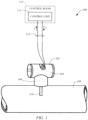
- FIG. 1 is a simplified diagram of an example of an industrial process control or measurement system 100, in accordance with embodiments of the present disclosure.
- the system 100 may be used in the processing of a material (e.g., process medium) to transform the material from a less valuable state into more valuable and useful products, such as petroleum, chemicals, paper, food, etc.
- a material e.g., process medium
- the system 100 may be used in an oil refinery that performs industrial processes that can process crude oil into gasoline, fuel oil, and other petrochemicals.
- the system 100 includes a field device 102 having a housing 104 that may be coupled to an industrial process, which may be contained in a pipe 106, through a process coupling 108.
- the device 102 is illustrated as including one or more process interface elements 110.
- the process interface element 110 may comprise a process variable sensor for measuring a parameter of the process. Examples of the process variable sensor include a pressure sensor for measuring a pressure of the process, a flow sensor for measuring a flow rate of the process, a temperature sensor for measuring a temperature of the process, a level sensor for measuring a level of the process, or another process variable sensor.
- the process interface element 110 can be configured as a control element for controlling an aspect of the process, such as a valve, an actuator to control a position of a valve, a solenoid, a heating element, or another control element.
- Communications between a control unit 111, which may be remotely located from the field device in a control room 112, and the field device 100 may be performed over a process control loop 114, in accordance with conventional analog and/or digital communication protocols.
- the process control loop 114 includes a two-wire process control loop, such as a 4-20 milliamp process control loop, in which a process variable or a control signal may be represented by a level of a loop current I flowing through the process control loop 114.
- Exemplary digital communication protocols include the modulation of digital signals onto the analog current level of the two-wire control loop 114, such as in accordance with the HART ® communication standard. Other purely digital techniques may also be employed including FieldBus and Profibus communication protocols.
- FIG. 2 is a simplified block diagram showing circuitry of a field device 102, in accordance with embodiments of the present disclosure.
- Field device 102 includes device circuitry 120, supplemental circuitry 122 and power supply circuitry 124.
- the power supply circuitry 124 controls electrical power to the device circuitry 120 and the supplemental circuitry 122, that is received over the two-wire process control loop 114.
- the power delivered over the two-wire process control loop 114 may be generated by a power source located in the control room 112 ( FIG. 1 ), for example.
- the device circuitry 120 generally includes conventional circuitry for performing primary operations of the field device 102, such as sensing or measuring a process variable and/or controlling a process using the one or more process interface elements 110.
- the device circuitry 120 may include process interface elements 110 in the form of one or more process variable sensors for sensing the process variable of an industrial process when the field device 102 is configured as a process variable transmitter.
- the device circuitry 120 may include process interface elements 110 in the form of one or more control elements for controlling an industrial process when the field device 102 is configured as a process controller.
- the device circuitry 120 may also include measurement circuitry 126 for processing signals from the one or more process variable sensors, and/or control circuitry for controlling the one or more control elements.
- the device circuitry 120 may also include communications circuitry 128 for controlling communications over the two-wire process control loop 114.
- the communications circuitry 128 may be used to represent a process variable value using the level of the loop current I, and/or communicate data using a modulated signal on the loop current I, for example.
- the device circuitry 120 also includes a controller 130, which represents one or more processors that control components of the field device 102 to perform one or more functions described herein in response to the execution of instructions, which may be stored locally in memory of the field device 102 or in memory that is remote from the field device, such as in the control unit 111. Examples of these functions include performing a process variable measurement using the one or more process interface elements 110, performing a process control function using the one or more process interface elements 110, communicating with the control unit 111 over the two-wire process control loop 114 using the communications circuitry 128, and/or other conventional field device functions. Additionally, the controller 130 may communicate with the supplemental circuitry as indicated by arrow 131. The communications 131 may include control signals from the controller 130 to the supplemental circuitry 122, data communication between the controller 130 and the supplemental circuitry 122, and/or other communications.
- the supplemental circuitry 122 generally includes circuitry for one or more devices that are used to perform secondary functions that are generally not essential to the process variable measurement or process control functions performed by the device circuitry 120.
- Examples of the supplemental circuitry include a display 132, a display controller 134 for displaying information on a display, a wireless communications module 136 for providing wireless communications, a flash memory writer 138 for writing data to flash memory, a power storage module 140, and/or other circuitry that may supplement the conventional field device operations performed by the device circuitry 120.
- the display 132 may be integrated or connected to the field device 102, and may be an LCD display or another suitable display.
- the display controller 134 may be used to drive the display of information on the display 132 or another display that is connected to the field device 102.
- the wireless communications module 136 may be used to provide wireless communication capability to the field device 102, or to expand the wireless communication capability of the field device 102.
- the wireless communications module 136 may facilitate wireless communications in accordance with a wireless communication protocol, such as WirelessHARTO (IEC 62591) or ISA 100. 11a (IEC 62734), Bluetooth, WiFi, LoRa, Sigfox, BLE, or another wireless protocol that is not provided by the device circuitry 120, such as by the communications circuitry 128.
- the flash memory writer 138 may be used to write data to flash memory that is connected to the field device 102.
- Power for the supplemental circuitry 122 may be scavenged from the excess power that remains after providing the required power (e.g., an operating voltage) to the device circuitry 120 and the power required to generate the desired loop current I over the two-wire process control loop 114.
- the power storage module 140 may be used to store the excess power that is not used by the device circuitry 120.
- the power stored by the power storage module 140 may be used by components of the field device 102, such as components of the supplemental circuitry 122.
- Examples of the power storage module 140 include a bulk capacitor, a battery, or another suitable power storage component.
- the supplemental circuitry 122 may also include user-accessible terminals 141A and 141B for accessing power for powering an external device, as shown in FIG. 2 .
- the terminals 141A and 141B may receive power from the power storage module 140, or another suitable component of the supplemental circuitry 122.
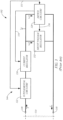
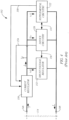
- FIGS. 3 and 4 are schematic diagrams of a field device 102 that includes power supply circuitry 144 in accordance with the prior art.
- the power supply circuitry 144 includes loop terminals 146 and 148 that are used to couple to the two-wire process control loop 114, a current regulator 150, and a shunt voltage regulator 152.
- the current regulator 150 is in series with the process control loop 114 and the loop terminals 146 and 148, and controls the loop current I in response to a current control signal 154 from the device circuitry 120 (e.g., the communications circuitry) using conventional techniques, such as using feedback from a sense resistor that is in series with the loop current I, for example.
- the current control signal 154 may direct the current regulator 150 to set the loop current I to a value that represents a process variable sensed by a process variable sensor 110 ( FIG. 2 ).
- the shunt voltage regulator 152 receives a current I SH and controls a voltage V DC that powers the device circuitry 120.
- the voltage V DC may be set by the shunt voltage regulator 152 in response to a voltage control signal 156 from the device circuitry 120, such as from the controller 130 ( FIG. 1 ).
- the supplemental circuitry 122 is connected in series with the process control loop 114, the loop terminals 146 and 148, and in stack with the device circuitry 120.
- This configuration of the power supply circuit 144 allows the supplemental circuit 122 to be powered by the loop current I.
- the supplemental circuitry 122 is in parallel with the device circuitry 120 and the shunt voltage regulator 152.
- the supplemental circuitry 122 which receives the current Isc.
- This configuration requires monitoring of the power consumption of the supplemental circuit 122 to prevent underpowering the operation of the device circuitry 120 and disrupting its critical performance of the primary objectives of the field device 102. This monitoring of the power consumption may be provided using control signals 154 and 156 from the device circuitry 120 to the current regulator 150 and the shunt voltage regulator 152, and a control or feedback signal 158 from the supplemental circuitry 122 to the current regulator, for example.
- this configuration of the power supply circuitry 144 may result in greater power loss than the configuration of FIG. 3 .
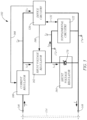
- FIG. 5 is a schematic diagram of a field device 102 that includes power supply circuitry 124 in accordance with embodiments of the present disclosure.
- the power supply circuitry 124 includes loop terminals 146 and 148, a current regulator 160, a shunt voltage regulator 162, and a shunt voltage regulator 164.
- the current regulator 160 is positioned in series with the process control loop 114, the loop terminals 146 and 148 and the device circuitry 120.
- the current regulator 160 may operate in accordance with conventional current regulators, such as the current regulator 150 of FIGS.
- the current control signal 166 may direct the current regulator 160 to set the loop current I to a value that represents a process variable sensed by a sensor 110 ( FIG. 2 ).
- the shunt voltage regulator 162 is connected in series with the current regulator 160 and the two-wire process control loop, and in parallel with the device circuitry 120.
- the voltage V DC is set by the shunt voltage regulator 162 in response to a voltage control signal 168 from the device circuitry 120, such as from the controller 130 ( FIG. 2 ), in accordance with conventional techniques.
- the shunt voltage regulator 164 and the supplemental circuitry 122 are connected in series to the shunt voltage regulator 162, arranged in parallel between the shunt voltage regulator 162 and ground or common corresponding to the loop terminal 148.
- the shunt voltage regulator 164 and the supplemental circuitry 122 are powered by power from the two-wire process control loop 114 that is shunted through the shunt voltage regulator 162.
- the voltage Vsc across the device circuitry 120 must generally be less than the voltage V DC across the supplemental circuitry 122.
- the shunt voltage regulator 164 may comprise a Zener diode 170 or other suitable circuitry.
- the voltage Vsc may correspond to the reverse breakdown voltage of the diode 170.
- the power supply circuitry 124 does not require additional diagnostics of power consumption or connection to the device circuitry 120 over the conventional power supply circuitry 144 ( FIG. 4 ). Rather, the supplemental circuitry 122 simply consumes all the needed power from the power shunted through the shunt voltage regulator 162, and the excess power is fed to the process control loop 114. Power may be consumed by the supplemental circuitry 122 without disruption to the loop current I or the operation of the device circuitry 120, even in the case of a short circuit through the supplemental circuitry 122.
- the field device 102 include output terminals 172 and 174 that are coupled to the power supply circuitry 124, as shown in FIG. 2 .
- the output terminals 172 and 174 are user accessible terminals that may be accessed through the housing 104 and connected to an external device (e.g., computing device).
- the output terminal 172 may be coupled to the voltage Vsc and the output terminal 174 may be coupled to electrical common or ground corresponding to the loop terminal 148, as shown in FIG. 5 .
- the voltage difference between the output terminals 172 and 174 may represent a process variable measurement sensed by a process variable sensor 110.
- FIG. 6 is a flowchart illustrating embodiments of one example of the method with reference to the power supply circuitry shown in FIG. 5 .
- the first and second loop terminals 146 and 148 of the power supply circuitry 124 are coupled to the two-wire process control loop 114.
- device circuitry 120 of the field device 102 is powered with power received from the two-wire process control loop 114.
- a loop current I flowing through the two-wire process control loop is regulated using a current regulator 160 of the field device 102 that is connected in series with the two-wire process control loop 114, the first and second loop terminals 146 and 148, and the device circuitry 120.
- This regulation of the loop current I may be in response to a control signal 166 from the device circuitry 120, such as the communications circuit 128 or the controller 130 ( FIG. 2 ) of the device circuitry 120.
- the loop current I may be set to a level (e.g., 4-20 mA) in response to the control signal 166 that represents a process variable of an industrial process measured using a process variable sensor 110 ( FIG. 2 ), such as a pressure sensor, a temperature sensor, a flow sensor, and a level sensor.
- a voltage V DC across the device circuitry 120 is regulated at 186 using the shunt voltage regulator 162 (first shunt voltage regulator) of the field device 102 that is connected in series with the two-wire process control loop 114 and the current regulator 160, and in parallel with the device circuitry 120, as shown in FIG. 5 .
- the voltage V DC may be controlled in response to a control signal 168 from the device circuitry 120, such as the controller 130.
- the supplemental circuitry 122 which is connected in series with the shunt voltage regulator 162 and the second loop terminal 148, is powered with power received from the two-wire process control loop 114 that is shunted through the shunt voltage regulator 162.
- a voltage Vsc across the supplemental circuitry 122 is regulated using the shunt voltage regulator 164 (second shunt voltage regulator) of the field device 102 that is connected in series with the shunt voltage regulator 162 and the second loop terminal 148, and in parallel with the supplemental circuitry 122.
- the voltage Vsc is used to power the supplemental circuitry 122.
- the voltage Vsc and the current I SH2 are used to power components of the supplemental circuitry, such as a display 132, a display controller 134 for displaying information on a display, a wireless communications module 136 for providing wireless communications, a flash memory writer 138 for writing data to flash memory, and/or a power storage module 140 for storing electrical energy, which are shown in FIG. 2 .
- the supplemental circuitry such as a display 132, a display controller 134 for displaying information on a display, a wireless communications module 136 for providing wireless communications, a flash memory writer 138 for writing data to flash memory, and/or a power storage module 140 for storing electrical energy, which are shown in FIG. 2 .
Landscapes
- Engineering & Computer Science (AREA)
- Physics & Mathematics (AREA)
- Power Engineering (AREA)
- Automation & Control Theory (AREA)
- General Physics & Mathematics (AREA)
- Radar, Positioning & Navigation (AREA)
- Electromagnetism (AREA)
- Quality & Reliability (AREA)
- Manufacturing & Machinery (AREA)
- General Engineering & Computer Science (AREA)
- Arrangements For Transmission Of Measured Signals (AREA)
- Programmable Controllers (AREA)
- Human Computer Interaction (AREA)
Description
- Embodiments of the present disclosure relate to industrial process field devices and, more specifically, to power supply circuitry of such field devices.
-
US 2006/092039 A1 describes a field device whereby the device's additional information can be transmitted wirelessly without the need for battery replacement or external wiring. Further, a field device is described whereby the firmware of a wireless module in the field device can be developed at minimum cost and whereby it can be made easy to link the firmware to applications, such as an asset management system, on the host system side. -
US 2006/290328 A1 describes a field device for use in an industrial process control or monitoring system with terminals configured to connect to a two-wire process control loop configured to carry data and to provide power. An RF circuitry in the field device is configured for radio frequency communication having variable power consumption. -
US 2005/289276 A1 describes a field device for use in an industrial process control or monitoring system includes terminals configured to connect to a two-wire process control loop. The loop carries data and provides power to the field device. - In industrial settings, control systems are used to monitor and control inventories of industrial and chemical processes, and the like. Typically, the control system performs these functions using field devices distributed at key locations in the industrial process and coupled to control circuitry in a control room by a process control loop.
- Typical industrial process field devices include device circuitry that enables the field device to perform conventional field device tasks such as process parameter monitoring and measurements using one or more sensors, and/or process control operations using one or more control elements. Exemplary sensors include pressure sensors, flow sensors, level sensors, temperature sensors, and other sensors used in industrial processes. Exemplary control elements include actuators, solenoids, valves, and other control elements.
- The device circuitry of field devices may also include a controller that is used to control the sensors and/or control elements, and communicate with a process control room, or other circuitry, over a process control loop, such as a 4-20 mA process control loop. The process control loop may deliver a current that is regulated by the field device to indicate a sensed parameter value.
- Many field devices are configured to be powered from the same two-wire process control loop used to transmit information. The two-wire process control loop may couple to a single field device or to multiple field devices ("multi-drop"). This limits the power that is available to the field device.
- Process field devices may be configured to provide supplemental features beyond those typically provided by the device circuitry. Such supplemental features may include, for example, wireless data communications, flash writes, a display, or other supplemental features.
- Powering such supplemental features using power provided over the two-wire process control loop requires circuitry that scavenges excess power that is not required to power the device circuitry or provide the desired current over the process control loop.
- The present invention is directed to a field device for use in monitoring or controlling an industrial process according to claim 1, and to a method of providing power to a field device according to claim 11. Further advantageous embodiments are subject matter of the dependent claims.. According to the invention, the field device includes first and second loop terminals configured to couple to a two-wire process control loop, device circuitry, a current regulator, a first shunt voltage regulator, supplemental circuitry, and a second shunt voltage regulator. The device circuitry is configured to monitor a process variable or control a control device, and is powered by power from the two-wire process control loop. The current regulator is in series with the first and second loop terminals and the device circuitry, and is configured to regulate a loop current flowing through the two-wire process control loop. The first shunt voltage regulator is connected in series with the current regulator and the first and second loop terminals, and in parallel with the device circuitry. The first shunt voltage regulator is configured to regulate a voltage across the device circuitry. The supplemental circuitry is connected in series with the first shunt voltage regulator and the second loop terminal, and is powered by power from the two-wire process control loop shunted through the first shunt voltage regulator. The second shunt voltage regulator is connected in series with the first shunt voltage regulator and the second loop terminal, and in parallel with the supplemental circuitry. The second shunt voltage regulator is configured to control a voltage across the supplemental circuitry.
- According to the invention, the method of providing power to a field device for use in monitoring or controlling an industrial process, first and second loop terminals of the field device are coupled to a two-wire process control loop. Device circuitry of the field device is powered with power received from the two-wire process control loop. The device circuitry being configured to monitor a process variable sensor or control a control device. A loop current through the two-wire process control loop is regulated using a current regulator of the field device connected in series with the two-wire process control loop, the first and second loop terminals, and the device circuitry. A voltage across the device circuitry is regulated using a first shunt voltage regulator of the field device connected in series with the two-wire process control loop and the current regulator, and in parallel with the device circuitry. Supplemental circuitry connected in series with the first shunt voltage regulator and the second loop terminal is powered with power received from the two-wire process control loop shunted through the first shunt voltage regulator. A voltage across the supplemental circuitry is regulated using a second shunt voltage regulator of the field device connected in series with the first shunt voltage regulator and the second loop terminal, and in parallel with the supplemental circuitry.
- This Summary is provided to introduce a selection of concepts in a simplified form that are further described below in the Detailed Description.
-
-
FIG. 1 is a simplified diagram of an example of an industrial process control or measurement system in accordance with embodiments of the present disclosure. -
FIG. 2 is a simplified block diagram showing circuitry of a field device in accordance with embodiments of the present disclosure. -
FIGS. 3 and4 are schematic diagrams of a field device that includes power supply circuitry in accordance with the prior art. -
FIG. 5 is a schematic diagram of a field device that includes power supply circuitry in accordance with embodiments of the present disclosure. -
FIG. 6 is a flow chart illustrating an example of a method of providing power to a field device in accordance with embodiments of the present disclosure. - Embodiments of the present disclosure are described more fully hereinafter with reference to the accompanying drawings. Elements that are identified using the same or similar reference characters refer to the same or similar elements. Some elements may not be shown in each of the figures in order to simplify the illustrations.
- The various embodiments of the present disclosure may be embodied in many different forms and should not be construed as limited to the specific embodiments set forth herein. Rather, these embodiments are provided so that this disclosure will be thorough and complete, and will fully convey the scope of the present disclosure to those skilled in the art.
-
FIG. 1 is a simplified diagram of an example of an industrial process control ormeasurement system 100, in accordance with embodiments of the present disclosure. Thesystem 100 may be used in the processing of a material (e.g., process medium) to transform the material from a less valuable state into more valuable and useful products, such as petroleum, chemicals, paper, food, etc. For example, thesystem 100 may be used in an oil refinery that performs industrial processes that can process crude oil into gasoline, fuel oil, and other petrochemicals. - The
system 100 includes afield device 102 having ahousing 104 that may be coupled to an industrial process, which may be contained in apipe 106, through aprocess coupling 108. Thedevice 102 is illustrated as including one or moreprocess interface elements 110. If thefield device 102 is configured as a process variable transmitter, theprocess interface element 110 may comprise a process variable sensor for measuring a parameter of the process. Examples of the process variable sensor include a pressure sensor for measuring a pressure of the process, a flow sensor for measuring a flow rate of the process, a temperature sensor for measuring a temperature of the process, a level sensor for measuring a level of the process, or another process variable sensor. If thefield device 102 is configured as a process variable controller, theprocess interface element 110 can be configured as a control element for controlling an aspect of the process, such as a valve, an actuator to control a position of a valve, a solenoid, a heating element, or another control element. - Communications between a
control unit 111, which may be remotely located from the field device in acontrol room 112, and thefield device 100 may be performed over aprocess control loop 114, in accordance with conventional analog and/or digital communication protocols. In some embodiments, theprocess control loop 114 includes a two-wire process control loop, such as a 4-20 milliamp process control loop, in which a process variable or a control signal may be represented by a level of a loop current I flowing through theprocess control loop 114. Exemplary digital communication protocols include the modulation of digital signals onto the analog current level of the two-wire control loop 114, such as in accordance with the HART® communication standard. Other purely digital techniques may also be employed including FieldBus and Profibus communication protocols. -
FIG. 2 is a simplified block diagram showing circuitry of afield device 102, in accordance with embodiments of the present disclosure.Field device 102 includesdevice circuitry 120,supplemental circuitry 122 andpower supply circuitry 124. Thepower supply circuitry 124 controls electrical power to thedevice circuitry 120 and thesupplemental circuitry 122, that is received over the two-wireprocess control loop 114. The power delivered over the two-wireprocess control loop 114 may be generated by a power source located in the control room 112 (FIG. 1 ), for example. - The
device circuitry 120 generally includes conventional circuitry for performing primary operations of thefield device 102, such as sensing or measuring a process variable and/or controlling a process using the one or moreprocess interface elements 110. Thus, thedevice circuitry 120 may includeprocess interface elements 110 in the form of one or more process variable sensors for sensing the process variable of an industrial process when thefield device 102 is configured as a process variable transmitter. Alternatively, thedevice circuitry 120 may includeprocess interface elements 110 in the form of one or more control elements for controlling an industrial process when thefield device 102 is configured as a process controller. Thedevice circuitry 120 may also includemeasurement circuitry 126 for processing signals from the one or more process variable sensors, and/or control circuitry for controlling the one or more control elements. - The
device circuitry 120 may also includecommunications circuitry 128 for controlling communications over the two-wireprocess control loop 114. Thus, thecommunications circuitry 128 may be used to represent a process variable value using the level of the loop current I, and/or communicate data using a modulated signal on the loop current I, for example. - The
device circuitry 120 also includes acontroller 130, which represents one or more processors that control components of thefield device 102 to perform one or more functions described herein in response to the execution of instructions, which may be stored locally in memory of thefield device 102 or in memory that is remote from the field device, such as in thecontrol unit 111. Examples of these functions include performing a process variable measurement using the one or moreprocess interface elements 110, performing a process control function using the one or moreprocess interface elements 110, communicating with thecontrol unit 111 over the two-wireprocess control loop 114 using thecommunications circuitry 128, and/or other conventional field device functions. Additionally, thecontroller 130 may communicate with the supplemental circuitry as indicated byarrow 131. Thecommunications 131 may include control signals from thecontroller 130 to thesupplemental circuitry 122, data communication between thecontroller 130 and thesupplemental circuitry 122, and/or other communications. - The
supplemental circuitry 122 generally includes circuitry for one or more devices that are used to perform secondary functions that are generally not essential to the process variable measurement or process control functions performed by thedevice circuitry 120. Examples of the supplemental circuitry include adisplay 132, adisplay controller 134 for displaying information on a display, awireless communications module 136 for providing wireless communications, aflash memory writer 138 for writing data to flash memory, apower storage module 140, and/or other circuitry that may supplement the conventional field device operations performed by thedevice circuitry 120. - The
display 132 may be integrated or connected to thefield device 102, and may be an LCD display or another suitable display. Thedisplay controller 134 may be used to drive the display of information on thedisplay 132 or another display that is connected to thefield device 102. Thewireless communications module 136 may be used to provide wireless communication capability to thefield device 102, or to expand the wireless communication capability of thefield device 102. For example, thewireless communications module 136 may facilitate wireless communications in accordance with a wireless communication protocol, such as WirelessHARTO (IEC 62591) orISA 100. 11a (IEC 62734), Bluetooth, WiFi, LoRa, Sigfox, BLE, or another wireless protocol that is not provided by thedevice circuitry 120, such as by thecommunications circuitry 128. Theflash memory writer 138 may be used to write data to flash memory that is connected to thefield device 102. - Due to the important functions provided by the
device circuitry 120, it is critical for thepower supply circuitry 124 to first serve the power needs of thedevice circuitry 120. Power for thesupplemental circuitry 122 may be scavenged from the excess power that remains after providing the required power (e.g., an operating voltage) to thedevice circuitry 120 and the power required to generate the desired loop current I over the two-wireprocess control loop 114. - The
power storage module 140 may be used to store the excess power that is not used by thedevice circuitry 120. The power stored by thepower storage module 140 may be used by components of thefield device 102, such as components of thesupplemental circuitry 122. Examples of thepower storage module 140 include a bulk capacitor, a battery, or another suitable power storage component. - The
supplemental circuitry 122 may also include user-accessible terminals FIG. 2 . Theterminals power storage module 140, or another suitable component of thesupplemental circuitry 122. -
FIGS. 3 and4 are schematic diagrams of afield device 102 that includespower supply circuitry 144 in accordance with the prior art. Thepower supply circuitry 144 includesloop terminals process control loop 114, acurrent regulator 150, and ashunt voltage regulator 152. Thecurrent regulator 150 is in series with theprocess control loop 114 and theloop terminals current control signal 154 may direct thecurrent regulator 150 to set the loop current I to a value that represents a process variable sensed by a process variable sensor 110 (FIG. 2 ). - The
shunt voltage regulator 152 receives a current ISH and controls a voltage VDC that powers thedevice circuitry 120. The voltage VDC may be set by theshunt voltage regulator 152 in response to a voltage control signal 156 from thedevice circuitry 120, such as from the controller 130 (FIG. 1 ). - In
FIG. 3 , thesupplemental circuitry 122 is connected in series with theprocess control loop 114, theloop terminals device circuitry 120. This configuration of thepower supply circuit 144 allows thesupplemental circuit 122 to be powered by the loop current I. A current IDC is supplied to the device circuitry, where IDC=I-ISH. This configuration forces thedevice circuitry 120 to work on different voltage levels, complicates the control circuit, and increases the minimum requirements for the lift-off voltage of thefield device 102. - In
FIG. 4 , thesupplemental circuitry 122 is in parallel with thedevice circuitry 120 and theshunt voltage regulator 152. Here, the current Ic (IC=I-ISH) is shared by thedevice circuitry 120, which receives the current IDC, and thesupplemental circuitry 122, which receives the current Isc. This configuration requires monitoring of the power consumption of thesupplemental circuit 122 to prevent underpowering the operation of thedevice circuitry 120 and disrupting its critical performance of the primary objectives of thefield device 102. This monitoring of the power consumption may be provided usingcontrol signals device circuitry 120 to thecurrent regulator 150 and theshunt voltage regulator 152, and a control or feedback signal 158 from thesupplemental circuitry 122 to the current regulator, for example. Additionally, this configuration of thepower supply circuitry 144 may result in greater power loss than the configuration ofFIG. 3 . -
FIG. 5 is a schematic diagram of afield device 102 that includespower supply circuitry 124 in accordance with embodiments of the present disclosure. Thepower supply circuitry 124 includesloop terminals current regulator 160, ashunt voltage regulator 162, and ashunt voltage regulator 164. Thecurrent regulator 160 is positioned in series with theprocess control loop 114, theloop terminals device circuitry 120. Thecurrent regulator 160 may operate in accordance with conventional current regulators, such as thecurrent regulator 150 ofFIGS. 3 or4 , and may control the loop current I in response to a current control signal 166 from the device circuitry (e.g., thecommunications circuitry 128 or the controller 130) using conventional techniques, such as using feedback from a sense resistor that is in series with the loop current I, for example. Thecurrent control signal 166 may direct thecurrent regulator 160 to set the loop current I to a value that represents a process variable sensed by a sensor 110 (FIG. 2 ). - The
shunt voltage regulator 162 is connected in series with thecurrent regulator 160 and the two-wire process control loop, and in parallel with thedevice circuitry 120. Thevoltage regulator 160 receives a current ISH and controls a voltage VDC that drives the current IDC (I=IDC+ISH) and powers thedevice circuitry 120. The voltage VDC is set by theshunt voltage regulator 162 in response to a voltage control signal 168 from thedevice circuitry 120, such as from the controller 130 (FIG. 2 ), in accordance with conventional techniques. - The
shunt voltage regulator 164 and thesupplemental circuitry 122 are connected in series to theshunt voltage regulator 162, arranged in parallel between theshunt voltage regulator 162 and ground or common corresponding to theloop terminal 148. Theshunt voltage regulator 164 and thesupplemental circuitry 122 are powered by power from the two-wireprocess control loop 114 that is shunted through theshunt voltage regulator 162. Theshunt voltage regulator 164 receives a current ISH1 and controls a voltage Vsc that drives a current ISH2 (ISH2 = ISH - ISH1) and powers thesupplemental circuitry 122. For thefield device 102 to operate in a stable manner, the voltage Vsc across thedevice circuitry 120 must generally be less than the voltage VDC across thesupplemental circuitry 122. - As indicated in
FIG. 5 , theshunt voltage regulator 164 may comprise aZener diode 170 or other suitable circuitry. The voltage Vsc may correspond to the reverse breakdown voltage of thediode 170. - In some embodiments, the
power supply circuitry 124 does not require additional diagnostics of power consumption or connection to thedevice circuitry 120 over the conventional power supply circuitry 144 (FIG. 4 ). Rather, thesupplemental circuitry 122 simply consumes all the needed power from the power shunted through theshunt voltage regulator 162, and the excess power is fed to theprocess control loop 114. Power may be consumed by thesupplemental circuitry 122 without disruption to the loop current I or the operation of thedevice circuitry 120, even in the case of a short circuit through thesupplemental circuitry 122. - In some embodiments, the
field device 102 includeoutput terminals power supply circuitry 124, as shown inFIG. 2 . In one embodiment, theoutput terminals housing 104 and connected to an external device (e.g., computing device). Theoutput terminal 172 may be coupled to the voltage Vsc and theoutput terminal 174 may be coupled to electrical common or ground corresponding to theloop terminal 148, as shown inFIG. 5 . In some embodiments, the voltage difference between theoutput terminals variable sensor 110. - Some embodiments of the present disclosure are directed to a method of providing power to a
field device 102.FIG. 6 is a flowchart illustrating embodiments of one example of the method with reference to the power supply circuitry shown inFIG. 5 . - At 180, the first and
second loop terminals power supply circuitry 124 are coupled to the two-wireprocess control loop 114. At 182,device circuitry 120 of thefield device 102 is powered with power received from the two-wireprocess control loop 114. - At 184 of the method, a loop current I flowing through the two-wire process control loop is regulated using a
current regulator 160 of thefield device 102 that is connected in series with the two-wireprocess control loop 114, the first andsecond loop terminals device circuitry 120. This regulation of the loop current I may be in response to acontrol signal 166 from thedevice circuitry 120, such as thecommunications circuit 128 or the controller 130 (FIG. 2 ) of thedevice circuitry 120. Additionally, the loop current I may be set to a level (e.g., 4-20 mA) in response to thecontrol signal 166 that represents a process variable of an industrial process measured using a process variable sensor 110 (FIG. 2 ), such as a pressure sensor, a temperature sensor, a flow sensor, and a level sensor. - A voltage VDC across the
device circuitry 120 is regulated at 186 using the shunt voltage regulator 162 (first shunt voltage regulator) of thefield device 102 that is connected in series with the two-wireprocess control loop 114 and thecurrent regulator 160, and in parallel with thedevice circuitry 120, as shown inFIG. 5 . The voltage VDC may be controlled in response to acontrol signal 168 from thedevice circuitry 120, such as thecontroller 130. - At 188 of the method, the
supplemental circuitry 122, which is connected in series with theshunt voltage regulator 162 and thesecond loop terminal 148, is powered with power received from the two-wireprocess control loop 114 that is shunted through theshunt voltage regulator 162. - At 190, a voltage Vsc across the
supplemental circuitry 122 is regulated using the shunt voltage regulator 164 (second shunt voltage regulator) of thefield device 102 that is connected in series with theshunt voltage regulator 162 and thesecond loop terminal 148, and in parallel with thesupplemental circuitry 122. The voltage Vsc is used to power thesupplemental circuitry 122. - In some embodiments, the voltage Vsc and the current ISH2 are used to power components of the supplemental circuitry, such as a
display 132, adisplay controller 134 for displaying information on a display, awireless communications module 136 for providing wireless communications, aflash memory writer 138 for writing data to flash memory, and/or apower storage module 140 for storing electrical energy, which are shown inFIG. 2 . - Although the embodiments of the present disclosure have been described with reference to preferred embodiments, workers skilled in the art will recognize that changes may be made in form and detail.
Claims (15)
- A field device (102) for use in monitoring or controlling an industrial process comprising:first and second loop terminals (146, 148) configured to couple to a two-wire process control loop;device circuitry (120) configured to monitor a process variable or control a control device, the device circuitry (120) powered by power from the two-wire process control loop;a current regulator (160) in series with the first and second loop terminals (146, 148) and the device circuitry (120), the current regulator (160) configured to regulate a loop current flowing through the two-wire process control loop and the first and second loop terminals (146, 148);a first shunt voltage regulator (162) connected in series with the current regulator (160) and the first and second loop terminals (146, 148), and in parallel with the device circuitry (120), the first shunt voltage regulator (162) configured to regulate a first voltage across the device circuitry (120) andto power the device circuitry (120), wherein the first shunt voltage regulator (162) is coupled to the device circuitry (120) which is configured to provide a voltage control signal (168) for controlling the first voltage;supplemental circuitry connected (122) in series with the first shunt voltage regulator (162) and the second loop terminal (148), and powered by power from the two-wire process control loop shunted through the first shunt voltage regulator (162); anda second shunt voltage regulator (164) connected in series with the first shunt voltage regulator (162) and the second loop terminal (148), and in parallel with the supplemental circuitry (122), the second shunt voltage regulator (164) configured to control a second voltage across the supplemental circuitry (122), and to power the supplemental circuitry (122) through the second voltage.
- The field device (102) of claim 1, wherein:a current IDC travels through the device circuitry (120);a current ISH travels through the first shunt voltage regulator (162); andthe loop current is equal to the sum of the current IDC and the current ISH.
- The field device (102) of claim 2, wherein:a current ISH1 travels through the second shunt voltage regulator (164);a current ISH2 travels through the supplemental circuitry (122); andthe current ISH is equal to the sum of the current ISH1 and the current ISH2.
- The field device( 102) of claim 3, wherein the loop current varies between 4 mA and 20 mA.
- The field device (102) of claim 1, wherein the current regulator (160) is configured to control the loop current in response to control signal from the device circuitry (120) indicating a measured process variable, wherein the device circuitry (120) in particular includes a process variable sensor selected from the group consisting of a pressure sensor, a temperature sensor, a flow sensor, and a level sensor.
- The field device (102) of claim 1, wherein the device circuitry (120) includes a control element selected from the group consisting of an actuator, a solenoid, a valve, and a heating element.
- The field device (102) of claim 1, wherein the supplemental circuitry (122) includes a device selected from the group consisting of a display, a display controller for displaying information on a display, a wireless communications module for providing wireless communications, a flash memory writer for writing data to flash memory, and a power storage module for storing electrical energy.
- The field device (102) of claim 1, wherein the supplemental circuitry (122) includes user accessible terminals for powering an external device.
- The field device (102) of claim 1, wherein the second shunt voltage regulator (164) comprises a Zener diode.
- The field device (102) of claim 1, further comprising a first output terminal coupled to the second voltage, and a second output terminal coupled to the second loop terminal.
- A method of providing power to a field device (102) for use in monitoring or controlling an industrial process, the method comprising:coupling (180) first and second loop terminals (146, 148) of the field device (102) to a two-wire process control loop;powering (182) device circuitry (120) of the field device (102) with power received from the two-wire process control loop, the device circuitry (120) configured to monitor a process variable sensor or control a control device;regulating (184) a loop current through the two-wire process control loop using a current regulator (160) of the field device (102) connected in series with the two-wire process control loop, the first and second loop terminals (146, 148), and the device circuitry (120);regulating (186) a first voltage across the device circuitry (120) using a first shunt voltage regulator (162) of the field device (102) connected in series with the two-wire process control loop and the current regulator (160), and in parallel with the device circuitry (120) to power the device circuitry (120), the first shunt regulator (162) receiving a voltage control signal (168) from the device circuitry (120) which controls the first voltage;powering (188) supplemental circuitry (122) connected in series with the first shunt voltage regulator (162) and the second loop terminal (148) with power received from the two-wire process control loop shunted through the first shunt voltage regulator (162); andregulating (190) a second voltage across the supplemental circuitry (122) using a second shunt voltage regulator (164) of the field device (102) connected in series with the first shunt voltage regulator (162) and the second loop terminal (148), and in parallel with the supplemental circuitry (122), the second voltage powering the supplemental circuitry (122).
- The method of claim 11, wherein:powering (182) the device circuitry comprises delivering a current IDC through the device circuitry;a current ISH travels through the first shunt voltage regulator (162) during regulating the first voltage; andthe loop current is equal to the sum of the current IDC and the current ISH.
- The method of claim 12, wherein:powering (188) the supplemental circuitry (122) comprises delivering a current ISH2 through the supplemental circuitry (122);a current ISH1 travels through the second shunt voltage (164) regulator during regulating the second voltage; andthe current ISH is equal to the sum of the current ISH1 and the current ISH2,, wherein regulating the loop current in particular comprises regulating the loop current to vary between 4 mA and 20 mA.
- The method of claim 11, wherein regulating (184) the loop current comprises regulating the loop current to a level that is representative of a process variable measured using a process variable sensor of the device circuitry selected from the group consisting of a pressure sensor, a temperature sensor, a flow sensor, and a level sensor, orwherein the device circuitry includes a control element selected from the group consisting of an actuator, a solenoid, a valve, and a heating element, orwherein the supplemental circuitry (122) includes a device selected from the group consisting of a display, a display controller for displaying information on a display, a wireless communications module for providing wireless communications, a flash memory writer for writing data to flash memory, and a power storage module for storing electrical energy, orwherein the supplemental circuitry (122) includes user accessible terminals for powering an external device.
- The method of claim 11, further comprising providing a first output terminal coupled to the second voltage and a second output terminal coupled to the second loop terminal.
Applications Claiming Priority (1)
| Application Number | Priority Date | Filing Date | Title |
|---|---|---|---|
| PCT/RU2020/000160 WO2021194368A1 (en) | 2020-03-26 | 2020-03-26 | Two-wire industrial process field device power supply circuitry |
Publications (2)
| Publication Number | Publication Date |
|---|---|
| EP4127844A1 EP4127844A1 (en) | 2023-02-08 |
| EP4127844B1 true EP4127844B1 (en) | 2024-11-06 |
Family
ID=72944224
Family Applications (1)
| Application Number | Title | Priority Date | Filing Date |
|---|---|---|---|
| EP20793484.5A Active EP4127844B1 (en) | 2020-03-26 | 2020-03-26 | Two-wire industrial process field device power supply circuitry |
Country Status (5)
| Country | Link |
|---|---|
| US (1) | US11579641B2 (en) |
| EP (1) | EP4127844B1 (en) |
| JP (1) | JP7361225B2 (en) |
| CN (1) | CN113728283B (en) |
| WO (1) | WO2021194368A1 (en) |
Families Citing this family (1)
| Publication number | Priority date | Publication date | Assignee | Title |
|---|---|---|---|---|
| EP4336152B1 (en) * | 2022-09-09 | 2026-04-01 | Rosemount Tank Radar AB | Loop-powered field device with improved loop current control |
Family Cites Families (9)
| Publication number | Priority date | Publication date | Assignee | Title |
|---|---|---|---|---|
| JPH07123031A (en) * | 1993-10-27 | 1995-05-12 | Hitachi Ltd | Field device communication method and device |
| DE10326627A1 (en) * | 2003-06-11 | 2005-01-05 | Endress + Hauser Gmbh + Co. Kg | Method for displaying the function of a field device of process automation technology |
| US7018800B2 (en) * | 2003-08-07 | 2006-03-28 | Rosemount Inc. | Process device with quiescent current diagnostics |
| US7262693B2 (en) * | 2004-06-28 | 2007-08-28 | Rosemount Inc. | Process field device with radio frequency communication |
| JP4792851B2 (en) * | 2004-11-01 | 2011-10-12 | 横河電機株式会社 | Field equipment |
| RU2389056C2 (en) * | 2005-06-27 | 2010-05-10 | Роузмаунт Инк. | Field device with radio-frequency connection, in which consumed power is controlled dynamically |
| US8000841B2 (en) * | 2005-12-30 | 2011-08-16 | Rosemount Inc. | Power management in a process transmitter |
| US8786128B2 (en) * | 2010-05-11 | 2014-07-22 | Rosemount Inc. | Two-wire industrial process field device with power scavenging |
| US9863980B2 (en) * | 2015-05-22 | 2018-01-09 | Rosemount Tank Radar Ab | Loop-powered field device with voltage regulator and current source in series |
-
2020
- 2020-03-26 CN CN202080003087.1A patent/CN113728283B/en active Active
- 2020-03-26 JP JP2022558380A patent/JP7361225B2/en active Active
- 2020-03-26 WO PCT/RU2020/000160 patent/WO2021194368A1/en not_active Ceased
- 2020-03-26 EP EP20793484.5A patent/EP4127844B1/en active Active
- 2020-03-26 US US17/049,690 patent/US11579641B2/en active Active
Also Published As
| Publication number | Publication date |
|---|---|
| US11579641B2 (en) | 2023-02-14 |
| CN113728283B (en) | 2024-09-17 |
| US20210303010A1 (en) | 2021-09-30 |
| WO2021194368A1 (en) | 2021-09-30 |
| JP2023519370A (en) | 2023-05-10 |
| JP7361225B2 (en) | 2023-10-13 |
| CN113728283A (en) | 2021-11-30 |
| EP4127844A1 (en) | 2023-02-08 |
Similar Documents
| Publication | Publication Date | Title |
|---|---|---|
| EP2569675B1 (en) | Two-wire industrial process field device maximizing the power available to the circuitry of the device at minimum control loop current | |
| CN102084626B (en) | RF adapter for field device with loop current bypass | |
| US8847571B2 (en) | RF adapter for field device with variable voltage drop | |
| US7675932B2 (en) | Adapter for providing digital communication between a field device and a computer | |
| US5650777A (en) | Conversion circuit for process control system | |
| EP0490864B1 (en) | Process controller with modular I/O units | |
| US9442477B2 (en) | Automation technology autarkic field device | |
| EP4127844B1 (en) | Two-wire industrial process field device power supply circuitry | |
| US12379703B2 (en) | Automation field device with auxiliary current input | |
| CN107425785B (en) | Dynamic Motor Drives for Battery-Operated Devices | |
| JP2007533027A (en) | Process equipment with switching power supply | |
| EP2027688B1 (en) | Bus loop power interface and method | |
| JP7624094B2 (en) | Power management using low power wireless communication for loop-powered field devices - Patents.com | |
| US20240305328A1 (en) | Load adapter module for wireless discrete input/output field device | |
| US20250141216A1 (en) | Intrinsically safe automation field device | |
| JPH03156700A (en) | 2-wire signal transmission device |
Legal Events
| Date | Code | Title | Description |
|---|---|---|---|
| STAA | Information on the status of an ep patent application or granted ep patent |
Free format text: STATUS: UNKNOWN |
|
| STAA | Information on the status of an ep patent application or granted ep patent |
Free format text: STATUS: THE INTERNATIONAL PUBLICATION HAS BEEN MADE |
|
| PUAI | Public reference made under article 153(3) epc to a published international application that has entered the european phase |
Free format text: ORIGINAL CODE: 0009012 |
|
| STAA | Information on the status of an ep patent application or granted ep patent |
Free format text: STATUS: REQUEST FOR EXAMINATION WAS MADE |
|
| 17P | Request for examination filed |
Effective date: 20221020 |
|
| AK | Designated contracting states |
Kind code of ref document: A1 Designated state(s): AL AT BE BG CH CY CZ DE DK EE ES FI FR GB GR HR HU IE IS IT LI LT LU LV MC MK MT NL NO PL PT RO RS SE SI SK SM TR |
|
| DAV | Request for validation of the european patent (deleted) | ||
| DAX | Request for extension of the european patent (deleted) | ||
| GRAP | Despatch of communication of intention to grant a patent |
Free format text: ORIGINAL CODE: EPIDOSNIGR1 |
|
| STAA | Information on the status of an ep patent application or granted ep patent |
Free format text: STATUS: GRANT OF PATENT IS INTENDED |
|
| INTG | Intention to grant announced |
Effective date: 20240606 |
|
| GRAS | Grant fee paid |
Free format text: ORIGINAL CODE: EPIDOSNIGR3 |
|
| GRAA | (expected) grant |
Free format text: ORIGINAL CODE: 0009210 |
|
| STAA | Information on the status of an ep patent application or granted ep patent |
Free format text: STATUS: THE PATENT HAS BEEN GRANTED |
|
| AK | Designated contracting states |
Kind code of ref document: B1 Designated state(s): AL AT BE BG CH CY CZ DE DK EE ES FI FR GB GR HR HU IE IS IT LI LT LU LV MC MK MT NL NO PL PT RO RS SE SI SK SM TR |
|
| REG | Reference to a national code |
Ref country code: GB Ref legal event code: FG4D |
|
| REG | Reference to a national code |
Ref country code: CH Ref legal event code: EP |
|
| REG | Reference to a national code |
Ref country code: DE Ref legal event code: R096 Ref document number: 602020040932 Country of ref document: DE |
|
| REG | Reference to a national code |
Ref country code: IE Ref legal event code: FG4D |
|
| REG | Reference to a national code |
Ref country code: LT Ref legal event code: MG9D |
|
| REG | Reference to a national code |
Ref country code: NL Ref legal event code: MP Effective date: 20241106 |
|
| PG25 | Lapsed in a contracting state [announced via postgrant information from national office to epo] |
Ref country code: HR Free format text: LAPSE BECAUSE OF FAILURE TO SUBMIT A TRANSLATION OF THE DESCRIPTION OR TO PAY THE FEE WITHIN THE PRESCRIBED TIME-LIMIT Effective date: 20241106 Ref country code: PT Free format text: LAPSE BECAUSE OF FAILURE TO SUBMIT A TRANSLATION OF THE DESCRIPTION OR TO PAY THE FEE WITHIN THE PRESCRIBED TIME-LIMIT Effective date: 20250306 Ref country code: IS Free format text: LAPSE BECAUSE OF FAILURE TO SUBMIT A TRANSLATION OF THE DESCRIPTION OR TO PAY THE FEE WITHIN THE PRESCRIBED TIME-LIMIT Effective date: 20250306 |
|
| PG25 | Lapsed in a contracting state [announced via postgrant information from national office to epo] |
Ref country code: FI Free format text: LAPSE BECAUSE OF FAILURE TO SUBMIT A TRANSLATION OF THE DESCRIPTION OR TO PAY THE FEE WITHIN THE PRESCRIBED TIME-LIMIT Effective date: 20241106 Ref country code: NL Free format text: LAPSE BECAUSE OF FAILURE TO SUBMIT A TRANSLATION OF THE DESCRIPTION OR TO PAY THE FEE WITHIN THE PRESCRIBED TIME-LIMIT Effective date: 20241106 |
|
| REG | Reference to a national code |
Ref country code: AT Ref legal event code: MK05 Ref document number: 1740031 Country of ref document: AT Kind code of ref document: T Effective date: 20241106 |
|
| PG25 | Lapsed in a contracting state [announced via postgrant information from national office to epo] |
Ref country code: BG Free format text: LAPSE BECAUSE OF FAILURE TO SUBMIT A TRANSLATION OF THE DESCRIPTION OR TO PAY THE FEE WITHIN THE PRESCRIBED TIME-LIMIT Effective date: 20241106 |
|
| PG25 | Lapsed in a contracting state [announced via postgrant information from national office to epo] |
Ref country code: ES Free format text: LAPSE BECAUSE OF FAILURE TO SUBMIT A TRANSLATION OF THE DESCRIPTION OR TO PAY THE FEE WITHIN THE PRESCRIBED TIME-LIMIT Effective date: 20241106 |
|
| PG25 | Lapsed in a contracting state [announced via postgrant information from national office to epo] |
Ref country code: NO Free format text: LAPSE BECAUSE OF FAILURE TO SUBMIT A TRANSLATION OF THE DESCRIPTION OR TO PAY THE FEE WITHIN THE PRESCRIBED TIME-LIMIT Effective date: 20250206 |
|
| PG25 | Lapsed in a contracting state [announced via postgrant information from national office to epo] |
Ref country code: LV Free format text: LAPSE BECAUSE OF FAILURE TO SUBMIT A TRANSLATION OF THE DESCRIPTION OR TO PAY THE FEE WITHIN THE PRESCRIBED TIME-LIMIT Effective date: 20241106 Ref country code: GR Free format text: LAPSE BECAUSE OF FAILURE TO SUBMIT A TRANSLATION OF THE DESCRIPTION OR TO PAY THE FEE WITHIN THE PRESCRIBED TIME-LIMIT Effective date: 20250207 Ref country code: AT Free format text: LAPSE BECAUSE OF FAILURE TO SUBMIT A TRANSLATION OF THE DESCRIPTION OR TO PAY THE FEE WITHIN THE PRESCRIBED TIME-LIMIT Effective date: 20241106 |
|
| PG25 | Lapsed in a contracting state [announced via postgrant information from national office to epo] |
Ref country code: PL Free format text: LAPSE BECAUSE OF FAILURE TO SUBMIT A TRANSLATION OF THE DESCRIPTION OR TO PAY THE FEE WITHIN THE PRESCRIBED TIME-LIMIT Effective date: 20241106 |
|
| PG25 | Lapsed in a contracting state [announced via postgrant information from national office to epo] |
Ref country code: RS Free format text: LAPSE BECAUSE OF FAILURE TO SUBMIT A TRANSLATION OF THE DESCRIPTION OR TO PAY THE FEE WITHIN THE PRESCRIBED TIME-LIMIT Effective date: 20250206 |
|
| PG25 | Lapsed in a contracting state [announced via postgrant information from national office to epo] |
Ref country code: SM Free format text: LAPSE BECAUSE OF FAILURE TO SUBMIT A TRANSLATION OF THE DESCRIPTION OR TO PAY THE FEE WITHIN THE PRESCRIBED TIME-LIMIT Effective date: 20241106 |
|
| PG25 | Lapsed in a contracting state [announced via postgrant information from national office to epo] |
Ref country code: DK Free format text: LAPSE BECAUSE OF FAILURE TO SUBMIT A TRANSLATION OF THE DESCRIPTION OR TO PAY THE FEE WITHIN THE PRESCRIBED TIME-LIMIT Effective date: 20241106 |
|
| PG25 | Lapsed in a contracting state [announced via postgrant information from national office to epo] |
Ref country code: EE Free format text: LAPSE BECAUSE OF FAILURE TO SUBMIT A TRANSLATION OF THE DESCRIPTION OR TO PAY THE FEE WITHIN THE PRESCRIBED TIME-LIMIT Effective date: 20241106 |
|
| PGFP | Annual fee paid to national office [announced via postgrant information from national office to epo] |
Ref country code: CH Payment date: 20250401 Year of fee payment: 6 |
|
| PG25 | Lapsed in a contracting state [announced via postgrant information from national office to epo] |
Ref country code: RO Free format text: LAPSE BECAUSE OF FAILURE TO SUBMIT A TRANSLATION OF THE DESCRIPTION OR TO PAY THE FEE WITHIN THE PRESCRIBED TIME-LIMIT Effective date: 20241106 |
|
| PG25 | Lapsed in a contracting state [announced via postgrant information from national office to epo] |
Ref country code: SK Free format text: LAPSE BECAUSE OF FAILURE TO SUBMIT A TRANSLATION OF THE DESCRIPTION OR TO PAY THE FEE WITHIN THE PRESCRIBED TIME-LIMIT Effective date: 20241106 |
|
| PG25 | Lapsed in a contracting state [announced via postgrant information from national office to epo] |
Ref country code: CZ Free format text: LAPSE BECAUSE OF FAILURE TO SUBMIT A TRANSLATION OF THE DESCRIPTION OR TO PAY THE FEE WITHIN THE PRESCRIBED TIME-LIMIT Effective date: 20241106 |
|
| PG25 | Lapsed in a contracting state [announced via postgrant information from national office to epo] |
Ref country code: IT Free format text: LAPSE BECAUSE OF FAILURE TO SUBMIT A TRANSLATION OF THE DESCRIPTION OR TO PAY THE FEE WITHIN THE PRESCRIBED TIME-LIMIT Effective date: 20241106 |
|
| REG | Reference to a national code |
Ref country code: DE Ref legal event code: R097 Ref document number: 602020040932 Country of ref document: DE |
|
| PG25 | Lapsed in a contracting state [announced via postgrant information from national office to epo] |
Ref country code: SE Free format text: LAPSE BECAUSE OF FAILURE TO SUBMIT A TRANSLATION OF THE DESCRIPTION OR TO PAY THE FEE WITHIN THE PRESCRIBED TIME-LIMIT Effective date: 20241106 |
|
| PLBE | No opposition filed within time limit |
Free format text: ORIGINAL CODE: 0009261 |
|
| STAA | Information on the status of an ep patent application or granted ep patent |
Free format text: STATUS: NO OPPOSITION FILED WITHIN TIME LIMIT |
|
| PG25 | Lapsed in a contracting state [announced via postgrant information from national office to epo] |
Ref country code: MC Free format text: LAPSE BECAUSE OF FAILURE TO SUBMIT A TRANSLATION OF THE DESCRIPTION OR TO PAY THE FEE WITHIN THE PRESCRIBED TIME-LIMIT Effective date: 20241106 |
|
| 26N | No opposition filed |
Effective date: 20250807 |
|
| PG25 | Lapsed in a contracting state [announced via postgrant information from national office to epo] |
Ref country code: LU Free format text: LAPSE BECAUSE OF NON-PAYMENT OF DUE FEES Effective date: 20250326 |
|
| GBPC | Gb: european patent ceased through non-payment of renewal fee |
Effective date: 20250326 |
|
| REG | Reference to a national code |
Ref country code: BE Ref legal event code: MM Effective date: 20250331 |
|
| PG25 | Lapsed in a contracting state [announced via postgrant information from national office to epo] |
Ref country code: GB Free format text: LAPSE BECAUSE OF NON-PAYMENT OF DUE FEES Effective date: 20250326 |
|
| PG25 | Lapsed in a contracting state [announced via postgrant information from national office to epo] |
Ref country code: FR Free format text: LAPSE BECAUSE OF NON-PAYMENT OF DUE FEES Effective date: 20250331 |
|
| PG25 | Lapsed in a contracting state [announced via postgrant information from national office to epo] |
Ref country code: BE Free format text: LAPSE BECAUSE OF NON-PAYMENT OF DUE FEES Effective date: 20250331 |
|
| PG25 | Lapsed in a contracting state [announced via postgrant information from national office to epo] |
Ref country code: IE Free format text: LAPSE BECAUSE OF NON-PAYMENT OF DUE FEES Effective date: 20250326 |
|
| REG | Reference to a national code |
Ref country code: CH Ref legal event code: U11 Free format text: ST27 STATUS EVENT CODE: U-0-0-U10-U11 (AS PROVIDED BY THE NATIONAL OFFICE) Effective date: 20260401 |
|
| PGFP | Annual fee paid to national office [announced via postgrant information from national office to epo] |
Ref country code: DE Payment date: 20260219 Year of fee payment: 7 |