EP4127115B1 - Thermal management system - Google Patents
Thermal management system Download PDFInfo
- Publication number
- EP4127115B1 EP4127115B1 EP21713674.6A EP21713674A EP4127115B1 EP 4127115 B1 EP4127115 B1 EP 4127115B1 EP 21713674 A EP21713674 A EP 21713674A EP 4127115 B1 EP4127115 B1 EP 4127115B1
- Authority
- EP
- European Patent Office
- Prior art keywords
- heat
- working fluid
- thermal management
- generating component
- management system
- Prior art date
- Legal status (The legal status is an assumption and is not a legal conclusion. Google has not performed a legal analysis and makes no representation as to the accuracy of the status listed.)
- Active
Links
Images

Classifications
-
- C—CHEMISTRY; METALLURGY
- C10—PETROLEUM, GAS OR COKE INDUSTRIES; TECHNICAL GASES CONTAINING CARBON MONOXIDE; FUELS; LUBRICANTS; PEAT
- C10M—LUBRICATING COMPOSITIONS; USE OF CHEMICAL SUBSTANCES EITHER ALONE OR AS LUBRICATING INGREDIENTS IN A LUBRICATING COMPOSITION
- C10M169/00—Lubricating compositions characterised by containing as components a mixture of at least two types of ingredient selected from base-materials, thickeners or additives, covered by the preceding groups, each of these compounds being essential
- C10M169/04—Mixtures of base-materials and additives
-
- C—CHEMISTRY; METALLURGY
- C09—DYES; PAINTS; POLISHES; NATURAL RESINS; ADHESIVES; COMPOSITIONS NOT OTHERWISE PROVIDED FOR; APPLICATIONS OF MATERIALS NOT OTHERWISE PROVIDED FOR
- C09K—MATERIALS FOR MISCELLANEOUS APPLICATIONS, NOT PROVIDED FOR ELSEWHERE
- C09K5/00—Heat-transfer, heat-exchange or heat-storage materials, e.g. refrigerants; Materials for the production of heat or cold by chemical reactions other than by combustion
- C09K5/08—Materials not undergoing a change of physical state when used
- C09K5/10—Liquid materials
-
- B—PERFORMING OPERATIONS; TRANSPORTING
- B60—VEHICLES IN GENERAL
- B60K—ARRANGEMENT OR MOUNTING OF PROPULSION UNITS OR OF TRANSMISSIONS IN VEHICLES; ARRANGEMENT OR MOUNTING OF PLURAL DIVERSE PRIME-MOVERS IN VEHICLES; AUXILIARY DRIVES FOR VEHICLES; INSTRUMENTATION OR DASHBOARDS FOR VEHICLES; ARRANGEMENTS IN CONNECTION WITH COOLING, AIR INTAKE, GAS EXHAUST OR FUEL SUPPLY OF PROPULSION UNITS IN VEHICLES
- B60K11/00—Arrangement in connection with cooling of propulsion units
- B60K11/02—Arrangement in connection with cooling of propulsion units with liquid cooling
-
- C—CHEMISTRY; METALLURGY
- C09—DYES; PAINTS; POLISHES; NATURAL RESINS; ADHESIVES; COMPOSITIONS NOT OTHERWISE PROVIDED FOR; APPLICATIONS OF MATERIALS NOT OTHERWISE PROVIDED FOR
- C09K—MATERIALS FOR MISCELLANEOUS APPLICATIONS, NOT PROVIDED FOR ELSEWHERE
- C09K15/00—Anti-oxidant compositions; Compositions inhibiting chemical change
- C09K15/04—Anti-oxidant compositions; Compositions inhibiting chemical change containing organic compounds
- C09K15/06—Anti-oxidant compositions; Compositions inhibiting chemical change containing organic compounds containing oxygen
- C09K15/08—Anti-oxidant compositions; Compositions inhibiting chemical change containing organic compounds containing oxygen containing a phenol or quinone moiety
-
- C—CHEMISTRY; METALLURGY
- C10—PETROLEUM, GAS OR COKE INDUSTRIES; TECHNICAL GASES CONTAINING CARBON MONOXIDE; FUELS; LUBRICANTS; PEAT
- C10M—LUBRICATING COMPOSITIONS; USE OF CHEMICAL SUBSTANCES EITHER ALONE OR AS LUBRICATING INGREDIENTS IN A LUBRICATING COMPOSITION
- C10M115/00—Lubricating compositions characterised by the thickener being a non-macromolecular organic compound other than a carboxylic acid or salt thereof
- C10M115/02—Hydrocarbons
-
- C—CHEMISTRY; METALLURGY
- C10—PETROLEUM, GAS OR COKE INDUSTRIES; TECHNICAL GASES CONTAINING CARBON MONOXIDE; FUELS; LUBRICANTS; PEAT
- C10M—LUBRICATING COMPOSITIONS; USE OF CHEMICAL SUBSTANCES EITHER ALONE OR AS LUBRICATING INGREDIENTS IN A LUBRICATING COMPOSITION
- C10M129/00—Lubricating compositions characterised by the additive being an organic non-macromolecular compound containing oxygen
- C10M129/02—Lubricating compositions characterised by the additive being an organic non-macromolecular compound containing oxygen having a carbon chain of less than 30 atoms
- C10M129/04—Hydroxy compounds
- C10M129/10—Hydroxy compounds having hydroxy groups bound to a carbon atom of a six-membered aromatic ring
-
- C—CHEMISTRY; METALLURGY
- C10—PETROLEUM, GAS OR COKE INDUSTRIES; TECHNICAL GASES CONTAINING CARBON MONOXIDE; FUELS; LUBRICANTS; PEAT
- C10M—LUBRICATING COMPOSITIONS; USE OF CHEMICAL SUBSTANCES EITHER ALONE OR AS LUBRICATING INGREDIENTS IN A LUBRICATING COMPOSITION
- C10M135/00—Lubricating compositions characterised by the additive being an organic non-macromolecular compound containing sulfur, selenium or tellurium
- C10M135/08—Lubricating compositions characterised by the additive being an organic non-macromolecular compound containing sulfur, selenium or tellurium containing a sulfur-to-oxygen bond
- C10M135/10—Sulfonic acids or derivatives thereof
-
- C—CHEMISTRY; METALLURGY
- C10—PETROLEUM, GAS OR COKE INDUSTRIES; TECHNICAL GASES CONTAINING CARBON MONOXIDE; FUELS; LUBRICANTS; PEAT
- C10M—LUBRICATING COMPOSITIONS; USE OF CHEMICAL SUBSTANCES EITHER ALONE OR AS LUBRICATING INGREDIENTS IN A LUBRICATING COMPOSITION
- C10M141/00—Lubricating compositions characterised by the additive being a mixture of two or more compounds covered by more than one of the main groups C10M125/00 - C10M139/00, each of these compounds being essential
- C10M141/08—Lubricating compositions characterised by the additive being a mixture of two or more compounds covered by more than one of the main groups C10M125/00 - C10M139/00, each of these compounds being essential at least one of them being an organic sulfur-, selenium- or tellurium-containing compound
-
- H—ELECTRICITY
- H01—ELECTRIC ELEMENTS
- H01M—PROCESSES OR MEANS, e.g. BATTERIES, FOR THE DIRECT CONVERSION OF CHEMICAL ENERGY INTO ELECTRICAL ENERGY
- H01M10/00—Secondary cells; Manufacture thereof
- H01M10/60—Heating or cooling; Temperature control
- H01M10/61—Types of temperature control
- H01M10/613—Cooling or keeping cold
-
- H—ELECTRICITY
- H01—ELECTRIC ELEMENTS
- H01M—PROCESSES OR MEANS, e.g. BATTERIES, FOR THE DIRECT CONVERSION OF CHEMICAL ENERGY INTO ELECTRICAL ENERGY
- H01M10/00—Secondary cells; Manufacture thereof
- H01M10/60—Heating or cooling; Temperature control
- H01M10/61—Types of temperature control
- H01M10/615—Heating or keeping warm
-
- H—ELECTRICITY
- H01—ELECTRIC ELEMENTS
- H01M—PROCESSES OR MEANS, e.g. BATTERIES, FOR THE DIRECT CONVERSION OF CHEMICAL ENERGY INTO ELECTRICAL ENERGY
- H01M10/00—Secondary cells; Manufacture thereof
- H01M10/60—Heating or cooling; Temperature control
- H01M10/62—Heating or cooling; Temperature control specially adapted for specific applications
- H01M10/625—Vehicles
-
- H—ELECTRICITY
- H01—ELECTRIC ELEMENTS
- H01M—PROCESSES OR MEANS, e.g. BATTERIES, FOR THE DIRECT CONVERSION OF CHEMICAL ENERGY INTO ELECTRICAL ENERGY
- H01M10/00—Secondary cells; Manufacture thereof
- H01M10/60—Heating or cooling; Temperature control
- H01M10/65—Means for temperature control structurally associated with the cells
- H01M10/656—Means for temperature control structurally associated with the cells characterised by the type of heat-exchange fluid
- H01M10/6567—Liquids
-
- H—ELECTRICITY
- H01—ELECTRIC ELEMENTS
- H01M—PROCESSES OR MEANS, e.g. BATTERIES, FOR THE DIRECT CONVERSION OF CHEMICAL ENERGY INTO ELECTRICAL ENERGY
- H01M10/00—Secondary cells; Manufacture thereof
- H01M10/60—Heating or cooling; Temperature control
- H01M10/66—Heat-exchange relationships between the cells and other systems, e.g. central heating systems or fuel cells
- H01M10/667—Heat-exchange relationships between the cells and other systems, e.g. central heating systems or fuel cells the system being an electronic component, e.g. a CPU, an inverter or a capacitor
-
- H—ELECTRICITY
- H05—ELECTRIC TECHNIQUES NOT OTHERWISE PROVIDED FOR
- H05K—PRINTED CIRCUITS; CASINGS OR CONSTRUCTIONAL DETAILS OF ELECTRIC APPARATUS; MANUFACTURE OF ASSEMBLAGES OF ELECTRICAL COMPONENTS
- H05K7/00—Constructional details common to different types of electric apparatus
- H05K7/20—Modifications to facilitate cooling, ventilating, or heating
- H05K7/20218—Modifications to facilitate cooling, ventilating, or heating using a liquid coolant without phase change in electronic enclosures
- H05K7/20236—Modifications to facilitate cooling, ventilating, or heating using a liquid coolant without phase change in electronic enclosures by immersion
-
- H—ELECTRICITY
- H05—ELECTRIC TECHNIQUES NOT OTHERWISE PROVIDED FOR
- H05K—PRINTED CIRCUITS; CASINGS OR CONSTRUCTIONAL DETAILS OF ELECTRIC APPARATUS; MANUFACTURE OF ASSEMBLAGES OF ELECTRICAL COMPONENTS
- H05K7/00—Constructional details common to different types of electric apparatus
- H05K7/20—Modifications to facilitate cooling, ventilating, or heating
- H05K7/20709—Modifications to facilitate cooling, ventilating, or heating for server racks or cabinets; for data centers, e.g. 19-inch computer racks
- H05K7/20763—Liquid cooling without phase change
- H05K7/20781—Liquid cooling without phase change within cabinets for removing heat from server blades
-
- H—ELECTRICITY
- H05—ELECTRIC TECHNIQUES NOT OTHERWISE PROVIDED FOR
- H05K—PRINTED CIRCUITS; CASINGS OR CONSTRUCTIONAL DETAILS OF ELECTRIC APPARATUS; MANUFACTURE OF ASSEMBLAGES OF ELECTRICAL COMPONENTS
- H05K7/00—Constructional details common to different types of electric apparatus
- H05K7/20—Modifications to facilitate cooling, ventilating, or heating
- H05K7/20845—Modifications to facilitate cooling, ventilating, or heating for automotive electronic casings
- H05K7/20872—Liquid coolant without phase change
-
- H—ELECTRICITY
- H05—ELECTRIC TECHNIQUES NOT OTHERWISE PROVIDED FOR
- H05K—PRINTED CIRCUITS; CASINGS OR CONSTRUCTIONAL DETAILS OF ELECTRIC APPARATUS; MANUFACTURE OF ASSEMBLAGES OF ELECTRICAL COMPONENTS
- H05K7/00—Constructional details common to different types of electric apparatus
- H05K7/20—Modifications to facilitate cooling, ventilating, or heating
- H05K7/2089—Modifications to facilitate cooling, ventilating, or heating for power electronics, e.g. for inverters for controlling motor
- H05K7/20927—Liquid coolant without phase change
-
- B—PERFORMING OPERATIONS; TRANSPORTING
- B60—VEHICLES IN GENERAL
- B60K—ARRANGEMENT OR MOUNTING OF PROPULSION UNITS OR OF TRANSMISSIONS IN VEHICLES; ARRANGEMENT OR MOUNTING OF PLURAL DIVERSE PRIME-MOVERS IN VEHICLES; AUXILIARY DRIVES FOR VEHICLES; INSTRUMENTATION OR DASHBOARDS FOR VEHICLES; ARRANGEMENTS IN CONNECTION WITH COOLING, AIR INTAKE, GAS EXHAUST OR FUEL SUPPLY OF PROPULSION UNITS IN VEHICLES
- B60K1/00—Arrangement or mounting of electrical propulsion units
- B60K2001/003—Arrangement or mounting of electrical propulsion units with means for cooling the electrical propulsion units
- B60K2001/005—Arrangement or mounting of electrical propulsion units with means for cooling the electrical propulsion units the electric storage means
-
- C—CHEMISTRY; METALLURGY
- C10—PETROLEUM, GAS OR COKE INDUSTRIES; TECHNICAL GASES CONTAINING CARBON MONOXIDE; FUELS; LUBRICANTS; PEAT
- C10M—LUBRICATING COMPOSITIONS; USE OF CHEMICAL SUBSTANCES EITHER ALONE OR AS LUBRICATING INGREDIENTS IN A LUBRICATING COMPOSITION
- C10M2203/00—Organic non-macromolecular hydrocarbon compounds and hydrocarbon fractions as ingredients in lubricant compositions
- C10M2203/003—Organic non-macromolecular hydrocarbon compounds and hydrocarbon fractions as ingredients in lubricant compositions used as base material
-
- C—CHEMISTRY; METALLURGY
- C10—PETROLEUM, GAS OR COKE INDUSTRIES; TECHNICAL GASES CONTAINING CARBON MONOXIDE; FUELS; LUBRICANTS; PEAT
- C10M—LUBRICATING COMPOSITIONS; USE OF CHEMICAL SUBSTANCES EITHER ALONE OR AS LUBRICATING INGREDIENTS IN A LUBRICATING COMPOSITION
- C10M2203/00—Organic non-macromolecular hydrocarbon compounds and hydrocarbon fractions as ingredients in lubricant compositions
- C10M2203/10—Petroleum or coal fractions, e.g. tars, solvents, bitumen
- C10M2203/1006—Petroleum or coal fractions, e.g. tars, solvents, bitumen used as base material
-
- C—CHEMISTRY; METALLURGY
- C10—PETROLEUM, GAS OR COKE INDUSTRIES; TECHNICAL GASES CONTAINING CARBON MONOXIDE; FUELS; LUBRICANTS; PEAT
- C10M—LUBRICATING COMPOSITIONS; USE OF CHEMICAL SUBSTANCES EITHER ALONE OR AS LUBRICATING INGREDIENTS IN A LUBRICATING COMPOSITION
- C10M2205/00—Organic macromolecular hydrocarbon compounds or fractions, whether or not modified by oxidation as ingredients in lubricant compositions
- C10M2205/17—Fisher Tropsch reaction products
- C10M2205/173—Fisher Tropsch reaction products used as base material
-
- C—CHEMISTRY; METALLURGY
- C10—PETROLEUM, GAS OR COKE INDUSTRIES; TECHNICAL GASES CONTAINING CARBON MONOXIDE; FUELS; LUBRICANTS; PEAT
- C10M—LUBRICATING COMPOSITIONS; USE OF CHEMICAL SUBSTANCES EITHER ALONE OR AS LUBRICATING INGREDIENTS IN A LUBRICATING COMPOSITION
- C10M2207/00—Organic non-macromolecular hydrocarbon compounds containing hydrogen, carbon and oxygen as ingredients in lubricant compositions
- C10M2207/02—Hydroxy compounds
- C10M2207/023—Hydroxy compounds having hydroxy groups bound to carbon atoms of six-membered aromatic rings
-
- C—CHEMISTRY; METALLURGY
- C10—PETROLEUM, GAS OR COKE INDUSTRIES; TECHNICAL GASES CONTAINING CARBON MONOXIDE; FUELS; LUBRICANTS; PEAT
- C10M—LUBRICATING COMPOSITIONS; USE OF CHEMICAL SUBSTANCES EITHER ALONE OR AS LUBRICATING INGREDIENTS IN A LUBRICATING COMPOSITION
- C10M2207/00—Organic non-macromolecular hydrocarbon compounds containing hydrogen, carbon and oxygen as ingredients in lubricant compositions
- C10M2207/02—Hydroxy compounds
- C10M2207/023—Hydroxy compounds having hydroxy groups bound to carbon atoms of six-membered aromatic rings
- C10M2207/026—Hydroxy compounds having hydroxy groups bound to carbon atoms of six-membered aromatic rings with tertiary alkyl groups
-
- C—CHEMISTRY; METALLURGY
- C10—PETROLEUM, GAS OR COKE INDUSTRIES; TECHNICAL GASES CONTAINING CARBON MONOXIDE; FUELS; LUBRICANTS; PEAT
- C10M—LUBRICATING COMPOSITIONS; USE OF CHEMICAL SUBSTANCES EITHER ALONE OR AS LUBRICATING INGREDIENTS IN A LUBRICATING COMPOSITION
- C10M2215/00—Organic non-macromolecular compounds containing nitrogen as ingredients in lubricant Compositions
- C10M2215/22—Heterocyclic nitrogen compounds
- C10M2215/223—Five-membered rings containing nitrogen and carbon only
-
- C—CHEMISTRY; METALLURGY
- C10—PETROLEUM, GAS OR COKE INDUSTRIES; TECHNICAL GASES CONTAINING CARBON MONOXIDE; FUELS; LUBRICANTS; PEAT
- C10M—LUBRICATING COMPOSITIONS; USE OF CHEMICAL SUBSTANCES EITHER ALONE OR AS LUBRICATING INGREDIENTS IN A LUBRICATING COMPOSITION
- C10M2219/00—Organic non-macromolecular compounds containing sulfur, selenium or tellurium as ingredients in lubricant compositions
- C10M2219/04—Organic non-macromolecular compounds containing sulfur, selenium or tellurium as ingredients in lubricant compositions containing sulfur-to-oxygen bonds, i.e. sulfones, sulfoxides
- C10M2219/044—Sulfonic acids, Derivatives thereof, e.g. neutral salts
-
- C—CHEMISTRY; METALLURGY
- C10—PETROLEUM, GAS OR COKE INDUSTRIES; TECHNICAL GASES CONTAINING CARBON MONOXIDE; FUELS; LUBRICANTS; PEAT
- C10N—INDEXING SCHEME ASSOCIATED WITH SUBCLASS C10M RELATING TO LUBRICATING COMPOSITIONS
- C10N2020/00—Specified physical or chemical properties or characteristics, i.e. function, of component of lubricating compositions
- C10N2020/01—Physico-chemical properties
- C10N2020/011—Cloud point
-
- C—CHEMISTRY; METALLURGY
- C10—PETROLEUM, GAS OR COKE INDUSTRIES; TECHNICAL GASES CONTAINING CARBON MONOXIDE; FUELS; LUBRICANTS; PEAT
- C10N—INDEXING SCHEME ASSOCIATED WITH SUBCLASS C10M RELATING TO LUBRICATING COMPOSITIONS
- C10N2020/00—Specified physical or chemical properties or characteristics, i.e. function, of component of lubricating compositions
- C10N2020/01—Physico-chemical properties
- C10N2020/02—Viscosity; Viscosity index
-
- C—CHEMISTRY; METALLURGY
- C10—PETROLEUM, GAS OR COKE INDUSTRIES; TECHNICAL GASES CONTAINING CARBON MONOXIDE; FUELS; LUBRICANTS; PEAT
- C10N—INDEXING SCHEME ASSOCIATED WITH SUBCLASS C10M RELATING TO LUBRICATING COMPOSITIONS
- C10N2030/00—Specified physical or chemical properties which is improved by the additive characterising the lubricating composition, e.g. multifunctional additives
- C10N2030/10—Inhibition of oxidation, e.g. anti-oxidants
-
- C—CHEMISTRY; METALLURGY
- C10—PETROLEUM, GAS OR COKE INDUSTRIES; TECHNICAL GASES CONTAINING CARBON MONOXIDE; FUELS; LUBRICANTS; PEAT
- C10N—INDEXING SCHEME ASSOCIATED WITH SUBCLASS C10M RELATING TO LUBRICATING COMPOSITIONS
- C10N2030/00—Specified physical or chemical properties which is improved by the additive characterising the lubricating composition, e.g. multifunctional additives
- C10N2030/20—Colour, e.g. dyes
-
- C—CHEMISTRY; METALLURGY
- C10—PETROLEUM, GAS OR COKE INDUSTRIES; TECHNICAL GASES CONTAINING CARBON MONOXIDE; FUELS; LUBRICANTS; PEAT
- C10N—INDEXING SCHEME ASSOCIATED WITH SUBCLASS C10M RELATING TO LUBRICATING COMPOSITIONS
- C10N2030/00—Specified physical or chemical properties which is improved by the additive characterising the lubricating composition, e.g. multifunctional additives
- C10N2030/28—Anti-static
-
- C—CHEMISTRY; METALLURGY
- C10—PETROLEUM, GAS OR COKE INDUSTRIES; TECHNICAL GASES CONTAINING CARBON MONOXIDE; FUELS; LUBRICANTS; PEAT
- C10N—INDEXING SCHEME ASSOCIATED WITH SUBCLASS C10M RELATING TO LUBRICATING COMPOSITIONS
- C10N2040/00—Specified use or application for which the lubricating composition is intended
- C10N2040/14—Electric or magnetic purposes
- C10N2040/16—Dielectric; Insulating oil or insulators
-
- C—CHEMISTRY; METALLURGY
- C10—PETROLEUM, GAS OR COKE INDUSTRIES; TECHNICAL GASES CONTAINING CARBON MONOXIDE; FUELS; LUBRICANTS; PEAT
- C10N—INDEXING SCHEME ASSOCIATED WITH SUBCLASS C10M RELATING TO LUBRICATING COMPOSITIONS
- C10N2040/00—Specified use or application for which the lubricating composition is intended
- C10N2040/25—Internal-combustion engines
-
- H—ELECTRICITY
- H01—ELECTRIC ELEMENTS
- H01M—PROCESSES OR MEANS, e.g. BATTERIES, FOR THE DIRECT CONVERSION OF CHEMICAL ENERGY INTO ELECTRICAL ENERGY
- H01M2220/00—Batteries for particular applications
- H01M2220/20—Batteries in motive systems, e.g. vehicle, ship, plane
-
- Y—GENERAL TAGGING OF NEW TECHNOLOGICAL DEVELOPMENTS; GENERAL TAGGING OF CROSS-SECTIONAL TECHNOLOGIES SPANNING OVER SEVERAL SECTIONS OF THE IPC; TECHNICAL SUBJECTS COVERED BY FORMER USPC CROSS-REFERENCE ART COLLECTIONS [XRACs] AND DIGESTS
- Y02—TECHNOLOGIES OR APPLICATIONS FOR MITIGATION OR ADAPTATION AGAINST CLIMATE CHANGE
- Y02E—REDUCTION OF GREENHOUSE GAS [GHG] EMISSIONS, RELATED TO ENERGY GENERATION, TRANSMISSION OR DISTRIBUTION
- Y02E60/00—Enabling technologies; Technologies with a potential or indirect contribution to GHG emissions mitigation
- Y02E60/10—Energy storage using batteries
-
- Y—GENERAL TAGGING OF NEW TECHNOLOGICAL DEVELOPMENTS; GENERAL TAGGING OF CROSS-SECTIONAL TECHNOLOGIES SPANNING OVER SEVERAL SECTIONS OF THE IPC; TECHNICAL SUBJECTS COVERED BY FORMER USPC CROSS-REFERENCE ART COLLECTIONS [XRACs] AND DIGESTS
- Y02—TECHNOLOGIES OR APPLICATIONS FOR MITIGATION OR ADAPTATION AGAINST CLIMATE CHANGE
- Y02T—CLIMATE CHANGE MITIGATION TECHNOLOGIES RELATED TO TRANSPORTATION
- Y02T10/00—Road transport of goods or passengers
- Y02T10/60—Other road transportation technologies with climate change mitigation effect
- Y02T10/70—Energy storage systems for electromobility, e.g. batteries
Definitions
- This invention relates to a thermal management system, a method of thermal management for a heat-generating component and the use of a Fischer-Tropsch derived base fluid in a working fluid in contact with a heat-generating component in a thermal management system.
- This invention relates to a number of possible efficiencies driving lower energy requirements and lower CO 2 emissions. Firstly, it relates to electric vehicle technology. Secondly, the invention is also applicable to the thermal management of IT equipment, such as servers. However, the invention described herein is not inherently limited by the technology to which it may be applied. The present invention is applicable to any heat-generating electric technology.
- BEV battery electric vehicles
- HEV hybrid electric vehicles
- FCEV fuel cell electric vehicles
- Hybrid electric vehicles include a battery in combination with conventional combustion engines or fuel cells.
- Fuel cell electric vehicles also need a battery for buffering and interim storage of electrical energy.
- Fuel cell powered electrical systems also generate significant waste heat (approximately 50% of the energy is produced as waste heat) in use that needs to be removed during operation.
- the thermal management of components provides challenges across other industries as well.
- PCMs Phase change materials
- PCMs Phase change materials are also utilized in some systems and are an effective means to take up heat while they change from solid to liquid state. PCMs are limited to the melting temperature of the selected and is not suitable for thermal management. At high ambient temperatures, the PCM could melt without any extra heat dissipated from the heat-generating component.
- BMS battery management system
- Direct liquid cooling involving novel thermal management systems, generally designed with heat-generating components immersed in a liquid coolant, can help control each component's temperature much more effectively, as the fluid is directly in contact with the cell surface.
- novel thermal management systems generally designed with heat-generating components immersed in a liquid coolant, can help control each component's temperature much more effectively, as the fluid is directly in contact with the cell surface.
- Such a system is described, for example, in US20170279172 .
- Suitable fluids also require low viscosity, to aid pumping, as well as high thermal conductivity and heat capacity. It has already been demonstrated that immersive thermal management can help to increase power and energy density ratios and also significantly enhance cell durability.
- Hydrofluorinated ethers have been demonstrated as suitable fluids for immersive thermal management (e.g. in WO2018224908 ). While this fluid reduces the flammability risk, it places several technical challenges for the application such as resulting high pressures due to its low boiling temperature, high density and challenges in material compatibility.
- JP 2009 126256 A discloses a cooling device for a vehicle capable of efficiently cooling a battery, an inverter and a motor adequately arranged in a flow passage of a cooling medium in a hybrid vehicle and an electric automobile.
- Developing improved methods and suitable working fluids for directly thermally managing electrical systems remains an on-going challenge.
- Such working fluids require excellent material compatibility, thermodynamic properties and low flammability. Cost and weight considerations need also to be taken into account for practical purposes.
- the dielectric properties of these working fluids must be maintained over time. It is important that the fluids have low conductivity levels, which can be maintained as the fluid ages, so as to prevent short circuits and/or damage to the heat-generating component.
- the avoidance of electrostatic charging of the working fluid during use, e.g. when pumping at high flow rates, is also desirable.
- the present invention provides a thermal management system comprising:
- the present invention also provides a method of thermal management of a heat-generating component comprising the steps of at least partially immersing a heat-generating component in a working fluid; such that the heat-generating component is in direct contact with the working fluid; and transferring the heat from the heat-generating component using the working fluid in a constant cyclical flow of working fluid across the one or more heat-generating components, on to a heat exchanger and then back to the heat-generating component, wherein the working fluid comprises a Fischer-Tropsch derived base fluid; an antioxidant additive; and an antistatic additive.
- the present invention also provides for the use of a Fischer-Tropsch derived base fluid as a base fluid in a working fluid also comprising an antioxidant additive and an anti-static additive, wherein the working fluid is disposed in the interior space of a thermal management system, said thermal management system comprising: a housing having an interior space;a heat-generating component disposed within the interior space; and a heat exchanger; such that the heat-generating component is in direct contact with, and partially immersed up to fully immersed in, the working fluid; wherein the thermal management system is constructed such that a constant cyclical flow of working fluid is maintained across the one or more heat-generating components, on to the heat exchanger and then back to the heat-generating component, in order to prove improved conductivity levels in the working fluid over time.
- a highly efficient system and method for immersion thermal management of a heat-generating component may be provided wherein a heat-generating component is in direct contact with a working fluid and wherein said working fluid comprises a Fischer-Tropsch derived base fluid; an antioxidant additive; and an antistatic additive.
- the heat-generating component is preferably an electrical element.
- Typical electrical elements that may benefit from the system and method described herein include computer servers, batteries, inverters, electric motors and fuel cells, or any combination of these.
- One or more heat-generating components may be cooled within the thermal management system of the invention.
- the thermal management system of the invention comprises a housing having an interior space; a heat-generating component disposed within the interior space; and a working fluid liquid disposed within the interior space such that the heat-generating component is in direct contact with the working fluid.
- the heat-generating component may be partially immersed, and up to fully immersed, in the working fluid.
- the thermal management system is constructed such that a constant cyclical flow of working fluid is maintained across the one or more heat-generating components, on to a heat exchanger and then back to the heat-generating component.
- the heat exchanger may be disposed within or external to the housing.
- the thermal management system may comprise a liquid circuit with a pump and a heat exchanger.
- the pump operates to move the working fluid from the heat-generating component to and from the heat exchanger.
- Heat is transferred from the heat-generating component to the working fluid.
- the working fluid may then be pumped away from the heat-generating component to a heat exchanger. Heat may then be transferred from the working component via the heat exchanger.
- the working fluid may then be returned to the heat-generating component.
- the thermal management system may also be suitable to provide heat to the heat-generating component at certain times during the functioning of said component, e.g. at start-up or during running in cold environments.
- a source of heating will be included in the thermal management system.
- Such a source of heat may comprise an internal heat source or an external heat source.
- a control mechanism will also be included in the thermal management system to allow switching between cooling and heating embodiments of the system.
- a suitable internal heat source may involve a battery with a load to form a heat-generating circuit.
- Suitable external heat sources include heat pumps, phase change materials capable of releasing heat upon the phase change, electric heaters and heaters burning ethanol, bioethanol or other fuels.
- the working fluid comprises a Fischer-Tropsch derived base fluid and an antioxidant additive.
- the working fluid also comprises an antistatic additive.
- Fischer-Tropsch derived base fluids are known in the art.
- Fischer-Tropsch derived is meant that a base fluid is, or is derived from, a synthesis product of a Fischer-Tropsch process.
- Fischer-Tropsch derived base fluids are often classified by the starting material in the Fischer-Tropsch process, i.e. 'X-to-liquids' or 'XTL', with X standing for said starting material.
- Biomass-to-liquid (BTL), coal to liquids (CTL), gas-to-liquid (GTL) and power-to-liquid (PTL) processes are some examples of Fischer-Tropsch processes producing base fluids.
- the Fischer-Tropsch derived base fluid is a GTL (Gas-To-Liquids) base fluid.
- Suitable Fischer-Tropsch derived base fluids including oils that may be conveniently used in the Fischer-Tropsch derived working fluid are those as for example disclosed in EP0776959 , EP0668342 , WO97021788 , WO0015736 , WO0014188 , WO0014187 , WO0014183 , WO0014179 , WO0008115 , WO9941332 , EP1029029 , WO0118156 and WO 0157166 .
- the Fischer-Tropsch derived base fluids for use in the invention preferably have kinematic viscosities at 100°C of at most 4 mm 2 /s.
- a particularly preferred Fischer-Tropsch derived base fluid for use in the working fluid herein is a Fischer-Tropsch derived base oil with a kinematic viscosity at 100°C in the range of from 2 to 4 mm 2 /s, for example GTL 3 (having a kinematic viscosity at 100°C of approximately 3 mm 2 /s).
- Fischer-Tropsch derived base fluid for use in the working fluid herein is a Fischer-Tropsch derived base fluid produced from a gas oil stream, preferably a dewaxed gas oil stream, from a GTL process, wherein said fluid has a kinematic viscosity at 40°C in the range of from 2.0 to 11 mm 2 /second.
- a Fischer-Tropsch derived base fluid produced from a gas oil stream has a kinematic viscosity at 40°C of at least 2.1 mm 2 /second, more preferably at least 2.2 mm 2 /second.
- said fluid has a kinematic viscosity at 40°C of at most 10.0 mm 2 /second, more preferably at most 7.0 mm 2 /second, most preferably at most 6.0 mm 2 /second.
- the working fluid comprises a mixture of more than one Fischer-Tropsch derived base fluid.
- the working fluid may comprise both a Fischer-Tropsch derived base oil with a kinematic viscosity at 100°C in the range of from 2 to 4 mm 2 /s and a Fischer-Tropsch derived base fluid produced from a gas oil stream.
- the total amount of Fischer-Tropsch derived base fluids incorporated in the working fluid is preferably in the range of from 60.0 to 99.9 wt.%.
- mineral oils include liquid petroleum oils and solvent-treated or acid-treated mineral lubricating oil of the paraffinic, naphthenic, or mixed paraffinic/naphthenic type which may be further refined by hydrofinishing processes and/or dewaxing.
- Synthetic oils include hydrocarbon oils such as olefin oligomers (including polyalphaolefin base oils; PAOs), dibasic acid esters, polyol esters, polyalkylene glycols (PAGs), alkyl benzenes, alkyl naphthalenes and dewaxed waxy isomerates.
- the working fluid comprises one or more additional base oils selected from alkyl benzenes, alkyl naphthalenes and mixtures thereof. If present, the one or more additional base oils selected from alkyl benzenes, alkyl naphthalenes and mixtures thereof are present in no more than 35 wt% with respect to the total weight of the working fluid. Preferably the one or more additional base oils selected from alkyl benzenes, alkyl naphthalenes and mixtures thereof are present in an amount in the range of from 1 to 30 wt% with respect to the total weight of the working fluid.
- the working fluid preferably has a pour point of less than or equal to -40°C, more preferably less than or equal to -50°C, measured according to ISO 3016.
- the working fluid also preferably has a flash point of at least 100°C, more preferably at least 110°C, most preferably at least 120°C, and preferably at most 240°C, according to ASTM D93.
- the working fluid preferably has a kinematic viscosity at 40°C of at least 2.0 mm 2 /s, more preferably at least 2.1 mm 2 /s, most preferably at least 2.2 mm 2 /s, measured according to ISO 3104.
- the working fluid preferably has a kinematic viscosity at 40°C of at most 22.0 mm 2 /s, more preferably at most 11.0 mm 2 /s, most preferably at most 10.0 mm 2 /s.
- the thermal conductivity of the working fluid at 20°C is preferably at least 0.135 w/mK, measured according to ASTM D7896.
- the specific heat capacity of the working fluid at 20°C, according to ASTM D 1269, is preferably at least 1.9 kJ/kg*K, more preferably at least 2.0 kJ/kg*K.
- the antioxidant additive is suitably a hindered phenolic antioxidant additive, sterically hindered monohydric, dihydric and trihydric phenols, sterically hindered dinuclear, trinuclear and polynuclear phenols.
- Sterically hindered phenolic antioxidants of particular interest may be selected from the group consisting of 2,6-di-tert-butylphenol (available under the trade designation "IRGANOX TM L 140" from BASF), di tert-butylated hydroxytoluene (“BHT"), methylene-4,4'-bis-(2.6-tert-butylphenol), 2,2'-methylene bis-(4,6-di-tert-butylphenol), 1,6-hexamethylene-bis-(3,5-di-tert-butyl-hydroxyhydrocinnamate) (available under the trade designation "IRGANOX TM L109” from BASF), ((3,5-bis(1,1-dimethylethyl)-4-hydroxyphenyl)methyl)thio) acetic acid, C 10 -C 14 isoalkyl esters (available under the trade designation "IRGANOX TM L118" from BASF), 3,5-di-tert-butyl-4-
- antioxidants for use herein are di-tert-butylated hydroxytoluene (“BHT”) and C 7 to C 9 alkyl esters of 3,5-di-tert-butyl-4-hydroxyhydrocinnamic acid, (available under the trade designation "IRGANOX TM L135" from BASF).
- BHT di-tert-butylated hydroxytoluene
- IRGANOX TM L135" from BASF
- more than one antioxidant additive may be present in the working fluid.
- an additional amine antioxidant for example an alkylated or styrenated diphenylamine, may be added to the working fluid.
- amine antioxidants are aromatic amine anti-oxidants for example N,N'-Di-isopropyl-p-phenylenediamine, N,N'-di-sec-butyl-p-phenylenediamine, N,N'-bis(1,4-dimethyl-pentyl)-p-phenylenediamine, N,N'-bis(1-ethyl-3-methyl-pentyl)-p-phenylene-diamine, N,N'-bis(1-methyl-heptyl)-p-phenylenediamine, N,N'-dicyclohexyl-p-phenylene-diamine, N,N'-diphenyl-p-phenylenediamine, N,N'-di(naphthyl-2-)-p-phenylenediamine, N-isopropyl-N'-phenyl-p-phenylenediamine, N-(1,3-dimethylbuty
- p,p'-di-tert-octyldiphenylamine 4-n-butylaminophenol, 4-butyrylaminophenol, 4-nonanoylaminophenol, 4-dodecanoylaminophenol, 4-octadecanoylaminophenol, di(4-methoxyphenyl)amine, 2,6-di-tert-butyl-4-dimethylamino-methylphenol, 2,4'-diaminodiphenylmethane, 4,4'-diaminodiphenylmethane, N,N,N',N'-tetramethyl-4,4'-diaminodiphenylmethane, 1,2-di(phenylamino)ethane, 1,2-di[(2-methylphenyl)amino]ethane, 1,3-di(phenylamino)-propane, (o-tolyl)biguanide, di[4-(1',3
- tert-octylated N-phenyl-1-naphthylamine mixture of mono- and dialkylated tert-butyl-/tert-octyldiphenylamines, 2,3-dihydro-3,3-dimethyl-4H-1,4-benzothiazine, phenothiazine, N-allylphenothiazine, tert-octylated phenothiazine, 3,7-di-tert-octylphenothiazine, Also possible amine antioxidants are those according to formula VIII and IX of EP1054052 , which compounds are also described in US4824601 .
- the total amount of the one or more antioxidant additives present in the working fluid is preferably at least 0.1wt%, more preferably at least 0.15wt% and preferably at most 3.0 wt%, more preferably at most 2.0 wt% with respect to the total weight of the working fluid.
- the antistatic additive for use herein is preferably selected from those containing alkyl substituted naphthalene sulfonic acids, benzotriazole and substituted benzotriazoles.
- Substituted benzotriazole compounds for use herein may be represented by the formula (I).
- R 4 may be hydrogen or a group represented by the formula (II) or by the formula (III) wherein: c is 0, 1, 2 or 3; R 1 and R 2 are hydrogen or the same or different straight or branched alkyl groups of 1-18 carbon atoms, preferably a branched alkyl group of 1-12 carbon atoms; R 3 is a straight or branched C 1-4 alkyl group, preferably R 3 is methyl or ethyl and C is 1 or 2; R 5 is a methylene or ethylene group; R 6 and R 7 are the same or different alkyl groups of 3-15 carbon atoms, preferably of 4-9 carbon atoms.
- Preferred compounds are 1-[bis(2-ethylhexyl)-aminomethyl]benzotriazole, methylbenzotriazole, dimethylbenzotriazole, ethylbenzotriazole, ethylmethylbenzotriazole, diethylbenzotriazole and mixtures thereof.
- Other preferred compounds include (N-Bis(2-ethylhexyl)-aminomethyl-tolutriazole, non-substituted benzotriazole, and 5-methyl-1H-benzotriazole.
- Preferred alkyl substituted naphthalene sulfonic acids include di C8-C10, branched, C9 rich, alkylnaphthalene sulphonic acid, such as those commercially available as "Stadis 450" from Innospec.
- the content of the above antistatic additive in the working fluid herein is preferably above 0,5 mg/kg and more preferably above 1 mg/kg with respect to the total weight of the working fluid.
- a practical upper limit may vary depending on the specific application of the lubricating composition.
- This concentration may be up to 3 wt. %, preferably however in the range of from 1 mg/kg to 1 wt. % with respect to the total weight of the working fluid.
- such compounds may be advantageously used at concentrations below 1000 mg/kg and more preferably below 300 mg/kg with respect to the total weight of the working fluid.
- ⁇ anti-aging properties' herein is meant at least one property selected from electrical conductivity at 24 and/or 90°C (measured according to IEC 60247), appearance and sludge formation (measured according to visual rating), relative permittivity (measured according to IEC 60247) and discoloration (measured according to ISO 2049) is maintained at a suitable level over time.
- the use of a Fischer-Tropsch derived base fluid in a working fluid also comprising antioxidant and antistatic additives in contact with a heat-generating component in a thermal management system provides said working fluid with improved conductivity levels over time.
- FIG. 1 shows a suitable liquid circuit for the thermal management system of the present invention.
- a heat-generating component (1) is disposed within a housing (2).
- Working fluid flows (3) through the interior space of the housing (1) and then through connecting pipework (4) to one or more heat exchanger (5).
- said flow is maintained by a pump (6).
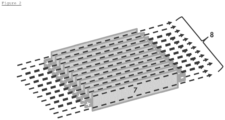
- FIG. 2 is an illustration of a battery comprising a number of cells within a thermal management system according to the invention.
- a number of pouch cells (7) are disposed within a housing (not shown).
- the flow of the working fluid across and between the pouch cells (7) is indicated by the arrows (8).
- the base oils used were an API Group I base oil commercially available as HVI60 from Shell and a Fischer-Tropsch derived base oil commercially available as GTL 3 from Shell.
- the base oil characteristics are indicated in Table 1.
- Table 1 Test method API Group I Base oil GTL3 Base oil Colour ISO 2049 0.4 ⁇ 0,2 Kinematic Viscosity @ 100°C ISO 3104 4.5 2.7 Kinematic Viscosity @ 40°C ISO 3104 23.4 9.8 Pour point ISO 3016 -15 -42 Flash point ISO 2592 216 200
- the antioxidant additive used in the Examples was di-tert-butylated hydroxytoluene (BHT) and the anti-static additive was Stadis 450, ex. Innospec.
- Stadis 450 is indicated to contain 10 - 25% di C8-C10, branched, C9 rich, alkylnaphthalene sulphonic acid.
- the working fluids (900 mL per fluid) were each placed in 1000mL beakers. A copper and steel coil was also placed in each beaker. Such coils were of the type used in the ASTM D493 test method for oxidation stability, but of half the usual size.
- the beakers containing the oil samples and coils were then kept in an oven (with air ventilation) at 120°C. The beakers were uncovered.
Landscapes
- Chemical & Material Sciences (AREA)
- Engineering & Computer Science (AREA)
- Chemical Kinetics & Catalysis (AREA)
- General Chemical & Material Sciences (AREA)
- Organic Chemistry (AREA)
- Oil, Petroleum & Natural Gas (AREA)
- Electrochemistry (AREA)
- Manufacturing & Machinery (AREA)
- Physics & Mathematics (AREA)
- Thermal Sciences (AREA)
- Microelectronics & Electronic Packaging (AREA)
- Materials Engineering (AREA)
- Combustion & Propulsion (AREA)
- General Engineering & Computer Science (AREA)
- Computer Hardware Design (AREA)
- Transportation (AREA)
- Mechanical Engineering (AREA)
- Lubricants (AREA)
Description
- This invention relates to a thermal management system, a method of thermal management for a heat-generating component and the use of a Fischer-Tropsch derived base fluid in a working fluid in contact with a heat-generating component in a thermal management system.
- Throughout a range of industries, new technologies are being sought in order to provide more energy efficient, lower CO2 solutions. This invention relates to a number of possible efficiencies driving lower energy requirements and lower CO2 emissions. Firstly, it relates to electric vehicle technology. Secondly, the invention is also applicable to the thermal management of IT equipment, such as servers. However, the invention described herein is not inherently limited by the technology to which it may be applied. The present invention is applicable to any heat-generating electric technology.
- By 2040, it is expected that up to 50% of all new passenger car sales will be electric vehicles. This includes battery electric vehicles (BEV) and hybrid electric vehicles (HEV) of fuel cell electric vehicles (FCEV). Hybrid electric vehicles include a battery in combination with conventional combustion engines or fuel cells. Fuel cell electric vehicles also need a battery for buffering and interim storage of electrical energy.
- Current battery technology relies on lithium-ion batteries and it is likely that these will remain the dominant battery technology for at least the next 15 years. While slow charging at home or destination is likely to be the dominant way of charging, high-performance fast-charging (HPC) during a journey will be required by many customers who want to drive longer distances. To improve and shorten the charging process, it is required to increase voltage, current, or both at the same time. A higher current will also increase excess heat generated. The level of excess heat is very high and can reach 20 kWh or higher. Effective thermal management to control temperature uniformity within the cell pack is required to prevent battery cells from irreversible deterioration.
- Within an electric vehicle, other components also require thermal management, especially cooling. Heat is generated by both the electric motor and the inverter in use. A method of thermal management that could be applied to each of these components and preferably a circuit incorporating all of these components (including the battery) would be most desirable.
- Fuel cell powered electrical systems also generate significant waste heat (approximately 50% of the energy is produced as waste heat) in use that needs to be removed during operation.
- The thermal management of components provides challenges across other industries as well. The thermal management of IT components, especially servers, also provides many challenges. Air cooling of these components requires high energy usage and expensive cooling infrastructure. A simpler, more energy efficient system for the thermal management of these electronic components would be highly desirable.
- Most cooling systems historically have used air passed over the source of heat in order to manage excess heat. However, such systems are limited in heat capacity and are not capable of managing the heat produced, for example, in an electrical device subjected to the strains of a process such as HPC. The infrastructure included in an air-cooling system can also be complex, expensive and involve the maintenance of many moving parts.
- More advanced thermal management systems have been developed in which a conventional water/glycol mixture is used as a heat transfer fluid. A battery block, containing a large number of individual battery cells, may be effectively cooled with a water/glycol mixture. This is rapidly becoming the dominant thermal management technology in use in electric vehicles sold today as it is more efficient than air-cooling.
US20090023056 ,US20100025006 andUS2011021356 , in the name of Tesla Motors Inc., describe pipe systems in which about 11% percent of the cell surface are directly in contact with pipes containing coolants. In these indirect thermal management systems, the heat needs to pass through the pipe material and then the heat is transferred to the glycol/water. This limits the overall effectiveness of this heat transfer design. - Phase change materials (PCMs) are also utilized in some systems and are an effective means to take up heat while they change from solid to liquid state. PCMs are limited to the melting temperature of the selected and is not suitable for thermal management. At high ambient temperatures, the PCM could melt without any extra heat dissipated from the heat-generating component.
- Under HPC conditions, if these systems fail to control cell temperature and uniformity effectively, the battery management system (BMS) in the car limits the current to protect the battery. This can slow down the charging process very significantly and limits fast charging capability. Other systems may simply over-heat or be subject to safety shutdowns in high temperature conditions.
- Direct liquid cooling, involving novel thermal management systems, generally designed with heat-generating components immersed in a liquid coolant, can help control each component's temperature much more effectively, as the fluid is directly in contact with the cell surface. Such a system is described, for example, in
US20170279172 . To prevent short circuits, this requires a fluid with very good dielectric properties. Suitable fluids also require low viscosity, to aid pumping, as well as high thermal conductivity and heat capacity. It has already been demonstrated that immersive thermal management can help to increase power and energy density ratios and also significantly enhance cell durability. - Hydrofluorinated ethers have been demonstrated as suitable fluids for immersive thermal management (e.g. in
WO2018224908 ). While this fluid reduces the flammability risk, it places several technical challenges for the application such as resulting high pressures due to its low boiling temperature, high density and challenges in material compatibility. -
JP 2009 126256 A -
-
Figure 1 illustrates a simplified circuit for a thermal management system of the present invention. -
Figure 2 is an illustration of a battery comprising a number of cells within a thermal management system according to the invention. - The present invention provides a
thermal management system comprising: - a housing having an interior space;
- a heat-generating component disposed within the interior space;
- a heat exchanger; and
- a working fluid liquid disposed within the interior space such that the heat-generating component is in direct contact with, and partially immersed up to fully immersed in, the working fluid;
- The present invention also provides a method of thermal management of a heat-generating component comprising the steps of at least partially immersing a heat-generating component in a working fluid; such that the heat-generating component is in direct contact with the working fluid; and transferring the heat from the heat-generating component using the working fluid in a constant cyclical flow of working fluid across the one or more heat-generating components, on to a heat exchanger and then back to the heat-generating component, wherein the working fluid comprises a Fischer-Tropsch derived base fluid; an antioxidant additive; and an antistatic additive.
- The present invention also provides for the use of a Fischer-Tropsch derived base fluid as a base fluid in a working fluid also comprising an antioxidant additive and an anti-static additive, wherein the working fluid is disposed in the interior space of a thermal management system, said thermal management system comprising: a housing having an interior space;a heat-generating component disposed within the interior space; and a heat exchanger; such that the heat-generating component is in direct contact with, and partially immersed up to fully immersed in, the working fluid; wherein the thermal management system is constructed such that a constant cyclical flow of working fluid is maintained across the one or more heat-generating components, on to the heat exchanger and then back to the heat-generating component, in order to prove improved conductivity levels in the working fluid over time.
- The present inventors have surprisingly found that a highly efficient system and method for immersion thermal management of a heat-generating component may be provided wherein a heat-generating component is in direct contact with a working fluid and wherein said working fluid comprises a Fischer-Tropsch derived base fluid; an antioxidant additive; and an antistatic additive.
- The heat-generating component is preferably an electrical element. Typical electrical elements that may benefit from the system and method described herein include computer servers, batteries, inverters, electric motors and fuel cells, or any combination of these.
- One or more heat-generating components may be cooled within the thermal management system of the invention.
- The thermal management system of the invention comprises a housing having an interior space; a heat-generating component disposed within the interior space; and a working fluid liquid disposed within the interior space such that the heat-generating component is in direct contact with the working fluid. The heat-generating component may be partially immersed, and up to fully immersed, in the working fluid.
- The thermal management system is constructed such that a constant cyclical flow of working fluid is maintained across the one or more heat-generating components, on to a heat exchanger and then back to the heat-generating component.
- The heat exchanger may be disposed within or external to the housing.
- The thermal management system may comprise a liquid circuit with a pump and a heat exchanger. In this embodiment, the pump operates to move the working fluid from the heat-generating component to and from the heat exchanger.
- Heat is transferred from the heat-generating component to the working fluid. The working fluid may then be pumped away from the heat-generating component to a heat exchanger. Heat may then be transferred from the working component via the heat exchanger. The working fluid may then be returned to the heat-generating component.
- As well as functioning to remove heat from the heat-generating component disposed therein, the thermal management system may also be suitable to provide heat to the heat-generating component at certain times during the functioning of said component, e.g. at start-up or during running in cold environments. In this embodiment of the invention a source of heating will be included in the thermal management system. Such a source of heat may comprise an internal heat source or an external heat source. A control mechanism will also be included in the thermal management system to allow switching between cooling and heating embodiments of the system.
- A suitable internal heat source may involve a battery with a load to form a heat-generating circuit. Suitable external heat sources include heat pumps, phase change materials capable of releasing heat upon the phase change, electric heaters and heaters burning ethanol, bioethanol or other fuels.
- The working fluid comprises a Fischer-Tropsch derived base fluid and an antioxidant additive. Preferably, the working fluid also comprises an antistatic additive.
- Fischer-Tropsch derived base fluids are known in the art. By the term "Fischer-Tropsch derived" is meant that a base fluid is, or is derived from, a synthesis product of a Fischer-Tropsch process.
- Fischer-Tropsch derived base fluids are often classified by the starting material in the Fischer-Tropsch process, i.e. 'X-to-liquids' or 'XTL', with X standing for said starting material. Biomass-to-liquid (BTL), coal to liquids (CTL), gas-to-liquid (GTL) and power-to-liquid (PTL) processes are some examples of Fischer-Tropsch processes producing base fluids. Preferably, the Fischer-Tropsch derived base fluid is a GTL (Gas-To-Liquids) base fluid.
- Suitable Fischer-Tropsch derived base fluids including oils that may be conveniently used in the Fischer-Tropsch derived working fluid are those as for example disclosed in
EP0776959 ,EP0668342 ,WO97021788 WO0015736 WO0014188 WO0014187 WO0014183 WO0014179 WO0008115 WO9941332 EP1029029 ,WO0118156 WO 0157166 - The Fischer-Tropsch derived base fluids for use in the invention preferably have kinematic viscosities at 100°C of at most 4 mm2/s.
- A particularly preferred Fischer-Tropsch derived base fluid for use in the working fluid herein is a Fischer-Tropsch derived base oil with a kinematic viscosity at 100°C in the range of from 2 to 4 mm2/s, for example GTL 3 (having a kinematic viscosity at 100°C of approximately 3 mm2/s).
- Another particularly preferred Fischer-Tropsch derived base fluid for use in the working fluid herein is a Fischer-Tropsch derived base fluid produced from a gas oil stream, preferably a dewaxed gas oil stream, from a GTL process, wherein said fluid has a kinematic viscosity at 40°C in the range of from 2.0 to 11 mm2/second. Preferably said Fischer-Tropsch derived base fluid produced from a gas oil stream has a kinematic viscosity at 40°C of at least 2.1 mm2/second, more preferably at least 2.2 mm2/second. Also preferably, said fluid has a kinematic viscosity at 40°C of at most 10.0 mm2/second, more preferably at most 7.0 mm2/second, most preferably at most 6.0 mm2/second.
- In one embodiment of the invention the working fluid comprises a mixture of more than one Fischer-Tropsch derived base fluid. For example, the working fluid may comprise both a Fischer-Tropsch derived base oil with a kinematic viscosity at 100°C in the range of from 2 to 4 mm2/s and a Fischer-Tropsch derived base fluid produced from a gas oil stream.
- The total amount of Fischer-Tropsch derived base fluids incorporated in the working fluid is preferably in the range of from 60.0 to 99.9 wt.%.
- Other components within the working fluid may include one or more additional base oils including mineral oils and synthetic oils. Mineral oils include liquid petroleum oils and solvent-treated or acid-treated mineral lubricating oil of the paraffinic, naphthenic, or mixed paraffinic/naphthenic type which may be further refined by hydrofinishing processes and/or dewaxing. Synthetic oils include hydrocarbon oils such as olefin oligomers (including polyalphaolefin base oils; PAOs), dibasic acid esters, polyol esters, polyalkylene glycols (PAGs), alkyl benzenes, alkyl naphthalenes and dewaxed waxy isomerates.
- In one preferred embodiment, the working fluid comprises one or more additional base oils selected from alkyl benzenes, alkyl naphthalenes and mixtures thereof. If present, the one or more additional base oils selected from alkyl benzenes, alkyl naphthalenes and mixtures thereof are present in no more than 35 wt% with respect to the total weight of the working fluid. Preferably the one or more additional base oils selected from alkyl benzenes, alkyl naphthalenes and mixtures thereof are present in an amount in the range of from 1 to 30 wt% with respect to the total weight of the working fluid.
- The working fluid preferably has a pour point of less than or equal to -40°C, more preferably less than or equal to -50°C, measured according to ISO 3016.
- The working fluid also preferably has a flash point of at least 100°C, more preferably at least 110°C, most preferably at least 120°C, and preferably at most 240°C, according to ASTM D93.
- The working fluid preferably has a kinematic viscosity at 40°C of at least 2.0 mm2/s, more preferably at least 2.1 mm2/s, most preferably at least 2.2 mm2/s, measured according to ISO 3104. The working fluid preferably has a kinematic viscosity at 40°C of at most 22.0 mm2/s, more preferably at most 11.0 mm2/s, most preferably at most 10.0 mm2/s.
- The thermal conductivity of the working fluid at 20°C is preferably at least 0.135 w/mK, measured according to ASTM D7896.
- The specific heat capacity of the working fluid at 20°C, according to ASTM D 1269, is preferably at least 1.9 kJ/kg*K, more preferably at least 2.0 kJ/kg*K.
- The antioxidant additive is suitably a hindered phenolic antioxidant additive, sterically hindered monohydric, dihydric and trihydric phenols, sterically hindered dinuclear, trinuclear and polynuclear phenols.
- Sterically hindered phenolic antioxidants of particular interest may be selected from the group consisting of 2,6-di-tert-butylphenol (available under the trade designation "IRGANOX TM L 140" from BASF), di tert-butylated hydroxytoluene ("BHT"), methylene-4,4'-bis-(2.6-tert-butylphenol), 2,2'-methylene bis-(4,6-di-tert-butylphenol), 1,6-hexamethylene-bis-(3,5-di-tert-butyl-hydroxyhydrocinnamate) (available under the trade designation "IRGANOX TM L109" from BASF), ((3,5-bis(1,1-dimethylethyl)-4-hydroxyphenyl)methyl)thio) acetic acid, C10-C14isoalkyl esters (available under the trade designation "IRGANOX TM L118" from BASF), 3,5-di-tert-butyl-4-hydroxyhydrocinnamic acid, C7-C9alkyl esters (available under the trade designation "IRGANOX TM L135" from BASF,) tetrakis-(3-(3,5-di-tert-butyl-4-hydroxyphenyl)-propionyloxymethyl)methane (available under the trade designation "IRGANOX TM 1010" from BASF), thiodiethylene bis(3,5-di-tert-butyl-4-hydroxyhydrocinnamate (available under the trade designation "IRGANOX TM 1035" from BASF), octadecyl 3,5-di-tert-butyl-4-hydroxyhydrocinnamate (available under the trade designation "IRGANOX TM 1076" from BASF), 2,5-di-tert-butylhydroquinone and mixtures thereof.
- Particularly preferred antioxidants for use herein are di-tert-butylated hydroxytoluene ("BHT") and C7 to C9 alkyl esters of 3,5-di-tert-butyl-4-hydroxyhydrocinnamic acid, (available under the trade designation "IRGANOX TM L135" from BASF).
- In one embodiment of the invention, more than one antioxidant additive may be present in the working fluid.
- Optionally, an additional amine antioxidant, for example an alkylated or styrenated diphenylamine, may be added to the working fluid.
- Examples of amine antioxidants are aromatic amine anti-oxidants for example N,N'-Di-isopropyl-p-phenylenediamine, N,N'-di-sec-butyl-p-phenylenediamine, N,N'-bis(1,4-dimethyl-pentyl)-p-phenylenediamine, N,N'-bis(1-ethyl-3-methyl-pentyl)-p-phenylene-diamine, N,N'-bis(1-methyl-heptyl)-p-phenylenediamine, N,N'-dicyclohexyl-p-phenylene-diamine, N,N'-diphenyl-p-phenylenediamine, N,N'-di(naphthyl-2-)-p-phenylenediamine, N-isopropyl-N'-phenyl-p-phenylenediamine, N-(1,3-dimethylbutyl)-N'-phenyl-p-phenylenediamine, N-(1-methylheptyl)-N'-phenyl-p-phenylenediamine, N'-cyclohexyl-N'-phenyl-p-phenylenediamine, 4-(p-toluene-sulfoamido)diphenylamine, N,N'-dimethyl-N,N'-di-sec-butyl-p-phenylenediamine, diphenylamine, N-allyldiphenylamine, 4-isopropoxydiphenylamine, N-phenyl-1-naphthylamine, N-phenyl-2-naphthylamine, octylated diphenylamine, e.g. p,p'-di-tert-octyldiphenylamine, 4-n-butylaminophenol, 4-butyrylaminophenol, 4-nonanoylaminophenol, 4-dodecanoylaminophenol, 4-octadecanoylaminophenol, di(4-methoxyphenyl)amine, 2,6-di-tert-butyl-4-dimethylamino-methylphenol, 2,4'-diaminodiphenylmethane, 4,4'-diaminodiphenylmethane, N,N,N',N'-tetramethyl-4,4'-diaminodiphenylmethane, 1,2-di(phenylamino)ethane, 1,2-di[(2-methylphenyl)amino]ethane, 1,3-di(phenylamino)-propane, (o-tolyl)biguanide, di[4-(1',3'-dimethylbutyl)phenyl]amine, alkylated phenyl alpha naphthylamines, e.g. tert-octylated N-phenyl-1-naphthylamine, mixture of mono- and dialkylated tert-butyl-/tert-octyldiphenylamines, 2,3-dihydro-3,3-dimethyl-4H-1,4-benzothiazine, phenothiazine, N-allylphenothiazine, tert-octylated phenothiazine, 3,7-di-tert-octylphenothiazine, Also possible amine antioxidants are those according to formula VIII and IX of
EP1054052 , which compounds are also described inUS4824601 . - The total amount of the one or more antioxidant additives present in the working fluid is preferably at least 0.1wt%, more preferably at least 0.15wt% and preferably at most 3.0 wt%, more preferably at most 2.0 wt% with respect to the total weight of the working fluid.
- The antistatic additive for use herein is preferably selected from those containing alkyl substituted naphthalene sulfonic acids, benzotriazole and substituted benzotriazoles.
- Substituted benzotriazole compounds for use herein may be represented by the formula (I).



c is 0, 1, 2 or 3;
R1 and R2 are hydrogen or the same or different straight or branched alkyl groups of 1-18 carbon atoms, preferably a branched alkyl group of 1-12 carbon atoms; R3 is a straight or branched C1-4 alkyl group, preferably R3 is methyl or ethyl and C is 1 or 2; R5 is a methylene or ethylene group; R6 and R7 are the same or different alkyl groups of 3-15 carbon atoms, preferably of 4-9 carbon atoms. - Preferred compounds are 1-[bis(2-ethylhexyl)-aminomethyl]benzotriazole, methylbenzotriazole, dimethylbenzotriazole, ethylbenzotriazole, ethylmethylbenzotriazole, diethylbenzotriazole and mixtures thereof. Other preferred compounds include (N-Bis(2-ethylhexyl)-aminomethyl-tolutriazole, non-substituted benzotriazole, and 5-methyl-1H-benzotriazole.
- Preferred alkyl substituted naphthalene sulfonic acids include di C8-C10, branched, C9 rich, alkylnaphthalene sulphonic acid, such as those commercially available as "Stadis 450" from Innospec.
- The content of the above antistatic additive in the working fluid herein is preferably above 0,5 mg/kg and more preferably above 1 mg/kg with respect to the total weight of the working fluid. A practical upper limit may vary depending on the specific application of the lubricating composition. This concentration may be up to 3 wt. %, preferably however in the range of from 1 mg/kg to 1 wt. % with respect to the total weight of the working fluid. However, such compounds may be advantageously used at concentrations below 1000 mg/kg and more preferably below 300 mg/kg with respect to the total weight of the working fluid.
- It has also been surprisingly found that the use of a Fischer-Tropsch derived base fluid in a working fluid also comprising such antioxidant and antistatic additives in contact with a heat-generating component in a thermal management system provides said working fluid with improved anti-aging properties. By `anti-aging properties' herein, is meant at least one property selected from electrical conductivity at 24 and/or 90°C (measured according to IEC 60247), appearance and sludge formation (measured according to visual rating), relative permittivity (measured according to IEC 60247) and discoloration (measured according to ISO 2049) is maintained at a suitable level over time. The use of a Fischer-Tropsch derived base fluid in a working fluid also comprising antioxidant and antistatic additives in contact with a heat-generating component in a thermal management system provides said working fluid with improved conductivity levels over time.
-
Figure 1 shows a suitable liquid circuit for the thermal management system of the present invention. InFigure 1 , a heat-generating component (1) is disposed within a housing (2). Working fluid flows (3) through the interior space of the housing (1) and then through connecting pipework (4) to one or more heat exchanger (5). In this embodiment, said flow is maintained by a pump (6). -
Figure 2 is an illustration of a battery comprising a number of cells within a thermal management system according to the invention. In this embodiment, a number of pouch cells (7) are disposed within a housing (not shown). The flow of the working fluid across and between the pouch cells (7) is indicated by the arrows (8). - The present invention will now further be illustrated by the following, non-limiting, examples.
- Six blends of working fluid formulations were produced according to the components listed in Table 2. The base oils used were an API Group I base oil commercially available as HVI60 from Shell and a Fischer-Tropsch derived base oil commercially available as
GTL 3 from Shell. The base oil characteristics are indicated in Table 1.Table 1 Test method API Group I Base oil GTL3 Base oil Colour ISO 2049 0.4 <0,2 Kinematic Viscosity @ 100°C ISO 3104 4.5 2.7 Kinematic Viscosity @ 40°C ISO 3104 23.4 9.8 Pour point ISO 3016 -15 -42 Flash point ISO 2592 216 200 - The antioxidant additive used in the Examples was di-tert-butylated hydroxytoluene (BHT) and the anti-static additive was Stadis 450, ex. Innospec. Stadis 450 is indicated to contain 10 - 25% di C8-C10, branched, C9 rich, alkylnaphthalene sulphonic acid.
- The working fluids (900 mL per fluid) were each placed in 1000mL beakers. A copper and steel coil was also placed in each beaker. Such coils were of the type used in the ASTM D493 test method for oxidation stability, but of half the usual size.
- To prepare the copper and steel wire coils, 112 mm of low metalloid steel wire with a diameter of 1,59mm and an electrolytic copper wire, length also 112 mm but with a diameter of 1,63 mm were placed beside each other. The wires were then twisted to a coil which was then used for the test.
- The beakers containing the oil samples and coils were then kept in an oven (with air ventilation) at 120°C. The beakers were uncovered.
- At each of the times indicated in Table 2 below, an oil sample of 125mL was taken and tested. Electrical conductivity was tested according to IEC 60247. The appearance was tested by a visual assessment. The colour of the sample was tested according to ISO 2049
- These Examples, representative of using the working fluids in a thermal management system, clearly demonstrate that working fluids comprising a Fischer-Tropsch derived base fluid (blends 1 to 3) have and maintain over time better conductivity and appearance characteristics, when compared with working fluids comprising an API Group I base oil (blends 4 to 6). These characteristics are further improved by the addition of an antioxidant additive (blend 2).
Blend 2 demonstrates maintenance of electrical conductivity at low levels as well as maintenance of good appearance and colour characteristics. The further addition of an anti-static additive to a working fluid comprising a Fischer-Tropsch derived base fluid and an antioxidant additive maintains the electrical conductivity of said fluid over time at an excellent level that prevents static build up and short circuits. These improvements are not seen for the equivalent blends in working fluids comprising an API Group I base oil (blends 4 and 5).Table 2 Blend 1 Blend 2 Blend 3 Blend 4 Blend 5 Blend 6 Gp I Base oil - - - 99.7999 99.8 100 GTL3 Base oil 99.7999 99.8 100 - - - Antioxidant 0.2 0.2 - 0.2 0.2 - Antistatic 0.00045 - - 0.00045 - - Electrical Conductivity (pS/m) @ 90 °C fresh oil 35 0.04 0.04 140 14.4 8.7 after 1 week 0.7 0.8 0.9 1358 425 826 after 2 weeks 0.2 0.7 2.5 1358 1190 1752 after 3 weeks 33 0.4 0.5 3738 3502 3734 after 4 weeks 63 0.8 151 5345 4967 5531 Appearance fresh oil clear, free of deposit clear, free of deposit clear, free of deposit clear, free of deposit clear, free of deposit clear, free of deposit after 1 week clear, free of deposit clear, free of deposit clear, free of deposit clear, free of deposit clear, free of deposit clear, free of deposit after 2 weeks clear, free of deposit clear, free of deposit clear, free of deposit dark, deposit dark, free of deposit dark, free of deposit after 3 weeks clear, slight deposit clear, slight deposit clear, slight deposit dark, deposit dark, deposit dark, deposit after 4 weeks hazy, some deposit hazy, some deposit hazy, some deposit hazy, sludge hazy, sludge hazy, sludge Colour fresh oil <0, 2 <0,2 <0,2 0.4 0.4 0.4 after 1 week <0, 2 <0,2 <0,2 6.7 6.2 5.8 after 2 weeks <0, 2 <0,2 <0,2 >8 >8 8 after 3 weeks 0.2 0.4 0.6 >8 >8 >8 after 4 weeks 1.2 1.3 1.8 >8 >8 >8
Claims (14)
- A thermal management system comprising:a housing having an interior space;a heat-generating component disposed within the interior space;a heat exchanger; anda working fluid liquid disposed within the interior space such that the heat-generating component is in direct contact with, and partially immersed up to fully immersed in, the working fluid;wherein the working fluid comprises a Fischer-Tropsch derived base fluid; an antioxidant additive and an anti-static additive, wherein the thermal management system is constructed such that a constant cyclical flow of working fluid is maintained across the one or more heat-generating components, on to the heat exchanger and then back to the heat-generating component.
- The thermal management system of Claim 1, wherein the antioxidant additive comprises a hindered phenol.
- The thermal management system of Claim 2, wherein the antioxidant additive is selected from the group consisting of 2,6-di-tert-butylphenol, di tert-butylated hydroxytoluene, methylene-4,4'-bis-(2.6-tert-butylphenol), 2,2'-methylene bis-(4,6-di-tert-butylphenol), 1,6-hexamethylene-bis-(3,5-di-tert-butyl-hydroxyhydrocinnamate), ((3,5-bis(1,1-dimethylethyl)-4-hydroxyphenyl)methyl)thio) acetic acid, C10-C14isoalkyl esters, 3,5-di-tert-butyl-4-hydroxyhydrocinnamic acid, C7-C9alkyl esters, tetrakis-(3-(3,5-di-tert-butyl-4-hydroxyphenyl)-propionyloxymethyl)methane, thiodiethylene bis(3,5-di-tert-butyl-4-hydroxyhydrocinnamate, octadecyl 3,5-di-tert-butyl-4-hydroxyhydrocinnamate, 2,5-di-tert-butylhydroquinone and mixtures thereof.
- The thermal management system of any one of Claims 1 to 3, wherein the antistatic additive is selected from the group consisting of alkyl substituted naphthalene sulphonic acids, alkylated benzotriazoles and benzotriazole.
- The thermal management system of any one of Claims 1 to 4, wherein the thermal management system further comprises a pump, wherein the pump is configured to move the working fluid to and from the heat exchanger.
- The thermal management system of any one of Claims 1 to 5, wherein the heat-generating component comprises a server.
- The thermal management system of any of Claims 1 to 5, wherein the heat-generating component is a battery.
- The thermal management system of any of Claims 1 to 4, wherein the heat-generating component is one or more of a battery, an e-motor and an inverter within an electric vehicle.
- A method of thermal management of a heat-generating component comprising the steps of at least partially immersing a heat-generating component in a working fluid, such that the heat-generating component is in direct contact with the working fluid; and transferring the heat from the heat-generating component using the working fluid in a constant cyclical flow of working fluid across the one or more heat-generating components, on to a heat exchanger and then back to the heat-generating component, wherein the working fluid comprises a Fischer-Tropsch derived base fluid; an antioxidant additive; and an antistatic additive.
- The method of Claim 9, wherein said method comprises the steps of pumping the working fluid to a heat exchanger; transferring heat from the working fluid; and returning said working fluid to the heat-generating component.
- The method of Claim 9 or Claim 10, wherein the antioxidant additive is a hindered phenol.
- The method of Claim 13, wherein the antioxidant additive is 2,6-di-tert-butyl-4-methylphenol.
- The method of any one of Claims 9 to 12 wherein the antistatic additive is selected from the group consisting of alkyl substituted naphthalene sulphonic acids, alkylated benzotriazoles, benzotriazole and mixtures thereof.
- The use of a Fischer-Tropsch derived base fluid as a base fluid in a working fluid also comprising an antioxidant additive and an anti-static additive, wherein the working fluid is disposed in the interior space of a thermal management system, said thermal management system comprising:a housing having an interior space;a heat-generating component disposed within the interior space; anda heat exchanger;such that the heat-generating component is in direct contact with, and partially immersed up to fully immersed in, the working fluid;wherein the thermal management system is constructed such that a constant cyclical flow of working fluid is maintained across the one or more heat-generating components, on to the heat exchanger and then back to the heat-generating component, in order to prove improved conductivity levels in the working fluid over time.
Applications Claiming Priority (2)
| Application Number | Priority Date | Filing Date | Title |
|---|---|---|---|
| EP20166789 | 2020-03-30 | ||
| PCT/EP2021/057611 WO2021197968A1 (en) | 2020-03-30 | 2021-03-24 | Thermal management system |
Publications (3)
| Publication Number | Publication Date |
|---|---|
| EP4127115A1 EP4127115A1 (en) | 2023-02-08 |
| EP4127115C0 EP4127115C0 (en) | 2023-11-15 |
| EP4127115B1 true EP4127115B1 (en) | 2023-11-15 |
Family
ID=70058262
Family Applications (1)
| Application Number | Title | Priority Date | Filing Date |
|---|---|---|---|
| EP21713674.6A Active EP4127115B1 (en) | 2020-03-30 | 2021-03-24 | Thermal management system |
Country Status (6)
| Country | Link |
|---|---|
| US (1) | US12180410B2 (en) |
| EP (1) | EP4127115B1 (en) |
| JP (1) | JP2023520456A (en) |
| CN (1) | CN115335497A (en) |
| BR (1) | BR112022019578A2 (en) |
| WO (1) | WO2021197968A1 (en) |
Families Citing this family (2)
| Publication number | Priority date | Publication date | Assignee | Title |
|---|---|---|---|---|
| CN119213095A (en) * | 2022-05-19 | 2024-12-27 | 国际壳牌研究有限公司 | Thermal Management System |
| JP2025050515A (en) * | 2023-09-25 | 2025-04-04 | トヨタ自動車株式会社 | Cooling System |
Family Cites Families (42)
| Publication number | Priority date | Publication date | Assignee | Title |
|---|---|---|---|---|
| GB8332797D0 (en) | 1983-12-08 | 1984-01-18 | Ciba Geigy Ag | Antioxidant production |
| JPH0363993U (en) * | 1989-10-26 | 1991-06-21 | ||
| EP0668342B1 (en) | 1994-02-08 | 1999-08-04 | Shell Internationale Researchmaatschappij B.V. | Lubricating base oil preparation process |
| EP1365005B1 (en) | 1995-11-28 | 2005-10-19 | Shell Internationale Researchmaatschappij B.V. | Process for producing lubricating base oils |
| CA2237068C (en) | 1995-12-08 | 2005-07-26 | Exxon Research And Engineering Company | Biodegradable high performance hydrocarbon base oils |
| US6090989A (en) | 1997-10-20 | 2000-07-18 | Mobil Oil Corporation | Isoparaffinic lube basestock compositions |
| JPH11185530A (en) * | 1997-12-22 | 1999-07-09 | Nippon Mitsubishi Oil Corp | Electrical insulating oil |
| US6059955A (en) | 1998-02-13 | 2000-05-09 | Exxon Research And Engineering Co. | Low viscosity lube basestock |
| US6008164A (en) | 1998-08-04 | 1999-12-28 | Exxon Research And Engineering Company | Lubricant base oil having improved oxidative stability |
| US6080301A (en) | 1998-09-04 | 2000-06-27 | Exxonmobil Research And Engineering Company | Premium synthetic lubricant base stock having at least 95% non-cyclic isoparaffins |
| US6475960B1 (en) | 1998-09-04 | 2002-11-05 | Exxonmobil Research And Engineering Co. | Premium synthetic lubricants |
| US6165949A (en) | 1998-09-04 | 2000-12-26 | Exxon Research And Engineering Company | Premium wear resistant lubricant |
| US6103099A (en) | 1998-09-04 | 2000-08-15 | Exxon Research And Engineering Company | Production of synthetic lubricant and lubricant base stock without dewaxing |
| US6332974B1 (en) | 1998-09-11 | 2001-12-25 | Exxon Research And Engineering Co. | Wide-cut synthetic isoparaffinic lubricating oils |
| EP1054052B1 (en) | 1999-05-19 | 2006-06-28 | Ciba SC Holding AG | Stabilized hydrotreated and hydrodewaxed lubricant compositions |
| FR2798136B1 (en) | 1999-09-08 | 2001-11-16 | Total Raffinage Distribution | NEW HYDROCARBON BASE OIL FOR LUBRICANTS WITH VERY HIGH VISCOSITY INDEX |
| US7067049B1 (en) | 2000-02-04 | 2006-06-27 | Exxonmobil Oil Corporation | Formulated lubricant oils containing high-performance base oils derived from highly paraffinic hydrocarbons |
| AR032941A1 (en) | 2001-03-05 | 2003-12-03 | Shell Int Research | A PROCEDURE TO PREPARE A LUBRICATING BASE OIL AND BASE OIL OBTAINED, WITH ITS VARIOUS USES |
| US7510674B2 (en) * | 2004-12-01 | 2009-03-31 | Chevron U.S.A. Inc. | Dielectric fluids and processes for making same |
| CN101198680B (en) * | 2005-06-23 | 2012-03-21 | 国际壳牌研究有限公司 | Oxidative stable oil formulation |
| US7403392B2 (en) * | 2006-05-16 | 2008-07-22 | Hardcore Computer, Inc. | Liquid submersion cooling system |
| JP4636031B2 (en) | 2007-02-01 | 2011-02-23 | トヨタ自動車株式会社 | Power supply |
| US7789176B2 (en) | 2007-04-11 | 2010-09-07 | Tesla Motors, Inc. | Electric vehicle thermal management system |
| US20090001330A1 (en) * | 2007-06-28 | 2009-01-01 | Chevron U.S.A. Inc. | Electrical Insulating Oil Compositions and Preparation Thereof |
| US20090023056A1 (en) | 2007-07-18 | 2009-01-22 | Tesla Motors, Inc. | Battery pack thermal management system |
| US20090036337A1 (en) * | 2007-07-31 | 2009-02-05 | Chevron U.S.A. Inc. | Electrical Insulating Oil Compositions and Preparation Thereof |
| US8383563B2 (en) * | 2007-08-10 | 2013-02-26 | Exxonmobil Research And Engineering Company | Method for enhancing the oxidation and nitration resistance of natural gas engine oil compositions and such compositions |
| JP2009126256A (en) * | 2007-11-21 | 2009-06-11 | Toyota Motor Corp | Vehicle cooling device |
| US8221614B2 (en) * | 2007-12-07 | 2012-07-17 | Shell Oil Company | Base oil formulations |
| TW200944127A (en) | 2008-03-14 | 2009-11-01 | Basf Se | Herbicidal compositions comprising pyroxasulfone |
| WO2011113851A1 (en) * | 2010-03-17 | 2011-09-22 | Shell Internationale Research Maatschappij B.V. | Lubricating composition |
| JP2011201953A (en) | 2010-03-24 | 2011-10-13 | Showa Shell Sekiyu Kk | Coolant |
| JP2013043933A (en) * | 2011-08-24 | 2013-03-04 | Showa Shell Sekiyu Kk | Coolant |
| US9692095B2 (en) | 2015-06-30 | 2017-06-27 | Faraday&Future Inc. | Fully-submerged battery cells for vehicle energy-storage systems |
| NL2015841B1 (en) | 2015-11-23 | 2017-06-07 | Aecorsis B V | A device comprising heat producing components with liquid submersion cooling. |
| US10784545B2 (en) | 2016-03-25 | 2020-09-22 | Xing Power Inc. | Submerged cell modular battery system |
| JP6980969B2 (en) * | 2016-04-13 | 2021-12-15 | 富士通株式会社 | Data center and data center control method |
| CN105703498A (en) | 2016-04-22 | 2016-06-22 | 三门峡速达交通节能科技股份有限公司 | Stator oil-immersed circulating cooling structure of built-in disc type motor |
| NL2016812B1 (en) | 2016-05-23 | 2017-11-30 | Aecorsis B V | A device comprising server modules |
| JP7186185B2 (en) | 2017-06-07 | 2022-12-08 | スリーエム イノベイティブ プロパティズ カンパニー | Immersion cooling fluid |
| NL2019860B1 (en) | 2017-11-07 | 2019-05-13 | Aecorsis B V | Device comprising a sandwiched electronic unit comprising a heat sink |
| CN109841918B (en) | 2019-03-01 | 2025-03-11 | 华南理工大学 | Heat dissipation structure of electric vehicle power battery pack using immersion cooling |
-
2021
- 2021-03-24 BR BR112022019578A patent/BR112022019578A2/en unknown
- 2021-03-24 WO PCT/EP2021/057611 patent/WO2021197968A1/en not_active Ceased
- 2021-03-24 EP EP21713674.6A patent/EP4127115B1/en active Active
- 2021-03-24 CN CN202180023616.9A patent/CN115335497A/en active Pending
- 2021-03-24 US US17/908,559 patent/US12180410B2/en active Active
- 2021-03-24 JP JP2022559908A patent/JP2023520456A/en active Pending
Also Published As
| Publication number | Publication date |
|---|---|
| EP4127115C0 (en) | 2023-11-15 |
| WO2021197968A1 (en) | 2021-10-07 |
| US20230097290A1 (en) | 2023-03-30 |
| CN115335497A (en) | 2022-11-11 |
| US12180410B2 (en) | 2024-12-31 |
| JP2023520456A (en) | 2023-05-17 |
| EP4127115A1 (en) | 2023-02-08 |
| BR112022019578A2 (en) | 2022-11-16 |
Similar Documents
| Publication | Publication Date | Title |
|---|---|---|
| US9206379B2 (en) | Lubricating composition | |
| EP3006545B1 (en) | Electrical oil formulation | |
| US11718806B2 (en) | Transformer oil basestock and transformer oil composition comprising the same | |
| EP1896556B1 (en) | Oxidative stable oil formulation | |
| EP4127115B1 (en) | Thermal management system | |
| CN101372645B (en) | Electrical insulation oil and preparation thereof | |
| CN114106787B (en) | Cooling medium composition and preparation method thereof | |
| EP3757188B1 (en) | Heat-radiating fluid composition and battery module comprising the same | |
| US11108102B2 (en) | Coolant | |
| JP7334691B2 (en) | Non-aqueous coolant composition and cooling system | |
| CN119053675A (en) | Organic heat transfer systems, methods, and fluids | |
| JP2013043933A (en) | Coolant | |
| CN115161097B (en) | Preparation method of three-in-one bridge oil for electric automobile | |
| EP4127116B1 (en) | Managing thermal runaway | |
| JP2022049993A (en) | Non-water coolant composition and cooling system | |
| JP2023520458A5 (en) | ||
| EP4559990A1 (en) | Ester-fluorocarbon mixtures as efficient heat transfer fluids | |
| JPH0317191A (en) | Grease for sliding contact point | |
| CN118369408A (en) | Organic heat transfer systems, methods and fluids | |
| JP5396320B2 (en) | Electrical insulating oil and method for producing the same | |
| JPH117831A (en) | Oil-filled electrical equipment |
Legal Events
| Date | Code | Title | Description |
|---|---|---|---|
| STAA | Information on the status of an ep patent application or granted ep patent |
Free format text: STATUS: UNKNOWN |
|
| STAA | Information on the status of an ep patent application or granted ep patent |
Free format text: STATUS: THE INTERNATIONAL PUBLICATION HAS BEEN MADE |
|
| PUAI | Public reference made under article 153(3) epc to a published international application that has entered the european phase |
Free format text: ORIGINAL CODE: 0009012 |
|
| STAA | Information on the status of an ep patent application or granted ep patent |
Free format text: STATUS: REQUEST FOR EXAMINATION WAS MADE |
|
| 17P | Request for examination filed |
Effective date: 20220920 |
|
| AK | Designated contracting states |
Kind code of ref document: A1 Designated state(s): AL AT BE BG CH CY CZ DE DK EE ES FI FR GB GR HR HU IE IS IT LI LT LU LV MC MK MT NL NO PL PT RO RS SE SI SK SM TR |
|
| DAV | Request for validation of the european patent (deleted) | ||
| DAX | Request for extension of the european patent (deleted) | ||
| GRAP | Despatch of communication of intention to grant a patent |
Free format text: ORIGINAL CODE: EPIDOSNIGR1 |
|
| STAA | Information on the status of an ep patent application or granted ep patent |
Free format text: STATUS: GRANT OF PATENT IS INTENDED |
|
| RIC1 | Information provided on ipc code assigned before grant |
Ipc: H01M 10/625 20140101ALI20230725BHEP Ipc: C10N 40/25 20060101ALI20230725BHEP Ipc: C10N 40/16 20060101ALI20230725BHEP Ipc: C10N 30/20 20060101ALI20230725BHEP Ipc: C10N 30/10 20060101ALI20230725BHEP Ipc: C10N 20/02 20060101ALI20230725BHEP Ipc: C10N 20/00 20060101ALI20230725BHEP Ipc: B60K 1/00 20060101ALI20230725BHEP Ipc: H05K 7/20 20060101ALI20230725BHEP Ipc: H01M 10/6567 20140101ALI20230725BHEP Ipc: H01M 10/613 20140101ALI20230725BHEP Ipc: C09K 5/10 20060101ALI20230725BHEP Ipc: B60K 11/02 20060101ALI20230725BHEP Ipc: B60H 1/00 20060101ALI20230725BHEP Ipc: C10M 169/04 20060101AFI20230725BHEP |
|
| INTG | Intention to grant announced |
Effective date: 20230829 |
|
| GRAS | Grant fee paid |
Free format text: ORIGINAL CODE: EPIDOSNIGR3 |
|
| GRAA | (expected) grant |
Free format text: ORIGINAL CODE: 0009210 |
|
| STAA | Information on the status of an ep patent application or granted ep patent |
Free format text: STATUS: THE PATENT HAS BEEN GRANTED |
|
| AK | Designated contracting states |
Kind code of ref document: B1 Designated state(s): AL AT BE BG CH CY CZ DE DK EE ES FI FR GB GR HR HU IE IS IT LI LT LU LV MC MK MT NL NO PL PT RO RS SE SI SK SM TR |
|
| REG | Reference to a national code |
Ref country code: CH Ref legal event code: EP Ref country code: GB Ref legal event code: FG4D |
|
| REG | Reference to a national code |
Ref country code: DE Ref legal event code: R096 Ref document number: 602021006877 Country of ref document: DE |
|
| REG | Reference to a national code |
Ref country code: IE Ref legal event code: FG4D |
|
| U01 | Request for unitary effect filed |
Effective date: 20231115 |
|
| U07 | Unitary effect registered |
Designated state(s): AT BE BG DE DK EE FI FR IT LT LU LV MT NL PT SE SI Effective date: 20231121 |
|
| REG | Reference to a national code |
Ref country code: NO Ref legal event code: T2 Effective date: 20231115 |
|
| U20 | Renewal fee for the european patent with unitary effect paid |
Year of fee payment: 4 Effective date: 20240207 |
|
| PG25 | Lapsed in a contracting state [announced via postgrant information from national office to epo] |
Ref country code: GR Free format text: LAPSE BECAUSE OF FAILURE TO SUBMIT A TRANSLATION OF THE DESCRIPTION OR TO PAY THE FEE WITHIN THE PRESCRIBED TIME-LIMIT Effective date: 20240216 |
|
| PG25 | Lapsed in a contracting state [announced via postgrant information from national office to epo] |
Ref country code: IS Free format text: LAPSE BECAUSE OF FAILURE TO SUBMIT A TRANSLATION OF THE DESCRIPTION OR TO PAY THE FEE WITHIN THE PRESCRIBED TIME-LIMIT Effective date: 20240315 |
|
| PG25 | Lapsed in a contracting state [announced via postgrant information from national office to epo] |
Ref country code: ES Free format text: LAPSE BECAUSE OF FAILURE TO SUBMIT A TRANSLATION OF THE DESCRIPTION OR TO PAY THE FEE WITHIN THE PRESCRIBED TIME-LIMIT Effective date: 20231115 |
|
| PG25 | Lapsed in a contracting state [announced via postgrant information from national office to epo] |
Ref country code: IS Free format text: LAPSE BECAUSE OF FAILURE TO SUBMIT A TRANSLATION OF THE DESCRIPTION OR TO PAY THE FEE WITHIN THE PRESCRIBED TIME-LIMIT Effective date: 20240315 Ref country code: GR Free format text: LAPSE BECAUSE OF FAILURE TO SUBMIT A TRANSLATION OF THE DESCRIPTION OR TO PAY THE FEE WITHIN THE PRESCRIBED TIME-LIMIT Effective date: 20240216 Ref country code: ES Free format text: LAPSE BECAUSE OF FAILURE TO SUBMIT A TRANSLATION OF THE DESCRIPTION OR TO PAY THE FEE WITHIN THE PRESCRIBED TIME-LIMIT Effective date: 20231115 |
|
| PG25 | Lapsed in a contracting state [announced via postgrant information from national office to epo] |
Ref country code: RS Free format text: LAPSE BECAUSE OF FAILURE TO SUBMIT A TRANSLATION OF THE DESCRIPTION OR TO PAY THE FEE WITHIN THE PRESCRIBED TIME-LIMIT Effective date: 20231115 Ref country code: PL Free format text: LAPSE BECAUSE OF FAILURE TO SUBMIT A TRANSLATION OF THE DESCRIPTION OR TO PAY THE FEE WITHIN THE PRESCRIBED TIME-LIMIT Effective date: 20231115 Ref country code: HR Free format text: LAPSE BECAUSE OF FAILURE TO SUBMIT A TRANSLATION OF THE DESCRIPTION OR TO PAY THE FEE WITHIN THE PRESCRIBED TIME-LIMIT Effective date: 20231115 |
|
| PG25 | Lapsed in a contracting state [announced via postgrant information from national office to epo] |
Ref country code: CZ Free format text: LAPSE BECAUSE OF FAILURE TO SUBMIT A TRANSLATION OF THE DESCRIPTION OR TO PAY THE FEE WITHIN THE PRESCRIBED TIME-LIMIT Effective date: 20231115 |
|
| PG25 | Lapsed in a contracting state [announced via postgrant information from national office to epo] |
Ref country code: SK Free format text: LAPSE BECAUSE OF FAILURE TO SUBMIT A TRANSLATION OF THE DESCRIPTION OR TO PAY THE FEE WITHIN THE PRESCRIBED TIME-LIMIT Effective date: 20231115 |
|
| PG25 | Lapsed in a contracting state [announced via postgrant information from national office to epo] |
Ref country code: SM Free format text: LAPSE BECAUSE OF FAILURE TO SUBMIT A TRANSLATION OF THE DESCRIPTION OR TO PAY THE FEE WITHIN THE PRESCRIBED TIME-LIMIT Effective date: 20231115 Ref country code: SK Free format text: LAPSE BECAUSE OF FAILURE TO SUBMIT A TRANSLATION OF THE DESCRIPTION OR TO PAY THE FEE WITHIN THE PRESCRIBED TIME-LIMIT Effective date: 20231115 Ref country code: RO Free format text: LAPSE BECAUSE OF FAILURE TO SUBMIT A TRANSLATION OF THE DESCRIPTION OR TO PAY THE FEE WITHIN THE PRESCRIBED TIME-LIMIT Effective date: 20231115 Ref country code: CZ Free format text: LAPSE BECAUSE OF FAILURE TO SUBMIT A TRANSLATION OF THE DESCRIPTION OR TO PAY THE FEE WITHIN THE PRESCRIBED TIME-LIMIT Effective date: 20231115 |
|
| REG | Reference to a national code |
Ref country code: DE Ref legal event code: R097 Ref document number: 602021006877 Country of ref document: DE |
|
| PLBE | No opposition filed within time limit |
Free format text: ORIGINAL CODE: 0009261 |
|
| STAA | Information on the status of an ep patent application or granted ep patent |
Free format text: STATUS: NO OPPOSITION FILED WITHIN TIME LIMIT |
|
| 26N | No opposition filed |
Effective date: 20240819 |
|
| REG | Reference to a national code |
Ref country code: CH Ref legal event code: PL |
|
| PG25 | Lapsed in a contracting state [announced via postgrant information from national office to epo] |
Ref country code: MC Free format text: LAPSE BECAUSE OF FAILURE TO SUBMIT A TRANSLATION OF THE DESCRIPTION OR TO PAY THE FEE WITHIN THE PRESCRIBED TIME-LIMIT Effective date: 20231115 |
|
| PG25 | Lapsed in a contracting state [announced via postgrant information from national office to epo] |
Ref country code: MC Free format text: LAPSE BECAUSE OF FAILURE TO SUBMIT A TRANSLATION OF THE DESCRIPTION OR TO PAY THE FEE WITHIN THE PRESCRIBED TIME-LIMIT Effective date: 20231115 |
|
| PG25 | Lapsed in a contracting state [announced via postgrant information from national office to epo] |
Ref country code: IE Free format text: LAPSE BECAUSE OF NON-PAYMENT OF DUE FEES Effective date: 20240324 |
|
| PG25 | Lapsed in a contracting state [announced via postgrant information from national office to epo] |
Ref country code: IE Free format text: LAPSE BECAUSE OF NON-PAYMENT OF DUE FEES Effective date: 20240324 Ref country code: CH Free format text: LAPSE BECAUSE OF NON-PAYMENT OF DUE FEES Effective date: 20240331 |
|
| U20 | Renewal fee for the european patent with unitary effect paid |
Year of fee payment: 5 Effective date: 20250205 |
|
| PG25 | Lapsed in a contracting state [announced via postgrant information from national office to epo] |
Ref country code: CY Free format text: LAPSE BECAUSE OF FAILURE TO SUBMIT A TRANSLATION OF THE DESCRIPTION OR TO PAY THE FEE WITHIN THE PRESCRIBED TIME-LIMIT; INVALID AB INITIO Effective date: 20210324 |
|
| PG25 | Lapsed in a contracting state [announced via postgrant information from national office to epo] |
Ref country code: HU Free format text: LAPSE BECAUSE OF FAILURE TO SUBMIT A TRANSLATION OF THE DESCRIPTION OR TO PAY THE FEE WITHIN THE PRESCRIBED TIME-LIMIT; INVALID AB INITIO Effective date: 20210324 |
|
| PG25 | Lapsed in a contracting state [announced via postgrant information from national office to epo] |
Ref country code: TR Free format text: LAPSE BECAUSE OF FAILURE TO SUBMIT A TRANSLATION OF THE DESCRIPTION OR TO PAY THE FEE WITHIN THE PRESCRIBED TIME-LIMIT Effective date: 20231115 |
|
| U20 | Renewal fee for the european patent with unitary effect paid |
Year of fee payment: 6 Effective date: 20260209 |
|
| PGFP | Annual fee paid to national office [announced via postgrant information from national office to epo] |
Ref country code: GB Payment date: 20260106 Year of fee payment: 6 |
|
| PGFP | Annual fee paid to national office [announced via postgrant information from national office to epo] |
Ref country code: NO Payment date: 20260310 Year of fee payment: 6 |