EP4126841B1 - Compounds for inhibition of fibroblast activation protein - Google Patents
Compounds for inhibition of fibroblast activation protein Download PDFInfo
- Publication number
- EP4126841B1 EP4126841B1 EP21726038.9A EP21726038A EP4126841B1 EP 4126841 B1 EP4126841 B1 EP 4126841B1 EP 21726038 A EP21726038 A EP 21726038A EP 4126841 B1 EP4126841 B1 EP 4126841B1
- Authority
- EP
- European Patent Office
- Prior art keywords
- quinoline
- pyrrolidine
- oxoethyl
- glycyl
- carboxamide
- Prior art date
- Legal status (The legal status is an assumption and is not a legal conclusion. Google has not performed a legal analysis and makes no representation as to the accuracy of the status listed.)
- Active
Links
Classifications
-
- C—CHEMISTRY; METALLURGY
- C07—ORGANIC CHEMISTRY
- C07D—HETEROCYCLIC COMPOUNDS
- C07D401/00—Heterocyclic compounds containing two or more hetero rings, having nitrogen atoms as the only ring hetero atoms, at least one ring being a six-membered ring with only one nitrogen atom
- C07D401/02—Heterocyclic compounds containing two or more hetero rings, having nitrogen atoms as the only ring hetero atoms, at least one ring being a six-membered ring with only one nitrogen atom containing two hetero rings
- C07D401/12—Heterocyclic compounds containing two or more hetero rings, having nitrogen atoms as the only ring hetero atoms, at least one ring being a six-membered ring with only one nitrogen atom containing two hetero rings linked by a chain containing hetero atoms as chain links
-
- C—CHEMISTRY; METALLURGY
- C07—ORGANIC CHEMISTRY
- C07K—PEPTIDES
- C07K5/00—Peptides containing up to four amino acids in a fully defined sequence; Derivatives thereof
- C07K5/04—Peptides containing up to four amino acids in a fully defined sequence; Derivatives thereof containing only normal peptide links
- C07K5/06—Dipeptides
- C07K5/06008—Dipeptides with the first amino acid being neutral
- C07K5/06017—Dipeptides with the first amino acid being neutral and aliphatic
- C07K5/06026—Dipeptides with the first amino acid being neutral and aliphatic the side chain containing 0 or 1 carbon atom, i.e. Gly or Ala
-
- A—HUMAN NECESSITIES
- A61—MEDICAL OR VETERINARY SCIENCE; HYGIENE
- A61K—PREPARATIONS FOR MEDICAL, DENTAL OR TOILETRY PURPOSES
- A61K31/00—Medicinal preparations containing organic active ingredients
- A61K31/33—Heterocyclic compounds
- A61K31/395—Heterocyclic compounds having nitrogen as a ring hetero atom, e.g. guanethidine or rifamycins
- A61K31/435—Heterocyclic compounds having nitrogen as a ring hetero atom, e.g. guanethidine or rifamycins having six-membered rings with one nitrogen as the only ring hetero atom
- A61K31/47—Quinolines; Isoquinolines
- A61K31/4709—Non-condensed quinolines and containing further heterocyclic rings
-
- A—HUMAN NECESSITIES
- A61—MEDICAL OR VETERINARY SCIENCE; HYGIENE
- A61K—PREPARATIONS FOR MEDICAL, DENTAL OR TOILETRY PURPOSES
- A61K51/00—Preparations containing radioactive substances for use in therapy or testing in vivo
- A61K51/02—Preparations containing radioactive substances for use in therapy or testing in vivo characterised by the carrier, i.e. characterised by the agent or material covalently linked or complexing the radioactive nucleus
- A61K51/04—Organic compounds
- A61K51/0474—Organic compounds complexes or complex-forming compounds, i.e. wherein a radioactive metal (e.g. 111In3+) is complexed or chelated by, e.g. a N2S2, N3S, NS3, N4 chelating group
- A61K51/0478—Organic compounds complexes or complex-forming compounds, i.e. wherein a radioactive metal (e.g. 111In3+) is complexed or chelated by, e.g. a N2S2, N3S, NS3, N4 chelating group complexes from non-cyclic ligands, e.g. EDTA, MAG3
-
- A—HUMAN NECESSITIES
- A61—MEDICAL OR VETERINARY SCIENCE; HYGIENE
- A61K—PREPARATIONS FOR MEDICAL, DENTAL OR TOILETRY PURPOSES
- A61K51/00—Preparations containing radioactive substances for use in therapy or testing in vivo
- A61K51/02—Preparations containing radioactive substances for use in therapy or testing in vivo characterised by the carrier, i.e. characterised by the agent or material covalently linked or complexing the radioactive nucleus
- A61K51/04—Organic compounds
- A61K51/0497—Organic compounds conjugates with a carrier being an organic compounds
-
- A—HUMAN NECESSITIES
- A61—MEDICAL OR VETERINARY SCIENCE; HYGIENE
- A61P—SPECIFIC THERAPEUTIC ACTIVITY OF CHEMICAL COMPOUNDS OR MEDICINAL PREPARATIONS
- A61P35/00—Antineoplastic agents
-
- C—CHEMISTRY; METALLURGY
- C07—ORGANIC CHEMISTRY
- C07D—HETEROCYCLIC COMPOUNDS
- C07D401/00—Heterocyclic compounds containing two or more hetero rings, having nitrogen atoms as the only ring hetero atoms, at least one ring being a six-membered ring with only one nitrogen atom
- C07D401/14—Heterocyclic compounds containing two or more hetero rings, having nitrogen atoms as the only ring hetero atoms, at least one ring being a six-membered ring with only one nitrogen atom containing three or more hetero rings
-
- G—PHYSICS
- G01—MEASURING; TESTING
- G01N—INVESTIGATING OR ANALYSING MATERIALS BY DETERMINING THEIR CHEMICAL OR PHYSICAL PROPERTIES
- G01N33/00—Investigating or analysing materials by specific methods not covered by groups G01N1/00 - G01N31/00
- G01N33/48—Biological material, e.g. blood, urine; Haemocytometers
- G01N33/50—Chemical analysis of biological material, e.g. blood, urine; Testing involving biospecific ligand binding methods; Immunological testing
- G01N33/53—Immunoassay; Biospecific binding assay; Materials therefor
- G01N33/569—Immunoassay; Biospecific binding assay; Materials therefor for microorganisms, e.g. protozoa, bacteria, viruses
- G01N33/56966—Animal cells
-
- G—PHYSICS
- G01—MEASURING; TESTING
- G01N—INVESTIGATING OR ANALYSING MATERIALS BY DETERMINING THEIR CHEMICAL OR PHYSICAL PROPERTIES
- G01N33/00—Investigating or analysing materials by specific methods not covered by groups G01N1/00 - G01N31/00
- G01N33/48—Biological material, e.g. blood, urine; Haemocytometers
- G01N33/50—Chemical analysis of biological material, e.g. blood, urine; Testing involving biospecific ligand binding methods; Immunological testing
- G01N33/53—Immunoassay; Biospecific binding assay; Materials therefor
- G01N33/575—Immunoassay; Biospecific binding assay; Materials therefor for cancer
-
- G—PHYSICS
- G01—MEASURING; TESTING
- G01N—INVESTIGATING OR ANALYSING MATERIALS BY DETERMINING THEIR CHEMICAL OR PHYSICAL PROPERTIES
- G01N33/00—Investigating or analysing materials by specific methods not covered by groups G01N1/00 - G01N31/00
- G01N33/48—Biological material, e.g. blood, urine; Haemocytometers
- G01N33/50—Chemical analysis of biological material, e.g. blood, urine; Testing involving biospecific ligand binding methods; Immunological testing
- G01N33/58—Chemical analysis of biological material, e.g. blood, urine; Testing involving biospecific ligand binding methods; Immunological testing involving labelled substances
Definitions
- the aim of the invention is to provide new compounds that are suitable for targeting cancer therapy and diagnostics.
- Fibroblast activation protein is a serine protease expressed in many rapidly proliferating tissues, especially in the fibroblasts of epithelial tumours. Due to low or undetectable expression in healthy adult tissues, FAP is a promising platform for targeting cancer therapy and diagnosis. Although FAP has been implicated in tumour proliferation in many studies, the inhibition of FAP has not been shown to slow tumour growth (summarized in Busek et al. 2018, Front. Biosci., 1933 ).
- FAP Due to its specific occurrence in pathological tissues and its anchorage on the outside of the plasma membrane of activated fibroblasts, FAP seems to be an ideal molecular address, thanks to which it is possible to precisely target tumour tissue.
- Initial studies have shown that this approach is relevant for the diagnosis of tumours using PET/CT.
- Conjugates of a selective FAP inhibitor with the DOTA chelator carrying the 68 Ga radioactive isotope enabled a tumour tissue imaging sensitivity that is comparable to the currently used (18F)-fluorodeoxyglucose (FDG).
- FDG fluorodeoxyglucose
- FAP molecular recognition as a platform for tumour targeting has been shown to be relevant, the natural expression of this enzyme in target tissues is still very low, and therefore the use of highly selective inhibitors or substrates with extremely high affinity is necessary. Due to the low concentrations of endogenously expressed FAP, this enzyme is also difficult to study under laboratory conditions, therefore models with the overexpression of FAP are used almost exclusively.
- the molecule is derived from the FAP peptide substrate X-Gly-Pro-Y (wherein X and Y are arbitrary peptide sequences).
- the Gly-Pro motif is essential for the affinity of the substance for the FAP active site ( Edosada et al. 2006, FEES Lett., 1581 ).
- the N-terminal 4 carbonylquinoline is the result of extensive optimization, and represents the most suitable substituent of said dipeptide Gly-Pro.
- the peptide bond behind the proline in the FAP enzyme substrate can be replaced with an active head, i.e. a group that will have an electrophilic centre and will be capable of undergoing nucleophilic attack at the catalytic site of the enzyme.
- the present invention is based on the use of a novel active head, specifically ⁇ -ketoamide, to form a novel and unexpectedly highly effective compound for inhibiting fibroblast activation protein (FAP).
- FAP fibroblast activation protein
- the nitrogen substitutions proposed here for the ⁇ -ketoamide group dramatically increase the affinity of the substances for FAP.
- the disclosed compounds can be used to target tumour tissues for diagnostic or therapeutic purposes.
- the present invention provides quinolinecarboxamide compounds exhibiting high inhibitory activity against fibroblast activation protein (FAP), said compounds having the general formula I
- the invention further provides compounds of general formula I , selected from the group consisting of ( S )- N- (2-(2-(2-(Benzylamino)-2-oxoacetyl)pyrrolidin-1-yl)-2-oxoethyl)quinoline-4-carboxamide,
- the invention furthermore relates to compounds of general formula I for use as medicaments.
- the invention further relates to compounds of general formula I for use as medicaments in the treatment of cancer.
- the invention further relates to compounds of general formula I for use as medicaments in the treatment of epithelial tumours.
- the invention also relates to compounds of general formula I for use in targeted diagnostics of tumour tissue, in particular epithelial tumours.
- the invention further provides a pharmaceutical composition
- a pharmaceutical composition comprising a therapeutically effective amount of the compound of general formula I and optionally at least one pharmaceutically acceptable carrier, filler and/or diluent.
- the invention also relates to a pharmaceutical composition
- a pharmaceutical composition comprising a therapeutically effective amount of the compound of general formula I optionally at least one pharmaceutically acceptable carrier, filler and/or diluent, for use in the treatment of cancer, in particular of epithelial tumours.
- the invention also relates to a diagnostic composition
- a diagnostic composition comprising the compound of general formula I and optionally at least one pharmaceutically acceptable carrier, filler and/or diluent.
- the invention also relates to a diagnostic composition
- a diagnostic composition comprising the compound of general formula I and optionally at least one pharmaceutically acceptable carrier, filler and/or diluent for use in targeted diagnostics of tumour tissue, in particular of epithelial tumours.
- the best tested compound is more than 20 times more potent than the previously mentioned substance "B” (i.e. UAMC-1110), which is generally considered to be the best compound known in the state of the art. However, even more relevant is the comparison with substance "A” (without two fluorine atoms), the composition of which is most similar to the compounds of the present invention. The most potent of them are more than two orders of magnitude more sensitive to FAP (150 times).
- the most potent compound 3b exhibits an excellent stability in both plasma and microsomes. It is therefore suitable for in vivo applications targeting the FAP enzyme. Importantly, due to its high stability in murine plasma and microsomes, it will be possible to use mouse models during the development of these applications.
- the low cytotoxicity of the compounds of the invention (including the most potent compound 3b ) measured at two concentrations (differing by 1 order of magnitude) in four human tumour cell lines is crucial for the possible future use of the compounds of this type for in vivo applications.
- Said compounds can be synthesized according to Schemes 1-4 from Boc-L-prolinal, Cbz-glycine and the corresponding isonitrile by the Passerini reaction.
- the resulting ⁇ -acyloxyamide is further acid deprotected and basic transacylated to give the corresponding ⁇ -hydroxyamide.
- This compound can be subjected to modifications through peptide-forming condensations and through gentle introduction and removal of protecting groups.
- the resulting ⁇ -hydroxyamide is then oxidized to the final ⁇ -ketoamide.
- NMR spectra were measured in a Bruker Avance III 500 MHz spectrometer ( 1 H at 500 MHz and 13 C at 125.7 MHz).
- HR MS High-resolution mass spectra
- HR MS were measured in an LTQ Orbitrap XL hybrid mass spectrometer (Thermo Fisher Scientific, Waltham, MA, USA) using electrospray ionization.
- the substances were purified by reversed-phase FLASH chromatography (silica gel C18 230-400 mesh) in a Teledyne ISCO CombiFLASH Rf + with a dual UV detector (210 and 254 nm) using a gradient of 0.1% (vol./vol.) aqueous solution of trifluoroacetic acid ⁇ acetonitrile.
- Boc-L-prolinal (1 eq.), N-Cbz-glycine (1 eq.) and the corresponding isonitrile (1 eq.) were dissolved in anhydrous DCM, and the resulting mixture was stirred at room temperature for 4 hours. At full conversion (LC-MS), trifluoroacetic acid was added and the mixture was stirred for another hour. The mixture was concentrated under reduced vacuum and then redissolved in DCM. While stirring and cooling to 0 °C, triethylamine was added dropwise to the mixture. The mixture was further stirred at room temperature until full conversion (LC-MS, maximum 3 hours). The liquid portions of the mixture were evaporated under reduced pressure and the residue was redissolved in DCM.
- the Cbz or Bn protected substance was dissolved in methanol, and palladium hydroxide on coal was added to the mixture.
- the mixture was placed in a hydrogen atmosphere and stirred for 3 hours.
- the catalyst was separated from the mixture by filtration, and the liquid portion was concentrated under reduced pressure. Residual solvent and water were removed from the mixture under high vacuum. The substance obtained in this way was used without further purification for the next reaction.
- Methylester 2k (500 mg, 926 ⁇ mol) was dissolved in 9 ml of methanol and 1 ml of 10% (wt./wt.) aqueous KOH. After stirring at room temperature for 5 hours, the mixture was neutralized by the dropwise addition of 10% (wt./wt.) HCl to a pH between 7 and 8 and concentrated under reduced pressure. The product was isolated from the mixture directly by FLASH chromatography. Lyophilization of the fractions containing the desired product (LC-MS) gave the product trifluoroacetate as a white solid (350 mg, 72% yield; LC-MS R t,1 2,64 min, R t,2 2,71 min, m/z 415,30 [M+H] + ).
- Precursor 1a (1163 mg, 79% yield; LC-MS R t,1 3.98 min, R t,2 4.03 min, m/z 426.36 [M+H] + ) was obtained from General Procedure 1 .
- Precursor 1a was subsequently debenzylated by General Procedure 2 , and the resulting amine was condensed with quinoline-4-carboxylic acid by General Procedure 3 to give precursor 2a (825 mg, 71% yield; LC-MS R t,1 3.36 min, R t,2 3.45 min, m/z 447.26 [M+H] + ).
- Precursor 2a was oxidized to the final ⁇ -ketoamide 3a (107 mg, 47% yield) by General Procedure 4 .
- Precursor 4d (1176 mg, 88% yield; LC-MS R t,1 3.79 min, R t,2 3,85 min, m/z 486.16 [M+H] + ) was obtained from General Procedure 1 .
- Precursor 4d was subsequently debenzylated by General Procedure 2 , and the resulting amine was condensed with quinoline-4-carboxylic acid by General Procedure 3 to give precursor 2b (130 mg, 92% yield; LC-MS R t,1 3.00 min, R t,2 3.07 min, m/z 507.25 [M+H] + ).
- Precursor 2b was oxidized to the final ⁇ -ketoamide 3b by General Procedure 4 (20 mg, 53% yield).
- Precursor 1c (113 mg, 51% yield; LC-MS R t,1 4.08 min, R t,2 4.14 min, m/z 444.06 [M+H] + ) was obtained from General Procedure 1 .
- Precursor 1c was subsequently debenzylated by General Procedure 2 , and the resulting amine was condensed with quinoline-4-carboxylic acid by General Procedure 3 to give precursor 2c (70 mg, 74% yield; LC-MS R t,1 3.52 min, R t,2 3.61 min, m/z 465.01 [M+H] + ).
- Precursor 2c was oxidized to the final ⁇ -ketoamide 3c (37 mg, 65% yield) by General Procedure 4 .
- Precursor 1d (380 mg, 85%yield; LC-MS R t,1 4.08 min, R t,2 4.14 min, m/z 440.32 [M+H] + ) was obtained from General Procedure 1 .
- Precursor 1d was subsequently debenzylated by General Procedure 2 , and the resulting amine was condensed with quinoline-4-carboxylic acid by General Procedure 3 to give Precursor 2d (286 mg, 68% yield; LC-MS R t,1 3.49 min, R t,2 3.59 min, m/z 461,30 [M+H] + ).
- Precursor 2d was oxidized to the final ⁇ -ketoamide 3d (74 mg, 67% yield) by General Procedure 4 .
- Precursor 1e (LC-MS R t,1 3.85 min, R t,2 3.91 min, m/z 500.28 [M+H] + ) was obtained from General Procedure 1 .
- Precursor 1e was subsequently debenzylated by General Procedure 2 , and the resulting amine was condensed with quinoline-4-carboxylic acid by General Procedure 3 to give Precursor 2e (260 mg, 59% yield; LC-MS R t,1 3.28 min, R t,2 3.38 min, m/z 521.27 [M+H] + ).
- Precursor 2e was oxidized to the final ⁇ -ketoamide 3e (88 mg, 88% yield) by General Procedure 4 .
- Precursor 1f (325 mg, 79% yield; LC-MS R t,1 3.97 min, R t,2 4.04 min, m/z 464.26 [M+Na] + ) was obtained from General Procedure 1 .
- Precursor 1f was subsequently debenzylated by General Procedure 2 , and the resulting amine was condensed with quinoline-4-carboxylic acid by General Procedure 3 to give Precursor 2f (171 mg, 40% yield; LC-MS R t,1 3.32 min, R t,2 3.45 min, m/z 463.25 [M+H] + ).
- Precursor 2f was oxidized to the final ⁇ -ketoamide 3f (77 mg, 63% yield) by General Procedure 4 .
- Precursor 1g (LC-MS R t,1 4.03 min, R t,2 4.11 min, m/z 492.20 [M+Na] + ) was obtained from General Procedure 1 .
- Precursor 1g was subsequently debenzylated by General Procedure 2 , and the resulting amine was condensed with quinoline-4-carboxylic acid by General Procedure 3 to give Precursor 2g (137 mg, 32% yield; LC-MS R t,1 3.42 min, R t,2 3.57 min, m/z 491.21 [M+H] + ).
- Precursor 2g was oxidized to the final ⁇ -ketoamide 3g (76 mg, 72% yield) by General Procedure 4 .
- Precursor 1h (1608 mg, 75% yield; LC-MS R t,1 3.51 min, R t,2 3.58 min, m/z 376.34 [M+H] + ) was obtained from General Procedure 1.
- Precursor 1h was subsequently debenzylated by General Procedure 2 , and the resulting amine was condensed with quinoline-4-carboxylic acid by General Procedure 3 to give precursor 2h (176 mg, 78% yield; LC-MS R t,1 2.85 min, R t,2 2.94 min, m/z 397.36 [M+H] + ).
- Precursor 2h was oxidized to the final ⁇ -ketoamide 3h (67 mg, 77% yield) by General Procedure 4 .
- Precursor 1i (225 mg, 60% yield; LC-MS R t,1 3.66 min, R t,2 3.73 min, m/z 378.38 [M+H] + ) was obtained from General procedure 1 .
- Precursor 1i was subsequently debenzylated by General Procedure 2 , and the resulting amine was condensed with quinoline-4-carboxylic acid by General Procedure 3 to give Precursor 2i (80 mg, 48% yield; LC-MS R t,1 3.00 min, R t,2 3.10 min, m/z 399.36 [M+H] + ).
- Precursor 2i was oxidized to the final ⁇ -ketoamide 3i (27 mg, 39% yield) by General Procedure 4 .
- Precursor 1j was obtained from General Procedure 1 (370 mg, 90% yield; LC-MS R t,1 4.11 min, R t,2 4.17 min, m/z 406.39 [M+H] + ). Precursor 1j was subsequently debenzylated by General Procedure 2 , and the resulting amine was condensed with quinoline-4-carboxylic acid by General Procedure 3 to give Precursor 2j (291 mg, 64% yield; LC-MS R t,1 3.50 min, R t,2 3.61 min, m/z 427.39 [M+H] + ). Precursor 2j was oxidized to the final ⁇ -ketoamide 3j (98 mg, 70% yield) by General Procedure 4 .
- Precursor 1k (800 mg, 95%yield; LC-MS R t,1 3.46 min, R t,2 3.51 min, m/z 408.32 [M+H] + ) was obtained from General Procedure 1 .
- Precursor 1k was subsequently debenzylated by General Procedure 2 , and the resulting amine was condensed with quinoline-4-carboxylic acid by General Procedure 3 to give Precursor 2k (500 mg, 75% yield; LC-MS R t,1 2.84 min, R t,2 2.91 min, m/z 429.30 [M+H] + ).
- Precursor 2k was oxidized to the final ⁇ -ketoamide 3k (15 mg, 46% yield) by General Procedure 4 .
- Precursor 11 (212 mg, 46% yield; LC-MS R t,1 3.51 min, R t,2 3.57 min, m/z 472.28 [M+Na] + ) was obtained from General Procedure 1 .
- Precursor 11 was subsequently debenzylated by General Procedure 2 , and the resulting amine was condensed with quinoline-4-carboxylic acid by General Procedure 3 to give Precursor 21 (140 mg, 62% yield; LC-MS R t,1 3.40 min, R t,2 3.48 min, m/z 471.30 [M+H] + ).
- Precursor 21 was oxidized to the final ⁇ -ketoamide 3l (55 mg, 50% yield) by General Procedure 4 .
- Precursor 1m was subsequently debenzylated by General Procedure 2 , and the resulting amine was condensed with quinoline-4-carboxylic acid by General Procedure 3 to give Precursor 2m (76 mg, 58% yield; LC-MS R t,1 2.95 min, R t,2 3.03 min, R t,2 3.05 min, m/z 443.28 [M+H] + ).
- Precursor 2m was oxidized to the final ⁇ -ketoamide 3m (49 mg, 87% yield) by General Procedure 4 .
- Precursor 1b was debenzylated by General Procedure 2 , and the resulting amine was condensed by General Procedure 3 with quinoline-4-carboxylic acid derivative 10 to give Precursor 11 (417 mg, 65% yield; LC-MS R t,1 3.76 min, R t,2 3.82 min, m/z 642.59 [1/2(M - COOtBu)+H] + ).
- Precursor 11 was oxidized to ⁇ -ketoamide (229 mg, 55% yield; LC-MS R t,1 3.81 min, R t,2 3.87 min, m/z 641.57 [1/2(M - COOtBu)+H] + ) by General Procedure 4 .
- Precursor 1b was debenzylated by General Procedure 2 and the resulting amine was condensed by General Procedure 3 with quinoline-4-carboxylic acid derivative 13 to give Precursor 14 (170 mg, 46% yield; LC-MS R t,1 3.61 min, R t,2 3.68 min, m/z 666.30 [M+H] + ).
- Precursor 14 was oxidized to ⁇ -ketoamide (121 mg, 72% yield; LC-MS R t,1 3.71 min, R t,2 3.78 min, m/z 664.26 [M+H] + ) by General Procedure 4 . The product was then deprotected in 7 ml of 30% TFA in DCM.
- the human recombinant FAP enzyme was prepared according to a previously published procedure (Dvo ⁇ áková et al. 2017 , J. Med. Chem., 8365).
- the human recombinant enzymes DPPIV and PREP were purchased from R&D Systems (cat. numbers 9168-SE-010 and 4308-SE-010).
- IC 50 values were measured in duplicate according to a previously published procedure (Dvo ⁇ áková et al. 2017 , J. Med. Chem. , 8365). Data were analysed by nonlinear regression with GraphPrism (version 8.3.1). The measurement results are given as values of the mean inhibitory concentration IC 50 and its linearized form via the negative decimal logarithm of pICso. The most active substances exhibit the lowest IC 50 and pICso values.
- Example Compound DPPIV PREP FAP/PREP selectivity index Calculted as IC 50 (PREP)/IC 50 (FAP) IC 50 [nmol.l -1 ] 2 3b > 4000 0.4 2.1 5 3e > 4000 0.5 0.34 10 3j > 4000 0.4 0.13 12 3l > 4000 0.6 2.2 19 5f > 4000 0.3 0.0092 22 5i > 4000 0.26 0.54
- a 10 mmol ⁇ l -1 solution in DMSO was prepared from each test substance, 0.7 ⁇ l of the solution was added to 1400 ⁇ l of human (Biowest) or murine (Biosera) plasma maintained at 37 °C, After 0, 20, 60 and 120 minutes, 40 ⁇ l aliquots were taken and analysed by LC-MS: An aliquot of plasma was extracted with 120 ⁇ l of methanol containing caffeine as an internal standard. The solution was vortexed (5 min) and centrifuged (20500 g; 10 min), the supernatant was transferred to a vial, and 1 ⁇ l of the mixture was used for LC-MS analysis.
- Murine microsomes (Thermofisher) 0.5 mg/ml were incubated with 5 ⁇ mol ⁇ l -1 solution of test substance, freshly prepared 2 mmol ⁇ l -1 solution of NADPH and 2 mmol ⁇ l -1 MgCl 2 in 90 mmol ⁇ l -1 Tris buffer (pH 7.4). The incubation of 37.5 ⁇ l of the mixture was terminated by the addition of 150 ⁇ l of acetonitrile containing caffeine as an internal standard, cooled to 0 °C. The mixture was vortexed (5 min) and centrifuged (20500 g; 10 min). The supernatant was transferred to a vial, and 1 ⁇ l of the mixture was used for LC-MS analysis.
- substances 3a , 3b and 3e are stable, while substances 5f and 5h degrade immediately (100 % of the substance degraded within 20 minutes).
- substances 3a and 3b are stable (a maximum of 20 % of the substance degraded within 120 minutes)
- substances 3e and 5f are partially stable (40-50 % of the substance degraded within 120 minutes)
- substance 5h is unstable (100 % of the substance degraded within 20 minutes).
- cytotoxicity of the substances was measured on four tumour cell lines: CCRF-CEM, HepG2, Hela, HL-60. All cell lines were purchased from ATCC (Manassas, VA, USA). Cells were cultured in RPMI-1640 or DMEM medium containing 10% (wt/wt) FBS and 1% (wt/wt) GlutaMax. Cells were distributed at 2,000 - 10,000 per well of a 384-well plate (Thermo Fisher Scientific, Waltham, USA) and incubated overnight.
- test substance solutions (10 or 100 ⁇ mol ⁇ l -1 ) were added to the wells and the cells were incubated with the test substances at 37 °C and 5% (vol./vol.) CO 2 for another 72 h.
- XTT dye XTT cell proliferation kit II, Roche Diagnostics GmbH, Mannheim, Germany
- the substances disclosed in this application are useful as medicaments for the targeted treatment or diagnostic agents for the targeted diagnosis of tumour growth.
Landscapes
- Health & Medical Sciences (AREA)
- Chemical & Material Sciences (AREA)
- Life Sciences & Earth Sciences (AREA)
- Organic Chemistry (AREA)
- Medicinal Chemistry (AREA)
- General Health & Medical Sciences (AREA)
- Engineering & Computer Science (AREA)
- Immunology (AREA)
- Veterinary Medicine (AREA)
- Animal Behavior & Ethology (AREA)
- Pharmacology & Pharmacy (AREA)
- Public Health (AREA)
- Molecular Biology (AREA)
- Physics & Mathematics (AREA)
- Hematology (AREA)
- Urology & Nephrology (AREA)
- Biomedical Technology (AREA)
- Epidemiology (AREA)
- Proteomics, Peptides & Aminoacids (AREA)
- Cell Biology (AREA)
- Biochemistry (AREA)
- Optics & Photonics (AREA)
- Pathology (AREA)
- Microbiology (AREA)
- General Physics & Mathematics (AREA)
- Biotechnology (AREA)
- Food Science & Technology (AREA)
- Analytical Chemistry (AREA)
- Chemical Kinetics & Catalysis (AREA)
- General Chemical & Material Sciences (AREA)
- Nuclear Medicine, Radiotherapy & Molecular Imaging (AREA)
- Genetics & Genomics (AREA)
- Tropical Medicine & Parasitology (AREA)
- Virology (AREA)
- Biophysics (AREA)
- Zoology (AREA)
- Pharmaceuticals Containing Other Organic And Inorganic Compounds (AREA)
- Peptides Or Proteins (AREA)
- Organic Low-Molecular-Weight Compounds And Preparation Thereof (AREA)
- Plural Heterocyclic Compounds (AREA)
Description
- The aim of the invention is to provide new compounds that are suitable for targeting cancer therapy and diagnostics.
- Fibroblast activation protein (FAP) is a serine protease expressed in many rapidly proliferating tissues, especially in the fibroblasts of epithelial tumours. Due to low or undetectable expression in healthy adult tissues, FAP is a promising platform for targeting cancer therapy and diagnosis. Although FAP has been implicated in tumour proliferation in many studies, the inhibition of FAP has not been shown to slow tumour growth (summarized in Busek et al. 2018, Front. Biosci., 1933).
- Due to its specific occurrence in pathological tissues and its anchorage on the outside of the plasma membrane of activated fibroblasts, FAP seems to be an ideal molecular address, thanks to which it is possible to precisely target tumour tissue. Initial studies have shown that this approach is relevant for the diagnosis of tumours using PET/CT. Conjugates of a selective FAP inhibitor with the DOTA chelator carrying the 68Ga radioactive isotope enabled a tumour tissue imaging sensitivity that is comparable to the currently used (18F)-fluorodeoxyglucose (FDG). A major advantage of this approach over the current method is the elimination of false positive signals generated by tissues with high glucose consumption (Lindner et al. 2018, J. Nucl. Med., 1415).
- Although the use of FAP molecular recognition as a platform for tumour targeting has been shown to be relevant, the natural expression of this enzyme in target tissues is still very low, and therefore the use of highly selective inhibitors or substrates with extremely high affinity is necessary. Due to the low concentrations of endogenously expressed FAP, this enzyme is also difficult to study under laboratory conditions, therefore models with the overexpression of FAP are used almost exclusively.
- Compounds of formula A and B (see below), which have the best affinity and selectivity properties to date (Jansen et al. 2014, J. Med. Chem., 3053), are currently used to target FAP. The compound of formula B is the result of extensive research on the structure-activity relationship of FAP inhibitors, during which each part of its structure was highly optimized (e.g., Jansen et al. 2013, ACS Med. Chem. Lett., 491; Poplawski et al. 2013, J. Med. Chem., 3467; Ryabtsova et al. 2012, Bioorg. Med. Chem. Lett., 3412). The molecule is derived from the FAP peptide substrate X-Gly-Pro-Y (wherein X and Y are arbitrary peptide sequences). The Gly-Pro motif is essential for the affinity of the substance for the FAP active site (Edosada et al. 2006, FEES Lett., 1581). The N-terminal 4 carbonylquinoline is the result of extensive optimization, and represents the most suitable substituent of said dipeptide Gly-Pro. For the purposes of inhibition, the peptide bond behind the proline in the FAP enzyme substrate can be replaced with an active head, i.e. a group that will have an electrophilic centre and will be capable of undergoing nucleophilic attack at the catalytic site of the enzyme.

- So far, only the following functional groups have been used for this purpose: boronic acid, chloromethyl ketone and nitrile. It is the nitrile group that has worked the most so far, and nitrile FAP inhibitors have been used to target tumours in vivo (Lindner et al. 2018, J. Nucl. Med., 1415).
- As was mentioned above, extreme affinity of the inhibitor is necessary for the optimal targeting of FAP in vivo and in vitro. Although the N-terminal portion of the inhibitor molecule has been highly optimized, the C-terminal portion has not yet been explored. Thus optimizing this part of the molecule also opens up the possibility of further increasing the desired affinity of the inhibitor.
- In this invention, we show that by using a substitutable active head, specifically α-ketoamide, it is possible to unexpectedly expand the number of interactions of the inhibitor with the active site of the enzyme and thus significantly improve the affinity of this inhibitor for FAP.
- From an extensive study of the relationship between structure and activity, we have obtained a number of substances which far exceed all previously known FAP inhibitors in terms of their affinity and ability to inhibit. These substances can be used for analogous applications that have already been mentioned, i.e. for the specific targeting of tumours for diagnostic and therapeutic purposes, or for laboratory purposes in the study of endogenous FAP expression.
- The present invention is based on the use of a novel active head, specifically α-ketoamide, to form a novel and unexpectedly highly effective compound for inhibiting fibroblast activation protein (FAP). The nitrogen substitutions proposed here for the α-ketoamide group dramatically increase the affinity of the substances for FAP. The disclosed compounds can be used to target tumour tissues for diagnostic or therapeutic purposes.
- The present invention provides quinolinecarboxamide compounds exhibiting high inhibitory activity against fibroblast activation protein (FAP), said compounds having the general formula I

- wherein R1 and R2 are independently selected from the group consisting of H, D, and F,
- R3 is selected from the group consisting of H, D, and C1-C5 alkyl,
- R4 and R5 are independently selected from the group consisting of H, D, -OH, C1-C3 alkoxy and the structure -X-Y-Z, wherein X is oxygen or -NH-, Y is


- wherein k is an integer from 5 to 15 and m is an integer from 1 to 3, and Z is


- R6 is selected from the group consisting of H, D, C1-C10 alkyl, C3-C10 cycloalkyl, adamantyl, and substituted or unsubstituted aryl or C7-C20 alkylaryl, wherein the aryl is

- wherein R7 and R11 are independently selected from the group consisting of H, D, halogen, C1-C3 alkyl, C1-C3 alkoxy, -CF3, and -C(=O)-OR12, wherein R12 is selected from the group consisting of H, D, halogen, C1-C4 alkyl, and C1-C2 alkyl,
- R8, R9 and R10 are independently selected from the group consisting of H, D, halogen, -OMe, C1-C3 alkyl, C1-C3 alkoxy or C1-C2 alkoxy, -CF3, and -C(=O)-OR12,
- or R6 is


- wherein R13 is selected from the group consisting of -OR12, -NHR12 , -N(-CH3)R12, pyrrolidine, and morpholine,
- R14 and R15 are independently selected from the group consisting of H, D, C1-C5 alkyl, phenyl, 3,4-dimethoxyphenyl, benzyl, 3,4-dimethoxybenzyl, and unsubstituted C3-C8 heteroalkylaryl,
- R16 and R17 are independently selected from the group consisting of H, D, C1-C6 alkyl, phenyl, benzyl, 4-hydroxybenzyl, unsubstituted C3-C8 heteroalkylaryl, -(CH2)n-C(=O)-OR18, - (CH2)n-C(=O)-NR19R20, and -(CH2)n-NR21R22, wherein n is an integer from 1 to 4,
- R18 is selected from the group consisting of H, D, C1-C3 alkyl, and benzyl,
- R19 and R20 are independently selected from the group consisting of H, D, C1-C3 alkyl, benzyl, and 3,4-dimethoxybenzyl, and
- R21 and R22 are independently selected from the group consisting of H, D, and (benzyloxy)carbonyl.
- As described herein, and unless otherwise indicated, individual substituents have the following meanings:
- alkyl is a straight or branched hydrocarbon chain containing the number of carbons indicated at each occurence of this term and specifically includes methyl, ethyl, propyl, isopropyl, butyl, isobutyl, s-butyl, t-butyl, pentyl, isopentyl, neopentyl, hexyl, isohexyl, cyclohexyl, cyclohexylmethyl, 3-methylpentyl, 2,2-dimethylbutyl, 2,3-dimethylbutyl and the like;
- cycloalkyl is a cyclic hydrocarbon chain containing the number of carbons indicated at each occurence of this term and specifically includes cyclopropyl, cyclopentyl, cyclohexyl, and the like;
- heterocycloalkyl is a cyclic hydrocarbon chain containing the number of carbons indicated at each occurence of this term and containing at least one nitrogen or oxygen atom, and specifically includes pyrrolidine, piperidine, tetrahydrofuran, tetrahydropyran, piperazine, morpholine,
- aryl is a hydrocarbon group containing one or more aromatic nuclei, containing the number of carbons indicated at each occurence of this term, and may be unsubstituted or substituted with one or more substituents selected from the group consisting of D, -OH, alkoxy, NH2, -NO2, - CN, -C(=O)-O-alkyl and halogen,
- heteroalkylaryl is an alkyl group bearing at least one aromatic nucleus containing the number of carbons indicated at each occurence of this term and at least one heteroatom from the group consisting of oxygen, nitrogen and sulfur, preferably aryl is selected from pyrrole, furan, thiophene, imidazole, thiazole, oxazole, indole and pyridine, and may be unsubstituted or substituted with one or more substituents selected from the group consisting of -OH, -O(aryl), -O(arylalkyl), -C(O)-, -CN, and halogen;
- alkylaryl denotes an alkyl group which is substituted with one or more aryl groups unsubstituted or substituted with one or more of the substituents selected from the group consisting of D, -OH, alkyl, alkoxy, -O(aryl), -O(arylalkyl), -C(=O)-, -C(=O)-O-alkyl, -CN, and halogen;
- alkoxy means a saturated, straight or branched, C1 to C10 hydrocarbon chain directly attached through an oxygen atom, and specifically includes methoxy, ethoxy, propoxy, isopropoxy, butoxy, isobutoxy, t-butoxy, pentyloxy, isopentyloxy, neopentyloxy, hexyloxy, isohexyloxy, and the like.
- The invention further provides compounds of general formula I, selected from the group consisting of (S)-N-(2-(2-(2-(Benzylamino)-2-oxoacetyl)pyrrolidin-1-yl)-2-oxoethyl)quinoline-4-carboxamide,
- (S)-N-(2-(2-(2-((3,4-Dimethoxybenzyl)amino)-2-oxoacetyl)pyrrolidin-1-yl)-2-oxoethyl)-quinoline-4-carboxamide,
- (S)-N-(2-(2-(2-((4-Fluorobenzyl)amino)-2-oxoacetyl)pyrrolidin-1-yl)-2-oxoethyl)quinoline-4-carboxamide,
- (S)-N-(2-Oxo-2-(2-(2-oxo-2-(phenethylamino)acetyl)pyrrolidin-1-yl)ethyl)quinoline-4-carboxamide,
- (S)-N-(2-(2-(2-((3,4-Dimethoxyphenethyl)amino)-2-oxoacetyl)pyrrolidin-1-yl)-2-oxoethyl)quinoline-4-carboxamide,
- (S)-N-(2-(2-(2-((4-Methoxyphenyl)amino)-2-oxoacetyl)pyrrolidin-1-yl)-2-oxoethyl)quinoline-4-carboxamide,
- Methyl(S)-4-(2-oxo-2-(1-((quinoline-4-carbonyl)glycyl)pyrrolidin-2-yl)acetamido)benzoate,
- (S)-N-(2-(2-(2-(Cyclopropylamino)-2-oxoacetyl)pyrrolidin-1-yl)-2-oxoethyl)quinoline-4-carboxamide,
- (S)-N-(2-(2-(2-(Isopropylamino)-2-oxoacetyl)pyrrolidin-1-yl)-2-oxoethyl)quinoline-4-carboxamide,
- (S)-N-(2-Oxo-2-(2-(2-oxo-2-(pentylamino)acetyl)pyrrolidin-1-yl)ethyl)quinoline-4-carboxamide,
- Methyl (S)-(2-oxo-2-(1-((quinoline-4-carbonyl)glycyl)pyrrolidin-2-yl)acetyl)glycinate,
- tert-Butyl (S)-(2-oxo-2-(1-((quinoline-4-carbonyl)glycyl)pyrrolidin-2-yl)acetyl)glycinate,
- Methyl (2-oxo-2-((S)-1-((quinoline-4-carbonyl)glycyl)pyrrolidin-2-yl)acetyl)alaninate,
- (S)-N-(2-(2-(2-((2-(Dimethylamino)-2-oxoethyl)amino)-2-oxoacetyl)pyrrolidin-1-yl)-2-oxoethyl)quinoline-4-carboxamide,
- (S)-N-(2-(2-(2-((2-(Ethyl(propyl)amino)-2-oxoethyl)amino)-2-oxoacetyl)pyrrolidin-1-yl)-2-oxoethyl)quinoline-4-carboxamide,
- (S)-N-(2-(2-(2-((2-(Isopropylamino)-2-oxoethyl)amino)-2-oxoacetyl)pyrrolidin-1-yl)-2-oxoethyl)quinoline-4-carboxamide,
- (S)-N-(2-(2-(2-((2-(Benzylamino)-2-oxoethyl)amino)-2-oxoacetyl)pyrrolidin-1-yl)-2-oxoethyl)quinoline-4 -carboxamide,
- Methyl (2-oxo-2-((S)-1-((quinoline-4-carbonyl)glycyl)pyrrolidin-2-yl)acetyl)glycyl-L-leucinate,
- Methyl (2-oxo-2-((S)-1-((quinoline-4-carbonyl)glycyl)pyrrolidin-2-yl)acetyl)glycyl-L-phenylalaninate,
- Methyl (2-oxo-2-((S)-1-((quinoline-4-carbonyl)glycyl)pyrrolidin-2-yl)acetyl)glycyl-L-glutaminate,
- 5-Benzyl 1-methyl (2-oxo-2-((S)-1-((quinoline-4-carbonyl)glycyl)pyrrolidin-2-yl)acetyl)-glycyl-L-glutamate,
- Benzyl N 6-((benzyloxy)carbonyl)-N 2-((2-oxo-2-((S)-1-((quinoline-4-carbonyl)glycyl)- pyrrolidin-2-yl)acetyl)glycyl)-L-lysinate,
- (S)-S-(62-((4-((2-(2-(2-((3,4-dimethoxybenzyl)amino)-2-oxoacetyl)pyrrolidin-1-yl)-2-oxoethyl)carbamoyl)quinoline-7-yl)oxy)-2,5,8,11,61-pentaoxo-15,18,21,24,27,30,33,36,39,42,45,48,51,54,57-pentadecaoxa-3,6,9,12,60-pentaaza-dohexacontyl)-ethanethioate,
- and (S)-N-(2-(2-(2-((3,4-dimethoxybenzyl)amino)-2-oxoacetyl)pyrrolidin-1-yl)-2-oxoethyl)-7-(2-(6-hydrazinylnicotinamido)ethoxy)quinoline-4-carboxamide.
- The invention furthermore relates to compounds of general formula I for use as medicaments.
- The invention further relates to compounds of general formula I for use as medicaments in the treatment of cancer.
- The invention further relates to compounds of general formula I for use as medicaments in the treatment of epithelial tumours.
- The invention also relates to compounds of general formula I for use in targeted diagnostics of tumour tissue, in particular epithelial tumours.
- The invention further provides a pharmaceutical composition comprising a therapeutically effective amount of the compound of general formula I and optionally at least one pharmaceutically acceptable carrier, filler and/or diluent.
- The invention also relates to a pharmaceutical composition comprising a therapeutically effective amount of the compound of general formula I optionally at least one pharmaceutically acceptable carrier, filler and/or diluent, for use in the treatment of cancer, in particular of epithelial tumours.
- The invention also relates to a diagnostic composition comprising the compound of general formula I and optionally at least one pharmaceutically acceptable carrier, filler and/or diluent.
- The invention also relates to a diagnostic composition comprising the compound of general formula I and optionally at least one pharmaceutically acceptable carrier, filler and/or diluent for use in targeted diagnostics of tumour tissue, in particular of epithelial tumours.
- To verify the applicability of the compounds in in vivo applications, i.e. both for the pharmaceutical inhibition of the FAP enzyme and for the use of conjugates of the compounds for diagnostic and therapeutic purposes, selectivity to related proteins, stability in murine and human plasma, stability in murine microsomes and cytotoxicity on human tumour lines has been measured for selected compounds. The IC50 (mean inhibitory concentration) of the selected compoupnds was measured using the enzymes dipeptidyl peptidase IV and prolyl endopeptidase (DPPIV and PREP), to determine possible interferences of the compounds with these enzymes. It was confirmed that there is no risk of interference with DPPIV due to the high IC50 value; hence the substances bind significantly less to the enzyme than to FAP. Although these compounds bind to PREP as well as to FAP, PREP is present mainly in the cytosol, so the interference is insignificant - the compounds do not come into contact with this enzyme in vivo.
- The best tested compound is more than 20 times more potent than the previously mentioned substance "B" (i.e. UAMC-1110), which is generally considered to be the best compound known in the state of the art. However, even more relevant is the comparison with substance "A" (without two fluorine atoms), the composition of which is most similar to the compounds of the present invention. The most potent of them are more than two orders of magnitude more sensitive to FAP (150 times).
- The most potent compound 3b exhibits an excellent stability in both plasma and microsomes. It is therefore suitable for in vivo applications targeting the FAP enzyme. Importantly, due to its high stability in murine plasma and microsomes, it will be possible to use mouse models during the development of these applications.
- In general, the low cytotoxicity of the compounds of the invention (including the most potent compound 3b) measured at two concentrations (differing by 1 order of magnitude) in four human tumour cell lines is crucial for the possible future use of the compounds of this type for in vivo applications.
- Said compounds can be synthesized according to Schemes 1-4 from Boc-L-prolinal, Cbz-glycine and the corresponding isonitrile by the Passerini reaction. The resulting α-acyloxyamide is further acid deprotected and basic transacylated to give the corresponding α-hydroxyamide. This compound can be subjected to modifications through peptide-forming condensations and through gentle introduction and removal of protecting groups. The resulting α-hydroxyamide is then oxidized to the final α-ketoamide. For derivatives 12 and 15, the oxidation had to be performed before the introduction of hydrazinonicotinic acid (HYNIC) or mercaptoacetyltriglycine (MAG3) due to the incompatibility of these structures with the oxidation step.
- The synthetic approach is illustrated in the following schemes:


- Reaction conditions valid for Schemes 1-4:
a: 1) DCM, rt, 2) DCM, TFA, rt, 3) DCM,Et3N, rt, b: H2, Pd(OH)2/C, MeOH, rt, c: Quinoline-4-carboxylic acid, TSTU, DIPEA, DMF, rt, d: IBX, DMSO, rt, e: 1% KOH, 90% MeOH, f: 1) TSTU, DIPEA, DMF, 2) R'-NH-R", DMF; X = -CH(COOMe)(CH2)4NH- -
- bd
- broad dublet
- Bn
- benzyl
- Boc
- terc-butyloxycarbonyl
- bt
- broad triplet
- Cbz
- benzyloxycarbonyl
- CCRF-CEM
- human lymphoblastoid leukemia tumour cell line
- Cp
- cyclopropyl
- CT
- computed tomography
- d
- doublet
- DCM
- dichloromethane
- dd
- doublet of doublets
- ddd
- doublet of doublets of doublets
- DIPEA
- diisopropylethylamine
- DMF
- dimethylformamide
- DMSO
- dimethyl sulfoxide
- DOTA
- 1,4,7,10-tetraazacyclododecane-1,4,7,10-tetraacetic acid
- DPPIV
- dipeptidyl peptidase IV
- ekv.
- molar equivalent
- FAP
- fibroblast activation protein
- FDG
- (18F)- fluorodeoxyglucose
- Gly
- glycine
- Hela
- human cervical carcinoma cell line
- HepG2
- human liver carcinoma cell line
- HL-60
- human myeloid leukemia cell line
- HPLC
- high-performance liquid chromatography
- HR MS
- high-resolution mass spectrum
- HYNIC
- hydrazinonicotinic acid
- IBX
- iodoxybenzoic acid
- IC50
- mean inhibitory concentration
- LC-MS
- tandem of liquid chromatography and mass spectrometry
- m
- multiplet
- MAG3
- mercaptoacetyltriglycine
- MeOH
- methanol
- NMR
- nuclear magnetic resonance
- PDA
- light detector with diode array
- PET
- positron emission tomography
- Ph
- phenyl
- PREP
- prolyl endopeptidase
- Pro
- proline
- QDA
- mass detector with Dalton quadrupole
- Rt
- retention time
- s
- singlet
- SPECT
- single-photon emission computed tomography
- TFA
- trifluoroacetic acid
- TSTU
- N,N,N'N'-Tetramethyl-O-(N-succinimidyl)uronium tetrafluoroborate
- UHPLC-MS
- tandem of ultra-high performance liquid chromatography and mass spectrometry
- UV
- ultraviolet rays
- vol./vol.
- proportion of volume units
- wt./wt.
- proportion of weight units
- NMR spectra were measured in a Bruker Avance III 500 MHz spectrometer (1H at 500 MHz and 13C at 125.7 MHz). High-resolution mass spectra (HR MS) were measured in an LTQ Orbitrap XL hybrid mass spectrometer (Thermo Fisher Scientific, Waltham, MA, USA) using electrospray ionization. During the synthesis, the substances were purified by reversed-phase FLASH chromatography (silica gel C18 230-400 mesh) in a Teledyne ISCO CombiFLASH Rf + with a dual UV detector (210 and 254 nm) using a gradient of 0.1% (vol./vol.) aqueous solution of trifluoroacetic acid → acetonitrile.
- Purity and conversion during the reactions were monitored by UHPLC-MS in a Waters Acquity H-class UPLC with PDA (diode array, 190-800 nm) and QDA (100-1250 m/z) detectors using a Bischoff ProntoSIL HPLC column (100 × 2.0 mm, Prontopearl TPP 120-2.2-C18 SH, 2.2 µm) and a gradient of water → acetonitrile with the addition of 0.1% (vol./vol.) formic acid at a flow rate of 0.5 ml/min.
-
Example Compound Structure Systematic name 1 3a 
(S)-N-(2-(2-(2-(Benzylamino)-2-oxoacetyl)pyrrolidin-1 -yl)-2-oxoethyl)quinoline-4-carboxamide 2 3b 
(S)-N-(2-(2-(2-((3,4-Dimethoxybenzyl)amino)-2-oxoacetyl)pyrrolidin-1 -yl)-2-oxoethyl)quinoline-4-carboxamide 3 3c 
(S)-N-(2-(2-(2-((4-Fluorobenzyl)amino)-2-oxoacetyl)pyrrolidin-1 -yl)-2-oxoethyl)quinoline-4-carboxamide 4 3d 
(S)-N-(2-Oxo-2-(2-(2-oxo-2-(phenethylamino)acetyl) pyrrolidin-1-yl)ethyl) quinoline-4-carboxamide 5 3e 
(S)-N-(2-(2-(2-((3,4-Dimethoxyphenethyl)amino)-2-oxoacetyl)pyrrolidin-1 -yl)-2-oxoethyl)quinoline-4-carboxamide 6 3f 
(S)-N-(2-(2-(2-((4-Methoxyphenyl)amino)-2-oxoacetyl)pyrrolidin-1 -yl)-2-oxoethyl)quinoline-4-carboxamide 7 3g 
Methyl(S)-4-(2-oxo-2-(1-((quinoline-4-carbonyl)glycyl)-pyrrolidin-2-yl)acetamido)-benzoate 8 3h 
(S)-N-(2-(2-(2-(Cyclopropylamino)-2-oxoacetyl)pyrrolidin-1 -yl)-2-oxoethyl)quinoline-4-carboxamide 9 3i 
(S)-N-(2-(2-(2-(Isopropylamino)-2-oxoacetyl)pyrrolidin-1 -yl)-2-oxoethyl)quinoline-4-carboxamide 10 3j 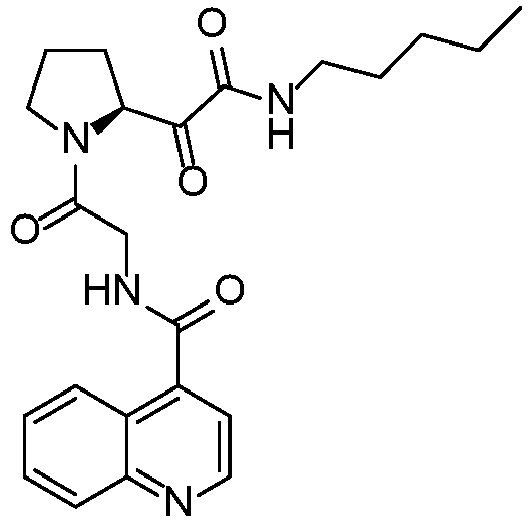
(S)-N-(2-Oxo-2-(2-(2-oxo-2-(pentylamino)acetyl)pyrrolidin-1 - yl)ethyl)quinoline-4-carboxamide 11 3k 
Methyl(S)-(2-oxo-2-(1-((quinoline-4-carbonyl)glycyl)pyrrolidin-2-yl)acetyl)glycinate 12 31 
terc-Butyl(S)-(2-oxo-2-(1-((quinoline-4-carbonyl)glycyl)-pyrrolidin-2-yl)acetyl)glycinate 13 3m 
Methyl(2-oxo-2-((S)-1-((quinoline-4-carbonyl)-glycyl)pyrrolidin-2-yl)acetyl)alaninate 14 5a 
(S)-N-(2-(2-(2-((2-(Dimethylamino)-2-oxoethyl)amino)-2-oxoacetyl)pyrrolidin-1 -yl)-2-oxoethyl)quinoline-4-carboxamide 15 5b 
(S)-N-(2-(2-(2-((2-(Ethyl(propyl)amino)-2-oxoethyl)amino)-2-oxoacetyl)pyrrolidin-1 -yl)-2-oxoethyl)quinoline-4-carboxamide 16 5c 
(S)-N-(2-(2-(2-((2-(Isopropylamino)-2-oxoethyl)amino)-2-oxoacetyl)pyrrolidin-1 -yl)-2-oxoethyl)quinoline-4-carboxamide 17 5d 
(S)-N-(2-(2-(2-((2-(Benzylamino)-2-oxoethyl)amino)-2-oxoacetyl)pyrrolidin-1 -yl)-2-oxoethyl)quinoline-4-carboxamide 18 5e 
Methyl (2-oxo-2-((S)-1-((quinoline-4-carbonyl)glycyl)pyrrolidin-2-yl)acetyl)glycyl-L-leucinate 19 5f 
Methyl (2-oxo-2-((S)-1-((quinoline-4-carbonyl)glycyl)pyrrolidin-2-yl)acetyl)glycyl-L-phenylalaninate 20 5g 
Methyl (2-oxo-2-((S)-1-((quinoline-4-carbonyl)glycyl)pyrrolidin-2-yl)acetyl)glycyl-L-glutaminate 21 5h 
5-Benzyl 1-methyl (2-oxo-2-((S)-1-((quinoline-4-carbonyl)glycyl)pyrrolidin-2-yl)acetyl)glycyl-L-glutamate 22 5i 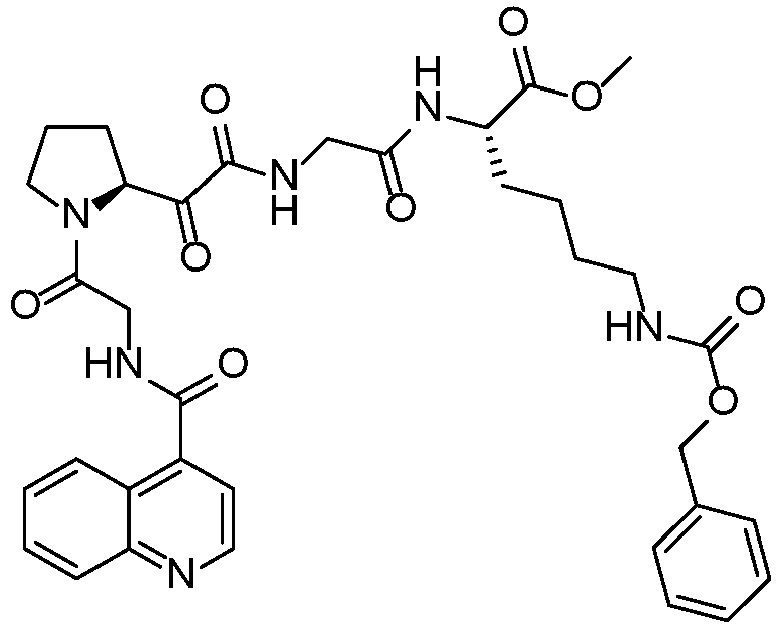
Benzyl N 6-((benzyloxy)carbonyl)-N 2-((2-oxo-2-((S)-1-((quinoline-4-carbonyl)glycyl)pyrrolidin-2-yl)acetyl)glycyl)-L-lysinate 23 9 
(S)-S-(62-((4-((2-(2-(2-((3,4-dimethoxybenzyl)amino)-2-oxoacetyl)pyrrolidin-1 -yl)-2-oxoethyl)carbamoyl)quinoline-7-yl)oxy)-2,5,8,11,61-pentaoxo-15,18,21,24,27,30,33,36,39,42, 45,48,51,54,57-pentadecaoxa-3,6,9,12,60-pentaazadohexacontyl) ethanthioate 24 12 
(S)-N-(2-(2-(2-((3,4-dimethoxybenzyl)amino)-2-oxoacetyl)pyrrolidin-1 -yl)-2-oxoethyl)-7-(2-(6-hydrazineylnicotinamido)ethoxy) quinoline-4-carboxamide - Boc-L-prolinal (1 eq.), N-Cbz-glycine (1 eq.) and the corresponding isonitrile (1 eq.) were dissolved in anhydrous DCM, and the resulting mixture was stirred at room temperature for 4 hours. At full conversion (LC-MS), trifluoroacetic acid was added and the mixture was stirred for another hour. The mixture was concentrated under reduced vacuum and then redissolved in DCM. While stirring and cooling to 0 °C, triethylamine was added dropwise to the mixture. The mixture was further stirred at room temperature until full conversion (LC-MS, maximum 3 hours). The liquid portions of the mixture were evaporated under reduced pressure and the residue was redissolved in DCM. The polar portions of the mixture were extracted into water (3x) and the organic phase was dried over brine and sodium sulfate. After evaporating the solvent, α-hydroxyamide 4 was obtained, which was used for the next reaction without purification. Reaction yields are calculated based on the amount of Boc-L-prolinal used. In General Procedure 1, a mixture of diastereomers was always obtained, the retention times of which are given as Rt,1 and Rt,2.
- The Cbz or Bn protected substance was dissolved in methanol, and palladium hydroxide on coal was added to the mixture. The mixture was placed in a hydrogen atmosphere and stirred for 3 hours. The catalyst was separated from the mixture by filtration, and the liquid portion was concentrated under reduced pressure. Residual solvent and water were removed from the mixture under high vacuum. The substance obtained in this way was used without further purification for the next reaction.
- The carboxylic acid (1 eq.), TSTU (1 eq.) and DIPEA were dissolved in anhydrous DMF. After stirring for 1 hour at room temperature, a solution of the amine (1.1 eq.) in anhydrous DMF was added to the mixture, and the resulting mixture was stirred overnight. The product was isolated from the crude mixture by reversed-phase FLASH chromatography. Its trifluoroacetate salt was obtained by lyophilization of the fractions containing the desired product. Reaction yields are calculated with respect to the amount of precursor 4 used. In General Procedure 3, a mixture of diastereomers was always obtained, the retention times of which are reported as Rt,1 and Rt,2.
- A mixture of α-hydroxyamide (1 eq.) and IBX (1.5 eq.) in DMSO was stirred overnight. At full conversion (by LC-MS), the product was isolated from the crude mixture by reversed-phase FLASH chromatography. Its trifluoroacetate salt was obtained by lyophilization of the fractions containing the desired product. Reaction yields are calculated with respect to the amount of α-hydroxyamide 5 used. According to the NMR and LC-MS analyses, the products of General Procedure 4 are present as a mixture of rotamers. Only the set of signals belonging to the dominant rotamer is listed in the NMR reports. The retention times of both rotamers are given as Rt,1 and Rt,2.
- Methylester 2k (500 mg, 926 µmol) was dissolved in 9 ml of methanol and 1 ml of 10% (wt./wt.) aqueous KOH. After stirring at room temperature for 5 hours, the mixture was neutralized by the dropwise addition of 10% (wt./wt.) HCl to a pH between 7 and 8 and concentrated under reduced pressure. The product was isolated from the mixture directly by FLASH chromatography. Lyophilization of the fractions containing the desired product (LC-MS) gave the product trifluoroacetate as a white solid (350 mg, 72% yield; LC-MS Rt,1 2,64 min, Rt,2 2,71 min, m/z 415,30 [M+H]+).
- Precursor 1a (1163 mg, 79% yield; LC-MS Rt,1 3.98 min, Rt,2 4.03 min, m/z 426.36 [M+H]+) was obtained from General Procedure 1. Precursor 1a was subsequently debenzylated by General Procedure 2, and the resulting amine was condensed with quinoline-4-carboxylic acid by General Procedure 3 to give precursor 2a (825 mg, 71% yield; LC-MS Rt,1 3.36 min, Rt,2 3.45 min, m/z 447.26 [M+H]+). Precursor 2a was oxidized to the final α-ketoamide 3a (107 mg, 47% yield) by General Procedure 4.
- 1H NMR (500 MHz, DMSO-d6): 9.31 (bt, 1H, JNH,CH2 = 6.4 Hz, COCONH); 9.04 (m, 1H, NH-2'); 9.04 (d, 1H, J2,3 = 4.5 Hz, H-2); 8.35 (bdd, 1H, J5,6 = 8.5 Hz, J5,7 = 1.5 Hz, H-5); 8.11 (bd, 1H, J8,7 = 8.5 Hz, H-8); 7.87 (ddd, 1H, J7,8 = 8.5 Hz, J8,7 = 6.9 Hz, J7,5 = 1.5 Hz, H-7); 7.70 (ddd, 1H, J6,5 = 8.5 Hz, J6,7 = 6.9 Hz, J6,8 = 1.3 Hz, H-6); 7.63 (d, 1H, J3,2 = 4.5 Hz, H-3); 7.35 - 7.18 (m, 5H, H-o,m,p-Bn); 5.23 (dd, 1H, J1",2" = 9.1 and 4.7 Hz, H-1"); 4.36 and 4.32 (2×dd, 2× 1H, Jgem = 14.8 Hz, JCH2,NH = 6.4 Hz, CH2-Bn); 4.28 and 4.17 (2×dd, 2× 1H, Jgem = 16.8 Hz, J2',NH = 6.0 Hz, H-2'); 3.74 - 3.62 (m, 2H, H-4"); 2.25 (m, 1H, H-2"b); 2.03 (m, 1H, H-3"b); 1.97 - 1.80 (m, 2H, H-3"a, 2"a);
- 13C NMR (125.7 MHz, DMSO-d6): 195.57 (COCONH); 166.92 (CO-1'); 166.56 (CO-3'); 160.60 (COCONH); 149.80 (CH-2); 146.60 (C-8a); 143.79 (C-4); 138.75 (C-i-Bn); 130.85 (CH-7); 128.56 (CH-m-Bn); 128.32 (CH-8); 127.97 (CH-6); 127.57 (CH-o-Bn); 127.20 (CH-p-Bn); 126.24 (CH-5); 124.58 (C-4a); 119.41 (CH-3); 60.47 (CH-1"); 46.12 (CH2-4"); 42.31 (CH2-Bn); 41.56 (CH2-2'); 27.94 (CH2-2"); 24.81 (CH2-3");
- LC-MS Rt,1 3.49 min, Rt,2 3.60 min, m/z 445.27 [M+H]+;
- HR MS for C25H25N4O4 [M+H]+ calculated 445.18703; found 445.18668.
- Precursor 4d (1176 mg, 88% yield; LC-MS Rt,1 3.79 min, Rt,2 3,85 min, m/z 486.16 [M+H]+) was obtained from General Procedure 1. Precursor 4d was subsequently debenzylated by General Procedure 2, and the resulting amine was condensed with quinoline-4-carboxylic acid by General Procedure 3 to give precursor 2b (130 mg, 92% yield; LC-MS Rt,1 3.00 min, Rt,2 3.07 min, m/z 507.25 [M+H]+). Precursor 2b was oxidized to the final α-ketoamide 3b by General Procedure 4 (20 mg, 53% yield).
- 1H NMR (500 MHz, DMSO-d6): 9.22 (bt, 1H, JNH,CH2 = 6,3 Hz, COCONH); 9.03 - 8.97 (m, 2H, NH-2', H-2); 8.32 (dd, 1H, J5,6 = 8.4 Hz, J5,7 = 1.4 Hz, H-5); 8.09 (bd, 1H, J8,7 = 8.5 Hz, H-8); 7.83 (ddd, 1H, J7,8 = 8.5 Hz, J8,7 = 6.9 Hz, J7,5 = 1.4 Hz, H-7); 7.66 (ddd, 1H, J6,5 = 8.5 Hz, J6,7 = 6.9 Hz, J6,8 = 1.2 Hz, H-6); 7,57 (d, 1H, J3,2 = 4.4 Hz, H-3); 6.91 (d, 1H, J2,6 = 2.0 Hz, H-2-Ph); 6.86 (d, 1H, J5,6 = 8.3 Hz, H-5-Ph); 6.79 (dd, 1H, J6,5 = 8.2 Hz, J6,2 = 2.0 Hz, H-6-Ph); 5.23 (dd, 1H, J1",2" = 9.2 and 4.7 Hz, H-1"); 4.33 - 4.21 (m, 3H, CH2-Ph, H-2'b); 4.15 (dd, 1H, Jgem = 16.7 Hz, J2'a,NH = 5.9 Hz, H-2'a); 3.70 (s, 3H, CH3O-3-Ph); 3.69 (s, 3H, CH3O-4-Ph); 3.70 - 3.62 (m, 2H, H-4"); 2.24 (m, 1H, H-2"b); 2.01 (m, 1H, H-3"b); 1.90 (m, 1H, H-3"a); 1.84 (m, 1H, H-2"a);
- 13C NMR (125.7 MHz, DMSO-d6): 195.66 (COCONH); 167.08 (CO-1'); 166.56 (CO-3'); 160.48 (COCONH); 150.15 (CH-2); 148.75 (C-3-Ph); 148.05 (C-4-Ph); 147.42 (C-8a); 142.98 (C-4); 131.10 (C-1-Ph); 130.40 (CH-7); 128.89 (CH-8); 127.69 (CH-6); 126.14 (CH-5); 124.49 (C-4a); 119.75 (CH-6-Ph); 119.33 (CH-3); 111.84 (CH-5-Ph); 111.69 (CH-2-Ph); 60.40 (CH-1"); 55.70 and 55.58 (CH3O); 46.12 (CH2-4"); 42.08 (CH2-Ph); 41.54 (CH2-2'); 27.95 (CH2-2"); 24.81 (CH2-3");
- LC-MS Rt,1 3.32 min, Rt,2 3.44 min, m/z 505.22 [M+H]+;
- HR MS for C27H29N4O6 [M+H]+ calculated 505.20816; found 505.20740.
- Precursor 1c (113 mg, 51% yield; LC-MS Rt,1 4.08 min, Rt,2 4.14 min, m/z 444.06 [M+H]+) was obtained from General Procedure 1. Precursor 1c was subsequently debenzylated by General Procedure 2, and the resulting amine was condensed with quinoline-4-carboxylic acid by General Procedure 3 to give precursor 2c (70 mg, 74% yield; LC-MS Rt,1 3.52 min, Rt,2 3.61 min, m/z 465.01 [M+H]+). Precursor 2c was oxidized to the final α-ketoamide 3c (37 mg, 65% yield) by General Procedure 4.
- 1H NMR (500 MHz, DMSO-d6): 9.32 (bt, 1H, JNH,CH2 = 6.4 Hz, COCONH); 9.05 (t, 1H, J NH,2' = 6.0 Hz, NH-2'); 9.04 (d, 1H, J2,3 = 4.5 Hz, H-2); 8.34 (dd, 1H, J5,6 = 8.5 Hz, J5,7 = 1.5 Hz, H-5); 8.11 (dm, 1H, J8,7 = 8.5 Hz, H-8); 7.87 (ddd, 1H, J7,8 = 8.5 Hz, J8,7 = 6.9 Hz, J7,5 = 1.5 Hz, H-7); 7.70 (ddd, 1H, J6,5 = 8.5 Hz, J6,7 = 6.9 Hz, J6,8 = 1.3 Hz, H-6); 7.62 (d, 1H, J3,2 = 4.5 Hz, H-3); 7.31 (m, 2H, H-o-Ph); 7.13 (m, 2H, H-m-Ph); 5.22 (dd, 1H, J1",2" = 9.2 and 4.7 Hz, H-1"); 4.32 (bd, 2H, JCH2,NH = 6.5 Hz, CH2-Ph); 4.27 and 4.17 (2×dd, 2×1H, Jgem = 16.9 Hz, J2',NH = 6.0 Hz, H-2'); 3.71 - 3.62 (m, 2H, H-4"); 2.24 (m, 1H, H-2"b); 2.01 (m, 1H, H-3"b); 1.89 (m, 1H, H-3"a); 1.86 (m, 1H, H-2"a);
- 13C NMR (125.7 MHz, DMSO-d6): 195.56 (COCONH); 166.98 (CO-1'); 166.61 (CO-3'); 161.50 (d, JC,F = 242.6 Hz, C-p-Ph); 160.54 (COCONH); 149.87 (CH-2); 146.71 (C-8a); 143.72 (C-4); 134.99 (d, JC,F = 3,0 Hz, C-i-Ph); 130.84 (CH-7); 129.69 (d, JC,F = 8.2 Hz, CH-o-Ph); 128.33 (CH-8); 127.98 (CH-6); 126.25 (CH-5); 124.60 (C-4a); 119.43 (CH-3); 115.34 (d, JC,F = 21.3 Hz, CH-m-Ph); 60.51 (CH-1"); 46.16 (CH2-4"); 41.66 (CH2-Ph); 41.59 (CH2-2'); 27.97 (CH2-2"); 24.85 (CH2-3");
- LC-MS Rt,1 3.65 min, Rt,2 3.78 min, m/z 462.99 [M+H]+;
- HR MS for C25H24FN4O4 [M+H]+ calculated 463.17761; found 463.17741.
- Precursor 1d (380 mg, 85%yield; LC-MS Rt,1 4.08 min, Rt,2 4.14 min, m/z 440.32 [M+H]+) was obtained from General Procedure 1. Precursor 1d was subsequently debenzylated by General Procedure 2, and the resulting amine was condensed with quinoline-4-carboxylic acid by General Procedure 3 to give Precursor 2d (286 mg, 68% yield; LC-MS Rt,1 3.49 min, Rt,2 3.59 min, m/z 461,30 [M+H]+). Precursor 2d was oxidized to the final α-ketoamide 3d (74 mg, 67% yield) by General Procedure 4.
- 1H NMR (500 MHz, DMSO-d6): 9.02 (t, 1H, JNH,2' = 6.0 Hz, NH-2'); 9.01 (d, 1H, J2,3 = 4.4 Hz, H-2); 8.83 (t, 1H, JNH,CH2 = 6.0 Hz, COCONH); 8.34 (dm, 1H, J5,6 = 8.5 Hz, H-5); 8.09 (dm, 1H, J8,7 = 8.5 Hz, H-8); 7.84 (ddd, 1H, J7,8 = 8.5 Hz, J8,7 = 6.9 Hz, J7,5 = 1.5 Hz, H-7); 7.68 (ddd, 1H, J6,5 = 8.5 Hz, J6,7 = 6.9 Hz, J6,8 = 1.3 Hz, H-6); 7.58 (d, 1H, J3,2 = 4.4 Hz, H-3); 7.28 (m, 2H, H-m-Ph); 7.23 - 7.16 (m, 3H, H-o,p-Ph); 5.20 (dd, 1H, J1",2" = 9.1 and 4.6 Hz, H-1"); 4.26 and 4.16 (2×dd, 2×1H, Jgem = 16.8 Hz, J2',NH = 6.0 Hz, H-2'); 3.70 - 3.62 (m, 2H, H-4"); 3.42 - 3.31 (m, 2H, CH2 CH2-Ph); 2.78 (t, 2H, JCH2,CH2 = 7.7 Hz, CH2CH2 -Ph); 2.21 (m, 1H, H-2"b); 2.00 (m, 1H, H-3 "b); 1.87 (m, 1H, H-3"a); 1.77 (m, 1H, H-2"a);
- 13C NMR (125.7 MHz, DMSO-d6): 195.54 (COCONH); 167.10 (CO-1'); 166.58 (CO-3'); 160.39 (COCONH); 150.12 (CH-2); 147.29 (C-8a); 143.21 (C-4); 139.27 (C-i-Ph); 130.53 (CH-7); 128.88 (CH-o-Ph); 128.78 (CH-8); 128.61 (CH-m-Ph); 127.76 (CH-6); 126.44 (CH-p-Ph); 126.19 (CH-5); 124.53 (C-4a); 119.35 (CH-3); 60.51 (CH-1"); 46.11 (CH2-4"); 41.58 (CH2-2'); 40.44 (CH2CH2-Ph); 34.83 (CH2CH2-Ph); 27.83 (CH2-2"); 24.72 (CH2-3");
- LC-MS Rt,1 3.63 min, Rt,2 3.73 min, m/z 459.25 [M+H]+;
- HR MS for C26H25N4O4 [M+H]+ calculated 459.20268; found 459.20258.
- Precursor 1e (LC-MS Rt,1 3.85 min, Rt,2 3.91 min, m/z 500.28 [M+H]+) was obtained from General Procedure 1. Precursor 1e was subsequently debenzylated by General Procedure 2, and the resulting amine was condensed with quinoline-4-carboxylic acid by General Procedure 3 to give Precursor 2e (260 mg, 59% yield; LC-MS Rt,1 3.28 min, Rt,2 3.38 min, m/z 521.27 [M+H]+). Precursor 2e was oxidized to the final α-ketoamide 3e (88 mg, 88% yield) by General Procedure 4.
- 1H NMR (500 MHz, DMSO-d6): 9.04 (d, 1H, J2,3 = 4.5 Hz, H-2); 9.04 (m, 1H, NH-2'); 8.78 (bt, 1H, JNH,CH2 = 6.0 Hz, COCONH); 8.36 (bdd, 1H, J5,6 = 8.5 Hz, J5,7 = 1.5 Hz, H-5); 8.11 (bd, 1H, J8,7 = 8.4 Hz, H-8); 7.87 (ddd, 1H, J7,8 = 8.5 Hz, J8,7 = 6.9 Hz, J7,5 = 1.5 Hz, H-7); 7.71 (ddd, 1H, J6,5 = 8.5 Hz, J6,7 = 6.9 Hz, J6,8 = 1.3 Hz, H-6); 7.62 (d, 1H, J3,2 = 4.5 Hz, H-3); 6.84 (d, 1H, J5,6 = 8.2 Hz, H-5-Ph); 6.78 (d, 1H, J2,6 = 2.0 Hz, H-2-Ph); 6.70 (dd, 1H, J6,5 = 8.2 Hz, J6,2 = 2.0 Hz, H-6-Ph); 5.21 (dd, 1H, J1",2" = 9.3 and 4.7 Hz, H-1"); 4.25 and 4.17 (2×dd, 2×1H, Jgem = 16.8 Hz, J2',NH = 6.1 Hz, H-2'); 3.71 (s, 3H, CH3O-3-Ph); 3.69 (s, 3H, CH3O-4-Ph); 3.70 - 3.60 (m, 2H, H-4"); 3.35 (m, 2H, CH2CH2-Ph); 2.72 (t, 2H, JCH2,CH2 = 7.4 Hz, CH2CH2-Ph); 2.21 (m, 1H, H-2"b); 2.00 (m, 1H, H-3"b); 1.85 (m, 1H, H-3"a); 1.77 (m, 1H, H-2"a);
- 13C NMR (125.7 MHz, DMSO-d6): 195.57 (COCONH); 166.92 (CO-1'); 166.54 (CO-3'); 160.37 (COCONH); 149.80 (CH-2); 148.78 (C-3-Ph); 147.45 (C-4-Ph); 146.60 (C-8a); 143.82 (C-4); 131.67 (C-1-Ph); 130.86 (CH-7); 128.22 (CH-8); 127.97 (CH-6); 126.26 (CH-5); 124.59 (C-4a); 120.65 (CH-6-Ph); 119.40 (CH-3); 112.60 (CH-2-Ph); 112.03 (CH-5-Ph); 60.52 (CH-1"); 55.68 (CH3O-4-Ph); 55.54 (CH3O-3-Ph); 46.10 (CH2-4"); 41.58 (CH2-2'); 40.57 (CH2CH2-Ph); 34.33 (CH2CH2-Ph); 27.82 (CH2-2"); 24.70 (CH2-3");
- LC-MS Rt,1 3.41 min, Rt,2 3.52 min, m/z 519.23 [M+H]+;
- HR MS for C28H31N4O6 [M+H]+ calculated 519.22381; found 519.22360.
- Precursor 1f (325 mg, 79% yield; LC-MS Rt,1 3.97 min, Rt,2 4.04 min, m/z 464.26 [M+Na]+) was obtained from General Procedure 1. Precursor 1f was subsequently debenzylated by General Procedure 2, and the resulting amine was condensed with quinoline-4-carboxylic acid by General Procedure 3 to give Precursor 2f (171 mg, 40% yield; LC-MS Rt,1 3.32 min, Rt,2 3.45 min, m/z 463.25 [M+H]+). Precursor 2f was oxidized to the final α-ketoamide 3f (77 mg, 63% yield) by General Procedure 4.
- 1H NMR (500 MHz, DMSO-d6): 10.56 (s, 1H, NH-Ph); 9.04 (bt, 1H, J7NH,2' = 6.0 Hz, NH-2'), 9.01 (d, 1H, J2,3 = 4.4 Hz, H-2); 8.33 (bdd, 1H, J5,6 = 8.5 Hz, J5,7 = 1,5 Hz, H-5); 8.09 (dm, 1H, J8,7 = 8.5 Hz, H-8); 7.83 (ddd, 1H, J7,8 = 8.5 Hz, J8,7 = 6.9 Hz, J7,5 = 1.5 Hz, H-7); 7.74 (m, 2H, H-o-Ph); 7.68 (ddd, 1H, J6,5 = 8.5 Hz, J6,7 = 6.9 Hz, J6,8 = 1.3 Hz, H-6); 7.58 (d, 1H, J3,2 = 4.4 Hz, H-3); 6.93 (m, 2H, H-m-Ph); 5.30 (dd, 1H, J1",2" = 9.0 and 4.6 Hz, H-1"); 4.27 and 4.20 (2×dd, 2×1H, Jgem = 16.9 Hz, J2',NH = 6.0 Hz, H-2'); 3.73 (s, 3H, CH3O-Ph); 3.76 - 3.65 (m, 2H, H-4"); 2.29 (m, 1H, H-2"b); 2.04 (m, 1H, H-3"b); 2.00 - 1.89 (m, 2H, H-3"a, H-2"a);
- 13C NMR (125.7 MHz, DMSO-d6): 195.68 (COCONH); 167.07 (CO-1'); 166.68 (CO-3'); 158.54 (COCONH); 156.35 (C-p-Ph); 150.06 (CH-2); 147.16 (C-8a); 143.28 (C-4); 130.75 (C-i-Ph); 130.57 (CH-7); 128.68 (CH-8); 127.79 (CH-6); 126.18 (CH-5); 124.52 (C-4a); 122.19 (CH-o-Ph); 119.36 (CH-3); 114.11 (CH-m-Ph); 60.38 (CH-1"); 55.42 (CH3O-Ph); 46.19 (CH2-4"); 41.56 (CH2-2'); 28.12 (CH2-2"); 24.94 (CH2-3");
- LC-MS Rt,1 3.48 min, Rt,2 3.62 min, m/z 461.24 [M+H]+;
- HR MS for C25H25N4O5 [M+H]+ calculated 461.18195; found 461.18205.
- Precursor 1g (LC-MS Rt,1 4.03 min, Rt,2 4.11 min, m/z 492.20 [M+Na]+) was obtained from General Procedure 1. Precursor 1g was subsequently debenzylated by General Procedure 2, and the resulting amine was condensed with quinoline-4-carboxylic acid by General Procedure 3 to give Precursor 2g (137 mg, 32% yield; LC-MS Rt,1 3.42 min, Rt,2 3.57 min, m/z 491.21 [M+H]+). Precursor 2g was oxidized to the final α-ketoamide 3g (76 mg, 72% yield) by General Procedure 4.
- 1H NMR (500 MHz, DMSO-d6): 10.98 (s, 1H, COCONH); 9.04 (t, 1H, JNH,CH2 = 6.0 Hz, NH-2'); 9.00 (d, 1H, J2,3 = 4.4 Hz, H-2); 8.30 (dm, 1H, J5,6 = 8.5 Hz, H-5); 8.08 (dm, 1H, J8,7 = 8.5 Hz, H-8); 8.00 - 7.93 (m, 4H, H-o,m-Ph); 7.82 (ddd, 1H, J7,8 = 8.5 Hz, J8,7 = 6.9 Hz, J7,5 = 1.4 Hz, H-7); 7.65 (ddd, 1H, J6,5 = 8.5 Hz, J6,7 = 6.9 Hz, J6,8 = 1.3 Hz, H-6); 7.57 (d, 1H, J3,2 = 4.4 Hz, H-3); 5.26 (dd, 1H, J1",2" = 8.9 and 4.7 Hz, H-1"); 4.27 (dd, 1H, Jgem = 16.9 Hz, J2'b,NH = 5.9 Hz, H-2'b); 4.20 (dd, 1H, Jgem = 16.7 Hz, J2'a,NH = 6.1 Hz, H-2'a); 3.83 (s, 3H, CH3COO); 3.78 - 3.67 (m, 2H, H-4"); 2.29 (m, 1H, H-2"b); 2.09 - 1.94 (m, 3H, H-3", H-2"a);
- 13C NMR (125.7 MHz, DMSO-d6): 195.08 (COCONH); 167.09 (CO-1'); 166.81 (CO-3'); 165.98 (CH3COO); 159.46 (COCONH); 150.08 (CH-2); 147.23 (C-8a); 143.14 (C-4); 142.16 (C-i-Ph); 130.51 (CH-7); 130.41 (CH-m-Ph); 128.74 (CH-8); 127.74 (CH-6); 126.15 (CH-5); 125.49 (C-p-Ph); 124.50 (C-4a); 120.32 (CH-o-Ph); 119.35 (CH-3); 60.36 (CH-1"); 52.28 (CH3COO); 46.21 (CH2-4"); 41.53 (CH2-2'); 28.16 (CH2-2"); 25.07 (CH2-3");
- LC-MS Rt,1 3.60 min, Rt,2 3.70 min, m/z 489.18 [M+H]+;
- HR MS for C26H25N4O6 [M+H]+ calculated 489.17686; found 489.17664.
- Precursor 1h (1608 mg, 75% yield; LC-MS Rt,1 3.51 min, Rt,2 3.58 min, m/z 376.34 [M+H]+) was obtained from General Procedure 1. Precursor 1h was subsequently debenzylated by General Procedure 2, and the resulting amine was condensed with quinoline-4-carboxylic acid by General Procedure 3 to give precursor 2h (176 mg, 78% yield; LC-MS Rt,1 2.85 min, Rt,2 2.94 min, m/z 397.36 [M+H]+). Precursor 2h was oxidized to the final α-ketoamide 3h (67 mg, 77% yield) by General Procedure 4.
- 1H NMR (500 MHz, CDCl3): 8.91 (d, 1H, J2,3 = 4.3 Hz, H-2); 8.26 (bd, 1H, J5,6 = 8.5 Hz, H-5); 8.12 (dm, 1H, J8,7 = 8.5 Hz, H-8); 7.74 (ddd, 1H, J7,8 = 8.5 Hz, J8,7 = 6.9 Hz, J7,5 = 1.4 Hz, H-7); 7.60 (ddd, 1H, J6,5 = 8.5 Hz, J6,7 = 6.9 Hz, J6,8 = 1.3 Hz, H-6); 7.48 (d, 1H, J3,2 = 4.3 Hz, H-3); 7.14 (bt, 1H, JNH,2' = 4.3 Hz, NH-2'); 7.00 (bd, 1H, JNH,CH = 3.9 Hz, NH-cp); 5.33 (dd, 1H, J1",2" = 9.0 and 5.5 Hz, H-1"); 4,39 (dd, 1H, Jgem = 17.7 Hz, J2'b,NH = 4.6 Hz, H-2'b); 4.29 (dd, 1H, Jgem = 17.7 Hz, J2'a,NH = 4.0 Hz, H-2'a); 3.72 - 3.57 (m, 2H, H-4"); 2.76 (m, 1H, CH-cp); 2.39 (m, 1H, H-2"b); 2.16 -1.92 (m, 3H, H-2"a, H-3''); 0.86 - 0.76 and 0.64 - 0.51 (2×m, 2×2H, CH2-cp);
- 13C NMR (125.7 MHz, CDCl3): 194.42 (CO-1"); 167.15 (CO-1'); 166.11 (CO-3'); 160.47 (CONH-cp); 149.73 (CH-2); 148.58 (C-8a); 141.07 (C-4); 129.99 (CH-7); 129.77 (CH-8); 127.73 (CH-6); 125.26 (CH-5); 124.36 (C-4a); 118.78 (CH-3); 60.85 (CH-1"); 46.35 (CH2-4"); 42.30 (CH2-2');28.33 (CH2-2"); 24.93 (CH2-3"); 22.38 (CH-cp); 6.37 and 6.34 (CH2-cp);
- LC-MS Rt,1 2.91 min, Rt,2 3.04 min, m/z 395.34 [M+H]+;
- HR MS for C21H23N4O4 [M+H]+ calculated 395.17138; found 395.17106.
- Precursor 1i (225 mg, 60% yield; LC-MS Rt,1 3.66 min, Rt,2 3.73 min, m/z 378.38 [M+H]+) was obtained from General procedure 1. Precursor 1i was subsequently debenzylated by General Procedure 2, and the resulting amine was condensed with quinoline-4-carboxylic acid by General Procedure 3 to give Precursor 2i (80 mg, 48% yield; LC-MS Rt,1 3.00 min, Rt,2 3.10 min, m/z 399.36 [M+H]+). Precursor 2i was oxidized to the final α-ketoamide 3i (27 mg, 39% yield) by General Procedure 4.
- 1H NMR (500 MHz, DMSO-d6): 9.06 (m, 1H, NH-2'); 9.05 (d, 1H, J2,3 = 4,5 Hz, H-2); 8.58 (bd, 1H, JNH,CH = 8.2 Hz, COCONH); 8.35 (dm, 1H, J5,6 = 8.5 Hz, H-5); 8.12 (dm, 1H, J8,7 = 8.5 Hz, H-8); 7.89 (ddd, 1H, J7,8 = 8.5 Hz, J7,6 = 6.9 Hz, J7,5 = 1.5 Hz, H-7); 7.73 (ddd, 1H, J6,5 = 8.5 Hz, J6,7 = 6.9 Hz, J6,8 = 1.3 Hz, H-6); 7.64 (d, 1H, J3,2 = 4.5 Hz, H-3); 5.21 (dd, 1H, J1",2" = 9.2 and 4,3 Hz, H-1"); 4.25 (dd, 1H, Jgem = 16.9 Hz, J2'b,NH = 5.9 Hz, H-2'b); 4.17 (dd, 1H, Jgem = 16.9 Hz, J2'a,NH = 6.0 Hz, H-2'a); 3.98 - 3.87 (m, 1H, (CH3)2CH); 3.72 - 3.61 (m, 2H, H-4"); 2.23 (m, 1H, H-2"b); 2.00 (m, 1H, H-3 "b); 1.91 - 1.77 (m, 2H, H-2"a, H-3"a); 1.11 and 1.10 (2×d, 2×3H, (CH3)2CH);
- 13C NMR (125.7 MHz, DMSO-d6): 195.80 (COCONH); 166.94 (CO-1'); 166.54 (CO-3'); 159.66 (COCONH); 149.82 (CH-2); 146.58 (C-8a); 143.89 (C-4); 130.92 (CH-7); 128.21 (CH-8); 128.00 (CH-6); 126.28 (CH-5); 124.61 (C-4a); 119.42 (CH-3); 60.56 (CH-1"); 46.13 (CH2-4"); 41.60 (CH2-2'); 41.02 ((CH3)2CH); 27.95 (CH2-2"); 24.74 (CH2-3"); 22.07 ((CH3)2CH);
- LC-MS Rt,1 3.11 min, Rt,2 3.22 min, m/z 397.35 [M+H]+;
- HR MS for C21H25N4O4 [M+H]+ calculated 397.18703; found 397.18665.
- Precursor 1j was obtained from General Procedure 1 (370 mg, 90% yield; LC-MS Rt,1 4.11 min, Rt,2 4.17 min, m/z 406.39 [M+H]+). Precursor 1j was subsequently debenzylated by General Procedure 2, and the resulting amine was condensed with quinoline-4-carboxylic acid by General Procedure 3 to give Precursor 2j (291 mg, 64% yield; LC-MS Rt,1 3.50 min, Rt,2 3.61 min, m/z 427.39 [M+H]+). Precursor 2j was oxidized to the final α-ketoamide 3j (98 mg, 70% yield) by General Procedure 4.
- 1H NMR (500 MHz, DMSO-d6): 9.03 (d, 1H, J2,3 = 4.5 Hz, H-2); 9.03 (m, 1H, NH-2'); 8.74 (bt, 1H, JNH,CH2 = 6.0 Hz, COCONH); 8.35 (bdd, 1H, J5,6 = 8.5 Hz, J5,7 = 1.5 Hz, H-5); 8.11 (bd, 1H, J8,7 = 8.5 Hz, H-8); 7.86 (ddd, 1H, J7,8 = 8.5 Hz, J8,7 = 6.9 Hz, J7,5 = 1.5 Hz, H-7); 7.71 (ddd, 1H, J6,5 = 8.5 Hz, J6,7 = 6.9 Hz, J6,8 = 1.3 Hz, H-6); 7.61 (d, 1H, J3,2 = 4.5 Hz, H-3); 5.23 (bdd, 1H, J1",2" = 9.3 and 4.5 Hz, H-1"); 4.26 and 4.22 (2×dd, 2×1H, Jgem = 16.8 Hz, J2',NH = 6.0 Hz, H-2'); 3.70 - 3.62 (m, 2H, H-4"); 3.19 - 3.06 (m, 2H, CH2(CH2)3CH3); 2.24 (m, 1H, H-2"b); 2.00 (m, 1H, H-3"b); 1.92 - 1.74 (m, 2H, H-3"a,2"a); 1.46 (m, 2H, CH2CH2(CH2)2CH3); 1.32 - 1.17 (m, 4H, (CH2)2CH2CH2CH3); 0.84 (t, 3H, JCH3,CH2 = 7.1 Hz, (CH2)4CH3);
- 13C NMR (125.7 MHz, DMSO-d6): 195.66 (COCONH); 166.96 (CO-1'); 166.52 (CO-3'); 160.42 (COCONH); 149.89 (CH-2); 146.81 (C-8a); 143.61 (C-4); 130.74 (CH-7); 128.39 (CH-8); 127.88 (CH-6); 126.23 (CH-5); 124.57 (C-4a); 119.38 (CH-3); 60.46 (CH-1"); 46.11 (CH2-4"); 41.57 (CH2-2'); 38.79 (CH2(CH2)3CH3); 28.75 ((CH2)2CH2CH2CH3); 28.58 (CH2CH2(CH2)2CH3); 27.91(CH2-2"); 24.73 (CH2-3"); 22.00 ((CH2)3CH2CH3); 14.12 ((CH2)4CH3);
- LC-MS Rt,1 3.63 min, Rt,2 3.76 min, m/z 425.34 [M+H]+;
- HR MS for C23H29N4O4 [M+H]+ calculated 425.21833; found 425.21812.
- Precursor 1k (800 mg, 95%yield; LC-MS Rt,1 3.46 min, Rt,2 3.51 min, m/z 408.32 [M+H]+) was obtained from General Procedure 1. Precursor 1k was subsequently debenzylated by General Procedure 2, and the resulting amine was condensed with quinoline-4-carboxylic acid by General Procedure 3 to give Precursor 2k (500 mg, 75% yield; LC-MS Rt,1 2.84 min, Rt,2 2.91 min, m/z 429.30 [M+H]+). Precursor 2k was oxidized to the final α-ketoamide 3k (15 mg, 46% yield) by General Procedure 4.
- 1H NMR (500 MHz, DMSO-d6): 9.10 (bt, 1H, JNH,CH2 = 6.1 Hz, COCONH); 9.03 (t, 1H, JNH,2' = 6.1 Hz, NH-2'); 9.02 (d, 1H, J2,3 = 4.4 Hz, H-2); 8.34 (dm, 1H, J5,6 = 8.5 Hz, H-5); 8.10 (dm, 1H, J8,7 = 8.5 Hz, H-8); 7.85 (ddd, 1H, J7,8 = 8.5 Hz, J8,7 = 6.9 Hz, J7,5 = 1.4 Hz, H-7); 7.71 (ddd, 1H, J6,5 = 8.5 Hz, J6,7 = 6.9 Hz, J6,8 = 1.3 Hz, H-6); 7.60 (d, 1H, J3,2 = 4.4 Hz, H-3); 5.22 (dd, 1H, J1",2" = 9.2 and 4.5 Hz, H-1"); (dd, 1H, Jgem = 16.9 Hz, J2'b,NH = 6.1 Hz, H-2'b); 4.17 (dd, 1H, Jgem = 16.9 Hz, J2'a,NH = 6.0 Hz, H-2'a); 3.99 - 3.87 (m, 2H, CH3COOCH2); 3.72 - 3.60 (m, 2H, H-4"); 3.65 (s, 3H, CH3COOCH2); 2.25 (m, 1H, H-2"b); 2.02 (m, 1H, H-3"b); 1.88 (m, 1H, H-3"a); 1.84 (m, 1H, H-2"a);
- 13C NMR (125.7 MHz, DMSO-d6): 194.92 (COCONH). 169.62 (CH3COO); 167.05 (CO-1'); 166.63 (CO-3'); 160.80 (COCONH); 150.02 (CH-2); 147.12 (C-8a); 143.31 (C-4); 130.58 (CH-7); 128.63 (CH-8); 127.82 (CH-6); 126.19 (CH-5); 124.53 (C-4a); 119.37 (CH-3); 60.52 (CH-1"); 52.18 (CH3COO); 46.10 (CH2-4"); 41.57 (CH2-2'); 40.78 (CH3COOCH2); 27.79 (CH2-2"); 24.72 (CH2-3");
- LC-MS Rt,1 2.90 min, Rt,2 3.00 min, m/z 427.29 [M+H]+;
- HR MS for C21H23N4O6 [M+H]+ calculated 427.16121; found 427.16096.
- Precursor 11 (212 mg, 46% yield; LC-MS Rt,1 3.51 min, Rt,2 3.57 min, m/z 472.28 [M+Na]+) was obtained from General Procedure 1. Precursor 11 was subsequently debenzylated by General Procedure 2, and the resulting amine was condensed with quinoline-4-carboxylic acid by General Procedure 3 to give Precursor 21 (140 mg, 62% yield; LC-MS Rt,1 3.40 min, Rt,2 3.48 min, m/z 471.30 [M+H]+). Precursor 21 was oxidized to the final α-ketoamide 3l (55 mg, 50% yield) by General Procedure 4.
- 1H NMR (500 MHz, DMSO-d6): 9.07 (m, 1H, NH-2'); 9.06 (d, 1H, J2,3 = 4.5 Hz, H-2); 9.00 (bt, 1H, JNH,CH2 = 6.2 Hz, COCONH); 8.37 (bdd, 1H, J5,6 = 8.5 Hz, J5,7 = 1.5 Hz, H-5); 8.12 (dm, 1H, J8,7 = 8.5 Hz, H-8); 7.88 (ddd, 1H, J7,8 = 8.5 Hz, J8,7 = 6.9 Hz, J7,5 = 1.5 Hz, H-7); 7.74 (ddd, 1H, J6,5 = 8.5 Hz, J6,7 = 6.9 Hz, J6,8 = 1.3 Hz, H-6); 7.65 (d, 1H, J3,2 = 4.5 Hz, H-3); 5.23 (dd, 1H, J1",2" = 9.2 and 4,3 Hz, H-1"); 4.29 (dd, 1H,Jgem = 16.8 Hz, J2'b,NH = 6.1 Hz, H-2'b); 4.17 (dd, 1H, Jgem = 16.8 Hz, J2'a,NH = 5.9 Hz, H-2'a); 3.86 - 3.74 (m, 2H, CH2COO); 3.72 - 3.62 (m, 2H, H-4"); 2.26 (m, 1H, H-2"b); 2.02 (m, 1H, H-3"b); 1.92 -1.78 (m, 2H, H-3"a,2"a); 1.41 (s, 9H, (CH3)3C);
- 13C NMR (125.7 MHz, DMSO-d6): 195.02 (COCONH). 168.18 (CH2COO); 166.90 (CO-1'); 166.59 (CO-3'); 160.76 (COCONH); 149.67 (CH-2); 146.27 (C-8a); 144.14 (C-4); 131.05 (CH-7); 128.13 (CH-6); 127.95 (CH-8); 126.32 (CH-5); 124.65 (C-4a); 119.46 (CH-3); 81.31 ((CH3)3C); 60.52 (CH-1"); 46.12 (CH2-4"); 41.61 (CH2-2'); 41.52 (CH2COO); 27.92 ((CH3)3C); 27.83 (CH2-2"); 24.71 (CH2-3"); LC-MS Rt,1 3.53 min, Rt,2 3.62 min, m/z 469.29 [M+H]+;
- HR MS for C24H29N4O6 [M+H]+ calculated 469.20816; found 469.20798.
- General Procedure 1 gave precursor 1ma ((2-(( S )-1-(((benzyloxy)carbonyl)glycyl)pyrrolidin-2-yl)-2-hydroxyacetyl)alanine; 237 mg, 82% yield; LC-MS Rt,1 3.24 min, Rt,2 3.34 min, m/z 408.27 [M+H]+), which was converted to the methyl ester by an esterification corresponding to General Procedure 3 using an excess of methanol instead of an amine (Precursor 1m; 100 mg, 44% yield; LC-MS Rt,1 3.60 min, Rt,2 3.66 min, m/z 422.36 [M+H]+). Precursor 1m was subsequently debenzylated by General Procedure 2, and the resulting amine was condensed with quinoline-4-carboxylic acid by General Procedure 3 to give Precursor 2m (76 mg, 58% yield; LC-MS Rt,1 2.95 min, Rt,2 3.03 min, Rt,2 3.05 min, m/z 443.28 [M+H]+). Precursor 2m was oxidized to the final α-ketoamide 3m (49 mg, 87% yield) by General Procedure 4.
- 1H NMR (500 MHz, DMSO-d6): 9.13 and 9.12 (2×bd, 2×1H, JNH,CH = 7.5 Hz, COCONH); 9.06 (m, 2H, NH-2'); 9.06 (2×d, 2×1H, J2,3 = 4.5 Hz, H-2); 8.38 and 8.36 (2×dm, 2×1H, J5,6 = 8.6 Hz, H-5); 8.12 (2×dm, 2×1H, J8,7 = 8.5 Hz, H-8); 7.89 and 7.88 (2×ddd, 2×1H, J7,8 = 8.5 Hz, J8,7 = 6.9 Hz, J7,5 = 1.5 Hz, H-7); 7.75 and 7.73 (2×ddd, 2×1H, J6,5 = 8.5 Hz, J6,7 = 6.9 Hz, J6,8 = 1.3 Hz, H-6); 7.65 and 7.64 (2×bd, 2×1H, J3,2 = 4.5 Hz, H-3); 5.24 (dd, 1H, J1",2" = 9.2 and 4.5 Hz, H-1''); 5.20 (dd, 1H, J1",2" = 9.3 and 4.2 Hz, H-1"); 4.40 and 4.39 (2×pent, 2×1H, JCH,VH = JCH,CH3 = 7.4 Hz, CH3CH); 4.28 and 4.27 (2×dd, 2× 1H, Jgem = 16.8 Hz, J2'b,NH = 6.0 Hz, H-2'b); 4.19 (2×dd, 2×1H, Jgem = 16.8 Hz, J2'a,NH = 5.9 Hz, H-2'a); 3.75 - 3.60 (2×m, 2×2H, H-4"); 3.64 (2×s, 2×3H, CH3COO); 2.30 - 2.20 (m, 2×1H, H-2"b); 2.06 - 1.96 (m, 2×1H, H-3"b); 1.93 - 1.77 (m, 4×1H, H-3"a, H-2"a); 1.36 and 1.34 (2×d, 2×3H, JCH3,CH = 7.3 Hz, CH3CH);
- 13C NMR (125.7 MHz, DMSO-d6): 195.25 and 195.17 (COCONH); 172.49 (CH3COO); 167.10 (CO-1'); 166.86 and 166.79 (CO-3'); 160.85 and 160.48 (COCONH); 149.90 and 149.88 (CH-2); 146.54 and 146.50 (C-8a); 144.39 and 144.29 (C-4); 131.27 and 131.24 (CH-7); 128.32 and 128.29 (CH-6); 128.22 and 128.16 (CH-8); 126.55 and 126.50 (CH-5); 124.86 and 124.85 (C-4a); 119.66 (CH-3); 61.10 and 60.62 (CH-1"); 52.59 and 52.56 (CH3COO); 48.10 and 48.04 (CH3CH); 46.32 (CH2-4"); 41.84 and 41.80 (CH2-2'); 28.03 and 27.96 (CH2-2"); 24.94 and 24.88 (CH2-3"); 16.95 and 16.84 (CH3CH); LC-MS Rt,1 3.07 min, Rt,2 3.15 min, m/z 441.25[M+H]+;
- In successive General Procedures 3 and 4, α-ketoamide 5a (29 mg, 69% yield) was prepared from Precursor 7 and an ethanolic solution of dimethylamine (5.6 mol·l-1).
- 1H NMR (500 MHz, DMSO-d6): 9.04 (m, 1H, NH-2'); 9.02 (d, 1H, J2,3 = 4.5 Hz, H-2); 8.50 (bt, 1H, JNH,CH2 = 5.5 Hz, COCONH); 8.34 (dm, 1H, J5,6 = 8.5 Hz, H-5); 8.10 (dm, 1H, J8,7 = 8.5 Hz, H-8); 7.85 (ddd, 1H, J7,8 = 8.5 Hz, J8,7 = 6.9 Hz, J7,5 = 1.5 Hz, H-7); 7.71 (ddd, 1H, J6,5 = 8.5 Hz, J6,7 = 6.9 Hz, J6,8 = 1.3 Hz, H-6); 7.61 (d, 1H, J3,2 = 4.5 Hz, H-3); 5.24 (dd, 1H, J1",2" = 9.2 and 4.2 Hz, H-1"); 4.29 (dd, 1H, Jgem = 16.8 Hz, J2'b,NH = 6.2 Hz, H-2'b); 4.16 (dd, 1H, Jgem = 16.8 Hz, J2'a,NH = 5.8 Hz, H-2'a); 4.03 and 3.98 (2×dd, 2×1H, Jgem = 17.0 Hz, JCH2,NH = 5.7 Hz; CH2CON); 3.72 - 3.61 (m, 2H, H-4"); 2.96 and 2.83 (2×s, 2×3H, (CH3)2N); 2.25 (m, 1H, H-2"b); 2.02 (m, 1H, H-3"b); 1.93 -1.81 (m, 2H, H-3"a,2"a);
- 13C NMR (125.7 MHz, DMSO-d6): 195.18 (COCONH). 167.25 (CH2CON); 167.05 (CO-1'); 166.64 (CO-3'); 160.26 (COCONH); 149.98 (CH-2); 146.99 (C-8a); 143.45 (C-4); 130.68 (CH-7); 128.53 (CH-8); 127.90 (CH-6); 126.22 (CH-5); 124.56 (C-4a); 119.41 (CH-3); 60.46 (CH-1"); 46.13 (CH2-4"); 41.59 (CH2-2'); 40.68 (CH2CON); 35.86 and 35.34 ((CH3)2N); 27.77 (CH2-2"); 24.72 (CH2-3");
- LC-MS Rt,1 2.79 min, Rt,2 2.88 min, m/z 440.26 [M+H]+;
- HR MS for C22H26N5O5 [M+H]+ calculated 440.19285; found 440.19275.
- In successive General Procedures 3 and 4, α-ketoamide 5b (18 mg, 50% yield) was prepared from Precursor 7 and pyrrolidine.
- 1H NMR (500 MHz, DMSO-d6): 9.02 (m, 1H, NH-2'); 9.00 (d, 1H, J2,3 = 4.4 Hz, H-2); 8.56 (bt, 1H, JNH,CH2 = 5.7 Hz, COCONH); 8.33 (bdd, 1H, J5,6 = 8.5 Hz, J5,7 = 1.5 Hz, H-5); 8.09 (dm, 1H, J8,7 = 8.5 Hz, H-8); 7.84 (ddd, 1H, J7,8 = 8.5 Hz, J8,7 = 6.9 Hz, J7,5 = 1.5 Hz, H-7); 7.70 (ddd, 1H, J6,5 = 8.5 Hz, J6,7 = 6.9 Hz, J6,8 = 1.3 Hz, H-6); 7.58 (d, 1H, J3,2 = 4.4 Hz, H-3); 5.23 (dd, 1H, J1",2" = 9.2 and 4.3 Hz, H-1"); 4.28 (dd, 1H, Jgem = 16.8 Hz, J2'b,NH = 6.1 Hz, H-2'b); 4.15 (dd, 1H, Jgem = 16.8 Hz, J2'a,NH = 5.8 Hz, H-2'a); 3.98 - 3.87 (m, 2H, CH2CONH); 3.72 - 3.62 (m, 2H, H-4"); 3.41 and 3.29 (2×t, 2×2H, JCH2,CH2 = 6.9 Hz; CH2-2,5-C4H8N); 2.24 (m, 1H, H-2"b); 2.01 (m, 1H, H-3"b); 1.92 -1.71 (m, 6H, H-3"a,2"a, H-3,4-C4H8N);
- 13C NMR (125.7 MHz, DMSO-d6): 195.21 (COCONH), 167.14 (CO-1'); 166.66 (CO-3'); 165.62 (CH2CONH); 160.35 (COCONH); 150.17 (CH-2); 147.39 (C-8a); 143.06 (C-4); 130.47 (CH-7); 128.86 (CH-8); 127.77 (CH-6); 126.17 (CH-5); 124.51 (C-4a); 119.38 (CH-3); 60.52 (CH-1"); 46.14 (CH2-4"); 45.89 and 45.15 (CH2-2,5-C4H8N); 41.59 (CH2-2'); 41.41 (CH2CON); 27.78 (CH2-2"); 25.81 (CH2-3-C4H8N or CH2-4-C4H8N); 24.73 (CH2-3"); 23.94 81 (CH2-3-C4H8N or CH2-4-C4H8N);
- LC-MS Rt,1 2.98 min, Rt,2 3.03 min, m/z 466.26 [M+H]+;
- In successive General Procedures 3 and 4, α-ketoamide 5c (21 mg, 66% yield) was prepared from Precursor 7 and isopropylamine.
- 1H NMR (500 MHz, DMSO-d6): 9.02 (t, 1H, JNH,2' = 6.0 Hz, NH-2'); 9.00 (d, 1H, J2,3 = 4.4 Hz, H-2); 8.67 (t, 1H, JNH,CH2 = 6.0 Hz, COCONH); 8.33 (ddd, 1H, J5,6 = 8.5 Hz, J5,7 = 1.5 Hz, J5,8 = 0.6 Hz, H-5); 8.09 (dm, 1H, J8,7 = 8.5 Hz, H-8); 7.84 (ddd, 1H, J7,8 = 8.5 Hz, J8,7 = 6.9 Hz, J7,5 = 1.5 Hz, H-7); 7.83 (m, 1H, (CH3)2CHNH); 7.69 (ddd, 1H, J6,5 = 8.5 Hz, J6,7 = 6.9 Hz, J6,8 = 1.3 Hz, H-6); 7.58 (d, 1H, J3,2 = 4.4 Hz, H-3); 5.23 (dd, 1H, J1",2" = 9.2 and 4.2 Hz, H-1"); (dd, 1H, Jgem = 16.8 Hz, J2'b,NH = 6.1 Hz, H-2'b); 4.17 (dd, 1H, Jgem = 16.8 Hz, J2'a,NH = 5.9 Hz, H-2'a); 3.81 (m, 1H, (CH3)2CHNH); 3.76 - 3.62 (m, 4H, CH2CONH, H-4"); 2.23 (m, 1H, H-2"b); 2.01 (m, 1H, H-3"b); 1.90 -1.83 (m, 2H, H-3"a,2"a); 1.04 and 1.03 (2×d, 2×3H, JCH3,CH = 6.6 Hz, (CH3)2CHNH);
- 13C NMR (125.7 MHz, DMSO-d6): 195.05 (COCONH), 167.13 (CO-1'); 166.72 and 166.62 (CO-3', CH2CONH); 160.47 (COCONH); 150.16 (CH-2); 147.44 (C-8a); 143.01 (C-4); 130.42 (CH-7); 128.89 (CH-8); 127.73 (CH-6); 126.17 (CH-5); 124.50 (C-4a); 119.35 (CH-3); 60.40 (CH-1"); 46.12 (CH2-4"); 41.94 (CH2CONH); 41.57 (CH2-2'); 40.81 ((CH3)2CH); 27.75 (CH2-2"); 24.72 (CH2-3"); 22.58 ((CH3)2CH);
- LC-MS Rt,1 3.05 min, Rt,2 3.11 min, m/z 454.24 [M+H]+;
- HR MS for C23H27N5O5 [M+H]+ calculated 454.20850; found 454.20844.
- In successive General Procedures 3 and 4, α-ketoamide 5d (10 mg, 19% yield) was prepared from Precursor 7 and benzylamine.
- 1H NMR (500 MHz, DMSO-d6): 9.01 (m, 1H, NH-2'); 8.99 (d, 1H, J2,3 = 4,4 Hz, H-2); 8.85 (bt, 1H, JNH,CH2 = 6.0 Hz, COCONH); 8.48 (bt, 1H, JNH,CH2 = 6.0 Hz, NH-CH2Bn); 8.33 (bdd, 1H, J5,6 = 8.5 Hz, J5,7 = 1.5 Hz, H-5); 8.09 (dm, 1H, J8,7 = 8.5 Hz, H-8); 7.83 (ddd, 1H, J7,8 = 8.5 Hz, J8,7 = 6.9 Hz, J7,5 = 1.5 Hz, H-7); 7.69 (ddd, 1H, J6,5 = 8.5 Hz, J6,7 = 6.9 Hz, J6,8 = 1.3 Hz, H-6); 7.57 (d, 1H, J3,2 = 4.4 Hz, H-3); 7.31 (m, 2H, H-m-Bn); 7.27 - 7.20 (m, 3H, H-o,p-Bn); 5.25 (dd, 1H, J 1",2" = 9.2 and 4.2 Hz, H-1"); 4.28 (m, 2H, CH2-Bn); 4.27 (dd, 1H, Jgem = 16.8 Hz, J 2'b, NH = 6.0 Hz, H-2'b); 4.16 (dd, 1H, Jgem = 16.8 Hz, J 2'a, NH = 5.9 Hz, H-2'a); 3.86 (dd, 1H, Jgem = 16.4 Hz, J CH2, NH = 6.3 Hz, CH2CONH-b); 3.78 (dd, 1H, Jgem = 16.4 Hz, J CH2, NH = 6.0 Hz, CH2 CONH-a); 3.71 - 3.62 (m, 2H, H-4"); 2.24 (m, 1H, H-2"b); 2.01 (m, 1H, H-3 "b); 1.94 -1.84 (m, 2H, H-3"a,2"a);
- 13C NMR (125.7 MHz, DMSO-d6): 194.85 (COCONH); 168.01 (CH2CONH); 167.13 (CO-1'); 166.62 (CO-3'); 160.56 (COCONH); 150.19 (CH-2); 147.49 (C-8a); 142.97 (C-4); 139.44 (C-i-Bn); 130.39 (CH-7); 128.94 (CH-8); 128.49 (CH-m-Bn); 127.70 (CH-6); 127.40 (CH-o-Bn); 127.02 (CH-p-Bn); 126.14 (CH-5); 124.49 (C-4a); 119.33 (CH-3); 60.44 (CH-1"); 46.11 (CH2-4"); 42.28 (CH2-Bn); 41.19 (CH2CONH); 41.57 (CH2-2'); 27.70 (CH2-2"); 24.70 (CH2-3");
- LC-MS Rt,1 3.26 min, Rt,2 3.35 min, m/z 502.21 [M+H]+;
- HR MS for C27H28N5O5 [M+H]+ calculated 502.20850; found 502.20825.
- In successive General Procedures 3 and 4, α-ketoamide 5e (33 mg, 77% yield) was prepared from Precursor 7 and methyl-L-leucinate.
- 1H NMR (500 MHz, DMSO-d6): 9.05 (m, 1H, NH-2'); 9.05 (d, 1H, J2,3 = 4.5 Hz, H-2); 8.77 (bt, 1H, J NH, CH2 = 6.2 Hz, COCONH); 8.40 (bd, 1H, J NH, CH = 7.9 Hz, CH3COOCHNH); 8.36 (dm, 1H, J 5, 6 = 8.5 Hz, H-5); 8.12 (dm, 1H, J 8, 7 = 8.5 Hz, H-8); 7.87 (ddd, 1H, J 7, 8 = 8.5 Hz, J 8, 7 = 6.9 Hz, J 7, 5 = 1.5 Hz, H-7); 7,74 (ddd, 1H, J 6, 5 = 8.4 Hz, J 6, 7 = 6.9 Hz, J 6, 8 = 1.3 Hz, H-6); 7.64 (d, 1H, J 3, 2 = 4.5 Hz, H-3); 5.25 (dd, 1H, J 1",2" = 9.3 and 4.0 Hz, H-1"); 4.31 (m, 1H, CH3COOCHNH); 4.28 (dd, 1H, Jgem = 16.8 Hz, J2'b,NH = 6.1 Hz, H-2'b); 4.17 (dd, 1H, Jgem = 16.8 Hz, J 2'a, NH = 5,8 Hz, H-2'a); 3.86 - 3.75 (m, 2H, CH2CONH); 3.72 - 3.62 (m, 2H, H-4"); 3.62 (s, 3H, CH3COOCH); 2.23 (m, 1H, H-2"b); 2.01 (m, 1H, H-3"b); 1.92 -1.83 (m, 2H, H-3"a,2"a); 1.60 (m, 1H, CH2CH(CH3)2); 1.55 and 1.48 (2×m, 2×1H, CH2CH(CH3)2); 0.87 and 0.83 (2×d, 2×3H, JCH3,CH = 6.5 Hz, CH2CH(CH3)2);
- 13C NMR (125.7 MHz, DMSO-d6): 194.80 (COCONH); 173.16 (CH3COOCH); 168.13 (CH2CONH); 166.92 (CO-1'); 166.57 (CO-3'); 160.48 (COCONH); 149.74 (CH-2); 146.46 (C-8a); 143.96 (C-4); 130.93 (CH-7); 128.06 (CH-6); 128.00 (CH-8); 126.28 (CH-5); 124.62 (C-4a); 119.43 (CH-3); 60.47 (CH-1"); 52.14 (CH3COOCH); 50.45 (CH3COOCH); 46.12 (CH2-4"); 41.75 (CH2CONH); 41.60 (CH2-2'); 40.12 (CH2CH(CH3)2); 27.64 (CH2-2"); 24.65 (CH2-3"), 24.35 (CH2CH(CH3)2); 22.98 and 21.49 (CH2CH(CH3)2);
- LC-MS Rt,1 3.46 min, Rt,2 3.52 min, m/z 540.26 [M+H]+;
- HR MS for C27H34N5O7 [M+H]+ calculated 540.24527; found 540.24499.
- In successive General Procedures 3 and 4, α-ketoamide 5f (45 mg, 79% yield) was prepared from Precursor 7 and methyl-L-phenylalaninate.
- 1H NMR (500 MHz, DMSO-d6): 9.04 (m, 1H, NH-2'); 9.04 (d, 1H, J 2, 3 = 4,5 Hz, H-2); 8.74 (bt, 1H, JNH,CH2 = 6.2 Hz, COCONH); 8.50 (bd, 1H, JNH,CH = 7.7 Hz, CH3COOCHNH); 8.35 (dm, 1H, J5,6 = 8.5 Hz, H-5); 8.11 (dm, 1H, J8,7 = 8.5 Hz, H-8); 7.87 (ddd, 1H, J7,8 = 8.5 Hz, J8,7 = 6.9 Hz, J7,5 = 1.5 Hz, H-7); 7.73 (ddd, 1H, J6,5 = 8.5 Hz, J6,7 = 6.9 Hz, J6,8 = 1.3 Hz, H-6); 7.63 (d, 1H, J3,2 = 4.5 Hz, H-3); 7.27 (m, 2H, H-m-Bn); 7.23 - 7.18 (m, 3H, H-o,p-Bn); 5.24 (dd, 1H, J1",2" = 9.2 and 4.1 Hz, H-1"); 4.47 (m, 1H, CH3COOCH); 4.28 (dd, 1H, Jgem = 16.8 Hz, J2'b,NH = 6.1 Hz, H-2'b); 4.17 (dd, 1H, Jgem = 16.8 Hz, J 2'a,NH = 5.9 Hz, H-2'a); 3.82 (dd, 1H, Jgem = 16.6 Hz, JCH2,NH = 6.3 Hz, CH2CONH-b); 3.72 (dd, 1H, Jgem = 16.6 Hz, JCH2,NH = 6.1 Hz, CH2 CONH-a); 3.71 - 3.61 (m, 2H, H-4"); 3.60 (s, 3H, CH3COO); 3.02 (dd, 1H, Jgem = 13.7 Hz, JCH2,CH = 5.7 Hz, CH2 -Bn-b); 2.91 (dd, 1H, Jgem = 13.7 Hz, JCH2,CH = 9.0 Hz, CH2-Bn-a); 2.24 (m, 1H, H-2"b); 2.01 (m, 1H, H-3"b); 1.90 -1.82 (m, 2H, H-3 "a,2"a);
- 13C NMR (125.7 MHz, DMSO-d6): 194.88 (COCONH); 172.09 (CH3COO); 168.08 (CH2CONH); 166.92 (CO-1'); 166.56 (CO-3'); 160.41 (COCONH); 149.75 (CH-2); 146.50 (C-8a); 143.89 (C-4); 137.21 (C-i-Bn); 130.90 (CH-7); 129.34 (CH-o-Bn); 128.53 (CH-m-Bn); 128.13 (CH-8); 128.03 (CH-6); 126.86 (CH-p-Bn); 126.27 (CH-5); 124.60 (C-4a); 119.42 (CH-3); 60.44 (CH-1"); 53.94 (CH3COOCH); 52.16 (CH3COO); 46.10 (CH2-4"); 41.67 (CH2CONH); 41.59 (CH2-2'); 36.85 (CH2-Bn); 27.70 (CH2-2"); 24.68 (CH2-3");
- LC-MS Rt,1 3.52 min, Rt,2 3.59 min, m/z 574.28 [M+H]+;
- HR MS for C30H32N5O7 [M+H]+ calculated 574.22962; found 574.22949.
- In successive General Procedures 3 and 4, α-ketoamide 5g (13 mg, 47% yield; LC-MS Rt,1 2.69 min, Rt,2 2.78 min, m/z 555.25 [M+H]+) was prepared from Precursor 7 and methyl-L-glutaminate.
- In successive General Procedures 3 and 4, α-ketoamide 5h (5 mg, 43% yield; LC-MS Rt,1 3.68 min, Rt,2 3.78 min, m/z 646.28 [M+H]+) was prepared from Precursor 7 and 5-benzyl-1-methyl-L-glutamate.
- In successive General Procedures 3 and 4, α-ketoamide 5i (15 mg, 60% yield) was prepared from Precursor 7 and methyl N6-Cbz-L-lysinate.
- 1H NMR (500 MHz, DMSO-d6): 9.02 (m, 1H, NH-2'); 9.01 (d, 1H, J2,3 = 4.5 Hz, H-2); 8.76 (bt, 1H, JNH,CH2 = 6.2 Hz, COCONH); 8.39 (bd, 1H, JNH,CH = 7.5 Hz, CH3COOCHNH); 8.33 (dm, 1H, J5,6 = 8.5 Hz, H-5); 8.09 (dm, 1H, J8,7 = 8.5 Hz, H-8); 7.84 (ddd, 1H, J7,8 = 8.5 Hz, J8,7 = 6.9 Hz, J7,5 = 1,5 Hz, H-7); 7.70 (m, 1H, H-6); 7.59 (d, 1H, J3,2 = 4.5 Hz, H-3); 7.39 - 7.27 (m, 5H, H-o,m,p-Ph); 7.26 (m, 1H, NH-5‴); 5.24 (dd, 1H, J1",2" = 9.2 and 4.0 Hz, H-1"); 5.00 (s, 2H, COOCH2Ph); 4.28 (dd, 1H, Jgem = 16.9 Hz, J2'b,NH = 6.1 Hz, H-2'b); 4.22 (m, 1H, CH-1‴); 4.16 (dd, 1H, Jgem = 16.9 Hz, J2'a,NH = 6.0 Hz, H-2'a); 3.86 - 3.76 (m, 2H, CH2 CONH); 3.70 - 3.61 (m, 2H, H-4"); 3.62 (s, 3H, CH3COO); 2.97 (m, 2H, H-5‴); 2.22 (m, 1H, H-2"b); 2.00 (m, 1H, H-3"b); 1.92 -1.83 (m, 2H, H-3"a,2"a); 1.59 (m, 2H, CH2-2‴); 1.38 (m, 2H, CH2-4‴); 1.26 (m, 2H, CH2-3‴);
- 13C NMR (125.7 MHz, DMSO-d6): 194.84 (COCONH); 172.74 (CH3COO); 168.12 (CH2CONH); 167.05 (CO-1'); 166.57 (CO-3'); 160.46 (COCONH); 156.30 (COOCH2Ph); 150.07 (CH-2); 147.17 (C-8a); 143.25 (C-4); 137.48 (C-i-Ph); 130.53 (CH-7); 128.67 (CH-8); 128.57 (CH-m-Ph); 127.97 (CHo,p-Ph); 127.79 (CH-6); 126.18 (CH-5); 124.51 (C-4a); 119.34 (CH-3); 65.33 (COOCH2Ph); 60.43 (CH-1"); 52.12 and 52.09 (CH3COO, CH-1‴); 46.09 (CH2-4"); 41.71 (CH2CONH); 41.57 (CH2-2'); 40.25 (CH2-5‴); 30.82 (CH2-2‴); 29.14 (CH2-4‴); 27.65 (CH2-2"); 24.65 (CH2-3"), 22.75 (CH2-3‴);
- LC-MS Rt,1 3.72 min, Rt,2 3.79 min, m/z 689.29 [M+H]+;
- HR MS for C35H41N6O9 [M+H]+ calculated 689.29295; found 689.29276.
- Precursor 1b was debenzylated by General Procedure 2, and the resulting amine was condensed by General Procedure 3 with quinoline-4-carboxylic acid derivative 10 to give Precursor 11 (417 mg, 65% yield; LC-MS Rt,1 3.76 min, Rt,2 3.82 min, m/z 642.59 [1/2(M - COOtBu)+H]+). Precursor 11 was oxidized to α-ketoamide (229 mg, 55% yield; LC-MS Rt,1 3.81 min, Rt,2 3.87 min, m/z 641.57 [1/2(M - COOtBu)+H]+) by General Procedure 4. The product was then deprotected in 10 ml of 30% TFA in DCM. The liquid components were evaporated under reduced pressure, and the resulting amine was isolated by FLASH chromatography. After lyophilization of the product-containing fractions, this amine was condensed by General Procedure 3 with Boc-Gly-Gly-Gly (41 mg, 22% yield; LC-MS Rt,1 3.51 min, Rt,2 3.57 min, m/z 727.06 [1/2(M - COOtBu)+H]+). The deprotection step under TFA/DCM conditions mentioned above was repeated, and the resulting amine was condensed by General Procedure 3 with S-acetyl-2-thioacetic acid to give the final Product 12. (2,2 mg, 28% yield; LC-MS Rt,1 3.42 min, Rt,2 3.47 min, m/z 785.10 [1/2M+H]+).
- Precursor 1b was debenzylated by General Procedure 2 and the resulting amine was condensed by General Procedure 3 with quinoline-4-carboxylic acid derivative 13 to give Precursor 14 (170 mg, 46% yield; LC-MS Rt,1 3.61 min, Rt,2 3.68 min, m/z 666.30 [M+H]+). Precursor 14 was oxidized to α-ketoamide (121 mg, 72% yield; LC-MS Rt,1 3.71 min, Rt,2 3.78 min, m/z 664.26 [M+H]+) by General Procedure 4. The product was then deprotected in 7 ml of 30% TFA in DCM. The liquid components were evaporated under reduced pressure, and the resulting amine was isolated by FLASH chromatography. After lyophilization of the product-containing fractions, this amine was condensed by General Procedure 3 with N-Boc-hydrazinonicotinic acid (24 mg, 59% yield; LC-MS Rt,1 3.41 min, Rt,2 3.48 min, m/z 799.31 [M+H]+). The deprotection step under TFA/DCM conditions mentioned above was repeated to give the final Product 15 (1 mg, 8% yield; LC-MS Rt,1 2.88 min, Rt,2 2.96 min, m/z 699.20 [M+H]+).
- The human recombinant FAP enzyme was prepared according to a previously published procedure (Dvořáková et al. 2017, J. Med. Chem., 8365). The human recombinant enzymes DPPIV and PREP were purchased from R&D Systems (cat. numbers 9168-SE-010 and 4308-SE-010). IC50 values were measured in duplicate according to a previously published procedure (Dvořáková et al. 2017, J. Med. Chem., 8365). Data were analysed by nonlinear regression with GraphPrism (version 8.3.1). The measurement results are given as values of the mean inhibitory concentration IC50 and its linearized form via the negative decimal logarithm of pICso. The most active substances exhibit the lowest IC50 and pICso values.
-
Example Compound pIC50 [mol.l-1] IC50 [nmol.l-1] 95% confidence interval IC50 [nmol.l-1] Min Max 1 3a 8.27 ± 0.04 5.336 4.488 6.437 2 3b 9.72 ± 0.03 0.1909 0.165 0.2205 3 3c 8.36 ± 0.04 4.41 3.636 5.378 4 3d 8.34 ± 0.02 4.605 4.121 5.170 5 3e 8.84 ± 0.03 1.459 1.232 1.730 6 3f 8.17 ± 0.04 6.814 5.632 8.691 7 3g 8.50 ± 0.02 3.157 2.821 3.541 8 3h 8.37 ± 0.03 4.255 3.683 4.945 9 3i 7.68 ± 0.02 20.75 18.44 23.46 10 3j 8.53 ± 0.03 2.988 2.539 3.534 11 3k 8.10 ± 0.05 7.932 6.373 10.68 12 3l 9.57 ± 0.02 0.2676 0.2445 0.2952 13 3m 8.53 ± 0.02 2.97 2.712 3.255 14 5a 7.81 ± 0.03 15.6 13.75 17.92 15 5b 8.14 ± 0.03 7.246 6.234 8.468 16 5c 8.04 ± 0.03 9.08 7.738 10.75 17 5d 8.39 ± 0.03 4.053 3.374 4.885 18 5e 7.49 ± 0.04 32.74 27.41 39.39 19 5f 8.56 ± 0.03 2.778 2.395 3.234 20 5g 7.74 ± 0.03 18.42 15.55 21.99 21 5h 9.23 ± 0.05 0.5895 0.4548 0.7803 22 5i 8.70 ± 0.04 1.986 1.588 2.567 -
FAPa DPPIVa PREPa Substance according to the formula pICso [mol.l-1] IC50 [nmol.l-1] A 7.55 ± 0.05 28.53 > 4000 660 B 8.37 ± 0.01 4.273 > 4000 670 -
Example Compound DPPIV PREP FAP/PREP selectivity index Calculted as IC50(PREP)/IC50(FAP) IC50 [nmol.l-1] 2 3b > 4000 0.4 2.1 5 3e > 4000 0.5 0.34 10 3j > 4000 0.4 0.13 12 3l > 4000 0.6 2.2 19 5f > 4000 0.3 0.0092 22 5i > 4000 0.26 0.54 - A 10 mmol·l-1 solution in DMSO was prepared from each test substance, 0.7 µl of the solution was added to 1400 µl of human (Biowest) or murine (Biosera) plasma maintained at 37 °C, After 0, 20, 60 and 120 minutes, 40 µl aliquots were taken and analysed by LC-MS:
An aliquot of plasma was extracted with 120 µl of methanol containing caffeine as an internal standard. The solution was vortexed (5 min) and centrifuged (20500 g; 10 min), the supernatant was transferred to a vial, and 1 µl of the mixture was used for LC-MS analysis. - Murine microsomes (Thermofisher) 0.5 mg/ml were incubated with 5 µmol·l-1 solution of test substance, freshly prepared 2 mmol·l-1 solution of NADPH and 2 mmol·l-1 MgCl2 in 90 mmol·l-1 Tris buffer (pH 7.4). The incubation of 37.5 µl of the mixture was terminated by the addition of 150 µl of acetonitrile containing caffeine as an internal standard, cooled to 0 °C. The mixture was vortexed (5 min) and centrifuged (20500 g; 10 min). The supernatant was transferred to a vial, and 1 µl of the mixture was used for LC-MS analysis.
- Samples were analyzed in a Sciex Qtrap 6550 instrument and a Phenomex column was used for the separation (50 × 2.1, 13 nm, 1.7 µm), a flow rate of 0.3 ml/min, and a gradient with a mobile phase fraction of B (0.1% (vol./vol.) formic acid in acetonitrile) continuously increased over 6 minutes from 5 to 100% (vol./vol.) in mobile phase A (0.1% (vol./vol.) formic acid in water). Results are presented as the percentage of test substance versus control (aliquot taken at time 0).
- Stability was tested for selected inhibitors 3a, 3b, 3e, 5f and 5h.
- These substances are stable in human plasma. The highest rate of degradation was observed for substance 5f, where 25 % of the substance degraded within 120 minutes. In murine plasma, only substances 3a, 3b and 3e are stable, while substances 5f and 5h degrade immediately (100 % of the substance degraded within 20 minutes). In murine microsomes, substances 3a and 3b are stable (a maximum of 20 % of the substance degraded within 120 minutes), substances 3e and 5f are partially stable (40-50 % of the substance degraded within 120 minutes) and substance 5h is unstable (100 % of the substance degraded within 20 minutes).
- The cytotoxicity of the substances was measured on four tumour cell lines: CCRF-CEM, HepG2, Hela, HL-60. All cell lines were purchased from ATCC (Manassas, VA, USA). Cells were cultured in RPMI-1640 or DMEM medium containing 10% (wt/wt) FBS and 1% (wt/wt) GlutaMax. Cells were distributed at 2,000 - 10,000 per well of a 384-well plate (Thermo Fisher Scientific, Waltham, USA) and incubated overnight. After 24 hours, test substance solutions (10 or 100 µmol·l-1) were added to the wells and the cells were incubated with the test substances at 37 °C and 5% (vol./vol.) CO2 for another 72 h. XTT dye (XTT cell proliferation kit II, Roche Diagnostics GmbH, Mannheim, Germany) was added to the wells according to the manufacturer's protocol. After one hour of incubation with the dye, the absorbance at 495 nm was measured and the signal was compared with the control (100% viability = cells without test substance).
-
Comp, ID Cell viability [% vs. control] CEM HL60 HeLa S3 HepG2 10µM 100µM 10µM 100µM 10µM 100µM 10µM 100µM 3a 105 94 94 106 119 96 103 107 3b 106 88 88 100 106 78 97 92 3d 105 85 110 107 86 81 88 89 3e 108 85 101 106 104 86 92 90 3f 92 84 110 108 103 94 95 82 3g 106 73 100 103 98 89 93 63 3h 94 115 110 95 89 103 88 108 3i 93 117 111 100 78 105 87 110 3j 94 119 109 123 93 109 76 124 3k 110 123 112 103 104 94 109 105 3l 104 121 104 111 95 100 97 109 3m 97 120 102 124 108 104 91 105 5a 104 100 105 76 92 102 91 104 5b 90 109 111 86 93 101 83 106 5c 113 108 86 89 119 99 96 108 5d 89 107 112 95 95 96 82 89 5e 96 104 112 83 99 106 75 110 5f 98 72 114 98 96 100 78 121 5g 114 101 88 103 109 99 102 108 5h 114 103 109 106 116 93 112 105 5i 107 107 104 101 94 98 89 101 M = mol.l-1 - The substances disclosed in this application are useful as medicaments for the targeted treatment or diagnostic agents for the targeted diagnosis of tumour growth.
Claims (12)
- Quinolinecarboxamide compounds of general formula I
 wherein R1 and R2 are independently selected from the group consisting of H, D, and F,R3 is selected from the group consisting of H, D, and C1-C5 alkyl,R4 and R5 are independently selected from the group consisting of H, D, -OH, C1-C3 alkoxy and a structure -X-Y-Z, wherein X is oxygen or -NH-, Y is

 wherein k is an integer from 5 to 15 and m is an integer from 1 to 3, and Z is

 R6 is selected from the group consisting of H, D, C1-C10 alkyl, C3-C10 cycloalkyl, adamantyl, and substituted or unsubstituted aryl or C7-C20 alkylaryl, wherein the aryl is
 wherein R7 and R11 are independently selected from the group consisting of H, D, halogen, C1-C3 alkyl, C1-C3 alkoxy, -CF3, and -C(=O)-OR12,wherein R12 is selected from the group consisting of H, D, halogen, and C1-C4 alkyl or C1-C2 alkyl,R8, R9 and R10 are independently selected from the group consisting of H, D, halogen, -OMe, C1-C3 alkyl, C1-C3 alkoxy or C1-C2 alkoxy, -CF3, and -C(=O)-OR12,or R6 is
 wherein R13 is selected from the group consisting of -OR12, -NHR12 , -N(-CH3)R12, pyrrolidine, and morpholine,R14 and R15 are independently selected from the group consisting of H, D, C1-C5 alkyl, phenyl, 3,4-dimethoxyphenyl, benzyl, 3,4-dimethoxybenzyl, and unsubstituted C3-C8 heteroalkylaryl,R16 and R17 are independently selected from the group consisting of H, D, C1-C6 alkyl, phenyl, benzyl, 4-hydroxybenzyl, unsubstituted C3-C8 heteroalkylaryl, -(CH2)nC(=O)-OR18, -(CH2)n-C(=O)-NR19R20, and -(CH2)nNR21R22, wherein n is an integer from 1 to 4,R18 is selected from the group consisting of H, D, C1-C3 alkyl, and benzyl,R19 and R20 are independently selected from the group consisting of H, D, C1-C3 alkyl, benzyl, and 3,4-dimethoxybenzyl, andR21 and R22 are independently selected from the group consisting of H, D, and (benzyloxy)carbonyl.
 - Quinolinecarboxamide compounds of the general formula I according to claim 1, selected from the group consisting of(S)-N-(2-(2-(2-(Benzylamino)-2-oxoacetyl)pyrrolidine-1-yl)-2-oxoethyl)quinoline-4-carboxamide,(S)-N-(2-(2-(2-((3,4-Dimethoxybenzyl)amino)-2-oxoacetyl)pyrrolidine-1-yl)-2-oxoethyl)-quinoline-4-carboxamide,(S)-N-(2-(2-(2-((4-Fluorobenzyl)amino)-2-oxoacetyl)pyrrolidine-1-yl)-2-oxoethyl)quinoline-4-carboxamide,(S)-N-(2-Oxo-2-(2-(2-oxo-2-(phenethylamino)acetyl)pyrrolidine-1-yl)ethyl)quinoline-4-carboxamide,(S)-N-(2-(2-(2-((3,4-Dimethoxyphenethyl)amino)-2-oxoacetyl)pyrrolidine-1-yl)-2-oxoethyl)quinoline-4-carboxamide,(S)-N-(2-(2-(2-((4-Methoxyphenyl)amino)-2-oxoacetyl)pyrrolidine-1-yl)-2-oxoethyl)quinoline-4-carboxamide,Methyl(S)-4-(2-oxo-2-(1-((quinoline-4-carbonyl)glycyl)pyrrolidine-2-yl)acetamido)benzoate,(S)-N-(2-(2-(2-(Cyclopropylamino)-2-oxoacetyl)pyrrolidine-1-yl)-2-oxoethyl)quinoline-4-carboxamide,(S)-N-(2-(2-(2-(Isopropylamino)-2-oxoacetyl)pyrrolidine-1-yl)-2-oxoethyl)quinoline-4-carboxamide,(S)-N-(2-Oxo-2-(2-(2-oxo-2-(pentylamino)acetyl)pyrrolidine-1-yl)ethyl)quinoline-4-carboxamide,Methyl (S)-(2-oxo-2-(1-((quinoline-4-carbonyl)glycyl)pyrrolidine-2-yl)acetyl)glycinate,tert-Butyl (S)-(2-oxo-2-(1-((quinoline-4-carbonyl)glycyl)pyrrolidine-2-yl)acetyl)glycinate,Methyl (2-oxo-2-((S)-1-((quinoline-4-carbonyl)glycyl)pyrrolidine-2-yl)acetyl)alaninate,(S)-N-(2-(2-(2-((2-(Dimethylamino)-2-oxoethyl)amino)-2-oxoacetyl)pyrrolidine-1-yl)-2-oxoethyl)quinoline-4-carboxamide,(S)-N-(2-(2-(2-((2-(Ethyl(propyl)amino)-2-oxoethyl)amino)-2-oxoacetyl)pyrrolidine-1-yl)-2-oxoethyl)quinoline-4-carboxamide,(S)-N-(2-(2-(2-((2-(Isopropylamino)-2-oxoethyl)amino)-2-oxoacetyl)pyrrolidine-1-yl)-2-oxoethyl)quinoline-4-carboxamide,(S)-N-(2-(2-(2-((2-(Benzylamino)-2-oxoethyl)amino)-2-oxoacetyl)pyrrolidine-1-yl)-2-oxoethyl)quinoline-4-carboxamide,Methyl (2-oxo-2-((S)-1-((quinoline-4-carbonyl)glycyl)pyrrolidine-2-yl)acetyl)glycyl-L-leucinate,Methyl (2-oxo-2-((S)-1-((quinoline-4-carbonyl)glycyl)pyrrolidine-2-yl)acetyl)glycyl-L-phenylalaninate,Methyl (2-oxo-2-((S)-1-((quinoline-4-carbonyl)glycyl)pyrrolidine-2-yl)acetyl)glycyl-L-glutaminate, 5-Benzyl 1-methyl (2-oxo-2-((S)-1-((quinoline-4-carbonyl)glycyl)pyrrolidine-2-yl)acetyl)-glycyl-L-glutamate,Benzyl N 6-((benzyloxy)carbonyl)-N 2-((2-oxo-2-((S)-1-((quinoline-4-carbonyl)glycyl)-pyrrolidine-2-yl)acetyl)glycyl)-L-lysinate,(S)-S-(62-((4-((2-(2-(2-((3,4-dimethoxybenzyl)amino)-2-oxoacetyl)pyrrolidine-1-yl)-2-oxoethyl)carbamoyl)quinoline-7-yl)oxy)-2,5,8,11,61-pentaoxo-15,18,21,24,27,30,33,36,39,42,45,48,51,54,57-pentadekaoxa-3,6,9,12,60-pentaaza- dohexacontyl)-ethanethioate,and (S)-N-(2-(2-(2-((3,4-dimethoxybenzyl)amino)-2-oxoacetyl)pyrrolidine-1-yl)-2-oxoethyl)-7-(2-(6-hydrazinylnicotinamido)ethoxy)quinoline-4-carboxamide.
- Quinolinecarboxamide compounds of the general formula I according to claim 1 or 2, for use as medicaments.
- Quinolinecarboxamide compounds of the general formula I according to claim 1 or 2, for use as medicaments in treatment of cancer.
- Quinolinecarboxamide compounds of the general formula I according to claim 1 or 2, for use in treatment of epithelial tumours.
- Quinolinecarboxamide compounds of the general formula I according to claim 1 or 2, for use in targeted diagnostics of tumour tissue.
- Quinolinecarboxamide compounds of the general formula I according to claim 1 or 2, for use in targeted diagnostics of epithelial tumours.
- A pharmaceutical composition comprising a therapeutically effective amount of a compound of the general formula I according to claims 1 or 2 and optionally at least one pharmaceutically acceptable carrier, excipient and/or diluent.
- A pharmaceutical composition according to claim 8 for use in treatment of cancer, in particular of epithelial tumours.
- A diagnostic composition comprising a therapeutically effective amount of a compound of the general formula I according to claims 1 or 2 and optionally at least one pharmaceutically acceptable carrier, filler and/or diluent.
- A diagnostic composition according to claim 10 for use in targeted diagnostics of tumour tissue.
- A diagnostic composition according to claim 10 for use in targeted diagnostics of epithelial tumours.
Applications Claiming Priority (2)
| Application Number | Priority Date | Filing Date | Title |
|---|---|---|---|
| CZ2020177A CZ309380B6 (en) | 2020-03-30 | 2020-03-30 | Compounds for inhibiting fibroblast activating protein |
| PCT/CZ2021/050036 WO2021197519A1 (en) | 2020-03-30 | 2021-03-29 | Compounds for inhibition of fibroblast activation protein |
Publications (2)
| Publication Number | Publication Date |
|---|---|
| EP4126841A1 EP4126841A1 (en) | 2023-02-08 |
| EP4126841B1 true EP4126841B1 (en) | 2023-09-27 |
Family
ID=75953813
Family Applications (1)
| Application Number | Title | Priority Date | Filing Date |
|---|---|---|---|
| EP21726038.9A Active EP4126841B1 (en) | 2020-03-30 | 2021-03-29 | Compounds for inhibition of fibroblast activation protein |
Country Status (8)
| Country | Link |
|---|---|
| US (1) | US12371416B2 (en) |
| EP (1) | EP4126841B1 (en) |
| JP (1) | JP7368637B2 (en) |
| KR (1) | KR102917649B1 (en) |
| AU (1) | AU2021248368B2 (en) |
| CZ (1) | CZ309380B6 (en) |
| IL (1) | IL295197B2 (en) |
| WO (1) | WO2021197519A1 (en) |
Families Citing this family (10)
| Publication number | Priority date | Publication date | Assignee | Title |
|---|---|---|---|---|
| AU2023223808A1 (en) * | 2022-02-22 | 2024-09-19 | Osaka University | RADIOLABELED FAPα-AFFINITY COMPOUND AND USE THEREOF |
| JP2025521779A (en) * | 2022-07-05 | 2025-07-10 | ゾウネック、アレックス | Prodrug kits for multi-step chemotherapy |
| CN115304582B (en) * | 2022-07-20 | 2023-05-12 | 北京法伯新天医药科技有限公司 | FAP-α specific tumor diagnostic imaging agent |
| PE20260283A1 (en) * | 2023-03-10 | 2026-02-02 | Purdue Research Foundation | Bispecific adapters and their use with universal CAR-T cells in the treatment of tumors and in the inhibition of cancer-associated fibroblasts |
| WO2025037000A1 (en) | 2023-08-17 | 2025-02-20 | Universiteit Antwerpen | Novel fibroblast activation protein inhibitors and medical uses thereof |
| WO2025102002A1 (en) * | 2023-11-10 | 2025-05-15 | Purdue Research Foundation | Keto-amide-based fibroblast activation protein-targeted ligand linked to a pi3k inhibitor, compositions and methods of use |
| WO2025125621A1 (en) | 2023-12-14 | 2025-06-19 | Radiovaxx Gmbh | Cancer-associated protein-targeted strong or covalently binding precursor compounds and radiotracers |
| WO2025179155A1 (en) * | 2024-02-22 | 2025-08-28 | Purdue Research Foundation | Chemically stable keto-amide-based fibroblast activation protein-targeted conjugates, compositions, and methods of use |
| WO2025240868A1 (en) * | 2024-05-16 | 2025-11-20 | Purdue Research Foundation | Method of using chemically stable keto-amide fibroblast activation protein-targeted conjugates and compositions comprising same to treat fibrosis |
| WO2025240871A1 (en) * | 2024-05-16 | 2025-11-20 | Purdue Research Foundation | Chemically stable keto-amide-based fibroblast activation protein-targeted nanoparticle-based magnetic resonance imaging agent, compositions, and methods of use |
Family Cites Families (4)
| Publication number | Priority date | Publication date | Assignee | Title |
|---|---|---|---|---|
| EP0709373B1 (en) * | 1993-07-23 | 2001-10-17 | Zaidan Hojin Biseibutsu Kagaku Kenkyu Kai | Pyrrolidine derivative |
| EP2753334B1 (en) | 2011-08-30 | 2022-10-19 | Trustees Of Tufts College | Fap-activated proteasome inhibitors for treating solid tumors |
| EP2804859B1 (en) * | 2012-01-17 | 2019-06-12 | Universiteit Antwerpen | Novel fap inhibitors |
| WO2019154859A1 (en) * | 2018-02-06 | 2019-08-15 | Universität Heidelberg | Fap inhibitor |
-
2020
- 2020-03-30 CZ CZ2020177A patent/CZ309380B6/en unknown
-
2021
- 2021-03-29 EP EP21726038.9A patent/EP4126841B1/en active Active
- 2021-03-29 IL IL295197A patent/IL295197B2/en unknown
- 2021-03-29 WO PCT/CZ2021/050036 patent/WO2021197519A1/en not_active Ceased
- 2021-03-29 KR KR1020227037963A patent/KR102917649B1/en active Active
- 2021-03-29 JP JP2022560141A patent/JP7368637B2/en active Active
- 2021-03-29 US US17/913,128 patent/US12371416B2/en active Active
- 2021-03-29 AU AU2021248368A patent/AU2021248368B2/en active Active
Also Published As
| Publication number | Publication date |
|---|---|
| CZ2020177A3 (en) | 2021-10-13 |
| CA3166572A1 (en) | 2021-10-07 |
| KR102917649B1 (en) | 2026-01-23 |
| US12371416B2 (en) | 2025-07-29 |
| AU2021248368B2 (en) | 2023-04-06 |
| US20230192647A1 (en) | 2023-06-22 |
| JP7368637B2 (en) | 2023-10-24 |
| KR20220159468A (en) | 2022-12-02 |
| IL295197B2 (en) | 2023-05-01 |
| JP2023519752A (en) | 2023-05-12 |
| IL295197A (en) | 2022-09-01 |
| AU2021248368A1 (en) | 2022-09-08 |
| WO2021197519A1 (en) | 2021-10-07 |
| CZ309380B6 (en) | 2022-10-26 |
| EP4126841A1 (en) | 2023-02-08 |
| IL295197B1 (en) | 2023-01-01 |
Similar Documents
| Publication | Publication Date | Title |
|---|---|---|
| US12371416B2 (en) | Compounds for inhibition of fibroblast activation protein | |
| KR100352048B1 (en) | Stilbene derivatives and pharmaceutical compositions containing them | |
| JP2018536702A (en) | 7- (thiazol-5-yl) pyrrolopyrimidine compounds as TLR7 agonists | |
| EA017797B1 (en) | Diazo bicyclic smac mimetics, processes for preparing, uses thereof, pharmaceutical compositions containing them and a kit comprising said compositions | |
| AU2010258437A1 (en) | 2, 3-dihydro-1H-indene compounds and their use to treat cancer | |
| EP4455131A1 (en) | Aromatic vinyl compound, metal complex thereof, and preparation method therefor and use thereof | |
| CA3205456A1 (en) | Smac mimetics for treatment of cancer, process for preparation and pharmaceutical composition thereof | |
| CA3166572C (en) | Compounds for inhibition of fibroblast activation protein | |
| US6596845B1 (en) | Cinnamoyl distamycin analogous derivatives, process for their preparation, and their use as antitumor agents | |
| EP3215513B1 (en) | Functionalized morpholinyl anthracycline derivatives | |
| AU2023223808A1 (en) | RADIOLABELED FAPα-AFFINITY COMPOUND AND USE THEREOF | |
| Simonov et al. | Synthesis of 4-substituted 3-[3-(dialkylaminomethyl) indol-1-yl] maleimides and study of their ability to inhibit protein kinase C-α, prevent development of multiple drug resistance of tumor cells and cytotoxicity | |
| WO2012169785A9 (en) | Symmetrically structured quinazoline derivatives | |
| EP4574212A1 (en) | Histone deacetylase inhibitors | |
| CN119060094B (en) | An inhibitory radioactive probe targeting fibroblast activation protein and its preparation method and application | |
| EP4471025A1 (en) | Ezh1/2 inhibitor, preparation thereof, and use thereof in anti-tumor therapy | |
| CZ298871B6 (en) | S-nitrosothiols functioning as agents for the treatment of circulatory system dysfunctions | |
| CN109608524B (en) | Polypeptide derivative with DPP-4 inhibition and GLP1R activation activities, preparation and application | |
| EP4598928A1 (en) | Follicle-stimulating hormone receptor (fshr) targeted therapeutics and uses thereof | |
| KR20250120302A (en) | Neuropeptide Y1 receptor (NPY1R) targeting therapeutic agents and uses thereof | |
| WO2024256574A1 (en) | Process for preparing macrocyclic btk inhibitors | |
| EP4725507A1 (en) | Polypeptide conjugate, pharmaceutical composition containing polypeptide conjugate and use thereof | |
| KR20260057452A (en) | Compounds and Uses | |
| EP4538278A1 (en) | Arginase inhibitor and pharmaceutical composition comprising same | |
| US20260137819A1 (en) | Follicle-stimulating hormone receptor (fshr) targeted therapeutics and uses thereof |
Legal Events
| Date | Code | Title | Description |
|---|---|---|---|
| STAA | Information on the status of an ep patent application or granted ep patent |
Free format text: STATUS: UNKNOWN |
|
| STAA | Information on the status of an ep patent application or granted ep patent |
Free format text: STATUS: THE INTERNATIONAL PUBLICATION HAS BEEN MADE |
|
| PUAI | Public reference made under article 153(3) epc to a published international application that has entered the european phase |
Free format text: ORIGINAL CODE: 0009012 |
|
| STAA | Information on the status of an ep patent application or granted ep patent |
Free format text: STATUS: REQUEST FOR EXAMINATION WAS MADE |
|
| 17P | Request for examination filed |
Effective date: 20221025 |
|
| AK | Designated contracting states |
Kind code of ref document: A1 Designated state(s): AL AT BE BG CH CY CZ DE DK EE ES FI FR GB GR HR HU IE IS IT LI LT LU LV MC MK MT NL NO PL PT RO RS SE SI SK SM TR |
|
| GRAP | Despatch of communication of intention to grant a patent |
Free format text: ORIGINAL CODE: EPIDOSNIGR1 |
|
| STAA | Information on the status of an ep patent application or granted ep patent |
Free format text: STATUS: GRANT OF PATENT IS INTENDED |
|
| DAV | Request for validation of the european patent (deleted) | ||
| DAX | Request for extension of the european patent (deleted) | ||
| INTG | Intention to grant announced |
Effective date: 20230420 |
|
| TPAC | Observations filed by third parties |
Free format text: ORIGINAL CODE: EPIDOSNTIPA |
|
| GRAS | Grant fee paid |
Free format text: ORIGINAL CODE: EPIDOSNIGR3 |
|
| GRAA | (expected) grant |
Free format text: ORIGINAL CODE: 0009210 |
|
| STAA | Information on the status of an ep patent application or granted ep patent |
Free format text: STATUS: THE PATENT HAS BEEN GRANTED |
|
| AK | Designated contracting states |
Kind code of ref document: B1 Designated state(s): AL AT BE BG CH CY CZ DE DK EE ES FI FR GB GR HR HU IE IS IT LI LT LU LV MC MK MT NL NO PL PT RO RS SE SI SK SM TR |
|
| REG | Reference to a national code |
Ref country code: GB Ref legal event code: FG4D |
|
| REG | Reference to a national code |
Ref country code: CH Ref legal event code: EP |
|
| REG | Reference to a national code |
Ref country code: DE Ref legal event code: R096 Ref document number: 602021005482 Country of ref document: DE |
|
| REG | Reference to a national code |
Ref country code: IE Ref legal event code: FG4D |
|
| REG | Reference to a national code |
Ref country code: LT Ref legal event code: MG9D |
|
| PG25 | Lapsed in a contracting state [announced via postgrant information from national office to epo] |
Ref country code: GR Free format text: LAPSE BECAUSE OF FAILURE TO SUBMIT A TRANSLATION OF THE DESCRIPTION OR TO PAY THE FEE WITHIN THE PRESCRIBED TIME-LIMIT Effective date: 20231228 |
|
| PG25 | Lapsed in a contracting state [announced via postgrant information from national office to epo] |
Ref country code: SE Free format text: LAPSE BECAUSE OF FAILURE TO SUBMIT A TRANSLATION OF THE DESCRIPTION OR TO PAY THE FEE WITHIN THE PRESCRIBED TIME-LIMIT Effective date: 20230927 Ref country code: RS Free format text: LAPSE BECAUSE OF FAILURE TO SUBMIT A TRANSLATION OF THE DESCRIPTION OR TO PAY THE FEE WITHIN THE PRESCRIBED TIME-LIMIT Effective date: 20230927 Ref country code: NO Free format text: LAPSE BECAUSE OF FAILURE TO SUBMIT A TRANSLATION OF THE DESCRIPTION OR TO PAY THE FEE WITHIN THE PRESCRIBED TIME-LIMIT Effective date: 20231227 Ref country code: LV Free format text: LAPSE BECAUSE OF FAILURE TO SUBMIT A TRANSLATION OF THE DESCRIPTION OR TO PAY THE FEE WITHIN THE PRESCRIBED TIME-LIMIT Effective date: 20230927 Ref country code: LT Free format text: LAPSE BECAUSE OF FAILURE TO SUBMIT A TRANSLATION OF THE DESCRIPTION OR TO PAY THE FEE WITHIN THE PRESCRIBED TIME-LIMIT Effective date: 20230927 Ref country code: HR Free format text: LAPSE BECAUSE OF FAILURE TO SUBMIT A TRANSLATION OF THE DESCRIPTION OR TO PAY THE FEE WITHIN THE PRESCRIBED TIME-LIMIT Effective date: 20230927 Ref country code: GR Free format text: LAPSE BECAUSE OF FAILURE TO SUBMIT A TRANSLATION OF THE DESCRIPTION OR TO PAY THE FEE WITHIN THE PRESCRIBED TIME-LIMIT Effective date: 20231228 Ref country code: FI Free format text: LAPSE BECAUSE OF FAILURE TO SUBMIT A TRANSLATION OF THE DESCRIPTION OR TO PAY THE FEE WITHIN THE PRESCRIBED TIME-LIMIT Effective date: 20230927 |
|
| REG | Reference to a national code |
Ref country code: NL Ref legal event code: MP Effective date: 20230927 |
|
| REG | Reference to a national code |
Ref country code: AT Ref legal event code: MK05 Ref document number: 1615340 Country of ref document: AT Kind code of ref document: T Effective date: 20230927 |
|
| PG25 | Lapsed in a contracting state [announced via postgrant information from national office to epo] |
Ref country code: NL Free format text: LAPSE BECAUSE OF FAILURE TO SUBMIT A TRANSLATION OF THE DESCRIPTION OR TO PAY THE FEE WITHIN THE PRESCRIBED TIME-LIMIT Effective date: 20230927 |
|
| PG25 | Lapsed in a contracting state [announced via postgrant information from national office to epo] |
Ref country code: IS Free format text: LAPSE BECAUSE OF FAILURE TO SUBMIT A TRANSLATION OF THE DESCRIPTION OR TO PAY THE FEE WITHIN THE PRESCRIBED TIME-LIMIT Effective date: 20240127 |
|
| PG25 | Lapsed in a contracting state [announced via postgrant information from national office to epo] |
Ref country code: AT Free format text: LAPSE BECAUSE OF FAILURE TO SUBMIT A TRANSLATION OF THE DESCRIPTION OR TO PAY THE FEE WITHIN THE PRESCRIBED TIME-LIMIT Effective date: 20230927 |
|
| PG25 | Lapsed in a contracting state [announced via postgrant information from national office to epo] |
Ref country code: ES Free format text: LAPSE BECAUSE OF FAILURE TO SUBMIT A TRANSLATION OF THE DESCRIPTION OR TO PAY THE FEE WITHIN THE PRESCRIBED TIME-LIMIT Effective date: 20230927 |
|
| PG25 | Lapsed in a contracting state [announced via postgrant information from national office to epo] |
Ref country code: SM Free format text: LAPSE BECAUSE OF FAILURE TO SUBMIT A TRANSLATION OF THE DESCRIPTION OR TO PAY THE FEE WITHIN THE PRESCRIBED TIME-LIMIT Effective date: 20230927 Ref country code: RO Free format text: LAPSE BECAUSE OF FAILURE TO SUBMIT A TRANSLATION OF THE DESCRIPTION OR TO PAY THE FEE WITHIN THE PRESCRIBED TIME-LIMIT Effective date: 20230927 Ref country code: IS Free format text: LAPSE BECAUSE OF FAILURE TO SUBMIT A TRANSLATION OF THE DESCRIPTION OR TO PAY THE FEE WITHIN THE PRESCRIBED TIME-LIMIT Effective date: 20240127 Ref country code: ES Free format text: LAPSE BECAUSE OF FAILURE TO SUBMIT A TRANSLATION OF THE DESCRIPTION OR TO PAY THE FEE WITHIN THE PRESCRIBED TIME-LIMIT Effective date: 20230927 Ref country code: EE Free format text: LAPSE BECAUSE OF FAILURE TO SUBMIT A TRANSLATION OF THE DESCRIPTION OR TO PAY THE FEE WITHIN THE PRESCRIBED TIME-LIMIT Effective date: 20230927 Ref country code: CZ Free format text: LAPSE BECAUSE OF FAILURE TO SUBMIT A TRANSLATION OF THE DESCRIPTION OR TO PAY THE FEE WITHIN THE PRESCRIBED TIME-LIMIT Effective date: 20230927 Ref country code: AT Free format text: LAPSE BECAUSE OF FAILURE TO SUBMIT A TRANSLATION OF THE DESCRIPTION OR TO PAY THE FEE WITHIN THE PRESCRIBED TIME-LIMIT Effective date: 20230927 Ref country code: SK Free format text: LAPSE BECAUSE OF FAILURE TO SUBMIT A TRANSLATION OF THE DESCRIPTION OR TO PAY THE FEE WITHIN THE PRESCRIBED TIME-LIMIT Effective date: 20230927 Ref country code: PT Free format text: LAPSE BECAUSE OF FAILURE TO SUBMIT A TRANSLATION OF THE DESCRIPTION OR TO PAY THE FEE WITHIN THE PRESCRIBED TIME-LIMIT Effective date: 20240129 |
|
| PG25 | Lapsed in a contracting state [announced via postgrant information from national office to epo] |
Ref country code: PL Free format text: LAPSE BECAUSE OF FAILURE TO SUBMIT A TRANSLATION OF THE DESCRIPTION OR TO PAY THE FEE WITHIN THE PRESCRIBED TIME-LIMIT Effective date: 20230927 Ref country code: IT Free format text: LAPSE BECAUSE OF FAILURE TO SUBMIT A TRANSLATION OF THE DESCRIPTION OR TO PAY THE FEE WITHIN THE PRESCRIBED TIME-LIMIT Effective date: 20230927 |
|
| REG | Reference to a national code |
Ref country code: DE Ref legal event code: R097 Ref document number: 602021005482 Country of ref document: DE |
|
| PG25 | Lapsed in a contracting state [announced via postgrant information from national office to epo] |
Ref country code: DK Free format text: LAPSE BECAUSE OF FAILURE TO SUBMIT A TRANSLATION OF THE DESCRIPTION OR TO PAY THE FEE WITHIN THE PRESCRIBED TIME-LIMIT Effective date: 20230927 |
|
| PG25 | Lapsed in a contracting state [announced via postgrant information from national office to epo] |
Ref country code: DK Free format text: LAPSE BECAUSE OF FAILURE TO SUBMIT A TRANSLATION OF THE DESCRIPTION OR TO PAY THE FEE WITHIN THE PRESCRIBED TIME-LIMIT Effective date: 20230927 |
|
| PLBE | No opposition filed within time limit |
Free format text: ORIGINAL CODE: 0009261 |
|
| STAA | Information on the status of an ep patent application or granted ep patent |
Free format text: STATUS: NO OPPOSITION FILED WITHIN TIME LIMIT |
|
| 26N | No opposition filed |
Effective date: 20240628 |
|
| PG25 | Lapsed in a contracting state [announced via postgrant information from national office to epo] |
Ref country code: SI Free format text: LAPSE BECAUSE OF FAILURE TO SUBMIT A TRANSLATION OF THE DESCRIPTION OR TO PAY THE FEE WITHIN THE PRESCRIBED TIME-LIMIT Effective date: 20230927 |
|
| PG25 | Lapsed in a contracting state [announced via postgrant information from national office to epo] |
Ref country code: SI Free format text: LAPSE BECAUSE OF FAILURE TO SUBMIT A TRANSLATION OF THE DESCRIPTION OR TO PAY THE FEE WITHIN THE PRESCRIBED TIME-LIMIT Effective date: 20230927 |
|
| PG25 | Lapsed in a contracting state [announced via postgrant information from national office to epo] |
Ref country code: BG Free format text: LAPSE BECAUSE OF FAILURE TO SUBMIT A TRANSLATION OF THE DESCRIPTION OR TO PAY THE FEE WITHIN THE PRESCRIBED TIME-LIMIT Effective date: 20230927 |
|
| PG25 | Lapsed in a contracting state [announced via postgrant information from national office to epo] |
Ref country code: LU Free format text: LAPSE BECAUSE OF NON-PAYMENT OF DUE FEES Effective date: 20240329 |
|
| PG25 | Lapsed in a contracting state [announced via postgrant information from national office to epo] |
Ref country code: MC Free format text: LAPSE BECAUSE OF FAILURE TO SUBMIT A TRANSLATION OF THE DESCRIPTION OR TO PAY THE FEE WITHIN THE PRESCRIBED TIME-LIMIT Effective date: 20230927 |
|
| PG25 | Lapsed in a contracting state [announced via postgrant information from national office to epo] |
Ref country code: MC Free format text: LAPSE BECAUSE OF FAILURE TO SUBMIT A TRANSLATION OF THE DESCRIPTION OR TO PAY THE FEE WITHIN THE PRESCRIBED TIME-LIMIT Effective date: 20230927 Ref country code: LU Free format text: LAPSE BECAUSE OF NON-PAYMENT OF DUE FEES Effective date: 20240329 Ref country code: BG Free format text: LAPSE BECAUSE OF FAILURE TO SUBMIT A TRANSLATION OF THE DESCRIPTION OR TO PAY THE FEE WITHIN THE PRESCRIBED TIME-LIMIT Effective date: 20230927 |
|
| REG | Reference to a national code |
Ref country code: BE Ref legal event code: MM Effective date: 20240331 |
|
| PG25 | Lapsed in a contracting state [announced via postgrant information from national office to epo] |
Ref country code: BE Free format text: LAPSE BECAUSE OF NON-PAYMENT OF DUE FEES Effective date: 20240331 |
|
| PG25 | Lapsed in a contracting state [announced via postgrant information from national office to epo] |
Ref country code: IE Free format text: LAPSE BECAUSE OF NON-PAYMENT OF DUE FEES Effective date: 20240329 |
|
| PG25 | Lapsed in a contracting state [announced via postgrant information from national office to epo] |
Ref country code: IE Free format text: LAPSE BECAUSE OF NON-PAYMENT OF DUE FEES Effective date: 20240329 Ref country code: BE Free format text: LAPSE BECAUSE OF NON-PAYMENT OF DUE FEES Effective date: 20240331 |
|
| PGFP | Annual fee paid to national office [announced via postgrant information from national office to epo] |
Ref country code: CH Payment date: 20250401 Year of fee payment: 5 |
|
| PG25 | Lapsed in a contracting state [announced via postgrant information from national office to epo] |
Ref country code: CY Free format text: LAPSE BECAUSE OF FAILURE TO SUBMIT A TRANSLATION OF THE DESCRIPTION OR TO PAY THE FEE WITHIN THE PRESCRIBED TIME-LIMIT; INVALID AB INITIO Effective date: 20210329 |
|
| PG25 | Lapsed in a contracting state [announced via postgrant information from national office to epo] |
Ref country code: HU Free format text: LAPSE BECAUSE OF FAILURE TO SUBMIT A TRANSLATION OF THE DESCRIPTION OR TO PAY THE FEE WITHIN THE PRESCRIBED TIME-LIMIT; INVALID AB INITIO Effective date: 20210329 |
|
| PG25 | Lapsed in a contracting state [announced via postgrant information from national office to epo] |
Ref country code: TR Free format text: LAPSE BECAUSE OF FAILURE TO SUBMIT A TRANSLATION OF THE DESCRIPTION OR TO PAY THE FEE WITHIN THE PRESCRIBED TIME-LIMIT Effective date: 20230927 |
|
| REG | Reference to a national code |
Ref country code: CH Ref legal event code: U11 Free format text: ST27 STATUS EVENT CODE: U-0-0-U10-U11 (AS PROVIDED BY THE NATIONAL OFFICE) Effective date: 20260401 |
|
| PGFP | Annual fee paid to national office [announced via postgrant information from national office to epo] |
Ref country code: GB Payment date: 20260317 Year of fee payment: 6 |
|
| PGFP | Annual fee paid to national office [announced via postgrant information from national office to epo] |
Ref country code: DE Payment date: 20260318 Year of fee payment: 6 |
|
| PGFP | Annual fee paid to national office [announced via postgrant information from national office to epo] |
Ref country code: FR Payment date: 20260317 Year of fee payment: 6 |