EP4125286A1 - Secure element for a device - Google Patents
Secure element for a device Download PDFInfo
- Publication number
- EP4125286A1 EP4125286A1 EP21306039.5A EP21306039A EP4125286A1 EP 4125286 A1 EP4125286 A1 EP 4125286A1 EP 21306039 A EP21306039 A EP 21306039A EP 4125286 A1 EP4125286 A1 EP 4125286A1
- Authority
- EP
- European Patent Office
- Prior art keywords
- external application
- data
- access
- security applet
- permission
- Prior art date
- Legal status (The legal status is an assumption and is not a legal conclusion. Google has not performed a legal analysis and makes no representation as to the accuracy of the status listed.)
- Withdrawn
Links
Images




Classifications
-
- H—ELECTRICITY
- H04—ELECTRIC COMMUNICATION TECHNIQUE
- H04W—WIRELESS COMMUNICATION NETWORKS
- H04W12/00—Security arrangements; Authentication; Protecting privacy or anonymity
- H04W12/30—Security of mobile devices; Security of mobile applications
-
- H—ELECTRICITY
- H04—ELECTRIC COMMUNICATION TECHNIQUE
- H04L—TRANSMISSION OF DIGITAL INFORMATION, e.g. TELEGRAPHIC COMMUNICATION
- H04L63/00—Network architectures or network communication protocols for network security
- H04L63/10—Network architectures or network communication protocols for network security for controlling access to devices or network resources
-
- G—PHYSICS
- G06—COMPUTING OR CALCULATING; COUNTING
- G06F—ELECTRIC DIGITAL DATA PROCESSING
- G06F21/00—Security arrangements for protecting computers, components thereof, programs or data against unauthorised activity
- G06F21/60—Protecting data
- G06F21/62—Protecting access to data via a platform, e.g. using keys or access control rules
- G06F21/6218—Protecting access to data via a platform, e.g. using keys or access control rules to a system of files or objects, e.g. local or distributed file system or database
- G06F21/6245—Protecting personal data, e.g. for financial or medical purposes
-
- H—ELECTRICITY
- H04—ELECTRIC COMMUNICATION TECHNIQUE
- H04L—TRANSMISSION OF DIGITAL INFORMATION, e.g. TELEGRAPHIC COMMUNICATION
- H04L9/00—Cryptographic mechanisms or cryptographic arrangements for secret or secure communications; Network security protocols
- H04L9/32—Cryptographic mechanisms or cryptographic arrangements for secret or secure communications; Network security protocols including means for verifying the identity or authority of a user of the system or for message authentication, e.g. authorization, entity authentication, data integrity or data verification, non-repudiation, key authentication or verification of credentials
-
- H—ELECTRICITY
- H04—ELECTRIC COMMUNICATION TECHNIQUE
- H04W—WIRELESS COMMUNICATION NETWORKS
- H04W12/00—Security arrangements; Authentication; Protecting privacy or anonymity
- H04W12/04—Key management, e.g. using generic bootstrapping architecture [GBA]
-
- H—ELECTRICITY
- H04—ELECTRIC COMMUNICATION TECHNIQUE
- H04W—WIRELESS COMMUNICATION NETWORKS
- H04W12/00—Security arrangements; Authentication; Protecting privacy or anonymity
- H04W12/08—Access security
-
- H—ELECTRICITY
- H04—ELECTRIC COMMUNICATION TECHNIQUE
- H04W—WIRELESS COMMUNICATION NETWORKS
- H04W12/00—Security arrangements; Authentication; Protecting privacy or anonymity
- H04W12/08—Access security
- H04W12/088—Access security using filters or firewalls
-
- H—ELECTRICITY
- H04—ELECTRIC COMMUNICATION TECHNIQUE
- H04W—WIRELESS COMMUNICATION NETWORKS
- H04W12/00—Security arrangements; Authentication; Protecting privacy or anonymity
- H04W12/30—Security of mobile devices; Security of mobile applications
- H04W12/37—Managing security policies for mobile devices or for controlling mobile applications
-
- H—ELECTRICITY
- H04—ELECTRIC COMMUNICATION TECHNIQUE
- H04W—WIRELESS COMMUNICATION NETWORKS
- H04W88/00—Devices specially adapted for wireless communication networks, e.g. terminals, base stations or access point devices
- H04W88/02—Terminal devices
Definitions
- This invention belongs to the field of managing the secure elements comprised in user devices, such as mobile phones.
- SE dedicated secure element
- Any external application (understood as an application designed to work in the operative system of the user device) may have access to the information contained in the SE. However, this access must be ensured to happen in a secure environment, avoiding that the external application may have access to unnecessary information stored in the SE.
- GlobalPlatform Secure Element Access is a solution to regulate the access of the external applications to the SE.
- this external application is free to send commands to the SE, and any data may be accessed by third parties.
- SD Security Domain
- HLOS High Level Operating System
- TSM Trusted Services Manager
- SCP Secure Element Issuer
- the present invention provides an alternative solution to the problem of managing the security in the access of external applications to the security element of a user's device.
- the invention provides a secure element for a device comprising an operative system, the secure element comprising a first security applet configured to communicate with the device operative system, wherein the first security applet is configured to accept any first external application, after performing a key registration, as a local administrator application for some first data provided by the first external application, so that no other external application may access the first data without a permission of the first external application.
- This invention introduces the direct communication between an external application and a first applet of the security element.
- the first external application only needs a key exchange with the first applet of the security element to obtain an "administrator role" over their own first data.
- a “device”, in the sense of this invention, should be understood as any device with an operative system which is configured to transmit or receive electronic communications with an external operator.
- telecommunications devices such as computers, mobile phones or tablets are the best example thereof, the invention is not limited to these devices. Any other case, involving internet of things (e.g., car sharing app or parking app or virtual car key app with a car using its own operative system) are also within the scope of protection of the invention.
- a "secure element”, in the sense of this invention, should be understood as any element which is configured to store and exchange any secure data with the operative system of the device.
- An “external application”, in the sense of this invention, should be understood as any program configured to be installed in the device, especially in the device operative system.
- a "key exchange”, in the sense of this invention, should be understood as any sequence of operations where each party sends the public part of his key pair to the other one as it becomes a way to authenticate to the other party.
- the first (or second, or third) data in the sense of this invention, should be understood as a key, a string, a blob or any other piece of info that may be securely read or used.
- the first security applet is configured to accept that the first external application may delegate either the access to the first data or specific access permissions to some external applications, such as, for example, a local administrator role similar to the role of the first external application, so that more than one external application may manage the access to the first data.
- the permission to access (or even to read/write) over these data may be delegated to other external applications.
- the first external application when delegating access to different delegated applications, apply in some embodiments the fine-grained authorization concept up to resource level (i.e., to the level of particular external applications), so that some specific applications may have specific rights (read/write/delete/create over all or selected data).
- the first external application may inform the first security applet that the first data allows more than one application being the administrator thereof. Then, the first security applet may grant this administrator role to different applications. Each one of these applications would have an administrator role for the first data, so that they could freely access to this first data (not to the data managed by other external applications, unless allowed) and more than one external application could designate new delegated apps.
- the first security applet is configured to require a token authorization for any external application to become local administrator for their corresponding data.
- the first security applet comprised in the secure element is thus able to manage the access and usage of its storage, by means of a permissions management system. Since the storage size is not endless, it may be useful in some cases, where specific restrictions or monetization by profile are intended.
- the first security applet is configured to accept a main external application as main administrator application for the first security applet, and further configured to confer the main external application the ability to access any data stored in the first security applet and/or the ability to confer further external applications the permission to access any data stored in the first security applet.
- a main administrator may be useful in some cases, when an access to many different pieces of information is to be centralized.
- the first security applet is configured to establish a relation with the first external application so that any communication between them begins with a secure messaging session established by an authentication.
- the first security applet ensures, by the secure messaging session, that it is the administrator application the one which tries to access the corresponding data.
- the first external application is configured to be installed by a user.
- the first external application which is recognized by the first security applet as an administrator application for its first data, is not a pre-installed application, but an application that may be installed by the phone's user in any moment.
- the secure element comprises more than one security applet.
- the scheme and features associated in the different embodiments to the first security applet may be extended accordingly to additional security applets.
- the first security applet is configured to provide a service, e.g., store secret values, generate keys, perform computations etc for the external administrator application and at least some of them for delegated applications.
- a service e.g., store secret values, generate keys, perform computations etc for the external administrator application and at least some of them for delegated applications.
- the first security applet is configured to recognize more than one external application as local administrator application for their corresponding data, so that no other external application may access the corresponding data without a permission of the corresponding external application.
- the storage of the first security applet may be divided in watertight compartments, so that the data of one compartment is managed by one local administrator application and no other external application (even local administrators of other compartments) may access these data without the permission of the corresponding local administrator.
- first and second external applications present the possibility that a second external application, different from the first external application, may become the administrator of some second data, different from the first data.
- Both first and second external applications would share the features of the first security applet, but each one of them would have the ability to decide about the access to their respective data: the first external application would have the right to regulate the access to the first data before any other external application (including the second external application) and the second external application would have the right to regulate the access to the second data before any other external application (including the first external application).
- This device guarantees the confidentiality and integrity of the communication between a SE Applet and a Mobile Application without knowledge of SD keys.
- the invention provides a telecommunications device comprising a secure element according to the first inventive aspect.
- the invention provides a method of management of secure information in a secure element according to the first inventive aspect, the method comprising the steps of
- the method further comprises the steps of
- the method further comprises the steps of
- the method further comprises the steps of
- the method further comprises the steps of
- Figure 1 shows a device, which in this case is a mobile phone 1, which comprises
- the secure element 4 is configured to communicate with the operative system 2 of the device, when storing and using some private information, when some application may require the use of this private information.
- the private information referred in the present invention is not pre-installed in the secure element, but is information provided and managed by some external applications working in the operative system.
- the secure element comprises a plurality of security applets 5, 6, which are in charge of managing the information to be stored in the secure element.
- first security applet 5 One of these security applets will be called first security applet 5 and, in the example of this figure, is configured to receive the requests of external applications 7, 8, 9.
- External applications 7, 8, 9 are applications to be installed by the user in the operative system of the mobile phone.
- Figure 2 shows a particular embodiment of a device according to the invention, wherein the first security applet 5 contains a first data 11 provided by a first external application 7 and a second data 12 provided by a second external application 8.
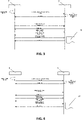
- Figures 3 and 4 show diagrams with some steps of a method according to the invention. In this case, they are based on the device of Figure 2 .
- the first external application 7 which has not had any previous contact with the first security applet 5, sends a request by means of a key pair exchange, to become the administrator, before this first security applet 5, of some private first data, which will be provided later by the same first external application 7.
- the first security applet 5 is configured to recognize this first external application 7, after performing a key exchange, as the local administrator application for the first data 11, so that no other external application may access the first data without a permission of the first external application.
- AuthZ token authorization
- this first external application 7 In the lower portion of this diagram, it is seen the access of this first external application 7 to its own piece of private data (the first data 11) within the context of a secure session established with the first security applet 5. Since the first external application 7 has acquired the status of local administrator of the first data 11, this access is allowed.
- the first external application 7 only needs a key exchange with the first applet 5 of the security element to obtain a "local administrator role" over their own first data.
- this further external application must require a permission.
- Figure 4 also based on the device of Figure 3 , shows a second external application 8 repeating the steps performed by the first external application 7 with respect to the first security applet 5 in Figure 3 , but in this case with respect to its own piece of private information (the second private data 12), to which the second external application 8 is the local administrator.
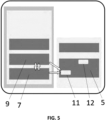
- Figure 5 shows a particular embodiment of a device according to the invention, wherein the first security applet 5 contains a first data 11 provided by a first external application 7 (this first external application 7 being local administrator of this first data 11) and a second data 12 provided by a second external application (this second external application, not shown, being local administrator of this second data 12).
- the first external application 7 is delegating the access to their own data 11 when a further external application 9 requests the first external application 7 (which is the "local administrator" over the first data 11) to access to the first data 11.
- Figure 6 shows a diagram where this action is being detailed.
- the further external application 9 requests this access to the first external application 7, which is the local administrator over the first data 11.
- the first external application 7 sends the delegation key to the first security applet 5 and then, after establishing the secure session with the delegated key, the ok is returned to the further external application 9.
- the further external application 9 by means of the delegated key, is able to access to the first data 11 (the one which is administrated by the first external application 7), but is not able to access to any other data, such as the second data 12, which is not administrated by the first external application 7, which is the application that has delegated its role. Since the first external application 7 was not authorized to access the second data 12, the delegated application 9 is not authorized to access to it either.
- access delegation is defined ad hoc for some external applications: the first external application, when delegating access to different delegated applications, apply in some embodiments the fine-grained authorization concept up to resource level (i.e., to the level of particular external applications), so that some specific applications may have specific rights (read/write/delete/create) over all or just a selected portion of data.
- the first external application may delegate to another external application the permission to become local administrator (and in turn be able to delegate the access to the first data to further external applications).
- FIG. 7 shows a particular embodiment of a device according to the invention, wherein now the second security applet 6 contains a third data 13 provided by a first external application 7 (this first external application 7 being local administrator of this third data 13) and a fourth data 14 provided by a second external application 8 (this second external application 8 being local administrator of this fourth data 14).
- the first external application 7 is becoming the main administrator before the second security applet 6, thus acquiring permissions to access, not only its own private information (the third data 13) but also any other piece of information stored in the corresponding security applet, such as the fourth data 14.
- Figure 8 shows a diagram to detail the steps of a method according to the invention. These steps are referred to the device of Figure 7 .
- the first external application 7 requests, by a key exchange with the second security applet 6, becoming the main administrator application. After this key exchange, the first external application 7 becomes the main administrator application before the second security applet 6.
- the main administrator 7 is authorized to access to the third data 13.
- Figure 9 shows a diagram to detail some other steps of a method according to the invention.
- the second external application 8 as local administrator of the fourth data 14, establishes a secure session to access its own data 14, the same as in other examples of relations between a local administrator and the corresponding security applet concerning a particular piece of data.
- the main administrator 7 is now able, without a further action, to access, not only its own private data (the third data 13) but also any other data stored in the same security applet (the second security applet 6).
- the secure session is established and the main administrator 7 has access both to the third data 13 and to the fourth data 14.
- Figure 10 uses the device of Figure 7 but with a further external application 9.
- the first external application 7 has become main administrator before the second security applet 6, and a further external application 9 requests an access to the fourth data 14.
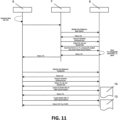
- Figure 11 shows a diagram of how these elements interact.
- the further external application 9 requests the main administrator (i.e., the first external application 7) an access to the fourth data 14.
- the second security applet 6 stores the PU_Delegated9 and the further external application 9 is delegated to access this fourth data 14.
- the further external application 9 uses the delegated key to request the second security applet 6 an access to the fourth data 14 within a secure session. This access is granted, but access to any other data (such as the third data 13) is not allowed, since permission was requested to the main administrator only for the fourth data 14.
Landscapes
- Engineering & Computer Science (AREA)
- Computer Security & Cryptography (AREA)
- Signal Processing (AREA)
- Computer Networks & Wireless Communication (AREA)
- Bioethics (AREA)
- General Health & Medical Sciences (AREA)
- Health & Medical Sciences (AREA)
- Theoretical Computer Science (AREA)
- General Engineering & Computer Science (AREA)
- Computer Hardware Design (AREA)
- Medical Informatics (AREA)
- General Physics & Mathematics (AREA)
- Physics & Mathematics (AREA)
- Software Systems (AREA)
- Databases & Information Systems (AREA)
- Computing Systems (AREA)
- Storage Device Security (AREA)
Abstract
The invention provides a secure element (4) for a device comprising an operative system (2), the secure element (4) comprising a first security applet (5) configured to communicate with the device operative system, wherein the first security applet (5) is configured to accept any first external application (7, 8), after performing a key registration, as a local administrator application for some first data (11, 12) provided by the first external application (7, 8), so that no other external application may access the first data (11, 12) without a permission of the first external application. The invention also provides a telecommunications device and a method of management of secure information in such a secure element.
Description
- This invention belongs to the field of managing the secure elements comprised in user devices, such as mobile phones.
- As known, some user devices, such as mobile phones, store the user's private information in a dedicated secure element (SE), such as integrated or dedicated security chips, that are located in the same user device, but as a separated hardware, also comprising their own software.
- Any external application (understood as an application designed to work in the operative system of the user device) may have access to the information contained in the SE. However, this access must be ensured to happen in a secure environment, avoiding that the external application may have access to unnecessary information stored in the SE.
- Some solutions to these problems have been disclosed. For example, GlobalPlatform Secure Element Access is a solution to regulate the access of the external applications to the SE. However, when an external application has a granted access to the SE, this external application is free to send commands to the SE, and any data may be accessed by third parties.
- Another existing solution, such as Secure Channel Protocols (SCP), rely on keys stored in the Security Domain (SD). This implies that any external Mobile Application which is able to authenticate to the SD will be allowed access to any SE Applet which relies on an authentication to the SD. The SE Applet cannot differentiate between two different Mobile Applications which has successfully performed an authentication. This problem is usually dealt with by combining the isolation of the SE Applications into different SDs to avoid illegal access from different external Mobile Applications, with access condition management from High Level Operating System (HLOS). This makes deployment on card even more complicated.
- One other challenge with using the SCP to cipher the communication is that the mobile application will either need to have permanent access to a Trusted Services Manager (TSM) or store the SD's symmetric keys locally themselves which required them to first have access to TSM servers. The need to have access to the TSM servers creates challenges when deploying on the field, especially when the mobile application is only performing a local access to the secure element.
- Another problem with using SCP is that the SD keys are not always loaded by the service provider themselves, rather they will need the help of the Secure Element Issuer (SEI) TSM to do so. Some service providers may not trust that the keys at some point have passed through a third party entity.
- The present invention provides an alternative solution to the problem of managing the security in the access of external applications to the security element of a user's device.
- The invention provides an alternative solution for this problem by means of a secure element according to
claim 1. Preferred embodiments of the invention are defined in dependent claims. - Unless otherwise defined, all terms (including technical and scientific terms) used herein are to be interpreted as is customary in the art. It will be further understood that terms in common usage should also be interpreted as is customary in the relevant art and not in an idealised or overly formal sense unless expressly so defined herein.
- In this text, the term "comprises" and its derivations (such as "comprising", etc.) should not be understood in an excluding sense, that is, these terms should not be interpreted as excluding the possibility that what is described and defined may include further elements, steps, etc.
- In a first inventive aspect, the invention provides a secure element for a device comprising an operative system, the secure element comprising a first security applet configured to communicate with the device operative system, wherein the first security applet is configured to accept any first external application, after performing a key registration, as a local administrator application for some first data provided by the first external application, so that no other external application may access the first data without a permission of the first external application.
- This invention introduces the direct communication between an external application and a first applet of the security element. The first external application only needs a key exchange with the first applet of the security element to obtain an "administrator role" over their own first data.
- A "device", in the sense of this invention, should be understood as any device with an operative system which is configured to transmit or receive electronic communications with an external operator. Although telecommunications devices, such as computers, mobile phones or tablets are the best example thereof, the invention is not limited to these devices. Any other case, involving internet of things (e.g., car sharing app or parking app or virtual car key app with a car using its own operative system) are also within the scope of protection of the invention.
- A "secure element", in the sense of this invention, should be understood as any element which is configured to store and exchange any secure data with the operative system of the device.
- An "external application", in the sense of this invention, should be understood as any program configured to be installed in the device, especially in the device operative system.
- A "key exchange", in the sense of this invention, should be understood as any sequence of operations where each party sends the public part of his key pair to the other one as it becomes a way to authenticate to the other party.
- The first (or second, or third) data, in the sense of this invention, should be understood as a key, a string, a blob or any other piece of info that may be securely read or used.
- In some particular embodiments, the first security applet is configured to accept that the first external application may delegate either the access to the first data or specific access permissions to some external applications, such as, for example, a local administrator role similar to the role of the first external application, so that more than one external application may manage the access to the first data..
- Once the first external application has become a local administrator application for its own data, the permission to access (or even to read/write) over these data may be delegated to other external applications.
- The first external application, when delegating access to different delegated applications, apply in some embodiments the fine-grained authorization concept up to resource level (i.e., to the level of particular external applications), so that some specific applications may have specific rights (read/write/delete/create over all or selected data).
- The first external application may inform the first security applet that the first data allows more than one application being the administrator thereof. Then, the first security applet may grant this administrator role to different applications. Each one of these applications would have an administrator role for the first data, so that they could freely access to this first data (not to the data managed by other external applications, unless allowed) and more than one external application could designate new delegated apps.
- In some particular embodiments, the first security applet is configured to require a token authorization for any external application to become local administrator for their corresponding data.
- In some cases, the first security applet comprised in the secure element is thus able to manage the access and usage of its storage, by means of a permissions management system. Since the storage size is not endless, it may be useful in some cases, where specific restrictions or monetization by profile are intended.
- In some particular embodiments, the first security applet is configured to accept a main external application as main administrator application for the first security applet, and further configured to confer the main external application the ability to access any data stored in the first security applet and/or the ability to confer further external applications the permission to access any data stored in the first security applet.
- A main administrator may be useful in some cases, when an access to many different pieces of information is to be centralized.
- In some particular embodiments, the first security applet is configured to establish a relation with the first external application so that any communication between them begins with a secure messaging session established by an authentication.
- Since the local administrator role has been established previously, the first security applet ensures, by the secure messaging session, that it is the administrator application the one which tries to access the corresponding data.
- In some particular embodiments, the first external application is configured to be installed by a user.
- In these cases, the first external application, which is recognized by the first security applet as an administrator application for its first data, is not a pre-installed application, but an application that may be installed by the phone's user in any moment.
- In some particular embodiments, the secure element comprises more than one security applet.
- The scheme and features associated in the different embodiments to the first security applet may be extended accordingly to additional security applets.
- In some particular embodiments, the first security applet is configured to provide a service, e.g., store secret values, generate keys, perform computations etc for the external administrator application and at least some of them for delegated applications.
- In some particular embodiments, the first security applet is configured to recognize more than one external application as local administrator application for their corresponding data, so that no other external application may access the corresponding data without a permission of the corresponding external application.
- The storage of the first security applet may be divided in watertight compartments, so that the data of one compartment is managed by one local administrator application and no other external application (even local administrators of other compartments) may access these data without the permission of the corresponding local administrator.
- These embodiments present the possibility that a second external application, different from the first external application, may become the administrator of some second data, different from the first data. Both first and second external applications would share the features of the first security applet, but each one of them would have the ability to decide about the access to their respective data: the first external application would have the right to regulate the access to the first data before any other external application (including the second external application) and the second external application would have the right to regulate the access to the second data before any other external application (including the first external application).
- This device guarantees the confidentiality and integrity of the communication between a SE Applet and a Mobile Application without knowledge of SD keys.
- In a second inventive aspect, the invention provides a telecommunications device comprising a secure element according to the first inventive aspect.
- In a further inventive aspect, the invention provides a method of management of secure information in a secure element according to the first inventive aspect, the method comprising the steps of
- a first external application which has not had any previous contact with the first security applet request a local administrator permission for some first data provided by the first external application;
- the first security applet, after performing a key registration, accepts the first external application as local administrator for the first data, so that no other external application may access the first data without a permission of the first external application.
- In some particular embodiments, the method further comprises the steps of
- a further external application request the first external application a permission to access the first data in the first security applet;
- the first external application initiates a secure session to store the first data in the security applet;
- the first external application, after a key registration, confers the further external application the permission to access the first data in the first security applet; and
- the further external application establishes a secure session with the first security applet to access the first data.
- In some particular embodiments, the method further comprises the steps of
- A second external application which has not had any previous contact with the first security applet request a local administrator permission for some second data provided by the second external application;
- the first security applet, after performing a key registration, accepts the second external application as local administrator for the second data, so that no other external application may access the second data without a permission of the second external application.
- In some particular embodiments, the method further comprises the steps of
- A fourth external application, which may be different or not from the first external application, requests the first security applet to become a main administrator
- The first security applet, after a key registration, accepts the fourth external application as the main administrator
- a fifth external application requests the fourth external application a local administrator permission for some third data provided by the fifth external application;
- the fourth external application, after performing a key registration, accepts the fifth external application as local administrator for the fourth data, so that no other external application may access the fourth data without a permission of the fourth external application or of the fifth external application.
- In some particular embodiments, the method further comprises the steps of
- A fourth external application performs a key registration together with a token with the first security applet
- The first security applet discerns if the token is acceptable
- If the token is acceptable, the first security applet accepts the fourth external application as local administrator for some third data, so that no other external application may access the third data without a permission of the fifth external application.
- To complete the description and in order to provide for a better understanding of the invention, a set of drawings is provided. Said drawings form an integral part of the description and illustrate an embodiment of the invention, which should not be interpreted as restricting the scope of the invention, but just as an example of how the invention can be carried out. The drawings comprise the following figures:
-
Figure 1 shows a particular embodiment of a mobile phone device according to the invention. -
Figure 2 shows a particular arrangement of a mobile phone according to the invention. -
Figures 3 and 4 show diagrams with some steps of a method according to the invention performed in the mobile phone ofFigure 2 . -
Figure 5 shows a particular arrangement of a mobile phone according to the invention. -
Figure 6 shows a diagram with some steps of a method according to the invention performed in the mobile phone ofFigure 5 . -
Figure 7 shows a particular arrangement of a mobile phone according to the invention. -
Figures 8 and9 show diagrams with some steps of a method according to the invention performed in the mobile phone ofFigure 7 . -
Figure 10 shows a particular arrangement of a mobile phone according to the invention. -
Figure 11 shows a diagram with some steps of a method according to the invention performed in the mobile phone ofFigure 10 . - The example embodiments are described in sufficient detail to enable those of ordinary skill in the art to embody and implement the systems and processes herein described. It is important to understand that embodiments can be provided in many alternate forms and should not be construed as limited to the examples set forth herein.
- Accordingly, while embodiment can be modified in various ways and take on various alternative forms, specific embodiments thereof are shown in the drawings and described in detail below as examples. There is no intent to limit to the particular forms disclosed. On the contrary, all modifications, equivalents, and alternatives falling within the scope of the appended claims should be included. Elements of the example embodiments are consistently denoted by the same reference numerals throughout the drawings and detailed description where appropriate.
-
Figure 1 shows a device, which in this case is amobile phone 1, which comprises - an
operative system 2, - an
internal memory 3; and - a
secure element 4 isolated from theinternal memory 3. - The
secure element 4 is configured to communicate with theoperative system 2 of the device, when storing and using some private information, when some application may require the use of this private information. - The private information referred in the present invention is not pre-installed in the secure element, but is information provided and managed by some external applications working in the operative system.
- The secure element comprises a plurality of
security applets - One of these security applets will be called
first security applet 5 and, in the example of this figure, is configured to receive the requests ofexternal applications External applications -
Figure 2 shows a particular embodiment of a device according to the invention, wherein thefirst security applet 5 contains afirst data 11 provided by a firstexternal application 7 and asecond data 12 provided by a secondexternal application 8. -
Figures 3 and 4 show diagrams with some steps of a method according to the invention. In this case, they are based on the device ofFigure 2 . ConcerningFigure 3 , in the upper part of the figure, the firstexternal application 7, which has not had any previous contact with thefirst security applet 5, sends a request by means of a key pair exchange, to become the administrator, before thisfirst security applet 5, of some private first data, which will be provided later by the same firstexternal application 7. Thefirst security applet 5 is configured to recognize this firstexternal application 7, after performing a key exchange, as the local administrator application for thefirst data 11, so that no other external application may access the first data without a permission of the first external application. - The use of a token authorization (AuthZ) is optional, and may be used in some cases.
- In the lower portion of this diagram, it is seen the access of this first
external application 7 to its own piece of private data (the first data 11) within the context of a secure session established with thefirst security applet 5. Since the firstexternal application 7 has acquired the status of local administrator of thefirst data 11, this access is allowed. - Hence, in the method illustrated in this figure, the first
external application 7 only needs a key exchange with thefirst applet 5 of the security element to obtain a "local administrator role" over their own first data. - Then, if a further external application wants to access this first data stored in the first security applet, this further external application must require a permission.
-
Figure 4 , also based on the device ofFigure 3 , shows a secondexternal application 8 repeating the steps performed by the firstexternal application 7 with respect to thefirst security applet 5 inFigure 3 , but in this case with respect to its own piece of private information (the second private data 12), to which the secondexternal application 8 is the local administrator. -
Figure 5 shows a particular embodiment of a device according to the invention, wherein thefirst security applet 5 contains afirst data 11 provided by a first external application 7 (this firstexternal application 7 being local administrator of this first data 11) and asecond data 12 provided by a second external application (this second external application, not shown, being local administrator of this second data 12). - In this case, the first
external application 7 is delegating the access to theirown data 11 when a furtherexternal application 9 requests the first external application 7 (which is the "local administrator" over the first data 11) to access to thefirst data 11. -
Figure 6 shows a diagram where this action is being detailed. The furtherexternal application 9 requests this access to the firstexternal application 7, which is the local administrator over thefirst data 11. The firstexternal application 7 sends the delegation key to thefirst security applet 5 and then, after establishing the secure session with the delegated key, the ok is returned to the furtherexternal application 9. - Then, as shown in the lower portion of the diagram, the further
external application 9, by means of the delegated key, is able to access to the first data 11 (the one which is administrated by the first external application 7), but is not able to access to any other data, such as thesecond data 12, which is not administrated by the firstexternal application 7, which is the application that has delegated its role. Since the firstexternal application 7 was not authorized to access thesecond data 12, the delegatedapplication 9 is not authorized to access to it either. - In some cases, access delegation is defined ad hoc for some external applications: the first external application, when delegating access to different delegated applications, apply in some embodiments the fine-grained authorization concept up to resource level (i.e., to the level of particular external applications), so that some specific applications may have specific rights (read/write/delete/create) over all or just a selected portion of data.
- In fact, in some cases, the first external application (local administrator) may delegate to another external application the permission to become local administrator (and in turn be able to delegate the access to the first data to further external applications).
-
Figure 7 shows a particular embodiment of a device according to the invention, wherein now thesecond security applet 6 contains athird data 13 provided by a first external application 7 (this firstexternal application 7 being local administrator of this third data 13) and afourth data 14 provided by a second external application 8 (this secondexternal application 8 being local administrator of this fourth data 14). - In this case, the first
external application 7 is becoming the main administrator before thesecond security applet 6, thus acquiring permissions to access, not only its own private information (the third data 13) but also any other piece of information stored in the corresponding security applet, such as thefourth data 14. -
Figure 8 shows a diagram to detail the steps of a method according to the invention. These steps are referred to the device ofFigure 7 . In this case, the firstexternal application 7 requests, by a key exchange with thesecond security applet 6, becoming the main administrator application. After this key exchange, the firstexternal application 7 becomes the main administrator application before thesecond security applet 6. - As seen in the lower portion of the diagram, after this main administrator has taken over its position, the
main administrator 7 is authorized to access to thethird data 13. -
Figure 9 shows a diagram to detail some other steps of a method according to the invention. In this case, with the embodiment ofFigure 7 , the secondexternal application 8, as local administrator of thefourth data 14, establishes a secure session to access itsown data 14, the same as in other examples of relations between a local administrator and the corresponding security applet concerning a particular piece of data. - In this figure, the
main administrator 7 is now able, without a further action, to access, not only its own private data (the third data 13) but also any other data stored in the same security applet (the second security applet 6). By means of a key registration, the secure session is established and themain administrator 7 has access both to thethird data 13 and to thefourth data 14. -
Figure 10 uses the device ofFigure 7 but with a furtherexternal application 9. In this case, the firstexternal application 7 has become main administrator before thesecond security applet 6, and a furtherexternal application 9 requests an access to thefourth data 14. -
Figure 11 shows a diagram of how these elements interact. The furtherexternal application 9 requests the main administrator (i.e., the first external application 7) an access to thefourth data 14. Thesecond security applet 6 stores the PU_Delegated9 and the furtherexternal application 9 is delegated to access thisfourth data 14. - In the lower portion of the diagram, the further
external application 9 uses the delegated key to request thesecond security applet 6 an access to thefourth data 14 within a secure session. This access is granted, but access to any other data (such as the third data 13) is not allowed, since permission was requested to the main administrator only for thefourth data 14.
Claims (14)
- Secure element (4) for a device comprising an operative system (2), the secure element (4) comprising a first security applet (5) configured to communicate with the device operative system, wherein the first security applet (5) is configured to accept any first external application (7, 8), after performing a key registration, as a local administrator application for some first data (11, 12) provided by the first external application (7, 8), so that no other external application may access the first data (11, 12) without a permission of the first external application.
- Secure element (4) according to any claim 1, wherein the first security applet (5) is configured to accept that the first external application (7, 8) may delegate either the access to the first data or specific access permissions to some external applications (9), such as, for example, a local administrator role similar to the role of the first external application, so that more than one external application may manage the access to the first data.
- Secure element (4) according to any of the preceding claims, wherein the first security applet (5) is configured to require a token authorization (AuthZ) for any external application to become local administrator for their corresponding data.
- Secure element (4) according to any of the preceding claims, wherein the first security applet (5) is configured to accept a main external application (7) as main administrator application for the first security applet (5), and further configured to confer the main external application the ability to access any data stored in the first security applet and/or the ability to confer further external applications the permission to access any data stored in the first security applet.
- Secure element (4) according to any of the preceding claims, wherein the first security applet (5) is configured to establish a relation with the first external application (7, 8) so that any communication between them begins with a secure messaging session established by an authentication.
- Secure element (4) according to any of the preceding claims, wherein the first external application (7, 8) is configured to be installed by a user.
- Secure element according to any of the preceding claims, wherein the secure element (4) comprises more than one security applet (5, 6).
- Secure element (4) according to any of the preceding claims, wherein the first security applet is configured to recognize more than one external application as local administrator application for their corresponding data, so that no other external application may access the corresponding data without a permission of the corresponding external application.
- Telecommunications device (1) comprising a secure element (4) according to any of the preceding claims.
- Method of management of secure information in a secure element according to any of claims 1 to 8, the method comprising the steps ofa first external application (7) which has not had any previous contact with the first security applet (5) requests a local administrator permission for some first data (11) provided by the first external application (7);the first security applet (5), after performing a key registration, accepts the first external application (5) as local administrator for the first data (11), so that no other external application may access the first data (11) without a permission of the first external application (7).
- Method according to claim 10, further comprising the steps ofa further external application (9) request the first external application (7) a permission to access the first data (11) in the first security applet (5);the first external application (7) initiates a secure session to store the first data (11) in the security applet;the first external application (7), after a key registration, confers the further external application (9) the permission to access the first data (11) in the first security applet (5); andthe further external application (9) establishes a secure session with the first security applet (5) to access the first data (11).
- Method according to any of claims 10 or 11, further comprising the steps ofA second external application (8) which has not had any previous contact with the first security applet request a local administrator permission for some second data (12) provided by the second external application (8);the first security applet (5), after performing a key registration, accepts the second external application (8) as local administrator for the second data (12), so that no other external application may access the second data without a permission of the second external application.
- Method according to any of claims 10 to 12, further comprising the steps ofA fourth external application (7), which may be different or not from the first external application, requests the first security applet to become a main administratorThe first security applet, after a key registration, accepts the fourth external application as the main administrator;a fifth external application (9) requests the fourth external application (7) a local administrator permission for accessing some fourth data (14) comprised in the first security applet;the fourth external application (7), after performing a key registration, confers the fifth external application (9) permission for accessing the fourth data (14).
- Method according to any of claims 10 to 13, wherein the first external application comprises a token and the key registration includes the authorization of the token as a requirement for accepting the first external application as local administrator for the first data.
Priority Applications (7)
| Application Number | Priority Date | Filing Date | Title |
|---|---|---|---|
| EP21306039.5A EP4125286A1 (en) | 2021-07-27 | 2021-07-27 | Secure element for a device |
| AU2022317099A AU2022317099A1 (en) | 2021-07-27 | 2022-06-30 | Secure element for a device |
| PCT/EP2022/068121 WO2023006332A1 (en) | 2021-07-27 | 2022-06-30 | Secure element for a device |
| US18/291,582 US12619771B2 (en) | 2021-07-27 | 2022-06-30 | Secure element for a device |
| KR1020247003307A KR102952767B1 (en) | 2021-07-27 | 2022-06-30 | Device security elements |
| EP22744658.0A EP4378189A1 (en) | 2021-07-27 | 2022-06-30 | Secure element for a device |
| AU2025256093A AU2025256093A1 (en) | 2021-07-27 | 2025-10-21 | Secure element for a device |
Applications Claiming Priority (1)
| Application Number | Priority Date | Filing Date | Title |
|---|---|---|---|
| EP21306039.5A EP4125286A1 (en) | 2021-07-27 | 2021-07-27 | Secure element for a device |
Publications (1)
| Publication Number | Publication Date |
|---|---|
| EP4125286A1 true EP4125286A1 (en) | 2023-02-01 |
Family
ID=77739032
Family Applications (2)
| Application Number | Title | Priority Date | Filing Date |
|---|---|---|---|
| EP21306039.5A Withdrawn EP4125286A1 (en) | 2021-07-27 | 2021-07-27 | Secure element for a device |
| EP22744658.0A Pending EP4378189A1 (en) | 2021-07-27 | 2022-06-30 | Secure element for a device |
Family Applications After (1)
| Application Number | Title | Priority Date | Filing Date |
|---|---|---|---|
| EP22744658.0A Pending EP4378189A1 (en) | 2021-07-27 | 2022-06-30 | Secure element for a device |
Country Status (4)
| Country | Link |
|---|---|
| EP (2) | EP4125286A1 (en) |
| KR (1) | KR102952767B1 (en) |
| AU (2) | AU2022317099A1 (en) |
| WO (1) | WO2023006332A1 (en) |
Citations (3)
| Publication number | Priority date | Publication date | Assignee | Title |
|---|---|---|---|---|
| US20140189880A1 (en) * | 2012-12-31 | 2014-07-03 | Gemalto Sa | System and method for administrating access control rules on a secure element |
| US8806199B2 (en) * | 2010-12-17 | 2014-08-12 | Google Inc. | Writing application data to a secure element |
| US20210014682A1 (en) * | 2019-07-11 | 2021-01-14 | Mastercard International Incorporated | Methods and systems for securing and utilizing a personal date store on a mobile device |
Family Cites Families (4)
| Publication number | Priority date | Publication date | Assignee | Title |
|---|---|---|---|---|
| EP2600275A1 (en) * | 2011-12-02 | 2013-06-05 | Nxp B.V. | Method for accessing a secure storage, secure storage and system comprising the secure storage |
| ES2651684T3 (en) * | 2012-04-17 | 2018-01-29 | Secure Nfc Pty. Ltd. | Multi-sender secure element partition architecture for NFC-enabled devices |
| FR3050348A1 (en) * | 2016-04-18 | 2017-10-20 | Orange | METHOD FOR OBTAINING A SECURITY TOKEN BY A MOBILE TERMINAL |
| US10733284B2 (en) * | 2016-10-06 | 2020-08-04 | Samsung Electronics Co., Ltd. | Trusted execution environment secure element communication |
-
2021
- 2021-07-27 EP EP21306039.5A patent/EP4125286A1/en not_active Withdrawn
-
2022
- 2022-06-30 AU AU2022317099A patent/AU2022317099A1/en not_active Abandoned
- 2022-06-30 EP EP22744658.0A patent/EP4378189A1/en active Pending
- 2022-06-30 WO PCT/EP2022/068121 patent/WO2023006332A1/en not_active Ceased
- 2022-06-30 KR KR1020247003307A patent/KR102952767B1/en active Active
-
2025
- 2025-10-21 AU AU2025256093A patent/AU2025256093A1/en not_active Abandoned
Patent Citations (3)
| Publication number | Priority date | Publication date | Assignee | Title |
|---|---|---|---|---|
| US8806199B2 (en) * | 2010-12-17 | 2014-08-12 | Google Inc. | Writing application data to a secure element |
| US20140189880A1 (en) * | 2012-12-31 | 2014-07-03 | Gemalto Sa | System and method for administrating access control rules on a secure element |
| US20210014682A1 (en) * | 2019-07-11 | 2021-01-14 | Mastercard International Incorporated | Methods and systems for securing and utilizing a personal date store on a mobile device |
Non-Patent Citations (1)
| Title |
|---|
| GLOBALPLATFORM: "GlobalPlatform Device Technology Secure Element Access Control Version 1.1", 30 September 2014 (2014-09-30), XP055539898, Retrieved from the Internet <URL:https://globalplatform.org/wp-content/uploads/2014/10/GPD_SE_Access_Control_v1.1.pdf> [retrieved on 20190109] * |
Also Published As
| Publication number | Publication date |
|---|---|
| EP4378189A1 (en) | 2024-06-05 |
| KR20240025684A (en) | 2024-02-27 |
| AU2025256093A1 (en) | 2025-11-13 |
| WO2023006332A1 (en) | 2023-02-02 |
| US20250094621A1 (en) | 2025-03-20 |
| KR102952767B1 (en) | 2026-04-14 |
| AU2022317099A1 (en) | 2024-02-08 |
Similar Documents
| Publication | Publication Date | Title |
|---|---|---|
| US9609024B2 (en) | Method and system for policy based authentication | |
| EP1556992B1 (en) | Secure implementation and utilization of device-specific security data | |
| KR101434769B1 (en) | Method and apparatus for trusted federated identity management and data access authorization | |
| EP2262164A1 (en) | Secure data transfer | |
| US20050193199A1 (en) | Accessing protected data on network storage from multiple devices | |
| WO2002033521A2 (en) | Method and apparatus for controlling access to functions with different security levels | |
| TW201428535A (en) | Policy-based techniques for managing access control | |
| EP1836543A1 (en) | Method and system for access control and data protection in digital memories, related digital memory and computer program product therefor | |
| CN111191217A (en) | Password management method and related device | |
| CN105763517A (en) | Router security access and control method and system | |
| KR20140058196A (en) | Apparatus and method for protecting mobile message data | |
| KR20130049103A (en) | Security domain authority change control method of server, security domain authority change method of smart card, security domain authority change method of user equipment, server, smart card, and user equipment | |
| US12619771B2 (en) | Secure element for a device | |
| US20250094621A1 (en) | Secure element for a device | |
| EP1636767B1 (en) | A method for allocation of secure resources in a security module | |
| KR101678729B1 (en) | A secure element for a telecommunications terminal | |
| Arfaoui et al. | Practical and privacy-preserving TEE migration | |
| Suoranta et al. | Strong authentication with mobile phone | |
| EP3512231B1 (en) | Method for providing an enhanced level of authentication related to distribution of a secure software client application; as well as corresponding system and computer program product. | |
| Kasper et al. | Rights management with NFC smartphones and electronic ID cards: A proof of concept for modern car sharing | |
| CN120091314B (en) | Key processing methods and related devices | |
| EP2680181A1 (en) | System and method of securely creating and controlling access to a virtualised space | |
| Horsch et al. | TrustID: Trustworthy identities for untrusted mobile devices | |
| WO2025196241A1 (en) | Use of two or more esim profiles for storing and executing algorithms, cryptographic keys, and data | |
| Mont et al. | On identity-aware devices: Putting users in control across federated services |
Legal Events
| Date | Code | Title | Description |
|---|---|---|---|
| PUAI | Public reference made under article 153(3) epc to a published international application that has entered the european phase |
Free format text: ORIGINAL CODE: 0009012 |
|
| STAA | Information on the status of an ep patent application or granted ep patent |
Free format text: STATUS: THE APPLICATION HAS BEEN PUBLISHED |
|
| AK | Designated contracting states |
Kind code of ref document: A1 Designated state(s): AL AT BE BG CH CY CZ DE DK EE ES FI FR GB GR HR HU IE IS IT LI LT LU LV MC MK MT NL NO PL PT RO RS SE SI SK SM TR |
|
| STAA | Information on the status of an ep patent application or granted ep patent |
Free format text: STATUS: THE APPLICATION IS DEEMED TO BE WITHDRAWN |
|
| 18D | Application deemed to be withdrawn |
Effective date: 20230802 |