EP4125251A1 - Transmission method through in-vehicle switch-based network - Google Patents
Transmission method through in-vehicle switch-based network Download PDFInfo
- Publication number
- EP4125251A1 EP4125251A1 EP21188015.8A EP21188015A EP4125251A1 EP 4125251 A1 EP4125251 A1 EP 4125251A1 EP 21188015 A EP21188015 A EP 21188015A EP 4125251 A1 EP4125251 A1 EP 4125251A1
- Authority
- EP
- European Patent Office
- Prior art keywords
- data stream
- reservoir
- data
- rssj
- switch
- Prior art date
- Legal status (The legal status is an assumption and is not a legal conclusion. Google has not performed a legal analysis and makes no representation as to the accuracy of the status listed.)
- Pending
Links
Images

Classifications
-
- H—ELECTRICITY
- H04—ELECTRIC COMMUNICATION TECHNIQUE
- H04L—TRANSMISSION OF DIGITAL INFORMATION, e.g. TELEGRAPHIC COMMUNICATION
- H04L47/00—Traffic control in data switching networks
- H04L47/10—Flow control; Congestion control
- H04L47/24—Traffic characterised by specific attributes, e.g. priority or QoS
- H04L47/2425—Traffic characterised by specific attributes, e.g. priority or QoS for supporting services specification, e.g. SLA
- H04L47/2433—Allocation of priorities to traffic types
-
- H—ELECTRICITY
- H04—ELECTRIC COMMUNICATION TECHNIQUE
- H04L—TRANSMISSION OF DIGITAL INFORMATION, e.g. TELEGRAPHIC COMMUNICATION
- H04L12/00—Data switching networks
- H04L12/28—Data switching networks characterised by path configuration, e.g. LAN [Local Area Networks] or WAN [Wide Area Networks]
- H04L12/40—Bus networks
- H04L12/40006—Architecture of a communication node
-
- G—PHYSICS
- G07—CHECKING-DEVICES
- G07C—TIME OR ATTENDANCE REGISTERS; REGISTERING OR INDICATING THE WORKING OF MACHINES; GENERATING RANDOM NUMBERS; VOTING OR LOTTERY APPARATUS; ARRANGEMENTS, SYSTEMS OR APPARATUS FOR CHECKING NOT PROVIDED FOR ELSEWHERE
- G07C5/00—Registering or indicating the working of vehicles
- G07C5/08—Registering or indicating performance data other than driving, working, idle, or waiting time, with or without registering driving, working, idle or waiting time
- G07C5/0808—Diagnosing performance data
-
- G—PHYSICS
- G07—CHECKING-DEVICES
- G07C—TIME OR ATTENDANCE REGISTERS; REGISTERING OR INDICATING THE WORKING OF MACHINES; GENERATING RANDOM NUMBERS; VOTING OR LOTTERY APPARATUS; ARRANGEMENTS, SYSTEMS OR APPARATUS FOR CHECKING NOT PROVIDED FOR ELSEWHERE
- G07C5/00—Registering or indicating the working of vehicles
- G07C5/08—Registering or indicating performance data other than driving, working, idle, or waiting time, with or without registering driving, working, idle or waiting time
- G07C5/0816—Indicating performance data, e.g. occurrence of a malfunction
-
- H—ELECTRICITY
- H04—ELECTRIC COMMUNICATION TECHNIQUE
- H04L—TRANSMISSION OF DIGITAL INFORMATION, e.g. TELEGRAPHIC COMMUNICATION
- H04L47/00—Traffic control in data switching networks
- H04L47/10—Flow control; Congestion control
- H04L47/24—Traffic characterised by specific attributes, e.g. priority or QoS
- H04L47/245—Traffic characterised by specific attributes, e.g. priority or QoS using preemption
-
- H—ELECTRICITY
- H04—ELECTRIC COMMUNICATION TECHNIQUE
- H04L—TRANSMISSION OF DIGITAL INFORMATION, e.g. TELEGRAPHIC COMMUNICATION
- H04L47/00—Traffic control in data switching networks
- H04L47/70—Admission control; Resource allocation
- H04L47/72—Admission control; Resource allocation using reservation actions during connection setup
-
- H—ELECTRICITY
- H04—ELECTRIC COMMUNICATION TECHNIQUE
- H04L—TRANSMISSION OF DIGITAL INFORMATION, e.g. TELEGRAPHIC COMMUNICATION
- H04L49/00—Packet switching elements
- H04L49/35—Switches specially adapted for specific applications
- H04L49/351—Switches specially adapted for specific applications for local area network [LAN], e.g. Ethernet switches
-
- H—ELECTRICITY
- H04—ELECTRIC COMMUNICATION TECHNIQUE
- H04L—TRANSMISSION OF DIGITAL INFORMATION, e.g. TELEGRAPHIC COMMUNICATION
- H04L12/00—Data switching networks
- H04L12/28—Data switching networks characterised by path configuration, e.g. LAN [Local Area Networks] or WAN [Wide Area Networks]
- H04L12/40—Bus networks
- H04L2012/40267—Bus for use in transportation systems
- H04L2012/40273—Bus for use in transportation systems the transportation system being a vehicle
-
- H—ELECTRICITY
- H04—ELECTRIC COMMUNICATION TECHNIQUE
- H04L—TRANSMISSION OF DIGITAL INFORMATION, e.g. TELEGRAPHIC COMMUNICATION
- H04L67/00—Network arrangements or protocols for supporting network services or applications
- H04L67/01—Protocols
- H04L67/12—Protocols specially adapted for proprietary or special-purpose networking environments, e.g. medical networks, sensor networks, networks in vehicles or remote metering networks
- H04L67/125—Protocols specially adapted for proprietary or special-purpose networking environments, e.g. medical networks, sensor networks, networks in vehicles or remote metering networks involving control of end-device applications over a network
-
- H—ELECTRICITY
- H04—ELECTRIC COMMUNICATION TECHNIQUE
- H04L—TRANSMISSION OF DIGITAL INFORMATION, e.g. TELEGRAPHIC COMMUNICATION
- H04L67/00—Network arrangements or protocols for supporting network services or applications
- H04L67/34—Network arrangements or protocols for supporting network services or applications involving the movement of software or configuration parameters
Definitions
- the present disclosure relates to the field of data transmission through a switch-based Ethernet network in an in-vehicle communications network system.
- the current in-vehicle communications network architectures include separated functional system domains such as body/comfort, chassis, power train, and infotainment.
- the architecture is based on functions of the systems, and not on location of the systems in the vehicle.
- Each domain is developed with a different schedule and different requirements.
- the communication between domains is limited.
- the automotive manufacturers can qualify that one domain is working, by performing some testing to ensure that functionalities are working properly, independently from another domain.
- a zone-based or zonal architecture has been proposed. It allows to reduce the physical wiring requirements within the vehicle.
- a qualification for all domains may increase the price for each software update and increase the time for deploying the updated architecture by the time needed for testing.
- the present disclosure concerns a method for transmitting data through a switch-based network in an in-vehicle communications network system, including the following steps performed at a transmitter device : generating, by a generator, a reservoir data stream and transmitting said reservoir data stream through the switch-based network, and when a new data stream from the transmitter device to the receiver device is needed, replacing, by an injector, at least part of the reservoir data stream by the new data stream.
- a reservoir data stream for example at a production or development stage (time) of the switch-based network, before it is used for the first time in the vehicle, allows to facilitate a later qualification (testing) of the network when a change on the network is performed. It is not necessary to change the amount or timing of the communications within the switch-based network, when the change is implemented. Only in case the in-vehicle network needs to change importantly, an adjustment of the network needs to be made.
- a data traffic transmitted from the transmitter device to the receiver device including a regular data stream the reservoir data stream is added to said regular data stream.
- the generator generates data of at least one type of the group including random data, data for analytics, data for computer security, data for diagnostic, data for logging, to create the reservoir data stream.
- Random data can be generated to create the reservoir data stream.
- any other type of data could be used.
- the method further includes a step of configuring (setting) the generator to generate said reservoir data stream, before a first use of said switch-based network, and replacing at least part of the reservoir data stream by the new data stream is performed during lifetime (operation) of the switch-based network.
- the reservoir data stream is advantageously set up before a first rollout of the switch-based network.
- replacing at least part of the reservoir data stream by the new data stream is performed when a software update requiring the addition of said new data stream from the transmitter device to the receiver device is performed within the switch-based network.
- a software update within the in-vehicle system is typically a situation that may require the addition of a new data stream between two devices.
- the generator generates a plurality of additional reservoir data streams having different transmission rates for the same receiver device.
- the injector selects, among said plurality of data streams having different transmission rates, one reservoir data stream which transmission rate can include a transmission rate of the new data stream.
- Determining which reservoir streams to add within the in-vehicle switch-based network is based on assumptions related to future changes, made during the initial development of the network.
- the generator generates a plurality of additional reservoir data streams that are for different receiver devices.
- a plurality of reservoir data streams being transmitted through the switch-based network the method further includes a step of selecting, among said plurality of reservoir data streams, a reservoir data stream that fulfills requirements of the new data stream, said requirements including a transmitter device, a receiver device and a transmission rate.
- the present disclosure also concerns a transmitter device for an in-vehicle communications network system, including means for carrying out the steps of the method previously defined.
- the present disclosure also concerns a method for receiving data by a receiver device through a switch-based network in an in-vehicle communications network system, including the following steps performed by the receiver device :
- the data of the received reservoir data stream is either discarded, or used for at least one function of the group including an analytics function, a diagnostic function, a computer security function and a logging function to be implemented by the receiver device.
- the present disclosure also concerns a receiver device for an in-vehicle communications network system, including means for carrying out the steps of the method above defined.
- the present disclosure also concerns an in-vehicle communications network system including one or more transmitter devices as previously defined, one or more receiver devices as above defined, transmission lines for transmitting data streams and one or more switches for routing the data streams.
- the present disclosure also concerns a vehicle including the communications network system above defined.
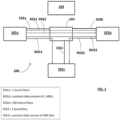
- FIG. 1 illustrates different devices 101a, 101b, that are interconnected to form an in-vehicle communications network system within a vehicle 100.
- the devices 101a, 101b, ... can communicate with each other through a switch-based network 200, for example a switch-based Ethernet network, that includes one or more transmission lines 102a, 102b, ... and one or more switches 103.
- a switch-based network for example a switch-based Ethernet network, that includes one or more transmission lines 102a, 102b, ... and one or more switches 103.
- routing is performed by using routing tables embedded in switches 103.
- Each switch 103 has a function of routing data in the network based on its routing table.
- the in-vehicle communications network system includes three devices 101a, 101b, 101c and each device is connected to the two other devices through the switch 103.
- the example given in figure 1 is only illustrative. There are various embodiments of the in-vehicle communications network system.
- first regular communications between the different devices 101a, 101b, 101c are set up (in other words: configured).
- a regular communication is a normal communication from a transmitter device to a receiver device to transmit useful data for the receiver device (in other words: data that will be used, processed by the receiver device).
- the data transmitted through the regular communications is processed by the receiver device after reception, for example to execute an action within the system.
- the regular communications carry data that are necessary for the in-vehicle system to work.
- each additional communication between a transmitter device and a receiver device includes one or more reservoir data streams. It is generated by a generator of the transmitter device and transmitted from the transmitter device to the receiver device (or to a plurality of receiver devices) through the switch-based network 200.
- the reservoir data streams only carry data that is not essential for the switch-based network 200 (and/or the in-vehicle communications network system) to work and could be deleted without changing or affecting the operation of the switch-based network 200 (an/or in-vehicle system).
- the data carried by a reservoir data stream includes random data generated by a random or pseudo-random generator.
- the data carried by a reservoir data stream can include other types of data related to optional functions to be implemented by the receiver device.
- the data of the reservoir data stream can include data for analytics, data for computer security (e.g., data related to a honeypot), data for logging, and/or data for analytics, etc. Other types of optional data could be considered for the reservoir data streams.
- the data carried by the reservoir data stream is additional and optional data that can be deleted (and/or replaced) at some point during the lifetime of the switch-based network 200, without changing or affecting the operation of the switch-based network 200.
- An essential function of the reservoir data stream is to provide a flow of (available) data between the transmitter device and the receiver device, from the first rollout (first use) of the switch-based network 200 and during its lifetime.
- the in-vehicle communications network system is deployed, at its first rollout (before a first use), it is submitted to testing or qualification to ensure that the system is working properly.
- qualification testing
- functionalities of the system are tested to check it they work.
- the reservoir data streams exist and are taken into account in the qualification.
- a qualification could also be performed after the first rollout, at any moment during the lifetime of the vehicle system.
- a change on the in-vehicle communications network system is needed, for example after it has been initially deployed, due to a software update or a new release within the switch-based network 200, it may require the addition of a new data stream from a transmitter device to a receiver device to carry data for the receiver device.
- the new data stream may have some requirements including a source (transmitter) device, destination (receiver) device, and a transmission rate.
- an existing reservoir data stream that fulfills the requirements of the new data stream is searched and selected among the plurality of reservoir data streams.
- an injector replaces at least part of the selected reservoir data stream by the new data stream. In other words, at least part of the data initially carried by the reservoir data stream is replaced by the data of the required new data stream.
- FIG. 2 illustrates a method of transmitting data and a corresponding method of receiving data through the switch-based network 200, according to an embodiment, that will now be described.
- phase S0 for example before a client deployment of the in-vehicle system and/or before first rollout of the switch-based network 200, a plurality of communications is set up within the switch-based network 200.
- the communications that are initially set up within the switch-based network 200 include regular communications RGSi (regular data streams) and reservoir communications RSSj (reservoir data streams), i and j being indexes.
- the switch-based network 200 can route the configured regular communications RGSi and the configured reservoir communications RSSj.
- the regular data streams RGSi are transmitted within the switch-based network 200 (step S1).
- a generator of the transmitter device For each reservoir data stream RSSj that has been set up from a transmitter (source) device to a receiver (destination) device, a generator of the transmitter device generates the reservoir data stream RSSj in a step S2 and transmits it to the receiver device through the switch-based network 200 in a step S3.
- the generator can include a random data generator that generates random data to create the reservoir data stream. Alternatively, it can generate other types of data (analytics, diagnostic, security, and/or logging etc.) that is optional for the switch-based network 200 to work and can be replaced.
- the receiver devices receive the regular data streams RGSi and the reservoir data streams RSSj.
- Each regular data stream received by a receiver device is processed (used) by the receiver device.
- the random data of the reservoir data streams is discarded or ignored by the receiver devices.
- the receiver device utilizes the data carried by the reservoir data stream RSSj for corresponding purposes (analytics, diagnostic, computer security (e.g., honeypot for hackers), data logging, etc.).
- the regular data streams RGS1, RGS2, RGS3 and the reservoir data streams RSS1 and RSS2 are routed by the pre-configured switch 103 and transmitted through the switch-based network 200.
- a change on the system may be necessary and require the addition of a new data stream NDS within the switch-based network 200.
- the change on the system can result from a software update (or from the implementation of a new software release) in the switch-based network 200.
- the step S5 in figure 2 represents the software update.
- the new data stream NDS has some requirements or characteristics.
- the requirements of the new data stream NDS include a source (transmitter) device, a destination (receiver) device and a transmission rate.
- an element of the in-vehicle communications network system searches and selects, among the plurality of a reservoir data streams RSSj existing within the switch-based network 200, one reservoir data stream that can fulfill the requirements of the new data stream.
- the supervising control device 104 can have a table or database storing information on all communications (i.e., all data streams) established in the system. For example, the adequate reservoir data stream is searched in the database storing information on all the reservoir data streams set up in the network 200. Alternatively, the search and selection could be performed by one or more devices 101a, 101b, ... of the network 200.
- the selected reservoir data stream has the required transmitter and receiver devices and the transmission rate of the reservoir data stream can include the transmission rate of the new data stream.
- the software update S5 it is needed to add in the switch-based network 200 a new data stream of useful data, including one data burst every 100ms, from the transmitter device 101a to the receiver device 101b.
- the reservoir data stream RSS1 from the transmitter device 101a to the receiver device 101b including one burst every 5ms is selected and part of the reservoir data stream RSS1 is replaced with the new data stream (1 burst every 100ms).
- a step S7 the transmitter device and the receiver device linked by the selected reservoir data stream - 101a and 101b linked by RSS1 in the example given above - are notified to add the new data stream NDS over the selected reservoir data stream.
- the transmission rate of the new data stream NDS is provided to them.
- an injector of the transmission device 101a replaces at least part of the selected reservoir data stream RSS1 by the data of the new data stream NDS. In this way, the new data stream NDS is transmitted over the reservoir data stream RSS1 from the transmitter device 101a to the receiver device 101b.
- the selected data stream RSS1 including the new data stream NDS is transmitted from the transmitter device 101a to the receiver device 101b, here via the switch 103, without requiring any adjustment within the network 200.
- the receiver device 101b receives the transmitted reservoir data stream RSS1 including the new data stream NDS, together with the regular data stream(s) (RG3 in figure 1 ).
- An extractor of the receiver device 101b extracts the new data stream NDS from the received reservoir data stream RSS1, in a step S11.
- the remaining data of the reservoir data stream RSS1 (random data) is ignored or discarded.
- the remaining data is used for the corresponding purposes by the receiver device.
- the present disclosure allows the switch-based network 200 to be updated during its lifetime after a first rollout, without need to make adjustment of the network 200.
- the switches of the network do not need to be reconfigured.
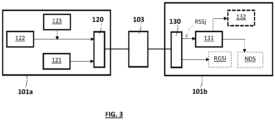
- FIG 3 An embodiment of the transmitter device, for example the transmitter device 101a, is illustrated in figure 3 and will now be described. For the sake of conciseness, only the elements of the device related to the present disclosure will be described.
- the transmitter device 101a includes means for carrying out the steps of the method for transmitting data previously described.
- the transmitter device 101a includes a network interface 120 to interface with the switch-based network 200, one or more sources 121 of regular data streams, a reservoir data stream generator 122, an injector 123, and a processing unit or processor (not represented) controlling the operation of the device 101a.
- the generator 122 is responsible for generating one or more reservoir data streams and transmitting said one or more reservoir data streams through the switch-based network 200.
- it includes a random data generator that generates random data to create the reservoir data stream(s).
- the generator 122 generates data for other (optional) purposes such as analytics, diagnostic, security, logging etc.., that could be ignored (deleted or replaced) later during the lifetime of the network 200.
- the generator 122 may generate a plurality of additional reservoir data streams having different transmission rates for the same receiver device. It may also generate a plurality of additional reservoir data streams that are for different receiver devices.
- the injector 123 is responsible for replacing at least part of a reservoir data stream from the transmitter device 101a to a given receiver device by a new data stream of useful data for the receiver device. Furthermore, when the generator 122 generates several reservoir data streams having different transmission rates to the same receiver device, the injector is responsible for selecting, among said reservoir data streams having different transmission rates, one reservoir data stream which transmission rate can include a transmission rate of the new data stream.
- the transmitter device 101a has hardware and software to implement its functionalities.
- the generator 122 and the injector 123 are software components running on the processing unit.
- receiver device for example the receiver device 101b
- FIG 3 An embodiment of the receiver device, for example the receiver device 101b, is illustrated in figure 3 and will now be described. For the sake of conciseness, only the elements of the device related to the present disclosure will be described.
- the receiver device 101b includes means for carrying out the steps of the method for receiving data previously described.
- the receiver device 101b includes a network interface 130 to interface with the switch-based network 200, an extractor 131, and a processing unit or processor (not represented) to control the operation of the receiver device 101b.
- a traffic data including one or more regular data stream(s) RGSi and possibly one or more reservoir data stream(s) RSSj is received by the receiver device 101b through the network interface 130.
- the regular stream RGS3 and the two reservoir streams RSS1 and RSS2 are received through the interface 130.
- the extractor 131 is responsible for extracting the reservoir data stream(s) (e.g., RSS1 and RSS2 in figure 1 ) from the data traffic received by the network interface 130.
- the extractor 131 is responsible for extracting the new data stream and forward it within the receiver device for further processing.
- the data of the received reservoir data stream(s) RSSj is ignored or discarded (not further processed or used) by the extractor 131.
- it could be transmitted to a processor for implementing a specific (optional) functionality (analytics, diagnostic, security, logging, etc.), as previously explained.
- the receiver device 101b transmits the received regular data stream(s) RGSi and the extracted new data stream NDS to the processing unit for further processing or use.
- the receiver device 101b has an analyzer 132 for analyzing the received reservoir data stream(s), in particular in testing (qualification).
Landscapes
- Engineering & Computer Science (AREA)
- Computer Networks & Wireless Communication (AREA)
- Signal Processing (AREA)
- Physics & Mathematics (AREA)
- General Physics & Mathematics (AREA)
- Small-Scale Networks (AREA)
- Data Exchanges In Wide-Area Networks (AREA)
Abstract
generating, by a generator, a reservoir data stream (RSSj) and transmitting said reservoir data stream (RSSj) through the switch-based network (200), and
when a new data stream from the transmitter device (101a) to the receiver device (101b) is needed, replacing, by an injector, at least part of the reservoir data stream (RSSj) by the new data stream.
Description
- The present disclosure relates to the field of data transmission through a switch-based Ethernet network in an in-vehicle communications network system.
- In the automotive field, the current in-vehicle communications network architectures include separated functional system domains such as body/comfort, chassis, power train, and infotainment. The architecture is based on functions of the systems, and not on location of the systems in the vehicle. Each domain is developed with a different schedule and different requirements. The communication between domains is limited. The automotive manufacturers can qualify that one domain is working, by performing some testing to ensure that functionalities are working properly, independently from another domain.
- To overcome some issues of the architecture based on separated domains, such as physical wiring requirements, a zone-based or zonal architecture has been proposed. It allows to reduce the physical wiring requirements within the vehicle.
- In a transition to the zonal architecture, some domains need to share resources such as communication buses.
- Furthermore, the development of over-the-air updates enables the automotive manufacturers to continue developing the vehicles after their production and first rollout (in other words: first use) with frequent updates or releases of software components within the vehicles. Some domains, for example infotainment, ADAS and/or AD, are likely to get more frequent updates than other domains like body/comfort or powertrain.
- A problem arises when a change in one domain requires a qualification, in other words some testing, for all domains, because the different domains share resources. Such a qualification for all domains may increase the price for each software update and increase the time for deploying the updated architecture by the time needed for testing.
- Therefore, there is a need for facilitating a qualification (testing) of the in-vehicle communications network system when a change is made on the vehicle system, for example when a software update is performed.
- The present disclosure concerns a method for transmitting data through a switch-based network in an in-vehicle communications network system, including the following steps performed at a transmitter device : generating, by a generator, a reservoir data stream and transmitting said reservoir data stream through the switch-based network, and when a new data stream from the transmitter device to the receiver device is needed, replacing, by an injector, at least part of the reservoir data stream by the new data stream.
- The addition of a reservoir data stream, for example at a production or development stage (time) of the switch-based network, before it is used for the first time in the vehicle, allows to facilitate a later qualification (testing) of the network when a change on the network is performed. It is not necessary to change the amount or timing of the communications within the switch-based network, when the change is implemented. Only in case the in-vehicle network needs to change importantly, an adjustment of the network needs to be made.
- In an embodiment, a data traffic transmitted from the transmitter device to the receiver device including a regular data stream, the reservoir data stream is added to said regular data stream.
- In an embodiment, the generator generates data of at least one type of the group including random data, data for analytics, data for computer security, data for diagnostic, data for logging, to create the reservoir data stream. Random data can be generated to create the reservoir data stream. However, any other type of data could be used.
- In an embodiment, the method further includes a step of configuring (setting) the generator to generate said reservoir data stream, before a first use of said switch-based network, and replacing at least part of the reservoir data stream by the new data stream is performed during lifetime (operation) of the switch-based network. The reservoir data stream is advantageously set up before a first rollout of the switch-based network.
- In an embodiment, replacing at least part of the reservoir data stream by the new data stream is performed when a software update requiring the addition of said new data stream from the transmitter device to the receiver device is performed within the switch-based network. A software update within the in-vehicle system is typically a situation that may require the addition of a new data stream between two devices.
- In an embodiment, the generator generates a plurality of additional reservoir data streams having different transmission rates for the same receiver device. In that case, the injector selects, among said plurality of data streams having different transmission rates, one reservoir data stream which transmission rate can include a transmission rate of the new data stream.
- Determining which reservoir streams to add within the in-vehicle switch-based network is based on assumptions related to future changes, made during the initial development of the network.
- In an embodiment, the generator generates a plurality of additional reservoir data streams that are for different receiver devices.
- In an embodiment, a plurality of reservoir data streams being transmitted through the switch-based network, the method further includes a step of selecting, among said plurality of reservoir data streams, a reservoir data stream that fulfills requirements of the new data stream, said requirements including a transmitter device, a receiver device and a transmission rate.
- The present disclosure also concerns a transmitter device for an in-vehicle communications network system, including means for carrying out the steps of the method previously defined.
- The present disclosure also concerns a method for receiving data by a receiver device through a switch-based network in an in-vehicle communications network system, including the following steps performed by the receiver device :
- receiving, from a transmitter device through the switch-based network, a reservoir data stream;
- when a new data stream from the transmitter device to the receiver device is required, extracting, by an extractor, the new data stream from the reservoir data stream.
- In an embodiment, the data of the received reservoir data stream is either discarded, or used for at least one function of the group including an analytics function, a diagnostic function, a computer security function and a logging function to be implemented by the receiver device.
- The present disclosure also concerns a receiver device for an in-vehicle communications network system, including means for carrying out the steps of the method above defined.
- The present disclosure also concerns an in-vehicle communications network system including one or more transmitter devices as previously defined, one or more receiver devices as above defined, transmission lines for transmitting data streams and one or more switches for routing the data streams.
- The present disclosure also concerns a vehicle including the communications network system above defined.
- Other features, purposes and advantages of the disclosure will become more explicit by means of reading the detailed statement of the non-restrictive embodiments made with reference to the accompanying drawings.
-
Figure 1 shows an illustrative example of a part of an in-vehicle communications network system, according to an embodiment. -
Figure 2 is a flowchart of a method for transmitting data and a method for receiving data, according to an embodiment. -
Figure 3 is a functional block diagram of a transmitter device and a receiver device, according to an embodiment. -
Figure 1 illustratesdifferent devices vehicle 100. Thedevices network 200, for example a switch-based Ethernet network, that includes one ormore transmission lines more switches 103. In the switch-based network, routing is performed by using routing tables embedded inswitches 103. Eachswitch 103 has a function of routing data in the network based on its routing table. - In the example shown in
figure 1 , the in-vehicle communications network system includes threedevices switch 103. The example given infigure 1 is only illustrative. There are various embodiments of the in-vehicle communications network system. - In a first rollout, before a first use of the in-vehicle communications network system, first regular communications between the
different devices - In an embodiment, before the first use of the in-vehicle communications network system, additional communications are configured (in other words: set up), in addition to the regular communications. The additional communications exist in parallel with the regular communications. Each additional communication between a transmitter device and a receiver device includes one or more reservoir data streams. It is generated by a generator of the transmitter device and transmitted from the transmitter device to the receiver device (or to a plurality of receiver devices) through the switch-based
network 200. The reservoir data streams only carry data that is not essential for the switch-based network 200 (and/or the in-vehicle communications network system) to work and could be deleted without changing or affecting the operation of the switch-based network 200 (an/or in-vehicle system). In an embodiment, the data carried by a reservoir data stream includes random data generated by a random or pseudo-random generator. In other embodiments, the data carried by a reservoir data stream can include other types of data related to optional functions to be implemented by the receiver device. For example, the data of the reservoir data stream can include data for analytics, data for computer security (e.g., data related to a honeypot), data for logging, and/or data for analytics, etc. Other types of optional data could be considered for the reservoir data streams. In any way, the data carried by the reservoir data stream is additional and optional data that can be deleted (and/or replaced) at some point during the lifetime of the switch-basednetwork 200, without changing or affecting the operation of the switch-basednetwork 200. An essential function of the reservoir data stream is to provide a flow of (available) data between the transmitter device and the receiver device, from the first rollout (first use) of the switch-basednetwork 200 and during its lifetime. - Typically, when the in-vehicle communications network system is deployed, at its first rollout (before a first use), it is submitted to testing or qualification to ensure that the system is working properly. During qualification (testing), functionalities of the system are tested to check it they work. When the in-vehicle communications network system is qualified, the reservoir data streams exist and are taken into account in the qualification. A qualification could also be performed after the first rollout, at any moment during the lifetime of the vehicle system.
- When a change on the in-vehicle communications network system is needed, for example after it has been initially deployed, due to a software update or a new release within the switch-based
network 200, it may require the addition of a new data stream from a transmitter device to a receiver device to carry data for the receiver device. The new data stream may have some requirements including a source (transmitter) device, destination (receiver) device, and a transmission rate. In that case, an existing reservoir data stream that fulfills the requirements of the new data stream is searched and selected among the plurality of reservoir data streams. Then, at the source (transmitter) device, an injector replaces at least part of the selected reservoir data stream by the new data stream. In other words, at least part of the data initially carried by the reservoir data stream is replaced by the data of the required new data stream. -
Figure 2 illustrates a method of transmitting data and a corresponding method of receiving data through the switch-basednetwork 200, according to an embodiment, that will now be described. - In a configuration (setting) phase S0, for example before a client deployment of the in-vehicle system and/or before first rollout of the switch-based
network 200, a plurality of communications is set up within the switch-basednetwork 200. - The communications that are initially set up within the switch-based
network 200 include regular communications RGSi (regular data streams) and reservoir communications RSSj (reservoir data streams), i and j being indexes. After configuration, the switch-basednetwork 200 can route the configured regular communications RGSi and the configured reservoir communications RSSj. - In operation, when the in-vehicle system is running, the regular data streams RGSi are transmitted within the switch-based network 200 (step S1).
- In addition, for each reservoir data stream RSSj that has been set up from a transmitter (source) device to a receiver (destination) device, a generator of the transmitter device generates the reservoir data stream RSSj in a step S2 and transmits it to the receiver device through the switch-based
network 200 in a step S3. The generator can include a random data generator that generates random data to create the reservoir data stream. Alternatively, it can generate other types of data (analytics, diagnostic, security, and/or logging etc.) that is optional for the switch-basednetwork 200 to work and can be replaced. - In a step S4, the receiver devices receive the regular data streams RGSi and the reservoir data streams RSSj. Each regular data stream received by a receiver device is processed (used) by the receiver device. The random data of the reservoir data streams is discarded or ignored by the receiver devices. Alternatively, in case that the data of the reservoir data stream includes other types of data (analytics data, diagnostic data, security data, and/or logging data etc.), the receiver device utilizes the data carried by the reservoir data stream RSSj for corresponding purposes (analytics, diagnostic, computer security (e.g., honeypot for hackers), data logging, etc.).
- In the example of
figure 1 , the following first regular communications RGSi are set up (established) within the network 200: - a regular communication from the
device 101 a to thedevice 101 c consisting in a data stream RGS1 containing one data burst (e.g., 400 kb) every 10ms; - a regular communication from the
device 101 b to thedevice 101 c consisting in a constant data stream RGS2 of 1 MB/s; - a regular communication of high priority from the
device 101a to thedevice 101b consisting in a data stream RGS3 of 100 bytes every 10ms. - Furthermore, two reservoir data streams are added into the system:
- a reservoir data stream RSS1 from the
transmitter device 101a to thereceiver device 101b including one burst of data every 5ms; - a reservoir data stream RSS2 from the
transmitter device 101a to thereceiver device 101b including a constant data stream of 500kb/s. - When the in-vehicle communications network system is running, the regular data streams RGS1, RGS2, RGS3 and the reservoir data streams RSS1 and RSS2 are routed by the
pre-configured switch 103 and transmitted through the switch-basednetwork 200. - Then, during the lifetime of the in-vehicle communications network system, a change on the system may be necessary and require the addition of a new data stream NDS within the switch-based
network 200. The change on the system can result from a software update (or from the implementation of a new software release) in the switch-basednetwork 200. The step S5 infigure 2 represents the software update. - The new data stream NDS has some requirements or characteristics. In an embodiment, the requirements of the new data stream NDS include a source (transmitter) device, a destination (receiver) device and a transmission rate.
- In a step S6, an element of the in-vehicle communications network system, for example a supervising
control device 104, searches and selects, among the plurality of a reservoir data streams RSSj existing within the switch-basednetwork 200, one reservoir data stream that can fulfill the requirements of the new data stream. The supervisingcontrol device 104 can have a table or database storing information on all communications (i.e., all data streams) established in the system. For example, the adequate reservoir data stream is searched in the database storing information on all the reservoir data streams set up in thenetwork 200. Alternatively, the search and selection could be performed by one ormore devices network 200. The selected reservoir data stream has the required transmitter and receiver devices and the transmission rate of the reservoir data stream can include the transmission rate of the new data stream. - For example, due to the software update S5, it is needed to add in the switch-based network 200 a new data stream of useful data, including one data burst every 100ms, from the
transmitter device 101a to thereceiver device 101b. In that case, the reservoir data stream RSS1 from thetransmitter device 101a to thereceiver device 101b including one burst every 5ms is selected and part of the reservoir data stream RSS1 is replaced with the new data stream (1 burst every 100ms). - Then, in a step S7, the transmitter device and the receiver device linked by the selected reservoir data stream - 101a and 101b linked by RSS1 in the example given above - are notified to add the new data stream NDS over the selected reservoir data stream. The transmission rate of the new data stream NDS is provided to them.
- In a step S8, since the addition of the new data stream NDS from the
transmitter device 101a to thereceiver device 101b is required to carry useful data for thereceiver device 101b, an injector of thetransmission device 101a replaces at least part of the selected reservoir data stream RSS1 by the data of the new data stream NDS. In this way, the new data stream NDS is transmitted over the reservoir data stream RSS1 from thetransmitter device 101a to thereceiver device 101b. - In a step S9, the selected data stream RSS1 including the new data stream NDS is transmitted from the
transmitter device 101a to thereceiver device 101b, here via theswitch 103, without requiring any adjustment within thenetwork 200. - In a step S10, the
receiver device 101b receives the transmitted reservoir data stream RSS1 including the new data stream NDS, together with the regular data stream(s) (RG3 infigure 1 ). An extractor of thereceiver device 101b extracts the new data stream NDS from the received reservoir data stream RSS1, in a step S11. The remaining data of the reservoir data stream RSS1 (random data) is ignored or discarded. Alternatively, in case that the reservoir data stream including remaining data for other optional purposes (analytics, diagnostic, security, logging, etc.), the remaining data is used for the corresponding purposes by the receiver device. - The present disclosure allows the switch-based
network 200 to be updated during its lifetime after a first rollout, without need to make adjustment of thenetwork 200. The switches of the network do not need to be reconfigured. - An embodiment of the transmitter device, for example the
transmitter device 101a, is illustrated infigure 3 and will now be described. For the sake of conciseness, only the elements of the device related to the present disclosure will be described. - The
transmitter device 101a includes means for carrying out the steps of the method for transmitting data previously described. According to an embodiment, thetransmitter device 101a includes anetwork interface 120 to interface with the switch-basednetwork 200, one ormore sources 121 of regular data streams, a reservoirdata stream generator 122, aninjector 123, and a processing unit or processor (not represented) controlling the operation of thedevice 101a. - The
generator 122 is responsible for generating one or more reservoir data streams and transmitting said one or more reservoir data streams through the switch-basednetwork 200. In an embodiment, it includes a random data generator that generates random data to create the reservoir data stream(s). In other embodiments, thegenerator 122 generates data for other (optional) purposes such as analytics, diagnostic, security, logging etc.., that could be ignored (deleted or replaced) later during the lifetime of thenetwork 200. Thegenerator 122 may generate a plurality of additional reservoir data streams having different transmission rates for the same receiver device. It may also generate a plurality of additional reservoir data streams that are for different receiver devices. - The
injector 123 is responsible for replacing at least part of a reservoir data stream from thetransmitter device 101a to a given receiver device by a new data stream of useful data for the receiver device. Furthermore, when thegenerator 122 generates several reservoir data streams having different transmission rates to the same receiver device, the injector is responsible for selecting, among said reservoir data streams having different transmission rates, one reservoir data stream which transmission rate can include a transmission rate of the new data stream. - The
transmitter device 101a has hardware and software to implement its functionalities. In an embodiment, thegenerator 122 and theinjector 123 are software components running on the processing unit. - An embodiment of the receiver device, for example the
receiver device 101b, is illustrated infigure 3 and will now be described. For the sake of conciseness, only the elements of the device related to the present disclosure will be described. - The
receiver device 101b includes means for carrying out the steps of the method for receiving data previously described. In an embodiment, thereceiver device 101b includes anetwork interface 130 to interface with the switch-basednetwork 200, anextractor 131, and a processing unit or processor (not represented) to control the operation of thereceiver device 101b. - A traffic data including one or more regular data stream(s) RGSi and possibly one or more reservoir data stream(s) RSSj is received by the
receiver device 101b through thenetwork interface 130. In the example offigure 1 , the regular stream RGS3 and the two reservoir streams RSS1 and RSS2 are received through theinterface 130. Theextractor 131 is responsible for extracting the reservoir data stream(s) (e.g., RSS1 and RSS2 infigure 1 ) from the data traffic received by thenetwork interface 130. In addition, when a new data stream has been added over a received reservoir data stream, theextractor 131 is responsible for extracting the new data stream and forward it within the receiver device for further processing. The data of the received reservoir data stream(s) RSSj is ignored or discarded (not further processed or used) by theextractor 131. Alternatively, it could be transmitted to a processor for implementing a specific (optional) functionality (analytics, diagnostic, security, logging, etc.), as previously explained. - The
receiver device 101b transmits the received regular data stream(s) RGSi and the extracted new data stream NDS to the processing unit for further processing or use. - Optionally, the
receiver device 101b has ananalyzer 132 for analyzing the received reservoir data stream(s), in particular in testing (qualification).
Claims (15)
- A method for transmitting data through a switch-based network (200) in an in-vehicle communications network system, including the following steps performed at a transmitter device (101a) :generating (S2), by a generator (122), a reservoir data stream (RSSj) and transmitting said reservoir data stream (RSSj) through the switch-based network (200), andwhen a new data stream (NDS) from the transmitter device (101a) to the receiver device (101b) is needed, replacing, by an injector (123), at least part of the reservoir data stream (RSSj) by the new data stream (NDS).
- The method according to claim 1, wherein, a data traffic transmitted from the transmitter device (101a) to the receiver device (101b) including a regular data stream (RGSi), the reservoir data stream (RSSj) is added to said regular data stream (RGSi).
- The method according to claim 1 or 2, wherein the generator (122) generates data of at least one type of the group including random data, data for analytics, data for computer security, data for diagnostic, data for logging, to create the reservoir data stream (RSSj).
- The method according to any of claims 1 to 3, further including a step (S0) of configuring the generator (122) to generate said reservoir data stream (RSSj), before a first use of said switch-based network (200), and replacing at least part of the reservoir data stream (RSSj) by the new data stream (NDS) is performed during lifetime of the switch-based network (200).
- The method according to any of claims 1 to 4, wherein replacing at least part of the reservoir data stream (RSSj) by the new data stream (NDS) is performed when a software update requiring the addition of said new data stream (NDS) from the transmitter device to the receiver device within the switch-based network (200) is performed.
- The method according to any of claims 1 to 5, wherein the generator (122) generates a plurality of additional reservoir data streams having different transmission rates for the same receiver device.
- The method according to any of claim 6, wherein the injector (123) selects, among said plurality of data streams having different transmission rates, one reservoir data stream which transmission rate can include a transmission rate of the new data stream.
- The method according to any of claims 1 to 7, wherein the generator (122) generates a plurality of additional reservoir data streams that are for different receiver devices.
- The method according to any of claims 1 to 8, wherein, a plurality of reservoir data streams (RSSj) being transmitted through the switch-based network (200), the method further includes a step (S6) of selecting, among said plurality of reservoir data streams (RSSj), a reservoir data stream that fulfills requirements of the new data stream, said requirements including a transmitter device, a receiver device and a transmission rate.
- A transmitter device (101a) for an in-vehicle communications network system, including means for carrying out the steps of the method according to any of claims 1 to 9.
- A method for receiving data by a receiver device (101b) through a switch-based network (200) in an in-vehicle communications network system, including the following steps performed by the receiver device (101b) :receiving, from a transmitter device through the switch-based network (200), a reservoir data stream (RSSj);when a new data stream (NDS) from the transmitter device (101a) to the receiver device (101b) is required, extracting (S11), by an extractor (131), the new data stream (NDS) from the reservoir data stream (RSSj).
- The method according to claim 11, wherein the data of the received reservoir data stream (RSSj) is either discarded, or used for at least one function of the group including an analytics function, a diagnostic function, a computer security function and a logging function to be implemented by the receiver device (101b).
- A receiver device (101b) for an in-vehicle communications network system, including means for carrying out the steps of the method according to any of claims 11 and 12.
- An in-vehicle communications network system including one or more transmitter devices according to claim 10, one or more receiver devices according to claim 13, transmission lines for transmitting data streams and one or more switches for routing the data streams.
- A vehicle including the communications network system according to claim 14.
Priority Applications (3)
| Application Number | Priority Date | Filing Date | Title |
|---|---|---|---|
| EP21188015.8A EP4125251A1 (en) | 2021-07-27 | 2021-07-27 | Transmission method through in-vehicle switch-based network |
| CN202210792579.4A CN115695460A (en) | 2021-07-27 | 2022-07-07 | Airborne switched network transmission method |
| US17/815,140 US12362962B2 (en) | 2021-07-27 | 2022-07-26 | Transmission method through in-vehicle switch-based network |
Applications Claiming Priority (1)
| Application Number | Priority Date | Filing Date | Title |
|---|---|---|---|
| EP21188015.8A EP4125251A1 (en) | 2021-07-27 | 2021-07-27 | Transmission method through in-vehicle switch-based network |
Publications (1)
| Publication Number | Publication Date |
|---|---|
| EP4125251A1 true EP4125251A1 (en) | 2023-02-01 |
Family
ID=77103871
Family Applications (1)
| Application Number | Title | Priority Date | Filing Date |
|---|---|---|---|
| EP21188015.8A Pending EP4125251A1 (en) | 2021-07-27 | 2021-07-27 | Transmission method through in-vehicle switch-based network |
Country Status (3)
| Country | Link |
|---|---|
| US (1) | US12362962B2 (en) |
| EP (1) | EP4125251A1 (en) |
| CN (1) | CN115695460A (en) |
Citations (2)
| Publication number | Priority date | Publication date | Assignee | Title |
|---|---|---|---|---|
| US20090028186A1 (en) * | 2007-07-27 | 2009-01-29 | Schmidt Brian K | Bandwidth reservation for data flows in interconnection networks |
| WO2020207429A1 (en) * | 2019-04-11 | 2020-10-15 | 中国移动通信有限公司研究院 | Message processing method and apparatus, and computer-readable storage medium |
Family Cites Families (9)
| Publication number | Priority date | Publication date | Assignee | Title |
|---|---|---|---|---|
| JP3972730B2 (en) | 2001-07-18 | 2007-09-05 | 株式会社デンソー | Vehicle communication system |
| US20130144723A1 (en) * | 2011-11-17 | 2013-06-06 | Abacast, Inc. | Systems, methods and articles to automatically expose and place material in streams of programming |
| CN102932224A (en) | 2012-11-23 | 2013-02-13 | 哈尔滨工业大学 | CAN network-based data communication system and data communication method based on same |
| DE102014101646A1 (en) * | 2014-02-11 | 2015-08-13 | Motama Gmbh | Method for transmitting a data stream in real time |
| US10848406B2 (en) * | 2015-07-22 | 2020-11-24 | Dynamic Network Services, Inc. | Methods, systems, and apparatus to generate information transmission performance alerts |
| GB2559328B (en) * | 2017-01-26 | 2020-10-14 | Jaguar Land Rover Ltd | Communication over a network |
| US10103938B1 (en) * | 2017-05-24 | 2018-10-16 | GM Global Technology Operations LLC | Vehicle network switch configurations based on driving mode |
| US11849450B2 (en) * | 2018-02-19 | 2023-12-19 | Bombardier Inc. | Method and computer device for transmitting an information stream associated with a user device |
| CN110704155B (en) * | 2018-07-09 | 2023-03-17 | 阿里巴巴集团控股有限公司 | Container network construction method and device, physical host and data transmission method |
-
2021
- 2021-07-27 EP EP21188015.8A patent/EP4125251A1/en active Pending
-
2022
- 2022-07-07 CN CN202210792579.4A patent/CN115695460A/en active Pending
- 2022-07-26 US US17/815,140 patent/US12362962B2/en active Active
Patent Citations (2)
| Publication number | Priority date | Publication date | Assignee | Title |
|---|---|---|---|---|
| US20090028186A1 (en) * | 2007-07-27 | 2009-01-29 | Schmidt Brian K | Bandwidth reservation for data flows in interconnection networks |
| WO2020207429A1 (en) * | 2019-04-11 | 2020-10-15 | 中国移动通信有限公司研究院 | Message processing method and apparatus, and computer-readable storage medium |
Non-Patent Citations (2)
| Title |
|---|
| HACKEL TIMO ET AL: "Strategies for Integrating Control Flows in Software-Defined In-Vehicle Networks and Their Impact on Network Security", 2020 IEEE VEHICULAR NETWORKING CONFERENCE (VNC), IEEE, 16 December 2020 (2020-12-16), pages 1 - 8, XP033879325, DOI: 10.1109/VNC51378.2020.9318372 * |
| HOUTAN BAHAR ET AL: "Work in Progress: Investigating the Effects of High Priority Traffic on the Best Effort Traffic in TSN Networks", 2019 IEEE REAL-TIME SYSTEMS SYMPOSIUM (RTSS), IEEE, 3 December 2019 (2019-12-03), pages 556 - 559, XP033752954, DOI: 10.1109/RTSS46320.2019.00063 * |
Also Published As
| Publication number | Publication date |
|---|---|
| US12362962B2 (en) | 2025-07-15 |
| CN115695460A (en) | 2023-02-03 |
| US20230033771A1 (en) | 2023-02-02 |
Similar Documents
| Publication | Publication Date | Title |
|---|---|---|
| CN103502947B (en) | Vehicle Components Diagnostic System | |
| JP7043736B2 (en) | Electronic control device for vehicles and service management system for vehicles | |
| CN105046156B (en) | Intelligent terminal and its equipment access right control method | |
| US11269617B2 (en) | System for transmitting at least one upgrade package for at least one control device of a motor vehicle and method | |
| US20160119419A1 (en) | System for verifying vehicle-based communication service | |
| CN108683594B (en) | Vehicle gateway routing method, device, vehicle and storage medium | |
| CN108781385A (en) | V2X message communication method and device | |
| CN102929669A (en) | Embedded software upgrading method, system and device | |
| US9992055B2 (en) | Disseminating commands from a DMS server to fielded devices using an extendable command architecture | |
| KR970068300A (en) | Network management method and device and network system | |
| JP5776848B2 (en) | Communication system and communication method | |
| CN108762240A (en) | A kind of vehicle diagnosis method and device | |
| US20130124703A1 (en) | Method and apparatus for setting up gateway for autosar-based vehicle network | |
| Aust | Vehicle update management in software defined vehicles | |
| US20210318680A1 (en) | Communication and relay systems for vehicles | |
| CN114051040A (en) | SOA-based communication architecture and fusion method for vehicle body domain and cockpit domain | |
| CN112074811A (en) | Method and system for data acquisition in a vehicle | |
| US7996235B2 (en) | Telematics marketing information acquisition triggering method and system | |
| US12362962B2 (en) | Transmission method through in-vehicle switch-based network | |
| CN106941418A (en) | The synchronous method and device of SSL VPN configuration informations | |
| CN106063230B (en) | Method and system for downloading data to at least one computer | |
| US20190162552A1 (en) | Method for providing a map in a vehicle | |
| US10567934B1 (en) | Device for vehicle-to-X communication and method | |
| CN111800449A (en) | Data synchronization of airborne datalink applications with non-airborne datalink applications | |
| US7386612B2 (en) | Method and apparatus for disambiguating transmit-by-exception telemetry from a multi-path, multi-tier network |
Legal Events
| Date | Code | Title | Description |
|---|---|---|---|
| PUAI | Public reference made under article 153(3) epc to a published international application that has entered the european phase |
Free format text: ORIGINAL CODE: 0009012 |
|
| STAA | Information on the status of an ep patent application or granted ep patent |
Free format text: STATUS: THE APPLICATION HAS BEEN PUBLISHED |
|
| AK | Designated contracting states |
Kind code of ref document: A1 Designated state(s): AL AT BE BG CH CY CZ DE DK EE ES FI FR GB GR HR HU IE IS IT LI LT LU LV MC MK MT NL NO PL PT RO RS SE SI SK SM TR |
|
| RAP3 | Party data changed (applicant data changed or rights of an application transferred) |
Owner name: APTIV TECHNOLOGIES LIMITED |
|
| STAA | Information on the status of an ep patent application or granted ep patent |
Free format text: STATUS: REQUEST FOR EXAMINATION WAS MADE |
|
| 17P | Request for examination filed |
Effective date: 20230627 |
|
| RBV | Designated contracting states (corrected) |
Designated state(s): AL AT BE BG CH CY CZ DE DK EE ES FI FR GB GR HR HU IE IS IT LI LT LU LV MC MK MT NL NO PL PT RO RS SE SI SK SM TR |
|
| RAP1 | Party data changed (applicant data changed or rights of an application transferred) |
Owner name: APTIV TECHNOLOGIES AG |
|
| RAP3 | Party data changed (applicant data changed or rights of an application transferred) |
Owner name: APTIV TECHNOLOGIES AG |
|
| STAA | Information on the status of an ep patent application or granted ep patent |
Free format text: STATUS: EXAMINATION IS IN PROGRESS |
|
| 17Q | First examination report despatched |
Effective date: 20250711 |