EP4125023A1 - Customer service detection program, customer service detection method, and information processing device - Google Patents
Customer service detection program, customer service detection method, and information processing device Download PDFInfo
- Publication number
- EP4125023A1 EP4125023A1 EP22186221.2A EP22186221A EP4125023A1 EP 4125023 A1 EP4125023 A1 EP 4125023A1 EP 22186221 A EP22186221 A EP 22186221A EP 4125023 A1 EP4125023 A1 EP 4125023A1
- Authority
- EP
- European Patent Office
- Prior art keywords
- users
- customer service
- product
- visiting
- information
- Prior art date
- Legal status (The legal status is an assumption and is not a legal conclusion. Google has not performed a legal analysis and makes no representation as to the accuracy of the status listed.)
- Granted
Links
Images






Classifications
-
- G—PHYSICS
- G06—COMPUTING OR CALCULATING; COUNTING
- G06Q—INFORMATION AND COMMUNICATION TECHNOLOGY [ICT] SPECIALLY ADAPTED FOR ADMINISTRATIVE, COMMERCIAL, FINANCIAL, MANAGERIAL OR SUPERVISORY PURPOSES; SYSTEMS OR METHODS SPECIALLY ADAPTED FOR ADMINISTRATIVE, COMMERCIAL, FINANCIAL, MANAGERIAL OR SUPERVISORY PURPOSES, NOT OTHERWISE PROVIDED FOR
- G06Q30/00—Commerce
- G06Q30/02—Marketing; Price estimation or determination; Fundraising
-
- G—PHYSICS
- G06—COMPUTING OR CALCULATING; COUNTING
- G06Q—INFORMATION AND COMMUNICATION TECHNOLOGY [ICT] SPECIALLY ADAPTED FOR ADMINISTRATIVE, COMMERCIAL, FINANCIAL, MANAGERIAL OR SUPERVISORY PURPOSES; SYSTEMS OR METHODS SPECIALLY ADAPTED FOR ADMINISTRATIVE, COMMERCIAL, FINANCIAL, MANAGERIAL OR SUPERVISORY PURPOSES, NOT OTHERWISE PROVIDED FOR
- G06Q30/00—Commerce
- G06Q30/02—Marketing; Price estimation or determination; Fundraising
- G06Q30/0201—Market modelling; Market analysis; Collecting market data
- G06Q30/0204—Market segmentation
-
- G—PHYSICS
- G06—COMPUTING OR CALCULATING; COUNTING
- G06Q—INFORMATION AND COMMUNICATION TECHNOLOGY [ICT] SPECIALLY ADAPTED FOR ADMINISTRATIVE, COMMERCIAL, FINANCIAL, MANAGERIAL OR SUPERVISORY PURPOSES; SYSTEMS OR METHODS SPECIALLY ADAPTED FOR ADMINISTRATIVE, COMMERCIAL, FINANCIAL, MANAGERIAL OR SUPERVISORY PURPOSES, NOT OTHERWISE PROVIDED FOR
- G06Q30/00—Commerce
- G06Q30/06—Buying, selling or leasing transactions
- G06Q30/0601—Electronic shopping [e-shopping]
- G06Q30/0613—Electronic shopping [e-shopping] using intermediate agents
-
- G—PHYSICS
- G06—COMPUTING OR CALCULATING; COUNTING
- G06T—IMAGE DATA PROCESSING OR GENERATION, IN GENERAL
- G06T7/00—Image analysis
- G06T7/70—Determining position or orientation of objects or cameras
- G06T7/73—Determining position or orientation of objects or cameras using feature-based methods
-
- G—PHYSICS
- G06—COMPUTING OR CALCULATING; COUNTING
- G06V—IMAGE OR VIDEO RECOGNITION OR UNDERSTANDING
- G06V10/00—Arrangements for image or video recognition or understanding
- G06V10/70—Arrangements for image or video recognition or understanding using pattern recognition or machine learning
- G06V10/762—Arrangements for image or video recognition or understanding using pattern recognition or machine learning using clustering, e.g. of similar faces in social networks
-
- G—PHYSICS
- G06—COMPUTING OR CALCULATING; COUNTING
- G06V—IMAGE OR VIDEO RECOGNITION OR UNDERSTANDING
- G06V10/00—Arrangements for image or video recognition or understanding
- G06V10/70—Arrangements for image or video recognition or understanding using pattern recognition or machine learning
- G06V10/77—Processing image or video features in feature spaces; using data integration or data reduction, e.g. principal component analysis [PCA] or independent component analysis [ICA] or self-organising maps [SOM]; Blind source separation
- G06V10/774—Generating sets of training patterns; Bootstrap methods, e.g. bagging or boosting
-
- G—PHYSICS
- G06—COMPUTING OR CALCULATING; COUNTING
- G06V—IMAGE OR VIDEO RECOGNITION OR UNDERSTANDING
- G06V20/00—Scenes; Scene-specific elements
- G06V20/50—Context or environment of the image
- G06V20/52—Surveillance or monitoring of activities, e.g. for recognising suspicious objects
-
- G—PHYSICS
- G06—COMPUTING OR CALCULATING; COUNTING
- G06V—IMAGE OR VIDEO RECOGNITION OR UNDERSTANDING
- G06V40/00—Recognition of biometric, human-related or animal-related patterns in image or video data
- G06V40/10—Human or animal bodies, e.g. vehicle occupants or pedestrians; Body parts, e.g. hands
- G06V40/103—Static body considered as a whole, e.g. static pedestrian or occupant recognition
-
- G—PHYSICS
- G06—COMPUTING OR CALCULATING; COUNTING
- G06V—IMAGE OR VIDEO RECOGNITION OR UNDERSTANDING
- G06V40/00—Recognition of biometric, human-related or animal-related patterns in image or video data
- G06V40/20—Movements or behaviour, e.g. gesture recognition
-
- G—PHYSICS
- G06—COMPUTING OR CALCULATING; COUNTING
- G06T—IMAGE DATA PROCESSING OR GENERATION, IN GENERAL
- G06T2207/00—Indexing scheme for image analysis or image enhancement
- G06T2207/20—Special algorithmic details
- G06T2207/20081—Training; Learning
-
- G—PHYSICS
- G06—COMPUTING OR CALCULATING; COUNTING
- G06T—IMAGE DATA PROCESSING OR GENERATION, IN GENERAL
- G06T2207/00—Indexing scheme for image analysis or image enhancement
- G06T2207/30—Subject of image; Context of image processing
- G06T2207/30196—Human being; Person
Definitions
- the embodiments discussed herein are related to a customer service detection program, a customer service detection method, and an information processing device.
- Patent LITERATURE 1 Japanese Laid-open Patent Publication No. 2009-48430
- a person's action that represents interest in the product varies, so it is preferable to create a rule for each product, but it is difficult to do so in reality because the number of products is huge.
- a rule is assumed to detect the action of riding the bicycle, the action of grabbing a handlebar of the bicycle, or the like.
- a rule is assumed to detect sitting or the like on the sofa.
- another rule needs to be created.
- a customer service detection program that causes a computer (10) to execute a process.
- the process includes obtaining (30) skeletal information of each of users who acted on a product, first generating (30) a feature quantity that characterizes an action of each of the users on a basis of the skeletal information of each of the users, second generating (30) a determination index for determining a user interested in a product, by using the feature quantity of each of the users, and detecting (40) a customer service target from visiting users, by using the determination index.
- FIG. 1 is a diagram for explaining an example of the overall configuration of a system according to a first embodiment.
- cameras 1 installed in respective sales floors, a Point Of Sales (POS) device 2 for managing product sales, clerk terminals 3 used by clerks, and an information processing device 10 are connected to each other through various networks regardless of whether the networks are wired or wireless.
- POS Point Of Sales
- Each camera 1 is an example of an image pickup device installed in each sales floor, the installation location of the POS device 2 at the cash register counter, or the like.
- Each camera 1 captures moving image data, which includes image data, moving picture data, video data, or the like, of a customer looking at a product, a customer purchasing a product, or the like, and transmits the data to the information processing device 10.
- the POS device 2 holds the purchase history of each product, and periodically transmits the purchase history to the information processing device 10.
- Each clerk terminal 3 is an example of a mobile terminal that exchanges various data with the information processing device 10, and is a terminal owned by a person in charge of customer service.
- the information processing device 10 identifies a person, who is highly effective in customer service, in the existing sales floor video in association with the moving image data of purchasers and the POS data, and gives notice about this person to the clerk terminals 3. Specifically, the information processing device 10 obtains the skeletal information of each of the users who acted on a product, and generates feature quantities that characterize the actions of each of the users on the basis of the skeletal information of the users. Then, the information processing device 10 uses the feature quantities of each of the users to generate a determination index for determining a user interested in the product. After that, the information processing device 10 uses the determination index to detect a customer service target from visiting users.
- the information processing device 10 uses the moving image data or the like actually collected to generate a determination index for determining a customer service target. After that, as operational processing, the information processing device 10 uses the current moving image data or the like and the determination index to execute the detection of a customer service target.
- the information processing device 10 does not perform object learning, Region Of Interest (ROI) setting, or detailed definition of detection target actions, which is costly for each sales floor.
- ROI Region Of Interest
- the information processing device 10 makes it possible to detect a customer highly effective in customer service, by detecting a person interested in a product.
- FIG. 2 is a functional block diagram illustrating the functional configuration of the information processing device 10 according to the first embodiment.
- the information processing device 10 includes a communication unit 11, a storage unit 12, and a control unit 20.
- the communication unit 11 is a processing unit that controls communication with other devices, and is implemented by, for example, a communication interface.
- the communication unit 11 receives moving image data or the like from each camera 1, receives POS data from the POS device 2, and transmits various data to the clerk terminals 3.
- the storage unit 12 is an example of a storage device that stores various data and various programs to be executed by the control unit 20, and is implemented by, for example, a memory or hard disk.
- This storage unit 12 stores a product DB 13, an action DB 14, a training data DB 15, and an image DB 16.
- the product DB 13 is a database that stores data related to products that are placed as sales targets in the store.
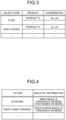
- FIG. 3 is a diagram illustrating an example of the information stored in the product DB 13.
- the product DB 13 stores "SALES FLOOR, PRODUCT, and COORDINATES" in correlation with each other.
- the "SALES FLOOR” is set with information that identifies each sales floor
- the "PRODUCT” is set with information that identifies each product
- the "COORDINATES” is set with the position of each product in the imaging area of each camera 1.
- FIG. 3 it is illustrated that a product A in the food sales floor is located at "xa, ya" in the imaging area of the camera 1.
- the action DB 14 is a database that stores data on the correlation between actions and skeletal information, which provides an index indicating what kind of skeletal information is identified as what kind of action.
- FIG. 4 is a diagram illustrating an example of the information stored in the action DB 14. As illustrated in FIG. 4 , the action DB 14 stores "ACTION and SKELETAL INFORMATION" in correlation with each other. The "ACTION” is set with each target action to be identified, and the "SKELETAL INFORMATION" is set with skeletal information to identify each action. In the example of FIG. 4 , it is illustrated that, when the skeletal information of "KNEE ANGLE IS THRESHOLD OR MORE" is continuously detected for 10 frames or more, this is identified as the action of "STOPPING".
- the "ACTION” includes information that can be set arbitrarily, such as “WALKING”, “RIGHT HAND FORWARD” that indicates putting the right hand forward, and “POSITION RIGHT” that indicates standing on the right side of the product.
- the correlation between these actions and the skeletal information can be generated by performing analysis or the like of the past history in advance.
- the training data DB 15 is a database that stores training data used for training of a determination index for determining a user interested in a product.
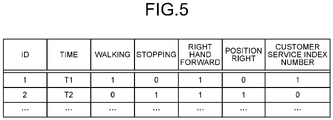
- FIG. 5 is a diagram illustrating an example of the information stored in the training data DB 15.
- the training data stored in the training data DB 15 includes "ID, TIME, WALKING, STOPPING, RIGHT HAND FORWARD, POSITION RIGHT, and CUSTOMER SERVICE INDEX NUMBER".
- the "WALKING, STOPPING, RIGHT HAND FORWARD, and POSITION RIGHT” are set to "1” when being applicable, and are set to "0” when being not applicable.
- the "CUSTOMER SERVICE INDEX NUMBER” is set to "1” when the corresponding user purchased the product, and is set to "0" when the corresponding user did not purchase the product.
- the information processing device 10 identifies the user (customer) by face recognition or the like from the moving image data captured by the camera 1, and follows up the user by the cameras in the store. Then, the information processing device 10 can identify the target product that brought about the actions, by the coordinates in the sales floor A. Further, the information processing device 10 can generate training data by identifying whether the user has purchased the product by use of the camera 1 that captures the cash register.
- the "WALKING, STOPPING, RIGHT HAND FORWARD, and POSITION RIGHT” are feature quantities.
- the "CUSTOMER SERVICE INDEX NUMBER” is correct answer information, and is an example of a customer service index number that indicates the degree of user's interest in the product.
- the control unit 20 is a processing unit that controls the entire information processing device 10, and is implemented by, for example, a processor or the like.
- the control unit 20 includes a preliminary processing unit 30 and an operation executing unit 40.
- the preliminary processing unit 30 is a processing unit that executes, before the operation, preliminary training to generate a determination index used for determining a customer highly effective in customer service.
- FIG. 6 is a diagram for explaining the overall configuration of the processing during the preliminary training.
- the information processing device 10 can identify users by obtaining image data captured by a camera 1 in a certain sales floor, identify products and coordinates corresponding to this certain sales floor from the product DB 13, and further identify the target product on which a user acted. After that, the information processing device 10 identifies the user from the image data captured by the camera 1A of the cash register (POS device 2), and obtains the POS data of the product purchased by the user. Then, the information processing device 10 generates the determination index by associating the image data captured in the sales floor with the image data captured at the cash register.
- POS device 2 cash register
- the preliminary processing unit 30 obtains the skeletal information of each of the users who acted on the product.
- the preliminary processing unit 30 obtains the skeletal information of each user from image data captured by cameras, by use of a mechanical learning model or image analysis.
- FIG. 7 is a diagram for explaining an example of the skeletal information. As illustrated in FIG. 7 , the preliminary processing unit 30 obtains the skeletal information by inputting image data (each frame) into the trained mechanical learning model.
- the preliminary processing unit 30 can obtain 18 pieces of skeletal coordinate information illustrated in FIG. 7 , from the image data.
- the Z-axis is in the distance direction from the image pickup device to the target
- the Y-axis is in the height direction perpendicular to the Z-axis
- the X-axis is in the horizontal direction.
- the preliminary processing unit 30 generates feature quantities that characterize the actions of each user on the basis of the skeletal information of the user. For example, the preliminary processing unit 30 refers to the information stored in the action DB illustrated in FIG. 4 to identify the action corresponding to each piece of the obtained skeletal information. Further, the preliminary processing unit 30 uses the identified result to generate training data, and stores the training data in the training data DB 15.
- FIG. 8 is a diagram for explaining an example of characteristic action recognition.
- the preliminary processing unit 30 identifies a series of actions of from the action of "stopping” to the action of "stretching a hand".
- the preliminary processing unit 30 uses the feature quantities of each of the users to generate a determination index for determining a user interested in the product.
- the preliminary processing unit 30 stores the determination index in the storage unit 12 and outputs the determination index to the operation executing unit 40.
- the preliminary processing unit 30 uses the feature quantities to perform clustering for each of the users, and calculates the average value of the customer service index numbers of the respective users belonging to each of the clusters generated by the clustering. Then, the preliminary processing unit 30 generates, as the determination index, a specific cluster in which the average value of the customer service index numbers is greater than or equal to a threshold.
- FIG. 9 is a diagram for explaining the generation of the determination index.
- each of the feature quantities corresponds to a feature quantity, such as walking, stopping, right hand forward, or position right.
- the customer service index number is a value indicating the presence or absence of product purchase, for example.
- the preliminary processing unit 30 performs mapping for each piece of the training data on the feature space, which is formed two-dimensional by a feature quantity A and a feature quantity B, while using the feature quantities of each piece of the training data as feature vectors (vector data). Then, the preliminary processing unit 30 performs clustering for each piece of the training data on the feature space, and thereby generates a cluster 1, a cluster 2, and a cluster 3.
- the preliminary processing unit 30 After that, the preliminary processing unit 30 generates an average value "0.8" of the values of the customer service index numbers in the training data belonging to the cluster 1, an average value "0.13" of the values of the customer service index numbers in the training data belonging to the cluster 2, and an average value "0.17" of the values of the customer service index numbers in the training data belonging to the cluster 3.
- the preliminary processing unit 30 determines the cluster 1 in which the average value is greater than or equal to a threshold (such as 0.5) as the determination index.
- a threshold such as 0.5
- the preliminary processing unit 30 may execute the processing again by increasing the training data.
- the operation executing unit 40 includes a detection unit 41 and a notification unit 42, and executes the detection of a customer highly effective in customer service by use of the determination index generated by the preliminary processing unit 30.
- FIG. 10 is a diagram for explaining the overall configuration of the processing during the operation.
- the information processing device 10 obtains image data captured by a camera 1 on a certain sales floor, and obtains the skeletal information of a user. After that, the information processing device 10 determines whether the feature quantities based on the skeletal information belong to the cluster 1 described above. When the feature quantities belong to the cluster 1, the information processing device 10 transmits a message, such as "THERE IS CUSTOMER INTERESTED IN PRODUCT ON XXX SALES FLOOR", to the clerk terminals 3. In this way, the information processing device 10 can found a customer highly effective in customer service from among the visiting customers, so that some clerk can advise the customer about the product, for example.
- a message such as "THERE IS CUSTOMER INTERESTED IN PRODUCT ON XXX SALES FLOOR"
- the detection unit 41 is a processing unit that obtains the skeletal information of visiting users, and generates feature quantities of the visiting users on the basis of the skeletal information of the visiting users. Further, when the feature quantities of a visiting user belong to the specific cluster, this processing unit detects the visiting user as a customer service target.
- the detection unit 41 executes determination of a customer service target while executing action detection by following up the person A for a time or number of frames determined in advance.
- FIG. 11 is a diagram for explaining the customer service determination.
- the detection unit 41 uses the technical method of FIG. 7 to each piece of the image data (frames) in which the person A appears, and thereby obtains the skeletal information of the person A contained in the image data. Subsequently, the detection unit 41 refers to the action DB illustrated in FIG. 4 to recognize actions corresponding to the skeletal information A of this person thus obtained.
- the detection unit 41 determines that this indicates a customer highly effective in customer service, and detects the person A as a customer service target. After that, the detection unit 41 outputs, to the notification unit 42, the sales floor where the person A as the customer service target has been detected, the image data of the person A, the number of frames and the time used for the detection, and so forth.
- the detection unit 41 determines that this indicates a customer less effective in customer service, and detects the person A as being out of the customer service target.
- the notification unit 42 is a processing unit that gives notice of information about a detected user to the person in charge of customer service, when the user is detected as the customer service target.
- the notification unit 42 receives, from the detection unit 41, the sales floor where the person A as the customer service target has been detected, the image data of the person A, the number of frames and the time used for the detection, and so forth. Then, the notification unit 42 transmits a message that identifies the sales floor with the customer service target to the clerk terminals 3 of clerks present near the sales floor A, a manager who manages the clerks integrally, etc.
- FIG. 12 is a flowchart illustrating the flow of the training processing according to the first embodiment.
- the preliminary processing unit 30 obtains moving picture data of a specific sales floor (S101), and executes person detection for every frame of the moving picture data (S102).
- the preliminary processing unit 30 generates feature vectors by obtaining the action elements illustrated in FIG. 4 for every frame and every person (S103). Further, the preliminary processing unit 30 calculates the customer service index number (product purchase) for each person in association with the moving picture data in front of the cash register and the POS data (S104).
- the preliminary processing unit 30 executes clustering by mapping each of the feature vectors on the feature space in which arbitrarily specified feature quantities are used as axes (S105). Then, the preliminary processing unit 30 calculates the average value of the customer service index numbers for every cluster (S106), and records a cluster in which the average value of the customer service index numbers is greater than or equal to a threshold, as a customer service target (S107).
- FIG. 13 is a flowchart illustrating the flow of the operational processing according to the first embodiment.
- the operation executing unit 40 obtains moving picture data of the learned sales floor (S201), and executes person detection for every frame of the moving picture data (S202).
- the operation executing unit 40 obtains the action elements illustrated in FIG. 4 for every frame and every person, and generates feature vectors (S203).
- the operation executing unit 40 performs mapping for the feature vectors of every frame and every person on the feature space, and determines clusters where the feature vectors belong (S204).
- the operation executing unit 40 aggregates the information of a plurality of frames, and determines clusters where persons belong (S205). When there is a person who belongs to the customer service target cluster, the operation executing unit 40 gives notice to the clerk terminals 3 (S206). For example, the operation executing unit 40 executes the feature vector generation and the cluster determination for each piece of image data obtained in each sales floor, and gives notice to the clerk terminals 3 at the timing when a person who belongs to the customer service target cluster is detected.
- the operation executing unit 40 may execute the processing to a plurality of frames together, or may execute the processing to frames one by one.
- the information processing device 10 can detect a customer interested in a product, without applying the cost for object learning and ROI setting to each sales floor, and thus can determine a customer highly effective in customer service. As a result, the store side can expect the sales to increase as clerks provide a customer service to such customers.
- the information processing device 10 can generate a determination index that does not depend on the type or size of a product, by performing action recognition using skeletal information. Thus, it is possible to detect a customer highly effective in customer service with high accuracy, without creating a rule for each product.
- FIG. 14 is a diagram for explaining a specific example 1 that uses a mechanical learning model.
- the preliminary processing unit 30 generates a mechanical learning model by mechanical learning that uses "WALKING, STOPPING, RIGHT HAND FORWARD, and POSITION RIGHT" in the training data as explanatory variables and "CUSTOMER SERVICE INDEX NUMBER" in the training data as an objective variable. That is, the preliminary processing unit 30 generates a mechanical learning model that determines whether the customer service index number is high or not in accordance with an input of the action recognition result. In other words, the preliminary processing unit 30 generates, from the skeletal information, a mechanical learning model that determines whether the customer is likely to purchase the product.
- the operation executing unit 40 uses the same technical method as that of the first embodiment, to input data, which indicates the feature quantities of a person detected in a certain sales floor, into the mechanical learning model, and to obtain a determination result about the customer service target from the output result of the mechanical learning model. Consequently, the operation executing unit 40 can execute the detection of a customer service target by use of the mechanical learning model. Further, the operation executing unit 40 can keep the determination index up to date by updating the mechanical learning model by re-training or the like of the mechanical learning model.
- FIG. 15 is a diagram for explaining a specific example 2 that uses a mechanical learning model.
- the preliminary processing unit 30 executes clustering for the training data by the same technical method as that of the first embodiment, and identifies a cluster high in customer service index number.
- the preliminary processing unit 30 generates a mechanical learning model by use of the training data that belongs to the cluster high in customer service index number.
- the preliminary processing unit 30 generates a mechanical learning model by mechanical learning that uses "WALKING, STOPPING, RIGHT HAND FORWARD, and POSITION RIGHT" in the training data as explanatory variables and "CUSTOMER SERVICE INDEX NUMBER" in the training data as an objective variable.
- the operation executing unit 40 uses the same technical method as that of the first embodiment, to input data, which indicates the feature quantities of a person detected in a certain sales floor, into the mechanical learning model, and to obtain a determination result about the customer service target from the output result of the mechanical learning model. Consequently, as compared even with the specific example 1, since the operation executing unit 40 generates a mechanical learning model after narrowing down the training data, it is possible to execute the detection processing with higher accuracy.
- the information processing device 10 may add a time zone to the action elements, such that a cluster specific to a time zone with high sales is used as a cluster high in customer service index number.
- the information processing device 10 may use, instead of the "presence or absence of product purchase", information that indicates whether the user's visit time is within a time zone with many product purchasers (for example, from 14:00 to 16:00).
- the information processing device 10 may record the detected movement and the actual customer service effect, and give some feedback to the estimate of a customer service index number. For example, the information processing device 10 may update the customer service index number by the feedback result, and further update the evaluation index by re-clustering or re-training.
- the information processing device 10 may execute detection in consideration of time-series elements. For example, since a cluster containing the actions of one person changes over time, the information processing device 10 connects the order of changes with the customer service index number. Then, in the feedback of the customer service effect, the information processing device 10 gives some feedback concerning which timing in the cluster transition the customer service was performed. Consequently, it is possible to give notice of effective customer service timing.
- each device may be integrated. That is, all or some of the constituent elements may be functionally or physically distributed/integrated in any unit in accordance with various loads and/or use conditions.
- all or any part of each processing function of each device may be implemented by a CPU and a program that is analyzed and executed by the CPU, or may be implemented as hardware by wired logic.
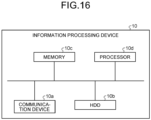
- FIG. 16 is a diagram for explaining an example of a hardware configuration.
- the information processing device 10 includes a communication device 10a, a Hard Disk Drive (HDD) 10b, a memory 10c, and a processor 10d. Further, these units illustrated in FIG. 16 are connected to each other by a bus or the like.
- HDD Hard Disk Drive
- the communication device 10a is a network interface card or the like, and performs communication with other devices.
- the HDD 10b stores the programs and DBs for operating the functions illustrated in FIG. 2 .
- the processor 10d reads a program that executes the same processing as that of each processing unit illustrated in FIG. 2 from the HDD 10b or the like, and expands the program in the memory 10c to operate a process that executes each function explained with reference to FIG. 2 and so forth. For example, this process executes the same function as that of each processing unit included in the information processing device 10. Specifically, the processor 10d reads a program that includes the same functions as those of the preliminary processing unit 30, the operation executing unit 40, etc. from HDD 10b or the like. Then, the processor 10d executes a process that executes the same processing parts as those of the preliminary processing unit 30, the operation executing unit 40, etc.
- the information processing device 10 operates as an information processing device that executes the detection method by reading and executing a program.
- the information processing device 10 may realize the same functions as those of each embodiment described above by reading the program from a recording medium by a medium reader and executing the program thus read.
- the program may be executed without being limited to the manner of execution by the information processing device 10.
- the embodiment described above may be applied as well when another computer or server executes the program or when these devices work together to execute the program.
- This program may be distributed via a network, such as the internet.
- This program may be recorded in a computer-readable recording medium, such as a hard disk, flexible disc (FD), CD-ROM, Magneto-Optical disk (MO), or Digital Versatile Disc (DVD), and executed by being read from the recording medium by a computer.
- a computer-readable recording medium such as a hard disk, flexible disc (FD), CD-ROM, Magneto-Optical disk (MO), or Digital Versatile Disc (DVD)
Landscapes
- Engineering & Computer Science (AREA)
- Theoretical Computer Science (AREA)
- Business, Economics & Management (AREA)
- General Physics & Mathematics (AREA)
- Physics & Mathematics (AREA)
- Finance (AREA)
- Accounting & Taxation (AREA)
- Development Economics (AREA)
- Strategic Management (AREA)
- Multimedia (AREA)
- Computer Vision & Pattern Recognition (AREA)
- Entrepreneurship & Innovation (AREA)
- General Health & Medical Sciences (AREA)
- Health & Medical Sciences (AREA)
- General Business, Economics & Management (AREA)
- Economics (AREA)
- Marketing (AREA)
- Human Computer Interaction (AREA)
- Databases & Information Systems (AREA)
- Software Systems (AREA)
- Medical Informatics (AREA)
- Evolutionary Computation (AREA)
- Artificial Intelligence (AREA)
- Computing Systems (AREA)
- Psychiatry (AREA)
- Social Psychology (AREA)
- Game Theory and Decision Science (AREA)
- Data Mining & Analysis (AREA)
- Image Analysis (AREA)
- Management, Administration, Business Operations System, And Electronic Commerce (AREA)
Abstract
Description
- The embodiments discussed herein are related to a customer service detection program, a customer service detection method, and an information processing device.
- There are known technical methods for detecting a person's action that represents great interest in a product. For example, there are known technologies, such as a technology that determines whether a customer is picking up a product by hand and looking at the product and especially at the label of the product, a technology that determines from the video the position where a customer's hand has reached on the shelf, and a technology that estimates a customer's posture and identifies movements of stretching a hand for a product, putting the product in a cart, and so forth.
- Patent LITERATURE 1:
Japanese Laid-open Patent Publication No. 2009-48430 - In the case of the technologies described above, however, specific actions are detected in accordance with rules created in advance. Therefore, it is difficult to perform the action detection with high accuracy that covers every product in sales floors, and thus it is difficult to find customers highly effective in customer service.
- Specifically, depending on the type of product, a person's action that represents interest in the product varies, so it is preferable to create a rule for each product, but it is difficult to do so in reality because the number of products is huge. For example, when the product is a bicycle, a rule is assumed to detect the action of riding the bicycle, the action of grabbing a handlebar of the bicycle, or the like. Alternatively, when the product is a sofa, a rule is assumed to detect sitting or the like on the sofa. Further, when the product is a cosmetic product, another rule needs to be created.
- Accordingly, it is an object in one aspect of an embodiment of the invention to provide a customer service detection program, a customer service detection method, and an information processing device, which make it possible to detect a customer highly effective in customer service.
- According to an aspect of an embodiment, a customer service detection program that causes a computer (10) to execute a process. The process includes obtaining (30) skeletal information of each of users who acted on a product, first generating (30) a feature quantity that characterizes an action of each of the users on a basis of the skeletal information of each of the users, second generating (30) a determination index for determining a user interested in a product, by using the feature quantity of each of the users, and detecting (40) a customer service target from visiting users, by using the determination index.
-
-
FIG. 1 is a diagram for explaining an example of the overall configuration of a system according to a first embodiment; -
FIG. 2 is a functional block diagram illustrating the functional configuration of an information processing device according to the first embodiment; -
FIG. 3 is a diagram illustrating an example of the information stored in a product DB; -
FIG. 4 is a diagram illustrating an example of the information stored in an action DB; -
FIG. 5 is a diagram illustrating an example of the information stored in a training data DB; -
FIG. 6 is a diagram for explaining the overall configuration of the processing during preliminary training; -
FIG. 7 is a diagram for explaining an example of skeletal information; -
FIG. 8 is a diagram for explaining an example of characteristic action recognition; -
FIG. 9 is a diagram for explaining the generation of a determination index; -
FIG. 10 is a diagram for explaining the overall configuration of the processing during operation; -
FIG. 11 is a diagram for explaining the customer service determination; -
FIG. 12 is a flowchart illustrating the flow of training processing according to the first embodiment; -
FIG. 13 is a flowchart illustrating the flow of operational processing according to the first embodiment; -
FIG. 14 is a diagram for explaining a specific example 1 that uses a mechanical learning model; -
FIG. 15 is a diagram for explaining a specific example 2 that uses a mechanical learning model; and -
FIG. 16 is a diagram for explaining an example of a hardware configuration. - Preferred embodiments will be explained with reference to accompanying drawings. The present invention is not limited to the following embodiments. Further, disclosed embodiments may be combined as appropriate to an extent within the consistent range.
-
FIG. 1 is a diagram for explaining an example of the overall configuration of a system according to a first embodiment. As illustrated inFIG. 1 , in this system,cameras 1 installed in respective sales floors, a Point Of Sales (POS)device 2 for managing product sales,clerk terminals 3 used by clerks, and aninformation processing device 10 are connected to each other through various networks regardless of whether the networks are wired or wireless. - Each
camera 1 is an example of an image pickup device installed in each sales floor, the installation location of thePOS device 2 at the cash register counter, or the like. Eachcamera 1 captures moving image data, which includes image data, moving picture data, video data, or the like, of a customer looking at a product, a customer purchasing a product, or the like, and transmits the data to theinformation processing device 10. ThePOS device 2 holds the purchase history of each product, and periodically transmits the purchase history to theinformation processing device 10. Eachclerk terminal 3 is an example of a mobile terminal that exchanges various data with theinformation processing device 10, and is a terminal owned by a person in charge of customer service. - In a system like this, the
information processing device 10 identifies a person, who is highly effective in customer service, in the existing sales floor video in association with the moving image data of purchasers and the POS data, and gives notice about this person to theclerk terminals 3. Specifically, theinformation processing device 10 obtains the skeletal information of each of the users who acted on a product, and generates feature quantities that characterize the actions of each of the users on the basis of the skeletal information of the users. Then, theinformation processing device 10 uses the feature quantities of each of the users to generate a determination index for determining a user interested in the product. After that, theinformation processing device 10 uses the determination index to detect a customer service target from visiting users. - That is, as preliminary processing, the
information processing device 10 uses the moving image data or the like actually collected to generate a determination index for determining a customer service target. After that, as operational processing, theinformation processing device 10 uses the current moving image data or the like and the determination index to execute the detection of a customer service target. - As described above, the
information processing device 10 does not perform object learning, Region Of Interest (ROI) setting, or detailed definition of detection target actions, which is costly for each sales floor. However, theinformation processing device 10 makes it possible to detect a customer highly effective in customer service, by detecting a person interested in a product. -
FIG. 2 is a functional block diagram illustrating the functional configuration of theinformation processing device 10 according to the first embodiment. As illustrated inFIG. 2 , theinformation processing device 10 includes acommunication unit 11, astorage unit 12, and acontrol unit 20. - The
communication unit 11 is a processing unit that controls communication with other devices, and is implemented by, for example, a communication interface. For example, thecommunication unit 11 receives moving image data or the like from eachcamera 1, receives POS data from thePOS device 2, and transmits various data to theclerk terminals 3. - The
storage unit 12 is an example of a storage device that stores various data and various programs to be executed by thecontrol unit 20, and is implemented by, for example, a memory or hard disk. Thisstorage unit 12 stores aproduct DB 13, an action DB 14, atraining data DB 15, and animage DB 16. - The product DB 13 is a database that stores data related to products that are placed as sales targets in the store.
FIG. 3 is a diagram illustrating an example of the information stored in theproduct DB 13. As illustrated inFIG. 3 , the product DB 13 stores "SALES FLOOR, PRODUCT, and COORDINATES" in correlation with each other. The "SALES FLOOR" is set with information that identifies each sales floor, the "PRODUCT" is set with information that identifies each product, and the "COORDINATES" is set with the position of each product in the imaging area of eachcamera 1. In the example ofFIG. 3 , it is illustrated that a product A in the food sales floor is located at "xa, ya" in the imaging area of thecamera 1. - The action DB 14 is a database that stores data on the correlation between actions and skeletal information, which provides an index indicating what kind of skeletal information is identified as what kind of action.
FIG. 4 is a diagram illustrating an example of the information stored in the action DB 14. As illustrated inFIG. 4 , the action DB 14 stores "ACTION and SKELETAL INFORMATION" in correlation with each other. The "ACTION" is set with each target action to be identified, and the "SKELETAL INFORMATION" is set with skeletal information to identify each action. In the example ofFIG. 4 , it is illustrated that, when the skeletal information of "KNEE ANGLE IS THRESHOLD OR MORE" is continuously detected for 10 frames or more, this is identified as the action of "STOPPING". In addition to the "STOPPING", the "ACTION" includes information that can be set arbitrarily, such as "WALKING", "RIGHT HAND FORWARD" that indicates putting the right hand forward, and "POSITION RIGHT" that indicates standing on the right side of the product. The correlation between these actions and the skeletal information can be generated by performing analysis or the like of the past history in advance. - The
training data DB 15 is a database that stores training data used for training of a determination index for determining a user interested in a product.FIG. 5 is a diagram illustrating an example of the information stored in thetraining data DB 15. As illustrated inFIG. 5 , the training data stored in thetraining data DB 15 includes "ID, TIME, WALKING, STOPPING, RIGHT HAND FORWARD, POSITION RIGHT, and CUSTOMER SERVICE INDEX NUMBER". Here, the "WALKING, STOPPING, RIGHT HAND FORWARD, and POSITION RIGHT" are set to "1" when being applicable, and are set to "0" when being not applicable. The "CUSTOMER SERVICE INDEX NUMBER" is set to "1" when the corresponding user purchased the product, and is set to "0" when the corresponding user did not purchase the product. - In other words, the user with ID = 1 is indicated that the user purchased the product after performing each the actions of "WALKING" and putting the "RIGHT HAND FORWARD" in front of the product. The
information processing device 10 identifies the user (customer) by face recognition or the like from the moving image data captured by thecamera 1, and follows up the user by the cameras in the store. Then, theinformation processing device 10 can identify the target product that brought about the actions, by the coordinates in the sales floor A. Further, theinformation processing device 10 can generate training data by identifying whether the user has purchased the product by use of thecamera 1 that captures the cash register. - Here, the "WALKING, STOPPING, RIGHT HAND FORWARD, and POSITION RIGHT" are feature quantities. The "CUSTOMER SERVICE INDEX NUMBER" is correct answer information, and is an example of a customer service index number that indicates the degree of user's interest in the product.
- The
control unit 20 is a processing unit that controls the entireinformation processing device 10, and is implemented by, for example, a processor or the like. Thecontrol unit 20 includes a preliminary processing unit 30 and an operation executing unit 40. - The preliminary processing unit 30 is a processing unit that executes, before the operation, preliminary training to generate a determination index used for determining a customer highly effective in customer service.
FIG. 6 is a diagram for explaining the overall configuration of the processing during the preliminary training. As illustrated inFIG. 6 , theinformation processing device 10 can identify users by obtaining image data captured by acamera 1 in a certain sales floor, identify products and coordinates corresponding to this certain sales floor from theproduct DB 13, and further identify the target product on which a user acted. After that, theinformation processing device 10 identifies the user from the image data captured by thecamera 1A of the cash register (POS device 2), and obtains the POS data of the product purchased by the user. Then, theinformation processing device 10 generates the determination index by associating the image data captured in the sales floor with the image data captured at the cash register. - Specifically, the preliminary processing unit 30 obtains the skeletal information of each of the users who acted on the product. For example, the preliminary processing unit 30 obtains the skeletal information of each user from image data captured by cameras, by use of a mechanical learning model or image analysis.
FIG. 7 is a diagram for explaining an example of the skeletal information. As illustrated inFIG. 7 , the preliminary processing unit 30 obtains the skeletal information by inputting image data (each frame) into the trained mechanical learning model. - For the skeletal information, it is possible to use 18 pieces of definition information (the
number 0 to the number 17), in which numbers are applied to the respective joints identified by a known skeletal model. For example, the right shoulder joint (SHOULDER_RIGHT) is assigned the number 7, the left elbow joint (ELBOW_LEFT) is assigned the number 5, the left knee joint (KNEE_LEFT) is assigned thenumber 11, and the right hip joint (HIP_RIGHT) is assigned the number 14. Therefore, the preliminary processing unit 30 can obtain 18 pieces of skeletal coordinate information illustrated inFIG. 7 , from the image data. For example, the preliminary processing unit 30 obtains "the X-coordinate = X7, the Y-coordinate = Y7, and the Z-coordinate = Z7" as the position of the right shoulder joint of the number 7. Here, for example, it may be defined that the Z-axis is in the distance direction from the image pickup device to the target, the Y-axis is in the height direction perpendicular to the Z-axis, and the X-axis is in the horizontal direction. - Then, the preliminary processing unit 30 generates feature quantities that characterize the actions of each user on the basis of the skeletal information of the user. For example, the preliminary processing unit 30 refers to the information stored in the action DB illustrated in
FIG. 4 to identify the action corresponding to each piece of the obtained skeletal information. Further, the preliminary processing unit 30 uses the identified result to generate training data, and stores the training data in thetraining data DB 15. -
FIG. 8 is a diagram for explaining an example of characteristic action recognition. As illustrated inFIG. 8 , when the state of "the knee angle is greater than or equal to a threshold" is continuously detected over predetermined frames in front of the product shelf, and then a frame of "the angle of one of the elbows is greater than or equal to a threshold" is detected, the preliminary processing unit 30 identifies a series of actions of from the action of "stopping" to the action of "stretching a hand". The preliminary processing unit 30 generates feature quantities of "WALKING = 0, STOPPING = 1, RIGHT HAND FORWARD = 1, and POSITION RIGHT = 0" in correlation with the time identified here. - Further, when identifying from the POS data that this user purchased the product, the preliminary processing unit 30 generates training data that correlates the feature quantities of "WALKING = 0, STOPPING = 1, RIGHT HAND FORWARD = 1, and POSITION RIGHT = 0" with "CUSTOMER SERVICE INDEX NUMBER = 1".
- After that, the preliminary processing unit 30 uses the feature quantities of each of the users to generate a determination index for determining a user interested in the product. The preliminary processing unit 30 stores the determination index in the
storage unit 12 and outputs the determination index to the operation executing unit 40. For example, the preliminary processing unit 30 uses the feature quantities to perform clustering for each of the users, and calculates the average value of the customer service index numbers of the respective users belonging to each of the clusters generated by the clustering. Then, the preliminary processing unit 30 generates, as the determination index, a specific cluster in which the average value of the customer service index numbers is greater than or equal to a threshold. -
FIG. 9 is a diagram for explaining the generation of the determination index. Here, an explanation will be given of a two-dimensional feature space that uses two feature quantities as an example. Here, for example, each of the feature quantities corresponds to a feature quantity, such as walking, stopping, right hand forward, or position right. The customer service index number is a value indicating the presence or absence of product purchase, for example. - As illustrated in
FIG. 9 , the preliminary processing unit 30 performs mapping for each piece of the training data on the feature space, which is formed two-dimensional by a feature quantity A and a feature quantity B, while using the feature quantities of each piece of the training data as feature vectors (vector data). Then, the preliminary processing unit 30 performs clustering for each piece of the training data on the feature space, and thereby generates acluster 1, acluster 2, and acluster 3. After that, the preliminary processing unit 30 generates an average value "0.8" of the values of the customer service index numbers in the training data belonging to thecluster 1, an average value "0.13" of the values of the customer service index numbers in the training data belonging to thecluster 2, and an average value "0.17" of the values of the customer service index numbers in the training data belonging to thecluster 3. - Then, the preliminary processing unit 30 determines the
cluster 1 in which the average value is greater than or equal to a threshold (such as 0.5) as the determination index. Here, when there is no cluster in which the average value is greater than or equal to threshold, the preliminary processing unit 30 may execute the processing again by increasing the training data. - Returning to
FIG. 2 , the operation executing unit 40 includes adetection unit 41 and anotification unit 42, and executes the detection of a customer highly effective in customer service by use of the determination index generated by the preliminary processing unit 30. -
FIG. 10 is a diagram for explaining the overall configuration of the processing during the operation. As illustrated inFIG. 10 , theinformation processing device 10 obtains image data captured by acamera 1 on a certain sales floor, and obtains the skeletal information of a user. After that, theinformation processing device 10 determines whether the feature quantities based on the skeletal information belong to thecluster 1 described above. When the feature quantities belong to thecluster 1, theinformation processing device 10 transmits a message, such as "THERE IS CUSTOMER INTERESTED IN PRODUCT ON XXX SALES FLOOR", to theclerk terminals 3. In this way, theinformation processing device 10 can found a customer highly effective in customer service from among the visiting customers, so that some clerk can advise the customer about the product, for example. - The
detection unit 41 is a processing unit that obtains the skeletal information of visiting users, and generates feature quantities of the visiting users on the basis of the skeletal information of the visiting users. Further, when the feature quantities of a visiting user belong to the specific cluster, this processing unit detects the visiting user as a customer service target. - Specifically, when the
detection unit 41 detects a person A from image data captured by acamera 1 in a sales floor A, thedetection unit 41 executes determination of a customer service target while executing action detection by following up the person A for a time or number of frames determined in advance. -
FIG. 11 is a diagram for explaining the customer service determination. As illustrated inFIG. 11 , when thedetection unit 41 detects a person A from certain image data (frames), thedetection unit 41 uses the technical method ofFIG. 7 to each piece of the image data (frames) in which the person A appears, and thereby obtains the skeletal information of the person A contained in the image data. Subsequently, thedetection unit 41 refers to the action DB illustrated inFIG. 4 to recognize actions corresponding to the skeletal information A of this person thus obtained. - Here, it is assumed that the
detection unit 41 detects the action of "WALKING" and the action of "RIGHT HAND FORWARD" in a few frames obtained within a time specified in advance. Then, thedetection unit 41 generates "WALKING = 1, STOPPING = 0, RIGHT HAND FORWARD = 1, and POSITION RIGHT = 0" as the feature quantity data of the detection target, and performs mapping for these feature quantities in the form of vector data on the feature space of the determination index. - As a result of the mapping, when the feature quantity vector data of the detection target belongs to the
cluster 1, thedetection unit 41 determines that this indicates a customer highly effective in customer service, and detects the person A as a customer service target. After that, thedetection unit 41 outputs, to thenotification unit 42, the sales floor where the person A as the customer service target has been detected, the image data of the person A, the number of frames and the time used for the detection, and so forth. - On the other hand, when the feature quantity data of the detection target belong to a cluster other than the
cluster 1, thedetection unit 41 determines that this indicates a customer less effective in customer service, and detects the person A as being out of the customer service target. - The
notification unit 42 is a processing unit that gives notice of information about a detected user to the person in charge of customer service, when the user is detected as the customer service target. As an explanation in the above example, thenotification unit 42 receives, from thedetection unit 41, the sales floor where the person A as the customer service target has been detected, the image data of the person A, the number of frames and the time used for the detection, and so forth. Then, thenotification unit 42 transmits a message that identifies the sales floor with the customer service target to theclerk terminals 3 of clerks present near the sales floor A, a manager who manages the clerks integrally, etc. - Here, an explanation will be given of the training processing performed by the preliminary processing unit 30 and the operational processing performed by the operation executing unit 40.
-
FIG. 12 is a flowchart illustrating the flow of the training processing according to the first embodiment. As illustrated inFIG. 12 , the preliminary processing unit 30 obtains moving picture data of a specific sales floor (S101), and executes person detection for every frame of the moving picture data (S102). - Subsequently, the preliminary processing unit 30 generates feature vectors by obtaining the action elements illustrated in
FIG. 4 for every frame and every person (S103). Further, the preliminary processing unit 30 calculates the customer service index number (product purchase) for each person in association with the moving picture data in front of the cash register and the POS data (S104). - After that, the preliminary processing unit 30 executes clustering by mapping each of the feature vectors on the feature space in which arbitrarily specified feature quantities are used as axes (S105). Then, the preliminary processing unit 30 calculates the average value of the customer service index numbers for every cluster (S106), and records a cluster in which the average value of the customer service index numbers is greater than or equal to a threshold, as a customer service target (S107).
-
FIG. 13 is a flowchart illustrating the flow of the operational processing according to the first embodiment. As illustrated inFIG. 13 , the operation executing unit 40 obtains moving picture data of the learned sales floor (S201), and executes person detection for every frame of the moving picture data (S202). - Subsequently, the operation executing unit 40 obtains the action elements illustrated in
FIG. 4 for every frame and every person, and generates feature vectors (S203). The operation executing unit 40 performs mapping for the feature vectors of every frame and every person on the feature space, and determines clusters where the feature vectors belong (S204). - After that, the operation executing unit 40 aggregates the information of a plurality of frames, and determines clusters where persons belong (S205). When there is a person who belongs to the customer service target cluster, the operation executing unit 40 gives notice to the clerk terminals 3 (S206). For example, the operation executing unit 40 executes the feature vector generation and the cluster determination for each piece of image data obtained in each sales floor, and gives notice to the
clerk terminals 3 at the timing when a person who belongs to the customer service target cluster is detected. Here, the operation executing unit 40 may execute the processing to a plurality of frames together, or may execute the processing to frames one by one. - As described above, the
information processing device 10 can detect a customer interested in a product, without applying the cost for object learning and ROI setting to each sales floor, and thus can determine a customer highly effective in customer service. As a result, the store side can expect the sales to increase as clerks provide a customer service to such customers. - Further, the
information processing device 10 can generate a determination index that does not depend on the type or size of a product, by performing action recognition using skeletal information. Thus, it is possible to detect a customer highly effective in customer service with high accuracy, without creating a rule for each product. - Incidentally, in the first embodiment described above, an explanation has been given of an example of using a cluster to generate a determination index. However, this is not limiting, and a mechanical learning model may be used. Accordingly, in a second embodiment, an explanation will be given of an example of generating a mechanical learning model as a determination index. Here, for the mechanical learning model, various types of algorithm, related to a support vector machine, a neural network, etc., can be used,
-
FIG. 14 is a diagram for explaining a specific example 1 that uses a mechanical learning model. As illustrated inFIG. 14 , the preliminary processing unit 30 generates a mechanical learning model by mechanical learning that uses "WALKING, STOPPING, RIGHT HAND FORWARD, and POSITION RIGHT" in the training data as explanatory variables and "CUSTOMER SERVICE INDEX NUMBER" in the training data as an objective variable. That is, the preliminary processing unit 30 generates a mechanical learning model that determines whether the customer service index number is high or not in accordance with an input of the action recognition result. In other words, the preliminary processing unit 30 generates, from the skeletal information, a mechanical learning model that determines whether the customer is likely to purchase the product. - After that, the operation executing unit 40 uses the same technical method as that of the first embodiment, to input data, which indicates the feature quantities of a person detected in a certain sales floor, into the mechanical learning model, and to obtain a determination result about the customer service target from the output result of the mechanical learning model. Consequently, the operation executing unit 40 can execute the detection of a customer service target by use of the mechanical learning model. Further, the operation executing unit 40 can keep the determination index up to date by updating the mechanical learning model by re-training or the like of the mechanical learning model.
-
FIG. 15 is a diagram for explaining a specific example 2 that uses a mechanical learning model. As illustrated inFIG. 15 , the preliminary processing unit 30 executes clustering for the training data by the same technical method as that of the first embodiment, and identifies a cluster high in customer service index number. After that, the preliminary processing unit 30 generates a mechanical learning model by use of the training data that belongs to the cluster high in customer service index number. For example, the preliminary processing unit 30 generates a mechanical learning model by mechanical learning that uses "WALKING, STOPPING, RIGHT HAND FORWARD, and POSITION RIGHT" in the training data as explanatory variables and "CUSTOMER SERVICE INDEX NUMBER" in the training data as an objective variable. - After that, the operation executing unit 40 uses the same technical method as that of the first embodiment, to input data, which indicates the feature quantities of a person detected in a certain sales floor, into the mechanical learning model, and to obtain a determination result about the customer service target from the output result of the mechanical learning model. Consequently, as compared even with the specific example 1, since the operation executing unit 40 generates a mechanical learning model after narrowing down the training data, it is possible to execute the detection processing with higher accuracy.
- Incidentally, the embodiments of the present invention have been described so far, but the present invention may be implemented in various different forms other than the embodiments described above.
- The data examples, the numerical examples, the number of clusters, the information in each DB, the number of frames, the correlation between actions and skeletal information, etc. used in the embodiments described above are mere examples and may be arbitrarily changed.
- In the embodiments described above, an explanation has been given of an example in which image data obtained by the camera in front of the cash register is correlated with image data obtained in each sales floor. However, this is not limiting. For example, the
information processing device 10 may add a time zone to the action elements, such that a cluster specific to a time zone with high sales is used as a cluster high in customer service index number. For example, as the customer service index number, theinformation processing device 10 may use, instead of the "presence or absence of product purchase", information that indicates whether the user's visit time is within a time zone with many product purchasers (for example, from 14:00 to 16:00). - Further, even when the presence or absence of product purchase is used, the
information processing device 10 may use, in stead of the two values of purchase and non-purchase, three values or the like, such as "a person who did purchase after receiving a customer service = 1, a person who did purchase without receiving a customer service = 0.5, and a person who did not purchase = 0". - Further, in the application to a sales floor, the
information processing device 10 may record the detected movement and the actual customer service effect, and give some feedback to the estimate of a customer service index number. For example, theinformation processing device 10 may update the customer service index number by the feedback result, and further update the evaluation index by re-clustering or re-training. - Further, the
information processing device 10 may execute detection in consideration of time-series elements. For example, since a cluster containing the actions of one person changes over time, theinformation processing device 10 connects the order of changes with the customer service index number. Then, in the feedback of the customer service effect, theinformation processing device 10 gives some feedback concerning which timing in the cluster transition the customer service was performed. Consequently, it is possible to give notice of effective customer service timing. - The processing sequences, the control sequences, the specific names, and the information including various data and parameters disclosed in the above description and the drawings may be arbitrarily changed unless otherwise specified.
- Further, the specific forms of distribution and integration of the constituent elements of each device are not limited to those illustrated in the drawings. For example, the preliminary processing unit 30 and the operation executing unit 40 may be integrated. That is, all or some of the constituent elements may be functionally or physically distributed/integrated in any unit in accordance with various loads and/or use conditions. In addition, all or any part of each processing function of each device may be implemented by a CPU and a program that is analyzed and executed by the CPU, or may be implemented as hardware by wired logic.
-
FIG. 16 is a diagram for explaining an example of a hardware configuration. As illustrated inFIG. 16 , theinformation processing device 10 includes acommunication device 10a, a Hard Disk Drive (HDD) 10b, amemory 10c, and aprocessor 10d. Further, these units illustrated inFIG. 16 are connected to each other by a bus or the like. - The
communication device 10a is a network interface card or the like, and performs communication with other devices. TheHDD 10b stores the programs and DBs for operating the functions illustrated inFIG. 2 . - The
processor 10d reads a program that executes the same processing as that of each processing unit illustrated inFIG. 2 from theHDD 10b or the like, and expands the program in thememory 10c to operate a process that executes each function explained with reference toFIG. 2 and so forth. For example, this process executes the same function as that of each processing unit included in theinformation processing device 10. Specifically, theprocessor 10d reads a program that includes the same functions as those of the preliminary processing unit 30, the operation executing unit 40, etc. fromHDD 10b or the like. Then, theprocessor 10d executes a process that executes the same processing parts as those of the preliminary processing unit 30, the operation executing unit 40, etc. - As described above, the
information processing device 10 operates as an information processing device that executes the detection method by reading and executing a program. Alternatively, theinformation processing device 10 may realize the same functions as those of each embodiment described above by reading the program from a recording medium by a medium reader and executing the program thus read. Note that, in another embodiment, the program may be executed without being limited to the manner of execution by theinformation processing device 10. For example, the embodiment described above may be applied as well when another computer or server executes the program or when these devices work together to execute the program. - This program may be distributed via a network, such as the internet. This program may be recorded in a computer-readable recording medium, such as a hard disk, flexible disc (FD), CD-ROM, Magneto-Optical disk (MO), or Digital Versatile Disc (DVD), and executed by being read from the recording medium by a computer.
- According to the embodiments, it is possible to detect a customer highly effective in customer service.
Claims (9)
- A customer service detection program that causes a computer (10) to execute a process comprising:obtaining (30) skeletal information of each of users who acted on a product;first generating (30) a feature quantity that characterizes an action of each of the users on a basis of the skeletal information of each of the users;second generating (30) a determination index for determining a user interested in a product, by using the feature quantity of each of the users; anddetecting (40) a customer service target from visiting users, by using the determination index.
- The customer service detection program according to claim 1, whereinthe first generating (30) includesadding, to the feature quantity of each of the users, a customer service index number indicating a degree of interest of each of the users in a product, andthe generating a determination index includesperforming clustering for each of the users, by using the feature quantity,calculating an average value of customer service index numbers of respective users who belong to each of clusters generated by the clustering, andgenerating, as the determination index, a specific cluster in which the average value of customer service index numbers is greater than or equal to a threshold.
- The customer service detection program according to claim 2, wherein the detecting (40) includesobtaining skeletal information of a visiting user,generating a feature quantity of the visiting user, on a basis of the skeletal information of the visiting user, anddetecting the visiting user as a customer service target, when the feature quantity of the visiting user belongs to the specific cluster.
- The customer service detection program according to claim 2, whereinthe second generating (30) includesgenerating, as the determination index, a mechanical learning model by mechanical learning that uses, as input data, feature quantities of respective users who belong to the specific cluster, and uses, as correct answer information, customer service index numbers of these users, andthe detecting (40) includesobtaining skeletal information of each of visiting users,generating a feature quantity of each of the visiting users, on a basis of the skeletal information of each of the visiting users, andinputting the feature quantity of each of the visiting users into the mechanical learning model, and detecting a customer service target from the visiting users, on a basis of an output result of the mechanical learning model.
- The customer service detection program according to claim 1, whereinthe first generating (30) includesadding, to the feature quantity of each of the users, a customer service index number indicating a degree of interest of each of the users in a product,the generating a determination index includesgenerating, as the determination index, a mechanical learning model by mechanical learning that uses, as input data, the feature quantity of each of the users, and uses, as correct answer information, the customer service index number of each of the users, andthe detecting (40) includesobtaining skeletal information of each of visiting users,generating a feature quantity of each of the visiting users, on a basis of the skeletal information of each of the visiting users, andinputting the feature quantity of each of the visiting users into the mechanical learning model, and detecting a customer service target from the visiting users, on a basis of an output result of the mechanical learning model.
- The customer service detection program according to any one of claims 1 to 5, wherein the detecting (40) includes
giving notice of information about a detected user to a person in charge of customer service, when a user of the customer service target is detected. - The customer service detection program according to any one of claims 2 to 6, wherein the customer service index number is information indicating whether a user purchased a product, or information indicating whether a user's visit time is within a time zone with many product purchasers.
- A customer service detection method causing a computer (10) to execute a process comprising:obtaining (30) skeletal information of each of users who acted on a product;generating (30) a feature quantity that characterizes an action of each of the users on a basis of the skeletal information of each of the users;generating (30) a determination index for determining a user interested in a product, by using the feature quantity of each of the users; anddetecting (40) a customer service target from visiting users, by using the determination index.
- An information processing device comprising:an obtaining unit (30) that obtains skeletal information of each of users who acted on a product;a generating unit (30) that generates a feature quantity that characterizes an action of each of the users on a basis of the skeletal information of each of the users;a generating unit (30) that generates a determination index for determining a user interested in a product, by using the feature quantity of each of the users; anda detecting unit (40) that detects a customer service target from visiting users, by using the determination index.
Applications Claiming Priority (1)
| Application Number | Priority Date | Filing Date | Title |
|---|---|---|---|
| JP2021126300A JP7647427B2 (en) | 2021-07-30 | 2021-07-30 | Customer service detection program, customer service detection method, and information processing device |
Publications (2)
| Publication Number | Publication Date |
|---|---|
| EP4125023A1 true EP4125023A1 (en) | 2023-02-01 |
| EP4125023B1 EP4125023B1 (en) | 2026-01-28 |
Family
ID=82850748
Family Applications (1)
| Application Number | Title | Priority Date | Filing Date |
|---|---|---|---|
| EP22186221.2A Active EP4125023B1 (en) | 2021-07-30 | 2022-07-21 | Customer service detection program, customer service detection method, and information processing device |
Country Status (3)
| Country | Link |
|---|---|
| US (1) | US20230033062A1 (en) |
| EP (1) | EP4125023B1 (en) |
| JP (1) | JP7647427B2 (en) |
Families Citing this family (1)
| Publication number | Priority date | Publication date | Assignee | Title |
|---|---|---|---|---|
| JP7315048B1 (en) * | 2022-02-21 | 2023-07-26 | 富士通株式会社 | Distribution program, distribution method and information processing device |
Citations (5)
| Publication number | Priority date | Publication date | Assignee | Title |
|---|---|---|---|---|
| JP2009048430A (en) | 2007-08-20 | 2009-03-05 | Kozo Keikaku Engineering Inc | Customer behavior analysis device, customer behavior judgment system, and customer purchase behavior analysis system |
| US20160203499A1 (en) * | 2013-09-06 | 2016-07-14 | Nec Corporation | Customer behavior analysis system, customer behavior analysis method, non-transitory computer readable medium, and shelf system |
| CN110728209A (en) * | 2019-09-24 | 2020-01-24 | 腾讯科技(深圳)有限公司 | Gesture recognition method and device, electronic equipment and storage medium |
| CN111242714A (en) * | 2018-11-29 | 2020-06-05 | 中国移动通信集团天津有限公司 | Product recommendation method and device |
| CN112070027A (en) * | 2020-09-09 | 2020-12-11 | 腾讯科技(深圳)有限公司 | Network training and action recognition method, device, equipment and storage medium |
Family Cites Families (11)
| Publication number | Priority date | Publication date | Assignee | Title |
|---|---|---|---|---|
| JP2010002997A (en) * | 2008-06-18 | 2010-01-07 | Toshiba Tec Corp | Personal behavior analysis apparatus and personal behavior analysis program |
| US10289076B2 (en) * | 2016-11-15 | 2019-05-14 | Roborus Co., Ltd. | Concierge robot system, concierge service method, and concierge robot |
| US10198711B2 (en) * | 2017-02-28 | 2019-02-05 | Walmart Apollo, Llc | Methods and systems for monitoring or tracking products in a retail shopping facility |
| JP7081081B2 (en) * | 2017-03-03 | 2022-06-07 | 日本電気株式会社 | Information processing equipment, terminal equipment, information processing method, information output method, customer service support method and program |
| JP7135329B2 (en) * | 2018-01-31 | 2022-09-13 | 日本電気株式会社 | Information processing method, information processing apparatus, and information processing program |
| JP7062985B2 (en) * | 2018-02-06 | 2022-05-09 | コニカミノルタ株式会社 | Customer behavior analysis system and customer behavior analysis method |
| US20210233103A1 (en) * | 2018-07-05 | 2021-07-29 | Panasonic Intellectual Property Management Co., Ltd. | Sales promotion system and sales promotion method |
| CN109448026A (en) * | 2018-11-16 | 2019-03-08 | 南京甄视智能科技有限公司 | Passenger flow statistical method and system based on head and shoulder detection |
| JP7357244B2 (en) * | 2019-09-09 | 2023-10-06 | パナソニックIpマネジメント株式会社 | Store usage information distribution device, store usage information distribution system equipped with the same, and store usage information distribution method |
| JP7337625B2 (en) * | 2019-09-20 | 2023-09-04 | 東芝テック株式会社 | Purchase behavior data collection system and purchase behavior data collection program |
| US20220067688A1 (en) * | 2020-09-01 | 2022-03-03 | Lg Electronics Inc. | Automated shopping experience using cashier-less systems |
-
2021
- 2021-07-30 JP JP2021126300A patent/JP7647427B2/en active Active
-
2022
- 2022-07-20 US US17/868,914 patent/US20230033062A1/en active Pending
- 2022-07-21 EP EP22186221.2A patent/EP4125023B1/en active Active
Patent Citations (5)
| Publication number | Priority date | Publication date | Assignee | Title |
|---|---|---|---|---|
| JP2009048430A (en) | 2007-08-20 | 2009-03-05 | Kozo Keikaku Engineering Inc | Customer behavior analysis device, customer behavior judgment system, and customer purchase behavior analysis system |
| US20160203499A1 (en) * | 2013-09-06 | 2016-07-14 | Nec Corporation | Customer behavior analysis system, customer behavior analysis method, non-transitory computer readable medium, and shelf system |
| CN111242714A (en) * | 2018-11-29 | 2020-06-05 | 中国移动通信集团天津有限公司 | Product recommendation method and device |
| CN110728209A (en) * | 2019-09-24 | 2020-01-24 | 腾讯科技(深圳)有限公司 | Gesture recognition method and device, electronic equipment and storage medium |
| CN112070027A (en) * | 2020-09-09 | 2020-12-11 | 腾讯科技(深圳)有限公司 | Network training and action recognition method, device, equipment and storage medium |
Non-Patent Citations (1)
| Title |
|---|
| KOOHZADI MARYAM ET AL: "Survey on deep learning methods in human action recognition", IET COMPUTER VISION, THE INSTITUTION OF ENGINEERING AND TECHNOLOGY, MICHAEL FARADAY HOUSE, SIX HILLS WAY, STEVENAGE, HERTS. SG1 2AY, UK, vol. 11, no. 8, 1 December 2017 (2017-12-01), pages 623 - 632, XP006064362, ISSN: 1751-9632, DOI: 10.1049/IET-CVI.2016.0355 * |
Also Published As
| Publication number | Publication date |
|---|---|
| US20230033062A1 (en) | 2023-02-02 |
| EP4125023B1 (en) | 2026-01-28 |
| JP7647427B2 (en) | 2025-03-18 |
| JP2023020755A (en) | 2023-02-09 |
Similar Documents
| Publication | Publication Date | Title |
|---|---|---|
| EP4202880A1 (en) | Information processing program, information processing method, and information processing apparatus | |
| JP6879379B2 (en) | Customer service support equipment, customer service support methods, and programs | |
| US8412656B1 (en) | Method and system for building a consumer decision tree in a hierarchical decision tree structure based on in-store behavior analysis | |
| JP4972491B2 (en) | Customer movement judgment system | |
| JP7711441B2 (en) | Behavior recognition program, behavior recognition method, and information processing device | |
| EP4231250A1 (en) | Information processing program, information processing method, and information processing apparatus | |
| EP4231252A1 (en) | Information processing program, information processing method, and information processing apparatus | |
| JP7318680B2 (en) | Information processing program, information processing method, and information processing apparatus | |
| JP2024067990A (en) | GENERATION PROGRAM, GENERATION METHOD, AND INFORMATION PROCESSING APPARATUS | |
| EP4125023B1 (en) | Customer service detection program, customer service detection method, and information processing device | |
| US12608944B2 (en) | Information processing program, information processing method, and information processing device | |
| EP4125067B1 (en) | Generating program, generation method, and information processing device | |
| EP4125056A1 (en) | Information processing program, information processing method, and information processing device | |
| JP7658237B2 (en) | Estimation program, estimation method, and estimation device | |
| EP4231222A1 (en) | Information processing program, information processing method, and information processing apparatus | |
| EP4390875A1 (en) | Alert output program, alert output method, and information processing device | |
| JP7848621B2 (en) | Display control program, display control method, and information processing device. | |
| EP4125048B1 (en) | Information processing program, information processing method, and information processing apparatus | |
| JP7835291B2 (en) | Generation program, generation method, and information processing device. | |
| WO2024018548A1 (en) | Generation program, generation method, and information processing device | |
| JP2023087988A (en) | Information processing system | |
| CN120338872A (en) | A retail management method and system based on Internet of Things | |
| JP2024067989A (en) | GENERATION PROGRAM, GENERATION METHOD, AND INFORMATION PROCESSING APPARATUS | |
| JP2020027313A (en) | Information processing system, customer flow analysis method |
Legal Events
| Date | Code | Title | Description |
|---|---|---|---|
| PUAI | Public reference made under article 153(3) epc to a published international application that has entered the european phase |
Free format text: ORIGINAL CODE: 0009012 |
|
| STAA | Information on the status of an ep patent application or granted ep patent |
Free format text: STATUS: THE APPLICATION HAS BEEN PUBLISHED |
|
| AK | Designated contracting states |
Kind code of ref document: A1 Designated state(s): AL AT BE BG CH CY CZ DE DK EE ES FI FR GB GR HR HU IE IS IT LI LT LU LV MC MK MT NL NO PL PT RO RS SE SI SK SM TR |
|
| STAA | Information on the status of an ep patent application or granted ep patent |
Free format text: STATUS: REQUEST FOR EXAMINATION WAS MADE |
|
| 17P | Request for examination filed |
Effective date: 20230710 |
|
| RBV | Designated contracting states (corrected) |
Designated state(s): AL AT BE BG CH CY CZ DE DK EE ES FI FR GB GR HR HU IE IS IT LI LT LU LV MC MK MT NL NO PL PT RO RS SE SI SK SM TR |
|
| STAA | Information on the status of an ep patent application or granted ep patent |
Free format text: STATUS: EXAMINATION IS IN PROGRESS |
|
| 17Q | First examination report despatched |
Effective date: 20250623 |
|
| GRAP | Despatch of communication of intention to grant a patent |
Free format text: ORIGINAL CODE: EPIDOSNIGR1 |
|
| STAA | Information on the status of an ep patent application or granted ep patent |
Free format text: STATUS: GRANT OF PATENT IS INTENDED |
|
| INTG | Intention to grant announced |
Effective date: 20250820 |
|
| RIC1 | Information provided on ipc code assigned before grant |
Ipc: G06Q 30/02 20230101AFI20250808BHEP Ipc: G06V 40/20 20220101ALI20250808BHEP Ipc: G06V 20/52 20220101ALI20250808BHEP Ipc: G06V 40/10 20220101ALI20250808BHEP |
|
| GRAS | Grant fee paid |
Free format text: ORIGINAL CODE: EPIDOSNIGR3 |
|
| GRAA | (expected) grant |
Free format text: ORIGINAL CODE: 0009210 |
|
| STAA | Information on the status of an ep patent application or granted ep patent |
Free format text: STATUS: THE PATENT HAS BEEN GRANTED |
|
| AK | Designated contracting states |
Kind code of ref document: B1 Designated state(s): AL AT BE BG CH CY CZ DE DK EE ES FI FR GB GR HR HU IE IS IT LI LT LU LV MC MK MT NL NO PL PT RO RS SE SI SK SM TR |
|
| REG | Reference to a national code |
Ref country code: CH Ref legal event code: F10 Free format text: ST27 STATUS EVENT CODE: U-0-0-F10-F00 (AS PROVIDED BY THE NATIONAL OFFICE) Effective date: 20260128 Ref country code: GB Ref legal event code: FG4D |
|
| REG | Reference to a national code |
Ref country code: DE Ref legal event code: R096 Ref document number: 602022029124 Country of ref document: DE |
|
| REG | Reference to a national code |
Ref country code: IE Ref legal event code: FG4D |