EP4124950A1 - Exposing a cloud api based on supported hardware - Google Patents
Exposing a cloud api based on supported hardware Download PDFInfo
- Publication number
- EP4124950A1 EP4124950A1 EP21198744.1A EP21198744A EP4124950A1 EP 4124950 A1 EP4124950 A1 EP 4124950A1 EP 21198744 A EP21198744 A EP 21198744A EP 4124950 A1 EP4124950 A1 EP 4124950A1
- Authority
- EP
- European Patent Office
- Prior art keywords
- cloud service
- services
- service system
- cloud
- application
- Prior art date
- Legal status (The legal status is an assumption and is not a legal conclusion. Google has not performed a legal analysis and makes no representation as to the accuracy of the status listed.)
- Pending
Links
Images


Classifications
-
- G—PHYSICS
- G06—COMPUTING OR CALCULATING; COUNTING
- G06F—ELECTRIC DIGITAL DATA PROCESSING
- G06F9/00—Arrangements for program control, e.g. control units
- G06F9/06—Arrangements for program control, e.g. control units using stored programs, i.e. using an internal store of processing equipment to receive or retain programs
- G06F9/46—Multiprogramming arrangements
- G06F9/50—Allocation of resources, e.g. of the central processing unit [CPU]
- G06F9/5005—Allocation of resources, e.g. of the central processing unit [CPU] to service a request
- G06F9/5027—Allocation of resources, e.g. of the central processing unit [CPU] to service a request the resource being a machine, e.g. CPUs, Servers, Terminals
- G06F9/5044—Allocation of resources, e.g. of the central processing unit [CPU] to service a request the resource being a machine, e.g. CPUs, Servers, Terminals considering hardware capabilities
-
- G—PHYSICS
- G06—COMPUTING OR CALCULATING; COUNTING
- G06F—ELECTRIC DIGITAL DATA PROCESSING
- G06F9/00—Arrangements for program control, e.g. control units
- G06F9/06—Arrangements for program control, e.g. control units using stored programs, i.e. using an internal store of processing equipment to receive or retain programs
- G06F9/46—Multiprogramming arrangements
- G06F9/54—Interprogram communication
- G06F9/542—Event management; Broadcasting; Multicasting; Notifications
-
- G—PHYSICS
- G06—COMPUTING OR CALCULATING; COUNTING
- G06F—ELECTRIC DIGITAL DATA PROCESSING
- G06F9/00—Arrangements for program control, e.g. control units
- G06F9/06—Arrangements for program control, e.g. control units using stored programs, i.e. using an internal store of processing equipment to receive or retain programs
- G06F9/46—Multiprogramming arrangements
- G06F9/54—Interprogram communication
- G06F9/547—Remote procedure calls [RPC]; Web services
Definitions
- the present disclosure relates generally to software technology, and more particularly, to systems and methods for exposure of application programming interfaces (APIs) of one or more services of a cloud service application based on the supported hardware of a cloud service system that executes the cloud service application.
- APIs application programming interfaces
- Cloud service systems are infrastructure, platforms, or software that are hosted by third-party providers and made available to users through the internet.
- Cloud services facilitate the flow of user data from front-end clients (e.g. servers, tablets, desktops, laptops - anything on the client's end), through the internet, to the provider's systems, and back.
- Clients can access cloud services with nothing more than a computer, operating system, and internet connectivity or virtual private network (VPN).
- VPN virtual private network
- the present invention discloses methods, systems, computer-readable storage media and computer programs according to the appended claims.
- the present invention is directed to a method comprising:
- the method may further comprise detecting, by the cloud service system, the hardware profile of the cloud service system.
- the method may further comprise detecting an occurrence of a triggering event, wherein the determining as to whether the cloud service application has the capability to provide the access to the one or more services of the cloud service application is responsive to detecting the occurrence of the triggering event.
- the method may further comprise detecting, by the cloud service system, the occurrence of the triggering event by detecting a change in the hardware profile of the cloud service system.
- the method may further comprise detecting an occurrence of a triggering event, wherein the determining as to whether the cloud service application has the capability to provide the access to the one or more services of the cloud service application is responsive to detecting the occurrence of the triggering event and detecting, by the cloud service system, the occurrence of the triggering event by detecting a change in the hardware profile of the cloud service system.
- the method may further comprise detecting, by the cloud service system, the change in the hardware profile by receiving an indication from an operating system of the cloud service system that the hardware profile of the cloud service system has changed.
- the method may further comprise detecting an occurrence of a triggering event, wherein the determining as to whether the cloud service application has the capability to provide the access to the one or more services of the cloud service application is responsive to detecting the occurrence of the triggering event and detecting, by the cloud service system, the occurrence of the triggering event by detecting a change in the hardware profile of the cloud service system.
- the method may further comprise detecting, by the cloud service system, the change in the hardware profile by scanning the cloud service system to detect whether the hardware profile of the cloud service system has changed.
- the method may further comprise detecting an occurrence of a triggering event, wherein the determining as to whether the cloud service application has the capability to provide the access to the one or more services of the cloud service application is responsive to detecting the occurrence of the triggering event and detecting, by the cloud service system, the occurrence of the triggering event by receiving a request from the client device for exposure to an application programming interface (API) of a particular service of the cloud service application.
- API application programming interface
- the method may further comprise detecting an occurrence of a triggering event, wherein the determining as to whether the cloud service application has the capability to provide the access to the one or more services of the cloud service application is responsive to detecting the occurrence of the triggering event and detecting, by the cloud service system, the occurrence of the triggering event by detecting a change in the hardware profile of the cloud service system.
- the method may further comprise detecting, by the cloud service system, the occurrence of the triggering event by detecting that the cloud service application has been updated to provide a different set of the one or more services.
- providing exposure to the APIs of at least one of the one or more services may further comprise:
- providing exposure to the APIs of at least one of the one or more services may further comprise:
- providing the exposure to the APIs of at least one of the one or more services may further comprise: sending, by the cloud storage system to the client device, a message comprising a list of services that are supported by the hardware profile of the cloud service system.
- maintaining the plurality of linkages in the data storage may further comprise:
- the present invention is further directed to a cloud service system comprising:
- the processing device is may further be to detect an occurrence of a triggering event, wherein the determining as to whether the cloud service application has the capability to provide the access to the one or more services of the cloud service application is responsive to detecting the occurrence of the triggering event.
- the processing device may further be to detect the occurrence of the triggering event by detecting a change in the hardware profile of the cloud service system.
- the processing device may further be to detect the occurrence of the triggering event by detecting a change in the hardware profile of the cloud service system and to detect the change in the hardware profile by receiving an indication from an operating system of the cloud service system that the hardware profile of the cloud service system has changed.
- the processing device may further be to detect the occurrence of the triggering event by detecting a change in the hardware profile of the cloud service system and to detect the change in the hardware profile by scanning the cloud service system to detect whether the hardware profile of the cloud service system has changed.
- the processing device may further be to detect the occurrence of the triggering event by receiving a request from the client device for exposure to an application programming interface (API) of a particular service of the cloud service application.
- API application programming interface
- the present invention is further directed to a computer-readable medium, preferably a non-transitory computer-readable medium storing instructions that, when execute by a processing device of a cloud service system, cause the processing device to perform the method as described above or to:
- the present invention is further directed to a computer instructions which, when the program is executed by a computer, cause the computer to carry out the methods as described above.
- a developer may design a cloud service system to include a cloud service component of Single Root I/O Virtualization (SR-IOV), which allows a Peripheral Component Interconnect (PCI) Express device to present itself as several virtual network interface cards (NICs) to a hypervisor, and/or a service component of Data Plane Development Kit (DPDK), which allows for the offloading of data packet processing from an operating system kernel to processes running in user space.
- SR-IOV Single Root I/O Virtualization
- PCI Peripheral Component Interconnect Express device
- NICs virtual network interface cards
- DPDK Data Plane Development Kit
- the confused customer will then send repeated requests for the cloud service system to provide the cloud service. These repeated requests; however, may overburden the network infrastructure by increasing network congestion and power consumption by the network infrastructure. The repeated requests may also reduce the capability for the cloud service system to provide cloud services to other customers because the cloud service system has to consume its resources (e.g., processing, power) to process each of these requests.
- the confused customer will open a ticket asking for technical support for why the cloud service is not working in their computing environment, which only further wastes valuable networking resources.
- aspects of the present disclosure address the above-noted and other deficiencies by exposing a cloud application programming interface (API) based on supported hardware of a cloud service system.
- Benefits of using the one or more embodiments of the present disclosure for exposing a cloud API based on supported hardware of a cloud service system may include a reduction in the amount of networking resources in order to provide cloud services, as well as, a decrease in network congestion and power consumption for the overall network infrastructure.
- a cloud service system may include a collection of interconnected cloud servers that each execute a cloud service application that is configured to provide one or more cloud services to one or more client devices.
- the cloud service system may receive a request from a client device for exposure to an application programming interface (API) of a particular service of the cloud service application.
- API application programming interface
- the cloud service system may maintain in a data storage (e.g., a memory, a database), a plurality of linkages between a plurality of service identifiers corresponding to the one or more services of the cloud service application and a plurality of hardware identifiers. Each respective service identifier is associated with one or more hardware identifiers of the plurality of hardware identifiers.
- the cloud service system may determine, based on the plurality of linkages and/or a hardware profile of the cloud service system, whether the cloud service system has a capability to provide access to the one or more services of the cloud service application.
- the cloud service system may provide, to a client device responsive to determining whether the cloud service system has the capability to provide the access to the one or more services, exposure (e.g., access, notifications, etc.) to application programming interfaces (APIs) of at least one of the one or more services of the cloud service application.
- exposure e.g., access, notifications, etc.
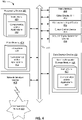
- FIG. 1 is a block diagram depicting an example environment for exposing cloud application programming interface (API) based on supported hardware, according to some embodiments.
- the environment 100 includes a cloud service system 104 and a plurality of client devices 108 that are communicably coupled together via a communication network 120.
- the environment 100 includes a cloud provider 105 that manages (e.g., controls, operates) the cloud service system 104.
- the communication network 120 may be a public network (e.g., the internet), a private network (e.g., a local area network (LAN) or wide area network (WAN)), or a combination thereof.
- communication network 120 may include a wired or a wireless infrastructure, which may be provided by one or more wireless communications systems, such as wireless fidelity (Wi-Fi) connectivity to the communication network 120 and/or a wireless carrier system that can be implemented using various data processing equipment, communication towers (e.g. cell towers), etc.
- the communication network 120 may carry communications (e.g., data, message, packets, frames, etc.) between any other the computing device.
- the cloud service system 104 includes cloud servers 102a, 102b, 102c, 102d (collectively referred to as, “cloud servers 102") that are communicably connected to one another via the communication network 120 to form a cloud system for delivering services and/or computing resources (collectively referred to as, “services” or “cloud services”) to the one or more client devices 108. As shown in FIG.
- the cloud service system 104 may include cloud service components 106a, 106b, 106c, 106d (collectively referred to as, "cloud service components 106"), where cloud service component 106a is configured to provide a network service, cloud service component 106b is configured to provide a block storage service, cloud service component 106c is configured to provide a compute service, and cloud service component 106 is configured to provide an object storage service.
- cloud service components 106 are cloud service components 106a, 106b, 106c, 106d (collectively referred to as, "cloud service components 106"), where cloud service component 106a is configured to provide a network service, cloud service component 106b is configured to provide a block storage service, cloud service component 106c is configured to provide a compute service, and cloud service component 106 is configured to provide an object storage service.
- the cloud service system 104 includes a select number of cloud service components (e.g., cloud service components 106a, 106b, 106c, 106d) that are each configured to provide a particular type of cloud service
- the cloud service system 104 may include any number of cloud service components for providing any type of cloud service.
- the cloud service system 104 may include cloud service component 106 that is configured to provide networking services, block storage services, computing services, object storage services, database services, communication services, deployment and management services, monitoring services, telemetry services, queuing services, collaboration services, application services, and the like.
- the cloud service system 104 may be any type of cloud service.
- the cloud service system 104 may be an Infrastructure-as-a-Service (IaaS) that provides users with compute, networking, and storage resources.
- the cloud service system 104 may be a Platform-as-a-Service (PaaS) that provides users with a platform on which applications can run, as well as the information technology (IT) infrastructure for it to run.
- the cloud service system 104 may be a Software-as-a-Service (SaaS) that provides users with a cloud application, the platform on which it runs, and the platform's underlying infrastructure.
- the cloud service system 104 may be a Function-as-a-Service (FaaS) that is an event-driven execution model that lets the developers build, run, and manage application packages as functions without maintaining the infrastructure.
- IaaS Infrastructure-as-a-Service
- PaaS Platform-as-a-Service
- IT information technology
- the cloud service system 104 may be a Software
- a cloud server 102 may be any suitable type of computing device or machine that has a processing device, for example, server computers (e.g., an application server, a catalog server, a communications server, a computing server, a database server, a file server, a game server, a mail server, a media server, a proxy server, a virtual server, a web server), desktop computers, laptop computers, tablet computers, smartphones, set-top boxes, a graphics processing unit (GPU), etc.
- a computing device may comprise a single machine or may include multiple interconnected machines (e.g., multiple servers configured in a cluster).
- a cloud server 102 may be one or more virtual environments.
- a virtual environment 113 may be a virtual machine (VM) that may execute on a hypervisor which executes on top of an operating system (OS) for a computing device.
- the hypervisor may manage system sources (including access to hardware devices, such as processing devices, memories, storage devices).
- the hypervisor may also emulate the hardware (or other physical resources) which may be used by the VMs to execute software/applications.
- a virtual environment may be a container that may execute on a container engine which executes on top of the OS for a computing device.
- a container engine may allow different containers to share the OS of a computing device (e.g., the OS kernel, binaries, libraries, etc.).
- the cloud service system 104 may use the same type or different types of virtual environments.
- all of the cloud servers 102 may be VMs.
- all of the cloud servers 102 may be containers.
- some of the cloud servers 102 may be VMs, other cloud servers 102 may be containers, and other cloud servers 102 may be computing devices (or groups of computing devices).
- the client device 108 may be any suitable type of computing device or machine that has a processing device, for example, desktop computers, laptop computers, tablet computers, smartphones, set-top boxes, a graphics processing unit (GPU), etc.
- a client device 108 may be operated by a customer, an administrator/operator of the cloud service system 104, etc.
- each of the cloud servers 102a may execute a cloud service application that is configured to provide one or more cloud services.
- the cloud service system 104 may receive a request (shown in FIG. 1 as, "API Exposure Request") from a client device 108 for exposure to an application programming interface (API) of a particular service of the cloud service application.
- the cloud service system 104 may maintain in a data storage (e.g., a memory, a database), a plurality of linkages between a plurality of service identifiers corresponding to the one or more services of the cloud service application and a plurality of hardware identifiers. Each respective service identifier is associated with one or more hardware identifiers of the plurality of hardware identifiers.
- the cloud service system 104 may determine, based on the plurality of linkages and/or a hardware profile of the cloud service system, whether the cloud service system 104 has a capability to provide access to the one or more services of the cloud service application.
- the cloud service system 104 may provide, to a client device responsive to determining whether the cloud service system has the capability to provide the access to the one or more services, exposure (shown in FIG. 1 as, "Exposed Service(s)”) to application programming interfaces (APIs) of at least one of the one or more services of the cloud service application.
- FIG. 1 shows only a select number of computing devices (e.g., cloud servers 102, client devices 108), the environment 100 may include any number of computing devices that are interconnected in any arrangement to facilitate the exchange of data between the computing devices.
- computing devices e.g., cloud servers 102, client devices 108
- the environment 100 may include any number of computing devices that are interconnected in any arrangement to facilitate the exchange of data between the computing devices.
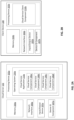
- FIG. 2A is a block diagram depicting an example cloud server 102 of the cloud service system 104 in FIG. 1 , according to some embodiments. While various devices, interfaces, and logic with particular functionality are shown, it should be understood that the one or more cloud servers 102 (e.g., cloud servers 102a-102d) of the cloud service system 104 includes any number of devices and/or components, interfaces, and logic for facilitating the functions described herein. For example, the activities of multiple devices may be combined as a single device and implemented on a same processing device (e.g., processing device 202a), as additional devices and/or components with additional functionality are included.
- processing device 202a e.g., processing device 202a
- the cloud server 102 includes a processing device 202a (e.g., general purpose processor, a PLD, etc.), which may be composed of one or more processors, and a memory 204a (e.g., synchronous dynamic random access memory (DRAM), read-only memory (ROM)), which may communicate with each other via a bus (not shown).
- a processing device 202a e.g., general purpose processor, a PLD, etc.
- a memory 204a e.g., synchronous dynamic random access memory (DRAM), read-only memory (ROM)
- DRAM synchronous dynamic random access memory
- ROM read-only memory
- the processing device 202a may be provided by one or more general-purpose processing devices such as a microprocessor, central processing unit, or the like.
- processing device 202a may include a complex instruction set computing (CISC) microprocessor, reduced instruction set computing (RISC) microprocessor, very long instruction word (VLIW) microprocessor, or a processor implementing other instruction sets or processors implementing a combination of instruction sets.
- the processing device 202a may comprise one or more special-purpose processing devices such as an application specific integrated circuit (ASIC), a field programmable gate array (FPGA), a digital signal processor (DSP), network processor, or the like.
- ASIC application specific integrated circuit
- FPGA field programmable gate array
- DSP digital signal processor
- the processing device 202a may be configured to execute the operations described herein, in accordance with one or more aspects of the present disclosure, for performing the operations and steps discussed herein.
- the memory 204a (e.g., Random Access Memory (RAM), Read-Only Memory (ROM), Non-volatile RAM (NVRAM), Flash Memory, hard disk storage, optical media, etc.) of processing device 202a stores data and/or computer instructions/code for facilitating at least some of the various processes described herein.
- the memory 204a includes tangible, non-transient volatile memory, or non-volatile memory.
- the memory 204a stores programming logic (e.g., instructions/code) that, when executed by the processing device 202a, controls the operations of the cloud server 102.
- the processing device 202a and the memory 204a form various processing devices and/or circuits described with respect to the cloud server 102.
- the instructions include code from any suitable computer programming language such as, but not limited to, C, C++, C#, Java, JavaScript, VBScript, Perl, HTML, XML, Python, TCL, and Basic.
- the processing device 202a may include and/or execute an operating system 226a that is configured to support basic functionality for the cloud server 102, such as scheduling tasks, executing applications, and controlling peripherals.
- the operating system 226a may be any type of operating system (OS), such as any version of Microsoft Windows, Unix, Linux, Android, or macOS, etc.
- the processing device 202a may include and/or execute a cloud service application 210a to run on and/or within the operating system 226a.
- the cloud service application 210a is configured to include and/or execute cloud service components 106a, 106b, 106c, 106d (collectively referred to as, "cloud service components 106") that are each configured to provide a respective cloud service (sometimes simply referred to as, "service") without direct active management by a user (e.g., a user of client device 108).
- a cloud service component 106 may be configured to provide any type of cloud service, such as networking services, block storage services, computing services, object storage services, database services, communication services, deployment and management services, monitoring services, telemetry services, queuing services, collaboration services, application services, and the like.
- FIG. 2A shows only a select number of cloud service components 106 (e.g., cloud service components 106a, 106b, 106c, 106d); the cloud server 102 may include any number of cloud service components to provide any number of cloud services to one or more client devices 108.
- the cloud service application 210a may be configured to maintain (e.g., preserve, manage) in a data storage (e.g., memory 204a, a local or remote data storage), a plurality of linkages (e.g., associations) between a plurality of service identifiers corresponding to the one or more services of the cloud service application 210a and a plurality of hardware identifiers.
- a data storage e.g., memory 204a, a local or remote data storage
- linkages e.g., associations
- each respective service identifier may be associated with one or more hardware identifiers of the plurality of hardware identifiers.
- a linkage may indicate that the service corresponding to the service identifier needs the one or more hardware components that correspond to the one or more hardware identifiers in order for the service to be able to successfully operate and provide the service to one or more client devices 108.
- a service is able to successfully operate if the service is able to execute and operate at a performance level that meets the minimum performance level that is expected by a developer of the service.
- a hardware component may be any hardware component of a computer device, such as, a processor, memory, a storage device, an adapter (e.g., networking, audio, etc.), one or more ports/interfaces, a video graphics card, a motherboard, and/or the like.
- a hardware identifier may identify the type of hardware, the version of the hardware, the model number of the hardware, the brand of the hardware, the specifications for the hardware (e.g., networking speed and/or bandwidth, processor speed, load balancing capabilities, multi-threading capabilities), a count of hardware components (e.g., a count of the processors), and/or the like.
- the cloud service application 210a may be configured to detect (e.g., sense, determine, notice) that the cloud service application 210a has been reconfigured (e.g., updated, modified, adjusted) to provide a different set of one or more services. For example, the cloud service application 210a may detect that the cloud service application 210a has been reconfigured to modify (e.g., adjust, alter, change) a service of the cloud service application 210a. As another example, the cloud service application 210a may detect that the cloud service application 210a has been reconfigured to remove or add a service to the cloud service application 210a. As another example, the cloud service application 210a may detect that an operability of a service has changed in that the service failed or recovered.
- the cloud service application 210a may detect that an operability of a service has changed in that the service failed or recovered.
- the cloud service application 210a may be configured to update the plurality of linkages using one or more linkages corresponding to the different set of the one or more services.
- the cloud service application 210a may be configured to receive (e.g., obtain, acquire, retrieve) an indication (e.g., a linkage) that a service has been updated to require more or less hardware components in order to be able to successfully operate and provide the service to one or more client devices 108.
- the cloud service application 210a may be configured to update, in response to receiving the indication, the plurality of linkages using the indication (e.g., linkage).
- the cloud service application 210a may be configured to determine, based on the plurality of linkages and/or a hardware profile of the cloud service system 104, whether the cloud service system 104 has a capability to provide access to the one or more services of the cloud service application 210a. In some embodiments, a capability to provide the access to the one or more services of the cloud service application 210a depends on whether one or more cloud servers 102 of the cloud service system 104 include the appropriate hardware to support the service.
- the cloud service application 210a may be configured to determine the particular hardware for supporting a service based on the linkage that corresponds to the service. In some embodiments, the cloud service application 210a is configured to detect the hardware profile of the cloud service system 104 by scanning the cloud service system 104 to detect the hardware profile of the cloud service system 104. In some embodiments, a hardware profile of the cloud service application 210a is a list that includes each of the hardware components included in the cloud service system 104.
- the cloud service application 210a may be configured to detect whether a triggering event has occurred. In some embodiments, the determining by the cloud service application 210a as to whether the cloud service application 210a has the capability to provide the access to the one or more services of the cloud service application is responsive to the cloud service application 210a detecting that a triggering event has occurred.
- the cloud service application 210a may be configured to detect that a triggering event has occurred if the cloud service application 210a detects a change (e.g., modification) in the hardware profile of the cloud service system 104. In some embodiments, the cloud service application 210a may detect a change in the hardware profile of the cloud service system 104 by determining that the cloud service system 104 has been reconfigured to remove or add a hardware component to the cloud service system 104. In some embodiments, the cloud service application 210a may detect a change in the hardware profile of the cloud service system 104 by detecting that an operability of a hardware component has changed in that the hardware component has failed or recovered.
- a change e.g., modification
- the cloud service application 210a may be configured to detect a change in the hardware profile of the cloud service system 104 by receiving an indication from the operating system 226a of a cloud server 102 that the hardware profile of the cloud server 102 has changed. In some embodiments, the cloud service application 210a may be configured to detect a change in the hardware profile of the cloud service system 104 by detecting a change in the hardware profile of the cloud service system 104 by scanning the cloud service system 104 to detect whether the hardware profile of the cloud service system 104 has changed.
- the cloud service application 210a may be configured to detect that a triggering event has occurred if the cloud service application 210a receives a request (shown in FIG. 1 as, "API exposure request") from the client device 108 for an exposure to an application programming interface (API) of a particular service of the cloud service application 210a.
- the cloud service application 210a may be configured to detect that a triggering event has occurred if the cloud service application 210a detects that the cloud service application 210a has been reconfigured to provide a different set of one or more services, as compared to the one or more services that the cloud service application 210 was configured to provide prior to the reconfiguration.
- the cloud service application 210a may be configured to detect that a triggering event has occurred if a predetermined amount (e.g., hours, days, weeks) of time has elapsed. For example, the cloud service application 210a may be configured to detect the determining by the cloud service application 210a as to whether the cloud service application 210a has the capability to provide the access to the one or more services of the cloud service application on a periodic (e.g., hours, days, weeks) basis.
- a predetermined amount e.g., hours, days, weeks
- the cloud service application 210a may be configured to provide, to the client device 108 via a message (shown in FIG. 1 as, "exposed service(s)", exposure to application programming interfaces (APIs) of at least one of the one or more services of the cloud service application.
- the cloud service application 210a may be configured to provide, to the client device 108, exposure to application programming interfaces (APIs) of at least one of the one or more services of the cloud service application in response to determining whether the cloud service system 104 has the capability to provide the access to the one or more services.
- the cloud service application 210a may be configured to determine, based on one or more linkages and/or the hardware profile of the cloud service system, that the cloud service system 104 has the capability to provide access to a first set (e.g., one or more) of the one or more services of the cloud service application 210a. In some embodiments, the cloud service application 210a may be configured to determine, based on a one or more linkages and/or the hardware profile of the cloud service system, that the cloud service system 104 lacks the capability to provide access to a second set of the one or more services of the cloud service application 210a.
- the cloud service application 210a may be configured to provide, to the client device 108 responsive to determining the capability (and/or the lack of capability) to provide access to one or more services, access to APIs of the first set of the one or more services of the cloud service system without providing access to APIs of the second set of the one or more services of the cloud service application.
- access to the one or more services means that the client device 108 may use the one or more services.
- the cloud service application 210a may be configured to send (e.g., transmit, provide, deliver) to the client device 108, a message indicating that the hardware profile of the cloud service system 104 does not support one or more services (sometimes referred to as, "a second set") of the cloud service application 210a in response to determining, based on a one or more linkages and/or the hardware profile of the cloud service system 104, that the cloud service system 104 lacks the capability to provide access to the one or more services of the cloud service application 210a.
- send e.g., transmit, provide, deliver
- a message indicating that the hardware profile of the cloud service system 104 does not support one or more services (sometimes referred to as, "a second set") of the cloud service application 210a in response to determining, based on a one or more linkages and/or the hardware profile of the cloud service system 104, that the cloud service system 104 lacks the capability to provide access to the one or more services of the cloud service application 210a.
- the cloud service application 210a may be configured to hide (e.g., block) the APIs of one or more services of the cloud service application 210a from the client device 108 to prevent (e.g., restrict) the client device 108 from accessing the APIs of the one or more services of the cloud service application 210a.
- the cloud service application 210a may be configured to send to the client device 108, a message that includes a list of services that are supported by the hardware profile of the cloud service system 104.
- the list may include one or more services that are supported by the hardware profile of the cloud service system 104.
- the message may include a list of the services that are not supported by the hardware profile of the cloud service system 104 and descriptions of the corresponding hardware components that are missing (or corrupted) from the hardware profile, thereby preventing the one or more services from successfully running on the cloud service system 104.
- the cloud server 102 includes a network interface 206a configured to establish a communication session with a computing device for sending and receiving data over the communication network 120 to the computing device.
- the network interface 206a includes a cellular transceiver (supporting cellular standards), a local wireless network transceiver (supporting 802.1 1X, ZigBee, Bluetooth, Wi-Fi, or the like), a wired network interface, a combination thereof (e.g., both a cellular transceiver and a Bluetooth transceiver), and/or the like.
- the cloud server 102 includes a plurality of network interfaces 206a of different types, allowing for connections to a variety of networks, such as local area networks (public or private) or wide area networks including the Internet, via different sub-networks.
- the cloud server 102 includes an input/output device 205a configured to receive user input from and provide information to a user.
- the input/output device 205a is structured to exchange data, communications, instructions, etc. with an input/output component of the cloud server 102.
- input/output device 205a may be any electronic device that conveys data to a user by generating sensory information (e.g., a visualization on a display, one or more sounds, tactile feedback, etc.) and/or converts received sensory information from a user into electronic signals (e.g., a keyboard, a mouse, a pointing device, a touch screen display, a microphone, etc.).
- the one or more user interfaces may be internal to the housing of the cloud server 102, such as a built-in display, touch screen, microphone, etc., or external to the housing of the cloud server 102, such as a monitor connected to the cloud server 102, a speaker connected to the cloud server 102, etc., according to various embodiments.
- the cloud server 102 includes communication circuitry for facilitating the exchange of data, values, messages, and the like between the input/output device 205a and the components of the cloud server 102.
- the input/output device 205a includes machine-readable media for facilitating the exchange of information between the input/output device 205a and the components of the cloud server 102.
- the input/output device 205a includes any combination of hardware components (e.g., a touchscreen), communication circuitry, and machine-readable media.
- the cloud server 102 includes a device identification component 207a (shown in FIG. 2A as device ID component 207a) configured to generate and/or manage a device identifier associated with the cloud server 102.
- the device identifier may include any type and form of identification used to distinguish the cloud server 102 from other computing devices.
- the device identifier may be cryptographically generated, encrypted, or otherwise obfuscated by any device and/or component of cloud server 102.
- the cloud server 102 may include the device identifier in any communication (e.g., exposed services) that the cloud server 102 sends to a computing device.
- the cloud server 102 includes a bus (not shown), such as an address/data bus or other communication mechanism for communicating information, which interconnects the devices and/or components of cloud server 102, such as processing device 202a, network interface 206a, input/output device 205a, and/or device ID component 207a.
- a bus such as an address/data bus or other communication mechanism for communicating information, which interconnects the devices and/or components of cloud server 102, such as processing device 202a, network interface 206a, input/output device 205a, and/or device ID component 207a.
- the devices and/or components of cloud server 102 may be implemented with the processing device 202a.
- the cloud server 102 may be implemented as a software application stored within the memory 204a and executed by the processing device 202a. Accordingly, such embodiment can be implemented with minimal or no additional hardware costs.
- any of these above-recited devices and/or components rely on dedicated hardware specifically configured for performing operations of the devices and/or components.
- FIG. 2B is a block diagram depicting an example of the client device 108 of the environment in FIG. 1 , according to some embodiments. While various devices, interfaces, and logic with particular functionality are shown, it should be understood that the client device 108 includes any number of devices and/or components, interfaces, and logic for facilitating the functions described herein. For example, the activities of multiple devices may be combined as a single device and implemented on a same processing device (e.g., processing device 202b), as additional devices and/or components with additional functionality are included.
- processing device 202b e.g., processing device 202b
- the client device 108 includes a processing device 202b (e.g., general purpose processor, a PLD, etc.), which may be composed of one or more processors, and a memory 204b (e.g., synchronous dynamic random access memory (DRAM), read-only memory (ROM)), which may communicate with each other via a bus (not shown).
- the processing device 202b includes identical or nearly identical functionality as processing device 202a in FIG. 2a , but with respect to devices and/or components of the client device 108 instead of devices and/or components of the cloud server 102.
- the memory 204b of processing device 202b stores data and/or computer instructions/code for facilitating at least some of the various processes described herein.
- the memory 204b includes identical or nearly identical functionality as memory 204a in FIG. 2A , but with respect to devices and/or components of the client device 108 instead of devices and/or components of the cloud server 102.
- the processing device 202b may execute a cloud service client component 210b that may be configured to send a request (shown in FIG. 1 as, "API exposure request") to the cloud service system 104 for exposure to an application programming interface (API) of a particular service of the cloud service application 210a.
- the cloud service client component 210b may be configured to receive, via a message (shown in FIG. 1 as, "exposed service(s)"), exposure to application programming interfaces (APIs) of at least one of the one or more services of the cloud service application 210a.
- the cloud service client component 210b may be configured to receive access to application programming interfaces (APIs) of at least one of the one or more services of the cloud service application 210a.
- the cloud service client component 210b may be configured to use the one or more services of the cloud service application 210a via the application programming interfaces (APIs) of the one or more services.
- the cloud service client component 210b may be configured to receive to the client device 108, a message that includes a list of services that are supported by the hardware profile of the cloud service system 210a.
- the list may include one or more services that are supported by the hardware profile of the cloud service system 210a.
- the message may include a list of the services that are not supported by the hardware profile of the cloud service system 210a and descriptions of the corresponding hardware components that are missing (or corrupted) from the hardware profile, thereby preventing the one or more services from successfully running on the cloud service system 210a.
- the client device 108 includes a network interface 206b configured to establish a communication session with a computing device for sending and receiving data over a network to the computing device.
- the network interface 206b includes identical or nearly identical functionality as network interface 206a in FIG. 2A , but with respect to devices and/or components of the client device 108 instead of devices and/or components of the cloud server 102.
- the client device 108 includes an input/output device 205b configured to receive user input from and provide information to a user.
- the input/output device 205b is structured to exchange data, communications, instructions, etc. with an input/output component of the client device 108.
- the input/output device 205b includes identical or nearly identical functionality as input/output device 205a in FIG. 2A , but with respect to devices and/or components of the client device 108 instead of devices and/or components of the cloud server 102.
- the client device 108 includes a device identification component 207b (shown in FIG. 2B as device ID component 207b) configured to generate and/or manage a device identifier associated with the client device 108.
- the device ID component 207b includes identical or nearly identical functionality as device ID component 207a in FIG. 2A , but with respect to devices and/or components of the client device 108 instead of devices and/or components of the cloud server 102.
- the client device 108 includes a bus (not shown), such as an address/data bus or other communication mechanism for communicating information, which interconnects the devices and/or components of the client device 108, such as processing device 202b, network interface 206b, input/output device 205b, device ID component 207b, and the cloud service client component 210b.
- a bus such as an address/data bus or other communication mechanism for communicating information, which interconnects the devices and/or components of the client device 108, such as processing device 202b, network interface 206b, input/output device 205b, device ID component 207b, and the cloud service client component 210b.
- client device 108 may be implemented with the processing device 202b.
- the client device 108 may be implemented as a software application stored within the memory 204b and executed by the processing device 202b. Accordingly, such embodiment can be implemented with minimal or no additional hardware costs.
- any of these above-recited devices and/or components rely on dedicated hardware specifically configured for performing operations of the devices and/or components.
- FIG. 3 is a flow diagram depicting a method for exposing cloud application programming interface (API) based on supported hardware, according to some embodiments.
- Method 300 may be performed by processing logic that may comprise hardware (e.g., circuitry, dedicated logic, programmable logic, a processor, a processing device, a central processing unit (CPU), a system-on-chip (SoC), etc.), software (e.g., instructions and/or an application that is running/executing on a processing device), firmware (e.g., microcode), or a combination thereof.
- method 300 may be performed by a cloud server, such as cloud server 102 in FIG. 1 .
- method 300 may be performed by a client device, such as client device 108 in FIG. 1 .
- method 300 illustrates example functions used by various embodiments. Although specific function blocks (“blocks") are disclosed in method 300, such blocks are examples. That is, embodiments are well suited to performing various other blocks or variations of the blocks recited in method 300. It is appreciated that the blocks in method 300 may be performed in an order different than presented, and that not all of the blocks in method 300 may be performed.
- blocks specific function blocks
- the method 300 includes the block 302 of executing, by a cloud service system, a cloud service application to provide one or more services.
- the method 300 includes the block 304 of maintaining, by the cloud service system in a data storage, a plurality of linkages between a plurality of service identifiers corresponding to the one or more services of the cloud service application and a plurality of hardware identifiers, each respective service identifier is associated with one or more hardware identifiers of the plurality of hardware identifiers.
- the method 300 includes the block 306 of determining, by the cloud service system based on the plurality of linkages and a hardware profile of the cloud service system, whether the cloud service system has a capability to provide access to the one or more services of the cloud service application.
- the method 300 includes the block 308 of providing, by the cloud service system to a client device responsive to determining whether the cloud service system has the capability to provide the access to the one or more services, exposure to application programming interfaces (APIs) of at least one of the one or more services of the cloud service application.
- APIs application programming interfaces
- FIG. 4 is a block diagram of an example computing device 400 that may perform one or more of the operations described herein, in accordance with some embodiments.
- Computing device 400 may be connected to other computing devices in a LAN, an intranet, an extranet, and/or the Internet.
- the computing device may operate in the capacity of a server machine in client-server network environment or in the capacity of a client in a peer-to-peer network environment.
- the computing device may be provided by a personal computer (PC), a set-top box (STB), a server, a network router, switch or bridge, or any machine capable of executing a set of instructions (sequential or otherwise) that specify actions to be taken by that machine.
- PC personal computer
- STB set-top box
- server a server
- network router switch or bridge
- the example computing device 400 may include a processing device (e.g., a general purpose processor, a PLD, etc.) 402, a main memory 404 (e.g., synchronous dynamic random access memory (DRAM), read-only memory (ROM)), a static memory 406 (e.g., flash memory and a data storage device 418), which may communicate with each other via a bus 430.
- a processing device e.g., a general purpose processor, a PLD, etc.
- main memory 404 e.g., synchronous dynamic random access memory (DRAM), read-only memory (ROM)
- static memory 406 e.g., flash memory and a data storage device 418
- Processing device 402 may be provided by one or more general-purpose processing devices such as a microprocessor, central processing unit, or the like.
- processing device 402 may comprise a complex instruction set computing (CISC) microprocessor, reduced instruction set computing (RISC) microprocessor, very long instruction word (VLIW) microprocessor, or a processor implementing other instruction sets or processors implementing a combination of instruction sets.
- processing device 402 may also comprise one or more special-purpose processing devices such as an application specific integrated circuit (ASIC), a field programmable gate array (FPGA), a digital signal processor (DSP), network processor, or the like.
- ASIC application specific integrated circuit
- FPGA field programmable gate array
- DSP digital signal processor
- the processing device 402 may be configured to execute the operations described herein, in accordance with one or more aspects of the present disclosure, for performing the operations and steps discussed herein.
- Computing device 400 may further include a network interface device 408 which may communicate with a communication network 420.
- the computing device 400 also may include a video display unit 410 (e.g., a liquid crystal display (LCD) or a cathode ray tube (CRT)), an alphanumeric input device 412 (e.g., a keyboard), a cursor control device 414 (e.g., a mouse) and an acoustic signal generation device 416 (e.g., a speaker).
- video display unit 410, alphanumeric input device 412, and cursor control device 414 may be combined into a single component or device (e.g., an LCD touch screen).
- Data storage device 418 may include a computer-readable storage medium 428 on which may be stored one or more sets of instructions 425 that may include instructions for one or more components and/or applications 442 (e.g., cloud service components 106a-106d in FIG. 2A , cloud service application 210 in FIG. 2A ) for carrying out the operations described herein, in accordance with one or more aspects of the present disclosure.
- Instructions 425 may also reside, completely or at least partially, within main memory 404 and/or within processing device 402 during execution thereof by computing device 400, main memory 404 and processing device 402 also constituting computer-readable media.
- the instructions 425 may further be transmitted or received over a communication network 420 via network interface device 408.
- While computer-readable storage medium 428 is shown in an illustrative example to be a single medium, the term “computer-readable storage medium” should be taken to include a single medium or multiple media (e.g., a centralized or distributed database and/or associated caches and servers) that store the one or more sets of instructions.
- the term “computer-readable storage medium” shall also be taken to include any medium that is capable of storing, encoding or carrying a set of instructions for execution by the machine and that cause the machine to perform the methods described herein.
- the term “computer-readable storage medium” shall accordingly be taken to include, but not be limited to, solid-state memories, optical media and magnetic media.
- terms such as “executing,” “determining,” “establishing,” “granting,” or the like refer to actions and processes performed or implemented by computing devices that manipulates and transforms data represented as physical (electronic) quantities within the computing device's registers and memories into other data similarly represented as physical quantities within the computing device memories or registers or other such information storage, transmission or display devices.
- the terms “first,” “second,” “third,” “fourth,” etc., as used herein are meant as labels to distinguish among different elements and may not necessarily have an ordinal meaning according to their numerical designation.
- Examples described herein also relate to an apparatus for performing the operations described herein.
- This apparatus may be specially constructed for the required purposes, or it may comprise a general purpose computing device selectively programmed by a computer program stored in the computing device.
- a computer program may be stored in a computer-readable non-transitory storage medium.
- Various units, circuits, or other components may be described or claimed as “configured to” or “configurable to” perform a task or tasks.
- the phrase “configured to” or “configurable to” is used to connote structure by indicating that the units/circuits/components include structure (e.g., circuitry) that performs the task or tasks during operation.
- the unit/circuit/component can be said to be configured to perform the task, or configurable to perform the task, even when the specified unit/circuit/component is not currently operational (e.g., is not on).
- the units/circuits/components used with the "configured to” or “configurable to” language include hardware--for example, circuits, memory storing program instructions executable to implement the operation, etc. Reciting that a unit/circuit/component is “configured to” perform one or more tasks, or is “configurable to” perform one or more tasks, is expressly intended not to invoke 35 U.S.C. 112, sixth paragraph, for that unit/circuit/component. Additionally, "configured to" or “configurable to” can include generic structure (e.g., generic circuitry) that is manipulated by software and/or firmware (e.g., an FPGA or a general-purpose processor executing software) to operate in manner that is capable of performing the task(s) at issue.
- generic structure e.g., generic circuitry
- firmware e.g., an FPGA or a general-purpose processor executing software
- Configured to may also include adapting a manufacturing process (e.g., a semiconductor fabrication facility) to fabricate devices (e.g., integrated circuits) that are adapted to implement or perform one or more tasks.
- a manufacturing process e.g., a semiconductor fabrication facility
- devices e.g., integrated circuits
- Configurable to is expressly intended not to apply to blank media, an unprogrammed processor or unprogrammed generic computer, or an unprogrammed programmable logic device, programmable gate array, or other unprogrammed device, unless accompanied by programmed media that confers the ability to the unprogrammed device to be configured to perform the disclosed function(s).
Landscapes
- Engineering & Computer Science (AREA)
- Software Systems (AREA)
- Theoretical Computer Science (AREA)
- Physics & Mathematics (AREA)
- General Engineering & Computer Science (AREA)
- General Physics & Mathematics (AREA)
- Multimedia (AREA)
- Computer And Data Communications (AREA)
- Stored Programmes (AREA)
Abstract
Description
- The present disclosure relates generally to software technology, and more particularly, to systems and methods for exposure of application programming interfaces (APIs) of one or more services of a cloud service application based on the supported hardware of a cloud service system that executes the cloud service application.
- Cloud service systems are infrastructure, platforms, or software that are hosted by third-party providers and made available to users through the internet. Cloud services facilitate the flow of user data from front-end clients (e.g. servers, tablets, desktops, laptops - anything on the client's end), through the internet, to the provider's systems, and back. Clients can access cloud services with nothing more than a computer, operating system, and internet connectivity or virtual private network (VPN).
- Accordingly, the present invention discloses methods, systems, computer-readable storage media and computer programs according to the appended claims.
- In an aspect the present invention is directed to a method comprising:
- executing, by a cloud service system, a cloud service application to provide one or more services;
- maintaining, by the cloud service system in a data storage, a plurality of linkages between a plurality of service identifiers corresponding to the one or more services of the cloud service application and a plurality of hardware identifiers, each respective service identifier is associated with one or more hardware identifiers of the plurality of hardware identifiers; determining, by the cloud service system based on the plurality of linkages and a hardware profile of the cloud service system, whether the cloud service system has a capability to provide access to the one or more services of the cloud service application; and
- In embodiments of the method according to the present invention, the method may further comprise detecting, by the cloud service system, the hardware profile of the cloud service system.
- In embodiments of the method according to the present invention, the method may further comprise detecting an occurrence of a triggering event, wherein the determining as to whether the cloud service application has the capability to provide the access to the one or more services of the cloud service application is responsive to detecting the occurrence of the triggering event. In addition thereto the method may further comprise detecting, by the cloud service system, the occurrence of the triggering event by detecting a change in the hardware profile of the cloud service system.
- In embodiments of the method according to the present invention, the method may further comprise
detecting an occurrence of a triggering event, wherein the determining as to whether the cloud service application has the capability to provide the access to the one or more services of the cloud service application is responsive to detecting the occurrence of the triggering event and detecting, by the cloud service system, the occurrence of the triggering event by detecting a change in the hardware profile of the cloud service system. In addition thereto, the method may further comprise detecting, by the cloud service system, the change in the hardware profile by receiving an indication from an operating system of the cloud service system that the hardware profile of the cloud service system has changed. - In embodiments of the method according to the present invention, the method may further comprise
detecting an occurrence of a triggering event, wherein the determining as to whether the cloud service application has the capability to provide the access to the one or more services of the cloud service application is responsive to detecting the occurrence of the triggering event and detecting, by the cloud service system, the occurrence of the triggering event by detecting a change in the hardware profile of the cloud service system. In addition thereto, the method may further comprise detecting, by the cloud service system, the change in the hardware profile by scanning the cloud service system to detect whether the hardware profile of the cloud service system has changed. - In embodiments of the method according to the present invention, the method may further comprise
detecting an occurrence of a triggering event, wherein the determining as to whether the cloud service application has the capability to provide the access to the one or more services of the cloud service application is responsive to detecting the occurrence of the triggering event and detecting, by the cloud service system, the occurrence of the triggering event by receiving a request from the client device for exposure to an application programming interface (API) of a particular service of the cloud service application. - In embodiments of the method according to the present invention, the method may further comprise
detecting an occurrence of a triggering event, wherein the determining as to whether the cloud service application has the capability to provide the access to the one or more services of the cloud service application is responsive to detecting the occurrence of the triggering event and detecting, by the cloud service system, the occurrence of the triggering event by detecting a change in the hardware profile of the cloud service system. In addition thereto, the method may further comprise detecting, by the cloud service system, the occurrence of the triggering event by detecting that the cloud service application has been updated to provide a different set of the one or more services. - In embodiments of the method according to the present invention, providing exposure to the APIs of at least one of the one or more services may further comprise:
- determining, by the cloud service system based on the plurality of linkages and the hardware profile of the cloud service system, that the cloud service system has the capability to provide access to a first set of the one or more services of the cloud service application;
- determining, by the cloud service system based on the plurality of linkages and the hardware profile of the cloud service system, that the cloud service system lacks the capability to provide access to a second set of the one or more services of the cloud service application; and providing, by the cloud storage system to the client device, access to APIs of the first set of the one or more services of the cloud service system without providing access to APIs of the second set of the one or more services of the cloud service application. In addition thereto the method may further comprise sending, by the cloud storage system to the client device, a message indicating that the hardware profile of the cloud service system does not support the second set of the one or more services of the cloud service application.
- In embodiments of the method according to the present invention, providing exposure to the APIs of at least one of the one or more services may further comprise:
- determining, by the cloud service system based on the plurality of linkages and the hardware profile of the cloud service system, that the cloud service system has the capability to provide access to a first set of the one or more services of the cloud service application;
- determining, by the cloud service system based on the plurality of linkages and the hardware profile of the cloud service system, that the cloud service system lacks the capability to provide access to a second set of the one or more services of the cloud service application; and
- providing, by the cloud storage system to the client device, access to APIs of the first set of the one or more services of the cloud service system without providing access to APIs of the second set of the one or more services of the cloud service application. In addition thereto the method may further comprise hiding, by the cloud service system, the APIs of the second set of the one or more services of the cloud service application from the client device to prevent the client device from accessing the APIs of the second set of the one or more services of the cloud service application.
- In embodiment of the method according to the present invention, providing the exposure to the APIs of at least one of the one or more services may further comprise: sending, by the cloud storage system to the client device, a message comprising a list of services that are supported by the hardware profile of the cloud service system.
- In embodiment of the method according to the present invention, maintaining the plurality of linkages in the data storage may further comprise:
- detecting, by the cloud service system, that the cloud service application has been updated to provide a different set of the one or more services; and
- updating, by the cloud service system, the plurality of linkages using one or more linkages corresponding to the different set of the one or more services.
- In an aspect the present invention is further directed to a cloud service system comprising:
- a data storage; and
- a processing device, operatively coupled to the data storage, to perform the methods as described above or to :
- execute a cloud service application to provide one or more services;
- maintain, in the data storage, a plurality of linkages between a plurality of service identifiers corresponding to the one or more services of the cloud service application and a plurality of hardware identifiers, each respective service identifier is associated with one or more hardware identifiers of the plurality of hardware identifiers;
- In an embodiment of the cloud service system according to the present invention, the processing device is may further be to detect an occurrence of a triggering event, wherein the determining as to whether the cloud service application has the capability to provide the access to the one or more services of the cloud service application is responsive to detecting the occurrence of the triggering event.
- In an embodiment of the cloud service system according to the present invention, the processing device may further be to detect the occurrence of the triggering event by detecting a change in the hardware profile of the cloud service system.
- In an embodiment of the cloud service system according to the present invention, the processing device may further be to detect the occurrence of the triggering event by detecting a change in the hardware profile of the cloud service system and to detect the change in the hardware profile by receiving an indication from an operating system of the cloud service system that the hardware profile of the cloud service system has changed.
- In an embodiment of the cloud service system according to the present invention, the processing device may further be to detect the occurrence of the triggering event by detecting a change in the hardware profile of the cloud service system and to detect the change in the hardware profile by scanning the cloud service system to detect whether the hardware profile of the cloud service system has changed.
- In embodiments of the the cloud service according to the present invention, the processing device may further be to detect the occurrence of the triggering event by receiving a request from the client device for exposure to an application programming interface (API) of a particular service of the cloud service application.
- In an aspect the present invention is further directed to a computer-readable medium, preferably a non-transitory computer-readable medium storing instructions that, when execute by a processing device of a cloud service system, cause the processing device to perform the method as described above or to:
- execute, by the processing device, a cloud service application to provide one or more services;
- maintain, in a data storage, a plurality of linkages between a plurality of service identifiers corresponding to the one or more services of the cloud service application and a plurality of hardware identifiers, each respective service identifier is associated with one or more hardware identifiers of the plurality of hardware identifiers;
- In an aspect, the present invention is further directed to a computer instructions which, when the program is executed by a computer, cause the computer to carry out the methods as described above.
- The described embodiments and the advantages thereof may best be understood by reference to the following description taken in conjunction with the accompanying drawings. These drawings in no way limit any changes in form and detail that may be made to the described embodiments by one skilled in the art without departing from the spirit and scope of the described embodiments.
-
FIG. 1 is a block diagram depicting an example environment for exposing cloud application programming interface (API) based on supported hardware, according to some embodiments; -
FIG. 2A is a block diagram depicting an example of thecloud server 102 inFIG. 1 , according to some embodiments; -
FIG. 2B is a block diagram depicting an example of theclient device 108 of the environment inFIG. 1 , according to some embodiments; -
FIG. 3 is a flow diagram depicting a method for exposing a cloud application programming interface (API) based on supported hardware, according to some embodiments; and -
FIG. 4 is a block diagram of an example computing device that may perform one or more of the operations described herein, in accordance with some embodiments. - When operating a cloud service system, it is possible for customers to try to use a cloud service of the cloud API just to find out that the cloud service has failed to load in their computing environment and without any clear explanation as to why the cloud service has failed to load. For example, a developer may design a cloud service system to include a cloud service component of Single Root I/O Virtualization (SR-IOV), which allows a Peripheral Component Interconnect (PCI) Express device to present itself as several virtual network interface cards (NICs) to a hypervisor, and/or a service component of Data Plane Development Kit (DPDK), which allows for the offloading of data packet processing from an operating system kernel to processes running in user space. While these cloud service components will successful execute on the developer's computing hardware, the customers of the cloud service system are using an entirely different hardware platform that often lacks the appropriate computing hardware (e.g., processors, memory, storage, adapters) to successfully support the cloud services provided by the cloud service component. Thus, the execution of these cloud service components using the wrong hardware platform will cause the cloud service system to provide an inferior or non-operational service to the customer, which confuses the customer.
- The confused customer will then send repeated requests for the cloud service system to provide the cloud service. These repeated requests; however, may overburden the network infrastructure by increasing network congestion and power consumption by the network infrastructure. The repeated requests may also reduce the capability for the cloud service system to provide cloud services to other customers because the cloud service system has to consume its resources (e.g., processing, power) to process each of these requests. In the end, the confused customer will open a ticket asking for technical support for why the cloud service is not working in their computing environment, which only further wastes valuable networking resources.
- Aspects of the present disclosure address the above-noted and other deficiencies by exposing a cloud application programming interface (API) based on supported hardware of a cloud service system. Benefits of using the one or more embodiments of the present disclosure for exposing a cloud API based on supported hardware of a cloud service system may include a reduction in the amount of networking resources in order to provide cloud services, as well as, a decrease in network congestion and power consumption for the overall network infrastructure.
- As discussed in greater detail below, a cloud service system may include a collection of interconnected cloud servers that each execute a cloud service application that is configured to provide one or more cloud services to one or more client devices. The cloud service system may receive a request from a client device for exposure to an application programming interface (API) of a particular service of the cloud service application. The cloud service system may maintain in a data storage (e.g., a memory, a database), a plurality of linkages between a plurality of service identifiers corresponding to the one or more services of the cloud service application and a plurality of hardware identifiers. Each respective service identifier is associated with one or more hardware identifiers of the plurality of hardware identifiers. The cloud service system may determine, based on the plurality of linkages and/or a hardware profile of the cloud service system, whether the cloud service system has a capability to provide access to the one or more services of the cloud service application. The cloud service system may provide, to a client device responsive to determining whether the cloud service system has the capability to provide the access to the one or more services, exposure (e.g., access, notifications, etc.) to application programming interfaces (APIs) of at least one of the one or more services of the cloud service application.
-
FIG. 1 is a block diagram depicting an example environment for exposing cloud application programming interface (API) based on supported hardware, according to some embodiments. Theenvironment 100 includes acloud service system 104 and a plurality ofclient devices 108 that are communicably coupled together via a communication network 120. Theenvironment 100 includes acloud provider 105 that manages (e.g., controls, operates) thecloud service system 104. - The communication network 120 may be a public network (e.g., the internet), a private network (e.g., a local area network (LAN) or wide area network (WAN)), or a combination thereof. In some embodiments, communication network 120 may include a wired or a wireless infrastructure, which may be provided by one or more wireless communications systems, such as wireless fidelity (Wi-Fi) connectivity to the communication network 120 and/or a wireless carrier system that can be implemented using various data processing equipment, communication towers (e.g. cell towers), etc. The communication network 120 may carry communications (e.g., data, message, packets, frames, etc.) between any other the computing device.
- The
cloud service system 104 includescloud servers cloud servers 102") that are communicably connected to one another via the communication network 120 to form a cloud system for delivering services and/or computing resources (collectively referred to as, "services" or "cloud services") to the one ormore client devices 108. As shown inFIG. 1 , thecloud service system 104 may includecloud service components cloud service component 106a is configured to provide a network service,cloud service component 106b is configured to provide a block storage service,cloud service component 106c is configured to provide a compute service, and cloud service component 106 is configured to provide an object storage service. - Although
FIG. 1 shows that thecloud service system 104 includes a select number of cloud service components (e.g.,cloud service components cloud service system 104 may include any number of cloud service components for providing any type of cloud service. For example, thecloud service system 104 may include cloud service component 106 that is configured to provide networking services, block storage services, computing services, object storage services, database services, communication services, deployment and management services, monitoring services, telemetry services, queuing services, collaboration services, application services, and the like. - The
cloud service system 104 may be any type of cloud service. In some embodiments, thecloud service system 104 may be an Infrastructure-as-a-Service (IaaS) that provides users with compute, networking, and storage resources. In some embodiments, thecloud service system 104 may be a Platform-as-a-Service (PaaS) that provides users with a platform on which applications can run, as well as the information technology (IT) infrastructure for it to run. In some embodiments, thecloud service system 104 may be a Software-as-a-Service (SaaS) that provides users with a cloud application, the platform on which it runs, and the platform's underlying infrastructure. In some embodiments, thecloud service system 104 may be a Function-as-a-Service (FaaS) that is an event-driven execution model that lets the developers build, run, and manage application packages as functions without maintaining the infrastructure. - A
cloud server 102 may be any suitable type of computing device or machine that has a processing device, for example, server computers (e.g., an application server, a catalog server, a communications server, a computing server, a database server, a file server, a game server, a mail server, a media server, a proxy server, a virtual server, a web server), desktop computers, laptop computers, tablet computers, smartphones, set-top boxes, a graphics processing unit (GPU), etc. In some examples, a computing device may comprise a single machine or may include multiple interconnected machines (e.g., multiple servers configured in a cluster). - A
cloud server 102 may be one or more virtual environments. In one embodiment, a virtual environment 113 may be a virtual machine (VM) that may execute on a hypervisor which executes on top of an operating system (OS) for a computing device. The hypervisor may manage system sources (including access to hardware devices, such as processing devices, memories, storage devices). The hypervisor may also emulate the hardware (or other physical resources) which may be used by the VMs to execute software/applications. In another embodiment, a virtual environment may be a container that may execute on a container engine which executes on top of the OS for a computing device. For example, a container engine may allow different containers to share the OS of a computing device (e.g., the OS kernel, binaries, libraries, etc.). Thecloud service system 104 may use the same type or different types of virtual environments. For example, all of thecloud servers 102 may be VMs. In another example, all of thecloud servers 102 may be containers. In a further example, some of thecloud servers 102 may be VMs,other cloud servers 102 may be containers, andother cloud servers 102 may be computing devices (or groups of computing devices). - The
client device 108 may be any suitable type of computing device or machine that has a processing device, for example, desktop computers, laptop computers, tablet computers, smartphones, set-top boxes, a graphics processing unit (GPU), etc. Aclient device 108 may be operated by a customer, an administrator/operator of thecloud service system 104, etc. - Still referring to
FIG. 1 , each of thecloud servers 102a may execute a cloud service application that is configured to provide one or more cloud services. Thecloud service system 104 may receive a request (shown inFIG. 1 as, "API Exposure Request") from aclient device 108 for exposure to an application programming interface (API) of a particular service of the cloud service application. Thecloud service system 104 may maintain in a data storage (e.g., a memory, a database), a plurality of linkages between a plurality of service identifiers corresponding to the one or more services of the cloud service application and a plurality of hardware identifiers. Each respective service identifier is associated with one or more hardware identifiers of the plurality of hardware identifiers. Thecloud service system 104 may determine, based on the plurality of linkages and/or a hardware profile of the cloud service system, whether thecloud service system 104 has a capability to provide access to the one or more services of the cloud service application. Thecloud service system 104 may provide, to a client device responsive to determining whether the cloud service system has the capability to provide the access to the one or more services, exposure (shown inFIG. 1 as, "Exposed Service(s)") to application programming interfaces (APIs) of at least one of the one or more services of the cloud service application. - Although
FIG. 1 shows only a select number of computing devices (e.g.,cloud servers 102, client devices 108), theenvironment 100 may include any number of computing devices that are interconnected in any arrangement to facilitate the exchange of data between the computing devices. -
FIG. 2A is a block diagram depicting anexample cloud server 102 of thecloud service system 104 inFIG. 1 , according to some embodiments. While various devices, interfaces, and logic with particular functionality are shown, it should be understood that the one or more cloud servers 102 (e.g.,cloud servers 102a-102d) of thecloud service system 104 includes any number of devices and/or components, interfaces, and logic for facilitating the functions described herein. For example, the activities of multiple devices may be combined as a single device and implemented on a same processing device (e.g.,processing device 202a), as additional devices and/or components with additional functionality are included. - The
cloud server 102 includes aprocessing device 202a (e.g., general purpose processor, a PLD, etc.), which may be composed of one or more processors, and amemory 204a (e.g., synchronous dynamic random access memory (DRAM), read-only memory (ROM)), which may communicate with each other via a bus (not shown). - The
processing device 202a may be provided by one or more general-purpose processing devices such as a microprocessor, central processing unit, or the like. In some embodiments,processing device 202a may include a complex instruction set computing (CISC) microprocessor, reduced instruction set computing (RISC) microprocessor, very long instruction word (VLIW) microprocessor, or a processor implementing other instruction sets or processors implementing a combination of instruction sets. In some embodiments, theprocessing device 202a may comprise one or more special-purpose processing devices such as an application specific integrated circuit (ASIC), a field programmable gate array (FPGA), a digital signal processor (DSP), network processor, or the like. Theprocessing device 202a may be configured to execute the operations described herein, in accordance with one or more aspects of the present disclosure, for performing the operations and steps discussed herein. - The
memory 204a (e.g., Random Access Memory (RAM), Read-Only Memory (ROM), Non-volatile RAM (NVRAM), Flash Memory, hard disk storage, optical media, etc.) ofprocessing device 202a stores data and/or computer instructions/code for facilitating at least some of the various processes described herein. Thememory 204a includes tangible, non-transient volatile memory, or non-volatile memory. Thememory 204a stores programming logic (e.g., instructions/code) that, when executed by theprocessing device 202a, controls the operations of thecloud server 102. In some embodiments, theprocessing device 202a and thememory 204a form various processing devices and/or circuits described with respect to thecloud server 102. The instructions include code from any suitable computer programming language such as, but not limited to, C, C++, C#, Java, JavaScript, VBScript, Perl, HTML, XML, Python, TCL, and Basic. - The
processing device 202a may include and/or execute anoperating system 226a that is configured to support basic functionality for thecloud server 102, such as scheduling tasks, executing applications, and controlling peripherals. In some embodiments, theoperating system 226a may be any type of operating system (OS), such as any version of Microsoft Windows, Unix, Linux, Android, or macOS, etc. - The
processing device 202a may include and/or execute acloud service application 210a to run on and/or within theoperating system 226a. Thecloud service application 210a is configured to include and/or executecloud service components FIG. 2A shows only a select number of cloud service components 106 (e.g.,cloud service components cloud server 102 may include any number of cloud service components to provide any number of cloud services to one ormore client devices 108. - In some embodiments, the
cloud service application 210a may be configured to maintain (e.g., preserve, manage) in a data storage (e.g.,memory 204a, a local or remote data storage), a plurality of linkages (e.g., associations) between a plurality of service identifiers corresponding to the one or more services of thecloud service application 210a and a plurality of hardware identifiers. In some embodiments, each respective service identifier may be associated with one or more hardware identifiers of the plurality of hardware identifiers. In some embodiments, a linkage may indicate that the service corresponding to the service identifier needs the one or more hardware components that correspond to the one or more hardware identifiers in order for the service to be able to successfully operate and provide the service to one ormore client devices 108. In some embodiments, a service is able to successfully operate if the service is able to execute and operate at a performance level that meets the minimum performance level that is expected by a developer of the service. - In some embodiments, a hardware component may be any hardware component of a computer device, such as, a processor, memory, a storage device, an adapter (e.g., networking, audio, etc.), one or more ports/interfaces, a video graphics card, a motherboard, and/or the like. In some embodiments, a hardware identifier may identify the type of hardware, the version of the hardware, the model number of the hardware, the brand of the hardware, the specifications for the hardware (e.g., networking speed and/or bandwidth, processor speed, load balancing capabilities, multi-threading capabilities), a count of hardware components (e.g., a count of the processors), and/or the like.
- In some embodiments, the
cloud service application 210a may be configured to detect (e.g., sense, determine, notice) that thecloud service application 210a has been reconfigured (e.g., updated, modified, adjusted) to provide a different set of one or more services. For example, thecloud service application 210a may detect that thecloud service application 210a has been reconfigured to modify (e.g., adjust, alter, change) a service of thecloud service application 210a. As another example, thecloud service application 210a may detect that thecloud service application 210a has been reconfigured to remove or add a service to thecloud service application 210a. As another example, thecloud service application 210a may detect that an operability of a service has changed in that the service failed or recovered. - In some embodiments, the
cloud service application 210a may be configured to update the plurality of linkages using one or more linkages corresponding to the different set of the one or more services. In some embodiments, thecloud service application 210a may be configured to receive (e.g., obtain, acquire, retrieve) an indication (e.g., a linkage) that a service has been updated to require more or less hardware components in order to be able to successfully operate and provide the service to one ormore client devices 108. Thecloud service application 210a may be configured to update, in response to receiving the indication, the plurality of linkages using the indication (e.g., linkage). - In some embodiments, the
cloud service application 210a may be configured to determine, based on the plurality of linkages and/or a hardware profile of thecloud service system 104, whether thecloud service system 104 has a capability to provide access to the one or more services of thecloud service application 210a. In some embodiments, a capability to provide the access to the one or more services of thecloud service application 210a depends on whether one ormore cloud servers 102 of thecloud service system 104 include the appropriate hardware to support the service. - In some embodiments, the
cloud service application 210a may be configured to determine the particular hardware for supporting a service based on the linkage that corresponds to the service. In some embodiments, thecloud service application 210a is configured to detect the hardware profile of thecloud service system 104 by scanning thecloud service system 104 to detect the hardware profile of thecloud service system 104. In some embodiments, a hardware profile of thecloud service application 210a is a list that includes each of the hardware components included in thecloud service system 104. - In some embodiments, the
cloud service application 210a may be configured to detect whether a triggering event has occurred. In some embodiments, the determining by thecloud service application 210a as to whether thecloud service application 210a has the capability to provide the access to the one or more services of the cloud service application is responsive to thecloud service application 210a detecting that a triggering event has occurred. - In some embodiments, the
cloud service application 210a may be configured to detect that a triggering event has occurred if thecloud service application 210a detects a change (e.g., modification) in the hardware profile of thecloud service system 104. In some embodiments, thecloud service application 210a may detect a change in the hardware profile of thecloud service system 104 by determining that thecloud service system 104 has been reconfigured to remove or add a hardware component to thecloud service system 104. In some embodiments, thecloud service application 210a may detect a change in the hardware profile of thecloud service system 104 by detecting that an operability of a hardware component has changed in that the hardware component has failed or recovered. - In some embodiments, the
cloud service application 210a may be configured to detect a change in the hardware profile of thecloud service system 104 by receiving an indication from theoperating system 226a of acloud server 102 that the hardware profile of thecloud server 102 has changed. In some embodiments, thecloud service application 210a may be configured to detect a change in the hardware profile of thecloud service system 104 by detecting a change in the hardware profile of thecloud service system 104 by scanning thecloud service system 104 to detect whether the hardware profile of thecloud service system 104 has changed. - In some embodiments, the
cloud service application 210a may be configured to detect that a triggering event has occurred if thecloud service application 210a receives a request (shown inFIG. 1 as, "API exposure request") from theclient device 108 for an exposure to an application programming interface (API) of a particular service of thecloud service application 210a. In some embodiments, thecloud service application 210a may be configured to detect that a triggering event has occurred if thecloud service application 210a detects that thecloud service application 210a has been reconfigured to provide a different set of one or more services, as compared to the one or more services that the cloud service application 210 was configured to provide prior to the reconfiguration. - In some embodiments, the
cloud service application 210a may be configured to detect that a triggering event has occurred if a predetermined amount (e.g., hours, days, weeks) of time has elapsed. For example, thecloud service application 210a may be configured to detect the determining by thecloud service application 210a as to whether thecloud service application 210a has the capability to provide the access to the one or more services of the cloud service application on a periodic (e.g., hours, days, weeks) basis. - In some embodiments, the
cloud service application 210a may be configured to provide, to theclient device 108 via a message (shown inFIG. 1 as, "exposed service(s)"), exposure to application programming interfaces (APIs) of at least one of the one or more services of the cloud service application. In some embodiments, thecloud service application 210a may be configured to provide, to theclient device 108, exposure to application programming interfaces (APIs) of at least one of the one or more services of the cloud service application in response to determining whether thecloud service system 104 has the capability to provide the access to the one or more services. - In some embodiments, the
cloud service application 210a may be configured to determine, based on one or more linkages and/or the hardware profile of the cloud service system, that thecloud service system 104 has the capability to provide access to a first set (e.g., one or more) of the one or more services of thecloud service application 210a. In some embodiments, thecloud service application 210a may be configured to determine, based on a one or more linkages and/or the hardware profile of the cloud service system, that thecloud service system 104 lacks the capability to provide access to a second set of the one or more services of thecloud service application 210a. In some embodiments, thecloud service application 210a may be configured to provide, to theclient device 108 responsive to determining the capability (and/or the lack of capability) to provide access to one or more services, access to APIs of the first set of the one or more services of the cloud service system without providing access to APIs of the second set of the one or more services of the cloud service application. In some embodiments, access to the one or more services means that theclient device 108 may use the one or more services. - In some embodiments, the
cloud service application 210a may be configured to send (e.g., transmit, provide, deliver) to theclient device 108, a message indicating that the hardware profile of thecloud service system 104 does not support one or more services (sometimes referred to as, "a second set") of thecloud service application 210a in response to determining, based on a one or more linkages and/or the hardware profile of thecloud service system 104, that thecloud service system 104 lacks the capability to provide access to the one or more services of thecloud service application 210a. - In some embodiments, the
cloud service application 210a may be configured to hide (e.g., block) the APIs of one or more services of thecloud service application 210a from theclient device 108 to prevent (e.g., restrict) theclient device 108 from accessing the APIs of the one or more services of thecloud service application 210a. - In some embodiments, the
cloud service application 210a may be configured to send to theclient device 108, a message that includes a list of services that are supported by the hardware profile of thecloud service system 104. In some embodiments, the list may include one or more services that are supported by the hardware profile of thecloud service system 104. In some embodiments, the message may include a list of the services that are not supported by the hardware profile of thecloud service system 104 and descriptions of the corresponding hardware components that are missing (or corrupted) from the hardware profile, thereby preventing the one or more services from successfully running on thecloud service system 104. - The
cloud server 102 includes a network interface 206a configured to establish a communication session with a computing device for sending and receiving data over the communication network 120 to the computing device. Accordingly, the network interface 206a includes a cellular transceiver (supporting cellular standards), a local wireless network transceiver (supporting 802.1 1X, ZigBee, Bluetooth, Wi-Fi, or the like), a wired network interface, a combination thereof (e.g., both a cellular transceiver and a Bluetooth transceiver), and/or the like. In some embodiments, thecloud server 102 includes a plurality of network interfaces 206a of different types, allowing for connections to a variety of networks, such as local area networks (public or private) or wide area networks including the Internet, via different sub-networks. - The
cloud server 102 includes an input/output device 205a configured to receive user input from and provide information to a user. In this regard, the input/output device 205a is structured to exchange data, communications, instructions, etc. with an input/output component of thecloud server 102. Accordingly, input/output device 205a may be any electronic device that conveys data to a user by generating sensory information (e.g., a visualization on a display, one or more sounds, tactile feedback, etc.) and/or converts received sensory information from a user into electronic signals (e.g., a keyboard, a mouse, a pointing device, a touch screen display, a microphone, etc.). The one or more user interfaces may be internal to the housing of thecloud server 102, such as a built-in display, touch screen, microphone, etc., or external to the housing of thecloud server 102, such as a monitor connected to thecloud server 102, a speaker connected to thecloud server 102, etc., according to various embodiments. In some embodiments, thecloud server 102 includes communication circuitry for facilitating the exchange of data, values, messages, and the like between the input/output device 205a and the components of thecloud server 102. In some embodiments, the input/output device 205a includes machine-readable media for facilitating the exchange of information between the input/output device 205a and the components of thecloud server 102. In still another embodiment, the input/output device 205a includes any combination of hardware components (e.g., a touchscreen), communication circuitry, and machine-readable media. - The
cloud server 102 includes adevice identification component 207a (shown inFIG. 2A asdevice ID component 207a) configured to generate and/or manage a device identifier associated with thecloud server 102. The device identifier may include any type and form of identification used to distinguish thecloud server 102 from other computing devices. In some embodiments, to preserve privacy, the device identifier may be cryptographically generated, encrypted, or otherwise obfuscated by any device and/or component ofcloud server 102. In some embodiments, thecloud server 102 may include the device identifier in any communication (e.g., exposed services) that thecloud server 102 sends to a computing device. - The
cloud server 102 includes a bus (not shown), such as an address/data bus or other communication mechanism for communicating information, which interconnects the devices and/or components ofcloud server 102, such asprocessing device 202a, network interface 206a, input/output device 205a, and/ordevice ID component 207a. - In some embodiments, some or all of the devices and/or components of
cloud server 102 may be implemented with theprocessing device 202a. For example, thecloud server 102 may be implemented as a software application stored within thememory 204a and executed by theprocessing device 202a. Accordingly, such embodiment can be implemented with minimal or no additional hardware costs. In some embodiments, any of these above-recited devices and/or components rely on dedicated hardware specifically configured for performing operations of the devices and/or components. -
FIG. 2B is a block diagram depicting an example of theclient device 108 of the environment inFIG. 1 , according to some embodiments. While various devices, interfaces, and logic with particular functionality are shown, it should be understood that theclient device 108 includes any number of devices and/or components, interfaces, and logic for facilitating the functions described herein. For example, the activities of multiple devices may be combined as a single device and implemented on a same processing device (e.g.,processing device 202b), as additional devices and/or components with additional functionality are included. - The
client device 108 includes aprocessing device 202b (e.g., general purpose processor, a PLD, etc.), which may be composed of one or more processors, and amemory 204b (e.g., synchronous dynamic random access memory (DRAM), read-only memory (ROM)), which may communicate with each other via a bus (not shown). Theprocessing device 202b includes identical or nearly identical functionality asprocessing device 202a inFIG. 2a , but with respect to devices and/or components of theclient device 108 instead of devices and/or components of thecloud server 102. - The
memory 204b ofprocessing device 202b stores data and/or computer instructions/code for facilitating at least some of the various processes described herein. Thememory 204b includes identical or nearly identical functionality asmemory 204a inFIG. 2A , but with respect to devices and/or components of theclient device 108 instead of devices and/or components of thecloud server 102. - The
processing device 202b may execute a cloudservice client component 210b that may be configured to send a request (shown inFIG. 1 as, "API exposure request") to thecloud service system 104 for exposure to an application programming interface (API) of a particular service of thecloud service application 210a. In some embodiments, the cloudservice client component 210b may be configured to receive, via a message (shown inFIG. 1 as, "exposed service(s)"), exposure to application programming interfaces (APIs) of at least one of the one or more services of thecloud service application 210a. In some embodiments, the cloudservice client component 210b may be configured to receive access to application programming interfaces (APIs) of at least one of the one or more services of thecloud service application 210a. In some embodiments, the cloudservice client component 210b may be configured to use the one or more services of thecloud service application 210a via the application programming interfaces (APIs) of the one or more services. - In some embodiments, the cloud
service client component 210b may be configured to receive to theclient device 108, a message that includes a list of services that are supported by the hardware profile of thecloud service system 210a. In some embodiments, the list may include one or more services that are supported by the hardware profile of thecloud service system 210a. In some embodiments, the message may include a list of the services that are not supported by the hardware profile of thecloud service system 210a and descriptions of the corresponding hardware components that are missing (or corrupted) from the hardware profile, thereby preventing the one or more services from successfully running on thecloud service system 210a. - The
client device 108 includes anetwork interface 206b configured to establish a communication session with a computing device for sending and receiving data over a network to the computing device. Accordingly, thenetwork interface 206b includes identical or nearly identical functionality as network interface 206a inFIG. 2A , but with respect to devices and/or components of theclient device 108 instead of devices and/or components of thecloud server 102. - The
client device 108 includes an input/output device 205b configured to receive user input from and provide information to a user. In this regard, the input/output device 205b is structured to exchange data, communications, instructions, etc. with an input/output component of theclient device 108. The input/output device 205b includes identical or nearly identical functionality as input/output device 205a inFIG. 2A , but with respect to devices and/or components of theclient device 108 instead of devices and/or components of thecloud server 102. - The
client device 108 includes adevice identification component 207b (shown inFIG. 2B asdevice ID component 207b) configured to generate and/or manage a device identifier associated with theclient device 108. Thedevice ID component 207b includes identical or nearly identical functionality asdevice ID component 207a inFIG. 2A , but with respect to devices and/or components of theclient device 108 instead of devices and/or components of thecloud server 102. - The
client device 108 includes a bus (not shown), such as an address/data bus or other communication mechanism for communicating information, which interconnects the devices and/or components of theclient device 108, such asprocessing device 202b,network interface 206b, input/output device 205b,device ID component 207b, and the cloudservice client component 210b. - In some embodiments, some or all of the devices and/or components of
client device 108 may be implemented with theprocessing device 202b. For example, theclient device 108 may be implemented as a software application stored within thememory 204b and executed by theprocessing device 202b. Accordingly, such embodiment can be implemented with minimal or no additional hardware costs. In some embodiments, any of these above-recited devices and/or components rely on dedicated hardware specifically configured for performing operations of the devices and/or components. -
FIG. 3 is a flow diagram depicting a method for exposing cloud application programming interface (API) based on supported hardware, according to some embodiments.Method 300 may be performed by processing logic that may comprise hardware (e.g., circuitry, dedicated logic, programmable logic, a processor, a processing device, a central processing unit (CPU), a system-on-chip (SoC), etc.), software (e.g., instructions and/or an application that is running/executing on a processing device), firmware (e.g., microcode), or a combination thereof. In some embodiments,method 300 may be performed by a cloud server, such ascloud server 102 inFIG. 1 . In some embodiments,method 300 may be performed by a client device, such asclient device 108 inFIG. 1 . - With reference to
FIG. 3 ,method 300 illustrates example functions used by various embodiments. Although specific function blocks ("blocks") are disclosed inmethod 300, such blocks are examples. That is, embodiments are well suited to performing various other blocks or variations of the blocks recited inmethod 300. It is appreciated that the blocks inmethod 300 may be performed in an order different than presented, and that not all of the blocks inmethod 300 may be performed. - As shown in
FIG. 3 , themethod 300 includes theblock 302 of executing, by a cloud service system, a cloud service application to provide one or more services. Themethod 300 includes theblock 304 of maintaining, by the cloud service system in a data storage, a plurality of linkages between a plurality of service identifiers corresponding to the one or more services of the cloud service application and a plurality of hardware identifiers, each respective service identifier is associated with one or more hardware identifiers of the plurality of hardware identifiers. Themethod 300 includes theblock 306 of determining, by the cloud service system based on the plurality of linkages and a hardware profile of the cloud service system, whether the cloud service system has a capability to provide access to the one or more services of the cloud service application. Themethod 300 includes theblock 308 of providing, by the cloud service system to a client device responsive to determining whether the cloud service system has the capability to provide the access to the one or more services, exposure to application programming interfaces (APIs) of at least one of the one or more services of the cloud service application. -
FIG. 4 is a block diagram of anexample computing device 400 that may perform one or more of the operations described herein, in accordance with some embodiments.Computing device 400 may be connected to other computing devices in a LAN, an intranet, an extranet, and/or the Internet. The computing device may operate in the capacity of a server machine in client-server network environment or in the capacity of a client in a peer-to-peer network environment. The computing device may be provided by a personal computer (PC), a set-top box (STB), a server, a network router, switch or bridge, or any machine capable of executing a set of instructions (sequential or otherwise) that specify actions to be taken by that machine. Further, while only a single computing device is illustrated, the term "computing device" shall also be taken to include any collection of computing devices that individually or jointly execute a set (or multiple sets) of instructions to perform the methods discussed herein. - The
example computing device 400 may include a processing device (e.g., a general purpose processor, a PLD, etc.) 402, a main memory 404 (e.g., synchronous dynamic random access memory (DRAM), read-only memory (ROM)), a static memory 406 (e.g., flash memory and a data storage device 418), which may communicate with each other via abus 430. -
Processing device 402 may be provided by one or more general-purpose processing devices such as a microprocessor, central processing unit, or the like. In an illustrative example,processing device 402 may comprise a complex instruction set computing (CISC) microprocessor, reduced instruction set computing (RISC) microprocessor, very long instruction word (VLIW) microprocessor, or a processor implementing other instruction sets or processors implementing a combination of instruction sets.Processing device 402 may also comprise one or more special-purpose processing devices such as an application specific integrated circuit (ASIC), a field programmable gate array (FPGA), a digital signal processor (DSP), network processor, or the like. Theprocessing device 402 may be configured to execute the operations described herein, in accordance with one or more aspects of the present disclosure, for performing the operations and steps discussed herein. -
Computing device 400 may further include anetwork interface device 408 which may communicate with acommunication network 420. Thecomputing device 400 also may include a video display unit 410 (e.g., a liquid crystal display (LCD) or a cathode ray tube (CRT)), an alphanumeric input device 412 (e.g., a keyboard), a cursor control device 414 (e.g., a mouse) and an acoustic signal generation device 416 (e.g., a speaker). In one embodiment,video display unit 410,alphanumeric input device 412, andcursor control device 414 may be combined into a single component or device (e.g., an LCD touch screen). -
Data storage device 418 may include a computer-readable storage medium 428 on which may be stored one or more sets ofinstructions 425 that may include instructions for one or more components and/or applications 442 (e.g.,cloud service components 106a-106d inFIG. 2A , cloud service application 210 inFIG. 2A ) for carrying out the operations described herein, in accordance with one or more aspects of the present disclosure.Instructions 425 may also reside, completely or at least partially, withinmain memory 404 and/or withinprocessing device 402 during execution thereof by computingdevice 400,main memory 404 andprocessing device 402 also constituting computer-readable media. Theinstructions 425 may further be transmitted or received over acommunication network 420 vianetwork interface device 408. - While computer-
readable storage medium 428 is shown in an illustrative example to be a single medium, the term "computer-readable storage medium" should be taken to include a single medium or multiple media (e.g., a centralized or distributed database and/or associated caches and servers) that store the one or more sets of instructions. The term "computer-readable storage medium" shall also be taken to include any medium that is capable of storing, encoding or carrying a set of instructions for execution by the machine and that cause the machine to perform the methods described herein. The term "computer-readable storage medium" shall accordingly be taken to include, but not be limited to, solid-state memories, optical media and magnetic media. - Unless specifically stated otherwise, terms such as "executing," "determining," "establishing," "granting," or the like, refer to actions and processes performed or implemented by computing devices that manipulates and transforms data represented as physical (electronic) quantities within the computing device's registers and memories into other data similarly represented as physical quantities within the computing device memories or registers or other such information storage, transmission or display devices. Also, the terms "first," "second," "third," "fourth," etc., as used herein are meant as labels to distinguish among different elements and may not necessarily have an ordinal meaning according to their numerical designation.
- Examples described herein also relate to an apparatus for performing the operations described herein. This apparatus may be specially constructed for the required purposes, or it may comprise a general purpose computing device selectively programmed by a computer program stored in the computing device. Such a computer program may be stored in a computer-readable non-transitory storage medium.
- The methods and illustrative examples described herein are not inherently related to any particular computer or other apparatus. Various general purpose systems may be used in accordance with the teachings described herein, or it may prove convenient to construct more specialized apparatus to perform the required method steps. The required structure for a variety of these systems will appear as set forth in the description above.
- The above description is intended to be illustrative, and not restrictive. Although the present disclosure has been described with references to specific illustrative examples, it will be recognized that the present disclosure is not limited to the examples described. The scope of the disclosure should be determined with reference to the following claims, along with the full scope of equivalents to which the claims are entitled.
- As used herein, the singular forms "a", "an" and "the" are intended to include the plural forms as well, unless the context clearly indicates otherwise. It will be further understood that the terms "comprises", "comprising", "includes", and/or "including", when used herein, specify the presence of stated features, integers, steps, operations, elements, and/or components, but do not preclude the presence or addition of one or more other features, integers, steps, operations, elements, components, and/or groups thereof. Therefore, the terminology used herein is for the purpose of describing particular embodiments only and is not intended to be limiting.
- It should also be noted that in some alternative implementations, the functions/acts noted may occur out of the order noted in the figures. For example, two figures shown in succession may in fact be executed substantially concurrently or may sometimes be executed in the reverse order, depending upon the functionality/acts involved.
- Although the method operations were described in a specific order, it should be understood that other operations may be performed in between described operations, described operations may be adjusted so that they occur at slightly different times or the described operations may be distributed in a system which allows the occurrence of the processing operations at various intervals associated with the processing.
- Various units, circuits, or other components may be described or claimed as "configured to" or "configurable to" perform a task or tasks. In such contexts, the phrase "configured to" or "configurable to" is used to connote structure by indicating that the units/circuits/components include structure (e.g., circuitry) that performs the task or tasks during operation. As such, the unit/circuit/component can be said to be configured to perform the task, or configurable to perform the task, even when the specified unit/circuit/component is not currently operational (e.g., is not on). The units/circuits/components used with the "configured to" or "configurable to" language include hardware--for example, circuits, memory storing program instructions executable to implement the operation, etc. Reciting that a unit/circuit/component is "configured to" perform one or more tasks, or is "configurable to" perform one or more tasks, is expressly intended not to invoke 35 U.S.C. 112, sixth paragraph, for that unit/circuit/component. Additionally, "configured to" or "configurable to" can include generic structure (e.g., generic circuitry) that is manipulated by software and/or firmware (e.g., an FPGA or a general-purpose processor executing software) to operate in manner that is capable of performing the task(s) at issue. "Configured to" may also include adapting a manufacturing process (e.g., a semiconductor fabrication facility) to fabricate devices (e.g., integrated circuits) that are adapted to implement or perform one or more tasks. "Configurable to" is expressly intended not to apply to blank media, an unprogrammed processor or unprogrammed generic computer, or an unprogrammed programmable logic device, programmable gate array, or other unprogrammed device, unless accompanied by programmed media that confers the ability to the unprogrammed device to be configured to perform the disclosed function(s).
- The foregoing description, for the purpose of explanation, has been described with reference to specific embodiments. However, the illustrative discussions above are not intended to be exhaustive or to limit the invention to the precise forms disclosed. Many modifications and variations are possible in view of the above teachings. The embodiments were chosen and described in order to best explain the principles of the embodiments and its practical applications, to thereby enable others skilled in the art to best utilize the embodiments and various modifications as may be suited to the particular use contemplated. Accordingly, the present embodiments are to be considered as illustrative and not restrictive, and the invention is not to be limited to the details given herein, but may be modified within the scope and equivalents of the appended claims.
provide, to a client device responsive to determining whether the cloud service system has the capability to provide the access to the one or more services, exposure to application programming interfaces (APIs) of at least one of the one or more services of the cloud service application.
provide, to the client device responsive to determining whether the cloud service system has the capability to provide the access to the one or more services, exposure to application programming interfaces (APIs) of at least one of the one or more services of the cloud service application.
Claims (15)
- A method comprising:executing, by a cloud service system, a cloud service application to provide one or more services;maintaining, by the cloud service system in a data storage, a plurality of linkages between a plurality of service identifiers corresponding to the one or more services of the cloud service application and a plurality of hardware identifiers, each respective service identifier is associated with one or more hardware identifiers of the plurality of hardware identifiers;determining, by the cloud service system based on the plurality of linkages and a hardware profile of the cloud service system, whether the cloud service system has a capability to provide access to the one or more services of the cloud service application; andproviding, by the cloud service system to a client device responsive to determining whether the cloud service system has the capability to provide the access to the one or more services, exposure to application programming interfaces (APIs) of at least one of the one or more services of the cloud service application.
- The method of claim 1, further comprising:
detecting, by the cloud service system, the hardware profile of the cloud service system. - The method of claim 1, further comprising:
detecting an occurrence of a triggering event, wherein the determining as to whether the cloud service application has the capability to provide the access to the one or more services of the cloud service application is responsive to detecting the occurrence of the triggering event. - The method of claim 3, further comprising:
detecting, by the cloud service system, the occurrence of the triggering event by detecting a change in the hardware profile of the cloud service system. - The method of claim 4, further comprising:
detecting, by the cloud service system, the change in the hardware profile by receiving an indication from an operating system of the cloud service system that the hardware profile of the cloud service system has changed. - The method of claim 4, further comprising:
detecting, by the cloud service system, the change in the hardware profile by scanning the cloud service system to detect whether the hardware profile of the cloud service system has changed. - The method of claim 3, further comprising:
detecting, by the cloud service system, the occurrence of the triggering event by receiving a request from the client device for exposure to an application programming interface (API) of a particular service of the cloud service application. - The method of claim 4, further comprising:
detecting, by the cloud service system, the occurrence of the triggering event by detecting that the cloud service application has been updated to provide a different set of the one or more services. - The method of claim 1, wherein providing exposure to the APIs of at least one of the one or more services comprises:determining, by the cloud service system based on the plurality of linkages and the hardware profile of the cloud service system, that the cloud service system has the capability to provide access to a first set of the one or more services of the cloud service application;determining, by the cloud service system based on the plurality of linkages and the hardware profile of the cloud service system, that the cloud service system lacks the capability to provide access to a second set of the one or more services of the cloud service application; andproviding, by the cloud storage system to the client device, access to APIs of the first set of the one or more services of the cloud service system without providing access to APIs of the second set of the one or more services of the cloud service application.
- The method of claim 9, further comprising:sending, by the cloud storage system to the client device, a message indicating that the hardware profile of the cloud service system does not support the second set of the one or more services of the cloud service application, orhiding, by the cloud service system, the APIs of the second set of the one or more services of the cloud service application from the client device to prevent the client device from accessing the APIs of the second set of the one or more services of the cloud service application.
- The method of claim 1, wherein providing the exposure to the APIs of at least one of the one or more services comprises:
sending, by the cloud storage system to the client device, a message comprising a list of services that are supported by the hardware profile of the cloud service system. - The method of claim 1, wherein maintaining the plurality of linkages in the data storage comprises:detecting, by the cloud service system, that the cloud service application has been updated to provide a different set of the one or more services; andupdating, by the cloud service system, the plurality of linkages using one or more linkages corresponding to the different set of the one or more services.
- A cloud service system comprising:a data storage; anda processing device, operatively coupled to the data storage, to perform the method of any of claims 1 to 12 or to :execute a cloud service application to provide one or more services;maintain, in the data storage, a plurality of linkages between a plurality of service identifiers corresponding to the one or more services of the cloud service application and a plurality of hardware identifiers, each respective service identifier is associated with one or more hardware identifiers of the plurality of hardware identifiers;determine, based on the plurality of linkages and a hardware profile of the cloud service system, whether the cloud service system has a capability to provide access to the one or more services of the cloud service application; andprovide, to a client device responsive to determining whether the cloud service system has the capability to provide the access to the one or more services, exposure to application programming interfaces (APIs) of at least one of the one or more services of the cloud service application.
- A non-transitory computer-readable medium storing instructions that, when execute by a processing device of a cloud service system, cause the processing device to perform the method of any of claims 1 to 12:execute, by the processing device, a cloud service application to provide one or more services;maintain, in a data storage, a plurality of linkages between a plurality of service identifiers corresponding to the one or more services of the cloud service application and a plurality of hardware identifiers, each respective service identifier is associated with one or more hardware identifiers of the plurality of hardware identifiers;determine, based on the plurality of linkages and a hardware profile of the cloud service system, whether the cloud service system has a capability to provide the access to the one or more services of the cloud service application; andprovide, to the client device responsive to determining whether the cloud service system has the capability to provide the access to the one or more services, exposure to application programming interfaces (APIs) of at least one of the one or more services of the cloud service application.
- A computer program comprising instructions which, when the program is executed by a computer, cause the computer to carry out the method of any of claims 1 to 12.
Applications Claiming Priority (1)
| Application Number | Priority Date | Filing Date | Title |
|---|---|---|---|
| US17/387,726 US12360828B2 (en) | 2021-07-28 | 2021-07-28 | Exposing a cloud API based on supported hardware |
Publications (1)
| Publication Number | Publication Date |
|---|---|
| EP4124950A1 true EP4124950A1 (en) | 2023-02-01 |
Family
ID=77924308
Family Applications (1)
| Application Number | Title | Priority Date | Filing Date |
|---|---|---|---|
| EP21198744.1A Pending EP4124950A1 (en) | 2021-07-28 | 2021-09-24 | Exposing a cloud api based on supported hardware |
Country Status (3)
| Country | Link |
|---|---|
| US (1) | US12360828B2 (en) |
| EP (1) | EP4124950A1 (en) |
| CN (1) | CN115686500A (en) |
Cited By (1)
| Publication number | Priority date | Publication date | Assignee | Title |
|---|---|---|---|---|
| US20230237203A1 (en) * | 2022-01-21 | 2023-07-27 | Dell Products, L.P. | Assignment of service identity for information handling systems |
Families Citing this family (2)
| Publication number | Priority date | Publication date | Assignee | Title |
|---|---|---|---|---|
| US12160352B2 (en) * | 2022-07-20 | 2024-12-03 | Wheel Health Inc. | Scheduling method and system for middleware-mediated user-to-user service |
| US12457214B2 (en) | 2023-08-28 | 2025-10-28 | Pure Storage, Inc. | Early detection of cloud-based events |
Citations (7)
| Publication number | Priority date | Publication date | Assignee | Title |
|---|---|---|---|---|
| US20140215312A1 (en) * | 2013-01-28 | 2014-07-31 | Red Hat, Inc. | Responsive Layout Based on Behavioral Intent in a Multi-Tenant Platform-as-a-Service (PaaS) System |
| US20150195303A1 (en) * | 2014-01-06 | 2015-07-09 | International Business Machines Corporation | Preventing application-level denial-of-service in a multi-tenant system |
| US20160124742A1 (en) * | 2014-10-30 | 2016-05-05 | Equinix, Inc. | Microservice-based application development framework |
| US20180210768A1 (en) * | 2017-01-23 | 2018-07-26 | International Business Machines Corporation | Api-based service command invocation |
| US20200162359A1 (en) * | 2018-11-16 | 2020-05-21 | Citrix Systems, Inc. | Systems and methods for checking compatibility of saas apps for different browsers |
| WO2020190256A1 (en) * | 2019-03-15 | 2020-09-24 | Hewlett-Packard Development Company, L.P. | Functional tuning for cloud based applications and connected clients |
| US20210064433A1 (en) * | 2019-08-28 | 2021-03-04 | Red Hat, Inc. | Workflow resource management for cloud computing services |
Family Cites Families (16)
| Publication number | Priority date | Publication date | Assignee | Title |
|---|---|---|---|---|
| US5909593A (en) * | 1996-12-09 | 1999-06-01 | International Business Machines Corporation | System for assigning snoop levels to snooper modules and selectively invoking snooper modules having specified relation to a selected snoop level for hardware detection |
| US9733953B2 (en) | 2012-06-22 | 2017-08-15 | Microsoft Technology Licensing, Llc | API redirection for limited capability operating systems |
| US10860557B2 (en) | 2013-03-13 | 2020-12-08 | Salesforce.Com, Inc. | Systems, methods, and apparatuses for implementing change value indication and historical value comparison |
| US9246778B2 (en) * | 2013-08-12 | 2016-01-26 | International Business Machines Corporation | System to enhance performance, throughput and reliability of an existing cloud offering |
| US10216812B2 (en) * | 2013-10-30 | 2019-02-26 | Hewlett Packard Enterprise Development Lp | Application programmable interface (API) discovery |
| US9661064B2 (en) | 2014-01-24 | 2017-05-23 | Ca, Inc. | Systems and methods for deploying legacy software in the cloud |
| US9729506B2 (en) | 2014-08-22 | 2017-08-08 | Shape Security, Inc. | Application programming interface wall |
| US10033833B2 (en) * | 2016-01-11 | 2018-07-24 | Cisco Technology, Inc. | Apparatus, systems and methods for automatic distributed application deployment in heterogeneous environments |
| US10606565B2 (en) * | 2017-01-31 | 2020-03-31 | Stackery, Inc. | Visual devops systems and methods |
| US10666715B2 (en) * | 2017-05-08 | 2020-05-26 | International Business Machines Corporation | Incident management for complex information technology platforms |
| US20190097900A1 (en) * | 2018-11-26 | 2019-03-28 | Bryan J. Rodriguez | Zero-configuration cluster and provisioning pipeline for heterogeneous computing nodes |
| CN109660392B (en) | 2018-12-14 | 2022-01-11 | 武汉烽火信息集成技术有限公司 | Hardware unification self-adaptive management deployment method and system under Linux system |
| US20200249936A1 (en) * | 2019-02-04 | 2020-08-06 | James Ronald Barfield, JR. | Method and system for a platform for api based user supplied algorithm deployment |
| US11231979B2 (en) * | 2020-03-19 | 2022-01-25 | Intuit Inc. | Method and system for generating an application programming interface based on declarative schemas for individual services |
| CN112256452A (en) * | 2020-10-21 | 2021-01-22 | 上海商汤智能科技有限公司 | Service item determination method, device, equipment and storage medium of cloud service platform |
| US12056978B2 (en) * | 2020-11-03 | 2024-08-06 | Au10Tix Ltd. | System, method and computer program product for ascertaining document liveness |
-
2021
- 2021-07-28 US US17/387,726 patent/US12360828B2/en active Active
- 2021-09-24 EP EP21198744.1A patent/EP4124950A1/en active Pending
- 2021-09-28 CN CN202111141038.7A patent/CN115686500A/en active Pending
Patent Citations (7)
| Publication number | Priority date | Publication date | Assignee | Title |
|---|---|---|---|---|
| US20140215312A1 (en) * | 2013-01-28 | 2014-07-31 | Red Hat, Inc. | Responsive Layout Based on Behavioral Intent in a Multi-Tenant Platform-as-a-Service (PaaS) System |
| US20150195303A1 (en) * | 2014-01-06 | 2015-07-09 | International Business Machines Corporation | Preventing application-level denial-of-service in a multi-tenant system |
| US20160124742A1 (en) * | 2014-10-30 | 2016-05-05 | Equinix, Inc. | Microservice-based application development framework |
| US20180210768A1 (en) * | 2017-01-23 | 2018-07-26 | International Business Machines Corporation | Api-based service command invocation |
| US20200162359A1 (en) * | 2018-11-16 | 2020-05-21 | Citrix Systems, Inc. | Systems and methods for checking compatibility of saas apps for different browsers |
| WO2020190256A1 (en) * | 2019-03-15 | 2020-09-24 | Hewlett-Packard Development Company, L.P. | Functional tuning for cloud based applications and connected clients |
| US20210064433A1 (en) * | 2019-08-28 | 2021-03-04 | Red Hat, Inc. | Workflow resource management for cloud computing services |
Cited By (2)
| Publication number | Priority date | Publication date | Assignee | Title |
|---|---|---|---|---|
| US20230237203A1 (en) * | 2022-01-21 | 2023-07-27 | Dell Products, L.P. | Assignment of service identity for information handling systems |
| US11983302B2 (en) * | 2022-01-21 | 2024-05-14 | Dell Products, L.P. | Assignment of service identity for information handling systems |
Also Published As
| Publication number | Publication date |
|---|---|
| CN115686500A (en) | 2023-02-03 |
| US20230031610A1 (en) | 2023-02-02 |
| US12360828B2 (en) | 2025-07-15 |
Similar Documents
| Publication | Publication Date | Title |
|---|---|---|
| JP7693684B2 (en) | Techniques for utilizing directed acyclic graphs for deployment instructions | |
| US11429442B2 (en) | Parallel and distributed computing using multiple virtual machines | |
| US8473958B2 (en) | Adjusting client display devices based on settings included in a notification from remote virtual machine host prior to connection establishment | |
| US9965304B2 (en) | Delayed hardware upgrades in virtualization systems | |
| US11119675B2 (en) | Polymorphism and type casting in storage volume connections | |
| US20190026143A1 (en) | Guest controlled virtual device packet filtering | |
| US20100306381A1 (en) | Mechanism for migration of client-side virtual machine system resources | |
| US12360828B2 (en) | Exposing a cloud API based on supported hardware | |
| US9189264B1 (en) | Notification propagation in virtual computing environment | |
| US11263058B2 (en) | Methods and apparatus for limiting data transferred over the network by interpreting part of the data as a metaproperty | |
| CN116257320B (en) | DPU-based virtualization configuration management method, device, equipment and medium | |
| US20250356000A1 (en) | Securing function as a service cloud computing environments | |
| US9348678B1 (en) | Partitioned application environment | |
| US20260017151A1 (en) | Bare-metal snapshots using data processing units and remote storage | |
| US10733005B1 (en) | Providing access to mobile applications by heterogeneous devices | |
| US12561160B2 (en) | Using OSTree native containers to customize virtual machines for lightweight application deployment | |
| US11625242B1 (en) | Automated generation of dependency hierarchy based on input and output requirements of information | |
| US20240223611A1 (en) | Managing computing system configurations for security quality of service (qos) | |
| US11977907B2 (en) | Hybrid push and pull event source broker for serverless function scaling | |
| US11165712B2 (en) | Methods and apparatus to provide a custom installable open virtualization application file for on-premise installation via the cloud | |
| CN112929195A (en) | Service system, method executed by service system, processing apparatus, and storage medium | |
| US11755375B2 (en) | Aggregating host machines into a single cloud node for workloads requiring excessive resources | |
| US11494197B2 (en) | Enabling a pre-boot screen to be accessed remotely | |
| US12197975B2 (en) | Asynchronous communication in cluster infrastructures | |
| US12210893B2 (en) | Establishing process connections utilizing an intermediary broker |
Legal Events
| Date | Code | Title | Description |
|---|---|---|---|
| PUAI | Public reference made under article 153(3) epc to a published international application that has entered the european phase |
Free format text: ORIGINAL CODE: 0009012 |
|
| STAA | Information on the status of an ep patent application or granted ep patent |
Free format text: STATUS: THE APPLICATION HAS BEEN PUBLISHED |
|
| AK | Designated contracting states |
Kind code of ref document: A1 Designated state(s): AL AT BE BG CH CY CZ DE DK EE ES FI FR GB GR HR HU IE IS IT LI LT LU LV MC MK MT NL NO PL PT RO RS SE SI SK SM TR |
|
| STAA | Information on the status of an ep patent application or granted ep patent |
Free format text: STATUS: REQUEST FOR EXAMINATION WAS MADE |
|
| 17P | Request for examination filed |
Effective date: 20230726 |
|
| RBV | Designated contracting states (corrected) |
Designated state(s): AL AT BE BG CH CY CZ DE DK EE ES FI FR GB GR HR HU IE IS IT LI LT LU LV MC MK MT NL NO PL PT RO RS SE SI SK SM TR |
|
| RAP3 | Party data changed (applicant data changed or rights of an application transferred) |
Owner name: RED HAT, LLC |