EP4124849A1 - Method for operando characterization of chemical species within a battery using infrared spectroscopy - Google Patents
Method for operando characterization of chemical species within a battery using infrared spectroscopy Download PDFInfo
- Publication number
- EP4124849A1 EP4124849A1 EP21306068.4A EP21306068A EP4124849A1 EP 4124849 A1 EP4124849 A1 EP 4124849A1 EP 21306068 A EP21306068 A EP 21306068A EP 4124849 A1 EP4124849 A1 EP 4124849A1
- Authority
- EP
- European Patent Office
- Prior art keywords
- optical signal
- optical fiber
- chemical species
- battery
- wavelengths
- Prior art date
- Legal status (The legal status is an assumption and is not a legal conclusion. Google has not performed a legal analysis and makes no representation as to the accuracy of the status listed.)
- Withdrawn
Links
- 239000013626 chemical specie Substances 0.000 title claims abstract description 67
- 238000012512 characterization method Methods 0.000 title claims abstract description 34
- 238000000034 method Methods 0.000 title claims abstract description 14
- 238000004566 IR spectroscopy Methods 0.000 title 1
- 230000003287 optical effect Effects 0.000 claims abstract description 75
- 239000013307 optical fiber Substances 0.000 claims abstract description 65
- 238000001228 spectrum Methods 0.000 claims abstract description 29
- 230000001351 cycling effect Effects 0.000 claims abstract description 24
- 239000000126 substance Substances 0.000 claims abstract description 15
- 239000005387 chalcogenide glass Substances 0.000 claims abstract description 13
- 239000000203 mixture Substances 0.000 claims abstract description 12
- 239000003792 electrolyte Substances 0.000 claims description 23
- 239000011521 glass Substances 0.000 claims description 7
- 239000000463 material Substances 0.000 claims description 5
- 238000011088 calibration curve Methods 0.000 claims description 4
- 238000007599 discharging Methods 0.000 claims description 3
- 230000005670 electromagnetic radiation Effects 0.000 claims description 3
- 230000003595 spectral effect Effects 0.000 claims description 3
- 229910000661 Mercury cadmium telluride Inorganic materials 0.000 claims description 2
- MCMSPRNYOJJPIZ-UHFFFAOYSA-N cadmium;mercury;tellurium Chemical compound [Cd]=[Te]=[Hg] MCMSPRNYOJJPIZ-UHFFFAOYSA-N 0.000 claims description 2
- 210000004027 cell Anatomy 0.000 claims 6
- 210000003666 myelinated nerve fiber Anatomy 0.000 claims 1
- 239000000835 fiber Substances 0.000 description 41
- 238000001514 detection method Methods 0.000 description 15
- 230000015572 biosynthetic process Effects 0.000 description 9
- 230000015556 catabolic process Effects 0.000 description 6
- 238000006731 degradation reaction Methods 0.000 description 6
- 238000010521 absorption reaction Methods 0.000 description 5
- 238000000354 decomposition reaction Methods 0.000 description 5
- 239000000243 solution Substances 0.000 description 5
- 241000894007 species Species 0.000 description 5
- SBLRHMKNNHXPHG-UHFFFAOYSA-N 4-fluoro-1,3-dioxolan-2-one Chemical compound FC1COC(=O)O1 SBLRHMKNNHXPHG-UHFFFAOYSA-N 0.000 description 4
- 229910001416 lithium ion Inorganic materials 0.000 description 4
- 239000005486 organic electrolyte Substances 0.000 description 4
- 238000009877 rendering Methods 0.000 description 4
- CURLTUGMZLYLDI-UHFFFAOYSA-N Carbon dioxide Chemical compound O=C=O CURLTUGMZLYLDI-UHFFFAOYSA-N 0.000 description 3
- XEKOWRVHYACXOJ-UHFFFAOYSA-N Ethyl acetate Chemical compound CCOC(C)=O XEKOWRVHYACXOJ-UHFFFAOYSA-N 0.000 description 3
- 229910019398 NaPF6 Inorganic materials 0.000 description 3
- -1 aliphatic ethers Chemical class 0.000 description 3
- IEJIGPNLZYLLBP-UHFFFAOYSA-N dimethyl carbonate Chemical compound COC(=O)OC IEJIGPNLZYLLBP-UHFFFAOYSA-N 0.000 description 3
- 230000006870 function Effects 0.000 description 3
- 230000007246 mechanism Effects 0.000 description 3
- 125000002496 methyl group Chemical group [H]C([H])([H])* 0.000 description 3
- 230000003071 parasitic effect Effects 0.000 description 3
- 238000010926 purge Methods 0.000 description 3
- 150000003839 salts Chemical class 0.000 description 3
- 229910001415 sodium ion Inorganic materials 0.000 description 3
- XKRFYHLGVUSROY-UHFFFAOYSA-N Argon Chemical compound [Ar] XKRFYHLGVUSROY-UHFFFAOYSA-N 0.000 description 2
- IJGRMHOSHXDMSA-UHFFFAOYSA-N Atomic nitrogen Chemical compound N#N IJGRMHOSHXDMSA-UHFFFAOYSA-N 0.000 description 2
- 239000004593 Epoxy Substances 0.000 description 2
- KMTRUDSVKNLOMY-UHFFFAOYSA-N Ethylene carbonate Chemical compound O=C1OCCO1 KMTRUDSVKNLOMY-UHFFFAOYSA-N 0.000 description 2
- HBBGRARXTFLTSG-UHFFFAOYSA-N Lithium ion Chemical compound [Li+] HBBGRARXTFLTSG-UHFFFAOYSA-N 0.000 description 2
- 238000002835 absorbance Methods 0.000 description 2
- 230000032683 aging Effects 0.000 description 2
- 230000008901 benefit Effects 0.000 description 2
- 229910002092 carbon dioxide Inorganic materials 0.000 description 2
- 239000001569 carbon dioxide Substances 0.000 description 2
- 150000004770 chalcogenides Chemical class 0.000 description 2
- 238000006243 chemical reaction Methods 0.000 description 2
- 230000007423 decrease Effects 0.000 description 2
- FKRCODPIKNYEAC-UHFFFAOYSA-N ethyl propionate Chemical compound CCOC(=O)CC FKRCODPIKNYEAC-UHFFFAOYSA-N 0.000 description 2
- 125000000524 functional group Chemical group 0.000 description 2
- 230000010354 integration Effects 0.000 description 2
- 230000009467 reduction Effects 0.000 description 2
- 239000002904 solvent Substances 0.000 description 2
- 238000004611 spectroscopical analysis Methods 0.000 description 2
- IAHFWCOBPZCAEA-UHFFFAOYSA-N succinonitrile Chemical compound N#CCCC#N IAHFWCOBPZCAEA-UHFFFAOYSA-N 0.000 description 2
- VMZOBROUFBEGAR-UHFFFAOYSA-N tris(trimethylsilyl) phosphite Chemical compound C[Si](C)(C)OP(O[Si](C)(C)C)O[Si](C)(C)C VMZOBROUFBEGAR-UHFFFAOYSA-N 0.000 description 2
- HCBRSIIGBBDDCD-UHFFFAOYSA-N 1,1,2,2-tetrafluoro-3-(1,1,2,2-tetrafluoroethoxy)propane Chemical compound FC(F)C(F)(F)COC(F)(F)C(F)F HCBRSIIGBBDDCD-UHFFFAOYSA-N 0.000 description 1
- ZZXUZKXVROWEIF-UHFFFAOYSA-N 1,2-butylene carbonate Chemical compound CCC1COC(=O)O1 ZZXUZKXVROWEIF-UHFFFAOYSA-N 0.000 description 1
- VAYTZRYEBVHVLE-UHFFFAOYSA-N 1,3-dioxol-2-one Chemical compound O=C1OC=CO1 VAYTZRYEBVHVLE-UHFFFAOYSA-N 0.000 description 1
- WNXJIVFYUVYPPR-UHFFFAOYSA-N 1,3-dioxolane Chemical compound C1COCO1 WNXJIVFYUVYPPR-UHFFFAOYSA-N 0.000 description 1
- RYHBNJHYFVUHQT-UHFFFAOYSA-N 1,4-Dioxane Chemical compound C1COCCO1 RYHBNJHYFVUHQT-UHFFFAOYSA-N 0.000 description 1
- WRWPPGUCZBJXKX-UHFFFAOYSA-N 1-fluoro-4-methylbenzene Chemical compound CC1=CC=C(F)C=C1 WRWPPGUCZBJXKX-UHFFFAOYSA-N 0.000 description 1
- LWLOKSXSAUHTJO-UHFFFAOYSA-N 4,5-dimethyl-1,3-dioxolan-2-one Chemical compound CC1OC(=O)OC1C LWLOKSXSAUHTJO-UHFFFAOYSA-N 0.000 description 1
- BTBUEUYNUDRHOZ-UHFFFAOYSA-N Borate Chemical compound [O-]B([O-])[O-] BTBUEUYNUDRHOZ-UHFFFAOYSA-N 0.000 description 1
- FERIUCNNQQJTOY-UHFFFAOYSA-M Butyrate Chemical compound CCCC([O-])=O FERIUCNNQQJTOY-UHFFFAOYSA-M 0.000 description 1
- BVKZGUZCCUSVTD-UHFFFAOYSA-L Carbonate Chemical compound [O-]C([O-])=O BVKZGUZCCUSVTD-UHFFFAOYSA-L 0.000 description 1
- OIFBSDVPJOWBCH-UHFFFAOYSA-N Diethyl carbonate Chemical compound CCOC(=O)OCC OIFBSDVPJOWBCH-UHFFFAOYSA-N 0.000 description 1
- UFHFLCQGNIYNRP-UHFFFAOYSA-N Hydrogen Chemical compound [H][H] UFHFLCQGNIYNRP-UHFFFAOYSA-N 0.000 description 1
- 229910001290 LiPF6 Inorganic materials 0.000 description 1
- 239000002202 Polyethylene glycol Substances 0.000 description 1
- VYPSYNLAJGMNEJ-UHFFFAOYSA-N Silicium dioxide Chemical compound O=[Si]=O VYPSYNLAJGMNEJ-UHFFFAOYSA-N 0.000 description 1
- FKNQFGJONOIPTF-UHFFFAOYSA-N Sodium cation Chemical compound [Na+] FKNQFGJONOIPTF-UHFFFAOYSA-N 0.000 description 1
- QAOWNCQODCNURD-UHFFFAOYSA-N Sulfuric acid Chemical compound OS(O)(=O)=O QAOWNCQODCNURD-UHFFFAOYSA-N 0.000 description 1
- WYURNTSHIVDZCO-UHFFFAOYSA-N Tetrahydrofuran Chemical compound C1CCOC1 WYURNTSHIVDZCO-UHFFFAOYSA-N 0.000 description 1
- KXKVLQRXCPHEJC-UHFFFAOYSA-N acetic acid trimethyl ester Natural products COC(C)=O KXKVLQRXCPHEJC-UHFFFAOYSA-N 0.000 description 1
- 239000002253 acid Substances 0.000 description 1
- 239000000654 additive Substances 0.000 description 1
- 125000005910 alkyl carbonate group Chemical group 0.000 description 1
- 239000012080 ambient air Substances 0.000 description 1
- 238000013459 approach Methods 0.000 description 1
- 229910052786 argon Inorganic materials 0.000 description 1
- 230000005540 biological transmission Effects 0.000 description 1
- PMGNOQUKCGLETL-UHFFFAOYSA-N carbonic acid 1,2-difluoroethene Chemical compound C(O)(O)=O.FC=CF PMGNOQUKCGLETL-UHFFFAOYSA-N 0.000 description 1
- 150000004649 carbonic acid derivatives Chemical class 0.000 description 1
- 238000010523 cascade reaction Methods 0.000 description 1
- 238000003421 catalytic decomposition reaction Methods 0.000 description 1
- 150000005676 cyclic carbonates Chemical class 0.000 description 1
- 150000004292 cyclic ethers Chemical class 0.000 description 1
- 230000018109 developmental process Effects 0.000 description 1
- 230000000694 effects Effects 0.000 description 1
- 150000002170 ethers Chemical class 0.000 description 1
- GZKHDVAKKLTJPO-UHFFFAOYSA-N ethyl 2,2-difluoroacetate Chemical compound CCOC(=O)C(F)F GZKHDVAKKLTJPO-UHFFFAOYSA-N 0.000 description 1
- 125000001495 ethyl group Chemical group [H]C([H])([H])C([H])([H])* 0.000 description 1
- JBTWLSYIZRCDFO-UHFFFAOYSA-N ethyl methyl carbonate Chemical compound CCOC(=O)OC JBTWLSYIZRCDFO-UHFFFAOYSA-N 0.000 description 1
- 230000009477 glass transition Effects 0.000 description 1
- 239000001257 hydrogen Substances 0.000 description 1
- 229910052739 hydrogen Inorganic materials 0.000 description 1
- 239000012535 impurity Substances 0.000 description 1
- 238000002347 injection Methods 0.000 description 1
- 239000007924 injection Substances 0.000 description 1
- 235000015110 jellies Nutrition 0.000 description 1
- 239000008274 jelly Substances 0.000 description 1
- 238000012417 linear regression Methods 0.000 description 1
- 239000007788 liquid Substances 0.000 description 1
- 238000004519 manufacturing process Methods 0.000 description 1
- 229910052757 nitrogen Inorganic materials 0.000 description 1
- 239000003960 organic solvent Substances 0.000 description 1
- 244000045947 parasite Species 0.000 description 1
- 230000037361 pathway Effects 0.000 description 1
- 229920001223 polyethylene glycol Polymers 0.000 description 1
- RUOJZAUFBMNUDX-UHFFFAOYSA-N propylene carbonate Chemical compound CC1COC(=O)O1 RUOJZAUFBMNUDX-UHFFFAOYSA-N 0.000 description 1
- 230000005855 radiation Effects 0.000 description 1
- 150000004771 selenides Chemical class 0.000 description 1
- 230000035945 sensitivity Effects 0.000 description 1
- 239000007784 solid electrolyte Substances 0.000 description 1
- 150000004763 sulfides Chemical class 0.000 description 1
- 235000011149 sulphuric acid Nutrition 0.000 description 1
- 150000004772 tellurides Chemical class 0.000 description 1
- 238000000411 transmission spectrum Methods 0.000 description 1
- 239000011800 void material Substances 0.000 description 1
- XLYOFNOQVPJJNP-UHFFFAOYSA-N water Substances O XLYOFNOQVPJJNP-UHFFFAOYSA-N 0.000 description 1
- 239000011592 zinc chloride Substances 0.000 description 1
- 235000005074 zinc chloride Nutrition 0.000 description 1
- JIAARYAFYJHUJI-UHFFFAOYSA-L zinc dichloride Chemical compound [Cl-].[Cl-].[Zn+2] JIAARYAFYJHUJI-UHFFFAOYSA-L 0.000 description 1
Images


Classifications
-
- G—PHYSICS
- G01—MEASURING; TESTING
- G01N—INVESTIGATING OR ANALYSING MATERIALS BY DETERMINING THEIR CHEMICAL OR PHYSICAL PROPERTIES
- G01N21/00—Investigating or analysing materials by the use of optical means, i.e. using sub-millimetre waves, infrared, visible or ultraviolet light
- G01N21/17—Systems in which incident light is modified in accordance with the properties of the material investigated
- G01N21/55—Specular reflectivity
- G01N21/552—Attenuated total reflection
-
- G—PHYSICS
- G01—MEASURING; TESTING
- G01N—INVESTIGATING OR ANALYSING MATERIALS BY DETERMINING THEIR CHEMICAL OR PHYSICAL PROPERTIES
- G01N21/00—Investigating or analysing materials by the use of optical means, i.e. using sub-millimetre waves, infrared, visible or ultraviolet light
- G01N21/17—Systems in which incident light is modified in accordance with the properties of the material investigated
- G01N21/25—Colour; Spectral properties, i.e. comparison of effect of material on the light at two or more different wavelengths or wavelength bands
- G01N21/255—Details, e.g. use of specially adapted sources, lighting or optical systems
-
- G—PHYSICS
- G01—MEASURING; TESTING
- G01N—INVESTIGATING OR ANALYSING MATERIALS BY DETERMINING THEIR CHEMICAL OR PHYSICAL PROPERTIES
- G01N21/00—Investigating or analysing materials by the use of optical means, i.e. using sub-millimetre waves, infrared, visible or ultraviolet light
- G01N21/17—Systems in which incident light is modified in accordance with the properties of the material investigated
- G01N21/25—Colour; Spectral properties, i.e. comparison of effect of material on the light at two or more different wavelengths or wavelength bands
- G01N21/27—Colour; Spectral properties, i.e. comparison of effect of material on the light at two or more different wavelengths or wavelength bands using photo-electric detection ; circuits for computing concentration
- G01N21/272—Colour; Spectral properties, i.e. comparison of effect of material on the light at two or more different wavelengths or wavelength bands using photo-electric detection ; circuits for computing concentration for following a reaction, e.g. for determining photometrically a reaction rate (photometric cinetic analysis)
-
- G—PHYSICS
- G01—MEASURING; TESTING
- G01N—INVESTIGATING OR ANALYSING MATERIALS BY DETERMINING THEIR CHEMICAL OR PHYSICAL PROPERTIES
- G01N21/00—Investigating or analysing materials by the use of optical means, i.e. using sub-millimetre waves, infrared, visible or ultraviolet light
- G01N21/17—Systems in which incident light is modified in accordance with the properties of the material investigated
- G01N21/25—Colour; Spectral properties, i.e. comparison of effect of material on the light at two or more different wavelengths or wavelength bands
- G01N21/31—Investigating relative effect of material at wavelengths characteristic of specific elements or molecules, e.g. atomic absorption spectrometry
- G01N21/35—Investigating relative effect of material at wavelengths characteristic of specific elements or molecules, e.g. atomic absorption spectrometry using infrared light
- G01N21/3563—Investigating relative effect of material at wavelengths characteristic of specific elements or molecules, e.g. atomic absorption spectrometry using infrared light for analysing solids; Preparation of samples therefor
-
- G—PHYSICS
- G01—MEASURING; TESTING
- G01N—INVESTIGATING OR ANALYSING MATERIALS BY DETERMINING THEIR CHEMICAL OR PHYSICAL PROPERTIES
- G01N21/00—Investigating or analysing materials by the use of optical means, i.e. using sub-millimetre waves, infrared, visible or ultraviolet light
- G01N21/17—Systems in which incident light is modified in accordance with the properties of the material investigated
- G01N21/25—Colour; Spectral properties, i.e. comparison of effect of material on the light at two or more different wavelengths or wavelength bands
- G01N21/31—Investigating relative effect of material at wavelengths characteristic of specific elements or molecules, e.g. atomic absorption spectrometry
- G01N21/35—Investigating relative effect of material at wavelengths characteristic of specific elements or molecules, e.g. atomic absorption spectrometry using infrared light
- G01N21/3577—Investigating relative effect of material at wavelengths characteristic of specific elements or molecules, e.g. atomic absorption spectrometry using infrared light for analysing liquids, e.g. polluted water
-
- H—ELECTRICITY
- H01—ELECTRIC ELEMENTS
- H01M—PROCESSES OR MEANS, e.g. BATTERIES, FOR THE DIRECT CONVERSION OF CHEMICAL ENERGY INTO ELECTRICAL ENERGY
- H01M10/00—Secondary cells; Manufacture thereof
- H01M10/42—Methods or arrangements for servicing or maintenance of secondary cells or secondary half-cells
- H01M10/48—Accumulators combined with arrangements for measuring, testing or indicating the condition of cells, e.g. the level or density of the electrolyte
-
- G—PHYSICS
- G01—MEASURING; TESTING
- G01N—INVESTIGATING OR ANALYSING MATERIALS BY DETERMINING THEIR CHEMICAL OR PHYSICAL PROPERTIES
- G01N21/00—Investigating or analysing materials by the use of optical means, i.e. using sub-millimetre waves, infrared, visible or ultraviolet light
- G01N21/17—Systems in which incident light is modified in accordance with the properties of the material investigated
- G01N21/25—Colour; Spectral properties, i.e. comparison of effect of material on the light at two or more different wavelengths or wavelength bands
- G01N21/31—Investigating relative effect of material at wavelengths characteristic of specific elements or molecules, e.g. atomic absorption spectrometry
- G01N2021/3196—Correlating located peaks in spectrum with reference data, e.g. fingerprint data
-
- G—PHYSICS
- G01—MEASURING; TESTING
- G01N—INVESTIGATING OR ANALYSING MATERIALS BY DETERMINING THEIR CHEMICAL OR PHYSICAL PROPERTIES
- G01N21/00—Investigating or analysing materials by the use of optical means, i.e. using sub-millimetre waves, infrared, visible or ultraviolet light
- G01N21/17—Systems in which incident light is modified in accordance with the properties of the material investigated
- G01N21/25—Colour; Spectral properties, i.e. comparison of effect of material on the light at two or more different wavelengths or wavelength bands
- G01N21/31—Investigating relative effect of material at wavelengths characteristic of specific elements or molecules, e.g. atomic absorption spectrometry
- G01N21/35—Investigating relative effect of material at wavelengths characteristic of specific elements or molecules, e.g. atomic absorption spectrometry using infrared light
- G01N2021/3595—Investigating relative effect of material at wavelengths characteristic of specific elements or molecules, e.g. atomic absorption spectrometry using infrared light using FTIR
-
- G—PHYSICS
- G01—MEASURING; TESTING
- G01N—INVESTIGATING OR ANALYSING MATERIALS BY DETERMINING THEIR CHEMICAL OR PHYSICAL PROPERTIES
- G01N21/00—Investigating or analysing materials by the use of optical means, i.e. using sub-millimetre waves, infrared, visible or ultraviolet light
- G01N21/75—Systems in which material is subjected to a chemical reaction, the progress or the result of the reaction being investigated
-
- Y—GENERAL TAGGING OF NEW TECHNOLOGICAL DEVELOPMENTS; GENERAL TAGGING OF CROSS-SECTIONAL TECHNOLOGIES SPANNING OVER SEVERAL SECTIONS OF THE IPC; TECHNICAL SUBJECTS COVERED BY FORMER USPC CROSS-REFERENCE ART COLLECTIONS [XRACs] AND DIGESTS
- Y02—TECHNOLOGIES OR APPLICATIONS FOR MITIGATION OR ADAPTATION AGAINST CLIMATE CHANGE
- Y02E—REDUCTION OF GREENHOUSE GAS [GHG] EMISSIONS, RELATED TO ENERGY GENERATION, TRANSMISSION OR DISTRIBUTION
- Y02E60/00—Enabling technologies; Technologies with a potential or indirect contribution to GHG emissions mitigation
- Y02E60/10—Energy storage using batteries
Definitions
- the invention relates to the field of batteries, and more particularly the field of characterizing the chemical species involved in the formation of the solid electrolyte interface layer (SEI) for batteries, that are forming upon battery cycling and the observation of the electrolyte degradation which include but not limit to Lithium ion (Li-ion) and Sodium-ion (Na-ion) batteries.
- SEI solid electrolyte interface layer
- the formation of the SEI layer a passivating film that results from the self-limited partial catalytic decomposition of the electrolyte at the electrode surfaces for potentials beyond its range of thermodynamic stability, is one of the major factors influencing the performance of the battery cell over time. Indeed, even though the formation of the SEI Layer is essential for the battery cell to function, if it occurs in excess, it may lead to undesirable lithium ions consumption, significant increases in impedance, and the reduction of the active electrode area, leading to a decrease of the performance of the battery cell over time. As such, the formation of SEI and its stability, which mainly controls the cell lifetime is a critical and expensive step in cell manufacturing, rendering the protocols as trade secrets among the manufacturers. Similarly, based on the dynamic nature of the SEI, knowing the chemical evolution of the electrolyte when ageing or upon cycling is important in order to have a better understanding of the degradation phenomena
- the invention aims to overcome this limitation by allowing the identification of the electrolyte decomposition pathway and the chemical composition parasitic chemical species, such as alkyl carbonates and polyethylene glycol, forming the SEI.
- the invention relates to a method for operando characterization of the chemical composition of a battery cell, comprising the following steps :
- the invention is based on the realization that the organic electrolyte and its decomposition products interact by absorption with infrared radiation within the 3 to 15 microns wavelength region.
- the invention aims to take advantage of this by considering transmitting an infrared signal within the electrolyte and to identify chemical species that appear while cycling the battery and affect said infrared signal using spectrometry.
- silica (SiO 2 ) optical fibers commonly used in telecommunications, transmit solely in the 0.8 to 2 microns wavelengths, hence rendering infrared detection impossible.
- An aspect of the invention is therefore to use chalcogenide (Sulfides, Selenides, Tellurides) glasses that can transmit over the 3 to 13 microns wavelengths : by inserting a chalcogenide optical fiber through a battery cell and transmitting an optical signal through said fiber, the evanescent wave from the optical fiber will interact with the electrolyte of the battery cell and especially the organic solvents decomposition products that will appear during cycling of the battery. This in turn will affect the transmitted optical signal at an output extremity of the optical fiber.
- chalcogenide Sulfides, Selenides, Tellurides
- the invention therefore allows to record in real-time, in operando, the appearance of chemical species and even quantify them. This opens the way to better understanding the degradation mechanism and instabilities of electrolytes which are linked to the apparition of certain chemical species, and therefore provide guidance to cure such parasitic reactions to enhance battery lifetime.
- the formation of the SEI may be closely monitored using the invention.
- the method according to the invention can be adapted to any kind of battery cell, rendering it particularly convenient.
- the method further comprises a step of cycling the battery, wherein the steps of generating an optical signal and transmitting it through the optical fiber, detecting, the transmitted optical signal at an output extremity of the optical fiber, and recording the detected optical signal over time are performed while cycling the battery.
- the method comprises a step of establishing a spectrum of said recorded optical signal.
- the method further comprises a step of associating the recorded optical signal intensities of said signature wavelength to a molar quantity of the at least one predetermined chemical species.
- the step of associating signature peaks to at least one predetermined chemical species includes a step of comparing the located signatures wavelengths to a spectra database associating particular infrared wavelengths to predetermined chemical species.
- the spectra database also includes a calibration curve associating a molar quantity of the at least one predetermined chemical species to the intensity of the optical signal for a particular wavelength.
- the method comprises a prior step of establishing the spectra database.
- Another possibility is to use already-established tables that provide absorption frequencies, usually expressed in wave numbers, for common types of molecular bonds and functional groups.
- the step of establishing the spectra database comprises the following sub-steps :
- the molar quantity of the predetermined chemical species within the solution is recorded and the association of the intensity of the recorded optical signal of the wavelength or set of wavelengths and the molar quantity of the predetermined chemical species is entered in the database.
- the optical fiber is embedded in an electrode of the battery cell. This allows to characterize the chemical species within the electrode of the battery.
- the optical fiber is inserted through the electrolyte of the battery cell. This allows to characterize the chemical species within the electrolyte of the battery.
- the optical fiber is made from a material comprising essentially Te 2 As 3 Se 5 glass.
- This kind of chalcogenide glass is particularly suited to the invention as it easily is transparent to infrared signals the wavelengths or which are absorbed by the typical chemical species of batteries.
- An optical fiber according to FR2958403 which is hereby included by reference, can be particularly used.
- the diameter of the optical fiber is comprised between 100 and 400 ⁇ m. Indeed, should its diameter be above 400 ⁇ m, the fiber becomes rigid and inconvenient to connect to distant apparatuses. On the other hand, should its diameter be under 100 ⁇ m, it becomes to fragile or difficult to handle.
- the chalcogenide glass of the optical fiber is transparent to an electromagnetic radiation the wavenumber of which is comprised between 2 and 12 ⁇ m.
- the invention also concerns a characterization device for identifying the chemical species within a battery cell, comprising :
- the optical signal generator and detector are comprised within a spectrometer which is a Fourier transformed infrared spectrometer, preferably including a Mercury-cadmium-telluride detector with for example a spectral range comprised between 12000 cm -1 and 600 cm -1 .
- a spectrometer which is a Fourier transformed infrared spectrometer, preferably including a Mercury-cadmium-telluride detector with for example a spectral range comprised between 12000 cm -1 and 600 cm -1 .
- a characterization device 10 for identifying the chemical species within a battery cell 12 is shown on Figure 1 .
- Characterization device 10 comprises an optical fiber 14 made of chalcogenide glass inserted through the battery cell 12.
- Battery cell is preferably a Na-ion or Li-ion battery, and can have different formats such as a 18650, pouch, CR2032 or swagelock. On Figure 1 , the battery cell is a 18650 cell. Naturally, it should be noted that these are merely examples of types and formats of battery cells and the invention may be used for any type of battery cell.
- the optical fiber 14 is inserted through (embedded into) an electrode 16 of the battery cell 12.
- the electrode 16 can be either the positive, the negative electrode.
- the optical fiber 14 passes through the jelly roll of the battery cell 12 in its central space.
- the optical fiber 14 may be inserted through the electrolyte of the battery cell 12 in order to characterize the chemicals species within the electrolyte. In that case, fiber 14 is integrated in the electrolyte between the separators (not shown on the Figures) of battery cell 12.
- the integration of the optical fiber into a 18650 cell 12 is presented in Figure 1 .
- the 18650-instrumented cell is drilled with two holes of 0.8 mm on the center of the negative and positive sides of the cell 12 to allow the fiber 14 to pass through the central void of the jellyroll.
- the drilled cell 12 is dried under vacuum overnight at 80°C and introduce in argon-filled glove box.
- a needle for example of a diameter of 0.45 mm
- the optical fiber 14 with a length of about 60 centimeters is passed through the cell 12.
- the hole on the positive electrode side is closed with epoxy and cured for 24 hours.
- about 5.3 ml of electrolyte is injected from the hole on the negative side.
- the second hole is also sealed with epoxy and cured for 24 hours.
- optical fiber 14 is made from a material comprising essentially Te 2 As 3 Se 5 glass.
- a material "comprising essentially” Te 2 As 3 Se 5 glass means that comprises at least 99% Te 2 As 3 Se 5 glass.
- impurities such as hydrogen can be occasionally found in the glass but do not factor for more than 1% of the optical fiber.
- This kind of chalcogenide glass is particularly suited to the invention as it easily is transparent to infrared signals the wavelengths or which are absorbed by the typical chemical species of batteries.
- the glass transition of the Te 2 As 3 Se 5 fiber is 137 °C, which allows the integration in battery cells 12.
- the diameter of the optical fiber 14 is preferably comprised between 100 and 400 ⁇ m. Indeed, should its diameter be above 400 ⁇ m, the fiber becomes rigid and inconvenient to connect to distant apparatuses.
- the diameter of the optical fiber 14 might be constant or the fiber 14 may be locally tapered to improve detection, as exemplified above. On the other hand, should its diameter be under 100 ⁇ m, it becomes to fragile or difficult to handle.
- the chalcogenide glass of optical fiber 14 is transparent to an electromagnetic radiation the wavenumber of which is comprised between 2 and 12 ⁇ m.
- spectrometer 20 emits in the mid-range infrared.
- Characterization device 10 comprises an electrical power source 18 for charging and discharging the battery 12 in a sequential manner, also known as cycling the battery 12.
- an electrical power source 12 is known in itself and will not be described further.
- Characterization device 10 also comprises an infrared optical signal generator generating, while cycling the battery, an optical signal through the optical fiber 14.
- the optical signal generator is the present case part of a spectrometer 20.
- a focusing accessory 21 may be added to focus the infrared beam emitted by the spectrometer 20 as can be shown on Figure 1 .
- the infrared optical signal is sent to optical fiber 14 at an input extremity 141 of the optical fiber 14, shown on the left of Figure 1 .
- fiber 14 extends in a general longitudinal direction L between input end 141 and output end 140.
- Fiber 14 comprises, from the input end 141 to the second end 140, a first fiber section 23 for guiding infrared waves, this first section 23 being connected on its side remote from the input end 141 to a first point connection 24 of a second, detection section 25, said second section 25 being connected by a second point 26 remote from the first connection point 24 to a third fiber section 27 for guiding infrared waves.
- the second sensing section 25 of the fiber 2 has a transverse width in at least one dimension, a diameter or cross-section, which is less than the transverse width, or diameter or cross-section of the first section 23, and which is less than the transverse width, diameter or cross-section of the third section 27.
- the second sensing section 25 is tapered.
- the second sensing section 25 of the fiber 2 extends over a non-zero length L1 of the fiber 14 between the first and second connection points 24, 26 and between the first section 23 and the third section 27.
- the fiber 14 has an average diameter of about 400 ⁇ m in the first section 23 and in the third section 27, while the fiber 14 has an average diameter of about 100 ⁇ m in the second detection section 25 for a length L1 of the second detection section of about 10 cm.
- the first section 23 is longer than the length of the second detection section 25.
- the third section 27 has a length greater than the length L1 of the second detection section 25.
- the first connection point 24 is for example formed by a cross-sectional area tapering from the first section 23 to the second detection section 25, being for example truncated conical as shown in figure 2 .
- the second connection point 26 has for example a cross-section widening from the second detection section 25 to the third section 27, being for example truncated conical in shape as shown in figure 2 .
- the second detection section 25 has for example a constant cross-sectional width and/or a constant cross-sectional diameter and/or a constant cross-section.
- the second detection section 25 is intended to come into contact with an external medium in order to detect the disturbances brought by this external medium to the propagation of the infrared waves in the fiber 14.
- second detection section 25 being tapered, it makes the optical fiber 14 more sensitive to those disturbances it allows more reflections of the infrared waves within second section 25.
- Figure 2 shows the path of an optical signal O, here an infrared wave, sent from the input end 141 into the section 23 by thick arrows inside the fiber 14. Due to the narrowing of the cross-section of the fiber 14. in the second detection section 25, there are more reflections of the wave in this second section 25 against the outer surface 14S of the fiber 14.
- O optical signal
- infrared wave O propagates through the fiber 14 by a series of total internal reflections within second section 25.
- the interference between the incident and reflected optical signal waves results in the generation of an evanescent wave field 28 inside the sample, which is a function of its refractive index and which amplitude decreases exponentially from the fiber core.
- the evanescent wave field 28 will be partially absorbed at each reflection leading to a reduction of the corresponding wavelength in the transmission spectra.
- the external medium being the electrode 16, or the electrolyte in other variants, of battery cell 12
- the chemical composition of the electrode 16 notably bonds of the molecules composing the chemical components, will have an influence of the infrared wave O transmitted from input end 141 to output end 140.
- the working principle behind the invention is to take advantage of this fact and use fiber evanescent wave spectroscopy.
- characterization device 10 comprises a detector 30 detecting the optical signal transmitted through the optical fiber 14 at an output extremity of the optical fiber 140 as the optical fiber 14 is used in a transmission mode.
- detector 30 could be placed at the input 141 extremity of the optical fiber in case it is used in a reflection mode. In that case, a mirror is placed at the output extremity 140 of the fiber.
- detector 30 is a separate device from spectrometer 20 on Figure 1 , this is only an exemplary embodiment as detector 30 can be comprised within spectrometer 20.
- Detector 30 preferably is a mecury-cadmium-telluride (MCT) detector cooled with liquid nitrogen.
- MCT mecury-cadmium-telluride
- the spectral range of detector 30 may for example be comprised between 12000 cm -1 and 600 cm -1 .
- the amplitude of the optical signal O is controlled - around 10000 for a 150 ⁇ m diameter and 70 cm long Te 2 As 3 Se 5 fiber. For all the spectra, 100 scans are acquired. The resolution is for example 4 cm -1 .
- the background is acquired before or after the injection of the electrolyte in the cell 12.
- Focusing accessory 21, battery cell 12, optical fiber 14 and detector 30 are advantageously placed within a purge chamber 34 for purging any parasite chemical component such as the outside ambient air, and in particular carbon dioxide (CO 2 ) which is a chemical species of particular interest in the context of observing the decomposition of an electrolyte for example.
- CO 2 carbon dioxide
- Characterization device 10 also comprises a memory (not shown on the
- Said memory may be included within the spectrometer or within a computer (not shown) connected to the spectrometer 20.
- Characterization device 10 also comprises a processor (not shown on the
- Figures for example located within the spectrometer 20 or within a computer, locating signature wavelengths for which the optical signal O intensity is above a predetermined threshold. In other words, peaks of the optical signal O are detected.
- the spectrometer 20 After recording the detected optical signal over time, the spectrometer 20 establish a spectrum of said recorded optical signal O.
- the processor associates said located signature wavelengths, or spectrum peaks, to at least one predetermined chemical species.
- associating signature peaks to at least one predetermined chemical species involves comparing the located signatures wavelengths to a spectra database associating particular infrared wavelengths to predetermined chemical species.
- the spectra database may be established earlier on by inserting the optical fiber 14 in a solution of a pure, predetermined chemical species. Then, using the infrared spectrometer 20, the transmitted optical signal O is detected and recorded, and a wavelength or a set of wavelength for which the recorded optical signal has an intensity above a predetermined threshold are detected. Thus, the signatures wavelengths of said species are obtained and entered within the spectra database. This can be repeated for different expected predetermined chemical species.
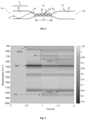
- Figure 3 illustrates a spectre of the optical signal through optical fiber 14 over time with the intensity of the signal shown in increasingly deep shades of grey, different chemical species can be identified within the electrode.
- the optical signal O has a high intensity at a wavelength corresponding to a wavenumber of 900cm -1 is acquired. This particular wavelength corresponds to the signature wavelength of NaPF 6 .
- the presence of NaPF 6 can be attested from 0,5h after the beginning of the cycling of the battery.
- DMC dimethyl carbonate
- a series of wavelengths for which the intensity of the optical signal is high is identified.
- This series of wavelengths are signature wavelengths of fluoroethylene carbonate (FEC).
- FEC fluoroethylene carbonate
- FIG. 4 Another example can be seen on Figure 4 , where the spectrum of the optical signal through optical fiber 14 over time has been plotted to identify different chemical species within an electrode, and is compared to a plot of the voltage over time within the battery cell 12 to link the cycling and the spectrum.
- the identified chemical species are shown above or under the characteristic peaks (wavenumber for which a high intensity is detected and recorded).
- the processor associates the recorded optical signal intensities of said signature wavelength to a molar quantity of the at least one predetermined chemical species.
- the spectra database can include a calibration curve associating a molar quantity of the at least one predetermined chemical species to the intensity of the optical signal for a particular wavelength.
- Such a calibration curve can be obtained by taking into account that the fraction of the light absorbed depends on the concentration and the absorption wavelength.
- a ( ⁇ p ) is the absorbance of a solution containing several chemical species
- L is the Waveguide length in cm (length of the fiber 14)
- c is the concentration on mol L -1
- ⁇ pi ( ⁇ p ) is the molar absorption of the i species in L mol -1 cm -1 .
- ⁇ A ⁇ 1 L . [ ⁇ 11 ⁇ 1 c 1 + ⁇ 12 ⁇ 1 c 2 + ⁇ + ⁇ 1 N ⁇ 1 c N
- a ⁇ 2 L . [ ⁇ 21 ⁇ 2 c 1 + ⁇ 22 ⁇ 2 c 2 + ⁇ + ⁇ 2 N ⁇ 2 c N ...
- a ⁇ p L . [ ⁇ p 1 ⁇ p c 1 + ⁇ p 2 ⁇ p c 2 + ⁇ + ⁇ pN ⁇ p c N
- the invention may be used to characterize the chemical species within any kind of batteries.
- the invention may characterize typical solvents used in organic electrolytes such as :
- the invention is also suited to characterize typical additives used in organic electrolytes such carbonate (Vinylene carbonate, Fluoroethylene carbonate), tris(trimethylsilyl)phosphite (TMSPi) and succinonitrile (SN), lithiumbis(oxalato)borate (LiBOB), and any mixture thereof.
- carbonate Vinyl carbonate, Fluoroethylene carbonate
- TMSPi tris(trimethylsilyl)phosphite
- SN succinonitrile
- LiBOB lithiumbis(oxalato)borate
- the invention is also suited to characterize typical salts used in organic electrolytes such as fluorinated salts like Lithium hexafluorophosphate (LiPF6) or Sodium hexafluorophosphate (NaPF6).
- fluorinated salts like Lithium hexafluorophosphate (LiPF6) or Sodium hexafluorophosphate (NaPF6).
- the invention therefore allows to record in real-time, in operando, the decomposition of electrolytes, the appearance of chemical species and even quantify them. This opens the way to better understanding the degradation mechanism and instabilities of electrolytes which are linked to the apparition of certain chemical species, and therefore provide guidance to cure such parasitic reactions to enhance battery lifetime.
- the formation of the SEI may be closely monitored using the invention.
- the method according to the invention can be adapted to any kind of battery cell, rendering it particularly convenient.
Landscapes
- Physics & Mathematics (AREA)
- Chemical & Material Sciences (AREA)
- Spectroscopy & Molecular Physics (AREA)
- Pathology (AREA)
- General Health & Medical Sciences (AREA)
- Immunology (AREA)
- General Physics & Mathematics (AREA)
- Biochemistry (AREA)
- Health & Medical Sciences (AREA)
- Life Sciences & Earth Sciences (AREA)
- Analytical Chemistry (AREA)
- Chemical Kinetics & Catalysis (AREA)
- Engineering & Computer Science (AREA)
- Manufacturing & Machinery (AREA)
- Electrochemistry (AREA)
- General Chemical & Material Sciences (AREA)
- Mathematical Physics (AREA)
- Theoretical Computer Science (AREA)
- Investigating Or Analysing Materials By Optical Means (AREA)
- Optical Fibers, Optical Fiber Cores, And Optical Fiber Bundles (AREA)
Abstract
Method for operando characterization of the chemical composition of a battery cell (12), comprising the following steps :
- inserting an optical fiber (14) made of chalcogenide glass through the battery cell (12),
- cycling the battery (12),
- while cycling the battery (12), generating an optical signal and transmitting it through the optical fiber (14),
- detecting, using an infrared spectrometer (20), the transmitted optical signal at an output extremity (140) of the optical fiber (14),
- recording the detected optical signal over time,
- locating signature wavelengths for which the optical signal intensity is above a predetermined threshold within the spectrum,
- associating said located signature wavelengths to at least one predetermined chemical species.
- inserting an optical fiber (14) made of chalcogenide glass through the battery cell (12),
- cycling the battery (12),
- while cycling the battery (12), generating an optical signal and transmitting it through the optical fiber (14),
- detecting, using an infrared spectrometer (20), the transmitted optical signal at an output extremity (140) of the optical fiber (14),
- recording the detected optical signal over time,
- locating signature wavelengths for which the optical signal intensity is above a predetermined threshold within the spectrum,
- associating said located signature wavelengths to at least one predetermined chemical species.
Description
- The invention relates to the field of batteries, and more particularly the field of characterizing the chemical species involved in the formation of the solid electrolyte interface layer (SEI) for batteries, that are forming upon battery cycling and the observation of the electrolyte degradation which include but not limit to Lithium ion (Li-ion) and Sodium-ion (Na-ion) batteries.
- With batteries being increasingly used in both the transport and power sectors, there exists a need to increase their reliability and performance.
- It is well-known in the field of batteries that the formation of the SEI layer, a passivating film that results from the self-limited partial catalytic decomposition of the electrolyte at the electrode surfaces for potentials beyond its range of thermodynamic stability, is one of the major factors influencing the performance of the battery cell over time. Indeed, even though the formation of the SEI Layer is essential for the battery cell to function, if it occurs in excess, it may lead to undesirable lithium ions consumption, significant increases in impedance, and the reduction of the active electrode area, leading to a decrease of the performance of the battery cell over time. As such, the formation of SEI and its stability, which mainly controls the cell lifetime is a critical and expensive step in cell manufacturing, rendering the protocols as trade secrets among the manufacturers. Similarly, based on the dynamic nature of the SEI, knowing the chemical evolution of the electrolyte when ageing or upon cycling is important in order to have a better understanding of the degradation phenomena
- In the past, sensing activities within the field of batteries have mainly relied on the use of sensors placed outside, rather than inside battery cells. Knowledge of the internal chemical and/or physical parameters is therefore limited. More recently, the development of implantable optical sensors that can measure, via non-disruptive approaches, multiple parameters such as temperature, pressure, strain, electrolyte composition, and heat flow with high sensitivity at various locations within the cells has been developed. To that end, together with the relative signal stability of the optical signal and their suitability for wavelength multiplexing, physicists back in 2013 began using SMF-FBG (Single Mode Fiber - Fiber Bragg Grating) sensors.
- However, these techniques do not allow knowing the nature and the formulae of the chemical species, which are necessary to fully understand the cascade-reactions mechanism leading to the formation of the SEI. The invention aims to overcome this limitation by allowing the identification of the electrolyte decomposition pathway and the chemical composition parasitic chemical species, such as alkyl carbonates and polyethylene glycol, forming the SEI.
- To that end, the invention relates to a method for operando characterization of the chemical composition of a battery cell, comprising the following steps :
- inserting an optical fiber made of chalcogenide glass through the battery cell,
- generating an optical signal and transmitting it through the optical fiber,
- detecting, using an infrared spectrometer, the transmitted optical signal at an output extremity of the optical fiber,
- recording the detected optical signal over time,
- locating signature wavelengths for which the optical signal intensity is above a predetermined threshold,
- associating said located signature wavelengths to at least one predetermined chemical species.
- The invention is based on the realization that the organic electrolyte and its decomposition products interact by absorption with infrared radiation within the 3 to 15 microns wavelength region. The invention aims to take advantage of this by considering transmitting an infrared signal within the electrolyte and to identify chemical species that appear while cycling the battery and affect said infrared signal using spectrometry. However, traditional silica (SiO2) optical fibers, commonly used in telecommunications, transmit solely in the 0.8 to 2 microns wavelengths, hence rendering infrared detection impossible.
- An aspect of the invention is therefore to use chalcogenide (Sulfides, Selenides, Tellurides) glasses that can transmit over the 3 to 13 microns wavelengths : by inserting a chalcogenide optical fiber through a battery cell and transmitting an optical signal through said fiber, the evanescent wave from the optical fiber will interact with the electrolyte of the battery cell and especially the organic solvents decomposition products that will appear during cycling of the battery. This in turn will affect the transmitted optical signal at an output extremity of the optical fiber. Thus, by recording said signal, establishing a spectrum of the recorded optical signal, locating signature peaks of the spectrum and associating said located signature peaks to predetermined chemical species, it is possible to identify the degradation and formation of chemical species during battery cycling and/or ageing, but also at which point in this cycling they appear. In further applications it is also possibly to asses the molar quantity of these chemical species.
- The invention therefore allows to record in real-time, in operando, the appearance of chemical species and even quantify them. This opens the way to better understanding the degradation mechanism and instabilities of electrolytes which are linked to the apparition of certain chemical species, and therefore provide guidance to cure such parasitic reactions to enhance battery lifetime. In particular, the formation of the SEI, may be closely monitored using the invention. In addition, owing to this real-time knowledge of the chemical composition of the electrolyte, one may study the influence of different parameters such as temperature, current, voltage, etc. on the battery cycling. Finally, the method according to the invention can be adapted to any kind of battery cell, rendering it particularly convenient.
- According to a particular embodiment of the invention, the method further comprises a step of cycling the battery, wherein the steps of generating an optical signal and transmitting it through the optical fiber, detecting, the transmitted optical signal at an output extremity of the optical fiber, and recording the detected optical signal over time are performed while cycling the battery. This in particular allows to identify the degradation and formation of chemical species during battery cycling
- Preferably, to simplify the location of the signature wavelengths and their association to predetermined chemical species, after recording the detected optical signal over time, the method comprises a step of establishing a spectrum of said recorded optical signal.
- In order to obtain not only the chemical composition of the battery, but also quantify the thus-characterized chemical species, the method further comprises a step of associating the recorded optical signal intensities of said signature wavelength to a molar quantity of the at least one predetermined chemical species.
- To facilitate the characterization of the chemical species, the step of associating signature peaks to at least one predetermined chemical species includes a step of comparing the located signatures wavelengths to a spectra database associating particular infrared wavelengths to predetermined chemical species.
- Preferably, the spectra database also includes a calibration curve associating a molar quantity of the at least one predetermined chemical species to the intensity of the optical signal for a particular wavelength.
- Accord to particular embodiment of the invention, the method comprises a prior step of establishing the spectra database. Another possibility is to use already-established tables that provide absorption frequencies, usually expressed in wave numbers, for common types of molecular bonds and functional groups.
- Accord to particular embodiment of the invention, the step of establishing the spectra database comprises the following sub-steps :
- inserting an optical fiber made of chalcogenide glass in a solution of a predetermined chemical species,
- detecting, using the infrared spectrometer, the transmitted optical signal at an output extremity of the optical fiber,
- recording the detected optical signal,
- locating a wavelength or a set of wavelength for which the recorded optical signal has an intensity above a predetermined threshold,
- entering within the spectra database the association of said wavelength or a set of wavelength to said predetermined chemical species.
- In order to be able to quantify the quantity of chemical species within the battery, the molar quantity of the predetermined chemical species within the solution is recorded and the association of the intensity of the recorded optical signal of the wavelength or set of wavelengths and the molar quantity of the predetermined chemical species is entered in the database.
- According to a particular embodiment of the invention, the optical fiber is embedded in an electrode of the battery cell. This allows to characterize the chemical species within the electrode of the battery.
- According to a particular embodiment of the invention, the optical fiber is inserted through the electrolyte of the battery cell. This allows to characterize the chemical species within the electrolyte of the battery.
- Preferably, the optical fiber is made from a material comprising essentially Te2As3Se5 glass. This kind of chalcogenide glass is particularly suited to the invention as it easily is transparent to infrared signals the wavelengths or which are absorbed by the typical chemical species of batteries. An optical fiber according to
FR2958403 - Preferably, the diameter of the optical fiber is comprised between 100 and 400 µm. Indeed, should its diameter be above 400 µm, the fiber becomes rigid and inconvenient to connect to distant apparatuses. On the other hand, should its diameter be under 100 µm, it becomes to fragile or difficult to handle.
- Preferably, in order to be able to transmit infrared signals the wavelengths or which are absorbed by the typical chemical species of batteries, the chalcogenide glass of the optical fiber is transparent to an electromagnetic radiation the wavenumber of which is comprised between 2 and 12 µm.
- The invention also concerns a characterization device for identifying the chemical species within a battery cell, comprising :
- an optical fiber made of chalcogenide glass inserted through the battery cell,
- an electrical power source for charging and discharging the battery,
- an infrared optical signal generator generating, while cycling the battery, an optical signal through the optical fiber,
- a detector detecting the optical signal transmitted through the optical fiber at an output extremity of the optical fiber,
- a memory for recording the detected optical signal,
- a processor locating signature wavelengths for which the optical signal intensity is above a predetermined threshold within the spectrum and associating said located signature wavelengths to at least one predetermined chemical species.
- According to a particular embodiment of the invention, the optical signal generator and detector are comprised within a spectrometer which is a Fourier transformed infrared spectrometer, preferably including a Mercury-cadmium-telluride detector with for example a spectral range comprised between 12000 cm-1 and 600 cm-1. This kind of apparatus is particularly well-suited for putting the invention into practice as it is convenient to use and provides a suitable precision.
- The invention will be better understood in view of the following description, referring to the annexed Figures in which:
-
Figure 1 is a schematic figure of a characterization device according to a particular embodiment of the invention ; -
Figure 2 is a schematic cut-off figure of the optical fiber of the characterization device ofFigure 1 ; -
Figure 3 is a first graph illustrating a spectrum obtained using the characterization device and method according to the invention ; -
Figure 4 is a second graph illustrating a spectrum obtained using the characterization device and method according to the invention and a graph illustrating the cycling of the battery ofFigure 1 . - A
characterization device 10 for identifying the chemical species within abattery cell 12 is shown onFigure 1 . -
Characterization device 10 comprises anoptical fiber 14 made of chalcogenide glass inserted through thebattery cell 12. Battery cell is preferably a Na-ion or Li-ion battery, and can have different formats such as a 18650, pouch, CR2032 or swagelock. OnFigure 1 , the battery cell is a 18650 cell. Naturally, it should be noted that these are merely examples of types and formats of battery cells and the invention may be used for any type of battery cell. - As can be seen on
Figure 1 , theoptical fiber 14 is inserted through (embedded into) anelectrode 16 of thebattery cell 12. Theelectrode 16 can be either the positive, the negative electrode. As an alternative, theoptical fiber 14 passes through the jelly roll of thebattery cell 12 in its central space. - This allows to characterize the chemicals species within the
electrode 16 material (either negative or positive). However, according to another embodiment, theoptical fiber 14 may be inserted through the electrolyte of thebattery cell 12 in order to characterize the chemicals species within the electrolyte. In that case,fiber 14 is integrated in the electrolyte between the separators (not shown on the Figures) ofbattery cell 12. - For example, the integration of the optical fiber into a 18650
cell 12 is presented inFigure 1 . The 18650-instrumented cell is drilled with two holes of 0.8 mm on the center of the negative and positive sides of thecell 12 to allow thefiber 14 to pass through the central void of the jellyroll. The drilledcell 12 is dried under vacuum overnight at 80°C and introduce in argon-filled glove box. Using a needle (for example of a diameter of 0.45 mm) as a guide, theoptical fiber 14 with a length of about 60 centimeters is passed through thecell 12. Once thefiber 14 is placed with approximately the same length of fiber going out from each part of the cell, the hole on the positive electrode side is closed with epoxy and cured for 24 hours. Then, about 5.3 ml of electrolyte is injected from the hole on the negative side. Finally, the second hole is also sealed with epoxy and cured for 24 hours. - Preferably,
optical fiber 14 is made from a material comprising essentially Te2As3Se5 glass. It should be noted that a material "comprising essentially" Te2As3Se5 glass means that comprises at least 99% Te2As3Se5 glass. For instance, impurities such as hydrogen can be occasionally found in the glass but do not factor for more than 1% of the optical fiber. This kind of chalcogenide glass is particularly suited to the invention as it easily is transparent to infrared signals the wavelengths or which are absorbed by the typical chemical species of batteries. In addition the glass transition of the Te2As3Se5 fiber is 137 °C, which allows the integration inbattery cells 12. - The diameter of the
optical fiber 14 is preferably comprised between 100 and 400 µm. Indeed, should its diameter be above 400 µm, the fiber becomes rigid and inconvenient to connect to distant apparatuses. The diameter of theoptical fiber 14 might be constant or thefiber 14 may be locally tapered to improve detection, as exemplified above. On the other hand, should its diameter be under 100 µm, it becomes to fragile or difficult to handle. - Preferably, in order to be able to transmit infrared signals the wavelengths or which are absorbed by the typical chemical species of batteries, the chalcogenide glass of
optical fiber 14 is transparent to an electromagnetic radiation the wavenumber of which is comprised between 2 and 12 µm. In other words,spectrometer 20 emits in the mid-range infrared. -
Characterization device 10 comprises anelectrical power source 18 for charging and discharging thebattery 12 in a sequential manner, also known as cycling thebattery 12. Such anelectrical power source 12 is known in itself and will not be described further. -
Characterization device 10 also comprises an infrared optical signal generator generating, while cycling the battery, an optical signal through theoptical fiber 14. The optical signal generator is the present case part of aspectrometer 20. A focusingaccessory 21 may be added to focus the infrared beam emitted by thespectrometer 20 as can be shown onFigure 1 . - The infrared optical signal is sent to
optical fiber 14 at aninput extremity 141 of theoptical fiber 14, shown on the left ofFigure 1 . - More particularly, as can be seen on
Figure 2 ,fiber 14 extends in a general longitudinal direction L betweeninput end 141 andoutput end 140. -
Fiber 14 comprises, from theinput end 141 to thesecond end 140, afirst fiber section 23 for guiding infrared waves, thisfirst section 23 being connected on its side remote from theinput end 141 to afirst point connection 24 of a second,detection section 25, saidsecond section 25 being connected by asecond point 26 remote from thefirst connection point 24 to athird fiber section 27 for guiding infrared waves. - The
second sensing section 25 of thefiber 2 has a transverse width in at least one dimension, a diameter or cross-section, which is less than the transverse width, or diameter or cross-section of thefirst section 23, and which is less than the transverse width, diameter or cross-section of thethird section 27. In other words, thesecond sensing section 25 is tapered. However, it is also possible to use afiber 14 that is homogenous diameter or cross-section along its entire length. - The
second sensing section 25 of thefiber 2 extends over a non-zero length L1 of thefiber 14 between the first and second connection points 24, 26 and between thefirst section 23 and thethird section 27. - For example, the
fiber 14 has an average diameter of about 400 µm in thefirst section 23 and in thethird section 27, while thefiber 14 has an average diameter of about 100 µm in thesecond detection section 25 for a length L1 of the second detection section of about 10 cm. Thefirst section 23 is longer than the length of thesecond detection section 25. Thethird section 27 has a length greater than the length L1 of thesecond detection section 25. - The
first connection point 24 is for example formed by a cross-sectional area tapering from thefirst section 23 to thesecond detection section 25, being for example truncated conical as shown infigure 2 . Thesecond connection point 26 has for example a cross-section widening from thesecond detection section 25 to thethird section 27, being for example truncated conical in shape as shown infigure 2 . Between the first and second connection points 24, 26, thesecond detection section 25 has for example a constant cross-sectional width and/or a constant cross-sectional diameter and/or a constant cross-section. - The
second detection section 25 is intended to come into contact with an external medium in order to detect the disturbances brought by this external medium to the propagation of the infrared waves in thefiber 14. In this particular embodiment,second detection section 25 being tapered, it makes theoptical fiber 14 more sensitive to those disturbances it allows more reflections of the infrared waves withinsecond section 25. -
Figure 2 shows the path of an optical signal O, here an infrared wave, sent from theinput end 141 into thesection 23 by thick arrows inside thefiber 14. Due to the narrowing of the cross-section of thefiber 14. in thesecond detection section 25, there are more reflections of the wave in thissecond section 25 against theouter surface 14S of thefiber 14. - When an external medium is brought into contact with the
second sensing section 25, the propagation of the infrared wave O in thissecond section 25 is disturbed, due to the fact that a portion of the infrared wave O passes from thesecond section 25 to the external medium. Therefore, the contact of thesecond detection section 25 with an external medium will have an influence on the infrared wave O which will be transmitted fromfirst section 23 tothird section 27. - To be more precise, infrared wave O propagates through the
fiber 14 by a series of total internal reflections withinsecond section 25. The interference between the incident and reflected optical signal waves results in the generation of anevanescent wave field 28 inside the sample, which is a function of its refractive index and which amplitude decreases exponentially from the fiber core. Theevanescent wave field 28 will be partially absorbed at each reflection leading to a reduction of the corresponding wavelength in the transmission spectra. - The number of reflections (N) is a function of the fiber length (L), its diameter (d) and the angle of incidence of the light from normal (θ):

- Here, the external medium being the
electrode 16, or the electrolyte in other variants, ofbattery cell 12, the chemical composition of theelectrode 16, notably bonds of the molecules composing the chemical components, will have an influence of the infrared wave O transmitted frominput end 141 tooutput end 140. - The working principle behind the invention is to take advantage of this fact and use fiber evanescent wave spectroscopy.
- Hence,
characterization device 10 comprises adetector 30 detecting the optical signal transmitted through theoptical fiber 14 at an output extremity of theoptical fiber 140 as theoptical fiber 14 is used in a transmission mode. - However, in another, non-illustrated variant,
detector 30 could be placed at theinput 141 extremity of the optical fiber in case it is used in a reflection mode. In that case, a mirror is placed at theoutput extremity 140 of the fiber. - It should also be noted that even though
detector 30 is a separate device fromspectrometer 20 onFigure 1 , this is only an exemplary embodiment asdetector 30 can be comprised withinspectrometer 20. -
Detector 30 preferably is a mecury-cadmium-telluride (MCT) detector cooled with liquid nitrogen. The spectral range ofdetector 30 may for example be comprised between 12000 cm-1 and 600 cm-1. - The amplitude of the optical signal O is controlled - around 10000 for a 150 µm diameter and 70 cm long Te2As3Se5 fiber. For all the spectra, 100 scans are acquired. The resolution is for example 4 cm-1. Preferably, the background is acquired before or after the injection of the electrolyte in the
cell 12. - Focusing
accessory 21,battery cell 12,optical fiber 14 anddetector 30 are advantageously placed within apurge chamber 34 for purging any parasite chemical component such as the outside ambient air, and in particular carbon dioxide (CO2) which is a chemical species of particular interest in the context of observing the decomposition of an electrolyte for example. -
Characterization device 10 also comprises a memory (not shown on the - Figures) for recording the detected optical signal O. Said memory may be included within the spectrometer or within a computer (not shown) connected to the
spectrometer 20. -
Characterization device 10 also comprises a processor (not shown on the - Figures), for example located within the
spectrometer 20 or within a computer, locating signature wavelengths for which the optical signal O intensity is above a predetermined threshold. In other words, peaks of the optical signal O are detected. - Preferably, to simplify the location of the signature wavelengths and their association to predetermined chemical species, after recording the detected optical signal over time, the
spectrometer 20 establish a spectrum of said recorded optical signal O. - Then, the processor associates said located signature wavelengths, or spectrum peaks, to at least one predetermined chemical species.
- To facilitate the characterization of the chemical species, associating signature peaks to at least one predetermined chemical species involves comparing the located signatures wavelengths to a spectra database associating particular infrared wavelengths to predetermined chemical species.
- The spectra database may be established earlier on by inserting the
optical fiber 14 in a solution of a pure, predetermined chemical species. Then, using theinfrared spectrometer 20, the transmitted optical signal O is detected and recorded, and a wavelength or a set of wavelength for which the recorded optical signal has an intensity above a predetermined threshold are detected. Thus, the signatures wavelengths of said species are obtained and entered within the spectra database. This can be repeated for different expected predetermined chemical species. - Another possibility is to use already-established tables that provide absorption frequencies, usually expressed in wave numbers, for common types of molecular bonds and functional groups.
- An illustration of the results obtained through the use of a device according to the invention can be seen on
Figure 3. Figure 3 illustrates a spectre of the optical signal throughoptical fiber 14 over time with the intensity of the signal shown in increasingly deep shades of grey, different chemical species can be identified within the electrode. At 0,5h, the optical signal O has a high intensity at a wavelength corresponding to a wavenumber of 900cm-1 is acquired. This particular wavelength corresponds to the signature wavelength of NaPF6. Thus, the presence of NaPF6 can be attested from 0,5h after the beginning of the cycling of the battery. - In the same way, at 0,5h, a series of wavelengths for which the intensity of the optical signal is high is identified. This series of wavelengths are signature wavelengths of dimethyl carbonate (DMC). Thus, the presence of DMC can be attested from 0,5h after the beginning of the cycling of the battery.
- In the same way, at 1 h, a series of wavelengths for which the intensity of the optical signal is high is identified. This series of wavelengths are signature wavelengths of fluoroethylene carbonate (FEC). Thus, the presence of FEC can be attested from 1h after the beginning of the cycling of the battery.
- Another example can be seen on
Figure 4 , where the spectrum of the optical signal throughoptical fiber 14 over time has been plotted to identify different chemical species within an electrode, and is compared to a plot of the voltage over time within thebattery cell 12 to link the cycling and the spectrum. The identified chemical species are shown above or under the characteristic peaks (wavenumber for which a high intensity is detected and recorded). - Preferably, in order to obtain not only the chemical composition of the battery, but also quantify the thus-characterized chemical species, the processor associates the recorded optical signal intensities of said signature wavelength to a molar quantity of the at least one predetermined chemical species.
- To that end, the spectra database can include a calibration curve associating a molar quantity of the at least one predetermined chemical species to the intensity of the optical signal for a particular wavelength.
- Such a calibration curve can be obtained by taking into account that the fraction of the light absorbed depends on the concentration and the absorption wavelength. In order to quantify the species that are present within a medium, the Beer-Lambert law for evanescent fiber is then transformed into :

- Thus, for a chemical species characterized by p wavelengths, the Beer-Lambert law for evanescent fiber can be translated into :

- To determine the coefficient εpi (λp ), different solutions of different concentrations (or different molar quantities) of a predetermined chemical species are prepared, and a linear regression of the absorbance against the concentration of the chemical species can be plotted. Then the association of the intensity of the recorded optical signal of the signature wavelength or set of wavelengths to the concentration of the predetermined chemical species is entered in the spectra database. This allows to calibrate the device and the method according the invention.
- The invention may be used to characterize the chemical species within any kind of batteries. In particular, the invention may characterize typical solvents used in organic electrolytes such as :
- Cyclic ethers (tetrahydrofurane, dioxane, 1,3-dioxolane) ;
- Linear ethers (methyl, ethyl and propyl formate, methyl and ethyl acetate, methyl and ethyl propionate) aliphatic ethers ;
- Linear carbonates (ethylene carbonate, dimethyl carbonate, ethyl methyl carbonate, diethyl carbonate) ;
- Cyclic carbonates (ethylene carbonate, propylene carbonate, 1,2-butylene carbonate, 2,3-butylene carbonate) ;
- Fluorinated (4-fluorotoluene, 1,1,2,2-
tetrafluoroethyl - aqueous electrolytes, where the solvent is water mixed with an acid (H2SO4), a base (KOH), or a salt (ZnCl2),
- any mixtures of the above.
- The invention is also suited to characterize typical additives used in organic electrolytes such carbonate (Vinylene carbonate, Fluoroethylene carbonate), tris(trimethylsilyl)phosphite (TMSPi) and succinonitrile (SN), lithiumbis(oxalato)borate (LiBOB), and any mixture thereof.
- The invention is also suited to characterize typical salts used in organic electrolytes such as fluorinated salts like Lithium hexafluorophosphate (LiPF6) or Sodium hexafluorophosphate (NaPF6).
- The invention therefore allows to record in real-time, in operando, the decomposition of electrolytes, the appearance of chemical species and even quantify them. This opens the way to better understanding the degradation mechanism and instabilities of electrolytes which are linked to the apparition of certain chemical species, and therefore provide guidance to cure such parasitic reactions to enhance battery lifetime. In particular, the formation of the SEI, may be closely monitored using the invention. In addition, owing to this real-time knowledge of the chemical composition of the electrolyte, one may study the influence of different parameters such as temperature, current, voltage, etc. on the battery cycling. Finally, the method according to the invention can be adapted to any kind of battery cell, rendering it particularly convenient.
-
- 10 :
- Characterization device
- 12 :
- Battery cell
- 14 :
- Optical fiber
- 141 :
- input end of the fiber
- 140 :
- Output end of the fiber
- 16 :
- Electrode of the cell
- 18 :
- Electrical power source
- 20 :
- Spectrometer
- 23 :
- First section of the fiber
- 24 :
- First connection point of the fiber
- 25 :
- Second section of the fiber
- 26 :
- Second connection point of the fiber
- 27 :
- Third section of the fiber
- 28 :
- Evanescent wave field
- 30 :
- Detector
- 34 :
- Purge chamber
- L :
- Longitudinal direction of the fiber
- L1 :
- Length of the second detection section
- O :
- Optical signal
Claims (16)
- Method for operando characterization of the chemical composition of a battery cell (12), comprising the following steps :- inserting an optical fiber (14) made of chalcogenide glass through the battery cell,- generating an optical signal (O) and transmitting it through the optical fiber (14),- detecting, using an infrared spectrometer (20), the transmitted optical signal (O) at an output extremity (140) of the optical fiber (14),- recording the detected optical signal (O) over time,- locating signature wavelengths for which the optical signal (O) intensity is above a predetermined threshold,- associating said located signature wavelengths to at least one predetermined chemical species.
- Characterization method according to claim 1, wherein it further comprises a step of cycling the battery, wherein the steps of generating an optical signal (O) and transmitting it through the optical fiber (14), detecting, the transmitted optical signal (O) at an output extremity (140) of the optical fiber (14), and recording the detected optical signal over time are performed while cycling the battery (12).
- Characterization method according to claim 1 or 2, wherein it includes, after recording the detected optical signal (O) over time, a step of establishing a spectrum of said recorded optical signal (O).
- Characterization method according to any one of the preceding claims, wherein it further comprises a step of associating the recorded optical signal (O) intensities of said signature wavelength to a molar quantity of the at least one predetermined chemical species.
- Characterization method according to any one of the preceding claims, wherein the step of associating signature peaks to at least one predetermined chemical species includes a step of comparing the located signatures wavelengths to a spectra database associating particular infrared wavelengths to predetermined chemical species.
- Characterization method according to claim 5, wherein the spectra database also includes a calibration curve associating a molar quantity of the at least one predetermined chemical species to the intensity of the optical signal (O) for a particular wavelength.
- Characterization method according to any one of claims 4 to 6, wherein it comprises a prior step of establishing the spectra database.
- Characterization method according to claim 7 wherein the step of establishing the spectra database comprises the following sub-steps :- inserting an optical fiber (14) made of chalcogenide glass in a solution of a predetermined chemical species,- detecting, using the infrared spectrometer (20), the transmitted optical signal at an output extremity of the optical fiber (14),- recording the detected optical signal (O),- locating a wavelength or a set of wavelength for which the recorded optical signal (O) has an intensity above a predetermined threshold,- entering within the spectra database the association of said wavelength or a set of wavelength to said predetermined chemical species.
- Characterization method according to claim 8, wherein the molar quantity of the predetermined chemical species within the solution is recorded and the association of the intensity of the recorded optical signal (O) of the wavelength or set of wavelengths and the molar quantity of the predetermined chemical species is entered in the database.
- Characterization method according to any one of the preceding claims, wherein the optical fiber (14) is embedded in an electrode of the battery cell (12).
- Characterization method according to any one of claims 1 to 10, wherein the optical fiber (14) is inserted through the electrolyte of the battery cell (12).
- Characterization method according to any one of the preceding claims, wherein the optical fiber (14) is made from a material comprising essentially Te2As3Se5 glass.
- Characterization method according to any one of the preceding claims, wherein the diameter of the optical fiber (14) is comprised between 100 and 400 µm.
- Characterization method according to any one of the preceding claims, wherein the chalcogenide glass of the optical fiber (14) is transparent to an electromagnetic radiation the wavenumber of which is comprised between 2 and 12 µm.
- Characterization device for identifying the chemical species within a battery cell, comprising :- an optical fiber (14) made of chalcogenide glass inserted through the battery cell (12),- an electrical power source (18) for charging and discharging the battery (12),- an infrared optical signal generator (20) generating, while cycling the battery (12), an optical signal through the optical fiber (14),- a detector (30) detecting the optical signal (O) transmitted through the optical fiber (14) at an output extremity (140) of the optical fiber,- a memory for recording the detected optical signal (O),- a processor locating signature wavelengths for which the optical signal (O) intensity is above a predetermined threshold within the spectrum and associating said located signature wavelengths to at least one predetermined chemical species.
- Characterization device according to claim 15, wherein the optical signal generator and detector (30) are comprised within a spectrometer (20), which is a Fourier transformed infrared spectrometer, preferably including a Mercury-cadmium-telluride detector with for example a spectral range comprised between 12000 cm-1 and 600 cm-1.
Priority Applications (5)
| Application Number | Priority Date | Filing Date | Title |
|---|---|---|---|
| EP21306068.4A EP4124849A1 (en) | 2021-07-30 | 2021-07-30 | Method for operando characterization of chemical species within a battery using infrared spectroscopy |
| PCT/EP2022/071395 WO2023006966A1 (en) | 2021-07-30 | 2022-07-29 | Method for operando characterization of chemical species within a battery using infrared evanescent wave spectroscopy |
| EP22754890.6A EP4377675A1 (en) | 2021-07-30 | 2022-07-29 | Method for operando characterization of chemical species within a battery using infrared evanescent wave spectroscopy |
| JP2024505415A JP2024528915A (en) | 2021-07-30 | 2022-07-29 | Method for operando analysis of chemical species in batteries using infrared evanescent wave spectroscopy |
| US18/292,778 US20250085214A1 (en) | 2021-07-30 | 2022-07-29 | Method for operando characterization of chemical species within a battery using infrared evanescent wave spectroscopy |
Applications Claiming Priority (1)
| Application Number | Priority Date | Filing Date | Title |
|---|---|---|---|
| EP21306068.4A EP4124849A1 (en) | 2021-07-30 | 2021-07-30 | Method for operando characterization of chemical species within a battery using infrared spectroscopy |
Publications (1)
| Publication Number | Publication Date |
|---|---|
| EP4124849A1 true EP4124849A1 (en) | 2023-02-01 |
Family
ID=77666427
Family Applications (2)
| Application Number | Title | Priority Date | Filing Date |
|---|---|---|---|
| EP21306068.4A Withdrawn EP4124849A1 (en) | 2021-07-30 | 2021-07-30 | Method for operando characterization of chemical species within a battery using infrared spectroscopy |
| EP22754890.6A Pending EP4377675A1 (en) | 2021-07-30 | 2022-07-29 | Method for operando characterization of chemical species within a battery using infrared evanescent wave spectroscopy |
Family Applications After (1)
| Application Number | Title | Priority Date | Filing Date |
|---|---|---|---|
| EP22754890.6A Pending EP4377675A1 (en) | 2021-07-30 | 2022-07-29 | Method for operando characterization of chemical species within a battery using infrared evanescent wave spectroscopy |
Country Status (4)
| Country | Link |
|---|---|
| US (1) | US20250085214A1 (en) |
| EP (2) | EP4124849A1 (en) |
| JP (1) | JP2024528915A (en) |
| WO (1) | WO2023006966A1 (en) |
Citations (3)
| Publication number | Priority date | Publication date | Assignee | Title |
|---|---|---|---|---|
| US5949219A (en) * | 1998-07-24 | 1999-09-07 | The United States Of America As Represented By The United States Department Of Energy | Optical state-of-charge monitor for batteries |
| FR2958403A1 (en) | 2010-04-01 | 2011-10-07 | Univ Rennes | EVANESCENT INFRARED WAVE SENSOR AND METHOD FOR MANUFACTURING THE SAME |
| WO2021019405A1 (en) * | 2019-07-26 | 2021-02-04 | Cambridge Enterprise Limited | Fibre-optic sensing apparatus and method |
Family Cites Families (8)
| Publication number | Priority date | Publication date | Assignee | Title |
|---|---|---|---|---|
| US5239176A (en) * | 1991-10-03 | 1993-08-24 | Foster-Miller, Inc. | Tapered optical fiber sensing attenuated total reflectance |
| JP5328573B2 (en) * | 2009-09-03 | 2013-10-30 | 三菱電機株式会社 | Idle stop control device and idle stop control method |
| JP2015197961A (en) * | 2014-03-31 | 2015-11-09 | 株式会社日産アーク | Manufacturing system and manufacturing method of lithium ion secondary battery, and quality management system and quality management method of electrolyte of lithium ion secondary battery in manufacturing method |
| US9583796B2 (en) * | 2014-04-01 | 2017-02-28 | Palo Alto Research Center Incorporated | Method for monitoring/managing electrochemical energy device by detecting intercalation stage changes |
| US9553465B2 (en) * | 2014-04-21 | 2017-01-24 | Palo Alto Research Center Incorporated | Battery management based on internal optical sensing |
| CN108593735B (en) * | 2018-04-12 | 2019-12-24 | 暨南大学 | Optical fiber online monitoring system and method for charging state of energy storage equipment |
| CN110132893B (en) * | 2019-05-16 | 2021-12-28 | 江苏科信光电科技有限公司 | Gas detector based on optical fiber structure |
| CN112054254B (en) * | 2020-08-18 | 2022-02-18 | 暨南大学 | Battery optical fiber in-situ detection system and method |
-
2021
- 2021-07-30 EP EP21306068.4A patent/EP4124849A1/en not_active Withdrawn
-
2022
- 2022-07-29 JP JP2024505415A patent/JP2024528915A/en active Pending
- 2022-07-29 WO PCT/EP2022/071395 patent/WO2023006966A1/en not_active Ceased
- 2022-07-29 US US18/292,778 patent/US20250085214A1/en active Pending
- 2022-07-29 EP EP22754890.6A patent/EP4377675A1/en active Pending
Patent Citations (3)
| Publication number | Priority date | Publication date | Assignee | Title |
|---|---|---|---|---|
| US5949219A (en) * | 1998-07-24 | 1999-09-07 | The United States Of America As Represented By The United States Department Of Energy | Optical state-of-charge monitor for batteries |
| FR2958403A1 (en) | 2010-04-01 | 2011-10-07 | Univ Rennes | EVANESCENT INFRARED WAVE SENSOR AND METHOD FOR MANUFACTURING THE SAME |
| WO2021019405A1 (en) * | 2019-07-26 | 2021-02-04 | Cambridge Enterprise Limited | Fibre-optic sensing apparatus and method |
Non-Patent Citations (3)
| Title |
|---|
| GHANNOUM ABDULRAHMAN ET AL: "Fiber optic monitoring of lithium-ion batteries: A novel tool to understand the lithiation of batteries", 2016 IEEE SENSORS, IEEE, 30 October 2016 (2016-10-30), pages 1 - 3, XP033036977, DOI: 10.1109/ICSENS.2016.7808695 * |
| SHUO CUI ET AL: "From Selenium- to Tellurium-Based Glass Optical Fibers for Infrared Spectroscopies", MOLECULES, vol. 18, no. 5, 10 May 2013 (2013-05-10), pages 5373 - 5388, XP055135674, DOI: 10.3390/molecules18055373 * |
| XUNSI WANG ET AL: "Investigations of GeTeAgI chalcogenide glass for far-infrared application", SPECTROCHIMICA ACTA PART A: MOLECULAR AND BIOMOLECULAR SPECTROSCOPY, ELSEVIER, AMSTERDAM, NL, vol. 86, 9 November 2011 (2011-11-09), pages 586 - 589, XP028341558, ISSN: 1386-1425, [retrieved on 20111118], DOI: 10.1016/J.SAA.2011.11.018 * |
Also Published As
| Publication number | Publication date |
|---|---|
| US20250085214A1 (en) | 2025-03-13 |
| WO2023006966A1 (en) | 2023-02-02 |
| JP2024528915A (en) | 2024-08-01 |
| EP4377675A1 (en) | 2024-06-05 |
Similar Documents
| Publication | Publication Date | Title |
|---|---|---|
| US20220268629A1 (en) | Spectral measurement method, spectral measurement system, and broadband pulsed light source unit | |
| CN105911020B (en) | Method for simultaneously measuring multi-component gas based on cavity ring-down spectroscopy | |
| CA3025935C (en) | Photothermal interferometry apparatus and method | |
| US9553465B2 (en) | Battery management based on internal optical sensing | |
| KR100487055B1 (en) | Photothermic transducing spectroscopic analyzer | |
| WO2021209961A1 (en) | Battery block comprising battery cells and a fiber-optic sensing systems for the in situ monitoring of said battery cells | |
| CN101949688B (en) | Tunable laser line width measuring method based on cavity ring-down spectroscopy | |
| CN103411686B (en) | Based on optical fiber scanning optical source wavelength caliberating device and the method for gas absorption spectrum line | |
| CN101251482B (en) | Mine Gas Remote Fiber Laser Detector | |
| Hedman et al. | Fibre Optic Sensor for Characterisation of Lithium‐Ion Batteries | |
| WO2021019405A1 (en) | Fibre-optic sensing apparatus and method | |
| CN110068548B (en) | Wavelength locking device and method for laser in off-axis integral cavity system | |
| Wang et al. | Gas concentration sensing based on fiber loop ring-down spectroscopy: a review | |
| CN118243630A (en) | A gas sensing device | |
| EP3517938B1 (en) | Optical detector and method for detection of a chemical compound | |
| CN117783048A (en) | A method and system for in-situ gas detection of energy storage batteries | |
| CN112903628B (en) | Trace gas detection method under negative pressure state | |
| US11796459B1 (en) | Method for measuring multiple parameters of mixed gases based on broadband infrared light source | |
| US20250085214A1 (en) | Method for operando characterization of chemical species within a battery using infrared evanescent wave spectroscopy | |
| CN114199809A (en) | Monolithic integrated infrared laser gas detection device | |
| CN114062274A (en) | Optical fiber photoacoustic sensing system and method for detecting dissolved gas in oil | |
| CN210375634U (en) | On-chip waveguide loss measuring device | |
| KR20010005783A (en) | Method of spectrochemical analysis of impurity in gas | |
| CN119470279A (en) | Antiresonant hollow core waveguide photothermal spectroscopy gas sensor | |
| de Barros et al. | Lead-acid battery electrolyte density sensor using heterocore optical fiber |
Legal Events
| Date | Code | Title | Description |
|---|---|---|---|
| PUAI | Public reference made under article 153(3) epc to a published international application that has entered the european phase |
Free format text: ORIGINAL CODE: 0009012 |
|
| STAA | Information on the status of an ep patent application or granted ep patent |
Free format text: STATUS: THE APPLICATION HAS BEEN PUBLISHED |
|
| AK | Designated contracting states |
Kind code of ref document: A1 Designated state(s): AL AT BE BG CH CY CZ DE DK EE ES FI FR GB GR HR HU IE IS IT LI LT LU LV MC MK MT NL NO PL PT RO RS SE SI SK SM TR |
|
| STAA | Information on the status of an ep patent application or granted ep patent |
Free format text: STATUS: THE APPLICATION IS DEEMED TO BE WITHDRAWN |
|
| 18D | Application deemed to be withdrawn |
Effective date: 20230802 |