EP4123789A1 - Battery device - Google Patents
Battery device Download PDFInfo
- Publication number
- EP4123789A1 EP4123789A1 EP21771489.8A EP21771489A EP4123789A1 EP 4123789 A1 EP4123789 A1 EP 4123789A1 EP 21771489 A EP21771489 A EP 21771489A EP 4123789 A1 EP4123789 A1 EP 4123789A1
- Authority
- EP
- European Patent Office
- Prior art keywords
- battery
- wall
- air passage
- housing
- chambers
- Prior art date
- Legal status (The legal status is an assumption and is not a legal conclusion. Google has not performed a legal analysis and makes no representation as to the accuracy of the status listed.)
- Pending
Links
Images



Classifications
-
- H—ELECTRICITY
- H01—ELECTRIC ELEMENTS
- H01M—PROCESSES OR MEANS, e.g. BATTERIES, FOR THE DIRECT CONVERSION OF CHEMICAL ENERGY INTO ELECTRICAL ENERGY
- H01M10/00—Secondary cells; Manufacture thereof
- H01M10/60—Heating or cooling; Temperature control
- H01M10/61—Types of temperature control
- H01M10/613—Cooling or keeping cold
-
- H—ELECTRICITY
- H01—ELECTRIC ELEMENTS
- H01M—PROCESSES OR MEANS, e.g. BATTERIES, FOR THE DIRECT CONVERSION OF CHEMICAL ENERGY INTO ELECTRICAL ENERGY
- H01M10/00—Secondary cells; Manufacture thereof
- H01M10/60—Heating or cooling; Temperature control
- H01M10/62—Heating or cooling; Temperature control specially adapted for specific applications
- H01M10/625—Vehicles
-
- H—ELECTRICITY
- H01—ELECTRIC ELEMENTS
- H01M—PROCESSES OR MEANS, e.g. BATTERIES, FOR THE DIRECT CONVERSION OF CHEMICAL ENERGY INTO ELECTRICAL ENERGY
- H01M10/00—Secondary cells; Manufacture thereof
- H01M10/60—Heating or cooling; Temperature control
- H01M10/65—Means for temperature control structurally associated with the cells
- H01M10/655—Solid structures for heat exchange or heat conduction
- H01M10/6554—Rods or plates
- H01M10/6555—Rods or plates arranged between the cells
-
- H—ELECTRICITY
- H01—ELECTRIC ELEMENTS
- H01M—PROCESSES OR MEANS, e.g. BATTERIES, FOR THE DIRECT CONVERSION OF CHEMICAL ENERGY INTO ELECTRICAL ENERGY
- H01M10/00—Secondary cells; Manufacture thereof
- H01M10/60—Heating or cooling; Temperature control
- H01M10/65—Means for temperature control structurally associated with the cells
- H01M10/655—Solid structures for heat exchange or heat conduction
- H01M10/6556—Solid parts with flow channel passages or pipes for heat exchange
- H01M10/6557—Solid parts with flow channel passages or pipes for heat exchange arranged between the cells
-
- H—ELECTRICITY
- H01—ELECTRIC ELEMENTS
- H01M—PROCESSES OR MEANS, e.g. BATTERIES, FOR THE DIRECT CONVERSION OF CHEMICAL ENERGY INTO ELECTRICAL ENERGY
- H01M10/00—Secondary cells; Manufacture thereof
- H01M10/60—Heating or cooling; Temperature control
- H01M10/65—Means for temperature control structurally associated with the cells
- H01M10/656—Means for temperature control structurally associated with the cells characterised by the type of heat-exchange fluid
- H01M10/6561—Gases
- H01M10/6563—Gases with forced flow, e.g. by blowers
-
- H—ELECTRICITY
- H01—ELECTRIC ELEMENTS
- H01M—PROCESSES OR MEANS, e.g. BATTERIES, FOR THE DIRECT CONVERSION OF CHEMICAL ENERGY INTO ELECTRICAL ENERGY
- H01M50/00—Constructional details or processes of manufacture of the non-active parts of electrochemical cells other than fuel cells, e.g. hybrid cells
- H01M50/20—Mountings; Secondary casings or frames; Racks, modules or packs; Suspension devices; Shock absorbers; Transport or carrying devices; Holders
- H01M50/204—Racks, modules or packs for multiple batteries or multiple cells
- H01M50/207—Racks, modules or packs for multiple batteries or multiple cells characterised by their shape
- H01M50/209—Racks, modules or packs for multiple batteries or multiple cells characterised by their shape adapted for prismatic or rectangular cells
-
- H—ELECTRICITY
- H01—ELECTRIC ELEMENTS
- H01M—PROCESSES OR MEANS, e.g. BATTERIES, FOR THE DIRECT CONVERSION OF CHEMICAL ENERGY INTO ELECTRICAL ENERGY
- H01M50/00—Constructional details or processes of manufacture of the non-active parts of electrochemical cells other than fuel cells, e.g. hybrid cells
- H01M50/20—Mountings; Secondary casings or frames; Racks, modules or packs; Suspension devices; Shock absorbers; Transport or carrying devices; Holders
- H01M50/249—Mountings; Secondary casings or frames; Racks, modules or packs; Suspension devices; Shock absorbers; Transport or carrying devices; Holders specially adapted for aircraft or vehicles, e.g. cars or trains
-
- Y—GENERAL TAGGING OF NEW TECHNOLOGICAL DEVELOPMENTS; GENERAL TAGGING OF CROSS-SECTIONAL TECHNOLOGIES SPANNING OVER SEVERAL SECTIONS OF THE IPC; TECHNICAL SUBJECTS COVERED BY FORMER USPC CROSS-REFERENCE ART COLLECTIONS [XRACs] AND DIGESTS
- Y02—TECHNOLOGIES OR APPLICATIONS FOR MITIGATION OR ADAPTATION AGAINST CLIMATE CHANGE
- Y02E—REDUCTION OF GREENHOUSE GAS [GHG] EMISSIONS, RELATED TO ENERGY GENERATION, TRANSMISSION OR DISTRIBUTION
- Y02E60/00—Enabling technologies; Technologies with a potential or indirect contribution to GHG emissions mitigation
- Y02E60/10—Energy storage using batteries
Definitions
- An embodiment of the present invention relates to a battery device.
- a battery device including a plurality of battery modules and a fan that generates an air flow for cooling the plurality of battery modules has been conventionally known.
- Patent Literature 1 Japanese Patent Application Laid-open No. 2011-175896
- a battery device includes a first housing, a plurality of battery modules, a heat sink, a fan, and a duct.
- the first housing includes: an air passage extending in an up-down direction; a pair of battery chambers provided on both left and right sides of the air passage, each of the battery chambers including a plurality of shelves arranged in the up-down direction and being sealed to an outside; a pair of partition walls configured to partition the battery chambers and the air passage, the partition walls including a plurality of vents for communicating each of the shelves and the air passage; an electric chamber arranged in a front-rear direction with the battery chambers and the air passage; and an isolation wall configured to isolate the electric chamber from the battery chambers and the air passage.
- the plurality of battery modules are housed in each of the shelves in the battery chambers.
- the heat sink is configured to cool the plurality of battery modules.
- the fan is provided at an end of the air passage, the fan generating an air flow for cooling the battery modules housed in each of the shelves via the vents.
- the duct includes a storage chamber capable of storing a cable of the fan, the duct isolating the storage chamber from the battery chambers.
- FIG. 1 is a perspective view of a battery device 1 according to an embodiment.
- the battery device 1 includes, for example, a housing 2, a plurality of battery modules 3 (see FIG. 2 ) housed in a battery chamber 11 in the housing 2, and a plurality of electric devices 4 housed in an electric chamber 12 in the housing 2.
- the plurality of battery modules 3 are installed on each shelf 10 (see FIG. 3 ) in the battery chamber 11, and the plurality of battery modules 3 are connected in series or in parallel to configure the battery device 1.
- the housing 2 is an example of a first housing.
- the battery device 1 is installed in various devices, machines, facilities, and the like, and is used as a power source for the various devices, machines, facilities, and the like.
- the battery device 1 may be mounted on a railway vehicle and may be used as a power source of the railway vehicle.
- a set in which a plurality of battery devices 1 shown in the present embodiment are connected in series or in parallel may be mounted on the railway vehicle.
- the battery device 1 is also referred to as a railway vehicle storage battery device or the like.
- the X direction is along a depth direction (front-rear direction) of the housing 2 and along a width direction (transverse direction) of the battery module 3.
- the Y direction is along a width direction (left-right direction) of the housing 2 and along a longitudinal direction of the battery module 3.
- the Z direction is along a height direction (up-down direction) of the housing 2 and along a height direction of the battery module 3.
- the X direction may be referred to as forward direction
- the opposite direction of the X direction may be referred to as rearward direction
- the Y direction may be referred to as rightward direction
- the opposite direction of the Y direction may be referred to as leftward direction
- the Z direction may be referred to as upward direction
- the opposite direction of the Z direction may be referred to as downward direction.
- the housing 2 is formed in a rectangular parallelepiped box shape that is short in the Y direction.
- the housing 2 has a plurality of walls such as a bottom wall 2a, a top wall 2b, a front wall 2c, a left wall 2d, a rear wall 2e, a right wall 2f, an isolation wall 2g, a shelf wall 2h (see FIG. 3 ), and a partition wall 2i (see FIG. 4 ).
- the front wall 2c, the left wall 2d, the rear wall 2e, and the right wall 2f are also referred to as side walls, peripheral walls, or the like.
- the bottom wall 2a and the top wall 2b both extend along a direction (XY plane) orthogonal to the Z direction and are provided in parallel to each other at an interval in the Z direction.
- the bottom wall 2a constitutes the lower end of the housing 2
- the top wall 2b constitutes the upper end of the housing 2.
- the bottom wall 2a is also referred to as a lower wall or the like
- the top wall 2b is also referred to as an upper wall or the like.
- Both the left wall 2d and the right wall 2f extend along a direction (XZ plane) orthogonal to the Y direction and are provided in parallel to each other at an interval in the Y direction.
- the right wall 2f extends between the ends of the bottom wall 2a and the top wall 2b in the Y direction
- the left wall 2d extends between the ends of the bottom wall 2a and the top wall 2b in the opposite direction of the Y direction.
- the left wall 2d constitutes the left end of the housing 2
- the right wall 2f constitutes the right end of the housing 2.
- Each of the left wall 2d and the right wall 2f is provided with a pressure release valve 5.
- the pressure release valve 5 is disposed at the upper ends of the left wall 2d and the right wall 2f in the Z direction and faces the battery chamber 11 in the housing 2.
- the pressure release valve 5 opens when the pressure in the battery chamber 11 becomes higher than a threshold value to reduce the pressure in the battery chamber 11.
- the front wall 2c and the rear wall 2e both extend along a direction (YZ plane) orthogonal to the X direction and are provided in parallel to each other at an interval in the X direction.
- the front wall 2c extends between the ends of the bottom wall 2a and the top wall 2b in the X direction
- the rear wall 2e extends between the ends of the bottom wall 2a and the top wall 2b in the opposite direction of the X direction.
- the front wall 2c constitutes the front end of the housing 2
- the rear wall 2e constitutes the rear end of the housing 2.
- the isolation wall 2g (see FIG. 5 ) is positioned between the front wall 2c and the rear wall 2e and extends between the left wall 2d and the right wall 2f and between the bottom wall 2a and the top wall 2b.
- the isolation wall 2g is parallel to the front wall 2c and the rear wall 2e.
- the isolation wall 2g divides the inside of the housing 2 into the battery chamber 11 and the electric chamber 12 as a plurality of spaces in the X direction.
- the isolation wall 2g isolates the electric chamber 12 from the battery chamber 11 and an air passage 13 (see FIG. 4 ) to be described later.
- the partition wall 2i is positioned between the left wall 2d and the right wall 2f and extends between the isolation wall 2g and the rear wall 2e and between the bottom wall 2a and the top wall 2b described above.
- a pair of partition walls 2i are provided in parallel to each other at an interval in the Y direction.
- the air passage 13 to be described later is provided between the pair of partition walls 2i.
- the partition walls 2i partition the inside of the housing 2 into a pair of battery chambers 11 and the air passage 13 as a plurality of spaces in the Y direction.
- the shelf wall 2h is positioned between the bottom wall 2a and the top wall 2b and extends between the partition wall 2i and the left wall 2d and between the partition wall 2i and the right wall 2f.
- a plurality of shelf walls 2h are provided in parallel to each other at intervals in the Z direction.
- the shelf walls 2h partition the inside of the battery chamber 11 into shelves 10 as a plurality of spaces in the Z direction.
- the shelf walls 2h may be supported by the housing 2 to be slidable along the Y direction, that is, drawable, for example.
- Each shelf 10 houses, for example, six battery modules 3 (see FIG. 3 ) in a state of being arranged in the X direction.
- each shelf wall 2h supports a module row including six battery modules 3 arranged in the X direction.
- the module row is also referred to as a module group or the like.
- the housing 2 is composed of, for example, a combination of a plurality of components (divided bodies) such as a base 15, a front cover 16, and side covers 17, 18.
- the base 15, the front cover 16, and the side covers 17, 18 are each formed of a synthetic resin material, a metal material, or the like.
- the base 15 includes the bottom wall 2a, the top wall 2b, the rear wall 2e, the isolation wall 2g, the shelf wall 2h, and the partition wall 2i.
- the front cover 16 includes the front wall 2c.
- the side cover 17 includes the left wall 2d, and the side cover 18 includes the right wall 2f.
- the front cover 16 and the side covers 17, 18 are coupled to the base 15 by a coupling tool such as a screw, a clamp material, or the like in a state where the electric chamber 12 and the battery chamber 11 are covered from the outside, for example.
- Sealing members are provided between the base 15 and the side covers 17, 18, between the base 15 and the front cover 16, and the like.
- the sealing member is, for example, a frame-shaped packing (gasket) or the like formed along the edge of the battery chamber 11 or the electric chamber 12.
- the sealing member prevents gas, liquid, or the like from leaking from the periphery of the battery chamber 11 or the electric chamber 12. In other words, the battery chamber 11 and the electric chamber 12 are sealed to the outside of the housing 2.
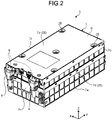
- FIG. 2 is a perspective view of the battery module 3 of the battery device 1.
- the battery module 3 includes, for example, a housing 7, a plurality of battery cells 6 housed in the housing 7, and an output terminal 8 electrically connected to the plurality of battery cells 6 via a bus bar or the like.
- the power of the plurality of battery cells 6, that is, the power of the battery module 3 is taken out to the outside via a cable 9 electrically connected to the output terminal 8.
- the housing 7 is an example of a second housing.
- the battery cell 6 may be composed of, for example, a lithium-ion secondary battery or the like.
- the battery cell 6 may be another secondary battery such as a nickel-metal hydride battery or a nickel-cadmium battery.
- the lithium-ion secondary battery is a type of non-aqueous electrolyte secondary battery, in which lithium ions in an electrolyte are responsible for electrical conduction.
- the battery cell 6 is a so-called prismatic can type cell and is also referred to as a can cell or the like.
- the plurality of battery cells 6 are housed in the housing 7, for example, in a vertical orientation, in other words, an orientation in which each terminal surface faces the Z direction.
- the plurality of battery cells 6 are arranged in a plurality of rows in the X direction and the Y direction in the housing 7, for example.
- the housing 7 is formed in, for example, a rectangular parallelepiped box shape that is short in the X direction.
- the housing 7 has a plurality of walls such as a bottom wall 7a, a top wall 7b, a pair of end walls 7c, 7e, and a pair of side walls 7d, 7f.
- the bottom wall 7a is also referred to as a lower wall or the like
- the top wall 7b is also referred to as an upper wall or the like.
- the end walls 7c, 7e and the side walls 7d, 7f are also referred to as peripheral walls or the like.
- the bottom wall 7a and the top wall 7b both extend along a direction (XY plane) orthogonal to the Z direction and are provided in parallel to each other at an interval in the Z direction.
- the bottom wall 7a constitutes the lower end of the housing 7, and the top wall 7b constitutes the upper end of the housing 7.
- the bottom wall 7a supports the lower surface of each battery cell 6 and is thermally connected to the lower surface directly or indirectly via thermally conductive grease or the like.
- Both the pair of end walls 7c, 7e extend along a direction (XZ plane) orthogonal to the Y direction and are provided in parallel to each other at an interval in the Y direction.
- the end wall 7e constitutes the end of the housing 7 in the Y direction
- the end wall 7c constitutes the end of the housing 7 in the opposite direction of the Y direction.
- the end walls 7c, 7e cover the short side surfaces or the long side surfaces of each battery cell 6.
- Both the pair of side walls 7d, 7f extend along a direction (YZ plane) orthogonal to the X direction and are provided in parallel to each other at an interval in the X direction.
- the side wall 7f constitutes the end of the housing 7 in the X direction
- the side wall 7d constitutes the end of the housing 7 in the opposite direction of the X direction.
- the side walls 7d, 7f cover the long side surfaces or the short side surfaces of each battery cell 6.
- the housing 7 is composed of, for example, a combination of a plurality of components (divided bodies) such as a case 25 and a top cover 26.
- the case 25 and the top cover 26 are each formed of a synthetic resin material, a metal material, or the like.
- the case 25 includes, for example, the bottom wall 7a, the pair of end walls 7c, 7e, and the pair of side walls 7d, 7f.
- the top cover 26 includes, for example, the top wall 7b.
- the top cover 26 is coupled to the case 25 by a coupling tool 28 such as a screw, a snap fit, or the like in a state where the top cover 26 covers the storage chamber of the battery cell 6 from the Z direction.
- FIG. 3 is a side view of a part of the battery device 1 in a state where the side cover 17 is removed.
- each shelf 10 in the battery chamber 11 of the housing 2 is provided with a heat sink 20.
- the heat sink 20 includes, for example, a cooling plate 21 and a connection pipe 22.
- the cooling plate 21 is formed in, for example, a quadrangular plate shape extending along the shelf wall 2h of the housing 2. In each shelf 10, the cooling plate 21 is interposed between the shelf wall 2h and the module row including six battery modules 3 arranged in the X direction. In other words, the cooling plate 21 is provided in a state of being thermally connected to the bottom wall 7a of each battery module 3.
- a flow path through which a fluid such as cooling water for cooling the battery module 3 flows is provided inside the cooling plate 21.
- the flow path is connected to the connection pipe 22 and extends while meandering in the X direction and the Y direction inside the cooling plate 21 to exchange heat with the plurality of battery modules 3.
- the flow paths of a plurality of cooling plates 21 arranged in the Z direction are connected in series, in parallel, or in a combination of series and parallel by a plurality of connection pipes 22.
- a thermally conductive layer (not illustrated) is provided between the cooling plate 21 and the bottom wall 7a of the battery module 3.
- the thermally conductive layer is, for example, thermally conductive grease, a thermally conductive sheet, or the like.
- the thermally conductive layer improves thermal conductivity between the cooling plate 21 and the bottom wall 7a, and thus the cooling effect of the heat sink 20 on the bottom wall 7a, that is, the plurality of battery cells 6 can further improve.
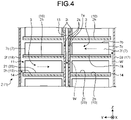
- FIG. 4 is a YZ sectional view of a part of the battery chamber 11 of the battery device 1. As illustrated in FIG. 4 , the air passage 13 extending along the Z direction is provided in a substantially central part of the battery chamber 11 in the Y direction. The air passage 13 is provided between the pair of partition walls 2i described above and is arranged with each shelf 10 in the Y direction.
- the upper end of the air passage 13 in the Z direction faces the top wall 2b of the housing 2.
- the lower end of the air passage 13 faces a fan 30 (see FIG. 5 ) to be described later.
- the upper end of the partition wall 2i is joined to the top wall 2b by welding or the like, and the lower end of the partition wall 2i is joined to the bottom wall 2a or the lowermost shelf wall 2h.
- the lower end is an example of an end
- the top wall 2b is an example of an outer wall.
- Each partition wall 2i is provided with a plurality of vents 2k.
- Each vent 2k is a through hole penetrating the partition wall 2i in the Y direction and communicates the air passage 13 with each shelf 10 of the battery chamber 11.
- the vent 2k is elongated in the X direction to overlap with the module row including six battery modules 3 arranged in the X direction.
- an air flow W discharged from the fan 30 is supplied to each shelf 10 of the battery chamber 11 via a gap 14 between the left wall 2d and the shelf wall 2h and between the right wall 2f and the shelf wall 2h. Then, the air flow W passes through each shelf 10 in such a manner as to cross each shelf 10 in the Y direction and returns from the vent 2k to the fan 30 via the air passage 13.
- the top wall 7b, the end walls 7c, 7e, the side walls 7d, 7f, and the like of the housing 7 of the battery module 3 other than the bottom wall 7a facing the heat sink 20 face the space of each shelf 10.
- the air flow W can thus further improve the cooling effect on the battery module 3 by exchanging heat with the top wall 7b, the end walls 7c, 7e, the side walls 7d, 7f, and the like other than the bottom wall 7a in the process of passing through each shelf 10.
- the temperature rise of the plurality of battery modules 3 housed in each of the pair of battery chambers 11 can be more effectively inhibited by the cooling by the air flow W circulating (swirling) in the battery chamber 11 and the cooling by the heat sink 20.
- FIG. 5 is an XY sectional view of a part of the lower end of the battery device 1.
- the fan 30 is connected to the lower end of the air passage 13 described above.
- the housing 2 is provided with a plurality of fans 30 arranged in the X direction. Each of the plurality of fans 30 faces the air passage 13.
- the fan 30 is, for example, a centrifugal fan or an axial fan rotatable about a rotation center Ax extending along the Z direction.
- the fan 30 generates the air flow W flowing to circulate (swirl) in the above-described battery chamber 11 with the rotation of a blade around the rotation center Ax in an annular opening.
- the width of the fan 30 along the Y direction is substantially the same as or slightly smaller than the width of the air passage 13, that is, the distance between the pair of partition walls 2i. In other words, the fan 30 may be housed between the pair of partition walls 2i.
- the fan 30 is adjacently provided with a duct 40 in the Y direction.
- the duct 40 extends along the X direction and is joined to the isolation wall 2g of the housing 2.
- a storage chamber 41 capable of storing a cable or the like of the fan 30 is provided inside the duct 40.
- the cable of the fan 30 is connected to the electric devices 4 and the like in the electric chamber 12 from the storage chamber 41 via a through hole (not illustrated) provided in the isolation wall 2g.
- the fan 30, the duct 40, and the like may be housed, for example, in a space between the bottom wall 2a of the housing 2 and the lowermost shelf wall 2h.
- the fan 30 may be provided in a state of being exposed in the Z direction from the shelf wall 2h and covered from both sides in the Y direction by the pair of partition walls 2i.
- the duct 40 includes a top wall exposed in the Z direction from the shelf wall 2h, and the top wall isolates the battery chamber 11 from the storage chamber 41.
- the battery device 1 includes a housing 2 (first housing), a plurality of battery modules 3, a heat sink 20, a fan 30, and a duct 40.
- the housing 2 (first housing) includes: a pair of battery chambers 11 each including a plurality of shelves 10 arranged in the Z direction and being sealed to an outside; a pair of partition walls 2i configured to partition the battery chambers 11 and an air passage 13, the pair of partition walls 2i including a plurality of vents 2k for communicating each shelf 10 and the air passage 13; an electric chamber 12 arranged in the X direction with the battery chambers 11 and the air passage 13; and an isolation wall 2g configured to isolate the electric chamber 12 from the battery chambers 11 and the air passage 13.
- the plurality of battery modules 3 are housed in each shelf 10 in the battery chambers 11.
- the heat sink 20 cools the plurality of battery modules 3.
- the fan 30 is provided at the lower end (an end) of the air passage 13, and generates an air flow W for cooling the battery modules 3 housed in each shelf 10 via the vents 2k.
- the duct 40 includes a storage chamber 41 capable of storing a cable of the fan 30, and isolates the storage chamber 41 from the battery chambers 11.
- Such a configuration enables, for example, the plurality of battery modules 3 to be isolated from the electric devices 4 housed in the electric chamber 12, the cable of the fan 30 housed in the duct 40, and the like in the housing 2, which is likely to further increase the safety of the battery device 1.
- the temperature rise of the plurality of battery modules 3 arranged in the pair of battery chambers 11 can be more effectively inhibited, for example by the cooling by the heat sink 20 and the cooling by the air flow W of the fan 30. It is therefore possible to obtain the battery device 1 capable of securing, for example, both safety and cooling performance, which have conventionally contradicted each other.
- each battery module 3 includes a plurality of battery cells 6 and the housing 7 (second housing) including the bottom wall 7a thermally connected to the plurality of battery cells 6, and the heat sink 20 is provided in a state of being thermally connected to the bottom wall 7a of each battery module 3.
- Such a configuration enables the plurality of battery cells 6 to be more efficiently cooled for example by exchanging heat between the heat sink 20 and the bottom wall 7a of each battery module 3. Further, for example, the air flow W from the fan 30 cools the top wall 7b other than the bottom wall 7a of the battery module 3, the end walls 7c, 7e, the side walls 7d, 7f, and the like, which can inhibit the temperature rise of the plurality of battery cells 6 more effectively.
- the heat sink 20 includes the cooling plate 21 provided with a flow path through which a fluid for cooling the plurality of battery cells 6 by exchanging heat with the bottom wall 7a flows.
- Such a configuration enables, for example, the water-cooling or liquid-cooling type heat sink 20 with the cooling plate 21 to inhibit temperature rise of the plurality of battery modules 3 more effectively.
- the partition wall 2i is joined to the top wall 2b (outer wall) of the housing 2, and the duct 40 is joined to the isolation wall 2g.
- Such a configuration enables, for example, the partition wall 2i and the isolation wall 2g to improve rigidity and strength of the housing 2, which can secure durability and safety even when a plurality of battery modules 3 are arranged in the housing 2 at high density.
Landscapes
- Chemical & Material Sciences (AREA)
- Chemical Kinetics & Catalysis (AREA)
- Electrochemistry (AREA)
- General Chemical & Material Sciences (AREA)
- Engineering & Computer Science (AREA)
- Manufacturing & Machinery (AREA)
- Aviation & Aerospace Engineering (AREA)
- Battery Mounting, Suspending (AREA)
- Secondary Cells (AREA)
- Power Steering Mechanism (AREA)
Abstract
Description
- An embodiment of the present invention relates to a battery device.
- A battery device including a plurality of battery modules and a fan that generates an air flow for cooling the plurality of battery modules has been conventionally known.
- Patent Literature 1:
Japanese Patent Application Laid-open No. 2011-175896 - In this type of battery device, for example, it is beneficial to obtain a novel configuration with less inconvenience such that both safety and cooling performance can be ensured.
- A battery device according to an embodiment includes a first housing, a plurality of battery modules, a heat sink, a fan, and a duct. The first housing includes: an air passage extending in an up-down direction; a pair of battery chambers provided on both left and right sides of the air passage, each of the battery chambers including a plurality of shelves arranged in the up-down direction and being sealed to an outside; a pair of partition walls configured to partition the battery chambers and the air passage, the partition walls including a plurality of vents for communicating each of the shelves and the air passage; an electric chamber arranged in a front-rear direction with the battery chambers and the air passage; and an isolation wall configured to isolate the electric chamber from the battery chambers and the air passage. The plurality of battery modules are housed in each of the shelves in the battery chambers. The heat sink is configured to cool the plurality of battery modules. The fan is provided at an end of the air passage, the fan generating an air flow for cooling the battery modules housed in each of the shelves via the vents. The duct includes a storage chamber capable of storing a cable of the fan, the duct isolating the storage chamber from the battery chambers.
-
-
FIG. 1 is an exemplary and schematic perspective view of a battery device according to an embodiment. -
FIG. 2 is an exemplary and schematic perspective view of a battery module of the battery device according to the embodiment. -
FIG. 3 is an exemplary and schematic side view of a part of the battery device according to the embodiment in a state where a side cover is removed. -
FIG. 4 is an exemplary and schematic YZ sectional view of a part of a battery chamber of the battery device of the embodiment. -
FIG. 5 is an exemplary and schematic XY sectional view of a part of a lower end part of the battery device of the embodiment. - Hereinafter, exemplary embodiments of the present invention are disclosed. The configurations of the embodiments described below and the functions and effects brought about by the configurations are examples. The present invention may also be realized by configurations other than those disclosed in the following embodiments. According to the present invention, it is possible to obtain at least one of various effects (including derivative effects) obtained by the configurations.
- In the present specification, ordinal numbers are used only to distinguish components, members, parts, positions, directions, and the like, and do not indicate order or priority.
-
FIG. 1 is a perspective view of abattery device 1 according to an embodiment. As illustrated inFIG. 1 , thebattery device 1 includes, for example, ahousing 2, a plurality of battery modules 3 (seeFIG. 2 ) housed in abattery chamber 11 in thehousing 2, and a plurality of electric devices 4 housed in anelectric chamber 12 in thehousing 2. In the present embodiment, for example, the plurality ofbattery modules 3 are installed on each shelf 10 (seeFIG. 3 ) in thebattery chamber 11, and the plurality ofbattery modules 3 are connected in series or in parallel to configure thebattery device 1. Thehousing 2 is an example of a first housing. - The
battery device 1 is installed in various devices, machines, facilities, and the like, and is used as a power source for the various devices, machines, facilities, and the like. For example, thebattery device 1 may be mounted on a railway vehicle and may be used as a power source of the railway vehicle. A set in which a plurality ofbattery devices 1 shown in the present embodiment are connected in series or in parallel may be mounted on the railway vehicle. Thebattery device 1 is also referred to as a railway vehicle storage battery device or the like. - In the following description, three directions orthogonal to each other are defined for convenience. The X direction is along a depth direction (front-rear direction) of the
housing 2 and along a width direction (transverse direction) of thebattery module 3. The Y direction is along a width direction (left-right direction) of thehousing 2 and along a longitudinal direction of thebattery module 3. The Z direction is along a height direction (up-down direction) of thehousing 2 and along a height direction of thebattery module 3. - In the following description, for convenience, the X direction may be referred to as forward direction, the opposite direction of the X direction may be referred to as rearward direction, the Y direction may be referred to as rightward direction, the opposite direction of the Y direction may be referred to as leftward direction, the Z direction may be referred to as upward direction, and the opposite direction of the Z direction may be referred to as downward direction.
- As illustrated in
FIG. 1 , thehousing 2 is formed in a rectangular parallelepiped box shape that is short in the Y direction. Thehousing 2 has a plurality of walls such as abottom wall 2a, atop wall 2b, afront wall 2c, aleft wall 2d, arear wall 2e, aright wall 2f, anisolation wall 2g, ashelf wall 2h (seeFIG. 3 ), and apartition wall 2i (seeFIG. 4 ). Thefront wall 2c, theleft wall 2d, therear wall 2e, and theright wall 2f are also referred to as side walls, peripheral walls, or the like. - The
bottom wall 2a and thetop wall 2b both extend along a direction (XY plane) orthogonal to the Z direction and are provided in parallel to each other at an interval in the Z direction. Thebottom wall 2a constitutes the lower end of thehousing 2, and thetop wall 2b constitutes the upper end of thehousing 2. Thebottom wall 2a is also referred to as a lower wall or the like, and thetop wall 2b is also referred to as an upper wall or the like. - Both the
left wall 2d and theright wall 2f extend along a direction (XZ plane) orthogonal to the Y direction and are provided in parallel to each other at an interval in the Y direction. Theright wall 2f extends between the ends of thebottom wall 2a and thetop wall 2b in the Y direction, and theleft wall 2d extends between the ends of thebottom wall 2a and thetop wall 2b in the opposite direction of the Y direction. Theleft wall 2d constitutes the left end of thehousing 2, and theright wall 2f constitutes the right end of thehousing 2. - Each of the
left wall 2d and theright wall 2f is provided with apressure release valve 5. Thepressure release valve 5 is disposed at the upper ends of theleft wall 2d and theright wall 2f in the Z direction and faces thebattery chamber 11 in thehousing 2. Thepressure release valve 5 opens when the pressure in thebattery chamber 11 becomes higher than a threshold value to reduce the pressure in thebattery chamber 11. - The
front wall 2c and therear wall 2e both extend along a direction (YZ plane) orthogonal to the X direction and are provided in parallel to each other at an interval in the X direction. Thefront wall 2c extends between the ends of thebottom wall 2a and thetop wall 2b in the X direction, and therear wall 2e extends between the ends of thebottom wall 2a and thetop wall 2b in the opposite direction of the X direction. Thefront wall 2c constitutes the front end of thehousing 2, and therear wall 2e constitutes the rear end of thehousing 2. - The
isolation wall 2g (seeFIG. 5 ) is positioned between thefront wall 2c and therear wall 2e and extends between theleft wall 2d and theright wall 2f and between thebottom wall 2a and thetop wall 2b. Theisolation wall 2g is parallel to thefront wall 2c and therear wall 2e. Theisolation wall 2g divides the inside of thehousing 2 into thebattery chamber 11 and theelectric chamber 12 as a plurality of spaces in the X direction. Theisolation wall 2g isolates theelectric chamber 12 from thebattery chamber 11 and an air passage 13 (seeFIG. 4 ) to be described later. - The
partition wall 2i is positioned between theleft wall 2d and theright wall 2f and extends between theisolation wall 2g and therear wall 2e and between thebottom wall 2a and thetop wall 2b described above. In thehousing 2, a pair ofpartition walls 2i are provided in parallel to each other at an interval in the Y direction. Theair passage 13 to be described later is provided between the pair ofpartition walls 2i. Thepartition walls 2i partition the inside of thehousing 2 into a pair ofbattery chambers 11 and theair passage 13 as a plurality of spaces in the Y direction. - The
shelf wall 2h is positioned between thebottom wall 2a and thetop wall 2b and extends between thepartition wall 2i and theleft wall 2d and between thepartition wall 2i and theright wall 2f. In thehousing 2, a plurality ofshelf walls 2h are provided in parallel to each other at intervals in the Z direction. Theshelf walls 2h partition the inside of thebattery chamber 11 intoshelves 10 as a plurality of spaces in the Z direction. Theshelf walls 2h may be supported by thehousing 2 to be slidable along the Y direction, that is, drawable, for example. - Each
shelf 10 houses, for example, six battery modules 3 (seeFIG. 3 ) in a state of being arranged in the X direction. In other words, eachshelf wall 2h supports a module row including sixbattery modules 3 arranged in the X direction. The module row is also referred to as a module group or the like. - As illustrated in
FIG. 1 , thehousing 2 is composed of, for example, a combination of a plurality of components (divided bodies) such as abase 15, afront cover 16, and side covers 17, 18. Thebase 15, thefront cover 16, and the side covers 17, 18 are each formed of a synthetic resin material, a metal material, or the like. - The
base 15 includes thebottom wall 2a, thetop wall 2b, therear wall 2e, theisolation wall 2g, theshelf wall 2h, and thepartition wall 2i. Thefront cover 16 includes thefront wall 2c. The side cover 17 includes theleft wall 2d, and theside cover 18 includes theright wall 2f. Thefront cover 16 and the side covers 17, 18 are coupled to thebase 15 by a coupling tool such as a screw, a clamp material, or the like in a state where theelectric chamber 12 and thebattery chamber 11 are covered from the outside, for example. - Sealing members (not illustrated) are provided between the base 15 and the side covers 17, 18, between the base 15 and the
front cover 16, and the like. The sealing member is, for example, a frame-shaped packing (gasket) or the like formed along the edge of thebattery chamber 11 or theelectric chamber 12. The sealing member prevents gas, liquid, or the like from leaking from the periphery of thebattery chamber 11 or theelectric chamber 12. In other words, thebattery chamber 11 and theelectric chamber 12 are sealed to the outside of thehousing 2. -
FIG. 2 is a perspective view of thebattery module 3 of thebattery device 1. As illustrated inFIG. 2 , thebattery module 3 includes, for example, ahousing 7, a plurality ofbattery cells 6 housed in thehousing 7, and anoutput terminal 8 electrically connected to the plurality ofbattery cells 6 via a bus bar or the like. The power of the plurality ofbattery cells 6, that is, the power of thebattery module 3 is taken out to the outside via acable 9 electrically connected to theoutput terminal 8. Thehousing 7 is an example of a second housing. - The
battery cell 6 may be composed of, for example, a lithium-ion secondary battery or the like. Thebattery cell 6 may be another secondary battery such as a nickel-metal hydride battery or a nickel-cadmium battery. The lithium-ion secondary battery is a type of non-aqueous electrolyte secondary battery, in which lithium ions in an electrolyte are responsible for electrical conduction. Thebattery cell 6 is a so-called prismatic can type cell and is also referred to as a can cell or the like. - The plurality of
battery cells 6 are housed in thehousing 7, for example, in a vertical orientation, in other words, an orientation in which each terminal surface faces the Z direction. The plurality ofbattery cells 6 are arranged in a plurality of rows in the X direction and the Y direction in thehousing 7, for example. - The
housing 7 is formed in, for example, a rectangular parallelepiped box shape that is short in the X direction. Thehousing 7 has a plurality of walls such as abottom wall 7a, atop wall 7b, a pair ofend walls side walls 7d, 7f. Thebottom wall 7a is also referred to as a lower wall or the like, and thetop wall 7b is also referred to as an upper wall or the like. Theend walls side walls 7d, 7f are also referred to as peripheral walls or the like. - The
bottom wall 7a and thetop wall 7b both extend along a direction (XY plane) orthogonal to the Z direction and are provided in parallel to each other at an interval in the Z direction. Thebottom wall 7a constitutes the lower end of thehousing 7, and thetop wall 7b constitutes the upper end of thehousing 7. Thebottom wall 7a supports the lower surface of eachbattery cell 6 and is thermally connected to the lower surface directly or indirectly via thermally conductive grease or the like. - Both the pair of
end walls end wall 7e constitutes the end of thehousing 7 in the Y direction, and theend wall 7c constitutes the end of thehousing 7 in the opposite direction of the Y direction. Theend walls battery cell 6. - Both the pair of
side walls 7d, 7f extend along a direction (YZ plane) orthogonal to the X direction and are provided in parallel to each other at an interval in the X direction. Theside wall 7f constitutes the end of thehousing 7 in the X direction, and the side wall 7d constitutes the end of thehousing 7 in the opposite direction of the X direction. Theside walls 7d, 7f cover the long side surfaces or the short side surfaces of eachbattery cell 6. - The
housing 7 is composed of, for example, a combination of a plurality of components (divided bodies) such as a case 25 and atop cover 26. The case 25 and thetop cover 26 are each formed of a synthetic resin material, a metal material, or the like. - The case 25 includes, for example, the
bottom wall 7a, the pair ofend walls side walls 7d, 7f. Thetop cover 26 includes, for example, thetop wall 7b. Thetop cover 26 is coupled to the case 25 by acoupling tool 28 such as a screw, a snap fit, or the like in a state where thetop cover 26 covers the storage chamber of thebattery cell 6 from the Z direction. -
FIG. 3 is a side view of a part of thebattery device 1 in a state where theside cover 17 is removed. As illustrated inFIG. 3 , eachshelf 10 in thebattery chamber 11 of thehousing 2 is provided with aheat sink 20. Theheat sink 20 includes, for example, a coolingplate 21 and aconnection pipe 22. - The cooling
plate 21 is formed in, for example, a quadrangular plate shape extending along theshelf wall 2h of thehousing 2. In eachshelf 10, the coolingplate 21 is interposed between theshelf wall 2h and the module row including sixbattery modules 3 arranged in the X direction. In other words, the coolingplate 21 is provided in a state of being thermally connected to thebottom wall 7a of eachbattery module 3. - A flow path through which a fluid such as cooling water for cooling the
battery module 3 flows is provided inside the coolingplate 21. The flow path is connected to theconnection pipe 22 and extends while meandering in the X direction and the Y direction inside the coolingplate 21 to exchange heat with the plurality ofbattery modules 3. In the present embodiment, for example, the flow paths of a plurality of coolingplates 21 arranged in the Z direction are connected in series, in parallel, or in a combination of series and parallel by a plurality ofconnection pipes 22. - In addition, a thermally conductive layer (not illustrated) is provided between the cooling
plate 21 and thebottom wall 7a of thebattery module 3. The thermally conductive layer is, for example, thermally conductive grease, a thermally conductive sheet, or the like. The thermally conductive layer improves thermal conductivity between the coolingplate 21 and thebottom wall 7a, and thus the cooling effect of theheat sink 20 on thebottom wall 7a, that is, the plurality ofbattery cells 6 can further improve. -
FIG. 4 is a YZ sectional view of a part of thebattery chamber 11 of thebattery device 1. As illustrated inFIG. 4 , theair passage 13 extending along the Z direction is provided in a substantially central part of thebattery chamber 11 in the Y direction. Theair passage 13 is provided between the pair ofpartition walls 2i described above and is arranged with eachshelf 10 in the Y direction. - The upper end of the
air passage 13 in the Z direction faces thetop wall 2b of thehousing 2. The lower end of theair passage 13 faces a fan 30 (seeFIG. 5 ) to be described later. In the present embodiment, for example, the upper end of thepartition wall 2i is joined to thetop wall 2b by welding or the like, and the lower end of thepartition wall 2i is joined to thebottom wall 2a or thelowermost shelf wall 2h. The lower end is an example of an end, and thetop wall 2b is an example of an outer wall. - Each
partition wall 2i is provided with a plurality ofvents 2k. Eachvent 2k is a through hole penetrating thepartition wall 2i in the Y direction and communicates theair passage 13 with eachshelf 10 of thebattery chamber 11. For example, thevent 2k is elongated in the X direction to overlap with the module row including sixbattery modules 3 arranged in the X direction. - In the present embodiment, for example, an air flow W discharged from the
fan 30 is supplied to eachshelf 10 of thebattery chamber 11 via agap 14 between theleft wall 2d and theshelf wall 2h and between theright wall 2f and theshelf wall 2h. Then, the air flow W passes through eachshelf 10 in such a manner as to cross eachshelf 10 in the Y direction and returns from thevent 2k to thefan 30 via theair passage 13. - Here, the
top wall 7b, theend walls side walls 7d, 7f, and the like of thehousing 7 of thebattery module 3 other than thebottom wall 7a facing theheat sink 20 face the space of eachshelf 10. The air flow W can thus further improve the cooling effect on thebattery module 3 by exchanging heat with thetop wall 7b, theend walls side walls 7d, 7f, and the like other than thebottom wall 7a in the process of passing through eachshelf 10. - In this manner, in the present embodiment, the temperature rise of the plurality of
battery modules 3 housed in each of the pair ofbattery chambers 11 can be more effectively inhibited by the cooling by the air flow W circulating (swirling) in thebattery chamber 11 and the cooling by theheat sink 20. -
FIG. 5 is an XY sectional view of a part of the lower end of thebattery device 1. As illustrated inFIG. 5 , thefan 30 is connected to the lower end of theair passage 13 described above. In the present embodiment, for example, thehousing 2 is provided with a plurality offans 30 arranged in the X direction. Each of the plurality offans 30 faces theair passage 13. - The
fan 30 is, for example, a centrifugal fan or an axial fan rotatable about a rotation center Ax extending along the Z direction. Thefan 30 generates the air flow W flowing to circulate (swirl) in the above-describedbattery chamber 11 with the rotation of a blade around the rotation center Ax in an annular opening. The width of thefan 30 along the Y direction is substantially the same as or slightly smaller than the width of theair passage 13, that is, the distance between the pair ofpartition walls 2i. In other words, thefan 30 may be housed between the pair ofpartition walls 2i. - The
fan 30 is adjacently provided with aduct 40 in the Y direction. Theduct 40 extends along the X direction and is joined to theisolation wall 2g of thehousing 2. Astorage chamber 41 capable of storing a cable or the like of thefan 30 is provided inside theduct 40. The cable of thefan 30 is connected to the electric devices 4 and the like in theelectric chamber 12 from thestorage chamber 41 via a through hole (not illustrated) provided in theisolation wall 2g. - The
fan 30, theduct 40, and the like may be housed, for example, in a space between thebottom wall 2a of thehousing 2 and thelowermost shelf wall 2h. Thefan 30 may be provided in a state of being exposed in the Z direction from theshelf wall 2h and covered from both sides in the Y direction by the pair ofpartition walls 2i. Theduct 40 includes a top wall exposed in the Z direction from theshelf wall 2h, and the top wall isolates thebattery chamber 11 from thestorage chamber 41. - As described above, in the present embodiment, the
battery device 1 includes a housing 2 (first housing), a plurality ofbattery modules 3, aheat sink 20, afan 30, and aduct 40. The housing 2 (first housing) includes: a pair ofbattery chambers 11 each including a plurality ofshelves 10 arranged in the Z direction and being sealed to an outside; a pair ofpartition walls 2i configured to partition thebattery chambers 11 and anair passage 13, the pair ofpartition walls 2i including a plurality ofvents 2k for communicating eachshelf 10 and theair passage 13; anelectric chamber 12 arranged in the X direction with thebattery chambers 11 and theair passage 13; and anisolation wall 2g configured to isolate theelectric chamber 12 from thebattery chambers 11 and theair passage 13. The plurality ofbattery modules 3 are housed in eachshelf 10 in thebattery chambers 11. Theheat sink 20 cools the plurality ofbattery modules 3. Thefan 30 is provided at the lower end (an end) of theair passage 13, and generates an air flow W for cooling thebattery modules 3 housed in eachshelf 10 via thevents 2k. Theduct 40 includes astorage chamber 41 capable of storing a cable of thefan 30, and isolates thestorage chamber 41 from thebattery chambers 11. - Such a configuration enables, for example, the plurality of
battery modules 3 to be isolated from the electric devices 4 housed in theelectric chamber 12, the cable of thefan 30 housed in theduct 40, and the like in thehousing 2, which is likely to further increase the safety of thebattery device 1. In addition, the temperature rise of the plurality ofbattery modules 3 arranged in the pair ofbattery chambers 11 can be more effectively inhibited, for example by the cooling by theheat sink 20 and the cooling by the air flow W of thefan 30. It is therefore possible to obtain thebattery device 1 capable of securing, for example, both safety and cooling performance, which have conventionally contradicted each other. - In the present exemplary embodiment, each
battery module 3 includes a plurality ofbattery cells 6 and the housing 7 (second housing) including thebottom wall 7a thermally connected to the plurality ofbattery cells 6, and theheat sink 20 is provided in a state of being thermally connected to thebottom wall 7a of eachbattery module 3. - Such a configuration enables the plurality of
battery cells 6 to be more efficiently cooled for example by exchanging heat between theheat sink 20 and thebottom wall 7a of eachbattery module 3. Further, for example, the air flow W from thefan 30 cools thetop wall 7b other than thebottom wall 7a of thebattery module 3, theend walls side walls 7d, 7f, and the like, which can inhibit the temperature rise of the plurality ofbattery cells 6 more effectively. - In the present embodiment, the
heat sink 20 includes the coolingplate 21 provided with a flow path through which a fluid for cooling the plurality ofbattery cells 6 by exchanging heat with thebottom wall 7a flows. - Such a configuration enables, for example, the water-cooling or liquid-cooling
type heat sink 20 with the coolingplate 21 to inhibit temperature rise of the plurality ofbattery modules 3 more effectively. - In the present embodiment, the
partition wall 2i is joined to thetop wall 2b (outer wall) of thehousing 2, and theduct 40 is joined to theisolation wall 2g. - Such a configuration enables, for example, the
partition wall 2i and theisolation wall 2g to improve rigidity and strength of thehousing 2, which can secure durability and safety even when a plurality ofbattery modules 3 are arranged in thehousing 2 at high density. - Although several embodiments of the present invention have been described, these embodiments are presented for illustrative purposes only, and are not intended to limit the scope of the invention. These novel embodiments can be implemented in various other forms, and various omissions, substitutions, combinations, and modifications can be made without departing from the scope of sprit of the invention. In addition, specifications (structure, type, direction, form, size, length, width, thickness, height, number, arrangement, position, material, and the like) of each configuration and shape can be appropriately changed and implemented.
Claims (4)
- A battery device comprising:a first housing including:an air passage extending in an up-down direction;a pair of battery chambers provided on both left and right sides of the air passage, each of the battery chambers including a plurality of shelves arranged in the up-down direction and being sealed to an outside;a pair of partition walls configured to partition the battery chambers and the air passage, the partition walls including a plurality of vents for communicating each of the shelves and the air passage;an electric chamber arranged in a front-rear direction with the battery chambers and the air passage; andan isolation wall configured to isolate the electric chamber from the battery chambers and the air passage;a plurality of battery modules housed in each of the shelves in the battery chambers;a heat sink configured to cool the plurality of battery modules;a fan provided at an end of the air passage, the fan generating an air flow for cooling the battery modules housed in each of the shelves via the vents; anda duct including a storage chamber capable of storing a cable of the fan, the duct isolating the storage chamber from the battery chambers.
- The battery device according to claim 1, whereineach of the battery modules includes a plurality of battery cells and a second housing including a bottom wall thermally connected to the plurality of battery cells, andthe heat sink is provided in a state of being thermally connected to the bottom walls of the battery modules.
- The battery device according to claim 2, wherein the heat sink includes a cooling plate provided with a flow path through which a fluid for cooling the plurality of battery cells by exchanging heat with the bottom walls flows.
- The battery device according to any one of claims 1 to 3, whereinthe partition walls are joined to an outer wall of the first housing, andthe duct is joined to the isolation wall.
Applications Claiming Priority (2)
| Application Number | Priority Date | Filing Date | Title |
|---|---|---|---|
| JP2020048717A JP7471882B2 (en) | 2020-03-19 | 2020-03-19 | Battery device |
| PCT/JP2021/009743 WO2021187300A1 (en) | 2020-03-19 | 2021-03-11 | Battery device |
Publications (2)
| Publication Number | Publication Date |
|---|---|
| EP4123789A1 true EP4123789A1 (en) | 2023-01-25 |
| EP4123789A4 EP4123789A4 (en) | 2025-01-15 |
Family
ID=77768260
Family Applications (1)
| Application Number | Title | Priority Date | Filing Date |
|---|---|---|---|
| EP21771489.8A Pending EP4123789A4 (en) | 2020-03-19 | 2021-03-11 | BATTERY DEVICE |
Country Status (5)
| Country | Link |
|---|---|
| EP (1) | EP4123789A4 (en) |
| JP (1) | JP7471882B2 (en) |
| CN (1) | CN115298881A (en) |
| TW (1) | TWI768773B (en) |
| WO (1) | WO2021187300A1 (en) |
Cited By (2)
| Publication number | Priority date | Publication date | Assignee | Title |
|---|---|---|---|---|
| GB2629752A (en) * | 2023-02-17 | 2024-11-13 | Sunswap Ltd | Rechargeable battery pack |
| EP4481917A1 (en) * | 2023-06-20 | 2024-12-25 | SK On Co., Ltd. | Energy storage apparatus |
Families Citing this family (1)
| Publication number | Priority date | Publication date | Assignee | Title |
|---|---|---|---|---|
| CN116387692B (en) * | 2023-05-31 | 2023-08-18 | 宁波齐云新材料技术有限公司 | Lithium battery pack intelligent heat dissipation control system and control method thereof |
Family Cites Families (15)
| Publication number | Priority date | Publication date | Assignee | Title |
|---|---|---|---|---|
| JP4118014B2 (en) * | 2000-10-31 | 2008-07-16 | 三洋電機株式会社 | Power supply |
| JP4062932B2 (en) * | 2002-02-19 | 2008-03-19 | 新神戸電機株式会社 | Battery module |
| JP4293980B2 (en) * | 2004-11-30 | 2009-07-08 | 三洋電機株式会社 | Power supply for vehicle |
| KR100946019B1 (en) * | 2006-04-24 | 2010-03-09 | 미쓰비시덴키 가부시키가이샤 | Power storage devices |
| JP4661895B2 (en) * | 2008-04-02 | 2011-03-30 | 株式会社デンソー | Battery cooling device |
| US20100275619A1 (en) | 2009-04-30 | 2010-11-04 | Lg Chem, Ltd. | Cooling system for a battery system and a method for cooling the battery system |
| JP5204797B2 (en) | 2010-02-25 | 2013-06-05 | 株式会社日立製作所 | Secondary battery module and secondary battery module device |
| JP2015041605A (en) | 2013-08-23 | 2015-03-02 | 三菱重工業株式会社 | Battery module and battery module fixation rack |
| JP6260625B2 (en) | 2013-12-11 | 2018-01-17 | 日立化成株式会社 | Power storage device |
| JP6261975B2 (en) | 2013-12-11 | 2018-01-17 | 株式会社東芝 | Heating element storage device |
| JP6385766B2 (en) * | 2014-09-17 | 2018-09-05 | 株式会社東芝 | Vehicle storage battery device |
| WO2018047337A1 (en) | 2016-09-12 | 2018-03-15 | 株式会社東芝 | Battery unit and vehicular storage battery device |
| JP6892451B2 (en) * | 2016-09-13 | 2021-06-23 | 株式会社東芝 | Battery device and vehicle |
| JP7068053B2 (en) * | 2018-06-04 | 2022-05-16 | 株式会社東芝 | Cooling system |
| CN109509937A (en) | 2018-12-29 | 2019-03-22 | 银隆新能源股份有限公司 | Container air conditioner cooling system and container |
-
2020
- 2020-03-19 JP JP2020048717A patent/JP7471882B2/en active Active
-
2021
- 2021-03-11 WO PCT/JP2021/009743 patent/WO2021187300A1/en not_active Ceased
- 2021-03-11 EP EP21771489.8A patent/EP4123789A4/en active Pending
- 2021-03-11 CN CN202180021827.9A patent/CN115298881A/en active Pending
- 2021-03-17 TW TW110109492A patent/TWI768773B/en active
Cited By (3)
| Publication number | Priority date | Publication date | Assignee | Title |
|---|---|---|---|---|
| GB2629752A (en) * | 2023-02-17 | 2024-11-13 | Sunswap Ltd | Rechargeable battery pack |
| GB2629752B (en) * | 2023-02-17 | 2025-05-07 | Sunswap Ltd | Rechargeable battery pack |
| EP4481917A1 (en) * | 2023-06-20 | 2024-12-25 | SK On Co., Ltd. | Energy storage apparatus |
Also Published As
| Publication number | Publication date |
|---|---|
| JP2021150170A (en) | 2021-09-27 |
| WO2021187300A1 (en) | 2021-09-23 |
| JP7471882B2 (en) | 2024-04-22 |
| EP4123789A4 (en) | 2025-01-15 |
| CN115298881A (en) | 2022-11-04 |
| TW202141843A (en) | 2021-11-01 |
| TWI768773B (en) | 2022-06-21 |
Similar Documents
| Publication | Publication Date | Title |
|---|---|---|
| EP3073546B1 (en) | Battery pack | |
| US9130209B2 (en) | Electric storage apparatus including inter-electric storage device air passages between electric storage devices and air vent portion formed at end of electric storage devices | |
| EP4123789A1 (en) | Battery device | |
| US8852773B2 (en) | Battery pack | |
| CN210074100U (en) | Battery pack and battery pack heat dissipation structure | |
| KR102058688B1 (en) | Battery Module of Indirect Cooling | |
| JP5987569B2 (en) | Battery pack | |
| US11296372B2 (en) | Battery module and battery pack | |
| KR20190066731A (en) | Cell edge direct cooling type Battery module and Battery pack including the same | |
| CN107925026A (en) | Battery pack | |
| CN115066789B (en) | Electric vehicle air-cooled battery pack | |
| US11283122B2 (en) | Battery pack | |
| KR20220023465A (en) | Battery Module Having Water-Cooled Type Cooling Structure composed of aluminium profile | |
| US20250141014A1 (en) | Lithium battery pack for wheelchair and medical auxiliary driving equipment | |
| KR102258175B1 (en) | Battery Pack with means for cooling heat element | |
| KR102683482B1 (en) | Battery Pack | |
| US20220149420A1 (en) | Battery unit and motor vehicle provided with at least one such unit | |
| EP3579322B1 (en) | Battery-cooling device for vehicle and manufacturing method of same | |
| US20250183401A1 (en) | Storage container support assembly | |
| JP7709285B2 (en) | Battery pack | |
| CN214411312U (en) | Heat dissipation module and energy storage module | |
| KR102694029B1 (en) | Junction block | |
| CN224006014U (en) | Battery pack components and electrical equipment | |
| JP2021061159A (en) | Battery cooling structure for vehicle | |
| JP2025502846A (en) | Battery pack having improved cooling structure and device including same |
Legal Events
| Date | Code | Title | Description |
|---|---|---|---|
| STAA | Information on the status of an ep patent application or granted ep patent |
Free format text: STATUS: THE INTERNATIONAL PUBLICATION HAS BEEN MADE |
|
| PUAI | Public reference made under article 153(3) epc to a published international application that has entered the european phase |
Free format text: ORIGINAL CODE: 0009012 |
|
| STAA | Information on the status of an ep patent application or granted ep patent |
Free format text: STATUS: REQUEST FOR EXAMINATION WAS MADE |
|
| 17P | Request for examination filed |
Effective date: 20220914 |
|
| AK | Designated contracting states |
Kind code of ref document: A1 Designated state(s): AL AT BE BG CH CY CZ DE DK EE ES FI FR GB GR HR HU IE IS IT LI LT LU LV MC MK MT NL NO PL PT RO RS SE SI SK SM TR |
|
| DAV | Request for validation of the european patent (deleted) | ||
| DAX | Request for extension of the european patent (deleted) | ||
| A4 | Supplementary search report drawn up and despatched |
Effective date: 20241218 |
|
| RIC1 | Information provided on ipc code assigned before grant |
Ipc: H01M 50/249 20210101ALI20241212BHEP Ipc: H01M 10/6557 20140101ALI20241212BHEP Ipc: H01M 10/6555 20140101ALI20241212BHEP Ipc: H01M 50/209 20210101ALI20241212BHEP Ipc: H01M 10/625 20140101ALI20241212BHEP Ipc: H01M 10/613 20140101ALI20241212BHEP Ipc: H01M 10/6563 20140101AFI20241212BHEP |
|
| RAP1 | Party data changed (applicant data changed or rights of an application transferred) |
Owner name: KABUSHIKI KAISHA TOSHIBA |