EP4123332A1 - Method for estimating a location of at least one mobile network node and respective network - Google Patents
Method for estimating a location of at least one mobile network node and respective network Download PDFInfo
- Publication number
- EP4123332A1 EP4123332A1 EP21187335.1A EP21187335A EP4123332A1 EP 4123332 A1 EP4123332 A1 EP 4123332A1 EP 21187335 A EP21187335 A EP 21187335A EP 4123332 A1 EP4123332 A1 EP 4123332A1
- Authority
- EP
- European Patent Office
- Prior art keywords
- gaussian mixture
- initial
- noise
- parameters
- noise model
- Prior art date
- Legal status (The legal status is an assumption and is not a legal conclusion. Google has not performed a legal analysis and makes no representation as to the accuracy of the status listed.)
- Granted
Links
Images





Classifications
-
- H—ELECTRICITY
- H04—ELECTRIC COMMUNICATION TECHNIQUE
- H04W—WIRELESS COMMUNICATION NETWORKS
- H04W64/00—Locating users or terminals or network equipment for network management purposes, e.g. mobility management
- H04W64/003—Locating users or terminals or network equipment for network management purposes, e.g. mobility management locating network equipment
-
- G—PHYSICS
- G01—MEASURING; TESTING
- G01S—RADIO DIRECTION-FINDING; RADIO NAVIGATION; DETERMINING DISTANCE OR VELOCITY BY USE OF RADIO WAVES; LOCATING OR PRESENCE-DETECTING BY USE OF THE REFLECTION OR RERADIATION OF RADIO WAVES; ANALOGOUS ARRANGEMENTS USING OTHER WAVES
- G01S5/00—Position-fixing by co-ordinating two or more direction or position line determinations; Position-fixing by co-ordinating two or more distance determinations
- G01S5/02—Position-fixing by co-ordinating two or more direction or position line determinations; Position-fixing by co-ordinating two or more distance determinations using radio waves
- G01S5/0278—Position-fixing by co-ordinating two or more direction or position line determinations; Position-fixing by co-ordinating two or more distance determinations using radio waves involving statistical or probabilistic considerations
-
- G—PHYSICS
- G01—MEASURING; TESTING
- G01S—RADIO DIRECTION-FINDING; RADIO NAVIGATION; DETERMINING DISTANCE OR VELOCITY BY USE OF RADIO WAVES; LOCATING OR PRESENCE-DETECTING BY USE OF THE REFLECTION OR RERADIATION OF RADIO WAVES; ANALOGOUS ARRANGEMENTS USING OTHER WAVES
- G01S5/00—Position-fixing by co-ordinating two or more direction or position line determinations; Position-fixing by co-ordinating two or more distance determinations
- G01S5/02—Position-fixing by co-ordinating two or more direction or position line determinations; Position-fixing by co-ordinating two or more distance determinations using radio waves
- G01S5/0205—Details
- G01S5/0244—Accuracy or reliability of position solution or of measurements contributing thereto
Definitions
- the invention relates to a method for estimating a location of at least one mobile network node of a wireless communication network comprising said at least one mobile network node and at least two static network nodes, and a wireless communication network with location estimation of at least one mobile network node, the wireless communication network comprising subscribers comprising said at least one mobile network node and at least two static network nodes.
- CN 111739096 A relates to a self-positioning method and a self-positioning system for a depth sensor during movement, wherein the method comprises the following steps: in a preset scene, defining a camera coordinate system of a depth sensor at an initial moment as a reference coordinate system; defining three-dimensional point cloud obtained by the depth sensor by using the reference coordinate system at the initial time as target point cloud; defining three-dimensional point cloud obtained by the depth sensor by using the current camera coordinate system at the current moment as reference point cloud; matching the reference point cloud with the target point cloud to obtain the six-dimensional pose of the depth sensor at the current moment; and positioning the depth sensor by utilizing the six-dimensional pose of the depth sensor at the current moment.
- noise is assumed as a known parameter and the probability of the pose of a sensor is modeled using Gaussian mixture model, which disadvantageously leads to several inaccuracies especially in the case of an unknown ranging noise distribution.
- an object to provide a method for estimating a location of at least one mobile network node of a wireless communication network, and a wireless communication network with location estimation of at least one mobile network node, thereby ensuring a particularly high accuracy.
- This object is solved by the features of the first independent claim for a method for estimating a location of at least one mobile network node of a wireless communication network comprising said at least one mobile network node and at least two static network nodes, and the features of the second independent claim for a wireless communication network with location estimation of at least one mobile network node, the wireless communication network comprising subscribers comprising said at least one mobile network node and at least two static network nodes.
- the dependent claims contain further developments.
- a method for estimating a location of at least one mobile network node of a wireless communication network comprising said at least one mobile network node and at least two static network nodes, the method comprising the steps of performing initial range measurements between the at least two static network nodes in a pairwise manner, determining an initial location estimate with respect to the at least one mobile network node on the basis of said initial range measurements, determining an estimate for corresponding noise samples on the basis of said initial location estimate and/or a respective location of at least one of the at least two static network nodes, estimating corresponding initial parameters of a Gaussian mixture noise model on the basis of said initial noise samples, and determining a weighted sum of respective refined parameters of the Gaussian mixture noise model and the corresponding initial parameters of the Gaussian mixture noise model.
- the location of the at least one mobile network node can be found based on noisy range measurements between the at least one mobile network node and the at least two static network nodes, which leads to a particularly high accuracy.
- the number of the static network nodes can be limited to a rather small number such as four or eight. As a further advantage, it is noted that no calibration stage is required.
- determining the weighted sum comprises the usage of a momentum factor, wherein said momentum factor provides a balance between the respective refined parameters of the Gaussian mixture noise model before an iterative estimation and the respective refined parameters of the Gaussian mixture noise model after an iterative estimation.
- accuracy can further be increased in a particularly efficient manner.
- estimating the corresponding initial parameters of the Gaussian mixture noise model is iterated such that the Gaussian mixture noise model fits best to the initial noise samples.
- complexity can be reduced, which leads to an increased efficiency.
- estimating the corresponding initial parameters of the Gaussian mixture noise model comprises determining the respective probability of contributing of the corresponding component of the Gaussian mixture noise model to each of the initial noise samples, and/or maximizing a respective match between the corresponding initial parameters of the Gaussian mixture noise model and the initial noise samples.
- determining the respective probability of contributing of the corresponding component of the Gaussian mixture noise model to each of the initial noise samples and/or maximizing a respective match between the corresponding initial parameters of the Gaussian mixture noise model and the initial noise samples.
- the method further comprises the steps of performing further range measurements between the at least one mobile network node and the at least two static network nodes in a pairwise manner, and determining a refined location estimation with respect to the at least one mobile network node on the basis of said further range measurements.
- accuracy can further be increased in a very efficient manner.
- the method further comprises the step of determining refined noise samples on the basis of the further range measurements and/or the refined location estimation.
- inaccuracies can further be reduced.
- the method further comprises the step of estimating the respective refined parameters of a Gaussian mixture noise model especially on the basis of said refined noise samples.
- efficiency can further be increased.
- estimating the respective refined parameters of the Gaussian mixture noise model is iterated especially such that the Gaussian mixture noise model fits best to the refined noise samples.
- complexity can further be reduced, thereby increasing efficiency.
- estimating the respective refined parameters of the Gaussian mixture noise model comprises determining the respective probability of contributing of the corresponding component of the Gaussian mixture noise model to each of the refined noise samples, and/or maximizing a respective match between the respective refined parameters of the Gaussian mixture noise model and the refined noise samples.
- inefficiencies can further be reduced especially by increasing simplicity.
- the method further comprises the step of updating the respective refined parameters of the Gaussian mixture noise model on the basis of the weighted sum.
- accuracy can further be increased in a particularly efficient manner.
- the method further comprises the step of checking if updating the respective refined parameters of the Gaussian mixture noise model is acceptable especially on the basis of Kullback-Leibler divergence or Bhattacharyya distance, preferably Kullback-Leibler divergence.
- inaccuracy can efficiently be forestalled.
- the initial noise samples comprise or are ranging errors.
- the refined noise samples comprise or are ranging errors.
- noise is caused at least by multipath propagation of the corresponding signals within the wireless communication network.
- at least one, preferably each, of the at least one mobile network node communicates in a bidirectional manner.
- at least one, preferably each, of the at least two static network nodes communicates in a bidirectional manner.
- a wireless communication network with location estimation of at least one mobile network node comprising subscribers comprising said at least one mobile network node and at least two static network nodes, wherein at least one subscriber is configured to perform initial range measurements between the at least two static network nodes in a pairwise manner, determine an initial location estimate with respect to the at least one mobile network node on the basis of said initial range measurements, determine an estimate for corresponding noise samples on the basis of said initial location estimate and/or a respective location of at least one of the at least two static network nodes, estimate corresponding initial parameters of a Gaussian mixture noise model on the basis of said initial noise samples, and determine a weighted sum of respective refined parameters of the Gaussian mixture noise model and the corresponding initial parameters of the Gaussian mixture noise model.
- At least one subscriber is configured to use a momentum factor for or in the context of determining the weighted sum, wherein said momentum factor provides a balance between the respective refined parameters of the Gaussian mixture noise model before an iterative estimation and the respective refined parameters of the Gaussian mixture noise model after an iterative estimation.
- At least one subscriber is configured to iterate estimating the corresponding initial parameters of the Gaussian mixture noise model such that the Gaussian mixture noise model fits best to the initial noise samples.
- estimating the corresponding initial parameters of the Gaussian mixture noise model comprises determining the respective probability of contributing of the corresponding component of the Gaussian mixture noise model to each of the initial noise samples, and/or maximizing a respective match between the corresponding initial parameters of the Gaussian mixture noise model and the initial noise samples.
- At least one subscriber is configured to determine the respective probability of contributing of the corresponding component of the Gaussian mixture noise model to each of the initial noise samples, and/or to maximize a respective match between the corresponding initial parameters of the Gaussian mixture noise model and the initial noise samples.
- At least one subscriber is configured to perform further range measurements between the at least one mobile network node and the at least two static network nodes in a pairwise manner, and to determine a refined location estimation with respect to the at least one mobile network node on the basis of said further range measurements.
- At least one subscriber is configured to determine refined noise samples on the basis of the further range measurements and/or the refined location estimation.
- At least one subscriber is configured to estimate the respective refined parameters of a Gaussian mixture noise model especially on the basis of said refined noise samples.
- At least one subscriber is configured to iterate estimating the respective refined parameters of the Gaussian mixture noise model especially such that the Gaussian mixture noise model fits best to the refined noise samples.
- estimating the respective refined parameters of the Gaussian mixture noise model comprises determining the respective probability of contributing of the corresponding component of the Gaussian mixture noise model to each of the refined noise samples, and/or maximizing a respective match between the respective refined parameters of the Gaussian mixture noise model and the refined noise samples.
- At least one subscriber is configured to determine the respective probability of contributing of the corresponding component of the Gaussian mixture noise model to each of the refined noise samples, and/or to maximize a respective match between the respective refined parameters of the Gaussian mixture noise model and the refined noise samples.
- At least one subscriber is configured to update the respective refined parameters of the Gaussian mixture noise model on the basis of the weighted sum.
- At least one subscriber is configured to check if updating the respective refined parameters of the Gaussian mixture noise model is acceptable especially on the basis of Kullback-Leibler divergence or Bhattacharyya distance, preferably Kullback-Leibler divergence.
- At least one subscriber is configured to repeat at least a part of the actions according to the corresponding subscriber configuration of any of the implementation forms of the second aspect of the invention.
- the initial noise samples comprise or are ranging errors.
- the refined noise samples comprise or are ranging errors.
- noise is caused at least by multipath propagation of the corresponding signals within the wireless communication network.
- at least one, preferably each, of the at least one mobile network node communicates in a bidirectional manner.
- at least one, preferably each, of the at least two static network nodes communicates in a bidirectional manner.
- Fig. 1 illustrates an exemplary localization scenario.
- localization of an agent with unknown location can be performed based on range measurements between the agent and some a-priori known locations, which can be referred to as anchors or access points.
- anchors such known locations are referred to as anchors as it can be seen from Fig. 1A or Fig. 1B , respectively.
- ultra-wide band (UWB) or Bluetooth low-energy (BLE) radio systems can preferably be based on:
- Fig. 1 is an example of an interested scenario in the sense of the invention, which exemplarily comprises a 10m-by-10m room with one agent (mobile in the room) and four anchors (radios in each corner of the room).
- the goal is to find the location of the agent based on the range measurements between the agent and anchors. If the ranges are noise-free, the intersection of the circles with radius of the ranges centred on each anchor determines the location of the agent, shown by the dot 11 in Fig. 1A .
- the measured range always contains noise. This noise is due to several reasons such as the reflective property of the propagation environment or nonidealities of the hardware, etc.
- Fig. 1B the intersection of circles with radius of the noisy range measurements would result in erroneous localization, wherein the magnitude of the arrow 12 in Fig. 1B exemplarily illustrates the corresponding localization error.
- the distribution of the noise can be estimated, and then exploited in the context of localization.
- the parameters of the corresponding noise model can advantageously be estimated in an on-the-fly manner.
- the estimated noise model is especially employed to localize the agent.
- on-the-fly it is especially meant that there is no extensive dedicated calibration stage to perform multiple range measurements in different locations in order to estimate the noise model.
- the invention preferably first updates the latest estimate of the noise model and then uses the updated model to estimate the location of the agent.
- a range measurement may exemplarily be considered between N A anchors and an agent.
- the measurement noise can be modeled using generic models such as Gaussian mixture (GM) model.
- GM Gaussian mixture
- Pdf probability density function
- the parameters of the GM noise model can be estimated based on samples of the noise distribution preferably using expectation maximization technique which is explained in the following.
- Expectation maximization especially estimates the parameters of the GM, representing the noise distribution based on observations (samples) of the noise distribution.
- the samples of noise distribution can be collected based on a calibration stage, wherein for some a-priori known locations in the localization environment, the ranges to the anchors can be measured. Then, based on the locations of the anchors, which are also known, the samples of the noise distribution can be computed. These noise sample are then fed into an iterative procedure with some initialized GM parameters to estimate the GM distribution that fit the best into the noise samples.
- the output of EM is a GM noise model, which can then be used in the localization to improve the localization performance especially compared to an intersection-based localization.
- N S known locations x k , k ⁇ 1,..., N S ⁇
- EM preferably is an iterative method which consists of two steps: (i) expectation (E) step and (ii) maximization (M) step.
- the output of EM especially is the update GM parameters, i.e., ⁇ l .
- the probability of contributing of the j-th component of GM to each noise sample ⁇ r ki - ⁇ x k - x ⁇ i ⁇ 2 ⁇ is exemplarily computed.
- This probability can be expresses as P j
- EM provides an estimation for the GM model which can be used for localization, it especially relies on the assumption that many samples from the unknown noise distribution are available. These noise samples be gathered typically using an extensive calibration stage.
- an extensive calibration stage may be not allowed.
- the number of anchors/agents involved in the localization step may especially be limited (for instance, 4-8 anchors and one agent), which in turn means that only a limited number of noise samples are available for estimating the GM model.
- the invention jointly localizes the agent and estimates noise distribution especially based on the limited number of samples/range measurements without having an extensive calibration stage.
- an on-the-fly localization is performed, which can also be dubbed as joint momentum-based Gaussian mixture model update and positioning, in short MGMP.
- MGMP especially attempts to progressively improve the GM estimation while performing localization.
- MGMP preferably first employs the latest GM estimate and the noisy range measurements between the agent and anchors to find an initial estimate for the location of the agent.
- the samples of the ranging noise distribution can be computed.
- the samples of the ranging noise distribution and the latest GM estimate are then preferably used to update the GM estimate.
- the updated GM estimate can be used to localize the agent. It is remarked that the initialization stage of the inventive method may especially provide the first GM estimate to start the localization.
- the MGMP especially contains five steps, which are summarized below.
- a first step may be called initialization step. This step especially provides the first GM estimate to start the localization stage.
- the parameters mean, standard deviation, probability of each component
- the parameters for the first GM are preferably initialized.
- the range measurements between anchors are especially utilized to update the initialized GM.
- a set of values for the momentum factor may preferably be considered.
- the momentum coefficient can be a decreasing function over the time. Note that the initialization is preferably just performed one time, hence, step 1 is especially not performed in each GM update and localization which can be done through step 2 to step 5.
- the second step preferably comprises computing the noise samples and a new GM estimate.
- an initial estimate for the location of the agent may be computed especially using the latest GM estimate and the noisy range measurements between the agent and anchors.
- the noise samples of ranging noise distribution can be computed.
- EM can be performed with the input of the computed noise samples and the latest GM estimate, preferably yielding a new GM estimate.
- said third step preferably comprises momentum-based Gaussian mixture and Gaussian merging.
- the new GM estimate from the second step and the latest GM estimate may preferably be used to come up with a candidate GM for updating the GM estimation.
- a weighted sum of the latest GM estimate (the GM utilized as the input of step 2) and the new GM estimate (the GM resulted as the output of step 2) can be computed preferably using the initialized set of momentum factors from step 1.
- This weighted sum is exemplarily referred to as momentum-based Gaussian mixture, wherein the term "momentum" especially refers to the fact that the GM estimation improvement is gradually performed in the sense of the invention.
- weighted sum especially is to update the GM estimation by not relying only on the output step 2, as it is computed based on few noise samples.
- the weighted sum preferably doubles the number of GM components which may result in overfitting, the GM components from the weighted sum are especially merged mutually such that the statistical properties of the merged component stays the same as that of the sum of two components from the weighted sum.
- said fourth step preferably comprises a check for accepting the candidate GM.
- a statistical check is preferably devised to decide whether MGMP accepts the candidate GM for updating the GM estimate or not. In case that the candidate GM is not accepted, the latest GM estimate is used for updating the GM estimate.
- the GM is preferably be updated based on few noise samples, especially comparing two consecutive time instances, there should not be a large deviation between the distribution of the latest GM estimate and the candidate GM.
- noise samples are all from the tail of true noise distribution.
- the GM resulted as the output of step 3 may become dramatically different than the latest GM estimate and the candidate GM can be considered as an outlier.
- the devised statistical check especially attempts to find such outliers in updating the GM and improves the convergence of the invention.
- KL divergence Kullback-Leibler
- Bhattacharyya distance it might be particularly advantageous to use KL divergence, which especially improves better the convergence of invention.
- said fifth step preferably comprises localization.
- the location of the agent will be estimated especially using the updated GM estimate about the ranging noise.
- the updated GM estimate about the ranging noise.
- a variant of MGMP can be obtained by omitting the step 5.
- the initial estimate about the location of the agent (which is preferably computed in step 2) can especially be used as the estimated location and the updated GM model from step 4 can preferably be used for the next localization time instant.
- MGMP is especially based on EM, momentum-based GM update, GM merging, and KL divergence.
- momentum-based GM update, GM merging, and KL divergence are firstly explained. Then, the workflow of the MGMP will be explained in a step-by-step manner.
- l 1 means the start of the localization where the inventive method is initialized and gives the first estimate of the ranging noise model.
- MGMP preferably employs EM. If the number of available noise samples for GM estimation is limited, EM routine will especially tend to suppress some GM components. Then, the GM update become less likely compared to the underlying noise model, hence, the corresponding localization does not perform well.
- Fig. 1 there are only four range measurements in each iteration. After computing the four noise samples corresponding to four range measurements, the EM should update the noise model using only these four noise samples.
- the idea of momentum-based GM update especially is to not fully trust on the GM update yielded by applying EM, as EM update is based on a few noise samples. Instead, it is considered a momentum preferably between the latest GM estimation (which is used as the input for EM) and the outcome of EM.
- the number of GM components is doubled (see equation (7)).
- the GM components are especially mutually merged, preferably such that the statistical moments of the merge components are preserved.
- ⁇ m ⁇ ⁇ m , ⁇ m , ⁇ m ⁇ , the parameters of the merged GM component are exemplarily denoted.
- MGMP two GM components are preferably approximated with similar means as one Gaussian, in which the corresponding moments can be computed using equations (9.1) to (9.3).
- a numerical example is provided in the following.
- the setup given in Fig. 1 is considered.
- the EM tends to suppress the first component, yielding a GM which is less similar to the original noise distribution compared to the input of the EM routine.
- the proposed momentum-based GM update prevents suppressing the first component and yields a better estimation of the noise distribution compared to the output of the EM routine.
- the GM resulting from the invention is shown for different momentum factors as illustrated by curves 31 (0.1), 32 (0.5), 33 (0.8).
- the lowest ⁇ provides the best momentum-based GM.
- KL divergence is a metric to evaluate the statistical distance between two distributions. The lower the KL divergence between two distributions means that the distributions are more similar.
- ⁇ l ⁇ j 0 ⁇ j 0 ⁇ j 0 after the explanation of the workflow of MGMP.
- the range measurements between anchors are exemplarily used to compute the ground truth noise samples.
- N A N A ⁇ 1 2 range measurements between anchors there are N A N A ⁇ 1 2 range measurements between anchors in a scenario with N A anchors.
- EM algorithm (see above-mentioned equations (5), (6.1) to (6.3)) is performed with the noise samples ⁇ r ki - ⁇ x ⁇ k - x ⁇ i ⁇ 2 ⁇ and initial parameters ⁇ 0 , yielding the parameter estimate ⁇ 1 .
- ⁇ 1 is then used for starting the localization stage in MGMP algorithm. Note that the initialization is just performed one time, hence, step 1 is especially not a part of iterative stage of the MGMP where the GM is updated, and the location of the agent is estimated.
- two GMs with parameters ⁇ l -1 and ⁇ e are preferably combined using ⁇ l , according to the above-mentioned equation (7), yielding 2N components.
- pair of components in ⁇ l -1 and ⁇ e are especially merged, yielding final estimated GM with N components.
- the second dominant component of ⁇ l -1 is preferably merged with the component of ⁇ e which is not selected yet and has the closest mean. This selection procedure continues, until all N components of ⁇ l -1 are especially paired with a component in ⁇ e . Then, the selected components are preferably combined with using ⁇ l , according to the above-mentioned equation (7), and merged according to the above-mentioned equations (9.1) to (9.3), yielding ⁇ est l . ⁇ est l is especially the candidate GM for updating the GM estimate.
- MGMP preferably has a condition to whether accept the candidate GM ⁇ est l or not.
- ⁇ l ⁇ 1 KL is defined as the average of the KL divergence between two consecutive estimations of MGMP, computed up to time instant ( l -1). Note that ⁇ l ⁇ 1 KL can be progressively computed along with GM estimation of MGMP at each time instant, i.e., no need to have a memory about KL divergence between two consecutive estimations of MGMP up to time instant ( l -1).
- ⁇ j 1 N ⁇ j , est l 2 ⁇ ⁇ j , est l 2 e ⁇ n ⁇ ⁇ j , est l 2 2 ⁇ ⁇ j , est l 2 ⁇ 20 ⁇ l ⁇ 1 KL ⁇ l ⁇ 1 else
- the foregoing equation (14) especially ensures that the updated GM estimate ⁇ l does not vary a lot with respect to the latest estimate ⁇ l -1 . If it varies a lot (first condition of (14)), the latest GM estimate ( ⁇ l -1 ) is preferably used as the current GM estimate ( ⁇ l ).
- the localization is performed based on the updated GM estimate ⁇ l .
- the GM with parameter ⁇ l are preferably used as an input for the next joint localization and GM estimation ( ⁇ l +1 ) corresponding to iteration (time instant) ( l +1), which can especially be done by repeating the above-mentioned steps 2 two 5 as exemplarily shown by Fig. 4 .
- the momentum coefficient may especially be a decreasing function over the time. This means that as the invention gathers more and more noise samples, the GM estimation should converge to a good estimation of the underlying GM noise model.
- An example of such scenario is localization of an agent in a building or a factory hall.
- K-means method For applying the invention in other ranging systems, one can run a standard K-means method based on range measurements between anchors.
- Said K-means method preferably is a clustering method and finds the mean of N noise components contributing the noise of measurements between anchor, i.e., the output of K-means method can be used as ⁇ 1 0 , ... ⁇ N 0 .
- MGMP employs EM algorithm as well as and Gaussian merging.
- the computation complexity of EM algorithm see equations (5) and (6.1) to (6.3)
- Gaussian merging see equations (9.1) to (9.3) is at the cost of few multiplications and additions, which is not significant.
- the maximum likelihood (ML) preferably provides the best estimation for the location of the agent.
- the best initialization of the optimization problem in (16) preferably is the true location of the agent, hence, ML based localization with such initialization especially provides the best localization performance, i.e., performance upper bound.
- LS-based localization in least squares (LS)-based localization, one can assume that there is no a-priori knowledge about the underlying range measurement noise.
- the LS-localization is preferably performed by minimizing the sum of the squared ranging errors.
- FIG. 5 shows the respective exemplary simulation setup.
- the simulation setup a 10 m by 10 m room has been considered, wherein the anchors are located around the room with 5m distance to the neighboring anchors.
- the square 52 denotes the trajectory, where the agent moves on. On the trajectory, the distance between the location of the agent at each time instance compared to the previous location is 0.5m.
- MGMP especially approaches ML performance.
- Fig. 7B comprising curves 74 (original), 75 (initial), 76 (GM EM by anchors), and 77 (GM momentum-based), the CDF of the initial GM in MGMP, underlying GM noise model, GM estimated using only anchors (step 1 of MGMP in the sense of the invention), and final MGMP estimation are compared.
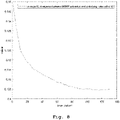
- the average KL divergence is shown between the distributions of MGMP estimation and the underlying noise. This figure has especially been obtained with averaging of 100 independent simulations. As it can be seen, on average the KL divergence is between MGMP and underlying noise reduces, which means that the estimation improves over time.
- the corresponding measurements have been done based on a vector network analyzer (VNA).
- VNA vector network analyzer
- the corresponding measurements have been collected based on Bluetooth low energy transceivers where the interference sources such as WIFI in the measurement setup have been disabled.
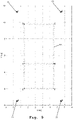
- FIG. 9 the corresponding schematic of the measurement setup is shown.
- the four anchors are shown with squares 91, 92, 93, 94 at the corner of a room and the location of agent in the measurement is shown with circles such as circle 95.
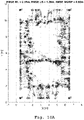
- Fig. 10A and 10B the performance of the localization for MGMP, ML, and LS are compared for the considered measurement case studies, wherein squares, plus, circles are the result of localization for MGMP, ML, and LS.
- MGMP provides a good localization accuaracy, i.e. the root mean square error (RMSE) of the localization for MGMP approaches the RMSE of the ML localization.
- RMSE root mean square error
- the invention or MGMP jointly determines the location of an agent and an updated GM estimate about the unknown ranging noise distribution based on the range measurement between the agent and a limited number of anchors.
- said limited number of anchors is sufficient.
- MGMP provides online localization, i.e. no calibration stage is required.
- MGMP can be used for online localization of multiple agents.
- MGMP can be applied to various ranging schemes such as phase-based ranging, UWB ranging, ToA, and TDoA.
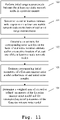
- FIG. 11 there is provided a flow chart of a further exemplary embodiment of the inventive method for estimating a location of at least one mobile network node of a wireless communication network comprising said at least one mobile network node and at least two static network nodes.
- initial range measurements are performed between the at least two static network nodes in a pairwise manner. Furthermore, in a second step 101, an initial location estimate is determined with respect to the at least one mobile network node on the basis of said initial range measurements.
- an estimate for corresponding noise samples is determined on the basis of said initial location estimate and/or a respective location of at least one of the at least two static network nodes.
- corresponding initial parameters of a Gaussian mixture noise model are estimated on the basis of said initial noise samples.
- a weighted sum of respective refined parameters of the Gaussian mixture noise model and the corresponding initial parameters of the Gaussian mixture noise model is determined.
- determining (step 104) the weighted sum comprises the usage of a momentum factor, wherein said momentum factor provides a balance between the respective refined parameters of the Gaussian mixture noise model before an iterative estimation and the respective refined parameters of the Gaussian mixture noise model after an iterative estimation.
- step 103 it might be particularly advantageous if estimating (step 103) the corresponding initial parameters of the Gaussian mixture noise model is iterated such that the Gaussian mixture noise model fits best to the initial noise samples.
- estimating (step 103) the corresponding initial parameters of the Gaussian mixture noise model comprises determining the respective probability of contributing of the corresponding component of the Gaussian mixture noise model to each of the initial noise samples, and/or maximizing a respective match between the corresponding initial parameters of the Gaussian mixture noise model and the initial noise samples.
- the method may further comprise the step of performing (step 105) further range measurements between the at least one mobile network node and the at least two static network nodes in a pairwise manner, and/or determining (step 106) a refined location estimation with respect to the at least one mobile network node on the basis of said further range measurements.
- the method further comprises the step of determining refined noise samples on the basis of the further range measurements and/or the refined location estimation.
- the method may additionally or alternatively comprise the step of estimating the respective refined parameters of a Gaussian mixture noise model especially on the basis of the refined noise samples.
- estimating the respective refined parameters of the Gaussian mixture noise model comprises determining the respective probability of contributing of the corresponding component of the Gaussian mixture noise model to each of the refined noise samples, and/or maximizing a respective match between the respective refined parameters of the Gaussian mixture noise model and the refined noise samples.
- the method may comprise the step of updating the respective refined parameters of the Gaussian mixture noise model on the basis of the weighted sum.
- the method comprises the step of checking if updating the respective refined parameters of the Gaussian mixture noise model is acceptable especially on the basis of Kullback-Leibler divergence or Bhattacharyya distance, preferably Kullback-Leibler divergence.
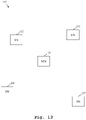
- Fig. 13 illustrates an exemplary embodiment of the inventive wireless communication network 120 with location estimation of at least one mobile network node 121.
- the wireless communication network 120 comprises subscribers, exemplarily the five subscribers 121, 122, 123, 124, 125, comprising said at least one mobile network node, exemplarily the mobile network node 121, and at least two static network nodes, exemplarily the four static network nodes 122, 123, 124, 125.
- At least one subscriber is configured to perform initial range measurements between the static network nodes 122 to 125 in a pairwise manner, determine an initial location estimate with respect to the mobile network node 121 on the basis of said initial range measurements, determine an estimate for corresponding noise samples on the basis of said initial location estimate and/or a respective location of at least one of the static network nodes 122 to 15, estimate corresponding initial parameters of a Gaussian mixture noise model on the basis of said initial noise samples, and determine a weighted sum of respective refined parameters of the Gaussian mixture noise model and the corresponding initial parameters of the Gaussian mixture noise model.
Landscapes
- Engineering & Computer Science (AREA)
- Physics & Mathematics (AREA)
- Computer Networks & Wireless Communication (AREA)
- Signal Processing (AREA)
- Probability & Statistics with Applications (AREA)
- General Physics & Mathematics (AREA)
- Radar, Positioning & Navigation (AREA)
- Remote Sensing (AREA)
- Mobile Radio Communication Systems (AREA)
- Small-Scale Networks (AREA)
Abstract
Description
- The invention relates to a method for estimating a location of at least one mobile network node of a wireless communication network comprising said at least one mobile network node and at least two static network nodes, and a wireless communication network with location estimation of at least one mobile network node, the wireless communication network comprising subscribers comprising said at least one mobile network node and at least two static network nodes.
- Generally, in times of an increasing number of communication applications providing wireless connectivity capabilities, there is a growing need of a method for estimating a location of at least one mobile network node of a wireless communication network, and a wireless communication network with location estimation of at least one mobile network node.
-
CN 111739096 A relates to a self-positioning method and a self-positioning system for a depth sensor during movement, wherein the method comprises the following steps: in a preset scene, defining a camera coordinate system of a depth sensor at an initial moment as a reference coordinate system; defining three-dimensional point cloud obtained by the depth sensor by using the reference coordinate system at the initial time as target point cloud; defining three-dimensional point cloud obtained by the depth sensor by using the current camera coordinate system at the current moment as reference point cloud; matching the reference point cloud with the target point cloud to obtain the six-dimensional pose of the depth sensor at the current moment; and positioning the depth sensor by utilizing the six-dimensional pose of the depth sensor at the current moment. In this context, noise is assumed as a known parameter and the probability of the pose of a sensor is modeled using Gaussian mixture model, which disadvantageously leads to several inaccuracies especially in the case of an unknown ranging noise distribution. - Accordingly, there is an object to provide a method for estimating a location of at least one mobile network node of a wireless communication network, and a wireless communication network with location estimation of at least one mobile network node, thereby ensuring a particularly high accuracy.
- This object is solved by the features of the first independent claim for a method for estimating a location of at least one mobile network node of a wireless communication network comprising said at least one mobile network node and at least two static network nodes, and the features of the second independent claim for a wireless communication network with location estimation of at least one mobile network node, the wireless communication network comprising subscribers comprising said at least one mobile network node and at least two static network nodes. The dependent claims contain further developments.
- According to a first aspect of the invention, it is provided a method for estimating a location of at least one mobile network node of a wireless communication network comprising said at least one mobile network node and at least two static network nodes, the method comprising the steps of performing initial range measurements between the at least two static network nodes in a pairwise manner, determining an initial location estimate with respect to the at least one mobile network node on the basis of said initial range measurements, determining an estimate for corresponding noise samples on the basis of said initial location estimate and/or a respective location of at least one of the at least two static network nodes, estimating corresponding initial parameters of a Gaussian mixture noise model on the basis of said initial noise samples, and determining a weighted sum of respective refined parameters of the Gaussian mixture noise model and the corresponding initial parameters of the Gaussian mixture noise model.
- Advantageously, the location of the at least one mobile network node can be found based on noisy range measurements between the at least one mobile network node and the at least two static network nodes, which leads to a particularly high accuracy. Further advantageously, the number of the static network nodes can be limited to a rather small number such as four or eight. As a further advantage, it is noted that no calibration stage is required.
- According to a first preferred implementation form of the first aspect of the invention, determining the weighted sum comprises the usage of a momentum factor, wherein said momentum factor provides a balance between the respective refined parameters of the Gaussian mixture noise model before an iterative estimation and the respective refined parameters of the Gaussian mixture noise model after an iterative estimation. Advantageously, for instance, accuracy can further be increased in a particularly efficient manner.
- According to a second preferred implementation form of the first aspect of the invention, estimating the corresponding initial parameters of the Gaussian mixture noise model is iterated such that the Gaussian mixture noise model fits best to the initial noise samples. Advantageously, for example, complexity can be reduced, which leads to an increased efficiency.
- According to a further preferred implementation form of the first aspect of the invention, estimating the corresponding initial parameters of the Gaussian mixture noise model comprises determining the respective probability of contributing of the corresponding component of the Gaussian mixture noise model to each of the initial noise samples, and/or maximizing a respective match between the corresponding initial parameters of the Gaussian mixture noise model and the initial noise samples. Advantageously, for instance, not only inaccuracies but also inefficiencies can further be reduced especially by increasing simplicity.
- According to a further preferred implementation form of the first aspect of the invention, the method further comprises the steps of performing further range measurements between the at least one mobile network node and the at least two static network nodes in a pairwise manner, and determining a refined location estimation with respect to the at least one mobile network node on the basis of said further range measurements. Advantageously, for example, accuracy can further be increased in a very efficient manner.
- According to a further preferred implementation form of the first aspect of the invention, the method further comprises the step of determining refined noise samples on the basis of the further range measurements and/or the refined location estimation. Advantageously, for instance, inaccuracies can further be reduced.
- According to a further preferred implementation form of the first aspect of the invention, the method further comprises the step of estimating the respective refined parameters of a Gaussian mixture noise model especially on the basis of said refined noise samples. Advantageously, for example, efficiency can further be increased.
- According to a further preferred implementation form of the first aspect of the invention, estimating the respective refined parameters of the Gaussian mixture noise model is iterated especially such that the Gaussian mixture noise model fits best to the refined noise samples. Advantageously, for instance, complexity can further be reduced, thereby increasing efficiency.
- According to a further preferred implementation form of the first aspect of the invention, estimating the respective refined parameters of the Gaussian mixture noise model comprises determining the respective probability of contributing of the corresponding component of the Gaussian mixture noise model to each of the refined noise samples, and/or maximizing a respective match between the respective refined parameters of the Gaussian mixture noise model and the refined noise samples. Advantageously, for example, inefficiencies can further be reduced especially by increasing simplicity.
- According to a further preferred implementation form of the first aspect of the invention, the method further comprises the step of updating the respective refined parameters of the Gaussian mixture noise model on the basis of the weighted sum. Advantageously, for instance, accuracy can further be increased in a particularly efficient manner.
- According to a further preferred implementation form of the first aspect of the invention, the method further comprises the step of checking if updating the respective refined parameters of the Gaussian mixture noise model is acceptable especially on the basis of Kullback-Leibler divergence or Bhattacharyya distance, preferably Kullback-Leibler divergence. Advantageously, for example, inaccuracy can efficiently be forestalled.
- According to a further preferred implementation form of the first aspect of the invention, at least a part of the steps according to any of the implementation forms of the first aspect of the invention is repeated. Advantageously, for instance, complexity can further be reduced, thereby increasing efficiency.
- According to a further preferred implementation form of the first aspect of the invention, the initial noise samples comprise or are ranging errors. Additionally or alternatively, the refined noise samples comprise or are ranging errors. In addition to this or as an alternative, noise is caused at least by multipath propagation of the corresponding signals within the wireless communication network. Further additionally or further alternatively, at least one, preferably each, of the at least one mobile network node communicates in a bidirectional manner. In further addition to this or as a further alternative, at least one, preferably each, of the at least two static network nodes communicates in a bidirectional manner.
- Before the second aspect of the invention and its preferred implementation forms are explained in detail in the following, it is noted that the advantages having been mentioned above in the context of the first aspect and its preferred implementation forms analogously apply without explicitly repeating said advantages.
- According to a second aspect of the invention, it is provided a wireless communication network with location estimation of at least one mobile network node, the wireless communication network comprising subscribers comprising said at least one mobile network node and at least two static network nodes, wherein at least one subscriber is configured to perform initial range measurements between the at least two static network nodes in a pairwise manner, determine an initial location estimate with respect to the at least one mobile network node on the basis of said initial range measurements, determine an estimate for corresponding noise samples on the basis of said initial location estimate and/or a respective location of at least one of the at least two static network nodes, estimate corresponding initial parameters of a Gaussian mixture noise model on the basis of said initial noise samples, and determine a weighted sum of respective refined parameters of the Gaussian mixture noise model and the corresponding initial parameters of the Gaussian mixture noise model.
- According to a first preferred implementation form of the second aspect of the invention, at least one subscriber is configured to use a momentum factor for or in the context of determining the weighted sum, wherein said momentum factor provides a balance between the respective refined parameters of the Gaussian mixture noise model before an iterative estimation and the respective refined parameters of the Gaussian mixture noise model after an iterative estimation.
- According to a second preferred implementation form of the second aspect of the invention, at least one subscriber is configured to iterate estimating the corresponding initial parameters of the Gaussian mixture noise model such that the Gaussian mixture noise model fits best to the initial noise samples.
- According to a further preferred implementation form of the second aspect of the invention, estimating the corresponding initial parameters of the Gaussian mixture noise model comprises determining the respective probability of contributing of the corresponding component of the Gaussian mixture noise model to each of the initial noise samples, and/or maximizing a respective match between the corresponding initial parameters of the Gaussian mixture noise model and the initial noise samples.
- Accordingly, it might be particularly advantageous if at least one subscriber is configured to determine the respective probability of contributing of the corresponding component of the Gaussian mixture noise model to each of the initial noise samples, and/or to maximize a respective match between the corresponding initial parameters of the Gaussian mixture noise model and the initial noise samples.
- According to a further preferred implementation form of the second aspect of the invention, at least one subscriber is configured to perform further range measurements between the at least one mobile network node and the at least two static network nodes in a pairwise manner, and to determine a refined location estimation with respect to the at least one mobile network node on the basis of said further range measurements.
- According to a further preferred implementation form of the second aspect of the invention, at least one subscriber is configured to determine refined noise samples on the basis of the further range measurements and/or the refined location estimation.
- According to a further preferred implementation form of the second aspect of the invention, at least one subscriber is configured to estimate the respective refined parameters of a Gaussian mixture noise model especially on the basis of said refined noise samples.
- According to a further preferred implementation form of the second aspect of the invention, at least one subscriber is configured to iterate estimating the respective refined parameters of the Gaussian mixture noise model especially such that the Gaussian mixture noise model fits best to the refined noise samples.
- According to a further preferred implementation form of the second aspect of the invention, estimating the respective refined parameters of the Gaussian mixture noise model comprises determining the respective probability of contributing of the corresponding component of the Gaussian mixture noise model to each of the refined noise samples, and/or maximizing a respective match between the respective refined parameters of the Gaussian mixture noise model and the refined noise samples.
- Accordingly, it might be particularly advantageous if at least one subscriber is configured to determine the respective probability of contributing of the corresponding component of the Gaussian mixture noise model to each of the refined noise samples, and/or to maximize a respective match between the respective refined parameters of the Gaussian mixture noise model and the refined noise samples.
- According to a further preferred implementation form of the second aspect of the invention, at least one subscriber is configured to update the respective refined parameters of the Gaussian mixture noise model on the basis of the weighted sum.
- According to a further preferred implementation form of the second aspect of the invention, at least one subscriber is configured to check if updating the respective refined parameters of the Gaussian mixture noise model is acceptable especially on the basis of Kullback-Leibler divergence or Bhattacharyya distance, preferably Kullback-Leibler divergence.
- According to a further preferred implementation form of the second aspect of the invention, at least one subscriber is configured to repeat at least a part of the actions according to the corresponding subscriber configuration of any of the implementation forms of the second aspect of the invention.
- According to a further preferred implementation form of the second aspect of the invention, the initial noise samples comprise or are ranging errors. Additionally or alternatively, the refined noise samples comprise or are ranging errors. In addition to this or as an alternative, noise is caused at least by multipath propagation of the corresponding signals within the wireless communication network. Further additionally or further alternatively, at least one, preferably each, of the at least one mobile network node communicates in a bidirectional manner. In further addition to this or as a further alternative, at least one, preferably each, of the at least two static network nodes communicates in a bidirectional manner.
- Exemplary embodiments of the invention are now further explained with respect to the drawings by way of example only, and not for limitation. In the drawings:
- Fig. 1A
- illustrates an exemplary intersection-based localization with noise-free range measurements;
- Fig. 1B
- shows an exemplary intersection-based localization with noisy range measurements;
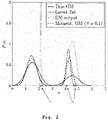
- Fig. 2
- shows a comparison between the Pdf of GM in a numerical example;
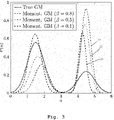
- Fig. 3
- shows a comparison between the Pdf of momentum-based GM in a numerical example for different momentum factors;
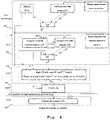
- Fig. 4
- shows a flow chart of an exemplary embodiment of the inventive method, which is called MGMP;
- Fig. 5
- illustrates an exemplary simulation setup;
- Fig. 6
- illustrates the performance of positioning for the MGMP, ML, and LS with {α 1 = 0.7, µ 1 = 1.5, σ 1 = 0.5}, {α 2 = 0.3, µ 2 = 4.5, σ 2 = 0.5} as the components of the underlying noise model, MGMP is initialized with {α 1 = 0.5, µ 1 = 1, σ 1 = 0.5}, {α 2 = 0.5, µ 2 = 2, σ 2 = 0.5};
- Fig. 7A
- illustrates the CDF of positioning error corresponding to
Fig. 6 ; - Fig. 7B
- illustrates a comparison between the CDFs of initial GM, MGMP estimation, GM estimation using only anchors, and the underlying noise corresponding to
Fig. 6 ; - Fig. 8
- shows the evolution of the KL divergence between MGMP estimation and the underlying noise corresponding to
Fig. 6 ; - Fig. 9
- shows a schematic of the exemplary measurement setup;
- Fig. 10A
- illustrates a comparison between the performance of MGMP, ML, and LS with measurement results "8_shape_HVpolarized_VNA";
- Fig. 10B
- illustrates a comparison between the performance of MGMP, ML, and LS with measurement results "8_shape_HVpolarized_FW153_no_interference";
- Fig. 11
- shows a flow chart of a further exemplary embodiment of the inventive method;
- Fig. 12
- shows a flow chart of a further exemplary embodiment of the inventive method; and
- Fig. 13
- shows an exemplary embodiment of an inventive wireless communication network with location estimation of at least one mobile network node.
-
Fig. 1 illustrates an exemplary localization scenario. In this context, it is noted that localization of an agent with unknown location can be performed based on range measurements between the agent and some a-priori known locations, which can be referred to as anchors or access points. In this exemplary case, such known locations are referred to as anchors as it can be seen fromFig. 1A or Fig. 1B , respectively. - For instance, it is further noted that the range measurement in ultra-wide band (UWB) or Bluetooth low-energy (BLE) radio systems can preferably be based on:
- (i) Received signal strength indicator (RSSI);
- (ii) Time-of-arrival (ToA) or Time-difference-of-arrival (TDoA); and/or
- (iii) phase-based measurements.
- As already mentioned above,
Fig. 1 is an example of an interested scenario in the sense of the invention, which exemplarily comprises a 10m-by-10m room with one agent (mobile in the room) and four anchors (radios in each corner of the room). - The goal is to find the location of the agent based on the range measurements between the agent and anchors. If the ranges are noise-free, the intersection of the circles with radius of the ranges centred on each anchor determines the location of the agent, shown by the
dot 11 inFig. 1A . - In a real system, regardless of the ranging method, the measured range always contains noise. This noise is due to several reasons such as the reflective property of the propagation environment or nonidealities of the hardware, etc.
- As it can be seen from
Fig. 1B , the intersection of circles with radius of the noisy range measurements would result in erroneous localization, wherein the magnitude of thearrow 12 inFig. 1B exemplarily illustrates the corresponding localization error. To improve the localization performance, the distribution of the noise can be estimated, and then exploited in the context of localization. - In the sense of the invention, the parameters of the corresponding noise model can advantageously be estimated in an on-the-fly manner. Then, the estimated noise model is especially employed to localize the agent. By "on-the-fly" term, it is especially meant that there is no extensive dedicated calibration stage to perform multiple range measurements in different locations in order to estimate the noise model. Instead, as the agent moves in the environment, at each time instant where the ranging between agent and anchors are performed, the invention preferably first updates the latest estimate of the noise model and then uses the updated model to estimate the location of the agent.
- For further explanation, a range measurement may exemplarily be considered between NA anchors and an agent. The range measured to the ith, i= {1,..., NA } anchor is given as

- The measurement noise can be modeled using generic models such as Gaussian mixture (GM) model. Using GM, the probability density function (Pdf) of ni is given as
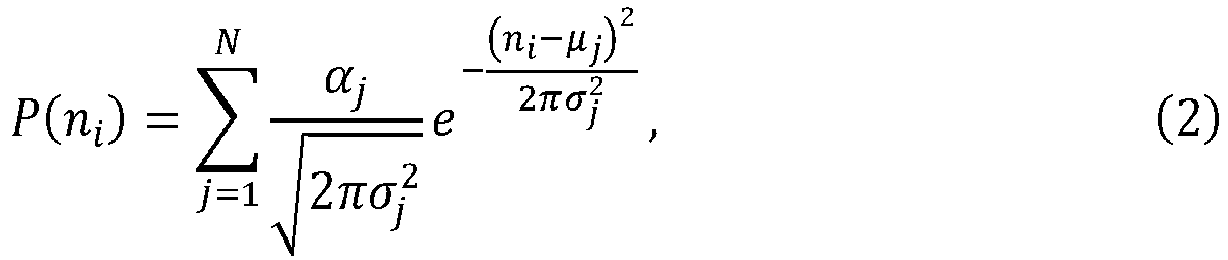
- The parameters of the GM noise model can be estimated based on samples of the noise distribution preferably using expectation maximization technique which is explained in the following.
- Expectation maximization (EM) especially estimates the parameters of the GM, representing the noise distribution based on observations (samples) of the noise distribution. The samples of noise distribution can be collected based on a calibration stage, wherein for some a-priori known locations in the localization environment, the ranges to the anchors can be measured. Then, based on the locations of the anchors, which are also known, the samples of the noise distribution can be computed. These noise sample are then fed into an iterative procedure with some initialized GM parameters to estimate the GM distribution that fit the best into the noise samples. The output of EM is a GM noise model, which can then be used in the localization to improve the localization performance especially compared to an intersection-based localization.
- By θ , the set of parameters of the GM is exemplarily denoted, representing noise model, i.e., θ ={αj,µj,σj }, j={1,...,N}. In the calibration phase, for NS known locations xk, k={1,...,NS }, and NA known location of anchors x̃i i={1,...,NA }, the set of range measurements to anchors rki are exemplarily performed.
- Then, {rki -∥xk -x̃i ∥2}, wherein i={1,...,NA }, k={1,...,NS } as a set of samples of the noise distribution is exemplarily computed. These noise samples are then used in the EM to find the parameters of GM, i.e., θ . EM preferably is an iterative method which consists of two steps: (i) expectation (E) step and (ii) maximization (M) step.
- In the following, the workflow of EM is exemplarily explained. Assume that EM is at iteration (l-1), with inputs of θ l-1 and noise samples {rki -∥xk -x̃i ∥2}, wherein i={1,...,NA }, k={1,...,NS }. The output of EM especially is the update GM parameters, i.e., θl .
- In said expectation step, the probability of contributing of the j-th component of GM to each noise sample {rki -∥xk -x̃i ∥2} is exemplarily computed. This probability can be expresses as

- Furthermore, the parameters of θ l in maximization step can be computed as:


- With respect to EM, in a nutshell, it is noted that for a given set of noise samples {rki-∥xk-x̃i∥2}, wherein i= {1,...,NA}, k={1,...,NS} and initialized noise parameters θ0=

- It is noted that EM provides an estimation for the GM model which can be used for localization, it especially relies on the assumption that many samples from the unknown noise distribution are available. These noise samples be gathered typically using an extensive calibration stage.
- Nevertheless, in practical scenarios, an extensive calibration stage may be not allowed. Furthermore, the number of anchors/agents involved in the localization step may especially be limited (for instance, 4-8 anchors and one agent), which in turn means that only a limited number of noise samples are available for estimating the GM model.
- In such use cases, EM-type schemes cannot provide a good GM estimation about the noise model, yielding a poor localization performance. Therefore, the invention jointly localizes the agent and estimates noise distribution especially based on the limited number of samples/range measurements without having an extensive calibration stage.
- Inventively, an on-the-fly localization is performed, which can also be dubbed as joint momentum-based Gaussian mixture model update and positioning, in short MGMP.
- In a high-level view, MGMP especially attempts to progressively improve the GM estimation while performing localization. Concretely, at a given time instant corresponding to an unknown location of the agent, MGMP preferably first employs the latest GM estimate and the noisy range measurements between the agent and anchors to find an initial estimate for the location of the agent.
- Then, especially using such initial location estimate and the location of the anchors, the samples of the ranging noise distribution can be computed. The samples of the ranging noise distribution and the latest GM estimate are then preferably used to update the GM estimate. Furthermore, the updated GM estimate can be used to localize the agent. It is remarked that the initialization stage of the inventive method may especially provide the first GM estimate to start the localization. In a high-level, the MGMP especially contains five steps, which are summarized below.
- A first step may be called initialization step. This step especially provides the first GM estimate to start the localization stage. In the initialization step, the parameters (mean, standard deviation, probability of each component) for the first GM are preferably initialized.
- Then, the range measurements between anchors are especially utilized to update the initialized GM. Furthermore, a set of values for the momentum factor may preferably be considered. For localization in a static environment, i.e., localization in the environment, which is not changing, the momentum coefficient can be a decreasing function over the time. Note that the initialization is preferably just performed one time, hence,
step 1 is especially not performed in each GM update and localization which can be done throughstep 2 to step 5. - Moreover, the second step preferably comprises computing the noise samples and a new GM estimate. In this step, first, an initial estimate for the location of the agent may be computed especially using the latest GM estimate and the noisy range measurements between the agent and anchors. Then, especially using the location of the anchors and the initial location estimate of agent, the noise samples of ranging noise distribution can be computed. Furthermore, EM can be performed with the input of the computed noise samples and the latest GM estimate, preferably yielding a new GM estimate.
- With respect to the third step, it is noted that said third step preferably comprises momentum-based Gaussian mixture and Gaussian merging. In this step, the new GM estimate from the second step and the latest GM estimate may preferably be used to come up with a candidate GM for updating the GM estimation. In particular, a weighted sum of the latest GM estimate (the GM utilized as the input of step 2) and the new GM estimate (the GM resulted as the output of step 2) can be computed preferably using the initialized set of momentum factors from
step 1. This weighted sum is exemplarily referred to as momentum-based Gaussian mixture, wherein the term "momentum" especially refers to the fact that the GM estimation improvement is gradually performed in the sense of the invention. The goal of such weighted sum especially is to update the GM estimation by not relying only on theoutput step 2, as it is computed based on few noise samples. As the weighted sum preferably doubles the number of GM components which may result in overfitting, the GM components from the weighted sum are especially merged mutually such that the statistical properties of the merged component stays the same as that of the sum of two components from the weighted sum. - Now, with respect to the fourth step, said fourth step preferably comprises a check for accepting the candidate GM. In this step, a statistical check is preferably devised to decide whether MGMP accepts the candidate GM for updating the GM estimate or not. In case that the candidate GM is not accepted, the latest GM estimate is used for updating the GM estimate.
- As in each time instant, the GM is preferably be updated based on few noise samples, especially comparing two consecutive time instances, there should not be a large deviation between the distribution of the latest GM estimate and the candidate GM. However, it is possible that noise samples are all from the tail of true noise distribution. In this case the GM resulted as the output of
step 3 may become dramatically different than the latest GM estimate and the candidate GM can be considered as an outlier. The devised statistical check especially attempts to find such outliers in updating the GM and improves the convergence of the invention. It is noted that there are several statistical metrics that can be used to compare two distributions, for instance, Kullback-Leibler (KL) divergence or Bhattacharyya distance. In this context, it might be particularly advantageous to use KL divergence, which especially improves better the convergence of invention. - With respect to the fifth step, it is noted that said fifth step preferably comprises localization. In this step, the location of the agent will be estimated especially using the updated GM estimate about the ranging noise. Optionally, in a limit it might be removed.
- It is remarked that a variant of MGMP can be obtained by omitting the
step 5. In such variant, the initial estimate about the location of the agent (which is preferably computed in step 2) can especially be used as the estimated location and the updated GM model fromstep 4 can preferably be used for the next localization time instant. - For a detailed explanation, it is noted that in the sense of the invention, MGMP is especially based on EM, momentum-based GM update, GM merging, and KL divergence. In the following, momentum-based GM update, GM merging, and KL divergence are firstly explained. Then, the workflow of the MGMP will be explained in a step-by-step manner.
- It is further noted that in the following description, the term iteration may especially be used for referring to the time instant where the ranging and localization are performed. l=1 means the start of the localization where the inventive method is initialized and gives the first estimate of the ranging noise model. Then, l=2 means that the first time that the ranging between agent and anchors are performed, where MGMP updates the previous noise model based on the new range measurements and then localizes the agent.
- With respect to the above-mentioned momentum-based GM update, it is noted that, as will be explained later, at each iteration MGMP preferably employs EM. If the number of available noise samples for GM estimation is limited, EM routine will especially tend to suppress some GM components. Then, the GM update become less likely compared to the underlying noise model, hence, the corresponding localization does not perform well.
- As an example, in
Fig. 1 , there are only four range measurements in each iteration. After computing the four noise samples corresponding to four range measurements, the EM should update the noise model using only these four noise samples. The idea of momentum-based GM update especially is to not fully trust on the GM update yielded by applying EM, as EM update is based on a few noise samples. Instead, it is considered a momentum preferably between the latest GM estimation (which is used as the input for EM) and the outcome of EM. - It is assumed that the latest estimate of the GM parameters is θ l-1, and


- With respect to the above-mentioned Gaussian mixture merging, it is noted that especially using the momentum GM update, the number of GM components is doubled (see equation (7)). To keep the same number of components and prevent overestimation of the noise parameters, preferably at each iteration of MGMP, the GM components are especially mutually merged, preferably such that the statistical moments of the merge components are preserved.
- It is assumed that there are two GM components with parameters θ 1={α 1,µ 1,σ 1}, θ 2={α 2,µ 2,σ 2}. The goal is to find a merged GM component which has the same component probability, mean, and variance. By θ m ={αm ,µm ,σm }, the parameters of the merged GM component are exemplarily denoted. The following relation should hold with respect to the Pdf of the merged component θ m and θ 1 and θ 2:

- From (8), it can be shown that the component probability, mean, and variance corresponding to θ m can be computed as


- In MGMP, two GM components are preferably approximated with similar means as one Gaussian, in which the corresponding moments can be computed using equations (9.1) to (9.3).
- To additionally clarify the momentum-based GM update and GM merging, a numerical example is provided in the following. In this context, the setup given in
Fig. 1 is considered. In addition to this, it is assumed that the original GM noise model has two components {α 1=0.7, µ 1=1.5, σ 1=0.5}, {α 2= 0.3,µ 2=4.5, σ 2=0.5}. Furthermore, the latest GM estimation has two components {α 1=0.666, µ 1=1.43, σ1=0.37}, {α 2=0.333, µ 2= 4.21, σ2=0.153}, and there is a length-four noise sample observation {4.75,2.14,4.12,4.7} which corresponds to four ranges and is shown by thecircles 21 inFig. 2 . - Employing the EM with the latest GM estimate and observation set, yields a GM with two components {α 1=0.25, µ 1=2.14, σ 1= 0.000036}, {α 2=0.75, µ 2=4.52, σ 2=0.28}, which is shown in
Fig. 2 As component with σ 1=0.000036 is hard to visualize compared to the other GM component, the variance is increased to be able to visualize inFig. 2 . - Although the first GM component of the original noise distribution is dominant (component factor 0.7), as the noise samples are more towards the second GM component of the original noise distribution, the EM tends to suppress the first component, yielding a GM which is less similar to the original noise distribution compared to the input of the EM routine. Performing momentum-based GM with β 1=0.1 and Gaussian merging results in a GM with two components {α 1= 0.62, µ 1j=1.46, σ 1=0.39}, {α 2=0.37, µ 2=4.27, σ 2=0.22}, which is also shown in
Fig. 2 . - One can see that the proposed momentum-based GM update prevents suppressing the first component and yields a better estimation of the noise distribution compared to the output of the EM routine. In
Fig. 3 , the GM resulting from the invention is shown for different momentum factors as illustrated by curves 31 (0.1), 32 (0.5), 33 (0.8). - As it can be expected, since the output of EM routine is less similar to the original GM distribution than the previous estimate of the noise distribution, the lowest β provides the best momentum-based GM.
- With respect to the above-mentioned KL divergence, it is noted that KL divergence is a metric to evaluate the statistical distance between two distributions. The lower the KL divergence between two distributions means that the distributions are more similar.
- In the following, there are defined p(x) and q(x) as two continuous Pdfs. KL divergence between p(x) and q(x) is defined as

- Note that when q(x) = p(x), then KL(p(x)||q(x)) = 0. This means that the more similar of two Pdfs, the less value of the corresponding KL divergence.
- Again, with respect to the MGMP, in the following, it is assumed that there are NA anchors, and at each iteration (time instant), there are NS agents. It is remarked that the special case of NS =1, NA =4, corresponds to the scenario shown in
Fig. 1 . - As it can be seen from
Fig. 4 showing an exemplary flow chart of MGMP in the sense of the invention, especially according to theinitialization step 401, MGMP is initialized with a set of parameters for the GM noise model, i.e.,

- Firstly, the range measurements between anchors are exemplarily used to compute the ground truth noise samples. There are


- Then, EM algorithm (see above-mentioned equations (5), (6.1) to (6.3)) is performed with the noise samples {rki - ∥x̃k -x̃i ∥2} and initial parameters θ 0, yielding the parameter estimate θ 1. θ 1 is then used for starting the localization stage in MGMP algorithm. Note that the initialization is just performed one time, hence,
step 1 is especially not a part of iterative stage of the MGMP where the GM is updated, and the location of the agent is estimated. - After initialization, the other steps of MGMP are as follows. Especially without loss of generality, it is assumed that MGMP is at time instant (l-1), wherein the parameters of the latest GM estimate are θ l-1, and rki, i= {1,...,N} k={1,...,N} ...,NS } are the range measurements between NS agents and NA anchors.
- In accordance with the
second step 402 ofFig. 4 , the following optimization is preferably solved to find the initial estimation about the location of agents:
- Then, based on these initial estimated locations, the location of anchors x̃i, and range measurements rki, the noise sample are computed as

- Then, EM algorithm (see above-mentioned equations (5) and (6.1) to (6.3)) is performed with the inputs of {rki -∥xk -x̃i ∥2} and θ l , yielding

- Furthermore, in accordance with the
third step 403, two GMs with parameters θ l-1 and θ e are preferably combined using βl, according to the above-mentioned equation (7), yielding 2N components. - Then, pair of components in θ l-1 and θ e are especially merged, yielding final estimated GM with N components.
- Firstly, it is selected which pair of components in θ l-1 and θ e should be merged after combining. To do so, the dominant component of θ l-1, i.e., component with largest

- Similarly, the second dominant component of θ l-1 is preferably merged with the component of θ e which is not selected yet and has the closest mean. This selection procedure continues, until all N components of θ l-1 are especially paired with a component in θ e . Then, the selected components are preferably combined with using βl , according to the above-mentioned equation (7), and merged according to the above-mentioned equations (9.1) to (9.3), yielding


- Moreover, especially according to the
fourth step 404, MGMP preferably has a condition to whether accept the candidate GM
- In the following,


- In a nutshell, the foregoing equation (14) especially ensures that the updated GM estimate θ l does not vary a lot with respect to the latest estimate θ l-1. If it varies a lot (first condition of (14)), the latest GM estimate ( θ l-1) is preferably used as the current GM estimate ( θ l ).
- Furthermore, in accordance with the
fifth step 405 ofFig. 4 , the localization is performed based on the updated GM estimate θl . Concretely, the location of the kth agent is especially computed as
- After localization, the GM with parameter θ l are preferably used as an input for the next joint localization and GM estimation ( θ l+1) corresponding to iteration (time instant) (l+1), which can especially be done by repeating the above-mentioned
steps 2 two 5 as exemplarily shown byFig. 4 . - In the following, it will be explained, how the parameters βl and θ 0 can preferably be chosen.
- With respect to choosing βl , it is noted that for localization in the static environment, i.e., localization in the environment, which is not changing over the period of localization, the momentum coefficient may especially be a decreasing function over the time. This means that as the invention gathers more and more noise samples, the GM estimation should converge to a good estimation of the underlying GM noise model. An example of such scenario is localization of an agent in a building or a factory hall. The following two options of βl are used for the simulation results as well as testing of the invention on the measurement data:


- Furthermore, with respect to choosing θ 0, MGMP has been tested with initialization of GM components with equal probabilities, wherein the standard deviation of each component is equal to 0.5, i.e.,


- Selecting the mean for each component in the initial GM, especially depends on the employed ranging method. For the application of phase-based ranging where the invention is tested, typically there is 1 m to 2 m bias of error in ranging, hence, the mean of noise components can be selected in this range.
- For applying the invention in other ranging systems, one can run a standard K-means method based on range measurements between anchors. Said K-means method preferably is a clustering method and finds the mean of N noise components contributing the noise of measurements between anchor, i.e., the output of K-means method can be used as

- With respect to the computational complexity of MGMP in the sense of the invention, it is noted that, as explained before, MGMP employs EM algorithm as well as and Gaussian merging. The computation complexity of EM algorithm (see equations (5) and (6.1) to (6.3)) as well and Gaussian merging (see equations (9.1) to (9.3)) is at the cost of few multiplications and additions, which is not significant.
- Advantageously, solving the above-mentioned equation (15) for finding the location of the agent is most computationally heavy stage of MGMP. However, as one can show the cost function of (15) is convex, hence, any standard low-complex Gradient decent method can be employed to find the solution of said equation (15). Overall, the computational complexity of MGMP is not high.
- In the context of maximum likelihood localization, it is noted that if the parameters of the GM representing the noise distribution are known (i.e., {αj,µj,σj }, j={1,...,N}), the maximum likelihood (ML) preferably provides the best estimation for the location of the agent.
- The ML estimate of the location of the agent can be expressed as

- Note that the cost function of (16) is non-convex, therefore, the performance of localization is sensitive to the initialization of the optimization.
- In the sense of an embodiment the invention, it is referred to ML localization, where optimization in (16) initialized by the true location of the agent.
- In other words, for solving the above-mentioned equation (16), clearly the best initialization of the optimization problem in (16) preferably is the true location of the agent, hence, ML based localization with such initialization especially provides the best localization performance, i.e., performance upper bound.
- Furthermore, in the context of least squares localization, it is noted that in least squares (LS)-based localization, one can assume that there is no a-priori knowledge about the underlying range measurement noise. The LS-localization is preferably performed by minimizing the sum of the squared ranging errors.
- The LS estimate about the location of the agent is given as

- Now, with respect to simulation and measurement results, it is noted that
Fig. 5 shows the respective exemplary simulation setup. For the simulation setup, a 10 m by 10 m room has been considered, wherein the anchors are located around the room with 5m distance to the neighboring anchors. - There are considered eight anchors, which are exemplarily located on the square 51, and one agent, i.e., NA =8, NS =1. The square 52 denotes the trajectory, where the agent moves on. On the trajectory, the distance between the location of the agent at each time instance compared to the previous location is 0.5m.
- It is assumed that the agent moves on the trajectory two times, yielding the total of 130 locations. It is further assumed that the underlying noise model had two components, i.e., {α 1=0.7, µ 1=1.5, σ1=0.5}, {α 2=0.3,µ 2 =4.5, σ 2=0.5). As it can be seen, this simulation scenario is especially the same as the one according to
Fig. 1 , wherein just the number of anchors is increased from 4 to 8. - Furthermore, in
Fig. 6 , the performance of the localization for MGMP, ML, and LS are compared, wherein MGMP is initialized with a GM with two components, i.e. {α 1=0.5, µ 1= 1, σ 1=0.5}, {α 2=0.5, µ 2=2, σ 2=0.5}. - Note that RMSE (indicated in the title of
Fig. 6 ) is a metric which stands for root means square error. It is considered that the momentum coefficient at time instant l is given as
- Now, with respect to
Fig. 7A comprising curves 71 (momentum-based error), 72 (ML error), and 73 (LS error), the cumulative distribution function (CDF) of the localization error is illustrated. As it can be seen, MGMP especially approaches ML performance. - Furthermore, in
Fig. 7B comprising curves 74 (original), 75 (initial), 76 (GM EM by anchors), and 77 (GM momentum-based), the CDF of the initial GM in MGMP, underlying GM noise model, GM estimated using only anchors (step 1 of MGMP in the sense of the invention), and final MGMP estimation are compared. - Moreover, according to
Fig. 8 , the average KL divergence is shown between the distributions of MGMP estimation and the underlying noise. This figure has especially been obtained with averaging of 100 independent simulations. As it can be seen, on average the KL divergence is between MGMP and underlying noise reduces, which means that the estimation improves over time. - Especially to verify the performance of MGMP by measurements, two sets of measurements have exemplarily been considered, i.e., "8_shape_HVpolarized_VNA" and "8_shape_HVpolarized_FW153_no_interference".
- In said "8_shape_HVpolarized_VNA", the corresponding measurements have been done based on a vector network analyzer (VNA). In said "8_shape_HVpolarized_FW153_no_interference", the corresponding measurements have been collected based on Bluetooth low energy transceivers where the interference sources such as WIFI in the measurement setup have been disabled.
- In these two case studies, there are four anchors and one agent NA =4, NS =1, i.e., at each time instant four samples are available. The underlying noise model can be extracted from the measurement samples as a GM with three components. It is noted that a major performance improvement has especially not been seen by considering two initial GM components in MGMP compared to MGMP initialized by only one Gaussian component, in these two case studies.
- This may especially be due to the fact that the two dominant noise components of the underlying noise model have similar means, hence, it can be well approximated with single Gaussian. For the following results, we initialized MGMP with a Gaussian with {α 1=1, µ 1=1, σ 1=1} parameters.
- Now, with respect to
Fig. 9 , the corresponding schematic of the measurement setup is shown. The four anchors are shown withsquares circle 95. - Furthermore, in
Fig. 10A and10B , the performance of the localization for MGMP, ML, and LS are compared for the considered measurement case studies, wherein squares, plus, circles are the result of localization for MGMP, ML, and LS. - In both case studies, the momentum coefficient has exemplarily been employed at time instant l as

- Similar to simulation results, it can especially be seen that MGMP provides a good localization accuaracy, i.e. the root mean square error (RMSE) of the localization for MGMP approaches the RMSE of the ML localization.
- Moreover, in accordance with all the explanations above, major advantages of the invention can basically be summarized as follows: The invention or MGMP, respectively, jointly determines the location of an agent and an updated GM estimate about the unknown ranging noise distribution based on the range measurement between the agent and a limited number of anchors. In this context, it is to be emphasized that said limited number of anchors is sufficient. It is additionally to be highlighted that MGMP provides online localization, i.e. no calibration stage is required. Furthermore, MGMP can be used for online localization of multiple agents. It is further remarked that MGMP can be applied to various ranging schemes such as phase-based ranging, UWB ranging, ToA, and TDoA.
- Now, with respect to
Fig. 11 , it is noted that there is provided a flow chart of a further exemplary embodiment of the inventive method for estimating a location of at least one mobile network node of a wireless communication network comprising said at least one mobile network node and at least two static network nodes. - In accordance with said
Fig. 11 , in afirst step 100, initial range measurements are performed between the at least two static network nodes in a pairwise manner. Furthermore, in asecond step 101, an initial location estimate is determined with respect to the at least one mobile network node on the basis of said initial range measurements. - Moreover, in a
third step 102, an estimate for corresponding noise samples is determined on the basis of said initial location estimate and/or a respective location of at least one of the at least two static network nodes. In addition to this, in afourth step 103, corresponding initial parameters of a Gaussian mixture noise model are estimated on the basis of said initial noise samples. Further additionally, in afifth step 104, a weighted sum of respective refined parameters of the Gaussian mixture noise model and the corresponding initial parameters of the Gaussian mixture noise model is determined. - In this context, it might be particularly advantageous if determining (step 104) the weighted sum comprises the usage of a momentum factor, wherein said momentum factor provides a balance between the respective refined parameters of the Gaussian mixture noise model before an iterative estimation and the respective refined parameters of the Gaussian mixture noise model after an iterative estimation.
- In addition to this or as an alternative, it might be particularly advantageous if estimating (step 103) the corresponding initial parameters of the Gaussian mixture noise model is iterated such that the Gaussian mixture noise model fits best to the initial noise samples.
- Further additionally or further alternatively, it might be particularly advantageous if estimating (step 103) the corresponding initial parameters of the Gaussian mixture noise model comprises determining the respective probability of contributing of the corresponding component of the Gaussian mixture noise model to each of the initial noise samples, and/or maximizing a respective match between the corresponding initial parameters of the Gaussian mixture noise model and the initial noise samples.
- Moreover, as it can be seen from
Fig. 12 , in accordance withstep 105 or step 106, respectively, the method may further comprise the step of performing (step 105) further range measurements between the at least one mobile network node and the at least two static network nodes in a pairwise manner, and/or determining (step 106) a refined location estimation with respect to the at least one mobile network node on the basis of said further range measurements. - According to step 107 of
fig. 12 , it might be particularly advantageous if the method further comprises the step of determining refined noise samples on the basis of the further range measurements and/or the refined location estimation. - Furthermore, according to step 108 of
Fig. 12 , the method may additionally or alternatively comprise the step of estimating the respective refined parameters of a Gaussian mixture noise model especially on the basis of the refined noise samples. - It is noted that it might be particularly advantageous if estimating the respective refined parameters of the Gaussian mixture noise model is iterated, such that the Gaussian mixture noise model fits best to the refined noise samples.
- Additionally or alternatively, it is noted that it might be particularly advantageous if estimating the respective refined parameters of the Gaussian mixture noise model comprises determining the respective probability of contributing of the corresponding component of the Gaussian mixture noise model to each of the refined noise samples, and/or maximizing a respective match between the respective refined parameters of the Gaussian mixture noise model and the refined noise samples.
- Moreover, in accordance with
step 109 ofFig. 12 , the method may comprise the step of updating the respective refined parameters of the Gaussian mixture noise model on the basis of the weighted sum. - As illustrated by
step 110 ofFig. 12 , it is noted that it might be particularly advantageous if the method comprises the step of checking if updating the respective refined parameters of the Gaussian mixture noise model is acceptable especially on the basis of Kullback-Leibler divergence or Bhattacharyya distance, preferably Kullback-Leibler divergence. - It is further noted it might be particularly advantageous if at least a part of the steps according to
Fig. 11 and/orFig. 12 is repeated. This may analogously apply not only forFig. 4 but also for any combination ofFig. 4 ,Fig. 11 , andFig. 12 . - Finally,
Fig. 13 illustrates an exemplary embodiment of the inventivewireless communication network 120 with location estimation of at least onemobile network node 121. In accordance with saidFig. 12 , thewireless communication network 120 comprises subscribers, exemplarily the fivesubscribers mobile network node 121, and at least two static network nodes, exemplarily the fourstatic network nodes - In this context, at least one subscriber is configured to perform initial range measurements between the
static network nodes 122 to 125 in a pairwise manner, determine an initial location estimate with respect to themobile network node 121 on the basis of said initial range measurements, determine an estimate for corresponding noise samples on the basis of said initial location estimate and/or a respective location of at least one of thestatic network nodes 122 to 15, estimate corresponding initial parameters of a Gaussian mixture noise model on the basis of said initial noise samples, and determine a weighted sum of respective refined parameters of the Gaussian mixture noise model and the corresponding initial parameters of the Gaussian mixture noise model. - While various embodiments of the present invention have been described above, it should be understood that they have been presented by way of example only, and not limitation. Numerous changes to the disclosed embodiments can be made in accordance with the disclosure herein without departing from the spirit or scope of the invention. Thus, the breadth and scope of the present invention should not be limited by any of the above-described embodiments. Rather, the scope of the invention should be defined in accordance with the following claims and their equivalents.
- Although the invention has been illustrated and described with respect to one or more implementations, equivalent alterations and modifications will occur to others skilled in the art upon the reading and understanding of this specification and the annexed drawings. In addition, while a particular feature of the invention may have been disclosed with respect to only one of several implementations, such feature may be combined with one or more other features of the other implementations as may be desired and advantageous for any given or particular application.
Claims (15)
- A method for estimating a location of at least one mobile network node of a wireless communication network comprising said at least one mobile network node and at least two static network nodes, the method comprising the steps of:performing (100, 401) initial range measurements between the at least two static network nodes in a pairwise manner,determining (101, 402) an initial location estimate with respect to the at least one mobile network node on the basis of said initial range measurements,determining (102, 401) an estimate for corresponding noise samples on the basis of said initial location estimate and/or a respective location of at least one of the at least two static network nodes,estimating (103, 401) corresponding initial parameters of a Gaussian mixture noise model on the basis of said initial noise samples, anddetermining (104, 403) a weighted sum of respective refined parameters of the Gaussian mixture noise model and the corresponding initial parameters of the Gaussian mixture noise model.
- The method according to claim 1,
wherein determining (104, 403) the weighted sum comprises the usage of a momentum factor, wherein said momentum factor provides a balance between the respective refined parameters of the Gaussian mixture noise model before an iterative estimation and the respective refined parameters of the Gaussian mixture noise model after an iterative estimation. - The method according to claim 1 or 2,
wherein estimating (103, 401) the corresponding initial parameters of the Gaussian mixture noise model is iterated such that the Gaussian mixture noise model fits best to the initial noise samples. - The method according to any of the claims 1 to 3,
wherein estimating (103, 401) the corresponding initial parameters of the Gaussian mixture noise model comprises:determining (401) the respective probability of contributing of the corresponding component of the Gaussian mixture noise model to each of the initial noise samples, and/ormaximizing (401) a respective match between the corresponding initial parameters of the Gaussian mixture noise model and the initial noise samples. - The method according to any of the claims 1 to 4,
wherein the method further comprises the steps of:performing (105, 402) further range measurements between the at least one mobile network node and the at least two static network nodes in a pairwise manner, anddetermining (106, 402) a refined location estimation with respect to the at least one mobile network node on the basis of said further range measurements. - The method according to claim 5,
wherein the method further comprises the step of:
determining (107, 402) refined noise samples on the basis of the further range measurements and/or the refined location estimation. - The method according to any of the claims 1 to 6,
wherein the method further comprises the step of:
estimating (108, 402) the respective refined parameters of a Gaussian mixture noise model, especially in the case of claim 6, on the basis of said refined noise samples. - The method according to claim 7,
wherein estimating (108, 402) the respective refined parameters of the Gaussian mixture noise model is iterated, such that the Gaussian mixture noise model fits best to the refined noise samples. - The method according to claim 7 or 8,
wherein estimating (108, 402) the respective refined parameters of the Gaussian mixture noise model comprises:determining (402) the respective probability of contributing of the corresponding component of the Gaussian mixture noise model to each of the refined noise samples, and/ormaximizing (402) a respective match between the respective refined parameters of the Gaussian mixture noise model and the refined noise samples. - The method according to any of the claims 1 to 9,
wherein the method further comprises the step of:
updating (109) the respective refined parameters of the Gaussian mixture noise model on the basis of the weighted sum. - The method according to claim 10,
wherein the method further comprises the step of:
checking (110, 404) if updating the respective refined parameters of the Gaussian mixture noise model is acceptable especially on the basis of Kullback-Leibler divergence or Bhattacharyya distance, preferably Kullback-Leibler divergence. - The method according to any of the claims 1 to 11,
wherein at least a part of the steps according to any of the claims 1 to 11 is repeated. - The method according to any of the claims 1 to 12,
wherein the initial noise samples comprise or are ranging errors, and/or
wherein the refined noise samples comprise or are ranging errors, and/or
wherein noise is caused at least by multipath propagation of the corresponding signals within the wireless communication network, and/or
wherein at least one, preferably each, of the at least one mobile network node communicates in a bidirectional manner, and/or
wherein at least one, preferably each, of the at least two static network nodes communicates in a bidirectional manner. - A wireless communication network with location estimation of at least one mobile network node, the wireless communication network comprising subscribers comprising said at least one mobile network node and at least two static network nodes, wherein at least one subscriber is configured to:perform (100, 401) initial range measurements between the at least two static network nodes in a pairwise manner,determine (101, 402) an initial location estimate with respect to the at least one mobile network node on the basis of said initial range measurements,determine (102, 401) an estimate for corresponding noise samples on the basis of said initial location estimate and/or a respective location of at least one of the at least two static network nodes,estimate (103, 401) corresponding initial parameters of a Gaussian mixture noise model on the basis of said initial noise samples, anddetermine (104, 403) a weighted sum of respective refined parameters of the Gaussian mixture noise model and the corresponding initial parameters of the Gaussian mixture noise model.
- The wireless communication network according to claim 14,
wherein at least one subscriber is configured to use a momentum factor for or in the context of determining (104, 403) the weighted sum, wherein said momentum factor provides a balance between the respective refined parameters of the Gaussian mixture noise model before an iterative estimation and the respective refined parameters of the Gaussian mixture noise model after an iterative estimation.
Priority Applications (3)
| Application Number | Priority Date | Filing Date | Title |
|---|---|---|---|
| EP21187335.1A EP4123332B1 (en) | 2021-07-23 | 2021-07-23 | Method for estimating a location of at least one mobile network node and respective network |
| EP24220544.1A EP4502643A3 (en) | 2021-07-23 | 2021-07-23 | Method for estimating a location of at least one mobile network node and corresponding network |
| US17/813,765 US12267805B2 (en) | 2021-07-23 | 2022-07-20 | Method for estimating a location of at least one mobile network node and respective network |
Applications Claiming Priority (1)
| Application Number | Priority Date | Filing Date | Title |
|---|---|---|---|
| EP21187335.1A EP4123332B1 (en) | 2021-07-23 | 2021-07-23 | Method for estimating a location of at least one mobile network node and respective network |
Related Child Applications (2)
| Application Number | Title | Priority Date | Filing Date |
|---|---|---|---|
| EP24220544.1A Division EP4502643A3 (en) | 2021-07-23 | 2021-07-23 | Method for estimating a location of at least one mobile network node and corresponding network |
| EP24220544.1A Division-Into EP4502643A3 (en) | 2021-07-23 | 2021-07-23 | Method for estimating a location of at least one mobile network node and corresponding network |
Publications (2)
| Publication Number | Publication Date |
|---|---|
| EP4123332A1 true EP4123332A1 (en) | 2023-01-25 |
| EP4123332B1 EP4123332B1 (en) | 2025-11-26 |
Family
ID=77042783
Family Applications (2)
| Application Number | Title | Priority Date | Filing Date |
|---|---|---|---|
| EP24220544.1A Pending EP4502643A3 (en) | 2021-07-23 | 2021-07-23 | Method for estimating a location of at least one mobile network node and corresponding network |
| EP21187335.1A Active EP4123332B1 (en) | 2021-07-23 | 2021-07-23 | Method for estimating a location of at least one mobile network node and respective network |
Family Applications Before (1)
| Application Number | Title | Priority Date | Filing Date |
|---|---|---|---|
| EP24220544.1A Pending EP4502643A3 (en) | 2021-07-23 | 2021-07-23 | Method for estimating a location of at least one mobile network node and corresponding network |
Country Status (2)
| Country | Link |
|---|---|
| US (1) | US12267805B2 (en) |
| EP (2) | EP4502643A3 (en) |
Families Citing this family (2)
| Publication number | Priority date | Publication date | Assignee | Title |
|---|---|---|---|---|
| EP4669978A1 (en) * | 2023-02-22 | 2025-12-31 | Telefonaktiebolaget LM Ericsson (publ) | Model drift monitoring for AI/ML-based positioning through joint statistical distribution and performance metrics |
| CN117014845B (en) * | 2023-09-22 | 2024-02-20 | 北京紫光青藤微系统有限公司 | Method and device for determining communication starting position and near field communication equipment |
Citations (1)
| Publication number | Priority date | Publication date | Assignee | Title |
|---|---|---|---|---|
| CN111739096A (en) | 2020-06-24 | 2020-10-02 | 深圳阿米嘎嘎科技有限公司 | Self-positioning method and system during movement of depth sensor |
Family Cites Families (4)
| Publication number | Priority date | Publication date | Assignee | Title |
|---|---|---|---|---|
| US8797899B2 (en) * | 2011-12-22 | 2014-08-05 | Qualcomm Incorporated | System and method for probabilistic WLAN positioning |
| US9846220B2 (en) * | 2015-08-19 | 2017-12-19 | Locix, Inc. | Systems and methods for determining locations of wireless sensor nodes in a network architecture having mesh-based features for localization |
| CN110249639B (en) * | 2017-02-10 | 2021-10-22 | 霍尼韦尔国际公司 | System and method for monitoring and mapping noise data from multiple noise monitoring devices |
| US11546777B2 (en) * | 2020-08-13 | 2023-01-03 | Verizon Patent And Licensing Inc. | Method and system for object detection based on network beamforming |
-
2021
- 2021-07-23 EP EP24220544.1A patent/EP4502643A3/en active Pending
- 2021-07-23 EP EP21187335.1A patent/EP4123332B1/en active Active
-
2022
- 2022-07-20 US US17/813,765 patent/US12267805B2/en active Active
Patent Citations (1)
| Publication number | Priority date | Publication date | Assignee | Title |
|---|---|---|---|---|
| CN111739096A (en) | 2020-06-24 | 2020-10-02 | 深圳阿米嘎嘎科技有限公司 | Self-positioning method and system during movement of depth sensor |
Non-Patent Citations (3)
| Title |
|---|
| CARMELO DI FRANCO ET AL: "Calibration-free network localization using non-line-of-sight ultra-wideband measurements", INFORMATION PROCESSING IN SENSOR NETWORKS, ACM, 2 PENN PLAZA, SUITE 701 NEW YORK NY 10121-0701 USA, 18 April 2017 (2017-04-18), pages 235 - 246, XP058327648, ISBN: 978-1-4503-4890-4, DOI: 10.1145/3055031.3055091 * |
| LI KANG ET AL: "An expectation maximization solution for RSS target localization by Gaussian mixture noise analysis", SPIE PROCEEDINGS; [PROCEEDINGS OF SPIE ISSN 0277-786X], SPIE, US, vol. 11719, 20 January 2021 (2021-01-20), pages 1171912 - 1171912, XP060137856, ISBN: 978-1-5106-3673-6, DOI: 10.1117/12.2589432 * |
| LOHRASBIPEYDEH HANNAN ET AL: "Robust Recursive RSSD Based Source Localization in Gaussian Mixture Channels", IEEE COMMUNICATIONS LETTERS, IEEE SERVICE CENTER, PISCATAWAY, NJ, US, vol. 24, no. 11, 6 July 2020 (2020-07-06), pages 2498 - 2502, XP011819388, ISSN: 1089-7798, [retrieved on 20201110], DOI: 10.1109/LCOMM.2020.3007191 * |
Also Published As
| Publication number | Publication date |
|---|---|
| EP4502643A2 (en) | 2025-02-05 |
| US20230035737A1 (en) | 2023-02-02 |
| US12267805B2 (en) | 2025-04-01 |
| EP4123332B1 (en) | 2025-11-26 |
| EP4502643A3 (en) | 2025-04-30 |
Similar Documents
| Publication | Publication Date | Title |
|---|---|---|
| CN102395192B (en) | Method and device for locating wireless sensor terminal | |
| KR101213363B1 (en) | Wireless localization method using 4 or more anchor nodes based on RSSI at indoor environment and a recording medium in which a program for the method is recorded | |
| US8279840B2 (en) | Systems and methods for providing location based services (LBS) utilizing WLAN and/or GPS signals for seamless indoor and outdoor tracking | |
| US10534065B2 (en) | Estimation of a level for an observation data set | |
| CN103270801B (en) | Method and system for locating a position of a user equipment | |
| Chen et al. | Network-side mobile position location using factor graphs | |
| CN103379619A (en) | Method and system for positioning | |
| US20160182164A1 (en) | Signal Strength Distribution Establishing Method and Wireless Positioning System | |
| CN102984745A (en) | Combined estimation method for Wi-Fi AP (wireless fidelity access point) position and path loss model | |
| US12267805B2 (en) | Method for estimating a location of at least one mobile network node and respective network | |
| CN104507164B (en) | A kind of WSN node positioning methods based on RSS and ranging unbiased esti-mator | |
| Podevijn et al. | Performance comparison of RSS algorithms for indoor localization in large open environments | |
| US8797899B2 (en) | System and method for probabilistic WLAN positioning | |
| CN106162865A (en) | The localization method of terminal and device | |
| Vakulya et al. | Fast adaptive acoustic localization for sensor networks | |
| CN119094064B (en) | Channel model modeling method, device, equipment, storage medium and program product | |
| Müller et al. | A survey of parametric fingerprint-positioning methods | |
| Elbakly et al. | Cone: Zero-calibration accurate confidence estimation for indoor localization systems | |
| Danaee et al. | Improved least squares approaches for differential received signal strength-based localization with unknown transmit power | |
| US20230091448A1 (en) | Method and positioning engine for determining a position of a mobile device | |
| Mwila et al. | An efficient approach to node localisation and tracking in wireless sensor networks | |
| Jagadeesan et al. | Distributionally robust radio frequency localization | |
| Quan et al. | Joint approximate maximum likelihood localization algorithm in 5G new radio systems | |
| Zhou et al. | Hybrid ToA and Fingerprinting Localization Enabled by Channel Knowledge Map | |
| CN120568459B (en) | A method for estimating the lower bound of error in a 5G indoor integrated positioning system |
Legal Events
| Date | Code | Title | Description |
|---|---|---|---|
| PUAI | Public reference made under article 153(3) epc to a published international application that has entered the european phase |
Free format text: ORIGINAL CODE: 0009012 |
|
| STAA | Information on the status of an ep patent application or granted ep patent |
Free format text: STATUS: THE APPLICATION HAS BEEN PUBLISHED |
|
| AK | Designated contracting states |
Kind code of ref document: A1 Designated state(s): AL AT BE BG CH CY CZ DE DK EE ES FI FR GB GR HR HU IE IS IT LI LT LU LV MC MK MT NL NO PL PT RO RS SE SI SK SM TR |
|
| STAA | Information on the status of an ep patent application or granted ep patent |
Free format text: STATUS: REQUEST FOR EXAMINATION WAS MADE |
|
| 17P | Request for examination filed |
Effective date: 20230714 |
|
| RBV | Designated contracting states (corrected) |
Designated state(s): AL AT BE BG CH CY CZ DE DK EE ES FI FR GB GR HR HU IE IS IT LI LT LU LV MC MK MT NL NO PL PT RO RS SE SI SK SM TR |
|
| STAA | Information on the status of an ep patent application or granted ep patent |
Free format text: STATUS: EXAMINATION IS IN PROGRESS |
|
| 17Q | First examination report despatched |
Effective date: 20240709 |
|
| GRAP | Despatch of communication of intention to grant a patent |
Free format text: ORIGINAL CODE: EPIDOSNIGR1 |
|
| STAA | Information on the status of an ep patent application or granted ep patent |
Free format text: STATUS: GRANT OF PATENT IS INTENDED |
|
| INTG | Intention to grant announced |
Effective date: 20250407 |
|
| GRAJ | Information related to disapproval of communication of intention to grant by the applicant or resumption of examination proceedings by the epo deleted |
Free format text: ORIGINAL CODE: EPIDOSDIGR1 |
|
| STAA | Information on the status of an ep patent application or granted ep patent |
Free format text: STATUS: EXAMINATION IS IN PROGRESS |
|
| GRAP | Despatch of communication of intention to grant a patent |
Free format text: ORIGINAL CODE: EPIDOSNIGR1 |
|
| STAA | Information on the status of an ep patent application or granted ep patent |
Free format text: STATUS: GRANT OF PATENT IS INTENDED |
|
| INTC | Intention to grant announced (deleted) | ||
| INTG | Intention to grant announced |
Effective date: 20250903 |
|
| GRAS | Grant fee paid |
Free format text: ORIGINAL CODE: EPIDOSNIGR3 |
|
| GRAA | (expected) grant |
Free format text: ORIGINAL CODE: 0009210 |
|
| STAA | Information on the status of an ep patent application or granted ep patent |
Free format text: STATUS: THE PATENT HAS BEEN GRANTED |
|
| AK | Designated contracting states |
Kind code of ref document: B1 Designated state(s): AL AT BE BG CH CY CZ DE DK EE ES FI FR GB GR HR HU IE IS IT LI LT LU LV MC MK MT NL NO PL PT RO RS SE SI SK SM TR |
|
| REG | Reference to a national code |
Ref country code: CH Ref legal event code: F10 Free format text: ST27 STATUS EVENT CODE: U-0-0-F10-F00 (AS PROVIDED BY THE NATIONAL OFFICE) Effective date: 20251126 Ref country code: GB Ref legal event code: FG4D |
|
| REG | Reference to a national code |
Ref country code: IE Ref legal event code: FG4D |
|
| REG | Reference to a national code |
Ref country code: DE Ref legal event code: R096 Ref document number: 602021042930 Country of ref document: DE |
|
| REG | Reference to a national code |
Ref country code: NL Ref legal event code: MP Effective date: 20251126 |
|
| PG25 | Lapsed in a contracting state [announced via postgrant information from national office to epo] |
Ref country code: ES Free format text: LAPSE BECAUSE OF FAILURE TO SUBMIT A TRANSLATION OF THE DESCRIPTION OR TO PAY THE FEE WITHIN THE PRESCRIBED TIME-LIMIT Effective date: 20251126 |
|
| REG | Reference to a national code |
Ref country code: LT Ref legal event code: MG9D |
|
| PG25 | Lapsed in a contracting state [announced via postgrant information from national office to epo] |
Ref country code: NO Free format text: LAPSE BECAUSE OF FAILURE TO SUBMIT A TRANSLATION OF THE DESCRIPTION OR TO PAY THE FEE WITHIN THE PRESCRIBED TIME-LIMIT Effective date: 20260226 |
|
| PG25 | Lapsed in a contracting state [announced via postgrant information from national office to epo] |
Ref country code: HR Free format text: LAPSE BECAUSE OF FAILURE TO SUBMIT A TRANSLATION OF THE DESCRIPTION OR TO PAY THE FEE WITHIN THE PRESCRIBED TIME-LIMIT Effective date: 20251126 Ref country code: FI Free format text: LAPSE BECAUSE OF FAILURE TO SUBMIT A TRANSLATION OF THE DESCRIPTION OR TO PAY THE FEE WITHIN THE PRESCRIBED TIME-LIMIT Effective date: 20251126 Ref country code: AT Free format text: LAPSE BECAUSE OF FAILURE TO SUBMIT A TRANSLATION OF THE DESCRIPTION OR TO PAY THE FEE WITHIN THE PRESCRIBED TIME-LIMIT Effective date: 20251126 |
|
| REG | Reference to a national code |
Ref country code: AT Ref legal event code: MK05 Ref document number: 1861548 Country of ref document: AT Kind code of ref document: T Effective date: 20251126 |
|
| PG25 | Lapsed in a contracting state [announced via postgrant information from national office to epo] |
Ref country code: NL Free format text: LAPSE BECAUSE OF FAILURE TO SUBMIT A TRANSLATION OF THE DESCRIPTION OR TO PAY THE FEE WITHIN THE PRESCRIBED TIME-LIMIT Effective date: 20251126 |
|
| PG25 | Lapsed in a contracting state [announced via postgrant information from national office to epo] |
Ref country code: RS Free format text: LAPSE BECAUSE OF FAILURE TO SUBMIT A TRANSLATION OF THE DESCRIPTION OR TO PAY THE FEE WITHIN THE PRESCRIBED TIME-LIMIT Effective date: 20260226 |
|
| PG25 | Lapsed in a contracting state [announced via postgrant information from national office to epo] |
Ref country code: IS Free format text: LAPSE BECAUSE OF FAILURE TO SUBMIT A TRANSLATION OF THE DESCRIPTION OR TO PAY THE FEE WITHIN THE PRESCRIBED TIME-LIMIT Effective date: 20260326 |
|
| PG25 | Lapsed in a contracting state [announced via postgrant information from national office to epo] |
Ref country code: PT Free format text: LAPSE BECAUSE OF FAILURE TO SUBMIT A TRANSLATION OF THE DESCRIPTION OR TO PAY THE FEE WITHIN THE PRESCRIBED TIME-LIMIT Effective date: 20260326 |
|
| PG25 | Lapsed in a contracting state [announced via postgrant information from national office to epo] |
Ref country code: PL Free format text: LAPSE BECAUSE OF FAILURE TO SUBMIT A TRANSLATION OF THE DESCRIPTION OR TO PAY THE FEE WITHIN THE PRESCRIBED TIME-LIMIT Effective date: 20251126 |
|
| PG25 | Lapsed in a contracting state [announced via postgrant information from national office to epo] |
Ref country code: LV Free format text: LAPSE BECAUSE OF FAILURE TO SUBMIT A TRANSLATION OF THE DESCRIPTION OR TO PAY THE FEE WITHIN THE PRESCRIBED TIME-LIMIT Effective date: 20251126 |
|
| PG25 | Lapsed in a contracting state [announced via postgrant information from national office to epo] |
Ref country code: BG Free format text: LAPSE BECAUSE OF FAILURE TO SUBMIT A TRANSLATION OF THE DESCRIPTION OR TO PAY THE FEE WITHIN THE PRESCRIBED TIME-LIMIT Effective date: 20251126 |