EP4122770B1 - Gripping arm for a bicycle carrier with a ratcheting mechanism - Google Patents
Gripping arm for a bicycle carrier with a ratcheting mechanism Download PDFInfo
- Publication number
- EP4122770B1 EP4122770B1 EP22183949.1A EP22183949A EP4122770B1 EP 4122770 B1 EP4122770 B1 EP 4122770B1 EP 22183949 A EP22183949 A EP 22183949A EP 4122770 B1 EP4122770 B1 EP 4122770B1
- Authority
- EP
- European Patent Office
- Prior art keywords
- arm
- joint
- wheel
- bicycle carrier
- bicycle
- Prior art date
- Legal status (The legal status is an assumption and is not a legal conclusion. Google has not performed a legal analysis and makes no representation as to the accuracy of the status listed.)
- Active
Links
Images







Classifications
-
- B—PERFORMING OPERATIONS; TRANSPORTING
- B60—VEHICLES IN GENERAL
- B60R—VEHICLES, VEHICLE FITTINGS, OR VEHICLE PARTS, NOT OTHERWISE PROVIDED FOR
- B60R9/00—Supplementary fittings on vehicle exterior for carrying loads, e.g. luggage, sports gear or the like
- B60R9/04—Carriers associated with vehicle roof
- B60R9/048—Carriers characterised by article-gripping, -covering,-retaining, or -locking means
-
- B—PERFORMING OPERATIONS; TRANSPORTING
- B60—VEHICLES IN GENERAL
- B60R—VEHICLES, VEHICLE FITTINGS, OR VEHICLE PARTS, NOT OTHERWISE PROVIDED FOR
- B60R9/00—Supplementary fittings on vehicle exterior for carrying loads, e.g. luggage, sports gear or the like
- B60R9/08—Supplementary fittings on vehicle exterior for carrying loads, e.g. luggage, sports gear or the like specially adapted for sports gear
- B60R9/10—Supplementary fittings on vehicle exterior for carrying loads, e.g. luggage, sports gear or the like specially adapted for sports gear for cycles
-
- B—PERFORMING OPERATIONS; TRANSPORTING
- B62—LAND VEHICLES FOR TRAVELLING OTHERWISE THAN ON RAILS
- B62H—CYCLE STANDS; SUPPORTS OR HOLDERS FOR PARKING OR STORING CYCLES; APPLIANCES PREVENTING OR INDICATING UNAUTHORIZED USE OR THEFT OF CYCLES; LOCKS INTEGRAL WITH CYCLES; DEVICES FOR LEARNING TO RIDE CYCLES
- B62H3/00—Separate supports or holders for parking or storing cycles
- B62H3/04—Separate supports or holders for parking or storing cycles involving forked supports of brackets for holding a wheel
- B62H3/06—Separate supports or holders for parking or storing cycles involving forked supports of brackets for holding a wheel collapsible
Definitions
- the present disclosure relates to bicycle carriers. More specifically, it relates to bicycle carriers having a wheel gripping arm with a ratcheting mechanism.
- Bicycle carriers for carrying bicycles on a vehicle can be used to transport bicycles from one place to another.
- the bicycle carrier can be secured to the vehicle safely and conveniently via a hitch, typically attached to rear of the vehicle.
- Various mechanisms can be used to secure the bicycle to the bicycle carrier, for example straps and securement arms.
- these devices can be cumbersome and difficult to use or fail to securely fasten the bicycle to the bicycle carrier in a sufficient manner.
- JP2012035788A discloses a known bicycle carrier for carrying bicycles on a vehicle, according to the preamble of claim 1.
- Document US6439397B shows a telescopic arm with a ratchet for securing a bicycle.
- the bicycle carrier has gripping arms mounted to a base.
- the gripping arms are rotatably coupled to the base and adjusted using an adjustment and locking mechanism placed on the base.
- the bicycle carrier includes a base configured to support a bicycle, the base having a first end and a second end, a wheel securement arm having a free end and a fixed end, wherein the fixed end is coupled to the first end of the base at a first joint such that the wheel securement arm is rotatably coupled to the base, and a ratchet arm having a ratcheting assembly, the ratchet arm coupled to the wheel securement arm by a third joint and rotatably coupled to the base at a second joint.
- the wheel securement arm is movable between a closed position and a loading position wherein in the closed position, the third joint is disposed laterally between the first joint and the second joint, and wherein in the loading position, the third joint is disposed laterally past the first j oint, such that the first joint is disposed laterally between the third joint and the second joint.
- the base further comprises a central support beam, wherein the second joint couples the ratchet arm with the base at a position between the central support beam and the first end.
- the ratcheting assembly includes a pawl with one or more teeth configured to engage with a toothed surface of the ratchet arm, and a release which is coupled to the pawl.
- the ratchet arm is a telescoping arm having a first telescoping part and a second telescoping part, wherein the release is disposed on the first telescoping part such that a user can manipulate the release to disengage ratcheting assembly, wherein when the ratcheting assembly is disengaged, the wheel securement arm can be rotated into the loading position.
- the toothed surface can be disposed on an exterior side of the second telescoping part.
- Embodiments of the bicycle carriers 100 disclosed herein can be used to secure one or more bicycles to a vehicle. It is important to securely mount a bicycle onto the bicycle carrier to reduce motion forces imparted on the bicycle that can result in damage. Therefore, it is important to have a bicycle carrier that is adjustable for different sizes of bicycles and wheels. It is also important for the user to be able to quickly and easily manipulate the bicycle carrier during loading, securement, and unloading of the bicycle(s).
- Embodiments of the bicycle carriers 100 disclosed herein can have a wheel securement arm 200 configured to secure a wheel of a bicycle on the bicycle carrier 100.
- the bicycle carrier 100 can also include a ratchet arm 300, which can be coupled to a base 110 of the bicycle carrier 100 and the wheel securement arm 200.
- the configuration of wheel securement arm 200 and ratchet arm 300 can facilitate quick and easy securement of a bicycle onto bicycle carrier 100. This can particularly be achieved because of the ratcheting assembly 302 of ratchet arm 300, which provides incremental adjustment to the position of wheel securement arm 200 about the wheel of a bicycle.
- an actuation member 400 disposed conveniently at a free end 202 of wheel securement arm 200 makes it easy for the user to engage and disengage the ratcheting assembly 302 from a location that is readily accessible and ergonomic for the user.
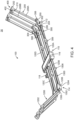
- FIGS. 1-3 illustrate front views of bicycle carrier 100 according to an embodiment.
- the front view refers to a viewpoint looking at the bicycle carrier from behind a vehicle onto which the bicycle carrier is attached.
- FIG. 1 illustrates bicycle carrier 100 in a closed position 10, where wheel securement arm 200 is folded down so that it is generally parallel with wheel tray 120A of base 110 of bicycle carrier 100. This provides a compact configuration when bicycles are not loaded onto bicycle carrier 100.
- actuation member 400 e.g., handle 402
- wheel securement arm 200 in direction R1, as illustrated in FIG.
- second wheel securement arm 1200 can be rotated in direction R2.
- second wheel securement arm 1200 and second ratchet arm 1300 can have a free end 1202 and a fixed end 1204 that is coupled to wheel tray 120B at fourth joint 1206 near second end 114 of base 110.
- second ratchet arm 1300 can have a second ratcheting assembly 1302 and be coupled to wheel tray 120B at fifth joint 1306 and to second wheel securement arm 1200 at sixth joint 1356.
- ratcheting assembly 302 still permits wheel securement arm 200 to rotate in a direction opposite R1 when actuation member 400 is released, which allows for easy adjustment of wheel securement arm 200 about the wheel of a bicycle. Therefore, once a bicycle is loaded onto bicycle carrier 100 in loading position 30 shown in FIG. 3 , wheel securement arm 200 can be rotated in a direction opposite R1 to secure the wheel of the bicycle.
- First joint 206 couples wheel securement arm 200 near a first end 112 of base 110.
- Second joint 306 couples ratchet arm 300 with base 110 at a position between central support beam 116 and first end 112.
- Third joint 356 couples ratchet arm 300 with wheel securement arm 200.
- third joint 356 is disposed laterally between first joint 206 and second joint 306.
- third joint 356 moves laterally closer to first joint 206.
- third joint 356 is disposed laterally past first joint 206, such that first joint 206 is disposed laterally between third joint 356 and second joint 306.
- third joint 356 can be disposed laterally beyond first end 112 of base 110 in loading position 30.
- bicycle carrier 100 can include base 110 having a first end 112, a second end 114, and a central support beam 116.
- Base 110 of bicycle carrier 100 can be attached to a vehicle, for example, by stinger 118.
- bicycle carrier 100 can be a platform-style carrier, for example, with one or more wheel trays 120A-D.
- bicycle carrier 100 can be configured to carry one, two, three, four or more bicycles. In the embodiment shown in FIG. 4 , for example, the bicycle carrier 100 is configured to carry two bicycles.
- the wheels of a first bicycle can be disposed in wheel trays 120A and 120B and the wheels of a second bicycle can be disposed in wheel trays 120C and 120D.
- bicycle carrier 100 can include wheel securement arm 200, which can include free end 202 and fixed end 204.
- fixed end 204 can be coupled with base 110 at a first joint 206.
- first joint 206 can be a rotatable connection point such that wheel securement arm 200 can rotate with respect to base 110.
- wheel securement arm 200 can include one or more wheel engagement surface 210 configured to contact a wheel of a bicycle.
- uprights 208A-B spaced apart from each other such that a bicycle wheel can be disposed between uprights 208A-B.
- wheel engagement surface 210 can be disposed between uprights 208A-B and configured to contact a surface of the bicycle wheel to secure the bicycle in place on bicycle carrier 100.
- Bicycle carrier 100 can also include ratchet arm 300, which can include ratcheting assembly 302, described in more detail below.
- ratchet arm 300 can be coupled to base 110, for example, to wheel tray 120A at second joint 306.
- second joint 306 can be a rotatable joint such that ratchet arm 300 can rotate with respect to base 110.
- ratchet arm 300 can also be coupled to wheel securement arm 200, for example, at third joint 356.
- ratchet arm 300 can be an adjustment arm with an adjustment mechanism other than ratcheting assembly 302.
- the adjustment arm with adjustment mechanism can include, without limitation, gears, pulleys, pins (e.g., spring pins) with corresponding holes or notches, interference wedges, etc.
- the purpose of the adjustment mechanism is to provide incremental rotational positioning of the wheel securement arm 200.
- housing 350 can be coupled to ratchet arm 300. In some embodiments, housing 350 can also be coupled to wheel securement arm 200. In some embodiments, housing 350 can house ratcheting assembly 302 at least partially within housing 350. For example, at least a portion of ratcheting assembly 302 can be disposed within an interior 351 of housing 350, as shown, for example, in FIGS. 6 and 9 . In some embodiments, housing 350 can have a top opening 354 such that an interior 351 of housing 350 is exposed (see FIG. 6 ). In some embodiments, housing 350 can cover ratcheting assembly 302 within an interior 351 of housing 350 (see FIGS. 4 and 9 ). As wheel securement arm 200 is rotated, housing 350 translates along ratchet arm 300.
- Bicycle carrier 100 can also include actuation member 400, which can be configured to engage and disengage ratcheting assembly 302.
- actuation member 400 can be disposed at or near free end 202 of wheel securement arm 200.
- actuation member 400 can be a handle 402 (see FIG. 6 ) or a button 403 (see FIG. 12A ).
- Other mechanisms such as knobs, levers, etc. can be used for actuation member 400.
- actuation member 400 can be coupled with ratcheting assembly 302 by a linkage 404, for example, cable 406.
- actuation member 400 can be a handle 402 such that when handle 402 is displaced, ratcheting assembly 302 is disengaged, allowing wheel securement arm 200 to rotate. Disposing actuation member 400 at free end 202 of wheel securement arm 200 provides easy accessibility for the user. And the handle 402 mechanism shown in FIG. 6 allows the user to ergonomically grip the handle 402 and pull it while rotating wheel securement arm 200 to keep ratcheting assembly 302 disengaged. In some embodiments, handle 402 can slide along an upper surface at free end 202.
- Handle 402 can be coupled to ratcheting assembly 302, for example, by cable 406.
- Materials for cable 406 include, but are not limited to, metal, plastic, fabric, or any combination thereof.
- cable 406 can be a braided steel cable.
- cable 406 can be disposed exterior to wheel securement arm 200 for ease of manufacturing.
- ratcheting assembly 302 can be disposed at least partially within housing 350.
- cable 406 can be disposed through a passage 358 in housing 350 in order to couple to ratcheting assembly 302.
- FIGS. 7A and 7B illustrate a perspective view and side cross-sectional view, respectively, of ratcheting assembly 302, according to an embodiment.
- ratcheting assembly 302 is in an engaged configuration, where actuation member 400 is not being operated.
- ratcheting assembly 302 can include pawl 310, which can have one or more teeth 311 configured to engage with a toothed surface 304 of ratchet arm 300.
- an exterior surface 308 of ratchet arm 300 can include the toothed surface 304 as either an integral or separate component.
- ratcheting assembly 302 can include spring 313 configured to bias pawl 310 into engagement with toothed surface 304.
- ratcheting assembly 302 can include release 312 which can be coupled to pawl 310.
- release 312 can be coupled to, for example, cable 406 or other linkage 404, which can in turn be coupled with the actuation member 400.
- FIGS. 7A and 7B when actuation member 400 is not being operated, rotation of wheel securement arm 200 in direction R1 (see FIG. 2 ) can be prevented be the interaction of teeth 311 on pawl 310 with the toothed surface 304 of ratchet arm 300. However, rotation of wheel securement arm 200 is permitted in the direction opposite R1. Incremental adjustments associated with the spacing of the teeth on toothed surface 304 can be made to firmly secure the wheel of the bicycle on bicycle carrier 100.
- FIGS. 8A and 8B illustrate ratcheting assembly 302 in a disengaged configuration, where actuation member 400 is actuated by a user.
- actuation member 400 is actuated by a user.
- cable 406 can be pulled in a direction of distal end 320 of ratchet arm 300 thereby causing release 312 to rotate pawl 310, which disengages teeth 311 from toothed surface 304.
- This allows wheel securement arm 200 to rotate about first joint 206 in direction R1 (see FIG. 2 ).
- cable 406 or other linkage 404 can be disposed within an interior 351 of housing 350 and within an interior 240 of wheel securement arm 200. This can prevent objects from becoming caught in cable 406. In such embodiments, cable 406 is not visible from an exterior of bicycle carrier 100.
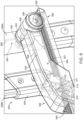
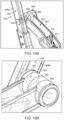
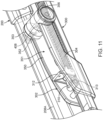
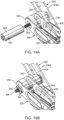
- FIGS. 9 , 10A , 10B , and 11 illustrate a pathway for cable 406 within the interiors of housing 350 and wheel securement arm 200.
- this pathway can include a tube 408 disposed within housing 350 to facilitate cable 406 making a turn from housing 350 into wheel securement arm 200 without becoming twisted.
- tube 408 can be a resilient material resistant to bending and twisting (e.g., metal or plastic) to prevent cable 406 from becoming kinked.
- tube 408 can include a bend having a 90 degree angle.
- tube 408 can be disposed within housing 350 at third joint 356.
- housing 350 can include a slot 352 through which cable 406 can pass from the interior 351 of housing 350 into the interior 240 of wheel securement arm 200.
- slot 352 can be formed in an end cap 353 of housing 350 disposed between housing 350 and wheel securement arm 200.
- slot 352 can be a radial slot. In some embodiments, slot 352 can extend up to 90 degrees along a circumference.
- tube 408 can be disposed at a first end of slot 352.
- slot 352 rotates around tube 408 until tube 408 is disposed at second end of slot 352, as shown in FIG. 11 . This can allow wheel securement arm 200 to rotate from the closed position 10 to the loading position 30, and vice versa, without cable 406 becoming kinked.
- pivot tube 380 can be used to prevent cable 406 from becoming kinked.
- pivot tube 380 can include groove 382, or other internal or external pathway, providing a large surface area along which cable 406 can be disposed from ratchet arm 300 to wheel securement arm 200.
- pivot tube 380 can be disposed about a pin 384 coupling wheel securement arm 200 and ratchet arm 300, for example, at third joint 356.
- cable 406 can run within interior 340 of ratchet arm 300, within groove 382 of pivot tube 380, and into interior 240 of upright 208A of wheel securement arm 200.
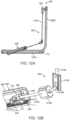
- FIGS. 12A and 12B illustrate a linkage 404 between actuation member 400 and ratcheting assembly 302, according to an embodiment of bicycle carrier 100.
- actuation member 400 can be a button 403, as shown in FIG. 12A .
- actuation member 400 can be coupled with ratcheting assembly 302 by way of linkage 404, which can include rods 410A-C.
- Rod 410A can be coupled to button 403 and extend along a length within wheel securement arm 200.
- rod 410A can be coupled to wedge 412A.
- Wedge 412A can be coupled to transition rod 410B, which can in turn be coupled to wedge 412B.
- Transition rod 410B can be disposed at an angle between rod 410A and rod 410C. Further, wedge 412B can be coupled to rod 410C, which can in turn be coupled with ratcheting assembly 302, for example, with pawl 310.
- rod 410A travels downward and wedge 412A eases the transition rod 410B into wedge 412B, which translates rod 410C, thereby disengaging the one or more teeth 311 of pawl 310 from toothed surface 304. This can allow wheel securement arm 200 to rotate as described above.
- ratcheting assembly 302 can be disposed within an interior 340 of ratchet arm 300.
- toothed surface 304 can be integrally formed with an interior surface 342 of ratchet arm 300.
- FIGS. 13A and 13B illustrate bicycle carrier 100 according to an embodiment.
- ratcheting assembly 302 is disposed at third joint 356.
- a distal end 320 of ratchet arm 300 overhangs first end 112 of base 110 by a distance D. This increases the overall space occupied by the bicycle carrier in the closed position 10.
- FIGS. 14A and 14B illustrate an embodiment of bicycle carrier 100 where ratcheting assembly 302 is disposed between third joint 356 and second joint 306 of ratchet arm 300.
- ratcheting assembly 302 is disposed between third joint 356 and second joint 306 of ratchet arm 300.
- distal end 320 of ratchet arm 300 overhangs first end 112 of base 110 by a shorter distance d than the embodiment of FIGS. 13A and 13B .
- the ratcheting assembly can be disposed such that the distal end 320 of ratchet arm 300 is even with or shorter than first end 112 in the closed position 10.
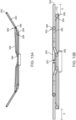
- FIGS. 15A and 15B illustrate bicycle carrier 100, according to an embodiment.
- ratchet arm 300 can be a telescoping arm having a first telescoping part 372 and a second telescoping part 374.
- toothed surface 304 can be located on an exterior side of ratchet arm 300, for example, on an exterior side of second telescoping part 374.
- release 312 can be disposed on first telescoping part 372 such that a user can manipulate release 312 to disengage the ratcheting assembly 302.
- the wheel securement arm 200 can be rotated into the loading position 30 as shown, for example, in FIG. 15A .
- the wheel securement arm 200 can also be rotated into the closed position 10, whereby a portion of second telescoping part 374 can translate through an opening 370 in third joint 356.
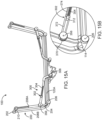
- FIG. 16 illustrates a portion of a bicycle carrier 100, according to an embodiment.
- ratchet arm 300 includes first telescoping part 372, second telescoping part 374, and third telescoping part 376.
- second telescoping part 374 can include a toothed surface 304 and first telescoping part 372 can include release 312 for ratcheting assembly 302.
- Ratcheting assembly 302 can function in the same way as described with respect to FIGS. 15A and 15B .
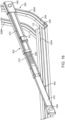
- FIG. 17 illustrates an embodiment of ratcheting assembly 302 which can be included, for example, in the embodiments illustrated in FIGS. 15A-B and FIG. 16 .
- ratcheting assembly 302 can include a release 312 configured to disengage a pawl 310 when release 312 is operated by a user.
- the first telescoping part 372 can slide through the second telescoping part 374.
- FIG. 18 illustrates wheel securement arm 200 of bicycle carrier 100, according to an embodiment.
- wheel securement arm 200 can include an adjustable wheel engagement surface 2210.
- wheel engagement surface 2210 can slide along wheel securement arm 200.
- wheel engagement surface 2210 can be coupled to wheel securement arm 200 by a ratcheting assembly 2302.
- Ratcheting assembly 2302 can include, for example, a release 2312 configured to disengage teeth from a toothed surface 2304 disposed on an exterior surface 2308 of an upright 2208A and/or 2208B. This can allow for incremental adjustments of the wheel engagement surface 2210 to accommodate different diameter wheels within wheel securement arm 2200.
Landscapes
- Engineering & Computer Science (AREA)
- Mechanical Engineering (AREA)
- Fittings On The Vehicle Exterior For Carrying Loads, And Devices For Holding Or Mounting Articles (AREA)
- Transmission Devices (AREA)
- Axle Suspensions And Sidecars For Cycles (AREA)
Description
- The present disclosure relates to bicycle carriers. More specifically, it relates to bicycle carriers having a wheel gripping arm with a ratcheting mechanism.
- Bicycle carriers for carrying bicycles on a vehicle can be used to transport bicycles from one place to another. In some examples, the bicycle carrier can be secured to the vehicle safely and conveniently via a hitch, typically attached to rear of the vehicle. Various mechanisms can be used to secure the bicycle to the bicycle carrier, for example straps and securement arms. However, these devices can be cumbersome and difficult to use or fail to securely fasten the bicycle to the bicycle carrier in a sufficient manner.
JP2012035788A US6439397B shows a telescopic arm with a ratchet for securing a bicycle. The bicycle carrier has gripping arms mounted to a base. The gripping arms are rotatably coupled to the base and adjusted using an adjustment and locking mechanism placed on the base. - Disclosed is a bicycle carrier according to claim 1. The bicycle carrier includes a base configured to support a bicycle, the base having a first end and a second end, a wheel securement arm having a free end and a fixed end, wherein the fixed end is coupled to the first end of the base at a first joint such that the wheel securement arm is rotatably coupled to the base, and a ratchet arm having a ratcheting assembly, the ratchet arm coupled to the wheel securement arm by a third joint and rotatably coupled to the base at a second joint. The wheel securement arm is movable between a closed position and a loading position wherein in the closed position, the third joint is disposed laterally between the first joint and the second joint, and wherein in the loading position, the third joint is disposed laterally past the first j oint, such that the first joint is disposed laterally between the third joint and the second joint. The base further comprises a central support beam, wherein the second joint couples the ratchet arm with the base at a position between the central support beam and the first end. The ratcheting assembly includes a pawl with one or more teeth configured to engage with a toothed surface of the ratchet arm, and a release which is coupled to the pawl. The ratchet arm is a telescoping arm having a first telescoping part and a second telescoping part, wherein the release is disposed on the first telescoping part such that a user can manipulate the release to disengage ratcheting assembly, wherein when the ratcheting assembly is disengaged, the wheel securement arm can be rotated into the loading position. The toothed surface can be disposed on an exterior side of the second telescoping part.
- The accompanying drawings illustrate the embodiments and, together with the description, further serve to explain the principles of the embodiments and to enable a person skilled in the relevant art(s) to make and use the embodiments.
-
FIG. 1 illustrates a front view of a bicycle carrier in a closed position, according to an embodiment. -
FIG. 2 illustrates a front view of a bicycle carrier in a transition position, according to an embodiment. -
FIG. 3 illustrates a front view of a bicycle carrier in a loading position, according to an embodiment. -
FIG. 4 illustrates a perspective view of a bicycle carrier, according to an embodiment. -
FIG. 5 illustrates a front view of a portion of a bicycle carrier, according to an embodiment. -
FIG. 6 illustrates a perspective view of a portion of a bicycle carrier, according to an embodiment. -
FIGS. 7A and 7B illustrate a ratcheting assembly for a bicycle carrier, according to an embodiment. -
FIGS 8A and 8B illustrate a ratcheting assembly for a bicycle carrier, according to an embodiment. -
FIG. 9 illustrates a ratcheting assembly for a bicycle carrier, according to an embodiment. -
FIGS. 10A and 10B illustrate partial interior views of portions of a bicycle carrier, according to an embodiment. -
FIG. 11 illustrates a ratcheting assembly for a bicycle carrier, according to an embodiment. -
FIGS. 12A and 12B illustrate a linkage for a bicycle carrier, according to an embodiment. -
FIGS. 13A and 13B illustrate a front view of a bicycle carrier, according to an embodiment. -
FIGS. 14A and 14B illustrate a front view of a bicycle carrier, according to an embodiment. -
FIG. 15A illustrates a bicycle carrier, according to an embodiment. -
FIG. 15B illustrates a portion of a bicycle carrier, according to an embodiment. -
FIG. 16 illustrates a portion of a bicycle carrier, according to an embodiment. -
FIG. 17 illustrates a portion of a bicycle carrier, according to an embodiment. -
FIG. 18 illustrates a wheel securement arm, according to an embodiment. -
FIGS. 19A and 19B illustrate partial interior views of portions of a bicycle carrier, according to an embodiment. - The features and advantages of the embodiments will become more apparent from the detail description set forth below when taken in conjunction with the drawings, in which like reference characters identify corresponding elements throughout. In the drawings like reference numbers generally indicate identical, functionally similar, and/or structurally similar elements.
- Embodiments of the present disclosure are described in detail with reference to embodiments thereof as illustrated in the accompanying drawings. References to "one embodiment," "an embodiment," "some embodiments," etc., indicate that the embodiment(s) described may include a particular feature, structure, or characteristic, but every embodiment may not necessarily include the particular feature, structure, or characteristic. Moreover, such phrases are not necessarily referring to the same embodiment. Further, when a particular feature, structure, or characteristic is described in connection with an embodiment, it is submitted that it is within the knowledge of one skilled in the art to affect such feature, structure, or characteristic in connection with other embodiments whether or not explicitly described.
- The following examples are illustrative, but not limiting, of the present embodiments. Other suitable modifications and adaptations of the variety of conditions and parameters normally encountered in the field, and which would be apparent to those skilled in the art, are within and scope of the disclosure.
- Embodiments of the
bicycle carriers 100 disclosed herein can be used to secure one or more bicycles to a vehicle. It is important to securely mount a bicycle onto the bicycle carrier to reduce motion forces imparted on the bicycle that can result in damage. Therefore, it is important to have a bicycle carrier that is adjustable for different sizes of bicycles and wheels. It is also important for the user to be able to quickly and easily manipulate the bicycle carrier during loading, securement, and unloading of the bicycle(s). - Embodiments of the
bicycle carriers 100 disclosed herein can have a wheel securementarm 200 configured to secure a wheel of a bicycle on thebicycle carrier 100. Thebicycle carrier 100 can also include aratchet arm 300, which can be coupled to abase 110 of thebicycle carrier 100 and the wheel securementarm 200. The configuration ofwheel securement arm 200 and ratchetarm 300 can facilitate quick and easy securement of a bicycle ontobicycle carrier 100. This can particularly be achieved because of the ratchetingassembly 302 ofratchet arm 300, which provides incremental adjustment to the position ofwheel securement arm 200 about the wheel of a bicycle. Additionally, anactuation member 400 disposed conveniently at afree end 202 ofwheel securement arm 200 makes it easy for the user to engage and disengage the ratchetingassembly 302 from a location that is readily accessible and ergonomic for the user. - By way of example,
FIGS. 1-3 illustrate front views ofbicycle carrier 100 according to an embodiment. As described herein, the front view refers to a viewpoint looking at the bicycle carrier from behind a vehicle onto which the bicycle carrier is attached.FIG. 1 illustratesbicycle carrier 100 in aclosed position 10, wherewheel securement arm 200 is folded down so that it is generally parallel withwheel tray 120A ofbase 110 ofbicycle carrier 100. This provides a compact configuration when bicycles are not loaded ontobicycle carrier 100. To open thebicycle carrier 100 for loading bicycles, a user can manipulate, for example, actuation member 400 (e.g., handle 402) and rotatewheel securement arm 200 in direction R1, as illustrated inFIG. 2 , which showsbicycle carrier 100 in atransition position 20, aswheel securement arm 200 is rotated fromclosed position 10 to aloading position 30 shown inFIG. 3 and also in the perspective view ofFIG. 4 . Similarly, secondwheel securement arm 1200 can be rotated in direction R2. - The components and functions described herein for
wheel securement arm 200 and ratchetarm 300 coupled towheel tray 120A are also applicable to the components coupled towheel trays 120B-D, for example, secondwheel securement arm 1200 andsecond ratchet arm 1300. For example, secondwheel securement arm 1200 can have afree end 1202 and afixed end 1204 that is coupled towheel tray 120B at fourth joint 1206 nearsecond end 114 ofbase 110. Also, for example,second ratchet arm 1300 can have asecond ratcheting assembly 1302 and be coupled towheel tray 120B at fifth joint 1306 and to secondwheel securement arm 1200 at sixth joint 1356. - Referring to
FIGS. 1-4 , whenactuation member 400 is released,wheel securement arm 200 is prevented from rotating in direction R1 by ratchetingassembly 302, described in detail below. However, ratchetingassembly 302 still permitswheel securement arm 200 to rotate in a direction opposite R1 whenactuation member 400 is released, which allows for easy adjustment ofwheel securement arm 200 about the wheel of a bicycle. Therefore, once a bicycle is loaded ontobicycle carrier 100 inloading position 30 shown inFIG. 3 ,wheel securement arm 200 can be rotated in a direction opposite R1 to secure the wheel of the bicycle. - The relative positioning of the joints or attachment points of the
wheel securement arm 200 and ratchetarm 300 with each other and withbase 110 ofbicycle carrier 100 facilitate the ease of adjustment and compact nature of the bicycle carrier. First joint 206 couples wheelsecurement arm 200 near afirst end 112 ofbase 110. Second joint 306 couples ratchetarm 300 withbase 110 at a position betweencentral support beam 116 andfirst end 112. Third joint 356 couples ratchetarm 300 withwheel securement arm 200. - As shown in
FIG. 1 , in theclosed position 10, third joint 356 is disposed laterally between first joint 206 and second joint 306. As shown in thetransition position 20 ofFIG. 2 , aswheel securement arm 200 is rotated in direction R1, third joint 356 moves laterally closer to first joint 206. And as shown inFIG. 3 , inloading position 30, third joint 356 is disposed laterally past first joint 206, such that first joint 206 is disposed laterally between third joint 356 and second joint 306. In some embodiments, third joint 356 can be disposed laterally beyondfirst end 112 ofbase 110 inloading position 30. - As shown, for example, in
FIGS. 1-4 ,bicycle carrier 100 can include base 110 having afirst end 112, asecond end 114, and acentral support beam 116.Base 110 ofbicycle carrier 100 can be attached to a vehicle, for example, bystinger 118. In some embodiments,bicycle carrier 100 can be a platform-style carrier, for example, with one ormore wheel trays 120A-D. In some embodiments,bicycle carrier 100 can be configured to carry one, two, three, four or more bicycles. In the embodiment shown inFIG. 4 , for example, thebicycle carrier 100 is configured to carry two bicycles. The wheels of a first bicycle can be disposed inwheel trays wheel trays - As discussed above,
bicycle carrier 100 can includewheel securement arm 200, which can includefree end 202 andfixed end 204. In some embodiments, fixedend 204 can be coupled withbase 110 at a first joint 206. In some embodiments, first joint 206 can be a rotatable connection point such thatwheel securement arm 200 can rotate with respect tobase 110. In some embodiments,wheel securement arm 200 can include one or morewheel engagement surface 210 configured to contact a wheel of a bicycle. As shown, for example inFIGS. 4-6 , in some embodiments, uprights 208A-B spaced apart from each other such that a bicycle wheel can be disposed betweenuprights 208A-B. In some embodiments,wheel engagement surface 210 can be disposed betweenuprights 208A-B and configured to contact a surface of the bicycle wheel to secure the bicycle in place onbicycle carrier 100. -
Bicycle carrier 100 can also includeratchet arm 300, which can include ratchetingassembly 302, described in more detail below. In some embodiments,ratchet arm 300 can be coupled tobase 110, for example, towheel tray 120A at second joint 306. In some embodiments, second joint 306 can be a rotatable joint such thatratchet arm 300 can rotate with respect tobase 110. In some embodiments,ratchet arm 300 can also be coupled towheel securement arm 200, for example, at third joint 356. In some embodiments,ratchet arm 300 can be an adjustment arm with an adjustment mechanism other than ratchetingassembly 302. For example, the adjustment arm with adjustment mechanism can include, without limitation, gears, pulleys, pins (e.g., spring pins) with corresponding holes or notches, interference wedges, etc. The purpose of the adjustment mechanism is to provide incremental rotational positioning of thewheel securement arm 200. - In some embodiments,
housing 350 can be coupled to ratchetarm 300. In some embodiments,housing 350 can also be coupled towheel securement arm 200. In some embodiments,housing 350 can house ratchetingassembly 302 at least partially withinhousing 350. For example, at least a portion of ratchetingassembly 302 can be disposed within an interior 351 ofhousing 350, as shown, for example, inFIGS. 6 and9 . In some embodiments,housing 350 can have atop opening 354 such that an interior 351 ofhousing 350 is exposed (seeFIG. 6 ). In some embodiments,housing 350 can cover ratchetingassembly 302 within an interior 351 of housing 350 (seeFIGS. 4 and9 ). Aswheel securement arm 200 is rotated,housing 350 translates alongratchet arm 300. -
Bicycle carrier 100 can also includeactuation member 400, which can be configured to engage and disengage ratchetingassembly 302. In some embodiments,actuation member 400 can be disposed at or nearfree end 202 ofwheel securement arm 200. In some embodiments,actuation member 400 can be a handle 402 (seeFIG. 6 ) or a button 403 (seeFIG. 12A ). Other mechanisms such as knobs, levers, etc. can be used foractuation member 400. In some embodiments,actuation member 400 can be coupled with ratchetingassembly 302 by alinkage 404, for example,cable 406. - As shown, for example, in
FIG. 6 , in some embodiments,actuation member 400 can be ahandle 402 such that whenhandle 402 is displaced, ratchetingassembly 302 is disengaged, allowingwheel securement arm 200 to rotate. Disposingactuation member 400 atfree end 202 ofwheel securement arm 200 provides easy accessibility for the user. And thehandle 402 mechanism shown inFIG. 6 allows the user to ergonomically grip thehandle 402 and pull it while rotatingwheel securement arm 200 to keep ratchetingassembly 302 disengaged. In some embodiments, handle 402 can slide along an upper surface atfree end 202. - Handle 402 can be coupled to ratcheting
assembly 302, for example, bycable 406. Materials forcable 406 include, but are not limited to, metal, plastic, fabric, or any combination thereof. For example, in some embodiments,cable 406 can be a braided steel cable. In some embodiments, as shown inFIGS. 5 and6 ,cable 406 can be disposed exterior towheel securement arm 200 for ease of manufacturing. In some embodiments, ratchetingassembly 302 can be disposed at least partially withinhousing 350. Thus, in some embodiments,cable 406 can be disposed through apassage 358 inhousing 350 in order to couple to ratchetingassembly 302. -
FIGS. 7A and 7B illustrate a perspective view and side cross-sectional view, respectively, of ratchetingassembly 302, according to an embodiment. InFIGS. 7A and 7B , ratchetingassembly 302 is in an engaged configuration, whereactuation member 400 is not being operated. In some embodiments, ratchetingassembly 302 can includepawl 310, which can have one ormore teeth 311 configured to engage with atoothed surface 304 ofratchet arm 300. For example, anexterior surface 308 ofratchet arm 300 can include thetoothed surface 304 as either an integral or separate component. In some embodiments, ratchetingassembly 302 can includespring 313 configured to biaspawl 310 into engagement withtoothed surface 304. In some embodiments, ratchetingassembly 302 can include release 312 which can be coupled topawl 310. In some embodiments,release 312 can be coupled to, for example,cable 406 orother linkage 404, which can in turn be coupled with theactuation member 400. Thus, as shown inFIGS. 7A and 7B , whenactuation member 400 is not being operated, rotation ofwheel securement arm 200 in direction R1 (seeFIG. 2 ) can be prevented be the interaction ofteeth 311 onpawl 310 with thetoothed surface 304 ofratchet arm 300. However, rotation ofwheel securement arm 200 is permitted in the direction opposite R1. Incremental adjustments associated with the spacing of the teeth ontoothed surface 304 can be made to firmly secure the wheel of the bicycle onbicycle carrier 100. -
FIGS. 8A and 8B illustrate ratchetingassembly 302 in a disengaged configuration, whereactuation member 400 is actuated by a user. For example, by pullinghandle 402,cable 406 can be pulled in a direction ofdistal end 320 ofratchet arm 300 thereby causingrelease 312 to rotatepawl 310, which disengagesteeth 311 fromtoothed surface 304. This allowswheel securement arm 200 to rotate about first joint 206 in direction R1 (seeFIG. 2 ). - In some embodiments,
cable 406 orother linkage 404 can be disposed within an interior 351 ofhousing 350 and within an interior 240 ofwheel securement arm 200. This can prevent objects from becoming caught incable 406. In such embodiments,cable 406 is not visible from an exterior ofbicycle carrier 100. For example,FIGS. 9 ,10A ,10B , and11 illustrate a pathway forcable 406 within the interiors ofhousing 350 andwheel securement arm 200. In some embodiments, this pathway can include atube 408 disposed withinhousing 350 to facilitatecable 406 making a turn fromhousing 350 intowheel securement arm 200 without becoming twisted. In some embodiments,tube 408 can be a resilient material resistant to bending and twisting (e.g., metal or plastic) to preventcable 406 from becoming kinked. In some embodiments,tube 408 can include a bend having a 90 degree angle. - In some embodiments,
tube 408 can be disposed withinhousing 350 at third joint 356. In some embodiments,housing 350 can include aslot 352 through whichcable 406 can pass from theinterior 351 ofhousing 350 into theinterior 240 ofwheel securement arm 200. In some embodiments,slot 352 can be formed in anend cap 353 ofhousing 350 disposed betweenhousing 350 andwheel securement arm 200. In some embodiments,slot 352 can be a radial slot. In some embodiments,slot 352 can extend up to 90 degrees along a circumference. - As shown, for example, in
FIGS. 10A and 10B whenwheel securement arm 200 is inloading position 30,tube 408 can be disposed at a first end ofslot 352. Aswheel securement arm 200 is rotated to theclosed position 10,slot 352 rotates aroundtube 408 untiltube 408 is disposed at second end ofslot 352, as shown inFIG. 11 . This can allowwheel securement arm 200 to rotate from theclosed position 10 to theloading position 30, and vice versa, withoutcable 406 becoming kinked. - In some embodiments, as shown in
FIGS. 19A and 19B ,pivot tube 380 can be used to preventcable 406 from becoming kinked. For example,pivot tube 380 can include groove 382, or other internal or external pathway, providing a large surface area along whichcable 406 can be disposed fromratchet arm 300 towheel securement arm 200. In some embodiments,pivot tube 380 can be disposed about apin 384 couplingwheel securement arm 200 and ratchetarm 300, for example, at third joint 356. Thus,cable 406 can run withininterior 340 ofratchet arm 300, withingroove 382 ofpivot tube 380, and intointerior 240 ofupright 208A ofwheel securement arm 200. -
FIGS. 12A and 12B illustrate alinkage 404 betweenactuation member 400 and ratchetingassembly 302, according to an embodiment ofbicycle carrier 100. In some embodiments,actuation member 400 can be abutton 403, as shown inFIG. 12A . In some embodiments,actuation member 400 can be coupled with ratchetingassembly 302 by way oflinkage 404, which can includerods 410A-C. Rod 410A can be coupled tobutton 403 and extend along a length withinwheel securement arm 200. In some embodiments,rod 410A can be coupled towedge 412A.Wedge 412A can be coupled totransition rod 410B, which can in turn be coupled towedge 412B.Transition rod 410B can be disposed at an angle betweenrod 410A androd 410C. Further,wedge 412B can be coupled torod 410C, which can in turn be coupled with ratchetingassembly 302, for example, withpawl 310. By engaging button 303, for example, by pushing downward on button 303,rod 410A travels downward andwedge 412A eases thetransition rod 410B intowedge 412B, which translatesrod 410C, thereby disengaging the one ormore teeth 311 ofpawl 310 fromtoothed surface 304. This can allowwheel securement arm 200 to rotate as described above. As. As also shown, for example, inFIG. 12B , in some embodiments, ratchetingassembly 302 can be disposed within an interior 340 ofratchet arm 300. In some embodiments,toothed surface 304 can be integrally formed with aninterior surface 342 ofratchet arm 300. -
FIGS. 13A and 13B illustratebicycle carrier 100 according to an embodiment. In this embodiment, ratchetingassembly 302 is disposed at third joint 356. As shown inFIG. 13B , whenwheel securement arm 200 is rotated to theclosed position 10, adistal end 320 ofratchet arm 300 overhangs first end 112 ofbase 110 by a distance D. This increases the overall space occupied by the bicycle carrier in theclosed position 10. - In comparison,
FIGS. 14A and 14B illustrate an embodiment ofbicycle carrier 100 where ratchetingassembly 302 is disposed between third joint 356 andsecond joint 306 ofratchet arm 300. As shown inFIG. 14B , in theclosed position 10,distal end 320 ofratchet arm 300 overhangs first end 112 ofbase 110 by a shorter distance d than the embodiment ofFIGS. 13A and 13B . In some embodiments, as shown inFIG. 1 , the ratcheting assembly can be disposed such that thedistal end 320 ofratchet arm 300 is even with or shorter thanfirst end 112 in theclosed position 10. -
FIGS. 15A and 15B illustratebicycle carrier 100, according to an embodiment. As shown inFIGS. 15A and 15B ,ratchet arm 300 can be a telescoping arm having afirst telescoping part 372 and asecond telescoping part 374. In some embodiments,toothed surface 304 can be located on an exterior side ofratchet arm 300, for example, on an exterior side ofsecond telescoping part 374. In some embodiments,release 312 can be disposed onfirst telescoping part 372 such that a user can manipulate release 312 to disengage the ratchetingassembly 302. When ratchetingassembly 302 is disengaged, thewheel securement arm 200 can be rotated into theloading position 30 as shown, for example, inFIG. 15A . Thewheel securement arm 200 can also be rotated into theclosed position 10, whereby a portion ofsecond telescoping part 374 can translate through anopening 370 in third joint 356. -
FIG. 16 illustrates a portion of abicycle carrier 100, according to an embodiment. InFIG. 16 ,ratchet arm 300 includesfirst telescoping part 372,second telescoping part 374, andthird telescoping part 376. In some embodiments,second telescoping part 374 can include atoothed surface 304 andfirst telescoping part 372 can include release 312 for ratchetingassembly 302. Ratchetingassembly 302 can function in the same way as described with respect toFIGS. 15A and 15B . -
FIG. 17 illustrates an embodiment of ratchetingassembly 302 which can be included, for example, in the embodiments illustrated inFIGS. 15A-B andFIG. 16 . For example, ratchetingassembly 302 can include arelease 312 configured to disengage apawl 310 whenrelease 312 is operated by a user. When pawl 310 is disengaged fromtoothed surface 304, thefirst telescoping part 372 can slide through thesecond telescoping part 374. -
FIG. 18 illustrateswheel securement arm 200 ofbicycle carrier 100, according to an embodiment. In some embodiments,wheel securement arm 200 can include an adjustablewheel engagement surface 2210. For example,wheel engagement surface 2210 can slide alongwheel securement arm 200. For example,wheel engagement surface 2210 can be coupled towheel securement arm 200 by a ratchetingassembly 2302. Ratchetingassembly 2302 can include, for example, arelease 2312 configured to disengage teeth from atoothed surface 2304 disposed on anexterior surface 2308 of an upright 2208A and/or 2208B. This can allow for incremental adjustments of thewheel engagement surface 2210 to accommodate different diameter wheels withinwheel securement arm 2200.
Claims (2)
- A bicycle carrier (100), comprising:a base (110) configured to support a bicycle, the base (110) comprising a first end (112) and a second end (114);a wheel securement arm (200) having a free end (202) and a fixed end (204), wherein the fixed end (204) is coupled to the first end (112) of the base (110) at a first joint (206) such that the wheel securement arm (200) is rotatably coupled to the base (110); andan adjustment arm (300) comprising an adjusting mechanism (302), wherein the adjustment arm (300) is coupled to the wheel securement arm (200) by a third joint (356) and rotatably coupled to the base (110) at a second joint (306),wherein the wheel securement arm (200) is movable between a closed position (10) and a loading position (30), wherein in the closed position (10), the third joint (356) is disposed laterally between the first joint (206) and the second joint (306), and wherein in the loading position (30), the third joint (356) is disposed laterally past the first joint (206), such that the first joint (206) is disposed laterally between the third joint (356) and the second joint (306),characterized in thatthe base (110) further comprises a central support beam (116), wherein the second joint (306) couples the adjustment arm arm (300) with the base (110) at a position between the central support beam (116) and the first end (112),and in thatthe adjustment arm with the adjustment mechanism is a ratchet arm (300) comprising a ratcheting assembly (302), wherein the ratcheting assembly (302) includes a pawl (310) with one or more teeth (311) configured to engage with a toothed surface (304) of the ratchet arm (300), and a release (312) which is coupled to the pawl (310),and in thatthe ratchet arm (300) is a telescoping arm having a first telescoping part (372) and a second telescoping part (374), wherein the release (312) is disposed on the first telescoping part (372) such that a user can manipulate the release (312) to disengage ratcheting assembly (302), wherein when the ratcheting assembly (302) is disengaged, the wheel securement arm (200) can be rotated into the loading position (30).
- The bicycle carrier of claim 1, wherein the toothed surface is disposed on an exterior side of second telescoping part (374).
Applications Claiming Priority (3)
| Application Number | Priority Date | Filing Date | Title |
|---|---|---|---|
| US16/116,560 US10688939B2 (en) | 2018-08-29 | 2018-08-29 | Gripping arm for a bicycle carrier with a ratcheting mechanism |
| PCT/IB2019/056901 WO2020044154A1 (en) | 2018-08-29 | 2019-08-14 | Gripping arm for a bicycle carrier with a ratcheting mechanism |
| EP19779573.5A EP3844029B1 (en) | 2018-08-29 | 2019-08-14 | Gripping arm for a bicycle carrier with a ratcheting mechanism |
Related Parent Applications (1)
| Application Number | Title | Priority Date | Filing Date |
|---|---|---|---|
| EP19779573.5A Division EP3844029B1 (en) | 2018-08-29 | 2019-08-14 | Gripping arm for a bicycle carrier with a ratcheting mechanism |
Publications (2)
| Publication Number | Publication Date |
|---|---|
| EP4122770A1 EP4122770A1 (en) | 2023-01-25 |
| EP4122770B1 true EP4122770B1 (en) | 2025-06-11 |
Family
ID=68084888
Family Applications (2)
| Application Number | Title | Priority Date | Filing Date |
|---|---|---|---|
| EP19779573.5A Active EP3844029B1 (en) | 2018-08-29 | 2019-08-14 | Gripping arm for a bicycle carrier with a ratcheting mechanism |
| EP22183949.1A Active EP4122770B1 (en) | 2018-08-29 | 2019-08-14 | Gripping arm for a bicycle carrier with a ratcheting mechanism |
Family Applications Before (1)
| Application Number | Title | Priority Date | Filing Date |
|---|---|---|---|
| EP19779573.5A Active EP3844029B1 (en) | 2018-08-29 | 2019-08-14 | Gripping arm for a bicycle carrier with a ratcheting mechanism |
Country Status (6)
| Country | Link |
|---|---|
| US (4) | US10688939B2 (en) |
| EP (2) | EP3844029B1 (en) |
| CN (4) | CN115817362B (en) |
| CA (1) | CA3103077C (en) |
| MX (1) | MX391347B (en) |
| WO (1) | WO2020044154A1 (en) |
Families Citing this family (15)
| Publication number | Priority date | Publication date | Assignee | Title |
|---|---|---|---|---|
| JP2019501829A (en) * | 2016-01-16 | 2019-01-24 | アルペン ストレージ, インク.Alpen Storage, Inc. | Storage device |
| USD877685S1 (en) * | 2018-09-13 | 2020-03-10 | Thule Sweden Ab | Carrier |
| US11208167B2 (en) | 2018-11-15 | 2021-12-28 | Kuat Innovations Llc | Bicycle rack with actuated arm |
| US12071104B2 (en) | 2021-04-02 | 2024-08-27 | Thule Sweden Ab | Load carrier apparatuses and systems |
| US20220379794A1 (en) * | 2021-05-25 | 2022-12-01 | Yotta Innovation Co., Ltd. | Adjustment mechanism for wheel securement member of vehicle carrier |
| PL4116150T3 (en) * | 2021-07-06 | 2023-07-24 | Thule Sweden Ab | A CARRIER, LIKE A BIKE RACK |
| US20230278654A1 (en) * | 2022-03-01 | 2023-09-07 | Robert Allen Ward | Guiderail Bicycle Rack |
| AU2023219836B2 (en) * | 2022-09-01 | 2025-03-06 | Bell Sports, Inc. | Pivotable bicycle rack |
| WO2024081322A1 (en) * | 2022-10-11 | 2024-04-18 | Marc Lauzon | Bicycle rack |
| US20240123912A1 (en) * | 2022-12-16 | 2024-04-18 | Ningbo Tuoluzhe Auto Accessories Co., Ltd. | Vehicle-mounted device for fixing bicycle |
| US20240326567A1 (en) * | 2023-03-04 | 2024-10-03 | Ari B. Teman | Carrier roof repositioning management |
| US20250042342A1 (en) * | 2023-07-31 | 2025-02-06 | Kuat Innovations Llc | Bicycle Carrier |
| DE102023122729A1 (en) * | 2023-08-24 | 2025-02-27 | Xbull GmbH | Bicycle carrier for detachable attachment of a bicycle in or on a motor vehicle |
| USD1110927S1 (en) | 2024-05-17 | 2026-02-03 | Yakima Products, Inc. | Bicycle carrier |
| US12606096B1 (en) * | 2025-12-03 | 2026-04-21 | Russell Sutliff | Motorcycle or electric bike rack for a vehicle |
Citations (1)
| Publication number | Priority date | Publication date | Assignee | Title |
|---|---|---|---|---|
| US6439397B1 (en) * | 2000-09-06 | 2002-08-27 | Sportworks Northwest, Inc. | Retention arm for gear racks |
Family Cites Families (45)
| Publication number | Priority date | Publication date | Assignee | Title |
|---|---|---|---|---|
| US3355028A (en) | 1965-10-14 | 1967-11-28 | Raymond O Mork | Portable bicycle stand |
| US3529737A (en) | 1967-06-27 | 1970-09-22 | Melwyn Daugherty | Motorcycle carrier for vehicles |
| US3843001A (en) | 1972-06-14 | 1974-10-22 | H Willis | Ramp loading motorcycle carrier rack |
| US3861533A (en) | 1973-05-16 | 1975-01-21 | Ready Metal Mfg Co | Bicycle rack |
| US4524893A (en) | 1984-09-10 | 1985-06-25 | Yakima, Inc. | Bicycle carrier |
| US4852779A (en) | 1988-02-16 | 1989-08-01 | Kevin Berg | Collapsible bike rack for automotive vehicle |
| SE504794C2 (en) * | 1992-09-08 | 1997-04-28 | Thule Ind Ab | Device for transporting a bicycle on a vehicle roof |
| CA2121414C (en) | 1994-02-22 | 2005-06-14 | Michael K. Reeves | Bicycle rack |
| US7104430B2 (en) | 1995-03-16 | 2006-09-12 | Sportworks Northwest, Inc. | Bicycle rack |
| US5833074A (en) * | 1995-04-06 | 1998-11-10 | Phillips; Cal M. | Fast-loading, protective bicycle rack |
| US6053336A (en) | 1997-09-09 | 2000-04-25 | Sportworks Northwest, Inc. | Wheel retention device with externally rotatable multi-faceted retention ring |
| US6244483B1 (en) | 1999-08-25 | 2001-06-12 | Mclemore John D. | Carrier device |
| US6460743B2 (en) | 2000-03-13 | 2002-10-08 | Industri Ab Thule | Method and apparatus for providing a roof-mounted upright bicycle carrier |
| US6868998B2 (en) | 2001-07-10 | 2005-03-22 | Watermark Paddlesports, Inc. | Bike mount |
| WO2003008236A1 (en) | 2001-07-20 | 2003-01-30 | Charles Stephen Simmons-Jacobs | Bicycle rack |
| US6761297B1 (en) | 2001-08-23 | 2004-07-13 | Fabio Pedrini | Ride ready vehicle-mounted bicycle carrier |
| US6857545B2 (en) | 2002-01-11 | 2005-02-22 | Mclemore John D. | Bike carrier |
| SE0201832L (en) * | 2002-06-14 | 2003-09-30 | Thule Sweden Ab | Cargo hold for transporting a bicycle |
| US7044347B1 (en) | 2003-03-06 | 2006-05-16 | Fabio Pedrini | Interlock arrangement for an extendible and retractable stabilizer for use in a bicycle carrier |
| US8286843B2 (en) * | 2004-06-23 | 2012-10-16 | Thule Sweden Ab | Rotatable hitch mountable load carrier |
| US7694830B1 (en) | 2005-01-11 | 2010-04-13 | Larson Roger C | Bicycle storage and retrieval assembly |
| US7648151B2 (en) | 2005-05-31 | 2010-01-19 | Fabio Pedrini | Bicycle support with pivoting wheel engagement member |
| US8763870B2 (en) | 2005-08-09 | 2014-07-01 | Yakima Innovation Development Corporation | Adjustable bicycle wheel retainer |
| US7784656B2 (en) | 2005-09-23 | 2010-08-31 | Byk-Rak, Llc | Bumper and bike rack assembly |
| US8496148B2 (en) | 2006-06-29 | 2013-07-30 | Michael Kent Farney | Bicycle carrier |
| US7815083B2 (en) * | 2006-10-27 | 2010-10-19 | Softride, Inc. | Hitch mounted carrier |
| US8899456B2 (en) | 2007-04-05 | 2014-12-02 | Marty Williams | Bicycle carrier |
| US8113398B2 (en) | 2007-07-06 | 2012-02-14 | Yakima Products, Inc. | Hitch mounted bicycle racks for vehicles |
| GB2452946B (en) * | 2007-09-20 | 2012-02-22 | Darren William Corfield | Clamp |
| US7639486B2 (en) * | 2007-12-13 | 2009-12-29 | International Business Machines Corporation | Rack system providing flexible configuration of computer systems with front access |
| CN201677818U (en) * | 2010-05-25 | 2010-12-22 | 沈清作 | roof rack |
| JP2012035788A (en) | 2010-08-09 | 2012-02-23 | Car Mate Mfg Co Ltd | Tire holding mechanism of carrier for bicycle |
| US9649986B2 (en) * | 2013-09-17 | 2017-05-16 | Fabio Pedrini | Wheel clamping bicycle carrier |
| US9073492B1 (en) | 2014-01-13 | 2015-07-07 | Jason Shih Chieh Shen | Adjustable bicycle carrier |
| CN204952077U (en) * | 2015-08-03 | 2016-01-13 | 徐州工业职业技术学院 | Multi -functional atmospheric pressure sways exercycle |
| DE102016216686A1 (en) * | 2015-09-29 | 2017-03-30 | Magna Closures S.P.A. | Vehicle lock with deflection pulley for flexible cable routing |
| CN109661328B (en) * | 2016-06-05 | 2022-06-03 | 雅捷马产品公司 | Bicycle support mounted by hanging means |
| US10668866B2 (en) | 2016-09-15 | 2020-06-02 | Kuat Innovations, LLC | Hitch-mounted bicycle carrier |
| US10059276B2 (en) * | 2017-01-02 | 2018-08-28 | Cal M. Phillips | Carrier for a two wheeled vehicle |
| US10150424B1 (en) | 2017-01-02 | 2018-12-11 | Cal M. Phillips | Adjustable retention arm for a bike carrier |
| US9956922B2 (en) | 2017-01-02 | 2018-05-01 | Cal M. Phillips | Carrier for a two wheeled vehicle |
| US20180215322A1 (en) * | 2017-01-31 | 2018-08-02 | Yakima Products, Inc. | Rooftop cargo carrier system |
| CN206749675U (en) * | 2017-02-15 | 2017-12-15 | 深圳市慧智慧科技有限公司 | A kind of hanging rack of bike |
| CN207650943U (en) * | 2017-11-06 | 2018-07-24 | 杭州朗鸿科技股份有限公司 | A kind of anti-theft device of electronic product |
| US11208167B2 (en) * | 2018-11-15 | 2021-12-28 | Kuat Innovations Llc | Bicycle rack with actuated arm |
-
2018
- 2018-08-29 US US16/116,560 patent/US10688939B2/en active Active
-
2019
- 2019-08-14 CN CN202211593736.5A patent/CN115817362B/en active Active
- 2019-08-14 EP EP19779573.5A patent/EP3844029B1/en active Active
- 2019-08-14 CA CA3103077A patent/CA3103077C/en active Active
- 2019-08-14 EP EP22183949.1A patent/EP4122770B1/en active Active
- 2019-08-14 CN CN202410054179.2A patent/CN118025024A/en active Pending
- 2019-08-14 WO PCT/IB2019/056901 patent/WO2020044154A1/en not_active Ceased
- 2019-08-14 CN CN201980049107.6A patent/CN112469594A/en active Pending
- 2019-08-14 US US17/271,892 patent/US12049198B2/en active Active
- 2019-08-14 CN CN202410318590.6A patent/CN118025025A/en active Pending
- 2019-08-14 MX MX2020012382A patent/MX391347B/en unknown
-
2021
- 2021-11-17 US US17/528,624 patent/US12109980B2/en active Active
-
2024
- 2024-10-04 US US18/906,561 patent/US20250136011A1/en active Pending
Patent Citations (1)
| Publication number | Priority date | Publication date | Assignee | Title |
|---|---|---|---|---|
| US6439397B1 (en) * | 2000-09-06 | 2002-08-27 | Sportworks Northwest, Inc. | Retention arm for gear racks |
Also Published As
| Publication number | Publication date |
|---|---|
| CA3103077A1 (en) | 2020-03-05 |
| CN118025025A (en) | 2024-05-14 |
| CN115817362A (en) | 2023-03-21 |
| US20250136011A1 (en) | 2025-05-01 |
| EP3844029A1 (en) | 2021-07-07 |
| US10688939B2 (en) | 2020-06-23 |
| US20210245674A1 (en) | 2021-08-12 |
| US12109980B2 (en) | 2024-10-08 |
| CN115817362B (en) | 2024-03-01 |
| MX2020012382A (en) | 2022-04-06 |
| US20220073008A1 (en) | 2022-03-10 |
| CN112469594A (en) | 2021-03-09 |
| US12049198B2 (en) | 2024-07-30 |
| MX391347B (en) | 2025-03-21 |
| WO2020044154A1 (en) | 2020-03-05 |
| CN118025024A (en) | 2024-05-14 |
| US20200070734A1 (en) | 2020-03-05 |
| EP3844029B1 (en) | 2022-07-20 |
| CA3103077C (en) | 2021-03-23 |
| EP4122770A1 (en) | 2023-01-25 |
Similar Documents
| Publication | Publication Date | Title |
|---|---|---|
| EP4122770B1 (en) | Gripping arm for a bicycle carrier with a ratcheting mechanism | |
| US6550801B1 (en) | Adjustable cable compensating knuckle for a stroller | |
| US5802923A (en) | Shifting apparatus for a bicycle | |
| CN104936852B (en) | Retractable backboard Handleset | |
| EP0398119B1 (en) | Fastening and adjusting device, particularly for ski boots | |
| US6961978B2 (en) | Detachable handle assembly for rolling luggage | |
| US6260643B1 (en) | Cart puller with retaining cord mechanism | |
| US20130327801A1 (en) | Anti-sway apparatus for a rack arrangement | |
| US20080029982A1 (en) | Stroller Brake System | |
| CN114025994B (en) | load carrier | |
| EP3601128B1 (en) | Reeling apparatus for spooling a flexible member therefrom | |
| EP4417376B1 (en) | Reaching and grasping tool | |
| JP2000118411A (en) | Stopper device | |
| JP2004203276A (en) | Parking brake device | |
| JP7094624B2 (en) | Parts mounting structure | |
| JP2001327317A (en) | Pull hand type suitcase | |
| JP4392679B2 (en) | Bicycle ring lock | |
| WO2001028840A2 (en) | Stroller having a hinge release mechanism | |
| KR19990017889U (en) | Clamp Structure for Fixing Duct | |
| JPH0586736U (en) | Parking brake operating device | |
| JPS6226946B2 (en) | ||
| JPH0237063A (en) | Manual parking brake device | |
| HK1131316A1 (en) | Device for unwinding a flexible support wire for vines |
Legal Events
| Date | Code | Title | Description |
|---|---|---|---|
| PUAI | Public reference made under article 153(3) epc to a published international application that has entered the european phase |
Free format text: ORIGINAL CODE: 0009012 |
|
| STAA | Information on the status of an ep patent application or granted ep patent |
Free format text: STATUS: THE APPLICATION HAS BEEN PUBLISHED |
|
| AC | Divisional application: reference to earlier application |
Ref document number: 3844029 Country of ref document: EP Kind code of ref document: P |
|
| AK | Designated contracting states |
Kind code of ref document: A1 Designated state(s): AL AT BE BG CH CY CZ DE DK EE ES FI FR GB GR HR HU IE IS IT LI LT LU LV MC MK MT NL NO PL PT RO RS SE SI SK SM TR |
|
| STAA | Information on the status of an ep patent application or granted ep patent |
Free format text: STATUS: REQUEST FOR EXAMINATION WAS MADE |
|
| 17P | Request for examination filed |
Effective date: 20230503 |
|
| RBV | Designated contracting states (corrected) |
Designated state(s): AL AT BE BG CH CY CZ DE DK EE ES FI FR GB GR HR HU IE IS IT LI LT LU LV MC MK MT NL NO PL PT RO RS SE SI SK SM TR |
|
| P01 | Opt-out of the competence of the unified patent court (upc) registered |
Effective date: 20230528 |
|
| STAA | Information on the status of an ep patent application or granted ep patent |
Free format text: STATUS: EXAMINATION IS IN PROGRESS |
|
| 17Q | First examination report despatched |
Effective date: 20240604 |
|
| GRAP | Despatch of communication of intention to grant a patent |
Free format text: ORIGINAL CODE: EPIDOSNIGR1 |
|
| STAA | Information on the status of an ep patent application or granted ep patent |
Free format text: STATUS: GRANT OF PATENT IS INTENDED |
|
| INTG | Intention to grant announced |
Effective date: 20250327 |
|
| GRAS | Grant fee paid |
Free format text: ORIGINAL CODE: EPIDOSNIGR3 |
|
| GRAA | (expected) grant |
Free format text: ORIGINAL CODE: 0009210 |
|
| STAA | Information on the status of an ep patent application or granted ep patent |
Free format text: STATUS: THE PATENT HAS BEEN GRANTED |
|
| AC | Divisional application: reference to earlier application |
Ref document number: 3844029 Country of ref document: EP Kind code of ref document: P |
|
| AK | Designated contracting states |
Kind code of ref document: B1 Designated state(s): AL AT BE BG CH CY CZ DE DK EE ES FI FR GB GR HR HU IE IS IT LI LT LU LV MC MK MT NL NO PL PT RO RS SE SI SK SM TR |
|
| REG | Reference to a national code |
Ref country code: GB Ref legal event code: FG4D |
|
| REG | Reference to a national code |
Ref country code: CH Ref legal event code: EP |
|
| REG | Reference to a national code |
Ref country code: DE Ref legal event code: R096 Ref document number: 602019071165 Country of ref document: DE |
|
| REG | Reference to a national code |
Ref country code: IE Ref legal event code: FG4D |
|
| PG25 | Lapsed in a contracting state [announced via postgrant information from national office to epo] |
Ref country code: ES Free format text: LAPSE BECAUSE OF FAILURE TO SUBMIT A TRANSLATION OF THE DESCRIPTION OR TO PAY THE FEE WITHIN THE PRESCRIBED TIME-LIMIT Effective date: 20250611 Ref country code: FI Free format text: LAPSE BECAUSE OF FAILURE TO SUBMIT A TRANSLATION OF THE DESCRIPTION OR TO PAY THE FEE WITHIN THE PRESCRIBED TIME-LIMIT Effective date: 20250611 |
|
| PGFP | Annual fee paid to national office [announced via postgrant information from national office to epo] |
Ref country code: DE Payment date: 20250827 Year of fee payment: 7 |
|
| REG | Reference to a national code |
Ref country code: LT Ref legal event code: MG9D |
|
| PG25 | Lapsed in a contracting state [announced via postgrant information from national office to epo] |
Ref country code: NO Free format text: LAPSE BECAUSE OF FAILURE TO SUBMIT A TRANSLATION OF THE DESCRIPTION OR TO PAY THE FEE WITHIN THE PRESCRIBED TIME-LIMIT Effective date: 20250911 Ref country code: GR Free format text: LAPSE BECAUSE OF FAILURE TO SUBMIT A TRANSLATION OF THE DESCRIPTION OR TO PAY THE FEE WITHIN THE PRESCRIBED TIME-LIMIT Effective date: 20250912 |
|
| REG | Reference to a national code |
Ref country code: NL Ref legal event code: MP Effective date: 20250611 |
|
| PG25 | Lapsed in a contracting state [announced via postgrant information from national office to epo] |
Ref country code: BG Free format text: LAPSE BECAUSE OF FAILURE TO SUBMIT A TRANSLATION OF THE DESCRIPTION OR TO PAY THE FEE WITHIN THE PRESCRIBED TIME-LIMIT Effective date: 20250611 |
|
| PGFP | Annual fee paid to national office [announced via postgrant information from national office to epo] |
Ref country code: GB Payment date: 20250826 Year of fee payment: 7 |
|
| PG25 | Lapsed in a contracting state [announced via postgrant information from national office to epo] |
Ref country code: HR Free format text: LAPSE BECAUSE OF FAILURE TO SUBMIT A TRANSLATION OF THE DESCRIPTION OR TO PAY THE FEE WITHIN THE PRESCRIBED TIME-LIMIT Effective date: 20250611 |
|
| PGFP | Annual fee paid to national office [announced via postgrant information from national office to epo] |
Ref country code: FR Payment date: 20250825 Year of fee payment: 7 |
|
| PG25 | Lapsed in a contracting state [announced via postgrant information from national office to epo] |
Ref country code: RS Free format text: LAPSE BECAUSE OF FAILURE TO SUBMIT A TRANSLATION OF THE DESCRIPTION OR TO PAY THE FEE WITHIN THE PRESCRIBED TIME-LIMIT Effective date: 20250911 |
|
| PG25 | Lapsed in a contracting state [announced via postgrant information from national office to epo] |
Ref country code: LV Free format text: LAPSE BECAUSE OF FAILURE TO SUBMIT A TRANSLATION OF THE DESCRIPTION OR TO PAY THE FEE WITHIN THE PRESCRIBED TIME-LIMIT Effective date: 20250611 |
|
| PG25 | Lapsed in a contracting state [announced via postgrant information from national office to epo] |
Ref country code: NL Free format text: LAPSE BECAUSE OF FAILURE TO SUBMIT A TRANSLATION OF THE DESCRIPTION OR TO PAY THE FEE WITHIN THE PRESCRIBED TIME-LIMIT Effective date: 20250611 |
|
| PG25 | Lapsed in a contracting state [announced via postgrant information from national office to epo] |
Ref country code: PT Free format text: LAPSE BECAUSE OF FAILURE TO SUBMIT A TRANSLATION OF THE DESCRIPTION OR TO PAY THE FEE WITHIN THE PRESCRIBED TIME-LIMIT Effective date: 20251013 |
|
| REG | Reference to a national code |
Ref country code: AT Ref legal event code: MK05 Ref document number: 1802113 Country of ref document: AT Kind code of ref document: T Effective date: 20250611 |
|
| PG25 | Lapsed in a contracting state [announced via postgrant information from national office to epo] |
Ref country code: IS Free format text: LAPSE BECAUSE OF FAILURE TO SUBMIT A TRANSLATION OF THE DESCRIPTION OR TO PAY THE FEE WITHIN THE PRESCRIBED TIME-LIMIT Effective date: 20251011 |
|
| PG25 | Lapsed in a contracting state [announced via postgrant information from national office to epo] |
Ref country code: SM Free format text: LAPSE BECAUSE OF FAILURE TO SUBMIT A TRANSLATION OF THE DESCRIPTION OR TO PAY THE FEE WITHIN THE PRESCRIBED TIME-LIMIT Effective date: 20250611 Ref country code: AT Free format text: LAPSE BECAUSE OF FAILURE TO SUBMIT A TRANSLATION OF THE DESCRIPTION OR TO PAY THE FEE WITHIN THE PRESCRIBED TIME-LIMIT Effective date: 20250611 |
|
| PG25 | Lapsed in a contracting state [announced via postgrant information from national office to epo] |
Ref country code: CZ Free format text: LAPSE BECAUSE OF FAILURE TO SUBMIT A TRANSLATION OF THE DESCRIPTION OR TO PAY THE FEE WITHIN THE PRESCRIBED TIME-LIMIT Effective date: 20250611 |
|
| PG25 | Lapsed in a contracting state [announced via postgrant information from national office to epo] |
Ref country code: PL Free format text: LAPSE BECAUSE OF FAILURE TO SUBMIT A TRANSLATION OF THE DESCRIPTION OR TO PAY THE FEE WITHIN THE PRESCRIBED TIME-LIMIT Effective date: 20250611 |
|
| PG25 | Lapsed in a contracting state [announced via postgrant information from national office to epo] |
Ref country code: EE Free format text: LAPSE BECAUSE OF FAILURE TO SUBMIT A TRANSLATION OF THE DESCRIPTION OR TO PAY THE FEE WITHIN THE PRESCRIBED TIME-LIMIT Effective date: 20250611 |
|
| PG25 | Lapsed in a contracting state [announced via postgrant information from national office to epo] |
Ref country code: SK Free format text: LAPSE BECAUSE OF FAILURE TO SUBMIT A TRANSLATION OF THE DESCRIPTION OR TO PAY THE FEE WITHIN THE PRESCRIBED TIME-LIMIT Effective date: 20250611 |
|
| PG25 | Lapsed in a contracting state [announced via postgrant information from national office to epo] |
Ref country code: RO Free format text: LAPSE BECAUSE OF FAILURE TO SUBMIT A TRANSLATION OF THE DESCRIPTION OR TO PAY THE FEE WITHIN THE PRESCRIBED TIME-LIMIT Effective date: 20250611 |
|
| REG | Reference to a national code |
Ref country code: DE Ref legal event code: R097 Ref document number: 602019071165 Country of ref document: DE |
|
| REG | Reference to a national code |
Ref country code: CH Ref legal event code: H13 Free format text: ST27 STATUS EVENT CODE: U-0-0-H10-H13 (AS PROVIDED BY THE NATIONAL OFFICE) Effective date: 20260324 |
|
| PG25 | Lapsed in a contracting state [announced via postgrant information from national office to epo] |
Ref country code: MC Free format text: LAPSE BECAUSE OF FAILURE TO SUBMIT A TRANSLATION OF THE DESCRIPTION OR TO PAY THE FEE WITHIN THE PRESCRIBED TIME-LIMIT Effective date: 20250611 |
|
| PG25 | Lapsed in a contracting state [announced via postgrant information from national office to epo] |
Ref country code: DK Free format text: LAPSE BECAUSE OF FAILURE TO SUBMIT A TRANSLATION OF THE DESCRIPTION OR TO PAY THE FEE WITHIN THE PRESCRIBED TIME-LIMIT Effective date: 20250611 |
|
| PG25 | Lapsed in a contracting state [announced via postgrant information from national office to epo] |
Ref country code: LU Free format text: LAPSE BECAUSE OF NON-PAYMENT OF DUE FEES Effective date: 20250814 Ref country code: IT Free format text: LAPSE BECAUSE OF FAILURE TO SUBMIT A TRANSLATION OF THE DESCRIPTION OR TO PAY THE FEE WITHIN THE PRESCRIBED TIME-LIMIT Effective date: 20250611 |
|
| PLBE | No opposition filed within time limit |
Free format text: ORIGINAL CODE: 0009261 |
|
| STAA | Information on the status of an ep patent application or granted ep patent |
Free format text: STATUS: NO OPPOSITION FILED WITHIN TIME LIMIT |
|
| PG25 | Lapsed in a contracting state [announced via postgrant information from national office to epo] |
Ref country code: CH Free format text: LAPSE BECAUSE OF NON-PAYMENT OF DUE FEES Effective date: 20250831 |
|
| REG | Reference to a national code |
Ref country code: CH Ref legal event code: L10 Free format text: ST27 STATUS EVENT CODE: U-0-0-L10-L00 (AS PROVIDED BY THE NATIONAL OFFICE) Effective date: 20260423 |