EP4121782B1 - Method for estimating a longitudinal acceleration of at least one railway vehicle - Google Patents
Method for estimating a longitudinal acceleration of at least one railway vehicle Download PDFInfo
- Publication number
- EP4121782B1 EP4121782B1 EP21718647.7A EP21718647A EP4121782B1 EP 4121782 B1 EP4121782 B1 EP 4121782B1 EP 21718647 A EP21718647 A EP 21718647A EP 4121782 B1 EP4121782 B1 EP 4121782B1
- Authority
- EP
- European Patent Office
- Prior art keywords
- instant
- longitudinal
- acceleration
- railway vehicle
- value
- Prior art date
- Legal status (The legal status is an assumption and is not a legal conclusion. Google has not performed a legal analysis and makes no representation as to the accuracy of the status listed.)
- Active
Links
Images


Classifications
-
- B—PERFORMING OPERATIONS; TRANSPORTING
- B60—VEHICLES IN GENERAL
- B60L—PROPULSION OF ELECTRICALLY-PROPELLED VEHICLES; SUPPLYING ELECTRIC POWER FOR AUXILIARY EQUIPMENT OF ELECTRICALLY-PROPELLED VEHICLES; ELECTRODYNAMIC BRAKE SYSTEMS FOR VEHICLES IN GENERAL; MAGNETIC SUSPENSION OR LEVITATION FOR VEHICLES; MONITORING OPERATING VARIABLES OF ELECTRICALLY-PROPELLED VEHICLES; ELECTRIC SAFETY DEVICES FOR ELECTRICALLY-PROPELLED VEHICLES
- B60L3/00—Electric devices on electrically-propelled vehicles for safety purposes; Monitoring operating variables, e.g. speed, deceleration or energy consumption
- B60L3/10—Indicating wheel slip ; Correction of wheel slip
-
- B—PERFORMING OPERATIONS; TRANSPORTING
- B60—VEHICLES IN GENERAL
- B60L—PROPULSION OF ELECTRICALLY-PROPELLED VEHICLES; SUPPLYING ELECTRIC POWER FOR AUXILIARY EQUIPMENT OF ELECTRICALLY-PROPELLED VEHICLES; ELECTRODYNAMIC BRAKE SYSTEMS FOR VEHICLES IN GENERAL; MAGNETIC SUSPENSION OR LEVITATION FOR VEHICLES; MONITORING OPERATING VARIABLES OF ELECTRICALLY-PROPELLED VEHICLES; ELECTRIC SAFETY DEVICES FOR ELECTRICALLY-PROPELLED VEHICLES
- B60L58/00—Methods or circuit arrangements for monitoring or controlling batteries or fuel cells, specially adapted for electric vehicles
- B60L58/10—Methods or circuit arrangements for monitoring or controlling batteries or fuel cells, specially adapted for electric vehicles for monitoring or controlling batteries
- B60L58/24—Methods or circuit arrangements for monitoring or controlling batteries or fuel cells, specially adapted for electric vehicles for monitoring or controlling batteries for controlling the temperature of batteries
- B60L58/27—Methods or circuit arrangements for monitoring or controlling batteries or fuel cells, specially adapted for electric vehicles for monitoring or controlling batteries for controlling the temperature of batteries by heating
-
- B—PERFORMING OPERATIONS; TRANSPORTING
- B60—VEHICLES IN GENERAL
- B60T—VEHICLE BRAKE CONTROL SYSTEMS OR PARTS THEREOF; BRAKE CONTROL SYSTEMS OR PARTS THEREOF, IN GENERAL; ARRANGEMENT OF BRAKING ELEMENTS ON VEHICLES IN GENERAL; PORTABLE DEVICES FOR PREVENTING UNWANTED MOVEMENT OF VEHICLES; VEHICLE MODIFICATIONS TO FACILITATE COOLING OF BRAKES
- B60T8/00—Arrangements for adjusting wheel-braking force to meet varying vehicular or ground-surface conditions, e.g. limiting or varying distribution of braking force
- B60T8/17—Using electrical or electronic regulation means to control braking
- B60T8/1701—Braking or traction control means specially adapted for particular types of vehicles
- B60T8/1705—Braking or traction control means specially adapted for particular types of vehicles for rail vehicles
-
- B—PERFORMING OPERATIONS; TRANSPORTING
- B60—VEHICLES IN GENERAL
- B60T—VEHICLE BRAKE CONTROL SYSTEMS OR PARTS THEREOF; BRAKE CONTROL SYSTEMS OR PARTS THEREOF, IN GENERAL; ARRANGEMENT OF BRAKING ELEMENTS ON VEHICLES IN GENERAL; PORTABLE DEVICES FOR PREVENTING UNWANTED MOVEMENT OF VEHICLES; VEHICLE MODIFICATIONS TO FACILITATE COOLING OF BRAKES
- B60T8/00—Arrangements for adjusting wheel-braking force to meet varying vehicular or ground-surface conditions, e.g. limiting or varying distribution of braking force
- B60T8/17—Using electrical or electronic regulation means to control braking
- B60T8/172—Determining control parameters used in the regulation, e.g. by calculations involving measured or detected parameters
-
- B—PERFORMING OPERATIONS; TRANSPORTING
- B61—RAILWAYS
- B61L—GUIDING RAILWAY TRAFFIC; ENSURING THE SAFETY OF RAILWAY TRAFFIC
- B61L25/00—Recording or indicating positions or identities of vehicles or trains or setting of track apparatus
- B61L25/02—Indicating or recording positions or identities of vehicles or trains
- B61L25/021—Measuring and recording of train speed
-
- G—PHYSICS
- G01—MEASURING; TESTING
- G01P—MEASURING LINEAR OR ANGULAR SPEED, ACCELERATION, DECELERATION, OR SHOCK; INDICATING PRESENCE, ABSENCE, OR DIRECTION, OF MOVEMENT
- G01P15/00—Measuring acceleration; Measuring deceleration; Measuring shock, i.e. sudden change of acceleration
- G01P15/18—Measuring acceleration; Measuring deceleration; Measuring shock, i.e. sudden change of acceleration in two or more dimensions
-
- G—PHYSICS
- G01—MEASURING; TESTING
- G01P—MEASURING LINEAR OR ANGULAR SPEED, ACCELERATION, DECELERATION, OR SHOCK; INDICATING PRESENCE, ABSENCE, OR DIRECTION, OF MOVEMENT
- G01P21/00—Testing or calibrating of apparatus or devices covered by the preceding groups
-
- B—PERFORMING OPERATIONS; TRANSPORTING
- B60—VEHICLES IN GENERAL
- B60L—PROPULSION OF ELECTRICALLY-PROPELLED VEHICLES; SUPPLYING ELECTRIC POWER FOR AUXILIARY EQUIPMENT OF ELECTRICALLY-PROPELLED VEHICLES; ELECTRODYNAMIC BRAKE SYSTEMS FOR VEHICLES IN GENERAL; MAGNETIC SUSPENSION OR LEVITATION FOR VEHICLES; MONITORING OPERATING VARIABLES OF ELECTRICALLY-PROPELLED VEHICLES; ELECTRIC SAFETY DEVICES FOR ELECTRICALLY-PROPELLED VEHICLES
- B60L2200/00—Type of vehicles
- B60L2200/26—Rail vehicles
-
- B—PERFORMING OPERATIONS; TRANSPORTING
- B60—VEHICLES IN GENERAL
- B60L—PROPULSION OF ELECTRICALLY-PROPELLED VEHICLES; SUPPLYING ELECTRIC POWER FOR AUXILIARY EQUIPMENT OF ELECTRICALLY-PROPELLED VEHICLES; ELECTRODYNAMIC BRAKE SYSTEMS FOR VEHICLES IN GENERAL; MAGNETIC SUSPENSION OR LEVITATION FOR VEHICLES; MONITORING OPERATING VARIABLES OF ELECTRICALLY-PROPELLED VEHICLES; ELECTRIC SAFETY DEVICES FOR ELECTRICALLY-PROPELLED VEHICLES
- B60L2240/00—Control parameters of input or output; Target parameters
- B60L2240/10—Vehicle control parameters
- B60L2240/14—Acceleration
- B60L2240/16—Acceleration longitudinal
-
- B—PERFORMING OPERATIONS; TRANSPORTING
- B60—VEHICLES IN GENERAL
- B60L—PROPULSION OF ELECTRICALLY-PROPELLED VEHICLES; SUPPLYING ELECTRIC POWER FOR AUXILIARY EQUIPMENT OF ELECTRICALLY-PROPELLED VEHICLES; ELECTRODYNAMIC BRAKE SYSTEMS FOR VEHICLES IN GENERAL; MAGNETIC SUSPENSION OR LEVITATION FOR VEHICLES; MONITORING OPERATING VARIABLES OF ELECTRICALLY-PROPELLED VEHICLES; ELECTRIC SAFETY DEVICES FOR ELECTRICALLY-PROPELLED VEHICLES
- B60L2240/00—Control parameters of input or output; Target parameters
- B60L2240/40—Drive Train control parameters
- B60L2240/54—Drive Train control parameters related to batteries
- B60L2240/545—Temperature
-
- Y—GENERAL TAGGING OF NEW TECHNOLOGICAL DEVELOPMENTS; GENERAL TAGGING OF CROSS-SECTIONAL TECHNOLOGIES SPANNING OVER SEVERAL SECTIONS OF THE IPC; TECHNICAL SUBJECTS COVERED BY FORMER USPC CROSS-REFERENCE ART COLLECTIONS [XRACs] AND DIGESTS
- Y02—TECHNOLOGIES OR APPLICATIONS FOR MITIGATION OR ADAPTATION AGAINST CLIMATE CHANGE
- Y02T—CLIMATE CHANGE MITIGATION TECHNOLOGIES RELATED TO TRANSPORTATION
- Y02T10/00—Road transport of goods or passengers
- Y02T10/60—Other road transportation technologies with climate change mitigation effect
- Y02T10/70—Energy storage systems for electromobility, e.g. batteries
Definitions
- This invention generally lies within the railway vehicle sector; in particular, this invention relates to a method for estimating a longitudinal acceleration of at least one railway vehicle.
- Slippage also known as slip, slide or sliding
- slippage speed is understood to be a condition where there is a difference between the rotational speed of the axle and the speed of travel of the vehicle. This difference is defined as the slippage speed.
- More modem railway vehicles have electronic systems installed on board that generally include subsystems for controlling the slippage of the wheels, which subsystems are adapted to intervene when the vehicle is in a traction phase or when the vehicle is in a braking phase.
- Subsystems of this kind are known as anti-skid or anti-slide systems or are also known as WSP (wheel slide protection) systems.
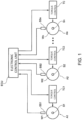
- FIG. 1 A system for controlling the adhesion of the wheels in an anti-slippage function according to the prior art is shown schematically in Fig. 1 , which refers to a vehicle comprising n controlled axles A1, A2, ..., An.
- the axles A1, A2, ..., An comprise a relative shaft S1, S2, ..., Sn and a relative pair of wheels W1, W2, ..., Wn rotationally integral therewith.
- the WSP system in Fig. 1 comprises an electronic control unit ECU, typically based on a microprocessor architecture, which receives tachometric signals relating to the angular speed of each axle A1, A2, ..., An from sensors SS1, SS2, ..., SSn respectively associated with these axles.
- the electronic unit ECU is also connected to torque control devices TC1, TC2, ..., TCn which are each associated with a relevant axle A1, A2, ..., An.
- the electronic unit ECU is arranged to modulate the torque applied to each axle according to a predetermined algorithm if, when torque is applied during a traction or braking phase in situations of degraded adhesion, the wheels of one or more axles result in a condition of possible incipient slippage.
- the torque is modulated in such a way as to prevent the axles from jamming completely, possibly in such a way as to bring each axle into a controlled sliding situation, with a view to recover adhesion and in any case for the entire duration of the situation of degraded adhesion.
- One known method for accurately tracking the speed of a railway vehicle requires the maintenance of an idle axle, i.e. an axle which is not subjected to traction or braking torques. This is required to ensure that the measurement of its speed is the best reproduction of the real speed V real of said railway vehicle.
- This solution is particularly effective in the case of particularly low adhesion between the wheels and the track. In this case, in the event of traction or braking, all of said wheels could enter a slippage condition and would therefore not be able to provide correct information regarding the real speed of the vehicle.
- An idle axle which is not subjected to traction or braking torques could continue to accurately track the speed of the vehicle.
- Modem railway vehicle architectures particularly for underground railways, tend to have very limited compositions, for example are made of two carriages.
- the use of an "idle" axle would lead to a significant loss of traction and braking capacity of the train.
- Fig. 2.a shows an example composition comprising two independent cars while Fig. 2.b shows an example composition comprising two cars constrained by means of a Jacobs bogie. It is evident that the use of an idle axle disadvantageously reduces the traction and braking capacity by 12.5% in the first case and by so much as 16.7% in the second case.
- MEMS micro electro-mechanical systems
- an accelerometric sensor typically a triaxial accelerometric sensor, on board.
- Longitudinal acceleration is understood to mean the acceleration of the vehicle in its direction of travel. By integrating this longitudinal acceleration over time, the longitudinal speed, i.e. the speed of travel of the vehicle, is obtained. This methodology is clearly not affected by the above-described slippage problems to which the axles may be subjected in the event of degraded adhesion.
- a railway vehicle 1 is travelling on a track 3 and provided with an accelerometric sensor 2.
- axis z may be defined as the direction of gravitational acceleration and axes x and y may be defined as the transverse directions on the plane perpendicular to z.
- axis y' may be defined as the longitudinal direction of the vehicle
- axis x' may be defined as the transverse direction of the vehicle
- axis z' may be defined as the direction perpendicular to the plane ("floor") of the vehicle.
- x", y" and z" may be defined as the sensitive axes of the triaxial accelerometric sensor.
- the accelerometric sensor that is integrated in an electronic circuit board on board the vehicle will not have its sensitive axes x", y" and z" perfectly aligned with those of the vehicle x', y' and z'.
- angles of rotation between the vehicle reference system and the gravitational reference system may be defined as ⁇ , ⁇ , ⁇ , for the axes x, y, z, respectively.
- angles of rotation between the accelerometer reference system and the vehicle reference system may be defined as ⁇ ', ⁇ ', ⁇ ', for the axes x, y, z, respectively.
- angles ⁇ , ⁇ , ⁇ are unknown to the electronic unit that acquires the accelerometer, but they are constant over time since they depend only on the mounting of the accelerometer relative to the vehicle.
- angles ⁇ ', ⁇ ', ⁇ ', as well as being unknown to the electronic unit that acquires the accelerometer, are not constant over time since they depend on the curvature and gradient of the local section of track.
- the problem of determining the longitudinal acceleration of the vehicle from the measurements of a triaxial accelerometer mounted on board the vehicle may not be solved analytically and/or geometrically.
- WO2017042138 proposes an analytical/geometric method for determining the orientation of an accelerometric sensor with respect to the vehicle on which the sensor is mounted. This method is based on the availability of:
- T) in formulas (5) and (6) is used to contain the variation of Vv(t) within physical limits allowed by the train, when excessive instantaneous and simultaneous variations of the axle speeds due to particularly degraded adhesion conditions during traction or braking could lead to a significant loss in the speed Vv(t) calculated using formulas (5) and (6).
- US 2014/136048 A1 discloses a system and a method for compensating a misalignment characteristic of one or more acceleration sensors fixed to a sprung mass of a vehicle.
- the above-mentioned problems remain unresolved.
- An object of this invention is therefore to provide a method for estimating a longitudinal acceleration of at least one railway vehicle and a method for estimating a longitudinal speed of at least one railway vehicle, which methods allow, respectively, the longitudinal acceleration and the longitudinal speed of the vehicle to be measured even in a condition in which all of the axles of said vehicle are in a slippage phase caused by degraded adhesion.
- a further object of this invention is therefore to allow the use of the idle axle to be fully recovered for traction and braking purposes, even in the case of particularly low adhesion, thus increasing the traction and braking capacity of the train while allowing said axis to accurately track the speed of the train in order to accurately evaluate the longitudinal forward speed.
- the method for estimating a longitudinal speed and the method for estimating a longitudinal acceleration may be applied to both slippage situations in a traction phase (negative V slippage ) and slippage situations in a braking phase (positive V slippage ).
- This invention allows for the most precise knowledge of the longitudinal speed of a railway vehicle, so as to facilitate and improve, for example, the piloting of control systems, anti-slippage systems, and odometric references installed on board.
- This invention proposes a method for calculating an estimated longitudinal acceleration of at least one railway vehicle, and thereafter a method for calculating an estimated longitudinal speed of the railway vehicle, using an accelerometric sensor means, for example a triaxial accelerometric sensor means.
- the method for estimating a longitudinal acceleration of at least one railway vehicle requires the availability, even discontinuous availability, of a measurement of the speed of the train that is independent from the accelerometer, in the following referred to as the independent longitudinal reference speed V ref of the railway vehicle.
- the method for estimating a longitudinal acceleration of at least one railway vehicle is based on obtaining the direction cosines of a 3x3 orientation matrix such that, if multiplied by the measurements from the sensor having 3 orthogonal axes, an estimated longitudinal acceleration of the vehicle is obtained. By integrating the estimated longitudinal acceleration of the vehicle, it is possible to obtain an estimated longitudinal speed of the vehicle.
- this independent longitudinal reference speed must be measured for at least one time interval containing the instant t.
- the interval may be 20 ms, 100 ms, etc.
- the unknowns of this equation are the values of k 1 , k 2 and k 3 .
- Equation (7) is valid only in cases in which the independent longitudinal reference speed v ref described above is available.
- equation (7) solving equation (7) during the phases in which the independent longitudinal reference speed v ref is available means that the coefficients k 1 , k 2 and k 3 may be dynamically updated such that their linear combination with the accelerations measured by the sensor results in the estimated longitudinal acceleration of the railway vehicle or train.
- the accelerometric sensor means 100 is arranged to measure a first acceleration a x along a first axis x, a second acceleration a y along a second axis y and a third acceleration a z along a third axis z.
- the first axis x, the second axis y and the third axis z are orthogonal to each other.
- the method for estimating a longitudinal acceleration of at least one railway vehicle comprises a first calibration phase which includes the steps of:
- the calibration instants may all be obtained in a single continuous calibration interval in which the independent longitudinal reference speed of the railway vehicle is available, or the calibration instants may be obtained in several calibration intervals in which the independent longitudinal reference speed of the railway vehicle is available. In the second case, the various calibration intervals may be separated by intervals in which the independent longitudinal reference speed of the railway vehicle is not available.
- saying that the independent longitudinal reference speed v ref is independent from the accelerometric sensor means 100 is understood to mean that the independent longitudinal reference speed is not a speed obtained by means of said accelerometric sensor means.
- the independent longitudinal reference speed v ref may be understood to mean the case in which the independent longitudinal reference speed v ref may be used in the method for estimating a longitudinal acceleration of at least one railway vehicle that is the subject of the present invention since it is accessible and reflects the real longitudinal speed at which the railway vehicle is moving along a track.
- the method for estimating a longitudinal acceleration of at least one railway vehicle also comprises a further measurement phase following said calibration phase.
- This measurement phase comprises the steps of:
- the estimated longitudinal acceleration value a lon (t i1 ) is relative to said measurement instant t i1 and is estimated by means of the sum of:
- the method for estimating a longitudinal speed of at least one railway vehicle again comprises a calibration phase which includes the step of:
- the estimated longitudinal acceleration value a lon (t c1 ) is relative to said calibration instant t c1 and is estimated by the linear filter by means of the sum of:
- the calibration phase also includes the steps of:
- the values of the first direction cosine ki, the second direction cosine k 2 and the third direction cosine k 3 may be predetermined. For example, they may be a predetermined default value that will be gradually adjusted as the calibration is performed in various calibration instants, or they may be a predetermined value equivalent to the value of the first direction cosine ki, the second direction cosine k 2 and the third direction cosine k 3 that were calibrated during a previous operation of the railway vehicle.
- the error may be obtained by comparing the output of the linear filter with the reference longitudinal acceleration value obtained by deriving the independent longitudinal reference speed v ref . This error is used by the adaptive filter to dynamically recalculate the coefficients of the linear filter k 1 , k 2 , k 3 in order to recursively minimize the error.
- the method for estimating a longitudinal speed of at least one railway vehicle also comprises a further measurement phase following said calibration phase.
- This measurement phase comprises the step of:
- the estimated longitudinal acceleration value a lon (t i1 ) is relative to said measurement instant t i1 and is estimated by means of the sum of:
- an availability instant t av may be defined as the last instant in which the independent longitudinal reference speed v ref is available. The instant following the availability instant t av will be an instant in which the independent longitudinal reference speed v ref will no longer be available.
- the independent longitudinal reference speed v ref (t av ), detected at the instant t av , is the last available reliable value of the independent longitudinal reference speed v ref .
- a return to availability instant t ret_av may also be defined as the first instant in which the independent longitudinal reference speed v ef becomes available again.
- the measurement instant t i1 may coincide with the return to availability instant t ret_av .
- the coefficients k 1 , k 2 , k 3 will be dynamically updated up to the availability instant t av .
- the values of k 1 , k 2 , k 3 will be frozen at their last value updated at the availability instant t av , k 1 (t av ), k 2 (t av ), k 3 (t av )).
- the values of k 1 , k 2 , k 3 may be dynamically updated by solving equation (7).
- the first measurement instant t i1 may coincide with an instant in which said independent longitudinal reference speed v ref (t ret_av ) becomes available again after being unavailable.
- the adaptive filter may be arranged to determine the respective updated values of the first direction cosine ki, the second direction cosine k 2 and the third direction cosine k 3 through an adaptive algorithm based on a least means square technique, LMS.
- the calibration phase may be repeated for a plurality of calibration instants, for example a second calibration instant t i2 , a third calibration instant t i3 , ..., an n-th calibration instant t in .
- the calibration step may be performed at each first ignition of the at least one railway vehicle.
- the independent longitudinal reference speed v ef may be a longitudinal speed obtained from an angular speed of an axle of the railway vehicle.
- the independent longitudinal reference speed v ef may be available when the axle is not slipping.
- the independent longitudinal reference speed v ef of the railway vehicle is a longitudinal speed of the railway vehicle provided by a positioning means.
- the independent longitudinal reference speed v ef may be available when said positioning means communicates with a satellite.
- the positioning means may be a GPS system/device which communicates using a suitable signal to obtain the location information and therefore the speed of movement of the train.
- the independent longitudinal reference speed v ef may not be available when, for example, the railway vehicle is inside a tunnel and is not able to communicate with said satellite.
- the estimated longitudinal acceleration a lon may be determined for a plurality of measurement times t i1 , t i2 , ..., t in in which the independent longitudinal reference speed v ref of the railway vehicle is available, for example a second measurement instant t i2 , a third measurement instant t i3 , ..., an n-th measurement instant t in .
- the plurality of measurement times t i1 , t i2 , ..., t in may be selected according to an acquisition period ⁇ T i .
- the estimated longitudinal acceleration a lon may be continuously determined from an availability instant t av coinciding with an instant that directly precedes an unavailability instant in which said independent longitudinal reference speed v ref of the railway vehicle is no longer available, and a measurement instant, for example the first measurement instant t i1 or the successive measurement instants t i2 , ..., t in .
- This invention also relates to a method for estimating a longitudinal speed of at least one railway vehicle.
- the method for estimating a longitudinal speed of at least one railway vehicle comprises the step of measuring the value of the independent longitudinal reference speed v ref (t av ) of the at least one axle of the railway vehicle in the availability instant t av .
- the method for estimating a longitudinal speed of at least one railway vehicle also comprises the step of determining the longitudinal speed v RV (t in ) of the railway vehicle according to the following steps:
- the method for estimating a longitudinal speed of at least one railway vehicle comprises the step of measuring the value of the independent longitudinal reference speed v ref (t av ) of said at least one railway vehicle in the availability instant t av .
- the method for estimating a longitudinal speed of at least one railway vehicle also comprises the step of determining the longitudinal speed v RV (t) of the railway vehicle according to the following steps:
- the speed of the railway vehicle will be calculated using the measurements from the accelerometer and the last reliable independent longitudinal reference speed value v ref according to the equations shown above.
- the longitudinal speed of the railway vehicle v RV will always be available, even in the phases in which the independent longitudinal reference speed v ref is not available. Because of this, it is also possible to fully recover the use of the idle axle for traction and braking purposes, even in the case of particularly low adhesion, thus increasing the traction and braking capacity of the train.
Landscapes
- Engineering & Computer Science (AREA)
- Mechanical Engineering (AREA)
- Transportation (AREA)
- Physics & Mathematics (AREA)
- General Physics & Mathematics (AREA)
- Sustainable Energy (AREA)
- Sustainable Development (AREA)
- Power Engineering (AREA)
- Life Sciences & Earth Sciences (AREA)
- Electric Propulsion And Braking For Vehicles (AREA)
- Regulating Braking Force (AREA)
- Train Traffic Observation, Control, And Security (AREA)
- Radar Systems Or Details Thereof (AREA)
Description
- This invention generally lies within the railway vehicle sector; in particular, this invention relates to a method for estimating a longitudinal acceleration of at least one railway vehicle.
- Slippage (also known as slip, slide or sliding) is understood to be a condition where there is a difference between the rotational speed of the axle and the speed of travel of the vehicle. This difference is defined as the slippage speed.
- The slippage speed may be calculated using the following formula:

- More modem railway vehicles have electronic systems installed on board that generally include subsystems for controlling the slippage of the wheels, which subsystems are adapted to intervene when the vehicle is in a traction phase or when the vehicle is in a braking phase. Subsystems of this kind are known as anti-skid or anti-slide systems or are also known as WSP (wheel slide protection) systems.
- A system for controlling the adhesion of the wheels in an anti-slippage function according to the prior art is shown schematically in
Fig. 1 , which refers to a vehicle comprising n controlled axles A1, A2, ..., An. The axles A1, A2, ..., An comprise a relative shaft S1, S2, ..., Sn and a relative pair of wheels W1, W2, ..., Wn rotationally integral therewith. - In the drawings, only one wheel of each axle is generally shown.
- The WSP system in
Fig. 1 comprises an electronic control unit ECU, typically based on a microprocessor architecture, which receives tachometric signals relating to the angular speed of each axle A1, A2, ..., An from sensors SS1, SS2, ..., SSn respectively associated with these axles. The electronic unit ECU is also connected to torque control devices TC1, TC2, ..., TCn which are each associated with a relevant axle A1, A2, ..., An. - The electronic unit ECU is arranged to modulate the torque applied to each axle according to a predetermined algorithm if, when torque is applied during a traction or braking phase in situations of degraded adhesion, the wheels of one or more axles result in a condition of possible incipient slippage. The torque is modulated in such a way as to prevent the axles from jamming completely, possibly in such a way as to bring each axle into a controlled sliding situation, with a view to recover adhesion and in any case for the entire duration of the situation of degraded adhesion.
- It is evident that knowledge of the instantaneous speed of the vehicle VRV(t) is fundamental for correctly controlling the slippage.
- One known method for accurately tracking the speed of a railway vehicle requires the maintenance of an idle axle, i.e. an axle which is not subjected to traction or braking torques. This is required to ensure that the measurement of its speed is the best reproduction of the real speed Vreal of said railway vehicle. This solution is particularly effective in the case of particularly low adhesion between the wheels and the track. In this case, in the event of traction or braking, all of said wheels could enter a slippage condition and would therefore not be able to provide correct information regarding the real speed of the vehicle. An idle axle which is not subjected to traction or braking torques could continue to accurately track the speed of the vehicle.
- Modem railway vehicle architectures, particularly for underground railways, tend to have very limited compositions, for example are made of two carriages. In this case, the use of an "idle" axle would lead to a significant loss of traction and braking capacity of the train.
-
Fig. 2.a shows an example composition comprising two independent cars whileFig. 2.b shows an example composition comprising two cars constrained by means of a Jacobs bogie. It is evident that the use of an idle axle disadvantageously reduces the traction and braking capacity by 12.5% in the first case and by so much as 16.7% in the second case. - In the prior art, there are also systems based on accelerometric sensors for measuring the forward speed of a vehicle.
- Given the increasing availability and the progressive reduction in cost of MEMS ("micro electro-mechanical systems"), more and more electronic devices, regardless of their main application, integrate an accelerometric sensor, typically a triaxial accelerometric sensor, on board.
- The use of an accelerometric sensor for estimating the longitudinal acceleration of the vehicle is, in principle, easily applicable.
- Longitudinal acceleration is understood to mean the acceleration of the vehicle in its direction of travel. By integrating this longitudinal acceleration over time, the longitudinal speed, i.e. the speed of travel of the vehicle, is obtained. This methodology is clearly not affected by the above-described slippage problems to which the axles may be subjected in the event of degraded adhesion.
- With reference to
Fig. 3 , arailway vehicle 1 is travelling on a track 3 and provided with anaccelerometric sensor 2. - In the terrestrial/gravitational reference system, axis z may be defined as the direction of gravitational acceleration and axes x and y may be defined as the transverse directions on the plane perpendicular to z.
- In the reference system integral with the vehicle, however, axis y' may be defined as the longitudinal direction of the vehicle, axis x' may be defined as the transverse direction of the vehicle and axis z' may be defined as the direction perpendicular to the plane ("floor") of the vehicle.
- Furthermore, x", y" and z" may be defined as the sensitive axes of the triaxial accelerometric sensor.
- Now considering the ideal case in which the sensor is installed integrally with the vehicle, with the axes perfectly aligned with those of the vehicle, this will result in:


- Also considering the particular case in which the
vehicle 1 is travelling on a section of track 3 that is perfectly straight and has no gradient, this will result in:


- In these ideal conditions, the longitudinal acceleration of the vehicle may be directly deduced from the accelerometer measurements being:

- The speed of travel of the vehicle may then be calculated as a temporal integration of the acceleration value:


- However, this methodology, which has been greatly simplified by the above assumptions, is not actually applicable in a real context.
- Although it may be mounted with precision, the accelerometric sensor that is integrated in an electronic circuit board on board the vehicle will not have its sensitive axes x", y" and z" perfectly aligned with those of the vehicle x', y' and z'.
- Moreover, the hypothesis that the
vehicle 1 is travelling on a section of track 3 that is perfectly straight and has no gradient is not applicable in practice either, because the railway vehicle may travel on sections that are curved and/or have a non-zero gradient. - The invalidity of the aforementioned assumptions opens the way to geometric scenarios in which the three reference systems (gravitational, vehicle and accelerometer) have relative angles on the 3 axes.
- The angles of rotation between the vehicle reference system and the gravitational reference system may be defined as α, β, ϕ, for the axes x, y, z, respectively.
- The angles of rotation between the accelerometer reference system and the vehicle reference system may be defined as α', β', ϕ', for the axes x, y, z, respectively.
- The angles α, β, ϕ are unknown to the electronic unit that acquires the accelerometer, but they are constant over time since they depend only on the mounting of the accelerometer relative to the vehicle.
- The angles α', β', ϕ', as well as being unknown to the electronic unit that acquires the accelerometer, are not constant over time since they depend on the curvature and gradient of the local section of track.
- Since the angles α, β, ϕ and the angles α', β', ϕ' are unknown and unrelated to each other, the problem of determining the longitudinal acceleration of the vehicle from the measurements of a triaxial accelerometer mounted on board the vehicle may not be solved analytically and/or geometrically.
- For example,
WO2017042138 proposes an analytical/geometric method for determining the orientation of an accelerometric sensor with respect to the vehicle on which the sensor is mounted. This method is based on the availability of: - a "free state," i.e. a state of a railway vehicle that is stationary or at a constant speed, in which state the accelerometric sensor is subjected only to the gravitational force;
- availability, even discontinuous availability, of a source of speed of the railway vehicle that is reliable and external to the accelerometer.
- The availability, even discontinuous availability, of a reliable measurement of speed of the railway vehicle that is external to the accelerometer is plausible if one considers that the angular speed of the axles (measured by the sensors SS in
Fig. 1 ) is reliable in all cases of non-degraded adhesion, which are still the majority. The role of the accelerometric sensor, and of the method for estimating the speed of the railway vehicle therefrom, will be that of being used in situations of degraded adhesion in which the axles are all in slippage and their angular speed is not representative of the speed of the railway vehicle or train. - However, the method proposed in
WO2017042138 is fundamentally based on two assumptions: - 1) during the "free state," the vehicle is on a perfectly level section of track (gradient equal to zero);
- 2) in the phases of using the speed external to the accelerometer, the railway vehicle or train is on a perfectly straight section of track. The transverse acceleration component (axis x) is therefore disregarded and is instead present in the curvilinear sections.
- The assumptions on which
WO2017042138 is based are greatly limiting and do not ensure the operation of this method in a real application. - The most commonly used algorithm for estimating the real speed Vv(t) of the vehicle, in the event of braking, normally uses a function such as:


- More accurate variants of formulas (5) and (6) are known, but are still based on the instantaneous measurement of the individual speed of the axles. Here it is clear that the availability of an idle axle would make formulas (5) and (6) extremely accurate if all the axles subjected to torque were in the slippage phase.
-
US 2014/136048 A1 discloses a system and a method for compensating a misalignment characteristic of one or more acceleration sensors fixed to a sprung mass of a vehicle. However, the above-mentioned problems remain unresolved. - An object of this invention is therefore to provide a method for estimating a longitudinal acceleration of at least one railway vehicle and a method for estimating a longitudinal speed of at least one railway vehicle, which methods allow, respectively, the longitudinal acceleration and the longitudinal speed of the vehicle to be measured even in a condition in which all of the axles of said vehicle are in a slippage phase caused by degraded adhesion.
- A further object of this invention is therefore to allow the use of the idle axle to be fully recovered for traction and braking purposes, even in the case of particularly low adhesion, thus increasing the traction and braking capacity of the train while allowing said axis to accurately track the speed of the train in order to accurately evaluate the longitudinal forward speed.
- The method for estimating a longitudinal speed and the method for estimating a longitudinal acceleration may be applied to both slippage situations in a traction phase (negative Vslippage) and slippage situations in a braking phase (positive Vslippage).
- This invention allows for the most precise knowledge of the longitudinal speed of a railway vehicle, so as to facilitate and improve, for example, the piloting of control systems, anti-slippage systems, and odometric references installed on board.
- The aforesaid and other objects and advantages are achieved, according to an aspect of the invention, by a method for estimating a longitudinal acceleration of at least one railway vehicle having the features defined in
claim 1 and inclaim 2, respectively, and by methods for estimating a longitudinal acceleration of at least one railway vehicle having the features defined in therespective claims 10 and 12. Preferred embodiments of the invention are defined in the dependent claims, the content of which is to be understood as an integral part of the present description. - The functional and structural features of some preferred embodiments of a method for estimating a longitudinal speed of at least one railway vehicle according to the invention will now be described. Reference is made to the appended drawings, in which:
-
Fig. 1 shows a WSP system produced in accordance with the prior art; -
Fig. 2a shows an example composition comprising two independent cars whileFig. 2.b shows an example composition comprising two cars constrained by means of a Jacobs bogie; -
Fig. 3 shows a railway vehicle travelling on a track and provided with an accelerometric sensor; -
Fig. 4 shows an example system which may be used to implement an embodiment of this invention; and -
Fig. 5 shows a plurality of explanatory graphs of the trend over time of the speed of the railway vehicle, the availability of the independent longitudinal reference speed and the direction cosines. - Before describing a plurality of embodiments of the invention in detail, it should be clarified that the invention is not limited in its application to the construction details and configuration of the components presented in the following description or illustrated in the drawings. The invention is capable of assuming other embodiments and of being implemented or constructed in practice in different ways. It should also be understood that the phraseology and terminology have a descriptive purpose and should not be construed as limiting. The use of "include" and "comprise" and their variations is to be understood as encompassing the elements set out below and their equivalents, as well as additional elements and the equivalents thereof.
- This invention proposes a method for calculating an estimated longitudinal acceleration of at least one railway vehicle, and thereafter a method for calculating an estimated longitudinal speed of the railway vehicle, using an accelerometric sensor means, for example a triaxial accelerometric sensor means.
- The method for estimating a longitudinal acceleration of at least one railway vehicle requires the availability, even discontinuous availability, of a measurement of the speed of the train that is independent from the accelerometer, in the following referred to as the independent longitudinal reference speed Vref of the railway vehicle. The method for estimating a longitudinal acceleration of at least one railway vehicle is based on obtaining the direction cosines of a 3x3 orientation matrix such that, if multiplied by the measurements from the sensor having 3 orthogonal axes, an estimated longitudinal acceleration of the vehicle is obtained. By integrating the estimated longitudinal acceleration of the vehicle, it is possible to obtain an estimated longitudinal speed of the vehicle.
- The main equation used is as follows:

- k1, k2 and k3 are numerical values of direction cosines, k1, k2 and k3 being the variables of the equation;
- ax(t), ay(t), az(t) are accelerations detected by the accelerometric sensor means on its three orthogonal axes in a generic instant t;
- aref(t) is an independent reference acceleration at the instant t, determined by means of a derivative at the instant t of an independent reference longitudinal speed (i.e. travel speed) vref, i.e.:

- In order for it to be possible to calculate the derivative of the independent longitudinal reference speed at the instant t, this independent longitudinal reference speed must be measured for at least one time interval containing the instant t. For example, the interval may be 20 ms, 100 ms, etc.
- The unknowns of this equation are the values of k1, k2 and k3.
- Equation (7) is valid only in cases in which the independent longitudinal reference speed vref described above is available.
- Regardless of the technique used, solving equation (7) during the phases in which the independent longitudinal reference speed vref is available means that the coefficients k1, k2 and k3 may be dynamically updated such that their linear combination with the accelerations measured by the sensor results in the estimated longitudinal acceleration of the railway vehicle or train.
- In the following, a first embodiment of a method for estimating a longitudinal acceleration of at least one railway vehicle by means of an accelerometric sensor means 100 is described. The accelerometric sensor means 100 is arranged to measure a first acceleration ax along a first axis x, a second acceleration ay along a second axis y and a third acceleration az along a third axis z. The first axis x, the second axis y and the third axis z are orthogonal to each other.
- The method for estimating a longitudinal acceleration of at least one railway vehicle comprises a first calibration phase which includes the steps of:
- measuring, in a first calibration instant tc1 in which an independent longitudinal reference speed vref of the railway vehicle is available, a first value of the first acceleration ax(tci1, a first value of the second acceleration ay(tc1) and a first value of the third acceleration az(tc1), wherein the independent longitudinal reference speed vref is independent from said accelerometric sensor means (100);
- measuring, in a second calibration instant tc2 in which said independent longitudinal reference speed vref of the railway vehicle is available, which second calibration instant is different from said first calibration instant tc1, a second value of the first acceleration ax(tc2), a second value of the second acceleration ay(tc2) and a second value of the third acceleration az(tc2);
- measuring, in a third calibration instant tc3 in which said independent longitudinal reference speed vref of the railway vehicle is available, which third calibration instant is different from said first calibration instant tc1 and from said second calibration instant tc2, a third value of the first acceleration ax(tc3), a third value of the second acceleration ay(tc3) and a third value of the third acceleration az(tc3);
- calculating the value of a first independent longitudinal reference acceleration aref(tc1) in the first calibration instant tc1 from a first value of the independent longitudinal reference speed vref(tc1) measured in the first calibration instant tc1;
- calculating the value of a second independent longitudinal reference acceleration aref(tc2) in the second calibration instant tc2 from a second value of the independent longitudinal reference speed vref(tc2) measured in the second calibration instant tc2;
- calculating the value of a third independent longitudinal reference acceleration aref(tc3) in the third calibration instant tc3 from a third value of the independent longitudinal reference speed vref(tc3) measured in the third calibration instant tc3; - solving the following system, in order to determine the values of the first direction cosine ki, the second direction cosine k2 and the third direction cosine k3:

- Clearly, the calibration instants may all be obtained in a single continuous calibration interval in which the independent longitudinal reference speed of the railway vehicle is available, or the calibration instants may be obtained in several calibration intervals in which the independent longitudinal reference speed of the railway vehicle is available. In the second case, the various calibration intervals may be separated by intervals in which the independent longitudinal reference speed of the railway vehicle is not available.
- In other words, it is possible to measure of values of ax, ay, az and vref in three different calibration instants tc1, tc2, tc3 provided that the independent longitudinal reference speed vref is available, so as to have a system of three equations. This system of three equations in three unknowns may be solved both by an analytical method and by a numerical method. Furthermore, by acquiring the measurements at further instants (i.e. more than 3 times), it is possible to recursively increase and update the accuracy of the solutions k1, k2, k3 over time.
- In the present case, saying that the independent longitudinal reference speed vref is independent from the accelerometric sensor means 100 is understood to mean that the independent longitudinal reference speed is not a speed obtained by means of said accelerometric sensor means.
- In the present case, stating that the independent longitudinal reference speed vref is available may be understood to mean the case in which the independent longitudinal reference speed vref may be used in the method for estimating a longitudinal acceleration of at least one railway vehicle that is the subject of the present invention since it is accessible and reflects the real longitudinal speed at which the railway vehicle is moving along a track. The method for estimating a longitudinal acceleration of at least one railway vehicle also comprises a further measurement phase following said calibration phase.
- This measurement phase comprises the steps of:
- determining, for at least a first measurement instant ti1 in which said independent longitudinal reference speed of the railway vehicle is not available, an estimated longitudinal acceleration value atlon(ti1) of the at least one railway vehicle.
- The estimated longitudinal acceleration value alon(ti1) is relative to said measurement instant ti1 and is estimated by means of the sum of:
- a multiplication of the first direction cosine ki, determined during the calibration phase, with a fourth value of the first acceleration ax(ti1) acquired in said first measurement instant ti1;
- a multiplication of the second direction cosine k2, determined during the calibration phase, with a fourth value of the second acceleration ay(ti1) acquired in said first measurement instant ti1;
- a multiplication of the third direction cosine k3, determined during the calibration phase, with a fourth value of the third acceleration az(ti1) acquired in said first measurement instant ti1.
- In one alternative embodiment, with reference to
Fig. 4 , the method for estimating a longitudinal speed of at least one railway vehicle again comprises a calibration phase which includes the step of: - estimating, by means of a linear filter, for at least a first calibration instant tc1 in which an independent longitudinal reference speed vef of the railway vehicle is available, an estimated longitudinal acceleration value alon(tc1) of the at least one railway vehicle. The independent longitudinal reference speed vref is also independent from said accelerometric sensor means 100 in this case.
- The estimated longitudinal acceleration value alon(tc1) is relative to said calibration instant tc1 and is estimated by the linear filter by means of the sum of:
- a multiplication of a first direction cosine ki having a predetermined value with a first value of the first acceleration ax(tc1) acquired in said first calibration instant tc1;
- a multiplication of a second direction cosine k2 having a predetermined value with a first value of the second acceleration ay(tc1) acquired in said first calibration instant tc1;
- a multiplication of a third direction cosine k3 having a predetermined value with a first value of the third acceleration az(tc1) acquired in said first calibration instant tc1.
- In this embodiment, the calibration phase also includes the steps of:
- determining an estimate error, Error, by means of the difference between the estimated longitudinal acceleration value alon(tc1), relative to said first calibration instant tc1, and an independent longitudinal reference acceleration value aref(tc1) which is relative to the first calibration instant tc1 and determined from a first value of the independent longitudinal reference speed value vref(tc1) measured in the first calibration instant tc1;
- determining, by means of an adaptive filter (104), respective updated values of the first direction cosine ki, the second direction cosine k2 and the third direction cosine k3 to be imposed onto said linear filter in order to minimize said estimate error.
- When the calibration phase is started for the first time, the values of the first direction cosine ki, the second direction cosine k2 and the third direction cosine k3 may be predetermined. For example, they may be a predetermined default value that will be gradually adjusted as the calibration is performed in various calibration instants, or they may be a predetermined value equivalent to the value of the first direction cosine ki, the second direction cosine k2 and the third direction cosine k3 that were calibrated during a previous operation of the railway vehicle.
- In other words, solving the equation may be based on the use of adaptive algorithms. The error may be obtained by comparing the output of the linear filter with the reference longitudinal acceleration value obtained by deriving the independent longitudinal reference speed vref. This error is used by the adaptive filter to dynamically recalculate the coefficients of the linear filter k1, k2, k3 in order to recursively minimize the error.
- In this alternative embodiment too, the method for estimating a longitudinal speed of at least one railway vehicle also comprises a further measurement phase following said calibration phase.
- This measurement phase comprises the step of:
- determining, by means of said linear filter, for at least a first measurement instant ti1 in which said independent longitudinal reference speed of the railway vehicle is not available, an estimated longitudinal acceleration value alon(ti1) of the at least one railway vehicle.
- The estimated longitudinal acceleration value alon(ti1) is relative to said measurement instant ti1 and is estimated by means of the sum of:
- a multiplication of the updated value of the first direction cosine ki, determined during the calibration phase, with a value of the first acceleration ax(ti1) acquired in said first measurement instant ti1;
- a multiplication of the updated value of the second direction cosine k2, determined during the calibration phase, with a value of the second acceleration ay(ti1) acquired in said first measurement instant ti1;
- a multiplication of the updated value of the third direction cosine k3, determined during the calibration phase, with a value of the third acceleration az(ti1) acquired in said first measurement instant ti1.
- With reference to
Fig. 5 , an availability instant tav may be defined as the last instant in which the independent longitudinal reference speed vref is available. The instant following the availability instant tav will be an instant in which the independent longitudinal reference speed vref will no longer be available. - The independent longitudinal reference speed vref(tav), detected at the instant tav, is the last available reliable value of the independent longitudinal reference speed vref.
- A return to availability instant tret_av, where tret_av > tav, may also be defined as the first instant in which the independent longitudinal reference speed vef becomes available again.
- The measurement instant ti1 may coincide with the return to availability instant tret_av.
- The
equation 
- By solving this equation, the coefficients k1, k2, k3 will be dynamically updated up to the availability instant tav. In the time period between tav and tret_av, the values of k1, k2, k3 will be frozen at their last value updated at the availability instant tav, k1(tav), k2(tav), k3(tav)). Then, with t > tav, the values of k1, k2, k3 may be dynamically updated by solving equation (7).
- For example, the first measurement instant ti1 may coincide with an instant in which said independent longitudinal reference speed vref(tret_av) becomes available again after being unavailable.
- The adaptive filter may be arranged to determine the respective updated values of the first direction cosine ki, the second direction cosine k2 and the third direction cosine k3 through an adaptive algorithm based on a least means square technique, LMS.
- For all of the embodiments described above, the calibration phase may be repeated for a plurality of calibration instants, for example a second calibration instant ti2, a third calibration instant ti3, ..., an n-th calibration instant tin.
- Clearly, the calibration step may be performed at each first ignition of the at least one railway vehicle.
- In the following, some examples of the independent longitudinal reference speed vref of the railway vehicle will be given.
- For example, the independent longitudinal reference speed vef may be a longitudinal speed obtained from an angular speed of an axle of the railway vehicle. In this case, the independent longitudinal reference speed vef may be available when the axle is not slipping.
- In a further example, the independent longitudinal reference speed vef of the railway vehicle is a longitudinal speed of the railway vehicle provided by a positioning means. In this case, the independent longitudinal reference speed vef may be available when said positioning means communicates with a satellite. The positioning means may be a GPS system/device which communicates using a suitable signal to obtain the location information and therefore the speed of movement of the train. The independent longitudinal reference speed vef may not be available when, for example, the railway vehicle is inside a tunnel and is not able to communicate with said satellite.
- In a further aspect of the invention, the estimated longitudinal acceleration alon may be determined for a plurality of measurement times ti1, ti2, ..., tin in which the independent longitudinal reference speed vref of the railway vehicle is available, for example a second measurement instant ti2, a third measurement instant ti3, ..., an n-th measurement instant tin. The plurality of measurement times ti1, ti2, ..., tin may be selected according to an acquisition period ΔTi.
- Or, the estimated longitudinal acceleration alon may be continuously determined from an availability instant tav coinciding with an instant that directly precedes an unavailability instant in which said independent longitudinal reference speed vref of the railway vehicle is no longer available, and a measurement instant, for example the first measurement instant ti1 or the successive measurement instants ti2, ..., tin.
- This invention also relates to a method for estimating a longitudinal speed of at least one railway vehicle.
- When the estimated longitudinal acceleration alon is determined for a plurality of measurement times tl1, ti2, ..., tin in which the independent longitudinal reference speed vref of the rail vehicle is available, which measurement times were selected according to an acquisition period ΔTi, the method for estimating a longitudinal speed of at least one railway vehicle comprises the step of measuring the value of the independent longitudinal reference speed vref(tav) of the at least one axle of the railway vehicle in the availability instant tav.
- The method for estimating a longitudinal speed of at least one railway vehicle also comprises the step of determining the longitudinal speed vRV(tin) of the railway vehicle according to the following steps:
- calculating the sum of the longitudinal accelerations estimated in the plurality of measurement times ti1, ti2, ..., tin;
- multiplying the sum of the longitudinal accelerations determined in the plurality of measurement times ti1, ti2, ..., tin by the acquisition period ΔTi;
- adding the value of the independent longitudinal reference speed Vref(tav) of said at least one railway vehicle in the availability instant tav to the result of the multiplication of the sum of the estimated longitudinal accelerations determined in the plurality of measurement times ti1, ti2, ..., tin by the acquisition period ΔTi.
- For example, the step of determining the longitudinal speed vRV of the railway vehicle may be carried out using the following formula:

- vref (tav ) is the independent longitudinal reference speed Vref(tav) of said at least one railway vehicle in the availability instant tav;
-

- ΔTi is the acquisition period.
- When instead the estimated longitudinal acceleration alon is determined continuously from the availability instant tav, coinciding with an instant directly preceding an unavailability instant in which said independent longitudinal reference speed vref is not available, and for example a first measurement instant ti1, the method for estimating a longitudinal speed of at least one railway vehicle comprises the step of measuring the value of the independent longitudinal reference speed vref(tav) of said at least one railway vehicle in the availability instant tav.
- The method for estimating a longitudinal speed of at least one railway vehicle also comprises the step of determining the longitudinal speed vRV(t) of the railway vehicle according to the following steps:
- calculating the integral of the estimated longitudinal acceleration alon determined continuously from the availability instant tav to said first measurement instant ti1;
- adding the value of the independent longitudinal reference speed Vref(tav) of said at least one railway vehicle in the availability instant tav to the result of the integral of the estimated longitudinal acceleration.
- For example, the step of determining the longitudinal speed vRV(ti1) of the railway vehicle may be carried out using the following formula:

- vref (tav ) is the independent longitudinal reference speed Vref(tav) in the availability instant tav;
-

- The above is also valid for the subsequent measurement instants. For example, considering an n-th measurement time tin, the step of determining the longitudinal speed vRV(tin) of the railway vehicle may be carried out using the following formula:

- vref (tav ) is the independent longitudinal reference speed Vref(tav) in the availability instant tav;
-

- Again with reference to
Fig. 5 , it may therefore be summarized that, during the time period between tav and tret_av, with the independent longitudinal reference speed vref not being available, the acceleration of the railway vehicle will be calculated from the measurements of the accelerometer. - During the time period between tav and tret_av, with the independent longitudinal reference speed vref not being available, the speed of the railway vehicle will be calculated using the measurements from the accelerometer and the last reliable independent longitudinal reference speed value vref according to the equations shown above.
- Advantageously, because of that which has been described above in the present description, the longitudinal speed of the railway vehicle vRV will always be available, even in the phases in which the independent longitudinal reference speed vref is not available. Because of this, it is also possible to fully recover the use of the idle axle for traction and braking purposes, even in the case of particularly low adhesion, thus increasing the traction and braking capacity of the train.
- Various aspects and embodiments of a method for estimating a longitudinal acceleration of at least one railway vehicle and a method for estimating a longitudinal speed of at least one railway vehicle according to the invention have been described. It is understood that each embodiment may be combined with any other embodiment. Furthermore, the invention is not limited to the described embodiments, but may be varied within the scope defined by the appended claims.
Claims (14)
- Method for estimating a longitudinal acceleration of at least one railway vehicle by means of an accelerometric sensor means (100) arranged to measure a first acceleration ax along a first axis x, a second acceleration ay along a second axis y and a third acceleration az along a third axis z, wherein the first axis x, the second axis y and the third axis z are orthogonal to each other;
the method for estimating a longitudinal acceleration of at least one railway vehicle is characterized by the fact that it comprises the steps of:- executing a calibration phase including the steps of:• measuring, in a first calibration instant tc1 in which an independent longitudinal reference speed vref of the railway vehicle is available, a first value of the first acceleration ax(tci1, a first value of the second acceleration ay(tc1) and a first value of the third acceleration az(tc1); the measurement of the independent longitudinal reference speed vref being independent from said accelerometric sensor means (100);• measuring, in a second calibration instant tc2 in which said independent longitudinal reference speed vref of the railway vehicle is available, which second calibration instant is different from said first calibration instant tc1, a second value of the first acceleration ax(tc2), a second value of the second acceleration ay(tc2) and a second value of the third acceleration az(tc2);• measuring, in a third calibration instant tc3 in which said independent longitudinal reference speed vref of the railway vehicle is available, which third calibration instant is different from said first calibration instant tc1 and from said second calibration instant tc2, a third value of the first acceleration ax(tc3), a third value of the second acceleration ay(tc3) and a third value of the third acceleration az(tc3);• calculating the value of a first independent longitudinal reference acceleration aref(tc1) in the first calibration instant tc1 from a first value of the independent longitudinal reference speed vref(tc1) measured in the first calibration instant tc1;• calculating the value of a second independent longitudinal reference acceleration aref(tc2) in the second calibration instant tc2 from a second value of the effective independent longitudinal reference speed vref(tc2) measured in the second calibration instant tc2;• calculating the value of a third independent longitudinal reference acceleration aref(tc3) in the third calibration instant tc3 from a third value of the independent longitudinal reference speed vref(tc3) measured in the third calibration instant tc3;• solving the following system, in order to determine the values of a first direction cosine k1, a second direction cosine k2 and a third direction cosine k3: - following the calibration phase, determining, for at least a first measurement instant ti1 in which said independent longitudinal reference speed of the railway vehicle is not available, an estimated longitudinal acceleration value alon(ti1) of the at least one railway vehicle, wherein said estimated longitudinal acceleration value alon(ti1) is relative to said first measurement instant ti1 and is estimated by means of the sum of:• a multiplication of the first direction cosine ki, determined during the calibration phase, with a fourth value of the first acceleration ax(ti1) acquired in said first measurement instant ti1;• a multiplication of the second direction cosine k2, determined during the calibration phase, with a fourth value of the second acceleration ay(ti1) acquired in said first measurement instant ti1;• a multiplication of the third direction cosine k3, determined during the calibration phase, with a fourth value of the third acceleration az(ti1) acquired in said first measurement instant ti1.
 - Method for estimating a longitudinal acceleration of at least one railway vehicle by means of an accelerometric sensor means (100) arranged to measure a first acceleration ax along a first axis x, a second acceleration ay along a second axis y and a third acceleration az along a third axis z, wherein the first axis x, the second axis y and the third axis z are orthogonal to each other;
the method for estimating a longitudinal acceleration of at least one railway vehicle is characterized by the fact that it comprises the steps of:- executing a calibration phase including the steps of:• for at least a first calibration instant tc1 in which an independent longitudinal reference speed vref of the railway vehicle is available, wherein the measurement of the independent longitudinal reference speed vref is independent from said accelerometric sensor means (100), estimating an estimated longitudinal acceleration value alon(tc1) of the at least one railway vehicle by means of a linear filter; wherein said estimated longitudinal acceleration value alon(tc1) is relative to said first calibration instant tc1 and is estimated by the linear filter by means of the sum of:o a multiplication of a first direction cosine ki having a predetermined value with a first value of the first acceleration ax(tc1) acquired in said first calibration instant tc1;o a multiplication of a second direction cosine k2 having a predetermined value with a first value of the second acceleration ay(tc1) acquired in said first calibration instant tc1;o a multiplication of a third direction cosine k3 having a predetermined value with a first value of the third acceleration az(tc1) acquired in said first calibration instant tc1;• determining an estimate error (Error) by means of the difference between the estimated longitudinal acceleration value alon(tc1), relative to said first calibration instant tc1, and a reference longitudinal acceleration value aref(tc1) which is relative to the first calibration instant tc1 and determined from a first value of the independent reference longitudinal speed value vref(tc1) measured in the first calibration instant tc1;• determining, by means of an adaptive filter (104), respective updated values of the first direction cosine k1, the second direction cosine k2 and the third direction cosine k3 to be imposed onto said linear filter in order to minimize said estimate error;- following the calibration phase, determining by means of said linear filter, for at least a first measurement instant ti1 in which said independent longitudinal reference speed of the railway vehicle is not available, an estimated longitudinal acceleration value alon(ti1) of the at least one railway vehicle, wherein said estimated longitudinal acceleration value alon(ti1) is relative to said first measurement instant ti1 and is estimated by means of the sum of:• a multiplication of the updated value of said first direction cosine ki, determined during the calibration phase, with a second value of the first acceleration ax(ti1) acquired in said first measurement instant ti1;• a multiplication of the updated value of said second direction cosine k2, determined during the calibration phase, with a second value of the second acceleration ay(ti1) acquired in said first measurement instant ti1;• a multiplication of the updated value of said third direction cosine k3, determined during the calibration phase, with a second value of the third acceleration az(ti1) acquired in said first measurement instant ti1. - Method for estimating a longitudinal acceleration of at least one railway vehicle according to claim 2, wherein said adaptive filter is arranged to determine said respective updated values of the first direction cosine ki, the second direction cosine k2 and the third direction cosine k3 through an adaptive algorithm based on a least means square technique, LMS.
- Method for estimating a longitudinal acceleration of at least one railway vehicle according to any of the preceding claims, wherein the calibration phase is repeated for a plurality of calibration instants.
- Method for estimating a longitudinal acceleration of at least one railway vehicle according to any of the preceding claims, wherein the calibration phase is performed at each first ignition of the at least one railway vehicle.
- Method for estimating a longitudinal acceleration of at least one railway vehicle according to any of the preceding claims, wherein said independent longitudinal reference speed vref of the railway vehicle is a longitudinal speed determined from an angular speed of an axle of the railway vehicle;
said independent longitudinal reference speed vef being available when said axle is not slipping. - Method for estimating a longitudinal acceleration of at least one railway vehicle according to any of claims 1 to 6, wherein said independent longitudinal reference speed vef of the railway vehicle is a longitudinal speed of the railway vehicle provided by a positioning means;
said independent longitudinal reference speed vef being available when said positioning means communicates with a satellite. - Method for estimating a longitudinal acceleration of at least one railway vehicle according to any of the preceding claims, wherein the estimated longitudinal acceleration alon is determined for a plurality of measurement instants (ti1, ti2, ..., tin) in which said independent longitudinal reference speed vref of the railway vehicle is available; the plurality of measurement instants (ti1, ti2, ..., tin) being selected according to an acquisition period ΔTi.
- Method for estimating a longitudinal acceleration of at least one railway vehicle according to any of claims 1 to 7, wherein the estimated longitudinal acceleration alon is continuously determined from an availability instant tav coinciding with an instant that directly precedes an unavailability instant in which said independent longitudinal reference speed vref of the railway vehicle is no longer available, and said first measurement instant ti1.
- Method for estimating a longitudinal speed of at least one railway vehicle comprising the steps of:- executing a method for estimating a longitudinal acceleration of at least one railway vehicle according to claim 8;- measuring the value of the independent longitudinal reference speed Vref(tav) of said at least one railway vehicle in an availability instant tav coinciding with an instant that directly precedes an unavailability instant in which said independent longitudinal reference speed vref of the railway vehicle is no longer available;- determining the longitudinal speed vRV of the railway vehicle according to the following steps:• calculating the sum of the longitudinal accelerations estimated in the plurality of measurement instants (ti1, ti2, ..., tin);• multiplying the sum of the longitudinal accelerations determined in the plurality of measurement instants (ti1, ti2, ..., tin) by the acquisition period ΔTi;• adding the value of the independent longitudinal reference speed Vref(tav) of said at least one railway vehicle in the availability instant tav to the result of the multiplication of the sum of the estimated longitudinal accelerations determined in the plurality of measurement instants (ti1, ti2, ..., tin) by the acquisition period ΔT;.
- Method for estimating a longitudinal speed of at least one railway vehicle according to claim 10, wherein the step of determining the longitudinal speed vRV(tin) of the railway vehicle is carried out by the following formula:
 - vref (t av ) is the independent longitudinal reference speed Vref(tav) of said at least one railway vehicle in the availability instant tav;-
 - ΔTi is the acquisition period.
 - Method for estimating a longitudinal speed of at least one railway vehicle comprising the steps of:- executing a method for estimating a longitudinal acceleration of at least one railway vehicle according to claim 9;- measuring the value of the independent longitudinal reference speed Vref(tav) of said at least one railway vehicle in the availability instant tav;- determining the longitudinal speed vRV(ti1) of the railway vehicle according to the following steps:• calculating the integral of the estimated longitudinal acceleration alon determined continuously from the availability instant tav to said first measurement instant ti1;• adding the value of the independent longitudinal reference speed Vref(tav) of said at least one railway vehicle in the availability instant tav to the result of the integral of the estimated longitudinal acceleration.
- Method for estimating a longitudinal speed of at least one railway vehicle according to claim 12, wherein the step of determining the longitudinal speed vRV(ti1) of the railway vehicle is carried out by the following formula:
 - vref (tav ) is the independent longitudinal reference speed Vref(tav) in the availability instant tav,-
- Method for estimating a longitudinal speed of at least one railway vehicle according to any of claims 10 to 13, wherein the first measurement instant ti1 coincides with a return to availability instant tret_av in which said independent longitudinal references speed Vref becomes available again after being unavailable.
Applications Claiming Priority (2)
| Application Number | Priority Date | Filing Date | Title |
|---|---|---|---|
| IT102020000005671A IT202000005671A1 (en) | 2020-03-17 | 2020-03-17 | Procedure for estimating a longitudinal speed of at least one railway vehicle |
| PCT/IB2021/052211 WO2021186355A1 (en) | 2020-03-17 | 2021-03-17 | Method for estimating a longitudinal acceleration of at least one railway vehicle |
Publications (2)
| Publication Number | Publication Date |
|---|---|
| EP4121782A1 EP4121782A1 (en) | 2023-01-25 |
| EP4121782B1 true EP4121782B1 (en) | 2024-12-18 |
Family
ID=70805052
Family Applications (1)
| Application Number | Title | Priority Date | Filing Date |
|---|---|---|---|
| EP21718647.7A Active EP4121782B1 (en) | 2020-03-17 | 2021-03-17 | Method for estimating a longitudinal acceleration of at least one railway vehicle |
Country Status (10)
| Country | Link |
|---|---|
| US (1) | US20240201221A1 (en) |
| EP (1) | EP4121782B1 (en) |
| JP (1) | JP7695951B2 (en) |
| KR (1) | KR20220159401A (en) |
| CN (1) | CN115315630A (en) |
| BR (1) | BR112022017327A2 (en) |
| ES (1) | ES3013306T3 (en) |
| HU (1) | HUE070281T2 (en) |
| IT (1) | IT202000005671A1 (en) |
| WO (1) | WO2021186355A1 (en) |
Families Citing this family (2)
| Publication number | Priority date | Publication date | Assignee | Title |
|---|---|---|---|---|
| IT202100022442A1 (en) * | 2021-08-27 | 2023-02-27 | Faiveley Transport Italia Spa | System for determining the forward speed of at least one vehicle |
| DE102022210315A1 (en) * | 2022-09-29 | 2024-04-04 | Siemens Mobility GmbH | Estimator |
Family Cites Families (32)
| Publication number | Priority date | Publication date | Assignee | Title |
|---|---|---|---|---|
| GB474718A (en) * | 1937-01-22 | 1937-11-05 | Charles Frodsham Holt | Improvements in and connected with the ascertaining and the indicating of the speed and position of vehicles (including aircraft, submarines, ships); and with the automatic correction of the latitude-speed-course error of gyro-compasses |
| US4033635A (en) * | 1974-03-13 | 1977-07-05 | Fabrica Espanola Magnetos, S.A. | Electronic control devices applicable to anti-skid equipment in automobile vehicles |
| US4321678A (en) * | 1977-09-14 | 1982-03-23 | Bodenseewerk Geratetechnik Gmbh | Apparatus for the automatic determination of a vehicle position |
| DE3744159A1 (en) * | 1987-12-24 | 1989-07-06 | Bodenseewerk Geraetetech | DEVICE FOR DETERMINING THE SPEED OF VEHICLES |
| JPH05280979A (en) * | 1992-03-31 | 1993-10-29 | Mitsubishi Precision Co Ltd | Apparatus and method for measuring track shape |
| JP3292319B2 (en) * | 1993-01-11 | 2002-06-17 | 東海旅客鉄道株式会社 | Track shape measuring device and measuring method |
| DE19735562B4 (en) * | 1997-08-16 | 2010-01-07 | Continental Teves Ag & Co. Ohg | Method and device for determining the reference speed in a motor vehicle |
| JP3487333B2 (en) * | 1998-05-07 | 2004-01-19 | 三菱自動車工業株式会社 | Body speed estimation device |
| JP2000121658A (en) * | 1998-10-14 | 2000-04-28 | Hitachi Ltd | Train position detecting apparatus and method |
| US6826468B2 (en) * | 2003-03-03 | 2004-11-30 | Robert Bosch Corporation | Method and system for classifying vehicle conditions |
| JP4491596B2 (en) * | 2003-09-09 | 2010-06-30 | 独立行政法人産業技術総合研究所 | Method and apparatus for measuring characteristics of sensor for detecting acceleration |
| US8364365B2 (en) * | 2004-06-29 | 2013-01-29 | Ford Global Technologies | Method and apparatus for determining a reference vehicle velocity and a rear wheel speed in a vehicle having three speed sensors |
| WO2007042290A1 (en) * | 2005-10-12 | 2007-04-19 | Filip Van Biervliet | Method to control the movements of a flight simulator and flight simulator implementing such method |
| US7440824B2 (en) * | 2005-11-16 | 2008-10-21 | Gm Global Technology Operations, Inc. | Vehicle stability control with lateral dynamics feedback |
| FR2894033B1 (en) * | 2005-11-29 | 2008-01-04 | Renault Sas | METHOD AND DEVICE FOR ESTIMATING THE LONGITUDINAL SPEED OF A MOTOR VEHICLE |
| JP2008032521A (en) * | 2006-07-28 | 2008-02-14 | Icom Inc | Fall detector, and method, and computer program |
| JP5032287B2 (en) * | 2007-12-10 | 2012-09-26 | 日本無線株式会社 | Accelerometer |
| JP5123118B2 (en) * | 2008-09-10 | 2013-01-16 | 日本無線株式会社 | Accelerometer |
| FR2942895B1 (en) * | 2009-03-03 | 2011-02-25 | Continental Automotive France | METHOD OF AUTOMATIC CALIBRATION, WHEN RUNNING A VEHICLE, ACCELERATION SENSOR MOUNTED ON A WHEEL OF SAID VEHICLE |
| US8843290B2 (en) * | 2010-07-22 | 2014-09-23 | Qualcomm Incorporated | Apparatus and methods for calibrating dynamic parameters of a vehicle navigation system |
| US8548722B2 (en) * | 2011-08-12 | 2013-10-01 | Deere & Company | Tilt sensor and method for determining the tilt of a vehicle |
| JP6003146B2 (en) * | 2012-03-28 | 2016-10-05 | セイコーエプソン株式会社 | Acceleration bias estimation method and measurement apparatus |
| US9316667B2 (en) * | 2012-11-14 | 2016-04-19 | Bose Corporation | Accelerometer leveling in an actively controlled vehicle suspension |
| US9311761B1 (en) * | 2014-11-21 | 2016-04-12 | Continental Automotive Systems, Inc. | Vehicle load information system to determine road slope and load when trailer is added to vehicle |
| DE102015000931B4 (en) * | 2015-01-28 | 2020-12-03 | Elektronische Fahrwerksysteme GmbH | Method for determining a reference speed for a vehicle with at least two wheels and a control device and a braking device |
| DE102015115282A1 (en) | 2015-09-10 | 2017-03-16 | Knorr-Bremse Systeme für Nutzfahrzeuge GmbH | Method and device for determining an orientation of a sensor unit |
| JP7232048B2 (en) * | 2016-03-04 | 2023-03-02 | コンティネンタル・テーベス・アクチエンゲゼルシヤフト・ウント・コンパニー・オッフェネ・ハンデルスゲゼルシヤフト | Method and apparatus for measuring vehicle roll angle |
| DE102016010750B4 (en) * | 2016-09-06 | 2018-07-12 | Nira Dynamics Ab | Estimate absolute wheel radius and estimate a vertical compression value |
| DE102016015810A1 (en) * | 2016-09-06 | 2018-04-26 | Nira Dynamics Ab | Estimate absolute wheel radius and estimate a vertical compression value |
| CN109254171B (en) * | 2017-07-12 | 2022-02-18 | 罗伯特·博世有限公司 | Position calibration method and device of vehicle acceleration sensor and vehicle control equipment |
| DE102017119991B4 (en) * | 2017-08-31 | 2020-11-26 | Knorr-Bremse Systeme für Schienenfahrzeuge GmbH | Method and device for determining braking-relevant actual values of a rail vehicle for performing deceleration-controlled braking with distributed sensors |
| CN110104102B (en) * | 2019-05-22 | 2020-07-28 | 桂林电子科技大学 | Estimation method for longitudinal slip state of driving wheel of self-balancing bicycle |
-
2020
- 2020-03-17 IT IT102020000005671A patent/IT202000005671A1/en unknown
-
2021
- 2021-03-17 HU HUE21718647A patent/HUE070281T2/en unknown
- 2021-03-17 CN CN202180022154.9A patent/CN115315630A/en active Pending
- 2021-03-17 JP JP2022556123A patent/JP7695951B2/en active Active
- 2021-03-17 ES ES21718647T patent/ES3013306T3/en active Active
- 2021-03-17 EP EP21718647.7A patent/EP4121782B1/en active Active
- 2021-03-17 BR BR112022017327A patent/BR112022017327A2/en unknown
- 2021-03-17 US US17/905,597 patent/US20240201221A1/en active Pending
- 2021-03-17 WO PCT/IB2021/052211 patent/WO2021186355A1/en not_active Ceased
- 2021-03-17 KR KR1020227035948A patent/KR20220159401A/en active Pending
Also Published As
| Publication number | Publication date |
|---|---|
| KR20220159401A (en) | 2022-12-02 |
| EP4121782A1 (en) | 2023-01-25 |
| WO2021186355A1 (en) | 2021-09-23 |
| BR112022017327A2 (en) | 2022-10-11 |
| IT202000005671A1 (en) | 2021-09-17 |
| JP2023520169A (en) | 2023-05-16 |
| JP7695951B2 (en) | 2025-06-19 |
| US20240201221A1 (en) | 2024-06-20 |
| HUE070281T2 (en) | 2025-05-28 |
| CN115315630A (en) | 2022-11-08 |
| ES3013306T3 (en) | 2025-04-11 |
Similar Documents
| Publication | Publication Date | Title |
|---|---|---|
| US11091164B2 (en) | Method and system for computing a road friction estimate | |
| US7536272B2 (en) | Method and device for estimating the total mass of a motor vehicle | |
| KR101884485B1 (en) | Determination of steering angle for a motor vehicle | |
| EP2694930B1 (en) | Weight estimation of a vehicle | |
| US7620504B2 (en) | Road-surface condition estimating device | |
| US20190368878A1 (en) | Method for determining an orientation of a vehicle | |
| US9221473B2 (en) | Travel velocity compensation apparatus and method for railway vehicles | |
| CN104820114B (en) | Method and device for calibrating an acceleration sensor in a motor vehicle | |
| US7499826B2 (en) | Method of estimating mass for vehicle safety | |
| US20020145333A1 (en) | System and method for avoiding rollovers | |
| CN101939203B (en) | Device for measuring the displacement of an automated guided vehicle | |
| JP2004037255A (en) | Vehicle mass estimation method and apparatus, and gradient estimation method and apparatus using the method | |
| EP4121782B1 (en) | Method for estimating a longitudinal acceleration of at least one railway vehicle | |
| US20090299546A1 (en) | Dynamic-based method of estimating the absolute roll angle of a vehicle body | |
| US10525994B2 (en) | Method for evaluating the velocity of a railway vehicle | |
| US6594563B1 (en) | Method and device for monitoring a plurality of sensors detecting a process, notably for an ESP system for vehicles | |
| CN118683554A (en) | Vehicle speed estimation device | |
| CN113581255B (en) | A train speed measuring device and speed measuring method | |
| CN111428905A (en) | A method and system for predicting longitudinal vehicle speed under all operating conditions | |
| JPH07229754A (en) | Electric vehicle mileage calculator | |
| JPH0812079B2 (en) | Train movement distance measuring device | |
| JP3431229B2 (en) | Mileage measurement device | |
| JPH06284518A (en) | Moving-body acceleration detector and moving-body position detector | |
| EP1729087A1 (en) | Real-time determination of grade and superelevation angles of roads | |
| JP7530516B2 (en) | Speed detection device and speed detection method |
Legal Events
| Date | Code | Title | Description |
|---|---|---|---|
| STAA | Information on the status of an ep patent application or granted ep patent |
Free format text: STATUS: UNKNOWN |
|
| STAA | Information on the status of an ep patent application or granted ep patent |
Free format text: STATUS: THE INTERNATIONAL PUBLICATION HAS BEEN MADE |
|
| PUAI | Public reference made under article 153(3) epc to a published international application that has entered the european phase |
Free format text: ORIGINAL CODE: 0009012 |
|
| STAA | Information on the status of an ep patent application or granted ep patent |
Free format text: STATUS: REQUEST FOR EXAMINATION WAS MADE |
|
| 17P | Request for examination filed |
Effective date: 20221012 |
|
| AK | Designated contracting states |
Kind code of ref document: A1 Designated state(s): AL AT BE BG CH CY CZ DE DK EE ES FI FR GB GR HR HU IE IS IT LI LT LU LV MC MK MT NL NO PL PT RO RS SE SI SK SM TR |
|
| DAV | Request for validation of the european patent (deleted) | ||
| DAX | Request for extension of the european patent (deleted) | ||
| P01 | Opt-out of the competence of the unified patent court (upc) registered |
Effective date: 20230530 |
|
| REG | Reference to a national code |
Ref country code: DE Ref legal event code: R079 Free format text: PREVIOUS MAIN CLASS: G01P0015180000 Ipc: G01P0021000000 Ref country code: DE Ref legal event code: R079 Ref document number: 602021023558 Country of ref document: DE Free format text: PREVIOUS MAIN CLASS: G01P0015180000 Ipc: G01P0021000000 |
|
| GRAP | Despatch of communication of intention to grant a patent |
Free format text: ORIGINAL CODE: EPIDOSNIGR1 |
|
| STAA | Information on the status of an ep patent application or granted ep patent |
Free format text: STATUS: GRANT OF PATENT IS INTENDED |
|
| RIC1 | Information provided on ipc code assigned before grant |
Ipc: B60T 8/172 20060101ALI20240625BHEP Ipc: B60L 58/27 20190101ALI20240625BHEP Ipc: B60T 8/17 20060101ALI20240625BHEP Ipc: B60L 3/10 20060101ALI20240625BHEP Ipc: G01P 15/18 20130101ALI20240625BHEP Ipc: G01P 21/00 20060101AFI20240625BHEP |
|
| INTG | Intention to grant announced |
Effective date: 20240711 |
|
| GRAS | Grant fee paid |
Free format text: ORIGINAL CODE: EPIDOSNIGR3 |
|
| GRAA | (expected) grant |
Free format text: ORIGINAL CODE: 0009210 |
|
| STAA | Information on the status of an ep patent application or granted ep patent |
Free format text: STATUS: THE PATENT HAS BEEN GRANTED |
|
| AK | Designated contracting states |
Kind code of ref document: B1 Designated state(s): AL AT BE BG CH CY CZ DE DK EE ES FI FR GB GR HR HU IE IS IT LI LT LU LV MC MK MT NL NO PL PT RO RS SE SI SK SM TR |
|
| REG | Reference to a national code |
Ref country code: CH Ref legal event code: EP |
|
| REG | Reference to a national code |
Ref country code: DE Ref legal event code: R096 Ref document number: 602021023558 Country of ref document: DE |
|
| REG | Reference to a national code |
Ref country code: IE Ref legal event code: FG4D |
|
| REG | Reference to a national code |
Ref country code: LT Ref legal event code: MG9D |
|
| PG25 | Lapsed in a contracting state [announced via postgrant information from national office to epo] |
Ref country code: HR Free format text: LAPSE BECAUSE OF FAILURE TO SUBMIT A TRANSLATION OF THE DESCRIPTION OR TO PAY THE FEE WITHIN THE PRESCRIBED TIME-LIMIT Effective date: 20241218 |
|
| REG | Reference to a national code |
Ref country code: ES Ref legal event code: FG2A Ref document number: 3013306 Country of ref document: ES Kind code of ref document: T3 Effective date: 20250411 |
|
| PG25 | Lapsed in a contracting state [announced via postgrant information from national office to epo] |
Ref country code: FI Free format text: LAPSE BECAUSE OF FAILURE TO SUBMIT A TRANSLATION OF THE DESCRIPTION OR TO PAY THE FEE WITHIN THE PRESCRIBED TIME-LIMIT Effective date: 20241218 |
|
| PG25 | Lapsed in a contracting state [announced via postgrant information from national office to epo] |
Ref country code: BG Free format text: LAPSE BECAUSE OF FAILURE TO SUBMIT A TRANSLATION OF THE DESCRIPTION OR TO PAY THE FEE WITHIN THE PRESCRIBED TIME-LIMIT Effective date: 20241218 |
|
| PG25 | Lapsed in a contracting state [announced via postgrant information from national office to epo] |
Ref country code: NO Free format text: LAPSE BECAUSE OF FAILURE TO SUBMIT A TRANSLATION OF THE DESCRIPTION OR TO PAY THE FEE WITHIN THE PRESCRIBED TIME-LIMIT Effective date: 20250318 |
|
| REG | Reference to a national code |
Ref country code: NL Ref legal event code: MP Effective date: 20241218 |
|
| PG25 | Lapsed in a contracting state [announced via postgrant information from national office to epo] |
Ref country code: LV Free format text: LAPSE BECAUSE OF FAILURE TO SUBMIT A TRANSLATION OF THE DESCRIPTION OR TO PAY THE FEE WITHIN THE PRESCRIBED TIME-LIMIT Effective date: 20241218 Ref country code: GR Free format text: LAPSE BECAUSE OF FAILURE TO SUBMIT A TRANSLATION OF THE DESCRIPTION OR TO PAY THE FEE WITHIN THE PRESCRIBED TIME-LIMIT Effective date: 20250319 |
|
| PG25 | Lapsed in a contracting state [announced via postgrant information from national office to epo] |
Ref country code: RS Free format text: LAPSE BECAUSE OF FAILURE TO SUBMIT A TRANSLATION OF THE DESCRIPTION OR TO PAY THE FEE WITHIN THE PRESCRIBED TIME-LIMIT Effective date: 20250318 |
|
| PG25 | Lapsed in a contracting state [announced via postgrant information from national office to epo] |
Ref country code: NL Free format text: LAPSE BECAUSE OF FAILURE TO SUBMIT A TRANSLATION OF THE DESCRIPTION OR TO PAY THE FEE WITHIN THE PRESCRIBED TIME-LIMIT Effective date: 20241218 |
|
| REG | Reference to a national code |
Ref country code: AT Ref legal event code: MK05 Ref document number: 1752629 Country of ref document: AT Kind code of ref document: T Effective date: 20241218 |
|
| REG | Reference to a national code |
Ref country code: HU Ref legal event code: AG4A Ref document number: E070281 Country of ref document: HU |
|
| PG25 | Lapsed in a contracting state [announced via postgrant information from national office to epo] |
Ref country code: SM Free format text: LAPSE BECAUSE OF FAILURE TO SUBMIT A TRANSLATION OF THE DESCRIPTION OR TO PAY THE FEE WITHIN THE PRESCRIBED TIME-LIMIT Effective date: 20241218 |
|
| PG25 | Lapsed in a contracting state [announced via postgrant information from national office to epo] |
Ref country code: PL Free format text: LAPSE BECAUSE OF FAILURE TO SUBMIT A TRANSLATION OF THE DESCRIPTION OR TO PAY THE FEE WITHIN THE PRESCRIBED TIME-LIMIT Effective date: 20241218 |
|
| PGFP | Annual fee paid to national office [announced via postgrant information from national office to epo] |
Ref country code: ES Payment date: 20250417 Year of fee payment: 5 |
|
| PG25 | Lapsed in a contracting state [announced via postgrant information from national office to epo] |
Ref country code: IS Free format text: LAPSE BECAUSE OF FAILURE TO SUBMIT A TRANSLATION OF THE DESCRIPTION OR TO PAY THE FEE WITHIN THE PRESCRIBED TIME-LIMIT Effective date: 20250418 |
|
| PG25 | Lapsed in a contracting state [announced via postgrant information from national office to epo] |
Ref country code: PT Free format text: LAPSE BECAUSE OF FAILURE TO SUBMIT A TRANSLATION OF THE DESCRIPTION OR TO PAY THE FEE WITHIN THE PRESCRIBED TIME-LIMIT Effective date: 20250421 |
|
| PG25 | Lapsed in a contracting state [announced via postgrant information from national office to epo] |
Ref country code: EE Free format text: LAPSE BECAUSE OF FAILURE TO SUBMIT A TRANSLATION OF THE DESCRIPTION OR TO PAY THE FEE WITHIN THE PRESCRIBED TIME-LIMIT Effective date: 20241218 |
|
| PG25 | Lapsed in a contracting state [announced via postgrant information from national office to epo] |
Ref country code: AT Free format text: LAPSE BECAUSE OF FAILURE TO SUBMIT A TRANSLATION OF THE DESCRIPTION OR TO PAY THE FEE WITHIN THE PRESCRIBED TIME-LIMIT Effective date: 20241218 Ref country code: RO Free format text: LAPSE BECAUSE OF FAILURE TO SUBMIT A TRANSLATION OF THE DESCRIPTION OR TO PAY THE FEE WITHIN THE PRESCRIBED TIME-LIMIT Effective date: 20241218 |
|
| PG25 | Lapsed in a contracting state [announced via postgrant information from national office to epo] |
Ref country code: SK Free format text: LAPSE BECAUSE OF FAILURE TO SUBMIT A TRANSLATION OF THE DESCRIPTION OR TO PAY THE FEE WITHIN THE PRESCRIBED TIME-LIMIT Effective date: 20241218 |
|
| PG25 | Lapsed in a contracting state [announced via postgrant information from national office to epo] |
Ref country code: CZ Free format text: LAPSE BECAUSE OF FAILURE TO SUBMIT A TRANSLATION OF THE DESCRIPTION OR TO PAY THE FEE WITHIN THE PRESCRIBED TIME-LIMIT Effective date: 20241218 |
|
| PG25 | Lapsed in a contracting state [announced via postgrant information from national office to epo] |
Ref country code: SE Free format text: LAPSE BECAUSE OF FAILURE TO SUBMIT A TRANSLATION OF THE DESCRIPTION OR TO PAY THE FEE WITHIN THE PRESCRIBED TIME-LIMIT Effective date: 20241218 |
|
| REG | Reference to a national code |
Ref country code: DE Ref legal event code: R097 Ref document number: 602021023558 Country of ref document: DE |
|
| PG25 | Lapsed in a contracting state [announced via postgrant information from national office to epo] |
Ref country code: DK Free format text: LAPSE BECAUSE OF FAILURE TO SUBMIT A TRANSLATION OF THE DESCRIPTION OR TO PAY THE FEE WITHIN THE PRESCRIBED TIME-LIMIT Effective date: 20241218 |
|
| PG25 | Lapsed in a contracting state [announced via postgrant information from national office to epo] |
Ref country code: MC Free format text: LAPSE BECAUSE OF FAILURE TO SUBMIT A TRANSLATION OF THE DESCRIPTION OR TO PAY THE FEE WITHIN THE PRESCRIBED TIME-LIMIT Effective date: 20241218 |
|
| REG | Reference to a national code |
Ref country code: CH Ref legal event code: H13 Free format text: ST27 STATUS EVENT CODE: U-0-0-H10-H13 (AS PROVIDED BY THE NATIONAL OFFICE) Effective date: 20251023 |
|
| PLBE | No opposition filed within time limit |
Free format text: ORIGINAL CODE: 0009261 |
|
| STAA | Information on the status of an ep patent application or granted ep patent |
Free format text: STATUS: NO OPPOSITION FILED WITHIN TIME LIMIT |
|
| PG25 | Lapsed in a contracting state [announced via postgrant information from national office to epo] |
Ref country code: LU Free format text: LAPSE BECAUSE OF NON-PAYMENT OF DUE FEES Effective date: 20250317 |
|
| 26N | No opposition filed |
Effective date: 20250919 |
|
| REG | Reference to a national code |
Ref country code: BE Ref legal event code: MM Effective date: 20250331 |
|
| PG25 | Lapsed in a contracting state [announced via postgrant information from national office to epo] |
Ref country code: BE Free format text: LAPSE BECAUSE OF NON-PAYMENT OF DUE FEES Effective date: 20250331 |
|
| PG25 | Lapsed in a contracting state [announced via postgrant information from national office to epo] |
Ref country code: CH Free format text: LAPSE BECAUSE OF NON-PAYMENT OF DUE FEES Effective date: 20250331 |
|
| PG25 | Lapsed in a contracting state [announced via postgrant information from national office to epo] |
Ref country code: IE Free format text: LAPSE BECAUSE OF NON-PAYMENT OF DUE FEES Effective date: 20250317 |
|
| PGFP | Annual fee paid to national office [announced via postgrant information from national office to epo] |
Ref country code: GB Payment date: 20260316 Year of fee payment: 6 |
|
| PGFP | Annual fee paid to national office [announced via postgrant information from national office to epo] |
Ref country code: DE Payment date: 20260217 Year of fee payment: 6 |
|
| PGFP | Annual fee paid to national office [announced via postgrant information from national office to epo] |
Ref country code: IT Payment date: 20260216 Year of fee payment: 6 |
|
| PGFP | Annual fee paid to national office [announced via postgrant information from national office to epo] |
Ref country code: HU Payment date: 20260224 Year of fee payment: 6 |
|
| PGFP | Annual fee paid to national office [announced via postgrant information from national office to epo] |
Ref country code: FR Payment date: 20260312 Year of fee payment: 6 |