EP4121720B1 - Security method and application software - Google Patents
Security method and application software Download PDFInfo
- Publication number
- EP4121720B1 EP4121720B1 EP21707991.2A EP21707991A EP4121720B1 EP 4121720 B1 EP4121720 B1 EP 4121720B1 EP 21707991 A EP21707991 A EP 21707991A EP 4121720 B1 EP4121720 B1 EP 4121720B1
- Authority
- EP
- European Patent Office
- Prior art keywords
- route
- transmitting device
- receiving device
- electronic transmitting
- signal
- Prior art date
- Legal status (The legal status is an assumption and is not a legal conclusion. Google has not performed a legal analysis and makes no representation as to the accuracy of the status listed.)
- Active
Links
Images

Classifications
-
- G—PHYSICS
- G01—MEASURING; TESTING
- G01C—MEASURING DISTANCES, LEVELS OR BEARINGS; SURVEYING; NAVIGATION; GYROSCOPIC INSTRUMENTS; PHOTOGRAMMETRY OR VIDEOGRAMMETRY
- G01C21/00—Navigation; Navigational instruments not provided for in groups G01C1/00 - G01C19/00
- G01C21/26—Navigation; Navigational instruments not provided for in groups G01C1/00 - G01C19/00 specially adapted for navigation in a road network
- G01C21/34—Route searching; Route guidance
- G01C21/36—Input/output arrangements for on-board computers
- G01C21/3697—Output of additional, non-guidance related information, e.g. low fuel level
-
- G—PHYSICS
- G01—MEASURING; TESTING
- G01C—MEASURING DISTANCES, LEVELS OR BEARINGS; SURVEYING; NAVIGATION; GYROSCOPIC INSTRUMENTS; PHOTOGRAMMETRY OR VIDEOGRAMMETRY
- G01C21/00—Navigation; Navigational instruments not provided for in groups G01C1/00 - G01C19/00
- G01C21/26—Navigation; Navigational instruments not provided for in groups G01C1/00 - G01C19/00 specially adapted for navigation in a road network
- G01C21/34—Route searching; Route guidance
- G01C21/36—Input/output arrangements for on-board computers
- G01C21/3667—Display of a road map
- G01C21/3676—Overview of the route on the road map
-
- G—PHYSICS
- G08—SIGNALLING
- G08B—SIGNALLING SYSTEMS, e.g. PERSONAL CALLING SYSTEMS; ORDER TELEGRAPHS; ALARM SYSTEMS
- G08B21/00—Alarms responsive to a single specified undesired or abnormal condition and not otherwise provided for
- G08B21/18—Status alarms
- G08B21/182—Level alarms, e.g. alarms responsive to variables exceeding a threshold
-
- G—PHYSICS
- G08—SIGNALLING
- G08B—SIGNALLING SYSTEMS, e.g. PERSONAL CALLING SYSTEMS; ORDER TELEGRAPHS; ALARM SYSTEMS
- G08B25/00—Alarm systems in which the location of the alarm condition is signalled to a central station, e.g. fire or police telegraphic systems
- G08B25/01—Alarm systems in which the location of the alarm condition is signalled to a central station, e.g. fire or police telegraphic systems characterised by the transmission medium
- G08B25/016—Personal emergency signalling and security systems
-
- G—PHYSICS
- G08—SIGNALLING
- G08B—SIGNALLING SYSTEMS, e.g. PERSONAL CALLING SYSTEMS; ORDER TELEGRAPHS; ALARM SYSTEMS
- G08B25/00—Alarm systems in which the location of the alarm condition is signalled to a central station, e.g. fire or police telegraphic systems
- G08B25/01—Alarm systems in which the location of the alarm condition is signalled to a central station, e.g. fire or police telegraphic systems characterised by the transmission medium
- G08B25/10—Alarm systems in which the location of the alarm condition is signalled to a central station, e.g. fire or police telegraphic systems characterised by the transmission medium using wireless transmission systems
-
- G—PHYSICS
- G08—SIGNALLING
- G08G—TRAFFIC CONTROL SYSTEMS
- G08G1/00—Traffic control systems for road vehicles
- G08G1/20—Monitoring the location of vehicles belonging to a group, e.g. fleet of vehicles, countable or determined number of vehicles
- G08G1/207—Monitoring the location of vehicles belonging to a group, e.g. fleet of vehicles, countable or determined number of vehicles with respect to certain areas, e.g. forbidden or allowed areas with possible alerting when inside or outside boundaries
-
- H—ELECTRICITY
- H04—ELECTRIC COMMUNICATION TECHNIQUE
- H04W—WIRELESS COMMUNICATION NETWORKS
- H04W4/00—Services specially adapted for wireless communication networks; Facilities therefor
- H04W4/02—Services making use of location information
- H04W4/024—Guidance services
-
- H—ELECTRICITY
- H04—ELECTRIC COMMUNICATION TECHNIQUE
- H04W—WIRELESS COMMUNICATION NETWORKS
- H04W4/00—Services specially adapted for wireless communication networks; Facilities therefor
- H04W4/02—Services making use of location information
- H04W4/029—Location-based management or tracking services
Definitions
- the invention relates to a security method for route tracking and route monitoring by means of an electronic transmitting device being configured to carry out continuous position determination, and to an application program configured to control the electronic transmitting device to carry out a route monitoring procedure.
- navigation devices or systems essentially comprise a position- determining device which determines the position in space in a manner known per se with the aid of GPS or Galileo signals emitted by satellites. Starting from this position, a route guidance device can calculate a route to the destination point entered by the user and corresponding directional information can be provided optically and/or acoustically.
- Such navigation devices are either designed to be portable, for example so that they can be carried by the user outdoors, or they are installed in a passenger vehicle or in a vehicle for transporting goods in order to reach a destination.
- a route can be defined by a user on a data processing device, for example a PC or another mobile terminal, such as a smartphone, by specifying the starting point and the destination point.
- This defined route can also be called up via a plurality of linked devices; for example, the route is determined via the navigation program on the PC and transmitted to a terminal such as a smartphone or navigation device, so that the defined route can serve as the basis for route guidance.
- a security procedure in particular a route monitoring procedure
- Route monitoring is implemented by means of an electronic transmitting device which is suitable for position determination and can be connectable to an external receiving device through control by the application program.
- a user first defines an individual reference route by entering the starting point and destination point and adjusting the route guidance, and then a security perimeter is defined by entering a maximum distance value.
- the distance value should preferably be greater than or equal to 2 m from the actual location.
- the position of the user is determined continuously while a user is following the reference route.
- the distance of the current position from the reference route is calculated continuously and compared with the defined maximum distance of the security perimeter.
- a signal is ouputted to at least one linked receiving device, by wireless data transmission, if the current position is outside the security perimeter.
- a corresponding signal is then rendered on the linked receiving device.
- An embodiment of the invention has an advantage that helpers can be activated by the user, for example, from circles of family, friends or acquaintances. It is possible for these persons to be immediately informed in case of deviation from the predefined route of the user without, for example, needing to actively monitor the position data of the user.
- the previously defined security distance forms an alarm-free movement zone around the planned route, so that slight deviations from the route are permissible and do not lead to false alarms. For example, to map the entire area of a wide street, a narrow security distance of 50 m is entirely sufficient as a range of motion for people walking, whereby a distance of 1000 m gives the user greater freedom of movement.
- 1000 m is a narrow corridor, which however also does not trigger an alarm when the route is left, for example to drive to a fuelling station.
- the movement zone can preferably be set in a customisable manner at a distance from the actual location of between 0 m and 10000 m, preferably between 2 m and 10000 m.
- a more accurate detection of the position, reaching almost pin- point precise location detection, is also conceivable and is covered by the disclosure. Only the current limitations of state- of- the- art position determination define the lower limit of a minimum distance.
- the data transmission from the transmitting device to the receiving device is advantageously carried out via a mobile communication network and is controlled by the application program, so that only previously defined and linked receiving devices can receive and send the signals.
- a user actively starts the route monitoring procedure by input into the electronic transmitting device, or a contact person remotely starts the route monitoring by input into the linked receiving device.
- the input can be implemented, for example, via a start button on a user interface of the transmitting device.
- the user interface can be formed by a visual representation on a screen with tactile user input.
- the application program ensures that the contact person transmits the start signal to the actual transmitting device, which also carries out the monitoring procedure. It can also be advantageous that further data, such as the reference route data, are also remotely transmitted to the transmitting device if, for example, the contact person creates a new route.
Landscapes
- Engineering & Computer Science (AREA)
- Physics & Mathematics (AREA)
- General Physics & Mathematics (AREA)
- Remote Sensing (AREA)
- Radar, Positioning & Navigation (AREA)
- Business, Economics & Management (AREA)
- Emergency Management (AREA)
- Computer Networks & Wireless Communication (AREA)
- Signal Processing (AREA)
- Automation & Control Theory (AREA)
- Computer Security & Cryptography (AREA)
- Navigation (AREA)
- Alarm Systems (AREA)
- Position Fixing By Use Of Radio Waves (AREA)
- Traffic Control Systems (AREA)
Description
- The invention relates to a security method for route tracking and route monitoring by means of an electronic transmitting device being configured to carry out continuous position determination, and to an application program configured to control the electronic transmitting device to carry out a route monitoring procedure.
- Various embodiments of navigation devices or systems are known. They essentially comprise a position- determining device which determines the position in space in a manner known per se with the aid of GPS or Galileo signals emitted by satellites. Starting from this position, a route guidance device can calculate a route to the destination point entered by the user and corresponding directional information can be provided optically and/or acoustically. Such navigation devices are either designed to be portable, for example so that they can be carried by the user outdoors, or they are installed in a passenger vehicle or in a vehicle for transporting goods in order to reach a destination.
- The route can be calculated depending on user- specified criteria such as, inter alia, indication of intermediate points or exclusion of specific routes. For the provision of route guidance information, it is known to use an artificially represented road map, possibly with an overlay of aerial photographs or satellite photos, reproduced on a display or screen of the navigation device. The route can be highlighted in colour in this representation
- It is also known that computer-implemented application programs are configured to establish route guidance and route planning independently of a genuine navigation device. A route can be defined by a user on a data processing device, for example a PC or another mobile terminal, such as a smartphone, by specifying the starting point and the destination point. This defined route can also be called up via a plurality of linked devices; for example, the route is determined via the navigation program on the PC and transmitted to a terminal such as a smartphone or navigation device, so that the defined route can serve as the basis for route guidance.
- There are some situations where people need to tell other selected people if and when a certain destination point has been reached. From a security point of view, in particular, it can be advantageous for other people to know about the route and the arrival. For example, it is important for parents of school children to know whether they have safely completed the walk between home and school. Other situations in which groups of people are in particular need of protection, such as women alone on their way home at night, are also always associated both with an increased need for security and with an increased need for monitoring by a contact person. This applies not only to people who travel on foot or by public transport, but also to long- distance travellers, for example, solo travellers who are travelling in a passenger vehicle such as a car or train.
- In this context, it is known for an individual to be able to share their current location with selected persons by active actuation of the locate function, so that said persons are informed of the current position. This is possible, for example, via mobile communication terminals, which use an application program to send the current location via a communication network to selected receiving devices, of the contact person, where it can be displayed on a visually generated map.
- Each one of
US 10,573184 B1 US 2018/0001870 A1 ,US 2018/0003516 A1 andUS 2013/ 0109427 A1 discloses a method for route tracking and route monitoring according to the preamble of claim 1. - An object of this invention is to provide a method which makes it possible to link travellers and contact persons and to ensure route monitoring from a security perspective.
- The invention achieves this object by the features of the independent claims. Advantageous configurations can be found in the sub-claims, in the description and in the figures.
- One basic idea of an embodiment of the invention consists in that a security procedure, in particular a route monitoring procedure, can be carried out by means of a computer-implemented application program. Route monitoring is implemented by means of an electronic transmitting device which is suitable for position determination and can be connectable to an external receiving device through control by the application program.
- According to the invention, a user first defines an individual reference route by entering the starting point and destination point and adjusting the route guidance, and then a security perimeter is defined by entering a maximum distance value. The distance value should preferably be greater than or equal to 2 m from the actual location. The position of the user is determined continuously while a user is following the reference route. The distance of the current position from the reference route is calculated continuously and compared with the defined maximum distance of the security perimeter. A signal is ouputted to at least one linked receiving device, by wireless data transmission, if the current position is outside the security perimeter. A corresponding signal is then rendered on the linked receiving device.
- An embodiment of the invention has an advantage that helpers can be activated by the user, for example, from circles of family, friends or acquaintances. It is possible for these persons to be immediately informed in case of deviation from the predefined route of the user without, for example, needing to actively monitor the position data of the user. The previously defined security distance forms an alarm-free movement zone around the planned route, so that slight deviations from the route are permissible and do not lead to false alarms. For example, to map the entire area of a wide street, a narrow security distance of 50 m is entirely sufficient as a range of motion for people walking, whereby a distance of 1000 m gives the user greater freedom of movement. On the other hand, for a traveller in a car, 1000 m is a narrow corridor, which however also does not trigger an alarm when the route is left, for example to drive to a fuelling station. The movement zone can preferably be set in a customisable manner at a distance from the actual location of between 0 m and 10000 m, preferably between 2 m and 10000 m. A more accurate detection of the position, reaching almost pin- point precise location detection, is also conceivable and is covered by the disclosure. Only the current limitations of state- of- the- art position determination define the lower limit of a minimum distance.
- The automated monitoring procedure also means that the user does not need to intervene to issue an alarm signal independently; especially in dangerous situations, the user may no longer be able to do this. With other user groups, such as children, there is already no expectation of or justification for independent emergency communication.
- The data transmission from the transmitting device to the receiving device is advantageously carried out via a mobile communication network and is controlled by the application program, so that only previously defined and linked receiving devices can receive and send the signals.
- In an advantageous embodiment, signal transmission to the linked receiving device is also preformed when the destination point is reached. The route monitoring is thereby not only successfully completed for the user, but the successful completion of the specified reference route is also signalled and reported to the contact persons.
- In a further advantageous embodiment, a user actively starts the route monitoring procedure by input into the electronic transmitting device, or a contact person remotely starts the route monitoring by input into the linked receiving device. The input can be implemented, for example, via a start button on a user interface of the transmitting device. The user interface can be formed by a visual representation on a screen with tactile user input. In the event of a remote start, the application program ensures that the contact person transmits the start signal to the actual transmitting device, which also carries out the monitoring procedure. It can also be advantageous that further data, such as the reference route data, are also remotely transmitted to the transmitting device if, for example, the contact person creates a new route.
- In a further advantageous embodiment, the route monitoring procedure is started automatically at a previously defined start time, so further active operation of the transmitting device or of the application program can be omitted with prior knowledge and determination of the start time. This also ensures that the user does not accidentally forget to start route monitoring. In this context, it is also advantageous to make a note of further reference routes, such as, for example, a return route for a specific start time.
- It is further advantageous that a predetermined period of time is defined for the route to be covered, and that a signal is transmitted to the linked receiving device if the period of time is exceeded without the destination having been reached. The route monitoring and signalling thereby extends not only to the geographic, but also to the temporal aspect of the route. The contact persons thus find out whether the user has reached the destination within the allotted time. The time period is determined by a calculation of the application program for the defined route; in this context, it is possible for the application program to access its own route and map data, or access data from another map and traffic data service. After specifying the means of transportation, for example on foot, by bike, car or public transport, the route duration can thereby be determined. However, it can also be advantageous to define an alternative or additional route time, for example, to take time buffers or breaks into account.
- It is further advantageous that a predetermined destination time is fixed and that a signal is transmitted to the linked receiving device if the destination has not been reached by this destination time. The contact persons thus find out whether the user has reached the destination on time or has already been delayed.
- When the application program detects one of the described signal parameters, a signal transmission is initiated by means of a wireless data connection, in particular a mobile communication data connection, which is directed to at least one receiving device linked and enabled in the application program. The application program does not necessarily also need to be installed on the receiving device, but rather can be made available by accessing other connection channels on the receiving device, which are preferably output as an optical and/or acoustic and/or vibration signal.
- It is further preferred that the signal output by the receiving device is in the form of a text message. This can either be implemented internally in the application, if the application program is installed both on the transmitting device and on the receiving device, or via another text communication platform. In particular, the message can take place via a so-called push notification.
- It is particularly preferred that the signal output by the receiving device provides information about when and at what position the security perimeter has been left.
- In a further preferred embodiment, the current position of the user or of the electrical transmitting device can be continuously transmitted to the linked receiving device. This additional option can preferably be set to active or inactive, by the user, for individual contact persons.
- The electronic transmitting device is substantially a mobile communication terminal which is configured to display navigation data. Intelligent electronic devices such as smartphones or tablet computers are particularly suitable. Devices of this type are able to implement the application program and generally comprise the standardised connection technologies in order to act as an interface for signal transmission to the receiving device. The transmitting device advantageously comprises a display, particularly preferably a touch- sensitive display.
- Alternatively, the transmitting device can also be a mobile navigation device or one permanently installed in a vehicle. Such navigation devices, both mobile and permanently installed devices, must also be able to implement the application program and provide connection interfaces. The vehicle may be an unmanned aerial vehicle, an aircraft, a car, a truck or a vessle.
- One aspect of an embodiment of the invention relates to a computer-implemented application program which is configured to control and link the electronic transmitting device and the at least one receiving device and to carry out the described monitoring procedure. It is therefore configured so that the user can define one or more individual reference routes. This can be done by the application program and the transmitting device being configured to define a reference route directly. This can be done by entering the starting and destination points, as is customary in known navigation services, or by entering coordinates (longitude and latitude coordinates), for example, in the event that no roads are available. It is preferably also possible for routes to be defined externally and to be transmitted to the application program, which can store and call up the reference route in a local memory of the transmitting device. Furthermore, the application program is configured to define a security perimeter around the reference route and to continuously determine the position while following the reference route. This can take place via satellite positioning signals such as GPS or Galileo signals or, for example, also via cell site analysis in a mobile communication network. Furthermore, the application program is configured to continuously compare the current position with the parameters specified by the security perimeter and to send signals to a linked receiving device by means of wireless data transmission, such as mobile communication/mobile Internet signals.
- In a preferred embodiment, the application program is configured to provide a user interface which enables a map representation of the route determination. This can be shown on a display of the transmitter and the relevant starting and destination points can be entered by the user by touch control by tapping a point on the map display.
- According to the invention the application program also displays the security perimeter in addition to the defined route in the map display. This can be done, for example, by colour highlighting around the route representation, wherein the colour highlighting corresponds, on the scale of the displayed map section, to the defined security distance.
- For this purpose, according to the invention, the application program provides the user with a simple input and setting of the security perimeter by means of a visual touch surface slider.
- The application program can preferably also be implemented as a so-called plug-in or tool of another known navigation program, so that it merely adds the additional input and setting options for the security perimeter and the start/destination time or route duration in the user interface of the known navigation program.
- According to a further aspect of the invention, an electronic transmitting device is suggested comprising a position-determining device to carry out a position determination using one or more location methods, and an application program that is configured to define a reference route and a security perimeter around the reference route as a maximum distance value, wherein the electronic transmitting device is configured to continuously determine the position while following the individual reference route; continuously calculate a distance of the position from the individual reference route; compare the distance of the position from the individual reference route with the maximum distance value of the security perimeter; and output a security signal via wireless data transmission to be received by at least one receiving device when the distance is greater than the maximum distance of the security perimeter.
- Such an electronic transmission device can be used for various different applications to detect leaving the defined security perimeter. The transmitted security signal may be received by a receiving device that can alert an end-user.
- It may also also be possible that the security signal is first sent to a receiving unit where the signal is redirected to a personal device of an end-user; for example, a smartphone, a smartwatch, a tablet, or a computer.
- According to a further aspect of the invention, a vehicle is suggested comprinsing an electronic transmitting device according to
claim 19, wherein the vehicle is one of the following type: an unmanned aerial vehicle; an aircraft; a car; a truck; or a vessle. Preferably, the vehicle is an autonomous driving vehicle and/or an unmanned vehicle. It has been shown that it is advantgeous for different applications to receive an alert signal when a vehicle, particularly an autonmous driving vehicle, leaves a predefined zone. The reference route may also comprise altitude information; this is advatageous, for example, in case the vehicle is an aerial vehicle. - The invention will be explained below on the basis of the preferred embodiments with reference to the accompanying drawings, in which:
- FIG. 1
- schematically shows the basic components of route monitoring;
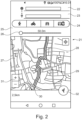
- FIG. 2
- shows a user interface of the application program with a representation of a reference route having a first security perimeter; and
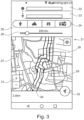
- FIG. 3
- shows a user interface of the application program with a representation of a reference route having a second security perimeter;
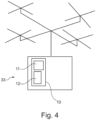
- Fig. 4
- shows a vehicle comprising a transmitting device.
- A position- determining
device 11 of the transmittingdevice 10 is designed such that, starting from a defined starting point and the current position, it can determine a route to a destination point specified by the user and can provide corresponding optical and/or acoustic route information to the user (FIG. 1 ). This is done, for example, by displaying map information in two or three dimensions on adisplay 12 or a screen. - When route monitoring is active, the application program can send
signals 13 according to defined criteria to the linked receivingdevice 14 of acontact person 15. The receivingdevice 14 then, in turn, provides a signal to the contact person. This can be achieved with optical 16, acoustic 17 orvibration 18 signals. In particular, the notification can be implemented in atext message 19 on adisplay 20 of the receivingdevice 14 with the content that the user has left the security perimeter or that the user has reached the destination. Further location- related information can also be transmitted, such as where and when the security perimeter was left. - A corresponding representation with different defined security perimeters can be seen in
FIGS. 2 and3 . Auser interface 21 is shown in a manner customary for navigation services, which has input areas forstarting point 22 anddestination point 23 in the upper area. Furthermore, additional parameters can be set, such as the type of means oftransport 24, which can be selected from on foot, by bicycle or by motor vehicle. A further selection relates to local and long- distance public transport, such as buses and trains, which includes timetable information for public transport. - In a
further setting area 25, the application program offers the user the possibility of setting the security perimeter by means of avirtual slider 26. In the embodiment shown, a security perimeter of at least 2 m to at most 10000 m can be set using the slider. Themap display 27 of thereference route 28 takes up most of theuser interface 21. The calculated route guidance, which is determined from the input of the starting and destination points and optionally further customisations, such as intermediate destinations, is shown here by means of a highlighted line. In accordance with the setting of the security perimeter by means of theslider 26, the security perimeter is displayed as a colour- highlightedarea 29 around the shownroute 28. Anarrow security perimeter 29 of 50 m is set inFIG. 2 , and awider security perimeter 29 of 200 m is set inFIG. 3 around theroute 28. The determined position of the current location is also displayed using agraphical symbol 30. The user can set the scale of the displayedmap section 27 by usingbuttons 31 assigned to a zoom function or using touch sequences (tap, drag, slide, etc.). It is also possible to provide additional input fields (not shown) through which start times, destination times and travel durations can be entered or adjusted. - A
start button 32 can be provided, whereby the user actively starts route monitoring. Alternatively, route monitoring starts automatically at a specified start time. -
Fig. 4 shows avehicle 33 in the form of an unmanned aerial vehicle comprisisng thetransmission device 10 that is shown inFigure 1 . Due to the use of thesecurity perimeter 29, it is possible to detect deviations in all spatial directions. Therefore, the unmanned aerial vehicle is capable to send a security signal in case it leaves the routing, but also in case a corridor defined by flying altitudes is left. - Aspects of the invention, such as route tracking and route monitoring, may be described in the general context of computer-executable instructions, such as program modules, being executed by a computer. Generally, program modules include routines, programs, objects, components, data structures, etc., that perform particular tasks or implement particular abstract data types. Moreover, those skilled in the art will appreciate that the invention may be practiced with a variety of computer-system configurations, including multiprocessor systems, microprocessor-based or programmable-consumer electronics, minicomputers, mainframe computers, and the like. Any number of computer-systems and computer networks are acceptable for use with the present invention.
- Specific hardware devices, programming languages, components, processes, protocols, and numerous details including operating environments and the like are set forth to provide a thorough understanding of the present invention. In other instances, structures, devices, and processes are shown in block-diagram form, rather than in detail, to avoid obscuring the present invention. But an ordinary-skilled artisan would understand that the present invention may be practiced without these specific details. Computer systems, servers, work stations, and other machines may be connected to one another across a communication medium including, for example, a network or networks.
- As one skilled in the art will appreciate, embodiments of the present invention may be embodied as, among other things: a method, system, or computer-program product. Accordingly, the embodiments may take the form of a hardware embodiment, a software embodiment, or an embodiment combining software and hardware. In an embodiment, the present invention takes the form of a computer-program product that includes computer-useable instructions embodied on one or more computer-readable media.
- Computer-readable media include both volatile and nonvolatile media, transient and non-transient media, removable and nonremovable media, and contemplate media readable by a database, a switch, and various other network devices. By way of example, and not limitation, computer-readable media comprise media implemented in any method or technology for storing information. Examples of stored information include computer-useable instructions, data structures, program modules, and other data representations. Media examples include, but are not limited to, information-delivery media, RAM, ROM, EEPROM, flash memory or other memory technology, CD-ROM, digital versatile discs (DVD), holographic media or other optical disc storage, magnetic cassettes, magnetic tape, magnetic disk storage, and other magnetic storage devices. These technologies can store data momentarily, temporarily, or permanently.
- The invention may be practiced in distributed-computing environments where tasks are performed by remote-processing devices that are linked through a communications network. In a distributed-computing environment, program modules may be located in both local and remote computer-storage media including memory storage devices. The computer-useable instructions form an interface to allow a computer to react according to a source of input. The instructions cooperate with other code segments to initiate a variety of tasks in response to data received in conjunction with the source of the received data.
- The present invention may be practiced in a network environment such as a communications network. Such networks are widely used to connect various types of network elements, such as routers, servers, gateways, and so forth. Further, the invention may be practiced in a multi-network environment having various, connected public and/or private networks.
- Communication between network elements may be wireless or wireline (wired). As will be appreciated by those skilled in the art, communication networks may take several different forms and may use several different communication protocols. And the present invention is not limited by the forms and communication protocols described herein.
- It should be understood that the examples and embodiments described herein are for illustrative purposes only and that various modifications or changes in light thereof will be suggested to persons skilled in the art.
- Although the present invention has been described with reference to the particular embodiments herein set forth, it is understood that the present disclosure has been made only by way of example and that numerous changes in details of construction may be resorted to.
- Thus, the scope of the invention should not be limited by the foregoing specifications, but rather only by the scope of the claims appended hereto.
Claims (15)
- A method for route tracking and route monitoring, comprising:providing an electronic transmitting device (10), wherein the electronic transmitting device (10) is configured to carry out a position determination using one or more location methods;defining an individual reference route (28) by entering a starting point (22) and a destination point (23) and adapting a route guidance;defining a security perimeter (29) by entering a maximum distance value;continuously determining a position while following the individual reference route (28);continuously calculating a distance of the position from the individual reference route (28);comparing the distance of the position from the individual reference route (28) with the maximum distance value of the security perimeter (29); andoutputting a security signal via wireless data transmission to be received by at least one receiving device (14) when the distance is greater than the maximum distance of the security perimeter (29), characterized in that the method further comprises:displaying the security perimeter (29) on the map display; andsetting an input of the security perimeter (29) via a visual slider (26) of a touch screen of the electronic transmitting device (10).
- The method according to claim 1, wherein a destination point reached signal is output to be received by the at least one receiving device (14) when the destination point is reached.
- The method according to any of the preceding claims, wherein a user actively starts a route monitoring procedure by input into the electronic transmitting device (10) or input into the at least one receiving device (14), wherein the route monitoring procedure comprises the determining, calculating, and comparing steps, wherein preferably the route monitoring procedure begins automatically at a predefined start time.
- The security method according to any of the preceding claims, wherein a predetermined period of time is specified for the individual reference route (28) to be covered and a time exceeded signal is output to be received by the at least one receiving device (14) if the predetermined period of time is exceeded without the destination point (23) having been reached.
- The method according to any of the preceding claims, wherein a predetermined destination time is fixed and a destination not reached signal is output to be received by the at least one receiving device (14) if the destination point (23) has not been reached by this predetermined destination time.
- The method according to any of the preceding claims, further comprising:
linking the transmitting device (10) to the at least one receiving device (14), and rendering a signal on the at least one receiving device (14). - The method according to claim 6, wherein the signal rendered by the at least one receiving device (14) comprises one or more of the following:an optical signal (16);an acoustic signal (17); anda vibration signal (18); and/orwherein the signal rendered by the at least one receiving device (14) contains a text message; and/orwherein the signal rendered by the at least one receiving device (14) provides information about a point in time and the position at which the distance was greater than the maximum distance of the security perimeter (29).
- The method according to any of the preceding claims, wherein the position of the electronic transmitting device (10) is continuously transmitted by the electronic transmitting device (10) to the receiving device (14) at pre-defined or user defined time intervals.
- The method according to any of the preceding claims, wherein the electronic transmitting device (10) is a mobile communication terminal configured to display navigation data.
- The method according to any of the preceding claims, wherein the electronic transmitting device (10) is one or more of the following:a mobile navigation device;a smartphone;a tablet computer; anda smart watch.
- The method according to any of the preceding claims, wherein the electronic transmitting device (10) is installed in a vehicle.
- A non-transitory computer readable medium comprising instructions which when executed by a computer carry out the method according to any of the preceding claims.
- The non-transitory computer readable medium according to claim 12, wherein the method further comprises:
providing a user interface (21) which enables a map representation of the individual reference route (28) on a display (12) of the electronic transmitting device (10). - An electronic transmitting device (10) comprising- a position-determining device (11) to carry out a position determination using one or more location methods, and an application program that is configured to define a reference route (28) and a security perimeter (29) around the reference route (28) as a maximum distance value, wherein the electronic transmitting device (10) is configured to- continuously determine the position while following the individual reference route (28);- continuously calculate a distance of the position from the individual reference route (28);- compare the distance of the position from the individual reference route (28) with the maximum distance value of the security perimeter (29); and- output a security signal via wireless data transmission to be received by at least one receiving device (14) when the distance is greater than the maximum distance of the security perimeter (29), characterized in that the electronic transmitting device (10) is configured- to display the security perimeter (29) on the map display; and- to set an input of the security perimeter (29) via a visual slider (26) of a touch screen of the electronic transmitting device (10).
- Vehicle (33) comprising an electronic transmitting (10) device according to claim 14, wherein the vehicle (33) is one of the following:- an unmanned aerial vehicle;- an aircraft;- a car;- a truck; or- a vessel.
Applications Claiming Priority (2)
| Application Number | Priority Date | Filing Date | Title |
|---|---|---|---|
| US16/824,084 US11127281B1 (en) | 2020-03-19 | 2020-03-19 | Security method and application software |
| PCT/EP2021/054594 WO2021185546A1 (en) | 2020-03-19 | 2021-02-24 | Security method and application software |
Publications (2)
| Publication Number | Publication Date |
|---|---|
| EP4121720A1 EP4121720A1 (en) | 2023-01-25 |
| EP4121720B1 true EP4121720B1 (en) | 2024-07-03 |
Family
ID=74732947
Family Applications (1)
| Application Number | Title | Priority Date | Filing Date |
|---|---|---|---|
| EP21707991.2A Active EP4121720B1 (en) | 2020-03-19 | 2021-02-24 | Security method and application software |
Country Status (5)
| Country | Link |
|---|---|
| US (1) | US11127281B1 (en) |
| EP (1) | EP4121720B1 (en) |
| CN (1) | CN114450559A (en) |
| TW (1) | TWI813967B (en) |
| WO (1) | WO2021185546A1 (en) |
Families Citing this family (3)
| Publication number | Priority date | Publication date | Assignee | Title |
|---|---|---|---|---|
| EP4150926A4 (en) * | 2020-05-15 | 2023-06-28 | Telefonaktiebolaget LM Ericsson (publ.) | Method and management entity for determination of geofence |
| US20250037589A1 (en) * | 2023-07-24 | 2025-01-30 | Honeywell International Inc. | Autonomous protected flight zones during emergency operations of aerial vehicles |
| CN117831178B (en) * | 2023-11-17 | 2024-11-05 | 华能济南黄台发电有限公司 | Temporary external personnel access management method and device |
Family Cites Families (26)
| Publication number | Priority date | Publication date | Assignee | Title |
|---|---|---|---|---|
| US5974356A (en) * | 1997-03-14 | 1999-10-26 | Qualcomm Incorporated | System and method for determining vehicle travel routes and mileage |
| US20050037729A1 (en) * | 2003-08-14 | 2005-02-17 | Marc Dupont | Method to automatically monitor a person using a cellular telephone, server and cellular telephone implementing this method |
| WO2005050849A2 (en) * | 2003-10-01 | 2005-06-02 | Laird Mark D | Wireless virtual campus escort system |
| US7394386B2 (en) * | 2005-03-03 | 2008-07-01 | Motorola, Inc. | Location signaling for transport system |
| US8115625B2 (en) * | 2006-05-26 | 2012-02-14 | Panasonic Corporation | Parental alert and child tracking device which determines if a child has deviated from a predicated travel route |
| EP2068120B1 (en) * | 2007-12-04 | 2010-08-11 | Research In Motion Limited | Mobile tracking |
| US8606298B2 (en) * | 2010-03-11 | 2013-12-10 | Electronics And Telecommunications Research Institute | System and method for tracking location of mobile terminal using TV |
| US8456298B2 (en) * | 2010-11-02 | 2013-06-04 | Timo Valtonen | Apparatus and method for portable tracking |
| US10422654B2 (en) * | 2011-06-03 | 2019-09-24 | Apple Inc. | Devices and methods for comparing and selecting alternative navigation routes |
| EP2557397B1 (en) | 2011-08-12 | 2014-02-19 | Technisat Digital Gmbh | Method for determining a route using a navigation system |
| US20130109427A1 (en) * | 2011-11-02 | 2013-05-02 | George Matus | Individual Security Through Mobile Device Notifications |
| WO2013101205A1 (en) * | 2011-12-30 | 2013-07-04 | Intel Corporation | Method and apparatus using geofence to track individual group members |
| US20150163626A1 (en) * | 2012-06-11 | 2015-06-11 | Georeach Limited | Monitoring system, server, mobile device and method |
| WO2014130072A1 (en) * | 2013-02-22 | 2014-08-28 | Intel Corporation | Geo-fence creation on touch-enabled devices |
| KR101607223B1 (en) * | 2013-10-18 | 2016-04-11 | 주식회사 엘지유플러스 | A method and a server for transmitting a course deviation alram message |
| US20150121535A1 (en) * | 2013-10-30 | 2015-04-30 | Microsoft Corporation | Managing geographical location information for digital photos |
| US9413707B2 (en) * | 2014-04-11 | 2016-08-09 | ACR Development, Inc. | Automated user task management |
| US9454889B2 (en) * | 2014-07-28 | 2016-09-27 | Dan Kerning | Security and public safety application for a mobile device |
| US10115277B2 (en) * | 2014-07-29 | 2018-10-30 | GeoFrenzy, Inc. | Systems and methods for geofence security |
| US10013871B1 (en) * | 2015-09-03 | 2018-07-03 | United Services Automobile Association | Monitoring systems and methods for personal safety |
| US9952056B2 (en) | 2016-03-11 | 2018-04-24 | Route4Me, Inc. | Methods and systems for detecting and verifying route deviations |
| US10501054B2 (en) | 2016-06-30 | 2019-12-10 | Ford Global Technologies, Llc | On-demand driver systems and methods |
| CN108566617A (en) * | 2018-04-04 | 2018-09-21 | 深圳市沃特沃德股份有限公司 | Emergency route monitors based reminding method and device |
| CN108871315A (en) * | 2018-07-26 | 2018-11-23 | 广东小天才科技有限公司 | Navigation monitoring method and system based on wearable device and wearable device |
| US10573184B1 (en) | 2018-11-26 | 2020-02-25 | Internatioinal Business Machines Corpoation | Monitoring security threat during travel |
| US11477609B2 (en) * | 2019-06-01 | 2022-10-18 | Apple Inc. | User interfaces for location-related communications |
-
2020
- 2020-03-19 US US16/824,084 patent/US11127281B1/en active Active
-
2021
- 2021-02-24 EP EP21707991.2A patent/EP4121720B1/en active Active
- 2021-02-24 CN CN202180005545.XA patent/CN114450559A/en active Pending
- 2021-02-24 WO PCT/EP2021/054594 patent/WO2021185546A1/en not_active Ceased
- 2021-03-19 TW TW110109960A patent/TWI813967B/en active
Also Published As
| Publication number | Publication date |
|---|---|
| WO2021185546A1 (en) | 2021-09-23 |
| EP4121720A1 (en) | 2023-01-25 |
| TW202136811A (en) | 2021-10-01 |
| CN114450559A (en) | 2022-05-06 |
| US20210295675A1 (en) | 2021-09-23 |
| US11127281B1 (en) | 2021-09-21 |
| TWI813967B (en) | 2023-09-01 |
| BR112022015478A2 (en) | 2022-09-27 |
Similar Documents
| Publication | Publication Date | Title |
|---|---|---|
| US12392618B2 (en) | Navigating an indoor transit system using a mobile device | |
| EP4121720B1 (en) | Security method and application software | |
| JP4905793B2 (en) | Monitoring system, monitoring method and monitoring program | |
| JP4878160B2 (en) | Traffic information display method and navigation system | |
| KR20190023071A (en) | Indirect electronic badge tracking | |
| KR20190023072A (en) | Electronic badge for authenticating and tracking industrial vehicle operators | |
| KR20190023070A (en) | Use of electronic badges in pass-through maneuvers | |
| CN109653789B (en) | A portable mine intelligent escape guidance device | |
| US20100253506A1 (en) | Tracking system | |
| JP2001229500A (en) | Real-time tracking and management technology for airport land vehicles | |
| AU2008236660A1 (en) | Method and apparatus for acquiring local position and overlaying information | |
| KR20190023068A (en) | Electronic badge as a talking marker | |
| JP6901915B2 (en) | Train approach warning system | |
| KR102495287B1 (en) | Life safety management system using augmented reality technology | |
| JP6681308B2 (en) | Dynamic management system, dynamic management device, and dynamic management method | |
| CN112731971B (en) | Method and device for controlling unmanned aerial vehicle to land, readable storage medium and electronic equipment | |
| JP2010139462A (en) | Earthquake distribution system | |
| US20220232346A1 (en) | Security method and application software | |
| US20210056493A1 (en) | Device for creating and managing itineraries | |
| JPH1164027A (en) | Navigation method based on schedule | |
| KR20150112421A (en) | Navigation apparatus, method thereof and computer readable medium having computer program recorded therefor | |
| US20240019263A1 (en) | Information processing apparatus, information processing method, and moving object | |
| US10824689B2 (en) | Sharing point of interest data | |
| US20190164401A1 (en) | Object tracking system | |
| KR102107983B1 (en) | Method For Providing Connected Car Services Using Plurality Mobile Virtual Fence |
Legal Events
| Date | Code | Title | Description |
|---|---|---|---|
| STAA | Information on the status of an ep patent application or granted ep patent |
Free format text: STATUS: UNKNOWN |
|
| STAA | Information on the status of an ep patent application or granted ep patent |
Free format text: STATUS: THE INTERNATIONAL PUBLICATION HAS BEEN MADE |
|
| PUAI | Public reference made under article 153(3) epc to a published international application that has entered the european phase |
Free format text: ORIGINAL CODE: 0009012 |
|
| STAA | Information on the status of an ep patent application or granted ep patent |
Free format text: STATUS: REQUEST FOR EXAMINATION WAS MADE |
|
| 17P | Request for examination filed |
Effective date: 20221011 |
|
| AK | Designated contracting states |
Kind code of ref document: A1 Designated state(s): AL AT BE BG CH CY CZ DE DK EE ES FI FR GB GR HR HU IE IS IT LI LT LU LV MC MK MT NL NO PL PT RO RS SE SI SK SM TR |
|
| DAV | Request for validation of the european patent (deleted) | ||
| DAX | Request for extension of the european patent (deleted) | ||
| GRAP | Despatch of communication of intention to grant a patent |
Free format text: ORIGINAL CODE: EPIDOSNIGR1 |
|
| STAA | Information on the status of an ep patent application or granted ep patent |
Free format text: STATUS: GRANT OF PATENT IS INTENDED |
|
| INTG | Intention to grant announced |
Effective date: 20240125 |
|
| GRAS | Grant fee paid |
Free format text: ORIGINAL CODE: EPIDOSNIGR3 |
|
| GRAA | (expected) grant |
Free format text: ORIGINAL CODE: 0009210 |
|
| STAA | Information on the status of an ep patent application or granted ep patent |
Free format text: STATUS: THE PATENT HAS BEEN GRANTED |
|
| AK | Designated contracting states |
Kind code of ref document: B1 Designated state(s): AL AT BE BG CH CY CZ DE DK EE ES FI FR GB GR HR HU IE IS IT LI LT LU LV MC MK MT NL NO PL PT RO RS SE SI SK SM TR |
|
| REG | Reference to a national code |
Ref country code: CH Ref legal event code: EP |
|
| REG | Reference to a national code |
Ref country code: DE Ref legal event code: R096 Ref document number: 602021015136 Country of ref document: DE |
|
| REG | Reference to a national code |
Ref country code: LT Ref legal event code: MG9D |
|
| REG | Reference to a national code |
Ref country code: NL Ref legal event code: MP Effective date: 20240703 |
|
| PG25 | Lapsed in a contracting state [announced via postgrant information from national office to epo] |
Ref country code: PT Free format text: LAPSE BECAUSE OF FAILURE TO SUBMIT A TRANSLATION OF THE DESCRIPTION OR TO PAY THE FEE WITHIN THE PRESCRIBED TIME-LIMIT Effective date: 20241104 |
|
| REG | Reference to a national code |
Ref country code: AT Ref legal event code: MK05 Ref document number: 1700237 Country of ref document: AT Kind code of ref document: T Effective date: 20240703 |
|
| PG25 | Lapsed in a contracting state [announced via postgrant information from national office to epo] |
Ref country code: NL Free format text: LAPSE BECAUSE OF FAILURE TO SUBMIT A TRANSLATION OF THE DESCRIPTION OR TO PAY THE FEE WITHIN THE PRESCRIBED TIME-LIMIT Effective date: 20240703 |
|
| PG25 | Lapsed in a contracting state [announced via postgrant information from national office to epo] |
Ref country code: PT Free format text: LAPSE BECAUSE OF FAILURE TO SUBMIT A TRANSLATION OF THE DESCRIPTION OR TO PAY THE FEE WITHIN THE PRESCRIBED TIME-LIMIT Effective date: 20241104 Ref country code: NL Free format text: LAPSE BECAUSE OF FAILURE TO SUBMIT A TRANSLATION OF THE DESCRIPTION OR TO PAY THE FEE WITHIN THE PRESCRIBED TIME-LIMIT Effective date: 20240703 |
|
| PG25 | Lapsed in a contracting state [announced via postgrant information from national office to epo] |
Ref country code: NO Free format text: LAPSE BECAUSE OF FAILURE TO SUBMIT A TRANSLATION OF THE DESCRIPTION OR TO PAY THE FEE WITHIN THE PRESCRIBED TIME-LIMIT Effective date: 20241003 |
|
| PG25 | Lapsed in a contracting state [announced via postgrant information from national office to epo] |
Ref country code: GR Free format text: LAPSE BECAUSE OF FAILURE TO SUBMIT A TRANSLATION OF THE DESCRIPTION OR TO PAY THE FEE WITHIN THE PRESCRIBED TIME-LIMIT Effective date: 20241004 Ref country code: FI Free format text: LAPSE BECAUSE OF FAILURE TO SUBMIT A TRANSLATION OF THE DESCRIPTION OR TO PAY THE FEE WITHIN THE PRESCRIBED TIME-LIMIT Effective date: 20240703 Ref country code: PL Free format text: LAPSE BECAUSE OF FAILURE TO SUBMIT A TRANSLATION OF THE DESCRIPTION OR TO PAY THE FEE WITHIN THE PRESCRIBED TIME-LIMIT Effective date: 20240703 |
|
| PG25 | Lapsed in a contracting state [announced via postgrant information from national office to epo] |
Ref country code: BG Free format text: LAPSE BECAUSE OF FAILURE TO SUBMIT A TRANSLATION OF THE DESCRIPTION OR TO PAY THE FEE WITHIN THE PRESCRIBED TIME-LIMIT Effective date: 20240703 |
|
| PG25 | Lapsed in a contracting state [announced via postgrant information from national office to epo] |
Ref country code: LV Free format text: LAPSE BECAUSE OF FAILURE TO SUBMIT A TRANSLATION OF THE DESCRIPTION OR TO PAY THE FEE WITHIN THE PRESCRIBED TIME-LIMIT Effective date: 20240703 |
|
| PG25 | Lapsed in a contracting state [announced via postgrant information from national office to epo] |
Ref country code: IS Free format text: LAPSE BECAUSE OF FAILURE TO SUBMIT A TRANSLATION OF THE DESCRIPTION OR TO PAY THE FEE WITHIN THE PRESCRIBED TIME-LIMIT Effective date: 20241103 Ref country code: AT Free format text: LAPSE BECAUSE OF FAILURE TO SUBMIT A TRANSLATION OF THE DESCRIPTION OR TO PAY THE FEE WITHIN THE PRESCRIBED TIME-LIMIT Effective date: 20240703 |
|
| PG25 | Lapsed in a contracting state [announced via postgrant information from national office to epo] |
Ref country code: CZ Free format text: LAPSE BECAUSE OF FAILURE TO SUBMIT A TRANSLATION OF THE DESCRIPTION OR TO PAY THE FEE WITHIN THE PRESCRIBED TIME-LIMIT Effective date: 20240703 Ref country code: HR Free format text: LAPSE BECAUSE OF FAILURE TO SUBMIT A TRANSLATION OF THE DESCRIPTION OR TO PAY THE FEE WITHIN THE PRESCRIBED TIME-LIMIT Effective date: 20240703 |
|
| PG25 | Lapsed in a contracting state [announced via postgrant information from national office to epo] |
Ref country code: RS Free format text: LAPSE BECAUSE OF FAILURE TO SUBMIT A TRANSLATION OF THE DESCRIPTION OR TO PAY THE FEE WITHIN THE PRESCRIBED TIME-LIMIT Effective date: 20241003 Ref country code: ES Free format text: LAPSE BECAUSE OF FAILURE TO SUBMIT A TRANSLATION OF THE DESCRIPTION OR TO PAY THE FEE WITHIN THE PRESCRIBED TIME-LIMIT Effective date: 20240703 |
|
| PG25 | Lapsed in a contracting state [announced via postgrant information from national office to epo] |
Ref country code: RS Free format text: LAPSE BECAUSE OF FAILURE TO SUBMIT A TRANSLATION OF THE DESCRIPTION OR TO PAY THE FEE WITHIN THE PRESCRIBED TIME-LIMIT Effective date: 20241003 Ref country code: PL Free format text: LAPSE BECAUSE OF FAILURE TO SUBMIT A TRANSLATION OF THE DESCRIPTION OR TO PAY THE FEE WITHIN THE PRESCRIBED TIME-LIMIT Effective date: 20240703 Ref country code: NO Free format text: LAPSE BECAUSE OF FAILURE TO SUBMIT A TRANSLATION OF THE DESCRIPTION OR TO PAY THE FEE WITHIN THE PRESCRIBED TIME-LIMIT Effective date: 20241003 Ref country code: LV Free format text: LAPSE BECAUSE OF FAILURE TO SUBMIT A TRANSLATION OF THE DESCRIPTION OR TO PAY THE FEE WITHIN THE PRESCRIBED TIME-LIMIT Effective date: 20240703 Ref country code: IS Free format text: LAPSE BECAUSE OF FAILURE TO SUBMIT A TRANSLATION OF THE DESCRIPTION OR TO PAY THE FEE WITHIN THE PRESCRIBED TIME-LIMIT Effective date: 20241103 Ref country code: HR Free format text: LAPSE BECAUSE OF FAILURE TO SUBMIT A TRANSLATION OF THE DESCRIPTION OR TO PAY THE FEE WITHIN THE PRESCRIBED TIME-LIMIT Effective date: 20240703 Ref country code: GR Free format text: LAPSE BECAUSE OF FAILURE TO SUBMIT A TRANSLATION OF THE DESCRIPTION OR TO PAY THE FEE WITHIN THE PRESCRIBED TIME-LIMIT Effective date: 20241004 Ref country code: FI Free format text: LAPSE BECAUSE OF FAILURE TO SUBMIT A TRANSLATION OF THE DESCRIPTION OR TO PAY THE FEE WITHIN THE PRESCRIBED TIME-LIMIT Effective date: 20240703 Ref country code: ES Free format text: LAPSE BECAUSE OF FAILURE TO SUBMIT A TRANSLATION OF THE DESCRIPTION OR TO PAY THE FEE WITHIN THE PRESCRIBED TIME-LIMIT Effective date: 20240703 Ref country code: CZ Free format text: LAPSE BECAUSE OF FAILURE TO SUBMIT A TRANSLATION OF THE DESCRIPTION OR TO PAY THE FEE WITHIN THE PRESCRIBED TIME-LIMIT Effective date: 20240703 Ref country code: BG Free format text: LAPSE BECAUSE OF FAILURE TO SUBMIT A TRANSLATION OF THE DESCRIPTION OR TO PAY THE FEE WITHIN THE PRESCRIBED TIME-LIMIT Effective date: 20240703 Ref country code: AT Free format text: LAPSE BECAUSE OF FAILURE TO SUBMIT A TRANSLATION OF THE DESCRIPTION OR TO PAY THE FEE WITHIN THE PRESCRIBED TIME-LIMIT Effective date: 20240703 |
|
| REG | Reference to a national code |
Ref country code: DE Ref legal event code: R097 Ref document number: 602021015136 Country of ref document: DE |
|
| PG25 | Lapsed in a contracting state [announced via postgrant information from national office to epo] |
Ref country code: SM Free format text: LAPSE BECAUSE OF FAILURE TO SUBMIT A TRANSLATION OF THE DESCRIPTION OR TO PAY THE FEE WITHIN THE PRESCRIBED TIME-LIMIT Effective date: 20240703 Ref country code: RO Free format text: LAPSE BECAUSE OF FAILURE TO SUBMIT A TRANSLATION OF THE DESCRIPTION OR TO PAY THE FEE WITHIN THE PRESCRIBED TIME-LIMIT Effective date: 20240703 Ref country code: DK Free format text: LAPSE BECAUSE OF FAILURE TO SUBMIT A TRANSLATION OF THE DESCRIPTION OR TO PAY THE FEE WITHIN THE PRESCRIBED TIME-LIMIT Effective date: 20240703 |
|
| PG25 | Lapsed in a contracting state [announced via postgrant information from national office to epo] |
Ref country code: EE Free format text: LAPSE BECAUSE OF FAILURE TO SUBMIT A TRANSLATION OF THE DESCRIPTION OR TO PAY THE FEE WITHIN THE PRESCRIBED TIME-LIMIT Effective date: 20240703 |
|
| PG25 | Lapsed in a contracting state [announced via postgrant information from national office to epo] |
Ref country code: IT Free format text: LAPSE BECAUSE OF FAILURE TO SUBMIT A TRANSLATION OF THE DESCRIPTION OR TO PAY THE FEE WITHIN THE PRESCRIBED TIME-LIMIT Effective date: 20240703 Ref country code: SK Free format text: LAPSE BECAUSE OF FAILURE TO SUBMIT A TRANSLATION OF THE DESCRIPTION OR TO PAY THE FEE WITHIN THE PRESCRIBED TIME-LIMIT Effective date: 20240703 |
|
| PLBE | No opposition filed within time limit |
Free format text: ORIGINAL CODE: 0009261 |
|
| STAA | Information on the status of an ep patent application or granted ep patent |
Free format text: STATUS: NO OPPOSITION FILED WITHIN TIME LIMIT |
|
| 26N | No opposition filed |
Effective date: 20250404 |
|
| PG25 | Lapsed in a contracting state [announced via postgrant information from national office to epo] |
Ref country code: SE Free format text: LAPSE BECAUSE OF FAILURE TO SUBMIT A TRANSLATION OF THE DESCRIPTION OR TO PAY THE FEE WITHIN THE PRESCRIBED TIME-LIMIT Effective date: 20240703 |
|
| PG25 | Lapsed in a contracting state [announced via postgrant information from national office to epo] |
Ref country code: MC Free format text: LAPSE BECAUSE OF FAILURE TO SUBMIT A TRANSLATION OF THE DESCRIPTION OR TO PAY THE FEE WITHIN THE PRESCRIBED TIME-LIMIT Effective date: 20240703 |
|
| REG | Reference to a national code |
Ref country code: CH Ref legal event code: PL |
|
| PG25 | Lapsed in a contracting state [announced via postgrant information from national office to epo] |
Ref country code: LU Free format text: LAPSE BECAUSE OF NON-PAYMENT OF DUE FEES Effective date: 20250224 |
|
| PG25 | Lapsed in a contracting state [announced via postgrant information from national office to epo] |
Ref country code: CH Free format text: LAPSE BECAUSE OF NON-PAYMENT OF DUE FEES Effective date: 20250228 |
|
| GBPC | Gb: european patent ceased through non-payment of renewal fee |
Effective date: 20250224 |
|
| REG | Reference to a national code |
Ref country code: CH Ref legal event code: K11 Free format text: ST27 STATUS EVENT CODE: U-0-0-K10-K11 (AS PROVIDED BY THE NATIONAL OFFICE) Effective date: 20251121 Ref country code: CH Ref legal event code: U11 Free format text: ST27 STATUS EVENT CODE: U-0-0-U10-U11 (AS PROVIDED BY THE NATIONAL OFFICE) Effective date: 20251121 |
|
| REG | Reference to a national code |
Ref country code: BE Ref legal event code: MM Effective date: 20250228 |
|
| PG25 | Lapsed in a contracting state [announced via postgrant information from national office to epo] |
Ref country code: GB Free format text: LAPSE BECAUSE OF NON-PAYMENT OF DUE FEES Effective date: 20250224 |
|
| PG25 | Lapsed in a contracting state [announced via postgrant information from national office to epo] |
Ref country code: BE Free format text: LAPSE BECAUSE OF NON-PAYMENT OF DUE FEES Effective date: 20250228 |
|
| PG25 | Lapsed in a contracting state [announced via postgrant information from national office to epo] |
Ref country code: CH Free format text: LAPSE BECAUSE OF NON-PAYMENT OF DUE FEES Effective date: 20250228 |
|
| PGFP | Annual fee paid to national office [announced via postgrant information from national office to epo] |
Ref country code: CH Payment date: 20251121 Year of fee payment: 5 |
|
| PGRI | Patent reinstated in contracting state [announced from national office to epo] |
Ref country code: CH Effective date: 20251121 |
|
| PG25 | Lapsed in a contracting state [announced via postgrant information from national office to epo] |
Ref country code: IE Free format text: LAPSE BECAUSE OF NON-PAYMENT OF DUE FEES Effective date: 20250224 |
|
| PGFP | Annual fee paid to national office [announced via postgrant information from national office to epo] |
Ref country code: DE Payment date: 20260217 Year of fee payment: 6 |
|
| PGFP | Annual fee paid to national office [announced via postgrant information from national office to epo] |
Ref country code: FR Payment date: 20260223 Year of fee payment: 6 |