EP4120553B1 - Synchronous machine device, variable speed pumped storage power generation apparatus, and operation method - Google Patents
Synchronous machine device, variable speed pumped storage power generation apparatus, and operation method Download PDFInfo
- Publication number
- EP4120553B1 EP4120553B1 EP21768250.9A EP21768250A EP4120553B1 EP 4120553 B1 EP4120553 B1 EP 4120553B1 EP 21768250 A EP21768250 A EP 21768250A EP 4120553 B1 EP4120553 B1 EP 4120553B1
- Authority
- EP
- European Patent Office
- Prior art keywords
- power generation
- power
- generation motor
- motor device
- synchronous machine
- Prior art date
- Legal status (The legal status is an assumption and is not a legal conclusion. Google has not performed a legal analysis and makes no representation as to the accuracy of the status listed.)
- Active
Links
Images

Classifications
-
- H—ELECTRICITY
- H02—GENERATION; CONVERSION OR DISTRIBUTION OF ELECTRIC POWER
- H02J—ELECTRIC POWER NETWORKS; CIRCUIT ARRANGEMENTS OR SYSTEMS FOR SUPPLYING OR DISTRIBUTING ELECTRIC POWER; SYSTEMS FOR STORING ELECTRIC ENERGY
- H02J15/00—Systems for storing electric energy specially adapted for power networks
- H02J15/10—Systems for storing electric energy specially adapted for power networks using storage of hydraulic energy
-
- H—ELECTRICITY
- H02—GENERATION; CONVERSION OR DISTRIBUTION OF ELECTRIC POWER
- H02J—ELECTRIC POWER NETWORKS; CIRCUIT ARRANGEMENTS OR SYSTEMS FOR SUPPLYING OR DISTRIBUTING ELECTRIC POWER; SYSTEMS FOR STORING ELECTRIC ENERGY
- H02J3/00—Circuit arrangements for AC mains or AC distribution networks
- H02J3/28—Arrangements for balancing of the load in networks by storage of energy
Definitions
- the present invention relates to a synchronous machine device, a variable speed pumped storage power generation device, and an operation method, in which a synchronous power generation motor device is connected to a power system via a parallel circuit of a power converter and a bypass line.
- a form for implementing a variable speed pumped storage power generation device includes a system in which an inductive power generation motor is used to achieve a variable speed by secondary excitation of the inductive power generation motor, and a system in which a synchronous power generation motor device is connected to a power system via a parallel circuit of a power converter and a bypass line and a variable speed is achieved by adjusting a frequency in the power converter.
- the present invention relates to a synchronous machine device of a system using a synchronous power generation motor device, a variable speed pumped storage power generation device, and a step-out estimation method.
- PTL 1 discloses a variable speed operation control device and an operation method of a hydraulic power generation system that improve power generation efficiency by switching between a bypass operation mode in which a power generation device is operated in a manner of being directly connected to a power system through a bypass line and a converter operation mode in which the power generation device is operated via a power converter.
- PTL 2 equally a method to detect faults in a main circuit in case an electric motor has been already started is described.
- a field current of a synchronous electric motor or a synchronous generation electric motor being a master machine and a second synchronous generation electric motor being used as a slave machine and determine a given circuit error in case the detected field current exceeds a predetermined range, leading further to the effect that additionally arranged circuit breakers may be opened so as to allow short-circuiting of the faulty circuit.
- a number of different strategies to further improve the reliability of speed pumped storage hydropower plants for balancing power fluctuations from wind power in an isolated grid are disclosed. Specifically, a topology based on a synchronous machine and a full scale back-to-back voltage source converter are suggested for obtaining variable speed operation of a pump-turbine unit.
- NPTL 1 Suul J. A. et al. "Variable speed pumped storage hydropower for integration of wind energy in isolated grids: case description and control strategies", Nordic Workshops on Power and Industrial Electronics, June 2008
- variable speed pumped storage power generation device In order to enable a variable speed pumped storage power generation device and a synchronous machine device of a system using a synchronous power generation motor device to contribute to stabilization of a power system, it is necessary to ensure operation continuity when there is a system fault.
- a variable speed pumped storage power generation device that is switched between a bypass operation and a converter operation, for example, when troubleshooting of a system fault is delayed due to a main protection failure during the bypass operation, a synchronous speed of a power generation motor device may be greatly deviated and the power generation motor device steps out synchronization, which leads to the stop of the power generation motor device.
- an object of the present invention to provide a synchronous machine device, a variable speed pumped storage power generation device, and an operation method that can improve an operation tolerance when a system fault occurs during a bypass operation.
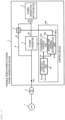
- FIG. 1 is a diagram showing a configuration example of a variable speed pumped storage power generation device 1 according to a first embodiment of the present invention.
- a power generation motor device 2 is connected to a power system 7 via a parallel circuit of a power converter 3 and a bypass line 4 including a circuit breaker 5, and a transformer 6.
- the control device 100 receives signals from respective units of the variable speed pumped storage power generation device 1 so as to estimate whether the power system 7 steps out, thereby controlling the power converter 3.
- the power generation motor device 2 includes a water wheel pump that converts potential energy of water into rotational energy (or converts rotational energy into potential energy), a synchronous power generation motor that converts the rotational energy into a power generation output Pg (or converts a pumping input Pg into rotational energy), a speed regulator (a governor) that controls a rotational speed of the water wheel pump, an automatic voltage regulator (AVR) that adjusts an excitation voltage of a rotor to control a terminal voltage of a power generator.
- a water wheel pump that converts potential energy of water into rotational energy
- a synchronous power generation motor that converts the rotational energy into a power generation output Pg (or converts a pumping input Pg into rotational energy)
- a speed regulator a governor
- AVR automatic voltage regulator
- the power generation motor device 2 in the present specification may be a synchronous power generator or a synchronous motor, in addition to a so-called power generation motor.
- the power generation motor device 2 may be a single machine such as a synchronous power generator and a synchronous motor, or may be a power generator motor that performs both power generation and pumping. In the present invention, such machines are collectively referred to as a power generation motor device (a power generation motor) .
- a step-out estimation control of the power system 7 can be applied to any mode of a power generation motor operation.
- the step-out estimation control can be applied as long as the power generation motor device 2 is in a direct connection state in which the power generation motor device 2 is connected to a power system via the bypass line 4 including the circuit breaker 5.
- a power generation operation mode will be described as an example, and the power converter 3 includes a first converter that converts the power generation output Pg from AC to DC and a second converter that converts DC power to AC power of a commercial frequency.
- a two-level, three-level, or multi-level converter can be used for each converter.
- the power converter 3 has a frequency conversion function, and the frequency conversion function enables the power converter 3 to shift from a low-speed rotation range to a high-speed rotation range in a pumped storage power generation operation using a synchronous power generation motor.
- the bypass line 4 is a line for directly connecting the power generation motor device 2 to the power system 7 via the transformer 6.
- the bypass line is opened and closed by the circuit breaker 5. After the synchronous power generation motor is started up, the synchronous power generation motor is disconnected from a power converter 3 side and shifted to a connection with a bypass line 4 side, and the synchronous power generation motor can be operated at high efficiency by using a direct connection operation.
- the control device 100 includes a step-out estimation unit 101 that estimates whether the power generation motor device 2 steps out based on power of the power generation motor device 2 (the power generation output Pg during a power generation operation and the pumping input Pg during a motor operation) and an AC voltage Vac at an interconnection point where the variable speed pumped storage power generation device is interconnected to a power system or the like, and that calculates a start-up command Str of the power converter 3, a bypass line opening determination unit 102 that calculates an opening or closing command SWoc of the circuit breaker 5 based on a current Ib of the bypass line 4 and the start-up command Str, and a converter control unit 103 that controls power Pc of the power converter 3.
- a step-out estimation unit 101 that estimates whether the power generation motor device 2 steps out based on power of the power generation motor device 2 (the power generation output Pg during a power generation operation and the pumping input Pg during a motor operation) and an AC voltage Vac at an interconnection point where the variable speed pumped storage power generation device
- the power generation motor device 2 shown in FIG. 1 is connected to a power system via the bypass line 4 and is in a so-called direct connection operation state. Since the following concept is exactly the same during a power generation operation and a motor operation, the power generation output Pg during the power generation operation will be described as a representative example of the power of the power generation motor device 2 in the following description.
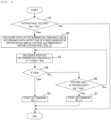
- step S1 it is determined whether a system fault occurs based on whether the AC voltage Vac is lower than a first threshold Vac1.
- the calculation process proceeds to a process of step S2, and when it is detected that no system fault occurs, the calculation process is ended.
- step S2 when a system fault occurs and a voltage drop occurs, it is estimated whether this influence develops to a later stage in which the power system steps out.
- an early countermeasure will be taken using the power converter 3.
- a step-out determination threshold Eth is calculated in accordance with power Pg0 of the power generation motor device 2 and an AC voltage Vac0 immediately before the system fault, the step-out determination threshold Eth being a threshold for determining whether the power system steps out.
- a method of calculating the step-out determination threshold Eth will be described later with reference to FIG. 3 .
- a step-out determination value E is calculated by integrating a difference between the AC voltage Vac0 immediately before the system fault and an AC voltage Vac at a current time.
- the step-out determination value E can be regarded as a value obtained by integrating a difference between a mechanical input and output and an electrical input and output applied to the power generation motor device 2 during a fault continuation period after the occurrence of the fault. It can be said that the power system is likely to step out as the step-out determination value E increases.
- step S4 the step-out determination value E is compared with the step-out determination threshold Eth, and when the step-out determination value E exceeds the step-out determination threshold Eth, it is determined that the power generation motor device 2 will step out later.
- step S5 the start-up command Str of the power converter is set to 1 to start up the power converter 3.
- step S6 the calculation process proceeds to step S6.
- step S6 it is determined whether the system fault is troubleshot based on whether the AC voltage Vac exceeds a second threshold Vac2.
- the calculation process returns to the process of step S3 and the step-out estimation process of the power generation motor device is continued.
- step S7 the start-up command Str of the power converter is set to 0, that is, the power converter is maintained in a stopped state, and the calculation process is ended. It is possible to prevent unnecessary operation switching between the bypass operation and the converter operation by using a step-out estimation method of the power generation motor device described above.
- a comparison process between the step-out determination value E and the step-out determination threshold Eth is performed during the fault continuation period which is a period from when the fault occurs up to when the fault is troubleshot.
- a method of calculating the step-out determination threshold Eth in the process of step S2 will be described with reference to FIG. 3 .
- the step-out determination threshold Eth is calculated using a table as shown in the drawing in accordance with the power Pg0 of the power generation motor device 2 and the AC voltage Vac0 immediately before the system fault. As the power Pg0 of the power generation motor device 2 decreases, the step-out determination threshold Eth is set to a larger value. In a case where the power Pg0 of the power generation motor device 2 is maintained at the same value, the step-out determination threshold Eth is set to a smaller value as the AC voltage Vac0 decreases.
- FIG. 4 is a block diagram showing the bypass line opening determination unit 102.
- a comparator 102a determines whether the current Ib of the bypass line is lower than a threshold Ibmin. The comparator 102a outputs 1 when the current Ib is lower than the threshold Ibmin, and outputs 0 when the current Ib is not lower than the threshold Ibmin.
- An opening or closing command SWoc of the circuit breaker outputs 1 (a circuit breaker opening command) when the start-up command Str of the power converter described above in an AND logic circuit 102b is 1 (the power converter is in a start-up state) and the current Ib of the bypass line is lower than the threshold Ibmin.
- an operation of the power generation motor device 2 shifts from the bypass operation to the converter operation.
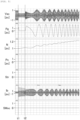
- FIG. 5 is a waveform example when there is a system fault in a case where the bypass operation is continued without applying the present invention.
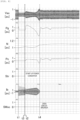
- FIG. 6 shows a case where the bypass operation is switched to the converter operation.
- the waveform indicates a system voltage Vac, the power Pg and a rotational speed N of the power generation motor device 2, the power Pc and the start-up command Str of the power converter, the current Ib of the bypass line, and the opening or closing command SWoc of the circuit breaker from the top.
- a fault condition is a condition under which a three-phase equilibrium fault occurs in an AC system at a time t1 and the fault is troubleshot at a time t2 in both FIGS. 5 and 6 .
- FIG. 6 shows a case where it is determined that the power generation motor device 2 steps out at a time t3 before the time t2 when the fault is troubleshot, the power converter 3 starts up, and the circuit breaker 5 of the bypass line 4 is opened at a time t4.
- an electric torque of the power generation motor device 2 can be controlled by the power converter 3 by switching an operation mode from the bypass operation to the converter operation, an increase in the rotational speed of the power generation motor device 2 is prevented.
- a transiently increased rotational speed can be adjusted by a governor control of the power generation motor device 2 or a power control of the power converter 3.
- the present invention can also be applied to a pumping operation.
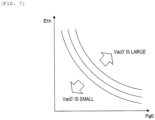
- the step-out determination threshold Eth is calculated based on the power Pg0 of the power generation motor device 2 and the AC voltage Vac0 immediately before the system fault, while in the second embodiment, an AC voltage VacO' immediately after the system fault may be used instead of the AC voltage Vac0 immediately before the system fault, as shown in FIG. 7 .
- the step-out determination threshold Eth is set to a larger value.
- the step-out determination threshold Eth is set to a smaller value as the AC voltage Vac0 decreases.
Landscapes
- Engineering & Computer Science (AREA)
- Power Engineering (AREA)
- Control Of Eletrric Generators (AREA)
- Supply And Distribution Of Alternating Current (AREA)
Description
- The present invention relates to a synchronous machine device, a variable speed pumped storage power generation device, and an operation method, in which a synchronous power generation motor device is connected to a power system via a parallel circuit of a power converter and a bypass line.
- A form for implementing a variable speed pumped storage power generation device includes a system in which an inductive power generation motor is used to achieve a variable speed by secondary excitation of the inductive power generation motor, and a system in which a synchronous power generation motor device is connected to a power system via a parallel circuit of a power converter and a bypass line and a variable speed is achieved by adjusting a frequency in the power converter.
- The present invention relates to a synchronous machine device of a system using a synchronous power generation motor device, a variable speed pumped storage power generation device, and a step-out estimation method. For example,
PTL 1 discloses a variable speed operation control device and an operation method of a hydraulic power generation system that improve power generation efficiency by switching between a bypass operation mode in which a power generation device is operated in a manner of being directly connected to a power system through a bypass line and a converter operation mode in which the power generation device is operated via a power converter. In addition, in PTL 2, equally a method to detect faults in a main circuit in case an electric motor has been already started is described. Herein, specifically, it is stipulated to detect a field current of a synchronous electric motor or a synchronous generation electric motor being a master machine and a second synchronous generation electric motor being used as a slave machine and determine a given circuit error in case the detected field current exceeds a predetermined range, leading further to the effect that additionally arranged circuit breakers may be opened so as to allow short-circuiting of the faulty circuit. Moreover, in NPTL 1, a number of different strategies to further improve the reliability of speed pumped storage hydropower plants for balancing power fluctuations from wind power in an isolated grid are disclosed. Specifically, a topology based on a synchronous machine and a full scale back-to-back voltage source converter are suggested for obtaining variable speed operation of a pump-turbine unit. -
- PTL 1:
Japanese Patent No. 6246753 - PTL 2:
Japanese Published Patent Application No. 2001 057735 A - NPTL 1: Suul J. A. et al. "Variable speed pumped storage hydropower for integration of wind energy in isolated grids: case description and control strategies", Nordic Workshops on Power and Industrial Electronics, June 2008
- In order to enable a variable speed pumped storage power generation device and a synchronous machine device of a system using a synchronous power generation motor device to contribute to stabilization of a power system, it is necessary to ensure operation continuity when there is a system fault. However, in a variable speed pumped storage power generation device that is switched between a bypass operation and a converter operation, for example, when troubleshooting of a system fault is delayed due to a main protection failure during the bypass operation, a synchronous speed of a power generation motor device may be greatly deviated and the power generation motor device steps out synchronization, which leads to the stop of the power generation motor device.
- Here, an object of the present invention to provide a synchronous machine device, a variable speed pumped storage power generation device, and an operation method that can improve an operation tolerance when a system fault occurs during a bypass operation.
- In order to solve the above-mentioned problems, a synchronous machine device according to
independent claim 1 is proposed. - Dependent claims define preferable embodiments of the proposed invention.
- It is possible to increase the degree of contribution to a stable operation of a power system of a device by improving an operation tolerance of the synchronous machine device and the variable speed pumped storage power generation device when there is a system fault.
-
-
FIG. 1 is a diagram showing a configuration example of a variable speed pump device according to an embodiment of the present invention. -
FIG. 2 is a diagram showing a flow of a calculation process in a step-outestimation unit 101. -
FIG. 3 is a diagram showing a method of calculating a step-out determination threshold Eth of a power generation motor device. -
FIG. 4 is a block diagram showing a bypass line opening determination unit. -
FIG. 5 is a diagram showing a waveform example when there is a system fault in a case where the present invention is not applied. -
FIG. 6 is a diagram showing a waveform example when there is a system fault in a case where the present invention is applied. -
FIG. 7 is a diagram showing another method of calculating the step-out determination threshold Eth. - Hereinafter, embodiments of the present invention will be described with reference to the drawings.
-
FIG. 1 is a diagram showing a configuration example of a variable speed pumped storagepower generation device 1 according to a first embodiment of the present invention. In the variable speed pumped storagepower generation device 1, a power generation motor device 2 is connected to apower system 7 via a parallel circuit of apower converter 3 and abypass line 4 including acircuit breaker 5, and a transformer 6. Thecontrol device 100 receives signals from respective units of the variable speed pumped storagepower generation device 1 so as to estimate whether thepower system 7 steps out, thereby controlling thepower converter 3. - Although the power generation motor device 2 is shown in
FIG. 1 in a simplified manner, the power generation motor device 2 includes a water wheel pump that converts potential energy of water into rotational energy (or converts rotational energy into potential energy), a synchronous power generation motor that converts the rotational energy into a power generation output Pg (or converts a pumping input Pg into rotational energy), a speed regulator (a governor) that controls a rotational speed of the water wheel pump, an automatic voltage regulator (AVR) that adjusts an excitation voltage of a rotor to control a terminal voltage of a power generator. - Here, the power generation motor device 2 in the present specification may be a synchronous power generator or a synchronous motor, in addition to a so-called power generation motor. In short, as long as the power generation motor device 2 has a configuration of a synchronous machine connected to a power system via a parallel circuit of the
power converter 3 and thebypass line 4 including thecircuit breaker 5, the power generation motor device 2 may be a single machine such as a synchronous power generator and a synchronous motor, or may be a power generator motor that performs both power generation and pumping. In the present invention, such machines are collectively referred to as a power generation motor device (a power generation motor) . - Although details will be described later, a step-out estimation control of the
power system 7 according to the present invention can be applied to any mode of a power generation motor operation. In short, the step-out estimation control can be applied as long as the power generation motor device 2 is in a direct connection state in which the power generation motor device 2 is connected to a power system via thebypass line 4 including thecircuit breaker 5. - A power generation operation mode will be described as an example, and the
power converter 3 includes a first converter that converts the power generation output Pg from AC to DC and a second converter that converts DC power to AC power of a commercial frequency. A two-level, three-level, or multi-level converter can be used for each converter. Thepower converter 3 has a frequency conversion function, and the frequency conversion function enables thepower converter 3 to shift from a low-speed rotation range to a high-speed rotation range in a pumped storage power generation operation using a synchronous power generation motor. - The
bypass line 4 is a line for directly connecting the power generation motor device 2 to thepower system 7 via the transformer 6. The bypass line is opened and closed by thecircuit breaker 5. After the synchronous power generation motor is started up, the synchronous power generation motor is disconnected from apower converter 3 side and shifted to a connection with abypass line 4 side, and the synchronous power generation motor can be operated at high efficiency by using a direct connection operation. - The
control device 100 includes a step-outestimation unit 101 that estimates whether the power generation motor device 2 steps out based on power of the power generation motor device 2 (the power generation output Pg during a power generation operation and the pumping input Pg during a motor operation) and an AC voltage Vac at an interconnection point where the variable speed pumped storage power generation device is interconnected to a power system or the like, and that calculates a start-up command Str of thepower converter 3, a bypass lineopening determination unit 102 that calculates an opening or closing command SWoc of thecircuit breaker 5 based on a current Ib of thebypass line 4 and the start-up command Str, and aconverter control unit 103 that controls power Pc of thepower converter 3. - Next, a flow of a calculation process in the step-out
estimation unit 101 will be described with reference toFIG. 2 . Here, it is assumed that the power generation motor device 2 shown inFIG. 1 is connected to a power system via thebypass line 4 and is in a so-called direct connection operation state. Since the following concept is exactly the same during a power generation operation and a motor operation, the power generation output Pg during the power generation operation will be described as a representative example of the power of the power generation motor device 2 in the following description. - In a process of step S1 shown in
FIG. 2 , it is determined whether a system fault occurs based on whether the AC voltage Vac is lower than a first threshold Vac1. When it is detected that a system fault occurs, the calculation process proceeds to a process of step S2, and when it is detected that no system fault occurs, the calculation process is ended. In subsequent processes shown inFIG. 2 , when a system fault occurs and a voltage drop occurs, it is estimated whether this influence develops to a later stage in which the power system steps out. When the power system may step out, an early countermeasure will be taken using thepower converter 3. - In the process of step S2, a step-out determination threshold Eth is calculated in accordance with power Pg0 of the power generation motor device 2 and an AC voltage Vac0 immediately before the system fault, the step-out determination threshold Eth being a threshold for determining whether the power system steps out. A method of calculating the step-out determination threshold Eth will be described later with reference to
FIG. 3 . - In a process of step S3, a step-out determination value E is calculated by integrating a difference between the AC voltage Vac0 immediately before the system fault and an AC voltage Vac at a current time. Here, the step-out determination value E can be regarded as a value obtained by integrating a difference between a mechanical input and output and an electrical input and output applied to the power generation motor device 2 during a fault continuation period after the occurrence of the fault. It can be said that the power system is likely to step out as the step-out determination value E increases.
- In a process of step S4, the step-out determination value E is compared with the step-out determination threshold Eth, and when the step-out determination value E exceeds the step-out determination threshold Eth, it is determined that the power generation motor device 2 will step out later. In a process of step S5, the start-up command Str of the power converter is set to 1 to start up the
power converter 3. When the step-out determination value E is lower than the step-out determination threshold Eth, the calculation process proceeds to step S6. - In a process of step S6, it is determined whether the system fault is troubleshot based on whether the AC voltage Vac exceeds a second threshold Vac2. When it is determined that the system fault is not troubleshot, the calculation process returns to the process of step S3 and the step-out estimation process of the power generation motor device is continued. When it is determined that the system fault is troubleshot, the calculation process proceeds to a process of step S7, and the start-up command Str of the power converter is set to 0, that is, the power converter is maintained in a stopped state, and the calculation process is ended. It is possible to prevent unnecessary operation switching between the bypass operation and the converter operation by using a step-out estimation method of the power generation motor device described above.
- According to the series of processes described above, a comparison process between the step-out determination value E and the step-out determination threshold Eth is performed during the fault continuation period which is a period from when the fault occurs up to when the fault is troubleshot. As a result, it is possible to appropriately evaluate an influence on step-out according to the magnitude of the fault (the magnitude of a voltage drop) and the fault duration period.
- A method of calculating the step-out determination threshold Eth in the process of step S2 will be described with reference to
FIG. 3 . - In the process of step S2, the step-out determination threshold Eth is calculated using a table as shown in the drawing in accordance with the power Pg0 of the power generation motor device 2 and the AC voltage Vac0 immediately before the system fault. As the power Pg0 of the power generation motor device 2 decreases, the step-out determination threshold Eth is set to a larger value. In a case where the power Pg0 of the power generation motor device 2 is maintained at the same value, the step-out determination threshold Eth is set to a smaller value as the AC voltage Vac0 decreases.
-
FIG. 4 is a block diagram showing the bypass lineopening determination unit 102. Acomparator 102a determines whether the current Ib of the bypass line is lower than a threshold Ibmin. Thecomparator 102a outputs 1 when the current Ib is lower than the threshold Ibmin, andoutputs 0 when the current Ib is not lower than the threshold Ibmin. - An opening or closing command SWoc of the circuit breaker outputs 1 (a circuit breaker opening command) when the start-up command Str of the power converter described above in an AND
logic circuit 102b is 1 (the power converter is in a start-up state) and the current Ib of the bypass line is lower than the threshold Ibmin. As a result, an operation of the power generation motor device 2 shifts from the bypass operation to the converter operation. - Next, a waveform example when a fault occurs in accordance with whether the present invention is applied will be described with reference to
FIGS. 5 and6 .FIG. 5 is a waveform example when there is a system fault in a case where the bypass operation is continued without applying the present invention.FIG. 6 shows a case where the bypass operation is switched to the converter operation. The waveform indicates a system voltage Vac, the power Pg and a rotational speed N of the power generation motor device 2, the power Pc and the start-up command Str of the power converter, the current Ib of the bypass line, and the opening or closing command SWoc of the circuit breaker from the top. A fault condition is a condition under which a three-phase equilibrium fault occurs in an AC system at a time t1 and the fault is troubleshot at a time t2 in bothFIGS. 5 and6 . - When the bypass operation shown in
FIG. 5 is continued, it is shown that the rotational speed N of the power generation motor device 2 greatly deviates from 1 [pu] of a synchronous speed after the system fault is troubleshot, the power generation motor device 2 steps out, and the device is stopped. - On the other hand,
FIG. 6 shows a case where it is determined that the power generation motor device 2 steps out at a time t3 before the time t2 when the fault is troubleshot, thepower converter 3 starts up, and thecircuit breaker 5 of thebypass line 4 is opened at a time t4. - Since an electric torque of the power generation motor device 2 can be controlled by the
power converter 3 by switching an operation mode from the bypass operation to the converter operation, an increase in the rotational speed of the power generation motor device 2 is prevented. A transiently increased rotational speed can be adjusted by a governor control of the power generation motor device 2 or a power control of thepower converter 3. - In this manner, it is possible to avoid step-out of the power generation motor device 2 when a system fault occurs during the bypass operation according to the first embodiment of the present invention. As a result, an operation tolerance of the variable speed pumped storage power generation device can be improved, and it is possible to increase the degree of contribution to a stable operation of a power system of the device.
- Although the first embodiment exhibits an effect in the case of a power generation operation, the present invention can also be applied to a pumping operation.
- In a second embodiment, another method of calculating the step-out determination threshold Eth will be described. In the first embodiment, the step-out determination threshold Eth is calculated based on the power Pg0 of the power generation motor device 2 and the AC voltage Vac0 immediately before the system fault, while in the second embodiment, an AC voltage VacO' immediately after the system fault may be used instead of the AC voltage Vac0 immediately before the system fault, as shown in
FIG. 7 . In this case as well, as the power Pg0 of the power generation motor device 2 decreases, the step-out determination threshold Eth is set to a larger value. - In a case where the power Pg0 of the power generation motor device 2 is maintained at the same value, the step-out determination threshold Eth is set to a smaller value as the AC voltage Vac0 decreases.
-
- 1 variable speed pumped storage power generation device
- 2 power generation motor device
- 3 power converter
- 4 bypass line
- 5 circuit breaker
- 6 transformer
- 7 power system
- 100 control device
- 101 step-out estimation unit
- 102 bypass line opening determination unit
- 102a comparator
- 102b AND logic circuit
- 103 converter control unit
Claims (6)
- A synchronous machine device in which a power generation motor device (2) is connected to a power system (7) via a parallel circuit of a power converter (3) and a bypass line (4) including a circuit breaker (5), the synchronous machine device characterized by:an estimation unit (101) configured to estimate whether the power generation motor device (2) steps out based on power of the power generation motor device (2) and a system voltage when a system fault occurs in a state in which the power generation motor device (2) is directly connected to the power system (7) via the parallel circuit and the power converter (3) is stopped; anda control device (100) that includes a control unit (103) configured to control to start up the power converter (3) when it is estimated that the power generation motor device (2) steps out and to control the electric torque of the power generation motor device (2) based on the controlled power converter (3) in order to prevent the step out.
- The synchronous machine device according to claim 1, wherein
the estimation unit (101) includes a unit configured to calculate a step-out determination threshold of the power generation motor device (2) in accordance with the power of the power generation motor device (2) and the system voltage when the system fault occurs, a unit configured to calculate a step-out determination value, E, based on the system voltage immediately before the system fault and a system voltage at a current time during a fault continuation period, and a unit configured to compare the step-out determination threshold and the step-out determination value. - The synchronous machine device according to claim 1 or 2, wherein
the control unit (103) includes a bypass line opening determination unit (102) configured to open the circuit breaker (5) of the bypass line (4) by determining that a current of the bypass line (4) is lower than a predetermined value after the power converter (3) starts up. - A variable speed pumped storage power generation device (1) provided in the synchronous machine device according to any one of claims 1 to 3, wherein
the variable speed pumped storage power generation device (1) is a power generation motor device (2) that is connected to a pump water wheel and is configured to perform a variable speed pumped storage power generation operation. - The synchronous machine device according to claim 2, wherein
the unit of the estimation unit (101) that calculates the step-out determination threshold of the power generation motor device (2) is configured to calculate the step-out determination threshold of the power generation motor device (2) in accordance with the power of the power generation motor device (2) and the system voltage immediately before the system fault. - The synchronous machine device according to claim 2, wherein
the unit of the estimation unit (101) that calculates the step-out determination threshold of the power generation motor device (2) is configured to calculate the step-out determination threshold of the power generation motor device in accordance with the power of the power generation motor device (2) immediately before the system fault and a system voltage immediately after the system fault.
Applications Claiming Priority (2)
| Application Number | Priority Date | Filing Date | Title |
|---|---|---|---|
| JP2020041667A JP7365272B2 (en) | 2020-03-11 | 2020-03-11 | Synchronous machine device, variable speed pumped storage power generation device, and operating method |
| PCT/JP2021/009244 WO2021182459A1 (en) | 2020-03-11 | 2021-03-09 | Synchronous machine device, variable speed pumped storage power generation apparatus, and operation method |
Publications (3)
| Publication Number | Publication Date |
|---|---|
| EP4120553A1 EP4120553A1 (en) | 2023-01-18 |
| EP4120553A4 EP4120553A4 (en) | 2024-04-17 |
| EP4120553B1 true EP4120553B1 (en) | 2025-06-25 |
Family
ID=77670630
Family Applications (1)
| Application Number | Title | Priority Date | Filing Date |
|---|---|---|---|
| EP21768250.9A Active EP4120553B1 (en) | 2020-03-11 | 2021-03-09 | Synchronous machine device, variable speed pumped storage power generation apparatus, and operation method |
Country Status (3)
| Country | Link |
|---|---|
| EP (1) | EP4120553B1 (en) |
| JP (1) | JP7365272B2 (en) |
| WO (1) | WO2021182459A1 (en) |
Family Cites Families (3)
| Publication number | Priority date | Publication date | Assignee | Title |
|---|---|---|---|---|
| JP3774838B2 (en) | 1999-08-11 | 2006-05-17 | 株式会社日立製作所 | Accident detection and protection method when starting motor mode of synchronous generator motor, and synchronous generator motor |
| JP2009033798A (en) | 2007-07-24 | 2009-02-12 | Fuji Electric Systems Co Ltd | Induction generator start-up method |
| JP6246753B2 (en) | 2015-02-23 | 2017-12-13 | 株式会社東芝 | Variable speed operation control device and hydroelectric power generation system |
-
2020
- 2020-03-11 JP JP2020041667A patent/JP7365272B2/en active Active
-
2021
- 2021-03-09 WO PCT/JP2021/009244 patent/WO2021182459A1/en not_active Ceased
- 2021-03-09 EP EP21768250.9A patent/EP4120553B1/en active Active
Also Published As
| Publication number | Publication date |
|---|---|
| JP2021145434A (en) | 2021-09-24 |
| EP4120553A4 (en) | 2024-04-17 |
| WO2021182459A1 (en) | 2021-09-16 |
| JP7365272B2 (en) | 2023-10-19 |
| EP4120553A1 (en) | 2023-01-18 |
Similar Documents
| Publication | Publication Date | Title |
|---|---|---|
| Jlassi et al. | Multiple open-circuit faults diagnosis in back-to-back converters of PMSG drives for wind turbine systems | |
| CA2914293C (en) | Systems and methods for increasing wind turbine power output | |
| US9520819B2 (en) | System and method for controlling a power generation system based on a detected islanding event | |
| US9954393B2 (en) | Power distribution systems | |
| US10107260B2 (en) | Wind turbine auxiliary circuit control | |
| US11223310B2 (en) | Variable speed generator/motor device | |
| JP7412309B2 (en) | Grid integration device | |
| US11677345B2 (en) | Control method and system for continuous high and low voltage ride through of permanent-magnet direct-drive wind-driven generator set | |
| KR101410744B1 (en) | Limitation method of the current and regeneration power reference using the grid-side converter capacity connected with utility grid | |
| KR101806595B1 (en) | Apparatus for controlling inverter | |
| CN118199163A (en) | A hydropower microgrid control method and system | |
| EP4120553B1 (en) | Synchronous machine device, variable speed pumped storage power generation apparatus, and operation method | |
| EP3823158A1 (en) | Variable-speed generator-motor device | |
| CN114977268A (en) | System and method for providing grid formation control for doubly fed wind turbine generators | |
| Zhour et al. | A New Approach to Fault Detection in the Power Converter in Wind Turbine Conversion Systems | |
| US11255309B2 (en) | System and method for increasing mechanical inertia of a wind turbine rotor to support a power grid during an over-frequency or under-frequency disturbance of the grid | |
| Gjerde et al. | Fault tolerance of a 10 MW, 100 kV transformerless offshore wind turbine concept with a modular converter system | |
| JP6453107B2 (en) | Power generation system | |
| Anto et al. | Starting performance of doubly fed induction machine drive serving to pumped storage plants subjected to faults in power and control circuits | |
| Selvaraj et al. | Fault tolerant schemes for multi-channel 3L-NPC Bi-directional PWM power converter fed asynchronous hydro-generating unit | |
| Suwan-ngam | Analysis of a Doubly-Fed Induction Motor for Soft Start Operation based on Stator Flux Vector Control | |
| US11549493B2 (en) | System and method for frequency filtering of a renewable energy power system | |
| WO2024118067A1 (en) | System and method for operating an inverter-based resource in grid-forming mode (gfm) for enhanced stability during a transient grid power event | |
| WO2023112222A1 (en) | Electric power conversion device and control method for electric power conversion device | |
| Wei et al. | Mode switching DFIG for low voltage ride through |
Legal Events
| Date | Code | Title | Description |
|---|---|---|---|
| STAA | Information on the status of an ep patent application or granted ep patent |
Free format text: STATUS: THE INTERNATIONAL PUBLICATION HAS BEEN MADE |
|
| PUAI | Public reference made under article 153(3) epc to a published international application that has entered the european phase |
Free format text: ORIGINAL CODE: 0009012 |
|
| STAA | Information on the status of an ep patent application or granted ep patent |
Free format text: STATUS: REQUEST FOR EXAMINATION WAS MADE |
|
| 17P | Request for examination filed |
Effective date: 20221011 |
|
| AK | Designated contracting states |
Kind code of ref document: A1 Designated state(s): AL AT BE BG CH CY CZ DE DK EE ES FI FR GB GR HR HU IE IS IT LI LT LU LV MC MK MT NL NO PL PT RO RS SE SI SK SM TR |
|
| DAV | Request for validation of the european patent (deleted) | ||
| DAX | Request for extension of the european patent (deleted) | ||
| A4 | Supplementary search report drawn up and despatched |
Effective date: 20240315 |
|
| RIC1 | Information provided on ipc code assigned before grant |
Ipc: H02J 3/08 20060101ALI20240311BHEP Ipc: H02P 9/04 20060101AFI20240311BHEP |
|
| GRAP | Despatch of communication of intention to grant a patent |
Free format text: ORIGINAL CODE: EPIDOSNIGR1 |
|
| STAA | Information on the status of an ep patent application or granted ep patent |
Free format text: STATUS: GRANT OF PATENT IS INTENDED |
|
| INTG | Intention to grant announced |
Effective date: 20250115 |
|
| GRAS | Grant fee paid |
Free format text: ORIGINAL CODE: EPIDOSNIGR3 |
|
| GRAA | (expected) grant |
Free format text: ORIGINAL CODE: 0009210 |
|
| STAA | Information on the status of an ep patent application or granted ep patent |
Free format text: STATUS: THE PATENT HAS BEEN GRANTED |
|
| AK | Designated contracting states |
Kind code of ref document: B1 Designated state(s): AL AT BE BG CH CY CZ DE DK EE ES FI FR GB GR HR HU IE IS IT LI LT LU LV MC MK MT NL NO PL PT RO RS SE SI SK SM TR |
|
| REG | Reference to a national code |
Ref country code: GB Ref legal event code: FG4D |
|
| REG | Reference to a national code |
Ref country code: CH Ref legal event code: EP |
|
| REG | Reference to a national code |
Ref country code: DE Ref legal event code: R096 Ref document number: 602021032926 Country of ref document: DE |
|
| REG | Reference to a national code |
Ref country code: CH Ref legal event code: EP Ref country code: SE Ref legal event code: TRGR |
|
| REG | Reference to a national code |
Ref country code: IE Ref legal event code: FG4D |
|
| PG25 | Lapsed in a contracting state [announced via postgrant information from national office to epo] |
Ref country code: FI Free format text: LAPSE BECAUSE OF FAILURE TO SUBMIT A TRANSLATION OF THE DESCRIPTION OR TO PAY THE FEE WITHIN THE PRESCRIBED TIME-LIMIT Effective date: 20250625 |
|
| REG | Reference to a national code |
Ref country code: LT Ref legal event code: MG9D |
|
| PG25 | Lapsed in a contracting state [announced via postgrant information from national office to epo] |
Ref country code: NO Free format text: LAPSE BECAUSE OF FAILURE TO SUBMIT A TRANSLATION OF THE DESCRIPTION OR TO PAY THE FEE WITHIN THE PRESCRIBED TIME-LIMIT Effective date: 20250925 Ref country code: GR Free format text: LAPSE BECAUSE OF FAILURE TO SUBMIT A TRANSLATION OF THE DESCRIPTION OR TO PAY THE FEE WITHIN THE PRESCRIBED TIME-LIMIT Effective date: 20250926 |
|
| PG25 | Lapsed in a contracting state [announced via postgrant information from national office to epo] |
Ref country code: BG Free format text: LAPSE BECAUSE OF FAILURE TO SUBMIT A TRANSLATION OF THE DESCRIPTION OR TO PAY THE FEE WITHIN THE PRESCRIBED TIME-LIMIT Effective date: 20250625 |
|
| PG25 | Lapsed in a contracting state [announced via postgrant information from national office to epo] |
Ref country code: HR Free format text: LAPSE BECAUSE OF FAILURE TO SUBMIT A TRANSLATION OF THE DESCRIPTION OR TO PAY THE FEE WITHIN THE PRESCRIBED TIME-LIMIT Effective date: 20250625 |
|
| PG25 | Lapsed in a contracting state [announced via postgrant information from national office to epo] |
Ref country code: RS Free format text: LAPSE BECAUSE OF FAILURE TO SUBMIT A TRANSLATION OF THE DESCRIPTION OR TO PAY THE FEE WITHIN THE PRESCRIBED TIME-LIMIT Effective date: 20250925 |
|
| PG25 | Lapsed in a contracting state [announced via postgrant information from national office to epo] |
Ref country code: LV Free format text: LAPSE BECAUSE OF FAILURE TO SUBMIT A TRANSLATION OF THE DESCRIPTION OR TO PAY THE FEE WITHIN THE PRESCRIBED TIME-LIMIT Effective date: 20250625 |
|
| REG | Reference to a national code |
Ref country code: NL Ref legal event code: MP Effective date: 20250625 |
|
| PG25 | Lapsed in a contracting state [announced via postgrant information from national office to epo] |
Ref country code: NL Free format text: LAPSE BECAUSE OF FAILURE TO SUBMIT A TRANSLATION OF THE DESCRIPTION OR TO PAY THE FEE WITHIN THE PRESCRIBED TIME-LIMIT Effective date: 20250625 |
|
| PG25 | Lapsed in a contracting state [announced via postgrant information from national office to epo] |
Ref country code: PT Free format text: LAPSE BECAUSE OF FAILURE TO SUBMIT A TRANSLATION OF THE DESCRIPTION OR TO PAY THE FEE WITHIN THE PRESCRIBED TIME-LIMIT Effective date: 20251027 |
|
| REG | Reference to a national code |
Ref country code: AT Ref legal event code: MK05 Ref document number: 1807652 Country of ref document: AT Kind code of ref document: T Effective date: 20250625 |
|
| PG25 | Lapsed in a contracting state [announced via postgrant information from national office to epo] |
Ref country code: IS Free format text: LAPSE BECAUSE OF FAILURE TO SUBMIT A TRANSLATION OF THE DESCRIPTION OR TO PAY THE FEE WITHIN THE PRESCRIBED TIME-LIMIT Effective date: 20251025 |
|
| PG25 | Lapsed in a contracting state [announced via postgrant information from national office to epo] |
Ref country code: AT Free format text: LAPSE BECAUSE OF FAILURE TO SUBMIT A TRANSLATION OF THE DESCRIPTION OR TO PAY THE FEE WITHIN THE PRESCRIBED TIME-LIMIT Effective date: 20250625 Ref country code: SM Free format text: LAPSE BECAUSE OF FAILURE TO SUBMIT A TRANSLATION OF THE DESCRIPTION OR TO PAY THE FEE WITHIN THE PRESCRIBED TIME-LIMIT Effective date: 20250625 |
|
| PG25 | Lapsed in a contracting state [announced via postgrant information from national office to epo] |
Ref country code: CZ Free format text: LAPSE BECAUSE OF FAILURE TO SUBMIT A TRANSLATION OF THE DESCRIPTION OR TO PAY THE FEE WITHIN THE PRESCRIBED TIME-LIMIT Effective date: 20250625 |
|
| PG25 | Lapsed in a contracting state [announced via postgrant information from national office to epo] |
Ref country code: PL Free format text: LAPSE BECAUSE OF FAILURE TO SUBMIT A TRANSLATION OF THE DESCRIPTION OR TO PAY THE FEE WITHIN THE PRESCRIBED TIME-LIMIT Effective date: 20250625 |
|
| PG25 | Lapsed in a contracting state [announced via postgrant information from national office to epo] |
Ref country code: EE Free format text: LAPSE BECAUSE OF FAILURE TO SUBMIT A TRANSLATION OF THE DESCRIPTION OR TO PAY THE FEE WITHIN THE PRESCRIBED TIME-LIMIT Effective date: 20250625 |
|
| PG25 | Lapsed in a contracting state [announced via postgrant information from national office to epo] |
Ref country code: SK Free format text: LAPSE BECAUSE OF FAILURE TO SUBMIT A TRANSLATION OF THE DESCRIPTION OR TO PAY THE FEE WITHIN THE PRESCRIBED TIME-LIMIT Effective date: 20250625 |
|
| PG25 | Lapsed in a contracting state [announced via postgrant information from national office to epo] |
Ref country code: ES Free format text: LAPSE BECAUSE OF FAILURE TO SUBMIT A TRANSLATION OF THE DESCRIPTION OR TO PAY THE FEE WITHIN THE PRESCRIBED TIME-LIMIT Effective date: 20250625 |
|
| REG | Reference to a national code |
Ref country code: CH Ref legal event code: U11 Free format text: ST27 STATUS EVENT CODE: U-0-0-U10-U11 (AS PROVIDED BY THE NATIONAL OFFICE) Effective date: 20260401 |
|
| PGFP | Annual fee paid to national office [announced via postgrant information from national office to epo] |
Ref country code: SE Payment date: 20260323 Year of fee payment: 6 |
|
| PGFP | Annual fee paid to national office [announced via postgrant information from national office to epo] |
Ref country code: GB Payment date: 20260324 Year of fee payment: 6 |
|
| PG25 | Lapsed in a contracting state [announced via postgrant information from national office to epo] |
Ref country code: DK Free format text: LAPSE BECAUSE OF FAILURE TO SUBMIT A TRANSLATION OF THE DESCRIPTION OR TO PAY THE FEE WITHIN THE PRESCRIBED TIME-LIMIT Effective date: 20250625 |
|
| PGFP | Annual fee paid to national office [announced via postgrant information from national office to epo] |
Ref country code: DE Payment date: 20260331 Year of fee payment: 6 |
|
| PG25 | Lapsed in a contracting state [announced via postgrant information from national office to epo] |
Ref country code: IT Free format text: LAPSE BECAUSE OF FAILURE TO SUBMIT A TRANSLATION OF THE DESCRIPTION OR TO PAY THE FEE WITHIN THE PRESCRIBED TIME-LIMIT Effective date: 20250625 |
|
| PGFP | Annual fee paid to national office [announced via postgrant information from national office to epo] |
Ref country code: FR Payment date: 20260324 Year of fee payment: 6 |
|
| PLBE | No opposition filed within time limit |
Free format text: ORIGINAL CODE: 0009261 |
|
| STAA | Information on the status of an ep patent application or granted ep patent |
Free format text: STATUS: NO OPPOSITION FILED WITHIN TIME LIMIT |