EP4120503A1 - Zero voltage discharge circuit device - Google Patents
Zero voltage discharge circuit device Download PDFInfo
- Publication number
- EP4120503A1 EP4120503A1 EP20924601.6A EP20924601A EP4120503A1 EP 4120503 A1 EP4120503 A1 EP 4120503A1 EP 20924601 A EP20924601 A EP 20924601A EP 4120503 A1 EP4120503 A1 EP 4120503A1
- Authority
- EP
- European Patent Office
- Prior art keywords
- node
- switching element
- voltage
- secondary battery
- end connected
- Prior art date
- Legal status (The legal status is an assumption and is not a legal conclusion. Google has not performed a legal analysis and makes no representation as to the accuracy of the status listed.)
- Pending
Links
Images


Classifications
-
- H—ELECTRICITY
- H02—GENERATION; CONVERSION OR DISTRIBUTION OF ELECTRIC POWER
- H02J—ELECTRIC POWER NETWORKS; CIRCUIT ARRANGEMENTS OR SYSTEMS FOR SUPPLYING OR DISTRIBUTING ELECTRIC POWER; SYSTEMS FOR STORING ELECTRIC ENERGY
- H02J7/00—Circuit arrangements for charging or discharging batteries or for supplying loads from batteries
- H02J7/875—Charging or discharging for charge maintenance, battery initiation or rejuvenation
-
- H—ELECTRICITY
- H02—GENERATION; CONVERSION OR DISTRIBUTION OF ELECTRIC POWER
- H02J—ELECTRIC POWER NETWORKS; CIRCUIT ARRANGEMENTS OR SYSTEMS FOR SUPPLYING OR DISTRIBUTING ELECTRIC POWER; SYSTEMS FOR STORING ELECTRIC ENERGY
- H02J7/00—Circuit arrangements for charging or discharging batteries or for supplying loads from batteries
- H02J7/90—Regulation of charging or discharging current or voltage
- H02J7/96—Regulation of charging or discharging current or voltage in response to battery voltage
-
- H—ELECTRICITY
- H03—ELECTRONIC CIRCUITRY
- H03K—PULSE TECHNIQUE
- H03K17/00—Electronic switching or gating, i.e. not by contact-making and –breaking
- H03K17/30—Modifications for providing a predetermined threshold before switching
- H03K17/302—Modifications for providing a predetermined threshold before switching in field-effect transistor switches
-
- H—ELECTRICITY
- H01—ELECTRIC ELEMENTS
- H01M—PROCESSES OR MEANS, e.g. BATTERIES, FOR THE DIRECT CONVERSION OF CHEMICAL ENERGY INTO ELECTRICAL ENERGY
- H01M10/00—Secondary cells; Manufacture thereof
- H01M10/42—Methods or arrangements for servicing or maintenance of secondary cells or secondary half-cells
- H01M10/44—Methods for charging or discharging
- H01M10/441—Methods for charging or discharging for several batteries or cells simultaneously or sequentially
-
- H—ELECTRICITY
- H02—GENERATION; CONVERSION OR DISTRIBUTION OF ELECTRIC POWER
- H02J—ELECTRIC POWER NETWORKS; CIRCUIT ARRANGEMENTS OR SYSTEMS FOR SUPPLYING OR DISTRIBUTING ELECTRIC POWER; SYSTEMS FOR STORING ELECTRIC ENERGY
- H02J7/00—Circuit arrangements for charging or discharging batteries or for supplying loads from batteries
- H02J7/34—Parallel operation in networks using both storage and other DC sources, e.g. providing buffering
- H02J7/345—Parallel operation in networks using both storage and other DC sources, e.g. providing buffering using capacitors as storage or buffering devices
-
- H—ELECTRICITY
- H02—GENERATION; CONVERSION OR DISTRIBUTION OF ELECTRIC POWER
- H02J—ELECTRIC POWER NETWORKS; CIRCUIT ARRANGEMENTS OR SYSTEMS FOR SUPPLYING OR DISTRIBUTING ELECTRIC POWER; SYSTEMS FOR STORING ELECTRIC ENERGY
- H02J7/00—Circuit arrangements for charging or discharging batteries or for supplying loads from batteries
- H02J7/36—Arrangements using end-cell switching
-
- H—ELECTRICITY
- H03—ELECTRONIC CIRCUITRY
- H03K—PULSE TECHNIQUE
- H03K17/00—Electronic switching or gating, i.e. not by contact-making and –breaking
- H03K17/13—Modifications for switching at zero crossing
- H03K17/133—Modifications for switching at zero crossing in field-effect transistor switches
-
- H—ELECTRICITY
- H02—GENERATION; CONVERSION OR DISTRIBUTION OF ELECTRIC POWER
- H02J—ELECTRIC POWER NETWORKS; CIRCUIT ARRANGEMENTS OR SYSTEMS FOR SUPPLYING OR DISTRIBUTING ELECTRIC POWER; SYSTEMS FOR STORING ELECTRIC ENERGY
- H02J2207/00—Details of circuit arrangements for charging or discharging batteries or supplying loads from batteries
- H02J2207/20—Charging or discharging characterised by the power electronics converter
-
- H—ELECTRICITY
- H03—ELECTRONIC CIRCUITRY
- H03K—PULSE TECHNIQUE
- H03K2217/00—Indexing scheme related to electronic switching or gating, i.e. not by contact-making or -breaking covered by H03K17/00
- H03K2217/0045—Full bridges, determining the direction of the current through the load
-
- Y—GENERAL TAGGING OF NEW TECHNOLOGICAL DEVELOPMENTS; GENERAL TAGGING OF CROSS-SECTIONAL TECHNOLOGIES SPANNING OVER SEVERAL SECTIONS OF THE IPC; TECHNICAL SUBJECTS COVERED BY FORMER USPC CROSS-REFERENCE ART COLLECTIONS [XRACs] AND DIGESTS
- Y02—TECHNOLOGIES OR APPLICATIONS FOR MITIGATION OR ADAPTATION AGAINST CLIMATE CHANGE
- Y02E—REDUCTION OF GREENHOUSE GAS [GHG] EMISSIONS, RELATED TO ENERGY GENERATION, TRANSMISSION OR DISTRIBUTION
- Y02E60/00—Enabling technologies; Technologies with a potential or indirect contribution to GHG emissions mitigation
- Y02E60/10—Energy storage using batteries
Definitions
- the disclosure relates to a zero-voltage discharge circuit device, and, particularly, a zero-voltage discharge circuit device, which is configured to discharge a secondary battery while relevant switching elements are kept continuously turned on without being repeatedly turned on and off in a discharge mode of the second battery, so that the discharge circuit can be configured with low withstand voltage switching elements, and is configured to generate a charging current and a discharging current by just selectively turning on the switching elements without changing an operating voltage, thereby reducing power loss in charging and discharging, and simplifying a control operation for the charging and the discharging.
- Zero-voltage discharge refers to that a battery operates in a constant current mode (CCM), where current has a constant level, until voltage reaches 0V while the battery is being discharged.
- CCM constant current mode
- the zero-voltage discharge is necessary for the following reasons: a charger/discharger is classified into a charger/discharger for formation, which is used in the manufacture of a secondary battery product, and a charger/discharger for a cycler, which repeats charging and discharging more times to design and research the products, and it is important to implement a circuit for the zero-voltage discharge to meet the requirements of a user because the charger/discharger for the cycler uses a voltage of 0 to 4.5V and performs discharge up to a lower voltage.
- the zero-voltage discharge was not achieved.
- the load wiring of the charger/discharger is so long (about 6 to 10 m) that a voltage drop (about 0.7 to 1.0 V) occurs when current flows in the load wiring.
- a voltage drop also occurs when current flows in semiconductor elements (a diode, a metal oxide semiconductor field effect transistor (MOSFET), etc.) of the circuit. Due to voltage drop components described above, constant current discharge is not maintained in a region where a battery voltage is low. Therefore, the conventional charging/discharging circuit cannot maintain the constant current discharge when the battery voltage is lower than or equal to 2.0 V.
- Such a conventional secondary battery charging/discharging circuit used for testing a secondary battery could make the secondary battery be discharged only up to a certain voltage (e.g., up to 20% of a rated voltage) or higher but be not discharged below that voltage. Therefore, there was a problem in that the secondary battery was not sufficiently tested.
- a certain voltage e.g., up to 20% of a rated voltage
- Korean Patent No. 10-1197078 (hereinafter referred to as the "related art") has disclosed a zero voltage discharge circuit with active switching elements, in which only a switching operation is enough to perform discharging without adding separate auxiliary power, thereby making a secondary battery sufficiently discharge a small amount of remaining voltage (20% or below to 0%).
- the foregoing zero voltage discharge circuit suggested in the related art unavoidably increases the withstand voltage of relevant switching elements due to parasitic resonance because the switching elements repeatedly switch on and off under pulse width modulation (PWM) control during the charging or the discharging, and increases the costs of the circuit because high withstand voltage switching elements are used.
- PWM pulse width modulation
- the foregoing zero voltage discharge circuit suggested in the related art has a disadvantage in that control operations for charging and discharging are complicated because all the switching elements connected to the primary and secondary sides of a transformer are required to be selectively controlled to generate a charging current and a discharging current, and the voltage polarity at the secondary side of the transformer is required to be altered according to the charging and the discharging.
- the disclosure is conceived to solve the problems of the related art, and an aspect of the disclosure is to provide a zero-voltage discharge circuit device, which is configured to discharge a secondary battery while relevant switching elements are kept continuously turned on without being repeatedly turned on and off in a discharge mode of the second battery, so that the discharge circuit can be configured with low withstand voltage switching elements, thereby reducing the costs of configuring the charging/discharging circuit.
- an aspect of the disclosure is to provide a zero-voltage discharge circuit device, which is configured to generate a charging current and a discharging current by just selectively turning on switching elements without changing an operating voltage, thereby reducing power loss in charging and discharging, and simplifying a control operation for the charging and the discharging.
- a zero-voltage discharge circuit device includes a first switching element including a first end connected to an operating voltage applying node corresponding to a node to which an operating voltage is applied by an operating voltage applying unit, and a second end connected to a first node; a second switching element including a first end connected to the operating voltage applying node, and a second end connected to a second node, and being connected in parallel with the first switching element; a third switching element including a first end connected to the first node, and a second end connected to a reference node; a fourth switching element including a first end connected to the second node, and a second end connected to the reference node; a first inductor including a first end connected to the first node, and a second end connected to a third node to which a positive (+) terminal of a secondary battery is connected; a first capacitor including a first end connected to the third node, and a second end connected to the reference node; a second in
- the first switching element and the fourth switching element are turned on in a charge mode for the secondary battery, and only the second switching element and the third switching element are turned on in a discharge mode for the secondary battery.
- the operating voltage applying unit equally applies the operating voltage to the operating voltage applying node in a charge mode and a discharge mode for the secondary battery.
- a secondary battery is configured to be discharged while relevant switching elements are kept continuously turned on without being repeatedly turned on and off in a discharge mode of the second battery, so that the discharge circuit can be configured with low withstand voltage switching elements, thereby having an advantage of reducing the costs of configuring the charging/discharging circuit.
- it is configured to generate a charging current and a discharging current by just selectively turning on switching elements without changing an operating voltage, thereby having effects on reducing power loss in charging and discharging, and simplifying a control operation for the charging and the discharging.
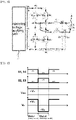
- FIG. 1 is a configuration diagram of a zero-voltage discharge circuit device according to an embodiment of the disclosure.
- the zero-voltage discharge circuit device includes an operating voltage applying unit 1, and the operating voltage applying unit 1 generates and applies an operating voltage V in to an operating voltage applying node N in .
- the operating voltage applying unit 1 operates to apply the operating voltage V in corresponding to a positive voltage to the operating voltage applying node N in .
- the zero-voltage discharge circuit device includes four switching elements, i.e., a first switching element S1, a second switching element S2, a third switching element S3, and a fourth switching element S4; two inductors, i.e., a first inductor L1 and a second inductor L2; and two capacitors, i.e., a first capacitor C1 and a second capacitor C2 in order to perform an operation of charging a secondary battery 3 and an operation of discharging the secondary battery 3
- the first switching element S1 has a first end connected to the operating voltage applying node N in corresponding to the node to which the operating voltage applying unit 1 applies the operating voltage V in , and a second end connected to a first node N1.
- the first switching element S1 is made of a metal oxide semiconductor field effect transistor (MOSFET). Specifically, the first switching element S1 is disposed with a drain connected to the operating voltage applying node N in , and a source connected to the first node N1.
- MOSFET metal oxide semiconductor field effect transistor
- a first diode D1 is connected to the first switching element S1 made of the MOSFET.
- the first diode D1 is connected to prevent the first switching element S1 made of the MOSFET from being damaged by high counter electromotive force applied to the drain at the moment when the first switching element S1 is turned off from an on state.
- the first diode D1 is disposed with an anode connected to the first node N1, and a cathode connected to the operating voltage applying node N in .
- the second switching element S2 has a first end connected to the operating voltage applying node N in , and a second end connected to a second node N2, and is connected in parallel with the first switching element S1.
- the second switching element S2 is also made of a MOSFET. Specifically, the second switching element S2 is disposed with a drain connected to the operating voltage applying node N in , and a source connected to the second node N2.
- a second diode D2 is connected to the second switching element S2 made of the MOSFET.
- the second diode D2 is connected to prevent the second switching element S2 made of the MOSFET from being damaged by high counter electromotive force applied to the drain at the moment when the second switching element S2 is turned off from an on state.
- the second diode D2 is disposed with an anode connected to the second node N2, and a cathode connected to the operating voltage applying node N in .
- the third switching element S3 has a first end connected to the first node N1, and a second end connected to a reference node N r .
- the reference node N r may be connected to the ground.
- the third switching element S3 is also made of a MOSFET. Specifically, the third switching element S3 is disposed with a drain connected to the first node N1, and a source connected to the reference node N r .
- a third diode D3 is connected to the third switching element S3 made of the MOSFET.
- the third diode D3 is connected to prevent the third switching element S3 from being damaged by high counter electromotive force applied to the drain at the moment when the third switching element S3 is turned off from an on state.
- the third diode D3 is disposed with an anode connected to the reference node N r , and a cathode connected to the first node N1.
- the fourth switching element S4 has a first end connected to the second node N2, and a second end connected to the reference node N r .
- the reference node N r may be connected to the ground.
- the fourth switching element S4 is also made of a MOSFET. Specifically, the fourth switching element S4 is disposed with a drain connected to the second node N2, and a source connected to the reference node N r .
- a fourth diode D4 is connected to the fourth switching element S4 made of the MOSFET.
- the fourth diode D4 is connected to prevent the fourth switching element S4 made of the MOSFET from being damaged by high counter electromotive force applied to the drain at the moment when the fourth switching element S4 is turned off from an on state.
- the fourth diode D4 is disposed with an anode connected to the reference node N r , and a cathode connected to the second node N2.
- the first inductor L1 has a first end connected to the first node N1, and a second end connected to a third node N3 to which a positive (+) terminal of the secondary battery 3 is connected. Specifically, the first inductor L1 has the first end connected to the source of the first switching element S1 and the drain of the third switching element S3 via the first node N1, and the second end connected to the positive (+) terminal of the secondary battery 3 via the third node N3.
- the first inductor L1 is made of a current stabilizing coil, and operates so that a charging current and a discharging current can flow stably.
- the first inductor L1 is directly involved in making the charging current stably flow in the secondary battery 3 in the charge mode for charging the secondary battery 3, as will be described later.
- the first capacitor C1 has a first end connected to the third node N3, and a second end connected to the reference node N r . Specifically, the first capacitor C1 has the first end connected to the second end of the first inductor L1 and the positive (+) terminal of the secondary battery 3 via the third node N3, and the second end connected to the source of the third switching element S3 and the source of the fourth switching element S4 via the reference node N r .
- the first capacitor C1 operates as a voltage stabilizing capacitor to stabilize a voltage waveform of the secondary battery in the charge and discharge modes for the secondary battery 3.
- the first capacitor C1 is connected in parallel with the secondary battery 3 in the charge mode for charging the secondary battery 3, and is directly involved in stabilizing the voltage waveform of the secondary battery, as will be described later.
- the second inductor L2 has a second end connected to the second node N2, and a first end connected to a third node N4 to which a negative (-) terminal of the secondary battery 3 is connected. Specifically, the second inductor L2 has the second end connected to the source of the second switching element S2 and the drain of the fourth switching element S4 via the second node N2, and the first end connected to the negative (+) terminal of the secondary battery 3 via the fourth node N4.
- the second inductor L2 is made of a current stabilizing coil, and operates so that the charging current and the discharging current can flow stably.
- the second inductor L2 is directly involved in making the discharging current stably flow in the secondary battery 3 in the discharge mode for discharging the secondary battery 3, as will be described later.
- the second capacitor C2 has a first end connected to the fourth node N4, and a second end connected to the reference node N r .
- the second capacitor C2 has the first end connected to the first end of the second inductor L2 and the negative (-) terminal of the secondary battery 3 via the fourth node N4, and the second end connected to the source of the third switching element S3, the source of the fourth switching element S4, and the second end of the first capacitor C1 via the reference node N r .
- the second capacitor C2 operates as a voltage stabilizing capacitor to stabilize a voltage waveform of the secondary battery in the charge and discharge modes for the secondary battery 3.
- the second capacitor C2 is connected in parallel with the secondary battery 3 in the discharge mode for discharging the secondary battery 3, and is directly involved in stabilizing the voltage waveform of the secondary battery, as will be described later.
- the zero-voltage discharge circuit device further includes a control unit 5 and a switching signal generation unit 7 to selectively control the switching of the switching elements S1, S2, S3, and S4 so that the operations of charging and discharging the secondary battery 3 can be performed.
- control unit 5 is connected to the switching signal generation unit 7 so as to output control signals for switching on and off the switching elements S1, S2, S3, and S4.
- the switching signal generation unit 7 is connected to each gate of the switching elements S1, S2, S3, and S4 to output the switching signals for turning on and off the switching elements S1, S2, S3, and S4 of FIG. 1 .
- control unit 5 controls the switching signal generation unit 7 to turn on the first switching element S1 and the fourth switching element S4 but turn off the second switching element S2 and the third switching element S3 in the operation of the charge mode Mode 1 shown in FIG. 2 , and controls the switching signal generation unit 7 to turn on the second switching element S2 and the third switching element S3 but turn off the first switching element S1 and the fourth switching element S4 in the operation of the discharge mode Mode 2 shown in FIG. 3 .
- the zero-voltage discharge circuit device operates to turn on only the first switching element S1 and the fourth switching element S4 in the charge mode Mode 1 for the secondary battery 3, and turn on only the second switching element S2 and the third switching element S3 in the discharge mode Mode 2 for the secondary battery 3.
- the operations in the charge mode Mode 1 for charging the secondary battery 3 and the flow of the charging current are as follows.
- the switching control signal corresponding to the charge mode Mode 1 of FIG. 4 is output from the control unit 5 to the switching signal generation unit 7 of FIG. 5 .
- the switching signal generation unit 7 outputs a turning-on signal to the gates of the first switching element S1 and the fourth switching element S4, and at the same time outputs a turning-off signal to the second switching element S2 and the third switching element S3. Then, the first switching element S1 and the fourth switching element S4 are turned on, and at the same time the second switching element S2 and the third switching element S3 are turned off.
- the applying voltage V in generated and applied by the operating voltage applying unit 1 is applied to the operating voltage applying node N in to which the first ends, i.e., the drains of the first switching element S1 and the second switching element S2 are connected together.
- the charging current flows in a closed circuit formed by the operating voltage applying node N in --> the first switching element S1-> the first node N1 --> the first inductor L1 --> the third node N3 --> the positive (+) terminal of the secondary battery 3 --> the negative (-) terminal of the secondary battery 3 --> the fourth node N4 --> the second inductor L2 --> the second node N2-> the fourth switching element S4 --> the reference node N r --> the operating voltage applying unit 1.
- the first inductor L1 allows the charging current to stably flow to the positive (+) terminal of the secondary battery 3, and this flow of the charging current enables charging the secondary battery 3. Further, as the charging current flows along the second inductor L2 and the fourth switching element S4, the negative (-) terminal of the secondary battery 3 is connected to the reference node N r to which the second end of the first capacitor C1 is connected, and the positive (+) terminal of the secondary battery 3 and the first end of the first capacitor C1 are connected via the third node N3, so that the secondary battery 3 can be maintained as connected in parallel with the first capacitor C1, thereby charging the secondary battery 3 while a stable waveform is maintained by the first capacitor C1 operating as the voltage stabilizing capacitor.
- the operating voltage V in is applied to the operating voltage applying node N in , and therefore, as shown in FIG. 4 , the voltage V Nin at the operating voltage applying node N in is +V in and is continuously maintained at a constant level of +V in during the charge mode.
- the voltage applied to the first node N1 becomes +V in corresponding to the operating voltage on the premise that the voltage drop in the first switching element S1 is "0".
- the voltage applied to the second node N2 becomes "0", i.e., the ground voltage at the reference node N r on the premise that the voltage drop in the fourth switching element S4 is "0". Therefore, voltage between the first node N1 and the second node N2, specifically, voltage V X at the first node N1 with respect to the second node N2 becomes +V in corresponding to the operating voltage as shown in FIG. 4 .
- the first inductor L1 allows the charging current to flow from the positive (+) terminal toward the negative (-) terminal of the secondary battery 3, thereby charging the secondary battery 3.
- the second inductor L2 is also helpful in flowing the charging current because the charging current flows along the closed circuit.
- the operations in the discharge mode Mode 2 for discharging the secondary battery 3 and the flow of the discharging current are as follows.
- the switching control signal corresponding to the discharge mode Mode 2 of FIG. 4 is output from the control unit 5 to the switching signal generation unit 7 of FIG. 5 .
- the switching signal generation unit 7 outputs a turning-on signal to the gates of the second switching element S2 and the third switching element S3, and at the same time outputs a turning-off signal to the first switching element S1 and the fourth switching element S4. Then, the second switching element S2 and the third switching element S3 are turned on, and at the same time the first switching element S1 and the fourth switching element S4 are turned off.
- the applying voltage V in generated and applied by the operating voltage applying unit 1 is applied to the operating voltage applying node N in to which the first ends, i.e., the drains of the first switching element S1 and the second switching element S2 are connected together.
- the charging current flows in a closed circuit formed by the operating voltage applying node N in --> the second switching element S2 --> the second node N2 --> the second inductor L2 --> the fourth node(N4) --> the negative (-) terminal of the secondary battery 3 --> the positive (+) terminal of the secondary battery 3 --> the third node N3 --> the first inductor L1 --> the first node N1 --> the third switching element S3 --> the reference node N r --> the operating voltage applying unit 1.
- current i.e., the discharging current
- the second inductor L2 allows the discharging current to stably flow to the negative (-) terminal of the secondary battery 3, and this flow of the discharging current enables discharging the voltage charged in the charge mode from the secondary battery 3.
- the positive (+) terminal of the secondary battery 3 is connected to the reference node N r to which the second end of the second capacitor C2 is connected, and the negative (-) terminal of the secondary battery 3 and the first end of the second capacitor C2 are connected via the fourth node N4, so that the secondary battery 3 can be maintained as connected in parallel with the second capacitor C2, thereby discharging the secondary battery 3 while a stable waveform is maintained by the second capacitor C2 operating as the voltage stabilizing capacitor.
- the zero-voltage discharge circuit device is configured to discharge the secondary battery 3 while the second switching element S2 and the third switching element S3 are kept continuously turned on without being repeatedly turned on and off in the discharge mode of the second battery 3, so that the discharge circuit can be configured with low withstand voltage switching elements, thereby reducing the costs of configuring the charging/discharging circuit.
- the operating voltage V in is applied to the operating voltage applying node N in like that in the charging mode of FIG. 2 , and therefore, as shown in FIG. 4 , the voltage V Nin at the operating voltage applying node N in is +V in and is continuously maintained at a constant level of +V in during the discharge mode.
- the operating voltage applying unit 1 applies the same operating voltage V in to the operating voltage applying node N in in the charge mode Mode 1 and the discharge mode Mode 2 of the secondary battery 3.
- the zero-voltage discharge circuit device according to the disclosure does not change the operating voltage in the charge mode and the discharge mode.
- the operating voltage V in for each mode is not varied but constantly applied by the operating voltage applying unit 1 when the zero-voltage discharge circuit device according to the disclosure switches over between the charge mode and the discharge mode.
- the charge mode and the discharge mode are switched over therebetween by just selectively turning on the switching elements without changing the operating voltage V in .
- the switching elements are just selectively turned on without changing the operating voltage V in to generate the charging current and the discharging current, thereby having effects on reducing the power loss in the charging and the discharging, and simplifying a control operation for the charging and the discharging.
- the voltage applied to the second node N2 becomes +V in corresponding to the operating voltage on the premise that the voltage drop in the second switching element S2 is "0".
- the voltage applied to the first node N1 becomes "0", i.e., the ground voltage at the reference node N r on the premise that the voltage drop in the third switching element S3 is "0". Therefore, voltage between the first node N1 and the second node N2, specifically, voltage V X at the first node N1 with respect to the second node N2 becomes -V in corresponding to the negative operating voltage as shown in FIG. 4 .
- the second inductor L2 allows the charging current to flow from the negative (-) terminal toward the positive (+) terminal of the secondary battery 3, thereby discharging the voltage charged in the charge mode from the secondary battery 3.
- the first inductor L1 is also helpful in flowing the discharging current because the discharging current flows along the closed circuit.
- the zero-voltage discharge circuit device applies the same operating voltage as that for the charge mode to the operating voltage applying node in the discharge mode, and, as a result, the operating voltage is induced in the second inductor L2 by turning on the second switching element S2.
- the operating voltage induced in the second inductor L2 serves as auxiliary power in the discharge mode, so that the discharging current of the secondary battery 3 can be maintained even in a region where the voltage of the secondary battery 3 is low. Therefore, the secondary battery is sufficiently discharged up to 0 V.
- a zero-voltage discharge circuit device is configured to discharge a secondary battery while relevant switching elements are kept continuously turned on without being repeatedly turned on and off in a discharge mode of the second battery, so that the discharge circuit can be configured with low withstand voltage switching elements, thereby having industrial applicability of reducing costs of configuring a charging/discharging circuit.
Landscapes
- Engineering & Computer Science (AREA)
- Power Engineering (AREA)
- Manufacturing & Machinery (AREA)
- Chemical & Material Sciences (AREA)
- Chemical Kinetics & Catalysis (AREA)
- Electrochemistry (AREA)
- General Chemical & Material Sciences (AREA)
- Charge And Discharge Circuits For Batteries Or The Like (AREA)
- Secondary Cells (AREA)
Abstract
Description
- The disclosure relates to a zero-voltage discharge circuit device, and, particularly, a zero-voltage discharge circuit device, which is configured to discharge a secondary battery while relevant switching elements are kept continuously turned on without being repeatedly turned on and off in a discharge mode of the second battery, so that the discharge circuit can be configured with low withstand voltage switching elements, and is configured to generate a charging current and a discharging current by just selectively turning on the switching elements without changing an operating voltage, thereby reducing power loss in charging and discharging, and simplifying a control operation for the charging and the discharging.
- Zero-voltage discharge refers to that a battery operates in a constant current mode (CCM), where current has a constant level, until voltage reaches 0V while the battery is being discharged.
- The zero-voltage discharge is necessary for the following reasons: a charger/discharger is classified into a charger/discharger for formation, which is used in the manufacture of a secondary battery product, and a charger/discharger for a cycler, which repeats charging and discharging more times to design and research the products, and it is important to implement a circuit for the zero-voltage discharge to meet the requirements of a user because the charger/discharger for the cycler uses a voltage of 0 to 4.5V and performs discharge up to a lower voltage.
- In a conventional circuit, the zero-voltage discharge was not achieved. The reason is as follows: the load wiring of the charger/discharger is so long (about 6 to 10 m) that a voltage drop (about 0.7 to 1.0 V) occurs when current flows in the load wiring. In addition, a voltage drop also occurs when current flows in semiconductor elements (a diode, a metal oxide semiconductor field effect transistor (MOSFET), etc.) of the circuit. Due to voltage drop components described above, constant current discharge is not maintained in a region where a battery voltage is low. Therefore, the conventional charging/discharging circuit cannot maintain the constant current discharge when the battery voltage is lower than or equal to 2.0 V.
- Such a conventional secondary battery charging/discharging circuit used for testing a secondary battery could make the secondary battery be discharged only up to a certain voltage (e.g., up to 20% of a rated voltage) or higher but be not discharged below that voltage. Therefore, there was a problem in that the secondary battery was not sufficiently tested.
- To solve this problem of the conventional charging/discharging circuit,
Korean Patent No. 10-1197078 - However, the foregoing zero voltage discharge circuit suggested in the related art unavoidably increases the withstand voltage of relevant switching elements due to parasitic resonance because the switching elements repeatedly switch on and off under pulse width modulation (PWM) control during the charging or the discharging, and increases the costs of the circuit because high withstand voltage switching elements are used.
- Further, the foregoing zero voltage discharge circuit suggested in the related art has a disadvantage in that control operations for charging and discharging are complicated because all the switching elements connected to the primary and secondary sides of a transformer are required to be selectively controlled to generate a charging current and a discharging current, and the voltage polarity at the secondary side of the transformer is required to be altered according to the charging and the discharging.
- The disclosure is conceived to solve the problems of the related art, and an aspect of the disclosure is to provide a zero-voltage discharge circuit device, which is configured to discharge a secondary battery while relevant switching elements are kept continuously turned on without being repeatedly turned on and off in a discharge mode of the second battery, so that the discharge circuit can be configured with low withstand voltage switching elements, thereby reducing the costs of configuring the charging/discharging circuit.
- Further, an aspect of the disclosure is to provide a zero-voltage discharge circuit device, which is configured to generate a charging current and a discharging current by just selectively turning on switching elements without changing an operating voltage, thereby reducing power loss in charging and discharging, and simplifying a control operation for the charging and the discharging.
- A zero-voltage discharge circuit device according to the disclosure, proposed to solve the foregoing problems, includes a first switching element including a first end connected to an operating voltage applying node corresponding to a node to which an operating voltage is applied by an operating voltage applying unit, and a second end connected to a first node; a second switching element including a first end connected to the operating voltage applying node, and a second end connected to a second node, and being connected in parallel with the first switching element; a third switching element including a first end connected to the first node, and a second end connected to a reference node; a fourth switching element including a first end connected to the second node, and a second end connected to the reference node; a first inductor including a first end connected to the first node, and a second end connected to a third node to which a positive (+) terminal of a secondary battery is connected; a first capacitor including a first end connected to the third node, and a second end connected to the reference node; a second inductor including a second end connected to the second node, and a first end connected to a fourth node to which a negative (-) terminal of a secondary battery is connected; and a second capacitor including a first end connected to the fourth node, and a second end connected to the reference node.
- Here, only the first switching element and the fourth switching element are turned on in a charge mode for the secondary battery, and only the second switching element and the third switching element are turned on in a discharge mode for the secondary battery.
- Further, the operating voltage applying unit equally applies the operating voltage to the operating voltage applying node in a charge mode and a discharge mode for the secondary battery.
- In a zero-voltage discharge circuit device with the foregoing problems and solutions according to the disclosure, a secondary battery is configured to be discharged while relevant switching elements are kept continuously turned on without being repeatedly turned on and off in a discharge mode of the second battery, so that the discharge circuit can be configured with low withstand voltage switching elements, thereby having an advantage of reducing the costs of configuring the charging/discharging circuit.
- Further, according to the disclosure, it is configured to generate a charging current and a discharging current by just selectively turning on switching elements without changing an operating voltage, thereby having effects on reducing power loss in charging and discharging, and simplifying a control operation for the charging and the discharging.
-
-
FIG. 1 is a configuration diagram of a zero-voltage discharge circuit device according to an embodiment of the disclosure. -
FIG. 2 is a circuit diagram ofFIG. 1 , showing current flows to explain operations in a charge mode of the zero-voltage discharge circuit device according to an embodiment of the disclosure. -
FIG. 3 is a circuit diagram ofFIG. 1 , showing current flows to explain operations in a discharge mode of a zero-voltage discharge circuit device according to an embodiment of the disclosure. -
FIG. 4 shows waveforms of control signals for switching elements and voltages at relevant nodes in charging and discharging modes of a zero-voltage discharge circuit device according to an embodiment of the disclosure. -
FIG. 5 is a control block diagram showing connection states of a switching signal generation unit and a control unit to switch on and off switching elements according to an embodiment of the disclosure. - Below, embodiments of a zero-voltage discharge circuit device with the foregoing problems, solutions and effects according to the disclosure will be described with reference to the accompanying drawings.
-
FIG. 1 is a configuration diagram of a zero-voltage discharge circuit device according to an embodiment of the disclosure. - As shown in
FIG. 1 , the zero-voltage discharge circuit device according to an embodiment of the disclosure includes an operatingvoltage applying unit 1, and the operatingvoltage applying unit 1 generates and applies an operating voltage Vin to an operating voltage applying node Nin. In other words, the operatingvoltage applying unit 1 operates to apply the operating voltage Vin corresponding to a positive voltage to the operating voltage applying node Nin. - Further, the zero-voltage discharge circuit device according to an embodiment of the disclosure includes four switching elements, i.e., a first switching element S1, a second switching element S2, a third switching element S3, and a fourth switching element S4; two inductors, i.e., a first inductor L1 and a second inductor L2; and two capacitors, i.e., a first capacitor C1 and a second capacitor C2 in order to perform an operation of charging a
secondary battery 3 and an operation of discharging thesecondary battery 3 - The first switching element S1 has a first end connected to the operating voltage applying node Nin corresponding to the node to which the operating
voltage applying unit 1 applies the operating voltage Vin, and a second end connected to a first node N1. - The first switching element S1 is made of a metal oxide semiconductor field effect transistor (MOSFET). Specifically, the first switching element S1 is disposed with a drain connected to the operating voltage applying node Nin, and a source connected to the first node N1.
- A first diode D1 is connected to the first switching element S1 made of the MOSFET. The first diode D1 is connected to prevent the first switching element S1 made of the MOSFET from being damaged by high counter electromotive force applied to the drain at the moment when the first switching element S1 is turned off from an on state. The first diode D1 is disposed with an anode connected to the first node N1, and a cathode connected to the operating voltage applying node Nin.
- The second switching element S2 has a first end connected to the operating voltage applying node Nin, and a second end connected to a second node N2, and is connected in parallel with the first switching element S1.
- Like the first switching element S1, the second switching element S2 is also made of a MOSFET. Specifically, the second switching element S2 is disposed with a drain connected to the operating voltage applying node Nin, and a source connected to the second node N2.
- A second diode D2 is connected to the second switching element S2 made of the MOSFET. The second diode D2 is connected to prevent the second switching element S2 made of the MOSFET from being damaged by high counter electromotive force applied to the drain at the moment when the second switching element S2 is turned off from an on state. The second diode D2 is disposed with an anode connected to the second node N2, and a cathode connected to the operating voltage applying node Nin.
- The third switching element S3 has a first end connected to the first node N1, and a second end connected to a reference node Nr. Here, the reference node Nr may be connected to the ground.
- Like the first switching element S1, the third switching element S3 is also made of a MOSFET. Specifically, the third switching element S3 is disposed with a drain connected to the first node N1, and a source connected to the reference node Nr.
- A third diode D3 is connected to the third switching element S3 made of the MOSFET. The third diode D3 is connected to prevent the third switching element S3 from being damaged by high counter electromotive force applied to the drain at the moment when the third switching element S3 is turned off from an on state. The third diode D3 is disposed with an anode connected to the reference node Nr, and a cathode connected to the first node N1.
- The fourth switching element S4 has a first end connected to the second node N2, and a second end connected to the reference node Nr. Here, the reference node Nr may be connected to the ground.
- Like the first switching element S1, the fourth switching element S4 is also made of a MOSFET. Specifically, the fourth switching element S4 is disposed with a drain connected to the second node N2, and a source connected to the reference node Nr.
- A fourth diode D4 is connected to the fourth switching element S4 made of the MOSFET. The fourth diode D4 is connected to prevent the fourth switching element S4 made of the MOSFET from being damaged by high counter electromotive force applied to the drain at the moment when the fourth switching element S4 is turned off from an on state. The fourth diode D4 is disposed with an anode connected to the reference node Nr, and a cathode connected to the second node N2.
- The first inductor L1 has a first end connected to the first node N1, and a second end connected to a third node N3 to which a positive (+) terminal of the
secondary battery 3 is connected. Specifically, the first inductor L1 has the first end connected to the source of the first switching element S1 and the drain of the third switching element S3 via the first node N1, and the second end connected to the positive (+) terminal of thesecondary battery 3 via the third node N3. - The first inductor L1 is made of a current stabilizing coil, and operates so that a charging current and a discharging current can flow stably. In particular, the first inductor L1 is directly involved in making the charging current stably flow in the
secondary battery 3 in the charge mode for charging thesecondary battery 3, as will be described later. - The first capacitor C1 has a first end connected to the third node N3, and a second end connected to the reference node Nr. Specifically, the first capacitor C1 has the first end connected to the second end of the first inductor L1 and the positive (+) terminal of the
secondary battery 3 via the third node N3, and the second end connected to the source of the third switching element S3 and the source of the fourth switching element S4 via the reference node Nr. - The first capacitor C1 operates as a voltage stabilizing capacitor to stabilize a voltage waveform of the secondary battery in the charge and discharge modes for the
secondary battery 3. In particular, the first capacitor C1 is connected in parallel with thesecondary battery 3 in the charge mode for charging thesecondary battery 3, and is directly involved in stabilizing the voltage waveform of the secondary battery, as will be described later. - The second inductor L2 has a second end connected to the second node N2, and a first end connected to a third node N4 to which a negative (-) terminal of the
secondary battery 3 is connected. Specifically, the second inductor L2 has the second end connected to the source of the second switching element S2 and the drain of the fourth switching element S4 via the second node N2, and the first end connected to the negative (+) terminal of thesecondary battery 3 via the fourth node N4. - The second inductor L2 is made of a current stabilizing coil, and operates so that the charging current and the discharging current can flow stably. In particular, the second inductor L2 is directly involved in making the discharging current stably flow in the
secondary battery 3 in the discharge mode for discharging thesecondary battery 3, as will be described later. - The second capacitor C2 has a first end connected to the fourth node N4, and a second end connected to the reference node Nr. Specifically, the second capacitor C2 has the first end connected to the first end of the second inductor L2 and the negative (-) terminal of the
secondary battery 3 via the fourth node N4, and the second end connected to the source of the third switching element S3, the source of the fourth switching element S4, and the second end of the first capacitor C1 via the reference node Nr. - The second capacitor C2 operates as a voltage stabilizing capacitor to stabilize a voltage waveform of the secondary battery in the charge and discharge modes for the
secondary battery 3. In particular, the second capacitor C2 is connected in parallel with thesecondary battery 3 in the discharge mode for discharging thesecondary battery 3, and is directly involved in stabilizing the voltage waveform of the secondary battery, as will be described later. - Below, the operations of the zero-voltage discharge circuit device configured as described above according to an embodiment of the disclosure will be described with reference to the circuit diagrams of
FIGS. 2 and3 , and the waveforms ofFIG. 4 . - The zero-voltage discharge circuit device according to an embodiment of the disclosure further includes a
control unit 5 and a switching signal generation unit 7 to selectively control the switching of the switching elements S1, S2, S3, and S4 so that the operations of charging and discharging thesecondary battery 3 can be performed. - As shown in
FIG. 5 , thecontrol unit 5 is connected to the switching signal generation unit 7 so as to output control signals for switching on and off the switching elements S1, S2, S3, and S4. The switching signal generation unit 7 is connected to each gate of the switching elements S1, S2, S3, and S4 to output the switching signals for turning on and off the switching elements S1, S2, S3, and S4 ofFIG. 1 . - Specifically, referring to
FIG. 4 , thecontrol unit 5 controls the switching signal generation unit 7 to turn on the first switching element S1 and the fourth switching element S4 but turn off the second switching element S2 and the third switching element S3 in the operation of thecharge mode Mode 1 shown inFIG. 2 , and controls the switching signal generation unit 7 to turn on the second switching element S2 and the third switching element S3 but turn off the first switching element S1 and the fourth switching element S4 in the operation of the discharge mode Mode 2 shown inFIG. 3 . - In other words, the zero-voltage discharge circuit device according to an embodiment of the disclosure operates to turn on only the first switching element S1 and the fourth switching element S4 in the
charge mode Mode 1 for thesecondary battery 3, and turn on only the second switching element S2 and the third switching element S3 in the discharge mode Mode 2 for thesecondary battery 3. - Referring to
FIG. 2 , the operations in thecharge mode Mode 1 for charging thesecondary battery 3 and the flow of the charging current are as follows. - The switching control signal corresponding to the
charge mode Mode 1 ofFIG. 4 is output from thecontrol unit 5 to the switching signal generation unit 7 ofFIG. 5 . In other words, in thecharge mode Mode 1 ofFIG. 4 , the switching signal generation unit 7 outputs a turning-on signal to the gates of the first switching element S1 and the fourth switching element S4, and at the same time outputs a turning-off signal to the second switching element S2 and the third switching element S3. Then, the first switching element S1 and the fourth switching element S4 are turned on, and at the same time the second switching element S2 and the third switching element S3 are turned off. - As described above, the applying voltage Vin generated and applied by the operating
voltage applying unit 1 is applied to the operating voltage applying node Nin to which the first ends, i.e., the drains of the first switching element S1 and the second switching element S2 are connected together. - Then, as shown in
FIG. 2 , the charging current flows in a closed circuit formed by the operating voltage applying node Nin --> the first switching element S1-> the first node N1 --> the first inductor L1 --> the third node N3 --> the positive (+) terminal of thesecondary battery 3 --> the negative (-) terminal of thesecondary battery 3 --> the fourth node N4 --> the second inductor L2 --> the second node N2-> the fourth switching element S4 --> the reference node Nr --> the operatingvoltage applying unit 1. - As the operating voltage Vin is applied to the first inductor L1, the first inductor L1 allows the charging current to stably flow to the positive (+) terminal of the
secondary battery 3, and this flow of the charging current enables charging thesecondary battery 3. Further, as the charging current flows along the second inductor L2 and the fourth switching element S4, the negative (-) terminal of thesecondary battery 3 is connected to the reference node Nr to which the second end of the first capacitor C1 is connected, and the positive (+) terminal of thesecondary battery 3 and the first end of the first capacitor C1 are connected via the third node N3, so that thesecondary battery 3 can be maintained as connected in parallel with the first capacitor C1, thereby charging thesecondary battery 3 while a stable waveform is maintained by the first capacitor C1 operating as the voltage stabilizing capacitor. - Meanwhile, as described above, in the charge mode shown in
FIG. 2 , the operating voltage Vin is applied to the operating voltage applying node Nin, and therefore, as shown inFIG. 4 , the voltage VNin at the operating voltage applying node Nin is +Vin and is continuously maintained at a constant level of +Vin during the charge mode. - As the first switching element S1 is turned on, the voltage applied to the first node N1 becomes +Vin corresponding to the operating voltage on the premise that the voltage drop in the first switching element S1 is "0". Further, as the fourth switching element S4 is turned on, the voltage applied to the second node N2 becomes "0", i.e., the ground voltage at the reference node Nr on the premise that the voltage drop in the fourth switching element S4 is "0". Therefore, voltage between the first node N1 and the second node N2, specifically, voltage VX at the first node N1 with respect to the second node N2 becomes +Vin corresponding to the operating voltage as shown in
FIG. 4 . - Because the voltage VX at the first node N1 with respect to the second node N2 becomes +Vin, the first inductor L1 allows the charging current to flow from the positive (+) terminal toward the negative (-) terminal of the
secondary battery 3, thereby charging thesecondary battery 3. Of course, the second inductor L2 is also helpful in flowing the charging current because the charging current flows along the closed circuit. - Referring to
FIG. 3 , the operations in the discharge mode Mode 2 for discharging thesecondary battery 3 and the flow of the discharging current are as follows. - The switching control signal corresponding to the discharge mode Mode 2 of
FIG. 4 is output from thecontrol unit 5 to the switching signal generation unit 7 ofFIG. 5 . In other words, in the discharge mode Mode 2 ofFIG. 4 , the switching signal generation unit 7 outputs a turning-on signal to the gates of the second switching element S2 and the third switching element S3, and at the same time outputs a turning-off signal to the first switching element S1 and the fourth switching element S4. Then, the second switching element S2 and the third switching element S3 are turned on, and at the same time the first switching element S1 and the fourth switching element S4 are turned off. - As described above, the applying voltage Vin generated and applied by the operating
voltage applying unit 1 is applied to the operating voltage applying node Nin to which the first ends, i.e., the drains of the first switching element S1 and the second switching element S2 are connected together. - Then, as shown in
FIG. 2 , the charging current flows in a closed circuit formed by the operating voltage applying node Nin --> the second switching element S2 --> the second node N2 --> the second inductor L2 --> the fourth node(N4) --> the negative (-) terminal of thesecondary battery 3 --> the positive (+) terminal of thesecondary battery 3 --> the third node N3 --> the first inductor L1 --> the first node N1 --> the third switching element S3 --> the reference node Nr --> the operatingvoltage applying unit 1. Eventually, current (i.e., the discharging current) flows from the negative (-) terminal to the positive (+) terminal of thesecondary battery 3, so that thesecondary battery 3 can perform a discharge operation of discharging the charged voltage. - As the operating voltage Vin is applied to the second inductor L2, the second inductor L2 allows the discharging current to stably flow to the negative (-) terminal of the
secondary battery 3, and this flow of the discharging current enables discharging the voltage charged in the charge mode from thesecondary battery 3. Further, as the discharging current flows along the first inductor L1 and the third switching element S3, the positive (+) terminal of thesecondary battery 3 is connected to the reference node Nr to which the second end of the second capacitor C2 is connected, and the negative (-) terminal of thesecondary battery 3 and the first end of the second capacitor C2 are connected via the fourth node N4, so that thesecondary battery 3 can be maintained as connected in parallel with the second capacitor C2, thereby discharging thesecondary battery 3 while a stable waveform is maintained by the second capacitor C2 operating as the voltage stabilizing capacitor. - In such a discharge process, the second switching element S2 and the third switching element S3, which operate in the discharge mode, are continuously maintained as turned on without being turned on and off while the discharge circuit show in
FIG. 3 operates in the discharge mode. As a result, the zero-voltage discharge circuit device according to the disclosure is configured to discharge thesecondary battery 3 while the second switching element S2 and the third switching element S3 are kept continuously turned on without being repeatedly turned on and off in the discharge mode of thesecond battery 3, so that the discharge circuit can be configured with low withstand voltage switching elements, thereby reducing the costs of configuring the charging/discharging circuit. - Meanwhile, as described above, in the discharge mode shown in
FIG. 3 , the operating voltage Vin is applied to the operating voltage applying node Nin like that in the charging mode ofFIG. 2 , and therefore, as shown inFIG. 4 , the voltage VNin at the operating voltage applying node Nin is +Vin and is continuously maintained at a constant level of +Vin during the discharge mode. - In other words, the operating
voltage applying unit 1 applies the same operating voltage Vin to the operating voltage applying node Nin in thecharge mode Mode 1 and the discharge mode Mode 2 of thesecondary battery 3. Thus, the zero-voltage discharge circuit device according to the disclosure does not change the operating voltage in the charge mode and the discharge mode. In this way, the operating voltage Vin for each mode is not varied but constantly applied by the operatingvoltage applying unit 1 when the zero-voltage discharge circuit device according to the disclosure switches over between the charge mode and the discharge mode. According to the disclosure, the charge mode and the discharge mode are switched over therebetween by just selectively turning on the switching elements without changing the operating voltage Vin. In other words, according to the disclosure, the switching elements are just selectively turned on without changing the operating voltage Vin to generate the charging current and the discharging current, thereby having effects on reducing the power loss in the charging and the discharging, and simplifying a control operation for the charging and the discharging. - As the second switching element S2 is turned on, the voltage applied to the second node N2 becomes +Vin corresponding to the operating voltage on the premise that the voltage drop in the second switching element S2 is "0". Further, as the third switching element S3 is turned on, the voltage applied to the first node N1 becomes "0", i.e., the ground voltage at the reference node Nr on the premise that the voltage drop in the third switching element S3 is "0". Therefore, voltage between the first node N1 and the second node N2, specifically, voltage VX at the first node N1 with respect to the second node N2 becomes -Vin corresponding to the negative operating voltage as shown in
FIG. 4 . - Because the voltage VX at the first node N1 with respect to the second node N2 becomes -Vin, the second inductor L2 allows the charging current to flow from the negative (-) terminal toward the positive (+) terminal of the
secondary battery 3, thereby discharging the voltage charged in the charge mode from thesecondary battery 3. Of course, the first inductor L1 is also helpful in flowing the discharging current because the discharging current flows along the closed circuit. - As described above, the discharging current flows in the operating
voltage applying unit 1, thereby causing the voltage of thesecondary battery 3 to be discharged. Meanwhile, in this discharging process, the voltage of thesecondary battery 3 is not enough to achieve the discharging up to 0 V. To this end, the zero-voltage discharge circuit device according to the disclosure applies the same operating voltage as that for the charge mode to the operating voltage applying node in the discharge mode, and, as a result, the operating voltage is induced in the second inductor L2 by turning on the second switching element S2. The operating voltage induced in the second inductor L2 serves as auxiliary power in the discharge mode, so that the discharging current of thesecondary battery 3 can be maintained even in a region where the voltage of thesecondary battery 3 is low. Therefore, the secondary battery is sufficiently discharged up to 0 V. - Although a few embodiments of the disclosure have been described above, it will be apparent for a person having ordinary knowledge in the art that these descriptions are for the illustrative purposes only and various changes can be made without departing from the scope of the disclosure. Accordingly, the genuine technical scope of the disclosure should be defined by the appended claims.
- A zero-voltage discharge circuit device according to the disclosure is configured to discharge a secondary battery while relevant switching elements are kept continuously turned on without being repeatedly turned on and off in a discharge mode of the second battery, so that the discharge circuit can be configured with low withstand voltage switching elements, thereby having industrial applicability of reducing costs of configuring a charging/discharging circuit.
Claims (3)
- A zero-voltage discharge circuit device comprising:a first switching element comprising a first end connected to an operating voltage applying node corresponding to a node to which an operating voltage is applied by an operating voltage applying unit, and a second end connected to a first node;a second switching element comprising a first end connected to the operating voltage applying node, and a second end connected to a second node, and being connected in parallel with the first switching element;a third switching element comprising a first end connected to the first node, and a second end connected to a reference node;a fourth switching element comprising a first end connected to the second node, and a second end connected to the reference node;a first inductor comprising a first end connected to the first node, and a second end connected to a third node to which a positive (+) terminal of a secondary battery is connected;a first capacitor comprising a first end connected to the third node, and a second end connected to the reference node;a second inductor comprising a second end connected to the second node, and a first end connected to a fourth node to which a negative (-) terminal of a secondary battery is connected; anda second capacitor comprising a first end connected to the fourth node, and a second end connected to the reference node.
- The zero-voltage discharge circuit device of claim 1, wherein only the first switching element and the fourth switching element are turned on in a charge mode for the secondary battery, and only the second switching element and the third switching element are turned on in a discharge mode for the secondary battery.
- The zero-voltage discharge circuit device of claim 1, wherein the operating voltage applying unit equally applies the operating voltage to the operating voltage applying node in a charge mode and a discharge mode for the secondary battery.
Applications Claiming Priority (2)
| Application Number | Priority Date | Filing Date | Title |
|---|---|---|---|
| PCT/KR2020/003249 WO2021182648A1 (en) | 2020-03-09 | 2020-03-09 | Zero voltage discharge circuit device |
| KR1020200028766A KR102316715B1 (en) | 2020-03-09 | 2020-03-09 | Zero voltage discharge circuit device |
Publications (2)
| Publication Number | Publication Date |
|---|---|
| EP4120503A1 true EP4120503A1 (en) | 2023-01-18 |
| EP4120503A4 EP4120503A4 (en) | 2023-11-29 |
Family
ID=77670879
Family Applications (1)
| Application Number | Title | Priority Date | Filing Date |
|---|---|---|---|
| EP20924601.6A Pending EP4120503A4 (en) | 2020-03-09 | 2020-03-09 | ZERO VOLTAGE DISCHARGE CIRCUIT DEVICE |
Country Status (4)
| Country | Link |
|---|---|
| US (1) | US12483057B2 (en) |
| EP (1) | EP4120503A4 (en) |
| KR (1) | KR102316715B1 (en) |
| WO (1) | WO2021182648A1 (en) |
Family Cites Families (10)
| Publication number | Priority date | Publication date | Assignee | Title |
|---|---|---|---|---|
| WO2009027758A1 (en) * | 2007-09-01 | 2009-03-05 | Brusa Elektronik Ag | Zero-voltage switching power converter |
| KR101191137B1 (en) | 2010-02-17 | 2012-11-15 | 주식회사 엣셀 | Bi-Directional Charging System |
| KR101197078B1 (en) | 2011-05-09 | 2012-11-07 | 주식회사 피앤이솔루션 | Zero voltage discharge circuit with active switching elements |
| KR101220910B1 (en) | 2011-05-09 | 2013-02-05 | 주식회사 피앤이솔루션 | Zero voltage discharge circuit having active switching elements of parallel type |
| KR20120125767A (en) * | 2011-05-09 | 2012-11-19 | 주식회사 피앤이솔루션 | Charging and discharging circuit of Secondary battery having full bridge switching circuit |
| KR101492398B1 (en) | 2013-06-13 | 2015-02-12 | 주식회사 피앤이솔루션 | Charging and discharging device for changing charge amount of a battery |
| KR101558662B1 (en) | 2013-10-10 | 2015-10-08 | 현대자동차주식회사 | Switching power supply device and battery charger including the same |
| JP6286793B2 (en) | 2014-01-24 | 2018-03-07 | 株式会社日立情報通信エンジニアリング | DC-DC converter, secondary battery charge / discharge system, and control method of DC-DC converter |
| KR101560792B1 (en) * | 2014-09-03 | 2015-10-19 | 서울과학기술대학교 산학협력단 | Dc/dc converter for battery and control method using the same |
| CN208299693U (en) * | 2018-05-29 | 2018-12-28 | 福建星云电子股份有限公司 | A kind of Switching Power Supply of full bridge structure |
-
2020
- 2020-03-09 EP EP20924601.6A patent/EP4120503A4/en active Pending
- 2020-03-09 KR KR1020200028766A patent/KR102316715B1/en active Active
- 2020-03-09 US US17/797,712 patent/US12483057B2/en active Active
- 2020-03-09 WO PCT/KR2020/003249 patent/WO2021182648A1/en not_active Ceased
Also Published As
| Publication number | Publication date |
|---|---|
| US12483057B2 (en) | 2025-11-25 |
| US20230101334A1 (en) | 2023-03-30 |
| WO2021182648A1 (en) | 2021-09-16 |
| EP4120503A4 (en) | 2023-11-29 |
| KR20210113714A (en) | 2021-09-17 |
| KR102316715B1 (en) | 2021-10-25 |
Similar Documents
| Publication | Publication Date | Title |
|---|---|---|
| US8754675B2 (en) | System and method for driving a switch | |
| US8558584B2 (en) | System and method for bootstrapping a switch driver | |
| US7193866B1 (en) | Half-bridge LLC resonant converter with a synchronous rectification function | |
| US9806616B2 (en) | Control circuit for multiple high side switches | |
| EP3443657A1 (en) | Dc-dc converter and control circuit | |
| CN110460226B (en) | Switching power supply device | |
| US11011988B1 (en) | Implicit on-time regulated hybrid converter | |
| CN101483391A (en) | Self-supply circuit and method for a voltage converter | |
| US8310281B2 (en) | System and method for driving a cascode switch | |
| CN110190752B (en) | A bidirectional CLLLC-DCX resonant converter and its control method | |
| US7564704B2 (en) | Method of forming a power supply controller and structure therefor | |
| US11362581B2 (en) | Starter circuit for energy harvesting circuits | |
| US11606024B2 (en) | Starter circuit for energy harvesting circuits | |
| US12068685B2 (en) | Power supply cell and power supply system using the same | |
| US12483057B2 (en) | Zero-voltage discharge circuit device | |
| US10075055B2 (en) | Zero-voltage-switching scheme for phase shift converters | |
| KR20240129999A (en) | Charging circuit | |
| US11990749B2 (en) | Power supply cell and power supply system using the same | |
| US20210242790A1 (en) | Control unit for improving conversion efficiency | |
| US7915880B2 (en) | Step-up DC-DC converter | |
| US20260100633A1 (en) | Converting device and controlling method thereof | |
| WO2021005894A1 (en) | Dc-dc converter and power supply device | |
| EP2575246B1 (en) | Method for discharging a DC-link capacitor in a DC-DC converter apparatus, and corresponding DC-DC converter apparatus | |
| CN120110166A (en) | Bias generator, power converter, and bias generating method | |
| KR20070065818A (en) | Zero Voltage Switching in Power Converters |
Legal Events
| Date | Code | Title | Description |
|---|---|---|---|
| STAA | Information on the status of an ep patent application or granted ep patent |
Free format text: STATUS: THE INTERNATIONAL PUBLICATION HAS BEEN MADE |
|
| PUAI | Public reference made under article 153(3) epc to a published international application that has entered the european phase |
Free format text: ORIGINAL CODE: 0009012 |
|
| STAA | Information on the status of an ep patent application or granted ep patent |
Free format text: STATUS: REQUEST FOR EXAMINATION WAS MADE |
|
| 17P | Request for examination filed |
Effective date: 20221007 |
|
| AK | Designated contracting states |
Kind code of ref document: A1 Designated state(s): AL AT BE BG CH CY CZ DE DK EE ES FI FR GB GR HR HU IE IS IT LI LT LU LV MC MK MT NL NO PL PT RO RS SE SI SK SM TR |
|
| DAV | Request for validation of the european patent (deleted) | ||
| DAX | Request for extension of the european patent (deleted) | ||
| REG | Reference to a national code |
Ref country code: DE Ref legal event code: R079 Free format text: PREVIOUS MAIN CLASS: H02J0007000000 Ipc: H02J0007360000 |
|
| A4 | Supplementary search report drawn up and despatched |
Effective date: 20231102 |
|
| RIC1 | Information provided on ipc code assigned before grant |
Ipc: H02J 7/00 20060101ALI20231026BHEP Ipc: H02J 7/36 20060101AFI20231026BHEP |