EP4120397A1 - Lithium compensation agent for lithium secondary battery, preparation method for lithium compensation agent, and lithium secondary battery, battery module, battery pack, and device - Google Patents
Lithium compensation agent for lithium secondary battery, preparation method for lithium compensation agent, and lithium secondary battery, battery module, battery pack, and device Download PDFInfo
- Publication number
- EP4120397A1 EP4120397A1 EP20962762.9A EP20962762A EP4120397A1 EP 4120397 A1 EP4120397 A1 EP 4120397A1 EP 20962762 A EP20962762 A EP 20962762A EP 4120397 A1 EP4120397 A1 EP 4120397A1
- Authority
- EP
- European Patent Office
- Prior art keywords
- lithium
- optionally
- lithium supplement
- supplement
- lithium secondary
- Prior art date
- Legal status (The legal status is an assumption and is not a legal conclusion. Google has not performed a legal analysis and makes no representation as to the accuracy of the status listed.)
- Pending
Links
- 229910052744 lithium Inorganic materials 0.000 title claims abstract description 422
- WHXSMMKQMYFTQS-UHFFFAOYSA-N Lithium Chemical compound [Li] WHXSMMKQMYFTQS-UHFFFAOYSA-N 0.000 title claims abstract description 406
- 238000002360 preparation method Methods 0.000 title claims abstract description 22
- 239000013589 supplement Substances 0.000 claims abstract description 233
- 238000000034 method Methods 0.000 claims description 78
- PXHVJJICTQNCMI-UHFFFAOYSA-N nickel Substances [Ni] PXHVJJICTQNCMI-UHFFFAOYSA-N 0.000 claims description 67
- 239000010949 copper Substances 0.000 claims description 56
- 150000001875 compounds Chemical class 0.000 claims description 52
- 239000013543 active substance Substances 0.000 claims description 38
- 239000000203 mixture Substances 0.000 claims description 36
- 239000002245 particle Substances 0.000 claims description 27
- XLYOFNOQVPJJNP-UHFFFAOYSA-N water Substances O XLYOFNOQVPJJNP-UHFFFAOYSA-N 0.000 claims description 23
- 229910052759 nickel Inorganic materials 0.000 claims description 22
- 239000000047 product Substances 0.000 claims description 21
- 229910001868 water Inorganic materials 0.000 claims description 21
- 229910052802 copper Inorganic materials 0.000 claims description 19
- 238000001035 drying Methods 0.000 claims description 19
- WMFOQBRAJBCJND-UHFFFAOYSA-M Lithium hydroxide Chemical compound [Li+].[OH-] WMFOQBRAJBCJND-UHFFFAOYSA-M 0.000 claims description 18
- 229910052742 iron Inorganic materials 0.000 claims description 16
- 229910052748 manganese Inorganic materials 0.000 claims description 16
- 238000002441 X-ray diffraction Methods 0.000 claims description 14
- XLOMVQKBTHCTTD-UHFFFAOYSA-N Zinc monoxide Chemical compound [Zn]=O XLOMVQKBTHCTTD-UHFFFAOYSA-N 0.000 claims description 14
- 239000000463 material Substances 0.000 claims description 14
- 239000011248 coating agent Substances 0.000 claims description 13
- 238000000576 coating method Methods 0.000 claims description 13
- 238000005245 sintering Methods 0.000 claims description 13
- 229910052725 zinc Inorganic materials 0.000 claims description 13
- KLZUFWVZNOTSEM-UHFFFAOYSA-K Aluminium flouride Chemical group F[Al](F)F KLZUFWVZNOTSEM-UHFFFAOYSA-K 0.000 claims description 12
- VYPSYNLAJGMNEJ-UHFFFAOYSA-N Silicium dioxide Chemical compound O=[Si]=O VYPSYNLAJGMNEJ-UHFFFAOYSA-N 0.000 claims description 12
- GWEVSGVZZGPLCZ-UHFFFAOYSA-N Titan oxide Chemical compound O=[Ti]=O GWEVSGVZZGPLCZ-UHFFFAOYSA-N 0.000 claims description 12
- MCMNRKCIXSYSNV-UHFFFAOYSA-N Zirconium dioxide Chemical compound O=[Zr]=O MCMNRKCIXSYSNV-UHFFFAOYSA-N 0.000 claims description 12
- GNTDGMZSJNCJKK-UHFFFAOYSA-N divanadium pentaoxide Chemical compound O=[V](=O)O[V](=O)=O GNTDGMZSJNCJKK-UHFFFAOYSA-N 0.000 claims description 12
- 229910052749 magnesium Inorganic materials 0.000 claims description 12
- 229910001512 metal fluoride Inorganic materials 0.000 claims description 12
- 235000021317 phosphate Nutrition 0.000 claims description 12
- LFQSCWFLJHTTHZ-UHFFFAOYSA-N Ethanol Chemical compound CCO LFQSCWFLJHTTHZ-UHFFFAOYSA-N 0.000 claims description 11
- 239000013078 crystal Substances 0.000 claims description 11
- 229910044991 metal oxide Inorganic materials 0.000 claims description 11
- 229910010434 Li2Ni0.4Cu0.6O2 Inorganic materials 0.000 claims description 10
- 229910019142 PO4 Inorganic materials 0.000 claims description 10
- 229910052782 aluminium Inorganic materials 0.000 claims description 10
- 238000010438 heat treatment Methods 0.000 claims description 9
- 229910052757 nitrogen Inorganic materials 0.000 claims description 9
- 229910052717 sulfur Inorganic materials 0.000 claims description 9
- 238000005406 washing Methods 0.000 claims description 9
- RYGMFSIKBFXOCR-UHFFFAOYSA-N Copper Chemical compound [Cu] RYGMFSIKBFXOCR-UHFFFAOYSA-N 0.000 claims description 8
- GNRSAWUEBMWBQH-UHFFFAOYSA-N oxonickel Chemical compound [Ni]=O GNRSAWUEBMWBQH-UHFFFAOYSA-N 0.000 claims description 8
- QPLDLSVMHZLSFG-UHFFFAOYSA-N Copper oxide Chemical compound [Cu]=O QPLDLSVMHZLSFG-UHFFFAOYSA-N 0.000 claims description 7
- 238000004146 energy storage Methods 0.000 claims description 7
- 229910052718 tin Inorganic materials 0.000 claims description 7
- XKRFYHLGVUSROY-UHFFFAOYSA-N Argon Chemical compound [Ar] XKRFYHLGVUSROY-UHFFFAOYSA-N 0.000 claims description 6
- IJGRMHOSHXDMSA-UHFFFAOYSA-N Atomic nitrogen Chemical compound N#N IJGRMHOSHXDMSA-UHFFFAOYSA-N 0.000 claims description 6
- 229910011255 B2O3 Inorganic materials 0.000 claims description 6
- 229910052684 Cerium Inorganic materials 0.000 claims description 6
- KFZMGEQAYNKOFK-UHFFFAOYSA-N Isopropanol Chemical compound CC(C)O KFZMGEQAYNKOFK-UHFFFAOYSA-N 0.000 claims description 6
- PNEYBMLMFCGWSK-UHFFFAOYSA-N aluminium oxide Inorganic materials [O-2].[O-2].[O-2].[Al+3].[Al+3] PNEYBMLMFCGWSK-UHFFFAOYSA-N 0.000 claims description 6
- 229910000147 aluminium phosphate Inorganic materials 0.000 claims description 6
- 239000012298 atmosphere Substances 0.000 claims description 6
- 238000000498 ball milling Methods 0.000 claims description 6
- 229910052804 chromium Inorganic materials 0.000 claims description 6
- 229910000152 cobalt phosphate Inorganic materials 0.000 claims description 6
- 229910052681 coesite Inorganic materials 0.000 claims description 6
- 229910052593 corundum Inorganic materials 0.000 claims description 6
- 229910052906 cristobalite Inorganic materials 0.000 claims description 6
- JKWMSGQKBLHBQQ-UHFFFAOYSA-N diboron trioxide Chemical compound O=BOB=O JKWMSGQKBLHBQQ-UHFFFAOYSA-N 0.000 claims description 6
- WBJZTOZJJYAKHQ-UHFFFAOYSA-K iron(3+) phosphate Chemical compound [Fe+3].[O-]P([O-])([O-])=O WBJZTOZJJYAKHQ-UHFFFAOYSA-K 0.000 claims description 6
- 229910000399 iron(III) phosphate Inorganic materials 0.000 claims description 6
- XGZVUEUWXADBQD-UHFFFAOYSA-L lithium carbonate Chemical compound [Li+].[Li+].[O-]C([O-])=O XGZVUEUWXADBQD-UHFFFAOYSA-L 0.000 claims description 6
- 229910052808 lithium carbonate Inorganic materials 0.000 claims description 6
- 229910001463 metal phosphate Inorganic materials 0.000 claims description 6
- 229910000159 nickel phosphate Inorganic materials 0.000 claims description 6
- NBIIXXVUZAFLBC-UHFFFAOYSA-K phosphate Chemical compound [O-]P([O-])([O-])=O NBIIXXVUZAFLBC-UHFFFAOYSA-K 0.000 claims description 6
- 239000010452 phosphate Substances 0.000 claims description 6
- 150000003013 phosphoric acid derivatives Chemical class 0.000 claims description 6
- 239000000377 silicon dioxide Substances 0.000 claims description 6
- 229910052682 stishovite Inorganic materials 0.000 claims description 6
- 229910052719 titanium Inorganic materials 0.000 claims description 6
- 229910052723 transition metal Inorganic materials 0.000 claims description 6
- 229910052905 tridymite Inorganic materials 0.000 claims description 6
- 229910052720 vanadium Inorganic materials 0.000 claims description 6
- 229910001845 yogo sapphire Inorganic materials 0.000 claims description 6
- BHHYHSUAOQUXJK-UHFFFAOYSA-L zinc fluoride Chemical compound F[Zn]F BHHYHSUAOQUXJK-UHFFFAOYSA-L 0.000 claims description 6
- 229910052726 zirconium Inorganic materials 0.000 claims description 6
- 229910000480 nickel oxide Inorganic materials 0.000 claims description 5
- FUJCRWPEOMXPAD-UHFFFAOYSA-N Li2O Inorganic materials [Li+].[Li+].[O-2] FUJCRWPEOMXPAD-UHFFFAOYSA-N 0.000 claims description 4
- XUCJHNOBJLKZNU-UHFFFAOYSA-M dilithium;hydroxide Chemical compound [Li+].[Li+].[OH-] XUCJHNOBJLKZNU-UHFFFAOYSA-M 0.000 claims description 4
- 229910011140 Li2C2 Inorganic materials 0.000 claims description 3
- 229910021570 Manganese(II) fluoride Inorganic materials 0.000 claims description 3
- 229910003212 Ni0.5Cu0.5 Inorganic materials 0.000 claims description 3
- 229910005581 NiC2 Inorganic materials 0.000 claims description 3
- 229910052786 argon Inorganic materials 0.000 claims description 3
- JJLJMEJHUUYSSY-UHFFFAOYSA-L copper(II) hydroxide Inorganic materials [OH-].[OH-].[Cu+2] JJLJMEJHUUYSSY-UHFFFAOYSA-L 0.000 claims description 3
- ARUVKPQLZAKDPS-UHFFFAOYSA-L copper(II) sulfate Chemical compound [Cu+2].[O-][S+2]([O-])([O-])[O-] ARUVKPQLZAKDPS-UHFFFAOYSA-L 0.000 claims description 3
- 229910000366 copper(II) sulfate Inorganic materials 0.000 claims description 3
- AEJIMXVJZFYIHN-UHFFFAOYSA-N copper;dihydrate Chemical compound O.O.[Cu] AEJIMXVJZFYIHN-UHFFFAOYSA-N 0.000 claims description 3
- CTNMMTCXUUFYAP-UHFFFAOYSA-L difluoromanganese Chemical compound F[Mn]F CTNMMTCXUUFYAP-UHFFFAOYSA-L 0.000 claims description 3
- FZGIHSNZYGFUGM-UHFFFAOYSA-L iron(ii) fluoride Chemical compound [F-].[F-].[Fe+2] FZGIHSNZYGFUGM-UHFFFAOYSA-L 0.000 claims description 3
- XIXADJRWDQXREU-UHFFFAOYSA-M lithium acetate Chemical compound [Li+].CC([O-])=O XIXADJRWDQXREU-UHFFFAOYSA-M 0.000 claims description 3
- 229910001635 magnesium fluoride Inorganic materials 0.000 claims description 3
- 238000002156 mixing Methods 0.000 claims description 3
- LGQLOGILCSXPEA-UHFFFAOYSA-L nickel sulfate Chemical compound [Ni+2].[O-]S([O-])(=O)=O LGQLOGILCSXPEA-UHFFFAOYSA-L 0.000 claims description 3
- 229910021508 nickel(II) hydroxide Inorganic materials 0.000 claims description 3
- 229910000363 nickel(II) sulfate Inorganic materials 0.000 claims description 3
- ANOBYBYXJXCGBS-UHFFFAOYSA-L stannous fluoride Chemical compound F[Sn]F ANOBYBYXJXCGBS-UHFFFAOYSA-L 0.000 claims description 3
- 238000005303 weighing Methods 0.000 claims description 3
- 238000012360 testing method Methods 0.000 abstract description 28
- 229910052751 metal Inorganic materials 0.000 abstract description 6
- 239000002184 metal Substances 0.000 abstract description 6
- 230000007774 longterm Effects 0.000 abstract description 5
- 238000004090 dissolution Methods 0.000 abstract description 3
- 230000000052 comparative effect Effects 0.000 description 19
- 239000011572 manganese Substances 0.000 description 16
- 239000003792 electrolyte Substances 0.000 description 12
- 239000011777 magnesium Substances 0.000 description 12
- XEEYBQQBJWHFJM-UHFFFAOYSA-N iron Substances [Fe] XEEYBQQBJWHFJM-UHFFFAOYSA-N 0.000 description 11
- 229910052493 LiFePO4 Inorganic materials 0.000 description 10
- 238000010586 diagram Methods 0.000 description 10
- 238000003860 storage Methods 0.000 description 10
- 230000008569 process Effects 0.000 description 9
- 239000000523 sample Substances 0.000 description 9
- 239000000243 solution Substances 0.000 description 9
- 239000011230 binding agent Substances 0.000 description 8
- 239000006258 conductive agent Substances 0.000 description 8
- 230000015572 biosynthetic process Effects 0.000 description 7
- 239000011267 electrode slurry Substances 0.000 description 7
- 238000004519 manufacturing process Methods 0.000 description 7
- 238000005259 measurement Methods 0.000 description 7
- 239000002904 solvent Substances 0.000 description 7
- 239000004698 Polyethylene Substances 0.000 description 6
- 230000001351 cycling effect Effects 0.000 description 6
- 238000009826 distribution Methods 0.000 description 6
- 229920000573 polyethylene Polymers 0.000 description 6
- 239000000843 powder Substances 0.000 description 6
- 238000003786 synthesis reaction Methods 0.000 description 6
- 238000004448 titration Methods 0.000 description 6
- CPLXHLVBOLITMK-UHFFFAOYSA-N Magnesium oxide Chemical compound [Mg]=O CPLXHLVBOLITMK-UHFFFAOYSA-N 0.000 description 5
- 239000011135 tin Substances 0.000 description 5
- 239000011701 zinc Substances 0.000 description 5
- OKTJSMMVPCPJKN-UHFFFAOYSA-N Carbon Chemical compound [C] OKTJSMMVPCPJKN-UHFFFAOYSA-N 0.000 description 4
- KMTRUDSVKNLOMY-UHFFFAOYSA-N Ethylene carbonate Chemical compound O=C1OCCO1 KMTRUDSVKNLOMY-UHFFFAOYSA-N 0.000 description 4
- VEXZGXHMUGYJMC-UHFFFAOYSA-N Hydrochloric acid Chemical compound Cl VEXZGXHMUGYJMC-UHFFFAOYSA-N 0.000 description 4
- 239000002033 PVDF binder Substances 0.000 description 4
- JBTWLSYIZRCDFO-UHFFFAOYSA-N ethyl methyl carbonate Chemical compound CCOC(=O)OC JBTWLSYIZRCDFO-UHFFFAOYSA-N 0.000 description 4
- 150000004706 metal oxides Chemical class 0.000 description 4
- -1 polyethylene Polymers 0.000 description 4
- 229920002981 polyvinylidene fluoride Polymers 0.000 description 4
- 238000003825 pressing Methods 0.000 description 4
- 238000012545 processing Methods 0.000 description 4
- 239000000126 substance Substances 0.000 description 4
- HBBGRARXTFLTSG-UHFFFAOYSA-N Lithium ion Chemical compound [Li+] HBBGRARXTFLTSG-UHFFFAOYSA-N 0.000 description 3
- 239000006229 carbon black Substances 0.000 description 3
- 239000008367 deionised water Substances 0.000 description 3
- 229910021641 deionized water Inorganic materials 0.000 description 3
- 238000007599 discharging Methods 0.000 description 3
- 230000000694 effects Effects 0.000 description 3
- 230000006872 improvement Effects 0.000 description 3
- 229910001416 lithium ion Inorganic materials 0.000 description 3
- 239000000395 magnesium oxide Substances 0.000 description 3
- SBLRHMKNNHXPHG-UHFFFAOYSA-N 4-fluoro-1,3-dioxolan-2-one Chemical compound FC1COC(=O)O1 SBLRHMKNNHXPHG-UHFFFAOYSA-N 0.000 description 2
- KRHYYFGTRYWZRS-UHFFFAOYSA-N Fluorane Chemical compound F KRHYYFGTRYWZRS-UHFFFAOYSA-N 0.000 description 2
- 229910012406 LiNi0.5 Inorganic materials 0.000 description 2
- 229910002991 LiNi0.5Co0.2Mn0.3O2 Inorganic materials 0.000 description 2
- 229910015872 LiNi0.8Co0.1Mn0.1O2 Inorganic materials 0.000 description 2
- SECXISVLQFMRJM-UHFFFAOYSA-N N-Methylpyrrolidone Chemical compound CN1CCCC1=O SECXISVLQFMRJM-UHFFFAOYSA-N 0.000 description 2
- OBNDGIHQAIXEAO-UHFFFAOYSA-N [O].[Si] Chemical compound [O].[Si] OBNDGIHQAIXEAO-UHFFFAOYSA-N 0.000 description 2
- DPXJVFZANSGRMM-UHFFFAOYSA-N acetic acid;2,3,4,5,6-pentahydroxyhexanal;sodium Chemical compound [Na].CC(O)=O.OCC(O)C(O)C(O)C(O)C=O DPXJVFZANSGRMM-UHFFFAOYSA-N 0.000 description 2
- 239000000654 additive Substances 0.000 description 2
- 230000000996 additive effect Effects 0.000 description 2
- 230000009286 beneficial effect Effects 0.000 description 2
- 229910052799 carbon Inorganic materials 0.000 description 2
- 239000001768 carboxy methyl cellulose Substances 0.000 description 2
- 230000008859 change Effects 0.000 description 2
- 239000011247 coating layer Substances 0.000 description 2
- 238000005520 cutting process Methods 0.000 description 2
- 238000005516 engineering process Methods 0.000 description 2
- 239000011888 foil Substances 0.000 description 2
- 239000007789 gas Substances 0.000 description 2
- 238000007561 laser diffraction method Methods 0.000 description 2
- 239000012046 mixed solvent Substances 0.000 description 2
- 239000003960 organic solvent Substances 0.000 description 2
- 238000011056 performance test Methods 0.000 description 2
- 239000007774 positive electrode material Substances 0.000 description 2
- 150000003839 salts Chemical class 0.000 description 2
- 229910052710 silicon Inorganic materials 0.000 description 2
- 239000010703 silicon Substances 0.000 description 2
- 239000002153 silicon-carbon composite material Substances 0.000 description 2
- 239000011734 sodium Substances 0.000 description 2
- 235000019812 sodium carboxymethyl cellulose Nutrition 0.000 description 2
- 229920001027 sodium carboxymethylcellulose Polymers 0.000 description 2
- 239000012086 standard solution Substances 0.000 description 2
- 229920003048 styrene butadiene rubber Polymers 0.000 description 2
- 239000013077 target material Substances 0.000 description 2
- 239000002562 thickening agent Substances 0.000 description 2
- VZSRBBMJRBPUNF-UHFFFAOYSA-N 2-(2,3-dihydro-1H-inden-2-ylamino)-N-[3-oxo-3-(2,4,6,7-tetrahydrotriazolo[4,5-c]pyridin-5-yl)propyl]pyrimidine-5-carboxamide Chemical compound C1C(CC2=CC=CC=C12)NC1=NC=C(C=N1)C(=O)NCCC(N1CC2=C(CC1)NN=N2)=O VZSRBBMJRBPUNF-UHFFFAOYSA-N 0.000 description 1
- 229910001367 Li3V2(PO4)3 Inorganic materials 0.000 description 1
- 229910032387 LiCoO2 Inorganic materials 0.000 description 1
- 229910002993 LiMnO2 Inorganic materials 0.000 description 1
- 229910000668 LiMnPO4 Inorganic materials 0.000 description 1
- 229910002995 LiNi0.8Co0.15Al0.05O2 Inorganic materials 0.000 description 1
- 229910003005 LiNiO2 Inorganic materials 0.000 description 1
- 229910001290 LiPF6 Inorganic materials 0.000 description 1
- 229910002097 Lithium manganese(III,IV) oxide Inorganic materials 0.000 description 1
- 239000002174 Styrene-butadiene Substances 0.000 description 1
- RTAQQCXQSZGOHL-UHFFFAOYSA-N Titanium Chemical compound [Ti] RTAQQCXQSZGOHL-UHFFFAOYSA-N 0.000 description 1
- 239000000956 alloy Substances 0.000 description 1
- 229910045601 alloy Inorganic materials 0.000 description 1
- XAGFODPZIPBFFR-UHFFFAOYSA-N aluminium Chemical compound [Al] XAGFODPZIPBFFR-UHFFFAOYSA-N 0.000 description 1
- 238000013459 approach Methods 0.000 description 1
- 229910021383 artificial graphite Inorganic materials 0.000 description 1
- 230000000712 assembly Effects 0.000 description 1
- 238000000429 assembly Methods 0.000 description 1
- MTAZNLWOLGHBHU-UHFFFAOYSA-N butadiene-styrene rubber Chemical compound C=CC=C.C=CC1=CC=CC=C1 MTAZNLWOLGHBHU-UHFFFAOYSA-N 0.000 description 1
- 150000004649 carbonic acid derivatives Chemical class 0.000 description 1
- 238000012512 characterization method Methods 0.000 description 1
- 239000003153 chemical reaction reagent Substances 0.000 description 1
- 238000005345 coagulation Methods 0.000 description 1
- 230000015271 coagulation Effects 0.000 description 1
- 239000002131 composite material Substances 0.000 description 1
- 239000011889 copper foil Substances 0.000 description 1
- 230000001186 cumulative effect Effects 0.000 description 1
- 238000000354 decomposition reaction Methods 0.000 description 1
- 239000003599 detergent Substances 0.000 description 1
- 238000011161 development Methods 0.000 description 1
- 230000007613 environmental effect Effects 0.000 description 1
- 238000000605 extraction Methods 0.000 description 1
- 229910002804 graphite Inorganic materials 0.000 description 1
- 239000010439 graphite Substances 0.000 description 1
- 238000000227 grinding Methods 0.000 description 1
- 229910021385 hard carbon Inorganic materials 0.000 description 1
- 150000004679 hydroxides Chemical class 0.000 description 1
- 239000012535 impurity Substances 0.000 description 1
- 238000006138 lithiation reaction Methods 0.000 description 1
- AXZKOIWUVFPNLO-UHFFFAOYSA-N magnesium;oxygen(2-) Chemical compound [O-2].[Mg+2] AXZKOIWUVFPNLO-UHFFFAOYSA-N 0.000 description 1
- 230000014759 maintenance of location Effects 0.000 description 1
- 230000003446 memory effect Effects 0.000 description 1
- 238000012986 modification Methods 0.000 description 1
- 230000004048 modification Effects 0.000 description 1
- 229910021382 natural graphite Inorganic materials 0.000 description 1
- 239000007773 negative electrode material Substances 0.000 description 1
- 239000012299 nitrogen atmosphere Substances 0.000 description 1
- 238000001139 pH measurement Methods 0.000 description 1
- 238000012856 packing Methods 0.000 description 1
- 239000002985 plastic film Substances 0.000 description 1
- 229920006255 plastic film Polymers 0.000 description 1
- 230000002035 prolonged effect Effects 0.000 description 1
- 239000012488 sample solution Substances 0.000 description 1
- 238000000926 separation method Methods 0.000 description 1
- 238000007493 shaping process Methods 0.000 description 1
- 238000007086 side reaction Methods 0.000 description 1
- 229910021384 soft carbon Inorganic materials 0.000 description 1
- 230000003595 spectral effect Effects 0.000 description 1
- 230000001502 supplementing effect Effects 0.000 description 1
- 238000009827 uniform distribution Methods 0.000 description 1
- 238000009461 vacuum packaging Methods 0.000 description 1
- 230000003313 weakening effect Effects 0.000 description 1
Images


Classifications
-
- H—ELECTRICITY
- H01—ELECTRIC ELEMENTS
- H01M—PROCESSES OR MEANS, e.g. BATTERIES, FOR THE DIRECT CONVERSION OF CHEMICAL ENERGY INTO ELECTRICAL ENERGY
- H01M4/00—Electrodes
- H01M4/02—Electrodes composed of, or comprising, active material
- H01M4/62—Selection of inactive substances as ingredients for active masses, e.g. binders, fillers
-
- C—CHEMISTRY; METALLURGY
- C01—INORGANIC CHEMISTRY
- C01G—COMPOUNDS CONTAINING METALS NOT COVERED BY SUBCLASSES C01D OR C01F
- C01G53/00—Compounds of nickel
- C01G53/40—Complex oxides containing nickel and at least one other metal element
- C01G53/42—Complex oxides containing nickel and at least one other metal element containing alkali metals, e.g. LiNiO2
- C01G53/44—Complex oxides containing nickel and at least one other metal element containing alkali metals, e.g. LiNiO2 containing manganese
- C01G53/50—Complex oxides containing nickel and at least one other metal element containing alkali metals, e.g. LiNiO2 containing manganese of the type (MnO2)n-, e.g. Li(NixMn1-x)O2 or Li(MyNixMn1-x-y)O2
-
- H—ELECTRICITY
- H01—ELECTRIC ELEMENTS
- H01M—PROCESSES OR MEANS, e.g. BATTERIES, FOR THE DIRECT CONVERSION OF CHEMICAL ENERGY INTO ELECTRICAL ENERGY
- H01M10/00—Secondary cells; Manufacture thereof
- H01M10/05—Accumulators with non-aqueous electrolyte
- H01M10/052—Li-accumulators
-
- H—ELECTRICITY
- H01—ELECTRIC ELEMENTS
- H01M—PROCESSES OR MEANS, e.g. BATTERIES, FOR THE DIRECT CONVERSION OF CHEMICAL ENERGY INTO ELECTRICAL ENERGY
- H01M10/00—Secondary cells; Manufacture thereof
- H01M10/05—Accumulators with non-aqueous electrolyte
- H01M10/052—Li-accumulators
- H01M10/0525—Rocking-chair batteries, i.e. batteries with lithium insertion or intercalation in both electrodes; Lithium-ion batteries
-
- H—ELECTRICITY
- H01—ELECTRIC ELEMENTS
- H01M—PROCESSES OR MEANS, e.g. BATTERIES, FOR THE DIRECT CONVERSION OF CHEMICAL ENERGY INTO ELECTRICAL ENERGY
- H01M4/00—Electrodes
- H01M4/02—Electrodes composed of, or comprising, active material
- H01M4/13—Electrodes for accumulators with non-aqueous electrolyte, e.g. for lithium-accumulators; Processes of manufacture thereof
- H01M4/131—Electrodes based on mixed oxides or hydroxides, or on mixtures of oxides or hydroxides, e.g. LiCoOx
-
- H—ELECTRICITY
- H01—ELECTRIC ELEMENTS
- H01M—PROCESSES OR MEANS, e.g. BATTERIES, FOR THE DIRECT CONVERSION OF CHEMICAL ENERGY INTO ELECTRICAL ENERGY
- H01M4/00—Electrodes
- H01M4/02—Electrodes composed of, or comprising, active material
- H01M4/36—Selection of substances as active materials, active masses, active liquids
- H01M4/362—Composites
- H01M4/364—Composites as mixtures
-
- H—ELECTRICITY
- H01—ELECTRIC ELEMENTS
- H01M—PROCESSES OR MEANS, e.g. BATTERIES, FOR THE DIRECT CONVERSION OF CHEMICAL ENERGY INTO ELECTRICAL ENERGY
- H01M4/00—Electrodes
- H01M4/02—Electrodes composed of, or comprising, active material
- H01M4/36—Selection of substances as active materials, active masses, active liquids
- H01M4/362—Composites
- H01M4/366—Composites as layered products
-
- H—ELECTRICITY
- H01—ELECTRIC ELEMENTS
- H01M—PROCESSES OR MEANS, e.g. BATTERIES, FOR THE DIRECT CONVERSION OF CHEMICAL ENERGY INTO ELECTRICAL ENERGY
- H01M4/00—Electrodes
- H01M4/02—Electrodes composed of, or comprising, active material
- H01M4/36—Selection of substances as active materials, active masses, active liquids
- H01M4/48—Selection of substances as active materials, active masses, active liquids of inorganic oxides or hydroxides
- H01M4/485—Selection of substances as active materials, active masses, active liquids of inorganic oxides or hydroxides of mixed oxides or hydroxides for inserting or intercalating light metals, e.g. LiTi2O4 or LiTi2OxFy
-
- H—ELECTRICITY
- H01—ELECTRIC ELEMENTS
- H01M—PROCESSES OR MEANS, e.g. BATTERIES, FOR THE DIRECT CONVERSION OF CHEMICAL ENERGY INTO ELECTRICAL ENERGY
- H01M4/00—Electrodes
- H01M4/02—Electrodes composed of, or comprising, active material
- H01M4/36—Selection of substances as active materials, active masses, active liquids
- H01M4/48—Selection of substances as active materials, active masses, active liquids of inorganic oxides or hydroxides
- H01M4/50—Selection of substances as active materials, active masses, active liquids of inorganic oxides or hydroxides of manganese
- H01M4/505—Selection of substances as active materials, active masses, active liquids of inorganic oxides or hydroxides of manganese of mixed oxides or hydroxides containing manganese for inserting or intercalating light metals, e.g. LiMn2O4 or LiMn2OxFy
-
- H—ELECTRICITY
- H01—ELECTRIC ELEMENTS
- H01M—PROCESSES OR MEANS, e.g. BATTERIES, FOR THE DIRECT CONVERSION OF CHEMICAL ENERGY INTO ELECTRICAL ENERGY
- H01M4/00—Electrodes
- H01M4/02—Electrodes composed of, or comprising, active material
- H01M4/36—Selection of substances as active materials, active masses, active liquids
- H01M4/48—Selection of substances as active materials, active masses, active liquids of inorganic oxides or hydroxides
- H01M4/52—Selection of substances as active materials, active masses, active liquids of inorganic oxides or hydroxides of nickel, cobalt or iron
- H01M4/525—Selection of substances as active materials, active masses, active liquids of inorganic oxides or hydroxides of nickel, cobalt or iron of mixed oxides or hydroxides containing iron, cobalt or nickel for inserting or intercalating light metals, e.g. LiNiO2, LiCoO2 or LiCoOxFy
-
- H—ELECTRICITY
- H01—ELECTRIC ELEMENTS
- H01M—PROCESSES OR MEANS, e.g. BATTERIES, FOR THE DIRECT CONVERSION OF CHEMICAL ENERGY INTO ELECTRICAL ENERGY
- H01M4/00—Electrodes
- H01M4/02—Electrodes composed of, or comprising, active material
- H01M4/36—Selection of substances as active materials, active masses, active liquids
- H01M4/58—Selection of substances as active materials, active masses, active liquids of inorganic compounds other than oxides or hydroxides, e.g. sulfides, selenides, tellurides, halogenides or LiCoFy; of polyanionic structures, e.g. phosphates, silicates or borates
- H01M4/5825—Oxygenated metallic salts or polyanionic structures, e.g. borates, phosphates, silicates, olivines
-
- C—CHEMISTRY; METALLURGY
- C01—INORGANIC CHEMISTRY
- C01P—INDEXING SCHEME RELATING TO STRUCTURAL AND PHYSICAL ASPECTS OF SOLID INORGANIC COMPOUNDS
- C01P2002/00—Crystal-structural characteristics
- C01P2002/70—Crystal-structural characteristics defined by measured X-ray, neutron or electron diffraction data
- C01P2002/72—Crystal-structural characteristics defined by measured X-ray, neutron or electron diffraction data by d-values or two theta-values, e.g. as X-ray diagram
-
- H—ELECTRICITY
- H01—ELECTRIC ELEMENTS
- H01M—PROCESSES OR MEANS, e.g. BATTERIES, FOR THE DIRECT CONVERSION OF CHEMICAL ENERGY INTO ELECTRICAL ENERGY
- H01M4/00—Electrodes
- H01M4/02—Electrodes composed of, or comprising, active material
- H01M2004/026—Electrodes composed of, or comprising, active material characterised by the polarity
- H01M2004/028—Positive electrodes
-
- Y—GENERAL TAGGING OF NEW TECHNOLOGICAL DEVELOPMENTS; GENERAL TAGGING OF CROSS-SECTIONAL TECHNOLOGIES SPANNING OVER SEVERAL SECTIONS OF THE IPC; TECHNICAL SUBJECTS COVERED BY FORMER USPC CROSS-REFERENCE ART COLLECTIONS [XRACs] AND DIGESTS
- Y02—TECHNOLOGIES OR APPLICATIONS FOR MITIGATION OR ADAPTATION AGAINST CLIMATE CHANGE
- Y02E—REDUCTION OF GREENHOUSE GAS [GHG] EMISSIONS, RELATED TO ENERGY GENERATION, TRANSMISSION OR DISTRIBUTION
- Y02E60/00—Enabling technologies; Technologies with a potential or indirect contribution to GHG emissions mitigation
- Y02E60/10—Energy storage using batteries
Definitions
- This application pertains to the field of lithium secondary battery technologies, and relates to a lithium supplement for lithium secondary batteries, a preparation method thereof, and a related electric device, and in particular, to a lithium supplement for lithium secondary batteries, a preparation method thereof, and a lithium secondary battery, battery module, battery pack, and apparatus including such lithium supplement.
- Lithium secondary batteries are widely used in various consumer electronic products due to their advantages such as high energy density, long cycle life, and zero memory effect. In recent years, with continuous development of electric vehicles and energy storage systems, requirements for energy density of lithium secondary batteries are also increasing.
- the energy density of lithium secondary batteries is improved mainly by using high gram capacity active substances or high active substance packing rates, or reducing consumption of active lithium.
- the foregoing improvement approaches are often subjected to high cost, complicated process, or poor processability, which are not conducive to large-scale commercial application and cause huge safety hazards for actual production.
- such improvements have notable impact on safety performance of lithium secondary batteries.
- some embodiments of this application provide a lithium supplement for lithium secondary batteries, the lithium supplement includes a compound L having a molecular formula of Li x Ni a Cu 1-a-b M b O 2 , where 1 ⁇ x ⁇ 2, 0 ⁇ a ⁇ 1, and 0 ⁇ b ⁇ 0.1, and M is selected from one or more of Zn, Sn, Mg, Fe, and Mn.
- An XRD pattern of the lithium supplement shows a first diffraction peak at a diffraction angle 2 ⁇ of 42°-44° and a second diffraction peak at a diffraction angle 2 ⁇ of 25°-27°.
- a diffraction intensity of the first diffraction peak is I 1
- a diffraction intensity of the second diffraction peak is I 2
- I 1 /I 2 ⁇ 0.1% holds.
- the first diffraction peak corresponds to a diffraction peak of nickel oxide on a (200) crystal plane
- the second diffraction peak corresponds to a diffraction peak of the compound L on a (100) crystal plane.
- a percentage of free lithium contained in the lithium supplement is ⁇ 5wt%, optionally ⁇ 3wt%, and optionally, ⁇ 1wt%.
- the free lithium includes Li 2 CO 3 and LiOH.
- pH of the lithium supplement is denoted as pH L , and 11 ⁇ pH L ⁇ 13 holds; and optionally, 11.5 ⁇ pH L ⁇ 12.5.
- a water concentration of the lithium supplement is not higher than 800 ppm, and optionally, the water concentration of the lithium supplement is not higher than 300 ppm.
- a median particle size by volume D v 50 of the lithium supplement is 2 ⁇ m-10 ⁇ m, and optionally, the median particle size by volume D v 50 of the lithium supplement is 3 ⁇ m-6 ⁇ m.
- the compound L is selected from Li 2 Ni 0.1 Cu 0.9 O 2 , Li 2 Ni 0.2 Cu 0.8 O 2 , Li 2 Ni 0 . 3 Cu 0.7 O 2 , Li 2 Ni 0.4 Cu 0.6 O 2 , Li 2 Ni 0.5 Cu 0.5 O 2 , Li 2 Ni 0.6 Cu 0.4 O 2 , Li 2 Ni 0.7 Cu 0.3 O 2 , Li 2 Ni 0.8 Cu 0.2 O 2 , Li 2 Ni 0.9 Cu 0.1 O 2 , or Li 2 Ni 0.4 Cu 0.55 Mg 0.05 O 2 .
- the lithium supplement further includes a coating layer on at least partial surface of the compound L, and a substance of the coating layer is selected from one or more of metal fluorides, oxides, and phosphates; optionally, the metal fluoride is selected from AlF 3 ; the oxide is selected from one or more of V 2 O 5 , Al 2 O 3 , ZrO 2 , TiO 2 , ZnO, SiO 2 , and B 2 O 3 ; and the phosphate is selected from AlPO 4 , FePO 4 , Co 3 (PO 4 ) 2 , and Ni 3 (PO 4 ) 2 .
- some embodiments of this application further provide a preparation method of the foregoing lithium supplement for lithium secondary batteries, including the following steps:
- the sintering satisfies at least one of the following conditions:
- the method further includes the following step: S3: crushing and grading the sintered product obtained in S2 to obtain a graded product with a median particle size D v 50 of 2 ⁇ m-10 ⁇ m, where optionally, a median particle size by volume D v 50 of the graded product is 3 ⁇ m-6 ⁇ m.
- the method further includes the following steps:
- the method further includes the following step: S6: ball-milling and coating the lithium supplement with a coating material, where the coating material is selected from one or more of metal fluorides, oxides, and phosphates.
- the metal fluoride is selected from AlF 3 ; the oxide is selected from one or more of V 2 O 5 , Al 2 O 3 , ZrO 2 , TiO 2 , ZnO, SiO 2 , and B 2 O 3 ; and the phosphate is selected from one or more of AlPO 4 , FePO 4 , Co 3 (PO 4 ) 2 , and Ni 3 (PO 4 ) 2 .
- ambient humidity is not higher than 45%; optionally, the ambient humidity is not higher than 30%; and further optionally, the ambient humidity is not higher than 10%.
- the lithium source is selected from one or more of Li 2 O, Li 2 CO 3 , Li 2 C 2 O 4 , CH3COOLi, LiOH ⁇ H 2 O, and LiOH;
- the nickel source is selected from one or more of Ni 2 CO 3 , Ni(OH) 2 , NiO, NiSO 4 , Ni(CH 3 COO) 2 , and NiC 2 O 4 ;
- the copper source is selected from one or more of Cu 2 (OH) 2 CO 3 , Cu(OH) 2 , CuO, CuSO 4 , CuC 2 O 4 , and Cu(CH 3 COO) 2 ;
- the M source is selected from one or more of ZnO, SnO, MgO, FeO, MnO, ZnF 2 , SnF 2 , MgF 2 , FeF 2 , and MnF 2 .
- some embodiments of this application further provide a lithium secondary battery, where the lithium secondary battery includes a lithium supplement, and the lithium supplement is the foregoing lithium supplement.
- a positive electrode of the lithium secondary battery contains a lithium supplement, and based on total mass of a positive electrode active substance, a mass percentage of the lithium supplement is 0.1wt%-10wt%, and further optionally, the mass percentage of the lithium supplement is 2wt%-8wt%.
- the positive electrode active substance includes at least one of the compounds expressed by formula (I) to formula (III): Li 1+x1 Ni a1 Co b1 M' 1-a1-b1 O 2-y1 Ay 1 (I); Li 1+x2 Mn a2 M" 2-a2 O 4-d A' d (II); and LiFe (1-x3-y3) Mn x3 M′′′ y3 PO 4 (III).
- M' is one or more of Mn, Fe, Cr, Ti, Zn, V, Al, Zr, and Ce
- A includes one or more of S, N, F, Cl, Br, and I; and optionally, 0.5 ⁇ a1 ⁇ 1, 0 ⁇ b1 ⁇ 0.5, 0.7 ⁇ a1+b1 ⁇ 1, and 0 ⁇ y ⁇ 0.1
- M is either one or both of Mn and Al
- A is either one or both of S or F.
- M includes one or more of Ni, Fe, Cr, Ti, Zn, V, Al, Mg, Zr, and Ce
- A' includes one or more of S, N, F, Cl, Br, and I.
- M′′′ is selected from one or more of transition metal elements other than Fe and Mn and non-transition metal elements.
- the positive electrode active substance includes at least the compound expressed by the formula (III).
- pH of the compound expressed by the formula (I) is denoted as pH c
- pH of the lithium supplement is denoted as pH L
- pH c ⁇ pH L holds.
- pH L ⁇ 1.5 ⁇ pH c ; and optionally, pH L ⁇ 1.1 ⁇ pH c .
- some embodiments of this application further provide a battery module, including the foregoing lithium secondary battery.
- some embodiments of this application further provide a battery pack, including the foregoing lithium secondary battery in this application or the foregoing battery module in this application.
- some embodiments of this application further provide an apparatus, including the foregoing lithium secondary battery, or the foregoing battery module, or the foregoing battery pack, where the lithium secondary battery, the battery module, or the battery pack may serve as a power source of the apparatus or as an energy storage unit of the apparatus.
- the lithium supplement of this application When the lithium supplement of this application is used in lithium secondary batteries, the processing technology is simple and requirements for process environmental conditions are low. In addition, the lithium supplement can maintain its own stability and low metal dissolution during long-term use of lithium secondary batteries, effectively improving energy density of lithium secondary batteries and ensuring a low self-discharge rate of lithium secondary batteries, thereby ensuring that the lithium secondary battery has high energy density, long cycle life, and high safety.
- the battery module, the battery pack, and the apparatus that include the lithium supplement of this application have the same advantages as the lithium secondary battery including the lithium supplement.
- the following describes in detail a lithium supplement for lithium secondary batteries, a preparation method thereof, and a lithium secondary battery, battery module, battery pack, and apparatus including such lithium supplement according to this application.
- pre-lithiation is generally performed on a negative electrode, a positive electrode, or a separator to supplement lithium ions consumed in forming an SEI film during an initial charging of lithium secondary batteries in advance.
- providing lithium metal powder or a lithium strip on a negative electrode of the lithium secondary battery is a relatively common method for supplementing lithium, with advantages of high specific capacity and low consumption of lithium metal.
- this method requires special devices and preparation processes, which is not conducive to large-scale commercial application due to its high costs, complicated preparation processes, harsh production environment, and poor practicability.
- the lithium metal powder or lithium strip as an active metal reacts violently with moisture in the air, posing a huge safety hazard for practical production.
- lithium-rich metal oxides are used as lithium supplements.
- secondary batteries are unstable in extractable capacity during long-term cycling, leading to limited improvement on cycle life and energy density of lithium secondary batteries, which greatly limits application of the lithium-rich metal oxides.
- secondary batteries are prone to self-discharge or internal short-circuit. Therefore, how to improve energy density of secondary batteries while ensuring that the battery has good electrochemical performance and high safety is a technical problem that needs to be resolved urgently for lithium secondary batteries.
- the lithium supplement includes a compound L having a molecular formula of Li x Ni a Cu 1-a-b M b O 2 , where 1 ⁇ x ⁇ 2, 0 ⁇ a ⁇ 1, and 0 ⁇ b ⁇ 0.1, and M is selected from one or more of Zn, Sn, Mg, Fe, and Mn.
- An XRD pattern of the lithium supplement shows a first diffraction peak at a diffraction angle 2 ⁇ of 42°-44° and a second diffraction peak at a diffraction angle 2 ⁇ of 25°-27°.
- a diffraction intensity of the first diffraction peak is I 1
- a diffraction intensity of the second diffraction peak is I 2
- I 1 /I 2 ⁇ 0.1% holds.
- the first diffraction peak corresponds to a diffraction peak of nickel oxide on a (200) crystal plane
- the second diffraction peak corresponds to a diffraction peak of the compound L on a (100) crystal plane.
- the strongest diffraction peak is a diffraction peak corresponding to the (200) crystal plane, and the diffraction peak is located at a diffraction angle 2 ⁇ of 43.2°.
- the strongest diffraction peak is a diffraction peak corresponding to the (100) crystal plane, and the diffraction peak is located at the diffraction angle 2 ⁇ of 26.0°.
- a doping element M has a small amount in the compound L (0 ⁇ b ⁇ 0.1), which has little effect on a crystal structure of the compound L. Therefore, a peak position of an XRD diffraction pattern of the compound L is almost identical to that of pure LiNi 0.5 Cu 0.5 O 2 . It should be pointed out that a certain error in a material grain size and test instrumentation can cause a small shift of the peak position in the XRD pattern, usually within ⁇ 1°.
- a method for testing the XRD pattern of the lithium supplement can be determined by using an instrument and a method known in the art.
- the following method can be used for testing: With Cu as a target material, an X-ray diffractometer of model Bruker D8 Discover is used to perform an XRD test on a test sample of a lithium supplement at a diffraction angle 2 ⁇ of 15°-75° under a voltage of 40 kV.
- the test sample of the lithium supplement can be prepared according to the following methods: 0.5 g-1 g of the lithium supplement is taken for grinding, compacted on a surface of a slide to obtain the test sample of the lithium supplement, and then the foregoing test is performed.
- the lithium supplement includes the compound L having a molecular formula of Li x Ni a Cu 1-a-b M b O 2 , and when a ratio of peak intensities of the first diffraction peak at a diffraction angle 2 ⁇ of 42°-44° to the second diffraction peak at a diffraction angle 2 ⁇ of 25°-27° in the XRD pattern of the lithium supplement is I 1 /I 2 ⁇ 0.1%, the lithium supplement can exert a high gram capacity and has good electrochemical stability.
- energy density of the lithium secondary battery can be effectively improved, and during long-term charging and discharging of the lithium secondary battery, self-discharge of the battery can be effectively reduced.
- I 1 /I 2 ⁇ 0.05%.
- I 1 /I 2 ⁇ 0.01%.
- I 1 /I 2 ⁇ 0.005%.
- a value of I 1 /I 2 may be 0.1%, 0.09%, 0.08%, 0.07%, 0.06%, 0.05%, 0.04%, 0.03%, 0.02%, 0.01%, 0.009%, 0.008%, 0.007%, 0.006%, 0.005%, or a value within a range obtained by combining any two of the foregoing values.
- a percentage of free lithium contained in the lithium supplement is ⁇ 5wt%.
- the percentage of free lithium contained in the lithium supplement is ⁇ 1wt%.
- the free lithium (also referred to "residual lithium”) mentioned herein refers to lithium-containing oxides, hydroxides, and/or carbonates on the surface of the compound L.
- residual lithium when free lithium is present in the lithium supplement, the presence of these small amounts of free lithium may neutralize hydrofluoric acid generated by decomposition of an electrolyte, weakening corrosive effect on a positive electrode active substance or the lithium supplement in the battery.
- a percentage of free lithium contained in the lithium supplement does not exceed 5wt%, 3wt%, 1wt%, 0.8wt%, 0.5wt%, or 0.3wt% of total weight of the lithium supplement, or a value within a range obtained by combining any two of the foregoing values.
- a method for testing the percentage of free lithium contained in the lithium supplement is well known in the art.
- the following method can be used for testing: 30 g of the lithium supplement is taken and added to 100 mL of deionized water and stirred at a speed of 200 rpm for 30 minutes, free lithium in the test sample is titrated with a standard solution of hydrochloric acid, and a titration end-point is determined by a sudden potential jump using a compound pH electrode as an indicator electrode.
- the free lithium includes Li 2 CO 3 and LiOH.
- pH of the lithium supplement is denoted as pH L , and 11 ⁇ pH L ⁇ 13 holds. Optionally, 11.5 ⁇ pH L ⁇ 12.5.
- pH L of the lithium supplement may be, for example, 11, 11.5, 12, or 12.5, or all ranges and sub-ranges formed by these values.
- the ranges and sub-ranges include but are not limited to 11-12.5, 11.5-12, or the like.
- a method for testing pH L of the lithium supplement is well known in the art.
- the solution containing the lithium supplement can be tested with the pH meter calibrated.
- a water concentration of the lithium supplement is ⁇ 800 ppm. In another embodiment of this application, the water concentration of the lithium supplement is ⁇ 300 ppm. Moisture in the lithium supplement reacts with the electrolyte to generate HF, which leads to metal dissolution and increases self-discharge of the lithium secondary battery during use, resulting in an increased self-discharge rate of the lithium secondary battery.
- the water concentration of the lithium supplement may be, for example, 800 ppm, 500 ppm, 300 ppm, 200 ppm, or 100 ppm, or all ranges and sub-ranges formed by these values.
- the ranges and sub-ranges include but are not limited to 100 ppm-800 ppm, 100 ppm-500 ppm, 100 ppm-300 ppm, 100 ppm-200 ppm, and the like.
- a method for testing the water concentration of the lithium supplement is well known in the art.
- the following method can be used for testing: A Coulomb moisture meter with model 831 is used, 10 g of the lithium supplement is taken and heated at 170°C in an 874-model automatic Karl Fischer sample heater, and purged with dry gas at a 40 mL/min flow rate into a titration vessel to titrate the water concentration for a titration time of 400s.
- a median particle size by volume D v 50 of the lithium supplement is 2 ⁇ m-10 ⁇ m. In another embodiment of this application, the median particle size by volume D v 50 of the lithium supplement is 3 ⁇ m-6 ⁇ m.
- a smaller particle size of the lithium supplement indicates a higher specific surface area, greater activity, and a larger area in contact with the electrolyte, so that the lithium secondary battery has a higher extractable capacity during cycling.
- an excessively small particle size makes the powder easily agglomerate, affecting capacity per gram performance.
- the median particle size by volume D v 50 of the lithium supplement may be, for example, 1 ⁇ m, 2 ⁇ m, 3 ⁇ m, 5 ⁇ m, 6 ⁇ m, 8 ⁇ m, or 10 ⁇ m, or all ranges and sub-ranges formed by these values.
- the ranges and sub-ranges include but are not limited to 1-10, 2-10, 1-8, 2-8, 1-6, 2-6, 1-5, 2-5, 5-8, 5-10, or the like.
- a method for testing the median particle size by volume D v 50 of the lithium supplement is well known in the art.
- the following method can be used for testing:
- a laser particle size analyzer for example, Malvern Mastersizer 2000E, UK
- D v 50 described herein indicates a corresponding particle size when a cumulative volume distribution percentage of the material reaches 50%.
- in the molecular formula of the compound L 0 ⁇ a ⁇ 1. In another embodiment of this application, in the molecular formula of the compound L, 0.1 ⁇ a ⁇ 0.9. Optionally, 0.2 ⁇ a ⁇ 0.6, and further optionally, 0.2 ⁇ a ⁇ 0.4. In another embodiment of this application, for the compound L, a is 0.1, 0.2, 0.3, 0.4, 0.5, or 0.6.
- M is selected from one or more of Zn, Sn, Mg, Fe, and Mn. In another embodiment of this application, for the compound L, M is selected from Mg.
- a sintering temperature of the compound L can be lowered and crystallinity of the compound L can be improved.
- the molecular formula of the compound L is Li x Ni a Cu 1-a O 2 , where x and a are as described above.
- the compound L includes but is not limited to Li 2 Ni 0.1 Cu 0.9 O 2 , Li 2 Ni 0.2 Cu 0.8 O 2 , Li 2 Ni 0.3 Cu 0.7 O 2 , Li 2 Ni 0.4 Cu 0.6 O 2 , Li 2 Ni 0.5 Cu 0.5 O 2 , Li 2 Ni 0.6 Cu 0.4 O 2 , Li 2 Ni 0.7 Cu 0.3 O 2 , Li 2 Ni 0.8 Cu 0.2 O 2 , Li 2 Ni 0.9 Cu 0.1 O 2 , or Li 2 Ni 0.4 Cu 0.55 Mg 0.05 O 2 .
- the lithium supplement further includes a coating material on at least partial surface of the compound L, and the coating material is selected from one or more of metal fluorides, oxides, and phosphates.
- the metal fluoride is selected from AlF 3 ;
- the oxide is selected from one or more of V 2 O 5 , Al 2 O 3 , ZrO 2 , TiO 2 , ZnO, SiO 2 , and B 2 O 3 ;
- the phosphate is selected from one or more of AlPO 4 , FePO 4 , Co 3 (PO 4 ) 2 , and Ni 3 (PO 4 ) 2 .
- the water concentration and pH percentage on the surface of the lithium supplement can be further reduced, thereby improving ease of processing and electrochemical stability of the lithium supplement.
- the preparation method of the lithium supplement for lithium secondary batteries according to the second aspect of this application includes the following steps:
- the sintering satisfies at least one of the following conditions:
- the method further includes S3: crushing and grading the sintered product obtained in S2 to obtain a graded product with a median particle size D v 50 of 2 ⁇ m-10 ⁇ m.
- the median particle size by volume D v 50 of the graded product is 3 ⁇ m-6 ⁇ m.
- the method further includes S4: washing the graded product of S3 with absolute ethanol or isopropanol for a wash time of 0 h-2 h.
- the wash time is 0.2 h-1.5 h.
- the method further includes S5: drying or infrared heating the washed product under vacuum or an inert atmosphere.
- the inert atmosphere includes nitrogen or argon, a temperature for the drying or infrared heating is 100°C-200°C, and a time for drying or infrared heating is 2 h-12 h.
- the method further includes S6: performing ball milling and coating on a target lithium supplement with a coating material, where the coating material is selected from one or more of metal fluorides, oxides, and phosphates.
- the metal fluoride is selected from AlF 3 .
- the oxide is selected from one or more of V 2 O 5 , Al 2 O 3 , ZrO 2 , TiO 2 , ZnO, SiO 2 , and B 2 O 3 .
- the phosphate is selected from one or more of AlPO 4 , FePO 4 , Co 3 (PO 4 ) 2 , and Ni 3 (PO 4 ) 2 .
- the lithium source is selected from one or more of Li 2 O, Li 2 CO 3 , Li 2 C 2 O 4 , CH 3 COOLi, LiOH ⁇ H 2 O, and LiOH.
- the nickel source is selected from one or more of Ni 2 CO 3 , Ni(OH) 2 , NiO, NiSO 4 , Ni(CH 3 COO) 2 , and NiC 2 O 4 .
- the copper source is selected from one or more of Cu 2 (OH) 2 CO 3 , Cu(OH) 2 , CuO, CuSO 4 , CuC 2 O 4 , and Cu(CH 3 COO) 2 .
- the M source is selected from one or more of ZnO, SnO, MgO, FeO, MnO, ZnF 2 , SnF 2 , MgF 2 , FeF 2 , and MnF 2 .
- ambient humidity is not higher than 45%.
- the ambient humidity is not higher than 30%.
- the ambient humidity is not higher than 10%.
- the lithium secondary battery according to the third aspect of this application includes the foregoing lithium supplement.
- a positive electrode of the lithium secondary battery contains a lithium supplement, and based on total mass of a positive electrode active substance, a mass percentage of the lithium supplement is 0.1wt%-10wt%; and further optionally, a mass percentage of the lithium supplement is 2wt%-8wt%.
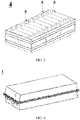
- FIG. 1 is a three-dimensional diagram of a lithium secondary battery according to an embodiment of this application.
- FIG. 2 is an exploded view of the lithium secondary battery in FIG. 1 .
- the lithium secondary battery 5 (hereinafter referred to as a battery cell 5) according to this application includes a housing 51, an electrode assembly 52, and a top cover assembly 53.
- the electrode assembly 52 is accommodated in the housing 51.
- a quantity of the electrode assemblies 52 is not limited, and may be one or more.
- the battery cell 5 in FIG. 1 is a tank type battery, but is not limited thereto in this application.
- the battery cell 5 may be a bag type battery, which means that the housing 51 is replaced with a metal plastic film and the top cover assembly 53 is eliminated.
- the positive electrode includes a positive electrode active substance that can release and accept lithium ions and the foregoing lithium supplement.
- the positive electrode active substance includes at least one of the compounds expressed by formula (I) to formula (III): Li 1+x1 Ni a1 Co b1 M' 1-a1-b1 O 2-y1 Ay 1 (I); Li 1+x2 Mn a2 M" 2-a2 O 4-d A' d (II); and LiFe (1-x3-y3) Mn x3 M′′′ y3 PO 4 (III).
- M' is one or more of Mn, Fe, Cr, Ti, Zn, V, Al, Zr, and Ce
- A includes one or more of S, N, F, Cl, Br, and I; and optionally, 0.5 ⁇ a1 ⁇ 1, 0 ⁇ b1 ⁇ 0.5, 0.7 ⁇ a1+b1 ⁇ 1, and 0 ⁇ y ⁇ 0.1
- M is either one or both of Mn and Al
- A is either one or both of S or F.
- M includes one or more of Ni, Fe, Cr, Ti, Zn, V, Al, Mg, Zr, and Ce
- A' includes one or more of S, N, F, Cl, Br, and I.
- M' is selected from one or more of transition metal elements other than Fe and Mn and non-transition metal elements.
- the positive electrode active substance includes at least the compound expressed by the formula (III).
- the positive electrode active substance is selected from one or more of LiFePO 4 , Li 3 V 2 (PO 4 ) 3 , LiFe y Mn 1-y PO 4 , LiNi 0.8 Co 0.15 Al 0.05 O 2 , LiNi 0.8 Co 0.1 Mn 0.1 O 2 , LiNi 0.5 Co 0.2 Mn 0.3 O 2 , LiMnO 2 , LiMn 2 O 4 , LiCoO 2 , LiMnPO 4 , and LiNiO 2 , where 0 ⁇ y ⁇ 1.
- the positive electrode active substance is LiFePO 4 .
- the positive electrode active substance is LiNi 0.8 Co 0.1 Mn 0.1 O 2 (namely, NCM 811).
- pH of the compound expressed by the formula (I) is denoted as pH c
- pH of the lithium supplement is denoted as pH L
- pH c ⁇ pH L holds.
- pH L ⁇ 1.5 ⁇ pH c
- pH L ⁇ 1.1 ⁇ pH c .
- the lithium supplement and the ternary positive electrode active substance can coexist stably in a positive electrode slurry, improving ease of processing of the lithium supplement in the lithium secondary battery and uniform distribution of compositions on a positive electrode plate, which helps mass production and enables the battery have both high energy density and low self-discharge rate.
- pH c can be determined by using the same method as that for testing pH L of the lithium supplement.
- a conductive agent used for the positive electrode is not specifically limited and may be approximately selected according to actual needs, for example, a conductive agent in the art commonly used for the positive electrode, provided that the technical solution of this application can be implemented.
- the conductive agent is carbon black.
- a binder used for the positive electrode is not specifically limited and may be appropriately selected according to actual needs, for example, a binder in the art commonly used for the positive electrode, provided that the technical solution of this application can be implemented.
- the binder is one or more of polyvinylidene fluoride (PVDF), styrene-butadiene rubber (SBR), and sodium carboxymethyl cellulose (CMC-Na).
- a negative electrode used in the lithium secondary battery is not specifically limited, may be appropriately selected according to actual needs, and can be those negative electrodes commonly used in lithium secondary batteries, provided that the technical solution of this application can be implemented.
- the negative electrode includes a negative electrode active substance that can accept and release lithium ions.
- the negative electrode active substance is selected from soft carbon, hard carbon, artificial graphite, natural graphite, silicon, a silicon-oxygen compound, a silicon carbon composite, lithium titanate, a metal that can form an alloy with lithium, and the like.
- the negative electrode active substance may select a negative electrode active substance with a high gram capacity, such as silicon, silicon-oxygen compound, and silicon carbon composite with a high gram capacity.
- the substance of a separator used in the lithium secondary battery is not limited herein and can be selected according to actual needs.
- the separator is a polyethylene film (PE).
- the separator is a polyethylene film (PE) with a thickness of 12 ⁇ m.
- the positive electrode In a specific application, the positive electrode generally needs to be further processed into a positive electrode plate for use.
- a structure and preparation method of the positive electrode plate are known in the art.
- the positive electrode active substance, conductive agent, binder, and lithium supplement are uniformly mixed in an organic solvent, and then applied onto a positive electrode current collector (for example, an Al foil), followed by drying and cold pressing to obtain a positive electrode plate.
- a positive electrode current collector for example, an Al foil
- the negative electrode generally needs to be further processed into a negative electrode plate for use.
- a structure and preparation method of the negative electrode plate are known in the art.
- the negative electrode active substance, the conductive agent, the binder, and a thickener are uniformly mixed in a solvent, and then applied onto a negative electrode current collector (for example, a Cu foil), followed by drying and cold pressing to obtain a negative electrode plate.
- the negative electrode active substance, conductive agent, binder, thickener, and solvent that are used for the negative electrode are all conventional reagents used for the lithium secondary battery, and details are not described herein.
- an electrolyte used in the lithium secondary battery is not specifically limited and may be appropriately selected according to actual needs, for example, an electrolyte in the art commonly used in the lithium secondary battery, provided that the technical solution of this application can be implemented.
- the electrolyte can be one of ethylene carbonate (EC) and ethyl methyl carbonate (EMC) or any combination thereof, for example, the two may be mixed in any ratio in a mass ratio of 1:9, 2:8, 3:7, or 4:6.
- the battery module according to the fourth aspect of this application includes the foregoing lithium secondary battery of this application.
- FIG. 3 is a three-dimensional diagram of a battery module according to an embodiment of this application.
- the battery module of this application may be a battery module 4, which includes a plurality of battery cells 5 arranged in a longitudinal direction.
- the battery module 4 may be used as a power source or an energy storage apparatus.
- a quantity of battery cells 5 included in the battery module 4 may be adjusted based on use and capacity of the battery module 4.
- the battery pack according to the fifth aspect of this application includes the foregoing lithium secondary battery of this application or the foregoing battery module of this application.
- FIG. 4 is a three-dimensional diagram of a battery pack according to another embodiment of this application.
- FIG. 5 is an exploded view of the battery pack in FIG. 4 .
- the battery pack 1 of this application includes an upper box body 2, a lower box body 3, and the battery module 4.
- the upper box body 2 and the lower box body 3 are assembled to form a space for accommodating the battery module 4.
- the battery module 4 is disposed in the space in which the upper box body 2 and the lower box body 3 are assembled.
- An output electrode of the battery module 4 penetrates through one or both of the upper box body 2 and the lower box body 3 to output power or to charge from an outer source.
- the battery pack 1 may be used as a power source or an energy storage apparatus.
- the apparatus according to the sixth aspect of this application includes the foregoing lithium secondary battery of this application, or the foregoing battery module of this application, or the foregoing battery pack of this application.
- the lithium secondary battery, the battery module, or the battery pack may be used as a power source of the apparatus of this application or an energy storage unit of the apparatus.
- FIG. 6 is a schematic diagram of an apparatus using a lithium secondary battery as a power source according to an embodiment of this application.
- the apparatus that uses the battery cell 5 is an electric automobile.
- the apparatus that uses the battery cell 5 is obviously not limited to this, but may be any electric vehicle other than electric automobiles (for example, an electric bus, an electric tram, an electric bicycle, an electric motorbike, an electric scooter, an electric golf cart, or an electric truck), an electric vessel, an electric tool, a consumer electronic product, and an energy storage system.
- the electric vehicle may be a battery electric vehicle, a hybrid electric vehicle, or a plug-in hybrid electric vehicle.
- the apparatus provided in the sixth aspect of this application may include the battery module according to the fourth aspect of this application or the battery pack according to the fifth aspect of this application.
- a carbon-coated positive electrode active material LiFePO 4 (LFP), the prepared lithium supplement, a conductive agent carbon black (Super P), and a binder polyvinylidene fluoride (PVDF) were mixed well in a mass ratio of 94:2:3:1 in a proper amount of solvent N-methylpyrrolidone (NMP) to obtain a positive electrode slurry, where the pH value of the carbon-coated positive electrode active material LiFePO 4 (LFP) was 8.9.
- the positive electrode slurry was applied on a positive electrode current collector aluminum foil, followed by processes such as drying, cold pressing, slitting, and cutting, to obtain a positive electrode plate.
- a negative electrode active material graphite, a conductive agent carbon black (Super P), a binder butadiene styrene rubber (SBR), and sodium carboxymethyl cellulose (CMC-Na) were mixed well in a mass ratio of 96:1.5:1.5:1.0 in a proper amount of solvent deionized water to obtain a negative electrode slurry.
- the negative electrode slurry was applied on a negative electrode current collector copper foil, followed by processes such as drying, cold pressing, slitting, and cutting, to obtain a negative electrode plate.
- the separator was a polyethylene (PE) film.
- Ethylene carbonate (EC) and methyl ethyl carbonate (EMC) were mixed in a mass ratio of 30:70 to obtain an organic solvent; a fully dried electrolytic salt LiPF 6 was dissolved in the above mixed solvent, with a concentration of 1.3 mol/L. Then, 6% fluoroethylene carbonate (FEC) as an additive was added into the mixed solvent and uniformly mixed with the solvent to obtain an electrolyte. A concentration of the electrolytic salt was calculated based on the total volume of the electrolyte, and the additive content is a weight percentage calculated based on the total weight of the electrolyte.
- FEC fluoroethylene carbonate
- the prepared positive electrode plate, the separator, and the negative electrode plate were sequentially stacked, so that the separator was located between the positive electrode plate and the negative electrode plate to provide separation. Then, the stack was wound to form an electrode assembly.
- the electrode assembly was placed in an outer package and the prepared electrolyte was injected into the lithium secondary battery that was dried, followed by processes such as vacuum packaging, standing, formation, and shaping, to obtain a lithium secondary battery.
- the lithium secondary battery of this application was prepared according to the method in Example 1 except that the synthesis temperature in step S2 of preparing the lithium supplement of this example was 670°C. Compositions and parameters of the prepared lithium supplement are given in Table 1 below.
- the lithium secondary battery of this application was prepared according to the method in Example 1 except that the synthesis temperature in step S2 of preparing the lithium supplement of this example was 660°C. Compositions and parameters of the prepared lithium supplement are given in Table 1 below.
- the lithium secondary battery of this application was prepared according to the method in Example 1 except that the synthesis temperature in step S2 of preparing the lithium supplement of this example was 640°C. Compositions and parameters of the prepared lithium supplement are given in Table 1 below.
- the lithium secondary battery of this application was prepared according to the method in Example 1 except that in step S1 of preparing the lithium supplement in this example, magnesium oxide was added, where a molar ratio of Li, Ni, Cu, and Mg was 2.05:0.4:0.55:0.05; and the synthesis temperature in step S2 was 670°C.
- Compositions and parameters of the prepared lithium supplement are given in Table 1 below.
- the lithium secondary battery of this application was prepared according to the method in Example 1 except that the positive electrode active substance used in the positive electrode plate of this example was LiNi 0.5 Co 0.2 Mn 0.3 O 2 .
- Compositions and parameters of the prepared lithium supplement are given in Table 1 below.
- the lithium secondary battery of this application was prepared according to the method in Example 1 except that in step S1 of preparing the lithium supplement in this example, a molar ratio of Li, Ni, and Cu was 2.05:0.1:0.9. Compositions and parameters of the prepared lithium supplement are given in Table 1 below.
- the lithium secondary battery of this application was prepared according to the method in Example 1 except that in step S1 of preparing the lithium supplement in this example, a molar ratio of Li, Ni, and Cu was 2.05:0.2:0.8. Compositions and parameters of the prepared lithium supplement are given in Table 1 below.
- the lithium secondary battery of this application was prepared according to the method in Example 1 except that in step S1 of preparing the lithium supplement in this example, a molar ratio of Li, Ni, and Cu was 2.05:0.6:0.4. Compositions and parameters of the prepared lithium supplement are given in Table 1 below.
- the lithium secondary battery of this application was prepared according to the method in Example 1 except that in step S1 of preparing the lithium supplement in this example, a molar ratio of Li, Ni, and Cu was 2.05:0.9:0.1. Composition and parameters of the lithium supplement are given in Table 1 below.
- the lithium secondary battery in Comparative Example 1 (corresponding to D1 in Table 1) was prepared according to the method in Example 1 except that no lithium supplement was added to the positive electrode plate in this Comparative Example.
- the lithium secondary battery in Comparative Example 2 (corresponding to D2 in Table 1) was prepared according to the method in Example 6 except that no lithium supplement was added to the positive electrode plate in this Comparative Example.
- the lithium secondary battery in Comparative Example 3 (corresponding to D3 in Table 1) was prepared according to the method in Example 1 except that the synthesis temperature in step S2 of preparing the lithium supplement in this Comparative Example was 820°C. Compositions and parameters of the prepared lithium supplement are given in Table 1 below.
- the lithium secondary battery in Comparative Example 4 (corresponding to D4 in Table 1) was prepared according to the method in Example 6 except that the synthesis temperature in step S2 of preparing the lithium supplement in this Comparative Example was 850°C. Compositions and parameters of the prepared lithium supplement are given in Table 1 below.
- test samples of the lithium supplement may be prepared by using the following method: 0.5 g of the lithium supplement prepared in each of the examples and comparative examples was taken, separately ground, and compacted on a surface of a slide, so that test samples of the lithium supplement were obtained, for subsequent XRD analysis.
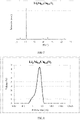
- FIG. 7 shows an XRD pattern of the lithium supplement according to Example 1 of this application, and XRD patterns of the lithium supplements of other examples of this application are basically the same and are not provided herein.
- a Coulomb moisture analyzer with model 831 was used, and 10 g of lithium supplement was taken and heated at 170°C in an 874-model automatic Karl Fischer sample heater, and purged with dry gas at a flow rate of 40 mL/min into a titration vessel to titrate the water concentration for a titration time of 400s.
- a laser particle size analyzer for example, Malvern Mastersizer 2000E, UK was used for measurement.
- FIG. 8 shows a diagram of a particle size distribution of the lithium supplement according to Example 1 of this application. It can be seen that D v 50 of the lithium supplement in Example 1 was 5 ⁇ m.
- each of the lithium secondary batteries in the examples and comparative examples was charged to a charge cutoff voltage (LFP positive electrode: 3.65 V and NCM523 positive electrode: 4.25 V) with a constant current at 1C rate, then charged at a constant voltage until the current was ⁇ 0.05C, and left standing for 5 minutes, then discharged to a discharge cutoff voltage (LFP positive electrode: 2.5 V and NCM523 positive electrode: 2.8 V) with a constant current at 1C rate, and left standing for 5 minutes. This was one charge and discharge cycle.
- the batteries were subjected to charge and discharge cycling until the battery capacity was decayed to 80%. The number of cycles at that point was the cycling performance of the batteries at 25°C. Results are shown in Table 1 and Table 2 below.
- each of the lithium secondary batteries in examples and comparative examples was charged to 50% capacity with a constant current at 1C rate, stored at room temperature for 1 month, then discharged to a discharge cut-off voltage (LFP positive electrode: 2.5 V and NCM523 positive electrode: 2.8 V) with a constant current at 1C rate, and left standing for 5 minutes.
- a difference between the discharge capacity before storage and the discharge capacity after one month of storage/the discharge capacity before storage self-discharge rate per month of the battery. Results are shown in Table 1 and Table 2 below.
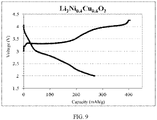
- FIG. 9 is curves showing a change in capacity of a lithium secondary battery in charge and discharge according to Example 1 of this application.
- the lithium secondary batteries in Comparative Examples 3 and 4 have improved cycling performance to some extent, but the self-discharge rates of the batteries were still high, which made the batteries prone to capacity decay during long-term storage.
- the lithium secondary battery of this application was prepared according to the method in Example 1 except that in step S1 of preparing the lithium supplement in this example, a molar ratio of Li, Ni, and Cu was 2.12:0.4:0.6. Compositions and parameters of the prepared lithium supplement are given in Table 2 below.
- the lithium secondary battery of this application was prepared according to the method in Example 1 except that in step S1 of preparing the lithium supplement in this example, a molar ratio of Li, Ni, and Cu was 2.2:0.4:0.6. Compositions and parameters of the prepared lithium supplement are given in Table 2 below.
- the lithium secondary battery of this application was prepared according to the method in Example 1 except that in step S1 of preparing the lithium supplement in this example, a molar ratio of Li, Ni, and Cu was 2.4:0.4:0.6. Compositions and parameters of the prepared lithium supplement are given in Table 2 below.
- the lithium secondary battery of this application was prepared according to the method in Example 1 except that in step S1 of preparing the lithium supplement in this example, a molar ratio of Li, Ni, and Cu was 2.5:0.4:0.6. Compositions and parameters of the prepared lithium supplement are given in Table 2 below.
- the total percentage of free lithium contained in the lithium supplement was adjusted by changing a relative concentration of element Li and other elements in step S1 of preparing the lithium supplement. It can be seen from Table 2 that when the total percentage of free lithium of the lithium supplement was controlled within the above range, the active lithium content and usage rate in the lithium supplement could be effectively improved, thereby helping improve extractable capacity of the lithium supplement.
- the lithium supplement had high electrochemical stability during charging and discharging process of the battery, which could further reduce the self-discharge rate of the battery.
- the lithium secondary battery of this application was prepared according to the method in Example 1 except that in step S4 of preparing the lithium supplement in this example, the wash time with anhydrous ethanol was 2 h. Compositions and parameters of the prepared lithium supplement are given in Table 3 below.
- the lithium secondary battery of this application was prepared according to the method in Example 1 except that in step S4 of preparing the lithium supplement in this example, the wash time with anhydrous ethanol was 1 h. Compositions and parameters of the prepared lithium supplement are given in Table 3 below.
- the lithium secondary battery of this application was prepared according to the method in Example 1 except that in step S4 of preparing the lithium supplement in this example, the wash time with anhydrous ethanol was 0.8 h.
- Compositions and parameters of the prepared lithium supplement are given in Table 3 below.
- the lithium secondary battery of this application was prepared according to the method in Example 1 except that in step S4 of preparing the lithium supplement in this example, the wash time with anhydrous ethanol was 0.2 h. Compositions and parameters of the prepared lithium supplement are given in Table 3 below.
- the lithium secondary battery of this application was prepared according to the method in Example 1 except that in step S4 of preparing the lithium supplement in this example, the wash time with anhydrous ethanol was 0.1 h. Compositions and parameters of the prepared lithium supplement are given in Table 3 below.
- the lithium secondary battery of this application was prepared according to the method in Example 1 except that in step S4 of preparing the lithium supplement in this example, the wash time with anhydrous ethanol was 0 h.
- Compositions and parameters of the prepared lithium supplement are given in Table 3 below.
- the lithium secondary batteries of this application were prepared according to the method in Example 1 except that in step S3 of preparing the lithium supplement in Examples 18-23, the crushed and graded products have different median particle sizes D v 50. Compositions and parameters of the prepared lithium supplement are given in Table 4 below.
- the final particle size distribution of the lithium supplement could be controlled by grading settings of a crushing device. It can be seen from Table 4 that when the median particle size by volume of the lithium supplement was within the above range, excessive loss and relatively low yield of the lithium supplement during crushing could be avoided; and the surface area of the lithium supplement was controlled, stability of the lithium supplement in the positive electrode slurry and an active lithium extraction rate of the lithium supplement in the battery were improved, thereby improving extractable capacity of the lithium supplement and kinetics of the battery.
- the lithium secondary battery of this example was prepared according to the method in Example 1 except that in step S4 of preparing the lithium supplement in this example, the drying time after washing was 10 h.
- Compositions and parameters of the prepared lithium supplement are given in Table 5 below.
- the lithium secondary battery of this example was prepared according to the method in Example 1 except that in step S4 of preparing the lithium supplement in this example, the drying time after washing was 8 h.
- Compositions and parameters of the prepared lithium supplement are given in Table 5 below.
- the lithium secondary battery of this example was prepared according to the method in Example 1 except that in step S4 of preparing the lithium supplement in this example, the drying time after washing was 6 h.
- Compositions and parameters of the prepared lithium supplement are given in Table 5 below.
- the lithium secondary battery of this example was prepared according to the method in Example 1 except that in step S4 of preparing the lithium supplement in this example, the drying time after washing was 2 h.
- Compositions and parameters of the prepared lithium supplement are given in Table 5 below.
- the lithium secondary battery of this example was prepared according to the method in Example 1 except that in step S4 of preparing the lithium supplement in this example, the drying time after washing was 1 h.
- Compositions and parameters of the prepared lithium supplement are given in Table 5 below.
- the water concentration of the lithium supplement was controlled by controlling the drying time after washing.
- the water concentration of the lithium supplement was within the above range, the lithium secondary battery has good cycle life and low self-discharge rate.
- the water concentration of the lithium supplement was controlled within 500 ppm.
- the lithium secondary batteries of this example were prepared according to the method in Example 1 except that the positive electrode active substances in these examples used materials with different pH values. Compositions and parameters of the prepared positive electrode active substances and lithium supplements are shown in Table 6 below.
- the positive electrode active substance was a lithium nickel cobalt manganese metal oxide and the lithium supplement was applied to the positive electrode plates of the ternary positive electrode active substances with different pH values
- pHs of the lithium supplement and the ternary positive electrode active substance satisfied pH L ⁇ 1.5 ⁇ pH c , and further pHL ⁇ 1.1 ⁇ pH c
- the lithium supplement could further improve extractable capacity in the battery, and the battery has prolonged cycle life and effectively reduced storage self-discharge rate.
Landscapes
- Chemical & Material Sciences (AREA)
- Electrochemistry (AREA)
- General Chemical & Material Sciences (AREA)
- Chemical Kinetics & Catalysis (AREA)
- Inorganic Chemistry (AREA)
- Engineering & Computer Science (AREA)
- Composite Materials (AREA)
- Manufacturing & Machinery (AREA)
- Materials Engineering (AREA)
- Organic Chemistry (AREA)
- Crystallography & Structural Chemistry (AREA)
- Secondary Cells (AREA)
- Battery Electrode And Active Subsutance (AREA)
Abstract
Description
- This application pertains to the field of lithium secondary battery technologies, and relates to a lithium supplement for lithium secondary batteries, a preparation method thereof, and a related electric device, and in particular, to a lithium supplement for lithium secondary batteries, a preparation method thereof, and a lithium secondary battery, battery module, battery pack, and apparatus including such lithium supplement.
- Lithium secondary batteries are widely used in various consumer electronic products due to their advantages such as high energy density, long cycle life, and zero memory effect. In recent years, with continuous development of electric vehicles and energy storage systems, requirements for energy density of lithium secondary batteries are also increasing.
- Generally, the energy density of lithium secondary batteries is improved mainly by using high gram capacity active substances or high active substance packing rates, or reducing consumption of active lithium. However, the foregoing improvement approaches are often subjected to high cost, complicated process, or poor processability, which are not conducive to large-scale commercial application and cause huge safety hazards for actual production. In addition, such improvements have notable impact on safety performance of lithium secondary batteries.
- Therefore, developing a method that can effectively improve the energy density of lithium secondary batteries and ensure their good safety performance while achieving high safety and low cost of their manufacture processes, has become a technical problem that needs to be resolved urgently for lithium secondary batteries.
- According to a first aspect, some embodiments of this application provide a lithium supplement for lithium secondary batteries, the lithium supplement includes a compound L having a molecular formula of LixNiaCu1-a-bMbO2, where 1≤x≤2, 0<a<1, and 0≤b<0.1, and M is selected from one or more of Zn, Sn, Mg, Fe, and Mn.
- An XRD pattern of the lithium supplement shows a first diffraction peak at a diffraction angle 2θ of 42°-44° and a second diffraction peak at a diffraction angle 2θ of 25°-27°. A diffraction intensity of the first diffraction peak is I1, a diffraction intensity of the second diffraction peak is I2, and I1/I2<0.1% holds.
- The first diffraction peak corresponds to a diffraction peak of nickel oxide on a (200) crystal plane, and the second diffraction peak corresponds to a diffraction peak of the compound L on a (100) crystal plane.
- Based on total weight of the lithium supplement, a percentage of free lithium contained in the lithium supplement is ≤5wt%, optionally ≤3wt%, and optionally, ≤1wt%.
- The free lithium includes Li2CO3 and LiOH.
pH of the lithium supplement is denoted as pHL, and 11≤pHL≤13 holds; and optionally, 11.5≤pHL≤12.5. - A water concentration of the lithium supplement is not higher than 800 ppm, and optionally, the water concentration of the lithium supplement is not higher than 300 ppm.
- A median particle size by volume Dv50 of the lithium supplement is 2 µm-10 µm, and optionally, the median particle size by volume Dv50 of the lithium supplement is 3 µm-6 µm.
- In the molecular formula of the compound L, 0.1≤a≤0.9; optionally, 0.2≤a≤0.6; and further optionally, 0.2≤a≤0.4.
- The compound L is selected from Li2Ni0.1Cu0.9O2, Li2Ni0.2Cu0.8O2, Li2Ni0.3Cu0.7O2, Li2Ni0.4Cu0.6O2, Li2Ni0.5Cu0.5O2, Li2Ni0.6Cu0.4O2, Li2Ni0.7Cu0.3O2, Li2Ni0.8Cu0.2O2, Li2Ni0.9Cu0.1O2, or Li2Ni0.4Cu0.55Mg0.05O2.
- The lithium supplement further includes a coating layer on at least partial surface of the compound L, and a substance of the coating layer is selected from one or more of metal fluorides, oxides, and phosphates; optionally, the metal fluoride is selected from AlF3; the oxide is selected from one or more of V2O5, Al2O3, ZrO2, TiO2, ZnO, SiO2, and B2O3; and the phosphate is selected from AlPO4, FePO4, Co3(PO4)2, and Ni3(PO4)2.
- According to a second aspect, some embodiments of this application further provide a preparation method of the foregoing lithium supplement for lithium secondary batteries, including the following steps:
- S1: weighing a lithium source, a nickel source, a copper source, and an M source, and mixing them and then performing ball milling, where a molar ratio of Li, Ni, Cu, and M is c:a:(1-a-b):b, 2≤c≤3, 0<a<1, and 0≤b<0.1, and M is selected from one or more of Zn, Sn, Mg, Fe, and Mn; and
- S2: sintering the ball-milled mixture to obtain the lithium supplement.
- In S1, 2.1≤c≤2.7 and 0.1≤a≤0.9; optionally, 2.2≤c≤2.6 and 0.2≤a≤0.6; and further optionally, 0.2≤a≤0.4.
- In S2, the sintering satisfies at least one of the following conditions:
- (1) a temperature rise rate is 1°C/min-10°C/min; and optionally, the temperature rise rate is 3°C/min-5°C/min;
- (2) a sintering temperature is 600°C-800°C; and optionally, the sintering temperature is 650°C-750°C; and
- (3) a temperature hold time is 5 h-20 h; and optionally, the temperature hold time is 6 h-10 h.
- Optionally, the method further includes the following step:
S3: crushing and grading the sintered product obtained in S2 to obtain a graded product with a median particle size Dv50 of 2 µm-10 µm, where optionally, a median particle size by volume Dv50 of the graded product is 3 µm-6 µm. - Optionally, the method further includes the following steps:
- S4: washing the graded product of S3 with absolute ethanol or isopropanol for a wash time of 0 h-2 h, and optionally, 0.2 h-1.5 h; and
- S5: drying or infrared heating the washed product under vacuum or an inert atmosphere, where optionally, the inert atmosphere includes nitrogen or argon, and a temperature for the drying or infrared heating is 100°C-200°C, and a time for the drying or infrared heating is 2 h-12 h.
- Optionally, the method further includes the following step:
S6: ball-milling and coating the lithium supplement with a coating material, where the coating material is selected from one or more of metal fluorides, oxides, and phosphates. - The metal fluoride is selected from AlF3; the oxide is selected from one or more of V2O5, Al2O3, ZrO2, TiO2, ZnO, SiO2, and B2O3; and the phosphate is selected from one or more of AlPO4, FePO4, Co3(PO4)2, and Ni3(PO4)2.
- During preparation, ambient humidity is not higher than 45%; optionally, the ambient humidity is not higher than 30%; and further optionally, the ambient humidity is not higher than 10%.
- The lithium source is selected from one or more of Li2O, Li2CO3, Li2C2O4, CH3COOLi, LiOH·H2O, and LiOH; the nickel source is selected from one or more of Ni2CO3, Ni(OH)2, NiO, NiSO4, Ni(CH3COO)2, and NiC2O4; the copper source is selected from one or more of Cu2(OH)2CO3, Cu(OH)2, CuO, CuSO4, CuC2O4, and Cu(CH3COO)2; and the M source is selected from one or more of ZnO, SnO, MgO, FeO, MnO, ZnF2, SnF2, MgF2, FeF2, and MnF2.
- According to a third aspect, some embodiments of this application further provide a lithium secondary battery, where the lithium secondary battery includes a lithium supplement, and the lithium supplement is the foregoing lithium supplement.
- Optionally, a positive electrode of the lithium secondary battery contains a lithium supplement, and based on total mass of a positive electrode active substance, a mass percentage of the lithium supplement is 0.1wt%-10wt%, and further optionally, the mass percentage of the lithium supplement is 2wt%-8wt%.
- The positive electrode active substance includes at least one of the compounds expressed by formula (I) to formula (III):
Li1+x1Nia1Cob1M'1-a1-b1O2-y1Ay1 (I);
Li1+x2Mna2M"2-a2O4-dA'd (II);
and
LiFe(1-x3-y3)Mnx3M‴y3PO4 (III).
- In the formula (I), -0.1≤x1≤0.2, 0<a1<1, 0<b1<1, 0<a1+b1<1, and 0≤y1<0.2, M' is one or more of Mn, Fe, Cr, Ti, Zn, V, Al, Zr, and Ce, and A includes one or more of S, N, F, Cl, Br, and I; and optionally, 0.5≤a1<1, 0<b1<0.5, 0.7≤a1+b1<1, and 0≤y<0.1, M is either one or both of Mn and Al, and A is either one or both of S or F.
- In the formula (II), -0.1≤x2≤0.2, 0<a2≤2, and 0≤d<1, M" includes one or more of Ni, Fe, Cr, Ti, Zn, V, Al, Mg, Zr, and Ce, and A' includes one or more of S, N, F, Cl, Br, and I.
- In the formula (III), 0≤x3≤1 and 0≤y3≤0.1, and M‴ is selected from one or more of transition metal elements other than Fe and Mn and non-transition metal elements.
- Optionally, the positive electrode active substance includes at least the compound expressed by the formula (III).
- Optionally, when the positive electrode active substance contains the compound expressed by the formula (I), pH of the compound expressed by the formula (I) is denoted as pHc, pH of the lithium supplement is denoted as pHL, and pHc≤pHL holds.
- Optionally, pHL≤1.5×pHc; and optionally, pHL≤1.1×pHc.
- According to a fourth aspect, some embodiments of this application further provide a battery module, including the foregoing lithium secondary battery.
- According to a fifth aspect, some embodiments of this application further provide a battery pack, including the foregoing lithium secondary battery in this application or the foregoing battery module in this application.
- According to a sixth aspect, some embodiments of this application further provide an apparatus, including the foregoing lithium secondary battery, or the foregoing battery module, or the foregoing battery pack, where the lithium secondary battery, the battery module, or the battery pack may serve as a power source of the apparatus or as an energy storage unit of the apparatus.
- When the lithium supplement of this application is used in lithium secondary batteries, the processing technology is simple and requirements for process environmental conditions are low. In addition, the lithium supplement can maintain its own stability and low metal dissolution during long-term use of lithium secondary batteries, effectively improving energy density of lithium secondary batteries and ensuring a low self-discharge rate of lithium secondary batteries, thereby ensuring that the lithium secondary battery has high energy density, long cycle life, and high safety.
- The battery module, the battery pack, and the apparatus that include the lithium supplement of this application have the same advantages as the lithium secondary battery including the lithium supplement.
-
-
FIG. 1 is a three-dimensional diagram of a lithium secondary battery according to an embodiment of this application. -
FIG. 2 is an exploded view of the lithium secondary battery inFIG. 1 . -
FIG. 3 is a three-dimensional diagram of a battery module according to an embodiment of this application. -
FIG. 4 is a three-dimensional diagram of a battery pack according to another embodiment of this application. -
FIG. 5 is an exploded view of the battery pack inFIG. 4 . -
FIG. 6 is a schematic diagram of an apparatus using a lithium secondary battery as a power source according to an embodiment of this application. -
FIG. 7 is an XRD pattern of a lithium supplement according to Example 1 of this application. -
FIG. 8 is a particle size distribution diagram of a lithium supplement according to Example 1 of this application. -
FIG. 9 is curves showing a change in capacity of a lithium secondary battery in charge and discharge according to Example 1 of this application. - Reference signs are: 1. battery pack; 2. upper box body; 3. lower box body; 4. battery module; 5. battery cell; 51. housing; 52. electrode assembly; and 53. top cover assembly.
- To make the objectives, technical solutions, and advantages of this application clearer, the following describes the embodiments of this application in detail with reference to the accompanying drawings. However, those of ordinary skill in the art should understand that these embodiments are only used to illustrate but not limit the technical solutions of this application.
- The following describes in detail a lithium supplement for lithium secondary batteries, a preparation method thereof, and a lithium secondary battery, battery module, battery pack, and apparatus including such lithium supplement according to this application.
- In order to improve energy density of lithium secondary batteries, "pre-lithiation" is generally performed on a negative electrode, a positive electrode, or a separator to supplement lithium ions consumed in forming an SEI film during an initial charging of lithium secondary batteries in advance. It is known that providing lithium metal powder or a lithium strip on a negative electrode of the lithium secondary battery is a relatively common method for supplementing lithium, with advantages of high specific capacity and low consumption of lithium metal. However, this method requires special devices and preparation processes, which is not conducive to large-scale commercial application due to its high costs, complicated preparation processes, harsh production environment, and poor practicability. Most importantly, the lithium metal powder or lithium strip as an active metal reacts violently with moisture in the air, posing a huge safety hazard for practical production.
- In lithium secondary batteries, use of lithium-rich metal oxides as lithium supplements is also a way to improve energy density of batteries. However, when the lithium-rich metal oxides are used, secondary batteries are unstable in extractable capacity during long-term cycling, leading to limited improvement on cycle life and energy density of lithium secondary batteries, which greatly limits application of the lithium-rich metal oxides. In addition, during charging and discharging process of lithium secondary batteries containing lithium-rich metal oxides, secondary batteries are prone to self-discharge or internal short-circuit. Therefore, how to improve energy density of secondary batteries while ensuring that the battery has good electrochemical performance and high safety is a technical problem that needs to be resolved urgently for lithium secondary batteries.
- In the lithium supplement for lithium secondary batteries according to the first aspect of this application, the lithium supplement includes a compound L having a molecular formula of LixNiaCu1-a-bMbO2, where 1≤x≤2, 0<a<1, and 0≤b<0.1, and M is selected from one or more of Zn, Sn, Mg, Fe, and Mn.
- An XRD pattern of the lithium supplement shows a first diffraction peak at a diffraction angle 2θ of 42°-44° and a second diffraction peak at a diffraction angle 2θ of 25°-27°. A diffraction intensity of the first diffraction peak is I1, a diffraction intensity of the second diffraction peak is I2, and I1/I2<0.1% holds.
- The first diffraction peak corresponds to a diffraction peak of nickel oxide on a (200) crystal plane, and the second diffraction peak corresponds to a diffraction peak of the compound L on a (100) crystal plane.
- It is well known in the art that, generally, for perfectly crystallized nickel oxide, the strongest diffraction peak is a diffraction peak corresponding to the (200) crystal plane, and the diffraction peak is located at a diffraction angle 2θ of 43.2°. For perfectly crystallized LiNi0.5Cu0.5O2, the strongest diffraction peak is a diffraction peak corresponding to the (100) crystal plane, and the diffraction peak is located at the diffraction angle 2θ of 26.0°. For the compound L (LixNiaCu1-a-bMbO2) of this application, a doping element M has a small amount in the compound L (0≤b<0.1), which has little effect on a crystal structure of the compound L. Therefore, a peak position of an XRD diffraction pattern of the compound L is almost identical to that of pure LiNi0.5Cu0.5O2. It should be pointed out that a certain error in a material grain size and test instrumentation can cause a small shift of the peak position in the XRD pattern, usually within ±1°.
- In this application, a method for testing the XRD pattern of the lithium supplement can be determined by using an instrument and a method known in the art. As an example, the following method can be used for testing: With Cu as a target material, an X-ray diffractometer of model Bruker D8 Discover is used to perform an XRD test on a test sample of a lithium supplement at a diffraction angle 2θ of 15°-75° under a voltage of 40 kV. The test sample of the lithium supplement can be prepared according to the following methods: 0.5 g-1 g of the lithium supplement is taken for grinding, compacted on a surface of a slide to obtain the test sample of the lithium supplement, and then the foregoing test is performed.
- In this application, the lithium supplement includes the compound L having a molecular formula of LixNiaCu1-a-bMbO2, and when a ratio of peak intensities of the first diffraction peak at a diffraction angle 2θ of 42°-44° to the second diffraction peak at a diffraction angle 2θ of 25°-27° in the XRD pattern of the lithium supplement is I1/I2<0.1%, the lithium supplement can exert a high gram capacity and has good electrochemical stability. When the foregoing lithium supplement is applied to a lithium secondary battery, energy density of the lithium secondary battery can be effectively improved, and during long-term charging and discharging of the lithium secondary battery, self-discharge of the battery can be effectively reduced.
- In an embodiment of this application, I1/I2<0.05%. Optionally, I1/I2<0.01%. Further optionally, I1/I2<0.005%. Specifically, a value of I1/I2 may be 0.1%, 0.09%, 0.08%, 0.07%, 0.06%, 0.05%, 0.04%, 0.03%, 0.02%, 0.01%, 0.009%, 0.008%, 0.007%, 0.006%, 0.005%, or a value within a range obtained by combining any two of the foregoing values.
- In an embodiment of this application, based on total weight of the lithium supplement, a percentage of free lithium contained in the lithium supplement is ≤5wt%. Optionally, the percentage of free lithium contained in the lithium supplement is ≤1wt%. The free lithium (also referred to "residual lithium") mentioned herein refers to lithium-containing oxides, hydroxides, and/or carbonates on the surface of the compound L. In this application, when free lithium is present in the lithium supplement, the presence of these small amounts of free lithium may neutralize hydrofluoric acid generated by decomposition of an electrolyte, weakening corrosive effect on a positive electrode active substance or the lithium supplement in the battery. But when a relative percentage of free lithium is too high, the free lithium has side reactions with the electrolyte, which reduces cycle life of the secondary battery and increases a self-discharge rate of the secondary battery during storage. In an embodiment of this application, for example, including but not limited to, a percentage of free lithium contained in the lithium supplement does not exceed 5wt%, 3wt%, 1wt%, 0.8wt%, 0.5wt%, or 0.3wt% of total weight of the lithium supplement, or a value within a range obtained by combining any two of the foregoing values.
- In this application, a method for testing the percentage of free lithium contained in the lithium supplement is well known in the art. In an example, the following method can be used for testing: 30 g of the lithium supplement is taken and added to 100 mL of deionized water and stirred at a speed of 200 rpm for 30 minutes, free lithium in the test sample is titrated with a standard solution of hydrochloric acid, and a titration end-point is determined by a sudden potential jump using a compound pH electrode as an indicator electrode.
- In an embodiment of this application, the free lithium includes Li2CO3 and LiOH.
- In an embodiment of this application, pH of the lithium supplement is denoted as pHL, and 11≤pHL≤13 holds. Optionally, 11.5≤pHL≤12.5. In this application, when a pH value of the lithium supplement is controlled within the above range, a proportion of active lithium in the lithium supplement can be effectively increased, and chemical coagulation of a positive electrode slurry during processing can be effectively avoided, which is beneficial to manufacturing. In a specific embodiment of this application, pHL of the lithium supplement may be, for example, 11, 11.5, 12, or 12.5, or all ranges and sub-ranges formed by these values. For example, the ranges and sub-ranges include but are not limited to 11-12.5, 11.5-12, or the like.
- In this application, a method for testing pHL of the lithium supplement is well known in the art. In an example, the following method can be used for testing: A Mettler pH meter model S220 is used, and 5 g of the lithium supplement is added to 45 g of CO2-free water (mass ratio of powder to solvent=1:9), stirred at a speed of 200 rpm for 30 minutes, and left standing for 1.5 h. The solution containing the lithium supplement can be tested with the pH meter calibrated.
- In an embodiment of this application, a water concentration of the lithium supplement is ≤800 ppm. In another embodiment of this application, the water concentration of the lithium supplement is ≤300 ppm. Moisture in the lithium supplement reacts with the electrolyte to generate HF, which leads to metal dissolution and increases self-discharge of the lithium secondary battery during use, resulting in an increased self-discharge rate of the lithium secondary battery. In a specific embodiment of this application, the water concentration of the lithium supplement may be, for example, 800 ppm, 500 ppm, 300 ppm, 200 ppm, or 100 ppm, or all ranges and sub-ranges formed by these values. For example, the ranges and sub-ranges include but are not limited to 100 ppm-800 ppm, 100 ppm-500 ppm, 100 ppm-300 ppm, 100 ppm-200 ppm, and the like.
- In this application, a method for testing the water concentration of the lithium supplement is well known in the art. In an example, the following method can be used for testing: A Coulomb moisture meter with model 831 is used, 10 g of the lithium supplement is taken and heated at 170°C in an 874-model automatic Karl Fischer sample heater, and purged with dry gas at a 40 mL/min flow rate into a titration vessel to titrate the water concentration for a titration time of 400s.
- In an embodiment of this application, a median particle size by volume Dv50 of the lithium supplement is 2 µm-10 µm. In another embodiment of this application, the median particle size by volume Dv50 of the lithium supplement is 3 µm-6 µm. A smaller particle size of the lithium supplement indicates a higher specific surface area, greater activity, and a larger area in contact with the electrolyte, so that the lithium secondary battery has a higher extractable capacity during cycling. However, an excessively small particle size makes the powder easily agglomerate, affecting capacity per gram performance. In an embodiment of this application, the median particle size by volume Dv50 of the lithium supplement may be, for example, 1 µm, 2 µm, 3 µm, 5 µm, 6 µm, 8 µm, or 10 µm, or all ranges and sub-ranges formed by these values. For example, the ranges and sub-ranges include but are not limited to 1-10, 2-10, 1-8, 2-8, 1-6, 2-6, 1-5, 2-5, 5-8, 5-10, or the like.
- In this application, a method for testing the median particle size by volume Dv50 of the lithium supplement is well known in the art. As an example, the following method can be used for testing: With reference to the GB/T 19077-2016 particle size distribution laser diffraction method, a laser particle size analyzer (for example, Malvern Mastersizer 2000E, UK) is used for measurement. Dv50 described herein indicates a corresponding particle size when a cumulative volume distribution percentage of the material reaches 50%.
- In an embodiment of this application, in the molecular formula of the compound L, 0<a<1. In another embodiment of this application, in the molecular formula of the compound L, 0.1≤a≤0.9. Optionally, 0.2≤a≤0.6, and further optionally, 0.2≤a≤0.4. In another embodiment of this application, for the compound L, a is 0.1, 0.2, 0.3, 0.4, 0.5, or 0.6.
- In an embodiment of this application, in the molecular formula of the compound L, 0≤b<0.1. In another embodiment of this application, in the molecular formula of the compound L, 0≤b≤0.05. In another embodiment of this application, for the compound L, b=0 or 0.05. In another embodiment of this application, for the compound L, b=0.05.
- In this application, when relative molar ratios a and (1-a-b) of element Ni to element Cu in the compound L are within the above ranges, it is beneficial to synthesize a compound L with higher crystallinity at a lower temperature, effectively reducing production cost, and it can also be ensured that the lithium supplement containing the compound L has a high gram capacity and charge-discharge plateau, helping improve the energy density of the lithium secondary battery.
- In an embodiment of this application, for the compound L, M is selected from one or more of Zn, Sn, Mg, Fe, and Mn. In another embodiment of this application, for the compound L, M is selected from Mg. When the compound L is doped with the element M, a sintering temperature of the compound L can be lowered and crystallinity of the compound L can be improved.
- In an embodiment of this application, the molecular formula of the compound L is LixNiaCu1-aO2, where x and a are as described above.
- In an embodiment of this application, the compound L includes but is not limited to Li2Ni0.1Cu0.9O2, Li2Ni0.2Cu0.8O2, Li2Ni0.3Cu0.7O2, Li2Ni0.4Cu0.6O2, Li2Ni0.5Cu0.5O2, Li2Ni0.6Cu0.4O2, Li2Ni0.7Cu0.3O2, Li2Ni0.8Cu0.2O2, Li2Ni0.9Cu0.1O2, or Li2Ni0.4Cu0.55Mg0.05O2.
- In an embodiment of this application, the lithium supplement further includes a coating material on at least partial surface of the compound L, and the coating material is selected from one or more of metal fluorides, oxides, and phosphates. Optionally, the metal fluoride is selected from AlF3; the oxide is selected from one or more of V2O5, Al2O3, ZrO2, TiO2, ZnO, SiO2, and B2O3; and the phosphate is selected from one or more of AlPO4, FePO4, Co3(PO4)2, and Ni3(PO4)2.
- In this application, when the compound L is further coated with the foregoing material, the water concentration and pH percentage on the surface of the lithium supplement can be further reduced, thereby improving ease of processing and electrochemical stability of the lithium supplement.
- The preparation method of the lithium supplement for lithium secondary batteries according to the second aspect of this application includes the following steps:
- S1: weighing a lithium source, a nickel source, a copper source, and an M source, and mixing them and then performing ball milling, where a molar ratio of Li, Ni, Cu, and M is c:a:(1-a-b):b, 2≤c≤3, 0<a<1, and 0≤b<0.1, and M is selected from one or more of Zn, Sn, Mg, Fe, and Mn; and
- S2: sintering the ball-milled mixture to obtain a lithium supplement.
- In S1, 2.1≤c≤2.7 and 0.1≤a≤0.9; optionally, 2.2≤c≤2.6 and 0.2≤a≤0.6; and further optionally, 0.2≤a≤0.4.
- In S2, the sintering satisfies at least one of the following conditions:
- (1) A temperature rise rate is 1°C/min-10°C/min; and optionally, the temperature rise rate is 3°C/min-5°C/min;
- (2) A sintering temperature is 600°C-800°C; and optionally, the sintering temperature is 650°C-750°C; and
- (3) A temperature hold time is 5 h-20 h; and optionally, the temperature hold time is 6 h-10 h.
- Optionally, the method further includes S3: crushing and grading the sintered product obtained in S2 to obtain a graded product with a median particle size Dv50 of 2 µm-10 µm. Optionally, the median particle size by volume Dv50 of the graded product is 3 µm-6 µm.
- Optionally, the method further includes S4: washing the graded product of S3 with absolute ethanol or isopropanol for a wash time of 0 h-2 h. Optionally, the wash time is 0.2 h-1.5 h.
- Optionally, the method further includes S5: drying or infrared heating the washed product under vacuum or an inert atmosphere. Optionally, the inert atmosphere includes nitrogen or argon, a temperature for the drying or infrared heating is 100°C-200°C, and a time for drying or infrared heating is 2 h-12 h.
- Optionally, the method further includes S6: performing ball milling and coating on a target lithium supplement with a coating material, where the coating material is selected from one or more of metal fluorides, oxides, and phosphates.
- In a specific embodiment of this application, the metal fluoride is selected from AlF3.
- In a specific embodiment of this application, the oxide is selected from one or more of V2O5, Al2O3, ZrO2, TiO2, ZnO, SiO2, and B2O3.
- In a specific embodiment of this application, the phosphate is selected from one or more of AlPO4, FePO4, Co3(PO4)2, and Ni3(PO4)2.
- In a specific embodiment of this application, the lithium source is selected from one or more of Li2O, Li2CO3, Li2C2O4, CH3COOLi, LiOH·H2O, and LiOH.
- In a specific embodiment of this application, the nickel source is selected from one or more of Ni2CO3, Ni(OH)2, NiO, NiSO4, Ni(CH3COO)2, and NiC2O4.
- In a specific embodiment of this application, the copper source is selected from one or more of Cu2(OH)2CO3, Cu(OH)2, CuO, CuSO4, CuC2O4, and Cu(CH3COO)2.
- In a specific embodiment of this application, the M source is selected from one or more of ZnO, SnO, MgO, FeO, MnO, ZnF2, SnF2, MgF2, FeF2, and MnF2.
- Optionally, during preparation, ambient humidity is not higher than 45%. Optionally, the ambient humidity is not higher than 30%. Further optionally, the ambient humidity is not higher than 10%.
- The lithium secondary battery according to the third aspect of this application includes the foregoing lithium supplement. Optionally, a positive electrode of the lithium secondary battery contains a lithium supplement, and based on total mass of a positive electrode active substance, a mass percentage of the lithium supplement is 0.1wt%-10wt%; and further optionally, a mass percentage of the lithium supplement is 2wt%-8wt%.
-
FIG. 1 is a three-dimensional diagram of a lithium secondary battery according to an embodiment of this application.FIG. 2 is an exploded view of the lithium secondary battery inFIG. 1 . Referring toFIG. 1 and FIG. 2 , the lithium secondary battery 5 (hereinafter referred to as a battery cell 5) according to this application includes ahousing 51, anelectrode assembly 52, and atop cover assembly 53. Theelectrode assembly 52 is accommodated in thehousing 51. A quantity of theelectrode assemblies 52 is not limited, and may be one or more. - It should be noted that the
battery cell 5 inFIG. 1 is a tank type battery, but is not limited thereto in this application. Thebattery cell 5 may be a bag type battery, which means that thehousing 51 is replaced with a metal plastic film and thetop cover assembly 53 is eliminated. - In an embodiment of this application, the positive electrode includes a positive electrode active substance that can release and accept lithium ions and the foregoing lithium supplement. The positive electrode active substance includes at least one of the compounds expressed by formula (I) to formula (III):
Li1+x1Nia1Cob1M'1-a1-b1O2-y1Ay1 (I);
Li1+x2Mna2M"2-a2O4-dA'd (II);
and
LiFe(1-x3-y3)Mnx3M‴y3PO4 (III).
- In the formula (I), -0.1≤x1≤0.2, 0<a1<1, 0≤b1≤1, 0<a1+b1<1, and 0≤y1<0.2, M' is one or more of Mn, Fe, Cr, Ti, Zn, V, Al, Zr, and Ce, and A includes one or more of S, N, F, Cl, Br, and I; and optionally, 0.5≤a1<1, 0<b1<0.5, 0.7≤a1+b1<1, and 0≤y<0.1, M is either one or both of Mn and Al, and A is either one or both of S or F.
- In the formula (II), -0.1≤x2≤0.2, 0<a2≤2, and 0≤d<1, M" includes one or more of Ni, Fe, Cr, Ti, Zn, V, Al, Mg, Zr, and Ce, and A' includes one or more of S, N, F, Cl, Br, and I.
- In the formula (III), 0≤x3≤1 and 0≤y3≤0.1, and M'" is selected from one or more of transition metal elements other than Fe and Mn and non-transition metal elements.
- Optionally, the positive electrode active substance includes at least the compound expressed by the formula (III).
- In an embodiment of this application, the positive electrode active substance is selected from one or more of LiFePO4, Li3V2(PO4)3, LiFeyMn1-yPO4, LiNi0.8Co0.15Al0.05O2, LiNi0.8Co0.1Mn0.1O2, LiNi0.5Co0.2Mn0.3O2, LiMnO2, LiMn2O4, LiCoO2, LiMnPO4, and LiNiO2, where 0<y<1. In a specific embodiment of this application, the positive electrode active substance is LiFePO4. In another specific embodiment of this application, the positive electrode active substance is LiNi0.8Co0.1Mn0.1O2 (namely, NCM 811).
- In an embodiment of this application, when the positive electrode active substance contains the compound expressed by the formula (I), pH of the compound expressed by the formula (I) is denoted as pHc, pH of the lithium supplement is denoted as pHL, and pHc≤pHL holds. Optionally, pHL≤1.5×pHc. Further optionally, pHL≤1.1×pHc. When pHs of a ternary positive electrode active substance and the lithium supplement satisfy the foregoing relationship, the lithium supplement and the ternary positive electrode active substance can coexist stably in a positive electrode slurry, improving ease of processing of the lithium supplement in the lithium secondary battery and uniform distribution of compositions on a positive electrode plate, which helps mass production and enables the battery have both high energy density and low self-discharge rate.
- In this application, a method for testing pHc of the ternary positive electrode active substance is well known in the art. In an example, pHc can be determined by using the same method as that for testing pHL of the lithium supplement.
- In this specification, a conductive agent used for the positive electrode is not specifically limited and may be approximately selected according to actual needs, for example, a conductive agent in the art commonly used for the positive electrode, provided that the technical solution of this application can be implemented. In an embodiment of this application, the conductive agent is carbon black.
- In this specification, a binder used for the positive electrode is not specifically limited and may be appropriately selected according to actual needs, for example, a binder in the art commonly used for the positive electrode, provided that the technical solution of this application can be implemented. In an embodiment of this application, the binder is one or more of polyvinylidene fluoride (PVDF), styrene-butadiene rubber (SBR), and sodium carboxymethyl cellulose (CMC-Na).
- In this specification, a negative electrode used in the lithium secondary battery is not specifically limited, may be appropriately selected according to actual needs, and can be those negative electrodes commonly used in lithium secondary batteries, provided that the technical solution of this application can be implemented. In an example, in an embodiment of this application, the negative electrode includes a negative electrode active substance that can accept and release lithium ions. The negative electrode active substance is selected from soft carbon, hard carbon, artificial graphite, natural graphite, silicon, a silicon-oxygen compound, a silicon carbon composite, lithium titanate, a metal that can form an alloy with lithium, and the like. Optionally, the negative electrode active substance may select a negative electrode active substance with a high gram capacity, such as silicon, silicon-oxygen compound, and silicon carbon composite with a high gram capacity.
- The substance of a separator used in the lithium secondary battery is not limited herein and can be selected according to actual needs. In an embodiment of this application, the separator is a polyethylene film (PE). In another embodiment of this application, the separator is a polyethylene film (PE) with a thickness of 12 µm.
- In a specific application, the positive electrode generally needs to be further processed into a positive electrode plate for use. A structure and preparation method of the positive electrode plate are known in the art. For example, the positive electrode active substance, conductive agent, binder, and lithium supplement are uniformly mixed in an organic solvent, and then applied onto a positive electrode current collector (for example, an Al foil), followed by drying and cold pressing to obtain a positive electrode plate.
- Similarly, in a specific application, the negative electrode generally needs to be further processed into a negative electrode plate for use. A structure and preparation method of the negative electrode plate are known in the art. For example, the negative electrode active substance, the conductive agent, the binder, and a thickener are uniformly mixed in a solvent, and then applied onto a negative electrode current collector (for example, a Cu foil), followed by drying and cold pressing to obtain a negative electrode plate.
- The negative electrode active substance, conductive agent, binder, thickener, and solvent that are used for the negative electrode are all conventional reagents used for the lithium secondary battery, and details are not described herein.
- In this specification, an electrolyte used in the lithium secondary battery is not specifically limited and may be appropriately selected according to actual needs, for example, an electrolyte in the art commonly used in the lithium secondary battery, provided that the technical solution of this application can be implemented. In an embodiment of this application, the electrolyte can be one of ethylene carbonate (EC) and ethyl methyl carbonate (EMC) or any combination thereof, for example, the two may be mixed in any ratio in a mass ratio of 1:9, 2:8, 3:7, or 4:6.
- The battery module according to the fourth aspect of this application includes the foregoing lithium secondary battery of this application.
-
FIG. 3 is a three-dimensional diagram of a battery module according to an embodiment of this application. Referring toFIG. 3 , the battery module of this application may be abattery module 4, which includes a plurality ofbattery cells 5 arranged in a longitudinal direction. - The
battery module 4 may be used as a power source or an energy storage apparatus. A quantity ofbattery cells 5 included in thebattery module 4 may be adjusted based on use and capacity of thebattery module 4. - The battery pack according to the fifth aspect of this application includes the foregoing lithium secondary battery of this application or the foregoing battery module of this application.
-
FIG. 4 is a three-dimensional diagram of a battery pack according to another embodiment of this application.FIG. 5 is an exploded view of the battery pack inFIG. 4 . Referring toFIG. 4 andFIG. 5 , thebattery pack 1 of this application includes anupper box body 2, alower box body 3, and thebattery module 4. Theupper box body 2 and thelower box body 3 are assembled to form a space for accommodating thebattery module 4. Thebattery module 4 is disposed in the space in which theupper box body 2 and thelower box body 3 are assembled. - An output electrode of the
battery module 4 penetrates through one or both of theupper box body 2 and thelower box body 3 to output power or to charge from an outer source. - It should be noted that a quantity and an arrangement of the
battery modules 4 used in thebattery pack 1 may be determined according to an actual need. Thebattery pack 1 may be used as a power source or an energy storage apparatus. - The apparatus according to the sixth aspect of this application includes the foregoing lithium secondary battery of this application, or the foregoing battery module of this application, or the foregoing battery pack of this application. The lithium secondary battery, the battery module, or the battery pack may be used as a power source of the apparatus of this application or an energy storage unit of the apparatus.
-
FIG. 6 is a schematic diagram of an apparatus using a lithium secondary battery as a power source according to an embodiment of this application. As an example only, inFIG. 6 , the apparatus that uses thebattery cell 5 is an electric automobile. However, the apparatus that uses thebattery cell 5 is obviously not limited to this, but may be any electric vehicle other than electric automobiles (for example, an electric bus, an electric tram, an electric bicycle, an electric motorbike, an electric scooter, an electric golf cart, or an electric truck), an electric vessel, an electric tool, a consumer electronic product, and an energy storage system. - The electric vehicle may be a battery electric vehicle, a hybrid electric vehicle, or a plug-in hybrid electric vehicle. Certainly, depending on an actual use form, the apparatus provided in the sixth aspect of this application may include the battery module according to the fourth aspect of this application or the battery pack according to the fifth aspect of this application.
- The technical solutions of this application will be further explained below with reference to specific examples. Obviously, the following example embodiments are only used for illustration but no limitations on the technical solutions of this application. All other examples obtained by a person skill in the art based on the examples of this application without creative efforts shall fall within the protection scope of this application.
-
- S1: Li2O, NiO, and CuO powders were weighted with a molar ratio of Li, Ni, and Cu being 2.05:0.4:0.6, and their mixture was ball-milled and mixed well;
- S2: A temperature of the mixture was risen to 680°C at a temperature rise rate of 3°C/min under a nitrogen atmosphere, and the temperature was maintained for 10 h and then naturally reduced;
- S3: A resulting product was crushed and graded to obtain a graded product with Dv50 of about 5 µm; and
- S4: The graded product was then washed with absolute ethanol for 0.5 h and finally baked in a blast oven at 160°C for 12 h to obtain a lithium supplement with compositions and parameters shown in Table 1 below.
- A carbon-coated positive electrode active material LiFePO4 (LFP), the prepared lithium supplement, a conductive agent carbon black (Super P), and a binder polyvinylidene fluoride (PVDF) were mixed well in a mass ratio of 94:2:3:1 in a proper amount of solvent N-methylpyrrolidone (NMP) to obtain a positive electrode slurry, where the pH value of the carbon-coated positive electrode active material LiFePO4 (LFP) was 8.9. The positive electrode slurry was applied on a positive electrode current collector aluminum foil, followed by processes such as drying, cold pressing, slitting, and cutting, to obtain a positive electrode plate.
- A negative electrode active material graphite, a conductive agent carbon black (Super P), a binder butadiene styrene rubber (SBR), and sodium carboxymethyl cellulose (CMC-Na) were mixed well in a mass ratio of 96:1.5:1.5:1.0 in a proper amount of solvent deionized water to obtain a negative electrode slurry. The negative electrode slurry was applied on a negative electrode current collector copper foil, followed by processes such as drying, cold pressing, slitting, and cutting, to obtain a negative electrode plate.
- The separator was a polyethylene (PE) film.
- Ethylene carbonate (EC) and methyl ethyl carbonate (EMC) were mixed in a mass ratio of 30:70 to obtain an organic solvent; a fully dried electrolytic salt LiPF6 was dissolved in the above mixed solvent, with a concentration of 1.3 mol/L. Then, 6% fluoroethylene carbonate (FEC) as an additive was added into the mixed solvent and uniformly mixed with the solvent to obtain an electrolyte. A concentration of the electrolytic salt was calculated based on the total volume of the electrolyte, and the additive content is a weight percentage calculated based on the total weight of the electrolyte.
- The prepared positive electrode plate, the separator, and the negative electrode plate were sequentially stacked, so that the separator was located between the positive electrode plate and the negative electrode plate to provide separation. Then, the stack was wound to form an electrode assembly. The electrode assembly was placed in an outer package and the prepared electrolyte was injected into the lithium secondary battery that was dried, followed by processes such as vacuum packaging, standing, formation, and shaping, to obtain a lithium secondary battery.
- The lithium secondary battery of this application was prepared according to the method in Example 1 except that the synthesis temperature in step S2 of preparing the lithium supplement of this example was 670°C. Compositions and parameters of the prepared lithium supplement are given in Table 1 below.
- The lithium secondary battery of this application was prepared according to the method in Example 1 except that the synthesis temperature in step S2 of preparing the lithium supplement of this example was 660°C. Compositions and parameters of the prepared lithium supplement are given in Table 1 below.
- The lithium secondary battery of this application was prepared according to the method in Example 1 except that the synthesis temperature in step S2 of preparing the lithium supplement of this example was 640°C. Compositions and parameters of the prepared lithium supplement are given in Table 1 below.
- The lithium secondary battery of this application was prepared according to the method in Example 1 except that in step S1 of preparing the lithium supplement in this example, magnesium oxide was added, where a molar ratio of Li, Ni, Cu, and Mg was 2.05:0.4:0.55:0.05; and the synthesis temperature in step S2 was 670°C. Compositions and parameters of the prepared lithium supplement are given in Table 1 below.
- The lithium secondary battery of this application was prepared according to the method in Example 1 except that the positive electrode active substance used in the positive electrode plate of this example was LiNi0.5Co0.2Mn0.3O2. Compositions and parameters of the prepared lithium supplement are given in Table 1 below.
- The lithium secondary battery of this application was prepared according to the method in Example 1 except that in step S1 of preparing the lithium supplement in this example, a molar ratio of Li, Ni, and Cu was 2.05:0.1:0.9. Compositions and parameters of the prepared lithium supplement are given in Table 1 below.
- The lithium secondary battery of this application was prepared according to the method in Example 1 except that in step S1 of preparing the lithium supplement in this example, a molar ratio of Li, Ni, and Cu was 2.05:0.2:0.8. Compositions and parameters of the prepared lithium supplement are given in Table 1 below.
- The lithium secondary battery of this application was prepared according to the method in Example 1 except that in step S1 of preparing the lithium supplement in this example, a molar ratio of Li, Ni, and Cu was 2.05:0.6:0.4. Compositions and parameters of the prepared lithium supplement are given in Table 1 below.
- The lithium secondary battery of this application was prepared according to the method in Example 1 except that in step S1 of preparing the lithium supplement in this example, a molar ratio of Li, Ni, and Cu was 2.05:0.9:0.1. Composition and parameters of the lithium supplement are given in Table 1 below.
- The lithium secondary battery in Comparative Example 1 (corresponding to D1 in Table 1) was prepared according to the method in Example 1 except that no lithium supplement was added to the positive electrode plate in this Comparative Example.
- The lithium secondary battery in Comparative Example 2 (corresponding to D2 in Table 1) was prepared according to the method in Example 6 except that no lithium supplement was added to the positive electrode plate in this Comparative Example.
- The lithium secondary battery in Comparative Example 3 (corresponding to D3 in Table 1) was prepared according to the method in Example 1 except that the synthesis temperature in step S2 of preparing the lithium supplement in this Comparative Example was 820°C. Compositions and parameters of the prepared lithium supplement are given in Table 1 below.
- The lithium secondary battery in Comparative Example 4 (corresponding to D4 in Table 1) was prepared according to the method in Example 6 except that the synthesis temperature in step S2 of preparing the lithium supplement in this Comparative Example was 850°C. Compositions and parameters of the prepared lithium supplement are given in Table 1 below.
- With Cu as a target material, an X-ray diffractometer of model Bruker D8 Discover was used to perform XRD analysis of a test sample of a lithium supplement at a diffraction angle 2θ of 15°-75° at a voltage of 40 kV. The test samples of the lithium supplement may be prepared by using the following method: 0.5 g of the lithium supplement prepared in each of the examples and comparative examples was taken, separately ground, and compacted on a surface of a slide, so that test samples of the lithium supplement were obtained, for subsequent XRD analysis.
-
FIG. 7 shows an XRD pattern of the lithium supplement according to Example 1 of this application, and XRD patterns of the lithium supplements of other examples of this application are basically the same and are not provided herein. It can be seen fromFIG. 7 that the XRD pattern shows a first diffraction peak (with diffraction intensity of I1) at a 2θ angle of 43.2°, which corresponds to a diffraction peak position of perfectly crystallized nickel oxide on a (200) crystal plane; that the XRD pattern shows a second diffraction peak (with diffraction intensity of I2) at a 2θ angle of 26.0°, which corresponds to a diffraction peak position of the compound L on a (100) crystal plane; and that I1/I2=0.01%. - 30 g of the lithium supplement prepared in each of the examples was taken and separately added into 100 mL of deionized water and stirred at a rotational speed of 200 r/min for 30 minutes. Free lithium in the test sample was titrated with a standard solution of hydrochloric acid, a titration end-point was determined by a sudden potential jump using a composite pH electrode as an indicator electrode, and then a percentage of free lithium was calculated.
- A Mettler acidity meter with model S220 was used, and 5 g of the sample under test was taken and added to 45 g of CO2-free water (mass ratio of powder to solvent=1:9), stirred at a speed of 200 rpm for 30 minutes, and then left standing for 1.5 h. A pH value of the sample solution under test was measured with the pH meter calibrated.
- A Coulomb moisture analyzer with model 831 was used, and 10 g of lithium supplement was taken and heated at 170°C in an 874-model automatic Karl Fischer sample heater, and purged with dry gas at a flow rate of 40 mL/min into a titration vessel to titrate the water concentration for a titration time of 400s.
- With reference to the GB/T 19077-2016 particle size distribution laser diffraction method, a laser particle size analyzer (for example, Malvern Mastersizer 2000E, UK) was used for measurement.
-
FIG. 8 shows a diagram of a particle size distribution of the lithium supplement according to Example 1 of this application. It can be seen that Dv50 of the lithium supplement in Example 1 was 5 µm. - The plasma emission spectrometer with model ICAP7400 of Thermo Fisher Scientific, USA, was used for measurement by the ICP method. The specific method and principle were as follows: 2 g of lithium supplement was taken and vaporized in high-energy plasma and then ionized. In this process, all elements had their specific spectral lines and measured by using an electron multiplier, which could quantitatively analyze chemical composition elements in the lithium supplement.
- At 25°C, each of the lithium secondary batteries in the examples and comparative examples was charged to a charge cutoff voltage (LFP positive electrode: 3.65 V and NCM523 positive electrode: 4.25 V) with a constant current at 1C rate, then charged at a constant voltage until the current was ≤0.05C, and left standing for 5 minutes, then discharged to a discharge cutoff voltage (LFP positive electrode: 2.5 V and NCM523 positive electrode: 2.8 V) with a constant current at 1C rate, and left standing for 5 minutes. This was one charge and discharge cycle. The batteries were subjected to charge and discharge cycling until the battery capacity was decayed to 80%. The number of cycles at that point was the cycling performance of the batteries at 25°C. Results are shown in Table 1 and Table 2 below.
- At 25°C, each of the lithium secondary batteries in examples and comparative examples was charged to 50% capacity with a constant current at 1C rate, stored at room temperature for 1 month, then discharged to a discharge cut-off voltage (LFP positive electrode: 2.5 V and NCM523 positive electrode: 2.8 V) with a constant current at 1C rate, and left standing for 5 minutes. This was a one-month storage self-discharge test. A difference between the discharge capacity before storage and the discharge capacity after one month of storage/the discharge capacity before storage=self-discharge rate per month of the battery. Results are shown in Table 1 and Table 2 below.
FIG. 9 is curves showing a change in capacity of a lithium secondary battery in charge and discharge according to Example 1 of this application.Table 1 Example Positive electrode active substance Lithium supplement Lithium secondary battery Compound L I1/I2 Total percentage of free lithium pH value Dv50 (µm) Water concentration (ppm) Cycle life (els to 80% SOH) at 25°C One-month storage self-discharge rate at 25°C 1 LFP Li2Ni0.4Cu0.6O2 0.01% 0.3% 12 5 100 6020 2.25% 2 LFP Li2Ni0.4Cu0.6O2 0.05% 0.3% 12 5 100 5820 2.40% 3 LFP Li2Ni0.4Cu0.6O2 0.07% 0.3% 12 5 100 5630 2.65% 4 LFP Li2Ni0.4Cu0.6O2 0.10% 0.3% 12 5 100 5250 2.80% 5 LFP Li2Ni0.4Cu0.55Mg0.05O2 0.01% 0.3% 12 5 100 6008 2.25% 6 NCM523 Li2Ni0.4Cu0.6O2 0.01% 0.3% 12 5 100 2080 3.24% 7 LFP Li2Ni0.1Cu0.9O2 0.10% 0.3% 12 5 100 5698 2.48% 8 LFP Li2Ni0.2Cu0.8O2 0.10% 0.3% 12 5 100 5930 2.32% 9 LFP Li2Ni0.6Cu0.4O2 0.10% 0.3% 12 5 100 5975 2.28% 10 LFP Li2Ni0.9Cu0.1O2 0.10% 0.3% 12 5 100 5755 2.54% D1 LFP / / / / / / 4530 2.35% D2 NCM523 / / / / / / 1830 3.22% D3 LFP Li2Ni0.4Cu0.6O2 0.15% 0.3% 12 5 100 4860 3.10% D4 NCM523 Li2Ni0.4Cu0.6O2 0.15% 0.3% 12 5 100 1950 3.36% - It can be seen from Table 1 that, compared with Comparative Examples 1 and 2 without using the lithium supplement, the lithium secondary battery including the lithium supplement of this application had significantly improved cycle life at 25°C and had a lower one-month storage self-discharge rate at 25°C. In Comparative Examples 3 and 4, an appropriate amount of lithium supplement was added to the positive electrode, but the I1/I2 of the lithium supplement was higher than 0.1%, indicating that the lithium supplement has lower crystallinity and excessively high content of surface impurity phase. Therefore, compared with the lithium secondary batteries without the lithium supplement in Comparative Examples 1 and 2, the lithium secondary batteries in Comparative Examples 3 and 4 have improved cycling performance to some extent, but the self-discharge rates of the batteries were still high, which made the batteries prone to capacity decay during long-term storage.
- The lithium secondary battery of this application was prepared according to the method in Example 1 except that in step S1 of preparing the lithium supplement in this example, a molar ratio of Li, Ni, and Cu was 2.12:0.4:0.6. Compositions and parameters of the prepared lithium supplement are given in Table 2 below.
- The lithium secondary battery of this application was prepared according to the method in Example 1 except that in step S1 of preparing the lithium supplement in this example, a molar ratio of Li, Ni, and Cu was 2.2:0.4:0.6. Compositions and parameters of the prepared lithium supplement are given in Table 2 below.
- The lithium secondary battery of this application was prepared according to the method in Example 1 except that in step S1 of preparing the lithium supplement in this example, a molar ratio of Li, Ni, and Cu was 2.4:0.4:0.6. Compositions and parameters of the prepared lithium supplement are given in Table 2 below.
- The lithium secondary battery of this application was prepared according to the method in Example 1 except that in step S1 of preparing the lithium supplement in this example, a molar ratio of Li, Ni, and Cu was 2.5:0.4:0.6. Compositions and parameters of the prepared lithium supplement are given in Table 2 below.

- In this application, the total percentage of free lithium contained in the lithium supplement was adjusted by changing a relative concentration of element Li and other elements in step S1 of preparing the lithium supplement. It can be seen from Table 2 that when the total percentage of free lithium of the lithium supplement was controlled within the above range, the active lithium content and usage rate in the lithium supplement could be effectively improved, thereby helping improve extractable capacity of the lithium supplement. The lithium supplement had high electrochemical stability during charging and discharging process of the battery, which could further reduce the self-discharge rate of the battery.
- The lithium secondary battery of this application was prepared according to the method in Example 1 except that in step S4 of preparing the lithium supplement in this example, the wash time with anhydrous ethanol was 2 h. Compositions and parameters of the prepared lithium supplement are given in Table 3 below.
- The lithium secondary battery of this application was prepared according to the method in Example 1 except that in step S4 of preparing the lithium supplement in this example, the wash time with anhydrous ethanol was 1 h. Compositions and parameters of the prepared lithium supplement are given in Table 3 below.
- The lithium secondary battery of this application was prepared according to the method in Example 1 except that in step S4 of preparing the lithium supplement in this example, the wash time with anhydrous ethanol was 0.8 h. Compositions and parameters of the prepared lithium supplement are given in Table 3 below.
- The lithium secondary battery of this application was prepared according to the method in Example 1 except that in step S4 of preparing the lithium supplement in this example, the wash time with anhydrous ethanol was 0.2 h. Compositions and parameters of the prepared lithium supplement are given in Table 3 below.
- The lithium secondary battery of this application was prepared according to the method in Example 1 except that in step S4 of preparing the lithium supplement in this example, the wash time with anhydrous ethanol was 0.1 h. Compositions and parameters of the prepared lithium supplement are given in Table 3 below.
- The lithium secondary battery of this application was prepared according to the method in Example 1 except that in step S4 of preparing the lithium supplement in this example, the wash time with anhydrous ethanol was 0 h. Compositions and parameters of the prepared lithium supplement are given in Table 3 below.

- In this application, after the lithium supplement was washed with absolute ethanol for a period of time, residual lithium precipitated on the surface of the lithium supplement during preparation could be taken away by the detergent, so that its pH value was adjusted. It can be seen from Table 3 that when the pH value of the lithium supplement was controlled within the above range, an active lithium retention rate inside the lithium supplement was relatively high, which helped further improving gram capacity of the lithium supplement.
- The lithium secondary batteries of this application were prepared according to the method in Example 1 except that in step S3 of preparing the lithium supplement in Examples 18-23, the crushed and graded products have different median particle sizes Dv50. Compositions and parameters of the prepared lithium supplement are given in Table 4 below.
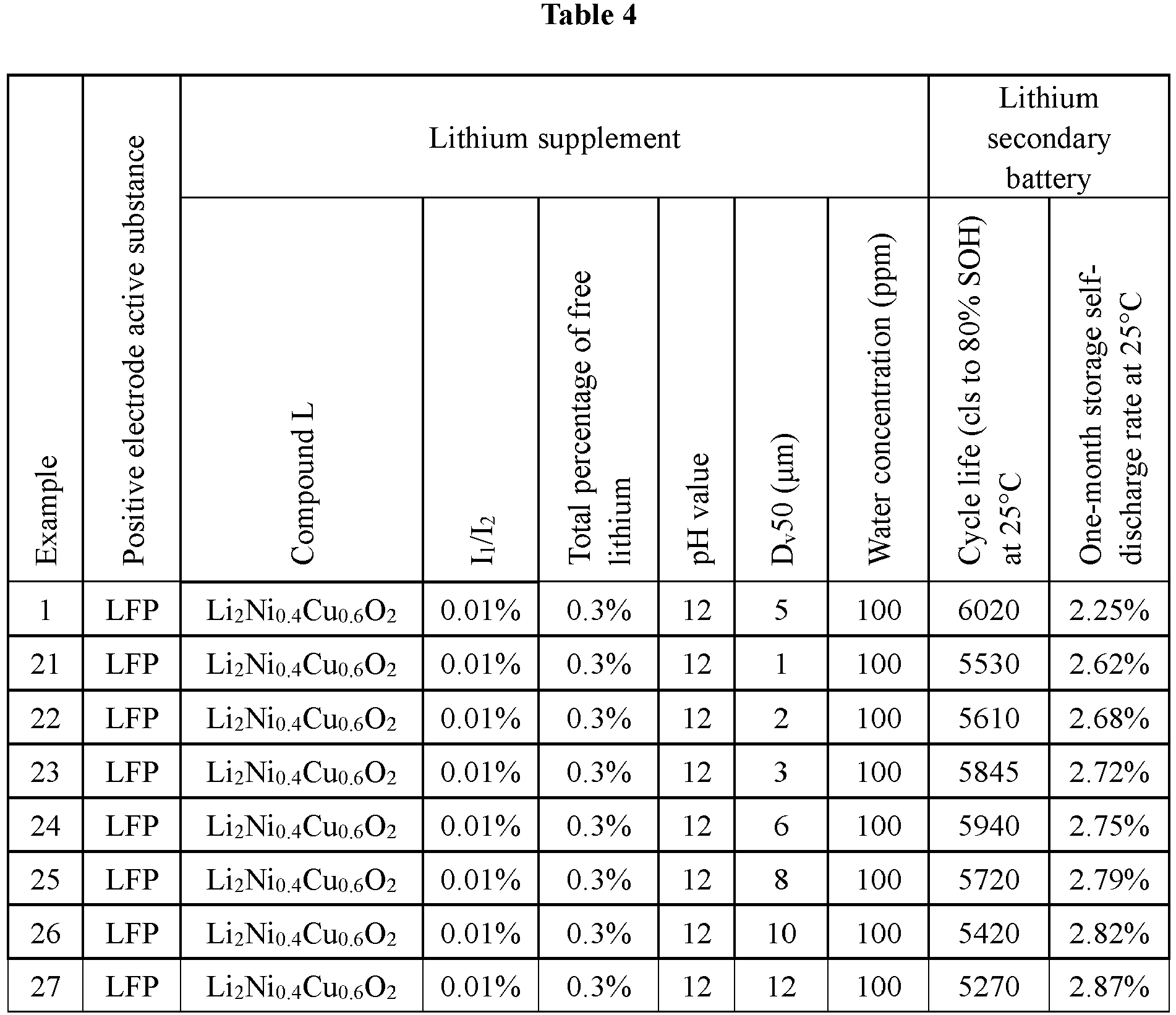
- In this application, the final particle size distribution of the lithium supplement could be controlled by grading settings of a crushing device. It can be seen from Table 4 that when the median particle size by volume of the lithium supplement was within the above range, excessive loss and relatively low yield of the lithium supplement during crushing could be avoided; and the surface area of the lithium supplement was controlled, stability of the lithium supplement in the positive electrode slurry and an active lithium extraction rate of the lithium supplement in the battery were improved, thereby improving extractable capacity of the lithium supplement and kinetics of the battery.
- The lithium secondary battery of this example was prepared according to the method in Example 1 except that in step S4 of preparing the lithium supplement in this example, the drying time after washing was 10 h. Compositions and parameters of the prepared lithium supplement are given in Table 5 below.
- The lithium secondary battery of this example was prepared according to the method in Example 1 except that in step S4 of preparing the lithium supplement in this example, the drying time after washing was 8 h. Compositions and parameters of the prepared lithium supplement are given in Table 5 below.
- The lithium secondary battery of this example was prepared according to the method in Example 1 except that in step S4 of preparing the lithium supplement in this example, the drying time after washing was 6 h. Compositions and parameters of the prepared lithium supplement are given in Table 5 below.
- The lithium secondary battery of this example was prepared according to the method in Example 1 except that in step S4 of preparing the lithium supplement in this example, the drying time after washing was 2 h. Compositions and parameters of the prepared lithium supplement are given in Table 5 below.
- The lithium secondary battery of this example was prepared according to the method in Example 1 except that in step S4 of preparing the lithium supplement in this example, the drying time after washing was 1 h. Compositions and parameters of the prepared lithium supplement are given in Table 5 below.

- In this application, the water concentration of the lithium supplement was controlled by controlling the drying time after washing. When the water concentration of the lithium supplement was within the above range, the lithium secondary battery has good cycle life and low self-discharge rate. Preferably, the water concentration of the lithium supplement was controlled within 500 ppm.
- The lithium secondary batteries of this example were prepared according to the method in Example 1 except that the positive electrode active substances in these examples used materials with different pH values. Compositions and parameters of the prepared positive electrode active substances and lithium supplements are shown in Table 6 below.

- In this application, when the positive electrode active substance was a lithium nickel cobalt manganese metal oxide and the lithium supplement was applied to the positive electrode plates of the ternary positive electrode active substances with different pH values, it could be found that when pHs of the lithium supplement and the ternary positive electrode active substance satisfied pHL≤1.5×pHc, and further pHL≤1.1×pHc, the lithium supplement could further improve extractable capacity in the battery, and the battery has prolonged cycle life and effectively reduced storage self-discharge rate.
- A person of ordinary skill in the art can understand that the foregoing embodiments are only some specific embodiments for implementing this application, and in practical applications, various changes and modifications in forms and details can be made to the foregoing embodiments and fall within the protection scope of this application.
Claims (24)
- A lithium supplement for lithium secondary batteries, wherein the lithium supplement comprises a compound L having a molecular formula of LixNiaCu1-a-bMbO2, wherein 1≤x≤2, 0<a<1, and 0≤b<0.1, and M is selected from one or more of Zn, Sn, Mg, Fe, and Mn;wherein an XRD pattern of the lithium supplement shows a first diffraction peak at a diffraction angle 2θ of 42°-44° and a second diffraction peak at a diffraction angle 2θ of 25°-27°, a diffraction intensity of the first diffraction peak is I1, a diffraction intensity of the second diffraction peak is I2, and I1/I2<0.1% holds,wherein the first diffraction peak corresponds to a diffraction peak of nickel oxide on a (200) crystal plane, and the second diffraction peak corresponds to a diffraction peak of the compound L on a (100) crystal plane.
- The lithium supplement according to claim 1, wherein based on total weight of the lithium supplement, a percentage of free lithium contained in the lithium supplement is ≤5wt%, and optionally, ≤1wt%.
- The lithium supplement according to claim 2, wherein the free lithium comprises Li2CO3 and LiOH.
- The lithium supplement according to any one of claims 1 to 3, wherein pH of the lithium supplement is denoted as pHL, and 11≤pHL≤13 holds; and optionally, 11.5≤pHL≤12.5.
- The lithium supplement according to any one of claims 1 to 4, wherein a water concentration of the lithium supplement is not higher than 800 ppm; and optionally, the water concentration of the lithium supplement is not higher than 300 ppm.
- The lithium supplement according to any one of claims 1 to 5, wherein a median particle size by volume Dv50 of the lithium supplement is 2 µm-10 µm; and optionally, the median particle size by volume Dv50 of the lithium supplement is 3 µm-6 µm.
- The lithium supplement according to any one of claims 1 to 6, wherein, in the molecular formula of the compound L, 0.1≤a≤0.9; optionally, 0.2≤a≤0.6; and further optionally, 0.2≤a≤0.4.
- The lithium supplement according to any one of claims 1 to 7, wherein the compound L is selected from Li2Ni0.1Cu0.9O2, Li2Ni0.2Cu0.8O2, Li2Ni0.3Cu0.7O2, Li2Ni0.4Cu0.6O2, Li2Ni0.5Cu0.5O2, Li2Ni0.6Cu0.4O2, Li2Ni0.7Cu0.3O2, Li2Ni0.8Cu0.2O2, Li2Ni0.9Cu0.1O2, or Li2Ni0.4Cu0.55Mg0.05O2.
- The lithium supplement according to any one of claims 1 to 8, wherein the lithium supplement further comprises a coating material on at least partial surface of the compound L, and the coating material is selected from one or more of metal fluorides, oxides, and phosphates; and
optionally, the metal fluoride is selected from AlF3; the oxide is selected from one or more of V2O5, Al2O3, ZrO2, TiO2, ZnO, SiO2, and B2O3; and the phosphate is selected from one or more of AlPO4, FePO4, Co3(PO4)2, and Ni3(PO4)2. - A preparation method of the lithium supplement for lithium secondary batteries according to any one of claims 1 to 9, comprising the following steps:S1: weighing a lithium source, a nickel source, a copper source, and an M source, and mixing them and then performing ball milling, wherein a molar ratio of Li, Ni, Cu, and M is c:a:(1-a-b):b, 2≤c≤3, 0<a<1, and 0≤b<0.1, and M is selected from one or more of Zn, Sn, Mg, Fe, and Mn; andS2: sintering the ball-milled mixture to obtain the lithium supplement.
- The method according to claim 10, wherein in S1, 2.1≤c≤2.7 and 0.1≤a≤0.9; optionally, 2.2≤c≤2.6 and 0.2≤a≤0.6; and further optionally, 0.2≤a≤0.4.
- The method according to claim 10 or 11, wherein in S2, the sintering satisfies at least one of the following conditions:(1) a temperature rise rate is 1°C/min-10°C/min; and optionally, the temperature rise rate is 3°C/min-5°C/min;(2) a sintering temperature is 600°C-800°C; and optionally, the sintering temperature is 650°C-750°C; and(3) a temperature hold time is 5 h-20 h; and optionally, the temperature hold time is 6 h-10 h.
- The method according to any one of claims 10 to 12, wherein optionally, the method further comprises the following step:
S3: crushing and grading the sintered product obtained in S2 to obtain a graded product with a median particle size Dv50 of 2 µm-10 µm, wherein optionally, a median particle size by volume Dv50 of the graded product is 3 µm-6 µm. - The method according to claim 13, wherein optionally, the method further comprises the following steps:S4: washing the graded product of S3 with absolute ethanol or isopropanol for a wash time of 0 h-2 h, and optionally, 0.2 h-1.5 h; andS5: drying or infrared heating the washed product under vacuum or an inert atmosphere, wherein optionally, the inert atmosphere comprises nitrogen or argon, and a temperature for the drying or infrared heating is 100°C-200°C, and a time for the drying or infrared heating is 2 h-12 h.
- The method according to any one of claims 10 to 14, wherein optionally, the method further comprises the following step:
S6: ball-milling and coating the lithium supplement with a coating material, wherein the coating material is selected from one or more of metal fluorides, oxides, and phosphates. - The method according to claim 15, wherein the metal fluoride is selected from AlF3; the oxide is selected from one or more of V2O5, Al2O3, ZrO2, TiO2, ZnO, SiO2, and B2O3; and the phosphate is selected from one or more of AlPO4, FePO4, Co3(PO4)2, and Ni3(PO4)2.
- The method according to any one of claims 10 to 16, wherein during preparation, ambient humidity is not higher than 45%; optionally, the ambient humidity is not higher than 30%; and further optionally, the ambient humidity is not higher than 10%.
- The method according to any one of claims 10 to 17, wherein the lithium source is selected from one or more of Li2O, Li2CO3, Li2C2O4, CH3COOLi, LiOH·H2O, and LiOH; the nickel source is selected from one or more of Ni2CO3, Ni(OH)2, NiO, NiSO4, Ni(CH3COO)2, and NiC2O4; the copper source is selected from one or more of Cu2(OH)2CO3, Cu(OH)2, CuO, CuSO4, CuC2O4, and Cu(CH3COO)2; and the M source is selected from one or more of ZnO, SnO, MgO, FeO, MnO, ZnF2, SnF2, MgF2, FeF2, and MnF2.
- A lithium secondary battery, wherein the lithium secondary battery comprises a lithium supplement, and the lithium supplement is the lithium supplement according to any one of claims 1 to 9 or the lithium supplement prepared by the method according to any one of claims 10 to 18; and
optionally, a positive electrode of the lithium secondary battery contains a lithium supplement, and based on total mass of a positive electrode active substance, a mass percentage of the lithium supplement is 0.1wt%-10wt%, and further optionally, the mass percentage of the lithium supplement is 2wt%-8wt%. - The lithium secondary battery according to claim 19, wherein the positive electrode active substance comprises at least one of the compounds expressed by formula (I) to formula (III):
Li1+x1Nia1Cob1M'1-a1-b1O2-y1Ay1 (I);
Li1+x2Mna2M"2-a2O4-dA'd (II);
and
LiFe(1-x3-y3)Mnx3M‴y3PO4 (III),
wherein in the formula (I), -0.1≤x1≤0.2, 0<a1<1, 0≤b1≤1, 0<a1+b1<1, and 0≤y1<0.2, M' is one or more of Mn, Fe, Cr, Ti, Zn, V, Al, Zr, and Ce, and A comprises one or more of S, N, F, Cl, Br, and I; and optionally, 0.5≤a1<1, 0<b1<0.5, 0.7≤a1+b1<1, and 0≤y<0.1, M is either one or both of Mn and Al, and A is either one or both of S or F;wherein in the formula (II), -0.1≤x2≤0.2, 0<a2≤2, and 0≤d<1, M" comprises one or more of Ni, Fe, Cr, Ti, Zn, V, Al, Mg, Zr, and Ce, and A' comprises one or more of S, N, F, Cl, Br, and I;wherein in the formula (III), 0≤x3≤1 and 0≤y3≤0.1, and M'" is selected from one or more of transition metal elements other than Fe and Mn and non-transition metal elements; andoptionally, the positive electrode active substance comprises at least the compound expressed by the formula (III). - The lithium secondary battery according to claim 20, wherein when the positive electrode active substance contains the compound expressed by the formula (I), pH of the compound expressed by the formula (I) is denoted as pHc, pH of the lithium supplement is denoted as pHL, and pHc≤pHL holds,
optionally, pHL≤1.5×pHc; and optionally, pHL≤1.1×pHc. - A battery module, comprising the lithium secondary battery according to any one of claims 19 to 21.
- A battery pack, comprising the lithium secondary battery according to any one of claims 19 to 21 or the battery module according to claim 22.
- An apparatus, comprising the lithium secondary battery according to any one of claims 19 to 21, or the battery module according to claim 22, or the battery pack according to claim 23, wherein the lithium secondary battery, the battery module, or the battery pack may serve as a power source or an energy storage unit for the apparatus.
Applications Claiming Priority (1)
| Application Number | Priority Date | Filing Date | Title |
|---|---|---|---|
| PCT/CN2020/131475 WO2022109871A1 (en) | 2020-11-25 | 2020-11-25 | Lithium compensation agent for lithium secondary battery, preparation method for lithium compensation agent, and lithium secondary battery, battery module, battery pack, and device |
Publications (2)
| Publication Number | Publication Date |
|---|---|
| EP4120397A1 true EP4120397A1 (en) | 2023-01-18 |
| EP4120397A4 EP4120397A4 (en) | 2023-12-20 |
Family
ID=81755023
Family Applications (1)
| Application Number | Title | Priority Date | Filing Date |
|---|---|---|---|
| EP20962762.9A Pending EP4120397A4 (en) | 2020-11-25 | 2020-11-25 | LITHIUM COMPENSATION AGENT FOR LITHIUM SECONDARY BATTERY, METHOD FOR PREPARING LITHIUM COMPENSATION AGENT, AND LITHIUM SECONDARY BATTERY, BATTERY MODULE, BATTERY PACK AND DEVICE |
Country Status (4)
| Country | Link |
|---|---|
| US (1) | US20230207812A1 (en) |
| EP (1) | EP4120397A4 (en) |
| CN (1) | CN115989606B (en) |
| WO (1) | WO2022109871A1 (en) |
Families Citing this family (3)
| Publication number | Priority date | Publication date | Assignee | Title |
|---|---|---|---|---|
| CN114914434A (en) * | 2022-06-30 | 2022-08-16 | 广州博粤新材料科技有限公司 | Positive electrode material containing lithium supplement agent and preparation method thereof |
| CN118315577A (en) * | 2022-12-30 | 2024-07-09 | 比亚迪股份有限公司 | Lithium supplement materials, positive electrodes, electrochemical devices and electrical equipment |
| CN120048900A (en) * | 2023-11-27 | 2025-05-27 | 宁德时代新能源科技股份有限公司 | Capacity compensation additive, preparation method thereof, positive electrode plate, battery and electricity utilization device |
Family Cites Families (6)
| Publication number | Priority date | Publication date | Assignee | Title |
|---|---|---|---|---|
| JP3033899B1 (en) * | 1999-01-12 | 2000-04-17 | 宇部興産株式会社 | Positive electrode active material for lithium secondary battery, method for producing the same and use thereof |
| US20140023935A1 (en) * | 2011-04-13 | 2014-01-23 | Nec Corporation | Lithium secondary cell |
| CN108511697A (en) * | 2017-09-28 | 2018-09-07 | 深圳市优特利电源有限公司 | Cupro-nickel acid lithium anode material and preparation method thereof and lithium ion battery |
| KR102646712B1 (en) * | 2017-11-22 | 2024-03-12 | 주식회사 엘지에너지솔루션 | Method for preparing positive electrode additives of lithium secondary battery |
| WO2020086718A1 (en) * | 2018-10-25 | 2020-04-30 | Tesla, Inc. | Active material for electrode and method of manufacturing thereof |
| CN111653770A (en) * | 2020-06-10 | 2020-09-11 | 广东邦普循环科技有限公司 | Positive electrode additive and preparation method and application thereof |
-
2020
- 2020-11-25 EP EP20962762.9A patent/EP4120397A4/en active Pending
- 2020-11-25 WO PCT/CN2020/131475 patent/WO2022109871A1/en not_active Ceased
- 2020-11-25 CN CN202080102730.6A patent/CN115989606B/en active Active
-
2022
- 2022-12-02 US US18/074,416 patent/US20230207812A1/en active Pending
Also Published As
| Publication number | Publication date |
|---|---|
| EP4120397A4 (en) | 2023-12-20 |
| US20230207812A1 (en) | 2023-06-29 |
| CN115989606B (en) | 2025-04-29 |
| WO2022109871A1 (en) | 2022-06-02 |
| CN115989606A (en) | 2023-04-18 |
Similar Documents
| Publication | Publication Date | Title |
|---|---|---|
| JP7375222B2 (en) | Positive electrode active materials, lithium ion secondary batteries, battery modules, battery packs and electrical devices | |
| US11605816B2 (en) | Lithium secondary battery and battery module, battery pack, and electric apparatus containing same | |
| US20160301063A1 (en) | Method for producing surface-treated oxide particles, and oxide particles produced by said production method | |
| US20230207812A1 (en) | Lithium supplement for lithium secondary battery, preparation method thereof, and lithium secondary battery, battery module, battery pack, and apparatus | |
| EP3352261B1 (en) | Non-aqueous electrolyte cell and cell pack | |
| EP4276928A1 (en) | Positive active material, preparation method therefor, positive electrode plate containing positive active material, and secondary battery and electric device | |
| EP4546454A1 (en) | Positive electrode active material, preparation method for positive electrode active material, positive electrode plate, secondary battery, battery module, battery pack and electric device | |
| EP4293777A1 (en) | Secondary battery, battery module, battery pack, and electric device | |
| EP4280300A1 (en) | Positive electrode active material, preparation method therefor, and positive electrode plate, secondary battery, and electric device comprising same | |
| EP4394938A1 (en) | Positive electrode active material, preparation method therefor, positive electrode sheet, secondary battery, battery module, battery pack and electric apparatus | |
| EP4386905A1 (en) | Positive electrode active material and preparation method therefor, positive electrode plate comprising same, secondary battery and electric device | |
| US12519127B2 (en) | Secondary battery, battery module, battery pack, and electric device | |
| EP4672363A1 (en) | POSITIVE ELECTRODE ACTIVE MATERIAL AND MANUFACTURING METHOD THEREOF, POSITIVE ELECTRODE FILM, BATTERY AND ELECTRICAL DEVICE | |
| EP4336593B1 (en) | Positive electrode active material, preparation method therefor and a positive electrode plate comprising same | |
| EP4280301A1 (en) | Positive electrode sheet, secondary battery, battery module, battery pack, and electric apparatus | |
| EP4425607A1 (en) | Secondary battery, battery module, battery pack, and electrical device | |
| US11888154B2 (en) | Positive electrode sheet, secondary battery, battery module, battery pack and electrical apparatus | |
| US20230352674A1 (en) | Positive electrode active material and preparation method therefor, positive electrode plate comprising same, secondary battery, and power consuming device | |
| US20240254003A1 (en) | Positive electrode active material with core-shell structure and preparation method thereof, positive electrode plate, secondary battery, battery module, battery pack, and electric apparatus | |
| EP4675701A1 (en) | Positive electrode active material and preparation method therefor, positive electrode sheet, battery and electric device | |
| US20240120480A1 (en) | Positive electrode active material and preparation method thereof, positive electrode plate, secondary battery, battery module, battery pack, and electric apparatus | |
| EP4358187A1 (en) | Positive electrode plate, secondary battery, battery module, battery pack, and electric apparatus | |
| EP4318655A1 (en) | Positive electrode active material and preparation method therefor, positive electrode sheet, secondary battery, battery module, battery pack and electrical device | |
| EP4421917A1 (en) | Positive electrode active material, preparation method therefor and positive electrode plate containing same, and secondary battery and electric apparatus | |
| EP4362136A1 (en) | Positive electrode active material having core-shell structure and preparation method therefor, positive electrode sheet, secondary battery, battery module, battery pack, and electrical apparatus |
Legal Events
| Date | Code | Title | Description |
|---|---|---|---|
| STAA | Information on the status of an ep patent application or granted ep patent |
Free format text: STATUS: THE INTERNATIONAL PUBLICATION HAS BEEN MADE |
|
| PUAI | Public reference made under article 153(3) epc to a published international application that has entered the european phase |
Free format text: ORIGINAL CODE: 0009012 |
|
| STAA | Information on the status of an ep patent application or granted ep patent |
Free format text: STATUS: REQUEST FOR EXAMINATION WAS MADE |
|
| 17P | Request for examination filed |
Effective date: 20221030 |
|
| AK | Designated contracting states |
Kind code of ref document: A1 Designated state(s): AL AT BE BG CH CY CZ DE DK EE ES FI FR GB GR HR HU IE IS IT LI LT LU LV MC MK MT NL NO PL PT RO RS SE SI SK SM TR |
|
| A4 | Supplementary search report drawn up and despatched |
Effective date: 20231116 |
|
| RIC1 | Information provided on ipc code assigned before grant |
Ipc: H01M 10/0525 20100101ALI20231113BHEP Ipc: H01M 4/525 20100101AFI20231113BHEP |
|
| DAV | Request for validation of the european patent (deleted) | ||
| DAX | Request for extension of the european patent (deleted) | ||
| RAP1 | Party data changed (applicant data changed or rights of an application transferred) |
Owner name: CONTEMPORARY AMPEREX TECHNOLOGY(HONG KONG) LIMITED |