EP4120160A1 - Information processing device, work planning method, and work planning program - Google Patents
Information processing device, work planning method, and work planning program Download PDFInfo
- Publication number
- EP4120160A1 EP4120160A1 EP22162119.6A EP22162119A EP4120160A1 EP 4120160 A1 EP4120160 A1 EP 4120160A1 EP 22162119 A EP22162119 A EP 22162119A EP 4120160 A1 EP4120160 A1 EP 4120160A1
- Authority
- EP
- European Patent Office
- Prior art keywords
- constraint condition
- work
- order
- objects
- products
- Prior art date
- Legal status (The legal status is an assumption and is not a legal conclusion. Google has not performed a legal analysis and makes no representation as to the accuracy of the status listed.)
- Pending
Links
Images




Classifications
-
- G—PHYSICS
- G06—COMPUTING OR CALCULATING; COUNTING
- G06Q—INFORMATION AND COMMUNICATION TECHNOLOGY [ICT] SPECIALLY ADAPTED FOR ADMINISTRATIVE, COMMERCIAL, FINANCIAL, MANAGERIAL OR SUPERVISORY PURPOSES; SYSTEMS OR METHODS SPECIALLY ADAPTED FOR ADMINISTRATIVE, COMMERCIAL, FINANCIAL, MANAGERIAL OR SUPERVISORY PURPOSES, NOT OTHERWISE PROVIDED FOR
- G06Q10/00—Administration; Management
- G06Q10/06—Resources, workflows, human or project management; Enterprise or organisation planning; Enterprise or organisation modelling
- G06Q10/063—Operations research, analysis or management
- G06Q10/0631—Resource planning, allocation, distributing or scheduling for enterprises or organisations
-
- G—PHYSICS
- G06—COMPUTING OR CALCULATING; COUNTING
- G06Q—INFORMATION AND COMMUNICATION TECHNOLOGY [ICT] SPECIALLY ADAPTED FOR ADMINISTRATIVE, COMMERCIAL, FINANCIAL, MANAGERIAL OR SUPERVISORY PURPOSES; SYSTEMS OR METHODS SPECIALLY ADAPTED FOR ADMINISTRATIVE, COMMERCIAL, FINANCIAL, MANAGERIAL OR SUPERVISORY PURPOSES, NOT OTHERWISE PROVIDED FOR
- G06Q10/00—Administration; Management
- G06Q10/06—Resources, workflows, human or project management; Enterprise or organisation planning; Enterprise or organisation modelling
- G06Q10/063—Operations research, analysis or management
- G06Q10/0631—Resource planning, allocation, distributing or scheduling for enterprises or organisations
- G06Q10/06316—Sequencing of tasks or work
-
- G—PHYSICS
- G06—COMPUTING OR CALCULATING; COUNTING
- G06F—ELECTRIC DIGITAL DATA PROCESSING
- G06F17/00—Digital computing or data processing equipment or methods, specially adapted for specific functions
- G06F17/10—Complex mathematical operations
-
- G—PHYSICS
- G06—COMPUTING OR CALCULATING; COUNTING
- G06Q—INFORMATION AND COMMUNICATION TECHNOLOGY [ICT] SPECIALLY ADAPTED FOR ADMINISTRATIVE, COMMERCIAL, FINANCIAL, MANAGERIAL OR SUPERVISORY PURPOSES; SYSTEMS OR METHODS SPECIALLY ADAPTED FOR ADMINISTRATIVE, COMMERCIAL, FINANCIAL, MANAGERIAL OR SUPERVISORY PURPOSES, NOT OTHERWISE PROVIDED FOR
- G06Q10/00—Administration; Management
- G06Q10/04—Forecasting or optimisation specially adapted for administrative or management purposes, e.g. linear programming or "cutting stock problem"
-
- G—PHYSICS
- G06—COMPUTING OR CALCULATING; COUNTING
- G06Q—INFORMATION AND COMMUNICATION TECHNOLOGY [ICT] SPECIALLY ADAPTED FOR ADMINISTRATIVE, COMMERCIAL, FINANCIAL, MANAGERIAL OR SUPERVISORY PURPOSES; SYSTEMS OR METHODS SPECIALLY ADAPTED FOR ADMINISTRATIVE, COMMERCIAL, FINANCIAL, MANAGERIAL OR SUPERVISORY PURPOSES, NOT OTHERWISE PROVIDED FOR
- G06Q10/00—Administration; Management
- G06Q10/06—Resources, workflows, human or project management; Enterprise or organisation planning; Enterprise or organisation modelling
- G06Q10/063—Operations research, analysis or management
- G06Q10/0633—Workflow analysis
-
- G—PHYSICS
- G06—COMPUTING OR CALCULATING; COUNTING
- G06Q—INFORMATION AND COMMUNICATION TECHNOLOGY [ICT] SPECIALLY ADAPTED FOR ADMINISTRATIVE, COMMERCIAL, FINANCIAL, MANAGERIAL OR SUPERVISORY PURPOSES; SYSTEMS OR METHODS SPECIALLY ADAPTED FOR ADMINISTRATIVE, COMMERCIAL, FINANCIAL, MANAGERIAL OR SUPERVISORY PURPOSES, NOT OTHERWISE PROVIDED FOR
- G06Q50/00—Information and communication technology [ICT] specially adapted for implementation of business processes of specific business sectors, e.g. utilities or tourism
- G06Q50/04—Manufacturing
-
- Y—GENERAL TAGGING OF NEW TECHNOLOGICAL DEVELOPMENTS; GENERAL TAGGING OF CROSS-SECTIONAL TECHNOLOGIES SPANNING OVER SEVERAL SECTIONS OF THE IPC; TECHNICAL SUBJECTS COVERED BY FORMER USPC CROSS-REFERENCE ART COLLECTIONS [XRACs] AND DIGESTS
- Y02—TECHNOLOGIES OR APPLICATIONS FOR MITIGATION OR ADAPTATION AGAINST CLIMATE CHANGE
- Y02P—CLIMATE CHANGE MITIGATION TECHNOLOGIES IN THE PRODUCTION OR PROCESSING OF GOODS
- Y02P90/00—Enabling technologies with a potential contribution to greenhouse gas [GHG] emissions mitigation
- Y02P90/30—Computing systems specially adapted for manufacturing
Definitions
- This case relates to an information processing device, a work planning method, and a work planning program.
- a technique for generating a loading order of a work object into a work line with a planning algorithm is required.
- Japanese Laid-open Patent Publication No. 2000-317777 and Japanese Laid-open Patent Publication No. 04-069137 are disclosed as related art.
- an object of this case is to provide an information processing device, a work planning method, and a work planning program that can plan a work order in a short time.
- a work planning program that causes at least one computer to execute a process, the process includes dividing a plurality of objects into a plurality of groups according to a type of a constraint condition set to each of the plurality of objects, the constraint condition being related to an order in which the plurality of objects are worked in a work line; and acquiring an order of the plurality of objects in the work line so that the constraint condition is satisfied in each of the plurality of groups.
- a work order can be planned in a short time.
- an outline of a work line with a multiproduct mixed flow work method will be described.
- different types of products are sequentially loaded into a single work line in a predetermined order and sequentially move on the work line.
- Working is performed on each product according to the predetermined order.
- 12 products having product numbers from 001 to 012 are loaded into the work line from the product with the product number 001.
- the products from the product 001 to the product 012 may include the same type of products and may include different types of products.
- an amount (lot) for working on the same type of products in one work line can be reduced, and a needed amount of work can be performed as needed.
- a production line that is an example of the work line an amount of wasteful stocks and interim products that are not worth as products can be reduced.
- the multiproduct mixed flow work method has a problem in that, when the flowing way is unbalanced, the load on the operator is also unbalanced because different types of products flow on the work line at the same time. For example, when vehicles to which a sunroof is attached continuously flow on the work line, a person in charge of the sunroof continues to work without having a break time. In this case, there is a possibility that an operation error finally occurs and effects on the quality, cost, productivity, or the like increase.
- the multiproduct mixed flow work method it is desirable to plan a work order in consideration of a "constraint condition" such as "a specific type of product and a specific type of product are not sequentially loaded on a work line".
- the constraint condition here is a constraint condition regarding the order of the products flowing on the work line.
- this "constraint condition” has been complicated, and it has been difficult to plan the work order that satisfies the various and complicated "constraint conditions”.
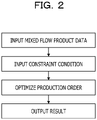
- FIG. 2 is a diagram illustrating a solution method by a mathematical programming solver. As illustrated ion FIG. 2 , first, mixed flow product data is input to the mathematical programming solver. Next, constraint conditions set to each product are input to the mathematical programming solver. Next, the mathematical programming solver calculates a work order of each product so as to optimize the work order. Next, the mathematical programming solver outputs an optimization result.
- This mathematical programming solver generally has a property that the mathematical programming solver can efficiently obtain a result with high quality for a small problem.
- the mathematical programming solver is applied to a site where operations are performed on a large number of products such as 100 to 10,000 pieces per day, there is no guarantee of obtaining a result within a realistic time period (for example, several minutes) that is needed to calculate a planning result. For example, there is a possibility that it is not possible to obtain the result before the work is started. Furthermore, a memory size required for the processing becomes enormous, and there is a case where it is not possible for a real computer to execute processing.
- the information processing device the work planning method, and the work planning program that can plan a work order of each product in a work line in a short time will be described.
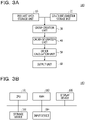
- FIG. 3A is a block diagram illustrating an overall configuration of an information processing device 100.
- the information processing device 100 includes a product data storage unit 10, a constraint condition storage unit 20, a group creation unit 30, an order generation unit 40, an order calculation unit 50, an output unit 60, and the like.
- FIG. 3B is a block diagram illustrating a hardware configuration of the information processing device 100.
- the information processing device 100 includes a CPU 101, a RAM 102, a storage device 103, an input device 104, a display device 105, and the like.
- the central processing unit (CPU) 101 is a central processing unit.
- the CPU 101 includes one or more cores.
- the random access memory (RAM) 102 is a volatile memory that temporarily stores a program to be executed by the CPU 101, data to be processed by the CPU 101, and the like.
- the storage device 103 is a nonvolatile storage device. For example, a read only memory (ROM), a solid state drive (SSD) such as a flash memory, a hard disk to be driven by a hard disk drive, or the like may be used as the storage device 103.
- the storage device 103 stores a work planning program.
- the input device 104 is an input device such as a keyboard or a mouse.
- the display device 105 is a display device such as a liquid crystal display (LCD).
- the CPU 101 executes the work planning program so as to implement the product data storage unit 10, the constraint condition storage unit 20, the group creation unit 30, the order generation unit 40, the order calculation unit 50, and the output unit 60.
- the product data storage unit 10 the constraint condition storage unit 20, the group creation unit 30, the order generation unit 40, the order calculation unit 50, and the output unit 60
- hardware such as a dedicated circuit may also be used.
- FIG. 4A is a diagram illustrating product data stored in the product data storage unit 10.
- the product data is stored in the product data storage unit 10 via the input device 104 or the like.
- the product data storage unit 10 stores a product number on which a work is performed in a work line and a constraint condition number in association with each other.
- An order from the top to the bottom indicates an initial loading order of each product into the work line.
- from a product 001 to a product 012 are loaded into the work line in a product number order.
- the products from the product 001 to the product 012 may include the same type of products and may include different types of products.
- the same work is performed on the same type of products.
- the same constraint conditions are set to the same type of products.
- FIG. 4B is a diagram illustrating constraint conditions stored in the constraint condition storage unit 20.
- the constraint conditions are stored in the constraint condition storage unit 20 via the input device 104 or the like.
- the constraint condition storage unit 20 stores three types of constraint conditions including to work at intervals of one or more other products (constraint condition 1), to work at intervals of two or more other products (constraint condition 2), and to work at intervals of five or more other products (constraint condition 3).
- the constraint condition 1 is provided because painting of the same color is not continuously provided.
- the constraint condition 2 is provided because it is necessary to provide a certain interval since a large vehicle takes time to be assembled.
- the constraint condition 3 is provided because it is necessary to provide a large interval to distribute resources since optional processing such as a sunroof needs a large number of people. As illustrated in FIG. 4A , there is a case where one or more constraint conditions are set to each product or there is a case where no constraint condition is set to each product.
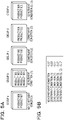
- the group creation unit 30 assigns the same label to each product stored in the product data storage unit 10 to which the same type of constraint condition is set. For example, to each product, the group creation unit 30 assigns labels of a group a of products to which the constraint condition is not set, a group b of products to which only the constraint condition 1 is set, a group c of products to which only the constraint condition 2 is set, a group d of products to which only the constraint condition 3 is set, and a group e of products to which the constraint conditions 1 and 2 are set.
- the label of the group a is assigned to the products 006 and 007
- the label of the group b is assigned to the products 001, 003, 004, and 005.
- the group creation unit 30 calculates a rate of the number of products with each label (appearance rate) with respect to the total number of products stored in the product data storage unit 10. For example, because the number of products to which the label of the group a is assigned is two while the total number of products is 12, as illustrated in FIG. 5B , an appearance rate of the number of products to which the label of the group a is assigned is 0.17. Because the number of products to which the label of the group b is assigned is four, an appearance rate of the number of products to which the label of the group b is assigned is 0.33. Because the number of products to which the labels of the respective groups c to e are assigned is two, an appearance rate of the number of products to which the respective labels of the groups c to e are assigned is 0.17.
- the group creation unit 30 divides the products 001 to 012 into a plurality of groups in order to reduce unbalance of the label types using the calculated appearance rate. For example, the group creation unit 30 divides the products 001 to 012 into a plurality of groups so as to equalize the distribution of the types of the labels.
- the group #1 is a group which is loaded into the work line prior to the group #2.
- the group #1 includes the products 001, 002, 003, 006, 008, and 009.
- the group #2 includes the products 004, 005, 007, 010, 011, and 012.
- the order generation unit 40 determines an order so as to equalize the distribution of the constraint conditions in each of the groups #1 and #2. For example, as illustrated in FIG. 6 , the order generation unit 40 rearranges the products in an order of the product 001, the product 006, the product 002, the product 009, the product 008, and the product 003 in the group #1. Furthermore, the order generation unit 40 rearranges the products in an order of the product 004, the product 007, the product 010, the product 012, the product 011, and the product 005 in the group #2. In this way, the product, to which only the constraint condition 1 is set, that belongs to the group b is the farthest, and the products in the other groups are arranged between the products in the group b and the other products in the group b.
- the constraint condition 1 is set to the products 008, 003, and 004. However, another product is not sandwiched between the product 008 and the product 003, and another product is not sandwiched between the product 003 and the product 004. Therefore, the order in FIG. 6 does not satisfy the constraint condition 1.
- the constraint condition 2 is set to the products 002 and 008. However, two or more other products are not sandwiched between the products 002 and 008. Therefore, the order in FIG. 6 does not satisfy the constraint condition 2.
- the order calculation unit 50 performs optimization by calculating the order of the products so as to satisfy each constraint condition using the mathematical programming solver in each of the groups #1 and #2.
- FIG. 7 is a diagram illustrating optimization.
- the order calculation unit 50 determines whether or not the constraint conditions are satisfied between adjacent groups.
- the constraint condition 3 is not satisfied. Therefore, the order calculation unit 50 replaces the order of the products with another order so that each constraint condition is satisfied between the adjacent groups.
- the output unit 60 outputs an optimization result in FIG. 8 . For example, the result output from the output unit 60 is displayed on the display device 105.
- FIG. 9 is a diagram illustrating an operation of the information processing device 100 described above as a flowchart.
- the product data storage unit 10 stores the product data input via the input device 104 or the like (step S1).
- the product data is the data described with reference to FIG. 4A .
- the constraint condition storage unit 20 stores the constraint conditions input via the input device 104 or the like (step S2).
- the constraint condition is the condition described with reference to FIG. 4B .
- the group creation unit 30 refers to the product data stored in the product data storage unit 10 and assigns the same label to products having the same type of constraint conditions (step S3). As a result, it is possible to perform classification according to the type of the constraint condition. For example, as described with reference to FIG. 5A , the group creation unit 30 assigns the label to each product.
- the group creation unit 30 groups each product according to the appearance rate of each group obtained in step S3 (step S4). As a result, it is possible to perform grouping according to the classification of the constraint conditions in step S3. For example, the group creation unit 30 groups each product according to the appearance rate described with reference to FIG. 5B .
- the order generation unit 40 generates a loading order of products in each group so as to equalize the distribution of the constraint conditions in each group obtained in step S4 (step S5). For example, the order generation unit 40 generates the loading order as described with reference to FIG. 6 .
- the order calculation unit 50 performs optimization by calculating the order of the products so as to satisfy each constraint condition in each group (step S6). In this case, as described with reference to FIGs. 7 and 8 , the order calculation unit 50 optimizes the order of the products so as to satisfy the constraint condition between the adjacent groups.
- the constraint conditions include a constraint that six intervals are provided between the products.
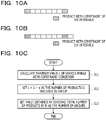
- the six intervals between the products As illustrated in FIG. 10A , it is necessary to include at least eight products in the group.
- the number of products included in the group is set to eight, if two products, to which the constraint for providing six intervals is set, are accidentally included in the group, the corresponding two products are fixed at both ends. Therefore, by focusing on the maximum interval of each constraint condition, the number of products in each group is set to the maximum number of intervals + 2 + ⁇ (margin).
- the margin ⁇ is set to be equal to or more than one.
- FIG. 10C is a flowchart illustrating an example of processing in a case where the group creation unit 30 calculates the number of groups when performing grouping in step S4.
- the group creation unit 30 acquires the maximum interval L of each constraint condition (step S11).
- the group creation unit 30 sets L + 2 + ⁇ as the number of products D included in each group (step S12).
- the group creation unit 30 sets a value obtained by dividing the total number of products included in the product data stored in the product data storage unit 10 by the number of products D as the number of groups (step S13). It is preferable that the number of products in each group be the same. However, in a case where there is a remainder when the total number of products is divided by the number of products D, the remainder may also be added to any one of the groups.
- . An appearance probability T of the number of products to which each label is set is set as T
- B is the total number of products.
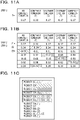
- FIG. 11A is a diagram illustrating the appearance probability T.
- the group creation unit 30 substitutes the appearance probability T into a cumulative appearance probability Z1 (STEP 2).
- the group creation unit 30 calculates a cumulative appearance probability Z2 by adding the appearance probability T to the cumulative appearance probability Z1, allocates a type with the largest cumulative appearance probability to a slot, and subtracts one from that type of the cumulative appearance probability (STEP 3).
- the constraint condition (1) is "0.66" that is the maximum value, and "0.34" is obtained by subtracting "0.66" from one.
- the product 001 to which the constraint condition (1) is set is allocated to the first slot.
- the appearance probability T is added to a cumulative appearance probability Z3.
- "no constraint condition” is "0.51” that is the maximum value, and "0.49” is obtained by subtracting "0.51" from one.
- the product 006 to which no constraint condition is set is allocated to the second slot.
- the products are divided into two or more groups according to the types of the constraint conditions set to each product.
- the type of the constraint condition is considered.
- the loading order to the work line is calculated so that the constraint condition set to each product is satisfied in the group.
- the number of products in the group is less than the total number of products.
- the work order of each product in the work line can be planned in a short time. For example, in a case where the mathematical programming solver is used, although an optimum solution can be calculated with high accuracy, there is a possibility that a calculation time increases. However, because it is sufficient to calculate the work order in each group in the present embodiment, the calculation time is shorter.
- the work order of each product in the work line can be planned more accurately.
- the interval in a case where working is performed on the same type of products has been described as the constraint condition.
- the present embodiment is not limited to this.
- Other constraint conditions regarding the order of the products flowing in the work line can be applied to the embodiment described above.
- This constraint condition is a constraint condition focusing on a situation in which it is desired to alternately arrange right-handle vehicles and left-handle vehicles, the number of right-handle vehicles is larger than the number of left-handle vehicles, and the right-handle vehicles are prevented from being sequentially arranged more than necessary.
- This constraint condition is a constraint condition focusing on that overflowing of a shelf can be prevented in a case where only three parts for electric vehicles can be constantly placed on a parts shelf at the maximum.
- the product is an example of an object to be worked in order in the work line.
- the group creation unit 30 is an example of a group creation unit that divides a plurality of objects into a plurality of groups according to the type of the constraint condition set to each of the plurality of objects.
- the order calculation unit 50 is an example of an order calculation unit that calculates an order of the objects so that the constraint condition set to each object is satisfied in the group.
Landscapes
- Business, Economics & Management (AREA)
- Human Resources & Organizations (AREA)
- Engineering & Computer Science (AREA)
- Strategic Management (AREA)
- Economics (AREA)
- Entrepreneurship & Innovation (AREA)
- Physics & Mathematics (AREA)
- Theoretical Computer Science (AREA)
- General Physics & Mathematics (AREA)
- Marketing (AREA)
- Tourism & Hospitality (AREA)
- General Business, Economics & Management (AREA)
- Game Theory and Decision Science (AREA)
- Operations Research (AREA)
- Quality & Reliability (AREA)
- Development Economics (AREA)
- Educational Administration (AREA)
- Mathematical Physics (AREA)
- Data Mining & Analysis (AREA)
- Mathematical Analysis (AREA)
- Primary Health Care (AREA)
- Algebra (AREA)
- Computational Mathematics (AREA)
- General Health & Medical Sciences (AREA)
- Health & Medical Sciences (AREA)
- Mathematical Optimization (AREA)
- Manufacturing & Machinery (AREA)
- Pure & Applied Mathematics (AREA)
- Databases & Information Systems (AREA)
- Software Systems (AREA)
- General Engineering & Computer Science (AREA)
- Management, Administration, Business Operations System, And Electronic Commerce (AREA)
Abstract
Description
- This case relates to an information processing device, a work planning method, and a work planning program.
- A technique for generating a loading order of a work object into a work line with a planning algorithm is required.
-
Japanese Laid-open Patent Publication No. 2000-317777 Japanese Laid-open Patent Publication No. 04-069137 - In a multiproduct mixed flow work method, different types of products move on a work line. However, there is a problem in that, when a product flowing way is unbalanced, a load on an operator is unbalanced. Therefore, in the multiproduct mixed flow work method, it is desirable to plan a work order in consideration of constraint conditions regarding the order. However, as the constraint conditions become more complicated, it takes longer time to plan the work order.
- In one aspect, an object of this case is to provide an information processing device, a work planning method, and a work planning program that can plan a work order in a short time.
- According to an aspect of the embodiments, a work planning program that causes at least one computer to execute a process, the process includes dividing a plurality of objects into a plurality of groups according to a type of a constraint condition set to each of the plurality of objects, the constraint condition being related to an order in which the plurality of objects are worked in a work line; and acquiring an order of the plurality of objects in the work line so that the constraint condition is satisfied in each of the plurality of groups.
- A work order can be planned in a short time.
-
-
FIG. 1 is a diagram illustrating an order of products; -
FIG. 2 is a diagram illustrating a solution method by a mathematical programming solver; -
FIG. 3A is a block diagram illustrating an overall configuration of an information processing device; -
FIG. 3B is a block diagram illustrating a hardware configuration of the information processing device; -
FIG. 4A is a diagram illustrating product data stored in a product data storage unit; -
FIG. 4B is a diagram illustrating constraint conditions stored in a constraint condition storage unit; -
FIG. 5A is a diagram illustrating a label; -
FIG. 5B is a diagram illustrating an appearance rate; -
FIG. 6 is a diagram illustrating an order in a group; -
FIG. 7 is a diagram illustrating optimization; -
FIG. 8 is a diagram illustrating optimization; -
FIG. 9 is a diagram illustrating an operation of the information processing device as a flowchart; -
FIGs. 10A to 10C are diagrams for explaining details of a method for determining the number of groups; and -
FIGs. 11A to 11C are diagrams for explaining details of a determination method in a case where a product in a group is determined. - Prior to description of an embodiment, an outline of a work line with a multiproduct mixed flow work method will be described. In the multiproduct mixed flow work method, different types of products are sequentially loaded into a single work line in a predetermined order and sequentially move on the work line. Working is performed on each product according to the predetermined order. In the example in
FIG. 1 , 12 products having product numbers from 001 to 012 are loaded into the work line from the product with theproduct number 001. The products from theproduct 001 to theproduct 012 may include the same type of products and may include different types of products. - With the multiproduct mixed flow work method, an amount (lot) for working on the same type of products in one work line can be reduced, and a needed amount of work can be performed as needed. As a result, in a production line that is an example of the work line, an amount of wasteful stocks and interim products that are not worth as products can be reduced.
- On the other hand, the multiproduct mixed flow work method has a problem in that, when the flowing way is unbalanced, the load on the operator is also unbalanced because different types of products flow on the work line at the same time. For example, when vehicles to which a sunroof is attached continuously flow on the work line, a person in charge of the sunroof continues to work without having a break time. In this case, there is a possibility that an operation error finally occurs and effects on the quality, cost, productivity, or the like increase.
- Therefore, in the multiproduct mixed flow work method, it is desirable to plan a work order in consideration of a "constraint condition" such as "a specific type of product and a specific type of product are not sequentially loaded on a work line". The constraint condition here is a constraint condition regarding the order of the products flowing on the work line. In recent years, in order to increase an additional value, the types of products have varied, and this "constraint condition" has been complicated, and it has been difficult to plan the work order that satisfies the various and complicated "constraint conditions".
- As a method for planning the work order in the multiproduct mixed flow work method in consideration of the "constraint conditions", there is a method using a mathematical programming solver.
FIG. 2 is a diagram illustrating a solution method by a mathematical programming solver. As illustrated ionFIG. 2 , first, mixed flow product data is input to the mathematical programming solver. Next, constraint conditions set to each product are input to the mathematical programming solver. Next, the mathematical programming solver calculates a work order of each product so as to optimize the work order. Next, the mathematical programming solver outputs an optimization result. - This mathematical programming solver generally has a property that the mathematical programming solver can efficiently obtain a result with high quality for a small problem. However, in a case where the mathematical programming solver is applied to a site where operations are performed on a large number of products such as 100 to 10,000 pieces per day, there is no guarantee of obtaining a result within a realistic time period (for example, several minutes) that is needed to calculate a planning result. For example, there is a possibility that it is not possible to obtain the result before the work is started. Furthermore, a memory size required for the processing becomes enormous, and there is a case where it is not possible for a real computer to execute processing.
- There is a method for improving a processing time through parallel processing, and the parallel processing has been already implemented in a commercially available mathematical programming solver. However, it is difficult for a current mathematical programming solver to achieve the object described above by improving the processing time several times. Furthermore, it is possible to stop optimization when a determined time period elapsed. However, decrease in the quality of the work order deteriorates the quality, the cost, the productivity, or the like.
- In the following embodiment, the information processing device, the work planning method, and the work planning program that can plan a work order of each product in a work line in a short time will be described.
-
FIG. 3A is a block diagram illustrating an overall configuration of aninformation processing device 100. As illustrated inFIG. 3A , theinformation processing device 100 includes a productdata storage unit 10, a constraintcondition storage unit 20, agroup creation unit 30, anorder generation unit 40, anorder calculation unit 50, anoutput unit 60, and the like. -
FIG. 3B is a block diagram illustrating a hardware configuration of theinformation processing device 100. As illustrated inFIG. 3B , theinformation processing device 100 includes aCPU 101, aRAM 102, astorage device 103, aninput device 104, adisplay device 105, and the like. - The central processing unit (CPU) 101 is a central processing unit. The
CPU 101 includes one or more cores. The random access memory (RAM) 102 is a volatile memory that temporarily stores a program to be executed by theCPU 101, data to be processed by theCPU 101, and the like. Thestorage device 103 is a nonvolatile storage device. For example, a read only memory (ROM), a solid state drive (SSD) such as a flash memory, a hard disk to be driven by a hard disk drive, or the like may be used as thestorage device 103. Thestorage device 103 stores a work planning program. Theinput device 104 is an input device such as a keyboard or a mouse. Thedisplay device 105 is a display device such as a liquid crystal display (LCD). TheCPU 101 executes the work planning program so as to implement the productdata storage unit 10, the constraintcondition storage unit 20, thegroup creation unit 30, theorder generation unit 40, theorder calculation unit 50, and theoutput unit 60. Note that, as the productdata storage unit 10, the constraintcondition storage unit 20, thegroup creation unit 30, theorder generation unit 40, theorder calculation unit 50, and theoutput unit 60, hardware such as a dedicated circuit may also be used. -
FIG. 4A is a diagram illustrating product data stored in the productdata storage unit 10. The product data is stored in the productdata storage unit 10 via theinput device 104 or the like. As illustrated inFIG. 4A , the productdata storage unit 10 stores a product number on which a work is performed in a work line and a constraint condition number in association with each other. An order from the top to the bottom indicates an initial loading order of each product into the work line. In the initial loading order inFIG. 4A , from aproduct 001 to aproduct 012 are loaded into the work line in a product number order. The products from theproduct 001 to theproduct 012 may include the same type of products and may include different types of products. The same work is performed on the same type of products. The same constraint conditions are set to the same type of products. -
FIG. 4B is a diagram illustrating constraint conditions stored in the constraintcondition storage unit 20. The constraint conditions are stored in the constraintcondition storage unit 20 via theinput device 104 or the like. As illustrated inFIG. 4B , the constraintcondition storage unit 20 stores three types of constraint conditions including to work at intervals of one or more other products (constraint condition 1), to work at intervals of two or more other products (constraint condition 2), and to work at intervals of five or more other products (constraint condition 3). For example, theconstraint condition 1 is provided because painting of the same color is not continuously provided. Theconstraint condition 2 is provided because it is necessary to provide a certain interval since a large vehicle takes time to be assembled. Theconstraint condition 3 is provided because it is necessary to provide a large interval to distribute resources since optional processing such as a sunroof needs a large number of people. As illustrated inFIG. 4A , there is a case where one or more constraint conditions are set to each product or there is a case where no constraint condition is set to each product. - The
group creation unit 30 assigns the same label to each product stored in the productdata storage unit 10 to which the same type of constraint condition is set. For example, to each product, thegroup creation unit 30 assigns labels of a group a of products to which the constraint condition is not set, a group b of products to which only theconstraint condition 1 is set, a group c of products to which only theconstraint condition 2 is set, a group d of products to which only theconstraint condition 3 is set, and a group e of products to which theconstraint conditions FIG. 5A , for example, the label of the group a is assigned to theproducts products - Next, the
group creation unit 30 calculates a rate of the number of products with each label (appearance rate) with respect to the total number of products stored in the productdata storage unit 10. For example, because the number of products to which the label of the group a is assigned is two while the total number of products is 12, as illustrated inFIG. 5B , an appearance rate of the number of products to which the label of the group a is assigned is 0.17. Because the number of products to which the label of the group b is assigned is four, an appearance rate of the number of products to which the label of the group b is assigned is 0.33. Because the number of products to which the labels of the respective groups c to e are assigned is two, an appearance rate of the number of products to which the respective labels of the groups c to e are assigned is 0.17. - Next, the
group creation unit 30 divides theproducts 001 to 012 into a plurality of groups in order to reduce unbalance of the label types using the calculated appearance rate. For example, thegroup creation unit 30 divides theproducts 001 to 012 into a plurality of groups so as to equalize the distribution of the types of the labels. The appearance rate = 0.33 of the number of products to which the label of the group b is assigned is twice of the appearance rate = 0.17 of the number of products to which the labels of the other groups a and c to e are assigned. Therefore, for example, thegroup creation unit 30 includes two products to which the label of the group b is assigned and one product to which each of the labels of the groups a and c to e is assigned in each ofgroups # 1 and #2. Thegroup # 1 is a group which is loaded into the work line prior to thegroup # 2. As an example, thegroup # 1 includes theproducts group # 2 includes theproducts - Next, the
order generation unit 40 determines an order so as to equalize the distribution of the constraint conditions in each of thegroups # 1 and #2. For example, as illustrated inFIG. 6 , theorder generation unit 40 rearranges the products in an order of theproduct 001, theproduct 006, theproduct 002, theproduct 009, theproduct 008, and theproduct 003 in thegroup # 1. Furthermore, theorder generation unit 40 rearranges the products in an order of theproduct 004, theproduct 007, theproduct 010, theproduct 012, theproduct 011, and theproduct 005 in thegroup # 2. In this way, the product, to which only theconstraint condition 1 is set, that belongs to the group b is the farthest, and the products in the other groups are arranged between the products in the group b and the other products in the group b. - Here, the constraint conditions of each product in the
groups # 1 and #2 are examined. Theconstraint condition 1 is set to theproducts product 008 and theproduct 003, and another product is not sandwiched between theproduct 003 and theproduct 004. Therefore, the order inFIG. 6 does not satisfy theconstraint condition 1. Furthermore, theconstraint condition 2 is set to theproducts products FIG. 6 does not satisfy theconstraint condition 2. - Therefore, the
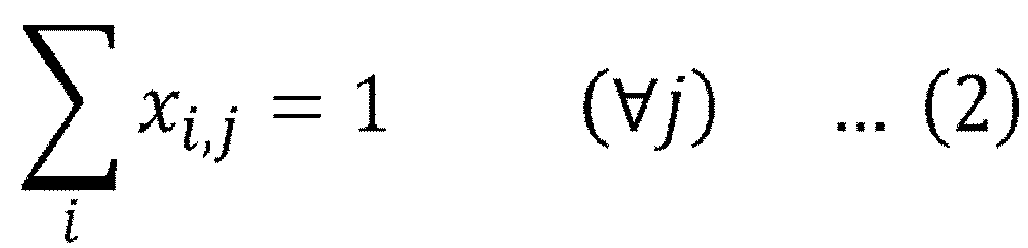
order calculation unit 50 performs optimization by calculating the order of the products so as to satisfy each constraint condition using the mathematical programming solver in each of thegroups # 1 and #2. - Here, the mathematical programming solver will be described. First, it is assumed that only one product is a j-th product to be worked (the following formula (1)). Furthermore, a product i is worked only once (the following formula (2)). The reference Xi,j means that the product i is the j-th product to be worked. Furthermore, Xi,j is "0" or "1".
[Expression 1]
- Next, conditions regarding intervals are determined as in the following formula (3). In the following formula (3), "M" represents a set of interval constraints m. The reference "Cm" represents a distance of an interval to be secured in the interval constraints m. The reference "Rm" represents a set of products to which the interval constraint m is applied.
[Expression 3]
-
FIG. 7 is a diagram illustrating optimization. In the result illustrated inFIG. 7 , in each group, each of the constraint conditions (1) to (4) is satisfied. Next, theorder calculation unit 50 determines whether or not the constraint conditions are satisfied between adjacent groups. In the example inFIG. 7 , five or more other products are not sandwiched between theproducts constraint condition 3 is not satisfied. Therefore, theorder calculation unit 50 replaces the order of the products with another order so that each constraint condition is satisfied between the adjacent groups. In the example inFIG. 8 , the constraint conditions are satisfied between the adjacent groups. Therefore, theoutput unit 60 outputs an optimization result inFIG. 8 . For example, the result output from theoutput unit 60 is displayed on thedisplay device 105. -
FIG. 9 is a diagram illustrating an operation of theinformation processing device 100 described above as a flowchart. As illustrated inFIG. 9 , the productdata storage unit 10 stores the product data input via theinput device 104 or the like (step S1). The product data is the data described with reference toFIG. 4A . Next, the constraintcondition storage unit 20 stores the constraint conditions input via theinput device 104 or the like (step S2). The constraint condition is the condition described with reference toFIG. 4B . - Next, the
group creation unit 30 refers to the product data stored in the productdata storage unit 10 and assigns the same label to products having the same type of constraint conditions (step S3). As a result, it is possible to perform classification according to the type of the constraint condition. For example, as described with reference toFIG. 5A , thegroup creation unit 30 assigns the label to each product. - Next, the
group creation unit 30 groups each product according to the appearance rate of each group obtained in step S3 (step S4). As a result, it is possible to perform grouping according to the classification of the constraint conditions in step S3. For example, thegroup creation unit 30 groups each product according to the appearance rate described with reference toFIG. 5B . - Next, the
order generation unit 40 generates a loading order of products in each group so as to equalize the distribution of the constraint conditions in each group obtained in step S4 (step S5). For example, theorder generation unit 40 generates the loading order as described with reference toFIG. 6 . - Next, the
order calculation unit 50 performs optimization by calculating the order of the products so as to satisfy each constraint condition in each group (step S6). In this case, as described with reference toFIGs. 7 and8 , theorder calculation unit 50 optimizes the order of the products so as to satisfy the constraint condition between the adjacent groups. - Here, details of a method for determining the number of groups in a case where the
group creation unit 30 performs grouping in step S4 will be described. For example, the constraint conditions include a constraint that six intervals are provided between the products. In order to provide the six intervals between the products, as illustrated inFIG. 10A , it is necessary to include at least eight products in the group. However, when the number of products included in the group is set to eight, if two products, to which the constraint for providing six intervals is set, are accidentally included in the group, the corresponding two products are fixed at both ends. Therefore, by focusing on the maximum interval of each constraint condition, the number of products in each group is set to the maximum number of intervals + 2 + α (margin). The margin α is set to be equal to or more than one. -
FIG. 10C is a flowchart illustrating an example of processing in a case where thegroup creation unit 30 calculates the number of groups when performing grouping in step S4. As illustrated inFIG. 10C , thegroup creation unit 30 acquires the maximum interval L of each constraint condition (step S11). Next, thegroup creation unit 30 sets L + 2 + α as the number of products D included in each group (step S12). Next, thegroup creation unit 30 sets a value obtained by dividing the total number of products included in the product data stored in the productdata storage unit 10 by the number of products D as the number of groups (step S13). It is preferable that the number of products in each group be the same. However, in a case where there is a remainder when the total number of products is divided by the number of products D, the remainder may also be added to any one of the groups. - Next, details of a determination method in a case where the
group creation unit 30 determines the product in the group in step S5 will be described. First, thegroup creation unit 30 assigns the same label to all products to which the same type of the constraint condition is set. For example, a set S of the labels is set as S = {S1, S2,..., SN}. The number of products to which each label Si is assigned is set as |Si|. An appearance probability T of the number of products to which each label is set is set as T = |Si| / B. Here, "B" is the total number of products. - The
group creation unit 30 sets a set T of the appearance probability as T = {|S1| / B, |S2| / B,..., |SN| / B} (STEP 1).FIG. 11A is a diagram illustrating the appearance probability T. - Next, as illustrated in
FIG. 11B , thegroup creation unit 30 substitutes the appearance probability T into a cumulative appearance probability Z1 (STEP 2). Next, thegroup creation unit 30 calculates a cumulative appearance probability Z2 by adding the appearance probability T to the cumulative appearance probability Z1, allocates a type with the largest cumulative appearance probability to a slot, and subtracts one from that type of the cumulative appearance probability (STEP 3). In the example inFIG. 11B , the constraint condition (1) is "0.66" that is the maximum value, and "0.34" is obtained by subtracting "0.66" from one. As a result, as illustrated inFIG. 11C , theproduct 001 to which the constraint condition (1) is set is allocated to the first slot. According to the similar procedure, the appearance probability T is added to a cumulative appearance probability Z3. In this case, "no constraint condition" is "0.51" that is the maximum value, and "0.49" is obtained by subtracting "0.51" from one. As a result, as illustrated inFIG. 11C , theproduct 006 to which no constraint condition is set is allocated to the second slot. When the above procedure is repeated and there are no more products to be allocated, the processing ends. - According to the present embodiment, the products are divided into two or more groups according to the types of the constraint conditions set to each product. As a result, at the time of grouping, the type of the constraint condition is considered. Next, the loading order to the work line is calculated so that the constraint condition set to each product is satisfied in the group. As a result, the number of products in the group is less than the total number of products. As described above, because it is sufficient to calculate the loading order for the smaller number of products in each group in consideration of the constraint conditions, the work order of each product in the work line can be planned in a short time. For example, in a case where the mathematical programming solver is used, although an optimum solution can be calculated with high accuracy, there is a possibility that a calculation time increases. However, because it is sufficient to calculate the work order in each group in the present embodiment, the calculation time is shorter.
- By satisfying the constraint condition between the adjacent groups when the loading order is calculated in the group, the work order of each product in the work line can be planned more accurately.
- By assigning the same label to each object to which the same type of constraint condition is set and dividing the objects into the two or more groups so as to reduce the unbalance of the types of the labels between the two or more groups when the products are divided into the groups, conditions close to the optimal solution are satisfied. As a result, a time period needed to search for the optimum solution can be shortened.
- Note that, in the embodiment described above, the interval in a case where working is performed on the same type of products has been described as the constraint condition. However, the present embodiment is not limited to this. Other constraint conditions regarding the order of the products flowing in the work line can be applied to the embodiment described above.
- For example, a constraint condition that "up to two vehicles of the same type are allowed to be arranged in a row" is considered. This constraint condition is a constraint condition focusing on a situation in which it is desired to alternately arrange right-handle vehicles and left-handle vehicles, the number of right-handle vehicles is larger than the number of left-handle vehicles, and the right-handle vehicles are prevented from being sequentially arranged more than necessary.
- Alternatively, it is assumed that four components be mounted on a carriage that shares components. Then, it is assumed that the number of large components that can be mounted on the carriage is three at the maximum and four small components can be mounted at the maximum. In this case, a constraint condition that "up to three vehicles of the same type are allowed to be arranged in a row" is considered. In that case, when this constraint is set to a vehicle to which the large component is mounted, up to four components can be constantly mounted on the carriage.
- Alternatively, a constraint condition that "only three vehicles of the same type are allowed to be included in five continuous vehicles and it does not matter whether or not the three vehicles are continuous" is considered. This constraint condition is a constraint condition focusing on that overflowing of a shelf can be prevented in a case where only three parts for electric vehicles can be constantly placed on a parts shelf at the maximum.
- In each example described above, the product is an example of an object to be worked in order in the work line. The
group creation unit 30 is an example of a group creation unit that divides a plurality of objects into a plurality of groups according to the type of the constraint condition set to each of the plurality of objects. Theorder calculation unit 50 is an example of an order calculation unit that calculates an order of the objects so that the constraint condition set to each object is satisfied in the group. - Although the embodiment of the present invention has been described in detail thus far, the present invention is not limited to such specific embodiment and various modifications and alterations may be made within the scope of the present invention described in the claims.
Claims (15)
- A work planning program that causes at least one computer to execute a process, the process comprising:dividing a plurality of objects into a plurality of groups according to a type of a constraint condition set to each of the plurality of objects, the constraint condition being related to an order in which the plurality of objects are worked in a work line; andacquiring an order of the plurality of objects in the work line so that the constraint condition is satisfied in each of the plurality of groups.
- The work planning program according to claim 1, wherein the acquiring includes acquiring the order so that each constraint condition between adjacent groups is satisfied.
- The work planning program according to claim 1 or 2, wherein the dividing includes:assigning a same label to products with the same type of the constraint condition; andreducing unbalance of the types of the labels between the plurality of groups.
- The work planning program according to any one of claims 1 to 3, wherein the acquiring includes using a mathematical programming solver.
- The work planning program according to any one of claims 1 to 4, wherein the constraint condition includes a condition that determines the number of other objects to be intervened between two objects on which the same work is performed.
- An information processing device comprising:a group generation unit that divides a plurality of objects into a plurality of groups according to a type of a constraint condition set to each of the plurality of objects, the constraint condition being related to an order in which the plurality of objects are worked in a work line; andan order calculation unit that acquires an order of the plurality of objects in the work line so that the constraint condition is satisfied in each of the plurality of groups.
- The information processing device according to claim 6, wherein the order calculation unit further acquires the order so that each constraint condition between adjacent groups is satisfied.
- The information processing device according to claim 6 or 7, wherein the group generation unit further:assigns a same label to products with the same type of the constraint condition, andreduces unbalance of the types of the labels between the plurality of groups.
- The information processing device according to any one of claims 6 to 9, wherein the order calculation unit further that uses a mathematical programming solver.
- The information processing device according to any one of claims 6 to 10, wherein the constraint condition includes a condition that determines the number of other objects to be intervened between two objects on which the same work is performed.
- A work planning method for a computer to execute a process comprising:dividing a plurality of objects into a plurality of groups according to a type of a constraint condition set to each of the plurality of objects, the constraint condition being related to an order in which the plurality of objects are worked in a work line; andacquiring an order of the plurality of objects in the work line so that the constraint condition is satisfied in each of the plurality of groups.
- The work planning method according to claim 11, wherein the acquiring includes acquiring the order so that each constraint condition between adjacent groups is satisfied.
- The work planning method according to claim 11 or 12, wherein the dividing includes:assigning a same label to products with the same type of the constraint condition; andreducing unbalance of the types of the labels between the plurality of groups.
- The work planning method according to any one of claims 11 to 13, wherein the acquiring includes using a mathematical programming solver.
- The work planning method according to any one of claims 11 to 14, wherein the constraint condition includes a condition that determines the number of other objects to be intervened between two objects on which the same work is performed.
Applications Claiming Priority (1)
| Application Number | Priority Date | Filing Date | Title |
|---|---|---|---|
| JP2021117496A JP7709024B2 (en) | 2021-07-16 | 2021-07-16 | Information processing device, work plan creation method, and work plan creation program |
Publications (1)
| Publication Number | Publication Date |
|---|---|
| EP4120160A1 true EP4120160A1 (en) | 2023-01-18 |
Family
ID=80780742
Family Applications (1)
| Application Number | Title | Priority Date | Filing Date |
|---|---|---|---|
| EP22162119.6A Pending EP4120160A1 (en) | 2021-07-16 | 2022-03-15 | Information processing device, work planning method, and work planning program |
Country Status (4)
| Country | Link |
|---|---|
| US (1) | US12008499B2 (en) |
| EP (1) | EP4120160A1 (en) |
| JP (1) | JP7709024B2 (en) |
| CN (1) | CN115619113B (en) |
Cited By (1)
| Publication number | Priority date | Publication date | Assignee | Title |
|---|---|---|---|---|
| EP4513286A1 (en) * | 2023-08-22 | 2025-02-26 | Fujitsu Limited | Computation program, computation method, and information processing apparatus |
Citations (6)
| Publication number | Priority date | Publication date | Assignee | Title |
|---|---|---|---|---|
| JPH0469137A (en) | 1990-07-11 | 1992-03-04 | Toyota Motor Corp | Production scheduling method for mixed production line |
| JP2000317777A (en) | 1999-05-11 | 2000-11-21 | Nkk Corp | Production plan creation method |
| US20190049935A1 (en) * | 2016-04-26 | 2019-02-14 | Fujitsu Limited | Production plan generation device, production plan generation method, and production plan |
| US20190228360A1 (en) * | 2017-05-31 | 2019-07-25 | Hitachi, Ltd. | Production schedule creating apparatus, production schedule creating method, and production schedule creating program |
| US20190243347A1 (en) * | 2018-02-06 | 2019-08-08 | Toyota Jidosha Kabushiki Kaisha | Production management method, production management system, and program |
| US20200019655A1 (en) * | 2017-04-26 | 2020-01-16 | Fujitsu Limited | Information processing device, recording medium recording production plan generation program, and production plan generation method |
Family Cites Families (27)
| Publication number | Priority date | Publication date | Assignee | Title |
|---|---|---|---|---|
| US5237508A (en) * | 1989-08-10 | 1993-08-17 | Fujitsu Limited | Production control system |
| US5177688A (en) * | 1989-12-01 | 1993-01-05 | Texas Instruments Incorporated | Assembly line balancer |
| US5347463A (en) * | 1990-07-03 | 1994-09-13 | Honda Giken Kogyo Kabushiki Kaisha | System and method for line production management |
| US5249120A (en) * | 1991-01-14 | 1993-09-28 | The Charles Stark Draper Laboratory, Inc. | Automated manufacturing costing system and method |
| US5630070A (en) * | 1993-08-16 | 1997-05-13 | International Business Machines Corporation | Optimization of manufacturing resource planning |
| US6341240B1 (en) * | 1997-07-28 | 2002-01-22 | International Business Machines Corporation | Method of allocating work in capacity planning |
| US5980084A (en) * | 1997-11-24 | 1999-11-09 | Sandia Corporation | Method and apparatus for automated assembly |
| US6198980B1 (en) * | 1998-11-06 | 2001-03-06 | John Costanza Institute Of Technology | System and method for designing a mixed-model manufacturing process |
| JP2001325016A (en) * | 2000-05-15 | 2001-11-22 | Denso Corp | Production method and production system |
| JP2003091309A (en) * | 2001-07-11 | 2003-03-28 | Class Technology Co Ltd | Production management system and production management method |
| US7043820B2 (en) * | 2001-07-27 | 2006-05-16 | Fuji Machine Mfg. Co., Ltd. | Electric-component mounting system |
| JP3735079B2 (en) * | 2002-03-15 | 2006-01-11 | 株式会社日立製作所 | Device and method for planning the order of introduction of automobile production line |
| US6829514B2 (en) * | 2003-01-17 | 2004-12-07 | Motorola, Inc. | Balancing workloads in an electronics assembly factory |
| US8548838B1 (en) * | 2005-09-28 | 2013-10-01 | Kyyba, Inc. | Method, software and/or process for optimizing the distribution of labor in a manufacturing environment |
| EP2033148A1 (en) * | 2006-06-09 | 2009-03-11 | Optimal Design SPRL | Method for organising a manufacturing or assembling process |
| US7715936B2 (en) * | 2006-08-25 | 2010-05-11 | I-Factory Inc. | System and method for the production of goods or products |
| US20090132319A1 (en) * | 2007-11-21 | 2009-05-21 | Maxager Technology, Inc. | Method for generating an asset loading plan |
| JP5202177B2 (en) * | 2008-08-12 | 2013-06-05 | 株式会社日立製作所 | Production planning method, execution program thereof, and execution apparatus thereof |
| JP5379261B2 (en) * | 2012-04-12 | 2013-12-25 | 新日鐵住金株式会社 | Scheduling apparatus, scheduling method, and computer program |
| JP2015146118A (en) * | 2014-02-03 | 2015-08-13 | 富士通テレコムネットワークス株式会社 | Manufacturing plan creation device and manufacturing plan creation method |
| CN107257987B (en) * | 2015-02-25 | 2021-04-20 | 西门子公司 | Method and manufacturing facility for manufacturing a product according to a production plan comprising multiple production steps |
| US20180129192A1 (en) * | 2016-11-07 | 2018-05-10 | Fujitsu Limited | Job planning device and job planning method |
| JP6806890B2 (en) * | 2017-05-18 | 2021-01-06 | ヤマハ発動機株式会社 | Production control equipment |
| US20190139441A1 (en) * | 2017-11-03 | 2019-05-09 | Drishti Technologies, Inc. | Contextual training systems and methods |
| EP3540661A1 (en) * | 2018-03-15 | 2019-09-18 | Siemens Industry Software Ltd. | Method for balancing a production line |
| CN111582531A (en) * | 2019-02-19 | 2020-08-25 | 顺丰科技有限公司 | Model creation method, distribution optimization method, device, equipment and storage medium |
| US20220122006A1 (en) * | 2020-10-20 | 2022-04-21 | Fujitsu Limited | Production planning using optimization solver machines |
-
2021
- 2021-07-16 JP JP2021117496A patent/JP7709024B2/en active Active
-
2022
- 2022-03-10 US US17/691,166 patent/US12008499B2/en active Active
- 2022-03-15 EP EP22162119.6A patent/EP4120160A1/en active Pending
- 2022-03-31 CN CN202210332670.8A patent/CN115619113B/en active Active
Patent Citations (6)
| Publication number | Priority date | Publication date | Assignee | Title |
|---|---|---|---|---|
| JPH0469137A (en) | 1990-07-11 | 1992-03-04 | Toyota Motor Corp | Production scheduling method for mixed production line |
| JP2000317777A (en) | 1999-05-11 | 2000-11-21 | Nkk Corp | Production plan creation method |
| US20190049935A1 (en) * | 2016-04-26 | 2019-02-14 | Fujitsu Limited | Production plan generation device, production plan generation method, and production plan |
| US20200019655A1 (en) * | 2017-04-26 | 2020-01-16 | Fujitsu Limited | Information processing device, recording medium recording production plan generation program, and production plan generation method |
| US20190228360A1 (en) * | 2017-05-31 | 2019-07-25 | Hitachi, Ltd. | Production schedule creating apparatus, production schedule creating method, and production schedule creating program |
| US20190243347A1 (en) * | 2018-02-06 | 2019-08-08 | Toyota Jidosha Kabushiki Kaisha | Production management method, production management system, and program |
Cited By (1)
| Publication number | Priority date | Publication date | Assignee | Title |
|---|---|---|---|---|
| EP4513286A1 (en) * | 2023-08-22 | 2025-02-26 | Fujitsu Limited | Computation program, computation method, and information processing apparatus |
Also Published As
| Publication number | Publication date |
|---|---|
| US12008499B2 (en) | 2024-06-11 |
| CN115619113A (en) | 2023-01-17 |
| CN115619113B (en) | 2025-12-05 |
| JP7709024B2 (en) | 2025-07-16 |
| US20230015306A1 (en) | 2023-01-19 |
| JP2023013367A (en) | 2023-01-26 |
Similar Documents
| Publication | Publication Date | Title |
|---|---|---|
| US8849733B2 (en) | Benchmarking progressive systems for solving combinatorial problems | |
| Korytkowski et al. | An evolutionary simulation-based optimization approach for dispatching scheduling | |
| EP3425466B1 (en) | Design support device, design support method and design support program | |
| US20210287134A1 (en) | Information processing apparatus, information processing method, and computer program | |
| EP4120160A1 (en) | Information processing device, work planning method, and work planning program | |
| US9530109B2 (en) | Iterative pattern generation algorithm for plate design problems | |
| DE112023004612T5 (en) | Parameter adjustment device and parameter adjustment method | |
| US8271311B2 (en) | System and method for resource allocation of semiconductor testing industry | |
| EP3336780A1 (en) | Device for deciding number of persons to be assigned, method for deciding number of persons to be assigned, and program for deciding number of persons to be assigned | |
| Bulavchuk et al. | Genetic algorithm based on idempotent algebra methods for RCPSP | |
| US20140300926A1 (en) | Methods and systems for automatic selection of a production device configuration in a production environment | |
| US20220327399A1 (en) | Problem decomposition in a large scale complex combinatorial problem | |
| US11366457B1 (en) | Controling operation of machine tools using artificial intelligence | |
| WO2023223667A1 (en) | Production planning device, production planning method, and program | |
| US20250384364A1 (en) | Optimization of Production Planning | |
| US7039484B2 (en) | Prediction of the degree of delivery reliability in serial production | |
| CN116802575A (en) | Work plan making method, work plan making program, and information processing device | |
| US20080027687A1 (en) | Process sequence modeling using histogram analytics | |
| US8185227B2 (en) | Method and system for determining manufacturing throughput target | |
| US20220067611A1 (en) | Learning-based resource allocation method, learning-based resource allocation system and user interface | |
| JP2023057945A (en) | Optimization problem solving device, and optimization problem solving method | |
| EP4213082A1 (en) | Planning program, planning method, and information processing apparatus | |
| JP3045075B2 (en) | Production scheduling method | |
| EP3460732A1 (en) | Dispatching method and system based on multiple levels of steady state production rate in working benches | |
| US12231436B2 (en) | Method for permission management |
Legal Events
| Date | Code | Title | Description |
|---|---|---|---|
| PUAI | Public reference made under article 153(3) epc to a published international application that has entered the european phase |
Free format text: ORIGINAL CODE: 0009012 |
|
| STAA | Information on the status of an ep patent application or granted ep patent |
Free format text: STATUS: THE APPLICATION HAS BEEN PUBLISHED |
|
| AK | Designated contracting states |
Kind code of ref document: A1 Designated state(s): AL AT BE BG CH CY CZ DE DK EE ES FI FR GB GR HR HU IE IS IT LI LT LU LV MC MK MT NL NO PL PT RO RS SE SI SK SM TR |
|
| STAA | Information on the status of an ep patent application or granted ep patent |
Free format text: STATUS: REQUEST FOR EXAMINATION WAS MADE |
|
| 17P | Request for examination filed |
Effective date: 20230203 |
|
| RBV | Designated contracting states (corrected) |
Designated state(s): AL AT BE BG CH CY CZ DE DK EE ES FI FR GB GR HR HU IE IS IT LI LT LU LV MC MK MT NL NO PL PT RO RS SE SI SK SM TR |
|
| STAA | Information on the status of an ep patent application or granted ep patent |
Free format text: STATUS: EXAMINATION IS IN PROGRESS |
|
| 17Q | First examination report despatched |
Effective date: 20251103 |