EP4119879B1 - Heat transfer device with nested layers of helical fluid channels - Google Patents
Heat transfer device with nested layers of helical fluid channels Download PDFInfo
- Publication number
- EP4119879B1 EP4119879B1 EP22170091.7A EP22170091A EP4119879B1 EP 4119879 B1 EP4119879 B1 EP 4119879B1 EP 22170091 A EP22170091 A EP 22170091A EP 4119879 B1 EP4119879 B1 EP 4119879B1
- Authority
- EP
- European Patent Office
- Prior art keywords
- helical
- channel
- fluid
- walls
- heat transfer
- Prior art date
- Legal status (The legal status is an assumption and is not a legal conclusion. Google has not performed a legal analysis and makes no representation as to the accuracy of the status listed.)
- Active
Links
Images






Classifications
-
- B—PERFORMING OPERATIONS; TRANSPORTING
- B33—ADDITIVE MANUFACTURING TECHNOLOGY
- B33Y—ADDITIVE MANUFACTURING, i.e. MANUFACTURING OF THREE-DIMENSIONAL [3D] OBJECTS BY ADDITIVE DEPOSITION, ADDITIVE AGGLOMERATION OR ADDITIVE LAYERING, e.g. BY 3D PRINTING, STEREOLITHOGRAPHY OR SELECTIVE LASER SINTERING
- B33Y80/00—Products made by additive manufacturing
-
- F—MECHANICAL ENGINEERING; LIGHTING; HEATING; WEAPONS; BLASTING
- F28—HEAT EXCHANGE IN GENERAL
- F28D—HEAT-EXCHANGE APPARATUS, NOT PROVIDED FOR IN ANOTHER SUBCLASS, IN WHICH THE HEAT-EXCHANGE MEDIA DO NOT COME INTO DIRECT CONTACT
- F28D11/00—Heat-exchange apparatus employing moving conduits
- F28D11/02—Heat-exchange apparatus employing moving conduits the movement being rotary, e.g. performed by a drum or roller
- F28D11/04—Heat-exchange apparatus employing moving conduits the movement being rotary, e.g. performed by a drum or roller performed by a tube or a bundle of tubes
-
- B—PERFORMING OPERATIONS; TRANSPORTING
- B64—AIRCRAFT; AVIATION; COSMONAUTICS
- B64D—EQUIPMENT FOR FITTING IN OR TO AIRCRAFT; FLIGHT SUITS; PARACHUTES; ARRANGEMENT OR MOUNTING OF POWER PLANTS OR PROPULSION TRANSMISSIONS IN AIRCRAFT
- B64D13/00—Arrangements or adaptations of air-treatment apparatus for aircraft crew or passengers, or freight space
- B64D13/06—Arrangements or adaptations of air-treatment apparatus for aircraft crew or passengers, or freight space the air being conditioned
- B64D13/08—Arrangements or adaptations of air-treatment apparatus for aircraft crew or passengers, or freight space the air being conditioned the air being heated or cooled
-
- B—PERFORMING OPERATIONS; TRANSPORTING
- B64—AIRCRAFT; AVIATION; COSMONAUTICS
- B64D—EQUIPMENT FOR FITTING IN OR TO AIRCRAFT; FLIGHT SUITS; PARACHUTES; ARRANGEMENT OR MOUNTING OF POWER PLANTS OR PROPULSION TRANSMISSIONS IN AIRCRAFT
- B64D33/00—Arrangement in aircraft of power plant parts or auxiliaries not otherwise provided for
- B64D33/02—Arrangement in aircraft of power plant parts or auxiliaries not otherwise provided for of combustion air intakes
-
- F—MECHANICAL ENGINEERING; LIGHTING; HEATING; WEAPONS; BLASTING
- F01—MACHINES OR ENGINES IN GENERAL; ENGINE PLANTS IN GENERAL; STEAM ENGINES
- F01K—STEAM ENGINE PLANTS; STEAM ACCUMULATORS; ENGINE PLANTS NOT OTHERWISE PROVIDED FOR; ENGINES USING SPECIAL WORKING FLUIDS OR CYCLES
- F01K23/00—Plants characterised by more than one engine delivering power external to the plant, the engines being driven by different fluids
- F01K23/02—Plants characterised by more than one engine delivering power external to the plant, the engines being driven by different fluids the engine cycles being thermally coupled
- F01K23/06—Plants characterised by more than one engine delivering power external to the plant, the engines being driven by different fluids the engine cycles being thermally coupled combustion heat from one cycle heating the fluid in another cycle
- F01K23/065—Plants characterised by more than one engine delivering power external to the plant, the engines being driven by different fluids the engine cycles being thermally coupled combustion heat from one cycle heating the fluid in another cycle the combustion taking place in an internal combustion piston engine, e.g. a diesel engine
-
- F—MECHANICAL ENGINEERING; LIGHTING; HEATING; WEAPONS; BLASTING
- F01—MACHINES OR ENGINES IN GENERAL; ENGINE PLANTS IN GENERAL; STEAM ENGINES
- F01K—STEAM ENGINE PLANTS; STEAM ACCUMULATORS; ENGINE PLANTS NOT OTHERWISE PROVIDED FOR; ENGINES USING SPECIAL WORKING FLUIDS OR CYCLES
- F01K25/00—Plants or engines characterised by use of special working fluids, not otherwise provided for; Plants operating in closed cycles and not otherwise provided for
- F01K25/08—Plants or engines characterised by use of special working fluids, not otherwise provided for; Plants operating in closed cycles and not otherwise provided for using special vapours
- F01K25/10—Plants or engines characterised by use of special working fluids, not otherwise provided for; Plants operating in closed cycles and not otherwise provided for using special vapours the vapours being cold, e.g. ammonia, carbon dioxide, ether
- F01K25/103—Carbon dioxide
-
- F—MECHANICAL ENGINEERING; LIGHTING; HEATING; WEAPONS; BLASTING
- F02—COMBUSTION ENGINES; HOT-GAS OR COMBUSTION-PRODUCT ENGINE PLANTS
- F02C—GAS-TURBINE PLANTS; AIR INTAKES FOR JET-PROPULSION PLANTS; CONTROLLING FUEL SUPPLY IN AIR-BREATHING JET-PROPULSION PLANTS
- F02C7/00—Features, components parts, details or accessories, not provided for in, or of interest apart form groups F02C1/00 - F02C6/00; Air intakes for jet-propulsion plants
- F02C7/12—Cooling of plants
- F02C7/14—Cooling of plants of fluids in the plant, e.g. lubricant or fuel
- F02C7/141—Cooling of plants of fluids in the plant, e.g. lubricant or fuel of working fluid
-
- F—MECHANICAL ENGINEERING; LIGHTING; HEATING; WEAPONS; BLASTING
- F02—COMBUSTION ENGINES; HOT-GAS OR COMBUSTION-PRODUCT ENGINE PLANTS
- F02C—GAS-TURBINE PLANTS; AIR INTAKES FOR JET-PROPULSION PLANTS; CONTROLLING FUEL SUPPLY IN AIR-BREATHING JET-PROPULSION PLANTS
- F02C7/00—Features, components parts, details or accessories, not provided for in, or of interest apart form groups F02C1/00 - F02C6/00; Air intakes for jet-propulsion plants
- F02C7/12—Cooling of plants
- F02C7/14—Cooling of plants of fluids in the plant, e.g. lubricant or fuel
- F02C7/141—Cooling of plants of fluids in the plant, e.g. lubricant or fuel of working fluid
- F02C7/143—Cooling of plants of fluids in the plant, e.g. lubricant or fuel of working fluid before or between the compressor stages
-
- F—MECHANICAL ENGINEERING; LIGHTING; HEATING; WEAPONS; BLASTING
- F02—COMBUSTION ENGINES; HOT-GAS OR COMBUSTION-PRODUCT ENGINE PLANTS
- F02C—GAS-TURBINE PLANTS; AIR INTAKES FOR JET-PROPULSION PLANTS; CONTROLLING FUEL SUPPLY IN AIR-BREATHING JET-PROPULSION PLANTS
- F02C7/00—Features, components parts, details or accessories, not provided for in, or of interest apart form groups F02C1/00 - F02C6/00; Air intakes for jet-propulsion plants
- F02C7/12—Cooling of plants
- F02C7/16—Cooling of plants characterised by cooling medium
-
- F—MECHANICAL ENGINEERING; LIGHTING; HEATING; WEAPONS; BLASTING
- F28—HEAT EXCHANGE IN GENERAL
- F28D—HEAT-EXCHANGE APPARATUS, NOT PROVIDED FOR IN ANOTHER SUBCLASS, IN WHICH THE HEAT-EXCHANGE MEDIA DO NOT COME INTO DIRECT CONTACT
- F28D7/00—Heat-exchange apparatus having stationary tubular conduit assemblies for both heat-exchange media, the media being in contact with different sides of a conduit wall
- F28D7/0008—Heat-exchange apparatus having stationary tubular conduit assemblies for both heat-exchange media, the media being in contact with different sides of a conduit wall the conduits for one medium being in heat conductive contact with the conduits for the other medium
- F28D7/0025—Heat-exchange apparatus having stationary tubular conduit assemblies for both heat-exchange media, the media being in contact with different sides of a conduit wall the conduits for one medium being in heat conductive contact with the conduits for the other medium the conduits for one medium or the conduits for both media being flat tubes or arrays of tubes
- F28D7/0033—Heat-exchange apparatus having stationary tubular conduit assemblies for both heat-exchange media, the media being in contact with different sides of a conduit wall the conduits for one medium being in heat conductive contact with the conduits for the other medium the conduits for one medium or the conduits for both media being flat tubes or arrays of tubes the conduits for one medium or the conduits for both media being bent
-
- F—MECHANICAL ENGINEERING; LIGHTING; HEATING; WEAPONS; BLASTING
- F28—HEAT EXCHANGE IN GENERAL
- F28D—HEAT-EXCHANGE APPARATUS, NOT PROVIDED FOR IN ANOTHER SUBCLASS, IN WHICH THE HEAT-EXCHANGE MEDIA DO NOT COME INTO DIRECT CONTACT
- F28D7/00—Heat-exchange apparatus having stationary tubular conduit assemblies for both heat-exchange media, the media being in contact with different sides of a conduit wall
- F28D7/02—Heat-exchange apparatus having stationary tubular conduit assemblies for both heat-exchange media, the media being in contact with different sides of a conduit wall the conduits being helically coiled
- F28D7/022—Heat-exchange apparatus having stationary tubular conduit assemblies for both heat-exchange media, the media being in contact with different sides of a conduit wall the conduits being helically coiled the conduits of two or more media in heat-exchange relationship being helically coiled, the coils having a cylindrical configuration
-
- F—MECHANICAL ENGINEERING; LIGHTING; HEATING; WEAPONS; BLASTING
- F28—HEAT EXCHANGE IN GENERAL
- F28F—DETAILS OF HEAT-EXCHANGE AND HEAT-TRANSFER APPARATUS, OF GENERAL APPLICATION
- F28F13/00—Arrangements for modifying heat-transfer, e.g. increasing, decreasing
- F28F13/06—Arrangements for modifying heat-transfer, e.g. increasing, decreasing by affecting the pattern of flow of the heat-exchange media
- F28F13/12—Arrangements for modifying heat-transfer, e.g. increasing, decreasing by affecting the pattern of flow of the heat-exchange media by creating turbulence, e.g. by stirring, by increasing the force of circulation
-
- F—MECHANICAL ENGINEERING; LIGHTING; HEATING; WEAPONS; BLASTING
- F28—HEAT EXCHANGE IN GENERAL
- F28F—DETAILS OF HEAT-EXCHANGE AND HEAT-TRANSFER APPARATUS, OF GENERAL APPLICATION
- F28F5/00—Elements specially adapted for movement
- F28F5/06—Hollow screw conveyors
-
- F—MECHANICAL ENGINEERING; LIGHTING; HEATING; WEAPONS; BLASTING
- F28—HEAT EXCHANGE IN GENERAL
- F28F—DETAILS OF HEAT-EXCHANGE AND HEAT-TRANSFER APPARATUS, OF GENERAL APPLICATION
- F28F7/00—Elements not covered by group F28F1/00, F28F3/00 or F28F5/00
- F28F7/02—Blocks traversed by passages for heat-exchange media
-
- B—PERFORMING OPERATIONS; TRANSPORTING
- B64—AIRCRAFT; AVIATION; COSMONAUTICS
- B64D—EQUIPMENT FOR FITTING IN OR TO AIRCRAFT; FLIGHT SUITS; PARACHUTES; ARRANGEMENT OR MOUNTING OF POWER PLANTS OR PROPULSION TRANSMISSIONS IN AIRCRAFT
- B64D33/00—Arrangement in aircraft of power plant parts or auxiliaries not otherwise provided for
- B64D33/02—Arrangement in aircraft of power plant parts or auxiliaries not otherwise provided for of combustion air intakes
- B64D2033/024—Arrangement in aircraft of power plant parts or auxiliaries not otherwise provided for of combustion air intakes comprising cooling means
-
- F—MECHANICAL ENGINEERING; LIGHTING; HEATING; WEAPONS; BLASTING
- F05—INDEXING SCHEMES RELATING TO ENGINES OR PUMPS IN VARIOUS SUBCLASSES OF CLASSES F01-F04
- F05D—INDEXING SCHEME FOR ASPECTS RELATING TO NON-POSITIVE-DISPLACEMENT MACHINES OR ENGINES, GAS-TURBINES OR JET-PROPULSION PLANTS
- F05D2220/00—Application
- F05D2220/30—Application in turbines
- F05D2220/32—Application in turbines in gas turbines
- F05D2220/323—Application in turbines in gas turbines for aircraft propulsion, e.g. jet engines
-
- F—MECHANICAL ENGINEERING; LIGHTING; HEATING; WEAPONS; BLASTING
- F05—INDEXING SCHEMES RELATING TO ENGINES OR PUMPS IN VARIOUS SUBCLASSES OF CLASSES F01-F04
- F05D—INDEXING SCHEME FOR ASPECTS RELATING TO NON-POSITIVE-DISPLACEMENT MACHINES OR ENGINES, GAS-TURBINES OR JET-PROPULSION PLANTS
- F05D2220/00—Application
- F05D2220/70—Application in combination with
- F05D2220/76—Application in combination with an electrical generator
-
- F—MECHANICAL ENGINEERING; LIGHTING; HEATING; WEAPONS; BLASTING
- F05—INDEXING SCHEMES RELATING TO ENGINES OR PUMPS IN VARIOUS SUBCLASSES OF CLASSES F01-F04
- F05D—INDEXING SCHEME FOR ASPECTS RELATING TO NON-POSITIVE-DISPLACEMENT MACHINES OR ENGINES, GAS-TURBINES OR JET-PROPULSION PLANTS
- F05D2260/00—Function
- F05D2260/20—Heat transfer, e.g. cooling
- F05D2260/213—Heat transfer, e.g. cooling by the provision of a heat exchanger within the cooling circuit
-
- F—MECHANICAL ENGINEERING; LIGHTING; HEATING; WEAPONS; BLASTING
- F28—HEAT EXCHANGE IN GENERAL
- F28D—HEAT-EXCHANGE APPARATUS, NOT PROVIDED FOR IN ANOTHER SUBCLASS, IN WHICH THE HEAT-EXCHANGE MEDIA DO NOT COME INTO DIRECT CONTACT
- F28D21/00—Heat-exchange apparatus not covered by any of the groups F28D1/00 - F28D20/00
- F28D2021/0019—Other heat exchangers for particular applications; Heat exchange systems not otherwise provided for
- F28D2021/0021—Other heat exchangers for particular applications; Heat exchange systems not otherwise provided for for aircrafts or cosmonautics
-
- F—MECHANICAL ENGINEERING; LIGHTING; HEATING; WEAPONS; BLASTING
- F28—HEAT EXCHANGE IN GENERAL
- F28D—HEAT-EXCHANGE APPARATUS, NOT PROVIDED FOR IN ANOTHER SUBCLASS, IN WHICH THE HEAT-EXCHANGE MEDIA DO NOT COME INTO DIRECT CONTACT
- F28D21/00—Heat-exchange apparatus not covered by any of the groups F28D1/00 - F28D20/00
- F28D2021/0019—Other heat exchangers for particular applications; Heat exchange systems not otherwise provided for
- F28D2021/0024—Other heat exchangers for particular applications; Heat exchange systems not otherwise provided for for combustion apparatus, e.g. for boilers
-
- F—MECHANICAL ENGINEERING; LIGHTING; HEATING; WEAPONS; BLASTING
- F28—HEAT EXCHANGE IN GENERAL
- F28D—HEAT-EXCHANGE APPARATUS, NOT PROVIDED FOR IN ANOTHER SUBCLASS, IN WHICH THE HEAT-EXCHANGE MEDIA DO NOT COME INTO DIRECT CONTACT
- F28D21/00—Heat-exchange apparatus not covered by any of the groups F28D1/00 - F28D20/00
- F28D2021/0019—Other heat exchangers for particular applications; Heat exchange systems not otherwise provided for
- F28D2021/0026—Other heat exchangers for particular applications; Heat exchange systems not otherwise provided for for combustion engines, e.g. for gas turbines or for Stirling engines
Definitions
- a heat exchanger is a device for transferring heat between a pair of fluids, often without contact of the fluids with one another.
- Heat exchangers are used in a wide variety of heating and cooling applications and have three basic configurations for travel of the pair of fluids: parallel flow (in the same direction), cross flow, and counterflow (in opposite directions).
- counterflow heat exchangers can transfer heat most efficiently.
- traditional counterflow heat exchangers may be unable to achieve the high efficiency of heat transfer and the compactness needed in demanding applications, such as power generation, that require operation at high temperatures and pressures.
- these traditional heat exchangers can be bulky and heavy due to complex fluid manifolds and thus unsuitable where minimizing size and weight are very important, such as on an aircraft.
- a new counterflow heat exchanger is needed.
- CN 106 403 653 B states a counter-flow heat exchanger with helical passages.
- EP 3 800 417 states a heat exchanger with interleaved manifolds and layered core.
- the present disclosure provides systems, apparatuses, and methods relating to heat transfer devices (heat exchangers) having nested layers of helical fluid channels for directing fluid flow.
- the present disclosure is based on a device for transferring heat between a first fluid and a second fluid includes a set of nested tubular walls and a plurality of helical walls intersecting each of the nested tubular walls to form one or more first channel layers nested with one or more second channel layers.
- Each of the one or more first channel layers and the one or more second channel layers includes a plurality of helical fluid channels.
- a first intake and a first outtake are in fluid communication with one another via the plurality of helical fluid channels of each first channel layer, for flow of the first fluid through the device from the first intake to the first outtake.
- a second intake and a second outtake are in fluid communication with one another via the plurality of helical fluid channels of each second channel layer, for flow of the second fluid through the device from the second intake to the second outtake.
- this device includes the features of anyone of claims 1-11.
- an aerospace vehicle (interchangeably called a flight vehicle) includes a vehicle body, an engine connected to the vehicle body and configured to power the vehicle body in a flight mode, and a heat transfer device connected to the vehicle body and/or the engine.
- the heat transfer device may be a device according to any of claims 1-11.
- a method of transferring heat between fluids uses a heat transfer device including the features of anyone of claims 1-11.
- a first fluid is passed through the heat transfer device between a first intake and a first outtake via a plurality of helical fluid channels of each first channel layer of the heat transfer device.
- a second fluid is passed through the heat transfer device between a second intake and a second outtake via a plurality of helical fluid channels of each second channel layer of the heat transfer device.
- a heat transfer device in accordance with the present teachings, and/or its various components may, but is not required to, contain at least one of the structures, components, functionalities, and/or variations described, illustrated, and/or incorporated herein.
- process steps, structures, components, functionalities, and/or variations described, illustrated, and/or incorporated herein in connection with the present teachings may be included in other similar devices and methods, including being interchangeable between disclosed examples.
- the following description of various examples is merely illustrative in nature and is in no way intended to limit the disclosure, its application, or uses. Additionally, the advantages provided by the examples described below are illustrative in nature and not all examples provide the same advantages or the same degree of advantages.
- a heat transfer device in accordance with the present teachings includes a thermally conductive structure having a first flow path for a first fluid and a second flow path for a second fluid, where the structure is configured to conduct heat between the first fluid and the second fluid.
- the first and second flow paths may be concentric with, and isolated from, one another.
- the heat transfer device may be a single additively manufactured unit and may also be referred to as a heat exchanger, a heat sink, and/or a cooler.
- the heat transfer device may be used in any suitable heat transfer application, in some examples, the device may be particularly useful for high temperature/high pressure applications, such as in a thermodynamic cycle to generate power from heat.
- the heat transfer device may have particular utility for thermal management in a high speed aircraft (e.g., a hypersonic air vehicle, such as a hypersonic airplane or a missile) or a power plant (e.g., a concentrated solar power plant or nuclear power plant).
- a high speed aircraft e.g., a hypersonic air vehicle, such as a hypersonic airplane or a missile
- a power plant e.g., a concentrated solar power plant or nuclear power plant.
- the first flow path includes one or more first channel layers and the second flow path includes one or more second channel layers.
- Each of the first and second channel layers encircles a central axis of the heat transfer device in a spaced relation to the central axis (i.e., without intersecting the central axis).
- the first and second channel layers may form a nested set of channel layers, may be concentric with one another, and/or may be located radially inward or radially outward of each other first/second channel layer, such as to form an alternating radial series of first and second channel layers.
- Each first channel layer includes a plurality of first helical fluid channels
- each second channel layer includes a plurality of second helical fluid channels.
- the first or second helical fluid channels of each first channel layer or each second channel layer are rotationally offset from one another about the central axis.
- the first flow path and the second flow path are not in fluid communication with one another. More specifically, the first channel layers and first helical fluid channels thereof are not in fluid communication with the second channel layers and second helical fluid channels thereof within the heat transfer device.
- the first and second channel layers, and the first and second helical fluid channels thereof, are formed by a set of nested tubular walls intersected by a plurality of helical walls.
- the nested tubular walls may be concentric with another and each centered on the central axis of the heat transfer device.
- Each channel layer is located between an adjacent pair of the nested tubular walls or, in some examples, one of the channel layers is located inside the innermost tubular wall of the set of nested tubular walls.
- the plurality of helical walls may be coaxial with the set of nested tubular walls.
- Each helical wall spans a space (a gap) between each adjacent pair of the nested tubular walls, and collectively the helical walls divide the space into a plurality of first or second helical fluid channels.
- Each first helical fluid channel of at least one first channel layer and each second helical fluid channel of at least one second channel layer is bounded by an adjacent pair of the nested tubular walls and by an adjacent pair of the helical walls.
- the use of nested tubular walls intersected by helical walls may allow the heat transfer device to have a larger wetted surface area for more efficient heat transfer, a more robust geometry to withstand large pressure differentials and/or high temperatures, a smaller size, a reduced weight, and/or a reduced pressure drop for fluid flow.
- This subsection describes an illustrative heat transfer device 100 having concentric channel layers of helical fluid channels; see Figs. 1 and 2 .
- Fig. 1 shows a schematic diagram of an illustrative heat transfer device 100 (interchangeably called a heat exchanger).
- the heat transfer device provides a first flow path 102 and a second flow path 104 for flow of a first fluid 106 and a second fluid 108, respectively, through the device without contact of the fluids with one another.
- first fluid 106 is represented by smaller dots and second fluid 108 by larger dots.
- Each flow path 102, 104 includes an intake, an outtake, and helical fluid channels located along the flow path intermediate the intake and the outtake.
- First flow path 102 has a first intake 110 and a first outtake 112 that are in fluid communication with one another via each of a plurality of first helical fluid channels 114.
- second flow path 104 has a second intake 116 and a second outtake 118 that in fluid communication with one another via each of a plurality of second helical fluid channels 120.
- First helical fluid channels 114 and second helical fluid channels 120 are formed by a central section 121, which is located between a pair of opposite end sections 122a, 122b.
- Each of the first and second flow paths is described as a helical path because each is composed of helical fluid channels along a majority of its length.
- the first and second flow paths are concentric (and coaxial) with one another, as determined by the helical portion of each path.
- first fluid 106 and second fluid 108 enter heat transfer device 100 at first and second intakes 110, 116, respectively, the two fluids have different temperatures.
- first fluid 106 may be hotter than second fluid 108 (or vice versa).
- first fluid 106 may be described in relative terms as a hot fluid and second fluid 108 as a cold fluid (or vice versa).
- heat is transferred from first fluid 106 to second fluid 108, such that first fluid 106 leaves first outtake 112 cooled and second fluid 108 leaves second outtake 118 heated.
- First and second flow paths 102, 104 are arranged to permit counterflow of first and second fluids 106, 108 through heat transfer device 100.
- the first and second fluids can travel in opposite directions through the heat transfer device on generally parallel paths.
- first fluid 106 flows from left to right in Fig. 1 through heat transfer device 100 from end section 122a to end section 122b, while second fluid 108 flows from right to left, from end section 122b to end section 122a.
- Each flow path 102, 104 also includes a pair of manifolds to connect the intake and outtake of the flow path to the corresponding first or second helical fluid channels. More specifically, first flow path 102 has a first inflow manifold 123 intermediate first intake 110 and first helical fluid channels 114. The first flow path also has a first outflow manifold 124 intermediate first helical fluid channels 114 and first outtake 112. First inflow manifold 123 allows first flow path 102 to branch as it extends from first intake 110 to first helical fluid channels 114, and first outflow manifold 124 allows branches of first flow path 102 to merge as the path extends from first helical fluid channels 114 to first outtake 112.
- second flow path 104 has a second inflow manifold 126 intermediate second intake 116 and second helical fluid channels 120.
- the second flow path also has a second outflow manifold 128 intermediate second helical fluid channels 120 and second outtake 118.
- Second inflow manifold 126 allows second flow path 104 to branch as it extends from second intake 116 to second helical fluid channels 120
- second outflow manifold 128 allows branches of second flow path 104 to merge as the path extends from second helical fluid channels 120 to second outtake 118.
- the helical fluid channels of each flow path 102, 104 are arranged in multiple channel layers, each including a plurality of helical fluid channels (within examples, at least 3, 4, 5, 6, 8, or 10 helical fluid channels, among others).
- a plurality of first helical fluid channels 114 are located in each of first channel layers 130a, 130b, and 130c
- a plurality of second helical fluid channels 120 are located in each of second channel layers 132a, 132b, and 132c.
- the channel layers are nested and concentric with one another. A portion of first channel layer 130b is magnified on the right side of Fig.
- each helical fluid channel may be selected to achieve a desired balance between the efficiency of heat transfer and the pressure drop.
- the number of channel layers present in the device may be chosen based on the heat transfer rate and efficiency needed. Increasing the number of channel layers increases the wetted surface area, which can increase the heat transfer rate, the heat transfer efficiency, or both, at the expense of increased size, weight, and/or pressure drop. For practical reasons, there may be at least a minimum spacing, such as at least about one millimeter, between opposite channel walls of the helical fluid channels (e.g., the size of the gap between adjacent tubular walls of the nested tubular walls), to avoid excessive pressure drops.
- the size of the device also or alternatively may be chosen to meet the performance requirements of a particular application. For example, the device may be enlarged in length and/or diameter to provide a higher heat transfer capacity.
- First and second fluids 106, 108 may be supplied to first and second intakes 110, 116 by separate fluid systems, each including a pump or other compressor and a fluid source.
- the fluids may include, but are not limited to, gases such as nitrogen or atmospheric air, a substance in a supercritical state, such as supercritical carbon dioxide, steam, dielectric liquid coolants such as silicone oils, non-dielectric liquid coolants such as aqueous solutions of ethylene glycol, and/or newer coolants such as nanofluids or ionic liquids, among others.
- first fluid 106 may be air or steam and second fluid 108 may be supercritical carbon dioxide.
- the cold fluid is a working fluid in a power cycle that converts heat to another form of energy.
- the first and second fluids are at different temperatures when they enter the heat transfer device, and may have different chemical compositions from one another or the same chemical composition.
- Fig. 2 shows a less schematic cross-sectional view of heat transfer device 100 taken through channel layers 130a-130c and 132a-132c of central section 121, orthogonal to a central axis 134 of the device.
- Channel layers 130a-130c for first fluid 106 are arranged to alternate with channel layers 132a-132c for second fluid 108, in a radial direction 136, that is, along a radius that intersects, and is oriented orthogonal to, central axis 134.
- Heat transfer device 100 has a set of nested tubular walls 138a-138f each encircling and centered on central axis 134, and thus concentric with one another. Six nested tubular walls are shown here, but in other examples, the heat transfer device may have any suitable number of nested tubular walls, such as at least three, four, five, or more. The number of nested tubular walls in the set may be determined by the size of the heat transfer device and the rate of heat transfer required, with a larger heat transfer device and/or a higher rate of transfer generally utilizing a greater number of nested tubular walls.
- the set of nested tubular walls includes an outermost tubular wall 138f, an innermost tubular wall 138a located at least predominantly inside outermost tubular wall 138f, and tubular walls 138b-138e each located between the outermost and innermost tubular walls and at least predominantly inside the outermost tubular wall.
- each of the tubular walls is cylindrical and of successively larger diameter when considered in order from innermost to outermost.
- the tubular walls are non-cylindrical, such as having a tubular geometry based on an oval, wavy, or irregular cross-sectional shape.
- Tubular walls 138a-138f are spaced from one another in radial direction 136.
- the spacing of the tubular walls from one another may be uniform or may vary. Varying the spacing may facilitate adjustment (e.g., equalization) of the wetted surface area of the first channel layers relative to the second channel layers and/or may accommodate the respective viscosities of the first and second fluids (e.g., a larger radial gap between adjacent tubular walls for a more viscous fluid and a smaller radial gap for a less viscous fluid).
- the thickness of tubular walls 138a-138f may be uniform or varying for each tubular wall, and uniform or varying among the tubular walls.
- a constant thickness for a given tubular wall may be advantageous to avoid points of weakness, and a varying thickness for the tubular wall may be desired to make the tubular wall thicker at positions where stress is expected to be greater, such as at junctions with other walls.
- a varying thickness among the tubular walls may be advantageous to strengthen the heat transfer device against external/internal pressure differentials.
- outermost tubular wall 138f may function as a housing/shell for the device, and thus may be thicker than the other tubular walls to protect the heat transfer device from the pressure differential between inside and outside the heat transfer device.
- Heat transfer device 100 has a plurality of helical walls 140 each intersecting each nested tubular wall of the set of nested tubular walls 138a-138f, to form first helical fluid channels 114 of first channel layers 130a-130c and second helical fluid channels 120 of second channel layers 132a-132c.
- the heat transfer device has five helical walls 140 each intersecting each of nested tubular walls 138a-138f, to form five helical fluid channels 114 or five helical fluid channels 120 in each first or second channel layer.
- Helical walls 140 are coaxial with the set of nested tubular walls 138a-138f and thus centered on central axis 134.
- Each helical wall 140 of the plurality of helical walls extends radially outward, linearly, in a different radial direction 136, at a given position along central axis 134.
- the helical wall intersects each of nested tubular walls 138a-138f. Accordingly, the helical wall extends (at least) from innermost tubular wall 138a, which is closest to central axis 134, to outermost tubular wall 138f, which is farthest from central axis 134.
- the helical wall also protrudes radially inward from the innermost tubular wall into a lumen 142 thereof, to form a helical rib 144 having a free edge in lumen 142.
- helical ribs 144 join one another at central axis 134.
- helical walls 140 do not protrude into lumen 142.
- Helical walls 140 match one another in size and shape.
- the helical walls have the same helical lead and the same radius as one another. They are rotationally offset from one another about central axis 134, optionally uniformly offset from one another by the same angle of rotation, such that the helical pitch of the helical walls is uniform.
- a uniform rotational offset among helical walls 140 may be desirable to produce the same size of helical fluid channels within a given channel layer and the same resistance to flow among the helical fluid channels of the channel layer.
- the term "helical pitch,” as used herein, is the distance between adjacent helical walls measured parallel to the central axis at the periphery of the helical walls.
- the "helical lead,” as used herein, is the axial distance spanned by one complete turn of a helical wall, measured parallel to the central axis at the periphery of the helical wall.
- Helical walls 140 and nested tubular walls 138a-138f collectively bound helical fluid channels 114, 120.
- the helical walls 140 divide a space 146 (a gap) between each adjacent pair of tubular walls 138a-138f, and at least a radially outer portion of lumen 142 of innermost tubular wall 138a, into two or more helical fluid channels 114 or two or more helical fluid channels 120. More specifically, each adjacent pair of the helical walls provides a series of pairs of rotationally-offset channel walls 148 each partially bounding one of the helical fluid channels of a helical column of helical fluid channels 114, 120.
- each adjacent pair of nested tubular walls 138a-138f provides a circumferential series of pairs of radially-spaced channel walls 150 each partially bounding one of the helical fluid channels of a circumferential row of helical fluid channels 114 or 120.
- Helical fluid channels 120 of core channel layer 132a are formed inside innermost tubular wall 138a.
- These helical fluid channels may be open helical passages 152 that are open along a radially inward side of each channel, and thus in fluid communication with one another along each helical passage, intermediate the ends thereof.
- helical walls 140 may have three primary functions. First, the helical walls, also called helical fins or heat transfer walls, provide wetted heat transfer surfaces that increase the efficiency of heat transfer. Second, the helical walls conduct heat between adjacent channel layers, which also increases the efficiency of heat transfer. Third, the helical walls may be radially continuous, extending from the outermost tubular wall to the innermost tubular wall, which may create a direct, continuous load path from the exterior wall of the heat transfer device to the innermost tubular wall. This load path allows the helical walls to handle high pressure differentials in tension. Each helical wall may have a uniform thickness, or may decrease in thickness (e.g., may taper or thin stepwise) toward the central axis of the device, to fine-tune strength capability and potentially reduce weight.
- the helical walls also called helical fins or heat transfer walls, provide wetted heat transfer surfaces that increase the efficiency of heat transfer.
- the helical walls conduct heat between adjacent channel layers, which also increases the efficiency of heat transfer
- Heat transfer device 100 is composed of a thermally conductive material, which may be metallic, polymer, or polymer composite (e.g., carbon fiber reinforced polymer (CFRP)), among others.
- the heat transfer device may be constructed by additive manufacturing, such as from a powder or filament of the thermally conductive material. If formed of polymer or polymer composite, the device being constructed may be treated by a post-build sealing process to ensure pressure containment (e.g., by epoxy vacuum infiltration).
- the heat transfer device may include multiple materials, or may be produced from a single material. Thermal conductivity, specific heat, density, and phase transition temperatures, along with other factors, may be considered in selecting a material or combination of materials. Appropriate or desirable materials may depend on an intended application and a selected additive manufacturing method.
- Heat transfer device 100 is partially or entirely unitary.
- the nested tubular walls and helical walls are formed collectively as a single monolithic structure.
- the single monolithic structure includes each manifold and/or each intake and outtake.
- the heat transfer device may be additively manufactured in one process, without need for assembly of separate parts.
- Heat transfer device 100 may have improved reliability, as a result of unitary construction. Less than optimal performance of the heat transfer device related to issues with connection or interaction of parts may be eliminated. Part count, production time, and manufacturing costs may be reduced. Unitary construction may also improve heat transfer between fluids 106, 108 by removing joints and interfaces and increasing the wetted surface area of the heat transfer device, and creating flow paths that are difficult or impossible to construct without the benefit of additive manufacturing.
- This subsection describes another illustrative heat transfer device 200 having concentric layers of helical fluid channels; see Figs. 3-14 .
- the relative terms “hot” and “cold” are used as arbitrary, interchangeable designations in this subsection to distinguish respective structures that contact a pair of fluids of different temperature.
- Heat transfer device includes a hot flow path 202 (dashed arrows) for flow of a hot fluid 206 through the device, and a cold flow path 204 (solid arrows) for flow of a cold fluid 208 through the device, where the two paths are completely separate from one another (see Figs. 8 and 12-14 ). Both paths are created by a central section 221 and a pair of end sections 222a, 222b, which are formed collectively by additive manufacturing as a single monolithic unit (see Figs. 3-5 and 9 ). Central section 221 is cylindrical and each end section 222a, 222b tapers away from central section 221 to a pair of cylindrical ports (an intake and an outtake) of substantially smaller diameter than the central section.
- the cylindrical ports are a hot outtake 212 and a cold intake 216 for end section 222a, and a hot intake 210 and a cold outtake 218 for end section 222b (see Figs. 3-9 ).
- the intakes and outtakes are interchangeably called inlets and outlets, respectively.
- Heat transfer device 200 defines a longitudinal axis 234 (see Figs. 4 and 5 ).
- Hot intake 210, hot outtake 212, cold intake 216, and cold outtake 218 define respective axes 254 that are parallel to one another and longitudinal axis 234, and coplanar with one another (see Fig. 4 ).
- This axial arrangement of intakes and outtakes avoids sharp turns and thus the pressure drop associated with such sharp turns.
- the intakes and outtakes may have different sizes and/or features to ensure that these ports are distinguishable from one another for proper connection to fluid sources.
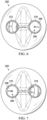
- Hot intake 210 and cold intake 216 each include a swirl initiator 256 (see Figs. 3 , 6, and 7 ).
- the swirl initiator includes one or more flow-steering vanes 258 projecting into the lumen of the corresponding intake (see Figs. 3 and 6-9 ), and promotes a swirling flow 260 of a hot or cold fluid passing through the intake (see Fig. 8 ).
- Each flow-steering vane 258 may be helical.
- the swirling flow advantageously encourages mixing of each fluid within heat transfer device 200, and thus drives more rapid and efficient heat transfer between the pair of fluids 206, 208 flowing through the device.
- the swirling flow provides better alignment of fluid flow with the inlets of the helical fluid channels. This better alignment of fluid flow avoids the need for an abrupt turn in flow direction, which may result in an undesirably large pressure drop and flow maldistribution, when each fluid enters the helical fluid channels.
- Fig. 9 shows a sectional view of heat transfer device 200.
- Each end section 222a, 222b includes a pair of manifolds each providing fluid communication between a port and hot helical fluid channels 214 or cold helical fluid channels 220 of central section 221. More specifically, end section 222a has a cold inflow manifold 226 that connects cold intake 216 to cold helical fluid channels 220, and also has a hot outflow manifold 224 that connects hot helical fluid channels 214 to hot outtake 212.
- end section 222b has a hot inflow manifold 223 that connects hot intake 210 to hot helical fluid channels 214, and also has a cold outflow manifold 228 that connects cold helical fluid channels 220 to cold outtake 218.
- hot inflow manifold 223 that connects hot intake 210 to hot helical fluid channels 214
- cold outflow manifold 228 that connects cold helical fluid channels 220 to cold outtake 218.
- Central section 221 of the depicted example includes six nested tubular walls 238a-238f and twelve helical walls 240 arranged coaxially with one another (see Figs. 9-12 ).
- the number of nested tubular walls may be at least three, four, five, six, eight, or ten, among others.
- the number of helical walls may be at least two, three, four, five, six, eight, or ten, among others.
- the nested tubular walls are intersected by the helical walls to form six concentric channel layers, namely, three hot channel layers 230a-230c and three cold channel layers 232a-232c arranged alternately.
- the order of channel layers is cold channel layer 232a, hot channel layer 230a, cold channel layer 232b, hot channel layer 230b, cold channel layer 232c, and hot channel layer 230c.
- the heat transfer device may have at least one, two, three, four, five, or more hot channel layers, at least one, two, three, four, five, or more cold channel layers, and at least two, three, four, five, six, eight, or ten channel layers (each hot or cold).
- Each of the hot channel layers and cold channel layers contains the same number of helical fluid channels.
- each hot channel layer 230a-230c contains twelve hot helical fluid channels 214
- each cold channel layer 232a-232c contains twelve cold helical fluid channels 220.
- the number of helical fluid channels 214 or 220 in each channel layer may match the number of helical walls 240.
- central section 221 has a total of thirty-six hot helical fluid channels 214 and thirty-six cold helical fluid channels 220.
- the heat transfer device may have a total of at least 4, 8, 12, 16, 20, 24, 28, 32, 36, 40, or 50 helical fluid channels (each hot or cold), among others.
- Each helical fluid channel 214, 220 is bounded by a pair of helical walls 240 and one or more of nested tubular walls 238a-238f (see Figs. 11 and 12 ).
- Each of hot helical fluid channels 214 of hot channel layers 230a-230c and cold helical fluid channels 220 of cold channel layers 232a-232c has a pair of rotationally-offset channel walls 248 provided by an adjacent pair of helical walls 240.
- the same pair of adjacent helical walls 240 forms the rotationally-offset channel walls 248 of a helical column 253 of alternating hot and cold helical fluid channels 214, 220.
- Each helical fluid channel 214 of hot channel layers 230a-230c and each helical fluid channel 220 of cold channel layers 232b, 232c has a pair of radially-spaced channel walls 250 provided by an adjacent pair of tubular walls of nested tubular walls 238a-238f.
- each helical fluid channel 220 of cold channel layer 232a has only one wall that is formed by a tubular wall, namely, innermost tubular wall 238a.
- the helical fluid channels 220 of cold channel layer 232a are open helical passages 252 having rotationally-offset channel walls 248 formed by protruding helical ribs 244 at radially inner portions of helical walls 240.
- Each helical passage 252 is radially outward of and continuous with a linear core passageway 262 that is coaxial with central axis 234 (also see Figs. 4 and 5 ).
- helical walls 240 may not protrude into the lumen of the innermost nested tubular wall, and thus open helical passages 252 are not formed.
- the thickness of hot channel layers 230a-230c is different from that of cold channel layers 232a-232c (see Figs. 9-12 ).
- the thickness of the hot channel layers relative to the thickness of the cold channel layers can be selected to optimize performance, such as to provide the desired ratio of hot and cold wetted surface areas, and/or to accommodate differences in the viscosity of the fluids, among others.
- Each channel layer 230a-230c and 232a-232c has an inlet end 264 opposite an outlet end 266 (see Figs. 9 , 10 , 13 , and 14 ).
- Inlet end 264 of each hot channel layer 230a-230c is adjacent end section 222b
- outlet end 266 of each hot channel layer is adjacent end section 222a (also see Figs. 4 and 5 ).
- This arrangement is logical because end section 222b contains hot intake 210 and end section 222a contains hot outtake 212. Accordingly, the positions of inlet end 264 and outlet end 266 are switched for cold channel layers 232a-232c relative to hot channel layers 230a-230c.
- inlet end 264 of each cold channel layer 232a-232c is adjacent end section 222a
- outlet end 266 of each cold channel layer 232a-232c is adjacent end section 222b.
- the inlet end 264 of each hot channel layer 230a-230c and cold channel layer 232a-232c includes a channel inlet 268 of each helical fluid channel 214 or 220 of the channel layer, and the outlet end 266 of the channel layer includes a channel outlet 270 of the helical fluid channel.
- Each manifold 223, 224, 226, 228 of heat transfer device 200 provides fluid communication between a port of the device (i.e., one of hot intake 210, hot outtake 212, cold intake 216, and cold outtake 218) and each hot helical fluid channel 214 or each cold helical fluid channel 220; see Fig. 9 .
- Manifolds 223, 224, 226, and 228 are similar in structure; corresponding features are identified with an appended letter "a” for parts of hot inflow manifold 223, "b” for parts of hot outflow manifold 224, "c” for parts of cold inflow manifold 226, and “d” for parts of cold outflow manifold 228.
- Each manifold includes a plenum, namely, a hot inflow plenum 272a, a hot outflow plenum 272b, a cold inflow plenum 272c, or a cold outflow plenum 272d.
- Each plenum 272a-272d directly communicates with the corresponding port, but directly communicates with only a subset of the channel inlets 268 or channel outlets 270 of helical fluid channels 214 or helical fluid channels 220 of each channel layer.
- each plenum directly communicates with only one-half (six) of the channel inlets or channel outlets of the helical fluid channels of each corresponding hot or cold channel layer.
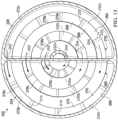
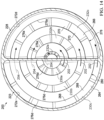
- Inflow manifolds 223, 226 also include distribution channels 274a or distribution channels 274c, respectively (see Figs. 9 , 10 , 13 , and 14 ).
- Each distribution channel 274a of inflow manifold 223 provides fluid communication between inflow plenum 272a and channel inlets 268 of one of the remaining subsets of hot helical fluid channels 214 of one of hot channel layers 230a-230c, where the remaining subset is laterally offset from, and not in direct fluid communication with, the inflow plenum.
- each distribution channel 274c of inflow manifold 226 provides fluid communication between inflow plenum 272c and channel inlets 268 of one of the remaining subsets of cold helical fluid channels 220 of one of cold channel layers 232a-232c, where the remaining subset is laterally offset from, and not in direct fluid communication with, the inflow plenum.
- Outflow manifolds 224, 228 also include collection channels 274b or collection channels 274d, respectively (see Figs. 9 , 10 , 13 , and 14 ).
- Each collection channel 274b of outflow manifold 224 provides fluid communication between outflow plenum 272b and channel outlets 270 of one of the remaining subsets of hot helical fluid channels 214 of one of hot channel layers 230a-230c, where the remaining subset is laterally offset from, and not in direct fluid communication with, the outflow plenum.
- each distribution channel 274d of outflow manifold 228 provides fluid communication between plenum 272d and channel outlets 270 of one of the remaining subsets of cold helical fluid channels 220 of one of cold channel layers 232a-232c, where the remaining subset is laterally offset from, and not in direct fluid communication with, the outflow plenum.
- Each distribution channel 274a, 274c and each collection channel 274b, 274d is at least partially bounded by a corresponding end cap (see Figs. 9 , 13 , and 14 ).
- Distribution channels 274a are at least partially bounded by end caps 276a.
- Distribution channels 274c are at least partially bounded by end caps 276c.
- Collection channels 274b are at least partially bounded by end caps 276b.
- Collection channels 274d are at least partially bounded by end caps 276d.
- Each distribution channel 274a, each collection channel 274b, each of two of three distribution channels 274c, and each of two of three collection channels 274d defines an arcuate longitudinal axis that extends along a semicircular portion of the inlet end or the outlet end of a hot or cold channel layer, and along a plane that is orthogonal to the longitudinal axis of the heat transfer device.
- Each inlet end 264 and each outlet end 266 of each channel layer 230a-230c and 232a-232c has an aligned portion 278 and an offset portion 280.
- Channel inlets 268 or channels outlets 270 of aligned portion 278 are axially aligned with, and directly communicate with, the corresponding plenum 272a, 272b, 272c, or 272d.
- Channel inlets 268 or channels outlets 270 of offset portion 280 are laterally offset from the corresponding plenum, and are axially aligned instead with an adjacent plenum.
- Each end cap 276a-276d forms a wall of a corresponding distribution channel 274a or 274c, or corresponding collection channel 274b or 274d, and separates the adjacent plenum from the corresponding distribution or collection channel.
- Figures 13 and 14 show flow paths 202, 204 of the first and second fluids with respect to manifolds 223, 224, 226, and 228.
- the line weights of arrows representing each flow path decrease as the flow path enters distribution channels 274a or 274c from the corresponding inflow plenum 272a or 272c, or increases as the flow path enters an outflow plenum 272b or 272d from corresponding collection channels 274b or 274d.
- Outermost tubular wall 238f also forms a cylindrical portion of a housing 282 (interchangeably called a shell) of heat transfer device 200 (see Figs. 9 and 10 ). Accordingly, the outermost tubular wall 238f has a thicker wall than the other tubular walls 238a-238e of the set of nested tubular walls, to make heat transfer device 200 more capable of withstanding large pressure differences between the inside and the outside of the device.
- the wall of outermost tubular wall 238f smoothly transitions to a peripheral wall of each end section 222a, 222b (see Fig. 9 ).
- all components of heat transfer device 200 are additively manufactured as a single monolithic unit.
- Such unitarity reduces part count and production time over conventionally manufactured heat exchangers.
- Such unitarity also reduces overall weight and volume of the heat transfer device by eliminating constraints of traditional manufacturing.
- Unitarity and use of a single material in printing also improves heat transfer performance by eliminating joints and interfaces and maximizing wetted surface area.
- Additive manufacturing also allows shapes and structures optimal for heat transfer that are not achievable in traditional manufacturing.
- An example of heat transfer device 200 has a 100 kW heat transfer capacity.
- the exemplary device has a mass of about 45 pounds (20.4 kilograms) and is formed of a nickel-based alloy.
- the cold wetted surface area is about 1350 square inches (0.87 square meter), and the hot wetted surface area is about 1690 square inches (1.10 square meter).
- the outer diameter is 7.45 inches (0.19 meter), the overall length is 17 inches (0.43 meter), and the working length is 9.2 inches (0.23 meter).
- This subsection describes illustrative heat transfer devices 300, 400, and 500 having protrusions each projecting into the lumen of a helical fluid channel; see Figs. 15-17 .
- the protrusions are enhancements to the heat transfer surfaces of the helical fluid channels and may improve the efficiency of heat transfer between the fluid channels, potentially allowing the heat transfer device to be more compact.
- Fig. 15 shows a fragmentary, sectional portion of heat transfer device 300, which is identical to heat transfer device 200 of subsection B, except for the addition of protrusions 386 (compare with Fig. 11 ).
- Heat transfer device 300 has hot helical fluid channels 314 and cold helical fluid channels 320, which correspond in number and position to hot helical fluid channels 214 and cold helical fluid channels 220 of heat transfer device 200.
- Each helical fluid channel 314 or helical fluid channel 320 has a lumen 388 and contains a pair of protrusions 386.
- Each protrusion 386 of the pair projects into the lumen from a helical wall 340, to a free edge of the protrusion that is spaced from the walls of the helical fluid channel.
- the pair of protrusions 386 project into the lumen from a pair of helical walls 340 that are rotationally adjacent one another.
- Fig. 16 shows a fragmentary, sectional portion of heat transfer device 400, which is identical to heat transfer device 200 of subsection B, except for the addition of protrusions 486 (compare with Fig. 11 ).
- Heat transfer device 400 has hot helical fluid channels 414 and cold helical fluid channels 420, which correspond in number and position to hot helical fluid channels 214 and cold helical fluid channels 220 of heat transfer device 200.
- Each hot helical fluid channel 414 and each cold helical fluid channel 420 has a lumen 488 and contains a pair of protrusions 486.
- Each protrusion 486 of the pair projects into the lumen from a helical wall 440, to a free edge of the protrusion that is spaced from the walls of the helical fluid channel.
- the pair of protrusions 486 project into the lumen from a pair of helical walls 440 that are rotationally adjacent one another.
- Protrusions 486 are similar to protrusions 386 of heat transfer device 300, except that they are radially offset from one another within a given helical fluid channel, which can improve mixing of fluid in the helical fluid channel.
- Fig. 17 shows a fragmentary, sectional portion of heat transfer device 500, which is identical to heat transfer device 200 of subsection B, except for the addition of protrusions 586 (compare with Fig. 11 ).
- Heat transfer device 500 has hot helical fluid channels 514 and cold helical fluid channels 520, which correspond in number and position to hot helical fluid channels 214 and cold helical fluid channels 220 of heat transfer device 200.
- Heat transfer device 500 also has nested tubular walls 538a-538f and helical walls 540, which intersect to bound the hot helical fluid channels and the cold helical fluid channels, as described above for heat transfer device 200.
- Each hot helical fluid channel 514 and each cold helical fluid channel 520 has a lumen 588 and a pair of protrusions 586.
- Each protrusion 586 of the pair projects radially into the lumen of a given helical fluid channel from a tubular wall of nested tubular walls 538a-538f, to a free edge of the protrusion that is spaced from the walls of the helical fluid channel.
- the pair of protrusions 586 project into the lumen from a pair of adjacent tubular walls of the nested tubular walls 538a-538f.
- the protrusions of this example may be elongated along the helical fluid channels to form flanges (interchangeably called ribs), which may be helical flanges.
- ribs interchangeably called ribs
- Each helical flange may extend along at least a portion of a helical path followed by a corresponding helical fluid channel(s).
- the flanges may be non-helical.
- the protrusions in each of the heat transfer devices of this subsection improve the efficiency of heat transfer by increasing the wetted surface area of conductive material of the heat transfer device that is in contact with each of the fluids. In other examples, only one or more than two protrusions project into the lumen of a given helical fluid channel.
- two protrusions project into the lumen from the same helical wall or the same tubular wall, or from a helical wall and a tubular wall.
- the protrusions are present in only a subset of the channel layers, such as only the hot channel layers or only the cold channel layers.
- This subsection describes an illustrative heat transfer device 600 having a helical wall defining at least one opening that provides fluid communication, mixing, and heat transfer between a pair of adjacent helical fluid channels within a channel layer; see Fig. 18 .
- Fig. 18 shows a fragmentary, sectional portion of heat transfer device 600, which is identical to heat transfer device 200 of subsection B, except for the addition of openings 690 in a helical wall 640 (compare with Fig. 11 ).
- Heat transfer device 600 has hot helical fluid channels 614 and cold helical fluid channels 620, which correspond in number and position to hot helical fluid channels 214 and cold helical fluid channels 220 of heat transfer device 200.
- Each opening 690 extends through helical wall 640 to each of a pair of adjacent hot helical fluid channels 614 or cold helical fluid channels 620 in the same channel layer, and thus interchangeably is described as a through-opening or through-hole.
- Each opening is circular.
- the opening can be non-circular, such as a helical opening elongated along a helical path followed by the helical wall, or elongated transverse to the helical path, among others.
- the opening provides fluid communication between the pair of adjacent channels at a position intermediate the inlets and outlets of the pair of channels. Openings 690 can improve the efficiency of the heat transfer device by encouraging mixing between adjacent channels.
- openings 690 are formed in two or more helical walls, such as each helical wall 640.
- the openings can decrease the weight of the device because the openings in a helical wall make the wall lighter.
- two or more openings 690 provide fluid communication between a given helical fluid channel and an adjacent helical fluid channel, at two or more positions along the given helical fluid channel.
- This subsection describes an illustrative aerospace vehicle 700 including heat transfer device 100, which is incorporated in a power cycle; see Fig. 19 (also see Figs. 1 and 2 and the Overview section above).
- Aerospace vehicle 700 has a vehicle body 701 and an engine 703 connected to the vehicle body and configured to power the vehicle body in a flight mode.
- the vehicle body can include a fuselage and one or more airfoils, such as wings.
- the aerospace vehicle can be an aircraft, a spacecraft, a rotorcraft, a missile, or a combination thereof, among others.
- Engine 703 provides propulsion for the vehicle and can, for example, be an airbreathing jet engine (such as a turbojet, turbofan, ramjet, or pulse jet engine), a rocket engine, a propeller/rotor engine, or the like.
- Heat transfer device 100 is connected to vehicle body 701 and/or engine 703.
- the heat transfer device can be utilized to transfer heat between any suitable first fluid 106 and second fluid 108.
- heat transfer device 100 transfers heat from air 705, as first fluid 106, to supercritical carbon dioxide (SCCD) 707, as second fluid 108.
- SCCD supercritical carbon dioxide
- heat transfer device 100 onboard aerospace vehicle 700 transfers heat from oil to air, air to air, water/steam to air, oil to water/steam, air to fuel, water/steam to fuel, or vice versa, among others.
- the first flow path 102 of heat transfer device 100 is in fluid communication with an engine intake 709 of engine 703.
- Air 705 enters engine intake 709 from outside aerospace vehicle 700 and has a high temperature due to the speed of the vehicle, which may be a hypersonic airplane.
- the air is cooled by passing it through heat transfer device 100 on first flow path 102, before entering a combustion chamber(s) of engine 703.
- the air may be cooled upstream of a fan or compressor stage of the engine, to mitigate the risk of heat damage. Cooling air upstream of the engine's combustion chamber could have two effects: limiting engine performance, and preventing damage to downstream engine components such as turbines or exhaust nozzles.
- the air instead of entering an engine intake, the air enters an intake of an environmental control system of the aerospace vehicle.
- SCCD 707 can be used as the working fluid in a thermodynamic cycle to convert heat to another form of energy, such as electrical, mechanical, and/or chemical energy.
- the second flow path 104 of heat transfer device 100 is in fluid communication with a turbine 711, a heat exchanger 713, and a compressor 715 of a heat-to-power thermodynamic cycle.
- Rotation of turbine 711 is driven by SCCD 707 received from heat transfer device 100 after the SCCD 707 has been heated with thermal energy received from air 705.
- the rotation of turbine 711 drives a generator 717, which converts mechanical energy to electrical energy.
- the electrical energy can be stored or used directly.
- Rotation of the turbine also powers compressor 715, which compresses SCCD 707 after additional thermal energy has been removed by heat exchanger 713.
- the compressed SCCD 707 then flows back to heat transfer device 100 and the cycle is repeated.
- This subsection describes an illustrative power plant 800 including heat transfer device 100, which is incorporated in a heat-to-power thermodynamic cycle; see Fig. 20 (also see Figs. 1 and 2 and the Overview section above).
- the power cycle transfers heat from a first fluid 106, such as steam, flowing through heat transfer device 100 on first flow path 102, to a second fluid 108, such as supercritical carbon dioxide (SCCD) 807, on second flow path 104.
- the first fluid is heated by a heat source 819 upstream of heat transfer device 100.
- the heated second fluid flows in a closed loop from second flow path 104 of heat transfer device 100 through a turbine 811, a heat exchanger 813, and a compressor 815, and back to heat transfer device 100, as described above in subsection E.
- Rotation of turbine 811 drives a generator 817 as explained above in subsection E.
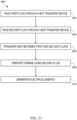
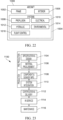
- This subsection describes steps of an illustrative method 900 of transferring heat between fluids using a heat transfer device having helical fluid channels; see Fig. 21 .
- Aspects of heat transfer devices described above may be utilized in the method steps described below. Where appropriate, reference may be made to components and systems that may be used in carrying out each step. These references are for illustration, and are not intended to limit the possible ways of carrying out any particular step of the method.
- steps of method 900 are described below and depicted in Fig. 21 , the steps need not necessarily all be performed, and in some cases may be performed simultaneously or in a different order than the order shown, and the method may not recite the complete process or all steps of the method.
- a first fluid is passed through a heat transfer device.
- the heat transfer device has any suitable combination of elements and features described elsewhere herein.
- a second fluid is passed through the heat transfer device.
- the first and second fluids pass through the heat transfer device at the same time, but without contacting one another.
- the first and second fluids pass through the heat transfer device in opposite directions from one another, on respective helical paths that may be concentric with, and parallel to, one another.
- step 906 heat is transferred between the first and second fluids, such that the second fluid is heated and the first fluid is cooled.
- the heated second fluid is used to operate a turbine.
- the heated second fluid passes through the turbine to produce rotation thereof.
- step 910 electrical energy is generated using mechanical energy from the turbine.
- Method 1100 includes a plurality of processes, stages, or phases. During pre-production, method 1100 may include a specification and design phase 1104 of aerospace vehicle 1000 and a material procurement phase 1106. During production, a component and subassembly manufacturing phase 1108 and a system integration phase 1110 of aerospace vehicle 1000 may take place. Thereafter, aerospace vehicle 1000 may go through a certification and delivery phase 1112 to be placed into in-service phase 1114.
- aerospace vehicle 1000 While in service (e.g., by an operator), aerospace vehicle 1000 may be scheduled for routine maintenance and service phase 1116 (which may also include modification, reconfiguration, refurbishment, and so on of one or more systems of aerospace vehicle 1000). While the examples described herein relate generally to the production and operational use of aerospace vehicle 1000, they may be practiced at other stages of method 1100.
- a system integrator may include, without limitation, any number of aerospace vehicle manufacturers and major-system subcontractors; a third party may include, without limitation, any number of vendors, subcontractors, and suppliers; and an operator may be an airline, leasing company, military entity, service organization, and so on.
- aerospace vehicle 1000 produced by illustrative method 1100 may include a frame 1002 with a plurality of systems 1004 and an interior 1006.
- plurality of systems 1004 include one or more of an engine system 1008, an electrical system 1010, a hydraulic system 1012, an environmental control system 1014, and a flight control system 1016.
- Each system may comprise various subsystems, such as controllers, processors, actuators, effectors, motors, generators, etc., depending on the functionality involved. Any number of other systems may be included.
- the engine system 1008 includes an engine connected to the aerospace vehicle body and configured to power the aerospace vehicle body in a flight mode.
- Electrical system 1010 and/or environmental control system 1014 of aerospace vehicle 1000 includes a heat transfer device.
- aerospace vehicle 1000 includes heat transfer device 100, 200, 300, 400, 500, or 600.
- the principles disclosed herein may be applied to other industries, such as the power industry, automotive industry, rail transport industry, and nautical engineering industry. Accordingly, in addition to aerospace vehicle 1000, the principles disclosed herein may apply to other vehicles, e.g., land vehicles, marine vehicles, etc.
- Apparatuses and methods shown or described herein may be employed during any one or more of the stages of the aerospace vehicle manufacturing and service method 1100.
- components or subassemblies corresponding to component and subassembly manufacturing phase 1108 may be fabricated or manufactured in a manner similar to components or subassemblies produced while aerospace vehicle 1000 is operating during in-service phase 1114.
- one or more examples of the apparatuses, methods, or combinations thereof may be utilized during manufacturing phase 1108 and system integration phase 1110, for example, by substantially expediting assembly of or reducing the cost of aerospace vehicle 1000.
- one or more examples of the apparatus or method realizations, or a combination thereof may be utilized, for example and without limitation, while aerospace vehicle 1000 is in in-service phase 1114 and/or during maintenance and service phase 1116.
- a device for transferring heat between a first fluid and a second fluid comprising: (i) a set of nested tubular walls; (ii) a plurality of helical walls intersecting each of the nested tubular walls to form one or more first channel layers nested with one or more second channel layers, each first channel layer and each second channel layer including a plurality of helical fluid channels; (iii) a first intake and a first outtake in fluid communication with one another via the plurality of helical fluid channels of each first channel layer, for flow of the first fluid through the device from the first intake to the first outtake; and (iv) a second intake and a second outtake in fluid communication with one another via the plurality of helical fluid channels of each second channel layer, for flow of the second fluid through the device from the second intake to the second outtake.
- each helical fluid channel of the plurality of helical fluid channels of each first channel layer and each second channel layer has a pair of channel walls formed by a pair of helical walls of the plurality of helical walls, and wherein, optionally, the pair of channel walls are rotationally offset from one another about a central axis defined by the set of nested tubular walls.
- each helical fluid channel of the plurality of helical fluid channels of at least one first channel layer and at least one second channel layer has a pair of channel walls spaced radially from one another and formed by a pair of nested tubular walls of the set of nested tubular walls.
- each helical fluid channel of the plurality of helical fluid channels of each first channel layer and each second channel layer is bounded by a pair of the nested tubular walls and a pair of the helical walls.
- A6 The device of any of paragraphs A1 to A5, wherein the set of nested tubular walls includes an outermost tubular wall forming at least part of a periphery of the device and at least three, four, or five nested tubular walls of successively smaller diameter inside the outermost tubular wall.
- A8 The device of any of paragraphs A1 to A7, wherein at least one of the first intake and the second intake includes one or more flow-steering vanes configured to encourage swirling flow of fluid passing through the at least one of the first intake and the second intake.
- A9 The device of any of paragraphs A1 to A8, further comprising a first inflow manifold providing fluid communication between the first intake and each helical fluid channel of the plurality of helical fluid channels of each first channel layer, the first inflow manifold including a plenum and a distribution channel extending from the plenum, the plenum being in direct fluid communication with only a subset of the plurality of helical fluid channels of a first channel layer of the one or more first channel layers, the distribution channel providing fluid communication between the plenum and another subset of the plurality of helical fluid channels of the first channel layer of the one or more first channel layers.
- the plenum being a first inflow plenum
- the second inflow manifold providing fluid communication between the second intake and each helical fluid channel of the plurality of helical fluid channels of each second channel layer
- the second inflow manifold including a second inflow plenum and a second distribution channel extending from the second inflow plenum
- the second inflow plenum being in direct fluid communication with only a subset of the plurality of helical fluid channels of a second channel layer of the one or more second channel layers
- the second distribution channel providing fluid communication between the second inflow plenum and another subset of the plurality of helical fluid channels of the second channel layer of the one or more second channel layers
- A10 The device of any of paragraphs A9 to A9.2, further comprising: a second outflow manifold located adjacent the first inflow manifold and including an outflow plenum, the second outflow manifold providing fluid communication between each helical fluid channel of the plurality of helical fluid channels of each second channel layer and the second outtake; and an end cap located at an inlet end of the first channel layer of the one or more first channel layers, the end cap forming a wall of the distribution channel and separating the outflow plenum of the second outflow manifold from the distribution channel of the first inflow manifold.
- each helical wall of the plurality of helical walls provides a load path extending radially and continuously from an outermost tubular wall to an innermost tubular wall of the set of nested tubular walls.
- A14 The device of any of paragraphs A1 to A13, further comprising a flange projecting from a helical wall of the plurality of helical walls, or from a nested tubular wall of the set of nested tubular walls, and into a lumen of a helical fluid channel of the plurality of helical fluid channels of a first channel layer or a second channel layer.
- A14.2. The device of paragraph A14 or A14.1, further comprising a plurality of flanges each projecting from the same helical wall of the plurality of helical walls, or from the same tubular wall of the set of nested tubular walls, into a lumen of a helical fluid channel of the plurality of helical fluid channels of a first channel layer or a second channel layer.
- each helical wall of at least a subset of the plurality of helical walls projects into a lumen of an innermost nested tubular wall of the set of nested tubular walls such that the at least a subset of the plurality of helical walls forms a plurality of open helical passages that are in fluid communication with one another within the innermost tubular wall and in fluid communication with one of the first and second intakes and a corresponding one of the first and second outtakes.
- A16 The device of any of paragraphs A1 to A15, further comprising a first inflow manifold providing fluid communication between the first intake and the plurality of helical fluid channels of each first channel layer, the first inflow manifold including an inflow plenum and a distribution channel, the distribution channel being located at an inlet end of a first channel layer and directing fluid from the plenum to channel inlets of only a subset of the plurality of helical fluid channels of the first channel layer.
- A16.2. The device of paragraph A16 or A16.1, wherein the one or more first channel layers include two or more first channel layers, and wherein the first inflow manifold includes a respective distribution channel for each first channel layer of the two or more first channel layers.
- A16.3. The device of any of paragraphs A16 to A16.2, wherein another subset of the plurality of helical fluid channels of the first channel layer has channel inlets that communicate directly with the inflow plenum of the first inflow manifold.
- A16.4 The device of any of paragraphs A16 to A16.3, wherein an offset portion of an inlet end of each first channel layer is covered by an end cap, and wherein an aligned portion of the inlet end of each first channel layer communicates directly with the inflow plenum.
- A17 The device of any of paragraphs A1 to A16.5, wherein the device has a central section located between a pair of end sections, wherein the central section includes each of the first and second channel layers, wherein the first intake and the second outtake are provided by one of the end sections, and wherein the second intake and the first outtake are provided by the other of the end sections.
- A18 The device of any of paragraphs A1 to A17, wherein the device is configured to provide counterflow of the first and second fluids through the device on respective first and second flow paths that are not in fluid communication with one another.
- A19 The device of any of paragraphs A1 to A18, further comprising a protrusion projecting from a helical wall of the plurality of helical walls or from a nested tubular wall of the set and nested tubular walls, into a lumen of a helical fluid channel of the plurality of helical fluid channels of a first channel layer or a second channel layer.
- the plurality of helical fluid channels of a first channel layer of the one or more first channel layers includes a pair of adjacent helical fluid channels having a pair of channel inlets and a pair of channel outlets, and wherein one of the helical walls defines an opening that provides fluid communication between the pair of adjacent helical fluid channels at a position intermediate the pair of channel inlets and the pair of channel outlets.
- each first channel layer is located between an adjacent pair of the tubular walls, and wherein each second channel layer is located between an adjacent pair of the tubular walls.
- each first channel layer is radially adjacent a second channel layer, and wherein each second channel layer is radially adjacent a first channel layer.
- A27 The device of any of paragraphs A1 to A26, wherein the plurality of helical walls includes at least three, four, five, six, eight, or ten helical walls.
- A28 An aerospace vehicle comprising the device of any of paragraphs A1 to A27.
- a power plant comprising the device of any of paragraphs A1 to A27.
- A30 The aerospace vehicle or power plant of paragraph A28 or A29, wherein the device is in fluid communication with a turbine.
- A31 The device of any of paragraphs A1 to A27, wherein the device is configured to receive and heat supercritical carbon dioxide as a working fluid in a thermodynamic cycle.
- An aerospace vehicle comprising: (i) a vehicle body; (ii) an engine connected to the vehicle body and configured to power the vehicle body in a flight mode; and (iii) a heat transfer device connected to the vehicle body and/or the engine and including a set of nested tubular walls, a plurality of helical walls intersecting each of the nested tubular walls to form one or more first channel layers nested with one or more second channel layers, each first channel layer and each second channel layer including a plurality of helical fluid channels, a first intake and a first outtake in fluid communication with one another via the helical fluid channels of each first channel layer, for flow of a first fluid through the heat transfer device from the first intake to the first outtake, and a second intake and a second outtake in fluid communication with one another via the plurality of helical fluid channels of each second channel layer, for flow of a second fluid through the heat transfer device from the second intake to the second outtake.
- a method of transferring heat between fluids using a heat transfer device including a set of nested tubular walls intersected by a plurality of helical walls to form one or more first channel layers nested with one or more second channel layers comprising: (i) passing a first fluid through the heat transfer device between a first intake and a first outtake via a plurality of helical fluid channels of each of one or more first channel layers of the heat transfer device; and (ii) passing a second fluid through the heat transfer device between a second intake and a second outtake via a plurality of helical fluid channels of each of one or more second channel layers of the heat transfer device.
- passing a first fluid includes passing a first fluid through a plurality of helical fluid channels defined by each of at least two first channel layers of the device, and wherein passing a second fluid includes passing a second fluid through a plurality of helical fluid channels defined by each of at least two second channel layers of the device.
- a device for transferring heat between a first fluid and a second fluid comprising: (i) a central section forming a radial series of first channel layers alternating with second channel layers, each of the first and second channel layers defining a plurality of helical fluid channels, wherein the central section includes a plurality of concentric helical walls, and wherein each helical fluid channel of the plurality of helical fluid channels of each first and second channel layer has a pair of walls formed by a pair of the helical walls; (ii) a first intake and a first outtake in fluid communication with one another via the plurality of helical fluid channels of each first channel layer, for flow of the first fluid through the device; and (iii) a second intake and a second outtake in fluid communication with one another via the plurality of helical fluid channels of each second channel layer, for flow of the second fluid through the device.
- the different examples of the heat transfer device described herein provide various advantages over traditional counterflow heat exchangers.
- the examples disclosed herein may be more compact and/or lighter in weight, may have more wetted surface area per unit volume for heat transfer and thus a greater efficiency of heat transfer, may handle and distribute stress more efficiently, may provide more uniform fluid flow, may offer better mixing within a fluid, and/or may have fewer sharp turns, if any, along each fluid flow path.
- the outermost tubular wall may be cylindrical, which takes advantage of inherent hoop strength to handle a large pressure differential between the outermost layer of helical fluid channels and the ambient environment outside the heat transfer device.
- the tubular walls nested in the outermost tubular wall also may be cylindrical, which also takes advantage of inherent hoop strength to provide the capability to handle a large pressure differential between adjacent hot and cold layers of helical fluid channels.
- End caps may be located at the inlet and outlet ends of each channel layer, and may be rounded/domed to avoid points of concentrated stress (stress risers) in response to pressure differentials.
- Helical walls may provide radial load paths each extending from the exterior surface of the heat transfer device to the innermost tubular wall, such that each helical wall efficiently reacts to pressure differentials in tension and the helical walls can collectively react to high pressure differentials.
- the helical walls of illustrative examples described herein offer unique characteristics and advantages.
- the helical walls function not only as efficient structural members but also transfer heat between hot and cold helical fluid channels, thereby increasing the wetted surface area for heat transfer and thus the efficiency of heat transfer.
- the number, helical pitch, and helical lead of the helical walls can be selected to customize the performance of the heat transfer device. Increasing the number of helical walls, decreasing the helical pitch of the helical walls, and decreasing the helical lead of each helical wall, increases the wetted surface area within the device and the pressure-handling capacity of the device, without changing the length of the heat transfer device. Alternatively, decreasing the number of helical walls, increasing the helical pitch of the helical walls, and/or increasing the helical lead of each helical fin reduces the pressure drop through the device, without changing the length of the heat transfer device.
- illustrative examples described herein are strengthened substantially with only minimal increases in the thickness of the nested tubular walls and/or the helical walls.
- illustrative examples described herein have helical walls and/or tubular walls from which added features (protrusions) project, to increase the wetted surface area for heat transfer.
- fluid flow paths of illustrative examples described herein have no sharp bends, thereby provide a low pressure-drop design.
- the intakes, outtakes, and manifolds of illustrative examples described herein have a simplified configuration.
- the intakes and outtakes may be located at opposite ends of the heat transfer device, and may be parallel and coplanar with one another, and parallel to the longitudinal/central axis of the heat transfer device. This straight-in/straight-out configuration reduces the pressure drop relative to traditional counterflow heat exchangers having elbow interfaces.
- Each manifold may be configured to communicate with multiple channel layers each containing multiple helical fluid channels, and the same manifold configuration can communicate with any number of channels in a channel layer.
- illustrative examples described herein have intakes including swirl initiators that promote smoother introduction of fluids into the channel inlets of helical fluid channels, by creating rotational flow that matches the rotational direction of the helical fluid channels and directs fluid flow into better alignment with the channel inlets, while encouraging mixing within each fluid.
Landscapes
- Engineering & Computer Science (AREA)
- Chemical & Material Sciences (AREA)
- Combustion & Propulsion (AREA)
- Mechanical Engineering (AREA)
- General Engineering & Computer Science (AREA)
- Thermal Sciences (AREA)
- Physics & Mathematics (AREA)
- Aviation & Aerospace Engineering (AREA)
- Manufacturing & Machinery (AREA)
- Materials Engineering (AREA)
- Chemical Kinetics & Catalysis (AREA)
- Health & Medical Sciences (AREA)
- General Health & Medical Sciences (AREA)
- Pulmonology (AREA)
- Heat-Exchange Devices With Radiators And Conduit Assemblies (AREA)
Description
- A heat exchanger is a device for transferring heat between a pair of fluids, often without contact of the fluids with one another. Heat exchangers are used in a wide variety of heating and cooling applications and have three basic configurations for travel of the pair of fluids: parallel flow (in the same direction), cross flow, and counterflow (in opposite directions). Of these configurations, counterflow heat exchangers can transfer heat most efficiently. However, traditional counterflow heat exchangers may be unable to achieve the high efficiency of heat transfer and the compactness needed in demanding applications, such as power generation, that require operation at high temperatures and pressures. Moreover, these traditional heat exchangers can be bulky and heavy due to complex fluid manifolds and thus unsuitable where minimizing size and weight are very important, such as on an aircraft. A new counterflow heat exchanger is needed.
-
CN 106 403 653 B according to its title, states a counter-flow heat exchanger with helical passages. -
US3,907,028 according to its abstract, states a heat exchanger formed by a plurality of concentric tubes having annular spaces therebetween. -
EP 3 800 417 according to its title, states a heat exchanger with interleaved manifolds and layered core. - The present disclosure provides systems, apparatuses, and methods relating to heat transfer devices (heat exchangers) having nested layers of helical fluid channels for directing fluid flow. The present disclosure is based on a device for transferring heat between a first fluid and a second fluid includes a set of nested tubular walls and a plurality of helical walls intersecting each of the nested tubular walls to form one or more first channel layers nested with one or more second channel layers. Each of the one or more first channel layers and the one or more second channel layers includes a plurality of helical fluid channels. A first intake and a first outtake are in fluid communication with one another via the plurality of helical fluid channels of each first channel layer, for flow of the first fluid through the device from the first intake to the first outtake. A second intake and a second outtake are in fluid communication with one another via the plurality of helical fluid channels of each second channel layer, for flow of the second fluid through the device from the second intake to the second outtake. In some examples, this device includes the features of anyone of claims 1-11.
- In some examples, an aerospace vehicle (interchangeably called a flight vehicle) includes a vehicle body, an engine connected to the vehicle body and configured to power the vehicle body in a flight mode, and a heat transfer device connected to the vehicle body and/or the engine. The heat transfer device may be a device according to any of claims 1-11.
- In some examples, a method of transferring heat between fluids uses a heat transfer device including the features of anyone of claims 1-11. In the method, a first fluid is passed through the heat transfer device between a first intake and a first outtake via a plurality of helical fluid channels of each first channel layer of the heat transfer device. A second fluid is passed through the heat transfer device between a second intake and a second outtake via a plurality of helical fluid channels of each second channel layer of the heat transfer device.
- Features, functions, and advantages may be achieved independently in various examples of the present disclosure, or may be combined in yet other examples, further details of which can be seen with reference to the following description and drawings.
-
-
Fig. 1 is a schematic view of an illustrative counterflow heat transfer device having nested layers of helical fluid channels, in accordance with aspects of the present disclosure. -
Fig. 2 is another schematic cross-sectional view of the heat transfer device ofFig. 1 , taken along line 2-2 ofFig. 1 orthogonal to a central axis of the device. -
Fig. 3 is an isometric view of another illustrative counterflow heat transfer device having nested layers of helical fluid channels. -
Fig. 4 is a top view of the heat transfer device ofFig. 3 . -
Fig. 5 is a side view of the heat transfer device ofFig. 3 . -
Fig. 6 is an end view of the heat transfer device ofFig. 3 , taken along line 6-6 ofFig. 5 and showing a hot outtake and a cold intake of the heat transfer device. -
Fig. 7 is an opposite end view of the heat transfer device ofFig. 3 , taken along line 7-7 ofFig. 5 and showing a hot intake and a cold outtake of the heat transfer device. -
Fig. 8 is a cutaway view of the heat transfer device ofFig. 3 , with flow paths for hot and cold fluids indicated using arrows having different line weights. -
Fig. 9 is a sectional view of the heat transfer device ofFig. 3 , taken along line 9-9 ofFig. 5 . -
Fig. 10 is a sectional view of the heat transfer device ofFig. 3 , taken along line 10-10 ofFig. 4 . -
Fig. 11 is a fragmentary sectional view of the heat transfer device ofFig. 3 , taken around the region indicated inFig. 9 . -
Fig. 12 is a cross-sectional view of the heat transfer device ofFig. 3 , taken along line 12-12 ofFig. 5 through a central section of the heat transfer device. -
Fig. 13 is a cross-sectional view of the heat transfer device ofFig. 3 , taken generally along line 13-13 ofFig. 5 through a pair of manifolds located near one end of the heat transfer device. -
Fig. 14 is another cross-sectional view of the heat transfer device ofFig. 3 , taken generally along line 14-14 ofFig. 5 through another pair of manifolds located near the opposite end of the heat transfer device. -
Fig. 15 is a fragmentary sectional view of an illustrative heat transfer device having the same basic structure as the heat transfer device ofFig. 3 , viewed generally as inFig. 11 , and showing pairs of aligned protrusions projecting into the lumens of pairs of axially-adjacent helical fluid channels from each helical wall of a plurality of helical walls. -
Fig. 16 is a fragmentary sectional view of another illustrative heat transfer device having the same basic structure as the heat transfer device ofFig. 3 , viewed generally as inFig. 11 , and showing pairs of protrusions projecting into the lumens of pairs of axially-adjacent helical fluid channels from each helical wall of a plurality of helical walls. -
Fig. 17 is a fragmentary sectional view of still another illustrative heat transfer device having the same basic structure as the heat transfer device ofFig. 3 , viewed generally as inFig. 11 , and showing protrusions projecting into the lumens of helical fluid channels from a set of nested tubular walls. -
Fig. 18 is a fragmentary sectional view of yet another illustrative heat transfer device having the same basic structure as the heat transfer device ofFig. 3 , viewed generally as inFig. 11 , and showing openings formed in a helical wall and allowing fluid communication between adjacent helical fluid channels, intermediate the ends thereof, within each channel layer. -
Fig. 19 is a schematic diagram of an illustrative aerospace vehicle incorporating the heat transfer device ofFig. 1 in a thermodynamic cycle that converts heat to another form of energy. -
Fig. 20 is a schematic diagram of an illustrative power plant incorporating the heat transfer device ofFig. 1 in a thermodynamic cycle that converts heat to another form of energy. -
Fig. 21 is a flowchart depicting steps of an illustrative method of transferring heat between a pair of fluids using a heat transfer device of the present disclosure. -
Fig. 22 is a schematic diagram of an illustrative aircraft. -
Fig. 23 is a flowchart depicting steps of an illustrative aircraft manufacturing and service method. - Various aspects and examples of a heat transfer device having nested layers of helical fluid channels, as well as related methods, are described below and illustrated in the associated drawings. Unless otherwise specified, a heat transfer device in accordance with the present teachings, and/or its various components may, but is not required to, contain at least one of the structures, components, functionalities, and/or variations described, illustrated, and/or incorporated herein. Furthermore, unless specifically excluded, the process steps, structures, components, functionalities, and/or variations described, illustrated, and/or incorporated herein in connection with the present teachings may be included in other similar devices and methods, including being interchangeable between disclosed examples. The following description of various examples is merely illustrative in nature and is in no way intended to limit the disclosure, its application, or uses. Additionally, the advantages provided by the examples described below are illustrative in nature and not all examples provide the same advantages or the same degree of advantages.
- This Detailed Description includes the following sections, which follow immediately below: (1) Overview; (2) Examples, Components, and Alternatives; (3) Illustrative Combinations and Additional Examples; (4) Advantages, Features, and Benefits; and (5) Conclusion. The Examples, Components, and Alternatives section is further divided into subsections A through H, each of which is labeled accordingly.
- In general, a heat transfer device in accordance with the present teachings includes a thermally conductive structure having a first flow path for a first fluid and a second flow path for a second fluid, where the structure is configured to conduct heat between the first fluid and the second fluid. The first and second flow paths may be concentric with, and isolated from, one another. The heat transfer device may be a single additively manufactured unit and may also be referred to as a heat exchanger, a heat sink, and/or a cooler. Although the heat transfer device may be used in any suitable heat transfer application, in some examples, the device may be particularly useful for high temperature/high pressure applications, such as in a thermodynamic cycle to generate power from heat. Accordingly, within examples, the heat transfer device may have particular utility for thermal management in a high speed aircraft (e.g., a hypersonic air vehicle, such as a hypersonic airplane or a missile) or a power plant (e.g., a concentrated solar power plant or nuclear power plant).
- The first flow path includes one or more first channel layers and the second flow path includes one or more second channel layers. Each of the first and second channel layers encircles a central axis of the heat transfer device in a spaced relation to the central axis (i.e., without intersecting the central axis). The first and second channel layers may form a nested set of channel layers, may be concentric with one another, and/or may be located radially inward or radially outward of each other first/second channel layer, such as to form an alternating radial series of first and second channel layers. Each first channel layer includes a plurality of first helical fluid channels, and each second channel layer includes a plurality of second helical fluid channels. The first or second helical fluid channels of each first channel layer or each second channel layer are rotationally offset from one another about the central axis. The first flow path and the second flow path are not in fluid communication with one another. More specifically, the first channel layers and first helical fluid channels thereof are not in fluid communication with the second channel layers and second helical fluid channels thereof within the heat transfer device.
- The first and second channel layers, and the first and second helical fluid channels thereof, are formed by a set of nested tubular walls intersected by a plurality of helical walls. The nested tubular walls may be concentric with another and each centered on the central axis of the heat transfer device. Each channel layer is located between an adjacent pair of the nested tubular walls or, in some examples, one of the channel layers is located inside the innermost tubular wall of the set of nested tubular walls. The plurality of helical walls may be coaxial with the set of nested tubular walls. Each helical wall spans a space (a gap) between each adjacent pair of the nested tubular walls, and collectively the helical walls divide the space into a plurality of first or second helical fluid channels. Each first helical fluid channel of at least one first channel layer and each second helical fluid channel of at least one second channel layer is bounded by an adjacent pair of the nested tubular walls and by an adjacent pair of the helical walls. Within examples, the use of nested tubular walls intersected by helical walls may allow the heat transfer device to have a larger wetted surface area for more efficient heat transfer, a more robust geometry to withstand large pressure differentials and/or high temperatures, a smaller size, a reduced weight, and/or a reduced pressure drop for fluid flow.
- The following sections describe selected aspects of exemplary heat transfer devices as well as related systems and/or methods. The examples in these sections are intended for illustration and should not be interpreted as limiting the entire scope of the present disclosure. Terms such as "upper", "lower", "left", and "right" may be used to in the context of the drawings to refer to relative positions of the described components, but it should be understood that any of the described components or heat transfer devices may be used in any orientation. Each section may include one or more distinct examples, and/or contextual or related information, function, and/or structure.
- This subsection describes an illustrative
heat transfer device 100 having concentric channel layers of helical fluid channels; seeFigs. 1 and 2 . -
Fig. 1 shows a schematic diagram of an illustrative heat transfer device 100 (interchangeably called a heat exchanger). The heat transfer device provides afirst flow path 102 and asecond flow path 104 for flow of afirst fluid 106 and asecond fluid 108, respectively, through the device without contact of the fluids with one another. InFigs. 1 and 2 ,first fluid 106 is represented by smaller dots andsecond fluid 108 by larger dots. - Each
flow path First flow path 102 has afirst intake 110 and afirst outtake 112 that are in fluid communication with one another via each of a plurality of first helicalfluid channels 114. Similarly,second flow path 104 has asecond intake 116 and asecond outtake 118 that in fluid communication with one another via each of a plurality of second helicalfluid channels 120. First helicalfluid channels 114 and second helicalfluid channels 120 are formed by acentral section 121, which is located between a pair ofopposite end sections - When
first fluid 106 andsecond fluid 108 enterheat transfer device 100 at first andsecond intakes first fluid 106 may be hotter than second fluid 108 (or vice versa). Accordingly,first fluid 106 may be described in relative terms as a hot fluid andsecond fluid 108 as a cold fluid (or vice versa). As the two fluids travel throughheat transfer device 100 onfirst flow path 102 andsecond flow path 104, heat is transferred fromfirst fluid 106 tosecond fluid 108, such thatfirst fluid 106 leavesfirst outtake 112 cooled andsecond fluid 108 leavessecond outtake 118 heated. - First and
second flow paths second fluids heat transfer device 100. In other words, the first and second fluids can travel in opposite directions through the heat transfer device on generally parallel paths. As indicated by arrows extending through the first andsecond intakes second outtakes first fluid 106 flows from left to right inFig. 1 throughheat transfer device 100 fromend section 122a to endsection 122b, whilesecond fluid 108 flows from right to left, fromend section 122b to endsection 122a. - Each
flow path first flow path 102 has afirst inflow manifold 123 intermediatefirst intake 110 and first helicalfluid channels 114. The first flow path also has afirst outflow manifold 124 intermediate first helicalfluid channels 114 andfirst outtake 112.First inflow manifold 123 allowsfirst flow path 102 to branch as it extends fromfirst intake 110 to first helicalfluid channels 114, andfirst outflow manifold 124 allows branches offirst flow path 102 to merge as the path extends from first helicalfluid channels 114 tofirst outtake 112. Similarly,second flow path 104 has asecond inflow manifold 126 intermediatesecond intake 116 and second helicalfluid channels 120. The second flow path also has asecond outflow manifold 128 intermediate second helicalfluid channels 120 andsecond outtake 118.Second inflow manifold 126 allowssecond flow path 104 to branch as it extends fromsecond intake 116 to second helicalfluid channels 120, andsecond outflow manifold 128 allows branches ofsecond flow path 104 to merge as the path extends from second helicalfluid channels 120 tosecond outtake 118. - The helical fluid channels of each
flow path heat transfer device 100, a plurality of first helicalfluid channels 114 are located in each offirst channel layers fluid channels 120 are located in each ofsecond channel layers first channel layer 130b is magnified on the right side ofFig. 1 to show the presence of five helicalfluid channels 114, although within examples, more or fewer helical fluid channels may be present in the channel layer. Within examples, the number of helical fluid channels per channel layer, and the size of each helical fluid channel, may be selected to achieve a desired balance between the efficiency of heat transfer and the pressure drop. - The number of channel layers present in the device may be chosen based on the heat transfer rate and efficiency needed. Increasing the number of channel layers increases the wetted surface area, which can increase the heat transfer rate, the heat transfer efficiency, or both, at the expense of increased size, weight, and/or pressure drop. For practical reasons, there may be at least a minimum spacing, such as at least about one millimeter, between opposite channel walls of the helical fluid channels (e.g., the size of the gap between adjacent tubular walls of the nested tubular walls), to avoid excessive pressure drops. The size of the device also or alternatively may be chosen to meet the performance requirements of a particular application. For example, the device may be enlarged in length and/or diameter to provide a higher heat transfer capacity.
- First and
second fluids second intakes first fluid 106 may be air or steam andsecond fluid 108 may be supercritical carbon dioxide. In some examples, the cold fluid is a working fluid in a power cycle that converts heat to another form of energy. The first and second fluids are at different temperatures when they enter the heat transfer device, and may have different chemical compositions from one another or the same chemical composition. -
Fig. 2 shows a less schematic cross-sectional view ofheat transfer device 100 taken throughchannel layers 130a-130c and 132a-132c ofcentral section 121, orthogonal to acentral axis 134 of the device.Channel layers 130a-130c forfirst fluid 106 are arranged to alternate withchannel layers 132a-132c forsecond fluid 108, in aradial direction 136, that is, along a radius that intersects, and is oriented orthogonal to,central axis 134. -
Heat transfer device 100 has a set of nestedtubular walls 138a-138f each encircling and centered oncentral axis 134, and thus concentric with one another. Six nested tubular walls are shown here, but in other examples, the heat transfer device may have any suitable number of nested tubular walls, such as at least three, four, five, or more. The number of nested tubular walls in the set may be determined by the size of the heat transfer device and the rate of heat transfer required, with a larger heat transfer device and/or a higher rate of transfer generally utilizing a greater number of nested tubular walls. The set of nested tubular walls includes an outermosttubular wall 138f, an innermosttubular wall 138a located at least predominantly inside outermosttubular wall 138f, and tubular walls 138b-138e each located between the outermost and innermost tubular walls and at least predominantly inside the outermost tubular wall. In the example depicted, each of the tubular walls is cylindrical and of successively larger diameter when considered in order from innermost to outermost. In other examples, the tubular walls are non-cylindrical, such as having a tubular geometry based on an oval, wavy, or irregular cross-sectional shape.Tubular walls 138a-138f are spaced from one another inradial direction 136. Within examples, the spacing of the tubular walls from one another may be uniform or may vary. Varying the spacing may facilitate adjustment (e.g., equalization) of the wetted surface area of the first channel layers relative to the second channel layers and/or may accommodate the respective viscosities of the first and second fluids (e.g., a larger radial gap between adjacent tubular walls for a more viscous fluid and a smaller radial gap for a less viscous fluid). Within examples, the thickness oftubular walls 138a-138f may be uniform or varying for each tubular wall, and uniform or varying among the tubular walls. A constant thickness for a given tubular wall may be advantageous to avoid points of weakness, and a varying thickness for the tubular wall may be desired to make the tubular wall thicker at positions where stress is expected to be greater, such as at junctions with other walls. A varying thickness among the tubular walls may be advantageous to strengthen the heat transfer device against external/internal pressure differentials. For example, outermosttubular wall 138f may function as a housing/shell for the device, and thus may be thicker than the other tubular walls to protect the heat transfer device from the pressure differential between inside and outside the heat transfer device. -
Heat transfer device 100 has a plurality ofhelical walls 140 each intersecting each nested tubular wall of the set of nestedtubular walls 138a-138f, to form first helicalfluid channels 114 offirst channel layers 130a-130c and second helicalfluid channels 120 ofsecond channel layers 132a-132c. In the example depicted, the heat transfer device has fivehelical walls 140 each intersecting each of nestedtubular walls 138a-138f, to form five helicalfluid channels 114 or five helicalfluid channels 120 in each first or second channel layer. However, within examples, more or fewer helical walls may be present, such as at least two, three, four, five, six, eight, or ten, among others, to form a matching number of helical fluid channels in each channel layer.Helical walls 140 are coaxial with the set of nestedtubular walls 138a-138f and thus centered oncentral axis 134. - Each
helical wall 140 of the plurality of helical walls extends radially outward, linearly, in a differentradial direction 136, at a given position alongcentral axis 134. The helical wall intersects each of nestedtubular walls 138a-138f. Accordingly, the helical wall extends (at least) from innermosttubular wall 138a, which is closest tocentral axis 134, to outermosttubular wall 138f, which is farthest fromcentral axis 134. In the depicted example, the helical wall also protrudes radially inward from the innermost tubular wall into alumen 142 thereof, to form ahelical rib 144 having a free edge inlumen 142. In other examples,helical ribs 144 join one another atcentral axis 134. In other examples,helical walls 140 do not protrude intolumen 142. -
Helical walls 140 match one another in size and shape. The helical walls have the same helical lead and the same radius as one another. They are rotationally offset from one another aboutcentral axis 134, optionally uniformly offset from one another by the same angle of rotation, such that the helical pitch of the helical walls is uniform. A uniform rotational offset amonghelical walls 140 may be desirable to produce the same size of helical fluid channels within a given channel layer and the same resistance to flow among the helical fluid channels of the channel layer. The term "helical pitch," as used herein, is the distance between adjacent helical walls measured parallel to the central axis at the periphery of the helical walls. The "helical lead," as used herein, is the axial distance spanned by one complete turn of a helical wall, measured parallel to the central axis at the periphery of the helical wall. -
Helical walls 140 and nestedtubular walls 138a-138f collectively bound helicalfluid channels helical walls 140 divide a space 146 (a gap) between each adjacent pair oftubular walls 138a-138f, and at least a radially outer portion oflumen 142 of innermosttubular wall 138a, into two or more helicalfluid channels 114 or two or more helicalfluid channels 120. More specifically, each adjacent pair of the helical walls provides a series of pairs of rotationally-offsetchannel walls 148 each partially bounding one of the helical fluid channels of a helical column of helicalfluid channels tubular walls 138a-138f provides a circumferential series of pairs of radially-spacedchannel walls 150 each partially bounding one of the helical fluid channels of a circumferential row of helicalfluid channels fluid channels 120 ofcore channel layer 132a are formed inside innermosttubular wall 138a. These helical fluid channels may be openhelical passages 152 that are open along a radially inward side of each channel, and thus in fluid communication with one another along each helical passage, intermediate the ends thereof. - Within examples,
helical walls 140 may have three primary functions. First, the helical walls, also called helical fins or heat transfer walls, provide wetted heat transfer surfaces that increase the efficiency of heat transfer. Second, the helical walls conduct heat between adjacent channel layers, which also increases the efficiency of heat transfer. Third, the helical walls may be radially continuous, extending from the outermost tubular wall to the innermost tubular wall, which may create a direct, continuous load path from the exterior wall of the heat transfer device to the innermost tubular wall. This load path allows the helical walls to handle high pressure differentials in tension. Each helical wall may have a uniform thickness, or may decrease in thickness (e.g., may taper or thin stepwise) toward the central axis of the device, to fine-tune strength capability and potentially reduce weight. -
Heat transfer device 100 is composed of a thermally conductive material, which may be metallic, polymer, or polymer composite (e.g., carbon fiber reinforced polymer (CFRP)), among others. The heat transfer device may be constructed by additive manufacturing, such as from a powder or filament of the thermally conductive material. If formed of polymer or polymer composite, the device being constructed may be treated by a post-build sealing process to ensure pressure containment (e.g., by epoxy vacuum infiltration). The heat transfer device may include multiple materials, or may be produced from a single material. Thermal conductivity, specific heat, density, and phase transition temperatures, along with other factors, may be considered in selecting a material or combination of materials. Appropriate or desirable materials may depend on an intended application and a selected additive manufacturing method. -
Heat transfer device 100 is partially or entirely unitary. In some examples, the nested tubular walls and helical walls are formed collectively as a single monolithic structure. In some examples, the single monolithic structure includes each manifold and/or each intake and outtake. The heat transfer device may be additively manufactured in one process, without need for assembly of separate parts. -
Heat transfer device 100 may have improved reliability, as a result of unitary construction. Less than optimal performance of the heat transfer device related to issues with connection or interaction of parts may be eliminated. Part count, production time, and manufacturing costs may be reduced. Unitary construction may also improve heat transfer betweenfluids - This subsection describes another illustrative
heat transfer device 200 having concentric layers of helical fluid channels; seeFigs. 3-14 . The relative terms "hot" and "cold" are used as arbitrary, interchangeable designations in this subsection to distinguish respective structures that contact a pair of fluids of different temperature. - Heat transfer device includes a hot flow path 202 (dashed arrows) for flow of a
hot fluid 206 through the device, and a cold flow path 204 (solid arrows) for flow of acold fluid 208 through the device, where the two paths are completely separate from one another (seeFigs. 8 and12-14 ). Both paths are created by acentral section 221 and a pair ofend sections Figs. 3-5 and9 ).Central section 221 is cylindrical and eachend section central section 221 to a pair of cylindrical ports (an intake and an outtake) of substantially smaller diameter than the central section. - The cylindrical ports are a
hot outtake 212 and acold intake 216 forend section 222a, and ahot intake 210 and acold outtake 218 forend section 222b (seeFigs. 3-9 ). (The intakes and outtakes are interchangeably called inlets and outlets, respectively.)Heat transfer device 200 defines a longitudinal axis 234 (seeFigs. 4 and5 ).Hot intake 210,hot outtake 212,cold intake 216, andcold outtake 218 definerespective axes 254 that are parallel to one another andlongitudinal axis 234, and coplanar with one another (seeFig. 4 ). This axial arrangement of intakes and outtakes avoids sharp turns and thus the pressure drop associated with such sharp turns. The intakes and outtakes may have different sizes and/or features to ensure that these ports are distinguishable from one another for proper connection to fluid sources. -
Hot intake 210 andcold intake 216 each include a swirl initiator 256 (seeFigs. 3 ,6, and 7 ). The swirl initiator includes one or more flow-steering vanes 258 projecting into the lumen of the corresponding intake (seeFigs. 3 and6-9 ), and promotes aswirling flow 260 of a hot or cold fluid passing through the intake (seeFig. 8 ). Each flow-steering vane 258 may be helical. The swirling flow advantageously encourages mixing of each fluid withinheat transfer device 200, and thus drives more rapid and efficient heat transfer between the pair offluids -
Fig. 9 shows a sectional view ofheat transfer device 200. Eachend section fluid channels 214 or cold helicalfluid channels 220 ofcentral section 221. More specifically,end section 222a has acold inflow manifold 226 that connectscold intake 216 to cold helicalfluid channels 220, and also has ahot outflow manifold 224 that connects hot helicalfluid channels 214 tohot outtake 212. Similarly,end section 222b has ahot inflow manifold 223 that connectshot intake 210 to hot helicalfluid channels 214, and also has acold outflow manifold 228 that connects cold helicalfluid channels 220 tocold outtake 218. The structure of these manifolds is explained in more detail below. -
Central section 221 of the depicted example includes six nestedtubular walls 238a-238f and twelvehelical walls 240 arranged coaxially with one another (seeFigs. 9-12 ). Within examples, the number of nested tubular walls may be at least three, four, five, six, eight, or ten, among others. Within examples, the number of helical walls may be at least two, three, four, five, six, eight, or ten, among others. In the depicted example, the nested tubular walls are intersected by the helical walls to form six concentric channel layers, namely, threehot channel layers 230a-230c and threecold channel layers 232a-232c arranged alternately. In other words, from innermost to outermost alongradial direction 236, the order of channel layers iscold channel layer 232a,hot channel layer 230a,cold channel layer 232b,hot channel layer 230b,cold channel layer 232c, andhot channel layer 230c. Within examples, the heat transfer device may have at least one, two, three, four, five, or more hot channel layers, at least one, two, three, four, five, or more cold channel layers, and at least two, three, four, five, six, eight, or ten channel layers (each hot or cold). Each of the hot channel layers and cold channel layers contains the same number of helical fluid channels. In the depicted example, eachhot channel layer 230a-230c contains twelve hot helicalfluid channels 214, and eachcold channel layer 232a-232c contains twelve cold helicalfluid channels 220. Within examples, with any number ofhelical walls 240, the number of helicalfluid channels helical walls 240. In the depicted example,central section 221 has a total of thirty-six hot helicalfluid channels 214 and thirty-six cold helicalfluid channels 220. Within examples, the heat transfer device may have a total of at least 4, 8, 12, 16, 20, 24, 28, 32, 36, 40, or 50 helical fluid channels (each hot or cold), among others. - Each helical
fluid channel helical walls 240 and one or more of nestedtubular walls 238a-238f (seeFigs. 11 and 12 ). Each of hot helicalfluid channels 214 ofhot channel layers 230a-230c and cold helicalfluid channels 220 ofcold channel layers 232a-232c has a pair of rotationally-offsetchannel walls 248 provided by an adjacent pair ofhelical walls 240. The same pair of adjacenthelical walls 240 forms the rotationally-offsetchannel walls 248 of ahelical column 253 of alternating hot and cold helicalfluid channels fluid channel 214 ofhot channel layers 230a-230c and each helicalfluid channel 220 ofcold channel layers channel walls 250 provided by an adjacent pair of tubular walls of nestedtubular walls 238a-238f. However, each helicalfluid channel 220 ofcold channel layer 232a has only one wall that is formed by a tubular wall, namely, innermosttubular wall 238a. More specifically, the helicalfluid channels 220 ofcold channel layer 232a are openhelical passages 252 having rotationally-offsetchannel walls 248 formed by protrudinghelical ribs 244 at radially inner portions ofhelical walls 240. Eachhelical passage 252 is radially outward of and continuous with alinear core passageway 262 that is coaxial with central axis 234 (also seeFigs. 4 and5 ). Within examples,helical walls 240 may not protrude into the lumen of the innermost nested tubular wall, and thus openhelical passages 252 are not formed. - In the depicted example, the thickness of
hot channel layers 230a-230c, measured radially, is different from that ofcold channel layers 232a-232c (seeFigs. 9-12 ). The thickness of the hot channel layers relative to the thickness of the cold channel layers can be selected to optimize performance, such as to provide the desired ratio of hot and cold wetted surface areas, and/or to accommodate differences in the viscosity of the fluids, among others. - Each
channel layer 230a-230c and 232a-232c has aninlet end 264 opposite an outlet end 266 (seeFigs. 9 ,10 ,13 , and14 ).Inlet end 264 of eachhot channel layer 230a-230c isadjacent end section 222b, and outlet end 266 of each hot channel layer isadjacent end section 222a (also seeFigs. 4 and5 ). This arrangement is logical becauseend section 222b containshot intake 210 andend section 222a containshot outtake 212. Accordingly, the positions ofinlet end 264 and outlet end 266 are switched forcold channel layers 232a-232c relative tohot channel layers 230a-230c. More specifically,inlet end 264 of eachcold channel layer 232a-232c isadjacent end section 222a, and outlet end 266 of eachcold channel layer 232a-232c isadjacent end section 222b. Theinlet end 264 of eachhot channel layer 230a-230c andcold channel layer 232a-232c includes achannel inlet 268 of each helicalfluid channel outlet end 266 of the channel layer includes achannel outlet 270 of the helical fluid channel. - Each manifold 223, 224, 226, 228 of
heat transfer device 200 provides fluid communication between a port of the device (i.e., one ofhot intake 210,hot outtake 212,cold intake 216, and cold outtake 218) and each hot helicalfluid channel 214 or each cold helicalfluid channel 220; seeFig. 9 .Manifolds hot inflow manifold 223, "b" for parts ofhot outflow manifold 224, "c" for parts ofcold inflow manifold 226, and "d" for parts ofcold outflow manifold 228. - Each manifold includes a plenum, namely, a
hot inflow plenum 272a, ahot outflow plenum 272b, acold inflow plenum 272c, or acold outflow plenum 272d. Eachplenum 272a-272d directly communicates with the corresponding port, but directly communicates with only a subset of thechannel inlets 268 orchannel outlets 270 of helicalfluid channels 214 or helicalfluid channels 220 of each channel layer. In the depicted example, each plenum directly communicates with only one-half (six) of the channel inlets or channel outlets of the helical fluid channels of each corresponding hot or cold channel layer. -
Inflow manifolds distribution channels 274a ordistribution channels 274c, respectively (seeFigs. 9 ,10 ,13 , and14 ). Eachdistribution channel 274a ofinflow manifold 223 provides fluid communication betweeninflow plenum 272a andchannel inlets 268 of one of the remaining subsets of hot helicalfluid channels 214 of one ofhot channel layers 230a-230c, where the remaining subset is laterally offset from, and not in direct fluid communication with, the inflow plenum. Similarly, eachdistribution channel 274c ofinflow manifold 226 provides fluid communication betweeninflow plenum 272c andchannel inlets 268 of one of the remaining subsets of cold helicalfluid channels 220 of one ofcold channel layers 232a-232c, where the remaining subset is laterally offset from, and not in direct fluid communication with, the inflow plenum. -
Outflow manifolds collection channels 274b orcollection channels 274d, respectively (seeFigs. 9 ,10 ,13 , and14 ). Eachcollection channel 274b ofoutflow manifold 224 provides fluid communication betweenoutflow plenum 272b andchannel outlets 270 of one of the remaining subsets of hot helicalfluid channels 214 of one ofhot channel layers 230a-230c, where the remaining subset is laterally offset from, and not in direct fluid communication with, the outflow plenum. Similarly, eachdistribution channel 274d ofoutflow manifold 228 provides fluid communication betweenplenum 272d andchannel outlets 270 of one of the remaining subsets of cold helicalfluid channels 220 of one ofcold channel layers 232a-232c, where the remaining subset is laterally offset from, and not in direct fluid communication with, the outflow plenum. - Each
distribution channel collection channel Figs. 9 ,13 , and14 ).Distribution channels 274a are at least partially bounded byend caps 276a.Distribution channels 274c are at least partially bounded byend caps 276c.Collection channels 274b are at least partially bounded byend caps 276b.Collection channels 274d are at least partially bounded byend caps 276d. Eachdistribution channel 274a, eachcollection channel 274b, each of two of threedistribution channels 274c, and each of two of threecollection channels 274d defines an arcuate longitudinal axis that extends along a semicircular portion of the inlet end or the outlet end of a hot or cold channel layer, and along a plane that is orthogonal to the longitudinal axis of the heat transfer device. - Each
inlet end 264 and each outlet end 266 of eachchannel layer 230a-230c and 232a-232c has an alignedportion 278 and an offsetportion 280.Channel inlets 268 orchannels outlets 270 of alignedportion 278 are axially aligned with, and directly communicate with, thecorresponding plenum Channel inlets 268 orchannels outlets 270 of offsetportion 280 are laterally offset from the corresponding plenum, and are axially aligned instead with an adjacent plenum. Eachend cap 276a-276d forms a wall of acorresponding distribution channel corresponding collection channel -
Figures 13 and14 show flow paths manifolds distribution channels corresponding inflow plenum outflow plenum collection channels - Outermost
tubular wall 238f also forms a cylindrical portion of a housing 282 (interchangeably called a shell) of heat transfer device 200 (seeFigs. 9 and10 ). Accordingly, the outermosttubular wall 238f has a thicker wall than the othertubular walls 238a-238e of the set of nested tubular walls, to makeheat transfer device 200 more capable of withstanding large pressure differences between the inside and the outside of the device. The wall of outermosttubular wall 238f smoothly transitions to a peripheral wall of eachend section Fig. 9 ). - In the present example, all components of
heat transfer device 200 are additively manufactured as a single monolithic unit. Such unitarity reduces part count and production time over conventionally manufactured heat exchangers. Such unitarity also reduces overall weight and volume of the heat transfer device by eliminating constraints of traditional manufacturing. Unitarity and use of a single material in printing also improves heat transfer performance by eliminating joints and interfaces and maximizing wetted surface area. Additive manufacturing also allows shapes and structures optimal for heat transfer that are not achievable in traditional manufacturing. - An example of
heat transfer device 200, intended for illustration only, has a 100 kW heat transfer capacity. The exemplary device has a mass of about 45 pounds (20.4 kilograms) and is formed of a nickel-based alloy. The cold wetted surface area is about 1350 square inches (0.87 square meter), and the hot wetted surface area is about 1690 square inches (1.10 square meter). The outer diameter is 7.45 inches (0.19 meter), the overall length is 17 inches (0.43 meter), and the working length is 9.2 inches (0.23 meter). - This subsection describes illustrative
heat transfer devices Figs. 15-17 . The protrusions are enhancements to the heat transfer surfaces of the helical fluid channels and may improve the efficiency of heat transfer between the fluid channels, potentially allowing the heat transfer device to be more compact. -
Fig. 15 shows a fragmentary, sectional portion ofheat transfer device 300, which is identical to heattransfer device 200 of subsection B, except for the addition of protrusions 386 (compare withFig. 11 ).Heat transfer device 300 has hot helical fluid channels 314 and cold helicalfluid channels 320, which correspond in number and position to hot helicalfluid channels 214 and cold helicalfluid channels 220 ofheat transfer device 200. Each helical fluid channel 314 or helicalfluid channel 320 has alumen 388 and contains a pair ofprotrusions 386. Eachprotrusion 386 of the pair projects into the lumen from ahelical wall 340, to a free edge of the protrusion that is spaced from the walls of the helical fluid channel. The pair ofprotrusions 386 project into the lumen from a pair ofhelical walls 340 that are rotationally adjacent one another. -
Fig. 16 shows a fragmentary, sectional portion ofheat transfer device 400, which is identical to heattransfer device 200 of subsection B, except for the addition of protrusions 486 (compare withFig. 11 ).Heat transfer device 400 has hot helical fluid channels 414 and cold helicalfluid channels 420, which correspond in number and position to hot helicalfluid channels 214 and cold helicalfluid channels 220 ofheat transfer device 200. Each hot helical fluid channel 414 and each cold helicalfluid channel 420 has alumen 488 and contains a pair ofprotrusions 486. Eachprotrusion 486 of the pair projects into the lumen from ahelical wall 440, to a free edge of the protrusion that is spaced from the walls of the helical fluid channel. The pair ofprotrusions 486 project into the lumen from a pair ofhelical walls 440 that are rotationally adjacent one another.Protrusions 486 are similar toprotrusions 386 ofheat transfer device 300, except that they are radially offset from one another within a given helical fluid channel, which can improve mixing of fluid in the helical fluid channel. -
Fig. 17 shows a fragmentary, sectional portion ofheat transfer device 500, which is identical to heattransfer device 200 of subsection B, except for the addition of protrusions 586 (compare withFig. 11 ).Heat transfer device 500 has hot helicalfluid channels 514 and cold helicalfluid channels 520, which correspond in number and position to hot helicalfluid channels 214 and cold helicalfluid channels 220 ofheat transfer device 200.Heat transfer device 500 also has nestedtubular walls 538a-538f andhelical walls 540, which intersect to bound the hot helical fluid channels and the cold helical fluid channels, as described above forheat transfer device 200. Each hot helicalfluid channel 514 and each cold helicalfluid channel 520 has alumen 588 and a pair ofprotrusions 586. Eachprotrusion 586 of the pair projects radially into the lumen of a given helical fluid channel from a tubular wall of nestedtubular walls 538a-538f, to a free edge of the protrusion that is spaced from the walls of the helical fluid channel. The pair ofprotrusions 586 project into the lumen from a pair of adjacent tubular walls of the nestedtubular walls 538a-538f. - The protrusions of this example may be elongated along the helical fluid channels to form flanges (interchangeably called ribs), which may be helical flanges. Each helical flange may extend along at least a portion of a helical path followed by a corresponding helical fluid channel(s). However, in the other examples, the flanges may be non-helical. The protrusions in each of the heat transfer devices of this subsection improve the efficiency of heat transfer by increasing the wetted surface area of conductive material of the heat transfer device that is in contact with each of the fluids. In other examples, only one or more than two protrusions project into the lumen of a given helical fluid channel. In other examples, two protrusions project into the lumen from the same helical wall or the same tubular wall, or from a helical wall and a tubular wall. In other examples, the protrusions are present in only a subset of the channel layers, such as only the hot channel layers or only the cold channel layers.
- This subsection describes an illustrative
heat transfer device 600 having a helical wall defining at least one opening that provides fluid communication, mixing, and heat transfer between a pair of adjacent helical fluid channels within a channel layer; seeFig. 18 . -
Fig. 18 shows a fragmentary, sectional portion ofheat transfer device 600, which is identical to heattransfer device 200 of subsection B, except for the addition ofopenings 690 in a helical wall 640 (compare withFig. 11 ).Heat transfer device 600 has hot helicalfluid channels 614 and cold helicalfluid channels 620, which correspond in number and position to hot helicalfluid channels 214 and cold helicalfluid channels 220 ofheat transfer device 200. - Each
opening 690 extends throughhelical wall 640 to each of a pair of adjacent hot helicalfluid channels 614 or cold helicalfluid channels 620 in the same channel layer, and thus interchangeably is described as a through-opening or through-hole. Each opening is circular. However, in other examples, the opening can be non-circular, such as a helical opening elongated along a helical path followed by the helical wall, or elongated transverse to the helical path, among others. With any suitable geometry, the opening provides fluid communication between the pair of adjacent channels at a position intermediate the inlets and outlets of the pair of channels.Openings 690 can improve the efficiency of the heat transfer device by encouraging mixing between adjacent channels. In other examples,openings 690 are formed in two or more helical walls, such as eachhelical wall 640. The openings can decrease the weight of the device because the openings in a helical wall make the wall lighter. In some examples, two ormore openings 690 provide fluid communication between a given helical fluid channel and an adjacent helical fluid channel, at two or more positions along the given helical fluid channel. - This subsection describes an
illustrative aerospace vehicle 700 includingheat transfer device 100, which is incorporated in a power cycle; seeFig. 19 (also seeFigs. 1 and 2 and the Overview section above). -
Aerospace vehicle 700 has avehicle body 701 and anengine 703 connected to the vehicle body and configured to power the vehicle body in a flight mode. The vehicle body can include a fuselage and one or more airfoils, such as wings. The aerospace vehicle can be an aircraft, a spacecraft, a rotorcraft, a missile, or a combination thereof, among others.Engine 703 provides propulsion for the vehicle and can, for example, be an airbreathing jet engine (such as a turbojet, turbofan, ramjet, or pulse jet engine), a rocket engine, a propeller/rotor engine, or the like. -
Heat transfer device 100 is connected tovehicle body 701 and/orengine 703. The heat transfer device can be utilized to transfer heat between any suitablefirst fluid 106 andsecond fluid 108. In the example depicted,heat transfer device 100 transfers heat fromair 705, asfirst fluid 106, to supercritical carbon dioxide (SCCD) 707, assecond fluid 108. In other examples,heat transfer device 100onboard aerospace vehicle 700 transfers heat from oil to air, air to air, water/steam to air, oil to water/steam, air to fuel, water/steam to fuel, or vice versa, among others. - The
first flow path 102 ofheat transfer device 100 is in fluid communication with anengine intake 709 ofengine 703.Air 705 entersengine intake 709 fromoutside aerospace vehicle 700 and has a high temperature due to the speed of the vehicle, which may be a hypersonic airplane. The air is cooled by passing it throughheat transfer device 100 onfirst flow path 102, before entering a combustion chamber(s) ofengine 703. The air may be cooled upstream of a fan or compressor stage of the engine, to mitigate the risk of heat damage. Cooling air upstream of the engine's combustion chamber could have two effects: limiting engine performance, and preventing damage to downstream engine components such as turbines or exhaust nozzles. In other examples, instead of entering an engine intake, the air enters an intake of an environmental control system of the aerospace vehicle. -
SCCD 707 can be used as the working fluid in a thermodynamic cycle to convert heat to another form of energy, such as electrical, mechanical, and/or chemical energy. Thesecond flow path 104 ofheat transfer device 100 is in fluid communication with aturbine 711, aheat exchanger 713, and acompressor 715 of a heat-to-power thermodynamic cycle. Rotation ofturbine 711 is driven bySCCD 707 received fromheat transfer device 100 after theSCCD 707 has been heated with thermal energy received fromair 705. The rotation ofturbine 711 drives agenerator 717, which converts mechanical energy to electrical energy. The electrical energy can be stored or used directly. Rotation of the turbine also powerscompressor 715, which compressesSCCD 707 after additional thermal energy has been removed byheat exchanger 713. Thecompressed SCCD 707 then flows back toheat transfer device 100 and the cycle is repeated. - This subsection describes an
illustrative power plant 800 includingheat transfer device 100, which is incorporated in a heat-to-power thermodynamic cycle; seeFig. 20 (also seeFigs. 1 and 2 and the Overview section above). - The power cycle transfers heat from a
first fluid 106, such as steam, flowing throughheat transfer device 100 onfirst flow path 102, to asecond fluid 108, such as supercritical carbon dioxide (SCCD) 807, onsecond flow path 104. The first fluid is heated by aheat source 819 upstream ofheat transfer device 100. The heated second fluid flows in a closed loop fromsecond flow path 104 ofheat transfer device 100 through aturbine 811, aheat exchanger 813, and acompressor 815, and back toheat transfer device 100, as described above in subsection E. Rotation ofturbine 811 drives agenerator 817 as explained above in subsection E. - This subsection describes steps of an
illustrative method 900 of transferring heat between fluids using a heat transfer device having helical fluid channels; seeFig. 21 . Aspects of heat transfer devices described above may be utilized in the method steps described below. Where appropriate, reference may be made to components and systems that may be used in carrying out each step. These references are for illustration, and are not intended to limit the possible ways of carrying out any particular step of the method. Although various steps ofmethod 900 are described below and depicted inFig. 21 , the steps need not necessarily all be performed, and in some cases may be performed simultaneously or in a different order than the order shown, and the method may not recite the complete process or all steps of the method. - At
step 902, a first fluid is passed through a heat transfer device. The heat transfer device has any suitable combination of elements and features described elsewhere herein. - At
step 904, a second fluid is passed through the heat transfer device. The first and second fluids pass through the heat transfer device at the same time, but without contacting one another. The first and second fluids pass through the heat transfer device in opposite directions from one another, on respective helical paths that may be concentric with, and parallel to, one another. - At
step 906, heat is transferred between the first and second fluids, such that the second fluid is heated and the first fluid is cooled. - At
step 908, the heated second fluid is used to operate a turbine. The heated second fluid passes through the turbine to produce rotation thereof. - At
step 910, electrical energy is generated using mechanical energy from the turbine. - Examples disclosed herein may be described in the context of an illustrative aircraft or aerospace vehicle 1000 (see
Fig. 22 ) and an illustrative aerospace vehicle manufacturing and service method 1100 (seeFig. 23 ).Method 1100 includes a plurality of processes, stages, or phases. During pre-production,method 1100 may include a specification anddesign phase 1104 ofaerospace vehicle 1000 and amaterial procurement phase 1106. During production, a component andsubassembly manufacturing phase 1108 and asystem integration phase 1110 ofaerospace vehicle 1000 may take place. Thereafter,aerospace vehicle 1000 may go through a certification anddelivery phase 1112 to be placed into in-service phase 1114. While in service (e.g., by an operator),aerospace vehicle 1000 may be scheduled for routine maintenance and service phase 1116 (which may also include modification, reconfiguration, refurbishment, and so on of one or more systems of aerospace vehicle 1000). While the examples described herein relate generally to the production and operational use ofaerospace vehicle 1000, they may be practiced at other stages ofmethod 1100. - Each of the processes of
method 1100 may be performed or carried out by a system integrator, a third party, and/or an operator (e.g., a customer). For the purposes of this description, a system integrator may include, without limitation, any number of aerospace vehicle manufacturers and major-system subcontractors; a third party may include, without limitation, any number of vendors, subcontractors, and suppliers; and an operator may be an airline, leasing company, military entity, service organization, and so on. - As shown in
Fig. 22 ,aerospace vehicle 1000 produced byillustrative method 1100 may include aframe 1002 with a plurality ofsystems 1004 and an interior 1006. Examples of plurality ofsystems 1004 include one or more of anengine system 1008, anelectrical system 1010, ahydraulic system 1012, anenvironmental control system 1014, and aflight control system 1016. Each system may comprise various subsystems, such as controllers, processors, actuators, effectors, motors, generators, etc., depending on the functionality involved. Any number of other systems may be included. Theengine system 1008 includes an engine connected to the aerospace vehicle body and configured to power the aerospace vehicle body in a flight mode.Electrical system 1010 and/orenvironmental control system 1014 ofaerospace vehicle 1000 includes a heat transfer device. For instance, in an example,aerospace vehicle 1000 includesheat transfer device - Although an aerospace example is shown, the principles disclosed herein may be applied to other industries, such as the power industry, automotive industry, rail transport industry, and nautical engineering industry. Accordingly, in addition to
aerospace vehicle 1000, the principles disclosed herein may apply to other vehicles, e.g., land vehicles, marine vehicles, etc. - Apparatuses and methods shown or described herein may be employed during any one or more of the stages of the aerospace vehicle manufacturing and
service method 1100. For example, components or subassemblies corresponding to component andsubassembly manufacturing phase 1108 may be fabricated or manufactured in a manner similar to components or subassemblies produced whileaerospace vehicle 1000 is operating during in-service phase 1114. Also, one or more examples of the apparatuses, methods, or combinations thereof may be utilized duringmanufacturing phase 1108 andsystem integration phase 1110, for example, by substantially expediting assembly of or reducing the cost ofaerospace vehicle 1000. Similarly, one or more examples of the apparatus or method realizations, or a combination thereof, may be utilized, for example and without limitation, whileaerospace vehicle 1000 is in in-service phase 1114 and/or during maintenance andservice phase 1116. - This section describes additional aspects and features of heat transfer devices with helical fluid channels, presented without limitation as a series of paragraphs, some or all of which may be alphanumerically designated for clarity and efficiency. Each of these paragraphs can be combined with one or more other paragraphs, and/or with disclosure from elsewhere in this application, in any suitable manner. Some of the paragraphs below expressly refer to and further limit other paragraphs, providing without limitation examples of some of the suitable combinations.
- A1. A device for transferring heat between a first fluid and a second fluid, the device comprising: (i) a set of nested tubular walls; (ii) a plurality of helical walls intersecting each of the nested tubular walls to form one or more first channel layers nested with one or more second channel layers, each first channel layer and each second channel layer including a plurality of helical fluid channels; (iii) a first intake and a first outtake in fluid communication with one another via the plurality of helical fluid channels of each first channel layer, for flow of the first fluid through the device from the first intake to the first outtake; and (iv) a second intake and a second outtake in fluid communication with one another via the plurality of helical fluid channels of each second channel layer, for flow of the second fluid through the device from the second intake to the second outtake.
- A2. The device of paragraph A1, wherein each helical fluid channel of the plurality of helical fluid channels of each first channel layer and each second channel layer has a pair of channel walls formed by a pair of helical walls of the plurality of helical walls, and wherein, optionally, the pair of channel walls are rotationally offset from one another about a central axis defined by the set of nested tubular walls.
- A3. The device of paragraph A1 or A2, wherein each helical fluid channel of the plurality of helical fluid channels of at least one first channel layer and at least one second channel layer has a pair of channel walls spaced radially from one another and formed by a pair of nested tubular walls of the set of nested tubular walls.
- A3.1. The device of any of paragraphs A1 to A3, wherein each helical fluid channel of the plurality of helical fluid channels of each first channel layer and each second channel layer is bounded by a pair of the nested tubular walls and a pair of the helical walls.
- A4. The device of any of paragraphs A1 to A3.1, wherein the one or more first channel layers and the one or more second channel layers are arranged in a radial series of at least two first channel layers alternating with at least two second channel layers.
- A4.1. The device of any of paragraphs A1 to A4, wherein a radial thickness of each first channel layer is different from a radial thickness of each second channel layer.
- A5. The device of any of paragraphs A1 to A4.1, wherein the helical walls of the plurality of helical walls have the same helical lead and/or the same radius as one another.
- A6. The device of any of paragraphs A1 to A5, wherein the set of nested tubular walls includes an outermost tubular wall forming at least part of a periphery of the device and at least three, four, or five nested tubular walls of successively smaller diameter inside the outermost tubular wall.
- A6.1. The device of paragraph A6, wherein the outermost tubular wall has a greater thickness, measured radially than each other nested tubular wall of the set of nested tubular walls.
- A7. The device of any of paragraphs A1 to A6.1, wherein the set of nested tubular walls, the plurality of helical walls, the first and second intakes, and the first and second outtakes are formed collectively as a single monolithic unit.
- A8. The device of any of paragraphs A1 to A7, wherein at least one of the first intake and the second intake includes one or more flow-steering vanes configured to encourage swirling flow of fluid passing through the at least one of the first intake and the second intake.
- A9. The device of any of paragraphs A1 to A8, further comprising a first inflow manifold providing fluid communication between the first intake and each helical fluid channel of the plurality of helical fluid channels of each first channel layer, the first inflow manifold including a plenum and a distribution channel extending from the plenum, the plenum being in direct fluid communication with only a subset of the plurality of helical fluid channels of a first channel layer of the one or more first channel layers, the distribution channel providing fluid communication between the plenum and another subset of the plurality of helical fluid channels of the first channel layer of the one or more first channel layers.
- A9.1. The device of paragraph A9, wherein the first inflow manifold includes a respective distribution channel for each first channel layer.
- A9.2. The device of paragraph A9 or A9.1, the plenum being a first inflow plenum, further comprising a second inflow manifold providing fluid communication between the second intake and each helical fluid channel of the plurality of helical fluid channels of each second channel layer, the second inflow manifold including a second inflow plenum and a second distribution channel extending from the second inflow plenum, the second inflow plenum being in direct fluid communication with only a subset of the plurality of helical fluid channels of a second channel layer of the one or more second channel layers, the second distribution channel providing fluid communication between the second inflow plenum and another subset of the plurality of helical fluid channels of the second channel layer of the one or more second channel layers
- A10. The device of any of paragraphs A9 to A9.2, further comprising: a second outflow manifold located adjacent the first inflow manifold and including an outflow plenum, the second outflow manifold providing fluid communication between each helical fluid channel of the plurality of helical fluid channels of each second channel layer and the second outtake; and an end cap located at an inlet end of the first channel layer of the one or more first channel layers, the end cap forming a wall of the distribution channel and separating the outflow plenum of the second outflow manifold from the distribution channel of the first inflow manifold.
- A11. The device of any of paragraphs A1 to A10, wherein the set of nested tubular walls defines a central axis, and wherein the first intake, the first outtake, the second intake, and the second outtake define respective axes that are parallel to the central axis.
- A12. The device of paragraph A11, wherein the respective axes are coplanar with one another.
- A13. The device of any of paragraphs A1 to A12, wherein each helical wall of the plurality of helical walls provides a load path extending radially and continuously from an outermost tubular wall to an innermost tubular wall of the set of nested tubular walls.
- A14. The device of any of paragraphs A1 to A13, further comprising a flange projecting from a helical wall of the plurality of helical walls, or from a nested tubular wall of the set of nested tubular walls, and into a lumen of a helical fluid channel of the plurality of helical fluid channels of a first channel layer or a second channel layer.
- A14.1 The device of paragraph A14, wherein the flange is a helical flange.
- A14.2. The device of paragraph A14 or A14.1, further comprising a plurality of flanges each projecting from the same helical wall of the plurality of helical walls, or from the same tubular wall of the set of nested tubular walls, into a lumen of a helical fluid channel of the plurality of helical fluid channels of a first channel layer or a second channel layer.
- A15. The device of any of paragraphs A1 to A14.2, wherein each helical wall of at least a subset of the plurality of helical walls projects into a lumen of an innermost nested tubular wall of the set of nested tubular walls such that the at least a subset of the plurality of helical walls forms a plurality of open helical passages that are in fluid communication with one another within the innermost tubular wall and in fluid communication with one of the first and second intakes and a corresponding one of the first and second outtakes.
- A16. The device of any of paragraphs A1 to A15, further comprising a first inflow manifold providing fluid communication between the first intake and the plurality of helical fluid channels of each first channel layer, the first inflow manifold including an inflow plenum and a distribution channel, the distribution channel being located at an inlet end of a first channel layer and directing fluid from the plenum to channel inlets of only a subset of the plurality of helical fluid channels of the first channel layer.
- A16.1. The device of paragraph A16, wherein the distribution channel defines a longitudinal axis lying in a plane that is orthogonal to a central axis of the set of nested tubular walls.
- A16.2. The device of paragraph A16 or A16.1, wherein the one or more first channel layers include two or more first channel layers, and wherein the first inflow manifold includes a respective distribution channel for each first channel layer of the two or more first channel layers.
- A16.3. The device of any of paragraphs A16 to A16.2, wherein another subset of the plurality of helical fluid channels of the first channel layer has channel inlets that communicate directly with the inflow plenum of the first inflow manifold.
- A16.4. The device of any of paragraphs A16 to A16.3, wherein an offset portion of an inlet end of each first channel layer is covered by an end cap, and wherein an aligned portion of the inlet end of each first channel layer communicates directly with the inflow plenum.
- A16.5. The device of paragraph A16.4, wherein the offset portion of the inlet end of each first channel layer is offset from the plenum in a direction transverse to a central axis of the set of nested tubular walls, and wherein the aligned portion of the inlet end of each first channel layer is aligned with the inflow plenum along a line parallel to the central axis.
- A17. The device of any of paragraphs A1 to A16.5, wherein the device has a central section located between a pair of end sections, wherein the central section includes each of the first and second channel layers, wherein the first intake and the second outtake are provided by one of the end sections, and wherein the second intake and the first outtake are provided by the other of the end sections.
- A18. The device of any of paragraphs A1 to A17, wherein the device is configured to provide counterflow of the first and second fluids through the device on respective first and second flow paths that are not in fluid communication with one another.
- A19. The device of any of paragraphs A1 to A18, further comprising a protrusion projecting from a helical wall of the plurality of helical walls or from a nested tubular wall of the set and nested tubular walls, into a lumen of a helical fluid channel of the plurality of helical fluid channels of a first channel layer or a second channel layer.
- A20. The device of paragraph A19, wherein two or more protrusions collectively project into a lumen of each of two or more helical fluid channels of the plurality of helical fluid channels of one or more channel layers of the first and second channel layers from one of the helical walls, optionally from the same helical wall, optionally into the same first or second channel layer, optionally into at least two channel layers of the first and second channel layers.
- A21. The device of paragraph A20, wherein the two or more protrusions are two or more helical flanges that collectively project into the lumen of each of the two or more of the helical fluid channels from one of the helical walls.
- A22. The device of any of paragraphs A1 to A21, wherein the plurality of helical fluid channels of a first channel layer of the one or more first channel layers includes a pair of adjacent helical fluid channels having a pair of channel inlets and a pair of channel outlets, and wherein one of the helical walls defines an opening that provides fluid communication between the pair of adjacent helical fluid channels at a position intermediate the pair of channel inlets and the pair of channel outlets.
- A23. The device of any of paragraphs A1 to A22, wherein each first channel layer is located between an adjacent pair of the tubular walls, and wherein each second channel layer is located between an adjacent pair of the tubular walls.
- A24. The device of any of paragraphs A1 to A23, wherein each first channel layer is radially adjacent a second channel layer, and wherein each second channel layer is radially adjacent a first channel layer.
- A25. The device of any of paragraphs A1 to A24, wherein the helical walls of the plurality of helical walls are rotationally offset from one another about a central axis defined by the set of nested tubular walls.
- A26. The device of paragraphs A25, wherein the helical walls of the plurality of helical walls have a uniform rotational offset from one another about the central axis.
- A27. The device of any of paragraphs A1 to A26, wherein the plurality of helical walls includes at least three, four, five, six, eight, or ten helical walls.
- A28. An aerospace vehicle comprising the device of any of paragraphs A1 to A27.
- A29. A power plant comprising the device of any of paragraphs A1 to A27.
- A30. The aerospace vehicle or power plant of paragraph A28 or A29, wherein the device is in fluid communication with a turbine.
- A31. The device of any of paragraphs A1 to A27, wherein the device is configured to receive and heat supercritical carbon dioxide as a working fluid in a thermodynamic cycle.
- B1. An aerospace vehicle comprising: (i) a vehicle body; (ii) an engine connected to the vehicle body and configured to power the vehicle body in a flight mode; and (iii) a heat transfer device connected to the vehicle body and/or the engine and including a set of nested tubular walls, a plurality of helical walls intersecting each of the nested tubular walls to form one or more first channel layers nested with one or more second channel layers, each first channel layer and each second channel layer including a plurality of helical fluid channels, a first intake and a first outtake in fluid communication with one another via the helical fluid channels of each first channel layer, for flow of a first fluid through the heat transfer device from the first intake to the first outtake, and a second intake and a second outtake in fluid communication with one another via the plurality of helical fluid channels of each second channel layer, for flow of a second fluid through the heat transfer device from the second intake to the second outtake.
- B2. The aerospace vehicle of paragraph B1, wherein the heat transfer device is configured to cool intake air for the engine.
- B3. The aerospace vehicle of paragraph B1 or B2, wherein one of the first and second fluids is supercritical carbon dioxide.
- B4. The aerospace vehicle of paragraph B3, wherein the heat transfer device is configured to heat the supercritical carbon dioxide for use as a working fluid in a thermodynamic cycle that converts heat to another form of energy.
- B5. The aerospace vehicle of any of paragraphs B1 to B4, wherein the heat transfer device is in fluid communication with a turbine.
- B6. The aerospace vehicle of any of paragraphs B1 to B5, wherein the aerospace vehicle is a hypersonic airplane.
- B7. The aerospace vehicle of any of paragraphs B1 to B6, wherein the heat transfer device includes any limitation or combination of limitations of paragraphs A1 to A27 and A31.
- C1. A method of transferring heat between fluids using a heat transfer device including a set of nested tubular walls intersected by a plurality of helical walls to form one or more first channel layers nested with one or more second channel layers, the method comprising: (i) passing a first fluid through the heat transfer device between a first intake and a first outtake via a plurality of helical fluid channels of each of one or more first channel layers of the heat transfer device; and (ii) passing a second fluid through the heat transfer device between a second intake and a second outtake via a plurality of helical fluid channels of each of one or more second channel layers of the heat transfer device.
- C2. The method of paragraph C1, wherein passing a first fluid includes passing a first fluid through a plurality of helical fluid channels defined by each of at least two first channel layers of the device, and wherein passing a second fluid includes passing a second fluid through a plurality of helical fluid channels defined by each of at least two second channel layers of the device.
- C3. The method of paragraph C1 or C2, wherein the heat transfer device includes any limitation or combination of limitations of paragraphs A1 to A27 and A31.
- D1. A device for transferring heat between a first fluid and a second fluid, the device comprising: (i) a central section forming a radial series of first channel layers alternating with second channel layers, each of the first and second channel layers defining a plurality of helical fluid channels, wherein the central section includes a plurality of concentric helical walls, and wherein each helical fluid channel of the plurality of helical fluid channels of each first and second channel layer has a pair of walls formed by a pair of the helical walls; (ii) a first intake and a first outtake in fluid communication with one another via the plurality of helical fluid channels of each first channel layer, for flow of the first fluid through the device; and (iii) a second intake and a second outtake in fluid communication with one another via the plurality of helical fluid channels of each second channel layer, for flow of the second fluid through the device.
- D2. The device of paragraph D1, wherein the device includes any limitation or combination of limitations of paragraphs A1 to A27 and A31.
- The different examples of the heat transfer device described herein provide various advantages over traditional counterflow heat exchangers. The examples disclosed herein may be more compact and/or lighter in weight, may have more wetted surface area per unit volume for heat transfer and thus a greater efficiency of heat transfer, may handle and distribute stress more efficiently, may provide more uniform fluid flow, may offer better mixing within a fluid, and/or may have fewer sharp turns, if any, along each fluid flow path.
- Additionally, and among other benefits, illustrative examples described herein provide more efficient pressure containment. The outermost tubular wall may be cylindrical, which takes advantage of inherent hoop strength to handle a large pressure differential between the outermost layer of helical fluid channels and the ambient environment outside the heat transfer device. The tubular walls nested in the outermost tubular wall also may be cylindrical, which also takes advantage of inherent hoop strength to provide the capability to handle a large pressure differential between adjacent hot and cold layers of helical fluid channels. End caps may be located at the inlet and outlet ends of each channel layer, and may be rounded/domed to avoid points of concentrated stress (stress risers) in response to pressure differentials. Helical walls may provide radial load paths each extending from the exterior surface of the heat transfer device to the innermost tubular wall, such that each helical wall efficiently reacts to pressure differentials in tension and the helical walls can collectively react to high pressure differentials.
- Additionally, and among other benefits, the helical walls of illustrative examples described herein offer unique characteristics and advantages. The helical walls function not only as efficient structural members but also transfer heat between hot and cold helical fluid channels, thereby increasing the wetted surface area for heat transfer and thus the efficiency of heat transfer. Moreover, the number, helical pitch, and helical lead of the helical walls can be selected to customize the performance of the heat transfer device. Increasing the number of helical walls, decreasing the helical pitch of the helical walls, and decreasing the helical lead of each helical wall, increases the wetted surface area within the device and the pressure-handling capacity of the device, without changing the length of the heat transfer device. Alternatively, decreasing the number of helical walls, increasing the helical pitch of the helical walls, and/or increasing the helical lead of each helical fin reduces the pressure drop through the device, without changing the length of the heat transfer device.
- Additionally, and among other benefits, illustrative examples described herein are strengthened substantially with only minimal increases in the thickness of the nested tubular walls and/or the helical walls.
- Additionally, and among other benefits, illustrative examples described herein have helical walls and/or tubular walls from which added features (protrusions) project, to increase the wetted surface area for heat transfer.
- Additionally, and among other benefits, the fluid flow paths of illustrative examples described herein have no sharp bends, thereby provide a low pressure-drop design.
- Additionally, and among other benefits, the intakes, outtakes, and manifolds of illustrative examples described herein have a simplified configuration. The intakes and outtakes may be located at opposite ends of the heat transfer device, and may be parallel and coplanar with one another, and parallel to the longitudinal/central axis of the heat transfer device. This straight-in/straight-out configuration reduces the pressure drop relative to traditional counterflow heat exchangers having elbow interfaces. Each manifold may be configured to communicate with multiple channel layers each containing multiple helical fluid channels, and the same manifold configuration can communicate with any number of channels in a channel layer.
- Additionally, and among other benefits, illustrative examples described herein have intakes including swirl initiators that promote smoother introduction of fluids into the channel inlets of helical fluid channels, by creating rotational flow that matches the rotational direction of the helical fluid channels and directs fluid flow into better alignment with the channel inlets, while encouraging mixing within each fluid.
- Additionally, and among other benefits, illustrative examples described herein optimize fluid flow for enhanced heat transfer and reduced fluid pressure drop.
- No known system or device can perform these functions, particularly with reduced weight and a smaller footprint than traditional heat transfer devices. Thus, the illustrative examples described herein are particularly useful for aerospace vehicles. However, not all examples described herein provide the same advantages or the same degree of advantage.
Claims (15)
- A device (200) for transferring heat between a first fluid and a second fluid, the device comprising:a set of nested tubular walls (238a-f);a plurality of helical walls intersecting each of the nested tubular walls to form one or more first channel layers nested with one or more second channel layers, each first channel layer and each second channel layer including a plurality of helical fluid channels;a first intake (210) and a first outtake (212) in fluid communication with one another via the plurality of helical fluid channels of each first channel layer, for flow of the first fluid through the device from the first intake to the first outtake;a second intake (216) and a second outtake (218) in fluid communication with one another via the plurality of helical fluid channels of each second channel layer, for flow of the second fluid through the device from the second intake to the second outtake;a first inflow manifold (223) providing fluid communication between the first intake and each helical fluid channel of the plurality of helical fluid channels of each first channel layer, the first inflow manifold including a plenum and a distribution channel extending from the plenum, the plenum being in direct fluid communication with only a subset of the plurality of helical fluid channels of a first channel layer of the one or more first channel layers, the distribution channel providing fluid communication between the plenum and another subset of the plurality of helical fluid channels of the first channel layer of the one or more first channel layers;a second outflow manifold (228) located adjacent the first inflow manifold and including a plenum, the second outflow manifold providing fluid communication between each helical fluid channel of the plurality of helical fluid channels of each second channel layer and the second outtake; andan end cap (276a,b) located at an inlet end of the first channel layer of the one or more first channel layers, the end cap forming a wall of the distribution channel of the first inflow manifold and separating the plenum of the second outflow manifold from the distribution channel of the first inflow manifold,wherein the set of nested tubular walls defines a central axis (234), and wherein the first intake, the first outtake, the second intake, and the second outtake define respective axes that are parallel to the central axis.
- The device of claim 1, wherein each helical fluid channel of the plurality of helical fluid channels of each first channel layer and each second channel layer has a pair of channel walls formed by a pair of helical walls of the plurality of helical walls.
- The device of claims 1-2, wherein each helical fluid channel of the plurality of helical fluid channels of at least one first channel layer and at least one second channel layer has a pair of channel walls spaced radially from one another and formed by a pair of nested tubular walls of the set of nested tubular walls.
- The device of claims 1-3, wherein the one or more first channel layers and the one or more second channel layers are arranged in a radial series of at least two first channel layers alternating with at least two second channel layers.
- The device of claims 1-4, wherein each helical fluid channel of the plurality of helical fluid channels of each first channel layer and each second channel layer is bounded by a pair of the nested tubular walls and a pair of the helical walls further wherein the set of nested tubular walls includes an outermost tubular wall forming at least part of a periphery of the device and at least three nested tubular walls of successively smaller diameter inside the outermost tubular wall.
- The device of claims 1-5, wherein the set of nested tubular walls, the plurality of helical walls, the first and second intakes, and the first and second outtakes are formed collectively as a single monolithic unit.
- The device of claims 1-6, wherein at least one of the first intake and the second intake includes one or more flow-steering vanes configured to encourage swirling flow of fluid passing through the at least one of the first intake and the second intake.
- The device of claims 1-7, wherein the first intake axe, the first outtake axe, the second intake axe, and the second outtake axe are coplanar.
- The device of claims 1-8, wherein each helical wall of the plurality of helical walls provides a load path extending radially and continuously from an outermost tubular wall to an innermost tubular wall of the set of nested tubular walls.
- The device of claims 1-9, further comprising a flange projecting from a helical wall of the plurality of helical walls, or from a nested tubular wall of the set of nested tubular walls, and into a lumen of a helical fluid channel of the plurality of helical fluid channels of a first channel layer or a second channel layer.
- The device of claims 1-10, wherein the plurality of helical fluid channels of a first channel layer of the one or more first channel layers includes a pair of adjacent helical fluid channels having a pair of channel inlets and a pair of channel outlets, and wherein one of the helical walls defines an opening that provides fluid communication between the pair of adjacent helical fluid channels at a position intermediate the pair of channel inlets and the pair of channel outlets.
- An aerospace vehicle comprising:a vehicle body;an engine connected to the vehicle body and configured to power the vehicle body in a flight mode; anda heat transfer device connected to the vehicle body and/or the engine according to any of claims 1-11 and configured to cool intake air for the engine.
- The aerospace vehicle of claim 12, wherein one of the first and second fluids is supercritical carbon dioxide further wherein the heat transfer device is configured to heat the supercritical carbon dioxide for use as a working fluid in a thermodynamic cycle that converts heat to another form of energy.
- The aerospace vehicle of claims 12-13, wherein the heat transfer device is in fluid communication with a turbine.
- A method of transferring heat between fluids using a heat transfer device including a set of nested tubular walls intersected by a plurality of helical walls to form one or more first channel layers nested with one or more second channel layers, the method comprising:passing a first fluid through the heat transfer device between a first intake and a first outtake via a plurality of helical fluid channels of each of the one or more first channel layers of the heat transfer device; andpassing a second fluid through the heat transfer device between a second intake and a second outtake via a plurality of helical fluid channels of each of the one or more second channel layers of the heat transfer device,wherein the heat transfer device is a device for transferring heat of any of claims 1-11.
Applications Claiming Priority (1)
| Application Number | Priority Date | Filing Date | Title |
|---|---|---|---|
| US17/374,860 US11927402B2 (en) | 2021-07-13 | 2021-07-13 | Heat transfer device with nested layers of helical fluid channels |
Publications (2)
| Publication Number | Publication Date |
|---|---|
| EP4119879A1 EP4119879A1 (en) | 2023-01-18 |
| EP4119879B1 true EP4119879B1 (en) | 2025-06-04 |
Family
ID=81387236
Family Applications (1)
| Application Number | Title | Priority Date | Filing Date |
|---|---|---|---|
| EP22170091.7A Active EP4119879B1 (en) | 2021-07-13 | 2022-04-26 | Heat transfer device with nested layers of helical fluid channels |
Country Status (5)
| Country | Link |
|---|---|
| US (2) | US11927402B2 (en) |
| EP (1) | EP4119879B1 (en) |
| JP (1) | JP2023012419A (en) |
| CN (1) | CN115615223A (en) |
| CA (1) | CA3158413A1 (en) |
Families Citing this family (6)
| Publication number | Priority date | Publication date | Assignee | Title |
|---|---|---|---|---|
| US11927402B2 (en) | 2021-07-13 | 2024-03-12 | The Boeing Company | Heat transfer device with nested layers of helical fluid channels |
| JP2024543711A (en) * | 2021-11-15 | 2024-11-21 | コンフラックス テクノロジー ピーティーワイ リミテッド | Heat Exchanger |
| US12416263B2 (en) * | 2023-05-01 | 2025-09-16 | General Electric Company | Rotatable heat exchanger for a gas turbine engine |
| CN117662266B (en) * | 2023-12-27 | 2024-09-17 | 中国核动力研究设计院 | Vortex generator and supercritical carbon dioxide energy conversion system |
| US12480460B1 (en) | 2024-05-21 | 2025-11-25 | General Electric Company | Composite tubular structure |
| CN121297508B (en) * | 2025-12-15 | 2026-04-10 | 西安航天动力试验技术研究所 | Vertical double-floating-head finned tube kerosene heat exchange device |
Family Cites Families (60)
| Publication number | Priority date | Publication date | Assignee | Title |
|---|---|---|---|---|
| US1965553A (en) * | 1933-04-22 | 1934-07-03 | Fedders Mfg Co Inc | Beverage cooler |
| US2014919A (en) * | 1934-08-15 | 1935-09-17 | Glenn F Zellhoefer | Coil |
| US2653014A (en) * | 1950-12-05 | 1953-09-22 | David H Sniader | Liquid cooling and dispensing device |
| US3323585A (en) * | 1965-08-25 | 1967-06-06 | Robert B Cannon | Header structure for heat transfer apparatus |
| US3907028A (en) * | 1974-05-02 | 1975-09-23 | Us Navy | Concentric cylinder heat exchanger |
| FR2313650A1 (en) * | 1975-06-05 | 1976-12-31 | Bertin & Cie | COMPACT HEAT EXCHANGER FOR FLUIDS |
| JPS545160U (en) * | 1977-06-15 | 1979-01-13 | ||
| US4168745A (en) * | 1977-12-05 | 1979-09-25 | The American Equipment Systems Corporation | Heat exchanger |
| US4215743A (en) * | 1978-03-08 | 1980-08-05 | Margittai Thomas B | Coaxial heat exchanger device |
| US4263878A (en) * | 1978-05-01 | 1981-04-28 | Thermo Electron Corporation | Boiler |
| US4451960A (en) * | 1979-03-15 | 1984-06-05 | Molitor Industries, Inc. | Method of producing multiple coil, multiple tube heat exchanger |
| US4275289A (en) * | 1980-02-04 | 1981-06-23 | Western Electric Company, Inc. | Uniformly cooled plasma etching electrode |
| US4361749A (en) * | 1980-02-04 | 1982-11-30 | Western Electric Co., Inc. | Uniformly cooled plasma etching electrode |
| WO1988001362A1 (en) * | 1986-08-21 | 1988-02-25 | Emil Bader | Countercurrent heat-exchanger with helical bank of tubes |
| DE3640970A1 (en) * | 1986-11-29 | 1988-06-09 | Gutehoffnungshuette Man | TUBE BUNDLE HEAT EXCHANGER |
| JP2702339B2 (en) * | 1991-11-18 | 1998-01-21 | シーケーディ株式会社 | Heat exchanger for dehumidifier |
| US5394937A (en) * | 1993-03-05 | 1995-03-07 | Nieh; Sen | Vortex heat exchange method and device |
| US5568835A (en) * | 1995-07-25 | 1996-10-29 | The Babcock & Wilcox Company | Concentric heat exchanger having hydraulically expanded flow channels |
| WO1998044305A1 (en) * | 1997-04-02 | 1998-10-08 | Creare Inc. | Radial flow heat exchanger |
| US6745822B1 (en) * | 1998-05-22 | 2004-06-08 | Matthew P. Mitchell | Concentric foil structure for regenerators |
| HK1052382B (en) * | 2000-08-10 | 2008-06-20 | Kankyo Co., Ltd. | Heat exchanger, method of manufacturing the heat exchanger, and dehumidification machine including the heat exchanger |
| DE10123219A1 (en) * | 2001-05-12 | 2003-01-16 | Bosch Gmbh Robert | Heat exchanger for heating a product, in particular a mass for the production of confectionery |
| US7122149B2 (en) * | 2002-07-12 | 2006-10-17 | Applied Research Associates, Inc. | Apparatus and method for continuous depyrogenation and production of sterile water for injection |
| NZ523962A (en) * | 2003-01-31 | 2004-10-29 | Energy Saving Concepts Ltd | Heat exchanger with multiple turbulent flow paths |
| US7243500B2 (en) * | 2004-06-02 | 2007-07-17 | Advanced Thermal Sciences Corp. | Heat exchanger and temperature control unit |
| US7766075B2 (en) | 2005-12-09 | 2010-08-03 | The Boeing Company | Microchannel heat exchanger |
| US8245981B2 (en) * | 2008-04-30 | 2012-08-21 | General Electric Company | Ice shed reduction for leading edge structures |
| WO2012170956A1 (en) * | 2011-06-08 | 2012-12-13 | Benjamin Bikson | Hollow fiber apparatus and use thereof for fluids separations and heat and mass transfers |
| RU2014126369A (en) * | 2011-11-28 | 2016-01-27 | Альфа Лаваль Корпорейт Аб | SPIRAL HEAT EXCHANGER WITH ANTI-AGING PROPERTIES |
| US9103225B2 (en) | 2012-06-04 | 2015-08-11 | United Technologies Corporation | Blade outer air seal with cored passages |
| US9719733B2 (en) * | 2012-09-27 | 2017-08-01 | Tai-Her Yang | Tri-piece thermal energy body heat exchanger having multi-layer pipeline and transferring heat to exterior through outer periphery of pipeline |
| US20140251585A1 (en) * | 2013-03-05 | 2014-09-11 | The Boeing Company | Micro-lattice Cross-flow Heat Exchangers for Aircraft |
| US20140284038A1 (en) * | 2013-03-21 | 2014-09-25 | Hamilton Sundstrand Corporation | Heat exchanger design and fabrication |
| US20160305719A1 (en) | 2013-04-04 | 2016-10-20 | The Boeing Company | Inline Cross Flow Heat Exchangers |
| US10427086B2 (en) | 2013-04-18 | 2019-10-01 | Climeworks Ag | Low-pressure drop structure of particle adsorbent bed for adsorption gas separation process |
| HK1189328A2 (en) * | 2013-09-30 | 2014-05-30 | 香港现代科技有限公司 | Fluid heat exchanger and energy recovery device |
| GB2519152B (en) * | 2013-10-11 | 2016-09-07 | Reaction Engines Ltd | Engine |
| JP6202391B2 (en) * | 2013-12-25 | 2017-09-27 | 株式会社ノーリツ | Heat exchanger and manufacturing method thereof |
| US9976815B1 (en) | 2014-02-20 | 2018-05-22 | Hrl Laboratories, Llc | Heat exchangers made from additively manufactured sacrificial templates |
| US9494174B2 (en) * | 2014-03-07 | 2016-11-15 | General Electric Company | Fluidic buffer volume device with reduced mixedness |
| US20150300745A1 (en) | 2014-04-16 | 2015-10-22 | Enterex America LLC | Counterflow helical heat exchanger |
| US20150361922A1 (en) | 2014-06-13 | 2015-12-17 | Honeywell International Inc. | Heat exchanger designs using variable geometries and configurations |
| US10907500B2 (en) | 2015-02-06 | 2021-02-02 | Raytheon Technologies Corporation | Heat exchanger system with spatially varied additively manufactured heat transfer surfaces |
| EP3320288B1 (en) * | 2015-07-10 | 2020-12-02 | Conflux Technology Pty Ltd | Heat exchanger |
| US10495384B2 (en) * | 2015-07-30 | 2019-12-03 | General Electric Company | Counter-flow heat exchanger with helical passages |
| US11530878B2 (en) * | 2016-04-07 | 2022-12-20 | Hamilton Sundstrand Corporation | Spiral tube heat exchanger |
| EP3542118B1 (en) | 2016-12-26 | 2021-09-29 | PTT Global Chemical Public Company Limited | A heat exchanger for exchanging heat of fluids having different temperatures |
| JP6680226B2 (en) | 2017-01-20 | 2020-04-15 | 株式会社デンソー | Fin, heat exchanger provided with fin, and method for manufacturing fin |
| US11747094B2 (en) | 2017-05-12 | 2023-09-05 | The Boeing Company | Hollow lattice thermal energy storage heat exchanger |
| EP3410054B1 (en) | 2017-05-30 | 2022-10-26 | Ge Avio S.r.l. | Additively manufactured heat exchanger |
| US11060480B2 (en) * | 2017-11-14 | 2021-07-13 | The Boeing Company | Sound-attenuating heat exchangers and methods of utilizing the same |
| US20190360759A1 (en) * | 2018-05-25 | 2019-11-28 | Purdue Research Foundation | Permeable membrane microchannel heat sinks and methods of making |
| US10807723B2 (en) | 2018-11-02 | 2020-10-20 | The Boeing Company | Integrated liquid heat exchanger and outflow valve systems and methods |
| EP3650799B1 (en) | 2018-11-07 | 2021-12-15 | Borgwarner Emissions Systems Spain, S.L.U. | A fin body for a heat exchange tube |
| US11226158B2 (en) | 2019-04-01 | 2022-01-18 | Hamilton Sundstrand Corporation | Heat exchanger fractal splitter |
| JP7313985B2 (en) * | 2019-09-04 | 2023-07-25 | 三菱重工業株式会社 | Heat exchange core, heat exchanger, and method of manufacturing heat exchange core |
| US20210102756A1 (en) * | 2019-10-04 | 2021-04-08 | Hamilton Sundstrand Corporation | Heat exchanger with interleaved manifolds and layered core |
| US20210254904A1 (en) | 2020-02-19 | 2021-08-19 | The Boeing Company | Additively manufactured heat exchanger |
| CN111852602B (en) * | 2020-06-22 | 2022-02-22 | 西安交通大学 | Transcritical carbon dioxide power generation system based on vortex tube |
| US11927402B2 (en) | 2021-07-13 | 2024-03-12 | The Boeing Company | Heat transfer device with nested layers of helical fluid channels |
-
2021
- 2021-07-13 US US17/374,860 patent/US11927402B2/en active Active
-
2022
- 2022-04-26 JP JP2022072348A patent/JP2023012419A/en active Pending
- 2022-04-26 EP EP22170091.7A patent/EP4119879B1/en active Active
- 2022-05-04 CA CA3158413A patent/CA3158413A1/en active Pending
- 2022-05-25 CN CN202210572951.0A patent/CN115615223A/en active Pending
-
2024
- 2024-03-11 US US18/601,959 patent/US12281853B2/en active Active
Also Published As
| Publication number | Publication date |
|---|---|
| CA3158413A1 (en) | 2023-01-13 |
| US20230015392A1 (en) | 2023-01-19 |
| EP4119879A1 (en) | 2023-01-18 |
| JP2023012419A (en) | 2023-01-25 |
| US11927402B2 (en) | 2024-03-12 |
| US20240295363A1 (en) | 2024-09-05 |
| US12281853B2 (en) | 2025-04-22 |
| CN115615223A (en) | 2023-01-17 |
Similar Documents
| Publication | Publication Date | Title |
|---|---|---|
| EP4119879B1 (en) | Heat transfer device with nested layers of helical fluid channels | |
| US12516631B2 (en) | Gas turbine engine having a heat exchanger arrangement for heating or cooling a fuel | |
| US20110146226A1 (en) | Recuperator for gas turbine engines | |
| US20220260316A1 (en) | Cross-flow heat exchangers and methods of making the same | |
| EP3469201B1 (en) | Radial flow turbine heat engine | |
| US20210254904A1 (en) | Additively manufactured heat exchanger | |
| CN109707514A (en) | Microchannel and precooler | |
| CN114812233A (en) | Plate-type air-oil precooler suitable for aeroengine | |
| US20260001655A1 (en) | Exhaust cone heat exchanger (hex) | |
| EP3849907B1 (en) | Engine module | |
| CA3110515A1 (en) | Intercooling systems and methods for aircraft engines | |
| CN118188164B (en) | An integrated structure of flow channel and variable geometry precooler | |
| US20250243810A1 (en) | Heat exchanger for a gas turbine engine | |
| US20250289581A1 (en) | Aircraft engine hybrid electric thermal management system | |
| CN111456965B (en) | Centrifugal axial flow turbine and new jet engine mode and operation method | |
| US12607132B1 (en) | Heat exchanger assembly configuration for a gas turbine engine | |
| US20260116568A1 (en) | Improved surface heat exchanger for an aircraft nacelle | |
| CN118934333B (en) | A nuclear-powered electric pressurized jet propulsion system | |
| US20240027144A1 (en) | Heat exchanger with a unit-cell | |
| CN121229254A (en) | Gas turbine engine with heat exchanger |
Legal Events
| Date | Code | Title | Description |
|---|---|---|---|
| PUAI | Public reference made under article 153(3) epc to a published international application that has entered the european phase |
Free format text: ORIGINAL CODE: 0009012 |
|
| STAA | Information on the status of an ep patent application or granted ep patent |
Free format text: STATUS: THE APPLICATION HAS BEEN PUBLISHED |
|
| AK | Designated contracting states |
Kind code of ref document: A1 Designated state(s): AL AT BE BG CH CY CZ DE DK EE ES FI FR GB GR HR HU IE IS IT LI LT LU LV MC MK MT NL NO PL PT RO RS SE SI SK SM TR |
|
| RAP3 | Party data changed (applicant data changed or rights of an application transferred) |
Owner name: THE BOEING COMPANY |
|
| STAA | Information on the status of an ep patent application or granted ep patent |
Free format text: STATUS: REQUEST FOR EXAMINATION WAS MADE |
|
| 17P | Request for examination filed |
Effective date: 20230712 |
|
| RBV | Designated contracting states (corrected) |
Designated state(s): AL AT BE BG CH CY CZ DE DK EE ES FI FR GB GR HR HU IE IS IT LI LT LU LV MC MK MT NL NO PL PT RO RS SE SI SK SM TR |
|
| GRAP | Despatch of communication of intention to grant a patent |
Free format text: ORIGINAL CODE: EPIDOSNIGR1 |
|
| STAA | Information on the status of an ep patent application or granted ep patent |
Free format text: STATUS: GRANT OF PATENT IS INTENDED |
|
| RIC1 | Information provided on ipc code assigned before grant |
Ipc: F28F 7/00 20060101ALI20240918BHEP Ipc: F28D 7/00 20060101AFI20240918BHEP |
|
| INTG | Intention to grant announced |
Effective date: 20240930 |
|
| GRAJ | Information related to disapproval of communication of intention to grant by the applicant or resumption of examination proceedings by the epo deleted |
Free format text: ORIGINAL CODE: EPIDOSDIGR1 |
|
| STAA | Information on the status of an ep patent application or granted ep patent |
Free format text: STATUS: REQUEST FOR EXAMINATION WAS MADE |
|
| INTC | Intention to grant announced (deleted) | ||
| GRAP | Despatch of communication of intention to grant a patent |
Free format text: ORIGINAL CODE: EPIDOSNIGR1 |
|
| STAA | Information on the status of an ep patent application or granted ep patent |
Free format text: STATUS: GRANT OF PATENT IS INTENDED |
|
| INTG | Intention to grant announced |
Effective date: 20250130 |
|
| GRAS | Grant fee paid |
Free format text: ORIGINAL CODE: EPIDOSNIGR3 |
|
| P01 | Opt-out of the competence of the unified patent court (upc) registered |
Free format text: CASE NUMBER: APP_13819/2025 Effective date: 20250320 |
|
| GRAA | (expected) grant |
Free format text: ORIGINAL CODE: 0009210 |
|
| STAA | Information on the status of an ep patent application or granted ep patent |
Free format text: STATUS: THE PATENT HAS BEEN GRANTED |
|
| AK | Designated contracting states |
Kind code of ref document: B1 Designated state(s): AL AT BE BG CH CY CZ DE DK EE ES FI FR GB GR HR HU IE IS IT LI LT LU LV MC MK MT NL NO PL PT RO RS SE SI SK SM TR |
|
| REG | Reference to a national code |
Ref country code: GB Ref legal event code: FG4D |
|
| REG | Reference to a national code |
Ref country code: CH Ref legal event code: EP |
|
| REG | Reference to a national code |
Ref country code: DE Ref legal event code: R096 Ref document number: 602022015361 Country of ref document: DE |
|
| REG | Reference to a national code |
Ref country code: IE Ref legal event code: FG4D |
|
| REG | Reference to a national code |
Ref country code: NL Ref legal event code: MP Effective date: 20250604 |
|
| PG25 | Lapsed in a contracting state [announced via postgrant information from national office to epo] |
Ref country code: ES Free format text: LAPSE BECAUSE OF FAILURE TO SUBMIT A TRANSLATION OF THE DESCRIPTION OR TO PAY THE FEE WITHIN THE PRESCRIBED TIME-LIMIT Effective date: 20250604 Ref country code: FI Free format text: LAPSE BECAUSE OF FAILURE TO SUBMIT A TRANSLATION OF THE DESCRIPTION OR TO PAY THE FEE WITHIN THE PRESCRIBED TIME-LIMIT Effective date: 20250604 |
|
| REG | Reference to a national code |
Ref country code: LT Ref legal event code: MG9D |
|
| PG25 | Lapsed in a contracting state [announced via postgrant information from national office to epo] |
Ref country code: NO Free format text: LAPSE BECAUSE OF FAILURE TO SUBMIT A TRANSLATION OF THE DESCRIPTION OR TO PAY THE FEE WITHIN THE PRESCRIBED TIME-LIMIT Effective date: 20250904 Ref country code: GR Free format text: LAPSE BECAUSE OF FAILURE TO SUBMIT A TRANSLATION OF THE DESCRIPTION OR TO PAY THE FEE WITHIN THE PRESCRIBED TIME-LIMIT Effective date: 20250905 |
|
| PG25 | Lapsed in a contracting state [announced via postgrant information from national office to epo] |
Ref country code: PL Free format text: LAPSE BECAUSE OF FAILURE TO SUBMIT A TRANSLATION OF THE DESCRIPTION OR TO PAY THE FEE WITHIN THE PRESCRIBED TIME-LIMIT Effective date: 20250604 |
|
| PG25 | Lapsed in a contracting state [announced via postgrant information from national office to epo] |
Ref country code: BG Free format text: LAPSE BECAUSE OF FAILURE TO SUBMIT A TRANSLATION OF THE DESCRIPTION OR TO PAY THE FEE WITHIN THE PRESCRIBED TIME-LIMIT Effective date: 20250604 |
|
| PG25 | Lapsed in a contracting state [announced via postgrant information from national office to epo] |
Ref country code: HR Free format text: LAPSE BECAUSE OF FAILURE TO SUBMIT A TRANSLATION OF THE DESCRIPTION OR TO PAY THE FEE WITHIN THE PRESCRIBED TIME-LIMIT Effective date: 20250604 |
|
| PG25 | Lapsed in a contracting state [announced via postgrant information from national office to epo] |
Ref country code: RS Free format text: LAPSE BECAUSE OF FAILURE TO SUBMIT A TRANSLATION OF THE DESCRIPTION OR TO PAY THE FEE WITHIN THE PRESCRIBED TIME-LIMIT Effective date: 20250904 |
|
| PG25 | Lapsed in a contracting state [announced via postgrant information from national office to epo] |
Ref country code: LV Free format text: LAPSE BECAUSE OF FAILURE TO SUBMIT A TRANSLATION OF THE DESCRIPTION OR TO PAY THE FEE WITHIN THE PRESCRIBED TIME-LIMIT Effective date: 20250604 |
|
| PG25 | Lapsed in a contracting state [announced via postgrant information from national office to epo] |
Ref country code: NL Free format text: LAPSE BECAUSE OF FAILURE TO SUBMIT A TRANSLATION OF THE DESCRIPTION OR TO PAY THE FEE WITHIN THE PRESCRIBED TIME-LIMIT Effective date: 20250604 |
|
| PG25 | Lapsed in a contracting state [announced via postgrant information from national office to epo] |
Ref country code: PT Free format text: LAPSE BECAUSE OF FAILURE TO SUBMIT A TRANSLATION OF THE DESCRIPTION OR TO PAY THE FEE WITHIN THE PRESCRIBED TIME-LIMIT Effective date: 20251006 |
|
| REG | Reference to a national code |
Ref country code: AT Ref legal event code: MK05 Ref document number: 1800691 Country of ref document: AT Kind code of ref document: T Effective date: 20250604 |
|
| PG25 | Lapsed in a contracting state [announced via postgrant information from national office to epo] |
Ref country code: IS Free format text: LAPSE BECAUSE OF FAILURE TO SUBMIT A TRANSLATION OF THE DESCRIPTION OR TO PAY THE FEE WITHIN THE PRESCRIBED TIME-LIMIT Effective date: 20251004 |
|
| PG25 | Lapsed in a contracting state [announced via postgrant information from national office to epo] |
Ref country code: AT Free format text: LAPSE BECAUSE OF FAILURE TO SUBMIT A TRANSLATION OF THE DESCRIPTION OR TO PAY THE FEE WITHIN THE PRESCRIBED TIME-LIMIT Effective date: 20250604 Ref country code: SM Free format text: LAPSE BECAUSE OF FAILURE TO SUBMIT A TRANSLATION OF THE DESCRIPTION OR TO PAY THE FEE WITHIN THE PRESCRIBED TIME-LIMIT Effective date: 20250604 |
|
| PG25 | Lapsed in a contracting state [announced via postgrant information from national office to epo] |
Ref country code: CZ Free format text: LAPSE BECAUSE OF FAILURE TO SUBMIT A TRANSLATION OF THE DESCRIPTION OR TO PAY THE FEE WITHIN THE PRESCRIBED TIME-LIMIT Effective date: 20250604 |
|
| PG25 | Lapsed in a contracting state [announced via postgrant information from national office to epo] |
Ref country code: EE Free format text: LAPSE BECAUSE OF FAILURE TO SUBMIT A TRANSLATION OF THE DESCRIPTION OR TO PAY THE FEE WITHIN THE PRESCRIBED TIME-LIMIT Effective date: 20250604 |
|
| PG25 | Lapsed in a contracting state [announced via postgrant information from national office to epo] |
Ref country code: SK Free format text: LAPSE BECAUSE OF FAILURE TO SUBMIT A TRANSLATION OF THE DESCRIPTION OR TO PAY THE FEE WITHIN THE PRESCRIBED TIME-LIMIT Effective date: 20250604 |
|
| PG25 | Lapsed in a contracting state [announced via postgrant information from national office to epo] |
Ref country code: IT Free format text: LAPSE BECAUSE OF FAILURE TO SUBMIT A TRANSLATION OF THE DESCRIPTION OR TO PAY THE FEE WITHIN THE PRESCRIBED TIME-LIMIT Effective date: 20250604 |
|
| REG | Reference to a national code |
Ref country code: DE Ref legal event code: R097 Ref document number: 602022015361 Country of ref document: DE |
|
| PLBE | No opposition filed within time limit |
Free format text: ORIGINAL CODE: 0009261 |
|
| STAA | Information on the status of an ep patent application or granted ep patent |
Free format text: STATUS: NO OPPOSITION FILED WITHIN TIME LIMIT |
|
| PG25 | Lapsed in a contracting state [announced via postgrant information from national office to epo] |
Ref country code: DK Free format text: LAPSE BECAUSE OF FAILURE TO SUBMIT A TRANSLATION OF THE DESCRIPTION OR TO PAY THE FEE WITHIN THE PRESCRIBED TIME-LIMIT Effective date: 20250604 |
|
| REG | Reference to a national code |
Ref country code: CH Ref legal event code: L10 Free format text: ST27 STATUS EVENT CODE: U-0-0-L10-L00 (AS PROVIDED BY THE NATIONAL OFFICE) Effective date: 20260416 |