EP4119709A1 - Homogeneous composite microstructure - Google Patents
Homogeneous composite microstructure Download PDFInfo
- Publication number
- EP4119709A1 EP4119709A1 EP22184878.1A EP22184878A EP4119709A1 EP 4119709 A1 EP4119709 A1 EP 4119709A1 EP 22184878 A EP22184878 A EP 22184878A EP 4119709 A1 EP4119709 A1 EP 4119709A1
- Authority
- EP
- European Patent Office
- Prior art keywords
- subtows
- weft
- warp
- tow
- tows
- Prior art date
- Legal status (The legal status is an assumption and is not a legal conclusion. Google has not performed a legal analysis and makes no representation as to the accuracy of the status listed.)
- Granted
Links
Images


Classifications
-
- D—TEXTILES; PAPER
- D03—WEAVING
- D03D—WOVEN FABRICS; METHODS OF WEAVING; LOOMS
- D03D1/00—Woven fabrics designed to make specified articles
-
- C—CHEMISTRY; METALLURGY
- C04—CEMENTS; CONCRETE; ARTIFICIAL STONE; CERAMICS; REFRACTORIES
- C04B—LIME, MAGNESIA; SLAG; CEMENTS; COMPOSITIONS THEREOF, e.g. MORTARS, CONCRETE OR LIKE BUILDING MATERIALS; ARTIFICIAL STONE; CERAMICS; REFRACTORIES; TREATMENT OF NATURAL STONE
- C04B35/00—Shaped ceramic products characterised by their composition; Ceramics compositions; Processing powders of inorganic compounds preparatory to the manufacturing of ceramic products
- C04B35/71—Ceramic products containing macroscopic reinforcing agents
- C04B35/78—Ceramic products containing macroscopic reinforcing agents containing non-metallic materials
- C04B35/80—Fibres, filaments, whiskers, platelets, or the like
-
- B—PERFORMING OPERATIONS; TRANSPORTING
- B28—WORKING CEMENT, CLAY, OR STONE
- B28B—SHAPING CLAY OR OTHER CERAMIC COMPOSITIONS; SHAPING SLAG; SHAPING MIXTURES CONTAINING CEMENTITIOUS MATERIAL, e.g. PLASTER
- B28B23/00—Arrangements specially adapted for the production of shaped articles with elements wholly or partly embedded in the moulding material; Production of reinforced objects
- B28B23/0006—Arrangements specially adapted for the production of shaped articles with elements wholly or partly embedded in the moulding material; Production of reinforced objects the reinforcement consisting of aligned, non-metal reinforcing elements
-
- C—CHEMISTRY; METALLURGY
- C04—CEMENTS; CONCRETE; ARTIFICIAL STONE; CERAMICS; REFRACTORIES
- C04B—LIME, MAGNESIA; SLAG; CEMENTS; COMPOSITIONS THEREOF, e.g. MORTARS, CONCRETE OR LIKE BUILDING MATERIALS; ARTIFICIAL STONE; CERAMICS; REFRACTORIES; TREATMENT OF NATURAL STONE
- C04B35/00—Shaped ceramic products characterised by their composition; Ceramics compositions; Processing powders of inorganic compounds preparatory to the manufacturing of ceramic products
- C04B35/515—Shaped ceramic products characterised by their composition; Ceramics compositions; Processing powders of inorganic compounds preparatory to the manufacturing of ceramic products based on non-oxide ceramics
- C04B35/56—Shaped ceramic products characterised by their composition; Ceramics compositions; Processing powders of inorganic compounds preparatory to the manufacturing of ceramic products based on non-oxide ceramics based on carbides or oxycarbides
- C04B35/565—Shaped ceramic products characterised by their composition; Ceramics compositions; Processing powders of inorganic compounds preparatory to the manufacturing of ceramic products based on non-oxide ceramics based on carbides or oxycarbides based on silicon carbide
-
- C—CHEMISTRY; METALLURGY
- C04—CEMENTS; CONCRETE; ARTIFICIAL STONE; CERAMICS; REFRACTORIES
- C04B—LIME, MAGNESIA; SLAG; CEMENTS; COMPOSITIONS THEREOF, e.g. MORTARS, CONCRETE OR LIKE BUILDING MATERIALS; ARTIFICIAL STONE; CERAMICS; REFRACTORIES; TREATMENT OF NATURAL STONE
- C04B35/00—Shaped ceramic products characterised by their composition; Ceramics compositions; Processing powders of inorganic compounds preparatory to the manufacturing of ceramic products
- C04B35/622—Forming processes; Processing powders of inorganic compounds preparatory to the manufacturing of ceramic products
- C04B35/626—Preparing or treating the powders individually or as batches ; preparing or treating macroscopic reinforcing agents for ceramic products, e.g. fibres; mechanical aspects section B
- C04B35/628—Coating the powders or the macroscopic reinforcing agents
- C04B35/62844—Coating fibres
- C04B35/62847—Coating fibres with oxide ceramics
- C04B35/62852—Alumina or aluminates
-
- C—CHEMISTRY; METALLURGY
- C04—CEMENTS; CONCRETE; ARTIFICIAL STONE; CERAMICS; REFRACTORIES
- C04B—LIME, MAGNESIA; SLAG; CEMENTS; COMPOSITIONS THEREOF, e.g. MORTARS, CONCRETE OR LIKE BUILDING MATERIALS; ARTIFICIAL STONE; CERAMICS; REFRACTORIES; TREATMENT OF NATURAL STONE
- C04B35/00—Shaped ceramic products characterised by their composition; Ceramics compositions; Processing powders of inorganic compounds preparatory to the manufacturing of ceramic products
- C04B35/622—Forming processes; Processing powders of inorganic compounds preparatory to the manufacturing of ceramic products
- C04B35/626—Preparing or treating the powders individually or as batches ; preparing or treating macroscopic reinforcing agents for ceramic products, e.g. fibres; mechanical aspects section B
- C04B35/628—Coating the powders or the macroscopic reinforcing agents
- C04B35/62844—Coating fibres
- C04B35/62847—Coating fibres with oxide ceramics
- C04B35/62855—Refractory metal oxides
-
- C—CHEMISTRY; METALLURGY
- C04—CEMENTS; CONCRETE; ARTIFICIAL STONE; CERAMICS; REFRACTORIES
- C04B—LIME, MAGNESIA; SLAG; CEMENTS; COMPOSITIONS THEREOF, e.g. MORTARS, CONCRETE OR LIKE BUILDING MATERIALS; ARTIFICIAL STONE; CERAMICS; REFRACTORIES; TREATMENT OF NATURAL STONE
- C04B35/00—Shaped ceramic products characterised by their composition; Ceramics compositions; Processing powders of inorganic compounds preparatory to the manufacturing of ceramic products
- C04B35/622—Forming processes; Processing powders of inorganic compounds preparatory to the manufacturing of ceramic products
- C04B35/626—Preparing or treating the powders individually or as batches ; preparing or treating macroscopic reinforcing agents for ceramic products, e.g. fibres; mechanical aspects section B
- C04B35/628—Coating the powders or the macroscopic reinforcing agents
- C04B35/62844—Coating fibres
- C04B35/62857—Coating fibres with non-oxide ceramics
- C04B35/6286—Carbides
- C04B35/62863—Silicon carbide
-
- C—CHEMISTRY; METALLURGY
- C04—CEMENTS; CONCRETE; ARTIFICIAL STONE; CERAMICS; REFRACTORIES
- C04B—LIME, MAGNESIA; SLAG; CEMENTS; COMPOSITIONS THEREOF, e.g. MORTARS, CONCRETE OR LIKE BUILDING MATERIALS; ARTIFICIAL STONE; CERAMICS; REFRACTORIES; TREATMENT OF NATURAL STONE
- C04B35/00—Shaped ceramic products characterised by their composition; Ceramics compositions; Processing powders of inorganic compounds preparatory to the manufacturing of ceramic products
- C04B35/622—Forming processes; Processing powders of inorganic compounds preparatory to the manufacturing of ceramic products
- C04B35/626—Preparing or treating the powders individually or as batches ; preparing or treating macroscopic reinforcing agents for ceramic products, e.g. fibres; mechanical aspects section B
- C04B35/628—Coating the powders or the macroscopic reinforcing agents
- C04B35/62844—Coating fibres
- C04B35/62857—Coating fibres with non-oxide ceramics
- C04B35/62865—Nitrides
- C04B35/62871—Silicon nitride
-
- C—CHEMISTRY; METALLURGY
- C04—CEMENTS; CONCRETE; ARTIFICIAL STONE; CERAMICS; REFRACTORIES
- C04B—LIME, MAGNESIA; SLAG; CEMENTS; COMPOSITIONS THEREOF, e.g. MORTARS, CONCRETE OR LIKE BUILDING MATERIALS; ARTIFICIAL STONE; CERAMICS; REFRACTORIES; TREATMENT OF NATURAL STONE
- C04B35/00—Shaped ceramic products characterised by their composition; Ceramics compositions; Processing powders of inorganic compounds preparatory to the manufacturing of ceramic products
- C04B35/622—Forming processes; Processing powders of inorganic compounds preparatory to the manufacturing of ceramic products
- C04B35/626—Preparing or treating the powders individually or as batches ; preparing or treating macroscopic reinforcing agents for ceramic products, e.g. fibres; mechanical aspects section B
- C04B35/628—Coating the powders or the macroscopic reinforcing agents
- C04B35/62844—Coating fibres
- C04B35/62857—Coating fibres with non-oxide ceramics
- C04B35/62873—Carbon
-
- C—CHEMISTRY; METALLURGY
- C04—CEMENTS; CONCRETE; ARTIFICIAL STONE; CERAMICS; REFRACTORIES
- C04B—LIME, MAGNESIA; SLAG; CEMENTS; COMPOSITIONS THEREOF, e.g. MORTARS, CONCRETE OR LIKE BUILDING MATERIALS; ARTIFICIAL STONE; CERAMICS; REFRACTORIES; TREATMENT OF NATURAL STONE
- C04B35/00—Shaped ceramic products characterised by their composition; Ceramics compositions; Processing powders of inorganic compounds preparatory to the manufacturing of ceramic products
- C04B35/622—Forming processes; Processing powders of inorganic compounds preparatory to the manufacturing of ceramic products
- C04B35/626—Preparing or treating the powders individually or as batches ; preparing or treating macroscopic reinforcing agents for ceramic products, e.g. fibres; mechanical aspects section B
- C04B35/628—Coating the powders or the macroscopic reinforcing agents
- C04B35/62884—Coating the powders or the macroscopic reinforcing agents by gas phase techniques
-
- C—CHEMISTRY; METALLURGY
- C04—CEMENTS; CONCRETE; ARTIFICIAL STONE; CERAMICS; REFRACTORIES
- C04B—LIME, MAGNESIA; SLAG; CEMENTS; COMPOSITIONS THEREOF, e.g. MORTARS, CONCRETE OR LIKE BUILDING MATERIALS; ARTIFICIAL STONE; CERAMICS; REFRACTORIES; TREATMENT OF NATURAL STONE
- C04B35/00—Shaped ceramic products characterised by their composition; Ceramics compositions; Processing powders of inorganic compounds preparatory to the manufacturing of ceramic products
- C04B35/622—Forming processes; Processing powders of inorganic compounds preparatory to the manufacturing of ceramic products
- C04B35/626—Preparing or treating the powders individually or as batches ; preparing or treating macroscopic reinforcing agents for ceramic products, e.g. fibres; mechanical aspects section B
- C04B35/628—Coating the powders or the macroscopic reinforcing agents
- C04B35/62886—Coating the powders or the macroscopic reinforcing agents by wet chemical techniques
-
- C—CHEMISTRY; METALLURGY
- C04—CEMENTS; CONCRETE; ARTIFICIAL STONE; CERAMICS; REFRACTORIES
- C04B—LIME, MAGNESIA; SLAG; CEMENTS; COMPOSITIONS THEREOF, e.g. MORTARS, CONCRETE OR LIKE BUILDING MATERIALS; ARTIFICIAL STONE; CERAMICS; REFRACTORIES; TREATMENT OF NATURAL STONE
- C04B35/00—Shaped ceramic products characterised by their composition; Ceramics compositions; Processing powders of inorganic compounds preparatory to the manufacturing of ceramic products
- C04B35/622—Forming processes; Processing powders of inorganic compounds preparatory to the manufacturing of ceramic products
- C04B35/626—Preparing or treating the powders individually or as batches ; preparing or treating macroscopic reinforcing agents for ceramic products, e.g. fibres; mechanical aspects section B
- C04B35/63—Preparing or treating the powders individually or as batches ; preparing or treating macroscopic reinforcing agents for ceramic products, e.g. fibres; mechanical aspects section B using additives specially adapted for forming the products, e.g.. binder binders
- C04B35/632—Organic additives
- C04B35/634—Polymers
- C04B35/63404—Polymers obtained by reactions only involving carbon-to-carbon unsaturated bonds
- C04B35/63416—Polyvinylalcohols [PVA]; Polyvinylacetates
-
- C—CHEMISTRY; METALLURGY
- C04—CEMENTS; CONCRETE; ARTIFICIAL STONE; CERAMICS; REFRACTORIES
- C04B—LIME, MAGNESIA; SLAG; CEMENTS; COMPOSITIONS THEREOF, e.g. MORTARS, CONCRETE OR LIKE BUILDING MATERIALS; ARTIFICIAL STONE; CERAMICS; REFRACTORIES; TREATMENT OF NATURAL STONE
- C04B35/00—Shaped ceramic products characterised by their composition; Ceramics compositions; Processing powders of inorganic compounds preparatory to the manufacturing of ceramic products
- C04B35/622—Forming processes; Processing powders of inorganic compounds preparatory to the manufacturing of ceramic products
- C04B35/626—Preparing or treating the powders individually or as batches ; preparing or treating macroscopic reinforcing agents for ceramic products, e.g. fibres; mechanical aspects section B
- C04B35/63—Preparing or treating the powders individually or as batches ; preparing or treating macroscopic reinforcing agents for ceramic products, e.g. fibres; mechanical aspects section B using additives specially adapted for forming the products, e.g.. binder binders
- C04B35/632—Organic additives
- C04B35/634—Polymers
- C04B35/63404—Polymers obtained by reactions only involving carbon-to-carbon unsaturated bonds
- C04B35/6342—Polyvinylacetals, e.g. polyvinylbutyral [PVB]
-
- D—TEXTILES; PAPER
- D02—YARNS; MECHANICAL FINISHING OF YARNS OR ROPES; WARPING OR BEAMING
- D02J—FINISHING OR DRESSING OF FILAMENTS, YARNS, THREADS, CORDS, ROPES OR THE LIKE
- D02J1/00—Modifying the structure or properties resulting from a particular structure; Modifying, retaining, or restoring the physical form or cross-sectional shape, e.g. by use of dies or squeeze rollers
- D02J1/18—Separating or spreading
-
- D—TEXTILES; PAPER
- D03—WEAVING
- D03D—WOVEN FABRICS; METHODS OF WEAVING; LOOMS
- D03D13/00—Woven fabrics characterised by the special disposition of the warp or weft threads, e.g. with curved weft threads, with discontinuous warp threads, with diagonal warp or weft
- D03D13/008—Woven fabrics characterised by the special disposition of the warp or weft threads, e.g. with curved weft threads, with discontinuous warp threads, with diagonal warp or weft characterised by weave density or surface weight
-
- D—TEXTILES; PAPER
- D03—WEAVING
- D03D—WOVEN FABRICS; METHODS OF WEAVING; LOOMS
- D03D15/00—Woven fabrics characterised by the material, structure or properties of the fibres, filaments, yarns, threads or other warp or weft elements used
- D03D15/20—Woven fabrics characterised by the material, structure or properties of the fibres, filaments, yarns, threads or other warp or weft elements used characterised by the material of the fibres or filaments constituting the yarns or threads
- D03D15/242—Woven fabrics characterised by the material, structure or properties of the fibres, filaments, yarns, threads or other warp or weft elements used characterised by the material of the fibres or filaments constituting the yarns or threads inorganic, e.g. basalt
-
- D—TEXTILES; PAPER
- D03—WEAVING
- D03D—WOVEN FABRICS; METHODS OF WEAVING; LOOMS
- D03D3/00—Woven fabrics characterised by their shape
- D03D3/005—Tapes or ribbons not otherwise provided for
-
- C—CHEMISTRY; METALLURGY
- C04—CEMENTS; CONCRETE; ARTIFICIAL STONE; CERAMICS; REFRACTORIES
- C04B—LIME, MAGNESIA; SLAG; CEMENTS; COMPOSITIONS THEREOF, e.g. MORTARS, CONCRETE OR LIKE BUILDING MATERIALS; ARTIFICIAL STONE; CERAMICS; REFRACTORIES; TREATMENT OF NATURAL STONE
- C04B2235/00—Aspects relating to ceramic starting mixtures or sintered ceramic products
- C04B2235/02—Composition of constituents of the starting material or of secondary phases of the final product
- C04B2235/30—Constituents and secondary phases not being of a fibrous nature
- C04B2235/32—Metal oxides, mixed metal oxides, or oxide-forming salts thereof, e.g. carbonates, nitrates, (oxy)hydroxides, chlorides
- C04B2235/3217—Aluminum oxide or oxide forming salts thereof, e.g. bauxite, alpha-alumina
-
- C—CHEMISTRY; METALLURGY
- C04—CEMENTS; CONCRETE; ARTIFICIAL STONE; CERAMICS; REFRACTORIES
- C04B—LIME, MAGNESIA; SLAG; CEMENTS; COMPOSITIONS THEREOF, e.g. MORTARS, CONCRETE OR LIKE BUILDING MATERIALS; ARTIFICIAL STONE; CERAMICS; REFRACTORIES; TREATMENT OF NATURAL STONE
- C04B2235/00—Aspects relating to ceramic starting mixtures or sintered ceramic products
- C04B2235/02—Composition of constituents of the starting material or of secondary phases of the final product
- C04B2235/30—Constituents and secondary phases not being of a fibrous nature
- C04B2235/32—Metal oxides, mixed metal oxides, or oxide-forming salts thereof, e.g. carbonates, nitrates, (oxy)hydroxides, chlorides
- C04B2235/3231—Refractory metal oxides, their mixed metal oxides, or oxide-forming salts thereof
- C04B2235/3244—Zirconium oxides, zirconates, hafnium oxides, hafnates, or oxide-forming salts thereof
-
- C—CHEMISTRY; METALLURGY
- C04—CEMENTS; CONCRETE; ARTIFICIAL STONE; CERAMICS; REFRACTORIES
- C04B—LIME, MAGNESIA; SLAG; CEMENTS; COMPOSITIONS THEREOF, e.g. MORTARS, CONCRETE OR LIKE BUILDING MATERIALS; ARTIFICIAL STONE; CERAMICS; REFRACTORIES; TREATMENT OF NATURAL STONE
- C04B2235/00—Aspects relating to ceramic starting mixtures or sintered ceramic products
- C04B2235/02—Composition of constituents of the starting material or of secondary phases of the final product
- C04B2235/30—Constituents and secondary phases not being of a fibrous nature
- C04B2235/38—Non-oxide ceramic constituents or additives
- C04B2235/3817—Carbides
- C04B2235/3821—Boron carbides
-
- C—CHEMISTRY; METALLURGY
- C04—CEMENTS; CONCRETE; ARTIFICIAL STONE; CERAMICS; REFRACTORIES
- C04B—LIME, MAGNESIA; SLAG; CEMENTS; COMPOSITIONS THEREOF, e.g. MORTARS, CONCRETE OR LIKE BUILDING MATERIALS; ARTIFICIAL STONE; CERAMICS; REFRACTORIES; TREATMENT OF NATURAL STONE
- C04B2235/00—Aspects relating to ceramic starting mixtures or sintered ceramic products
- C04B2235/02—Composition of constituents of the starting material or of secondary phases of the final product
- C04B2235/30—Constituents and secondary phases not being of a fibrous nature
- C04B2235/38—Non-oxide ceramic constituents or additives
- C04B2235/3817—Carbides
- C04B2235/3826—Silicon carbides
-
- C—CHEMISTRY; METALLURGY
- C04—CEMENTS; CONCRETE; ARTIFICIAL STONE; CERAMICS; REFRACTORIES
- C04B—LIME, MAGNESIA; SLAG; CEMENTS; COMPOSITIONS THEREOF, e.g. MORTARS, CONCRETE OR LIKE BUILDING MATERIALS; ARTIFICIAL STONE; CERAMICS; REFRACTORIES; TREATMENT OF NATURAL STONE
- C04B2235/00—Aspects relating to ceramic starting mixtures or sintered ceramic products
- C04B2235/02—Composition of constituents of the starting material or of secondary phases of the final product
- C04B2235/30—Constituents and secondary phases not being of a fibrous nature
- C04B2235/38—Non-oxide ceramic constituents or additives
- C04B2235/3852—Nitrides, e.g. oxynitrides, carbonitrides, oxycarbonitrides, lithium nitride, magnesium nitride
- C04B2235/3873—Silicon nitrides, e.g. silicon carbonitride, silicon oxynitride
-
- C—CHEMISTRY; METALLURGY
- C04—CEMENTS; CONCRETE; ARTIFICIAL STONE; CERAMICS; REFRACTORIES
- C04B—LIME, MAGNESIA; SLAG; CEMENTS; COMPOSITIONS THEREOF, e.g. MORTARS, CONCRETE OR LIKE BUILDING MATERIALS; ARTIFICIAL STONE; CERAMICS; REFRACTORIES; TREATMENT OF NATURAL STONE
- C04B2235/00—Aspects relating to ceramic starting mixtures or sintered ceramic products
- C04B2235/02—Composition of constituents of the starting material or of secondary phases of the final product
- C04B2235/30—Constituents and secondary phases not being of a fibrous nature
- C04B2235/42—Non metallic elements added as constituents or additives, e.g. sulfur, phosphor, selenium or tellurium
- C04B2235/422—Carbon
-
- C—CHEMISTRY; METALLURGY
- C04—CEMENTS; CONCRETE; ARTIFICIAL STONE; CERAMICS; REFRACTORIES
- C04B—LIME, MAGNESIA; SLAG; CEMENTS; COMPOSITIONS THEREOF, e.g. MORTARS, CONCRETE OR LIKE BUILDING MATERIALS; ARTIFICIAL STONE; CERAMICS; REFRACTORIES; TREATMENT OF NATURAL STONE
- C04B2235/00—Aspects relating to ceramic starting mixtures or sintered ceramic products
- C04B2235/02—Composition of constituents of the starting material or of secondary phases of the final product
- C04B2235/30—Constituents and secondary phases not being of a fibrous nature
- C04B2235/42—Non metallic elements added as constituents or additives, e.g. sulfur, phosphor, selenium or tellurium
- C04B2235/428—Silicon
-
- C—CHEMISTRY; METALLURGY
- C04—CEMENTS; CONCRETE; ARTIFICIAL STONE; CERAMICS; REFRACTORIES
- C04B—LIME, MAGNESIA; SLAG; CEMENTS; COMPOSITIONS THEREOF, e.g. MORTARS, CONCRETE OR LIKE BUILDING MATERIALS; ARTIFICIAL STONE; CERAMICS; REFRACTORIES; TREATMENT OF NATURAL STONE
- C04B2235/00—Aspects relating to ceramic starting mixtures or sintered ceramic products
- C04B2235/02—Composition of constituents of the starting material or of secondary phases of the final product
- C04B2235/50—Constituents or additives of the starting mixture chosen for their shape or used because of their shape or their physical appearance
- C04B2235/52—Constituents or additives characterised by their shapes
- C04B2235/5208—Fibers
- C04B2235/5216—Inorganic
- C04B2235/524—Non-oxidic, e.g. borides, carbides, silicides or nitrides
- C04B2235/5244—Silicon carbide
-
- C—CHEMISTRY; METALLURGY
- C04—CEMENTS; CONCRETE; ARTIFICIAL STONE; CERAMICS; REFRACTORIES
- C04B—LIME, MAGNESIA; SLAG; CEMENTS; COMPOSITIONS THEREOF, e.g. MORTARS, CONCRETE OR LIKE BUILDING MATERIALS; ARTIFICIAL STONE; CERAMICS; REFRACTORIES; TREATMENT OF NATURAL STONE
- C04B2235/00—Aspects relating to ceramic starting mixtures or sintered ceramic products
- C04B2235/02—Composition of constituents of the starting material or of secondary phases of the final product
- C04B2235/50—Constituents or additives of the starting mixture chosen for their shape or used because of their shape or their physical appearance
- C04B2235/52—Constituents or additives characterised by their shapes
- C04B2235/5208—Fibers
- C04B2235/5252—Fibers having a specific pre-form
- C04B2235/5256—Two-dimensional, e.g. woven structures
-
- C—CHEMISTRY; METALLURGY
- C04—CEMENTS; CONCRETE; ARTIFICIAL STONE; CERAMICS; REFRACTORIES
- C04B—LIME, MAGNESIA; SLAG; CEMENTS; COMPOSITIONS THEREOF, e.g. MORTARS, CONCRETE OR LIKE BUILDING MATERIALS; ARTIFICIAL STONE; CERAMICS; REFRACTORIES; TREATMENT OF NATURAL STONE
- C04B2235/00—Aspects relating to ceramic starting mixtures or sintered ceramic products
- C04B2235/60—Aspects relating to the preparation, properties or mechanical treatment of green bodies or pre-forms
- C04B2235/614—Gas infiltration of green bodies or pre-forms
-
- C—CHEMISTRY; METALLURGY
- C04—CEMENTS; CONCRETE; ARTIFICIAL STONE; CERAMICS; REFRACTORIES
- C04B—LIME, MAGNESIA; SLAG; CEMENTS; COMPOSITIONS THEREOF, e.g. MORTARS, CONCRETE OR LIKE BUILDING MATERIALS; ARTIFICIAL STONE; CERAMICS; REFRACTORIES; TREATMENT OF NATURAL STONE
- C04B2235/00—Aspects relating to ceramic starting mixtures or sintered ceramic products
- C04B2235/60—Aspects relating to the preparation, properties or mechanical treatment of green bodies or pre-forms
- C04B2235/616—Liquid infiltration of green bodies or pre-forms
-
- D—TEXTILES; PAPER
- D10—INDEXING SCHEME ASSOCIATED WITH SUBLASSES OF SECTION D, RELATING TO TEXTILES
- D10B—INDEXING SCHEME ASSOCIATED WITH SUBLASSES OF SECTION D, RELATING TO TEXTILES
- D10B2101/00—Inorganic fibres
- D10B2101/10—Inorganic fibres based on non-oxides other than metals
- D10B2101/14—Carbides; Nitrides; Silicides; Borides
- D10B2101/16—Silicon carbide
-
- D—TEXTILES; PAPER
- D10—INDEXING SCHEME ASSOCIATED WITH SUBLASSES OF SECTION D, RELATING TO TEXTILES
- D10B—INDEXING SCHEME ASSOCIATED WITH SUBLASSES OF SECTION D, RELATING TO TEXTILES
- D10B2505/00—Industrial
- D10B2505/02—Reinforcing materials; Prepregs
Definitions
- the present invention relates to ceramic matrix composites, and more particularly, to the preparation of woven ceramic fabrics for use in ceramic matrix composites.
- the microstructure of a composite component is dictated, in part, by the fiber tow structure.
- the microstructure of the tows also dictates the way the matrix is deposited during chemical vapor infiltration.
- the microstructure has a default bimodal pore distribution with intra- and inter-tow porosity, with inter-tow porosity typically exceeding intra-tow porosity. Homogenizing the microstructure helps to avoid or reduce stress concentrations in the resulting composite component.
- a method of preparing a woven ceramic fabric for use in a ceramic matrix composite includes transforming a woven fabric sheet having a first tow architecture into a separated woven fabric sheet having a second tow architecture, the first tow architecture including a plurality of warp tows and a plurality of weft tows, and the second tow architecture including a plurality of warp subtows and/or a plurality of weft subtows.
- Transforming the woven fabric sheet includes separating at least some of the plurality of warp tows and/or the plurality of weft tows into a greater number of corresponding warp subtows and/or weft subtows, respectively, such that second tow architecture includes more warp subtows and/or weft subtows than the first tow architecture comprises warp tows and weft tows, and wherein each of the warp subtows and/or weft subtows includes fewer filaments than corresponding warp tow and/or weft tow.
- Each of the plurality of warp subtows and/or weft subtows is spaced apart from the closest adjacent warp subtow and/or weft subtow, respectively, a distance of 25 to 230 microns.
- This disclosure presents a method for increasing the tow count of various traditional woven ceramic fabrics. More specifically, warp and/or weft tows can be divided into smaller subtows using mechanical or non-mechanical means. Various subtow patterns exhibit a range of inter-tow and inter-filament spacing ideal for matrix infiltration.
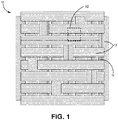
- FIG. 1 is a simplified illustration of woven fabric sheet 10.
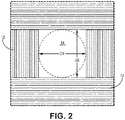
- FIG. 2 is an enlarged view of area A2 of FIG. 1 .
- Sheet 10 is formed from warp and weft (i.e., perpendicular) tows 12 which can be arranged in various woven architectures such as plain, harness (e.g., 3, 5, 8, etc.), twill, braid, or non-symmetric to name a few non-limiting examples.
- Each tow 12, as manufactured can be a bundle of silicon carbide filaments. Other suitable ceramics are contemplated herein.
- each tow 12 includes roughly 500 filaments, but in alternative embodiments, a tow 12 can include 500 to 2,000 filaments.
- Sheet 10 can exhibit inter-tow spacing defined by the distances D1 between adjacent warp tows and D2 between adjacent weft tows.
- the particular spacing between two adjacent warp or weft tows 12 can be generally uniform along the length of the respective tows 12, or can vary along the length of the respective tows 12. Variances typically arise from manufacturing imperfections. A combination of generally uniform and varied inter-tow spacing within sheet 10 is also possible.
- Sheet 10 further includes pores 14 at least partially defined by the distance D1 between adjacent warp tows 12 and the distance D2 between adjacent weft tows 12.
- Distances D1 or D2 could also represent a diameter in rounded pores 14 (represented in FIG. 2 by a dashed circular line).
- Pores 14 can be three dimensional with additional dimensions generally orthogonal to D1 and/or D2 (not shown).
- D1 can be generally equal to D2 as shown, but D1 can also be greater than D2, and vice versa.
- the average size of D1 and/or D2 can be between 300 to 500 microns. In an exemplary embodiment, D1 and/or D2 can be about 400 microns.
- sheet 10 can include a distribution of pore 14 dimensions (e.g., ranging from 300 to 500 microns) and shapes (e.g., both rounded and straight-edged), because of fabric deformation and lack of straightness of tows 12.
- pore 14 dimensions e.g., ranging from 300 to 500 microns
- shapes e.g., both rounded and straight-edged
- FIG. 3 is a simplified illustration of woven fabric sheet 110.
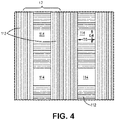
- FIG. 4 is an enlarged view of area A4 of FIG. 3 .
- Sheet 110 represents sheet 10 after the separation/splitting/division of warp and weft tows 12 into subtows 112.
- a "subtow” refers to a grouping of a subset of filaments from a parent tow 12 as a result of exposing sheet 10 to the separation means of method 200, discussed in greater detail below. Accordingly, sheet 110 can be referred to as a separated sheet. It can also be appropriate to refer to sheet 110 as a split or divided sheet.
- each tow 12 is separated into two subtows 112 (i.e., a "two-split" arrangement) using mechanical or other means discussed in greater detail below.
- the number and distribution of pores 114 in sheet 110 can increase as compared to sheet 10, while the dimensions of each pore 114 can decrease in comparison to a single pore 14.
- each pore 114 is defined by the distance D3 between adjacent warp tows 112 and the distance D4 between adjacent weft tows 112. Where D3 is generally equal to D4, D3 and/or D4 can be between 75 and 125 microns.
- the average size of D3 and/or D4 can be about 100 microns, or a 75% reduction in pore size. As was the case with D1 and D2, D3 and/or D4 can also be a diameter for a rounded pore 114. Additionally, sheet 110 can also include a distribution of pore sizes (e.g., ranging from 75 to 100 microns) and shapes (e.g., rounded and straight-edged).
- subtow arrangements are possible.
- only the tows 12 in either the warp or weft direction can be split into two subtows 112 (i.e., a "half-split" arrangement).
- Such an arrangement may be a result of the directionality of the separation means or asymmetry of the weave pattern of sheet 10, but may still provide a sufficient increase in pore density and a decrease in individual pore dimensions.
- the resultant pores in a half-split woven fabric sheet are likely to have oblong dimensions (i.e., the distances between adjacent warp and weft subtows are not equal to one another).
- Another subtow arrangement results in the splitting of each tow 12 in both the warp and weft directions into five subtows (i.e., a "five-split" arrangement).
- a five-split arrangement may best be achieved beginning with a sheet 10 having an ends-per-inch (EPI) and/or picks-per-inch (PPI) number of 8 to about 16 (equal to an end-per cm or picks-per-cm number of 3.15 to 6.30) so that there is sufficient room for the fivefold increase in subtows to spread out and become spaced apart from the immediately adjacent subtow(s).
- dimensions (i.e., distance or diameter) of the resultant pores can be reduced by about 70% to 80%.
- average pore size in the original sheet may be 800 to 1100 microns, and after splitting each tow 12 into five subtows, the pores may be 200 to 230 microns.
- warp and/or weft tows 12 can each be separated into three or four subtows each.
- Tows 12 can alternatively be split into more than 5 (e.g., six, seven, eight, etc.) subtows.
- the resulting inter-tow spacing/pore size can be as low as 25 microns.
- sheets having a low EPI/PPI number or a high-filament count in tows 12 can lend themselves to a higher split count with respect to resultant subtows.
- sheet 10 may have very low inter-tow spacing and/or overlapping tows of the same direction (e.g., adjacent warp tows 12).
- separation means can be used to create greater and more uniform overall inter-tow spacing in the resulting separated sheet.
- subtows 112 derived from a particular tow 12 will ideally, but not always, be evenly divided.
- the formation of two subtows 112 from a tow 12 of about 500 filaments can result in two subtows 112 of about 250 filaments each.
- the same tow 12 may be divided into five 100-filament subtows.
- the 500 filaments of tow 12 may not always be evenly apportioned among the subtows 112.
- a subtow 112 may contain 40% to 60% (200 to 300 filaments) of the 500 filaments.
- a subtow may contain 15% to 25% (75 to 125 filaments) of the 500 filaments.
- the splitting of a tow 12 into more than five subtows 112 can result in subtows 112 having as few as 50 filaments.
- individual filaments may disperse in such a manner during tow separation as to be grouped into more than one adjacent subtow 112 along a length of the filament, such that adjacent subtows can intermingle. Additionally, not every tow 12 will separate completely along its length and/or into the exact number of desired subtows.
- the extent of desired tow separation will ideally occur in 100% of the area of sheet 10 exposed to separation means, but in practice, 75% to 100%, or as little as 60% of the exposed area can exhibit the desired degree/extent of tow separation. Such cases still result in a sufficiently homogenous microstructure for the purposes of this disclosure.
- FIG. 5 is a flowchart illustrating selected steps of method 200, used to prepare woven fabric sheet 10 for use in a ceramic matrix composite. Steps 202-210 of method 200 are discussed in combination with FIGS. 1-5 .
- woven fabric sheet 10 can optionally be prepared for tow separation.
- preparing sheet 10 can mean desizing tows 12 using a heat treatment or other suitable means to remove any preexisting polymer coatings on tows 12. This allows individual filaments to move more freely during separation.
- Preparing can additionally and/or alternatively refer to the drying of sheet 10.
- Preparing can further refer to the wetting of sheet 10 with water or a polymer binder, such as poly-vinyl alcohol (PVA) or poly-vinyl butyral (PVB).
- preparing can additionally include the detensioning of sheet 10 to facilitate filament and tow/subtow movement during separation.
- tows 12 of woven fabric sheet 10 can be separated using one or more separation means. Separation of tows 12 may be achieved via mechanical means such as a continuous or pulsed-flow air knife to impinge tows 12 with an air stream. Insertion of studs into tows 12 using a roller or other studded element is another suitable mechanical separation method. Non-mechanical means, such as electrostatic dispersion, can additionally and/or alternatively be used. Separation may not occur in all tows 12 of a given direction. Separation can result in the reduced pores sizes and tow sizes (i.e., filament content) discussed above.
- inter-filament spacing in a subtow 112 may be greater than inter-filament spacing within the original tow 12 due to one or a combination of spreading after separation or relaxation of the woven architecture from desizing or detensioning.
- inter-tow spacing i.e., size of pores 114
- Inter-tow spacing will generally be between 25 and 230 microns across the various separated architectures disclosed herein.
- a polymer binder material e.g., PVA or PVB
- PVA or PVB a polymer binder material
- one or more sheets 110 can be formed into plies and arranged into a desired two or three dimensional preform structure.
- Step 208 can further optionally include deposition of particles onto the preform structure.
- the volume fraction of particles added to the preform structure can be relatively low (e.g., 1% to 5%).
- Such particles may be formed from a ceramic material (e.g., silicon carbide, boron carbide, silicon nitride, pure silicon, pure carbon, aluminum oxide, or hafnia) and are intended to remain as part of the structure through matrix formation and help enhance matrix formation and fortify the resultant CMC.
- the particles can alternatively be formed from a fugitive material designed to be later decomposed by thermal or chemical means.
- Fugitive particles can be formed from a polymer material such as PVA, PVB, or polymethyl methacrylate (PMMA). Fugitive particles can help maintain spacing of pores 114 and subtows 112 of sheet 110, as well as inter-ply spacing during subsequent processing steps. Ceramic or fugitive particles can alternatively be applied in steps 202 or 206.
- the preform structure can undergo matrix formation and densification using a chemical vapor infiltration or deposition (CVI or CVD) process.
- CVI or CVD chemical vapor infiltration or deposition
- the plies are infiltrated by reactant vapors, and a gaseous precursor deposits on the fibers.
- the matrix material can be a silicon carbide or other suitable ceramic material. Densification is carried out until the resulting CMC has reached the desired residual porosity. Typically, one or several interphases are deposited prior to the matrix to ensure that the composite fails in a non-brittle manner.
- the diffusion rate of the infiltrant inside of tows is a fraction of the rate of the infiltrant through the larger pores (i.e., inter-tow space) along the thickness direction of the preform panel.
- the rate of inter-filament diffusion can be on the order of one-one hundredth the rate of inter-tow diffusion.
- the disparity between the time of diffusion of the infiltrant to the center of a subtow from its edge and the time of diffusion of the same infiltrant from the surface of the component to its center is greatly reduced.
- the rates of diffusion become near equivalent if the tows are split into 5 subtows.
- the split arrangements discussed herein have a similar favorable effect.
- inter-filament spaces are more accessible to the matrix precursor materials, and the inter-tow spaces (i.e., pores 114) can be more quickly and evenly filled with the precursor materials.
- the overall duration of the CVI/CVD process may be greatly reduced, while the matrix precursor material is more evenly distributed within the preform structure.
- various post-processing steps can be performed, such as the application of one or more protective coatings (e.g., environmental and/or thermal barrier coatings).
- a bond coat can also be applied to facilitate bonding between the CMC and a protective coating.
- Other protective coatings especially those suitable for use in a gas turbine engine environment, are contemplated herein.
- a CMC component formed with the disclosed separated woven fabric(s) can be incorporated into aerospace, maritime, or industrial equipment, to name a few, non-limiting examples.
- a method of preparing a woven ceramic fabric for use in a ceramic matrix composite includes transforming a woven fabric sheet having a first tow architecture into a separated woven fabric sheet having a second tow architecture, the first tow architecture including a plurality of warp tows and a plurality of weft tows, and the second tow architecture including a plurality of warp subtows and/or a plurality of weft subtows.
- Transforming the woven fabric sheet includes separating at least some of the plurality of warp tows and/or the plurality of weft tows into a greater number of corresponding warp subtows and/or weft subtows, respectively, such that second tow architecture includes more warp subtows and/or weft subtows than the first tow architecture comprises warp tows and weft tows, and wherein each of the warp subtows and/or weft subtows includes fewer filaments than corresponding warp tow and/or weft tow.
- Each of the plurality of warp subtows and/or weft subtows is spaced apart from the closest adjacent warp subtow and/or weft subtow, respectively, a distance of 25 to 230 microns.
- the woven ceramic fabric can include silicon carbide.
- transforming the woven fabric sheet can include separating at least some of the plurality of warp tows and the plurality of weft tows into a greater number of corresponding warp subtows and weft subtows, respectively.
- the greater number can be two warp subtows for every warp tow and two weft subtows for every weft tow, such that the second tow architecture can include twice as many warp subtows and weft subtows as the first architecture has warp tows and weft tows.
- each of the warp subtows and the weft subtows can include 40% to 60% the number of filaments as the corresponding warp tow and weft tow.
- transforming the woven fabric sheet into a separated woven fabric sheet can further include reducing an average inter-tow pore size of the woven fabric sheet by 75%.
- the greater number can be five warp subtows for every warp tow and five weft subtows for every weft tow, such that the second tow architecture can include five times as many warp subtows and weft subtows as the first architecture has warp tows and weft tows.
- each of the warp subtows and the weft subtows can include 15% to 25% the number of filaments as the corresponding warp tow and weft tow.
- transforming the woven fabric sheet into a separated woven fabric sheet can further include reducing an average inter-tow pore size of the woven fabric sheet by 70% to 80%.
- the woven fabric sheet can have an ends-per-inch or picks-per-inch count of ranging from 8 to 16.
- the greater number can be three warp subtows for every warp tow and three weft subtows for every weft tow, such that the second tow architecture can include three times as many warp subtows and weft subtows as the first architecture has warp tows and weft tows.
- the greater number can be four warp subtows for every warp tow and four weft subtows for every weft tow, such that the second tow architecture can include four times as many warp subtows and weft subtows as the first architecture has warp tows and weft tows.
- Any of the above methods can further include preparing the woven fabric sheet before the step of transforming the woven fabric sheet, and preparing the woven fabric sheet can include wetting the woven fabric sheet with one of water, PVA, and PVB.
- separating the at least some of the plurality of warp tows or the plurality of weft tows into a greater number of corresponding warp subtows or weft subtows can include one of an air knife and a studded roller.
- Any of the above methods can further include applying one of PVA and PVB to the separated woven fabric sheet.
- Any of the above methods can further include forming the separated woven fabric sheet into a plurality of plies, and laying up the plurality of plies to form a preform.
- Any of the above methods can further include: forming the separated woven fabric sheet into a plurality of plies; laying up the plurality of plies to form a preform; and densifying the preform.
- any of the above methods can further include applying ceramic particles to the preform prior to densifying the preform, the ceramic particles being formed from one or a combination of silicon carbide, boron carbide, silicon nitride, pure silicon, pure carbon, aluminum oxide, and hafnia.
- Any of the above methods can further include applying fugitive particles to the preform prior to densifying the preform, the fugitive particles being formed from a polymer material.
- Any of the above methods can further include densifying the preform using one or a combination of chemical vapor infiltration, chemical vapor deposition, polymer infiltration and pyrolysis, and melt infiltration.
- the woven fabric sheet can include a first number of pores defined by the warp tows and weft tows, and wherein the separated woven fabric sheet can include a greater number of pores defined by the warp subtows and weft subtows.
Landscapes
- Chemical & Material Sciences (AREA)
- Engineering & Computer Science (AREA)
- Ceramic Engineering (AREA)
- Manufacturing & Machinery (AREA)
- Structural Engineering (AREA)
- Organic Chemistry (AREA)
- Materials Engineering (AREA)
- Inorganic Chemistry (AREA)
- Chemical Kinetics & Catalysis (AREA)
- Textile Engineering (AREA)
- Mechanical Engineering (AREA)
- General Chemical & Material Sciences (AREA)
- Woven Fabrics (AREA)
Abstract
Description
- The present invention relates to ceramic matrix composites, and more particularly, to the preparation of woven ceramic fabrics for use in ceramic matrix composites.
- The microstructure of a composite component is dictated, in part, by the fiber tow structure. In the case of ceramic matrix composites, the microstructure of the tows also dictates the way the matrix is deposited during chemical vapor infiltration. The microstructure has a default bimodal pore distribution with intra- and inter-tow porosity, with inter-tow porosity typically exceeding intra-tow porosity. Homogenizing the microstructure helps to avoid or reduce stress concentrations in the resulting composite component.
- There is provided herein a method of preparing a woven ceramic fabric for use in a ceramic matrix composite includes transforming a woven fabric sheet having a first tow architecture into a separated woven fabric sheet having a second tow architecture, the first tow architecture including a plurality of warp tows and a plurality of weft tows, and the second tow architecture including a plurality of warp subtows and/or a plurality of weft subtows. Transforming the woven fabric sheet includes separating at least some of the plurality of warp tows and/or the plurality of weft tows into a greater number of corresponding warp subtows and/or weft subtows, respectively, such that second tow architecture includes more warp subtows and/or weft subtows than the first tow architecture comprises warp tows and weft tows, and wherein each of the warp subtows and/or weft subtows includes fewer filaments than corresponding warp tow and/or weft tow. Each of the plurality of warp subtows and/or weft subtows is spaced apart from the closest adjacent warp subtow and/or weft subtow, respectively, a distance of 25 to 230 microns.
-
-
FIG. 1 is a simplified illustration of a woven fabric sheet having a traditional woven architecture. -
FIG. 2 is an enlarged view of area A2 ofFIG. 1 . -
FIG. 3 is a simplified illustration of the woven fabric sheet after separation of its fiber tows. -
FIG. 4 is an enlarged view of area A4 ofFIG. 3 . -
FIG. 5 is a flow chart illustrating steps of preparing the woven fabric sheet for use in a ceramic matrix composite. - While the above-identified figures set forth one or more embodiments of the present disclosure, other embodiments are also contemplated, as noted in the discussion. In all cases, this disclosure presents the invention by way of representation and not limitation. It should be understood that numerous other modifications and embodiments can be devised by those skilled in the art, which fall within the scope and spirit of the principles of the invention. The figures may not be drawn to scale, and applications and embodiments of the present invention may include features and components not specifically shown in the drawings.
- This disclosure presents a method for increasing the tow count of various traditional woven ceramic fabrics. More specifically, warp and/or weft tows can be divided into smaller subtows using mechanical or non-mechanical means. Various subtow patterns exhibit a range of inter-tow and inter-filament spacing ideal for matrix infiltration.
-
FIG. 1 is a simplified illustration ofwoven fabric sheet 10.FIG. 2 is an enlarged view of area A2 ofFIG. 1 .Sheet 10 is formed from warp and weft (i.e., perpendicular)tows 12 which can be arranged in various woven architectures such as plain, harness (e.g., 3, 5, 8, etc.), twill, braid, or non-symmetric to name a few non-limiting examples. Eachtow 12, as manufactured, can be a bundle of silicon carbide filaments. Other suitable ceramics are contemplated herein. In an exemplary embodiment, eachtow 12 includes roughly 500 filaments, but in alternative embodiments, atow 12 can include 500 to 2,000 filaments.Sheet 10 can exhibit inter-tow spacing defined by the distances D1 between adjacent warp tows and D2 between adjacent weft tows. The particular spacing between two adjacent warp orweft tows 12 can be generally uniform along the length of therespective tows 12, or can vary along the length of therespective tows 12. Variances typically arise from manufacturing imperfections. A combination of generally uniform and varied inter-tow spacing withinsheet 10 is also possible. -
Sheet 10 further includespores 14 at least partially defined by the distance D1 betweenadjacent warp tows 12 and the distance D2 betweenadjacent weft tows 12. Distances D1 or D2 could also represent a diameter in rounded pores 14 (represented inFIG. 2 by a dashed circular line).Pores 14 can be three dimensional with additional dimensions generally orthogonal to D1 and/or D2 (not shown). Depending on the particular woven architecture ofsheet 10, D1 can be generally equal to D2 as shown, but D1 can also be greater than D2, and vice versa. In the embodiment shown, the average size of D1 and/or D2 can be between 300 to 500 microns. In an exemplary embodiment, D1 and/or D2 can be about 400 microns. It should be understood thatsheet 10 can include a distribution ofpore 14 dimensions (e.g., ranging from 300 to 500 microns) and shapes (e.g., both rounded and straight-edged), because of fabric deformation and lack of straightness oftows 12. - It can be desirable to reduce inter-tow spacing and the size of
pores 14 while modifying pore distribution withinsheet 10.FIG. 3 is a simplified illustration ofwoven fabric sheet 110.FIG. 4 is an enlarged view of area A4 ofFIG. 3 .Sheet 110 representssheet 10 after the separation/splitting/division of warp andweft tows 12 intosubtows 112. As used herein a "subtow" refers to a grouping of a subset of filaments from aparent tow 12 as a result of exposingsheet 10 to the separation means ofmethod 200, discussed in greater detail below. Accordingly,sheet 110 can be referred to as a separated sheet. It can also be appropriate to refer tosheet 110 as a split or divided sheet. - As shown in
FIGS. 3 and4 , eachtow 12 is separated into two subtows 112 (i.e., a "two-split" arrangement) using mechanical or other means discussed in greater detail below. As such, the number and distribution ofpores 114 insheet 110 can increase as compared tosheet 10, while the dimensions of eachpore 114 can decrease in comparison to asingle pore 14. In the embodiment shown, eachpore 114 is defined by the distance D3 betweenadjacent warp tows 112 and the distance D4 betweenadjacent weft tows 112. Where D3 is generally equal to D4, D3 and/or D4 can be between 75 and 125 microns. In an exemplary embodiment, the average size of D3 and/or D4 can be about 100 microns, or a 75% reduction in pore size. As was the case with D1 and D2, D3 and/or D4 can also be a diameter for arounded pore 114. Additionally,sheet 110 can also include a distribution of pore sizes (e.g., ranging from 75 to 100 microns) and shapes (e.g., rounded and straight-edged). - Other subtow arrangements are possible. For example, only the
tows 12 in either the warp or weft direction can be split into two subtows 112 (i.e., a "half-split" arrangement). Such an arrangement may be a result of the directionality of the separation means or asymmetry of the weave pattern ofsheet 10, but may still provide a sufficient increase in pore density and a decrease in individual pore dimensions. Further, the resultant pores in a half-split woven fabric sheet are likely to have oblong dimensions (i.e., the distances between adjacent warp and weft subtows are not equal to one another). - Another subtow arrangement results in the splitting of each
tow 12 in both the warp and weft directions into five subtows (i.e., a "five-split" arrangement). A five-split arrangement may best be achieved beginning with asheet 10 having an ends-per-inch (EPI) and/or picks-per-inch (PPI) number of 8 to about 16 (equal to an end-per cm or picks-per-cm number of 3.15 to 6.30) so that there is sufficient room for the fivefold increase in subtows to spread out and become spaced apart from the immediately adjacent subtow(s). In such an arrangement, dimensions (i.e., distance or diameter) of the resultant pores can be reduced by about 70% to 80%. For example, average pore size in the original sheet may be 800 to 1100 microns, and after splitting eachtow 12 into five subtows, the pores may be 200 to 230 microns. - Other subtow multi-split arrangements are possible without departing from the scope of the invention. For example, warp and/or
weft tows 12 can each be separated into three or four subtows each.Tows 12 can alternatively be split into more than 5 (e.g., six, seven, eight, etc.) subtows. The resulting inter-tow spacing/pore size can be as low as 25 microns. In particular, sheets having a low EPI/PPI number or a high-filament count intows 12 can lend themselves to a higher split count with respect to resultant subtows. In some cases, particularly those with higher EPI/PPI numbers,sheet 10 may have very low inter-tow spacing and/or overlapping tows of the same direction (e.g., adjacent warp tows 12). In such cases, separation means can be used to create greater and more uniform overall inter-tow spacing in the resulting separated sheet. - It should be noted that
subtows 112 derived from aparticular tow 12 will ideally, but not always, be evenly divided. For example, in a two-split arrangement, the formation of twosubtows 112 from atow 12 of about 500 filaments can result in twosubtows 112 of about 250 filaments each. For a five-split arrangement, thesame tow 12 may be divided into five 100-filament subtows. However, as the precision of separation means can vary, the 500 filaments oftow 12 may not always be evenly apportioned among thesubtows 112. For a two-split arrangement, asubtow 112 may contain 40% to 60% (200 to 300 filaments) of the 500 filaments. For a five-split arrangement, a subtow may contain 15% to 25% (75 to 125 filaments) of the 500 filaments. The splitting of atow 12 into more than fivesubtows 112 can result insubtows 112 having as few as 50 filaments. It should also be noted that individual filaments may disperse in such a manner during tow separation as to be grouped into more than oneadjacent subtow 112 along a length of the filament, such that adjacent subtows can intermingle. Additionally, not everytow 12 will separate completely along its length and/or into the exact number of desired subtows. Thus, the extent of desired tow separation will ideally occur in 100% of the area ofsheet 10 exposed to separation means, but in practice, 75% to 100%, or as little as 60% of the exposed area can exhibit the desired degree/extent of tow separation. Such cases still result in a sufficiently homogenous microstructure for the purposes of this disclosure. -
FIG. 5 is a flowchart illustrating selected steps ofmethod 200, used to preparewoven fabric sheet 10 for use in a ceramic matrix composite. Steps 202-210 ofmethod 200 are discussed in combination withFIGS. 1-5 . - At
step 202,woven fabric sheet 10 can optionally be prepared for tow separation. In one embodiment, preparingsheet 10 can mean desizing tows 12 using a heat treatment or other suitable means to remove any preexisting polymer coatings ontows 12. This allows individual filaments to move more freely during separation. Preparing can additionally and/or alternatively refer to the drying ofsheet 10. Preparing can further refer to the wetting ofsheet 10 with water or a polymer binder, such as poly-vinyl alcohol (PVA) or poly-vinyl butyral (PVB). Finally, preparing can additionally include the detensioning ofsheet 10 to facilitate filament and tow/subtow movement during separation. - At
step 204, tows 12 of wovenfabric sheet 10 can be separated using one or more separation means. Separation oftows 12 may be achieved via mechanical means such as a continuous or pulsed-flow air knife to impingetows 12 with an air stream. Insertion of studs intotows 12 using a roller or other studded element is another suitable mechanical separation method. Non-mechanical means, such as electrostatic dispersion, can additionally and/or alternatively be used. Separation may not occur in alltows 12 of a given direction. Separation can result in the reduced pores sizes and tow sizes (i.e., filament content) discussed above. Furthermore, inter-filament spacing in asubtow 112 may be greater than inter-filament spacing within theoriginal tow 12 due to one or a combination of spreading after separation or relaxation of the woven architecture from desizing or detensioning. Thus, inter-tow spacing (i.e., size of pores 114) decreases and inter-filament spacing increases, creating a more homogeneous bimodal pore distribution. Inter-tow spacing will generally be between 25 and 230 microns across the various separated architectures disclosed herein. - At
step 206, a polymer binder material (e.g., PVA or PVB) can optionally be applied to separatedwoven fabric sheet 110, if not already applied atpreparation step 202. - At
step 208, one ormore sheets 110 can be formed into plies and arranged into a desired two or three dimensional preform structure. Step 208 can further optionally include deposition of particles onto the preform structure. The volume fraction of particles added to the preform structure can be relatively low (e.g., 1% to 5%). Such particles may be formed from a ceramic material (e.g., silicon carbide, boron carbide, silicon nitride, pure silicon, pure carbon, aluminum oxide, or hafnia) and are intended to remain as part of the structure through matrix formation and help enhance matrix formation and fortify the resultant CMC. The particles can alternatively be formed from a fugitive material designed to be later decomposed by thermal or chemical means. Fugitive particles can be formed from a polymer material such as PVA, PVB, or polymethyl methacrylate (PMMA). Fugitive particles can help maintain spacing ofpores 114 and subtows 112 ofsheet 110, as well as inter-ply spacing during subsequent processing steps. Ceramic or fugitive particles can alternatively be applied insteps - At
step 210, the preform structure can undergo matrix formation and densification using a chemical vapor infiltration or deposition (CVI or CVD) process. During densification, the plies are infiltrated by reactant vapors, and a gaseous precursor deposits on the fibers. The matrix material can be a silicon carbide or other suitable ceramic material. Densification is carried out until the resulting CMC has reached the desired residual porosity. Typically, one or several interphases are deposited prior to the matrix to ensure that the composite fails in a non-brittle manner. - During coating and matrix formation of standard (i.e., non-separated) architectures, the diffusion rate of the infiltrant inside of tows (i.e., the inter-filament spaces) is a fraction of the rate of the infiltrant through the larger pores (i.e., inter-tow space) along the thickness direction of the preform panel. For example, the rate of inter-filament diffusion can be on the order of one-one hundredth the rate of inter-tow diffusion. In any of the disclosed, more homogenous architectures, the disparity between the time of diffusion of the infiltrant to the center of a subtow from its edge and the time of diffusion of the same infiltrant from the surface of the component to its center is greatly reduced. For example, in a preform structure having an average tow size (e.g., diameter) of 1 mm and a panel thickness of 2 mm, the rates of diffusion become near equivalent if the tows are split into 5 subtows. Any of the split arrangements discussed herein have a similar favorable effect. Furthermore, inter-filament spaces are more accessible to the matrix precursor materials, and the inter-tow spaces (i.e., pores 114) can be more quickly and evenly filled with the precursor materials. Thus, the overall duration of the CVI/CVD process may be greatly reduced, while the matrix precursor material is more evenly distributed within the preform structure.
- At
step 212, various post-processing steps can be performed, such as the application of one or more protective coatings (e.g., environmental and/or thermal barrier coatings). A bond coat can also be applied to facilitate bonding between the CMC and a protective coating. Other protective coatings, especially those suitable for use in a gas turbine engine environment, are contemplated herein. - It should be understood that the fabrication of a composite from tow-separated fabrics will also benefit other densification techniques such as polymer infiltration and pyrolysis (PIP) or melt infiltration as a more homogeneous microstructure of the fiber microstructure will facilitate the densification process and improve the quality of the product.
- A CMC component formed with the disclosed separated woven fabric(s) can be incorporated into aerospace, maritime, or industrial equipment, to name a few, non-limiting examples.
- The following are non-exclusive descriptions of possible embodiments of the present invention.
- A method of preparing a woven ceramic fabric for use in a ceramic matrix composite includes transforming a woven fabric sheet having a first tow architecture into a separated woven fabric sheet having a second tow architecture, the first tow architecture including a plurality of warp tows and a plurality of weft tows, and the second tow architecture including a plurality of warp subtows and/or a plurality of weft subtows. Transforming the woven fabric sheet includes separating at least some of the plurality of warp tows and/or the plurality of weft tows into a greater number of corresponding warp subtows and/or weft subtows, respectively, such that second tow architecture includes more warp subtows and/or weft subtows than the first tow architecture comprises warp tows and weft tows, and wherein each of the warp subtows and/or weft subtows includes fewer filaments than corresponding warp tow and/or weft tow. Each of the plurality of warp subtows and/or weft subtows is spaced apart from the closest adjacent warp subtow and/or weft subtow, respectively, a distance of 25 to 230 microns.
- The method of the preceding paragraph can optionally include, additionally and/or alternatively, any one or more of the following features, configurations and/or additional components:
In the above method, the woven ceramic fabric can include silicon carbide. - In any of the above methods, transforming the woven fabric sheet can include separating at least some of the plurality of warp tows and the plurality of weft tows into a greater number of corresponding warp subtows and weft subtows, respectively.
- In any of the above methods, the greater number can be two warp subtows for every warp tow and two weft subtows for every weft tow, such that the second tow architecture can include twice as many warp subtows and weft subtows as the first architecture has warp tows and weft tows.
- In any of the above methods, each of the warp subtows and the weft subtows can include 40% to 60% the number of filaments as the corresponding warp tow and weft tow.
- In any of the above methods, transforming the woven fabric sheet into a separated woven fabric sheet can further include reducing an average inter-tow pore size of the woven fabric sheet by 75%.
- In any of the above methods, the greater number can be five warp subtows for every warp tow and five weft subtows for every weft tow, such that the second tow architecture can include five times as many warp subtows and weft subtows as the first architecture has warp tows and weft tows.
- In any of the above methods, each of the warp subtows and the weft subtows can include 15% to 25% the number of filaments as the corresponding warp tow and weft tow.
- In any of the above methods, transforming the woven fabric sheet into a separated woven fabric sheet can further include reducing an average inter-tow pore size of the woven fabric sheet by 70% to 80%.
- In any of the above methods, the woven fabric sheet can have an ends-per-inch or picks-per-inch count of ranging from 8 to 16.
- In any of the above methods, the greater number can be three warp subtows for every warp tow and three weft subtows for every weft tow, such that the second tow architecture can include three times as many warp subtows and weft subtows as the first architecture has warp tows and weft tows.
- In any of the above methods, the greater number can be four warp subtows for every warp tow and four weft subtows for every weft tow, such that the second tow architecture can include four times as many warp subtows and weft subtows as the first architecture has warp tows and weft tows.
- Any of the above methods can further include preparing the woven fabric sheet before the step of transforming the woven fabric sheet, and preparing the woven fabric sheet can include wetting the woven fabric sheet with one of water, PVA, and PVB.
- In any of the above methods, separating the at least some of the plurality of warp tows or the plurality of weft tows into a greater number of corresponding warp subtows or weft subtows can include one of an air knife and a studded roller.
- Any of the above methods can further include applying one of PVA and PVB to the separated woven fabric sheet.
- Any of the above methods can further include forming the separated woven fabric sheet into a plurality of plies, and laying up the plurality of plies to form a preform.
- Any of the above methods can further include: forming the separated woven fabric sheet into a plurality of plies; laying up the plurality of plies to form a preform; and densifying the preform.
- Any of the above methods can further include applying ceramic particles to the preform prior to densifying the preform, the ceramic particles being formed from one or a combination of silicon carbide, boron carbide, silicon nitride, pure silicon, pure carbon, aluminum oxide, and hafnia.
- Any of the above methods can further include applying fugitive particles to the preform prior to densifying the preform, the fugitive particles being formed from a polymer material.
- Any of the above methods can further include densifying the preform using one or a combination of chemical vapor infiltration, chemical vapor deposition, polymer infiltration and pyrolysis, and melt infiltration.
- In any of the above methods, the woven fabric sheet can include a first number of pores defined by the warp tows and weft tows, and wherein the separated woven fabric sheet can include a greater number of pores defined by the warp subtows and weft subtows.
- While the invention has been described with reference to an exemplary embodiment(s), it will be understood by those skilled in the art that various changes may be made and equivalents may be substituted for elements thereof without departing from the scope of the invention. In addition, many modifications may be made to adapt a particular situation or material to the teachings of the invention without departing from the essential scope thereof. Therefore, it is intended that the invention not be limited to the particular embodiment(s) disclosed, but that the invention will include all embodiments falling within the scope of the appended claims.
Claims (15)
- A method of preparing a woven ceramic fabric (10; 110) for use in a ceramic matrix composite, the method comprising:transforming a woven fabric sheet (10) having a first tow architecture into a separated woven fabric sheet (110) having a second tow architecture, the first tow architecture comprising a plurality of warp tows (12) and a plurality of weft tows (12), and the second tow architecture comprising a plurality of warp subtows (112) and/or a plurality of weft subtows (112);wherein transforming the woven fabric sheet (10) comprises separating at least some of the plurality of warp tows (12) and/or the plurality of weft tows (10) into a greater number of corresponding warp subtows (112) and/or weft subtows (112), respectively, such that second tow architecture comprises more warp subtows (112) and/or weft subtows (112) than the first tow architecture comprises warp tows (12) and/or weft tows (12), and wherein each of the warp subtows (112) and/or weft subtows (112) comprises fewer filaments than corresponding warp tow (12) or weft tow (12); andwherein each of the plurality of warp subtows (112) and/or weft subtows (112) is spaced apart from the closest adjacent warp subtow (112) and/or weft subtow (112), respectively, a distance of 25 to 230 microns.
- The method of claim 1, wherein the woven ceramic fabric (10; 110) comprises silicon carbide.
- The method of claim 1 or 2, wherein transforming the woven fabric sheet (10) comprises separating at least some of the plurality of warp tows (12) and the plurality of weft tows (12) into a greater number of corresponding warp subtows (112) and weft subtows (112), respectively.
- The method of claim 3, wherein the greater number is two warp subtows (112) for every warp tow (12) and two weft subtows (112)for every weft tow (12) such that the second tow architecture comprises twice as many warp subtows (112) and weft subtows (112) as the first architecture comprises warp tows (12) and weft tows (12), wherein optionally:each of the warp subtows (112) and the weft subtows (112) comprises 40% to 60% the number of filaments as the corresponding warp tow (12) and weft tow (12); and/ortransforming the woven fabric sheet (10) into a separated woven fabric sheet (110) further comprises reducing an average inter-tow pore size of the woven fabric sheet by 75%.
- The method of claim 3, wherein the greater number is five warp subtows (112) for every warp tow (12) and five weft subtows (112) for every weft tow (12), such that the second tow architecture comprises five times as many warp subtows (112) and weft subtows (112) as the first architecture comprises warp tows (12) and weft tows (12) wherein optionally:each of the warp subtows (112) and the weft subtows (112) comprises 15% to 25% the number of filaments as the corresponding warp tow (12) and weft tow (12); and/ortransforming the woven fabric sheet (10) into a separated woven fabric sheet (110) further comprises reducing an average inter-tow pore size of the woven fabric sheet (10) by 70% to 80%.
- The method of claim 5, wherein the woven fabric sheet (10) has an ends-per-inch or picks-per-inch count of ranging from 8 to 16 (3.15 to 6.30 ends-per-cm/picks-per-cm).
- The method of claim 3, wherein:the greater number is three warp subtows (112) for every warp tow (12) and three weft subtows (112) for every weft tow (12), such that the second tow architecture comprises three times as many warp subtows (112) and weft subtows (112) as the first architecture comprises warp tows (12) and weft tows (12); orthe greater number is four warp subtows (112) for every warp tow (12) and four weft subtows (112) for every weft tow (12), such that the second tow architecture comprises four times as many warp subtows (112) and weft subtows (112) as the first architecture comprises warp tows (12) and weft tows (12).
- The method of any preceding claim, and further comprising: preparing the woven fabric sheet (10) before the step of transforming the woven fabric sheet (10), wherein preparing the woven fabric sheet (10) comprises wetting the woven fabric sheet (10) with one of water, PVA, and PVB.
- The method of any preceding claim, wherein separating the at least some of the plurality of warp tows (12) or the plurality of weft tows (12) into a greater number of corresponding warp subtows (112) or weft subtows (112) comprises using one of an air knife and a studded roller.
- The method of any preceding claim, and further comprising: applying one of PVA and PVB to the separated woven fabric sheet (110).
- The method of any preceding claim, and further comprising:forming the separated woven fabric sheet (110) into a plurality of plies; andlaying up the plurality of plies to form a preform.
- The method of claim 11, and further comprising: applying ceramic particles to the preform prior to densifying the preform, the ceramic particles being formed from one or a combination of silicon carbide, boron carbide, silicon nitride, pure silicon, pure carbon, aluminum oxide, and hafnia.
- The method of claim 11 or 12 and further comprising: applying fugitive particles to the preform prior to densifying the preform, the fugitive particles being formed from a polymer material.
- The method of any of claims 11 to 13, and further comprising: densifying the preform using one or a combination of a chemical vapor infiltration, chemical vapor deposition, polymer infiltration and pyrolysis, and melt infiltration.
- The method of any preceding claim, wherein the woven fabric sheet (10) comprises a first number of pores (14) defined by the warp tows (12) and weft tows (12), and wherein the separated woven fabric sheet (110) comprises a greater number of pores (114) defined by the warp subtows (112) and/or weft subtows (112).
Applications Claiming Priority (1)
| Application Number | Priority Date | Filing Date | Title |
|---|---|---|---|
| US17/375,572 US20230019485A1 (en) | 2021-07-14 | 2021-07-14 | Homogeneous composite microstructure |
Publications (2)
| Publication Number | Publication Date |
|---|---|
| EP4119709A1 true EP4119709A1 (en) | 2023-01-18 |
| EP4119709B1 EP4119709B1 (en) | 2023-12-13 |
Family
ID=82595123
Family Applications (1)
| Application Number | Title | Priority Date | Filing Date |
|---|---|---|---|
| EP22184878.1A Active EP4119709B1 (en) | 2021-07-14 | 2022-07-14 | Homogeneous composite microstructure |
Country Status (2)
| Country | Link |
|---|---|
| US (1) | US20230019485A1 (en) |
| EP (1) | EP4119709B1 (en) |
Cited By (3)
| Publication number | Priority date | Publication date | Assignee | Title |
|---|---|---|---|---|
| EP4206372A1 (en) * | 2021-12-20 | 2023-07-05 | Raytheon Technologies Corporation | Ribbonized tows for optimized improved composite performance |
| US12312724B2 (en) | 2021-12-20 | 2025-05-27 | Rtx Corporation | Gradient tow ribbonizing for chemical vapor infiltration ceramic matrix composites |
| US12540102B2 (en) | 2021-11-05 | 2026-02-03 | Rtx Corporation | 3D woven space filler |
Families Citing this family (1)
| Publication number | Priority date | Publication date | Assignee | Title |
|---|---|---|---|---|
| US12522321B2 (en) | 2021-12-20 | 2026-01-13 | Rtx Corporation | Sacrificial yarn filament for use in ceramic matrix composites, methods of manufacture thereof and articles comprising the same |
Citations (2)
| Publication number | Priority date | Publication date | Assignee | Title |
|---|---|---|---|---|
| US20160136925A1 (en) * | 2013-03-15 | 2016-05-19 | Rolls-Royce Corporation | Fiber Architecture Optimization for Ceramic Matrix Composites |
| US9850174B2 (en) * | 2016-03-23 | 2017-12-26 | General Electric Company | Ceramic matrix composites having monomodal pore size distribution and low fiber volume fraction |
Family Cites Families (4)
| Publication number | Priority date | Publication date | Assignee | Title |
|---|---|---|---|---|
| US6032342A (en) * | 1996-05-01 | 2000-03-07 | Fukui Prefecture | Multi-filament split-yarn sheet and method and device for the manufacture thereof |
| EP3222514B1 (en) * | 2016-03-21 | 2019-05-22 | Airbus Operations GmbH | Skin panel with an energy-storing layer for an aircraft or spacecraft and method for manufacturing an energy-storing layer for a skin panel |
| US20180230062A1 (en) * | 2017-02-13 | 2018-08-16 | General Electric Company | Field Induced Tow Manipulation |
| US10934219B2 (en) * | 2017-12-20 | 2021-03-02 | Raytheon Technologies Corporation | Method of increasing the uniformity of chemical vapor deposition on fibrous material through the imposition of pressure waves |
-
2021
- 2021-07-14 US US17/375,572 patent/US20230019485A1/en not_active Abandoned
-
2022
- 2022-07-14 EP EP22184878.1A patent/EP4119709B1/en active Active
Patent Citations (2)
| Publication number | Priority date | Publication date | Assignee | Title |
|---|---|---|---|---|
| US20160136925A1 (en) * | 2013-03-15 | 2016-05-19 | Rolls-Royce Corporation | Fiber Architecture Optimization for Ceramic Matrix Composites |
| US9850174B2 (en) * | 2016-03-23 | 2017-12-26 | General Electric Company | Ceramic matrix composites having monomodal pore size distribution and low fiber volume fraction |
Cited By (4)
| Publication number | Priority date | Publication date | Assignee | Title |
|---|---|---|---|---|
| US12540102B2 (en) | 2021-11-05 | 2026-02-03 | Rtx Corporation | 3D woven space filler |
| EP4206372A1 (en) * | 2021-12-20 | 2023-07-05 | Raytheon Technologies Corporation | Ribbonized tows for optimized improved composite performance |
| US12017379B2 (en) | 2021-12-20 | 2024-06-25 | Rtx Corporation | Ribbonized tows for optimized improved composite performance |
| US12312724B2 (en) | 2021-12-20 | 2025-05-27 | Rtx Corporation | Gradient tow ribbonizing for chemical vapor infiltration ceramic matrix composites |
Also Published As
| Publication number | Publication date |
|---|---|
| US20230019485A1 (en) | 2023-01-19 |
| EP4119709B1 (en) | 2023-12-13 |
Similar Documents
| Publication | Publication Date | Title |
|---|---|---|
| EP4119709B1 (en) | Homogeneous composite microstructure | |
| US12017379B2 (en) | Ribbonized tows for optimized improved composite performance | |
| US10995039B1 (en) | Methods of forming ceramic matrix composites using sacrificial fibers and non-wetting coating | |
| US10384981B2 (en) | Methods of forming ceramic matrix composites using sacrificial fibers and related products | |
| RU2529529C2 (en) | Small-thickness part from thermo-structural composite and method of its production | |
| EP4197782A2 (en) | Gradient tow ribbonizing for chemical vapor infiiltration ceramic matrix composites | |
| US20230192561A1 (en) | Controlled gradient of porosity in cmc | |
| EP4344843A1 (en) | Spiked preform tooling for improved chemical vapor infiltration in ceramic matrix composites | |
| EP4197781A1 (en) | Pressurized stabilization of plies for improved interlaminar properties | |
| EP4541535A1 (en) | Z-channeling into a preform via needle perforation in a stand-alone tool | |
| US20210024427A1 (en) | Cmc system for improved infiltration | |
| US10821681B2 (en) | Liquid infusion molded ceramic matrix composites and methods of forming the same | |
| EP4119318B1 (en) | Electrostatic filament dispersal for cmc applications | |
| US12365632B2 (en) | Superabsorbent polymer filament sizing for CMC applications | |
| EP4477413A1 (en) | Particle enhanced ceramic matrix composite with no particles on surface plies | |
| EP4292995A2 (en) | Particle-imbedded serving yarn for cmc applications | |
| EP4201915A1 (en) | Introduction of metallic particles to enable formation of metallic carbides in a matrix | |
| EP3816139A1 (en) | Production method for composite material | |
| EP4177052A1 (en) | 3d woven space filler | |
| EP4119319B1 (en) | Method of fabric processing for improved cmc infiltration | |
| EP4431483A1 (en) | Three dimensional weave with sacrifical z-fibers for improved ceramic matrix composite microstructure | |
| US20250136521A1 (en) | Variable z-channel hole pattern | |
| US20250128453A1 (en) | Pre-shaped space fillers for small cross section features |
Legal Events
| Date | Code | Title | Description |
|---|---|---|---|
| PUAI | Public reference made under article 153(3) epc to a published international application that has entered the european phase |
Free format text: ORIGINAL CODE: 0009012 |
|
| STAA | Information on the status of an ep patent application or granted ep patent |
Free format text: STATUS: THE APPLICATION HAS BEEN PUBLISHED |
|
| AK | Designated contracting states |
Kind code of ref document: A1 Designated state(s): AL AT BE BG CH CY CZ DE DK EE ES FI FR GB GR HR HU IE IS IT LI LT LU LV MC MK MT NL NO PL PT RO RS SE SI SK SM TR |
|
| STAA | Information on the status of an ep patent application or granted ep patent |
Free format text: STATUS: REQUEST FOR EXAMINATION WAS MADE |
|
| 17P | Request for examination filed |
Effective date: 20230221 |
|
| RBV | Designated contracting states (corrected) |
Designated state(s): AL AT BE BG CH CY CZ DE DK EE ES FI FR GB GR HR HU IE IS IT LI LT LU LV MC MK MT NL NO PL PT RO RS SE SI SK SM TR |
|
| GRAP | Despatch of communication of intention to grant a patent |
Free format text: ORIGINAL CODE: EPIDOSNIGR1 |
|
| STAA | Information on the status of an ep patent application or granted ep patent |
Free format text: STATUS: GRANT OF PATENT IS INTENDED |
|
| RIC1 | Information provided on ipc code assigned before grant |
Ipc: D02J 1/18 20060101ALI20230619BHEP Ipc: C04B 35/80 20060101ALI20230619BHEP Ipc: C04B 35/565 20060101ALI20230619BHEP Ipc: C04B 30/02 20060101ALI20230619BHEP Ipc: B32B 18/00 20060101ALI20230619BHEP Ipc: D03D 13/00 20060101ALI20230619BHEP Ipc: D03D 9/00 20060101ALI20230619BHEP Ipc: D03D 15/242 20210101ALI20230619BHEP Ipc: D03D 1/00 20060101AFI20230619BHEP |
|
| INTG | Intention to grant announced |
Effective date: 20230713 |
|
| RAP3 | Party data changed (applicant data changed or rights of an application transferred) |
Owner name: RTX CORPORATION |
|
| GRAS | Grant fee paid |
Free format text: ORIGINAL CODE: EPIDOSNIGR3 |
|
| GRAA | (expected) grant |
Free format text: ORIGINAL CODE: 0009210 |
|
| STAA | Information on the status of an ep patent application or granted ep patent |
Free format text: STATUS: THE PATENT HAS BEEN GRANTED |
|
| AK | Designated contracting states |
Kind code of ref document: B1 Designated state(s): AL AT BE BG CH CY CZ DE DK EE ES FI FR GB GR HR HU IE IS IT LI LT LU LV MC MK MT NL NO PL PT RO RS SE SI SK SM TR |
|
| REG | Reference to a national code |
Ref country code: GB Ref legal event code: FG4D |
|
| REG | Reference to a national code |
Ref country code: CH Ref legal event code: EP |
|
| REG | Reference to a national code |
Ref country code: DE Ref legal event code: R096 Ref document number: 602022001289 Country of ref document: DE |
|
| REG | Reference to a national code |
Ref country code: IE Ref legal event code: FG4D |
|
| PG25 | Lapsed in a contracting state [announced via postgrant information from national office to epo] |
Ref country code: GR Free format text: LAPSE BECAUSE OF FAILURE TO SUBMIT A TRANSLATION OF THE DESCRIPTION OR TO PAY THE FEE WITHIN THE PRESCRIBED TIME-LIMIT Effective date: 20240314 |
|
| REG | Reference to a national code |
Ref country code: LT Ref legal event code: MG9D |
|
| PG25 | Lapsed in a contracting state [announced via postgrant information from national office to epo] |
Ref country code: LT Free format text: LAPSE BECAUSE OF FAILURE TO SUBMIT A TRANSLATION OF THE DESCRIPTION OR TO PAY THE FEE WITHIN THE PRESCRIBED TIME-LIMIT Effective date: 20231213 |
|
| REG | Reference to a national code |
Ref country code: NL Ref legal event code: MP Effective date: 20231213 |
|
| PG25 | Lapsed in a contracting state [announced via postgrant information from national office to epo] |
Ref country code: ES Free format text: LAPSE BECAUSE OF FAILURE TO SUBMIT A TRANSLATION OF THE DESCRIPTION OR TO PAY THE FEE WITHIN THE PRESCRIBED TIME-LIMIT Effective date: 20231213 |
|
| PG25 | Lapsed in a contracting state [announced via postgrant information from national office to epo] |
Ref country code: LT Free format text: LAPSE BECAUSE OF FAILURE TO SUBMIT A TRANSLATION OF THE DESCRIPTION OR TO PAY THE FEE WITHIN THE PRESCRIBED TIME-LIMIT Effective date: 20231213 Ref country code: GR Free format text: LAPSE BECAUSE OF FAILURE TO SUBMIT A TRANSLATION OF THE DESCRIPTION OR TO PAY THE FEE WITHIN THE PRESCRIBED TIME-LIMIT Effective date: 20240314 Ref country code: ES Free format text: LAPSE BECAUSE OF FAILURE TO SUBMIT A TRANSLATION OF THE DESCRIPTION OR TO PAY THE FEE WITHIN THE PRESCRIBED TIME-LIMIT Effective date: 20231213 Ref country code: BG Free format text: LAPSE BECAUSE OF FAILURE TO SUBMIT A TRANSLATION OF THE DESCRIPTION OR TO PAY THE FEE WITHIN THE PRESCRIBED TIME-LIMIT Effective date: 20240313 |
|
| REG | Reference to a national code |
Ref country code: AT Ref legal event code: MK05 Ref document number: 1640510 Country of ref document: AT Kind code of ref document: T Effective date: 20231213 |
|
| PG25 | Lapsed in a contracting state [announced via postgrant information from national office to epo] |
Ref country code: NL Free format text: LAPSE BECAUSE OF FAILURE TO SUBMIT A TRANSLATION OF THE DESCRIPTION OR TO PAY THE FEE WITHIN THE PRESCRIBED TIME-LIMIT Effective date: 20231213 |
|
| PG25 | Lapsed in a contracting state [announced via postgrant information from national office to epo] |
Ref country code: SE Free format text: LAPSE BECAUSE OF FAILURE TO SUBMIT A TRANSLATION OF THE DESCRIPTION OR TO PAY THE FEE WITHIN THE PRESCRIBED TIME-LIMIT Effective date: 20231213 Ref country code: RS Free format text: LAPSE BECAUSE OF FAILURE TO SUBMIT A TRANSLATION OF THE DESCRIPTION OR TO PAY THE FEE WITHIN THE PRESCRIBED TIME-LIMIT Effective date: 20231213 Ref country code: NO Free format text: LAPSE BECAUSE OF FAILURE TO SUBMIT A TRANSLATION OF THE DESCRIPTION OR TO PAY THE FEE WITHIN THE PRESCRIBED TIME-LIMIT Effective date: 20240313 Ref country code: NL Free format text: LAPSE BECAUSE OF FAILURE TO SUBMIT A TRANSLATION OF THE DESCRIPTION OR TO PAY THE FEE WITHIN THE PRESCRIBED TIME-LIMIT Effective date: 20231213 Ref country code: LV Free format text: LAPSE BECAUSE OF FAILURE TO SUBMIT A TRANSLATION OF THE DESCRIPTION OR TO PAY THE FEE WITHIN THE PRESCRIBED TIME-LIMIT Effective date: 20231213 Ref country code: HR Free format text: LAPSE BECAUSE OF FAILURE TO SUBMIT A TRANSLATION OF THE DESCRIPTION OR TO PAY THE FEE WITHIN THE PRESCRIBED TIME-LIMIT Effective date: 20231213 |
|
| PG25 | Lapsed in a contracting state [announced via postgrant information from national office to epo] |
Ref country code: IS Free format text: LAPSE BECAUSE OF FAILURE TO SUBMIT A TRANSLATION OF THE DESCRIPTION OR TO PAY THE FEE WITHIN THE PRESCRIBED TIME-LIMIT Effective date: 20240413 |
|
| PG25 | Lapsed in a contracting state [announced via postgrant information from national office to epo] |
Ref country code: CZ Free format text: LAPSE BECAUSE OF FAILURE TO SUBMIT A TRANSLATION OF THE DESCRIPTION OR TO PAY THE FEE WITHIN THE PRESCRIBED TIME-LIMIT Effective date: 20231213 Ref country code: AT Free format text: LAPSE BECAUSE OF FAILURE TO SUBMIT A TRANSLATION OF THE DESCRIPTION OR TO PAY THE FEE WITHIN THE PRESCRIBED TIME-LIMIT Effective date: 20231213 |
|
| PG25 | Lapsed in a contracting state [announced via postgrant information from national office to epo] |
Ref country code: SK Free format text: LAPSE BECAUSE OF FAILURE TO SUBMIT A TRANSLATION OF THE DESCRIPTION OR TO PAY THE FEE WITHIN THE PRESCRIBED TIME-LIMIT Effective date: 20231213 |
|
| PG25 | Lapsed in a contracting state [announced via postgrant information from national office to epo] |
Ref country code: SM Free format text: LAPSE BECAUSE OF FAILURE TO SUBMIT A TRANSLATION OF THE DESCRIPTION OR TO PAY THE FEE WITHIN THE PRESCRIBED TIME-LIMIT Effective date: 20231213 Ref country code: SK Free format text: LAPSE BECAUSE OF FAILURE TO SUBMIT A TRANSLATION OF THE DESCRIPTION OR TO PAY THE FEE WITHIN THE PRESCRIBED TIME-LIMIT Effective date: 20231213 Ref country code: RO Free format text: LAPSE BECAUSE OF FAILURE TO SUBMIT A TRANSLATION OF THE DESCRIPTION OR TO PAY THE FEE WITHIN THE PRESCRIBED TIME-LIMIT Effective date: 20231213 Ref country code: IT Free format text: LAPSE BECAUSE OF FAILURE TO SUBMIT A TRANSLATION OF THE DESCRIPTION OR TO PAY THE FEE WITHIN THE PRESCRIBED TIME-LIMIT Effective date: 20231213 Ref country code: IS Free format text: LAPSE BECAUSE OF FAILURE TO SUBMIT A TRANSLATION OF THE DESCRIPTION OR TO PAY THE FEE WITHIN THE PRESCRIBED TIME-LIMIT Effective date: 20240413 Ref country code: EE Free format text: LAPSE BECAUSE OF FAILURE TO SUBMIT A TRANSLATION OF THE DESCRIPTION OR TO PAY THE FEE WITHIN THE PRESCRIBED TIME-LIMIT Effective date: 20231213 Ref country code: CZ Free format text: LAPSE BECAUSE OF FAILURE TO SUBMIT A TRANSLATION OF THE DESCRIPTION OR TO PAY THE FEE WITHIN THE PRESCRIBED TIME-LIMIT Effective date: 20231213 Ref country code: AT Free format text: LAPSE BECAUSE OF FAILURE TO SUBMIT A TRANSLATION OF THE DESCRIPTION OR TO PAY THE FEE WITHIN THE PRESCRIBED TIME-LIMIT Effective date: 20231213 |
|
| PG25 | Lapsed in a contracting state [announced via postgrant information from national office to epo] |
Ref country code: PT Free format text: LAPSE BECAUSE OF FAILURE TO SUBMIT A TRANSLATION OF THE DESCRIPTION OR TO PAY THE FEE WITHIN THE PRESCRIBED TIME-LIMIT Effective date: 20240415 Ref country code: PL Free format text: LAPSE BECAUSE OF FAILURE TO SUBMIT A TRANSLATION OF THE DESCRIPTION OR TO PAY THE FEE WITHIN THE PRESCRIBED TIME-LIMIT Effective date: 20231213 |
|
| PG25 | Lapsed in a contracting state [announced via postgrant information from national office to epo] |
Ref country code: PT Free format text: LAPSE BECAUSE OF FAILURE TO SUBMIT A TRANSLATION OF THE DESCRIPTION OR TO PAY THE FEE WITHIN THE PRESCRIBED TIME-LIMIT Effective date: 20240415 Ref country code: PL Free format text: LAPSE BECAUSE OF FAILURE TO SUBMIT A TRANSLATION OF THE DESCRIPTION OR TO PAY THE FEE WITHIN THE PRESCRIBED TIME-LIMIT Effective date: 20231213 |
|
| REG | Reference to a national code |
Ref country code: DE Ref legal event code: R097 Ref document number: 602022001289 Country of ref document: DE |
|
| PG25 | Lapsed in a contracting state [announced via postgrant information from national office to epo] |
Ref country code: DK Free format text: LAPSE BECAUSE OF FAILURE TO SUBMIT A TRANSLATION OF THE DESCRIPTION OR TO PAY THE FEE WITHIN THE PRESCRIBED TIME-LIMIT Effective date: 20231213 |
|
| PLBE | No opposition filed within time limit |
Free format text: ORIGINAL CODE: 0009261 |
|
| STAA | Information on the status of an ep patent application or granted ep patent |
Free format text: STATUS: NO OPPOSITION FILED WITHIN TIME LIMIT |
|
| PG25 | Lapsed in a contracting state [announced via postgrant information from national office to epo] |
Ref country code: SI Free format text: LAPSE BECAUSE OF FAILURE TO SUBMIT A TRANSLATION OF THE DESCRIPTION OR TO PAY THE FEE WITHIN THE PRESCRIBED TIME-LIMIT Effective date: 20231213 |
|
| PG25 | Lapsed in a contracting state [announced via postgrant information from national office to epo] |
Ref country code: SI Free format text: LAPSE BECAUSE OF FAILURE TO SUBMIT A TRANSLATION OF THE DESCRIPTION OR TO PAY THE FEE WITHIN THE PRESCRIBED TIME-LIMIT Effective date: 20231213 Ref country code: DK Free format text: LAPSE BECAUSE OF FAILURE TO SUBMIT A TRANSLATION OF THE DESCRIPTION OR TO PAY THE FEE WITHIN THE PRESCRIBED TIME-LIMIT Effective date: 20231213 |
|
| 26N | No opposition filed |
Effective date: 20240916 |
|
| PG25 | Lapsed in a contracting state [announced via postgrant information from national office to epo] |
Ref country code: MC Free format text: LAPSE BECAUSE OF FAILURE TO SUBMIT A TRANSLATION OF THE DESCRIPTION OR TO PAY THE FEE WITHIN THE PRESCRIBED TIME-LIMIT Effective date: 20231213 |
|
| PG25 | Lapsed in a contracting state [announced via postgrant information from national office to epo] |
Ref country code: LU Free format text: LAPSE BECAUSE OF NON-PAYMENT OF DUE FEES Effective date: 20240714 |
|
| PG25 | Lapsed in a contracting state [announced via postgrant information from national office to epo] |
Ref country code: LU Free format text: LAPSE BECAUSE OF NON-PAYMENT OF DUE FEES Effective date: 20240714 |
|
| PG25 | Lapsed in a contracting state [announced via postgrant information from national office to epo] |
Ref country code: BE Free format text: LAPSE BECAUSE OF NON-PAYMENT OF DUE FEES Effective date: 20240731 |
|
| REG | Reference to a national code |
Ref country code: BE Ref legal event code: MM Effective date: 20240731 |
|
| PGFP | Annual fee paid to national office [announced via postgrant information from national office to epo] |
Ref country code: FR Payment date: 20250620 Year of fee payment: 4 |
|
| PG25 | Lapsed in a contracting state [announced via postgrant information from national office to epo] |
Ref country code: IE Free format text: LAPSE BECAUSE OF NON-PAYMENT OF DUE FEES Effective date: 20240714 |
|
| PG25 | Lapsed in a contracting state [announced via postgrant information from national office to epo] |
Ref country code: FI Free format text: LAPSE BECAUSE OF FAILURE TO SUBMIT A TRANSLATION OF THE DESCRIPTION OR TO PAY THE FEE WITHIN THE PRESCRIBED TIME-LIMIT Effective date: 20231213 |
|
| PGFP | Annual fee paid to national office [announced via postgrant information from national office to epo] |
Ref country code: DE Payment date: 20250620 Year of fee payment: 4 |
|
| PG25 | Lapsed in a contracting state [announced via postgrant information from national office to epo] |
Ref country code: CY Free format text: LAPSE BECAUSE OF FAILURE TO SUBMIT A TRANSLATION OF THE DESCRIPTION OR TO PAY THE FEE WITHIN THE PRESCRIBED TIME-LIMIT; INVALID AB INITIO Effective date: 20220714 |
|
| P01 | Opt-out of the competence of the unified patent court (upc) registered |
Free format text: CASE NUMBER: UPC_APP_0018588_4119709/2025 Effective date: 20251219 |
|
| REG | Reference to a national code |
Ref country code: CH Ref legal event code: H13 Free format text: ST27 STATUS EVENT CODE: U-0-0-H10-H13 (AS PROVIDED BY THE NATIONAL OFFICE) Effective date: 20260224 |
|
| PG25 | Lapsed in a contracting state [announced via postgrant information from national office to epo] |
Ref country code: HU Free format text: LAPSE BECAUSE OF FAILURE TO SUBMIT A TRANSLATION OF THE DESCRIPTION OR TO PAY THE FEE WITHIN THE PRESCRIBED TIME-LIMIT; INVALID AB INITIO Effective date: 20220714 |
|
| PG25 | Lapsed in a contracting state [announced via postgrant information from national office to epo] |
Ref country code: CH Free format text: LAPSE BECAUSE OF NON-PAYMENT OF DUE FEES Effective date: 20250731 |