EP4119475B1 - System for replacing a reel of material for the production of electrical energy storage devices and related method - Google Patents
System for replacing a reel of material for the production of electrical energy storage devices and related method Download PDFInfo
- Publication number
- EP4119475B1 EP4119475B1 EP22183383.3A EP22183383A EP4119475B1 EP 4119475 B1 EP4119475 B1 EP 4119475B1 EP 22183383 A EP22183383 A EP 22183383A EP 4119475 B1 EP4119475 B1 EP 4119475B1
- Authority
- EP
- European Patent Office
- Prior art keywords
- reel
- spindle
- initial flap
- feeding unit
- flap
- Prior art date
- Legal status (The legal status is an assumption and is not a legal conclusion. Google has not performed a legal analysis and makes no representation as to the accuracy of the status listed.)
- Active
Links
Images





Classifications
-
- B—PERFORMING OPERATIONS; TRANSPORTING
- B65—CONVEYING; PACKING; STORING; HANDLING THIN OR FILAMENTARY MATERIAL
- B65H—HANDLING THIN OR FILAMENTARY MATERIAL, e.g. SHEETS, WEBS, CABLES
- B65H19/00—Changing the web roll
- B65H19/10—Changing the web roll in unwinding mechanisms or in connection with unwinding operations
- B65H19/12—Lifting, transporting, or inserting the web roll; Removing empty core
- B65H19/123—Lifting, transporting, or inserting the web roll; Removing empty core with cantilever supporting arrangements
-
- B—PERFORMING OPERATIONS; TRANSPORTING
- B65—CONVEYING; PACKING; STORING; HANDLING THIN OR FILAMENTARY MATERIAL
- B65H—HANDLING THIN OR FILAMENTARY MATERIAL, e.g. SHEETS, WEBS, CABLES
- B65H16/00—Unwinding, paying-out webs
- B65H16/02—Supporting web roll
- B65H16/04—Supporting web roll cantilever type
-
- B—PERFORMING OPERATIONS; TRANSPORTING
- B65—CONVEYING; PACKING; STORING; HANDLING THIN OR FILAMENTARY MATERIAL
- B65H—HANDLING THIN OR FILAMENTARY MATERIAL, e.g. SHEETS, WEBS, CABLES
- B65H19/00—Changing the web roll
- B65H19/10—Changing the web roll in unwinding mechanisms or in connection with unwinding operations
-
- B—PERFORMING OPERATIONS; TRANSPORTING
- B65—CONVEYING; PACKING; STORING; HANDLING THIN OR FILAMENTARY MATERIAL
- B65H—HANDLING THIN OR FILAMENTARY MATERIAL, e.g. SHEETS, WEBS, CABLES
- B65H19/00—Changing the web roll
- B65H19/10—Changing the web roll in unwinding mechanisms or in connection with unwinding operations
- B65H19/102—Preparing the leading end of the replacement web before splicing operation; Adhesive arrangements on leading end of replacement web; Tabs and adhesive tapes for splicing
-
- B—PERFORMING OPERATIONS; TRANSPORTING
- B65—CONVEYING; PACKING; STORING; HANDLING THIN OR FILAMENTARY MATERIAL
- B65H—HANDLING THIN OR FILAMENTARY MATERIAL, e.g. SHEETS, WEBS, CABLES
- B65H19/00—Changing the web roll
- B65H19/10—Changing the web roll in unwinding mechanisms or in connection with unwinding operations
- B65H19/18—Attaching, e.g. pasting, the replacement web to the expiring web
-
- B—PERFORMING OPERATIONS; TRANSPORTING
- B65—CONVEYING; PACKING; STORING; HANDLING THIN OR FILAMENTARY MATERIAL
- B65H—HANDLING THIN OR FILAMENTARY MATERIAL, e.g. SHEETS, WEBS, CABLES
- B65H23/00—Registering, tensioning, smoothing or guiding webs
- B65H23/04—Registering, tensioning, smoothing or guiding webs longitudinally
- B65H23/26—Registering, tensioning, smoothing or guiding webs longitudinally by transverse stationary or adjustable bars or rollers
-
- H—ELECTRICITY
- H01—ELECTRIC ELEMENTS
- H01M—PROCESSES OR MEANS, e.g. BATTERIES, FOR THE DIRECT CONVERSION OF CHEMICAL ENERGY INTO ELECTRICAL ENERGY
- H01M10/00—Secondary cells; Manufacture thereof
- H01M10/04—Construction or manufacture in general
- H01M10/0404—Machines for assembling batteries
-
- B—PERFORMING OPERATIONS; TRANSPORTING
- B65—CONVEYING; PACKING; STORING; HANDLING THIN OR FILAMENTARY MATERIAL
- B65H—HANDLING THIN OR FILAMENTARY MATERIAL, e.g. SHEETS, WEBS, CABLES
- B65H2301/00—Handling processes for sheets or webs
- B65H2301/40—Type of handling process
- B65H2301/41—Winding, unwinding
- B65H2301/413—Supporting web roll
- B65H2301/4132—Cantilever arrangement
- B65H2301/41324—Cantilever arrangement linear movement of roll support
- B65H2301/413246—Cantilever arrangement linear movement of roll support perpendicular to roll axis (e.g. lowering)
-
- B—PERFORMING OPERATIONS; TRANSPORTING
- B65—CONVEYING; PACKING; STORING; HANDLING THIN OR FILAMENTARY MATERIAL
- B65H—HANDLING THIN OR FILAMENTARY MATERIAL, e.g. SHEETS, WEBS, CABLES
- B65H2301/00—Handling processes for sheets or webs
- B65H2301/40—Type of handling process
- B65H2301/41—Winding, unwinding
- B65H2301/417—Handling or changing web rolls
- B65H2301/4171—Handling web roll
- B65H2301/4175—Handling web roll involving cart
-
- B—PERFORMING OPERATIONS; TRANSPORTING
- B65—CONVEYING; PACKING; STORING; HANDLING THIN OR FILAMENTARY MATERIAL
- B65H—HANDLING THIN OR FILAMENTARY MATERIAL, e.g. SHEETS, WEBS, CABLES
- B65H2301/00—Handling processes for sheets or webs
- B65H2301/40—Type of handling process
- B65H2301/46—Splicing
- B65H2301/461—Processing webs in splicing process
- B65H2301/4611—Processing webs in splicing process before splicing
- B65H2301/46115—Processing webs in splicing process before splicing by bringing leading edge to splicing station, e.g. by chain or belt
-
- B—PERFORMING OPERATIONS; TRANSPORTING
- B65—CONVEYING; PACKING; STORING; HANDLING THIN OR FILAMENTARY MATERIAL
- B65H—HANDLING THIN OR FILAMENTARY MATERIAL, e.g. SHEETS, WEBS, CABLES
- B65H2405/00—Parts for holding the handled material
- B65H2405/40—Holders, supports for rolls
- B65H2405/42—Supports for rolls fully removable from the handling machine
- B65H2405/422—Trolley, cart, i.e. support movable on floor
- B65H2405/4221—Trolley, cart, i.e. support movable on floor for both full and empty (or partial) roll
-
- B—PERFORMING OPERATIONS; TRANSPORTING
- B65—CONVEYING; PACKING; STORING; HANDLING THIN OR FILAMENTARY MATERIAL
- B65H—HANDLING THIN OR FILAMENTARY MATERIAL, e.g. SHEETS, WEBS, CABLES
- B65H2555/00—Actuating means
- B65H2555/30—Multi-axis
-
- B—PERFORMING OPERATIONS; TRANSPORTING
- B65—CONVEYING; PACKING; STORING; HANDLING THIN OR FILAMENTARY MATERIAL
- B65H—HANDLING THIN OR FILAMENTARY MATERIAL, e.g. SHEETS, WEBS, CABLES
- B65H2701/00—Handled material; Storage means
- B65H2701/10—Handled articles or webs
- B65H2701/19—Specific article or web
-
- B—PERFORMING OPERATIONS; TRANSPORTING
- B65—CONVEYING; PACKING; STORING; HANDLING THIN OR FILAMENTARY MATERIAL
- B65H—HANDLING THIN OR FILAMENTARY MATERIAL, e.g. SHEETS, WEBS, CABLES
- B65H2801/00—Application field
- B65H2801/72—Fuel cell manufacture
-
- Y—GENERAL TAGGING OF NEW TECHNOLOGICAL DEVELOPMENTS; GENERAL TAGGING OF CROSS-SECTIONAL TECHNOLOGIES SPANNING OVER SEVERAL SECTIONS OF THE IPC; TECHNICAL SUBJECTS COVERED BY FORMER USPC CROSS-REFERENCE ART COLLECTIONS [XRACs] AND DIGESTS
- Y02—TECHNOLOGIES OR APPLICATIONS FOR MITIGATION OR ADAPTATION AGAINST CLIMATE CHANGE
- Y02E—REDUCTION OF GREENHOUSE GAS [GHG] EMISSIONS, RELATED TO ENERGY GENERATION, TRANSMISSION OR DISTRIBUTION
- Y02E60/00—Enabling technologies; Technologies with a potential or indirect contribution to GHG emissions mitigation
- Y02E60/10—Energy storage using batteries
-
- Y—GENERAL TAGGING OF NEW TECHNOLOGICAL DEVELOPMENTS; GENERAL TAGGING OF CROSS-SECTIONAL TECHNOLOGIES SPANNING OVER SEVERAL SECTIONS OF THE IPC; TECHNICAL SUBJECTS COVERED BY FORMER USPC CROSS-REFERENCE ART COLLECTIONS [XRACs] AND DIGESTS
- Y02—TECHNOLOGIES OR APPLICATIONS FOR MITIGATION OR ADAPTATION AGAINST CLIMATE CHANGE
- Y02P—CLIMATE CHANGE MITIGATION TECHNOLOGIES IN THE PRODUCTION OR PROCESSING OF GOODS
- Y02P70/00—Climate change mitigation technologies in the production process for final industrial or consumer products
- Y02P70/50—Manufacturing or production processes characterised by the final manufactured product
-
- Y—GENERAL TAGGING OF NEW TECHNOLOGICAL DEVELOPMENTS; GENERAL TAGGING OF CROSS-SECTIONAL TECHNOLOGIES SPANNING OVER SEVERAL SECTIONS OF THE IPC; TECHNICAL SUBJECTS COVERED BY FORMER USPC CROSS-REFERENCE ART COLLECTIONS [XRACs] AND DIGESTS
- Y02—TECHNOLOGIES OR APPLICATIONS FOR MITIGATION OR ADAPTATION AGAINST CLIMATE CHANGE
- Y02T—CLIMATE CHANGE MITIGATION TECHNOLOGIES RELATED TO TRANSPORTATION
- Y02T10/00—Road transport of goods or passengers
- Y02T10/60—Other road transportation technologies with climate change mitigation effect
- Y02T10/70—Energy storage systems for electromobility, e.g. batteries
Definitions
- the present invention relates to a system and to a related method for replacing a reel of material, in particular a reel of a strip of electrode or separator, for the production of electrical energy storage devices.
- the present invention is advantageously but not exclusively applied to the production of rechargeable batteries to which the following description will explicitly refer without thereby losing generality, for example planar batteries in metal can or enveloped (commonly called of the pouch type), or cylindrical batteries composed of cylindrical windings (for example of the jelly roll type).
- Rechargeable batteries usually comprise two layers of electrode (cathode and anode) and at least two layers of separator arranged staggered with respect to one another according to an alternated electrode-separator-electrode-separator scheme.
- such layers are each provided in a strip shape initially wound in a reel.
- the cylindrical winding is typically closed by a layer of protective tape and fed to a further unit for forming the battery.
- the strips of electrode and separator are fed along respective feeding paths for converging all of them towards a rolling unit, inside which they are laminated with respect to one another. If necessary, during the lamination, the aforementioned strips of electrode and separator are arranged between two further protection layers (these too strip-shaped). Such protection layers are configured to protect the strips of electrode and separator inside the rolling unit and are usually removed at the exit from this unit.
- the automatic machines of the aforementioned type generally comprise an aforementioned feeding unit of the strips of separator and electrode, which are initially wound in respective reels each supported by a relative support shaft or spindle.
- the feeding unit must constantly be provided with full reels of strips of electrode and separator so as to ensure the continuity of the process.
- the feeding unit is conveniently adapted to support two reels for each strip of material.
- the feeding unit comprises a pair of support shafts or spindles for each strip of material to be fed, one of which spindles supports the unwinding reel and the other of which spindles supports a full reel.
- a feeding unit of known type includes a splicing device (commonly known as splicer) configured to automatically join to one another the final flap of the exhausting reel with the initial flap of the full reel, for each pair of spindles (and thus of reels of a given strip of separator or electrode).
- a splicing device commonly known as splicer
- the latter is changed (replaced) with another full reel, whose initial flap, when the full reel is already on-board the feeding unit, is unwound (generally a closing tape is removed) and is arranged at the splicer, as described above.
- Document KR20200066018 discloses an electrode roll supplier including an electrode roll loading unit disposed in a frame and into which an electrode roll is loaded; a transfer unit disposed to be movable along the frame, and transferring the electrode roll loaded into the electrode roll loading unit to an electrode roll supply area.
- the object of the present invention is to provide a system and a related method for replacing a reel of material for the production of electrical energy storage devices, which are highly reliable and limited in cost, and allow meeting at least some of the requirements specified above and connected to the machines of known type.
- this object is achieved by a system for replacing a reel of material for the production of electrical energy storage devices and by a related method according to what claimed in the following independent claims and, preferably, in any one of the claims directly or indirectly dependent on the independent claims.
- reference numeral 1 indicates, as a whole, a system for replacing a reel 2 of material for the production of electrical energy storage devices, in particular a reel 2 of a strip of electrode (cathode or anode) or separator starting from which the storage devices are produced.
- the present invention is advantageously but not exclusively applied to the production of rechargeable batteries to which the following description will explicitly refer without thereby losing generality, for example planar batteries in metal can or enveloped (commonly called of the pouch type), or cylindrical batteries composed of cylindrical windings (for example of the jelly roll type).
- system 1 is adapted to be used for carrying out a reel change in a production assembly 100 of the rechargeable batteries comprising:
- the feeding unit 4 comprises a plurality of support shafts or spindles 5 each adapted to receive and support a respective reel 2 in rotation for determining the unwinding of the relative strip of electrode or separator from the latter.
- the feeding unit 4 must be constantly provided with full reels 2 of strips of electrode and separator so as to ensure the continuity of the process.
- the feeding unit 4 is conveniently adapted to support two reels 2 for each strip of electrode or separator.
- the feeding unit 4 comprises a pair of spindles 5 for each strip of material to be fed, one of which spindles 5 supports the unwinding reel 2 and the other of which spindles 5 supports a full reel 2.
- the feeding unit 4 includes a splicing device or splicer (known per se and not described in detail nor illustrated) configured to automatically join to one another the final flap of the exhausting reel 2 with the initial flap of the full reel 2, for each pair of support spindles 5 (and thus of reels 2 of a given strip of separator or electrode) .
- a splicing device or splicer known per se and not described in detail nor illustrated
- the splicing device comprises a receiving member having a gripper 6 adapted to grip an initial flap of the full reel 2.
- system 1 comprises:
- the vehicle 7 is defined by a conveyor trolley, preferably of the known type, comprising a base body 10, a plurality of wheels 21 fixed to the base body 10 and a support upright 20 fixed to the base body 10 and extending from the latter, preferably in vertical direction with respect to a resting ground of the wheels 21.
- the wheels 21 are rubber wheels.
- the vehicle 7 is configured to move on rails.
- the spindle 8 is fixed to the upright 20 and extends cantilevered from the latter.
- the vehicle 7 is provided with: sensors (known per se and not described in detail nor illustrated) configured to allow the self-driving of the vehicle 7, for example a radar o LIDAR system, a photoelectric barrier safety system, a laser system or the like; and with a control unit (not illustrated) configured to manage the data detected by the sensors and to control on the basis of these data, the trajectory of the vehicle 7 from the storage or receiving station to the change station, thus determining the self-driving thereof.
- sensors known per se and not described in detail nor illustrated
- a control unit not illustrated
- the vehicle 7 is self-propelled on a driving track by means of a slide fixed to the base body 10.
- the assembly comprises a system of rails defining the respective trajectories of the vehicle(s) 7 from the storage or receiving station to the change station.
- the system comprises a gripping member 11 carried by the vehicle 7 and comprising at least one gripper 12 configured to receive and grip an initial flap 2a of the reel 2 supported by the spindle 8 and to keep such initial flap 2a tensioned (or in tension) along an initial unwinding path T of the same (illustrated in Figures 11a and 11b ).
- the gripping member 11, and in particular the gripper 12, is arranged along the unwinding path T.
- system 1 further comprises a blocking device (not illustrated), for example a brake, carried by the vehicle 7 and configured to block an angular displacement of the reel 2 about a rotation axis coaxial to the support spindle 8, in use, the reel 2, so as to keep the initial flap 2a tensioned along the unwinding path T.
- a blocking device for example a brake, carried by the vehicle 7 and configured to block an angular displacement of the reel 2 about a rotation axis coaxial to the support spindle 8, in use, the reel 2, so as to keep the initial flap 2a tensioned along the unwinding path T.
- the blocking device could be defined by a stop mechanism acting on the reel 2 from the outside, for example a counter-roller acting thereon by pressure, thus blocking the unwinding of the strip of material wound in the reel 2.
- the architecture of the blocking device is simplified with respect to the previous case.
- the blocking device could be defined by an electric motor kept in torque and configured to move in rotation the spindle 8.
- the gripping member 11 comprises a pair of grippers 12 arranged spaced apart from one another along the unwinding path T (i.e. aligned with the unwinding path T but arranged at a non-null distance from one another) and configured to grip the initial flap 2a at spaced apart portions 2b of the latter, so that a central portion 2c of initial flap 2a between the gripped portions 2b is kept tensioned ( Figure 11b ).
- each gripper 12 is movable, in particular both grippers 12 are movable in a simultaneous and integral manner, between a retracted position ( Figures 7 and 8 ) in which it grips the initial flap 2a and determines a (for example places it in) tension thereof, and an advanced position ( Figure 9 ) in which it delivers the tensioned initial flap 2a to the feeding unit 4, and in particular to the gripper 6 of the splicing device or splicer of the same.
- the system 1 comprises a pushing device 13 configured to move each gripper 12 from the retracted position to the advanced position.
- the pushing device 13 is also configured to move the reel 2 from the support spindle 8 of the vehicle 7 to the support spindle 5 of the feeding unit 4 which needs to receive the full reel 2.
- the spindle 8 is configured to operatively couple to the spindle 5 of the feeding unit 4 which needs to receive the full reel 2 when the vehicle 7 is at the change station.
- the pushing device 13 is defined by a push bar controlled by an electric actuator, for example a linear or rotary motor with endless life, or a pneumatic actuator.
- an electric actuator for example a linear or rotary motor with endless life, or a pneumatic actuator.
- such push bar is operatively connected to the grippers 12 and is extractable, for example by means of the aforementioned electric actuator, from the upright 20 for moving the grippers 12.
- the pushing device 13 is defined by a spring pin.
- the pushing device 13 is defined by the spindle 8 in telescopic configuration for extending towards the feeding unit 4 or for returning towards the upright 20.
- the spindle 8 comprises a shaped terminal 14 configured to couple to the spindle 5 of the feeding unit 4 by means of a shape coupling ( Figures 4 , 5 , 8 and 9 ).
- the spindle 5 comprises a relative terminal 15 shaped complementarily to the terminal 14 for obtaining the aforementioned shape coupling.
- the terminal 14 has a conical cavity
- the terminal 15 has a conical shape complementary to the cavity.
- the aforementioned conical shape is particularly advantageous since it defines an invitation to the coupling of the terminal 15 in the terminal 14 which minimises and eliminates a possible misalignment of the spindles 5 and 8.
- each reel 2 is wound about a conveniently rigid core 17.
- each core 17 is defined by a cylindrical hollow body thus defining a hub of the relative reel 2 adapted to be engaged by the spindle 8 and/or by a spindle 5.
- the grippers 12 are carried by (fixed to) a separator 22 slidingly mounted on the spindle 8 (see to such regard Figures 8 and 9 ) and operatively coupled to the pushing device 13.
- the separator 22 is also operatively connectable to the core 17 of each full reel 2 supported by the spindle 8, for determining the push of the core 17 actuated by the pushing device 13.
- the pushing device 13 moves the core 17 by means of the separator 22.
- the pushing device 13 is configured to:
- the grippers 12 by gripping the portions 2b of the initial flap 2a, determine the tensioning of the central portion 2c of the latter and cause such central portion 2c to be kept tensioned at least during the movement of the grippers 12 from the retracted position to the advanced position, in particular until the grippers 12 release the initial flap 2a.
- the grippers 12 are configured to receive between them, in the advanced position, the gripper 6 of the splicing device of the feeding unit 4 for delivering the tensioned central portion 2c of the initial flap 2a to such gripper 6.
- the reel 2 is transferred from the vehicle 7 to the feeding unit 4 (i.e. the reel 2 change is carried out) so that the splicing device can receive and grip the initial flap 2a conveniently tensioned in a nominal manner automatically and without the need of the intervention of any operator.
- the system 1 also comprises an unwinding device 16 configured to separate the initial flap 2a from the reel 2 supported by the spindle 8 and to unwind it along the unwinding path T for feeding it to the gripping member 11.
- an unwinding device 16 configured to separate the initial flap 2a from the reel 2 supported by the spindle 8 and to unwind it along the unwinding path T for feeding it to the gripping member 11.
- the unwinding device comprises a counter-roller 16 associated with the spindle 8 and movable (in particular controllable by means of the aforementioned control unit) between an open configuration ( Figure 11a ), in which it is spaced apart from the spindle 8 and from the reel 2 supported, in use, by the latter, and a closed configuration ( Figure 11b ) in which it is contact-pressed (pushed) against such reel 2.
- the counter-roller 16 is actuatable in rotation ( Figure 11b ) for determining a rotation of the reel 2 about the spindle 8 and causing the separation of the initial flap 2a from the reel 2 and the unwinding of the initial flap 2a along the unwinding path T towards the gripping member 11, i.e. towards the grippers 12.
- the unwinding device comprises an electric motor configured to control the rotation of the spindle 8.
- the unwinding device comprises an opening element, configured to cut or remove an adhesive tape which constrains the flap 2a to the rest of the reel 2.
- system 1 further comprises a series of deviating members 23 preferably carried by the separator 22 and configured to guide the initial flap 2a unwinding along the path T.
- the withdrawing of the reel 2 from the storage or receiving station of the assembly 100 takes place in an automated manner, in particular, the storage station comprises automatic warehouses.
- the storage or receiving station is arranged at a machine upstream in the production chain of the electrical energy storage devices.
- the storage or receiving station corresponds to a station in which the reel 2 is completed. In these cases, therefore, the reel 2 is transported directly by a machine that winds it to one that unwinds it.
- the system 1 comprises two support spindles 8, both extending cantilevered from the upright 20.
- the vehicle 7 carries two support spindles 8.
- the vehicle 7 includes a rotatable plate 19 mounted in a movable manner to the upright 20 and to which the spindles 8 are fixed so as to extend cantilevered therefrom.
- the plate 19 is movable, at the change station (i.e. conveniently when the vehicle 7 is in the change station), between:
- the rotatable plate 19 is fixed to the upright 20 in a rotatable manner about a rotation axis A, preferably horizontal (perpendicular to the upright 20).
- the gripping member 11 comprises at least one gripper 12 for each spindle 8.
- the gripping member 11 comprises a pair of grippers 12 for each spindle 8, which operate in accordance with what described above.
- control unit controls, on the basis of the data received from the sensors, the movement of the vehicle 7 along the pre-established trajectory from the storage or receiving station to the change station ( Figure 3 ).
- the vehicle 7 advances for determining the coupling of the empty spindle 8 to the spindle 5 of the feeding unit 4 which supports the core 17 of the exhausted reel 2 to be changed ( Figure 4 ).
- the feeding unit 4 includes a pushing device 18, preferably one for each spindle 5 and substantially of the same type of the pushing device 13, configured to move the core 17 supported by the spindle 5 towards the spindle 8 (shape) coupled to the latter ( Figure 5 ).
- the pushing device 18 is instead supported by the vehicle 7. In such manner, this prevents modifying to such regard the feeding unit 4.
- the vehicle 7 spaces apart from the feeding unit 4 for decoupling the spindle 8 from the spindle 5 ( Figure 6 ), thus the control unit controls the rotation of the rotatable plate 19, so that the spindle 8 supporting the full reel 2 takes the place of the spindle 8 supporting the core 17 of the exhausted reel 2 and faces the spindle 5 ( Figure 7 ).
- the counter-roller 16 determines the separation and unwinding of the initial flap 2a along the unwinding path T and the relative grippers 12 grip the initial flap 2a ( Figure 7 ). In such condition, the initial flap 2a is tensioned, more in particular the central portion 2c is tensioned, still more in particular, such portion is kept tensioned until the grippers 12 deliver the flap 2a to the gripper 6 of the splicing device.
- the vehicle 7 is controlled for moving close again to the feeding unit 4, so as to determine the coupling of the spindle 8 supporting the full reel 2 to the spindle 5 ( Figure 8 ).
- the central portion 2c is always kept tensioned.
- the pushing device 13 is actuated and the core 17 of the full reel 2 (and therefore the latter) is thus transferred from the spindle 8 to the spindle 5.
- the grippers 12 are moved from the retracted position to the extracted position ( Figure 9 ).
- the gripper 6 of the splicing device is received between the two grippers 12 and grips the initial flap 2a at the central portion 2c, which, as specified above, is kept tensioned during such operation.
- the delivery of the full reel 2 is at this point accomplished, as well as the delivery of the initial flap 2a to the splicing device.
- the vehicle 7 can thus be decoupled from the feeding unit 4 ( Figure 10 ).
- Figure 12 shows an alternative embodiment of the present invention.
- the system 1 comprises the two spindles 8, the rotatable plate 19 and a gripping member 11' which differs from the gripping member 11 described above only with regard to the following, it being understood that, with the exception of what expressly indicated, the structure and operation of the system 1 are identical to those described in the foregoing.
- the gripping member 11' exactly comprises two grippers 12 (and not four as in the previous case) selectively associable with the first spindle 8 or with the second spindle 8 for gripping the initial flap 2a at the portions 2b spaced apart along the unwinding path T for keeping the central portion 2c tensioned.
- the two grippers 12 are arranged (in particular mounted) on the rotatable plate 19 spaced apart from one another and aligned along a straight line B lying on the plate 19, orthogonal to the rotation axis A and intersecting the rotation axis A, and the unwinding path T extends along the straight line B ( Figure 12 ) .
- the rotatable plate 19 has a circular shape and the straight line B defines a diameter of the rotatable plate 19.
- the two spindles 8 are arranged on opposite sides of the straight line B and the grippers 12 are arranged along the diameter of the plate 19, thus intersecting the rotation centre (rotation axis A) of the plate 19.
- the plate 19 has a whatsoever different shape (rectangular, oval, triangular, etc%), but the straight line B is always arranged so as to lie on the plate 19, intersecting the rotation axis A and orthogonal to the latter.
- the spindles 8 are arranged at the same distance from the straight line B, thus defining an antisymmetric configuration with respect to the straight line B.
- system 1 allows implementing a method for replacing a reel 2 of material for the production of electrical energy storage devices, the method comprising the steps of:
- the gripping step is carried out by means of at least one gripper 12 and the transferring step comprises moving the gripper 12 from a retracted position, in which it grips the initial flap 2a and determines a (places it in) tension thereof, to an advanced position, in which it delivers the tensioned initial flap 2a to the feeding unit 4.
- the gripping step comprises gripping the initial flap 2a at the portions 2b spaced apart from one another along the unwinding path T and the tensioning step comprises tensioning the central portion 2c of the initial flap 2a compressed between the two gripped portions 2b.
- system 1 and the method according to the present invention allow determining an increase in the production speed within the assembly 100, a minimisation of errors possibly made by the operator and a reduction in the risk of accidents of the latter and, therefore, an improvement of the safety conditions of the assembly 100.
- the presence of the counter-roller 16 for automatically unwinding the initial flap 2a and delivering it to the grippers 12 determines a further accentuation of the aforementioned advantages.
Landscapes
- Engineering & Computer Science (AREA)
- Manufacturing & Machinery (AREA)
- Chemical & Material Sciences (AREA)
- Chemical Kinetics & Catalysis (AREA)
- Electrochemistry (AREA)
- General Chemical & Material Sciences (AREA)
- Replacement Of Web Rolls (AREA)
- Transportation (AREA)
- Structural Engineering (AREA)
- Civil Engineering (AREA)
- Life Sciences & Earth Sciences (AREA)
- Geology (AREA)
- Mechanical Engineering (AREA)
Description
- This patent application claims priority from
Italian patent application no. 102021000018266 filed on July 12, 2021 - The present invention relates to a system and to a related method for replacing a reel of material, in particular a reel of a strip of electrode or separator, for the production of electrical energy storage devices.
- In particular, the present invention is advantageously but not exclusively applied to the production of rechargeable batteries to which the following description will explicitly refer without thereby losing generality, for example planar batteries in metal can or enveloped (commonly called of the pouch type), or cylindrical batteries composed of cylindrical windings (for example of the jelly roll type).
- Automatic machines for the production of electrical energy storage devices are known, and in particular of rechargeable batteries or of capacitors.
- Rechargeable batteries usually comprise two layers of electrode (cathode and anode) and at least two layers of separator arranged staggered with respect to one another according to an alternated electrode-separator-electrode-separator scheme.
- Within the production process, such layers are each provided in a strip shape initially wound in a reel.
- In the case of cylindrical batteries, it is known to feed by means of respective feeding units of the aforementioned automatic machines the strips of electrode and the strips of separator along different feeding paths which all converge towards a rotating winding core, which is configured to retain and wind (generally about an elongated-shaped support) the strips of electrode and the strips of separator arranged staggered with respect to one another in an alternated manner, so as to form a cylindrical winding.
- Subsequently, the cylindrical winding is typically closed by a layer of protective tape and fed to a further unit for forming the battery.
- In the case of planar batteries in metal can or enveloped, also known as pouch batteries, the strips of electrode and separator are fed along respective feeding paths for converging all of them towards a rolling unit, inside which they are laminated with respect to one another. If necessary, during the lamination, the aforementioned strips of electrode and separator are arranged between two further protection layers (these too strip-shaped). Such protection layers are configured to protect the strips of electrode and separator inside the rolling unit and are usually removed at the exit from this unit.
- Whatever type of rechargeable battery or capacitor is produced, the automatic machines of the aforementioned type generally comprise an aforementioned feeding unit of the strips of separator and electrode, which are initially wound in respective reels each supported by a relative support shaft or spindle.
- During the production process, the feeding unit must constantly be provided with full reels of strips of electrode and separator so as to ensure the continuity of the process.
- The need is thus known to provide for the change of the exhausted reels with full reels. Typically, the change of each exhausted reel with a full one is carried out manually by an operator.
- Generally, the feeding unit is conveniently adapted to support two reels for each strip of material. In particular, the feeding unit comprises a pair of support shafts or spindles for each strip of material to be fed, one of which spindles supports the unwinding reel and the other of which spindles supports a full reel.
- In accordance with the foregoing, in order to prevent interruptions in the production, a feeding unit of known type includes a splicing device (commonly known as splicer) configured to automatically join to one another the final flap of the exhausting reel with the initial flap of the full reel, for each pair of spindles (and thus of reels of a given strip of separator or electrode).
- To such regard, it is sufficient for the operator to manually arrange the initial flap of the full reel (already on-board the respective support spindle) at the splicer. At this point, the splicing will take place automatically upon the exhaustion of the unwinding reel.
- Once the "old" reel is exhausted, the latter is changed (replaced) with another full reel, whose initial flap, when the full reel is already on-board the feeding unit, is unwound (generally a closing tape is removed) and is arranged at the splicer, as described above.
- In such manner, the change of the reels of each strip of separator or electrode can take place without interrupting the production.
- Document
KR20200066018 - Although the machines and the methods for changing the reels of the aforementioned type are functionally and structurally valid, the Applicant observed that these are susceptible of further improvements, in particular with regard to the production speed, the minimisation of errors and the safety of the operators.
- The object of the present invention is to provide a system and a related method for replacing a reel of material for the production of electrical energy storage devices, which are highly reliable and limited in cost, and allow meeting at least some of the requirements specified above and connected to the machines of known type.
- According to the invention, this object is achieved by a system for replacing a reel of material for the production of electrical energy storage devices and by a related method according to what claimed in the following independent claims and, preferably, in any one of the claims directly or indirectly dependent on the independent claims.
- The claims describe preferred embodiments of the present invention forming integral part of the present description.
- In order to better understand the present invention, some non-limiting preferred embodiments are described in the following, by mere way of example and with the aid of the accompanying drawings, wherein:
-
Figure 1 is a front schematic view, with parts removed for clarity, of a system for replacing a reel of material for the production of electrical energy storage devices implemented according to the present invention; -
Figure 2 is a side view of the system ofFigure 1 ; -
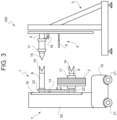
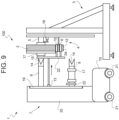
Figures 3 to 10 are schematic side views, with parts removed for clarity, of the system ofFigure 1 during as many distinct and subsequent operational conditions; -
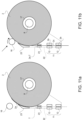
Figures 11a and 11b illustrate in front view, on an enlarged scale and with parts removed for clarity, a detail of the system ofFigure 1 during two subsequent operational conditions; and -
Figure 12 is a schematic front view, with parts removed for clarity, of a system for replacing a reel of material for the production of electrical energy storage devices implemented according to an alternative embodiment. - With reference to the accompanying figures,
reference numeral 1 indicates, as a whole, a system for replacing areel 2 of material for the production of electrical energy storage devices, in particular areel 2 of a strip of electrode (cathode or anode) or separator starting from which the storage devices are produced. - In particular, the present invention is advantageously but not exclusively applied to the production of rechargeable batteries to which the following description will explicitly refer without thereby losing generality, for example planar batteries in metal can or enveloped (commonly called of the pouch type), or cylindrical batteries composed of cylindrical windings (for example of the jelly roll type).
- More specifically, the
system 1 is adapted to be used for carrying out a reel change in aproduction assembly 100 of the rechargeable batteries comprising: - the
system 1 as better described in the following; and - an automatic machine 3 (known per se, not described in detail and illustrated only in part in
Figures 3 to 10 ) having an operative unit (not illustrated) configured to produce the rechargeable batteries (more precisely to produce cells, for example monocells, from which the actual batteries will then be obtained) starting from the strips of electrode and separator, and a feeding unit 4 (schematically illustrated) configured to feed to the operative unit placed downstream of the latter the strips initially wound inreels 2. - It is specified that, in the present description and in the appended claims, "reel change" is understood as the replacement, carried out by means of the
system 1 according to the present invention, of an exhausting or exhausted reel, i.e. that has almost finished or has finished unwinding the relative strip of material, with a full reel, i.e. still containing the entire strip of material. - The
feeding unit 4 comprises a plurality of support shafts orspindles 5 each adapted to receive and support arespective reel 2 in rotation for determining the unwinding of the relative strip of electrode or separator from the latter. - During the production process, the
feeding unit 4 must be constantly provided withfull reels 2 of strips of electrode and separator so as to ensure the continuity of the process. - The
feeding unit 4 is conveniently adapted to support tworeels 2 for each strip of electrode or separator. In particular, thefeeding unit 4 comprises a pair ofspindles 5 for each strip of material to be fed, one of whichspindles 5 supports theunwinding reel 2 and the other of whichspindles 5 supports afull reel 2. - In accordance with the foregoing, in order to prevent interruptions in the production, the
feeding unit 4 includes a splicing device or splicer (known per se and not described in detail nor illustrated) configured to automatically join to one another the final flap of theexhausting reel 2 with the initial flap of thefull reel 2, for each pair of support spindles 5 (and thus ofreels 2 of a given strip of separator or electrode) . - Specifically, the splicing device comprises a receiving member having a
gripper 6 adapted to grip an initial flap of thefull reel 2. - Therefore, the need is felt to provide for the change of the
exhausted reels 2 with full ("new")reels 2, so as to ensure the continuity of the production process. - As visible in the accompanying figures, the
system 1 comprises: - at least one
vehicle 7, preferably a self-driving vehicle, for transporting thereels 2 from a storage or receiving station to a change station of theassembly 100; and - at least one support shaft or
spindle 8 carried by thevehicle 7 and configured to support onereel 2 at a time and to transfer it, at the change station, to thefeeding unit 4, in particular to one of thespindles 5 of thefeeding unit 4 supporting an exhausting or exhausted reel and which, therefore, requires afull reel 2. - In an embodiment, the
vehicle 7 is defined by a conveyor trolley, preferably of the known type, comprising abase body 10, a plurality ofwheels 21 fixed to thebase body 10 and a support upright 20 fixed to thebase body 10 and extending from the latter, preferably in vertical direction with respect to a resting ground of thewheels 21. In particular, thewheels 21 are rubber wheels. In other non-limiting embodiments, thevehicle 7 is configured to move on rails. - The
spindle 8 is fixed to the upright 20 and extends cantilevered from the latter. - Conveniently, the
vehicle 7 is provided with: sensors (known per se and not described in detail nor illustrated) configured to allow the self-driving of thevehicle 7, for example a radar o LIDAR system, a photoelectric barrier safety system, a laser system or the like; and with a control unit (not illustrated) configured to manage the data detected by the sensors and to control on the basis of these data, the trajectory of thevehicle 7 from the storage or receiving station to the change station, thus determining the self-driving thereof. - In an embodiment, the
vehicle 7 is self-propelled on a driving track by means of a slide fixed to thebase body 10. For example, the assembly comprises a system of rails defining the respective trajectories of the vehicle(s) 7 from the storage or receiving station to the change station. - According to the invention, the system comprises a gripping
member 11 carried by thevehicle 7 and comprising at least onegripper 12 configured to receive and grip aninitial flap 2a of thereel 2 supported by thespindle 8 and to keep suchinitial flap 2a tensioned (or in tension) along an initial unwinding path T of the same (illustrated inFigures 11a and 11b ). - Conveniently, the gripping
member 11, and in particular thegripper 12, is arranged along the unwinding path T. - In an embodiment, the
system 1 further comprises a blocking device (not illustrated), for example a brake, carried by thevehicle 7 and configured to block an angular displacement of thereel 2 about a rotation axis coaxial to thesupport spindle 8, in use, thereel 2, so as to keep theinitial flap 2a tensioned along the unwinding path T. - It is understood that the blocking device could be defined by a stop mechanism acting on the
reel 2 from the outside, for example a counter-roller acting thereon by pressure, thus blocking the unwinding of the strip of material wound in thereel 2. In such case, the architecture of the blocking device is simplified with respect to the previous case. In other non-limiting cases, the blocking device could be defined by an electric motor kept in torque and configured to move in rotation thespindle 8. - According to a further aspect of the present invention, the gripping
member 11 comprises a pair ofgrippers 12 arranged spaced apart from one another along the unwinding path T (i.e. aligned with the unwinding path T but arranged at a non-null distance from one another) and configured to grip theinitial flap 2a at spaced apartportions 2b of the latter, so that acentral portion 2c ofinitial flap 2a between the grippedportions 2b is kept tensioned (Figure 11b ). - In other words, the presence of two
grippers 12 instead of only one, ensures that thecentral portion 2c of theinitial flap 2a remains tensioned during the movement of thevehicle 7 and during the transfer of thereel 2, as it will be apparent in the following. - In such case, the aforementioned angular blocking device of the
reel 2, which can be relatively complicated and expensive to manufacture, is not necessary, resulting in a simplified architecture and in a reduction in costs. - Advantageously, each
gripper 12 is movable, in particular bothgrippers 12 are movable in a simultaneous and integral manner, between a retracted position (Figures 7 and8 ) in which it grips theinitial flap 2a and determines a (for example places it in) tension thereof, and an advanced position (Figure 9 ) in which it delivers the tensionedinitial flap 2a to thefeeding unit 4, and in particular to thegripper 6 of the splicing device or splicer of the same. - To such regard, the
system 1 comprises a pushingdevice 13 configured to move each gripper 12 from the retracted position to the advanced position. - Specifically, the pushing
device 13 is also configured to move thereel 2 from thesupport spindle 8 of thevehicle 7 to thesupport spindle 5 of thefeeding unit 4 which needs to receive thefull reel 2. - More precisely, the
spindle 8 is configured to operatively couple to thespindle 5 of thefeeding unit 4 which needs to receive thefull reel 2 when thevehicle 7 is at the change station. - In an embodiment, the pushing
device 13 is defined by a push bar controlled by an electric actuator, for example a linear or rotary motor with endless life, or a pneumatic actuator. - More specifically, such push bar is operatively connected to the
grippers 12 and is extractable, for example by means of the aforementioned electric actuator, from theupright 20 for moving thegrippers 12. - In an alternative embodiment, the pushing
device 13 is defined by a spring pin. - In an alternative embodiment, the pushing
device 13 is defined by thespindle 8 in telescopic configuration for extending towards the feedingunit 4 or for returning towards theupright 20. - Preferably, the
spindle 8 comprises a shapedterminal 14 configured to couple to thespindle 5 of thefeeding unit 4 by means of a shape coupling (Figures 4 ,5 ,8 and9 ). - More in particular, the
spindle 5 comprises arelative terminal 15 shaped complementarily to the terminal 14 for obtaining the aforementioned shape coupling. - In such manner, the change of the
reel 2, i.e. its transfer from thespindle 8 to thespindle 5 by means of the pushingdevice 13 takes place in a safe manner and only when the coupling to one another has actually taken place. - In the described example, the terminal 14 has a conical cavity, whereas the terminal 15 has a conical shape complementary to the cavity.
- The aforementioned conical shape is particularly advantageous since it defines an invitation to the coupling of the terminal 15 in the terminal 14 which minimises and eliminates a possible misalignment of the
spindles - Preferably, each
reel 2 is wound about a convenientlyrigid core 17. - In practice, each core 17 is defined by a cylindrical hollow body thus defining a hub of the
relative reel 2 adapted to be engaged by thespindle 8 and/or by aspindle 5. - Conveniently, the
grippers 12 are carried by (fixed to) aseparator 22 slidingly mounted on the spindle 8 (see to such regardFigures 8 and9 ) and operatively coupled to the pushingdevice 13. - The
separator 22 is also operatively connectable to thecore 17 of eachfull reel 2 supported by thespindle 8, for determining the push of the core 17 actuated by the pushingdevice 13. - In practice, the pushing
device 13 moves the core 17 by means of theseparator 22. - In the light of the foregoing, the pushing
device 13 is configured to: - move each supported
reel 2 from thespindle 8 to thespindle 5 of thefeeding unit 4, when thespindle 8 is coupled to thespindle 5; and, simultaneously - move the
grippers 12 from the retracted position to the advanced position integrally with thereel 2. - Advantageously the
grippers 12, by gripping theportions 2b of theinitial flap 2a, determine the tensioning of thecentral portion 2c of the latter and cause suchcentral portion 2c to be kept tensioned at least during the movement of thegrippers 12 from the retracted position to the advanced position, in particular until thegrippers 12 release theinitial flap 2a. - More in particular, the
grippers 12 are configured to receive between them, in the advanced position, thegripper 6 of the splicing device of thefeeding unit 4 for delivering the tensionedcentral portion 2c of theinitial flap 2a tosuch gripper 6. - Thanks to the above-described configuration, the
reel 2 is transferred from thevehicle 7 to the feeding unit 4 (i.e. thereel 2 change is carried out) so that the splicing device can receive and grip theinitial flap 2a conveniently tensioned in a nominal manner automatically and without the need of the intervention of any operator. - This results in an increase in the production speed, in a minimisation of errors possibly made by the operator and in a reduction in the risk of accidents of the latter and, therefore, in an improvement of the safety conditions of the
assembly 100. - Advantageously, the
system 1 also comprises an unwindingdevice 16 configured to separate theinitial flap 2a from thereel 2 supported by thespindle 8 and to unwind it along the unwinding path T for feeding it to the grippingmember 11. - According to a non-limiting embodiment illustrated in
Figures 11a and 11b , the unwinding device comprises a counter-roller 16 associated with thespindle 8 and movable (in particular controllable by means of the aforementioned control unit) between an open configuration (Figure 11a ), in which it is spaced apart from thespindle 8 and from thereel 2 supported, in use, by the latter, and a closed configuration (Figure 11b ) in which it is contact-pressed (pushed) againstsuch reel 2. - Furthermore, the counter-roller 16 is actuatable in rotation (
Figure 11b ) for determining a rotation of thereel 2 about thespindle 8 and causing the separation of theinitial flap 2a from thereel 2 and the unwinding of theinitial flap 2a along the unwinding path T towards the grippingmember 11, i.e. towards thegrippers 12. - Alternatively or additionally, the unwinding device comprises an electric motor configured to control the rotation of the
spindle 8. - In some non-limiting cases, the unwinding device comprises an opening element, configured to cut or remove an adhesive tape which constrains the
flap 2a to the rest of thereel 2. - Conveniently, the
system 1 further comprises a series of deviatingmembers 23 preferably carried by theseparator 22 and configured to guide theinitial flap 2a unwinding along the path T. - Thanks to such configuration, the need for the intervention of the operator is further reduced, who only has to limit himself/herself to loading the
reel 2 on thespindle 8. In this manner, the production speed within theassembly 100 is increased and the risk of errors and accidents is reduced, all in a simple and cost-effective manner. - In an embodiment, also the withdrawing of the
reel 2 from the storage or receiving station of theassembly 100 takes place in an automated manner, in particular, the storage station comprises automatic warehouses. - According to some non-limiting embodiments, the storage or receiving station is arranged at a machine upstream in the production chain of the electrical energy storage devices. In particular, the storage or receiving station corresponds to a station in which the
reel 2 is completed. In these cases, therefore, thereel 2 is transported directly by a machine that winds it to one that unwinds it. - In the non-limiting example described and illustrated herein, the
system 1 comprises twosupport spindles 8, both extending cantilevered from theupright 20. In other words, thevehicle 7 carries twosupport spindles 8. - More precisely, the
vehicle 7 includes arotatable plate 19 mounted in a movable manner to theupright 20 and to which thespindles 8 are fixed so as to extend cantilevered therefrom. - In order to carry out the reel change, the
plate 19 is movable, at the change station (i.e. conveniently when thevehicle 7 is in the change station), between: - a first position (
Figures 4 and5 ), in which afirst spindle 8 is adapted to withdraw/receive acore 17 of anexhausted reel 2 from thefeeding unit 4, i.e. from therelative spindle 5, of themachine 3 and asecond spindle 8 supports a full reel 2 (to be fed to theaforementioned spindle 5 in replacement of the exhausted one); and - a second position (
Figures 7 ,8 and9 ), in which thesecond spindle 8 is adapted to transfer thefull reel 2 to thefeeding unit 4, i.e. to thespindle 5, and thefirst spindle 8 supports thecore 17 of theexhausted reel 2, previously received from thespindle 5. - In particular, the
rotatable plate 19 is fixed to the upright 20 in a rotatable manner about a rotation axis A, preferably horizontal (perpendicular to the upright 20). - Advantageously, the gripping
member 11 comprises at least onegripper 12 for eachspindle 8. - In particular, the gripping
member 11 comprises a pair ofgrippers 12 for eachspindle 8, which operate in accordance with what described above. - The operation of the
system 1 of reel change implemented according to the present invention will be described in the following, with particular reference toFigures 3 to 10 and to an initial condition in which thevehicle 7 has withdrawn afull reel 2 to be fed to thefeeding unit 4 for carrying out a reel change. In particular, one of the twospindles 8 carries thefull reel 2 whereas the other one is free (empty) while waiting to receive thecore 17 of theexhausted reel 2. - In such condition, the control unit controls, on the basis of the data received from the sensors, the movement of the
vehicle 7 along the pre-established trajectory from the storage or receiving station to the change station (Figure 3 ). - Once such position has been reached, the
vehicle 7 advances for determining the coupling of theempty spindle 8 to thespindle 5 of thefeeding unit 4 which supports thecore 17 of theexhausted reel 2 to be changed (Figure 4 ). Conveniently, thefeeding unit 4 includes a pushingdevice 18, preferably one for eachspindle 5 and substantially of the same type of the pushingdevice 13, configured to move the core 17 supported by thespindle 5 towards the spindle 8 (shape) coupled to the latter (Figure 5 ). - In some non-limiting cases not illustrated, the pushing
device 18 is instead supported by thevehicle 7. In such manner, this prevents modifying to such regard thefeeding unit 4. - Once the movement of the
core 17 has been carried out, thevehicle 7 spaces apart from thefeeding unit 4 for decoupling thespindle 8 from the spindle 5 (Figure 6 ), thus the control unit controls the rotation of therotatable plate 19, so that thespindle 8 supporting thefull reel 2 takes the place of thespindle 8 supporting thecore 17 of theexhausted reel 2 and faces the spindle 5 (Figure 7 ). Contextually or previously, for example, the counter-roller 16 determines the separation and unwinding of theinitial flap 2a along the unwinding path T and therelative grippers 12 grip theinitial flap 2a (Figure 7 ). In such condition, theinitial flap 2a is tensioned, more in particular thecentral portion 2c is tensioned, still more in particular, such portion is kept tensioned until thegrippers 12 deliver theflap 2a to thegripper 6 of the splicing device. - At this point, the
vehicle 7 is controlled for moving close again to thefeeding unit 4, so as to determine the coupling of thespindle 8 supporting thefull reel 2 to the spindle 5 (Figure 8 ). Thecentral portion 2c is always kept tensioned. - Then, the pushing
device 13 is actuated and thecore 17 of the full reel 2 (and therefore the latter) is thus transferred from thespindle 8 to thespindle 5. Contextually, thegrippers 12 are moved from the retracted position to the extracted position (Figure 9 ). - In such position, the
gripper 6 of the splicing device is received between the twogrippers 12 and grips theinitial flap 2a at thecentral portion 2c, which, as specified above, is kept tensioned during such operation. - The delivery of the
full reel 2 is at this point accomplished, as well as the delivery of theinitial flap 2a to the splicing device. Thevehicle 7 can thus be decoupled from the feeding unit 4 (Figure 10 ). -
Figure 12 shows an alternative embodiment of the present invention. - According to such embodiment, the
system 1 comprises the twospindles 8, therotatable plate 19 and a gripping member 11' which differs from the grippingmember 11 described above only with regard to the following, it being understood that, with the exception of what expressly indicated, the structure and operation of thesystem 1 are identical to those described in the foregoing. - In particular, the gripping member 11' exactly comprises two grippers 12 (and not four as in the previous case) selectively associable with the
first spindle 8 or with thesecond spindle 8 for gripping theinitial flap 2a at theportions 2b spaced apart along the unwinding path T for keeping thecentral portion 2c tensioned. Advantageously, the twogrippers 12 are arranged (in particular mounted) on therotatable plate 19 spaced apart from one another and aligned along a straight line B lying on theplate 19, orthogonal to the rotation axis A and intersecting the rotation axis A, and the unwinding path T extends along the straight line B (Figure 12 ) . - Preferably, the
rotatable plate 19 has a circular shape and the straight line B defines a diameter of therotatable plate 19. The twospindles 8 are arranged on opposite sides of the straight line B and thegrippers 12 are arranged along the diameter of theplate 19, thus intersecting the rotation centre (rotation axis A) of theplate 19. - In an alternative embodiment, the
plate 19 has a whatsoever different shape (rectangular, oval, triangular, etc...), but the straight line B is always arranged so as to lie on theplate 19, intersecting the rotation axis A and orthogonal to the latter. - Furthermore, the
spindles 8 are arranged at the same distance from the straight line B, thus defining an antisymmetric configuration with respect to the straight line B. - Thanks to such configuration, it is possible to grip the
initial flap 2a in two spaced apart points (theportions 2b), thus ensuring the tensioning of thecentral portion 2c, and at the same time limiting the total number of components (twogrippers 12 instead of 4) and, therefore, simplifying the architecture and reducing the total costs. - In the light of the foregoing, it is clear that the
system 1 allows implementing a method for replacing areel 2 of material for the production of electrical energy storage devices, the method comprising the steps of: - transporting the
reel 2 from a storage or receiving station to a change station; - unwinding the
initial flap 2a of thereel 2 along the unwinding path T; - gripping the
initial flap 2a; - tensioning the
initial flap 2a so as to tension it along the unwinding path T; - transferring, at the change station, the
reel 2 to thefeeding unit 4 while keeping theinitial flap 2a tensioned. - Advantageously, the gripping step is carried out by means of at least one
gripper 12 and the transferring step comprises moving thegripper 12 from a retracted position, in which it grips theinitial flap 2a and determines a (places it in) tension thereof, to an advanced position, in which it delivers the tensionedinitial flap 2a to thefeeding unit 4. - Advantageously, the gripping step comprises gripping the
initial flap 2a at theportions 2b spaced apart from one another along the unwinding path T and the tensioning step comprises tensioning thecentral portion 2c of theinitial flap 2a compressed between the two grippedportions 2b. - By examining the characteristics of the
system 1 and of the method provided according to the present invention, the advantages that they allow obtaining are evident. - In particular, the
system 1 and the method according to the present invention allow determining an increase in the production speed within theassembly 100, a minimisation of errors possibly made by the operator and a reduction in the risk of accidents of the latter and, therefore, an improvement of the safety conditions of theassembly 100. - Furthermore, the presence of the counter-roller 16 for automatically unwinding the
initial flap 2a and delivering it to thegrippers 12 determines a further accentuation of the aforementioned advantages. - Finally, in the event the
system 1 comprises the gripping member 11', the aforementioned advantages are achieved limiting at the same time the total number of components and, therefore, simplifying the architecture and reducing the total costs. - It is clear that modifications and variations can be made to the
system 1 described and illustrated herein without thereby departing from the scope of protection defined by the claims.
Claims (15)
- System (1) for replacing a reel (2) of material for the production of electrical energy storage devices, the system (1) comprising:- a vehicle (7), preferably a self-driving vehicle, for transporting a reel (2) from a storage or receiving station to a change station;the system (1) being characterized by further comprising:- at least one support shaft or spindle (8) carried by the vehicle (7) and configured to support the reel (2) and to transfer it, at the change station, to a feeding unit (4) of an automatic machine (3) for the production of the electrical energy storage devices; and- a gripping member (11; 11') carried by the vehicle (7) and comprising at least one gripper (12) configured to receive and grip an initial flap (2a) of the reel (2) supported by the support spindle (8) and to keep such initial flap (2a) tensioned along an unwinding path (T) of the same.
- The system as claimed in claim 1, and comprising a blocking device carried by the vehicle (7) and configured to block an angular displacement of the reel (2) supported by the support spindle (8), so as to keep the initial flap (2a) tensioned along the unwinding path (T).
- The system as claimed in claim 1 or 2, wherein the gripper (12) is movable between a retracted position, in which it grips said initial flap (2a) and determines a tension thereof, and an advanced position, to deliver the tensioned initial flap (2a) to the feeding unit (4).
- The system as claimed in claim 3, wherein the support spindle (8) is configured to operatively couple to the feeding unit (4) when the vehicle (7) is at the change station;wherein the system (1) comprises a pushing device (13) for moving the reel (2) from the support spindle (8) to the feeding unit (4) when the support spindle (8) is operatively coupled to the feeding unit (4);and wherein the pushing device (13) is configured to move the gripper (12) from the retracted position to the advanced position integrally with the reel (2).
- The system as claimed in claim 3 or 4, wherein the gripping member (11; 11') comprises a pair of said grippers (12) arranged spaced apart from one another along said unwinding path (T) of the initial flap (2a) and configured to grip the initial flap (2a) at two spaced apart portions (2b) thereof, so that a central portion (2c) of the initial flap (2a) between the two gripped portions (2b) is kept tensioned at least during the movement of the grippers (12) from the retracted position to the advanced position.
- The system as claimed in claim 5, wherein the two grippers (12) are configured to receive between them, in the advanced position, a retaining member (6) of the feeding unit (4) to deliver to the retaining member (6) said tensioned central portion (2c) of the initial flap (2a).
- The system as claimed in any one of the preceding claims, and comprising an unwinding device (16) configured to separate the initial flap (2a) from the reel and to unwind it along the unwinding path (T) for feeding it to the gripping member (11; 11').
- The system as claimed in claim 7, wherein the unwinding device comprises a counter-roller (16) associated with the support spindle (8) and movable between an open configuration, in which it is spaced apart from said spindle (8) and from the reel (2) supported, in use, by the latter, and a closed configuration in which it is contact-pressed against such reel (2) ;
and wherein the counter-roller (16) is actuatable in rotation to determine a rotation of the reel (2) about the support spindle (8) and cause the separation of the initial flap (2a) from the reel (2) and the unwinding of the initial flap (2a) along the unwinding path (T) towards the gripping member (11; 11'). - The system as claimed in any one of the preceding claims, and comprising two support spindles (8) mounted on a rotatable plate (19) carried by the vehicle (7) and movable, at the change station, between a first position, in which a first spindle (8) is configured to withdraw/receive a core (17) of an exhausted reel (2) from the feeding unit (4) of the automatic machine (3) and a second spindle (8) supports a full reel (2), and a second position, in which the second spindle (8) is configured to transfer the full reel (2) to the feeding unit (4) and the first spindle (8) supports the core (17) of the exhausted reel (2);
wherein the gripping member (11; 11') comprises at least one gripper (12) for each support spindle (8). - The system as claimed in claim 9, wherein the gripping member (11') comprises two grippers (12) selectively associable with the first spindle (8) or with the second spindle (8) to grip said initial flap (2a) at portions (2b) thereof spaced apart from one another along the unwinding path (T) and so as to keep tensioned a central portion (2c) of the initial flap (2a) between the two gripped portions (2b);wherein the plate (19) is mounted to the vehicle (7) rotatably about a rotation axis (A);and wherein the two grippers (12) are arranged on the rotatable plate (19) spaced apart from one another and aligned along a straight line (B) lying on the plate (19), orthogonal to the rotation axis (A) and intersecting the rotation axis (A), the unwinding path (T) extending along said straight line (B) .
- The system as claimed in any one of the preceding claims, wherein the support spindle (8) comprises a terminal (14) configured to couple with a receiving spindle (5) of the feeding unit (4) by means of a shape coupling.
- Assembly (100) for the production of electrical energy storage devices comprising:- an automatic machine (3) having an operative unit configured to produce the storage devices starting from strips of electrode and separator and a feeding unit (4) configured to feed to the operative unit said strips initially wound in respective reels (2); and- a system (1) for changing, within the feeding unit (4), an exhausted reel (2) with a full reel (2) as claimed in any one of the preceding claims;wherein the feeding unit (4) comprises a splicing device configured to join a final flap of an exhausting reel (2) with said initial flap (2a) of a full reel (2) and including a retaining member (6) for receiving the initial flap (2a) from the gripping member (11; 11');and wherein the gripping member (11; 11') is configured to feed said tensioned initial flap (2a) to the retaining member (6) of the splicing device.
- Method for replacing a reel (2) of material for the production of electrical energy storage devices, the method comprising the steps of:- transporting a reel (2) from a storage or receiving station to a change station;- unwinding an initial flap (2a) of said reel (2) along an unwinding path (T);- gripping said initial flap (2a);- tensioning said initial flap (2a) so as to tension it along the unwinding path (T);- transferring, at the change station, the reel (2) to a feeding unit (4) of an automatic machine (3) for the production of the storage devices while keeping the initial flap (2a) tensioned.
- Method as claimed in claim 13, wherein the gripping step is carried out by means of at least one gripper (12);
and wherein the transferring step comprises moving the gripper (12) from a retracted position, in which it grips said initial flap (2a) and determines its tension, to an advanced position, in which it delivers the tensioned initial flap (2a) to the feeding unit (4). - Method as claimed in claim 13 or 14, wherein the gripping step comprises gripping the initial flap (2a) at portions (2b) thereof spaced apart from one another along the unwinding path (T);
and wherein the tensioning step comprises tensioning a central portion (2c) of the initial flap (2a) between the two gripped portions (2b).
Applications Claiming Priority (1)
| Application Number | Priority Date | Filing Date | Title |
|---|---|---|---|
| IT202100018266 | 2021-07-12 |
Publications (2)
| Publication Number | Publication Date |
|---|---|
| EP4119475A1 EP4119475A1 (en) | 2023-01-18 |
| EP4119475B1 true EP4119475B1 (en) | 2024-09-04 |
Family
ID=77989917
Family Applications (1)
| Application Number | Title | Priority Date | Filing Date |
|---|---|---|---|
| EP22183383.3A Active EP4119475B1 (en) | 2021-07-12 | 2022-07-06 | System for replacing a reel of material for the production of electrical energy storage devices and related method |
Country Status (8)
| Country | Link |
|---|---|
| US (1) | US20230010608A1 (en) |
| EP (1) | EP4119475B1 (en) |
| JP (1) | JP2023011531A (en) |
| KR (1) | KR20230010594A (en) |
| CN (1) | CN115611045A (en) |
| CA (1) | CA3167274A1 (en) |
| HU (1) | HUE068160T2 (en) |
| PL (1) | PL4119475T3 (en) |
Families Citing this family (17)
| Publication number | Priority date | Publication date | Assignee | Title |
|---|---|---|---|---|
| US12434934B2 (en) * | 2019-12-24 | 2025-10-07 | Wuxi Lead Intelligent Equipment Co., Ltd. | Automatic roll replacing device, and winding equipment |
| US20240243330A1 (en) * | 2023-01-13 | 2024-07-18 | Kye-seol LEE | Automatic supply and replacement device of electrode plate for manufacturing secondary battery |
| US20240322213A1 (en) * | 2023-03-22 | 2024-09-26 | Kye-seol LEE | Secondary battery electrode film and separator supply device |
| KR102739371B1 (en) * | 2023-03-22 | 2024-12-06 | 이계설 | Automatic bobbin replacement device for electrode separator of anode |
| IT202300008721A1 (en) * | 2023-05-03 | 2024-11-03 | Manz Italy Srl | COIL LOADING APPARATUS, RELATED MACHINE COMPRISING THE LOADING APPARATUS AND METHOD FOR MANUFACTURING ELECTRIC ENERGY STORAGE DEVICES |
| IT202300008679A1 (en) * | 2023-05-03 | 2024-11-03 | Manz Italy Srl | COIL LOADING APPARATUS, RELATED MACHINE COMPRISING THE LOADING APPARATUS AND METHOD FOR MANUFACTURING ELECTRIC ENERGY STORAGE DEVICES |
| KR102603219B1 (en) | 2023-05-22 | 2023-11-16 | 주식회사 에스케이와이에프에이 | Reel bobbin transfer jig for battery |
| KR102767395B1 (en) | 2023-05-26 | 2025-02-14 | 주식회사 에스케이와이에프에이 | Reel bobbin transfer jig for battery |
| DE102023206476A1 (en) | 2023-07-07 | 2025-01-09 | Volkswagen Aktiengesellschaft | Device for changing a coil or a core, arrangement and method for changing a coil or a core |
| CN116946775B (en) * | 2023-07-10 | 2025-12-19 | 珠海创智科技有限公司 | Coil stock is got and is unloaded tong mechanism |
| KR20250023872A (en) | 2023-08-10 | 2025-02-18 | 창운정밀 주식회사 | Reel bobbin transfer jig for battery |
| IT202300022593A1 (en) * | 2023-10-27 | 2025-04-27 | Manz Italy Srl | TRANSFER APPARATUS FOR COILS, MACHINE COMPRISING THE TRANSFER APPARATUS AND METHOD FOR MANUFACTURING ELECTRIC ENERGY STORAGE DEVICES |
| KR102915167B1 (en) * | 2024-01-16 | 2026-01-20 | 현대무벡스 주식회사 | Automatic guided vehicle for reel replacement |
| KR102908926B1 (en) * | 2024-01-16 | 2026-01-08 | 현대무벡스 주식회사 | Reel replacement automatic guided vehicle capable of retrieving empty bobbins |
| WO2025216604A1 (en) * | 2024-04-08 | 2025-10-16 | 주식회사 에이아이로보틱스 | Film roll replacement and connection-and-attachment robot that travels autonomously |
| KR102742782B1 (en) * | 2024-06-07 | 2024-12-16 | (주)코윈테크 | Electrode roll holder device with separate discharge function |
| KR102796903B1 (en) * | 2024-12-05 | 2025-04-17 | (주)코윈테크 | Device for separating and extracting electrode rolls |
Family Cites Families (16)
| Publication number | Priority date | Publication date | Assignee | Title |
|---|---|---|---|---|
| GB1592948A (en) * | 1976-12-21 | 1981-07-15 | Masson Scott Thrissell Eng Ltd | Apparatus for web feed |
| DE3812514C2 (en) * | 1988-04-15 | 1998-01-29 | Focke & Co | Packaging machine with a transport spigot arranged on a transport arm for new bobbins |
| IT1253922B (en) * | 1991-12-20 | 1995-08-31 | Gd Spa | TROLLEY FOR LOADING REELS INTO A FEEDING DEVICE OF A PACKAGING MACHINE |
| DE19508581B4 (en) * | 1995-03-13 | 2006-04-13 | Focke & Co.(Gmbh & Co. Kg) | Device for handling bobbins from packaging material |
| FR2731997B1 (en) * | 1995-03-22 | 1997-05-09 | Kodak Pathe | TAPE PRODUCT REWINDER |
| US6056232A (en) * | 1997-08-27 | 2000-05-02 | Fuji Photo Film Co., Ltd. | Method of loading film roll on film unwinder shaft and film producing and packaging system |
| US6451145B1 (en) * | 1998-03-09 | 2002-09-17 | Frontier Industrial Technology, Inc. | Web splicing system |
| AUPR636201A0 (en) * | 2001-07-13 | 2001-08-02 | Cryovac Australia Pty Ltd | Mounting jig and trolley for mounting and optionally transporting a roll of material |
| US7331542B2 (en) * | 2003-05-09 | 2008-02-19 | Intellipack | Film unwind system with hinged spindle and electronic control of web tension |
| US7306184B2 (en) * | 2003-09-15 | 2007-12-11 | Tafel Brian L | Splicing vehicle |
| DE102013110944A1 (en) * | 2013-10-02 | 2015-04-02 | Krones Aktiengesellschaft | Method and device for changing carrier units with flat packaging material wound on supply rolls within a packaging machine |
| US20210139264A1 (en) * | 2018-04-26 | 2021-05-13 | I.M.A. Industria Macchine Automatiche S.P.A. | Method for reel changing in automatic machines |
| KR102538070B1 (en) * | 2018-11-30 | 2023-05-30 | 엘지전자 주식회사 | Electrode roll feeder |
| KR102858408B1 (en) * | 2021-02-26 | 2025-09-10 | 에스케이온 주식회사 | Automatically replacement apparatus and method for supply material |
| US20240243330A1 (en) * | 2023-01-13 | 2024-07-18 | Kye-seol LEE | Automatic supply and replacement device of electrode plate for manufacturing secondary battery |
| US20240322213A1 (en) * | 2023-03-22 | 2024-09-26 | Kye-seol LEE | Secondary battery electrode film and separator supply device |
-
2022
- 2022-07-06 HU HUE22183383A patent/HUE068160T2/en unknown
- 2022-07-06 PL PL22183383.3T patent/PL4119475T3/en unknown
- 2022-07-06 EP EP22183383.3A patent/EP4119475B1/en active Active
- 2022-07-07 CA CA3167274A patent/CA3167274A1/en active Pending
- 2022-07-11 KR KR1020220084938A patent/KR20230010594A/en active Pending
- 2022-07-11 JP JP2022111169A patent/JP2023011531A/en active Pending
- 2022-07-11 CN CN202210813957.2A patent/CN115611045A/en active Pending
- 2022-07-11 US US17/861,376 patent/US20230010608A1/en not_active Abandoned
Also Published As
| Publication number | Publication date |
|---|---|
| HUE068160T2 (en) | 2024-12-28 |
| JP2023011531A (en) | 2023-01-24 |
| US20230010608A1 (en) | 2023-01-12 |
| CN115611045A (en) | 2023-01-17 |
| PL4119475T3 (en) | 2024-12-23 |
| EP4119475A1 (en) | 2023-01-18 |
| KR20230010594A (en) | 2023-01-19 |
| CA3167274A1 (en) | 2023-01-12 |
Similar Documents
| Publication | Publication Date | Title |
|---|---|---|
| EP4119475B1 (en) | System for replacing a reel of material for the production of electrical energy storage devices and related method | |
| US4948060A (en) | Automatic web roll handling system for splicing | |
| MX2014006062A (en) | Reel unwinder and unwinding method. | |
| KR20010086203A (en) | Continuous winder | |
| CN101970321A (en) | Stretch film winder | |
| EP1380526B9 (en) | Web winding method and apparatus therefor | |
| EP4259564B1 (en) | Plant and process for handling cardboard reels | |
| EP4370456B1 (en) | Automatic unwinder of flexible materials wound on reels and process for feeding an operating machine with said flexible materials | |
| CN1329267C (en) | Apparatus | |
| US4555070A (en) | Method and apparatus for unwinding and splicing successive rolls | |
| GB1580969A (en) | Accumulator for a web transportation apparatus and apparatus for the treatment of a web of ribbon or sheet material including the same | |
| US12545542B2 (en) | Plant and process for handling cardboard reels | |
| US20250219124A1 (en) | Apparatus and relative method of winding a strip of material, in particular for the production of electrical energy storage devices | |
| US4575016A (en) | Continuous ribbon feed method and system | |
| EP4259565A1 (en) | Plant and method for the movement of cardboard cores | |
| JP3943915B2 (en) | Web winding and unwinding device and papermaking equipment provided with the same | |
| RU2859776C2 (en) | Method and machine for manufacturing cylindrical accumulators | |
| RU2859190C2 (en) | Method and machine for manufacturing cylindrical accumulators | |
| KR101062139B1 (en) | Device for controlling sheet drive in multilayer assembly manufacturing equipment | |
| CA2160426C (en) | Apparatus and process for supplying printed products to a processing section | |
| CN103930360A (en) | Winder | |
| IT9021223A1 (en) | DEVICE FOR THE AUTOMATED SUPPLY OF MAGNETIC TAPE SPOOLS ON TAPE BOX PACKAGING MACHINES | |
| WO2024161236A1 (en) | Splicing apparatus for splicing material bands for the production of power storage devices, machine and related splicing method | |
| JP4245241B2 (en) | Method and apparatus for continuous winding of plastic film | |
| CA1297464C (en) | Method of, and apparatus for, processing printed products, especially newspapers, periodicals and the like |
Legal Events
| Date | Code | Title | Description |
|---|---|---|---|
| PUAI | Public reference made under article 153(3) epc to a published international application that has entered the european phase |
Free format text: ORIGINAL CODE: 0009012 |
|
| STAA | Information on the status of an ep patent application or granted ep patent |
Free format text: STATUS: THE APPLICATION HAS BEEN PUBLISHED |
|
| AK | Designated contracting states |
Kind code of ref document: A1 Designated state(s): AL AT BE BG CH CY CZ DE DK EE ES FI FR GB GR HR HU IE IS IT LI LT LU LV MC MK MT NL NO PL PT RO RS SE SI SK SM TR |
|
| STAA | Information on the status of an ep patent application or granted ep patent |
Free format text: STATUS: REQUEST FOR EXAMINATION WAS MADE |
|
| 17P | Request for examination filed |
Effective date: 20230718 |
|
| RBV | Designated contracting states (corrected) |
Designated state(s): AL AT BE BG CH CY CZ DE DK EE ES FI FR GB GR HR HU IE IS IT LI LT LU LV MC MK MT NL NO PL PT RO RS SE SI SK SM TR |
|
| GRAP | Despatch of communication of intention to grant a patent |
Free format text: ORIGINAL CODE: EPIDOSNIGR1 |
|
| STAA | Information on the status of an ep patent application or granted ep patent |
Free format text: STATUS: GRANT OF PATENT IS INTENDED |
|
| RIC1 | Information provided on ipc code assigned before grant |
Ipc: H01M 4/04 20060101ALI20240229BHEP Ipc: H01M 10/04 20060101ALI20240229BHEP Ipc: B65H 19/10 20060101ALI20240229BHEP Ipc: B66F 9/075 20060101ALI20240229BHEP Ipc: B65H 19/12 20060101AFI20240229BHEP |
|
| INTG | Intention to grant announced |
Effective date: 20240322 |
|
| P01 | Opt-out of the competence of the unified patent court (upc) registered |
Effective date: 20240529 |
|
| GRAS | Grant fee paid |
Free format text: ORIGINAL CODE: EPIDOSNIGR3 |
|
| GRAA | (expected) grant |
Free format text: ORIGINAL CODE: 0009210 |
|
| STAA | Information on the status of an ep patent application or granted ep patent |
Free format text: STATUS: THE PATENT HAS BEEN GRANTED |
|
| AK | Designated contracting states |
Kind code of ref document: B1 Designated state(s): AL AT BE BG CH CY CZ DE DK EE ES FI FR GB GR HR HU IE IS IT LI LT LU LV MC MK MT NL NO PL PT RO RS SE SI SK SM TR |
|
| REG | Reference to a national code |
Ref country code: GB Ref legal event code: FG4D |
|
| REG | Reference to a national code |
Ref country code: CH Ref legal event code: EP |
|
| REG | Reference to a national code |
Ref country code: IE Ref legal event code: FG4D |
|
| REG | Reference to a national code |
Ref country code: DE Ref legal event code: R096 Ref document number: 602022005811 Country of ref document: DE |
|
| REG | Reference to a national code |
Ref country code: SE Ref legal event code: TRGR |
|
| REG | Reference to a national code |
Ref country code: LT Ref legal event code: MG9D |
|
| REG | Reference to a national code |
Ref country code: HU Ref legal event code: AG4A Ref document number: E068160 Country of ref document: HU |
|
| REG | Reference to a national code |
Ref country code: NL Ref legal event code: MP Effective date: 20240904 |
|
| PG25 | Lapsed in a contracting state [announced via postgrant information from national office to epo] |
Ref country code: NO Free format text: LAPSE BECAUSE OF FAILURE TO SUBMIT A TRANSLATION OF THE DESCRIPTION OR TO PAY THE FEE WITHIN THE PRESCRIBED TIME-LIMIT Effective date: 20241204 |
|
| PG25 | Lapsed in a contracting state [announced via postgrant information from national office to epo] |
Ref country code: GR Free format text: LAPSE BECAUSE OF FAILURE TO SUBMIT A TRANSLATION OF THE DESCRIPTION OR TO PAY THE FEE WITHIN THE PRESCRIBED TIME-LIMIT Effective date: 20241205 Ref country code: FI Free format text: LAPSE BECAUSE OF FAILURE TO SUBMIT A TRANSLATION OF THE DESCRIPTION OR TO PAY THE FEE WITHIN THE PRESCRIBED TIME-LIMIT Effective date: 20240904 |
|
| PG25 | Lapsed in a contracting state [announced via postgrant information from national office to epo] |
Ref country code: BG Free format text: LAPSE BECAUSE OF FAILURE TO SUBMIT A TRANSLATION OF THE DESCRIPTION OR TO PAY THE FEE WITHIN THE PRESCRIBED TIME-LIMIT Effective date: 20240904 |
|
| PG25 | Lapsed in a contracting state [announced via postgrant information from national office to epo] |
Ref country code: LV Free format text: LAPSE BECAUSE OF FAILURE TO SUBMIT A TRANSLATION OF THE DESCRIPTION OR TO PAY THE FEE WITHIN THE PRESCRIBED TIME-LIMIT Effective date: 20240904 |
|
| PG25 | Lapsed in a contracting state [announced via postgrant information from national office to epo] |
Ref country code: HR Free format text: LAPSE BECAUSE OF FAILURE TO SUBMIT A TRANSLATION OF THE DESCRIPTION OR TO PAY THE FEE WITHIN THE PRESCRIBED TIME-LIMIT Effective date: 20240904 |
|
| PG25 | Lapsed in a contracting state [announced via postgrant information from national office to epo] |
Ref country code: ES Free format text: LAPSE BECAUSE OF FAILURE TO SUBMIT A TRANSLATION OF THE DESCRIPTION OR TO PAY THE FEE WITHIN THE PRESCRIBED TIME-LIMIT Effective date: 20240904 Ref country code: RS Free format text: LAPSE BECAUSE OF FAILURE TO SUBMIT A TRANSLATION OF THE DESCRIPTION OR TO PAY THE FEE WITHIN THE PRESCRIBED TIME-LIMIT Effective date: 20241204 |
|
| PG25 | Lapsed in a contracting state [announced via postgrant information from national office to epo] |
Ref country code: RS Free format text: LAPSE BECAUSE OF FAILURE TO SUBMIT A TRANSLATION OF THE DESCRIPTION OR TO PAY THE FEE WITHIN THE PRESCRIBED TIME-LIMIT Effective date: 20241204 Ref country code: NO Free format text: LAPSE BECAUSE OF FAILURE TO SUBMIT A TRANSLATION OF THE DESCRIPTION OR TO PAY THE FEE WITHIN THE PRESCRIBED TIME-LIMIT Effective date: 20241204 Ref country code: LV Free format text: LAPSE BECAUSE OF FAILURE TO SUBMIT A TRANSLATION OF THE DESCRIPTION OR TO PAY THE FEE WITHIN THE PRESCRIBED TIME-LIMIT Effective date: 20240904 Ref country code: HR Free format text: LAPSE BECAUSE OF FAILURE TO SUBMIT A TRANSLATION OF THE DESCRIPTION OR TO PAY THE FEE WITHIN THE PRESCRIBED TIME-LIMIT Effective date: 20240904 Ref country code: GR Free format text: LAPSE BECAUSE OF FAILURE TO SUBMIT A TRANSLATION OF THE DESCRIPTION OR TO PAY THE FEE WITHIN THE PRESCRIBED TIME-LIMIT Effective date: 20241205 Ref country code: FI Free format text: LAPSE BECAUSE OF FAILURE TO SUBMIT A TRANSLATION OF THE DESCRIPTION OR TO PAY THE FEE WITHIN THE PRESCRIBED TIME-LIMIT Effective date: 20240904 Ref country code: ES Free format text: LAPSE BECAUSE OF FAILURE TO SUBMIT A TRANSLATION OF THE DESCRIPTION OR TO PAY THE FEE WITHIN THE PRESCRIBED TIME-LIMIT Effective date: 20240904 Ref country code: BG Free format text: LAPSE BECAUSE OF FAILURE TO SUBMIT A TRANSLATION OF THE DESCRIPTION OR TO PAY THE FEE WITHIN THE PRESCRIBED TIME-LIMIT Effective date: 20240904 |
|
| REG | Reference to a national code |
Ref country code: AT Ref legal event code: MK05 Ref document number: 1720201 Country of ref document: AT Kind code of ref document: T Effective date: 20240904 |
|
| PG25 | Lapsed in a contracting state [announced via postgrant information from national office to epo] |
Ref country code: NL Free format text: LAPSE BECAUSE OF FAILURE TO SUBMIT A TRANSLATION OF THE DESCRIPTION OR TO PAY THE FEE WITHIN THE PRESCRIBED TIME-LIMIT Effective date: 20240904 |
|
| PG25 | Lapsed in a contracting state [announced via postgrant information from national office to epo] |
Ref country code: PT Free format text: LAPSE BECAUSE OF FAILURE TO SUBMIT A TRANSLATION OF THE DESCRIPTION OR TO PAY THE FEE WITHIN THE PRESCRIBED TIME-LIMIT Effective date: 20250106 Ref country code: IS Free format text: LAPSE BECAUSE OF FAILURE TO SUBMIT A TRANSLATION OF THE DESCRIPTION OR TO PAY THE FEE WITHIN THE PRESCRIBED TIME-LIMIT Effective date: 20250104 |
|
| PG25 | Lapsed in a contracting state [announced via postgrant information from national office to epo] |
Ref country code: SM Free format text: LAPSE BECAUSE OF FAILURE TO SUBMIT A TRANSLATION OF THE DESCRIPTION OR TO PAY THE FEE WITHIN THE PRESCRIBED TIME-LIMIT Effective date: 20240904 Ref country code: RO Free format text: LAPSE BECAUSE OF FAILURE TO SUBMIT A TRANSLATION OF THE DESCRIPTION OR TO PAY THE FEE WITHIN THE PRESCRIBED TIME-LIMIT Effective date: 20240904 |
|
| PG25 | Lapsed in a contracting state [announced via postgrant information from national office to epo] |
Ref country code: EE Free format text: LAPSE BECAUSE OF FAILURE TO SUBMIT A TRANSLATION OF THE DESCRIPTION OR TO PAY THE FEE WITHIN THE PRESCRIBED TIME-LIMIT Effective date: 20240904 Ref country code: AT Free format text: LAPSE BECAUSE OF FAILURE TO SUBMIT A TRANSLATION OF THE DESCRIPTION OR TO PAY THE FEE WITHIN THE PRESCRIBED TIME-LIMIT Effective date: 20240904 |
|
| PG25 | Lapsed in a contracting state [announced via postgrant information from national office to epo] |
Ref country code: CZ Free format text: LAPSE BECAUSE OF FAILURE TO SUBMIT A TRANSLATION OF THE DESCRIPTION OR TO PAY THE FEE WITHIN THE PRESCRIBED TIME-LIMIT Effective date: 20240904 |
|
| PG25 | Lapsed in a contracting state [announced via postgrant information from national office to epo] |
Ref country code: SK Free format text: LAPSE BECAUSE OF FAILURE TO SUBMIT A TRANSLATION OF THE DESCRIPTION OR TO PAY THE FEE WITHIN THE PRESCRIBED TIME-LIMIT Effective date: 20240904 |
|
| REG | Reference to a national code |
Ref country code: DE Ref legal event code: R097 Ref document number: 602022005811 Country of ref document: DE |
|
| PG25 | Lapsed in a contracting state [announced via postgrant information from national office to epo] |
Ref country code: DK Free format text: LAPSE BECAUSE OF FAILURE TO SUBMIT A TRANSLATION OF THE DESCRIPTION OR TO PAY THE FEE WITHIN THE PRESCRIBED TIME-LIMIT Effective date: 20240904 |
|
| PLBE | No opposition filed within time limit |
Free format text: ORIGINAL CODE: 0009261 |
|
| STAA | Information on the status of an ep patent application or granted ep patent |
Free format text: STATUS: NO OPPOSITION FILED WITHIN TIME LIMIT |
|
| 26N | No opposition filed |
Effective date: 20250605 |
|
| PGFP | Annual fee paid to national office [announced via postgrant information from national office to epo] |
Ref country code: IT Payment date: 20250731 Year of fee payment: 4 |
|
| REG | Reference to a national code |
Ref country code: CH Ref legal event code: H13 Free format text: ST27 STATUS EVENT CODE: U-0-0-H10-H13 (AS PROVIDED BY THE NATIONAL OFFICE) Effective date: 20260224 |
|
| PG25 | Lapsed in a contracting state [announced via postgrant information from national office to epo] |
Ref country code: LU Free format text: LAPSE BECAUSE OF NON-PAYMENT OF DUE FEES Effective date: 20250706 |
|
| PGFP | Annual fee paid to national office [announced via postgrant information from national office to epo] |
Ref country code: HU Payment date: 20260130 Year of fee payment: 4 |
|
| REG | Reference to a national code |
Ref country code: BE Ref legal event code: MM Effective date: 20250731 |
|
| PGFP | Annual fee paid to national office [announced via postgrant information from national office to epo] |
Ref country code: SE Payment date: 20260130 Year of fee payment: 4 |
|
| PGFP | Annual fee paid to national office [announced via postgrant information from national office to epo] |
Ref country code: DE Payment date: 20260130 Year of fee payment: 4 |
|
| PG25 | Lapsed in a contracting state [announced via postgrant information from national office to epo] |
Ref country code: BE Free format text: LAPSE BECAUSE OF NON-PAYMENT OF DUE FEES Effective date: 20250731 |
|
| PGFP | Annual fee paid to national office [announced via postgrant information from national office to epo] |
Ref country code: FR Payment date: 20260130 Year of fee payment: 4 |
|
| PG25 | Lapsed in a contracting state [announced via postgrant information from national office to epo] |
Ref country code: CH Free format text: LAPSE BECAUSE OF NON-PAYMENT OF DUE FEES Effective date: 20250731 |
|
| PGFP | Annual fee paid to national office [announced via postgrant information from national office to epo] |
Ref country code: PL Payment date: 20260105 Year of fee payment: 4 |