EP4119426B1 - Device and method for monitoring the lubrication condition of a bearing of a track roller of a running gear of a tracked vehicle - Google Patents
Device and method for monitoring the lubrication condition of a bearing of a track roller of a running gear of a tracked vehicle Download PDFInfo
- Publication number
- EP4119426B1 EP4119426B1 EP21185441.9A EP21185441A EP4119426B1 EP 4119426 B1 EP4119426 B1 EP 4119426B1 EP 21185441 A EP21185441 A EP 21185441A EP 4119426 B1 EP4119426 B1 EP 4119426B1
- Authority
- EP
- European Patent Office
- Prior art keywords
- sensor arrangement
- temperature
- fastening screw
- sensor
- reader
- Prior art date
- Legal status (The legal status is an assumption and is not a legal conclusion. Google has not performed a legal analysis and makes no representation as to the accuracy of the status listed.)
- Active
Links
Images

Classifications
-
- F—MECHANICAL ENGINEERING; LIGHTING; HEATING; WEAPONS; BLASTING
- F16—ENGINEERING ELEMENTS AND UNITS; GENERAL MEASURES FOR PRODUCING AND MAINTAINING EFFECTIVE FUNCTIONING OF MACHINES OR INSTALLATIONS; THERMAL INSULATION IN GENERAL
- F16C—SHAFTS; FLEXIBLE SHAFTS; ELEMENTS OR CRANKSHAFT MECHANISMS; ROTARY BODIES OTHER THAN GEARING ELEMENTS; BEARINGS
- F16C41/00—Other accessories, e.g. devices integrated in the bearing not relating to the bearing function as such
- F16C41/008—Identification means, e.g. markings, RFID-tags; Data transfer means
-
- B—PERFORMING OPERATIONS; TRANSPORTING
- B62—LAND VEHICLES FOR TRAVELLING OTHERWISE THAN ON RAILS
- B62D—MOTOR VEHICLES; TRAILERS
- B62D55/00—Endless track vehicles
- B62D55/08—Endless track units; Parts thereof
- B62D55/14—Arrangement, location, or adaptation of rollers
- B62D55/15—Mounting devices, e.g. bushings, axles, bearings, sealings
-
- B—PERFORMING OPERATIONS; TRANSPORTING
- B62—LAND VEHICLES FOR TRAVELLING OTHERWISE THAN ON RAILS
- B62D—MOTOR VEHICLES; TRAILERS
- B62D55/00—Endless track vehicles
- B62D55/32—Assembly, disassembly, repair or servicing of endless-track systems
-
- B—PERFORMING OPERATIONS; TRANSPORTING
- B60—VEHICLES IN GENERAL
- B60Y—INDEXING SCHEME RELATING TO ASPECTS CROSS-CUTTING VEHICLE TECHNOLOGY
- B60Y2200/00—Type of vehicle
- B60Y2200/20—Off-Road Vehicles
- B60Y2200/25—Track vehicles
-
- F—MECHANICAL ENGINEERING; LIGHTING; HEATING; WEAPONS; BLASTING
- F16—ENGINEERING ELEMENTS AND UNITS; GENERAL MEASURES FOR PRODUCING AND MAINTAINING EFFECTIVE FUNCTIONING OF MACHINES OR INSTALLATIONS; THERMAL INSULATION IN GENERAL
- F16C—SHAFTS; FLEXIBLE SHAFTS; ELEMENTS OR CRANKSHAFT MECHANISMS; ROTARY BODIES OTHER THAN GEARING ELEMENTS; BEARINGS
- F16C13/00—Rolls, drums, discs, or the like; Bearings or mountings therefor
- F16C13/006—Guiding rollers, wheels or the like, formed by or on the outer element of a single bearing or bearing unit, e.g. two adjacent bearings, whose ratio of length to diameter is generally less than one
-
- F—MECHANICAL ENGINEERING; LIGHTING; HEATING; WEAPONS; BLASTING
- F16—ENGINEERING ELEMENTS AND UNITS; GENERAL MEASURES FOR PRODUCING AND MAINTAINING EFFECTIVE FUNCTIONING OF MACHINES OR INSTALLATIONS; THERMAL INSULATION IN GENERAL
- F16C—SHAFTS; FLEXIBLE SHAFTS; ELEMENTS OR CRANKSHAFT MECHANISMS; ROTARY BODIES OTHER THAN GEARING ELEMENTS; BEARINGS
- F16C2233/00—Monitoring condition, e.g. temperature, load, vibration
-
- F—MECHANICAL ENGINEERING; LIGHTING; HEATING; WEAPONS; BLASTING
- F16—ENGINEERING ELEMENTS AND UNITS; GENERAL MEASURES FOR PRODUCING AND MAINTAINING EFFECTIVE FUNCTIONING OF MACHINES OR INSTALLATIONS; THERMAL INSULATION IN GENERAL
- F16C—SHAFTS; FLEXIBLE SHAFTS; ELEMENTS OR CRANKSHAFT MECHANISMS; ROTARY BODIES OTHER THAN GEARING ELEMENTS; BEARINGS
- F16C2300/00—Application independent of particular apparatuses
- F16C2300/40—Application independent of particular apparatuses related to environment, i.e. operating conditions
- F16C2300/42—Application independent of particular apparatuses related to environment, i.e. operating conditions corrosive, i.e. with aggressive media or harsh conditions
-
- F—MECHANICAL ENGINEERING; LIGHTING; HEATING; WEAPONS; BLASTING
- F16—ENGINEERING ELEMENTS AND UNITS; GENERAL MEASURES FOR PRODUCING AND MAINTAINING EFFECTIVE FUNCTIONING OF MACHINES OR INSTALLATIONS; THERMAL INSULATION IN GENERAL
- F16C—SHAFTS; FLEXIBLE SHAFTS; ELEMENTS OR CRANKSHAFT MECHANISMS; ROTARY BODIES OTHER THAN GEARING ELEMENTS; BEARINGS
- F16C2310/00—Agricultural machines
-
- F—MECHANICAL ENGINEERING; LIGHTING; HEATING; WEAPONS; BLASTING
- F16—ENGINEERING ELEMENTS AND UNITS; GENERAL MEASURES FOR PRODUCING AND MAINTAINING EFFECTIVE FUNCTIONING OF MACHINES OR INSTALLATIONS; THERMAL INSULATION IN GENERAL
- F16C—SHAFTS; FLEXIBLE SHAFTS; ELEMENTS OR CRANKSHAFT MECHANISMS; ROTARY BODIES OTHER THAN GEARING ELEMENTS; BEARINGS
- F16C2326/00—Articles relating to transporting
- F16C2326/20—Land vehicles
-
- F—MECHANICAL ENGINEERING; LIGHTING; HEATING; WEAPONS; BLASTING
- F16—ENGINEERING ELEMENTS AND UNITS; GENERAL MEASURES FOR PRODUCING AND MAINTAINING EFFECTIVE FUNCTIONING OF MACHINES OR INSTALLATIONS; THERMAL INSULATION IN GENERAL
- F16C—SHAFTS; FLEXIBLE SHAFTS; ELEMENTS OR CRANKSHAFT MECHANISMS; ROTARY BODIES OTHER THAN GEARING ELEMENTS; BEARINGS
- F16C41/00—Other accessories, e.g. devices integrated in the bearing not relating to the bearing function as such
Definitions
- the invention relates to a device for monitoring the lubrication condition of the bearing of a track roller of a running gear of a tracked vehicle by means of temperature monitoring according to the preamble of patent claim 1.
- Such tracked vehicles can be vehicles for mining, construction, forestry, agriculture, landscaping, and material handling industries, for example heavy equipment for moving earth and other materials. hydraulic and electric excavators, backhoes, shovels, and drills. They are used at, for example, mining or construction sites. These track vehicles are heavy-duty equipment, some are capable of moving thousands of kilograms of material at a time.
- the drive system underneath such track vehicles includes a track-type undercarriage.
- a track undercarriage is used to move the heavy vehicle and large amounts of material over many types of terrain.
- Track undercarriages are intended to operate an a variety of terrain conditions and can handle a higher operating weight capacity than comparably sized wheeled assemblies.
- the roller components and bearing bushings are ideally well lubricated and there is a low friction contact surface between the bearing bushing and the roller or between the bearing bushing and the shaft. Inadequate lubrication of the contact surfaces will increase friction between the bearing bushing and the roller, resulting in wear of the bearing bushing and eventually damage to the roller assembly. Even with adequate lubrication, bearing bushings will wear over time due to contact with the roller or shaft. Because bearing bushings and lubricant are inside the roller assembly, the wear condition of the bearing bushings and the amount of lubricant in the roller assembly are difficult to monitor.
- roller assemblies in a tracked vehicle chassis typically fail due to inadequate lubrication. Without adequate lubrication, friction between the roller and bearing bushing or bearing bushing and shaft increases significantly, causing component wear. One indicator of inadequate lubrication is increased heat within the roller assembly.
- the tracked vehicle then fails at the job site when a roller unexpectedly stops turning. Tracked vehicles that fail at the point of use during operation create additional hazards and maintenance problems and incur additional costs for repairs and replacements. However, if lubricant problems or bearing bushing wear are detected early, the affected roller assembly can be repaired or replaced in a timely and cost-effective manner (e.g., as part of scheduled maintenance) without causing the tracked vehicle to fail while on the job site.
- WO 735 proposes monitoring the temperature of the roller assembly by means of temperature sensors.
- the monitoring device has a roller assembly that includes a fixed roller component and a bearing bushing. An opening is formed in the fixed roller component.
- a first sensor is disposed in the opening of the fixed roller component above the bearing bushing. The first sensor is configured to sense a first physical property of the bearing bushing.
- the fixed roller component is configured as a shaft or housing. The first sensor is a temperature sensor or a Hall effect sensor.
- a magnet is disposed on the roller assembly.
- a second sensor is disposed in the opening of the fixed roller component above the bearing bushing. The second sensor is configured to sense a second physical property of the bearing bushing.
- a data transmission device is coupled to the first sensor. Data is collected from the sensor. Data collected by the sensor is transmitted to a receiving device.
- the temperature sensor and the Hall effect sensor generate output signals or output data in the monitoring device.
- the output signals or data from the monitoring device are transmitted to an external receiving device that outputs the signals or data.
- a transmitter or connection port is used to transmit the output signals or data from the monitoring device to an external receiving device, such as a computer.
- the transmitted data can then be uploaded to a computer or other device that processes the data.
- the data from the monitoring device is used to monitor the operational status of the roller assembly. For example, when the monitoring device 58 measures the temperature in the end caps 52 and 54 and the thickness of the bushing 56, the monitoring device generates output signals or data that are transmitted to a computer via a wireless transmitter. Alternatively, the output data is accessed via a port connected to the monitoring device 58. The output data is processed and is used to determine if the roller assembly 50 is operating at the correct temperature and bearing bushing thickness. If the data indicates a problem with the roller assembly 50, the problem can be identified immediately. For example, if the temperature data indicates that the roller assembly has reached an abnormally high temperature, a manual or automatic alarm is triggered.
- a person may monitor the data and call the equipment operator if a roller assembly within the chassis reaches a certain temperature or becomes too hot.
- the computer contains an algorithm that automatically triggers an alert to the equipment operator when a roller assembly reaches a certain temperature.
- the Hall effect reaches a certain voltage and indicates critical bearing bushing wear, a manual or automatic alert is triggered. Therefore, the monitoring device 58 provides real-time feedback on the temperature and bearing bushing thickness of the roller assemblies 50.
- a disadvantage of the running gear monitoring device known from WO 735 is that the fixed roller component must have specially adapted openings to accommodate the sensors, and that the sensors interact directly with the bearing bushing to record usable temperature readings.
- the solution known from WO 735 cannot be easily retrofitted to existing tracked vehicles without a running gear monitoring device.
- the known solution is also costly to implement for equipping new vehicles because several components have to be machined and adapted to each other in order to integrate the solution into the tracked vehicle's running gear.
- the fastening screw with which the bearing journal of the track roller is fastened to an element of the frame of the tracked vehicle, can be used as a carrier element for both the temperature sensor and the RFID transponder of the sensor arrangement. This makes it very easy to retrofit existing tracked vehicles that do not have temperature monitoring devices with temperature monitoring devices according to the present invention. Likewise, it is very easy to equip new vehicles with a temperature monitoring device.
- Retrofitting existing tracked vehicles with a temperature monitoring device according to the invention can be done, for example, simply by replacing the original fastening screw with a fastening screw that carries the temperature sensor and the RFID transponder.
- Equipping new vehicles with the device according to the invention is comparably simple.
- the existing design of the track roller, of the housing accommodating the bearing journal of the track roller and the known mounting of the track roller on the vehicle frame do not need to be modified. It is sufficient to provide a fastening screw designed according to the invention, i.e. which carries the temperature sensor and the RFID transponder, as the fastening screw.
- the temperature sensor and the RFID transponder can, for example, be arranged together as a modular unit in a single housing.
- the fastening screw has a screw head, wherein the RFID transponder is disposed at the screw head.
- the fastening screw itself does not have to be structurally modified.
- the RFID transponder can be glued to the screw head, for example.
- the RFID transponder can also be screwed or otherwise mechanically attached to the screw head.
- the RFID transponder can be soldered or welded to the screw head.
- the screw head of the fastening screw has a recess in which at least the RFID transponder is arranged.
- the RFID transponder is accommodated in a protected manner. It can therefore not be damaged so quickly in the harsh operating environment in which tracked vehicles, such as construction vehicles in particular, are used.
- the fastening screw has a longitudinal bore in which at least a part of the sensor arrangement, in particular the temperature sensor, is arranged.
- the accuracy of the temperature measurement can be increased because the sensor is arranged closer to the bearing components in relation to which the supply of lubricant is to be monitored and on which signs of wear occur in the event of an undersupply of lubricant, than if there were no longitudinal bore for inserting the temperature sensor.
- the longitudinal bore is formed as a through bore, wherein the temperature sensor is disposed at the end of the through bore spaced from the screw head.
- the reader is configured as a radio frequency antenna.
- the sensor arrangement is designed as an active sensor arrangement with an energy source or an energy harvesting system and the RFID transponder can be supplied with energy by the energy source or the energy harvesting system. Due to their own energy source, such sensor arrangements work very reliably. Dropouts when reading out the measurement data rarely occur.
- the sensor arrangement is configured as a passive sensor arrangement without its own energy source, wherein the reader has an energy source and the sensor arrangement is configured to be excitable by the reader.
- the sensor arrangement is designed to be very low-maintenance, robust and not very susceptible to faults.
- the energy source is arranged on the reader, it can be replaced or maintained more easily than when the energy source is arranged on the sensor arrangement, because the reader can often be arranged in a more accessible location on the tracked vehicle than the sensor arrangements. If one reader is configured to read the measurement data of several sensor arrangements of several track rollers, then the maintenance requirement and the effort to replace the energy source is also reduced compared to a device in which each respective sensor arrangement comprises the energy source.
- the temperature sensor is designed as a thermocouple. This makes the sensor arrangement robust and less susceptible to failure, and therefore well suited for use in a harsh and dirty operating environment. Thermocouples are also inexpensive and readily available on the market.
- the invention exploits the knowledge that sufficiently accurate temperature measurements can be carried out with a sensor arrangement arranged on the fastening screw for fastening the track roller to the vehicle frame, which allow sufficient conclusions to be drawn about the lubricant supply to the bearing of the track rollers in the running gear of the tracked vehicle.
- This makes it unnecessary to provide the temperature sensors as close as possible to the bearing journals, so that special openings can be dispensed with in which the temperature sensors are arranged as directly as possible next to or above the bearing journal or the bearing bushing of the track roller.
- the RFID transponder is disposed on a free end of the fastening screw and the reader is disposed on the frame. This allows the temperature monitoring device according to the invention to be installed easily and quickly.
- the fastening screw comprises a longitudinal bore, wherein the temperature data is sensed by a temperature sensor disposed at least partially in the longitudinal bore.
- the accuracy of the temperature measurement can be increased because the temperature sensor can be arranged close to the bearing components in relation to which the supply of lubricant is to be monitored and on which signs of wear occur in the event of an undersupply of lubricant.
- the longitudinal bore is designed as a through-hole and the temperature sensor measures the temperature data at the end of the through-hole spaced from the free end of the fastening screw, the measurement accuracy is increased even further compared to a solution where the temperature sensor is arranged in a longitudinal bore designed as a blind hole.
- the sensor arrangement is designed as an active sensor arrangement with an energy source or an energy harvesting system and the RFID transponder is supplied with energy by the energy source or the energy harvesting system.
- the sensor arrangement is configured as a passive sensor arrangement without its own energy source, wherein the reader comprises an energy source and the sensor arrangement is excited by the reader.
- a method designed in this way operates very reliably and is not very susceptible to faults. Because the energy source is arranged on the reader, it can be replaced or maintained more easily than if the energy source is arranged on the respective sensor arrangement.
- the reader can often be located in a more accessible location on the tracked vehicle than the sensor arrangements. Furthermore, if one reader is configured to read the measurement data of several sensor arrangements, then the maintenance requirement and the effort for replacing the energy source is also reduced compared to a device in which the respective sensor arrangement comprises the energy source.
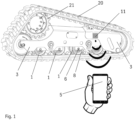
- Fig. 1 shows a part of a tracked vehicle undercarriage in a side view from the outside.
- the illustrated part of the running gear includes elements 8 of the vehicle frame 3, track rollers 1 attached to the vehicle frame 3, and the track chain 20 running on the track rollers 1.
- the track chain 20 is driven by the drive roller 21.
- the track rollers 1 have bearing journals 2 that cannot be seen in more detail in Fig. 1 (see Fig. 2 ).
- the track rollers 1 are fastened to elements 8 of the vehicle frame 3 by means of fastening screws 6.
- the reader 11 for reading out the temperature measurement data captured by the RFID transponder (not shown in Fig. 1 ) is attached to the vehicle frame 3.
- the distance between the reader 11 and the RFID transponders 10 arranged on the fastening screws 6 is selected so that even with respect to the fastening screw 6 furthest away from the reader 11, the maximum permissible distance for trouble-free reading of the measurement data is not exceeded.
- the reader 11 transmits the temperature data wirelessly to a further processing device.
- the further processing device 5 shown in Fig. 1 as an example is a smartphone.
- Fig. 2 shows a sectional view of a track roller 1 of the running gear of a tracked vehicle in a perspective view from the outside.
- the track roller 1 has a central shaft that includes an end bearing journal 2.
- the end bearing journal 2 has a threaded bore 7 aligned with a through bore 25 disposed in an element 8 of the vehicle frame 3.
- the bearing journal 2 is connected to the element 8 of the vehicle frame 3 via the fastening screw 6.
- the bearing journal 2 is supported by a sleeve bearing 24.
- the fastening screw 6 has a through bore 15.
- the fastening screw 6 carries a sensor arrangement 4 that comprises a temperature sensor 9 and an RFID transponder 10.
- the temperature sensor 9 is arranged in the through bore 15.
- the RFID transponder 10 is also arranged in the through bore 15 of the fastening screw 6.
- the temperature sensor 9 is arranged closer to the center of the vehicle and closer to the bearing point over which the track roller 1 is supported on the bearing journal 2 than the RFID transponder 10.
- a blind hole could also be provided in the fastening screw 6 according to an alternative embodiment.
- the entire sensor arrangement 4 comprising the temperature sensor 9 and the RFID transponder 10 could be arranged in a recess 13 arranged exclusively in the screw head 12 of the fastening screw 6 (see Fig. 6 ).
- an advantage is that the shank of the fastening screw 6 can be designed as a solid screw bolt that does not have a hole and is therefore mechanically more resilient than a fastening screw 6 whose screw shank has a through-hole or blind hole.
- the RFID transponder 10 is arranged in the area of the screw head 12 of the fastening screw 6, so that it is arranged as close as possible to the reader 11.
- the reader 11 is fastened to the vehicle frame 3.
- the reader 11 is designed as a highfrequency antenna and has its own power supply by means of a battery (not shown).
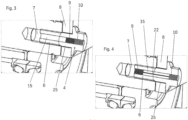
- Fig. 3 shows an enlarged view of the fastening screw 6 with the through bore 15 according to Fig. 2 .
- the sensor arrangement 4 with the temperature sensor 9 and the RFID transponder 10 is arranged in the through bore 15.
- the RFID transponder 10 is arranged at the outer end of the through bore 15.
- the temperature sensor 9 extends further into the interior of the fastening screw 6.
- the temperature sensor 9 and the RFID transponder 10 may be arranged in a common housing.
- the sensor arrangement 4 according to Fig. 3 is passive.
- the temperature sensor 9 measures the temperature of the fastening screw 6 at the location where the temperature sensor 9 is located.
- the measured values are passed on to the RFID transponder 10 and recorded by it.
- the RFID transponder 10 is excited by the reader 11 (see Figs. 1 and 2 ), which reads out the captured temperature values from the RFID transponder 10.
- the reader 11 transmits the temperature data to a further processing device 5 (see Fig. 1 ).
- the further processing device 5 may be a mobile device such as a smartphone or a portable computer such as a tablet.
- the further processing device 5 may be a computer located in the operator's cabin or cockpit of the tracked vehicle, e.g. integrated into the instrument panel or dashboard of the tracked vehicle, or installed as a separate device in the operator's cabin.
- the invention makes use of the insight that the temperature data measured by the temperature sensor do not necessarily have to be measured directly on the surface of the bearing element, i.e. directly on the surface of the bearing bushing as in WO 2013/148735 A1 , but that it is sufficient to arrange the temperature sensor at a distance from the bearing point at the fastening screw, and to measure the temperature data there.
- a correlation table which shows the correlation between the temperatures measured by the temperature sensor 9 in the area of the fastening screw and the temperatures of the bearing journal 2 or the bearing bushing/sleeve bearing 24.
- Such a correlation table can be created, for example, by simultaneously measuring both the temperature at the location of the temperature sensor 9 and the temperature which is present at the bearing journal 2 or the bearing bushing/sleeve bearing 24, and then comparing both temperature values measured at the same measurement time.
- the transmission of data from the reader 11 to the further processing device 5 may be wireless or cabled.
- the further processing device 5 can be set up to emit a warning signal if the measured temperature values reach or exceed a predefinable limit value.
- the tracked vehicle can be subjected to a (e.g. regular) maintenance measure before it breaks down during its operation on a construction site, i.e. before increased repair work and repair costs are incurred.
- Fig. 3 The advantage of the embodiment according to Fig. 3 is that low-cost sensor arrangements 4 manufactured as mass products can be used. These sensor arrangements 4 are readily available on the market. They can be easily installed and work together with an active reader 11 in a straightforward manner ("plug-and-play").
- Fig. 4 shows an embodiment of the invention in which the temperature sensor 9 is arranged at the inside end of the through bore 15, while the RFID transponder 10 is arranged at the outside end of the through bore 15.
- the RFID transponder 10 is arranged at the same location as in the embodiment example according to Fig. 3 .
- the temperature measurement data is transmitted from the temperature sensor 9 to the RFID transponder 10 via a connection 22.
- This connection 22 can be a wireless data transmission connection, but it can also be a connection cable for a wired transmission of the temperature data.
- the advantage of the embodiment according to Fig. 4 is that a more precise temperature measurement is possible than with the arrangement of the temperature sensor 9 according to Fig. 3 .
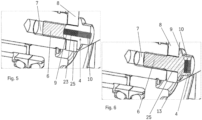
- Fig. 5 shows an embodiment of the invention in which the fastening screw 6 does not have a through bore, but a blind hole 23.
- the design and arrangement of the sensor arrangement 4 is comparable to Fig. 3 . Due to the design of the hole receiving the sensor arrangement 4 as a blind hole 23, the threaded bolt of the fastening screw 6 is solid, so that the fastening screw 6 can bear greater loads than a fastening screw with a through bore and a threaded bolt of hollow cylindrical design.
- Fig. 6 shows an embodiment of the invention in which neither a through bore nor a blind hole is provided in the fastening screw 6 to accommodate the sensor arrangement 4. Instead, a recess 13 is provided in the screw head 12 of the fastening screw 6 in which the sensor arrangement 4 is arranged. This recess 13 can be manufactured in the screw head 12, for example, by turning or milling.
- This embodiment of the invention also has the advantage that inexpensive sensor arrangements 4 manufactured as mass products can be used. These sensor arrangements 4 are readily available on the market. They can be easily installed and work together with an active reader 11 in a straightforward manner (“plug-and-play").
- the proposed solution takes advantage of the realization that the temperature readings from the temperature sensor do not necessarily have to be measured directly on the surface of the bearing element, i.e. directly on the surface of the bearing bushing as in WO 2013/148735 A1 , but that it is sufficient to arrange the temperature sensor at a distance from the bearing point at the fastening screw, and to measure the temperature data there.
- an existing correlation between the temperatures in the area of the fastening screw and the temperatures in the bearing journal or bearing bushing/sleeve bearing supporting the bearing journal can be taken into account when evaluating the measured temperature values.
- Such a correlation can be worked out, for example, in tests by simultaneously measuring and comparing both temperature values.
- the development of a temperature trend over time for the temperatures measured by the temperature sensor 9 can be observed as part of the evaluation of the measured temperature values.
Landscapes
- Engineering & Computer Science (AREA)
- Mechanical Engineering (AREA)
- General Engineering & Computer Science (AREA)
- Chemical & Material Sciences (AREA)
- Combustion & Propulsion (AREA)
- Transportation (AREA)
- Rolling Contact Bearings (AREA)
- Testing Of Devices, Machine Parts, Or Other Structures Thereof (AREA)
Description
- The invention relates to a device for monitoring the lubrication condition of the bearing of a track roller of a running gear of a tracked vehicle by means of temperature monitoring according to the preamble of
patent claim 1. - Such tracked vehicles can be vehicles for mining, construction, forestry, agriculture, landscaping, and material handling industries, for example heavy equipment for moving earth and other materials. hydraulic and electric excavators, backhoes, shovels, and drills. They are used at, for example, mining or construction sites. These track vehicles are heavy-duty equipment, some are capable of moving thousands of kilograms of material at a time. The drive system underneath such track vehicles includes a track-type undercarriage. A track undercarriage is used to move the heavy vehicle and large amounts of material over many types of terrain. Track undercarriages are intended to operate an a variety of terrain conditions and can handle a higher operating weight capacity than comparably sized wheeled assemblies.
- A device according to the preamble of
patent claim 1 is known from international patent applicationWO 2013/148735 A1 ("WO 735"). - As explained in WO 735, the roller components and bearing bushings are ideally well lubricated and there is a low friction contact surface between the bearing bushing and the roller or between the bearing bushing and the shaft. Inadequate lubrication of the contact surfaces will increase friction between the bearing bushing and the roller, resulting in wear of the bearing bushing and eventually damage to the roller assembly. Even with adequate lubrication, bearing bushings will wear over time due to contact with the roller or shaft. Because bearing bushings and lubricant are inside the roller assembly, the wear condition of the bearing bushings and the amount of lubricant in the roller assembly are difficult to monitor.
- According to WO 735, roller assemblies in a tracked vehicle chassis typically fail due to inadequate lubrication. Without adequate lubrication, friction between the roller and bearing bushing or bearing bushing and shaft increases significantly, causing component wear. One indicator of inadequate lubrication is increased heat within the roller assembly.
- Without constant monitoring of the roller assemblies of a tracked vehicle running gear, lubrication problems go unnoticed and the bearing bushings tend to wear out completely before the wear is noticed. Then the rollers run without bearing bushings. When a bearing bushing is completely worn and the roller continues to run without a bearing bushing, damage to the roller occurs as the roller contacts other surfaces within the roller assembly. The "metal on metal" contact or "steel on steel" contact between the roller and other surfaces of the roller assembly will cause the surface of the roller and the surface of the other components to wear and deteriorate beyond the point to which the parts can still be repaired. Eventually, a roller or bearing bushing will wear and seize without lubricant.
- The tracked vehicle then fails at the job site when a roller unexpectedly stops turning. Tracked vehicles that fail at the point of use during operation create additional hazards and maintenance problems and incur additional costs for repairs and replacements. However, if lubricant problems or bearing bushing wear are detected early, the affected roller assembly can be repaired or replaced in a timely and cost-effective manner (e.g., as part of scheduled maintenance) without causing the tracked vehicle to fail while on the job site.
- In order to be able to detect a lack of lubricant and thus impending wear at an early stage, WO 735 proposes monitoring the temperature of the roller assembly by means of temperature sensors.
- The monitoring device according to WO 735 has a roller assembly that includes a fixed roller component and a bearing bushing. An opening is formed in the fixed roller component. A first sensor is disposed in the opening of the fixed roller component above the bearing bushing. The first sensor is configured to sense a first physical property of the bearing bushing. The fixed roller component is configured as a shaft or housing. The first sensor is a temperature sensor or a Hall effect sensor. A magnet is disposed on the roller assembly. A second sensor is disposed in the opening of the fixed roller component above the bearing bushing. The second sensor is configured to sense a second physical property of the bearing bushing. A data transmission device is coupled to the first sensor. Data is collected from the sensor. Data collected by the sensor is transmitted to a receiving device.
- With regard to the further processing of the measured data, the following is described in WO 735: The temperature sensor and the Hall effect sensor generate output signals or output data in the monitoring device. The output signals or data from the monitoring device are transmitted to an external receiving device that outputs the signals or data. A transmitter or connection port is used to transmit the output signals or data from the monitoring device to an external receiving device, such as a computer. The transmitted data can then be uploaded to a computer or other device that processes the data.
- The data from the monitoring device is used to monitor the operational status of the roller assembly. For example, when the monitoring device 58 measures the temperature in the end caps 52 and 54 and the thickness of the bushing 56, the monitoring device generates output signals or data that are transmitted to a computer via a wireless transmitter. Alternatively, the output data is accessed via a port connected to the monitoring device 58. The output data is processed and is used to determine if the roller assembly 50 is operating at the correct temperature and bearing bushing thickness. If the data indicates a problem with the roller assembly 50, the problem can be identified immediately. For example, if the temperature data indicates that the roller assembly has reached an abnormally high temperature, a manual or automatic alarm is triggered. For example, a person may monitor the data and call the equipment operator if a roller assembly within the chassis reaches a certain temperature or becomes too hot. Alternatively, the computer contains an algorithm that automatically triggers an alert to the equipment operator when a roller assembly reaches a certain temperature. When the Hall effect reaches a certain voltage and indicates critical bearing bushing wear, a manual or automatic alert is triggered. Therefore, the monitoring device 58 provides real-time feedback on the temperature and bearing bushing thickness of the roller assemblies 50.
- A disadvantage of the running gear monitoring device known from WO 735 is that the fixed roller component must have specially adapted openings to accommodate the sensors, and that the sensors interact directly with the bearing bushing to record usable temperature readings. As a result, the solution known from WO 735 cannot be easily retrofitted to existing tracked vehicles without a running gear monitoring device. In addition, the known solution is also costly to implement for equipping new vehicles because several components have to be machined and adapted to each other in order to integrate the solution into the tracked vehicle's running gear.
- It is an objective of the present invention to provide a device for monitoring the lubrication condition of the bearing of a track roller of a running gear of a tracked vehicle by means of temperature monitoring, with which both existing tracked vehicles can be retrofitted and new vehicles can be equipped in a simple and cost-effective manner.
- This objective is reached according to the present invention by a device with the features of
patent claim 1. Advantageous further developments of the invention are indicated in the dependent claims. - According to the invention, it was recognized that the fastening screw, with which the bearing journal of the track roller is fastened to an element of the frame of the tracked vehicle, can be used as a carrier element for both the temperature sensor and the RFID transponder of the sensor arrangement. This makes it very easy to retrofit existing tracked vehicles that do not have temperature monitoring devices with temperature monitoring devices according to the present invention. Likewise, it is very easy to equip new vehicles with a temperature monitoring device.
- According to the invention, no specific modifications need to be made to the housing accommodating the bearing journal of the track roller. In particular, no openings need to be provided to accommodate the temperature sensor in the housing accommodating the bearing journal of the track roller. According to the invention, all components required for temperature monitoring are carried by the mounting screw. It is therefore sufficient according to the invention to provide a fastening screw equipped with these components.
- Retrofitting existing tracked vehicles with a temperature monitoring device according to the invention can be done, for example, simply by replacing the original fastening screw with a fastening screw that carries the temperature sensor and the RFID transponder.
- Equipping new vehicles with the device according to the invention is comparably simple. The existing design of the track roller, of the housing accommodating the bearing journal of the track roller and the known mounting of the track roller on the vehicle frame do not need to be modified. It is sufficient to provide a fastening screw designed according to the invention, i.e. which carries the temperature sensor and the RFID transponder, as the fastening screw.
- In the invention, sensor arrangements that are readily and inexpensively available on the market can be used. In these sensor arrangements, the temperature sensor and the RFID transponder can, for example, be arranged together as a modular unit in a single housing.
- Retrofitting temperature monitoring devices to existing tracked vehicles and integrating such devices into new vehicles is thus made easy and inexpensive with the invention for several reasons:
- 1) No components of the tracked vehicle chassis need to be structurally modified. Replacing the previous fastening screw with a fastening screw according to the invention that carries the sensor arrangement is sufficient to measure and record the temperature data required for temperature and wear monitoring.
- 2) The reader for reading the temperature data from the RFID transponder is independent of the sensor arrangement and can be attached to the tracked vehicle at a suitable location. For example, the reader can be located at a suitable reading distance from the RFID transponder on a component of the vehicle frame.
- 3) The further processing device is both independent of the sensor arrangement and independent of the reader device. The further processing device may be, for example, a portable device such as a smartphone, a portable computer like a tablet or the like. For new vehicles, the further processing device may be integrated into the display and instrument panel in the cockpit or driver's cabin of the tracked vehicle. For existing vehicles, the further processing device can be installed as a separate device subsequently in the cockpit or driver's cabin of the vehicle.
- According to one embodiment of the invention, it is provided that the fastening screw has a screw head, wherein the RFID transponder is disposed at the screw head. In this embodiment, the fastening screw itself does not have to be structurally modified. The RFID transponder can be glued to the screw head, for example. Alternatively, the RFID transponder can also be screwed or otherwise mechanically attached to the screw head. In another alternative, the RFID transponder can be soldered or welded to the screw head.
- According to one embodiment of the invention, it is provided that the screw head of the fastening screw has a recess in which at least the RFID transponder is arranged. By arranging the RFID transponder in a recess in the head of the fastening screw, the RFID transponder is accommodated in a protected manner. It can therefore not be damaged so quickly in the harsh operating environment in which tracked vehicles, such as construction vehicles in particular, are used.
- According to one embodiment of the invention, it is provided that the fastening screw has a longitudinal bore in which at least a part of the sensor arrangement, in particular the temperature sensor, is arranged. By arranging the temperature sensor in a longitudinal bore of the fastening screw, the accuracy of the temperature measurement can be increased because the sensor is arranged closer to the bearing components in relation to which the supply of lubricant is to be monitored and on which signs of wear occur in the event of an undersupply of lubricant, than if there were no longitudinal bore for inserting the temperature sensor.
- According to one embodiment of the invention, it is provided that the longitudinal bore is formed as a through bore, wherein the temperature sensor is disposed at the end of the through bore spaced from the screw head. By this arrangement, the accuracy of the temperature measurement can be further increased, because the sensor is arranged even closer to the bearing components with respect to which the supply of lubricant is to be monitored and at which signs of wear occur in the event of an undersupply of lubricant.
- According to one embodiment of the invention, it is provided that the reader is configured as a radio frequency antenna.
- According to one embodiment of the invention, the sensor arrangement is designed as an active sensor arrangement with an energy source or an energy harvesting system and the RFID transponder can be supplied with energy by the energy source or the energy harvesting system. Due to their own energy source, such sensor arrangements work very reliably. Dropouts when reading out the measurement data rarely occur.
- According to one embodiment of the invention, it is provided that the sensor arrangement is configured as a passive sensor arrangement without its own energy source, wherein the reader has an energy source and the sensor arrangement is configured to be excitable by the reader. In this embodiment, the sensor arrangement is designed to be very low-maintenance, robust and not very susceptible to faults. When the energy source is arranged on the reader, it can be replaced or maintained more easily than when the energy source is arranged on the sensor arrangement, because the reader can often be arranged in a more accessible location on the tracked vehicle than the sensor arrangements. If one reader is configured to read the measurement data of several sensor arrangements of several track rollers, then the maintenance requirement and the effort to replace the energy source is also reduced compared to a device in which each respective sensor arrangement comprises the energy source.
- According to one embodiment of the invention, it is provided that the temperature sensor is designed as a thermocouple. This makes the sensor arrangement robust and less susceptible to failure, and therefore well suited for use in a harsh and dirty operating environment. Thermocouples are also inexpensive and readily available on the market.
- It is also an objective of the present invention to provide a method for monitoring the lubrication condition of the bearing of a track roller of a running gear of a tracked vehicle by means of temperature monitoring, which can be used in a simple and cost-effective manner both on existing tracked vehicles and on new vehicles.
- This objective is reached by a method with the features of
patent claim 10. - Advantageous further embodiments of the method according to the invention are indicated in the dependent claims referring back to the independent method claim.
- With regard to the method, the invention exploits the knowledge that sufficiently accurate temperature measurements can be carried out with a sensor arrangement arranged on the fastening screw for fastening the track roller to the vehicle frame, which allow sufficient conclusions to be drawn about the lubricant supply to the bearing of the track rollers in the running gear of the tracked vehicle. This makes it unnecessary to provide the temperature sensors as close as possible to the bearing journals, so that special openings can be dispensed with in which the temperature sensors are arranged as directly as possible next to or above the bearing journal or the bearing bushing of the track roller.
- According to one embodiment of the method according to the invention, it is provided that the RFID transponder is disposed on a free end of the fastening screw and the reader is disposed on the frame. This allows the temperature monitoring device according to the invention to be installed easily and quickly.
- According to one embodiment of the method according to the invention, it is provided that the fastening screw comprises a longitudinal bore, wherein the temperature data is sensed by a temperature sensor disposed at least partially in the longitudinal bore. In this way, the accuracy of the temperature measurement can be increased because the temperature sensor can be arranged close to the bearing components in relation to which the supply of lubricant is to be monitored and on which signs of wear occur in the event of an undersupply of lubricant.
- If the longitudinal bore is designed as a through-hole and the temperature sensor measures the temperature data at the end of the through-hole spaced from the free end of the fastening screw, the measurement accuracy is increased even further compared to a solution where the temperature sensor is arranged in a longitudinal bore designed as a blind hole.
- According to one embodiment of the method according to the invention, it is provided that the sensor arrangement is designed as an active sensor arrangement with an energy source or an energy harvesting system and the RFID transponder is supplied with energy by the energy source or the energy harvesting system. Such a method works very reliably and is not very susceptible to faults.
- According to one embodiment of the method according to the invention, it is provided that the sensor arrangement is configured as a passive sensor arrangement without its own energy source, wherein the reader comprises an energy source and the sensor arrangement is excited by the reader. A method designed in this way operates very reliably and is not very susceptible to faults. Because the energy source is arranged on the reader, it can be replaced or maintained more easily than if the energy source is arranged on the respective sensor arrangement. The reader can often be located in a more accessible location on the tracked vehicle than the sensor arrangements. Furthermore, if one reader is configured to read the measurement data of several sensor arrangements, then the maintenance requirement and the effort for replacing the energy source is also reduced compared to a device in which the respective sensor arrangement comprises the energy source.
- The invention is explained in more detail below with reference to figures. The figures show in schematic representation
- Fig. 1
- A part of a tracked vehicle chassis with the device according to the invention in a side view from the outside;
- Fig. 2
- a sectional view of a track roller of a device according to
Fig. 1 attached to an element of the vehicle frame; - Fig. 3
- an enlarged representation of a first embodiment of the fastening screw for a device according to
Figs. 1 and2 , wherein the fastening screw carries a temperature sensor and an RFID transponder; - Fig. 4
- an enlarged representation of a second embodiment of the fastening screw for a device according to
Figs. 1 and2 , wherein the fastening screw carries a temperature sensor and an RFID transponder; - Fig. 5
- an enlarged representation of a third embodiment of the fastening screw for a device according to
Figs. 1 and2 , wherein the fastening screw carries a temperature sensor and an RFID transponder; - Fig. 6
- an enlarged representation of a fourth embodiment of the fastening screw for a device according to
Figs. 1 and2 , wherein the fastening screw carries a temperature sensor and an RFID transponder. -
Fig. 1 shows a part of a tracked vehicle undercarriage in a side view from the outside. The illustrated part of the running gear includeselements 8 of thevehicle frame 3,track rollers 1 attached to thevehicle frame 3, and thetrack chain 20 running on thetrack rollers 1. Thetrack chain 20 is driven by thedrive roller 21. In the view from the outside shown inFig. 1 , thetrack rollers 1 havebearing journals 2 that cannot be seen in more detail inFig. 1 (seeFig. 2 ). Thetrack rollers 1 are fastened toelements 8 of thevehicle frame 3 by means of fastening screws 6. Thereader 11 for reading out the temperature measurement data captured by the RFID transponder (not shown inFig. 1 ) is attached to thevehicle frame 3. The distance between thereader 11 and theRFID transponders 10 arranged on the fastening screws 6 is selected so that even with respect to thefastening screw 6 furthest away from thereader 11, the maximum permissible distance for trouble-free reading of the measurement data is not exceeded. - The
reader 11 transmits the temperature data wirelessly to a further processing device. Thefurther processing device 5 shown inFig. 1 as an example is a smartphone. -
Fig. 2 shows a sectional view of atrack roller 1 of the running gear of a tracked vehicle in a perspective view from the outside. Thetrack roller 1 has a central shaft that includes anend bearing journal 2. Theend bearing journal 2 has a threadedbore 7 aligned with a throughbore 25 disposed in anelement 8 of thevehicle frame 3. Thebearing journal 2 is connected to theelement 8 of thevehicle frame 3 via thefastening screw 6. - The
bearing journal 2 is supported by asleeve bearing 24. - The
fastening screw 6 has a throughbore 15. Thefastening screw 6 carries asensor arrangement 4 that comprises atemperature sensor 9 and anRFID transponder 10. Thetemperature sensor 9 is arranged in the throughbore 15. TheRFID transponder 10 is also arranged in the throughbore 15 of thefastening screw 6. Thetemperature sensor 9 is arranged closer to the center of the vehicle and closer to the bearing point over which thetrack roller 1 is supported on thebearing journal 2 than theRFID transponder 10. - Instead of the through
bore 15 shown inFig. 2 , a blind hole could also be provided in thefastening screw 6 according to an alternative embodiment. - According to another alternative embodiment, the
entire sensor arrangement 4 comprising thetemperature sensor 9 and theRFID transponder 10 could be arranged in arecess 13 arranged exclusively in thescrew head 12 of the fastening screw 6 (seeFig. 6 ). In this embodiment, an advantage is that the shank of thefastening screw 6 can be designed as a solid screw bolt that does not have a hole and is therefore mechanically more resilient than afastening screw 6 whose screw shank has a through-hole or blind hole. - In the embodiment of the invention shown in
Fig. 2 , theRFID transponder 10 is arranged in the area of thescrew head 12 of thefastening screw 6, so that it is arranged as close as possible to thereader 11. Thereader 11 is fastened to thevehicle frame 3. In the embodiment shown, thereader 11 is designed as a highfrequency antenna and has its own power supply by means of a battery (not shown). -
Fig. 3 shows an enlarged view of thefastening screw 6 with the throughbore 15 according toFig. 2 . Thesensor arrangement 4 with thetemperature sensor 9 and theRFID transponder 10 is arranged in the throughbore 15. TheRFID transponder 10 is arranged at the outer end of the throughbore 15. Thetemperature sensor 9 extends further into the interior of thefastening screw 6. Thetemperature sensor 9 and theRFID transponder 10 may be arranged in a common housing. - The
sensor arrangement 4 according toFig. 3 is passive. Thetemperature sensor 9 measures the temperature of thefastening screw 6 at the location where thetemperature sensor 9 is located. The measured values are passed on to theRFID transponder 10 and recorded by it. TheRFID transponder 10 is excited by the reader 11 (seeFigs. 1 and2 ), which reads out the captured temperature values from theRFID transponder 10. Thereader 11 transmits the temperature data to a further processing device 5 (seeFig. 1 ). Thefurther processing device 5 may be a mobile device such as a smartphone or a portable computer such as a tablet. Alternatively, thefurther processing device 5 may be a computer located in the operator's cabin or cockpit of the tracked vehicle, e.g. integrated into the instrument panel or dashboard of the tracked vehicle, or installed as a separate device in the operator's cabin. - The invention makes use of the insight that the temperature data measured by the temperature sensor do not necessarily have to be measured directly on the surface of the bearing element, i.e. directly on the surface of the bearing bushing as in
WO 2013/148735 A1 , but that it is sufficient to arrange the temperature sensor at a distance from the bearing point at the fastening screw, and to measure the temperature data there. - In order to determine whether a critical temperature has been reached, it can be sufficient to monitor the temperature measured by the
temperature sensor 9 over time. If a critical temperature has been reached the vehicle operator can react. - It is also possible to create a correlation table which shows the correlation between the temperatures measured by the
temperature sensor 9 in the area of the fastening screw and the temperatures of thebearing journal 2 or the bearing bushing/sleeve bearing 24. Such a correlation table can be created, for example, by simultaneously measuring both the temperature at the location of thetemperature sensor 9 and the temperature which is present at thebearing journal 2 or the bearing bushing/sleeve bearing 24, and then comparing both temperature values measured at the same measurement time. - The transmission of data from the
reader 11 to thefurther processing device 5 may be wireless or cabled. Thefurther processing device 5 can be set up to emit a warning signal if the measured temperature values reach or exceed a predefinable limit value. In this way, the tracked vehicle can be subjected to a (e.g. regular) maintenance measure before it breaks down during its operation on a construction site, i.e. before increased repair work and repair costs are incurred. - The advantage of the embodiment according to
Fig. 3 is that low-cost sensor arrangements 4 manufactured as mass products can be used. Thesesensor arrangements 4 are readily available on the market. They can be easily installed and work together with anactive reader 11 in a straightforward manner ("plug-and-play"). -
Fig. 4 shows an embodiment of the invention in which thetemperature sensor 9 is arranged at the inside end of the throughbore 15, while theRFID transponder 10 is arranged at the outside end of the throughbore 15. In the illustrated embodiment example, theRFID transponder 10 is arranged at the same location as in the embodiment example according toFig. 3 . The temperature measurement data is transmitted from thetemperature sensor 9 to theRFID transponder 10 via aconnection 22. Thisconnection 22 can be a wireless data transmission connection, but it can also be a connection cable for a wired transmission of the temperature data. - The advantage of the embodiment according to
Fig. 4 is that a more precise temperature measurement is possible than with the arrangement of thetemperature sensor 9 according toFig. 3 . -
Fig. 5 shows an embodiment of the invention in which thefastening screw 6 does not have a through bore, but ablind hole 23. The design and arrangement of thesensor arrangement 4 is comparable toFig. 3 . Due to the design of the hole receiving thesensor arrangement 4 as ablind hole 23, the threaded bolt of thefastening screw 6 is solid, so that thefastening screw 6 can bear greater loads than a fastening screw with a through bore and a threaded bolt of hollow cylindrical design. -
Fig. 6 shows an embodiment of the invention in which neither a through bore nor a blind hole is provided in thefastening screw 6 to accommodate thesensor arrangement 4. Instead, arecess 13 is provided in thescrew head 12 of thefastening screw 6 in which thesensor arrangement 4 is arranged. Thisrecess 13 can be manufactured in thescrew head 12, for example, by turning or milling. - This embodiment of the invention also has the advantage that
inexpensive sensor arrangements 4 manufactured as mass products can be used. Thesesensor arrangements 4 are readily available on the market. They can be easily installed and work together with anactive reader 11 in a straightforward manner ("plug-and-play"). - The proposed solution takes advantage of the realization that the temperature readings from the temperature sensor do not necessarily have to be measured directly on the surface of the bearing element, i.e. directly on the surface of the bearing bushing as in
WO 2013/148735 A1 , but that it is sufficient to arrange the temperature sensor at a distance from the bearing point at the fastening screw, and to measure the temperature data there. - According to one possibility, an existing correlation between the temperatures in the area of the fastening screw and the temperatures in the bearing journal or bearing bushing/sleeve bearing supporting the bearing journal can be taken into account when evaluating the measured temperature values. Such a correlation can be worked out, for example, in tests by simultaneously measuring and comparing both temperature values.
- According to another possibility, the development of a temperature trend over time for the temperatures measured by the
temperature sensor 9 can be observed as part of the evaluation of the measured temperature values. -
- 1
- track roller
- 2
- bearing journal
- 3
- frame
- 4
- sensor arrangement
- 5
- further processing device
- 6
- fastening screw
- 7
- threaded bore
- 8
- element of the frame
- 9
- temperature sensor
- 10
- FRID transponder
- 11
- Reade
- 12
- Screw head
- 13
- Recess
- 14
- Longitudinal bore
- 15
- Through bore
- 16
- Free end of fastening screw
- 20
- Track chain
- 21
- Drive roller
- 22
- Connection
- 23
- Blind hole
- 24
- Sleeve bearing
- 25
- Through bore
Claims (15)
- Device for monitoring the lubrication condition of the bearing of a track roller (1) of a running gear of a tracked vehicle by means of temperature monitoring, wherein the track roller (1) has at least one bearing journal (2), wherein the track roller (1) is mounted in a frame (3) of the tracked vehicle via the bearing journal (2), wherein a sensor arrangement (4) is arranged in the region of the bearing journal (2), wherein the sensor arrangement (4) is set up to transmit temperature data measured by the sensor arrangement (4) wirelessly to a further processing device (5),
characterized in thatthe sensor arrangement (4) is arranged on a fastening screw (6),wherein the fastening screw (6) is screwed into a threaded bore (7) provided in the bearing journal (2),wherein the track roller (1) is fastened to an element (8) of the frame (3) by means of the fastening screw (6),wherein the sensor arrangement (4) comprises a temperature sensor (9), with which instantaneous temperature data can be measured,wherein the sensor arrangement (4) comprises an RFID transponder (10) with which the temperature data can be acquired,wherein a reader (11) is provided at a distance from the RFID transponder (10) suitable for reading out the acquired temperature data,and wherein the reader (11) is configured for transmitting the temperature data to the further processing device (5) for further processing. - The device of claim 1, wherein the fastening screw (6) comprises a screw head (12), wherein the RFID transponder (10) is disposed at the screw head (12).
- The device of claim 2, wherein the screw head (12) has a recess (13) in which at least the RFID transponder is arranged.
- Device according to any one of claims 1 to 3, wherein the fastening screw (6) has a longitudinal bore (14) in which at least a part of the sensor arrangement (4), in particular the temperature sensor (9), is arranged.
- The device of claim 4, wherein the longitudinal bore (14) is formed as a through bore (15), wherein the temperature sensor (9) is disposed at the end of the through bore (15) spaced from the screw head (12).
- The device according to any one of claims 1 to 5, wherein the reader (11) is configured as a radio frequency antenna.
- Device according to any one of claims 1 to 6, wherein the sensor arrangement (4) is designed as an active sensor arrangement with an energy source or an energy harvesting system and the RFID transponder (10) can be supplied with energy by the energy source or the energy harvesting system.
- Device according to any one of claims 1 to 6, wherein the sensor arrangement (4) is configured as a passive sensor arrangement without its own energy source, wherein the reader (11) has an energy source and the sensor arrangement (4) is configured to be excitable by the reader (11).
- Device according to any one of claims 1 to 8, wherein the temperature sensor (9) is designed as a thermocouple.
- Method for monitoring the lubrication condition of the bearing of a track roller (1) of a running gear of a tracked vehicle by means of temperature monitoring, wherein the temperature monitoring is carried out during operation of the tracked vehicle by means of a sensor arrangement (4), wherein the track roller (1) is mounted in a frame (3) of the tracked vehicle via at least one bearing journal (2), wherein the sensor arrangement (4) is arranged in the region of the bearing journal (2), wherein the temperature data measured by the sensor arrangement (4) are transmitted wirelessly to a further processing device (5) characterized in thatthe sensor arrangement (4) is arranged on a fastening screw (6),wherein the fastening screw (6) is screwed into a threaded bore (7) provided in the bearing journal (2),wherein the track roller (1) is fastened to an element (8) of the frame (3) by means of the fastening screw (6),wherein the sensor arrangement (4) comprises a temperature sensor (9) with which instantaneous temperature data are measured,wherein the sensor arrangement (4) comprises an RFID transponder (10) with which the temperature data are acquired,wherein the acquired temperature data are read out by means of a reader (11) which is arranged at a distance from the RFID transponder (10) suitable for reading out the temperature data,and wherein the temperature data are transmitted from the reader (11) to the further processing device (5) for further processing.
- The method of claim 10, wherein the RFID transponder (10) is disposed on a free end of the fastening screw (6) and the reader (11) is disposed on the frame (3).
- The method of any one of claims 10 to 11, wherein the fastening screw (6) comprises a longitudinal bore (14), and wherein the temperature data is sensed by a temperature sensor (9) disposed at least partially in the longitudinal bore (14).
- The method of claim 12, wherein the longitudinal bore (14) is configured as a through bore (15), and wherein the temperature sensor (9) measures temperature data at the end of the through bore (15) spaced from the free end (16) of the fastening screw (6).
- Method according to any one of claims 10 to 13, wherein the sensor arrangement (4) is designed as an active sensor arrangement with an energy source or an energy harvesting system and the RFID transponder is supplied with energy by the energy source or the energy harvesting system.
- The method according to any one of claims 10 to 13, wherein the sensor arrangement (4) is configured as a passive sensor arrangement without its own energy source, wherein the reader (11) comprises an energy source and the sensor arrangement (4) is excited by the reader (11).
Priority Applications (5)
| Application Number | Priority Date | Filing Date | Title |
|---|---|---|---|
| EP21185441.9A EP4119426B1 (en) | 2021-07-13 | 2021-07-13 | Device and method for monitoring the lubrication condition of a bearing of a track roller of a running gear of a tracked vehicle |
| CN202280049665.4A CN117677561A (en) | 2021-07-13 | 2022-07-07 | Device for monitoring the lubrication condition of the bearings of the track rollers of the running gear of a tracked vehicle |
| PCT/EP2022/068992 WO2023285296A1 (en) | 2021-07-13 | 2022-07-07 | Device for monitoring the lubrication condition of a bearing of a track roller of a running gear of a tracked vehicle |
| KR1020247000577A KR102891170B1 (en) | 2021-07-13 | 2022-07-07 | A device for monitoring the lubrication status of the bearings of the track rollers of the driving gear of a track vehicle |
| US18/578,648 US12595825B2 (en) | 2021-07-13 | 2022-07-07 | Device for monitoring the lubrication condition of a bearing of a track roller of a running gear of a tracked vehicle |
Applications Claiming Priority (1)
| Application Number | Priority Date | Filing Date | Title |
|---|---|---|---|
| EP21185441.9A EP4119426B1 (en) | 2021-07-13 | 2021-07-13 | Device and method for monitoring the lubrication condition of a bearing of a track roller of a running gear of a tracked vehicle |
Publications (2)
| Publication Number | Publication Date |
|---|---|
| EP4119426A1 EP4119426A1 (en) | 2023-01-18 |
| EP4119426B1 true EP4119426B1 (en) | 2024-02-28 |
Family
ID=76920622
Family Applications (1)
| Application Number | Title | Priority Date | Filing Date |
|---|---|---|---|
| EP21185441.9A Active EP4119426B1 (en) | 2021-07-13 | 2021-07-13 | Device and method for monitoring the lubrication condition of a bearing of a track roller of a running gear of a tracked vehicle |
Country Status (5)
| Country | Link |
|---|---|
| US (1) | US12595825B2 (en) |
| EP (1) | EP4119426B1 (en) |
| KR (1) | KR102891170B1 (en) |
| CN (1) | CN117677561A (en) |
| WO (1) | WO2023285296A1 (en) |
Families Citing this family (2)
| Publication number | Priority date | Publication date | Assignee | Title |
|---|---|---|---|---|
| IT202300009558A1 (en) * | 2023-05-12 | 2024-11-12 | Berco Spa | DETECTION SYSTEM AND PROCESS FOR DETECTING ONE OR MORE PHYSICAL QUANTITIES OF AN UNDERCARRIAGE AND/OR A VEHICLE, AND UNDERCARRIAGE AND VEHICLE EQUIPPED WITH SAID DETECTION SYSTEM. |
| US12292337B2 (en) | 2023-06-07 | 2025-05-06 | Caterpillar Inc. | Roller temperature monitoring |
Family Cites Families (9)
| Publication number | Priority date | Publication date | Assignee | Title |
|---|---|---|---|---|
| US10046815B2 (en) | 2012-03-27 | 2018-08-14 | Wearpro Incorporated | Wear monitoring device and method of monitoring undercarriage and roller wear |
| KR101836931B1 (en) * | 2015-03-31 | 2018-04-19 | 주식회사 진성티이씨 | Track Assembly for Caterpilar vehicles |
| KR101836937B1 (en) * | 2015-04-17 | 2018-03-09 | 주식회사 진성티이씨 | Remote Mornitoring System of Caterpilar vehicles |
| KR101826527B1 (en) | 2016-10-06 | 2018-02-08 | 주식회사 진성티이씨 | Power Supply System of tracked vehicles for Sensors using low power |
| KR101919338B1 (en) | 2017-01-24 | 2018-11-20 | 주식회사 글로비즈 | Apparatus and system for monitoring temperature of railway vehicle |
| KR20180019131A (en) * | 2018-01-29 | 2018-02-23 | 주식회사 진성티이씨 | Track Assembly for Caterpilar vehicles |
| IT201900022590A1 (en) * | 2019-11-29 | 2021-05-29 | Italtractor | Tracked undercarriage monitoring system |
| CN111017059B (en) * | 2019-12-19 | 2021-06-22 | 三一重机有限公司 | Wheel internal pressure control system, construction machine and control method |
| WO2021142569A1 (en) * | 2020-01-13 | 2021-07-22 | 舍弗勒技术股份两合公司 | Sensing device and bearing component |
-
2021
- 2021-07-13 EP EP21185441.9A patent/EP4119426B1/en active Active
-
2022
- 2022-07-07 US US18/578,648 patent/US12595825B2/en active Active
- 2022-07-07 CN CN202280049665.4A patent/CN117677561A/en active Pending
- 2022-07-07 WO PCT/EP2022/068992 patent/WO2023285296A1/en not_active Ceased
- 2022-07-07 KR KR1020247000577A patent/KR102891170B1/en active Active
Also Published As
| Publication number | Publication date |
|---|---|
| EP4119426A1 (en) | 2023-01-18 |
| CN117677561A (en) | 2024-03-08 |
| US20240328461A1 (en) | 2024-10-03 |
| KR20240018612A (en) | 2024-02-13 |
| WO2023285296A1 (en) | 2023-01-19 |
| US12595825B2 (en) | 2026-04-07 |
| KR102891170B1 (en) | 2025-11-25 |
Similar Documents
| Publication | Publication Date | Title |
|---|---|---|
| US10696337B2 (en) | Wear monitoring device and method of monitoring undercarriage and roller wear | |
| US20240328461A1 (en) | Device for monitoring the lubrication condition of a bearing of a track roller of a running gear of a tracked vehicle | |
| JP4864085B2 (en) | Transmission chain monitoring system | |
| EP1362003B1 (en) | A load monitoring system for use with a load conveyor | |
| KR102755977B1 (en) | Device for determining the actual condition and/or remaining service life of construction, material-handling and/or conveying machinery | |
| KR100936120B1 (en) | Safety control system of crane using roller type load detector | |
| US20080033607A1 (en) | Monitoring system for aircraft landing system | |
| US10385688B2 (en) | Wear monitoring system for milling drum | |
| WO2019097556A1 (en) | Element of a tracked movement assembly for works machines | |
| KR20210147064A (en) | Crawler tracks, shoes, track links, undercarriage assemblies and vehicles provided with power supply units for powering sensors | |
| US4658638A (en) | Machine component diagnostic system | |
| US20070056379A1 (en) | Conveyor diagnostic system having local positioning system | |
| CN119262590A (en) | A logistics supply chain management system based on artificial intelligence | |
| EP4177140B1 (en) | Track link assembly | |
| EP3670279B1 (en) | Position sensing system and method for gathering vehicle component data | |
| CN109682498A (en) | A kind of Hooke's joint temperature pre-warning sensor | |
| Castagnetti et al. | A novel ball joint wear sensor for low-cost structural health monitoring of off-highway vehicles | |
| Murakami et al. | Precision angle sensor unit for construction machinery | |
| CN218625297U (en) | Lifting transmission assembly and lifting equipment | |
| US20010025731A1 (en) | Load measurement | |
| KR20250023482A (en) | Detection of track link pin wear based on sensor data from a sensor device provided in the cavity of the track link pin | |
| CN117703523A (en) | Alarm device and system for detecting tightness pressure of cutter head hob of shield in real time | |
| JP2024532224A (en) | Track Link Spacing Sensor | |
| CA3221356A1 (en) | Kit, system and method for real-time, autonomous remote monitoring of wear in a bushing of earth-moving equipment | |
| WO2018235060A1 (en) | CONTROL SYSTEM FOR LUBRICATED MACHINES AND METHOD THEREOF |
Legal Events
| Date | Code | Title | Description |
|---|---|---|---|
| PUAI | Public reference made under article 153(3) epc to a published international application that has entered the european phase |
Free format text: ORIGINAL CODE: 0009012 |
|
| STAA | Information on the status of an ep patent application or granted ep patent |
Free format text: STATUS: THE APPLICATION HAS BEEN PUBLISHED |
|
| AK | Designated contracting states |
Kind code of ref document: A1 Designated state(s): AL AT BE BG CH CY CZ DE DK EE ES FI FR GB GR HR HU IE IS IT LI LT LU LV MC MK MT NL NO PL PT RO RS SE SI SK SM TR |
|
| STAA | Information on the status of an ep patent application or granted ep patent |
Free format text: STATUS: REQUEST FOR EXAMINATION WAS MADE |
|
| 17P | Request for examination filed |
Effective date: 20230601 |
|
| RBV | Designated contracting states (corrected) |
Designated state(s): AL AT BE BG CH CY CZ DE DK EE ES FI FR GB GR HR HU IE IS IT LI LT LU LV MC MK MT NL NO PL PT RO RS SE SI SK SM TR |
|
| GRAP | Despatch of communication of intention to grant a patent |
Free format text: ORIGINAL CODE: EPIDOSNIGR1 |
|
| STAA | Information on the status of an ep patent application or granted ep patent |
Free format text: STATUS: GRANT OF PATENT IS INTENDED |
|
| INTG | Intention to grant announced |
Effective date: 20231017 |
|
| RAP3 | Party data changed (applicant data changed or rights of an application transferred) |
Owner name: THYSSENKRUPP AG Owner name: BERCO S.P.A. |
|
| GRAS | Grant fee paid |
Free format text: ORIGINAL CODE: EPIDOSNIGR3 |
|
| GRAA | (expected) grant |
Free format text: ORIGINAL CODE: 0009210 |
|
| STAA | Information on the status of an ep patent application or granted ep patent |
Free format text: STATUS: THE PATENT HAS BEEN GRANTED |
|
| AK | Designated contracting states |
Kind code of ref document: B1 Designated state(s): AL AT BE BG CH CY CZ DE DK EE ES FI FR GB GR HR HU IE IS IT LI LT LU LV MC MK MT NL NO PL PT RO RS SE SI SK SM TR |
|
| REG | Reference to a national code |
Ref country code: GB Ref legal event code: FG4D |
|
| REG | Reference to a national code |
Ref country code: CH Ref legal event code: EP |
|
| REG | Reference to a national code |
Ref country code: DE Ref legal event code: R096 Ref document number: 602021009765 Country of ref document: DE |
|
| REG | Reference to a national code |
Ref country code: IE Ref legal event code: FG4D |
|
| REG | Reference to a national code |
Ref country code: LT Ref legal event code: MG9D |
|
| PG25 | Lapsed in a contracting state [announced via postgrant information from national office to epo] |
Ref country code: IS Free format text: LAPSE BECAUSE OF FAILURE TO SUBMIT A TRANSLATION OF THE DESCRIPTION OR TO PAY THE FEE WITHIN THE PRESCRIBED TIME-LIMIT Effective date: 20240628 |
|
| REG | Reference to a national code |
Ref country code: NL Ref legal event code: MP Effective date: 20240228 |
|
| PG25 | Lapsed in a contracting state [announced via postgrant information from national office to epo] |
Ref country code: LT Free format text: LAPSE BECAUSE OF FAILURE TO SUBMIT A TRANSLATION OF THE DESCRIPTION OR TO PAY THE FEE WITHIN THE PRESCRIBED TIME-LIMIT Effective date: 20240228 |
|
| PG25 | Lapsed in a contracting state [announced via postgrant information from national office to epo] |
Ref country code: RS Free format text: LAPSE BECAUSE OF FAILURE TO SUBMIT A TRANSLATION OF THE DESCRIPTION OR TO PAY THE FEE WITHIN THE PRESCRIBED TIME-LIMIT Effective date: 20240528 Ref country code: NL Free format text: LAPSE BECAUSE OF FAILURE TO SUBMIT A TRANSLATION OF THE DESCRIPTION OR TO PAY THE FEE WITHIN THE PRESCRIBED TIME-LIMIT Effective date: 20240228 Ref country code: HR Free format text: LAPSE BECAUSE OF FAILURE TO SUBMIT A TRANSLATION OF THE DESCRIPTION OR TO PAY THE FEE WITHIN THE PRESCRIBED TIME-LIMIT Effective date: 20240228 |
|
| PG25 | Lapsed in a contracting state [announced via postgrant information from national office to epo] |
Ref country code: ES Free format text: LAPSE BECAUSE OF FAILURE TO SUBMIT A TRANSLATION OF THE DESCRIPTION OR TO PAY THE FEE WITHIN THE PRESCRIBED TIME-LIMIT Effective date: 20240228 |
|
| PG25 | Lapsed in a contracting state [announced via postgrant information from national office to epo] |
Ref country code: RS Free format text: LAPSE BECAUSE OF FAILURE TO SUBMIT A TRANSLATION OF THE DESCRIPTION OR TO PAY THE FEE WITHIN THE PRESCRIBED TIME-LIMIT Effective date: 20240528 Ref country code: NO Free format text: LAPSE BECAUSE OF FAILURE TO SUBMIT A TRANSLATION OF THE DESCRIPTION OR TO PAY THE FEE WITHIN THE PRESCRIBED TIME-LIMIT Effective date: 20240528 Ref country code: NL Free format text: LAPSE BECAUSE OF FAILURE TO SUBMIT A TRANSLATION OF THE DESCRIPTION OR TO PAY THE FEE WITHIN THE PRESCRIBED TIME-LIMIT Effective date: 20240228 Ref country code: LT Free format text: LAPSE BECAUSE OF FAILURE TO SUBMIT A TRANSLATION OF THE DESCRIPTION OR TO PAY THE FEE WITHIN THE PRESCRIBED TIME-LIMIT Effective date: 20240228 Ref country code: IS Free format text: LAPSE BECAUSE OF FAILURE TO SUBMIT A TRANSLATION OF THE DESCRIPTION OR TO PAY THE FEE WITHIN THE PRESCRIBED TIME-LIMIT Effective date: 20240628 Ref country code: HR Free format text: LAPSE BECAUSE OF FAILURE TO SUBMIT A TRANSLATION OF THE DESCRIPTION OR TO PAY THE FEE WITHIN THE PRESCRIBED TIME-LIMIT Effective date: 20240228 Ref country code: FI Free format text: LAPSE BECAUSE OF FAILURE TO SUBMIT A TRANSLATION OF THE DESCRIPTION OR TO PAY THE FEE WITHIN THE PRESCRIBED TIME-LIMIT Effective date: 20240228 Ref country code: ES Free format text: LAPSE BECAUSE OF FAILURE TO SUBMIT A TRANSLATION OF THE DESCRIPTION OR TO PAY THE FEE WITHIN THE PRESCRIBED TIME-LIMIT Effective date: 20240228 Ref country code: BG Free format text: LAPSE BECAUSE OF FAILURE TO SUBMIT A TRANSLATION OF THE DESCRIPTION OR TO PAY THE FEE WITHIN THE PRESCRIBED TIME-LIMIT Effective date: 20240228 |
|
| PG25 | Lapsed in a contracting state [announced via postgrant information from national office to epo] |
Ref country code: PT Free format text: LAPSE BECAUSE OF FAILURE TO SUBMIT A TRANSLATION OF THE DESCRIPTION OR TO PAY THE FEE WITHIN THE PRESCRIBED TIME-LIMIT Effective date: 20240628 Ref country code: PL Free format text: LAPSE BECAUSE OF FAILURE TO SUBMIT A TRANSLATION OF THE DESCRIPTION OR TO PAY THE FEE WITHIN THE PRESCRIBED TIME-LIMIT Effective date: 20240228 |
|
| REG | Reference to a national code |
Ref country code: AT Ref legal event code: MK05 Ref document number: 1661009 Country of ref document: AT Kind code of ref document: T Effective date: 20240228 |
|
| PG25 | Lapsed in a contracting state [announced via postgrant information from national office to epo] |
Ref country code: SE Free format text: LAPSE BECAUSE OF FAILURE TO SUBMIT A TRANSLATION OF THE DESCRIPTION OR TO PAY THE FEE WITHIN THE PRESCRIBED TIME-LIMIT Effective date: 20240228 Ref country code: PT Free format text: LAPSE BECAUSE OF FAILURE TO SUBMIT A TRANSLATION OF THE DESCRIPTION OR TO PAY THE FEE WITHIN THE PRESCRIBED TIME-LIMIT Effective date: 20240628 Ref country code: PL Free format text: LAPSE BECAUSE OF FAILURE TO SUBMIT A TRANSLATION OF THE DESCRIPTION OR TO PAY THE FEE WITHIN THE PRESCRIBED TIME-LIMIT Effective date: 20240228 Ref country code: LV Free format text: LAPSE BECAUSE OF FAILURE TO SUBMIT A TRANSLATION OF THE DESCRIPTION OR TO PAY THE FEE WITHIN THE PRESCRIBED TIME-LIMIT Effective date: 20240228 |
|
| PG25 | Lapsed in a contracting state [announced via postgrant information from national office to epo] |
Ref country code: DK Free format text: LAPSE BECAUSE OF FAILURE TO SUBMIT A TRANSLATION OF THE DESCRIPTION OR TO PAY THE FEE WITHIN THE PRESCRIBED TIME-LIMIT Effective date: 20240228 |
|
| PG25 | Lapsed in a contracting state [announced via postgrant information from national office to epo] |
Ref country code: SM Free format text: LAPSE BECAUSE OF FAILURE TO SUBMIT A TRANSLATION OF THE DESCRIPTION OR TO PAY THE FEE WITHIN THE PRESCRIBED TIME-LIMIT Effective date: 20240228 |
|
| PG25 | Lapsed in a contracting state [announced via postgrant information from national office to epo] |
Ref country code: CZ Free format text: LAPSE BECAUSE OF FAILURE TO SUBMIT A TRANSLATION OF THE DESCRIPTION OR TO PAY THE FEE WITHIN THE PRESCRIBED TIME-LIMIT Effective date: 20240228 Ref country code: EE Free format text: LAPSE BECAUSE OF FAILURE TO SUBMIT A TRANSLATION OF THE DESCRIPTION OR TO PAY THE FEE WITHIN THE PRESCRIBED TIME-LIMIT Effective date: 20240228 |
|
| PG25 | Lapsed in a contracting state [announced via postgrant information from national office to epo] |
Ref country code: AT Free format text: LAPSE BECAUSE OF FAILURE TO SUBMIT A TRANSLATION OF THE DESCRIPTION OR TO PAY THE FEE WITHIN THE PRESCRIBED TIME-LIMIT Effective date: 20240228 |
|
| PG25 | Lapsed in a contracting state [announced via postgrant information from national office to epo] |
Ref country code: SK Free format text: LAPSE BECAUSE OF FAILURE TO SUBMIT A TRANSLATION OF THE DESCRIPTION OR TO PAY THE FEE WITHIN THE PRESCRIBED TIME-LIMIT Effective date: 20240228 |
|
| PG25 | Lapsed in a contracting state [announced via postgrant information from national office to epo] |
Ref country code: SM Free format text: LAPSE BECAUSE OF FAILURE TO SUBMIT A TRANSLATION OF THE DESCRIPTION OR TO PAY THE FEE WITHIN THE PRESCRIBED TIME-LIMIT Effective date: 20240228 Ref country code: SK Free format text: LAPSE BECAUSE OF FAILURE TO SUBMIT A TRANSLATION OF THE DESCRIPTION OR TO PAY THE FEE WITHIN THE PRESCRIBED TIME-LIMIT Effective date: 20240228 Ref country code: RO Free format text: LAPSE BECAUSE OF FAILURE TO SUBMIT A TRANSLATION OF THE DESCRIPTION OR TO PAY THE FEE WITHIN THE PRESCRIBED TIME-LIMIT Effective date: 20240228 Ref country code: EE Free format text: LAPSE BECAUSE OF FAILURE TO SUBMIT A TRANSLATION OF THE DESCRIPTION OR TO PAY THE FEE WITHIN THE PRESCRIBED TIME-LIMIT Effective date: 20240228 Ref country code: DK Free format text: LAPSE BECAUSE OF FAILURE TO SUBMIT A TRANSLATION OF THE DESCRIPTION OR TO PAY THE FEE WITHIN THE PRESCRIBED TIME-LIMIT Effective date: 20240228 Ref country code: CZ Free format text: LAPSE BECAUSE OF FAILURE TO SUBMIT A TRANSLATION OF THE DESCRIPTION OR TO PAY THE FEE WITHIN THE PRESCRIBED TIME-LIMIT Effective date: 20240228 Ref country code: AT Free format text: LAPSE BECAUSE OF FAILURE TO SUBMIT A TRANSLATION OF THE DESCRIPTION OR TO PAY THE FEE WITHIN THE PRESCRIBED TIME-LIMIT Effective date: 20240228 |
|
| REG | Reference to a national code |
Ref country code: DE Ref legal event code: R097 Ref document number: 602021009765 Country of ref document: DE |
|
| PLBE | No opposition filed within time limit |
Free format text: ORIGINAL CODE: 0009261 |
|
| STAA | Information on the status of an ep patent application or granted ep patent |
Free format text: STATUS: NO OPPOSITION FILED WITHIN TIME LIMIT |
|
| REG | Reference to a national code |
Ref country code: DE Ref legal event code: R119 Ref document number: 602021009765 Country of ref document: DE |
|
| 26N | No opposition filed |
Effective date: 20241129 |
|
| PG25 | Lapsed in a contracting state [announced via postgrant information from national office to epo] |
Ref country code: MC Free format text: LAPSE BECAUSE OF FAILURE TO SUBMIT A TRANSLATION OF THE DESCRIPTION OR TO PAY THE FEE WITHIN THE PRESCRIBED TIME-LIMIT Effective date: 20240228 |
|
| REG | Reference to a national code |
Ref country code: CH Ref legal event code: PL |
|
| PG25 | Lapsed in a contracting state [announced via postgrant information from national office to epo] |
Ref country code: LU Free format text: LAPSE BECAUSE OF NON-PAYMENT OF DUE FEES Effective date: 20240713 |
|
| PG25 | Lapsed in a contracting state [announced via postgrant information from national office to epo] |
Ref country code: LU Free format text: LAPSE BECAUSE OF NON-PAYMENT OF DUE FEES Effective date: 20240713 |
|
| PG25 | Lapsed in a contracting state [announced via postgrant information from national office to epo] |
Ref country code: DE Free format text: LAPSE BECAUSE OF NON-PAYMENT OF DUE FEES Effective date: 20250201 |
|
| PG25 | Lapsed in a contracting state [announced via postgrant information from national office to epo] |
Ref country code: SI Free format text: LAPSE BECAUSE OF FAILURE TO SUBMIT A TRANSLATION OF THE DESCRIPTION OR TO PAY THE FEE WITHIN THE PRESCRIBED TIME-LIMIT Effective date: 20240228 Ref country code: CH Free format text: LAPSE BECAUSE OF NON-PAYMENT OF DUE FEES Effective date: 20240731 Ref country code: BE Free format text: LAPSE BECAUSE OF NON-PAYMENT OF DUE FEES Effective date: 20240731 |
|
| PG25 | Lapsed in a contracting state [announced via postgrant information from national office to epo] |
Ref country code: FR Free format text: LAPSE BECAUSE OF NON-PAYMENT OF DUE FEES Effective date: 20240731 |
|
| REG | Reference to a national code |
Ref country code: BE Ref legal event code: MM Effective date: 20240731 |
|
| PG25 | Lapsed in a contracting state [announced via postgrant information from national office to epo] |
Ref country code: IE Free format text: LAPSE BECAUSE OF NON-PAYMENT OF DUE FEES Effective date: 20240713 |
|
| PGFP | Annual fee paid to national office [announced via postgrant information from national office to epo] |
Ref country code: IT Payment date: 20250724 Year of fee payment: 5 |
|
| PG25 | Lapsed in a contracting state [announced via postgrant information from national office to epo] |
Ref country code: CY Free format text: LAPSE BECAUSE OF FAILURE TO SUBMIT A TRANSLATION OF THE DESCRIPTION OR TO PAY THE FEE WITHIN THE PRESCRIBED TIME-LIMIT; INVALID AB INITIO Effective date: 20210713 |
|
| PG25 | Lapsed in a contracting state [announced via postgrant information from national office to epo] |
Ref country code: HU Free format text: LAPSE BECAUSE OF FAILURE TO SUBMIT A TRANSLATION OF THE DESCRIPTION OR TO PAY THE FEE WITHIN THE PRESCRIBED TIME-LIMIT; INVALID AB INITIO Effective date: 20210713 |
|
| GBPC | Gb: european patent ceased through non-payment of renewal fee |
Effective date: 20250713 |
|
| PG25 | Lapsed in a contracting state [announced via postgrant information from national office to epo] |
Ref country code: GB Free format text: LAPSE BECAUSE OF NON-PAYMENT OF DUE FEES Effective date: 20250713 |