EP4119189A1 - Method and apparatus for selectively cancelling the effect of the active center of a molecule - Google Patents
Method and apparatus for selectively cancelling the effect of the active center of a molecule Download PDFInfo
- Publication number
- EP4119189A1 EP4119189A1 EP21382647.2A EP21382647A EP4119189A1 EP 4119189 A1 EP4119189 A1 EP 4119189A1 EP 21382647 A EP21382647 A EP 21382647A EP 4119189 A1 EP4119189 A1 EP 4119189A1
- Authority
- EP
- European Patent Office
- Prior art keywords
- molecule
- ray
- pulses
- ray pulses
- ultrashort
- Prior art date
- Legal status (The legal status is an assumption and is not a legal conclusion. Google has not performed a legal analysis and makes no representation as to the accuracy of the status listed.)
- Withdrawn
Links
- 238000000034 method Methods 0.000 title claims abstract description 26
- 230000000694 effects Effects 0.000 title claims abstract description 15
- 230000001360 synchronised effect Effects 0.000 claims abstract description 27
- XLYOFNOQVPJJNP-UHFFFAOYSA-N water Substances O XLYOFNOQVPJJNP-UHFFFAOYSA-N 0.000 claims description 12
- 230000003993 interaction Effects 0.000 claims description 7
- 230000010287 polarization Effects 0.000 claims description 7
- 239000003574 free electron Substances 0.000 claims description 6
- 230000000149 penetrating effect Effects 0.000 claims description 6
- 239000000463 material Substances 0.000 abstract description 3
- QVGXLLKOCUKJST-UHFFFAOYSA-N atomic oxygen Chemical compound [O] QVGXLLKOCUKJST-UHFFFAOYSA-N 0.000 description 17
- 229910052760 oxygen Inorganic materials 0.000 description 17
- 239000001301 oxygen Substances 0.000 description 17
- 238000010521 absorption reaction Methods 0.000 description 11
- 230000005284 excitation Effects 0.000 description 10
- 230000003595 spectral effect Effects 0.000 description 9
- 125000004429 atom Chemical group 0.000 description 7
- 230000008569 process Effects 0.000 description 7
- 239000000523 sample Substances 0.000 description 7
- 238000000862 absorption spectrum Methods 0.000 description 6
- 238000004998 X ray absorption near edge structure spectroscopy Methods 0.000 description 5
- 230000036962 time dependent Effects 0.000 description 5
- 238000013459 approach Methods 0.000 description 4
- 238000004088 simulation Methods 0.000 description 4
- 230000004075 alteration Effects 0.000 description 2
- 238000005284 basis set Methods 0.000 description 2
- 230000001427 coherent effect Effects 0.000 description 2
- 230000005684 electric field Effects 0.000 description 2
- 230000005281 excited state Effects 0.000 description 2
- 230000003287 optical effect Effects 0.000 description 2
- 230000010355 oscillation Effects 0.000 description 2
- 125000004430 oxygen atom Chemical group O* 0.000 description 2
- 238000001228 spectrum Methods 0.000 description 2
- 230000002123 temporal effect Effects 0.000 description 2
- 241000894006 Bacteria Species 0.000 description 1
- 238000003775 Density Functional Theory Methods 0.000 description 1
- 102000010750 Metalloproteins Human genes 0.000 description 1
- 108010063312 Metalloproteins Proteins 0.000 description 1
- 206010028980 Neoplasm Diseases 0.000 description 1
- 241000700605 Viruses Species 0.000 description 1
- 230000001133 acceleration Effects 0.000 description 1
- 238000004364 calculation method Methods 0.000 description 1
- 201000011510 cancer Diseases 0.000 description 1
- 150000001793 charged compounds Chemical class 0.000 description 1
- 239000013626 chemical specie Substances 0.000 description 1
- 238000013016 damping Methods 0.000 description 1
- 230000003111 delayed effect Effects 0.000 description 1
- 238000011161 development Methods 0.000 description 1
- 239000003814 drug Substances 0.000 description 1
- 238000005516 engineering process Methods 0.000 description 1
- 230000005283 ground state Effects 0.000 description 1
- 238000005286 illumination Methods 0.000 description 1
- 230000010354 integration Effects 0.000 description 1
- 230000001678 irradiating effect Effects 0.000 description 1
- 238000012986 modification Methods 0.000 description 1
- 230000004048 modification Effects 0.000 description 1
- 238000005457 optimization Methods 0.000 description 1
- 244000052769 pathogen Species 0.000 description 1
- 230000035515 penetration Effects 0.000 description 1
- 230000000737 periodic effect Effects 0.000 description 1
- 238000006303 photolysis reaction Methods 0.000 description 1
- 230000005855 radiation Effects 0.000 description 1
- 238000004611 spectroscopical analysis Methods 0.000 description 1
- 230000001052 transient effect Effects 0.000 description 1
- 150000003751 zinc Chemical class 0.000 description 1
Images

Classifications
-
- C—CHEMISTRY; METALLURGY
- C01—INORGANIC CHEMISTRY
- C01B—NON-METALLIC ELEMENTS; COMPOUNDS THEREOF; METALLOIDS OR COMPOUNDS THEREOF NOT COVERED BY SUBCLASS C01C
- C01B5/00—Water
-
- A—HUMAN NECESSITIES
- A61—MEDICAL OR VETERINARY SCIENCE; HYGIENE
- A61N—ELECTROTHERAPY; MAGNETOTHERAPY; RADIATION THERAPY; ULTRASOUND THERAPY
- A61N5/00—Radiation therapy
- A61N5/10—X-ray therapy; Gamma-ray therapy; Particle-irradiation therapy
-
- A—HUMAN NECESSITIES
- A61—MEDICAL OR VETERINARY SCIENCE; HYGIENE
- A61N—ELECTROTHERAPY; MAGNETOTHERAPY; RADIATION THERAPY; ULTRASOUND THERAPY
- A61N5/00—Radiation therapy
- A61N5/06—Radiation therapy using light
- A61N5/067—Radiation therapy using light using laser light
-
- H—ELECTRICITY
- H01—ELECTRIC ELEMENTS
- H01S—DEVICES USING THE PROCESS OF LIGHT AMPLIFICATION BY STIMULATED EMISSION OF RADIATION [LASER] TO AMPLIFY OR GENERATE LIGHT; DEVICES USING STIMULATED EMISSION OF ELECTROMAGNETIC RADIATION IN WAVE RANGES OTHER THAN OPTICAL
- H01S4/00—Devices using stimulated emission of electromagnetic radiation in wave ranges other than those covered by groups H01S1/00, H01S3/00 or H01S5/00, e.g. phonon masers, X-ray lasers or gamma-ray lasers
-
- A—HUMAN NECESSITIES
- A61—MEDICAL OR VETERINARY SCIENCE; HYGIENE
- A61N—ELECTROTHERAPY; MAGNETOTHERAPY; RADIATION THERAPY; ULTRASOUND THERAPY
- A61N5/00—Radiation therapy
- A61N5/10—X-ray therapy; Gamma-ray therapy; Particle-irradiation therapy
- A61N2005/1085—X-ray therapy; Gamma-ray therapy; Particle-irradiation therapy characterised by the type of particles applied to the patient
- A61N2005/1091—Kilovoltage or orthovoltage range photons
Definitions
- the present invention provides a method and an apparatus for selectively cancelling the effect of the active center of a molecule through selectively exciting atomic core states of the molecule.
- Femtosecond transient FWM grating spectroscopy with ultrafast X-rays has recently been demonstrated [13,14] showing experimentally how the large penetration depth of X-rays allows probing the bulk properties of materials, addressing core excited states, and creating excitation gratings with unprecedented nanoscale spatial resolution.
- difference-frequency generation (DFG) of optical and UV radiation using two-color X-ray laser pulses has been studied theoretically [15,16].
- An object of the present invention is to provide a technology for selectively cancelling the effect of the active center of a molecule in pathogens such as, for instance, viruses, bacteria or cancer cells, through a resonantly-enhanced difference-frequency generation (re-DFG) effect in the core electrons of an atom of the molecule.
- pathogens such as, for instance, viruses, bacteria or cancer cells
- Embodiments of the present invention provides, according to one aspect, a method for selectively cancelling the effect of the active center of a molecule, that comprises: illuminating the molecule with two synchronized ultrashort intense X-ray pulses using a laser, the two synchronized ultrashort intense X-ray pulses having different photon energies (i.e. two-color); and selectively exciting a core state of an atom of the molecule using a computing system that subtracts the photon energies of the two synchronized ultrashort intense X-ray pulses and matches the subtraction result to an atomic core resonance.
- the two pulses are linearly polarized in the x, y and z directions, with all polarizations in phase with each other.
- the two pulses have different durations. In another embodiment, the two pulses have different intensities. In yet another embodiment, the two pulses have both different durations and intensities. In a particular embodiment, the two pulses have a peak intensity of about 10 12 W/cm 2 .
- each one of the two pulses has a duration comprised in the femtoseconds and/or picoseconds range.
- the method further comprises illuminating the molecule with two (or more) additional synchronized ultrashort X-ray pulses using the laser, each one of the additional synchronized ultrashort X-ray pulses having a different photon energy; and selectively exciting one (or more) additional core states by the computing system subtracting the photon energies of the two (or more) additional synchronized ultrashort X-ray pulses and matching the subtraction result to an additional atomic core resonance.
- the pulses are collinearly aligned to illuminate the molecule.
- the Present invention also proposes, according to another aspect, an apparatus for selectively cancelling the effect of the active center of a molecule.
- the apparatus includes a laser for directing two synchronized ultrashort X-ray pulses to the molecule, the two synchronized ultrashort X-ray pulses having different photon energies.
- the apparatus also includes a computing system configured to, upon interaction of the two synchronized ultrashort X-ray pulses with the molecule, subtract the photon energies thereof and match the subtraction result to an atomic core resonance. Thus, a core state of an atom of the molecule can be selectively excited.
- the laser can comprise a X-ray free-electron laser (FEL) or a highly penetrating hard X-ray FEL.
- FEL X-ray free-electron laser
- FEL highly penetrating hard X-ray FEL
- the molecule can be a biomolecule, such as metalloproteins, a water molecule, or others.
- Present invention can use real-time time-dependent density functional theory simulations to numerically demonstrate that resonantly-enhanced difference frequency generation (re-DFG) involving intense ultrashort coherent x-ray pulses can selectively excite core states of atoms in molecules.
- re-DFG resonantly-enhanced difference frequency generation
- the technological solution provided by the present invention shows how the illumination of a molecule (e.g. a water molecule) with two-color femtosecond or picosecond highly penetrating X-ray pulses produces a difference-frequency component that is enhanced at an atomic core resonance.
- a molecule e.g. a water molecule
- the highly selective core excitation by re-DFG X-ray nonlinear processes using said X-ray pulses, as explained before, is equally achievable in more complex molecular systems and bulk materials, with extensive applications, in particular in medicine.
- the molecule is a single gas-phase water molecule, not limitative as the results that will be shown in the following can be extended to other and also larger molecules, such as biomolecules.
- the invention involves irradiating the water molecule with two synchronized ultrashort (i.e. femtosecond or picosecond) X-ray pulses of different photon energies (i.e. two-color) using a laser; subtracting, by a computing system, the photon energies of the two-color pulses, and matching, by the computing system, the result w to the atomic core resonance ⁇ 0 .
- ⁇ 0 is the oxygen K-edge in the water molecule.
- the two-color ultrashort X-ray pulses can have different durations and/or intensities.
- the duration of the two-color pulses determine the spectral selectivity that can be achieved by the nonlinear re-DFG effect.
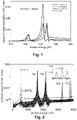
- Fig. 1 shows the computed water linear spectrum considering different field polarizations, together with the absorption spectrum obtained by adding the different polarization contributions.
- the simulations were performed using the NWChem real-time TDDFT module [17].
- Core absorption spectra are calculated using the spectroscopic real-time approach, by exciting the system with a delta-function electric field perturbation [18].
- the Gaussian basis set aug-cc-pVTZ were considered for the nuclear geometry optimization in the y-z plane together with the exchange-correlation functional PBE0, and the 6-31G basis set with PBE0 for the real-time TDDFT.
- the calculated oxygen K-edge main absorption peak was at 543 eV, which differed by 7 eV from an experimental value.
- the two-color laser pulses were linearly polarized in the x, y and z directions, with all polarizations in phase with each other, so that the resulting polarization is not aligned with any of the molecular axis.
- E 0 is the peak amplitude of the two-color pulse components
- ⁇ gives the duration of the pulse
- 3 ⁇ and 4 ⁇ are the respective central angular frequencies and to centers the pulses in the temporal grid.
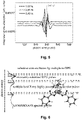
- Fig. 2 shows the spectral signal obtained for three different central photon energy values of the incident two-color pulses that produce a DFG component very close to the calculated oxygen K-edge.
- Other frequency mixing effects can also be seen at larger spectral values, which is limited by the calculated spectral range, corresponding to the second harmonic of the 3 ⁇ field (6 ⁇ ) and the sum-frequency generation 3 ⁇ + 4 ⁇ signal (7 ⁇ ).
- the central photon energy of the input two-color pulses (3 ⁇ , 4 ⁇ ) has been scanned by varying ⁇ to give DGF signals from about 535 eV to 550 eV, and the resulting spectrally integrated DFG signal is plotted in Fig. 3 for three different durations of the two-color input pulses, as indicated.
- the peak of the integrated DFG signal at the oxygen Kedge (543 eV) can be clearly seen, which is narrower as the duration of the incident pulses is increased.
- the integrated DFG values in Fig. 3 have been normalized for clarity.
- FIG. 4 This is illustrated in Fig. 4 , where some snapshots of the density-difference were evaluated after the exciting two-color pulses are over and for a duration corresponding to the oxygen K-edge period (7.6 as).
- the density-difference dynamics clearly shows how the core states of the oxygen atom have been excited by the nonlinear re-DFG effect.
- the probe was delayed 240 as from the end of the input two-color pulses.
- the absorption of the weak probe pulse following the nonlinear excitation of the system is given by the imaginary part of the Fourier transform of the resulting time-dependent dipole moment time-windowed in the region of the probe pulse [20].
- the integrated absorption spectrum as a function of the central photon energy of the input two-color pulses, i.e.
- Fig. 5 Clear oscillations of the absorption rate around the oxygen K-edge can be observed, which provide the evidence that the atom is excited about 543eV, as it has already been illustrated in Fig. 3 . Also clear in Fig. 5 is the spectral width of the excitation, which is established by the duration of the input pulses, as commented above.
- the period of the oscillations in the integrated absorption spectrum corresponds to the Fourier limited bandwidth of the input pulses, which is roughly 1.6 eV for the 1.67 fs pulses, 1.1 eV for the 2.55 fs, and 0.8 eV for the 3.43 fs, as the result of the periodic convolution between the probe field and the nonlinearly DFG generated time-dependent dipole moment, which modulates their time-delay and therefore also the probe absorption rate [20].
- Fig. 6 therein another embodiment of the present invention is shown.
- the selectivity of the outlined re-DFG process is further optimized using a combination of several synchronized ultrashort two-color X-ray pulses of different photon energies, which can produce re-DFG signals resonant with several XANES/EXAFS absorption lines simultaneously, resulting in additional selective local excitation of the molecule.
- the invention can be extended to higher photon energies following the rapid advances in FEL sources, such as considering two-color hard X-rays to core excite higher atomic number atoms by re-DFG.
- the essential in this hard X-ray approach is that the two-color pulses can be highly penetrating in bulk, while the core resonant re-DFG signals are not. Therefore, by virtue of the results from the water model that have been detailed, the same can be achieved in the atomic edges of, for example, biomolecular zinc complexes.
Landscapes
- Health & Medical Sciences (AREA)
- Engineering & Computer Science (AREA)
- Biomedical Technology (AREA)
- Physics & Mathematics (AREA)
- Organic Chemistry (AREA)
- Chemical & Material Sciences (AREA)
- Electromagnetism (AREA)
- Optics & Photonics (AREA)
- Nuclear Medicine, Radiotherapy & Molecular Imaging (AREA)
- Public Health (AREA)
- Veterinary Medicine (AREA)
- General Health & Medical Sciences (AREA)
- Animal Behavior & Ethology (AREA)
- Life Sciences & Earth Sciences (AREA)
- Radiology & Medical Imaging (AREA)
- Pathology (AREA)
- Inorganic Chemistry (AREA)
- Lasers (AREA)
Abstract
A method and an apparatus for selectively cancelling the effect of the active center of a molecule are provided. The method comprises illuminating the molecule with two synchronized ultrashort X-ray pulses using a laser, the two synchronized ultrashort X-ray pulses having different photon energies; and selectively exciting a core state of an atom of the molecule using a computing system that subtracts the photon energies of the two synchronized ultrashort X-ray pulses and matches a subtraction result to an atomic core resonance. The method is implementable for simple or complex molecular systems and bulk materials.
Description
- The present invention provides a method and an apparatus for selectively cancelling the effect of the active center of a molecule through selectively exciting atomic core states of the molecule.
- Selective photodissociation of molecules by resonant excitation near a chosen core ionization edge by means of nonlinear interactions in the X-ray range is becoming conceivable due to recent advances in the development of intense ultrashort X-ray coherent pulse sources, such as synchrotron, free-electron lasers (FEL) and in high-harmonic generation [1-10]. Resonant excitation near a core atomic ionization edge in a molecule follows a rapid redistribution of charge beginning in less than a femtosecond via Auger processes, so that multiple charged molecular ions are formed, and the molecule generally becomes unstable and dissociates.
- Several nonlinear interactions in the X-ray range are accordingly being investigated [11]. In a previous work [12] of the inventor of present invention, it was showed how the phase-sensitivity cancellation of the anti-Stokes component previously described in two and three-level systems in the infrared and optical regions can be extended to the X-ray absorption near edge structure (XANES) and extended X-ray absorption fine structure (EXAFS) [6] of chemical species by highly localized four-wave mixing (FWM) nonlinear processes. Femtosecond transient FWM grating spectroscopy with ultrafast X-rays has recently been demonstrated [13,14] showing experimentally how the large penetration depth of X-rays allows probing the bulk properties of materials, addressing core excited states, and creating excitation gratings with unprecedented nanoscale spatial resolution. Among the X-ray wave-mixing processes, difference-frequency generation (DFG) of optical and UV radiation using two-color X-ray laser pulses has been studied theoretically [15,16].
- An object of the present invention is to provide a technology for selectively cancelling the effect of the active center of a molecule in pathogens such as, for instance, viruses, bacteria or cancer cells, through a resonantly-enhanced difference-frequency generation (re-DFG) effect in the core electrons of an atom of the molecule.
- This object is fulfilled by the a method with the features of
claim 1 and by an apparatus with the characteristics of claim 10. - Embodiments of the present invention provides, according to one aspect, a method for selectively cancelling the effect of the active center of a molecule, that comprises: illuminating the molecule with two synchronized ultrashort intense X-ray pulses using a laser, the two synchronized ultrashort intense X-ray pulses having different photon energies (i.e. two-color); and selectively exciting a core state of an atom of the molecule using a computing system that subtracts the photon energies of the two synchronized ultrashort intense X-ray pulses and matches the subtraction result to an atomic core resonance.
- In an embodiment, the two pulses are linearly polarized in the x, y and z directions, with all polarizations in phase with each other.
- In an embodiment, the two pulses have different durations. In another embodiment, the two pulses have different intensities. In yet another embodiment, the two pulses have both different durations and intensities. In a particular embodiment, the two pulses have a peak intensity of about 1012 W/cm2.
- In an embodiment, each one of the two pulses has a duration comprised in the femtoseconds and/or picoseconds range.
- In an embodiment, the method further comprises illuminating the molecule with two (or more) additional synchronized ultrashort X-ray pulses using the laser, each one of the additional synchronized ultrashort X-ray pulses having a different photon energy; and selectively exciting one (or more) additional core states by the computing system subtracting the photon energies of the two (or more) additional synchronized ultrashort X-ray pulses and matching the subtraction result to an additional atomic core resonance.
- In an embodiment, the pulses are collinearly aligned to illuminate the molecule.
- Present invention also proposes, according to another aspect, an apparatus for selectively cancelling the effect of the active center of a molecule. The apparatus includes a laser for directing two synchronized ultrashort X-ray pulses to the molecule, the two synchronized ultrashort X-ray pulses having different photon energies. The apparatus also includes a computing system configured to, upon interaction of the two synchronized ultrashort X-ray pulses with the molecule, subtract the photon energies thereof and match the subtraction result to an atomic core resonance. Thus, a core state of an atom of the molecule can be selectively excited.
- According to the invention, the laser can comprise a X-ray free-electron laser (FEL) or a highly penetrating hard X-ray FEL.
- The molecule can be a biomolecule, such as metalloproteins, a water molecule, or others.
- Present invention can use real-time time-dependent density functional theory simulations to numerically demonstrate that resonantly-enhanced difference frequency generation (re-DFG) involving intense ultrashort coherent x-ray pulses can selectively excite core states of atoms in molecules.
- Therefore, the technological solution provided by the present invention shows how the illumination of a molecule (e.g. a water molecule) with two-color femtosecond or picosecond highly penetrating X-ray pulses produces a difference-frequency component that is enhanced at an atomic core resonance. The highly selective core excitation by re-DFG X-ray nonlinear processes using said X-ray pulses, as explained before, is equally achievable in more complex molecular systems and bulk materials, with extensive applications, in particular in medicine.
- The previous and other advantages and features will be more fully understood from the following detailed description of embodiments, with reference to the attached figures, which must be considered in an illustrative and non-limiting manner, in which:
-
Fig. 1 : Oxygen K-edge linear absorption lines obtained from the imaginary part of the Fourier transform of the time-dependent dipole moments, after the molecule has been excited with a small electric field kick of 10-4 a.u.≈ 51 mV/nm. The peaks have been broadened to account for core relaxation effects by damping the dipole time signal by e -t/ td, with td=20 a.u. ≈ 480 as. The absorption obtained with different linear field polarizations together with the sum in the three directions is shown. -
Fig. 2 : Spectral signal obtained by Fourier transform of the acceleration of the time dependent dipole resulting from the interaction of the two-color pulses with the water molecule, for three different values of w. The inset is a zoom of the spectra near the oxygen K-edge showing the enhancement of the DFG signal at resonance (ω = ω0 = 543 eV). -
Fig. 3 : Integrated DFG spectral signal around the oxygen K-edge (500 - 600 eV) as a function of the incident photon energy of the two-color pulses. -
Fig. 4 : Snapshots of the density-difference 46 as after the exciting two-color field is over, in the case of resonance (3ω0, 4ω0). The period of the calculated oxygen K-edge is 7.6 as. The illustration shows a complete cycle of the core oxygen excitation, the temporal resolution of the numerical integration is 0.48 as. -
Fig. 5 : Integrated absorption spectrum of the probe pulse around the oxygen K-edge (500 - 600 eV) as a function of the incident photon energy (hω) of the two-color pulses. -
Fig. 6 : Illustration of selective core excitation of an atom in a biomolecule by multiple hard X-ray re-DFG tuned at three different spectral peaks of the XANES/EXAFS spectral profile of the molecule. The XANES/EXAFS absorption profile provides a fingerprint of the state of a specific molecule. The essential in this hard X-ray approach is that the two-color hard X-ray pulses can be highly penetrating in bulk, while the core resonant re-DFG signals are not. - Present invention provides an apparatus and a method for selectively cancelling the effect of the active center of a molecule. In some particular embodiments, the molecule is a single gas-phase water molecule, not limitative as the results that will be shown in the following can be extended to other and also larger molecules, such as biomolecules.
- The invention involves irradiating the water molecule with two synchronized ultrashort (i.e. femtosecond or picosecond) X-ray pulses of different photon energies (i.e. two-color) using a laser; subtracting, by a computing system, the photon energies of the two-color pulses, and matching, by the computing system, the result w to the atomic core resonance ω0.
- In a particular embodiment, ω0 is the oxygen K-edge in the water molecule.
- The two-color ultrashort X-ray pulses can have different durations and/or intensities. The duration of the two-color pulses determine the spectral selectivity that can be achieved by the nonlinear re-DFG effect.
- To numerically show the above, in a first step, the absorption spectrum of the molecule around the target absorption edge was calculated.
Fig. 1 shows the computed water linear spectrum considering different field polarizations, together with the absorption spectrum obtained by adding the different polarization contributions. In this case, the simulations were performed using the NWChem real-time TDDFT module [17]. Core absorption spectra are calculated using the spectroscopic real-time approach, by exciting the system with a delta-function electric field perturbation [18]. In the present calculations the Gaussian basis set aug-cc-pVTZ were considered for the nuclear geometry optimization in the y-z plane together with the exchange-correlation functional PBE0, and the 6-31G basis set with PBE0 for the real-time TDDFT. - The calculated oxygen K-edge main absorption peak was at 543 eV, which differed by 7 eV from an experimental value.
- In a particular embodiment, the two-color laser pulses were linearly polarized in the x, y and z directions, with all polarizations in phase with each other, so that the resulting polarization is not aligned with any of the molecular axis. The two-color field components in each direction can have the form:

-
Fig. 2 shows the spectral signal obtained for three different central photon energy values of the incident two-color pulses that produce a DFG component very close to the calculated oxygen K-edge. The inset shows how the signal peaks exactly at the oxygen K-edge, which is the demonstration that the DFG signal is enhanced by the core oxygen K-edge resonance (h̅ω = h̅ω0 = 543 eV). Other frequency mixing effects can also be seen at larger spectral values, which is limited by the calculated spectral range, corresponding to the second harmonic of the 3ω field (6ω) and the sum-frequency generation 3ω + 4ω signal (7ω). The central photon energy of the input two-color pulses (3ω, 4ω) has been scanned by varying ω to give DGF signals from about 535 eV to 550 eV, and the resulting spectrally integrated DFG signal is plotted inFig. 3 for three different durations of the two-color input pulses, as indicated. The peak of the integrated DFG signal at the oxygen Kedge (543 eV) can be clearly seen, which is narrower as the duration of the incident pulses is increased. The integrated DFG values inFig. 3 have been normalized for clarity. It is worth noting that the durations of the pulses considered in the simulations are remarkably short (1.67 fs, 2.56 fs, and 3.43 fs), and therefore much narrower peaks inFig. 3 can be expected by considering longer incident pulses, which would result in a more selective re-DFG effect. - After the two-color laser pulses interact with the water molecule, the system remains core excited due to re-DFG when ω = ω0 = 543 eV, since no relaxation processes are considered in the simulations. The difference between the excited and ground state charge densities (density-difference) follow complicated dynamics around the oxygen atom, with a periodicity that corresponds to the oxygen K-edge absorption photon energy.
- This is illustrated in
Fig. 4 , where some snapshots of the density-difference were evaluated after the exciting two-color pulses are over and for a duration corresponding to the oxygen K-edge period (7.6 as). The density-difference dynamics clearly shows how the core states of the oxygen atom have been excited by the nonlinear re-DFG effect. - To also evaluate the invention in an all-laser-field approach, the degree of excitation of the oxygen after the interaction with the two-color pulses was computed by a cos2 envelope probe pulse of 0.8 fs (FWHM) duration and 104 W/cm2 peak intensity, with the central photon energy of the calculated oxygen K-edge (ω= 543 eV). The probe was delayed 240 as from the end of the input two-color pulses. The absorption of the weak probe pulse following the nonlinear excitation of the system is given by the imaginary part of the Fourier transform of the resulting time-dependent dipole moment time-windowed in the region of the probe pulse [20]. The integrated absorption spectrum as a function of the central photon energy of the input two-color pulses, i.e. as a function of h̅ω, is shown in
Fig. 5 . Clear oscillations of the absorption rate around the oxygen K-edge can be observed, which provide the evidence that the atom is excited about 543eV, as it has already been illustrated inFig. 3 . Also clear inFig. 5 is the spectral width of the excitation, which is established by the duration of the input pulses, as commented above. The period of the oscillations in the integrated absorption spectrum corresponds to the Fourier limited bandwidth of the input pulses, which is roughly 1.6 eV for the 1.67 fs pulses, 1.1 eV for the 2.55 fs, and 0.8 eV for the 3.43 fs, as the result of the periodic convolution between the probe field and the nonlinearly DFG generated time-dependent dipole moment, which modulates their time-delay and therefore also the probe absorption rate [20]. - With reference now to
Fig. 6 , therein another embodiment of the present invention is shown. In this case, the selectivity of the outlined re-DFG process is further optimized using a combination of several synchronized ultrashort two-color X-ray pulses of different photon energies, which can produce re-DFG signals resonant with several XANES/EXAFS absorption lines simultaneously, resulting in additional selective local excitation of the molecule. - Beyond the fundamental and applied interest of the nonlinear re-DFG X-ray matter interaction process presented in a single gas-phase water molecule, the invention can be extended to higher photon energies following the rapid advances in FEL sources, such as considering two-color hard X-rays to core excite higher atomic number atoms by re-DFG. The essential in this hard X-ray approach is that the two-color pulses can be highly penetrating in bulk, while the core resonant re-DFG signals are not. Therefore, by virtue of the results from the water model that have been detailed, the same can be achieved in the atomic edges of, for example, biomolecular zinc complexes.
- The present disclosure and/or some other examples have been described in the above. According to descriptions above, various alterations may be achieved. The topic of the present disclosure may be achieved in various forms and embodiments, and the present disclosure may be further used in a variety of application programs. All applications, modifications and alterations required to be protected in the claims may be within the protection scope of the present disclosure.
- The scope of the present invention is defined in the following set of claims.
-
- [1] Schoenlein, R. W.; Chattopadhyay, S.; W. Chong, H. H.; Glover, T. E.; Heimann, P. A.; Shank, C. V.; Zholents, A. A.; Zolotorev, M. S. Generation of femtosecond pulses of synchrotron radiation. .
- [2] Feng, C.; Deng, H. Review of fully coherent free-electron lasers. Nucl. Sci. Tech. 2018, 29, 160.
- [3] Rossbach, J; Schneider, J. R.; Wurth, W. 10 years of pioneering X-ray science at the Free-Electron Laser FLASH at DESY. Physics Reports 2019, 808, 1-74.
- [4] Serrat, C; Seres, J.; Seres, E.; Dinh, T. H.; Hasegawa, N.; Nishikino, M.; Namba, S. Parametric attosecond pulse amplification far from the ionization threshold from high order harmonic generation in He+. Opt. Express 2020, 28, 24243-24252.
- [5] Tanaka, S; Mukamel, S. Coherent X-ray raman spectroscopy: a nonlinear local probe for electronic excitations. Phys. Rev. Lett. 2002, 89, 043001.
- [6] Bressler, C.; Chergui, M. Ultrafast Xray absorption spectroscopy. Chem. Rev. 2004, 104, 1781.
- [7] Stöhr, J.; Scherz, A. Creation of Xray transparency of matter by stimulated elastic forward scattering. Phys. Rev. Lett. 2015, 115, 107402.
- [8] Prince, K.; et al. Coherent control with a short-wavelength free-electron laser. Nature Photon. 2016, 10, 176-179.
- [9] Norman, P.; Dreuw, A. Simulating Xray spectroscopies and calculating core-excited states of molecules. Chem. Rev. 2018, 118, 7208.
- [10] Chen, M.; Lopata, F. First-principles simulations of X-ray transient absorption for probing attosecond electron dynamics. J. Chem. Theory Comput. 2020, 16, 4470.
- [11] Zhang Y.; Hua W.; Bennett K.; Mukamel S. Nonlinear Spectroscopy of Core and Valence Excitations Using Short X-Ray Pulses: Simulation Challenges. Top Curr Chem. 2016, 368:273-345.
- [12] Serrat, C. Localized Core Four-Wave Mixing Buildup in the X-ray Spectrum of Chemical Species. J. Phys. Chem. Lett. 2021, 12, 1093-1097.
- [13] Bencivenga, F. et al. Four-wave mixing experiments with extreme ultraviolet transient gratings. .
- [14] Rouxel, J. R. et al. Hard X-ray transient grating spectroscopy on bismuth germanate. Nat. Photonics 2021.
- [15] Shwartz, E.; Shwartz, S. Difference frequency generation of optical radiation from two-color x-ray pulses. Opt. Express 2015, 23, 7471.
- [16] Minerbi, E.; Shwartz, S. Difference frequency generation of ultraviolet from x-ray pulses in opaque materials. J. Opt. Soc. Am. B 2019 36, 624.
- [17] Apra, E. et al. NWChem: Past, present, and future. J. Chem. Phys. 2020, 152, 184102.
- [18] Lopata, K.; Van Kuiken, B. E.; Khalil, M.; Govind, N. Linear-Response and Real-Time Time-Dependent Density Functional Theory Studies of Core-Level Near-Edge X?Ray Absorption. J. Chem. Theory Comput. 2012, 8, 3284?3292.
- [19] Wilson, K. R.; Rude, B. S.; Catalano, T.; Schaller, R. D.; Tobin, J. G.; Co, D. T.; Saykally, R. J. X-ray Spectroscopy of Liquid Water Microjets J. Phys. Chem. B 2001, 105, 3346-3349.
- [20] Mukamel, S. Principles of Nonlinear Optical Spectroscopy. Oxford University Press, Oxford, 1995.
Claims (13)
- A method for selectively cancelling the effect of the active center of a molecule, the method comprising:illuminating the molecule with two synchronized ultrashort X-ray pulses using a laser, the two synchronized ultrashort X-ray pulses having different photon energies; andselectively exciting a core state of an atom of the molecule using a computing system that subtracts the photon energies of the two synchronized ultrashort X-ray pulses and matches a subtraction result to an atomic core resonance.
- The method of claim 1, wherein the two synchronized ultrashort X-ray pulses are linearly polarized in the x, y and z directions, with all polarizations in phase with each other.
- The method of claim 1 or 2, wherein the two synchronized ultrashort X-ray pulses have different durations and/or intensities.
- The method of any one of the previous claims, wherein each one of the two synchronized ultrashort X-ray pulses has a duration comprised in the femtoseconds and/or picoseconds range.
- The method of claim 1, further comprising:illuminating the molecule with at least two additional synchronized ultrashort X-ray pulses using the laser, each one of the synchronized ultrashort X-ray pulses having a different photon energy; andselectively exciting at least one additional core state by the computing system: subtracting the photon energies of the two additional synchronized ultrashort X-ray pulses and matching a subtraction result to an additional core resonance.
- The method of any one of the previous claims, wherein the laser comprises an X-ray free-electron laser or a highly penetrating hard X-ray free-electron laser.
- The method of any one of the previous claims, wherein the molecule is a biological molecule.
- The method of any one of the previous claims 1 to 7, wherein the molecule is water.
- The method of any one of the previous claims, wherein the synchronized ultrashort X-ray pulses are illuminated collinearly to the molecule.
- An apparatus for selectively cancelling the effect of the active center of a molecule, comprising:a laser configured to direct two synchronized ultrashort X-ray pulses to the molecule, the two synchronized ultrashort X-ray pulses having different photon energies; anda computing system configured to, upon an interaction of the two synchronized ultrashort X-ray pulses with the molecule, subtract the photon energies thereof and match a subtraction result to an atomic core resonance in order to selectively excite a core state of an atom of the molecule.
- The apparatus of claim 10, wherein the laser comprises an X-ray free-electron laser or a highly penetrating hard X-ray free-electron laser.
- The apparatus of claim 10, wherein the molecule comprises a biological molecule.
- The apparatus of any one of claims 10 to 12, wherein the molecule comprises a water molecule.
Priority Applications (5)
| Application Number | Priority Date | Filing Date | Title |
|---|---|---|---|
| US18/579,448 US12629939B2 (en) | 2021-07-16 | Printhead die cap | |
| EP21382647.2A EP4119189A1 (en) | 2021-07-16 | 2021-07-16 | Method and apparatus for selectively cancelling the effect of the active center of a molecule |
| PCT/EP2022/069078 WO2023285306A1 (en) | 2021-07-16 | 2022-07-08 | Method and apparatus for selectively cancelling the effect of the active center of a molecule |
| US18/579,461 US12486167B2 (en) | 2021-07-16 | 2022-07-08 | Method and apparatus for selectively cancelling the effect of the active center of a molecule |
| EP22736301.7A EP4370201B1 (en) | 2021-07-16 | 2022-07-08 | Method and apparatus for selectively cancelling the effect of the active center of a molecule |
Applications Claiming Priority (1)
| Application Number | Priority Date | Filing Date | Title |
|---|---|---|---|
| EP21382647.2A EP4119189A1 (en) | 2021-07-16 | 2021-07-16 | Method and apparatus for selectively cancelling the effect of the active center of a molecule |
Publications (1)
| Publication Number | Publication Date |
|---|---|
| EP4119189A1 true EP4119189A1 (en) | 2023-01-18 |
Family
ID=77338626
Family Applications (2)
| Application Number | Title | Priority Date | Filing Date |
|---|---|---|---|
| EP21382647.2A Withdrawn EP4119189A1 (en) | 2021-07-16 | 2021-07-16 | Method and apparatus for selectively cancelling the effect of the active center of a molecule |
| EP22736301.7A Active EP4370201B1 (en) | 2021-07-16 | 2022-07-08 | Method and apparatus for selectively cancelling the effect of the active center of a molecule |
Family Applications After (1)
| Application Number | Title | Priority Date | Filing Date |
|---|---|---|---|
| EP22736301.7A Active EP4370201B1 (en) | 2021-07-16 | 2022-07-08 | Method and apparatus for selectively cancelling the effect of the active center of a molecule |
Country Status (3)
| Country | Link |
|---|---|
| US (1) | US12486167B2 (en) |
| EP (2) | EP4119189A1 (en) |
| WO (1) | WO2023285306A1 (en) |
Citations (1)
| Publication number | Priority date | Publication date | Assignee | Title |
|---|---|---|---|---|
| US20170362585A1 (en) * | 2016-06-15 | 2017-12-21 | Rensselaer Polytechnic Institute | Methods and apparatus for x-genetics |
Family Cites Families (2)
| Publication number | Priority date | Publication date | Assignee | Title |
|---|---|---|---|---|
| DE102010028994A1 (en) * | 2010-05-14 | 2011-11-17 | Helmholtz-Zentrum Dresden - Rossendorf E.V. | Generation of short-wave ultrashort light pulses and their use |
| JP6729878B2 (en) * | 2016-04-05 | 2020-07-29 | ウシオ電機株式会社 | Supercontinuum light generation light source for multiphoton excitation, supercontinuum light generation method for multiphoton excitation, multiphoton excitation fluorescence microscope, and multiphoton excitation method |
-
2021
- 2021-07-16 EP EP21382647.2A patent/EP4119189A1/en not_active Withdrawn
-
2022
- 2022-07-08 EP EP22736301.7A patent/EP4370201B1/en active Active
- 2022-07-08 US US18/579,461 patent/US12486167B2/en active Active
- 2022-07-08 WO PCT/EP2022/069078 patent/WO2023285306A1/en not_active Ceased
Patent Citations (1)
| Publication number | Priority date | Publication date | Assignee | Title |
|---|---|---|---|---|
| US20170362585A1 (en) * | 2016-06-15 | 2017-12-21 | Rensselaer Polytechnic Institute | Methods and apparatus for x-genetics |
Non-Patent Citations (27)
| Title |
|---|
| APRA, E. ET AL.: "NWChem: Past, present, and future", J. CHEM. PHYS., vol. 152, 2020, pages 184102 |
| BENCIVENGA, F. ET AL.: "Four-wave mixing experiments with extreme ultraviolet transient gratings", NATURE, vol. 520, 2015, pages 205 |
| BRESSLER, C.CHERGUI, M.: "Ultrafast Xray absorption spectroscopy", CHEM. REV., vol. 104, 2004, pages 1781 |
| CHEN, M.LOPATA, F.: "First-principles simulations of X-ray transient absorption for probing attosecond electron dynamics", J. CHEM. THEORY COMPUT., vol. 16, 2020, pages 4470 |
| DRESCHER MARKUS ET AL: "X-ray Pulses Approaching the Attosecond Frontier", SCIENCE, vol. 291, no. 5510, 9 March 2001 (2001-03-09), US, pages 1923 - 1927, XP055869082, ISSN: 0036-8075, DOI: 10.1126/science.1058561 * |
| FENG, C.DENG, H.: "Review of fully coherent free-electron lasers", NUCL. SCI. TECH., vol. 29, 2018, pages 160 |
| LOPATA, K.VAN KUIKEN, B. E.KHALIL, M.GOVIND, N.: "Linear-Response and Real-Time Time-Dependent Density Functional Theory Studies of Core-Level Near-Edge X?Ray Absorption", J. CHEM. THEORY COMPUT., vol. 8, 2012, pages 3284 - 3292 |
| MARCUS G. ET AL: "Free-Electron Laser Design for Four-Wave Mixing Experiments with Soft-X-Ray Pulses", PHYSICAL REVIEW LETTERS, vol. 113, no. 2, 24 March 2014 (2014-03-24), US, pages 55, XP055869162, ISSN: 0031-9007, Retrieved from the Internet <URL:https://journals.aps.org/prl/pdf/10.1103/PhysRevLett.113.024801> DOI: 10.1103/PhysRevLett.113.024801 * |
| MINERBI, E.SHWARTZ, S.: "Difference frequency generation of ultraviolet from x-ray pulses in opaque materials", J. OPT. SOC. AM. B, vol. 36, 2019, pages 624 |
| MUKAMEL, S.: "Principles of Nonlinear Optical Spectroscopy", 1995, OXFORD UNIVERSITY PRESS |
| NORMAN PATRICK ET AL: "Simulating X-ray Spectroscopies and Calculating Core-Excited States of Molecules", CHEMICAL REVIEWS, vol. 118, no. 15, 8 August 2018 (2018-08-08), US, pages 7208 - 7248, XP055869075, ISSN: 0009-2665, Retrieved from the Internet <URL:https://pubs.acs.org/doi/pdf/10.1021/acs.chemrev.8b00156> DOI: 10.1021/acs.chemrev.8b00156 * |
| NORMAN, P.DREUW, A.: "Simulating Xray spectroscopies and calculating core-excited states of molecules", CHEM. REV., vol. 118, 2018, pages 7208 |
| PRINCE, K. ET AL.: "Coherent control with a short-wavelength free-electron laser", NATURE PHOTON., vol. 10, 2016, pages 176 - 179 |
| ROSSBACH, JSCHNEIDER, J. R.WURTH, W.: "10 years of pioneering X-ray science at the Free-Electron Laser FLASH at DESY", PHYSICS REPORTS, vol. 808, 2019, pages 1 - 74 |
| ROUXEL, J. R. ET AL.: "Hard X-ray transient grating spectroscopy on bismuth germanate", NAT. PHOTONICS, 2021 |
| SCHOENLEIN, R. W.CHATTOPADHYAY, S.W. CHONG, H. H.GLOVER, T. E.HEIMANN, P. A.SHANK, C. V.ZHOLENTS, A. A.ZOLOTOREV, M. S.: "Generation of femtosecond pulses of synchrotron radiation", SCIENCE, vol. 287, 2000, pages 223 |
| SERRAT CARLES: "Localized Core Four-Wave Mixing Buildup in the X-ray Spectrum of Chemical Species", JOURNAL OF PHYSICAL CHEMISTRY LETTERS, vol. 12, no. 3, 28 January 2021 (2021-01-28), US, pages 1093 - 1097, XP055868770, ISSN: 1948-7185, Retrieved from the Internet <URL:https://pubs.acs.org/doi/pdf/10.1021/acs.jpclett.0c03270> DOI: 10.1021/acs.jpclett.0c03270 * |
| SERRAT, C.: "Localized Core Four-Wave Mixing Buildup in the X-ray Spectrum of Chemical Species", J. PHYS. CHEM. LETT., vol. 12, 2021, pages 1093 - 1097 |
| SERRAT, CSERES, J.SERES, E.DINH, T. H.HASEGAWA, N.NISHIKINO, M.NAMBA, S.: "Parametric attosecond pulse amplification far from the ionization threshold from high order harmonic generation in He+. Opt", EXPRESS, vol. 28, 2020, pages 24243 - 24252 |
| SHWARTZ E ET AL: "Difference-frequency generation of optical radiation from two-color X-ray pulses", 2015 CONFERENCE ON LASERS AND ELECTRO-OPTICS (CLEO), OSA, 10 May 2015 (2015-05-10), pages 1 - 2, XP033193420 * |
| SHWARTZ, E.SHWARTZ, S.: "Difference frequency generation of optical radiation from two-color x-ray pulses", OPT. EXPRESS, vol. 23, 2015, pages 7471 |
| STOHR, J.SCHERZ, A.: "Creation of Xray transparency of matter by stimulated elastic forward scattering", PHYS. REV. LETT., vol. 115, 2015, pages 107402 |
| TANAKA SATOSHI ET AL: "Coherent X-Ray Raman Spectroscopy: A Nonlinear Local Probe for Electronic Excitations", PHYSICAL REVIEW LETTERS, vol. 89, no. 4, July 2002 (2002-07-01), US, XP055869077, ISSN: 0031-9007, Retrieved from the Internet <URL:https://journals.aps.org/prl/pdf/10.1103/PhysRevLett.89.043001> DOI: 10.1103/PhysRevLett.89.043001 * |
| TANAKA, SMUKAMEL, S.: "Coherent X-ray raman spectroscopy: a nonlinear local probe for electronic excitations", PHYS. REV. LETT., vol. 89, 2002, pages 043001 |
| WILSON, K. R.RUDE, B. S.CATALANO, T.SCHALLER, R. D.TOBIN, J. G.CO, D. T.SAYKALLY, R. J.: "X-ray Spectroscopy of Liquid Water Microjets", J. PHYS. CHEM. B, vol. 105, 2001, pages 3346 - 3349 |
| YOU JHIH-AN ET AL: "Attosecond photoionization dynamics with stimulated core-valence transitions", PHYSICAL REVIEW A, vol. 93, no. 3, March 2016 (2016-03-01), XP055869168, ISSN: 2469-9926, Retrieved from the Internet <URL:https://journals.aps.org/pra/pdf/10.1103/PhysRevA.93.033413> DOI: 10.1103/PhysRevA.93.033413 * |
| ZHANG Y.HUA W.BENNETT K.MUKAMEL S.: "Nonlinear Spectroscopy of Core and Valence Excitations Using Short X-Ray Pulses: Simulation Challenges", TOP CURR CHEM., vol. 368, 2016, pages 273 - 345 |
Also Published As
| Publication number | Publication date |
|---|---|
| EP4370201A1 (en) | 2024-05-22 |
| EP4370201B1 (en) | 2025-06-18 |
| US12486167B2 (en) | 2025-12-02 |
| WO2023285306A1 (en) | 2023-01-19 |
| US20250002339A1 (en) | 2025-01-02 |
Similar Documents
| Publication | Publication Date | Title |
|---|---|---|
| Golubev et al. | Core-valence attosecond transient absorption spectroscopy of polyatomic molecules | |
| Adams et al. | X-ray quantum optics | |
| Warrick et al. | Probing the dynamics of Rydberg and valence states of molecular nitrogen with attosecond transient absorption spectroscopy | |
| Glushkov | Spectroscopy of atom and nucleus in a strong laser field: Stark effect and multiphoton resonances | |
| Mazza et al. | Mapping resonance structures in transient core-ionized atoms | |
| Gauduel et al. | Some evidence of ultrafast H2O+-water molecule reaction in femtosecond photoionization of pure liquid water: Influence on geminate pair recombination dynamics | |
| Li et al. | Elementary electron and ion dynamics in ionized liquid water | |
| Bredtmann et al. | Effect of nuclear motion on molecular high order harmonic pump probe spectroscopy | |
| Harkema et al. | Autoionizing polaritons in attosecond atomic ionization | |
| El Omar et al. | Time-dependent radiolytic yield of OH• radical studied by picosecond pulse radiolysis | |
| Piancastelli et al. | Core-hole-clock spectroscopies in the tender x-ray domain | |
| Rupprecht et al. | Resolving vibrations in a polyatomic molecule with femtometer precision via x-ray spectroscopy | |
| Ma et al. | Picosecond pulse radiolysis of highly concentrated phosphoric acid solutions: Mechanism of phosphate radical formation | |
| Chu et al. | Photoabsorption of attosecond XUV light pulses by two strongly laser-coupled autoionizing states | |
| El Omar et al. | Spur reactions observed by picosecond pulse radiolysis in highly concentrated bromide aqueous solutions | |
| Crance | Multiphoton detachment from negative ions of halogens, angular distributions and excess photon absorption | |
| Lee et al. | A reaction accelerator: Mid-infrared strong field dissociation yields mode-selective chemistry | |
| Endo et al. | Post-ionization dynamics of the polar molecule OCS in asymmetric laser fields | |
| Demeter | Propagation of ultra-short, resonant, ionizing laser pulses in rubidium vapor | |
| Ma et al. | Picosecond Pulse Radiolysis of Highly Concentrated Sulfuric Acid Solutions: Evidence for the Oxidation Reactivity of Radical Cation H2O•+ | |
| Balcerzyk et al. | Picosecond pulse radiolysis of direct and indirect radiolytic effects in highly concentrated halide aqueous solutions | |
| EP4370201B1 (en) | Method and apparatus for selectively cancelling the effect of the active center of a molecule | |
| Sarkisov et al. | Control of elementary chemical reactions by femtosecond light pulses | |
| Soifer et al. | Studying the universality of field induced tunnel ionization times via high-order harmonic spectroscopy | |
| He et al. | Macroscopic transient absorption in a V-type three-level system |
Legal Events
| Date | Code | Title | Description |
|---|---|---|---|
| PUAI | Public reference made under article 153(3) epc to a published international application that has entered the european phase |
Free format text: ORIGINAL CODE: 0009012 |
|
| STAA | Information on the status of an ep patent application or granted ep patent |
Free format text: STATUS: THE APPLICATION HAS BEEN PUBLISHED |
|
| AK | Designated contracting states |
Kind code of ref document: A1 Designated state(s): AL AT BE BG CH CY CZ DE DK EE ES FI FR GB GR HR HU IE IS IT LI LT LU LV MC MK MT NL NO PL PT RO RS SE SI SK SM TR |
|
| STAA | Information on the status of an ep patent application or granted ep patent |
Free format text: STATUS: THE APPLICATION IS DEEMED TO BE WITHDRAWN |
|
| 18D | Application deemed to be withdrawn |
Effective date: 20230719 |