EP4119115B1 - Rfid device and non-contact charging system - Google Patents
Rfid device and non-contact charging system Download PDFInfo
- Publication number
- EP4119115B1 EP4119115B1 EP22179870.5A EP22179870A EP4119115B1 EP 4119115 B1 EP4119115 B1 EP 4119115B1 EP 22179870 A EP22179870 A EP 22179870A EP 4119115 B1 EP4119115 B1 EP 4119115B1
- Authority
- EP
- European Patent Office
- Prior art keywords
- housing
- power
- power receiving
- antenna
- rfid
- Prior art date
- Legal status (The legal status is an assumption and is not a legal conclusion. Google has not performed a legal analysis and makes no representation as to the accuracy of the status listed.)
- Active
Links
Images










Classifications
-
- H—ELECTRICITY
- H02—GENERATION; CONVERSION OR DISTRIBUTION OF ELECTRIC POWER
- H02J—ELECTRIC POWER NETWORKS; CIRCUIT ARRANGEMENTS OR SYSTEMS FOR SUPPLYING OR DISTRIBUTING ELECTRIC POWER; SYSTEMS FOR STORING ELECTRIC ENERGY
- H02J50/00—Circuit arrangements or systems for wireless supply or distribution of electric power
- H02J50/10—Circuit arrangements or systems for wireless supply or distribution of electric power using inductive coupling
- H02J50/12—Circuit arrangements or systems for wireless supply or distribution of electric power using inductive coupling of the resonant type
-
- H—ELECTRICITY
- H02—GENERATION; CONVERSION OR DISTRIBUTION OF ELECTRIC POWER
- H02J—ELECTRIC POWER NETWORKS; CIRCUIT ARRANGEMENTS OR SYSTEMS FOR SUPPLYING OR DISTRIBUTING ELECTRIC POWER; SYSTEMS FOR STORING ELECTRIC ENERGY
- H02J7/00—Circuit arrangements for charging or discharging batteries or for supplying loads from batteries
- H02J7/70—Circuit arrangements for charging or discharging batteries or for supplying loads from batteries characterised by the mechanical construction
-
- A—HUMAN NECESSITIES
- A61—MEDICAL OR VETERINARY SCIENCE; HYGIENE
- A61H—PHYSICAL THERAPY APPARATUS, e.g. DEVICES FOR LOCATING OR STIMULATING REFLEX POINTS IN THE BODY; ARTIFICIAL RESPIRATION; MASSAGE; BATHING DEVICES FOR SPECIAL THERAPEUTIC OR HYGIENIC PURPOSES OR SPECIFIC PARTS OF THE BODY
- A61H3/00—Appliances for aiding patients or disabled persons to walk about
- A61H3/06—Walking aids for blind persons
- A61H3/061—Walking aids for blind persons with electronic detecting or guiding means
-
- A—HUMAN NECESSITIES
- A61—MEDICAL OR VETERINARY SCIENCE; HYGIENE
- A61H—PHYSICAL THERAPY APPARATUS, e.g. DEVICES FOR LOCATING OR STIMULATING REFLEX POINTS IN THE BODY; ARTIFICIAL RESPIRATION; MASSAGE; BATHING DEVICES FOR SPECIAL THERAPEUTIC OR HYGIENIC PURPOSES OR SPECIFIC PARTS OF THE BODY
- A61H3/00—Appliances for aiding patients or disabled persons to walk about
- A61H3/06—Walking aids for blind persons
- A61H3/068—Sticks for blind persons
-
- G—PHYSICS
- G06—COMPUTING OR CALCULATING; COUNTING
- G06K—GRAPHICAL DATA READING; PRESENTATION OF DATA; RECORD CARRIERS; HANDLING RECORD CARRIERS
- G06K19/00—Record carriers for use with machines and with at least a part designed to carry digital markings
- G06K19/06—Record carriers for use with machines and with at least a part designed to carry digital markings characterised by the kind of the digital marking, e.g. shape, nature, code
- G06K19/067—Record carriers with conductive marks, printed circuits or semiconductor circuit elements, e.g. credit or identity cards also with resonating or responding marks without active components
- G06K19/07—Record carriers with conductive marks, printed circuits or semiconductor circuit elements, e.g. credit or identity cards also with resonating or responding marks without active components with integrated circuit chips
- G06K19/0701—Record carriers with conductive marks, printed circuits or semiconductor circuit elements, e.g. credit or identity cards also with resonating or responding marks without active components with integrated circuit chips at least one of the integrated circuit chips comprising an arrangement for power management
-
- G—PHYSICS
- G06—COMPUTING OR CALCULATING; COUNTING
- G06K—GRAPHICAL DATA READING; PRESENTATION OF DATA; RECORD CARRIERS; HANDLING RECORD CARRIERS
- G06K7/00—Methods or arrangements for sensing record carriers, e.g. for reading patterns
- G06K7/10—Methods or arrangements for sensing record carriers, e.g. for reading patterns by electromagnetic radiation, e.g. optical sensing; by corpuscular radiation
- G06K7/10009—Methods or arrangements for sensing record carriers, e.g. for reading patterns by electromagnetic radiation, e.g. optical sensing; by corpuscular radiation sensing by radiation using wavelengths larger than 0.1 mm, e.g. radio-waves or microwaves
- G06K7/10366—Methods or arrangements for sensing record carriers, e.g. for reading patterns by electromagnetic radiation, e.g. optical sensing; by corpuscular radiation sensing by radiation using wavelengths larger than 0.1 mm, e.g. radio-waves or microwaves the interrogation device being adapted for miscellaneous applications
- G06K7/10376—Methods or arrangements for sensing record carriers, e.g. for reading patterns by electromagnetic radiation, e.g. optical sensing; by corpuscular radiation sensing by radiation using wavelengths larger than 0.1 mm, e.g. radio-waves or microwaves the interrogation device being adapted for miscellaneous applications the interrogation device being adapted for being moveable
- G06K7/10386—Methods or arrangements for sensing record carriers, e.g. for reading patterns by electromagnetic radiation, e.g. optical sensing; by corpuscular radiation sensing by radiation using wavelengths larger than 0.1 mm, e.g. radio-waves or microwaves the interrogation device being adapted for miscellaneous applications the interrogation device being adapted for being moveable the interrogation device being of the portable or hand-handheld type, e.g. incorporated in ubiquitous hand-held devices such as PDA or mobile phone, or in the form of a portable dedicated RFID reader
-
- H—ELECTRICITY
- H02—GENERATION; CONVERSION OR DISTRIBUTION OF ELECTRIC POWER
- H02J—ELECTRIC POWER NETWORKS; CIRCUIT ARRANGEMENTS OR SYSTEMS FOR SUPPLYING OR DISTRIBUTING ELECTRIC POWER; SYSTEMS FOR STORING ELECTRIC ENERGY
- H02J50/00—Circuit arrangements or systems for wireless supply or distribution of electric power
- H02J50/005—Mechanical details of housing or structure aiming to accommodate the power transfer means, e.g. mechanical integration of coils, antennas or transducers into emitting or receiving devices
-
- H—ELECTRICITY
- H02—GENERATION; CONVERSION OR DISTRIBUTION OF ELECTRIC POWER
- H02J—ELECTRIC POWER NETWORKS; CIRCUIT ARRANGEMENTS OR SYSTEMS FOR SUPPLYING OR DISTRIBUTING ELECTRIC POWER; SYSTEMS FOR STORING ELECTRIC ENERGY
- H02J50/00—Circuit arrangements or systems for wireless supply or distribution of electric power
- H02J50/10—Circuit arrangements or systems for wireless supply or distribution of electric power using inductive coupling
-
- H—ELECTRICITY
- H02—GENERATION; CONVERSION OR DISTRIBUTION OF ELECTRIC POWER
- H02J—ELECTRIC POWER NETWORKS; CIRCUIT ARRANGEMENTS OR SYSTEMS FOR SUPPLYING OR DISTRIBUTING ELECTRIC POWER; SYSTEMS FOR STORING ELECTRIC ENERGY
- H02J50/00—Circuit arrangements or systems for wireless supply or distribution of electric power
- H02J50/20—Circuit arrangements or systems for wireless supply or distribution of electric power using microwaves or radio frequency waves
-
- H—ELECTRICITY
- H02—GENERATION; CONVERSION OR DISTRIBUTION OF ELECTRIC POWER
- H02J—ELECTRIC POWER NETWORKS; CIRCUIT ARRANGEMENTS OR SYSTEMS FOR SUPPLYING OR DISTRIBUTING ELECTRIC POWER; SYSTEMS FOR STORING ELECTRIC ENERGY
- H02J7/00—Circuit arrangements for charging or discharging batteries or for supplying loads from batteries
- H02J7/40—Circuit arrangements for charging or discharging batteries or for supplying loads from batteries characterised by the exchange of charge or discharge related data
-
- H—ELECTRICITY
- H02—GENERATION; CONVERSION OR DISTRIBUTION OF ELECTRIC POWER
- H02J—ELECTRIC POWER NETWORKS; CIRCUIT ARRANGEMENTS OR SYSTEMS FOR SUPPLYING OR DISTRIBUTING ELECTRIC POWER; SYSTEMS FOR STORING ELECTRIC ENERGY
- H02J7/00—Circuit arrangements for charging or discharging batteries or for supplying loads from batteries
- H02J7/70—Circuit arrangements for charging or discharging batteries or for supplying loads from batteries characterised by the mechanical construction
- H02J7/731—Circuit arrangements for charging or discharging batteries or for supplying loads from batteries characterised by the mechanical construction specially adapted for holding portable devices containing batteries
-
- A—HUMAN NECESSITIES
- A61—MEDICAL OR VETERINARY SCIENCE; HYGIENE
- A61H—PHYSICAL THERAPY APPARATUS, e.g. DEVICES FOR LOCATING OR STIMULATING REFLEX POINTS IN THE BODY; ARTIFICIAL RESPIRATION; MASSAGE; BATHING DEVICES FOR SPECIAL THERAPEUTIC OR HYGIENIC PURPOSES OR SPECIFIC PARTS OF THE BODY
- A61H2201/00—Characteristics of apparatus not provided for in the preceding codes
- A61H2201/50—Control means thereof
- A61H2201/5097—Control means thereof wireless
-
- A—HUMAN NECESSITIES
- A61—MEDICAL OR VETERINARY SCIENCE; HYGIENE
- A61H—PHYSICAL THERAPY APPARATUS, e.g. DEVICES FOR LOCATING OR STIMULATING REFLEX POINTS IN THE BODY; ARTIFICIAL RESPIRATION; MASSAGE; BATHING DEVICES FOR SPECIAL THERAPEUTIC OR HYGIENIC PURPOSES OR SPECIFIC PARTS OF THE BODY
- A61H3/00—Appliances for aiding patients or disabled persons to walk about
- A61H3/02—Crutches
- A61H3/0288—Ferrules or tips therefor
-
- G—PHYSICS
- G06—COMPUTING OR CALCULATING; COUNTING
- G06K—GRAPHICAL DATA READING; PRESENTATION OF DATA; RECORD CARRIERS; HANDLING RECORD CARRIERS
- G06K7/00—Methods or arrangements for sensing record carriers, e.g. for reading patterns
- G06K7/10—Methods or arrangements for sensing record carriers, e.g. for reading patterns by electromagnetic radiation, e.g. optical sensing; by corpuscular radiation
- G06K7/10009—Methods or arrangements for sensing record carriers, e.g. for reading patterns by electromagnetic radiation, e.g. optical sensing; by corpuscular radiation sensing by radiation using wavelengths larger than 0.1 mm, e.g. radio-waves or microwaves
- G06K7/10198—Methods or arrangements for sensing record carriers, e.g. for reading patterns by electromagnetic radiation, e.g. optical sensing; by corpuscular radiation sensing by radiation using wavelengths larger than 0.1 mm, e.g. radio-waves or microwaves setting parameters for the interrogator, e.g. programming parameters and operating modes
- G06K7/10207—Methods or arrangements for sensing record carriers, e.g. for reading patterns by electromagnetic radiation, e.g. optical sensing; by corpuscular radiation sensing by radiation using wavelengths larger than 0.1 mm, e.g. radio-waves or microwaves setting parameters for the interrogator, e.g. programming parameters and operating modes parameter settings related to power consumption of the interrogator
-
- G—PHYSICS
- G06—COMPUTING OR CALCULATING; COUNTING
- G06K—GRAPHICAL DATA READING; PRESENTATION OF DATA; RECORD CARRIERS; HANDLING RECORD CARRIERS
- G06K7/00—Methods or arrangements for sensing record carriers, e.g. for reading patterns
- G06K7/10—Methods or arrangements for sensing record carriers, e.g. for reading patterns by electromagnetic radiation, e.g. optical sensing; by corpuscular radiation
- G06K7/10009—Methods or arrangements for sensing record carriers, e.g. for reading patterns by electromagnetic radiation, e.g. optical sensing; by corpuscular radiation sensing by radiation using wavelengths larger than 0.1 mm, e.g. radio-waves or microwaves
- G06K7/10366—Methods or arrangements for sensing record carriers, e.g. for reading patterns by electromagnetic radiation, e.g. optical sensing; by corpuscular radiation sensing by radiation using wavelengths larger than 0.1 mm, e.g. radio-waves or microwaves the interrogation device being adapted for miscellaneous applications
- G06K7/10376—Methods or arrangements for sensing record carriers, e.g. for reading patterns by electromagnetic radiation, e.g. optical sensing; by corpuscular radiation sensing by radiation using wavelengths larger than 0.1 mm, e.g. radio-waves or microwaves the interrogation device being adapted for miscellaneous applications the interrogation device being adapted for being moveable
- G06K7/10405—Methods or arrangements for sensing record carriers, e.g. for reading patterns by electromagnetic radiation, e.g. optical sensing; by corpuscular radiation sensing by radiation using wavelengths larger than 0.1 mm, e.g. radio-waves or microwaves the interrogation device being adapted for miscellaneous applications the interrogation device being adapted for being moveable the interrogation device including an arrangement for sensing environmental parameters, such as a temperature or acceleration sensor, e.g. used as an on/off trigger or as a warning means
-
- Y—GENERAL TAGGING OF NEW TECHNOLOGICAL DEVELOPMENTS; GENERAL TAGGING OF CROSS-SECTIONAL TECHNOLOGIES SPANNING OVER SEVERAL SECTIONS OF THE IPC; TECHNICAL SUBJECTS COVERED BY FORMER USPC CROSS-REFERENCE ART COLLECTIONS [XRACs] AND DIGESTS
- Y02—TECHNOLOGIES OR APPLICATIONS FOR MITIGATION OR ADAPTATION AGAINST CLIMATE CHANGE
- Y02E—REDUCTION OF GREENHOUSE GAS [GHG] EMISSIONS, RELATED TO ENERGY GENERATION, TRANSMISSION OR DISTRIBUTION
- Y02E60/00—Enabling technologies; Technologies with a potential or indirect contribution to GHG emissions mitigation
- Y02E60/10—Energy storage using batteries
Definitions
- Embodiments described herein relate generally to an RFID device and a non-contact charging system.
- the RFID device that a user can carry is known for a long time.
- the RFID device includes a battery and reads an RFID tag by power supplied from the battery. Since the RFID device is carried and operated by the user, miniaturization thereof is required.
- a power receiving coil for performing non-contact charging may affect an antenna.
- One of the objects of the present invention is to improve prior art techniques and overcome at least some of the prior art problems as for instance above illustrated.
- an RFID device comprising a case including a rotation mechanism; an antenna disposed in the case; and a cylindrical power receiving coil disposed in the case away from the antenna and extending in an axial direction of the rotation mechanism, and connected to a power receiver configured to charge a battery.
- the power receiving coil is disposed coaxially with a rotation axis of the rotation mechanism, and a diameter of the power receiving coil is smaller than a diameter of a cylindrical power transmitting coil that is configured to perform non-contact charging with the power receiving coil.
- the device according to the first aspect of the invention further comprises a cut-off circuit configured to cut off power supply from the battery to an RFID module connected to the antenna when the power receiving coil receives power from the power transmitting coil.
- the device further comprises a communication interface configured to transmit information read by the RFID module to the outside, wherein the battery, the power receiver, the RFID module, and the communication interface are provided in the case.
- a non-contact charging system comprising the RFID device according to the first aspect; and a cylindrically formed power transmitting table including a power transmitting device, the power transmitting device including a power transmitting coil and a power transmitting circuit, and enabling the RFID device to be disposed therein.
- RFID device includes a ferrule.
- the RFID device further comprises a plurality of housings.
- the plurality of housings includes a first housing formed of resin.
- the plurality of housings includes a first housing having a tubular shape.
- the plurality of housings includes a first housing which accommodates the antenna and the power receiving coil.
- the plurality of housings includes a first housing having an outer shape having a spherical shape, a polygonal columnar shape, or a gourd shape.
- the plurality of housings includes a first housing, a second housing and third housing, the first housing contacting the third housing, the second housing disposed between the first housing and the third housing.
- the plurality of housings includes a first housing, a second housing and a third housing, the first housing including one or more insertion portions arranged to insert into one or more respective grooves of the third housing.
- the first housing includes a guide display arranged adjacent to the one or more insertion portions.
- the plurality of housings includes a first housing having a rib formed integrally on an upper surface of a bottom portion of the first housing.
- the plurality of housings includes a first housing and a second housing, wherein an outer diameter of the second housing is less than an inner diameter of the first housing.
- the plurality of housings includes a first housing, a second housing and a third housing, the third housing having a shaft portion and a bearing member which form the rotation mechanism.
- a system including a white cane, and the RFID device of the first aspect, wherein the RFID device is mounted on the white cane.
- An object to be solved by an embodiment is to provide an RFID device and a non-contact charging system capable of preventing mutual influences between a power receiving coil and an antenna.
- an RFID device in general, includes a case, an antenna, and a power receiving coil.
- the case includes a rotation mechanism.
- the antenna is provided in the case.
- the power receiving coil is provided in the case away from the antenna in an axial direction of the rotation mechanism.
- the power receiving coil is connected to a power receiving unit (power receiver) that charges a battery.
- the power receiving coil has a cylindrical shape.
- an RFID device and a non-contact charging system capable of preventing mutual influences between a power receiving coil and an antenna.
- FIGS. 5 to 7 are views showing the configuration of the ferrule 12.
- FIG. 5 is a perspective view
- FIG. 6 is an exploded perspective view
- FIG. 7 is a cross-sectional view.
- FIG. 8 is a perspective view showing the configuration of the ferrule 12 by omitting a third housing 213 of a case 21, and
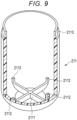
- FIG. 9 is a perspective view showing a configuration of a first housing 211 used in the case 21 by partially cutting out the configuration thereof.
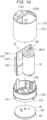
- FIG. 10 is an exploded perspective view showing configurations of a second housing 212 of the case 21, a battery 22, an antenna 23, and a control circuit board 25.
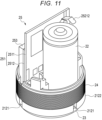
- FIG. 11 is a perspective view showing configurations of a first component 2122 of the second housing 212, the battery 22, and the control circuit board 25.
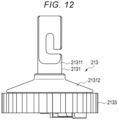
- FIGS. 12 and 13 are views showing a configuration of the third housing 213, FIG. 12 shows a side view, and FIG. 13 shows an exploded view.
- FIG. 14 shows configurations of the battery 22 and the control circuit board 25 if the first housing 211 and the third housing 213 are in a second location.
- FIG. 15 shows the configurations of the battery 22 and the control circuit board 25 if the first housing 211 and the third housing 213 are in a third location.
- FIGS. 16 and 17 are views showing a configuration of the antenna 23, FIG. 16 is a perspective view, and FIG. 17 is a side view.
- FIG. 18 is a perspective view showing a configuration of the control circuit board 25.
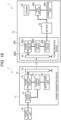
- FIG. 19 is a block diagram showing a configuration of the non-contact charging system 3 according to at least one embodiment
- FIGS. 20 and 21 are perspective views showing the configuration of the non-contact charging system 3.
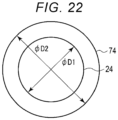
- FIG. 22 is an explanatory diagram showing configurations of a power receiving coil 24 and a power transmitting coil 74 of the non-contact charging system 3.
- the white cane 1 reads an RFID tag 6 on a walking path of a user by, for example, the RFID device 12, and notifies a terminal 5 of the user of read information.
- the RFID device 12 of the white cane 1, the terminal 5, and the RFID tag 6 form the communication system 2.
- the RFID device 12 of the white cane 1 forms the non-contact charging system 3 together with a power transmitting device (power transmitter) 7.
- the non-contact charging system 3 performs non-contact charging of the RFID device 12 by transmitting power from the power transmitting device 7 to the RFID device 12 of the white cane 1.
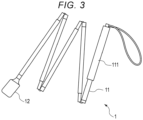
- the white cane 1 includes a white cane main body 11 and the RFID device 12.
- the RFID device 12 is an RFID reading device that reads information of the RFID tag 6.
- the RFID device 12 forms a ferrule.
- the RFID device 12 will be described as a ferrule 12.
- a vertical direction is defined by defining a side of the ferrule 12 of the white cane 1 as a lower side, and the embodiment will be hereinafter described.
- the white cane main body 11 is formed to be foldable in a plurality of stages.
- the white cane main body 11 is formed into a rod shape by unfolding the white cane main body 11.
- the white cane main body 11 includes a grip 111 at one end thereof, and the ferrule 12 is mounted on the other end thereof.
- the white cane main body 11 may be a slide type that expands and contracts or may be formed by a single shaft.
- the ferrule 12 includes the case 21, the battery 22, the antenna 23, the power receiving coil 24, the control circuit board 25, and a sensor 26.
- the ferrule 12 slides left and right on the ground in a state of contacting the ground, thereby sliding on the ground while rotating with respect to the white cane main body 11.
- the case 21 forms an outer shell of the ferrule 12 that rotates around a central axis coaxial with an axis of the white cane main body 11.
- the case 21 internally accommodates the battery 22, the antenna 23, the power receiving coil 24, the control circuit board 25, and the sensor 26 as electronic devices.
- the case 21 includes the first housing 211, the second housing 212, and the third housing 213.
- the first housing 211 is an outer case of the ferrule 12.
- the first housing 211 accommodates the battery 22, the antenna 23, the power receiving coil 24, the control circuit board 25, and the second housing 212.
- a corner of the first housing 211 rotates on the ground if the ferrule 12 rotates around a central axis of the first housing 211.
- the first housing 211 is fixed to the third housing 213.
- the first housing 211 is formed of, for example, a resin material.
- the first housing 211 is formed of, for example, polyacetal.
- the first housing 211 is formed in a bottomed tubular shape.
- the first housing 211 is formed in a bottomed cylindrical shape.
- a bottom portion of the first housing 211 is formed in a flat plate shape whose corner is formed in a curved surface shape or a hemispherical shape.
- the first housing 211 accommodates the battery 22, the antenna 23, the power receiving coil 24, the control circuit board 25, and the second housing 212, and an outer shape of the first housing 211 is appropriately set as long as the first housing 211 can slide on the ground.
- the outer shape of the first housing 211 include a spherical shape, a polygonal columnar shape, a gourd shape (e.g., an oblong shape, an irregular shape), and the like.
- the rib 2111 is formed to be integrated on an upper surface of the bottom portion of the first housing 211.
- the rib 2111 extends in four directions in the radial direction from the center of the bottom portion of the first housing 211.
- the rib 2111 is formed in a cross shape and protrudes from the upper surface of the bottom portion of the first housing 211.
- An upper surface of the rib 2111 is formed in a planar shape extending in a direction orthogonal to an axial direction of the first housing 211.
- At least a part of the upper surface of the rib 2111 and the plurality of protrusions 2112 contacts the antenna 23, and supports the antenna 23 in the axial direction.
- the insertion portion 2113 is formed at an upper end of an opening of the first housing 211.
- the insertion portion 2113 is inserted into the third housing 213.
- the insertion portion 2113 is formed to have a diameter smaller than an outer diameter on a center side of the first housing 211.
- the insertion portion 2113 is formed by making an opening end of the first housing 211 thinner than the outer diameter on the center side of the first housing 211.
- the plurality of first protruding portions 2114 are disposed at an equal space on the outer peripheral surface of the insertion portion 2113.
- two first protruding portions 2114 are provided.
- the two first protruding portions 2114 are disposed, for example, at symmetrical locations on the outer peripheral surface of the insertion portion 2113.
- the second protruding portion 2115 is provided between the two first protruding portions 2114 in a circumferential direction of the insertion portion 2113.
- the guide display unit 2116 displays the location of the first housing 211 inserted into the third housing 213.
- the guide display unit 2116 is a display that guides a location where the first housing 211 and the third housing 213 are attached and detached and a location where the power is turned ON and OFF.
- the guide display unit 2116 are three recesses for guiding these locations, and unevenness and Braille for displaying "OFF" and "ON". That is, the guide display unit 2116 is a display that visually or tactilely guides an operation location of the ferrule 12.
- the second housing 212 is formed in a tubular shape formed in a shape that can be inserted into the first housing 211.
- the second housing 212 is accommodated in the first housing 211.
- the second housing 212 is formed in a cylindrical shape.
- An outer diameter of the second housing 212 is formed to be slightly smaller than an inner diameter of the first housing 211 so that the second housing 212 can be inserted into the first housing 211.
- the second housing 212 accommodates or holds, for example, the battery 22, the antenna 23, the power receiving coil 24, the control circuit board 25, and the sensor 26. Movement of the second housing 212 in the circumferential direction is regulated by the first housing 211. Movement of the second housing 212 in the axial direction is regulated by the first housing 211 and the third housing 213. Accordingly, the second housing 212 is fixed to the first housing 211 and the third housing 213.
- the second housing 212 holds the antenna 23 at a lower end thereof .
- the second housing 212 accommodates, for example, the battery 22 and the control circuit board 25 inside.
- the second housing 212 holds, for example, the power receiving coil 24 on an outer peripheral surface thereof.
- the second housing 212 holds, for example, a part of the sensor 26 on an upper portion thereof.
- four notches 2121 in which the four protrusions 2112 of the first housing 211 are disposed are formed at the lower end thereof.
- the notch 2121 is engaged with the protrusion 2112 in the circumferential direction, such that the movement of the second housing 212 in the circumferential direction with respect to the first housing 211 is regulated.
- the second housing 212 is formed of one component or is formed by assembling a plurality of components. As a specific example, as shown in FIGS. 8 and 10 , the second housing 212 includes the first component 2122 and a second component 2123. The second housing 212 is formed by assembling the first component 2122 and the second component 2123 to be integrated with each other.
- the first component 2122 is formed in a tubular shape with opposite ends thereof opened.
- the first component 2122 holds, for example, the antenna 23 at a lower end thereof and the power receiving coil 24 on an outer peripheral surface thereof.
- the first component 2122 holds, for example, the battery 22 and the control circuit board 25. Lower end sides of the battery 22 and the control circuit board 25 are inserted into the first component 2122 such that the first component 2122 holds the battery 22 and the control circuit board 25.
- the first component 2122 is formed with a rib, a protrusion, and the like so that movement of the battery 22 and the control circuit board 25 in the radial direction and the circumferential direction can be regulated.
- the second component 2123 is formed in a tubular shape with opposite ends thereof opened.
- the second component 2123 is fixed to the first component 2122 by being engaged therewith or fitted thereto with a claw, unevenness, and the like.
- the second component 2123 is assembled into the first component 2122, thereby forming the tubular second housing 212 together with the first component 2122.
- the second component 2123 covers peripheries in the radial direction of the battery 22 and the control circuit board 25 held by the first component 2122.
- the second component 2123 includes a holding portion 21231 at an upper end thereof in which a part of the sensor 26 is provided, and a regulating portion 21232 covering an upper portion of the control circuit board 25.
- the holding portion 21231 holds, for example, a hall sensor 2621 of the sensor 26 which will be described later.
- the regulating portion 21232 regulates movement of the control circuit board 25 in the axial direction.
- the regulating portion 21232 is, for example, a rib formed in the opening at the upper end of the second component 2123 and configured to face at least a part of an upper end of the control circuit board 25 in the axial direction. At the upper end of the second component 2123, a portion facing the battery 22 in the axial direction is opened.
- the third housing 213 is fixed to a tip of the white cane main body 11. As shown in FIG. 5 , the third housing 213 fixes the first housing 211 to be rotatable around the axial direction of the white cane main body 11. As shown in FIGS. 5 to 7 , 12 , and 13 , the third housing 213 includes, for example, a base portion 2131 fixed to the white cane main body 11, a bearing member 2132 provided in the base portion 2131, and a lid portion 2133 fixed to the bearing member 2132.
- the base portion 2131 includes, for example, a fixed portion 21311, an umbrella portion 21312 formed to be integrated with the fixed portion 21311, and a shaft portion 21313 formed to be integrated with the umbrella portion 21312.
- the fixed portion 21311 is fixed to the tip of the white cane main body 11.
- the umbrella portion 21312 covers an upper surface of the lid portion 2133.
- the shaft portion 21313 is coaxial with the white cane main body 11 fixed to the fixed portion 21311.
- the bearing member 2132 is inserted into the shaft portion 21313 or fitted thereto, and the bearing member 2132 is fixed in the axial direction by a bolt 21314.
- the bearing member 2132 is, for example, a ball bearing or a needle bearing.
- the bearing member 2132 rotatably holds the lid portion 2133 on the shaft portion 21313.
- the lid portion 2133 is rotatably fixed to the shaft portion 21313 of the base portion 2131 via the bearing member 2132.
- the lid portion 2133 rotates with respect to the base portion 2131.
- the lid portion 2133 fixes the first housing 211.
- the lid portion 2133 covers an end portion of the opening of the first housing 211.
- the lid portion 2133 is formed to be able to move the first housing 211 to two locations where the power of the ferrule 12 is turned ON and OFF in a state of fixing the first housing 211.
- the lid portion 2133 includes a first terminal 25211 of a positive electrode terminal 2521 connected to the battery 22. If relative locations of the lid portion 2133 and the first housing 211 in the circumferential direction change, the lid portion 2133 is formed to be able to move the first terminal 25211 and switch a conduction state of the battery 22 and the control circuit board 25.
- the lid portion 2133 includes a top plate portion 21331, an outer peripheral wall portion 21332, and an inner peripheral wall portion 21333.
- the top plate portion 21331 is formed in a disk shape. As shown in FIGS. 6 , 7 , and 13 , the top plate portion 21331 is fixed to the bearing member 2132.
- the outer peripheral wall portion 21332 is formed to be integrated with an outer peripheral edge of the top plate portion 21331.
- An inner diameter of the outer peripheral wall portion 21332 is larger than an outer diameter of the insertion portion 2113 of the first housing 211.
- the inner diameter of the outer peripheral wall portion 21332 is smaller than a circumscribed circle of a plurality of first protruding portions 2114 formed in the insertion portion 2113, which are coaxial with the central axis of the first housing 211, and a circumscribed circle of the second protruding portion 2115 formed on the insertion portion 2113, which is coaxial with the central axis of the first housing 211.
- the outer peripheral wall portion 21332 includes, for example, a first groove 21335 and a second groove 21336, which are formed on an inner peripheral surface thereof.
- the same number of first grooves 21335 are provided as the number of first protruding portions 2114 of the insertion portion 2113.
- the first groove 21335 is formed so that the first protruding portion 2114 can be inserted thereinto.
- the first groove 21335 extends in the axial direction of the outer peripheral wall portion 21332.
- the first groove 21335 extends in one direction along the circumferential direction of the outer peripheral wall portion 21332 on the central side of the outer peripheral wall portion 21332 in the axial direction.
- the one direction along the circumferential direction is a direction in which the first housing 211 and the third housing 213 are rotated and fixed.
- the second groove 21336 is formed so that the second protruding portion 2115 can be inserted thereinto in the axial direction and the second protruding portion 2115 can move in the circumferential direction.
- the second groove 21336 is formed in a shape that allows the second protruding portion 2115 to move in the circumferential direction between a first location and a second location and between the second location and a third location, and the first housing 211 and the lid portion 2133 to rotate if a force in a rotational direction equal to or greater than a certain degree is applied to the first housing 211 and the lid portion 2133.
- the second groove 21336 regulates the movement of the second protruding portion 2115 between the first location and the second location, and between the second location and the third location.
- the first location is a location where the insertion portion 2113 is inserted into the lid portion 2133.
- the second location is a location where the insertion portion 2113 is fixed to the lid portion 2133, and, as shown in FIG. 14 , a location where the first terminal 25211 and a second terminal 25212 of the positive electrode terminal 2521 are separated from each other.
- the third location is a location where the insertion portion 2113 is fixed to the lid portion 2133, and, as shown in FIG. 15 , a location where the first terminal 25211 and the second terminal 25212 of the positive electrode terminal 2521 contact each other.
- the fixing of the insertion portion 2113 to the third housing 213 in the second location and the third location indicates a state in which movement in the axial direction and relative movement in the circumferential direction of the first housing 211 and the third housing 213 are regulated. That is, in the second location and the third location, the first protruding portion 2114 of the insertion portion 2113 is located at a portion extending in the circumferential direction of the first groove 21335, such that the movement in the axial direction of the insertion portion 2113 (the first housing 211) with respect to the lid portion 2133 of the third housing 213 is regulated.
- the movement of the second protruding portion 2115 is regulated by the second groove 21336, such that the movement in the circumferential direction of the first housing 211 with respect to the lid portion 2133 of the third housing 213 is regulated.
- the second groove 21336 is formed of, for example, a plurality of grooves extending in the axial direction and allowing the second protruding portions 2115 to be respectively disposed therein.
- the second groove 21336 is formed of three grooves formed at locations corresponding to the first location, the second location, and the third location.
- the inner peripheral wall portion 21333 is disposed with a predetermined gap in which the inner peripheral surface of the outer peripheral wall portion 21332 and the insertion portion 2113 can be disposed.
- a height of the inner peripheral wall portion 21333 from the top plate portion 21331 may be formed to be different depending on a portion.
- the inner peripheral wall portion 21333 may be formed by disposing a plurality of circular arc-shaped wall portions in the circumferential direction.
- the base portion 2131 is fixed to the white cane main body 11.
- the shaft portion 21313 and the bearing member 2132 of the base portion 2131 form a rotation mechanism.
- the first housing 211, the second housing 212, and the lid portion 2133 rotate with respect to the base portion 2131 by the rotation mechanism (the shaft portion 21313 and the bearing member 2132), and form a rotation unit for accommodating various electronic devices.
- the protrusion 2112 and the notch 2121 are engaged with each other in the circumferential direction, such that the second housing 212 is fixed to the first housing 211 in the circumferential direction.
- the antenna 23 or the second housing 212 contacts the rib 2111 or the protrusion 2112 of the first housing 211, and the second housing 212 or the battery 22 contacts a part of the third housing 213 (for example, a part of the lid portion 2133) or the first terminal 25211 fixed to the lid portion 2133 of the third housing 213, such that the second housing 212 is fixed to the first housing 211 and the third housing 213 in the axial direction.
- the battery 22 is a power source that supplies power to the antenna 23, the control circuit board 25, and the sensor 26.
- the battery 22 is a secondary battery.
- the antenna 23 includes a radiation element.
- the antenna 23 is, for example, a linearly polarized wave antenna.
- the antenna 23 is an inverted F antenna or a patch antenna (a microstrip antenna).
- the antenna 23 may be a circularly polarized wave antenna.
- the antenna 23 can be disposed in the first housing 211, and is formed in a shape that can be mounted on the second housing 212.
- an outer shape of the antenna 23 is formed in a circular shape whose diameter is equal to or less than the inner diameter of the first housing 211.
- the antenna 23 includes a base portion 231, a ground layer 232, and an antenna pattern 233.
- FIG. 16 shows an example of the antenna pattern 233 and a feeding point 234.
- the base portion 231 is formed in a disk shape having a diameter equal to or less than the inner diameter of the first housing 211.
- the base portion 231 may have an annular shape with an opening in the center, or may have a plate shape in which one main surface protrudes in a cylindrical shape.
- the antenna 23 is not limited to a circular shape as long as the antenna 23 can be disposed in the first housing 211 and mounted on the second housing 212.
- the base portion 231 is formed across both main surfaces, and includes one or a plurality of through holes 2311 connecting the ground layer 232 and the antenna pattern 233.
- the ground layer 232 is formed on one main surface of the base portion 231.
- the antenna pattern 233 is formed on the other main surface of the base portion 231.
- the antenna pattern 233 forms the radiation element.
- the power receiving coil 24 receives power transmitted from the power transmitting coil 74 and supplies the received power to a power receiving circuit 2551 which will be described later.
- the power receiving coil 24 is formed in a cylindrical shape.
- the power receiving coil 24 has a power receiving surface for receiving power in a cylindrical shape.
- the power receiving coil 24 is provided on the outer peripheral surface of the second housing 212.
- the power receiving coil 24 is provided on the outer peripheral surface of the first component 2122 of the second housing 212.
- the power receiving coil 24 is provided on the second housing 212 coaxial with the first housing 211, the second housing 212, and the third housing 213.
- the power receiving coil 24 is disposed coaxially with rotation center of the first housing 211, that is, the shaft portion 21313 and the bearing member 2132 of the third housing 213 forming the rotation mechanism.
- the power receiving coil 24 forms a resonance circuit (a power receiving resonance circuit) by being connected in series or in parallel with a power receiving resonance capacitor 2553 which will be described later.
- the power receiving coil 24 serving as the power receiving resonance circuit approaches the power transmitting coil 74, the power receiving coil 24 is electromagnetically coupled with the power transmitting coil 74. In the power receiving coil 24, an induced current is generated by a magnetic field output from the power transmitting coil 74.
- the power receiving coil 24 may be configured as a winding structure around which an insulated electric wire is wound, or may be configured by forming a coil pattern on a cylindrical printed circuit board.
- the power receiving coil 24 supplies the received AC power to the power receiving circuit 2551 which will be described later.
- a self-resonant frequency of the power receiving resonance circuit serving as the power receiving coil 24 is set to be approximately the same as a frequency transmitted by the power transmitting coil 74.
- FIGS. 7 , 8 , 10 , 11 , 14 , 15 , and 18 show an example of the control circuit board 25.
- the control circuit board 25 includes a circuit board 251 and a terminal 252.
- the control circuit board 25 is formed so that various processes can be performed by a processing circuit, a module, a wiring pattern, and the like mounted on the circuit board 251.
- the control circuit board 25 includes an RFID module 253, a communication unit 254 (communicator or communication interface), and a power receiving unit 255.
- the control circuit board 25 is connected to the antenna 23 and the power receiving coil 24.
- the control circuit board 25 is connected to the battery 22 via the terminal 252.
- the circuit board 251 is formed in, for example, a rectangular shape that can be accommodated in the second housing 212.
- the circuit board 251 may be formed of a plurality of circuit boards.
- the circuit board 251 includes a first circuit board 2511 and a second circuit board 2512.
- the first circuit board 2511 and the second circuit board 2512 are electrically connected to each other.
- the first circuit board 2511 and the second circuit board 2512 are disposed side by side in the second housing 212 in the radial direction of the second housing 212.
- the terminal 252 is connected to the battery 22.
- the terminal 252 includes the positive electrode terminal 2521 and a negative electrode terminal 2522.
- the positive electrode terminal 2521 contacts a positive electrode of the battery 22.
- the positive electrode terminal 2521 includes a first terminal 25211 and a second terminal 25212.
- the first terminal 25211 is fixed to the third housing 213. If the first housing 211, in which the second housing 212 is accommodated, is fixed to the lid portion 2133 of the third housing 213 and is located at the second location, as shown in FIGS. 7 and 14 , the first terminal 25211 contacts the positive electrode of the battery 22, and is separated from the second terminal 25212. If the first housing 211, in which the second housing 212 is accommodated, is fixed to the lid portion 2133 of the third housing 213 and is located at the third location, as shown in FIGS. 7 and 15 , the first terminal 25211 contacts both the positive electrode of the battery 22 and the second terminal 25212.
- the first terminal 25211 is formed in a band shape extending in a circular arc shape. If the first housing 211 and the third housing 213 rotate relative to each other and move from the second location to the third location, the first terminal 25211 moves in the circumferential direction as the third housing 213 moves in the circumferential direction, and connects the positive electrode of the battery 22 and the second terminal 25212.
- the second terminal 25212 is provided on the circuit board 251.
- the second terminal 25212 is provided on one circuit board 251 adjacent to the battery 22 in the second housing 212.
- the second terminal 25212 is provided on an upper end side of the first circuit board 2511 in a posture of being accommodated in the second housing 212.
- the second terminal 25212 contacts the first terminal 25211 at the second location.
- the negative electrode terminal 2522 contacts a negative electrode of the battery 22.
- the negative electrode terminal 2522 is provided on one circuit board 251 adjacent to the battery 22 in the second housing 212.
- the negative electrode terminal 2522 is provided at a lower end of the first circuit board 2511 in a posture of being accommodated in the second housing 212.
- the negative electrode terminal 2522 contacts the negative electrode of the battery 22 if the battery 22 is disposed in the second housing 212.
- the RFID module 253 is electrically connected to the antenna 23.
- the RFID module 253 reads, for example, the RFID tag 6.
- the RFID module 253 and the antenna 23 form an RFID reader.
- the RFID module 253 may be configured to form an RFID reader and writer together with the antenna 23 as a configuration for reading and writing the RFID tag 6.
- the RFID module 253 controls the antenna 23 and emits a radio wave from the antenna 23 in order to perform wireless communication of data with the RFID tag 6.
- the RFID module 253 supplies power to the RFID tag 6 by emitting the radio wave from the antenna 23, demodulates the data with the RFID tag 6, and changes a load of the antenna 23, thereby receiving a response wave returned from the RFID tag 6 via the antenna 23. Accordingly, the RFID module 253 reads the data of the RFID tag 6.
- the reading of the RFID tag 6 by the RFID module 253 is performed as below.
- the RFID module 253 emits the radio wave from the antenna 23 in order to perform the wireless communication with the RFID tag 6, and the RFID tag 6 starts by receiving the radio wave.
- the RFID module 253 amplitude-modulates a carrier wave emitted from the antenna 23 by a signal encoding the communication data
- the RFID tag 6 demodulates the amplitude-modulated communication data and changes the load of the antenna of the RFID tag 6 to return the response wave.
- the RFID module 253 acquires the data of the RFID tag 6 by receiving this response wave via the antenna 23.
- the RFID module 253 includes, for example, a control unit 2531 and a storage unit 2532.
- the RFID module 253 is appropriately provided with a coupler, a filter, an amplifier, a low-pass filter, a balun, and the like according to a reader function of the RFID module 253.
- the control unit 2531 executes arithmetic processing.
- the control unit 2531 is a processor serving as a processing circuit.
- the control unit 2531 performs various processing based on, for example, a program stored in the storage unit and data used in the program.
- the storage unit 2532 stores a program and data used in the program.
- the storage unit 2532 is a memory and a storage.
- the storage unit 2532 is, for example, a read only memory (ROM), a random access memory (RAM), or the like.
- the storage unit 2532 is, for example, an electrically erasable programmable ROM (EEPROM) (registered trademark), a ferroelectric random access memory (FRAM) (registered trademark), or the like.
- EEPROM electrically erasable programmable ROM
- FRAM ferroelectric random access memory
- the RFID module 253 performs processing of reading the data of the RFID tag 6 received from the antenna 23 by allowing the control unit 2531 to execute the program stored in the storage unit 2532.
- the RFID module 253 outputs information read from the RFID tag 6 to the communication unit 254.
- the communication unit 254 is mounted on the circuit board 251. For example, if the communication unit 254 transmits an advertisement, the terminal 5 receives the advertisement, and the communication unit 254 receives a connection request transmitted from the terminal 5, the communication unit 254 performs generic attribute profile (GATT) communication. For example, if the white cane 1 is used, a user sets the terminal 5 for receiving the information from the communication unit 254 in advance, and the communication unit 254 communicates with the terminal 5 set in advance.
- GATT generic attribute profile
- the power receiving unit 255 charges the battery 22 with power transmitted from the power transmitting coil 74 and received by the power receiving coil 24.
- the power receiving unit 255 supplies the received power to the battery 22.
- the power receiving unit 255 and the power receiving coil 24 form a power receiving device.
- the power receiving circuit 2551 converts the received power supplied from the power receiving coil 24 into power that can be supplied to the battery 22.
- the power receiving circuit 2551 rectifies the received power supplied from the power receiving coil 24 and converts the rectified power into a direct current.
- the power receiving circuit 2551 is implemented by, for example, a rectifier circuit including a rectifier bridge formed of a plurality of diodes. In this case, a pair of input terminals of the rectifier bridge are connected to the power receiving resonance circuit including the power receiving coil 24 and the resonance capacitor 2553.
- the power receiving circuit 2551 outputs DC power from a pair of output terminals by performing full-wave rectification on the received power supplied from the power receiving coil 24.
- the control circuit 2552 controls an operation of the power receiving circuit 2551.
- the control circuit 2552 includes, for example, a control unit and a storage unit.
- the control unit executes arithmetic processing.
- the control unit is a processor serving as a processing circuit.
- the control unit performs various processing based on, for example, a program stored in the storage unit and data used in the program.
- the storage unit stores the program and the data used in the program.
- the storage unit is a memory and a storage.
- the storage unit is, for example, a read only memory (ROM), a random access memory (RAM), or the like.
- the control circuit 2552 may be configured by a microcomputer and an oscillation circuit, and the like.
- a charging circuit 256 supplies the power supplied from the power receiving circuit 2551 to the battery 22 as power for charging.
- the charging circuit 256 converts the power supplied from the power receiving circuit 2551 into a direct current used for charging the battery 22. That is, the charging circuit 256 converts the power supplied from the power receiving circuit 2551 into the power for charging having a predetermined current value and voltage value for charging the battery 22, and supplies the charging power to the battery 22.
- the charging circuit 256 includes a charging IC including a port for transmitting a charging state to the control unit of the control circuit 2552.
- the sensor 26 detects a change in a posture of the ferrule 12 (the case 21) . As shown in FIG. 4 , the sensor 26 includes a first sensor 261 and a second sensor 262.
- the first sensor 261 detects the posture of the ferrule 12.
- the first sensor 261 is a motion sensor.
- the first sensor 261 is a 3-axis gyro sensor capable of detecting an angular velocity or a 3-axis acceleration sensor capable of detecting acceleration.
- the first sensor 261 maybe a 6-axis sensor capable of detecting the angular velocity and the acceleration.
- the first sensor 261 is mounted on the circuit board 251.
- the first sensor 261 outputs the detected angular velocity or acceleration as a signal to the control unit 2531.
- the hall sensor 2621 is provided in the holding portion 21231 of the second housing 212.
- the hall sensor 2621 moves in the circumferential direction if the first housing 211 rotates.
- the hall sensor 2621 moves in the circumferential direction with respect to the one or the plurality of magnets 2622, thereby detecting magnetism of the magnets 2622 facing the hall sensor 2621 during the movement thereof, and outputting a signal to the control unit 2531.
- the magnet 2622 is disposed at a location of facing the hall sensor 2621.
- the plurality of magnets 2622 are disposed at locations where the magnets 2622 are disposed at an equal space in the circumferential direction.
- the plurality of magnets 2622 are provided in the umbrella portion 21312 of the third housing 213.
- the plurality of magnets 2622 are disposed at an equal space on a coaxial circle coaxial with the axis of the shaft portion 21313 of the third housing 213.
- four magnets 2622 are provided, and the magnets 2622 are disposed to be spaced with 90 degrees in the circumferential direction.
- the third housing 213 of the case 21 is formed so that the lid portion 2133 is rotatable with respect to the umbrella portion 21312 via the bearing member 2132. Therefore, if a user holds the white cane 1 and moves the ferrule 12 to the left and right in a state where the ferrule 12 contacts the ground, the case 21 of the ferrule 12 slides on the ground while rotating around the central axis of the shaft portion 21313 of the third housing 213.
- the ferrule 12 can change a direction of polarization wave even in the case of the linearly polarized wave antenna 23.
- the communication system 2 is formed of the white cane 1 including the ferrule 12 serving as an RFID device, the terminal 5, and the RFID tag 6.
- the terminal 5 is a device that can be worn or carried by the user of the white cane 1.
- the terminal 5 is, for example, a mobile terminal such as a smartphone, a wearable device such as a smart watch, an audio device such as an earphone, a dedicated terminal capable of notifying information by sound and vibration.
- the terminal 5 may be configured to be built in the grip 111 of the white cane main body 11.
- the terminal 5 includes, for example, an input unit 51, a display unit 52, a communication unit 53, a notification unit 54, a storage unit 55, and a control unit 56.
- the input unit 51 is a device for receiving a user input such as a button, an operation panel, and a touch panel.
- the display unit 52 is a display device such as a liquid crystal display or an organic EL display.
- the communication unit 53 is controlled by the control unit 56.
- the communication unit 53 is any communication interface capable of communicating with the communication unit 254 of the ferrule 12 by using a wireless communication technique.
- the communication unit 53 may be configured to be able to communicate with a terminal and a network other than the communication unit 254 of the ferrule 12 by using a wired communication technique or a wireless communication technique.
- the communication unit 53 may be mounted as a communication module or a communication circuit board.
- the communication unit 53 transmits and receives information to and from the communication unit 254 of the ferrule 12 by using, for example, a short-range wireless communication technique such as Bluetooth low energy (BLE), which is a standard of Bluetooth (registered trademark).
- BLE Bluetooth low energy
- the communication unit 53 can be connected to the network via, for example, a base station by using a short-range wireless communication technique such as Wi-Fi (registered trademark) and a long-range wireless communication technique such as a general-purpose wireless communication technique including a mobile phone line such as long term evolution (LTE) (registered trademark).
- LTE long term evolution
- the notification unit 54 notifies information to the outside by sound or vibration.
- the notification unit 54 is a speaker, a vibrator, or the like.
- the notification unit 54 outputs sound and vibration in different patterns .
- the notification unit 54 if the notification unit 54 is the speaker and notifies the information by sound, the notification unit 54 performs notification by sound based on parameters such as different sound types, volumes, and sound lengths set corresponding to the information to be notified.
- the sound includes a voice.
- the notification unit 54 is a vibrator and notifies the information by vibration
- the notification unit 54 performs notification by vibration based on parameters such as different vibration types, vibration intensities, and vibration lengths set corresponding to the information to be notified.
- the notification unit 54 may notify the information by using one of the sound and the vibration, or may notify the information by using both the sound and the vibration.
- the control unit 56 is a processor including a processing circuit.
- the control unit 56 includes, for example, a central processing unit (CPU).
- Examples of the processor may include a field programmable gate array (FPGA), a digital signal processor (DSP), a graphics processing unit (GPU), or another general-purpose or dedicated processor.
- FPGA field programmable gate array
- DSP digital signal processor
- GPU graphics processing unit
- One or a plurality of processors are mounted on a circuit board such as a motherboard, a graphic board, and the like.
- control unit 56 implements, based on the control program, the control data, and the like stored in the storage unit 55, various functions such as processing for inputting an external command input by the input unit 51, processing for displaying information on the display unit 52, communication processing by the communication unit 53, and notification processing by the notification unit 54.
- the RFID tag 6 is provided in, for example, a station, a road, a building, and the like.
- the RFID tag 6 is embedded under a Braille block of the platform of a station and in a railroad of the platform, and is provided in a railroad vehicle.
- the RFID tag 6 may be a passive tag or an active tag.
- the RFID tag 6 includes a tag antenna 62 including a matching circuit and an IC chip 61. If the RFID tag 6 is the active tag, the RFID tag 6 includes a battery, a power supply circuit, and the like.
- FIG. 1 An example using the communication system 2 will be described.
- a user walks while swinging the white cane 1 in a left and right direction in a state where the ferrule 12 contacts the ground.
- the ferrule 12 receives information transmitted from the disposed RFID tag 6 with the antenna 23 and reads the received information with the RFID module 253.
- the information of the RFID tag 6 is transmitted from the communication unit 254 of the ferrule 12 to the communication unit 254 of the terminal 5, and the terminal 5 performs notification corresponding to the information of the RFID tag 6 by using the notification unit 54.
- the terminal 5 notifies the user of information indicating that the ferrule is located on the railroad side of the platform from the information of the RFID tag 6. If the RFID tag 6 is provided in the railroad vehicle, the terminal 5 notifies the user of a location of the railroad vehicle, for example, a location of a door of the railroad vehicle and information of the vehicle. As described above, the communication system 2 can read the information of the RFID tag 6 on the walking path by the white cane serving as the RFID device, and notify the user of the information by the terminal 5.
- the non-contact charging system 3 includes the ferrule 12 serving as a power receiving device including the power receiving unit 255 and the power receiving coil 24, and the power transmitting device 7.
- the non-contact charging system 3 performs non-contact charging of the ferrule 12 by the power transmitting device 7.
- the power transmitting device 7 includes a power transmitting table 71, a power circuit 72, a power transmitting circuit 73, a power transmitting coil 74, a control circuit 75, a notification unit 76, a resonance capacitor 77, and a power supplying unit 78.
- the power transmitting table 71 is formed so that the ferrule 12 can be inserted thereinto.
- the power transmitting table 71 holds the white cane 1 in an upright posture by inserting the ferrule 12 thereinto.
- the power transmitting table 71 is formed in a columnar shape.
- An inner diameter of the power transmitting table 71 is formed so that the ferrule 12 can be inserted thereinto and the posture of the white cane 1 can be maintained.
- the inner diameter of the power transmitting table 71 is the same as or slightly smaller than an outer diameter of the first housing 211 of the ferrule 12.
- the power transmitting table 71 accommodates the power circuit 72, the power transmitting circuit 73, the power transmitting coil 74, the control circuit 75, the notification unit 76, and the resonance capacitor 77.
- the power transmitting table 71 may be configured to accommodate at least the power transmitting coil 74 therein, and for example, the power circuit 72, the power transmitting circuit 73, the control circuit 75, the notification unit 76, and the like may be provided in a separate case.
- the power circuit 72 converts a voltage of DC power supply from the outside into a voltage desirable for an operation of each circuit.
- the power circuit 72 generates power for causing the power transmitting circuit 73 to transmit power, and supplies the generated power to the power transmitting circuit 73.
- the power circuit 72 generates power for operating the control circuit 75 and supplies the generated power to the control circuit 75.
- the power transmitting circuit 73 generates transmission power to be transmitted from the power transmitting coil 74.
- the power transmitting circuit 73 supplies the generated transmission power to the power transmitting coil 74.
- the power transmitting circuit 73 switches the DC power supplied from the power circuit 72 based on the control of the control circuit 75, thereby generating AC power as the transmission power.
- the power transmitting coil 74 outputs power that can be received by the power receiving coil 24 according to the transmission power supplied from the power transmitting circuit 73.
- the power transmitting coil 74 is formed in a cylindrical shape.
- the power transmitting coil 74 has a power receiving surface for receiving power, which is formed in a cylindrical shape.
- the power transmitting coil 74 is disposed in the power transmitting table 71 so that a power transmitting surface faces the power receiving surface of the power receiving coil 24 provided in the second housing 212 of the ferrule 12 inserted into the power transmitting table 71. That is, the power transmitting coil 74 is disposed at a height location of the power transmitting table 71, which faces the power receiving coil 24 inserted into the power transmitting table 71 in the radial direction.
- the power transmitting coil 74 is accommodated in the power transmitting table 71.
- the power transmitting coil 74 forms a resonance circuit (a power transmitting resonance circuit) by being connected in series or in parallel to the resonance capacitor 77. If AC power is supplied from the power transmitting circuit 73, the power transmitting coil 74 serving as the power transmitting resonance circuit generates a magnetic field corresponding to the supplied AC power.
- the power transmitting coil 74 may be configured as a winding structure around which an insulated electric wire is wound, or may be configured by forming a coil pattern on a printed circuit board.
- a diameter ⁇ D2 of the power transmitting coil 74 is larger than a diameter ⁇ B1 of the power receiving coil 24.
- the power transmitting coil 74 is set to have a diameter desirable for performing the non-contact charging with the power receiving coil 24. That is, the diameter ⁇ D1 of the power receiving coil 24 and the diameter ⁇ D2 of the power transmitting coil 74 are set at a predetermined space (D2 - D1) at which the non-contact charging can be desirably performed.
- the control circuit 75 controls operations of the power transmitting circuit 73 and the notification unit 76.
- the control circuit 75 includes, for example, a control unit and a storage unit.
- the control unit executes arithmetic processing.
- the control unit is a processor serving as a processing circuit.
- the control unit performs various processing based on, for example, a program stored in the storage unit and data used in the program.
- the storage unit stores the program and the data used in the program.
- the storage unit is a memory and a storage.
- the storage unit is, for example, a read only memory (ROM), a random access memory (RAM), or the like.
- the control circuit 75 may be configured by a microcomputer and an oscillation circuit, and the like.
- the control circuit 75 switches the notification of the notification unit 76 according to a power transmitting state of the power transmitting device 7 or a charging state of the battery 22.
- the control circuit 75 controls a frequency of the AC power output from the power transmitting circuit 73, and controls ON and OFF of the operation of the power transmitting circuit 73.
- the control circuit 75 switches between a state in which a magnetic field is generated in the power transmitting coil 74 (a power transmitting state) and a state in which a magnetic field is not generated in the power transmitting coil 74 (a standby state) by controlling the power transmitting circuit 73.
- the control circuit 75 may intermittently generate the magnetic field in the power transmitting coil 74 to perform control for changing a timing of the power transmission.
- the notification unit 76 is an indicator indicating the state of the power transmitting device 7 or a speaker that notifies the state of the power transmitting device 7 by sound.
- the notification unit 76 switches a display according to the control of the control circuit 75.
- the notification unit 76 includes an LED and a speaker, and switches on, off, or display color, and notifies according to the operating state of the power transmitting device 7 by sounds or voices of different patterns.
- the power supplying unit 78 is, for example, an AC adapter or a mobile battery.
- the power supplying unit 78 supplies power to the power circuit 72.
- the ferrule 12 serving as the RFID device and the white cane 1 configured as described above is configured to perform the non-contact charging by the power transmitting device 7.
- the non-contact charging of the ferrule 12 is performed by disposing the ferrule 12 in the power transmitting table 71 and causing the power receiving coil 24 of the ferrule 12 and the power transmitting coil 74 of the power transmitting table 71 to face each other.
- the battery 22 can be charged without disassembling the case 21 and taking out the battery 22 therefrom. That is, in the case of the ferrule 12, it is not required to take out the battery 22 from the case 21 for charging the battery 22. It is also not required to connect and disconnect a charging cable.
- the power receiving coil 24 and the power transmitting coil 74 have a cylindrical shape, and the power receiving coil 24 has a diameter smaller than that of the power transmitting coil 74.
- the power receiving coil 24 and the power transmitting coil 74 have the same height location. Accordingly, by disposing the ferrule 12 on the power transmitting table 71, the power receiving coil 24 and the power transmitting coil 74 face each other in the radial direction while maintaining a predetermined distance. Therefore, the ferrule 12 can perform the non-contact charging without worrying about a location in the circumferential direction when receiving power.
- the ferrule 12 and the non-contact charging system 3 can easily perform charging of the battery 22 of the ferrule 12. Particularly, many users of the white cane 1 are visually impaired. However, since the ferrule 12 is only required to be inserted into the power transmitting table 71, the non-contact charging system 3 can easily charge the white cane 1 even by a visually impaired person. Since a tip of the first housing 211 of the ferrule 12 is formed in a curved surface shape, the tip of the first housing 211 guides insertion if the ferrule 12 is inserted into the power transmitting table 71. Accordingly, the ferrule 12 can be easily inserted into the power transmitting table 71.
- the antenna 23 is disposed at a lower end of the second housing 212, and the power receiving coil 24 is disposed away from the antenna 23 in the axial direction of the second housing 212. Accordingly, the antenna 23 and the power receiving coil 24 are disposed away from each other at a predetermined distance in the axial direction in the case 21.
- the ferrule 12 can prevent an influence of the power receiving coil 24 if the antenna 23 reads the RFID tag 6. Therefore, the ferrule 12 can stably read the RFID tag 6.
- the power receiving coil 24 is disposed to deviate from the antenna 23 in the axial direction of the case 21, thereby making it possible to prevent mutual influences between the antenna 23 and the power receiving coil 24.
- the white cane 1, the ferrule (the RFID device) 12, the communication system 2, and the non-contact charging system 3 are not limited to the example of the above-described embodiment.
- the ferrule 12 is described as a configuration in which the battery 22 can be charged by the non-contact charging, the ferrule 12 is not limited to the configuration.
- the control circuit board 25 of the ferrule 12 may be configured to include a cut-off circuit 258 that cuts off the power supply from the battery 22 to the RFID module 253.
- the ferrule (the RFID device) 12 having such a configuration includes the cut-off circuit 258.
- the cut-off circuit 258 is provided in a circuit between the battery 22 and the RFID module 253.
- the cut-off circuit 258 switches between conduction and cut-off between the RFID module 253 and the battery 22 in a potential state of FET, transistor, relay, and the like. That is, the cut-off circuit 258 supplies and cuts off the power of the RFID module 253 by switching ON and OFF.
- the cut-off circuit 258 is controlled by, for example, a control unit 25521 which is a processor of the control circuit 2552.
- the charging circuit 256 includes a charging IC 2561 including a port for transmitting a charging state to the control unit of the control circuit 2552.
- the port becomes High if charging is performed, and the port becomes Low if charging is not performed.
- the control circuit 2552 includes the control unit 25521.
- the control unit 25521 determines the charging state from a state of the port of the charging IC 2561. Next, when determining that the charging state is charging, the control unit 25521 controls the cut-off circuit 258 to change the cut-off circuit 258 to OFF, and to cut off supplying the power to the RFID module 253.
- the control unit 25521 controls the cut-off circuit 258 to change the cut-off circuit 258 to ON, and to supply the power to the RFID module 253.
- the control circuit board 25 may be configured to include a voltage conversion circuit 25522 and an OR circuit 25523.
- the voltage conversion circuit 25522 transforms a voltage of the rectifier circuit of the power receiving circuit 2551. If the control unit 25521 determines that charging is performed and a command for cutting off the cut-off circuit 258 is input from the control unit 25521 or if a potential of the rectifier circuit of the power receiving circuit 2551 is received, the OR circuit 25523 switches the cut-off circuit 258 to cut off supplying the power to the RFID module 253.
- the ferrule 12 may be configured to include the cut-off circuit 258 that cuts off the power supply from the battery 22 to the RFID module 253 if the battery 22 is charged.
- the cut-off circuit 258 may not be configured to be controlled by the control unit 25521 of the control circuit 2552, and for example, the cut-off circuit 258 may be configured to be controlled by the control unit 2531 of the RFID module 253.
- a control unit which is another processor, may be mounted on the control circuit board 25, and this control unit may be configured to control the cut-off circuit 258.
- the RFID device 12 is used as the ferrule of the white cane 1, the embodiments are not limited thereto.
- the RFID device 12 may be configured to be used for performing another function other than the white cane 1.
- the case 21 may be configured to accommodate at least the antenna 23 and the power receiving coil 24, and another electronic device may be configured to be accommodated in the white cane main body 11 and the grip 111.
- the electronic device described above may be configured to be accommodated in the second housing 212.
- the configuration is not limited thereto.
- the sensor 26 can detect the rotation of the first housing 211 and the lid portion 2133 of the third housing 213 of the case 21, which are the rotation unit, if the white cane 1 is used, the sensor 26 may be configured to include only one of the first sensor 261 and the second sensor 262, or may be configured to include another sensor.
Landscapes
- Engineering & Computer Science (AREA)
- Power Engineering (AREA)
- Health & Medical Sciences (AREA)
- Computer Networks & Wireless Communication (AREA)
- Physics & Mathematics (AREA)
- General Health & Medical Sciences (AREA)
- Computer Hardware Design (AREA)
- Microelectronics & Electronic Packaging (AREA)
- General Physics & Mathematics (AREA)
- Theoretical Computer Science (AREA)
- Rehabilitation Therapy (AREA)
- Veterinary Medicine (AREA)
- Pain & Pain Management (AREA)
- Life Sciences & Earth Sciences (AREA)
- Animal Behavior & Ethology (AREA)
- Epidemiology (AREA)
- Public Health (AREA)
- Physical Education & Sports Medicine (AREA)
- Toxicology (AREA)
- Electromagnetism (AREA)
- Artificial Intelligence (AREA)
- Computer Vision & Pattern Recognition (AREA)
- Charge And Discharge Circuits For Batteries Or The Like (AREA)
- Walking Sticks, Umbrellas, And Fans (AREA)
Description
- Embodiments described herein relate generally to an RFID device and a non-contact charging system.
- An RFID device that a user can carry is known for a long time. The RFID device includes a battery and reads an RFID tag by power supplied from the battery. Since the RFID device is carried and operated by the user, miniaturization thereof is required.
- In order to charge the battery, a technique for performing charging by a charging cable, and a technique for performing charging by taking out the battery from the RFID device and mounting the battery on a charger are also known.
- However, the work of connecting and disconnecting the charging cable and mounting the battery thereon is complicated. For example, a technique in which the RFID device is used for a white cane is also known. However, since many white cane users are visually impaired individuals, it may be difficult to connect and disconnect the charging cable, and to mount the battery thereon. Therefore, it is required to achieve a technique in which the RFID device can be easily charged.
- For example, it is also possible to charge the battery by using a non-contact charging technique. However, if the RFID device is miniaturized, a power receiving coil for performing non-contact charging may affect an antenna.
-
GB2575506 A sender 12 operatively connected to a receiver 14, thesender 12 comprising a short-range wireless RFID receiver 16 and the receiver 16 comprising a processor and anoutput device 24 which, upon detection of asignal 26 by the receiver 16 from, for example, a passive RFID tag 28, outputs a speech-audio signal 30. - One of the objects of the present invention is to improve prior art techniques and overcome at least some of the prior art problems as for instance above illustrated.
- According to a first aspect of the present invention, it is provided an RFID device comprising a case including a rotation mechanism; an antenna disposed in the case; and a cylindrical power receiving coil disposed in the case away from the antenna and extending in an axial direction of the rotation mechanism, and connected to a power receiver configured to charge a battery.
- Optionally, in the device according to the first aspect of the invention, the power receiving coil is disposed coaxially with a rotation axis of the rotation mechanism, and a diameter of the power receiving coil is smaller than a diameter of a cylindrical power transmitting coil that is configured to perform non-contact charging with the power receiving coil.
- Optionally, the device according to the first aspect of the invention further comprises a cut-off circuit configured to cut off power supply from the battery to an RFID module connected to the antenna when the power receiving coil receives power from the power transmitting coil.
- Optionally, the device according to the first aspect of the invention further comprises a communication interface configured to transmit information read by the RFID module to the outside, wherein the battery, the power receiver, the RFID module, and the communication interface are provided in the case.
- According to a second aspect of the invention, it is provided a non-contact charging system, comprising the RFID device according to the first aspect; and a cylindrically formed power transmitting table including a power transmitting device, the power transmitting device including a power transmitting coil and a power transmitting circuit, and enabling the RFID device to be disposed therein.
- Optionally, in the device according to the first aspect of the invention, RFID device includes a ferrule.
- Optionally, in the device according to the first aspect of the invention, the RFID device further comprises a plurality of housings.
- Optionally, in the device according to the first aspect of the invention, the plurality of housings includes a first housing formed of resin.
- Optionally, in the device according to the first aspect of the invention, the plurality of housings includes a first housing having a tubular shape.
- Optionally, in the device according to the first aspect of the invention, the plurality of housings includes a first housing which accommodates the antenna and the power receiving coil.
- Optionally, in the device according to the first aspect of the invention, the plurality of housings includes a first housing having an outer shape having a spherical shape, a polygonal columnar shape, or a gourd shape.
- Optionally, in the device according to the first aspect of the invention, the plurality of housings includes a first housing, a second housing and third housing, the first housing contacting the third housing, the second housing disposed between the first housing and the third housing.
- Optionally, in the device according to the first aspect of the invention, the plurality of housings includes a first housing, a second housing and a third housing, the first housing including one or more insertion portions arranged to insert into one or more respective grooves of the third housing.
- Optionally, in the device according to the first aspect of the invention, the first housing includes a guide display arranged adjacent to the one or more insertion portions.
- Optionally, in the device according to the first aspect of the invention, the plurality of housings includes a first housing having a rib formed integrally on an upper surface of a bottom portion of the first housing.
- Optionally, in the device according to the first aspect of the invention, the plurality of housings includes a first housing and a second housing, wherein an outer diameter of the second housing is less than an inner diameter of the first housing.
- Optionally, in the device according to the first aspect of the invention, the plurality of housings includes a first housing, a second housing and a third housing, the third housing having a shaft portion and a bearing member which form the rotation mechanism.
- According to a third aspect of the invention, it is provided a system including a white cane, and the RFID device of the first aspect, wherein the RFID device is mounted on the white cane.
-
-
FIG. 1 is an explanatory diagram showing a configuration of a communication system using an RFID device according to at least one embodiment; -
FIG. 2 is a block diagram showing the configuration of the communication system using the RFID device; -
FIG. 3 is an explanatory diagram showing a configuration of a white cane using the RFID device; -
FIG. 4 is a block diagram showing a configuration of the RFID device; -
FIG. 5 is a perspective view showing a configuration of a ferrule of the white cane; -
FIG. 6 is an exploded perspective view showing the configuration of the ferrule; -
FIG. 7 is a cross-sectional view showing the configuration of the ferrule; -
FIG. 8 is an exploded perspective view showing a configuration of a main part of the ferrule; -
FIG. 9 is a perspective view showing a configuration of a first housing used in a case of the ferrule by partially cutting out the configuration thereof; -
FIG. 10 is an exploded perspective view showing the configuration of the main part of the ferrule; -
FIG. 11 is a perspective view showing the configuration of the main part of the ferrule; -
FIG. 12 is a side view showing a configuration of a third housing used in the case; -
FIG. 13 is an exploded view showing the configuration of the third housing; -
FIG. 14 is a perspective view showing a configuration of a battery and a control circuit board of the ferrule; -
FIG. 15 is a perspective view showing the configuration of the battery and the control circuit board of the ferrule; -
FIG. 16 is a perspective view showing a configuration of an antenna of the ferrule; -
FIG. 17 is a side view showing the configuration of the antenna; -
FIG. 18 is a perspective view showing the configuration of the control circuit board; -
FIG. 19 is a block diagram showing a configuration of a non-contact charging system; -
FIG. 20 is a perspective view showing the configuration of the non-contact charging system; -
FIG. 21 is a perspective view showing the configuration of the non-contact charging system; -
FIG. 22 is an explanatory diagram showing a configuration of a power receiving coil and a power transmitting coil of the non-contact charging system; -
FIG. 23 is a block diagram showing a configuration of a ferrule according to another embodiment; and -
FIG. 24 is a block diagram showing the configuration of the ferrule. - An object to be solved by an embodiment is to provide an RFID device and a non-contact charging system capable of preventing mutual influences between a power receiving coil and an antenna.
- In general, according to at least one embodiment, an RFID device includes a case, an antenna, and a power receiving coil. The case includes a rotation mechanism. The antenna is provided in the case. The power receiving coil is provided in the case away from the antenna in an axial direction of the rotation mechanism. The power receiving coil is connected to a power receiving unit (power receiver) that charges a battery. The power receiving coil has a cylindrical shape.
- According to at least one embodiment, it is possible to provide an RFID device and a non-contact charging system capable of preventing mutual influences between a power receiving coil and an antenna.
- Hereinafter, configurations of a
white cane 1 including anRFID device 12, acommunication system 2, and a non-contact charging system 3 according to an embodiment will be described with reference toFIGS. 1 to 22 . -
FIG. 1 is an explanatory diagram schematically showing a configuration of thecommunication system 2 using thewhite cane 1 including theRFID device 12, andFIG. 2 is a block diagram schematically showing the configuration of thecommunication system 2.FIG. 3 is an explanatory diagram showing a configuration of thewhite cane 1 using aferrule 12 as a RFID device.FIG. 4 is a block diagram showing a configuration of the ferrule (the RFID device) 12. -
FIGS. 5 to 7 are views showing the configuration of theferrule 12.FIG. 5 is a perspective view,FIG. 6 is an exploded perspective view, andFIG. 7 is a cross-sectional view.FIG. 8 is a perspective view showing the configuration of theferrule 12 by omitting athird housing 213 of acase 21, andFIG. 9 is a perspective view showing a configuration of afirst housing 211 used in thecase 21 by partially cutting out the configuration thereof.FIG. 10 is an exploded perspective view showing configurations of asecond housing 212 of thecase 21, abattery 22, anantenna 23, and acontrol circuit board 25.FIG. 11 is a perspective view showing configurations of afirst component 2122 of thesecond housing 212, thebattery 22, and thecontrol circuit board 25. -
FIGS. 12 and13 are views showing a configuration of thethird housing 213,FIG. 12 shows a side view, andFIG. 13 shows an exploded view.FIG. 14 shows configurations of thebattery 22 and thecontrol circuit board 25 if thefirst housing 211 and thethird housing 213 are in a second location.FIG. 15 shows the configurations of thebattery 22 and thecontrol circuit board 25 if thefirst housing 211 and thethird housing 213 are in a third location.FIGS. 16 and 17 are views showing a configuration of theantenna 23,FIG. 16 is a perspective view, andFIG. 17 is a side view.FIG. 18 is a perspective view showing a configuration of thecontrol circuit board 25. -
FIG. 19 is a block diagram showing a configuration of the non-contact charging system 3 according to at least one embodiment, andFIGS. 20 and21 are perspective views showing the configuration of the non-contact charging system 3.FIG. 22 is an explanatory diagram showing configurations of apower receiving coil 24 and apower transmitting coil 74 of the non-contact charging system 3. - As shown in
FIG. 1 , thewhite cane 1 reads anRFID tag 6 on a walking path of a user by, for example, theRFID device 12, and notifies aterminal 5 of the user of read information. TheRFID device 12 of thewhite cane 1, theterminal 5, and theRFID tag 6 form thecommunication system 2. As shown inFIG. 19 , theRFID device 12 of thewhite cane 1 forms the non-contact charging system 3 together with a power transmitting device (power transmitter) 7. The non-contact charging system 3 performs non-contact charging of theRFID device 12 by transmitting power from the power transmitting device 7 to theRFID device 12 of thewhite cane 1. - First, the configuration of the
white cane 1 will be described with reference toFIGS. 2 to 18 . - As shown in
FIG. 3 , thewhite cane 1 includes a white canemain body 11 and theRFID device 12. TheRFID device 12 is an RFID reading device that reads information of theRFID tag 6. Here, theRFID device 12 forms a ferrule. In the following description, theRFID device 12 will be described as aferrule 12. A vertical direction is defined by defining a side of theferrule 12 of thewhite cane 1 as a lower side, and the embodiment will be hereinafter described. - As shown in
FIG. 3 , for example, the white canemain body 11 is formed to be foldable in a plurality of stages. The white canemain body 11 is formed into a rod shape by unfolding the white canemain body 11. The white canemain body 11 includes agrip 111 at one end thereof, and theferrule 12 is mounted on the other end thereof. The white canemain body 11 may be a slide type that expands and contracts or may be formed by a single shaft. - As shown in
FIGS. 2 to 11 , theferrule 12 includes thecase 21, thebattery 22, theantenna 23, thepower receiving coil 24, thecontrol circuit board 25, and asensor 26. For example, if thewhite cane 1 is used, theferrule 12 slides left and right on the ground in a state of contacting the ground, thereby sliding on the ground while rotating with respect to the white canemain body 11. - The
case 21 forms an outer shell of theferrule 12 that rotates around a central axis coaxial with an axis of the white canemain body 11. As shown inFIGS. 7 and8 , thecase 21 internally accommodates thebattery 22, theantenna 23, thepower receiving coil 24, thecontrol circuit board 25, and thesensor 26 as electronic devices. As a specific example, as shown inFIGS. 5 to 8 , thecase 21 includes thefirst housing 211, thesecond housing 212, and thethird housing 213. - The
first housing 211 is an outer case of theferrule 12. Thefirst housing 211 accommodates thebattery 22, theantenna 23, thepower receiving coil 24, thecontrol circuit board 25, and thesecond housing 212. A corner of thefirst housing 211 rotates on the ground if theferrule 12 rotates around a central axis of thefirst housing 211. Thefirst housing 211 is fixed to thethird housing 213. Thefirst housing 211 is formed of, for example, a resin material. Thefirst housing 211 is formed of, for example, polyacetal. - As shown in
FIGS. 5 to 9 , thefirst housing 211 is formed in a bottomed tubular shape. For example, thefirst housing 211 is formed in a bottomed cylindrical shape. For example, a bottom portion of thefirst housing 211 is formed in a flat plate shape whose corner is formed in a curved surface shape or a hemispherical shape. Thefirst housing 211 accommodates thebattery 22, theantenna 23, thepower receiving coil 24, thecontrol circuit board 25, and thesecond housing 212, and an outer shape of thefirst housing 211 is appropriately set as long as thefirst housing 211 can slide on the ground. Other examples of the outer shape of thefirst housing 211 include a spherical shape, a polygonal columnar shape, a gourd shape (e.g., an oblong shape, an irregular shape), and the like. - As a specific example, as shown in
FIGS. 6 to 9 , thefirst housing 211 includes, for example, arib 2111 extending in a radial direction, and a plurality ofprotrusions 2112 formed at end portions of therib 2111 in the radial direction at a bottom portion of the interior thereof. Thefirst housing 211 includes aninsertion portion 2113, a plurality of first protrudingportions 2114 formed on an outer peripheral surface of theinsertion portion 2113, and asecond protruding portion 2115 formed on the outer peripheral surface of theinsertion portion 2113. Thefirst housing 211 includes aguide display unit 2116 formed adjacent to theinsertion portion 2113.Such insertion portions 2113 are configured as recesses. - The
rib 2111 is formed to be integrated on an upper surface of the bottom portion of thefirst housing 211. For example, therib 2111 extends in four directions in the radial direction from the center of the bottom portion of thefirst housing 211. In other words, therib 2111 is formed in a cross shape and protrudes from the upper surface of the bottom portion of thefirst housing 211. An upper surface of therib 2111 is formed in a planar shape extending in a direction orthogonal to an axial direction of thefirst housing 211. - The
protrusion 2112 extends in the axial direction of thefirst housing 211 from the end portion of therib 2111 in the radial direction. Theprotrusion 2112 is formed to be integrated with an inner peripheral surface of thefirst housing 211. The plurality ofprotrusions 2112 are respectively formed to be integrated with the end portions of therib 2111 in the radial direction. In the embodiment, since therib 2111 is formed in the cross shape, fourprotrusions 2112 are provided. For example, one of the fourprotrusions 2112 has a higher height in the axial direction than those of the other threeprotrusions 2112. - At least a part of the upper surface of the
rib 2111 and the plurality ofprotrusions 2112 contacts theantenna 23, and supports theantenna 23 in the axial direction. - The
insertion portion 2113 is formed at an upper end of an opening of thefirst housing 211. Theinsertion portion 2113 is inserted into thethird housing 213. Theinsertion portion 2113 is formed to have a diameter smaller than an outer diameter on a center side of thefirst housing 211. For example, theinsertion portion 2113 is formed by making an opening end of thefirst housing 211 thinner than the outer diameter on the center side of thefirst housing 211. - The plurality of first protruding
portions 2114 are disposed at an equal space on the outer peripheral surface of theinsertion portion 2113. For example, two first protrudingportions 2114 are provided. The two first protrudingportions 2114 are disposed, for example, at symmetrical locations on the outer peripheral surface of theinsertion portion 2113. For example, the second protrudingportion 2115 is provided between the two first protrudingportions 2114 in a circumferential direction of theinsertion portion 2113. - The
guide display unit 2116 displays the location of thefirst housing 211 inserted into thethird housing 213. For example, theguide display unit 2116 is a display that guides a location where thefirst housing 211 and thethird housing 213 are attached and detached and a location where the power is turned ON and OFF. For example, theguide display unit 2116 are three recesses for guiding these locations, and unevenness and Braille for displaying "OFF" and "ON". That is, theguide display unit 2116 is a display that visually or tactilely guides an operation location of theferrule 12. - As shown in
FIG. 8 , thesecond housing 212 is formed in a tubular shape formed in a shape that can be inserted into thefirst housing 211. Thesecond housing 212 is accommodated in thefirst housing 211. For example, thesecond housing 212 is formed in a cylindrical shape. An outer diameter of thesecond housing 212 is formed to be slightly smaller than an inner diameter of thefirst housing 211 so that thesecond housing 212 can be inserted into thefirst housing 211. Thesecond housing 212 accommodates or holds, for example, thebattery 22, theantenna 23, thepower receiving coil 24, thecontrol circuit board 25, and thesensor 26. Movement of thesecond housing 212 in the circumferential direction is regulated by thefirst housing 211. Movement of thesecond housing 212 in the axial direction is regulated by thefirst housing 211 and thethird housing 213. Accordingly, thesecond housing 212 is fixed to thefirst housing 211 and thethird housing 213. - For example, the
second housing 212 holds theantenna 23 at a lower end thereof . Thesecond housing 212 accommodates, for example, thebattery 22 and thecontrol circuit board 25 inside. Thesecond housing 212 holds, for example, thepower receiving coil 24 on an outer peripheral surface thereof. Thesecond housing 212 holds, for example, a part of thesensor 26 on an upper portion thereof. In thesecond housing 212, for example, fournotches 2121 in which the fourprotrusions 2112 of thefirst housing 211 are disposed are formed at the lower end thereof. Thenotch 2121 is engaged with theprotrusion 2112 in the circumferential direction, such that the movement of thesecond housing 212 in the circumferential direction with respect to thefirst housing 211 is regulated. - The
second housing 212 is formed of one component or is formed by assembling a plurality of components. As a specific example, as shown inFIGS. 8 and10 , thesecond housing 212 includes thefirst component 2122 and asecond component 2123. Thesecond housing 212 is formed by assembling thefirst component 2122 and thesecond component 2123 to be integrated with each other. - The
first component 2122 is formed in a tubular shape with opposite ends thereof opened. Thefirst component 2122 holds, for example, theantenna 23 at a lower end thereof and thepower receiving coil 24 on an outer peripheral surface thereof. Thefirst component 2122 holds, for example, thebattery 22 and thecontrol circuit board 25. Lower end sides of thebattery 22 and thecontrol circuit board 25 are inserted into thefirst component 2122 such that thefirst component 2122 holds thebattery 22 and thecontrol circuit board 25. Thefirst component 2122 is formed with a rib, a protrusion, and the like so that movement of thebattery 22 and thecontrol circuit board 25 in the radial direction and the circumferential direction can be regulated. - The
second component 2123 is formed in a tubular shape with opposite ends thereof opened. For example, thesecond component 2123 is fixed to thefirst component 2122 by being engaged therewith or fitted thereto with a claw, unevenness, and the like. For example, thesecond component 2123 is assembled into thefirst component 2122, thereby forming the tubularsecond housing 212 together with thefirst component 2122. Thesecond component 2123 covers peripheries in the radial direction of thebattery 22 and thecontrol circuit board 25 held by thefirst component 2122. Thesecond component 2123 includes a holdingportion 21231 at an upper end thereof in which a part of thesensor 26 is provided, and a regulatingportion 21232 covering an upper portion of thecontrol circuit board 25. - The holding
portion 21231 holds, for example, ahall sensor 2621 of thesensor 26 which will be described later. The regulatingportion 21232 regulates movement of thecontrol circuit board 25 in the axial direction. The regulatingportion 21232 is, for example, a rib formed in the opening at the upper end of thesecond component 2123 and configured to face at least a part of an upper end of thecontrol circuit board 25 in the axial direction. At the upper end of thesecond component 2123, a portion facing thebattery 22 in the axial direction is opened. - The
third housing 213 is fixed to a tip of the white canemain body 11. As shown inFIG. 5 , thethird housing 213 fixes thefirst housing 211 to be rotatable around the axial direction of the white canemain body 11. As shown inFIGS. 5 to 7 ,12 , and13 , thethird housing 213 includes, for example, abase portion 2131 fixed to the white canemain body 11, a bearingmember 2132 provided in thebase portion 2131, and alid portion 2133 fixed to the bearingmember 2132. - The
base portion 2131 includes, for example, a fixedportion 21311, anumbrella portion 21312 formed to be integrated with the fixedportion 21311, and ashaft portion 21313 formed to be integrated with theumbrella portion 21312. - The fixed
portion 21311 is fixed to the tip of the white canemain body 11. Theumbrella portion 21312 covers an upper surface of thelid portion 2133. For example, theshaft portion 21313 is coaxial with the white canemain body 11 fixed to the fixedportion 21311. The bearingmember 2132 is inserted into theshaft portion 21313 or fitted thereto, and the bearingmember 2132 is fixed in the axial direction by abolt 21314. - The bearing
member 2132 is, for example, a ball bearing or a needle bearing. The bearingmember 2132 rotatably holds thelid portion 2133 on theshaft portion 21313. - The
lid portion 2133 is rotatably fixed to theshaft portion 21313 of thebase portion 2131 via the bearingmember 2132. Thelid portion 2133 rotates with respect to thebase portion 2131. Thelid portion 2133 fixes thefirst housing 211. Thelid portion 2133 covers an end portion of the opening of thefirst housing 211. Thelid portion 2133 is formed to be able to move thefirst housing 211 to two locations where the power of theferrule 12 is turned ON and OFF in a state of fixing thefirst housing 211. - For example, as shown in
FIG. 6 , thelid portion 2133 includes afirst terminal 25211 of apositive electrode terminal 2521 connected to thebattery 22. If relative locations of thelid portion 2133 and thefirst housing 211 in the circumferential direction change, thelid portion 2133 is formed to be able to move thefirst terminal 25211 and switch a conduction state of thebattery 22 and thecontrol circuit board 25. - As shown in
FIGS. 6 and7 , thelid portion 2133 includes atop plate portion 21331, an outerperipheral wall portion 21332, and an innerperipheral wall portion 21333. Thetop plate portion 21331 is formed in a disk shape. As shown inFIGS. 6 ,7 , and13 , thetop plate portion 21331 is fixed to the bearingmember 2132. - The outer
peripheral wall portion 21332 is formed to be integrated with an outer peripheral edge of thetop plate portion 21331. An inner diameter of the outerperipheral wall portion 21332 is larger than an outer diameter of theinsertion portion 2113 of thefirst housing 211. The inner diameter of the outerperipheral wall portion 21332 is smaller than a circumscribed circle of a plurality of first protrudingportions 2114 formed in theinsertion portion 2113, which are coaxial with the central axis of thefirst housing 211, and a circumscribed circle of the second protrudingportion 2115 formed on theinsertion portion 2113, which is coaxial with the central axis of thefirst housing 211. - The outer
peripheral wall portion 21332 includes, for example, afirst groove 21335 and asecond groove 21336, which are formed on an inner peripheral surface thereof. The same number offirst grooves 21335 are provided as the number of first protrudingportions 2114 of theinsertion portion 2113. Thefirst groove 21335 is formed so that the first protrudingportion 2114 can be inserted thereinto. Thefirst groove 21335 extends in the axial direction of the outerperipheral wall portion 21332. Thefirst groove 21335 extends in one direction along the circumferential direction of the outerperipheral wall portion 21332 on the central side of the outerperipheral wall portion 21332 in the axial direction. Here, the one direction along the circumferential direction is a direction in which thefirst housing 211 and thethird housing 213 are rotated and fixed. - The
second groove 21336 is formed so that the second protrudingportion 2115 can be inserted thereinto in the axial direction and the second protrudingportion 2115 can move in the circumferential direction. For example, thesecond groove 21336 is formed in a shape that allows the second protrudingportion 2115 to move in the circumferential direction between a first location and a second location and between the second location and a third location, and thefirst housing 211 and thelid portion 2133 to rotate if a force in a rotational direction equal to or greater than a certain degree is applied to thefirst housing 211 and thelid portion 2133. For example, if a force in the rotational direction smaller than the certain degree is applied to thefirst housing 211 and thelid portion 2133, thesecond groove 21336 regulates the movement of the second protrudingportion 2115 between the first location and the second location, and between the second location and the third location. - Here, the first location is a location where the
insertion portion 2113 is inserted into thelid portion 2133. The second location is a location where theinsertion portion 2113 is fixed to thelid portion 2133, and, as shown inFIG. 14 , a location where thefirst terminal 25211 and asecond terminal 25212 of thepositive electrode terminal 2521 are separated from each other. The third location is a location where theinsertion portion 2113 is fixed to thelid portion 2133, and, as shown inFIG. 15 , a location where thefirst terminal 25211 and thesecond terminal 25212 of thepositive electrode terminal 2521 contact each other. - The fixing of the
insertion portion 2113 to thethird housing 213 in the second location and the third location indicates a state in which movement in the axial direction and relative movement in the circumferential direction of thefirst housing 211 and thethird housing 213 are regulated. That is, in the second location and the third location, the first protrudingportion 2114 of theinsertion portion 2113 is located at a portion extending in the circumferential direction of thefirst groove 21335, such that the movement in the axial direction of the insertion portion 2113 (the first housing 211) with respect to thelid portion 2133 of thethird housing 213 is regulated. In the second location and the third location, the movement of the second protrudingportion 2115 is regulated by thesecond groove 21336, such that the movement in the circumferential direction of thefirst housing 211 with respect to thelid portion 2133 of thethird housing 213 is regulated. - For example, the
second groove 21336 is formed of, for example, a plurality of grooves extending in the axial direction and allowing the second protrudingportions 2115 to be respectively disposed therein. Specifically, thesecond groove 21336 is formed of three grooves formed at locations corresponding to the first location, the second location, and the third location. - The inner
peripheral wall portion 21333 is disposed with a predetermined gap in which the inner peripheral surface of the outerperipheral wall portion 21332 and theinsertion portion 2113 can be disposed. A height of the innerperipheral wall portion 21333 from thetop plate portion 21331 may be formed to be different depending on a portion. The innerperipheral wall portion 21333 may be formed by disposing a plurality of circular arc-shaped wall portions in the circumferential direction. - In the
case 21 formed as described above, thebase portion 2131 is fixed to the white canemain body 11. Theshaft portion 21313 and the bearingmember 2132 of thebase portion 2131 form a rotation mechanism. Thefirst housing 211, thesecond housing 212, and thelid portion 2133 rotate with respect to thebase portion 2131 by the rotation mechanism (theshaft portion 21313 and the bearing member 2132), and form a rotation unit for accommodating various electronic devices. In thecase 21, theprotrusion 2112 and thenotch 2121 are engaged with each other in the circumferential direction, such that thesecond housing 212 is fixed to thefirst housing 211 in the circumferential direction. In thecase 21, theantenna 23 or thesecond housing 212 contacts therib 2111 or theprotrusion 2112 of thefirst housing 211, and thesecond housing 212 or thebattery 22 contacts a part of the third housing 213 (for example, a part of the lid portion 2133) or thefirst terminal 25211 fixed to thelid portion 2133 of thethird housing 213, such that thesecond housing 212 is fixed to thefirst housing 211 and thethird housing 213 in the axial direction. - The
battery 22 is a power source that supplies power to theantenna 23, thecontrol circuit board 25, and thesensor 26. Thebattery 22 is a secondary battery. - The
antenna 23 includes a radiation element. Theantenna 23 is, for example, a linearly polarized wave antenna. For example, theantenna 23 is an inverted F antenna or a patch antenna (a microstrip antenna). Theantenna 23 may be a circularly polarized wave antenna. For example, theantenna 23 can be disposed in thefirst housing 211, and is formed in a shape that can be mounted on thesecond housing 212. For example, an outer shape of theantenna 23 is formed in a circular shape whose diameter is equal to or less than the inner diameter of thefirst housing 211. - As a specific example, as shown in
FIGS. 16 and 17 , theantenna 23 includes abase portion 231, aground layer 232, and anantenna pattern 233.FIG. 16 shows an example of theantenna pattern 233 and afeeding point 234. For example, thebase portion 231 is formed in a disk shape having a diameter equal to or less than the inner diameter of thefirst housing 211. Thebase portion 231 may have an annular shape with an opening in the center, or may have a plate shape in which one main surface protrudes in a cylindrical shape. Theantenna 23 is not limited to a circular shape as long as theantenna 23 can be disposed in thefirst housing 211 and mounted on thesecond housing 212. - The
base portion 231 is formed across both main surfaces, and includes one or a plurality of throughholes 2311 connecting theground layer 232 and theantenna pattern 233. Theground layer 232 is formed on one main surface of thebase portion 231. Theantenna pattern 233 is formed on the other main surface of thebase portion 231. Theantenna pattern 233 forms the radiation element. - The
power receiving coil 24 receives power transmitted from thepower transmitting coil 74 and supplies the received power to apower receiving circuit 2551 which will be described later. As shown inFIGS. 8 and11 , thepower receiving coil 24 is formed in a cylindrical shape. Thepower receiving coil 24 has a power receiving surface for receiving power in a cylindrical shape. Thepower receiving coil 24 is provided on the outer peripheral surface of thesecond housing 212. As a specific example, as shown inFIG. 11 , thepower receiving coil 24 is provided on the outer peripheral surface of thefirst component 2122 of thesecond housing 212. - The
power receiving coil 24 is provided on thesecond housing 212 coaxial with thefirst housing 211, thesecond housing 212, and thethird housing 213. In other words, thepower receiving coil 24 is disposed coaxially with rotation center of thefirst housing 211, that is, theshaft portion 21313 and the bearingmember 2132 of thethird housing 213 forming the rotation mechanism. As shown inFIG. 19 , thepower receiving coil 24 forms a resonance circuit (a power receiving resonance circuit) by being connected in series or in parallel with a powerreceiving resonance capacitor 2553 which will be described later. - If the
power receiving coil 24 serving as the power receiving resonance circuit approaches thepower transmitting coil 74, thepower receiving coil 24 is electromagnetically coupled with thepower transmitting coil 74. In thepower receiving coil 24, an induced current is generated by a magnetic field output from thepower transmitting coil 74. Thepower receiving coil 24 may be configured as a winding structure around which an insulated electric wire is wound, or may be configured by forming a coil pattern on a cylindrical printed circuit board. - The
power receiving coil 24 supplies the received AC power to thepower receiving circuit 2551 which will be described later. For example, if a magnetic field resonance method is used for power transmission, a self-resonant frequency of the power receiving resonance circuit serving as thepower receiving coil 24 is set to be approximately the same as a frequency transmitted by thepower transmitting coil 74. -
FIGS. 7 ,8 ,10 ,11 ,14 ,15 , and18 show an example of thecontrol circuit board 25. Thecontrol circuit board 25 includes acircuit board 251 and a terminal 252. Thecontrol circuit board 25 is formed so that various processes can be performed by a processing circuit, a module, a wiring pattern, and the like mounted on thecircuit board 251. As a specific example, thecontrol circuit board 25 includes anRFID module 253, a communication unit 254 (communicator or communication interface), and apower receiving unit 255. Thecontrol circuit board 25 is connected to theantenna 23 and thepower receiving coil 24. Thecontrol circuit board 25 is connected to thebattery 22 via theterminal 252. - The
circuit board 251 is formed in, for example, a rectangular shape that can be accommodated in thesecond housing 212. Thecircuit board 251 may be formed of a plurality of circuit boards. As a specific example, thecircuit board 251 includes afirst circuit board 2511 and asecond circuit board 2512. Thefirst circuit board 2511 and thesecond circuit board 2512 are electrically connected to each other. Thefirst circuit board 2511 and thesecond circuit board 2512 are disposed side by side in thesecond housing 212 in the radial direction of thesecond housing 212. - The terminal 252 is connected to the
battery 22. The terminal 252 includes thepositive electrode terminal 2521 and anegative electrode terminal 2522. - The
positive electrode terminal 2521 contacts a positive electrode of thebattery 22. As a specific example, thepositive electrode terminal 2521 includes afirst terminal 25211 and asecond terminal 25212. Thefirst terminal 25211 is fixed to thethird housing 213. If thefirst housing 211, in which thesecond housing 212 is accommodated, is fixed to thelid portion 2133 of thethird housing 213 and is located at the second location, as shown inFIGS. 7 and14 , thefirst terminal 25211 contacts the positive electrode of thebattery 22, and is separated from thesecond terminal 25212. If thefirst housing 211, in which thesecond housing 212 is accommodated, is fixed to thelid portion 2133 of thethird housing 213 and is located at the third location, as shown inFIGS. 7 and15 , thefirst terminal 25211 contacts both the positive electrode of thebattery 22 and thesecond terminal 25212. - For example, as shown in
FIGS. 6 ,14 and15 , thefirst terminal 25211 is formed in a band shape extending in a circular arc shape. If thefirst housing 211 and thethird housing 213 rotate relative to each other and move from the second location to the third location, thefirst terminal 25211 moves in the circumferential direction as thethird housing 213 moves in the circumferential direction, and connects the positive electrode of thebattery 22 and thesecond terminal 25212. - The
second terminal 25212 is provided on thecircuit board 251. For example, thesecond terminal 25212 is provided on onecircuit board 251 adjacent to thebattery 22 in thesecond housing 212. As a specific example, thesecond terminal 25212 is provided on an upper end side of thefirst circuit board 2511 in a posture of being accommodated in thesecond housing 212. Thesecond terminal 25212 contacts thefirst terminal 25211 at the second location. - The
negative electrode terminal 2522 contacts a negative electrode of thebattery 22. For example, thenegative electrode terminal 2522 is provided on onecircuit board 251 adjacent to thebattery 22 in thesecond housing 212. As a specific example, thenegative electrode terminal 2522 is provided at a lower end of thefirst circuit board 2511 in a posture of being accommodated in thesecond housing 212. Thenegative electrode terminal 2522 contacts the negative electrode of thebattery 22 if thebattery 22 is disposed in thesecond housing 212. - The
RFID module 253 is electrically connected to theantenna 23. TheRFID module 253 reads, for example, theRFID tag 6. TheRFID module 253 and theantenna 23 form an RFID reader. TheRFID module 253 may be configured to form an RFID reader and writer together with theantenna 23 as a configuration for reading and writing theRFID tag 6. - The
RFID module 253 controls theantenna 23 and emits a radio wave from theantenna 23 in order to perform wireless communication of data with theRFID tag 6. TheRFID module 253 supplies power to theRFID tag 6 by emitting the radio wave from theantenna 23, demodulates the data with theRFID tag 6, and changes a load of theantenna 23, thereby receiving a response wave returned from theRFID tag 6 via theantenna 23. Accordingly, theRFID module 253 reads the data of theRFID tag 6. - As a specific example, the reading of the
RFID tag 6 by theRFID module 253 is performed as below. First, theRFID module 253 emits the radio wave from theantenna 23 in order to perform the wireless communication with theRFID tag 6, and theRFID tag 6 starts by receiving the radio wave. Next, if theRFID module 253 amplitude-modulates a carrier wave emitted from theantenna 23 by a signal encoding the communication data, theRFID tag 6 demodulates the amplitude-modulated communication data and changes the load of the antenna of theRFID tag 6 to return the response wave. TheRFID module 253 acquires the data of theRFID tag 6 by receiving this response wave via theantenna 23. - The
RFID module 253 includes, for example, acontrol unit 2531 and astorage unit 2532. TheRFID module 253 is appropriately provided with a coupler, a filter, an amplifier, a low-pass filter, a balun, and the like according to a reader function of theRFID module 253. Thecontrol unit 2531 executes arithmetic processing. Thecontrol unit 2531 is a processor serving as a processing circuit. Thecontrol unit 2531 performs various processing based on, for example, a program stored in the storage unit and data used in the program. Thestorage unit 2532 stores a program and data used in the program. Thestorage unit 2532 is a memory and a storage. Thestorage unit 2532 is, for example, a read only memory (ROM), a random access memory (RAM), or the like. Thestorage unit 2532 is, for example, an electrically erasable programmable ROM (EEPROM) (registered trademark), a ferroelectric random access memory (FRAM) (registered trademark), or the like. - The
RFID module 253 performs processing of reading the data of theRFID tag 6 received from theantenna 23 by allowing thecontrol unit 2531 to execute the program stored in thestorage unit 2532. TheRFID module 253 outputs information read from theRFID tag 6 to thecommunication unit 254. - The
communication unit 254 is connected to theterminal 5 by wireless communication. Thecommunication unit 254 transmits and receives the information to and from theterminal 5 by using, for example, a short-range wireless communication technique such as Bluetooth low energy (BLE), which is a standard of Bluetooth (registered trademark). For example, thecommunication unit 254 is a BLE module. - The
communication unit 254 is mounted on thecircuit board 251. For example, if thecommunication unit 254 transmits an advertisement, theterminal 5 receives the advertisement, and thecommunication unit 254 receives a connection request transmitted from theterminal 5, thecommunication unit 254 performs generic attribute profile (GATT) communication. For example, if thewhite cane 1 is used, a user sets theterminal 5 for receiving the information from thecommunication unit 254 in advance, and thecommunication unit 254 communicates with theterminal 5 set in advance. - The
power receiving unit 255 charges thebattery 22 with power transmitted from thepower transmitting coil 74 and received by thepower receiving coil 24. Thepower receiving unit 255 supplies the received power to thebattery 22. Thepower receiving unit 255 and thepower receiving coil 24 form a power receiving device. - As shown in
FIG. 19 , thepower receiving unit 255 includes, for example, thepower receiving circuit 2551, acontrol circuit 2552, and theresonance capacitor 2553. - The
power receiving circuit 2551 converts the received power supplied from thepower receiving coil 24 into power that can be supplied to thebattery 22. For example, thepower receiving circuit 2551 rectifies the received power supplied from thepower receiving coil 24 and converts the rectified power into a direct current. Thepower receiving circuit 2551 is implemented by, for example, a rectifier circuit including a rectifier bridge formed of a plurality of diodes. In this case, a pair of input terminals of the rectifier bridge are connected to the power receiving resonance circuit including thepower receiving coil 24 and theresonance capacitor 2553. Thepower receiving circuit 2551 outputs DC power from a pair of output terminals by performing full-wave rectification on the received power supplied from thepower receiving coil 24. - The
control circuit 2552 controls an operation of thepower receiving circuit 2551. Thecontrol circuit 2552 includes, for example, a control unit and a storage unit. The control unit executes arithmetic processing. The control unit is a processor serving as a processing circuit. The control unit performs various processing based on, for example, a program stored in the storage unit and data used in the program. The storage unit stores the program and the data used in the program. The storage unit is a memory and a storage. The storage unit is, for example, a read only memory (ROM), a random access memory (RAM), or the like. Thecontrol circuit 2552 may be configured by a microcomputer and an oscillation circuit, and the like. - A charging
circuit 256 supplies the power supplied from thepower receiving circuit 2551 to thebattery 22 as power for charging. For example, the chargingcircuit 256 converts the power supplied from thepower receiving circuit 2551 into a direct current used for charging thebattery 22. That is, the chargingcircuit 256 converts the power supplied from thepower receiving circuit 2551 into the power for charging having a predetermined current value and voltage value for charging thebattery 22, and supplies the charging power to thebattery 22. For example, the chargingcircuit 256 includes a charging IC including a port for transmitting a charging state to the control unit of thecontrol circuit 2552. - The
sensor 26 detects a change in a posture of the ferrule 12 (the case 21) . As shown inFIG. 4 , thesensor 26 includes afirst sensor 261 and asecond sensor 262. - The
first sensor 261 detects the posture of theferrule 12. Thefirst sensor 261 is a motion sensor. For example, thefirst sensor 261 is a 3-axis gyro sensor capable of detecting an angular velocity or a 3-axis acceleration sensor capable of detecting acceleration. Thefirst sensor 261 maybe a 6-axis sensor capable of detecting the angular velocity and the acceleration. As shown inFIG. 18 , for example, thefirst sensor 261 is mounted on thecircuit board 251. Thefirst sensor 261 outputs the detected angular velocity or acceleration as a signal to thecontrol unit 2531. - The
second sensor 262 detects rotation of theferrule 12, specifically, rotation of thefirst housing 211. As shown inFIG. 4 , thesecond sensor 262 includes, for example, thehall sensor 2621 for detecting magnetism, and one or a plurality ofmagnets 2622 provided in theumbrella portion 21312 of thethird housing 213. - As shown in
FIG. 8 , thehall sensor 2621 is provided in the holdingportion 21231 of thesecond housing 212. Thehall sensor 2621 moves in the circumferential direction if thefirst housing 211 rotates. For example, thehall sensor 2621 moves in the circumferential direction with respect to the one or the plurality ofmagnets 2622, thereby detecting magnetism of themagnets 2622 facing thehall sensor 2621 during the movement thereof, and outputting a signal to thecontrol unit 2531. - If the
hall sensor 2621 moves to a predetermined location, in other words, if the first housing 211 (the rotation unit) reaches a predetermined rotation angle of thebase portion 2131, themagnet 2622 is disposed at a location of facing thehall sensor 2621. For example, if a plurality ofmagnets 2622 are provided, the plurality ofmagnets 2622 are disposed at locations where themagnets 2622 are disposed at an equal space in the circumferential direction. As shown inFIG. 7 , the plurality ofmagnets 2622 are provided in theumbrella portion 21312 of thethird housing 213. For example, the plurality ofmagnets 2622 are disposed at an equal space on a coaxial circle coaxial with the axis of theshaft portion 21313 of thethird housing 213. For example, fourmagnets 2622 are provided, and themagnets 2622 are disposed to be spaced with 90 degrees in the circumferential direction. - In the
white cane 1 configured as described above, thethird housing 213 of thecase 21 is formed so that thelid portion 2133 is rotatable with respect to theumbrella portion 21312 via the bearingmember 2132. Therefore, if a user holds thewhite cane 1 and moves theferrule 12 to the left and right in a state where theferrule 12 contacts the ground, thecase 21 of theferrule 12 slides on the ground while rotating around the central axis of theshaft portion 21313 of thethird housing 213. - If the
first housing 211 of thecase 21 rotates, theantenna 23 accommodated in thefirst housing 211 also rotates. Therefore, theferrule 12 can change a direction of polarization wave even in the case of the linearlypolarized wave antenna 23. - Next, the
communication system 2 will be described with reference toFIGS. 1 and2 . - As shown in
FIGS. 1 and2 , thecommunication system 2 is formed of thewhite cane 1 including theferrule 12 serving as an RFID device, theterminal 5, and theRFID tag 6. - The
terminal 5 is a device that can be worn or carried by the user of thewhite cane 1. Theterminal 5 is, for example, a mobile terminal such as a smartphone, a wearable device such as a smart watch, an audio device such as an earphone, a dedicated terminal capable of notifying information by sound and vibration. Theterminal 5 may be configured to be built in thegrip 111 of the white canemain body 11. - The
terminal 5 includes, for example, aninput unit 51, adisplay unit 52, acommunication unit 53, anotification unit 54, astorage unit 55, and acontrol unit 56. - The
input unit 51 is a device for receiving a user input such as a button, an operation panel, and a touch panel. - The
display unit 52 is a display device such as a liquid crystal display or an organic EL display. - The
communication unit 53 is controlled by thecontrol unit 56. Thecommunication unit 53 is any communication interface capable of communicating with thecommunication unit 254 of theferrule 12 by using a wireless communication technique. Thecommunication unit 53 may be configured to be able to communicate with a terminal and a network other than thecommunication unit 254 of theferrule 12 by using a wired communication technique or a wireless communication technique. - For example, the
communication unit 53 may be mounted as a communication module or a communication circuit board. Thecommunication unit 53 transmits and receives information to and from thecommunication unit 254 of theferrule 12 by using, for example, a short-range wireless communication technique such as Bluetooth low energy (BLE), which is a standard of Bluetooth (registered trademark). Thecommunication unit 53 can be connected to the network via, for example, a base station by using a short-range wireless communication technique such as Wi-Fi (registered trademark) and a long-range wireless communication technique such as a general-purpose wireless communication technique including a mobile phone line such as long term evolution (LTE) (registered trademark). - The
notification unit 54 notifies information to the outside by sound or vibration. For example, thenotification unit 54 is a speaker, a vibrator, or the like. Thenotification unit 54 outputs sound and vibration in different patterns . For example, if thenotification unit 54 is the speaker and notifies the information by sound, thenotification unit 54 performs notification by sound based on parameters such as different sound types, volumes, and sound lengths set corresponding to the information to be notified. Here, the sound includes a voice. If thenotification unit 54 is a vibrator and notifies the information by vibration, thenotification unit 54 performs notification by vibration based on parameters such as different vibration types, vibration intensities, and vibration lengths set corresponding to the information to be notified. Thenotification unit 54 may notify the information by using one of the sound and the vibration, or may notify the information by using both the sound and the vibration. - The
storage unit 55 is a so-called memory or storage. Thestorage unit 55 stores various data. For example, thestorage unit 55 stores various control programs, control data, and the like. Thestorage unit 55 temporarily stores data and the like being processed by thecontrol unit 56. Thestorage unit 55 stores a setting value required for executing an application program as a database. Thestorage unit 55 stores an execution result of the application program. Thestorage unit 55 stores the information of theRFID tag 6 received by thecommunication unit 53. Thestorage unit 55 stores the parameters of thenotification unit 54 corresponding to the information of theRFID tag 6. - The
storage unit 55 may include, for example, an electrically erasable programmable read-only memory (EEPROM) (registered trademark), a read only memory (ROM), a random access memory (RAM), a NAND flash memory, a solid state drive (SSD), and the like. - The
control unit 56 is a processor including a processing circuit. Thecontrol unit 56 includes, for example, a central processing unit (CPU). Examples of the processor may include a field programmable gate array (FPGA), a digital signal processor (DSP), a graphics processing unit (GPU), or another general-purpose or dedicated processor. One or a plurality of processors are mounted on a circuit board such as a motherboard, a graphic board, and the like. - For example, the
control unit 56 implements, based on the control program, the control data, and the like stored in thestorage unit 55, various functions such as processing for inputting an external command input by theinput unit 51, processing for displaying information on thedisplay unit 52, communication processing by thecommunication unit 53, and notification processing by thenotification unit 54. - The
RFID tag 6 is provided in, for example, a station, a road, a building, and the like. For example, in the example ofFIG. 1 , theRFID tag 6 is embedded under a Braille block of the platform of a station and in a railroad of the platform, and is provided in a railroad vehicle. TheRFID tag 6 may be a passive tag or an active tag. TheRFID tag 6 includes atag antenna 62 including a matching circuit and anIC chip 61. If theRFID tag 6 is the active tag, theRFID tag 6 includes a battery, a power supply circuit, and the like. - An example using the
communication system 2 will be described. As shown inFIG. 1 , a user walks while swinging thewhite cane 1 in a left and right direction in a state where theferrule 12 contacts the ground. If theRFID tag 6 is disposed on or near a walking path, theferrule 12 receives information transmitted from the disposedRFID tag 6 with theantenna 23 and reads the received information with theRFID module 253. Next, the information of theRFID tag 6 is transmitted from thecommunication unit 254 of theferrule 12 to thecommunication unit 254 of theterminal 5, and theterminal 5 performs notification corresponding to the information of theRFID tag 6 by using thenotification unit 54. - For example, if the
RFID tag 6 is provided on a railroad side of the station platform, theterminal 5 notifies the user of information indicating that the ferrule is located on the railroad side of the platform from the information of theRFID tag 6. If theRFID tag 6 is provided in the railroad vehicle, theterminal 5 notifies the user of a location of the railroad vehicle, for example, a location of a door of the railroad vehicle and information of the vehicle. As described above, thecommunication system 2 can read the information of theRFID tag 6 on the walking path by the white cane serving as the RFID device, and notify the user of the information by theterminal 5. - Next, the non-contact charging system 3 will be described with reference to
FIGS. 19 to 21 . - As shown in
FIG. 19 , the non-contact charging system 3 includes theferrule 12 serving as a power receiving device including thepower receiving unit 255 and thepower receiving coil 24, and the power transmitting device 7. The non-contact charging system 3 performs non-contact charging of theferrule 12 by the power transmitting device 7. - As shown in
FIGS. 19 to 21 , the power transmitting device 7 includes a power transmitting table 71, apower circuit 72, apower transmitting circuit 73, apower transmitting coil 74, acontrol circuit 75, anotification unit 76, aresonance capacitor 77, and apower supplying unit 78. - The power transmitting table 71 is formed so that the
ferrule 12 can be inserted thereinto. For example, the power transmitting table 71 holds thewhite cane 1 in an upright posture by inserting theferrule 12 thereinto. For example, the power transmitting table 71 is formed in a columnar shape. An inner diameter of the power transmitting table 71 is formed so that theferrule 12 can be inserted thereinto and the posture of thewhite cane 1 can be maintained. The inner diameter of the power transmitting table 71 is the same as or slightly smaller than an outer diameter of thefirst housing 211 of theferrule 12. - The power transmitting table 71 accommodates the
power circuit 72, thepower transmitting circuit 73, thepower transmitting coil 74, thecontrol circuit 75, thenotification unit 76, and theresonance capacitor 77. The power transmitting table 71 may be configured to accommodate at least thepower transmitting coil 74 therein, and for example, thepower circuit 72, thepower transmitting circuit 73, thecontrol circuit 75, thenotification unit 76, and the like may be provided in a separate case. - The
power circuit 72 converts a voltage of DC power supply from the outside into a voltage desirable for an operation of each circuit. Thepower circuit 72 generates power for causing thepower transmitting circuit 73 to transmit power, and supplies the generated power to thepower transmitting circuit 73. Thepower circuit 72 generates power for operating thecontrol circuit 75 and supplies the generated power to thecontrol circuit 75. - The
power transmitting circuit 73 generates transmission power to be transmitted from thepower transmitting coil 74. Thepower transmitting circuit 73 supplies the generated transmission power to thepower transmitting coil 74. For example, thepower transmitting circuit 73 switches the DC power supplied from thepower circuit 72 based on the control of thecontrol circuit 75, thereby generating AC power as the transmission power. - The
power transmitting coil 74 outputs power that can be received by thepower receiving coil 24 according to the transmission power supplied from thepower transmitting circuit 73. Thepower transmitting coil 74 is formed in a cylindrical shape. Thepower transmitting coil 74 has a power receiving surface for receiving power, which is formed in a cylindrical shape. Thepower transmitting coil 74 is disposed in the power transmitting table 71 so that a power transmitting surface faces the power receiving surface of thepower receiving coil 24 provided in thesecond housing 212 of theferrule 12 inserted into the power transmitting table 71. That is, thepower transmitting coil 74 is disposed at a height location of the power transmitting table 71, which faces thepower receiving coil 24 inserted into the power transmitting table 71 in the radial direction. For example, thepower transmitting coil 74 is accommodated in the power transmitting table 71. - For example, the
power transmitting coil 74 forms a resonance circuit (a power transmitting resonance circuit) by being connected in series or in parallel to theresonance capacitor 77. If AC power is supplied from thepower transmitting circuit 73, thepower transmitting coil 74 serving as the power transmitting resonance circuit generates a magnetic field corresponding to the supplied AC power. Thepower transmitting coil 74 may be configured as a winding structure around which an insulated electric wire is wound, or may be configured by forming a coil pattern on a printed circuit board. - As shown in
FIG. 22 , a diameter ΦD2 of thepower transmitting coil 74 is larger than a diameter ΦB1 of thepower receiving coil 24. Thepower transmitting coil 74 is set to have a diameter desirable for performing the non-contact charging with thepower receiving coil 24. That is, the diameter ΦD1 of thepower receiving coil 24 and the diameter ΦD2 of thepower transmitting coil 74 are set at a predetermined space (D2 - D1) at which the non-contact charging can be desirably performed. - The
control circuit 75 controls operations of thepower transmitting circuit 73 and thenotification unit 76. Thecontrol circuit 75 includes, for example, a control unit and a storage unit. The control unit executes arithmetic processing. The control unit is a processor serving as a processing circuit. The control unit performs various processing based on, for example, a program stored in the storage unit and data used in the program. The storage unit stores the program and the data used in the program. The storage unit is a memory and a storage. The storage unit is, for example, a read only memory (ROM), a random access memory (RAM), or the like. Thecontrol circuit 75 may be configured by a microcomputer and an oscillation circuit, and the like. - For example, the
control circuit 75 switches the notification of thenotification unit 76 according to a power transmitting state of the power transmitting device 7 or a charging state of thebattery 22. Thecontrol circuit 75 controls a frequency of the AC power output from thepower transmitting circuit 73, and controls ON and OFF of the operation of thepower transmitting circuit 73. For example, thecontrol circuit 75 switches between a state in which a magnetic field is generated in the power transmitting coil 74 (a power transmitting state) and a state in which a magnetic field is not generated in the power transmitting coil 74 (a standby state) by controlling thepower transmitting circuit 73. Thecontrol circuit 75 may intermittently generate the magnetic field in thepower transmitting coil 74 to perform control for changing a timing of the power transmission. - The
notification unit 76 is an indicator indicating the state of the power transmitting device 7 or a speaker that notifies the state of the power transmitting device 7 by sound. Thenotification unit 76 switches a display according to the control of thecontrol circuit 75. For example, thenotification unit 76 includes an LED and a speaker, and switches on, off, or display color, and notifies according to the operating state of the power transmitting device 7 by sounds or voices of different patterns. - The
power supplying unit 78 is, for example, an AC adapter or a mobile battery. Thepower supplying unit 78 supplies power to thepower circuit 72. - The
ferrule 12 serving as the RFID device and thewhite cane 1 configured as described above is configured to perform the non-contact charging by the power transmitting device 7. The non-contact charging of theferrule 12 is performed by disposing theferrule 12 in the power transmitting table 71 and causing thepower receiving coil 24 of theferrule 12 and thepower transmitting coil 74 of the power transmitting table 71 to face each other. - Therefore, in the case of the
ferrule 12, thebattery 22 can be charged without disassembling thecase 21 and taking out thebattery 22 therefrom. That is, in the case of theferrule 12, it is not required to take out thebattery 22 from thecase 21 for charging thebattery 22. It is also not required to connect and disconnect a charging cable. - The
power receiving coil 24 and thepower transmitting coil 74 have a cylindrical shape, and thepower receiving coil 24 has a diameter smaller than that of thepower transmitting coil 74. Thepower receiving coil 24 and thepower transmitting coil 74 have the same height location. Accordingly, by disposing theferrule 12 on the power transmitting table 71, thepower receiving coil 24 and thepower transmitting coil 74 face each other in the radial direction while maintaining a predetermined distance. Therefore, theferrule 12 can perform the non-contact charging without worrying about a location in the circumferential direction when receiving power. - The
ferrule 12 and the non-contact charging system 3 can easily perform charging of thebattery 22 of theferrule 12. Particularly, many users of thewhite cane 1 are visually impaired. However, since theferrule 12 is only required to be inserted into the power transmitting table 71, the non-contact charging system 3 can easily charge thewhite cane 1 even by a visually impaired person. Since a tip of thefirst housing 211 of theferrule 12 is formed in a curved surface shape, the tip of thefirst housing 211 guides insertion if theferrule 12 is inserted into the power transmitting table 71. Accordingly, theferrule 12 can be easily inserted into the power transmitting table 71. - In the
ferrule 12, theantenna 23 is disposed at a lower end of thesecond housing 212, and thepower receiving coil 24 is disposed away from theantenna 23 in the axial direction of thesecond housing 212. Accordingly, theantenna 23 and thepower receiving coil 24 are disposed away from each other at a predetermined distance in the axial direction in thecase 21. - Accordingly, the
ferrule 12 can prevent an influence of thepower receiving coil 24 if theantenna 23 reads theRFID tag 6. Therefore, theferrule 12 can stably read theRFID tag 6. - As described above, with the
white cane 1, the ferrule (the RFID device) 12, and the non-contact charging system 3 according to one embodiment, thepower receiving coil 24 is disposed to deviate from theantenna 23 in the axial direction of thecase 21, thereby making it possible to prevent mutual influences between theantenna 23 and thepower receiving coil 24. - The
white cane 1, the ferrule (the RFID device) 12, thecommunication system 2, and the non-contact charging system 3 are not limited to the example of the above-described embodiment. - For example, while the
ferrule 12 is described as a configuration in which thebattery 22 can be charged by the non-contact charging, theferrule 12 is not limited to the configuration. For example, as shown inFIG. 23 , during the charging of thebattery 22, thecontrol circuit board 25 of theferrule 12 may be configured to include a cut-off circuit 258 that cuts off the power supply from thebattery 22 to theRFID module 253. - The ferrule (the RFID device) 12 having such a configuration includes the cut-
off circuit 258. For example, the cut-off circuit 258 is provided in a circuit between thebattery 22 and theRFID module 253. For example, the cut-off circuit 258 switches between conduction and cut-off between theRFID module 253 and thebattery 22 in a potential state of FET, transistor, relay, and the like. That is, the cut-off circuit 258 supplies and cuts off the power of theRFID module 253 by switching ON and OFF. The cut-off circuit 258 is controlled by, for example, acontrol unit 25521 which is a processor of thecontrol circuit 2552. - For example, the charging
circuit 256 includes a chargingIC 2561 including a port for transmitting a charging state to the control unit of thecontrol circuit 2552. For example, in the charging IC, the port becomes High if charging is performed, and the port becomes Low if charging is not performed. Thecontrol circuit 2552 includes thecontrol unit 25521. Thecontrol unit 25521 determines the charging state from a state of the port of the chargingIC 2561. Next, when determining that the charging state is charging, thecontrol unit 25521 controls the cut-off circuit 258 to change the cut-off circuit 258 to OFF, and to cut off supplying the power to theRFID module 253. When determining that the charging state is non-charging, thecontrol unit 25521 controls the cut-off circuit 258 to change the cut-off circuit 258 to ON, and to supply the power to theRFID module 253. - As another example of the
ferrule 12 that detects the charging state to supply and cut off the power to theRFID module 253, as shown inFIG. 24 , thecontrol circuit board 25 may be configured to include avoltage conversion circuit 25522 and an ORcircuit 25523. For example, thevoltage conversion circuit 25522 transforms a voltage of the rectifier circuit of thepower receiving circuit 2551. If thecontrol unit 25521 determines that charging is performed and a command for cutting off the cut-off circuit 258 is input from thecontrol unit 25521 or if a potential of the rectifier circuit of thepower receiving circuit 2551 is received, theOR circuit 25523 switches the cut-off circuit 258 to cut off supplying the power to theRFID module 253. - As described in these examples, the
ferrule 12 may be configured to include the cut-off circuit 258 that cuts off the power supply from thebattery 22 to theRFID module 253 if thebattery 22 is charged. The cut-off circuit 258 may not be configured to be controlled by thecontrol unit 25521 of thecontrol circuit 2552, and for example, the cut-off circuit 258 may be configured to be controlled by thecontrol unit 2531 of theRFID module 253. For example, a control unit, which is another processor, may be mounted on thecontrol circuit board 25, and this control unit may be configured to control the cut-off circuit 258. - In at least one of the above-described embodiments, while the
RFID device 12 is used as the ferrule of thewhite cane 1, the embodiments are not limited thereto. TheRFID device 12 may be configured to be used for performing another function other than thewhite cane 1. - For example, while at least one of the above-described embodiments describes a case in which an electronic device is provided in the
second housing 212 of thecase 21, thecase 21 may be configured to accommodate at least theantenna 23 and thepower receiving coil 24, and another electronic device may be configured to be accommodated in the white canemain body 11 and thegrip 111. The electronic device described above may be configured to be accommodated in thesecond housing 212. - While at least one of the above-described embodiments describes a configuration in which the
RFID device 12 includes thefirst sensor 261 which is the motion sensor and thesecond sensor 262 which is the hall sensor as thesensor 26, the configuration is not limited thereto. As long as thesensor 26 can detect the rotation of thefirst housing 211 and thelid portion 2133 of thethird housing 213 of thecase 21, which are the rotation unit, if thewhite cane 1 is used, thesensor 26 may be configured to include only one of thefirst sensor 261 and thesecond sensor 262, or may be configured to include another sensor. - With any one of the
white cane 1, thecommunication system 2, the non-contact charging system 3, and theRFID device 12 configured as described above, the mutual influences between the antenna and the power receiving coil can be prevented.
Claims (15)
- An RFID device (12) comprising:a case (21) including a rotation mechanism (21313, 2132);an antenna (23) disposed in the case; anda cylindrical power receiving coil (24) disposed in the case (21) away from the antenna (23) and extending in an axial direction of the rotation mechanism (21313, 2132), and connected to a power receiver (255) configured to charge a battery (22);wherein the case (21) includes a third housing (213) having a shaft portion (21313) as the rotation mechanism and a first housing (211) having a tubular shape disposed coaxially with the shaft portion, the antenna (23) and the cylindrical power receiving coil (24) being disposed in the first housing (211).
- The device (12) according to claim 1, further comprising:an RFID module (253);a communication interface configured to transmit information read by the RFID module (253) to the outside, whereinthe battery (22), the power receiver, the RFID module (253), and the communication interface are provided in the case (21).
- The device (12) according to any of claims 1 to 2, wherein the RFID device includes a ferrule.
- The device (12) according to any of claims 1 to 3, wherein the RFID device further comprises a plurality of housings.
- The device (12) according to claim 4, wherein the plurality of housings includes at least one ofa first housing formed of resin,a first housing having a tubular shape,a first housing which accommodates the antenna (23) and the power receiving coil (24), anda first housing having an outer shape having a spherical shape, a polygonal columnar shape, or a gourd shape.
- The device (12) according to claim 4 or 5, wherein the plurality of housings includes a first housing, a second housing (212) and third housing, the first housing contacting the third housing, the second housing (212) disposed between the first housing and the third housing.
- The device (12) according to any of claims 4 to 6, wherein the plurality of housings includes a first housing, a second housing (212) and a third housing, the first housing including one or more insertion portions arranged to insert into one or more respective grooves of the third housing.
- The device (12) according to claim 7, wherein the first housing includes a guide display arranged adjacent to the one or more insertion portions.
- The device (12) according to any of claims 4 to 8, wherein the plurality of housings includes a first housing having a rib formed integrally on an upper surface of a bottom portion of the first housing.
- The device (12) according to any of claims 4 to 9, wherein the plurality of housings includes a first housing and a second housing (212), wherein an outer diameter of the second housing (212) is less than an inner diameter of the first housing.
- The device (12) according to any of claims 4 to 10, wherein the plurality of housings includes the first housing, a second housing (212) and the third housing (213), the third housing having the shaft portion (21313) and a bearing member (2132) which form the rotation mechanism (21313, 2132).
- A non-contact charging system (3) including:a white cane, andthe RFID device (12) of any of claims 1 to 11, wherein the RFID device is mounted on the white cane.
- A non-contact charging system (3) according to claim 12, further comprising:
a cylindrically formed power transmitting table including a power transmitting device, the power transmitting device including a power transmitting coil (74) and a power transmitting circuit (73), and enabling the RFID device to be disposed therein. - The non-contact charging system (3) according to any of claims 12-13, wherein:the power receiving coil (24) is disposed coaxially with a rotation axis of the rotation mechanism, anda diameter of the power receiving coil (24) is smaller than a diameter of a cylindrical power transmitting coil (74) that is configured to perform non-contact charging with the power receiving coil (24) .
- The non-contact charging system (3) according to any of claims 12-14, further comprising:
a cut-off circuit (258) configured to cut off power supply from the battery (22) to an RFID module (253) connected to the antenna (23) when the power receiving coil (24) receives power from the power transmitting coil (74) .
Applications Claiming Priority (1)
| Application Number | Priority Date | Filing Date | Title |
|---|---|---|---|
| JP2021117395A JP7692750B2 (en) | 2021-07-15 | 2021-07-15 | RFID device and non-contact charging system |
Publications (2)
| Publication Number | Publication Date |
|---|---|
| EP4119115A1 EP4119115A1 (en) | 2023-01-18 |
| EP4119115B1 true EP4119115B1 (en) | 2024-09-25 |
Family
ID=82117099
Family Applications (1)
| Application Number | Title | Priority Date | Filing Date |
|---|---|---|---|
| EP22179870.5A Active EP4119115B1 (en) | 2021-07-15 | 2022-06-20 | Rfid device and non-contact charging system |
Country Status (3)
| Country | Link |
|---|---|
| US (1) | US20230016384A1 (en) |
| EP (1) | EP4119115B1 (en) |
| JP (1) | JP7692750B2 (en) |
Family Cites Families (7)
| Publication number | Priority date | Publication date | Assignee | Title |
|---|---|---|---|---|
| JP2003249880A (en) * | 2002-02-25 | 2003-09-05 | Tecdia Kk | White stick for non-contact RFID reader / writer |
| CN105788489A (en) * | 2014-12-23 | 2016-07-20 | 富泰华工业(深圳)有限公司 | Tour guide walking stick and tour guide system with same |
| US11561122B2 (en) * | 2017-06-13 | 2023-01-24 | Saudi Arabian Oil Company | Tank gauging and inventory management system |
| US20200220373A1 (en) * | 2017-09-13 | 2020-07-09 | Hewlett-Packard Development Company, L.P. | Portable wireless charging |
| GB2575506A (en) * | 2018-07-13 | 2020-01-15 | Robert Pearson Stephen | User interface device |
| CN109276419A (en) * | 2018-11-26 | 2019-01-29 | 衡阳市光纤技术产学研管理有限公司 | It can be provided in the indoor navigation device that blind person uses |
| WO2021006354A1 (en) | 2019-07-11 | 2021-01-14 | 京セラ株式会社 | Communication system, processing device, and personal possession |
-
2021
- 2021-07-15 JP JP2021117395A patent/JP7692750B2/en active Active
-
2022
- 2022-04-08 US US17/716,891 patent/US20230016384A1/en active Pending
- 2022-06-20 EP EP22179870.5A patent/EP4119115B1/en active Active
Also Published As
| Publication number | Publication date |
|---|---|
| JP2023013313A (en) | 2023-01-26 |
| US20230016384A1 (en) | 2023-01-19 |
| JP7692750B2 (en) | 2025-06-16 |
| EP4119115A1 (en) | 2023-01-18 |
Similar Documents
| Publication | Publication Date | Title |
|---|---|---|
| EP4092510A1 (en) | Stylus pen and electronic device assembly | |
| KR102498813B1 (en) | Electronic device for pairing with stylus pen and method thereof | |
| US12169601B2 (en) | Stylus and electronic device assembly with enhanced arrangement of components | |
| KR102465076B1 (en) | Electronic device including an antenna structure | |
| US12009681B2 (en) | System comprising electronic device and battery charging device, and operation method therefor | |
| US20200218364A1 (en) | Electronic device and method for identifying input | |
| KR20210121547A (en) | Electronic Device And Method Of Providing A Notification Based On Distance Of A Remote Input Device | |
| KR102920042B1 (en) | Foldable electronic device and method of supplying power to external electronic device using the foldable electronic device | |
| EP4119115B1 (en) | Rfid device and non-contact charging system | |
| JP7742252B2 (en) | Stone tip | |
| JP7634435B2 (en) | RFID device | |
| JP7712197B2 (en) | RFID device | |
| JP2025134778A (en) | Ferrules and white canes | |
| US12210698B2 (en) | Electronic device including stylus pen and operation method therefor | |
| US20240079908A1 (en) | Electronic device | |
| JP2023013315A (en) | Device and communication system | |
| US20240003989A1 (en) | Electronic device comprising magnetic sensor, and operation method therefor | |
| US20230420988A1 (en) | Wireless power system | |
| KR102912331B1 (en) | Electronic device for attaching electronic pen | |
| KR102810093B1 (en) | Electronic device wirelessly receiving power and method for operating thereof | |
| KR20220102895A (en) | Digitial pen and portable electronic device having the same | |
| EP4235372A1 (en) | Electronic device and method for operating electronic device | |
| EP4280021A1 (en) | Electronic device comprising electronic pen storage structure, and electronic pen | |
| US20250244837A1 (en) | Electronic device including solenoid type sensing substrate | |
| KR102540946B1 (en) | Digital pen and electronic device comprising the same |
Legal Events
| Date | Code | Title | Description |
|---|---|---|---|
| PUAI | Public reference made under article 153(3) epc to a published international application that has entered the european phase |
Free format text: ORIGINAL CODE: 0009012 |
|
| STAA | Information on the status of an ep patent application or granted ep patent |
Free format text: STATUS: THE APPLICATION HAS BEEN PUBLISHED |
|
| AK | Designated contracting states |
Kind code of ref document: A1 Designated state(s): AL AT BE BG CH CY CZ DE DK EE ES FI FR GB GR HR HU IE IS IT LI LT LU LV MC MK MT NL NO PL PT RO RS SE SI SK SM TR |
|
| STAA | Information on the status of an ep patent application or granted ep patent |
Free format text: STATUS: REQUEST FOR EXAMINATION WAS MADE |
|
| 17P | Request for examination filed |
Effective date: 20230614 |
|
| RBV | Designated contracting states (corrected) |
Designated state(s): AL AT BE BG CH CY CZ DE DK EE ES FI FR GB GR HR HU IE IS IT LI LT LU LV MC MK MT NL NO PL PT RO RS SE SI SK SM TR |
|
| GRAP | Despatch of communication of intention to grant a patent |
Free format text: ORIGINAL CODE: EPIDOSNIGR1 |
|
| STAA | Information on the status of an ep patent application or granted ep patent |
Free format text: STATUS: GRANT OF PATENT IS INTENDED |
|
| INTG | Intention to grant announced |
Effective date: 20240123 |
|
| GRAJ | Information related to disapproval of communication of intention to grant by the applicant or resumption of examination proceedings by the epo deleted |
Free format text: ORIGINAL CODE: EPIDOSDIGR1 |
|
| STAA | Information on the status of an ep patent application or granted ep patent |
Free format text: STATUS: REQUEST FOR EXAMINATION WAS MADE |
|
| INTC | Intention to grant announced (deleted) | ||
| GRAP | Despatch of communication of intention to grant a patent |
Free format text: ORIGINAL CODE: EPIDOSNIGR1 |
|
| STAA | Information on the status of an ep patent application or granted ep patent |
Free format text: STATUS: GRANT OF PATENT IS INTENDED |
|
| INTG | Intention to grant announced |
Effective date: 20240531 |
|
| GRAS | Grant fee paid |
Free format text: ORIGINAL CODE: EPIDOSNIGR3 |
|
| GRAA | (expected) grant |
Free format text: ORIGINAL CODE: 0009210 |
|
| STAA | Information on the status of an ep patent application or granted ep patent |
Free format text: STATUS: THE PATENT HAS BEEN GRANTED |
|
| AK | Designated contracting states |
Kind code of ref document: B1 Designated state(s): AL AT BE BG CH CY CZ DE DK EE ES FI FR GB GR HR HU IE IS IT LI LT LU LV MC MK MT NL NO PL PT RO RS SE SI SK SM TR |
|
| REG | Reference to a national code |
Ref country code: GB Ref legal event code: FG4D |
|
| REG | Reference to a national code |
Ref country code: CH Ref legal event code: EP |
|
| REG | Reference to a national code |
Ref country code: DE Ref legal event code: R096 Ref document number: 602022006319 Country of ref document: DE |
|
| REG | Reference to a national code |
Ref country code: IE Ref legal event code: FG4D |
|
| REG | Reference to a national code |
Ref country code: LT Ref legal event code: MG9D |
|
| PG25 | Lapsed in a contracting state [announced via postgrant information from national office to epo] |
Ref country code: NO Free format text: LAPSE BECAUSE OF FAILURE TO SUBMIT A TRANSLATION OF THE DESCRIPTION OR TO PAY THE FEE WITHIN THE PRESCRIBED TIME-LIMIT Effective date: 20241225 |
|
| PG25 | Lapsed in a contracting state [announced via postgrant information from national office to epo] |
Ref country code: GR Free format text: LAPSE BECAUSE OF FAILURE TO SUBMIT A TRANSLATION OF THE DESCRIPTION OR TO PAY THE FEE WITHIN THE PRESCRIBED TIME-LIMIT Effective date: 20241226 Ref country code: FI Free format text: LAPSE BECAUSE OF FAILURE TO SUBMIT A TRANSLATION OF THE DESCRIPTION OR TO PAY THE FEE WITHIN THE PRESCRIBED TIME-LIMIT Effective date: 20240925 |
|
| PG25 | Lapsed in a contracting state [announced via postgrant information from national office to epo] |
Ref country code: BG Free format text: LAPSE BECAUSE OF FAILURE TO SUBMIT A TRANSLATION OF THE DESCRIPTION OR TO PAY THE FEE WITHIN THE PRESCRIBED TIME-LIMIT Effective date: 20240925 |
|
| PG25 | Lapsed in a contracting state [announced via postgrant information from national office to epo] |
Ref country code: LV Free format text: LAPSE BECAUSE OF FAILURE TO SUBMIT A TRANSLATION OF THE DESCRIPTION OR TO PAY THE FEE WITHIN THE PRESCRIBED TIME-LIMIT Effective date: 20240925 |
|
| PG25 | Lapsed in a contracting state [announced via postgrant information from national office to epo] |
Ref country code: RS Free format text: LAPSE BECAUSE OF FAILURE TO SUBMIT A TRANSLATION OF THE DESCRIPTION OR TO PAY THE FEE WITHIN THE PRESCRIBED TIME-LIMIT Effective date: 20241225 |
|
| REG | Reference to a national code |
Ref country code: NL Ref legal event code: MP Effective date: 20240925 |
|
| PG25 | Lapsed in a contracting state [announced via postgrant information from national office to epo] |
Ref country code: RS Free format text: LAPSE BECAUSE OF FAILURE TO SUBMIT A TRANSLATION OF THE DESCRIPTION OR TO PAY THE FEE WITHIN THE PRESCRIBED TIME-LIMIT Effective date: 20241225 Ref country code: NO Free format text: LAPSE BECAUSE OF FAILURE TO SUBMIT A TRANSLATION OF THE DESCRIPTION OR TO PAY THE FEE WITHIN THE PRESCRIBED TIME-LIMIT Effective date: 20241225 Ref country code: LV Free format text: LAPSE BECAUSE OF FAILURE TO SUBMIT A TRANSLATION OF THE DESCRIPTION OR TO PAY THE FEE WITHIN THE PRESCRIBED TIME-LIMIT Effective date: 20240925 Ref country code: GR Free format text: LAPSE BECAUSE OF FAILURE TO SUBMIT A TRANSLATION OF THE DESCRIPTION OR TO PAY THE FEE WITHIN THE PRESCRIBED TIME-LIMIT Effective date: 20241226 Ref country code: FI Free format text: LAPSE BECAUSE OF FAILURE TO SUBMIT A TRANSLATION OF THE DESCRIPTION OR TO PAY THE FEE WITHIN THE PRESCRIBED TIME-LIMIT Effective date: 20240925 Ref country code: BG Free format text: LAPSE BECAUSE OF FAILURE TO SUBMIT A TRANSLATION OF THE DESCRIPTION OR TO PAY THE FEE WITHIN THE PRESCRIBED TIME-LIMIT Effective date: 20240925 |
|
| REG | Reference to a national code |
Ref country code: AT Ref legal event code: MK05 Ref document number: 1726082 Country of ref document: AT Kind code of ref document: T Effective date: 20240925 |
|
| PG25 | Lapsed in a contracting state [announced via postgrant information from national office to epo] |
Ref country code: NL Free format text: LAPSE BECAUSE OF FAILURE TO SUBMIT A TRANSLATION OF THE DESCRIPTION OR TO PAY THE FEE WITHIN THE PRESCRIBED TIME-LIMIT Effective date: 20240925 |
|
| PG25 | Lapsed in a contracting state [announced via postgrant information from national office to epo] |
Ref country code: IS Free format text: LAPSE BECAUSE OF FAILURE TO SUBMIT A TRANSLATION OF THE DESCRIPTION OR TO PAY THE FEE WITHIN THE PRESCRIBED TIME-LIMIT Effective date: 20250125 Ref country code: PT Free format text: LAPSE BECAUSE OF FAILURE TO SUBMIT A TRANSLATION OF THE DESCRIPTION OR TO PAY THE FEE WITHIN THE PRESCRIBED TIME-LIMIT Effective date: 20250127 |
|
| PG25 | Lapsed in a contracting state [announced via postgrant information from national office to epo] |
Ref country code: RO Free format text: LAPSE BECAUSE OF FAILURE TO SUBMIT A TRANSLATION OF THE DESCRIPTION OR TO PAY THE FEE WITHIN THE PRESCRIBED TIME-LIMIT Effective date: 20240925 Ref country code: SM Free format text: LAPSE BECAUSE OF FAILURE TO SUBMIT A TRANSLATION OF THE DESCRIPTION OR TO PAY THE FEE WITHIN THE PRESCRIBED TIME-LIMIT Effective date: 20240925 |
|
| PG25 | Lapsed in a contracting state [announced via postgrant information from national office to epo] |
Ref country code: ES Free format text: LAPSE BECAUSE OF FAILURE TO SUBMIT A TRANSLATION OF THE DESCRIPTION OR TO PAY THE FEE WITHIN THE PRESCRIBED TIME-LIMIT Effective date: 20240925 |
|
| PG25 | Lapsed in a contracting state [announced via postgrant information from national office to epo] |
Ref country code: EE Free format text: LAPSE BECAUSE OF FAILURE TO SUBMIT A TRANSLATION OF THE DESCRIPTION OR TO PAY THE FEE WITHIN THE PRESCRIBED TIME-LIMIT Effective date: 20240925 Ref country code: AT Free format text: LAPSE BECAUSE OF FAILURE TO SUBMIT A TRANSLATION OF THE DESCRIPTION OR TO PAY THE FEE WITHIN THE PRESCRIBED TIME-LIMIT Effective date: 20240925 |
|
| PG25 | Lapsed in a contracting state [announced via postgrant information from national office to epo] |
Ref country code: CZ Free format text: LAPSE BECAUSE OF FAILURE TO SUBMIT A TRANSLATION OF THE DESCRIPTION OR TO PAY THE FEE WITHIN THE PRESCRIBED TIME-LIMIT Effective date: 20240925 Ref country code: PL Free format text: LAPSE BECAUSE OF FAILURE TO SUBMIT A TRANSLATION OF THE DESCRIPTION OR TO PAY THE FEE WITHIN THE PRESCRIBED TIME-LIMIT Effective date: 20240925 |
|
| PG25 | Lapsed in a contracting state [announced via postgrant information from national office to epo] |
Ref country code: IT Free format text: LAPSE BECAUSE OF FAILURE TO SUBMIT A TRANSLATION OF THE DESCRIPTION OR TO PAY THE FEE WITHIN THE PRESCRIBED TIME-LIMIT Effective date: 20240925 Ref country code: SK Free format text: LAPSE BECAUSE OF FAILURE TO SUBMIT A TRANSLATION OF THE DESCRIPTION OR TO PAY THE FEE WITHIN THE PRESCRIBED TIME-LIMIT Effective date: 20240925 |
|
| REG | Reference to a national code |
Ref country code: DE Ref legal event code: R097 Ref document number: 602022006319 Country of ref document: DE |
|
| PGFP | Annual fee paid to national office [announced via postgrant information from national office to epo] |
Ref country code: DE Payment date: 20250402 Year of fee payment: 4 |
|
| PG25 | Lapsed in a contracting state [announced via postgrant information from national office to epo] |
Ref country code: DK Free format text: LAPSE BECAUSE OF FAILURE TO SUBMIT A TRANSLATION OF THE DESCRIPTION OR TO PAY THE FEE WITHIN THE PRESCRIBED TIME-LIMIT Effective date: 20240925 |
|
| PGFP | Annual fee paid to national office [announced via postgrant information from national office to epo] |
Ref country code: FR Payment date: 20250409 Year of fee payment: 4 |
|
| PLBE | No opposition filed within time limit |
Free format text: ORIGINAL CODE: 0009261 |
|
| STAA | Information on the status of an ep patent application or granted ep patent |
Free format text: STATUS: NO OPPOSITION FILED WITHIN TIME LIMIT |
|
| 26N | No opposition filed |
Effective date: 20250626 |
|
| PG25 | Lapsed in a contracting state [announced via postgrant information from national office to epo] |
Ref country code: SE Free format text: LAPSE BECAUSE OF FAILURE TO SUBMIT A TRANSLATION OF THE DESCRIPTION OR TO PAY THE FEE WITHIN THE PRESCRIBED TIME-LIMIT Effective date: 20240925 |
|
| PG25 | Lapsed in a contracting state [announced via postgrant information from national office to epo] |
Ref country code: HR Free format text: LAPSE BECAUSE OF FAILURE TO SUBMIT A TRANSLATION OF THE DESCRIPTION OR TO PAY THE FEE WITHIN THE PRESCRIBED TIME-LIMIT Effective date: 20240925 |
|
| REG | Reference to a national code |
Ref country code: CH Ref legal event code: H13 Free format text: ST27 STATUS EVENT CODE: U-0-0-H10-H13 (AS PROVIDED BY THE NATIONAL OFFICE) Effective date: 20260127 |
|
| PG25 | Lapsed in a contracting state [announced via postgrant information from national office to epo] |
Ref country code: MC Free format text: LAPSE BECAUSE OF FAILURE TO SUBMIT A TRANSLATION OF THE DESCRIPTION OR TO PAY THE FEE WITHIN THE PRESCRIBED TIME-LIMIT Effective date: 20240925 |
|
| PG25 | Lapsed in a contracting state [announced via postgrant information from national office to epo] |
Ref country code: LU Free format text: LAPSE BECAUSE OF NON-PAYMENT OF DUE FEES Effective date: 20250620 |
|
| REG | Reference to a national code |
Ref country code: BE Ref legal event code: MM Effective date: 20250630 |
|
| PG25 | Lapsed in a contracting state [announced via postgrant information from national office to epo] |
Ref country code: IE Free format text: LAPSE BECAUSE OF NON-PAYMENT OF DUE FEES Effective date: 20250620 |
|
| PG25 | Lapsed in a contracting state [announced via postgrant information from national office to epo] |
Ref country code: BE Free format text: LAPSE BECAUSE OF NON-PAYMENT OF DUE FEES Effective date: 20250630 |
|
| PG25 | Lapsed in a contracting state [announced via postgrant information from national office to epo] |
Ref country code: CH Free format text: LAPSE BECAUSE OF NON-PAYMENT OF DUE FEES Effective date: 20250630 |