EP4118146B1 - Silylated sealing composition with improved adhesion on metallic substrates - Google Patents
Silylated sealing composition with improved adhesion on metallic substrates Download PDFInfo
- Publication number
- EP4118146B1 EP4118146B1 EP21707722.1A EP21707722A EP4118146B1 EP 4118146 B1 EP4118146 B1 EP 4118146B1 EP 21707722 A EP21707722 A EP 21707722A EP 4118146 B1 EP4118146 B1 EP 4118146B1
- Authority
- EP
- European Patent Office
- Prior art keywords
- radical
- formula
- carbon atoms
- weight
- moisture curable
- Prior art date
- Legal status (The legal status is an assumption and is not a legal conclusion. Google has not performed a legal analysis and makes no representation as to the accuracy of the status listed.)
- Active
Links
Images

Classifications
-
- C—CHEMISTRY; METALLURGY
- C08—ORGANIC MACROMOLECULAR COMPOUNDS; THEIR PREPARATION OR CHEMICAL WORKING-UP; COMPOSITIONS BASED THEREON
- C08L—COMPOSITIONS OF MACROMOLECULAR COMPOUNDS
- C08L83/00—Compositions of macromolecular compounds obtained by reactions forming in the main chain of the macromolecule a linkage containing silicon with or without sulfur, nitrogen, oxygen or carbon only; Compositions of derivatives of such polymers
- C08L83/04—Polysiloxanes
-
- C—CHEMISTRY; METALLURGY
- C08—ORGANIC MACROMOLECULAR COMPOUNDS; THEIR PREPARATION OR CHEMICAL WORKING-UP; COMPOSITIONS BASED THEREON
- C08G—MACROMOLECULAR COMPOUNDS OBTAINED OTHERWISE THAN BY REACTIONS ONLY INVOLVING UNSATURATED CARBON-TO-CARBON BONDS
- C08G77/00—Macromolecular compounds obtained by reactions forming a linkage containing silicon with or without sulfur, nitrogen, oxygen or carbon in the main chain of the macromolecule
- C08G77/02—Polysilicates
-
- C—CHEMISTRY; METALLURGY
- C08—ORGANIC MACROMOLECULAR COMPOUNDS; THEIR PREPARATION OR CHEMICAL WORKING-UP; COMPOSITIONS BASED THEREON
- C08G—MACROMOLECULAR COMPOUNDS OBTAINED OTHERWISE THAN BY REACTIONS ONLY INVOLVING UNSATURATED CARBON-TO-CARBON BONDS
- C08G65/00—Macromolecular compounds obtained by reactions forming an ether link in the main chain of the macromolecule
- C08G65/02—Macromolecular compounds obtained by reactions forming an ether link in the main chain of the macromolecule from cyclic ethers by opening of the heterocyclic ring
- C08G65/32—Polymers modified by chemical after-treatment
- C08G65/329—Polymers modified by chemical after-treatment with organic compounds
- C08G65/336—Polymers modified by chemical after-treatment with organic compounds containing silicon
-
- C—CHEMISTRY; METALLURGY
- C08—ORGANIC MACROMOLECULAR COMPOUNDS; THEIR PREPARATION OR CHEMICAL WORKING-UP; COMPOSITIONS BASED THEREON
- C08L—COMPOSITIONS OF MACROMOLECULAR COMPOUNDS
- C08L71/00—Compositions of polyethers obtained by reactions forming an ether link in the main chain; Compositions of derivatives of such polymers
- C08L71/02—Polyalkylene oxides
-
- C—CHEMISTRY; METALLURGY
- C08—ORGANIC MACROMOLECULAR COMPOUNDS; THEIR PREPARATION OR CHEMICAL WORKING-UP; COMPOSITIONS BASED THEREON
- C08L—COMPOSITIONS OF MACROMOLECULAR COMPOUNDS
- C08L75/00—Compositions of polyureas or polyurethanes; Compositions of derivatives of such polymers
- C08L75/04—Polyurethanes
- C08L75/08—Polyurethanes from polyethers
-
- C—CHEMISTRY; METALLURGY
- C08—ORGANIC MACROMOLECULAR COMPOUNDS; THEIR PREPARATION OR CHEMICAL WORKING-UP; COMPOSITIONS BASED THEREON
- C08L—COMPOSITIONS OF MACROMOLECULAR COMPOUNDS
- C08L83/00—Compositions of macromolecular compounds obtained by reactions forming in the main chain of the macromolecule a linkage containing silicon with or without sulfur, nitrogen, oxygen or carbon only; Compositions of derivatives of such polymers
- C08L83/02—Polysilicates
-
- C—CHEMISTRY; METALLURGY
- C08—ORGANIC MACROMOLECULAR COMPOUNDS; THEIR PREPARATION OR CHEMICAL WORKING-UP; COMPOSITIONS BASED THEREON
- C08G—MACROMOLECULAR COMPOUNDS OBTAINED OTHERWISE THAN BY REACTIONS ONLY INVOLVING UNSATURATED CARBON-TO-CARBON BONDS
- C08G2150/00—Compositions for coatings
-
- C—CHEMISTRY; METALLURGY
- C08—ORGANIC MACROMOLECULAR COMPOUNDS; THEIR PREPARATION OR CHEMICAL WORKING-UP; COMPOSITIONS BASED THEREON
- C08G—MACROMOLECULAR COMPOUNDS OBTAINED OTHERWISE THAN BY REACTIONS ONLY INVOLVING UNSATURATED CARBON-TO-CARBON BONDS
- C08G2170/00—Compositions for adhesives
-
- C—CHEMISTRY; METALLURGY
- C08—ORGANIC MACROMOLECULAR COMPOUNDS; THEIR PREPARATION OR CHEMICAL WORKING-UP; COMPOSITIONS BASED THEREON
- C08G—MACROMOLECULAR COMPOUNDS OBTAINED OTHERWISE THAN BY REACTIONS ONLY INVOLVING UNSATURATED CARBON-TO-CARBON BONDS
- C08G77/00—Macromolecular compounds obtained by reactions forming a linkage containing silicon with or without sulfur, nitrogen, oxygen or carbon in the main chain of the macromolecule
- C08G77/04—Polysiloxanes
- C08G77/14—Polysiloxanes containing silicon bound to oxygen-containing groups
- C08G77/18—Polysiloxanes containing silicon bound to oxygen-containing groups to alkoxy or aryloxy groups
Definitions
- the present invention relates to a moisture curable silylated composition, and to its use as an adhesive, sealant and/or coating material, preferably to its use for assembling metallic substrates and/or filling gaps between them.
- Sealing (or sealant or caulk) compositions are widely used in the construction field. They are implemented to assemble substrates, for example made of concrete, via expansion joints. In such a use, they make it possible, by virtue of their mechanical and in particular elastic properties, to obtain a joint, which is stable to the dimensional variations brought about by changes in temperature. Sealant compositions may also be used for the adhesive bonding of floor coverings, in particular of wooden floors.
- sealant compositions are applied after having placed said cartridge in a gun.
- the handling by the operator of the gun trigger actuates a piston, which extrudes the sealant, through the nozzle, on one of the substrates to be assembled and/or introduces it into the gap between the two substrates to be joined.
- Sealant compositions comprise a moisture-crosslinkable prepolymer, the chemical structure of which has, generally terminal, isocyanate or alkoxysilyl reactive groups.
- these reactive groups undergo a crosslinking or curing reaction with the water which comes from the air moisture or from the substrate moisture. This reaction results in the creation of a solid three-dimensional polymeric network including siloxane bonds, which forms an adhesive joint between the 2 substrates.
- silylated sealing compositions are known.
- EP 1657155 describes a process for caulking a ship deck by means of a moisture curable sealing composition, which comprises one or more silyl-modified polyacrylates.
- wood planks are, in a first step, bonded on the ship subdeck. There remains between adjacent planks an empty interspace or gap (also called a seam), which follows the perimeter of the planks.
- Said process thus comprises, in a second step, sealing (or jointing or caulking) the bonded wood planks by filling the seams around them by the application of the sealing (or sealant) composition.
- the curing of said composition results in the formation of a joint which prevents undesirable products like dust, dirt, moisture, chemicals or sea water from penetrating into the seam and from being in contact with the subdeck. Possible damage or corrosion of the subdeck is thus prevented.
- FR3066765A1 describes a composition comprising from 0.68% to 1.00% by weight of at least one silsesquioxane (A) comprising at least one phenyl group and at least one alkoxy group; at least one silylated polymer comprising at least one alkoxysilane group; and at least 25% by weight of at least one carbonate filler, the percentages by weight being expressed with respect to the total weight of said composition.
- WO2016/174009A1 relates to the use of a composition comprising at least one silylated polymer comprising at least one alkoxysilane group, at least one catalyst and at least one filler as a joint mortar.
- EP2336208A1 describes a heat-curable composition
- a polyether (A) comprising two terminal groups of hydrolyzable alkoxysilane type, a compatible tackifying resin (B) and a crosslinking catalyst (C), which is used for self-adhesive backing.
- an adhesive joint between 2 metallic substrates there is a need to obtain an adhesive joint between 2 metallic substrates.
- the formation of such an adhesive joint may be desired for procuring to the joint such advantageous properties as air and/or water tightness.
- vent pipes which are implemented for the air transfer and exchange from the air conditioner systems developed for high-speed trains.
- vent pipes have a rectangular cross-section and extend throughout the train. They are assembled by screwing laminated insulating panels on metallic rigid frames, made for instance of aluminium.
- These insulating panels generally consist of a polyurethane foam board about 10 mm thick, which is coated on both sides by a metallic foil, for instance by an aluminium foil, of about 0.5 mm thickness.
- seams are formed at the interfaces between the metallic surface of the insulating panels and the metallic rigid frames on which they are screwed.
- Other seams are formed along the internal edges resulting from the intersection at a right angle of the 4-metallic foils which coat the 4 insulating panels that are arranged on the four sides of the vent pipes rectangular cross-section.
- One aim of the present invention is thus to propose a new moisture curable silylated composition that presents, after curing, a high level of adhesion on metallic substrates, in particular on aluminium.
- Another aim of the present invention is to propose a new silylated moisture curable composition that presents, after curing, a high level of adhesion on metallic substrates, in particular on aluminium, which is maintained after extended contact with water.
- Another aim of the present invention is to propose a new silylated moisture curable composition with appropriate viscosity and curing time suitable for use as a sealant.
- Another aim of the present invention is to propose a new silylated moisture curable composition, which is likely to be used for assembling metallic substrates and/or filling gaps between them, in particular with respect to aluminium substrates.
- the present invention relates to a moisture curable silylated composition characterized in that it comprises, on the basis of the total weight of said composition :
- the moisture curable composition such as previously defined unexpectedly results, after curing with moisture, to a cured composition which advantageously possesses a high level of adhesion to metallic substrates, and in particular to aluminium substrates.
- the adhesive joint consisting of the cured composition coated on aluminium shows, quite advantageously, a cohesive-type failure or substrate failure in tensile trials.
- the moisture curable composition according to the invention is thus in particular well suited to a use aiming at assembling metallic substrates and/or filling gaps between them.
- vent pipes which are due to be included in the air conditioner systems developed for high-speed trains.
- Fig 1 represents an enlarged cross-section view of a part of such a vent pipe (1) which presents a rectangular cross-section.
- Polyurethane foam boards (2) and (2') coated on their both sides by aluminium foils (3) and (3') are used.
- Each end of said polyurethane foam boards (2) and (2') are cut according to a 45° slope, in order to match each other and form a right angle, after being fixed on an aluminium frame (4) by screws (not shown on the figure).
- Such seams are sealed/ filled in by the introduction of the moisture curable composition according to the invention, followed by its moisture curing, resulting into bead (5) and strips (6), (6') which prevent leakage of the strong air stream which flows inside the vent pipe, in a direction (7) perpendicular to the plane of the figure.
- the curing time of the moisture curable composition according to the invention is comprised between 15 and 45 minutes and its viscosity is comprised, as measured by Rheometer between 20 and 50 Pa.s.
- Polymer (A) comprising at least 2 alkoxysilyl terminal groups of formula (I) :
- the moisture curable composition according to the invention comprises from 35 to 65 % by weight of polymer (A).
- polymer (A) is such that :
- Said polymer (A), sometimes designated by the term “SPUR”, may be obtained according to the following process:
- SPUR are also commercially available such as :
- the content of polymer (A) comprised in the composition according to the invention varies from 40 to 60 % by weight.
- Polymer (B) comprising at least 2 alkoxysilyl terminal groups of formula (II) :
- the moisture curable composition according to the invention comprises from 2.5 to 12 % by weight of polymer (B).
- Said polymer (B) is sometimes designated as ⁇ -STPE (for Silyl Terminated PolyEther). It may be obtained according to a process described in the document EP2336208 of BOSTIK.
- polymer (B) is such that in formula (II) R 2 is an isopropylene divalent radical and R 4 and R 5 are each a methyl or an ethyl.
- the content of polymer (B) comprised in the composition according to the invention varies from 3.7 to 10.5 % by weight.
- the moisture curable composition according to the invention comprises from 7.5 to 28 % by weight of an alkoxy modified silsesquioxane (C).
- Silsesquioxane (C) are organosilicon compounds, which adopt cage-like or polymeric structures with Si-O-Si linkages.
- alkoxy modified silsesquioxane (C) is of formula (III): wherein R' 1 to R' 8 are the same and different and represent :
- alkoxy modified silsesquioxanes (C) of formula (III) are known compounds which are described in particular in WO 2008/107331 .
- R' 1 to R' 8 in formula (III) represent a radical selected among methyl, methoxy or phenyl, provided that at least one of R' 1 to R' 8 is a methoxy, preferably at least two.
- the content of silsesquioxane (C) comprised in the composition according to the invention varies from 11.3 to 24.5 % by weight.
- the composition according to the invention comprises polymer (B) and silsesquioxane (C) in weight % quantity such that the weight ratio (B)/[(B) + (C)] lies in the range from 10 to 35 %, preferably in the range from 15 to 30 %.
- (B) and (C) can be advantageously introduced during the preparation of the composition according to the invention, combined as a single composition already available as a premix.
- the moisture curable composition according to the invention comprises :
- the moisture curable composition according to the invention comprises, in addition to (A), (B) and (C), from about 10 to 20 % by weight of a polyether (D) which comprises at least one alkoxysily terminal group linked to the main polyether chain by a divalent group : -O-CO-NH-(CH 2 ) 3 - in which -(CH 2 ) 3 - is directly linked to the Si atom of the alkoxysily terminal group.
- polyether (D) comprises 2 alkoxysilyl terminal groups and is of formula (IV) : wherein R 2 , R 4 , R 5 , n and p are such as defined for formula (I).
- Said polymer (D) is sometimes designated as ⁇ -STPE (for Silyl Terminated PolyEther). It may also be obtained according to a process described in the document EP2336208 of BOSTIK.
- R 2 is an isopropylene divalent radical and R 4 and R 5 are each a methyl or an ethyl.
- polymers of formula (IV) available to the market, one may cite GENIOSIL ® STP-E35 (obtainable at Wacker) with a number average molecular weight of 32240 g/mol which comprises 2 terminal alkoxysilyl groups of formula : Si(OCH 3 ) 3 , which are linked through the group : -O-CO-NH-(CH 2 ) 3 - to the main polyether chain.
- polyether (D) comprises only one alkoxysilyl terminal group.
- Geniosil ® XM25 sold by Wacker, which is a monosilyl polymer with a number average molecular weight of about 6000 g/mol. It comprises a main chain of polyether type and a hydrolyzable propylene-methyldimethoxysilane end group.
- the moisture curable composition according to the invention comprises a curing catalyst, which may be any catalyst known to a person skilled in the art for the condensation of silanol. Mention may be made, as examples of such catalysts, of amines or organometallic derivatives, and in particular organic derivatives of iron, titanium, aluminum, or divalent or tetravalent tin.
- a curing catalyst which may be any catalyst known to a person skilled in the art for the condensation of silanol. Mention may be made, as examples of such catalysts, of amines or organometallic derivatives, and in particular organic derivatives of iron, titanium, aluminum, or divalent or tetravalent tin.
- Weight amounts of curing catalyst usually lie in the range 0.1 to 2 %.
- the moisture curable composition according to the invention comprises, as a fire retardant, a phosphate ester or a derivative of a phosphate ester, such as the tris(2-ethylhexyl) phosphate, in a weight amount ranging from 10 to 20 %.
- a fire retardant such as the tris(2-ethylhexyl) phosphate
- the moisture curable composition according to the invention is transparent, with respect to both its uncured and cured form.
- the sealing composition may comprise a filler, in an amount not exceeding 10 % by weight, which preferably consists of fumed silica.
- fumed silica KONASIL K-D15 may be cited, which is commercially available from OCI company.
- the moisture curable composition according to the invention can contain one or more additional ingredients, such as a moisture scavenger, an adhesion promoter or a UV stabilizer.
- additional ingredients such as a moisture scavenger, an adhesion promoter or a UV stabilizer.
- the moisture content of the composition according to the invention it is preferable to monitor the moisture content of the composition according to the invention, so as to prevent immediate crosslinking of silylated polymers (A) and (B), and/or silsesquioxane (C), resulting in an increase in the viscosity of the composition during its storage.
- the moisture can be introduced into the composition by some of its ingredients.
- the composition according to the invention can comprise one or more dehydrating agents (or moisture scavengers).
- dehydrating agents are in particular alkoxysilanes, such as trialkoxysilanes (in particular trimethoxysilanes) and alkoxysilanes comprising an amino, mercapto or epoxy group. It is possible to give, as examples thereof, vinyltrimethoxysilane (or VTMO), ⁇ -glycidyloxypropyltrimethoxysilane, N-( ⁇ -aminoethyl)- ⁇ -aminopropyltrimethoxysilane, aminopropyltrimethoxysilane or trimethoxymethylsilane.
- Some of these compounds can also act as adhesion promoters, in particular the trialkoxysilanes comprising an amino, mercapto or epoxy group, such as [3-(2-aminoethyl)aminopropyl]trimethoxysilane (also designated as DAMO).
- the trialkoxysilanes comprising an amino, mercapto or epoxy group, such as [3-(2-aminoethyl)aminopropyl]trimethoxysilane (also designated as DAMO).
- composition according to the invention can also comprise a UV stabilizer such as Tinuvin ® 384-2, which is commercially available from BASF.
- a UV stabilizer such as Tinuvin ® 384-2, which is commercially available from BASF.
- the composition may comprise:
- the moisture curable composition according to the invention can be prepared by mixing the silylated polymer(s) (A) and (B), and the silsesquioxane (C) at a temperature ranging from 10°C to 40°C and at a relative humidity ranging from 0.1% to 50%. If a catalyst is present, it is preferably added in a second step, after the silylated polymers and the fillers (when present) have been mixed. The other additives are introduced in accordance with the usual practice.
- polymer (B) and silsesquioxane (C) are introduced during the composition preparation combined as a single composition such that the weight ratio (B)/[(B) + (C)] lies in the range from 10 to 35 %.
- the present invention also relates to the use of the moisture curable silylated composition according to the invention, as an adhesive, sealant and/or coating material, preferably to its use for assembling metallic substrates and/or filling gaps between them, more preferably for aluminium substrates.
- the use according to the invention is for assembling vent pipes, due to be included in the air conditioner systems for high-speed trains.
- Example 1 moisture-curable composition based on polymer (A), polymer (B), silsesquioxane (C) and polyether (D)
- composition of example 1 is prepared by mixing, as disclosed previously, the ingredients pointed out in Table 1 ; polymer (B) and silsesquioxane (C) are introduced in the mixture as the commercial premix Geniosil ® XB502. After its preparation, the composition is stored into a sealed cartridge, then is submitted to the following tests.
- Viscosity of the composition was determined at 23°C using a standard rheometer equipped with a plate of 25 mm diameter as measuring device, and running at a shear rate of 5.0 s -1 . A result comprised between 20 and 50 Pa.s was found.
- Skinning time for the composition was tested in a conditioned room (at 23°C and 50% of Relative Humidity), by first applying a strip of the composition on a substrate (for instance aluminium) and then using a finger to touch the surface of the composition every 5 minutes, to check if surface is skinned. The time needed for a skin to be formed is recorded. A result comprised between 20 and 30 minutes was obtained.
- the aluminium foil surface of the sample is cleaned from grease or dust by ethanol and then allowed to stand for 15 minutes for full evaporation of the solvent.
- a bead of the composition is applied from the cartridge on the cleaned aluminium foil of the sample, then scraped from one side to the other side by a spatula, in order to form a strip of around 10 cm length, 2 cm width and 2-3 mm thickness.
- the coated sample is left for curing in a conditioned room (at 23°C and 50% of Relative Humidity) during 7 days, in order to form a strip of cured composition (adhesive joint) which adheres to the aluminium foil.
- the failure mode of said strip is determined in a manual way, trying to insert a spatula between said strip and the aluminium foil substrate, in order to peel said strip off the aluminium foil.
- the result of the failure mode was therefore determined as being 100 % cohesive failure and noted 100% CF in Table 1.
- the preceding determination was repeated except that, after curing for 7 days, the coated substrate was immersed in water during 7 days and then allowed to stay at room conditions for 30 minutes before proceeding to the determination of the failure mode.
- the result of said failure mode was also determined as being 100 % cohesive failure and noted 100% CF in Table 1.
- Examples 2 and 3 moisture-curable composition based on polymer (A), polymer (B) and silsesquioxane (C)
- Example 1 is repeated with the compositions shown in Table 1, namely without Geniosil ® XM25. The same tests as for example 1 were then implemented.
- the result of the failure mode was therefore determined as being 100 % adhesive failure and noted 100% AF in Table 1.
- Example 1 is repeated with the compositions A, B and C shown in Table 1.
- the result of the failure mode was therefore determined as being 100 % adhesive failure and noted 100% AF in Table 1.
Landscapes
- Chemical & Material Sciences (AREA)
- Health & Medical Sciences (AREA)
- Chemical Kinetics & Catalysis (AREA)
- Medicinal Chemistry (AREA)
- Polymers & Plastics (AREA)
- Organic Chemistry (AREA)
- General Chemical & Material Sciences (AREA)
- Adhesives Or Adhesive Processes (AREA)
- Sealing Material Composition (AREA)
- Paints Or Removers (AREA)
- Compositions Of Macromolecular Compounds (AREA)
Description
- The present invention relates to a moisture curable silylated composition, and to its use as an adhesive, sealant and/or coating material, preferably to its use for assembling metallic substrates and/or filling gaps between them.
- Sealing (or sealant or caulk) compositions are widely used in the construction field. They are implemented to assemble substrates, for example made of concrete, via expansion joints. In such a use, they make it possible, by virtue of their mechanical and in particular elastic properties, to obtain a joint, which is stable to the dimensional variations brought about by changes in temperature. Sealant compositions may also be used for the adhesive bonding of floor coverings, in particular of wooden floors.
- Generally packaged, for the purpose of manual use, in cartridges provided with a nozzle at one end, sealant compositions are applied after having placed said cartridge in a gun. The handling by the operator of the gun trigger actuates a piston, which extrudes the sealant, through the nozzle, on one of the substrates to be assembled and/or introduces it into the gap between the two substrates to be joined.
- Sealant compositions comprise a moisture-crosslinkable prepolymer, the chemical structure of which has, generally terminal, isocyanate or alkoxysilyl reactive groups.
- After the extrusion of the sealant on a substrate for making an assembly and/or into the gap between the two substrates to be filled in, these reactive groups undergo a crosslinking or curing reaction with the water which comes from the air moisture or from the substrate moisture. This reaction results in the creation of a solid three-dimensional polymeric network including siloxane bonds, which forms an adhesive joint between the 2 substrates.
- Within the industrial field, such as the transport industry, silylated sealing compositions are known.
- As an example,
EP 1657155 describes a process for caulking a ship deck by means of a moisture curable sealing composition, which comprises one or more silyl-modified polyacrylates. - In the process described by this European patent, wood planks are, in a first step, bonded on the ship subdeck. There remains between adjacent planks an empty interspace or gap (also called a seam), which follows the perimeter of the planks. Said process thus comprises, in a second step, sealing (or jointing or caulking) the bonded wood planks by filling the seams around them by the application of the sealing (or sealant) composition. The curing of said composition results in the formation of a joint which prevents undesirable products like dust, dirt, moisture, chemicals or sea water from penetrating into the seam and from being in contact with the subdeck. Possible damage or corrosion of the subdeck is thus prevented.
FR3066765A1 WO2016/174009A1 relates to the use of a composition comprising at least one silylated polymer comprising at least one alkoxysilane group, at least one catalyst and at least one filler as a joint mortar.EP2336208A1 describes a heat-curable composition comprising a polyether (A) comprising two terminal groups of hydrolyzable alkoxysilane type, a compatible tackifying resin (B) and a crosslinking catalyst (C), which is used for self-adhesive backing. - However, there are many applications in the industry at large, and in the transport industry in particular, in which it is desirable to obtain an adhesive joint between 2 substrates other than concrete or wood, when one is looking for assembling them and/or sealing the gap (or seam) between them by means of a sealant composition.
- In particular, there is a need to obtain an adhesive joint between 2 metallic substrates. The formation of such an adhesive joint may be desired for procuring to the joint such advantageous properties as air and/or water tightness.
- As an example, one may cite the assembly of the vent pipes, which are implemented for the air transfer and exchange from the air conditioner systems developed for high-speed trains. Such vent pipes have a rectangular cross-section and extend throughout the train. They are assembled by screwing laminated insulating panels on metallic rigid frames, made for instance of aluminium. These insulating panels generally consist of a polyurethane foam board about 10 mm thick, which is coated on both sides by a metallic foil, for instance by an aluminium foil, of about 0.5 mm thickness.
- In such an assembly, seams are formed at the interfaces between the metallic surface of the insulating panels and the metallic rigid frames on which they are screwed. Other seams are formed along the internal edges resulting from the intersection at a right angle of the 4-metallic foils which coat the 4 insulating panels that are arranged on the four sides of the vent pipes rectangular cross-section.
- It is therefore required that such seams be sealed by an adhesive joint, in order to prevent a leakage of the strong air stream which flows inside the vent pipes and to guarantee that said vent pipes which extend throughout the train length are perfectly airtight (or airproof). This requirement is all the more important because of the high speed of the train (about 300 km/hour) due to be equipped with the vent pipes included in the air conditioner system. As cold and/or warm air streams flow across the vent pipes, if the joint adhesion were to fail, then there might be adverse problems, such as a very loud wind noise, like whistling, during the running of the train.
- For such a seal to be effective in terms of airtightness, a high level of adhesion of the sealing joint to the metallic substrates is therefore paramount.
- Further, as a high-speed train is able to circulate during one day across huge distances and different climates, it is likely to encounter various air temperature and humidity conditions. There is thus the risk that water could condense, inside the vent pipes, on the metallic foil surface of the insulating panels, and be in contact with the seal.
- There is therefore also the need that the high level of adhesion of the sealing joint to the metal substrate be maintained, even after extended contact with water.
- One aim of the present invention is thus to propose a new moisture curable silylated composition that presents, after curing, a high level of adhesion on metallic substrates, in particular on aluminium.
- Another aim of the present invention is to propose a new silylated moisture curable composition that presents, after curing, a high level of adhesion on metallic substrates, in particular on aluminium, which is maintained after extended contact with water.
- Another aim of the present invention is to propose a new silylated moisture curable composition with appropriate viscosity and curing time suitable for use as a sealant.
- Another aim of the present invention is to propose a new silylated moisture curable composition, which is likely to be used for assembling metallic substrates and/or filling gaps between them, in particular with respect to aluminium substrates.
- It has been found that the above aims can be totally or partly achieved by means of the moisture curable composition according to the invention, which is described hereinafter.
- The present invention relates to a moisture curable silylated composition characterized in that it comprises, on the basis of the total weight of said composition :
- from 35 to 65 % by weight of a polymer (A) comprising at least 2 alkoxysilyl terminal groups of formula (I) :


- R1 represents a hydrocarbon-based divalent radical comprising from 5 to 15 carbon atoms which may be aromatic or aliphatic, linear, branched or cyclic,
- R2 represents a linear or branched alkylene divalent radical comprising from 2 to 4 carbon atoms,
- R3 represents a linear or branched alkylene divalent radical comprising from 1 to 6 carbon atoms,
- R4 and R5, which are identical or different, each represent a linear or branched alkyl radical having 1 to 4 carbon atoms, with the possibility, when there are several R4 (or R5) radicals, that these are identical or different,
- R6 represents a hydrogen atom or a radical comprising 1 to 6 carbon atoms which may be aromatic or aliphatic, linear, branched or cyclic, or a radical selected among the radicals :
- of formula (Ia) :

- of formula (Ib) :

- of formula (Ic) :

- of formula (Ia) :
- n is an integer such that the average molecular weight of the polyether block of formula -[OR2]n- is between 300 g/mole and 40000 g/mole,
- m is an integer different from 0 such that the average molecular weight of the polymer (A) is between 500 g/mole and 50000 g/mole, and
- p is an integer equal to 0, 1 or 2 ;
- from 2.5 to 12 % by weight of a polymer (B) comprising at least 2 alkoxysilyl terminal groups of formula (II) :

- from 7.5 to 28 % by weight of an alkoxy modified silsesquioxane (C).
- It has been found that the moisture curable composition such as previously defined unexpectedly results, after curing with moisture, to a cured composition which advantageously possesses a high level of adhesion to metallic substrates, and in particular to aluminium substrates.
- Such a high level of adhesion can be experimentally infered from the failure mode of tensile trials carried out on a 2-layer system consisting of a layer of said cured composition coated on an aluminium substrate. Indeed, in the field of adhesives and sealants, several types of failure in tensile trials may be distinguished :
- adhesive failure, which occurs at the sealant/substrate interface,
- cohesive failure, that occurs within the actual layer of the sealant, each of the substrates bearing a fraction of the sealant ;
- substrate failure (also called substrate break), which is independent from the adhesive.
- There are also many intermediate situations, which are assessed by the percentage of the relevant substrate surface.
- Now, it has been found that the adhesive joint consisting of the cured composition coated on aluminium shows, quite advantageously, a cohesive-type failure or substrate failure in tensile trials.
- The moisture curable composition according to the invention is thus in particular well suited to a use aiming at assembling metallic substrates and/or filling gaps between them.
- In particular, it is well suited to a use for assembling vent pipes, which are due to be included in the air conditioner systems developed for high-speed trains.
-
Fig 1 represents an enlarged cross-section view of a part of such a vent pipe (1) which presents a rectangular cross-section. - Polyurethane foam boards (2) and (2') coated on their both sides by aluminium foils (3) and (3') are used.
- Each end of said polyurethane foam boards (2) and (2') are cut according to a 45° slope, in order to match each other and form a right angle, after being fixed on an aluminium frame (4) by screws (not shown on the figure).
- Such an assembly results in the formation of seams at the interface inside the vent pipe between aluminium foils (3) and (3') and also at the interface outside the vent pipe between aluminium frame (4) from the one hand and aluminium foils (3) and (3') from the other hand.
- Such seams are sealed/ filled in by the introduction of the moisture curable composition according to the invention, followed by its moisture curing, resulting into bead (5) and strips (6), (6') which prevent leakage of the strong air stream which flows inside the vent pipe, in a direction (7) perpendicular to the plane of the figure.
- Furthermore, it has been found that the curing time of the moisture curable composition according to the invention, as assessed by the skinning time test, is comprised between 15 and 45 minutes and its viscosity is comprised, as measured by Rheometer between 20 and 50 Pa.s. These properties make the composition well suited to being applied as a sealant, in particular by means of cartridges provided with a nozzle at one end.
- The moisture curable composition according to the invention comprises from 35 to 65 % by weight of polymer (A).
- According to a preferred variant, polymer (A) is such that :
- R1 is chosen from one of the following divalent radicals, the formulae of which below show the 2 free valences:
- a) the divalent radical derived from isophorone diisocyanate (IPDI) :

- b) the divalent radical derived from methylenebis(cyclohexyl isocyanate) (HMDI) :

- c) the divalent radical derived from tolylene diisocyanate (TDI) :

- d) the divalent radical derived from diphenylmethane diisocyanate (MDI) :

- e) the divalent radical derived from hexamethylene diisocyanate (HDI) :
-(CH2)6- ;
- f) the radical divalent derived from m-xylylene diisocyanate (XDI) :

- a) the divalent radical derived from isophorone diisocyanate (IPDI) :
- R2 is the ethylene and/or isopropylene divalent radical;
- R3 is the methylene and/or n-propylene divalent radical; and
- R4 and R5 each represent the methyl or ethyl radical ; and
- R6 represents a hydrogen atom ; a phenyl radical ; a linear, branched or cyclic alkyl radical comprising from 1 to 6 carbon atoms.
- Said polymer (A), sometimes designated by the term "SPUR", may be obtained according to the following process:
- a) reaction of a polyether polyol of formula :
H-[-OR2]n-OH
with a stoichiometric excess of diisocyanate of formula:
NCO-R1-NCO
in order to form a polyurethane-polyether block having at least two terminal -NCO groups; then - b) reaction between the block obtained at the preceding step with a stoichiometric or a slight excess quantity of an alpha, beta or gamma-aminosilane :
(R5O)3-p(R4)pSi-R3-NHR6
- Reference is made for more details to the international application
WO 2013/136108 or toWO2014/031568 . - Many SPUR are also commercially available such as :
- SPUR+ 1015 LM from MOMENTIVE ;
- DESMOSEAL® S XP 2774, DESMOSEAL® S XP 2636 or DESMOSEAL® S XP 2749 from Covestro.
- According to a preferred embodiment, the content of polymer (A) comprised in the composition according to the invention varies from 40 to 60 % by weight.
- The moisture curable composition according to the invention comprises from 2.5 to 12 % by weight of polymer (B).
- Said polymer (B) is sometimes designated as α-STPE (for Silyl Terminated PolyEther). It may be obtained according to a process described in the document
EP2336208 of BOSTIK. - According to a preferred embodiment, polymer (B) is such that in formula (II) R2 is an isopropylene divalent radical and R4 and R5 are each a methyl or an ethyl.
- Among the polymers of formula (II) available to the market, one may cite :
- GENIOSIL® STP-E10 (obtainable at Wacker) with a number average molecular weight of 8889 g/mol which comprises 2 terminal alkoxysilyl groups of formula : Si(CH3)(OCH3)2 , which are linked through the group : -O-CO-NH-CH2- to a main polypropylene glycol chain ;
- GENIOSIL® STP-E30 (obtainable at Wacker) with a number average molecular weight of 14493 g/mol which comprises 2 terminal alkoxysilyl groups of formula : Si(CH3)(OCH3)2 , which are linked through the group : -O-CO-NH-CH2- to a main polyether chain.
- According to a preferred embodiment, the content of polymer (B) comprised in the composition according to the invention varies from 3.7 to 10.5 % by weight.
- The moisture curable composition according to the invention comprises from 7.5 to 28 % by weight of an alkoxy modified silsesquioxane (C).
- Silsesquioxane (C) are organosilicon compounds, which adopt cage-like or polymeric structures with Si-O-Si linkages.
- Preferably the alkoxy modified silsesquioxane (C) is of formula (III):
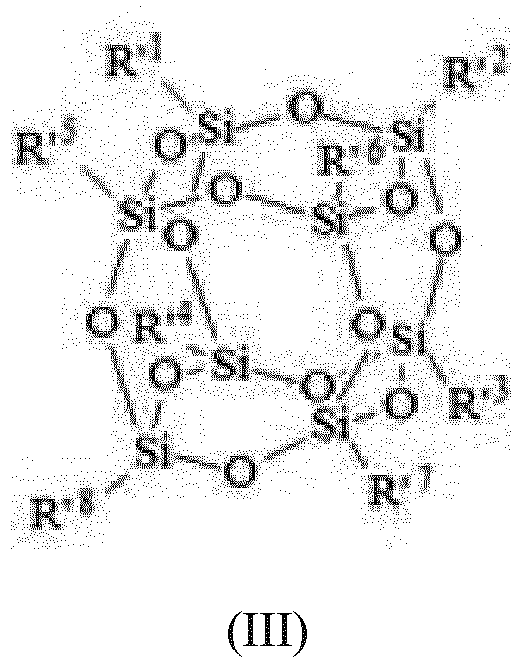
- a hydrogen atom,
- a radical selected among a linear or branched C1-C4 alkoxy, a linear or branched alkyl comprising from 1 to 30 carbon atoms, an alkenyl comprising from 2 to 30 carbon atoms, an aromatic radical comprising from 6 to 30 carbon atoms, an allyl radical comprising from 3 to 30 carbon atoms, a cyclic aliphatic radical comprising from 3 to 30 carbon atoms, an acyl radical comprising from 1 to 30 carbon atoms ; or
- a -OSiR'9R'10 group in which R'9 and R'10 represent a hydrogen atom, or a radical selected among a linear or branched C1-C4 alkyl, a linear or branched C1-C4 alkoxy, a C2-C4 alkenyl, a phenyl, a C3-C6 allyl radical, a C3-C8 cyclic aliphatic radical, a C1-C4 acyl radical ;
- The alkoxy modified silsesquioxanes (C) of formula (III) are known compounds which are described in particular in
WO 2008/107331 . - Preferably R'1 to R'8 in formula (III) represent a radical selected among methyl, methoxy or phenyl, provided that at least one of R'1 to R'8 is a methoxy, preferably at least two.
- According to a preferred embodiment, the content of silsesquioxane (C) comprised in the composition according to the invention varies from 11.3 to 24.5 % by weight.
- According to a more preferred embodiment, the composition according to the invention comprises polymer (B) and silsesquioxane (C) in weight % quantity such that the weight ratio (B)/[(B) + (C)] lies in the range from 10 to 35 %, preferably in the range from 15 to 30 %. In such an embodiment, (B) and (C) can be advantageously introduced during the preparation of the composition according to the invention, combined as a single composition already available as a premix.
- As an example of such a combination of (B) and (C), one may cite the commercial product Geniosil® XB502 from WACKER which comprises a mixture of:
- a methyl phenyl silsesquioxane (C) with methoxy endgroups and a number average molecular weight of about 800 g/mol, and
- a polymer (B) with a number average molecular weight of about 14000 g/mol and of formula (II) wherein p equals 1, R4 and R5 represent each a methyl, and the -[OR2]n- group derives from a polypropylene glycol ;
- According to a preferred embodiment, the moisture curable composition according to the invention comprises :
- from 40 to 60 % by weight of polymer (A) ;
- from 3.7 to 10.5 % by weight of polymer (B) ; and
- from 11.3 to 24.5 % by weight of silsesquioxane (C).
- According to a particularly preferred embodiment, the moisture curable composition according to the invention comprises, in addition to (A), (B) and (C), from about 10 to 20 % by weight of a polyether (D) which comprises at least one alkoxysily terminal group linked to the main polyether chain by a divalent group : -O-CO-NH-(CH2)3- in which -(CH2)3- is directly linked to the Si atom of the alkoxysily terminal group.
- According to a first embodiment, polyether (D) comprises 2 alkoxysilyl terminal groups and is of formula (IV) :

- Said polymer (D) is sometimes designated as γ-STPE (for Silyl Terminated PolyEther). It may also be obtained according to a process described in the document
EP2336208 of BOSTIK. - According to a more preferred embodiment, in formula (IV) R2 is an isopropylene divalent radical and R4 and R5 are each a methyl or an ethyl.
- Among the polymers of formula (IV) available to the market, one may cite GENIOSIL® STP-E35 (obtainable at Wacker) with a number average molecular weight of 32240 g/mol which comprises 2 terminal alkoxysilyl groups of formula : Si(OCH3)3 , which are linked through the group : -O-CO-NH-(CH2)3- to the main polyether chain.
- According to a second embodiment, which is preferred, polyether (D) comprises only one alkoxysilyl terminal group. As an example of such a polyether, one may cite Geniosil ® XM25 sold by Wacker, which is a monosilyl polymer with a number average molecular weight of about 6000 g/mol. It comprises a main chain of polyether type and a hydrolyzable propylene-methyldimethoxysilane end group.
- According to another preferred embodiment, the moisture curable composition according to the invention comprises a curing catalyst, which may be any catalyst known to a person skilled in the art for the condensation of silanol. Mention may be made, as examples of such catalysts, of amines or organometallic derivatives, and in particular organic derivatives of iron, titanium, aluminum, or divalent or tetravalent tin.
- Such compounds are commercially available, for example :
- from Evonik, such as TEGOKAT® 223, which is a catalyst based on dioctyl tin,
- from Dorf Ketal, such as TYZOR® 726, which is a catalyst based on an ethylacetoacetate titanium complex ; or
- from NITTO KASEI, such as NEOSTANN S-1, which is a catalyst based on the reaction product of silicic acid (H4SiO4) tetraethyl ester with bis(acetyloxy)dioctylstannane (CAS Number : 93925-43-0).
- Weight amounts of curing catalyst usually lie in the range 0.1 to 2 %.
- According to still a preferred embodiment, the moisture curable composition according to the invention comprises, as a fire retardant, a phosphate ester or a derivative of a phosphate ester, such as the tris(2-ethylhexyl) phosphate, in a weight amount ranging from 10 to 20 %. Such an embodiment is particularly appreciated for a use of the composition as a sealant for the transport industry, in particular for the equipment of trains, in order to protect passengers' safety in case of an accidental fire.
- According to still a preferred embodiment, the moisture curable composition according to the invention is transparent, with respect to both its uncured and cured form. In such a case, the sealing composition may comprise a filler, in an amount not exceeding 10 % by weight, which preferably consists of fumed silica. As an example of such a fumed silica, KONASIL K-D15 may be cited, which is commercially available from OCI company.
- Optionally, the moisture curable composition according to the invention can contain one or more additional ingredients, such as a moisture scavenger, an adhesion promoter or a UV stabilizer.
- It is preferable to monitor the moisture content of the composition according to the invention, so as to prevent immediate crosslinking of silylated polymers (A) and (B), and/or silsesquioxane (C), resulting in an increase in the viscosity of the composition during its storage. The moisture can be introduced into the composition by some of its ingredients.
- For this reason, the composition according to the invention can comprise one or more dehydrating agents (or moisture scavengers). Appropriate dehydrating agents are in particular alkoxysilanes, such as trialkoxysilanes (in particular trimethoxysilanes) and alkoxysilanes comprising an amino, mercapto or epoxy group. It is possible to give, as examples thereof, vinyltrimethoxysilane (or VTMO), γ-glycidyloxypropyltrimethoxysilane, N-(β-aminoethyl)-γ-aminopropyltrimethoxysilane, aminopropyltrimethoxysilane or trimethoxymethylsilane.
- Some of these compounds can also act as adhesion promoters, in particular the trialkoxysilanes comprising an amino, mercapto or epoxy group, such as [3-(2-aminoethyl)aminopropyl]trimethoxysilane (also designated as DAMO).
- At last, the composition according to the invention can also comprise a UV stabilizer such as Tinuvin® 384-2, which is commercially available from BASF.
- According to a preferred embodiment, the composition may comprise:
- from 0.1 to 2 % of moisture scavenger, and
- from 0.5 to 3 % of adhesion promoter.
- The moisture curable composition according to the invention can be prepared by mixing the silylated polymer(s) (A) and (B), and the silsesquioxane (C) at a temperature ranging from 10°C to 40°C and at a relative humidity ranging from 0.1% to 50%. If a catalyst is present, it is preferably added in a second step, after the silylated polymers and the fillers (when present) have been mixed. The other additives are introduced in accordance with the usual practice.
- As mentioned previously, and according to a preferred embodiment, polymer (B) and silsesquioxane (C) are introduced during the composition preparation combined as a single composition such that the weight ratio (B)/[(B) + (C)] lies in the range from 10 to 35 %.
- The present invention also relates to the use of the moisture curable silylated composition according to the invention, as an adhesive, sealant and/or coating material, preferably to its use for assembling metallic substrates and/or filling gaps between them, more preferably for aluminium substrates.
- According to an embodiment, the use according to the invention is for assembling vent pipes, due to be included in the air conditioner systems for high-speed trains.
- The following examples are given purely to illustrate the invention, but should not be interpreted as limiting its scope.
- The composition of example 1 is prepared by mixing, as disclosed previously, the ingredients pointed out in Table 1 ; polymer (B) and silsesquioxane (C) are introduced in the mixture as the commercial premix Geniosil® XB502. After its preparation, the composition is stored into a sealed cartridge, then is submitted to the following tests.
- Viscosity of the composition was determined at 23°C using a standard rheometer equipped with a plate of 25 mm diameter as measuring device, and running at a shear rate of 5.0 s-1. A result comprised between 20 and 50 Pa.s was found.
- Skinning time for the composition was tested in a conditioned room (at 23°C and 50% of Relative Humidity), by first applying a strip of the composition on a substrate (for instance aluminium) and then using a finger to touch the surface of the composition every 5 minutes, to check if surface is skinned. The time needed for a skin to be formed is recorded. A result comprised between 20 and 30 minutes was obtained.
- Use is made of a sample of a polyurethane foam board 10 mm thick, which is coated on both sides by an aluminium foil of 0.5 mm thickness.
- The aluminium foil surface of the sample is cleaned from grease or dust by ethanol and then allowed to stand for 15 minutes for full evaporation of the solvent.
- A bead of the composition is applied from the cartridge on the cleaned aluminium foil of the sample, then scraped from one side to the other side by a spatula, in order to form a strip of around 10 cm length, 2 cm width and 2-3 mm thickness.
- The coated sample is left for curing in a conditioned room (at 23°C and 50% of Relative Humidity) during 7 days, in order to form a strip of cured composition (adhesive joint) which adheres to the aluminium foil.
- Then the failure mode of said strip is determined in a manual way, trying to insert a spatula between said strip and the aluminium foil substrate, in order to peel said strip off the aluminium foil.
- It was not possible to peel said strip off the aluminium foil, because the strip itself broke apart, and the resulting remaining pieces were still sticking to the aluminium foil substrate.
- The result of the failure mode was therefore determined as being 100 % cohesive failure and noted 100% CF in Table 1.
- This result shows the excellent adhesion of the cured composition to aluminium.
- The preceding determination was repeated except that, after curing for 7 days, the coated substrate was immersed in water during 7 days and then allowed to stay at room conditions for 30 minutes before proceeding to the determination of the failure mode.
- The result of said failure mode was also determined as being 100 % cohesive failure and noted 100% CF in Table 1.
- This result shows that in addition to the excellent adhesion of the cured composition to aluminium, there is also an excellent adhesion to aluminium, for said cured composition after being exposed to water.
- Example 1 is repeated with the compositions shown in Table 1, namely without Geniosil ® XM25. The same tests as for example 1 were then implemented.
- Same results for viscosity and skinning time were obtained.
- Same results as for Example 1 were obtained, as pointed out in Table 1.
- When one tried to insert the spatula between the strip of cured composition and the aluminium foil substrate, it was found that said strip could be easily peeled off and that there were no remaining pieces sticking to the aluminium foil substrate.
- The result of the failure mode was therefore determined as being 100 % adhesive failure and noted 100% AF in Table 1.
- Example 1 is repeated with the compositions A, B and C shown in Table 1.
- The same tests as for example 1 were then implemented.
- Similar results for viscosity and skinning time were obtained.
- When one tried to insert the spatula between the strip of cured composition and the aluminium foil substrate, it was found that said strip could be easily peeled off and that there were no remaining pieces sticking to the aluminium foil substrate.
- The result of the failure mode was therefore determined as being 100 % adhesive failure and noted 100% AF in Table 1.
- The result of the failure mode was also determined as being 100 % adhesive failure and noted 100% AF in Table 1.
Table 1 Ingredient Content in % (weight/weight) Name Structure / Function Ex. 1 Ex. 2 Ex. 3 Ex. A (comp.) Ex. B (comp.) Ex. C (comp.) SPUR+ 1015 LM polymer (A) (SPUR) 41 57.4 41 73.8 57.4 41 Geniosil® XB502 Premix of Polymer (B) (α-STPE ) and silsesquioxane (C) 16.4 16.4 32.8 - - - Geniosil ® XM25 polyether (D) (y-STPE) 16.4 - - - 16.4 32.8 NEOSTANN S-1 curing catalyst 0.3 0.3 0.3 0.3 0.3 0.3 Tris(2-ethylhexyl) phosphate fire retardant agent 16.4 16.4 16.4 16.4 16.4 16.4 KONASIL K-D15 fumed silica / filler 6.6 6.6 6.6 6.6 6.6 6.6 VTMO moisture scavenger 0.8 0.8 0.8 0.8 0.8 0.8 DAMO adhesion promoter 1.3 1.3 1.3 1.3 1.3 1.3 Tinuvin® 384-2 UV stabilizer 0.8 0.8 0.8 0.8 0.8 0.8 Tests Results Failure mode of the cured composition adhering to an aluminium substrate 100% CF 100% CF 100% CF 100% AF 100% AF 100% AF Failure mode of the cured composition adhering to an aluminium substrate, after being in contact with water during 7 days 100% CF 100% AF 100% AF 100% AF 100% AF 100% AF
Claims (14)
- Moisture curable silylated composition characterized in that it comprises, on the basis of the total weight of said composition :- from 35 to 65 % by weight of a polymer (A) comprising at least 2 alkoxysilyl terminal groups of formula (I) :
 - R1 represents a hydrocarbon-based divalent radical comprising from 5 to 15 carbon atoms which may be aromatic or aliphatic, linear, branched or cyclic,- R2 represents a linear or branched alkylene divalent radical comprising from 2 to 4 carbon atoms,- R3 represents a linear or branched alkylene divalent radical comprising from 1 to 6 carbon atoms,- R4 and R5, which are identical or different, each represent a linear or branched alkyl radical having 1 to 4 carbon atoms, with the possibility, when there are several R4 (or R5) radicals, that these are identical or different,- R6 represents a hydrogen atom or a radical comprising 1 to 6 carbon atoms which may be aromatic or aliphatic, linear, branched or cyclic, or a radical selected among the radicals :- of formula (Ia) :
 - of formula (Ib) :
 - of formula (Ic) :
 - n is an integer such that the average molecular weight of the polyether block of formula -[OR2]n- is between 300 g/mole and 40000 g/mole,- m is an integer different from 0 such that the average molecular weight of the polymer (A) is between 500 g/mole and 50000 g/mole, and- p is an integer equal to 0, 1 or 2 ;- from 2.5 to 12 % by weight of a polymer (B) comprising at least 2 alkoxysilyl terminal groups of formula (II) :
 - from 7.5 to 28 % by weight of an alkoxy modified silsesquioxane (C).
 - Moisture curable silylated composition according to claim 1, characterized in that polymer (A) is such that :- R1 is chosen from one of the following divalent radicals, the formulae of which below show the 2 free valences:- a) the divalent radical derived from isophorone diisocyanate (IPDI) :
 - b) the divalent radical derived from methylenebis(cyclohexyl isocyanate) (HMDI) :
 - c) the divalent radical derived from tolylene diisocyanate (TDI) :
 - d) the divalent radical derived from diphenylmethane diisocyanate (MDI) :
 - e) the divalent radical derived from hexamethylene diisocyanate (HDI) :
-(CH2)6- ;
- f) the radical divalent derived from m-xylylene diisocyanate (XDI) : - R2 is the ethylene and/or isopropylene divalent radical;- R3 is the methylene and/or n-propylene divalent radical; and- R4 and R5 each represent the methyl or ethyl radical ; and- R6 represents a hydrogen atom ; a phenyl radical ; a linear, branched or cyclic alkyl radical comprising from 1 to 6 carbon atoms.
 - Moisture curable silylated composition according to either claims 1 or 2, characterized in that polymer (B) is such that in formula (II) R2 is an isopropylene divalent radical and R4 and R5 are each a methyl or an ethyl.
- Moisture curable silylated composition according to any of claims 1 to 3, characterized in that the alkoxy modified silsesquioxane (C) is of formula (III):
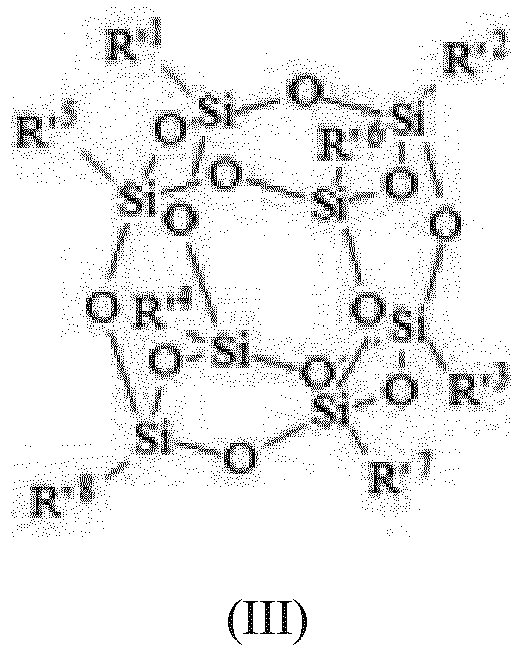 - a hydrogen atom,- a radical selected among a linear or branched C1-C4 alkoxy, a linear or branched alkyl comprising from 1 to 30 carbon atoms, an alkenyl comprising from 2 to 30 carbon atoms, an aromatic radical comprising from 6 to 30 carbon atoms, an allyl radical comprising from 3 to 30 carbon atoms, a cyclic aliphatic radical comprising from 3 to 30 carbon atoms, an acyl radical comprising from 1 to 30 carbon atoms ; or- a -OSiR'9R'10 group in which R'9 and R'10 represent a hydrogen atom, or a radical selected among a linear or branched C1-C4 alkyl, a linear or branched C1-C4 alkoxy, a C2-C4 alkenyl, a phenyl, a C3-C6 allyl radical, a C3-C8 cyclic aliphatic radical, a C1-C4 acyl radical ;provided that at least one of R'1 to R'8 is a C1-C4 alkoxy radical, preferably at least two.
 - Moisture curable silylated composition according to claim 4, characterized in that R'1 to R'8 in formula (III) represent a radical selected among methyl, methoxy or phenyl, provided that at least one of R'1 to R'8 is a methoxy, preferably at least two.
- Moisture curable silylated composition according to any of claims 1 to 5, characterized in that it comprises polymer (B) and silsesquioxane (C) in weight % quantity such that the weight ratio (B)/[(B) + (C)] lies in the range from 10 to 35 %.
- Moisture curable silylated composition according to any of claims 1 to 6, characterized in that it comprises :- from 40 to 60 % by weight of polymer (A) ;- from 3.7 to 10.5 % by weight of polymer (B) ; and- from 11.3 to 24.5 % by weight of silsesquioxane (C).
- Moisture curable silylated composition according to any of claims 1 to 7, characterized in that it comprises, in addition to (A), (B) and (C), from about 10 to 20 % by weight of a polyether (D) which comprises at least one alkoxysilyl terminal group linked to the main polyether chain by a divalent group : -O-CO-NH-(CH2)3- in which -(CH2)3- is directly linked to the Si atom of the alkoxysilyl terminal group.
- Moisture curable silylated composition according claim 8, characterized in that polyether (D) comprises 2 alkoxysilyl terminal groups and is of formula (IV) :

- Moisture curable silylated composition according claim 9, characterized in that in formula (IV) R2 is an isopropylene divalent radical and R4 and R5 are each a methyl or an ethyl.
- Moisture curable silylated composition according claim 8, characterized in that polyether (D) comprises only one alkoxysilyl terminal group.
- Use of the moisture curable silylated composition such as defined in any of claims 1 to 11 as an adhesive, sealant and/or coating material.
- Use according to claim 12 for assembling metallic substrates and/or filling gaps between them.
- Use according to claim 13, characterized in that the metallic substrates are aluminium substrates.
Applications Claiming Priority (2)
| Application Number | Priority Date | Filing Date | Title |
|---|---|---|---|
| EP20161825.3A EP3878909A1 (en) | 2020-03-09 | 2020-03-09 | Silylated sealing composition with improved adhesion on metallic substrates |
| PCT/EP2021/054984 WO2021180497A1 (en) | 2020-03-09 | 2021-03-01 | Silylated sealing composition with improved adhesion on metallic substrates |
Publications (3)
| Publication Number | Publication Date |
|---|---|
| EP4118146A1 EP4118146A1 (en) | 2023-01-18 |
| EP4118146B1 true EP4118146B1 (en) | 2025-05-14 |
| EP4118146C0 EP4118146C0 (en) | 2025-05-14 |
Family
ID=69784183
Family Applications (2)
| Application Number | Title | Priority Date | Filing Date |
|---|---|---|---|
| EP20161825.3A Withdrawn EP3878909A1 (en) | 2020-03-09 | 2020-03-09 | Silylated sealing composition with improved adhesion on metallic substrates |
| EP21707722.1A Active EP4118146B1 (en) | 2020-03-09 | 2021-03-01 | Silylated sealing composition with improved adhesion on metallic substrates |
Family Applications Before (1)
| Application Number | Title | Priority Date | Filing Date |
|---|---|---|---|
| EP20161825.3A Withdrawn EP3878909A1 (en) | 2020-03-09 | 2020-03-09 | Silylated sealing composition with improved adhesion on metallic substrates |
Country Status (5)
| Country | Link |
|---|---|
| US (1) | US20240191034A1 (en) |
| EP (2) | EP3878909A1 (en) |
| JP (1) | JP7749573B2 (en) |
| CN (1) | CN115244132A (en) |
| WO (1) | WO2021180497A1 (en) |
Families Citing this family (4)
| Publication number | Priority date | Publication date | Assignee | Title |
|---|---|---|---|---|
| EP4279555A1 (en) | 2022-05-19 | 2023-11-22 | Bostik SA | Moisture curable composition |
| EP4339217A1 (en) * | 2022-09-13 | 2024-03-20 | Henkel AG & Co. KGaA | Curable silicone compositions containing additives |
| CN117209746B (en) * | 2023-10-15 | 2025-07-04 | 江西蓝星星火有机硅有限公司 | Silane end capped polyether resin and preparation method and application thereof |
| WO2025184408A1 (en) * | 2024-02-29 | 2025-09-04 | Energizer Auto, Inc. | Polish and sealant compositions |
Citations (3)
| Publication number | Priority date | Publication date | Assignee | Title |
|---|---|---|---|---|
| WO2018215463A1 (en) | 2017-05-23 | 2018-11-29 | Bostik Sa | Low modulus silylated mastic composition |
| WO2019126246A1 (en) | 2017-12-22 | 2019-06-27 | Henkel IP & Holding GmbH | Silane-terminated polyurethane crosslinking polymer for high tensile strength adhesive |
| US20190315917A1 (en) | 2016-06-28 | 2019-10-17 | Wacker Chemie Ag | Crosslinkable materials based on organyloxysilane-terminated polymers |
Family Cites Families (6)
| Publication number | Priority date | Publication date | Assignee | Title |
|---|---|---|---|---|
| ATE367960T1 (en) | 2004-11-16 | 2007-08-15 | Bostik Sa | METHOD FOR SEALING SHIP DECKS |
| DE102007010544A1 (en) | 2007-03-05 | 2008-09-11 | Wacker Chemie Ag | Layers of heterosubstituted silsesquioxanes |
| FR2954341B1 (en) | 2009-12-21 | 2014-07-11 | Bostik Sa | ADHESIVE COMPOSITION RETICULABLE BY HEATING |
| CA2865518C (en) | 2012-03-12 | 2020-01-28 | Bostik Sa | Breathable self-adhesive articles |
| US20140058030A1 (en) | 2012-08-23 | 2014-02-27 | Bayer Materialscience Llc | Silane-terminated polyurethane and rubber composite materials |
| FR3035662B1 (en) * | 2015-04-28 | 2017-05-12 | Bostik Sa | USE OF A COMPOSITION BASED ON SILYLATED POLYMERS AS A JOINT MORTAR FOR SURFACE COATING |
-
2020
- 2020-03-09 EP EP20161825.3A patent/EP3878909A1/en not_active Withdrawn
-
2021
- 2021-03-01 WO PCT/EP2021/054984 patent/WO2021180497A1/en not_active Ceased
- 2021-03-01 CN CN202180019528.1A patent/CN115244132A/en active Pending
- 2021-03-01 EP EP21707722.1A patent/EP4118146B1/en active Active
- 2021-03-01 JP JP2022554236A patent/JP7749573B2/en active Active
- 2021-03-01 US US17/905,776 patent/US20240191034A1/en active Pending
Patent Citations (3)
| Publication number | Priority date | Publication date | Assignee | Title |
|---|---|---|---|---|
| US20190315917A1 (en) | 2016-06-28 | 2019-10-17 | Wacker Chemie Ag | Crosslinkable materials based on organyloxysilane-terminated polymers |
| WO2018215463A1 (en) | 2017-05-23 | 2018-11-29 | Bostik Sa | Low modulus silylated mastic composition |
| WO2019126246A1 (en) | 2017-12-22 | 2019-06-27 | Henkel IP & Holding GmbH | Silane-terminated polyurethane crosslinking polymer for high tensile strength adhesive |
Non-Patent Citations (3)
| Title |
|---|
| ANONYMOUS: "Elastic Bonding of Construction Materials - Silane Modified Polymers for Sealants and Adhesives in the Highest Quality", WACKER, 1 January 2018 (2018-01-01), XP093370199 |
| ANONYMOUS: "WACKER Presents Silane-Terminated Polymers for Flexible and Elastic Sealants and Adhesives and Dispersions for Packaging Adhesives", WACKER, 4 April 2017 (2017-04-04), XP093370205, Retrieved from the Internet <URL:https://www.wacker.com/cms/en-us/press-and-media/press/press-releases/2017/detail-79810.html> |
| ZANDER ET AL., (2018), GOOD ADHESION, LOW MODULUS NEW SILAN-TERMINATED POLYMERS, ADHESION ADHESIVES+SEALANTS, EXTRA (PUBLISHED IN 2018) |
Also Published As
| Publication number | Publication date |
|---|---|
| WO2021180497A1 (en) | 2021-09-16 |
| JP2023517322A (en) | 2023-04-25 |
| US20240191034A1 (en) | 2024-06-13 |
| JP7749573B2 (en) | 2025-10-06 |
| CN115244132A (en) | 2022-10-25 |
| EP3878909A1 (en) | 2021-09-15 |
| EP4118146C0 (en) | 2025-05-14 |
| EP4118146A1 (en) | 2023-01-18 |
Similar Documents
| Publication | Publication Date | Title |
|---|---|---|
| EP4118146B1 (en) | Silylated sealing composition with improved adhesion on metallic substrates | |
| RU2420554C2 (en) | Single-component anhydrous coating composition for sealing building structures and flat roofs | |
| US20090318599A1 (en) | Sealing composition, a method for preparing a sealing composition and the use of such a sealing composition | |
| EP1940963B1 (en) | Silane-containing adhesion promoter composition and sealants, adhesives and coatings containing same | |
| JP7221278B2 (en) | Compositions based on silane-terminated polymers with improved adhesion to thermoplastics | |
| DK2640773T3 (en) | Fast curing mass with good adhesive properties | |
| US5464888A (en) | Curable sealer and/or adhesive composition, and a method for coating same in a wet state with a base coat paint, and coated substrates formed thereby | |
| CA2487188C (en) | Moisture curable sealer and adhesive composition | |
| RU2355724C1 (en) | Humid-hardening composition with enhanced elasticity | |
| EP2055753B1 (en) | Method of joining wood elements using a moisture sealant adhesive | |
| AU2016383097B2 (en) | Liquid composition for a waterproofing membrane | |
| JP2026040507A (en) | Silane-functional polymer-based compositions with improved topcoatability | |
| CN109804010B (en) | Stabilizers for adhesive, sealant and coating compositions | |
| KR101873610B1 (en) | Method for laying parquet flooring with improved dimensional stability | |
| US20220119593A1 (en) | Multi-component crosslinkable masses based on organyloxysilane-terminated polymers | |
| EP0576248B1 (en) | Water reducible silicone weatherstrip coating | |
| CN101384681A (en) | One-component anhydrous coating composition for sealing constructed structures and flat roofs | |
| JPH01185377A (en) | Vinyl chloride sealant composition | |
| EP4663674A1 (en) | Curable silane-terminated polymer composition with reactive plasticizer | |
| EP4279555A1 (en) | Moisture curable composition |
Legal Events
| Date | Code | Title | Description |
|---|---|---|---|
| STAA | Information on the status of an ep patent application or granted ep patent |
Free format text: STATUS: UNKNOWN |
|
| STAA | Information on the status of an ep patent application or granted ep patent |
Free format text: STATUS: THE INTERNATIONAL PUBLICATION HAS BEEN MADE |
|
| PUAI | Public reference made under article 153(3) epc to a published international application that has entered the european phase |
Free format text: ORIGINAL CODE: 0009012 |
|
| STAA | Information on the status of an ep patent application or granted ep patent |
Free format text: STATUS: REQUEST FOR EXAMINATION WAS MADE |
|
| 17P | Request for examination filed |
Effective date: 20220914 |
|
| AK | Designated contracting states |
Kind code of ref document: A1 Designated state(s): AL AT BE BG CH CY CZ DE DK EE ES FI FR GB GR HR HU IE IS IT LI LT LU LV MC MK MT NL NO PL PT RO RS SE SI SK SM TR |
|
| DAV | Request for validation of the european patent (deleted) | ||
| DAX | Request for extension of the european patent (deleted) | ||
| GRAP | Despatch of communication of intention to grant a patent |
Free format text: ORIGINAL CODE: EPIDOSNIGR1 |
|
| STAA | Information on the status of an ep patent application or granted ep patent |
Free format text: STATUS: GRANT OF PATENT IS INTENDED |
|
| INTG | Intention to grant announced |
Effective date: 20240819 |
|
| GRAJ | Information related to disapproval of communication of intention to grant by the applicant or resumption of examination proceedings by the epo deleted |
Free format text: ORIGINAL CODE: EPIDOSDIGR1 |
|
| STAA | Information on the status of an ep patent application or granted ep patent |
Free format text: STATUS: REQUEST FOR EXAMINATION WAS MADE |
|
| GRAP | Despatch of communication of intention to grant a patent |
Free format text: ORIGINAL CODE: EPIDOSNIGR1 |
|
| INTC | Intention to grant announced (deleted) | ||
| STAA | Information on the status of an ep patent application or granted ep patent |
Free format text: STATUS: GRANT OF PATENT IS INTENDED |
|
| INTG | Intention to grant announced |
Effective date: 20250123 |
|
| GRAS | Grant fee paid |
Free format text: ORIGINAL CODE: EPIDOSNIGR3 |
|
| GRAA | (expected) grant |
Free format text: ORIGINAL CODE: 0009210 |
|
| STAA | Information on the status of an ep patent application or granted ep patent |
Free format text: STATUS: THE PATENT HAS BEEN GRANTED |
|
| RAP3 | Party data changed (applicant data changed or rights of an application transferred) |
Owner name: BOSTIK SA |
|
| AK | Designated contracting states |
Kind code of ref document: B1 Designated state(s): AL AT BE BG CH CY CZ DE DK EE ES FI FR GB GR HR HU IE IS IT LI LT LU LV MC MK MT NL NO PL PT RO RS SE SI SK SM TR |
|
| REG | Reference to a national code |
Ref country code: GB Ref legal event code: FG4D |
|
| REG | Reference to a national code |
Ref country code: CH Ref legal event code: EP |
|
| RAP4 | Party data changed (patent owner data changed or rights of a patent transferred) |
Owner name: BOSTIK SA |
|
| REG | Reference to a national code |
Ref country code: DE Ref legal event code: R096 Ref document number: 602021030746 Country of ref document: DE |
|
| REG | Reference to a national code |
Ref country code: IE Ref legal event code: FG4D |
|
| U01 | Request for unitary effect filed |
Effective date: 20250522 |
|
| U07 | Unitary effect registered |
Designated state(s): AT BE BG DE DK EE FI FR IT LT LU LV MT NL PT RO SE SI Effective date: 20250602 |
|
| PG25 | Lapsed in a contracting state [announced via postgrant information from national office to epo] |
Ref country code: ES Free format text: LAPSE BECAUSE OF FAILURE TO SUBMIT A TRANSLATION OF THE DESCRIPTION OR TO PAY THE FEE WITHIN THE PRESCRIBED TIME-LIMIT Effective date: 20250514 |
|
| PG25 | Lapsed in a contracting state [announced via postgrant information from national office to epo] |
Ref country code: NO Free format text: LAPSE BECAUSE OF FAILURE TO SUBMIT A TRANSLATION OF THE DESCRIPTION OR TO PAY THE FEE WITHIN THE PRESCRIBED TIME-LIMIT Effective date: 20250814 |
|
| PG25 | Lapsed in a contracting state [announced via postgrant information from national office to epo] |
Ref country code: PL Free format text: LAPSE BECAUSE OF FAILURE TO SUBMIT A TRANSLATION OF THE DESCRIPTION OR TO PAY THE FEE WITHIN THE PRESCRIBED TIME-LIMIT Effective date: 20250514 |
|
| PG25 | Lapsed in a contracting state [announced via postgrant information from national office to epo] |
Ref country code: HR Free format text: LAPSE BECAUSE OF FAILURE TO SUBMIT A TRANSLATION OF THE DESCRIPTION OR TO PAY THE FEE WITHIN THE PRESCRIBED TIME-LIMIT Effective date: 20250514 |
|
| PG25 | Lapsed in a contracting state [announced via postgrant information from national office to epo] |
Ref country code: RS Free format text: LAPSE BECAUSE OF FAILURE TO SUBMIT A TRANSLATION OF THE DESCRIPTION OR TO PAY THE FEE WITHIN THE PRESCRIBED TIME-LIMIT Effective date: 20250814 |
|
| PG25 | Lapsed in a contracting state [announced via postgrant information from national office to epo] |
Ref country code: IS Free format text: LAPSE BECAUSE OF FAILURE TO SUBMIT A TRANSLATION OF THE DESCRIPTION OR TO PAY THE FEE WITHIN THE PRESCRIBED TIME-LIMIT Effective date: 20250914 |
|
| PG25 | Lapsed in a contracting state [announced via postgrant information from national office to epo] |
Ref country code: SM Free format text: LAPSE BECAUSE OF FAILURE TO SUBMIT A TRANSLATION OF THE DESCRIPTION OR TO PAY THE FEE WITHIN THE PRESCRIBED TIME-LIMIT Effective date: 20250514 |
|
| PG25 | Lapsed in a contracting state [announced via postgrant information from national office to epo] |
Ref country code: CZ Free format text: LAPSE BECAUSE OF FAILURE TO SUBMIT A TRANSLATION OF THE DESCRIPTION OR TO PAY THE FEE WITHIN THE PRESCRIBED TIME-LIMIT Effective date: 20250514 |
|
| PG25 | Lapsed in a contracting state [announced via postgrant information from national office to epo] |
Ref country code: SK Free format text: LAPSE BECAUSE OF FAILURE TO SUBMIT A TRANSLATION OF THE DESCRIPTION OR TO PAY THE FEE WITHIN THE PRESCRIBED TIME-LIMIT Effective date: 20250514 |
|
| PLBI | Opposition filed |
Free format text: ORIGINAL CODE: 0009260 |
|
| REG | Reference to a national code |
Ref country code: CH Ref legal event code: L10 Free format text: ST27 STATUS EVENT CODE: U-0-0-L10-L00 (AS PROVIDED BY THE NATIONAL OFFICE) Effective date: 20260225 |
|
| PLAX | Notice of opposition and request to file observation + time limit sent |
Free format text: ORIGINAL CODE: EPIDOSNOBS2 |
|
| U20 | Renewal fee for the european patent with unitary effect paid |
Year of fee payment: 6 Effective date: 20260209 |
|
| 26 | Opposition filed |
Opponent name: HENKEL AG & CO. KGAA Effective date: 20260213 |