EP4117086A1 - Phosphate ester heat transfer fluids for immersion cooling system - Google Patents
Phosphate ester heat transfer fluids for immersion cooling system Download PDFInfo
- Publication number
- EP4117086A1 EP4117086A1 EP21191198.7A EP21191198A EP4117086A1 EP 4117086 A1 EP4117086 A1 EP 4117086A1 EP 21191198 A EP21191198 A EP 21191198A EP 4117086 A1 EP4117086 A1 EP 4117086A1
- Authority
- EP
- European Patent Office
- Prior art keywords
- heat transfer
- transfer fluid
- reservoir
- alkyl
- circulating
- Prior art date
- Legal status (The legal status is an assumption and is not a legal conclusion. Google has not performed a legal analysis and makes no representation as to the accuracy of the status listed.)
- Pending
Links
- 238000001816 cooling Methods 0.000 title claims abstract description 56
- -1 Phosphate ester Chemical class 0.000 title claims abstract description 49
- 238000007654 immersion Methods 0.000 title claims abstract description 35
- 229910019142 PO4 Inorganic materials 0.000 title claims abstract description 21
- 239000010452 phosphate Substances 0.000 title claims abstract description 20
- 239000012530 fluid Substances 0.000 title description 13
- 239000013529 heat transfer fluid Substances 0.000 claims abstract description 85
- 125000000217 alkyl group Chemical group 0.000 claims abstract description 39
- 125000001997 phenyl group Chemical group [H]C1=C([H])C([H])=C(*)C([H])=C1[H] 0.000 claims description 28
- 238000000034 method Methods 0.000 claims description 20
- 125000004400 (C1-C12) alkyl group Chemical group 0.000 claims description 4
- 238000005086 pumping Methods 0.000 claims 1
- 239000000203 mixture Substances 0.000 abstract description 9
- 125000003118 aryl group Chemical group 0.000 abstract description 3
- 230000002349 favourable effect Effects 0.000 abstract description 2
- 235000021317 phosphate Nutrition 0.000 description 17
- 239000000654 additive Substances 0.000 description 10
- 210000004027 cell Anatomy 0.000 description 7
- 150000003014 phosphoric acid esters Chemical class 0.000 description 7
- LYCAIKOWRPUZTN-UHFFFAOYSA-N Ethylene glycol Chemical compound OCCO LYCAIKOWRPUZTN-UHFFFAOYSA-N 0.000 description 6
- 230000000052 comparative effect Effects 0.000 description 6
- 239000007788 liquid Substances 0.000 description 6
- 239000002826 coolant Substances 0.000 description 5
- WVLBCYQITXONBZ-UHFFFAOYSA-N trimethyl phosphate Chemical compound COP(=O)(OC)OC WVLBCYQITXONBZ-UHFFFAOYSA-N 0.000 description 4
- RXPQRKFMDQNODS-UHFFFAOYSA-N tripropyl phosphate Chemical compound CCCOP(=O)(OCCC)OCCC RXPQRKFMDQNODS-UHFFFAOYSA-N 0.000 description 4
- 230000029936 alkylation Effects 0.000 description 3
- 238000005804 alkylation reaction Methods 0.000 description 3
- 238000007599 discharging Methods 0.000 description 3
- WGCNASOHLSPBMP-UHFFFAOYSA-N hydroxyacetaldehyde Natural products OCC=O WGCNASOHLSPBMP-UHFFFAOYSA-N 0.000 description 3
- 238000011068 loading method Methods 0.000 description 3
- XLYOFNOQVPJJNP-UHFFFAOYSA-N water Substances O XLYOFNOQVPJJNP-UHFFFAOYSA-N 0.000 description 3
- 125000006176 2-ethylbutyl group Chemical group [H]C([H])([H])C([H])([H])C([H])(C([H])([H])*)C([H])([H])C([H])([H])[H] 0.000 description 2
- 125000005916 2-methylpentyl group Chemical group 0.000 description 2
- CGSLYBDCEGBZCG-UHFFFAOYSA-N Octicizer Chemical compound C=1C=CC=CC=1OP(=O)(OCC(CC)CCCC)OC1=CC=CC=C1 CGSLYBDCEGBZCG-UHFFFAOYSA-N 0.000 description 2
- 239000002199 base oil Substances 0.000 description 2
- 125000004432 carbon atom Chemical group C* 0.000 description 2
- 238000010586 diagram Methods 0.000 description 2
- 125000001495 ethyl group Chemical group [H]C([H])([H])C([H])([H])* 0.000 description 2
- 239000003112 inhibitor Substances 0.000 description 2
- 125000002496 methyl group Chemical group [H]C([H])([H])* 0.000 description 2
- 125000004108 n-butyl group Chemical group [H]C([H])([H])C([H])([H])C([H])([H])C([H])([H])* 0.000 description 2
- 125000001280 n-hexyl group Chemical group C(CCCCC)* 0.000 description 2
- 125000004123 n-propyl group Chemical group [H]C([H])([H])C([H])([H])C([H])([H])* 0.000 description 2
- 238000006467 substitution reaction Methods 0.000 description 2
- STCOOQWBFONSKY-UHFFFAOYSA-N tributyl phosphate Chemical compound CCCCOP(=O)(OCCCC)OCCCC STCOOQWBFONSKY-UHFFFAOYSA-N 0.000 description 2
- OXFUXNFMHFCELM-UHFFFAOYSA-N tripropan-2-yl phosphate Chemical compound CC(C)OP(=O)(OC(C)C)OC(C)C OXFUXNFMHFCELM-UHFFFAOYSA-N 0.000 description 2
- FXNDIJDIPNCZQJ-UHFFFAOYSA-N 2,4,4-trimethylpent-1-ene Chemical group CC(=C)CC(C)(C)C FXNDIJDIPNCZQJ-UHFFFAOYSA-N 0.000 description 1
- 125000004493 2-methylbut-1-yl group Chemical group CC(C*)CC 0.000 description 1
- HBBGRARXTFLTSG-UHFFFAOYSA-N Lithium ion Chemical compound [Li+] HBBGRARXTFLTSG-UHFFFAOYSA-N 0.000 description 1
- QQONPFPTGQHPMA-UHFFFAOYSA-N Propene Chemical compound CC=C QQONPFPTGQHPMA-UHFFFAOYSA-N 0.000 description 1
- 238000004378 air conditioning Methods 0.000 description 1
- 150000001336 alkenes Chemical class 0.000 description 1
- 229940100198 alkylating agent Drugs 0.000 description 1
- 239000002168 alkylating agent Substances 0.000 description 1
- 239000003963 antioxidant agent Substances 0.000 description 1
- 239000003990 capacitor Substances 0.000 description 1
- 210000002421 cell wall Anatomy 0.000 description 1
- 150000001875 compounds Chemical class 0.000 description 1
- 239000012809 cooling fluid Substances 0.000 description 1
- 238000005260 corrosion Methods 0.000 description 1
- 230000007797 corrosion Effects 0.000 description 1
- 238000005336 cracking Methods 0.000 description 1
- 150000002148 esters Chemical class 0.000 description 1
- 230000009969 flowable effect Effects 0.000 description 1
- 239000006260 foam Substances 0.000 description 1
- 239000000446 fuel Substances 0.000 description 1
- 238000010438 heat treatment Methods 0.000 description 1
- 125000000959 isobutyl group Chemical group [H]C([H])([H])C([H])(C([H])([H])[H])C([H])([H])* 0.000 description 1
- 125000001972 isopentyl group Chemical group [H]C([H])([H])C([H])(C([H])([H])[H])C([H])([H])C([H])([H])* 0.000 description 1
- 125000001449 isopropyl group Chemical group [H]C([H])([H])C([H])(*)C([H])([H])[H] 0.000 description 1
- 229910001416 lithium ion Inorganic materials 0.000 description 1
- 239000006078 metal deactivator Substances 0.000 description 1
- 239000002480 mineral oil Substances 0.000 description 1
- 125000003136 n-heptyl group Chemical group [H]C([H])([H])C([H])([H])C([H])([H])C([H])([H])C([H])([H])C([H])([H])C([H])([H])* 0.000 description 1
- 125000000740 n-pentyl group Chemical group [H]C([H])([H])C([H])([H])C([H])([H])C([H])([H])C([H])([H])* 0.000 description 1
- 125000001147 pentyl group Chemical group C(CCCC)* 0.000 description 1
- 150000003013 phosphoric acid derivatives Chemical class 0.000 description 1
- 230000000704 physical effect Effects 0.000 description 1
- 229920013639 polyalphaolefin Polymers 0.000 description 1
- 238000005057 refrigeration Methods 0.000 description 1
- 125000002914 sec-butyl group Chemical group [H]C([H])([H])C([H])([H])C([H])(*)C([H])([H])[H] 0.000 description 1
- 239000007921 spray Substances 0.000 description 1
- 125000000999 tert-butyl group Chemical group [H]C([H])([H])C(*)(C([H])([H])[H])C([H])([H])[H] 0.000 description 1
- 125000001973 tert-pentyl group Chemical group [H]C([H])([H])C([H])([H])C(*)(C([H])([H])[H])C([H])([H])[H] 0.000 description 1
Images


Classifications
-
- H—ELECTRICITY
- H01—ELECTRIC ELEMENTS
- H01M—PROCESSES OR MEANS, e.g. BATTERIES, FOR THE DIRECT CONVERSION OF CHEMICAL ENERGY INTO ELECTRICAL ENERGY
- H01M10/00—Secondary cells; Manufacture thereof
- H01M10/60—Heating or cooling; Temperature control
- H01M10/62—Heating or cooling; Temperature control specially adapted for specific applications
- H01M10/625—Vehicles
-
- C—CHEMISTRY; METALLURGY
- C09—DYES; PAINTS; POLISHES; NATURAL RESINS; ADHESIVES; COMPOSITIONS NOT OTHERWISE PROVIDED FOR; APPLICATIONS OF MATERIALS NOT OTHERWISE PROVIDED FOR
- C09K—MATERIALS FOR MISCELLANEOUS APPLICATIONS, NOT PROVIDED FOR ELSEWHERE
- C09K5/00—Heat-transfer, heat-exchange or heat-storage materials, e.g. refrigerants; Materials for the production of heat or cold by chemical reactions other than by combustion
- C09K5/08—Materials not undergoing a change of physical state when used
- C09K5/10—Liquid materials
-
- H—ELECTRICITY
- H01—ELECTRIC ELEMENTS
- H01M—PROCESSES OR MEANS, e.g. BATTERIES, FOR THE DIRECT CONVERSION OF CHEMICAL ENERGY INTO ELECTRICAL ENERGY
- H01M10/00—Secondary cells; Manufacture thereof
- H01M10/60—Heating or cooling; Temperature control
- H01M10/61—Types of temperature control
- H01M10/613—Cooling or keeping cold
-
- H—ELECTRICITY
- H01—ELECTRIC ELEMENTS
- H01M—PROCESSES OR MEANS, e.g. BATTERIES, FOR THE DIRECT CONVERSION OF CHEMICAL ENERGY INTO ELECTRICAL ENERGY
- H01M10/00—Secondary cells; Manufacture thereof
- H01M10/60—Heating or cooling; Temperature control
- H01M10/65—Means for temperature control structurally associated with the cells
- H01M10/656—Means for temperature control structurally associated with the cells characterised by the type of heat-exchange fluid
- H01M10/6567—Liquids
-
- H—ELECTRICITY
- H01—ELECTRIC ELEMENTS
- H01M—PROCESSES OR MEANS, e.g. BATTERIES, FOR THE DIRECT CONVERSION OF CHEMICAL ENERGY INTO ELECTRICAL ENERGY
- H01M10/00—Secondary cells; Manufacture thereof
- H01M10/60—Heating or cooling; Temperature control
- H01M10/65—Means for temperature control structurally associated with the cells
- H01M10/656—Means for temperature control structurally associated with the cells characterised by the type of heat-exchange fluid
- H01M10/6567—Liquids
- H01M10/6568—Liquids characterised by flow circuits, e.g. loops, located externally to the cells or cell casings
-
- Y—GENERAL TAGGING OF NEW TECHNOLOGICAL DEVELOPMENTS; GENERAL TAGGING OF CROSS-SECTIONAL TECHNOLOGIES SPANNING OVER SEVERAL SECTIONS OF THE IPC; TECHNICAL SUBJECTS COVERED BY FORMER USPC CROSS-REFERENCE ART COLLECTIONS [XRACs] AND DIGESTS
- Y02—TECHNOLOGIES OR APPLICATIONS FOR MITIGATION OR ADAPTATION AGAINST CLIMATE CHANGE
- Y02E—REDUCTION OF GREENHOUSE GAS [GHG] EMISSIONS, RELATED TO ENERGY GENERATION, TRANSMISSION OR DISTRIBUTION
- Y02E60/00—Enabling technologies; Technologies with a potential or indirect contribution to GHG emissions mitigation
- Y02E60/10—Energy storage using batteries
Definitions
- the present disclosure relates to an immersion cooling system for electrical componentry, such as for cooling a power system (e.g., battery module) of an electric vehicle.
- the immersion cooling system employs a heat transfer fluid comprising at least one phosphate ester, as described herein.
- the phosphate esters of the present disclosure exhibit favorable properties in a circulating immersion cooling system, such as low flammability, low pour point, high electrical resistivity and low viscosity for pumpability.
- Cooling by immersing electrical componentry into a coolant is a promising alternative to traditional cooling systems.
- US 2018/0233791 A1 discloses a battery pack system to inhibit thermal runaway wherein a battery module is at least partially immersed in a coolant in a battery box.
- the coolant may be pumped out of the battery box, through a heat exchanger, and back into the battery box.
- trimethyl phosphate and tripropyl phosphate are mentioned, among other chemistries.
- a trimethyl phosphate fluid or tripropyl phosphate fluid exhibits a low direct-current (DC) resistivity, and each exhibits a low flash point such that the flammability of each fluid renders it unsuitable.
- DC direct-current
- phosphate esters of formula (I) are disclosed herein containing intramolecular mixtures of alkyl and aryl groups.
- the immersion cooling system of the present disclosure comprises electrical componentry, a heat transfer fluid, and a reservoir, wherein the electrical componentry is at least partially immersed in the heat transfer fluid within the reservoir, and a circulating system capable of circulating the heat transfer fluid out of the reservoir, through a circulating pipeline of the circulating system, and back into the reservoir, wherein the heat transfer fluid comprises one or more than one phosphate ester of formula (I) where each R group in formula I is independently chosen from C 1-18 alkyl, unsubstituted phenyl and C 1-12 alkyl-substituted phenyl, provided that at least one R group is C 1-18 alkyl and at least one other R group is unsubstituted phenyl or C 1-12 alkyl-substituted phenyl.
- each R group in formula I is independently chosen from C 1-18 alkyl, unsubstituted phenyl and C 1-12 alkyl-substituted phenyl, provided that at least one R group
- Also disclosed is a method of cooling electrical componentry comprising at least partially immersing electrical componentry in a heat transfer fluid within a reservoir, and circulating the heat transfer fluid out of the reservoir, through a circulating pipeline of a circulation system, and back into the reservoir, wherein the heat transfer fluid comprises at least one phosphate ester of formula (I) above.
- the system and method of the present disclosure are suitable for a wide variety of electrical componentry, and particularly in the cooling of battery systems.
- an immersion cooling system comprises electrical componentry, a heat transfer fluid, and a reservoir, wherein the electrical componentry is at least partially immersed in the heat transfer fluid within the reservoir, and a circulating system capable of circulating the heat transfer fluid out of the reservoir, through a circulating pipeline of the circulating system, and back into the reservoir.
- Electrical componentry includes any electronics that generate thermal energy in need of dissipation for safe usage. Examples include batteries, fuel cells, aircraft electronics, computer electronics such as microprocessors, un-interruptable power supplies (UPSs), power electronics (such as IGBTs, SCRs, thyristors, capacitors, diodes, transistors, rectifiers and the like), invertors, DC to DC convertors, chargers (e.g., within loading stations or charging points), phase change invertors, electric motors, electric motor controllers, DC to AC invertors, and photovoltaic cells.
- UPSs un-interruptable power supplies
- IGBTs IGBTs
- SCRs SCRs
- thyristors capacitors
- diodes diodes
- transistors rectifiers and the like
- invertors DC to DC convertors
- chargers e.g., within loading stations or charging points
- phase change invertors electric motors, electric motor controllers, DC to AC invertors, and photovolt
- the system and method of the present disclosure is particularly useful for cooling battery systems, such as those in electric vehicles (including passenger and commercial vehicles), e.g., in electric cars, trucks, buses, industrial trucks (e.g., forklifts and the like), mass transit vehicles (e.g., trains or trams) and other forms of electric powered transportation.
- electric vehicles including passenger and commercial vehicles
- mass transit vehicles e.g., trains or trams
- other forms of electric powered transportation such as those in electric vehicles (including passenger and commercial vehicles), e.g., in electric cars, trucks, buses, industrial trucks (e.g., forklifts and the like), mass transit vehicles (e.g., trains or trams) and other forms of electric powered transportation.
- a battery module may encompass one or more battery cells arranged or stacked relative to one another.
- the module can include prismatic, pouch or cylindrical cells.
- heat is typically generated by the battery cells, which can be dissipated by the immersion cooling system.
- Efficient cooling of the battery via the immersion cooling system allows for fast charge times at high loadings, while maintaining safe conditions and avoiding heat propagation and thermal runaway.
- Electrical componentry in electric powered transportation also include electric motors, which can be cooled by the immersion cooling system.
- the electrical componentry is at least partially immersed in the heat transfer fluid within a reservoir.
- the electrical componentry is substantially immersed or fully immersed in the heat transfer fluid, such as immersing (in the case of a battery module) the battery cell walls, tabs and wiring.
- the reservoir may be any container suitable for holding the heat transfer fluid in which the electrical componentry is immersed.
- the reservoir may be a container or housing for the electrical componentry, such as a battery module container or housing.
- the immersion cooling system further comprises a circulating system capable of circulating the heat transfer fluid out of the reservoir, through a circulating pipeline of the circulating system, and back into the reservoir.
- the circulating system includes a pump and a heat exchanger.
- the circulating system may pump heated heat transfer fluid out of the reservoir through a circulating pipeline and through a heat exchanger to cool the heat transfer fluid and pump the cooled heat transfer fluid through a circulating pipeline back into the reservoir.
- the immersion cooling system is operated to absorb heat generated by the electrical componentry, to remove heat transfer fluid that has been heated by the electrical componentry for cooling in the heat exchanger, and to circulate the cooled heat transfer fluid back into the reservoir.
- the heat exchanger may be any heat transfer unit capable of cooling the heated heat transfer fluid to a temperature suitable for the particular application.
- the heat exchanger may use air cooling (liquid to air) or liquid cooling (liquid to liquid).
- the heat exchanger for example, may be a shared heat transfer unit with another fluid circuit within the electrical equipment or device, such as a refrigeration/air conditioning circuit in an electric vehicle.
- the circulation system may flow the heat transfer fluid through multiple heat exchangers, such as air cooling and liquid cooling heat exchangers.
- the circulation pipeline of the circulating system may flow the heat transfer fluid to other electrical componentry that generate thermal energy in need of dissipation within the electrical equipment or device.
- the heat transfer fluid may also be used for immersion cooling of electrical componentry being powered by the battery (e.g., an electric motor) and/or immersion cooling of electrical componentry employed in charging the battery.
- the heated heat transfer fluid flowing out of the container(s) or housing(s) of the various electrical componentry may be cooled in one or more heat exchangers and the cooled heat transfer fluid may be circulated back to the container(s) or housing(s).
- the circulating system may also include a heat transfer fluid tank to store and/or maintain a volume of heat transfer fluid.
- cooled heat transfer fluid from a heat exchanger may be pumped into the heat transfer fluid tank and from the heat transfer fluid tank back into the reservoir.
- FIG. 3 An example of an immersion cooling system in accordance with the present disclosure is shown in FIG. 3 .
- the electrical componentry and reservoir are enlarged for purposes of illustration.
- the system comprises electrical componentry 1 (which, in this example, are battery cells of a battery module), a heat transfer fluid 2, and a reservoir 3.
- the electrical componentry 1 is at least partially immersed (in FIG. 3 , fully immersed) in the heat transfer fluid 2 within the reservoir 3.
- a circulating system comprising circulating pipeline 4, a heat exchanger 5 and a pump 6 moves heated heat transfer fluid 2 out of the reservoir for cooling in heat exchanger 5 and the cooled heat transfer fluid is circulated back into the reservoir 3.
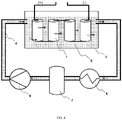
- the circulating system may also include a heat transfer fluid tank 7, as shown in FIG. 4 .
- the depicted flow of the heat transfer fluid 2 over and around the electrical componentry 1 as shown in FIG. 3 and FIG. 4 is exemplary only.
- the electrical componentry may be arranged within the reservoir in any way suitable for the type of electrical componentry and the intended application.
- the flow of heat transfer fluid in and out of the reservoir and the flow through the reservoir may be accomplished in any manner suitable to ensure that the electrical componentry remains at least partially immersed in the heat transfer fluid.
- the reservoir may include multiple inlets and outlets.
- the heat transfer fluid may flow from side to side, top to bottom or from bottom to top of the reservoir or a combination thereof, depending upon the desired orientation of the electrical componentry and the desired fluid flow of the system.
- the reservoir may include baffles for guiding the flow of heat transfer fluid over and/or around the electrical componentry.
- the heat transfer fluid may enter the reservoir via a spray system, such as being sprayed on the electrical componentry from one or more top inlets of the reservoir.
- the presently disclosed immersion arrangement of the electrical componentry in the heat transfer fluid also allows the fluid to transfer heat to the electrical componentry to provide temperature control in cold environments.
- the immersion cooling system may be equipped with a heater to heat the heat transfer fluid, such as shown in FIG. 2 where the heat exchanger may operate in a "heating mode.”
- the heated fluid may transfer heat to the immersed electrical componentry to achieve and/or maintain a desired or optimal temperature for the electrical componentry, such as a desired or optimal temperature for battery charging.
- the heat transfer fluid of the immersion cooling system comprises one or more than one phosphate ester of formula (I) where each R group in formula I is independently chosen from C 1-18 alkyl, unsubstituted phenyl and C 1-12 alkyl-substituted phenyl, provided that at least one R group is C 1-18 alkyl and at least one other R group is unsubstituted phenyl or C 1-12 alkyl-substituted phenyl.
- the heat transfer fluid may contain one or more phosphate esters not of formula (I)
- the phosphate ester of formula (I) or mixture thereof typically makes up more than 50% by weight based on the total weight of all phosphate esters in the heat transfer fluid, e.g., at least 60%, at least 70%, at least 80%, at least 90%, at least 95% or at least 99% by weight of all phosphate esters in the heat transfer fluid.
- one R group in formula (I) is C 1-18 alkyl and the remaining two R groups are independently chosen from unsubstituted phenyl and C 1-12 alkyl-substituted phenyl.
- the remaining two R groups are independently chosen from unsubstituted phenyl.
- the remaining two R groups are independently chosen from C 1-12 alkyl-substituted phenyl.
- two R groups in formula (I) are independently chosen from C 1-18 alkyl. Said two R groups may be the same or may be chosen from different C 1-18 alkyl.
- the remaining R group is unsubstituted phenyl. In other embodiments, the remaining R group is C 1-12 alkyl-substituted phenyl.
- R as "C 1-18 alkyl” in formula (I) may be a straight or branched chain alkyl group having the specified number of carbon atoms.
- R as C 1-18 alkyl is C 1-12 alkyl, C 3-12 alkyl or C 4-10 alkyl.
- unbranched alkyl groups include methyl, ethyl, n-propyl, n-butyl, n-pentyl, n-hexyl, n-heptyl, n-octyl, n-nonyl, n-decyl, n-undecyl, and n-dodecyl.
- branched alkyl groups include 2-methylpentyl, 2-ethylbutyl, 2,2-dimethylbutyl, 6-methylheptyl, 2-ethylhexyl, t-octyl, 3,5,5-trimethylhexyl, 7-methyloctyl, 2-butylhexyl, 8-methylnonyl, 2-butyloctyl, 11-methyldodecyl and the like.
- linear alkyl and branched alkyl groups also include moieties commonly called isononyl, isodecyl, isotridecyl, and the like where the prefix "iso” is understood to refer to mixtures of alkyls such as those derived from an oxo process.
- R as "C 1-12 alkyl-substituted phenyl" in formula (I) refers to a phenyl group substituted by a C 1-12 alkyl group.
- the alkyl group may be a straight or branched chain alkyl group having the specified number of carbon atoms. More than one alkyl group may be present on the phenyl ring (e.g., phenyl substituted by two alkyl groups or three alkyl groups). Often, however, the phenyl is substituted by one alkyl group (i.e., mono-alkylated).
- the C 1-12 alkyl is chosen from C 1-10 or C 3-10 alkyl, more preferably C 1-8 or C 3-8 alkyl, or C 1-6 or C 3-6 alkyl.
- alkyl groups include include methyl, ethyl, n-propyl, isopropyl, n-butyl, isobutyl, sec-butyl, t-butyl, pentyl, isopentyl, t-pentyl, 2-methylbutyl, n-hexyl, 2-methylpentyl, 2-ethylbutyl, 2,2-dimethylbutyl, 6-methylheptyl, 2-ethylhexyl, isooctyl, t-octyl, and isononyl, 3,5,5-trimethylhexyl, 2-butylhexyl, isodecyl, and 2-butyloctyl and the like.
- the alkylating agents may include olefins derived from cracking of naphtha, such as propylene, butylene, diisobutylene, and propylene tetramer.
- Said alkyl substitution on the phenyl ring may be at the ortho-, meta-, or para-position, or a combination thereof. Often, the alkyl substitution is at the para-position or predominantly at the para-position.
- the heat transfer fluid of the present disclosure may comprise more than one phosphate ester of formula (I), that is, a mixture of phosphate esters of formula (I), such as a mixture of compounds of formula (I) differing from each other in the number of R groups that are C 1-18 alkyl, and/or differing in the number of R groups that are C 1-12 alkyl-substituted phenyl and/or differing based on the degree of alkylation or the alkylation chain length of the alkyl and/or alkyl-substituted phenyl groups.
- a mixture of phosphate esters of formula (I) such as a mixture of compounds of formula (I) differing from each other in the number of R groups that are C 1-18 alkyl, and/or differing in the number of R groups that are C 1-12 alkyl-substituted phenyl and/or differing based on the degree of alkylation or the alkylation chain length of the alkyl and/or alkyl
- the heat transfer fluid of the present disclosure may also include one or more other base oils, such as mineral oils, polyalphaolefins, esters, etc.
- the other base oil(s) and amounts thereof should be chosen to be consistent with the properties suitable for the circulating immersion cooling fluid as described herein.
- the phosphate ester of formula (I) or mixture thereof makes up more than 50% by weight of the heat transfer fluid.
- the one or more than one phosphate ester of formula (I) is at least 60%, at least 70%, at least 80%, at least 90%, at least 95%, or at least 99% by weight of the heat transfer fluid.
- the heat transfer fluid of the present disclosure may further comprise one or more performance additives.
- performance additives include, but are not limited to, antioxidants, metal deactivators, flow additives, corrosion inhibitors, foam inhibitors, demulsifiers, pour point depressants, and any combination or mixture thereof.
- Fully-formulated heat transfer fluids typically contain one or more of these performance additives, and often a package of multiple performance additives. Often, one or more performance additives are present at 0.0001 wt% up to 3 wt%, or 0.05 wt% up to 1.5 wt%, or 0.1 wt% up to 1.0 wt%, based on the weight of the heat transfer fluid.
- the heat transfer fluid consists essentially of one or more than one phosphate ester of formula (I) and optionally one or more performance additives. In some embodiments, the heat transfer fluid consists of one or more than one phosphate ester of formula (I) and optionally one or more performance additives. In further embodiments, the heat transfer fluid consists essentially of one or more than one phosphate ester of formula (I), one or more than one phosphate ester not of formula (I), and optionally one or more performance additives. In further embodiments, the heat transfer fluid consists of one or more than one phosphate ester of formula (I), one or more than one phosphate ester not of formula (I), and optionally one or more performance additives.
- phosphate esters of the present disclosure are known or can be prepared by known techniques. Known processes are described, for example, in U.S. Patent Nos. 2,504,121 , 2,656,373 , 6,299,887 , and 7,700,807 .
- the physical properties of the presently disclosed heat transfer fluid may be adjusted or optimized at least in part based on the extent of alkylation of the phosphate ester(s) of formula (I).
- the heat transfer fluid of the present disclosure has a flash point according to ASTM D92 of ⁇ 190 °C; a kinematic viscosity measured at 40 °C according to ASTM D445 of less than 50 cSt; a pour point according to ASTM D5950 of ⁇ -20 °C; and a DC resistivity measured at 25 °C according to IEC 60247 of > 0.25 GOhm-cm.
- the flash point of the heat transfer fluid according to ASTM 92 is ⁇ 200 °C.
- the kinematic viscosity of the heat transfer fluid measured at 40 °C according to ASTM D445 is ⁇ 40 cSt or ⁇ 35 cSt, more preferably ⁇ 30 cSt.
- the pour point of the heat transfer fluid according to ASTM D5950 is ⁇ -25 °C, more preferably ⁇ -30 °C.
- the DC resistivity of the heat transfer fluid measured at 25 °C according to IEC 60247 is > 0.5 GOhm-cm.
- Also disclosed is a method of cooling electrical componentry comprising at least partially immersing electrical componentry in a heat transfer fluid within a reservoir, and circulating the heat transfer fluid out of the reservoir, through a circulating pipeline of a circulation system, and back into the reservoir, wherein the heat transfer fluid is as described above for the immersion cooling system.
- Trimethyl phosphate was evaluated according to the procedures above.
- Tri-n-propyl phosphate was evaluated according to the procedures above.
- Triisopropyl phosphate was evaluated according to the procedures above.
- Tri-n-butyl phosphate was evaluated according to the procedures above.
- the phosphate ester of Example 1 having the intramolecular mixture of alkyl and aryl groups had a flash point > 200 °C and a DC resistivity at 25°C of > 0.5 GOhm-cm, as well as a low pour point and a low kinematic viscosity at 40°C.
- the trialkyl phosphates of Comparative Examples 1-4 each exhibited a low flash point well below 200 °C and a low DC resistivity relative to Example 1.
Landscapes
- Chemical & Material Sciences (AREA)
- Engineering & Computer Science (AREA)
- Chemical Kinetics & Catalysis (AREA)
- Manufacturing & Machinery (AREA)
- Electrochemistry (AREA)
- General Chemical & Material Sciences (AREA)
- Physics & Mathematics (AREA)
- Combustion & Propulsion (AREA)
- Thermal Sciences (AREA)
- Materials Engineering (AREA)
- Organic Chemistry (AREA)
- Cooling Or The Like Of Electrical Apparatus (AREA)
Abstract
Description
- The present disclosure relates to an immersion cooling system for electrical componentry, such as for cooling a power system (e.g., battery module) of an electric vehicle. The immersion cooling system employs a heat transfer fluid comprising at least one phosphate ester, as described herein. In particular, the phosphate esters of the present disclosure exhibit favorable properties in a circulating immersion cooling system, such as low flammability, low pour point, high electrical resistivity and low viscosity for pumpability.
- Electrical componentry that use, store and/or generate energy or power can generate heat. For example, battery cells, such as lithium-ion batteries, generate large amounts of heat during charging and discharging operations. Traditional cooling systems employ air cooling or indirect liquid cooling. Commonly, water/glycol solutions are used as heat transfer fluids to dissipate heat via indirect cooling. In this cooling technique, the water/glycol coolant flows through channels, such as pipes or jackets, around the battery or through plates within the battery framework. The water/glycol solutions, however, are highly conductive and must not contact the electrical componentry, such as through leakage, for risk of causing short circuits, which can lead to heat propagation and thermal runaway. In addition, questions remain whether indirect cooling systems can adequately and efficiently remove heat under the increasing demands for high loading (fast charging), high capacity batteries.
- Cooling by immersing electrical componentry into a coolant is a promising alternative to traditional cooling systems. For example,
US 2018/0233791 A1 discloses a battery pack system to inhibit thermal runaway wherein a battery module is at least partially immersed in a coolant in a battery box. The coolant may be pumped out of the battery box, through a heat exchanger, and back into the battery box. As the coolant, trimethyl phosphate and tripropyl phosphate are mentioned, among other chemistries. However, as shown in the present application, a trimethyl phosphate fluid or tripropyl phosphate fluid exhibits a low direct-current (DC) resistivity, and each exhibits a low flash point such that the flammability of each fluid renders it unsuitable. - A need exists for the development of circulating immersion cooling systems employing flowable heat transfer fluids having low flammability, low pour point, high electrical resistivity and low viscosity.
- To fulfill this need, phosphate esters of formula (I) are disclosed herein containing intramolecular mixtures of alkyl and aryl groups.
- The immersion cooling system of the present disclosure comprises electrical componentry, a heat transfer fluid, and a reservoir, wherein the electrical componentry is at least partially immersed in the heat transfer fluid within the reservoir, and a circulating system capable of circulating the heat transfer fluid out of the reservoir, through a circulating pipeline of the circulating system, and back into the reservoir, wherein the heat transfer fluid comprises one or more than one phosphate ester of formula (I)

- Also disclosed is a method of cooling electrical componentry comprising at least partially immersing electrical componentry in a heat transfer fluid within a reservoir, and circulating the heat transfer fluid out of the reservoir, through a circulating pipeline of a circulation system, and back into the reservoir, wherein the heat transfer fluid comprises at least one phosphate ester of formula (I) above.
- The system and method of the present disclosure are suitable for a wide variety of electrical componentry, and particularly in the cooling of battery systems.
- The preceding summary is not intended to restrict in any way the scope of the claimed invention. In addition, it is to be understood that both the foregoing general description and the following detailed description are exemplary and explanatory only and are not restrictive of the invention, as claimed.
-
-
FIG. 1 andFIG. 2 each shows a block flow diagram of an exemplary immersion cooling system according to the present disclosure. -
FIG. 3 andFIG. 4 are schematic diagrams of exemplary immersion cooling systems according to the present disclosure. - Unless otherwise specified, the word "a" or "an" in this application means "one or more than one".
- In accordance with the present disclosure, an immersion cooling system comprises electrical componentry, a heat transfer fluid, and a reservoir, wherein the electrical componentry is at least partially immersed in the heat transfer fluid within the reservoir, and a circulating system capable of circulating the heat transfer fluid out of the reservoir, through a circulating pipeline of the circulating system, and back into the reservoir.
- Electrical componentry includes any electronics that generate thermal energy in need of dissipation for safe usage. Examples include batteries, fuel cells, aircraft electronics, computer electronics such as microprocessors, un-interruptable power supplies (UPSs), power electronics (such as IGBTs, SCRs, thyristors, capacitors, diodes, transistors, rectifiers and the like), invertors, DC to DC convertors, chargers (e.g., within loading stations or charging points), phase change invertors, electric motors, electric motor controllers, DC to AC invertors, and photovoltaic cells.
- The system and method of the present disclosure is particularly useful for cooling battery systems, such as those in electric vehicles (including passenger and commercial vehicles), e.g., in electric cars, trucks, buses, industrial trucks (e.g., forklifts and the like), mass transit vehicles (e.g., trains or trams) and other forms of electric powered transportation.
- Typically, electrified transportation is powered by battery modules. A battery module may encompass one or more battery cells arranged or stacked relative to one another. For example, the module can include prismatic, pouch or cylindrical cells. During charging and discharging (use) operations of the battery, heat is typically generated by the battery cells, which can be dissipated by the immersion cooling system. Efficient cooling of the battery via the immersion cooling system allows for fast charge times at high loadings, while maintaining safe conditions and avoiding heat propagation and thermal runaway. Electrical componentry in electric powered transportation also include electric motors, which can be cooled by the immersion cooling system.
- In accordance with the present disclosure, the electrical componentry is at least partially immersed in the heat transfer fluid within a reservoir. Often, the electrical componentry is substantially immersed or fully immersed in the heat transfer fluid, such as immersing (in the case of a battery module) the battery cell walls, tabs and wiring. The reservoir may be any container suitable for holding the heat transfer fluid in which the electrical componentry is immersed. For example, the reservoir may be a container or housing for the electrical componentry, such as a battery module container or housing.
- The immersion cooling system further comprises a circulating system capable of circulating the heat transfer fluid out of the reservoir, through a circulating pipeline of the circulating system, and back into the reservoir. Often, the circulating system includes a pump and a heat exchanger. In operation, for example as shown in
FIG. 1 , the circulating system may pump heated heat transfer fluid out of the reservoir through a circulating pipeline and through a heat exchanger to cool the heat transfer fluid and pump the cooled heat transfer fluid through a circulating pipeline back into the reservoir. In this manner, during operation of the electrical componentry (which is at least partially immersed in the heat transfer fluid within the reservoir), such as during charging or discharging operations of a battery, the immersion cooling system is operated to absorb heat generated by the electrical componentry, to remove heat transfer fluid that has been heated by the electrical componentry for cooling in the heat exchanger, and to circulate the cooled heat transfer fluid back into the reservoir. - The heat exchanger may be any heat transfer unit capable of cooling the heated heat transfer fluid to a temperature suitable for the particular application. For example, the heat exchanger may use air cooling (liquid to air) or liquid cooling (liquid to liquid). The heat exchanger, for example, may be a shared heat transfer unit with another fluid circuit within the electrical equipment or device, such as a refrigeration/air conditioning circuit in an electric vehicle. The circulation system may flow the heat transfer fluid through multiple heat exchangers, such as air cooling and liquid cooling heat exchangers.
- The circulation pipeline of the circulating system may flow the heat transfer fluid to other electrical componentry that generate thermal energy in need of dissipation within the electrical equipment or device. For example, as shown in
FIG. 2 for immersion cooling of a battery, the heat transfer fluid may also be used for immersion cooling of electrical componentry being powered by the battery (e.g., an electric motor) and/or immersion cooling of electrical componentry employed in charging the battery. The heated heat transfer fluid flowing out of the container(s) or housing(s) of the various electrical componentry may be cooled in one or more heat exchangers and the cooled heat transfer fluid may be circulated back to the container(s) or housing(s). - The circulating system may also include a heat transfer fluid tank to store and/or maintain a volume of heat transfer fluid. For example, cooled heat transfer fluid from a heat exchanger may be pumped into the heat transfer fluid tank and from the heat transfer fluid tank back into the reservoir.
- An example of an immersion cooling system in accordance with the present disclosure is shown in
FIG. 3 . The electrical componentry and reservoir are enlarged for purposes of illustration. The system comprises electrical componentry 1 (which, in this example, are battery cells of a battery module), aheat transfer fluid 2, and areservoir 3. Theelectrical componentry 1 is at least partially immersed (inFIG. 3 , fully immersed) in theheat transfer fluid 2 within thereservoir 3. A circulating system comprising circulatingpipeline 4, aheat exchanger 5 and apump 6 moves heatedheat transfer fluid 2 out of the reservoir for cooling inheat exchanger 5 and the cooled heat transfer fluid is circulated back into thereservoir 3. The circulating system may also include a heattransfer fluid tank 7, as shown inFIG. 4 . - The depicted flow of the
heat transfer fluid 2 over and around theelectrical componentry 1 as shown inFIG. 3 andFIG. 4 is exemplary only. The electrical componentry may be arranged within the reservoir in any way suitable for the type of electrical componentry and the intended application. Similarly, the flow of heat transfer fluid in and out of the reservoir and the flow through the reservoir may be accomplished in any manner suitable to ensure that the electrical componentry remains at least partially immersed in the heat transfer fluid. For example, the reservoir may include multiple inlets and outlets. The heat transfer fluid may flow from side to side, top to bottom or from bottom to top of the reservoir or a combination thereof, depending upon the desired orientation of the electrical componentry and the desired fluid flow of the system. The reservoir may include baffles for guiding the flow of heat transfer fluid over and/or around the electrical componentry. As a further example, the heat transfer fluid may enter the reservoir via a spray system, such as being sprayed on the electrical componentry from one or more top inlets of the reservoir. - While the system and method of the present disclosure is particularly useful for cooling of electrical componentry, such as battery modules, the presently disclosed immersion arrangement of the electrical componentry in the heat transfer fluid also allows the fluid to transfer heat to the electrical componentry to provide temperature control in cold environments. For example, the immersion cooling system may be equipped with a heater to heat the heat transfer fluid, such as shown in
FIG. 2 where the heat exchanger may operate in a "heating mode." The heated fluid may transfer heat to the immersed electrical componentry to achieve and/or maintain a desired or optimal temperature for the electrical componentry, such as a desired or optimal temperature for battery charging. - The heat transfer fluid of the immersion cooling system comprises one or more than one phosphate ester of formula (I)

- While the heat transfer fluid may contain one or more phosphate esters not of formula (I), the phosphate ester of formula (I) or mixture thereof typically makes up more than 50% by weight based on the total weight of all phosphate esters in the heat transfer fluid, e.g., at least 60%, at least 70%, at least 80%, at least 90%, at least 95% or at least 99% by weight of all phosphate esters in the heat transfer fluid.
- In some embodiments, one R group in formula (I) is C1-18 alkyl and the remaining two R groups are independently chosen from unsubstituted phenyl and C1-12 alkyl-substituted phenyl. For example, in certain embodiments, the remaining two R groups are independently chosen from unsubstituted phenyl. In certain other embodiments, the remaining two R groups are independently chosen from C1-12 alkyl-substituted phenyl.
- In further embodiments, two R groups in formula (I) are independently chosen from C1-18 alkyl. Said two R groups may be the same or may be chosen from different C1-18 alkyl. In additional embodiments, the remaining R group is unsubstituted phenyl. In other embodiments, the remaining R group is C1-12 alkyl-substituted phenyl.
- R as "C1-18 alkyl" in formula (I) may be a straight or branched chain alkyl group having the specified number of carbon atoms. Preferably, R as C1-18 alkyl is C1-12 alkyl, C3-12 alkyl or C4-10 alkyl. Examples of unbranched alkyl groups include methyl, ethyl, n-propyl, n-butyl, n-pentyl, n-hexyl, n-heptyl, n-octyl, n-nonyl, n-decyl, n-undecyl, and n-dodecyl. Examples of branched alkyl groups include 2-methylpentyl, 2-ethylbutyl, 2,2-dimethylbutyl, 6-methylheptyl, 2-ethylhexyl, t-octyl, 3,5,5-trimethylhexyl, 7-methyloctyl, 2-butylhexyl, 8-methylnonyl, 2-butyloctyl, 11-methyldodecyl and the like. Examples of linear alkyl and branched alkyl groups also include moieties commonly called isononyl, isodecyl, isotridecyl, and the like where the prefix "iso" is understood to refer to mixtures of alkyls such as those derived from an oxo process.
- R as "C1-12 alkyl-substituted phenyl" in formula (I) refers to a phenyl group substituted by a C1-12 alkyl group. The alkyl group may be a straight or branched chain alkyl group having the specified number of carbon atoms. More than one alkyl group may be present on the phenyl ring (e.g., phenyl substituted by two alkyl groups or three alkyl groups). Often, however, the phenyl is substituted by one alkyl group (i.e., mono-alkylated). Preferably, the C1-12 alkyl is chosen from C1-10 or C3-10 alkyl, more preferably C1-8 or C3-8 alkyl, or C1-6 or C3-6 alkyl. Examples of such alkyl groups include include methyl, ethyl, n-propyl, isopropyl, n-butyl, isobutyl, sec-butyl, t-butyl, pentyl, isopentyl, t-pentyl, 2-methylbutyl, n-hexyl, 2-methylpentyl, 2-ethylbutyl, 2,2-dimethylbutyl, 6-methylheptyl, 2-ethylhexyl, isooctyl, t-octyl, and isononyl, 3,5,5-trimethylhexyl, 2-butylhexyl, isodecyl, and 2-butyloctyl and the like. The alkylating agents may include olefins derived from cracking of naphtha, such as propylene, butylene, diisobutylene, and propylene tetramer. Said alkyl substitution on the phenyl ring may be at the ortho-, meta-, or para-position, or a combination thereof. Often, the alkyl substitution is at the para-position or predominantly at the para-position.
- The heat transfer fluid of the present disclosure may comprise more than one phosphate ester of formula (I), that is, a mixture of phosphate esters of formula (I), such as a mixture of compounds of formula (I) differing from each other in the number of R groups that are C1-18 alkyl, and/or differing in the number of R groups that are C1-12 alkyl-substituted phenyl and/or differing based on the degree of alkylation or the alkylation chain length of the alkyl and/or alkyl-substituted phenyl groups.
- The heat transfer fluid of the present disclosure may also include one or more other base oils, such as mineral oils, polyalphaolefins, esters, etc. The other base oil(s) and amounts thereof should be chosen to be consistent with the properties suitable for the circulating immersion cooling fluid as described herein. Typically, the phosphate ester of formula (I) or mixture thereof makes up more than 50% by weight of the heat transfer fluid. For example, in many embodiments, the one or more than one phosphate ester of formula (I) is at least 60%, at least 70%, at least 80%, at least 90%, at least 95%, or at least 99% by weight of the heat transfer fluid.
- The heat transfer fluid of the present disclosure may further comprise one or more performance additives. Examples of such additives include, but are not limited to, antioxidants, metal deactivators, flow additives, corrosion inhibitors, foam inhibitors, demulsifiers, pour point depressants, and any combination or mixture thereof. Fully-formulated heat transfer fluids typically contain one or more of these performance additives, and often a package of multiple performance additives. Often, one or more performance additives are present at 0.0001 wt% up to 3 wt%, or 0.05 wt% up to 1.5 wt%, or 0.1 wt% up to 1.0 wt%, based on the weight of the heat transfer fluid.
- In some embodiments, the heat transfer fluid consists essentially of one or more than one phosphate ester of formula (I) and optionally one or more performance additives. In some embodiments, the heat transfer fluid consists of one or more than one phosphate ester of formula (I) and optionally one or more performance additives. In further embodiments, the heat transfer fluid consists essentially of one or more than one phosphate ester of formula (I), one or more than one phosphate ester not of formula (I), and optionally one or more performance additives. In further embodiments, the heat transfer fluid consists of one or more than one phosphate ester of formula (I), one or more than one phosphate ester not of formula (I), and optionally one or more performance additives.
- The phosphate esters of the present disclosure are known or can be prepared by known techniques. Known processes are described, for example, in
U.S. Patent Nos. 2,504,121 ,2,656,373 ,6,299,887 , and7,700,807 . - The physical properties of the presently disclosed heat transfer fluid may be adjusted or optimized at least in part based on the extent of alkylation of the phosphate ester(s) of formula (I).
- Typically, the heat transfer fluid of the present disclosure has a flash point according to ASTM D92 of ≥ 190 °C; a kinematic viscosity measured at 40 °C according to ASTM D445 of less than 50 cSt; a pour point according to ASTM D5950 of ≤ -20 °C; and a DC resistivity measured at 25 °C according to IEC 60247 of > 0.25 GOhm-cm.
- Preferably, the flash point of the heat transfer fluid according to ASTM 92 is ≥ 200 °C.
- Preferably, the kinematic viscosity of the heat transfer fluid measured at 40 °C according to ASTM D445 is ≤ 40 cSt or ≤ 35 cSt, more preferably ≤ 30 cSt.
- Preferably, the pour point of the heat transfer fluid according to ASTM D5950 is ≤ -25 °C, more preferably ≤ -30 °C.
- Preferably, the DC resistivity of the heat transfer fluid measured at 25 °C according to IEC 60247 is > 0.5 GOhm-cm.
- Also disclosed is a method of cooling electrical componentry comprising at least partially immersing electrical componentry in a heat transfer fluid within a reservoir, and circulating the heat transfer fluid out of the reservoir, through a circulating pipeline of a circulation system, and back into the reservoir, wherein the heat transfer fluid is as described above for the immersion cooling system.
- Further non-limiting disclosure is provided in the Examples that follow.
- Heat transfer fluids in accordance with the present disclosure, as well as heat transfer fluids of the Comparative Examples, were evaluated to determine their flash point (ASTM D92), kinematic viscosity measured at 40 °C (ASTM D445), pour point (ASTM D5950), and DC resistivity measured at 25 °C (IEC 60247).
- 2-ethylhexyl diphenyl phosphate, available commercially under the name Disflamoll® DPO, was evaluated according to the procedures above.
- Trimethyl phosphate was evaluated according to the procedures above.
- Tri-n-propyl phosphate was evaluated according to the procedures above.
- Triisopropyl phosphate was evaluated according to the procedures above.
- Tri-n-butyl phosphate was evaluated according to the procedures above.
Example Viscosity at 40 C (cSt) Pour Point (°C) Flash Point (°C) DC Resistivity at 25°C (GOhm-cm) 1 8.6 -54 224 0.57 (2-ethylhexyl diphenyl phosphate) CE 11.3 - 107 < 0.25 (trimethyl phosphate) CE 23.3 - 123 < 0.25 (tri-n-propyl phosphate) CE 31.7 - 102 < 0.25 (triisopropyl phosphate) CE 42.5 <-75 168 < 0.25 (tri-n-butyl phosphate) - As shown in the Table above, the phosphate ester of Example 1 having the intramolecular mixture of alkyl and aryl groups had a flash point > 200 °C and a DC resistivity at 25°C of > 0.5 GOhm-cm, as well as a low pour point and a low kinematic viscosity at 40°C. In contrast, the trialkyl phosphates of Comparative Examples 1-4 each exhibited a low flash point well below 200 °C and a low DC resistivity relative to Example 1.
Claims (14)
- An immersion cooling system comprisingelectrical componentry,a heat transfer fluid, anda reservoir, wherein the electrical componentry is at least partially immersed in the heat transfer fluid within the reservoir, anda circulating system capable of circulating the heat transfer fluid out of the reservoir, through a circulating pipeline of the circulating system, and back into the reservoir,wherein the heat transfer fluid comprises one or more than one phosphate ester of formula (I)
 where each R in formula I is independently chosen from C1-18 alkyl, unsubstituted phenyl and C1-12 alkyl-substituted phenyl, provided that at least one R group is C1-18 alkyl and at least one other R group is unsubstituted phenyl or C1-12 alkyl-substituted phenyl.
 - The immersion cooling system of claim 1, wherein the electrical componentry comprises a battery.
- The immersion cooling system of claim 2, wherein the battery is a battery module for an electric vehicle.
- The immersion cooling system of claim 1, wherein the circulating system comprises a pump and a heat exchanger.
- The immersion cooling system of claim 4, wherein the circulating system further comprises a heat transfer fluid tank.
- The immersion cooling system of claim 1, wherein one R group in formula (I) is C1-18 alkyl and the remaining two R groups are independently chosen unsubstituted phenyl and C1-12 alkyl-substituted phenyl.
- The immersion cooling system of claim 1, wherein two R groups in formula (I) are independently chosen from C1-18 alkyl.
- The immersion cooling system of claim 1, wherein the heat transfer fluid comprises more than one phosphate ester of formula (I).
- The immersion cooling system of any one of claims 1-8, wherein R as alkyl in formula (I) is C1-12 alkyl.
- A method of cooling electrical componentry comprising providing an immersion cooling system according to any one of claims 1-9, and circulating the heat transfer fluid out of the reservoir, through a circulating pipeline of a circulation system, and back into the reservoir.
- The method of claim 10, wherein the electrical componentry comprises a battery.
- The method of claim 11, wherein the battery is a battery module for an electric vehicle.
- The method of claim 10, wherein the circulating system comprises a pump and a heat exchanger, and the step of circulating the heat transfer fluid comprises pumping the heat transfer fluid out of the reservoir through a circulating pipeline, through the heat exchanger, and back into the reservoir.
- The method of claim 13, wherein the circulating system further comprises a heat transfer fluid tank, and the heat transfer fluid flowing through the heat exchanger is pumped into the heat transfer fluid tank and from the heat transfer fluid tank back into the reservoir.
Priority Applications (7)
| Application Number | Priority Date | Filing Date | Title |
|---|---|---|---|
| PCT/US2022/035912 WO2023283120A1 (en) | 2021-07-07 | 2022-07-01 | Phosphate ester heat transfer fluids for immersion cooling system |
| EP22786131.7A EP4367740A1 (en) | 2021-07-07 | 2022-07-01 | Phosphate ester heat transfer fluids for immersion cooling system |
| JP2024500077A JP2024525534A (en) | 2021-07-07 | 2022-07-01 | Phosphate Ester Heat Transfer Fluids for Immersion Cooling Systems |
| KR1020247004375A KR20240032100A (en) | 2021-07-07 | 2022-07-01 | Phosphate ester heat transfer fluid for immersion cooling systems |
| US18/570,452 US20240292577A1 (en) | 2021-07-07 | 2022-07-01 | Phosphate ester heat transfer fluids for immersion cooling system |
| MX2024000312A MX2024000312A (en) | 2021-07-07 | 2022-07-01 | PHOSPHATE ESTER HEAT TRANSFER LIQUIDS FOR AN IMMERSION COOLING SYSTEM. |
| CA3225110A CA3225110A1 (en) | 2021-07-07 | 2022-07-01 | Phosphate ester heat transfer fluids for immersion cooling system |
Applications Claiming Priority (1)
| Application Number | Priority Date | Filing Date | Title |
|---|---|---|---|
| US202163219241P | 2021-07-07 | 2021-07-07 |
Publications (1)
| Publication Number | Publication Date |
|---|---|
| EP4117086A1 true EP4117086A1 (en) | 2023-01-11 |
Family
ID=77338502
Family Applications (1)
| Application Number | Title | Priority Date | Filing Date |
|---|---|---|---|
| EP21191198.7A Pending EP4117086A1 (en) | 2021-07-07 | 2021-08-13 | Phosphate ester heat transfer fluids for immersion cooling system |
Country Status (2)
| Country | Link |
|---|---|
| EP (1) | EP4117086A1 (en) |
| CN (1) | CN117642911A (en) |
Cited By (2)
| Publication number | Priority date | Publication date | Assignee | Title |
|---|---|---|---|---|
| US20240130086A1 (en) * | 2022-03-23 | 2024-04-18 | Nano And Advanced Materials Institute Limited | Multimode immersion cooling |
| WO2025194085A1 (en) * | 2024-03-14 | 2025-09-18 | Chevron Oronite Company Llc | Lubricating compositions for battery immersion cooling |
Citations (9)
| Publication number | Priority date | Publication date | Assignee | Title |
|---|---|---|---|---|
| US2504121A (en) | 1949-02-07 | 1950-04-18 | Monsanto Chemicals | Process for the production of alkyl diaryl esters of ortho phosphoric acid |
| US2656373A (en) | 1950-04-14 | 1953-10-20 | Monsanto Chemicals | Process for producing mixed diaryl esters of ortho-phosphoric acid |
| US6299887B1 (en) | 1995-02-24 | 2001-10-09 | Kao Corporation | Phosphoric triesters and external compositions containing the same |
| JP4222149B2 (en) * | 2003-08-07 | 2009-02-12 | ソニーケミカル&インフォメーションデバイス株式会社 | Absorbent sheet and non-aqueous electrolyte battery pack |
| US7700807B2 (en) | 2003-10-24 | 2010-04-20 | Supresta Llc | Process to prepare alkyl phenyl phosphates |
| CN201466117U (en) * | 2009-07-24 | 2010-05-12 | 岑显荣 | Battery-operated car storage battery with cooling shell and cooling device thereof |
| WO2017099956A1 (en) * | 2015-12-07 | 2017-06-15 | Exxonmobil Research And Engineering Company | Functional fluid compositions containing erosion inhibitors |
| US20180233791A1 (en) | 2015-08-14 | 2018-08-16 | Microvast Power Systems Co., Ltd. | Battery pack and battery pack system |
| WO2020252235A1 (en) * | 2019-06-12 | 2020-12-17 | The Lubrizol Corporation | Organic heat transfer system, method and fluid |
-
2021
- 2021-08-13 EP EP21191198.7A patent/EP4117086A1/en active Pending
-
2022
- 2022-07-01 CN CN202280048238.4A patent/CN117642911A/en active Pending
Patent Citations (9)
| Publication number | Priority date | Publication date | Assignee | Title |
|---|---|---|---|---|
| US2504121A (en) | 1949-02-07 | 1950-04-18 | Monsanto Chemicals | Process for the production of alkyl diaryl esters of ortho phosphoric acid |
| US2656373A (en) | 1950-04-14 | 1953-10-20 | Monsanto Chemicals | Process for producing mixed diaryl esters of ortho-phosphoric acid |
| US6299887B1 (en) | 1995-02-24 | 2001-10-09 | Kao Corporation | Phosphoric triesters and external compositions containing the same |
| JP4222149B2 (en) * | 2003-08-07 | 2009-02-12 | ソニーケミカル&インフォメーションデバイス株式会社 | Absorbent sheet and non-aqueous electrolyte battery pack |
| US7700807B2 (en) | 2003-10-24 | 2010-04-20 | Supresta Llc | Process to prepare alkyl phenyl phosphates |
| CN201466117U (en) * | 2009-07-24 | 2010-05-12 | 岑显荣 | Battery-operated car storage battery with cooling shell and cooling device thereof |
| US20180233791A1 (en) | 2015-08-14 | 2018-08-16 | Microvast Power Systems Co., Ltd. | Battery pack and battery pack system |
| WO2017099956A1 (en) * | 2015-12-07 | 2017-06-15 | Exxonmobil Research And Engineering Company | Functional fluid compositions containing erosion inhibitors |
| WO2020252235A1 (en) * | 2019-06-12 | 2020-12-17 | The Lubrizol Corporation | Organic heat transfer system, method and fluid |
Cited By (2)
| Publication number | Priority date | Publication date | Assignee | Title |
|---|---|---|---|---|
| US20240130086A1 (en) * | 2022-03-23 | 2024-04-18 | Nano And Advanced Materials Institute Limited | Multimode immersion cooling |
| WO2025194085A1 (en) * | 2024-03-14 | 2025-09-18 | Chevron Oronite Company Llc | Lubricating compositions for battery immersion cooling |
Also Published As
| Publication number | Publication date |
|---|---|
| CN117642911A (en) | 2024-03-01 |
Similar Documents
| Publication | Publication Date | Title |
|---|---|---|
| EP4117086A1 (en) | Phosphate ester heat transfer fluids for immersion cooling system | |
| EP4298181B1 (en) | Method, battery system and thermal management circuit using a dielectric thermal management fluid | |
| US20240279522A1 (en) | Phosphate ester heat transfer fluids for immersion cooling system | |
| CN112430454A (en) | Cooling liquid composition and cooling system | |
| US20240292577A1 (en) | Phosphate ester heat transfer fluids for immersion cooling system | |
| EP4116391B1 (en) | Phosphate tester heat transfer fluids and their use in an immersion cooling system | |
| US20240287371A1 (en) | Phosphate ester heat transfer fluids and their use in an immersion cooling system | |
| EP4117087A1 (en) | Phosphate ester heat transfer fluids for immersion cooling system | |
| US11447678B2 (en) | Coolant composition and cooling system | |
| US20210062060A1 (en) | Coolant composition and cooling system | |
| KR20230150323A (en) | Oilfield thermal management fluids and methods for using the same | |
| EP4559990A1 (en) | Ester-fluorocarbon mixtures as efficient heat transfer fluids | |
| JP2024507926A (en) | Dielectric thermal management fluids and methods for using them | |
| EP4597820A1 (en) | Power conversion device | |
| KR20260046295A (en) | Modular power converter system for vehicles |
Legal Events
| Date | Code | Title | Description |
|---|---|---|---|
| PUAI | Public reference made under article 153(3) epc to a published international application that has entered the european phase |
Free format text: ORIGINAL CODE: 0009012 |
|
| STAA | Information on the status of an ep patent application or granted ep patent |
Free format text: STATUS: THE APPLICATION HAS BEEN PUBLISHED |
|
| AK | Designated contracting states |
Kind code of ref document: A1 Designated state(s): AL AT BE BG CH CY CZ DE DK EE ES FI FR GB GR HR HU IE IS IT LI LT LU LV MC MK MT NL NO PL PT RO RS SE SI SK SM TR |
|
| STAA | Information on the status of an ep patent application or granted ep patent |
Free format text: STATUS: REQUEST FOR EXAMINATION WAS MADE |
|
| 17P | Request for examination filed |
Effective date: 20230711 |
|
| RBV | Designated contracting states (corrected) |
Designated state(s): AL AT BE BG CH CY CZ DE DK EE ES FI FR GB GR HR HU IE IS IT LI LT LU LV MC MK MT NL NO PL PT RO RS SE SI SK SM TR |
|
| RAP3 | Party data changed (applicant data changed or rights of an application transferred) |
Owner name: LANXESS CORPORATION |