EP4116345A1 - Alkoxylated resol-type phenol resin and method for producing same - Google Patents
Alkoxylated resol-type phenol resin and method for producing same Download PDFInfo
- Publication number
- EP4116345A1 EP4116345A1 EP21763560.6A EP21763560A EP4116345A1 EP 4116345 A1 EP4116345 A1 EP 4116345A1 EP 21763560 A EP21763560 A EP 21763560A EP 4116345 A1 EP4116345 A1 EP 4116345A1
- Authority
- EP
- European Patent Office
- Prior art keywords
- phenol resin
- type phenol
- para
- resol
- group
- Prior art date
- Legal status (The legal status is an assumption and is not a legal conclusion. Google has not performed a legal analysis and makes no representation as to the accuracy of the status listed.)
- Pending
Links
- 239000005011 phenolic resin Substances 0.000 title claims abstract description 138
- 238000004519 manufacturing process Methods 0.000 title description 5
- 238000000034 method Methods 0.000 claims abstract description 32
- 239000000203 mixture Substances 0.000 claims abstract description 15
- ISWSIDIOOBJBQZ-UHFFFAOYSA-N Phenol Chemical compound OC1=CC=CC=C1 ISWSIDIOOBJBQZ-UHFFFAOYSA-N 0.000 claims description 51
- HEMHJVSKTPXQMS-UHFFFAOYSA-M Sodium hydroxide Chemical compound [OH-].[Na+] HEMHJVSKTPXQMS-UHFFFAOYSA-M 0.000 claims description 42
- LRHPLDYGYMQRHN-UHFFFAOYSA-N N-Butanol Chemical compound CCCCO LRHPLDYGYMQRHN-UHFFFAOYSA-N 0.000 claims description 36
- 229910052739 hydrogen Inorganic materials 0.000 claims description 31
- 239000001257 hydrogen Substances 0.000 claims description 31
- 125000004435 hydrogen atom Chemical group [H]* 0.000 claims description 28
- -1 aldehyde compound Chemical class 0.000 claims description 27
- 125000003545 alkoxy group Chemical group 0.000 claims description 26
- 239000002966 varnish Substances 0.000 claims description 26
- 150000007514 bases Chemical class 0.000 claims description 22
- 150000001875 compounds Chemical class 0.000 claims description 21
- IWDCLRJOBJJRNH-UHFFFAOYSA-N p-cresol Chemical compound CC1=CC=C(O)C=C1 IWDCLRJOBJJRNH-UHFFFAOYSA-N 0.000 claims description 18
- 150000002989 phenols Chemical class 0.000 claims description 17
- BDAGIHXWWSANSR-UHFFFAOYSA-N methanoic acid Natural products OC=O BDAGIHXWWSANSR-UHFFFAOYSA-N 0.000 claims description 16
- 125000004209 (C1-C8) alkyl group Chemical group 0.000 claims description 15
- 230000001476 alcoholic effect Effects 0.000 claims description 15
- 125000000217 alkyl group Chemical group 0.000 claims description 15
- 125000001997 phenyl group Chemical group [H]C1=C([H])C([H])=C(*)C([H])=C1[H] 0.000 claims description 13
- 239000011342 resin composition Substances 0.000 claims description 13
- KWYUFKZDYYNOTN-UHFFFAOYSA-M Potassium hydroxide Chemical compound [OH-].[K+] KWYUFKZDYYNOTN-UHFFFAOYSA-M 0.000 claims description 12
- 229930040373 Paraformaldehyde Natural products 0.000 claims description 10
- 229920002866 paraformaldehyde Polymers 0.000 claims description 10
- OSWFIVFLDKOXQC-UHFFFAOYSA-N 4-(3-methoxyphenyl)aniline Chemical compound COC1=CC=CC(C=2C=CC(N)=CC=2)=C1 OSWFIVFLDKOXQC-UHFFFAOYSA-N 0.000 claims description 8
- 235000019253 formic acid Nutrition 0.000 claims description 8
- HXDOZKJGKXYMEW-UHFFFAOYSA-N 4-ethylphenol Chemical compound CCC1=CC=C(O)C=C1 HXDOZKJGKXYMEW-UHFFFAOYSA-N 0.000 claims description 6
- ISAVYTVYFVQUDY-UHFFFAOYSA-N 4-tert-Octylphenol Chemical compound CC(C)(C)CC(C)(C)C1=CC=C(O)C=C1 ISAVYTVYFVQUDY-UHFFFAOYSA-N 0.000 claims description 5
- QHPQWRBYOIRBIT-UHFFFAOYSA-N 4-tert-butylphenol Chemical compound CC(C)(C)C1=CC=C(O)C=C1 QHPQWRBYOIRBIT-UHFFFAOYSA-N 0.000 claims description 5
- 125000002496 methyl group Chemical group [H]C([H])([H])* 0.000 claims description 5
- AMQJEAYHLZJPGS-UHFFFAOYSA-N N-Pentanol Chemical compound CCCCCO AMQJEAYHLZJPGS-UHFFFAOYSA-N 0.000 claims description 4
- NBIIXXVUZAFLBC-UHFFFAOYSA-N Phosphoric acid Chemical compound OP(O)(O)=O NBIIXXVUZAFLBC-UHFFFAOYSA-N 0.000 claims description 4
- QAOWNCQODCNURD-UHFFFAOYSA-N Sulfuric acid Chemical compound OS(O)(=O)=O QAOWNCQODCNURD-UHFFFAOYSA-N 0.000 claims description 4
- RQPZNWPYLFFXCP-UHFFFAOYSA-L barium dihydroxide Chemical compound [OH-].[OH-].[Ba+2] RQPZNWPYLFFXCP-UHFFFAOYSA-L 0.000 claims description 4
- AXCZMVOFGPJBDE-UHFFFAOYSA-L calcium dihydroxide Chemical compound [OH-].[OH-].[Ca+2] AXCZMVOFGPJBDE-UHFFFAOYSA-L 0.000 claims description 4
- 239000000920 calcium hydroxide Substances 0.000 claims description 4
- 229910001861 calcium hydroxide Inorganic materials 0.000 claims description 4
- LEQAOMBKQFMDFZ-UHFFFAOYSA-N glyoxal Chemical compound O=CC=O LEQAOMBKQFMDFZ-UHFFFAOYSA-N 0.000 claims description 4
- ZXEKIIBDNHEJCQ-UHFFFAOYSA-N isobutanol Chemical compound CC(C)CO ZXEKIIBDNHEJCQ-UHFFFAOYSA-N 0.000 claims description 4
- VTHJTEIRLNZDEV-UHFFFAOYSA-L magnesium dihydroxide Chemical compound [OH-].[OH-].[Mg+2] VTHJTEIRLNZDEV-UHFFFAOYSA-L 0.000 claims description 4
- 239000000347 magnesium hydroxide Substances 0.000 claims description 4
- 229910001862 magnesium hydroxide Inorganic materials 0.000 claims description 4
- VHUUQVKOLVNVRT-UHFFFAOYSA-N Ammonium hydroxide Chemical compound [NH4+].[OH-] VHUUQVKOLVNVRT-UHFFFAOYSA-N 0.000 claims description 3
- GSEJCLTVZPLZKY-UHFFFAOYSA-N Triethanolamine Chemical compound OCCN(CCO)CCO GSEJCLTVZPLZKY-UHFFFAOYSA-N 0.000 claims description 3
- ZMANZCXQSJIPKH-UHFFFAOYSA-N Triethylamine Chemical compound CCN(CC)CC ZMANZCXQSJIPKH-UHFFFAOYSA-N 0.000 claims description 3
- 150000007513 acids Chemical class 0.000 claims description 2
- 229910000147 aluminium phosphate Inorganic materials 0.000 claims description 2
- 125000001495 ethyl group Chemical group [H]C([H])([H])C([H])([H])* 0.000 claims description 2
- 229940015043 glyoxal Drugs 0.000 claims description 2
- 125000004051 hexyl group Chemical group [H]C([H])([H])C([H])([H])C([H])([H])C([H])([H])C([H])([H])C([H])([H])* 0.000 claims description 2
- 229940035429 isobutyl alcohol Drugs 0.000 claims description 2
- WSFSSNUMVMOOMR-NJFSPNSNSA-N methanone Chemical compound O=[14CH2] WSFSSNUMVMOOMR-NJFSPNSNSA-N 0.000 claims description 2
- 125000000999 tert-butyl group Chemical group [H]C([H])([H])C(*)(C([H])([H])[H])C([H])([H])[H] 0.000 claims description 2
- 239000011248 coating agent Substances 0.000 abstract description 54
- 238000000576 coating method Methods 0.000 abstract description 54
- 238000005260 corrosion Methods 0.000 abstract description 28
- 230000007797 corrosion Effects 0.000 abstract description 28
- 150000003839 salts Chemical class 0.000 abstract description 22
- 239000003795 chemical substances by application Substances 0.000 abstract description 15
- 235000013361 beverage Nutrition 0.000 abstract description 4
- 238000006243 chemical reaction Methods 0.000 description 20
- OKKJLVBELUTLKV-UHFFFAOYSA-N Methanol Chemical group OC OKKJLVBELUTLKV-UHFFFAOYSA-N 0.000 description 17
- XLYOFNOQVPJJNP-UHFFFAOYSA-N water Substances O XLYOFNOQVPJJNP-UHFFFAOYSA-N 0.000 description 15
- 239000003822 epoxy resin Substances 0.000 description 14
- RLSSMJSEOOYNOY-UHFFFAOYSA-N m-cresol Chemical compound CC1=CC=CC(O)=C1 RLSSMJSEOOYNOY-UHFFFAOYSA-N 0.000 description 14
- 229920000647 polyepoxide Polymers 0.000 description 14
- 239000002994 raw material Substances 0.000 description 13
- 239000000463 material Substances 0.000 description 12
- 238000002360 preparation method Methods 0.000 description 11
- 229940100630 metacresol Drugs 0.000 description 10
- 239000002904 solvent Substances 0.000 description 10
- 230000000052 comparative effect Effects 0.000 description 9
- 239000011541 reaction mixture Substances 0.000 description 9
- 229920001225 polyester resin Polymers 0.000 description 8
- 239000004645 polyester resin Substances 0.000 description 8
- 239000000243 solution Substances 0.000 description 8
- MTHSVFCYNBDYFN-UHFFFAOYSA-N diethylene glycol Chemical compound OCCOCCO MTHSVFCYNBDYFN-UHFFFAOYSA-N 0.000 description 7
- QTBSBXVTEAMEQO-UHFFFAOYSA-N Acetic acid Chemical compound CC(O)=O QTBSBXVTEAMEQO-UHFFFAOYSA-N 0.000 description 6
- LYCAIKOWRPUZTN-UHFFFAOYSA-N Ethylene glycol Chemical compound OCCO LYCAIKOWRPUZTN-UHFFFAOYSA-N 0.000 description 6
- 125000004106 butoxy group Chemical group [*]OC([H])([H])C([H])([H])C(C([H])([H])[H])([H])[H] 0.000 description 6
- 239000003054 catalyst Substances 0.000 description 6
- 239000010410 layer Substances 0.000 description 6
- LCGLNKUTAGEVQW-UHFFFAOYSA-N Dimethyl ether Chemical compound COC LCGLNKUTAGEVQW-UHFFFAOYSA-N 0.000 description 5
- 229910052751 metal Inorganic materials 0.000 description 5
- 239000002184 metal Substances 0.000 description 5
- 239000007787 solid Substances 0.000 description 5
- RTZKZFJDLAIYFH-UHFFFAOYSA-N Diethyl ether Chemical compound CCOCC RTZKZFJDLAIYFH-UHFFFAOYSA-N 0.000 description 4
- FAPWRFPIFSIZLT-UHFFFAOYSA-M Sodium chloride Chemical compound [Na+].[Cl-] FAPWRFPIFSIZLT-UHFFFAOYSA-M 0.000 description 4
- 239000007864 aqueous solution Substances 0.000 description 4
- IISBACLAFKSPIT-UHFFFAOYSA-N bisphenol A Chemical compound C=1C=C(O)C=CC=1C(C)(C)C1=CC=C(O)C=C1 IISBACLAFKSPIT-UHFFFAOYSA-N 0.000 description 4
- 239000000178 monomer Substances 0.000 description 4
- 239000012860 organic pigment Substances 0.000 description 4
- 230000008569 process Effects 0.000 description 4
- 229920005989 resin Polymers 0.000 description 4
- 239000011347 resin Substances 0.000 description 4
- 238000006467 substitution reaction Methods 0.000 description 4
- 238000012360 testing method Methods 0.000 description 4
- ZWEHNKRNPOVVGH-UHFFFAOYSA-N 2-Butanone Chemical compound CCC(C)=O ZWEHNKRNPOVVGH-UHFFFAOYSA-N 0.000 description 3
- CSCPPACGZOOCGX-UHFFFAOYSA-N Acetone Chemical compound CC(C)=O CSCPPACGZOOCGX-UHFFFAOYSA-N 0.000 description 3
- LFQSCWFLJHTTHZ-UHFFFAOYSA-N Ethanol Chemical compound CCO LFQSCWFLJHTTHZ-UHFFFAOYSA-N 0.000 description 3
- XEKOWRVHYACXOJ-UHFFFAOYSA-N Ethyl acetate Chemical compound CCOC(C)=O XEKOWRVHYACXOJ-UHFFFAOYSA-N 0.000 description 3
- DNIAPMSPPWPWGF-UHFFFAOYSA-N Propylene glycol Chemical compound CC(O)CO DNIAPMSPPWPWGF-UHFFFAOYSA-N 0.000 description 3
- 229910000831 Steel Inorganic materials 0.000 description 3
- YXFVVABEGXRONW-UHFFFAOYSA-N Toluene Chemical compound CC1=CC=CC=C1 YXFVVABEGXRONW-UHFFFAOYSA-N 0.000 description 3
- 239000000654 additive Substances 0.000 description 3
- 239000012790 adhesive layer Substances 0.000 description 3
- 235000013305 food Nutrition 0.000 description 3
- 238000010559 graft polymerization reaction Methods 0.000 description 3
- 125000002887 hydroxy group Chemical group [H]O* 0.000 description 3
- 238000005342 ion exchange Methods 0.000 description 3
- 150000002500 ions Chemical class 0.000 description 3
- 230000007774 longterm Effects 0.000 description 3
- 229910021645 metal ion Inorganic materials 0.000 description 3
- VLKZOEOYAKHREP-UHFFFAOYSA-N n-Hexane Chemical compound CCCCCC VLKZOEOYAKHREP-UHFFFAOYSA-N 0.000 description 3
- 229910052755 nonmetal Inorganic materials 0.000 description 3
- 239000010959 steel Substances 0.000 description 3
- VTYYLEPIZMXCLO-UHFFFAOYSA-L Calcium carbonate Chemical compound [Ca+2].[O-]C([O-])=O VTYYLEPIZMXCLO-UHFFFAOYSA-L 0.000 description 2
- UFHFLCQGNIYNRP-UHFFFAOYSA-N Hydrogen Chemical compound [H][H] UFHFLCQGNIYNRP-UHFFFAOYSA-N 0.000 description 2
- UQSXHKLRYXJYBZ-UHFFFAOYSA-N Iron oxide Chemical compound [Fe]=O UQSXHKLRYXJYBZ-UHFFFAOYSA-N 0.000 description 2
- IMNFDUFMRHMDMM-UHFFFAOYSA-N N-Heptane Chemical compound CCCCCCC IMNFDUFMRHMDMM-UHFFFAOYSA-N 0.000 description 2
- CTQNGGLPUBDAKN-UHFFFAOYSA-N O-Xylene Chemical compound CC1=CC=CC=C1C CTQNGGLPUBDAKN-UHFFFAOYSA-N 0.000 description 2
- XBDQKXXYIPTUBI-UHFFFAOYSA-M Propionate Chemical compound CCC([O-])=O XBDQKXXYIPTUBI-UHFFFAOYSA-M 0.000 description 2
- XLOMVQKBTHCTTD-UHFFFAOYSA-N Zinc monoxide Chemical compound [Zn]=O XLOMVQKBTHCTTD-UHFFFAOYSA-N 0.000 description 2
- 230000000996 additive effect Effects 0.000 description 2
- XAGFODPZIPBFFR-UHFFFAOYSA-N aluminium Chemical compound [Al] XAGFODPZIPBFFR-UHFFFAOYSA-N 0.000 description 2
- TZCXTZWJZNENPQ-UHFFFAOYSA-L barium sulfate Chemical compound [Ba+2].[O-]S([O-])(=O)=O TZCXTZWJZNENPQ-UHFFFAOYSA-L 0.000 description 2
- 229910052799 carbon Inorganic materials 0.000 description 2
- 238000007796 conventional method Methods 0.000 description 2
- 229910000365 copper sulfate Inorganic materials 0.000 description 2
- ARUVKPQLZAKDPS-UHFFFAOYSA-L copper(II) sulfate Chemical compound [Cu+2].[O-][S+2]([O-])([O-])[O-] ARUVKPQLZAKDPS-UHFFFAOYSA-L 0.000 description 2
- JHIVVAPYMSGYDF-UHFFFAOYSA-N cyclohexanone Chemical compound O=C1CCCCC1 JHIVVAPYMSGYDF-UHFFFAOYSA-N 0.000 description 2
- XUJNEKJLAYXESH-UHFFFAOYSA-N cysteine Natural products SCC(N)C(O)=O XUJNEKJLAYXESH-UHFFFAOYSA-N 0.000 description 2
- 235000018417 cysteine Nutrition 0.000 description 2
- DIOQZVSQGTUSAI-UHFFFAOYSA-N decane Chemical compound CCCCCCCCCC DIOQZVSQGTUSAI-UHFFFAOYSA-N 0.000 description 2
- 230000000694 effects Effects 0.000 description 2
- 239000001023 inorganic pigment Substances 0.000 description 2
- 239000007788 liquid Substances 0.000 description 2
- 239000000314 lubricant Substances 0.000 description 2
- IEQIEDJGQAUEQZ-UHFFFAOYSA-N phthalocyanine Chemical compound N1C(N=C2C3=CC=CC=C3C(N=C3C4=CC=CC=C4C(=N4)N3)=N2)=C(C=CC=C2)C2=C1N=C1C2=CC=CC=C2C4=N1 IEQIEDJGQAUEQZ-UHFFFAOYSA-N 0.000 description 2
- 239000000049 pigment Substances 0.000 description 2
- 230000009257 reactivity Effects 0.000 description 2
- 239000011780 sodium chloride Substances 0.000 description 2
- 238000003860 storage Methods 0.000 description 2
- 239000008096 xylene Substances 0.000 description 2
- OSNILPMOSNGHLC-UHFFFAOYSA-N 1-[4-methoxy-3-(piperidin-1-ylmethyl)phenyl]ethanone Chemical compound COC1=CC=C(C(C)=O)C=C1CN1CCCCC1 OSNILPMOSNGHLC-UHFFFAOYSA-N 0.000 description 1
- DURPTKYDGMDSBL-UHFFFAOYSA-N 1-butoxybutane Chemical compound CCCCOCCCC DURPTKYDGMDSBL-UHFFFAOYSA-N 0.000 description 1
- RWNUSVWFHDHRCJ-UHFFFAOYSA-N 1-butoxypropan-2-ol Chemical compound CCCCOCC(C)O RWNUSVWFHDHRCJ-UHFFFAOYSA-N 0.000 description 1
- HFZLSTDPRQSZCQ-UHFFFAOYSA-N 1-pyrrolidin-3-ylpyrrolidine Chemical compound C1CCCN1C1CNCC1 HFZLSTDPRQSZCQ-UHFFFAOYSA-N 0.000 description 1
- HRWADRITRNUCIY-UHFFFAOYSA-N 2-(2-propan-2-yloxyethoxy)ethanol Chemical compound CC(C)OCCOCCO HRWADRITRNUCIY-UHFFFAOYSA-N 0.000 description 1
- MFYSUUPKMDJYPF-UHFFFAOYSA-N 2-[(4-methyl-2-nitrophenyl)diazenyl]-3-oxo-n-phenylbutanamide Chemical compound C=1C=CC=CC=1NC(=O)C(C(=O)C)N=NC1=CC=C(C)C=C1[N+]([O-])=O MFYSUUPKMDJYPF-UHFFFAOYSA-N 0.000 description 1
- QTWJRLJHJPIABL-UHFFFAOYSA-N 2-methylphenol;3-methylphenol;4-methylphenol Chemical compound CC1=CC=C(O)C=C1.CC1=CC=CC(O)=C1.CC1=CC=CC=C1O QTWJRLJHJPIABL-UHFFFAOYSA-N 0.000 description 1
- HCGFUIQPSOCUHI-UHFFFAOYSA-N 2-propan-2-yloxyethanol Chemical compound CC(C)OCCO HCGFUIQPSOCUHI-UHFFFAOYSA-N 0.000 description 1
- YEYKMVJDLWJFOA-UHFFFAOYSA-N 2-propoxyethanol Chemical compound CCCOCCO YEYKMVJDLWJFOA-UHFFFAOYSA-N 0.000 description 1
- LDMRLRNXHLPZJN-UHFFFAOYSA-N 3-propoxypropan-1-ol Chemical compound CCCOCCCO LDMRLRNXHLPZJN-UHFFFAOYSA-N 0.000 description 1
- YQUQWHNMBPIWGK-UHFFFAOYSA-N 4-isopropylphenol Chemical compound CC(C)C1=CC=C(O)C=C1 YQUQWHNMBPIWGK-UHFFFAOYSA-N 0.000 description 1
- ZUTYZAFDFLLILI-UHFFFAOYSA-N 4-sec-Butylphenol Chemical compound CCC(C)C1=CC=C(O)C=C1 ZUTYZAFDFLLILI-UHFFFAOYSA-N 0.000 description 1
- IYHIFXGFKVJNBB-UHFFFAOYSA-N 5-chloro-2-[(2-hydroxynaphthalen-1-yl)diazenyl]-4-methylbenzenesulfonic acid Chemical compound C1=C(Cl)C(C)=CC(N=NC=2C3=CC=CC=C3C=CC=2O)=C1S(O)(=O)=O IYHIFXGFKVJNBB-UHFFFAOYSA-N 0.000 description 1
- GZVHEAJQGPRDLQ-UHFFFAOYSA-N 6-phenyl-1,3,5-triazine-2,4-diamine Chemical compound NC1=NC(N)=NC(C=2C=CC=CC=2)=N1 GZVHEAJQGPRDLQ-UHFFFAOYSA-N 0.000 description 1
- 239000004925 Acrylic resin Substances 0.000 description 1
- 229920000178 Acrylic resin Polymers 0.000 description 1
- 229910000906 Bronze Inorganic materials 0.000 description 1
- DKPFZGUDAPQIHT-UHFFFAOYSA-N Butyl acetate Natural products CCCCOC(C)=O DKPFZGUDAPQIHT-UHFFFAOYSA-N 0.000 description 1
- OKTJSMMVPCPJKN-UHFFFAOYSA-N Carbon Chemical compound [C] OKTJSMMVPCPJKN-UHFFFAOYSA-N 0.000 description 1
- 239000004640 Melamine resin Substances 0.000 description 1
- 229920000877 Melamine resin Polymers 0.000 description 1
- 229910019142 PO4 Inorganic materials 0.000 description 1
- GWEVSGVZZGPLCZ-UHFFFAOYSA-N Titan oxide Chemical compound O=[Ti]=O GWEVSGVZZGPLCZ-UHFFFAOYSA-N 0.000 description 1
- AUNAPVYQLLNFOI-UHFFFAOYSA-L [Pb++].[Pb++].[Pb++].[O-]S([O-])(=O)=O.[O-][Cr]([O-])(=O)=O.[O-][Mo]([O-])(=O)=O Chemical compound [Pb++].[Pb++].[Pb++].[O-]S([O-])(=O)=O.[O-][Cr]([O-])(=O)=O.[O-][Mo]([O-])(=O)=O AUNAPVYQLLNFOI-UHFFFAOYSA-L 0.000 description 1
- 230000004308 accommodation Effects 0.000 description 1
- KXKVLQRXCPHEJC-UHFFFAOYSA-N acetic acid trimethyl ester Natural products COC(C)=O KXKVLQRXCPHEJC-UHFFFAOYSA-N 0.000 description 1
- 230000002378 acidificating effect Effects 0.000 description 1
- 230000002411 adverse Effects 0.000 description 1
- 239000005456 alcohol based solvent Substances 0.000 description 1
- 150000001338 aliphatic hydrocarbons Chemical class 0.000 description 1
- 229920000180 alkyd Polymers 0.000 description 1
- 229940072049 amyl acetate Drugs 0.000 description 1
- 238000004458 analytical method Methods 0.000 description 1
- PGMYKACGEOXYJE-UHFFFAOYSA-N anhydrous amyl acetate Natural products CCCCCOC(C)=O PGMYKACGEOXYJE-UHFFFAOYSA-N 0.000 description 1
- 239000002518 antifoaming agent Substances 0.000 description 1
- 150000004945 aromatic hydrocarbons Chemical class 0.000 description 1
- 125000004429 atom Chemical group 0.000 description 1
- IRERQBUNZFJFGC-UHFFFAOYSA-L azure blue Chemical compound [Na+].[Na+].[Na+].[Na+].[Na+].[Na+].[Na+].[Na+].[Al+3].[Al+3].[Al+3].[Al+3].[Al+3].[Al+3].[S-]S[S-].[O-][Si]([O-])([O-])[O-].[O-][Si]([O-])([O-])[O-].[O-][Si]([O-])([O-])[O-].[O-][Si]([O-])([O-])[O-].[O-][Si]([O-])([O-])[O-].[O-][Si]([O-])([O-])[O-] IRERQBUNZFJFGC-UHFFFAOYSA-L 0.000 description 1
- 230000008901 benefit Effects 0.000 description 1
- 210000004556 brain Anatomy 0.000 description 1
- 239000010974 bronze Substances 0.000 description 1
- 229940043232 butyl acetate Drugs 0.000 description 1
- 229910052793 cadmium Inorganic materials 0.000 description 1
- BDOSMKKIYDKNTQ-UHFFFAOYSA-N cadmium atom Chemical compound [Cd] BDOSMKKIYDKNTQ-UHFFFAOYSA-N 0.000 description 1
- CJOBVZJTOIVNNF-UHFFFAOYSA-N cadmium sulfide Chemical compound [Cd]=S CJOBVZJTOIVNNF-UHFFFAOYSA-N 0.000 description 1
- 229910000019 calcium carbonate Inorganic materials 0.000 description 1
- 239000000378 calcium silicate Substances 0.000 description 1
- 229910052918 calcium silicate Inorganic materials 0.000 description 1
- OYACROKNLOSFPA-UHFFFAOYSA-N calcium;dioxido(oxo)silane Chemical compound [Ca+2].[O-][Si]([O-])=O OYACROKNLOSFPA-UHFFFAOYSA-N 0.000 description 1
- 150000001721 carbon Chemical group 0.000 description 1
- 239000006229 carbon black Substances 0.000 description 1
- 150000004649 carbonic acid derivatives Chemical class 0.000 description 1
- ZCDOYSPFYFSLEW-UHFFFAOYSA-N chromate(2-) Chemical class [O-][Cr]([O-])(=O)=O ZCDOYSPFYFSLEW-UHFFFAOYSA-N 0.000 description 1
- 239000011247 coating layer Substances 0.000 description 1
- 229910000152 cobalt phosphate Inorganic materials 0.000 description 1
- KUNSUQLRTQLHQQ-UHFFFAOYSA-N copper tin Chemical compound [Cu].[Sn] KUNSUQLRTQLHQQ-UHFFFAOYSA-N 0.000 description 1
- XCJYREBRNVKWGJ-UHFFFAOYSA-N copper(II) phthalocyanine Chemical compound [Cu+2].C12=CC=CC=C2C(N=C2[N-]C(C3=CC=CC=C32)=N2)=NC1=NC([C]1C=CC=CC1=1)=NC=1N=C1[C]3C=CC=CC3=C2[N-]1 XCJYREBRNVKWGJ-UHFFFAOYSA-N 0.000 description 1
- 229930003836 cresol Natural products 0.000 description 1
- 239000003599 detergent Substances 0.000 description 1
- 238000011161 development Methods 0.000 description 1
- 229940028356 diethylene glycol monobutyl ether Drugs 0.000 description 1
- SZXQTJUDPRGNJN-UHFFFAOYSA-N dipropylene glycol Chemical compound OCCCOCCCO SZXQTJUDPRGNJN-UHFFFAOYSA-N 0.000 description 1
- 239000000598 endocrine disruptor Substances 0.000 description 1
- 231100000049 endocrine disruptor Toxicity 0.000 description 1
- 238000005516 engineering process Methods 0.000 description 1
- 239000003759 ester based solvent Substances 0.000 description 1
- 239000004210 ether based solvent Substances 0.000 description 1
- 125000001033 ether group Chemical group 0.000 description 1
- 229940093499 ethyl acetate Drugs 0.000 description 1
- 238000011156 evaluation Methods 0.000 description 1
- 230000001747 exhibiting effect Effects 0.000 description 1
- 238000002474 experimental method Methods 0.000 description 1
- 239000012467 final product Substances 0.000 description 1
- WBJINCZRORDGAQ-UHFFFAOYSA-N formic acid ethyl ester Natural products CCOC=O WBJINCZRORDGAQ-UHFFFAOYSA-N 0.000 description 1
- 230000006870 function Effects 0.000 description 1
- 125000000524 functional group Chemical group 0.000 description 1
- LNEPOXFFQSENCJ-UHFFFAOYSA-N haloperidol Chemical compound C1CC(O)(C=2C=CC(Cl)=CC=2)CCN1CCCC(=O)C1=CC=C(F)C=C1 LNEPOXFFQSENCJ-UHFFFAOYSA-N 0.000 description 1
- MNWFXJYAOYHMED-UHFFFAOYSA-M heptanoate Chemical compound CCCCCCC([O-])=O MNWFXJYAOYHMED-UHFFFAOYSA-M 0.000 description 1
- FUZZWVXGSFPDMH-UHFFFAOYSA-M hexanoate Chemical compound CCCCCC([O-])=O FUZZWVXGSFPDMH-UHFFFAOYSA-M 0.000 description 1
- 150000002431 hydrogen Chemical class 0.000 description 1
- UCNNJGDEJXIUCC-UHFFFAOYSA-L hydroxy(oxo)iron;iron Chemical compound [Fe].O[Fe]=O.O[Fe]=O UCNNJGDEJXIUCC-UHFFFAOYSA-L 0.000 description 1
- DCYOBGZUOMKFPA-UHFFFAOYSA-N iron(2+);iron(3+);octadecacyanide Chemical compound [Fe+2].[Fe+2].[Fe+2].[Fe+3].[Fe+3].[Fe+3].[Fe+3].N#[C-].N#[C-].N#[C-].N#[C-].N#[C-].N#[C-].N#[C-].N#[C-].N#[C-].N#[C-].N#[C-].N#[C-].N#[C-].N#[C-].N#[C-].N#[C-].N#[C-].N#[C-] DCYOBGZUOMKFPA-UHFFFAOYSA-N 0.000 description 1
- 239000012948 isocyanate Substances 0.000 description 1
- 150000002513 isocyanates Chemical class 0.000 description 1
- JMMWKPVZQRWMSS-UHFFFAOYSA-N isopropanol acetate Natural products CC(C)OC(C)=O JMMWKPVZQRWMSS-UHFFFAOYSA-N 0.000 description 1
- 229940011051 isopropyl acetate Drugs 0.000 description 1
- GWYFCOCPABKNJV-UHFFFAOYSA-M isovalerate Chemical compound CC(C)CC([O-])=O GWYFCOCPABKNJV-UHFFFAOYSA-M 0.000 description 1
- 239000005453 ketone based solvent Substances 0.000 description 1
- MOUPNEIJQCETIW-UHFFFAOYSA-N lead chromate Chemical compound [Pb+2].[O-][Cr]([O-])(=O)=O MOUPNEIJQCETIW-UHFFFAOYSA-N 0.000 description 1
- PIJPYDMVFNTHIP-UHFFFAOYSA-L lead sulfate Chemical compound [PbH4+2].[O-]S([O-])(=O)=O PIJPYDMVFNTHIP-UHFFFAOYSA-L 0.000 description 1
- 235000010187 litholrubine BK Nutrition 0.000 description 1
- ZLNQQNXFFQJAID-UHFFFAOYSA-L magnesium carbonate Chemical compound [Mg+2].[O-]C([O-])=O ZLNQQNXFFQJAID-UHFFFAOYSA-L 0.000 description 1
- 239000001095 magnesium carbonate Substances 0.000 description 1
- 229910000021 magnesium carbonate Inorganic materials 0.000 description 1
- 150000002739 metals Chemical class 0.000 description 1
- 238000012986 modification Methods 0.000 description 1
- 230000004048 modification Effects 0.000 description 1
- TVMXDCGIABBOFY-UHFFFAOYSA-N octane Chemical compound CCCCCCCC TVMXDCGIABBOFY-UHFFFAOYSA-N 0.000 description 1
- 239000003960 organic solvent Substances 0.000 description 1
- JCGNDDUYTRNOFT-UHFFFAOYSA-N oxolane-2,4-dione Chemical compound O=C1COC(=O)C1 JCGNDDUYTRNOFT-UHFFFAOYSA-N 0.000 description 1
- 238000011056 performance test Methods 0.000 description 1
- 235000021317 phosphate Nutrition 0.000 description 1
- 150000003013 phosphoric acid derivatives Chemical class 0.000 description 1
- 239000000843 powder Substances 0.000 description 1
- BDERNNFJNOPAEC-UHFFFAOYSA-N propan-1-ol Chemical compound CCCO BDERNNFJNOPAEC-UHFFFAOYSA-N 0.000 description 1
- 229960003351 prussian blue Drugs 0.000 description 1
- 239000013225 prussian blue Substances 0.000 description 1
- 150000004760 silicates Chemical class 0.000 description 1
- 150000004763 sulfides Chemical class 0.000 description 1
- 150000003467 sulfuric acid derivatives Chemical class 0.000 description 1
- OGIDPMRJRNCKJF-UHFFFAOYSA-N titanium oxide Inorganic materials [Ti]=O OGIDPMRJRNCKJF-UHFFFAOYSA-N 0.000 description 1
- ZIBGPFATKBEMQZ-UHFFFAOYSA-N triethylene glycol Chemical compound OCCOCCOCCO ZIBGPFATKBEMQZ-UHFFFAOYSA-N 0.000 description 1
- 235000013799 ultramarine blue Nutrition 0.000 description 1
- 230000002087 whitening effect Effects 0.000 description 1
- 239000011787 zinc oxide Substances 0.000 description 1
Classifications
-
- C—CHEMISTRY; METALLURGY
- C08—ORGANIC MACROMOLECULAR COMPOUNDS; THEIR PREPARATION OR CHEMICAL WORKING-UP; COMPOSITIONS BASED THEREON
- C08G—MACROMOLECULAR COMPOUNDS OBTAINED OTHERWISE THAN BY REACTIONS ONLY INVOLVING UNSATURATED CARBON-TO-CARBON BONDS
- C08G8/00—Condensation polymers of aldehydes or ketones with phenols only
- C08G8/04—Condensation polymers of aldehydes or ketones with phenols only of aldehydes
- C08G8/08—Condensation polymers of aldehydes or ketones with phenols only of aldehydes of formaldehyde, e.g. of formaldehyde formed in situ
- C08G8/20—Condensation polymers of aldehydes or ketones with phenols only of aldehydes of formaldehyde, e.g. of formaldehyde formed in situ with polyhydric phenols
- C08G8/22—Resorcinol
-
- C—CHEMISTRY; METALLURGY
- C08—ORGANIC MACROMOLECULAR COMPOUNDS; THEIR PREPARATION OR CHEMICAL WORKING-UP; COMPOSITIONS BASED THEREON
- C08G—MACROMOLECULAR COMPOUNDS OBTAINED OTHERWISE THAN BY REACTIONS ONLY INVOLVING UNSATURATED CARBON-TO-CARBON BONDS
- C08G8/00—Condensation polymers of aldehydes or ketones with phenols only
- C08G8/28—Chemically modified polycondensates
- C08G8/36—Chemically modified polycondensates by etherifying
-
- B—PERFORMING OPERATIONS; TRANSPORTING
- B65—CONVEYING; PACKING; STORING; HANDLING THIN OR FILAMENTARY MATERIAL
- B65D—CONTAINERS FOR STORAGE OR TRANSPORT OF ARTICLES OR MATERIALS, e.g. BAGS, BARRELS, BOTTLES, BOXES, CANS, CARTONS, CRATES, DRUMS, JARS, TANKS, HOPPERS, FORWARDING CONTAINERS; ACCESSORIES, CLOSURES, OR FITTINGS THEREFOR; PACKAGING ELEMENTS; PACKAGES
- B65D23/00—Details of bottles or jars not otherwise provided for
- B65D23/02—Linings or internal coatings
-
- C—CHEMISTRY; METALLURGY
- C08—ORGANIC MACROMOLECULAR COMPOUNDS; THEIR PREPARATION OR CHEMICAL WORKING-UP; COMPOSITIONS BASED THEREON
- C08G—MACROMOLECULAR COMPOUNDS OBTAINED OTHERWISE THAN BY REACTIONS ONLY INVOLVING UNSATURATED CARBON-TO-CARBON BONDS
- C08G8/00—Condensation polymers of aldehydes or ketones with phenols only
- C08G8/04—Condensation polymers of aldehydes or ketones with phenols only of aldehydes
- C08G8/08—Condensation polymers of aldehydes or ketones with phenols only of aldehydes of formaldehyde, e.g. of formaldehyde formed in situ
- C08G8/12—Condensation polymers of aldehydes or ketones with phenols only of aldehydes of formaldehyde, e.g. of formaldehyde formed in situ with monohydric phenols having only one hydrocarbon substituent ortho on para to the OH group, e.g. p-tert.-butyl phenol
-
- C—CHEMISTRY; METALLURGY
- C08—ORGANIC MACROMOLECULAR COMPOUNDS; THEIR PREPARATION OR CHEMICAL WORKING-UP; COMPOSITIONS BASED THEREON
- C08G—MACROMOLECULAR COMPOUNDS OBTAINED OTHERWISE THAN BY REACTIONS ONLY INVOLVING UNSATURATED CARBON-TO-CARBON BONDS
- C08G8/00—Condensation polymers of aldehydes or ketones with phenols only
- C08G8/04—Condensation polymers of aldehydes or ketones with phenols only of aldehydes
- C08G8/08—Condensation polymers of aldehydes or ketones with phenols only of aldehydes of formaldehyde, e.g. of formaldehyde formed in situ
- C08G8/24—Condensation polymers of aldehydes or ketones with phenols only of aldehydes of formaldehyde, e.g. of formaldehyde formed in situ with mixtures of two or more phenols which are not covered by only one of the groups C08G8/10 - C08G8/20
-
- C—CHEMISTRY; METALLURGY
- C08—ORGANIC MACROMOLECULAR COMPOUNDS; THEIR PREPARATION OR CHEMICAL WORKING-UP; COMPOSITIONS BASED THEREON
- C08L—COMPOSITIONS OF MACROMOLECULAR COMPOUNDS
- C08L61/00—Compositions of condensation polymers of aldehydes or ketones; Compositions of derivatives of such polymers
- C08L61/04—Condensation polymers of aldehydes or ketones with phenols only
- C08L61/06—Condensation polymers of aldehydes or ketones with phenols only of aldehydes with phenols
- C08L61/12—Condensation polymers of aldehydes or ketones with phenols only of aldehydes with phenols with polyhydric phenols
-
- C—CHEMISTRY; METALLURGY
- C08—ORGANIC MACROMOLECULAR COMPOUNDS; THEIR PREPARATION OR CHEMICAL WORKING-UP; COMPOSITIONS BASED THEREON
- C08L—COMPOSITIONS OF MACROMOLECULAR COMPOUNDS
- C08L61/00—Compositions of condensation polymers of aldehydes or ketones; Compositions of derivatives of such polymers
- C08L61/04—Condensation polymers of aldehydes or ketones with phenols only
- C08L61/06—Condensation polymers of aldehydes or ketones with phenols only of aldehydes with phenols
- C08L61/14—Modified phenol-aldehyde condensates
-
- C—CHEMISTRY; METALLURGY
- C09—DYES; PAINTS; POLISHES; NATURAL RESINS; ADHESIVES; COMPOSITIONS NOT OTHERWISE PROVIDED FOR; APPLICATIONS OF MATERIALS NOT OTHERWISE PROVIDED FOR
- C09D—COATING COMPOSITIONS, e.g. PAINTS, VARNISHES OR LACQUERS; FILLING PASTES; CHEMICAL PAINT OR INK REMOVERS; INKS; CORRECTING FLUIDS; WOODSTAINS; PASTES OR SOLIDS FOR COLOURING OR PRINTING; USE OF MATERIALS THEREFOR
- C09D161/00—Coating compositions based on condensation polymers of aldehydes or ketones; Coating compositions based on derivatives of such polymers
- C09D161/04—Condensation polymers of aldehydes or ketones with phenols only
- C09D161/06—Condensation polymers of aldehydes or ketones with phenols only of aldehydes with phenols
- C09D161/12—Condensation polymers of aldehydes or ketones with phenols only of aldehydes with phenols with polyhydric phenols
-
- C—CHEMISTRY; METALLURGY
- C09—DYES; PAINTS; POLISHES; NATURAL RESINS; ADHESIVES; COMPOSITIONS NOT OTHERWISE PROVIDED FOR; APPLICATIONS OF MATERIALS NOT OTHERWISE PROVIDED FOR
- C09D—COATING COMPOSITIONS, e.g. PAINTS, VARNISHES OR LACQUERS; FILLING PASTES; CHEMICAL PAINT OR INK REMOVERS; INKS; CORRECTING FLUIDS; WOODSTAINS; PASTES OR SOLIDS FOR COLOURING OR PRINTING; USE OF MATERIALS THEREFOR
- C09D161/00—Coating compositions based on condensation polymers of aldehydes or ketones; Coating compositions based on derivatives of such polymers
- C09D161/04—Condensation polymers of aldehydes or ketones with phenols only
- C09D161/06—Condensation polymers of aldehydes or ketones with phenols only of aldehydes with phenols
- C09D161/14—Modified phenol-aldehyde condensates
-
- C—CHEMISTRY; METALLURGY
- C09—DYES; PAINTS; POLISHES; NATURAL RESINS; ADHESIVES; COMPOSITIONS NOT OTHERWISE PROVIDED FOR; APPLICATIONS OF MATERIALS NOT OTHERWISE PROVIDED FOR
- C09D—COATING COMPOSITIONS, e.g. PAINTS, VARNISHES OR LACQUERS; FILLING PASTES; CHEMICAL PAINT OR INK REMOVERS; INKS; CORRECTING FLUIDS; WOODSTAINS; PASTES OR SOLIDS FOR COLOURING OR PRINTING; USE OF MATERIALS THEREFOR
- C09D5/00—Coating compositions, e.g. paints, varnishes or lacquers, characterised by their physical nature or the effects produced; Filling pastes
- C09D5/08—Anti-corrosive paints
-
- C—CHEMISTRY; METALLURGY
- C08—ORGANIC MACROMOLECULAR COMPOUNDS; THEIR PREPARATION OR CHEMICAL WORKING-UP; COMPOSITIONS BASED THEREON
- C08G—MACROMOLECULAR COMPOUNDS OBTAINED OTHERWISE THAN BY REACTIONS ONLY INVOLVING UNSATURATED CARBON-TO-CARBON BONDS
- C08G2150/00—Compositions for coatings
- C08G2150/90—Compositions for anticorrosive coatings
Definitions
- the present invention relates to an alkoxylated resol-type phenol resin and a method of preparing the same.
- the inner surfaces of beverage cans and food cans are coated with a coating film that reduces the corrosion of cans being caused by the beverage or food contained therein. Since the coating film is commonly deposited on a metal prior to the production of cans, the coating film is required to have processability good enough to prevent detachment of the coating film from cans during the production of cans and at the same time to have excellent corrosion resistance and salt resistance after the production.
- a known example of varnish for forming the coating film is a varnish that includes a bisphenol-A-type epoxy resin that serves as a main material and a phenol resin that serves as a curing agent.
- the varnish including a bisphenol-A-type epoxy resin has high processability, high hydrothermal resistance, and high adhesion to metals.
- the bisphenol-A-type epoxy resin may include bisphenol A, which is considered to function as endocrine disruptor and carry a risk of adversely affecting the brain of living organisms, as an unreacted material in the production of the bisphenol-A-type epoxy resin.
- bisphenol A may elute from a coating film formed of a varnish that includes the bisphenol-A-type epoxy resin when the coating film is cleaned with a detergent or brought into contact with an acidic liquid or a hot liquid. Therefore, there is a need of the varnish for coating cans that do not include the bisphenol-A-type epoxy resin.
- resin used as an alternative to the bisphenol-A-type epoxy resin examples include an acrylic resin including a hydroxyl group, an alkyd resin including a hydroxyl group, and a polyester resin including a hydroxyl group.
- a curing agent active development of technologies using alkyl phenols including cresol, para-tert-butyl phenol, and para-tert-octyl phenol as a bisphenol-free phenol curing agent applicable to epoxy resins and polyester resins as a raw material is in progress.
- Performance of the coating material is greatly influenced by properties of a curing agent (a phenol resin) that is mixed with the coating material.
- a curing agent a phenol resin
- Most of conventional methods for preparing a bisphenol-free phenol curing agent include meta-cresol as a raw material. This is because when meta-cresol, which is more reactive than other raw materials, is used, a phenol resin having excellent processability and metal adhesion may be easily manufactured.
- the phenol resin prepared using the meta-cresol described above as a raw material is used as a curing agent of a varnish for coating the inner surface of cans and thus has excellent processability and metal adhesion.
- improved corrosion resistance and salt resistance of coating films which are essentially required according to long-term accommodation of beverages or foods are still needed.
- a method of preparing an alkoxylated resol-type phenol resin including (a) reacting a phenolic compounds, which is a mixture of phenol and para-alkyl phenols, and an aldehyde compound in the presence of a basic compound to obtain a resol-type phenol resin; and (b) reacting the resol-type phenol resin an alcoholic compounds to prepare an alkoxylated resol-type phenol resin.
- an alkoxylated resol-type phenol resin including a repeating unit represented by Formula 1 and a repeating unit represented by Formula 2 and at least one group represented by Formula 3.
- n is an integer of 1 to 10
- R 1 is hydrogen or a group represented by Formula 3
- R 2 is hydrogen or a C1 to C2 alkyl group.
- Rsa and R 5b are each independently hydrogen or a C1 to C2 alkyl group, and R 6 is hydrogen or a C1 to C20 alkyl group.
- m is an integer selected from 1 to 10
- R 3 is a C1 to C8 alkyl group
- R 4 is hydrogen or a C1 to C2 alkyl group.
- a resin composition including the alkoxylated resol-type phenol resin.
- a varnish including the resin composition.
- a method of preparing an alkoxylated resol-type phenol resin according to the present invention enables preparation of an alkoxylated resol-type phenol resin, which is a curing agent with which a coating film having excellent corrosion resistance, salt resistance, and color characteristics may be formed, and a composition including the alkoxylated resol-type phenol resin as a curing agent may be suitably used as a varnish, which is, for example, a coating material for forming a corrosion resistant coating layer.
- a method of preparing an alkoxylated resol-type phenol resin including (a) reacting a phenolic compounds, which is a mixture of phenol and para-alkyl phenols, and an aldehyde compound in the presence of a basic compound to obtain a resol-type phenol resin; and (b) reacting the resol-type phenol resin an alcoholic compounds to prepare an alkoxylated resol-type phenol resin.
- para-alkylphenol may include a compound having a structure, in which a C1 to C8 alkyl group is substituted to carbon atom in the number 4 position of a benzene moiety of phenol.
- the para-alkyl phenols may include para-cresol, para-ethylphenol, para-propylphenol, para-isopropylphenol, para-n-butylphenol, para-sec-butylphenol, para-tert-butylphenol, para-isobutylphenol, para-n-pentylphenol, para-tert-pentylphenol, para-neopentylphenol, para-isopentylphenol, para-sec-pentylphenol, para-3-pentylphenol, para-sec-isopentylphenol, para-n-hexylphenol, para-isohexylphenol, para-sec-hexylphenol, para-tert-hexylphenol, para-n-heptylphenol, para-isoheptylphenol, para-sec-heptylphenol, para-tert-heptylphenol, para-n-octylphenol, para-isooctylphenol, para-is
- the para-alkyl phenols may be at least one selected from the group consisting of para-cresol, para-tert-butylphenol, para-ethylphenol, and para-tert-octylphenol.
- the para-alkyl phenols may be at least one selected from the group consisting of para-cresol, para-tert-butylphenol, and para-tert-octylphenol.
- the para-alkyl phenols may be para-cresol.
- Conventional methods include meta-cresol as an essential raw material in preparing a resol-type phenol resin, because the meta-cresol has an excellent reactivity so that a resol-type phenol resin may be easily manufactured.
- an alkoxylated resol-type phenol resin was prepared successfully using a phenol and a para-alkyl phenols as raw materials without using meta-cresol as a raw material, and more specifically, it was confirmed that a alkoxylated resol-type phenol resin prepared using a phenol and para-alkyl phenolss for example, para-cresol as raw materials exhibits excellent corrosion resistance and salt resistance as compared with those of a conventional alkoxylated resol-type phenol resin prepared using a phenol and meta-cresol as raw materials, thereby completing the present invention.
- the phenol and the para-alkyl phenols may be reacted in a molar ratio in a range of 1:1 to 1:10.
- the phenol and the para-alkyl phenols may be reacted in a molar ratio in a range of 1:2 to 1:6 or in a molar ratio in a range of 1:2 to 1:5.
- the compatibility to an alcoholic compounds may be insufficient.
- the molar ratio of the phenol and the para-alkyl phenols is higher than this range, a degree of alkoxylation may decrease as a molecular weight increases, and thus corrosion resistance and salt resistance may be insufficient, which is not preferable.
- the aldehyde compound may include at least one selected from the group consisting of paraformaldehyde, formaldehyde, and glyoxal.
- the aldehyde compound may be paraformaldehyde.
- the phenolic compounds and the aldehyde compound may be reacted in a molar ratio in a range of 1:1 to 1:10.
- the phenolic compounds and the aldehyde compound may be reacted in a molar ratio in a range of 1:1 to 1:5 or in a molar ratio in a range of 1:3 to 1:5.
- the reaction may not be performed smoothly, which may result in significant decrease in the yield of the final product or may not form the desired molecular structure in the present invention, and thus it is not preferable.
- examples of the basic compound may include a metal ion catalyst, a non-metal ion catalyst, or a mixture of the metal ion catalyst and the non-metal ion catalyst.
- the metal ion catalyst may be NaOH, KOH, Mg(OH) 2 , Ba(OH) 2 , or Ca(OH) 2
- the non-metal ion catalyst may be NH 4 OH, N(CH 2 CH 2 OH) 3 , or N(CH 2 CH 3 ) 3 .
- the basic compound may include at least one compound selected from the group consisting of NaOH, KOH, Mg(OH) 2 , Ba(OH) 2 , Ca(OH) 2 , NH 4 OH, N(CH 2 CH 2 OH) 3 , and N(CH 2 CH 3 ) 3 .
- the basic compound may include at least one compound selected from the group consisting of NaOH, Ba(OH) 2 , Ca(OH) 2 , Mg(OH) 2 , and KOH.
- the reaction may be performed while maintaining a temperature of 50 °C to 70 °C for 2 to 5 hours and then maintaining a temperature of 75 °C to 90 °C for 5 to 10 hours, the basic compound may be NaOH, and the basic compound may be added from 0.03 mol to 0.3 mol based on 1 mol of the phenolic compounds.
- the reaction in the step (a), the reaction may be performed while maintaining a temperature of 55 °C to 65 °C for 2 to 4 hours and then maintaining a temperature of 75 °C to 85 °C for 7 to 9 hours, the basic compound may be NaOH, and the basic compound may be added from 0.05 mol to 0.2 mol based on 1 mol of the phenolic compounds.
- a resol-type phenol resin having the desired properties for example, excellent corrosion resistance, salt resistance, and processability may not be obtained from a phenolic compounds including a phenol and a para-alkyl phenols.
- the alcoholic compounds in which methylol groups of the resol-type phenol resin are used in substitution into alkoxy groups, may be at least one selected from the group consisting of n-butanol, isobutylalcohol, and n-amyl alcohol.
- the alcoholic compounds may be n-butanol.
- An amount of the alcoholic compounds may be in a range of 100 parts to 500 parts by weight based on 100 parts by weight of the resol-type phenol resin prepared in the step (a).
- the amount of the alcoholic compounds may be in a range of 200 parts to 400 parts by weight in consideration of reactivity between the resol-type phenol resin and the alcoholic compounds.
- the para-alkyl phenols may be para-cresol
- the aldehyde compound may be paraformaldehyde
- the basic compound may be NaOH
- the alcoholic compounds may be n-butanol.
- the reaction may be performed at a temperature of 90 °C to 150 °C for 10 to 36 hours.
- the reaction may be performed at a temperature of 100 °C to 110 °C for 16 to 24 hours.
- 50 % to 100 % of methylol groups of the resol-type phenol resin may be substituted with alkoxy groups.
- 60 % to 100 %, 60 % to 90 %, or 70 % to 90 % of methylol groups of the resol-type phenol resin may be substituted with alkoxy groups.
- proportions of the methylol groups being substituted into alkoxy groups are calculated based on a weight of the methylol groups.
- reaction of the step (b) is beyond a temperature range of 90 °C to 150 °C and a time range of 10 hours to 36 hours, less than 50 % of methylol groups of the resol-type phenol resin are substituted with alkoxy groups, and thus a tendency of graft polymerization of the prepared alkoxylated resol-type phenol resin alone may increase, which may have a problem of decrease in processability.
- methylol groups of the resol-type phenol resin may be substituted with alkoxy groups, compatibility with the main materials is improved by the substitution in this range, and thus a coating film having excellent corrosion resistance and salt resistance may be formed.
- the step (b) may be performed by controlling the pH to 3.0 to 4.5 in the presence of at least one acidic compound selected from the group consisting of formic acid, sulfuric acid, and phosphoric acid.
- the step (b) may be performed with controlling the pH to 3.5 to 4.0 in the presence of formic acid.
- a weight average molecular weight of the alkoxylated resol-type phenol resin may be in a range of 1000 g/mol to 3000 g/mol.
- a weight average molecular weight of the alkoxylated resol-type phenol resin may be in a range of 1200 g/mol to 2500 g/mol or 1500 g/mol to 2000 g/mol.
- the alkoxylated resol-type phenol resin may have excellent processability, excellent compatibility with the main materials that are combined to form a coating film, and excellent curing property.
- the para-alkyl phenols is para-cresol
- 2 the aldehyde compound is paraformaldehyde
- 3 the phenol and para-alkyl phenols in the step (a) are reacted in a molar ratio of 1:2 to 1:5
- 4 the phenolic compounds and the aldehyde compound in the step (a) are reacted in a molar ratio of 1:3 to 1:5
- 5 the step (a) is performed by maintaining a temperature of 50 °C to 70 °C for 2 to 4 hours and then maintaining a temperature of 75 °C to 90 °C for 7 to 9 hours
- 6 the basic compound is NaOH
- 7 an added amount of the basic compound is in a range of 0.05 mol to 0.2 mol based on 1 mol of the phenolic compounds
- 8 the step (b) is performed at a temperature of 100 °C to 110 °C for 16 hours to 24 hours
- 9 the alcoholic compounds is n-butanol,
- an alkoxylated resol-type phenol resin including a repeating unit represented by Formula 1 and a repeating unit represented by Formula 2 and at least one group represented by Formula 3.
- n is an integer of 1 to 10
- R 1 is hydrogen or a group represented by Formula 3
- R 2 is hydrogen or a C1 to C2 alkyl group.
- Rsa and R 5b are each independently hydrogen or a C1 to C2 alkyl group, and R 6 is hydrogen or a C1 to C20 alkyl group.
- m is an integer of 1 to 10
- R 3 is a C1 to C8 alkyl group
- R 4 is hydrogen or a C1 to C2 alkyl group.
- R 3 may be a methyl group, an ethyl group, a tert-butyl group, or a tert-octyl group.
- * denotes a binding site to a neighboring atom.
- the alkoxylated resol-type phenol resin may include at least one repeating unit represented by Formula 1, in which R 1 is represented by Formula 3.
- an alkoxylated resol-type phenol resin including a phenol-derived repeating unit (a repeating unit represented by Formula 1) and a repeating unit having a C1 to C8 alkyl group at para positions (a repeating unit represented by Formula 2) instead of using meta-cresol as a raw material may exhibit excellent corrosion resistance and salt resistance as compared with those of an alkoxylated resol-type phenol resin conventionally prepared by including meta-cresol as a raw material.
- the alkoxylated resol-type phenol resin may further include a repeating unit represented by Formula 4 and a repeating unit represented by Formula 5.
- n1 is an integer of 1 to 10
- R 7 is hydrogen or a group represented by Formula 3
- R 8 and Rg are each independently hydrogen or a C1 to C2 alkyl group.
- Rsa and R 5b are each independently hydrogen or a C1 to C2 alkyl group, and R 6 is hydrogen or a C1 to C20 alkyl group.
- the alkoxylated resol-type phenol resin includes at least one repeating unit represented by Formula 4, in which R 7 is represented by Formula 3.
- m1 is an integer of 1 to 10
- R 10 is a C1 to C8 alkyl group
- R 11 and R 12 are hydrogen or a C1 to C2 alkyl group.
- the repeating unit represented by Formula 1 and the repeating unit represented by Formula 2 denote repeating units included in the alkoxylated resol-type phenol resin according to the present invention, and may also include a typical resol-type phenol resin structure having ether group in the repeating unit represented by Formula 4 or Formula 5 regardless of the proportion of the presence. This corresponds to the resultant formed by a reaction between alkylol groups which are formed as directly bonded to benzene rings by a reaction between a phenol or para-alkyl phenols, which is a monomer, and an aldehyde compound during the preparation process.
- the repeating unit represented by Formula 1 may be a repeating unit represented by one or a combination of at least two selected from Formulae 1-1 to 1-3.
- repeating unit represented by Formula 2 may be a repeating unit represented by Formula 2-1.
- R 3 may be a methyl group, and in this case, para-cresol is used as a raw material, which is suitable to be used as a varnish for forming a coating film exhibiting the most excellent corrosion resistance and salt resistance, for example, a corrosion resistant varnish.
- the varnish may be a coating material for coating cans.
- a ratio of benzene rings to which a C1 to C8 alkyl group are not directly bonded to benzene rings to which a C1 to C8 alkyl group are directly bonded may be in a range of 1:1 to 1:10, for example, 1:2 to 1:6 or 1:2 to 1:5.
- the proportion of the benzene rings to which a C1 to C8 alkyl group are not directly bonded corresponds to a mole number of the repeating unit represented by Formula 1 or Formula 4
- the proportion of the benzene rings to which a C1 to C8 alkyl group are directly bonded corresponds to a mole number of the repeating unit represented by Formula 2 or Formula 5.
- the proportions each denote a proportion according to the number of benzene rings.
- the proportions described above may be proportional to a molar ratio of the phenol and para-alkyl phenols used in the preparation process, and may particularly be analyzed and measured by NMR.
- the alkoxylated resol-type phenol resin having the proportions within these ranges may not only have excellent corrosion resistance and salt resistance but also a coating film formed of a varnish including the alkoxylated resol-type phenol resin may have excellent adhesion.
- the total amount of alkoxy groups in the alkoxylated resol-type phenol resin may be in a range of 50 % to 100 % of the total amount of alkoxy groups and alkylol groups in the alkoxylated resol-type phenol resin.
- 100 % of the total amount of alkoxy groups and alkylol groups in the alkoxylated resol-type phenol resin denotes complete alkoxylation of a resin-type phenol resin.
- An amount of alkoxy groups and alkylol groups denotes the number of functional groups existing therein.
- the alkoxy groups are derived from an alcoholic compounds used for alkoxylation in the step (b) of the preparation method described above.
- the total amount of alkoxy groups in the alkoxylated resol-type phenol resin may be 80 % to 90 % of alkoxy groups and alkylol groups in the alkoxylated resol-type phenol resin, and in this case, compatibility with the main materials of a resin composition including the alkoxylated resol-type phenol resin may be improved, and thus a coating film having excellent corrosion resistance and salt resistance may be formed.
- a weight average molecular weight of the alkoxylated resol-type phenol resin may be in a range of 1000 g/mol to 3000 g/mol.
- a weight average molecular weight of the alkoxylated resol-type phenol resin may be in a range of 1200 g/mol to 2500 g/mol or a range of 1500 g/mol to 2000 g/mol.
- the alkoxylated resol-type phenol resin is preferable in terms of having excellent processibility, excellent compatibility with the main materials combined for forming of a coating film, and excellent curing property.
- R 2 is hydrogen; in Formula 2, R 3 is a methyl group, and R 4 is hydrogen; in Formula 3, Rsa and R 5b are hydrogen, and R 6 is aC3 to C6 alkyl group; in the alkoxylated resol-type phenol resin, a ratio of benzene rings to which a C1 to C8 alkyl group are not directly bonded to benzene rings to which a C1 to C8 alkyl group are directly bonded is in a range of 1:2 to 1:5; and the total amount of alkoxy groups in the alkoxylated resol-type phenol resin may be 50 % to 100 % of the total amount of alkoxy groups and alkylol groups in the alkoxylated resol-type phenol resin.
- a resin composition including the alkoxylated resol-type phenol resin.
- the alkoxylated resol-type phenol resin may be used as a curing agent of various resins, and may preferably be used in combination as a curing agent of an epoxy resin or a polyester resin.
- the resin composition combined as a curing agent of an epoxy resin or a polyester resin may be used as a varnish, for example, a varnish for coating the inner surface of cans, as will be described herein to prepare a coating film having excellent corrosion resistance and salt resistance.
- the alkoxylated resol-type phenol resin may be included in an amount of 50 parts to 70 parts by weight based on the total weight of the resin composition.
- the alkoxylated resol-type phenol resin may be included in an amount of 55 parts to 65 parts by weight based on the total weight of the resin composition.
- a varnish including the resin composition or, for example, a corrosion resistant varnish.
- a varnish including the resin composition may be used as a varnish for coating the inner surface of cans.
- the varnish for coating the inner surface of cans may further include a pigment, a solvent, or an additive.
- the pigment examples include an inorganic pigment and an organic pigment.
- the inorganic pigment may be at least one selected from the group consisting of chromates (chrome yellow and chrome vermilion), ferrocyanides (Prussian blue), sulfides (cadmium yellow and cadmium red), oxides (titanium oxide, iron oxide red, iron black, and zinc oxide), sulfates (barium sulfate and lead sulfate), silicates (ultramarine blue and calcium silicate), carbonates (calcium carbonate and magnesium carbonate), phosphates (cobalt violet), metal powders (aluminum powder and bronze), and carbon (carbon black).
- chromates chrome yellow and chrome vermilion
- ferrocyanides Prussian blue
- sulfides cadmium yellow and cadmium red
- oxides titanium oxide, iron oxide red, iron black, and zinc oxide
- sulfates barium sulfate and lead sulfate
- the organic pigment may be at least one selected from the group consisting of azo organic pigments (benzidine yellow, Hansa yellow, vulcan orange, permanent red F5R, carmine 6B, lake red C, Cromophtal Red, and Cromophtal Yellow), and phthalocyanine organic pigments (phthalocyanine blue and phthalocyanine green).
- azo organic pigments benzidine yellow, Hansa yellow, vulcan orange, permanent red F5R, carmine 6B, lake red C, Cromophtal Red, and Cromophtal Yellow
- phthalocyanine organic pigments phthalocyanine blue and phthalocyanine green
- the solvent examples include aromatic hydrocarbon solvents such as toluene, xylene, Solvesso #100, and Solvesso #150; aliphatic hydrocarbon solvents such as hexane, heptane, octane, and decane; and ester solvents such as methyl acetate, ethyl acetate, isopropyl acetate, butyl acetate, amyl acetate, ethyl formate, and butyl propionate.
- aromatic hydrocarbon solvents such as toluene, xylene, Solvesso #100, and Solvesso #150
- aliphatic hydrocarbon solvents such as hexane, heptane, octane, and decane
- ester solvents such as methyl acetate, ethyl acetate, isopropyl acetate, butyl acetate, amyl acetate, ethyl formate
- solvent examples include the following water-miscible organic solvents: alcohol solvents such as methanol, ethanol, propanol, and butanol; ketone solvents such as acetone, methyl ethyl ketone, and cyclohexanone; and glycol ether solvents such as ethylene glycol (mono, di)methyl ether, ethylene glycol (mono, di)ethyl ether, ethylene glycol monopropyl ether, ethylene glycol monoisopropyl ether, monobutyl ether, diethylene glycol (mono, di)methyl ether, diethylene glycol (mono, di)ethyl ether, diethylene glycol monoisopropyl ether, diethylene glycol monobutyl ether, triethylene glycol (mono, di)methyl ether, propylene glycol (mono, di)methyl ether, propylene glycol monopropyl ether, propylene glycol monobutyl ether, and dipropyl
- additives examples include various lubricants, antifoaming agents, leveling agents, and lubricants.
- Other curing agents that serve as curing aids such as a melamine resin, a benzoguanamine resin, and an isocyanate resin, may also be used in combination with the above additives.
- an alkoxylated resol-type phenol resin having a solid content of 58 % to 62 % in n-butanol solution was obtained.
- the proportion (degree of alkoxylation) of methylol groups included in the alkoxylated resol-type phenol resin which were substituted into butoxy groups was 84 %.
- the weight average molecular weight of the alkoxylated resol-type phenol resin was in a range of 1500 g/mol to 1800 g/mol.
- an alkoxylated resol-type phenol resin having a solid content of 58 % to 62 % in n-butanol solution was obtained.
- the proportion (degree of alkoxylation) of methylol groups included in the alkoxylated resol-type phenol resin which were substituted into butoxy groups was 75 %.
- the weight average molecular weight of the alkoxylated resol-type phenol resin was in a range of 1800 g/mol to 2000 g/mol.
- an alkoxylated resol-type phenol resin having a solid content of 58 % to 62 % in n-butanol solution was obtained.
- the proportion (degree of alkoxylation) of methylol groups included in the alkoxylated resol-type phenol resin which were substituted into butoxy groups was 64 %.
- the weight average molecular weight of the alkoxylated resol-type phenol resin was in a range of 1800 g/mol to 2000 g/mol.
- An alkoxylated resol-type phenol resin was prepared in the same manner as in Example 1, except that 85.43 g (0.79 mol) of m-cresol was used instead of 73.96 g (0.79 mol) of phenol.
- the proportion (degree of alkoxylation) of methylol groups included in the alkoxylated resol-type phenol resin which were substituted into butoxy groups was 82 %.
- the weight average molecular weight of the alkoxylated resol-type phenol resin was in a range of 1500 g/mol to 1800 g/mol.
- An alkoxylated resol-type phenol resin was prepared in the same manner as in Example 3, except that 127.60 g (1.18 mol) of m-cresol was used instead of 110.94 g (1.18 mol) of phenol.
- the proportion (degree of alkoxylation) of methylol groups included in the alkoxylated resol-type phenol resin which were substituted into butoxy groups was 65 %.
- the weight average molecular weight of the alkoxylated resol-type phenol resin was in a range of 1800 g/mol to 2000 g/mol.
- a varnish for coating film was prepared using each of the phenol resins prepared in Examples 1 to 3 and Comparative Examples 1 and 2 in the following manner. Each of the vanish was applied to a tin-plated steel sheet, followed by baking treatment. Tests of processability, retort resistance, corrosion resistance, and salt resistance were performed on the coating films. Methods of the tests are shown below.
- An epoxy resin or a polyester resin, n-butanol, and xylene were dissolved in a mixture solvent in a weight ratio of 0.6:1:1 to prepare an epoxy resin or polyester resin solution having a solid content of 30 %.
- the epoxy resin or polyester resin solution and each phenol resin obtained from Examples 1 to 3 and Comparative Examples 1 and 2 were mixed respectively such that the solid content and the weight ratio of the epoxy resin or polyester resin solution to the phenol resin was 8 to 2 to obtain sample vanish compositions for coating film.
- the sample varnishes prepared by the above methods were each applied to a tin-plated steel sheet having a thickness of 0.3 mm with a bar coater such that a thickness of a dry coating film on the steel sheet was 5 ⁇ m to 7 ⁇ m, and the resulting coating film was printed at 205 °C for 10 minutes. Thereafter, the following coating film performances were measured, and the results are shown in Table 1.
- the method of preparing an alkoxylated resol-type phenol resin according to the present invention enables preparation of an alkoxylated resol-type phenol resin, which is a curing agent with which a coating film having excellent corrosion resistance, salt resistance, and color characteristics may be formed.
Landscapes
- Chemical & Material Sciences (AREA)
- Organic Chemistry (AREA)
- Health & Medical Sciences (AREA)
- Chemical Kinetics & Catalysis (AREA)
- Medicinal Chemistry (AREA)
- Polymers & Plastics (AREA)
- Engineering & Computer Science (AREA)
- Life Sciences & Earth Sciences (AREA)
- Materials Engineering (AREA)
- Wood Science & Technology (AREA)
- General Chemical & Material Sciences (AREA)
- Mechanical Engineering (AREA)
- Phenolic Resins Or Amino Resins (AREA)
Abstract
Description
- The present invention relates to an alkoxylated resol-type phenol resin and a method of preparing the same.
- The inner surfaces of beverage cans and food cans are coated with a coating film that reduces the corrosion of cans being caused by the beverage or food contained therein. Since the coating film is commonly deposited on a metal prior to the production of cans, the coating film is required to have processability good enough to prevent detachment of the coating film from cans during the production of cans and at the same time to have excellent corrosion resistance and salt resistance after the production.
- A known example of varnish for forming the coating film is a varnish that includes a bisphenol-A-type epoxy resin that serves as a main material and a phenol resin that serves as a curing agent. The varnish including a bisphenol-A-type epoxy resin has high processability, high hydrothermal resistance, and high adhesion to metals.
- However, the bisphenol-A-type epoxy resin may include bisphenol A, which is considered to function as endocrine disruptor and carry a risk of adversely affecting the brain of living organisms, as an unreacted material in the production of the bisphenol-A-type epoxy resin. In addition, bisphenol A may elute from a coating film formed of a varnish that includes the bisphenol-A-type epoxy resin when the coating film is cleaned with a detergent or brought into contact with an acidic liquid or a hot liquid. Therefore, there is a need of the varnish for coating cans that do not include the bisphenol-A-type epoxy resin.
- Examples of resin used as an alternative to the bisphenol-A-type epoxy resin include an acrylic resin including a hydroxyl group, an alkyd resin including a hydroxyl group, and a polyester resin including a hydroxyl group. Also, in the case of a curing agent, active development of technologies using alkyl phenols including cresol, para-tert-butyl phenol, and para-tert-octyl phenol as a bisphenol-free phenol curing agent applicable to epoxy resins and polyester resins as a raw material is in progress.
- Performance of the coating material is greatly influenced by properties of a curing agent (a phenol resin) that is mixed with the coating material. Most of conventional methods for preparing a bisphenol-free phenol curing agent include meta-cresol as a raw material. This is because when meta-cresol, which is more reactive than other raw materials, is used, a phenol resin having excellent processability and metal adhesion may be easily manufactured. The phenol resin prepared using the meta-cresol described above as a raw material is used as a curing agent of a varnish for coating the inner surface of cans and thus has excellent processability and metal adhesion. However, improved corrosion resistance and salt resistance of coating films which are essentially required according to long-term accommodation of beverages or foods are still needed.
-
Japanese Patent Application Publication No. 2000-336304 - It is an object of the present invention to provide an alkoxylated resol-type phenol resin and a method of preparing the same, wherein a coating film having excellent corrosion resistance, salt resistance, and color characteristics may be obtained when the alkoxylated resol-type phenol resin is used. Also, it is still another object of the present invention to provide a resin composition including the alkoxylated resol-type phenol resin and a varnish for coating the inner surface of cans, the varnish including the resin composition.
- According to an aspect of the present invention, provided is a method of preparing an alkoxylated resol-type phenol resin, the method including (a) reacting a phenolic compounds, which is a mixture of phenol and para-alkyl phenols, and an aldehyde compound in the presence of a basic compound to obtain a resol-type phenol resin; and (b) reacting the resol-type phenol resin an alcoholic compounds to prepare an alkoxylated resol-type phenol resin.
- According to another aspect of the present invention, provided is an alkoxylated resol-type phenol resin including a repeating unit represented by Formula 1 and a repeating unit represented by Formula 2 and at least one group represented by Formula 3.

- In Formula 1, n is an integer of 1 to 10, R1 is hydrogen or a group represented by Formula 3, and R2 is hydrogen or a C1 to C2 alkyl group.

- In Formula 3, Rsa and R5b are each independently hydrogen or a C1 to C2 alkyl group, and R6 is hydrogen or a C1 to C20 alkyl group.

- In Formula 2, m is an integer selected from 1 to 10, R3 is a C1 to C8 alkyl group, and R4 is hydrogen or a C1 to C2 alkyl group.
- According to another aspect of the present invention, provided is a resin composition including the alkoxylated resol-type phenol resin.
- According to another aspect of the present invention, provided is a varnish including the resin composition.
- A method of preparing an alkoxylated resol-type phenol resin according to the present invention enables preparation of an alkoxylated resol-type phenol resin, which is a curing agent with which a coating film having excellent corrosion resistance, salt resistance, and color characteristics may be formed, and a composition including the alkoxylated resol-type phenol resin as a curing agent may be suitably used as a varnish, which is, for example, a coating material for forming a corrosion resistant coating layer.
- Hereinafter, several aspects and various embodiments of the present invention will now be described in detail.
- The terms or language used herein should not be interpreted as limited as typical ones or ones defined in the dictionary but rather to comply with the technical spirit of the present disclosure based on the doctrine that the inventor may define terms on his own in a proper manner so as to make the invention understood in a best way to describe best the invention.
- The terms as used herein are provided merely to describe some embodiments thereof, but not to limit the present disclosure. It is to be understood that the singular forms "a," "an," and "the" include plural references unless the context clearly dictates otherwise. It will be further understood that the terms "comprise" and/or "have," when used in the present invention, specify the presence of stated features, integers, steps, operations, elements, components, or combinations thereof but do not preclude the presence or addition of one or more other features, integers, steps, operations, elements, components, or combinations thereof.
- In particular, according to one aspect of the present invention, provided is a method of preparing an alkoxylated resol-type phenol resin, the method including (a) reacting a phenolic compounds, which is a mixture of phenol and para-alkyl phenols, and an aldehyde compound in the presence of a basic compound to obtain a resol-type phenol resin; and (b) reacting the resol-type phenol resin an alcoholic compounds to prepare an alkoxylated resol-type phenol resin.
- Examples of the para-alkylphenol may include a compound having a structure, in which a C1 to C8 alkyl group is substituted to carbon atom in the number 4 position of a benzene moiety of phenol.
- For example, the para-alkyl phenols may include para-cresol, para-ethylphenol, para-propylphenol, para-isopropylphenol, para-n-butylphenol, para-sec-butylphenol, para-tert-butylphenol, para-isobutylphenol, para-n-pentylphenol, para-tert-pentylphenol, para-neopentylphenol, para-isopentylphenol, para-sec-pentylphenol, para-3-pentylphenol, para-sec-isopentylphenol, para-n-hexylphenol, para-isohexylphenol, para-sec-hexylphenol, para-tert-hexylphenol, para-n-heptylphenol, para-isoheptylphenol, para-sec-heptylphenol, para-tert-heptylphenol, para-n-octylphenol, para-isooctylphenol, para-sec-octylphenol, para-tert-octylphenol, or a mixture of at least two selected therefrom.
- According to an embodiment, the para-alkyl phenols may be at least one selected from the group consisting of para-cresol, para-tert-butylphenol, para-ethylphenol, and para-tert-octylphenol.
- According to another embodiment, the para-alkyl phenols may be at least one selected from the group consisting of para-cresol, para-tert-butylphenol, and para-tert-octylphenol. For example, the para-alkyl phenols may be para-cresol.
- Conventional methods include meta-cresol as an essential raw material in preparing a resol-type phenol resin, because the meta-cresol has an excellent reactivity so that a resol-type phenol resin may be easily manufactured. In the present invention, an alkoxylated resol-type phenol resin was prepared successfully using a phenol and a para-alkyl phenols as raw materials without using meta-cresol as a raw material, and more specifically, it was confirmed that a alkoxylated resol-type phenol resin prepared using a phenol and para-alkyl phenolss for example, para-cresol as raw materials exhibits excellent corrosion resistance and salt resistance as compared with those of a conventional alkoxylated resol-type phenol resin prepared using a phenol and meta-cresol as raw materials, thereby completing the present invention.
- In the step (a), the phenol and the para-alkyl phenols may be reacted in a molar ratio in a range of 1:1 to 1:10. For example, the phenol and the para-alkyl phenols may be reacted in a molar ratio in a range of 1:2 to 1:6 or in a molar ratio in a range of 1:2 to 1:5. When the molar ratio of the phenol and the para-alkyl phenols is beyond a range of 1:1 to 1:10, the compatibility to an alcoholic compounds may be insufficient. When the molar ratio of the phenol and the para-alkyl phenols is higher than this range, a degree of alkoxylation may decrease as a molecular weight increases, and thus corrosion resistance and salt resistance may be insufficient, which is not preferable.
- The aldehyde compound may include at least one selected from the group consisting of paraformaldehyde, formaldehyde, and glyoxal. For example, the aldehyde compound may be paraformaldehyde.
- In the step (a), the phenolic compounds and the aldehyde compound may be reacted in a molar ratio in a range of 1:1 to 1:10. For example, the phenolic compounds and the aldehyde compound may be reacted in a molar ratio in a range of 1:1 to 1:5 or in a molar ratio in a range of 1:3 to 1:5. When the molar ratio of the phenolic compounds and the aldehyde compound is beyond the range of 1:1 to 1:10, the reaction may not be performed smoothly, which may result in significant decrease in the yield of the final product or may not form the desired molecular structure in the present invention, and thus it is not preferable. Also, when the molar ratio of the phenolic compounds and the aldehyde compound is beyond the range of 1:3 to 1:5, an alkoxy reaction, which is a subsequent process, may not be performed smoothly due to differences in structures of the produced molecules, and accordingly corrosion resistance, salt resistance, and processability may be deteriorated.
- In the step (a), examples of the basic compound may include a metal ion catalyst, a non-metal ion catalyst, or a mixture of the metal ion catalyst and the non-metal ion catalyst. The metal ion catalyst may be NaOH, KOH, Mg(OH)2, Ba(OH)2, or Ca(OH)2, and the non-metal ion catalyst may be NH4OH, N(CH2CH2OH)3, or N(CH2CH3)3.
- According to an embodiment, the basic compound may include at least one compound selected from the group consisting of NaOH, KOH, Mg(OH)2, Ba(OH)2, Ca(OH)2, NH4OH, N(CH2CH2OH)3, and N(CH2CH3)3.
- For example, the basic compound may include at least one compound selected from the group consisting of NaOH, Ba(OH)2, Ca(OH)2, Mg(OH)2, and KOH.
- In the step (a), the reaction may be performed while maintaining a temperature of 50 °C to 70 °C for 2 to 5 hours and then maintaining a temperature of 75 °C to 90 °C for 5 to 10 hours, the basic compound may be NaOH, and the basic compound may be added from 0.03 mol to 0.3 mol based on 1 mol of the phenolic compounds.
- According to an embodiment, in the step (a), the reaction may be performed while maintaining a temperature of 55 °C to 65 °C for 2 to 4 hours and then maintaining a temperature of 75 °C to 85 °C for 7 to 9 hours, the basic compound may be NaOH, and the basic compound may be added from 0.05 mol to 0.2 mol based on 1 mol of the phenolic compounds.
- When the temperature ranges, time ranges, types and amounts of the basic compound in the step(a) are not satisfied, a resol-type phenol resin having the desired properties, for example, excellent corrosion resistance, salt resistance, and processability may not be obtained from a phenolic compounds including a phenol and a para-alkyl phenols.
- In the step (b), the alcoholic compounds, in which methylol groups of the resol-type phenol resin are used in substitution into alkoxy groups, may be at least one selected from the group consisting of n-butanol, isobutylalcohol, and n-amyl alcohol.
- For example, the alcoholic compounds may be n-butanol.
- An amount of the alcoholic compounds may be in a range of 100 parts to 500 parts by weight based on 100 parts by weight of the resol-type phenol resin prepared in the step (a).
- For example, the amount of the alcoholic compounds may be in a range of 200 parts to 400 parts by weight in consideration of reactivity between the resol-type phenol resin and the alcoholic compounds.
- According to an embodiment, the para-alkyl phenols may be para-cresol, the aldehyde compound may be paraformaldehyde, the basic compound may be NaOH, and the alcoholic compounds may be n-butanol. Unlike conditions of other types of compounds, there was an advantage of using each of these types of compounds that a degree of butoxy group substitution of methylol groups was easily controlled, and it was confirmed that the alkoxylated resol-type phenol resin prepared using the compounds exhibited excellent processability, corrosion resistance, and salt resistance.
- In the step (b), the reaction may be performed at a temperature of 90 °C to 150 °C for 10 to 36 hours. For example, the reaction may be performed at a temperature of 100 °C to 110 °C for 16 to 24 hours.
- 50 % to 100 % of methylol groups of the resol-type phenol resin may be substituted with alkoxy groups. For example, 60 % to 100 %, 60 % to 90 %, or 70 % to 90 % of methylol groups of the resol-type phenol resin may be substituted with alkoxy groups. Here, proportions of the methylol groups being substituted into alkoxy groups are calculated based on a weight of the methylol groups. When the reaction of the step (b) is beyond a temperature range of 90 °C to 150 °C and a time range of 10 hours to 36 hours, less than 50 % of methylol groups of the resol-type phenol resin are substituted with alkoxy groups, and thus a tendency of graft polymerization of the prepared alkoxylated resol-type phenol resin alone may increase, which may have a problem of decrease in processability.
- According to an embodiment, since 50 % to 100 % of methylol groups of the resol-type phenol resin may be substituted with alkoxy groups, compatibility with the main materials is improved by the substitution in this range, and thus a coating film having excellent corrosion resistance and salt resistance may be formed.
- The step (b) may be performed by controlling the pH to 3.0 to 4.5 in the presence of at least one acidic compound selected from the group consisting of formic acid, sulfuric acid, and phosphoric acid. For example, the step (b) may be performed with controlling the pH to 3.5 to 4.0 in the presence of formic acid.
- A weight average molecular weight of the alkoxylated resol-type phenol resin may be in a range of 1000 g/mol to 3000 g/mol. For example, a weight average molecular weight of the alkoxylated resol-type phenol resin may be in a range of 1200 g/mol to 2500 g/mol or 1500 g/mol to 2000 g/mol. When the weight average molecular weight of the alkoxylated resol-type phenol resin is within these ranges, the alkoxylated resol-type phenol resin may have excellent processability, excellent compatibility with the main materials that are combined to form a coating film, and excellent curing property.
- Although not explicitly described in the following Examples and Comparative Examples, in the method of preparing an alkoxylated resol-type phenol resin according to the present invention, characteristics of each of alkoxylated resol-type phenol resins prepared by varying a type of the para-alkyl phenols, a type of the aldehyde compound, a molar ratio of the phenol and para-alkyl phenols, a molar ratio of the phenolic compounds and the aldehyde compound, a reaction temperature and time in the step (a), a type of the basic compound, an added amount of the basic compound, a reaction temperature and time in the step (b), a degree of substitution of alkoxy groups of the resol-type phenol resin, a pH of the step (b), and a weight average molecular weight of the alkoxylated resol-type phenol resin were analyzed, and this was used to form a coating film on an aluminum metal using the alkoxylated resol-type phenol resins to carry out the performance analysis.
- As a result, unlike other conditions and other numerical value ranges, it was confirmed that when all the following conditions were met, compatibility of the alkoxylated resol-type phenol resin with the main materials was improved, and thus there was an effect of forming a coating film having excellent corrosion resistance and salt resistance. In addition, it was confirmed that when the alkoxylated resol-type phenol resin was applied in a coating film for coating the inner surface of cans, excellent color characteristics were exhibited such as easy realization of the desired color, maintaining the initial color after a long-term storage of the content, and no blushing phenomenon.
- ① The para-alkyl phenols is para-cresol, ② the aldehyde compound is paraformaldehyde, ③ the phenol and para-alkyl phenols in the step (a) are reacted in a molar ratio of 1:2 to 1:5, ④ the phenolic compounds and the aldehyde compound in the step (a) are reacted in a molar ratio of 1:3 to 1:5, ⑤ the step (a) is performed by maintaining a temperature of 50 °C to 70 °C for 2 to 4 hours and then maintaining a temperature of 75 °C to 90 °C for 7 to 9 hours, ⑥ the basic compound is NaOH, ⑦ an added amount of the basic compound is in a range of 0.05 mol to 0.2 mol based on 1 mol of the phenolic compounds, ⑧ the step (b) is performed at a temperature of 100 °C to 110 °C for 16 hours to 24 hours, ⑨ the alcoholic compounds is n-butanol, ⑩ 80 % to 90 % of methylol groups of the resol-type phenol resin are substituted with alkoxy groups, ⑪ the step (b) is performed by controlling the pH to 3.5 to 4.0 in the presence of formic acid, ⑫ a weight average molecular weight of the alkoxylated resol-type phenol resin is in a range of 1000 g/mol to 3000 g/mol.
- When at least one of these conditions was not satisfied, it was confirmed that there was a problem of a decrease in processability of the alkoxylated resol-type phenol resin due to an increase in a tendency of graft polymerization of the alkoxylated resol-type phenol resin alone, and it was also confirmed that color characteristics of the alkoxylated resin-type phenol resin were deteriorated such as a coating film formed using the alkoxylated resin-type phenol resin not maintaining the initial color or occurring of a blushing phenomenon.
- According to another aspect of the present invention, provided is an alkoxylated resol-type phenol resin including a repeating unit represented by Formula 1 and a repeating unit represented by Formula 2 and at least one group represented by Formula 3.

- In Formula 1, n is an integer of 1 to 10, R1 is hydrogen or a group represented by Formula 3, and R2 is hydrogen or a C1 to C2 alkyl group.

- In Formula 3, Rsa and R5b are each independently hydrogen or a C1 to C2 alkyl group, and R6 is hydrogen or a C1 to C20 alkyl group.

- In Formula 2, m is an integer of 1 to 10, R3 is a C1 to C8 alkyl group, and R4 is hydrogen or a C1 to C2 alkyl group.
- For example, in Formula 2, R3 may be a methyl group, an ethyl group, a tert-butyl group, or a tert-octyl group.
- In Formulae 1 to 3, * denotes a binding site to a neighboring atom.
- According to an embodiment, the alkoxylated resol-type phenol resin may include at least one repeating unit represented by Formula 1, in which R1 is represented by Formula 3.
- As described in relation to the alkoxylated resol-type phenol resin, an alkoxylated resol-type phenol resin including a phenol-derived repeating unit (a repeating unit represented by Formula 1) and a repeating unit having a C1 to C8 alkyl group at para positions (a repeating unit represented by Formula 2) instead of using meta-cresol as a raw material may exhibit excellent corrosion resistance and salt resistance as compared with those of an alkoxylated resol-type phenol resin conventionally prepared by including meta-cresol as a raw material.
- The alkoxylated resol-type phenol resin may further include a repeating unit represented by Formula 4 and a repeating unit represented by Formula 5.

- In Formula 4, n1 is an integer of 1 to 10, R7 is hydrogen or a group represented by Formula 3, and R8 and Rg are each independently hydrogen or a C1 to C2 alkyl group.

- In Formula 3, Rsa and R5b are each independently hydrogen or a C1 to C2 alkyl group, and R6 is hydrogen or a C1 to C20 alkyl group.
- The alkoxylated resol-type phenol resin includes at least one repeating unit represented by Formula 4, in which R7 is represented by Formula 3.

- In Formula 5, m1 is an integer of 1 to 10, R10 is a C1 to C8 alkyl group, R11 and R12 are hydrogen or a C1 to C2 alkyl group.
- The repeating unit represented by Formula 1 and the repeating unit represented by Formula 2 denote repeating units included in the alkoxylated resol-type phenol resin according to the present invention, and may also include a typical resol-type phenol resin structure having ether group in the repeating unit represented by Formula 4 or Formula 5 regardless of the proportion of the presence. This corresponds to the resultant formed by a reaction between alkylol groups which are formed as directly bonded to benzene rings by a reaction between a phenol or para-alkyl phenols, which is a monomer, and an aldehyde compound during the preparation process.
- The repeating unit represented by Formula 1 may be a repeating unit represented by one or a combination of at least two selected from Formulae 1-1 to 1-3.


- In Formulae 1-1 to 1-3, n is an integer of 1 to 10,
- R1 is hydrogen or a group represented by Formula 3, and
- R2 is hydrogen or a C1 to C2 alkyl group.

- In Formula 3, Rsa and R5b are each independently hydrogen or a C1 to C2 alkyl group, and
- R6 is hydrogen or a C1 to C20 alkyl group.
- Also, the repeating unit represented by Formula 2 may be a repeating unit represented by Formula 2-1.


- In Formula 2-1, m is an integer of 1 to 10,
- R3 is a C1 to C8 alkyl group, and
- R4 is hydrogen or a C1 to C2 alkyl group.
- Preferably, in Formula 2-1, R3 may be a methyl group, and in this case, para-cresol is used as a raw material, which is suitable to be used as a varnish for forming a coating film exhibiting the most excellent corrosion resistance and salt resistance, for example, a corrosion resistant varnish. For example, the varnish may be a coating material for coating cans.
- Among benzene rings included in the alkoxylated resol-type phenol resin, a ratio of benzene rings to which a C1 to C8 alkyl group are not directly bonded to benzene rings to which a C1 to C8 alkyl group are directly bonded may be in a range of 1:1 to 1:10, for example, 1:2 to 1:6 or 1:2 to 1:5. Here, the proportion of the benzene rings to which a C1 to C8 alkyl group are not directly bonded corresponds to a mole number of the repeating unit represented by Formula 1 or Formula 4, and the proportion of the benzene rings to which a C1 to C8 alkyl group are directly bonded corresponds to a mole number of the repeating unit represented by Formula 2 or Formula 5. The proportions each denote a proportion according to the number of benzene rings. The proportions described above may be proportional to a molar ratio of the phenol and para-alkyl phenols used in the preparation process, and may particularly be analyzed and measured by NMR. The alkoxylated resol-type phenol resin having the proportions within these ranges may not only have excellent corrosion resistance and salt resistance but also a coating film formed of a varnish including the alkoxylated resol-type phenol resin may have excellent adhesion.
- The total amount of alkoxy groups in the alkoxylated resol-type phenol resin may be in a range of 50 % to 100 % of the total amount of alkoxy groups and alkylol groups in the alkoxylated resol-type phenol resin. Here, 100 % of the total amount of alkoxy groups and alkylol groups in the alkoxylated resol-type phenol resin denotes complete alkoxylation of a resin-type phenol resin. An amount of alkoxy groups and alkylol groups denotes the number of functional groups existing therein. The alkoxy groups are derived from an alcoholic compounds used for alkoxylation in the step (b) of the preparation method described above. When the total amount of alkoxy groups is less than 50 % of the total amount of the alkoxy groups and alkylol groups, a tendency of graft polymerization of the alkoxylated resol-type phenol resin alone increases, and thus there is a problem of a decrease in processability.
- According to an embodiment, the total amount of alkoxy groups in the alkoxylated resol-type phenol resin may be 80 % to 90 % of alkoxy groups and alkylol groups in the alkoxylated resol-type phenol resin, and in this case, compatibility with the main materials of a resin composition including the alkoxylated resol-type phenol resin may be improved, and thus a coating film having excellent corrosion resistance and salt resistance may be formed.
- A weight average molecular weight of the alkoxylated resol-type phenol resin may be in a range of 1000 g/mol to 3000 g/mol. For example, a weight average molecular weight of the alkoxylated resol-type phenol resin may be in a range of 1200 g/mol to 2500 g/mol or a range of 1500 g/mol to 2000 g/mol. When the weight average molecular weight of the alkoxylated resol-type phenol resin is within these ranges, the alkoxylated resol-type phenol resin is preferable in terms of having excellent processibility, excellent compatibility with the main materials combined for forming of a coating film, and excellent curing property.
- According to an embodiment, in Formula 1, R2 is hydrogen; in Formula 2, R3 is a methyl group, and R4 is hydrogen; in Formula 3, Rsa and R5b are hydrogen, and R6 is aC3 to C6 alkyl group; in the alkoxylated resol-type phenol resin, a ratio of benzene rings to which a C1 to C8 alkyl group are not directly bonded to benzene rings to which a C1 to C8 alkyl group are directly bonded is in a range of 1:2 to 1:5; and the total amount of alkoxy groups in the alkoxylated resol-type phenol resin may be 50 % to 100 % of the total amount of alkoxy groups and alkylol groups in the alkoxylated resol-type phenol resin. Detachment of a coating film prepared using a coating material including the alkoxylated resol-type phenol resin satisfying all these conditions on a tape in the Scribe-Grid test performed according to ASTM B 571 was not observed, and thus it was confirmed that the coating film had excellent adhesion. It was confirmed that a part of a coating film prepared using a varnish including an alkoxylated resol-type phenol resin not satisfying the conditions in the same test was observed on a tape. In addition, it was confirmed that when the alkoxylated resol-type phenol resin was applied in a coating film for coating the inner surface of cans, it was confirmed that excellent color characteristics were exhibited such as easy realization of the desired color, maintaining the initial color after a long-term storage of the content, and no blushing phenomenon.
- According to another aspect of the present invention, provided is a resin composition including the alkoxylated resol-type phenol resin. The alkoxylated resol-type phenol resin may be used as a curing agent of various resins, and may preferably be used in combination as a curing agent of an epoxy resin or a polyester resin. The resin composition combined as a curing agent of an epoxy resin or a polyester resin may be used as a varnish, for example, a varnish for coating the inner surface of cans, as will be described herein to prepare a coating film having excellent corrosion resistance and salt resistance.
- The alkoxylated resol-type phenol resin may be included in an amount of 50 parts to 70 parts by weight based on the total weight of the resin composition. For example, the alkoxylated resol-type phenol resin may be included in an amount of 55 parts to 65 parts by weight based on the total weight of the resin composition.
- According to another embodiment of the present invention, provided is a varnish including the resin composition or, for example, a corrosion resistant varnish.
- According to an embodiment, a varnish including the resin composition may be used as a varnish for coating the inner surface of cans.
- The varnish for coating the inner surface of cans may further include a pigment, a solvent, or an additive.
- Examples of the pigment include an inorganic pigment and an organic pigment. The inorganic pigment may be at least one selected from the group consisting of chromates (chrome yellow and chrome vermilion), ferrocyanides (Prussian blue), sulfides (cadmium yellow and cadmium red), oxides (titanium oxide, iron oxide red, iron black, and zinc oxide), sulfates (barium sulfate and lead sulfate), silicates (ultramarine blue and calcium silicate), carbonates (calcium carbonate and magnesium carbonate), phosphates (cobalt violet), metal powders (aluminum powder and bronze), and carbon (carbon black).
- The organic pigment may be at least one selected from the group consisting of azo organic pigments (benzidine yellow, Hansa yellow, vulcan orange, permanent red F5R, carmine 6B, lake red C, Cromophtal Red, and Cromophtal Yellow), and phthalocyanine organic pigments (phthalocyanine blue and phthalocyanine green).
- Examples of the solvent include aromatic hydrocarbon solvents such as toluene, xylene, Solvesso #100, and Solvesso #150; aliphatic hydrocarbon solvents such as hexane, heptane, octane, and decane; and ester solvents such as methyl acetate, ethyl acetate, isopropyl acetate, butyl acetate, amyl acetate, ethyl formate, and butyl propionate. Other examples of the solvent include the following water-miscible organic solvents: alcohol solvents such as methanol, ethanol, propanol, and butanol; ketone solvents such as acetone, methyl ethyl ketone, and cyclohexanone; and glycol ether solvents such as ethylene glycol (mono, di)methyl ether, ethylene glycol (mono, di)ethyl ether, ethylene glycol monopropyl ether, ethylene glycol monoisopropyl ether, monobutyl ether, diethylene glycol (mono, di)methyl ether, diethylene glycol (mono, di)ethyl ether, diethylene glycol monoisopropyl ether, diethylene glycol monobutyl ether, triethylene glycol (mono, di)methyl ether, propylene glycol (mono, di)methyl ether, propylene glycol monopropyl ether, propylene glycol monobutyl ether, and dipropylene glycol (mono, di)methyl ether.
- Examples of the additive include various lubricants, antifoaming agents, leveling agents, and lubricants. Other curing agents that serve as curing aids, such as a melamine resin, a benzoguanamine resin, and an isocyanate resin, may also be used in combination with the above additives.
- Hereinafter, the present invention will be described in more detail through the Examples. These Examples are provided only for more specifically describing the present invention, and it will be obvious to a person with ordinary skill in the art to which the present invention pertains that the scope of the present invention is not limited by these Examples.
- To a four-neck flask equipped with a stirrer, a condenser, and a thermometer, 339.92 g (3.14 mol) of p-cresol, 73.96 g (0.79 mol) of phenol, 385 g (11.79 mol) of 92% paraformaldehyde, 388.5 g (5.24 mol) of n-butanol, and 50.27 g of 50 % NaOH aqueous solution were added. The resulting mixture was heated to 60 °C and reacted for 3 hours, and then a temperature of the resultant was increased to 80 °C and reacted until a weight average molecular weight was from 1500 g/mol to 1800 g/mol.
- After the reaction had been completed, 777 g (10.48 mol) of n-butanol was added to the reaction mixture. After the pH inside the system was controlled to be in a range of 3.5 to 4.0 using formic acid (pKa=3.8), the resulting mixture was reacted at 100 °C to 110 °C for 20 hours while removing water produced in the process of the reaction. After the reaction had been completed, 800 g of ion exchange water was added to the reaction mixture, and the reaction mixture was stirred at 80 °C and subsequently left to stand. The water layer separated at the bottom was removed. To reduce unreacted monomers, the separated water layer was washed with water three times or more. Then, the solvent was removed under the reduced pressure. Thus, an alkoxylated resol-type phenol resin having a solid content of 58 % to 62 % in n-butanol solution was obtained. The proportion (degree of alkoxylation) of methylol groups included in the alkoxylated resol-type phenol resin which were substituted into butoxy groups was 84 %. The weight average molecular weight of the alkoxylated resol-type phenol resin was in a range of 1500 g/mol to 1800 g/mol.
- To a four-neck flask equipped with a stirrer, a condenser, and a thermometer, 297.01 g (2.75 mol) of p-cresol, 110.94 g (1.18 mol) of phenol, 513.37 g (15.72 mol) of 92% paraformaldehyde, 388.5 g (5.24 mol) of n-butanol, and 50.27 g of 50 % NaOH aqueous solution were added. The resulting mixture was heated to 60 °C and reacted for 3 hours, and then a temperature of the resultant was increased to 80 °C and reacted until a weight average molecular weight was from 1800 g/mol to 2000 g/mol.
- After the reaction had been completed, 777 g (10.48 mol) of n-butanol was added to the reaction mixture. After the pH inside the system was controlled to be in a range of 3.5 to 4.0 using formic acid (pKa=3.8), the resulting mixture was reacted at 100 °C to 110 °C for 25 hours while removing water produced in the process of the reaction. After the reaction had been completed, 800 g of ion exchange water was added to the reaction mixture, and the reaction mixture was stirred at 80 °C and subsequently left to stand. The water layer separated at the bottom was removed. To reduce unreacted monomers, the separated water layer was washed with water three times or more. Then, the solvent was removed under the reduced pressure. Thus, an alkoxylated resol-type phenol resin having a solid content of 58 % to 62 % in n-butanol solution was obtained. The proportion (degree of alkoxylation) of methylol groups included in the alkoxylated resol-type phenol resin which were substituted into butoxy groups was 75 %. The weight average molecular weight of the alkoxylated resol-type phenol resin was in a range of 1800 g/mol to 2000 g/mol.
- To a four-neck flask equipped with a stirrer, a condenser, and a thermometer, 297.01 g (2.75 mol) of p-cresol, 110.94 g (1.18 mol) of phenol, 641.67 g (19.65 mol) of 92% paraformaldehyde, 388.5 g (5.24 mol) of n-butanol, and 25.14 g of 50 % NaOH aqueous solution were added. The resulting mixture was heated to 60 °C and reacted for 3 hours, and then a temperature of the resultant was increased to 80 °C and reacted until a weight average molecular weight was from 1800 g/mol to 2000 g/mol.
- After the reaction had been completed, 777 g (10.48 mol) of n-butanol was added to the reaction mixture. After the pH inside the system was controlled to be in a range of 3.5 to 4.0 using formic acid (pKa=3.8), the resulting mixture was reacted at 100 °C to 110 °C for 25 hours while removing water produced in the process of the reaction. After the reaction had been completed, 800 g of ion exchange water was added to the reaction mixture, and the reaction mixture was stirred at 80 °C and subsequently left to stand. The water layer separated at the bottom was removed. To reduce unreacted monomers, the separated water layer was washed with water three times or more. Then, the solvent was removed under the reduced pressure, and the solvent was removed. Thus, an alkoxylated resol-type phenol resin having a solid content of 58 % to 62 % in n-butanol solution was obtained. The proportion (degree of alkoxylation) of methylol groups included in the alkoxylated resol-type phenol resin which were substituted into butoxy groups was 64 %. The weight average molecular weight of the alkoxylated resol-type phenol resin was in a range of 1800 g/mol to 2000 g/mol.
- An alkoxylated resol-type phenol resin was prepared in the same manner as in Example 1, except that 85.43 g (0.79 mol) of m-cresol was used instead of 73.96 g (0.79 mol) of phenol. The proportion (degree of alkoxylation) of methylol groups included in the alkoxylated resol-type phenol resin which were substituted into butoxy groups was 82 %. The weight average molecular weight of the alkoxylated resol-type phenol resin was in a range of 1500 g/mol to 1800 g/mol.
- An alkoxylated resol-type phenol resin was prepared in the same manner as in Example 3, except that 127.60 g (1.18 mol) of m-cresol was used instead of 110.94 g (1.18 mol) of phenol. The proportion (degree of alkoxylation) of methylol groups included in the alkoxylated resol-type phenol resin which were substituted into butoxy groups was 65 %. The weight average molecular weight of the alkoxylated resol-type phenol resin was in a range of 1800 g/mol to 2000 g/mol.
- A varnish for coating film was prepared using each of the phenol resins prepared in Examples 1 to 3 and Comparative Examples 1 and 2 in the following manner. Each of the vanish was applied to a tin-plated steel sheet, followed by baking treatment. Tests of processability, retort resistance, corrosion resistance, and salt resistance were performed on the coating films. Methods of the tests are shown below.
- An epoxy resin or a polyester resin, n-butanol, and xylene were dissolved in a mixture solvent in a weight ratio of 0.6:1:1 to prepare an epoxy resin or polyester resin solution having a solid content of 30 %. The epoxy resin or polyester resin solution and each phenol resin obtained from Examples 1 to 3 and Comparative Examples 1 and 2 were mixed respectively such that the solid content and the weight ratio of the epoxy resin or polyester resin solution to the phenol resin was 8 to 2 to obtain sample vanish compositions for coating film.
- The sample varnishes prepared by the above methods were each applied to a tin-plated steel sheet having a thickness of 0.3 mm with a bar coater such that a thickness of a dry coating film on the steel sheet was 5 µm to 7 µm, and the resulting coating film was printed at 205 °C for 10 minutes. Thereafter, the following coating film performances were measured, and the results are shown in Table 1.
- (1) Processability: After treating each of the samples with steam and high-temperature hydrothermal at 125 °C for 30 minutes, adhesion of the film when the coating film was forcibly peeled off at the side thereof was evaluated according to the following levels. Good (⊚), Fair (○), Poor (△)
- (2) Retort resistance: After treating each of the samples with steam and high-temperature hydrothermal at 125 °C for 30 minutes, whitening state of the adhesive layer was observed by naked eye and evaluated according to the following levels. Good (⊚), Fair (○), Poor (△)
- (3) Corrosion resistance: After treating each of the samples with an aqueous copper sulfate solution for 3 hours, the state of the adhesive layer was observed by naked eye and evaluated according to the following levels. Good (⊚), Fair (○), Poor (△)
- (4) Corrosion resistance, salt resistance: After retort-treating each of the samples in 3 % sodium chloride, 3 % acetic acid, and 0.1 % cysteine aqueous solutions at 125 °C for 30 minutes, the state of the adhesive layer was observed by naked eye and evaluated according to the following levels. Good (⊚), Fair (○), Poor (△)
- As shown in Table 1, when compared with those of Comparative Examples 1 and 2, it was confirmed that the coating films using the alkoxylated resol-type phenol resin prepared in Examples 1 to 3 exhibited equal or excellent levels of overall properties such as processability, retort resistance, corrosion resistance, and salt resistance.
- From this result, it was confirmed that properties of a coating film may be improved by using phenol as a raw material instead of meta-cresol in the preparation of an alkoxylated resol-type phenol resin.
- Therefore, the method of preparing an alkoxylated resol-type phenol resin according to the present invention enables preparation of an alkoxylated resol-type phenol resin, which is a curing agent with which a coating film having excellent corrosion resistance, salt resistance, and color characteristics may be formed.
- The above-described Examples and Comparative Examples are set forth herein for illustrating the present invention, and the present invention is not limited thereto. Those skilled in the art will appreciate that various modifications are possible, without departing from the spirit of the present invention. Therefore, the scope of the present invention should be defined by the appended claims.
| Example 1 | Example 2 | Example 3 | Comparative Example 1 | Comparative Example 2 | ||
| Processability | Steam | ⊚ | ⊚ | ⊚ | ⊚ | ⊚ |
| High-temperature hydrothermal | ⊚ | ⊚ | ○ | ○ | ○ | |
| Retort resistance | Steam | ⊚ | ⊚ | ⊚ | ⊚ | ⊚ |
| High- | ⊚ | ⊚ | ⊚ | ⊚ | ⊚ | |
| temperature hydrothermal | ||||||
| Corrosion resistance | Copper sulfate | ⊚ | ○ | ⊚ | ⊚ | △ |
| Corrosion resistance, salt resistance | 3% Sodium chloride | ⊚ | ⊚ | △ | ○ | △ |
| 3% Acetic acid | ○ | ⊚ | ⊚ | △ | ○ | |
| 0.1% Cysteine | ⊚ | ○ | ○ | △ | ○ |
Claims (20)
- A method of preparing alkoxylated resol-type phenol resin, the method comprising:(a) reacting a phenolic compounds, which is a mixture of phenol and para-alkyl phenols, and an aldehyde compound in the presence of a basic compound to obtain a resol-type phenol resin; and(b) reacting the resol-type phenol resin an alcoholic compounds to prepare an alkoxylated resol-type phenol resin.
- The method of claim 1, wherein the para-alkyl phenols is at least one selected from the group consisting of para-cresol, para-tert-butylphenol, para-ethylphenol, and para-tert-octylphenol.
- The method of claim 1, wherein the para-alkyl phenols is para-cresol.
- The method of claim 1, wherein the aldehyde compound is at least one selected from the group consisting of paraformaldehyde, formaldehyde, and glyoxal.
- The method of claim 1, wherein the basic compound is at least one selected from the group consisting of NaOH, Ba(OH)2, Ca(OH)2, Mg(OH)2, KOH, NH4OH, N(CH2CH2OH)3, and N(CH2CH3)3.
- The method of claim 1, wherein the alcoholic compounds is at least one selected from the group consisting of n-butanol, isobutylalcohol, and n-amyl alcohol.
- The method of claim 1, whereinthe para-alkyl phenols is para-cresol,the aldehyde compound is paraformaldehyde,the basic compound is NaOH, andthe alcoholic compounds is n-butanol.
- The method of claim 1, wherein the phenol and the para-alkyl phenols in the step (a) are reacted in a molar ratio in a range of about 1:1 to about 1:10.
- The method of claim 1, wherein the phenolic compounds and the aldehyde compound in the step (a) are reacted in a molar ratio in a range of about 1:1 to about 1:10.
- The method of claim 1, whereinthe step (a) is performed by maintaining a temperature in a range of about 50 °C to about 70 °C for about 2 hours to about 5 hours and then maintaining a temperature in a range of about 75 °C to about 90 °C for about 5 hours to about 10 hours,the basic compound is NaOH, andthe basic compound is added in a range of about 0.03 mol to about 0.3 mol based on 1 mol of the phenolic compounds.
- The method of claim 1, wherein about 50 % to about 100 % of methylol groups of the resol-type phenol resin are substituted with alkoxy groups.
- The method of claim 1, wherein
the step (b) is performed by controlling the pH to about 3.0 to about 4.5 in the presence of at least one acidic compound selected from the group consisting of formic acid, sulfuric acid, and phosphoric acid. - The method of claim 1, whereinthe para-alkyl phenols is para-cresol,the aldehyde compound is paraformaldehyde,the phenol and the para-alkyl phenols of the step (a) are reacted in a molar ratio in a range of about 1:2 to about 1:5,the phenolic compounds and the aldehyde compound of the step (a) are reacted in a molar ratio in a range of about 1:3 to about 1:5,the step (a) is performed by maintaining a temperature in a range of about 50 °C to about 70 °C for about 2 hours to about 4 hours and then maintaining a temperature in a range of about 75 °C to about 90 °C for about 7 hours to about 9 hours,the basic compound is NaOH,the basic compound is added in a range of about 0.05 mol to about 0.2 mol based on 1 mol of the phenolic compounds,the step (b) is performed by maintaining a temperature in a range of about 100 °C to about 110 °C for about 16 hours to about 24 hours,the alcoholic compounds is n-butanol,about 80 % to about 90 % of methylol groups of the resol-type phenol resin are substituted with alkoxy groups,the step (b) is performed by controlling a pH to about 3.5 to about 4.0 in the presence of formic acid, anda weight average molecular weight of the alkoxylated resol-type phenol resin is in a range of about 1000 g/mol to about 3000 g/mol.
- An alkoxylated resol-type phenol resin comprising a repeating unit represented by Formula 1 and a repeating unit represented by Formula 2 and comprising at least one group represented by Formula 3:
 R1 is hydrogen or a group represented by Formula 3, andR2 is hydrogen or a C1 to C2 alkyl group,
 R6 is hydrogen or a C1 to C20 alkyl group,
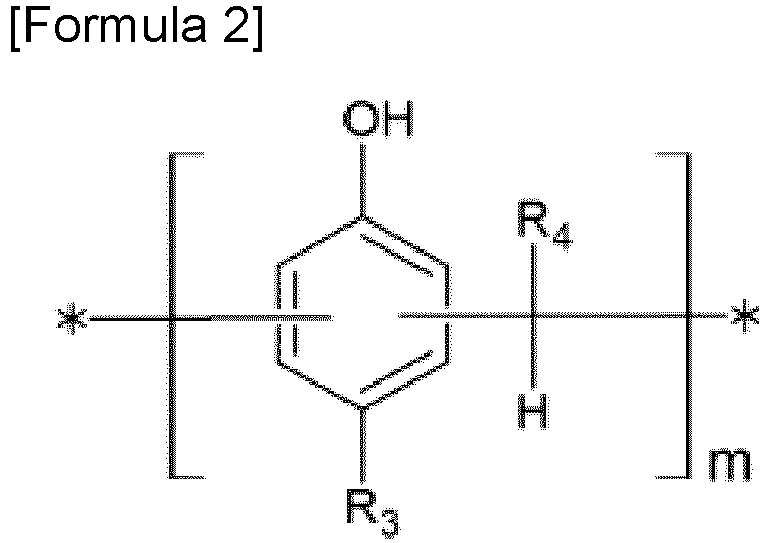 R3 is a C1 to C8 alkyl group, andR4 is hydrogen or a C1 to C2 alkyl group.
 - The alkoxylated resol-type phenol resin of claim 14, wherein R3 in Formula 2 is a methyl group, an ethyl group, a tert-butyl group, or a tert-octyl group.
- The alkoxylated resol-type phenol resin of claim 14, wherein the repeating unit represented by Formula 1 and the repeating unit represented by Formula 2 are comprised in the alkoxylated resol-type phenol resin at a ratio in range of about 1:1 to about 1:10.
- The alkoxylated resol-type phenol resin of claim 14, wherein the total amount of an alkoxy group comprised in the alkoxylated resol-type phenol resin is about 50 % to about 100 % of the total amount of an alkoxy group and an alkylol group comprised in the alkoxylated resol-type phenol resin.
- The alkoxylated resol-type phenol resin of claim 14, wherein,in Formula 1, R2 is hydrogen,in Formula 2, R3 is a methyl group, and R4 is hydrogen,in Formula 3, Rsa and R5b are hydrogen, and R6 is a C3 to C6 alkyl group,among benzene rings comprised in the alkoxylated resol-type phenol resin, a ratio of benzene rings not directly bonded to a C1 to C8 alkyl group to benzene rings directly bonded to a C1 to C8 alkyl group is in a range of about 1:2 to about 1:5, andthe total amount of an alkoxy group comprised in the alkoxylated resol-type phenol resin is about 50 % to about 100 % of the total amount of an alkoxy group and an alkylol group comprised in the alkoxylated resol-type phenol resin.
- A resin composition comprising the alkoxylated resol-type phenol resin of any one of claims 14 to 18.
- A varnish comprising the resin composition of claim 19.
Applications Claiming Priority (2)
| Application Number | Priority Date | Filing Date | Title |
|---|---|---|---|
| KR20200028398 | 2020-03-06 | ||
| PCT/KR2021/002752 WO2021177780A1 (en) | 2020-03-06 | 2021-03-05 | Alkoxylated resol-type phenol resin and method for producing same |
Publications (2)
| Publication Number | Publication Date |
|---|---|
| EP4116345A1 true EP4116345A1 (en) | 2023-01-11 |
| EP4116345A4 EP4116345A4 (en) | 2023-08-23 |
Family
ID=77793481
Family Applications (1)
| Application Number | Title | Priority Date | Filing Date |
|---|---|---|---|
| EP21763560.6A Pending EP4116345A4 (en) | 2020-03-06 | 2021-03-05 | Alkoxylated resol-type phenol resin and method for producing same |
Country Status (3)
| Country | Link |
|---|---|
| EP (1) | EP4116345A4 (en) |
| KR (1) | KR102532288B1 (en) |
| CN (1) | CN113646349B (en) |
Families Citing this family (1)
| Publication number | Priority date | Publication date | Assignee | Title |
|---|---|---|---|---|
| CN114907741A (en) * | 2022-04-27 | 2022-08-16 | 首航科环(泉州)纳米涂料有限公司 | Environment-friendly hydrophobic nano coating and preparation method and use method thereof |
Family Cites Families (7)
| Publication number | Priority date | Publication date | Assignee | Title |
|---|---|---|---|---|
| CA1107891A (en) * | 1976-01-09 | 1981-08-25 | Harry M. Culbertson | High ortho etherified resole resins |
| JP2621666B2 (en) * | 1991-01-21 | 1997-06-18 | 日本鋼管株式会社 | Phenolic resin-based coating composition |
| JPH07207222A (en) * | 1994-01-12 | 1995-08-08 | Kansai Paint Co Ltd | Coating composition |
| JP4362891B2 (en) | 1999-05-26 | 2009-11-11 | 住友ベークライト株式会社 | Metacresol resin composition for paint |
| JP4582367B2 (en) * | 2000-04-28 | 2010-11-17 | 東洋紡績株式会社 | Paint resin composition for cans and coated metal plate for cans coated with the same |
| JP2002275229A (en) * | 2001-03-16 | 2002-09-25 | Sumitomo Bakelite Co Ltd | Phenolic resin for coating |
| EP3130619A4 (en) * | 2014-04-10 | 2017-11-29 | DIC Corporation | Alkoxylated resol-type phenol resin manufacturing method, alkoxylated resol-type phenol resin, resin composition, and coating |
-
2021
- 2021-03-05 CN CN202180002672.4A patent/CN113646349B/en active Active
- 2021-03-05 KR KR1020210029382A patent/KR102532288B1/en active Active
- 2021-03-05 EP EP21763560.6A patent/EP4116345A4/en active Pending
Also Published As
| Publication number | Publication date |
|---|---|
| KR102532288B1 (en) | 2023-05-15 |
| KR20210113088A (en) | 2021-09-15 |
| CN113646349B (en) | 2024-11-01 |
| EP4116345A4 (en) | 2023-08-23 |
| CN113646349A (en) | 2021-11-12 |
Similar Documents
| Publication | Publication Date | Title |
|---|---|---|
| HU216086B (en) | Catalyzed cationic lacquer binder, process for producing the same and its use | |
| EP0232747A2 (en) | Method of coating objects by anodic electro-dip-lacquering, aqueous thermosetting coating agent, its use and objects coated with the same | |
| CA1218793A (en) | Poly (hydroxy ether) | |
| US12540210B2 (en) | Alkoxylated resol-type phenol resin and method for producing same | |
| EP1004679B1 (en) | Non-oriented electromagnetic steel sheet having insulating film excellent in film properties, method for producing same, and insulating film-forming agent used for producing the same | |
| KR102532288B1 (en) | Alkoxylated resol type phenolic resin and process of preparing the same | |
| JP3356302B2 (en) | Resin composition for water-based paint | |
| JP3276633B2 (en) | Resin composition for water-based paint | |
| JPH1180971A (en) | Non-oriented electrical steel sheet having insulating film with excellent film properties, method for producing the same, and insulating film forming agent used for the production | |
| JPH0218470A (en) | Cathode precipitable electrodeposition paint | |
| JPH05295318A (en) | Resin composition for water-base paint | |
| RU2024533C1 (en) | Method of preparing organic titanium compounds | |
| US5407748A (en) | Resin composition for aqueous paint | |
| JP5426436B2 (en) | Modified phenolic resin and aqueous coating composition containing the same | |
| CA1213392A (en) | Process for producing self-crosslinking cathodically depositable binders on the basis of modified phenol- novolaks | |
| JP3361123B2 (en) | Resin composition for water-based paint | |
| JP2785284B2 (en) | Method for producing mixed alkyl etherified methylol melamine resin | |
| JP4362891B2 (en) | Metacresol resin composition for paint | |
| JP5105789B2 (en) | Pigment dispersion paste and cationic electrodeposition paint | |
| EP0043462B1 (en) | Alkoxyalkyl-aminotriazine-transetherifying products and their use | |
| JP3602828B2 (en) | Cathodic electrodeposition bath composition | |
| KR100559058B1 (en) | Water dispersion resin composition and preparation method | |
| US10745556B1 (en) | Amino resin composition and varnish, coating layer, and product comprising the same | |
| EP0165648A2 (en) | Heat-curable coating agent and its use | |
| JPS6197371A (en) | Paint composition for the inside of cans |
Legal Events
| Date | Code | Title | Description |
|---|---|---|---|
| STAA | Information on the status of an ep patent application or granted ep patent |
Free format text: STATUS: THE INTERNATIONAL PUBLICATION HAS BEEN MADE |
|
| PUAI | Public reference made under article 153(3) epc to a published international application that has entered the european phase |
Free format text: ORIGINAL CODE: 0009012 |
|
| STAA | Information on the status of an ep patent application or granted ep patent |
Free format text: STATUS: REQUEST FOR EXAMINATION WAS MADE |
|
| 17P | Request for examination filed |
Effective date: 20220621 |
|
| AK | Designated contracting states |
Kind code of ref document: A1 Designated state(s): AL AT BE BG CH CY CZ DE DK EE ES FI FR GB GR HR HU IE IS IT LI LT LU LV MC MK MT NL NO PL PT RO RS SE SI SK SM TR |
|
| DAV | Request for validation of the european patent (deleted) | ||
| DAX | Request for extension of the european patent (deleted) | ||
| A4 | Supplementary search report drawn up and despatched |
Effective date: 20230720 |
|
| RIC1 | Information provided on ipc code assigned before grant |
Ipc: C08L 61/14 20060101ALI20230714BHEP Ipc: C09D 5/08 20060101ALI20230714BHEP Ipc: C09D 161/14 20060101ALI20230714BHEP Ipc: C08G 8/36 20060101ALI20230714BHEP Ipc: C08G 8/12 20060101ALI20230714BHEP Ipc: C08G 8/24 20060101ALI20230714BHEP Ipc: B65D 23/02 20060101ALI20230714BHEP Ipc: C09D 161/12 20060101ALI20230714BHEP Ipc: C08L 61/12 20060101ALI20230714BHEP Ipc: C08G 8/22 20060101AFI20230714BHEP |
|
| STAA | Information on the status of an ep patent application or granted ep patent |
Free format text: STATUS: EXAMINATION IS IN PROGRESS |
|
| 17Q | First examination report despatched |
Effective date: 20241220 |