EP4116302A1 - Compound and preparation method thereof and application thereof in preparation of therapeutic anti-cancer drug - Google Patents
Compound and preparation method thereof and application thereof in preparation of therapeutic anti-cancer drug Download PDFInfo
- Publication number
- EP4116302A1 EP4116302A1 EP21905192.7A EP21905192A EP4116302A1 EP 4116302 A1 EP4116302 A1 EP 4116302A1 EP 21905192 A EP21905192 A EP 21905192A EP 4116302 A1 EP4116302 A1 EP 4116302A1
- Authority
- EP
- European Patent Office
- Prior art keywords
- compound
- preparation
- nmr
- pharmaceutically acceptable
- cancer
- Prior art date
- Legal status (The legal status is an assumption and is not a legal conclusion. Google has not performed a legal analysis and makes no representation as to the accuracy of the status listed.)
- Granted
Links
Images


Classifications
-
- C—CHEMISTRY; METALLURGY
- C07—ORGANIC CHEMISTRY
- C07D—HETEROCYCLIC COMPOUNDS
- C07D487/00—Heterocyclic compounds containing nitrogen atoms as the only ring hetero atoms in the condensed system, not provided for by groups C07D451/00 - C07D477/00
- C07D487/02—Heterocyclic compounds containing nitrogen atoms as the only ring hetero atoms in the condensed system, not provided for by groups C07D451/00 - C07D477/00 in which the condensed system contains two hetero rings
- C07D487/04—Ortho-condensed systems
-
- A—HUMAN NECESSITIES
- A61—MEDICAL OR VETERINARY SCIENCE; HYGIENE
- A61K—PREPARATIONS FOR MEDICAL, DENTAL OR TOILETRY PURPOSES
- A61K31/00—Medicinal preparations containing organic active ingredients
- A61K31/33—Heterocyclic compounds
- A61K31/395—Heterocyclic compounds having nitrogen as a ring hetero atom, e.g. guanethidine or rifamycins
- A61K31/495—Heterocyclic compounds having nitrogen as a ring hetero atom, e.g. guanethidine or rifamycins having six-membered rings with two or more nitrogen atoms as the only ring heteroatoms, e.g. piperazine or tetrazines
- A61K31/505—Pyrimidines; Hydrogenated pyrimidines, e.g. trimethoprim
- A61K31/519—Pyrimidines; Hydrogenated pyrimidines, e.g. trimethoprim ortho- or peri-condensed with heterocyclic rings
-
- A—HUMAN NECESSITIES
- A61—MEDICAL OR VETERINARY SCIENCE; HYGIENE
- A61P—SPECIFIC THERAPEUTIC ACTIVITY OF CHEMICAL COMPOUNDS OR MEDICINAL PREPARATIONS
- A61P35/00—Antineoplastic agents
Definitions
- the present disclosure relates to the technical field of pharmacy, and in particular to a 2H-pyrazolo[3,4-d]pyrimidine derivative, a preparation method thereof, and use thereof in the preparation of an anti-cancer drug.
- Fibroblast growth factor receptors are members of the receptor tyrosine kinase (RTK) family and are receptor protein tyrosine kinases (RPTKs), including four highly-conserved transmembrane tyrosine kinases: FGFR1, FGFR2, FGFR3, and FGFR4.
- RTK receptor tyrosine kinases
- FGFR1, FGFR2, FGFR3, and FGFR4 receptor protein tyrosine kinases
- a signaling pathway of FGFR is that a ligand binds to a receptor to induce FGFR dimerization, thereby causing cascade activation of downstream signaling pathways such as Ras-MAPK, PI3K-Akt, STAT, and PLC ⁇ .
- FGFRs play important roles in a variety of cell functions, such as cell proliferation and differentiation, and biological processes including development, angiogenesis, homeostasis, and wound repair.
- FGFR abnormalities 7.1% of cancer patients have FGFR abnormalities.
- the FGFR1 amplification occurred most in squamous non-small cell lung cancer (NSCLC) patients with a proportion of 20%, which was 10% in breast cancer patients, 5% in ovarian cancer patients, and 3% in bladder cancer patients.
- NSCLC non-small cell lung cancer
- FGFR2 mutations have been found in gastric cancer (10%), endometrial cancer (12%), squamous NSCLC (5%), and triple-negative breast cancer (TNBC) (4%); and FGFR3 mutations are well known in bladder cancer (50% to 60%) and myeloma (15% to 20%).
- HCC hepatocellular carcinoma
- FGFR inhibitors are initially used to treat FGFR abnormality-associated cancer (7) , such as dovitinib (TKI-258), lucitanib (E-3810) (8) , nintedanib (BIBF-1120) (9) , and ponatinib (AP-24534) (10) .
- TKIs multi-targeted tyrosine kinase inhibitors
- E-3810 tyrosine kinase inhibitors
- AP-24534 ponatinib
- TKIs are currently in different stages of clinical research, such as AZD-4547 (phase III) (12) , BGJ-398 (phase II) (13) , LY-2874455 (phase II) (14) , and JNJ-42756493 (phase II) (15) , and these selective FGFR inhibitors are ATP-competitive inhibitors that bind to an active form of FGFR.
- FGFR inhibitors developed by many pharmaceutical chemistry laboratories have been reported. (16-22) .
- the technical problems to be solved/objectives to be achieved by the present disclosure at least include: overcoming the defects in the prior art and providing a 2 H -pyrazolo[3,4-d]pyrimidine derivative, a preparation method thereof, and use thereof in the preparation of an anti-cancer drug.
- the present disclosure provides a compound of formula I or a pharmaceutically acceptable salt thereof: where Ar is any one selected from the group consisting of a substituted aryl and a substituted heterocyclic group;
- the Ar is N-(2-aminoethyl)-2-aminoethyl-N-(2-aminoethyl)-2-aminoethyl-N-(2-aminoethyl)-2-aminoethyl-N-(2-aminoethyl)-2-aminoethyl-N-(2-aminoethyl)-2-aminoethyl
- the R is H, CF 3 , (CH 3 ) 2 NCH 2 , or CH 3 .
- the Linker is or
- the compound is one selected from the group consisting of compound 1 to compound 40:
- the present disclosure also provides a preparation method of the compound or the pharmaceutically acceptable salt thereof according to the above technical solution, with a synthetic route as follows:
- the preparation method may include the following steps:
- the present disclosure also provides use of the compound or the pharmaceutically acceptable salt thereof according to the above technical solution in the preparation of an tumor cell proliferation inhibitor, where a tumor cell is an FGFR abnormality-associated tumor cell.
- the tumor cell includes NCI-H1581 or SNU-16.
- the present disclosure also provides use of the compound or the pharmaceutically acceptable salt thereof according to the above technical solution in blocking a fibroblast growth factor (FGF)/FGFR signaling pathway in a tumor cell, where the tumor cell is an FGFR abnormality-associated tumor cell.
- FGF fibroblast growth factor
- the tumor cell includes NCI-H1581 or SNU-16.
- the present disclosure also provides a pharmaceutical composition including the compound or the pharmaceutically acceptable salt thereof according to the above technical solution, where the pharmaceutical composition further includes one or more pharmaceutically acceptable excipients; and a dosage form of the pharmaceutical composition is any pharmaceutically acceptable dosage form.
- the present disclosure also provides use of the compound or the pharmaceutically acceptable salt thereof according to the above technical solution or the pharmaceutical composition according to the above technical solution in the preparation of a drug for treating and/or preventing a cancer.
- the cancer is an FGFR abnormality-associated cancer.
- the present disclosure also provides use of the pharmaceutical composition according to the above technical solution in the preparation of an irreversible pan-FGFR inhibitor.
- the present disclosure also provides a method for treating a cancer, including the following step:
- the anti-cancer drug includes the compound 10 or the compound 36.
- the anti-cancer drug is administered at a dose of 50 mg/kg or 100 mg/kg; and the dose is calculated according to a dosage of the compound 10 or the compound 36.
- the anti-cancer drug includes the compound 10
- the anti-cancer drug is administered orally.
- the anti-cancer drug includes the compound 36
- the anti-cancer drug is administered through intraperitoneal injection.
- pharmaceutically acceptable adjuvant includes pharmaceutically acceptable carriers, excipients, diluents, and the like, which are compatible with the active pharmaceutical ingredients.
- the preparation of a pharmaceutical formulation with a pharmaceutically acceptable adjuvant is well known to those of ordinary skill in the art.
- the pharmaceutical composition may be combined with a pharmaceutically acceptable adjuvant (such as a carrier, an excipient, a diluent, or the like well known to those of ordinary skill in the art) to prepare various formulations, preferably including solid formulations and liquid preparations, such as tablets, pills, capsules, powders, suspensions, granules, syrups, emulsions, suspensions, and various sustained-release dosage forms, which may be preferably administered orally.
- a pharmaceutically acceptable adjuvant such as a carrier, an excipient, a diluent, or the like well known to those of ordinary skill in the art
- test reagents used are all conventional biochemical reagents, and the test methods are all conventional methods.
- the compound 1-2 (450 mg, 0.587 mmol) was dissolved in DCM (5 mL), and then TFA (5 mL) was slowly added dropwise, after 30 min the reaction was completed; adjusting alkali of a resulting reaction solution was conducted with saturated NaHCO 3 , and a resulting organic phase was concentrated to dry to obtain a brown-yellow oily intermediate.
- TLC thin layer chromatography
- a specific preparation method was the same as the preparation method of compound 1, except that one of the raw materials was equimolar 1-Boc-3-hydroxymethylpyrrolidine, in replacement of 1-Boc-3-azetidinemethanol in the preparation method of compound (1-1).
- a specific preparation method was the same as the preparation method of compound 1, except that one of the raw materials was equimolar N-Boc-4-hydroxypiperidine, in replacement of 1-Boc-3-azetidinemethanol in the preparation method of compound (1-1).
- a specific preparation method was the same as the preparation method of compound 1, except that one of the raw materials was equimolar N -Boc-4-piperidinemethanol, in replacement of 1-Boc-3-azetidinemethanol in the preparation method of compound (1-1).
- a specific preparation method was the same as the preparation method of compound 1, except that one of the raw materials was equimolar N -Boc-4-piperidineethanol, in replacement of 1-Boc-3-azetidinemethanol in the preparation method of compound (1-1).
- a specific preparation method was the same as the preparation method of compound 1, except that one of the raw materials was equimolar 1-Boc-3-hydroxymethylpiperidine, in replacement of 1-Boc-3-azetidinemethanol in the preparation method of compound (1-1).
- a specific preparation method was the same as the preparation method of compound 1, except that one of the raw materials was equimolar tert- Butyl 4-(2-hydroxyethyl)piperazine-1-carboxylate, in replacement of 1-Boc-3-azetidinemethanol in the preparation method of compound (1-1).
- a specific preparation method was the same as the preparation method of compound 1, except that one of the raw materials was equimolar 1-Boc-4-(3-hydroxypropane)piperazine, in replacement of 1-Boc-3-azetidinemethanol in the preparation method of compound (1-1).
- a specific preparation method was the same as the preparation method of compound 1, except that one of the raw materials was equimolar 1-Boc-4-(4-hydroxybutane)piperazine, in replacement of 1-Boc-3-azetidinemethanol in the preparation method of compound (1-1).
- a specific preparation method was the same as the preparation method of compound 1, except that one of the raw materials was equimolar 1-Boc-4-(5-hydroxypentane)piperazine, in replacement of 1-Boc-3-azetidinemethanol in the preparation method of compound (1-1).
- a specific preparation method was the same as the preparation method of compound 1, except that one of the raw materials was equimolar 1-Boc-4-(6-hydroxyhexane)piperazine, in replacement of 1-Boc-3-azetidinemethanol in the preparation method of compound (1-1).
- a specific preparation method was the same as the preparation method of compound 1, except that one of the raw materials was equimolar 1-Boc-4-(7-hydroxyheptane)piperazine, in replacement of 1-Boc-3-azetidinemethanol in the preparation method of compound (1-1).
- a specific preparation method was the same as the preparation method of compound 1, except that one of the raw materials was equimolar 3,4-methylenephenylboronic acid, in replacement of 3,5-dimethoxyphenylboronic acid in the preparation method of compound (1-2).
- a specific preparation method was the same as the preparation method of compound 1, except that one of the raw materials was equimolar benzofuran-2-boronic acid, in replacement of 3,5-dimethoxyphenylboronic acid in the preparation method of compound (1-2).
- a specific preparation method was the same as the preparation method of compound 1, except that one of the raw materials was equimolar p -methoxyboronic acid, in replacement of 3,5-dimethoxyphenylboronic acid in the preparation method of compound (1-2).
- a specific preparation method was the same as the preparation method of compound 1, except that one of the raw materials was equimolar 4-acetylaminophenylboronic acid, in replacement of 3,5-dimethoxyphenylboronic acid in the preparation method of compound (1-2).
- a specific preparation method was the same as the preparation method of compound 1, except that equimolar 4-trifluoromethoxyphenylboronic acid, in replacement of 3,5-dimethoxyphenylboronic acid in the preparation method of compound (1-2).
- a specific preparation method was the same as the preparation method of compound 1, except that one of the raw materials was equimolar 2-naphthaleneboronic acid in replacement of 3,5-dimethoxyphenylboronic acid in the preparation method of compound (1-2).
- a specific preparation method was the same as the preparation method of compound 1, except that one of the raw materials was equimolar 4-methylnaphthaleneboronic acid, in replacement of 3,5-dimethoxyphenylboronic acid in the preparation method of compound (1-2).
- a specific preparation method was the same as the preparation method of compound 1, except that one of the raw materials was equimolar 4-bromonaphthaleneboronic acid, in replacement of 3,5-dimethoxyphenylboronic acid in the preparation method of compound (1-2).
- a specific preparation method was the same as the preparation method of compound 1, except that one of the raw materials was equimolar 2,5-dimethoxyphenylboronic acid, in replacement of 3,5-dimethoxyphenylboronic acid in the preparation method of compound (1-2).
- a specific preparation method was the same as the preparation method of compound 1, except that one of the raw materials was equimolar 3,4-dimethoxyphenylboronic acid, in replacement of 3,5-dimethoxyphenylboronic acid in the preparation method of compound (1-2).
- a specific preparation method was the same as the preparation method of compound 1, except that one of the raw materials was equimolar 3,4,5-trimethoxyphenylboronic acid, in replacement of 3,5-dimethoxyphenylboronic acid in the preparation method of compound (1-2).
- a specific preparation method was the same as the preparation method of compound 1, except that one of the raw materials was equimolar 3-trifluoromethylphenylboronic acid, in replacement of 3,5-dimethoxyphenylboronic acid in the preparation method of compound (1-2).
- a specific preparation method was the same as the preparation method of compound 1, except that one of the raw materials was equimolar 3-isopropoxyphenylboronic acid, in replacement of 3,5-dimethoxyphenylboronic acid in the preparation method of compound (1-2).
- a specific preparation method was the same as the preparation method of compound 1, except that one of the raw materials was equimolar 3-benzyloxyphenylboronic acid, in replacement of 3,5-dimethoxyphenylboronic acid in the preparation method of compound (1-2).
- a specific preparation method was the same as the preparation method of compound 1, except that one of the raw materials was equimolar 2-chloro-5-methoxyphenylboronic acid, in replacement of 3,5-dimethoxyphenylboronic acid in the preparation method of compound (1-2).
- a specific preparation method was the same as the preparation method of compound 1, except that one of the raw materials was equimolar p-fluorophenylboronic acid, in replacement of 3,5-dimethoxyphenylboronic acid in the preparation method of compound (1-2).
- a specific preparation method was the same as the preparation method of compound 1, except that one of the raw materials was equimolar 3-fluoro-4-hydroxyphenylboronic acid, in replacement of 3,5-dimethoxyphenylboronic acid in the preparation method of compound (1-2).
- a specific preparation method was the same as the preparation method of compound 1, except that one of the raw materials was equimolar 6-methoxynaphthalene-2-boronic acid, in replacement of 3,5-dimethoxyphenylboronic acid in the preparation method of compound (1-2).
- a specific preparation method was the same as the preparation method of compound 1, except that one of the raw materials was equimolar p-nitrophenylboronic acid, in replacement of 3,5-dimethoxyphenylboronic acid in the preparation method of compound (1-2).
- a specific preparation method was the same as the preparation method of compound 1, except that one of the raw materials was equimolar 3-fluoro-5-methoxyphenylboronic acid, in replacement of 3,5-dimethoxyphenylboronic acid in the preparation method of compound (1-2).
- a specific preparation method was the same as the preparation method of compound 1, except that one of the raw materials was equimolar 3,5-difluorophenylboronic acid was used instead of 3,5-dimethoxyphenylboronic acid in the preparation method of compound (1-2).
- a specific preparation method was the same as the preparation method of compound 1, except that one of the raw materials was equimolar 3,5-bis(trifluoromethyl)phenylboronic acid, in replacement of 3,5-dimethoxyphenylboronic acid in the preparation method of compound (1-2).
- a specific preparation method was the same as the preparation method of compound 1, except that one of the raw materials was equimolar 3-fluoro-5-trifluoromethylphenylboronic acid, in replacement of 3,5-dimethoxyphenylboronic acid in the preparation method of compound (1-2).
- a specific preparation method was the same as the preparation method of compound 10, except that one of the raw materials was equimolar 4,4,4-trifluorocrotonic acid, in replacement of acryloyl chloride in the preparation method of compound (1-3).
- a specific preparation method was the same as the preparation method of compound 34, except that one of the raw materials was equimolar 4,4,4-trifluorobutenoic acid in replacement of acryloyl chloride in the preparation method of compound (1-3).
- a specific preparation method was the same as the preparation method of compound 35, except that one of the raw materials was equimolar 4,4,4-trifluorobutenoic acid, in replacement of acryloyl chloride in the preparation method of compound (1-3).
- a specific preparation method was the same as the preparation method of compound 10, except that one of the raw materials was equimolar trans-4-dimethylaminocrotonic acid, in replacement of acryloyl chloride in the preparation method of compound (1-3).
- a specific preparation method was the same as the preparation method of compound 10, except that one of the raw materials was equimolar crotonic acid, in replacement of acryloyl chloride in the preparation method of compound (1-3).
- HTRF time-resolved fluorescence
- cisbio HTRF KinEA (62TK0PEB) was used to pre-dilute each component required in an enzyme activity system with an enzyme activity buffer to a required working concentration.
- a 384-well plate (66PL384025) was prepared, 5 ⁇ L of a protein solution, 1 ⁇ L of a compound, and 2 ⁇ L of a substrate were added to each well, and 2 ⁇ L of ATP was finally added to initiate a reaction.
- Three parallel experiments were set for each concentration. In the blank control group, 1 ⁇ L of the compound was replaced with 1 ⁇ L of dimethyl sulfoxide (DMSO); and in the positive control group, the positive drug AZD4547 was used instead, and the other conditions remained unchanged.
- DMSO dimethyl sulfoxide
- the 384-well plate was sealed and incubated at room temperature for about 1 h. After the incubation was completed, 5 ⁇ L of a lanthanide-labeled phosphorylated substrate antibody (a donor) and 5 ⁇ L of a streptavidin-labeled XL665 (a receptor) were added to each well to stop the reaction, and the plate was further incubated at room temperature for about 1 h in the dark. Finally, the TECAN infinite M1000PRO multi-function microplate reader was used to detect a fluorescence signal, an inhibition rate was calculated, and an IC50 value was fitted with GraphPad Prism 7.0.
- the compounds 10 and 36 were selected, and the methyl thiazolyl tetrazolium (MTT) colorimetric method was used to evaluate the proliferation inhibition effects of the compounds 10 and 36 on various tumor cells.
- Tumor cells in a logarithmic growth phase were collected through trypsinization and resuspended in 1 mL of a fresh medium, and a small amount of a resulting suspension was taken, diluted, and subjected to cell counting with a hemocytometer. According to the cell growth rate, tumor cells were inoculated into a 96-well plate at a density of 3,000 cells/well to 5,000 cells/well, and then cultivated in an incubator for 24 h.
- MTT methyl thiazolyl tetrazolium
- the tumor cells were treated with the compounds 10 and 36 at 8 concentrations, with three replicate wells for each concentration, and then incubated for 96 h. After the incubation was completed, 10 ⁇ L of an MTT solution (5 mg/mL) was added to each well, and the plate was tapped for thorough mixing and then further incubated in an incubator for 3 h to 4 h. After the incubation was completed, the liquid in the well plate was carefully pipetted and removed, and then 100 ⁇ L of a DMSO solution was added to each well.
- an MTT solution 5 mg/mL
- a corresponding volume of the tumor cell suspension was taken and inoculated into a 6-well plate at a density of 3 ⁇ 10 5 cells/well, and cultivated in an incubator for 24 h. After the cells were completely adherence, the used medium was pipetted and removed, fresh media with the compounds 10 and 36 at different concentrations were added, and the plate was incubated in an incubator for 12 h.
- a culture supernatant was pipetted and removed, and the plate was washed three times with a pre-cooled 1X PBS solution to completely pipet and remove the residual solution; 60 ⁇ L of an RIPA lysis buffer was added to each well, and cells were gently scraped off with a cell scraper; a resulting lysis buffer was transferred to a 1.5 mL EP tube, subjected an ice bath for 10 min, and centrifuged at 14,000 rpm for 10 min, a resulting supernatant was pipetted into a new 1.5 mL EP tube, and a small amount of the supernatant was pipetted for protein content determination; and a corresponding volume of 5 X loading buffer was added to the remaining supernatant, and a resulting mixture was vortexed for thorough mixing and subjected a metal bath at 100°C for 10 min.
- a corresponding loading amount was calculated at 30 ⁇ g of protein per well.
- Proteins were isolated by 8% sodium dodecyl sulfate-polyacrylamide gel electrophoresis (SDS-PAGE), the isolated proteins were transferred to a polyvinylidene fluoride (PVDF) membrane, and stained with Ponceau S, and the PDVF membrane with proteins was cut according to a molecular weight of a target protein, rinsed with a 1X TBST solution to remove Ponceau S, and blocked with 5% skimmed milk powder for 30 min.
- PVDF polyvinylidene fluoride
- the PDVF membrane was washed three times with a 1X TBST solution, a PDVF membrane with the target protein band was placed in an incubation box, a corresponding primary antibody incubation solution was added, and the PDVF membrane was incubated at 4°C overnight. After the primary antibody incubation was completed, the membrane was washed three times with a 1X TBST solution, a corresponding secondary antibody incubation solution was added, and the membrane was incubated at room temperature for 1.5 h. After the incubation was completed, the membrane was washed three times with a 1X TBST solution and subjected to color development with a hypersensitive horseradish peroxidase (HRP) chemiluminescence kit.
- HRP horseradish peroxidase
- the compounds 10 and 36 not only significantly inhibited the phosphorylation of FGFR1 in NCI-H1581 cells and the phosphorylation of FGFR2 in SNU-16 cells, but also inhibited the activation of downstream PLC ⁇ , AKT, and ERK in a dose-dependent manner.
- the compounds 10 and 36 can strongly inhibit FGF/FGFR and downstream signaling pathways in vitro.
- a mouse subcutaneous xenograft model was established with human squamous cell lung carcinoma cells NCI-H1581 with high FGFR1 expression.
- Cells in a logarithmic growth phase were collected through trypsinization, washed three times with 1X PBS.
- mice When a tumor volume grew to 50 mm 3 to 100 mm 3 , the mice were randomly divided into three groups (control group, 50 mg/kg, and 100 mg/kg), with 6 mice in each group. The compound 10 was administered orally every day, and the compound 36 was intraperitoneally injected every day. The tumor volume and mouse body weight were measured. The mice was treated after 26 d of administration, that a tumor tissue was dissected and fixed in a formalin solution for later use.
- the compounds 10 and 36 inhibited the proliferation of NCI-H1581 cells in mice in a dose-dependent manner, with an inhibition rate of 72% in the high-dose group; inhibited the phosphorylation activation of FGFR1 in a tumor tissue; and did not lead to an obvious weight loss, indicating that the compounds 10 and 36 were well tolerated in vivo at all doses.
- the present disclosure optimizes 2H-pyrazolo[3,4-d]pyrimidine to obtain novel derivatives thereof (compounds 10 and 36), and the compounds 10 and 36 are served as effective and selective inhibitors for FGFR1, FGFR2, and FGFR3, which exhibit an irreversible binding effect to a target protein.
- the compounds are leading compounds that can not only inhibit FGF/FGFR and downstream signaling pathways thereof at low concentrations, but also exhibit significant anti-proliferation effects on the NCI-H1581 cancer cell line in vitro and in vivo.
- the compounds 10 and 36 show low toxicity and prominent PK properties, and are currently identified as potential drug candidates.
Landscapes
- Chemical & Material Sciences (AREA)
- Organic Chemistry (AREA)
- Health & Medical Sciences (AREA)
- Life Sciences & Earth Sciences (AREA)
- Medicinal Chemistry (AREA)
- Pharmacology & Pharmacy (AREA)
- Animal Behavior & Ethology (AREA)
- General Health & Medical Sciences (AREA)
- Public Health (AREA)
- Veterinary Medicine (AREA)
- Nuclear Medicine, Radiotherapy & Molecular Imaging (AREA)
- General Chemical & Material Sciences (AREA)
- Chemical Kinetics & Catalysis (AREA)
- Epidemiology (AREA)
- Pharmaceuticals Containing Other Organic And Inorganic Compounds (AREA)
- Nitrogen Condensed Heterocyclic Rings (AREA)
Abstract
Description
- The present disclosure claims priority to the
Chinese Patent Application 202011483614.1 filed to the China National Intellectual Property Administration (CNIPA) on December 16, 2020 - The present disclosure relates to the technical field of pharmacy, and in particular to a 2H-pyrazolo[3,4-d]pyrimidine derivative, a preparation method thereof, and use thereof in the preparation of an anti-cancer drug.
- Fibroblast growth factor receptors (FGFRs) are members of the receptor tyrosine kinase (RTK) family and are receptor protein tyrosine kinases (RPTKs), including four highly-conserved transmembrane tyrosine kinases: FGFR1, FGFR2, FGFR3, and FGFR4. A signaling pathway of FGFR is that a ligand binds to a receptor to induce FGFR dimerization, thereby causing cascade activation of downstream signaling pathways such as Ras-MAPK, PI3K-Akt, STAT, and PLCγ. FGFRs play important roles in a variety of cell functions, such as cell proliferation and differentiation, and biological processes including development, angiogenesis, homeostasis, and wound repair. According to research surveys (1-3), 7.1% of cancer patients have FGFR abnormalities. For example, the FGFR1 amplification occurred most in squamous non-small cell lung cancer (NSCLC) patients with a proportion of 20%, which was 10% in breast cancer patients, 5% in ovarian cancer patients, and 3% in bladder cancer patients. Currently, FGFR2 mutations have been found in gastric cancer (10%), endometrial cancer (12%), squamous NSCLC (5%), and triple-negative breast cancer (TNBC) (4%); and FGFR3 mutations are well known in bladder cancer (50% to 60%) and myeloma (15% to 20%). Aberrant FGF19/FGFR4 signaling is closely associated with hepatocellular carcinoma (HCC). Therefore, the development of a novel selective FGFR inhibitor to block the FGF/FGFR signaling pathway presents a promising therapeutic strategy for FGFR-associated cancer (4-6).
- Researchers are committed to developing an FGFR inhibitor as a novel anti-cancer agent for the treatment of FGFR-associated cancer. Several multi-targeted tyrosine kinase inhibitors (TKIs) are initially used to treat FGFR abnormality-associated cancer(7), such as dovitinib (TKI-258), lucitanib (E-3810)(8), nintedanib (BIBF-1120)(9), and ponatinib (AP-24534)(10). These FGFR inhibitors developed early are non-selective(11). Subsequently, several TKIs selective for FGFR with various scaffolds are developed. Some TKIs are currently in different stages of clinical research, such as AZD-4547 (phase III)(12), BGJ-398 (phase II)(13), LY-2874455 (phase II)(14), and JNJ-42756493 (phase II)(15), and these selective FGFR inhibitors are ATP-competitive inhibitors that bind to an active form of FGFR. In addition, FGFR inhibitors developed by many pharmaceutical chemistry laboratories have been reported.(16-22).
- The technical problems to be solved/objectives to be achieved by the present disclosure at least include: overcoming the defects in the prior art and providing a 2H-pyrazolo[3,4-d]pyrimidine derivative, a preparation method thereof, and use thereof in the preparation of an anti-cancer drug.
- In order to achieve the above objectives, the present disclosure discloses the following technical solutions:
- The present disclosure provides a compound of formula I or a pharmaceutically acceptable salt thereof:

- R is any structure selected from the group consisting of H, alkyl, aryl, -CF3, and an alkyl tertiary amine; and
- Linker is any one selected from the group consisting of alkyl, alkoxyl, a heteroatom substituent, and a substituted N-heterocyclic ring.
- Preferably, the Ar is


- Preferably, the R is H, CF3, (CH3)2NCH2, or CH3.
- Preferably, the Linker is


- Preferably, the compound is one selected from the group consisting of compound 1 to compound 40:


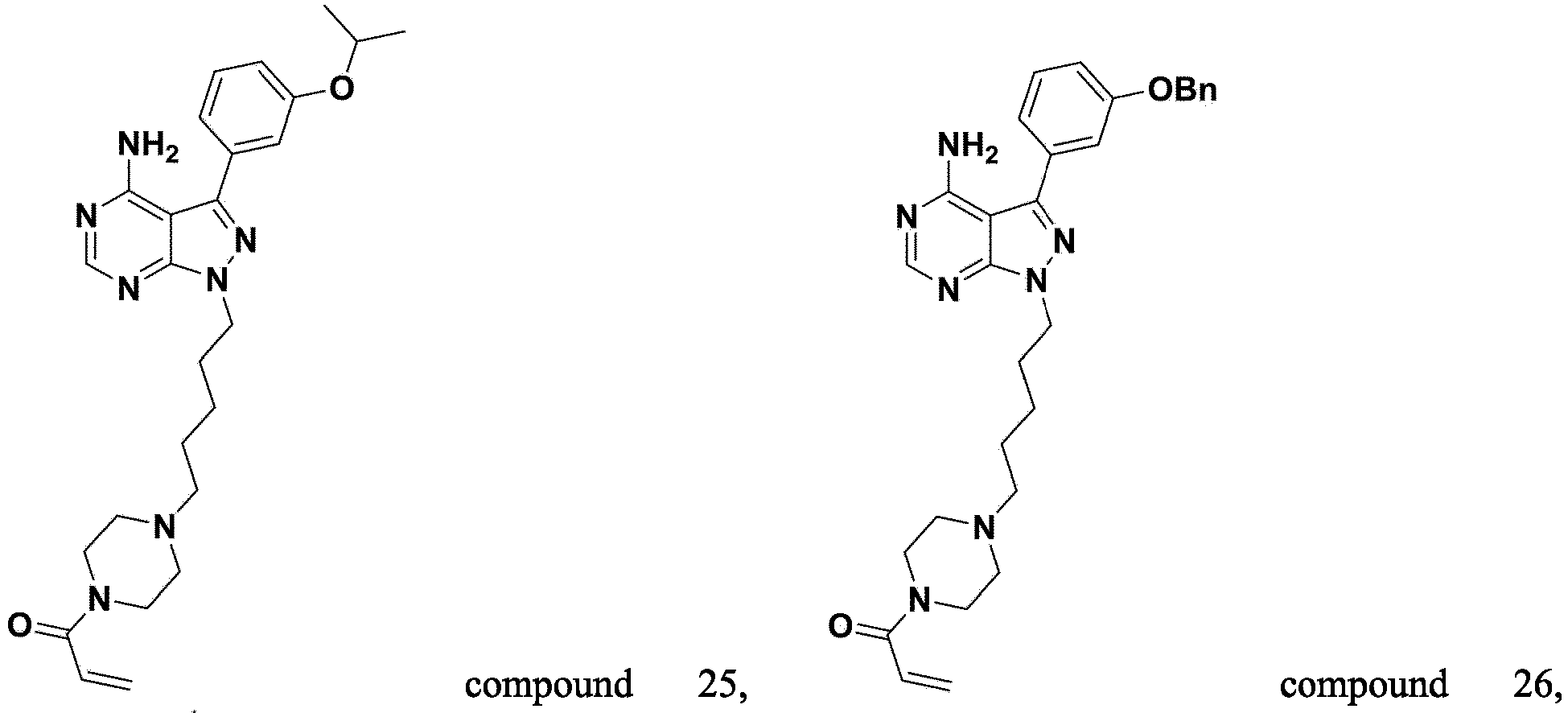


- The present disclosure also provides a preparation method of the compound or the pharmaceutically acceptable salt thereof according to the above technical solution, with a synthetic route as follows:

- Preferably, the preparation method may include the following steps:
- subjecting a compound with a structure shown in formula a and a compound with a structure shown in formula b to a Mitsunobu reaction at room temperature for 4 h to obtain a compound with a structure shown in formula c;
- subjecting the compound with the structure shown in formula c and a compound with a structure shown in formula d to a Suzuki coupling reaction at 80°C to obtain a compound with a structure shown in formula e;
- subjecting the compound with the structure shown in formula e and trifluoroacetic acid (TFA) to a deprotection reaction at 0°C to obtain a compound with a structure shown in formula f; and
- subjecting the compound with the structure shown in formula f to an acylation reaction at room temperature to obtain the compound with a structure shown in formula I;


- The present disclosure also provides use of the compound or the pharmaceutically acceptable salt thereof according to the above technical solution in the preparation of an tumor cell proliferation inhibitor, where a tumor cell is an FGFR abnormality-associated tumor cell.
- Preferably, the tumor cell includes NCI-H1581 or SNU-16.
- The present disclosure also provides use of the compound or the pharmaceutically acceptable salt thereof according to the above technical solution in blocking a fibroblast growth factor (FGF)/FGFR signaling pathway in a tumor cell, where the tumor cell is an FGFR abnormality-associated tumor cell.
- Preferably, the tumor cell includes NCI-H1581 or SNU-16.
- The present disclosure also provides a pharmaceutical composition including the compound or the pharmaceutically acceptable salt thereof according to the above technical solution, where the pharmaceutical composition further includes one or more pharmaceutically acceptable excipients; and
a dosage form of the pharmaceutical composition is any pharmaceutically acceptable dosage form. - The present disclosure also provides use of the compound or the pharmaceutically acceptable salt thereof according to the above technical solution or the pharmaceutical composition according to the above technical solution in the preparation of a drug for treating and/or preventing a cancer.
- Preferably, the cancer is an FGFR abnormality-associated cancer.
- The present disclosure also provides use of the pharmaceutical composition according to the above technical solution in the preparation of an irreversible pan-FGFR inhibitor.
- The present disclosure also provides a method for treating a cancer, including the following step:
- administering an anti-cancer drug to a patient through oral administration or intraperitoneal injection,
- where the anti-cancer drug includes the compound or the pharmaceutically acceptable salt thereof according to the above technical solution.
- Preferably, the anti-cancer drug includes the
compound 10 or thecompound 36. - Preferably, the anti-cancer drug is administered at a dose of 50 mg/kg or 100 mg/kg; and
the dose is calculated according to a dosage of thecompound 10 or thecompound 36. - Preferably, when the anti-cancer drug includes the
compound 10, the anti-cancer drug is administered orally. - Preferably, when the anti-cancer drug includes the
compound 36, the anti-cancer drug is administered through intraperitoneal injection. - In the present disclosure, the term "pharmaceutically acceptable adjuvant" includes pharmaceutically acceptable carriers, excipients, diluents, and the like, which are compatible with the active pharmaceutical ingredients. The preparation of a pharmaceutical formulation with a pharmaceutically acceptable adjuvant is well known to those of ordinary skill in the art.
- In the present disclosure, the pharmaceutical composition may be combined with a pharmaceutically acceptable adjuvant (such as a carrier, an excipient, a diluent, or the like well known to those of ordinary skill in the art) to prepare various formulations, preferably including solid formulations and liquid preparations, such as tablets, pills, capsules, powders, suspensions, granules, syrups, emulsions, suspensions, and various sustained-release dosage forms, which may be preferably administered orally.
-
-
FIG. 1 shows that thecompound 10 inhibits the activation of FGFR1 and a downstream signaling pathway thereof in NCI-H1581 cells and inhibits the activation of FGFR2 and a downstream signaling pathway thereof in SNU-16 cells in a concentration gradient-dependent manner, where A shows the inhibition on the activation of the FGFR1 and the downstream signaling pathway thereof in NCI-H1581 cells, and B shows the inhibition on the activation of the FGFR2 and the downstream signaling pathway thereof in SNU-16 cells; -
FIG. 2 shows that thecompound 36 inhibits the activation of FGFR1 and a downstream signaling pathway thereof in NCI-H1581 cells and inhibits the activation of FGFR2 and a downstream signaling pathway thereof in SUN-16 cells in a concentration gradient-dependent manner, where A shows the inhibition on the activation of the FGFR1 and the downstream signaling pathway thereof in NCI-H1581 cells, and B shows the inhibition on the activation of the FGFR2 and the downstream signaling pathway thereof in SUN-16 cells; -
FIG. 3 shows tumor volume curves (A), a tumor weight statistics chart after 26 d of treatment (B), body weight change curves during a treatment process (C), and a picture of tumors after 26 d of treatment (D) in a tumor model subcutaneously transplanted with NCI-H1581 tumor cells under the tumor proliferation inhibition of thecompound 10; and -
FIG. 4 shows tumor volume change curves (A), a tumor weight statistics chart after 26 d of treatment (B), body weight change curves during a treatment process (C), a picture of tumors after 26 d of treatment (D), and phosphorylation levels of FGFR1 in tissues of different treatments detected by immunohistochemistry (IHC) (E) in a tumor model subcutaneously transplanted with NCI-H1581 tumor cells under the tumor proliferation inhibition of thecompound 36. - Unless otherwise defined, the technical terms used in the following examples have the same meanings as commonly understood by those skilled in the art to which the present disclosure belongs. Unless otherwise specified, in the following examples, the test reagents used are all conventional biochemical reagents, and the test methods are all conventional methods.
- The present disclosure will be described in detail below with reference to the examples.
- Example 1: Preparation of compound 1

- A specific preparation method was as follows:
-

- 3-Bromo-1H-pyrazolo[3,4-d]pyrimidin-4-amine (500 mg, 2.34 mmol) was dissolved in dry tetrahydrofuran (THF) (23 mL), and then triphenylphosphine (TPP) (2.08 g, 7.94 mmol) and 1-Boc-3-azetidinemethanol were added; diisopropyl azodiformate (DIAD) (1.60 g, 7.94 mmol) was added dropwise at 0°C under the protection of argon, then the temperature was slowly raised to room temperature, and a reaction was further allowed for 4 h; and a reaction solution was spin-dried and purified by column chromatography (petroleum ether : ethyl acetate = 5:1 to 2:1) to obtain the compound 1-1 (yellow oily liquid, 685 mg, 69%).
- Nuclear magnetic resonance (NMR) test results of the compound 1-1 were as follows:
- 1H NMR (400 MHz, CDCl3) δ 8.06 (s, 1H), 7.96 - 7.87 (m, 6H), 7.64 - 7.45 (m, 9H), 4.48 (d, J = 7.3 Hz, 2H), 3.97 (t, J = 8.5 Hz, 2H), 3.88 - 3.74 (m, 2H), 3.19 - 2.98 (m, 1H), 1.41 (s, 9H). 13C NMR (100 MHz, CDCl3) δ 163.1, 163.0, 156.2, 155.9, 154.6, 154.5, 133.4, 133.4, 133.3, 133.3, 132.4, 132.3, 132.2, 128.8, 128.7, 128.7, 128.6, 128.6, 128.5, 128.4, 127.8, 127.4, 120.9, 107.1, 79.3, 52.9, 51.5, 49.7, 28.8, 28.4, 21.7, 14.2. HRMS (ESI) calculated for C32H32BrN6NaO2P+: 665.1400, found 665.1402.
-

- The compound 1-1 (5.01 mg, 6.74 mmol) and 3,5-dimethoxyphenylboronic acid (1.59 g, 8.76 mmol) were dissolved in a mixed solution of 1,4-dioxane and water (9 mL, v:v = 3:1), and then potassium carbonate (1.87 g, 13.5 mmol) and Pd(PPh3)4 (778 mg, 0.674 mmol) were added; a resulting system was argon replaced three times, and then heated to 80°C in an oil bath to undergo a reaction overnight; and after the reaction was completed, a resulting reaction system was washed with saturated sodium chloride (270 mL) and then subjected to extraction with ethyl acetate (90 mL), and a resulting organic phase was dried, concentrated, and purified by column chromatography (dichloromethane (DCM) : methanol = 70:1 to 30:1) to obtain the compound 1-2 (yellow oily liquid, 4.3 g, 60%).
- NMR test results of the compound 1-2 were as follows:
1H NMR (400 MHz, CDCl3) δ 8.06 (d, J = 3.2 Hz, 1H), 7.89 - 7.71 (m, 6H), 7.56 - 7.40 (m, 11H), 6.70 - 6.41 (m, 1H), 4.58 (dd, J = 7.3, 3.2 Hz, 2H), 4.11 - 3.96 (m, 2H), 3.92 - 3.84 (m, 2H), 3.76 (d, J = 3.1 Hz, 6H), 3.26 - 3.07 (m, 1H), 1.41 (d, J= 3.1 Hz, 9H). 13C NMR (100 MHz, CDCl3) δ 163.9, 163.9, 163.5, 163.4, 160.3, 156.3, 156.3, 155.2, 154.7, 146.1, 135.6, 134.2, 133.5, 133.4, 133.4, 133.3, 132.3, 132.2, 132.0, 132.0, 132.0, 1292, 128.6, 128.6, 128.5, 128.5, 128.4, 128.4, 128.2, 128.2, 127.8, 107.9, 100.6, 79.3, 77.4, 55.3, 49.5, 28.9, 28.4, 24.5. HRMS (ESI) calculated for C40H41N6NaO4P+: 723.2819, found 723.2822. -
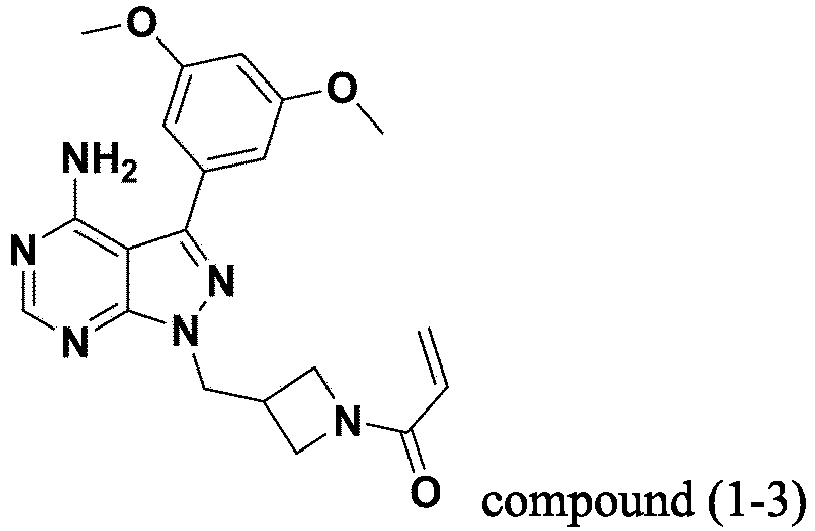
- At 0°C, the compound 1-2 (450 mg, 0.587 mmol) was dissolved in DCM (5 mL), and then TFA (5 mL) was slowly added dropwise, after 30 min the reaction was completed; adjusting alkali of a resulting reaction solution was conducted with saturated NaHCO3, and a resulting organic phase was concentrated to dry to obtain a brown-yellow oily intermediate. At 0°C, the intermediate was dissolved in 5 mL of DCM, then triethylamine (TEA) (98.2 µL, 0.704 mmol) was added, and then acryloyl chloride (52.2 µL, 0.646 mmol) was added dropwise; and a reaction was further allowed for 1 h at room temperature; and when it was monitored by thin layer chromatography (TLC) that the reaction was completed, a resulting reaction system was washed with saturated NaCl and then subjected to extraction with ethyl acetate, and a resulting organic phase was dried, concentrated, and purified by column chromatography (DCM : methanol = 30:1 to 10:1) to obtain the compound 1-3 (yellow oily liquid, 78 mg, 72%).
- 4) Preparation of compound 1: The compound 1-3 (100 mg, 0.189 mmol) was added to a mixed solution of acetic acid, THF, and water (3 mL, 3:1:2), and a reaction was conducted at room temperature for 18 h; and when it was monitored by TLC that the reaction was completed, a pH of a resulting reaction solution was adjusted to 7 to 8 with a saturated NaHCO3 solution (15 mL), extraction was conducted with ethyl acetate (10 mL × 2), and a resulting organic phase was dried, concentrated, and purified by column chromatography (DCM : methanol = 15:1 to 7:1) to obtain the compound 5a (yellow solid, 57.8 mg, 70%).
- NMR test results of the compound 1 were as follows:
1H NMR (400 MHz, CDCl3) δ 8.38 (s, 1H), 6.80 (d, J = 2.3 Hz, 2H), 6.57 (t, J = 2.3 Hz, 1H), 6.33 (dd, J= 17.0, 1.9 Hz, 1H), 6.17 (dd, J= 17.0, 10.3 Hz, 1H), 5.76 - 5.57 (m, 3H), 4.76 - 4.61 (m, 2H), 4.38 - 4.14 (m, 3H), 4.02 (dd, J = 10.5, 5.5 Hz, 1H), 3.87 (s, 6H), 3.49 - 3.25 (m, 1H). 13C NMR (100 MHz, CDCl3) δ 165.7, 161.6, 157.8, 156.2, 154.7, 144.7, 134.8, 127.4, 127.2, 125.7, 106.3, 101.2, 98.4, 55.6, 53.5, 50.8, 49.4, 32.7, 29.1, 27.9. HRMS (ESI) calculated for C20H22N6NaO3 +: 417.1646, found 417.1648. -
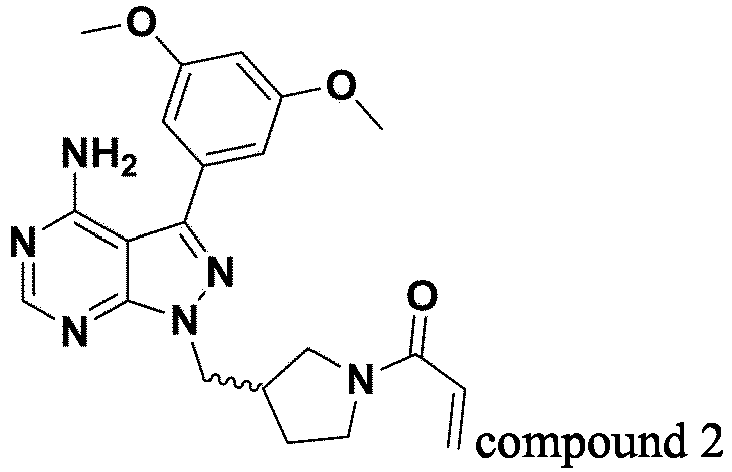
- A specific preparation method was the same as the preparation method of compound 1, except that one of the raw materials was equimolar 1-Boc-3-hydroxymethylpyrrolidine, in replacement of 1-Boc-3-azetidinemethanol in the preparation method of compound (1-1). NMR test results of the
compound 2 were as follows:
1H NMR (400 MHz, CDCl3) δ 8.38 (s, 1H), 6.81 (d, J= 2.2 Hz, 2H), 6.62 - 6.54 (m, 2H), 6.25 (dd, J = 16.9, 2.0 Hz, 1H), 5.76 (s, 2H), 5.66 (dd, J = 10.6, 2.0 Hz, 1H), 4.65 (d, J= 13.3 Hz, 1H), 4.49 (t, J = 7.2 Hz, 2H), 3.99 (d, J = 13.7 Hz, 1H), 3.86 (s, 6H), 3.00 (t, J = 12.6 Hz, 1H), 2.64 - 2.52 (m, 1H), 1.97 - 1.94 (m, 1H), 1.91 (s, 2H). 13C NMR (100 MHz, CDCl3) δ 164.5, 161.5, 158.0, 156.0, 154.6, 144.6, 134.9, 128.5, 127.5, 106.4, 101.3, 98.3, 55.6, 50.0, 49.1, 45.7, 45.2, 39.9, 37.74 29.6, 27.9. HRMS (ESI) calculated for C21H24N6NaO3 +: 431.1802, found 431.1804. -

- A specific preparation method was the same as the preparation method of compound 1, except that one of the raw materials was equimolar N-Boc-4-hydroxypiperidine, in replacement of 1-Boc-3-azetidinemethanol in the preparation method of compound (1-1). NMR test results of the compound 3 were as follows:
1H NMR (400 MHz, CDCl3) δ 8.38 (s, 1H), 6.80 (d, J= 2.2 Hz, 2H), 6.67 - 6.51 (m, 2H), 6.31 (dd, J= 16.8, 1.8 Hz, 1H), 5.84 - 5.63 (m, 3H), 5.05 (tt, J= 11.3, 4.2 Hz, 1H), 4.85 (d, J = 13.4 Hz, 1H), 4.20 (d, J = 13.9 Hz, 1H), 3.86 (s, 6H), 3.33 (t, J = 12.7 Hz, 1H), 3.02 - 2.85 (m, 1H), 2.34 (t, J = 11.8 Hz, 2H), 2.11 (d, J = 13.0 Hz, 2H). 13C NMR (101 MHz, CDCl3) δ 161.5, 157.8, 155.8, 154.7, 154.3, 144.1, 135.1, 132.1, 131.6, 106.3, 101.1, 100.0, 98.3, 79.6, 55.7, 55.6, 52.9, 45.5, 29.7, 28.4, 26.8. HRMS (ESI) calculated for C21H24N6NaO3 +: 431.1802, found 431.1805. -

- A specific preparation method was the same as the preparation method of compound 1, except that one of the raw materials was equimolar N-Boc-4-piperidinemethanol, in replacement of 1-Boc-3-azetidinemethanol in the preparation method of compound (1-1). NMR test results of the
compound 4 were as follows:
1H NMR (400 MHz, CDCl3) δ 8.34 (s, 1H), 6.80 (d, J= 2.3 Hz, 2H), 6.57 - 6.49 (m, 2H), 6.23 (d, J= 16.8 Hz, 1H), 5.89 (s, 2H), 5.64 (d, J= 10.6 Hz, 1H), 4.65 (d, J= 13.3 Hz, 1H), 4.33 (d, J = 7.1 Hz, 2H), 3.97 (d, J = 13.8 Hz, 1H), 3.85 (s, 6H), 3.00 (t, J = 12.9 Hz, 1H), 2.62 (t, J = 12.9 Hz, 1H), 2.33 (d, J = 11.0 Hz, 1H), 1.66 (d, J = 16.3 Hz, 3H), 1.33 (td, J = 14.3, 7.5 Hz, 2H). 13C NMR (100 MHz, CDCl3) δ 165.4, 161.5, 161.5, 157.9, 156.0, 154.7, 144.3, 134.9, 127.9, 127.9, 127.4, 106.4, 101.1, 99.9, 98.2, 55.6, 51.9, 45.6, 41.8, 36.8, 30.5, 29.4. HRMS (ESI) calculated for C22H26N6NaO3 +: 445.1959, found 445.1961. -

- A specific preparation method was the same as the preparation method of compound 1, except that one of the raw materials was equimolar N-Boc-4-piperidineethanol, in replacement of 1-Boc-3-azetidinemethanol in the preparation method of compound (1-1). NMR test results of the
compound 5 were as follows:
1H NMR (400 MHz, CDCl3) δ 8.38 (d, J = 1.1 Hz, 1H), 6.81 (d, J = 2.3 Hz, 2H), 6.57 (d, J = 2.4 Hz, 1H), 6.44 - 6.36 (m, 2H), 5.68 (dd, J = 9.6, 2.7 Hz, 1H), 4.50 (dd, J = 12.8, 6.9 Hz, 2H), 3.87 (s, 7H), 3.80 - 3.72 (m, 2H), 3.72 - 3.65 (m, 1H), 3.57 - 3.47 (m, 2H), 3.01 (d, J= 7.3 Hz, 1H), 1.65 (m, 4H). 13C NMR (100 MHz, CDCl3) δ 166.3, 162.5, 158.7, 156.8, 155.2, 145.2, 136.0, 128.9, 128.4, 107.4, 102.1, 99.3, 56.6, 47.3, 45.6, 43.2, 36.9, 34.6, 33.5, 32.9, 32.6, 30.7, 30.4. HRMS (ESI) calculated for C23H28N6NaO3 +: 459.2115, found 459.2115. -
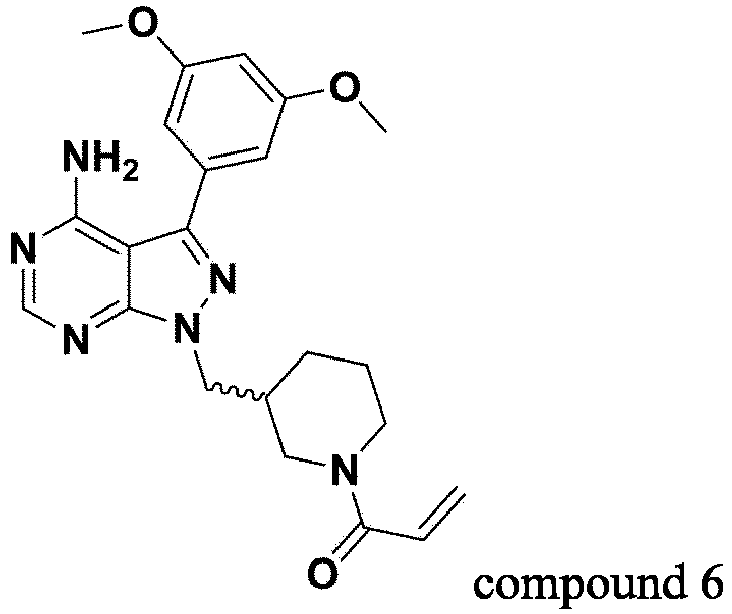
- A specific preparation method was the same as the preparation method of compound 1, except that one of the raw materials was equimolar 1-Boc-3-hydroxymethylpiperidine, in replacement of 1-Boc-3-azetidinemethanol in the preparation method of compound (1-1). NMR test results of the compound 6 were as follows:
1H NMR (400 MHz, CDCl3) δ 8.39 - 8.33 (m, 1H), 6.93 - 6.75 (m, 2H), 6.63 - 6.46 (m, 2H), 6.21 (dd, J = 16.9, 8.7 Hz, 1H), 5.99 (s, 2H), 5.61 (dd, J = 32.0, 10.5 Hz, 1H), 4.53 - 4.27 (m, 3H), 3.86 (s, 6H), 3.07 (dt, J = 23.7, 12.4 Hz, 1H), 2.81 (dt, J = 44.0, 12.0 Hz, 1H), 2.35 (s, 1H), 1.93 (s, 1H), 1.58 - 1.29 (m, 2H), 1.26 (m, 2H). 13C NMR (100 MHz, CDCl3) δ 165.5, 161.6, 157.9, 155.9, 154.7, 127.8, 127.4, 106.3, 101.3, 98.2, 55.6, 49.8, 49.7, 49.5, 46.5, 45.8, 42.7, 37.4, 36.4, 28.7, 25.2, 24.1. HRMS (ESI) calculated for C22H26N6NaO3 +: 445.1959, found 445.1961. -

- A specific preparation method was the same as the preparation method of compound 1, except that one of the raw materials was equimolar tert-Butyl 4-(2-hydroxyethyl)piperazine-1-carboxylate, in replacement of 1-Boc-3-azetidinemethanol in the preparation method of compound (1-1). NMR test results of the compound 7 were as follows:
1H NMR (400 MHz, CDCl3) δ 8.36 (s, 1H), 6.80 (d, J= 2.3 Hz, 2H), 6.60 - 6.47 (m, 2H), 6.26 (dd, J = 16.8, 1.9 Hz, 1H), 5.67 (dd, J = 10.5, 1.9 Hz, 1H), 4.57 (t, J = 6.7 Hz, 2H), 3.85 (s, 6H), 3.62 (s, 2H), 3.49 (s, 2H), 2.96 (t, J= 6.7 Hz, 2H), 2.56 (t, J= 5.0 Hz, 4H). 13C NMR (100 MHz, CDCl3) δ 165.3, 161.5, 157.4, 155.1, 154.5, 144.6, 134.8, 127.9, 127.4, 106.3, 101.2, 98.2, 95.6, 56.7, 55.6, 52.6, 50.9, 45.6, 44.4, 41.8, 31.9, 29.1. HRMS (ESI) calculated for C22H27N7NaO3 +: 460.2068, found 460.2072. -

- A specific preparation method was the same as the preparation method of compound 1, except that one of the raw materials was equimolar 1-Boc-4-(3-hydroxypropane)piperazine, in replacement of 1-Boc-3-azetidinemethanol in the preparation method of compound (1-1). NMR test results of the
compound 8 were as follows:
1H NMR (400 MHz, CDCl3) δ 8.36 (s, 1H), 6.81 (d, J= 2.3 Hz, 2H), 6.58 - 6.50 (m, 2H), 5.88 (s, 2H), 5.69 (dd, J = 10.5, 1.9 Hz, 1H), 4.52 (t, J = 6.9 Hz, 2H), 3.86 (s, 6H), 3.69 (d, J = 6.9 Hz, 2H), 3.57 (s, 2H), 2.51 (dt, J = 10.8, 6.0 Hz, 6H), 2.21 (p, J = 7.0 Hz, 2H). 13C NMR (100 MHz, CDCl3) δ 165.3, 160.3, 154.4, 133.4, 133.3, 132.2, 132.1, 132.0, 129.0, 128.6, 128.6, 128.4, 128.1, 127.3, 127.3, 107.9, 100.5, 55.4, 55.3, 53.1, 52.5, 45.2, 26.4. HRMS (ESI) calculated for C23H29N7NaO3 +: 474.2224, found 474.2226. -

- A specific preparation method was the same as the preparation method of compound 1, except that one of the raw materials was equimolar 1-Boc-4-(4-hydroxybutane)piperazine, in replacement of 1-Boc-3-azetidinemethanol in the preparation method of compound (1-1). NMR test results of the compound 9 were as follows:
1H NMR (400 MHz, CDCl3) δ 8.40 - 8.36 (m, 1H), 6.81 (dd, J = 3.2, 2.0 Hz, 2H), 6.54 (ddd, J= 17.4, 8.7, 4.1 Hz, 2H), 6.28 (dt, J= 16.9, 2.5 Hz, 1H), 5.72 - 5.66 (m, 1H), 5.61 (s, 2H), 4.46 (s, 2H), 3.89 - 3.82 (m, 6H), 3.67 (s, 2H), 3.54 (s, 2H), 2.41 (s, 6H), 2.01 (s, 2H), 1.56 (s, 2H). 13C NMR (100 MHz, MeOD) δ 169.4, 166.0, 152.2, 151.70, 147.6, 145.9, 132.7, 128.5, 126.6, 106.2, 106.1, 101.5, 101.4, 96.5, 56.6, 54.7, 53.5, 51.1, 40.5, 39.1, 38.5, 35.2, 28.3, 22.7. HRMS (ESI) calculated for C24H31N7NaO3 +: 488.2381, found 488.2383. -

- A specific preparation method was the same as the preparation method of compound 1, except that one of the raw materials was equimolar 1-Boc-4-(5-hydroxypentane)piperazine, in replacement of 1-Boc-3-azetidinemethanol in the preparation method of compound (1-1). NMR test results of the
compound 10 were as follows:
1H NMR (400 MHz, CDCl3) δ 8.38 (s, 1H), 6.82 - 6.80 (m, 2H), 6.58 - 6.55 (m, 1H), 6.53 (d, J = 10.4 Hz, 1H), 6.27 (d, J = 16.7 Hz, 1H), 5.68 (d, J = 10.6 Hz, 1H), 5.61 (s, 2H), 4.43 (s, 2H), 3.86 (s, 6H), 3.67 (s, 2H), 3.53 (s, 2H), 2.42 - 2.38 (m, 4H), 2.34 - 2.30 (m, 2H), 2.02 - 1.96 (m, 2H), 1.54 (d, J = 7.4 Hz, 2H), 1.39 (d, J= 6.9 Hz, 2H). 13C NMR (100 MHz, CDCl3) δ 165.3, 161.6, 157.7, 155.9, 154.3, 144.0, 135.1, 127.7, 127.5, 106.4, 101.1, 100.0, 98.3, 58.2, 55.6, 53.4, 52.7, 47.1, 45.7, 41.8, 40.5, 29.6, 29.3, 26.2, 24.5. HRMS (ESI) calculated for C25H33N7NaO3 +: 502.2537, found 502.2539. -

- A specific preparation method was the same as the preparation method of compound 1, except that one of the raw materials was equimolar 1-Boc-4-(6-hydroxyhexane)piperazine, in replacement of 1-Boc-3-azetidinemethanol in the preparation method of compound (1-1). NMR test results of the compound 11 were as follows:
1H NMR (400 MHz, CDCl3) δ 8.34 (d, J = 1.3 Hz, 1H), 6.81 (dd, J = 2.3, 1.3 Hz, 2H), 6.61 - 6.52 (m, 2H), 6.29 (dt, J = 16.9, 1.6 Hz, 1H), 6.00 (s, 2H), 5.69 (dt, J = 10.5, 1.6 Hz, 1H), 4.43 (t, J = 7.3 Hz, 2H), 3.86 (d, J = 1.3 Hz, 6H), 3.69 (t, J = 5.0 Hz, 2H), 3.56 (t, J = 4.9 Hz, 2H), 2.42 (t, J = 5.0 Hz, 4H), 2.33 (t, J = 7.6 Hz, 2H), 1.97 (t, J = 7.2 Hz, 2H), 1.54 - 1.45 (m, 2H), 1.38 (t, J = 4.3 Hz, 4H). 13C NMR (100 MHz, CDCl3) δ 165.3, 161.5, 157.8, 155.3, 154.1, 144.2, 135.0, 135.0, 127.9, 127.5, 127.5, 106.4, 106.4, 101.1, 98.2, 58.3, 55.6, 53.4, 52.7, 47.2, 45.7, 41.8, 29.7, 27.0, 26.6, 26.5. HRMS (ESI) calculated for C26H35N7NaO3 +: 516.2694, found 516.2696. -

- A specific preparation method was the same as the preparation method of compound 1, except that one of the raw materials was equimolar 1-Boc-4-(7-hydroxyheptane)piperazine, in replacement of 1-Boc-3-azetidinemethanol in the preparation method of compound (1-1). NMR test results of the
compound 12 were as follows:
1H NMR (400 MHz, CDCl3) δ 8.38 (d, J = 2.8 Hz, 1H), 6.82 (t, J = 2.5 Hz, 2H), 6.62 - 6.50 (m, 2H), 6.33 - 6.23 (m, 1H), 5.77 - 5.56 (m, 3H), 4.42 (s, 2H), 3.86 (d, J = 2.8 Hz, 6H), 3.70 (s, 2H), 3.57 (s, 2H), 2.50 - 2.37 (m, 4H), 2.33 (s, 2H), 1.96 (s, 2H), 1.47 (s, 2H), 1.33 (d, J = 27.0 Hz, 6H). 13C NMR (101 MHz, CDCl3) δ 165.6, 161.8, 158.1, 156.1, 154.5, 144.3 135.5, 135.5, 128.1, 127.8, 106.7, 101.4, 101.4, 98.6, 58.7, 55.9, 53.7, 53.1, 47.5, 46.0, 42.2, 30.0, 29.9, 29.3, 27.6, 26.9, 26.8. HRMS (ESI) calculated for C27H37N7NaO3 +: 530.2850, found 530.2852. -

- A specific preparation method was the same as the preparation method of compound 1, except that one of the raw materials was equimolar 3,4-methylenephenylboronic acid, in replacement of 3,5-dimethoxyphenylboronic acid in the preparation method of compound (1-2). NMR test results of the compound 13 were as follows:
1H NMR (400 MHz, CDCl3) δ 8.36 (s, 1H), 7.16 (d, J = 2.7 Hz, 1H), 6.97 (d, J = 7.9 Hz, 1H), 6.62 - 6.49 (m, 1H), 6.28 (dd, J= 16.9, 2.0 Hz, 1H), 6.06 (s, 2H), 5.86 - 5.65 (m, 3H), 4.42 (t, J = 7.2 Hz, 2H), 3.70 (d, J = 7.5 Hz, 2H), 3.55 (t, J = 5.1 Hz, 2H), 2.43 (t, J = 4.9 Hz, 4H), 2.35 (t, J = 7.6 Hz, 2H), 1.99 (td, J = 16.9, 15.0, 9.4 Hz, 2H), 1.79 - 1.14 (m, 6H). 13C NMR (100 MHz, CDCl3) δ 165.2, 157.8, 155.7, 154.2, 148.6, 148.5, 143.8, 127.4, 127.1, 122.1, 109.0, 108.9, 101.6, 101.5, 98.2, 58.1, 53.3, 52.7, 46.9, 45.6, 41.7, 29.5, 26.1, 24.5. HRMS (ESI) calculated for C24H29N7NaO3 +: 4860.2224, found 4860.2226. -

- A specific preparation method was the same as the preparation method of compound 1, except that one of the raw materials was equimolar benzofuran-2-boronic acid, in replacement of 3,5-dimethoxyphenylboronic acid in the preparation method of compound (1-2). NMR test results of the
compound 14 were as follows:
1H NMR (400 MHz, CDCl3) δ 8.39 (s, 1H), 7.68 (dd, J = 7.3, 1.5 Hz, 1H), 7.59 - 7.55 (m, 1H), 7.40 - 7.32 (m, 3H), 6.53 (dd, J = 16.8, 10.6 Hz, 1H), 6.28 (dd, J = 16.9, 1.9 Hz, 1H), 5.68 (dd, J = 10.6, 2.0 Hz, 1H), 4.46 (t, J = 7.2 Hz, 2H), 3.69 (s, 2H), 3.55 (s, 2H), 2.44 (s, 4H), 2.36 (t, J= 7.6 Hz, 2H), 2.01 (p, J= 7.4 Hz, 2H), 1.57 (q, J= 7.6 Hz, 2H), 1.44 - 1.36 (m, 2H). 13C NMR (100 MHz, CDCl3) δ 165.3, 163.8, 157.6, 156.0 154.4, 149.5, 134.7, 128.3, 127.8, 127.4, 125.1, 124.0, 121.7, 111.0, 104.3, 97.9, 58.1, 53.3, 52.7, 47.3, 45.6, 41.7, 29.5, 26.1, 24.4. HRMS (ESI) calculated for C25H29N7NaO2 +: 482.2269, found 482.2271. -

- A specific preparation method was the same as the preparation method of compound 1, except that one of the raw materials was equimolar p-methoxyboronic acid, in replacement of 3,5-dimethoxyphenylboronic acid in the preparation method of compound (1-2). NMR test results of the
compound 15 were as follows:
1H NMR (400 MHz, MeOD) δ 8.24 (s, 1H), 7.61 (d, J = 8.6 Hz, 2H), 7.18 - 7.06 (m, 2H), 6.82 - 6.64 (m, 1H), 6.19 (dd, J = 16.7, 2.0 Hz, 1H), 5.74 (dd, J = 10.6, 1.9 Hz, 1H), 4.41 (t, J= 6.8 Hz, 2H), 3.88 (s, 3H), 3.62 (s, 4H), 2.48 (s, 4H), 2.39 (s, 2H), 1.96 (q, J= 7.3 Hz, 2H), 1.60 - 1.52 (m, 2H), 1.35 (q, J= 7.9 Hz, 2H). 13C NMR (100 MHz, CDCl3) δ 165.3, 157.7, 155.9, 155.9, 154.4, 143.6, 140.4, 133.9, 132.5, 129.6, 127.8, 126.7, 125.9, 124.7, 64.1, 58.2, 53.4, 52.7, 48.6, 47.1, 29.5, 26.0, 24.5, 15.5. HRMS (ESI) calculated for C24H31N7NaO2 +: 472.2426, found 472.2428. -

- A specific preparation method was the same as the preparation method of compound 1, except that one of the raw materials was equimolar 4-acetylaminophenylboronic acid, in replacement of 3,5-dimethoxyphenylboronic acid in the preparation method of compound (1-2). NMR test results of the
compound 16 were as follows:
1H NMR (400 MHz, CDCl3) δ 8.24 (d, J= 1.3 Hz, 1H), 8.01 (s, 1H), 7.54 - 7.43 (m, 3H), 6.72 (dd, J= 16.9, 10.7 Hz, 1H), 6.18 (dt, J= 16.8, 1.7 Hz, 1H), 5.73 (dt, J= 10.6, 1.7 Hz, 1H), 4.43 (t, J = 6.7 Hz, 2H), 3.60 (q, J = 6.7, 4.6 Hz, 4H), 2.46 (d, J = 5.2 Hz, 4H), 2.37 (t, J = 7.6 Hz, 2H), 2.16 (d, J = 1.4 Hz, 3H), 1.97 (t, J = 7.4 Hz, 2H), 1.57 (dd, J = 11.0, 4.7 Hz, 2H), 1.34 (p, J = 7.6 Hz, 2H). 13C NMR (100 MHz, MeOD) δ 170.6, 165.9, 158.4, 155.4, 153.8, 144.4, 139.14, 133.2, 129.6, 127.3, 127.3, 123.7, 120.4, 120.1, 100.0, 97.6, 57.6, 52.8, 52.3, 45.0, 41.3, 28.9, 25.3, 23.9, 22.4. HRMS (ESI) calculated for C25H32N8NaO2 +: 472.2426, found 472.2428. -

- A specific preparation method was the same as the preparation method of compound 1, except that equimolar 4-trifluoromethoxyphenylboronic acid, in replacement of 3,5-dimethoxyphenylboronic acid in the preparation method of compound (1-2). NMR test results of the compound 17 were as follows:
1H NMR (400 MHz, CDCl3) δ 8.27 (s, 1H), 7.70 (t, J = 7.6 Hz, 1H), 7.63 (d, J = 10.6 Hz, 1H), 7.49 - 7.42 (m, 1H), 7.35 (dd, J = 7.8, 5.3 Hz, 1H), 6.73 (dd, J = 16.8, 10.7 Hz, 1H), 6.18 (dd, J = 16.8, 1.9 Hz, 1H), 5.73 (dd, J = 10.7, 2.0 Hz, 1H), 4.44 (t, J = 6.8 Hz, 2H), 3.61 (d, J = 5.4 Hz, 4H), 2.50 - 2.37 (m, 4H), 2.35 (d, J = 7.7 Hz, 2H), 1.99 (q, J = 7.1 Hz, 2H), 1.59 - 1.55 (m, 2H), 1.35 (s, 2H). 13C NMR (100 MHz, CDCl3) δ 166.2, 158.5, 156.8, 155.4, 150.6, 143.3, 136.3, 131.8, 128.6, 128.4, 127.6, 122.3, 121.9, 120.1, 99.2, 59.1, 54.3, 53.6, 48.1, 46.6, 42.8, 30.4, 27.1, 25.4. HRMS (ESI) calculated for C24H28F3N7NaO2 +: 526.2143, found 526.2145. -

- A specific preparation method was the same as the preparation method of compound 1, except that one of the raw materials was equimolar 2-naphthaleneboronic acid in replacement of 3,5-dimethoxyphenylboronic acid in the preparation method of compound (1-2). NMR test results of the
compound 18 were as follows:
1H NMR (400 MHz, CDCl3) δ 8.41 (s, 1H), 8.17 (s, 1H), 8.03 (d, J = 8.4 Hz, 1H), 7.93 (dd, J = 9.3, 3.6 Hz, 2H), 7.82 (d, J = 8.4 Hz, 1H), 7.58 (dd, J = 6.2, 3.2 Hz, 2H), 6.51 (dd, J = 16.8, 10.5 Hz, 1H), 6.27 (d, J = 16.8 Hz, 1H), 5.67 (d, J = 10.7 Hz, 1H), 4.49 (t, J = 7.2 Hz, 2H), 3.68 (s, 2H), 3.51 (d, J = 15.2 Hz, 2H), 2.37 (dd, J = 19.5, 12.3 Hz, 6H), 2.04 (dd, J = 14.6, 7.4 Hz, 2H), 1.57 (dd, J = 14.7, 7.5 Hz, 2H), 1.42 (dd, J = 14.9, 7.9 Hz, 2H). 13C NMR (100 MHz, CDCl3) δ 165.28, 157.63, 155.97, 154.54, 149.88, 142.42, 135.37, 135.35, 130.91, 127.75, 127.50, 127.24, 126.68, 121.64, 121.38, 121.00, 118.73, 98.31, 58.16, 53.43, 52.73, 47.17, 45.72, 41.87, 29.53, 26.24, 24.52. HRMS (ESI) calculated for C27H31N7NaO+: 492.2482, found 492.2484. -

- A specific preparation method was the same as the preparation method of compound 1, except that one of the raw materials was equimolar 4-methylnaphthaleneboronic acid, in replacement of 3,5-dimethoxyphenylboronic acid in the preparation method of compound (1-2). NMR test results of the compound 19 were as follows:
1H NMR (400 MHz, CDCl3) δ 8.37 (s, 1H), 8.10 (d, J = 8.4 Hz, 1H), 7.91 (d, J = 8.3 Hz, 1H), 7.63 - 7.41 (m, 4H), 6.52 (dd, J = 16.8, 10.5 Hz, 1H), 6.26 (dd, J = 16.8, 1.7 Hz, 1H), 5.67 (dd, J= 10.5, 1.7 Hz, 1H), 4.50 (t, J= 7.1 Hz, 2H), 3.66 (s, 2H), 3.49 (d, J= 16.9 Hz, 2H), 2.78 (s, 3H), 2.36 (dd, J = 19.3, 12.0 Hz, 6H), 2.13 - 1.98 (m, 2H), 1.57 (dt, J = 14.9, 7.6 Hz, 2H), 1.42 (dt, J = 15.0, 7.6 Hz, 2H). 13C NMR (100 MHz, CDCl3) δ 165.27, 159.72, 157.75, 155.67, 154.23, 144.16, 134.49, 130.52, 127.93, 127.88, 127.43, 120.40, 120.11, 115.46, 114.30, 98.54, 98.31, 63.68, 58.15, 53.31, 52.69, 47.03, 41.74, 29.71, 29.54, 26.11, 24.50, 24.04. HRMS (ESI) calculated for C28H33N7NaO+: 570.1587, found 570.1590. -

- A specific preparation method was the same as the preparation method of compound 1, except that one of the raw materials was equimolar 4-bromonaphthaleneboronic acid, in replacement of 3,5-dimethoxyphenylboronic acid in the preparation method of compound (1-2). NMR test results of the
compound 20 were as follows:
1H NMR (400 MHz, CDCl3) δ 8.38 (s, 1H), 8.11 (d, J = 8.4 Hz, 1H), 7.92 (d, J = 8.3 Hz, 1H), 7.64 - 7.42 (m, 4H), 6.53 (dd, J = 16.8, 10.5 Hz, 1H), 6.27 (dd, J = 16.8, 1.7 Hz, 1H), 5.68 (dd, J = 10.5, 1.7 Hz, 1H), 4.51 (t, J = 7.1 Hz, 2H), 3.67 (s, 2H), 3.50 (d, J = 17.0 Hz, 2H), 2.37 (dd, J = 19.3, 12.0 Hz, 6H), 2.13 - 1.99 (m, 2H), 1.58 (dt, J = 14.9, 7.6 Hz, 2H), 1.43 (dt, J = 15.0, 7.6 Hz, 2H). 13C NMR (100 MHz, CDCl3) δ 165.16, 157.62, 157.55, 155.88, 154.26, 149.40, 134.60, 128.22, 127.80, 127.72, 127.32, 125.04, 123.91, 121.64, 121.60, 110.91, 104.17, 99.87, 97.77, 58.01, 53.21, 52.59, 47.20, 45.47, 41.63, 29.34, 24.31. HRMS (ESI) calculated for C27H30BrN7NaO+: 570.1587, found 570.1590. -

- A specific preparation method was the same as the preparation method of compound 1, except that one of the raw materials was
equimolar 2,5-dimethoxyphenylboronic acid, in replacement of 3,5-dimethoxyphenylboronic acid in the preparation method of compound (1-2). NMR test results of the compound 21 were as follows:
1H NMR (400 MHz, CDCl3) δ 8.35 (s, 1H), 7.07 (s, 1H), 7.02 (d, J= 8.6 Hz, 2H), 6.56 (dd, J = 16.8, 10.6 Hz, 1H), 6.28 (d, J = 16.8 Hz, 1H), 5.70 (d, J = 7.6 Hz, 1H), 4.44 (t, J = 7.1 Hz, 2H), 3.81 (d, J = 11.0 Hz, 6H), 3.69 (s, 2H), 3.55 (s, 2H), 2.47 - 2.32 (m, 6H), 2.03 (dd, J = 14.0, 7.0 Hz, 2H), 1.61 - 1.52 (m, 2H), 1.41 (dd, J = 14.7, 7.6 Hz, 2H). 13C NMR (100 MHz, CDCl3) δ 165.28, 158.41, 155.55, 154.40, 153.90, 150.49, 140.79, 127.83, 127.47, 123.11, 117.10, 116.10, 113.43, 100.37, 58.17, 56.76, 55.85, 53.35, 52.72, 47.06, 45.66, 41.80, 29.55, 26.21. HRMS (ESI) calculated for C25H33N7NaO3 +: 502.2537, found 502.2539. -

- A specific preparation method was the same as the preparation method of compound 1, except that one of the raw materials was equimolar 3,4-dimethoxyphenylboronic acid, in replacement of 3,5-dimethoxyphenylboronic acid in the preparation method of compound (1-2). NMR test results of the
compound 22 were as follows:
1H NMR (400 MHz, CDCl3) δ 8.39 (s, 1H), 7.27 (s, 1H), 6.89 (s, 2H), 6.64 - 6.50 (m, 1H), 6.29 (d, J = 16.6 Hz, 1H), 5.70 (d, J = 10.2 Hz, 3H), 4.43 (d, J = 6.9 Hz, 2H), 3.94 (s, 3H), 3.91 (s, 3H), 3.69 (s, 2H), 3.56 (s, 2H), 2.38 (dd, J = 22.3, 15.1 Hz, 6H), 2.03 - 1.98 (m, 2H), 1.57 (d, J= 6.9 Hz, 2H), 1.40 (d, J= 7.0 Hz, 2H). 13C NMR (100 MHz, CDCl3)δ 165.34, 165.29, 157.82, 155.94, 155.91, 155.87, 154.22, 154.05, 153.99, 144.18, 138.75, 128.59, 127.92, 127.42, 105.53, 98.33, 61.03, 58.18, 56.33, 53.39, 52.70, 47.06 , 29.61, 26.19, 24.53. HRMS (ESI) calculated for C25H33N7NaO3 +: 502.2537, found 502.2539. -

- A specific preparation method was the same as the preparation method of compound 1, except that one of the raw materials was
equimolar 3,4,5-trimethoxyphenylboronic acid, in replacement of 3,5-dimethoxyphenylboronic acid in the preparation method of compound (1-2). NMR test results of the compound 23 were as follows:
1H NMR (400 MHz, CDCl3) δ 8.30 (s, 1H), 6.82 (d, J= 1.3 Hz, 2H), 6.47 (ddd, J= 16.8, 10.5, 1.3 Hz, 1H), 6.19 (dt, J = 16.8, 1.6 Hz, 1H), 5.87 (s, 2H), 5.60 (dt, J = 10.5, 1.6 Hz, 1H), 4.36 (t, J = 7.3 Hz, 2H), 3.86 (d, J = 1.3 Hz, 6H), 3.83 (d, J = 1.3 Hz, 3H), 3.60 (t, J = 5.0 Hz, 2H), 3.47 (t, J = 5.0 Hz, 2H), 2.33 (t, J = 5.1 Hz, 4H), 2.27 (d, J = 7.5 Hz, 2H), 1.93 (q, J = 7.6 Hz, 2H), 1.49 (t, J = 7.6 Hz, 2H), 1.33 (d, J = 7.6 Hz, 2H). 13C NMR (100 MHz, CDCl3) δ 165.2, 158.0, 155.8, 154.2, 153.9, 144.1, 138.8, 128.6, 128.6, 128.4, 127.7, 127.5, 105.6, 98.3, 61.0, 58.2, 56.3, 53.4, 52.7, 47.0, 45.7, 41.9, 29.7, 29.6, 26.3, 24.5. HRMS (ESI) calculated for C26H35N7NaO4 +: 532.2643, found 536.2645. -

- A specific preparation method was the same as the preparation method of compound 1, except that one of the raw materials was equimolar 3-trifluoromethylphenylboronic acid, in replacement of 3,5-dimethoxyphenylboronic acid in the preparation method of compound (1-2). NMR test results of the
compound 24 were as follows:
1H NMR (400 MHz, CDCl3) δ 8.37 (s, 1H), 7.68 - 7.54 (m, 3H), 7.33 (d, J= 6.5 Hz, 1H), 6.59 - 6.47 (m, 1H), 6.25 (dd, J = 16.8, 4.6 Hz, 1H), 5.95 - 5.59 (m, 3H), 4.43 (d, J = 6.6 Hz, 2H), 3.64 (d, J = 9.2 Hz, 2H), 3.52 (s, 2H), 2.39 (d, J = 5.7 Hz, 4H), 2.32 (d, J = 7.3 Hz, 2H), 1.98 (q, J= 7.1 Hz, 2H), 1.56 (s, 2H), 1.42 - 1.32 (m, 2H). 13C NMR (100 MHz, CDCl3) δ 165.3, 157.7, 155.8, 154.5, 149.8, 142.5, 135.3, 130.9, 127.7, 127.5, 126.7, 121.4, 121.0, 98.3, 58.1, 53.4, 52.7, 47.2, 45.7, 41.9, 29.7, 29.5, 26.2, 24.5. HRMS (ESI) calculated for C24H28F3N7NaO+: 510.2205, found 510.2207. -

- A specific preparation method was the same as the preparation method of compound 1, except that one of the raw materials was equimolar 3-isopropoxyphenylboronic acid, in replacement of 3,5-dimethoxyphenylboronic acid in the preparation method of compound (1-2). NMR test results of the
compound 25 were as follows:
1H NMR (400 MHz, CDCl3) δ 8.15 (d, J = 1.2 Hz, 1H), 7.36 (t, J = 7.9 Hz, 1H), 7.11 (dd, J= 8.2, 5.0 Hz, 2H), 7.00 - 6.95 (m, 1H), 6.70 - 6.60 (m, 1H), 6.09 (dt, J= 16.8, 1.6 Hz, 1H), 5.64 (dt, J = 10.6, 1.6 Hz, 1H), 4.60 (q, J = 6.0 Hz, 1H), 4.32 (t, J = 6.8 Hz, 2H), 3.53 (t, J = 6.3 Hz, 4H), 2.38 (s, 4H), 2.30 (t, J= 7.6 Hz, 2H), 1.87 (d, J= 7.1 Hz, 2H), 1.48 (t, J= 7.8 Hz, 2H), 1.25 (dd, J = 6.0, 1.3 Hz, 6H), 1.22 (d, J = 7.4 Hz, 2H). 13C NMR (100 MHz, MeOD) δ 166.0, 158.6, 158.5, 155.4, 153.7, 144.7, 134.0, 130.2, 127.3, 127.3, 120.1, 116.4, 115.5, 100.0, 97.6, 69.9, 57.6, 52.8, 52.3, 46.4, 45.0, 41.3, 28.9, 25.2, 23.9, 21.0. HRMS (ESI) calculated for C26H35N7NaO2 +: 500.2744, found 500.2747. -

- A specific preparation method was the same as the preparation method of compound 1, except that one of the raw materials was equimolar 3-benzyloxyphenylboronic acid, in replacement of 3,5-dimethoxyphenylboronic acid in the preparation method of compound (1-2). NMR test results of the
compound 26 were as follows:
1H NMR (400 MHz, CDCl3) δ 8.37 (s, 1H), 7.49 - 7.27 (m, 8H), 7.11 (d, J= 8.5 Hz, 1H), 6.54 (dd, J = 16.8, 10.4 Hz, 1H), 6.28 (d, J = 16.8 Hz, 1H), 5.69 (d, J = 10.4 Hz, 1H), 5.43 (s, 2H), 5.17 (s, 2H), 4.44 (t, J= 7.4 Hz, 2H), 3.62 (d, J = 49.9 Hz, 4H), 2.39 (d, J= 27.3 Hz, 6H), 2.03 - 1.93 (m, 2H), 1.38 (s, 2H). 13C NMR (100 MHz, CDCl3) δ 165.3, 159.4, 157.7, 155.4, 154.2, 144.1, 136.6, 134.5, 133.3, 130.6, 128.7, 128.1, 127.7, 127.5, 127.4, 120.9, 116.0, 114.5, 98.2, 70.0, 58.1, 53.3, 52.7, 47.1, 45.7, 41.8, 29.5, 26.2, 24.5, 21.2. HRMS (ESI) calculated for C30H35N7NaO2 +: 548.2744, found 548.2747. -

- A specific preparation method was the same as the preparation method of compound 1, except that one of the raw materials was equimolar 2-chloro-5-methoxyphenylboronic acid, in replacement of 3,5-dimethoxyphenylboronic acid in the preparation method of compound (1-2). NMR test results of the compound 27 were as follows:
1H NMR (400 MHz, CDCl3) δ 8.35 (d, J= 4.2 Hz, 1H), 7.43 (s, 1H), 6.99 (dq, J= 19.8, 3.2 Hz, 2H), 6.53 (ddd, J = 15.6, 10.7, 3.9 Hz, 1H), 6.25 (dd, J = 16.9, 3.9 Hz, 1H), 5.80 - 5.22 (m, 3H), 4.45 (t, J = 6.5 Hz, 2H), 3.82 (d, J = 4.9 Hz, 3H), 3.68 - 3.63 (m, 2H), 3.51 (s, 2H), 2.39 (d, J = 5.4 Hz, 4H), 2.31 (q, J = 6.2, 5.4 Hz, 2H), 1.99 (q, J = 6.8 Hz, 2H), 1.53 (q, J = 7.1 Hz, 2H), 1.42 - 1.28 (m, 2H). 13C NMR (100 MHz, CDCl3) δ 165.3, 158.6, 157.7, 155.9, 153.8, 141.1, 132.6, 131.1, 127.7, 127.5, 124.7, 116.9, 99.9, 70.5, 58.2, 55.7, 53.4, 52.7, 47.1, 45.7, 41.9, 29.5, 26.2, 24.5. HRMS (ESI) calculated for C24H30ClN7NaO2 +: 506.2042, found 506.2044. -

- A specific preparation method was the same as the preparation method of compound 1, except that one of the raw materials was equimolar p-fluorophenylboronic acid, in replacement of 3,5-dimethoxyphenylboronic acid in the preparation method of compound (1-2). NMR test results of the compound 28 were as follows:
1H NMR (400 MHz, CDCl3) δ 8.31 (s, 1H), 7.25 (s, 2H), 6.54 (dd, J = 16.8, 10.5 Hz, 1H), 6.29 (dd, J = 16.8, 1.7 Hz, 1H), 6.24 (s, 2H), 5.70 (d, J = 10.5 Hz, 1H), 4.35 (t, J = 7.0 Hz, 2H), 3.69 (t, J = 29.6 Hz, 4H), 2.44 (d, J = 31.0 Hz, 6H), 1.92 (dd, J= 14.9, 7.4 Hz, 2H), 1.58 (s, 2H), 1.35 - 1.30 (m, 2H). 13C NMR (100 MHz, CDCl3) δ 165.21, 158.54, 157.68, 155.61, 153.68, 141.11, 132.50, 131.04, 127.66, 127.44, 124.68, 116.84, 99.80, 58.07, 55.65, 53.26, 52.63, 47.07, 45.59, 41.74, 29.40, 26.09, 24.40. HRMS (ESI) calculated for C23H28FN7NaO+: 460.2232, found 460.2230. -

- A specific preparation method was the same as the preparation method of compound 1, except that one of the raw materials was equimolar 3-fluoro-4-hydroxyphenylboronic acid, in replacement of 3,5-dimethoxyphenylboronic acid in the preparation method of compound (1-2). NMR test results of the compound 29 were as follows:
1H NMR (400 MHz, CDCl3) δ 8.34 (s, 1H), 7.72 - 7.62 (m, 2H), 7.26 - 7.23 (m, 1H), 6.55 (dd, J = 16.8, 10.5 Hz, 1H), 6.28 (dd, J = 16.8, 1.9 Hz, 1H), 5.69 (dd, J = 10.5, 1.9 Hz, 1H), 4.44 (t, J = 7.2 Hz, 2H), 3.68 (s, 2H), 3.51 (d, J = 21.5 Hz, 2H), 2.47 - 2.39 (m, 4H), 2.36 - 2.31 (m, 2H), 1.99 (dt, J = 15.0, 7.5 Hz, 2H), 1.55 (dd, J = 15.1, 7.6 Hz, 2H), 1.42 - 1.33 (m, 2H). 13C NMR (100 MHz, CDCl3) δ 165.30, 162.94, 161.55, 157.73, 157.26, 156.54, 154.10, 119.85, 117.25, 100.41, 100.29, 99.99, 61.49, 57.97, 53.20, 52.53, 47.28, 29.69, 29.65, 29.40, 29.26, 24.72, 24.24.. HRMS (ESI) calculated for C23H28FN7NaO2+: 476.2181, found 476.2180. -

- A specific preparation method was the same as the preparation method of compound 1, except that one of the raw materials was equimolar 6-methoxynaphthalene-2-boronic acid, in replacement of 3,5-dimethoxyphenylboronic acid in the preparation method of compound (1-2). NMR test results of the
compound 30 were as follows:
1H NMR (400 MHz, CDCl3) δ 8.37 (d, J = 5.6 Hz, 1H), 8.08 (s, 1H), 7.91 (d, J = 8.4 Hz, 1H), 7.83 (d, J= 8.9 Hz, 1H), 7.77 (dd, J= 8.4, 1.6 Hz, 1H), 7.26 - 7.19 (m, 2H), 6.51 (dd, J = 16.8, 10.5 Hz, 1H), 6.31 - 6.16 (m, 1H), 5.77 (d, J = 66.8 Hz, 2H), 5.67 (dd, J = 10.5, 1.9 Hz, 1H), 4.47 (t, J = 7.2 Hz, 2H), 3.97 (s, 3H), 3.69 (s, 2H), 3.54 (s, 2H), 2.38 (dd, J = 21.6, 14.2 Hz, 6H), 2.02 (dt, J = 14.8, 7.4 Hz, 2H), 1.63 - 1.53 (m, 2H), 1.41 (dt, J = 15.1, 7.5 Hz, 2H). 13C NMR (100 MHz, CDCl3) δ 165.27, 158.50, 157.93, 155.54, 154.31, 144.47, 134.66, 129.73, 128.92, 128.23, 128.12, 127.81, 127.54, 127.43, 126.28, 119.94, 105.79, 98.49, 58.13, 55.42, 53.27, 52.70, 47.05, 45.55, 41.71, 29.57, 26.08, 24.51. HRMS (ESI) calculated for C28H33N7NaO2 +: 522.2588, found 522.2587. -

- A specific preparation method was the same as the preparation method of compound 1, except that one of the raw materials was equimolar p-nitrophenylboronic acid, in replacement of 3,5-dimethoxyphenylboronic acid in the preparation method of compound (1-2). NMR test results of the compound 31 were as follows:
1H NMR (400 MHz, CDCl3) δ 8.45 - 8.36 (m, 3H), 7.92 (d, J = 8.8 Hz, 2H), 6.54 (dd, J = 16.8, 10.5 Hz, 1H), 6.27 (dd, J = 16.9, 2.0 Hz, 1H), 5.90 - 5.63 (m, 3H), 4.48 (t, J = 7.2 Hz, 2H), 3.67 (s, 2H), 3.59 - 3.50 (m, 2H), 2.42 (t, J= 5.1 Hz, 4H), 2.35 (dd, J= 8.5, 6.5 Hz, 2H), 2.01 (p, J = 7.6 Hz, 2H), 1.63 - 1.55 (m, 2H), 1.41 (dt, J = 11.4, 6.8 Hz, 2H). 13C NMR (100 MHz, CDCl3) δ 165.3, 157.6, 155.9, 154.7, 148.0, 141.7, 139.6, 129.2, 127.8, 127.5, 124.6, 98.4, 77.2, 58.1, 53.4, 52.7, 47.4, 45.7, 41.8, 29.7, 29.5, 26.2, 24.5. HRMS (ESI) calculated for C23H28N8NaO3 +: 487.2177, found 487.2179. -

- A specific preparation method was the same as the preparation method of compound 1, except that one of the raw materials was equimolar 3-fluoro-5-methoxyphenylboronic acid, in replacement of 3,5-dimethoxyphenylboronic acid in the preparation method of compound (1-2). NMR test results of the compound 31 were as follows:
1H NMR (400 MHz, CDCl3) δ 8.38 (s, 1H), 7.24 (d, J = 2.1 Hz, 2H), 6.99 - 6.87 (m, 1H), 6.54 (dd, J= 16.8, 10.6 Hz, 1H), 6.27 (dd, J= 16.8, 1.9 Hz, 1H), 5.80 - 5.63 (m, 3H), 4.44 (t, J= 7.2 Hz, 2H), 3.92 (s, 3H), 3.66 (d, J = 12.5 Hz, 2H), 3.54 (s, 2H), 2.45 - 2.33 (m, 6H), 2.02 - 1.96 (m, 2H), 1.55 (dd, J = 15.0, 7.5 Hz, 2H), 1.37 (dd, J = 15.2, 7.2 Hz, 2H). 13C NMR (100 MHz, CDCl3) δ 165.31, 164.85, 164.72, 162.35, 162.23, 157.51, 155.78, 154.50, 127.78, 127.48, 111.59, 111.33, 104.53, 104.28, 98.15, 58.13, 53.38, 52.69, 47.23, 45.66, 41.82, 29.49, 26.17, 24.51. HRMS (ESI) calculated for C24H30FN7NaO2 +: 490.2337, found 490.2335. -

- A specific preparation method was the same as the preparation method of compound 1, except that one of the raw materials was equimolar 3,5-difluorophenylboronic acid was used instead of 3,5-dimethoxyphenylboronic acid in the preparation method of compound (1-2). NMR test results of the compound 33 were as follows:
1H NMR (400 MHz, CDCl3) δ 8.36 (s, 1H), 7.01 (dd, J = 8.4, 2.2 Hz, 2H), 6.73 (dt, J = 10.5, 2.3 Hz, 1H), 6.55 (dd, J = 16.8, 10.6 Hz, 1H), 6.28 (dd, J = 16.8, 1.9 Hz, 1H), 5.83 (s, 2H), 5.69 (dd, J = 10.5, 1.9 Hz, 1H), 4.44 (t, J = 7.2 Hz, 2H), 3.66 (m, J = 16.1 Hz, 2H), 3.55 (m, 2H), 2.37 (dd, J= 23.0, 15.7 Hz, 6H), 1.98 (dd, J= 14.9, 7.5 Hz, 2H), 1.56 (dd, J= 14.8, 7.4 Hz, 2H), 1.45 - 1.36 (m, 2H). 13C NMR (100 MHz, CDCl3) δ 165.28, 162.81, 161.77, 161.65, 157.58, 155.96, 154.41, 127.74, 127.49, 110.07, 110.04, 107.79, 107.57, 102.38, 102.13, 98.25, 58.15, 55.81, 53.35, 52.74, 47.12, 29.51, 24.50. HRMS (ESI) calculated for C23H27F2N7NaO+: 478.2137, found 478.2139. -

- A specific preparation method was the same as the preparation method of compound 1, except that one of the raw materials was equimolar 3,5-bis(trifluoromethyl)phenylboronic acid, in replacement of 3,5-dimethoxyphenylboronic acid in the preparation method of compound (1-2). NMR test results of the compound 34 were as follows:
1H NMR (400 MHz, CDCl3) δ 8.44 (s, 1H), 8.20 (s, 2H), 7.99 (s, 1H), 6.61 - 6.51 (m, 1H), 6.28 (d, J = 17.0 Hz, 1H), 5.69 (d, J = 10.6 Hz, 1H), 4.48 (t, J = 7.0 Hz, 2H), 3.64 (s, 4H), 2.39 (d, J = 26.1 Hz, 6H), 2.05 - 1.99 (m, 2H), 1.78 (s, 2H), 1.38 (dd, J = 23.0, 12.9 Hz, 2H). 13C NMR (100 MHz, CDCl3) δ 165.3, 157.5, 156.0, 154.8, 140.9, 135.5, 133.2, 132.9, 132.6, 128.5, 127.8, 127.5, 124.4, 122.5, 121.7, 98.4, 58.1, 53.4, 52.7, 47.35 45.7, 41.8, 29.5, 26.2, 24.5. HRMS (ESI) calculated for C25H27F6N7NaO+: 578.2073, found 578.2075. -

- A specific preparation method was the same as the preparation method of compound 1, except that one of the raw materials was equimolar 3-fluoro-5-trifluoromethylphenylboronic acid, in replacement of 3,5-dimethoxyphenylboronic acid in the preparation method of compound (1-2). NMR test results of the compound 35 were as follows:
1H NMR (400 MHz, CDCl3) δ 8.35 (s, 1H), 7.73 (s, 1H), 7.58 (dd, J = 8.7, 2.0 Hz, 1H), 7.40 - 7.37 (m, 1H), 6.48 (dd, J = 16.8, 10.5 Hz, 1H), 6.20 (dd, J = 16.8, 1.9 Hz, 1H), 5.61 (dd, J = 10.5, 1.9 Hz, 1H), 4.39 (t, J = 7.2 Hz, 2H), 3.60 (s, 2H), 3.47 (s, 2H), 2.34 (t, J = 5.1 Hz, 4H), 2.30 - 2.24 (m, 2H), 1.96 - 1.90 (m, 2H), 1.52 - 1.47 (m, 2H), 1.32 (t, J= 7.6 Hz, 2H). 13C NMR (100 MHz, CDCl3) δ 162.0, 161.5, 157.8, 155.6, 154.1, 144.2, 135.0, 129.5, 127.8, 127.7, 106.4, 101.0, 98.2, 58.0, 55.6, 53.3, 52.5, 47.0, 46.0, 42.2, 29.7, 29.5, 26.2, 24.5. HRMS (ESI) calculated for C24H27F4N7NaO+: 528.2105, found 528.2107. -

- A specific preparation method was the same as the preparation method of
compound 10, except that one of the raw materials wasequimolar compound 36 were as follows:
1H NMR (400 MHz, CDCl3) δ 8.32 (s, 1H), 6.92 (dt, J = 15.4, 2.1 Hz, 1H), 6.78 (d, J = 2.3 Hz, 2H), 6.73 - 6.64 (m, 1H), 6.52 (t, J = 2.3 Hz, 1H), 4.40 (t, J = 7.2 Hz, 2H), 3.82 (s, 6H), 3.65 (t, J = 5.2 Hz, 2H), 3.50 (t, J = 5.0 Hz, 2H), 2.40 (q, J = 4.7 Hz, 4H), 2.32 (t, J = 7.5 Hz, 2H), 1.96 (p, J= 7.4 Hz, 2H), 1.52 (q, J= 7.6 Hz, 2H), 1.36 (q, J= 8.2 Hz, 2H). 13C NMR (100 MHz, CDCl3) δ 162.3, 161.8, 158.1, 155.8, 154.3, 144.4, 135.3, 129.7, 129.4, 128.0, 127.9, 121.4, 106.6, 101.3, 98.5, 58.3, 55.8, 53.5, 52.7, 47.3, 46.2, 42.5, 29.9, 29.8, 26.4, 24.7. HRMS (ESI) calculated for C26H32F3N7NaO3 +: 570.2411, found 570.2413. -

- A specific preparation method was the same as the preparation method of compound 34, except that one of the raw materials was
equimolar
1H NMR (400 MHz, CDCl3) δ 8.43 (d, J= 2.3 Hz, 1H), 8.20 (s, 2H), 7.99 (s, 1H), 6.94 (d, J = 15.5 Hz, 1H), 6.72 (dt, J= 14.9, 6.8 Hz, 1H), 4.48 (t, J = 7.0 Hz, 2H), 3.69 (s, 2H), 3.54 (s, 2H), 2.41 (d, J= 31.2 Hz, 6H), 2.02 (q, J = 7.8 Hz, 2H), 1.59 (s, 2H), 1.44 - 1.26 (m, 2H). 13C NMR (100 MHz, CDCl3) δ 164.1, 162.1, 161.6, 157.4, 155.9, 154.7, 141.3, 136.6, 127.7, 121.0, 118.9, 118.7, 113.4, 113.2, 98.2, 58.0, 53.3, 52.5, 47.2, 45.9, 42.2, 29.7, 29.5, 26.1, 24.5, 14.1. HRMS (ESI) calculated for C26H26F9N7NaO+: 646.1947, found 646.1947. -

- A specific preparation method was the same as the preparation method of compound 35, except that one of the raw materials was
equimolar
1H NMR (400 MHz, CDCl3) δ 8.43 (d, J = 2.3 Hz, 1H), 8.20 (s, 2H), 7.99 (s, 1H), 6.94 (d, J= 15.5 Hz, 1H), 6.71 (dq, J = 14.2, 6.7 Hz, 1H), 4.48 (t, J= 7.0 Hz, 2H), 3.69 (s, 2H), 3.54 (s, 2H), 2.41 (d, J= 31.2 Hz, 6H), 2.01 (t, J= 7.6 Hz, 2H), 1.59 (s, 2H), 1.48 - 1.27 (m, 2H). 13C NMR (100 MHz, CDCl3) δ 162.0, 155.2, 154.6, 142.9, 133.2, 132.1, 132.1, 129.4, 129.0, 128.6, 128.5, 127.9, 121.3, 120.8, 111.6, 105.6, 58.1, 53.3, 52.6, 46.9, 46.0, 42.3, 29.5, 26.3, 24.5, 22.1. HRMS (ESI) calculated for C26H26F9N7NaO+: 646.1947, found 646.1947. -

- A specific preparation method was the same as the preparation method of
compound 10, except that one of the raw materials was equimolar trans-4-dimethylaminocrotonic acid, in replacement of acryloyl chloride in the preparation method of compound (1-3). NMR test results of the compound 39 were as follows:
1H NMR (400 MHz, CDCl3) δ 8.38 (s, 1H), 6.81 (d, J = 2.3 Hz, 2H), 6.56 (t, J = 2.3 Hz, 1H), 5.60 (s, 2H), 4.43 (t, J = 7.2 Hz, 2H), 3.86 (s, 6H), 3.67 (t, J = 5.1 Hz, 2H), 3.59 (t, J = 5.1 Hz, 2H), 3.49 (s, 1H), 2.45 (t, J = 5.1 Hz, 4H), 2.33 (t, J= 7.4 Hz, 2H), 1.96 (d, J = 7.5 Hz, 2H), 1.50 - 1.35 (m, 4H). 13C NMR (100 MHz, CDCl3) δ 161.5, 161.5, 157.7, 155.9, 144.0, 135.1, 106.4, 101.0, 100.0 98.3, 58.1, 55.6, 53.1, 52.4, 52.3, 49.4, 47.1, 45.8, 43.4, 43.3, 43.2, 37.4, 29.6, 26.9, 26.5. HRMS (ESI) calculated for C25H31N7NaO3 +: 500.2831, found 500.2833. -

- A specific preparation method was the same as the preparation method of
compound 10, except that one of the raw materials was equimolar crotonic acid, in replacement of acryloyl chloride in the preparation method of compound (1-3). NMR test results of the compound 40 were as follows:
1H NMR (400 MHz, CDCl3) δ 8.31 (s, 1H), 6.88 - 6.73 (m, 3H), 6.52 (t, J= 2.3 Hz, 1H), 6.20 (dq, J = 15.0, 1.7 Hz, 1H), 4.39 (t, J = 7.2 Hz, 2H), 3.82 (s, 6H), 3.62 (d, J = 8.1 Hz, 2H), 3.56 - 3.43 (m, 2H), 2.36 (t, J = 5.1 Hz, 4H), 2.29 (dd, J = 8.7, 6.4 Hz, 2H), 2.01 - 1.91 (m, 2H), 1.83 (dd, J= 6.9, 1.7 Hz, 3H), 1.52 (t, J= 7.6 Hz, 2H), 1.36 (ddd, J= 15.3, 9.1, 5.4 Hz, 2H). 13C NMR (100 MHz, CDCl3) δ 165.5, 161.5, 158.0, 155.7, 154.1, 144.1, 141.5, 135.1, 121.4, 119.9, 106.4, 101.1, 98.2, 60.4, 58.2, 55.5, 53.5, 53.4, 52.8, 47.0, 45.5, 41.8, 29.6, 26.2, 24.5, 18.2. HRMS (ESI) calculated for C26H35N7NaO3 +: 516.2694, found 516.2696. - In the present disclosure, the homogeneous time-resolved fluorescence (HTRF) technology was used to evaluate an inhibitory effect of a compound on the four subtypes FGFR1, FGFR2, FGFR3, and FGFR4. FGFR1, FGFR2, FGFR3, and FGFR4 prokaryotic expression vectors were first constructed; and when the prokaryotic expression vectors were identified as correct, FGFR proteins were expressed and purified on a large scale in an Escherichia coli (E. coli) system, and protein concentrations were determined. Resulting proteins were stored in aliquots. Before an enzyme activity test was started, cisbio HTRF KinEA (62TK0PEB) was used to pre-dilute each component required in an enzyme activity system with an enzyme activity buffer to a required working concentration. A 384-well plate (66PL384025) was prepared, 5 µL of a protein solution, 1 µL of a compound, and 2 µL of a substrate were added to each well, and 2 µL of ATP was finally added to initiate a reaction. Three parallel experiments were set for each concentration. In the blank control group, 1 µL of the compound was replaced with 1 µL of dimethyl sulfoxide (DMSO); and in the positive control group, the positive drug AZD4547 was used instead, and the other conditions remained unchanged. The 384-well plate was sealed and incubated at room temperature for about 1 h. After the incubation was completed, 5 µL of a lanthanide-labeled phosphorylated substrate antibody (a donor) and 5 µL of a streptavidin-labeled XL665 (a receptor) were added to each well to stop the reaction, and the plate was further incubated at room temperature for about 1 h in the dark. Finally, the TECAN infinite M1000PRO multi-function microplate reader was used to detect a fluorescence signal, an inhibition rate was calculated, and an IC50 value was fitted with GraphPad Prism 7.0.
- Results showed that the compounds 1 to 40 could inhibit the protein activity of FGFR1/2/3/4 to varying degrees.
Table 1 Structure-activity relationship (SAR) studies based on enzyme activity results 
Compound No. Ar Linker R Enzyme activity (IC50/nM) FGFR1 FGFR2 FGFR3 FGFR4 1 
315 540 520 1921 2 
818 666 525 >5000 3 
433 424 371 2730 4 

H 615 641 521 >5000 5 
741 1210 580 1780 6 
790 1130 769 >5000 7 
372 455 335 1610 8 
323 351 414 4700 9 
36.0 27.4 22.5 4210 10 
3.2 1.4 2.7 3270 11 
12.9 11.2 11.3 3207 12 
5.9 2.2 3.4 >5000 13 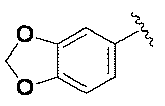
476 789 875 2709 14 
2109 1864 344 >5000 15 
>5000 3121 >5000 >5000 16 
1353 2511 1321 >5000 17 
3523 4111 >5000 >5000 18 

>5000 >5000 >5000 >5000 19 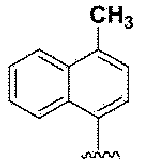
>5000 >5000 >5000 >5000 20 
>5000 >5000 >5000 >5000 21 
866 954 1978 >5000 22 
324 231 523 >5000 23 
277 223 486 4910 24 
1877 >5000 >5000 3903 25 
>5000 >5000 >5000 2246 26 
1501 2345 >5000 >5000 27 
554 763 731 2723 28 
185 337 321 2987 29 
417 560 318 2580 30 
>5000 >5000 >5000 >5000 31 
>5000 >5000 >5000 >5000 32 
118 133 132 >5000 33 
790 >10 >10 4112 34 
133 165 115 3921 35 
14.1 29.3 13.2 4102 36 
CF3 0.7 0.7 0.9 809 37 
9.9 12.1 10.2 >5000 38 
101 65 97 2401 39 
(CH3)2NCH 2 13.8 37.5 15.5 >5000 40 CH3 16.6 26.3 12.4 >5000 AZD4 547 NA 1.1 2.2 1.8 660 - In the present disclosure, the
compounds compounds compounds - The results (Table 1) showed that the
compounds compounds Table 2 Anti-proliferation activities of the compound 36 for specific cancer cell linesCompound IC50/µM NCI-H1581 FGFR1 amplification SNU-16 FGFR2 amplification SK-hep-1 FGFR4 amplification Huh-7 A549 AZD4547 0.042±0.002 0.006±0.001 2.78±0.069 >10 >10 10 0.051±0.003 0.037±0.005 2.86±0.250 >10 >10 36 0.055±0.008 0.043±0.006 3.05±0.120 >10 >10 - Example 43 Inhibition of the
compounds - To further elucidate the influence of the
compounds compounds - As shown in
FIG. 1 andFIG. 2 , thecompounds compounds - Example 44 Significant inhibition of the
compounds - In order to evaluate an anti-tumor effect of the
compounds compound 10 was administered orally every day, and thecompound 36 was intraperitoneally injected every day. The tumor volume and mouse body weight were measured. The mice was treated after 26 d of administration, that a tumor tissue was dissected and fixed in a formalin solution for later use. - As shown in
FIG. 3 andFIG. 4 , thecompounds compounds - In conclusion, the present disclosure optimizes 2H-pyrazolo[3,4-d]pyrimidine to obtain novel derivatives thereof (compounds 10 and 36), and the
compounds compounds - The above are merely examples of the present disclosure, and are not intended to limit the present disclosure. Any modification, equivalent substitution, and improvement fall within the spirit and principle of the present disclosure should be included in the claimed scope of the present disclosure.
-
- (1) Turner, N.; Grose, R. Fibroblast growth factor signalling: from development to cancer. .
- (2) Carter, E. P.; Fearon, A. E.; Grose, R. P. Careless talk costs lives: fibroblast growth factor receptor signalling and the consequences of pathway malfunction. Trends Cell Biol. 2015, 25, 221-233.
- (3) Touat, M.; Ileana, E.; Postel-Vinay, S.; Andre, F.; Soria, J. C. Targeting FGFR signaling in cancer. Clin. Cancer Res. 2015, 21, 2684-2694.
- (4) Dieci, M. V.; Arnedos, M.; Andre, F.; Soria, J. C. Fibroblast growth factor receptor inhibitors as a cancer treatment: from a biologic rationale to medical perspectives. Cancer Discovery 2013, 3, 264-279.
- (5) Turner, N.; Grose, R. Fibroblast growth factor signalling: from development to cancer. .
- (6) Hagel, M.; Miduturu, C.; Sheets, M.; Rubin, N.; Weng, W.; Stransky, N.; Bifulco, N.; Kim, J. L.; Hodous, B.; Brooijmans, N.; Shutes, A.; Winter, C.; Lengauer, C.; Kohl, N. E.; Guzi, T. First selective small molecule inhibitor of FGFR4 for the treatment of hepatocellular carcinomas with an activated FGFR4 signaling pathway. .
- (7) Babina, I. S.; Turner, N. C. Advances and challenges in targeting FGFR signalling in cancer. Nat. Rev. Cancer 2017, 17, 318-332.
- (8) Renhowe, P. A.; Pecchi, S.; Shafer, C. M.; Machajewski, T. D.; Jazan, E. M.; Taylor, C.; Antonios-McCrea, W.; McBride, C. M.; Frazier, K.; Wiesmann, M.; Lapointe, G. R.; Feucht, P. H.; Warne, R. L.; Heise, C. C.; Menezes, D.; Aardalen, K.; Ye, H.; He, M.; Le, V.; Vora, J.; Jansen, J. M.; Wernette-Hammond, M. E.; Harris, A. L. Design, structure-activity relationships and in vivo characterization of 4-amino-3-benzimidazol-2-ylhydroquinolin-2-ones: a novel class of receptor tyrosine kinase inhibitors. J. Med. Chem. 2009, 52, 278-292.
- (9) Bello, E.; Colella, G.; Scarlato, V.; Oliva, P.; Berndt, A.; Valbusa, G.; Serra, S. C.; D'Incalci, M.; Cavalletti, E.; Giavazzi, R.; Damia, G.; Camboni, G. E-3810 is a potent dual inhibitor of VEGFR and FGFR that exerts antitumor activity in multiple preclinical models. Cancer Res. 2011, 71, 1396-1405.
- (10) Roth, G. J.; Heckel, A.; Colbatzky, F.; Handschuh, S.; Kley, J.; Lehmann-Lintz, T.; Lotz, R.; Tontsch-Grunt, U.; Walter, R.; Hilberg, F. Design, synthesis, and evaluation of indolinones as triple angiokinase inhibitors and the discovery of a highly specific 6-methoxycarbonyl-substituted indolinone (BIBF 1120). J. Med. Chem. 2009, 52, 4466-4480.
- (11) Gozgit, J. M.; Wong, M. J.; Moran, L.; Wardwell, S.; Mohemmad, Q. K.; Narasimhan, N. I.; Shakespeare, W. C.; Wang, F.; Clackson, T.; Rivera, V. M. Ponatinib (AP24534), a multitargeted pan-FGFR inhibitor with activity in multiple FGFR-amplified or mutated cancer models. Mol. Cancer Ther. 2012, 11, 690-699.
- (12) Gavine, P. R.; Mooney, L.; Kilgour, E.; Thomas, A. P.; Al-Kadhimi, K.; Beck, S.; Rooney, C.; Coleman, T.; Baker, D.; Mellor, M. J.; Brooks, A. N.; Klinowska, T. AZD4547: an orally bioavailable, potent, and selective inhibitor of the fibroblast growth factor receptor tyrosine kinase family. Cancer Res. 2012, 72, 2045-2056.
- (13) Guagnano, V.; Furet, P.; Spanka, C.; Bordas, V.; Le Douget, M.; Stamm, C.; Brueggen, J.; Jensen, M. R.; Schnell, C.; Schmid, H.; Wartmann, M.; Berghausen, J.; Drueckes, P.; Zimmerlin, A.; Bussiere, D.; Murray, J.; Graus Porta, D. Graus Porta, D. Discovery of 3-(2,6-dichloro-3,5-dimethoxy-phenyl)-1-16-[4-(4-ethyl-piperazin-1-yl)-phenylamino]-pyrimidin -4-yl}-1-methyl-urea (NVP-BGJ398), a potent and selective inhibitor of the fibroblast growth factor receptor family of receptor tyrosine kinase. J. Med. Chem. 2011, 54, 7066-7083.
- (14) Zhao, G.; Li, W. Y.; Chen, D.; Henry, J. R.; Li, H. Y.; Chen, Z.; Zia-Ebrahimi, M.; Bloem, L.; Zhai, Y.; Huss, K.; Peng, S. B.; McCann, D. J. A novel, selective inhibitor of fibroblast growth factor receptors that shows a potent broad spectrum of antitumor activity in several tumor xenograft models. Mol. Cancer Ther. 2011, 10, 2200-2210.
- (15) Perera, T. P. S.; Jovcheva, E.; Mevellec, L.; Vialard, J.; De Lange, D.; Verhulst, T.; Paulussen, C.; Van De Ven, K.; King, P.; Freyne, E.; Rees, D. C.; Squires, M.; Saxty, G.; Page, M.; Murray, C. W.; Gilissen, R.; Ward, G.; Thompson, N. T.; Newell, D. R.; Cheng, N.; Xie, L.; Yang, J.; Platero, S. J.; Karkera, J. D.; Moy, C.; Angibaud, P.; Laquerre, S.; Lorenzi, M. V. Discovery and pharmacological characterization of JNJ-42756493 (erdafitinib), a functionally selective small-molecule FGFR family inhibitor. Mol. Cancer Ther. 2017, 16, 1010-1020.
- (16) Zhou, W.; Hur, W.; McDermott, U.; Dutt, A.; Xian, W.; Ficarro, S. B.; Zhang, J.; Sharma, S. V.; Brugge, J.; Meyerson, M.; Settleman, J.; Gray, N. S. A structure-guided approach to creating covalent FGFR inhibitors. Chem. Biol. 2010, 17, 285-295.
- (17) Tan, L.; Wang, J.; Tanizaki, J.; Huang, Z.; Aref, A. R.; Rusan, M.; Zhu, S. J.; Zhang, Y.; Ercan, D.; Liao, R. G.; Capelletti, M.; Zhou, W.; Hur, W.; Kim, N.; Sim, T.; Gaudet, S.; Barbie, D. A.; Yeh, J. R. J.; Yun, C. H.; Hammerman, P. S.; Mohammadi, M.; Janne, P. A.; Gray, N. S. Development of covalent inhibitors that can overcome resistance to first-generation FGFR kinase inhibitors. Proc. Natl. Acad. Sci. U. S. A. 2014, 111, E4869-E4877.
- (18) Brown, W. S.; Tan, L.; Smith, A.; Gray, N. S.; Wendt, M. K. Covalent targeting of fibroblast growth factor receptor inhibits metastatic breast cancer. Mol. Cancer Ther. 2016, 15, 2096-2106.
- (19) Brameld, K. A.; Owens, T. D.; Verner, E.; Venetsanakos, E.; Bradshaw, J. M.; Phan, V. T.; Tam, D.; Leung, K.; Shu, J.; LaStant, J.; Loughhead, D. G.; Ton, T.; Karr, D. E.; Gerritsen, M. E.; Goldstein, D. M.; Funk, J. O. Discovery of the irreversible covalent FGFR inhibitor 8-(3-(4-acryloylpiperazin-1-yl)propyl)-6-(2,6-dichloro-3,5-dimethoxyphenyl)-2-(methylamino)p yrido[2,3-d]pyrimidin-7(8H)-one (PRN1371) for the treatment of solid tumors. J. Med. Chem. 2017, 60, 6516-6527.
- (20) Wang, Y.; Dai, Y.; Wu, X.; Li, F.; Liu, B.; Li, C.; Liu, Q.; Zhou, Y.; Wang, B.; Zhu, M.; Cui, R.; Tan, X.; Xiong, Z.; Liu, J.; Tan, M.; Xu, Y.; Geng, M.; Jiang, H.; Liu, H.; Ai, J.; Zheng, M. Discovery and Development of a Series of Pyrazolo[3,4- d]pyridazinone Compounds as the Novel Covalent Fibroblast Growth Factor Receptor Inhibitors by the Rational Drug Design. J. Med. Chem. 2019, 62, 7473-7488.
- (21) Wang, Y.; Li, L.; Fan, J.; Dai, Y.; Jiang, A.; Geng, M.; Ai, J.; Duan, W. Discovery of Potent Irreversible Pan-Fibroblast Growth Factor Receptor (FGFR) Inhibitors. J. Med. Chem. 2018,61,9085-9104.
- (22) Li, X.; Guise, C. P.; Taghipouran, R.; Yosaatmadja, Y.; Ashoorzadeh, A.; Paik, W.; Squire, C. J.; Jiang, S.; Luo, J.; Xu, Y; Tu, Z.; Lu, X.; Ren, X.; Patterson, A. V.; Smaill, J. B.; Ding, K. 2-Oxo-3, 4-dihydropyrimido[4, 5-d]pyrimidinyl derivatives as new irreversible pan fibroblast growth factor receptor (FGFR) inhibitors. Eur. J. Med. Chem. 135, 2017, 531-543.
Claims (20)
- A compound of formula I or a pharmaceutically acceptable salt thereof:
 R is any structure selected from the group consisting of H, alkyl, aryl, -CF3, and an alkyl tertiary amine; andLinker is any one selected from the group consisting of alkyl, alkoxyl, a heteroatom substituent, and a substituted N-heterocyclic ring.
 - The compound or the pharmaceutically acceptable salt thereof according to claim 1, wherein the Ar is


- The compound or the pharmaceutically acceptable salt thereof according to claim 1, wherein the R is H, CF3, (CH3)2NCH2, or CH3.
- The compound or the pharmaceutically acceptable salt thereof according to claim 1, wherein the Linker is


- The compound or the pharmaceutically acceptable salt thereof according to any one of claims 1 to 4, wherein the compound is one selected from the group consisting of compound 1 to compound 40:


- A method for preparing the compound or the pharmaceutically acceptable salt thereof according to any one of claims 1 to 5, with a synthetic route as follows:

- The method according to claim 6, comprising the following steps:subjecting a compound with a structure shown in formula a and a compound with a structure shown in formula b to a Mitsunobu reaction at room temperature for 4 h to obtain a compound with a structure shown in formula c;subjecting the compound with the structure shown in formula c and a compound with a structure shown in formula d to a Suzuki coupling reaction at 80°C to obtain a compound with a structure shown in formula e;subjecting the compound with the structure shown in formula e and trifluoroacetic acid (TFA) to a deprotection reaction at 0°C to obtain a compound with a structure shown in formula f; andsubjecting the compound with the structure shown in formula f to an acylation reaction at room temperature to obtain the compound with a structure shown in formula I;


- Use of the compound or the pharmaceutically acceptable salt thereof according to any one of claims 1 to 5 in the preparation of an tumor cell proliferation inhibitor, wherein a tumor cell is a fibroblast growth factor receptor (FGFR) abnormality-associated tumor cell.
- The use according to claim 8, wherein the tumor cell comprises NCI-H1581 and SNU-16.
- Use of the compound or the pharmaceutically acceptable salt thereof according to any one of claims 1 to 5 in blocking a fibroblast growth factor (FGF)/FGFR signaling pathway in a tumor cell, wherein the tumor cell is an FGFR abnormality-associated tumor cell.
- The use according to claim 10, wherein the tumor cell comprises NCI-H1581 or SNU-16.
- A pharmaceutical composition comprising the compound or the pharmaceutically acceptable salt thereof according to any one of claims 1 to 5, wherein the pharmaceutical composition further comprises one or more pharmaceutically acceptable excipients; and
a dosage form of the pharmaceutical composition is any pharmaceutically acceptable dosage form. - Use of the compound or the pharmaceutically acceptable salt thereof according to any one of claims 1 to 5 or the pharmaceutical composition according to claim 12 in the preparation of a drug for treating and/or preventing a cancer.
- The use according to claim 9, wherein the cancer is an FGFR abnormality-associated cancer.
- Use of the pharmaceutical composition according to claim 12 in the preparation of an irreversible pan-FGFR inhibitor.
- A method for treating a cancer, comprising the following step:administering an anti-cancer drug to a patient through oral administration or intraperitoneal injection,wherein the anti-cancer drug comprises the compound or the pharmaceutically acceptable salt thereof according to any one of claims 1 to 5.
- The method according to claim 16, wherein the anti-cancer drug comprises the compound 10 or the compound 36.
- The method according to claim 17, wherein the anti-cancer drug is administered at a dose of 50 mg/kg or 100 mg/kg; and
the dose is calculated according to a dosage of the compound 10 or the compound 36. - The method according to claim 17 or 18, wherein when the anti-cancer drug comprises the compound 10, the anti-cancer drug is administered orally.
- The method according to claim 17 or 18, wherein when the anti-cancer drug comprises the compound 36, the anti-cancer drug is administered through intraperitoneal injection.
Applications Claiming Priority (2)
| Application Number | Priority Date | Filing Date | Title |
|---|---|---|---|
| CN202011483614.1A CN112574216B (en) | 2020-12-16 | 2020-12-16 | Compound, preparation method thereof and application thereof in preparing anti-cancer drugs |
| PCT/CN2021/120046 WO2022127261A1 (en) | 2020-12-16 | 2021-09-24 | Compound and preparation method thereof and application thereof in preparation of therapeutic anti-cancer drug |
Publications (4)
| Publication Number | Publication Date |
|---|---|
| EP4116302A1 true EP4116302A1 (en) | 2023-01-11 |
| EP4116302A4 EP4116302A4 (en) | 2023-10-11 |
| EP4116302B1 EP4116302B1 (en) | 2025-10-29 |
| EP4116302C0 EP4116302C0 (en) | 2025-10-29 |
Family
ID=75135393
Family Applications (1)
| Application Number | Title | Priority Date | Filing Date |
|---|---|---|---|
| EP21905192.7A Active EP4116302B1 (en) | 2020-12-16 | 2021-09-24 | Compound and preparation method thereof and application thereof in preparation of therapeutic anti-cancer drug |
Country Status (8)
| Country | Link |
|---|---|
| US (1) | US20230159537A1 (en) |
| EP (1) | EP4116302B1 (en) |
| JP (1) | JP7525630B2 (en) |
| KR (1) | KR102895641B1 (en) |
| CN (1) | CN112574216B (en) |
| AU (1) | AU2021398802B2 (en) |
| CA (1) | CA3196572A1 (en) |
| WO (1) | WO2022127261A1 (en) |
Families Citing this family (5)
| Publication number | Priority date | Publication date | Assignee | Title |
|---|---|---|---|---|
| CN112574216B (en) * | 2020-12-16 | 2022-03-08 | 天津济坤医药科技有限公司 | Compound, preparation method thereof and application thereof in preparing anti-cancer drugs |
| CN113264937B (en) * | 2021-06-08 | 2022-11-29 | 南开大学 | 4-aminopyrazolo [3,4-d ] pyrimidine derivative and application thereof |
| WO2023083373A1 (en) * | 2021-11-15 | 2023-05-19 | 微境生物医药科技(上海)有限公司 | Compound used as src inhibitor |
| CN116768903B (en) * | 2023-06-20 | 2025-05-09 | 河北康泰药业有限公司 | Pyrrolo pyrimidine derivative, preparation method thereof, pharmaceutical composition and application |
| CN120682233B (en) * | 2025-08-25 | 2025-12-12 | 浙江大学 | PKN3 kinase inhibitors, pharmaceutical compositions, preparation methods and applications of PKN3 kinase inhibitors |
Family Cites Families (12)
| Publication number | Priority date | Publication date | Assignee | Title |
|---|---|---|---|---|
| PL2526933T3 (en) * | 2006-09-22 | 2015-08-31 | Pharmacyclics Llc | Inhibitors of Bruton's tyrosine kinase |
| SG10201508035TA (en) * | 2007-03-28 | 2015-10-29 | Pharmacyclics Inc | Inhibitors of bruton's tyrosine kinase |
| US8377946B1 (en) * | 2011-12-30 | 2013-02-19 | Pharmacyclics, Inc. | Pyrazolo[3,4-d]pyrimidine and pyrrolo[2,3-d]pyrimidine compounds as kinase inhibitors |
| CN106928231B (en) * | 2015-12-31 | 2021-06-01 | 合肥中科普瑞昇生物医药科技有限公司 | Novel EGFR wild type and mutant kinase inhibitors |
| CN107417687A (en) * | 2016-05-24 | 2017-12-01 | 中国科学院上海药物研究所 | Five-ring heterocycles simultaneously [3,4 d] pyridazinone compound, its preparation method, pharmaceutical composition and its application |
| CN107513068A (en) * | 2016-06-16 | 2017-12-26 | 中国科学院上海药物研究所 | A kind of new compound and its preparation and application with FGFR inhibitory activity |
| WO2019034075A1 (en) * | 2017-08-15 | 2019-02-21 | 南京明德新药研发股份有限公司 | Fgfr and egfr inhibitor |
| CN109970740A (en) * | 2017-12-27 | 2019-07-05 | 广东众生药业股份有限公司 | 4- amidino-pyridine and azepine ring derivatives and its preparation method and application |
| CN109369654A (en) * | 2018-11-20 | 2019-02-22 | 山东大学 | 1,3-Disubstituted-4-aminopyrazolopyrimidine compounds and preparation method and application thereof |
| CN111018865B (en) * | 2019-10-17 | 2021-01-15 | 山东大学 | 1-Substituted benzyl pyrazolopyrimidine derivatives and preparation method and application thereof |
| CN112574216B (en) * | 2020-12-16 | 2022-03-08 | 天津济坤医药科技有限公司 | Compound, preparation method thereof and application thereof in preparing anti-cancer drugs |
| CN113264937B (en) * | 2021-06-08 | 2022-11-29 | 南开大学 | 4-aminopyrazolo [3,4-d ] pyrimidine derivative and application thereof |
-
2020
- 2020-12-16 CN CN202011483614.1A patent/CN112574216B/en active Active
-
2021
- 2021-09-24 EP EP21905192.7A patent/EP4116302B1/en active Active
- 2021-09-24 KR KR1020227032105A patent/KR102895641B1/en active Active
- 2021-09-24 US US17/915,817 patent/US20230159537A1/en active Pending
- 2021-09-24 JP JP2022554428A patent/JP7525630B2/en active Active
- 2021-09-24 CA CA3196572A patent/CA3196572A1/en active Pending
- 2021-09-24 AU AU2021398802A patent/AU2021398802B2/en active Active
- 2021-09-24 WO PCT/CN2021/120046 patent/WO2022127261A1/en not_active Ceased
Also Published As
| Publication number | Publication date |
|---|---|
| JP2023516483A (en) | 2023-04-19 |
| EP4116302A4 (en) | 2023-10-11 |
| AU2021398802A1 (en) | 2023-05-11 |
| WO2022127261A1 (en) | 2022-06-23 |
| EP4116302B1 (en) | 2025-10-29 |
| CN112574216A (en) | 2021-03-30 |
| KR102895641B1 (en) | 2025-12-03 |
| US20230159537A1 (en) | 2023-05-25 |
| CA3196572A1 (en) | 2022-06-23 |
| EP4116302C0 (en) | 2025-10-29 |
| CN112574216B (en) | 2022-03-08 |
| KR20220142500A (en) | 2022-10-21 |
| AU2021398802B2 (en) | 2024-06-20 |
| JP7525630B2 (en) | 2024-07-30 |
Similar Documents
| Publication | Publication Date | Title |
|---|---|---|
| EP4116302B1 (en) | Compound and preparation method thereof and application thereof in preparation of therapeutic anti-cancer drug | |
| EP3434676B1 (en) | Substituted pyrrolopyrimidine cdk inhibitor, pharmaceutical composition containing same and use thereof | |
| KR101839915B1 (en) | Arylamino purine derivatives, preparation method and pharmaceutical use thereof | |
| KR101546493B1 (en) | [12-] [15-] Imidazo[12-B]pyridazine and pyrazolo[15-A]pyrimidine derivatives and their use as protein kinase inhibitors | |
| TWI334417B (en) | Azaindoles | |
| EP3858833B9 (en) | Aminonorbornane derivative and manufacture method thereof and use thereof | |
| Garuti et al. | Polo-like kinases inhibitors | |
| EP4324833A1 (en) | Alkynylphenylbenzamide compound and use thereof | |
| KR20150074186A (en) | Heteroaryl alkyne compound and application thereof | |
| CN105017159B (en) | Fluoro- 2,4- disubstituted amido pyrimidine derivatives of 5- and its preparation method and application | |
| CN113416181A (en) | Quinazoline derivative and application thereof | |
| JP2018513214A (en) | Preparation and use of novel kinase inhibitors | |
| CN103788071A (en) | N-(5-(quinolyl-6-yl) pyridyl-3-yl)benzsulfamide derivatives, and preparation method and treatment use thereof | |
| JP2020529465A (en) | Substituted pyrazolopyrimidine useful as a kinase inhibitor | |
| KR20110028626A (en) | Novel derivatives of pyrroloindoles which are inhibitors of HSP0, compositions containing them, and uses thereof | |
| CN106317057B (en) | With Imidazopyrazines analog derivative, preparation and its application in medicine | |
| HK40080756A (en) | Compound and preparation method thereof and application thereof in preparation of therapeutic anti-cancer drug | |
| RU2821945C1 (en) | Compound, method for preparation and use thereof for producing anticancer drug | |
| CN116768903B (en) | Pyrrolo pyrimidine derivative, preparation method thereof, pharmaceutical composition and application | |
| HK40080756B (en) | Compound and preparation method thereof and application thereof in preparation of therapeutic anti-cancer drug | |
| CN110407839A (en) | The preparation and application of the triazol heterocycle compound of the structure containing heteroaryl amide | |
| EP4219476A1 (en) | Salt of arylaminoquinazoline-containing compound, and preparation method therefor and use thereof | |
| CN109438279B (en) | A small molecule compound for overcoming EGFR drug resistance mutation and its preparation method and use | |
| RU2830171C1 (en) | Btk inhibitors | |
| HK40107239A (en) | Alkynylphenylbenzamide compound and use thereof |
Legal Events
| Date | Code | Title | Description |
|---|---|---|---|
| STAA | Information on the status of an ep patent application or granted ep patent |
Free format text: STATUS: THE INTERNATIONAL PUBLICATION HAS BEEN MADE |
|
| PUAI | Public reference made under article 153(3) epc to a published international application that has entered the european phase |
Free format text: ORIGINAL CODE: 0009012 |
|
| STAA | Information on the status of an ep patent application or granted ep patent |
Free format text: STATUS: REQUEST FOR EXAMINATION WAS MADE |
|
| 17P | Request for examination filed |
Effective date: 20221003 |
|
| AK | Designated contracting states |
Kind code of ref document: A1 Designated state(s): AL AT BE BG CH CY CZ DE DK EE ES FI FR GB GR HR HU IE IS IT LI LT LU LV MC MK MT NL NO PL PT RO RS SE SI SK SM TR |
|
| REG | Reference to a national code |
Ref country code: HK Ref legal event code: DE Ref document number: 40080756 Country of ref document: HK |
|
| A4 | Supplementary search report drawn up and despatched |
Effective date: 20230911 |
|
| RIC1 | Information provided on ipc code assigned before grant |
Ipc: A61P 35/00 20060101ALI20230905BHEP Ipc: A61K 31/519 20060101ALI20230905BHEP Ipc: C07D 487/04 20060101AFI20230905BHEP |
|
| DAV | Request for validation of the european patent (deleted) | ||
| DAX | Request for extension of the european patent (deleted) | ||
| GRAP | Despatch of communication of intention to grant a patent |
Free format text: ORIGINAL CODE: EPIDOSNIGR1 |
|
| STAA | Information on the status of an ep patent application or granted ep patent |
Free format text: STATUS: GRANT OF PATENT IS INTENDED |
|
| INTG | Intention to grant announced |
Effective date: 20250611 |
|
| GRAS | Grant fee paid |
Free format text: ORIGINAL CODE: EPIDOSNIGR3 |
|
| GRAA | (expected) grant |
Free format text: ORIGINAL CODE: 0009210 |
|
| STAA | Information on the status of an ep patent application or granted ep patent |
Free format text: STATUS: THE PATENT HAS BEEN GRANTED |
|
| AK | Designated contracting states |
Kind code of ref document: B1 Designated state(s): AL AT BE BG CH CY CZ DE DK EE ES FI FR GB GR HR HU IE IS IT LI LT LU LV MC MK MT NL NO PL PT RO RS SE SI SK SM TR |
|
| REG | Reference to a national code |
Ref country code: CH Ref legal event code: F10 Free format text: ST27 STATUS EVENT CODE: U-0-0-F10-F00 (AS PROVIDED BY THE NATIONAL OFFICE) Effective date: 20251029 Ref country code: GB Ref legal event code: FG4D |
|
| REG | Reference to a national code |
Ref country code: IE Ref legal event code: FG4D |
|
| REG | Reference to a national code |
Ref country code: DE Ref legal event code: R096 Ref document number: 602021041555 Country of ref document: DE |
|
| U01 | Request for unitary effect filed |
Effective date: 20251125 |
|
| U07 | Unitary effect registered |
Designated state(s): AT BE BG DE DK EE FI FR IT LT LU LV MT NL PT RO SE SI Effective date: 20251128 |
|
| PG25 | Lapsed in a contracting state [announced via postgrant information from national office to epo] |
Ref country code: ES Free format text: LAPSE BECAUSE OF FAILURE TO SUBMIT A TRANSLATION OF THE DESCRIPTION OR TO PAY THE FEE WITHIN THE PRESCRIBED TIME-LIMIT Effective date: 20251029 |
|
| PG25 | Lapsed in a contracting state [announced via postgrant information from national office to epo] |
Ref country code: NO Free format text: LAPSE BECAUSE OF FAILURE TO SUBMIT A TRANSLATION OF THE DESCRIPTION OR TO PAY THE FEE WITHIN THE PRESCRIBED TIME-LIMIT Effective date: 20260129 |
|
| PG25 | Lapsed in a contracting state [announced via postgrant information from national office to epo] |
Ref country code: HR Free format text: LAPSE BECAUSE OF FAILURE TO SUBMIT A TRANSLATION OF THE DESCRIPTION OR TO PAY THE FEE WITHIN THE PRESCRIBED TIME-LIMIT Effective date: 20251029 |
|
| PG25 | Lapsed in a contracting state [announced via postgrant information from national office to epo] |
Ref country code: RS Free format text: LAPSE BECAUSE OF FAILURE TO SUBMIT A TRANSLATION OF THE DESCRIPTION OR TO PAY THE FEE WITHIN THE PRESCRIBED TIME-LIMIT Effective date: 20260129 |
|
| PG25 | Lapsed in a contracting state [announced via postgrant information from national office to epo] |
Ref country code: IS Free format text: LAPSE BECAUSE OF FAILURE TO SUBMIT A TRANSLATION OF THE DESCRIPTION OR TO PAY THE FEE WITHIN THE PRESCRIBED TIME-LIMIT Effective date: 20260228 |
|
| PG25 | Lapsed in a contracting state [announced via postgrant information from national office to epo] |
Ref country code: PL Free format text: LAPSE BECAUSE OF FAILURE TO SUBMIT A TRANSLATION OF THE DESCRIPTION OR TO PAY THE FEE WITHIN THE PRESCRIBED TIME-LIMIT Effective date: 20251029 |