EP4116140B1 - Electric vehicle charging plug - Google Patents
Electric vehicle charging plug Download PDFInfo
- Publication number
- EP4116140B1 EP4116140B1 EP21183673.9A EP21183673A EP4116140B1 EP 4116140 B1 EP4116140 B1 EP 4116140B1 EP 21183673 A EP21183673 A EP 21183673A EP 4116140 B1 EP4116140 B1 EP 4116140B1
- Authority
- EP
- European Patent Office
- Prior art keywords
- housing
- electric vehicle
- conductive path
- main housing
- charging plug
- Prior art date
- Legal status (The legal status is an assumption and is not a legal conclusion. Google has not performed a legal analysis and makes no representation as to the accuracy of the status listed.)
- Active
Links
Images


Classifications
-
- B—PERFORMING OPERATIONS; TRANSPORTING
- B60—VEHICLES IN GENERAL
- B60L—PROPULSION OF ELECTRICALLY-PROPELLED VEHICLES; SUPPLYING ELECTRIC POWER FOR AUXILIARY EQUIPMENT OF ELECTRICALLY-PROPELLED VEHICLES; ELECTRODYNAMIC BRAKE SYSTEMS FOR VEHICLES IN GENERAL; MAGNETIC SUSPENSION OR LEVITATION FOR VEHICLES; MONITORING OPERATING VARIABLES OF ELECTRICALLY-PROPELLED VEHICLES; ELECTRIC SAFETY DEVICES FOR ELECTRICALLY-PROPELLED VEHICLES
- B60L53/00—Methods of charging batteries, specially adapted for electric vehicles; Charging stations or on-board charging equipment therefor; Exchange of energy storage elements in electric vehicles
- B60L53/10—Methods of charging batteries, specially adapted for electric vehicles; Charging stations or on-board charging equipment therefor; Exchange of energy storage elements in electric vehicles characterised by the energy transfer between the charging station and the vehicle
- B60L53/14—Conductive energy transfer
- B60L53/16—Connectors, e.g. plugs or sockets, specially adapted for charging electric vehicles
-
- G—PHYSICS
- G01—MEASURING; TESTING
- G01N—INVESTIGATING OR ANALYSING MATERIALS BY DETERMINING THEIR CHEMICAL OR PHYSICAL PROPERTIES
- G01N27/00—Investigating or analysing materials by the use of electric, electrochemical, or magnetic means
- G01N27/02—Investigating or analysing materials by the use of electric, electrochemical, or magnetic means by investigating impedance
- G01N27/04—Investigating or analysing materials by the use of electric, electrochemical, or magnetic means by investigating impedance by investigating resistance
- G01N27/041—Investigating or analysing materials by the use of electric, electrochemical, or magnetic means by investigating impedance by investigating resistance of a solid body
-
- B—PERFORMING OPERATIONS; TRANSPORTING
- B60—VEHICLES IN GENERAL
- B60L—PROPULSION OF ELECTRICALLY-PROPELLED VEHICLES; SUPPLYING ELECTRIC POWER FOR AUXILIARY EQUIPMENT OF ELECTRICALLY-PROPELLED VEHICLES; ELECTRODYNAMIC BRAKE SYSTEMS FOR VEHICLES IN GENERAL; MAGNETIC SUSPENSION OR LEVITATION FOR VEHICLES; MONITORING OPERATING VARIABLES OF ELECTRICALLY-PROPELLED VEHICLES; ELECTRIC SAFETY DEVICES FOR ELECTRICALLY-PROPELLED VEHICLES
- B60L3/00—Electric devices on electrically-propelled vehicles for safety purposes; Monitoring operating variables, e.g. speed, deceleration or energy consumption
-
- B—PERFORMING OPERATIONS; TRANSPORTING
- B60—VEHICLES IN GENERAL
- B60L—PROPULSION OF ELECTRICALLY-PROPELLED VEHICLES; SUPPLYING ELECTRIC POWER FOR AUXILIARY EQUIPMENT OF ELECTRICALLY-PROPELLED VEHICLES; ELECTRODYNAMIC BRAKE SYSTEMS FOR VEHICLES IN GENERAL; MAGNETIC SUSPENSION OR LEVITATION FOR VEHICLES; MONITORING OPERATING VARIABLES OF ELECTRICALLY-PROPELLED VEHICLES; ELECTRIC SAFETY DEVICES FOR ELECTRICALLY-PROPELLED VEHICLES
- B60L3/00—Electric devices on electrically-propelled vehicles for safety purposes; Monitoring operating variables, e.g. speed, deceleration or energy consumption
- B60L3/04—Cutting off the power supply under fault conditions
-
- B—PERFORMING OPERATIONS; TRANSPORTING
- B60—VEHICLES IN GENERAL
- B60L—PROPULSION OF ELECTRICALLY-PROPELLED VEHICLES; SUPPLYING ELECTRIC POWER FOR AUXILIARY EQUIPMENT OF ELECTRICALLY-PROPELLED VEHICLES; ELECTRODYNAMIC BRAKE SYSTEMS FOR VEHICLES IN GENERAL; MAGNETIC SUSPENSION OR LEVITATION FOR VEHICLES; MONITORING OPERATING VARIABLES OF ELECTRICALLY-PROPELLED VEHICLES; ELECTRIC SAFETY DEVICES FOR ELECTRICALLY-PROPELLED VEHICLES
- B60L53/00—Methods of charging batteries, specially adapted for electric vehicles; Charging stations or on-board charging equipment therefor; Exchange of energy storage elements in electric vehicles
- B60L53/30—Constructional details of charging stations
-
- B—PERFORMING OPERATIONS; TRANSPORTING
- B60—VEHICLES IN GENERAL
- B60L—PROPULSION OF ELECTRICALLY-PROPELLED VEHICLES; SUPPLYING ELECTRIC POWER FOR AUXILIARY EQUIPMENT OF ELECTRICALLY-PROPELLED VEHICLES; ELECTRODYNAMIC BRAKE SYSTEMS FOR VEHICLES IN GENERAL; MAGNETIC SUSPENSION OR LEVITATION FOR VEHICLES; MONITORING OPERATING VARIABLES OF ELECTRICALLY-PROPELLED VEHICLES; ELECTRIC SAFETY DEVICES FOR ELECTRICALLY-PROPELLED VEHICLES
- B60L53/00—Methods of charging batteries, specially adapted for electric vehicles; Charging stations or on-board charging equipment therefor; Exchange of energy storage elements in electric vehicles
- B60L53/30—Constructional details of charging stations
- B60L53/31—Charging columns specially adapted for electric vehicles
-
- B—PERFORMING OPERATIONS; TRANSPORTING
- B60—VEHICLES IN GENERAL
- B60L—PROPULSION OF ELECTRICALLY-PROPELLED VEHICLES; SUPPLYING ELECTRIC POWER FOR AUXILIARY EQUIPMENT OF ELECTRICALLY-PROPELLED VEHICLES; ELECTRODYNAMIC BRAKE SYSTEMS FOR VEHICLES IN GENERAL; MAGNETIC SUSPENSION OR LEVITATION FOR VEHICLES; MONITORING OPERATING VARIABLES OF ELECTRICALLY-PROPELLED VEHICLES; ELECTRIC SAFETY DEVICES FOR ELECTRICALLY-PROPELLED VEHICLES
- B60L53/00—Methods of charging batteries, specially adapted for electric vehicles; Charging stations or on-board charging equipment therefor; Exchange of energy storage elements in electric vehicles
- B60L53/60—Monitoring or controlling charging stations
- B60L53/65—Monitoring or controlling charging stations involving identification of vehicles or their battery types
-
- G—PHYSICS
- G01—MEASURING; TESTING
- G01M—TESTING STATIC OR DYNAMIC BALANCE OF MACHINES OR STRUCTURES; TESTING OF STRUCTURES OR APPARATUS, NOT OTHERWISE PROVIDED FOR
- G01M5/00—Investigating the elasticity of structures, e.g. deflection of bridges or air-craft wings
- G01M5/0033—Investigating the elasticity of structures, e.g. deflection of bridges or air-craft wings by determining damage, crack or wear
-
- G—PHYSICS
- G01—MEASURING; TESTING
- G01N—INVESTIGATING OR ANALYSING MATERIALS BY DETERMINING THEIR CHEMICAL OR PHYSICAL PROPERTIES
- G01N27/00—Investigating or analysing materials by the use of electric, electrochemical, or magnetic means
- G01N27/02—Investigating or analysing materials by the use of electric, electrochemical, or magnetic means by investigating impedance
- G01N27/04—Investigating or analysing materials by the use of electric, electrochemical, or magnetic means by investigating impedance by investigating resistance
- G01N27/045—Circuits
-
- H—ELECTRICITY
- H01—ELECTRIC ELEMENTS
- H01R—ELECTRICALLY-CONDUCTIVE CONNECTIONS; STRUCTURAL ASSOCIATIONS OF A PLURALITY OF MUTUALLY-INSULATED ELECTRICAL CONNECTING ELEMENTS; COUPLING DEVICES; CURRENT COLLECTORS
- H01R13/00—Details of coupling devices of the kinds covered by groups H01R12/70 or H01R24/00 - H01R33/00
- H01R13/46—Bases; Cases
-
- H—ELECTRICITY
- H01—ELECTRIC ELEMENTS
- H01R—ELECTRICALLY-CONDUCTIVE CONNECTIONS; STRUCTURAL ASSOCIATIONS OF A PLURALITY OF MUTUALLY-INSULATED ELECTRICAL CONNECTING ELEMENTS; COUPLING DEVICES; CURRENT COLLECTORS
- H01R13/00—Details of coupling devices of the kinds covered by groups H01R12/70 or H01R24/00 - H01R33/00
- H01R13/66—Structural association with built-in electrical component
- H01R13/665—Structural association with built-in electrical component with built-in electronic circuit
- H01R13/6683—Structural association with built-in electrical component with built-in electronic circuit with built-in sensor
-
- H—ELECTRICITY
- H01—ELECTRIC ELEMENTS
- H01R—ELECTRICALLY-CONDUCTIVE CONNECTIONS; STRUCTURAL ASSOCIATIONS OF A PLURALITY OF MUTUALLY-INSULATED ELECTRICAL CONNECTING ELEMENTS; COUPLING DEVICES; CURRENT COLLECTORS
- H01R13/00—Details of coupling devices of the kinds covered by groups H01R12/70 or H01R24/00 - H01R33/00
- H01R13/66—Structural association with built-in electrical component
- H01R13/665—Structural association with built-in electrical component with built-in electronic circuit
- H01R13/6691—Structural association with built-in electrical component with built-in electronic circuit with built-in signalling means
-
- H—ELECTRICITY
- H04—ELECTRIC COMMUNICATION TECHNIQUE
- H04W—WIRELESS COMMUNICATION NETWORKS
- H04W4/00—Services specially adapted for wireless communication networks; Facilities therefor
- H04W4/80—Services using short range communication, e.g. near-field communication [NFC], radio-frequency identification [RFID] or low energy communication
-
- H—ELECTRICITY
- H01—ELECTRIC ELEMENTS
- H01R—ELECTRICALLY-CONDUCTIVE CONNECTIONS; STRUCTURAL ASSOCIATIONS OF A PLURALITY OF MUTUALLY-INSULATED ELECTRICAL CONNECTING ELEMENTS; COUPLING DEVICES; CURRENT COLLECTORS
- H01R2201/00—Connectors or connections adapted for particular applications
- H01R2201/26—Connectors or connections adapted for particular applications for vehicles
-
- Y—GENERAL TAGGING OF NEW TECHNOLOGICAL DEVELOPMENTS; GENERAL TAGGING OF CROSS-SECTIONAL TECHNOLOGIES SPANNING OVER SEVERAL SECTIONS OF THE IPC; TECHNICAL SUBJECTS COVERED BY FORMER USPC CROSS-REFERENCE ART COLLECTIONS [XRACs] AND DIGESTS
- Y02—TECHNOLOGIES OR APPLICATIONS FOR MITIGATION OR ADAPTATION AGAINST CLIMATE CHANGE
- Y02T—CLIMATE CHANGE MITIGATION TECHNOLOGIES RELATED TO TRANSPORTATION
- Y02T10/00—Road transport of goods or passengers
- Y02T10/60—Other road transportation technologies with climate change mitigation effect
- Y02T10/70—Energy storage systems for electromobility, e.g. batteries
-
- Y—GENERAL TAGGING OF NEW TECHNOLOGICAL DEVELOPMENTS; GENERAL TAGGING OF CROSS-SECTIONAL TECHNOLOGIES SPANNING OVER SEVERAL SECTIONS OF THE IPC; TECHNICAL SUBJECTS COVERED BY FORMER USPC CROSS-REFERENCE ART COLLECTIONS [XRACs] AND DIGESTS
- Y02—TECHNOLOGIES OR APPLICATIONS FOR MITIGATION OR ADAPTATION AGAINST CLIMATE CHANGE
- Y02T—CLIMATE CHANGE MITIGATION TECHNOLOGIES RELATED TO TRANSPORTATION
- Y02T10/00—Road transport of goods or passengers
- Y02T10/60—Other road transportation technologies with climate change mitigation effect
- Y02T10/7072—Electromobility specific charging systems or methods for batteries, ultracapacitors, supercapacitors or double-layer capacitors
-
- Y—GENERAL TAGGING OF NEW TECHNOLOGICAL DEVELOPMENTS; GENERAL TAGGING OF CROSS-SECTIONAL TECHNOLOGIES SPANNING OVER SEVERAL SECTIONS OF THE IPC; TECHNICAL SUBJECTS COVERED BY FORMER USPC CROSS-REFERENCE ART COLLECTIONS [XRACs] AND DIGESTS
- Y02—TECHNOLOGIES OR APPLICATIONS FOR MITIGATION OR ADAPTATION AGAINST CLIMATE CHANGE
- Y02T—CLIMATE CHANGE MITIGATION TECHNOLOGIES RELATED TO TRANSPORTATION
- Y02T90/00—Enabling technologies or technologies with a potential or indirect contribution to GHG emissions mitigation
- Y02T90/10—Technologies relating to charging of electric vehicles
- Y02T90/12—Electric charging stations
-
- Y—GENERAL TAGGING OF NEW TECHNOLOGICAL DEVELOPMENTS; GENERAL TAGGING OF CROSS-SECTIONAL TECHNOLOGIES SPANNING OVER SEVERAL SECTIONS OF THE IPC; TECHNICAL SUBJECTS COVERED BY FORMER USPC CROSS-REFERENCE ART COLLECTIONS [XRACs] AND DIGESTS
- Y02—TECHNOLOGIES OR APPLICATIONS FOR MITIGATION OR ADAPTATION AGAINST CLIMATE CHANGE
- Y02T—CLIMATE CHANGE MITIGATION TECHNOLOGIES RELATED TO TRANSPORTATION
- Y02T90/00—Enabling technologies or technologies with a potential or indirect contribution to GHG emissions mitigation
- Y02T90/10—Technologies relating to charging of electric vehicles
- Y02T90/14—Plug-in electric vehicles
Definitions
- the present invention relates to an electric vehicle charging plug and a charger comprising such a charging plug.
- KR20170093269 there is known a power plug for charging an electric vehicle comprising a plug portion including a plurality of circular plug pins configured to be inserted into a power outlet and a sensor disposed adjacent to the plug portion arranged to sense heat of the plug portion. Furthermore, the power plug comprises a housing for gripping the plug portion and supporting the sensor therein and a cable having one end thereof inserted into the housing and having a wire inside connected to the plug portion and a portion of the outer circumferential surface thereof fixed to the housing.
- the Korean application raises the problem of preventing electric shock and fire by using the temperature sensor arranged to detect threshold values associated with currents causing possible damage of the plug.
- KR20170093269 is silent about detecting cracks in the housing of the plug.
- a charging connector for a motor vehicle comprising a connection module and a load contact module.
- the connection module is arranged to be connected to supply lines for supplying power.
- the load contact module includes a load contact for transmitting a charging power.
- the load contact module is arranged to be removably and replaceably secured to the connection module. Further the load contact module includes a temperature sensor.
- Korean application WO2018192805 focuses on the overheating problem occurring in EV charging plugs.
- WO2018105809A1 discloses a portable charger for an electric car comprising a plug arranged to be connected to a power source and a control box connected to the plug. Further the plug comprises a bipolar plug pin, a neutral pole plug pin, a first temperature sensor installed adjacent to the positive electrode plug pin and a second temperature sensor disposed adjacent to the neutral pole plug pin.
- the control box is configured to receive signals from the first temperature sensor and the second temperature sensor and based on a calculated difference in those signal values decrease or stop transmission of current from the power source to the electric car.
- the PCT disclosure aims in improving continuity of charging by eliminating a problem of false signals deriving from using only one temperature sensor. It also solves a possible plug overheating problem and controlling current values transmitted to the car.
- DE102018120057 discloses a temperature measuring instrument having a panel-shaped cover element made of a ceramic material i.e. alumina-ceramic substrate, or plastic, a carrier element and a temperature measuring unit comprising conductive strips.
- the carrier element is a glass-fiber reinforced printed circuit board. Further, the conductive strips may be arranged on the carrier element or between the carrier element and the cover element.
- the carrier and cover elements are operatively connected with each other such that a connection of the carrier and cover elements is carried out through a glass solder.
- the carrier element is provided with recesses that are formed for retaining plug-in units within a region of a plug connector, wherein a material thickness of the carrier element amounts to 0.15-5 mm.
- the German application aims at providing a temperature measuring instrument for plug connectors which is simple in construction and enables temperature measurement on site, i.e. in the area of the plug connector/mating connector parts connected to one another, precisely. As a result it solves the problem of overheating of a charger during a charging process.
- US2019126764A1 discloses an electric vehicle charging plug comprising a housing for accommodating power contacts, power contacts for power transmission, a cooling system and an apparatus for detecting liquid leaking from the cooling system and collecting inside the housing.
- the apparatus for detecting a liquid has at least one detector element having a conductor track structure. The detector element is arranged in an interior of the housing and the conductor track structure forms a detection face for detecting the liquid.
- the US application raises the problem of a charging plug damage caused by leaks from the cooling system resulting in possible injury of a charger operator. For this reason it proposes the apparatus for detecting a liquid leaking but it is silent about detecting cracks in the housing of the plug.
- a portable charger connected to a wall electric power source and configured to supply an electric power from the wall electric power source to a load.
- the portable charger includes a plug inserted in a socket installed in the wall electric power source, an electric wire connecting the plug and the load to supply an electric power from the wall electric power source to the load, a switch disposed between the plug and the electric wire to switch on or off the supply of the electric power flowing through the electric wire.
- the portable charger includes a first detection unit configured to detect whether a user approaches, a second detection unit disposed in the electric wire and configured to detect a tensile force applied to the electric wire, and a control unit configured to supply an electric power through the electric wire to the load when the plug is plugged in the socket and to cut off the supply of the electric power flowing through the electric wire by controlling the switch on the basis of the user's approach that is detected by the first detection unit, and the tensile force that is detected by the second detection unit while the electric power is being supplied.
- German patent application DE102012222462A1 there is known a device for controlling energy transmission and for energy transmission between a first unit and a second unit.
- the device comprises a first coupling component suitable for connection to a second coupling component of the second unit, a positioning unit for guiding the device during the connection, and a detection unit for detecting at least one signal, wherein the detection unit is configured such that the at least one signal can be detected from a restricted spatial area.
- the device comprises further a control unit for evaluating the signal and controlling the energy transmission depending on a result of the evaluation.
- the detection unit can be in a form of an RFID reader and the signal can be in form of a frequency signal.
- US20100295694A1 discloses a smart aerospace structure comprising a deactivated radio-frequency identification tag comprising an integrated circuit and an electrical by-pass, wherein the electrical by-pass is conductive and the electrical by-pass is in parallel with the integrated circuit.
- the deactivated radio-frequency identification tag becomes activated when the by-pass becomes nonconductive upon an abnormal condition, where the abnormal condition comprises an improper clamp installation, a clamp failure, an impact, a thermal event or a crack.
- WO2020174267A1 discloses a connector for electric vehicle supply equipment comprising a housing that includes one or more electrical coupling members that are connectable between the electric vehicle supply equipment and a mating inlet of an electric vehicle to supply electric power to the vehicle.
- the housing includes a sensor that is operable to detect light within the housing and output a signal in response to the detection of light within the housing to interrupt or disable the supply of electric power to the vehicle through the connector.
- the invention provides an electric vehicle charging plug according to claim 1 and an electric vehicle charger according to claim 12 which comprises the electric vehicle charging plug according to claim 1.
- Preferred embodiments are defined in the dependent claims. J Z
- the first object of the invention is an electric vehicle charging plug comprising a housing for connecting to an electric vehicle, a main housing, a sensor comprising at least one conductive path embedded in a wall or arranged on the surface of the housing for connecting to an electric vehicle or the main housing, and a control unit, wherein the sensor is configured to detect the crack of the housing for connecting to an electric vehicle and/or the main housing, and wherein the control unit is configured to measure at least one of the characteristics of the least one conductive path and the sensor is configured such that upon at least partial breakage of the least one conductive path the at least one characteristic of the at least one conductive path measured by the control unit changes thereby indicating the crack of the housing and/or the main housing.
- the at least one conductive path is an electric conductive path and the control unit is configured to measure resistance, impedance, inductance and/or capacitance of the electric conductive path.
- the application of at least one conductive path in a form of an electric conductive path and the control unit configured to measure resistance, impedance, inductance and/or capacitance of the electric conductive path provides detection of mechanical damage of different degrees starting from microcracks and ending on a substantial destruction of the housing for connecting to an electric vehicle and/or the main housing, and thus prevents a user of the plug from electric shock. It also allows for protecting the device from burning or other damages and leads to its more efficient usage as a result of reduction of the electric vehicle charging plug downtime due to its necessary service comparing to existing solutions.
- control unit is configured to measure resistance and the crack of the housing and/or the main housing is indicated by the increase of resistance.
- the senor further comprises an RFID tag connected to an RFID tag's antenna, and an RFID controller connected to RFID controller's antenna configured to maintain a communication with the RFID tag, wherein the at least one conductive path acts as an RFID antenna or as an antenna of the RFID controller, and the sensor is configured such that upon at least partial breakage of the at least one conductive path the communication between the RFID controller and the RFID tag is no longer possible thereby indicating the crack of the housing and/or the main housing.
- the second object of the invention is an electric vehicle charging plug comprising a housing for connecting to an electric vehicle, a main housing, a sensor comprising at least one conductive path embedded in a wall or arranged on the surface of the housing for connecting to an electric vehicle or the main housing, and a control unit, wherein the sensor is configured to detect the crack of the housing and/or the main housing.
- the sensor further comprises an RFID system consisting of an RFID tag connected to an RFID tag's antenna, and an RFID controller connected to RFID controller's antenna.
- the RFID system is configured to measure at least one of the characteristics of the least one conductive path, wherein the sensor is configured such that upon at least partial breakage of the least one conductive path the at least one characteristic of the at least one conductive path measured by the RFID system changes thereby indicating the crack of the housing and/or the main housing.
- the application of the sensor further comprising the RFID system consisting of the RFID tag connected to the RFID tag's antenna, and the RFID controller connected to RFID controller's antenna, wherein the RFID system is configured to measure at least one of the characteristics of the least one conductive path, wherein the sensor is configured such that upon at least partial breakage of the least one conductive path the at least one characteristic of the at least one conductive path measured by the RFID system changes thereby indicating the crack of the housing and/or the main housing provides detection of mechanical damage of different degrees starting from microcracks and ending on a substantial destruction of the housing and/or the main housing, and thus prevents a user of the plug from electric shock. It also allows for protecting the device from burning or other damages and leads to its more efficient usage as a result of reduction of the electric vehicle charging plug downtime due to its necessary service comparing to existing solutions.
- the at least one conductive path is made of metallic layer, conductive ink, conductive plastic, conductive elastomer.
- the at least one conductive path is in the form of conductive path on the foil.
- the at least one conductive path is arranged on the surface of the housing and/or the main housing by means of 3D printing or by means of the Laser Direct Structuring technology.
- the at least one conductive path is made from at least one conductive thread.
- the application of at least one conductive thread allows for differentiation of deformation from at least partial breakage of the conductive path. Furthermore, said application provides an increase of the efficiency of the electric vehicle charging plug manufacturing process.
- control unit is configured to communicate with a charging device.
- control unit is configured to trigger a control signal of the charging device terminating or preventing the start of a charging process of the charging device upon detecting the crack of the housing and/or the main housing.
- the at least one conductive path is arranged on the inside or outside surface of the housing and/or the main housing.
- the senor comprises at least two conductive paths arranged in layers.
- the invention also relates to an electric vehicle charger comprising the electric vehicle charging plug and the charging device.
- the electric vehicle charging plug according to the invention allows for detecting cracks appearing on its housing for connecting to an electric vehicle and/or main housing thereby preventing its users from electric shock and subsequent fire.
- the electric vehicle charging plug according to the invention ensures possibility of continuously monitoring of a mechanical integrity status of the plug's housing (herein understood as a housing for connecting to an electric vehicle and/or a main housing) and thereby preventing its users from electric shock. It also allows for protecting the device from burning or other damages and leads to its more efficient usage as a result of reduction of the electric vehicle charging plug downtime due to its necessary service comparing to existing solutions.
- a mechanical integrity status of the plug's housing herein understood as a housing for connecting to an electric vehicle and/or a main housing
- Detection of plug's breakage allows to send information about the damage of the plug to a charging device and thereby change an actual status of the charging device in the online software associated with the charging device and/or directly in the charging device as well.
- the electric vehicle charging plug according to the invention eliminates the need for physical inspection of the plug and allows to plan the service of the plug or the charger in advance, especially when damage to the plug does not exclude the use of the charger.
- the application of conductive threads provides by its flexibility improved differentiation of the conductive paths deformation from at least partial breakage.
- the application of conductive threads provides an increase of the efficiency of the electric vehicle charging plug manufacturing process.
- a composite form comprising a layer of a foil, conductive paths and a plastic ensures protection for the conductive paths from adverse weather conditions.
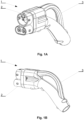
- An electric vehicle charging plug 1 ( Fig. 1A-B ) comprising a housing 2 for connecting to an electric vehicle, a main housing 3 and a sensor 4 comprising electric conductive paths 5 arranged inside the surface of the housing 2 and the main housing 3, and a control unit 6.
- the electric conductive paths 5 may have a form of conductive ink-applied on a flexible substrate such as e.g. a foil by ink-jet or screen printing method.
- the foil can be a polycarbonate foil or PET foil.
- the electric conductive paths 5 can be etched from a metalized foil layer.
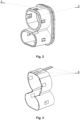
- the foil with the electric conductive paths 5 is placed in a molding tool in a way in which the electric conductive paths 5 are exposed directly to melted plastic injected in an injection molding process. Prior the over-molding, the electric conductive paths 5 are thermoformed in order to achieve a desired shape to fit to a socket of the molding tool ( Fig. 3 ). Finally, the foil with the electric conductive paths 5 is over-molded with plastic to create a uniform composite with the over-molded plastic.
- the foil can be positioned inside the molding tool either by an electrostatic charging of the foil (similarly to In Mold Labeling (IML) process) or by underpressure made by a creation of several small openings in a wall of the molding tool at areas at which the foil is going to be placed.
- the openings are connected with channels equipped with a vacuum pump.
- the disclosed composite creation ensures protection for the electric conductive paths 5 from adverse weather conditions.
- the electric conductive paths 5 can be placed inside the housing 2 and/or the main housing 3 by means of 2K injection molding process constituting over-molding of both sides of the electric conductive paths 5.
- the control unit 6 is configured to measure resistance of the electric conductive paths 5 and the sensor 4 is configured such that upon at least partial breakage of the electric conductive paths 5 their resistance measured by the control unit 6 increases thereby indicating the crack of the housing 2 and/or the main housing 3.
- the increase in the resistance value corresponds to the number of broken electric conductive paths 5, which in turn allows the size of the cracks in the housing 2 and/or in the main housing 3 to be determined.
- control unit 6 is configured to measure impedance, inductance and/or capacitance of the electric conductive paths 5 and the sensor 4 is configured such that upon at least partial breakage of the least one conductive path 5 the impedance, inductance and/or capacitance of the at least one conductive path 5 measured by the control unit 6 changes thereby indicating the crack of the housing 2 and/or the main housing 3.
- control unit 6 is configured to communicate with a charging device 11, especially in such a way that it triggers a control signal of the charging device 11 terminating or preventing the start of a charging process of the charging device 11 upon detecting the crack of the housing 2.
- the occurrence of cracks in the housing 2 and/or the main housing 3 is associated with breakages of the electric conductive paths 5.
- the breakages of the electric conductive paths 5 cause an increase in resistance in the monitored circuit, which in turn is detected by the control unit 6 which is in communication with the charging device 11.
- the control unit 6 can send a control signal to the charging device to terminate or to prevent the start of a charging process.
- the application of conductive paths 5 in a form of an electric conductive path and the control unit 6 configured to measure resistance of the electric conductive paths 5 provides detection of mechanical damage of different degrees starting from microcracks and ending on a substantial destruction of the housing 2 and/or the main housing 3, and thus prevents a user of the plug from electric shock. It also allows for protecting the device from burning or other damages and leads to its more efficient usage as a result of reduction of the electric vehicle charging plug downtime due to its necessary service comparing to existing solutions. It is possible to a very quick detection of damage of the housing 2 and/or the main housing 3 as a result of a car wheel running over it.
- the housing 2 and the main housing 3 can be made of one or more polymer materials, or polymer composite materials, including but not limited to acetal and ketal based polymers and copolymers, polyesters (e.g. polyethylene terephthalate, polybutylene terephthalate), polycarbonate, polystyrene, polyether sulfone (PESU), polyphenylene sulfone (PPSU), polysulfone, and polytetrafluoroethylene (PTFE).
- polyesters e.g. polyethylene terephthalate, polybutylene terephthalate
- polycarbonate polystyrene
- PESU polyether sulfone
- PPSU polyphenylene sulfone
- PTFE polytetrafluoroethylene
- polymers can also be implemented, including but not limited to polyvinyl chloride (PVC), polyethylene, polypropylene, polyetherimide (PEI), polyphenylene sulfide (PPS), polyether ether ketone (PEEK), polyphthalamide (PPA), polyoxymethylene (POM), phenolformaldehyde (PF), unsatured polyester (UP), polyurethane (PUR and PU), polyimide, polyamide, polyvinyl alcohol, polyvinylidene chloride, polyacrylonitrile and polyalkylene paraoxybenzoate.
- PVC polyvinyl chloride
- PEI polyethylene
- PPS polyphenylene sulfide
- PEEK polyether ether ketone
- PPA polyphthalamide
- POM polyoxymethylene
- UP unsatured polyester
- PUR and PU polyurethane
- polyimide polyamide
- polyvinyl alcohol polyvinylidene chloride
- polyacrylonitrile polyalky
- the composite can include a variety of types of fibers, including but not limited to carbon fiber, glass fiber, basalt fiber, wool, silk, cotton, rayon, cellulose, cellulose acetate, flax, ramie, jute and aramid fibers.
- additives can be used to improve the qualities of the materials, including but not limited to the mechanical and thermal stability, chemical resistance, insulation property and flammability.
- the additives can include, but are not limited to, ceramics, alumina, calcium silicate, flame retardants and clays.
- electric conductive paths can be arranged inside the surface of the housing 2 or the main housing 3 only.
- the second embodiment of the electric vehicle charging plug 1 is as in the first embodiment, with the difference that the electric conductive paths 5 are arranged on the outside surface of the housing 2 and the main housing 3 by means of 3D printing or by means of the Laser Direct Structuring technology.
- the electric conductive paths 5 can be arranged in layers next to each other. In still yet other embodiments, electric conductive paths are arranged on the outside surface of the housing 2 or the main housing 3 only.
- the electric vehicle charging plug 1 is as in the first or the second embodiment, with the difference that the electric conductive paths 5 are made of conductive threads woven into a fabric and integrated with the housing 2 and the main housing 3 by covering them by injected plastic in an injection molding process or by gluing them to the housing 2 and the main housing 3.
- the fabric should be loose enough to allow plastic to penetrate the fabric.
- the application of conductive threads provides by its flexibility improved differentiation of the conductive paths 5 deformation from at least partial breakage. Furthermore, the application of conductive threads provides an increase of the efficiency of the electric vehicle charging plug 1 manufacturing process.
- Another example of the electric vehicle charging plug 1 is as in the first embodiment, with the difference that the electric conductive paths 5 are in a form of electrically conductive plastic embedded in grooves of the housing 2 (shown in Fig. 5 ) and the main housing 3.
- the electrically conductive plastics can be conductive thermoplastics or their blends, e.g. filled with conductive or semiconductive particles like metal, carbon black, graphite, graphene and/or metal oxides.
- the electrically conductive plastics can be conductive elastomers or their blends, e.g. filled with conductive or semiconductive particles like metal, carbon black, graphite, graphene and/or metal oxides.
- the electric conductive paths 5 can be made of silver, copper, aluminum, or carbon in a solid form (e.g. in a form of a ribbon or a wire).
- the electric conductive paths 5 that acts as the RFID antenna 8.
- the sensor 4 is configured such that upon at least partial breakage of the conductive paths 5 the communication between the RFID controller 9 and the RFID tag 7 is no longer possible thereby indicating the crack of the housing 2.
- the sixth embodiment of the electric vehicle charging plug 1 comprising a housing 2 for connecting to an electric vehicle, a main housing 3 and a sensor 4 comprising electric conductive paths 5 arranged inside the surface of the housing 2 and the main housing 3, and a control unit 6.
- the electric conductive paths 5 may have any of the forms as disclosed in the above-mentioned embodiments.
- the housing 2 and the main housing 3 can be made of one or more of the materials as disclosed in the above-mentioned embodiments.
- the sensor 4 further comprises an RFID system consisting of a RFID tag 7 connected to an RFID tag's antenna 8, and an RFID controller 9 connected to RFID controller's antenna 10.
- the RFID controller 9 is placed in the main housing 3 and the RFID tag 7 is placed in the housing 2 for connecting to an electric vehicle.
- the RFID controller 9 is configured to measure resistance of the electric conductive paths 5 in the main housing 3 and the RFID tag 7 is configured to measure resistance of the electric conductive paths 5 in the housing 2.
- the sensor 4 is configured such that upon at least partial breakage of at least one electric conductive path 5 in the housing 2 and/or in the main housing 3, their resistance measured by the RFID tag 7 and/or RFID controller 9 increases, thereby indicating the crack of the housing 2 and/or the main housing 3.
- the increase in the resistance value corresponds to the number of the broken electric conductive paths 5, which in turn allows the size of the cracks in the housing 2 and/or in the main housing 3 to be determined.
- the RFID system is configured to measure impedance, inductance and/or capacitance of the electric conductive paths 5 and the sensor 4 is configured such that upon at least partial breakage of the least one conductive path 5 the impedance, inductance and/or capacitance of the at least one conductive path 5 measured by the RFID system changes thereby indicating the crack of the housing 2 and/or the main housing 3.
- control unit 6 is configured to communicate with a charging device 11, especially in such a way that it triggers a control signal of the charging device 11 terminating or preventing the start of a charging process of the charging device 11 upon detecting the crack of the housing 2 and/or the main housing 3.
- the occurrence of cracks in the housing 2 and/or the main housing 3 is associated with breakages of the electric conductive paths 5.
- the breakages of the electric conductive paths 5 cause an increase in resistance in the monitored circuit.
- the breakage of the conductive paths 5 inside the surface of the housing 2 is detected by the RFID tag 7 and the breakage of the conductive paths 5 inside the surface of the main housing 3 is detected by the RFID controller 9.
- the RFID tag 7 is in communication with the RFID controller 9 and further the RFID controller 9 is in communication with the control unit 6, in case of breakages in either or both of the mentioned housings 2, 3 the control unit 6 receives an appropriate information about the crack(s) and it can send a control signal to the charging device11 to terminate or to prevent the start of a charging process.
- the application of the sensor 4 further comprising the RFID system consisting of the RFID tag 7 connected to the RFID tag's antenna 8, and the RFID controller 9 connected to RFID controller's antenna 10, wherein the RFID system is configured to measure resistance of the electric conductive paths 5, and wherein the sensor 4 is configured such that upon at least partial breakage of the electric conductive paths 5 resistance of the electric conductive paths 5 measured by the RFID system changes (in this case increases) thereby indicating the crack of the housing and/or the main housing provides detection of mechanical damage of different degrees starting from microcracks and ending on a substantial destruction of the housing and/or the main housing, and thus prevents a user of the plug from electric shock.
- the application of the RFID system comprising its own RFID antennas as an additional part of the electric vehicle charging plug 1 ensures continuity of communication between the control unit 6 and the RFID system even if one or more of the electric conductive paths is broken.
- the maintenance of the continuity of communication makes it possible to distinguish damage of the controller 6 from electric conductive paths 5 breakage.
- the seventh embodiment of the invention relates to a charger 12 comprising the charging plug 1 according to any of the embodiments from 1 to 6 and the charging device 11.
Landscapes
- Engineering & Computer Science (AREA)
- Mechanical Engineering (AREA)
- Power Engineering (AREA)
- Transportation (AREA)
- Chemical & Material Sciences (AREA)
- Life Sciences & Earth Sciences (AREA)
- Microelectronics & Electronic Packaging (AREA)
- Physics & Mathematics (AREA)
- General Physics & Mathematics (AREA)
- Sustainable Energy (AREA)
- General Health & Medical Sciences (AREA)
- Sustainable Development (AREA)
- Pathology (AREA)
- Immunology (AREA)
- Chemical Kinetics & Catalysis (AREA)
- Electrochemistry (AREA)
- Health & Medical Sciences (AREA)
- Analytical Chemistry (AREA)
- Biochemistry (AREA)
- Computer Networks & Wireless Communication (AREA)
- Signal Processing (AREA)
- Aviation & Aerospace Engineering (AREA)
- Electric Propulsion And Braking For Vehicles (AREA)
- Charge And Discharge Circuits For Batteries Or The Like (AREA)
Description
- The present invention relates to an electric vehicle charging plug and a charger comprising such a charging plug.
- One of the most common failures of an electric vehicle charging plug is cracking of its housing. It usually happens due to mechanical shock, for example due to dropping a plug by a user or running a wheel of a car over a plug lying on the ground. A mechanical damage of a plug might have different degrees starting from microcracks and ending on a substantial destruction of the plug housing. In all cases, the destruction of the integrity of the plug entails the appearance of a security risk to the user. In particular, small cracks that can cause loss of electrical insulation of the device, which are so small that they may go unnoticed by the user, can be very dangerous. Such a defect may cause a significant risk of electric shock to the user.
- From Korean patent application
KR20170093269 KR20170093269 - From
PCT patent application WO2018192805 there is known a charging connector for a motor vehicle comprising a connection module and a load contact module. The connection module is arranged to be connected to supply lines for supplying power. The load contact module includes a load contact for transmitting a charging power. The load contact module is arranged to be removably and replaceably secured to the connection module. Further the load contact module includes a temperature sensor. Likewise the above-mentioned Korean applicationWO2018192805 focuses on the overheating problem occurring in EV charging plugs. -
WO2018105809A1 discloses a portable charger for an electric car comprising a plug arranged to be connected to a power source and a control box connected to the plug. Further the plug comprises a bipolar plug pin, a neutral pole plug pin, a first temperature sensor installed adjacent to the positive electrode plug pin and a second temperature sensor disposed adjacent to the neutral pole plug pin. The control box is configured to receive signals from the first temperature sensor and the second temperature sensor and based on a calculated difference in those signal values decrease or stop transmission of current from the power source to the electric car. The PCT disclosure aims in improving continuity of charging by eliminating a problem of false signals deriving from using only one temperature sensor. It also solves a possible plug overheating problem and controlling current values transmitted to the car. -
DE102018120057 discloses a temperature measuring instrument having a panel-shaped cover element made of a ceramic material i.e. alumina-ceramic substrate, or plastic, a carrier element and a temperature measuring unit comprising conductive strips. The carrier element is a glass-fiber reinforced printed circuit board. Further, the conductive strips may be arranged on the carrier element or between the carrier element and the cover element. The carrier and cover elements are operatively connected with each other such that a connection of the carrier and cover elements is carried out through a glass solder. The carrier element is provided with recesses that are formed for retaining plug-in units within a region of a plug connector, wherein a material thickness of the carrier element amounts to 0.15-5 mm. Copper spring-loaded contacts are positioned within a region of the recesses. The German application aims at providing a temperature measuring instrument for plug connectors which is simple in construction and enables temperature measurement on site, i.e. in the area of the plug connector/mating connector parts connected to one another, precisely. As a result it solves the problem of overheating of a charger during a charging process. -
US2019126764A1 discloses an electric vehicle charging plug comprising a housing for accommodating power contacts, power contacts for power transmission, a cooling system and an apparatus for detecting liquid leaking from the cooling system and collecting inside the housing. The apparatus for detecting a liquid has at least one detector element having a conductor track structure. The detector element is arranged in an interior of the housing and the conductor track structure forms a detection face for detecting the liquid. The US application raises the problem of a charging plug damage caused by leaks from the cooling system resulting in possible injury of a charger operator. For this reason it proposes the apparatus for detecting a liquid leaking but it is silent about detecting cracks in the housing of the plug. - From European patent application
EP2829432A2 there is known a portable charger connected to a wall electric power source and configured to supply an electric power from the wall electric power source to a load. The portable charger includes a plug inserted in a socket installed in the wall electric power source, an electric wire connecting the plug and the load to supply an electric power from the wall electric power source to the load, a switch disposed between the plug and the electric wire to switch on or off the supply of the electric power flowing through the electric wire. Further, the portable charger includes a first detection unit configured to detect whether a user approaches, a second detection unit disposed in the electric wire and configured to detect a tensile force applied to the electric wire, and a control unit configured to supply an electric power through the electric wire to the load when the plug is plugged in the socket and to cut off the supply of the electric power flowing through the electric wire by controlling the switch on the basis of the user's approach that is detected by the first detection unit, and the tensile force that is detected by the second detection unit while the electric power is being supplied. - From German patent application
DE102012222462A1 there is known a device for controlling energy transmission and for energy transmission between a first unit and a second unit. The device comprises a first coupling component suitable for connection to a second coupling component of the second unit, a positioning unit for guiding the device during the connection, and a detection unit for detecting at least one signal, wherein the detection unit is configured such that the at least one signal can be detected from a restricted spatial area. The device comprises further a control unit for evaluating the signal and controlling the energy transmission depending on a result of the evaluation. The detection unit can be in a form of an RFID reader and the signal can be in form of a frequency signal. - From US patent application
US2021086630A1 there is known a component of an electrified vehicle comprising an access cover configured to selectively open and close relative to the component and a circuit configured to indicate whether the access cover is open, wherein the circuit includes a light sensitive electronic component. The light sensitive electronic component is a light dependent resistor. -
US20100295694A1 discloses a smart aerospace structure comprising a deactivated radio-frequency identification tag comprising an integrated circuit and an electrical by-pass, wherein the electrical by-pass is conductive and the electrical by-pass is in parallel with the integrated circuit. The deactivated radio-frequency identification tag becomes activated when the by-pass becomes nonconductive upon an abnormal condition, where the abnormal condition comprises an improper clamp installation, a clamp failure, an impact, a thermal event or a crack. -
WO2020174267A1 discloses a connector for electric vehicle supply equipment comprising a housing that includes one or more electrical coupling members that are connectable between the electric vehicle supply equipment and a mating inlet of an electric vehicle to supply electric power to the vehicle. In turn, the housing includes a sensor that is operable to detect light within the housing and output a signal in response to the detection of light within the housing to interrupt or disable the supply of electric power to the vehicle through the connector. - Although the above-cited patent literature discloses variety of proposals of preventing plug damage due to overheating of a plug as well as monitoring of mechanical integrity status of a plug's housing (herein understood as a housing connecting to an electric vehicle and/or a main housing) none of them provides an electric vehicle charging plug that ensures detection of mechanical damage of different degrees starting from microcracks and ending on a substantial destruction of a plug's housing. Therefore, the aim of the invention is to provide an electric vehicle charging plug that solves the stated problem and that has additional advantages disclosed in this application.
- The invention provides an electric vehicle charging plug according to
claim 1 and an electric vehicle charger according toclaim 12 which comprises the electric vehicle charging plug according toclaim 1. Preferred embodiments are defined in the dependent claims. J Z - The first object of the invention is an electric vehicle charging plug comprising a housing for connecting to an electric vehicle, a main housing, a sensor comprising at least one conductive path embedded in a wall or arranged on the surface of the housing for connecting to an electric vehicle or the main housing, and a control unit, wherein the sensor is configured to detect the crack of the housing for connecting to an electric vehicle and/or the main housing, and wherein the control unit is configured to measure at least one of the characteristics of the least one conductive path and the sensor is configured such that upon at least partial breakage of the least one conductive path the at least one characteristic of the at least one conductive path measured by the control unit changes thereby indicating the crack of the housing and/or the main housing. The essence of the invention is that the at least one conductive path is an electric conductive path and the control unit is configured to measure resistance, impedance, inductance and/or capacitance of the electric conductive path.
- The application of at least one conductive path in a form of an electric conductive path and the control unit configured to measure resistance, impedance, inductance and/or capacitance of the electric conductive path provides detection of mechanical damage of different degrees starting from microcracks and ending on a substantial destruction of the housing for connecting to an electric vehicle and/or the main housing, and thus prevents a user of the plug from electric shock. It also allows for protecting the device from burning or other damages and leads to its more efficient usage as a result of reduction of the electric vehicle charging plug downtime due to its necessary service comparing to existing solutions.
- Preferably, the control unit is configured to measure resistance and the crack of the housing and/or the main housing is indicated by the increase of resistance.
- Preferably, the sensor further comprises an RFID tag connected to an RFID tag's antenna, and an RFID controller connected to RFID controller's antenna configured to maintain a communication with the RFID tag, wherein the at least one conductive path acts as an RFID antenna or as an antenna of the RFID controller, and the sensor is configured such that upon at least partial breakage of the at least one conductive path the communication between the RFID controller and the RFID tag is no longer possible thereby indicating the crack of the housing and/or the main housing.
- The second object of the invention is an electric vehicle charging plug comprising a housing for connecting to an electric vehicle, a main housing, a sensor comprising at least one conductive path embedded in a wall or arranged on the surface of the housing for connecting to an electric vehicle or the main housing, and a control unit, wherein the sensor is configured to detect the crack of the housing and/or the main housing. The essence of the invention is that the sensor further comprises an RFID system consisting of an RFID tag connected to an RFID tag's antenna, and an RFID controller connected to RFID controller's antenna. The RFID system is configured to measure at least one of the characteristics of the least one conductive path, wherein the sensor is configured such that upon at least partial breakage of the least one conductive path the at least one characteristic of the at least one conductive path measured by the RFID system changes thereby indicating the crack of the housing and/or the main housing.
- The application of the sensor further comprising the RFID system consisting of the RFID tag connected to the RFID tag's antenna, and the RFID controller connected to RFID controller's antenna, wherein the RFID system is configured to measure at least one of the characteristics of the least one conductive path, wherein the sensor is configured such that upon at least partial breakage of the least one conductive path the at least one characteristic of the at least one conductive path measured by the RFID system changes thereby indicating the crack of the housing and/or the main housing provides detection of mechanical damage of different degrees starting from microcracks and ending on a substantial destruction of the housing and/or the main housing, and thus prevents a user of the plug from electric shock. It also allows for protecting the device from burning or other damages and leads to its more efficient usage as a result of reduction of the electric vehicle charging plug downtime due to its necessary service comparing to existing solutions.
- Preferably, the at least one conductive path is made of metallic layer, conductive ink, conductive plastic, conductive elastomer.
- Preferably, the at least one conductive path is in the form of conductive path on the foil.
- Preferably, the at least one conductive path is arranged on the surface of the housing and/or the main housing by means of 3D printing or by means of the Laser Direct Structuring technology.
- Preferably, the at least one conductive path is made from at least one conductive thread.
- The application of at least one conductive thread allows for differentiation of deformation from at least partial breakage of the conductive path. Furthermore, said application provides an increase of the efficiency of the electric vehicle charging plug manufacturing process.
- Preferably, the control unit is configured to communicate with a charging device.
- Preferably, the control unit is configured to trigger a control signal of the charging device terminating or preventing the start of a charging process of the charging device upon detecting the crack of the housing and/or the main housing.
- Preferably, the at least one conductive path is arranged on the inside or outside surface of the housing and/or the main housing.
- Preferably, the sensor comprises at least two conductive paths arranged in layers.
- The invention also relates to an electric vehicle charger comprising the electric vehicle charging plug and the charging device.
- The electric vehicle charging plug according to the invention allows for detecting cracks appearing on its housing for connecting to an electric vehicle and/or main housing thereby preventing its users from electric shock and subsequent fire.
- The electric vehicle charging plug according to the invention ensures possibility of continuously monitoring of a mechanical integrity status of the plug's housing (herein understood as a housing for connecting to an electric vehicle and/or a main housing) and thereby preventing its users from electric shock. It also allows for protecting the device from burning or other damages and leads to its more efficient usage as a result of reduction of the electric vehicle charging plug downtime due to its necessary service comparing to existing solutions.
- The detection of plug's breakage allows for a quick service of the plug which provides greater reliability of the charger and increases lifetime over the solutions known from the state of the art.
- Monitoring of the plug's mechanical integrity allows to estimate the aging of the components inside the plug.
- Detection of plug's breakage allows to send information about the damage of the plug to a charging device and thereby change an actual status of the charging device in the online software associated with the charging device and/or directly in the charging device as well.
- Furthermore, the electric vehicle charging plug according to the invention eliminates the need for physical inspection of the plug and allows to plan the service of the plug or the charger in advance, especially when damage to the plug does not exclude the use of the charger.
- The application of conductive threads provides by its flexibility improved differentiation of the conductive paths deformation from at least partial breakage.
- Furthermore, the application of conductive threads provides an increase of the efficiency of the electric vehicle charging plug manufacturing process.
- The application of a composite form comprising a layer of a foil, conductive paths and a plastic ensures protection for the conductive paths from adverse weather conditions.
- The subject of the invention is shown in the embodiments in a drawing, in which:
- Fig.1A
- presents an electric vehicle charging plug according to the invention in a frontal perspective view;
- Fig.1B
- presents an electric vehicle charging plug according to the invention in a rear perspective view;
- Fig.2
- presents a housing for connecting to an electric vehicle of an electric vehicle charging plug according to the invention with conductive paths arranged on its outside surface in a perspective view;
- Fig.3
- presents a shaped film structure for embedding in the housing for connecting to an electric vehicle comprising conductive path made of ink applied thereon;
- Fig.4
- presents a housing for connecting to an electric vehicle with grooves in its outside surface for conductive paths in a perspective view;
- Fig.5
- presents a housing for connecting to an electric vehicle with conductive paths embedded in its grooves in a perspective view;
- Fig.6
- presents schematically a connection arrangement of an electric vehicle charging plug according to the first embodiment of the invention;
- Fig.7
- presents schematically a connection arrangement of an electric vehicle charging plug according to the fifth embodiment of the invention;
- Fig.8
- presents schematically a connection arrangement of an electric vehicle charging plug according to the sixth embodiment of the invention;
- Fig.9
- presents the seventh embodiment of the invention in a schematic view.
- An electric vehicle charging plug 1 (
Fig. 1A-B ) comprising ahousing 2 for connecting to an electric vehicle, amain housing 3 and asensor 4 comprising electricconductive paths 5 arranged inside the surface of thehousing 2 and themain housing 3, and acontrol unit 6. - The electric
conductive paths 5 may have a form of conductive ink-applied on a flexible substrate such as e.g. a foil by ink-jet or screen printing method. - The foil can be a polycarbonate foil or PET foil. Alternatively, the electric
conductive paths 5 can be etched from a metalized foil layer. The foil with the electricconductive paths 5 is placed in a molding tool in a way in which the electricconductive paths 5 are exposed directly to melted plastic injected in an injection molding process. Prior the over-molding, the electricconductive paths 5 are thermoformed in order to achieve a desired shape to fit to a socket of the molding tool (Fig. 3 ). Finally, the foil with the electricconductive paths 5 is over-molded with plastic to create a uniform composite with the over-molded plastic. - The foil can be positioned inside the molding tool either by an electrostatic charging of the foil (similarly to In Mold Labeling (IML) process) or by underpressure made by a creation of several small openings in a wall of the molding tool at areas at which the foil is going to be placed. The openings are connected with channels equipped with a vacuum pump.
- The disclosed composite creation ensures protection for the electric
conductive paths 5 from adverse weather conditions. - In the other examples of the invention, the electric
conductive paths 5 can be placed inside thehousing 2 and/or themain housing 3 by means of 2K injection molding process constituting over-molding of both sides of the electricconductive paths 5. - The
control unit 6 is configured to measure resistance of the electricconductive paths 5 and thesensor 4 is configured such that upon at least partial breakage of the electricconductive paths 5 their resistance measured by thecontrol unit 6 increases thereby indicating the crack of thehousing 2 and/or themain housing 3. The increase in the resistance value corresponds to the number of broken electricconductive paths 5, which in turn allows the size of the cracks in thehousing 2 and/or in themain housing 3 to be determined. - In the other embodiments of the invention, the
control unit 6 is configured to measure impedance, inductance and/or capacitance of the electricconductive paths 5 and thesensor 4 is configured such that upon at least partial breakage of the least oneconductive path 5 the impedance, inductance and/or capacitance of the at least oneconductive path 5 measured by thecontrol unit 6 changes thereby indicating the crack of thehousing 2 and/or themain housing 3. - Furthermore, the
control unit 6 is configured to communicate with a chargingdevice 11, especially in such a way that it triggers a control signal of the chargingdevice 11 terminating or preventing the start of a charging process of the chargingdevice 11 upon detecting the crack of thehousing 2. - In summary, the occurrence of cracks in the
housing 2 and/or themain housing 3 is associated with breakages of the electricconductive paths 5. The breakages of the electricconductive paths 5 cause an increase in resistance in the monitored circuit, which in turn is detected by thecontrol unit 6 which is in communication with the chargingdevice 11. Thecontrol unit 6 can send a control signal to the charging device to terminate or to prevent the start of a charging process. - The application of
conductive paths 5 in a form of an electric conductive path and thecontrol unit 6 configured to measure resistance of the electricconductive paths 5 provides detection of mechanical damage of different degrees starting from microcracks and ending on a substantial destruction of thehousing 2 and/or themain housing 3, and thus prevents a user of the plug from electric shock. It also allows for protecting the device from burning or other damages and leads to its more efficient usage as a result of reduction of the electric vehicle charging plug downtime due to its necessary service comparing to existing solutions. It is possible to a very quick detection of damage of thehousing 2 and/or themain housing 3 as a result of a car wheel running over it. - The
housing 2 and themain housing 3 can be made of one or more polymer materials, or polymer composite materials, including but not limited to acetal and ketal based polymers and copolymers, polyesters (e.g. polyethylene terephthalate, polybutylene terephthalate), polycarbonate, polystyrene, polyether sulfone (PESU), polyphenylene sulfone (PPSU), polysulfone, and polytetrafluoroethylene (PTFE). Other polymers can also be implemented, including but not limited to polyvinyl chloride (PVC), polyethylene, polypropylene, polyetherimide (PEI), polyphenylene sulfide (PPS), polyether ether ketone (PEEK), polyphthalamide (PPA), polyoxymethylene (POM), phenolformaldehyde (PF), unsatured polyester (UP), polyurethane (PUR and PU), polyimide, polyamide, polyvinyl alcohol, polyvinylidene chloride, polyacrylonitrile and polyalkylene paraoxybenzoate. In some embodiments, the composite can include a variety of types of fibers, including but not limited to carbon fiber, glass fiber, basalt fiber, wool, silk, cotton, rayon, cellulose, cellulose acetate, flax, ramie, jute and aramid fibers. In some examples, additives can be used to improve the qualities of the materials, including but not limited to the mechanical and thermal stability, chemical resistance, insulation property and flammability. The additives can include, but are not limited to, ceramics, alumina, calcium silicate, flame retardants and clays. - In other embodiments, electric conductive paths can be arranged inside the surface of the
housing 2 or themain housing 3 only. - The second embodiment of the electric
vehicle charging plug 1 is as in the first embodiment, with the difference that the electricconductive paths 5 are arranged on the outside surface of thehousing 2 and themain housing 3 by means of 3D printing or by means of the Laser Direct Structuring technology. The electricconductive paths 5 can be arranged in layers next to each other. In still yet other embodiments, electric conductive paths are arranged on the outside surface of thehousing 2 or themain housing 3 only. - Another example of the electric
vehicle charging plug 1 is as in the first or the second embodiment, with the difference that the electricconductive paths 5 are made of conductive threads woven into a fabric and integrated with thehousing 2 and themain housing 3 by covering them by injected plastic in an injection molding process or by gluing them to thehousing 2 and themain housing 3. The fabric should be loose enough to allow plastic to penetrate the fabric. - The application of conductive threads provides by its flexibility improved differentiation of the
conductive paths 5 deformation from at least partial breakage. Furthermore, the application of conductive threads provides an increase of the efficiency of the electricvehicle charging plug 1 manufacturing process. - Another example of the electric
vehicle charging plug 1 is as in the first embodiment, with the difference that the electricconductive paths 5 are in a form of electrically conductive plastic embedded in grooves of the housing 2 (shown inFig. 5 ) and themain housing 3. - The electrically conductive plastics can be conductive thermoplastics or their blends, e.g. filled with conductive or semiconductive particles like metal, carbon black, graphite, graphene and/or metal oxides. Similarly, the electrically conductive plastics can be conductive elastomers or their blends, e.g. filled with conductive or semiconductive particles like metal, carbon black, graphite, graphene and/or metal oxides.
- In another embodiment of the invention, the electric
conductive paths 5 can be made of silver, copper, aluminum, or carbon in a solid form (e.g. in a form of a ribbon or a wire). - The fifth embodiment of the electric
vehicle charging plug 1 as in the first embodiment, with the difference that thesensor 4 further comprises anRFID tag 7 connected to an RFID tag'santenna 8 and anRFID controller 9, connected to RFID controller'santenna 10, configured to maintain a communication with theRFID tag 7. In the presented embodiment, it is the electricconductive paths 5 that acts as theRFID antenna 8. In turn, thesensor 4 is configured such that upon at least partial breakage of theconductive paths 5 the communication between theRFID controller 9 and theRFID tag 7 is no longer possible thereby indicating the crack of thehousing 2. - The sixth embodiment of the electric
vehicle charging plug 1 comprising ahousing 2 for connecting to an electric vehicle, amain housing 3 and asensor 4 comprising electricconductive paths 5 arranged inside the surface of thehousing 2 and themain housing 3, and acontrol unit 6. - The electric
conductive paths 5 may have any of the forms as disclosed in the above-mentioned embodiments. - The
housing 2 and themain housing 3 can be made of one or more of the materials as disclosed in the above-mentioned embodiments. - The
sensor 4 further comprises an RFID system consisting of aRFID tag 7 connected to an RFID tag'santenna 8, and anRFID controller 9 connected to RFID controller'santenna 10. TheRFID controller 9 is placed in themain housing 3 and theRFID tag 7 is placed in thehousing 2 for connecting to an electric vehicle. In such a system, theRFID controller 9 is configured to measure resistance of the electricconductive paths 5 in themain housing 3 and theRFID tag 7 is configured to measure resistance of the electricconductive paths 5 in thehousing 2. Further, thesensor 4 is configured such that upon at least partial breakage of at least one electricconductive path 5 in thehousing 2 and/or in themain housing 3, their resistance measured by theRFID tag 7 and/orRFID controller 9 increases, thereby indicating the crack of thehousing 2 and/or themain housing 3. The increase in the resistance value corresponds to the number of the broken electricconductive paths 5, which in turn allows the size of the cracks in thehousing 2 and/or in themain housing 3 to be determined. - In the other embodiments of the invention, the RFID system is configured to measure impedance, inductance and/or capacitance of the electric
conductive paths 5 and thesensor 4 is configured such that upon at least partial breakage of the least oneconductive path 5 the impedance, inductance and/or capacitance of the at least oneconductive path 5 measured by the RFID system changes thereby indicating the crack of thehousing 2 and/or themain housing 3. - Furthermore, as in the abovementioned embodiments, the
control unit 6 is configured to communicate with a chargingdevice 11, especially in such a way that it triggers a control signal of the chargingdevice 11 terminating or preventing the start of a charging process of the chargingdevice 11 upon detecting the crack of thehousing 2 and/or themain housing 3. - In summary, the occurrence of cracks in the
housing 2 and/or themain housing 3 is associated with breakages of the electricconductive paths 5. The breakages of the electricconductive paths 5 cause an increase in resistance in the monitored circuit. The breakage of theconductive paths 5 inside the surface of thehousing 2 is detected by theRFID tag 7 and the breakage of theconductive paths 5 inside the surface of themain housing 3 is detected by theRFID controller 9. As theRFID tag 7 is in communication with theRFID controller 9 and further theRFID controller 9 is in communication with thecontrol unit 6, in case of breakages in either or both of the mentionedhousings control unit 6 receives an appropriate information about the crack(s) and it can send a control signal to the charging device11 to terminate or to prevent the start of a charging process. - The application of the
sensor 4 further comprising the RFID system consisting of theRFID tag 7 connected to the RFID tag'santenna 8, and theRFID controller 9 connected to RFID controller'santenna 10, wherein the RFID system is configured to measure resistance of the electricconductive paths 5, and wherein thesensor 4 is configured such that upon at least partial breakage of the electricconductive paths 5 resistance of the electricconductive paths 5 measured by the RFID system changes (in this case increases) thereby indicating the crack of the housing and/or the main housing provides detection of mechanical damage of different degrees starting from microcracks and ending on a substantial destruction of the housing and/or the main housing, and thus prevents a user of the plug from electric shock. It also allows for protecting the device from burning or other damages and leads to its more efficient usage as a result of reduction of the electric vehicle charging plug downtime due to its necessary service comparing to existing solutions. It is possible to a very quick detection of damage of thehousing 2 and/or themain housing 3 as a result of a car wheel running over it. - The application of the RFID system comprising its own RFID antennas as an additional part of the electric
vehicle charging plug 1 ensures continuity of communication between thecontrol unit 6 and the RFID system even if one or more of the electric conductive paths is broken. The maintenance of the continuity of communication makes it possible to distinguish damage of thecontroller 6 from electricconductive paths 5 breakage. - The seventh embodiment of the invention relates to a
charger 12 comprising the chargingplug 1 according to any of the embodiments from 1 to 6 and the chargingdevice 11.
Claims (12)
- An electric vehicle charging plug (1) comprising:- a housing (2) for connecting to an electric vehicle,- a main housing (3),- a sensor (4) comprising:- at least one conductive path (5) embedded in a wall or arranged on the surface of the housing (2) and/or main housing (3), and- a control unit (6),wherein the sensor (4) is configured to detect a crack of the housing (2) and/or the main housing (3), characterized in that the control unit (6) is configured to measure at least one of the characteristics of the least one conductive path (5) and the sensor (4) is configured such that upon at least partial breakage of the least one conductive path (5) the at least one characteristic of the at least one conductive path (5) measured by the control unit (6) changes thereby indicating the crack of the housing (2) and/or the main housing (3),whereby the at least one conductive path (5) is an electric conductive path and the control unit (6) is configured to measure resistance, impedance, inductance and/or capacitance of the electric conductive path.
- The electric vehicle charging plug according to claim 1 characterized in that the control unit (6) is configured to measure resistance and the crack of the housing (2) and/or the main housing (3) is indicated by the increase of resistance.
- The electric vehicle charging plug according to claim 1 or 2, characterized in that the sensor (4) further comprises an RFID tag (7) connected to an RFID tag's antenna (8), and an RFID controller (9) connected to an RFID controller's antenna (10), wherein RFID controller (9) is configured to maintain a communication with the RFID tag (7),
wherein- the at least one conductive path (5) acts as the RFID tag's antenna (8) or as the RFID controller's antenna (10), and- the sensor (4) is configured such that upon at least partial breakage of the at least one conductive path (5) the communication between the RFID controller (9) and the RFID tag (7) is no longer possible thereby indicating the crack of the housing (2) and/or the main housing (3). - An electric vehicle charging plug (1) comprising- a housing (2) for connecting to an electric vehicle,- a main housing (3),- a sensor (4) comprising:- at least one conductive path (5) embedded in a wall or arranged on the surface of the housing (2) and/or main housing (3), and- a control unit (6),wherein the sensor (4) is configured to detect a crack of the housing (2) and/or the main housing (3),characterized in that the sensor (4) further comprises:- a RFID system consisting of a RFID tag (7) connected to an RFID tag's antenna (8) and an RFID controller (9) connected to an RFID controller's antenna (10), and- the RFID system is configured to measure at least one of the characteristics of the least one conductive path (5), namely resistance, impedance, inductance and/or capacitance,
wherein- the sensor (4) is configured such that upon at least partial breakage of the least one conductive path (5) the at least one characteristic of the at least one conductive path (5) measured by the RFID system changes thereby indicating the crack of the housing (2) and/or the main housing (3). - The electric vehicle charging plug according to any of claims 1 to 4, characterized in that the at least one conductive path (5) is made of metallic layer, conductive ink, conductive plastic or conductive elastomer.
- The electric vehicle charging plug according to claims 1 to 4, characterized in that the least one conductive path (5) is in the form of conductive path on the foil.
- The electric vehicle charging plug according to any of claims 1 to 6, characterized in that the at least one conductive path is arranged on the surface of the housing and/or the main housing by means of 3D printing or by means of the Laser Direct Structuring technology.
- The electric vehicle charging plug according to any of claims 1 to 7, characterized in that the at least one conductive path (5) is made from at least one conductive thread.
- The electric vehicle charging plug according to any preceding claims, characterized in that the control unit (6) is configured to communicate with a charging device (11).
- The electric vehicle charging plug according to claim 9, characterized in that the control unit (6) is configured to trigger a control signal of the charging device (11) terminating or preventing the start of a charging process of the charging device (11) upon detection of the crack of the housing (2) and/or the main housing (3) by the sensor (4).
- The electric vehicle charging plug according to any of the preceding claims, characterized in that the at least one conductive path (5) is arranged on the inside or outside surface of the housing (2) and/or the main housing (3).
- An electric vehicle charger (12) comprising the charging plug (1) according to any of the preceding claims and the charging device (11).
Priority Applications (3)
| Application Number | Priority Date | Filing Date | Title |
|---|---|---|---|
| EP21183673.9A EP4116140B1 (en) | 2021-07-05 | 2021-07-05 | Electric vehicle charging plug |
| US17/856,387 US12291114B2 (en) | 2021-07-05 | 2022-07-01 | Electric vehicle charging plug |
| CN202210785914.8A CN115586220A (en) | 2021-07-05 | 2022-07-04 | Charging plug for electric vehicle |
Applications Claiming Priority (1)
| Application Number | Priority Date | Filing Date | Title |
|---|---|---|---|
| EP21183673.9A EP4116140B1 (en) | 2021-07-05 | 2021-07-05 | Electric vehicle charging plug |
Publications (3)
| Publication Number | Publication Date |
|---|---|
| EP4116140A1 EP4116140A1 (en) | 2023-01-11 |
| EP4116140B1 true EP4116140B1 (en) | 2024-06-26 |
| EP4116140C0 EP4116140C0 (en) | 2024-06-26 |
Family
ID=76971641
Family Applications (1)
| Application Number | Title | Priority Date | Filing Date |
|---|---|---|---|
| EP21183673.9A Active EP4116140B1 (en) | 2021-07-05 | 2021-07-05 | Electric vehicle charging plug |
Country Status (3)
| Country | Link |
|---|---|
| US (1) | US12291114B2 (en) |
| EP (1) | EP4116140B1 (en) |
| CN (1) | CN115586220A (en) |
Families Citing this family (8)
| Publication number | Priority date | Publication date | Assignee | Title |
|---|---|---|---|---|
| USD1002543S1 (en) * | 2021-09-29 | 2023-10-24 | Jiangsu Yihang Electric Technology Co., Ltd. | DC charging gun |
| USD998571S1 (en) * | 2021-10-27 | 2023-09-12 | Ti-Lane Precision Electronic Co., Ltd. | Vehicle charging connector |
| USD1122193S1 (en) * | 2021-10-29 | 2026-04-14 | ABB E-mobility B.V. | Electric vehicle charging connector |
| USD1035590S1 (en) * | 2022-11-11 | 2024-07-16 | ABB E-mobility B.V. | Charging device |
| AU2022487602A1 (en) * | 2022-11-25 | 2024-08-01 | Suzhou Yihang Electronic Technology Co., Ltd. | Quick-change structure of liquid-cooled charging gun |
| USD1094310S1 (en) * | 2023-03-15 | 2025-09-23 | ABB E-mobility B.V. | Power connector |
| USD1095447S1 (en) * | 2023-05-12 | 2025-09-30 | Stäubli Electrical Connectors Ag | Electrical connector |
| USD1087030S1 (en) * | 2023-11-30 | 2025-08-05 | Dongguan LanXin Charging Technology Co., Ltd. | Adapter |
Family Cites Families (11)
| Publication number | Priority date | Publication date | Assignee | Title |
|---|---|---|---|---|
| US8395521B2 (en) * | 2009-02-06 | 2013-03-12 | University Of Dayton | Smart aerospace structures |
| DE102012222462B4 (en) * | 2012-12-06 | 2014-09-18 | Siemens Aktiengesellschaft | Parameter-dependent control of an energy transfer |
| KR101728197B1 (en) * | 2013-07-22 | 2017-04-18 | 엘에스산전 주식회사 | Portable charger |
| KR20170093269A (en) | 2016-01-19 | 2017-08-16 | 통일전자공업(주) | Power plug for electric vehicle having a temparature sensor and an european type terminal and menufacturing method therof |
| US10133890B2 (en) * | 2016-08-29 | 2018-11-20 | Huawei Technologies Co., Ltd. | Stress sensitive radio frequency identification tag |
| WO2018105809A1 (en) | 2016-12-07 | 2018-06-14 | 엘에스산전 주식회사 | Portable charger for electric car |
| DE102017108526A1 (en) | 2017-04-21 | 2018-10-25 | Phoenix Contact E-Mobility Gmbh | Charging plug for a motor vehicle and load contact module for a charging plug |
| DE102018120057A1 (en) | 2017-08-17 | 2019-02-21 | Turck Duotec GmbH | TEMPERATURE MEASURING DEVICE |
| DE102017125265B4 (en) | 2017-10-27 | 2025-10-02 | Phoenix Contact E-Mobility Gmbh | Charging plug and charging station for a motor vehicle |
| WO2020174267A1 (en) * | 2019-02-28 | 2020-09-03 | Abb Schweiz Ag | Connector for electric vehicle supply equipment |
| US11634041B2 (en) * | 2019-09-19 | 2023-04-25 | Ford Global Technologies, Llc | Access cover detection circuit for electrified vehicle component and corresponding method |
-
2021
- 2021-07-05 EP EP21183673.9A patent/EP4116140B1/en active Active
-
2022
- 2022-07-01 US US17/856,387 patent/US12291114B2/en active Active
- 2022-07-04 CN CN202210785914.8A patent/CN115586220A/en active Pending
Also Published As
| Publication number | Publication date |
|---|---|
| CN115586220A (en) | 2023-01-10 |
| US20230001808A1 (en) | 2023-01-05 |
| US12291114B2 (en) | 2025-05-06 |
| EP4116140A1 (en) | 2023-01-11 |
| EP4116140C0 (en) | 2024-06-26 |
Similar Documents
| Publication | Publication Date | Title |
|---|---|---|
| EP4116140B1 (en) | Electric vehicle charging plug | |
| US11005221B2 (en) | Charging plug and charging station for a motor vehicle | |
| JP3274505B2 (en) | Installation of electronic circuits in tires | |
| US20100155539A1 (en) | Improvements relating to temperature monitoring | |
| US20240300333A1 (en) | Underbody element for a traction battery of a motor vehicle, motor vehicle with an underbody element, and method for determination of an intrusion into a traction battery of a motor vehicle | |
| CN103250299B (en) | Thermal interlock for battery packs, apparatus, system and method | |
| JP2015051876A (en) | Measuring tape for elevator device | |
| US20120291526A1 (en) | Aqueous chemical leak detection cable | |
| JP7554741B2 (en) | Plastic sliding elements with sensor functionality, especially with wear detection | |
| CN112406543B (en) | Panel crash monitoring method, panel, battery pack and vehicle | |
| CN112823104A (en) | A circuit suit, charging station for charging station | |
| CN111108653A (en) | High-voltage plug connection for a high-voltage plug connector of a motor vehicle, high-voltage on-board electrical system and motor vehicle | |
| EP3677886B1 (en) | Temperature monitoring device | |
| KR20160048221A (en) | Method for monitoring a battery, evaluation device and measurement system | |
| US9437350B2 (en) | Electrical line for a motor vehicle | |
| WO2017061470A1 (en) | Cable and liquid detector for use in cable | |
| KR20240170938A (en) | Plug connector part | |
| US10641816B2 (en) | Current conduction element and system for insulation monitoring | |
| CN116997776A (en) | Method and system for detecting heat generation at connectors between cables and connectors suitable for this method | |
| CN114467153A (en) | Device for monitoring the temperature of a section of a power transmission line from an energy source to an energy sink | |
| CN217717925U (en) | Be applied to hosiery machine's electrostatic detection remove device | |
| US20250110010A1 (en) | Device with leak detection of a dripable medium for a motor vehicle | |
| CN110571485B (en) | Battery heating film and battery box body water inlet detection device | |
| US11002879B2 (en) | Sensor device for the capacitive detection of a user action in a vehicle | |
| CN212483893U (en) | Magnetic ring detection module |
Legal Events
| Date | Code | Title | Description |
|---|---|---|---|
| PUAI | Public reference made under article 153(3) epc to a published international application that has entered the european phase |
Free format text: ORIGINAL CODE: 0009012 |
|
| STAA | Information on the status of an ep patent application or granted ep patent |
Free format text: STATUS: THE APPLICATION HAS BEEN PUBLISHED |
|
| AK | Designated contracting states |
Kind code of ref document: A1 Designated state(s): AL AT BE BG CH CY CZ DE DK EE ES FI FR GB GR HR HU IE IS IT LI LT LU LV MC MK MT NL NO PL PT RO RS SE SI SK SM TR |
|
| STAA | Information on the status of an ep patent application or granted ep patent |
Free format text: STATUS: REQUEST FOR EXAMINATION WAS MADE |
|
| 17P | Request for examination filed |
Effective date: 20230626 |
|
| RBV | Designated contracting states (corrected) |
Designated state(s): AL AT BE BG CH CY CZ DE DK EE ES FI FR GB GR HR HU IE IS IT LI LT LU LV MC MK MT NL NO PL PT RO RS SE SI SK SM TR |
|
| GRAP | Despatch of communication of intention to grant a patent |
Free format text: ORIGINAL CODE: EPIDOSNIGR1 |
|
| RIC1 | Information provided on ipc code assigned before grant |
Ipc: H02H 1/00 20060101ALI20240112BHEP Ipc: G01B 11/02 20060101ALI20240112BHEP Ipc: B60L 53/65 20190101ALI20240112BHEP Ipc: B60L 3/04 20060101ALI20240112BHEP Ipc: B60R 21/02 20060101ALI20240112BHEP Ipc: H01R 13/533 20060101ALI20240112BHEP Ipc: H01R 13/46 20060101ALI20240112BHEP Ipc: G01M 17/00 20060101ALI20240112BHEP Ipc: B60S 5/00 20060101ALI20240112BHEP Ipc: B60L 53/31 20190101ALI20240112BHEP Ipc: B60L 53/30 20190101ALI20240112BHEP Ipc: H02J 7/00 20060101ALI20240112BHEP Ipc: H01R 13/66 20060101ALI20240112BHEP Ipc: H01R 13/58 20060101ALI20240112BHEP Ipc: G01M 5/00 20060101ALI20240112BHEP Ipc: H01R 13/56 20060101ALI20240112BHEP Ipc: B60L 3/00 20190101ALI20240112BHEP Ipc: B60L 53/16 20190101AFI20240112BHEP |
|
| STAA | Information on the status of an ep patent application or granted ep patent |
Free format text: STATUS: GRANT OF PATENT IS INTENDED |
|
| INTG | Intention to grant announced |
Effective date: 20240222 |
|
| GRAS | Grant fee paid |
Free format text: ORIGINAL CODE: EPIDOSNIGR3 |
|
| GRAA | (expected) grant |
Free format text: ORIGINAL CODE: 0009210 |
|
| STAA | Information on the status of an ep patent application or granted ep patent |
Free format text: STATUS: THE PATENT HAS BEEN GRANTED |
|
| RIN1 | Information on inventor provided before grant (corrected) |
Inventor name: BEDNAROWSKI, DARIUSZ Inventor name: WYSOCKI, WOJCIECH Inventor name: BIALAS, MARCIN Inventor name: ZAWADZKI, ARTUR Inventor name: POREBSKA, RENATA Inventor name: MICHALIK, ADAM |
|
| AK | Designated contracting states |
Kind code of ref document: B1 Designated state(s): AL AT BE BG CH CY CZ DE DK EE ES FI FR GB GR HR HU IE IS IT LI LT LU LV MC MK MT NL NO PL PT RO RS SE SI SK SM TR |
|
| REG | Reference to a national code |
Ref country code: GB Ref legal event code: FG4D |
|
| REG | Reference to a national code |
Ref country code: CH Ref legal event code: EP |
|
| REG | Reference to a national code |
Ref country code: DE Ref legal event code: R096 Ref document number: 602021014724 Country of ref document: DE |
|
| U01 | Request for unitary effect filed |
Effective date: 20240630 |
|
| U07 | Unitary effect registered |
Designated state(s): AT BE BG DE DK EE FI FR IT LT LU LV MT NL PT SE SI Effective date: 20240704 |
|
| U20 | Renewal fee for the european patent with unitary effect paid |
Year of fee payment: 4 Effective date: 20240827 |
|
| PG25 | Lapsed in a contracting state [announced via postgrant information from national office to epo] |
Ref country code: HR Free format text: LAPSE BECAUSE OF FAILURE TO SUBMIT A TRANSLATION OF THE DESCRIPTION OR TO PAY THE FEE WITHIN THE PRESCRIBED TIME-LIMIT Effective date: 20240626 |
|
| PG25 | Lapsed in a contracting state [announced via postgrant information from national office to epo] |
Ref country code: GR Free format text: LAPSE BECAUSE OF FAILURE TO SUBMIT A TRANSLATION OF THE DESCRIPTION OR TO PAY THE FEE WITHIN THE PRESCRIBED TIME-LIMIT Effective date: 20240927 |
|
| PG25 | Lapsed in a contracting state [announced via postgrant information from national office to epo] |
Ref country code: NO Free format text: LAPSE BECAUSE OF FAILURE TO SUBMIT A TRANSLATION OF THE DESCRIPTION OR TO PAY THE FEE WITHIN THE PRESCRIBED TIME-LIMIT Effective date: 20240926 Ref country code: HR Free format text: LAPSE BECAUSE OF FAILURE TO SUBMIT A TRANSLATION OF THE DESCRIPTION OR TO PAY THE FEE WITHIN THE PRESCRIBED TIME-LIMIT Effective date: 20240626 Ref country code: GR Free format text: LAPSE BECAUSE OF FAILURE TO SUBMIT A TRANSLATION OF THE DESCRIPTION OR TO PAY THE FEE WITHIN THE PRESCRIBED TIME-LIMIT Effective date: 20240927 Ref country code: RS Free format text: LAPSE BECAUSE OF FAILURE TO SUBMIT A TRANSLATION OF THE DESCRIPTION OR TO PAY THE FEE WITHIN THE PRESCRIBED TIME-LIMIT Effective date: 20240926 |
|
| PG25 | Lapsed in a contracting state [announced via postgrant information from national office to epo] |
Ref country code: PL Free format text: LAPSE BECAUSE OF FAILURE TO SUBMIT A TRANSLATION OF THE DESCRIPTION OR TO PAY THE FEE WITHIN THE PRESCRIBED TIME-LIMIT Effective date: 20240626 |
|
| PG25 | Lapsed in a contracting state [announced via postgrant information from national office to epo] |
Ref country code: IS Free format text: LAPSE BECAUSE OF FAILURE TO SUBMIT A TRANSLATION OF THE DESCRIPTION OR TO PAY THE FEE WITHIN THE PRESCRIBED TIME-LIMIT Effective date: 20241026 |
|
| PG25 | Lapsed in a contracting state [announced via postgrant information from national office to epo] |
Ref country code: CZ Free format text: LAPSE BECAUSE OF FAILURE TO SUBMIT A TRANSLATION OF THE DESCRIPTION OR TO PAY THE FEE WITHIN THE PRESCRIBED TIME-LIMIT Effective date: 20240626 |
|
| PG25 | Lapsed in a contracting state [announced via postgrant information from national office to epo] |
Ref country code: RO Free format text: LAPSE BECAUSE OF FAILURE TO SUBMIT A TRANSLATION OF THE DESCRIPTION OR TO PAY THE FEE WITHIN THE PRESCRIBED TIME-LIMIT Effective date: 20240626 Ref country code: SK Free format text: LAPSE BECAUSE OF FAILURE TO SUBMIT A TRANSLATION OF THE DESCRIPTION OR TO PAY THE FEE WITHIN THE PRESCRIBED TIME-LIMIT Effective date: 20240626 |
|
| PG25 | Lapsed in a contracting state [announced via postgrant information from national office to epo] |
Ref country code: ES Free format text: LAPSE BECAUSE OF FAILURE TO SUBMIT A TRANSLATION OF THE DESCRIPTION OR TO PAY THE FEE WITHIN THE PRESCRIBED TIME-LIMIT Effective date: 20240626 Ref country code: SM Free format text: LAPSE BECAUSE OF FAILURE TO SUBMIT A TRANSLATION OF THE DESCRIPTION OR TO PAY THE FEE WITHIN THE PRESCRIBED TIME-LIMIT Effective date: 20240626 |
|
| PG25 | Lapsed in a contracting state [announced via postgrant information from national office to epo] |
Ref country code: SM Free format text: LAPSE BECAUSE OF FAILURE TO SUBMIT A TRANSLATION OF THE DESCRIPTION OR TO PAY THE FEE WITHIN THE PRESCRIBED TIME-LIMIT Effective date: 20240626 Ref country code: SK Free format text: LAPSE BECAUSE OF FAILURE TO SUBMIT A TRANSLATION OF THE DESCRIPTION OR TO PAY THE FEE WITHIN THE PRESCRIBED TIME-LIMIT Effective date: 20240626 Ref country code: RO Free format text: LAPSE BECAUSE OF FAILURE TO SUBMIT A TRANSLATION OF THE DESCRIPTION OR TO PAY THE FEE WITHIN THE PRESCRIBED TIME-LIMIT Effective date: 20240626 Ref country code: PL Free format text: LAPSE BECAUSE OF FAILURE TO SUBMIT A TRANSLATION OF THE DESCRIPTION OR TO PAY THE FEE WITHIN THE PRESCRIBED TIME-LIMIT Effective date: 20240626 Ref country code: IS Free format text: LAPSE BECAUSE OF FAILURE TO SUBMIT A TRANSLATION OF THE DESCRIPTION OR TO PAY THE FEE WITHIN THE PRESCRIBED TIME-LIMIT Effective date: 20241026 Ref country code: ES Free format text: LAPSE BECAUSE OF FAILURE TO SUBMIT A TRANSLATION OF THE DESCRIPTION OR TO PAY THE FEE WITHIN THE PRESCRIBED TIME-LIMIT Effective date: 20240626 Ref country code: CZ Free format text: LAPSE BECAUSE OF FAILURE TO SUBMIT A TRANSLATION OF THE DESCRIPTION OR TO PAY THE FEE WITHIN THE PRESCRIBED TIME-LIMIT Effective date: 20240626 |
|
| REG | Reference to a national code |
Ref country code: CH Ref legal event code: PL |
|
| PG25 | Lapsed in a contracting state [announced via postgrant information from national office to epo] |
Ref country code: MC Free format text: LAPSE BECAUSE OF FAILURE TO SUBMIT A TRANSLATION OF THE DESCRIPTION OR TO PAY THE FEE WITHIN THE PRESCRIBED TIME-LIMIT Effective date: 20240626 |
|
| PG25 | Lapsed in a contracting state [announced via postgrant information from national office to epo] |
Ref country code: MC Free format text: LAPSE BECAUSE OF FAILURE TO SUBMIT A TRANSLATION OF THE DESCRIPTION OR TO PAY THE FEE WITHIN THE PRESCRIBED TIME-LIMIT Effective date: 20240626 |
|
| PG25 | Lapsed in a contracting state [announced via postgrant information from national office to epo] |
Ref country code: CH Free format text: LAPSE BECAUSE OF NON-PAYMENT OF DUE FEES Effective date: 20240731 |
|
| U1N | Appointed representative for the unitary patent procedure changed after the registration of the unitary effect |
Representative=s name: VAN TRIER, NORBERTUS HENRICUS GERARDUS; NL |
|
| PLBE | No opposition filed within time limit |
Free format text: ORIGINAL CODE: 0009261 |
|
| STAA | Information on the status of an ep patent application or granted ep patent |
Free format text: STATUS: NO OPPOSITION FILED WITHIN TIME LIMIT |
|
| 26N | No opposition filed |
Effective date: 20250327 |
|
| PG25 | Lapsed in a contracting state [announced via postgrant information from national office to epo] |
Ref country code: IE Free format text: LAPSE BECAUSE OF NON-PAYMENT OF DUE FEES Effective date: 20240705 |
|
| U20 | Renewal fee for the european patent with unitary effect paid |
Year of fee payment: 5 Effective date: 20250728 |
|
| PG25 | Lapsed in a contracting state [announced via postgrant information from national office to epo] |
Ref country code: CY Free format text: LAPSE BECAUSE OF FAILURE TO SUBMIT A TRANSLATION OF THE DESCRIPTION OR TO PAY THE FEE WITHIN THE PRESCRIBED TIME-LIMIT; INVALID AB INITIO Effective date: 20210705 |
|
| PG25 | Lapsed in a contracting state [announced via postgrant information from national office to epo] |
Ref country code: HU Free format text: LAPSE BECAUSE OF FAILURE TO SUBMIT A TRANSLATION OF THE DESCRIPTION OR TO PAY THE FEE WITHIN THE PRESCRIBED TIME-LIMIT; INVALID AB INITIO Effective date: 20210705 |
|
| GBPC | Gb: european patent ceased through non-payment of renewal fee |
Effective date: 20250705 |
|
| PG25 | Lapsed in a contracting state [announced via postgrant information from national office to epo] |
Ref country code: GB Free format text: LAPSE BECAUSE OF NON-PAYMENT OF DUE FEES Effective date: 20250705 |