EP4115815A1 - Biological function estimation device and biological function estimation method - Google Patents
Biological function estimation device and biological function estimation method Download PDFInfo
- Publication number
- EP4115815A1 EP4115815A1 EP21776781.3A EP21776781A EP4115815A1 EP 4115815 A1 EP4115815 A1 EP 4115815A1 EP 21776781 A EP21776781 A EP 21776781A EP 4115815 A1 EP4115815 A1 EP 4115815A1
- Authority
- EP
- European Patent Office
- Prior art keywords
- drug
- biological function
- control unit
- estimation apparatus
- value
- Prior art date
- Legal status (The legal status is an assumption and is not a legal conclusion. Google has not performed a legal analysis and makes no representation as to the accuracy of the status listed.)
- Pending
Links
Images




Classifications
-
- G—PHYSICS
- G16—INFORMATION AND COMMUNICATION TECHNOLOGY [ICT] SPECIALLY ADAPTED FOR SPECIFIC APPLICATION FIELDS
- G16H—HEALTHCARE INFORMATICS, i.e. INFORMATION AND COMMUNICATION TECHNOLOGY [ICT] SPECIALLY ADAPTED FOR THE HANDLING OR PROCESSING OF MEDICAL OR HEALTHCARE DATA
- G16H10/00—ICT specially adapted for the handling or processing of patient-related medical or healthcare data
- G16H10/60—ICT specially adapted for the handling or processing of patient-related medical or healthcare data for patient-specific data, e.g. for electronic patient records
-
- G—PHYSICS
- G16—INFORMATION AND COMMUNICATION TECHNOLOGY [ICT] SPECIALLY ADAPTED FOR SPECIFIC APPLICATION FIELDS
- G16H—HEALTHCARE INFORMATICS, i.e. INFORMATION AND COMMUNICATION TECHNOLOGY [ICT] SPECIALLY ADAPTED FOR THE HANDLING OR PROCESSING OF MEDICAL OR HEALTHCARE DATA
- G16H20/00—ICT specially adapted for therapies or health-improving plans, e.g. for handling prescriptions, for steering therapy or for monitoring patient compliance
- G16H20/10—ICT specially adapted for therapies or health-improving plans, e.g. for handling prescriptions, for steering therapy or for monitoring patient compliance relating to drugs or medications, e.g. for ensuring correct administration to patients
-
- A—HUMAN NECESSITIES
- A61—MEDICAL OR VETERINARY SCIENCE; HYGIENE
- A61B—DIAGNOSIS; SURGERY; IDENTIFICATION
- A61B5/00—Measuring for diagnostic purposes; Identification of persons
- A61B5/20—Measuring for diagnostic purposes; Identification of persons for measuring urological functions restricted to the evaluation of the urinary system
- A61B5/201—Assessing renal or kidney functions
-
- A—HUMAN NECESSITIES
- A61—MEDICAL OR VETERINARY SCIENCE; HYGIENE
- A61B—DIAGNOSIS; SURGERY; IDENTIFICATION
- A61B5/00—Measuring for diagnostic purposes; Identification of persons
- A61B5/20—Measuring for diagnostic purposes; Identification of persons for measuring urological functions restricted to the evaluation of the urinary system
- A61B5/207—Sensing devices adapted to collect urine
- A61B5/208—Sensing devices adapted to collect urine adapted to determine urine quantity, e.g. flow, volume
-
- A—HUMAN NECESSITIES
- A61—MEDICAL OR VETERINARY SCIENCE; HYGIENE
- A61B—DIAGNOSIS; SURGERY; IDENTIFICATION
- A61B5/00—Measuring for diagnostic purposes; Identification of persons
- A61B5/48—Other medical applications
- A61B5/4836—Diagnosis combined with treatment in closed-loop systems or methods
- A61B5/4839—Diagnosis combined with treatment in closed-loop systems or methods combined with drug delivery
-
- A—HUMAN NECESSITIES
- A61—MEDICAL OR VETERINARY SCIENCE; HYGIENE
- A61B—DIAGNOSIS; SURGERY; IDENTIFICATION
- A61B5/00—Measuring for diagnostic purposes; Identification of persons
- A61B5/48—Other medical applications
- A61B5/4848—Monitoring or testing the effects of treatment, e.g. of medication
-
- G—PHYSICS
- G16—INFORMATION AND COMMUNICATION TECHNOLOGY [ICT] SPECIALLY ADAPTED FOR SPECIFIC APPLICATION FIELDS
- G16B—BIOINFORMATICS, i.e. INFORMATION AND COMMUNICATION TECHNOLOGY [ICT] SPECIALLY ADAPTED FOR GENETIC OR PROTEIN-RELATED DATA PROCESSING IN COMPUTATIONAL MOLECULAR BIOLOGY
- G16B5/00—ICT specially adapted for modelling or simulations in systems biology, e.g. gene-regulatory networks, protein interaction networks or metabolic networks
-
- G—PHYSICS
- G16—INFORMATION AND COMMUNICATION TECHNOLOGY [ICT] SPECIALLY ADAPTED FOR SPECIFIC APPLICATION FIELDS
- G16H—HEALTHCARE INFORMATICS, i.e. INFORMATION AND COMMUNICATION TECHNOLOGY [ICT] SPECIALLY ADAPTED FOR THE HANDLING OR PROCESSING OF MEDICAL OR HEALTHCARE DATA
- G16H10/00—ICT specially adapted for the handling or processing of patient-related medical or healthcare data
- G16H10/40—ICT specially adapted for the handling or processing of patient-related medical or healthcare data for data related to laboratory analysis, e.g. patient specimen analysis
-
- G—PHYSICS
- G16—INFORMATION AND COMMUNICATION TECHNOLOGY [ICT] SPECIALLY ADAPTED FOR SPECIFIC APPLICATION FIELDS
- G16H—HEALTHCARE INFORMATICS, i.e. INFORMATION AND COMMUNICATION TECHNOLOGY [ICT] SPECIALLY ADAPTED FOR THE HANDLING OR PROCESSING OF MEDICAL OR HEALTHCARE DATA
- G16H20/00—ICT specially adapted for therapies or health-improving plans, e.g. for handling prescriptions, for steering therapy or for monitoring patient compliance
- G16H20/10—ICT specially adapted for therapies or health-improving plans, e.g. for handling prescriptions, for steering therapy or for monitoring patient compliance relating to drugs or medications, e.g. for ensuring correct administration to patients
- G16H20/17—ICT specially adapted for therapies or health-improving plans, e.g. for handling prescriptions, for steering therapy or for monitoring patient compliance relating to drugs or medications, e.g. for ensuring correct administration to patients delivered via infusion or injection
-
- G—PHYSICS
- G16—INFORMATION AND COMMUNICATION TECHNOLOGY [ICT] SPECIALLY ADAPTED FOR SPECIFIC APPLICATION FIELDS
- G16H—HEALTHCARE INFORMATICS, i.e. INFORMATION AND COMMUNICATION TECHNOLOGY [ICT] SPECIALLY ADAPTED FOR THE HANDLING OR PROCESSING OF MEDICAL OR HEALTHCARE DATA
- G16H40/00—ICT specially adapted for the management or administration of healthcare resources or facilities; ICT specially adapted for the management or operation of medical equipment or devices
- G16H40/60—ICT specially adapted for the management or administration of healthcare resources or facilities; ICT specially adapted for the management or operation of medical equipment or devices for the operation of medical equipment or devices
- G16H40/63—ICT specially adapted for the management or administration of healthcare resources or facilities; ICT specially adapted for the management or operation of medical equipment or devices for the operation of medical equipment or devices for local operation
-
- G—PHYSICS
- G16—INFORMATION AND COMMUNICATION TECHNOLOGY [ICT] SPECIALLY ADAPTED FOR SPECIFIC APPLICATION FIELDS
- G16H—HEALTHCARE INFORMATICS, i.e. INFORMATION AND COMMUNICATION TECHNOLOGY [ICT] SPECIALLY ADAPTED FOR THE HANDLING OR PROCESSING OF MEDICAL OR HEALTHCARE DATA
- G16H50/00—ICT specially adapted for medical diagnosis, medical simulation or medical data mining; ICT specially adapted for detecting, monitoring or modelling epidemics or pandemics
- G16H50/20—ICT specially adapted for medical diagnosis, medical simulation or medical data mining; ICT specially adapted for detecting, monitoring or modelling epidemics or pandemics for computer-aided diagnosis, e.g. based on medical expert systems
-
- G—PHYSICS
- G16—INFORMATION AND COMMUNICATION TECHNOLOGY [ICT] SPECIALLY ADAPTED FOR SPECIFIC APPLICATION FIELDS
- G16H—HEALTHCARE INFORMATICS, i.e. INFORMATION AND COMMUNICATION TECHNOLOGY [ICT] SPECIALLY ADAPTED FOR THE HANDLING OR PROCESSING OF MEDICAL OR HEALTHCARE DATA
- G16H50/00—ICT specially adapted for medical diagnosis, medical simulation or medical data mining; ICT specially adapted for detecting, monitoring or modelling epidemics or pandemics
- G16H50/70—ICT specially adapted for medical diagnosis, medical simulation or medical data mining; ICT specially adapted for detecting, monitoring or modelling epidemics or pandemics for mining of medical data, e.g. analysing previous cases of other patients
-
- A—HUMAN NECESSITIES
- A61—MEDICAL OR VETERINARY SCIENCE; HYGIENE
- A61B—DIAGNOSIS; SURGERY; IDENTIFICATION
- A61B5/00—Measuring for diagnostic purposes; Identification of persons
- A61B5/01—Measuring temperature of body parts ; Diagnostic temperature sensing, e.g. for malignant or inflamed tissue
-
- A—HUMAN NECESSITIES
- A61—MEDICAL OR VETERINARY SCIENCE; HYGIENE
- A61B—DIAGNOSIS; SURGERY; IDENTIFICATION
- A61B5/00—Measuring for diagnostic purposes; Identification of persons
- A61B5/02—Detecting, measuring or recording for evaluating the cardiovascular system, e.g. pulse, heart rate, blood pressure or blood flow
- A61B5/021—Measuring pressure in heart or blood vessels
-
- A—HUMAN NECESSITIES
- A61—MEDICAL OR VETERINARY SCIENCE; HYGIENE
- A61B—DIAGNOSIS; SURGERY; IDENTIFICATION
- A61B5/00—Measuring for diagnostic purposes; Identification of persons
- A61B5/145—Measuring characteristics of blood in vivo, e.g. gas concentration or pH-value ; Measuring characteristics of body fluids or tissues, e.g. interstitial fluid or cerebral tissue
- A61B5/14546—Measuring characteristics of blood in vivo, e.g. gas concentration or pH-value ; Measuring characteristics of body fluids or tissues, e.g. interstitial fluid or cerebral tissue for measuring analytes not otherwise provided for, e.g. ions, cytochromes
-
- A—HUMAN NECESSITIES
- A61—MEDICAL OR VETERINARY SCIENCE; HYGIENE
- A61B—DIAGNOSIS; SURGERY; IDENTIFICATION
- A61B5/00—Measuring for diagnostic purposes; Identification of persons
- A61B5/48—Other medical applications
- A61B5/4842—Monitoring progression or stage of a disease
Definitions
- the present disclosure relates to a biological function estimation apparatus and a biological function estimation method.
- PTL 1 describes a drug administration system that measures and analyzes values of blood of a patient and calculates drug parameters.
- An object of the present disclosure is to evaluate a biological function of a patient with high accuracy without requiring a test each time.
- a biological function estimation apparatus includes a control unit configured to predict a drug reaction in a patient based on an evaluation value obtained by evaluating a biological function of the patient from a test result before drug administration and data on a drug to be administered to the patient, and configured to correct the evaluation value according to a comparison result between an obtained prediction value and an actual measurement value obtained by actually measuring the drug reaction after the drug administration.
- control unit changes at least one of an equation and a coefficient for calculating the evaluation value according to the comparison result.
- the data includes at least one of a type, a total administration amount, and an administration amount per unit time of the drug.
- control unit predicts the drug reaction, and corrects the evaluation value according to a comparison result between an obtained new prediction value and a new actual measurement value obtained by actually measuring the drug reaction after the drug administration.
- the control unit predicts the drug reaction based on a corrected value of the evaluation value obtained for drug administration at the first time point and data on the drug to be administered to the patient at the second time point, and further corrects the evaluation value according to a comparison result between an obtained new prediction value and a new actual measurement value obtained by actually measuring the drug reaction after the drug administration.
- control unit records, as temporary correction values, corrected values of the evaluation value obtained for the drug administration at the plurality of time points, and further corrects the evaluation value using the recorded temporary correction values.
- control unit sets a drug administration pattern at each of the plurality of time points.
- control unit adjusts, according to a comparison result between a new prediction value and a new actual measurement value obtained for drug administration at any one of the plurality of time points, the patterns at next and subsequent time points.
- control unit selects, as the pattern, a pattern candidate that is different for each time point from a predetermined pattern candidate group.
- control unit sets the pattern by setting at least one of the number of times of administration and an administration amount per unit time of the drug.
- control unit sets the pattern by setting a drug administration timing.
- control unit when setting the pattern, refers to performance data indicating a history of past drug administration and at least one of a prediction value, an actual measurement value, and a corrected value of an evaluation value.
- the history indicated by the performance data includes a history of another patient.
- control unit adjusts a measurement timing of the drug reaction according to the pattern.
- control unit when predicting the drug reaction, refers to progress data indicating a history of past drug administration and drug reaction.
- the history indicated by the progress data includes a history of another patient.
- control unit controls a pump configured to administer a drug to the patient.
- control unit controls a sensor configured to measure the drug reaction.
- the biological function estimation apparatus further includes an output unit configured to output the corrected value of the evaluation value.
- control unit acquires the test result and calculates the evaluation value from the test result.
- the evaluation value is a value obtained by evaluating a renal function as the biological function, and the control unit predicts a urine volume as the drug reaction.
- a biological function estimation method as an aspect of the present disclosure includes: predicting, by a computer, a drug reaction in a patient based on an evaluation value obtained by evaluating a biological function of the patient from a test result before drug administration and data on a drug to be administered to the patient; administering the drug to the patient by a pump; actually measuring, by a sensor, the drug reaction after the drug administration; and correcting, by the computer, the evaluation value according to a comparison result between an obtained prediction value and an obtained actual measurement value.
- a biological function of a patient can be evaluated with high accuracy without requiring a test each time.
- FIG. 1 A configuration of a system 10 as an aspect of the present disclosure will be described with reference to Fig. 1 .
- the system 10 shown in Fig. 1 includes a biological function estimation apparatus 20, a database 30, a pump 40, and a sensor 50.
- the biological function estimation apparatus 20 is communicably connected to the database 30, the pump 40, and the sensor 50 directly or via a network such as a LAN.
- LAN is an abbreviation for local area network.
- the biological function estimation apparatus 20 is installed in a hospital as an example, and may be installed in another facility such as a data center.
- the biological function estimation apparatus 20 is, for example, a general-purpose computer such as a PC or a server computer, or a dedicated computer. "PC" is an abbreviation for personal computer.
- the database 30 is installed in a hospital as an example, and may be installed in another facility such as a data center.
- the database 30 is, for example, an RDBMS.
- RDBMS is an abbreviation for relational database management system.
- the database 30 is separate from the biological function estimation apparatus 20 as an example, and may be integrated with the biological function estimation apparatus 20.
- the pump 40 is installed in a hospital.
- the pump 40 is, for example, an infusion pump or a syringe pump.
- the pump 40 may be a smart pump.
- the sensor 50 is installed in a hospital.
- the sensor 50 is, for example, a urine volume sensor, a body temperature sensor, a blood pressure sensor, a pulse sensor, or a respiration sensor.
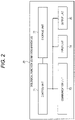
- a configuration of the biological function estimation apparatus 20 as an aspect of the present disclosure will be described with reference to Fig. 2 .
- the biological function estimation apparatus 20 includes a control unit 21, a storage unit 22, a communication unit 23, an input unit 24, and an output unit 25.
- the control unit 21 includes at least one processor, at least one dedicated circuit, or a combination thereof.
- the processor is a general-purpose processor such as a CPU or a GPU, or a dedicated processor specialized for specific processing.
- CPU is an abbreviation for central processing unit.
- GPU is an abbreviation for graphics processing unit.
- the dedicated circuit is, for example, an FPGA or an ASIC.
- FPGA is an abbreviation for field-programmable gate array.
- ASIC is an abbreviation for application specific integrated circuit.
- the control unit 21 executes processing related to an operation of the biological function estimation apparatus 20 while controlling the units of the biological function estimation apparatus 20.
- the storage unit 22 includes at least one semiconductor memory, at least one magnetic memory, at least one optical memory, or a combination of at least two types of the memories.
- the semiconductor memory is, for example, a RAM or a ROM.
- RAM is an abbreviation for random access memory.
- ROM is an abbreviation for read only memory.
- the RAM is, for example, an SRAM or a DRAM.
- SRAM is an abbreviation for static random access memory.
- DRAM is an abbreviation for dynamic random access memory.
- the ROM is, for example, an EEPROM.
- EEPROM is an abbreviation for electrically erasable programmable read only memory.
- the storage unit 22 functions as, for example, a main storage device, an auxiliary storage device, or a cache memory.
- the storage unit 22 stores data used for the operation of the biological function estimation apparatus 20 and data obtained by the operation of the biological function estimation apparatus 20.
- the database 30 may be integrated with the biological function estimation apparatus 20 by being constructed in the storage unit 22.
- the communication unit 23 includes at least one communication interface.
- the communication interface is, for example, a LAN interface.
- the communication unit 23 receives the data used for the operation of the biological function estimation apparatus 20 and transmits the data obtained by the operation of the biological function estimation apparatus 20.
- the input unit 24 includes at least one input interface.
- the input interface is, for example, a physical key, a capacitive key, a pointing device, a touch screen provided integrally with a display, or a microphone.
- the input unit 24 receives an operation of inputting the data used for the operation of the biological function estimation apparatus 20.
- the input unit 24 may be connected to the biological function estimation apparatus 20 as an external input device instead of being provided in the biological function estimation apparatus 20.
- any method such as USB, HDMI (registered trademark), or Bluetooth (registered trademark) can be used as a connection method.
- USB is an abbreviation for universal serial bus.
- HDMI registered trademark
- HDMI registered trademark
- HDMI registered trademark
- the output unit 25 includes at least one output interface.
- the output interface is, for example, a display or a speaker.
- the display is, for example, an LCD or an organic EL display.
- LCD is an abbreviation for liquid crystal display.
- EL is an abbreviation for electro luminescence.
- the output unit 25 outputs the data obtained by the operation of the biological function estimation apparatus 20.
- the output unit 25 may be connected to the biological function estimation apparatus 20 as an external output device instead of being provided in the biological function estimation apparatus 20.
- any method such as USB, HDMI (registered trademark), or Bluetooth (registered trademark) can be used as a connection method.
- a function of the biological function estimation apparatus 20 is implemented by executing a program as an aspect of the present disclosure by a processor corresponding to the control unit 21. That is, the function of the biological function estimation apparatus 20 is implemented by software.
- the program causes a computer to function as the biological function estimation apparatus 20 by causing the computer to execute the operation of the biological function estimation apparatus 20. That is, the computer functions as the biological function estimation apparatus 20 by executing the operation of the biological function estimation apparatus 20 according to the program.
- the program can be stored in a non-transitory computer-readable medium.
- the non-transitory computer-readable medium is, for example, a magnetic recording device, an optical disc, a magneto-optical recording medium, or a ROM.
- Distribution of the program is executed by, for example, selling, transferring, or lending a portable medium such as a DVD or a CD-ROM in which the program is stored.
- DVD is an abbreviation for digital versatile disc.
- CD-ROM is an abbreviation for compact disc read only memory.
- the program may be distributed by storing the program in a storage of a server and transferring the program from the server to another computer.
- the program may be provided as a program product.
- the computer temporarily stores, in a main storage device, the program stored in the portable medium or the program transferred from the server. Then, the computer reads, by the processor, the program stored in the main storage device, and executes, by the processor, processing according to the read program.
- the computer may read the program directly from the portable medium and execute processing according to the program.
- the processing may be executed by a so-called ASP type service in which the function is implemented only by instruction execution and result acquisition without transferring the program from the server to the computer.
- "ASP" is an abbreviation for application service provider.
- the program includes information that is provided for processing by an electronic computer and that is treated equivalent to a program. For example, data that is not a direct command to the computer but has a property that defines processing of the computer corresponds to "data that is treated equivalent to a program".
- a part or all of the functions of the biological function estimation apparatus 20 may be implemented by a dedicated circuit corresponding to the control unit 21. That is, a part or all of the functions of the biological function estimation apparatus 20 may be implemented by hardware.
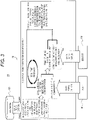
- the database 30 stores in-hospital data such as device measurement values, test data, and electronic medical record data.
- the test data includes a test result before drug administration.
- the control unit 21 of the biological function estimation apparatus 20 acquires, via the communication unit 23, the in-hospital data from the database 30.
- the control unit 21 evaluates a biological function of a patient based on the test result before the drug administration, which is provided in the in-hospital data.
- an evaluation value Ve is obtained.
- the biological function is, for example, an internal function such as a renal function, a cardiac function, a lung function, or a liver function.
- the biological function of the patient may be evaluated by an apparatus different from the biological function estimation apparatus 20. That is, the control unit 21 of the biological function estimation apparatus 20 may acquire, via the communication unit 23, the evaluation value Ve from another apparatus that evaluates the biological function of the patient based on the test result before the drug administration.
- the control unit 21 of the biological function estimation apparatus 20 acquires, via the communication unit 23, data Dm on a drug to be administered to the patient from the pump 40 or a device that monitors and controls the pump 40.
- the data Dm includes at least one of a type, a total administration amount, and an administration amount per unit time of the drug.
- the control unit 21 of the biological function estimation apparatus 20 predicts a drug reaction in the patient based on the evaluation value Ve and the data Dm on the drug. As a result, a prediction value Vp is obtained.
- the drug reaction is, for example, a vital sign such as a urine volume, a body temperature, a blood pressure, a pulse, or respiration, or a change in the vital sign.
- the pump 40 administers the drug to the patient.
- the sensor 50 actually measures the drug reaction after the drug administration. As a result, an actual measurement value Vm is obtained.
- the control unit 21 of the biological function estimation apparatus 20 acquires, via the communication unit 23, the actual measurement value Vm from the sensor 50.
- the control unit 21 of the biological function estimation apparatus 20 corrects the evaluation value Ve according to a comparison result between the prediction value Vp and the actual measurement value Vm.
- the biological function of the patient can be evaluated with high accuracy without requiring a test each time.
- the in-hospital data stored in the database 30 includes a blood test value as a test result before the drug administration.
- the blood test value provided in the in-hospital data is, for example, Cre, BUN/Cre, eGFR, Alb, or an inflammatory marker.
- Cre is a value of creatinine.
- BUN/Cre is a value obtained by dividing a concentration of urea nitrogen contained in blood by a concentration of creatinine.
- eGFR is an estimated glomerular filtration rate.
- Alb is a value of albumin.
- the blood test value provided in the in-hospital data may be Cys-C.
- Cys-C is a value of serum cystatin C.
- Electronic medical record data provided in the in-hospital data is, for example, blood pressure or pulse.
- the evaluation value Ve is a value obtained by evaluating a renal function as a biological function.
- the evaluation value Ve is, for example, a GFR or an eGFR.
- GFR is a glomerular filtration rate.
- the control unit 21 of the biological function estimation apparatus 20 predicts a urine volume per unit time as a drug reaction.
- the sensor 50 actually measures a urine volume per unit time as a drug reaction. That is, the sensor 50 is a urine volume sensor.
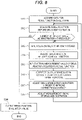
- step S101 the control unit 21 acquires a test result before the drug administration. Specifically, the control unit 21 acquires, via the communication unit 23, data for renal function evaluation such as the blood test value and the electronic medical record data that are provided in the in-hospital data from the database 30. As a modification, the control unit 21 may receive, via the input unit 24 such as a touch screen, an input of the data for renal function evaluation from a user such as a doctor or a nurse. Alternatively, the control unit 21 may receive, via the electronic medical record data or the input unit 24 such as a touch screen, an input of presence or absence of a disease to be considered at the time of renal function evaluation, such as presence of thyroid dysfunction or some malignant tumor diseases.
- data for renal function evaluation such as the blood test value and the electronic medical record data that are provided in the in-hospital data from the database 30.
- the control unit 21 may receive, via the input unit 24 such as a touch screen, an input of the data for renal function evaluation from a user such as a doctor or a nurse.
- step S102 the control unit 21 evaluates a renal function of a patient before the drug administration based on the test result acquired in step S101. That is, the control unit 21 calculates the evaluation value Ve based on the test result before the drug administration. For example, the control unit 21 calculates the GFR or the eGFR by substituting, into an equation for renal function evaluation, the blood test value and a value of the electronic medical record data that are provided in the data acquired in step S101. Alternatively, the control unit 21 calculates the GFR by multiplying, by a coefficient, the eGFR provided in the data acquired in step S101.
- control unit 21 stores the obtained evaluation value Ve in the storage unit 22.
- step S102 if the number of times of drug administration does not reach a threshold Vt, the processing of step S103 is executed.
- the threshold Vt may be any value of 1 or more, and is set to a value of 2 or more in the present embodiment.
- step S103 the control unit 21 acquires the data Dm on a drug to be administered to the patient. Specifically, the control unit 21 acquires, via the communication unit 23, the data Dm on the drug to be administered from the pump 40 or a device that monitors and controls the pump 40. As a modification, the control unit 21 may receive, via the input unit 24 such as a touch screen, an input of the data Dm on the drug from a user such as a doctor or a nurse.
- step S104 the control unit 21 predicts, based on the evaluation value Ve obtained in step S102 and the drug data Dm acquired in step S103, a urine volume per unit time as a drug reaction related to the renal function of the patient.
- the control unit 21 refers to a table stored in advance in the storage unit 22, and specifies the prediction value Vp corresponding to a combination of the evaluation value Ve and at least one of a type, a total administration amount, and an administration amount per unit time of the drug that are provided in the data Dm on the drug.
- control unit 21 calculates the prediction value Vp by substituting, into a predefined equation, the evaluation value Ve and at least one of the type, the total administration amount, and the administration amount per unit time of the drug that are provided in the data Dm on the drug.
- step S105 after the drug administration by the pump 40 for a certain period of time, the control unit 21 acquires, by the sensor 50, a result of actually measuring the urine volume per unit time as the drug reaction related to the renal function of the patient. Specifically, the control unit 21 acquires, via the communication unit 23, the actual measurement value Vm from the sensor 50. As a modification, the control unit 21 may receive, via the input unit 24 such as a touch screen, an input of the actual measurement value Vm from a user such as a doctor or a nurse.
- step S106 the control unit 21 corrects the evaluation value Ve obtained in step S102 according to a comparison result between the prediction value Vp obtained in step S104 and the actual measurement value Vm obtained in step S105. Specifically, the control unit 21 changes at least one of the equation and the coefficient for calculating the evaluation value Ve in step S102 according to the comparison result between the prediction value Vp and the actual measurement value Vm. For example, the control unit 21 corrects the equation for renal function evaluation applied in step S102 such that a difference between the prediction value Vp and the actual measurement value Vm becomes small.
- the control unit 21 reselects an equation to be used such that the difference between the prediction value Vp and the actual measurement value Vm becomes small.
- the control unit 21 corrects the coefficient to be multiplied to the eGFR in step S102 such that the difference between the prediction value Vp and the actual measurement value Vm becomes small. Then, in step S102, the control unit 21 recalculates the evaluation value Ve using at least one of the corrected equation and coefficient.
- control unit 21 recalculates the GFR or the eGFR by substituting, into the corrected equation for renal function evaluation, the blood test value and the value of the electronic medical record data that are provided in the data acquired in step S101. That is, the control unit 21 corrects the GFR or the eGFR.
- the control unit 21 recalculates the GFR by multiplying, by the corrected coefficient, the eGFR provided in the data acquired in step S101. That is, the control unit 21 corrects the GFR.
- the control unit 21 overwrites the evaluation value Ve stored in the storage unit 22 with the corrected value.
- step S102 if the number of times of drug administration reaches the threshold Vt, the processing of step S107 is executed.
- step S107 the output unit 25 outputs the corrected value of the evaluation value Ve.
- the control unit 21 displays, on the output unit 25 such as a display, the corrected value of the evaluation value Ve that is overwritten and stored in the storage unit 22.
- the control unit 21 predicts a drug reaction, and corrects the evaluation value Ve according to a comparison result between the obtained new prediction value Vp and the new actual measurement value Vm obtained by actually measuring the drug reaction after the drug administration.
- the control unit 21 predicts a drug reaction based on a corrected value of the evaluation value Ve obtained for the drug administration at the first time point and the data Dm on the drug to be administered to the patient at the second time point, and further corrects the evaluation value Ve according to a comparison result between the obtained new prediction value Vp and the new actual measurement value Vm obtained by actually measuring the drug reaction after the drug administration.
- step S103 a corrected value of the evaluation value Ve is obtained.
- step S102 a corrected value of the evaluation value Ve is obtained.
- step S102 a further corrected value of the evaluation value Ve is obtained.
- the control unit 21 also executes the processing of steps S103 to S106 to further correct the evaluation value Ve. In this way, in the present embodiment, the control unit 21 recursively corrects the evaluation value Ve.
- control unit 21 may record, as temporary correction values, corrected values of the evaluation value Ve obtained for drug administration at a plurality of time points, and may further correct the evaluation value Ve using the recorded temporary correction values.
- the control unit 21 executes the processing of step S103 to step S106 to recursively correct the evaluation value Ve.
- step S107 the control unit 21 records a recursively corrected value of the evaluation value Ve as a temporary correction value C1.
- the control unit 21 also executes the processing of step S103 to step S106 to recursively correct the evaluation value Ve.
- step S107 the control unit 21 records a recursively corrected value of the evaluation value Ve as a temporary correction value C2.
- the number of temporary correction values may be three or more.
- the control unit 21 determines a final output value of the evaluation value Ve using the plurality of temporary correction values. That is, the control unit 21 further corrects the evaluation value Ve. Any method such as average value calculation, median value calculation, single regression analysis, multiple regression analysis, polynomial regression, or regularization can be used as a method for determining the final output value.
- the control unit 21 of the biological function estimation apparatus 20 predicts the urine volume of the patient based on the evaluation value Ve obtained by evaluating the renal function of the patient from the test result before drug administration and the data Dm on the drug to be administered to the patient.
- the control unit 21 corrects the evaluation value Ve according to the comparison result between the obtained prediction value Vp and the actual measurement value Vm obtained by actually measuring the urine volume after drug administration.
- the renal function of a patient can be evaluated with high accuracy without requiring a test each time.
- whether to execute the processing of step S103 or the processing of step S107 is selected depending on whether the number of times of drug administration reaches the threshold Vt.
- the difference between the prediction value Vp and the actual measurement value Vm may be used instead of the number of times of drug administration. That is, when the difference between the prediction value Vp and the actual measurement value Vm is larger than a specific threshold, the processing of step S103 may be selected, and when the difference is equal to or smaller than the specific threshold, the processing of step S107 may be selected.
- both the threshold Vt for the number of times of drug administration and the threshold for the difference between the prediction value Vp and the actual measurement value Vm may be used.
- a condition for selecting the processing of step S107 may be set as a case where both of the thresholds are satisfied.
- the processing of step S107 may be selected if the threshold Vt for the number of times of drug administration is satisfied when the difference between the prediction value Vp and the actual measurement value Vm is not smaller than the specific threshold.
- the processing of step S107 may be selected if the difference between the prediction value Vp and the actual measurement value Vm is smaller than the specific threshold when the threshold Vt for the number of times of drug administration is not satisfied.
- the most accurate index of renal function evaluation is a GFR obtained by actually measuring an excretion rate of inulin from glomeruli.
- inulin is not present in the body. Therefore, inulin needs to be administered by infusion for measurement, and precise urine collection or complete urination and frequent blood collection are required. In this way, the measurement on GFR is very complicated and is accompanied by a burden on the patient. Therefore, the GFR is not used in actual clinical practice except when precise renal function evaluation is required for patients with renal disease or renal transplant donors.
- eCCr calculated by substituting, into an estimation equation, a serum concentration of creatinine, which is an effluent from a living body, a body weight, age, and sex is used. Alternatively, the eGFR calculated from serum Cre, age, and sex is used.
- eCCr is an estimated creatinine clearance. Actually measured CCr is set as the actual measurement value, and the measurement on CCr requires blood collection and accurate measurement on the urine volume for 24 hours. Therefore, it is extremely rare that the CCr is generally measured in order to obtain a drug administration guideline in clinical practice. "CCr” is creatinine clearance.
- ICU is an abbreviation for intensive care unit.
- CKD is an abbreviation for chronic kidney disease.
- the Cys-C or BUN/Cre is available as renal function evaluation executed in actual clinical practice, but since a blood test is required each time similar as the Cre, the eCCr, and the eGFR, the Cys-C or BUN/Cre is not suitable for real-time renal function evaluation. In addition, there is also a problem in measurement accuracy.
- the serum cystatin C is expressed in the whole body, a production amount and speed thereof are constant, and is hardly influenced by external factors such as inflammation and age. Further, after cystatin C secreted to the outside of cells is subjected to glomerular filtration in a short time, 99% of the cystatin C is reabsorbed and catabolized by proximal tubules. Therefore, the cystatin C is not recirculated into the blood. Therefore, it is considered that the serum Cys-C is determined by the glomerular filtration rate. However, it is known that the prediction accuracy on eGFR decreases in a patient with end-stage renal disease.
- the serum Cys-C is higher than a true value in a patient administered with steroid in a high capacity or in a long term. Furthermore, the serum Cys-C is considered to be affected by presence of thyroid dysfunction or some malignant tumor diseases.
- the BUN/Cre Since the serum CCr is used for the BUN/Cre, the BUN/Cre has the same problem as the serum CCr.
- the renal function can be more accurately estimated without using a blood test. Further, since feedback is executed in real time, the renal function of a patient during hospitalization can be evaluated accurately and in real time.
- an optimal drug administration pattern for correcting the evaluation value Ve is estimated, and drug administration is instructed according to the estimated pattern.
- At least one of a pattern in which a dose of a drug is increased stepwise from a low dose and a pattern in which the dose of the drug is decreased stepwise from a high dose within a predetermined prescription range is selected as the drug administration pattern. Therefore, a total amount of the drug to be administered is as prescribed.
- step S201 to step S206 Since processing of step S201 to step S206 is the same as the processing of step S101 to step S106 in the first embodiment, the description thereof will be omitted.
- step S207 the control unit 21 adjusts next and subsequent drug administration patterns according to a comparison result between the prediction value Vp obtained in step S204 and the actual measurement value Vm obtained in step S205. Specifically, the control unit 21 controls the pump 40 to set at least one of the number of times of administration and the administration amount per unit time of the drug, thereby setting the drug administration pattern to the above pattern.
- control unit 21 refers to a plurality of drug administration patterns stored in advance in the storage unit 22 and adjusts the drug administration pattern in step S207.
- an optimal drug administration pattern for obtaining a stable prediction value Vp is selected.
- a main reason may be that a magnitude of the actual measurement value Vm obtained in step S205 is not appropriate.
- a measurement value tends to vary due to an error in measurement, and variation occurs in the prediction value Vp calculated based on the measurement value.
- the prediction value Vp greatly varies.
- the urine volume per unit time is determined by a balance between the renal function and the drug administration amount.
- a plurality of drug administration patterns are stored in the storage unit 22, and the dose of the drug can be increased stepwise from a low dose, and the dose of the drug can be decreased stepwise from a high dose.
- the dose of the drug is increased stepwise from a low dose, it is possible to select various drug administration patterns having different lengths of time for maintaining the low dose and the high dose.
- the optimal drug administration pattern it is possible to acquire a larger number of measurement points at which the optimal actual measurement value Vm for obtaining the prediction value Vp is obtained within a range in which a necessary drug efficacy is not reduced.
- An optimal drug administration pattern is automatically selected as the drug administration pattern in step S207 according to a value of a difference between the prediction value Vp obtained in step S204 and the actual measurement value Vm obtained in step S205, a magnitude of the actual measurement value Vm, and a variation amount in the actual measurement value Vm.
- control unit 21 stores the actual measurement value Vm in the storage unit 22 and calculates the variation amount in the actual measurement value Vm.
- a generally used calculation method such as a method for calculating a difference from a previous value, a method of using time differentiation of the actual measurement value Vm, or a method of evaluating standard deviation or variation can be used as a method for calculating the variation amount.
- step S208 Since the processing of step S208 is the same as the processing of step S107 in the first embodiment, the description thereof will be omitted.
- the control unit 21 sets a drug administration pattern at each of a plurality of time points. Specifically, the control unit 21 adjusts the drug administration patterns at next and subsequent time points according to a comparison result between the new prediction value Vp and the new actual measurement value Vm obtained for drug administration at any one of the plurality of time points.
- the optimum drug administration pattern for obtaining the stable prediction value Vp is selected. Therefore, the estimation accuracy and the measurement efficiency on the renal function are improved.
- whether to execute the processing of step S203 or the processing of step S208 is selected depending on whether the number of times of drug administration reaches the threshold Vt.
- the difference between the prediction value Vp and the actual measurement value Vm may be used instead of the number of times of drug administration, as in the first embodiment.
- both the threshold Vt for the number of times of drug administration and the threshold for the difference between the prediction value Vp and the actual measurement value Vm may be used.
- an appropriate drug administration pattern is selected by the processing of step S207 based on the difference between the prediction value Vp and the actual measurement value Vm, the magnitude of the actual measurement value Vm itself, or the variation amount in the actual measurement value Vm.
- control unit 21 may select, as the drug administration pattern, a pattern candidate that is different for each time point from a predetermined pattern candidate group.
- the control unit 21 may refer to the performance data Da indicating a history of past drug administration and at least one of the prediction value Vp, the actual measurement value Vm, and the corrected value of the evaluation value Ve.
- the history indicated by the performance data Da may include a history of another patient.
- an optimum drug administration pattern for correcting the evaluation value Ve is estimated, drug administration is instructed according to the estimated pattern, and a measurement timing of the urine volume is instructed.
- the drug administration pattern includes a procedure of bolus administration for rapidly administering a certain amount in addition to an increase or decrease in the administration amount within a predetermined prescription range or a procedure of stopping the administration, and a pattern in which a procedure of executing measurement by the sensor 50 according to a change in the drug administration pattern is repeated is selected.
- a plurality of combinations of an estimation equation for calculating the evaluation value Ve from a comparison result between the prediction value Vp and the actual measurement value Vm in step S302 and a drug administration pattern corresponding to the estimation equation are stored in the storage unit 22. Then, it is possible to obtain an evaluation value Ve with even higher accuracy by selecting an optimal drug administration pattern.
- step S301 to step S306 Since the processing of step S301 to step S306 is the same as the processing of step S101 to step S106 in the first embodiment, the description thereof will be omitted.
- step S307 the control unit 21 adjusts next and subsequent drug administration patterns according to a comparison result between the prediction value Vp obtained in step S304 and the actual measurement value Vm obtained in step S305. Specifically, the control unit 21 controls the pump 40 to set at least one of the number of times of administration and the administration amount per unit time of the drug, and sets a drug administration timing, thereby setting the drug administration pattern to the above pattern. Not only a drug administration time point, but also whether to stop the drug administration during continuous administration and whether to re-administer the drug when the drug administration is stopped may be set as the drug administration timing.
- the urine volume per unit time is determined by a balance between the renal function and the drug administration amount.
- the drug is a diuretic drug
- the urine volume per unit time generally increases by increasing the administration amount, but an increasing tendency thereof is various.
- the increasing tendency is represented by a slope or a plot shape, continuity in change, or presence or absence of a threshold when an administration amount of the diuretic agent is plotted on a horizontal axis and the urine volume is plotted on a vertical axis.
- the increasing tendency is closely related to the desired renal function.
- convergence patterns which are different from one another, of a difference between the prediction value Vp and the actual measurement value Vm are obtained in a combination of the prediction value Vp and the actual measurement value Vm with respect to a urine volume responsiveness when the diuretic agent is bolus administered, a combination of the prediction value Vp and the actual measurement value Vm with respect to the urine volume responsiveness when the administration is stopped, and a combination of the prediction value Vp and the actual measurement value Vm with respect to fluctuation in the urine volume when the administration amount is intentionally increased or decreased. Then, three evaluation value Ve different from one another can be obtained.
- the estimation accuracy as the renal function evaluation value differs among the three evaluation values Ve. Therefore, by preparing a plurality of combinations of the equation for calculating the evaluation value Ve from the prediction value Vp and the actual measurement value Vm and the drug administration pattern corresponding to the equation, the drug administration pattern in which the difference between the prediction value Vp and the actual measurement value Vm is sufficiently small when the processing of steps S302 to S308 is repeated can be selected as the optimal drug administration pattern for obtaining the evaluation value Ve with high accuracy, and the target renal function evaluation value can be obtained.
- the plurality of combinations can be used as different explanatory variables.
- the explanatory variable is input information for estimating the evaluation value Ve.
- the plurality of combinations can be treated as individual regression trees in a random forest method, or can be used as a penalty term in machine learning.
- a combination of the prediction value Vp and the actual measurement value Vm are measured for each of various drug administration patterns.
- the obtained combination of the prediction value Vp, the actual measurement value Vm, and the evaluation value Ve is stored in the storage unit 22 in association with the drug administration pattern.
- the combination of the prediction value Vp, the actual measurement value Vm, and the evaluation value Ve may be stored, as time-series data, in the storage unit 22 in association with the drug administration pattern.
- step S308 the control unit 21 adjusts a measurement timing of the urine volume as the drug reaction according to the drug administration pattern adjusted in step S307. Specifically, the control unit 21 controls the sensor 50 to adjust the measurement timing of the urine volume so as to match the drug administration pattern adjusted in step S307.
- the control unit 21 controls the sensor 50 to adjust the measurement timing of the urine volume so as to match the drug administration pattern adjusted in step S307.
- accurate measurement on the urine volume responsiveness corresponding to the drug administration pattern affects the estimation accuracy on the evaluation value Ve. Therefore, it is possible to obtain the evaluation value Ve with high accuracy by executing the urine volume measurement so that the execution timings of the drug administration and the urine amount measurement coincide with each other.
- step S309 Since the processing of step S309 is the same as the processing of step S107 in the first embodiment, the description thereof will be omitted.
- the renal function can be estimated using the urine volume responsiveness when the drug administration pattern is variously changed, the estimation accuracy on the renal function is improved.
- whether to execute the processing of step S303 or the processing of step S309 is selected depending on whether the number of times of drug administration reaches the threshold Vt.
- the difference between the prediction value Vp and the actual measurement value Vm may be used instead of the number of times of drug administration, as in the first embodiment.
- both the threshold Vt for the number of times of drug administration and the threshold for the difference between the prediction value Vp and the actual measurement value Vm may be used.
- the measurement may be executed by changing a plurality of types of drug administration patterns according to a predetermined pattern, or the drug administration pattern may be automatically selected from several candidates stored in advance in the storage unit 22 according to the value of the evaluation value Ve obtained after drug administration or variation in the evaluation value Ve obtained after the drug administration.
- the combination of the prediction value Vp and the actual measurement value Vm obtained for a specific drug administration pattern and the variation in the evaluation value Ve obtained thereafter may be reduced.
- the prediction value Vp converges in any drug administration pattern, but when the difference between the prediction value Vp and the actual measurement value Vm does not become sufficiently small, the final evaluation value Ve may be obtained using a plurality of evaluation values Ve obtained for each drug administration pattern.
- any method can be selected as a method for obtaining the final evaluation value Ve.
- an average value or a median value of the plurality of evaluation values Ve may be calculated as the final evaluation value Ve, or the final evaluation value Ve may be calculated by single regression analysis, multiple regression analysis, polynomial regression, or regularization.
- test results used at the time of renal function evaluation on different patients in the past, in-hospital data such as presence or absence of a basic disease, and a drug administration pattern effective for reducing the difference between the prediction value Vp and the actual measurement value Vm can be recorded in association with one another.
- similar patient information may be referred to from a test result used at the time of renal function evaluation on the current target and in-hospital data such as presence or absence of a basic disease, and a drug administration pattern effective for similar patients in the past may be preferentially selected.
- the degree of convergence in the prediction value Vp or a decrease tendency itself of the difference between the prediction value Vp and the actual measurement value Vm for each drug administration pattern may be used as reference data, and the drug administration pattern effective in a similar case may be preferentially selected based on the past data stored in the storage unit 22.
- progress data Dp on a drug reaction for specific drug administration is recorded.
- the progress data Dp includes data in which a change per day in a patient during hospitalization and a change at the time of rehospitalization from previous hospitalization are recorded.
- the progress data Dp is referred to at the time of predicting the drug reaction related to the renal function.
- the history indicated by the progress data Dp may include a history of another patient.
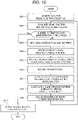
- steps S401 to S403 are the same as the processing of steps S301 to S303 in the third embodiment, the description thereof will be omitted.
- step S404 when the control unit 21 predicts a urine volume as the drug reaction, the control unit 21 refers to the progress data Dp indicating the history of the past drug administration and drug reaction. Specifically, the control unit 21 analyzes the history indicated by the progress data Dp and extracts characteristics of the drug reaction unique to the patient. When the control unit 21 refers to a table stored in advance in the storage unit 22 and specifies the prediction value Vp, the control unit 21 corrects the specified prediction value Vp according to the characteristics of the drug reaction unique to the patient. Alternatively, when the control unit 21 applies a predefined equation and calculates the prediction value Vp, the control unit 21 corrects the calculated prediction value Vp according to the characteristics of the drug reaction unique to the patient.
- step S405 Since the processing of step S405 is the same as the processing of step S305 in the third embodiment, the description thereof will be omitted.
- step S406 the control unit 21 records, as a part of the progress data Dp, date and time of drug administration by the pump 40, a type and amount of the administered drug, and the actual measurement value Vm obtained in step S405.
- steps S407 to S410 are the same as the processing of steps S306 to S309 in the third embodiment, the description thereof will be omitted.
- the progress data Dp when the prediction value Vp is calculated, the progress data Dp can be referred to in addition to the data Dm on the drug and the various data for renal function evaluation including the actual measurement value Vm. Therefore, the prediction value Vp closer to a true value can be obtained. Therefore, the number of repetitions of the processing of step S402 to step S409 can be reduced, and a time required to output a renal function evaluation value in step S410 can be shortened.
- Reducing the number of repetitions of the processing of step S402 to step S409 and shortening the time required to output the renal function evaluation value in step S410 is important in a situation such as ICU in which it is necessary to evaluate the renal function of the patient in real time.
- the prediction accuracy on the prediction value Vp based on the drug reaction is improved, the time required to output the renal function evaluation value can be shortened, and the estimation accuracy on the renal function is maintained or improved even in a use method such as real-time monitoring.
- control unit 21 may update the progress data Dp each time the prediction value Vp and the actual measurement value Vm are obtained. Accordingly, the prediction value Vp closer to a true value can be obtained.
- control unit 21 can obtain the prediction value Vp more individually optimized for a measurement target by executing machine learning using the combinations.
- whether to execute the processing of step S403 or the processing of step S410 is selected depending on whether the number of times of drug administration reaches the threshold Vt.
- the difference between the prediction value Vp and the actual measurement value Vm may be used instead of the number of times of drug administration, as in the first embodiment.
- both the threshold Vt for the number of times of drug administration and the threshold for the difference between the prediction value Vp and the actual measurement value Vm may be used.
- the progress data Dp is referred to for prediction of the drug reaction related to the renal function.
- the present disclosure is not limited to the above embodiments.
- a plurality of blocks described in the block diagram may be integrated, or one block may be divided.
- the steps may be executed in parallel or in a different order as necessary or according to the processing capability of the device that executes the steps.
- modifications can be made without departing from the gist of the present disclosure.
Landscapes
- Health & Medical Sciences (AREA)
- Engineering & Computer Science (AREA)
- Life Sciences & Earth Sciences (AREA)
- Medical Informatics (AREA)
- Public Health (AREA)
- General Health & Medical Sciences (AREA)
- Biomedical Technology (AREA)
- Physics & Mathematics (AREA)
- Pathology (AREA)
- Epidemiology (AREA)
- Primary Health Care (AREA)
- Molecular Biology (AREA)
- Biophysics (AREA)
- Bioinformatics & Cheminformatics (AREA)
- Heart & Thoracic Surgery (AREA)
- Surgery (AREA)
- Animal Behavior & Ethology (AREA)
- Veterinary Medicine (AREA)
- Physiology (AREA)
- Chemical & Material Sciences (AREA)
- Medicinal Chemistry (AREA)
- Data Mining & Analysis (AREA)
- Urology & Nephrology (AREA)
- Databases & Information Systems (AREA)
- Biotechnology (AREA)
- Bioinformatics & Computational Biology (AREA)
- Theoretical Computer Science (AREA)
- Spectroscopy & Molecular Physics (AREA)
- Evolutionary Biology (AREA)
- Pharmacology & Pharmacy (AREA)
- Business, Economics & Management (AREA)
- General Business, Economics & Management (AREA)
- Investigating Or Analysing Biological Materials (AREA)
- Infusion, Injection, And Reservoir Apparatuses (AREA)
Abstract
Description
- The present disclosure relates to a biological function estimation apparatus and a biological function estimation method.
- PTL 1 describes a drug administration system that measures and analyzes values of blood of a patient and calculates drug parameters.
- PTL 1:
JP-T-2013-520718 - It is important to evaluate a renal function of a hospitalized patient accurately and in real time in order to enhance a therapeutic effect and to prevent an occurrence of side effects such as renal dysfunction. Unfortunately, in the related art, a satisfactory renal function evaluation is not achieved due to a need for a blood test each time, or due to a problem of characteristics or reliability of an index itself used for evaluation.
- An object of the present disclosure is to evaluate a biological function of a patient with high accuracy without requiring a test each time.
- A biological function estimation apparatus as an aspect of the present disclosure includes a control unit configured to predict a drug reaction in a patient based on an evaluation value obtained by evaluating a biological function of the patient from a test result before drug administration and data on a drug to be administered to the patient, and configured to correct the evaluation value according to a comparison result between an obtained prediction value and an actual measurement value obtained by actually measuring the drug reaction after the drug administration.
- In an embodiment, the control unit changes at least one of an equation and a coefficient for calculating the evaluation value according to the comparison result.
- In an embodiment, the data includes at least one of a type, a total administration amount, and an administration amount per unit time of the drug.
- In an embodiment, for drug administration at each of a plurality of time points, the control unit predicts the drug reaction, and corrects the evaluation value according to a comparison result between an obtained new prediction value and a new actual measurement value obtained by actually measuring the drug reaction after the drug administration.
- In an embodiment, for drug administration at a second time point after a first time point among the plurality of time points, the control unit predicts the drug reaction based on a corrected value of the evaluation value obtained for drug administration at the first time point and data on the drug to be administered to the patient at the second time point, and further corrects the evaluation value according to a comparison result between an obtained new prediction value and a new actual measurement value obtained by actually measuring the drug reaction after the drug administration.
- In an embodiment, the control unit records, as temporary correction values, corrected values of the evaluation value obtained for the drug administration at the plurality of time points, and further corrects the evaluation value using the recorded temporary correction values.
- In an embodiment, the control unit sets a drug administration pattern at each of the plurality of time points.
- In an embodiment, the control unit adjusts, according to a comparison result between a new prediction value and a new actual measurement value obtained for drug administration at any one of the plurality of time points, the patterns at next and subsequent time points.
- In an embodiment, the control unit selects, as the pattern, a pattern candidate that is different for each time point from a predetermined pattern candidate group.
- In an embodiment, the control unit sets the pattern by setting at least one of the number of times of administration and an administration amount per unit time of the drug.
- In an embodiment, the control unit sets the pattern by setting a drug administration timing.
- In an embodiment, when setting the pattern, the control unit refers to performance data indicating a history of past drug administration and at least one of a prediction value, an actual measurement value, and a corrected value of an evaluation value.
- In an embodiment, the history indicated by the performance data includes a history of another patient.
- In an embodiment, the control unit adjusts a measurement timing of the drug reaction according to the pattern.
- In an embodiment, when predicting the drug reaction, the control unit refers to progress data indicating a history of past drug administration and drug reaction.
- In an embodiment, the history indicated by the progress data includes a history of another patient.
- In an embodiment, the control unit controls a pump configured to administer a drug to the patient.
- In an embodiment, the control unit controls a sensor configured to measure the drug reaction.
- In an embodiment, the biological function estimation apparatus further includes an output unit configured to output the corrected value of the evaluation value.
- In an embodiment, the control unit acquires the test result and calculates the evaluation value from the test result.
- In an embodiment, the evaluation value is a value obtained by evaluating a renal function as the biological function, and the control unit predicts a urine volume as the drug reaction.
- A biological function estimation method as an aspect of the present disclosure includes: predicting, by a computer, a drug reaction in a patient based on an evaluation value obtained by evaluating a biological function of the patient from a test result before drug administration and data on a drug to be administered to the patient; administering the drug to the patient by a pump; actually measuring, by a sensor, the drug reaction after the drug administration; and correcting, by the computer, the evaluation value according to a comparison result between an obtained prediction value and an obtained actual measurement value.
- According to the present disclosure, a biological function of a patient can be evaluated with high accuracy without requiring a test each time.
-
- [
Fig. 1] Fig. 1 is a diagram showing a configuration and functions of a system as an aspect of the present disclosure. - [
Fig. 2] Fig. 2 is a block diagram showing a configuration of a biological function estimation apparatus according to an aspect of the present disclosure. - [
Fig. 3] Fig. 3 is a diagram showing a configuration and functions of a system according to a first embodiment. - [
Fig. 4] Fig. 4 is a flowchart showing an operation of a biological function estimation apparatus according to the first embodiment. - [
Fig. 5] Fig. 5 is a diagram showing a configuration and functions of a system according to a second embodiment. - [
Fig. 6] Fig. 6 is a flowchart showing an operation of a biological function estimation apparatus according to the second embodiment. - [
Fig. 7] Fig. 7 is a diagram showing a configuration and functions of a system according to a third embodiment. - [
Fig. 8] Fig. 8 is a flowchart showing an operation of a biological function estimation apparatus according to the third embodiment. - [
Fig. 9] Fig. 9 is a diagram showing a configuration and functions of a system according to a fourth embodiment. - [
Fig. 10] Fig. 10 is a flowchart showing an operation of a biological function estimation apparatus according to the fourth embodiment. - Hereinafter, the present disclosure will be described with reference to the drawings.
- In the drawings, the same or corresponding parts are denoted by the same reference numerals. In the description of the embodiments, the description of the same or corresponding parts will be omitted or simplified as appropriate.
- A configuration of a
system 10 as an aspect of the present disclosure will be described with reference toFig. 1 . - The
system 10 shown inFig. 1 includes a biologicalfunction estimation apparatus 20, adatabase 30, apump 40, and asensor 50. - The biological
function estimation apparatus 20 is communicably connected to thedatabase 30, thepump 40, and thesensor 50 directly or via a network such as a LAN. "LAN" is an abbreviation for local area network. - The biological
function estimation apparatus 20 is installed in a hospital as an example, and may be installed in another facility such as a data center. The biologicalfunction estimation apparatus 20 is, for example, a general-purpose computer such as a PC or a server computer, or a dedicated computer. "PC" is an abbreviation for personal computer. - The
database 30 is installed in a hospital as an example, and may be installed in another facility such as a data center. Thedatabase 30 is, for example, an RDBMS. "RDBMS" is an abbreviation for relational database management system. Thedatabase 30 is separate from the biologicalfunction estimation apparatus 20 as an example, and may be integrated with the biologicalfunction estimation apparatus 20. - The
pump 40 is installed in a hospital. Thepump 40 is, for example, an infusion pump or a syringe pump. Thepump 40 may be a smart pump. - The
sensor 50 is installed in a hospital. Thesensor 50 is, for example, a urine volume sensor, a body temperature sensor, a blood pressure sensor, a pulse sensor, or a respiration sensor. - A configuration of the biological
function estimation apparatus 20 as an aspect of the present disclosure will be described with reference toFig. 2 . - The biological
function estimation apparatus 20 includes acontrol unit 21, astorage unit 22, acommunication unit 23, aninput unit 24, and anoutput unit 25. - The
control unit 21 includes at least one processor, at least one dedicated circuit, or a combination thereof. The processor is a general-purpose processor such as a CPU or a GPU, or a dedicated processor specialized for specific processing. "CPU" is an abbreviation for central processing unit. "GPU" is an abbreviation for graphics processing unit. The dedicated circuit is, for example, an FPGA or an ASIC. "FPGA" is an abbreviation for field-programmable gate array. "ASIC" is an abbreviation for application specific integrated circuit. Thecontrol unit 21 executes processing related to an operation of the biologicalfunction estimation apparatus 20 while controlling the units of the biologicalfunction estimation apparatus 20. - The
storage unit 22 includes at least one semiconductor memory, at least one magnetic memory, at least one optical memory, or a combination of at least two types of the memories. The semiconductor memory is, for example, a RAM or a ROM. "RAM" is an abbreviation for random access memory. "ROM" is an abbreviation for read only memory. The RAM is, for example, an SRAM or a DRAM. "SRAM" is an abbreviation for static random access memory. "DRAM" is an abbreviation for dynamic random access memory. The ROM is, for example, an EEPROM. "EEPROM" is an abbreviation for electrically erasable programmable read only memory. Thestorage unit 22 functions as, for example, a main storage device, an auxiliary storage device, or a cache memory. Thestorage unit 22 stores data used for the operation of the biologicalfunction estimation apparatus 20 and data obtained by the operation of the biologicalfunction estimation apparatus 20. Thedatabase 30 may be integrated with the biologicalfunction estimation apparatus 20 by being constructed in thestorage unit 22. - The
communication unit 23 includes at least one communication interface. The communication interface is, for example, a LAN interface. Thecommunication unit 23 receives the data used for the operation of the biologicalfunction estimation apparatus 20 and transmits the data obtained by the operation of the biologicalfunction estimation apparatus 20. - The
input unit 24 includes at least one input interface. The input interface is, for example, a physical key, a capacitive key, a pointing device, a touch screen provided integrally with a display, or a microphone. Theinput unit 24 receives an operation of inputting the data used for the operation of the biologicalfunction estimation apparatus 20. Theinput unit 24 may be connected to the biologicalfunction estimation apparatus 20 as an external input device instead of being provided in the biologicalfunction estimation apparatus 20. For example, any method such as USB, HDMI (registered trademark), or Bluetooth (registered trademark) can be used as a connection method. "USB" is an abbreviation for universal serial bus. "HDMI (registered trademark)" is an abbreviation for high-definition multimedia interface. - The
output unit 25 includes at least one output interface. The output interface is, for example, a display or a speaker. The display is, for example, an LCD or an organic EL display. "LCD" is an abbreviation for liquid crystal display. "EL" is an abbreviation for electro luminescence. Theoutput unit 25 outputs the data obtained by the operation of the biologicalfunction estimation apparatus 20. Theoutput unit 25 may be connected to the biologicalfunction estimation apparatus 20 as an external output device instead of being provided in the biologicalfunction estimation apparatus 20. For example, any method such as USB, HDMI (registered trademark), or Bluetooth (registered trademark) can be used as a connection method. - A function of the biological
function estimation apparatus 20 is implemented by executing a program as an aspect of the present disclosure by a processor corresponding to thecontrol unit 21. That is, the function of the biologicalfunction estimation apparatus 20 is implemented by software. The program causes a computer to function as the biologicalfunction estimation apparatus 20 by causing the computer to execute the operation of the biologicalfunction estimation apparatus 20. That is, the computer functions as the biologicalfunction estimation apparatus 20 by executing the operation of the biologicalfunction estimation apparatus 20 according to the program. - The program can be stored in a non-transitory computer-readable medium. The non-transitory computer-readable medium is, for example, a magnetic recording device, an optical disc, a magneto-optical recording medium, or a ROM. Distribution of the program is executed by, for example, selling, transferring, or lending a portable medium such as a DVD or a CD-ROM in which the program is stored. "DVD" is an abbreviation for digital versatile disc. "CD-ROM" is an abbreviation for compact disc read only memory. The program may be distributed by storing the program in a storage of a server and transferring the program from the server to another computer. The program may be provided as a program product.
- For example, the computer temporarily stores, in a main storage device, the program stored in the portable medium or the program transferred from the server. Then, the computer reads, by the processor, the program stored in the main storage device, and executes, by the processor, processing according to the read program. The computer may read the program directly from the portable medium and execute processing according to the program. Each time the program is transferred from the server to the computer, the computer may sequentially execute processing according to the received program. The processing may be executed by a so-called ASP type service in which the function is implemented only by instruction execution and result acquisition without transferring the program from the server to the computer. "ASP" is an abbreviation for application service provider. The program includes information that is provided for processing by an electronic computer and that is treated equivalent to a program. For example, data that is not a direct command to the computer but has a property that defines processing of the computer corresponds to "data that is treated equivalent to a program".
- A part or all of the functions of the biological
function estimation apparatus 20 may be implemented by a dedicated circuit corresponding to thecontrol unit 21. That is, a part or all of the functions of the biologicalfunction estimation apparatus 20 may be implemented by hardware. - Functions of the
system 10 as an aspect of the present disclosure will be described with reference toFigs. 1 and2 . The functions correspond to a biological function estimation method as an aspect of the present disclosure. - The
database 30 stores in-hospital data such as device measurement values, test data, and electronic medical record data. The test data includes a test result before drug administration. - The
control unit 21 of the biologicalfunction estimation apparatus 20 acquires, via thecommunication unit 23, the in-hospital data from thedatabase 30. Thecontrol unit 21 evaluates a biological function of a patient based on the test result before the drug administration, which is provided in the in-hospital data. As a result, an evaluation value Ve is obtained. The biological function is, for example, an internal function such as a renal function, a cardiac function, a lung function, or a liver function. For the evaluation on the biological function, not only the test result before the drug administration, but also the device measurement values and the electronic medical record data before the drug administration, which are provided in the in-hospital data, may be used. As a modification, the biological function of the patient may be evaluated by an apparatus different from the biologicalfunction estimation apparatus 20. That is, thecontrol unit 21 of the biologicalfunction estimation apparatus 20 may acquire, via thecommunication unit 23, the evaluation value Ve from another apparatus that evaluates the biological function of the patient based on the test result before the drug administration. - The
control unit 21 of the biologicalfunction estimation apparatus 20 acquires, via thecommunication unit 23, data Dm on a drug to be administered to the patient from thepump 40 or a device that monitors and controls thepump 40. The data Dm includes at least one of a type, a total administration amount, and an administration amount per unit time of the drug. - The
control unit 21 of the biologicalfunction estimation apparatus 20 predicts a drug reaction in the patient based on the evaluation value Ve and the data Dm on the drug. As a result, a prediction value Vp is obtained. The drug reaction is, for example, a vital sign such as a urine volume, a body temperature, a blood pressure, a pulse, or respiration, or a change in the vital sign. - The
pump 40 administers the drug to the patient. Thesensor 50 actually measures the drug reaction after the drug administration. As a result, an actual measurement value Vm is obtained. - The
control unit 21 of the biologicalfunction estimation apparatus 20 acquires, via thecommunication unit 23, the actual measurement value Vm from thesensor 50. - The
control unit 21 of the biologicalfunction estimation apparatus 20 corrects the evaluation value Ve according to a comparison result between the prediction value Vp and the actual measurement value Vm. - According to the above aspect, the biological function of the patient can be evaluated with high accuracy without requiring a test each time.
- Hereinafter, some embodiments as specific examples of the aspect shown in
Figs. 1 and2 will be described with reference to the drawings. - In the present embodiment, as shown in
Fig. 3 , the in-hospital data stored in thedatabase 30 includes a blood test value as a test result before the drug administration. The blood test value provided in the in-hospital data is, for example, Cre, BUN/Cre, eGFR, Alb, or an inflammatory marker. "Cre" is a value of creatinine. "BUN/Cre" is a value obtained by dividing a concentration of urea nitrogen contained in blood by a concentration of creatinine. "eGFR" is an estimated glomerular filtration rate. "Alb" is a value of albumin. The blood test value provided in the in-hospital data may be Cys-C. "Cys-C" is a value of serum cystatin C. Electronic medical record data provided in the in-hospital data is, for example, blood pressure or pulse. - In the present embodiment, the evaluation value Ve is a value obtained by evaluating a renal function as a biological function. The evaluation value Ve is, for example, a GFR or an eGFR. "GFR" is a glomerular filtration rate. The
control unit 21 of the biologicalfunction estimation apparatus 20 predicts a urine volume per unit time as a drug reaction. Thesensor 50 actually measures a urine volume per unit time as a drug reaction. That is, thesensor 50 is a urine volume sensor. - An operation of the biological
function estimation apparatus 20 according to the present embodiment will be described with reference toFig. 4 . - In step S101, the
control unit 21 acquires a test result before the drug administration. Specifically, thecontrol unit 21 acquires, via thecommunication unit 23, data for renal function evaluation such as the blood test value and the electronic medical record data that are provided in the in-hospital data from thedatabase 30. As a modification, thecontrol unit 21 may receive, via theinput unit 24 such as a touch screen, an input of the data for renal function evaluation from a user such as a doctor or a nurse. Alternatively, thecontrol unit 21 may receive, via the electronic medical record data or theinput unit 24 such as a touch screen, an input of presence or absence of a disease to be considered at the time of renal function evaluation, such as presence of thyroid dysfunction or some malignant tumor diseases. - In step S102, the
control unit 21 evaluates a renal function of a patient before the drug administration based on the test result acquired in step S101. That is, thecontrol unit 21 calculates the evaluation value Ve based on the test result before the drug administration. For example, thecontrol unit 21 calculates the GFR or the eGFR by substituting, into an equation for renal function evaluation, the blood test value and a value of the electronic medical record data that are provided in the data acquired in step S101. Alternatively, thecontrol unit 21 calculates the GFR by multiplying, by a coefficient, the eGFR provided in the data acquired in step S101. In a case of the former calculation, for unquantified information such as presence or absence of a disease, information in a state normalized or quantified in a form that can be substituted into an equation is substituted into the equation. Thecontrol unit 21 stores the obtained evaluation value Ve in thestorage unit 22. - After step S102, if the number of times of drug administration does not reach a threshold Vt, the processing of step S103 is executed. The threshold Vt may be any value of 1 or more, and is set to a value of 2 or more in the present embodiment.
- In step S103, the
control unit 21 acquires the data Dm on a drug to be administered to the patient. Specifically, thecontrol unit 21 acquires, via thecommunication unit 23, the data Dm on the drug to be administered from thepump 40 or a device that monitors and controls thepump 40. As a modification, thecontrol unit 21 may receive, via theinput unit 24 such as a touch screen, an input of the data Dm on the drug from a user such as a doctor or a nurse. - In step S104, the
control unit 21 predicts, based on the evaluation value Ve obtained in step S102 and the drug data Dm acquired in step S103, a urine volume per unit time as a drug reaction related to the renal function of the patient. Specifically, thecontrol unit 21 refers to a table stored in advance in thestorage unit 22, and specifies the prediction value Vp corresponding to a combination of the evaluation value Ve and at least one of a type, a total administration amount, and an administration amount per unit time of the drug that are provided in the data Dm on the drug. Alternatively, thecontrol unit 21 calculates the prediction value Vp by substituting, into a predefined equation, the evaluation value Ve and at least one of the type, the total administration amount, and the administration amount per unit time of the drug that are provided in the data Dm on the drug. - In step S105, after the drug administration by the
pump 40 for a certain period of time, thecontrol unit 21 acquires, by thesensor 50, a result of actually measuring the urine volume per unit time as the drug reaction related to the renal function of the patient. Specifically, thecontrol unit 21 acquires, via thecommunication unit 23, the actual measurement value Vm from thesensor 50. As a modification, thecontrol unit 21 may receive, via theinput unit 24 such as a touch screen, an input of the actual measurement value Vm from a user such as a doctor or a nurse. - In step S106, the
control unit 21 corrects the evaluation value Ve obtained in step S102 according to a comparison result between the prediction value Vp obtained in step S104 and the actual measurement value Vm obtained in step S105. Specifically, thecontrol unit 21 changes at least one of the equation and the coefficient for calculating the evaluation value Ve in step S102 according to the comparison result between the prediction value Vp and the actual measurement value Vm. For example, thecontrol unit 21 corrects the equation for renal function evaluation applied in step S102 such that a difference between the prediction value Vp and the actual measurement value Vm becomes small. Alternatively, when there are a plurality of equations for renal function evaluation that can be applied in step S102, thecontrol unit 21 reselects an equation to be used such that the difference between the prediction value Vp and the actual measurement value Vm becomes small. Alternatively, thecontrol unit 21 corrects the coefficient to be multiplied to the eGFR in step S102 such that the difference between the prediction value Vp and the actual measurement value Vm becomes small. Then, in step S102, thecontrol unit 21 recalculates the evaluation value Ve using at least one of the corrected equation and coefficient. For example, thecontrol unit 21 recalculates the GFR or the eGFR by substituting, into the corrected equation for renal function evaluation, the blood test value and the value of the electronic medical record data that are provided in the data acquired in step S101. That is, thecontrol unit 21 corrects the GFR or the eGFR. Alternatively, thecontrol unit 21 recalculates the GFR by multiplying, by the corrected coefficient, the eGFR provided in the data acquired in step S101. That is, thecontrol unit 21 corrects the GFR. Thecontrol unit 21 overwrites the evaluation value Ve stored in thestorage unit 22 with the corrected value. - After step S102, if the number of times of drug administration reaches the threshold Vt, the processing of step S107 is executed.
- In step S107, the
output unit 25 outputs the corrected value of the evaluation value Ve. Specifically, thecontrol unit 21 displays, on theoutput unit 25 such as a display, the corrected value of the evaluation value Ve that is overwritten and stored in thestorage unit 22. - In the present embodiment, since the threshold Vt is set to a value of 2 or more, the drug is administered to the patient at a plurality of time points. For drug administration at each of the plurality of time points, the
control unit 21 predicts a drug reaction, and corrects the evaluation value Ve according to a comparison result between the obtained new prediction value Vp and the new actual measurement value Vm obtained by actually measuring the drug reaction after the drug administration. Specifically, for drug administration at a second time point after a first time point among the plurality of time points, thecontrol unit 21 predicts a drug reaction based on a corrected value of the evaluation value Ve obtained for the drug administration at the first time point and the data Dm on the drug to be administered to the patient at the second time point, and further corrects the evaluation value Ve according to a comparison result between the obtained new prediction value Vp and the new actual measurement value Vm obtained by actually measuring the drug reaction after the drug administration. - For example, for drug administration at a time point T1, the
control unit 21 executes the processing of step S103 to step S106 to correct the evaluation value Ve. As a result, in step S102, a corrected value of the evaluation value Ve is obtained. For drug administration at a next time point T2, thecontrol unit 21 executes the processing of step S103 to step S106 to correct the corrected value of the evaluation value Ve. That is, thecontrol unit 21 further corrects the evaluation value Ve. As a result, in step S102, a further corrected value of the evaluation value Ve is obtained. When the threshold Vt = n and n > 2, for drug administration from a next time point T3 to a time point Tn, thecontrol unit 21 also executes the processing of steps S103 to S106 to further correct the evaluation value Ve. In this way, in the present embodiment, thecontrol unit 21 recursively corrects the evaluation value Ve. - As a modification of the present embodiment, the
control unit 21 may record, as temporary correction values, corrected values of the evaluation value Ve obtained for drug administration at a plurality of time points, and may further correct the evaluation value Ve using the recorded temporary correction values. - For example, for the drug administration at one or more time points, the
control unit 21 executes the processing of step S103 to step S106 to recursively correct the evaluation value Ve. In step S107, thecontrol unit 21 records a recursively corrected value of the evaluation value Ve as a temporary correction value C1. For the drug administration at another time point among the one or more time points, thecontrol unit 21 also executes the processing of step S103 to step S106 to recursively correct the evaluation value Ve. In step S107, thecontrol unit 21 records a recursively corrected value of the evaluation value Ve as a temporary correction value C2. As a result, a plurality of temporary correction values are recorded. The number of temporary correction values may be three or more. Thecontrol unit 21 determines a final output value of the evaluation value Ve using the plurality of temporary correction values. That is, thecontrol unit 21 further corrects the evaluation value Ve. Any method such as average value calculation, median value calculation, single regression analysis, multiple regression analysis, polynomial regression, or regularization can be used as a method for determining the final output value. - As described above, in the present embodiment, the
control unit 21 of the biologicalfunction estimation apparatus 20 predicts the urine volume of the patient based on the evaluation value Ve obtained by evaluating the renal function of the patient from the test result before drug administration and the data Dm on the drug to be administered to the patient. Thecontrol unit 21 corrects the evaluation value Ve according to the comparison result between the obtained prediction value Vp and the actual measurement value Vm obtained by actually measuring the urine volume after drug administration. - According to the present embodiment, the renal function of a patient can be evaluated with high accuracy without requiring a test each time.
- In the present embodiment, whether to execute the processing of step S103 or the processing of step S107 is selected depending on whether the number of times of drug administration reaches the threshold Vt. Alternatively, the difference between the prediction value Vp and the actual measurement value Vm may be used instead of the number of times of drug administration. That is, when the difference between the prediction value Vp and the actual measurement value Vm is larger than a specific threshold, the processing of step S103 may be selected, and when the difference is equal to or smaller than the specific threshold, the processing of step S107 may be selected.
- Alternatively, both the threshold Vt for the number of times of drug administration and the threshold for the difference between the prediction value Vp and the actual measurement value Vm may be used. In this case, a condition for selecting the processing of step S107 may be set as a case where both of the thresholds are satisfied. Alternatively, the processing of step S107 may be selected if the threshold Vt for the number of times of drug administration is satisfied when the difference between the prediction value Vp and the actual measurement value Vm is not smaller than the specific threshold. Alternatively, the processing of step S107 may be selected if the difference between the prediction value Vp and the actual measurement value Vm is smaller than the specific threshold when the threshold Vt for the number of times of drug administration is not satisfied. By combining the two thresholds in this way, it is possible to obtain a renal function evaluation value with high accuracy while setting an upper limit value of a time required to output the renal function evaluation value according to a use scene.
- The most accurate index of renal function evaluation is a GFR obtained by actually measuring an excretion rate of inulin from glomeruli. However, inulin is not present in the body. Therefore, inulin needs to be administered by infusion for measurement, and precise urine collection or complete urination and frequent blood collection are required. In this way, the measurement on GFR is very complicated and is accompanied by a burden on the patient. Therefore, the GFR is not used in actual clinical practice except when precise renal function evaluation is required for patients with renal disease or renal transplant donors.
- At present, an alternative marker is used. eCCr calculated by substituting, into an estimation equation, a serum concentration of creatinine, which is an effluent from a living body, a body weight, age, and sex is used. Alternatively, the eGFR calculated from serum Cre, age, and sex is used. "eCCr" is an estimated creatinine clearance. Actually measured CCr is set as the actual measurement value, and the measurement on CCr requires blood collection and accurate measurement on the urine volume for 24 hours. Therefore, it is extremely rare that the CCr is generally measured in order to obtain a drug administration guideline in clinical practice. "CCr" is creatinine clearance.
- As a result, what is executed as renal function evaluation in actual clinical practice is measurement on serum Cre and calculation on eCCr or eGFR. However, since these operations require a blood test, there is a problem that there is a limit in execution frequency, and the renal function cannot be evaluated in real time. Further, there is a problem that the calculated eCCr or eGFR is not accurate. Unlike inulin, creatinine is secreted not only by glomerular filtration but also by renal tubule. Therefore, the CCr is higher than the GFR by about 20% to 30%. In addition, with respect to the serum Cre, no decrease in renal function is detected in a sarcopenia patient having a decreased muscle mass and many older people. That is, it is expressed that the renal function is good. At or above 85 years old, 50% or more is said to be sarcopenia. Prevalence in Japan is about 3,700,000. In addition, in ICU, even when the patient is young, since he or she is bedridden for a while, the muscle mass is decreased. When the eCCr or eGFR is calculated using the serum Cre for such a patient, a renal function evaluation value is calculated to be higher than a true value. "ICU" is an abbreviation for intensive care unit.
- If administration is executed without accurately evaluating the renal function, there is a risk that a side effect occurs by administering a normal amount of a renal excretion drug to a patient with a decreased renal function, or there is a risk that a drug-induced renal disorder occurs. In particular, when the calculated eCCr or eGFR is about 60 mL/min to 100 mL/min, which is an excessive value and is difficult to understand, it is difficult to design administration. For example, particularly appropriate renal function evaluation is required for a patient of CKD. "CKD" is an abbreviation for chronic kidney disease.
- In addition, the Cys-C or BUN/Cre is available as renal function evaluation executed in actual clinical practice, but since a blood test is required each time similar as the Cre, the eCCr, and the eGFR, the Cys-C or BUN/Cre is not suitable for real-time renal function evaluation. In addition, there is also a problem in measurement accuracy.
- The serum cystatin C is expressed in the whole body, a production amount and speed thereof are constant, and is hardly influenced by external factors such as inflammation and age. Further, after cystatin C secreted to the outside of cells is subjected to glomerular filtration in a short time, 99% of the cystatin C is reabsorbed and catabolized by proximal tubules. Therefore, the cystatin C is not recirculated into the blood. Therefore, it is considered that the serum Cys-C is determined by the glomerular filtration rate. However, it is known that the prediction accuracy on eGFR decreases in a patient with end-stage renal disease. In addition, it is suggested that the serum Cys-C is higher than a true value in a patient administered with steroid in a high capacity or in a long term. Furthermore, the serum Cys-C is considered to be affected by presence of thyroid dysfunction or some malignant tumor diseases.
- Since the serum CCr is used for the BUN/Cre, the BUN/Cre has the same problem as the serum CCr.
- According to the present embodiment, by adopting one or more feedback systems, the renal function can be more accurately estimated without using a blood test. Further, since feedback is executed in real time, the renal function of a patient during hospitalization can be evaluated accurately and in real time.
- Differences from the first embodiment will be mainly described.
- In the present embodiment, as shown in
Fig. 5 , in order to improve the evaluation accuracy on the renal function, an optimal drug administration pattern for correcting the evaluation value Ve is estimated, and drug administration is instructed according to the estimated pattern. At least one of a pattern in which a dose of a drug is increased stepwise from a low dose and a pattern in which the dose of the drug is decreased stepwise from a high dose within a predetermined prescription range is selected as the drug administration pattern. Therefore, a total amount of the drug to be administered is as prescribed. - An operation of the biological
function estimation apparatus 20 according to the present embodiment will be described with reference toFig. 6 . - Since processing of step S201 to step S206 is the same as the processing of step S101 to step S106 in the first embodiment, the description thereof will be omitted.
- In step S207, the
control unit 21 adjusts next and subsequent drug administration patterns according to a comparison result between the prediction value Vp obtained in step S204 and the actual measurement value Vm obtained in step S205. Specifically, thecontrol unit 21 controls thepump 40 to set at least one of the number of times of administration and the administration amount per unit time of the drug, thereby setting the drug administration pattern to the above pattern. - In the present embodiment, the
control unit 21 refers to a plurality of drug administration patterns stored in advance in thestorage unit 22 and adjusts the drug administration pattern in step S207. When a difference between the prediction value Vp and the actual measurement value Vm does not converge even when the processing of steps S202 to S206 are repeated because the prediction value Vp obtained in step S202 continues to vary, an optimal drug administration pattern for obtaining a stable prediction value Vp is selected. - When the prediction value Vp obtained in step S202 greatly varies each time the processing of step S202 to step S206 is executed, a main reason may be that a magnitude of the actual measurement value Vm obtained in step S205 is not appropriate. When the urine volume per unit time as the actual measurement value Vm is too small, a measurement value tends to vary due to an error in measurement, and variation occurs in the prediction value Vp calculated based on the measurement value. On the other hand, when the urine volume per unit time is too large, since a variation amount in the urine volume that occurs while the processing of step S201 to step S206 are repeated also increases, the prediction value Vp greatly varies. The urine volume per unit time is determined by a balance between the renal function and the drug administration amount. Therefore, by executing administration in which the dose of the drug is increased stepwise from a low dose or administration in which the dose of the drug is decreased stepwise from a high dose within a predetermined prescription range, it is possible to obtain a measurement point at which the urine volume is not too small and is not too large. As a result, it is possible to obtain a stable prediction value Vp.
- A plurality of drug administration patterns are stored in the
storage unit 22, and the dose of the drug can be increased stepwise from a low dose, and the dose of the drug can be decreased stepwise from a high dose. In addition, for example, when the dose of the drug is increased stepwise from a low dose, it is possible to select various drug administration patterns having different lengths of time for maintaining the low dose and the high dose. By using the optimal drug administration pattern, it is possible to acquire a larger number of measurement points at which the optimal actual measurement value Vm for obtaining the prediction value Vp is obtained within a range in which a necessary drug efficacy is not reduced. - An optimal drug administration pattern is automatically selected as the drug administration pattern in step S207 according to a value of a difference between the prediction value Vp obtained in step S204 and the actual measurement value Vm obtained in step S205, a magnitude of the actual measurement value Vm, and a variation amount in the actual measurement value Vm. In addition, it is possible to designate, via the
input unit 24 such as a touch screen, a drug administration pattern to be used or a drug administration pattern not to be used based on a patient state or past performance, and it is also possible to set in advance a drug administration pattern to be preferentially used. - In the present embodiment, the
control unit 21 stores the actual measurement value Vm in thestorage unit 22 and calculates the variation amount in the actual measurement value Vm. A generally used calculation method such as a method for calculating a difference from a previous value, a method of using time differentiation of the actual measurement value Vm, or a method of evaluating standard deviation or variation can be used as a method for calculating the variation amount. - Since the processing of step S208 is the same as the processing of step S107 in the first embodiment, the description thereof will be omitted.
- As described above, in the present embodiment, the
control unit 21 sets a drug administration pattern at each of a plurality of time points. Specifically, thecontrol unit 21 adjusts the drug administration patterns at next and subsequent time points according to a comparison result between the new prediction value Vp and the new actual measurement value Vm obtained for drug administration at any one of the plurality of time points. - According to the present embodiment, even when the actual measurement value Vm is temporarily not within an appropriate range for obtaining the prediction value Vp and the prediction value Vp continues to vary, the optimum drug administration pattern for obtaining the stable prediction value Vp is selected. Therefore, the estimation accuracy and the measurement efficiency on the renal function are improved.
- In the present embodiment, whether to execute the processing of step S203 or the processing of step S208 is selected depending on whether the number of times of drug administration reaches the threshold Vt. Alternatively, the difference between the prediction value Vp and the actual measurement value Vm may be used instead of the number of times of drug administration, as in the first embodiment. Alternatively, both the threshold Vt for the number of times of drug administration and the threshold for the difference between the prediction value Vp and the actual measurement value Vm may be used. In any case, an appropriate drug administration pattern is selected by the processing of step S207 based on the difference between the prediction value Vp and the actual measurement value Vm, the magnitude of the actual measurement value Vm itself, or the variation amount in the actual measurement value Vm.
- As a modification of the present embodiment, the
control unit 21 may select, as the drug administration pattern, a pattern candidate that is different for each time point from a predetermined pattern candidate group. - As a modification of the present embodiment, when setting the drug administration pattern, the
control unit 21 may refer to the performance data Da indicating a history of past drug administration and at least one of the prediction value Vp, the actual measurement value Vm, and the corrected value of the evaluation value Ve. The history indicated by the performance data Da may include a history of another patient. - Differences from the first embodiment will be mainly described.
- In the present embodiment, as shown in
Fig. 7 , in order to improve an evaluation accuracy on a renal function, an optimum drug administration pattern for correcting the evaluation value Ve is estimated, drug administration is instructed according to the estimated pattern, and a measurement timing of the urine volume is instructed. The drug administration pattern includes a procedure of bolus administration for rapidly administering a certain amount in addition to an increase or decrease in the administration amount within a predetermined prescription range or a procedure of stopping the administration, and a pattern in which a procedure of executing measurement by thesensor 50 according to a change in the drug administration pattern is repeated is selected. - An operation of the biological
function estimation apparatus 20 according to the present embodiment will be described with reference toFig. 8 . - In the present embodiment, a plurality of combinations of an estimation equation for calculating the evaluation value Ve from a comparison result between the prediction value Vp and the actual measurement value Vm in step S302 and a drug administration pattern corresponding to the estimation equation are stored in the
storage unit 22. Then, it is possible to obtain an evaluation value Ve with even higher accuracy by selecting an optimal drug administration pattern. - Since the processing of step S301 to step S306 is the same as the processing of step S101 to step S106 in the first embodiment, the description thereof will be omitted.
- In step S307, the
control unit 21 adjusts next and subsequent drug administration patterns according to a comparison result between the prediction value Vp obtained in step S304 and the actual measurement value Vm obtained in step S305. Specifically, thecontrol unit 21 controls thepump 40 to set at least one of the number of times of administration and the administration amount per unit time of the drug, and sets a drug administration timing, thereby setting the drug administration pattern to the above pattern. Not only a drug administration time point, but also whether to stop the drug administration during continuous administration and whether to re-administer the drug when the drug administration is stopped may be set as the drug administration timing. - The urine volume per unit time is determined by a balance between the renal function and the drug administration amount. When the drug is a diuretic drug, the urine volume per unit time generally increases by increasing the administration amount, but an increasing tendency thereof is various. The increasing tendency is represented by a slope or a plot shape, continuity in change, or presence or absence of a threshold when an administration amount of the diuretic agent is plotted on a horizontal axis and the urine volume is plotted on a vertical axis. The increasing tendency is closely related to the desired renal function. Therefore, within a predetermined prescription range, convergence patterns, which are different from one another, of a difference between the prediction value Vp and the actual measurement value Vm are obtained in a combination of the prediction value Vp and the actual measurement value Vm with respect to a urine volume responsiveness when the diuretic agent is bolus administered, a combination of the prediction value Vp and the actual measurement value Vm with respect to the urine volume responsiveness when the administration is stopped, and a combination of the prediction value Vp and the actual measurement value Vm with respect to fluctuation in the urine volume when the administration amount is intentionally increased or decreased. Then, three evaluation value Ve different from one another can be obtained. Since a degree of convergence in the difference between the prediction value Vp and the actual measurement value Vm differs depending on the difference in the drug administration pattern, the estimation accuracy as the renal function evaluation value differs among the three evaluation values Ve. Therefore, by preparing a plurality of combinations of the equation for calculating the evaluation value Ve from the prediction value Vp and the actual measurement value Vm and the drug administration pattern corresponding to the equation, the drug administration pattern in which the difference between the prediction value Vp and the actual measurement value Vm is sufficiently small when the processing of steps S302 to S308 is repeated can be selected as the optimal drug administration pattern for obtaining the evaluation value Ve with high accuracy, and the target renal function evaluation value can be obtained.
- In addition, by preparing the plurality of combinations of the equation for calculating the evaluation value Ve from the prediction value Vp and the actual measurement value Vm and a drug administration pattern corresponding to the equation, when the evaluation value Ve is calculated using a machine learning method, the plurality of combinations can be used as different explanatory variables. The explanatory variable is input information for estimating the evaluation value Ve. The plurality of combinations can be treated as individual regression trees in a random forest method, or can be used as a penalty term in machine learning. These methods are particularly effective in a case where, in each of the plurality of drug administration patterns, the difference between the prediction value Vp and the actual measurement value Vm converges sufficiently small and the evaluation value Ve is obtained, but the obtained evaluation values Ve are different from one another, and it is not possible to determine which evaluation value Ve is to be used.
- When the processing of steps S302 to S308 are repeated, a combination of the prediction value Vp and the actual measurement value Vm are measured for each of various drug administration patterns. The obtained combination of the prediction value Vp, the actual measurement value Vm, and the evaluation value Ve is stored in the
storage unit 22 in association with the drug administration pattern. In this case, the combination of the prediction value Vp, the actual measurement value Vm, and the evaluation value Ve may be stored, as time-series data, in thestorage unit 22 in association with the drug administration pattern. - In step S308, the
control unit 21 adjusts a measurement timing of the urine volume as the drug reaction according to the drug administration pattern adjusted in step S307. Specifically, thecontrol unit 21 controls thesensor 50 to adjust the measurement timing of the urine volume so as to match the drug administration pattern adjusted in step S307. In the present embodiment, when the drug administration pattern is changed, accurate measurement on the urine volume responsiveness corresponding to the drug administration pattern affects the estimation accuracy on the evaluation value Ve. Therefore, it is possible to obtain the evaluation value Ve with high accuracy by executing the urine volume measurement so that the execution timings of the drug administration and the urine amount measurement coincide with each other. - Since the processing of step S309 is the same as the processing of step S107 in the first embodiment, the description thereof will be omitted.
- According to the present embodiment, since the renal function can be estimated using the urine volume responsiveness when the drug administration pattern is variously changed, the estimation accuracy on the renal function is improved.
- In the present embodiment, whether to execute the processing of step S303 or the processing of step S309 is selected depending on whether the number of times of drug administration reaches the threshold Vt. Alternatively, the difference between the prediction value Vp and the actual measurement value Vm may be used instead of the number of times of drug administration, as in the first embodiment. Alternatively, both the threshold Vt for the number of times of drug administration and the threshold for the difference between the prediction value Vp and the actual measurement value Vm may be used. In any case, the measurement may be executed by changing a plurality of types of drug administration patterns according to a predetermined pattern, or the drug administration pattern may be automatically selected from several candidates stored in advance in the
storage unit 22 according to the value of the evaluation value Ve obtained after drug administration or variation in the evaluation value Ve obtained after the drug administration. In addition, by repeating the same drug administration pattern, the combination of the prediction value Vp and the actual measurement value Vm obtained for a specific drug administration pattern and the variation in the evaluation value Ve obtained thereafter may be reduced. - Further, as a result of executing the processing of steps S302 to S308 in some drug administration patterns, the prediction value Vp converges in any drug administration pattern, but when the difference between the prediction value Vp and the actual measurement value Vm does not become sufficiently small, the final evaluation value Ve may be obtained using a plurality of evaluation values Ve obtained for each drug administration pattern. In this case, any method can be selected as a method for obtaining the final evaluation value Ve. For example, an average value or a median value of the plurality of evaluation values Ve may be calculated as the final evaluation value Ve, or the final evaluation value Ve may be calculated by single regression analysis, multiple regression analysis, polynomial regression, or regularization.
- In the
storage unit 22, test results used at the time of renal function evaluation on different patients in the past, in-hospital data such as presence or absence of a basic disease, and a drug administration pattern effective for reducing the difference between the prediction value Vp and the actual measurement value Vm can be recorded in association with one another. When selecting an optimal drug administration pattern for a current target, similar patient information may be referred to from a test result used at the time of renal function evaluation on the current target and in-hospital data such as presence or absence of a basic disease, and a drug administration pattern effective for similar patients in the past may be preferentially selected. Further, the degree of convergence in the prediction value Vp or a decrease tendency itself of the difference between the prediction value Vp and the actual measurement value Vm for each drug administration pattern may be used as reference data, and the drug administration pattern effective in a similar case may be preferentially selected based on the past data stored in thestorage unit 22. - Differences from the third embodiment will be mainly described.
- In the present embodiment, as shown in
Fig. 9 , progress data Dp on a drug reaction for specific drug administration is recorded. The progress data Dp includes data in which a change per day in a patient during hospitalization and a change at the time of rehospitalization from previous hospitalization are recorded. The progress data Dp is referred to at the time of predicting the drug reaction related to the renal function. The history indicated by the progress data Dp may include a history of another patient. - An operation of the biological
function estimation apparatus 20 according to the present embodiment will be described with reference toFig. 10 . - Since the processing of steps S401 to S403 are the same as the processing of steps S301 to S303 in the third embodiment, the description thereof will be omitted.
- In step S404, when the
control unit 21 predicts a urine volume as the drug reaction, thecontrol unit 21 refers to the progress data Dp indicating the history of the past drug administration and drug reaction. Specifically, thecontrol unit 21 analyzes the history indicated by the progress data Dp and extracts characteristics of the drug reaction unique to the patient. When thecontrol unit 21 refers to a table stored in advance in thestorage unit 22 and specifies the prediction value Vp, thecontrol unit 21 corrects the specified prediction value Vp according to the characteristics of the drug reaction unique to the patient. Alternatively, when thecontrol unit 21 applies a predefined equation and calculates the prediction value Vp, thecontrol unit 21 corrects the calculated prediction value Vp according to the characteristics of the drug reaction unique to the patient. - Since the processing of step S405 is the same as the processing of step S305 in the third embodiment, the description thereof will be omitted.
- In step S406, the
control unit 21 records, as a part of the progress data Dp, date and time of drug administration by thepump 40, a type and amount of the administered drug, and the actual measurement value Vm obtained in step S405. - Since the processing of steps S407 to S410 are the same as the processing of steps S306 to S309 in the third embodiment, the description thereof will be omitted.
- According to the present embodiment, when the prediction value Vp is calculated, the progress data Dp can be referred to in addition to the data Dm on the drug and the various data for renal function evaluation including the actual measurement value Vm. Therefore, the prediction value Vp closer to a true value can be obtained. Therefore, the number of repetitions of the processing of step S402 to step S409 can be reduced, and a time required to output a renal function evaluation value in step S410 can be shortened.
- Reducing the number of repetitions of the processing of step S402 to step S409 and shortening the time required to output the renal function evaluation value in step S410 is important in a situation such as ICU in which it is necessary to evaluate the renal function of the patient in real time.
- That is, according to the present embodiment, since the prediction accuracy on the prediction value Vp based on the drug reaction is improved, the time required to output the renal function evaluation value can be shortened, and the estimation accuracy on the renal function is maintained or improved even in a use method such as real-time monitoring.
- As a modification of the present embodiment, the
control unit 21 may update the progress data Dp each time the prediction value Vp and the actual measurement value Vm are obtained. Accordingly, the prediction value Vp closer to a true value can be obtained. - When combinations of the prediction value Vp and the actual measurement value Vm in various administration patterns applied in the past are stored as the progress data Dp indicating the history of past drug administration and drug reaction, the
control unit 21 can obtain the prediction value Vp more individually optimized for a measurement target by executing machine learning using the combinations. - In the present embodiment, whether to execute the processing of step S403 or the processing of step S410 is selected depending on whether the number of times of drug administration reaches the threshold Vt. Alternatively, the difference between the prediction value Vp and the actual measurement value Vm may be used instead of the number of times of drug administration, as in the first embodiment. Alternatively, both the threshold Vt for the number of times of drug administration and the threshold for the difference between the prediction value Vp and the actual measurement value Vm may be used. In any case, when the processing of steps S402 to S409 is repeated, the progress data Dp is referred to for prediction of the drug reaction related to the renal function.
- The present disclosure is not limited to the above embodiments. For example, a plurality of blocks described in the block diagram may be integrated, or one block may be divided. Instead of executing the plurality of steps described in the flowcharts in time series according to the description, the steps may be executed in parallel or in a different order as necessary or according to the processing capability of the device that executes the steps. In addition, modifications can be made without departing from the gist of the present disclosure.
-
- 10 system
- 20 biological function estimation apparatus
- 21 control unit
- 22 storage unit
- 23 communication unit
- 24 input unit
- 25 output unit
- 30 database
- 40 pump
- 50 sensor
Claims (22)
- A biological function estimation apparatus comprising:
a control unit configured to predict a drug reaction in a patient based on an evaluation value obtained by evaluating a biological function of the patient from a test result before drug administration and data on a drug to be administered to the patient, and configured to correct the evaluation value according to a comparison result between an obtained prediction value and an actual measurement value obtained by actually measuring the drug reaction after the drug administration. - The biological function estimation apparatus according to claim 1, wherein
the control unit changes at least one of an equation and a coefficient for calculating the evaluation value according to the comparison result. - The biological function estimation apparatus according to claim 1 or 2, wherein
the data includes at least one of a type, a total administration amount, and an administration amount per unit time of the drug. - The biological function estimation apparatus according to any one of claims 1 to 3, wherein
for drug administration at each of a plurality of time points, the control unit predicts the drug reaction, and corrects the evaluation value according to a comparison result between an obtained new prediction value and a new actual measurement value obtained by actually measuring the drug reaction after the drug administration. - The biological function estimation apparatus according to claim 4, wherein
for drug administration at a second time point after a first time point among the plurality of time points, the control unit predicts the drug reaction based on a corrected value of the evaluation value obtained for drug administration at the first time point and data on the drug to be administered to the patient at the second time point, and further corrects the evaluation value according to a comparison result between an obtained new prediction value and a new actual measurement value obtained by actually measuring the drug reaction after the drug administration. - The biological function estimation apparatus according to claim 4, wherein
the control unit records, as temporary correction values, corrected values of the evaluation value obtained for drug administration at the plurality of time points, and further corrects the evaluation value using the recorded temporary correction values. - The biological function estimation apparatus according to any one of claims 4 to 6, wherein
the control unit sets a drug administration pattern at each of the plurality of time points. - The biological function estimation apparatus according to claim 7, wherein
the control unit adjusts, according to a comparison result between a new prediction value and a new actual measurement value obtained for drug administration at any one of the plurality of time points, the patterns at next and subsequent time points. - The biological function estimation apparatus according to claim 7, wherein
the control unit selects, as the pattern, a pattern candidate that is different for each time point from a predetermined pattern candidate group. - The biological function estimation apparatus according to any one of claims 7 to 9, wherein
the control unit sets the pattern by setting at least one of the number of times of administration and an administration amount per unit time of the drug. - The biological function estimation apparatus according to any one of claims 7 to 10, wherein
the control unit sets the pattern by setting a drug administration timing. - The biological function estimation apparatus according to any one of claims 7 to 11, wherein
when setting the pattern, the control unit refers to performance data indicating a history of past drug administration and at least one of a prediction value, an actual measurement value, and a corrected value of an evaluation value. - The biological function estimation apparatus according to claim 12, wherein
the history indicated by the performance data includes a history of another patient. - The biological function estimation apparatus according to any one of claims 7 to 13, wherein
the control unit adjusts a measurement timing of the drug reaction according to the pattern. - The biological function estimation apparatus according to any one of claims 1 to 14, wherein
when predicting the drug reaction, the control unit refers to progress data indicating a history of past drug administration and drug reaction. - The biological function estimation apparatus according to claim 15, wherein
the history indicated by the progress data includes a history of another patient. - The biological function estimation apparatus according to any one of claims 1 to 16, wherein
the control unit controls a pump configured to administer a drug to the patient. - The biological function estimation apparatus according to any one of claims 1 to 17, wherein
the control unit controls a sensor configured to measure the drug reaction. - The biological function estimation apparatus according to any one of claims 1 to 18, further comprising:
an output unit configured to output the corrected value of the evaluation value. - The biological function estimation apparatus according to any one of claims 1 to 19, wherein
the control unit acquires the test result and calculates the evaluation value from the test result. - The biological function estimation apparatus according to any one of claims 1 to 20, whereinthe evaluation value is a value obtained by evaluating a renal function as the biological function, andthe control unit predicts a urine volume as the drug reaction.
- A biological function estimation method comprising:predicting, by a computer, a drug reaction in a patient based on an evaluation value obtained by evaluating a biological function of the patient from a test result before drug administration and data on a drug to be administered to the patient;administering the drug to the patient by a pump;actually measuring, by a sensor, the drug reaction after the drug administration; andcorrecting, by the computer, the evaluation value according to a comparison result between an obtained prediction value and an obtained actual measurement value.
Applications Claiming Priority (2)
| Application Number | Priority Date | Filing Date | Title |
|---|---|---|---|
| JP2020059122 | 2020-03-27 | ||
| PCT/JP2021/009085 WO2021192971A1 (en) | 2020-03-27 | 2021-03-08 | Biological function estimation device and biological function estimation method |
Publications (2)
| Publication Number | Publication Date |
|---|---|
| EP4115815A1 true EP4115815A1 (en) | 2023-01-11 |
| EP4115815A4 EP4115815A4 (en) | 2023-08-09 |
Family
ID=77891837
Family Applications (1)
| Application Number | Title | Priority Date | Filing Date |
|---|---|---|---|
| EP21776781.3A Pending EP4115815A4 (en) | 2020-03-27 | 2021-03-08 | DEVICE FOR EVALUATION OF BIOLOGICAL FUNCTIONS AND METHOD FOR ESTIMATION OF BIOLOGICAL FUNCTIONS |
Country Status (5)
| Country | Link |
|---|---|
| US (1) | US12614620B2 (en) |
| EP (1) | EP4115815A4 (en) |
| JP (1) | JP7608437B2 (en) |
| CN (1) | CN115334977B (en) |
| WO (1) | WO2021192971A1 (en) |
Families Citing this family (1)
| Publication number | Priority date | Publication date | Assignee | Title |
|---|---|---|---|---|
| JPWO2023189208A1 (en) * | 2022-03-31 | 2023-10-05 |
Family Cites Families (17)
| Publication number | Priority date | Publication date | Assignee | Title |
|---|---|---|---|---|
| US5722396A (en) | 1996-08-13 | 1998-03-03 | St. Luke's-Roosevelt Hospital Center | Method for estimating creatinine clearance using measurements of body cell mass |
| US5865763A (en) * | 1996-08-13 | 1999-02-02 | St. Luke's-Roosevelt Hospital | Method for estimating creatinine clearance in obese and malnourished subjects using measurements of body cell mass |
| EP2081493A2 (en) | 2006-11-14 | 2009-07-29 | Med-I-Dynamix Fluid Monitoring Ltd. | A diagnostic method and apparatus |
| JP2008273858A (en) * | 2007-04-26 | 2008-11-13 | Japan Health Science Foundation | Glycopeptide antibiotics containing vancomycin hydrochloride as an active ingredient for the treatment of heart failure patients with normal renal function or impaired renal function |
| US20090137980A1 (en) * | 2007-11-28 | 2009-05-28 | Medtronic, Inc. | Method and apparatus for multi-input stepwise infusion prescription |
| JP2013517030A (en) | 2010-03-05 | 2013-05-16 | ベー.ブラウン メルズンゲン アーゲー | System and method for monitoring at least one blood parameter |
| AU2011289159C1 (en) * | 2010-08-13 | 2015-12-10 | Respiratory Motion, Inc. | Devices and methods for respiratory variation monitoring by measurement of respiratory volumes, motion and variability |
| US8945094B2 (en) * | 2010-09-08 | 2015-02-03 | Honeywell International Inc. | Apparatus and method for medication delivery using single input-single output (SISO) model predictive control |
| SG10201907682RA (en) * | 2012-10-05 | 2019-10-30 | Mould Diane | System and method for providing patient-specific dosing as a function of mathematical models |
| US20150220698A1 (en) * | 2014-02-04 | 2015-08-06 | Abbvie Inc. | Systems and methods for determining secondary hyperparathyroidism risk factors |
| US20160004838A1 (en) * | 2014-07-03 | 2016-01-07 | Genelex Corporation | Methods and systems for improving drug interaction prediction and treating based on the predictions |
| JP6694289B2 (en) * | 2016-02-12 | 2020-05-13 | 株式会社日立製作所 | Drug efficacy evaluation support system and drug efficacy evaluation support information presentation method |
| CN105760698B (en) * | 2016-03-18 | 2019-02-05 | 华中科技大学同济医学院附属协和医院 | A system and method for early warning and analysis of adverse drug reactions |
| US10783997B2 (en) * | 2016-08-26 | 2020-09-22 | International Business Machines Corporation | Personalized tolerance prediction of adverse drug events |
| JP6818294B2 (en) * | 2016-09-05 | 2021-01-20 | 学校法人 埼玉医科大学 | Evaluation method of therapeutic effect of drug in cancer patients, creation method of evaluation data of therapeutic effect, evaluation device of therapeutic effect and evaluation program of therapeutic effect |
| EP3700579A4 (en) | 2017-10-27 | 2021-07-21 | MediBeacon Inc. | PROCEDURE FOR DETERMINING RENAL FUNCTION |
| EP3857234A1 (en) * | 2018-09-29 | 2021-08-04 | Numares AG | Biomarkers for precisely predicting the glomerular filtration rate and for indicating pathophysiologic factors of an impaired glomerular filtration rate |
-
2021
- 2021-03-08 EP EP21776781.3A patent/EP4115815A4/en active Pending
- 2021-03-08 JP JP2022509511A patent/JP7608437B2/en active Active
- 2021-03-08 CN CN202180022838.9A patent/CN115334977B/en active Active
- 2021-03-08 WO PCT/JP2021/009085 patent/WO2021192971A1/en not_active Ceased
-
2022
- 2022-09-23 US US17/951,484 patent/US12614620B2/en active Active
Also Published As
| Publication number | Publication date |
|---|---|
| JPWO2021192971A1 (en) | 2021-09-30 |
| CN115334977A (en) | 2022-11-11 |
| EP4115815A4 (en) | 2023-08-09 |
| US20230015588A1 (en) | 2023-01-19 |
| CN115334977B (en) | 2025-11-28 |
| WO2021192971A1 (en) | 2021-09-30 |
| US12614620B2 (en) | 2026-04-28 |
| JP7608437B2 (en) | 2025-01-06 |
Similar Documents
| Publication | Publication Date | Title |
|---|---|---|
| US20190304605A1 (en) | Medical characterization system | |
| JP7431773B2 (en) | Closed-loop control of physiological glucose | |
| US20230058662A1 (en) | System for monitoring and delivering medication to a patient and method of using the same to minimize the risks associated with automated therapy | |
| JP7396680B2 (en) | Systems and methods for modifying adaptive dosing regimens | |
| Chase et al. | Next-generation, personalised, model-based critical care medicine: a state-of-the art review of in silico virtual patient models, methods, and cohorts, and how to validation them | |
| JP7181900B2 (en) | Insulin titration algorithm based on patient profile | |
| JP2008525767A (en) | System and method for determining bolus amount of insulin | |
| JP2021522575A5 (en) | ||
| US12334201B2 (en) | Prescription assistance device and prescription assistance method | |
| CN119560097B (en) | A method and system for automatically determining dosage of individualized medication adjustment | |
| WO2018201083A1 (en) | System and method for predicting survival time | |
| US12614620B2 (en) | Biological function estimation device and biological function estimation method | |
| US20210151141A1 (en) | Joint state estimation prediction that evaluates differences in predicted vs. corresponding received data | |
| Heerdt et al. | Pressure-based estimation of right ventricular ejection fraction | |
| US20090221923A1 (en) | Cardiac Disease Treatment System | |
| WO2020040294A1 (en) | Administration managing apparatus, administration managing method and program | |
| WO2023183798A2 (en) | Minimally invasive glucose forecasting systems, devices, and methods | |
| US20250177407A1 (en) | Rivaroxaban Dosing | |
| US20250195486A1 (en) | Edoxaban dosing | |
| US20250364101A1 (en) | Dabigatran Dosing | |
| US12295943B2 (en) | Apixaban dosing | |
| WO2024165868A1 (en) | A dosage calculator | |
| EP4491132A1 (en) | Program, information processing method, and information processing apparatus | |
| US20220054054A1 (en) | System for Determining Treatment Decisions for Control of Blood Glucose | |
| KR101497999B1 (en) | Device and method for calculating glucose infusion rate |
Legal Events
| Date | Code | Title | Description |
|---|---|---|---|
| STAA | Information on the status of an ep patent application or granted ep patent |
Free format text: STATUS: THE INTERNATIONAL PUBLICATION HAS BEEN MADE |
|
| PUAI | Public reference made under article 153(3) epc to a published international application that has entered the european phase |
Free format text: ORIGINAL CODE: 0009012 |
|
| STAA | Information on the status of an ep patent application or granted ep patent |
Free format text: STATUS: REQUEST FOR EXAMINATION WAS MADE |
|
| 17P | Request for examination filed |
Effective date: 20221007 |
|
| AK | Designated contracting states |
Kind code of ref document: A1 Designated state(s): AL AT BE BG CH CY CZ DE DK EE ES FI FR GB GR HR HU IE IS IT LI LT LU LV MC MK MT NL NO PL PT RO RS SE SI SK SM TR |
|
| DAV | Request for validation of the european patent (deleted) | ||
| DAX | Request for extension of the european patent (deleted) | ||
| A4 | Supplementary search report drawn up and despatched |
Effective date: 20230712 |
|
| RIC1 | Information provided on ipc code assigned before grant |
Ipc: A61B 5/00 20060101ALI20230706BHEP Ipc: G01N 33/48 20060101ALI20230706BHEP Ipc: G16H 20/10 20180101ALI20230706BHEP Ipc: G16H 10/00 20180101ALI20230706BHEP Ipc: A61B 10/00 20060101AFI20230706BHEP |
|
| REG | Reference to a national code |
Ref country code: DE Ref legal event code: R079 Free format text: PREVIOUS MAIN CLASS: A61B0010000000 Ipc: G16H0010400000 |
|
| GRAP | Despatch of communication of intention to grant a patent |
Free format text: ORIGINAL CODE: EPIDOSNIGR1 |
|
| STAA | Information on the status of an ep patent application or granted ep patent |
Free format text: STATUS: GRANT OF PATENT IS INTENDED |
|
| RIC1 | Information provided on ipc code assigned before grant |
Ipc: G16H 10/40 20180101AFI20260129BHEP Ipc: G16H 40/63 20180101ALI20260129BHEP |
|
| INTG | Intention to grant announced |
Effective date: 20260211 |