EP4115720B1 - Modular and reconfigurable electric robot for agriculture - Google Patents
Modular and reconfigurable electric robot for agriculture Download PDFInfo
- Publication number
- EP4115720B1 EP4115720B1 EP20721726.6A EP20721726A EP4115720B1 EP 4115720 B1 EP4115720 B1 EP 4115720B1 EP 20721726 A EP20721726 A EP 20721726A EP 4115720 B1 EP4115720 B1 EP 4115720B1
- Authority
- EP
- European Patent Office
- Prior art keywords
- chassis
- electric
- electric robot
- wheel
- robot
- Prior art date
- Legal status (The legal status is an assumption and is not a legal conclusion. Google has not performed a legal analysis and makes no representation as to the accuracy of the status listed.)
- Active
Links
Images



Classifications
-
- A—HUMAN NECESSITIES
- A01—AGRICULTURE; FORESTRY; ANIMAL HUSBANDRY; HUNTING; TRAPPING; FISHING
- A01B—SOIL WORKING IN AGRICULTURE OR FORESTRY; PARTS, DETAILS, OR ACCESSORIES OF AGRICULTURAL MACHINES OR IMPLEMENTS, IN GENERAL
- A01B69/00—Steering of agricultural machines or implements; Guiding agricultural machines or implements on a desired track
- A01B69/007—Steering or guiding of agricultural vehicles, e.g. steering of the tractor to keep the plough in the furrow
- A01B69/008—Steering or guiding of agricultural vehicles, e.g. steering of the tractor to keep the plough in the furrow automatic
-
- A—HUMAN NECESSITIES
- A01—AGRICULTURE; FORESTRY; ANIMAL HUSBANDRY; HUNTING; TRAPPING; FISHING
- A01B—SOIL WORKING IN AGRICULTURE OR FORESTRY; PARTS, DETAILS, OR ACCESSORIES OF AGRICULTURAL MACHINES OR IMPLEMENTS, IN GENERAL
- A01B51/00—Undercarriages specially adapted for mounting on various kinds of agricultural tools or apparatus
- A01B51/02—Undercarriages specially adapted for mounting on various kinds of agricultural tools or apparatus propelled by a motor
-
- A—HUMAN NECESSITIES
- A01—AGRICULTURE; FORESTRY; ANIMAL HUSBANDRY; HUNTING; TRAPPING; FISHING
- A01B—SOIL WORKING IN AGRICULTURE OR FORESTRY; PARTS, DETAILS, OR ACCESSORIES OF AGRICULTURAL MACHINES OR IMPLEMENTS, IN GENERAL
- A01B51/00—Undercarriages specially adapted for mounting on various kinds of agricultural tools or apparatus
- A01B51/02—Undercarriages specially adapted for mounting on various kinds of agricultural tools or apparatus propelled by a motor
- A01B51/026—Undercarriages specially adapted for mounting on various kinds of agricultural tools or apparatus propelled by a motor of the automotive vehicle type, e.g. including driver accommodation
-
- B—PERFORMING OPERATIONS; TRANSPORTING
- B60—VEHICLES IN GENERAL
- B60G—VEHICLE SUSPENSION ARRANGEMENTS
- B60G3/00—Resilient suspensions for a single wheel
- B60G3/02—Resilient suspensions for a single wheel with a single pivoted arm
- B60G3/12—Resilient suspensions for a single wheel with a single pivoted arm the arm being essentially parallel to the longitudinal axis of the vehicle
- B60G3/14—Resilient suspensions for a single wheel with a single pivoted arm the arm being essentially parallel to the longitudinal axis of the vehicle the arm being rigid
-
- B—PERFORMING OPERATIONS; TRANSPORTING
- B62—LAND VEHICLES FOR TRAVELLING OTHERWISE THAN ON RAILS
- B62D—MOTOR VEHICLES; TRAILERS
- B62D7/00—Steering linkage; Stub axles or their mountings
- B62D7/02—Steering linkage; Stub axles or their mountings for pivoted bogies
- B62D7/04—Steering linkage; Stub axles or their mountings for pivoted bogies with more than one wheel
-
- B—PERFORMING OPERATIONS; TRANSPORTING
- B62—LAND VEHICLES FOR TRAVELLING OTHERWISE THAN ON RAILS
- B62D—MOTOR VEHICLES; TRAILERS
- B62D9/00—Steering deflectable wheels not otherwise provided for
- B62D9/002—Steering deflectable wheels not otherwise provided for combined with means for differentially distributing power on the deflectable wheels during cornering
-
- B—PERFORMING OPERATIONS; TRANSPORTING
- B60—VEHICLES IN GENERAL
- B60G—VEHICLE SUSPENSION ARRANGEMENTS
- B60G2200/00—Indexing codes relating to suspension types
- B60G2200/10—Independent suspensions
- B60G2200/13—Independent suspensions with longitudinal arms only
- B60G2200/132—Independent suspensions with longitudinal arms only with a single trailing arm
-
- B—PERFORMING OPERATIONS; TRANSPORTING
- B60—VEHICLES IN GENERAL
- B60G—VEHICLE SUSPENSION ARRANGEMENTS
- B60G2200/00—Indexing codes relating to suspension types
- B60G2200/40—Indexing codes relating to the wheels in the suspensions
- B60G2200/464—Caster angle
-
- B—PERFORMING OPERATIONS; TRANSPORTING
- B60—VEHICLES IN GENERAL
- B60G—VEHICLE SUSPENSION ARRANGEMENTS
- B60G2300/00—Indexing codes relating to the type of vehicle
- B60G2300/08—Agricultural vehicles
-
- B—PERFORMING OPERATIONS; TRANSPORTING
- B62—LAND VEHICLES FOR TRAVELLING OTHERWISE THAN ON RAILS
- B62D—MOTOR VEHICLES; TRAILERS
- B62D5/00—Power-assisted or power-driven steering
- B62D5/04—Power-assisted or power-driven steering electrical, e.g. using an electric servo-motor connected to, or forming part of, the steering gear
- B62D5/0418—Electric motor acting on road wheel carriers
Definitions
- the present invention relates to the field of electric robots. More particularly, the present invention relates to an electric robot for agricultural applications that can be adapted to any type of condition and work in an agricultural environment and that can operate autonomously.
- robots which represent an advantageous alternative for farmers due to their versatility to adapt to different working conditions.
- robots in general constitute lighter vehicles and represent a lower cost compared to conventional agricultural machines, which due to their weight compact the soil, negatively affecting production.
- robots can be programmed to perform tasks when favorable weather conditions (humidity, temperature, wind, etc.) are met, regardless of the time of the day. They enable agricultural productivity to be increased by automating tasks precisely and diligently, while farmers can handle other procedures or manual tasks. Therefore, it is evident that the use of robots makes it possible to make more efficient use of resources, save inputs and generate less impact on the ecosystem.
- favorable weather conditions humidity, temperature, wind, etc.
- electric robots such as the electric robot disclosed in the publication "The Thorvald II Agricultural Robotic System” by Lars Grimstad and P ⁇ l Johan.
- Said electric robot is a modular agricultural robot both in hardware and software, which can be reconfigured to operate in different conditions such as open fields, tunnels or greenhouses, being able to adjust the distance between wheels, load capacity, power, among others features.
- the robot uses one or more drive modules that have electric motors that are connected to the wheels by means of a transmission mechanism.
- the robot from the publication "Mobile Robot for Weeding” uses an independent control on each wheel as the steering system, by means of an electric motor at the top.
- Patent application WO 2017/161431 A1 in the name of EIRENE PROJETOS E CONSULTORIA LTDA and published on September 28, 2017 discloses an unmanned ground vehicle for selective spraying, and a spraying method using said vehicle.
- Said vehicle has a chassis assembly whose main function is vertical spraying and is capable of receiving different functional modules on its quick coupling platform.
- the vehicle is operated through a battery powered electrical supply, having an integral four-wheel drive system, an independent mechanical suspension system, and independent steering angle control.
- the robot of the patent application WO 2017/161431 A1 has steering motors on each wheel which implies high equipment cost, high mechanical complexity and high complexity in vehicle control.
- each of the previously cited documents discloses autonomous agricultural robots or vehicles.
- each of them has a transmission mechanism, for example a reduction mechanism, between the motor that drives the wheels and the wheels.
- a transmission mechanism for example a reduction mechanism
- the energy efficiency of the electric robot is inevitably reduced.
- said intermediate mechanism inevitably requires lubrication and maintenance, since it will be subject to greater wear.
- said agricultural robots or vehicles do not exceed the speed of 10 km/h in the field or their working speeds are not specified.
- the robots or agricultural vehicles commonly used in the state of the art are intended to work with light loads and at low speeds (less than 10 km/h).
- the present application discloses an electric robot that allows working at high speeds (for example, up to 20 km/h) and with high loads, which does not use any power transmission mechanism, which ensures the stability and horizontality of the vehicle at high speeds, which adapts to different agricultural conditions and work, and which allows it to be easily reconfigured in order to carry out different agricultural operations.
- an object of the present invention is a modular and reconfigurable autonomous electric robot according to claim 1.
- the electric robot is capable of adapting to any type of condition and work in an agricultural environment, comprising:
- the chassis comprises at least two crossbars, preferably a front crossbar and a rear crossbar which essentially constitute the front and the rear, respectively.
- the chassis comprises at least two stringers, preferably two lateral stringers and more preferably two lateral stringers and at least one central stringer, which essentially constitute the middle part of the chassis and connect the front part with the rear part thereof.
- the power supply is selected from the group consisting of a hybrid power supply and an electrical power supply.
- the hybrid power supply consists of a generator and rechargeable batteries.
- the electrical power supply consists of rechargeable batteries, or an interchangeable battery bank or pack.
- the batteries are selected from the group that includes lead, nickel-cadmium, lithium batteries, among others.
- the chassis is shaped to be able to place a component such as a container, a tank or a hopper in the middle of it to contain agricultural supplies.
- the implement is selected so as to perform one or more of the following functions: distribution of agricultural supplies, such as spraying, sowing, fertilization; weed control without agrochemicals; trailer for loading and unloading; measurement and sensing of soil properties, among others.
- the implement can be automatically driven by the processing and control module.
- each wheel assembly located at the front has a suspension formed by a spring and a damper.
- each of the wheel assemblies located at the front of the chassis and the wheel assemblies located at the rear of the chassis have a suspension formed by a spring and a damper.
- each wheel assembly located in the front part of the chassis comprises a power control module for its corresponding electric motor.
- each wheel assembly located at the rear of the chassis comprises a wheel with an electric motor directly coupled to the wheel.
- each wheel assembly located at the rear of the chassis comprises a power control module for the electric motor.
- Each wheel assembly located at the rear part of the chassis comprises a caster wheel and a caster axle, where the caster axle has a rotation axis that is inclined a determined angle of inclination with respect to a vertical line and allows the caster wheel to rotate around the axis.
- the angle of inclination of the axis of rotation of the caster axle with respect to a vertical line is between 1° and 20°, preferably between 5° and 15°, more preferably between 6° and 10°, even more preferably is 8°.
- the electric motor directly coupled to a corresponding wheel is a brushless type electric motor.
- the processing and control module is in data communication with an external server.
- the electric robot comprises an inertial measurement unit that is in data communication with the processing and control module.
- the electric robot comprises at least one environment perception sensor selected from the group consisting of lidar sensors, ultrasonic sensors, a radar, RGB cameras, RGB-D cameras, thermal cameras, infrared cameras, among others, wherein said at least one sensor of environment perception is in data communication with the processing and control module.
- the electric robot comprises at least one sensor for monitoring the status of the electric robot selected from the group consisting of fuel level sensors, wheel pressure sensors, temperature sensors of different points of the electric robot, position sensors of the mobile parts of the electric robot, sensors of the quantity of supplies for agricultural work, among others, wherein said at least one sensor for monitoring the state of the robot is in data communication with the processing and control module.
- the electric robot comprises a wireless communication system comprising communication modules such as LPWAN, Bluetooth, WiFi and mobile Internet.
- communication modules such as LPWAN, Bluetooth, WiFi and mobile Internet.
- an isometric perspective view of an embodiment of the electric robot 1 of the present invention can be seen, which generally comprises a chassis 10, a wheel assembly 20 in each corner of the chassis 10, a generator 34 and rechargeable batteries 36 as a power supply, a component 40 and an implement 50 for the distribution of agricultural supplies. Said elements will be described in greater detail and precision below with reference to the other Figures.
- FIG. 2A corresponds to an Isometric perspective view of chassis 10
- Figure 2B corresponds to a front view of chassis 10
- Figure 2C corresponds to a left side view of chassis 10
- Figure 2D corresponds to a top view of chassis 10.
- the symmetrical chassis 10 has three parts, a front or front part 11, a middle part 12 and a rear or rear part 13, corresponding respectively to the front, middle and rear parts of the electric robot of the present invention, wherein said chassis 10 is formed by two cross beams or crossbars, in particular a front crossbar 14a and a rear crossbar 14b, and by three longitudinal cross beams or stringers, in particular two lateral stringers 15a and 15c, and a central stringer 15b. It should be noted that in some other embodiments said central stringer 15b may not be included so that the electric robot has only the lateral stringers 15a and 15c.
- said chassis 10 is symmetrical because it presents two symmetry planes, a symmetry plane that corresponds to the vertical plane that passes through the longitudinal axis L and another symmetry plane that corresponds to the vertical plane that passes through the transverse axis T, the vertical being understood as the direction perpendicular to both the longitudinal axis L and the transverse T, which are horizontal axes.
- the crossbars 14a and 14b mainly constitute the front part 11 and the rear part 13, respectively, of the chassis 10.
- the stringers 15a, 15b and 15c mainly constitute the middle part 12 of the chassis 10 and structurally join the front part 11 with the rear part 13 of chassis 10.
- the crossbars 14a and 14b preferably consist of hollow circular section profiles, while each of the stringers 15a, 15b and 15c consists, by way of example, of two parallel plates that are laterally spaced from each other and joined by cylindrical bars. Said parallel plates have a central section where the upper and lower surfaces are flat and horizontal, that is, parallel to both the longitudinal axis L and the transverse axis T. As can be seen from Figure 2A , the plates that are in the sides or periphery of the chassis 10 have an upper surface that is higher than the upper surfaces of the other plates.
- the chassis 10 is shaped to be able, by way of example, to place in the middle part 12 a container, a tank, a hopper, etc., containing agricultural supplies such as seeds, agrochemicals or whatever corresponds according to the task to be performed by the electric robot, and that said container, tank, or hopper fits properly well inside the middle part 12 of the electric robot.
- the crossbars 14a and 14b have flange-like connections 16 at each of their ends so that different configurations of wheel assemblies can be linked to the chassis 10, as will be seen later. Additionally, the crossbars 14a and 14b comprise in their middle part linkage means 17 so as to allow the power supply and implements to be linked with the chassis 10.
- Such linkage means 17 may be, by way of example, plates facing up and out with respect to the chassis 10 and are located in the middle part of the crossbars 14a and 14b, for example, at a distance of approximately one third of their length with respect to one of their ends, and at a distance of approximately one third of its length with respect to the other of its ends.
- chassis crossbars can have different lengths so that the electric robot of the present invention is easily configurable and, therefore, scalable. Also, in case a robot enlargement is needed, more stringers and more crossbars can easily be added to the electric robot of the present invention. Consequently, aspects such as, for example, the gauge of the electric robot, would be easily configurable.
- the chassis 10 can be manufactured from some material selected from the group consisting of metallic materials, preferably steels or aluminum, and polymeric materials. In a preferred embodiment, the chassis 10 is made of high strength steel.
- Wheel assembly 20 comprises a drive wheel (shown as wheel 29a in Figure 5A ). This is because the wheel assembly 20, as can be seen from Figure 3A , comprises an electric motor 21. Additionally, the wheel assembly 20 comprises an articulated arm 22, a link 23 and a suspension 24. In a preferred embodiment, the wheel assembly 20 comprises a power control module (not shown) of the electric motor 21 which is preferably placed on the articulated arm 22 although it can also be placed on the chassis of the electric robot. Said power control module makes it possible to control the electric motor 21 so that it has a high performance and guarantees good operation of the electric robot.
- Electric motor 21 is directly coupled to wheel 29a (see Figure 5A ) which is not shown in Figure 3A in order to achieve a better understanding of wheel assembly 20.
- the electric motor 21 is a brushless electric motor, i.e. without brushes.
- the electric motor 21 is directly coupled to the wheel 29a, shown in Figure 5A , the use of mechanical transmissions or intermediate parts is avoided, which allows greater mechanical simplicity in the design. Furthermore, as the electric motor 21 is brushless type, there is no need for lubrication since there are no parts to wear out. In this way, the reliability of the electric robot increases, maintenance is minimal and the efficiency of the energy used to drive the robot is maximized. In addition, in case the power control module, mentioned above, is integrated in the articulated arm 22, it is possible to save between 5% and 10% of energy due to the fact that there is less power wiring (number of cables) which reduces losses due to Joule effect, thus improving electrical efficiency.
- the brushless type electric motor 21 that is used to drive the electric robot of the present invention is specifically designed to allow the electric robot to operate in the range of speeds and torques that said robot demands in order to adapt to any type of condition and agricultural work. Furthermore, said electric motor 21 regenerates energy in braking, which favors a lower energy consumption.
- the electric motor 21 is coupled to one end of the articulated arm 22, which through another end is coupled to the suspension 24 of the wheel assembly 20.
- the suspension 24 comprises a spring and a damper, which allows, in general, maintaining the contact force of the wheels with the ground, supporting the load of the electric robot, absorbing the irregularities that may exist in the work terrain, and favoring the stability of the robot when turning or braking.
- the flange-like joint 23 of the wheel assembly 20 allows said assembly to be coupled to the chassis 10 of the electric robot. This is achieved by coupling the joint 23 with any of the joints 16 of the chassis 10 of the electric robot by means of mechanical fixing, for example, by bolts or studs.
- FIG 3B shows a cross section of the electric motor 21 of Figure 3A , where components that make up the electric motor 21 can be seen such as the rotor 25a, the stator 25b and the shaft 25c coupled to the stator 25b.
- Said electric motor 21 comprises fins (not shown) on the inner cover of rotor 25a so as to dissipate the heat generated in rotor 25a by conduction and convection.
- the wheel assembly 20 is preferably located at each end of the front of the electric robot. However, it should be noted that a wheel assembly 20 can be attached to each joint 16 of the electric robot chassis 10 such as in the embodiment illustrated in Figures 6A and 6B . In such an embodiment, the electric robot has four wheel assemblies 20, i.e. two wheel assemblies 20 each located at transversely opposite ends of the front of the electric robot, and two wheel assemblies 20 each located transversely at each end opposite sides of the rear of the electric robot.
- the electric robot has two wheel assemblies 20 each located at transversely opposite ends of the front of the electric robot, and two wheel assemblies 26, which will be described below, each located at transversely opposite ends of the rear of the electric robot.
- FIG. 4A an embodiment of a wheel assembly 26 comprising wheel 29b, which is a caster wheel, can be seen in a first position (assembly 26 on the left) and in a second position (assembly 26 on the right).
- the wheel assembly 26, as can be seen from Figure 4A comprises a fork 28a that holds the wheel 29b, a joint 23, a suspension 24, and a caster axle 27 from which the wheel 29b can rotate.
- Wheel assembly 26 is preferably located at each end of the rear of the electric robot and, unlike wheel assembly 20, does not have a motor directly or indirectly coupled to wheel 29b, thus wheel 29b being a caster wheel.
- the wheel assembly 26 is linked to the chassis 10 by coupling the joint 23 with any of the joints 16, for example, those of the rear crossbar 14b of the chassis 10 of the electric robot by mechanical fixing, e.g. bolts or studs.
- the caster axle 27 has a rotation axis e that allows the suspension 24 and, in turn, the wheel 29b to freely rotate around said rotation axis e.
- This axis of rotation e is inclined with respect to a vertical axis v an angle B, called the angle of inclination, whose value is between 1° and 20°.
- the angle of inclination B is between 5° and 15°.
- the angle of inclination B is between 6° and 10°.
- the angle of inclination B is 8°. Therefore, the wheel assembly 26 is inclined at an angle B with respect to the vertical axis v.
- the angle of inclination B with respect to the vertical axis v helps to keep the electric robot in a straight line when it moves, that is, the electric robot maintains a straight path when it moves. If the inclination angles B were not available, when the electric motors of the front wheels were de-energized, the electric robot would tend to rotate 180°, that is, the rear wheels would tend to overtake the front wheels. Therefore, as said wheels have with an angle of inclination B, it is favored that the rear wheels do not tend to go forward once the motors are de-energized.
- the purpose of the angle of inclination B is to generate a change in height h of the wheel 29b and, therefore, of the wheel assembly 26, when it rotates around the caster axle 27.
- wheel 29b In the first position, wheel 29b is farthest from chassis 10 (not shown) and therefore from the center of gravity of the electric robot. In the second position, the wheel 29b is rotated 180° with respect to the axis of rotation e and the first position and, in turn, is closer to the center of gravity of the electric robot. For these two positions, the wheel assembly 26 is assumed to be coupled to the rear of the electric robot.
- the load supported by the wheel 29b is less than the load supported by the wheel 29b in the second position.
- This difference in load distribution supported by wheel 29b is due to the fact that the distance between the wheels of the wheel assemblies arranged at the rear of the electric robot and the wheels of the wheel assemblies arranged at the front of the electric robot changes. More precisely, in the case of the embodiment of Figure 5A , the distance between wheels 29a and wheels 29b varies when wheels 29b rotate around caster axle 27 and the load difference that is generated as a consequence is absorbed by the suspension 24 of the wheels 29b, more precisely by the suspension spring 24, which is compressed as a consequence.
- the angle of inclination B considerably reduces the oscillatory effect, called the shimmy effect, at working speeds, for example, of up to 20 km/h, of the electric robot. It should be noted that this effect occurs on caster wheels and intensifies with increasing speed. However, due to the angle of inclination B it is made more difficult to get the wheel out of its equilibrium position, when it is moving forward, and the shimmy effect occurs at higher speeds.
- FIG. 4B there are illustrated three preferred embodiments for the wheel assembly 26.
- the embodiment on the left of the figure, which is equal to the wheel assembly 26 illustrated in Figure 4A is characterized by having a suspension 24, which comprises a spring and a damper, and a double fork 28a, whereby the fork holds the wheel 29b on both sides.
- the embodiment in the center of the figure is characterized by having a suspension 24, which comprises a spring and a damper and a cantilever fork 28b, whereby it holds the wheel 29b only on one side.
- the embodiment on the right of the figure is characterized by having a fixed fork 28c, whereby it holds the wheel 29b on both sides, and by not having a suspension.
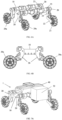
- FIG. 5A and 5B illustrated are an isometric perspective view and a left side view, respectively, of an embodiment of the chassis with wheel assemblies of the electric robot of the present invention that presents a certain configuration in terms of direction and traction.
- the chassis 10 has two wheel assemblies 20 each located at opposite ends of the front part of the chassis 10, that is, at opposite ends of the front crossbar, and two wheel assemblies 26 each located at opposite ends of the rear of the chassis 10, i.e. at opposite ends of the rear crossbar.
- Each of said wheel assemblies 20 and 26 has a flange-like joint 23 so that it can be linked to the corresponding crossbar joints of the electric robot.
- each of the electric motors 21 can rotate in the two possible directions of rotation (clockwise and counterclockwise), wherein in one of the directions it makes the electric robot advance and in the other direction, it makes it go back.
- FIGS. 6A and 6B illustrate an isometric perspective view and a left side view, respectively, of an embodiment of the chassis with wheel assemblies of the electric robot of the present invention that presents a certain configuration in terms of direction and traction.
- Said embodiment is substantially similar to the embodiment illustrated in Figures 5A and 5B , with the exception that it comprises a wheel assembly 20 at each of the opposite ends of the front and rear of the chassis 10 each of said wheel assemblies 20 having an electric motor 21, preferably a brushless type electric motor, directly coupled to the corresponding wheel 29a.
- the wheel assemblies 20 located at the front are identical to the wheel assemblies 20 located at the rear of the electric robot.
- the electric robot of the present invention has an electrical installation that allows it to adapt to different configurations, therefore, exchanging the wheel assemblies 20 of the opposite ends of the rear part with wheel assemblies 26 comprising the caster wheels 29b is easily done.
- Said electric robot 1 generally comprises the chassis 10, a wheel assembly 20 both at each of the opposite ends of the front and at opposite ends of the rear of the chassis 10, a battery bank 32 as a power supply and a component 40, for example a container for agricultural supplies.
- the electric robot 1 of the present invention is easily reconfigurable also regarding the power supply it uses to propel itself. This is so since the possibilities of the power supply of the electric robot are multiple.
- the power supply is selected from the group consisting of a hybrid power supply and an electrical power supply, wherein the hybrid power supply consists of a generator and rechargeable batteries, while the electrical power supply consists of rechargeable batteries, as illustrated in Figures 8A and 8B , or an interchangeable battery bank, as illustrated in Figure 7A .
- the batteries that the electric robot of the present invention uses as a power supply can be selected from the group that comprises lead batteries, lithium batteries, cadmium batteries, among others.
- the electric robot 1 of the present invention is designed to allow the mounting of the power supply, whatever it is, in the front part thereof. Said mounting is carried out through the linking means 17 of the chassis 10 (see Figures 2A-2D ).
- the mounting of the power supply to the linking means 17 is simple so that it can be done both manually and automatically.
- FIG. 7B an isometric perspective view of an embodiment of the electric robot 1 of the present invention can be seen in the skid steering configuration. Said embodiment is substantially similar to that illustrated for Figure 7A , the only difference being the power supply used. In this case, a generator 34 and batteries 36 are used as the power supply to achieve the propulsion of the electric robot 1.
- the electric robot 1 carries in its middle part a component 40 in the form of a container for agricultural supplies.
- the robot could have a tank, a hopper or other possible components, in order, for example, to contain seeds to be sown, agrochemicals to be injected or whatever corresponds to the task to be performed, for which the electric robot 1 is configured.
- the embodiment of the illustrated electrical robot 1 is substantially similar to the embodiment illustrated in Figure 7B except that it further comprises the implement 50, a boom for dispensing of agricultural supplies at the rear of the electric robot 1.
- the implement in addition to that shown in Figure 1 , can be selected from a variety of implements capable of performing one or more of the following functions: spraying; weed control without agrochemicals, for example, by means of some cutting tool (blades, cutting bars, etc.) for pruning, plucking, cutting, etc.; sowing; fertilization; trailer for loading and unloading, for example, of seeds or fertilizers, which can be hooked or linked to the rear of the electric robot 1 ; monitoring and sensing physical and chemical properties of the soil such as nutrients, texture, color, humidity, organic matter, etc.; among other possible functions, which can be automated. Whichever implement is selected, it is preferably placed at the rear of the electrical robot 1, although it could also be, at least in part, in the middle of the electrical robot 1.
- the implement 50 illustrated in Figure 1 is an agrochemical spray implement in the form of a boom which has nozzles along its length so that inject agrochemicals (fertilizers, pesticides, etc.).
- agrochemicals fertilizers, pesticides, etc.
- the implement 50 illustrated is an example and should not be considered as limiting in any way, since the electric robot of the present invention is designed to be easily reconfigurable so that some other implement can be installed, instead of the boom, to perform some of the functions previously described.
- the electric robots commonly used in agriculture generally work at low speeds (less than 10 km/h) and with small loads, while the electric robot 1 can work at high speeds, for example, up to 20 km/h, supporting high loads, for example, 500 kg or more, not counting the electric robot's own weight (chassis, wheel assemblies, power supply and implement).
- the electric robot 1 uses electric motors of, for example and in a preferred embodiment, 6 kW of working power, therefore, an electric robot 1 according to the embodiment of Figures 5A and 5B or according to the embodiment of Figures 6A and 6B , will have, respectively, a total power of 12 kW or 24 kW (one motor per wheel), in the event that 6 kW electric motors of power. In this way the electric robot of the present invention is ideal for extensive agriculture.
- tread width must be understood as the distance between wheels of the same axle (whether the wheels are at the front or at the rear), that is to say “gauge”; wheelbase must be understood as the distance between the axle of the wheels located at the front of the electric robot and the axle of the wheels located at the rear of the electric robot; clearance must be understood as the shortest distance between the bottom of the robot and the ground; tire diameter must be understood as the diameter of wheels 29a and 29b ; and spray implement must be understood as the distance from one end to the other of the spray implement illustrated in Figure 1 .
- the electric robot of the present invention is an autonomous robot since it has enough "intelligence" to independently carry out the operations for which it is intended. To do this, a user of the electric robot will configure it so that it can perform the desired task, placing an implement either to spray agrochemicals, sow, etc.; installing a power supply (be it a battery bank, a generator and batteries, etc.) so that the electric robot has a certain autonomy, that is, it has enough energy to operate either 5 consecutive hours, 10 consecutive hours, etc.; placing a container, tank or whatever corresponds, depending on the task to be carried out, in its middle part; and assigning a certain wheel configuration (wheels with differential drive and caster wheels, or skid steering) according to the conditions of the terrain on which it is going to work.
- a power supply be it a battery bank, a generator and batteries, etc.
- the robot can start operating.
- it has a processing and control module, a GNSS unit, an inertial measurement unit, at least one sensor for environment perception, at least one sensor for monitoring the status of the electric robot and a wireless communication system (not shown in the Figures).
- the control and processing module is responsible for controlling each of the robot functions and movements. First, it controls the electric motors of the wheels. This is essential since when the electric robot, in the configuration of wheels with differential drive and caster wheels, makes a turn, either to the left or to the right, the wheels will have to rotate at different speeds. For example, if the electric robot turns to the right, the electric motor of the wheel to the right of the electric robot will rotate at a slower speed than the electric motor of the wheel to the left of the electric robot, since the latter has to travel more than the wheel on the right when cornering. Also, in a skid steering configuration, the processing and control module will be responsible for driving the electric motors so that the wheels on the same side (right or left) of the electric robot rotate at the same speed when the electric robot makes a turn.
- Said processing and control module also enables the different components that the electric robot may have to be operated.
- it is responsible for operating the implement that is placed at its rear.
- the implement of Figure 1 in the form of a boom can be controlled to fold automatically, without the need for a person to do it manually.
- the nozzles along its length can be selectively controlled so as to inject agrochemicals where desired.
- said processing and control module may be in data communication with an external server in which the user loads the points, in a particular terrain, on which the electric robot of the present invention must operate or perform some function. These points can be supplied in the form of geolocations on a map or other form of data representation that can be accessed by the control unit.
- the control and processing module is in data communication also with the GNSS unit, the at least one environment perception sensor and the inertial measurement unit.
- the processing and control module allows the electric robot to be geolocated so that it can know its current location, the points on which it must work and the actions it must take in order to go to said points, for example, advance 100 meters forward, apply fertilizer at one point, then turn right, advance 50 meters and reapply fertilizer, etc.
- the user of the electric robot can, for example, define rest areas, recharging areas, storage area, safe paths for the movement of the robot, areas through which the robot should avoid moving, perimeter of the work lot, work path. This is accomplished either by moving the electric robot by remote control, by having the robot follow another vehicle, or offline by marking a satellite map as described above.
- the electric robot could work with only part of the information, for example, the perimeter of the lot is defined and determines by itself the best working path.
- the at least one environment perception sensor selected from the group comprising lidar sensors, ultrasonic sensors, a radar, RGB cameras, RGB-D cameras, thermal cameras, infrared cameras, among others, to detect possible obstacles or dangerous areas, for example, a lake, that could be in the path of the same.
- the processing and control module being in data communication with the at least one environment perception sensor, receives signals from said at least one environment perception sensor and from these signals performs actions such as making turns or maneuvers of way to avoid possible obstacles and avoid possible damage to the integrity of the electric robot, and then continue with the path it was taking.
- the at least one environment perception sensor can be used so as to allow the various operations of the electric robot to be carried out.
- the electric robot in case the electric robot is configured for the agrochemical application, it can use said at least one sensor of environment perception to detect weeds, and based on said detection, to send signals to the processing module and control so that it activates the nozzles of the boom so as to inject agrochemicals on the weeds.
- the at least one environment perception sensor can be used in order to determine possible paths for the movement of the robot; for command of the robot, for example, by recognizing gestures or following an object in the vehicle detection zone.
- the processing and control module is also in data communication with at least one sensor for monitoring the status of the electric robot selected from the group that includes fuel level sensors, wheel pressure sensors, temperature sensors of different points of the electric robot, position sensors of the mobile parts of the electric robot, sensors of the quantity of supplies for agricultural work, among others, for decision making.
- the at least one sensor for monitoring the condition of the electric robot may allow alarms for overtemperature and low air pressure in the wheels.
- the robot can determine which sections of an implement for agricultural work are folded and which are not.
- said processing and control module allows detecting when the power supply is running low. In this way, the processing and control module sends some signal to the external server with which it is communicated so that the user of the electric robot is aware that it requires a replacement or recharge of its batteries. Also, the processing and control module has the ability to automatically return the electric robot 1 to a charging station when it determines that the remaining charge on the power supply is not sufficient to continue the work. Similarly, the processing and control module can detect whether the amount of agricultural supplies in component 40 is running low, for example, if it is running out of agrochemicals to spray.
- FIGs 8A and 8B The replacement or recharging of batteries can be seen in Figures 8A and 8B in which, in turn, the electric robot 1 can be seen recharging rechargeable batteries 38 by, for example, an external charger as shown in Figure 8A or a charging station, inside a mobile container as shown in Figure 8B , where the electric robot, in addition to recharging its batteries, can be stored or sheltered if necessary.
- the electric robot 1 has a battery bank as its power supply, said electric robot can also go to the charging station (mobile container) which would also allow replacing the battery bank with another one already charged.
- the electric robot of the present invention comprises a wireless communication system comprising communication modules such as LPWAN, Bluetooth, WiFi and mobile Internet, for information exchange with a server or a remote command post.
- communication modules such as LPWAN, Bluetooth, WiFi and mobile Internet
- the electric robot of the present invention may comprise a housing on the chassis of said electric robot so that each of the elements that are installed or incorporated thereon of the chassis are housed and covered within said casing.
- the casing protects said elements from climatic and/or environmental conditions that could damage them and/or alter their operation.
Landscapes
- Engineering & Computer Science (AREA)
- Life Sciences & Earth Sciences (AREA)
- Mechanical Engineering (AREA)
- Soil Sciences (AREA)
- Environmental Sciences (AREA)
- Chemical & Material Sciences (AREA)
- Combustion & Propulsion (AREA)
- Transportation (AREA)
- Manipulator (AREA)
- Guiding Agricultural Machines (AREA)
- Arrangement Or Mounting Of Propulsion Units For Vehicles (AREA)
- Control Of Position, Course, Altitude, Or Attitude Of Moving Bodies (AREA)
Description
- The present invention relates to the field of electric robots. More particularly, the present invention relates to an electric robot for agricultural applications that can be adapted to any type of condition and work in an agricultural environment and that can operate autonomously.
- There are various types of vehicles that are implemented in the technical field related to agriculture, among them are electric robots, which represent an advantageous alternative for farmers due to their versatility to adapt to different working conditions. Additionally, robots in general constitute lighter vehicles and represent a lower cost compared to conventional agricultural machines, which due to their weight compact the soil, negatively affecting production.
- Furthermore, robots can be programmed to perform tasks when favorable weather conditions (humidity, temperature, wind, etc.) are met, regardless of the time of the day. They enable agricultural productivity to be increased by automating tasks precisely and tirelessly, while farmers can handle other procedures or manual tasks. Therefore, it is evident that the use of robots makes it possible to make more efficient use of resources, save inputs and generate less impact on the ecosystem.
- As it is known, on a field a multiplicity of tasks are carried out for agricultural purposes, such as plowing, applying fertilizers, sowing, watering, applying pesticides, harvesting, among many others. That is why the use of agricultural robots that can be adapted or configured to perform each of these tasks would be very beneficial for farmers.
- There are different electric robots, such as the electric robot disclosed in the publication "The Thorvald II Agricultural Robotic System" by Lars Grimstad and Pål Johan. Said electric robot is a modular agricultural robot both in hardware and software, which can be reconfigured to operate in different conditions such as open fields, tunnels or greenhouses, being able to adjust the distance between wheels, load capacity, power, among others features. For its propulsion, the robot uses one or more drive modules that have electric motors that are connected to the wheels by means of a transmission mechanism.
- However, it does not have a structural chassis, to which all parts and components are mounted, but instead uses aluminum tubes (of variable length) to interconnect the modules. This limits its ability to reconfigure for small loads and low power.
- The publication "Mobile Robot for Weeding", by Tommy Ertbolle Madsen and Hans Lavdal Jakobsen, discloses an autonomous agricultural robot vehicle for weed control. Said electric robot to propel itself uses a brushless type electric motor and a reduction mechanism to drive the wheels.
- Furthermore, it also has a smaller chassis and low power motors (0.5 kW) compared to the robot motors of the present application. In addition, the robot from the publication "Mobile Robot for Weeding" uses an independent control on each wheel as the steering system, by means of an electric motor at the top.
- Patent application
WO 2017/161431 A1 in the name of EIRENE PROJETOS E CONSULTORIA LTDA and published on September 28, 2017 discloses an unmanned ground vehicle for selective spraying, and a spraying method using said vehicle. - Said vehicle has a chassis assembly whose main function is vertical spraying and is capable of receiving different functional modules on its quick coupling platform. The vehicle is operated through a battery powered electrical supply, having an integral four-wheel drive system, an independent mechanical suspension system, and independent steering angle control.
- The robot of the patent application
WO 2017/161431 A1 has steering motors on each wheel which implies high equipment cost, high mechanical complexity and high complexity in vehicle control. - Each of the previously cited documents discloses autonomous agricultural robots or vehicles. However, each of them has a transmission mechanism, for example a reduction mechanism, between the motor that drives the wheels and the wheels. With an intermediate mechanism, the energy efficiency of the electric robot is inevitably reduced. Additionally, said intermediate mechanism inevitably requires lubrication and maintenance, since it will be subject to greater wear.
- Furthermore, said agricultural robots or vehicles, based on what is disclosed in their corresponding documents, do not exceed the speed of 10 km/h in the field or their working speeds are not specified. The robots or agricultural vehicles commonly used in the state of the art are intended to work with light loads and at low speeds (less than 10 km/h).
- On the other hand, there are other prior art documents that disclose agricultural robots that use hydraulic motors, which makes said robots more expensive, or that use combustion motors, which make them polluting the environment.
- Consequently, there is a need to provide an electric robot that is easily configurable in order to adapt to different conditions and agricultural work, being able to perform different functions in an agricultural field, the robot not having a transmission mechanism between the motor and the wheels, and that it can operate in an optimal range of speeds and torques, allowing the transport of high loads and maintaining its horizontality and stability.
CN101323328 ,US2019/200510 ,WO2019/193080 ,KR20130011166 CN101990796 ,WO2016/191825 andUS2020/000002 are example of electric robot for the agriculture. - Based on the above considerations, the present application discloses an electric robot that allows working at high speeds (for example, up to 20 km/h) and with high loads, which does not use any power transmission mechanism, which ensures the stability and horizontality of the vehicle at high speeds, which adapts to different agricultural conditions and work, and which allows it to be easily reconfigured in order to carry out different agricultural operations.
- Consequently, an object of the present invention is a modular and reconfigurable autonomous electric robot according to
claim 1.
The electric robot is capable of adapting to any type of condition and work in an agricultural environment, comprising: - a chassis with transverse and longitudinal symmetry comprising a front part, a middle part and a rear part;
- a power supply located at the front of the chassis;
- an implement for agricultural work located at the rear of the chassis;
- two wheel assemblies each located at transversely opposite ends of the front of the chassis and two wheel assemblies each located at transversely opposite ends of the rear of the chassis;
- a GNSS unit to geolocate the electric robot in real time; and
- a control and processing module that controls the electric robot and is in data communication with the GNSS unit,
- In an embodiment of the present invention, the chassis comprises at least two crossbars, preferably a front crossbar and a rear crossbar which essentially constitute the front and the rear, respectively.
- In an embodiment of the present invention, the chassis comprises at least two stringers, preferably two lateral stringers and more preferably two lateral stringers and at least one central stringer, which essentially constitute the middle part of the chassis and connect the front part with the rear part thereof.
- In an embodiment of the present invention, the power supply is selected from the group consisting of a hybrid power supply and an electrical power supply.
- In a preferred embodiment of the present invention, the hybrid power supply consists of a generator and rechargeable batteries.
- In a preferred embodiment of the present invention, the electrical power supply consists of rechargeable batteries, or an interchangeable battery bank or pack.
- In an embodiment of the present invention, the batteries are selected from the group that includes lead, nickel-cadmium, lithium batteries, among others.
- In an embodiment of the present invention, the chassis is shaped to be able to place a component such as a container, a tank or a hopper in the middle of it to contain agricultural supplies.
- In an embodiment of the present invention, the implement is selected so as to perform one or more of the following functions: distribution of agricultural supplies, such as spraying, sowing, fertilization; weed control without agrochemicals; trailer for loading and unloading; measurement and sensing of soil properties, among others.
- In a preferred embodiment of the present invention, the implement can be automatically driven by the processing and control module.
- In an embodiment of the present invention, each wheel assembly located at the front has a suspension formed by a spring and a damper.
- In a preferred embodiment of the present invention, each of the wheel assemblies located at the front of the chassis and the wheel assemblies located at the rear of the chassis have a suspension formed by a spring and a damper.
- In an embodiment of the present invention, each wheel assembly located in the front part of the chassis comprises a power control module for its corresponding electric motor.
- In an embodiment of the present invention, each wheel assembly located at the rear of the chassis comprises a wheel with an electric motor directly coupled to the wheel.
- In an embodiment of the present invention, each wheel assembly located at the rear of the chassis comprises a power control module for the electric motor.
- Each wheel assembly located at the rear part of the chassis comprises a caster wheel and a caster axle, where the caster axle has a rotation axis that is inclined a determined angle of inclination with respect to a vertical line and allows the caster wheel to rotate around the axis.
- In an embodiment of the present invention, the angle of inclination of the axis of rotation of the caster axle with respect to a vertical line is between 1° and 20°, preferably between 5° and 15°, more preferably between 6° and 10°, even more preferably is 8°.
- In an embodiment of the present invention, the electric motor directly coupled to a corresponding wheel is a brushless type electric motor.
- In an embodiment of the present invention, the processing and control module is in data communication with an external server.
- In an embodiment of the present invention, the electric robot comprises an inertial measurement unit that is in data communication with the processing and control module.
- In an embodiment of the present invention, the electric robot comprises at least one environment perception sensor selected from the group consisting of lidar sensors, ultrasonic sensors, a radar, RGB cameras, RGB-D cameras, thermal cameras, infrared cameras, among others, wherein said at least one sensor of environment perception is in data communication with the processing and control module.
- In an embodiment of the present invention, the electric robot comprises at least one sensor for monitoring the status of the electric robot selected from the group consisting of fuel level sensors, wheel pressure sensors, temperature sensors of different points of the electric robot, position sensors of the mobile parts of the electric robot, sensors of the quantity of supplies for agricultural work, among others, wherein said at least one sensor for monitoring the state of the robot is in data communication with the processing and control module.
- In an embodiment of the present invention, the electric robot comprises a wireless communication system comprising communication modules such as LPWAN, Bluetooth, WiFi and mobile Internet.
-
-
Figure 1 shows an isometric perspective view of an embodiment of the electric robot as disclosed. -
Figures 2A to 2D show respectively an isometric perspective view, a front view, a left side view and a top view of the chassis of the electric robot as disclosed. -
Figure 3A shows an isometric perspective view of one embodiment of a wheel assembly, without mounting the wheel, comprising an electric motor.Figure 3B shows a cross section of the electric motor of the wheel assembly ofFigure 3A . -
Figure 4A shows an embodiment of a wheel assembly comprising a caster wheel in a first position and in a second position.Figure 4B shows other embodiments of the wheel assembly ofFigure 4A . -
Figures 5A and 5B show an isometric perspective view and a left side view, respectively, of an embodiment of the chassis with wheel assemblies of the electric robot as disclosed presenting a certain configuration regarding direction and traction. -
Figures 6A and 6B show an isometric perspective view and a left side view, respectively, of another embodiment of the chassis with wheel assemblies of the electric robot as disclosed that presents a certain configuration regarding direction and traction. -
Figure 7A shows an isometric perspective view of one embodiment of the electric robot as disclosed.Figure 7B shows an isometric perspective view of another embodiment of the electric robot as disclosed. -
Figures 8A and 8B show the electric robot as disclosed in a charging station recharging its power supply. - The electric robot of the present invention will now be described in detail with reference to
Figures 1 to 8B , which illustrate, by way of example, preferred embodiments of the invention and the different elements that compose the same. - In each of the Figures, the same numerical references are used to designate similar or equal elements of the device of the present invention.
- Referring to
Figure 1 , an isometric perspective view of an embodiment of theelectric robot 1 of the present invention can be seen, which generally comprises achassis 10, awheel assembly 20 in each corner of thechassis 10, agenerator 34 andrechargeable batteries 36 as a power supply, acomponent 40 and an implement 50 for the distribution of agricultural supplies. Said elements will be described in greater detail and precision below with reference to the other Figures. - Referring to
Figures 2A to 2D , different views of an embodiment of thesymmetrical chassis 10 of theelectrical robot 1 of the present invention, shown inFigure 1 can be seen. In particular,Figure 2A corresponds to an Isometric perspective view ofchassis 10,Figure 2B corresponds to a front view ofchassis 10,Figure 2C corresponds to a left side view ofchassis 10, andFigure 2D corresponds to a top view ofchassis 10. - The
symmetrical chassis 10 has three parts, a front orfront part 11, amiddle part 12 and a rear orrear part 13, corresponding respectively to the front, middle and rear parts of the electric robot of the present invention, wherein saidchassis 10 is formed by two cross beams or crossbars, in particular afront crossbar 14a and arear crossbar 14b, and by three longitudinal cross beams or stringers, in particular twolateral stringers central stringer 15b. It should be noted that in some other embodiments saidcentral stringer 15b may not be included so that the electric robot has only thelateral stringers - Additionally, as can be seen directly through
Figures 2A to 2D , saidchassis 10 is symmetrical because it presents two symmetry planes, a symmetry plane that corresponds to the vertical plane that passes through the longitudinal axis L and another symmetry plane that corresponds to the vertical plane that passes through the transverse axis T, the vertical being understood as the direction perpendicular to both the longitudinal axis L and the transverse T, which are horizontal axes. - The
crossbars front part 11 and therear part 13, respectively, of thechassis 10. For their part, thestringers middle part 12 of thechassis 10 and structurally join thefront part 11 with therear part 13 ofchassis 10. - The
crossbars stringers Figure 2A , the plates that are in the sides or periphery of thechassis 10 have an upper surface that is higher than the upper surfaces of the other plates. In this way, thechassis 10 is shaped to be able, by way of example, to place in the middle part 12 a container, a tank, a hopper, etc., containing agricultural supplies such as seeds, agrochemicals or whatever corresponds according to the task to be performed by the electric robot, and that said container, tank, or hopper fits properly well inside themiddle part 12 of the electric robot. - The
crossbars like connections 16 at each of their ends so that different configurations of wheel assemblies can be linked to thechassis 10, as will be seen later. Additionally, thecrossbars chassis 10. Such linkage means 17 may be, by way of example, plates facing up and out with respect to thechassis 10 and are located in the middle part of thecrossbars - It should be noted that the chassis crossbars can have different lengths so that the electric robot of the present invention is easily configurable and, therefore, scalable. Also, in case a robot enlargement is needed, more stringers and more crossbars can easily be added to the electric robot of the present invention. Consequently, aspects such as, for example, the gauge of the electric robot, would be easily configurable.
- The
chassis 10 can be manufactured from some material selected from the group consisting of metallic materials, preferably steels or aluminum, and polymeric materials. In a preferred embodiment, thechassis 10 is made of high strength steel. - Referring to
Figure 3A , an isometric perspective view of one embodiment of awheel assembly 20 can be seen.Wheel assembly 20 comprises a drive wheel (shown aswheel 29a inFigure 5A ). This is because thewheel assembly 20, as can be seen fromFigure 3A , comprises anelectric motor 21. Additionally, thewheel assembly 20 comprises an articulatedarm 22, alink 23 and asuspension 24. In a preferred embodiment, thewheel assembly 20 comprises a power control module (not shown) of theelectric motor 21 which is preferably placed on the articulatedarm 22 although it can also be placed on the chassis of the electric robot. Said power control module makes it possible to control theelectric motor 21 so that it has a high performance and guarantees good operation of the electric robot. -
Electric motor 21 is directly coupled towheel 29a (seeFigure 5A ) which is not shown inFigure 3A in order to achieve a better understanding ofwheel assembly 20. In a preferred embodiment, theelectric motor 21 is a brushless electric motor, i.e. without brushes. - As the
electric motor 21 is directly coupled to thewheel 29a, shown inFigure 5A , the use of mechanical transmissions or intermediate parts is avoided, which allows greater mechanical simplicity in the design. Furthermore, as theelectric motor 21 is brushless type, there is no need for lubrication since there are no parts to wear out. In this way, the reliability of the electric robot increases, maintenance is minimal and the efficiency of the energy used to drive the robot is maximized. In addition, in case the power control module, mentioned above, is integrated in the articulatedarm 22, it is possible to save between 5% and 10% of energy due to the fact that there is less power wiring (number of cables) which reduces losses due to Joule effect, thus improving electrical efficiency. - The brushless type
electric motor 21 that is used to drive the electric robot of the present invention is specifically designed to allow the electric robot to operate in the range of speeds and torques that said robot demands in order to adapt to any type of condition and agricultural work. Furthermore, saidelectric motor 21 regenerates energy in braking, which favors a lower energy consumption. - The
electric motor 21 is coupled to one end of the articulatedarm 22, which through another end is coupled to thesuspension 24 of thewheel assembly 20. Thesuspension 24 comprises a spring and a damper, which allows, in general, maintaining the contact force of the wheels with the ground, supporting the load of the electric robot, absorbing the irregularities that may exist in the work terrain, and favoring the stability of the robot when turning or braking. - The flange-like joint 23 of the
wheel assembly 20 allows said assembly to be coupled to thechassis 10 of the electric robot. This is achieved by coupling the joint 23 with any of thejoints 16 of thechassis 10 of the electric robot by means of mechanical fixing, for example, by bolts or studs. -
Figure 3B shows a cross section of theelectric motor 21 ofFigure 3A , where components that make up theelectric motor 21 can be seen such as therotor 25a, thestator 25b and theshaft 25c coupled to the stator 25b. Saidelectric motor 21 comprises fins (not shown) on the inner cover ofrotor 25a so as to dissipate the heat generated inrotor 25a by conduction and convection. - The
wheel assembly 20 is preferably located at each end of the front of the electric robot. However, it should be noted that awheel assembly 20 can be attached to each joint 16 of theelectric robot chassis 10 such as in the embodiment illustrated inFigures 6A and 6B . In such an embodiment, the electric robot has fourwheel assemblies 20, i.e. twowheel assemblies 20 each located at transversely opposite ends of the front of the electric robot, and twowheel assemblies 20 each located transversely at each end opposite sides of the rear of the electric robot. - On the other hand, in another embodiment shown in
Figures 5A and 5B , the electric robot has twowheel assemblies 20 each located at transversely opposite ends of the front of the electric robot, and twowheel assemblies 26, which will be described below, each located at transversely opposite ends of the rear of the electric robot. - Referring now to
Figure 4A , an embodiment of awheel assembly 26 comprisingwheel 29b, which is a caster wheel, can be seen in a first position (assembly 26 on the left) and in a second position (assembly 26 on the right). Thewheel assembly 26, as can be seen fromFigure 4A , comprises afork 28a that holds thewheel 29b, a joint 23, asuspension 24, and acaster axle 27 from which thewheel 29b can rotate. -
Wheel assembly 26 is preferably located at each end of the rear of the electric robot and, unlikewheel assembly 20, does not have a motor directly or indirectly coupled towheel 29b, thuswheel 29b being a caster wheel. - The
wheel assembly 26, like thewheel assembly 20, is linked to thechassis 10 by coupling the joint 23 with any of thejoints 16, for example, those of therear crossbar 14b of thechassis 10 of the electric robot by mechanical fixing, e.g. bolts or studs. Thecaster axle 27 has a rotation axis e that allows thesuspension 24 and, in turn, thewheel 29b to freely rotate around said rotation axis e. This axis of rotation e is inclined with respect to a vertical axis v an angle B, called the angle of inclination, whose value is between 1° and 20°. In a preferred embodiment, the angle of inclination B is between 5° and 15°. In a more preferred embodiment, the angle of inclination B is between 6° and 10°. In an even more preferred embodiment, the angle of inclination B is 8°. Therefore, thewheel assembly 26 is inclined at an angle B with respect to the vertical axis v. - It is necessary to point out that, in case the angle of inclination B takes values above 20° of inclination, problems would occur such as the misalignment of the wheels, as well as loss of horizontality of the electric robot in case the wheels rotate 180°, since there would be an excessive height difference between the front wheels and the rear wheels.
- The angle of inclination B with respect to the vertical axis v helps to keep the electric robot in a straight line when it moves, that is, the electric robot maintains a straight path when it moves. If the inclination angles B were not available, when the electric motors of the front wheels were de-energized, the electric robot would tend to rotate 180°, that is, the rear wheels would tend to overtake the front wheels. Therefore, as said wheels have with an angle of inclination B, it is favored that the rear wheels do not tend to go forward once the motors are de-energized.
- Additionally, the purpose of the angle of inclination B is to generate a change in height h of the
wheel 29b and, therefore, of thewheel assembly 26, when it rotates around thecaster axle 27. As mentioned above, in saidFigure 4A two positions can be seen for thewheels 29b. In the first position,wheel 29b is farthest from chassis 10 (not shown) and therefore from the center of gravity of the electric robot. In the second position, thewheel 29b is rotated 180° with respect to the axis of rotation e and the first position and, in turn, is closer to the center of gravity of the electric robot. For these two positions, thewheel assembly 26 is assumed to be coupled to the rear of the electric robot. - In the first position, the load supported by the
wheel 29b is less than the load supported by thewheel 29b in the second position. This difference in load distribution supported bywheel 29b is due to the fact that the distance between the wheels of the wheel assemblies arranged at the rear of the electric robot and the wheels of the wheel assemblies arranged at the front of the electric robot changes. More precisely, in the case of the embodiment ofFigure 5A , the distance betweenwheels 29a andwheels 29b varies whenwheels 29b rotate aroundcaster axle 27 and the load difference that is generated as a consequence is absorbed by thesuspension 24 of thewheels 29b, more precisely by thesuspension spring 24, which is compressed as a consequence. - If the angle of inclination B were null, there would be no height difference h of the
wheel 29b when it rotates around the caster axle and the rear of the electric robot would tilt downwards, since thewheels 29b are closer to the center of gravity of the electric robot, the spring would further compress by supporting more weight and, consequently, the electric robot would lose its horizontality. The latter could affect both the stability of the electric robot when moving or making turns, as well as its performance when performing any function. - Likewise, the angle of inclination B considerably reduces the oscillatory effect, called the shimmy effect, at working speeds, for example, of up to 20 km/h, of the electric robot. It should be noted that this effect occurs on caster wheels and intensifies with increasing speed. However, due to the angle of inclination B it is made more difficult to get the wheel out of its equilibrium position, when it is moving forward, and the shimmy effect occurs at higher speeds.
- Referring now to
Figure 4B , there are illustrated three preferred embodiments for thewheel assembly 26. The embodiment on the left of the figure, which is equal to thewheel assembly 26 illustrated inFigure 4A , is characterized by having asuspension 24, which comprises a spring and a damper, and adouble fork 28a, whereby the fork holds thewheel 29b on both sides. The embodiment in the center of the figure is characterized by having asuspension 24, which comprises a spring and a damper and acantilever fork 28b, whereby it holds thewheel 29b only on one side. The embodiment on the right of the figure is characterized by having a fixedfork 28c, whereby it holds thewheel 29b on both sides, and by not having a suspension. - Referring again and in more detail to
Figures 5A and 5B , illustrated are an isometric perspective view and a left side view, respectively, of an embodiment of the chassis with wheel assemblies of the electric robot of the present invention that presents a certain configuration in terms of direction and traction. In particular, in each of saidFigures 5A and 5B , it can be seen that thechassis 10 has twowheel assemblies 20 each located at opposite ends of the front part of thechassis 10, that is, at opposite ends of the front crossbar, and twowheel assemblies 26 each located at opposite ends of the rear of thechassis 10, i.e. at opposite ends of the rear crossbar. Each of saidwheel assemblies - As the electric robot of said embodiment of
Figures 5A and 5B haswheel assemblies 20 comprisingdriving wheels 29a at the front of the electric robot andwheel assemblies 26 comprisingcaster wheels 29b at the rear of the electric robot, said embodiment comprises front-wheel drive. Thedriving wheels 29a of the electric robot in this embodiment are of the differential drive type, that is to say, that the electric robot by means of a processing and control module, as will be seen later, can change direction when moving varying the relative speed of rotation of theelectric motors 21 of thewheels 29a so that no additional steering movement is required. It should be noted that each of theelectric motors 21 can rotate in the two possible directions of rotation (clockwise and counterclockwise), wherein in one of the directions it makes the electric robot advance and in the other direction, it makes it go back. - It should be noted that, despite the advantages resulting from having
caster wheels 29b that have an angle of inclination B within any of the ranges described above, the wheels that are placed at the rear of the electric robot do not necessarily have to becaster wheels 29b as previously advanced and as will be seen below. - Referring again and in more detail to
Figures 6A and 6B , these figures illustrate an isometric perspective view and a left side view, respectively, of an embodiment of the chassis with wheel assemblies of the electric robot of the present invention that presents a certain configuration in terms of direction and traction. Said embodiment is substantially similar to the embodiment illustrated inFigures 5A and 5B , with the exception that it comprises awheel assembly 20 at each of the opposite ends of the front and rear of thechassis 10 each of saidwheel assemblies 20 having anelectric motor 21, preferably a brushless type electric motor, directly coupled to thecorresponding wheel 29a. Thus, thewheel assemblies 20 located at the front are identical to thewheel assemblies 20 located at the rear of the electric robot. - In said embodiment, there is both front-wheel drive and rear-wheel drive (4-wheel drive), which corresponds to a configuration called skid steering. Consequently, since each wheel has a motor, it will have a higher power making said embodiment more convenient for higher loads than in the embodiment corresponding to
Figures 5A and 5B . Also, the electric robot in the skid steering configuration rotates because the wheels on the same side rotate at a different speed than the wheels on the other side of the electric robot, for example, if the wheels on the left side of the electric robot rotate faster than the wheels on the right side, the electric robot will turn right. This embodiment has great traction on uneven terrain. - The electric robot of the present invention has an electrical installation that allows it to adapt to different configurations, therefore, exchanging the
wheel assemblies 20 of the opposite ends of the rear part withwheel assemblies 26 comprising thecaster wheels 29b is easily done. - Referring now to
Figure 7A , an isometric perspective view of an embodiment of theelectric robot 1 of the present invention can be seen in the skid steering configuration. Saidelectric robot 1 generally comprises thechassis 10, awheel assembly 20 both at each of the opposite ends of the front and at opposite ends of the rear of thechassis 10, abattery bank 32 as a power supply and acomponent 40, for example a container for agricultural supplies. These elements will be described in greater detail and precision below. - It should be noted that the
electric robot 1 of the present invention is easily reconfigurable also regarding the power supply it uses to propel itself. This is so since the possibilities of the power supply of the electric robot are multiple. In one embodiment of the present invention, the power supply is selected from the group consisting of a hybrid power supply and an electrical power supply, wherein the hybrid power supply consists of a generator and rechargeable batteries, while the electrical power supply consists of rechargeable batteries, as illustrated inFigures 8A and 8B , or an interchangeable battery bank, as illustrated inFigure 7A . - The batteries that the electric robot of the present invention uses as a power supply can be selected from the group that comprises lead batteries, lithium batteries, cadmium batteries, among others.
- The
electric robot 1 of the present invention is designed to allow the mounting of the power supply, whatever it is, in the front part thereof. Said mounting is carried out through the linking means 17 of the chassis 10 (seeFigures 2A-2D ). The mounting of the power supply to the linking means 17 is simple so that it can be done both manually and automatically. - Referring now to
Figure 7B , an isometric perspective view of an embodiment of theelectric robot 1 of the present invention can be seen in the skid steering configuration. Said embodiment is substantially similar to that illustrated forFigure 7A , the only difference being the power supply used. In this case, agenerator 34 andbatteries 36 are used as the power supply to achieve the propulsion of theelectric robot 1. - In both embodiments illustrated in
Figures 7A and7B , it can be seen how theelectric robot 1 carries in its middle part acomponent 40 in the form of a container for agricultural supplies. It should be noted that instead of a container, the robot could have a tank, a hopper or other possible components, in order, for example, to contain seeds to be sown, agrochemicals to be injected or whatever corresponds to the task to be performed, for which theelectric robot 1 is configured. - Referring again to
Figure 1 , the embodiment of the illustratedelectrical robot 1 is substantially similar to the embodiment illustrated inFigure 7B except that it further comprises the implement 50, a boom for dispensing of agricultural supplies at the rear of theelectric robot 1. The implement, in addition to that shown inFigure 1 , can be selected from a variety of implements capable of performing one or more of the following functions: spraying; weed control without agrochemicals, for example, by means of some cutting tool (blades, cutting bars, etc.) for pruning, plucking, cutting, etc.; sowing; fertilization; trailer for loading and unloading, for example, of seeds or fertilizers, which can be hooked or linked to the rear of theelectric robot 1; monitoring and sensing physical and chemical properties of the soil such as nutrients, texture, color, humidity, organic matter, etc.; among other possible functions, which can be automated. Whichever implement is selected, it is preferably placed at the rear of theelectrical robot 1, although it could also be, at least in part, in the middle of theelectrical robot 1. - In particular, in a preferred embodiment of the present invention, the implement 50 illustrated in
Figure 1 is an agrochemical spray implement in the form of a boom which has nozzles along its length so that inject agrochemicals (fertilizers, pesticides, etc.). It should be noted that the implement 50 illustrated is an example and should not be considered as limiting in any way, since the electric robot of the present invention is designed to be easily reconfigurable so that some other implement can be installed, instead of the boom, to perform some of the functions previously described. - The electric robots commonly used in agriculture generally work at low speeds (less than 10 km/h) and with small loads, while the
electric robot 1 can work at high speeds, for example, up to 20 km/h, supporting high loads, for example, 500 kg or more, not counting the electric robot's own weight (chassis, wheel assemblies, power supply and implement). For this theelectric robot 1 uses electric motors of, for example and in a preferred embodiment, 6 kW of working power, therefore, anelectric robot 1 according to the embodiment ofFigures 5A and 5B or according to the embodiment ofFigures 6A and 6B , will have, respectively, a total power of 12 kW or 24 kW (one motor per wheel), in the event that 6 kW electric motors of power. In this way the electric robot of the present invention is ideal for extensive agriculture. - Next, two tables are presented, one corresponding to the weight of the different elements that make up the electric robot and the load it carries, and the other corresponds to the dimensions of characteristic parameters for a vehicle. The values shown in said tables are by way of example only and should not be considered as limiting the electric robot of the present invention in any way, since these values would be easily modified, for example, making the electric robot bigger or smaller or replacing the material of which it is made by a lighter one, among other possibilities.
Weights Chassis + wheel assemblies 450 kg Power supply 300 kg Load + container 500 kg Implement 250 kg Total 1500 kg Dimensions Tread width 2100 mm Wheelbase 2050 mm Clearance 650 mm Tire diameter 650 mm Spray implement 10000 mm - The tread width must be understood as the distance between wheels of the same axle (whether the wheels are at the front or at the rear), that is to say "gauge"; wheelbase must be understood as the distance between the axle of the wheels located at the front of the electric robot and the axle of the wheels located at the rear of the electric robot; clearance must be understood as the shortest distance between the bottom of the robot and the ground; tire diameter must be understood as the diameter of
wheels Figure 1 . - The electric robot of the present invention is an autonomous robot since it has enough "intelligence" to independently carry out the operations for which it is intended. To do this, a user of the electric robot will configure it so that it can perform the desired task, placing an implement either to spray agrochemicals, sow, etc.; installing a power supply (be it a battery bank, a generator and batteries, etc.) so that the electric robot has a certain autonomy, that is, it has enough energy to operate either 5 consecutive hours, 10 consecutive hours, etc.; placing a container, tank or whatever corresponds, depending on the task to be carried out, in its middle part; and assigning a certain wheel configuration (wheels with differential drive and caster wheels, or skid steering) according to the conditions of the terrain on which it is going to work.
- Once the configuration described above has been carried out, the robot can start operating. For this, it has a processing and control module, a GNSS unit, an inertial measurement unit, at least one sensor for environment perception, at least one sensor for monitoring the status of the electric robot and a wireless communication system (not shown in the Figures).
- The control and processing module is responsible for controlling each of the robot functions and movements. First, it controls the electric motors of the wheels. This is essential since when the electric robot, in the configuration of wheels with differential drive and caster wheels, makes a turn, either to the left or to the right, the wheels will have to rotate at different speeds. For example, if the electric robot turns to the right, the electric motor of the wheel to the right of the electric robot will rotate at a slower speed than the electric motor of the wheel to the left of the electric robot, since the latter has to travel more than the wheel on the right when cornering. Also, in a skid steering configuration, the processing and control module will be responsible for driving the electric motors so that the wheels on the same side (right or left) of the electric robot rotate at the same speed when the electric robot makes a turn.
- Said processing and control module also enables the different components that the electric robot may have to be operated. In particular, it is responsible for operating the implement that is placed at its rear. By way of example only, the implement of
Figure 1 in the form of a boom can be controlled to fold automatically, without the need for a person to do it manually. Also, the nozzles along its length can be selectively controlled so as to inject agrochemicals where desired. - Additionally, said processing and control module may be in data communication with an external server in which the user loads the points, in a particular terrain, on which the electric robot of the present invention must operate or perform some function. These points can be supplied in the form of geolocations on a map or other form of data representation that can be accessed by the control unit.
- The control and processing module is in data communication also with the GNSS unit, the at least one environment perception sensor and the inertial measurement unit. In this way, the processing and control module allows the electric robot to be geolocated so that it can know its current location, the points on which it must work and the actions it must take in order to go to said points, for example, advance 100 meters forward, apply fertilizer at one point, then turn right, advance 50 meters and reapply fertilizer, etc.
- The user of the electric robot can, for example, define rest areas, recharging areas, storage area, safe paths for the movement of the robot, areas through which the robot should avoid moving, perimeter of the work lot, work path. This is accomplished either by moving the electric robot by remote control, by having the robot follow another vehicle, or offline by marking a satellite map as described above. The electric robot could work with only part of the information, for example, the perimeter of the lot is defined and determines by itself the best working path.
- The at least one environment perception sensor selected from the group comprising lidar sensors, ultrasonic sensors, a radar, RGB cameras, RGB-D cameras, thermal cameras, infrared cameras, among others, to detect possible obstacles or dangerous areas, for example, a lake, that could be in the path of the same. The processing and control module, being in data communication with the at least one environment perception sensor, receives signals from said at least one environment perception sensor and from these signals performs actions such as making turns or maneuvers of way to avoid possible obstacles and avoid possible damage to the integrity of the electric robot, and then continue with the path it was taking.
- Furthermore, the at least one environment perception sensor can be used so as to allow the various operations of the electric robot to be carried out. By way of example only, in case the electric robot is configured for the agrochemical application, it can use said at least one sensor of environment perception to detect weeds, and based on said detection, to send signals to the processing module and control so that it activates the nozzles of the boom so as to inject agrochemicals on the weeds.
- The at least one environment perception sensor can be used in order to determine possible paths for the movement of the robot; for command of the robot, for example, by recognizing gestures or following an object in the vehicle detection zone.
- The processing and control module is also in data communication with at least one sensor for monitoring the status of the electric robot selected from the group that includes fuel level sensors, wheel pressure sensors, temperature sensors of different points of the electric robot, position sensors of the mobile parts of the electric robot, sensors of the quantity of supplies for agricultural work, among others, for decision making. By way of example only, the at least one sensor for monitoring the condition of the electric robot may allow alarms for overtemperature and low air pressure in the wheels. In turn, for example, in the case of spraying, the robot can determine which sections of an implement for agricultural work are folded and which are not.
- Finally, said processing and control module allows detecting when the power supply is running low. In this way, the processing and control module sends some signal to the external server with which it is communicated so that the user of the electric robot is aware that it requires a replacement or recharge of its batteries. Also, the processing and control module has the ability to automatically return the
electric robot 1 to a charging station when it determines that the remaining charge on the power supply is not sufficient to continue the work. Similarly, the processing and control module can detect whether the amount of agricultural supplies incomponent 40 is running low, for example, if it is running out of agrochemicals to spray. - The replacement or recharging of batteries can be seen in
Figures 8A and 8B in which, in turn, theelectric robot 1 can be seen rechargingrechargeable batteries 38 by, for example, an external charger as shown inFigure 8A or a charging station, inside a mobile container as shown inFigure 8B , where the electric robot, in addition to recharging its batteries, can be stored or sheltered if necessary. In case theelectric robot 1 has a battery bank as its power supply, said electric robot can also go to the charging station (mobile container) which would also allow replacing the battery bank with another one already charged. - The electric robot of the present invention comprises a wireless communication system comprising communication modules such as LPWAN, Bluetooth, WiFi and mobile Internet, for information exchange with a server or a remote command post.
- It should be noted that, although it is not shown in any of the Figures, the electric robot of the present invention may comprise a housing on the chassis of said electric robot so that each of the elements that are installed or incorporated thereon of the chassis are housed and covered within said casing. In this way, the casing protects said elements from climatic and/or environmental conditions that could damage them and/or alter their operation.
Claims (15)
- A modular and reconfigurable autonomous electric robot capable of adapting to any type of condition and work in an agricultural environment, comprising:- a chassis (10) with transverse and longitudinal symmetry comprising a front part (11), a middle part (12) and a rear part (13);- a power supply located in the front part (11) of the chassis (10);- an implement for agricultural work located in the rear part (13) of the chassis (10);- two wheel assemblies (20) each located at transversely opposite ends of the front part (11) of the chassis (10) and two wheel assemblies (26) each located at transversely opposite ends of the rear part (13) of the chassis (10);- a GNSS unit to geolocate the electric robot (1) in real time; and- a processing and control module that controls the electric robot (1) and is in data communication with the GNSS unit,wherein each wheel assembly (20) located in the front part (11) of the chassis (10) comprises a wheel (29a) with an electric motor (21) directly coupled to the wheel,characterized in that each wheel assembly (26) located at the rear part (13) of the chassis (10) comprises a caster wheel (29b) and a caster axle (17), wherein the caster axle (17) has a rotation axis (e) that is inclined by an angle of inclination (B) with respect to a vertical line (v) and allows the caster wheel (29b) to rotate around said axis.
- The electric robot according to claim 1, wherein the chassis (10) comprises at least two crossbars (14a, 14b).
- The electric robot according to claim 2, wherein the chassis (10) comprises a front crossbar (14a) and a rear crossbar (14b) which essentially constitute the front part (11) and the rear part (13), respectively.
- The electric robot according to any one of the preceding claims, wherein the chassis (10) further comprises at least two stringers (15a, 15c).
- The electric robot according to claim 4, wherein the chassis (10) comprises two lateral stringers (15a, 15c) that essentially constitute the middle part (12) of the chassis (10) and join the front part (11) with the rear part (13).
- The electric robot according to any one of the preceding claims, wherein the chassis (10) is shaped to be able to place a component (40) such as a container, a tank or a hopper in the middle of the chassis to contain agricultural supplies.
- The electric robot according to any one of the preceding claims, wherein the implement is selected so as to perform one or more of the following functions: spraying, weed control without agrochemicals, seeding, fertilization, trailer for loading and unloading, and measurement and sensing of soil properties.
- The electric robot according to any one of the preceding claims, wherein the wheel assemblies (20) located in the front part (11) have a suspension formed by a spring and a damper.
- The electric robot according to any one of claims 1 to 7, wherein each of the wheel assemblies (20) located in the front part (11) of the chassis (10) and of the wheel assemblies (26) located in the rear part (13) of the chassis (10) has a suspension formed by a spring and a damper.
- The electric robot according to any one of the preceding claims, wherein the angle of inclination (B) of the caster axle (17) with respect to the vertical line (v) is between 5° and 15°.
- The electric robot according to claim 10, wherein the angle of inclination (B) of the caster axle (17) with respect to the vertical line (v) is 8°.
- The electric robot according to any one of the preceding claims, wherein the electric motor (21) directly coupled to a corresponding wheel (29a) is a brushless type electric motor (21).
- The electric robot according to any one of the preceding claims, wherein the robot further comprises at least one environment perception sensor selected from the group comprising lidar sensors, ultrasonic sensors, a radar, RGB cameras, RGB-D cameras, thermal cameras and infrared cameras, where said at least one environment perception sensor is in data communication with the processing and control module.
- The electric robot according to any one of the preceding claims, wherein the robot further comprises at least one sensor for monitoring the condition of the electric robot selected from the group comprising fuel level sensors, wheel pressure sensors, temperature sensors of different points of the electric robot, position sensors of the mobile parts of the electric robot and sensors of the quantity of supplies for agricultural work, wherein said at least one sensor for monitoring the condition of the robot is in data communication with the processing and control module.
- The electric robot according to any one of the preceding claims, wherein the robot further comprises a wireless communication system comprising communication modules such as LPWAN, Bluetooth, WiFi and mobile Internet.
Applications Claiming Priority (1)
| Application Number | Priority Date | Filing Date | Title |
|---|---|---|---|
| PCT/IB2020/051925 WO2021176253A1 (en) | 2020-03-05 | 2020-03-05 | Modular and reconfigurable electric robot for agriculture |
Publications (3)
| Publication Number | Publication Date |
|---|---|
| EP4115720A1 EP4115720A1 (en) | 2023-01-11 |
| EP4115720C0 EP4115720C0 (en) | 2024-07-17 |
| EP4115720B1 true EP4115720B1 (en) | 2024-07-17 |
Family
ID=70465127
Family Applications (1)
| Application Number | Title | Priority Date | Filing Date |
|---|---|---|---|
| EP20721726.6A Active EP4115720B1 (en) | 2020-03-05 | 2020-03-05 | Modular and reconfigurable electric robot for agriculture |
Country Status (5)
| Country | Link |
|---|---|
| US (1) | US12550804B2 (en) |
| EP (1) | EP4115720B1 (en) |
| AR (1) | AR123755A1 (en) |
| PL (1) | PL4115720T3 (en) |
| WO (1) | WO2021176253A1 (en) |
Families Citing this family (6)
| Publication number | Priority date | Publication date | Assignee | Title |
|---|---|---|---|---|
| KR20230132135A (en) * | 2022-03-08 | 2023-09-15 | 현대자동차주식회사 | Transporting robot |
| WO2024063703A1 (en) * | 2022-07-11 | 2024-03-28 | Delivers Ai Robotik Otonom Surus Bilgi Teknolojileri A.S. | Drivetrain system for an autonomous delivery robot |
| US20240217597A1 (en) * | 2022-12-31 | 2024-07-04 | Ztractor | Autonomous Electric Tractor |
| WO2024239075A1 (en) * | 2023-05-24 | 2024-11-28 | Bbm Tecnologia Ltda. | Autonomous agricultural vehicle for various uses |
| CA225903S (en) * | 2023-05-31 | 2024-11-08 | S&A Group Holdings Ltd | An agricultural robot |
| US20260116468A1 (en) | 2024-10-25 | 2026-04-30 | Avride Inc. | Chassis for robotic vehicle |
Family Cites Families (16)
| Publication number | Priority date | Publication date | Assignee | Title |
|---|---|---|---|---|
| CN101323328B (en) * | 2008-07-02 | 2012-09-12 | 南京农业大学 | Agricultural intelligent mobile robot platform |
| ITBO20080566A1 (en) * | 2008-09-16 | 2010-03-17 | Cnh Italia Spa | AGRICULTURAL VEHICLE |
| CN101990796B (en) | 2010-09-13 | 2012-07-18 | 中国农业大学 | Weeding robot system and method based on machine vision |
| KR20130011166A (en) * | 2011-07-20 | 2013-01-30 | 박진우 | Agricultural chemicals sprayer for controlling by wireless controler |
| US10028442B1 (en) * | 2013-05-31 | 2018-07-24 | Lon Owen Crosby | Self-propelled, close-coupled, autonomous grain cart |
| US9439341B2 (en) * | 2014-08-08 | 2016-09-13 | Deere & Company | Multi-mode steering control for a vehicle |
| EP3307047A4 (en) * | 2015-06-05 | 2018-11-14 | The University of Sydney | Automatic target recognition and management system |
| US9891629B2 (en) * | 2016-02-04 | 2018-02-13 | Deere & Company | Autonomous robotic agricultural machine and system thereof |
| BR102016006251B1 (en) | 2016-03-22 | 2018-06-19 | Eirene Projetos E Consultoria Ltda | UNCRAPLED GROUND VEHICLE FOR AGRICULTURE AND SPRAYING PROCESS USING UNCRAPLED GROUND VEHICLE FOR AGRICULTURE |
| US11712958B2 (en) * | 2016-05-24 | 2023-08-01 | Cnh Industrial America Llc | Multipurpose agricultural vehicle with reconfigurable power |
| BR102017005429B1 (en) * | 2017-03-17 | 2022-06-28 | Indústrias Reunidas Colombo Ltda | AGRICULTURAL AUTOMOTIVE |
| US10459443B2 (en) * | 2017-09-22 | 2019-10-29 | Erik Jertberg | Semi-autonomous farm transport vehicle for picked produce |
| US11991942B2 (en) * | 2018-06-29 | 2024-05-28 | Dcentralized Systems, Inc. | Implement attachment system for autonomous modular ground utility robot system |
| US20190200510A1 (en) | 2017-12-29 | 2019-07-04 | Dcentralized Systems Llc | Implement attachment apparatus and power take-off |
| DE102018108024A1 (en) * | 2018-04-05 | 2019-10-10 | Horsch Maschinen Gmbh | Autonomous agricultural vehicle |
| US11479071B2 (en) * | 2019-03-01 | 2022-10-25 | Kubota Corporation | Work vehicle and front grill of work vehicle |
-
2020
- 2020-03-05 US US17/909,704 patent/US12550804B2/en active Active
- 2020-03-05 PL PL20721726.6T patent/PL4115720T3/en unknown
- 2020-03-05 WO PCT/IB2020/051925 patent/WO2021176253A1/en not_active Ceased
- 2020-03-05 EP EP20721726.6A patent/EP4115720B1/en active Active
- 2020-04-08 AR ARP200101011A patent/AR123755A1/en active IP Right Grant
Also Published As
| Publication number | Publication date |
|---|---|
| PL4115720T3 (en) | 2025-01-20 |
| EP4115720C0 (en) | 2024-07-17 |
| BR112022017720A2 (en) | 2022-10-18 |
| WO2021176253A1 (en) | 2021-09-10 |
| US20230380321A1 (en) | 2023-11-30 |
| EP4115720A1 (en) | 2023-01-11 |
| US12550804B2 (en) | 2026-02-17 |
| AR123755A1 (en) | 2023-01-11 |
Similar Documents
| Publication | Publication Date | Title |
|---|---|---|
| EP4115720B1 (en) | Modular and reconfigurable electric robot for agriculture | |
| Grimstad et al. | Thorvald II-a modular and re-configurable agricultural robot | |
| AU2019248779B2 (en) | Autonomous agricultural carrier vehicle | |
| FI131469B1 (en) | An all-terrain utility vehicle and methods thereof | |
| EP3250407B1 (en) | Statically stable robot using wheel with inner system | |
| US9891629B2 (en) | Autonomous robotic agricultural machine and system thereof | |
| Barbosa et al. | Design and development of an autonomous mobile robot for inspection of soy and cotton crops | |
| US12168490B2 (en) | Modular vehicle system and wheel assembly | |
| CN114711212A (en) | Plant protection unmanned vehicle with variable height and span | |
| AU2021100165A4 (en) | Automatic system for navigation of an agricultural robot using pixhawk | |
| BR112022017720B1 (en) | Modular and Reconfigurable Autonomous Electric Robot | |
| BANIĆ et al. | AgAR: A Multipurpose Robotic Platform for the Digital Transformation of Agriculture | |
| US20240081170A1 (en) | Autonomous agricultural carrier vehicle and autonomous agricultural machine | |
| CN212373489U (en) | Unmanned vehicle chassis and unmanned vehicle | |
| Vidoni et al. | Advances in mobility platforms for agricultural robots | |
| Simonović et al. | AGAR: DESIGN AND CONTROL SYNTHESIS FOR A NEXT-GENERATION AGRICULTURAL GROUND ROBOT | |
| MX2015004627A (en) | A work vehicle. | |
| KR102893270B1 (en) | Autonomous driving unit for agriculture | |
| RU2834465C1 (en) | Robotic agricultural platform | |
| WO2026090659A1 (en) | Self-driving vehicle for facilitating fruit harvesting | |
| CN213534892U (en) | Planting greenhouse all-dimensional intelligent carrying trolley based on Mecanum wheels | |
| Wickramanayake | Hybrid locomotion for agricultural robotic platform: a thesis presented in partial fulfilment of the requirements for the degree of Master of Engineering in Electronics and Computer Engineering at Massey University, Turitea Campus, Palmerston North, New Zealand | |
| WO2026013619A2 (en) | Unmanned agricultural rover having a fuel cell propulsion | |
| KR20250062496A (en) | Agricultural electric vehicle with auxiliary work functions | |
| KR20160100742A (en) | Carrying cart for farm products |
Legal Events
| Date | Code | Title | Description |
|---|---|---|---|
| STAA | Information on the status of an ep patent application or granted ep patent |
Free format text: STATUS: UNKNOWN |
|
| STAA | Information on the status of an ep patent application or granted ep patent |
Free format text: STATUS: THE INTERNATIONAL PUBLICATION HAS BEEN MADE |
|
| PUAI | Public reference made under article 153(3) epc to a published international application that has entered the european phase |
Free format text: ORIGINAL CODE: 0009012 |
|
| STAA | Information on the status of an ep patent application or granted ep patent |
Free format text: STATUS: REQUEST FOR EXAMINATION WAS MADE |
|
| 17P | Request for examination filed |
Effective date: 20220905 |
|
| AK | Designated contracting states |
Kind code of ref document: A1 Designated state(s): AL AT BE BG CH CY CZ DE DK EE ES FI FR GB GR HR HU IE IS IT LI LT LU LV MC MK MT NL NO PL PT RO RS SE SI SK SM TR |
|
| DAV | Request for validation of the european patent (deleted) | ||
| DAX | Request for extension of the european patent (deleted) | ||
| P01 | Opt-out of the competence of the unified patent court (upc) registered |
Effective date: 20230515 |
|
| GRAP | Despatch of communication of intention to grant a patent |
Free format text: ORIGINAL CODE: EPIDOSNIGR1 |
|
| STAA | Information on the status of an ep patent application or granted ep patent |
Free format text: STATUS: GRANT OF PATENT IS INTENDED |
|
| INTG | Intention to grant announced |
Effective date: 20240305 |
|
| GRAS | Grant fee paid |
Free format text: ORIGINAL CODE: EPIDOSNIGR3 |
|
| GRAA | (expected) grant |
Free format text: ORIGINAL CODE: 0009210 |
|
| STAA | Information on the status of an ep patent application or granted ep patent |
Free format text: STATUS: THE PATENT HAS BEEN GRANTED |
|
| AK | Designated contracting states |
Kind code of ref document: B1 Designated state(s): AL AT BE BG CH CY CZ DE DK EE ES FI FR GB GR HR HU IE IS IT LI LT LU LV MC MK MT NL NO PL PT RO RS SE SI SK SM TR |
|
| REG | Reference to a national code |
Ref country code: CH Ref legal event code: EP |
|
| REG | Reference to a national code |
Ref country code: DE Ref legal event code: R096 Ref document number: 602020034099 Country of ref document: DE |
|
| REG | Reference to a national code |
Ref country code: IE Ref legal event code: FG4D |
|
| P04 | Withdrawal of opt-out of the competence of the unified patent court (upc) registered |
Free format text: CASE NUMBER: APP_43335/2024 Effective date: 20240724 |
|
| U01 | Request for unitary effect filed |
Effective date: 20240724 |
|
| U07 | Unitary effect registered |
Designated state(s): AT BE BG DE DK EE FI FR IT LT LU LV MT NL PT RO SE SI Effective date: 20240902 |
|
| PG25 | Lapsed in a contracting state [announced via postgrant information from national office to epo] |
Ref country code: NO Free format text: LAPSE BECAUSE OF FAILURE TO SUBMIT A TRANSLATION OF THE DESCRIPTION OR TO PAY THE FEE WITHIN THE PRESCRIBED TIME-LIMIT Effective date: 20241017 |
|
| PG25 | Lapsed in a contracting state [announced via postgrant information from national office to epo] |
Ref country code: GR Free format text: LAPSE BECAUSE OF FAILURE TO SUBMIT A TRANSLATION OF THE DESCRIPTION OR TO PAY THE FEE WITHIN THE PRESCRIBED TIME-LIMIT Effective date: 20241018 |
|
| PG25 | Lapsed in a contracting state [announced via postgrant information from national office to epo] |
Ref country code: IS Free format text: LAPSE BECAUSE OF FAILURE TO SUBMIT A TRANSLATION OF THE DESCRIPTION OR TO PAY THE FEE WITHIN THE PRESCRIBED TIME-LIMIT Effective date: 20241117 |
|
| PG25 | Lapsed in a contracting state [announced via postgrant information from national office to epo] |
Ref country code: HR Free format text: LAPSE BECAUSE OF FAILURE TO SUBMIT A TRANSLATION OF THE DESCRIPTION OR TO PAY THE FEE WITHIN THE PRESCRIBED TIME-LIMIT Effective date: 20240717 |
|
| PG25 | Lapsed in a contracting state [announced via postgrant information from national office to epo] |
Ref country code: RS Free format text: LAPSE BECAUSE OF FAILURE TO SUBMIT A TRANSLATION OF THE DESCRIPTION OR TO PAY THE FEE WITHIN THE PRESCRIBED TIME-LIMIT Effective date: 20241017 Ref country code: ES Free format text: LAPSE BECAUSE OF FAILURE TO SUBMIT A TRANSLATION OF THE DESCRIPTION OR TO PAY THE FEE WITHIN THE PRESCRIBED TIME-LIMIT Effective date: 20240717 |
|
| PG25 | Lapsed in a contracting state [announced via postgrant information from national office to epo] |
Ref country code: RS Free format text: LAPSE BECAUSE OF FAILURE TO SUBMIT A TRANSLATION OF THE DESCRIPTION OR TO PAY THE FEE WITHIN THE PRESCRIBED TIME-LIMIT Effective date: 20241017 Ref country code: NO Free format text: LAPSE BECAUSE OF FAILURE TO SUBMIT A TRANSLATION OF THE DESCRIPTION OR TO PAY THE FEE WITHIN THE PRESCRIBED TIME-LIMIT Effective date: 20241017 Ref country code: IS Free format text: LAPSE BECAUSE OF FAILURE TO SUBMIT A TRANSLATION OF THE DESCRIPTION OR TO PAY THE FEE WITHIN THE PRESCRIBED TIME-LIMIT Effective date: 20241117 Ref country code: HR Free format text: LAPSE BECAUSE OF FAILURE TO SUBMIT A TRANSLATION OF THE DESCRIPTION OR TO PAY THE FEE WITHIN THE PRESCRIBED TIME-LIMIT Effective date: 20240717 Ref country code: GR Free format text: LAPSE BECAUSE OF FAILURE TO SUBMIT A TRANSLATION OF THE DESCRIPTION OR TO PAY THE FEE WITHIN THE PRESCRIBED TIME-LIMIT Effective date: 20241018 Ref country code: ES Free format text: LAPSE BECAUSE OF FAILURE TO SUBMIT A TRANSLATION OF THE DESCRIPTION OR TO PAY THE FEE WITHIN THE PRESCRIBED TIME-LIMIT Effective date: 20240717 |
|
| PG25 | Lapsed in a contracting state [announced via postgrant information from national office to epo] |
Ref country code: SM Free format text: LAPSE BECAUSE OF FAILURE TO SUBMIT A TRANSLATION OF THE DESCRIPTION OR TO PAY THE FEE WITHIN THE PRESCRIBED TIME-LIMIT Effective date: 20240717 |
|
| PG25 | Lapsed in a contracting state [announced via postgrant information from national office to epo] |
Ref country code: CZ Free format text: LAPSE BECAUSE OF FAILURE TO SUBMIT A TRANSLATION OF THE DESCRIPTION OR TO PAY THE FEE WITHIN THE PRESCRIBED TIME-LIMIT Effective date: 20240717 |
|
| PG25 | Lapsed in a contracting state [announced via postgrant information from national office to epo] |
Ref country code: SK Free format text: LAPSE BECAUSE OF FAILURE TO SUBMIT A TRANSLATION OF THE DESCRIPTION OR TO PAY THE FEE WITHIN THE PRESCRIBED TIME-LIMIT Effective date: 20240717 |
|
| U20 | Renewal fee for the european patent with unitary effect paid |
Year of fee payment: 6 Effective date: 20250321 |
|
| PLBE | No opposition filed within time limit |
Free format text: ORIGINAL CODE: 0009261 |
|
| STAA | Information on the status of an ep patent application or granted ep patent |
Free format text: STATUS: NO OPPOSITION FILED WITHIN TIME LIMIT |
|
| 26N | No opposition filed |
Effective date: 20250422 |
|
| PG25 | Lapsed in a contracting state [announced via postgrant information from national office to epo] |
Ref country code: MC Free format text: LAPSE BECAUSE OF FAILURE TO SUBMIT A TRANSLATION OF THE DESCRIPTION OR TO PAY THE FEE WITHIN THE PRESCRIBED TIME-LIMIT Effective date: 20240717 |
|
| REG | Reference to a national code |
Ref country code: CH Ref legal event code: H13 Free format text: ST27 STATUS EVENT CODE: U-0-0-H10-H13 (AS PROVIDED BY THE NATIONAL OFFICE) Effective date: 20251024 |
|
| GBPC | Gb: european patent ceased through non-payment of renewal fee |
Effective date: 20250305 |
|
| PG25 | Lapsed in a contracting state [announced via postgrant information from national office to epo] |
Ref country code: GB Free format text: LAPSE BECAUSE OF NON-PAYMENT OF DUE FEES Effective date: 20250305 |
|
| PG25 | Lapsed in a contracting state [announced via postgrant information from national office to epo] |
Ref country code: CH Free format text: LAPSE BECAUSE OF NON-PAYMENT OF DUE FEES Effective date: 20250331 |
|
| PG25 | Lapsed in a contracting state [announced via postgrant information from national office to epo] |
Ref country code: IE Free format text: LAPSE BECAUSE OF NON-PAYMENT OF DUE FEES Effective date: 20250305 |
|
| PGFP | Annual fee paid to national office [announced via postgrant information from national office to epo] |
Ref country code: PL Payment date: 20260225 Year of fee payment: 7 |