EP4114012A1 - Method and apparatus for processing multimedia information, and electronic device and storage medium - Google Patents
Method and apparatus for processing multimedia information, and electronic device and storage medium Download PDFInfo
- Publication number
- EP4114012A1 EP4114012A1 EP21865686.6A EP21865686A EP4114012A1 EP 4114012 A1 EP4114012 A1 EP 4114012A1 EP 21865686 A EP21865686 A EP 21865686A EP 4114012 A1 EP4114012 A1 EP 4114012A1
- Authority
- EP
- European Patent Office
- Prior art keywords
- multimedia information
- audio
- information
- target
- source
- Prior art date
- Legal status (The legal status is an assumption and is not a legal conclusion. Google has not performed a legal analysis and makes no representation as to the accuracy of the status listed.)
- Granted
Links
Images




Classifications
-
- H—ELECTRICITY
- H04—ELECTRIC COMMUNICATION TECHNIQUE
- H04L—TRANSMISSION OF DIGITAL INFORMATION, e.g. TELEGRAPHIC COMMUNICATION
- H04L9/00—Cryptographic mechanisms or cryptographic arrangements for secret or secure communications; Network security protocols
- H04L9/50—Cryptographic mechanisms or cryptographic arrangements for secret or secure communications; Network security protocols using hash chains, e.g. blockchains or hash trees
-
- H—ELECTRICITY
- H04—ELECTRIC COMMUNICATION TECHNIQUE
- H04N—PICTORIAL COMMUNICATION, e.g. TELEVISION
- H04N21/00—Selective content distribution, e.g. interactive television or video on demand [VOD]
- H04N21/20—Servers specifically adapted for the distribution of content, e.g. VOD servers; Operations thereof
- H04N21/23—Processing of content or additional data; Elementary server operations; Server middleware
- H04N21/234—Processing of video elementary streams, e.g. splicing of video streams or manipulating encoded video stream scene graphs
- H04N21/23418—Processing of video elementary streams, e.g. splicing of video streams or manipulating encoded video stream scene graphs involving operations for analysing video streams, e.g. detecting features or characteristics
-
- G—PHYSICS
- G06—COMPUTING OR CALCULATING; COUNTING
- G06F—ELECTRIC DIGITAL DATA PROCESSING
- G06F21/00—Security arrangements for protecting computers, components thereof, programs or data against unauthorised activity
- G06F21/60—Protecting data
- G06F21/64—Protecting data integrity, e.g. using checksums, certificates or signatures
-
- G—PHYSICS
- G06—COMPUTING OR CALCULATING; COUNTING
- G06Q—INFORMATION AND COMMUNICATION TECHNOLOGY [ICT] SPECIALLY ADAPTED FOR ADMINISTRATIVE, COMMERCIAL, FINANCIAL, MANAGERIAL OR SUPERVISORY PURPOSES; SYSTEMS OR METHODS SPECIALLY ADAPTED FOR ADMINISTRATIVE, COMMERCIAL, FINANCIAL, MANAGERIAL OR SUPERVISORY PURPOSES, NOT OTHERWISE PROVIDED FOR
- G06Q10/00—Administration; Management
- G06Q10/40—Business processes related to social networking or social networking services
-
- G—PHYSICS
- G06—COMPUTING OR CALCULATING; COUNTING
- G06Q—INFORMATION AND COMMUNICATION TECHNOLOGY [ICT] SPECIALLY ADAPTED FOR ADMINISTRATIVE, COMMERCIAL, FINANCIAL, MANAGERIAL OR SUPERVISORY PURPOSES; SYSTEMS OR METHODS SPECIALLY ADAPTED FOR ADMINISTRATIVE, COMMERCIAL, FINANCIAL, MANAGERIAL OR SUPERVISORY PURPOSES, NOT OTHERWISE PROVIDED FOR
- G06Q30/00—Commerce
- G06Q30/02—Marketing; Price estimation or determination; Fundraising
- G06Q30/0241—Advertisements
- G06Q30/0251—Targeted advertisements
-
- G—PHYSICS
- G06—COMPUTING OR CALCULATING; COUNTING
- G06Q—INFORMATION AND COMMUNICATION TECHNOLOGY [ICT] SPECIALLY ADAPTED FOR ADMINISTRATIVE, COMMERCIAL, FINANCIAL, MANAGERIAL OR SUPERVISORY PURPOSES; SYSTEMS OR METHODS SPECIALLY ADAPTED FOR ADMINISTRATIVE, COMMERCIAL, FINANCIAL, MANAGERIAL OR SUPERVISORY PURPOSES, NOT OTHERWISE PROVIDED FOR
- G06Q30/00—Commerce
- G06Q30/02—Marketing; Price estimation or determination; Fundraising
- G06Q30/0282—Rating or review of business operators or products
-
- G—PHYSICS
- G06—COMPUTING OR CALCULATING; COUNTING
- G06Q—INFORMATION AND COMMUNICATION TECHNOLOGY [ICT] SPECIALLY ADAPTED FOR ADMINISTRATIVE, COMMERCIAL, FINANCIAL, MANAGERIAL OR SUPERVISORY PURPOSES; SYSTEMS OR METHODS SPECIALLY ADAPTED FOR ADMINISTRATIVE, COMMERCIAL, FINANCIAL, MANAGERIAL OR SUPERVISORY PURPOSES, NOT OTHERWISE PROVIDED FOR
- G06Q40/00—Finance; Insurance; Tax strategies; Processing of corporate or income taxes
- G06Q40/04—Trading; Exchange, e.g. stocks, commodities, derivatives or currency exchange
-
- G—PHYSICS
- G10—MUSICAL INSTRUMENTS; ACOUSTICS
- G10L—SPEECH ANALYSIS TECHNIQUES OR SPEECH SYNTHESIS; SPEECH RECOGNITION; SPEECH OR VOICE PROCESSING TECHNIQUES; SPEECH OR AUDIO CODING OR DECODING
- G10L21/00—Speech or voice signal processing techniques to produce another audible or non-audible signal, e.g. visual or tactile, in order to modify its quality or its intelligibility
- G10L21/02—Speech enhancement, e.g. noise reduction or echo cancellation
- G10L21/0272—Voice signal separating
- G10L21/0308—Voice signal separating characterised by the type of parameter measurement, e.g. correlation techniques, zero crossing techniques or predictive techniques
-
- G—PHYSICS
- G10—MUSICAL INSTRUMENTS; ACOUSTICS
- G10L—SPEECH ANALYSIS TECHNIQUES OR SPEECH SYNTHESIS; SPEECH RECOGNITION; SPEECH OR VOICE PROCESSING TECHNIQUES; SPEECH OR AUDIO CODING OR DECODING
- G10L25/00—Speech or voice analysis techniques not restricted to a single one of groups G10L15/00 - G10L21/00
- G10L25/03—Speech or voice analysis techniques not restricted to a single one of groups G10L15/00 - G10L21/00 characterised by the type of extracted parameters
- G10L25/18—Speech or voice analysis techniques not restricted to a single one of groups G10L15/00 - G10L21/00 characterised by the type of extracted parameters the extracted parameters being spectral information of each sub-band
-
- G—PHYSICS
- G10—MUSICAL INSTRUMENTS; ACOUSTICS
- G10L—SPEECH ANALYSIS TECHNIQUES OR SPEECH SYNTHESIS; SPEECH RECOGNITION; SPEECH OR VOICE PROCESSING TECHNIQUES; SPEECH OR AUDIO CODING OR DECODING
- G10L25/00—Speech or voice analysis techniques not restricted to a single one of groups G10L15/00 - G10L21/00
- G10L25/03—Speech or voice analysis techniques not restricted to a single one of groups G10L15/00 - G10L21/00 characterised by the type of extracted parameters
- G10L25/24—Speech or voice analysis techniques not restricted to a single one of groups G10L15/00 - G10L21/00 characterised by the type of extracted parameters the extracted parameters being the cepstrum
-
- G—PHYSICS
- G10—MUSICAL INSTRUMENTS; ACOUSTICS
- G10L—SPEECH ANALYSIS TECHNIQUES OR SPEECH SYNTHESIS; SPEECH RECOGNITION; SPEECH OR VOICE PROCESSING TECHNIQUES; SPEECH OR AUDIO CODING OR DECODING
- G10L25/00—Speech or voice analysis techniques not restricted to a single one of groups G10L15/00 - G10L21/00
- G10L25/48—Speech or voice analysis techniques not restricted to a single one of groups G10L15/00 - G10L21/00 specially adapted for particular use
- G10L25/51—Speech or voice analysis techniques not restricted to a single one of groups G10L15/00 - G10L21/00 specially adapted for particular use for comparison or discrimination
-
- G—PHYSICS
- G10—MUSICAL INSTRUMENTS; ACOUSTICS
- G10L—SPEECH ANALYSIS TECHNIQUES OR SPEECH SYNTHESIS; SPEECH RECOGNITION; SPEECH OR VOICE PROCESSING TECHNIQUES; SPEECH OR AUDIO CODING OR DECODING
- G10L25/00—Speech or voice analysis techniques not restricted to a single one of groups G10L15/00 - G10L21/00
- G10L25/48—Speech or voice analysis techniques not restricted to a single one of groups G10L15/00 - G10L21/00 specially adapted for particular use
- G10L25/51—Speech or voice analysis techniques not restricted to a single one of groups G10L15/00 - G10L21/00 specially adapted for particular use for comparison or discrimination
- G10L25/57—Speech or voice analysis techniques not restricted to a single one of groups G10L15/00 - G10L21/00 specially adapted for particular use for comparison or discrimination for processing of video signals
-
- H—ELECTRICITY
- H04—ELECTRIC COMMUNICATION TECHNIQUE
- H04L—TRANSMISSION OF DIGITAL INFORMATION, e.g. TELEGRAPHIC COMMUNICATION
- H04L67/00—Network arrangements or protocols for supporting network services or applications
- H04L67/01—Protocols
- H04L67/10—Protocols in which an application is distributed across nodes in the network
- H04L67/1095—Replication or mirroring of data, e.g. scheduling or transport for data synchronisation between network nodes
-
- H—ELECTRICITY
- H04—ELECTRIC COMMUNICATION TECHNIQUE
- H04L—TRANSMISSION OF DIGITAL INFORMATION, e.g. TELEGRAPHIC COMMUNICATION
- H04L67/00—Network arrangements or protocols for supporting network services or applications
- H04L67/50—Network services
- H04L67/55—Push-based network services
-
- H—ELECTRICITY
- H04—ELECTRIC COMMUNICATION TECHNIQUE
- H04L—TRANSMISSION OF DIGITAL INFORMATION, e.g. TELEGRAPHIC COMMUNICATION
- H04L9/00—Cryptographic mechanisms or cryptographic arrangements for secret or secure communications; Network security protocols
- H04L9/32—Cryptographic mechanisms or cryptographic arrangements for secret or secure communications; Network security protocols including means for verifying the identity or authority of a user of the system or for message authentication, e.g. authorization, entity authentication, data integrity or data verification, non-repudiation, key authentication or verification of credentials
- H04L9/3247—Cryptographic mechanisms or cryptographic arrangements for secret or secure communications; Network security protocols including means for verifying the identity or authority of a user of the system or for message authentication, e.g. authorization, entity authentication, data integrity or data verification, non-repudiation, key authentication or verification of credentials involving digital signatures
-
- H—ELECTRICITY
- H04—ELECTRIC COMMUNICATION TECHNIQUE
- H04N—PICTORIAL COMMUNICATION, e.g. TELEVISION
- H04N21/00—Selective content distribution, e.g. interactive television or video on demand [VOD]
- H04N21/20—Servers specifically adapted for the distribution of content, e.g. VOD servers; Operations thereof
- H04N21/23—Processing of content or additional data; Elementary server operations; Server middleware
- H04N21/233—Processing of audio elementary streams
-
- H—ELECTRICITY
- H04—ELECTRIC COMMUNICATION TECHNIQUE
- H04N—PICTORIAL COMMUNICATION, e.g. TELEVISION
- H04N21/00—Selective content distribution, e.g. interactive television or video on demand [VOD]
- H04N21/20—Servers specifically adapted for the distribution of content, e.g. VOD servers; Operations thereof
- H04N21/25—Management operations performed by the server for facilitating the content distribution or administrating data related to end-users or client devices, e.g. end-user or client device authentication, learning user preferences for recommending movies
- H04N21/254—Management at additional data server, e.g. shopping server, rights management server
- H04N21/2541—Rights Management
-
- H—ELECTRICITY
- H04—ELECTRIC COMMUNICATION TECHNIQUE
- H04N—PICTORIAL COMMUNICATION, e.g. TELEVISION
- H04N21/00—Selective content distribution, e.g. interactive television or video on demand [VOD]
- H04N21/20—Servers specifically adapted for the distribution of content, e.g. VOD servers; Operations thereof
- H04N21/27—Server based end-user applications
- H04N21/274—Storing end-user multimedia data in response to end-user request, e.g. network recorder
- H04N21/2743—Video hosting of uploaded data from client
-
- H—ELECTRICITY
- H04—ELECTRIC COMMUNICATION TECHNIQUE
- H04N—PICTORIAL COMMUNICATION, e.g. TELEVISION
- H04N21/00—Selective content distribution, e.g. interactive television or video on demand [VOD]
- H04N21/40—Client devices specifically adapted for the reception of or interaction with content, e.g. set-top-box [STB]; Operations thereof
- H04N21/45—Management operations performed by the client for facilitating the reception of or the interaction with the content or administrating data related to the end-user or to the client device itself, e.g. learning user preferences for recommending movies, resolving scheduling conflicts
- H04N21/466—Learning process for intelligent management, e.g. learning user preferences for recommending movies
- H04N21/4668—Learning process for intelligent management, e.g. learning user preferences for recommending movies for recommending content, e.g. movies
-
- G—PHYSICS
- G06—COMPUTING OR CALCULATING; COUNTING
- G06Q—INFORMATION AND COMMUNICATION TECHNOLOGY [ICT] SPECIALLY ADAPTED FOR ADMINISTRATIVE, COMMERCIAL, FINANCIAL, MANAGERIAL OR SUPERVISORY PURPOSES; SYSTEMS OR METHODS SPECIALLY ADAPTED FOR ADMINISTRATIVE, COMMERCIAL, FINANCIAL, MANAGERIAL OR SUPERVISORY PURPOSES, NOT OTHERWISE PROVIDED FOR
- G06Q2220/00—Business processing using cryptography
-
- Y—GENERAL TAGGING OF NEW TECHNOLOGICAL DEVELOPMENTS; GENERAL TAGGING OF CROSS-SECTIONAL TECHNOLOGIES SPANNING OVER SEVERAL SECTIONS OF THE IPC; TECHNICAL SUBJECTS COVERED BY FORMER USPC CROSS-REFERENCE ART COLLECTIONS [XRACs] AND DIGESTS
- Y02—TECHNOLOGIES OR APPLICATIONS FOR MITIGATION OR ADAPTATION AGAINST CLIMATE CHANGE
- Y02D—CLIMATE CHANGE MITIGATION TECHNOLOGIES IN INFORMATION AND COMMUNICATION TECHNOLOGIES [ICT], I.E. INFORMATION AND COMMUNICATION TECHNOLOGIES AIMING AT THE REDUCTION OF THEIR OWN ENERGY USE
- Y02D10/00—Energy efficient computing, e.g. low power processors, power management or thermal management
Definitions
- This application relates to multimedia information processing technologies, and in particular, to a multimedia information processing method and apparatus, an electronic device, and a storage medium.
- multimedia information is in various forms, an explosive growth is seen in the demand on multimedia information, and a quantity and types of multimedia information are also increasing.
- the embodiments of this application provide a multimedia information processing method, performed by an electronic device, the method including:
- the embodiments of this application further provide a multimedia information processing apparatus, including:
- the embodiments of this application further provide an electronic device, including:
- the embodiments of this application further provide a computer-readable storage medium, storing executable instructions, the executable instructions, when executed by a processor, implementing the multimedia information processing method provided in the embodiment of this application.
- FIG. 1 is a schematic diagram of a use environment of a multimedia information processing method according to an embodiment of this application.
- a client capable of performing different functions is arranged on a terminal (such as terminal 10-1 and terminal 10-2).
- the terminal (such as terminal 10-1 and terminal 10-2) may obtain different multimedia information for browsing from a corresponding server 200 through a network 300 by using a service process in the client.
- the network 300 may be a wide area network or a local area network, or a combination of the two, which uses a wireless link to implement data transmission.
- Types of multimedia information obtained by the terminal (such as terminal 10-1 and terminal 10-2) from the corresponding server 200 through the network 300 are not limited, for example, including but not limited to: a long video (such as a video with a duration greater than or equal to 1 minute uploaded by a user, or an existing video which needs to undergo copyright verification by the user), a short video (such as a video with a duration less than 1 minute uploaded by a user), and an audio (such as an MV with a fixed image or an album).
- a long video such as a video with a duration greater than or equal to 1 minute uploaded by a user, or an existing video which needs to undergo copyright verification by the user
- a short video such as a video with a duration less than 1 minute uploaded by a user
- an audio such as an MV with a fixed image or an album
- the terminal may either obtain a long video (that is, a video carry video information or a corresponding video link) from the corresponding server 200 through the network 300, or may obtain a short video from a corresponding server 400 for browsing through the same video client or a WeChat mini program by using the network 300.
- Multimedia information of different types may be stored in the server 200 and the server 400. Playing environments of multimedia information of different types are not differentiated in this application. Multimedia information pushed to a client of the user during this process needs to be copyright-compliant multimedia information. Therefore, for a large quantity of multimedia information, it is necessary to determine which multimedia information is similar, and further perform compliance detection on copyright information of similar multimedia information, so as to avoid pushing duplicate or infringing multimedia information.
- the embodiments of this application may be applied to short video playing.
- short video playing different short videos from different data sources are usually processed, and finally to-be-recommended videos corresponding to corresponding user are presented on a user interface (UI). If the recommended videos are pirated videos with non-compliant copyrights, there may be a negative impact on the user experience.
- a background database used for video playing receives a large amount of video data from different sources every day, and the obtained different videos for multimedia information recommendation to target users may also be called by other applications (for example, a recommendation result of a short video recommendation process is migrated to a long video recommendation process or a news recommendation process).
- a multimedia information processing model matching a corresponding target user may also be migrated to different multimedia information recommendation processes (for example, a multimedia information recommendation process of a webpage, a multimedia information recommendation process of a mini program, or a multimedia information recommendation process of a long video client).
- different multimedia information recommendation processes for example, a multimedia information recommendation process of a webpage, a multimedia information recommendation process of a mini program, or a multimedia information recommendation process of a long video client.
- the multimedia information processing method provided in the embodiments of this application may be implemented by a terminal.
- a terminal such as terminal 10-1 and terminal 10-2 may locally implement the multimedia information processing solutions.
- the multimedia information processing method provided in the embodiments of this application may be implemented by a server.
- a server 200 may implement the multimedia information processing solutions.
- the multimedia information processing method provided in the embodiments of this application may be collaboratively implemented by a terminal and a server.
- the terminal such as terminal 10-1 and terminal 10-2
- the server 200 may transmit the finally obtained to-be-recommended multimedia information to the terminal, so as to perform multimedia information recommendation.
- FIG. 2 is a schematic structural diagram of composition of an electronic device according to an embodiment of this application. It may be understood that, FIG. 2 shows only an exemplary structure rather than a complete structure of the electronic device. The structure shown in FIG. 2 may be partially or entirely implemented according to requirements.
- the electronic device may include: at least one processor 201, a memory 202, a user interface 203, and at least one network interface 204. All the components in the electronic device 20 are coupled together by using a bus system 205. It may be understood that the bus system 205 is configured to implement connection and communication between the components. In addition to a data bus, the bus system 205 further includes a power bus, a control bus, and a status signal bus. However, for ease of clear description, all types of buses are marked as the bus system 205 in FIG. 2 .
- the user interface 203 may include a display, a keyboard, a mouse, a track ball, a click wheel, a key, a button, a touch panel, a touchscreen, or the like.
- the memory 202 may be a volatile memory or a non-volatile memory, or may include both a volatile memory and a non-volatile memory.
- the memory 202 in the embodiments of this application can store data to support operations of the terminal (for example, terminal 10-1 or terminal 10-2).
- An example of the data includes: any computer program, for example, an operating system and an application, configured to be operated on the terminal (for example, terminal 10-1 and terminal 10-2).
- the operating system includes various system programs, such as framework layers, kernel library layers, and driver layers used for implementing various basic services and processing hardware-based tasks.
- the application may include various application programs.
- a multimedia information processing apparatus provided in the embodiments of this application may be implemented in the form of a combination of software and hardware.
- the multimedia information processing apparatus provided in the embodiments of this application may be a processor in the form of a hardware decoding processor, and is programmed to perform the multimedia information processing method provided in the embodiments of this application.
- the processor in the form of the hardware decoding processor may use one or more application specific integrated circuits (ASICs), digital signal processors (DSPs), programmable logic devices (PLDs), complex programmable logic devices (CPLDs), field-programmable gate arrays (FPGAs), or other electronic elements.
- ASICs application specific integrated circuits
- DSPs digital signal processors
- PLDs programmable logic devices
- CPLDs complex programmable logic devices
- FPGAs field-programmable gate arrays
- the multimedia information processing apparatus provided in the embodiments of this application is implemented by a combination of software and hardware.
- the multimedia information processing apparatus provided in the embodiments of this application may be directly embodied as a combination of software modules executed by the processor 201.
- the software modules may be located in a storage medium, the storage medium is located in the memory 202, and the processor 201 reads executable instructions included in the software modules in the memory 202, and implements, in combination with necessary hardware (for example, including a processor 201 and another component connected to the bus system 205), the multimedia information processing method provided in the embodiments of this application.
- the processor 201 may be an integrated circuit chip having a signal processing capability, for example, a general-purpose processor, a digital signal processor, or another programmable logic device, a discrete or transistor logic device, or a discrete hardware component, where the general-purpose processor may be a microprocessor, any conventional processor, or the like.
- the apparatus provided in the embodiments of this application may be directly executed by the processor 201 in the form of a hardware decoding processor, for example, executed by one or more ASICs, DSPs, PLDs, CPLDs, FPGAs or other electronic elements to implement the multimedia information processing method provided in the embodiments of this application.
- a hardware decoding processor for example, executed by one or more ASICs, DSPs, PLDs, CPLDs, FPGAs or other electronic elements to implement the multimedia information processing method provided in the embodiments of this application.
- the memory 202 in the embodiments of this application is configured to store data of various types to support operations of an electronic device 20.
- An example of the data includes: any executable instruction used for being operated on the electronic device 20, such as an executable instruction including a program for implementing the multimedia information processing method in the embodiments of this application.
- the multimedia information processing apparatus provided in the embodiments of this application may be implemented in the form of software.
- FIG. 2 shows a multimedia information processing apparatus 2020 stored in the memory 202, which may be software in the form of a program, a plug-in, or the like, and include a series of modules.
- An example of the program stored in the memory 202 may include the multimedia information processing apparatus 2020.
- the multimedia information processing apparatus 2020 includes the following software modules: an information transmission module 2081, and an information processing module 2082. In a case that a software module in the multimedia information processing apparatus 2020 is read into a RAM by the processor 201 and executed, the multimedia information processing method provided in the embodiments of this application is performed.
- the embodiments of this application also provide a computer program product or computer program, including a computer instruction (executable instruction) stored in a computer-readable storage medium.
- a processor of the electronic device reads the computer instruction in the computer-readable storage medium.
- the processor executes the computer instruction to cause the electronic device to implement different embodiments and a combination of the embodiments provided in various optional implementations of the multimedia information processing method described above.
- FIG. 3 is a schematic diagram of excessive video cropping according to an embodiment of this application.
- it is difficult to identify, by simply relying on video image fingerprints, some video repeating/infringing content that have changed a lot on a screen.
- audio information in videos may be compared through an audio fingerprint algorithm, to determine whether the videos are similar.
- an audio is firstly Fourier transformed to generate an audio spectrogram; then, on the basis of the audio spectrogram, a corresponding constellation map is calculated according to a frequency peak point; and finally, the constellation map is processed to generate a combined hash landmark (tl, f1, f2, and t2-tl), where t1 and t2 represent two time points, f1 represents a maximum frequency value corresponding to a time point t1, and f2 represents a maximum frequency value at a corresponding time point t2.
- this process cannot implement accurate identification for a use environment with a lot of attack information, for example:
- a use environment of a voice-changing attack because the landmark depends on a frequency peak point, and a frequency of an audio is changed in a voice-changing video, a generated hash is different, which eventually results in a failure of similarity identification (that is, it is incorrectly identified as dissimilar); and similarly, for a use environment of a speed-up/slow-speed attack, because a combined hash in the landmark depends on a dt(t2-tl), and a dt of a speed-up/slow-speed audio changes, a generated hash is different, which eventually results in a failure of similarity identification.
- FIG. 4 is a schematic flowchart of a multimedia information processing method according to an embodiment of this application. It may be understood that steps shown in FIG. 4 may be performed by various electronic devices, such as a terminal, a server, or a server cluster with a multimedia information processing function, running the multimedia information processing apparatus. For example, when running in a terminal, the multimedia information processing apparatus may trigger a mini program in the terminal to perform similarity detection (similarity identification) of multimedia information; and when the multimedia information processing apparatus runs in a long video copyright detection server and a music playing software server, copyright detection may be performed on a corresponding long video or audio information. The following describes the steps shown in FIG. 4 .
- similarity detection similarity identification
- Step 401 Parse, by a multimedia information processing apparatus, multimedia information to separate an audio from the multimedia information.
- the multimedia information is obtained, and the multimedia information is parsed to obtain the audio in the multimedia information.
- the multimedia information is parsed to separate the audio from the multimedia information, which may be implemented in the following manners: parsing the multimedia information to obtain timing information of the multimedia information; parsing, according to the timing information of the multimedia information, video parameters corresponding to the multimedia information, to obtain a playing duration parameter and an audio track information parameter that are corresponding to the multimedia information; and extracting the audio from the multimedia information based on the playing duration parameter and the audio track information parameter that are corresponding to the multimedia information.
- the multimedia information is a video
- an audio synchronization packet in the video may be obtained first, and the audio synchronization packet is used for representing timing information.
- audio header decoding data AACDecoderSpecificInfo and audio data configuration information AudioSpecificConfig in the audio synchronization packet are parsed to obtain a playing duration parameter and an audio track information parameter that are corresponding to the video.
- the audio data configuration information AudioSpecificConfig is used for generating ADST (including a sampling rate, a quantity of channels, and frame length data in an audio).
- AAC advanced audio coding
- Step 402 Convert, by the multimedia information processing apparatus, the audio to obtain a mel spectrogram corresponding to the audio.
- the conversion processing is performed on the audio, to convert the audio to a mel spectrogram.
- the unit of frequency is Hertz (Hz)
- a frequency range audible to a human ear is 20-20000 Hz, but it is not a linear relationship between the human ear perception and the scale unit of Hz.
- the audio is converted to data in a mel spectrogram (that is, converting the frequency scale to a mel frequency scale), it is a linear relationship between the human ear perception and the frequency. That is, under the mel frequency scale, in a case that mel frequencies of two audios are twice different, pitches audible to the human ear are also about twice different. Therefore, the beneficial technical effects of improving the perception of an audio and visualizing the audio can be implemented.
- the converting the audio to obtain a mel-spectrogram corresponding to the audio may be implemented in the following manners: performing channel conversion processing on the audio to obtain mono audio data; performing STFT on the mono audio data based on a windowing function, to obtain a corresponding spectrogram; and processing the spectrogram according to a duration parameter, to obtain the mel spectrogram corresponding to the audio.
- the audio may first be resampled (that is, channel conversion processing) to 16 KHz mono audio data; then, a Hann time window of 25 ms is used, and with a frame shift of 10 ms, a periodic Hann window performs STFT on the mono audio data to obtain the corresponding spectrogram; a mel spectrum is calculated by mapping the spectrogram to a 64-order mel filter bank, where a range of mel bins is 125-7500 Hz; log(mel-spectrum+0.01) is calculated to obtain a stable mel spectrum, and an added bias of 0.01 is to avoid taking a logarithm of 0; and the obtained features are framed with a duration parameter of 0.96s, in which there is no overlap of frames, and each frame includes 64 mel frequency bands with a duration of 10 ms (a total of 96 frames), so as to extract the mel spectrogram corresponding to the audio.
- the windowing function and the duration parameter may be considered as corresponding to the multimedia information processing model.
- Step 403 Determine, by the multimedia information processing apparatus according to the mel spectrogram corresponding to the audio, an audio feature vector corresponding to the audio.
- the audio feature vector corresponding to the audio is determined, and the audio feature vector can accurately and effectively reflect characteristics of the audio.
- the determining, according to the mel spectrogram corresponding to the audio, an audio feature vector corresponding to the audio may be implemented in the following manners: determining corresponding input triplet samples based on the mel spectrogram; performing cross-processing on the input triplet samples through a convolutional layer and a max pooling layer of a multimedia information processing model, to obtain downsampling results of the different input triplet samples; normalizing the downsampling results through a fully connected layer of the multimedia information processing model, to obtain normalized results; and performing deep factorization processing on the normalized results through the multimedia information processing model, to obtain audio feature vectors matching the different input triplet samples.
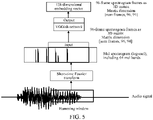
- FIG. 5 is a schematic diagram of a processing process of a multimedia information processing model according to an embodiment of this application.
- the feature extraction of the multimedia information processing model may be implemented by a visual geometry group (VGGish) network.
- VGish visual geometry group
- audio features are extracted from a mel spectrogram through the Vggish network, and extracted vectors are clustered and encoded by net vector of locally aggregated descriptors (NetVLAD) to obtain audio feature vectors.
- the NetVLAD can save a distance between each feature point and a nearest cluster center and use the distance as a new feature.
- the VGGish network supports the extraction of 128-dimensional embedding feature vectors with semantics, that is, the audio feature vectors, from a corresponding audio.
- an audio is first converted into an input triplet sample of a mel spectrogram as the input of the VGGish network.
- An example of the conversion process is as follows: the signal amplitude is used to calculate a spectrogram, the spectrogram is mapped to a 64-order mel filter bank to calculate a mel spectrogram, to obtain N input triplet samples mapped from Hz to the mel spectrogram, and a feature dimension is N ⁇ 96 ⁇ 64.
- a Tensorflow-based VGGish network may be used as an audio feature extractor, that is, the input triplet sample is used as the input of the VGGish network, and the VGGish network is used for feature extraction to obtain N ⁇ 128 audio feature vectors.
- Step 404 Determine, by the multimedia information processing apparatus based on an audio feature vector corresponding to a source audio in source multimedia information and an audio feature vector corresponding to a target audio in target multimedia information, a similarity between the target multimedia information and the source multimedia information.
- the similarity between two pieces of multimedia information may be determined according to the audio feature vector.
- the source multimedia information and the target multimedia information are respectively named, an audio in the source multimedia information is named as the source audio, and an audio in the target multimedia information is named as the target audio. Then, through the step 401 to the step 403, the audio feature vector corresponding to the source audio and the audio feature vector corresponding to the target audio may be determined.
- the similarity between the target multimedia information and the source multimedia information can be determined, that is, the similarity identification of multimedia information is implemented.
- FIG. 6 is a schematic flowchart of similarity identification according to an embodiment of this application. It can be understood that steps shown in FIG. 6 can be performed by various electronic devices running the multimedia information processing apparatus, for example, a terminal, a server, or a server cluster with a multimedia information processing function.
- the multimedia information processing apparatus may trigger a mini program in the terminal to perform similarity identification of multimedia information; and when the multimedia information processing apparatus runs in a short video copyright detection server and a music playing software server, the copyright detection may be performed on a corresponding short video or an audio.
- the steps shown in FIG. 6 The following describes the steps shown in FIG. 6 .
- Step 601 Determine a corresponding inter-frame similarity parameter set based on an audio feature vector corresponding to a source audio in source multimedia information and an audio feature vector corresponding to a target audio in target multimedia information.
- the source audio may be divided into a plurality of audio frames
- the target audio may be divided into a plurality of audio frames
- the source audio and the target audio may correspond to the same division standard (for example, a duration of each audio frame).
- pairwise combination processing (such as exhaustive pairwise combination processing) is performed on the plurality of audio frames divided from the source audio and the plurality of audio frames divided from the target audio, to obtain a plurality of audio frame pairs, where each of the audio frame pairs includes one audio frame divided from the source audio and one audio frame divided from the target audio.
- an inter-frame similarity between the two audio frames is determined. Then, an inter-frame similarity parameter set is constructed according to all inter-frame similarities.
- Step 602 Determine a quantity of audio frames in the inter-frame similarity parameter set reaching a similarity threshold.
- a quantity of audio frames (a quantity of audio frames may refer to a quantity of audio frame pairs) whose inter-frame similarities reach a similarity threshold is determined.
- Step 603 Perform a step 604 in a case that the quantity of audio frames reaching the similarity threshold exceeds a quantity threshold; otherwise, perform a step 605.
- the quantity of audio frames reaching the similarity threshold is compared with the quantity threshold. In a case that the quantity of audio frames reaching the similarity threshold exceeds the quantity threshold, it is determined that the target multimedia information is similar to the source multimedia information; and in a case that the quantity of audio frames reaching the similarity threshold does not exceed the quantity threshold, it is determined that the target multimedia information is dissimilar to the source multimedia information.
- Step 604 Determine that the target multimedia information is similar to the source multimedia information, and prompt to provide copyright information.
- the copyright information which may be copyright information of at least one of the target multimedia information and the source multimedia information, may be prompted to be provided.
- Step 605 Determine that the target multimedia information is dissimilar to the source multimedia information, and enter a corresponding recommendation process.
- the recommendation process may be used for recommending at least one of the target multimedia information and the source multimedia information.
- the copyright information of the target multimedia information and the copyright information of the source multimedia information are obtained; the legality of the target multimedia information is determined through the copyright information of the target multimedia information and the copyright information of the source multimedia information; and in a case that the copyright information of the target multimedia information is inconsistent with the copyright information of the source multimedia information, warning information is transmitted.
- the copyright information of the target multimedia information and the copyright information of the source multimedia information can be obtained, and the legality of the target multimedia information can be determined through the copyright information of the target multimedia information and the copyright information of the source multimedia information.
- the source multimedia information as legal by default as an example, in a case that the copyright information of the target multimedia information is consistent with the copyright information of the source multimedia information, it is determined that the target multimedia information is legal; and in a case that the copyright information of the target multimedia information is inconsistent with the copyright information of the source multimedia information, it is determined that the target multimedia information is illegal. In addition, in a case that the copyright information of the target multimedia information is inconsistent with the copyright information of the source multimedia information, warning information may also be transmitted.
- the legality of the source multimedia information may also be determined on the premise that the target multimedia information is legal by default.
- the target multimedia information in response to determining that the target multimedia information is dissimilar to the source multimedia information, the target multimedia information is added to a multimedia information source; a recall order of to-be-recommended multimedia information in the multimedia information source is sorted; and based on a sorting result of the recall order of the to-be-recommended multimedia information, the multimedia information is recommended to a target user.
- the target multimedia information can be added to the multimedia information source as the to-be-recommended multimedia information in the multimedia information source.
- the source multimedia information may also be added to the multimedia information source.
- the recall order of the to-be-recommended multimedia information in the multimedia information source is sorted, and based on the sorting result of the recall order of the to-be-recommended multimedia information, the multimedia information is recommended to the target user.
- FIG. 7 is a schematic flowchart of training a multimedia information processing model according to an embodiment of this application. It can be understood that steps shown in FIG. 7 may be performed by various electronic devices running the multimedia information processing apparatus, such as a terminal, a server, or a server cluster with a multimedia information processing function. Before deploying the multimedia information processing model, the multimedia information processing model may be trained, which is described with reference to the steps shown in FIG. 7 .
- Step 701 Obtain a first training sample set, the first training sample set including audio samples in the obtained multimedia information.
- the first training sample set is obtained, the first training sample set including the audio samples in the obtained video information (for example, obtained by a terminal), and the first training sample set may include at least one audio sample.
- Step 702 Perform noise addition on the first training sample set to obtain a corresponding second training sample set.
- noise addition is performed on the first training sample set to obtain the corresponding second training sample set, which may be implemented in the following manners: determining a dynamic noise type matching an environment in which the multimedia information processing model is used; and performing noise addition on the first training sample set according to the dynamic noise type, to change at least one of background noise, volume, sampling rate, and sound quality of the audio samples in the first training sample set, so as to obtain the corresponding second training sample set.
- audio information attacks include but are not limited to: an attack by changing an audio frequency, and an attack by changing a speed of a video. Therefore, in a construction process of the second training sample set, an audio enhancement data set may be made according to an audio attack type, where an audio enhancement form (that is, dynamic noise type) includes but is not limited to: voice change, addition of background noise, volume change, sample rate change, sound quality change. Different enhanced audios may be obtained by setting different audio enhancement forms.
- the construction of the second training sample set does not use situations in which video duration changes or frame pairs are not neat due to a frame shift.
- the second training sample set is made according to the audio enhancement data set.
- one original audio corresponds to 20 attack audios in the audio enhancement data set. Durations of each of the attack audios and the original audio are the same and there is no frame shift (that is, an audio at a corresponding time point is the same), the audio duration is dur, and the step is 0.96s, then each set of audios (original audio + corresponding attack audio) generates dur/0.96 labels, and labels at the same time point are the same. According to the attack audios and the corresponding labels, the second training sample set can be constructed.
- Step 703 Process the second training sample set through a multimedia information processing model, to determine initial parameters of the multimedia information processing model.
- Step 704 Process, in response to the initial parameters of the multimedia information processing model, the second training sample set through the multimedia information processing model, to determine updated parameters of the multimedia information processing model.
- the second training sample set in response to the initial parameters of the multimedia information processing model, is processed through the multimedia information processing model, to determine the updated parameters of the multimedia information processing model, which may be implemented in the following manners: substituting different audio samples in the second training sample set into a loss function corresponding to a triplet-loss layer network of the multimedia information processing model; determining parameters corresponding to the triplet-loss layer network in a case that the loss function satisfies a corresponding convergence condition; and determining the parameters of the triplet-loss layer network as the updated parameters of the multimedia information processing model.
- Step 705 Iteratively update network parameters of the multimedia information processing model through the second training sample set according to the updated parameters of the multimedia information processing model.
- the convergence condition matching the triplet-loss layer network in the multimedia information processing model may be determined; and the network parameters of the triplet-loss layer network are iteratively updated until the loss function corresponding to the triplet-loss layer network satisfies the corresponding convergence condition.
- the multimedia information processing model including a VGGish network as an example
- a 128-dimensional vector obtained by the VGGish network is inputted into a triplet-loss layer network (triplet-loss layer) in the multimedia information processing model for training, and finally similar audios obtain similar embedding outputs (that is, audio feature vectors).
- L represents a triplet loss function
- a is a sample
- p represents a sample similar to a
- n represents a sample belonging to a category different from that of a (that is, dissimilar to a)
- d(a, p) is a distance between a and p in a vector space
- d(a, n) is the same.
- a final optimization goal of the iterative processing shown in FIG. 8 is to narrow the distance between a and p, and to widen a distance between a and n, which may include the following three cases:
- related information of the multimedia information may be stored in a blockchain network or a cloud server, so as to accurately determine the similarity of multimedia information.
- an identifier of multimedia information, an audio feature vector corresponding to an audio in the multimedia information, and copyright information of the multimedia information may also be transmitted to the blockchain network, so that a node of the blockchain network fills the identifier of the multimedia information, the audio feature vector corresponding to the audio in the multimedia information, and the copyright information of the multimedia information into a new block, and in a case that a consensus on the new block is unanimous, the new block is appended to an end of a block chain.
- the following steps are further included: receiving a data synchronization request from another node in the blockchain network; verifying a permission of the another node in response to the data synchronization request; and performing data synchronization between a current node and the another node in a case that the verification on the permission of the another node succeeds, so that the another node can obtain the identifier of the multimedia information, the audio feature vector corresponding to the audio in the multimedia information, and the copyright information of the multimedia information.
- the following steps are further included: parsing, in response to a query request, the query request to obtain a corresponding object identifier; obtaining permission information in a target block in the blockchain network according to the object identifier; verifying a matchability between the permission information and the object identifier; correspondingly obtaining, in a case that the permission information matches the object identifier, the identifier of the multimedia information, the audio feature vector corresponding to the audio in the multimedia information, and the copyright information of the multimedia information in the blockchain network; and transmitting the obtained identifier of the multimedia information, the audio feature vector corresponding to the audio in the multimedia information, and the copyright information of the multimedia information to a corresponding client, so that the client obtains the identifier of the multimedia information, the audio feature vector corresponding to the audio in the multimedia information, and the copyright information of the multimedia information.
- FIG. 9 is a schematic diagram of an architecture of a blockchain network according to an embodiment of this application, including a blockchain network 200 (including a plurality of consensus nodes, where a consensus node 210 is exemplarily shown in FIG. 9 ), an authentication center 300, a service entity 400, and a service entity 500, which are respectively described below.
- the type of the blockchain network 200 is flexible and diverse, such as any one of a public chain, a private chain, or a consortium chain.
- an electronic device of any service entity such as a user terminal and a server, may access the blockchain network 200 without authorization; and taking the consortium chain as an example, an electronic device (such as a terminal/server) under the jurisdiction of a service entity which has obtains authorization may access the blockchain network 200, and become a client node in the blockchain network 200 in this case.
- the client node may only serve as an observer of the blockchain network 200, that is, to provide a function of supporting a service entity to initiate a transaction (for example, for storing data on a chain or querying data on a chain), and the client node may implement the function, such as a sorting function, a consensus service, and a ledger function of the consensus nodes 210 of the blockchain network 200 by default or selectively (for example, depending on specific service needs of the service entity). Therefore, data and a service processing logic of the service entity can be migrated to the blockchain network 200 to a greatest extent, and the data and the service processing process can be trustworthy and traceable through the blockchain network 200.
- the consensus nodes in the blockchain network 200 receive a transaction submitted by client nodes (for example, a client node 410 belonging to a service entity 400 and a client node 510 belonging to a database operator system shown in a foregoing embodiment) from different service entities (for example, the service entity 400 and the service entity 500 shown in a foregoing implementation), execute the transaction to update a ledger or query the ledger, and execute various intermediate results or final results of the transaction, or the final results may be returned to the client nodes of the service entities for display.
- client nodes for example, a client node 410 belonging to a service entity 400 and a client node 510 belonging to a database operator system shown in a foregoing embodiment
- service entities for example, the service entity 400 and the service entity 500 shown in a foregoing implementation
- a client node 410/510 may subscribe to events of interest in the blockchain network 200, such as transactions occurring in a specific organization/channel in the blockchain network 200, and the consensus nodes 210 push corresponding transaction notifications to the client node 410/510, thereby triggering a corresponding service logic in the client node 410/510.
- An exemplary application of the blockchain network is described by taking an example in which a plurality of service entities access the blockchain network to manage related information of multimedia information.
- a plurality of service entities involved in a management process for example, the service entity 400 which may be a multimedia information processing apparatus and the service entity 500 which may be a display system with a multimedia information processing function, each register to obtain a respective digital certificate from the authentication center 300.
- the digital certificate includes a public key of the service entity, and a digital signature signed by the authentication center 300 on the public key and identity information of the service entity, which are used for attaching to a transaction together with a digital signature of the service entity for the transaction, and are transmitted to the blockchain network, for the blockchain network to take out the digital certificate and the signature from the transaction, and verify the reliability of a message (that is, whether it has not been tampered with) and the identity information of the service entity transmitting the message.
- the blockchain network verifies based on an identity, such as a permission to initiate a transaction.
- a client running on an electronic device (such as a terminal or server) under the jurisdiction of the service entity may request to access to the blockchain network 200 to become a client node.
- the client node 410 of the service entity 400 is configured to transmit an identifier of multimedia information, an audio feature vector corresponding to an audio in the multimedia information, and copyright information of the multimedia information to the blockchain network, so that a node of the blockchain network fills the identifier of the multimedia information, the audio feature vector corresponding to the audio in the multimedia information, and the copyright information of the multimedia information into a new block, and in a case that a consensus on the new block is unanimous, the new block is appended to an end of a block chain.
- the identifier of the multimedia information, the audio feature vector corresponding to the audio in the multimedia information, and the copyright information of the multimedia information are correspondingly transmitted to the blockchain network 200, and a service logic may be preset in the client node 410.
- the client node 410 automatically transmits an identifier of the target multimedia information, an audio feature vector corresponding to an audio in the target multimedia information, and copyright information of the target multimedia information to the blockchain network 200, or a service personnel of the service entity 400 logs in in the client node 410, and manually packages and transmits the identifier of the target multimedia information, the audio feature vector corresponding to the audio in the target multimedia information, and the copyright information of the target multimedia information to the blockchain network 200.
- the client node 410 When transmitting, the client node 410 generates a transaction corresponding to an update operation according to the identifier of the multimedia information, the audio feature vector corresponding to the audio in the multimedia information, and the copyright information of the multimedia information, specifies, in the transaction, a smart contract that needs to be called to implement the update operation, and parameters passed to the smart contract, where the transaction also carries a digital certificate of the client node 410, a signed digital signature (for example, obtained by encrypting a digest of the transaction using a private key in the digital certificate of the client node 410), and broadcasts the transaction to the consensus nodes 210 in the blockchain network 200.
- a smart contract for example, obtained by encrypting a digest of the transaction using a private key in the digital certificate of the client node 410
- the consensus nodes 210 in the blockchain network 200 verify the digital certificate and the digital signature carried in the transaction, and after successful verification, confirm whether the service entity 400 has transaction authority according to an identity of the service entity 400 carried in the transaction, and any verification determining in the digital signature and the authority verification causes the transaction to fail.
- a digital signature of the consensus nodes 210 is signed (for example, obtained by encrypting a digest of the transaction using a private key of the consensus nodes 210), and the broadcasting continues to be performed in the blockchain network 200.
- the consensus nodes 210 in the blockchain network 200 fill the transaction into a new block and broadcast the transaction.
- the consensus nodes 210 in the blockchain network 200 perform a consensus process on the new block, and in a case that the consensus is successful, append the new block to an end of a block chain stored thereof, update a state database according to a result of the transaction, and execute the transaction in the new block: For a submitted transaction in which the identifier of the multimedia information, the audio feature vector corresponding to the audio in the multimedia information, and the copyright information of the multimedia information are to be updated and processed, a key-value pair including the identifier of the multimedia information, the audio feature vector corresponding to the audio in the multimedia information, and the copyright information of the multimedia information is added to the state database.
- a service personnel of the service entity 500 logs in in the client node 510, and inputs a query request for the identifier of the multimedia information, the audio feature vector corresponding to the audio in the multimedia information, and the copyright information of the multimedia information.
- the client node 510 generates a transaction corresponding to an update operation/query operation according to the query request, specifies, in the transaction, a smart contract that needs to be called to implement the update operation/query operation and parameters passed to the smart contract, where the transaction also carries a digital certificate of the client node 510, a signed digital signature (for example, obtained by encrypting a digest of the transaction using a private key in the digital certificate of the client node 510), and broadcasts the transaction to the consensus nodes 210 in the blockchain network 200.
- the consensus nodes 210 in the blockchain network 200 receive the transaction, verify the transaction, and fill a block, in a case that a consensus is unanimous, appends the filled new block to an end of a block chain stored thereof, update a state database according to a result of the transaction, and execute the transaction in the new block: For a submitted transaction in which copyright information of a specific piece of multimedia information is to be updated, a key-value pair corresponding to the copyright information of the multimedia information in the state database is updated; and for a submitted transaction in which copyright information of a specific piece of multimedia information is to be queried, an identifier of the multimedia information, an audio feature vector corresponding to an audio in the multimedia information, and a key-value pair corresponding to copyright information of the multimedia information are queried from the state database, and a transaction result is returned.
- FIG. 9 exemplarily shows a process of directly uploading the identifier of the multimedia information, the audio feature vector corresponding to the audio in the multimedia information, and the copyright information of the multimedia information on a chain.
- the client node 410 may upload the identifier of the multimedia information, the audio feature vector corresponding to the audio in the multimedia information, and a hash of the copyright information of the multimedia information on the chain in pairs, and simultaneously store the identifier of the multimedia information, the audio feature vector corresponding to the audio in the multimedia information, and the copyright information of the multimedia information in a distributed file system or a database.
- the client node 510 may perform verification in combination with a corresponding hash in the blockchain network 200, thereby reducing the workload of an on-chain operation.
- FIG. 10 is a schematic structural diagram of a block chain in a blockchain network 200 according to an embodiment of this application.
- a header of each block may include not only hash values of all transactions in the block, but also hash values of all transactions in a previous block. After being filled into the block and a consensus of nodes in the blockchain network is unanimous, a newly generated transaction record is appended to an end of the block chain to form a chain-like growth.
- a chain structure based on hash values between blocks ensures the tamper-proof and anti-forgery of a transaction in a block.
- FIG. 11 is a schematic diagram of a functional architecture of a blockchain network 200 according to an embodiment of this application, including an application layer 201, a consensus layer 202, a network layer 203, a data layer 204, and a resource layer 205, which are respectively described below.
- the resource layer 205 encapsulates computing resources, storage resources, and communication resources for implementing consensus nodes 210 in the blockchain network 200.
- the data layer 204 encapsulates various data structures implementing a ledger, including a block chain implemented as a file in a file system, a key-value state database, and a proof of existence (for example, a hash tree of a transaction in a block).
- a ledger including a block chain implemented as a file in a file system, a key-value state database, and a proof of existence (for example, a hash tree of a transaction in a block).
- the network layer 203 encapsulates functions of a point-to-point (P2P) network protocol, a data prorogation mechanism, a data verification mechanism, an access authentication mechanism, and service entity identity management.
- P2P point-to-point
- the P2P network protocol implements the communication between the consensus nodes 210 in the blockchain network 200, the data propagation mechanism ensures the propagation of a transaction in the blockchain network 200, and the data verification mechanism is used for implementing the reliability of data transmission between the consensus nodes 210 based on a cryptographic method (such as a digital certificate, a digital signature, a public/private key pair); the access authentication mechanism is used for authenticating an identity of a service entity joining the blockchain network 200 according to actual service scenarios, and granting the service entity the authority to access the blockchain network 200 in a case that the authentication succeeds; and the service identity management is used for storing identities of service identities allowed to access the blockchain network 200, as well as permissions (for example, types of transactions that can be initiated).
- a cryptographic method such as a digital certificate, a digital signature, a public/private key pair
- the access authentication mechanism is used for authenticating an identity of a service entity joining the blockchain network 200 according to actual service scenarios, and granting the service entity the authority to access the blockchain network 200 in
- the consensus layer 202 encapsulates a mechanism (for example, a consensus mechanism), and functions of transaction management and ledger management for the consensus nodes 210 in the blockchain network 200 to reach a consensus on a block.
- the consensus mechanism includes a consensus algorithm such as POS, POW, and DPOS, and supports the pluggability of the consensus algorithm.
- the transaction management is used for verifying a digital signature carried in a transaction received by the consensus nodes 210, verifying identity information of a service entity, and determining whether the service identity has the authority to conduct the transaction according to the identity information (read relevant information from the service entity identity management); and service entities authorized to access the blockchain network 200 all have digital certificates issued by an authentication center, and the service entities use private keys in respective digital certificates to sign a submitted transaction, thereby declaring respective legal identities.
- the ledger management is used for maintaining a block chain and a state database.
- a consensus block is appended to an end of a block chain; and a transaction in the consensus block is executed, a key-value pair in a state database is updated in a case that the transaction includes an update operation, the key-value pair in the state database is queried in a case that the transaction includes a query operation, and a query result is returned to a client node of a service entity.
- Query operations on various dimensions of a state database are supported, including: querying a block based on a block vector number (such as a transaction hash); querying a block according to a block hash value; querying a block according to a transaction vector number; querying a transaction according to a transaction vector number; querying account data of a service entity according to an account (vector number) of a service entity; and querying a block chain in a channel based on a channel name.
- a block vector number such as a transaction hash
- querying a block according to a block hash value querying a block according to a transaction vector number
- querying a transaction according to a transaction vector number querying account data of a service entity according to an account (vector number) of a service entity
- querying a block chain in a channel based on a channel name including: querying a block based on a block vector number (such as a transaction hash); querying a block according to a block hash
- the application layer 201 encapsulates various services that the blockchain network can implement, including transaction traceability, evidencing, verification, and the like.
- copyright information of multimedia information that has gone through similarity identification can be stored in a blockchain network.
- the multimedia information server may call the copyright information in the blockchain network, to verify the copyright compliance of the multimedia information uploaded by the user.
- FIG. 12 is a schematic diagram of a use scenario of a multimedia information processing method according to an embodiment of this application.
- a terminal such as terminal 10-1 and terminal 10-2 shown in FIG. 1
- a client capable of displaying a software corresponding to the short video, such as a client or a plug-in for short video playing, and a user may obtain and display the short video through the corresponding client;
- the terminal is connected to a short video server 200 through a network 300, and the network 300 may be a wide area network or a local area network, or a combination of the two, and implements data transmission using a wireless link.
- the user may also upload the short video through a mini program in the terminal for other users in the network to watch.
- a video server of an operator needs to detect the short video uploaded by the user, compare and analyze different video information, for example, determine whether a copyright of the short video uploaded by the user is compliant, and recommend the compliant video to different users, so as to avoid the short video of the user from being pirated.
- FIG. 13 is a schematic diagram of a use process of a multimedia information processing method according to an embodiment of this application, and description is made with reference to steps shown in FIG. 13 .
- Step 1301 Obtain an audio in a video.
- the obtained video may be parsed to separate the audio from the video, and the audio may also be preprocessed through a preprocessing process, such as determining a mel spectrogram corresponding to the audio.
- Step 1302 Obtain a training sample set of a video information processing model (corresponding to the multimedia information processing model described above).
- Step 1303 Train the video information processing model, and determine corresponding model parameters (network parameters).
- the video information processing model is trained according to the training sample set (such as the second training sample set described above), and the corresponding model parameters are determined.
- Step 1304 Deploy the trained video information processing model in a corresponding video detection server.
- relevant detection may be performed through the trained video information processing model.
- Step 1305 Detect audios in different videos through the video information processing model, to determine whether the different videos are similar.
- copyright information of the target short video is determined, for example, corresponding copyright information uploaded by a user through a mini program run by a terminal 10-1 is obtained, or the copyright information is obtained according to a storage position of copyright information in a cloud server network.
- the legality of the target short video is determined through the copyright information of the target short video and copyright information of the source video. In a case that the copyright information of the target short video is inconsistent with the copyright information of the source video, warning information is transmitted.
- the target short video is added to a video source (corresponding to the multimedia information source described above) as a to-be-recommended video in the video source.
- a recall order of all to-be-recommended videos in the video source is sorted, and videos are recommended to a target user based on a sorting result of the recall order of the to-be-recommended videos, which is more conducive to the push of original videos.
- the software module stored in the multimedia information processing apparatus 2020 of a memory 202 may include: an information transmission module 2081, configured to parse multimedia information to separate an audio from the multimedia information; and an information processing module 2082, configured to convert the audio to obtain a mel spectrogram corresponding to the audio; determine, according to the mel spectrogram corresponding to the audio, an audio feature vector corresponding to the audio; and determine, based on an audio feature vector corresponding to a source audio in source multimedia information and an audio feature vector corresponding to a target audio in target multimedia information, a similarity between the target multimedia information and the source multimedia information.
- the information transmission module 2081 is further configured to: parse the multimedia information to obtain timing information of the multimedia information; parse, according to the timing information of the multimedia information, video parameters corresponding to the multimedia information, to obtain a playing duration parameter and an audio track information parameter that are corresponding to the multimedia information; and extract the audio from the multimedia information based on the playing duration parameter and the audio track information parameter that are corresponding to the multimedia information.
- the information processing module 2082 is further configured to: perform channel conversion processing on the audio to obtain mono audio data; perform STFT on the mono audio data based on a windowing function, to obtain a corresponding spectrogram; and process the spectrogram according to a duration parameter, to obtain the mel spectrogram corresponding to the audio.
- the information processing module 2082 is further configured to: determine corresponding input triplet samples based on the mel spectrogram; perform cross-processing on the input triplet samples through a convolutional layer and a max pooling layer of a multimedia information processing model, to obtain downsampling results of the different input triplet samples; normalize the downsampling results through a fully connected layer of the multimedia information processing model, to obtain normalized results; and perform deep factorization processing on the normalized results through the multimedia information processing model, to obtain audio feature vectors matching the different input triplet samples.
- the information processing module 2082 is further configured to: obtain a first training sample set, the first training sample set including audio samples in acquired video information; perform noise addition on the first training sample set to obtain a corresponding second training sample set; process the second training sample set through a multimedia information processing model, to determine initial parameters of the multimedia information processing model; process, in response to the initial parameters of the multimedia information processing model, the second training sample set through the multimedia information processing model, to determine updated parameters of the multimedia information processing model; iteratively update network parameters of the multimedia information processing model through the second training sample set according to the updated parameters of the multimedia information processing model.
- the information processing module 2082 is further configured to: determine a dynamic noise type matching an environment in which the multimedia information processing model is used; and perform noise addition on the first training sample set according to the dynamic noise type, to change at least one of background noise, volume, sampling rate, and sound quality of the audio samples in the first training sample set, so as to obtain the corresponding second training sample set.
- the information processing module 2082 is further configured to: substitute different audio samples in the second training sample set into a loss function corresponding to a triplet-loss layer network of the multimedia information processing model; determine parameters corresponding to the triplet-loss layer network in a case that the loss function satisfies a corresponding convergence condition; and determine the parameters of the triplet-loss layer network as the updated parameters of the multimedia information processing model.
- the information processing module 2082 is further configured to: determine a convergence condition matching a triplet-loss layer network in the multimedia information processing model; and iteratively update network parameters of the triplet-loss layer network until a loss function corresponding to the triplet-loss layer network satisfies the convergence condition.
- the information processing module 2082 is further configured to: determine a corresponding inter-frame similarity parameter set based on the audio feature vector corresponding to the source audio in the source multimedia information and the audio feature vector corresponding to the target audio in the target multimedia information; determine a quantity of audio frames in the inter-frame similarity parameter set reaching a similarity threshold; and determine the similarity between the target multimedia information and the source multimedia information based on the quantity of audio frames reaching the similarity threshold.
- the information processing module 2082 is further configured to: obtain, in response to determining that the target multimedia information is similar to the source multimedia information, copyright information of the target multimedia information and copyright information of the source multimedia information; determine the legality of the target multimedia information through the copyright information of the target multimedia information and the copyright information of the source multimedia information; and transmit warning information in a case that the copyright information of the target multimedia information is inconsistent with the copyright information of the source multimedia information.
- the information processing module 2082 is further configured to: add, in response to determining that the target multimedia information is dissimilar to the source multimedia information, the target multimedia information to a multimedia information source; sort a recall order of to-be-recommended multimedia information in the multimedia information source; and recommend the multimedia information to a target user based on a sorting result of the recall order of the to-be-recommended multimedia information.
- the information processing module 2082 is further configured to: transmit an identifier of the multimedia information, an audio feature vector corresponding to an audio in the multimedia information, and copyright information of the multimedia information to a blockchain network, so that a node of the blockchain network fills the identifier of the multimedia information, the audio feature vector corresponding to the audio in the multimedia information, and the copyright information of the multimedia information into a new block, and in a case that a consensus on the new block is unanimous, the new block is appended to an end of a block chain.
- the information processing module 2082 is further configured to: receive a data synchronization request from another node in the blockchain network; verify a permission of the another node in response to the data synchronization request; and perform data synchronization between a current node and the another node in a case that the verification on the permission of the another node succeeds, so that the another node can obtain the identifier of the multimedia information, the audio feature vector corresponding to the audio in the multimedia information, and the copyright information of the multimedia information.
- the information processing module 2082 is further configured to: parse, in response to a query request, the query request to obtain a corresponding object identifier; obtain permission information in a target block in the blockchain network according to the object identifier; verify a matchability between the permission information and the object identifier; correspondingly obtain, in a case that the permission information matches the object identifier, the identifier of the multimedia information, the audio feature vector corresponding to the audio in the multimedia information, and the copyright information of the multimedia information in the blockchain network; and transmit the obtained identifier of the multimedia information, the audio feature vector corresponding to the audio in the multimedia information, and the copyright information of the multimedia information to a corresponding client, so that the client obtains the identifier of the multimedia information, the audio feature vector corresponding to the audio in the multimedia information, and the copyright information of the multimedia information.
- the embodiments of this application have at least the following technical effects:
- a similarity between multimedia information can be accurately and effectively determined according to the audio feature vector, and the accuracy of determining the similarity between the multimedia information is improved.
- the multimedia information is a video
- the misdetermining of a video similarity caused by excessive processing (such as excessive cropping) on a video image due to the determining solely relying on the video image is reduced.
Landscapes
- Engineering & Computer Science (AREA)
- Signal Processing (AREA)
- Physics & Mathematics (AREA)
- Multimedia (AREA)
- Business, Economics & Management (AREA)
- Health & Medical Sciences (AREA)
- Computer Security & Cryptography (AREA)
- Acoustics & Sound (AREA)
- Human Computer Interaction (AREA)
- Audiology, Speech & Language Pathology (AREA)
- Computational Linguistics (AREA)
- Strategic Management (AREA)
- Theoretical Computer Science (AREA)
- General Physics & Mathematics (AREA)
- Marketing (AREA)
- Economics (AREA)
- Finance (AREA)
- Accounting & Taxation (AREA)
- Computer Networks & Wireless Communication (AREA)
- General Business, Economics & Management (AREA)
- Entrepreneurship & Innovation (AREA)
- Development Economics (AREA)
- Quality & Reliability (AREA)
- Operations Research (AREA)
- Human Resources & Organizations (AREA)
- Tourism & Hospitality (AREA)
- Databases & Information Systems (AREA)
- Spectroscopy & Molecular Physics (AREA)
- Game Theory and Decision Science (AREA)
- General Health & Medical Sciences (AREA)
- Bioethics (AREA)
- Computer Hardware Design (AREA)
- Software Systems (AREA)
- General Engineering & Computer Science (AREA)
- Technology Law (AREA)
- Two-Way Televisions, Distribution Of Moving Picture Or The Like (AREA)
- Information Retrieval, Db Structures And Fs Structures Therefor (AREA)
Abstract
Description
- This application is proposed based on a
Chinese Patent Application No. 202010956391.X filed on September 11, 2020 - This application relates to multimedia information processing technologies, and in particular, to a multimedia information processing method and apparatus, an electronic device, and a storage medium.
- In the related art, multimedia information is in various forms, an explosive growth is seen in the demand on multimedia information, and a quantity and types of multimedia information are also increasing.
- Taking videos as an example, with the popularization and development of video editing tools, types of video image attacks have become more complex, and it is more difficult to identify similar videos through excessive video cropping. In a cropped video of this type, it is difficult to identify, simply by relying on video image fingerprints, some video repeating and infringing content that have changed a lot on a screen, resulting in low similarity identification accuracy.
- Technical solutions in the embodiments of this application are implemented as follows:
- The embodiments of this application provide a multimedia information processing method, performed by an electronic device, the method including:
- parsing multimedia information to separate an audio from the multimedia information;
- converting the audio to obtain a mel spectrogram corresponding to the audio;
- determining, according to the mel spectrogram corresponding to the audio, an audio feature vector corresponding to the audio; and
- determining, based on an audio feature vector corresponding to a source audio in source multimedia information and an audio feature vector corresponding to a target audio in target multimedia information, a similarity between the target multimedia information and the source multimedia information.
- The embodiments of this application further provide a multimedia information processing apparatus, including:
- an information transmission module, configured to parse multimedia information to separate an audio from the multimedia information; and
- an information processing module, configured to:
- convert the audio to obtain a mel spectrogram corresponding to the audio;
- determine, according to the mel spectrogram corresponding to the audio, an audio feature vector corresponding to the audio; and
- determine, based on an audio feature vector corresponding to a source audio in source multimedia information and an audio feature vector corresponding to a target audio in target multimedia information, a similarity between the target multimedia information and the source multimedia information.
- The embodiments of this application further provide an electronic device, including:
- a memory, configured to store an executable instruction; and
- a processor, configured to implement the multimedia information processing method provided in the embodiments of this application when executing the executable instruction stored in the memory.
- The embodiments of this application further provide a computer-readable storage medium, storing executable instructions, the executable instructions, when executed by a processor, implementing the multimedia information processing method provided in the embodiment of this application.
-
-
FIG. 1 is a schematic diagram of a use environment of a multimedia information processing method according to an embodiment of this application. -
FIG. 2 is a schematic structural diagram of composition of an electronic device according to an embodiment of this application. -
FIG. 3 is a schematic diagram of excessive video cropping according to an embodiment of this application. -
FIG. 4 is a schematic flowchart of a multimedia information processing method according to an embodiment of this application. -
FIG. 5 is a schematic diagram of a processing process of a multimedia information processing model according to an embodiment of this application. -
FIG. 6 is a schematic flowchart of similarity identification according to an embodiment of this application. -
FIG. 7 is a schematic flowchart of training a multimedia information processing model according to an embodiment of this application. -
FIG. 8 is a schematic diagram of an effect of iterative processing in an implementation of this application. -
FIG. 9 is a schematic diagram of an architecture of a blockchain network according to an embodiment of this application. -
FIG. 10 is a schematic structural diagram of a block chain in a blockchain network according to an embodiment of this application. -
FIG. 11 is a schematic diagram of a functional architecture of a blockchain network according to an embodiment of this application. -
FIG. 12 is a schematic diagram of a use scenario of a multimedia information processing method according to an embodiment of this application. -
FIG. 13 is a schematic diagram of a process of using a multimedia information processing method according to an embodiment of this application. - To make objectives, technical solutions, and advantages of this application clearer, the following describes this application in further detail with reference to the accompanying drawings. The described embodiments are not to be considered as a limitation to this application. All other embodiments obtained by a person of ordinary skill in the art without creative efforts shall fall within the protection scope of this application.
- In the following descriptions, the term "some embodiments" describes subsets of all possible embodiments, but it may be understood that "some embodiments" may be the same subset or different subsets of all the possible embodiments, and can be combined with each other without conflict.
- Before the embodiments of this application are further described in detail, a description is made on nouns and terms in the embodiments of this application, and the nouns and terms in the embodiments of this application are applicable to the following explanations.
- 1) "In response to" is used for representing a condition or status on which one or more operations to be performed depend. In a case that the condition or status is satisfied, the one or more operations may be performed immediately or after a set delay. Unless explicitly stated, there is no limitation on the order in which the plurality of operations are performed.
- 2) Multimedia information generally refers to multimedia information in various forms available on the Internet. The multimedia information may include at least one of texts, sounds, and images, but is certainly not limited thereto. For example, the multimedia information may be a long video (such as a video with a duration greater than or equal to 1 minute uploaded by a user), a short video (such as a video with a duration less than 1 minute uploaded by a user), or may be an audio, such as a music video (MV) with a fixed image or an album.
- 3) Client is a carrier implementing specific functions in a terminal, for example, a mobile client (APP) is a carrier implementing specific functions in a mobile terminal, such as executing a function of performing online live broadcast (video streaming) or a function of playing an online video.
- 4) Short-time Fourier transform (STFT) is a mathematical transform related to Fourier transform, and is used for determining a frequency and a phase of a sine wave in a partial region of a time-varying signal.
- 5) Mel Bank Features (MBF): Because a spectrogram obtained by audio processing (such as STFT processing) is relatively large, to obtain sound features of an appropriate size, the spectrogram may pass through Mel-scale filter banks, to transform the spectrogram into Mel Bank Features. The spectrogram is obtained by stacking spectrograms over time.
- 6) Information flow is an organized form of content arranged up and down according to specific specifications and styles. From the perspective of display sorting, time sorting, popularity sorting, or algorithm sorting may be applied.
- 7) Audio feature vector is an audio 01 vector, which is a binarized feature vector generated based on an audio.
-
FIG. 1 is a schematic diagram of a use environment of a multimedia information processing method according to an embodiment of this application. Referring toFIG. 1 , a client capable of performing different functions is arranged on a terminal (such as terminal 10-1 and terminal 10-2). The terminal (such as terminal 10-1 and terminal 10-2) may obtain different multimedia information for browsing from acorresponding server 200 through anetwork 300 by using a service process in the client. Thenetwork 300 may be a wide area network or a local area network, or a combination of the two, which uses a wireless link to implement data transmission. Types of multimedia information obtained by the terminal (such as terminal 10-1 and terminal 10-2) from thecorresponding server 200 through thenetwork 300 are not limited, for example, including but not limited to: a long video (such as a video with a duration greater than or equal to 1 minute uploaded by a user, or an existing video which needs to undergo copyright verification by the user), a short video (such as a video with a duration less than 1 minute uploaded by a user), and an audio (such as an MV with a fixed image or an album). For example: The terminal (such as terminal 10-1 and terminal 10-2) may either obtain a long video (that is, a video carry video information or a corresponding video link) from thecorresponding server 200 through thenetwork 300, or may obtain a short video from acorresponding server 400 for browsing through the same video client or a WeChat mini program by using thenetwork 300. Multimedia information of different types may be stored in theserver 200 and theserver 400. Playing environments of multimedia information of different types are not differentiated in this application. Multimedia information pushed to a client of the user during this process needs to be copyright-compliant multimedia information. Therefore, for a large quantity of multimedia information, it is necessary to determine which multimedia information is similar, and further perform compliance detection on copyright information of similar multimedia information, so as to avoid pushing duplicate or infringing multimedia information. - Taking short videos as an example, the embodiments of this application may be applied to short video playing. In short video playing, different short videos from different data sources are usually processed, and finally to-be-recommended videos corresponding to corresponding user are presented on a user interface (UI). If the recommended videos are pirated videos with non-compliant copyrights, there may be a negative impact on the user experience. A background database used for video playing receives a large amount of video data from different sources every day, and the obtained different videos for multimedia information recommendation to target users may also be called by other applications (for example, a recommendation result of a short video recommendation process is migrated to a long video recommendation process or a news recommendation process). Certainly, a multimedia information processing model matching a corresponding target user may also be migrated to different multimedia information recommendation processes (for example, a multimedia information recommendation process of a webpage, a multimedia information recommendation process of a mini program, or a multimedia information recommendation process of a long video client).
- In some embodiments, the multimedia information processing method provided in the embodiments of this application may be implemented by a terminal. For example, a terminal (such as terminal 10-1 and terminal 10-2) may locally implement the multimedia information processing solutions.
- In some embodiments, the multimedia information processing method provided in the embodiments of this application may be implemented by a server. For example, a
server 200 may implement the multimedia information processing solutions. - In some embodiments, the multimedia information processing method provided in the embodiments of this application may be collaboratively implemented by a terminal and a server. For example, the terminal (such as terminal 10-1 and terminal 10-2) may transmit a request to the
server 200 to request theserver 200 to implement the multimedia information processing solutions. Theserver 200 may transmit the finally obtained to-be-recommended multimedia information to the terminal, so as to perform multimedia information recommendation. - The structure of an electronic device according to the embodiments of this application is described in detail below. The electronic device may be implemented in various forms, for example, a terminal with a multimedia information processing function, such as a mobile phone running a video client, where the trained multimedia information processing model may be encapsulated in a storage medium of the terminal, or may be a server or a server group with a multimedia information processing function, where the trained multimedia information processing model may be deployed in a server, such as the
server 200 inFIG. 1 described above.FIG. 2 is a schematic structural diagram of composition of an electronic device according to an embodiment of this application. It may be understood that,FIG. 2 shows only an exemplary structure rather than a complete structure of the electronic device. The structure shown inFIG. 2 may be partially or entirely implemented according to requirements. - The electronic device provided in the embodiments of this application may include: at least one
processor 201, amemory 202, auser interface 203, and at least onenetwork interface 204. All the components in theelectronic device 20 are coupled together by using abus system 205. It may be understood that thebus system 205 is configured to implement connection and communication between the components. In addition to a data bus, thebus system 205 further includes a power bus, a control bus, and a status signal bus. However, for ease of clear description, all types of buses are marked as thebus system 205 inFIG. 2 . - The
user interface 203 may include a display, a keyboard, a mouse, a track ball, a click wheel, a key, a button, a touch panel, a touchscreen, or the like. - It may be understood that, the
memory 202 may be a volatile memory or a non-volatile memory, or may include both a volatile memory and a non-volatile memory. Thememory 202 in the embodiments of this application can store data to support operations of the terminal (for example, terminal 10-1 or terminal 10-2). An example of the data includes: any computer program, for example, an operating system and an application, configured to be operated on the terminal (for example, terminal 10-1 and terminal 10-2). The operating system includes various system programs, such as framework layers, kernel library layers, and driver layers used for implementing various basic services and processing hardware-based tasks. The application may include various application programs. - In some embodiments, a multimedia information processing apparatus provided in the embodiments of this application may be implemented in the form of a combination of software and hardware. In an example, the multimedia information processing apparatus provided in the embodiments of this application may be a processor in the form of a hardware decoding processor, and is programmed to perform the multimedia information processing method provided in the embodiments of this application. For example, the processor in the form of the hardware decoding processor may use one or more application specific integrated circuits (ASICs), digital signal processors (DSPs), programmable logic devices (PLDs), complex programmable logic devices (CPLDs), field-programmable gate arrays (FPGAs), or other electronic elements.
- For example, the multimedia information processing apparatus provided in the embodiments of this application is implemented by a combination of software and hardware. The multimedia information processing apparatus provided in the embodiments of this application may be directly embodied as a combination of software modules executed by the
processor 201. The software modules may be located in a storage medium, the storage medium is located in thememory 202, and theprocessor 201 reads executable instructions included in the software modules in thememory 202, and implements, in combination with necessary hardware (for example, including aprocessor 201 and another component connected to the bus system 205), the multimedia information processing method provided in the embodiments of this application. - As an example, the
processor 201 may be an integrated circuit chip having a signal processing capability, for example, a general-purpose processor, a digital signal processor, or another programmable logic device, a discrete or transistor logic device, or a discrete hardware component, where the general-purpose processor may be a microprocessor, any conventional processor, or the like. - As an example in which the multimedia information processing apparatus provided in the embodiments of this application is implemented by hardware, the apparatus provided in the embodiments of this application may be directly executed by the
processor 201 in the form of a hardware decoding processor, for example, executed by one or more ASICs, DSPs, PLDs, CPLDs, FPGAs or other electronic elements to implement the multimedia information processing method provided in the embodiments of this application. - The
memory 202 in the embodiments of this application is configured to store data of various types to support operations of anelectronic device 20. An example of the data includes: any executable instruction used for being operated on theelectronic device 20, such as an executable instruction including a program for implementing the multimedia information processing method in the embodiments of this application. - In some other embodiments, the multimedia information processing apparatus provided in the embodiments of this application may be implemented in the form of software.
FIG. 2 shows a multimedia information processing apparatus 2020 stored in thememory 202, which may be software in the form of a program, a plug-in, or the like, and include a series of modules. An example of the program stored in thememory 202 may include the multimedia information processing apparatus 2020. The multimedia information processing apparatus 2020 includes the following software modules: an information transmission module 2081, and an information processing module 2082. In a case that a software module in the multimedia information processing apparatus 2020 is read into a RAM by theprocessor 201 and executed, the multimedia information processing method provided in the embodiments of this application is performed. - According to the electronic device shown in
FIG. 2 , the embodiments of this application also provide a computer program product or computer program, including a computer instruction (executable instruction) stored in a computer-readable storage medium. A processor of the electronic device reads the computer instruction in the computer-readable storage medium. The processor executes the computer instruction to cause the electronic device to implement different embodiments and a combination of the embodiments provided in various optional implementations of the multimedia information processing method described above. - Before describing the multimedia information processing method provided in this application, defects of the Related Art are described first. Although an existing video server can roughly identify a similarity between videos through a corresponding matching algorithm, with the popularization and development of video editing tools, types of video image attacks have become more complex.
FIG. 3 is a schematic diagram of excessive video cropping according to an embodiment of this application. In a cropped video shown inFIG. 3 , it is difficult to identify, by simply relying on video image fingerprints, some video repeating/infringing content that have changed a lot on a screen. In addition, with the upgrade of video interactive gameplay, more and more video screens are based on the same fixed background, and only a smaller proportion of the screen is user-defined content, which results in an overall high similarity between two screens, but the actual contents are different, and both belong to the original content. In the related art, audio information in videos may be compared through an audio fingerprint algorithm, to determine whether the videos are similar. Specifically, taking an audio fingerprint algorithm of landmark as an example, an audio is firstly Fourier transformed to generate an audio spectrogram; then, on the basis of the audio spectrogram, a corresponding constellation map is calculated according to a frequency peak point; and finally, the constellation map is processed to generate a combined hash landmark (tl, f1, f2, and t2-tl), where t1 and t2 represent two time points, f1 represents a maximum frequency value corresponding to a time point t1, and f2 represents a maximum frequency value at a corresponding time point t2. However, this process cannot implement accurate identification for a use environment with a lot of attack information, for example: For a use environment of a voice-changing attack, because the landmark depends on a frequency peak point, and a frequency of an audio is changed in a voice-changing video, a generated hash is different, which eventually results in a failure of similarity identification (that is, it is incorrectly identified as dissimilar); and similarly, for a use environment of a speed-up/slow-speed attack, because a combined hash in the landmark depends on a dt(t2-tl), and a dt of a speed-up/slow-speed audio changes, a generated hash is different, which eventually results in a failure of similarity identification. - To overcome the defects described above,
FIG. 4 is a schematic flowchart of a multimedia information processing method according to an embodiment of this application. It may be understood that steps shown inFIG. 4 may be performed by various electronic devices, such as a terminal, a server, or a server cluster with a multimedia information processing function, running the multimedia information processing apparatus. For example, when running in a terminal, the multimedia information processing apparatus may trigger a mini program in the terminal to perform similarity detection (similarity identification) of multimedia information; and when the multimedia information processing apparatus runs in a long video copyright detection server and a music playing software server, copyright detection may be performed on a corresponding long video or audio information. The following describes the steps shown inFIG. 4 . - Step 401: Parse, by a multimedia information processing apparatus, multimedia information to separate an audio from the multimedia information.
- The multimedia information is obtained, and the multimedia information is parsed to obtain the audio in the multimedia information.
- In some embodiments of this application, the multimedia information is parsed to separate the audio from the multimedia information, which may be implemented in the following manners:
parsing the multimedia information to obtain timing information of the multimedia information; parsing, according to the timing information of the multimedia information, video parameters corresponding to the multimedia information, to obtain a playing duration parameter and an audio track information parameter that are corresponding to the multimedia information; and extracting the audio from the multimedia information based on the playing duration parameter and the audio track information parameter that are corresponding to the multimedia information. - For example, the multimedia information is a video, an audio synchronization packet in the video may be obtained first, and the audio synchronization packet is used for representing timing information. Then, audio header decoding data AACDecoderSpecificInfo and audio data configuration information AudioSpecificConfig in the audio synchronization packet are parsed to obtain a playing duration parameter and an audio track information parameter that are corresponding to the video. The audio data configuration information AudioSpecificConfig is used for generating ADST (including a sampling rate, a quantity of channels, and frame length data in an audio). Based on the audio track information parameter, other audio packets in the video are obtained, original audio data is parsed, and finally an AAC elementary stream (ES) is packaged into an ADTS format through an advanced audio coding (AAC) decoder of an audio data header. For example, a 7-byte header file ADTSheader may be added before the AAC ES to extract an audio from multimedia information (such as a video).
- Step 402: Convert, by the multimedia information processing apparatus, the audio to obtain a mel spectrogram corresponding to the audio.
- The conversion processing is performed on the audio, to convert the audio to a mel spectrogram. Because the unit of frequency is Hertz (Hz), a frequency range audible to a human ear is 20-20000 Hz, but it is not a linear relationship between the human ear perception and the scale unit of Hz. For example, in a case that a human is adapted to a pitch of 1000 Hz, and if a frequency of the pitch is increased to 2000 Hz, then the human ear can only perceive that the frequency has increased a little, but cannot perceive that the frequency has doubled. If the audio is converted to data in a mel spectrogram (that is, converting the frequency scale to a mel frequency scale), it is a linear relationship between the human ear perception and the frequency. That is, under the mel frequency scale, in a case that mel frequencies of two audios are twice different, pitches audible to the human ear are also about twice different. Therefore, the beneficial technical effects of improving the perception of an audio and visualizing the audio can be implemented.
- In some embodiments of this application, the converting the audio to obtain a mel-spectrogram corresponding to the audio may be implemented in the following manners:
performing channel conversion processing on the audio to obtain mono audio data; performing STFT on the mono audio data based on a windowing function, to obtain a corresponding spectrogram; and processing the spectrogram according to a duration parameter, to obtain the mel spectrogram corresponding to the audio. - For example, the audio may first be resampled (that is, channel conversion processing) to 16 KHz mono audio data; then, a Hann time window of 25 ms is used, and with a frame shift of 10 ms, a periodic Hann window performs STFT on the mono audio data to obtain the corresponding spectrogram; a mel spectrum is calculated by mapping the spectrogram to a 64-order mel filter bank, where a range of mel bins is 125-7500 Hz; log(mel-spectrum+0.01) is calculated to obtain a stable mel spectrum, and an added bias of 0.01 is to avoid taking a logarithm of 0; and the obtained features are framed with a duration parameter of 0.96s, in which there is no overlap of frames, and each frame includes 64 mel frequency bands with a duration of 10 ms (a total of 96 frames), so as to extract the mel spectrogram corresponding to the audio. The windowing function and the duration parameter may be considered as corresponding to the multimedia information processing model.
- Step 403: Determine, by the multimedia information processing apparatus according to the mel spectrogram corresponding to the audio, an audio feature vector corresponding to the audio.
- According to the mel spectrogram corresponding to the audio, the audio feature vector corresponding to the audio is determined, and the audio feature vector can accurately and effectively reflect characteristics of the audio.
- In some embodiments of this application, the determining, according to the mel spectrogram corresponding to the audio, an audio feature vector corresponding to the audio may be implemented in the following manners:
determining corresponding input triplet samples based on the mel spectrogram; performing cross-processing on the input triplet samples through a convolutional layer and a max pooling layer of a multimedia information processing model, to obtain downsampling results of the different input triplet samples; normalizing the downsampling results through a fully connected layer of the multimedia information processing model, to obtain normalized results; and performing deep factorization processing on the normalized results through the multimedia information processing model, to obtain audio feature vectors matching the different input triplet samples. - As an example,
FIG. 5 is a schematic diagram of a processing process of a multimedia information processing model according to an embodiment of this application. The feature extraction of the multimedia information processing model may be implemented by a visual geometry group (VGGish) network. For example, audio features are extracted from a mel spectrogram through the Vggish network, and extracted vectors are clustered and encoded by net vector of locally aggregated descriptors (NetVLAD) to obtain audio feature vectors. The NetVLAD can save a distance between each feature point and a nearest cluster center and use the distance as a new feature. - The description is further made by taking the VGGish network as an example, the VGGish network supports the extraction of 128-dimensional embedding feature vectors with semantics, that is, the audio feature vectors, from a corresponding audio. In a process of feature extraction, an audio is first converted into an input triplet sample of a mel spectrogram as the input of the VGGish network. An example of the conversion process is as follows: the signal amplitude is used to calculate a spectrogram, the spectrogram is mapped to a 64-order mel filter bank to calculate a mel spectrogram, to obtain N input triplet samples mapped from Hz to the mel spectrogram, and a feature dimension is
N ∗96∗64. A Tensorflow-based VGGish network may be used as an audio feature extractor, that is, the input triplet sample is used as the input of the VGGish network, and the VGGish network is used for feature extraction to obtainN ∗128 audio feature vectors. - Step 404: Determine, by the multimedia information processing apparatus based on an audio feature vector corresponding to a source audio in source multimedia information and an audio feature vector corresponding to a target audio in target multimedia information, a similarity between the target multimedia information and the source multimedia information.
- In this embodiment of this application, the similarity between two pieces of multimedia information may be determined according to the audio feature vector. To facilitate the distinction, the source multimedia information and the target multimedia information are respectively named, an audio in the source multimedia information is named as the source audio, and an audio in the target multimedia information is named as the target audio. Then, through the step 401 to the step 403, the audio feature vector corresponding to the source audio and the audio feature vector corresponding to the target audio may be determined.
- Based on the audio feature vector corresponding to the source audio in the source multimedia information and the audio feature vector corresponding to the target audio in the target multimedia information, the similarity between the target multimedia information and the source multimedia information can be determined, that is, the similarity identification of multimedia information is implemented.
-
FIG. 6 is a schematic flowchart of similarity identification according to an embodiment of this application. It can be understood that steps shown inFIG. 6 can be performed by various electronic devices running the multimedia information processing apparatus, for example, a terminal, a server, or a server cluster with a multimedia information processing function. When running in the terminal, the multimedia information processing apparatus may trigger a mini program in the terminal to perform similarity identification of multimedia information; and when the multimedia information processing apparatus runs in a short video copyright detection server and a music playing software server, the copyright detection may be performed on a corresponding short video or an audio. The following describes the steps shown inFIG. 6 . - Step 601: Determine a corresponding inter-frame similarity parameter set based on an audio feature vector corresponding to a source audio in source multimedia information and an audio feature vector corresponding to a target audio in target multimedia information.
- For example, the source audio may be divided into a plurality of audio frames, and the target audio may be divided into a plurality of audio frames, where the source audio and the target audio may correspond to the same division standard (for example, a duration of each audio frame). Then, pairwise combination processing (such as exhaustive pairwise combination processing) is performed on the plurality of audio frames divided from the source audio and the plurality of audio frames divided from the target audio, to obtain a plurality of audio frame pairs, where each of the audio frame pairs includes one audio frame divided from the source audio and one audio frame divided from the target audio.
- For each of the audio frame pairs, according to audio feature vectors respectively corresponding to two audio frames in the each of the audio frame pairs, an inter-frame similarity between the two audio frames is determined. Then, an inter-frame similarity parameter set is constructed according to all inter-frame similarities.
- Step 602: Determine a quantity of audio frames in the inter-frame similarity parameter set reaching a similarity threshold.
- In the inter-frame similarity parameter set, a quantity of audio frames (a quantity of audio frames may refer to a quantity of audio frame pairs) whose inter-frame similarities reach a similarity threshold is determined.
- Step 603: Perform a
step 604 in a case that the quantity of audio frames reaching the similarity threshold exceeds a quantity threshold; otherwise, perform astep 605. - The quantity of audio frames reaching the similarity threshold is compared with the quantity threshold. In a case that the quantity of audio frames reaching the similarity threshold exceeds the quantity threshold, it is determined that the target multimedia information is similar to the source multimedia information; and in a case that the quantity of audio frames reaching the similarity threshold does not exceed the quantity threshold, it is determined that the target multimedia information is dissimilar to the source multimedia information.
- Step 604: Determine that the target multimedia information is similar to the source multimedia information, and prompt to provide copyright information.
- In a case that the target multimedia information is similar to the source multimedia information, it is proved that there may be a risk of copyright infringement. Therefore, the copyright information, which may be copyright information of at least one of the target multimedia information and the source multimedia information, may be prompted to be provided.
- Step 605: Determine that the target multimedia information is dissimilar to the source multimedia information, and enter a corresponding recommendation process.
- In a case that the target multimedia information is dissimilar to the source multimedia information, it is proved that there is no risk of copyright infringement. Therefore, a corresponding recommendation process may be directly entered. The recommendation process may be used for recommending at least one of the target multimedia information and the source multimedia information.
- In some embodiments of this application, in response to determining that the target multimedia information is similar to the source multimedia information, the copyright information of the target multimedia information and the copyright information of the source multimedia information are obtained; the legality of the target multimedia information is determined through the copyright information of the target multimedia information and the copyright information of the source multimedia information; and in a case that the copyright information of the target multimedia information is inconsistent with the copyright information of the source multimedia information, warning information is transmitted.
- In response to determining that the target multimedia information is similar to the source multimedia information, it is proved that there may be a risk of copyright infringement. Therefore, the copyright information of the target multimedia information and the copyright information of the source multimedia information can be obtained, and the legality of the target multimedia information can be determined through the copyright information of the target multimedia information and the copyright information of the source multimedia information.
- Taking the source multimedia information as legal by default as an example, in a case that the copyright information of the target multimedia information is consistent with the copyright information of the source multimedia information, it is determined that the target multimedia information is legal; and in a case that the copyright information of the target multimedia information is inconsistent with the copyright information of the source multimedia information, it is determined that the target multimedia information is illegal. In addition, in a case that the copyright information of the target multimedia information is inconsistent with the copyright information of the source multimedia information, warning information may also be transmitted.
- Certainly, in this embodiment of this application, the legality of the source multimedia information may also be determined on the premise that the target multimedia information is legal by default.
- In some embodiments of this application, in response to determining that the target multimedia information is dissimilar to the source multimedia information, the target multimedia information is added to a multimedia information source; a recall order of to-be-recommended multimedia information in the multimedia information source is sorted; and based on a sorting result of the recall order of the to-be-recommended multimedia information, the multimedia information is recommended to a target user.
- In response to determining that the target multimedia information is dissimilar to the source multimedia information, it is proved that there is no risk of copyright infringement. Therefore, the target multimedia information can be added to the multimedia information source as the to-be-recommended multimedia information in the multimedia information source. Certainly, the source multimedia information may also be added to the multimedia information source. In a case that the multimedia information recommendation needs to be performed, the recall order of the to-be-recommended multimedia information in the multimedia information source is sorted, and based on the sorting result of the recall order of the to-be-recommended multimedia information, the multimedia information is recommended to the target user.
-
FIG. 7 is a schematic flowchart of training a multimedia information processing model according to an embodiment of this application. It can be understood that steps shown inFIG. 7 may be performed by various electronic devices running the multimedia information processing apparatus, such as a terminal, a server, or a server cluster with a multimedia information processing function. Before deploying the multimedia information processing model, the multimedia information processing model may be trained, which is described with reference to the steps shown inFIG. 7 . - Step 701: Obtain a first training sample set, the first training sample set including audio samples in the obtained multimedia information.
- The first training sample set is obtained, the first training sample set including the audio samples in the obtained video information (for example, obtained by a terminal), and the first training sample set may include at least one audio sample.
- Step 702: Perform noise addition on the first training sample set to obtain a corresponding second training sample set.
- In some embodiments of this application, noise addition is performed on the first training sample set to obtain the corresponding second training sample set, which may be implemented in the following manners:
determining a dynamic noise type matching an environment in which the multimedia information processing model is used; and performing noise addition on the first training sample set according to the dynamic noise type, to change at least one of background noise, volume, sampling rate, and sound quality of the audio samples in the first training sample set, so as to obtain the corresponding second training sample set. - In this embodiment of this application, audio information attacks include but are not limited to: an attack by changing an audio frequency, and an attack by changing a speed of a video. Therefore, in a construction process of the second training sample set, an audio enhancement data set may be made according to an audio attack type, where an audio enhancement form (that is, dynamic noise type) includes but is not limited to: voice change, addition of background noise, volume change, sample rate change, sound quality change. Different enhanced audios may be obtained by setting different audio enhancement forms. In some embodiments of this application, the construction of the second training sample set does not use situations in which video duration changes or frame pairs are not neat due to a frame shift.
- The second training sample set is made according to the audio enhancement data set. For example, one original audio corresponds to 20 attack audios in the audio enhancement data set. Durations of each of the attack audios and the original audio are the same and there is no frame shift (that is, an audio at a corresponding time point is the same), the audio duration is dur, and the step is 0.96s, then each set of audios (original audio + corresponding attack audio) generates dur/0.96 labels, and labels at the same time point are the same. According to the attack audios and the corresponding labels, the second training sample set can be constructed.
- Step 703: Process the second training sample set through a multimedia information processing model, to determine initial parameters of the multimedia information processing model.
- Step 704: Process, in response to the initial parameters of the multimedia information processing model, the second training sample set through the multimedia information processing model, to determine updated parameters of the multimedia information processing model.
- In some embodiments of this application, in response to the initial parameters of the multimedia information processing model, the second training sample set is processed through the multimedia information processing model, to determine the updated parameters of the multimedia information processing model, which may be implemented in the following manners:
substituting different audio samples in the second training sample set into a loss function corresponding to a triplet-loss layer network of the multimedia information processing model; determining parameters corresponding to the triplet-loss layer network in a case that the loss function satisfies a corresponding convergence condition; and determining the parameters of the triplet-loss layer network as the updated parameters of the multimedia information processing model. - Step 705: Iteratively update network parameters of the multimedia information processing model through the second training sample set according to the updated parameters of the multimedia information processing model.
- For example, the convergence condition matching the triplet-loss layer network in the multimedia information processing model may be determined; and the network parameters of the triplet-loss layer network are iteratively updated until the loss function corresponding to the triplet-loss layer network satisfies the corresponding convergence condition. Taking the multimedia information processing model including a VGGish network as an example, in a training phase, a 128-dimensional vector obtained by the VGGish network is inputted into a triplet-loss layer network (triplet-loss layer) in the multimedia information processing model for training, and finally similar audios obtain similar embedding outputs (that is, audio feature vectors). The formula of Triplet loss refers to Formula 1:

L represents a triplet loss function, a is a sample, p represents a sample similar to a, n represents a sample belonging to a category different from that of a (that is, dissimilar to a), d(a, p) is a distance between a and p in a vector space, and d(a, n) is the same. By minimizing the loss function described above, a degree of discrimination between similar and dissimilar samples can be learned. - A final optimization goal of the iterative processing shown in
FIG. 8 is to narrow the distance between a and p, and to widen a distance between a and n, which may include the following three cases: - 1) Easy triplets: L=0, that is d(a, p) + margin< and d(a, n)d(a, p) + margin<d(a, n), no optimization is needed in this case, that is, the distance between a and p is naturally very close, and the distance between a and n is far away.
- 2) Hard triplets: d(a, n)< and d(a, p)d(a, n)<d(a, p), that is, the distance between a and p is far.
- 3) Semi-hard triplets: d(a, p)< d(a, n)< d(a, p) + margind(a, p) < d(a, n) < and d(a, p) + margind(a, p)<d(a, n)<d(a, p) + margin, that is, the distance between a and n is very close, but there is a margin.
- In actual application scenarios, considering an increasing quantity of multimedia information, related information of the multimedia information may be stored in a blockchain network or a cloud server, so as to accurately determine the similarity of multimedia information.
- In some embodiments of this application, an identifier of multimedia information, an audio feature vector corresponding to an audio in the multimedia information, and copyright information of the multimedia information may also be transmitted to the blockchain network, so that
a node of the blockchain network fills the identifier of the multimedia information, the audio feature vector corresponding to the audio in the multimedia information, and the copyright information of the multimedia information into a new block, and in a case that a consensus on the new block is unanimous, the new block is appended to an end of a block chain. - In some embodiments, the following steps are further included:
receiving a data synchronization request from another node in the blockchain network; verifying a permission of the another node in response to the data synchronization request; and performing data synchronization between a current node and the another node in a case that the verification on the permission of the another node succeeds, so that the another node can obtain the identifier of the multimedia information, the audio feature vector corresponding to the audio in the multimedia information, and the copyright information of the multimedia information. - In some embodiments, the following steps are further included: parsing, in response to a query request, the query request to obtain a corresponding object identifier; obtaining permission information in a target block in the blockchain network according to the object identifier; verifying a matchability between the permission information and the object identifier; correspondingly obtaining, in a case that the permission information matches the object identifier, the identifier of the multimedia information, the audio feature vector corresponding to the audio in the multimedia information, and the copyright information of the multimedia information in the blockchain network; and transmitting the obtained identifier of the multimedia information, the audio feature vector corresponding to the audio in the multimedia information, and the copyright information of the multimedia information to a corresponding client, so that the client obtains the identifier of the multimedia information, the audio feature vector corresponding to the audio in the multimedia information, and the copyright information of the multimedia information.
-
FIG. 9 is a schematic diagram of an architecture of a blockchain network according to an embodiment of this application, including a blockchain network 200 (including a plurality of consensus nodes, where a consensus node 210 is exemplarily shown inFIG. 9 ), anauthentication center 300, aservice entity 400, and aservice entity 500, which are respectively described below. - The type of the
blockchain network 200 is flexible and diverse, such as any one of a public chain, a private chain, or a consortium chain. Taking the public chain as an example, an electronic device of any service entity, such as a user terminal and a server, may access theblockchain network 200 without authorization; and taking the consortium chain as an example, an electronic device (such as a terminal/server) under the jurisdiction of a service entity which has obtains authorization may access theblockchain network 200, and become a client node in theblockchain network 200 in this case. - In some embodiments, the client node may only serve as an observer of the
blockchain network 200, that is, to provide a function of supporting a service entity to initiate a transaction (for example, for storing data on a chain or querying data on a chain), and the client node may implement the function, such as a sorting function, a consensus service, and a ledger function of the consensus nodes 210 of theblockchain network 200 by default or selectively (for example, depending on specific service needs of the service entity). Therefore, data and a service processing logic of the service entity can be migrated to theblockchain network 200 to a greatest extent, and the data and the service processing process can be trustworthy and traceable through theblockchain network 200. - The consensus nodes in the
blockchain network 200 receive a transaction submitted by client nodes (for example, aclient node 410 belonging to aservice entity 400 and aclient node 510 belonging to a database operator system shown in a foregoing embodiment) from different service entities (for example, theservice entity 400 and theservice entity 500 shown in a foregoing implementation), execute the transaction to update a ledger or query the ledger, and execute various intermediate results or final results of the transaction, or the final results may be returned to the client nodes of the service entities for display. - For example, a
client node 410/510 may subscribe to events of interest in theblockchain network 200, such as transactions occurring in a specific organization/channel in theblockchain network 200, and the consensus nodes 210 push corresponding transaction notifications to theclient node 410/510, thereby triggering a corresponding service logic in theclient node 410/510. - An exemplary application of the blockchain network is described by taking an example in which a plurality of service entities access the blockchain network to manage related information of multimedia information.
- Referring to
FIG. 9 , a plurality of service entities involved in a management process, for example, theservice entity 400 which may be a multimedia information processing apparatus and theservice entity 500 which may be a display system with a multimedia information processing function, each register to obtain a respective digital certificate from theauthentication center 300. The digital certificate includes a public key of the service entity, and a digital signature signed by theauthentication center 300 on the public key and identity information of the service entity, which are used for attaching to a transaction together with a digital signature of the service entity for the transaction, and are transmitted to the blockchain network, for the blockchain network to take out the digital certificate and the signature from the transaction, and verify the reliability of a message (that is, whether it has not been tampered with) and the identity information of the service entity transmitting the message. The blockchain network verifies based on an identity, such as a permission to initiate a transaction. A client running on an electronic device (such as a terminal or server) under the jurisdiction of the service entity may request to access to theblockchain network 200 to become a client node. - The
client node 410 of theservice entity 400 is configured to transmit an identifier of multimedia information, an audio feature vector corresponding to an audio in the multimedia information, and copyright information of the multimedia information to the blockchain network, so that a node of the blockchain network fills the identifier of the multimedia information, the audio feature vector corresponding to the audio in the multimedia information, and the copyright information of the multimedia information into a new block, and in a case that a consensus on the new block is unanimous, the new block is appended to an end of a block chain. - The identifier of the multimedia information, the audio feature vector corresponding to the audio in the multimedia information, and the copyright information of the multimedia information are correspondingly transmitted to the
blockchain network 200, and a service logic may be preset in theclient node 410. For example, in response to determining that target multimedia information is dissimilar to source multimedia information, theclient node 410 automatically transmits an identifier of the target multimedia information, an audio feature vector corresponding to an audio in the target multimedia information, and copyright information of the target multimedia information to theblockchain network 200, or a service personnel of theservice entity 400 logs in in theclient node 410, and manually packages and transmits the identifier of the target multimedia information, the audio feature vector corresponding to the audio in the target multimedia information, and the copyright information of the target multimedia information to theblockchain network 200. When transmitting, theclient node 410 generates a transaction corresponding to an update operation according to the identifier of the multimedia information, the audio feature vector corresponding to the audio in the multimedia information, and the copyright information of the multimedia information, specifies, in the transaction, a smart contract that needs to be called to implement the update operation, and parameters passed to the smart contract, where the transaction also carries a digital certificate of theclient node 410, a signed digital signature (for example, obtained by encrypting a digest of the transaction using a private key in the digital certificate of the client node 410), and broadcasts the transaction to the consensus nodes 210 in theblockchain network 200. - When receiving the transaction, the consensus nodes 210 in the
blockchain network 200 verify the digital certificate and the digital signature carried in the transaction, and after successful verification, confirm whether theservice entity 400 has transaction authority according to an identity of theservice entity 400 carried in the transaction, and any verification determining in the digital signature and the authority verification causes the transaction to fail. After successful verification, a digital signature of the consensus nodes 210 is signed (for example, obtained by encrypting a digest of the transaction using a private key of the consensus nodes 210), and the broadcasting continues to be performed in theblockchain network 200. - After receiving the successfully verified transaction, the consensus nodes 210 in the
blockchain network 200 fill the transaction into a new block and broadcast the transaction. When broadcasting the new block, the consensus nodes 210 in theblockchain network 200 perform a consensus process on the new block, and in a case that the consensus is successful, append the new block to an end of a block chain stored thereof, update a state database according to a result of the transaction, and execute the transaction in the new block: For a submitted transaction in which the identifier of the multimedia information, the audio feature vector corresponding to the audio in the multimedia information, and the copyright information of the multimedia information are to be updated and processed, a key-value pair including the identifier of the multimedia information, the audio feature vector corresponding to the audio in the multimedia information, and the copyright information of the multimedia information is added to the state database. - A service personnel of the
service entity 500 logs in in theclient node 510, and inputs a query request for the identifier of the multimedia information, the audio feature vector corresponding to the audio in the multimedia information, and the copyright information of the multimedia information. Theclient node 510 generates a transaction corresponding to an update operation/query operation according to the query request, specifies, in the transaction, a smart contract that needs to be called to implement the update operation/query operation and parameters passed to the smart contract, where the transaction also carries a digital certificate of theclient node 510, a signed digital signature (for example, obtained by encrypting a digest of the transaction using a private key in the digital certificate of the client node 510), and broadcasts the transaction to the consensus nodes 210 in theblockchain network 200. - The consensus nodes 210 in the
blockchain network 200 receive the transaction, verify the transaction, and fill a block, in a case that a consensus is unanimous, appends the filled new block to an end of a block chain stored thereof, update a state database according to a result of the transaction, and execute the transaction in the new block: For a submitted transaction in which copyright information of a specific piece of multimedia information is to be updated, a key-value pair corresponding to the copyright information of the multimedia information in the state database is updated; and for a submitted transaction in which copyright information of a specific piece of multimedia information is to be queried, an identifier of the multimedia information, an audio feature vector corresponding to an audio in the multimedia information, and a key-value pair corresponding to copyright information of the multimedia information are queried from the state database, and a transaction result is returned. -
FIG. 9 exemplarily shows a process of directly uploading the identifier of the multimedia information, the audio feature vector corresponding to the audio in the multimedia information, and the copyright information of the multimedia information on a chain. However, in some other embodiments, in a case that the identifier of the multimedia information, the audio feature vector corresponding to the audio in the multimedia information, and the copyright information of the multimedia information occupy a relatively large amount of data, theclient node 410 may upload the identifier of the multimedia information, the audio feature vector corresponding to the audio in the multimedia information, and a hash of the copyright information of the multimedia information on the chain in pairs, and simultaneously store the identifier of the multimedia information, the audio feature vector corresponding to the audio in the multimedia information, and the copyright information of the multimedia information in a distributed file system or a database. After obtaining the identifier of the multimedia information, the audio feature vector corresponding to the audio in the multimedia information, and the copyright information of the multimedia information from the distributed file system or database, theclient node 510 may perform verification in combination with a corresponding hash in theblockchain network 200, thereby reducing the workload of an on-chain operation. - As an example of a block chain,
FIG. 10 is a schematic structural diagram of a block chain in ablockchain network 200 according to an embodiment of this application. A header of each block may include not only hash values of all transactions in the block, but also hash values of all transactions in a previous block. After being filled into the block and a consensus of nodes in the blockchain network is unanimous, a newly generated transaction record is appended to an end of the block chain to form a chain-like growth. A chain structure based on hash values between blocks ensures the tamper-proof and anti-forgery of a transaction in a block. - An exemplary functional architecture of a blockchain network according to an embodiment of this application is described below.
FIG. 11 is a schematic diagram of a functional architecture of ablockchain network 200 according to an embodiment of this application, including anapplication layer 201, aconsensus layer 202, anetwork layer 203, adata layer 204, and aresource layer 205, which are respectively described below. - The
resource layer 205 encapsulates computing resources, storage resources, and communication resources for implementing consensus nodes 210 in theblockchain network 200. - The
data layer 204 encapsulates various data structures implementing a ledger, including a block chain implemented as a file in a file system, a key-value state database, and a proof of existence (for example, a hash tree of a transaction in a block). - The
network layer 203 encapsulates functions of a point-to-point (P2P) network protocol, a data prorogation mechanism, a data verification mechanism, an access authentication mechanism, and service entity identity management. - The P2P network protocol implements the communication between the consensus nodes 210 in the
blockchain network 200, the data propagation mechanism ensures the propagation of a transaction in theblockchain network 200, and the data verification mechanism is used for implementing the reliability of data transmission between the consensus nodes 210 based on a cryptographic method (such as a digital certificate, a digital signature, a public/private key pair); the access authentication mechanism is used for authenticating an identity of a service entity joining theblockchain network 200 according to actual service scenarios, and granting the service entity the authority to access theblockchain network 200 in a case that the authentication succeeds; and the service identity management is used for storing identities of service identities allowed to access theblockchain network 200, as well as permissions (for example, types of transactions that can be initiated). - The
consensus layer 202 encapsulates a mechanism (for example, a consensus mechanism), and functions of transaction management and ledger management for the consensus nodes 210 in theblockchain network 200 to reach a consensus on a block. The consensus mechanism includes a consensus algorithm such as POS, POW, and DPOS, and supports the pluggability of the consensus algorithm. - The transaction management is used for verifying a digital signature carried in a transaction received by the consensus nodes 210, verifying identity information of a service entity, and determining whether the service identity has the authority to conduct the transaction according to the identity information (read relevant information from the service entity identity management); and service entities authorized to access the
blockchain network 200 all have digital certificates issued by an authentication center, and the service entities use private keys in respective digital certificates to sign a submitted transaction, thereby declaring respective legal identities. - The ledger management is used for maintaining a block chain and a state database. A consensus block is appended to an end of a block chain; and a transaction in the consensus block is executed, a key-value pair in a state database is updated in a case that the transaction includes an update operation, the key-value pair in the state database is queried in a case that the transaction includes a query operation, and a query result is returned to a client node of a service entity. Query operations on various dimensions of a state database are supported, including: querying a block based on a block vector number (such as a transaction hash); querying a block according to a block hash value; querying a block according to a transaction vector number; querying a transaction according to a transaction vector number; querying account data of a service entity according to an account (vector number) of a service entity; and querying a block chain in a channel based on a channel name.
- The
application layer 201 encapsulates various services that the blockchain network can implement, including transaction traceability, evidencing, verification, and the like. - Therefore, copyright information of multimedia information that has gone through similarity identification can be stored in a blockchain network. In a case that a new user uploads multimedia information to a multimedia information server, the multimedia information server may call the copyright information in the blockchain network, to verify the copyright compliance of the multimedia information uploaded by the user.
-
FIG. 12 is a schematic diagram of a use scenario of a multimedia information processing method according to an embodiment of this application. Taking a case in which multimedia information is a short video as an example, a terminal (such as terminal 10-1 and terminal 10-2 shown inFIG. 1 ) is provided with a client capable of displaying a software corresponding to the short video, such as a client or a plug-in for short video playing,, and a user may obtain and display the short video through the corresponding client; and the terminal is connected to ashort video server 200 through anetwork 300, and thenetwork 300 may be a wide area network or a local area network, or a combination of the two, and implements data transmission using a wireless link. Certainly, the user may also upload the short video through a mini program in the terminal for other users in the network to watch. In this process, a video server of an operator needs to detect the short video uploaded by the user, compare and analyze different video information, for example, determine whether a copyright of the short video uploaded by the user is compliant, and recommend the compliant video to different users, so as to avoid the short video of the user from being pirated. - A use process of the multimedia information processing method provided in this application is described below.
FIG. 13 is a schematic diagram of a use process of a multimedia information processing method according to an embodiment of this application, and description is made with reference to steps shown inFIG. 13 . - Step 1301: Obtain an audio in a video.
- The obtained video may be parsed to separate the audio from the video, and the audio may also be preprocessed through a preprocessing process, such as determining a mel spectrogram corresponding to the audio.
- Step 1302: Obtain a training sample set of a video information processing model (corresponding to the multimedia information processing model described above).
- Step 1303: Train the video information processing model, and determine corresponding model parameters (network parameters).
- The video information processing model is trained according to the training sample set (such as the second training sample set described above), and the corresponding model parameters are determined.
- Step 1304: Deploy the trained video information processing model in a corresponding video detection server.
- For the video detection server deployed with the trained video information processing model, relevant detection may be performed through the trained video information processing model.
- Step 1305: Detect audios in different videos through the video information processing model, to determine whether the different videos are similar.
- Taking a case in which videos are short videos as an example, in response to determining that a target short video is similar to a source video, copyright information of the target short video is determined, for example, corresponding copyright information uploaded by a user through a mini program run by a terminal 10-1 is obtained, or the copyright information is obtained according to a storage position of copyright information in a cloud server network. The legality of the target short video is determined through the copyright information of the target short video and copyright information of the source video. In a case that the copyright information of the target short video is inconsistent with the copyright information of the source video, warning information is transmitted.
- In response to determining that the target short video is dissimilar to the source video, the target short video is added to a video source (corresponding to the multimedia information source described above) as a to-be-recommended video in the video source. A recall order of all to-be-recommended videos in the video source is sorted, and videos are recommended to a target user based on a sorting result of the recall order of the to-be-recommended videos, which is more conducive to the push of original videos.
- An exemplary structure in which a multimedia information processing apparatus 2020 according to an embodiment of this application is implemented as a software module is further described below. In some embodiments, as shown in
FIG. 2 , the software module stored in the multimedia information processing apparatus 2020 of amemory 202 may include: an information transmission module 2081, configured to parse multimedia information to separate an audio from the multimedia information; and an information processing module 2082, configured to convert the audio to obtain a mel spectrogram corresponding to the audio; determine, according to the mel spectrogram corresponding to the audio, an audio feature vector corresponding to the audio; and determine, based on an audio feature vector corresponding to a source audio in source multimedia information and an audio feature vector corresponding to a target audio in target multimedia information, a similarity between the target multimedia information and the source multimedia information. - In some embodiments, the information transmission module 2081 is further configured to: parse the multimedia information to obtain timing information of the multimedia information; parse, according to the timing information of the multimedia information, video parameters corresponding to the multimedia information, to obtain a playing duration parameter and an audio track information parameter that are corresponding to the multimedia information; and extract the audio from the multimedia information based on the playing duration parameter and the audio track information parameter that are corresponding to the multimedia information.
- In some embodiments, the information processing module 2082 is further configured to: perform channel conversion processing on the audio to obtain mono audio data; perform STFT on the mono audio data based on a windowing function, to obtain a corresponding spectrogram; and process the spectrogram according to a duration parameter, to obtain the mel spectrogram corresponding to the audio.
- In some embodiments, the information processing module 2082 is further configured to: determine corresponding input triplet samples based on the mel spectrogram; perform cross-processing on the input triplet samples through a convolutional layer and a max pooling layer of a multimedia information processing model, to obtain downsampling results of the different input triplet samples; normalize the downsampling results through a fully connected layer of the multimedia information processing model, to obtain normalized results; and perform deep factorization processing on the normalized results through the multimedia information processing model, to obtain audio feature vectors matching the different input triplet samples.
- In some embodiments, the information processing module 2082 is further configured to: obtain a first training sample set, the first training sample set including audio samples in acquired video information; perform noise addition on the first training sample set to obtain a corresponding second training sample set; process the second training sample set through a multimedia information processing model, to determine initial parameters of the multimedia information processing model; process, in response to the initial parameters of the multimedia information processing model, the second training sample set through the multimedia information processing model, to determine updated parameters of the multimedia information processing model; iteratively update network parameters of the multimedia information processing model through the second training sample set according to the updated parameters of the multimedia information processing model.
- In some embodiments, the information processing module 2082 is further configured to: determine a dynamic noise type matching an environment in which the multimedia information processing model is used; and perform noise addition on the first training sample set according to the dynamic noise type, to change at least one of background noise, volume, sampling rate, and sound quality of the audio samples in the first training sample set, so as to obtain the corresponding second training sample set.
- In some embodiments, the information processing module 2082 is further configured to: substitute different audio samples in the second training sample set into a loss function corresponding to a triplet-loss layer network of the multimedia information processing model; determine parameters corresponding to the triplet-loss layer network in a case that the loss function satisfies a corresponding convergence condition; and determine the parameters of the triplet-loss layer network as the updated parameters of the multimedia information processing model.
- In some embodiments, the information processing module 2082 is further configured to: determine a convergence condition matching a triplet-loss layer network in the multimedia information processing model; and iteratively update network parameters of the triplet-loss layer network until a loss function corresponding to the triplet-loss layer network satisfies the convergence condition.
- In some embodiments, the information processing module 2082 is further configured to: determine a corresponding inter-frame similarity parameter set based on the audio feature vector corresponding to the source audio in the source multimedia information and the audio feature vector corresponding to the target audio in the target multimedia information; determine a quantity of audio frames in the inter-frame similarity parameter set reaching a similarity threshold; and determine the similarity between the target multimedia information and the source multimedia information based on the quantity of audio frames reaching the similarity threshold.
- In some embodiments, the information processing module 2082 is further configured to: obtain, in response to determining that the target multimedia information is similar to the source multimedia information, copyright information of the target multimedia information and copyright information of the source multimedia information; determine the legality of the target multimedia information through the copyright information of the target multimedia information and the copyright information of the source multimedia information; and transmit warning information in a case that the copyright information of the target multimedia information is inconsistent with the copyright information of the source multimedia information.
- In some embodiments, the information processing module 2082 is further configured to: add, in response to determining that the target multimedia information is dissimilar to the source multimedia information, the target multimedia information to a multimedia information source; sort a recall order of to-be-recommended multimedia information in the multimedia information source; and recommend the multimedia information to a target user based on a sorting result of the recall order of the to-be-recommended multimedia information.
- In some embodiments, the information processing module 2082 is further configured to: transmit an identifier of the multimedia information, an audio feature vector corresponding to an audio in the multimedia information, and copyright information of the multimedia information to a blockchain network, so that a node of the blockchain network fills the identifier of the multimedia information, the audio feature vector corresponding to the audio in the multimedia information, and the copyright information of the multimedia information into a new block, and in a case that a consensus on the new block is unanimous, the new block is appended to an end of a block chain.
- In some embodiments, the information processing module 2082 is further configured to: receive a data synchronization request from another node in the blockchain network; verify a permission of the another node in response to the data synchronization request; and perform data synchronization between a current node and the another node in a case that the verification on the permission of the another node succeeds, so that the another node can obtain the identifier of the multimedia information, the audio feature vector corresponding to the audio in the multimedia information, and the copyright information of the multimedia information.
- In some embodiments, the information processing module 2082 is further configured to: parse, in response to a query request, the query request to obtain a corresponding object identifier; obtain permission information in a target block in the blockchain network according to the object identifier; verify a matchability between the permission information and the object identifier; correspondingly obtain, in a case that the permission information matches the object identifier, the identifier of the multimedia information, the audio feature vector corresponding to the audio in the multimedia information, and the copyright information of the multimedia information in the blockchain network; and transmit the obtained identifier of the multimedia information, the audio feature vector corresponding to the audio in the multimedia information, and the copyright information of the multimedia information to a corresponding client, so that the client obtains the identifier of the multimedia information, the audio feature vector corresponding to the audio in the multimedia information, and the copyright information of the multimedia information.
- The embodiments of this application have at least the following technical effects: In the embodiments of this application, by determining a mel spectrogram corresponding to an audio, and determining an audio feature vector corresponding to the f according to the mel spectrogram, a similarity between multimedia information can be accurately and effectively determined according to the audio feature vector, and the accuracy of determining the similarity between the multimedia information is improved. In a case that the multimedia information is a video, the misdetermining of a video similarity caused by excessive processing (such as excessive cropping) on a video image due to the determining solely relying on the video image is reduced.
- The foregoing descriptions are merely exemplary embodiments of this application, but are not intended to limit this application. Any modification, equivalent replacement and improvement made within the spirit and principle of this application shall fall within the protection scope of this application.
Claims (17)
- A multimedia information processing method, performed by an electronic device, the method comprising:parsing multimedia information to separate an audio from the multimedia information;converting the audio to obtain a mel spectrogram corresponding to the audio;determining, according to the mel spectrogram corresponding to the audio, an audio feature vector corresponding to the audio; anddetermining, based on an audio feature vector corresponding to a source audio in source multimedia information and an audio feature vector corresponding to a target audio in target multimedia information, a similarity between the target multimedia information and the source multimedia information.
- The method according to claim 1, wherein the parsing multimedia information to separate an audio from the multimedia information comprises:parsing the multimedia information to obtain timing information of the multimedia information;parsing, according to the timing information of the multimedia information, video parameters corresponding to the multimedia information, to obtain a playing duration parameter and an audio track information parameter that are corresponding to the multimedia information; andextracting the audio from the multimedia information based on the playing duration parameter and the audio track information parameter that are corresponding to the multimedia information.
- The method according to claim 1, wherein the converting the audio to obtain a mel spectrogram corresponding to the audio comprises:performing channel conversion processing on the audio to obtain mono audio data;performing short-time Fourier transform (STFT) on the mono audio data based on a windowing function, to obtain a corresponding spectrogram; andprocessing the spectrogram according to a duration parameter, to obtain the mel spectrogram corresponding to the audio.
- The method according to claim 1, wherein the determining, according to the mel spectrogram corresponding to the audio, an audio feature vector corresponding to the audio comprises:determining corresponding input triplet samples based on the mel spectrogram;performing cross-processing on the input triplet samples through a convolutional layer and a max pooling layer of a multimedia information processing model, to obtain downsampling results of the different input triplet samples;normalizing the downsampling results through a fully connected layer of the multimedia information processing model, to obtain normalized results; andperforming deep factorization processing on the normalized results through the multimedia information processing model, to obtain audio feature vectors matching the different input triplet samples.
- The method according to claim 4, further comprising:obtaining a first training sample set, the first training sample set comprising audio samples in acquired video information;performing noise addition on the first training sample set, to obtain a corresponding second training sample set;processing the second training sample set through the multimedia information processing model, to determine initial parameters of the multimedia information processing model;processing, in response to the initial parameters of the multimedia information processing model, the second training sample set through the multimedia information processing model, to determine updated parameters of the multimedia information processing model; anditeratively updating, according to the updated parameters of the multimedia information processing model, network parameters of the multimedia information processing model through the second training sample set.
- The method according to claim 5, wherein the performing noise addition on the first training sample set, to obtain a corresponding second training sample set comprises:determining a dynamic noise type matching a use environment of the multimedia information processing model; andperforming noise addition on the first training sample set according to the dynamic noise type, to change at least one of background noise, volume, sampling rate, and sound quality of audio samples in the first training sample set, so as to obtain the corresponding second training sample set.
- The method according to claim 5, wherein the processing, in response to the initial parameters of the multimedia information processing model, the second training sample set through the multimedia information processing model, to determine updated parameters of the multimedia information processing model comprises:substituting different audio samples in the second training sample set into a loss function corresponding to a triplet-loss layer network of the multimedia information processing model;determining parameters corresponding to the triplet-loss layer network in a case that the loss function satisfies a corresponding convergence condition; anddetermining the parameters of the triplet-loss layer network as the updated parameters of the multimedia information processing model.
- The method according to claim 5, wherein the iteratively updating, according to the updated parameters of the multimedia information processing model, network parameters of the multimedia information processing model through the second training sample set comprises:determining a convergence condition matching a triplet-loss layer network in the multimedia information processing model; anditeratively updating network parameters of the triplet-loss layer network until a loss function corresponding to the triplet-loss layer network satisfies the convergence condition.
- The method according to claim 1, wherein the determining, based on an audio feature vector corresponding to a source audio in source multimedia information and an audio feature vector corresponding to a target audio in target multimedia information, a similarity between the target multimedia information and the source multimedia information comprises:determining a corresponding inter-frame similarity parameter set based on the audio feature vector corresponding to the source audio in the source multimedia information and the audio feature vector corresponding to the target audio in the target multimedia information;determining a quantity of audio frames reaching a similarity threshold in the inter-frame similarity parameter set; anddetermining the similarity between the target multimedia information and the source multimedia information based on the quantity of audio frames reaching the similarity threshold.
- The method according to claim 1, further comprising:obtaining, in response to determining that the target multimedia information is similar to the source multimedia information, copyright information of the target multimedia information and copyright information of the source multimedia information;determining legality of the target multimedia information according to the copyright information of the target multimedia information and the copyright information of the source multimedia information; andtransmitting warning information in a case that the copyright information of the target multimedia information is inconsistent with the copyright information of the source multimedia information.
- The method according to claim 1, further comprising:adding, in response to determining that the target multimedia information is dissimilar to the source multimedia information, the target multimedia information to a multimedia information source;sorting a recall order of to-be-recommended multimedia information in the multimedia information source; andrecommending multimedia information to a target user based on a sorting result of the recall order of the to-be-recommended multimedia information.
- The method according to any one of claims 1 to 11, further comprising:transmitting an identifier of the multimedia information, an audio feature vector corresponding to an audio in the multimedia information, and copyright information of the multimedia information to a blockchain network, so thata node of the blockchain network fills the identifier of the multimedia information, the audio feature vector corresponding to the audio in the multimedia information, and the copyright information of the multimedia information into a new block, and appends the new block to an end of a block chain in a case that a consensus on the new block is unanimous.
- The method according to claim 12, further comprising:receiving a data synchronization request of another node in the blockchain network;performing verification on a permission of the another node in response to the data synchronization request; andcontrolling, in a case that the verification on the permission of the another node succeeds, a current node to perform data synchronization with the another node, so that the another node obtains the identifier of the multimedia information, the audio feature vector corresponding to the audio in the multimedia information, and the copyright information of the multimedia information.
- The method according to claim 12, further comprising:parsing, in response to a query request, the query request to obtain a corresponding object identifier;obtaining permission information in a target block in the blockchain network according to the object identifier;verifying a matchability between the permission information and the object identifier;correspondingly obtaining, in a case that the permission information matches the object identifier, the identifier of the multimedia information, the audio feature vector corresponding to the audio in the multimedia information, and the copyright information of the multimedia information in the blockchain network; andtransmitting the obtained identifier of the multimedia information, the audio feature vector corresponding to the audio in the multimedia information, and the copyright information of the multimedia information to a corresponding client, so that the client obtains the identifier of the multimedia information, the audio feature vector corresponding to the audio in the multimedia information, and the copyright information of the multimedia information.
- A multimedia information processing apparatus, comprising:an information transmission module, configured to parse multimedia information to separate an audio from the multimedia information; andan information processing module, configured to:convert the audio to obtain a mel spectrogram corresponding to the audio;determine, according to the mel spectrogram corresponding to the audio, an audio feature vector corresponding to the audio; anddetermine, based on an audio feature vector corresponding to a source audio in source multimedia information and an audio feature vector corresponding to a target audio in target multimedia information, a similarity between the target multimedia information and the source multimedia information.
- An electronic device, comprising:a memory, configured to store an executable instruction; anda processor, configured to implement the multimedia information processing method according to any one of claims 1 to 14 when executing the executable instruction stored in the memory.
- A computer-readable storage medium, storing executable instructions, the executable instructions, when executed by a processor, implementing the multimedia information processing method according to any one of claims 1 to 14.
Applications Claiming Priority (2)
| Application Number | Priority Date | Filing Date | Title |
|---|---|---|---|
| CN202010956391.XA CN112104892B (en) | 2020-09-11 | 2020-09-11 | A multimedia information processing method, device, electronic device and storage medium |
| PCT/CN2021/107117 WO2022052630A1 (en) | 2020-09-11 | 2021-07-19 | Method and apparatus for processing multimedia information, and electronic device and storage medium |
Publications (3)
| Publication Number | Publication Date |
|---|---|
| EP4114012A1 true EP4114012A1 (en) | 2023-01-04 |
| EP4114012A4 EP4114012A4 (en) | 2023-08-02 |
| EP4114012B1 EP4114012B1 (en) | 2025-10-22 |
Family
ID=73750851
Family Applications (1)
| Application Number | Title | Priority Date | Filing Date |
|---|---|---|---|
| EP21865686.6A Active EP4114012B1 (en) | 2020-09-11 | 2021-07-19 | Method and apparatus for processing multimedia information, and electronic device and storage medium |
Country Status (4)
| Country | Link |
|---|---|
| US (1) | US11887619B2 (en) |
| EP (1) | EP4114012B1 (en) |
| CN (1) | CN112104892B (en) |
| WO (1) | WO2022052630A1 (en) |
Families Citing this family (16)
| Publication number | Priority date | Publication date | Assignee | Title |
|---|---|---|---|---|
| CN112104892B (en) | 2020-09-11 | 2021-12-10 | 腾讯科技(深圳)有限公司 | A multimedia information processing method, device, electronic device and storage medium |
| US12093545B2 (en) | 2020-12-31 | 2024-09-17 | Pure Storage, Inc. | Storage system with selectable write modes |
| CN113539299B (en) * | 2021-01-12 | 2025-07-15 | 腾讯科技(深圳)有限公司 | Multimedia information processing method, device, electronic device and storage medium |
| CN112380377B (en) * | 2021-01-14 | 2021-04-13 | 腾讯科技(深圳)有限公司 | Audio recommendation method and device, electronic equipment and computer storage medium |
| CN112597321B (en) * | 2021-03-05 | 2022-02-22 | 腾讯科技(深圳)有限公司 | Multimedia processing method based on block chain and related equipment |
| CN113055537B (en) * | 2021-04-13 | 2025-01-14 | 上海东普信息科技有限公司 | Voice quality inspection method, device, equipment and storage medium for customer service personnel |
| CN113435328B (en) * | 2021-06-25 | 2024-05-31 | 上海众源网络有限公司 | Video clip processing method and device, electronic equipment and readable storage medium |
| CN113192520B (en) * | 2021-07-01 | 2021-09-24 | 腾讯科技(深圳)有限公司 | Audio information processing method and device, electronic equipment and storage medium |
| CN113327631B (en) * | 2021-07-15 | 2023-03-21 | 广州虎牙科技有限公司 | Emotion recognition model training method, emotion recognition method and emotion recognition device |
| CN113626850B (en) * | 2021-10-13 | 2022-03-11 | 北京百度网讯科技有限公司 | Request processing method, device, equipment and storage medium based on alliance chain |
| US20260059181A1 (en) * | 2021-10-18 | 2026-02-26 | Kpi Solutions Co., Ltd. | Information processing system, information processing device, information processing method, and information processing program |
| CN114036341B (en) * | 2022-01-10 | 2022-03-29 | 腾讯科技(深圳)有限公司 | Music tag prediction method and related equipment |
| CN114090962B (en) * | 2022-01-24 | 2022-05-13 | 湖北长江传媒数字出版有限公司 | Intelligent publishing system and method based on big data |
| CN115171660B (en) * | 2022-06-10 | 2025-06-24 | 腾讯科技(深圳)有限公司 | A method, device, electronic device and storage medium for processing voiceprint information |
| CN115278382B (en) * | 2022-06-29 | 2024-06-18 | 北京捷通华声科技股份有限公司 | Method and device for determining video segments based on audio segments |
| CN120917444A (en) * | 2022-11-08 | 2025-11-07 | 尤尼提联接有限公司 | Distributed predictive engine agreement system and method |
Family Cites Families (36)
| Publication number | Priority date | Publication date | Assignee | Title |
|---|---|---|---|---|
| EP1081960B1 (en) * | 1999-01-29 | 2007-12-19 | Sony Corporation | Signal processing method and video/voice processing device |
| JP5257071B2 (en) * | 2006-08-03 | 2013-08-07 | 日本電気株式会社 | Similarity calculation device and information retrieval device |
| JP5129053B2 (en) * | 2007-07-27 | 2013-01-23 | パナソニック株式会社 | Content reproduction apparatus, content reproduction method, content reproduction program, and integrated circuit |
| US9299364B1 (en) * | 2008-06-18 | 2016-03-29 | Gracenote, Inc. | Audio content fingerprinting based on two-dimensional constant Q-factor transform representation and robust audio identification for time-aligned applications |
| WO2012089288A1 (en) * | 2011-06-06 | 2012-07-05 | Bridge Mediatech, S.L. | Method and system for robust audio hashing |
| US20140161263A1 (en) * | 2012-12-10 | 2014-06-12 | Microsoft Corporation | Facilitating recognition of real-time content |
| US20140172429A1 (en) * | 2012-12-14 | 2014-06-19 | Microsoft Corporation | Local recognition of content |
| CN104091598A (en) * | 2013-04-18 | 2014-10-08 | 腾讯科技(深圳)有限公司 | Audio file similarity calculation method and device |
| US9788777B1 (en) * | 2013-08-12 | 2017-10-17 | The Neilsen Company (US), LLC | Methods and apparatus to identify a mood of media |
| US9491522B1 (en) * | 2013-12-31 | 2016-11-08 | Google Inc. | Methods, systems, and media for presenting supplemental content relating to media content on a content interface based on state information that indicates a subsequent visit to the content interface |
| NL2012567B1 (en) * | 2014-04-04 | 2016-03-08 | Teletrax B V | Method and device for generating improved fingerprints. |
| CN107534800B (en) * | 2014-12-01 | 2020-07-03 | 构造数据有限责任公司 | System and method for continuous media segment identification |
| US11277390B2 (en) * | 2015-01-26 | 2022-03-15 | Listat Ltd. | Decentralized cybersecure privacy network for cloud communication, computing and global e-commerce |
| US20170097992A1 (en) * | 2015-10-02 | 2017-04-06 | Evergig Music S.A.S.U. | Systems and methods for searching, comparing and/or matching digital audio files |
| US10515292B2 (en) * | 2016-06-15 | 2019-12-24 | Massachusetts Institute Of Technology | Joint acoustic and visual processing |
| CN106126617B (en) * | 2016-06-22 | 2018-11-23 | 腾讯科技(深圳)有限公司 | A kind of video detecting method and server |
| WO2018045574A1 (en) * | 2016-09-09 | 2018-03-15 | Microsoft Technology Licensing, Llc. | Tracing objects across different parties |
| CN110322886A (en) * | 2018-03-29 | 2019-10-11 | 北京字节跳动网络技术有限公司 | A kind of audio-frequency fingerprint extracting method and device |
| CN108520078B (en) * | 2018-04-20 | 2020-03-20 | 百度在线网络技术(北京)有限公司 | Video identification method and device |
| CA3045675A1 (en) * | 2018-06-07 | 2019-12-07 | Alexander Sheung Lai Wong | System and method for decentralized digital structured data storage, management, and authentication using blockchain |
| US10885159B2 (en) * | 2018-07-09 | 2021-01-05 | Dish Network L.L.C. | Content anti-piracy management system and method |
| CN109002529B (en) * | 2018-07-17 | 2021-02-02 | 厦门美图之家科技有限公司 | Audio retrieval method and device |
| US11947593B2 (en) * | 2018-09-28 | 2024-04-02 | Sony Interactive Entertainment Inc. | Sound categorization system |
| WO2020153234A1 (en) * | 2019-01-23 | 2020-07-30 | ソニー株式会社 | Information processing system, information processing method, and program |
| US11544806B2 (en) * | 2019-02-27 | 2023-01-03 | Audible Magic Corporation | Aggregated media rights platform |
| CN109903773B (en) * | 2019-03-13 | 2021-01-08 | 腾讯音乐娱乐科技(深圳)有限公司 | Audio processing method, device and storage medium |
| CN109913910B (en) | 2019-04-08 | 2020-12-08 | 北京科技大学 | A kind of method for preparing titanium-iron alloy by ilmenite carbothermal-electrolysis |
| CN110047510A (en) * | 2019-04-15 | 2019-07-23 | 北京达佳互联信息技术有限公司 | Audio identification methods, device, computer equipment and storage medium |
| CN110264351B (en) * | 2019-05-15 | 2020-11-17 | 创新先进技术有限公司 | Copyright distribution method and device based on block chain |
| CN110263503B (en) * | 2019-05-17 | 2023-09-12 | 创新先进技术有限公司 | A copyright protection method, device and electronic equipment based on blockchain |
| CN110324726B (en) * | 2019-05-29 | 2022-02-18 | 北京奇艺世纪科技有限公司 | Model generation method, video processing method, model generation device, video processing device, electronic equipment and storage medium |
| US11501787B2 (en) * | 2019-08-22 | 2022-11-15 | Google Llc | Self-supervised audio representation learning for mobile devices |
| CN110598651B (en) * | 2019-09-17 | 2021-03-12 | 腾讯科技(深圳)有限公司 | An information processing method, device and storage medium |
| CN111581437A (en) * | 2020-05-07 | 2020-08-25 | 腾讯科技(深圳)有限公司 | Video retrieval method and device |
| US11816151B2 (en) * | 2020-05-15 | 2023-11-14 | Audible Magic Corporation | Music cover identification with lyrics for search, compliance, and licensing |
| CN112104892B (en) * | 2020-09-11 | 2021-12-10 | 腾讯科技(深圳)有限公司 | A multimedia information processing method, device, electronic device and storage medium |
-
2020
- 2020-09-11 CN CN202010956391.XA patent/CN112104892B/en active Active
-
2021
- 2021-07-19 WO PCT/CN2021/107117 patent/WO2022052630A1/en not_active Ceased
- 2021-07-19 EP EP21865686.6A patent/EP4114012B1/en active Active
-
2022
- 2022-10-10 US US17/962,722 patent/US11887619B2/en active Active
Also Published As
| Publication number | Publication date |
|---|---|
| WO2022052630A1 (en) | 2022-03-17 |
| CN112104892A (en) | 2020-12-18 |
| CN112104892B (en) | 2021-12-10 |
| US11887619B2 (en) | 2024-01-30 |
| US20230031846A1 (en) | 2023-02-02 |
| EP4114012B1 (en) | 2025-10-22 |
| EP4114012A4 (en) | 2023-08-02 |
Similar Documents
| Publication | Publication Date | Title |
|---|---|---|
| US11887619B2 (en) | Method and apparatus for detecting similarity between multimedia information, electronic device, and storage medium | |
| CN110991391B (en) | An information processing method and device based on a blockchain network | |
| CN110602544B (en) | Video display method and device, electronic equipment and storage medium | |
| KR102151384B1 (en) | Blockchain-based music originality analysis method and device | |
| CN113539299B (en) | Multimedia information processing method, device, electronic device and storage medium | |
| US11520806B1 (en) | Tokenized voice authenticated narrated video descriptions | |
| CN111931678A (en) | A video information processing method, device, electronic device and storage medium | |
| US20190342382A1 (en) | Method and electronic device for supporting artificial participation in decision-making of blockchain | |
| CN111860597A (en) | A video information processing method, device, electronic device and storage medium | |
| CN120509897A (en) | AI glasses safety payment method based on multiple encryption and related device | |
| CN104168117A (en) | Voice digital signature method | |
| CN116468214B (en) | Evidence electronization method and electronic equipment based on fault event processing process | |
| CN112380577A (en) | Multiparty-supported electronic contract repeated signing method and device and computer equipment | |
| KR102176833B1 (en) | System for authenticating set-top box users usgin mobile devices and reconmending personalized contents | |
| HK40054031A (en) | Multimedia information processing method and apparatus, electronic device and storage medium | |
| HK40054031B (en) | Multimedia information processing method and apparatus, electronic device and storage medium | |
| HK40036261A (en) | Method and device for processing multimedia information, electronic device and storage medium | |
| HK40036261B (en) | Method and device for processing multimedia information, electronic device and storage medium | |
| CN113852835A (en) | Live audio processing method, device, electronic device and storage medium | |
| CN115664757B (en) | Man-machine interaction verification method and device | |
| HK40021754A (en) | Information processing method and apparatus based on block chain network | |
| HK40021754B (en) | Information processing method and apparatus based on block chain network | |
| HK40015682B (en) | Method, apparatus, and storage medium for processing information | |
| HK40015682A (en) | Method, apparatus, and storage medium for processing information | |
| CN117271832A (en) | Cross-platform batch video number management method, system, equipment and medium |
Legal Events
| Date | Code | Title | Description |
|---|---|---|---|
| STAA | Information on the status of an ep patent application or granted ep patent |
Free format text: STATUS: THE INTERNATIONAL PUBLICATION HAS BEEN MADE |
|
| PUAI | Public reference made under article 153(3) epc to a published international application that has entered the european phase |
Free format text: ORIGINAL CODE: 0009012 |
|
| STAA | Information on the status of an ep patent application or granted ep patent |
Free format text: STATUS: REQUEST FOR EXAMINATION WAS MADE |
|
| 17P | Request for examination filed |
Effective date: 20220929 |
|
| AK | Designated contracting states |
Kind code of ref document: A1 Designated state(s): AL AT BE BG CH CY CZ DE DK EE ES FI FR GB GR HR HU IE IS IT LI LT LU LV MC MK MT NL NO PL PT RO RS SE SI SK SM TR |
|
| REG | Reference to a national code |
Ref legal event code: R079 Free format text: PREVIOUS MAIN CLASS: H04N0021234000 Ipc: G10L0025510000 Ref country code: DE Ref legal event code: R079 Ref document number: 602021041004 Country of ref document: DE Free format text: PREVIOUS MAIN CLASS: H04N0021234000 Ipc: G10L0025510000 |
|
| RIC1 | Information provided on ipc code assigned before grant |
Ipc: H04N 21/233 20110101ALI20230327BHEP Ipc: H04N 21/234 20110101ALI20230327BHEP Ipc: G10L 25/51 20130101AFI20230327BHEP |
|
| A4 | Supplementary search report drawn up and despatched |
Effective date: 20230703 |
|
| RIC1 | Information provided on ipc code assigned before grant |
Ipc: H04N 21/233 20110101ALI20230627BHEP Ipc: H04N 21/234 20110101ALI20230627BHEP Ipc: G10L 25/51 20130101AFI20230627BHEP |
|
| DAV | Request for validation of the european patent (deleted) | ||
| DAX | Request for extension of the european patent (deleted) | ||
| STAA | Information on the status of an ep patent application or granted ep patent |
Free format text: STATUS: EXAMINATION IS IN PROGRESS |
|
| 17Q | First examination report despatched |
Effective date: 20241002 |
|
| GRAP | Despatch of communication of intention to grant a patent |
Free format text: ORIGINAL CODE: EPIDOSNIGR1 |
|
| STAA | Information on the status of an ep patent application or granted ep patent |
Free format text: STATUS: GRANT OF PATENT IS INTENDED |
|
| INTG | Intention to grant announced |
Effective date: 20250519 |
|
| GRAS | Grant fee paid |
Free format text: ORIGINAL CODE: EPIDOSNIGR3 |
|
| GRAA | (expected) grant |
Free format text: ORIGINAL CODE: 0009210 |
|
| STAA | Information on the status of an ep patent application or granted ep patent |
Free format text: STATUS: THE PATENT HAS BEEN GRANTED |
|
| AK | Designated contracting states |
Kind code of ref document: B1 Designated state(s): AL AT BE BG CH CY CZ DE DK EE ES FI FR GB GR HR HU IE IS IT LI LT LU LV MC MK MT NL NO PL PT RO RS SE SI SK SM TR |
|
| REG | Reference to a national code |
Ref country code: CH Ref legal event code: F10 Free format text: ST27 STATUS EVENT CODE: U-0-0-F10-F00 (AS PROVIDED BY THE NATIONAL OFFICE) Effective date: 20251022 Ref country code: GB Ref legal event code: FG4D |
|
| REG | Reference to a national code |
Ref country code: DE Ref legal event code: R096 Ref document number: 602021041004 Country of ref document: DE |
|
| REG | Reference to a national code |
Ref country code: IE Ref legal event code: FG4D |
|
| REG | Reference to a national code |
Ref country code: NL Ref legal event code: MP Effective date: 20251022 |
|
| PG25 | Lapsed in a contracting state [announced via postgrant information from national office to epo] |
Ref country code: NL Free format text: LAPSE BECAUSE OF FAILURE TO SUBMIT A TRANSLATION OF THE DESCRIPTION OR TO PAY THE FEE WITHIN THE PRESCRIBED TIME-LIMIT Effective date: 20251022 |
|
| PG25 | Lapsed in a contracting state [announced via postgrant information from national office to epo] |
Ref country code: ES Free format text: LAPSE BECAUSE OF FAILURE TO SUBMIT A TRANSLATION OF THE DESCRIPTION OR TO PAY THE FEE WITHIN THE PRESCRIBED TIME-LIMIT Effective date: 20251022 |
|
| REG | Reference to a national code |
Ref country code: LT Ref legal event code: MG9D |
|
| PG25 | Lapsed in a contracting state [announced via postgrant information from national office to epo] |
Ref country code: NO Free format text: LAPSE BECAUSE OF FAILURE TO SUBMIT A TRANSLATION OF THE DESCRIPTION OR TO PAY THE FEE WITHIN THE PRESCRIBED TIME-LIMIT Effective date: 20260122 |
|
| PG25 | Lapsed in a contracting state [announced via postgrant information from national office to epo] |
Ref country code: HR Free format text: LAPSE BECAUSE OF FAILURE TO SUBMIT A TRANSLATION OF THE DESCRIPTION OR TO PAY THE FEE WITHIN THE PRESCRIBED TIME-LIMIT Effective date: 20251022 Ref country code: FI Free format text: LAPSE BECAUSE OF FAILURE TO SUBMIT A TRANSLATION OF THE DESCRIPTION OR TO PAY THE FEE WITHIN THE PRESCRIBED TIME-LIMIT Effective date: 20251022 Ref country code: AT Free format text: LAPSE BECAUSE OF FAILURE TO SUBMIT A TRANSLATION OF THE DESCRIPTION OR TO PAY THE FEE WITHIN THE PRESCRIBED TIME-LIMIT Effective date: 20251022 |
|
| REG | Reference to a national code |
Ref country code: AT Ref legal event code: MK05 Ref document number: 1849941 Country of ref document: AT Kind code of ref document: T Effective date: 20251022 |
|
| PG25 | Lapsed in a contracting state [announced via postgrant information from national office to epo] |
Ref country code: RS Free format text: LAPSE BECAUSE OF FAILURE TO SUBMIT A TRANSLATION OF THE DESCRIPTION OR TO PAY THE FEE WITHIN THE PRESCRIBED TIME-LIMIT Effective date: 20260122 |
|
| PG25 | Lapsed in a contracting state [announced via postgrant information from national office to epo] |
Ref country code: IS Free format text: LAPSE BECAUSE OF FAILURE TO SUBMIT A TRANSLATION OF THE DESCRIPTION OR TO PAY THE FEE WITHIN THE PRESCRIBED TIME-LIMIT Effective date: 20260222 |
|
| PG25 | Lapsed in a contracting state [announced via postgrant information from national office to epo] |
Ref country code: PT Free format text: LAPSE BECAUSE OF FAILURE TO SUBMIT A TRANSLATION OF THE DESCRIPTION OR TO PAY THE FEE WITHIN THE PRESCRIBED TIME-LIMIT Effective date: 20260223 |
|
| PG25 | Lapsed in a contracting state [announced via postgrant information from national office to epo] |
Ref country code: PL Free format text: LAPSE BECAUSE OF FAILURE TO SUBMIT A TRANSLATION OF THE DESCRIPTION OR TO PAY THE FEE WITHIN THE PRESCRIBED TIME-LIMIT Effective date: 20251022 |
|
| PG25 | Lapsed in a contracting state [announced via postgrant information from national office to epo] |
Ref country code: LV Free format text: LAPSE BECAUSE OF FAILURE TO SUBMIT A TRANSLATION OF THE DESCRIPTION OR TO PAY THE FEE WITHIN THE PRESCRIBED TIME-LIMIT Effective date: 20251022 |
|
| PG25 | Lapsed in a contracting state [announced via postgrant information from national office to epo] |
Ref country code: BG Free format text: LAPSE BECAUSE OF FAILURE TO SUBMIT A TRANSLATION OF THE DESCRIPTION OR TO PAY THE FEE WITHIN THE PRESCRIBED TIME-LIMIT Effective date: 20251022 |
|
| PG25 | Lapsed in a contracting state [announced via postgrant information from national office to epo] |
Ref country code: LT Free format text: LAPSE BECAUSE OF FAILURE TO SUBMIT A TRANSLATION OF THE DESCRIPTION OR TO PAY THE FEE WITHIN THE PRESCRIBED TIME-LIMIT Effective date: 20251022 |
|
| PG25 | Lapsed in a contracting state [announced via postgrant information from national office to epo] |
Ref country code: SM Free format text: LAPSE BECAUSE OF FAILURE TO SUBMIT A TRANSLATION OF THE DESCRIPTION OR TO PAY THE FEE WITHIN THE PRESCRIBED TIME-LIMIT Effective date: 20251022 |
|
| PG25 | Lapsed in a contracting state [announced via postgrant information from national office to epo] |
Ref country code: DK Free format text: LAPSE BECAUSE OF FAILURE TO SUBMIT A TRANSLATION OF THE DESCRIPTION OR TO PAY THE FEE WITHIN THE PRESCRIBED TIME-LIMIT Effective date: 20251022 |
|
| PG25 | Lapsed in a contracting state [announced via postgrant information from national office to epo] |
Ref country code: IT Free format text: LAPSE BECAUSE OF FAILURE TO SUBMIT A TRANSLATION OF THE DESCRIPTION OR TO PAY THE FEE WITHIN THE PRESCRIBED TIME-LIMIT Effective date: 20251022 |
|
| PG25 | Lapsed in a contracting state [announced via postgrant information from national office to epo] |
Ref country code: EE Free format text: LAPSE BECAUSE OF FAILURE TO SUBMIT A TRANSLATION OF THE DESCRIPTION OR TO PAY THE FEE WITHIN THE PRESCRIBED TIME-LIMIT Effective date: 20251022 |
|
| PG25 | Lapsed in a contracting state [announced via postgrant information from national office to epo] |
Ref country code: CZ Free format text: LAPSE BECAUSE OF FAILURE TO SUBMIT A TRANSLATION OF THE DESCRIPTION OR TO PAY THE FEE WITHIN THE PRESCRIBED TIME-LIMIT Effective date: 20251022 |
|
| PG25 | Lapsed in a contracting state [announced via postgrant information from national office to epo] |
Ref country code: SK Free format text: LAPSE BECAUSE OF FAILURE TO SUBMIT A TRANSLATION OF THE DESCRIPTION OR TO PAY THE FEE WITHIN THE PRESCRIBED TIME-LIMIT Effective date: 20251022 |
|
| PG25 | Lapsed in a contracting state [announced via postgrant information from national office to epo] |
Ref country code: SE Free format text: LAPSE BECAUSE OF FAILURE TO SUBMIT A TRANSLATION OF THE DESCRIPTION OR TO PAY THE FEE WITHIN THE PRESCRIBED TIME-LIMIT Effective date: 20251022 |