EP4113724B1 - Battery module including swelling relief unit - Google Patents
Battery module including swelling relief unit Download PDFInfo
- Publication number
- EP4113724B1 EP4113724B1 EP22736918.8A EP22736918A EP4113724B1 EP 4113724 B1 EP4113724 B1 EP 4113724B1 EP 22736918 A EP22736918 A EP 22736918A EP 4113724 B1 EP4113724 B1 EP 4113724B1
- Authority
- EP
- European Patent Office
- Prior art keywords
- battery
- relief unit
- swelling
- cell
- battery cell
- Prior art date
- Legal status (The legal status is an assumption and is not a legal conclusion. Google has not performed a legal analysis and makes no representation as to the accuracy of the status listed.)
- Active
Links
Images


Classifications
-
- H—ELECTRICITY
- H01—ELECTRIC ELEMENTS
- H01M—PROCESSES OR MEANS, e.g. BATTERIES, FOR THE DIRECT CONVERSION OF CHEMICAL ENERGY INTO ELECTRICAL ENERGY
- H01M10/00—Secondary cells; Manufacture thereof
- H01M10/04—Construction or manufacture in general
- H01M10/0481—Compression means other than compression means for stacks of electrodes and separators
-
- H—ELECTRICITY
- H01—ELECTRIC ELEMENTS
- H01M—PROCESSES OR MEANS, e.g. BATTERIES, FOR THE DIRECT CONVERSION OF CHEMICAL ENERGY INTO ELECTRICAL ENERGY
- H01M10/00—Secondary cells; Manufacture thereof
- H01M10/60—Heating or cooling; Temperature control
- H01M10/64—Heating or cooling; Temperature control characterised by the shape of the cells
- H01M10/647—Prismatic or flat cells, e.g. pouch cells
-
- H—ELECTRICITY
- H01—ELECTRIC ELEMENTS
- H01M—PROCESSES OR MEANS, e.g. BATTERIES, FOR THE DIRECT CONVERSION OF CHEMICAL ENERGY INTO ELECTRICAL ENERGY
- H01M50/00—Constructional details or processes of manufacture of the non-active parts of electrochemical cells other than fuel cells, e.g. hybrid cells
- H01M50/10—Primary casings; Jackets or wrappings
- H01M50/102—Primary casings; Jackets or wrappings characterised by their shape or physical structure
- H01M50/103—Primary casings; Jackets or wrappings characterised by their shape or physical structure prismatic or rectangular
-
- H—ELECTRICITY
- H01—ELECTRIC ELEMENTS
- H01M—PROCESSES OR MEANS, e.g. BATTERIES, FOR THE DIRECT CONVERSION OF CHEMICAL ENERGY INTO ELECTRICAL ENERGY
- H01M50/00—Constructional details or processes of manufacture of the non-active parts of electrochemical cells other than fuel cells, e.g. hybrid cells
- H01M50/20—Mountings; Secondary casings or frames; Racks, modules or packs; Suspension devices; Shock absorbers; Transport or carrying devices; Holders
- H01M50/204—Racks, modules or packs for multiple batteries or multiple cells
- H01M50/207—Racks, modules or packs for multiple batteries or multiple cells characterised by their shape
- H01M50/209—Racks, modules or packs for multiple batteries or multiple cells characterised by their shape adapted for prismatic or rectangular cells
-
- H—ELECTRICITY
- H01—ELECTRIC ELEMENTS
- H01M—PROCESSES OR MEANS, e.g. BATTERIES, FOR THE DIRECT CONVERSION OF CHEMICAL ENERGY INTO ELECTRICAL ENERGY
- H01M50/00—Constructional details or processes of manufacture of the non-active parts of electrochemical cells other than fuel cells, e.g. hybrid cells
- H01M50/20—Mountings; Secondary casings or frames; Racks, modules or packs; Suspension devices; Shock absorbers; Transport or carrying devices; Holders
- H01M50/204—Racks, modules or packs for multiple batteries or multiple cells
- H01M50/207—Racks, modules or packs for multiple batteries or multiple cells characterised by their shape
- H01M50/211—Racks, modules or packs for multiple batteries or multiple cells characterised by their shape adapted for pouch cells
-
- H—ELECTRICITY
- H01—ELECTRIC ELEMENTS
- H01M—PROCESSES OR MEANS, e.g. BATTERIES, FOR THE DIRECT CONVERSION OF CHEMICAL ENERGY INTO ELECTRICAL ENERGY
- H01M50/00—Constructional details or processes of manufacture of the non-active parts of electrochemical cells other than fuel cells, e.g. hybrid cells
- H01M50/20—Mountings; Secondary casings or frames; Racks, modules or packs; Suspension devices; Shock absorbers; Transport or carrying devices; Holders
- H01M50/233—Mountings; Secondary casings or frames; Racks, modules or packs; Suspension devices; Shock absorbers; Transport or carrying devices; Holders characterised by physical properties of casings or racks, e.g. dimensions
- H01M50/242—Mountings; Secondary casings or frames; Racks, modules or packs; Suspension devices; Shock absorbers; Transport or carrying devices; Holders characterised by physical properties of casings or racks, e.g. dimensions adapted for protecting batteries against vibrations, collision impact or swelling
-
- H—ELECTRICITY
- H01—ELECTRIC ELEMENTS
- H01M—PROCESSES OR MEANS, e.g. BATTERIES, FOR THE DIRECT CONVERSION OF CHEMICAL ENERGY INTO ELECTRICAL ENERGY
- H01M50/00—Constructional details or processes of manufacture of the non-active parts of electrochemical cells other than fuel cells, e.g. hybrid cells
- H01M50/20—Mountings; Secondary casings or frames; Racks, modules or packs; Suspension devices; Shock absorbers; Transport or carrying devices; Holders
- H01M50/262—Mountings; Secondary casings or frames; Racks, modules or packs; Suspension devices; Shock absorbers; Transport or carrying devices; Holders with fastening means, e.g. locks
- H01M50/264—Mountings; Secondary casings or frames; Racks, modules or packs; Suspension devices; Shock absorbers; Transport or carrying devices; Holders with fastening means, e.g. locks for cells or batteries, e.g. straps, tie rods or peripheral frames
-
- H—ELECTRICITY
- H01—ELECTRIC ELEMENTS
- H01M—PROCESSES OR MEANS, e.g. BATTERIES, FOR THE DIRECT CONVERSION OF CHEMICAL ENERGY INTO ELECTRICAL ENERGY
- H01M50/00—Constructional details or processes of manufacture of the non-active parts of electrochemical cells other than fuel cells, e.g. hybrid cells
- H01M50/20—Mountings; Secondary casings or frames; Racks, modules or packs; Suspension devices; Shock absorbers; Transport or carrying devices; Holders
- H01M50/289—Mountings; Secondary casings or frames; Racks, modules or packs; Suspension devices; Shock absorbers; Transport or carrying devices; Holders characterised by spacing elements or positioning means within frames, racks or packs
- H01M50/291—Mountings; Secondary casings or frames; Racks, modules or packs; Suspension devices; Shock absorbers; Transport or carrying devices; Holders characterised by spacing elements or positioning means within frames, racks or packs characterised by their shape
-
- H—ELECTRICITY
- H01—ELECTRIC ELEMENTS
- H01M—PROCESSES OR MEANS, e.g. BATTERIES, FOR THE DIRECT CONVERSION OF CHEMICAL ENERGY INTO ELECTRICAL ENERGY
- H01M50/00—Constructional details or processes of manufacture of the non-active parts of electrochemical cells other than fuel cells, e.g. hybrid cells
- H01M50/20—Mountings; Secondary casings or frames; Racks, modules or packs; Suspension devices; Shock absorbers; Transport or carrying devices; Holders
- H01M50/289—Mountings; Secondary casings or frames; Racks, modules or packs; Suspension devices; Shock absorbers; Transport or carrying devices; Holders characterised by spacing elements or positioning means within frames, racks or packs
- H01M50/293—Mountings; Secondary casings or frames; Racks, modules or packs; Suspension devices; Shock absorbers; Transport or carrying devices; Holders characterised by spacing elements or positioning means within frames, racks or packs characterised by the material
-
- H—ELECTRICITY
- H01—ELECTRIC ELEMENTS
- H01M—PROCESSES OR MEANS, e.g. BATTERIES, FOR THE DIRECT CONVERSION OF CHEMICAL ENERGY INTO ELECTRICAL ENERGY
- H01M50/00—Constructional details or processes of manufacture of the non-active parts of electrochemical cells other than fuel cells, e.g. hybrid cells
- H01M50/30—Arrangements for facilitating escape of gases
- H01M50/342—Non-re-sealable arrangements
- H01M50/3425—Non-re-sealable arrangements in the form of rupturable membranes or weakened parts, e.g. pierced with the aid of a sharp member
-
- H—ELECTRICITY
- H01—ELECTRIC ELEMENTS
- H01M—PROCESSES OR MEANS, e.g. BATTERIES, FOR THE DIRECT CONVERSION OF CHEMICAL ENERGY INTO ELECTRICAL ENERGY
- H01M50/00—Constructional details or processes of manufacture of the non-active parts of electrochemical cells other than fuel cells, e.g. hybrid cells
- H01M50/50—Current conducting connections for cells or batteries
- H01M50/572—Means for preventing undesired use or discharge
- H01M50/574—Devices or arrangements for the interruption of current
- H01M50/578—Devices or arrangements for the interruption of current in response to pressure
-
- H—ELECTRICITY
- H01—ELECTRIC ELEMENTS
- H01M—PROCESSES OR MEANS, e.g. BATTERIES, FOR THE DIRECT CONVERSION OF CHEMICAL ENERGY INTO ELECTRICAL ENERGY
- H01M2200/00—Safety devices for primary or secondary batteries
- H01M2200/20—Pressure-sensitive devices
-
- H—ELECTRICITY
- H01—ELECTRIC ELEMENTS
- H01M—PROCESSES OR MEANS, e.g. BATTERIES, FOR THE DIRECT CONVERSION OF CHEMICAL ENERGY INTO ELECTRICAL ENERGY
- H01M2220/00—Batteries for particular applications
- H01M2220/20—Batteries in motive systems, e.g. vehicle, ship, plane
-
- Y—GENERAL TAGGING OF NEW TECHNOLOGICAL DEVELOPMENTS; GENERAL TAGGING OF CROSS-SECTIONAL TECHNOLOGIES SPANNING OVER SEVERAL SECTIONS OF THE IPC; TECHNICAL SUBJECTS COVERED BY FORMER USPC CROSS-REFERENCE ART COLLECTIONS [XRACs] AND DIGESTS
- Y02—TECHNOLOGIES OR APPLICATIONS FOR MITIGATION OR ADAPTATION AGAINST CLIMATE CHANGE
- Y02E—REDUCTION OF GREENHOUSE GAS [GHG] EMISSIONS, RELATED TO ENERGY GENERATION, TRANSMISSION OR DISTRIBUTION
- Y02E60/00—Enabling technologies; Technologies with a potential or indirect contribution to GHG emissions mitigation
- Y02E60/10—Energy storage using batteries
Definitions
- the present invention relates to a battery module including a swelling relief unit. More particularly, the present invention relates to a battery module including a swelling relief unit capable of pressing a battery cell, wherein the swelling relief unit is disposed at a case of a module case and/or in the case of the module case in order to alleviate the behavior of lithium plating, thereby preventing reduction in lifespan of the battery cell.
- secondary batteries are used in an electric vehicle (EV), a hybrid electric vehicle (HEV), a plug-in hybrid electric vehicle (P-HEV), an energy storage system (ESS), etc.
- EV electric vehicle
- HEV hybrid electric vehicle
- P-HEV plug-in hybrid electric vehicle
- ESS energy storage system
- lithium secondary battery which is one of the secondary batteries
- the lithium secondary battery is operated as the result of lithium ions being repeatedly intercalated and deintercalated into and from a negative electrode and a positive electrode.
- lithium ions can move between the electrodes, but electrons cannot move between the electrodes.
- Lithium precipitation i.e. so-called lithium plating (Li-plating)
- Li-plating causes side reaction with the electrolyte and change in kinetic balance of the secondary battery.
- the capacity and cycle lifespan of the battery are reduced, and a safety-related problem in that an overcharging control function is lost occurs.
- lithium metal is dendritically precipitated on the surface of one electrode, which seriously threatens safety of the battery.
- the dendritically precipitated metal lithium penetrates a separator and comes into contact with the other electrode, internal short circuit occurs, and the temperature of the battery is increased due to rapid chemical reaction.
- a battery cell or a module may catch fire, which may lead to a dangerous result, such as explosion.
- Lithium plating more frequently occurs around a position of the battery cell from which an electrode tab protrudes, and the battery cell swells at the position of the battery cell from which the electrode tab protrudes as the number of times of charging and discharging and the number of cycles are increased.
- This phenomenon more greatly occurs in a battery module including a plurality of stacked battery cells than in a unit battery cell.
- the cycle lifespan of the battery cells constituting the battery module may be shorter than the cycle lifespan of the unit battery cell, and the scale of the accident may increase due to the plurality of battery cells.
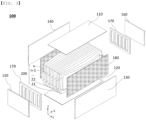
- FIGS. 1 to 3 show a conventional battery module 100.
- the battery module 100 is configured such that a cell stack 200 constituted by a plurality of stacked battery cells 21, 22, ..., n-1, and n is received in a module case (reference numeral not shown).
- Wide outer surfaces of the two battery cells 21 and n disposed at the outermost sides of the cell stack 200 may face a first side cover 130 and a second side cover 140 of the module case, respectively, a swelling control pad 180 may be located between each of the outermost battery cells and a corresponding one of the side covers of the module case, and a resin layer 400 configured to fix the cell stack 200 may be interposed between the cell stack 200 and a lower cover 120.
- an adhesive 300 may be interposed between facing battery cells at a predetermined region.
- the battery cells 21, 22, ..., n-1, and n in the conventional battery module 100 repeatedly swell and contract during charging and discharging, an electrode active material may be separated or degraded due to such deformation of the battery cells, and side reaction may occur, whereby battery performance may be lowered.
- the swelling control pad 180 is generally provided between the module case and each of the outermost battery cells or between the battery cells, wherein the swelling relief pad is compressed to perform a buffering operation when the battery cells swell, thereby controlling swelling of the battery cells.
- increment in volume of a central part of the battery cell and increment in volume of an edge of the battery cell are different from each other when the battery cell swells. That is, when the volume of the battery cell expands, the central part of the battery cell swells into a pot shape, compared to the edge of the battery cell. If the entirety of the surface of the battery cell that swells is uniformly supported, the battery cell is deformed by gas generated in the battery cell and lithium plating occurring due thereto.
- FIG. 4 is a schematic view illustrating a battery cell before and after deformation thereof using one outermost battery cell 21, among the conventional battery cells 21, 22, ..., n-1, and n, by way of example. Such swelling may occur in all of the battery cells including the outermost battery cells.
- parts of the battery cell 21 adjacent to electrode tabs and electrode leads 2 relatively greatly swell. Since swelling of the central part is inhibited, left and right side parts of the battery cell at which the electrode tabs are located swell due to gases generated in the battery cell. The battery cell is more greatly deformed as charging and discharging are continuously performed.
- Each battery cell swells, and the cell stack 200, in which the plurality of battery cells are coupled to each other, is more greatly deformed, which reduces the lifespan of the battery module 100 and furthermore causes an accident, such as fire.
- Patent Document 1 discloses a lithium secondary battery configured such that a microcapsule including a stabilization material configured to stabilize lithium precipitated from a negative electrode when the secondary battery is overcharged is formed between the negative electrode and a separator, and the surface of the microcapsule is formed as a thermoplastic resin layer configured to collapse when the secondary battery is overcharged in order to discharge the stabilization material.
- Patent Document 2 discloses a lithium precipitation detection method of observing a change in voltage of a secondary battery based on SOC at the time of charging the battery to detect precipitation of lithium from a negative electrode in real time, characterized in that a point at which a battery voltage increase rate slows down is determined to be a point at which lithium precipitation occurs.
- Patent Documents 1 and 2 disclose technologies for securing safety of the lithium secondary battery due to lithium precipitation, but do not disclose a battery module including a swelling relief unit capable of relieving swelling of a battery cell disposed in the battery module occurring during charging and discharging thereof.
- Patent Document 1 Korean Patent Application Publication No. 2017-0111566
- Patent Document 2 Korean Patent Application Publication No. 2017-0023583
- the present invention has been made in view of the above problems, and it is an object of the present invention to provide a battery module including a swelling relief unit capable of preventing reduction in lifespan of a battery cell in the battery module while a conventional battery module and battery cell are used without change.
- a battery module according to the independent claim 1 includes a cell stack comprising one or more battery cells by stacking and a module case configured to receive the cell stack therein, wherein a swelling relief unit is disposed so as to face an outermost battery cell disposed at an outermost side of the cell stack, the swelling relief unit comprising a convex portion pressing at least a part of the one or more battery cells.
- the swelling relief unit may be located between the outermost battery cell disposed at the outermost side of the cell stack and the module case.
- the swelling relief unit may be disposed so as to face both outermost battery cells disposed at outermost sides of the cell stack.
- the convex portion of the swelling relief unit may be located at only a predetermined region of a central part of the outermost battery cell.
- the convex portion of the swelling relief unit may be made of an elastic material.
- the convex portion of the swelling relief unit is configured to be deformed into a concave shape when a predetermined pressure or higher is applied thereto.
- An adhesive may be interposed between facing surfaces of the battery cells.
- the adhesive may be applied to entire facing surfaces of the battery cells.
- the swelling relief unit may be integrally formed at a side cover of the module case.
- the present invention provides a battery pack including the battery module and a device including the battery pack.
- one or more constructions that do not conflict with each other may be selected and combined from among the above constructions.
- a swelling relief unit is disposed at each outermost battery cell in order to inhibit abnormal swelling of battery cells and the battery module depending on the number of times of charging and discharging, whereby it is possible to prevent reduction in lifespan of the battery cells and to improve stability of the battery cells.
- a convex portion of the swelling relief unit is deformed into a concave shape when a predetermined pressure or higher is applied thereto, whereby pressure applied to a central part of the battery cell and the battery module is reduced.
- the periphery of an electrode tab does not swell, whereby occurrence of lithium plating may be alleviated, and therefore it is possible to prevent an increase in internal temperature of the battery cell and an accident related to the battery module, such as fire, depending thereon.
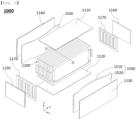
- FIG. 5 is an exploded perspective view of a battery module according to a first embodiment of the present invention
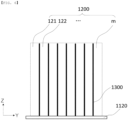
- FIG. 6 is a sectional view taken along line A-A' of FIG. 5 .
- the battery module 1000 may include a cell stack 1200 constituted by a plurality of stacked battery cells (reference numeral not shown) and a swelling relief unit 1500 disposed in a module case (reference numeral not shown) having an approximately hexahedral outer shape.
- the module case may include an upper cover 1110, a lower cover 1120, a first side cover 1130 and a second side cover 1140 facing each other so as to be located toward side surfaces of the cell stack 1200, which are wide surfaces), and a front cover 1150 and a rear cover 1160 located at the surfaces of the cell stack at which electrode tabs are disposed.
- the front cover 1150 and the rear cover 1160 are disposed so as to face in directions in which electrode leads of the battery cells are located in order to protect the electrode leads and busbars 1170, and the pair of side covers 1130 and 1140 protect the side surfaces (XZ planes) of the cell stack 1200 received in the module case.
- the upper cover 1110 and the lower cover 1120 protect an upper part and a lower part of the cell stack 1200, respectively.
- the upper cover 1110, the lower cover 1120, the pair of side covers 1130 and 1140, the front cover 1150, and the rear cover 1160 may be individually manufactured and may then be assembled with each other. Alternatively, some of the covers may be integrally formed as needed.
- the battery cells having the above construction are disposed in the module case in tight contact with each other in the state in which the side surfaces (XZ planes) of the battery cells are erected parallel to the first side cover 1130 and the second side cover 1140 of the module case.
- the cell stack 1200 which is received in an inner space of the module case, is configured such that the plurality of battery cells is stacked in the state in which the wide surfaces of the battery cells are in tight contact with each other, and each of the battery cells includes a cell case (not shown) configured to receive an electrode assembly (not shown) and electrode leads (not shown).
- the cell case is a pouch-shaped cell case (made of a laminate sheet), wherein at least one electrode assembly is received in a receiving portion, and an edge of the receiving portion is fused, whereby the receiving portion is hermetically sealed, and a pair of electrode leads is connected to opposite sides or one side of the electrode assembly so as to protrude outwards from the cell case.
- positive electrode tabs and negative electrode tabs of the electrode assembly may be electrically connected to each other, respectively, and may be exposed outwards from the cell case, or the electrode leads may be directly connected to the electrode assembly without tabs.
- the electrode assembly may be a jelly-roll type electrode assembly, which is configured to have a structure in which a long sheet type positive electrode and a long sheet type negative electrode are wound in the state in which a separator is interposed therebetween, a stacked type electrode assembly, which is configured to have a structure in which a rectangular positive electrode and a rectangular negative electrode are stacked in the state in which a separator is interposed therebetween, a stacked and folded type electrode assembly, which is configured to have a structure in which unit cells are wound using a long separation film, or a laminated and stacked type electrode assembly, which is configured to have a structure in which battery cells are stacked in the state in which a separator is interposed therebetween and are then attached to each other.
- the present invention is not limited thereto.
- an electrolyte in the battery cell may be replaced by a solid electrolyte or a gel type quasi-solid electrolyte obtained by adding an additive to a solid electrolyte, the gel type quasi-solid electrolyte having an intermediate phase between a liquid and a solid, in addition to a liquid electrolyte, which is commonly used.
- the electrode assembly is received in the cell case, and the cell case is generally configured to have a laminate sheet structure including an inner layer, a metal layer, and an outer layer.
- the inner layer is disposed in direct contact with the electrode assembly, and therefore the inner layer must exhibit high insulation properties and high resistance to an electrolytic solution.
- the inner layer must exhibit high sealability in order to hermetically seal the cell case from the outside, i.e. a thermally-bonded sealed portion between inner layers must exhibit excellent thermal bonding strength.
- the inner layer may be made of a material selected from among a polyolefin-based resin, such as polypropylene, polyethylene, polyethylene acrylate, or polybutylene, a polyurethane resin, and a polyimide resin, which exhibit excellent chemical resistance and high sealability.
- a polyolefin-based resin such as polypropylene, polyethylene, polyethylene acrylate, or polybutylene, a polyurethane resin, and a polyimide resin, which exhibit excellent chemical resistance and high sealability.
- polypropylene which exhibits excellent mechanical-physical properties, such as tensile strength, rigidity, surface hardness, and impact resistance, and excellent chemical resistance, is the most preferably used.
- the metal layer which is disposed so as to abut the inner layer, corresponds to a barrier layer configured to prevent moisture or various kinds of gas from permeating into the battery from the outside.
- An aluminum thin film which is lightweight and easily shapeable, may be used as a preferred material for the metal layer.
- the outer layer is provided on the other surface of the metal layer.
- the outer layer may be made of a heat-resistant polymer that exhibits excellent tensile strength, resistance to moisture permeation, and resistance to air transmission such that the outer layer exhibits high heat resistance and chemical resistance while protecting the electrode assembly.
- the outer layer may be made of nylon or polyethylene terephthalate.
- the present invention is not limited thereto.
- the swelling relief unit 1500 according to the first embodiment of the present invention may be located between the pair of side covers 1130 and 1140 of the module case and the cell stack 1200.
- the swelling relief unit 1500 may include a flat portion 1520, which is approximately flat, and a convex portion 1510 formed so as to protrude toward the cell stack 1200 based on a wide surface (XZ plane) of the flat portion 1520.
- the convex portion 1510 may be located at a central part of the flat portion 1520 in a longitudinal direction (X-axis direction), and the convex portion 1510 may be located in tight contact with a central part of the outermost side surface (X-axis direction in XZ plane) of the battery cell located at the outermost side of the cell stack 1200.
- the part of the convex portion 1510 disposed in tight contact with the outermost side surface of the outmost battery cell of the cell stack 1200 may be flat or arc-shaped.
- the convex portion 1510 of the swelling relief unit 1500 may be disposed in tight contact with a predetermined region of the central part of the battery cell, as described above, in order to relieve swelling through deformation thereof when a predetermined pressure is applied thereto, which is advantageous in lifespan extension.
- the convex portion 1510 of the swelling relief unit 1500 is located in tight contact with or adjacent to the outermost battery cell of the cell stack 1200 so as to face the outermost battery cell of the cell stack.
- a convex surface of the convex portion 1510 is deformed in a direction toward each of the side covers 1130 and 1140 of the module case.
- the battery cell contracts, and the deformed convex portion 1510 returns to the outermost battery cell corresponding thereto.
- the flat portion 1520 is not deformed, i.e. the initial shape of the flat portion is maintained.
- the convex portion 1510 When the battery cell swells by a predetermined volume or more during charging and discharging of the battery cell, whereby the pressure applied to the convex portion 1510 is equal to or higher than a predetermined pressure, the convex portion 1510 is generally deformed into a concave shape.
- the convex surface of the convex portion 1510 is generally permanently deformed in a direction toward each of the side covers 1130 and 1140 of the module case, whereby the convex portion 1510 has a concave shape.
- no pressure is applied to the battery cell that has swollen to a predetermined level or more.
- the convex portion 1510 is deformed so as to be closer to each of the side covers 1130 and 1140 of the module case than the flat portion 1520.
- the swelling relief unit 1500 which is deformed during charging and discharging of the battery cell, may be used to adjust the extent of pressure applied to the battery cell during charging and discharging of the battery cell.
- the battery cell naturally swells due to charging and discharging thereof, and therefore it is possible to provide pressure the most suitable to improve safety and lifespan of the battery cell.
- the swelling relief unit 1500 may be made of an elastic material in order to inhibit swelling of the battery cell in the initial stage.
- swelling pressure of the battery cell is applied to the convex portion 1510 of the swelling relief unit 1500 located in tight contact with the battery cell.
- the convex portion 1510 which is convex toward the side surface of the battery cell, may be deformed by swelling of the battery cell. If the convex portion 1510 is made of no elastic material, the convex portion may be ruptured by swelling pressure of the battery cell, whereby the battery cell may be damaged, which may lead to an accident, such as fire.
- the swelling relief unit 1500 When the swelling relief unit 1500 is made of an elastic material, therefore, the swelling relief unit is easily deformed when the battery cell swells, which is advantageous in accident prevention.
- the flat portion 1520 of the swelling relief unit 1500 remains flat irrespective of deformation of the battery cell due to swelling and/or contraction thereof, which is advantageous in relieving deformation of the battery cell due to lithium plating occurring as the result of gas generated in the battery cell moving to opposite ends of the battery cell.
- the convex portion 1510 may be brought into tight contact with the entirety or a portion of the battery cell in a height direction (Z-axis direction). Specifically, the convex portion may be disposed from the center to opposite sides of the battery cell in the height direction in a symmetrical fashion. As a result, the convex portion 1510 is brought into tight contact with the outside of the cell case at the center to opposite ends of the battery cell in the height direction that relatively easily swell, which is advantageous in relieving swelling.
- the swelling relief unit 1500 may be made of an elastic metal or synthetic resin.
- the swelling relief unit may be made of a soft elastic material, such as polyurethane (PU) or ethylene propylene diene monomer (EPDM). Since the above elastic material has excellent vibration absorption and compression repulsion, the battery module 1000 may have excellent dimensional stability even though the plurality of battery cells swells.
- the materials for the swelling relief unit are not limited to the above materials as long as the swelling relief unit is capable of inhibiting swelling of the battery cell and at the same time being deformed after the shape of the swelling relief unit is maintained until the pressure in the battery cell reaches a predetermined pressure.
- the swelling relief unit 1500 may be configured such that the convex portion 1510 is formed at the central part of the flat portion 1520, and one or more convex portions 1510 may be formed.
- the number of convex portions 1510 is not particularly restricted as long as it is possible to relieve swelling of the battery cell due to lithium plating.
- an adhesive 1300 may be applied between side surfaces (XZ planes) of adjacent battery cells in order to adhere the battery cells to each other. It is preferable for the adhesive 1300 to be applied to the entirety of the side surfaces of the adjacent battery cells.
- the adhesive 1300 may be applied to all of the side surfaces of the battery cells 121, 122, ..., and m, which are disposed in tight contact with each other, constituting the cell stack 1200, whereby the adjacent battery cells may be stably coupled to each other in tight contact with each other, and therefore the cell stack 1200 may have a more stable structure. Consequently, it is possible to stably receive the cell stack 1200 in the module case without disposition of a resin layer 400 used in a conventional battery module on the lower cover 1120.
- the resin layer configured to fix the stacked battery cells to the lower surface of the module case in the conventional battery module is not used, which is advantages in gas generated in each battery cell moving toward all peripheries of the battery cell.
- the gas generated in the battery cell may be rapidly and effectively diffused, whereby the gas does not stay in the electrode assembly, which is advantageous in relieving swelling of the battery cell and preventing lifespan reduction.
- the adhesive 1300 may be made of polyolefin, such as polyethylene (PE), cast polypropylene (cPP), or polypropylene (PP), or a copolymer thereof.
- PE polyethylene
- cPP cast polypropylene
- PP polypropylene
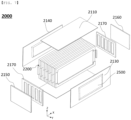
- FIG. 7 is an exploded perspective view of a battery module 2000 according to a second embodiment of the present invention.
- the second embodiment is identical to the first embodiment except that a swelling relief unit 2500 is integrally formed at each of a pair of side covers 2130 and 2140 of a module case, and therefore only the swelling relief unit 2500 will be described hereinafter.
- the swelling relief unit 2500 may be formed at a central part of each of the first side cover 2130 and the second side cover 2140 of the module case in a longitudinal direction (X-axis direction).
- each side cover may constitute a flat portion of the swelling relief unit 2500, and a part of the side cover may be bent so as to be convex toward a cell stack 2200.
- FIG. 7 shows that the swelling relief unit 2500 is located at the central part of each of the side covers 2130 and 2140 of the module case in a height direction (Z-axis direction).
- the present invention is not limited thereto as long as the swelling relief unit is provided over the entirety of the side cover in the height direction (Z-axis direction) and the side covers 2130 and 2140, an upper cover 2110, and a lower cover 2120 are coupled to each other to constitute the module case.
- the swelling relief unit 2500 may be quadrangular.
- the swelling relief unit may be polygonal, circular, or oval.
- the shape of the swelling relief unit is not particularly restricted as long as the swelling relief unit is elastically deformable due to swelling of the battery cells.
- the battery module according to the present invention described above is applicable to various kinds of devices or vehicles, such as an electric vehicle or a hybrid electric vehicle.
- the present invention relates to a battery module including a cell stack constituted by one or more stacked battery cells and a module case configured to receive the cell stack therein, wherein a swelling relief unit is disposed so as to face an outermost battery cell disposed at an outermost side of the cell stack, the swelling relief unit having a convex portion configured to press at least a part of the battery cell, and therefore the present invention has industrial applicability.
Landscapes
- Chemical & Material Sciences (AREA)
- Chemical Kinetics & Catalysis (AREA)
- Electrochemistry (AREA)
- General Chemical & Material Sciences (AREA)
- Engineering & Computer Science (AREA)
- Manufacturing & Machinery (AREA)
- Battery Mounting, Suspending (AREA)
- Sealing Battery Cases Or Jackets (AREA)
Description
- This application claims the benefit of priority to
Korean Patent Application No. 2021-0003604 filed on January 11, 2021 - The present invention relates to a battery module including a swelling relief unit. More particularly, the present invention relates to a battery module including a swelling relief unit capable of pressing a battery cell, wherein the swelling relief unit is disposed at a case of a module case and/or in the case of the module case in order to alleviate the behavior of lithium plating, thereby preventing reduction in lifespan of the battery cell.
- With an increase in demand for mobile devices, such as smartphones, demand for secondary batteries used as energy sources thereof has also increased. In addition, secondary batteries are used in an electric vehicle (EV), a hybrid electric vehicle (HEV), a plug-in hybrid electric vehicle (P-HEV), an energy storage system (ESS), etc.
- Demand for a lithium secondary battery, which is one of the secondary batteries, is overwhelmingly high. The lithium secondary battery is operated as the result of lithium ions being repeatedly intercalated and deintercalated into and from a negative electrode and a positive electrode. In an electrolyte containing lithium salt, lithium ions can move between the electrodes, but electrons cannot move between the electrodes.
- Lithium precipitation, i.e. so-called lithium plating (Li-plating), causes side reaction with the electrolyte and change in kinetic balance of the secondary battery. As a result, the capacity and cycle lifespan of the battery are reduced, and a safety-related problem in that an overcharging control function is lost occurs. During repeated charging and discharging, lithium metal is dendritically precipitated on the surface of one electrode, which seriously threatens safety of the battery. In the case in which the dendritically precipitated metal lithium penetrates a separator and comes into contact with the other electrode, internal short circuit occurs, and the temperature of the battery is increased due to rapid chemical reaction. As a result, a battery cell or a module may catch fire, which may lead to a dangerous result, such as explosion. Lithium plating more frequently occurs around a position of the battery cell from which an electrode tab protrudes, and the battery cell swells at the position of the battery cell from which the electrode tab protrudes as the number of times of charging and discharging and the number of cycles are increased. This phenomenon more greatly occurs in a battery module including a plurality of stacked battery cells than in a unit battery cell. The cycle lifespan of the battery cells constituting the battery module may be shorter than the cycle lifespan of the unit battery cell, and the scale of the accident may increase due to the plurality of battery cells.
-
FIGS. 1 to 3 show aconventional battery module 100. Referring toFIGS. 1 to 3 , thebattery module 100 is configured such that acell stack 200 constituted by a plurality of stackedbattery cells battery cells 21 and n disposed at the outermost sides of thecell stack 200 may face afirst side cover 130 and asecond side cover 140 of the module case, respectively, aswelling control pad 180 may be located between each of the outermost battery cells and a corresponding one of the side covers of the module case, and aresin layer 400 configured to fix thecell stack 200 may be interposed between thecell stack 200 and alower cover 120. In order to guarantee stability of thebattery cells cell stack 200, an adhesive 300 may be interposed between facing battery cells at a predetermined region. - The
battery cells conventional battery module 100 repeatedly swell and contract during charging and discharging, an electrode active material may be separated or degraded due to such deformation of the battery cells, and side reaction may occur, whereby battery performance may be lowered. In order to solve the above problems, theswelling control pad 180 is generally provided between the module case and each of the outermost battery cells or between the battery cells, wherein the swelling relief pad is compressed to perform a buffering operation when the battery cells swell, thereby controlling swelling of the battery cells. - As shown in
FIG. 3 , increment in volume of a central part of the battery cell and increment in volume of an edge of the battery cell are different from each other when the battery cell swells. That is, when the volume of the battery cell expands, the central part of the battery cell swells into a pot shape, compared to the edge of the battery cell. If the entirety of the surface of the battery cell that swells is uniformly supported, the battery cell is deformed by gas generated in the battery cell and lithium plating occurring due thereto. -
FIG. 4 is a schematic view illustrating a battery cell before and after deformation thereof using oneoutermost battery cell 21, among theconventional battery cells Fig. 4 , parts of thebattery cell 21 adjacent to electrode tabs and electrode leads 2 relatively greatly swell. Since swelling of the central part is inhibited, left and right side parts of the battery cell at which the electrode tabs are located swell due to gases generated in the battery cell. The battery cell is more greatly deformed as charging and discharging are continuously performed. Each battery cell swells, and thecell stack 200, in which the plurality of battery cells are coupled to each other, is more greatly deformed, which reduces the lifespan of thebattery module 100 and furthermore causes an accident, such as fire. - In order to extend the lifespan of the
battery cells battery module 100 and to improve stability of the battery module, it is necessary to relieve swelling of the battery cells in thebattery module 100 due to lithium plating. However, there is a limitation in inhibiting a lithium plating phenomenon due to the electrochemical mechanism of the battery cell. -
Patent Document 1 discloses a lithium secondary battery configured such that a microcapsule including a stabilization material configured to stabilize lithium precipitated from a negative electrode when the secondary battery is overcharged is formed between the negative electrode and a separator, and the surface of the microcapsule is formed as a thermoplastic resin layer configured to collapse when the secondary battery is overcharged in order to discharge the stabilization material. -
Patent Document 2 discloses a lithium precipitation detection method of observing a change in voltage of a secondary battery based on SOC at the time of charging the battery to detect precipitation of lithium from a negative electrode in real time, characterized in that a point at which a battery voltage increase rate slows down is determined to be a point at which lithium precipitation occurs. -
Patent Documents - In a battery module including a cell stack constituted by a plurality of stacked battery cells, an effective means capable of solving a problem due to deformation of the battery cells has not yet been suggested.
- (Patent Document 1)
Korean Patent Application Publication No. 2017-0111566 - (Patent Document 2)
Korean Patent Application Publication No. 2017-0023583 - Furhter examples of background art can be found in
JP2017037789A US2019363392A1 andUS2015303425A1 . - The present invention has been made in view of the above problems, and it is an object of the present invention to provide a battery module including a swelling relief unit capable of preventing reduction in lifespan of a battery cell in the battery module while a conventional battery module and battery cell are used without change.
- It is another object of the present invention to provide a battery module including a swelling relief unit capable of rapidly moving gas generated during use of the battery module to the periphery of a battery cell without staying in an electrode assembly of the battery cell.
- In order to accomplish the above objects, a battery module according to the
independent claim 1 includes a cell stack comprising one or more battery cells by stacking and a module case configured to receive the cell stack therein, wherein a swelling relief unit is disposed so as to face an outermost battery cell disposed at an outermost side of the cell stack, the swelling relief unit comprising a convex portion pressing at least a part of the one or more battery cells. - The swelling relief unit may be located between the outermost battery cell disposed at the outermost side of the cell stack and the module case.
- The swelling relief unit may be disposed so as to face both outermost battery cells disposed at outermost sides of the cell stack.
- The convex portion of the swelling relief unit may be located at only a predetermined region of a central part of the outermost battery cell.
- The convex portion of the swelling relief unit may be made of an elastic material.
- The convex portion of the swelling relief unit is configured to be deformed into a concave shape when a predetermined pressure or higher is applied thereto.
- An adhesive may be interposed between facing surfaces of the battery cells.
- The adhesive may be applied to entire facing surfaces of the battery cells.
- The swelling relief unit may be integrally formed at a side cover of the module case.
- In addition, the present invention provides a battery pack including the battery module and a device including the battery pack.
- In the present invention, one or more constructions that do not conflict with each other may be selected and combined from among the above constructions.
- In a battery module according to the present invention, a swelling relief unit is disposed at each outermost battery cell in order to inhibit abnormal swelling of battery cells and the battery module depending on the number of times of charging and discharging, whereby it is possible to prevent reduction in lifespan of the battery cells and to improve stability of the battery cells.
- A convex portion of the swelling relief unit is deformed into a concave shape when a predetermined pressure or higher is applied thereto, whereby pressure applied to a central part of the battery cell and the battery module is reduced. As a result, the periphery of an electrode tab does not swell, whereby occurrence of lithium plating may be alleviated, and therefore it is possible to prevent an increase in internal temperature of the battery cell and an accident related to the battery module, such as fire, depending thereon.
- Since the swelling relief unit according to the present invention is easily disposed in a conventional battery module without change, it is not necessary to change a battery module production process, which is economically advantageous.
- Since an adhesive layer is applied to the entirety of each of facing surfaces of adjacent battery cells in the battery module, gas generated in the battery cell during charging and discharging may be moved to the periphery of the battery cell, whereby it is possible to prevent nonuniform degradation of the battery cell.
-
-
FIG. 1 is a schematic view of a conventional battery module. -
FIG. 2 is a sectional view taken along line A-A' ofFIG. 1 . -
FIG. 3 is an exploded perspective view of the battery module shown inFIG. 1 . -
FIG. 4 is a schematic view illustrating a conventional battery cell before and after deformation thereof. -
FIG. 5 is an exploded perspective view of a battery module according to a first embodiment of the present invention. -
FIG. 6 is a sectional view taken along line A-A' ofFIG. 5 . -
FIG. 7 is an exploded perspective view of a battery module according to a second embodiment of the present invention. - In the present application, it should be understood that the terms "comprises," "has," "includes," etc. specify the presence of stated features, numbers, steps, operations, elements, components, or combinations thereof, but do not preclude the presence or addition of one or more other features, numbers, steps, operations, elements, components, or combinations thereof.
- In addition, the same reference numbers will be used throughout the drawings to refer to parts that perform similar functions or operations. In the case in which one part is said to be connected to another part in the specification, not only may the one part be directly connected to the other part, but also, the one part may be indirectly connected to the other part via a further part. In addition, that a certain element is included does not mean that other elements are excluded, but means that such elements may be further included unless mentioned otherwise.
- Hereinafter, a battery module according to the present invention will be described with reference to the accompanying drawings.
-
FIG. 5 is an exploded perspective view of a battery module according to a first embodiment of the present invention, andFIG. 6 is a sectional view taken along line A-A' ofFIG. 5 . - Referring to
FIGS. 5 and6 , the battery module 1000 according to the first embodiment of the present invention may include acell stack 1200 constituted by a plurality of stacked battery cells (reference numeral not shown) and aswelling relief unit 1500 disposed in a module case (reference numeral not shown) having an approximately hexahedral outer shape. - The module case may include an
upper cover 1110, alower cover 1120, afirst side cover 1130 and asecond side cover 1140 facing each other so as to be located toward side surfaces of thecell stack 1200, which are wide surfaces), and afront cover 1150 and arear cover 1160 located at the surfaces of the cell stack at which electrode tabs are disposed. - Here, the
front cover 1150 and therear cover 1160 are disposed so as to face in directions in which electrode leads of the battery cells are located in order to protect the electrode leads andbusbars 1170, and the pair of side covers 1130 and 1140 protect the side surfaces (XZ planes) of thecell stack 1200 received in the module case. - The
upper cover 1110 and thelower cover 1120 protect an upper part and a lower part of thecell stack 1200, respectively. - The
upper cover 1110, thelower cover 1120, the pair of side covers 1130 and 1140, thefront cover 1150, and therear cover 1160 may be individually manufactured and may then be assembled with each other. Alternatively, some of the covers may be integrally formed as needed. - The battery cells having the above construction are disposed in the module case in tight contact with each other in the state in which the side surfaces (XZ planes) of the battery cells are erected parallel to the
first side cover 1130 and thesecond side cover 1140 of the module case. - The
cell stack 1200, which is received in an inner space of the module case, is configured such that the plurality of battery cells is stacked in the state in which the wide surfaces of the battery cells are in tight contact with each other, and each of the battery cells includes a cell case (not shown) configured to receive an electrode assembly (not shown) and electrode leads (not shown). - The cell case is a pouch-shaped cell case (made of a laminate sheet), wherein at least one electrode assembly is received in a receiving portion, and an edge of the receiving portion is fused, whereby the receiving portion is hermetically sealed, and a pair of electrode leads is connected to opposite sides or one side of the electrode assembly so as to protrude outwards from the cell case. Of course, positive electrode tabs and negative electrode tabs of the electrode assembly may be electrically connected to each other, respectively, and may be exposed outwards from the cell case, or the electrode leads may be directly connected to the electrode assembly without tabs.
- The electrode assembly may be a jelly-roll type electrode assembly, which is configured to have a structure in which a long sheet type positive electrode and a long sheet type negative electrode are wound in the state in which a separator is interposed therebetween, a stacked type electrode assembly, which is configured to have a structure in which a rectangular positive electrode and a rectangular negative electrode are stacked in the state in which a separator is interposed therebetween, a stacked and folded type electrode assembly, which is configured to have a structure in which unit cells are wound using a long separation film, or a laminated and stacked type electrode assembly, which is configured to have a structure in which battery cells are stacked in the state in which a separator is interposed therebetween and are then attached to each other. However, the present invention is not limited thereto.
- It is obvious that an electrolyte in the battery cell may be replaced by a solid electrolyte or a gel type quasi-solid electrolyte obtained by adding an additive to a solid electrolyte, the gel type quasi-solid electrolyte having an intermediate phase between a liquid and a solid, in addition to a liquid electrolyte, which is commonly used.
- The electrode assembly is received in the cell case, and the cell case is generally configured to have a laminate sheet structure including an inner layer, a metal layer, and an outer layer. The inner layer is disposed in direct contact with the electrode assembly, and therefore the inner layer must exhibit high insulation properties and high resistance to an electrolytic solution. In addition, the inner layer must exhibit high sealability in order to hermetically seal the cell case from the outside, i.e. a thermally-bonded sealed portion between inner layers must exhibit excellent thermal bonding strength. The inner layer may be made of a material selected from among a polyolefin-based resin, such as polypropylene, polyethylene, polyethylene acrylate, or polybutylene, a polyurethane resin, and a polyimide resin, which exhibit excellent chemical resistance and high sealability. However, the present invention is not limited thereto, and polypropylene, which exhibits excellent mechanical-physical properties, such as tensile strength, rigidity, surface hardness, and impact resistance, and excellent chemical resistance, is the most preferably used.
- The metal layer, which is disposed so as to abut the inner layer, corresponds to a barrier layer configured to prevent moisture or various kinds of gas from permeating into the battery from the outside. An aluminum thin film, which is lightweight and easily shapeable, may be used as a preferred material for the metal layer.
- The outer layer is provided on the other surface of the metal layer. The outer layer may be made of a heat-resistant polymer that exhibits excellent tensile strength, resistance to moisture permeation, and resistance to air transmission such that the outer layer exhibits high heat resistance and chemical resistance while protecting the electrode assembly. As an example, the outer layer may be made of nylon or polyethylene terephthalate. However, the present invention is not limited thereto.
- The swelling
relief unit 1500 according to the first embodiment of the present invention may be located between the pair of side covers 1130 and 1140 of the module case and thecell stack 1200. - The swelling
relief unit 1500 may include aflat portion 1520, which is approximately flat, and aconvex portion 1510 formed so as to protrude toward thecell stack 1200 based on a wide surface (XZ plane) of theflat portion 1520. Specifically, theconvex portion 1510 may be located at a central part of theflat portion 1520 in a longitudinal direction (X-axis direction), and theconvex portion 1510 may be located in tight contact with a central part of the outermost side surface (X-axis direction in XZ plane) of the battery cell located at the outermost side of thecell stack 1200. In addition, the part of theconvex portion 1510 disposed in tight contact with the outermost side surface of the outmost battery cell of thecell stack 1200 may be flat or arc-shaped. - In the initial stage of charging and discharging, the central part of the battery cell swells. Consequently, the
convex portion 1510 of theswelling relief unit 1500 may be disposed in tight contact with a predetermined region of the central part of the battery cell, as described above, in order to relieve swelling through deformation thereof when a predetermined pressure is applied thereto, which is advantageous in lifespan extension. In the present invention, theconvex portion 1510 of theswelling relief unit 1500 is located in tight contact with or adjacent to the outermost battery cell of thecell stack 1200 so as to face the outermost battery cell of the cell stack. When the battery cell swells and the pressure in the battery cell reaches a predetermined pressure or higher during charging of the battery cell, a convex surface of theconvex portion 1510 is deformed in a direction toward each of the side covers 1130 and 1140 of the module case. During discharging of the battery cell, the battery cell contracts, and the deformedconvex portion 1510 returns to the outermost battery cell corresponding thereto. At this time, theflat portion 1520 is not deformed, i.e. the initial shape of the flat portion is maintained. - When the battery cell swells by a predetermined volume or more during charging and discharging of the battery cell, whereby the pressure applied to the
convex portion 1510 is equal to or higher than a predetermined pressure, theconvex portion 1510 is generally deformed into a concave shape. The convex surface of theconvex portion 1510 is generally permanently deformed in a direction toward each of the side covers 1130 and 1140 of the module case, whereby theconvex portion 1510 has a concave shape. As a result, no pressure is applied to the battery cell that has swollen to a predetermined level or more. Theconvex portion 1510 is deformed so as to be closer to each of the side covers 1130 and 1140 of the module case than theflat portion 1520. In the present invention, the swellingrelief unit 1500, which is deformed during charging and discharging of the battery cell, may be used to adjust the extent of pressure applied to the battery cell during charging and discharging of the battery cell. The battery cell naturally swells due to charging and discharging thereof, and therefore it is possible to provide pressure the most suitable to improve safety and lifespan of the battery cell. - In the present invention, the swelling
relief unit 1500 may be made of an elastic material in order to inhibit swelling of the battery cell in the initial stage. When the battery cell swells, swelling pressure of the battery cell is applied to theconvex portion 1510 of theswelling relief unit 1500 located in tight contact with the battery cell. Theconvex portion 1510, which is convex toward the side surface of the battery cell, may be deformed by swelling of the battery cell. If theconvex portion 1510 is made of no elastic material, the convex portion may be ruptured by swelling pressure of the battery cell, whereby the battery cell may be damaged, which may lead to an accident, such as fire. When theswelling relief unit 1500 is made of an elastic material, therefore, the swelling relief unit is easily deformed when the battery cell swells, which is advantageous in accident prevention. In addition, theflat portion 1520 of theswelling relief unit 1500 remains flat irrespective of deformation of the battery cell due to swelling and/or contraction thereof, which is advantageous in relieving deformation of the battery cell due to lithium plating occurring as the result of gas generated in the battery cell moving to opposite ends of the battery cell. - The
convex portion 1510 may be brought into tight contact with the entirety or a portion of the battery cell in a height direction (Z-axis direction). Specifically, the convex portion may be disposed from the center to opposite sides of the battery cell in the height direction in a symmetrical fashion. As a result, theconvex portion 1510 is brought into tight contact with the outside of the cell case at the center to opposite ends of the battery cell in the height direction that relatively easily swell, which is advantageous in relieving swelling. - Here, the swelling
relief unit 1500 may be made of an elastic metal or synthetic resin. Specifically, the swelling relief unit may be made of a soft elastic material, such as polyurethane (PU) or ethylene propylene diene monomer (EPDM). Since the above elastic material has excellent vibration absorption and compression repulsion, the battery module 1000 may have excellent dimensional stability even though the plurality of battery cells swells. In the present invention, the materials for the swelling relief unit are not limited to the above materials as long as the swelling relief unit is capable of inhibiting swelling of the battery cell and at the same time being deformed after the shape of the swelling relief unit is maintained until the pressure in the battery cell reaches a predetermined pressure. - Although not shown in
FIG. 5 , the swellingrelief unit 1500 according to the first embodiment of the present invention may be configured such that theconvex portion 1510 is formed at the central part of theflat portion 1520, and one or moreconvex portions 1510 may be formed. However, the number ofconvex portions 1510 is not particularly restricted as long as it is possible to relieve swelling of the battery cell due to lithium plating. - Meanwhile, as shown in
FIG. 6 , an adhesive 1300 may be applied between side surfaces (XZ planes) of adjacent battery cells in order to adhere the battery cells to each other. It is preferable for the adhesive 1300 to be applied to the entirety of the side surfaces of the adjacent battery cells. - The adhesive 1300 may be applied to all of the side surfaces of the
battery cells cell stack 1200, whereby the adjacent battery cells may be stably coupled to each other in tight contact with each other, and therefore thecell stack 1200 may have a more stable structure. Consequently, it is possible to stably receive thecell stack 1200 in the module case without disposition of aresin layer 400 used in a conventional battery module on thelower cover 1120. - The resin layer configured to fix the stacked battery cells to the lower surface of the module case in the conventional battery module is not used, which is advantages in gas generated in each battery cell moving toward all peripheries of the battery cell. As a result, the gas generated in the battery cell may be rapidly and effectively diffused, whereby the gas does not stay in the electrode assembly, which is advantageous in relieving swelling of the battery cell and preventing lifespan reduction.
- The adhesive 1300 may be made of polyolefin, such as polyethylene (PE), cast polypropylene (cPP), or polypropylene (PP), or a copolymer thereof.
-
FIG. 7 is an exploded perspective view of abattery module 2000 according to a second embodiment of the present invention. - The second embodiment is identical to the first embodiment except that a
swelling relief unit 2500 is integrally formed at each of a pair of side covers 2130 and 2140 of a module case, and therefore only the swellingrelief unit 2500 will be described hereinafter. - In the second embodiment of the present invention, the swelling
relief unit 2500 may be formed at a central part of each of thefirst side cover 2130 and thesecond side cover 2140 of the module case in a longitudinal direction (X-axis direction). Here, each side cover may constitute a flat portion of theswelling relief unit 2500, and a part of the side cover may be bent so as to be convex toward acell stack 2200. -
FIG. 7 shows that the swellingrelief unit 2500 is located at the central part of each of the side covers 2130 and 2140 of the module case in a height direction (Z-axis direction). However, the present invention is not limited thereto as long as the swelling relief unit is provided over the entirety of the side cover in the height direction (Z-axis direction) and the side covers 2130 and 2140, anupper cover 2110, and a lower cover 2120 are coupled to each other to constitute the module case. In addition, as shown inFIG. 7 , the swellingrelief unit 2500 may be quadrangular. Alternatively, the swelling relief unit may be polygonal, circular, or oval. However, the shape of the swelling relief unit is not particularly restricted as long as the swelling relief unit is elastically deformable due to swelling of the battery cells. - The battery module according to the present invention described above is applicable to various kinds of devices or vehicles, such as an electric vehicle or a hybrid electric vehicle.
- Although the specific details of the present invention have been described in detail, the scope of protection is defined in the appended claims.
-
- 1: Side surface of battery cell
- 2: Electrode lead
- 21, 22, 121, 122, m, n-1, n: Battery cells
- 100: Conventional battery module
- 110, 1110, 2110: Upper covers
- 120, 1120, 2120: Lower covers
- 130, 1130, 2130: First side covers
- 140, 1140, 2140: Second side covers
- 150, 1150, 2150: Front covers
- 160, 1160, 2160: Rear covers
- 170, 1170, 2170: Busbars
- 180: Swelling control pad
- 200, 1200, 2200: Cell stacks
- 300, 1300: Adhesives
- 400: Resin layer
- 1500, 2500: Swelling relief units
- 1510, 2510: Convex portions
- 1520, 2520: Flat portions
- 1000: Battery module according to first embodiment of present invention
- 2000: Battery module according to second embodiment of present invention
- The present invention relates to a battery module including a cell stack constituted by one or more stacked battery cells and a module case configured to receive the cell stack therein, wherein a swelling relief unit is disposed so as to face an outermost battery cell disposed at an outermost side of the cell stack, the swelling relief unit having a convex portion configured to press at least a part of the battery cell, and therefore the present invention has industrial applicability.
Claims (10)
- A battery module (1000, 2000) comprising:a cell stack (1200, 2200) comprising one or more battery cells (121, 122, ...) by stacking; anda module case configured to receive the cell stack (1200, 2200) therein,wherein a swelling relief unit (1500, 2500) is disposed so as to face an outermost battery cell disposed at an outermost side of the cell stack (1200, 2200), the swelling relief unit (1500, 2500) comprising a convex portion (1510, 2510) pressing at least a part of the one or more battery cells (121, 122, ...),wherein the convex portion (1510, 2510) of the swelling relief unit (1500, 2500) is configured to be deformed into a concave shape when a predetermined pressure or higher is applied thereto.
- The battery module (1000, 2000) according to claim 1, wherein the swelling relief unit (1500, 2500) is located between the outermost battery cell disposed at the outermost side of the cell stack (1200, 2200) and the module case.
- The battery module (1000, 2000) according to claim 1, wherein the swelling relief unit (1500, 2500) is disposed so as to face both outermost battery cells disposed at outermost sides of the cell stack (1200, 2200).
- The battery module (1000, 2000) according to claim 1, wherein the convex portion (1510, 2510) of the swelling relief unit (1500, 2500) is located at only a predetermined region of a central part of the outermost battery cell.
- The battery module (1000, 2000) according to claim 1, wherein the convex portion (1510, 2510) of the swelling relief unit (1500, 2500) is made of an elastic material.
- The battery module (1000, 2000) according to claim 1, wherein an adhesive is interposed between facing surfaces of the battery cells (121, 122, ...).
- The battery module (1000, 2000) according to claim 6, wherein the adhesive is applied to entire facing surfaces of the battery cells (121, 122, ...).
- The battery module (2000) according to claim 1, wherein the swelling relief unit (2500) is integrally formed at a side cover of the module case.
- A battery pack comprising the battery module (1000, 2000) according to any one of claims 1 to 9.
- A device comprising the battery pack according to claim 9.
Applications Claiming Priority (2)
| Application Number | Priority Date | Filing Date | Title |
|---|---|---|---|
| KR1020210003604A KR102834536B1 (en) | 2021-01-11 | 2021-01-11 | Battery module comprising expansion relief unit |
| PCT/KR2022/000416 WO2022149941A1 (en) | 2021-01-11 | 2022-01-11 | Battery module including expansion relaxation unit |
Publications (3)
| Publication Number | Publication Date |
|---|---|
| EP4113724A1 EP4113724A1 (en) | 2023-01-04 |
| EP4113724A4 EP4113724A4 (en) | 2023-09-20 |
| EP4113724B1 true EP4113724B1 (en) | 2025-02-26 |
Family
ID=82357376
Family Applications (1)
| Application Number | Title | Priority Date | Filing Date |
|---|---|---|---|
| EP22736918.8A Active EP4113724B1 (en) | 2021-01-11 | 2022-01-11 | Battery module including swelling relief unit |
Country Status (8)
| Country | Link |
|---|---|
| US (1) | US20230135785A1 (en) |
| EP (1) | EP4113724B1 (en) |
| JP (1) | JP7625320B2 (en) |
| KR (1) | KR102834536B1 (en) |
| CN (1) | CN115461920B (en) |
| ES (1) | ES3014767T3 (en) |
| HU (1) | HUE070549T2 (en) |
| WO (1) | WO2022149941A1 (en) |
Families Citing this family (6)
| Publication number | Priority date | Publication date | Assignee | Title |
|---|---|---|---|---|
| KR20230067335A (en) * | 2021-11-09 | 2023-05-16 | 에스케이온 주식회사 | Manufacturing method for battery cell stack |
| CN118712638A (en) * | 2023-03-27 | 2024-09-27 | 比亚迪股份有限公司 | Battery modules and vehicles |
| KR20250035238A (en) * | 2023-09-05 | 2025-03-12 | 삼성에스디아이 주식회사 | Battery module |
| CN221057624U (en) * | 2023-09-21 | 2024-05-31 | 宁德时代新能源科技股份有限公司 | Buffer pad, battery cell, battery and electrical equipment having the same |
| IT202300021093A1 (en) * | 2023-10-11 | 2025-04-11 | Ferrari Spa | BATTERY PACK FOR AN ELECTRIC-POWERED ROAD VEHICLE AND METHOD OF COMPENSATING FOR THE CHANGE IN THICKNESS OF AN ELECTROCHEMICAL CELL FOR SUCH BATTERY PACK |
| KR102658636B1 (en) * | 2023-11-21 | 2024-04-18 | (주)금창 | Battery module case with living hinge |
Family Cites Families (21)
| Publication number | Priority date | Publication date | Assignee | Title |
|---|---|---|---|---|
| JP2009182001A (en) * | 2008-01-29 | 2009-08-13 | Nisshin Steel Co Ltd | Cell stack structure |
| KR101173870B1 (en) * | 2010-08-18 | 2012-08-14 | 에스비리모티브 주식회사 | Battery module |
| KR20140064418A (en) * | 2012-11-20 | 2014-05-28 | 에스케이이노베이션 주식회사 | Secondary battery module |
| KR20150031861A (en) * | 2013-09-17 | 2015-03-25 | 삼성에스디아이 주식회사 | Battery module |
| JP6258272B2 (en) * | 2015-08-11 | 2018-01-10 | 株式会社東芝 | Battery module |
| KR101897859B1 (en) | 2015-08-24 | 2018-09-12 | 주식회사 엘지화학 | Detection method of Li plating, method and apparatus for charging secondary battery and secondary battery system using the same |
| KR20170111566A (en) | 2016-03-29 | 2017-10-12 | 현대자동차주식회사 | Lithium secondary battery |
| KR102018721B1 (en) * | 2016-05-31 | 2019-09-09 | 주식회사 엘지화학 | Battery module, battery pack comprising the battery module and vehicle comprising the battery pack |
| KR102018301B1 (en) | 2016-09-01 | 2019-09-04 | 주식회사 엘지화학 | Battery module and method for fabricating the same |
| CN206250253U (en) * | 2016-12-27 | 2017-06-13 | 宁德时代新能源科技股份有限公司 | Battery modules end plate and battery modules |
| CN110392944A (en) * | 2017-03-07 | 2019-10-29 | 远景Aesc日本有限公司 | Method for manufacturing battery pack |
| US10446894B2 (en) | 2017-07-19 | 2019-10-15 | Ford Global Technologies, Llc | Array plate assemblies for applying compressive spring forces against battery cell stacks |
| KR102229410B1 (en) * | 2017-09-18 | 2021-03-17 | 주식회사 엘지화학 | Battery module and battery pack including the same |
| KR102250204B1 (en) | 2018-03-07 | 2021-05-10 | 주식회사 엘지화학 | Battery module, battery pack comprising the battery module and vehicle comprising the battery pack |
| KR102378527B1 (en) | 2018-12-05 | 2022-03-23 | 주식회사 엘지에너지솔루션 | Battery module and the method of manufacturing the same |
| KR102298105B1 (en) * | 2019-01-08 | 2021-09-03 | 주식회사 엘지에너지솔루션 | Battery module with swelling gauge and battery pack including the same |
| DE102019205777A1 (en) * | 2019-04-23 | 2020-10-29 | Audi Ag | Clamping device for a battery module, battery module and motor vehicle |
| KR102284380B1 (en) * | 2019-06-21 | 2021-07-30 | 주식회사 엘지에너지솔루션 | Battery module and battery pack including the same |
| KR102396437B1 (en) * | 2019-06-25 | 2022-05-09 | 주식회사 엘지에너지솔루션 | Battery module and battery pack including the same |
| KR20210003604A (en) | 2019-07-02 | 2021-01-12 | 한국전자통신연구원 | Method and apparatus for intra prediction |
| CN210123769U (en) * | 2019-08-21 | 2020-03-03 | 蜂巢能源科技有限公司 | Double-layer shell and lithium battery pack |
-
2021
- 2021-01-11 KR KR1020210003604A patent/KR102834536B1/en active Active
-
2022
- 2022-01-11 US US17/917,528 patent/US20230135785A1/en active Pending
- 2022-01-11 HU HUE22736918A patent/HUE070549T2/en unknown
- 2022-01-11 WO PCT/KR2022/000416 patent/WO2022149941A1/en not_active Ceased
- 2022-01-11 CN CN202280003559.2A patent/CN115461920B/en active Active
- 2022-01-11 EP EP22736918.8A patent/EP4113724B1/en active Active
- 2022-01-11 JP JP2022567408A patent/JP7625320B2/en active Active
- 2022-01-11 ES ES22736918T patent/ES3014767T3/en active Active
Also Published As
| Publication number | Publication date |
|---|---|
| EP4113724A1 (en) | 2023-01-04 |
| ES3014767T3 (en) | 2025-04-24 |
| KR20220101507A (en) | 2022-07-19 |
| CN115461920A (en) | 2022-12-09 |
| JP7625320B2 (en) | 2025-02-03 |
| WO2022149941A1 (en) | 2022-07-14 |
| KR102834536B1 (en) | 2025-07-15 |
| US20230135785A1 (en) | 2023-05-04 |
| EP4113724A4 (en) | 2023-09-20 |
| CN115461920B (en) | 2025-01-28 |
| JP2023525016A (en) | 2023-06-14 |
| HUE070549T2 (en) | 2025-06-28 |
Similar Documents
| Publication | Publication Date | Title |
|---|---|---|
| EP4113724B1 (en) | Battery module including swelling relief unit | |
| EP4131584B1 (en) | Battery module including thermal insulation member | |
| EP2156488B1 (en) | Battery cell of improved safety | |
| US20250379310A1 (en) | Battery module capable of preventing movement of gas to adjacent module | |
| US9653749B2 (en) | Secondary battery and secondary battery pack having the same | |
| EP3817082B1 (en) | Pouch case and the method of manufacturing the pouch type secondary battery including the same | |
| US20150221925A1 (en) | Stacked type secondary battery | |
| KR20160106932A (en) | Pouch type secondary battery | |
| US10862097B2 (en) | Secondary battery | |
| EP4075562B1 (en) | Battery cell with improved safety and method of manufacturing the same | |
| EP4191760B1 (en) | Secondary battery | |
| KR20180095982A (en) | Secondary Battery with improved Stability having Heat Expandable layer and Method thereof | |
| EP4113733B1 (en) | Battery cell including electrode tab having stress relief portion | |
| US20250293385A1 (en) | Battery cell and battery module including the same | |
| US20240421423A1 (en) | Secondary Battery and Battery Module Including the Same | |
| EP4564547A1 (en) | Battery cell and battery module including the same | |
| US20250385410A1 (en) | Secondary battery | |
| EP4567974A1 (en) | Battery module and manufacturing method thereof | |
| KR20200020334A (en) | Cylindrical Secondary Battery Including Top Openable Structure | |
| EP4243194A1 (en) | Pouch-type battery cell with improved thermal stability |
Legal Events
| Date | Code | Title | Description |
|---|---|---|---|
| STAA | Information on the status of an ep patent application or granted ep patent |
Free format text: STATUS: THE INTERNATIONAL PUBLICATION HAS BEEN MADE |
|
| PUAI | Public reference made under article 153(3) epc to a published international application that has entered the european phase |
Free format text: ORIGINAL CODE: 0009012 |
|
| STAA | Information on the status of an ep patent application or granted ep patent |
Free format text: STATUS: REQUEST FOR EXAMINATION WAS MADE |
|
| 17P | Request for examination filed |
Effective date: 20220930 |
|
| AK | Designated contracting states |
Kind code of ref document: A1 Designated state(s): AL AT BE BG CH CY CZ DE DK EE ES FI FR GB GR HR HU IE IS IT LI LT LU LV MC MK MT NL NO PL PT RO RS SE SI SK SM TR |
|
| REG | Reference to a national code |
Ref country code: DE Ref legal event code: R079 Free format text: PREVIOUS MAIN CLASS: H01M0050242000 Ipc: H01M0050211000 Ref document number: 602022011200 Country of ref document: DE |
|
| A4 | Supplementary search report drawn up and despatched |
Effective date: 20230822 |
|
| RIC1 | Information provided on ipc code assigned before grant |
Ipc: H01M 50/291 20210101ALI20230816BHEP Ipc: H01M 10/04 20060101ALI20230816BHEP Ipc: H01M 50/293 20210101ALI20230816BHEP Ipc: H01M 50/211 20210101AFI20230816BHEP |
|
| DAV | Request for validation of the european patent (deleted) | ||
| DAX | Request for extension of the european patent (deleted) | ||
| REG | Reference to a national code |
Free format text: PREVIOUS MAIN CLASS: H01M0050211000 Ipc: H01M0010040000 Ref country code: DE Ref legal event code: R079 Ref document number: 602022011200 Country of ref document: DE Free format text: PREVIOUS MAIN CLASS: H01M0050211000 Ipc: H01M0010040000 |
|
| RIC1 | Information provided on ipc code assigned before grant |
Ipc: H01M 50/103 20210101ALI20240806BHEP Ipc: H01M 10/647 20140101ALI20240806BHEP Ipc: H01M 50/209 20210101ALI20240806BHEP Ipc: H01M 50/242 20210101ALI20240806BHEP Ipc: H01M 50/578 20210101ALI20240806BHEP Ipc: H01M 50/264 20210101ALI20240806BHEP Ipc: H01M 50/342 20210101ALI20240806BHEP Ipc: H01M 10/04 20060101AFI20240806BHEP |
|
| GRAP | Despatch of communication of intention to grant a patent |
Free format text: ORIGINAL CODE: EPIDOSNIGR1 |
|
| STAA | Information on the status of an ep patent application or granted ep patent |
Free format text: STATUS: GRANT OF PATENT IS INTENDED |
|
| INTG | Intention to grant announced |
Effective date: 20241024 |
|
| GRAS | Grant fee paid |
Free format text: ORIGINAL CODE: EPIDOSNIGR3 |
|
| P01 | Opt-out of the competence of the unified patent court (upc) registered |
Free format text: CASE NUMBER: APP_59670/2024 Effective date: 20241104 |
|
| GRAA | (expected) grant |
Free format text: ORIGINAL CODE: 0009210 |
|
| STAA | Information on the status of an ep patent application or granted ep patent |
Free format text: STATUS: THE PATENT HAS BEEN GRANTED |
|
| AK | Designated contracting states |
Kind code of ref document: B1 Designated state(s): AL AT BE BG CH CY CZ DE DK EE ES FI FR GB GR HR HU IE IS IT LI LT LU LV MC MK MT NL NO PL PT RO RS SE SI SK SM TR |
|
| REG | Reference to a national code |
Ref country code: GB Ref legal event code: FG4D |
|
| REG | Reference to a national code |
Ref country code: CH Ref legal event code: EP |
|
| REG | Reference to a national code |
Ref country code: DE Ref legal event code: R096 Ref document number: 602022011200 Country of ref document: DE |
|
| REG | Reference to a national code |
Ref country code: IE Ref legal event code: FG4D |
|
| REG | Reference to a national code |
Ref country code: ES Ref legal event code: FG2A Ref document number: 3014767 Country of ref document: ES Kind code of ref document: T3 Effective date: 20250424 |
|
| REG | Reference to a national code |
Ref country code: HU Ref legal event code: AG4A Ref document number: E070549 Country of ref document: HU |
|
| REG | Reference to a national code |
Ref country code: NL Ref legal event code: MP Effective date: 20250226 |
|
| PG25 | Lapsed in a contracting state [announced via postgrant information from national office to epo] |
Ref country code: RS Free format text: LAPSE BECAUSE OF FAILURE TO SUBMIT A TRANSLATION OF THE DESCRIPTION OR TO PAY THE FEE WITHIN THE PRESCRIBED TIME-LIMIT Effective date: 20250526 |
|
| PG25 | Lapsed in a contracting state [announced via postgrant information from national office to epo] |
Ref country code: FI Free format text: LAPSE BECAUSE OF FAILURE TO SUBMIT A TRANSLATION OF THE DESCRIPTION OR TO PAY THE FEE WITHIN THE PRESCRIBED TIME-LIMIT Effective date: 20250226 |
|
| PG25 | Lapsed in a contracting state [announced via postgrant information from national office to epo] |
Ref country code: PL Free format text: LAPSE BECAUSE OF FAILURE TO SUBMIT A TRANSLATION OF THE DESCRIPTION OR TO PAY THE FEE WITHIN THE PRESCRIBED TIME-LIMIT Effective date: 20250226 |
|
| REG | Reference to a national code |
Ref country code: LT Ref legal event code: MG9D |
|
| PG25 | Lapsed in a contracting state [announced via postgrant information from national office to epo] |
Ref country code: NO Free format text: LAPSE BECAUSE OF FAILURE TO SUBMIT A TRANSLATION OF THE DESCRIPTION OR TO PAY THE FEE WITHIN THE PRESCRIBED TIME-LIMIT Effective date: 20250526 Ref country code: IS Free format text: LAPSE BECAUSE OF FAILURE TO SUBMIT A TRANSLATION OF THE DESCRIPTION OR TO PAY THE FEE WITHIN THE PRESCRIBED TIME-LIMIT Effective date: 20250626 |
|
| PG25 | Lapsed in a contracting state [announced via postgrant information from national office to epo] |
Ref country code: NL Free format text: LAPSE BECAUSE OF FAILURE TO SUBMIT A TRANSLATION OF THE DESCRIPTION OR TO PAY THE FEE WITHIN THE PRESCRIBED TIME-LIMIT Effective date: 20250226 |
|
| PG25 | Lapsed in a contracting state [announced via postgrant information from national office to epo] |
Ref country code: HR Free format text: LAPSE BECAUSE OF FAILURE TO SUBMIT A TRANSLATION OF THE DESCRIPTION OR TO PAY THE FEE WITHIN THE PRESCRIBED TIME-LIMIT Effective date: 20250226 |
|
| PG25 | Lapsed in a contracting state [announced via postgrant information from national office to epo] |
Ref country code: PT Free format text: LAPSE BECAUSE OF FAILURE TO SUBMIT A TRANSLATION OF THE DESCRIPTION OR TO PAY THE FEE WITHIN THE PRESCRIBED TIME-LIMIT Effective date: 20250626 Ref country code: LV Free format text: LAPSE BECAUSE OF FAILURE TO SUBMIT A TRANSLATION OF THE DESCRIPTION OR TO PAY THE FEE WITHIN THE PRESCRIBED TIME-LIMIT Effective date: 20250226 |
|
| PG25 | Lapsed in a contracting state [announced via postgrant information from national office to epo] |
Ref country code: BG Free format text: LAPSE BECAUSE OF FAILURE TO SUBMIT A TRANSLATION OF THE DESCRIPTION OR TO PAY THE FEE WITHIN THE PRESCRIBED TIME-LIMIT Effective date: 20250226 Ref country code: GR Free format text: LAPSE BECAUSE OF FAILURE TO SUBMIT A TRANSLATION OF THE DESCRIPTION OR TO PAY THE FEE WITHIN THE PRESCRIBED TIME-LIMIT Effective date: 20250527 |
|
| REG | Reference to a national code |
Ref country code: AT Ref legal event code: MK05 Ref document number: 1771583 Country of ref document: AT Kind code of ref document: T Effective date: 20250226 |
|
| PG25 | Lapsed in a contracting state [announced via postgrant information from national office to epo] |
Ref country code: SE Free format text: LAPSE BECAUSE OF FAILURE TO SUBMIT A TRANSLATION OF THE DESCRIPTION OR TO PAY THE FEE WITHIN THE PRESCRIBED TIME-LIMIT Effective date: 20250226 |
|
| PG25 | Lapsed in a contracting state [announced via postgrant information from national office to epo] |
Ref country code: SM Free format text: LAPSE BECAUSE OF FAILURE TO SUBMIT A TRANSLATION OF THE DESCRIPTION OR TO PAY THE FEE WITHIN THE PRESCRIBED TIME-LIMIT Effective date: 20250226 |
|
| PG25 | Lapsed in a contracting state [announced via postgrant information from national office to epo] |
Ref country code: DK Free format text: LAPSE BECAUSE OF FAILURE TO SUBMIT A TRANSLATION OF THE DESCRIPTION OR TO PAY THE FEE WITHIN THE PRESCRIBED TIME-LIMIT Effective date: 20250226 |
|
| PG25 | Lapsed in a contracting state [announced via postgrant information from national office to epo] |
Ref country code: IT Free format text: LAPSE BECAUSE OF FAILURE TO SUBMIT A TRANSLATION OF THE DESCRIPTION OR TO PAY THE FEE WITHIN THE PRESCRIBED TIME-LIMIT Effective date: 20250226 |
|
| PG25 | Lapsed in a contracting state [announced via postgrant information from national office to epo] |
Ref country code: AT Free format text: LAPSE BECAUSE OF FAILURE TO SUBMIT A TRANSLATION OF THE DESCRIPTION OR TO PAY THE FEE WITHIN THE PRESCRIBED TIME-LIMIT Effective date: 20250226 |
|
| PG25 | Lapsed in a contracting state [announced via postgrant information from national office to epo] |
Ref country code: CZ Free format text: LAPSE BECAUSE OF FAILURE TO SUBMIT A TRANSLATION OF THE DESCRIPTION OR TO PAY THE FEE WITHIN THE PRESCRIBED TIME-LIMIT Effective date: 20250226 Ref country code: EE Free format text: LAPSE BECAUSE OF FAILURE TO SUBMIT A TRANSLATION OF THE DESCRIPTION OR TO PAY THE FEE WITHIN THE PRESCRIBED TIME-LIMIT Effective date: 20250226 |
|
| PG25 | Lapsed in a contracting state [announced via postgrant information from national office to epo] |
Ref country code: RO Free format text: LAPSE BECAUSE OF FAILURE TO SUBMIT A TRANSLATION OF THE DESCRIPTION OR TO PAY THE FEE WITHIN THE PRESCRIBED TIME-LIMIT Effective date: 20250226 |
|
| PG25 | Lapsed in a contracting state [announced via postgrant information from national office to epo] |
Ref country code: SK Free format text: LAPSE BECAUSE OF FAILURE TO SUBMIT A TRANSLATION OF THE DESCRIPTION OR TO PAY THE FEE WITHIN THE PRESCRIBED TIME-LIMIT Effective date: 20250226 |
|
| REG | Reference to a national code |
Ref country code: DE Ref legal event code: R097 Ref document number: 602022011200 Country of ref document: DE |
|
| PLBE | No opposition filed within time limit |
Free format text: ORIGINAL CODE: 0009261 |
|
| STAA | Information on the status of an ep patent application or granted ep patent |
Free format text: STATUS: NO OPPOSITION FILED WITHIN TIME LIMIT |
|
| PGFP | Annual fee paid to national office [announced via postgrant information from national office to epo] |
Ref country code: GB Payment date: 20251222 Year of fee payment: 5 |
|
| PGFP | Annual fee paid to national office [announced via postgrant information from national office to epo] |
Ref country code: FR Payment date: 20251223 Year of fee payment: 5 |
|
| PGFP | Annual fee paid to national office [announced via postgrant information from national office to epo] |
Ref country code: BE Payment date: 20251229 Year of fee payment: 5 |
|
| 26N | No opposition filed |
Effective date: 20251127 |
|
| PGFP | Annual fee paid to national office [announced via postgrant information from national office to epo] |
Ref country code: HU Payment date: 20260129 Year of fee payment: 5 |
|
| PGFP | Annual fee paid to national office [announced via postgrant information from national office to epo] |
Ref country code: ES Payment date: 20260212 Year of fee payment: 5 |
|
| PGFP | Annual fee paid to national office [announced via postgrant information from national office to epo] |
Ref country code: DE Payment date: 20251222 Year of fee payment: 5 |